


Ajay Kumar (talk | contribs) Add new article Tags: self-published-blog Disambiguation links |
general expand intro based on references for consistency |
||
| Line 1: | Line 1: | ||
{{Short description|Maharaja of Amber ( | {{Short description|Maharaja of Amber (1688–1743)}} | ||
{{Use Indian English|date=March 2017}} | {{Use Indian English|date=March 2017}} | ||
{{Use dmy dates|date=March | {{Use dmy dates|date=March 2024}} | ||
{{Infobox royalty | {{Infobox royalty | ||
| regnal name = Jai Singh II | | regnal name = Jai Singh II | ||
| full name = Jai Singh | | full name = Sawai Raja Jai Singh | ||
| name = Jai Singh II | | name = Sawai Raja Jai Singh II | ||
| title = | | title = Saramad-e-Raja-e-Hindustan<br>Raj-Rajeshwar Raj-Rajendra<br>Shri Maharajadhiraj<br>Maharaja Sawai <br>Bahadur<ref name="Sarkar, Jadunath 1994" /><br />Shri <ref>Sarkar, Jadunath (1984, reprint 1994) ''A History of Jaipur'', New Delhi: Orient Longman, {{ISBN|81-250-0333-9}}, p. 171</ref> | ||
| image = 1 Maharaja Sawai Jai Singh II ca 1725 Jaipur. British museum.jpg | | image = 1 Maharaja Sawai Jai Singh II ca 1725 Jaipur. British museum.jpg | ||
| caption = Sawai Jai Singh's portrait (1725 | | caption = Sawai Jai Singh's portrait (1725) from [[British Museum]] | ||
| succession = | | succession = 30th [[Raja]] of [[Jaipur state|Amber]] | ||
| succession1 = [[ | | succession1 = 1st [[Raja]] of Jaipur | ||
| reign = | | reign = 5 March 1699 – 18 November 1727 | ||
| reign1 = | | reign1 = 18 November 1727 – 21 September 1743 | ||
| coronation = 5 March 1699 (first)<br /> 25 January 1700 (second) | | coronation = 5 March 1699 (first)<br /> 25 January 1700 (second) | ||
| predecessor = [[Bishan Singh]] | | predecessor = [[Bishan Singh]] | ||
| predecessor1 = [[ | | predecessor1 = | ||
| | | successor = [[Ishwari Singh of Jaipur]] | ||
| | | successor1 = [[Ishwari Singh of Jaipur|Ishwari Singh]] | ||
| birth_name = Vijay Singh | | succession2 = [[Subahdar]] of [[Malwa Subah|Malwa]] | ||
| birth_date = {{Birth date|df=yes| | | cor-type2 = [[Mughal Emperor|Emperor]] | ||
| birth_place = [[ | | reign2 = 25 October 1732 – 24 December 1737 | ||
| coronation2 = [[Muhammad Shah]] | |||
| predecessor2 = [[Muhammad Khan Bangash]] | |||
| successor2 = [[Nizam-ul-Mulk, Asaf Jah I]] | |||
| birth_name = Kunwar Vijay Singh | |||
| birth_date = {{Birth date|df=yes|1688|11|3}} | |||
| birth_place = Kharwa, [[Ajmer Subah]], [[Mughal Empire]] | |||
| death_date = {{death date and age|df=yes|1743|9|21|1688|11|3}} | | death_date = {{death date and age|df=yes|1743|9|21|1688|11|3}} | ||
| | | death_place = [[Jaipur]], [[Jaipur Kingdom|Jaipur State]], [[Rajputana]] | ||
| spouse = | | burial_place = Royal Crematorium at Gaitore, [[Jaipur]], [[Rajasthan]] | ||
| | | spouse = {{unbulleted list | ||
|Gaurji Kesar Kanwarji of [[Sheopur]] in [[Malwa]] | |||
|Khichanji Sukh Kanwarji of [[Raghogarh-Vijaypur]] in [[Malwa]] | |||
|Ranawatji Chandra Kanwarji of [[Mewar]] | |||
|Rathorji Suraj Kanwarji of [[Marwar]] | |||
|Rathorji Anand Kanwarji of [[Kishangarh]] | |||
|Sisodiniji Phool Kanwarji of [[Banera]] in [[Mewar]] | |||
|Chundawatji Amrit Kanwarji of [[Deogarh, Rajasthan|Devgarh]] in [[Mewar]] | |||
|Jadonji Indra Kanwarji of [[Karauli]] | |||
|Hadiji Umaid Kanwarji of [[Bundi]] | |||
|Hadiji of [[Kota, Rajasthan|Kota]] | |||
|Rathorji Chandan Kanwarji of Bandanwara in [[Ajmer]] | |||
|Rathorji Bakht Kanwarji of [[Amjhera]] in [[Malwa]] | |||
|Tanwarji Laad Kanwarji of Lakhasar in [[Bikaner]] | |||
|Rathorji of Pisangan in [[Marwar]] | |||
|Solankiniji Gulab Kanwarji of Aligarh in [[Tonk, India|Tonk]] | |||
}} | |||
| issue = '''Sons'''<br> {{unbulleted list | |||
|Shiv Singh<br />[[Ishwari Singh of Jaipur|Ishwari Singh]]<br />[[Madho Singh I|Madho Singh]] | |||
}} | |||
'''Daughters'''<br> {{unbulleted list | |||
|Vichitra Kanwarji m. to Maharaja [[Abhay Singh of Marwar|Abhay Singh]] of [[Kingdom of Marwar]] | |||
|Kishan Kanwarji m. to Rao Dalel Singh of [[Bundi State]] | |||
}} | |||
| dynasty = [[Kachhwaha]] | | dynasty = [[Kachhwaha]] | ||
| religion = [[Hinduism]] | | religion = [[Hinduism]] | ||
| father = [[Bishan Singh]] | | father = [[Bishan Singh]] | ||
| mother = | | mother = Rathorji Indra Kanwarji d. of Rao Kesari Singh of Kharwa in [[Ajmer]]<ref>Harnath Singh, ''Jaipur and its Environs'' (1970), p. 9</ref> | ||
}} | }} | ||
'''Jai Singh II''' (3 November | '''Sawai Jai Singh II''' (3 November 1688 – 21 September 1743), was the 30th [[Kachwaha]] [[Rajput]] ruler of the [[Jaipur State|Kingdom of Amber]], who later founded the fortified city of [[Jaipur]] and made it his capital. He became the ruler of Amber at the age of 11, after the untimely death of his father Mirza [[Raja]] [[Bishan Singh]] on 31 December 1699.<ref>{{cite book |author=Andrew Topsfield |title=Court Painting in Rajasthan |url=https://books.google.com/books?id=A8XqAAAAMAAJ |year=2000 |publisher=Marg |isbn=978-81-85026-47-3 |page=50 }}</ref> | ||
Initially, Jai Singh served as a [[vassal]] of the [[Mughal Empire]]. He was given title of ''Sawai'' by | Initially, Raja Jai Singh served as a [[vassal]] of the [[Mughal Empire]]. He was given the title of "''Sawai"'' by [[Mughal Empire|Mughal]] [[Emperor]] [[Aurangzeb]] before the siege of [[Khelna]] [[Fort]] in [[Deccan]]."Sawai" means one and a quarter times superior to his contemporaries. He received the title of "''Maharaja Sawai'', ''Raj Rajeshwar'', ''Shri Rajadhiraj'' " in the year 1723 which happened to be the reign of later [[Mughals]] under emperor [[Muhammad Shah]]; this was in addition to the title of "''Saramad-i-Raja-i-Hindustan"'', conferred on him on 21 April 1721.<ref name="Sarkar, Jadunath 1994">Sarkar, Jadunath (1994) A History of Jaipur, New Delhi: Orient Blackswan, {{ISBN|81-250-0333-9}}, pp. 171, 173</ref><ref>{{cite book |author1=Prahlad Singh |author2=Kalyan Dutt Sharma |title=Stone observatories in India, erected by Maharaja Sawai Jai Singh of Jaipur |url=https://books.google.com/books?id=0njvAAAAMAAJ |year=1978 |publisher=Bharata Manisha |page=57 }}</ref> | ||
In the later part of his life | In the later part of his life Sawai Jai Singh broke free from Mughal [[hegemony]], and to assert his sovereignty, performed the [[Ashvamedha]] sacrifice, an ancient rite that had been abandoned for several centuries.<ref>{{cite book |author=Ajay Verghese |title=The Colonial Origins of Ethnic Violence in India |url=https://books.google.com/books?id=8TkyCwAAQBAJ&pg=PA64 |year=2016 |publisher=Stanford University Press |isbn=978-0-8047-9817-4 |page=64 }}</ref><ref>{{cite book |author=Yamini Narayanan |title=Religion, Heritage and the Sustainable City: Hinduism and urbanisation in Jaipur |url=https://books.google.com/books?id=sfrDBAAAQBAJ&pg=PA106 |year=2014 |publisher=Routledge |isbn=978-1-135-01269-4 |page=106 }}</ref> He moved his kingdom's capital from the town of Amber to the newly established walled city of Jaipur in 1727 and performed two Ashwamedha sacrifices, one in 1734, and again in 1741.<ref>{{cite book |author=Catherine B Asher |chapter=Excavating Communalism: Kachhwaha Rajadharma and Mughal Sovereignty |editor=Rajat Datta |title=Rethinking a Millennium: Perspectives on Indian History from the Eighth to the Eighteenth Century : Essays for Harbans Mukhia |chapter-url=https://books.google.com/books?id=2H4PGhFB9ScC&pg=PA232 |year=2008 |publisher=Aakar Books |isbn=978-81-89833-36-7 |page=232 }}</ref> | ||
Jai Singh had a | Sawai Jai Singh II other than administration and state craftship had a profound interest in the fields of [[Mathematics]], [[Architecture]], [[Astronomy]], [[Astrology]] and [[Literature]]. He commissioned the [[Jantar Mantar]] observatories at multiple places in India, including his capital Jaipur.<ref>{{cite book |author=Virendra Nath Sharma |title=Sawai Jai Singh and His Astronomy |url=https://books.google.com/books?id=QRA2mgZnXXMC&pg=PA2 |year=1995 |publisher=Motilal Banarsidass Publ. |isbn=978-81-208-1256-7 |pages=2, 98}}</ref> He had [[Euclid]]'s "Elements of Geometry" translated into [[Sanskrit]].<ref>{{Cite book|last=Chandara|first=Bipan|title=History of Modern India|publisher=Orient Black Swan|year=|isbn=|location=|pages=}}</ref> | ||
==The situation on his accession== | ==The situation on his accession== | ||
When Jai Singh acceded to the ancestral throne at Amber, he had barely enough resources to pay for the support of 1000 cavalry.This abysmal situation had arisen during the previous 96 years, coinciding with the reign of the [[Mughal Empire|Mughal]] Emperor [[Aurangzeb]]. The Jaipur kings had always preferred diplomacy over arms in their dealings with the Mughals, since their kingdom was located so close to the Mughal power centers of [[Delhi]] and [[Agra]]. | When Jai Singh acceded to the ancestral throne at Amber, he had barely enough resources to pay for the support of 1000 cavalry. This abysmal situation had arisen during the previous 96 years, coinciding with the reign of the [[Mughal Empire|Mughal]] Emperor [[Aurangzeb]]. The Jaipur kings had always preferred diplomacy over arms in their dealings with the Mughals, since their kingdom was located so close to the Mughal power centers of [[Delhi]] and [[Agra]]. | ||
Six months after his accession, Jai Singh was ordered by Aurangzeb to serve in the Deccan Wars. | Six months after his accession, Jai Singh was ordered by Aurangzeb to serve in the Deccan Wars. However, there was a delay of about one year in his responding to the call. One reason for this was that he was ordered to recruit a large force, in excess of the contingent required by his ''mansab''. He also had to conclude his marriage with the daughter of Udit Singh, the nephew of Raja Uttam Ram Gaur of Sheopur, in March 1701. Jai Singh reached [[Burhanpur]] on 3 August 1701, but he could not proceed further due to heavy rains. On 13 September 1701, an additional cut in his rank (by 500) and pay was made.<ref>Sarkar, Jadunath (1984, reprint 1994) ''A History of Jaipur'', New Delhi: Orient Longman, {{ISBN|81-250-0333-9}}, p. 157</ref> His feat of arms at the siege of [[Khelna]] (1702) was rewarded with the mere restoration of his earlier rank and the title of '''Sawai''' (meaning one and a quarter, i.e., more capable than one man). When Aurangzeb's grandson [[Bidar Bakht]] deputed Sawai Jai Singh to govern the province of [[Malwa]] (1704), Aurangzeb angrily revoked this appointment as ''jaiz nist'' (invalid). | ||
== | ==War with the Mughals== | ||
{{Main|Rajput Rebellion (1708–1710)}} | {{Main|Rajput Rebellion (1708–1710)}} | ||
The | The Mughal emperor [[Bahadur Shah I]] conferred the title of ''Mirza Raja'' to Jai Singh's younger brother, Vijay Singh, and declared him as the Raja of Amber ousting Jai Singh from the throne and demoting him to an ordinary [[Jagir|Jagirdar]]. In response, Jai Singh formed a political alliance with the [[Kingdom of Marwar]] and matrimonial alliance with the [[Kingdom of Mewar]] against the emperor, leading to the Rajput rebellion and re-annexation of lost territories. | ||
==Jai Singh and the Marathas== | ==Jai Singh and the Marathas== | ||
{{Main|Battle of Kampel}} | {{Main|Battle of Kampel||Battle of Mandsaur}} | ||
The [[Kachwaha]] ruler was appointed to govern [[Malwa]] three times between 1714 and 1737. In Jai Singh's first [[viceroyalty]] (subahdar) of Malwa (1714–1717), isolated Maratha war-bands that entered the province from the south (Deccan) were constantly defeated and repulsed by Jai Singh. | |||
In 1728, Peshwa [[Baji Rao I|Baji Rao]] defeated the [[Nizam]] of [[Hyderabad State|Hyderabad]], part of the Mughal Deccan ([[ | The [[Kachwaha]] ruler was appointed to govern [[Malwa]] three times between 1714 and 1737. In Jai Singh's first [[viceroyalty]] (subahdar) of Malwa (1714–1717), isolated Maratha war-bands that entered the province from the south (Deccan) were constantly defeated and repulsed by Jai Singh.<ref>{{Cite book |last=R.K. Gupta |first=S.R. Bakshi |title=Studies In Indian History: Rajasthan Through The Ages The Heritage Of Rajputs |publisher=Sarup and sons |year=2008 |isbn=978-81-76258-418 |edition=1st |pages=92–93}}</ref> In 1728, Peshwa [[Baji Rao I|Baji Rao]] defeated the [[Nizam]] of [[Hyderabad State|Hyderabad]], part of the Mughal Deccan ([[Treaty of Mungi-Shevgaon|Treaty of Shevgaon]], March 1728). With an agreement from Baji Rao to spare the Nizam's own domains, the Nizam allowed the Marathas a free passage through [[Berar Subah|Berar]] and [[Khandesh]], the gateway into [[Hindustan]].<ref>Sarkar, Jadunath (1984, reprint 1994) ''A History of Jaipur'', New Delhi: Orient Longman, {{ISBN|81-250-0333-9}}, p. 175</ref> The Marathas were then able to plant a permanent camp beyond the southern frontier of [[Malwa]]. Following the victory of the [[Peshwa]]'s brother, [[Chimaji Appa]], over the governor of Malwa [[Girdhar Bahadur]] on 29 November 1728, coupled with the subsequent rebellion in Bundelkhand led by [[Chhatrasal|Chhatra Sal]] with Maratha support, the Marathas were able to convulse much of the country beyond the Northern and Southern borders of the [[Narmada River|Narmada]].<ref>{{Cite book |last=R.K. Gupta |first=S.R. Bakshi |title=Studies In Indian History: Rajasthan Through The Ages The Heritage Of Rajputs |publisher=Sarup and sons |year=2008 |isbn=9788176258418 |edition=1st |pages=129–130}}</ref> | ||
Upon Jai Singh's second appointment to Malwa (1729–1730), as a far-sighted statesmen, Jai Singh was able to perceive a complete change in the political situation, during the twelve years which had passed since his first viceroyalty there. Imperial power had by then been crippled by the [[rebellion]] of the Nizam of Hyderabad as well as the ability of Peshwa Baji Rao to stabilize the internal situation of the Marathas, which resulted in their occupation of [[Gujarat]] and an immense increase of their forces. | Upon Jai Singh's second appointment to Malwa (1729–1730), as a far-sighted statesmen, Jai Singh was able to perceive a complete change in the political situation, during the twelve years which had passed since his first viceroyalty there. Imperial power had by then been crippled by the [[rebellion]] of the Nizam of Hyderabad as well as the ability of Peshwa Baji Rao to stabilize the internal situation of the Marathas, which resulted in their occupation of [[Gujarat]] and an immense increase of their forces. | ||
Nonetheless, in the name of the friendship between their royal ancestors, Jai Singh II, was able to appeal to [[Chattrapati Shahu|Shahu]] to restore to the imperialist, the great [[fortress]] of [[Mandu, Madhya Pradesh|Mandu]] which the Marathas had occupied a few weeks earlier (order date 19 March 1730). By May, Jai Singh was recalled back to [[Rajputana]] to attend more pressing matters, which thus resulted in his two years disassociation from Malwa. | Nonetheless, in the name of the friendship between their royal ancestors, Jai Singh II, was able to appeal to [[Chattrapati Shahu|Shahu]] to restore to the imperialist, the great [[fortress]] of [[Mandu, Madhya Pradesh|Mandu]] which the Marathas had occupied a few weeks earlier (order date 19 March 1730). By May, Jai Singh was recalled back to [[Rajputana]] to attend more pressing matters, which thus resulted in his two years disassociation from Malwa.{{citation needed|date=February 2024}} | ||
In 1732, Jai Singh was for the last time, appointed Subahdar of Malwa (1732–1737), during which time he | In 1732, Jai Singh was for the last time, appointed Subahdar of Malwa (1732–1737), during which time he petitioned [[Muhammad Shah]] to compromise with the Marathas under [[Shahu I|Shahu]], who remembered the positive relationship between the late [[Jai Singh I]] and his own grandfather, [[Shivaji]]. | ||
For this sensible advice, coupled with | For this sensible advice, coupled with anti–Jai Singh rhetoric at the Mughal court at Delhi, as well as Muhammad Shah's inability to assert his own [[Will (philosophy)|will]], Jai Singh was removed from his post while the Mughals decided on war. In this regard, Jai Singh II was practically the last subahdar of Malwa, as [[Qamar-ud-din Khan, Asaf Jah I|Nizam-ul-Mulk]] [[Asaf Jah]], who replaced him in 1737, met with most discomfiting failure at the hands of the Peshwa, resulting with the ceding of the whole of Malwa to the Marathas ([[Treaty of Duraha]], Saturday 7 January 1738).<ref>{{cite web |url=http://horsesandswords.blogspot.com/2006/10/malwa-and-gujarat.html |title=Military History & Fiction: Malwa and Gujarat |website=horsesandswords.blogspot.com |access-date=30 June 2022 |archive-url=https://web.archive.org/web/20070520163129/http://horsesandswords.blogspot.com/2006/10/malwa-and-gujarat.html |archive-date=20 May 2007 |url-status=dead}}</ref>{{better source needed|date=June 2022}} | ||
Exploiting the weakening of the Mughal state, the [[Persian people|Persian]] raider [[Nadir Shah]] defeated the Mughals at [[Karnal]] (13 February 1739) and finally sacked [[Delhi]] (11 March, same year). Through this period of turmoil Jai Singh remained in his own state—but he was not idle. Foreseeing the troubled time ahead, Jai Singh II | Exploiting the weakening of the Mughal state, the [[Persian people|Persian]] raider [[Nadir Shah]] defeated the Mughals at [[Karnal]] (13 February 1739) and finally sacked [[Delhi]] (11 March, same year). Through this period of turmoil, Jai Singh remained in his own state—but he was not idle. Foreseeing the troubled time ahead, Jai Singh II initiated a program of extensive [[fortification]] within the [[thikana]]s under Jaipur. To this day, most of the later fortifications around the former Jaipur state, are attributed to the reign of Jai Singh II. | ||
== | ==Militarization == | ||
Jai Singh increased the size of his ancestral kingdom by annexing lands from the Mughals and rebel chieftains—sometimes by paying money and sometimes through war. The most substantial acquisition was of [[Shekhawati]], which also gave Jai Singh the most able recruits for his fast expanding army.<ref>{{Cite web|date=2006 | Jai Singh increased the size of his ancestral kingdom by annexing lands from the Mughals and rebel chieftains—sometimes by paying money and sometimes through war. The most substantial acquisition was of [[Shekhawati]], which also gave Jai Singh the most able recruits for his fast-expanding army.<ref>{{Cite web|date=20 October 2006|title=Military History & Fiction: Shekhawati|url=http://horsesandswords.blogspot.com/2006/09/shekhawati.html|access-date=20 August 2020|archive-url=https://web.archive.org/web/20061020110101/http://horsesandswords.blogspot.com/2006/09/shekhawati.html|archive-date=20 October 2006}}</ref> | ||
According to an estimate by [[Jadunath Sarkar]] | According to an estimate by [[Jadunath Sarkar]], ''Jai Singh's regular army did not exceed 40,000 men, which would have cost about 60 lakhs a year, but his strength lay in the large number of [[artillery]] and copious supply of munitions which he was careful to maintain and his rule of arming his foot with [[matchlock]]s instead of the [[traditional]] [[Rajput]] [[sword]] and [[shield]]'' - ''He had the wisdom to recognize early the change which firearms had introduced in Indian warfare and to prepare for himself for the new war by raising the fire-power of his army to the maximum'',{{Clarify|reason=Should this be a block quote? Where does the quotation end?|date=January 2024}} he thus anticipated the success of later Indian rulers like [[Mirza Najaf Khan]], [[Mahadji Sindhia]] and [[Tipu Sultan]]. Jai Singh's experimental weapon, [[the Jaivana]], which he created prior to the shift of his capital to Jaipur, remains the largest wheeled [[cannon]] in the world. In 1732, Jai Singh, as governor of [[Malwa]], maintained a force of 30,000 [[soldiers]], split evenly into horsemen and foot-[[musketeers]]. This figure does not include his contingents in the Subahs of [[Agra]] and [[Ajmer]] or in his own dominions and [[fort]] [[garrisons]]. | ||
== | ==Diplomacy in Rajputana== | ||
[[File:Jaipur_03-2016_22_City_Palace_complex.jpg|thumb|[[City Palace, Jaipur]] built in 1727]] | |||
The armed strength of Jai Singh had | The armed strength of Jai Singh had made him the most formidable ruler in Northern India, and all the other Rajas looked up to him for protection and the promotion of their interests at the Imperial court. As the fast-spreading Maratha dominion and their raids into the north had caused alarm among the Rajput chiefs, Jai Singh called a conference of Rajput rulers at Hurda (1734) to deal with this peril, but nothing came of it. In 1736, Peshwa Baji Rao imposed tribute on the Kingdom of Mewar. To thwart further Maratha expansion, Sawai Jai Singh planned the formation of a local hegemony, led by Jaipur, and a political union in Rajputana. To this end, he annexed [[Bundi]] and [[Rampura, Neemuch|Rampura]] in the Malwa plateau, strengthen alliance with Mewar, and intervened in the affairs of the [[Rathore (Rajput clan)|Rathores]] of [[Bikaner]] and Jodhpur. These half-successful attempts only stiffened the backs of the other Rajput clans, who turned to the Marathas for aid, consequently hastening that state's domination over Rajasthan. Jai Singh's ambitions in Rajputana failed after the [[Battle of Gangwana]]. | ||
==Death and succession== | ==Death and succession== | ||
[[Battle of Gangwana]] was | The [[Battle of Gangwana]] was Jai Singh's last significant battle.Due to old age and some health issues he died two years later, in 1743. [[Madho Singh I|Madho Singh]] later avenged his father by poisoning [[Bakht Singh of Marwar|Bakht Singh]] of Marwar. Jai Singh was cremated at the Royal Crematorium at Gaitore in the north of Jaipur. He was succeeded by his<ref>{{Cite book |last=Sarkar |first=Jadunath |title=texts Fall Of The Mughal Empire |publisher=Orient BlackSwan |year=1964 |isbn=978-8125032458 |volume=1 |pages=150}}</ref> son [[Ishwari Singh of Jaipur|Ishwari Singh]].<ref>Vir Vinod, Rajasthan Through the Ages By R.K. Gupta, S.R. Bakshi p. 156</ref><ref name="Pingree 1999 73–85">{{Cite journal |last=Pingree |first=David |date=1999 |title=An Astronomer's Progress |url=https://www.jstor.org/stable/3181975 |journal=Proceedings of the American Philosophical Society |volume=143 |issue=1 |pages=73–85 |jstor=3181975 |issn=0003-049X}}</ref> | ||
==Contributions to society, culture, and science== | ==Contributions to society, culture, and science== | ||
Jai Singh was the first Hindu ruler in centuries to perform | Jai Singh was the first Hindu ruler in centuries to perform ancient [[Historical Vedic religion|Vedic]] ceremonies like the [[Ashwamedha]] sacrifices (1716)<ref>Bowker, John, The Oxford Dictionary of World Religions, New York, Oxford University Press, 1997, p. 103</ref> and the [[Vajapeya]] (1734); on both occasions, vast amounts were distributed in [[Charity (practice)|charity]]. Being initiated in the [[Nimbarka Sampradaya]] of the [[Vaishnava]] sect, he also promoted [[Sanskrit]] learning and initiated reforms in [[Hindu]] [[society]], including the abolition of Sati and the reduction of wasteful expenditures associated with [[Rajput]] [[wedding]]s. It was at Jai Singh's insistence that the hated [[jaziya]] [[tax]], imposed on the [[Hindu]] [[population]] by Aurangzeb (1679), was finally abolished by the [[Emperor]] [[Muhammad Shah]] in 1720. In 1728, Jai Singh prevailed on him to also withdraw the [[pilgrimage]] [[tax]] on [[Hindus]] at [[Gaya, India|Gaya]].{{Citation needed|date=June 2022}} | ||
In 1719, he was witness to a noisy | In 1719, he was witness to a noisy controversy in the court of [[Mughal Emperor]] [[Muhammad Shah]]. The argument concerned astronomical calculations intended determine an auspicious date on which the emperor could start a journey. This discussion led Jai Singh to believe that the nation needed to be educated on the subject of [[astronomy]]. His interest may have been kindled as early as 1702 by his tutor Jagannatha Samrat. Despite local wars, foreign invasions, and consequent turmoil, Jai Singh found time and energy to build astronomical [[observatories]].<ref name="Pingree 1999 73–85"/> | ||
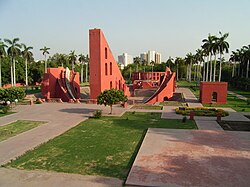
[[File:Jantar Mantar Delhi 27-05-2005.jpg|thumb|220px|The observatory built by Sawai Jai Singh in Delhi]] | [[File:Jantar Mantar Delhi 27-05-2005.jpg|thumb|220px|[[Jantar Mantar, New Delhi|The observatory]] built by Sawai Jai Singh in Delhi]] | ||
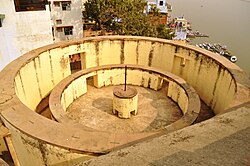
He ordered the construction of five such buildings—at [[Delhi]], [[Mathura, Uttar Pradesh|Mathura]] (in his Agra province), [[Varanasi#Jantar Mantar|Benares]], [[Ujjain]] (capital of his Malwa province), and his own capital of [[Jaipur]]. His astronomical observations were remarkably accurate. He drew up a set of tables, entitled ''Zij-i-Muhammadshahi'', to enable people to make astronomical observations. He instigated the translation into Sanskrit of Euclid's ''Elements of Geometry'', several works on trigonometry, and Napier's work on the construction and use of logarithms.<ref name=mitra1995>{{Cite journal|author=Umasankar Mitra|title=Astronomical Observatories of Maharaja Jai Singh|publisher=NCERT|journal=School Science|volume=23|year=1995|issue=4|pages=45–48|url=http://www.ncert.nic.in/publication/journals/pdf_files/school_science/sc_June_2009.pdf}}</ref> Relying primarily on [[Indian astronomy]], his observatories were used to accurately predict eclipses and other astronomical events. The observational techniques and instruments used in his observatories were also superior to those used by the European [[Jesuit]] astronomers he invited to his observatories.<ref>{{citation|title=Sawai Jai Singh and His Astronomy|first=Virendra Nath|last=Sharma|year=1995|publisher=[[Motilal Banarsidass]] Publ.|isbn=81-208-1256-5|pages=8–9}}</ref><ref>{{citation|title=The Science of Empire: Scientific Knowledge, Civilization, and Colonial Rule in India|first=Zaheer|last=Baber|year=1996|publisher=[[State University of New York Press]]|isbn=0-7914-2919-9|pages=82–90}}</ref> Termed as the [[Jantar Mantar]], they consisted of the ''Ram Yantra'' (a cylindrical building with an open top and a pillar in its center), the ''Jai Prakash'' (a concave hemisphere), the ''Samrat Yantra'' (a huge equinoctial dial), the ''Digamsha Yantra'' (a pillar surrounded by two circular walls), and the ''Narivalaya Yantra'' (a cylindrical dial). | |||
[[File:Digansa Yantra.JPG|thumb|Jantar Mantar in Varanasi]] | [[File:Digansa Yantra.JPG|thumb|Jantar Mantar in Varanasi]] | ||
The ''Samrat Yantra'' is a huge [[sundial]]. It can be used to estimate the [[Time zone|local time]], to locate the [[Pole Star]], and to measure the [[declination]] of celestial objects. The ''Rama Yantra'' can be used to measure the [[altitude]] and [[azimuth]] of celestial objects. The ''Shanku Yantra'' can be used to measure the [[latitude]] of the place.<ref name=mitra1995/> | The ''Samrat Yantra'' is a huge [[sundial]]. It can be used to estimate the [[Time zone|local time]], to locate the [[Pole Star]], and to measure the [[declination]] of celestial objects. The ''Rama Yantra'' can be used to measure the [[altitude]] and [[azimuth]] of celestial objects. The ''Shanku Yantra'' can be used to measure the [[latitude]] of the place.<ref name=mitra1995/> | ||
Jai Singh's greatest achievement was the construction of [[Jaipur]] | Jai Singh's greatest achievement was the construction of the city of [[Jaipur]] (known originally as Jai Nagara<ref>{{Cite book |last=Tillotson |first=Giles |url=https://books.google.com/books?id=mR1eDwAAQBAJ&q=jai+nagar |title=Jaipur Nama: Tales From The Pink City |publisher=Penguin Random House India |year=2006 |isbn=9789387625167}}</ref> in Sanskrit and as the 'city of victory' and later as the 'pink city' by the British by the early 20th century). The planned city later became the capital of the Indian state of Rajasthan. Construction of the new capital began as early as 1725, although it was only in 1727 that the foundation stone was ceremonially laid. By 1733, Jaipur officially replaced Amber as the capital of the Kachawahas. Built on the ancient Hindu grid pattern, found in the archaeological ruins of 3000 BCE,{{Clarify|reason=What ruins?|date=January 2024}} it was designed by [[Vidyadhar Bhattacharya]], who was educated in the ancient Sanskrit manuals on city-planning and architecture (''silpa-sutras''). Merchants from all over India settled down in the relative safety of this rich city, protected by thick walls and a garrison of 17,000 (including adequate artillery). The Sanskrit epic 'Ishvar Vilas Mahakavya', written by [[Kavikalanidhi Devarshi Shrikrishna Bhatt]], recounts various important events of that era, including the construction of Jaipur city, in detail.<ref>‘Īśvara Vilāsa Mahākāvya’, Ed. Bhatt Mathuranath Shastri, Jagdish Sanskrit Pustakalaya, Jaipur, 2006. He was born in 1686, Rajasthan. He was a great Indian astronomer, architect, and a mathematician he ascended the throne of Amber at age of 13. At age of 15, he was honoured with title of Sawai meaning One And A quarter he built five jantar mantars, four of which are situated in Ujjain, varanasi, delhi, jaipur . while the one in Mathura no more exists he himself designed the three major instruments known as Ram Yantra, Samrat Yantra and Jai Prakash. | ||
Samrat Yantra is basically a huge sundial. Its accuracy is up to half a minute. | |||
he built five jantar mantars , four of which are situated in Ujjain , varanasi , delhi , jaipur . while the one in Mathura no more exists | |||
He planned and built the city of Jaipur in 1727, which is a model of ''town planning and architecture''.</ref> | |||
He planned and built the city of Jaipur in | |||
Jai Singh also translated works by people like [[John Napier]]. For these multiple achievements, Jai Singh II is remembered as the most enlightened king of 18th-century [[India]] even to this date. These days Jai Singh's observatories at [[Jaipur]], [[Varanasi]], and [[Ujjain]] are functional. Only the one at Delhi is not functional and the one at [[Mathura]] disappeared a long time ago.<ref>Sharma, Virendra Nath (1995), ''Sawai Jai Singh and His Astronomy'', Motilal Banarasidass, {{ISBN|81-208-1256-5}}</ref> | Jai Singh also translated works by people like [[John Napier]]. For these multiple achievements, Jai Singh II is remembered as the most enlightened king of 18th-century [[India]] even to this date. These days Jai Singh's observatories at [[Jaipur]], [[Varanasi]], and [[Ujjain]] are functional. Only the one at Delhi is not functional and the one at [[Mathura]] disappeared a long time ago.<ref>Sharma, Virendra Nath (1995), ''Sawai Jai Singh and His Astronomy'', Motilal Banarasidass, {{ISBN|81-208-1256-5}}</ref> | ||
| Line 110: | Line 137: | ||
==External links== | ==External links== | ||
{{commons category}} | {{commons category}} | ||
*[https://web.archive.org/web/20061207200908/http://uqconnect.net/~zzhsoszy/ips/j/jaipur.html Genealogy of the rulers of Jaipur] | *[https://web.archive.org/web/20061207200908/http://uqconnect.net/~zzhsoszy/ips/j/jaipur.html Genealogy of the rulers of Jaipur] (archived 7 December 2006) | ||
{{Jaipur}} | {{Jaipur}} | ||
{{Maharajas of Jaipur}} | {{Maharajas of Jaipur}} | ||
| Line 116: | Line 143: | ||
{{DEFAULTSORT:Jai Singh 02 Of Amber}} | {{DEFAULTSORT:Jai Singh 02 Of Amber}} | ||
[[Category: | [[Category:1688 births]] | ||
[[Category:1743 deaths]] | [[Category:1743 deaths]] | ||
[[Category:Maharajas of Jaipur]] | [[Category:Maharajas of Jaipur]] | ||
| Line 125: | Line 152: | ||
[[Category:18th-century Indian mathematicians]] | [[Category:18th-century Indian mathematicians]] | ||
[[Category:18th-century Indian monarchs]] | [[Category:18th-century Indian monarchs]] | ||
[[Category:Scholars from | [[Category:Scholars from Rajputana]] | ||
[[Category:18th-century Mughal Empire people]] | |||
Latest revision as of 18:08, 1 March 2026
| Sawai Raja Jai Singh II | |||||||||
|---|---|---|---|---|---|---|---|---|---|
| Saramad-e-Raja-e-Hindustan Raj-Rajeshwar Raj-Rajendra Shri Maharajadhiraj Maharaja Sawai Bahadur[1] Shri [2] | |||||||||
 Sawai Jai Singh's portrait (1725) from British Museum | |||||||||
| 30th Raja of Amber | |||||||||
| Reign | 5 March 1699 – 18 November 1727 | ||||||||
| Coronation | 5 March 1699 (first) 25 January 1700 (second) | ||||||||
| Predecessor | Bishan Singh | ||||||||
| Successor | Ishwari Singh of Jaipur | ||||||||
| 1st Raja of Jaipur | |||||||||
| Reign | 18 November 1727 – 21 September 1743 | ||||||||
| Successor | Ishwari Singh | ||||||||
| Subahdar of Malwa | |||||||||
| Reign | 25 October 1732 – 24 December 1737 | ||||||||
| Emperor | Muhammad Shah | ||||||||
| Predecessor | Muhammad Khan Bangash | ||||||||
| Successor | Nizam-ul-Mulk, Asaf Jah I | ||||||||
| Born | Kunwar Vijay Singh 3 November 1688 Kharwa, Ajmer Subah, Mughal Empire | ||||||||
| Died | 21 September 1743 (aged 54) Jaipur, Jaipur State, Rajputana | ||||||||
| Burial | |||||||||
| Spouse |
| ||||||||
| Issue | Sons
| ||||||||
| |||||||||
| Dynasty | Kachhwaha | ||||||||
| Father | Bishan Singh | ||||||||
| Mother | Rathorji Indra Kanwarji d. of Rao Kesari Singh of Kharwa in Ajmer[3] | ||||||||
| Religion | Hinduism | ||||||||
Sawai Jai Singh II (3 November 1688 – 21 September 1743), was the 30th Kachwaha Rajput ruler of the Kingdom of Amber, who later founded the fortified city of Jaipur and made it his capital. He became the ruler of Amber at the age of 11, after the untimely death of his father Mirza Raja Bishan Singh on 31 December 1699.[4]
Initially, Raja Jai Singh served as a vassal of the Mughal Empire. He was given the title of "Sawai" by Mughal Emperor Aurangzeb before the siege of Khelna Fort in Deccan."Sawai" means one and a quarter times superior to his contemporaries. He received the title of "Maharaja Sawai, Raj Rajeshwar, Shri Rajadhiraj " in the year 1723 which happened to be the reign of later Mughals under emperor Muhammad Shah; this was in addition to the title of "Saramad-i-Raja-i-Hindustan", conferred on him on 21 April 1721.[1][5]
In the later part of his life Sawai Jai Singh broke free from Mughal hegemony, and to assert his sovereignty, performed the Ashvamedha sacrifice, an ancient rite that had been abandoned for several centuries.[6][7] He moved his kingdom's capital from the town of Amber to the newly established walled city of Jaipur in 1727 and performed two Ashwamedha sacrifices, one in 1734, and again in 1741.[8]
Sawai Jai Singh II other than administration and state craftship had a profound interest in the fields of Mathematics, Architecture, Astronomy, Astrology and Literature. He commissioned the Jantar Mantar observatories at multiple places in India, including his capital Jaipur.[9] He had Euclid's "Elements of Geometry" translated into Sanskrit.[10]
The situation on his accession[edit | edit source]
When Jai Singh acceded to the ancestral throne at Amber, he had barely enough resources to pay for the support of 1000 cavalry. This abysmal situation had arisen during the previous 96 years, coinciding with the reign of the Mughal Emperor Aurangzeb. The Jaipur kings had always preferred diplomacy over arms in their dealings with the Mughals, since their kingdom was located so close to the Mughal power centers of Delhi and Agra.
Six months after his accession, Jai Singh was ordered by Aurangzeb to serve in the Deccan Wars. However, there was a delay of about one year in his responding to the call. One reason for this was that he was ordered to recruit a large force, in excess of the contingent required by his mansab. He also had to conclude his marriage with the daughter of Udit Singh, the nephew of Raja Uttam Ram Gaur of Sheopur, in March 1701. Jai Singh reached Burhanpur on 3 August 1701, but he could not proceed further due to heavy rains. On 13 September 1701, an additional cut in his rank (by 500) and pay was made.[11] His feat of arms at the siege of Khelna (1702) was rewarded with the mere restoration of his earlier rank and the title of Sawai (meaning one and a quarter, i.e., more capable than one man). When Aurangzeb's grandson Bidar Bakht deputed Sawai Jai Singh to govern the province of Malwa (1704), Aurangzeb angrily revoked this appointment as jaiz nist (invalid).
War with the Mughals[edit | edit source]
The Mughal emperor Bahadur Shah I conferred the title of Mirza Raja to Jai Singh's younger brother, Vijay Singh, and declared him as the Raja of Amber ousting Jai Singh from the throne and demoting him to an ordinary Jagirdar. In response, Jai Singh formed a political alliance with the Kingdom of Marwar and matrimonial alliance with the Kingdom of Mewar against the emperor, leading to the Rajput rebellion and re-annexation of lost territories.
Jai Singh and the Marathas[edit | edit source]
The Kachwaha ruler was appointed to govern Malwa three times between 1714 and 1737. In Jai Singh's first viceroyalty (subahdar) of Malwa (1714–1717), isolated Maratha war-bands that entered the province from the south (Deccan) were constantly defeated and repulsed by Jai Singh.[12] In 1728, Peshwa Baji Rao defeated the Nizam of Hyderabad, part of the Mughal Deccan (Treaty of Shevgaon, March 1728). With an agreement from Baji Rao to spare the Nizam's own domains, the Nizam allowed the Marathas a free passage through Berar and Khandesh, the gateway into Hindustan.[13] The Marathas were then able to plant a permanent camp beyond the southern frontier of Malwa. Following the victory of the Peshwa's brother, Chimaji Appa, over the governor of Malwa Girdhar Bahadur on 29 November 1728, coupled with the subsequent rebellion in Bundelkhand led by Chhatra Sal with Maratha support, the Marathas were able to convulse much of the country beyond the Northern and Southern borders of the Narmada.[14]
Upon Jai Singh's second appointment to Malwa (1729–1730), as a far-sighted statesmen, Jai Singh was able to perceive a complete change in the political situation, during the twelve years which had passed since his first viceroyalty there. Imperial power had by then been crippled by the rebellion of the Nizam of Hyderabad as well as the ability of Peshwa Baji Rao to stabilize the internal situation of the Marathas, which resulted in their occupation of Gujarat and an immense increase of their forces. Nonetheless, in the name of the friendship between their royal ancestors, Jai Singh II, was able to appeal to Shahu to restore to the imperialist, the great fortress of Mandu which the Marathas had occupied a few weeks earlier (order date 19 March 1730). By May, Jai Singh was recalled back to Rajputana to attend more pressing matters, which thus resulted in his two years disassociation from Malwa.[citation needed]
In 1732, Jai Singh was for the last time, appointed Subahdar of Malwa (1732–1737), during which time he petitioned Muhammad Shah to compromise with the Marathas under Shahu, who remembered the positive relationship between the late Jai Singh I and his own grandfather, Shivaji. For this sensible advice, coupled with anti–Jai Singh rhetoric at the Mughal court at Delhi, as well as Muhammad Shah's inability to assert his own will, Jai Singh was removed from his post while the Mughals decided on war. In this regard, Jai Singh II was practically the last subahdar of Malwa, as Nizam-ul-Mulk Asaf Jah, who replaced him in 1737, met with most discomfiting failure at the hands of the Peshwa, resulting with the ceding of the whole of Malwa to the Marathas (Treaty of Duraha, Saturday 7 January 1738).[15][better source needed]
Exploiting the weakening of the Mughal state, the Persian raider Nadir Shah defeated the Mughals at Karnal (13 February 1739) and finally sacked Delhi (11 March, same year). Through this period of turmoil, Jai Singh remained in his own state—but he was not idle. Foreseeing the troubled time ahead, Jai Singh II initiated a program of extensive fortification within the thikanas under Jaipur. To this day, most of the later fortifications around the former Jaipur state, are attributed to the reign of Jai Singh II.
Militarization[edit | edit source]
Jai Singh increased the size of his ancestral kingdom by annexing lands from the Mughals and rebel chieftains—sometimes by paying money and sometimes through war. The most substantial acquisition was of Shekhawati, which also gave Jai Singh the most able recruits for his fast-expanding army.[16]
According to an estimate by Jadunath Sarkar, Jai Singh's regular army did not exceed 40,000 men, which would have cost about 60 lakhs a year, but his strength lay in the large number of artillery and copious supply of munitions which he was careful to maintain and his rule of arming his foot with matchlocks instead of the traditional Rajput sword and shield - He had the wisdom to recognize early the change which firearms had introduced in Indian warfare and to prepare for himself for the new war by raising the fire-power of his army to the maximum,[clarification needed] he thus anticipated the success of later Indian rulers like Mirza Najaf Khan, Mahadji Sindhia and Tipu Sultan. Jai Singh's experimental weapon, the Jaivana, which he created prior to the shift of his capital to Jaipur, remains the largest wheeled cannon in the world. In 1732, Jai Singh, as governor of Malwa, maintained a force of 30,000 soldiers, split evenly into horsemen and foot-musketeers. This figure does not include his contingents in the Subahs of Agra and Ajmer or in his own dominions and fort garrisons.
Diplomacy in Rajputana[edit | edit source]

The armed strength of Jai Singh had made him the most formidable ruler in Northern India, and all the other Rajas looked up to him for protection and the promotion of their interests at the Imperial court. As the fast-spreading Maratha dominion and their raids into the north had caused alarm among the Rajput chiefs, Jai Singh called a conference of Rajput rulers at Hurda (1734) to deal with this peril, but nothing came of it. In 1736, Peshwa Baji Rao imposed tribute on the Kingdom of Mewar. To thwart further Maratha expansion, Sawai Jai Singh planned the formation of a local hegemony, led by Jaipur, and a political union in Rajputana. To this end, he annexed Bundi and Rampura in the Malwa plateau, strengthen alliance with Mewar, and intervened in the affairs of the Rathores of Bikaner and Jodhpur. These half-successful attempts only stiffened the backs of the other Rajput clans, who turned to the Marathas for aid, consequently hastening that state's domination over Rajasthan. Jai Singh's ambitions in Rajputana failed after the Battle of Gangwana.
Death and succession[edit | edit source]
The Battle of Gangwana was Jai Singh's last significant battle.Due to old age and some health issues he died two years later, in 1743. Madho Singh later avenged his father by poisoning Bakht Singh of Marwar. Jai Singh was cremated at the Royal Crematorium at Gaitore in the north of Jaipur. He was succeeded by his[17] son Ishwari Singh.[18][19]
Contributions to society, culture, and science[edit | edit source]
Jai Singh was the first Hindu ruler in centuries to perform ancient Vedic ceremonies like the Ashwamedha sacrifices (1716)[20] and the Vajapeya (1734); on both occasions, vast amounts were distributed in charity. Being initiated in the Nimbarka Sampradaya of the Vaishnava sect, he also promoted Sanskrit learning and initiated reforms in Hindu society, including the abolition of Sati and the reduction of wasteful expenditures associated with Rajput weddings. It was at Jai Singh's insistence that the hated jaziya tax, imposed on the Hindu population by Aurangzeb (1679), was finally abolished by the Emperor Muhammad Shah in 1720. In 1728, Jai Singh prevailed on him to also withdraw the pilgrimage tax on Hindus at Gaya.[citation needed]
In 1719, he was witness to a noisy controversy in the court of Mughal Emperor Muhammad Shah. The argument concerned astronomical calculations intended determine an auspicious date on which the emperor could start a journey. This discussion led Jai Singh to believe that the nation needed to be educated on the subject of astronomy. His interest may have been kindled as early as 1702 by his tutor Jagannatha Samrat. Despite local wars, foreign invasions, and consequent turmoil, Jai Singh found time and energy to build astronomical observatories.[19]

He ordered the construction of five such buildings—at Delhi, Mathura (in his Agra province), Benares, Ujjain (capital of his Malwa province), and his own capital of Jaipur. His astronomical observations were remarkably accurate. He drew up a set of tables, entitled Zij-i-Muhammadshahi, to enable people to make astronomical observations. He instigated the translation into Sanskrit of Euclid's Elements of Geometry, several works on trigonometry, and Napier's work on the construction and use of logarithms.[21] Relying primarily on Indian astronomy, his observatories were used to accurately predict eclipses and other astronomical events. The observational techniques and instruments used in his observatories were also superior to those used by the European Jesuit astronomers he invited to his observatories.[22][23] Termed as the Jantar Mantar, they consisted of the Ram Yantra (a cylindrical building with an open top and a pillar in its center), the Jai Prakash (a concave hemisphere), the Samrat Yantra (a huge equinoctial dial), the Digamsha Yantra (a pillar surrounded by two circular walls), and the Narivalaya Yantra (a cylindrical dial).

The Samrat Yantra is a huge sundial. It can be used to estimate the local time, to locate the Pole Star, and to measure the declination of celestial objects. The Rama Yantra can be used to measure the altitude and azimuth of celestial objects. The Shanku Yantra can be used to measure the latitude of the place.[21]
Jai Singh's greatest achievement was the construction of the city of Jaipur (known originally as Jai Nagara[24] in Sanskrit and as the 'city of victory' and later as the 'pink city' by the British by the early 20th century). The planned city later became the capital of the Indian state of Rajasthan. Construction of the new capital began as early as 1725, although it was only in 1727 that the foundation stone was ceremonially laid. By 1733, Jaipur officially replaced Amber as the capital of the Kachawahas. Built on the ancient Hindu grid pattern, found in the archaeological ruins of 3000 BCE,[clarification needed] it was designed by Vidyadhar Bhattacharya, who was educated in the ancient Sanskrit manuals on city-planning and architecture (silpa-sutras). Merchants from all over India settled down in the relative safety of this rich city, protected by thick walls and a garrison of 17,000 (including adequate artillery). The Sanskrit epic 'Ishvar Vilas Mahakavya', written by Kavikalanidhi Devarshi Shrikrishna Bhatt, recounts various important events of that era, including the construction of Jaipur city, in detail.[25]
Jai Singh also translated works by people like John Napier. For these multiple achievements, Jai Singh II is remembered as the most enlightened king of 18th-century India even to this date. These days Jai Singh's observatories at Jaipur, Varanasi, and Ujjain are functional. Only the one at Delhi is not functional and the one at Mathura disappeared a long time ago.[26]
See also[edit | edit source]
References[edit | edit source]
- ↑ 1.0 1.1 Sarkar, Jadunath (1994) A History of Jaipur, New Delhi: Orient Blackswan, ISBN 81-250-0333-9, pp. 171, 173
- ↑ Sarkar, Jadunath (1984, reprint 1994) A History of Jaipur, New Delhi: Orient Longman, ISBN 81-250-0333-9, p. 171
- ↑ Harnath Singh, Jaipur and its Environs (1970), p. 9
- ↑ Andrew Topsfield (2000). Court Painting in Rajasthan. Marg. p. 50. ISBN 978-81-85026-47-3.
- ↑ Prahlad Singh; Kalyan Dutt Sharma (1978). Stone observatories in India, erected by Maharaja Sawai Jai Singh of Jaipur. Bharata Manisha. p. 57.
- ↑ Ajay Verghese (2016). The Colonial Origins of Ethnic Violence in India. Stanford University Press. p. 64. ISBN 978-0-8047-9817-4.
- ↑ Yamini Narayanan (2014). Religion, Heritage and the Sustainable City: Hinduism and urbanisation in Jaipur. Routledge. p. 106. ISBN 978-1-135-01269-4.
- ↑ Catherine B Asher (2008). "Excavating Communalism: Kachhwaha Rajadharma and Mughal Sovereignty". In Rajat Datta (ed.). Rethinking a Millennium: Perspectives on Indian History from the Eighth to the Eighteenth Century : Essays for Harbans Mukhia. Aakar Books. p. 232. ISBN 978-81-89833-36-7.
- ↑ Virendra Nath Sharma (1995). Sawai Jai Singh and His Astronomy. Motilal Banarsidass Publ. pp. 2, 98. ISBN 978-81-208-1256-7.
- ↑ Chandara, Bipan. History of Modern India. Orient Black Swan.
- ↑ Sarkar, Jadunath (1984, reprint 1994) A History of Jaipur, New Delhi: Orient Longman, ISBN 81-250-0333-9, p. 157
- ↑ R.K. Gupta, S.R. Bakshi (2008). Studies In Indian History: Rajasthan Through The Ages The Heritage Of Rajputs (1st ed.). Sarup and sons. pp. 92–93. ISBN 978-81-76258-418.
- ↑ Sarkar, Jadunath (1984, reprint 1994) A History of Jaipur, New Delhi: Orient Longman, ISBN 81-250-0333-9, p. 175
- ↑ R.K. Gupta, S.R. Bakshi (2008). Studies In Indian History: Rajasthan Through The Ages The Heritage Of Rajputs (1st ed.). Sarup and sons. pp. 129–130. ISBN 9788176258418.
- ↑ "Military History & Fiction: Malwa and Gujarat". horsesandswords.blogspot.com. Archived from the original on 20 May 2007. Retrieved 30 June 2022.
- ↑ "Military History & Fiction: Shekhawati". 20 October 2006. Archived from the original on 20 October 2006. Retrieved 20 August 2020.
- ↑ Sarkar, Jadunath (1964). texts Fall Of The Mughal Empire. Vol. 1. Orient BlackSwan. p. 150. ISBN 978-8125032458.
- ↑ Vir Vinod, Rajasthan Through the Ages By R.K. Gupta, S.R. Bakshi p. 156
- ↑ 19.0 19.1 Pingree, David (1999). "An Astronomer's Progress". Proceedings of the American Philosophical Society. 143 (1): 73–85. ISSN 0003-049X. JSTOR 3181975.
- ↑ Bowker, John, The Oxford Dictionary of World Religions, New York, Oxford University Press, 1997, p. 103
- ↑ 21.0 21.1 Umasankar Mitra (1995). "Astronomical Observatories of Maharaja Jai Singh" (PDF). School Science. 23 (4). NCERT: 45–48.
- ↑ Sharma, Virendra Nath (1995), Sawai Jai Singh and His Astronomy, Motilal Banarsidass Publ., pp. 8–9, ISBN 81-208-1256-5
- ↑ Baber, Zaheer (1996), The Science of Empire: Scientific Knowledge, Civilization, and Colonial Rule in India, State University of New York Press, pp. 82–90, ISBN 0-7914-2919-9
- ↑ Tillotson, Giles (2006). Jaipur Nama: Tales From The Pink City. Penguin Random House India. ISBN 9789387625167.
- ↑ ‘Īśvara Vilāsa Mahākāvya’, Ed. Bhatt Mathuranath Shastri, Jagdish Sanskrit Pustakalaya, Jaipur, 2006. He was born in 1686, Rajasthan. He was a great Indian astronomer, architect, and a mathematician he ascended the throne of Amber at age of 13. At age of 15, he was honoured with title of Sawai meaning One And A quarter he built five jantar mantars, four of which are situated in Ujjain, varanasi, delhi, jaipur . while the one in Mathura no more exists he himself designed the three major instruments known as Ram Yantra, Samrat Yantra and Jai Prakash. Samrat Yantra is basically a huge sundial. Its accuracy is up to half a minute. He planned and built the city of Jaipur in 1727, which is a model of town planning and architecture.
- ↑ Sharma, Virendra Nath (1995), Sawai Jai Singh and His Astronomy, Motilal Banarasidass, ISBN 81-208-1256-5
Bibliography[edit | edit source]
- Bhatnagar, V. S. (1974) Life and Times of Sawai Jai Singh, 1688-1743, Delhi: Impex India
- Sarkar, Jadunath (1984, reprint 1994) A History of Jaipur, New Delhi: Orient Longman, ISBN 81-250-0333-9
- Jyoti J. (2001) Royal Jaipur, Roli Books, ISBN 81-7436-166-9
- Tillotson G, (2006) Jaipur Nama, Penguin books
- Schwarz, Michiel (1980) Observatoria : De astronomische instrumenten van Maharaja Sawai Jai Singh II in New Delhi, Jaipur, Ujjain en Benares, Amsterdam: Westland/Utrecht Hypothekbank
- Sharma, Virendra Nath (1995, revised edition 2016) Sawai Jai Singh and his Astronomy, Delhi: Motilal Barnasidass Publishers
External links[edit | edit source]
- Genealogy of the rulers of Jaipur (archived 7 December 2006)
Jaipur topics | |||||||
|---|---|---|---|---|---|---|---|
| History | |||||||
| Government and localities | |||||||
| Economy | |||||||
| Buildings and landmarks |
| ||||||
| Transport |
| ||||||
| Culture | |||||||
| Education |
| ||||||
