

m small update page and fixed typos |
|||
| Line 1: | Line 1: | ||
{{ | {{Short description|Bird species}} | ||
{{ | {{Redirect|Emerald dove|other species and the emerald dove genus|Chalcophaps}} | ||
{{ | {{Speciesbox | ||
| name = Common emerald dove | | name = Common emerald dove | ||
| status = LC | | status = LC | ||
| status_system = IUCN3.1 | | status_system = IUCN3.1 | ||
| status_ref = <ref>{{ | | status_ref = <ref name="iucn status 19 November 2021">{{cite iucn |author=BirdLife International |date=2016 |title=''Chalcophaps indica'' |volume=2016 |article-number=e.T22725538A94895385 |doi=10.2305/IUCN.UK.2016-3.RLTS.T22725538A94895385.en |access-date=19 November 2021}}</ref> | ||
| image = | | image = Asian Emerald Dove 0A2A7379.jpg | ||
| image_caption = | | image_caption = | ||
| genus = Chalcophaps | | genus = Chalcophaps | ||
| Line 16: | Line 16: | ||
}} | }} | ||
The '''common emerald dove''' (''Chalcophaps indica''), also called '''Asian emerald dove''' and '''grey-capped emerald dove''', is a widespread resident breeding [[Columbidae|pigeon]] native to the tropical and subtropical parts of the [[Indian | The '''emerald dove''' or '''common emerald dove''' ('''''Chalcophaps indica'''''), also called '''Asian emerald dove''' and '''grey-capped emerald dove''', is a widespread resident breeding [[Columbidae|pigeon]] native to the tropical and subtropical parts of the [[Indian subcontinent]] and [[Southeast Asia]]. The dove is also known by the names of '''green dove''' and '''green-winged pigeon'''. The common emerald dove is the state bird of the Indian state of [[Tamil Nadu]]. The [[Pacific emerald dove]] and [[Stephan's emerald dove]] were both considered [[conspecific]]. | ||
==Taxonomy== | ==Taxonomy== | ||
In 1743 the English naturalist [[George Edwards (naturalist)|George Edwards]] included a picture and a description of the common emerald dove in his ''A Natural History of Uncommon Birds''. He used the English name "Green Wing'd Dove". His drawing was made from a live bird at the home a merchant in [[Rotherhithe]] near London. Edwards was told that the dove had come from the [[East Indies]].<ref>{{ cite book | last=Edwards | first=George | author-link=George Edwards (naturalist) | year=1743 | title=A Natural History of Uncommon Birds | place=London | publisher=Printed for the author, at the College of Physicians | page=14 | url=https://www.biodiversitylibrary.org/page/50240534 }}</ref> When in 1758 the Swedish naturalist [[Carl Linnaeus]] updated his ''[[Systema Naturae]]'' for the [[10th edition of Systema Naturae|tenth edition]], he placed the common emerald dove with all the other pigeons in the [[genus]] ''[[Columba (genus)|Columba]]''. Linnaeus included a brief description, coined the [[binomial name]] ''Columba indica'' and cited Edwards's work.<ref>{{cite book | last=Linnaeus | first=Carl | author-link=Carl Linnaeus | year=1758 | title= Systema Naturae per regna tria naturae, secundum classes, ordines, genera, species, cum characteribus, differentiis, synonymis, locis | volume= | In 1743, the English naturalist [[George Edwards (naturalist)|George Edwards]] included a picture and a description of the common emerald dove in his ''A Natural History of Uncommon Birds''. He used the English name "Green Wing'd Dove". His drawing was made from a live bird at the home a merchant in [[Rotherhithe]] near London. Edwards was told that the dove had come from the [[East Indies]].<ref>{{ cite book | last=Edwards | first=George | author-link=George Edwards (naturalist) | year=1743 | title=A Natural History of Uncommon Birds | volume=Part I & II | place=London | publisher=Printed for the author, at the College of Physicians | page=14, Plate 14 | url=https://www.biodiversitylibrary.org/page/50240534 }}</ref> When in 1758 the Swedish naturalist [[Carl Linnaeus]] updated his ''[[Systema Naturae]]'' for the [[10th edition of Systema Naturae|tenth edition]], he placed the common emerald dove with all the other pigeons in the [[genus]] ''[[Columba (genus)|Columba]]''. Linnaeus included a brief description, coined the [[binomial name]] ''Columba indica'' and cited Edwards's work.<ref>{{cite book | last=Linnaeus | first=Carl | author-link=Carl Linnaeus | year=1758 | title= Systema Naturae per regna tria naturae, secundum classes, ordines, genera, species, cum characteribus, differentiis, synonymis, locis | volume= 1 | edition=10th | page=164 | publisher=Holmiae:Laurentii Salvii | language=la | url=https://www.biodiversitylibrary.org/page/727071 }}</ref> The [[specific epithet]] ''indica'' is Latin for "Indian" and is used by Linnaeus to denote the [[East Indies]].<ref>{{cite book | last=Jobling | first=James A. | year=2010| title=The Helm Dictionary of Scientific Bird Names | publisher=Christopher Helm | location=London | isbn=978-1-4081-2501-4 | page=204 }}</ref> The species is now placed in the genus ''[[Chalcophaps]]'' that was introduced by the English ornithologist [[John Gould]] in 1843.<ref>{{ cite book | last=Gould | first=John | author-link=John Gould | year=1843 | title=The Birds of Australia | publisher=self published | place=London | volume= 5 | at=Plate 62 and text | url=https://www.biodiversitylibrary.org/page/48401179 }}</ref><ref name=ioc>{{cite web| editor1-last=Gill | editor1-first=Frank | editor1-link=Frank Gill (ornithologist) | editor2-last=Donsker | editor2-first=David | editor3-last=Rasmussen | editor3-first=Pamela | editor3-link=Pamela Rasmussen | year=2020 | title=Pigeons | work=IOC World Bird List Version 10.1 | url=https://www.worldbirdnames.org/bow/pigeons/ | publisher=International Ornithologists' Union | access-date=18 March 2020 }}</ref> | ||
Six [[subspecies]] are recognised:<ref name=ioc/> | Six [[subspecies]] are recognised:<ref name=ioc/> | ||
| Line 36: | Line 36: | ||
== Distribution and habitat == | == Distribution and habitat == | ||
This is a common species in [[tropical forest]]s and similar dense wet [[woodland]]s, [[farm]]s and [[mangrove]]s.<ref name=hbw/><ref name=rasmussen>{{ cite book | last1=Rasmussen | first1=Pamela C. | author1-link=Pamela C. Rasmussen | last2=Anderton | first2=John C. | year=2012 | title=Birds of South Asia. The Ripley Guide | volume= | This is a common species in [[tropical forest]]s and similar dense wet [[woodland]]s, [[farm]]s and [[mangrove]]s.<ref name=hbw/><ref name=rasmussen>{{ cite book | last1=Rasmussen | first1=Pamela C. | author1-link=Pamela C. Rasmussen | last2=Anderton | first2=John C. | year=2012 | title=Birds of South Asia. The Ripley Guide | volume= 2 | edition=2nd | publisher=Smithsonian National Museum of Natural History and Lynx Edicions | place=Washington D.C. and Barcelona | isbn=978-84-96553-87-3 | pages=211–212 }}</ref> It builds a scant stick [[Bird nest|nest]] in a [[tree]] up to five metres and lays two cream-coloured [[bird egg|egg]]s. | ||
== Behaviour and ecology == | == Behaviour and ecology == | ||
{{ | [[File:Asian Emerald Dove.jpg|thumb|In flight at [[Chitwan National Park]], [[Nepal]].]] | ||
The call of the common emerald dove is a low soft moaning cooing consisting of about six to seven coos, starting quietly and rising. It also calls a nasal "hoo-hoo-hoon". Males perform a bobbing dance during [[courtship display]].<ref>{{Cite book |last=Brown, J. |author-link=Jennifer Brown (author) |title=Husbandry Guidelines For the Emerald Dove ''Chalcophaps indica'' |publisher=[[Western Sydney Institute of TAFE]] |date=2010 |edition= |issue=2}}</ref> | |||
Its flight is fast and direct, with the regular beats and an occasional sharp flick of the [[wing]]s which are characteristic of pigeons in general. It often flies low between | It is either single, or occurs in pairs or in small groups.{{cn|date=March 2026}} It searches for fallen [[fruit]] on the ground and spends little time in trees except when roosting. It eats [[seed]]s and fruits of a wide variety of [[plant]]s and is generally tame and approachable. | ||
Its flight is fast and direct, with the regular beats and an occasional sharp flick of the [[wing]]s which are characteristic of pigeons in general. It often flies low between patches of dense forest, but when disturbed, it frequently walks away. It is a particularly good weaver when flying through [[forest]]s.{{cn|date=March 2026}} | |||
== References == | == References == | ||
{{Reflist}} | {{Reflist}} | ||
* Grimmett, ''Birds of India'', Inskipp and Inskipp, {{ISBN|0-691-04910-6}} | * Grimmett, ''Birds of India'', Inskipp and Inskipp, {{ISBN|0-691-04910-6}} | ||
| Line 57: | Line 55: | ||
{{Taxonbar|from=Q795565}} | {{Taxonbar|from=Q795565}} | ||
[[Category:Chalcophaps|common emerald dove]] | [[Category:Chalcophaps|common emerald dove]] | ||
[[Category:Birds of | [[Category:Birds of Indomalaya]] | ||
[[Category:Birds of | [[Category:Birds of Taiwan]] | ||
[[Category:Birds described in 1758|common emerald dove]] | [[Category:Birds described in 1758|common emerald dove]] | ||
[[Category: | [[Category:Animal taxa named by Carl Linnaeus|common emerald dove]] | ||
Latest revision as of 17:59, 6 March 2026
| Common emerald dove | |
|---|---|

| |
Scientific classification 
| |
| : | [[Template:Taxonomy/Chalcophaps]] |
| Species: | Template:Taxonomy/ChalcophapsC. indica
|
| Binomial name | |
| Template:Taxonomy/ChalcophapsChalcophaps indica | |
| Subspecies | |
|
See text | |
| Synonyms | |
|
Columba indica Linnaeus, 1758 | |
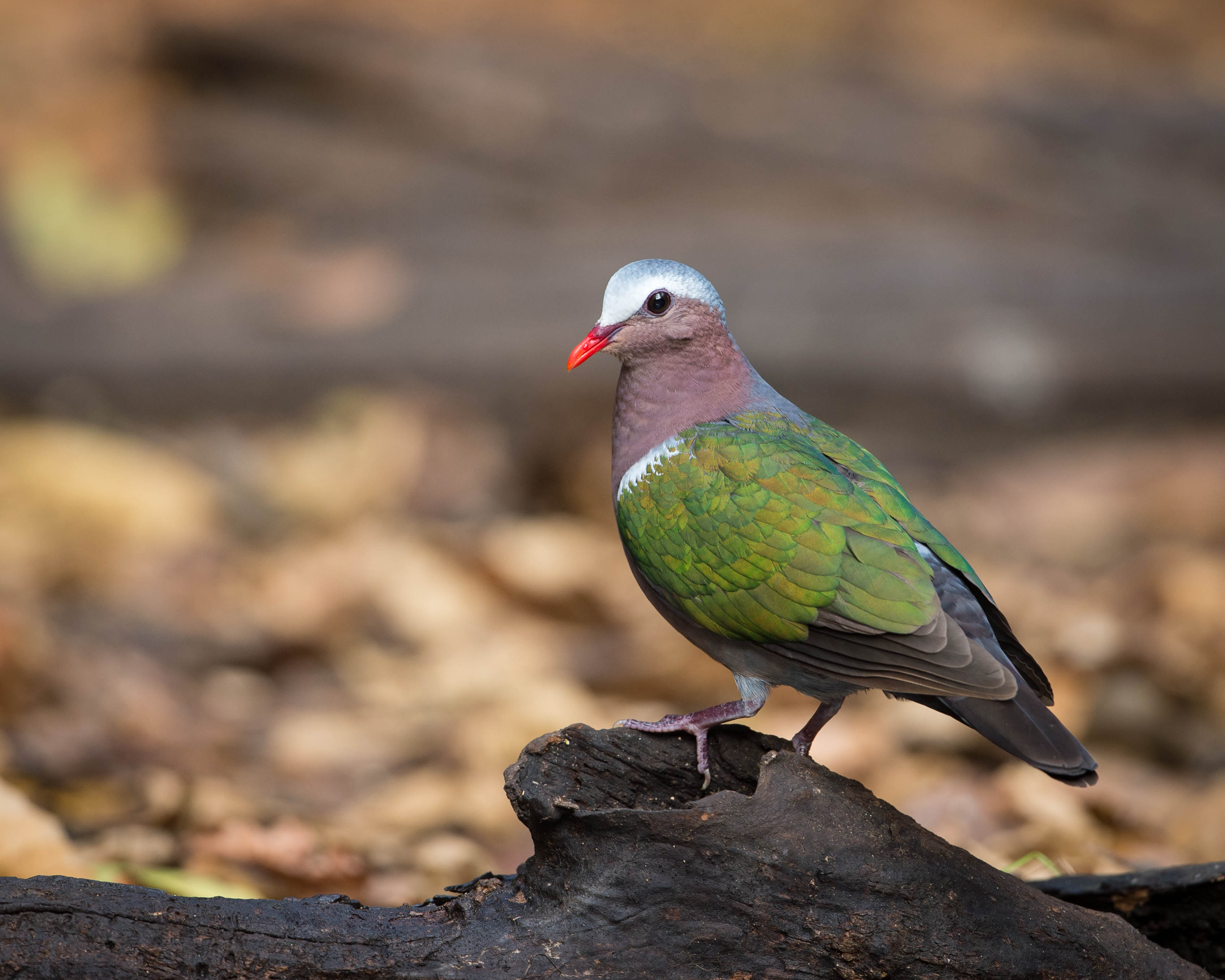
The emerald dove or common emerald dove (Chalcophaps indica), also called Asian emerald dove and grey-capped emerald dove, is a widespread resident breeding pigeon native to the tropical and subtropical parts of the Indian subcontinent and Southeast Asia. The dove is also known by the names of green dove and green-winged pigeon. The common emerald dove is the state bird of the Indian state of Tamil Nadu. The Pacific emerald dove and Stephan's emerald dove were both considered conspecific.
Taxonomy[edit | edit source]
In 1743, the English naturalist George Edwards included a picture and a description of the common emerald dove in his A Natural History of Uncommon Birds. He used the English name "Green Wing'd Dove". His drawing was made from a live bird at the home a merchant in Rotherhithe near London. Edwards was told that the dove had come from the East Indies.[2] When in 1758 the Swedish naturalist Carl Linnaeus updated his Systema Naturae for the tenth edition, he placed the common emerald dove with all the other pigeons in the genus Columba. Linnaeus included a brief description, coined the binomial name Columba indica and cited Edwards's work.[3] The specific epithet indica is Latin for "Indian" and is used by Linnaeus to denote the East Indies.[4] The species is now placed in the genus Chalcophaps that was introduced by the English ornithologist John Gould in 1843.[5][6]
Six subspecies are recognised:[6]
- C. i. indica (Linnaeus, 1758) – India to south China, Malaysia, Philippines, Indonesian and west Papuan islands
- C. i. robinsoni Baker, ECS, 1928 – Sri Lanka
- C. i. maxima Hartert, 1931 – Andaman Islands
- C. i. augusta Bonaparte, 1855 – Nicobar Islands
- C. i. natalis Lister, 1889 – Christmas Island (Indian Ocean)
- C. i. minima Hartert, 1931 – Numfor, Biak and Mios Num islands (off north New Guinea)
Description[edit | edit source]

.jpg)
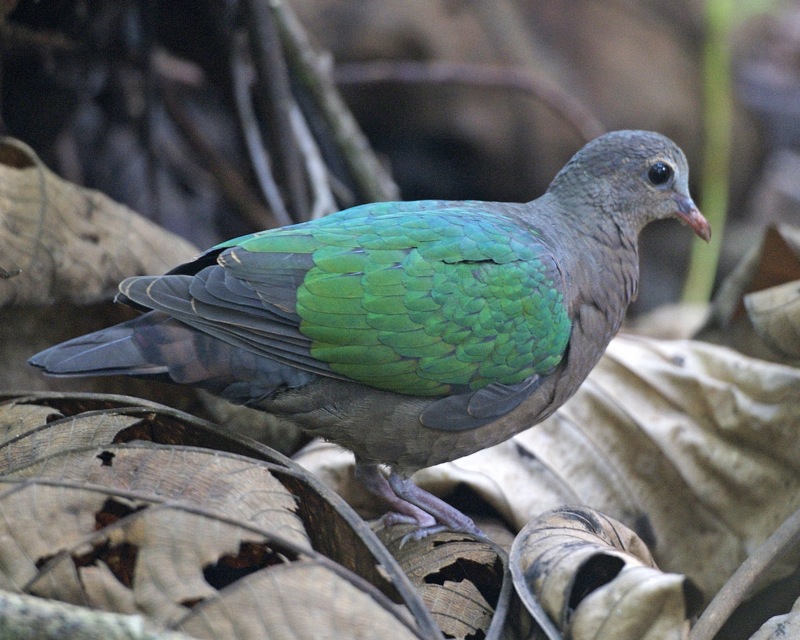
The common emerald dove is a stocky, medium-sized pigeon, typically 23–27 cm (9.1–10.6 in) in length.[7] The back and wings are bright emerald green. The flight feathers and tail are blackish, and broad black and white bars show on the lower back in flight. The head and underparts are dark vinous pink, fading to greyish on the lower belly. The eyes are dark brown, the bill bright red and legs and feet rufous. The male has a white patch on the edge of the shoulders and a grey crown, which the female lacks. Females will tend to have a browner complexion with a grey mark on the shoulder. Immature birds resemble females but have brown scallops on their body and wing plumage.
Distribution and habitat[edit | edit source]
This is a common species in tropical forests and similar dense wet woodlands, farms and mangroves.[7][8] It builds a scant stick nest in a tree up to five metres and lays two cream-coloured eggs.
Behaviour and ecology[edit | edit source]

The call of the common emerald dove is a low soft moaning cooing consisting of about six to seven coos, starting quietly and rising. It also calls a nasal "hoo-hoo-hoon". Males perform a bobbing dance during courtship display.[9] It is either single, or occurs in pairs or in small groups.[citation needed] It searches for fallen fruit on the ground and spends little time in trees except when roosting. It eats seeds and fruits of a wide variety of plants and is generally tame and approachable. Its flight is fast and direct, with the regular beats and an occasional sharp flick of the wings which are characteristic of pigeons in general. It often flies low between patches of dense forest, but when disturbed, it frequently walks away. It is a particularly good weaver when flying through forests.[citation needed]
References[edit | edit source]
- ↑ BirdLife International (2016). "Chalcophaps indica". IUCN Red List of Threatened Species. 2016 e.T22725538A94895385. doi:10.2305/IUCN.UK.2016-3.RLTS.T22725538A94895385.en. Retrieved 19 November 2021.
- ↑ Edwards, George (1743). A Natural History of Uncommon Birds. Vol. Part I & II. London: Printed for the author, at the College of Physicians. p. 14, Plate 14.
- ↑ Linnaeus, Carl (1758). Systema Naturae per regna tria naturae, secundum classes, ordines, genera, species, cum characteribus, differentiis, synonymis, locis (in Latina). Vol. 1 (10th ed.). Holmiae:Laurentii Salvii. p. 164.
{{cite book}}: CS1 maint: publisher location (link) - ↑ Jobling, James A. (2010). The Helm Dictionary of Scientific Bird Names. London: Christopher Helm. p. 204. ISBN 978-1-4081-2501-4.
- ↑ Gould, John (1843). The Birds of Australia. Vol. 5. London: self published. Plate 62 and text.
- ↑ 6.0 6.1 Gill, Frank; Donsker, David; Rasmussen, Pamela, eds. (2020). "Pigeons". IOC World Bird List Version 10.1. International Ornithologists' Union. Retrieved 18 March 2020.
- ↑ 7.0 7.1 Baptista, L.F.; Trail, P.W.; Horblit, H.M.; Kirwan, G.M.; Garcia, E.F.J.; Boesman, P. (2020). del Hoyo, J.; Elliott, A.; Sargatal, J.; Christie, D.A.; de Juana, E. (eds.). "Grey-capped Emerald Dove (Chalcophaps indica)". Handbook of the Birds of the World Alive. Lynx Edicions. Retrieved 18 March 2020.
- ↑ Rasmussen, Pamela C.; Anderton, John C. (2012). Birds of South Asia. The Ripley Guide. Vol. 2 (2nd ed.). Washington D.C. and Barcelona: Smithsonian National Museum of Natural History and Lynx Edicions. pp. 211–212. ISBN 978-84-96553-87-3.
- ↑ Brown, J. (2010). Husbandry Guidelines For the Emerald Dove Chalcophaps indica. Western Sydney Institute of TAFE.
- Grimmett, Birds of India, Inskipp and Inskipp, ISBN 0-691-04910-6