



No edit summary |
cleanup article for consistency and fixed typos after review |
||
| Line 1: | Line 1: | ||
{{Short description|British Army units composed of Gurkhas}} | {{Short description|British Army units composed of Nepalese Gurkhas}} | ||
{{Use dmy dates|date=November 2022}} | {{Use dmy dates|date=November 2022}} | ||
{{British Army Arms}} | {{British Army Arms}} | ||
{{Infobox military unit | {{Infobox military unit | ||
| unit_name = Brigade of Gurkhas | | unit_name = Brigade of Gurkhas | ||
| Line 8: | Line 7: | ||
| image_size = 180px | | image_size = 180px | ||
| caption = Brigade insignia | | caption = Brigade insignia | ||
| dates = | | dates = 1815–present<ref>{{cite news | url=https://www.gwt.org.uk/about-the-gurkhas/gurkhas/ | title=Who are they | the Gurkha Welfare Trust | About the Gurkhas | newspaper=The Gurkha Welfare Trust }}</ref> | ||
| | | country = {{flag|United Kingdom}} | ||
| allegiance = [[King Charles III]] | |||
| branch = {{army|United Kingdom}} | | branch = {{army|United Kingdom}} | ||
| type = [[Assault troops]] | | type = [[Assault troops]] | ||
| size = ~4090<ref>https://assets.publishing.service.gov.uk/government/uploads/system/uploads/attachment_data/file/990125/SPS_1_Apr_2021.pdf | | size = ~4090<ref>{{cite web|url=https://assets.publishing.service.gov.uk/government/uploads/system/uploads/attachment_data/file/990125/SPS_1_Apr_2021.pdf|title=UK Armed Forces Quarterly Service Personnel Statistics|archive-url=https://web.archive.org/web/20230327010828/https://assets.publishing.service.gov.uk/government/uploads/system/uploads/attachment_data/file/990125/SPS_1_Apr_2021.pdf|url-status=live|archive-date=2023-03-27|access-date=2023-08-12}}</ref> | ||
| role = [[Land warfare]]<br />[[Expeditionary warfare]]<br />[[Airborne forces]] | | role = [[Land warfare]]<br />[[Expeditionary warfare]]<br />[[Airborne forces]] | ||
| command_structure = | | command_structure = | ||
| current_commander = | | current_commander = | ||
| garrison = [[Staff College, Camberley]] | | garrison = [[Staff College, Camberley]] | ||
| ceremonial_chief = [[ | | ceremonial_chief = [[Charles III]] | ||
| ceremonial_chief_label = Commander-in-Chief | | ceremonial_chief_label = Commander-in-Chief | ||
| nickname = ''''The Gurkhas''" | | nickname = ''''The Gurkhas''" | ||
| Line 30: | Line 30: | ||
| battles = | | battles = | ||
| identification_symbol = [[Image:Gurkhas TRF.svg|90px]] | | identification_symbol = [[Image:Gurkhas TRF.svg|90px]] | ||
| identification_symbol_label = Tactical Recognition Flash | | identification_symbol_label = [[Tactical Recognition Flash]] | ||
| notable_commanders = | | notable_commanders = | ||
| anniversaries = | | anniversaries = | ||
}} | }} | ||
'''Brigade of Gurkhas''' is the collective name which refers to all the units in the [[British Army]] that are composed of [[Gurkha|Nepalese Gurkha]] soldiers.<ref>{{Cite web |title=» Who are they? |url=https://www.gwt.org.uk/about-the-gurkhas/gurkhas/ |access-date=2022-10-28 |website=www.gwt.org.uk}}</ref> The brigade draws its heritage from Gurkha units that originally served in the [[British Indian Army]] prior to Indian independence, and prior to that served for the [[East India Company]].<ref>{{Cite web |last=Latter |first=Mick |date=2013-03-25 |title=Gurkhas, Nepal and the East India Company |url=https://www.gurkhabde.com/gurkhas-nepal-and-east-india-companyu/ |access-date=2022-10-28 |website=Welcome to the Gurkha Brigade Association |language=en-GB}}</ref> The brigade includes infantry, engineering, signal, logistic and training and support units. They are known for their [[khukuri]], a distinctive heavy knife with a curved blade, and have a reputation for being fierce and brave soldiers. | |||
The brigade celebrated 200 years of service in the British Army in 2015.<ref>{{cite news|title=200th anniversary of the Gurkhas: fierce, loyal and brave, Britain must thank them for their service|url=https://www.telegraph.co.uk/news/uknews/defence/11518142/200th-anniversary-of-the-Gurkhas-fierce-loyal-and-brave-Britain-must-thank-them-for-their-service.html|access-date=22 May 2015|work=The Telegraph|date=7 April 2015}}</ref><ref>{{cite news|title=Nepali men have been fighting for Britain for 200 years|url=https://www.washingtonpost.com/news/in-sight/wp/2015/04/30/nepali-men-have-been-fighting-for-britain-for-200-years-one-photographer-shows-what-it-means-to-be-the-gurkhas/|newspaper=The Washington Post|access-date=23 May 2015|date=30 April 2015}}</ref> | The brigade celebrated 200 years of service in the British Army in 2015.<ref>{{cite news|title=200th anniversary of the Gurkhas: fierce, loyal and brave, Britain must thank them for their service|url=https://www.telegraph.co.uk/news/uknews/defence/11518142/200th-anniversary-of-the-Gurkhas-fierce-loyal-and-brave-Britain-must-thank-them-for-their-service.html|access-date=22 May 2015|work=The Telegraph|date=7 April 2015}}</ref><ref>{{cite news|title=Nepali men have been fighting for Britain for 200 years|url=https://www.washingtonpost.com/news/in-sight/wp/2015/04/30/nepali-men-have-been-fighting-for-britain-for-200-years-one-photographer-shows-what-it-means-to-be-the-gurkhas/|newspaper=The Washington Post|access-date=23 May 2015|date=30 April 2015}}</ref> | ||
| Line 43: | Line 43: | ||
{{See also | British Indian Army | Gorkha_regiments_(India) | l2= Gurkha regiments history | Royal_Gurkha_Rifles#History | l3 = Royal Gurkha Rifles history | Gurkhas }} | {{See also | British Indian Army | Gorkha_regiments_(India) | l2= Gurkha regiments history | Royal_Gurkha_Rifles#History | l3 = Royal Gurkha Rifles history | Gurkhas }} | ||
During the [[the Gurkha War|war in Nepal]] in 1814, in which the British | During the [[the Gurkha War|war in Nepal]] in 1814, in which the British failed to annex [[Nepal]] into the Empire, Army officers were shocked by the tenacity of the Gurkha soldiers and encouraged them to volunteer for the [[Honourable East India Company|East India Company]]. Gurkhas served as troops of the Company in the [[Pindaree War]] of 1817, in [[Bharatpur, Nepal]] in 1826, and the [[First Anglo-Sikh War|First]] and [[Second Anglo-Sikh War|Second]] Sikh Wars in 1846 and 1848. During the [[Indian Rebellion of 1857|Sepoy Mutiny]] in 1857, the Gurkha [[regiment]]s remained loyal to the British, and became part of the [[British Indian Army]] on its formation. The [[2nd Gurkha Rifles]] (The Sirmoor Rifles) and the [[Royal Green Jackets|60th Rifles]] famously defended [[Raja Hindu Rao|Hindu Rao]]'s house.<ref>{{cite web|url=https://www.telegraph.co.uk/news/worldnews/asia/nepal/1339272/Artist-captures-key-moment-of-Gurkha-loyalty.html|title=Artist captures key moment of Gurkha loyalty|publisher=The Telegraph|date=2 September 2001|access-date=16 May 2014}}</ref> | ||
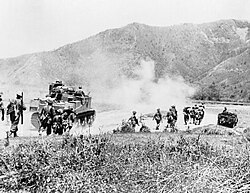
[[File:Imphalgurkhas.jpg|thumb|right|Gurkhas advancing with [[tank]]s to clear the [[Empire of Japan|Japanese]] from the Imphal–Kohima road]] | [[File:Imphalgurkhas.jpg|thumb|right|Gurkhas advancing with [[tank]]s to clear the [[Empire of Japan|Japanese]] from the Imphal–Kohima road]] | ||
During the [[Malayan Emergency]] in the late 1940s, Gurkhas fought as jungle soldiers as they had done in [[Burma]].<ref>{{cite web|url=http://www.colonialfilm.org.uk/node/3278|title=Operations by 1st Battalion 6th Gurkha Rifles during the Malayan Emergency|access-date=16 May 2014}}</ref> The Training Depot Brigade of Gurkhas was established on 15 August 1951 at [[Sungai Petani]], [[Kedah]], [[Federation of Malaya|Malaya]].<ref name=scmp/> After the conflict ended, the Gurkhas were transferred to [[Hong Kong]], where they carried out security duties.<ref name=scmp>{{cite web|url= | During the [[Malayan Emergency]] in the late 1940s, Gurkhas fought as jungle soldiers as they had done in [[Burma]].<ref>{{cite web|url=http://www.colonialfilm.org.uk/node/3278|title=Operations by 1st Battalion 6th Gurkha Rifles during the Malayan Emergency|access-date=16 May 2014}}</ref> The Training Depot Brigade of Gurkhas was established on 15 August 1951 at [[Sungai Petani]], [[Kedah]], [[Federation of Malaya|Malaya]].<ref name=scmp/> After the conflict ended, the Gurkhas were transferred to [[Hong Kong]], where they carried out security duties.<ref name=scmp>{{cite web|url=https://www.scmp.com/lifestyle/article/1458561/nepalese-community-hong-kong-looks-preserve-gurkha-legacy|title=The Nepalese community in Hong Kong looks to preserve Gurkha legacy|date=28 March 2014 |publisher=Lifestyle|access-date=16 May 2014}}</ref> The troops patrolled the border checking for illegal immigrants entering the territory, most crucially during the turbulence of the [[Cultural Revolution]]. They were deployed to contain crowds during the [[Hong Kong 1966 riots|Star Ferry riots of 1966]]. | ||
After Indian independence and [[Partition of India|partition]] in 1947, under the [[Britain-India-Nepal Tripartite Agreement|Tripartite Agreement]], six Gurkha regiments joined the post-independence [[Indian Army]]. Four Gurkha regiments, the [[2nd Gurkha Rifles|2nd]], [[6th Gurkha Rifles|6th]], [[7th Gurkha Rifles|7th]], and [[10th Gurkha Rifles]], joined the British Army on 1 January 1948.<ref name=research>{{cite web|url=http://www.thegurkhamuseum.co.uk/Research/16|title=The Gurkha Museum Winchester|access-date=15 May 2014|archive-url=https://web.archive.org/web/20141216154247/http://www.thegurkhamuseum.co.uk/Research/16|archive-date=2014-12-16|url-status=dead}}</ref> The [[2nd King Edward VII's Own Gurkha Rifles (The Sirmoor Rifles)|1st/2nd Gurkha Rifles]] was deployed to [[Brunei]] at the outbreak of the [[Brunei Revolt]] in 1962.<ref>{{cite web|url=http://www.iwm.org.uk/collections/item/object/80019433|title=British officer served with 1/2nd Gurkha Rifles in Brunei Rebellion, 1962–1963|publisher=Imperial War Museum|access-date=16 May 2014}}</ref> In 1974 [[Turkish invasion of Cyprus|Turkey invaded Cyprus]] and the 10th Gurkha Rifles was sent to defend the British sovereign base area of [[Dhekelia Cantonment|Dhekelia]].<ref>{{cite web|url=http://www.10gr.com/html/History.htm|title=A short history of the 10th Princess Mary's own Gurkha Rifles|access-date=16 May 2014|url-status=dead|archive-url=https://web.archive.org/web/20140517114320/http://www.10gr.com/html/History.htm|archive-date=17 May 2014}}</ref> In 1982, during the [[Falklands War]], the 7th Gurkha Rifles formed part of 5 Infantry Brigade and was responsible for capturing Mount William shortly before the Argentinian surrender.<ref>{{cite book |last=Middlebrook |first=Martin |title=The Falklands War |year=2012 |location=Barnsley, UK |publisher=Pen & Sword Military |pages=374-375|isbn=978-1-84884-636-4}}</ref> | |||
On 1 July 1994, the four rifle regiments were merged into one, the [[Royal Gurkha Rifles]], and the three corps regiments (the Gurkha Military Police having been disbanded in 1965) were reduced to [[Squadron (army)|squadron]] strength. On 1 July 1997, the British government [[handover of Hong Kong|transferred sovereignty over Hong Kong]] to the [[People's Republic of China]], which led to the closing of the local British garrison. Gurkha HQ and recruit training were moved to the UK.<ref name=scmp/> The Royal Gurkha Rifles took part in operations in [[Kosovo]] in 1999, in [[UN peacekeeping operations]] in [[East Timor]] in 2000 and in [[Sierra Leone]] later that year.<ref>{{cite web|url=http://www.rgrra.com/index.php/history|title=The Royal Gurkha Rifles: Regimental History|access-date=16 May 2014|archive-date=27 April 2014|archive-url=https://web.archive.org/web/20140427015121/http://www.rgrra.com/index.php/history|url-status=usurped}}</ref> | |||
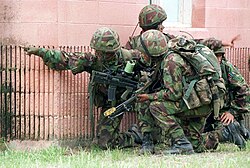
[[File:Gurkhas exercise DM-SD-98-00170.jpg|thumb|right|Gurkhas undergoing an urban warfare exercise in the United States. Note the [[kukri]] on the webbing of the nearest soldier | [[File:Gurkhas exercise DM-SD-98-00170.jpg|thumb|right|Gurkhas undergoing an urban warfare exercise in the United States. Note the [[kukri]] on the webbing of the nearest soldier]] | ||
In September 2008 the High Court in London ruled that the British Government must issue clear guidance on the criteria against which Gurkhas may be considered for settlement rights in the UK. On 21 May 2009, and following a lengthy [[Gurkha Justice Campaign|campaign by Gurkha veterans]], the British [[Home Secretary]], [[Jacqui Smith]], announced that all Gurkha veterans who had served four years or more in the British Army before 1997 would be allowed to settle in Britain.<ref>{{cite news|url= http://news.bbc.co.uk/1/hi/uk_politics/8060607.stm|title= Gurkhas win right to settle in UK|work= BBC News|date= 21 May 2009|access-date= 24 May 2009}}</ref> | In September 2008, the High Court in London ruled that the British Government must issue clear guidance on the criteria against which Gurkhas may be considered for settlement rights in the UK. On 21 May 2009, and following a lengthy [[Gurkha Justice Campaign|campaign by Gurkha veterans]], the British [[Home Secretary]], [[Jacqui Smith]], announced that all Gurkha veterans who had served four years or more in the British Army before 1997 would be allowed to settle in Britain.<ref>{{cite news|url= http://news.bbc.co.uk/1/hi/uk_politics/8060607.stm|title= Gurkhas win right to settle in UK|work= BBC News|date= 21 May 2009|access-date= 24 May 2009}}</ref> | ||
== British Gurkha units 1947–1994 == | == British Gurkha units 1947–1994 == | ||
| Line 76: | Line 78: | ||
== Today == | == Today == | ||
[[File:Band of the Brigade of Gurkhas.jpg|thumb|Band of the Brigade of Gurkhas performing in France, 2014 | [[File:Band of the Brigade of Gurkhas.jpg|thumb|Band of the Brigade of Gurkhas performing in France, 2014]] | ||
Current units of the Brigade of Gurkhas include:<ref>{{cite web|url=http://www.gurkhabde.com/brigade-of-gurkhas/|title=Serving Brigade of Gurkhas|date=13 February 2013 |access-date=15 May 2014}}</ref> | Current units of the Brigade of Gurkhas include:<ref>{{cite web|url=http://www.gurkhabde.com/brigade-of-gurkhas/|title=Serving Brigade of Gurkhas|date=13 February 2013 |access-date=15 May 2014}}</ref> | ||
* HQ, Brigade of Gurkhas, at the former [[Staff College, Camberley]] in Surrey<ref>{{cite news|url=https://www.gurkhabde.com/hqbg-opening-ceremony-at-camberley/|title=HQBG opening ceremony at Camberley|date=11 April 2014|publisher=The Gurkha Brigade Association|access-date=29 January 2021}}</ref> | * HQ, Brigade of Gurkhas, at the former [[Staff College, Camberley]] in Surrey<ref>{{cite news|url=https://www.gurkhabde.com/hqbg-opening-ceremony-at-camberley/|title=HQBG opening ceremony at Camberley|date=11 April 2014|publisher=The Gurkha Brigade Association|access-date=29 January 2021}}</ref> | ||
**[[Queen's Gurkha Signals]] | **[[Queen's Gurkha Signals]] | ||
*** 242 Squadron (part of 22 Signal Regiment), in Stafford | |||
*** 243 Squadron (part of 15 Signal Regiment) | |||
*** 246 Squadron (part of 2 Signal Regiment) | *** 246 Squadron (part of 2 Signal Regiment) | ||
*** 247 Squadron (part of 16 Signal Regiment) | *** 247 Squadron (part of 16 Signal Regiment) | ||
| Line 89: | Line 93: | ||
*** Nepal Signal Troop, in [[Kathmandu]] supporting [[British Gurkhas Nepal|HQ British Gurkhas Nepal]] | *** Nepal Signal Troop, in [[Kathmandu]] supporting [[British Gurkhas Nepal|HQ British Gurkhas Nepal]] | ||
** [[Royal Gurkha Rifles]] | ** [[Royal Gurkha Rifles]] | ||
*** 1st Battalion, | *** 1st Battalion, Royal Gurkha Rifles in [[Brunei]] – a light infantry battalion, part of [[British Forces Brunei]] | ||
*** 2nd Battalion, | *** 2nd Battalion, Royal Gurkha Rifles in [[Shorncliffe Army Camp|Shorncliffe]] – an [[air assault]] infantry battalion, part of [[16 Air Assault Brigade]] | ||
*** Coriano Company, | ***A (Krithia) Company, Royal Gurkha Rifles in [[Belfast]] – a special operations infantry company (part of 1st Battalion, [[Ranger Regiment (United Kingdom)|Ranger Regiment]]) | ||
*** Falklands Company, | ***G (Coriano) Company, Royal Gurkha Rifles in [[Aldershot]] – a special operations infantry company (part of 4th Battalion, [[Ranger Regiment (United Kingdom)|Ranger Regiment]]) | ||
**Queen's Gurkha Engineers<ref name=":0">{{Cite web|last=Cooper|first=Tim|title=Queen's Gurkha Engineers Celebrate 73rd Birthday|url=https://www.forces.net/services/gurkhas/queens-gurkha-engineers-celebrate-their-73rd-birthday|access-date=2021-09-27|website=Forces Network|language=en}}</ref> | ***F (Falklands) Company, Royal Gurkha Rifles in Aldershot – a special operations infantry company (part of 2nd Battalion, [[Ranger Regiment (United Kingdom)|Ranger Regiment]]) | ||
*** 69 Gurkha Field Squadron | **Queen's Gurkha Engineers<ref name=":0">{{Cite web|last=Cooper|first=Tim|title=Queen's Gurkha Engineers Celebrate 73rd Birthday|url=https://www.forces.net/services/gurkhas/queens-gurkha-engineers-celebrate-their-73rd-birthday|access-date=2021-09-27|website=Forces Network|date=25 September 2021 |language=en}}</ref> | ||
*** 70 Gurkha Field Support Squadron | *** 67 Gurkha Field Squadron, in [[Invicta Park Barracks|Maidstone]] | ||
**[[10 Queen's Own Gurkha Logistic Regiment RLC|10th Queen's Own Gurkha Logistic Regiment RLC]], in [[Aldershot Garrison|Aldershot]]<ref>[http://webarchive.nationalarchives.gov.uk/20121019014916/http://www.mod.uk:80/DefenceInternet/DefenceNews/HistoryAndHonour/RoyalVisitFor50yearoldGurkhaRegiment.htm Royal Visit For 50 year old Gurkha Regiment]. The national archives. Retrieved 12 February 2012</ref> | *** 69 Gurkha Field Squadron, in [[Invicta Park Barracks|Maidstone]]<ref name=":0" /> | ||
**[[Gurkha Allied Rapid Reaction Corps Support Battalion]] | *** 70 Gurkha Field Support Squadron, in Maidstone<ref name=":0" /><ref>{{Cite web|title=British Army units from 1945 on - 36 Regiment|url=http://british-army-units1945on.co.uk/royal-engineers/regiments---major-units/36-regiment.html|website=british-army-units1945on.co.uk}}</ref> | ||
**[[British Gurkhas Nepal]] – recruits for the British Army and Singapore Police, handles soldier and ex-soldier welfare<ref>{{Cite web|title=British Gurkhas Nepal|url=https://www.army.mod.uk/who-we-are/corps-regiments-and-units/brigade-of-gurkhas/british-gurkhas-nepal/|access-date=20 February 2019|website=British Army|language=en-GB}}</ref> | **King's Gurkha Artillery in Larkhill<ref>{{cite web |author=<!-- not stated --> |date=2 June 2025 |title=Gurkhas arrive in Larkhill for The King’s Gurkha Artillery |url=https://www.gurkhabde.com/news/gurkhas-arrive-in-larkhill/ |website=Gurkha Brigade Association |location= |publisher= |access-date=5 August 2025}}</ref> | ||
**[[10 Queen's Own Gurkha Logistic Regiment RLC|10th Queen's Own Gurkha Logistic Regiment RLC]], in [[Aldershot Garrison|Aldershot]]<ref>{{usurped|1=[http://webarchive.nationalarchives.gov.uk/20121019014916/http://www.mod.uk:80/DefenceInternet/DefenceNews/HistoryAndHonour/RoyalVisitFor50yearoldGurkhaRegiment.htm Royal Visit For 50 year old Gurkha Regiment]}}. The national archives. Retrieved 12 February 2012</ref> | |||
**[[Gurkha Allied Rapid Reaction Corps Support Battalion]]{{efn|Established in 1993 as Headquarters Allied Rapid Reaction Corps Support Battalion, for many years it included numbers of Gurkhas. In August 2021, the battalion added the subtitle 'Gurkha', and is now officially subsumed into the Brigade of Gurkhas.<ref>British Army, ''[https://edition.pagesuite-professional.co.uk/html5/reader/production/default.aspx?pubname=&edid=0377652b-c123-4bff-8806-61b9af842025 August 2021 Soldier Magazine]''. Retrieved 13 August 2021.</ref>}} | |||
**[[British Gurkhas Nepal]] – recruits for the British Army and the [[Gurkha Contingent]] of the [[Singapore Police Force]], handles soldier and ex-soldier welfare<ref>{{Cite web|title=British Gurkhas Nepal|url=https://www.army.mod.uk/who-we-are/corps-regiments-and-units/brigade-of-gurkhas/british-gurkhas-nepal/|access-date=20 February 2019|website=British Army|language=en-GB}}</ref> | |||
**Gurkha Staff and Personnel Support Company – administration for all Brigade of Gurkhas units<ref>{{Cite web|url=https://www.army.mod.uk/who-we-are/corps-regiments-and-units/brigade-of-gurkhas/gurkha-staff-and-personnel-support/|title=Gurkha Staff and Personnel Support|website=British Army|language=en-GB|access-date=20 February 2019}}</ref> | **Gurkha Staff and Personnel Support Company – administration for all Brigade of Gurkhas units<ref>{{Cite web|url=https://www.army.mod.uk/who-we-are/corps-regiments-and-units/brigade-of-gurkhas/gurkha-staff-and-personnel-support/|title=Gurkha Staff and Personnel Support|website=British Army|language=en-GB|access-date=20 February 2019}}</ref> | ||
** [[Band of the Brigade of Gurkhas]] (raised in November 1859, then in 1st Gurkha Rifles) | ** [[Band of the Brigade of Gurkhas]] (raised in November 1859, then in 1st Gurkha Rifles) | ||
** Gurkha Company | ** Gurkha Company (Babaji) at the [[Infantry Training Centre (British Army)|Infantry Training Centre, Catterick]] | ||
** Gurkha Company (Sittang) at the [[Royal Military Academy Sandhurst]] | ** Gurkha Company (Sittang) at the [[Royal Military Academy Sandhurst]] | ||
** Gurkha | ** Gurkha Company (Mandalay) at the [[Infantry Battle School]], Brecon | ||
** Gurkha Training Support Company (Tavoleto) at [[Waterloo Lines]], Warminster | ** Gurkha Training Support Company (Tavoleto) at [[Waterloo Lines]], Warminster | ||
** Brigade Training Team | ** Brigade Training Team | ||
| Line 109: | Line 116: | ||
In 2018, the UK Government announced that it intended to expand the brigade by more than 800 posts, with the Queen's Gurkha Engineers receiving an additional squadron, while the Queen’s Gurkha Signals and the Queen's Own Gurkha Logistic Regiment will receive two new squadrons. Additionally, approximately 300 new posts within the Royal Gurkha Rifles will be created forming a new battalion planned for the Specialist Infantry role.<ref>{{cite web |url=http://www.janes.com/article/81826/uk-to-recruit-more-gurkha-soldiers |title=UK to recruit more Gurkha soldiers |last=Ripley |first=Tim |date=18 July 2018|website=Jane's 360 |access-date=20 July 2018 }}</ref><ref>{{cite web |url=http://ukarmedforcescommentary.blogspot.com/2016/08/good-news-and-confirmation-of-bad-habit.html |title=Good news and a confirmation of a bad habit |last=Molinelli |first=Gabriele |date=4 August 2016 |website=UK Armed Forces Commentary |access-date=20 July 2018 }}</ref> In 2018, it was announced that from 2020, female applicants would be able to apply to join the Gurkhas.<ref>{{cite web |url=https://www.bbc.co.uk/news/uk-44844438 |title=Gurkhas to recruit women for first time from 2020 |date=16 July 2018 |website=BBC News |access-date=20 July 2018 }}</ref> However, this decision was reversed in 2019.<ref>{{cite news|url=https://www.nepalitimes.com/banner/girl-gurkhas/|title=Girl Gurkhas|publisher=Nepali Times|date=23 July 2019|access-date=24 November 2020}}</ref> | In 2018, the UK Government announced that it intended to expand the brigade by more than 800 posts, with the Queen's Gurkha Engineers receiving an additional squadron, while the Queen’s Gurkha Signals and the Queen's Own Gurkha Logistic Regiment will receive two new squadrons. Additionally, approximately 300 new posts within the Royal Gurkha Rifles will be created forming a new battalion planned for the Specialist Infantry role.<ref>{{cite web |url=http://www.janes.com/article/81826/uk-to-recruit-more-gurkha-soldiers |title=UK to recruit more Gurkha soldiers |last=Ripley |first=Tim |date=18 July 2018|website=Jane's 360 |access-date=20 July 2018 }}</ref><ref>{{cite web |url=http://ukarmedforcescommentary.blogspot.com/2016/08/good-news-and-confirmation-of-bad-habit.html |title=Good news and a confirmation of a bad habit |last=Molinelli |first=Gabriele |date=4 August 2016 |website=UK Armed Forces Commentary |access-date=20 July 2018 }}</ref> In 2018, it was announced that from 2020, female applicants would be able to apply to join the Gurkhas.<ref>{{cite web |url=https://www.bbc.co.uk/news/uk-44844438 |title=Gurkhas to recruit women for first time from 2020 |date=16 July 2018 |website=BBC News |access-date=20 July 2018 }}</ref> However, this decision was reversed in 2019.<ref>{{cite news|url=https://www.nepalitimes.com/banner/girl-gurkhas/|title=Girl Gurkhas|publisher=Nepali Times|date=23 July 2019|access-date=24 November 2020}}</ref> | ||
In April 2025, the UK government announced a further increase by creating a new artillery regiment within the brigade, bearing the name the King's Gurkha Artillery. As with other Gurkha units affiliated to the support arms and services, the King's Gurkha Artillery will have its own unique cap badge combining elements that illustrate its Gurkha heritage and the heritage of its parent unit, in this case the [[Royal Artillery]]. The creation of the King's Gurkha Artillery will mark the first time that Gurkhas have served in their own dedicated [[artillery]] unit in the British Army.<ref>{{Cite web |title=New King’s Gurkha Artillery Unit to boost Armed Forces Capabilities |url=https://www.gov.uk/government/news/new-kings-gurkha-artillery-unit-to-boost-armed-forces-capabilities |access-date=2025-04-28 |website=GOV.UK |language=en}}</ref><ref>{{Cite web |date=2025-04-28 |title=New 400-strong King's Gurkha Artillery regiment announced in front of MPs |url=https://www.forcesnews.com/services/gurkhas/new-400-strong-kings-gurkha-artillery-regiment-announced |access-date=2025-04-28 |website=www.forcesnews.com |language=en}}</ref>{{efn|Although the King's Gurkha Artillery is the first dedicated Gurkha artillery regiment, Gurkhas have previously served in the artillery role during their time in the British Army. Following the transfer of Gurkha regiments after Indian independence, it was decided to bring all Gurkha units under the command of a single, all-arms division. This led to the two battalions of the 7th Gurkha Rifles being selected for conversion to artillery as 101 and 102 Field Regiments, Royal Artillery. But, owing to the need for experienced infantry soldiers trained in jungle warfare as a result of the [[Malayan Emergency]], the two regiments were re-roled back to infantry after just a year.<ref>{{cite web |author=<!-- not stated --> |date= |title=The King’s Gurkha Artillery – an historical perspective on a new Gurkha capbadge |url=https://thegurkhamuseum.co.uk/blog/gurkhagunnershistory/ |website=The Gurkha Museum |location= |publisher= |access-date=10 July 2025}}</ref>}} | |||
== Recruitment and basic training == | == Recruitment and basic training == | ||
The selection process for the Gurkhas is demanding: in 2017, 230 trainee riflemen were recruited from about 25,000 applicants.<ref>{{Cite web|url=http://www.khukurihouseonline.com/Content/Gurkhas/recruiting.php|title=Recruiting|website=khukurihouseonline.com|url-status=dead|archive-url=https://web.archive.org/web/20170209223050/http://www.khukurihouseonline.com/Content/Gurkhas/recruiting.php|archive-date=9 February 2017}}</ref> Recruitment is run by [[British Gurkhas Nepal]]; based at [[Jawalakhel]], near [[Kathmandu]], the main recruiting centre is in the city of [[Pokhara]]. Recruitment sees the prospective soldier undergo two stages of selection; first the regional selection at either Pokhara or [[Dharan]], where the recruit undertakes a series of physical tests, written [[English language|English]] and [[numeracy]] assessments, and an [[interview]].<ref>{{cite web |url=https://www.army.mod.uk/who-we-are/corps-regiments-and-units/brigade-of-gurkhas/gurkha-recruitment/regional-selection/ |title=Regional Selection |author=<!--Not stated--> |website=Brigade of Gurkhas |publisher=British Army |access-date=8 May 2020 }}</ref> Those that pass regional selection move forward to the central selection process in Kathmandu, which sees further physical and language tests, a medical and a second interview.<ref>{{cite web |url=https://www.army.mod.uk/who-we-are/corps-regiments-and-units/brigade-of-gurkhas/gurkha-recruitment/central-selection/ |title=Central Selection |author=<!--Not stated--> |website=Brigade of Gurkhas |publisher=British Army |access-date=8 May 2020 }}</ref> | The selection process for the Gurkhas is demanding: in 2017, 230 trainee riflemen were recruited from about 25,000 applicants.<ref>{{Cite web|url=http://www.khukurihouseonline.com/Content/Gurkhas/recruiting.php|title=Recruiting|website=khukurihouseonline.com|url-status=dead|archive-url=https://web.archive.org/web/20170209223050/http://www.khukurihouseonline.com/Content/Gurkhas/recruiting.php|archive-date=9 February 2017}}</ref> Recruitment is run by [[British Gurkhas Nepal]]; based at [[Jawalakhel]], near [[Kathmandu]], the main recruiting centre is in the city of [[Pokhara]]. Recruitment sees the prospective soldier undergo two stages of selection; first the regional selection at either Pokhara or [[Dharan]], where the recruit undertakes a series of physical tests, written [[English language|English]] and [[numeracy]] assessments, and an [[interview]].<ref>{{cite web |url=https://www.army.mod.uk/who-we-are/corps-regiments-and-units/brigade-of-gurkhas/gurkha-recruitment/regional-selection/ |title=Regional Selection |author=<!--Not stated--> |website=Brigade of Gurkhas |publisher=British Army |access-date=8 May 2020 }}</ref> Those that pass regional selection move forward to the central selection process in Kathmandu, which sees further physical and language tests, a medical and a second interview.<ref>{{cite web |url=https://www.army.mod.uk/who-we-are/corps-regiments-and-units/brigade-of-gurkhas/gurkha-recruitment/central-selection/ |title=Central Selection |author=<!--Not stated--> |website=Brigade of Gurkhas |publisher=British Army |access-date=8 May 2020 }}</ref> | ||
Gurkhas | Training for Gurkhas is conducted at the [[Infantry Training Centre (British Army)|Infantry Training Centre]] at [[Catterick Garrison]] in [[North Yorkshire]]. It lasts for 36 weeks and addresses a range of areas such as the Brigade ethos, language training, cultural training, career management and trade selection, as well as the same 26-week Combat Infantryman's Course that the Line Infantry receive. This enables the trained Gurkha soldiers to fulfill their roles on operations and continue the traditions of their forefathers.<ref>{{Cite web|url=http://www.army.mod.uk/training_education/24434.aspx|title=The British Army – Gurkha training|website=www.army.mod.uk|access-date=2016-10-27}}</ref> | ||
In addition to running recruitment of soldiers to join the British Army, British Gurkhas Nepal also runs the recruitment process for the [[Gurkha Contingent]] of the [[Singapore Police Force]]. Recruits indicate at the registration stage whether they wish to join the Singapore Police or the British Army.<ref>{{cite web |url=https://www.army.mod.uk/who-we-are/corps-regiments-and-units/brigade-of-gurkhas/gurkha-recruitment/recruit-registration/ |title=Recruit Registration |author=<!--Not stated--> |website=Brigade of Gurkhas |publisher=British Army |access-date=8 May 2020 }}</ref> | In addition to running recruitment of soldiers to join the British Army, British Gurkhas Nepal also runs the recruitment process for the [[Gurkha Contingent]] of the [[Singapore Police Force]]. Recruits indicate at the registration stage whether they wish to join the Singapore Police or the British Army.<ref>{{cite web |url=https://www.army.mod.uk/who-we-are/corps-regiments-and-units/brigade-of-gurkhas/gurkha-recruitment/recruit-registration/ |title=Recruit Registration |author=<!--Not stated--> |website=Brigade of Gurkhas |publisher=British Army |access-date=8 May 2020 }}</ref> | ||
Although all enlisted Gurkha soldiers are recruited from Nepalese citizens in Nepal, officers in the Brigade are either selected from those who have distinguished themselves in the ranks, or are commissioned from British or Commonwealth cadets at the [[Royal Military Academy Sandhurst]]. Officers from Sandhurst attend an intensive language course at Pokhara Camp to enable them to converse with their soldiers in the [[Nepali language]], although Gurkha soldiers are also expected to learn English.<ref>{{cite web |url=https://www.army.mod.uk/umbraco/Surface/Download/Get/27206 |title=The Royal Gurkha Rifles Potential Officers Guide |author=<!--Not stated--> |date= |website=www.army.mod.uk |publisher=British Army |access-date=27 December 2023}}</ref> | |||
== Organisation == | == Organisation == | ||
| Line 123: | Line 134: | ||
=== London memorial === | === London memorial === | ||
[[File:Gurkha Soldier Monument, London - April 2008.jpg|thumb|right|upright|A monument to the Gurkha Soldier near the Ministry of Defence in London]] | [[File:Gurkha Soldier Monument, London - April 2008.jpg|thumb|right|upright|A monument to the Gurkha Soldier near the Ministry of Defence in London]] | ||
The [[Gurkha Memorial, London|British memorial to the Gurkhas]] was unveiled by Queen [[Elizabeth II of the United Kingdom|Elizabeth II]] on 3 December 1997. The inscription on the monument is a quotation from Sir [[Ralph Lilley Turner]], a former officer in the [[3rd Gurkha Rifles]]. | The [[Gurkha Memorial, London|British memorial to the Gurkhas]] was unveiled by Queen [[Elizabeth II of the United Kingdom|Elizabeth II]] on 3 December 1997. The inscription on the monument is a quotation from Sir [[Ralph Lilley Turner]], a former officer in the [[3rd Gurkha Rifles]]. It reads, "Bravest of the brave. Most generous of the generous. Never had country more faithful friends than you". | ||
=== 200 years of service === | === 200 years of service === | ||
A series of events took place in 2015 to mark 200 years of service by the Gurkhas in the British Army including a march past [[Buckingham Palace]].<ref>{{cite web|title=Events|url=http://www.gurkha200.co.uk/events/|publisher=Gurkha 200|access-date=22 May 2015|archive-url=https://web.archive.org/web/20150523172207/http://www.gurkha200.co.uk/events/ | A series of events took place in 2015 to mark 200 years of service by the Gurkhas in the British Army including a march past [[Buckingham Palace]].<ref>{{cite web|title=Events|url=http://www.gurkha200.co.uk/events/|publisher=Gurkha 200|access-date=22 May 2015|archive-url=https://web.archive.org/web/20150523172207/http://www.gurkha200.co.uk/events/|archive-date=2015-05-23|url-status=dead}}</ref><ref>{{cite news|title=Gurkhas march to remember fallen comrades|url=https://www.bbc.co.uk/news/uk-32538630|access-date=22 May 2015|work=[[BBC News]] |date=30 April 2015}}</ref><ref>{{cite web|title=Gurkha 200|url=https://www.gwt.org.uk/gurkha-200|publisher=Gurkha Welfare Trust|access-date=23 May 2015|archive-date=12 May 2015|archive-url=https://web.archive.org/web/20150512195741/https://www.gwt.org.uk/gurkha-200|url-status=dead}}</ref> | ||
== Other == | == Other == | ||
Under international law, according to Protocol 1 Additions to the Geneva Conventions of 1949, Gurkhas serving as regular uniformed soldiers are not mercenaries.<ref name=mod-JW>{{cite web|last=Wither |first=James |url=http://da.mod.uk/defac/colleges/csrc/document-listings/special/05(04)-JW.doc |title=Expeditionary Forces for Post Modern Europe: Will European Military Weakness Provide an Opportunity for the New Condottieri? |website=Conflict Studies Research Centre, website of the [[Ministry of Defence (United Kingdom)|MoD]] |date=January 2005|archive-url=https://web.archive.org/web/20071021003627/http://da.mod.uk/defac/colleges/csrc/document-listings/special/05%2804%29-JW.doc |page=11 |archive-date=21 October 2007}}</ref> According to Cabinet Office official histories (''Official History of the Falkland Islands'' by Sir [[Lawrence Freedman]]), Sir [[John Nott]], as Secretary of State for Defence, expressed the British Government's concern that the Gurkhas could not be sent with the task force to [[Falkland War|recapture the Falkland Islands]] because it might upset the non-aligned members of the fragile coalition of support that the British had built in the United Nations. The then-Chief of Defence Staff Sir [[Edwin Bramall]], a former officer in the 2nd Gurkhas like Nott, said that the Gurkhas were needed for sound military reasons (as a constituent part of 5th Infantry Brigade) and if they were not deployed then there would always be a political reason not to deploy Gurkhas in future conflicts. So he requested that Nott argue the case in Government for deploying them against the advice of the Foreign Office. Nott agreed to do so, commenting that the Gurkhas "would be mortified if we spoilt their chances [of going]".<ref>[[Lawrence Freedman|Freedman, Lawrence]], (2005). ''The Official History of the Falklands Campaign, Volume 2: War and Diplomacy'', Routledge, {{ISBN|978-0-7146-5207-8}}. Page 208.</ref> | Under international law, according to Protocol 1 Additions to the Geneva Conventions of 1949, Gurkhas serving as regular uniformed soldiers are not mercenaries.<ref name=mod-JW>{{cite web|last=Wither |first=James |url=http://da.mod.uk/defac/colleges/csrc/document-listings/special/05(04)-JW.doc |title=Expeditionary Forces for Post Modern Europe: Will European Military Weakness Provide an Opportunity for the New Condottieri? |website=Conflict Studies Research Centre, website of the [[Ministry of Defence (United Kingdom)|MoD]] |date=January 2005|archive-url=https://web.archive.org/web/20071021003627/http://da.mod.uk/defac/colleges/csrc/document-listings/special/05%2804%29-JW.doc |page=11 |archive-date=21 October 2007}}</ref> According to Cabinet Office official histories (''Official History of the Falkland Islands'' by Sir [[Lawrence Freedman]]), Sir [[John Nott]], as Secretary of State for Defence, expressed the British Government's concern that the Gurkhas could not be sent with the task force to [[Falkland War|recapture the Falkland Islands]] because it might upset the non-aligned members of the fragile coalition of support that the British had built in the United Nations. The then-Chief of Defence Staff Sir [[Edwin Bramall]], a former officer in the 2nd Gurkhas like Nott, said that the Gurkhas were needed for sound military reasons (as a constituent part of 5th Infantry Brigade) and if they were not deployed then there would always be a political reason not to deploy Gurkhas in future conflicts. So he requested that Nott argue the case in Government for deploying them against the advice of the Foreign Office. Nott agreed to do so, commenting that the Gurkhas "would be mortified if we spoilt their chances [of going]".<ref>[[Lawrence Freedman|Freedman, Lawrence]], (2005). ''The Official History of the Falklands Campaign, Volume 2: War and Diplomacy'', Routledge, {{ISBN|978-0-7146-5207-8}}. Page 208.</ref> | ||
=== Alliances === | ===Alliances=== | ||
* {{AUS}} – [[Royal Australian Regiment|The Royal Australian Regiment]] | *{{AUS}} – [[Royal Australian Regiment|The Royal Australian Regiment]] | ||
* {{NZL}} – [[Royal New Zealand Infantry Regiment|The Royal New Zealand Infantry Regiment]] | *{{NZL}} – [[Royal New Zealand Infantry Regiment|The Royal New Zealand Infantry Regiment]] | ||
* {{BRU}} – [[Royal Brunei Land | *{{BRU}} – [[Royal Brunei Land Force|The Royal Brunei Land Force]] | ||
== See also == | ==See also== | ||
* [[Gorkha regiments (India)#History|History and origin of Gurkha regiments]] | *[[Gorkha regiments (India)#History|History and origin of Gurkha regiments]] | ||
* [[Gorkha regiments (India)]] | *[[List of military operations involving Gurkhas]] | ||
* [[Gurkha Contingent]] (Singapore Police Force) | *[[Queen's Truncheon]] equivalent of and carried as the [[colours and guidons|Colour]]. | ||
* [[Gurkha Reserve Unit|Gurkha Reserve Unit (Brunei) | *[[Gorkha regiments (India)]] | ||
*[[Gurkha Contingent]] ([[Singapore Police Force]]) | |||
*[[Gurkha Reserve Unit|Gurkha Reserve Unit (Brunei)]] | |||
== Footnotes == | ==Footnotes== | ||
'''Notes''' | '''Notes''' | ||
{{Notelist}} | |||
'''Citations'''{{Reflist | '''Citations'''{{Reflist}} | ||
==Further reading== | ==Further reading== | ||
* Parker, John (1999). ''The Gurkhas''. Headline Book Publishing. {{ISBN|0-7472-6243-8}}. | *Parker, John (1999). ''The Gurkhas''. Headline Book Publishing. {{ISBN|0-7472-6243-8}}. | ||
== External links == | ==External links== | ||
* {{Commons category-inline}} | *{{Commons category-inline}} | ||
* {{Official website}} | *{{Official website}} | ||
* [https://web.archive.org/web/20190502192752/http://www.thegurkhamuseum.co.uk/ Gurkha Museum] | *{{usurped|1=[https://web.archive.org/web/20190502192752/http://www.thegurkhamuseum.co.uk/ Gurkha Museum]}} | ||
* [https://web.archive.org/web/20080115011643/http://www.regiments.org/regiments/uk/depot/948gurka.htm | *{{usurped|1=[https://web.archive.org/web/20080115011643/http://www.regiments.org/regiments/uk/depot/948gurka.htm 'Brigade of Gurkhas' in ''Land Forces of Britain, The Empire and Commonwealth'']}} | ||
{{British Infantry}} | {{British Infantry}} | ||
Latest revision as of 20:15, 17 February 2026
| Brigade of Gurkhas | |
|---|---|
| Active | 1815–present[1] |
| Country |  United Kingdom United Kingdom |
| Allegiance | King Charles III |
| Branch |  British Army British Army |
| Type | Assault troops |
| Role | Land warfare Expeditionary warfare Airborne forces |
| Size | ~4090[2] |
| Garrison/HQ | Staff College, Camberley |
| Nickname(s) | ''The Gurkhas" |
| Commanders | |
| Commander-in-Chief | Charles III |
| Insignia | |
| Tactical Recognition Flash |  |
Brigade of Gurkhas is the collective name which refers to all the units in the British Army that are composed of Nepalese Gurkha soldiers.[3] The brigade draws its heritage from Gurkha units that originally served in the British Indian Army prior to Indian independence, and prior to that served for the East India Company.[4] The brigade includes infantry, engineering, signal, logistic and training and support units. They are known for their khukuri, a distinctive heavy knife with a curved blade, and have a reputation for being fierce and brave soldiers.
The brigade celebrated 200 years of service in the British Army in 2015.[5][6]
History[edit | edit source]
During the war in Nepal in 1814, in which the British failed to annex Nepal into the Empire, Army officers were shocked by the tenacity of the Gurkha soldiers and encouraged them to volunteer for the East India Company. Gurkhas served as troops of the Company in the Pindaree War of 1817, in Bharatpur, Nepal in 1826, and the First and Second Sikh Wars in 1846 and 1848. During the Sepoy Mutiny in 1857, the Gurkha regiments remained loyal to the British, and became part of the British Indian Army on its formation. The 2nd Gurkha Rifles (The Sirmoor Rifles) and the 60th Rifles famously defended Hindu Rao's house.[7]

During the Malayan Emergency in the late 1940s, Gurkhas fought as jungle soldiers as they had done in Burma.[8] The Training Depot Brigade of Gurkhas was established on 15 August 1951 at Sungai Petani, Kedah, Malaya.[9] After the conflict ended, the Gurkhas were transferred to Hong Kong, where they carried out security duties.[9] The troops patrolled the border checking for illegal immigrants entering the territory, most crucially during the turbulence of the Cultural Revolution. They were deployed to contain crowds during the Star Ferry riots of 1966.
After Indian independence and partition in 1947, under the Tripartite Agreement, six Gurkha regiments joined the post-independence Indian Army. Four Gurkha regiments, the 2nd, 6th, 7th, and 10th Gurkha Rifles, joined the British Army on 1 January 1948.[10] The 1st/2nd Gurkha Rifles was deployed to Brunei at the outbreak of the Brunei Revolt in 1962.[11] In 1974 Turkey invaded Cyprus and the 10th Gurkha Rifles was sent to defend the British sovereign base area of Dhekelia.[12] In 1982, during the Falklands War, the 7th Gurkha Rifles formed part of 5 Infantry Brigade and was responsible for capturing Mount William shortly before the Argentinian surrender.[13]
On 1 July 1994, the four rifle regiments were merged into one, the Royal Gurkha Rifles, and the three corps regiments (the Gurkha Military Police having been disbanded in 1965) were reduced to squadron strength. On 1 July 1997, the British government transferred sovereignty over Hong Kong to the People's Republic of China, which led to the closing of the local British garrison. Gurkha HQ and recruit training were moved to the UK.[9] The Royal Gurkha Rifles took part in operations in Kosovo in 1999, in UN peacekeeping operations in East Timor in 2000 and in Sierra Leone later that year.[14]

In September 2008, the High Court in London ruled that the British Government must issue clear guidance on the criteria against which Gurkhas may be considered for settlement rights in the UK. On 21 May 2009, and following a lengthy campaign by Gurkha veterans, the British Home Secretary, Jacqui Smith, announced that all Gurkha veterans who had served four years or more in the British Army before 1997 would be allowed to settle in Britain.[15]
British Gurkha units 1947–1994[edit | edit source]
Former units included:[10]
- 2nd King Edward VII's Own Gurkha Rifles (1947–1994)
- 6th Queen Elizabeth's Own Gurkha Rifles (1947–1994)
- 7th Duke of Edinburgh's Own Gurkha Rifles (1947–1994)
- 10th Princess Mary's Own Gurkha Rifles (1947–1994)
- Gurkha Army Service Corps (1958–1965)
- Gurkha Transport Regiment (1965–1992)
- Queen's Gurkha Engineers (1977–present)
- Gurkha Engineer Training Squadron, Royal Engineers (1948–1951)
- 50th (Gurkha) Engineer Regiment, Royal Engineers (1951–1955)
- Gurkha Engineers (1955–1977)
- Queen's Gurkha Signals (1977–present)
- Gurkha Signals (1948–1949)
- Gurkha Royal Signals (1949–1954)
- Gurkha Signals (1954–1977)
- Gurkha Provost Company, Royal Military Police (1949–1957)
- 17th Gurkha Divisional Provost Company, Royal Military Police (1957–1969)
- Gurkha Independent Parachute Company, Parachute Regiment (c. 1960 – 1970)
Today[edit | edit source]

Current units of the Brigade of Gurkhas include:[16]
- HQ, Brigade of Gurkhas, at the former Staff College, Camberley in Surrey[17]
- Queen's Gurkha Signals
- 242 Squadron (part of 22 Signal Regiment), in Stafford
- 243 Squadron (part of 15 Signal Regiment)
- 246 Squadron (part of 2 Signal Regiment)
- 247 Squadron (part of 16 Signal Regiment)
- 248 Squadron (part of 22 Signal Regiment), in Stafford
- 249 Squadron (part of 3rd (UK) Division HQ and Signal Regiment), in Bulford
- 250 Squadron (provides command support to Commander Joint Forces Operation and his Staff when deployed), in Bramcote
- Brunei Signal Troop, in Brunei supporting British Forces Brunei
- Nepal Signal Troop, in Kathmandu supporting HQ British Gurkhas Nepal
- Royal Gurkha Rifles
- 1st Battalion, Royal Gurkha Rifles in Brunei – a light infantry battalion, part of British Forces Brunei
- 2nd Battalion, Royal Gurkha Rifles in Shorncliffe – an air assault infantry battalion, part of 16 Air Assault Brigade
- A (Krithia) Company, Royal Gurkha Rifles in Belfast – a special operations infantry company (part of 1st Battalion, Ranger Regiment)
- G (Coriano) Company, Royal Gurkha Rifles in Aldershot – a special operations infantry company (part of 4th Battalion, Ranger Regiment)
- F (Falklands) Company, Royal Gurkha Rifles in Aldershot – a special operations infantry company (part of 2nd Battalion, Ranger Regiment)
- Queen's Gurkha Engineers[18]
- King's Gurkha Artillery in Larkhill[20]
- 10th Queen's Own Gurkha Logistic Regiment RLC, in Aldershot[21]
- Gurkha Allied Rapid Reaction Corps Support Battalion[lower-alpha 1]
- British Gurkhas Nepal – recruits for the British Army and the Gurkha Contingent of the Singapore Police Force, handles soldier and ex-soldier welfare[23]
- Gurkha Staff and Personnel Support Company – administration for all Brigade of Gurkhas units[24]
- Band of the Brigade of Gurkhas (raised in November 1859, then in 1st Gurkha Rifles)
- Gurkha Company (Babaji) at the Infantry Training Centre, Catterick
- Gurkha Company (Sittang) at the Royal Military Academy Sandhurst
- Gurkha Company (Mandalay) at the Infantry Battle School, Brecon
- Gurkha Training Support Company (Tavoleto) at Waterloo Lines, Warminster
- Brigade Training Team
- Nepali Language Wing, Catterick
- Queen's Gurkha Signals
In 2018, the UK Government announced that it intended to expand the brigade by more than 800 posts, with the Queen's Gurkha Engineers receiving an additional squadron, while the Queen’s Gurkha Signals and the Queen's Own Gurkha Logistic Regiment will receive two new squadrons. Additionally, approximately 300 new posts within the Royal Gurkha Rifles will be created forming a new battalion planned for the Specialist Infantry role.[25][26] In 2018, it was announced that from 2020, female applicants would be able to apply to join the Gurkhas.[27] However, this decision was reversed in 2019.[28]
In April 2025, the UK government announced a further increase by creating a new artillery regiment within the brigade, bearing the name the King's Gurkha Artillery. As with other Gurkha units affiliated to the support arms and services, the King's Gurkha Artillery will have its own unique cap badge combining elements that illustrate its Gurkha heritage and the heritage of its parent unit, in this case the Royal Artillery. The creation of the King's Gurkha Artillery will mark the first time that Gurkhas have served in their own dedicated artillery unit in the British Army.[29][30][lower-alpha 2]
Recruitment and basic training[edit | edit source]
The selection process for the Gurkhas is demanding: in 2017, 230 trainee riflemen were recruited from about 25,000 applicants.[32] Recruitment is run by British Gurkhas Nepal; based at Jawalakhel, near Kathmandu, the main recruiting centre is in the city of Pokhara. Recruitment sees the prospective soldier undergo two stages of selection; first the regional selection at either Pokhara or Dharan, where the recruit undertakes a series of physical tests, written English and numeracy assessments, and an interview.[33] Those that pass regional selection move forward to the central selection process in Kathmandu, which sees further physical and language tests, a medical and a second interview.[34]
Training for Gurkhas is conducted at the Infantry Training Centre at Catterick Garrison in North Yorkshire. It lasts for 36 weeks and addresses a range of areas such as the Brigade ethos, language training, cultural training, career management and trade selection, as well as the same 26-week Combat Infantryman's Course that the Line Infantry receive. This enables the trained Gurkha soldiers to fulfill their roles on operations and continue the traditions of their forefathers.[35]
In addition to running recruitment of soldiers to join the British Army, British Gurkhas Nepal also runs the recruitment process for the Gurkha Contingent of the Singapore Police Force. Recruits indicate at the registration stage whether they wish to join the Singapore Police or the British Army.[36]
Although all enlisted Gurkha soldiers are recruited from Nepalese citizens in Nepal, officers in the Brigade are either selected from those who have distinguished themselves in the ranks, or are commissioned from British or Commonwealth cadets at the Royal Military Academy Sandhurst. Officers from Sandhurst attend an intensive language course at Pokhara Camp to enable them to converse with their soldiers in the Nepali language, although Gurkha soldiers are also expected to learn English.[37]
Organisation[edit | edit source]
Brigade HQ is based at the former Staff College, Camberley. Two battalions of the Royal Gurkha Rifles are formed as light role infantry; they are not equipped with either armoured or wheeled vehicles.[38] The 1st Battalion, Royal Gurkha Rifles is based at the British garrison in Brunei as part of Britain's commitment to maintaining a military presence in SE Asia.[39] The 2nd Battalion, Royal Gurkha Rifles is based at Shorncliffe Army Camp, near Folkestone in Kent as part of 16 Air Assault Brigade, and is available for deployment to most areas in Europe and Africa. The 3rd Battalion, to be stationed at Aldershot, is approximately half the size of the others, and is a so-called 'specialised infantry' battalion, serving in the training role as part of the Specialised Infantry Group.
Commemoration of service[edit | edit source]
London memorial[edit | edit source]

The British memorial to the Gurkhas was unveiled by Queen Elizabeth II on 3 December 1997. The inscription on the monument is a quotation from Sir Ralph Lilley Turner, a former officer in the 3rd Gurkha Rifles. It reads, "Bravest of the brave. Most generous of the generous. Never had country more faithful friends than you".
200 years of service[edit | edit source]
A series of events took place in 2015 to mark 200 years of service by the Gurkhas in the British Army including a march past Buckingham Palace.[40][41][42]
Other[edit | edit source]
Under international law, according to Protocol 1 Additions to the Geneva Conventions of 1949, Gurkhas serving as regular uniformed soldiers are not mercenaries.[43] According to Cabinet Office official histories (Official History of the Falkland Islands by Sir Lawrence Freedman), Sir John Nott, as Secretary of State for Defence, expressed the British Government's concern that the Gurkhas could not be sent with the task force to recapture the Falkland Islands because it might upset the non-aligned members of the fragile coalition of support that the British had built in the United Nations. The then-Chief of Defence Staff Sir Edwin Bramall, a former officer in the 2nd Gurkhas like Nott, said that the Gurkhas were needed for sound military reasons (as a constituent part of 5th Infantry Brigade) and if they were not deployed then there would always be a political reason not to deploy Gurkhas in future conflicts. So he requested that Nott argue the case in Government for deploying them against the advice of the Foreign Office. Nott agreed to do so, commenting that the Gurkhas "would be mortified if we spoilt their chances [of going]".[44]
Alliances[edit | edit source]
 Australia – The Royal Australian Regiment
 New Zealand – The Royal New Zealand Infantry Regiment
- Template:BRU – The Royal Brunei Land Force
See also[edit | edit source]
- History and origin of Gurkha regiments
- List of military operations involving Gurkhas
- Queen's Truncheon equivalent of and carried as the Colour.
- Gorkha regiments (India)
- Gurkha Contingent (Singapore Police Force)
- Gurkha Reserve Unit (Brunei)
Footnotes[edit | edit source]
Notes
- ↑ Established in 1993 as Headquarters Allied Rapid Reaction Corps Support Battalion, for many years it included numbers of Gurkhas. In August 2021, the battalion added the subtitle 'Gurkha', and is now officially subsumed into the Brigade of Gurkhas.[22]
- ↑ Although the King's Gurkha Artillery is the first dedicated Gurkha artillery regiment, Gurkhas have previously served in the artillery role during their time in the British Army. Following the transfer of Gurkha regiments after Indian independence, it was decided to bring all Gurkha units under the command of a single, all-arms division. This led to the two battalions of the 7th Gurkha Rifles being selected for conversion to artillery as 101 and 102 Field Regiments, Royal Artillery. But, owing to the need for experienced infantry soldiers trained in jungle warfare as a result of the Malayan Emergency, the two regiments were re-roled back to infantry after just a year.[31]
Citations
- ↑ "Who are they | the Gurkha Welfare Trust | About the Gurkhas". The Gurkha Welfare Trust.
- ↑ "UK Armed Forces Quarterly Service Personnel Statistics" (PDF). Archived (PDF) from the original on 27 March 2023. Retrieved 12 August 2023.
- ↑ "» Who are they?". www.gwt.org.uk. Retrieved 28 October 2022.
- ↑ Latter, Mick (25 March 2013). "Gurkhas, Nepal and the East India Company". Welcome to the Gurkha Brigade Association. Retrieved 28 October 2022.
- ↑ "200th anniversary of the Gurkhas: fierce, loyal and brave, Britain must thank them for their service". The Telegraph. 7 April 2015. Retrieved 22 May 2015.
- ↑ "Nepali men have been fighting for Britain for 200 years". The Washington Post. 30 April 2015. Retrieved 23 May 2015.
- ↑ "Artist captures key moment of Gurkha loyalty". The Telegraph. 2 September 2001. Retrieved 16 May 2014.
- ↑ "Operations by 1st Battalion 6th Gurkha Rifles during the Malayan Emergency". Retrieved 16 May 2014.
- ↑ 9.0 9.1 9.2 "The Nepalese community in Hong Kong looks to preserve Gurkha legacy". Lifestyle. 28 March 2014. Retrieved 16 May 2014.
- ↑ 10.0 10.1 "The Gurkha Museum Winchester". Archived from the original on 16 December 2014. Retrieved 15 May 2014.
- ↑ "British officer served with 1/2nd Gurkha Rifles in Brunei Rebellion, 1962–1963". Imperial War Museum. Retrieved 16 May 2014.
- ↑ "A short history of the 10th Princess Mary's own Gurkha Rifles". Archived from the original on 17 May 2014. Retrieved 16 May 2014.
- ↑ Middlebrook, Martin (2012). The Falklands War. Barnsley, UK: Pen & Sword Military. pp. 374–375. ISBN 978-1-84884-636-4.
- ↑ "The Royal Gurkha Rifles: Regimental History". Archived from the original on 27 April 2014. Retrieved 16 May 2014.
- ↑ "Gurkhas win right to settle in UK". BBC News. 21 May 2009. Retrieved 24 May 2009.
- ↑ "Serving Brigade of Gurkhas". 13 February 2013. Retrieved 15 May 2014.
- ↑ "HQBG opening ceremony at Camberley". The Gurkha Brigade Association. 11 April 2014. Retrieved 29 January 2021.
- ↑ 18.0 18.1 18.2 Cooper, Tim (25 September 2021). "Queen's Gurkha Engineers Celebrate 73rd Birthday". Forces Network. Retrieved 27 September 2021.
- ↑ "British Army units from 1945 on - 36 Regiment". british-army-units1945on.co.uk.
- ↑ "Gurkhas arrive in Larkhill for The King's Gurkha Artillery". Gurkha Brigade Association. 2 June 2025. Retrieved 5 August 2025.
- ↑ Royal Visit For 50 year old Gurkha Regiment[usurped]. The national archives. Retrieved 12 February 2012
- ↑ British Army, August 2021 Soldier Magazine. Retrieved 13 August 2021.
- ↑ "British Gurkhas Nepal". British Army. Retrieved 20 February 2019.
- ↑ "Gurkha Staff and Personnel Support". British Army. Retrieved 20 February 2019.
- ↑ Ripley, Tim (18 July 2018). "UK to recruit more Gurkha soldiers". Jane's 360. Retrieved 20 July 2018.
- ↑ Molinelli, Gabriele (4 August 2016). "Good news and a confirmation of a bad habit". UK Armed Forces Commentary. Retrieved 20 July 2018.
- ↑ "Gurkhas to recruit women for first time from 2020". BBC News. 16 July 2018. Retrieved 20 July 2018.
- ↑ "Girl Gurkhas". Nepali Times. 23 July 2019. Retrieved 24 November 2020.
- ↑ "New King's Gurkha Artillery Unit to boost Armed Forces Capabilities". GOV.UK. Retrieved 28 April 2025.
- ↑ "New 400-strong King's Gurkha Artillery regiment announced in front of MPs". www.forcesnews.com. 28 April 2025. Retrieved 28 April 2025.
- ↑ "The King's Gurkha Artillery – an historical perspective on a new Gurkha capbadge". The Gurkha Museum. Retrieved 10 July 2025.
- ↑ "Recruiting". khukurihouseonline.com. Archived from the original on 9 February 2017.
- ↑ "Regional Selection". Brigade of Gurkhas. British Army. Retrieved 8 May 2020.
- ↑ "Central Selection". Brigade of Gurkhas. British Army. Retrieved 8 May 2020.
- ↑ "The British Army – Gurkha training". www.army.mod.uk. Retrieved 27 October 2016.
- ↑ "Recruit Registration". Brigade of Gurkhas. British Army. Retrieved 8 May 2020.
- ↑ "The Royal Gurkha Rifles Potential Officers Guide". www.army.mod.uk. British Army. Retrieved 27 December 2023.
- ↑ "The Gurkha culture". Ministry of Defence. Retrieved 16 May 2014.
- ↑ "Royal Gurkha Rifles". Ministry of Defence. Retrieved 16 May 2014.
- ↑ "Events". Gurkha 200. Archived from the original on 23 May 2015. Retrieved 22 May 2015.
- ↑ "Gurkhas march to remember fallen comrades". BBC News. 30 April 2015. Retrieved 22 May 2015.
- ↑ "Gurkha 200". Gurkha Welfare Trust. Archived from the original on 12 May 2015. Retrieved 23 May 2015.
- ↑ Wither, James (January 2005). "Expeditionary Forces for Post Modern Europe: Will European Military Weakness Provide an Opportunity for the New Condottieri?". Conflict Studies Research Centre, website of the MoD. p. 11. Archived from the original on 21 October 2007.
- ↑ Freedman, Lawrence, (2005). The Official History of the Falklands Campaign, Volume 2: War and Diplomacy, Routledge, ISBN 978-0-7146-5207-8. Page 208.
Further reading[edit | edit source]
- Parker, John (1999). The Gurkhas. Headline Book Publishing. ISBN 0-7472-6243-8.
External links[edit | edit source]
{{URL|example.com|optional display text}}- Gurkha Museum[usurped]
- 'Brigade of Gurkhas' in Land Forces of Britain, The Empire and Commonwealth[usurped]
Gurkha topics | |||||||||||||||||||
|---|---|---|---|---|---|---|---|---|---|---|---|---|---|---|---|---|---|---|---|
| Background | | ||||||||||||||||||
| Service |
| ||||||||||||||||||
| People |
| ||||||||||||||||||
| Welfare | |||||||||||||||||||
| Honours | |||||||||||||||||||
| Influence | |||||||||||||||||||
