
No edit summary |
added references as per guidelines and fixed typos per standard format |
||
| Line 1: | Line 1: | ||
{{Short description|Pakistani | {{Short description|Pakistani Islamist militant organisation}} | ||
{{EngvarB|date=September 2015}} | {{EngvarB|date=September 2015}} | ||
{{Use dmy dates|date=September 2014}} | {{Use dmy dates|date=September 2014}} | ||
{{Infobox militant organization | {{Infobox militant organization | ||
| image = Flag of Jihad.svg | | image = Flag of Jihad.svg | ||
| caption = [[Jihadist flag]] | | name = Harakat ul-Jihad al-Islami | ||
| founders = [[Fazlur Rehman Khalil]]<br/>[[Qari Saifullah Akhtar]] | | caption = [[Jihadist flag]] used by Harkat-ul-Jihad al-Islami | ||
| leader = [[Ilyas Kashmiri (militant)|Ilyas Kashmiri]]{{KIA}}<br/>Shah Sahib | | founders = [[Fazlur Rehman Khalil]]<br/>[[Qari Saifullah Akhtar]]{{KIA}} | ||
| ideology = [[Islamism]]<br/>[[Islamic fundamentalism]] | | leader = [[Ilyas Kashmiri (militant)|Ilyas Kashmiri]]{{KIA}}<br/>Shah Sahib | ||
| active = 1985–present | | ideology = [[Islamism]]<br/>[[Islamic fundamentalism]]<br/>[[Deobandi]]<ref>{{Cite book |last=Gunaratna, Iqbal |first=Rohan, Khuram |title=Pakistan: Terrorism Ground Zero |publisher=Reaktion Books |year=2011 |isbn=978-1-86189-768-8 |location=London |pages=175, 176}}</ref> | ||
| battles = [[Soviet–Afghan War]]<br/>[[Kashmir insurgency]]<br/>[[Internal conflict in Bangladesh]]<br/>[[Bangladesh drug war]]<br/>[[ | | active = 1985–present | ||
| battles = [[Soviet–Afghan War]]<br/>[[Kashmir insurgency]]<br/>[[Internal conflict in Bangladesh]]<br/>[[Kargil War]]<br>[[War in North-West Pakistan]]<br>[[Bangladesh drug war]]<br/>[[War in Afghanistan (2001–2021)]] <br> [[Operation Clean and Beautiful Nation]] | |||
| status = Active | | status = Active | ||
| attacks = [[Beheading of Bhausaheb Maruti Talekar]]<ref>{{cite news|author1=Manu Pubby|title=24-yr-old sepoy was beheaded in 2000 LoC raid - Indian Express|url=http://archive.indianexpress.com/news/24yrold-sepoy-was-beheaded-in-2000-loc-raid/520047/2|access-date=13 October 2016|work=Indian Express|date=22 September 2009}}</ref> | |||
| designated_as_terror_group_by = *{{flag|Bangladesh}} | | designated_as_terror_group_by = *{{flag|Bangladesh}} | ||
*{{flag|India}} | *{{flag|India}} | ||
| Line 17: | Line 19: | ||
*{{nobr|{{flagdeco|United Kingdom}} [[United Kingdom]]}} | *{{nobr|{{flagdeco|United Kingdom}} [[United Kingdom]]}} | ||
*{{flag|United States}} | *{{flag|United States}} | ||
| size = >400 (claimed)<ref>{{cite web|url=https://2009-2017.state.gov/j/ct/rls/crt/2015/257523.htm|title=Chapter 6. Foreign Terrorist Organizations|website=state.gov|access-date=6 April 2018}}</ref> | | size = >400+ (claimed)<ref>{{cite web|url=https://2009-2017.state.gov/j/ct/rls/crt/2015/257523.htm|title=Chapter 6. Foreign Terrorist Organizations|website=state.gov|access-date=6 April 2018}}</ref> | ||
| area = * [[Pakistan]] | |||
* [[India]] | |||
* [[Afghanistan]] | |||
* [[Bangladesh]] | |||
| successor = | | successor = | ||
| allies = {{ | | allies = {{flagicon image|Flag of Harkat-ul-Mujahideen.svg}} [[Harakat-ul-Mujahedeen]]<br>{{flagicon image|Flag of Lashkar-e-Taiba.svg}} [[Lashkar-e-Taiba]]<br>{{flagicon image|Jaishi-e-Mohammed.svg}} [[Jaish-e-Mohammed]]<br>[[Haqqani Network]]<br>{{flagicon image|Flag of the Taliban.svg}} [[Taliban]]<br>{{flagicon image|Flag of Tehrik-i-Taliban.svg}}{{flagicon image|Variant flag of the Islamic State.svg}} [[Pakistani Taliban]]<br>[[Asian Tigers (militant group)|Asian Tigers]]<br>{{flagicon image|Flag of AQIS.svg}} [[Al-Qaeda in the Indian Subcontinent]]<br>{{flagicon image|Flag of Jihad.svg}} [[Jamaat-ul-Mujahideen Bangladesh]]<br>{{flagicon image|Flag of Jihad.svg}} [[Indian Mujahideen]]<ref>[https://www.start.umd.edu/baad/database/indian-mujahideen-2012 Indian Mujahideen]. [[Study of Terrorism and Responses to Terrorism]].</ref> | ||
}} | }} | ||
'''Harkat-ul-Jihad-al-Islami''' ({{ | '''Harkat-ul-Jihad-al-Islami''' ({{langx|ar|حركة الجهاد الإسلامي|Ḥarkat al-Jihād al-Islāmiyah|lit=Islamic Jihad Movement"|engvar=gb}}, '''HuJI''') is a Pakistani [[Islamic fundamentalism|Islamic fundamentalist]] organisation affiliated with [[al-Qaeda]] and the [[Taliban]].<ref name=":0">{{cite book |last=Hussain |first=Zahid |year=2007 |title=Frontline Pakistan: The Struggle with Militant Islam |publisher=Columbia University Press |page=52 |isbn=978-0-231-14224-3 |quote=The first Pakistani jihadist group emerged in 1980 ... By 2002, Pakistan had become home to 24 militant groups ... among them were LeT, JeM, Harakat-ul-Mujahideen (HuM) and Harkat-al-Jihad-al-Islami (HJI). All these paramilitary groups, originally from the same source, had similar motivations and goals ... HuM and HJI were both strongly linked with the Taliban.}}</ref><ref>[http://web.stanford.edu/group/mappingmilitants/cgi-bin/maps/view/pak Pakistan – ''Mapping Militants''] {{Webarchive|url=https://web.archive.org/web/20230319070309/http://web.stanford.edu/group/mappingmilitants/cgi-bin/maps/view/pak |date=19 March 2023 }}. [[Stanford University]].</ref> | ||
It has been most active in the South Asian countries of [[Pakistan]], [[Bangladesh]] and [[India]] since the early 1990s. The organisation has been designated as a terrorist group by [[India]], [[Israel]], [[New Zealand]], [[United Kingdom]], [[United States]], and [[Bangladesh]] when its [[Harkat-ul-Jihad al-Islami Bangladesh|Bangladesh branch]] was banned in 2005. | |||
The operational commander of HuJI, [[Ilyas Kashmiri (militant)|Ilyas Kashmiri]], was killed in a | The operational commander of HuJI, [[Ilyas Kashmiri (militant)|Ilyas Kashmiri]], was killed in a U.S. [[drone strike]] in South Waziristan on 4 June 2011.<ref>{{cite news |author=M Ilyas Khan |url=https://www.bbc.co.uk/news/world-south-asia-13653324 |title=US strike 'kills' key Pakistan militant Ilyas Kashmiri |work=BBC News |date=4 June 2011 |access-date=8 November 2011}}</ref> He was linked to the [[2010 Pune bombing|13 February 2010 bombing of a German bakery in Pune]]. A statement was released soon after the attack that claimed to be from Kashmiri; it threatened other cities and major sporting events in India.<ref>{{cite web|url=http://www.atimes.com/atimes/South_Asia/LB13Df03.html |archive-url=https://web.archive.org/web/20100219231349/http://www.atimes.com/atimes/South_Asia/LB13Df03.html |url-status=unfit |archive-date=19 February 2010 |title=Asia Times Online :: South Asia news, business and economy from India and Pakistan|work=Asia Times |date=13 February 2010 |access-date=8 November 2011}}</ref> A local Taliban commander, Shah Sahib, was named as Kashmiri's successor.<ref>{{cite news |date=13 August 2011 |title=Shah Sahib new chief of 313 Brigade |url=http://www.pakistantoday.com.pk/2011/08/shah-sahib-new-chief-of-313-brigade/ |newspaper=Pakistan Today |access-date=7 March 2011|df=dmy-all}}</ref> | ||
==History== | ==History== | ||
HuJI or HJI was formed in 1984, during the [[Soviet–Afghan War]], by [[Fazlur Rehman Khalil]] and [[Qari Saifullah Akhtar]]. Khalil later broke away to form his own group, [[Harkat-ul-Ansar]] (HuA), which became | HuJI or HJI was formed in 1984, during the [[Soviet–Afghan War]], by [[Fazlur Rehman Khalil]] and [[Qari Saifullah Akhtar]]. Khalil later broke away to form his own group, [[Harkat-ul-Ansar]] (HuA), which became a highly feared militant organisation in Kashmir.<ref>{{cite book |last=Hussain |first=Zahid |year=2007 |title=Frontline Pakistan: The Struggle with Militant Islam |publisher=Columbia University Press |page=71 |isbn=978-0-231-14224-3 |quote=In 1984 Khalil, along with another militant leader Saifullah Akhtar, founded Harkat-al-Jihad-al-Islami (HJI) ... A few years later he broke away to form his own group, Harkat-ul-Ansar (HuA). By 1990, HuA had emerged as one of the most feared militant groups fighting in Kashmir.}}</ref> This group re-formed as [[Harkat-ul-Mujahideen]] (HuM) when HuA was blacklisted by the [[United States]] in 1997.<ref>{{cite book |last=Hussain |first=Zahid |year=2007 |title=Frontline Pakistan: The Struggle with Militant Islam |publisher=Columbia University Press |page=72 |isbn=978-0-231-14224-3 |quote=HuA was one of the groups on the [1997 list of terrorist organisations]. After being blacklisted by the US administration it resurfaced under a new banner, HuM.}}</ref> | ||
HuJI first | HuJI first mainly operated in Afghanistan to fight the Soviets, but after the Soviets retreated, the organisation also started operating in [[Jammu and Kashmir (union territory)|Jammu and Kashmir]]. HuJI's influence expanded into [[Bangladesh]] when the [[Harkat-ul-Jihad-al-Islami Bangladesh|Bangladeshi branch of the organisation]] was established in 1992, with direct assistance from [[Osama bin Laden]].<ref name="Asia Times article">Sudha Ramachandran. [https://web.archive.o=rg/web/20041213084809/http://www.atimes.com/atimes/South_Asia/FL10Df06.html 'PART 2: Behind the Harkat-ul Jihad al-Islami'] ''Asia Times Online'', 10 December 2004</ref> | ||
==Ideology== | ==Ideology== | ||
The organisation along with other | The organisation along with other jihadist terrorist groups such as [[Harkat-ul-Mujahideen]], [[Jaish-e-Mohammed]], [[Al-Qaeda]] & [[Lashkar-e-Taiba]] have similar motivations and goals. Harkat-ul-Jihad al-Islami and [[Harkat-ul-Mujahideen]] were both strongly backed by the [[Taliban]] and [[Al-Qaeda]] and the group professed [[Taliban]]-style [[Islamic fundamentalism|fundamentalist Islamist ideology]]. The organisation aims to spread [[Islamism|radical Islamist ideology]], to take over [[Kashmir]], [[Afghanistan]], [[Palestine]], and the rest of Muslim-majority lands from what it calls "enemies of [[Islam]]" and enforce its extremist interpretations of [[Sharia law|Sharia]] in all those regions.<ref name=":0"/> | ||
==Activities in Bangladesh== | ==Activities in Bangladesh== | ||
In the 1990s, | In the 1990s, HuJI gave [[Recruitment|recruitment training]] near the hilly areas of [[Chittagong]] and [[Cox's Bazar]].<ref name="Asia Times article"/><ref>John Wilson. [http://www.jamestown.org/terrorism/news/article.php?articleid=2369092 'The Roots of Extremism in Bangladesh'] {{Webarchive|url=https://web.archive.org/web/20061016202622/http://jamestown.org/terrorism/news/article.php?articleid=2369092 |date=16 October 2006}} ''Terrorism Monitor'', January 2005 issue, published by the ''Jamestown Foundation''</ref> In 1999, members of the organisation attacked Bangladeshi poet [[Shamsur Rahman (poet)|Shamsur Rahman]].<ref>{{cite web|url=https://www.nytimes.com/2006/08/19/obituaries/19rahman.html?_r=1&oref=slogin|title=Shamsur Rahman, Bangladeshi Poet, Dies|work=The New York Times|date=19 August 2006|archive-url=https://web.archive.org/web/20090423154021/http://www.nytimes.com/glogin?URI=http%3A%2F%2Fwww.nytimes.com%2F2006%2F08%2F19%2Fobituaries%2F19rahman.html&OQ=_rQ3D2Q26orefQ3Dslogin&OP=692a7388Q2FQ2AsE%2CQ2AQ60Q3DYgjQ3DQ3DipQ2ApttQ51Q2AtxQ2AUZQ2AQ3D%2CBikAjBEgQ2AUZjAJQ5CA2dJiQ5C6|archive-date=23 April 2009|url-status=live|df=dmy-all|access-date=22 February 2017}}</ref> HuJI claimed responsibility for the [[2001 Ramna Batamul bombings]], where 10 people were killed.<ref>Sudha Ramachandran. [http://www.pinr.com/report.php?ac=view_report&report_id=334&language_id=1 'The Threat of Islamic Extremism to Bangladesh'] {{Webarchive|url=https://web.archive.org/web/20061106000627/http://www.pinr.com/report.php?ac=view_report&report_id=334&language_id=1 |date=6 November 2006}} ''PINR – Power and Interest News Report'', 27 July 2005</ref> It was also the prime suspect in a plot to assassinate former Bangladeshi prime minister [[Sheikh Hasina]] in 2000.<ref>{{cite web|url=https://www.thedailystar.net/backpage/assassination-attempt-hasina-ten-huji-men-get-death-shooting-1451581|title=Assassination Attempt on Hasina: Ten Huji men get death by shooting|date=21 August 2017|work=The Daily Star|archive-url=https://web.archive.org/web/20170822094048/https://www.thedailystar.net/backpage/assassination-attempt-hasina-ten-huji-men-get-death-shooting-1451581|archive-date=22 August 2017|url-status=live|df=dmy-all}}</ref> In 2005, it was officially banned by the government of Bangladesh.<ref>{{cite web|url=https://www.benarnews.org/english/news/bengali/huji-arrests-12082016145943.html|title=Bangladesh Nabs Five Suspected HuJI Militants|date=8 December 2016|work=Benar News|archive-url=https://web.archive.org/web/20161209164312/https://www.benarnews.org/english/news/bengali/huji-arrests-12082016145943.html|archive-date=9 December 2016|url-status=live|df=dmy-all}}</ref> HuJI has been condemned by various [[Islamist]] groups such as the [[Hefazat-e-Islam Bangladesh]].<ref>{{Cite news|url=http://english.thereport24.com/article/12764/index.html|title=Al Qaeda won't gain ground in Bangladesh: Politicians|last=Azam|first=Kawsar|date=4 September 2014|newspaper=English24.com|access-date=17 January 2017|archive-url=https://web.archive.org/web/20170118052106/http://english.thereport24.com/article/12764/index.html|archive-date=18 January 2017|url-status=dead|df=dmy-all}}</ref><ref>{{Cite web|url=https://www.imrcusa.org/condemnation-continues-to-pour-from-all-corners-against-al-qaeda-establishment-in-south-asia/|title=Condemnation continues to pour from all corners against Al-Qaeda establishment in South Asia|last=Mirsab|first=A|date=7 September 2014|website=Indian Muslim Relief and Charities|access-date=17 January 2017|archive-date=18 January 2017|archive-url=https://web.archive.org/web/20170118051949/https://www.imrcusa.org/condemnation-continues-to-pour-from-all-corners-against-al-qaeda-establishment-in-south-asia/|url-status=dead}}</ref> | ||
In 2008, the founders formed Islamic Democratic Party (IDP) and Abdus Salam was chosen as the leader.<ref>{{cite news |title=Huji adviser 'detained' |url=https://www.thedailystar.net/news-detail-119990 |access-date=26 November 2025 |work=[[The Daily Star (Bangladesh)|The Daily Star]] |date=1 January 2010 |language=en}}</ref> | |||
==Activities in India== | ==Activities in India== | ||
[[ | The [[government of India]] has declared HuJI a terrorist organisation and banned it.<ref name="MHA_BanList">{{cite web|title=List of Banned Organisations|url=https://mha.gov.in/banned-organisations|website=Ministry of Home Affairs, GoI|publisher=Government of India|access-date=3 May 2018|archive-url=https://web.archive.org/web/20180503233101/https://mha.gov.in/banned-organisations |archive-date=3 May 2018}}</ref> In 2006, the Indian state police [[Special Task Force (India)|Special Task Force]] uncovered a plot by six HuJI members, including the mastermind of the [[2006 Varanasi bombings]], involving the destruction of two [[Hindu]] temples in [[Varanasi]]. Maps of their plans were recovered during their arrest. The organisation has claimed responsibility for blasts at the [[Delhi High Court]] that killed 10 people and injured around 60.<ref>{{cite news |url=http://www.firstpost.com/politics/explosion-outside-delhi-high-court-several-injured-77954.html |title=NIA team of 20 to probe Delhi blast |work=Firstpost |date=7 September 2011 |access-date=8 November 2011}}</ref> [[Vikar Ahmed]], a member of an [[Islamist]] group connected to HuJI, has been accused of murdering police officers in Hyderabad. He is also a suspect in the [[Mecca Masjid bombing]].<ref>[http://www.satp.org/satporgtp/countries/india/states/andhra/data_sheets/islamistex.htm Islamist extremism related incidents in Andhra Pradesh since 2007] South Asia Terrorism Portal</ref> | ||
In | |||
HuJI claimed responsibility for the [[2011 Delhi bombing]], but this has not been confirmed by the [[National Investigation Agency]].<ref>{{cite news |url=http://www.hindustantimes.com/india-news/newdelhi/9-dead-47-injured-in-Delhi-High-Court-blast-Chidambaram/Article1-742586.aspx |title=11 dead, 76 injured in terror strike |work=Hindustan Times |date=7 September 2011 |access-date=8 November 2011 |url-status=dead |archive-url=https://web.archive.org/web/20121023003033/http://www.hindustantimes.com/india-news/newdelhi/9-dead-47-injured-in-Delhi-High-Court-blast-Chidambaram/Article1-742586.aspx |archive-date=23 October 2012 |df=dmy-all}}</ref><ref>{{cite news|author=Vishwa Mohan|url=http://articles.timesofindia.indiatimes.com/2011-09-07/india/30122504_1_huji-harkat-ul-jihad-delhi-high-court |archive-url=https://web.archive.org/web/20121106104413/http://articles.timesofindia.indiatimes.com/2011-09-07/india/30122504_1_huji-harkat-ul-jihad-delhi-high-court |url-status=dead |archive-date=6 November 2012 |title=HuJI claims responsibility for Delhi high court blast|date=7 September 2011 |work=[[The Times of India]]|access-date=8 November 2011}}</ref> 14 people were killed and 94 injured in the blast. Police have released two sketches of the suspects.<ref>{{cite news|url=http://articles.timesofindia.indiatimes.com/2011-09-07/delhi/30122233_1_delhi-high-court-bomb-explosion-car-bomb|archive-url=https://web.archive.org/web/20111106234214/http://articles.timesofindia.indiatimes.com/2011-09-07/delhi/30122233_1_delhi-high-court-bomb-explosion-car-bomb|url-status=dead|archive-date=6 November 2011|title=Briefcase bomb at Delhi high court kills 11, injures 62|agency=TNN|date=7 September 2011|work=[[The Times of India]]<!--, 01.34 pm IST-->|location=New Delhi}}</ref><ref>{{cite web|url=https://www.youtube.com/watch?v=6ppRvSD0D9g |archive-url=https://ghostarchive.org/varchive/youtube/20211221/6ppRvSD0D9g |archive-date=2021-12-21 |url-status=live|title=Another e-mail claims responsibility for Delhi blasts |publisher=YouTube |date=9 September 2011 |access-date=8 November 2011}}{{cbignore}}</ref><ref>{{cite web|url=https://www.youtube.com/watch?v=53dmT_j3oh0 |archive-url=https://ghostarchive.org/varchive/youtube/20211221/53dmT_j3oh0 |archive-date=2021-12-21 |url-status=live|title=Delhi Police Releases Sketches of Two Blast Suspects |publisher=YouTube |date=7 September 2011 |access-date=8 November 2011|language=hi}}{{cbignore}}</ref> HuJI has threatened to target other Indian cities.<!-- Here is the Embedded video link for this latest attack. This link has English news video clip. This is in Hindi Language. Also as clear in the video links, they have also made threats to target other Indian cities. --> | |||
14 people were killed and 94 | |||
==Designation as a terrorist organisation== | ==Designation as a terrorist organisation== | ||
{| class="wikitable" style="text-align:center" | {| class="wikitable" style="text-align:center" | ||
|- | |- | ||
| Line 66: | Line 68: | ||
|Bangladesh | |Bangladesh | ||
|17 October 2005 | |17 October 2005 | ||
|<ref>{{Cite news|title=Dhaka outlaws third Islamic group |first=Waliur |last=Rahman |publisher=BBC News |date=17 October 2005 |url= | |<ref>{{Cite news|title=Dhaka outlaws third Islamic group |first=Waliur |last=Rahman |publisher=BBC News |date=17 October 2005 |url=https://news.bbc.co.uk/2/hi/south_asia/4350752.stm |access-date=24 August 2010|archive-url=https://web.archive.org/web/20080311042445/http://news.bbc.co.uk/2/hi/south_asia/4350752.stm|archive-date=11 March 2008|url-status=live|df=dmy-all}}</ref> | ||
|- | |- | ||
|Israel | |Israel | ||
| Line 78: | Line 80: | ||
|United States | |United States | ||
|6 August 2010 | |6 August 2010 | ||
|<ref>{{cite web|url=https://2009-2017.state.gov/j/ct/rls/other/des/123085.htm|title=Foreign Terrorist Organizations|work=U.S. Department of State|access-date=20 May 2015}}</ref> | |<ref name=":1">{{cite web|url=https://2009-2017.state.gov/j/ct/rls/other/des/123085.htm|title=Foreign Terrorist Organizations|work=U.S. Department of State|access-date=20 May 2015}}</ref> | ||
|} | |} | ||
On 6 August 2010, the United Nations designated Harakat-ul Jihad al-Islami | On 6 August 2010, the [[United Nations]] designated Harakat-ul Jihad al-Islami a foreign terror group and blacklisted its commander, [[Ilyas Kashmiri (militant)|Ilyas Kashmiri]]. State Department counterterrorism coordinator [[Daniel Benjamin]] said this demonstrated the global community's resolve to counter the group's threat. "The linkages between HUJI and Al-Qaeda are clear, and today's designations convey the operational relationship between these organisations", he said.<ref>{{cite news |date=7 August 2010 |title=US, UN declare HuJI a terrorist organisation |url=https://www.hindustantimes.com/world/us-un-declare-huji-a-terrorist-organisation/story-62YvbJtqfp9eg8CwbSnDpN.html |newspaper=Hindustan Times |agency=PTI |access-date=27 July 2015}}</ref><ref name=USState>{{cite press release |title=Designations of Harakat-ul Jihad Islami (HUJI) and its Leader Mohammad Ilyas Kashmiri |url=https://2009-2017.state.gov/r/pa/prs/ps/2010/08/145779.htm |publisher=US Department of State |date=6 August 2010 |access-date=12 August 2010}}</ref> | ||
==Militant attacks claimed by or attributed to HuJI== | ==Militant attacks claimed by or attributed to HuJI== | ||
| Line 128: | Line 130: | ||
==See also== | ==See also== | ||
* [[List of | * [[List of designated terrorist groups]] | ||
==References== | ==References== | ||
| Line 141: | Line 143: | ||
{{DEFAULTSORT:Harkat-Ul-Jihad Al-Islami}} | {{DEFAULTSORT:Harkat-Ul-Jihad Al-Islami}} | ||
[[Category:Anti-Israeli sentiment in Asia]] | |||
[[Category:Organisations designated as terrorist by the United Kingdom]] | [[Category:Organisations designated as terrorist by the United Kingdom]] | ||
[[Category:Jihadist groups in Bangladesh]] | [[Category:Jihadist groups in Bangladesh]] | ||
| Line 153: | Line 156: | ||
[[Category:Organisations designated as terrorist by New Zealand]] | [[Category:Organisations designated as terrorist by New Zealand]] | ||
[[Category:Organizations designated as terrorist by the United States]] | [[Category:Organizations designated as terrorist by the United States]] | ||
[[Category:Islamic terrorism in India]] | |||
[[Category:Islamic terrorism in Pakistan]] | |||
[[Category:Organizations designated as terrorist by Bangladesh]] | |||
[[Category:Deobandi jihadist organizations]] | |||
[[Category:Organisations based in Azad Kashmir]] | |||
Latest revision as of 12:18, 11 March 2026
| Harakat ul-Jihad al-Islami | |
|---|---|
 Jihadist flag used by Harkat-ul-Jihad al-Islami | |
| Founders | Fazlur Rehman Khalil Qari Saifullah Akhtar † |
| Leader | Ilyas Kashmiri † Shah Sahib |
| Dates of operation | 1985–present |
| Active regions | |
| Ideology | Islamism Islamic fundamentalism Deobandi[1] |
| Notable attacks | Beheading of Bhausaheb Maruti Talekar[2] |
| Status | Active |
| Size | >400+ (claimed)[3] |
| Allies | 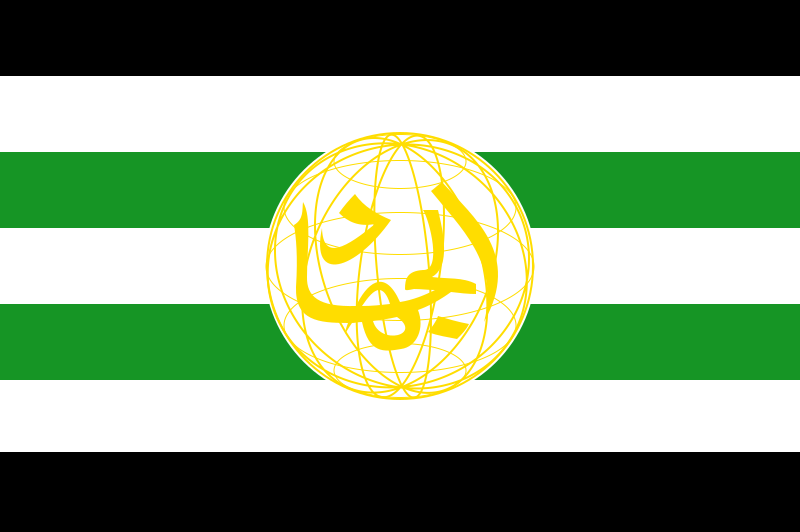 Harakat-ul-Mujahedeen Harakat-ul-Mujahedeen Lashkar-e-Taiba Lashkar-e-Taiba Jaish-e-Mohammed Jaish-e-MohammedHaqqani Network  Taliban Taliban  Pakistani Taliban Pakistani TalibanAsian Tigers  Al-Qaeda in the Indian Subcontinent Al-Qaeda in the Indian Subcontinent Jamaat-ul-Mujahideen Bangladesh Indian Mujahideen[4] Jamaat-ul-Mujahideen Bangladesh Indian Mujahideen[4] |
| Battles and wars | Soviet–Afghan War Kashmir insurgency Internal conflict in Bangladesh Kargil War War in North-West Pakistan Bangladesh drug war War in Afghanistan (2001–2021) Operation Clean and Beautiful Nation |
| Designated as a terrorist group by | |





Harkat-ul-Jihad-al-Islami (Script error: The function "langx" does not exist., HuJI) is a Pakistani Islamic fundamentalist organisation affiliated with al-Qaeda and the Taliban.[5][6]
It has been most active in the South Asian countries of Pakistan, Bangladesh and India since the early 1990s. The organisation has been designated as a terrorist group by India, Israel, New Zealand, United Kingdom, United States, and Bangladesh when its Bangladesh branch was banned in 2005.
The operational commander of HuJI, Ilyas Kashmiri, was killed in a U.S. drone strike in South Waziristan on 4 June 2011.[7] He was linked to the 13 February 2010 bombing of a German bakery in Pune. A statement was released soon after the attack that claimed to be from Kashmiri; it threatened other cities and major sporting events in India.[8] A local Taliban commander, Shah Sahib, was named as Kashmiri's successor.[9]
History[edit | edit source]
HuJI or HJI was formed in 1984, during the Soviet–Afghan War, by Fazlur Rehman Khalil and Qari Saifullah Akhtar. Khalil later broke away to form his own group, Harkat-ul-Ansar (HuA), which became a highly feared militant organisation in Kashmir.[10] This group re-formed as Harkat-ul-Mujahideen (HuM) when HuA was blacklisted by the United States in 1997.[11]
HuJI first mainly operated in Afghanistan to fight the Soviets, but after the Soviets retreated, the organisation also started operating in Jammu and Kashmir. HuJI's influence expanded into Bangladesh when the Bangladeshi branch of the organisation was established in 1992, with direct assistance from Osama bin Laden.[12]
Ideology[edit | edit source]
The organisation along with other jihadist terrorist groups such as Harkat-ul-Mujahideen, Jaish-e-Mohammed, Al-Qaeda & Lashkar-e-Taiba have similar motivations and goals. Harkat-ul-Jihad al-Islami and Harkat-ul-Mujahideen were both strongly backed by the Taliban and Al-Qaeda and the group professed Taliban-style fundamentalist Islamist ideology. The organisation aims to spread radical Islamist ideology, to take over Kashmir, Afghanistan, Palestine, and the rest of Muslim-majority lands from what it calls "enemies of Islam" and enforce its extremist interpretations of Sharia in all those regions.[5]
Activities in Bangladesh[edit | edit source]
In the 1990s, HuJI gave recruitment training near the hilly areas of Chittagong and Cox's Bazar.[12][13] In 1999, members of the organisation attacked Bangladeshi poet Shamsur Rahman.[14] HuJI claimed responsibility for the 2001 Ramna Batamul bombings, where 10 people were killed.[15] It was also the prime suspect in a plot to assassinate former Bangladeshi prime minister Sheikh Hasina in 2000.[16] In 2005, it was officially banned by the government of Bangladesh.[17] HuJI has been condemned by various Islamist groups such as the Hefazat-e-Islam Bangladesh.[18][19]
In 2008, the founders formed Islamic Democratic Party (IDP) and Abdus Salam was chosen as the leader.[20]
Activities in India[edit | edit source]
The government of India has declared HuJI a terrorist organisation and banned it.[21] In 2006, the Indian state police Special Task Force uncovered a plot by six HuJI members, including the mastermind of the 2006 Varanasi bombings, involving the destruction of two Hindu temples in Varanasi. Maps of their plans were recovered during their arrest. The organisation has claimed responsibility for blasts at the Delhi High Court that killed 10 people and injured around 60.[22] Vikar Ahmed, a member of an Islamist group connected to HuJI, has been accused of murdering police officers in Hyderabad. He is also a suspect in the Mecca Masjid bombing.[23]
HuJI claimed responsibility for the 2011 Delhi bombing, but this has not been confirmed by the National Investigation Agency.[24][25] 14 people were killed and 94 injured in the blast. Police have released two sketches of the suspects.[26][27][28] HuJI has threatened to target other Indian cities.
Designation as a terrorist organisation[edit | edit source]
| Country | Date | References |
| United Kingdom | 14 October 2005 | [29] |
| India | 29 December 2004 | [30] |
| Bangladesh | 17 October 2005 | [31] |
| Israel | 2005 | [32] |
| New Zealand | 15 December 2010 | [33] |
| United States | 6 August 2010 | [34] |
On 6 August 2010, the United Nations designated Harakat-ul Jihad al-Islami a foreign terror group and blacklisted its commander, Ilyas Kashmiri. State Department counterterrorism coordinator Daniel Benjamin said this demonstrated the global community's resolve to counter the group's threat. "The linkages between HUJI and Al-Qaeda are clear, and today's designations convey the operational relationship between these organisations", he said.[35][36]
Militant attacks claimed by or attributed to HuJI[edit | edit source]
| Date | Country | Description |
|---|---|---|
| 1999 | Bangladesh | Failed attempt to assassinate the humanist poet Shamsur Rahman |
| 2000 | Bangladesh | Alleged failed scheme to assassinate the Prime Minister of Bangladesh Sheikh Hasina |
| 14 April 2001 | Bangladesh | Pahela Baishakh attack on Ramna Batamul |
| 2003 | India | Role in assassination of the former Gujarat Home Minister Haren Pandya. |
| 2002 January | India | Terror attack near the American Centre in Kolkata, executed in collaboration with the Dawood-linked mafioso Aftab Ansari |
| 2004 | Bangladesh | 2004 Dhaka grenade attack attempt to assassinate Sheikh Hasina |
| 2005 June | India | Bombing of the Delhi-Patna Shramjeevi Express at Jaunpur |
| 2005 | India | Suicide bombing of the headquarters of the Andhra Pradesh Police's counter-terrorism Special Task Force. A Bangladeshi national, Mohatasin Bilal, had carried out the bombing |
| March 2006 | Varanasi, Uttar Pradesh, India | Bombing of the Sankat Mochan temple, which was traced to HuJI's Bangladesh-based cells |
| 25 August 2007 | Hyderabad, Andhra Pradesh, India | 25 August 2007 Hyderabad bombings (suspected, but no evidence revealed as of early September) |
| 13 May 2008 | Jaipur, Rajasthan, India | 13 May 2008 Jaipur bombings (suspected; evidence pending.) |
| 25 July 2008 | Bangalore, India | 2008 Bengaluru serial blasts (suspected; evidence pending.) |
| 26 July 2008 | Ahmadabad, India | 2008 Ahmedabad serial blasts (suspected; evidence pending.) |
| 13 September 2008 | Delhi, India | 2008 Delhi serial blasts (suspected; evidence pending.) |
| 20 September 2008 | Islamabad, Pakistan | 2008 Marriott Hotel bombing (claimed by HuJI; evidence pending.) |
| 1 October 2008 | Agartala, Tripura, India | 2008 Agartala bombings (HuJI suspected; evidence pending.) |
| 30 October 2008 | Guwahati, Barpeta, Kokrajhar, Bongaigaon, India | 2008 Assam bombings (HuJI suspected; evidence pending.) |
| 13 February 2010 | Pune, India | 2010 Pune bombing (HuJI suspected)[37] |
| 7 September 2011 | New Delhi, India | 2011 Delhi bombing (claimed by HuJI; evidence pending.) |
See also[edit | edit source]
References[edit | edit source]
- ↑ Gunaratna, Iqbal, Rohan, Khuram (2011). Pakistan: Terrorism Ground Zero. London: Reaktion Books. pp. 175, 176. ISBN 978-1-86189-768-8.
{{cite book}}: CS1 maint: multiple names: authors list (link) - ↑ Manu Pubby (22 September 2009). "24-yr-old sepoy was beheaded in 2000 LoC raid - Indian Express". Indian Express. Retrieved 13 October 2016.
- ↑ "Chapter 6. Foreign Terrorist Organizations". state.gov. Retrieved 6 April 2018.
- ↑ Indian Mujahideen. Study of Terrorism and Responses to Terrorism.
- ↑ 5.0 5.1 Hussain, Zahid (2007). Frontline Pakistan: The Struggle with Militant Islam. Columbia University Press. p. 52. ISBN 978-0-231-14224-3.
The first Pakistani jihadist group emerged in 1980 ... By 2002, Pakistan had become home to 24 militant groups ... among them were LeT, JeM, Harakat-ul-Mujahideen (HuM) and Harkat-al-Jihad-al-Islami (HJI). All these paramilitary groups, originally from the same source, had similar motivations and goals ... HuM and HJI were both strongly linked with the Taliban.
- ↑ Pakistan – Mapping Militants Archived 19 March 2023 at the Wayback Machine. Stanford University.
- ↑ M Ilyas Khan (4 June 2011). "US strike 'kills' key Pakistan militant Ilyas Kashmiri". BBC News. Retrieved 8 November 2011.
- ↑ "Asia Times Online :: South Asia news, business and economy from India and Pakistan". Asia Times. 13 February 2010. Archived from the original on 19 February 2010. Retrieved 8 November 2011.
- ↑ "Shah Sahib new chief of 313 Brigade". Pakistan Today. 13 August 2011. Retrieved 7 March 2011.
- ↑ Hussain, Zahid (2007). Frontline Pakistan: The Struggle with Militant Islam. Columbia University Press. p. 71. ISBN 978-0-231-14224-3.
In 1984 Khalil, along with another militant leader Saifullah Akhtar, founded Harkat-al-Jihad-al-Islami (HJI) ... A few years later he broke away to form his own group, Harkat-ul-Ansar (HuA). By 1990, HuA had emerged as one of the most feared militant groups fighting in Kashmir.
- ↑ Hussain, Zahid (2007). Frontline Pakistan: The Struggle with Militant Islam. Columbia University Press. p. 72. ISBN 978-0-231-14224-3.
HuA was one of the groups on the [1997 list of terrorist organisations]. After being blacklisted by the US administration it resurfaced under a new banner, HuM.
- ↑ 12.0 12.1 Sudha Ramachandran. 'PART 2: Behind the Harkat-ul Jihad al-Islami' Asia Times Online, 10 December 2004
- ↑ John Wilson. 'The Roots of Extremism in Bangladesh' Archived 16 October 2006 at the Wayback Machine Terrorism Monitor, January 2005 issue, published by the Jamestown Foundation
- ↑ "Shamsur Rahman, Bangladeshi Poet, Dies". The New York Times. 19 August 2006. Archived from the original on 23 April 2009. Retrieved 22 February 2017.
- ↑ Sudha Ramachandran. 'The Threat of Islamic Extremism to Bangladesh' Archived 6 November 2006 at the Wayback Machine PINR – Power and Interest News Report, 27 July 2005
- ↑ "Assassination Attempt on Hasina: Ten Huji men get death by shooting". The Daily Star. 21 August 2017. Archived from the original on 22 August 2017.
- ↑ "Bangladesh Nabs Five Suspected HuJI Militants". Benar News. 8 December 2016. Archived from the original on 9 December 2016.
- ↑ Azam, Kawsar (4 September 2014). "Al Qaeda won't gain ground in Bangladesh: Politicians". English24.com. Archived from the original on 18 January 2017. Retrieved 17 January 2017.
- ↑ Mirsab, A (7 September 2014). "Condemnation continues to pour from all corners against Al-Qaeda establishment in South Asia". Indian Muslim Relief and Charities. Archived from the original on 18 January 2017. Retrieved 17 January 2017.
- ↑ "Huji adviser 'detained'". The Daily Star. 1 January 2010. Retrieved 26 November 2025.
- ↑ "List of Banned Organisations". Ministry of Home Affairs, GoI. Government of India. Archived from the original on 3 May 2018. Retrieved 3 May 2018.
- ↑ "NIA team of 20 to probe Delhi blast". Firstpost. 7 September 2011. Retrieved 8 November 2011.
- ↑ Islamist extremism related incidents in Andhra Pradesh since 2007 South Asia Terrorism Portal
- ↑ "11 dead, 76 injured in terror strike". Hindustan Times. 7 September 2011. Archived from the original on 23 October 2012. Retrieved 8 November 2011.
- ↑ Vishwa Mohan (7 September 2011). "HuJI claims responsibility for Delhi high court blast". The Times of India. Archived from the original on 6 November 2012. Retrieved 8 November 2011.
- ↑ "Briefcase bomb at Delhi high court kills 11, injures 62". The Times of India. New Delhi. TNN. 7 September 2011. Archived from the original on 6 November 2011.
- ↑ "Another e-mail claims responsibility for Delhi blasts". YouTube. 9 September 2011. Archived from the original on 21 December 2021. Retrieved 8 November 2011.
- ↑ "Delhi Police Releases Sketches of Two Blast Suspects" (in हिन्दी). YouTube. 7 September 2011. Archived from the original on 21 December 2021. Retrieved 8 November 2011.
- ↑ "Terrorism Act 2000". Schedule 2, Act No. 11 of 2000.
- ↑ "The Unlawful Activities (Prevention) Amendment Act, 2004" (PDF). The Gazette of India. 30 December 2004. p. 13. Archived from the original (PDF) on 10 April 2018. Retrieved 10 April 2018.
- ↑ Rahman, Waliur (17 October 2005). "Dhaka outlaws third Islamic group". BBC News. Archived from the original on 11 March 2008. Retrieved 24 August 2010.
- ↑ "The Proclamation & Orders List". Ministry of Justice (Israel). Archived from the original (DOC) on 10 August 2014.
- ↑ "Lists associated with Resolution 1373". New Zealand Police. 20 July 2014. Retrieved 16 August 2014.
- ↑ "Foreign Terrorist Organizations". U.S. Department of State. Retrieved 20 May 2015.
- ↑ "US, UN declare HuJI a terrorist organisation". Hindustan Times. PTI. 7 August 2010. Retrieved 27 July 2015.
- ↑ "Designations of Harakat-ul Jihad Islami (HUJI) and its Leader Mohammad Ilyas Kashmiri" (Press release). US Department of State. 6 August 2010. Retrieved 12 August 2010.
- ↑ "Pune blast probe: Maha ATS detains suspected HuJI member". Zee News. 23 February 2010.
External links[edit | edit source]
Template:US War on Terror Template:Militant Islamism in South Asia