


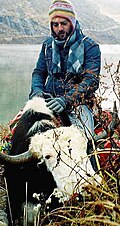


Ajay Kumar (talk | contribs) Created a new article |
m reworked formatting to improve readability and added references for clarity |
||
| Line 1: | Line 1: | ||
{{Short description|Long-haired domesticated bovid}} | {{Short description|Long-haired domesticated bovid}} | ||
{{For multi|the progenitor species Bos mutus|Wild yak|other uses|Yak (disambiguation)}} | {{For multi|the progenitor species Bos mutus|Wild yak|other uses|Yak (disambiguation)}} | ||
{{Redirect|Dri|the Argentine Roman Catholic cardinal|Luis Pascual Dri}} | |||
{{Redirect|Dri|other uses|DRI}} | |||
{{Use dmy dates|date=January 2021}} | {{Use dmy dates|date=January 2021}} | ||
{{Speciesbox | {{Speciesbox | ||
| name = Yak | | name = Yak | ||
| image = | | image = Sarlyk Yak2.jpg | ||
| image_caption = A yak | | image_caption = A yak near [[Chagan-Uzun]], Altai Republic, Russia | ||
| status = DOM | | status = DOM | ||
| taxon = Bos grunniens | | taxon = Bos grunniens | ||
| Line 13: | Line 14: | ||
}} | }} | ||
The ''' | The '''yak''' ('''''Bos grunniens'''''), also known as the '''Tartary ox''', '''grunting ox''',<ref>{{Cite journal |last=Scherf |first=Beate |date=2000 |title=World Watch List for Domestic Animal Diversity |url=https://www.fao.org/3/x8750e/x8750e.pdf |journal=World Watch List for Domestic Animal Diversity |publisher=FAO |page=653}}</ref> '''hairy cattle''',<ref>{{Cite encyclopedia|url=https://www.britannica.com/animal/yak|title = Yak | mammal |encyclopedia=Encyclopædia Britannica}}</ref> '''sarlak''' or '''sarlyk''',<ref>{{Cite dictionary|url=https://www.merriam-webster.com/dictionary/sarlak|title = SARLAK Definition & Meaning - Merriam-Webster |dictionary=Merriam-Webster}}</ref> or '''domestic yak''', is a species of long-haired [[domestication|domesticated]] [[bos|cattle]] found throughout the [[Himalayas|Himalayan]] region, the [[Tibetan Plateau]], [[Tajikistan]], the [[Pamir Mountains]], and as far north as [[Mongolia]] and [[Siberia]]. It is descended from the [[wild yak]] (''Bos mutus'').<ref name = MSW3>{{MSW3 Artiodactyla | id = 14200680 | page = 691}}</ref> | ||
==Etymology== | ==Etymology== | ||
The English word '' | The English word ''Yak'' originates from the {{bo|t=གཡག་|w=g.yag}}. In Tibetan and [[Balti language|Balti]] it refers only to the male of the species, the female being called {{bo|t=འབྲི་|w='bri}} or {{bo|t=གནག|w=gnag}} in Tibetan and {{bo|t=ཧཡག་མོ་|w=hYag-mo}} in Balti. In English, as in most other languages that have borrowed the word, ''yak'' is usually used for both sexes, with ''bull'' or ''cow'' referring to each sex separately. | ||
==Taxonomy== | ==Taxonomy== | ||
[[File:Gansu Museum 2007 318.jpg|thumb|left|Bronze model of yak from [[Gansu]], China | [[File:Gansu Museum 2007 318.jpg|thumb|left|Bronze model of yak from [[Gansu]], China; [[Yuan dynasty]], 1271–1368 AD]] | ||
Belonging to the genus ''[[Bos]]'', | Belonging to the genus ''[[Bos]]'', yaks are related to [[cattle]] and [[bison]]. [[Mitochondrial DNA]] analyses to determine the evolutionary history of yaks have been inconclusive. | ||
The yak may have diverged from cattle at any point between one and five million years ago, and there is some suggestion that it may be more closely related to | The yak may have diverged from cattle at any point between one and five million years ago, and there is some suggestion that it may be more closely related to bison than to the other members of its designated genus.<ref name=Guo2006>{{cite journal | author = Guo, S.| year = 2006 | title = Taxonomic placement and origin of yaks: implications from analyses of mtDNA D-loop fragment sequences |url=http://www.mammal.cn/EN/abstract/abstract2079.shtml| journal = Acta Theriologica Sinica | volume = 26 | issue = 4 | pages = 325–330|display-authors=etal}}</ref> Apparent close fossil relatives of the yak, such as ''[[Bos baikalensis]]'', have been found in eastern Russia, suggesting a possible route by which yak-like ancestors of the modern [[American bison]] could have entered the Americas.<ref name=Leslie2009/> | ||
The species was originally designated as ''Bos grunniens'' ("grunting ox") by [[Carl Linnaeus|Linnaeus]] in 1766, | The species was originally designated as ''Bos grunniens'' ("grunting ox") by [[Carl Linnaeus|Linnaeus]] in 1766. Still, this name is now generally considered to refer only to the domesticated form of the animal, with ''Bos mutus'' ("mute ox") being the preferred name for the wild species. Although some authors still consider the wild yak to be a [[subspecies]], ''Bos grunniens mutus'', the [[International Commission on Zoological Nomenclature|ICZN]] made [[Opinion 2027|an official ruling]] in 2003<ref name=iczn2027>{{cite journal | author = International Commission on Zoological Nomenclature | year = 2003 | title = Opinion 2027. Usage of 17 specific names based on wild species that are predated by or contemporary with those based on domestic animals (Lepidoptera, Osteichthyes, Mammalia): conserved | journal = Bulletin of Zoological Nomenclature | volume = 60 | pages = 81–84 | url=https://www.biodiversitylibrary.org/page/34357823}}</ref> permitting the use of the name ''Bos mutus'' for [[wild yak]]s, and this is now the more common usage.<ref name=iucn>{{cite iucn |author=Buzzard, P. |author2=Berger, J. |date=2016 |title=''Bos mutus'' |volume=2016 |article-number=e.T2892A101293528 |doi=10.2305/IUCN.UK.2016-2.RLTS.T2892A101293528.en |access-date=12 November 2021}}</ref><ref name=Leslie2009/><ref name=Gentry2004>{{Cite journal | doi = 10.1016/j.jas.2003.10.006| title = The naming of wild animal species and their domestic derivatives| journal = Journal of Archaeological Science| volume = 31| issue = 5| page = 645| year = 2004| last1 = Gentry | first1 = A. | last2 = Clutton-Brock | first2 = J. | last3 = Groves | first3 = C. P. | bibcode = 2004JArSc..31..645G}}</ref> | ||
There are no recognised subspecies of yak except where the wild yak is considered a subspecies of ''Bos grunniens''. | |||
==Physical characteristics== | ==Physical characteristics== | ||
[[File: | [[File:Yak in Langtang Valley.jpg|left|thumb|A yak at [[Langtang]] valley, Nepal ]] | ||
Yaks are heavily built animals with bulky frames, sturdy legs, rounded, cloven hooves, and extremely dense, long fur | Yaks are heavily built animals with bulky frames, sturdy legs, rounded, cloven hooves, and extremely dense, long fur hanging lower than the belly. While wild yaks are generally dark, blackish to brown in colouration, domestic yaks can be quite variable, often having rusty brown and cream patches. They have small ears and broad foreheads, with smooth horns that are generally dark in colour. In males (bulls), the horns sweep out from the sides of the head and then curve backwards; they typically range from {{cvt|48|to|99|cm}} in length. | ||
The horns of females (cows) are smaller, at {{ | The horns of females (cows) are smaller, at {{cvt|27|to|64|cm}} in length, and have a more upright shape. Both sexes have a short neck with a pronounced hump over the shoulders, although this is larger and more visible in males.<ref name=Leslie2009>{{cite journal | author1 = Leslie, D.M. | author2 = Schaller, G.B. | year = 2009 | title = ''Bos grunniens'' and ''Bos mutus'' (Artiodactyla: Bovidae) | journal = Mammalian Species | volume = 836 | pages = 1–17 | doi = 10.1644/836.1 | bibcode = 2009MamSp.836....1L | doi-access = free }}</ref> Males weigh {{Cvt|350|to|585|kg|lb}}, females weigh {{Cvt|225|to|255|kg|lb}}. Wild (feral) yaks can be substantially heavier, bulls reaching weights of up to {{cvt|1000|kg|lb}}.<ref>Buchholtz, C. (1990). True Cattle (Genus ''Bos''). pp. 386–397 in S. Parker, ed. ''Grzimek's Encyclopedia of Mammals, Volume 5''. New York: McGraw-Hill Publishing Company. (quoted in [http://animaldiversity.ummz.umich.edu/site/accounts/information/Bos_grunniens.html Oliphant, M. (2003). ''Bos grunniens'' (On-line), Animal Diversity Web. Accessed 4 April 2009])</ref> Depending on the breed, domestic yak males are {{cvt|111|-|138|cm|in}} high at the withers, while females are {{cvt|105|-|117|cm|in}} high at the withers.<ref>{{cite web|url=http://www.fao.org/docrep/006/AD347E/ad347e06.htm|title=The Yak. Chapter 2: Yak breeds|website=FAO|access-date=2017-08-31}}</ref> | ||
Both sexes have long shaggy hair with a dense woolly undercoat over the chest, flanks, and thighs to insulate them from the cold. Especially in bulls, this may form a long "skirt" that can reach the ground. The tail is long and horselike rather than tufted like the tails of cattle or bison. Domesticated yaks have a wide range of coat colours, with some individuals being white, grey, brown, [[Roan (color)|roan]] or [[piebald]]. The [[udder]] in females and the [[scrotum]] in males are small and hairy | Both sexes have long, shaggy hair with a dense woolly undercoat over the chest, flanks, and thighs to insulate them from the cold. Especially in bulls, this may form a long "skirt" that can reach the ground. The tail is long and horselike rather than tufted like the tails of cattle or bison. Domesticated yaks have a wide range of coat colours, with some individuals being white, grey, brown, [[Roan (color)|roan]] or [[piebald]]. The [[udder]] in females and the [[scrotum]] in males are small and hairy as protection against the cold. Females have four [[teat]]s.<ref name=Leslie2009/> | ||
Yaks are not known to produce the characteristic lowing (mooing) sound of cattle, but both wild and domestic yaks grunt and squeak, which inspired the scientific name of the domestic yak variant, ''Bos grunniens'' (grunting bull). | Yaks are not known to produce the characteristic lowing (mooing) sound of cattle, but both wild and domestic yaks grunt and squeak, which inspired the scientific name of the domestic yak variant, ''Bos grunniens'' (grunting bull). [[Nikolay Przhevalsky]] named the wild variant ''Bos mutus'' (silent bull), believing that it did not make a sound at all, but it does.<ref>{{cite web|url=http://www.fao.org/docrep/006/AD347E/ad347e05.htm|title=Origins, Domestication and Distribution of Yak|website=FAO|access-date=2017-08-31}}</ref> | ||
===Physiology=== | ===Physiology=== | ||
[[File:The Yak Rider.JPG|thumb|upright|Yak rider near [[Lake Tsomgo|Tsomgo Lake]], | [[File:The Yak Rider.JPG|thumb|upright|Yak rider near [[Lake Tsomgo|Tsomgo Lake]], Sikkim ({{Convert|3700|m|abbr=on|disp=or}})]] | ||
Yak physiology is well [[high-altitude adaptation|adapted to high altitudes]], having larger lungs and heart than cattle found at lower altitudes, as well as greater capacity for transporting oxygen through their blood,<ref name=Wiener>{{cite web|url=http://www.fao.org/DOCREP/006/AD347E/ad347e08.htm|title=The Yak in Relation to Its Environment|website=FAO}}</ref><ref>''The Yak, Second Edition''. Bangkok: Regional Office for Asia and the Pacific Food and Agriculture Organization of the United Nations, {{ISBN|92-5-104965-3}}. Accessed 8 August 2008.</ref> due to the persistence of [[foetal haemoglobin]] throughout life.<ref name=Sarkar1999>{{Cite journal | doi = 10.1053/tvjl.1999.0361| pmid = 10409419| title = Fetal Haemoglobin in Pregnant Yaks (''Poephagus grunniens'' L.)| journal = The Veterinary Journal| volume = 158| issue = 1| pages = 68–70| year = 1999| last1 = Sarkar | first1 = M.| last2 = Das | first2 = D. N. | last3 = Mondal | first3 = D. B. }}</ref> Conversely, yaks have trouble thriving at lower altitudes,<ref>[http://agtr.ilri.cgiar.org/BreedInformation/breedpg/Others/Yak.htm Yak], Animal genetics training resources version II: Breed Information. | Yak physiology is well [[high-altitude adaptation|adapted to high altitudes]], having larger lungs and heart than cattle found at lower altitudes, as well as greater capacity for transporting oxygen through their blood,<ref name=Wiener>{{cite web|url=http://www.fao.org/DOCREP/006/AD347E/ad347e08.htm|title=The Yak in Relation to Its Environment|website=FAO}}</ref><ref>''The Yak, Second Edition''. Bangkok: Regional Office for Asia and the Pacific Food and Agriculture Organization of the United Nations, {{ISBN|92-5-104965-3}}. Accessed 8 August 2008.</ref> due to the persistence of [[foetal haemoglobin]] throughout life.<ref name=Sarkar1999>{{Cite journal | doi = 10.1053/tvjl.1999.0361| pmid = 10409419| title = Fetal Haemoglobin in Pregnant Yaks (''Poephagus grunniens'' L.)| journal = The Veterinary Journal| volume = 158| issue = 1| pages = 68–70| year = 1999| last1 = Sarkar | first1 = M.| last2 = Das | first2 = D. N. | last3 = Mondal | first3 = D. B. }}</ref> Conversely, yaks have trouble thriving at lower altitudes,<ref>[http://agtr.ilri.cgiar.org/BreedInformation/breedpg/Others/Yak.htm Yak] {{Webarchive|url=https://web.archive.org/web/20110725111943/http://agtr.ilri.cgiar.org/BreedInformation/breedpg/Others/Yak.htm |date=25 July 2011 }}, Animal genetics training resources version II: Breed Information. Adopted from: Bonnemaire, J. "Yak". In: Mason, Ian L. (ed). (1984). ''Evolution of Domesticated Animals''. London: Longman, pp. 39–45. {{ISBN|0-582-46046-8}}. Accessed 8 August 2008.</ref> and are prone to suffering from heat exhaustion above about {{cvt|15|C}}. Further adaptations to the cold include a thick layer of [[subcutaneous fat]] and an almost complete lack of functional [[sweat glands]].<ref name=Wiener/> | ||
Compared with domestic cattle, the [[rumen]] of yaks is unusually large, relative to the [[omasum]].{{Citation needed|date=October 2014}} This likely allows them to consume greater quantities of low-quality food at a time, and to ferment it longer | Compared with domestic cattle, the [[rumen]] of yaks is unusually large, relative to the [[omasum]].{{Citation needed|date=October 2014}} This likely allows them to consume greater quantities of low-quality food at a time, and to ferment it longer to extract more nutrients.<ref name=Wiener/> Yak consume the equivalent of 1% of their body weight daily while cattle require 3% to maintain condition.{{Citation needed|date=February 2012}} They are grazing herbivores, with their wild ancestors feeding primarily on [[Poaceae|grass]] and [[sedges]],<ref name=Harris1995>{{cite journal |last1= Harris |first1= R.B. |last2= Miller |first2= D.J. |date= October 2009 |title= Overlap in summer habitats and diets of Tibetan Plateau ungulates |journal= Mammalia |volume= 59 |issue= 2 |pages= 197–212 |doi= 10.1515/mamm.1995.59.2.197|s2cid= 84659876 }}</ref> with some herbs and dwarf shrubs.<ref name=Schaller1996>{{cite journal |last1= Schaller |first1= G.B. |last2= Liu |first2= W. |date= 1996 |title= Distribution, status, and conservation of wild yak ''Bos grunniens'' |journal= Biological Conservation |volume= 76 |issue= 1 |pages= 1–8 |doi= 10.1016/0006-3207(96)85972-6|bibcode= 1996BCons..76....1S }}</ref> | ||
==Reproduction and life history== | ==Reproduction and life history== | ||
[[File:Yak calf in Austria 2009.jpg|thumb|left|Ten-day-old yak | [[File:Yak calf in Austria 2009.jpg|thumb|left|Ten-day-old yak]] | ||
Yaks mate in the summer, typically between July and September, depending on the local environment. For the remainder of the year, many bulls wander in small bachelor groups away from the large herds | Yaks mate in the summer, typically between July and September, depending on the local environment. For the remainder of the year, many bulls wander in small bachelor groups away from the large herds. Still, as the [[Rut (mammalian reproduction)|rut]] approaches, they become aggressive and regularly fight with each other to establish dominance. In addition to non-violent threat displays, bellowing, and scraping the ground with their horns, bull yaks compete more directly, repeatedly charging at each other with heads lowered or sparring with their horns. Like [[bison]], but unlike cattle, males wallow in dry soil during the rut, often while [[Urination#Other animals|scent-marking with urine]] or dung.<ref name=Leslie2009/> Females enter [[Estrous cycle#Estrus|oestrus]] up to four times a year, and females are receptive only for a few hours in each cycle.<ref name=Sarkar2005>{{cite journal | author1 = Sarkar, M. | author2 = Prakash, B.S. | year = 2005 | title = Timing of ovulation in relation to onset of estrus and LH peak in yak (''Poephagus grunniens'' L.) | journal = Animal Reproduction Science | volume = 86 | issue = 4 | pages = 353–362 | doi = 10.1016/j.anireprosci.2004.08.005| pmid = 15766812 }}</ref> | ||
[[Gestation]] lasts between 257 and 270 days,<ref name=Wiener/> so that the young are born between May and June, and results in the birth of a single calf. The cow finds a secluded spot to give birth, but the calf | [[Gestation]] lasts between 257 and 270 days,<ref name=Wiener/> so that the young are born between May and June, and results in the birth of a single calf. The cow finds a secluded spot to give birth, but the calf can walk within about ten minutes of birth, and the pair soon rejoin the herd.<ref name=Wiener/> Females of both the wild and domestic forms typically give birth only once every other year,<ref name=Leslie2009/> although more frequent births are possible if the food supply is good. | ||
Calves are [[weaning|weaned]] at one year and become independent shortly thereafter. Wild calves are initially brown in color | Calves are [[weaning|weaned]] at one year and become independent shortly thereafter. Wild calves are initially brown in color and only later develop darker adult hair. Females generally give birth for the first time at three or four years of age,<ref name=Zi2003>{{cite journal | author = Zi, X.D. | year = 2003 | title = Reproduction in female yaks (''Bos grunniens'') and opportunities for improvement | journal = Theriogenology | volume = 59 | issue = 5–6 | pages = 1303–1312 | doi = 10.1016/S0093-691X(02)01172-X | pmid = 12527077}}</ref> and reach their peak reproductive fitness at around six years. Yaks may live for more than twenty years in domestication or captivity,<ref name=Leslie2009/> although it is likely that this may be somewhat shorter in the wild. | ||
==Husbandry== | ==Husbandry== | ||
[[File:Yaks on Manali, Himachal Pradesh.jpg|thumb|A domesticated Yak being used for tourists in [[Manali, Himachal Pradesh]], India.]] | |||
[[File:Bos grunniens at Yundrok Yumtso Lake.jpg|thumb|Near [[Yamdrok Lake]] in [[Tibet Autonomous Region|Tibet]].]] | |||
For thousands of years,{{cn|date=October 2024}} domesticated yaks have been kept in Mongolia and Tibet, primarily for their milk, [[Yak fiber|fibre]] (wool), and meat, and as [[Working animal|beasts of burden]].<ref>{{cite journal |url=https://books.google.com/books?id=QzuheS7ZSWkC&pg=PA40 |first=K. J. |last=Peters |page=40 |title=Unconventional livestock: Classification and potential uses |journal=ILCA Bulletin |number=27 |publisher=International Livestock Centre for Africa |date=April 1987}}</ref> Their dried droppings are an important fuel, used all over Tibet, and are often the only fuel available on the high, treeless [[Tibetan Plateau]]. Yaks transport goods across mountain passes for local farmers and traders and are an attraction for climbing and trekking expeditions: | |||
<blockquote> | |||
Only one thing makes it hard to use yaks for long journeys in barren regions. They will not eat [[grain]], which could be carried on the journey. They will starve unless they can be brought to a place where there is grass.<ref>Golden Book Encyclopedia, Vol. 16 p. 1505b. Rockefeller Center, NY: [[Golden Press]] (1959).</ref> | |||
</blockquote> | |||
They also are used to draw [[plough]]s.<ref name="bhutanyaks">{{cite web|url=http://himalaya.socanth.cam.ac.uk/collections/journals/jbs/pdf/JBS_02_01_04.pdf |website=Digital Himalaya |title=Economy of Yak Herders|last=Gyamtsho|first=Pema}}</ref> Yaks' milk is often processed to a cheese called ''[[chhurpi]]'' in Tibetan and Nepali languages, and ''[[Mongolian cuisine|byaslag]]'' in Mongolia. [[Yak butter|Butter made from yaks' milk]] is an ingredient of the [[butter tea]] that Tibetans consume in large quantities,<ref>{{cite magazine |url=http://www.flavorandfortune.com/dataaccess/article.php?ID=205 |access-date=2012-12-19 |title=Tibet and Tibetan Foods |date=Winter 1999 |first1=Jacqueline M. |last1=Newman |magazine=Flavor and Fortune |volume=6 |issue=4 |archive-url=https://web.archive.org/web/20130701001047/http://www.flavorandfortune.com/dataaccess/article.php?ID=205 |archive-date= Jul 1, 2013 }}</ref> and is also used in lamps and made into [[Torma|butter sculptures]] used in religious festivities.<ref>"[http://www.webexhibits.org/butter/countries-tibet.html Butter - Yaks, butter & lamps in Tibet]", WebExhibits.</ref> | |||
===Outside the Himalayas=== | ===Outside the Himalayas=== | ||
Small numbers of herds can be found in the United States | Small numbers of herds can be found in the United States, Canada, New Zealand, and some parts of Europe. Yaks have generated interest outside the Himalayas as a commercial crop and by cattle breeders. The main interest of North American yak breeders is lean meat production by [[Hybrid (biology)|hybridizing]] with other cattle, followed by [[wool]] production.<ref>{{cite web|url=http://www.fao.org/3/ad347e/ad347e0u.htm|title=Part 3 - Yak in nontraditional environments by Gerald Wiener|publisher=FAO |work=the Yak - Second Edition |date= 2003 }}</ref> | ||
===Research=== | ===Research=== | ||
The [[Indian government]] established a dedicated centre for research into yak husbandry, the ICAR-National Research Centre on Yak, in 1989. It is located at [[Dirang]], | The [[Indian government]] established a dedicated centre for research into yak husbandry, the ICAR-National Research Centre on Yak, in 1989. It is located at [[Dirang]], Arunachal Pradesh, and maintains a yak farm in the Nyukmadung area at an altitude of {{convert|2750|m|ft}} above MSL.<ref>{{cite web|title=Welcome to the Official Website of ICAR-NRCY |website=nrcy.icar.gov.in |url=http://nrcy.icar.gov.in/}}</ref> | ||
=== | ===Breeding and hybridization=== | ||
In [[Nepal]], [[Tibet]], and [[Mongolia]], domestic cattle are crossbred with yaks. This gives rise to the infertile male [[dzo]] མཛོ། as well as fertile females known as {{lang|ne|dzomo}} or {{lang|ne|zhom}} མཛོ་མོ།, which may be crossed again with cattle. The Dwarf Lulu breed, "the only ''Bos primigenius taurus'' type of cattle in Nepal" has been tested for DNA markers and found to be a mixture of both taurine and [[zebu]] types of cattle (''B. p. taurus'' and ''B. p. indicus'') with yak.<ref>{{cite journal|title=Mitochondrial DNA analysis of Nepalese domestic dwarf cattle Lulu|journal=Animal Science Journal|author1=Takeda, K. |author2=Satoh, M. |author3=Neopane, S.P. |author4=Kuwar, B.S. |author5=Joshi, H.D. |author6=Shrestha, N.P. |author7=Fujise, H. |author8=Tasai, M. |author9=Tagami, T. |author10=Hanada, H. |doi=10.1111/j.1740-0929.2004.00163.x|year=2004|volume=75|issue=2| | In [[Nepal]], [[Tibet]], and [[Mongolia]], domestic cattle are crossbred with yaks. This gives rise to the infertile male [[dzo]] མཛོ། as well as fertile females known as {{lang|ne|dzomo}} or {{lang|ne|zhom}} མཛོ་མོ།, which may be crossed again with cattle. The Dwarf Lulu breed, "the only ''Bos primigenius taurus'' type of cattle in Nepal" has been tested for DNA markers and found to be a mixture of both taurine and [[zebu]] types of cattle (''B. p. taurus'' and ''B. p. indicus'') with yak.<ref>{{cite journal|title=Mitochondrial DNA analysis of Nepalese domestic dwarf cattle Lulu|journal=Animal Science Journal|author1=Takeda, K. |author2=Satoh, M. |author3=Neopane, S.P. |author4=Kuwar, B.S. |author5=Joshi, H.D. |author6=Shrestha, N.P. |author7=Fujise, H. |author8=Tasai, M. |author9=Tagami, T. |author10=Hanada, H. |doi=10.1111/j.1740-0929.2004.00163.x|year=2004|volume=75|issue=2|page=103}}</ref> According to the [[International Veterinary Information Service]], the low productivity of second-generation cattle–yak crosses makes them suitable only as meat animals.<ref name="ivis.org"/> | ||
Crosses between yaks and domestic cattle (''Bos primigenius taurus'') have been recorded in Chinese literature for at least 2,000 years.<ref name=Leslie2009/> Successful crosses have also been recorded between [[Yakalo|yak and American bison]],<ref name="ivis.org">Zhang, R.C. (14 December 2000). [http://www.ivis.org/advances/Zhao/zhang3/IVIS.pdf "Interspecies Hybridization between Yak, ''Bos taurus'' and ''Bos indicus'' and Reproduction of the Hybrids"]. | Crosses between yaks and domestic cattle (''Bos primigenius taurus'') have been recorded in Chinese literature for at least 2,000 years.<ref name=Leslie2009/> Successful crosses have also been recorded between [[Yakalo|yak and American bison]],<ref name="ivis.org">Zhang, R.C. (14 December 2000). [http://www.ivis.org/advances/Zhao/zhang3/IVIS.pdf "Interspecies Hybridization between Yak, ''Bos taurus'' and ''Bos indicus'' and Reproduction of the Hybrids"]. In: ''Recent Advances in Yak Reproduction'', Zhao, X.X.; Zhang, R.C. (eds.). International Veterinary Information Service.</ref> [[gaur]], and [[banteng]], generally with similar results to those produced with domestic cattle.<ref name=Leslie2009/> | ||
=== | ===Domestication=== | ||
Jacques et al. (2021)<ref>{{cite journal|title=Yak Domestication: A Review of Linguistic, Archaeological, and Genetic Evidence|journal=Ethnobiology Letters|author1=Jacques, G. |author2=d'Alpoim Guedes, J. |author3=Zhang, S. |doi=10.14237/ebl.12.1.2021.1755|year=2021|volume=12|issue=1|pages=103–114|s2cid=238997533|doi-access=free}} | Jacques et al. (2021)<ref>{{cite journal|title=Yak Domestication: A Review of Linguistic, Archaeological, and Genetic Evidence|journal=Ethnobiology Letters|author1=Jacques, G.|author1-link=Guillaume Jacques |author2=d'Alpoim Guedes, J. |author3=Zhang, S. |doi=10.14237/ebl.12.1.2021.1755|year=2021|volume=12|issue=1|pages=103–114|s2cid=238997533|doi-access=free}}</ref> show that most elaborate yak-related terminologies are found within Tibetic and [[Gyalrongic]] languages. Both branches also have native terms for [[dzo|yak-cattle hybrids]], suggesting that Tibetic and Gyalrongic speakers may have independently cross-bred yaks and cattle, predating the proto-Gyalrongic split (3221 [2169–4319] [[Before present|BP]]<ref>{{cite journal|title=Dated language phylogenies shed light on the ancestry of Sino-Tibetan|journal= Proceedings of the National Academy of Sciences|author1=Sagart, L.|author1-link=Laurent Sagart |author2=Jacques, G.|author2-link=Guillaume Jacques|author3=Lai, Y.|author4=Ryder, R.J.|author5=Thouzeau, V.|author6=Greenhill, S. J.|author6-link=Simon Greenhill |author7=List, J.-M.|author7-link=Johann-Mattis List|doi=10.1073/pnas.1817972116 |pmc=6534992 |year=2019|volume=116|issue=21|pages=10317–10322|pmid=31061123|bibcode=2019PNAS..11610317S |doi-access=free}}</ref>) from Tibeto-Gyalrongic. The oldest dated physical evidence of yak domestication is from 2,500 years BP.<ref>{{Cite web |date=13 December 2023 |title=Earliest evidence for domestic yak found using both archaeology, ancient DNA |url=https://www.sciencedaily.com/releases/2023/12/231213143709.htm |access-date=14 December 2023 |website=ScienceDaily |language=en}}</ref> | ||
</ref> show that most elaborate yak-related terminologies are found within Tibetic and [[Gyalrongic]] languages. Both branches also have native terms for [[dzo|yak-cattle hybrids]], suggesting that Tibetic and Gyalrongic speakers may have independently cross-bred yaks and cattle, predating the proto-Gyalrongic split (3221 [ | |||
</ref>) from Tibeto-Gyalrongic. | |||
==Customs== | ==Customs== | ||
[[File:Yak racing.jpg|thumb|right|[[Yak racing]]]] | |||
In Nepal, | In parts of Tibet and Karakorum, [[yak racing]] is a form of entertainment at traditional festivals and an important part of their culture. More recently, sports involving domesticated yaks, such as yak skiing or [[yak polo]], are being marketed as tourist attractions in South Asian countries, including in [[Gilgit-Baltistan]], Pakistan.{{Citation needed|date=December 2016}} | ||
In Nepal, an annual festival is held to drink the fresh blood of yak, and it is believed that it cures various diseases such as gastritis, [[jaundice]], and body strain.<ref>{{Cite journal| doi = 10.3167/np.2007.110204| volume = 11| issue = 2| pages = 57–85| last1 = Degen| first1 = Allan A.| last2 = Kam| first2 = Michael| last3 = Pandey| first3 = Shambhu B.| last4 = Upreti| first4 = Chet R.| last5 = Pandey| first5 = Sanjeev| last6 = Regmi| first6 = Prajwal| title = Transhumant Pastoralism in Yak Production in the Lower Mustang District of Nepal| journal = Nomadic Peoples| date = 2007-10-21}}</ref><ref>{{cite web| title = People flock to Mustang to drink yak blood| access-date = 2021-06-07| url = https://kathmandupost.com/miscellaneous/2016/04/23/people-flock-in-mustang-to-drink-yak-blood}}</ref> The fresh blood is extracted from the neck of a yak without killing it. The cut is healed after the ceremony is over.<ref>{{cite web| title = Festival to drink Yak blood begins in Nepal| work = Hindustan Times| access-date = 2021-06-07| date = 2008-07-20| url = https://www.hindustantimes.com/world/festival-to-drink-yak-blood-begins-in-nepal/story-sbE82I3UCI6YoC2eCN7cCK.html}}</ref> The ritual is believed to be originated in Tibet and [[Mustang District|Mustang]].<ref>{{Cite news| issn = 0971-751X| last = Ians| title = Nepal now sees blood drinking festival| work = The Hindu| location = Kathmandu| access-date = 2021-06-07| date = 2010-03-11| url = https://www.thehindu.com/news/Nepal-now-sees-blood-drinking-festival/article16559874.ece}}</ref> | |||
Traditionally, yaks are used to transport deceased people to [[charnel ground]]s for [[sky burial]]s in Tibet, with Tibetan practice holding that the yaks be set free upon the conclusion of the task.<ref>{{cite web |title=Sky Burial – The traditional Tibetan Funeral Custom |url=http://eng.tibet.cn/eng/index/life/201907/t20190726_6646094.html |website=Tibet.cn |access-date=12 April 2025}}</ref><ref name=Runze>{{citation |url=http://english.sina.com/china/2012/1213/537423.html |website=Sina English |title=Funeral Reforms Edge Along in Tibetan Areas |date=December 13, 2012 |editor-last=Runze |editor-first=Yu |access-date=August 12, 2024 |publisher=Xinhua |archive-url=https://web.archive.org/web/20210224131001/http://english.sina.com/china/2012/1213/537423.html |archive-date=February 24, 2021}}</ref><ref>{{cite web |last1=Jigme |first1=Catherine |title=Sky burial may be replaced by cremation in Qinghai |url=https://www.tibettravel.org/news/201403242081.html |website=Tibet Travel |access-date=12 April 2025}}</ref><ref>{{cite web |last1=Logan |first1=Pamela |title=Survival and Evolution of Sky Burial Practices |url=https://www.pamela-logan.com/culture/survival-and-evolution-of-sky-burial/ |access-date=12 April 2025}}</ref> | |||
Yak skiing is a sport practiced in the Indian hill resort of [[Manali, Himachal Pradesh]], as a tourist attraction. The sport involves a skier waiting at the bottom of a slope and a [[yak]] at the top of the hill; yak and skier are connected by means of a rope going around a [[pulley]] at the top of the hill. To engage the yak, the skier must shake (and swiftly put down) a bucket of [[Equine nutrition#Special feeding issues for ponies|pony nuts]]. This attracts the yak, which charges downhill and pulls the skier upward by means of the rope.<ref>{{cite magazine |last=Perry |first=Alex |date=4 July 2005 |title=Extreme Yak Sports |url=http://content.time.com/time/magazine/article/0,9171,1077223,00.html |access-date=2012-03-08 |magazine=Time |archive-date=7 March 2014 |archive-url=https://web.archive.org/web/20140307205812/http://content.time.com/time/magazine/article/0,9171,1077223,00.html |url-status=dead }}</ref><ref>{{cite news |date=3 July 2005 |title=Asia's newest sport - yak skiing |url=http://news.bbc.co.uk/2/hi/south_asia/4644933.stm |access-date=2008-10-21 |publisher=BBC News}}</ref> | |||
==Gallery== | ==Gallery== | ||
<gallery mode="packed" widths="160" heights="140"> | <gallery mode="packed" widths="160" heights="140"> | ||
File:Yaks in Manali.jpg|Yaks in [[Manali, Himachal Pradesh]], India saddled for riding | File:Yaks in Manali.jpg|Yaks in [[Manali, Himachal Pradesh]], India, saddled for riding | ||
File:LitangMonastery.jpg|Train of pack yaks at Litang monastery in [[Garzê Tibetan Autonomous Prefecture]], Sichuan, China | File:LitangMonastery.jpg|Train of pack yaks at Litang monastery in [[Garzê Tibetan Autonomous Prefecture]], Sichuan, China | ||
File:Yaks still provide the best way to plow fields in Tibet.jpg|Yaks plowing fields in Tibet | File:Yaks still provide the best way to plow fields in Tibet.jpg|Yaks plowing fields in Tibet | ||
File:YakRace.jpg|Yaks in [[Gilgit-Baltistan]], Pakistan | File:YakRace.jpg|Yaks in [[Gilgit-Baltistan]], Pakistan | ||
File:四川 阿坝 白牦牛 - panoramio.jpg|Domestic yak in [[Mao County]], China | File:四川 阿坝 白牦牛 - panoramio.jpg|Domestic yak in [[Mao County]], China | ||
File:四姑娘山景区 Mount Siguniang Scenic Area 17.jpg|A yak at [[Mount Siguniang|Mount Siguniang Scenic Area]], Sichuan, China | |||
File:四姑娘山景区 Mount Siguniang Scenic Area 17.jpg|A yak at [[Mount Siguniang|Mount Siguniang Scenic Area]], | File:Yak rearing at highest altitude- Rigma, Dolpa.jpg|Yak are reared on grazing pastures and meadows at elevations of {{cvt|3000|-|5000|m|ft}} above sea level in 28 northern mountain districts in Nepal. | ||
</gallery> | </gallery> | ||
==See also== | ==See also== | ||
* [[Yak dance]] | |||
* [[Yakalo]] | * [[Yakalo]] | ||
==References== | ==References== | ||
{{ | {{Reflist|30em}} | ||
==External links== | ==External links== | ||
{{Wikispecies}} | |||
{{Commons}} | |||
*[https://www.iyak.org/ International Yak Association (IYAK)] | * [https://www.iyak.org/ International Yak Association (IYAK)]; {{Webarchive|url=https://web.archive.org/web/20200304073748/https://www.iyak.org/ |date=4 March 2020 }} | ||
*[https://web.archive.org/web/20070928013330/http://www.eyak.ch/ European Yak Association (EYAK)] | * [https://web.archive.org/web/20070928013330/http://www.eyak.ch/ European Yak Association (EYAK)] | ||
*[http://www.fao.org/docrep/006/ad347e/ad347e06.htm Article on Yak breeds in FAO archives] | * [http://www.fao.org/docrep/006/ad347e/ad347e06.htm Article on Yak breeds in FAO archives] | ||
*[http://kekexili.typepad.com/life_on_the_tibetan_plate/2006/10/yaks.html Yaks: The Official Animal of Tibet] | * [http://kekexili.typepad.com/life_on_the_tibetan_plate/2006/10/yaks.html Yaks: The Official Animal of Tibet] | ||
*[https://web.archive.org/web/20130523064042/http://me.lzu.edu.cn/yak/ Yak Genome Database] | * [https://web.archive.org/web/20130523064042/http://me.lzu.edu.cn/yak/ Yak Genome Database] | ||
{{Artiodactyla|R.4}} | {{Artiodactyla|R.4}} | ||
{{Fibers}} | {{Fibers}} | ||
{{Meat | {{Meat}} | ||
{{Working animals}} | {{Working animals}} | ||
{{Animal domestication}} | |||
{{Taxonbar|from=Q19829410}} | {{Taxonbar|from=Q19829410}} | ||
[[Category:Yaks| ]] | [[Category:Yaks| ]] | ||
[[Category:Animal taxa named by Carl Linnaeus]] | |||
[[Category:Bos]] | |||
[[Category:Domesticated animals]] | |||
[[Category:Fauna of the Himalayas]] | |||
[[Category:Livestock]] | [[Category:Livestock]] | ||
[[Category: | [[Category:Mammals described in 1766]] | ||
[[Category:Mammals of Central Asia]] | [[Category:Mammals of Central Asia]] | ||
[[Category:Mammals of East Asia]] | [[Category:Mammals of East Asia]] | ||
| Line 123: | Line 133: | ||
[[Category:Mammals of South Asia]] | [[Category:Mammals of South Asia]] | ||
[[Category:Mammals of Tibet]] | [[Category:Mammals of Tibet]] | ||
[[Category: | [[Category:Pack animals]] | ||
Latest revision as of 20:41, 10 March 2026
| Yak | |
|---|---|

| |
| A yak near Chagan-Uzun, Altai Republic, Russia | |
Domesticated
| |
Scientific classification 
| |
| : | [[Template:Taxonomy/Bos]] |
| Species: | Template:Taxonomy/BosB. grunniens
|
| Binomial name | |
| Template:Taxonomy/BosBos grunniens Linnaeus, 1766
| |
| Synonyms | |
|
Poephagus grunniens | |
The yak (Bos grunniens), also known as the Tartary ox, grunting ox,[1] hairy cattle,[2] sarlak or sarlyk,[3] or domestic yak, is a species of long-haired domesticated cattle found throughout the Himalayan region, the Tibetan Plateau, Tajikistan, the Pamir Mountains, and as far north as Mongolia and Siberia. It is descended from the wild yak (Bos mutus).[4]
Etymology[edit | edit source]
The English word Yak originates from the Tibetan: གཡག་, Wylie: g.yag. In Tibetan and Balti it refers only to the male of the species, the female being called Tibetan: འབྲི་, Wylie: 'bri or Tibetan: གནག, Wylie: gnag in Tibetan and Tibetan: ཧཡག་མོ་, Wylie: hYag-mo in Balti. In English, as in most other languages that have borrowed the word, yak is usually used for both sexes, with bull or cow referring to each sex separately.
Taxonomy[edit | edit source]

Belonging to the genus Bos, yaks are related to cattle and bison. Mitochondrial DNA analyses to determine the evolutionary history of yaks have been inconclusive.
The yak may have diverged from cattle at any point between one and five million years ago, and there is some suggestion that it may be more closely related to bison than to the other members of its designated genus.[5] Apparent close fossil relatives of the yak, such as Bos baikalensis, have been found in eastern Russia, suggesting a possible route by which yak-like ancestors of the modern American bison could have entered the Americas.[6]
The species was originally designated as Bos grunniens ("grunting ox") by Linnaeus in 1766. Still, this name is now generally considered to refer only to the domesticated form of the animal, with Bos mutus ("mute ox") being the preferred name for the wild species. Although some authors still consider the wild yak to be a subspecies, Bos grunniens mutus, the ICZN made an official ruling in 2003[7] permitting the use of the name Bos mutus for wild yaks, and this is now the more common usage.[8][6][9]
There are no recognised subspecies of yak except where the wild yak is considered a subspecies of Bos grunniens.
Physical characteristics[edit | edit source]

Yaks are heavily built animals with bulky frames, sturdy legs, rounded, cloven hooves, and extremely dense, long fur hanging lower than the belly. While wild yaks are generally dark, blackish to brown in colouration, domestic yaks can be quite variable, often having rusty brown and cream patches. They have small ears and broad foreheads, with smooth horns that are generally dark in colour. In males (bulls), the horns sweep out from the sides of the head and then curve backwards; they typically range from 48 to 99 cm (19 to 39 in) in length.
The horns of females (cows) are smaller, at 27 to 64 cm (11 to 25 in) in length, and have a more upright shape. Both sexes have a short neck with a pronounced hump over the shoulders, although this is larger and more visible in males.[6] Males weigh 350 to 585 kg (772 to 1,290 lb), females weigh 225 to 255 kg (496 to 562 lb). Wild (feral) yaks can be substantially heavier, bulls reaching weights of up to 1,000 kg (2,200 lb).[10] Depending on the breed, domestic yak males are 111–138 cm (44–54 in) high at the withers, while females are 105–117 cm (41–46 in) high at the withers.[11]
Both sexes have long, shaggy hair with a dense woolly undercoat over the chest, flanks, and thighs to insulate them from the cold. Especially in bulls, this may form a long "skirt" that can reach the ground. The tail is long and horselike rather than tufted like the tails of cattle or bison. Domesticated yaks have a wide range of coat colours, with some individuals being white, grey, brown, roan or piebald. The udder in females and the scrotum in males are small and hairy as protection against the cold. Females have four teats.[6]
Yaks are not known to produce the characteristic lowing (mooing) sound of cattle, but both wild and domestic yaks grunt and squeak, which inspired the scientific name of the domestic yak variant, Bos grunniens (grunting bull). Nikolay Przhevalsky named the wild variant Bos mutus (silent bull), believing that it did not make a sound at all, but it does.[12]
Physiology[edit | edit source]

Yak physiology is well adapted to high altitudes, having larger lungs and heart than cattle found at lower altitudes, as well as greater capacity for transporting oxygen through their blood,[13][14] due to the persistence of foetal haemoglobin throughout life.[15] Conversely, yaks have trouble thriving at lower altitudes,[16] and are prone to suffering from heat exhaustion above about 15 °C (59 °F). Further adaptations to the cold include a thick layer of subcutaneous fat and an almost complete lack of functional sweat glands.[13]
Compared with domestic cattle, the rumen of yaks is unusually large, relative to the omasum.[citation needed] This likely allows them to consume greater quantities of low-quality food at a time, and to ferment it longer to extract more nutrients.[13] Yak consume the equivalent of 1% of their body weight daily while cattle require 3% to maintain condition.[citation needed] They are grazing herbivores, with their wild ancestors feeding primarily on grass and sedges,[17] with some herbs and dwarf shrubs.[18]
Reproduction and life history[edit | edit source]

Yaks mate in the summer, typically between July and September, depending on the local environment. For the remainder of the year, many bulls wander in small bachelor groups away from the large herds. Still, as the rut approaches, they become aggressive and regularly fight with each other to establish dominance. In addition to non-violent threat displays, bellowing, and scraping the ground with their horns, bull yaks compete more directly, repeatedly charging at each other with heads lowered or sparring with their horns. Like bison, but unlike cattle, males wallow in dry soil during the rut, often while scent-marking with urine or dung.[6] Females enter oestrus up to four times a year, and females are receptive only for a few hours in each cycle.[19]
Gestation lasts between 257 and 270 days,[13] so that the young are born between May and June, and results in the birth of a single calf. The cow finds a secluded spot to give birth, but the calf can walk within about ten minutes of birth, and the pair soon rejoin the herd.[13] Females of both the wild and domestic forms typically give birth only once every other year,[6] although more frequent births are possible if the food supply is good.
Calves are weaned at one year and become independent shortly thereafter. Wild calves are initially brown in color and only later develop darker adult hair. Females generally give birth for the first time at three or four years of age,[20] and reach their peak reproductive fitness at around six years. Yaks may live for more than twenty years in domestication or captivity,[6] although it is likely that this may be somewhat shorter in the wild.
Husbandry[edit | edit source]


For thousands of years,[citation needed] domesticated yaks have been kept in Mongolia and Tibet, primarily for their milk, fibre (wool), and meat, and as beasts of burden.[21] Their dried droppings are an important fuel, used all over Tibet, and are often the only fuel available on the high, treeless Tibetan Plateau. Yaks transport goods across mountain passes for local farmers and traders and are an attraction for climbing and trekking expeditions:
Only one thing makes it hard to use yaks for long journeys in barren regions. They will not eat grain, which could be carried on the journey. They will starve unless they can be brought to a place where there is grass.[22]
They also are used to draw ploughs.[23] Yaks' milk is often processed to a cheese called chhurpi in Tibetan and Nepali languages, and byaslag in Mongolia. Butter made from yaks' milk is an ingredient of the butter tea that Tibetans consume in large quantities,[24] and is also used in lamps and made into butter sculptures used in religious festivities.[25]
Outside the Himalayas[edit | edit source]
Small numbers of herds can be found in the United States, Canada, New Zealand, and some parts of Europe. Yaks have generated interest outside the Himalayas as a commercial crop and by cattle breeders. The main interest of North American yak breeders is lean meat production by hybridizing with other cattle, followed by wool production.[26]
Research[edit | edit source]
The Indian government established a dedicated centre for research into yak husbandry, the ICAR-National Research Centre on Yak, in 1989. It is located at Dirang, Arunachal Pradesh, and maintains a yak farm in the Nyukmadung area at an altitude of 2,750 metres (9,020 ft) above MSL.[27]
Breeding and hybridization[edit | edit source]
In Nepal, Tibet, and Mongolia, domestic cattle are crossbred with yaks. This gives rise to the infertile male dzo མཛོ། as well as fertile females known as dzomo or zhom མཛོ་མོ།, which may be crossed again with cattle. The Dwarf Lulu breed, "the only Bos primigenius taurus type of cattle in Nepal" has been tested for DNA markers and found to be a mixture of both taurine and zebu types of cattle (B. p. taurus and B. p. indicus) with yak.[28] According to the International Veterinary Information Service, the low productivity of second-generation cattle–yak crosses makes them suitable only as meat animals.[29]
Crosses between yaks and domestic cattle (Bos primigenius taurus) have been recorded in Chinese literature for at least 2,000 years.[6] Successful crosses have also been recorded between yak and American bison,[29] gaur, and banteng, generally with similar results to those produced with domestic cattle.[6]
Domestication[edit | edit source]
Jacques et al. (2021)[30] show that most elaborate yak-related terminologies are found within Tibetic and Gyalrongic languages. Both branches also have native terms for yak-cattle hybrids, suggesting that Tibetic and Gyalrongic speakers may have independently cross-bred yaks and cattle, predating the proto-Gyalrongic split (3221 [2169–4319] BP[31]) from Tibeto-Gyalrongic. The oldest dated physical evidence of yak domestication is from 2,500 years BP.[32]
Customs[edit | edit source]

In parts of Tibet and Karakorum, yak racing is a form of entertainment at traditional festivals and an important part of their culture. More recently, sports involving domesticated yaks, such as yak skiing or yak polo, are being marketed as tourist attractions in South Asian countries, including in Gilgit-Baltistan, Pakistan.[citation needed]
In Nepal, an annual festival is held to drink the fresh blood of yak, and it is believed that it cures various diseases such as gastritis, jaundice, and body strain.[33][34] The fresh blood is extracted from the neck of a yak without killing it. The cut is healed after the ceremony is over.[35] The ritual is believed to be originated in Tibet and Mustang.[36]
Traditionally, yaks are used to transport deceased people to charnel grounds for sky burials in Tibet, with Tibetan practice holding that the yaks be set free upon the conclusion of the task.[37][38][39][40]
Yak skiing is a sport practiced in the Indian hill resort of Manali, Himachal Pradesh, as a tourist attraction. The sport involves a skier waiting at the bottom of a slope and a yak at the top of the hill; yak and skier are connected by means of a rope going around a pulley at the top of the hill. To engage the yak, the skier must shake (and swiftly put down) a bucket of pony nuts. This attracts the yak, which charges downhill and pulls the skier upward by means of the rope.[41][42]
Gallery[edit | edit source]
-
 Yaks in Manali, Himachal Pradesh, India, saddled for riding
 -
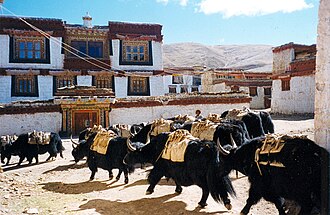 Train of pack yaks at Litang monastery in Garzê Tibetan Autonomous Prefecture, Sichuan, China
 -
 Yaks plowing fields in Tibet
 -
 Yaks in Gilgit-Baltistan, Pakistan
 -
 Domestic yak in Mao County, China
 -
 A yak at Mount Siguniang Scenic Area, Sichuan, China
 -
 Yak are reared on grazing pastures and meadows at elevations of 3,000–5,000 m (9,800–16,400 ft) above sea level in 28 northern mountain districts in Nepal.


See also[edit | edit source]
References[edit | edit source]
- ↑ Scherf, Beate (2000). "World Watch List for Domestic Animal Diversity" (PDF). World Watch List for Domestic Animal Diversity. FAO: 653.
- ↑ "Yak | mammal". Encyclopædia Britannica.
- ↑ "SARLAK Definition & Meaning - Merriam-Webster". Merriam-Webster.
- ↑ Template:MSW3 Artiodactyla
- ↑ Guo, S.; et al. (2006). "Taxonomic placement and origin of yaks: implications from analyses of mtDNA D-loop fragment sequences". Acta Theriologica Sinica. 26 (4): 325–330.
- ↑ 6.0 6.1 6.2 6.3 6.4 6.5 6.6 6.7 6.8 Leslie, D.M.; Schaller, G.B. (2009). "Bos grunniens and Bos mutus (Artiodactyla: Bovidae)". Mammalian Species. 836: 1–17. Bibcode:2009MamSp.836....1L. doi:10.1644/836.1.
- ↑ International Commission on Zoological Nomenclature (2003). "Opinion 2027. Usage of 17 specific names based on wild species that are predated by or contemporary with those based on domestic animals (Lepidoptera, Osteichthyes, Mammalia): conserved". Bulletin of Zoological Nomenclature. 60: 81–84.
- ↑ Buzzard, P.; Berger, J. (2016). "Bos mutus". IUCN Red List of Threatened Species. 2016 e.T2892A101293528. doi:10.2305/IUCN.UK.2016-2.RLTS.T2892A101293528.en. Retrieved 12 November 2021.
- ↑ Gentry, A.; Clutton-Brock, J.; Groves, C. P. (2004). "The naming of wild animal species and their domestic derivatives". Journal of Archaeological Science. 31 (5): 645. Bibcode:2004JArSc..31..645G. doi:10.1016/j.jas.2003.10.006.
- ↑ Buchholtz, C. (1990). True Cattle (Genus Bos). pp. 386–397 in S. Parker, ed. Grzimek's Encyclopedia of Mammals, Volume 5. New York: McGraw-Hill Publishing Company. (quoted in Oliphant, M. (2003). Bos grunniens (On-line), Animal Diversity Web. Accessed 4 April 2009)
- ↑ "The Yak. Chapter 2: Yak breeds". FAO. Retrieved 31 August 2017.
- ↑ "Origins, Domestication and Distribution of Yak". FAO. Retrieved 31 August 2017.
- ↑ 13.0 13.1 13.2 13.3 13.4 "The Yak in Relation to Its Environment". FAO.
- ↑ The Yak, Second Edition. Bangkok: Regional Office for Asia and the Pacific Food and Agriculture Organization of the United Nations, ISBN 92-5-104965-3. Accessed 8 August 2008.
- ↑ Sarkar, M.; Das, D. N.; Mondal, D. B. (1999). "Fetal Haemoglobin in Pregnant Yaks (Poephagus grunniens L.)". The Veterinary Journal. 158 (1): 68–70. doi:10.1053/tvjl.1999.0361. PMID 10409419.
- ↑ Yak Archived 25 July 2011 at the Wayback Machine, Animal genetics training resources version II: Breed Information. Adopted from: Bonnemaire, J. "Yak". In: Mason, Ian L. (ed). (1984). Evolution of Domesticated Animals. London: Longman, pp. 39–45. ISBN 0-582-46046-8. Accessed 8 August 2008.
- ↑ Harris, R.B.; Miller, D.J. (October 2009). "Overlap in summer habitats and diets of Tibetan Plateau ungulates". Mammalia. 59 (2): 197–212. doi:10.1515/mamm.1995.59.2.197. S2CID 84659876.
- ↑ Schaller, G.B.; Liu, W. (1996). "Distribution, status, and conservation of wild yak Bos grunniens". Biological Conservation. 76 (1): 1–8. Bibcode:1996BCons..76....1S. doi:10.1016/0006-3207(96)85972-6.
- ↑ Sarkar, M.; Prakash, B.S. (2005). "Timing of ovulation in relation to onset of estrus and LH peak in yak (Poephagus grunniens L.)". Animal Reproduction Science. 86 (4): 353–362. doi:10.1016/j.anireprosci.2004.08.005. PMID 15766812.
- ↑ Zi, X.D. (2003). "Reproduction in female yaks (Bos grunniens) and opportunities for improvement". Theriogenology. 59 (5–6): 1303–1312. doi:10.1016/S0093-691X(02)01172-X. PMID 12527077.
- ↑ Peters, K. J. (April 1987). "Unconventional livestock: Classification and potential uses". ILCA Bulletin (27). International Livestock Centre for Africa: 40.
- ↑ Golden Book Encyclopedia, Vol. 16 p. 1505b. Rockefeller Center, NY: Golden Press (1959).
- ↑ Gyamtsho, Pema. "Economy of Yak Herders" (PDF). Digital Himalaya.
- ↑ Newman, Jacqueline M. (Winter 1999). "Tibet and Tibetan Foods". Flavor and Fortune. Vol. 6, no. 4. Archived from the original on 1 July 2013. Retrieved 19 December 2012.
- ↑ "Butter - Yaks, butter & lamps in Tibet", WebExhibits.
- ↑ "Part 3 - Yak in nontraditional environments by Gerald Wiener". the Yak - Second Edition. FAO. 2003.
- ↑ "Welcome to the Official Website of ICAR-NRCY". nrcy.icar.gov.in.
- ↑ Takeda, K.; Satoh, M.; Neopane, S.P.; Kuwar, B.S.; Joshi, H.D.; Shrestha, N.P.; Fujise, H.; Tasai, M.; Tagami, T.; Hanada, H. (2004). "Mitochondrial DNA analysis of Nepalese domestic dwarf cattle Lulu". Animal Science Journal. 75 (2): 103. doi:10.1111/j.1740-0929.2004.00163.x.
- ↑ 29.0 29.1 Zhang, R.C. (14 December 2000). "Interspecies Hybridization between Yak, Bos taurus and Bos indicus and Reproduction of the Hybrids". In: Recent Advances in Yak Reproduction, Zhao, X.X.; Zhang, R.C. (eds.). International Veterinary Information Service.
- ↑ Jacques, G.; d'Alpoim Guedes, J.; Zhang, S. (2021). "Yak Domestication: A Review of Linguistic, Archaeological, and Genetic Evidence". Ethnobiology Letters. 12 (1): 103–114. doi:10.14237/ebl.12.1.2021.1755. S2CID 238997533.
- ↑ Sagart, L.; Jacques, G.; Lai, Y.; Ryder, R.J.; Thouzeau, V.; Greenhill, S. J.; List, J.-M. (2019). "Dated language phylogenies shed light on the ancestry of Sino-Tibetan". Proceedings of the National Academy of Sciences. 116 (21): 10317–10322. Bibcode:2019PNAS..11610317S. doi:10.1073/pnas.1817972116. PMC 6534992. PMID 31061123.
- ↑ "Earliest evidence for domestic yak found using both archaeology, ancient DNA". ScienceDaily. 13 December 2023. Retrieved 14 December 2023.
- ↑ Degen, Allan A.; Kam, Michael; Pandey, Shambhu B.; Upreti, Chet R.; Pandey, Sanjeev; Regmi, Prajwal (21 October 2007). "Transhumant Pastoralism in Yak Production in the Lower Mustang District of Nepal". Nomadic Peoples. 11 (2): 57–85. doi:10.3167/np.2007.110204.
- ↑ "People flock to Mustang to drink yak blood". Retrieved 7 June 2021.
- ↑ "Festival to drink Yak blood begins in Nepal". Hindustan Times. 20 July 2008. Retrieved 7 June 2021.
- ↑ Ians (11 March 2010). "Nepal now sees blood drinking festival". The Hindu. Kathmandu. ISSN 0971-751X. Retrieved 7 June 2021.
- ↑ "Sky Burial – The traditional Tibetan Funeral Custom". Tibet.cn. Retrieved 12 April 2025.
- ↑ Runze, Yu, ed. (13 December 2012), "Funeral Reforms Edge Along in Tibetan Areas", Sina English, Xinhua, archived from the original on 24 February 2021, retrieved 12 August 2024
- ↑ Jigme, Catherine. "Sky burial may be replaced by cremation in Qinghai". Tibet Travel. Retrieved 12 April 2025.
- ↑ Logan, Pamela. "Survival and Evolution of Sky Burial Practices". Retrieved 12 April 2025.
- ↑ Perry, Alex (4 July 2005). "Extreme Yak Sports". Time. Archived from the original on 7 March 2014. Retrieved 8 March 2012.
- ↑ "Asia's newest sport - yak skiing". BBC News. 3 July 2005. Retrieved 21 October 2008.
External links[edit | edit source]
- International Yak Association (IYAK); Archived 4 March 2020 at the Wayback Machine
- European Yak Association (EYAK)
- Article on Yak breeds in FAO archives
- Yaks: The Official Animal of Tibet
- Yak Genome Database
Template:Artiodactyla Template:Fibers Template:Meat Template:Working animals Template:Animal domestication