




Ajay Kumar (talk | contribs) Created a new article |
mNo edit summary |
||
| Line 1: | Line 1: | ||
{{Short description|Peninsula in | {{Short description|Peninsula of Turkey in Western Asia}} | ||
{{ | {{Other uses}} | ||
{{Redirect|Asia Minor}} | {{Redirect|Asia Minor}} | ||
{{Use dmy dates|date= | {{Use dmy dates|date=December 2025}} | ||
{{Infobox | {{Infobox islands | ||
| name = Anatolia | | name = Anatolia<br />{{small|Asia Minor}} | ||
| | | local_name = {{nobold|{{lang|tr|Anadolu}} ([[Turkish language|Turkish]])}} | ||
| | | image_map = Map of the geographic region of Anatolia.png | ||
| | | image_map_caption = Map of Anatolia (dark green), which according to one definition is delineated by an imprecise line from the [[Gulf of Alexandretta]] to the [[Black Sea]].<ref name=Merriam>{{cite book |title=Merriam-Webster's Geographical Dictionary |year=2001 |isbn=978-0-87779-546-9 |page=46 |url=https://books.google.com/books?id=Co_VIPIJerIC&q=anatolia+geographical+dictionary&pg=PA883 |access-date=18 May 2001 |last1=Hopkins |first1=Daniel J. |last2=Staff |first2=Merriam-Webster |author3=편집부 |publisher=Merriam-Webster |archive-date=28 November 2021 |archive-url=https://web.archive.org/web/20211128204112/https://books.google.com/books?id=Co_VIPIJerIC&q=anatolia+geographical+dictionary&pg=PA883 |url-status=live |quote=Anatolia: The part of Turkey in Asia equivalent to the peninsula of Asia Minor up to indefinite line on E from Gulf of Iskenderun to Black Sea comprising about three fifths of Turkey's provinces}}</ref> According to another definition, it is coterminous with the Asian part of Turkey.<ref name=anatolia_definition> | ||
* {{harvnb|McColl|2014|p=922}}: "Thrace, its European area, is about the size of Vermont at 9,412 square mi (24,378 square km). Its Asian area (Asia Minor) is called Anatolia and covers 291,971 square mi (756,202 square km)" | |||
| image_map = Map of the geographic region of Anatolia.png | * {{harvnb|Cohen|2008|p=125}}: "Anatolia, [Gr.=sunrise], Asiatic part of Turkey; its area covers 97% of all Turkey" | ||
| | * {{harvnb|Tockner|Uehlinger|Robinson|2009|location=Chapter 17}}: "About 97% of the country is in Asia Minor (Anatolia) and 3% in Europe (Thrace)" | ||
* {{cite web |url=https://www.cia.gov/the-world-factbook/countries/turkey-turkiye/#geography |archive-url=https://web.archive.org/web/20220618061436/https://www.cia.gov/the-world-factbook/countries/turkey-turkiye/#geography |url-status=dead |archive-date=18 June 2022 |title=Turkey |work=[[The World Factbook]] |publisher=[[Central Intelligence Agency]] |access-date=20 February 2024}}: "the 97% of the country in Asia is referred to as Anatolia" | |||
* {{cite web |url=https://www.britannica.com/place/Anatolia |title=Anatolia |website=[[Encyclopedia Britannica]] |access-date=29 February 2024}}: "Anatolia, the peninsula of land that today constitutes the Asian portion of Turkey" | |||
| | * {{harvnb|Steadman|McMahon|2011|p=466}} | ||
| | * {{harvnb|Howard|2016|p=7}} | ||
| | * {{cite web |url=http://countrystudies.us/turkey/18.htm |editor=Helen Chapin Metz |title=Turkey: A Country Study | Geography |year=1995 |location=Washington |publisher=GPO for the Library of Congress |access-date=31 May 2024}}: "The Asian part of the country is known by a variety of names--Asia Minor, Asiatic Turkey, the Anatolian Plateau, and Anatolia (Anadolu)"</ref> | ||
| | | coordinates = {{coord|39|N|35|E|type:country|display=inline,title}} | ||
| | | etymology = 'The East' (from {{langx|grc|[[wikt:ἀνατολή|Ἀνατολή]]|label=[[Ancient Greek|Greek]]}}, {{transliteration|grc|Anatolḗ}}) | ||
| | | location = [[West Asia]] | ||
| coordinates = {{ | | island_type = [[Peninsula]] | ||
| etymology = | | area_km2 = 537,886 | ||
| area_footnotes = <ref>{{cite book |author1=Stephen Mitchell |title=Anatolia: land, men, and Gods in Asia Minor |date=6 July 1995 |publisher=[[Oxford University Press]] |isbn=0-19-815029-6 |url=https://libunix.ku.edu.tr/search~S9/?searchtype=t&searcharg=Anatolia%3A+Land%2C+Men%2C+and+Gods+in+Asia+Minor&searchscope=9&SORT=DZ&extended=0&SUBMIT=Search&searchlimits=&searchorigarg=tAnatolian+Civilizations+and+Antique+Cities+of+Turkey |volume=2 }}</ref> | |||
| | |||
| | |||
| | |||
| | |||
| area_km2 = | |||
| area_footnotes = | |||
<ref>{{cite | |||
| | |||
| country_largest_city = [[Ankara]] | | country_largest_city = [[Ankara]] | ||
| country_largest_city_population = 5,803,482 | |||
| country_largest_city_population = 5, | | demonym = Anatolian | ||
| | | population = | ||
| | | languages = {{vunblist | ||
| | | Predominantly [[Turkish language|Turkish]]<ref> | ||
| | * {{harvnb|KONDA|2006|p=19}} | ||
| | * {{harvnb|Comrie|2018|p=537}}</ref>}} {{collapsible list |title=Others:|[[Kurmanji|Kurdish]]|[[Zaza language|Zaza]]|[[Arabic]]|[[Circassian languages|Circassian]]|[[Laz language|Laz]]|[[Greek language|Greek]]|[[Georgian language|Georgian]]|[[Armenian language|Armenian]]|[[Suret language|Neo-Aramaic]]|[[Languages of Turkey|Other languages]]}} | ||
| | | ethnic_groups = {{Plainlist| | ||
| | *Majority: [[Turkish people|Turks]]<ref name=World_Factbook_People>{{cite web|url=https://www.cia.gov/the-world-factbook/countries/turkey-turkiye/#people-and-society |archive-url=https://web.archive.org/web/20220618061436/https://www.cia.gov/the-world-factbook/countries/turkey-turkiye/#people-and-society |url-status=dead |archive-date=18 June 2022 |title=Turkey (Turkiye) |work=[[The World Factbook]] |publisher=[[Central Intelligence Agency]] |access-date=9 October 2024}}</ref><ref name="KONDA 2006 17">{{harvnb|KONDA|2006|p=17}}</ref> | ||
| | *Minority: [[Kurds in Turkey|Kurds]] and [[Minorities in Turkey|other peoples]]<ref name=World_Factbook_People/><ref name="KONDA 2006 17"/>}} | ||
| | | timezone1 = [[Time in Turkey|TRT]] | ||
| utc_offset1 = +03:00 | |||
| | |||
| | |||
| | |||
| | |||
| | |||
| ethnic_groups = [[Turkish people|Turks]] | |||
| timezone1 = [[Time in Turkey|TRT]] | |||
| utc_offset1 = + | |||
}} | }} | ||
'''Anatolia''' | '''Anatolia''' ({{langx|tr|Anadolu}}), also known as '''Asia Minor''',{{efn|Additional alternative names include '''Asian/Asiatic Turkey''', the '''Anatolian Peninsula''', and the '''Anatolian Plateau'''.}} is a [[peninsula]] in [[West Asia]] that makes up the majority of the land area of [[Turkey]]. It is the westernmost protrusion of [[Asia]] and is geographically bounded by the [[Mediterranean Sea]] to the south, the [[Aegean Sea]] to the west, the [[Turkish Straits]] to the northwest, and the [[Black Sea]] to the north. The eastern and southeastern limits have been expanded either to the entirety of Asiatic Turkey<ref name="anatolia_definition" /> or to an imprecise line from the [[Black Sea]] to the [[Gulf of Alexandretta]].<ref name="Merriam" /> Topographically, the [[Sea of Marmara]] connects the Black Sea with the Aegean Sea through the [[Bosporus]] and the [[Dardanelles]], and separates Anatolia from [[Thrace]] in [[Southeast Europe]]. | ||
During the [[Neolithic period]], Anatolia was an early center for the [[development of farming]] after it originated in the adjacent [[Fertile Crescent]]. Beginning around 9,000 years ago, there was a major migration of [[Anatolian Neolithic Farmers|Anatolian neolithic farmers]] into [[Neolithic Europe|Europe]], with their descendants coming to dominate the continent as far west as the [[Iberian Peninsula]] and the [[British Isles]]. | |||
The | The [[List of ancient peoples of Anatolia|earliest recorded inhabitants of Anatolia]], such as the [[Hattians]], who were neither [[Indo-European languages|Indo-European]] nor [[Semitic languages|Semitic]], were gradually absorbed by the incoming Indo-European [[Anatolian peoples]], who spoke the now-extinct [[Anatolian languages]]. The major Anatolian languages included [[Hittite language|Hittite]], [[Luwian language|Luwian]], and [[Lydian language|Lydian]]; other local languages, albeit poorly attested, included [[Phrygian language|Phrygian]] and [[Mysian language|Mysian]]. The [[Hurro-Urartian languages]] were spoken throughout [[Mitanni]] in the southeast, while [[Galatian language|Galatian]], a [[Celtic languages|Celtic language]], was spoken throughout [[Galatia]] in the central peninsula. Among the other peoples who established a significant presence in [[Prehistory of Anatolia|ancient Anatolia]] were the [[Galatians (people)|Galatians]], the [[Hurrians]], the [[Assyrian people|Assyrians]], the [[Armenians]], the [[Hattians]], and the [[Cimmerians]], as well as some of the [[List of ancient Greek tribes|ancient Greek tribes]], including the [[Ionians]], the [[Dorians]], and the [[Aeolic Greek|Aeolian]]s. In the era of [[classical antiquity]] (see [[Classical Anatolia]]), the Anatolian languages were largely replaced by the [[Greek language]], which came to dominate a large region during the [[Hellenistic period]] and the [[Roman Empire|Roman period]]. | ||
The [[Byzantine Empire|Byzantine period]] saw the height and eventual decline of Greek influence throughout the peninsula as the [[Byzantine–Seljuk wars]] enabled the incoming [[Seljuk dynasty|Seljuk Turks]] to establish a foothold in the region. Thus, the process of Anatolia's [[Turkification]] began under the [[Seljuk Empire]] in the late 11th century and continued under the [[Ottoman Empire]] until the early 20th century, when the [[Ottoman dynasty]] collapsed in the [[Aftermath of World War I#Ottoman Empire|aftermath of World War I]]. Between 1894 and 1924, millions of non-Turkic peoples and [[Christianity in the Ottoman Empire|Christians]], especially [[Greeks]] (about two million) and [[Armenian Genocide|Armenians]] (est. 1.5 million),<ref>https://hmh.org/library/research/genocide-in-armenia-guide/</ref> were [[Late Ottoman genocides|killed by the Ottoman Turkish authorities]] or expelled from the bulk of the area of modern-day Turkey. Nonetheless, a variety of non-Turkic languages continue to be spoken by ethnic minorities in Anatolia today, including [[Arabic]], [[Kurdish language|Kurdish]], [[Assyrian Neo-Aramaic|Neo-Aramaic]], [[Armenian language|Armenian]], the [[North Caucasian languages]], [[Laz language|Laz]], [[Georgian language|Georgian]], and [[Greek language|Greek]]. | |||
==Geography== | ==Geography== | ||
{{Main|Geography of Turkey}} | {{Main|Geography of Turkey}} | ||
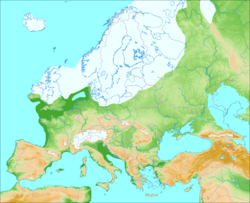
[[File:Weichsel-Würm-Glaciation.png|thumb|right|Europe during the [[Last Glacial Maximum]], c. 20,000 years ago. Anatolia was connected to the European mainland until {{Circa| | [[File:Weichsel-Würm-Glaciation.png|thumb|right|Europe during the [[Last Glacial Maximum]], c. 20,000 years ago. Anatolia was connected to the European mainland until {{Circa|5,600 BCE}},<ref name="Black Sea Deluge">{{cite web|url=https://commons.wikimedia.org/wiki/File:Deluge-NASA.png|title=Illustration of the Lake (later Sea) of Marmara and the formation of the Turkish Straits after the Black Sea deluge|website=www.ncdc.noaa.gov|date=26 January 2014|access-date=22 May 2021|archive-date=31 August 2021|archive-url=https://web.archive.org/web/20210831144627/https://commons.wikimedia.org/wiki/File:Deluge-NASA.png|url-status=live}}</ref><ref name="Dimitrov1">Dimitrov P., 2003. [https://www.researchgate.net/publication/284602641_The_Black_Sea_-_a_Clue_to_the_Secret_of_World_Flood "The Black Sea – a Clue to the Secret of World Flood"]. {{Webarchive|url=https://web.archive.org/web/20210521201345/https://www.researchgate.net/publication/284602641_The_Black_Sea_-_a_Clue_to_the_Secret_of_World_Flood |date=21 May 2021 }}. ''Oceanology'', 4, 52–57.</ref><ref name="Dimitrov2">Dimitrov P., D. Dimitrov. 2004. [https://www.researchgate.net/publication/290938137_The_Black_Sea_The_Flood_and_the_ancient_myths The Black Sea The Flood and the ancient myths]. {{Webarchive|url=https://web.archive.org/web/20210515095644/https://www.researchgate.net/publication/290938137_The_Black_Sea_The_Flood_and_the_ancient_myths |date=15 May 2021 }}. "Slavena", Varna, {{ISBN|954579335X}}, 91 pp., {{doi|10.13140/RG.2.2.18954.16327}}.</ref> when the melting [[ice sheet]]s caused the [[sea level]] in the [[Mediterranean Sea|Mediterranean]] to rise around {{convert|120|m|-1|abbr=on}},<ref name="Dimitrov1"/><ref name="Dimitrov2"/> triggering the formation of the [[Turkish Straits]].<ref name="Black Sea Deluge"/><ref name="Dimitrov1"/><ref name="Dimitrov2"/> As a result, two former [[lake]]s (the [[Sea of Marmara]] and the [[Black Sea]])<ref name="Black Sea Deluge"/> were connected to the [[Mediterranean Sea]], which separated Anatolia from Europe.]] | ||
Traditionally, Anatolia is considered to extend in the east to an indefinite line running from the [[Gulf of Alexandretta]] to the [[Black Sea]],<ref name="Niewohner2017">{{cite book|author=Philipp Niewohner|title=The Archaeology of Byzantine Anatolia: From the End of Late Antiquity until the Coming of the Turks|url=https://books.google.com/books?id=cAUmDwAAQBAJ&pg=PA18|date=2017|publisher=Oxford University Press|isbn=978- | Traditionally, Anatolia is considered to extend in the east to an indefinite line running from the [[Gulf of Alexandretta]] to the [[Black Sea]],<ref name="Niewohner2017">{{cite book|author=Philipp Niewohner|title=The Archaeology of Byzantine Anatolia: From the End of Late Antiquity until the Coming of the Turks|url=https://books.google.com/books?id=cAUmDwAAQBAJ&pg=PA18|date=2017|publisher=Oxford University Press|isbn=978-0-19-061047-0|pages=18–|access-date=7 December 2018|archive-date=11 March 2020|archive-url=https://web.archive.org/web/20200311111958/https://books.google.com/books?id=cAUmDwAAQBAJ&pg=PA18|url-status=live}}</ref> coterminous with the [[Anatolian Plateau]]. This traditional geographical definition is used, for example, in the latest edition of ''[[Merriam-Webster's Geographical Dictionary]]''.<ref name="Merriam" /> Under this definition, Anatolia is bounded to the east by the [[Armenian Highlands]], and the [[Euphrates]] before that river bends to the southeast to enter [[Mesopotamia]].<ref name="Mitchell">Stephen Mitchell (1995). ''Anatolia: Land, Men, and Gods in Asia Minor. The Celts in Anatolia and the impact of Roman rule''. Clarendon Press, 266 pp. {{ISBN|978-0198150299}} [https://books.google.com/books?id=pUYtwuve40kC] {{Webarchive|url=https://web.archive.org/web/20170329114033/https://books.google.com/books?id=pUYtwuve40kC|date=29 March 2017}}</ref> To the southeast, it is bounded by the ranges that separate it from the [[Orontes River|Orontes]] valley in [[Syria (region)|Syria]] and the Mesopotamian plain.<ref name="Mitchell"/> | ||
Following the [[Armenian genocide]], [[Western Armenia]] [[Eastern Anatolia Region#Substitution with Armenia|was renamed]] the [[Eastern Anatolia | Following the [[Armenian genocide]], [[Western Armenia]] [[Eastern Anatolia Region#Substitution with Armenia|was renamed]] the [[Eastern Anatolia region]] by the newly established Turkish government.<ref name="Sahakyan">{{cite book|last=Sahakyan|first=Lusine|title=Turkification of the Toponyms in the Ottoman Empire and the Republic of Turkey|year=2010|publisher=Arod Books|location=Montreal|isbn=978-0-9699879-7-0}}</ref><ref name=":0">{{cite book |last1=Hovannisian |first1=Richard |url=https://books.google.com/books?id=K3monyE4CVQC |title=The Armenian Genocide: Cultural and Ethical Legacies |date=2007 |publisher=Transaction Publishers |isbn=978-1-4128-3592-3 |location=New Brunswick, NJ |page=3 |access-date=10 September 2015 |archive-date=10 October 2017 |archive-url=https://web.archive.org/web/20171010030024/https://books.google.com/books?id=K3monyE4CVQC |url-status=live }}</ref> In 1941, with the [[First Geography Congress, Turkey|First Geography Congress]] which divided Turkey into [[geographical regions of Turkey|seven geographical regions]] based on differences in climate and landscape, the eastern [[provinces of Turkey]] were placed into the Eastern Anatolia region,<ref>[http://www.tandfonline.com/doi/abs/10.2167/irgee216.0 A Comparative Analysis Regarding Pictures Included in Secondary School Geography Textbooks Taught in Turkey]. {{Webarchive|url=https://web.archive.org/web/20150413141440/http://www.tandfonline.com/doi/abs/10.2167/irgee216.0 |date=13 April 2015 }}, Okan Yasar and Mehmet Seremet, ''International Research in Geographical and Environmental Education'', 2007.</ref> which largely corresponds to the historical region of [[Western Armenia]]. Vazken Davidian terms the expanded use of "Anatolia" to apply to territory in eastern Turkey that was formerly referred to as ''Armenia'' (which had a sizeable [[Armenians in the Ottoman Empire|Armenian]] population before the [[Armenian genocide]]) an "ahistorical imposition" and notes that a growing body of literature is uncomfortable with referring to the Ottoman East as "Eastern Anatolia".<ref>Vazken Khatchig Davidian, "Imagining Ottoman Armenia: Realism and Allegory in Garabed Nichanian's Provincial Wedding in Moush and Late Ottoman Art Criticism", p. 7 & footnote 34, in ''Études arméniennes contemporaines'' volume 6, 2015.</ref><ref name="Sahakyan"/><ref name=":0" /> | ||
The highest mountain in the | The highest mountain in the Eastern Anatolia region (also the highest peak in the [[Armenian Highlands]]) is [[Mount Ararat]] (5123 m).<ref>{{Cite journal| volume = 42| issue = 2| pages = 143–149| last1 = Fevzi Özgökçe| last2 = Kit Tan| last3 = Vladimir Stevanović| title = A new subspecies of Silene acaulis (Caryophyllaceae) from East Anatolia, Turkey| journal = Annales Botanici Fennici|year = 2005| jstor = 23726860}}</ref> The [[Euphrates]], [[Aras (river)|Aras]], [[Karasu (Euphrates)|Karasu]] and [[Murat river]]s connect the Armenian Highlands to the [[South Caucasus]] and the Upper Euphrates Valley. Along with the [[Çoruh]], these rivers are the longest in the Eastern Anatolia region.<ref name=palumbi>{{Cite journal| doi = 10.1093/oxfordhb/9780195376142.013.0009| last = Palumbi| first = Giulio| title = The Chalcolithic of Eastern Anatolia| journal = The Oxford Handbook of Ancient Anatolia| volume = 1| access-date = 6 May 2018| date = 5 September 2011| url = http://www.oxfordhandbooks.com/view/10.1093/oxfordhb/9780195376142.001.0001/oxfordhb-9780195376142-e-9| editor1-last = McMahon| editor1-first = Gregory| editor2-last = Steadman| editor2-first = Sharon| archive-date = 12 May 2018| archive-url = https://web.archive.org/web/20180512155433/http://www.oxfordhandbooks.com/view/10.1093/oxfordhb/9780195376142.001.0001/oxfordhb-9780195376142-e-9| url-status = live| url-access = subscription}}</ref> | ||
== Etymology == | == Etymology == | ||
The English-language name ''Anatolia'' derives from the [[Ancient Greek|Greek]] {{lang|grc|Ἀνατολή}} ({{lang|grc-Latn|Anatolḗ}}) meaning "the East" and designating (from a Greek point of view) eastern regions in general. The Greek word refers to the direction where the sun rises, coming from {{lang|grc|ἀνατέλλω}} ''anatello'' '(Ι) rise up', comparable to terms in other languages such as "[[levant]]" from Latin {{Lang|la|levo}} 'to rise', "[[orient]]" from Latin {{Lang|la|orior}} 'to arise, to originate', [[Hebrew language|Hebrew]] {{Lang|he|מִזְרָח}} ''mizraḥ'' 'east' from {{Lang|he|זָרַח}} ''zaraḥ'' 'to rise, to shine', [[Aramaic]] {{Lang|arc|מִדְנָח}} ''midnaḥ'' from {{Lang|arc|דְּנַח}} ''denaḥ'' 'to rise, to shine'.<ref name="etym">{{cite web |url= https://www.perseus.tufts.edu/cgi-bin/ptext?doc=Perseus%3Atext%3A1999.04.0057%3Aentry%3D%237638 |author= Henry George Liddell |author2= Robert Scott |title= A Greek-English Lexicon |access-date= 20 February 2021 |archive-date= 26 May 2007 |archive-url= https://web.archive.org/web/20070526063014/http://www.perseus.tufts.edu/cgi-bin/ptext?doc=Perseus%3Atext%3A1999.04.0057%3Aentry%3D%237638 |url-status= live }}</ref><ref name="OED">{{Cite web |title=Anatolia | Origin and meaning of the name Anatolia | The English-language name ''Anatolia'' derives from the [[Ancient Greek|Greek]] {{lang|grc|Ἀνατολή}} ({{lang|grc-Latn|Anatolḗ}}) meaning "the East" and designating (from a Greek point of view) eastern regions in general. The Greek word refers to the direction where the sun rises, coming from {{lang|grc|ἀνατέλλω}} ''anatello'' '(Ι) rise up', comparable to terms in other languages such as "[[levant]]" from Latin {{Lang|la|levo}} 'to rise', "[[orient]]" from Latin {{Lang|la|orior}} 'to arise, to originate', [[Hebrew language|Hebrew]] {{Lang|he|מִזְרָח}} ''mizraḥ'' 'east' from {{Lang|he|זָרַח}} ''zaraḥ'' 'to rise, to shine', [[Aramaic]] {{Lang|arc|מִדְנָח}} ''midnaḥ'' from {{Lang|arc|דְּנַח}} ''denaḥ'' 'to rise, to shine'.<ref name="etym">{{cite web |url= https://www.perseus.tufts.edu/cgi-bin/ptext?doc=Perseus%3Atext%3A1999.04.0057%3Aentry%3D%237638 |author= Henry George Liddell |author2= Robert Scott |title=ἀνατολή |website= A Greek-English Lexicon |access-date=20 February 2021 |archive-date=26 May 2007 |archive-url= https://web.archive.org/web/20070526063014/http://www.perseus.tufts.edu/cgi-bin/ptext?doc=Perseus%3Atext%3A1999.04.0057%3Aentry%3D%237638 |url-status= live }}</ref><ref name="OED">{{Cite web |title=Anatolia | Origin and meaning of the name Anatolia |url=https://www.etymonline.com/word/anatolia |url-status=live |archive-url=https://web.archive.org/web/20170713102500/http://www.etymonline.com/index.php?term=Anatolia |archive-date=13 July 2017 |access-date=14 May 2021 |website=Online Etymology Dictionary |language=en-US}}</ref> | ||
The use of Anatolian designations has varied over time, perhaps originally referring to the [[Aeolians|Aeolian]], [[Ionians|Ionian]] and [[Dorians|Dorian]] colonies situated along the eastern coasts of the [[Aegean Sea]], but also encompassing eastern regions in general. Such use of Anatolian designations was employed during the reign of Roman Emperor [[Diocletian]] ({{Reign|284|305}}), who created the [[Diocese of the East]], known in Greek as the Eastern Diocese, but completely unrelated to the regions of Asia Minor. In their widest territorial scope, Anatolian designations were employed during the reign of Roman Emperor [[Constantine I]] (306–337), who created the [[Praetorian prefecture of the East]], known in Greek as the Eastern Prefecture, encompassing all eastern regions of the [[Late Roman Empire]] and spanning from [[Diocese of Thrace|Thrace]] to [[Diocese of Egypt|Egypt]]. | The use of Anatolian designations has varied over time, perhaps originally referring to the [[Aeolians|Aeolian]], [[Ionians|Ionian]] and [[Dorians|Dorian]] colonies situated along the eastern coasts of the [[Aegean Sea]], but also encompassing eastern regions in general. Such use of Anatolian designations was employed during the reign of Roman Emperor [[Diocletian]] ({{Reign|284|305}}), who created the [[Diocese of the East]], known in Greek as the Eastern Diocese, but completely unrelated to the regions of Asia Minor. In their widest territorial scope, Anatolian designations were employed during the reign of Roman Emperor [[Constantine I]] (306–337), who created the [[Praetorian prefecture of the East]], known in Greek as the Eastern Prefecture, encompassing all eastern regions of the [[Late Roman Empire]] and spanning from [[Diocese of Thrace|Thrace]] to [[Diocese of Egypt|Egypt]]. | ||
| Line 116: | Line 63: | ||
Only after the loss of other eastern regions during the 7th century and the reduction of [[Byzantine Empire|Byzantine]] eastern domains to Asia Minor, that region became the only remaining part of the ''Byzantine East'', and thus commonly referred to (in Greek) as the Eastern part of the Empire. At the same time, the [[Anatolic Theme]] ({{lang|grc|Ἀνατολικὸν θέμα}} / "the Eastern theme") was created, as a province (''[[Theme (Byzantine district)|theme]]'') covering the western and central parts of Turkey's present-day [[Central Anatolia Region]], centered around [[Iconium]], but ruled from the city of [[Amorium]].<ref name="First Thema 1952, p. 59">"On the First Thema, called Anatolikón. This theme is called Anatolikón or Theme of the Anatolics, not because it is above and in the direction of the east where the sun rises, but because it lies to the East of Byzantium and Europe." [[Constantine VII Porphyrogenitus]], ''De Thematibus'', ed. A. Pertusi. Vatican: [[Vatican Library]], 1952, pp. 59 ff.</ref><ref name="John Haldon 2002. Page 32">John Haldon, ''Byzantium, a History'', 2002, p. 32.</ref> | Only after the loss of other eastern regions during the 7th century and the reduction of [[Byzantine Empire|Byzantine]] eastern domains to Asia Minor, that region became the only remaining part of the ''Byzantine East'', and thus commonly referred to (in Greek) as the Eastern part of the Empire. At the same time, the [[Anatolic Theme]] ({{lang|grc|Ἀνατολικὸν θέμα}} / "the Eastern theme") was created, as a province (''[[Theme (Byzantine district)|theme]]'') covering the western and central parts of Turkey's present-day [[Central Anatolia Region]], centered around [[Iconium]], but ruled from the city of [[Amorium]].<ref name="First Thema 1952, p. 59">"On the First Thema, called Anatolikón. This theme is called Anatolikón or Theme of the Anatolics, not because it is above and in the direction of the east where the sun rises, but because it lies to the East of Byzantium and Europe." [[Constantine VII Porphyrogenitus]], ''De Thematibus'', ed. A. Pertusi. Vatican: [[Vatican Library]], 1952, pp. 59 ff.</ref><ref name="John Haldon 2002. Page 32">John Haldon, ''Byzantium, a History'', 2002, p. 32.</ref> | ||
The Latinized form "{{Lang|la-x-medieval|Anatolia|italic=no}}", with its ''-ia'' ending, is probably a [[Medieval Latin]] innovation.<ref name=OED /> The modern Turkish form {{Lang|tr|Anadolu}} derives directly from the Greek name {{lang|el| | The Latinized form "{{Lang|la-x-medieval|Anatolia|italic=no}}", with its ''-ia'' ending, is probably a [[Medieval Latin]] innovation.<ref name=OED /> The modern Turkish form {{Lang|tr|Anadolu}} derives directly from the Greek name {{lang|el|Ἀνατολή}} (''Anatolḗ''). The Russian male name [[Anatoly]], the French [[Anatole (given name)|Anatole]] and plain [[Anatol]], all stemming from saints [[Anatolius of Laodicea]] (d. 283) and [[Anatolius of Constantinople]] (d. 458; the first [[Patriarch of Constantinople]]), share the same linguistic origin. | ||
== Names == | == Names == | ||
{{Further| | {{Further|Place name changes in Turkey}} | ||
The oldest known name for any region within Anatolia is related to its central area, known as the "Land of [[Hatti (land of the Hattians)|Hatti]]" – a designation that was initially used for the land of ancient [[Hattians]], but later became the most common name for the entire territory under the rule of ancient [[Hittites]].{{sfn|Bryce|2009|pp=297–98}} | The oldest known name for any region within Anatolia is related to its central area, known as the "Land of [[Hatti (land of the Hattians)|Hatti]]" – a designation that was initially used for the land of ancient [[Hattians]], but later became the most common name for the entire territory under the rule of ancient [[Hittites]].{{sfn|Bryce|2009|pp=297–98}} | ||
| Line 125: | Line 72: | ||
The first recorded name the Greeks used for the Anatolian peninsula, though not particularly popular at the time, was [[:wikt:Ἀσία|Ἀσία]] (''Asía''),<ref>Henry George Liddell, Robert Scott, [https://www.perseus.tufts.edu/hopper/text?doc=Perseus%3Atext%3A1999.04.0057%3Aentry%3D*%29asi%2Fa Ἀσία]. {{Webarchive|url=https://web.archive.org/web/20110427042823/http://www.perseus.tufts.edu/hopper/text?doc=Perseus%3Atext%3A1999.04.0057%3Aentry%3D*%29asi%2Fa |date=27 April 2011 }}, ''A Greek-English Lexicon'', on Perseus.</ref> perhaps from an Akkadian expression for the "sunrise" or possibly echoing the name of the [[Assuwa league]] in western Anatolia.{{citation needed|date=January 2013}} The Romans used it as the name of their [[Asia (Roman province)|province]], comprising the west of the peninsula plus the nearby [[Aegean Islands]]. As the name "Asia" broadened its scope to apply to the vaster region east of the Mediterranean, some Greeks in [[Late Antiquity]] came to use the name Asia Minor (Μικρὰ Ἀσία, ''Mikrà Asía''), meaning "Lesser Asia" to refer to present-day Anatolia, whereas the administration of the Empire preferred the description Ἀνατολή (''Anatolḗ''; {{lit|the East}}). | The first recorded name the Greeks used for the Anatolian peninsula, though not particularly popular at the time, was [[:wikt:Ἀσία|Ἀσία]] (''Asía''),<ref>Henry George Liddell, Robert Scott, [https://www.perseus.tufts.edu/hopper/text?doc=Perseus%3Atext%3A1999.04.0057%3Aentry%3D*%29asi%2Fa Ἀσία]. {{Webarchive|url=https://web.archive.org/web/20110427042823/http://www.perseus.tufts.edu/hopper/text?doc=Perseus%3Atext%3A1999.04.0057%3Aentry%3D*%29asi%2Fa |date=27 April 2011 }}, ''A Greek-English Lexicon'', on Perseus.</ref> perhaps from an Akkadian expression for the "sunrise" or possibly echoing the name of the [[Assuwa league]] in western Anatolia.{{citation needed|date=January 2013}} The Romans used it as the name of their [[Asia (Roman province)|province]], comprising the west of the peninsula plus the nearby [[Aegean Islands]]. As the name "Asia" broadened its scope to apply to the vaster region east of the Mediterranean, some Greeks in [[Late Antiquity]] came to use the name Asia Minor (Μικρὰ Ἀσία, ''Mikrà Asía''), meaning "Lesser Asia" to refer to present-day Anatolia, whereas the administration of the Empire preferred the description Ἀνατολή (''Anatolḗ''; {{lit|the East}}). | ||
The [[endonym]] Ῥωμανία (''Rōmanía'' "the land of the Romans, i.e. the Eastern Roman Empire") was understood as another name for the province by the invading [[Seljuq Turks]], who founded a [[Sultanate of Rûm]] in 1077. Thus (land of the) [[Rûm]] became another name for Anatolia. By the 12th century Europeans had started referring to Anatolia as ''Turchia''.<ref name=oxfordreference>{{Cite book| publisher = Oxford University Press| isbn = 978- | The [[endonym]] Ῥωμανία (''Rōmanía'' "the land of the Romans, i.e. the Eastern Roman Empire") was understood as another name for the province by the invading [[Seljuq Turks]], who founded a [[Sultanate of Rûm]] in 1077. Thus (land of the) [[Rûm]] became another name for Anatolia. By the 12th century Europeans had started referring to Anatolia as ''Turchia''.<ref name=oxfordreference>{{Cite book| publisher = Oxford University Press| isbn = 978-0-19-186632-6| last = Everett-Heath| first = John| title = The Concise Dictionary of World Place-Names| volume = 1| chapter = Anatolia| access-date = 5 December 2018| year = 2018| chapter-url = http://www.oxfordreference.com/view/10.1093/acref/9780191866326.001.0001/acref-9780191866326-e-258| doi = 10.1093/acref/9780191866326.001.0001| archive-date = 6 December 2018| archive-url = https://web.archive.org/web/20181206102228/http://www.oxfordreference.com/view/10.1093/acref/9780191866326.001.0001/acref-9780191866326-e-258| url-status = live}}</ref> | ||
During the era of the [[Ottoman Empire]], mapmakers | During the era of the [[Ottoman Empire]], many mapmakers referred to the mountainous plateau in eastern Anatolia as [[Armenia]]. Other contemporary sources called the same area [[Kurdistan]].<ref name=suny>{{Cite book| publisher = Princeton University Press| isbn = 978-1-4008-6558-1| last = Suny| first = Ronald Grigor| title = 'They Can Live in the Desert but Nowhere Else': A History of the Armenian Genocide| year=2015|page=31}}</ref> Geographers have used ''[[East Anatolian plateau]]'', ''[[Armenian plateau]]'' and the ''[[Iranian plateau]]'' to refer to the region; the former two largely overlap.<ref name=Oxford_Handbook_p466>{{harvnb|Steadman|McMahon|2011|p=466}}</ref> While a standard definition of Anatolia refers to the entire Asian side of Turkey, according to archaeologist Lori Khatchadourian, this difference in terminology "primarily result[s] from the shifting political fortunes and cultural trajectories of the region since the nineteenth century".<ref name=Oxford_Handbook_p466/> | ||
Turkey's [[First Geography Congress, Turkey|First Geography Congress]] in 1941 created two [[geographical regions of Turkey]] to the east of the Gulf of Iskenderun-Black Sea line, the [[Eastern Anatolia | Turkey's [[First Geography Congress, Turkey|First Geography Congress]] in 1941 created two [[geographical regions of Turkey]] to the east of the Gulf of Iskenderun-Black Sea line, the [[Eastern Anatolia region]] and the [[Southeastern Anatolia region]],<ref name="Yigit">Ali Yiğit, "Geçmişten Günümüze Türkiye'yi Bölgelere Ayıran Çalışmalar ve Yapılması Gerekenler", ''Ankara Üniversitesi Türkiye Coğrafyası Araştırma ve Uygulama Merkezi, IV. Ulural Coğrafya Sempozyumu, "Avrupa Birliği Sürecindeki Türkiye'de Bölgesel Farklılıklar"'', [http://www.fka.org.tr/SayfaDownload/bildiri_nihan_atay.pdf pp. 34–35]. {{Webarchive|url=https://web.archive.org/web/20131109013737/http://www.fka.org.tr/SayfaDownload/bildiri_nihan_atay.pdf |date= 9 November 2013 }}.</ref> the former largely corresponding to the [[Western Armenia|western part of the Armenian Highlands]], the latter to the northern part of the Mesopotamian plain. According to [[Richard G. Hovannisian|Richard Hovannisian]], this changing of toponyms was "necessary to obscure all evidence" of the [[Armenians|Armenian]] presence as part of the policy of [[Armenian genocide denial]] embarked upon by the newly established Turkish government and what Hovannisian calls its "foreign collaborators".<ref>{{Cite book| publisher = Wayne State University Press| isbn = 978-0-8143-2777-7| last = Hovannisian| first = Richard G.| title = Remembrance and Denial: The Case of the Armenian Genocide| date = 1998| url = https://books.google.com/books?id=kiBHkRtRmIIC&pg=PA204| access-date = 5 December 2018| archive-date = 10 March 2020| archive-url = https://web.archive.org/web/20200310025218/https://books.google.com/books?id=kiBHkRtRmIIC&pg=PA204| url-status = live}}</ref> | ||
==History== | ==History== | ||
| Line 135: | Line 82: | ||
===Prehistoric Anatolia=== | ===Prehistoric Anatolia=== | ||
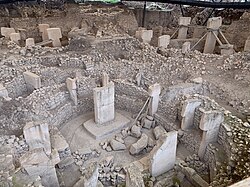
[[File:Göbeklitepe_Şanlıurfa.jpg|thumb|The | [[File:Göbeklitepe_Şanlıurfa.jpg|thumb|The [[henge]]s in [[Göbekli Tepe]] were erected as far back as 9,600 BCE.]] | ||
{{main|Prehistory of Anatolia}} | {{main|Prehistory of Anatolia}} | ||
Human habitation in Anatolia dates back to the [[Paleolithic]].<ref>{{cite journal |last=Stiner |first=Mary C. |author2=Kuhn, Steven L. |author3= Güleç, Erksin |title=Early Upper Paleolithic shell beads at Üçağızlı Cave I (Turkey): Technology and the socioeconomic context of ornament life-histories |journal=Journal of Human Evolution |volume=64 |issue=5 |pages=380–98 |doi=10.1016/j.jhevol.2013.01.008 |issn=0047-2484 |year=2013 |pmid=23481346}}</ref> Neolithic settlements include [[Çatalhöyük]], [[Çayönü]], [[Nevali Cori]], [[Aşıklı Höyük]], [[Boncuklu Höyük]], [[Hacilar]], [[Göbekli Tepe]], [[Norşuntepe]], [[Köşk Höyük]], and [[Yumuktepe]]. Çatalhöyük (7 | Human habitation in Anatolia dates back to the [[Paleolithic]].<ref>{{cite journal |last=Stiner |first=Mary C. |author2=Kuhn, Steven L. |author3= Güleç, Erksin |title=Early Upper Paleolithic shell beads at Üçağızlı Cave I (Turkey): Technology and the socioeconomic context of ornament life-histories |journal=Journal of Human Evolution |volume=64 |issue=5 |pages=380–98 |doi=10.1016/j.jhevol.2013.01.008 |issn=0047-2484 |year=2013 |pmid=23481346|bibcode=2013JHumE..64..380S }}</ref> Neolithic settlements include [[Çatalhöyük]], [[Çayönü]], [[Nevali Cori]], [[Aşıklı Höyük]], [[Boncuklu Höyük]], [[Hacilar]], [[Göbekli Tepe]], [[Norşuntepe]], [[Köşk Höyük]], and [[Yumuktepe]]. Çatalhöyük (7,000 BCE) is considered the most advanced of these.<ref>{{cite book |last1=Whitehouse |first1=Harvey |last2=Martin |first2=Luther H. |title=Theorizing Religions Past: Archaeology, History, and Cognition |date=2004 |publisher=Rowman Altamira |isbn=978-0-7591-0621-5 |page=38 |language=en}}</ref> Recent advances in archaeogenetics have confirmed that the [[History of agriculture|spread of agriculture]] from the Middle East to Europe was strongly correlated with the [[Pre-modern human migration|migration]] of [[Early European Farmers|early farmers from Anatolia]] about 9,000 years ago, and was not just a cultural exchange.<ref>{{cite news |last=Curry |first=Andrew |date=August 2019 |title=The first Europeans weren't who you might think |url=https://www.nationalgeographic.com/culture/article/first-europeans-immigrants-genetic-testing-feature |archive-url=https://web.archive.org/web/20210319032852/https://www.nationalgeographic.com/culture/article/first-europeans-immigrants-genetic-testing-feature |archive-date=19 March 2021 |work=National Geographic}}</ref> Anatolian Neolithic farmers derived most of their ancestry from local [[Anatolian hunter-gatherers]], suggesting that agriculture was adopted in site by these hunter-gatherers and not spread by [[demic diffusion]] into the region.<ref>{{Cite journal |last1=Krause |first1=Johannes |last2=Jeong |first2=Choongwon |last3=Haak |first3=Wolfgang |last4=Posth |first4=Cosimo |last5=Stockhammer |first5=Philipp W. |last6=Mustafaoğlu |first6=Gökhan |last7=Fairbairn |first7=Andrew |last8=Bianco |first8=Raffaela A. |last9=Julia Gresky |date=19 March 2019 |title=Late Pleistocene human genome suggests a local origin for the first farmers of central Anatolia |journal=Nature Communications |language=en |volume=10 |issue=1 |page=1218 |bibcode=2019NatCo..10.1218F |doi=10.1038/s41467-019-09209-7 |issn=2041-1723 |pmc=6425003 |pmid=30890703 |doi-access=free}}</ref> Anatolian-derived Neolithic Farmers would subsequently spread across Europe, as far west as the Iberian Peninsula and the British Isles,<ref>{{Cite journal |last1=Brace |first1=Selina |last2=Diekmann |first2=Yoan |last3=Booth |first3=Thomas J. |last4=van Dorp |first4=Lucy |last5=Faltyskova |first5=Zuzana |last6=Rohland |first6=Nadin |last7=Mallick |first7=Swapan |last8=Olalde |first8=Iñigo |last9=Ferry |first9=Matthew |last10=Michel |first10=Megan |last11=Oppenheimer |first11=Jonas |last12=Broomandkhoshbacht |first12=Nasreen |last13=Stewardson |first13=Kristin |last14=Martiniano |first14=Rui |last15=Walsh |first15=Susan |date=15 April 2019 |title=Ancient genomes indicate population replacement in Early Neolithic Britain |journal=Nature Ecology & Evolution |language=en |volume=3 |issue=5 |pages=765–771 |doi=10.1038/s41559-019-0871-9 |issn=2397-334X |pmc=6520225 |pmid=30988490|bibcode=2019NatEE...3..765B }}</ref><ref>{{Cite journal |last1=Olalde |first1=Iñigo |last2=Mallick |first2=Swapan |last3=Patterson |first3=Nick |last4=Rohland |first4=Nadin |last5=Villalba-Mouco |first5=Vanessa |last6=Silva |first6=Marina |last7=Dulias |first7=Katharina |last8=Edwards |first8=Ceiridwen J. |last9=Gandini |first9=Francesca |last10=Pala |first10=Maria |last11=Soares |first11=Pedro |last12=Ferrando-Bernal |first12=Manuel |last13=Adamski |first13=Nicole |last14=Broomandkhoshbacht |first14=Nasreen |last15=Cheronet |first15=Olivia |date=15 March 2019 |title=The genomic history of the Iberian Peninsula over the past 8,000 years |journal=Science |language=en |volume=363 |issue=6432 |pages=1230–1234 |doi=10.1126/science.aav4040 |issn=0036-8075 |pmc=6436108 |pmid=30872528|bibcode=2019Sci...363.1230O }}</ref> as well as to the [[Maghreb]].<ref>{{Cite journal |last1=Simões |first1=Luciana G. |last2=Günther |first2=Torsten |last3=Martínez-Sánchez |first3=Rafael M. |last4=Vera-Rodríguez |first4=Juan Carlos |last5=Iriarte |first5=Eneko |last6=Rodríguez-Varela |first6=Ricardo |last7=Bokbot |first7=Youssef |last8=Valdiosera |first8=Cristina |last9=Jakobsson |first9=Mattias |date=15 June 2023 |title=Northwest African Neolithic initiated by migrants from Iberia and Levant |journal=Nature |language=en |volume=618 |issue=7965 |pages=550–556 |bibcode=2023Natur.618..550S |doi=10.1038/s41586-023-06166-6 |issn=0028-0836 |pmc=10266975 |pmid=37286608}}</ref> Most modern Europeans derive a significant part of their ancestry from these Neolithic Anatolian farmers.<ref>{{Cite journal |last1=Allentoft |first1=Morten E. |last2=Sikora |first2=Martin |last3=Refoyo-Martínez |first3=Alba |last4=Irving-Pease |first4=Evan K. |last5=Fischer |first5=Anders |last6=Barrie |first6=William |last7=Ingason |first7=Andrés |last8=Stenderup |first8=Jesper |last9=Sjögren |first9=Karl-Göran |last10=Pearson |first10=Alice |last11=Sousa da Mota |first11=Bárbara |last12=Schulz Paulsson |first12=Bettina |last13=Halgren |first13=Alma |last14=Macleod |first14=Ruairidh |last15=Jørkov |first15=Marie Louise Schjellerup |date=11 January 2024 |title=Population genomics of post-glacial western Eurasia |journal=Nature |language=en |volume=625 |issue=7994 |pages=301–311 |doi=10.1038/s41586-023-06865-0 |issn=0028-0836 |pmc=10781627 |pmid=38200295|bibcode=2024Natur.625..301A }}</ref> [[Levantines]] also have significant Neolithic Anatolian farmer ancestry from post-[[Bronze Age]] migrations.<ref>{{Cite journal |last1=Almarri |first1=Mohamed A. |last2=Haber |first2=Marc |last3=Lootah |first3=Reem A. |last4=Hallast |first4=Pille |display-authors=3 |date=2021 |title=The genomic history of the Middle East |journal=Cell |volume=184 |issue=18 |pages=4612–4625 |doi=10.1016/j.cell.2021.07.013 |pmc=8445022 |pmid=34352227}}</ref> About 6,500 years ago and thereafter, Anatolians became more genetically homogeneous due to eastern inflow. Earlier forms of Anatolian and non–Indo-European languages such as Hattic and Hurrian were likely spoken by migrants and locals participating in this great mixture. Steppe ancestry is also absent in Anatolians until the Bronze Age.<ref>{{Cite journal |last1=Lazaridis |first1=Iosif |last2=Alpaslan-Roodenberg |first2=Songül |last3=Acar |first3=Ayşe |last4=Açıkkol |first4=Ayşen |display-authors=3 |date=2022 |title=The genetic history of the Southern Arc: A bridge between West Asia and Europe |journal=Science |volume=377 |issue=6609 |article-number=eabm4247 |doi=10.1126/science.abm4247 |pmid=36007055 |pmc=10064553 |hdl=20.500.12684/12345 }}</ref> | ||
[[Neolithic]] Anatolia has been [[Anatolian hypothesis|proposed]] as the [[Urheimat|homeland]] of the [[Indo-European languages|Indo-European language family]], although linguists tend to favor a [[Kurgan hypothesis|later origin]] in the steppes north of the Black Sea. However, it is clear that the [[Anatolian languages]], the earliest attested branch of Indo-European, have been spoken in Anatolia since at least the 19th century BCE.<ref>{{Cite web|title=Indo-European Daughter Languages: Anatolian|url=https://www.historyfiles.co.uk/FeaturesMiddEast/AnatoliaLanguage01.htm|access-date=26 January 2021|website=www.historyfiles.co.uk|archive-date=13 May 2021|archive-url=https://web.archive.org/web/20210513212533/https://www.historyfiles.co.uk/FeaturesMiddEast/AnatoliaLanguage01.htm|url-status=live}}</ref><ref>{{Cite web|title=Anatolian languages|url=https://www.britannica.com/topic/Anatolian-languages|access-date= 26 January 2021|website=Encyclopedia Britannica|language=en|archive-date=6 September 2015|archive-url=https://web.archive.org/web/20150906190429/https://www.britannica.com/topic/Anatolian-languages|url-status=live}}</ref> | |||
===Ancient Anatolia=== | ===Ancient Anatolia=== | ||
{{Main|List of ancient kingdoms of Anatolia|Ancient regions of Anatolia}} | {{Main|List of ancient kingdoms of Anatolia|Ancient regions of Anatolia}} | ||
Anatolia's historical records start with [[clay tablets]] from approximately around 2000 BC that were found in modern-day [[Kültepe]].<ref name="Howard 2016-4">{{harvnb|Howard|2016|p=26}}</ref> These tablets belonged to an [[Karum (trade post)|Assyrian trade colony]].<ref name="Howard 2016-4"/> The languages in Anatolia at that time included Hattian, Hurrian, [[Hittite language|Hittite]], [[Luwian language|Luwian]], and [[Palaic language|Palaic]].<ref name="McMahon_Steadman_2012_p_234">{{harvnb|Steadman|2012|p=234}}</ref> | |||
====Hattians and Hurrians==== | ====Hattians and Hurrians==== | ||
{{main|Hattians|Hurrians}} | {{main|Hattians|Hurrians}} | ||
The earliest historically attested populations of Anatolia were the [[Hattians]] in central Anatolia, and [[Hurrians]] further to the east. The Hattians were an indigenous people, whose main center was the city of [[Hattush]]. Affiliation of [[Hattian language]] remains unclear, while [[Hurrian language]] belongs to a distinctive family of [[Hurro-Urartian languages]]. All of those languages are extinct; relationships with indigenous [[languages of the Caucasus]] have been proposed,{{sfn|Bryce|2005|p=12}} but are not generally accepted. The region became famous for exporting raw materials. Organized trade between Anatolia and [[Mesopotamia]] started to emerge during the period of the [[Akkadian Empire]], and was continued and intensified during the period of the [[Old Assyrian Empire]], between the 21st and the 18th centuries BCE. Assyrian traders were bringing tin and textiles in exchange for copper, silver or gold. Cuneiform records, dated {{Circa|20th century BCE}}, found in Anatolia at the Assyrian colony of [[Kültepe|Kanesh]], use an advanced system of trading computations and credit lines.<ref name="Freeman">{{cite book|last=Freeman|first=Charles|title= Egypt, Greece and Rome: Civilizations of the Ancient Mediterranean|publisher=Oxford University Press |year=1999|isbn=978- | The earliest historically attested populations of Anatolia were the [[Hattians]] in central Anatolia, and [[Hurrians]] further to the east. The Hattians were an indigenous people, whose main center was the city of [[Hattush]]. Affiliation of [[Hattian language]] remains unclear, while [[Hurrian language]] belongs to a distinctive family of [[Hurro-Urartian languages]]. All of those languages are extinct; relationships with indigenous [[languages of the Caucasus]] have been proposed,{{sfn|Bryce|2005|p=12}} but are not generally accepted. The region became famous for exporting raw materials. Organized trade between Anatolia and [[Mesopotamia]] started to emerge during the period of the [[Akkadian Empire]], and was continued and intensified during the period of the [[Old Assyrian Empire]], between the 21st and the 18th centuries BCE. Assyrian traders were bringing tin and textiles in exchange for copper, silver or gold. Cuneiform records, dated {{Circa|20th century BCE}}, found in Anatolia at the Assyrian colony of [[Kültepe|Kanesh]], use an advanced system of trading computations and credit lines.<ref name="Freeman">{{cite book|last=Freeman|first=Charles|title= Egypt, Greece and Rome: Civilizations of the Ancient Mediterranean|publisher=Oxford University Press |year=1999|isbn=978-0-19-872194-9}}</ref>{{sfn|Akurgal|2001|p=}}{{sfn|Barjamovic|2011|p=}} | ||
==== | ====Hittites, Luwians, and Palaians==== | ||
{{ | {{See also|Hittites|Luwians|Pala (Anatolia)}} | ||
[[File:Sphinx_Gate,_Hattusa_01.jpg|thumb|The Sphinx Gate in [[Hattusa]]]] | [[File:Sphinx_Gate,_Hattusa_01.jpg|thumb|The Sphinx Gate in [[Hattusa]]]] | ||
[[Hattians|Hattian]] rulers were gradually replaced by [[Hittites|Hittite]] rulers.<ref name="Howard 2016-4"/> The Hittite kingdom was a large kingdom in Central Anatolia, with its capital of [[Hattusa]].<ref name="Howard 2016-4"/> It co-existed in Anatolia with [[Pala (Anatolia)|Palaians]] and [[Luwians]], approximately between 1700 and 1200 BC.<ref name="Howard 2016-4"/> As the Hittite kingdom was disintegrating, further waves of Indo-European peoples migrated from southeastern Europe, which was followed by warfare.<ref>{{harvnb|Howard|2016|pp=26–27}}</ref> It is not known if the [[Trojan War]] is based on historical events.<ref>{{harvnb|Jablonka|2012|pp=724–726}}</ref> [[Late Bronze Age Troy|Troy's Late Bronze Age]] layers matches most with ''[[Iliad]]''{{'}}s story.<ref>{{harvnb|McMahon|2012|p=17}}</ref> | |||
====Post-Hittite Anatolia (12th–6th centuries BCE)==== | |||
====Post-Hittite Anatolia (12th–6th | |||
{{multiple image | {{multiple image | ||
| align = right | | align = right | ||
| Line 168: | Line 111: | ||
| width = 230 | | width = 230 | ||
| image1 = The_theatre_of_ancient_Halicarnassus,_built_in_the_4th_century_BC_during_the_reign_of_King_Mausolos_and_enlarged_in_the_2nd_century_AD,_the_original_capacity_of_the_theatre_was_10,000,_Bodrum,_Turkey_(16456817694).jpg|245 | | image1 = The_theatre_of_ancient_Halicarnassus,_built_in_the_4th_century_BC_during_the_reign_of_King_Mausolos_and_enlarged_in_the_2nd_century_AD,_the_original_capacity_of_the_theatre_was_10,000,_Bodrum,_Turkey_(16456817694).jpg|245 | ||
| caption1 = The [[Theatre at Halicarnassus]] (modern [[Bodrum]]) was built in the 4th century | | caption1 = The [[Theatre at Halicarnassus]] (modern [[Bodrum]]) was built in the 4th century BCE by [[Mausolus]], the [[Achaemenid Empire|Persian]] [[satrap]] (governor) of [[Caria#Persian satrapy|Caria]]. The [[Mausoleum at Halicarnassus]] was one of the [[Seven Wonders of the Ancient World]].<ref name=history>{{cite web | title = History of the Past: World History | url = http://worldhistory.byethost8.com/}}</ref><ref name=seven>{{cite web | title = The Seven Wonders | author = Paul Lunde | date = May–June 1980 | publisher = Saudi Aramco World | url = http://www.saudiaramcoworld.com/issue/198003/the.seven.wonders.htm | access-date = 12 September 2009 | archive-url = https://web.archive.org/web/20091013125703/http://www.saudiaramcoworld.com/issue/198003/the.seven.wonders.htm | archive-date = 13 October 2009 }}</ref> | ||
| image2 = Ephesus_Celsus_Library_Façade.jpg|245 | | image2 = Ephesus_Celsus_Library_Façade.jpg|245 | ||
| caption2 = The [[Library of Celsus]] in [[Ephesus]] was built by the [[Roman Empire|Romans]] in 114–117.<ref>{{cite web|url=https://www.worldhistory.org/Celsus_Library/|title=Celsus Library|publisher=[[World History Encyclopedia]]|author=Mark Cartwright|access-date=2 February 2017}}</ref> The [[Temple of Artemis]] in Ephesus, built by king [[Croesus]] of [[Lydia]] in the 6th century BC, was one of the [[Seven Wonders of the Ancient World]].<ref>{{cite web|title=The Temple of Artemis at Ephesus: The Un-Greek Temple and Wonder|url=https://www.worldhistory.org/article/128/|website=[[World History Encyclopedia]]|access-date=17 February 2017}}</ref> | | caption2 = The [[Library of Celsus]] in [[Ephesus]] was built by the [[Roman Empire|Romans]] in 114–117.<ref>{{cite web|url=https://www.worldhistory.org/Celsus_Library/|title=Celsus Library|publisher=[[World History Encyclopedia]]|author=Mark Cartwright|access-date=2 February 2017}}</ref> The [[Temple of Artemis]] in Ephesus, built by king [[Croesus]] of [[Lydia]] in the 6th century BC, was one of the [[Seven Wonders of the Ancient World]].<ref>{{cite web|title=The Temple of Artemis at Ephesus: The Un-Greek Temple and Wonder|url=https://www.worldhistory.org/article/128/|website=[[World History Encyclopedia]]|access-date= 17 February 2017}}</ref> | ||
| total_width = | | total_width = | ||
| alt1 = | | alt1 = | ||
}} | }} | ||
Around 750 BC, [[Phrygia]] had been established, with its two centers in [[Gordium]] and modern-day [[Kayseri]].<ref name="Howard 2016-2">{{harvnb|Howard|2016|p=27}}</ref> [[Phrygians]] spoke an Indo-European language, which was closer to [[Greek language|Greek]] than Anatolian languages.<ref name="McMahon_Steadman_2012_p_522">{{harvnb|Beckman|2012|p=522}}</ref> Phrygians shared Anatolia with [[Neo-Hittite states|Neo-Hittites]] and [[Urartu]]. Luwian-speakers were probably the majority in various Anatolian Neo-Hittite states.<ref>{{harvnb|Yakubovich|2012|p=538}}</ref> Urartians spoke a non-Indo-European language and their capital was around [[Lake Van]].<ref>{{harvnb|Zimansky|2012|p=552}}</ref><ref name="Howard 2016-2"/> Urartu and Phrygia fell in seventh century BC.<ref name="Howard 2016-2"/><ref name="Howard 2016">{{harvnb|Howard|2016|p=28}}</ref> They were replaced by [[Carians]], [[Lycians]] and [[Lydians]].<ref name="Howard 2016"/> These three cultures "can be considered a reassertion of the ancient, indigenous culture of the Hattian cities of Anatolia".<ref name="Howard 2016"/> | |||
==== Early Greek presence ==== | |||
{{multiple image | {{multiple image | ||
| align = right | | align = right | ||
| Line 207: | Line 134: | ||
}} | }} | ||
The | In the late [[Bronze Age]], there were three<ref name=Bryce_2012_pp369–370>{{harvnb|Bryce|2012|pp=369–370}}: "The only clear evidence we have for significant Mycenaean settlement anywhere in the Near Eastern region is at Miletus on the southwestern Anatolian coast, at the mouth of the Maeander River, and at the site now called Müsgebi ..."</ref> or four<ref name="Britannica">{{Cite web|title=Anatolia – Greek colonies on the Anatolian coasts, c. 1180–547 bce|url=https://www.britannica.com/place/Anatolia/Greek-colonies-on-the-Anatolian-coasts-c-1180-547-bce|access-date=2 February 2024|website=[[Encyclopedia Britannica]]|language=en|quote=Before the Greek migrations that followed the end of the Bronze Age (c. 1200 BCE), probably the only Greek-speaking communities on the west coast of Anatolia were Mycenaean settlements at Iasus and Müskebi on the Halicarnassus peninsula and walled Mycenaean colonies at Miletus and Colophon. |archive-url=https://web.archive.org/web/20230321122314/https://www.britannica.com/place/Anatolia/Greek-colonies-on-the-Anatolian-coasts-c-1180-547-bce |archive-date=21 March 2023 |url-status=live }}</ref> Greek-speaking settlements in Anatolia, including [[Miletus]].<ref name=Bryce_2012_pp369–370/><ref name="Britannica"/> Around 1200–1000 BC, [[Iron Age Greek migrations|Greeks started migrating]] to the west coast of Anatolia.<ref>{{harvnb|Howard|2016|p=27}}</ref><ref>{{harvnb|Harl|2012|p=753}}</ref> The size of these migrations are unknown.<ref>{{harvnb|Harl|2012|p=753}}: "It is impossible to estimate the scale of Greek migrations after the collapse of the Mycenaean kingdoms."</ref> Important [[polis|cities]] included [[Miletus]], [[Ephesus]], [[Halicarnassus]], [[Smyrna]] (now [[İzmir]]) and others<ref>{{harvnb|Harl|2012|pp=753–756}}</ref> These settlements were grouped as [[Aeolis]], [[Ionia]], and [[Doric hexapolis|Doris]], after the specific Greek groups that settled them.<ref>{{harvnb|Greaves|2012|p=505}}</ref><ref>{{harvnb|Harl|2012|p=753}}</ref> By 900 BC, Greek settlements emerged across the west coast of Anatolia from [[Knidos]] in the south all the way to the entrance of the [[Hellespont]] in the north.<ref>{{harvnb|Harl|2012|p=753}}</ref> In the Anatolian interior, Greek culture had limited influence until the time of [[Alexander the Great]]; Greek settlements "largely (although not exclusively)" existed on the western coast of Anatolia in the early [[Iron Age]].<ref>{{harvnb|Greaves|2012|p=500–501}}: "However, during the early Iron Age, Greek communities in Anatolia were largely (although not exclusively) limited to the western coastal region. Their cultural influence in the interior was relatively limited, only becoming dominant after Alexander"</ref> | ||
Further Greek colonization in Anatolia was led by Miletus and [[Megara]] in 750–480 BC, particularly in the [[Sea of Marmara]] and the [[Black Sea]]; settlements were also established in the south coast of Anatolia, at [[Phaselis]], [[Aspendos]], and [[Side, Turkey|Side]].<ref>{{harvnb|Harl|2012|pp=753–754}}</ref> Some archaeological evidence supports ancient Greeks' migration myths about the Ionian Migration not being a "virgin soil foundation", with a pre-Greek population present.<ref>{{harvnb|Greaves|2012|pp=508–509}}</ref> Aeolian and Ionian Greeks, refugees from their former Mycenaean kingdoms, mixed through marriages with native Anatolians.<ref>{{harvnb|Harl|2012|p=754}}</ref> In the late eighth century BC, the Greek cities of Anatolia maintained familial, linguistic, and religious connections to their close relatives on the Greek mainland. Around 750 BC, Greeks in Anatolia started to differentiate themselves from other Anatolians, whom they regarded as barbarians, through the concept of the [[polis]].<ref>{{harvnb|Harl|2012|pp=754–755}}</ref> The Greek city-states emerged in Anatolian western coasts as significant cultural and commercial hubs.<ref>{{harvnb|Harl|2012|p=755}}</ref> Their prosperity was based on extensive trade with the Anatolian peoples (Lycian, Lydian, Carian) and with other cities around the Aegean Sea.{{sfn|Harl|2012|pp=755}} They also made numerous achievements in philosophy, science, architecture, and literature.{{sfn|Harl|2012|pp=755–761}} | |||
===Classical Anatolia=== | ===Classical Anatolia=== | ||
{{main|Classical Anatolia}} | {{main|Classical Anatolia}} | ||
In [[Classical antiquity]], Anatolia was described by the Ancient Greek historian [[Herodotus]] and later historians as divided into regions that were diverse in culture, language, and religious practices.<ref name=yavuz>{{Cite book| publisher = Oxford University Press| isbn = 978- | In [[Classical antiquity]], Anatolia was described by the Ancient Greek historian [[Herodotus]] and later historians as divided into regions that were diverse in culture, language, and religious practices.<ref name=yavuz>{{Cite book| publisher = Oxford University Press| isbn = 978-0-19-517072-6| last = Yavuz| first = Mehmet Fatih| title = The Oxford Encyclopedia of Ancient Greece and Rome| chapter = Anatolia| access-date = 5 December 2018| date = 2010| chapter-url = http://www.oxfordreference.com/view/10.1093/acref/9780195170726.001.0001/acref-9780195170726-e-61| doi = 10.1093/acref/9780195170726.001.0001| archive-date = 6 December 2018| archive-url = https://web.archive.org/web/20181206102239/http://www.oxfordreference.com/view/10.1093/acref/9780195170726.001.0001/acref-9780195170726-e-61| url-status = live}}</ref> The northern regions included [[Bithynia]], [[Paphlagonia]], and [[Pontus (region)|Pontus]]; to the west were [[Mysia]], [[Lydia]], and Caria; and [[Lycia]], [[Pamphylia]], and [[Cilicia]] belonged to the southern shore. There were also several inland regions: [[Phrygia]], [[Cappadocia]], [[Pisidia]], and [[Galatia]].<ref name=yavuz /> Languages spoken included the late surviving [[Anatolic languages]], [[Isaurian language|Isaurian]],<ref>{{Cite book|chapter-url=https://books.google.com/books?id=5geoDQAAQBAJ&q=isaurian%20personal%20names&pg=PT64|title=Violence in Late Antiquity: Perceptions and Practices|last=Honey|first=Linda|isbn=978-1-351-87574-5|page=50|chapter=Justifiably Outraged or Simply Outrageous? The Isaurian Incident of Ammianus Marcellinus|date=5 December 2016|publisher=Routledge |access-date=8 November 2020|archive-date=19 May 2022|archive-url=https://web.archive.org/web/20220519052917/https://books.google.com/books?id=5geoDQAAQBAJ&q=isaurian%20personal%20names&pg=PT64|url-status=live}}</ref> and [[Pisidian language|Pisidian]], [[Ancient Greek|Greek]] in western and coastal regions, [[Phrygian language|Phrygian]] spoken until the 7th century CE,<ref>{{cite book|last1=Swain|first1=Simon|last2=Adams|first2=J. Maxwell|last3=Janse|first3=Mark|title=Bilingualism in Ancient Society: Language Contact and the Written Word|publisher=Oxford University Press|location=Oxford [Oxfordshire]|year=2002 |pages=246–66|isbn=0-19-924506-1}}</ref> local variants of [[Thracian]] in the northwest, the [[Galatian language|Galatian variant of Gaulish]] in [[Galatia]] until the 6th century CE,<ref>Freeman, Philip, ''The Galatian Language'', Edwin Mellen, 2001, pp. 11–12.</ref><ref>Clackson, James. "Language maintenance and language shift in the Mediterranean world during the Roman Empire." Multilingualism in the Graeco-Roman Worlds (2012): 36–57. p. 46: The second testimonium for the late survival of Galatian appears in the Life of Saint Euthymius, who died in ad 487.</ref><ref>Norton, Tom. [https://repository.uwtsd.ac.uk/402/1/TOM%20NORTON.pdf] {{Webarchive|url=https://web.archive.org/web/20181102201528/http://repository.uwtsd.ac.uk/402/1/TOM%20NORTON.pdf|archive-url=https://ghostarchive.org/archive/20221009/http://repository.uwtsd.ac.uk/402/1/TOM%20NORTON.pdf|archive-date=9 October 2022|url-status=live|date=2 November 2018}} | A question of identity: who were the Galatians?. University of Wales. p. 62: The final reference to Galatian comes two hundred years later in the sixth century, when Cyril of Scythopolis attests that Galatian was still being spoken eight hundred years after the Galatians arrived in Asia Minor. Cyril tells of the temporary possession of a monk from Galatia by Satan and rendered speechless, but when he recovered, he spoke only in his native Galatian when questioned: 'If he were pressed, he spoke only in Galatian'.180 After this, the rest is silence, and further archaeological or literary discoveries are awaited to see if Galatian survived any later. In this regard, the example of Crimean Gothic is instructive. It was presumed to have died out in the fifth century CE, but the discovery of a small corpus of the language dating from the sixteenth century altered this perception.</ref> [[Ancient Cappadocian language|Cappadocian]] in the homonymous region,<ref>J. Eric Cooper, Michael J. Decker, ''Life and Society in Byzantine Cappadocia'' {{ISBN|0230361064}}, p. 14</ref> [[Armenian language|Armenian]] in the east, and [[Kartvelian languages]] in the northeast. | ||
Anatolia is known as the birthplace of minted [[coin]]age (as opposed to unminted coinage, which first appears in [[Mesopotamia]] at a much earlier date) as a medium of exchange, | Anatolia is known as the birthplace of minted [[coin]]age (as opposed to unminted coinage, which first appears in [[Mesopotamia]] at a much earlier date) as a medium of exchange, sometime in the 7th century BCE in Lydia. The use of minted coins continued to flourish during the [[Hellenistic period|Greek]] and [[Roman Empire|Roman]] eras.<ref>{{Cite book|isbn=978-0-415-08992-0|last=Howgego|first=C. J.|title=Ancient History from Coins|author-link=Christopher Howgego| year=1995|publisher=Routledge }}</ref><ref>[http://www.asiaminorcoins.com/ Asia Minor Coins] {{Webarchive|url=https://web.archive.org/web/20200317151148/https://www.asiaminorcoins.com/ |date=17 March 2020 }} – an index of Greek and Roman coins from Asia Minor (ancient Anatolia)</ref> | ||
During the 6th century BCE, all of Anatolia was conquered by the [[Persia]]n [[Achaemenid Empire]], the Persians having usurped the [[Medes]] as the [[List of monarchs of Persia|dominant dynasty of Persia]]. In 499 BCE, the [[Ionia]]n city-states on the west coast of Anatolia rebelled against Persian rule. The [[Ionian Revolt]], as it became known, though quelled, initiated the [[Greco-Persian Wars]], which ended in a Greek victory in 449 BCE, and the Ionian cities regained their independence. By the [[Peace of Antalcidas]] (387 BCE), which ended the [[Corinthian War]], Persia regained control over Ionia.<ref>{{cite book |last1=Dandamaev |first1=M. A. |author-link1=Muhammad Dandamayev |title=A Political History of the Achaemenid Empire |date=1989 |publisher=Brill |isbn=978- | During the 6th century BCE, all of Anatolia was conquered by the [[Persia]]n [[Achaemenid Empire]], the Persians having usurped the [[Medes]] as the [[List of monarchs of Persia|dominant dynasty of Persia]]. In 499 BCE, the [[Ionia]]n city-states on the west coast of Anatolia rebelled against Persian rule. The [[Ionian Revolt]], as it became known, though quelled, initiated the [[Greco-Persian Wars]], which ended in a [[Delian League|Greek]] victory in 449 BCE, and the Ionian cities regained their independence. By the [[Peace of Antalcidas]] (387 BCE), which ended the [[Corinthian War]], Persia regained control over Ionia.<ref>{{cite book |last1=Dandamaev |first1=M. A. |author-link1=Muhammad Dandamayev |title=A Political History of the Achaemenid Empire |date=1989 |publisher=Brill |isbn=978-90-04-09172-6 |page=294}}</ref><ref>{{cite encyclopedia | title = ARTAXERXES II | last = Schmitt | first = R. | author-link = Rüdiger Schmitt | url = http://www.iranicaonline.org/articles/artaxerxes-ii-achaemenid-king | encyclopedia = Encyclopaedia Iranica, Vol. II, Fasc. 6 | pages = 656–58 | year = 1986 | access-date = 21 April 2019 | archive-date = 9 April 2019 | archive-url = https://web.archive.org/web/20190409011010/http://www.iranicaonline.org/articles/artaxerxes-ii-achaemenid-king | url-status = live }}</ref> | ||
In 334 BCE, the [[Macedonia (ancient kingdom)|Macedonian]] Greek king [[Alexander the Great]] conquered the Anatolian peninsula from the Achaemenid Persian Empire.<ref>{{cite book|last1=Roisman|first1=Joseph|last2=Worthington|first2=Ian|title=A Companion to Ancient Macedonia|publisher=John Wiley and Sons|year=2010|isbn=978- | ====Hellenistic period==== | ||
[[File:Nemrut Dağı 12.jpg|thumb | In 334 BCE, the [[Macedonia (ancient kingdom)|Macedonian]] Greek king [[Alexander the Great]] conquered the Anatolian peninsula from the Achaemenid Persian Empire.<ref>{{cite book|last1=Roisman|first1=Joseph|last2=Worthington|first2=Ian|title=A Companion to Ancient Macedonia|publisher=John Wiley and Sons|year=2010|isbn=978-1-4051-7936-2|url=https://books.google.com/books?id=lkYFVJ3U-BIC|access-date=20 June 2015|archive-date=16 April 2020|archive-url=https://web.archive.org/web/20200416185650/https://books.google.com/books?id=lkYFVJ3U-BIC|url-status=live}}</ref> Alexander restored democracy in the Greek cities of Anatolia and was greeted by them as a liberator. The Lydians and Carians also hailed Alexander.<ref>{{harvnb|Harl|2012|p=771}}</ref> Alexander's conquest opened up the interior of Asia Minor to Greek settlement and influence. Anatolian cities transformed themselves into Hellenic-style poleis, and cities in Caria, Lydia, Lycia and Cilicia adopted Greek language, culture and institutions.<ref>{{harvnb|Harl|2012|p=772}}</ref> | ||
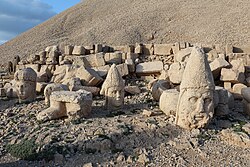
[[File:Nemrut Dağı 12.jpg|thumb|left|Sanctuary of the Kings of [[Commagene]] on [[Mount Nemrut]] (1st century BCE)]] Following the death of Alexander the Great and the subsequent breakup of the [[Macedonian Empire]], Anatolia was ruled by a series of Hellenistic kingdoms, such as the [[Attalid dynasty|Attalids of Pergamum]] and the [[Seleucids]], the latter controlling most of Anatolia. A period of peaceful [[Hellenization]] followed, such that the local Anatolian languages had been supplanted by Greek by the 1st century BCE. In 133 BCE, the last Attalid king bequeathed his kingdom to the [[Roman Republic]]; western and central Anatolia came under [[Romanization of Anatolia|Roman control]], but [[Hellenistic culture]] remained predominant. | |||
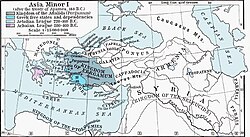
[[File:Asia Minor 188 BCE.jpg|thumb|250px|Asia Minor in 188 BC]] | |||
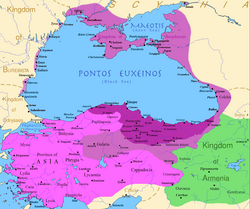
[[File:PonticKingdom.png|thumb|250px|Kingdom of Pontus before the reign of Mithridates VI (120 BC, Dark Purple), after his early conquests (Light Purple), and his conquests in the first Mithridatic wars (88 BC, Pink). Armenia is in Green]] | |||
[[Mithridates VI Eupator]], ruler of the [[Kingdom of Pontus]] in northern Anatolia, waged war against the [[Roman Republic]] in the year 88 BCE in order to halt the advance of Roman [[hegemony]] in the [[Aegean Sea]] region. Mithridates VI sought to dominate Asia Minor and the [[Black Sea]] region, waging several hard-fought but ultimately unsuccessful wars (the [[Mithridatic Wars]]) to break Roman dominion over Asia and the [[Hellenic world]].<ref>"[https://www.britannica.com/biography/Mithradates-VI-Eupator Mithradates VI Eupator]", ''[[Encyclopædia Britannica]]''</ref> He has been called the greatest ruler of the Kingdom of Pontus.<ref>{{cite book|last=Hewsen|first=Robert H.|title=Armenian Pontus: The Trebizond-Black Sea Communities|year=2009|publisher=Mazda Publishers, Inc.|location=Costa Mesa, CA|isbn=978-1-56859-155-1|pages=41, 37–66|editor=Richard G. Hovannisian|chapter=Armenians on the Black Sea: The Province of Trebizond}}</ref> His ally and son-in-law, [[Tigranes the Great]] of [[Kingdom of Armenia (antiquity)|Armenia]] ({{reign|95|55 BCE}}), briefly conquered significant portions of Anatolia, including Cilicia, Cappadocia, [[Sophene]] and perhaps [[Galatia]].<ref>{{cite book |last1=Traina |first1=Giusto |author1-link=Giusto Traina |editor1-last=Dueck |editor1-first=Daniela |title=The Routledge Companion to Strabo |date=2017 |publisher=Routledge |location=London |isbn=978-1-315-69641-6 |page=95 |chapter=Strabo and the history of Armenia}}</ref> Further annexations by Rome, in particular of the Kingdom of Pontus by [[Pompey]], brought all of Anatolia under [[Romanization of Anatolia|Roman control]], except for the southeastern frontier with the [[Parthian Empire]], which remained unstable for centuries, causing a series of military conflicts that culminated in the [[Roman–Parthian Wars]] (54 BCE – 217 CE). | |||
===Early Christian period=== | |||
{{Main|Christianity as the Roman state religion|Spread of Christianity}} | |||
{{Further|Christianity in late antiquity|Crisis of the Third Century}} | {{Further|Christianity in late antiquity|Crisis of the Third Century}} | ||
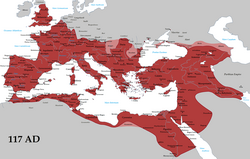
[[File:Roman Empire Trajan 117AD.png|thumb|upright=1.1|{{legend|#b23938|[[Roman Empire]] in 117 CE at its greatest extent, at the time of [[Trajan]]'s death.}} {{legend|#d28989|[[vassal state]]s<ref>{{Cite book |last=Bennett, Julian |url=https://books.google.com/books?id=qk_tofvS8EsC |title=Trajan: Optimus Princeps : a Life and Times |publisher=Routledge |year=1997 |isbn=978-0-415-16524-2}}. Fig. 1. Regions east of the [[Euphrates]] river were held only in the years 116–117.</ref>}}]] | [[File:Roman Empire Trajan 117AD.png|thumb|upright=1.1|{{legend|#b23938|[[Roman Empire]] in 117 CE at its greatest extent, at the time of [[Trajan]]'s death.}} {{legend|#d28989|[[vassal state]]s<ref>{{Cite book |last=Bennett, Julian |url=https://books.google.com/books?id=qk_tofvS8EsC |title=Trajan: Optimus Princeps: a Life and Times |publisher=Routledge |year=1997 |isbn=978-0-415-16524-2}}. Fig. 1. Regions east of the [[Euphrates]] river were held only in the years 116–117.</ref>}}]] | ||
[[File:Seven churches of asia.svg|thumb|The [[Seven churches of Asia]]]] | |||
After the [[first division of the Roman Empire]], Anatolia became part of the [[Byzantine Empire|Eastern Roman Empire]], otherwise known as the Byzantine Empire or [[Byzantium]].<ref name="Niewöhner 2017">{{cite book |author-last=Niewöhner |author-first=Philipp |year=2017 |chapter=Chapter 3: Urbanism – The Archaeology of Byzantine Anatolia |chapter-url=https://books.google.com/books?id=cgUmDwAAQBAJ&pg=PA39 |editor-last=Niewöhner |editor-first=Philipp |title=The Archaeology of Byzantine Anatolia: From the End of Late Antiquity until the Coming of the Turks |location=[[Oxford]] and | After the [[first division of the Roman Empire]], Anatolia became part of the [[Byzantine Empire|Eastern Roman Empire]], otherwise known as the Byzantine Empire or [[Byzantium]].<ref name="Niewöhner 2017">{{cite book |author-last=Niewöhner |author-first=Philipp |year=2017 |chapter=Chapter 3: Urbanism – The Archaeology of Byzantine Anatolia |chapter-url=https://books.google.com/books?id=cgUmDwAAQBAJ&pg=PA39 |editor-last=Niewöhner |editor-first=Philipp |title=The Archaeology of Byzantine Anatolia: From the End of Late Antiquity until the Coming of the Turks |location=[[Oxford]] and New York |publisher=[[Oxford University Press]] |pages=39–59 |doi=10.1093/acprof:oso/9780190610463.003.0004 |isbn=978-0-19-061048-7}}</ref> In the 1st century CE, Anatolia became [[History of early Christianity|one of the first places where Christianity spread]], so that by the 4th century CE, western and central Anatolia were overwhelmingly Christian and Greek-speaking.<ref name="Niewöhner 2017"/> | ||
Byzantine Anatolia was one of the wealthiest and most densely populated places in the [[Later Roman Empire]]. Anatolia's wealth grew during the 4th and 5th centuries thanks, in part, to the [[Pilgrim's Road]] that ran through the peninsula. Literary evidence about the rural landscape stems from the [[Hagiography|Christian hagiographies]] of the 6th-century [[Nicholas of Sion]] and 7th-century [[Theodore of Sykeon]]. Large and prosperous urban centers of Byzantine Anatolia included [[Assos]], [[Ephesus]], [[Miletus]], [[Nicaea]], [[Pergamum]], [[Priene]], [[Sardis]], and [[Aphrodisias]].<ref name="Niewöhner 2017"/> | Byzantine Anatolia was one of the wealthiest and most densely populated places in the [[Later Roman Empire]]. Anatolia's wealth grew during the 4th and 5th centuries thanks, in part, to the [[Pilgrim's Road]] that ran through the peninsula. Literary evidence about the rural landscape stems from the [[Hagiography|Christian hagiographies]] of the 6th-century [[Nicholas of Sion]] and 7th-century [[Theodore of Sykeon]]. Large and prosperous urban centers of Byzantine Anatolia included [[Assos]], [[Ephesus]], [[Miletus]], [[Nicaea]], [[Pergamum]], [[Priene]], [[Sardis]], and [[Aphrodisias]].<ref name="Niewöhner 2017"/> | ||
From the mid-5th century onwards, urbanism was affected negatively and began to decline, while the rural areas reached unprecedented levels of prosperity in the region.<ref name="Niewöhner 2017"/> Historians and scholars continue to debate the cause of the urban decline in Byzantine Anatolia between the 6th and 7th centuries,<ref name="Niewöhner 2017"/> variously attributing it to the [[Plague of Justinian]] (541), the [[Byzantine–Sasanian War of 602–628|Byzantine–Sasanian War]] (602–628), and the [[Muslim conquest of the Levant|Arab invasion of the Levant]] (634–638).<ref name=thonemann>{{Cite book| publisher = Oxford University Press| isbn = 978- | From the mid-5th century onwards, urbanism was affected negatively and began to decline, while the rural areas reached unprecedented levels of prosperity in the region.<ref name="Niewöhner 2017"/> Historians and scholars continue to debate the cause of the urban decline in Byzantine Anatolia between the 6th and 7th centuries,<ref name="Niewöhner 2017"/> variously attributing it to the [[Plague of Justinian]] (541), the [[Byzantine–Sasanian War of 602–628|Byzantine–Sasanian War]] (602–628), and the [[Muslim conquest of the Levant|Arab invasion of the Levant]] (634–638).<ref name=thonemann>{{Cite book| publisher = Oxford University Press| isbn = 978-0-19-866277-8| last = Thonemann| first = Peter| title = The Oxford Dictionary of Late Antiquity| volume = 1| chapter = Anatolia| access-date = 6 December 2018| year = 2018| chapter-url = http://www.oxfordreference.com/view/10.1093/acref/9780198662778.001.0001/acref-9780198662778-e-241| doi = 10.1093/acref/9780198662778.001.0001| archive-date = 6 December 2018| archive-url = https://web.archive.org/web/20181206102258/http://www.oxfordreference.com/view/10.1093/acref/9780198662778.001.0001/acref-9780198662778-e-241| url-status = live}}</ref> | ||
===Medieval | ===Medieval period=== | ||
{{further|Byzantine Anatolia}} | {{further|Byzantine Anatolia|Byzantine Empire|Sultanate of Rum}} | ||
{{see also|List of states in late medieval Anatolia}} | {{see also|List of states in late medieval Anatolia}} | ||
[[File:Asia Minor ca 842 AD.svg|thumb|left|upright=1.35|[[Byzantine Anatolia]] and the [[Arab–Byzantine wars|Byzantine-Arab frontier zone]] in the mid-9th century]] | [[File:Asia Minor ca 842 AD.svg|thumb|left|upright=1.35|[[Byzantine Anatolia]] and the [[Arab–Byzantine wars|Byzantine-Arab frontier zone]] in the mid-9th century]] | ||
In the 10 years following the [[Battle of Manzikert]] in 1071, the [[Seljuk Turks]] from Central Asia migrated over large areas of Anatolia, with particular concentrations around the northwestern rim.<ref>{{cite book |title=The Byzantine Empire 1025–1204 |last=Angold |first=Michael |year=1997 |isbn=978- | In the 10 years following the [[Battle of Manzikert]] in 1071, the [[Seljuk Turks]] from [[Central Asia]] migrated over large areas of Anatolia, with particular concentrations around the northwestern rim.<ref>{{cite book |title=The Byzantine Empire 1025–1204 |last=Angold |first=Michael |year=1997 |isbn=978-0-582-29468-4 |page=117|publisher=Longman }}</ref> The Turkish language and the Islamic religion were gradually introduced as a result of the Seljuk conquest, and this period marks the start of Anatolia's slow transition from predominantly Christian and Greek-speaking, to predominantly Muslim and Turkish-speaking (although ethnic groups such as Armenians, Greeks, and Assyrians remained numerous and retained Christianity and their native languages). In the following century, the [[Byzantine Empire under the Komnenos dynasty|Byzantines]] managed to reassert their control in western and northern Anatolia. Control of Anatolia was then split between the [[Byzantine Empire]] and the Seljuk [[Sultanate of Rûm]], with the Byzantine holdings gradually being reduced.<ref name=Balyuzi/> | ||
[[File:11 13th century Asia Minor Turkish Invasions.png|thumb|Settlements and regions affected during the first wave of [[Byzantine–Seljuk wars|Turkish invasions]] in Asia Minor (11th–13th century)]] | [[File:11 13th century Asia Minor Turkish Invasions.png|thumb|Settlements and regions affected during the first wave of [[Byzantine–Seljuk wars|Turkish invasions]] in Asia Minor (11th–13th century)]] | ||
The [[Fourth Crusade]] would prove to be a grave challenge to the Byzantine Empire. The loss of a central authority figure shattered the empire, breaking it into four major successor states that each held sway over different parts of the empire.<ref>Treadgold. A History of the Byzantine State and Society. p. 941-944</ref> Two of these states, the [[Empire of Nicaea]] and the [[Empire of Trebizond]], would contend for the remains of the empire in Anatolia, with the Nicaean Empire holding the northwestern coast and the Trapezuntine empire holding the northeastern coast. | |||
In 1255, the [[Mongols]] swept through eastern and central Anatolia, and would remain until 1335. The [[Ilkhanate]] garrison was stationed near [[Ankara]].<ref name=Balyuzi>H. M. Balyuzi ''Muḥammad and the course of Islám'', p. 342</ref><ref>John Freely ''Storm on Horseback: The Seljuk Warriors of Turkey'', p. 83</ref> After the decline of the Ilkhanate from 1335 to 1353, the [[Mongol Empire]]'s legacy in the region was the [[Uyghur people|Uyghur]] [[Eretna Dynasty]] that was overthrown by [[Kadi Burhan al-Din]] in 1381.<ref>Clifford Edmund Bosworth-The new Islamic dynasties: a chronological and genealogical manual, p. 234</ref> | In 1255, the [[Mongols]] swept through eastern and central Anatolia, and would remain until 1335. The [[Ilkhanate]] garrison was stationed near [[Ankara]].<ref name=Balyuzi>H. M. Balyuzi ''Muḥammad and the course of Islám'', p. 342</ref><ref>John Freely ''Storm on Horseback: The Seljuk Warriors of Turkey'', p. 83</ref> After the decline of the Ilkhanate from 1335 to 1353, the [[Mongol Empire]]'s legacy in the region was the [[Uyghur people|Uyghur]] [[Eretna Dynasty]] that was overthrown by [[Kadi Burhan al-Din]] in 1381.<ref>Clifford Edmund Bosworth-The new Islamic dynasties: a chronological and genealogical manual, p. 234</ref> | ||
By the end of the 14th century, most of Anatolia was controlled by various [[Anatolian beyliks]]. Smyrna fell in 1330, and the last Byzantine stronghold in Anatolia, Philadelphia, fell in 1390. The [[Turkmen people|Turkmen]] Beyliks were under the control of the Mongols, at least nominally, through declining Seljuk | By the end of the 14th century, most of Anatolia was controlled by various [[Anatolian beyliks]]. Smyrna fell in 1330, and the last Byzantine stronghold in Anatolia, [[Alaşehir|Philadelphia]], [[Fall of Philadelphia|fell in 1390]]. The [[Turkmen people|Turkmen]] Beyliks were under the control of the Mongols, at least nominally, through declining Seljuk Sultans.<ref>Mehmet Fuat Köprülü, Gary Leiser-The origins of the Ottoman Empire, p. 33</ref><ref>Peter Partner ''God of battles: holy wars of Christianity and Islam'', p. 122</ref> The Beyliks did not mint coins in the names of their own leaders while they remained under the suzerainty of the [[Mongol]] [[Ilkhanids]].<ref>''Osman's Dream: The History of the Ottoman Empire'', p. 13</ref> The [[Ottoman dynasty|Ottoman]] ruler [[Osman I]] was the first Turkish ruler who minted coins in his own name in 1320s; they bear the legend "Minted by Osman son of Ertugrul".<ref>Artuk – ''Osmanli Beyliginin Kurucusu'', 27f</ref> Since the minting of coins was a prerogative accorded in Islamic practice only to a [[Sovereignty|sovereign]], it can be considered that the Ottoman Turks had become formally independent from the Mongol Khans.<ref>Pamuk – ''A Monetary History'', pp. 30–31</ref> | ||
===Ottoman Empire=== | ===Ottoman Empire=== | ||
| Line 250: | Line 184: | ||
[[File:Growth of the Ottoman Empire.jpg|thumb|[[Territorial evolution of the Ottoman Empire]] between 1359 and 1683]] | [[File:Growth of the Ottoman Empire.jpg|thumb|[[Territorial evolution of the Ottoman Empire]] between 1359 and 1683]] | ||
Among the [[Turkish people|Turkish]] leaders, the [[Ottoman dynasty|Ottomans]] emerged as great power under [[Osman I]] and his son [[Orhan]].<ref>{{Cite encyclopedia|url=https://www.britannica.com/biography/Osman-I|title=Osman I {{!}} Ottoman | Among the [[Turkish people|Turkish]] leaders, the [[Ottoman dynasty|Ottomans]] emerged as great power under [[Osman I]] and his son [[Orhan]].<ref>{{Cite encyclopedia|url=https://www.britannica.com/biography/Osman-I|title=Osman I {{!}} Ottoman Sultan|encyclopedia=Encyclopædia Britannica|access-date=23 April 2018|archive-date=24 April 2018|archive-url=https://web.archive.org/web/20180424073731/https://www.britannica.com/biography/Osman-I|url-status=live}}</ref><ref>{{Cite encyclopedia|url=https://www.britannica.com/biography/Orhan|title=Orhan {{!}} Ottoman Sultan|encyclopedia=Encyclopædia Britannica|access-date=23 April 2018|archive-date=10 March 2018|archive-url=https://web.archive.org/web/20180310140006/https://www.britannica.com/biography/Orhan|url-status=live}}</ref> The [[Anatolian beyliks]] were successively absorbed into the rising [[Ottoman Empire]] during the 15th century.<ref>{{Cite book|chapter-url=https://www.cambridge.org/core/books/new-cambridge-history-of-islam/rise-of-the-ottomans/015D10BC98EA8A2D69B29D54AC7241CC|title=The rise of the Ottomans (Chapter 11) – The New Cambridge History of Islam|pages=313–31|last=Fleet|first=Kate|publisher=Cambridge Core|language=en|access-date=23 April 2018|doi=10.1017/CHOL9780521839570.013|chapter=The rise of the Ottomans|year=2010|isbn=978-1-139-05615-1|archive-date=24 April 2018|archive-url=https://web.archive.org/web/20180424071602/https://www.cambridge.org/core/books/new-cambridge-history-of-islam/rise-of-the-ottomans/015D10BC98EA8A2D69B29D54AC7241CC|url-status=live}}</ref> It is not well understood how the Osmanlı, or [[Ottoman Empire|Ottoman Turks]], came to dominate their neighbors, as the history of medieval Anatolia is still little known.<ref>{{cite book |last=Finkel |first=Caroline |title=Osman's Dream: The History of the Ottoman Empire |url=https://books.google.com/books?id=9cTHyUQoTyUC&pg=PA5 |year=2007 |publisher=Basic Books |isbn=978-0-465-00850-6 |page=5 |access-date=6 June 2013 |archive-date=2 January 2014 |archive-url=https://web.archive.org/web/20140102002603/http://books.google.com/books?id=9cTHyUQoTyUC&pg=PA5 |url-status=live }}</ref> The Ottomans completed the conquest of the peninsula in 1517 with the taking of [[Halicarnassus]] (modern [[Bodrum]]) from the [[Knights of Saint John]].<ref>{{Cite web|url=http://www.iranicaonline.org/articles/halicarnassus|title=Halicarnassus |website=Encyclopaedia Iranica |orig-date=15 December 2003 |date=1 March 2012 |first1=Bruno |last1=Genito |access-date=23 April 2018|archive-date=24 April 2018|archive-url=https://web.archive.org/web/20180424071811/http://www.iranicaonline.org/articles/halicarnassus|url-status=live}}</ref> | ||
===Modern times=== | ===Modern times=== | ||
{{further|History of Turkey}} | {{further|History of Turkey}} | ||
[[File:The Historical Atlas, 1911 – Distribution of Races in the Balkan Peninsula and Asia Minor.jpg|thumb|Ethnic map of Asia Minor in 1905–06]] | [[File:The Historical Atlas, 1911 – Distribution of Races in the Balkan Peninsula and Asia Minor.jpg|thumb|Ethnic map of Asia Minor in 1905–06]] | ||
With the acceleration of the decline of the Ottoman Empire in the early 19th century, and as a result of the expansionist policies of the [[Russian Empire]] in the [[Caucasus]], many Muslim nations and groups in that region, mainly [[Circassians]], [[Tatars]], [[Azeris]], [[Lezgian people|Lezgis]], [[Chechens]] and several [[Turkic peoples|Turkic]] groups left their homelands and settled in Anatolia. As the Ottoman Empire further shrank in the [[Balkan]] regions and then fragmented during the [[Balkan Wars]], much of the non-Christian populations of its former possessions, mainly Balkan Muslims ([[Bosniaks]], [[Albanians]], [[Turkish people|Turks]], [[Pomaks|Muslim Bulgarians]] and [[Greek Muslims]] such as the [[Vallahades]] from [[Macedonia (Greece)|Greek Macedonia]]), were resettled in various parts of Anatolia, mostly in formerly Christian villages throughout Anatolia. | With the acceleration of the decline of the Ottoman Empire in the early 19th century, and as a result of the expansionist policies of the [[Russian Empire]] in the [[Caucasus]], many Muslim nations and groups in that region, mainly [[Circassians]], [[Crimean Tatars]], [[Azeris]], [[Lezgian people|Lezgis]], [[Chechens]], [[Chveneburi|Muslim Georgians]],<ref name="Incorporated2009">{{cite book|last=Incorporated|first=Facts On File|title=Encyclopedia of the Peoples of Africa and the Middle East|year=2009|publisher=Infobase Publishing|isbn=978-1-4381-2676-0|page=244|url=https://books.google.com/books?id=stl97FdyRswC&q=chveneburi&pg=PA244}}</ref> [[Hemshin people|Hamshenis]]<ref>{{cite book |last=Simonian |first=Hovann H. |date=2007b |title=The Hemshin: History, Society and Identity in the Highlands of Northeast Turkey |chapter=Hemshin from Islamicization to the End of the Nineteenth Century}}</ref> and several [[Turkic peoples|Turkic]] groups left their homelands and settled in Anatolia. As the Ottoman Empire further shrank in the [[Balkan]] regions and then fragmented during the [[Balkan Wars]], much of the non-Christian populations of its former possessions, mainly Balkan Muslims ([[Bosniaks]], [[Albanians]], [[Turkish people|Turks]], [[Serb Muslims]],<ref name="Pekesen2012">{{Cite web |last=Pekesen |first=Berna |date=7 March 2012 |editor-last=Berger |editor-first=Lutz |editor2-last=Landes |editor2-first=Lisa |title=Expulsion and Emigration of the Muslims from the Balkans |url=http://ieg-ego.eu/en/threads/europe-on-the-road/forced-ethnic-migration/berna-pekesen-expulsion-and-emigration-of-the-muslims-from-the-balkans |access-date=9 September 2022 |website=[[European History Online]] |publisher=[[Leibniz Institute of European History]] |translator-last=Reid |translator-first=Christopher}}</ref> [[Pomaks|Muslim Bulgarians]] and [[Greek Muslims]] such as the [[Vallahades]] from [[Macedonia (Greece)|Greek Macedonia]]), were resettled in various parts of Anatolia, mostly in formerly Christian villages throughout Anatolia. | ||
[[File:St. Polycarp Kilisesi (2).jpg|left|thumb|St. Polycarp Church, in modern-day [[İzmir|Izmir]].]] | |||
A continuous reverse migration occurred since the early 19th century, when Greeks from Anatolia, [[Constantinople]] and Pontus area migrated toward the newly independent [[Kingdom of Greece]], and also towards the [[United States]], the southern part of the [[Russian Empire]], Latin America, and the rest of Europe. | A continuous reverse migration occurred since the early 19th century, when Greeks from Anatolia, [[Constantinople]] and Pontus area migrated toward the newly independent [[Kingdom of Greece]], and also towards the [[United States]], the southern part of the [[Russian Empire]], Latin America, and the rest of Europe. | ||
[[File:Ankara and mosque wza.jpg|thumb|Mosque in [[Ankara]]]] | |||
Following the Russo-Persian [[Treaty of Turkmenchay]] (1828) and the incorporation of [[Eastern Armenia]] into the Russian Empire, another migration involved the large Armenian population of Anatolia, which recorded significant migration rates from [[Western Armenia]] (Eastern Anatolia) toward the Russian Empire, especially toward its newly established Armenian provinces.<ref name="Swietochowski Borderland">{{cite book |last=Swietochowski |first=Tadeusz |author-link=Tadeusz Swietochowski |url=https://books.google.com/books?id=FfRYRwAACAAJ&q=Russia+and+Iran+in+the+great+game:+travelogues+and+orientalism |title=Russia and Azerbaijan: A Borderland in Transition |publisher=[[Columbia University Press]] |year=1995 |isbn=978-0-231-07068-3 |pages=69, 133}}</ref> | |||
Anatolia remained [[multi-ethnic]] until the early 20th century (see the [[rise of nationalism under the Ottoman Empire]]). During World War I, the [[Armenian genocide]], the [[Greek genocide]] (especially in [[Pontus (region)|Pontus]]), and the [[Assyrian genocide]] almost entirely removed the ancient indigenous communities of [[Armenians|Armenian]], [[Greeks|Greek]], and [[Assyrian people|Assyrian]] populations in Anatolia and surrounding regions. Following the [[Greco-Turkish War of 1919–1922]], most remaining ethnic Anatolian Greeks were forced out during the 1923 [[population exchange between Greece and Turkey]]. Of the remainder, most have left Turkey since then, leaving fewer than 5,000 Greeks in Anatolia today.<ref>{{Cite web |date=7 September 2023 |title=The uncertain future of Greeks in Turkey |url=https://www.economist.com/europe/2023/09/07/the-uncertain-future-of-greeks-in-turkey#selection-1030.0-1030.1 |access-date=3 September 2024 |website=archive.is |archive-url=https://archive.today/20230907151019/https://www.economist.com/europe/2023/09/07/the-uncertain-future-of-greeks-in-turkey#selection-1030.0-1030.1 |archive-date=7 September 2023}}</ref> According to Morris and Ze'evi, 4 million Christians were ethnically cleansed from Asia minor by the Turks from 1894 to 1924.<ref>{{Cite book |last1=Morris |first1=Benny |url=https://books.google.com/books?id=THSPDwAAQBAJ&q=Benny+Morris+the+thirty+year+genocide |title=The Thirty-Year Genocide: Turkey's Destruction of Its Christian Minorities, 1894–1924 |last2=Ze'evi |first2=Dror |date=24 April 2019 |publisher=Harvard University Press |isbn=978-0-674-91645-6 |page=3 |language=en}}</ref> | |||
Anatolia remained [[multi-ethnic]] until the early 20th century (see the [[rise of nationalism under the Ottoman Empire]]). During World War I, the [[Armenian genocide]], the [[Greek genocide]] (especially in [[Pontus (region)|Pontus]]), and the [[Assyrian genocide]] almost entirely removed the ancient indigenous communities of [[Armenians|Armenian]], [[Greeks|Greek]], and [[Assyrian people|Assyrian]] populations in Anatolia and surrounding regions. Following the [[Greco-Turkish War of 1919–1922]], most remaining ethnic Anatolian Greeks were forced out during the 1923 [[population exchange between Greece and Turkey]]. Of the remainder, most have left Turkey since then, leaving fewer than 5,000 Greeks in Anatolia today. | |||
==Geology== | ==Geology== | ||
| Line 269: | Line 202: | ||
Anatolia's terrain is structurally complex. A central [[massif]] composed of uplifted blocks and downfolded [[Trough (geology)|troughs]], covered by recent [[Deposit (geology)|deposits]] and giving the appearance of a plateau with rough terrain, is wedged between two folded mountain ranges that converge in the east. True lowland is confined to a few narrow coastal strips along the Aegean, Mediterranean, and the Black Sea coasts. Flat or gently sloping land is rare and largely confined to the deltas of the [[Kızıl River]], the coastal plains of [[Çukurova]] and the valley floors of the [[Gediz River]] and the [[Büyük Menderes River]] as well as some interior high plains in Anatolia, mainly around [[Lake Tuz]] (Salt Lake) and the [[Konya]] Basin (''Konya Ovasi''). | Anatolia's terrain is structurally complex. A central [[massif]] composed of uplifted blocks and downfolded [[Trough (geology)|troughs]], covered by recent [[Deposit (geology)|deposits]] and giving the appearance of a plateau with rough terrain, is wedged between two folded mountain ranges that converge in the east. True lowland is confined to a few narrow coastal strips along the Aegean, Mediterranean, and the Black Sea coasts. Flat or gently sloping land is rare and largely confined to the deltas of the [[Kızıl River]], the coastal plains of [[Çukurova]] and the valley floors of the [[Gediz River]] and the [[Büyük Menderes River]] as well as some interior high plains in Anatolia, mainly around [[Lake Tuz]] (Salt Lake) and the [[Konya]] Basin (''Konya Ovasi''). | ||
There are two mountain ranges in southern Anatolia: the [[Taurus | There are two mountain ranges in southern Anatolia: the [[Taurus Mountains|Taurus]] and the [[Zagros]] Mountains.<ref name=wiley>{{Cite book| publisher = John Wiley & Sons| isbn = 978-1-118-94501-8| last1 = Cemen| first1 = Ibrahim| last2 = Yilmaz| first2 = Yucel| title = Active Global Seismology: Neotectonics and Earthquake Potential of the Eastern Mediterranean Region| year=2017}}</ref> | ||
===Climate=== | ===Climate=== | ||
{{Main|Climate of Turkey}} | {{Main|Climate of Turkey}} | ||
<gallery caption="Temperatures of Anatolia" widths="180px"> | <gallery caption="Temperatures of Anatolia" widths="180px"> | ||
File:Klima_ankara.png|[[Ankara]] (central Anatolia) | File:Klima_ankara.png|[[Ankara]] (central Anatolia) | ||
| Line 279: | Line 213: | ||
</gallery> | </gallery> | ||
Anatolia has a varied range of climates. The central plateau is characterized by a continental climate, with hot summers and cold snowy winters. The south and west coasts enjoy a typical Mediterranean climate, with mild rainy winters | Anatolia has a varied range of climates. The central plateau is characterized by a continental climate, with hot summers and cold, snowy winters. The south and west coasts enjoy a typical Mediterranean climate, with mild rainy winters and warm, dry summers.<ref name=Prothero19>{{cite book|last=Prothero|first=W.G.|title=Anatolia|year=1920|publisher=H.M. Stationery Office|location=London|url=http://www.wdl.org/en/item/11766/view/1/19/|access-date=6 September 2013|archive-date=2 November 2013|archive-url=https://web.archive.org/web/20131102025925/http://www.wdl.org/en/item/11766/view/1/19/|url-status=live}}</ref> The Black Sea and Marmara coasts have a temperate oceanic climate, with warm, foggy summers and much rainfall throughout the year. | ||
===Ecoregions=== | ===Ecoregions=== | ||
| Line 290: | Line 224: | ||
* [[Northern Anatolian conifer and deciduous forests]]: These forests occupy the mountains of northern Anatolia, running east and west between the coastal Euxine-Colchic forests and the drier, continental climate forests of central and eastern Anatolia.<ref>{{WWF ecoregion|id=pa0515|name=Northern Anatolian conifer and deciduous forests|access-date=25 May 2008}}</ref> | * [[Northern Anatolian conifer and deciduous forests]]: These forests occupy the mountains of northern Anatolia, running east and west between the coastal Euxine-Colchic forests and the drier, continental climate forests of central and eastern Anatolia.<ref>{{WWF ecoregion|id=pa0515|name=Northern Anatolian conifer and deciduous forests|access-date=25 May 2008}}</ref> | ||
* [[Central Anatolian deciduous forests]]: These forests of deciduous oaks and evergreen pines cover the plateau of central Anatolia.<ref>{{WWF ecoregion|id=pa0410|name=Central Anatolian deciduous forests|access-date=25 May 2008}}</ref> | * [[Central Anatolian deciduous forests]]: These forests of deciduous oaks and evergreen pines cover the plateau of central Anatolia.<ref>{{WWF ecoregion|id=pa0410|name=Central Anatolian deciduous forests|access-date=25 May 2008}}</ref> | ||
* [[Central Anatolian steppe]]: These dry grasslands cover the drier valleys and surround the saline lakes of central Anatolia, and include [[halophytic]] (salt tolerant) plant communities.<ref>{{WWF ecoregion|name=Central Anatolian steppe|access-date=25 May 2008|id=pa0803}}</ref> | * [[Central Anatolian steppe]]: These dry grasslands cover the drier valleys and surround the saline lakes of central Anatolia, and include [[halophytic]] (salt-tolerant) plant communities.<ref>{{WWF ecoregion|name=Central Anatolian steppe|access-date=25 May 2008|id=pa0803}}</ref> | ||
[[File:Pontic Panorama.jpg|thumb | [[File:Pontic Panorama.jpg|thumb|A panorama of the [[Pontic Mountains]] in the [[Black Sea Region]] of northern Anatolia, Turkey]] | ||
* [[Eastern Anatolian deciduous forests]]: This ecoregion occupies the plateau of eastern Anatolia. The drier and more continental climate is beneficial for steppe-forests dominated by deciduous oaks, with areas of shrubland, montane forest, and valley forest.<ref>{{WWF ecoregion|id=pa0420|name=Eastern Anatolian deciduous forests|access-date=25 May 2008}}</ref> | * [[Eastern Anatolian deciduous forests]]: This ecoregion occupies the plateau of eastern Anatolia. The drier and more continental climate is beneficial for steppe-forests dominated by deciduous oaks, with areas of shrubland, montane forest, and valley forest.<ref>{{WWF ecoregion|id=pa0420|name=Eastern Anatolian deciduous forests|access-date=25 May 2008}}</ref> | ||
* [[Anatolian conifer and deciduous mixed forests]]: These forests occupy the western, Mediterranean-climate portion of the Anatolian plateau. Pine forests | * [[Anatolian conifer and deciduous mixed forests]]: These forests occupy the western, Mediterranean-climate portion of the Anatolian plateau. Pine forests, mixed pine, oak woodlands and shrublands are predominant.<ref>{{WWF ecoregion|name=Anatolian conifer and deciduous mixed forests|access-date=25 May 2008|id=pa1202}}</ref> | ||
* [[Aegean and Western Turkey sclerophyllous and mixed forests]]: These Mediterranean-climate forests occupy the coastal lowlands and valleys of western Anatolia bordering the Aegean Sea. The ecoregion has forests of [[Turkish pine]] ''(Pinus brutia)'', oak forests and woodlands, and [[maquis shrubland]] of Turkish pine and evergreen [[sclerophyll]]ous trees and shrubs, including [[Olive]] ''(Olea europaea)'', [[Arbutus unedo|Strawberry Tree]] ''(Arbutus unedo)'', ''[[Arbutus andrachne]]'', Kermes Oak ''([[Quercus coccifera]])'', and [[Bay Laurel]] ''(Laurus nobilis)''.<ref>{{WWF ecoregion|name=Aegean and Western Turkey sclerophyllous and mixed forests|access-date=25 May 2008|id=pa1201}}</ref> | * [[Aegean and Western Turkey sclerophyllous and mixed forests]]: These Mediterranean-climate forests occupy the coastal lowlands and valleys of western Anatolia bordering the Aegean Sea. The ecoregion has forests of [[Turkish pine]] ''(Pinus brutia)'', oak forests and woodlands, and [[maquis shrubland]] of Turkish pine and evergreen [[sclerophyll]]ous trees and shrubs, including [[Olive]] ''(Olea europaea)'', [[Arbutus unedo|Strawberry Tree]] ''(Arbutus unedo)'', ''[[Arbutus andrachne]]'', Kermes Oak ''([[Quercus coccifera]])'', and [[Bay Laurel]] ''(Laurus nobilis)''.<ref>{{WWF ecoregion|name=Aegean and Western Turkey sclerophyllous and mixed forests|access-date=25 May 2008|id=pa1201}}</ref> | ||
* [[Southern Anatolian montane conifer and deciduous forests]]: These mountain forests occupy the Mediterranean-climate [[Taurus Mountains]] of southern Anatolia. Conifer forests are predominant, chiefly Anatolian black pine ''([[Pinus nigra]])'', Cedar of Lebanon ''([[Cedrus libani]])'', Taurus fir ''([[Abies cilicica]])'', and [[juniper]] ''([[Juniperus foetidissima]]'' and ''[[Juniperus excelsa|J. excelsa]])''. Broadleaf trees include oaks, [[hornbeam]], and [[maple]]s.<ref>{{WWF ecoregion|name=Southern Anatolian montane conifer and deciduous forests|access-date=25 May 2008|id=pa1220}}</ref> | * [[Southern Anatolian montane conifer and deciduous forests]]: These mountain forests occupy the Mediterranean-climate [[Taurus Mountains]] of southern Anatolia. Conifer forests are predominant, chiefly Anatolian black pine ''([[Pinus nigra]])'', Cedar of Lebanon ''([[Cedrus libani]])'', Taurus fir ''([[Abies cilicica]])'', and [[juniper]] ''([[Juniperus foetidissima]]'' and ''[[Juniperus excelsa|J. excelsa]])''. Broadleaf trees include oaks, [[hornbeam]], and [[maple]]s.<ref>{{WWF ecoregion|name=Southern Anatolian montane conifer and deciduous forests|access-date=25 May 2008|id=pa1220}}</ref> | ||
| Line 300: | Line 234: | ||
==Demographics== | ==Demographics== | ||
{{Main|Demographics of Turkey}} | {{Main|Demographics of Turkey}} | ||
The largest | |||
The largest provinces in Anatolia (aside from the Asian side of [[Istanbul]]) are [[Ankara]], [[İzmir]], [[Bursa]], [[Antalya]], [[Konya]], [[Adana]], [[Kocaeli Province|Kocaeli]], [[Mersin]], [[Manisa]], [[Kayseri]], [[Samsun]], [[Balıkesir]], [[Aydın]], [[Kahramanmaraş|Maraş]], [[Sakarya Province|Sakarya]], [[Muğla]], [[Denizli]], [[Eskişehir]], [[Trabzon]], [[Ordu]], [[Afyonkarahisar|Afyon]], [[Sivas]], [[Tokat]], [[Zonguldak]], [[Kütahya]], [[Çanakkale]], [[Osmaniye]] and [[Çorum]]. All have populations of more than 500,000.<ref>{{Cite web |title=Türkiye'nin En Kalabalık İlleri 2024 En Kalabalık Şehirler |url=https://www.nufusu.com/turkiyenin-en-kalabalik-sehirleri |access-date=23 May 2025 |website=www.nufusu.com}}</ref> | |||
==See also== | ==See also== | ||
{{Portal|Turkey}} | |||
{{div col|colwidth=10em}} | {{div col|colwidth=10em}} | ||
* [[Aeolis]] | * [[Aeolis]] | ||
| Line 343: | Line 278: | ||
{{Reflist}} | {{Reflist}} | ||
=== | === Sources === | ||
{{refbegin}} | {{refbegin}} | ||
* {{cite book |last=Akurgal |first=Ekrem |author-link=Ekrem Akurgal |title=The Hattian and Hittite Civilizations |year=2001 |location=Ankara |publisher=Ministry of Culture |isbn=978- | * {{cite book |last=Akurgal |first=Ekrem |author-link=Ekrem Akurgal |title=The Hattian and Hittite Civilizations |year=2001 |location=Ankara |publisher=Ministry of Culture |isbn=978-975-17-2756-5 |url=https://books.google.com/books?id=IZ1tAAAAMAAJ |access-date=7 January 2021 |archive-date=28 April 2021 |archive-url=https://web.archive.org/web/20210428164117/https://books.google.com/books?id=IZ1tAAAAMAAJ |url-status=live }} | ||
* {{cite book |last=Barjamovic |first=Gojko |author-link=Gojko Barjamovic |title=A Historical Geography of Anatolia in the Old Assyrian Colony Period |year=2011 |location=Copenhagen |publisher=Museum Tusculanum Press |isbn=978- | * {{cite book |last=Barjamovic |first=Gojko |author-link=Gojko Barjamovic |title=A Historical Geography of Anatolia in the Old Assyrian Colony Period |year=2011 |location=Copenhagen |publisher=Museum Tusculanum Press |isbn=978-87-635-3645-5 |url=https://books.google.com/books?id=hB9feN_sbx4C |access-date=7 January 2021 |archive-date=28 April 2021 |archive-url=https://web.archive.org/web/20210428164116/https://books.google.com/books?id=hB9feN_sbx4C |url-status=live }} | ||
* {{cite book |last=Bryce |first=Trevor R. |author-link=Trevor R. Bryce |title=The Kingdom of the Hittites |year=2005 |orig- | * {{cite book |last=Bryce |first=Trevor R. |author-link=Trevor R. Bryce |title=The Kingdom of the Hittites |year=2005 |orig-date=1998 |edition=2nd revised |location=New York |publisher=Oxford University Press |isbn=978-0-19-927908-1 |url=https://books.google.com/books?id=HMHmCwAAQBAJ |access-date=7 January 2021 |archive-date=5 May 2021 |archive-url=https://web.archive.org/web/20210505123630/https://books.google.com/books?id=HMHmCwAAQBAJ |url-status=live }} | ||
* {{cite book |last=Bryce |first=Trevor R. |author-link=Trevor R. Bryce |title=The Routledge Handbook of the Peoples and Places of Ancient Western Asia: The Near East from the Early Bronze Age to the fall of the Persian Empire |year=2009 |location=London & New York |publisher=Routledge |isbn=978- | * {{cite book |last=Bryce |first=Trevor R. |author-link=Trevor R. Bryce |title=The Routledge Handbook of the Peoples and Places of Ancient Western Asia: The Near East from the Early Bronze Age to the fall of the Persian Empire |year=2009 |location=London & New York |publisher=Routledge |isbn=978-1-134-15907-9 |url=https://books.google.com/books?id=AwwNS0diXP4C }} | ||
* {{cite book |last1=Steadman |first1=Sharon R. |last2=McMahon |first2=Gregory |year=2011 |title = The Oxford Handbook of Ancient Anatolia:(10,000–323 BCE) |publisher=Oxford University Press Inc. |isbn=978- | * {{cite book | editor-last1=Cohen | editor-first1=Saul B. | title=The Columbia Gazetteer of the World: Volume 1 A to G | publisher=Columbia University Press |edition=2nd | year=2008 | isbn=978-0-231-14554-1 | oclc=212893637}} | ||
* {{cite book | last=Comrie | first=Bernard | editor-first1=Bernard | editor-last1=Comrie | title=The World's Major Languages | publisher=Routledge | date=2018 |edition=3rd | isbn=978-0-19-506511-4 |doi=10.4324/9781315644936}} | |||
* {{cite book | last=Howard | first=Douglas A. | title=The History of Turkey | publisher=Greenwood | publication-place=Santa Barbara, California | year=2016 | isbn=978-1-4408-3466-0 |edition=2nd}} | |||
* {{cite book | last=McColl | first=R. W. | title=Encyclopedia of World Geography | publisher=Facts On File | year=2014 | isbn=978-0-8160-7229-3}} | |||
* {{cite book |doi=10.1093/oxfordhb/9780195376142.001.0001 |date=2012 |isbn=978-0-19-537614-2 |editor-last1=McMahon |editor-last2=Steadman |editor-first1=Gregory |editor-first2=Sharon |title=The Oxford Handbook of Ancient Anatolia: (10,000-323 BCE) |publisher=Oxford University Press}} | |||
** {{harvc |last1=McMahon |first1=Gregory |last2=Steadman |first2=Sharon |chapter=Introduction: The Oxford Handbook of Ancient Anatolia |in1=McMahon |in2=Steadman |year=2012 |pages=3–12 |anchor-year=2012a}} {{doi|10.1093/oxfordhb/9780195376142.013.0001}} | |||
** {{harvc |last1=McMahon |first1=Gregory |chapter=The Land and Peoples of Anatolia through Ancient Eyes |in1=McMahon |in2=Steadman |year=2012 |pages=15–33}} {{doi|10.1093/oxfordhb/9780195376142.013.0002}} | |||
** {{harvc |last1=Matthews |first1=Roger |chapter=A History of the Preclassical Archaeology of Anatolia |in1=McMahon |in2=Steadman |year=2012 |pages=34–55}} {{doi|10.1093/oxfordhb/9780195376142.013.0003}} | |||
** {{harvc |last1=Steadman |first1=Sharon |chapter=The Early Bronze Age on the Plateau |in1=McMahon |in2=Steadman |year=2012 |pages=229–259}} {{doi|10.1093/oxfordhb/9780195376142.013.0010}} | |||
** {{harvc |last1=Michel |first1=Cécile |chapter=The Kārum Period on the Plateau |in1=McMahon |in2=Steadman |year=2012 |pages=313–336}} {{doi|10.1093/oxfordhb/9780195376142.013.0013}} | |||
** {{harvc |last1=Bryce |first1=Trevor |chapter=The Late Bronze Age in the West and the Aegean |in1=McMahon |in2=Steadman |year=2012 |pages=363–375}} {{doi|10.1093/oxfordhb/9780195376142.013.0015}} | |||
** {{harvc |last1=Khatchadourian |first1=Lori |chapter=The Iron Age in Eastern Anatolia |in1=McMahon |in2=Steadman |year=2012 |pages=464–499}} {{doi|10.1093/oxfordhb/9780195376142.013.0020}} | |||
** {{harvc |last1=Greaves |first1=Alan M. |chapter=The Greeks in Western Anatolia |in1=McMahon |in2=Steadman |year=2012 |pages=500–514}} {{doi|10.1093/oxfordhb/9780195376142.013.0021}} | |||
** {{harvc |last1=Beckman |first1=Gary |chapter=The Hittite Language: Recovery and Grammatical Sketch |in1=McMahon |in2=Steadman |year=2012 |pages=517–533}} {{doi|10.1093/oxfordhb/9780195376142.013.0022}} | |||
** {{harvc |last1=Yakubovich |first1=Ilya |chapter=Luwian and the Luwians |in1=McMahon |in2=Steadman |year=2012 |pages=534–547}} {{doi|10.1093/oxfordhb/9780195376142.013.0023}} | |||
** {{harvc |last1=Zimansky |first1=Paul |chapter=Urartian and the Urartians |in1=McMahon |in2=Steadman |year=2012 |pages=548–559}} {{doi|10.1093/oxfordhb/9780195376142.013.0024}} | |||
** {{harvc |last1=Sams |first1=G. Kenneth |chapter=Anatolia: The First Millennium B.C.E. in Historical Context |in1=McMahon |in2=Steadman |year=2012 |pages=604–622}} {{doi|10.1093/oxfordhb/9780195376142.013.0027}} | |||
** {{harvc |last1=Melchert |first1=H. Craig |chapter=Indo-Europeans |in1=McMahon |in2=Steadman |year=2012 |pages=704–716}} {{doi|10.1093/oxfordhb/9780195376142.013.0031}} | |||
** {{harvc |last1=Jablonka |first1=Peter |chapter=Troy in Regional and International Context |in1=McMahon |in2=Steadman |year=2012 |pages=717–733}} {{doi|10.1093/oxfordhb/9780195376142.013.0032}} | |||
** {{harvc |last1=Harl |first1=Kenneth W. |chapter=The Greeks in Anatolia: From the Migrations to Alexander the Great |in1=McMahon |in2=Steadman |year=2012 |pages=752–774}} {{doi|10.1093/oxfordhb/9780195376142.013.0034}} | |||
* {{cite book |last1=Steadman |first1=Sharon R. |last2=McMahon |first2=Gregory |year=2011 |title = The Oxford Handbook of Ancient Anatolia:(10,000–323 BCE) |publisher=Oxford University Press Inc. |isbn=978-0-19-537614-2 |doi=10.1093/oxfordhb/9780195376142.001.0001 |hdl=11693/51311 |editor1-last=McMahon |editor1-first=Gregory |editor2-last=Steadman |editor2-first=Sharon }} | |||
* {{cite book | editor-last1=Tockner | editor-first1=Klement | editor-last2=Uehlinger | editor-first2=Urs | editor-last3=Robinson | editor-first3=Christopher T. | title=Rivers of Europe | publisher=Academic Press | year=2009 | isbn=978-0-08-091908-9 |url=https://books.google.com/books?id=GDmX5XKkQCcC}} | |||
* {{cite report |ref={{harvid|KONDA|2006}} |url=http://www.konda.com.tr/tr/raporlar/2006_09_KONDA_Toplumsal_Yapi.pdf |title=Toplumsal Yapı Araştırması 2006 |date=2006 |publisher=[[KONDA Research and Consultancy]] |access-date=21 February 2015 |archive-url=https://web.archive.org/web/20170215004933/http://www.konda.com.tr/tr/raporlar/2006_09_KONDA_Toplumsal_Yapi.pdf |archive-date=15 February 2017}} | |||
{{refend}} | {{refend}} | ||
| Line 365: | Line 322: | ||
==External links== | ==External links== | ||
* | * {{Commons category-inline}} | ||
{{Navboxes | {{Navboxes | ||
| Line 376: | Line 333: | ||
[[Category:Anatolia| ]] | [[Category:Anatolia| ]] | ||
[[Category:Geography of ancient Greece]] | |||
[[Category:Geography of | |||
[[Category:Geography of the Middle East]] | [[Category:Geography of the Middle East]] | ||
[[Category:Historical regions | [[Category:Historical regions in Turkey]] | ||
[[Category:Peninsulas of Asia]] | [[Category:Peninsulas of Asia]] | ||
[[Category:Peninsulas of Turkey]] | [[Category:Peninsulas of Turkey]] | ||
Latest revision as of 08:34, 23 March 2026
| Anadolu (Turkish) | |
|---|---|
 Map of Anatolia (dark green), which according to one definition is delineated by an imprecise line from the Gulf of Alexandretta to the Black Sea.[1] According to another definition, it is coterminous with the Asian part of Turkey.[2] | |
| Etymology | 'The East' (from Greek: Ἀνατολή, Anatolḗ) |
| Geography | |
| Location | West Asia |
| Coordinates | 39°N 35°E / 39°N 35°E |
| Type | Peninsula |
| Area | 537,886 km2 (207,679 sq mi)[3] |
| Largest settlement | Ankara (pop. 5,803,482) |
| Demographics | |
| Demonym | Anatolian |
| Languages | |
| Ethnic groups | |
| Additional information | |
| Time zone | |
Anatolia (Turkish: Anadolu), also known as Asia Minor,[lower-alpha 1] is a peninsula in West Asia that makes up the majority of the land area of Turkey. It is the westernmost protrusion of Asia and is geographically bounded by the Mediterranean Sea to the south, the Aegean Sea to the west, the Turkish Straits to the northwest, and the Black Sea to the north. The eastern and southeastern limits have been expanded either to the entirety of Asiatic Turkey[2] or to an imprecise line from the Black Sea to the Gulf of Alexandretta.[1] Topographically, the Sea of Marmara connects the Black Sea with the Aegean Sea through the Bosporus and the Dardanelles, and separates Anatolia from Thrace in Southeast Europe.
During the Neolithic period, Anatolia was an early center for the development of farming after it originated in the adjacent Fertile Crescent. Beginning around 9,000 years ago, there was a major migration of Anatolian neolithic farmers into Europe, with their descendants coming to dominate the continent as far west as the Iberian Peninsula and the British Isles.
The earliest recorded inhabitants of Anatolia, such as the Hattians, who were neither Indo-European nor Semitic, were gradually absorbed by the incoming Indo-European Anatolian peoples, who spoke the now-extinct Anatolian languages. The major Anatolian languages included Hittite, Luwian, and Lydian; other local languages, albeit poorly attested, included Phrygian and Mysian. The Hurro-Urartian languages were spoken throughout Mitanni in the southeast, while Galatian, a Celtic language, was spoken throughout Galatia in the central peninsula. Among the other peoples who established a significant presence in ancient Anatolia were the Galatians, the Hurrians, the Assyrians, the Armenians, the Hattians, and the Cimmerians, as well as some of the ancient Greek tribes, including the Ionians, the Dorians, and the Aeolians. In the era of classical antiquity (see Classical Anatolia), the Anatolian languages were largely replaced by the Greek language, which came to dominate a large region during the Hellenistic period and the Roman period.
The Byzantine period saw the height and eventual decline of Greek influence throughout the peninsula as the Byzantine–Seljuk wars enabled the incoming Seljuk Turks to establish a foothold in the region. Thus, the process of Anatolia's Turkification began under the Seljuk Empire in the late 11th century and continued under the Ottoman Empire until the early 20th century, when the Ottoman dynasty collapsed in the aftermath of World War I. Between 1894 and 1924, millions of non-Turkic peoples and Christians, especially Greeks (about two million) and Armenians (est. 1.5 million),[7] were killed by the Ottoman Turkish authorities or expelled from the bulk of the area of modern-day Turkey. Nonetheless, a variety of non-Turkic languages continue to be spoken by ethnic minorities in Anatolia today, including Arabic, Kurdish, Neo-Aramaic, Armenian, the North Caucasian languages, Laz, Georgian, and Greek.
Geography[edit | edit source]

Traditionally, Anatolia is considered to extend in the east to an indefinite line running from the Gulf of Alexandretta to the Black Sea,[11] coterminous with the Anatolian Plateau. This traditional geographical definition is used, for example, in the latest edition of Merriam-Webster's Geographical Dictionary.[1] Under this definition, Anatolia is bounded to the east by the Armenian Highlands, and the Euphrates before that river bends to the southeast to enter Mesopotamia.[12] To the southeast, it is bounded by the ranges that separate it from the Orontes valley in Syria and the Mesopotamian plain.[12]
Following the Armenian genocide, Western Armenia was renamed the Eastern Anatolia region by the newly established Turkish government.[13][14] In 1941, with the First Geography Congress which divided Turkey into seven geographical regions based on differences in climate and landscape, the eastern provinces of Turkey were placed into the Eastern Anatolia region,[15] which largely corresponds to the historical region of Western Armenia. Vazken Davidian terms the expanded use of "Anatolia" to apply to territory in eastern Turkey that was formerly referred to as Armenia (which had a sizeable Armenian population before the Armenian genocide) an "ahistorical imposition" and notes that a growing body of literature is uncomfortable with referring to the Ottoman East as "Eastern Anatolia".[16][13][14]
The highest mountain in the Eastern Anatolia region (also the highest peak in the Armenian Highlands) is Mount Ararat (5123 m).[17] The Euphrates, Aras, Karasu and Murat rivers connect the Armenian Highlands to the South Caucasus and the Upper Euphrates Valley. Along with the Çoruh, these rivers are the longest in the Eastern Anatolia region.[18]
Etymology[edit | edit source]
The English-language name Anatolia derives from the Greek Ἀνατολή (Anatolḗ) meaning "the East" and designating (from a Greek point of view) eastern regions in general. The Greek word refers to the direction where the sun rises, coming from ἀνατέλλω anatello '(Ι) rise up', comparable to terms in other languages such as "levant" from Latin levo 'to rise', "orient" from Latin orior 'to arise, to originate', Hebrew מִזְרָח mizraḥ 'east' from זָרַח zaraḥ 'to rise, to shine', Aramaic מִדְנָח midnaḥ from דְּנַח denaḥ 'to rise, to shine'.[19][20]
The use of Anatolian designations has varied over time, perhaps originally referring to the Aeolian, Ionian and Dorian colonies situated along the eastern coasts of the Aegean Sea, but also encompassing eastern regions in general. Such use of Anatolian designations was employed during the reign of Roman Emperor Diocletian (r. 284–305), who created the Diocese of the East, known in Greek as the Eastern Diocese, but completely unrelated to the regions of Asia Minor. In their widest territorial scope, Anatolian designations were employed during the reign of Roman Emperor Constantine I (306–337), who created the Praetorian prefecture of the East, known in Greek as the Eastern Prefecture, encompassing all eastern regions of the Late Roman Empire and spanning from Thrace to Egypt.
Only after the loss of other eastern regions during the 7th century and the reduction of Byzantine eastern domains to Asia Minor, that region became the only remaining part of the Byzantine East, and thus commonly referred to (in Greek) as the Eastern part of the Empire. At the same time, the Anatolic Theme (Ἀνατολικὸν θέμα / "the Eastern theme") was created, as a province (theme) covering the western and central parts of Turkey's present-day Central Anatolia Region, centered around Iconium, but ruled from the city of Amorium.[21][22]
The Latinized form "Anatolia", with its -ia ending, is probably a Medieval Latin innovation.[20] The modern Turkish form Anadolu derives directly from the Greek name Ἀνατολή (Anatolḗ). The Russian male name Anatoly, the French Anatole and plain Anatol, all stemming from saints Anatolius of Laodicea (d. 283) and Anatolius of Constantinople (d. 458; the first Patriarch of Constantinople), share the same linguistic origin.
Names[edit | edit source]
The oldest known name for any region within Anatolia is related to its central area, known as the "Land of Hatti" – a designation that was initially used for the land of ancient Hattians, but later became the most common name for the entire territory under the rule of ancient Hittites.[23]
The first recorded name the Greeks used for the Anatolian peninsula, though not particularly popular at the time, was Ἀσία (Asía),[24] perhaps from an Akkadian expression for the "sunrise" or possibly echoing the name of the Assuwa league in western Anatolia.[citation needed] The Romans used it as the name of their province, comprising the west of the peninsula plus the nearby Aegean Islands. As the name "Asia" broadened its scope to apply to the vaster region east of the Mediterranean, some Greeks in Late Antiquity came to use the name Asia Minor (Μικρὰ Ἀσία, Mikrà Asía), meaning "Lesser Asia" to refer to present-day Anatolia, whereas the administration of the Empire preferred the description Ἀνατολή (Anatolḗ; lit. 'the East').
The endonym Ῥωμανία (Rōmanía "the land of the Romans, i.e. the Eastern Roman Empire") was understood as another name for the province by the invading Seljuq Turks, who founded a Sultanate of Rûm in 1077. Thus (land of the) Rûm became another name for Anatolia. By the 12th century Europeans had started referring to Anatolia as Turchia.[25]
During the era of the Ottoman Empire, many mapmakers referred to the mountainous plateau in eastern Anatolia as Armenia. Other contemporary sources called the same area Kurdistan.[26] Geographers have used East Anatolian plateau, Armenian plateau and the Iranian plateau to refer to the region; the former two largely overlap.[27] While a standard definition of Anatolia refers to the entire Asian side of Turkey, according to archaeologist Lori Khatchadourian, this difference in terminology "primarily result[s] from the shifting political fortunes and cultural trajectories of the region since the nineteenth century".[27]
Turkey's First Geography Congress in 1941 created two geographical regions of Turkey to the east of the Gulf of Iskenderun-Black Sea line, the Eastern Anatolia region and the Southeastern Anatolia region,[28] the former largely corresponding to the western part of the Armenian Highlands, the latter to the northern part of the Mesopotamian plain. According to Richard Hovannisian, this changing of toponyms was "necessary to obscure all evidence" of the Armenian presence as part of the policy of Armenian genocide denial embarked upon by the newly established Turkish government and what Hovannisian calls its "foreign collaborators".[29]
History[edit | edit source]
Prehistoric Anatolia[edit | edit source]

Human habitation in Anatolia dates back to the Paleolithic.[30] Neolithic settlements include Çatalhöyük, Çayönü, Nevali Cori, Aşıklı Höyük, Boncuklu Höyük, Hacilar, Göbekli Tepe, Norşuntepe, Köşk Höyük, and Yumuktepe. Çatalhöyük (7,000 BCE) is considered the most advanced of these.[31] Recent advances in archaeogenetics have confirmed that the spread of agriculture from the Middle East to Europe was strongly correlated with the migration of early farmers from Anatolia about 9,000 years ago, and was not just a cultural exchange.[32] Anatolian Neolithic farmers derived most of their ancestry from local Anatolian hunter-gatherers, suggesting that agriculture was adopted in site by these hunter-gatherers and not spread by demic diffusion into the region.[33] Anatolian-derived Neolithic Farmers would subsequently spread across Europe, as far west as the Iberian Peninsula and the British Isles,[34][35] as well as to the Maghreb.[36] Most modern Europeans derive a significant part of their ancestry from these Neolithic Anatolian farmers.[37] Levantines also have significant Neolithic Anatolian farmer ancestry from post-Bronze Age migrations.[38] About 6,500 years ago and thereafter, Anatolians became more genetically homogeneous due to eastern inflow. Earlier forms of Anatolian and non–Indo-European languages such as Hattic and Hurrian were likely spoken by migrants and locals participating in this great mixture. Steppe ancestry is also absent in Anatolians until the Bronze Age.[39]
Neolithic Anatolia has been proposed as the homeland of the Indo-European language family, although linguists tend to favor a later origin in the steppes north of the Black Sea. However, it is clear that the Anatolian languages, the earliest attested branch of Indo-European, have been spoken in Anatolia since at least the 19th century BCE.[40][41]
Ancient Anatolia[edit | edit source]
Anatolia's historical records start with clay tablets from approximately around 2000 BC that were found in modern-day Kültepe.[42] These tablets belonged to an Assyrian trade colony.[42] The languages in Anatolia at that time included Hattian, Hurrian, Hittite, Luwian, and Palaic.[43]
Hattians and Hurrians[edit | edit source]
The earliest historically attested populations of Anatolia were the Hattians in central Anatolia, and Hurrians further to the east. The Hattians were an indigenous people, whose main center was the city of Hattush. Affiliation of Hattian language remains unclear, while Hurrian language belongs to a distinctive family of Hurro-Urartian languages. All of those languages are extinct; relationships with indigenous languages of the Caucasus have been proposed,[44] but are not generally accepted. The region became famous for exporting raw materials. Organized trade between Anatolia and Mesopotamia started to emerge during the period of the Akkadian Empire, and was continued and intensified during the period of the Old Assyrian Empire, between the 21st and the 18th centuries BCE. Assyrian traders were bringing tin and textiles in exchange for copper, silver or gold. Cuneiform records, dated c. 20th century BCE, found in Anatolia at the Assyrian colony of Kanesh, use an advanced system of trading computations and credit lines.[45][46][47]
Hittites, Luwians, and Palaians[edit | edit source]

Hattian rulers were gradually replaced by Hittite rulers.[42] The Hittite kingdom was a large kingdom in Central Anatolia, with its capital of Hattusa.[42] It co-existed in Anatolia with Palaians and Luwians, approximately between 1700 and 1200 BC.[42] As the Hittite kingdom was disintegrating, further waves of Indo-European peoples migrated from southeastern Europe, which was followed by warfare.[48] It is not known if the Trojan War is based on historical events.[49] Troy's Late Bronze Age layers matches most with Iliad's story.[50]
Post-Hittite Anatolia (12th–6th centuries BCE)[edit | edit source]
.jpg)

Around 750 BC, Phrygia had been established, with its two centers in Gordium and modern-day Kayseri.[55] Phrygians spoke an Indo-European language, which was closer to Greek than Anatolian languages.[56] Phrygians shared Anatolia with Neo-Hittites and Urartu. Luwian-speakers were probably the majority in various Anatolian Neo-Hittite states.[57] Urartians spoke a non-Indo-European language and their capital was around Lake Van.[58][55] Urartu and Phrygia fell in seventh century BC.[55][59] They were replaced by Carians, Lycians and Lydians.[59] These three cultures "can be considered a reassertion of the ancient, indigenous culture of the Hattian cities of Anatolia".[59]
Early Greek presence[edit | edit source]


In the late Bronze Age, there were three[60] or four[61] Greek-speaking settlements in Anatolia, including Miletus.[60][61] Around 1200–1000 BC, Greeks started migrating to the west coast of Anatolia.[62][63] The size of these migrations are unknown.[64] Important cities included Miletus, Ephesus, Halicarnassus, Smyrna (now İzmir) and others[65] These settlements were grouped as Aeolis, Ionia, and Doris, after the specific Greek groups that settled them.[66][67] By 900 BC, Greek settlements emerged across the west coast of Anatolia from Knidos in the south all the way to the entrance of the Hellespont in the north.[68] In the Anatolian interior, Greek culture had limited influence until the time of Alexander the Great; Greek settlements "largely (although not exclusively)" existed on the western coast of Anatolia in the early Iron Age.[69]
Further Greek colonization in Anatolia was led by Miletus and Megara in 750–480 BC, particularly in the Sea of Marmara and the Black Sea; settlements were also established in the south coast of Anatolia, at Phaselis, Aspendos, and Side.[70] Some archaeological evidence supports ancient Greeks' migration myths about the Ionian Migration not being a "virgin soil foundation", with a pre-Greek population present.[71] Aeolian and Ionian Greeks, refugees from their former Mycenaean kingdoms, mixed through marriages with native Anatolians.[72] In the late eighth century BC, the Greek cities of Anatolia maintained familial, linguistic, and religious connections to their close relatives on the Greek mainland. Around 750 BC, Greeks in Anatolia started to differentiate themselves from other Anatolians, whom they regarded as barbarians, through the concept of the polis.[73] The Greek city-states emerged in Anatolian western coasts as significant cultural and commercial hubs.[74] Their prosperity was based on extensive trade with the Anatolian peoples (Lycian, Lydian, Carian) and with other cities around the Aegean Sea.[75] They also made numerous achievements in philosophy, science, architecture, and literature.[76]
Classical Anatolia[edit | edit source]
In Classical antiquity, Anatolia was described by the Ancient Greek historian Herodotus and later historians as divided into regions that were diverse in culture, language, and religious practices.[77] The northern regions included Bithynia, Paphlagonia, and Pontus; to the west were Mysia, Lydia, and Caria; and Lycia, Pamphylia, and Cilicia belonged to the southern shore. There were also several inland regions: Phrygia, Cappadocia, Pisidia, and Galatia.[77] Languages spoken included the late surviving Anatolic languages, Isaurian,[78] and Pisidian, Greek in western and coastal regions, Phrygian spoken until the 7th century CE,[79] local variants of Thracian in the northwest, the Galatian variant of Gaulish in Galatia until the 6th century CE,[80][81][82] Cappadocian in the homonymous region,[83] Armenian in the east, and Kartvelian languages in the northeast.
Anatolia is known as the birthplace of minted coinage (as opposed to unminted coinage, which first appears in Mesopotamia at a much earlier date) as a medium of exchange, sometime in the 7th century BCE in Lydia. The use of minted coins continued to flourish during the Greek and Roman eras.[84][85]
During the 6th century BCE, all of Anatolia was conquered by the Persian Achaemenid Empire, the Persians having usurped the Medes as the dominant dynasty of Persia. In 499 BCE, the Ionian city-states on the west coast of Anatolia rebelled against Persian rule. The Ionian Revolt, as it became known, though quelled, initiated the Greco-Persian Wars, which ended in a Greek victory in 449 BCE, and the Ionian cities regained their independence. By the Peace of Antalcidas (387 BCE), which ended the Corinthian War, Persia regained control over Ionia.[86][87]
Hellenistic period[edit | edit source]
In 334 BCE, the Macedonian Greek king Alexander the Great conquered the Anatolian peninsula from the Achaemenid Persian Empire.[88] Alexander restored democracy in the Greek cities of Anatolia and was greeted by them as a liberator. The Lydians and Carians also hailed Alexander.[89] Alexander's conquest opened up the interior of Asia Minor to Greek settlement and influence. Anatolian cities transformed themselves into Hellenic-style poleis, and cities in Caria, Lydia, Lycia and Cilicia adopted Greek language, culture and institutions.[90]

Following the death of Alexander the Great and the subsequent breakup of the Macedonian Empire, Anatolia was ruled by a series of Hellenistic kingdoms, such as the Attalids of Pergamum and the Seleucids, the latter controlling most of Anatolia. A period of peaceful Hellenization followed, such that the local Anatolian languages had been supplanted by Greek by the 1st century BCE. In 133 BCE, the last Attalid king bequeathed his kingdom to the Roman Republic; western and central Anatolia came under Roman control, but Hellenistic culture remained predominant.


Mithridates VI Eupator, ruler of the Kingdom of Pontus in northern Anatolia, waged war against the Roman Republic in the year 88 BCE in order to halt the advance of Roman hegemony in the Aegean Sea region. Mithridates VI sought to dominate Asia Minor and the Black Sea region, waging several hard-fought but ultimately unsuccessful wars (the Mithridatic Wars) to break Roman dominion over Asia and the Hellenic world.[91] He has been called the greatest ruler of the Kingdom of Pontus.[92] His ally and son-in-law, Tigranes the Great of Armenia (r. 95 – 55 BCE), briefly conquered significant portions of Anatolia, including Cilicia, Cappadocia, Sophene and perhaps Galatia.[93] Further annexations by Rome, in particular of the Kingdom of Pontus by Pompey, brought all of Anatolia under Roman control, except for the southeastern frontier with the Parthian Empire, which remained unstable for centuries, causing a series of military conflicts that culminated in the Roman–Parthian Wars (54 BCE – 217 CE).
Early Christian period[edit | edit source]


After the first division of the Roman Empire, Anatolia became part of the Eastern Roman Empire, otherwise known as the Byzantine Empire or Byzantium.[95] In the 1st century CE, Anatolia became one of the first places where Christianity spread, so that by the 4th century CE, western and central Anatolia were overwhelmingly Christian and Greek-speaking.[95]
Byzantine Anatolia was one of the wealthiest and most densely populated places in the Later Roman Empire. Anatolia's wealth grew during the 4th and 5th centuries thanks, in part, to the Pilgrim's Road that ran through the peninsula. Literary evidence about the rural landscape stems from the Christian hagiographies of the 6th-century Nicholas of Sion and 7th-century Theodore of Sykeon. Large and prosperous urban centers of Byzantine Anatolia included Assos, Ephesus, Miletus, Nicaea, Pergamum, Priene, Sardis, and Aphrodisias.[95]
From the mid-5th century onwards, urbanism was affected negatively and began to decline, while the rural areas reached unprecedented levels of prosperity in the region.[95] Historians and scholars continue to debate the cause of the urban decline in Byzantine Anatolia between the 6th and 7th centuries,[95] variously attributing it to the Plague of Justinian (541), the Byzantine–Sasanian War (602–628), and the Arab invasion of the Levant (634–638).[96]
Medieval period[edit | edit source]

In the 10 years following the Battle of Manzikert in 1071, the Seljuk Turks from Central Asia migrated over large areas of Anatolia, with particular concentrations around the northwestern rim.[97] The Turkish language and the Islamic religion were gradually introduced as a result of the Seljuk conquest, and this period marks the start of Anatolia's slow transition from predominantly Christian and Greek-speaking, to predominantly Muslim and Turkish-speaking (although ethnic groups such as Armenians, Greeks, and Assyrians remained numerous and retained Christianity and their native languages). In the following century, the Byzantines managed to reassert their control in western and northern Anatolia. Control of Anatolia was then split between the Byzantine Empire and the Seljuk Sultanate of Rûm, with the Byzantine holdings gradually being reduced.[98]

The Fourth Crusade would prove to be a grave challenge to the Byzantine Empire. The loss of a central authority figure shattered the empire, breaking it into four major successor states that each held sway over different parts of the empire.[99] Two of these states, the Empire of Nicaea and the Empire of Trebizond, would contend for the remains of the empire in Anatolia, with the Nicaean Empire holding the northwestern coast and the Trapezuntine empire holding the northeastern coast.
In 1255, the Mongols swept through eastern and central Anatolia, and would remain until 1335. The Ilkhanate garrison was stationed near Ankara.[98][100] After the decline of the Ilkhanate from 1335 to 1353, the Mongol Empire's legacy in the region was the Uyghur Eretna Dynasty that was overthrown by Kadi Burhan al-Din in 1381.[101]
By the end of the 14th century, most of Anatolia was controlled by various Anatolian beyliks. Smyrna fell in 1330, and the last Byzantine stronghold in Anatolia, Philadelphia, fell in 1390. The Turkmen Beyliks were under the control of the Mongols, at least nominally, through declining Seljuk Sultans.[102][103] The Beyliks did not mint coins in the names of their own leaders while they remained under the suzerainty of the Mongol Ilkhanids.[104] The Ottoman ruler Osman I was the first Turkish ruler who minted coins in his own name in 1320s; they bear the legend "Minted by Osman son of Ertugrul".[105] Since the minting of coins was a prerogative accorded in Islamic practice only to a sovereign, it can be considered that the Ottoman Turks had become formally independent from the Mongol Khans.[106]
Ottoman Empire[edit | edit source]

Among the Turkish leaders, the Ottomans emerged as great power under Osman I and his son Orhan.[107][108] The Anatolian beyliks were successively absorbed into the rising Ottoman Empire during the 15th century.[109] It is not well understood how the Osmanlı, or Ottoman Turks, came to dominate their neighbors, as the history of medieval Anatolia is still little known.[110] The Ottomans completed the conquest of the peninsula in 1517 with the taking of Halicarnassus (modern Bodrum) from the Knights of Saint John.[111]
Modern times[edit | edit source]

With the acceleration of the decline of the Ottoman Empire in the early 19th century, and as a result of the expansionist policies of the Russian Empire in the Caucasus, many Muslim nations and groups in that region, mainly Circassians, Crimean Tatars, Azeris, Lezgis, Chechens, Muslim Georgians,[112] Hamshenis[113] and several Turkic groups left their homelands and settled in Anatolia. As the Ottoman Empire further shrank in the Balkan regions and then fragmented during the Balkan Wars, much of the non-Christian populations of its former possessions, mainly Balkan Muslims (Bosniaks, Albanians, Turks, Serb Muslims,[114] Muslim Bulgarians and Greek Muslims such as the Vallahades from Greek Macedonia), were resettled in various parts of Anatolia, mostly in formerly Christian villages throughout Anatolia.
.jpg)
A continuous reverse migration occurred since the early 19th century, when Greeks from Anatolia, Constantinople and Pontus area migrated toward the newly independent Kingdom of Greece, and also towards the United States, the southern part of the Russian Empire, Latin America, and the rest of Europe.

Following the Russo-Persian Treaty of Turkmenchay (1828) and the incorporation of Eastern Armenia into the Russian Empire, another migration involved the large Armenian population of Anatolia, which recorded significant migration rates from Western Armenia (Eastern Anatolia) toward the Russian Empire, especially toward its newly established Armenian provinces.[115]
Anatolia remained multi-ethnic until the early 20th century (see the rise of nationalism under the Ottoman Empire). During World War I, the Armenian genocide, the Greek genocide (especially in Pontus), and the Assyrian genocide almost entirely removed the ancient indigenous communities of Armenian, Greek, and Assyrian populations in Anatolia and surrounding regions. Following the Greco-Turkish War of 1919–1922, most remaining ethnic Anatolian Greeks were forced out during the 1923 population exchange between Greece and Turkey. Of the remainder, most have left Turkey since then, leaving fewer than 5,000 Greeks in Anatolia today.[116] According to Morris and Ze'evi, 4 million Christians were ethnically cleansed from Asia minor by the Turks from 1894 to 1924.[117]
Geology[edit | edit source]
.jpg)
Anatolia's terrain is structurally complex. A central massif composed of uplifted blocks and downfolded troughs, covered by recent deposits and giving the appearance of a plateau with rough terrain, is wedged between two folded mountain ranges that converge in the east. True lowland is confined to a few narrow coastal strips along the Aegean, Mediterranean, and the Black Sea coasts. Flat or gently sloping land is rare and largely confined to the deltas of the Kızıl River, the coastal plains of Çukurova and the valley floors of the Gediz River and the Büyük Menderes River as well as some interior high plains in Anatolia, mainly around Lake Tuz (Salt Lake) and the Konya Basin (Konya Ovasi).
There are two mountain ranges in southern Anatolia: the Taurus and the Zagros Mountains.[118]
Climate[edit | edit source]
- Temperatures of Anatolia
-
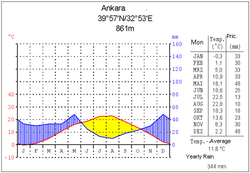 Ankara (central Anatolia)
 -
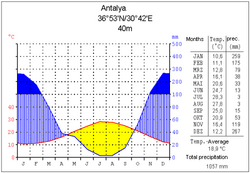 Antalya (southern Anatolia)
 -
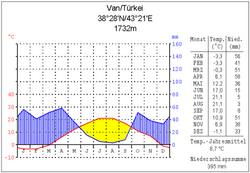 Van (eastern Anatolia)


Anatolia has a varied range of climates. The central plateau is characterized by a continental climate, with hot summers and cold, snowy winters. The south and west coasts enjoy a typical Mediterranean climate, with mild rainy winters and warm, dry summers.[119] The Black Sea and Marmara coasts have a temperate oceanic climate, with warm, foggy summers and much rainfall throughout the year.
Ecoregions[edit | edit source]

.jpg)
There is a diverse number of plant and animal communities.
The mountains and coastal plain of northern Anatolia experience a humid and mild climate. There are temperate broadleaf, mixed and coniferous forests. The central and eastern plateau, with its drier continental climate, has deciduous forests and forest steppes. Western and southern Anatolia, which have a Mediterranean climate, contain Mediterranean forests, woodlands, and scrub ecoregions.
- Euxine-Colchic deciduous forests: These temperate broadleaf and mixed forests extend across northern Anatolia, lying between the mountains of northern Anatolia and the Black Sea. They include the enclaves of temperate rainforest lying along the southeastern coast of the Black Sea in eastern Turkey and Georgia.[120]
- Northern Anatolian conifer and deciduous forests: These forests occupy the mountains of northern Anatolia, running east and west between the coastal Euxine-Colchic forests and the drier, continental climate forests of central and eastern Anatolia.[121]
- Central Anatolian deciduous forests: These forests of deciduous oaks and evergreen pines cover the plateau of central Anatolia.[122]
- Central Anatolian steppe: These dry grasslands cover the drier valleys and surround the saline lakes of central Anatolia, and include halophytic (salt-tolerant) plant communities.[123]

- Eastern Anatolian deciduous forests: This ecoregion occupies the plateau of eastern Anatolia. The drier and more continental climate is beneficial for steppe-forests dominated by deciduous oaks, with areas of shrubland, montane forest, and valley forest.[124]
- Anatolian conifer and deciduous mixed forests: These forests occupy the western, Mediterranean-climate portion of the Anatolian plateau. Pine forests, mixed pine, oak woodlands and shrublands are predominant.[125]
- Aegean and Western Turkey sclerophyllous and mixed forests: These Mediterranean-climate forests occupy the coastal lowlands and valleys of western Anatolia bordering the Aegean Sea. The ecoregion has forests of Turkish pine (Pinus brutia), oak forests and woodlands, and maquis shrubland of Turkish pine and evergreen sclerophyllous trees and shrubs, including Olive (Olea europaea), Strawberry Tree (Arbutus unedo), Arbutus andrachne, Kermes Oak (Quercus coccifera), and Bay Laurel (Laurus nobilis).[126]
- Southern Anatolian montane conifer and deciduous forests: These mountain forests occupy the Mediterranean-climate Taurus Mountains of southern Anatolia. Conifer forests are predominant, chiefly Anatolian black pine (Pinus nigra), Cedar of Lebanon (Cedrus libani), Taurus fir (Abies cilicica), and juniper (Juniperus foetidissima and J. excelsa). Broadleaf trees include oaks, hornbeam, and maples.[127]
- Eastern Mediterranean conifer-sclerophyllous-broadleaf forests: This ecoregion occupies the coastal strip of southern Anatolia between the Taurus Mountains and the Mediterranean Sea. Plant communities include broadleaf sclerophyllous maquis shrublands, forests of Aleppo Pine (Pinus halepensis) and Turkish Pine (Pinus brutia), and dry oak (Quercus spp.) woodlands and steppes.[128]
Demographics[edit | edit source]
The largest provinces in Anatolia (aside from the Asian side of Istanbul) are Ankara, İzmir, Bursa, Antalya, Konya, Adana, Kocaeli, Mersin, Manisa, Kayseri, Samsun, Balıkesir, Aydın, Maraş, Sakarya, Muğla, Denizli, Eskişehir, Trabzon, Ordu, Afyon, Sivas, Tokat, Zonguldak, Kütahya, Çanakkale, Osmaniye and Çorum. All have populations of more than 500,000.[129]
See also[edit | edit source]
- Aeolis
- Anatolian hypothesis
- Anatolianism
- Anatolian leopard
- Anatolian Plate
- Anatolian Shepherd
- Ancient kingdoms of Anatolia
- Antigonid dynasty
- Doris (Asia Minor)
- Empire of Nicaea
- Empire of Trebizond
- Gordium
- Lycaonia
- Midas
- Miletus
- Myra
- Pentarchy
- Pontic Greeks
- Rumi
- Saint Anatolia
- Saint John
- Saint Nicholas
- Saint Paul
- Seleucid Empire
- Seven churches of Asia
- Seven Sleepers
- Tarsus
- Troad
- Turkic migration
Explanatory notes[edit | edit source]
- ↑ Additional alternative names include Asian/Asiatic Turkey, the Anatolian Peninsula, and the Anatolian Plateau.
References[edit | edit source]
Citations[edit | edit source]
- ↑ 1.0 1.1 1.2 Hopkins, Daniel J.; Staff, Merriam-Webster; 편집부 (2001). Merriam-Webster's Geographical Dictionary. Merriam-Webster. p. 46. ISBN 978-0-87779-546-9. Archived from the original on 28 November 2021. Retrieved 18 May 2001.
Anatolia: The part of Turkey in Asia equivalent to the peninsula of Asia Minor up to indefinite line on E from Gulf of Iskenderun to Black Sea comprising about three fifths of Turkey's provinces
- ↑ 2.0 2.1
- McColl 2014, p. 922: "Thrace, its European area, is about the size of Vermont at 9,412 square mi (24,378 square km). Its Asian area (Asia Minor) is called Anatolia and covers 291,971 square mi (756,202 square km)"
- Cohen 2008, p. 125: "Anatolia, [Gr.=sunrise], Asiatic part of Turkey; its area covers 97% of all Turkey"
- Tockner, Uehlinger & Robinson 2009: "About 97% of the country is in Asia Minor (Anatolia) and 3% in Europe (Thrace)"
- "Turkey". The World Factbook. Central Intelligence Agency. Archived from the original on 18 June 2022. Retrieved 20 February 2024.: "the 97% of the country in Asia is referred to as Anatolia"
- "Anatolia". Encyclopedia Britannica. Retrieved 29 February 2024.: "Anatolia, the peninsula of land that today constitutes the Asian portion of Turkey"
- Steadman & McMahon 2011, p. 466
- Howard 2016, p. 7
- Helen Chapin Metz, ed. (1995). "Turkey: A Country Study | Geography". Washington: GPO for the Library of Congress. Retrieved 31 May 2024.: "The Asian part of the country is known by a variety of names--Asia Minor, Asiatic Turkey, the Anatolian Plateau, and Anatolia (Anadolu)"
- ↑ Stephen Mitchell (6 July 1995). Anatolia: land, men, and Gods in Asia Minor. Vol. 2. Oxford University Press. ISBN 0-19-815029-6.
- ↑
- KONDA 2006, p. 19
- Comrie 2018, p. 537
- ↑ 5.0 5.1 "Turkey (Turkiye)". The World Factbook. Central Intelligence Agency. Archived from the original on 18 June 2022. Retrieved 9 October 2024.
- ↑ 6.0 6.1 KONDA 2006, p. 17
- ↑ https://hmh.org/library/research/genocide-in-armenia-guide/
- ↑ 8.0 8.1 8.2 "Illustration of the Lake (later Sea) of Marmara and the formation of the Turkish Straits after the Black Sea deluge". www.ncdc.noaa.gov. 26 January 2014. Archived from the original on 31 August 2021. Retrieved 22 May 2021.
- ↑ 9.0 9.1 9.2 Dimitrov P., 2003. "The Black Sea – a Clue to the Secret of World Flood". Archived 21 May 2021 at the Wayback Machine. Oceanology, 4, 52–57.
- ↑ 10.0 10.1 10.2 Dimitrov P., D. Dimitrov. 2004. The Black Sea The Flood and the ancient myths. Archived 15 May 2021 at the Wayback Machine. "Slavena", Varna, ISBN 954579335X, 91 pp., doi:10.13140/RG.2.2.18954.16327.
- ↑ Philipp Niewohner (2017). The Archaeology of Byzantine Anatolia: From the End of Late Antiquity until the Coming of the Turks. Oxford University Press. pp. 18–. ISBN 978-0-19-061047-0. Archived from the original on 11 March 2020. Retrieved 7 December 2018.
- ↑ 12.0 12.1 Stephen Mitchell (1995). Anatolia: Land, Men, and Gods in Asia Minor. The Celts in Anatolia and the impact of Roman rule. Clarendon Press, 266 pp. ISBN 978-0198150299 [1] Archived 29 March 2017 at the Wayback Machine
- ↑ 13.0 13.1 Sahakyan, Lusine (2010). Turkification of the Toponyms in the Ottoman Empire and the Republic of Turkey. Montreal: Arod Books. ISBN 978-0-9699879-7-0.
- ↑ 14.0 14.1 Hovannisian, Richard (2007). The Armenian Genocide: Cultural and Ethical Legacies. New Brunswick, NJ: Transaction Publishers. p. 3. ISBN 978-1-4128-3592-3. Archived from the original on 10 October 2017. Retrieved 10 September 2015.
- ↑ A Comparative Analysis Regarding Pictures Included in Secondary School Geography Textbooks Taught in Turkey. Archived 13 April 2015 at the Wayback Machine, Okan Yasar and Mehmet Seremet, International Research in Geographical and Environmental Education, 2007.
- ↑ Vazken Khatchig Davidian, "Imagining Ottoman Armenia: Realism and Allegory in Garabed Nichanian's Provincial Wedding in Moush and Late Ottoman Art Criticism", p. 7 & footnote 34, in Études arméniennes contemporaines volume 6, 2015.
- ↑ Fevzi Özgökçe; Kit Tan; Vladimir Stevanović (2005). "A new subspecies of Silene acaulis (Caryophyllaceae) from East Anatolia, Turkey". Annales Botanici Fennici. 42 (2): 143–149. JSTOR 23726860.
- ↑ Palumbi, Giulio (5 September 2011). McMahon, Gregory; Steadman, Sharon (eds.). "The Chalcolithic of Eastern Anatolia". The Oxford Handbook of Ancient Anatolia. 1. doi:10.1093/oxfordhb/9780195376142.013.0009. Archived from the original on 12 May 2018. Retrieved 6 May 2018.
- ↑ Henry George Liddell; Robert Scott. "ἀνατολή". A Greek-English Lexicon. Archived from the original on 26 May 2007. Retrieved 20 February 2021.
- ↑ 20.0 20.1 "Anatolia | Origin and meaning of the name Anatolia". Online Etymology Dictionary. Archived from the original on 13 July 2017. Retrieved 14 May 2021.
- ↑ "On the First Thema, called Anatolikón. This theme is called Anatolikón or Theme of the Anatolics, not because it is above and in the direction of the east where the sun rises, but because it lies to the East of Byzantium and Europe." Constantine VII Porphyrogenitus, De Thematibus, ed. A. Pertusi. Vatican: Vatican Library, 1952, pp. 59 ff.
- ↑ John Haldon, Byzantium, a History, 2002, p. 32.
- ↑ Bryce 2009, pp. 297–98.
- ↑ Henry George Liddell, Robert Scott, Ἀσία. Archived 27 April 2011 at the Wayback Machine, A Greek-English Lexicon, on Perseus.
- ↑ Everett-Heath, John (2018). "Anatolia". The Concise Dictionary of World Place-Names. Vol. 1. Oxford University Press. doi:10.1093/acref/9780191866326.001.0001. ISBN 978-0-19-186632-6. Archived from the original on 6 December 2018. Retrieved 5 December 2018.
- ↑ Suny, Ronald Grigor (2015). 'They Can Live in the Desert but Nowhere Else': A History of the Armenian Genocide. Princeton University Press. p. 31. ISBN 978-1-4008-6558-1.
- ↑ 27.0 27.1 Steadman & McMahon 2011, p. 466
- ↑ Ali Yiğit, "Geçmişten Günümüze Türkiye'yi Bölgelere Ayıran Çalışmalar ve Yapılması Gerekenler", Ankara Üniversitesi Türkiye Coğrafyası Araştırma ve Uygulama Merkezi, IV. Ulural Coğrafya Sempozyumu, "Avrupa Birliği Sürecindeki Türkiye'de Bölgesel Farklılıklar", pp. 34–35. Archived 9 November 2013 at the Wayback Machine.
- ↑ Hovannisian, Richard G. (1998). Remembrance and Denial: The Case of the Armenian Genocide. Wayne State University Press. ISBN 978-0-8143-2777-7. Archived from the original on 10 March 2020. Retrieved 5 December 2018.
- ↑ Stiner, Mary C.; Kuhn, Steven L.; Güleç, Erksin (2013). "Early Upper Paleolithic shell beads at Üçağızlı Cave I (Turkey): Technology and the socioeconomic context of ornament life-histories". Journal of Human Evolution. 64 (5): 380–98. Bibcode:2013JHumE..64..380S. doi:10.1016/j.jhevol.2013.01.008. ISSN 0047-2484. PMID 23481346.
- ↑ Whitehouse, Harvey; Martin, Luther H. (2004). Theorizing Religions Past: Archaeology, History, and Cognition. Rowman Altamira. p. 38. ISBN 978-0-7591-0621-5.
- ↑ Curry, Andrew (August 2019). "The first Europeans weren't who you might think". National Geographic. Archived from the original on 19 March 2021.
- ↑ Krause, Johannes; Jeong, Choongwon; Haak, Wolfgang; Posth, Cosimo; Stockhammer, Philipp W.; Mustafaoğlu, Gökhan; Fairbairn, Andrew; Bianco, Raffaela A.; Julia Gresky (19 March 2019). "Late Pleistocene human genome suggests a local origin for the first farmers of central Anatolia". Nature Communications. 10 (1): 1218. Bibcode:2019NatCo..10.1218F. doi:10.1038/s41467-019-09209-7. ISSN 2041-1723. PMC 6425003. PMID 30890703.
- ↑ Brace, Selina; Diekmann, Yoan; Booth, Thomas J.; van Dorp, Lucy; Faltyskova, Zuzana; Rohland, Nadin; Mallick, Swapan; Olalde, Iñigo; Ferry, Matthew; Michel, Megan; Oppenheimer, Jonas; Broomandkhoshbacht, Nasreen; Stewardson, Kristin; Martiniano, Rui; Walsh, Susan (15 April 2019). "Ancient genomes indicate population replacement in Early Neolithic Britain". Nature Ecology & Evolution. 3 (5): 765–771. Bibcode:2019NatEE...3..765B. doi:10.1038/s41559-019-0871-9. ISSN 2397-334X. PMC 6520225. PMID 30988490.
- ↑ Olalde, Iñigo; Mallick, Swapan; Patterson, Nick; Rohland, Nadin; Villalba-Mouco, Vanessa; Silva, Marina; Dulias, Katharina; Edwards, Ceiridwen J.; Gandini, Francesca; Pala, Maria; Soares, Pedro; Ferrando-Bernal, Manuel; Adamski, Nicole; Broomandkhoshbacht, Nasreen; Cheronet, Olivia (15 March 2019). "The genomic history of the Iberian Peninsula over the past 8,000 years". Science. 363 (6432): 1230–1234. Bibcode:2019Sci...363.1230O. doi:10.1126/science.aav4040. ISSN 0036-8075. PMC 6436108. PMID 30872528.
- ↑ Simões, Luciana G.; Günther, Torsten; Martínez-Sánchez, Rafael M.; Vera-Rodríguez, Juan Carlos; Iriarte, Eneko; Rodríguez-Varela, Ricardo; Bokbot, Youssef; Valdiosera, Cristina; Jakobsson, Mattias (15 June 2023). "Northwest African Neolithic initiated by migrants from Iberia and Levant". Nature. 618 (7965): 550–556. Bibcode:2023Natur.618..550S. doi:10.1038/s41586-023-06166-6. ISSN 0028-0836. PMC 10266975. PMID 37286608.
- ↑ Allentoft, Morten E.; Sikora, Martin; Refoyo-Martínez, Alba; Irving-Pease, Evan K.; Fischer, Anders; Barrie, William; Ingason, Andrés; Stenderup, Jesper; Sjögren, Karl-Göran; Pearson, Alice; Sousa da Mota, Bárbara; Schulz Paulsson, Bettina; Halgren, Alma; Macleod, Ruairidh; Jørkov, Marie Louise Schjellerup (11 January 2024). "Population genomics of post-glacial western Eurasia". Nature. 625 (7994): 301–311. Bibcode:2024Natur.625..301A. doi:10.1038/s41586-023-06865-0. ISSN 0028-0836. PMC 10781627. PMID 38200295.
- ↑ Almarri, Mohamed A.; Haber, Marc; Lootah, Reem A.; et al. (2021). "The genomic history of the Middle East". Cell. 184 (18): 4612–4625. doi:10.1016/j.cell.2021.07.013. PMC 8445022. PMID 34352227.
- ↑ Lazaridis, Iosif; Alpaslan-Roodenberg, Songül; Acar, Ayşe; et al. (2022). "The genetic history of the Southern Arc: A bridge between West Asia and Europe". Science. 377 (6609) eabm4247. doi:10.1126/science.abm4247. hdl:20.500.12684/12345. PMC 10064553. PMID 36007055.
- ↑ "Indo-European Daughter Languages: Anatolian". www.historyfiles.co.uk. Archived from the original on 13 May 2021. Retrieved 26 January 2021.
- ↑ "Anatolian languages". Encyclopedia Britannica. Archived from the original on 6 September 2015. Retrieved 26 January 2021.
- ↑ 42.0 42.1 42.2 42.3 42.4 Howard 2016, p. 26
- ↑ Steadman 2012, p. 234
- ↑ Bryce 2005, p. 12.
- ↑ Freeman, Charles (1999). Egypt, Greece and Rome: Civilizations of the Ancient Mediterranean. Oxford University Press. ISBN 978-0-19-872194-9.
- ↑ Akurgal 2001.
- ↑ Barjamovic 2011.
- ↑ Howard 2016, pp. 26–27
- ↑ Jablonka 2012, pp. 724–726
- ↑ McMahon 2012, p. 17
- ↑ "History of the Past: World History".
- ↑ Paul Lunde (May–June 1980). "The Seven Wonders". Saudi Aramco World. Archived from the original on 13 October 2009. Retrieved 12 September 2009.
- ↑ Mark Cartwright. "Celsus Library". World History Encyclopedia. Retrieved 2 February 2017.
- ↑ "The Temple of Artemis at Ephesus: The Un-Greek Temple and Wonder". World History Encyclopedia. Retrieved 17 February 2017.
- ↑ 55.0 55.1 55.2 Howard 2016, p. 27
- ↑ Beckman 2012, p. 522
- ↑ Yakubovich 2012, p. 538
- ↑ Zimansky 2012, p. 552
- ↑ 59.0 59.1 59.2 Howard 2016, p. 28
- ↑ 60.0 60.1 Bryce 2012, pp. 369–370: "The only clear evidence we have for significant Mycenaean settlement anywhere in the Near Eastern region is at Miletus on the southwestern Anatolian coast, at the mouth of the Maeander River, and at the site now called Müsgebi ..."
- ↑ 61.0 61.1 "Anatolia – Greek colonies on the Anatolian coasts, c. 1180–547 bce". Encyclopedia Britannica. Archived from the original on 21 March 2023. Retrieved 2 February 2024.
Before the Greek migrations that followed the end of the Bronze Age (c. 1200 BCE), probably the only Greek-speaking communities on the west coast of Anatolia were Mycenaean settlements at Iasus and Müskebi on the Halicarnassus peninsula and walled Mycenaean colonies at Miletus and Colophon.
- ↑ Howard 2016, p. 27
- ↑ Harl 2012, p. 753
- ↑ Harl 2012, p. 753: "It is impossible to estimate the scale of Greek migrations after the collapse of the Mycenaean kingdoms."
- ↑ Harl 2012, pp. 753–756
- ↑ Greaves 2012, p. 505
- ↑ Harl 2012, p. 753
- ↑ Harl 2012, p. 753
- ↑ Greaves 2012, p. 500–501: "However, during the early Iron Age, Greek communities in Anatolia were largely (although not exclusively) limited to the western coastal region. Their cultural influence in the interior was relatively limited, only becoming dominant after Alexander"
- ↑ Harl 2012, pp. 753–754
- ↑ Greaves 2012, pp. 508–509
- ↑ Harl 2012, p. 754
- ↑ Harl 2012, pp. 754–755
- ↑ Harl 2012, p. 755
- ↑ Harl 2012, pp. 755.
- ↑ Harl 2012, pp. 755–761.
- ↑ 77.0 77.1 Yavuz, Mehmet Fatih (2010). "Anatolia". The Oxford Encyclopedia of Ancient Greece and Rome. Oxford University Press. doi:10.1093/acref/9780195170726.001.0001. ISBN 978-0-19-517072-6. Archived from the original on 6 December 2018. Retrieved 5 December 2018.
- ↑ Honey, Linda (5 December 2016). "Justifiably Outraged or Simply Outrageous? The Isaurian Incident of Ammianus Marcellinus". Violence in Late Antiquity: Perceptions and Practices. Routledge. p. 50. ISBN 978-1-351-87574-5. Archived from the original on 19 May 2022. Retrieved 8 November 2020.
- ↑ Swain, Simon; Adams, J. Maxwell; Janse, Mark (2002). Bilingualism in Ancient Society: Language Contact and the Written Word. Oxford [Oxfordshire]: Oxford University Press. pp. 246–66. ISBN 0-19-924506-1.
- ↑ Freeman, Philip, The Galatian Language, Edwin Mellen, 2001, pp. 11–12.
- ↑ Clackson, James. "Language maintenance and language shift in the Mediterranean world during the Roman Empire." Multilingualism in the Graeco-Roman Worlds (2012): 36–57. p. 46: The second testimonium for the late survival of Galatian appears in the Life of Saint Euthymius, who died in ad 487.
- ↑ Norton, Tom. [2] Archived 2 November 2018 at the Wayback Machine | A question of identity: who were the Galatians?. University of Wales. p. 62: The final reference to Galatian comes two hundred years later in the sixth century, when Cyril of Scythopolis attests that Galatian was still being spoken eight hundred years after the Galatians arrived in Asia Minor. Cyril tells of the temporary possession of a monk from Galatia by Satan and rendered speechless, but when he recovered, he spoke only in his native Galatian when questioned: 'If he were pressed, he spoke only in Galatian'.180 After this, the rest is silence, and further archaeological or literary discoveries are awaited to see if Galatian survived any later. In this regard, the example of Crimean Gothic is instructive. It was presumed to have died out in the fifth century CE, but the discovery of a small corpus of the language dating from the sixteenth century altered this perception.
- ↑ J. Eric Cooper, Michael J. Decker, Life and Society in Byzantine Cappadocia ISBN 0230361064, p. 14
- ↑ Howgego, C. J. (1995). Ancient History from Coins. Routledge. ISBN 978-0-415-08992-0.
- ↑ Asia Minor Coins Archived 17 March 2020 at the Wayback Machine – an index of Greek and Roman coins from Asia Minor (ancient Anatolia)
- ↑ Dandamaev, M. A. (1989). A Political History of the Achaemenid Empire. Brill. p. 294. ISBN 978-90-04-09172-6.
- ↑ Schmitt, R. (1986). "ARTAXERXES II". Encyclopaedia Iranica, Vol. II, Fasc. 6. pp. 656–58. Archived from the original on 9 April 2019. Retrieved 21 April 2019.
- ↑ Roisman, Joseph; Worthington, Ian (2010). A Companion to Ancient Macedonia. John Wiley and Sons. ISBN 978-1-4051-7936-2. Archived from the original on 16 April 2020. Retrieved 20 June 2015.
- ↑ Harl 2012, p. 771
- ↑ Harl 2012, p. 772
- ↑ "Mithradates VI Eupator", Encyclopædia Britannica
- ↑ Hewsen, Robert H. (2009). "Armenians on the Black Sea: The Province of Trebizond". In Richard G. Hovannisian (ed.). Armenian Pontus: The Trebizond-Black Sea Communities. Costa Mesa, CA: Mazda Publishers, Inc. pp. 41, 37–66. ISBN 978-1-56859-155-1.
- ↑ Traina, Giusto (2017). "Strabo and the history of Armenia". In Dueck, Daniela (ed.). The Routledge Companion to Strabo. London: Routledge. p. 95. ISBN 978-1-315-69641-6.
- ↑ Bennett, Julian (1997). Trajan: Optimus Princeps: a Life and Times. Routledge. ISBN 978-0-415-16524-2.. Fig. 1. Regions east of the Euphrates river were held only in the years 116–117.
- ↑ 95.0 95.1 95.2 95.3 95.4 Niewöhner, Philipp (2017). "Chapter 3: Urbanism – The Archaeology of Byzantine Anatolia". In Niewöhner, Philipp (ed.). The Archaeology of Byzantine Anatolia: From the End of Late Antiquity until the Coming of the Turks. Oxford and New York: Oxford University Press. pp. 39–59. doi:10.1093/acprof:oso/9780190610463.003.0004. ISBN 978-0-19-061048-7.
- ↑ Thonemann, Peter (2018). "Anatolia". The Oxford Dictionary of Late Antiquity. Vol. 1. Oxford University Press. doi:10.1093/acref/9780198662778.001.0001. ISBN 978-0-19-866277-8. Archived from the original on 6 December 2018. Retrieved 6 December 2018.
- ↑ Angold, Michael (1997). The Byzantine Empire 1025–1204. Longman. p. 117. ISBN 978-0-582-29468-4.
- ↑ 98.0 98.1 H. M. Balyuzi Muḥammad and the course of Islám, p. 342
- ↑ Treadgold. A History of the Byzantine State and Society. p. 941-944
- ↑ John Freely Storm on Horseback: The Seljuk Warriors of Turkey, p. 83
- ↑ Clifford Edmund Bosworth-The new Islamic dynasties: a chronological and genealogical manual, p. 234
- ↑ Mehmet Fuat Köprülü, Gary Leiser-The origins of the Ottoman Empire, p. 33
- ↑ Peter Partner God of battles: holy wars of Christianity and Islam, p. 122
- ↑ Osman's Dream: The History of the Ottoman Empire, p. 13
- ↑ Artuk – Osmanli Beyliginin Kurucusu, 27f
- ↑ Pamuk – A Monetary History, pp. 30–31
- ↑ "Osman I | Ottoman Sultan". Encyclopædia Britannica. Archived from the original on 24 April 2018. Retrieved 23 April 2018.
- ↑ "Orhan | Ottoman Sultan". Encyclopædia Britannica. Archived from the original on 10 March 2018. Retrieved 23 April 2018.
- ↑ Fleet, Kate (2010). "The rise of the Ottomans". The rise of the Ottomans (Chapter 11) – The New Cambridge History of Islam. Cambridge Core. pp. 313–31. doi:10.1017/CHOL9780521839570.013. ISBN 978-1-139-05615-1. Archived from the original on 24 April 2018. Retrieved 23 April 2018.
- ↑ Finkel, Caroline (2007). Osman's Dream: The History of the Ottoman Empire. Basic Books. p. 5. ISBN 978-0-465-00850-6. Archived from the original on 2 January 2014. Retrieved 6 June 2013.
- ↑ Genito, Bruno (1 March 2012) [15 December 2003]. "Halicarnassus". Encyclopaedia Iranica. Archived from the original on 24 April 2018. Retrieved 23 April 2018.
- ↑ Incorporated, Facts On File (2009). Encyclopedia of the Peoples of Africa and the Middle East. Infobase Publishing. p. 244. ISBN 978-1-4381-2676-0.
- ↑ Simonian, Hovann H. (2007b). "Hemshin from Islamicization to the End of the Nineteenth Century". The Hemshin: History, Society and Identity in the Highlands of Northeast Turkey.
- ↑ Pekesen, Berna (7 March 2012). Berger, Lutz; Landes, Lisa (eds.). "Expulsion and Emigration of the Muslims from the Balkans". European History Online. Translated by Reid, Christopher. Leibniz Institute of European History. Retrieved 9 September 2022.
- ↑ Swietochowski, Tadeusz (1995). Russia and Azerbaijan: A Borderland in Transition. Columbia University Press. pp. 69, 133. ISBN 978-0-231-07068-3.
- ↑ "The uncertain future of Greeks in Turkey". archive.is. 7 September 2023. Retrieved 3 September 2024.
{{cite web}}: CS1 maint: deprecated archival service (link) - ↑ Morris, Benny; Ze'evi, Dror (24 April 2019). The Thirty-Year Genocide: Turkey's Destruction of Its Christian Minorities, 1894–1924. Harvard University Press. p. 3. ISBN 978-0-674-91645-6.
- ↑ Cemen, Ibrahim; Yilmaz, Yucel (2017). Active Global Seismology: Neotectonics and Earthquake Potential of the Eastern Mediterranean Region. John Wiley & Sons. ISBN 978-1-118-94501-8.
- ↑ Prothero, W.G. (1920). Anatolia. London: H.M. Stationery Office. Archived from the original on 2 November 2013. Retrieved 6 September 2013.
- ↑ "Euxine-Colchic deciduous forests". Terrestrial Ecoregions. World Wildlife Fund. Retrieved 25 May 2008.
- ↑ "Northern Anatolian conifer and deciduous forests". Terrestrial Ecoregions. World Wildlife Fund. Retrieved 25 May 2008.
- ↑ "Central Anatolian deciduous forests". Terrestrial Ecoregions. World Wildlife Fund. Retrieved 25 May 2008.
- ↑ "Central Anatolian steppe". Terrestrial Ecoregions. World Wildlife Fund. Retrieved 25 May 2008.
- ↑ "Eastern Anatolian deciduous forests". Terrestrial Ecoregions. World Wildlife Fund. Retrieved 25 May 2008.
- ↑ "Anatolian conifer and deciduous mixed forests". Terrestrial Ecoregions. World Wildlife Fund. Retrieved 25 May 2008.
- ↑ "Aegean and Western Turkey sclerophyllous and mixed forests". Terrestrial Ecoregions. World Wildlife Fund. Retrieved 25 May 2008.
- ↑ "Southern Anatolian montane conifer and deciduous forests". Terrestrial Ecoregions. World Wildlife Fund. Retrieved 25 May 2008.
- ↑ "Eastern Mediterranean conifer-sclerophyllous-broadleaf forests". Terrestrial Ecoregions. World Wildlife Fund. Retrieved 25 May 2008.
- ↑ "Türkiye'nin En Kalabalık İlleri 2024 En Kalabalık Şehirler". www.nufusu.com. Retrieved 23 May 2025.


Sources[edit | edit source]
- Akurgal, Ekrem (2001). The Hattian and Hittite Civilizations. Ankara: Ministry of Culture. ISBN 978-975-17-2756-5. Archived from the original on 28 April 2021. Retrieved 7 January 2021.
- Barjamovic, Gojko (2011). A Historical Geography of Anatolia in the Old Assyrian Colony Period. Copenhagen: Museum Tusculanum Press. ISBN 978-87-635-3645-5. Archived from the original on 28 April 2021. Retrieved 7 January 2021.
- Bryce, Trevor R. (2005) [1998]. The Kingdom of the Hittites (2nd revised ed.). New York: Oxford University Press. ISBN 978-0-19-927908-1. Archived from the original on 5 May 2021. Retrieved 7 January 2021.
- Bryce, Trevor R. (2009). The Routledge Handbook of the Peoples and Places of Ancient Western Asia: The Near East from the Early Bronze Age to the fall of the Persian Empire. London & New York: Routledge. ISBN 978-1-134-15907-9.
- Cohen, Saul B., ed. (2008). The Columbia Gazetteer of the World: Volume 1 A to G (2nd ed.). Columbia University Press. ISBN 978-0-231-14554-1. OCLC 212893637.
- Comrie, Bernard (2018). Comrie, Bernard (ed.). The World's Major Languages (3rd ed.). Routledge. doi:10.4324/9781315644936. ISBN 978-0-19-506511-4.
- Howard, Douglas A. (2016). The History of Turkey (2nd ed.). Santa Barbara, California: Greenwood. ISBN 978-1-4408-3466-0.
- McColl, R. W. (2014). Encyclopedia of World Geography. Facts On File. ISBN 978-0-8160-7229-3.
- McMahon, Gregory; Steadman, Sharon, eds. (2012). The Oxford Handbook of Ancient Anatolia: (10,000-323 BCE). Oxford University Press. doi:10.1093/oxfordhb/9780195376142.001.0001. ISBN 978-0-19-537614-2.
- Script error: No such module "Harvc". doi:10.1093/oxfordhb/9780195376142.013.0001
- Script error: No such module "Harvc". doi:10.1093/oxfordhb/9780195376142.013.0002
- Script error: No such module "Harvc". doi:10.1093/oxfordhb/9780195376142.013.0003
- Script error: No such module "Harvc". doi:10.1093/oxfordhb/9780195376142.013.0010
- Script error: No such module "Harvc". doi:10.1093/oxfordhb/9780195376142.013.0013
- Script error: No such module "Harvc". doi:10.1093/oxfordhb/9780195376142.013.0015
- Script error: No such module "Harvc". doi:10.1093/oxfordhb/9780195376142.013.0020
- Script error: No such module "Harvc". doi:10.1093/oxfordhb/9780195376142.013.0021
- Script error: No such module "Harvc". doi:10.1093/oxfordhb/9780195376142.013.0022
- Script error: No such module "Harvc". doi:10.1093/oxfordhb/9780195376142.013.0023
- Script error: No such module "Harvc". doi:10.1093/oxfordhb/9780195376142.013.0024
- Script error: No such module "Harvc". doi:10.1093/oxfordhb/9780195376142.013.0027
- Script error: No such module "Harvc". doi:10.1093/oxfordhb/9780195376142.013.0031
- Script error: No such module "Harvc". doi:10.1093/oxfordhb/9780195376142.013.0032
- Script error: No such module "Harvc". doi:10.1093/oxfordhb/9780195376142.013.0034
- Steadman, Sharon R.; McMahon, Gregory (2011). McMahon, Gregory; Steadman, Sharon (eds.). The Oxford Handbook of Ancient Anatolia:(10,000–323 BCE). Oxford University Press Inc. doi:10.1093/oxfordhb/9780195376142.001.0001. hdl:11693/51311. ISBN 978-0-19-537614-2.
- Tockner, Klement; Uehlinger, Urs; Robinson, Christopher T., eds. (2009). Rivers of Europe. Academic Press. ISBN 978-0-08-091908-9.
- Toplumsal Yapı Araştırması 2006 (PDF) (Report). KONDA Research and Consultancy. 2006. Archived from the original (PDF) on 15 February 2017. Retrieved 21 February 2015.
Further reading[edit | edit source]
| Library resources about Anatolia |
- Akat, Yücel, Neşe Özgünel, and Aynur Durukan. 1991. Anatolia: A World Heritage. Ankara: Kültür Bakanliǧi.
- Brewster, Harry. 1993. Classical Anatolia: The Glory of Hellenism. London: I. B. Tauris.
- Donbaz, Veysel, and Şemsi Güner. 1995. The Royal Roads of Anatolia. Istanbul: Dünya.
- Dusinberre, Elspeth R. M. 2013. Empire, Authority, and Autonomy In Achaemenid Anatolia. Cambridge: Cambridge University Press.
- Gates, Charles, Jacques Morin, and Thomas Zimmermann. 2009. Sacred Landscapes In Anatolia and Neighboring Regions. Oxford: Archaeopress.
- Mikasa, Takahito, ed. 1999. Essays On Ancient Anatolia. Wiesbaden: Harrassowitz.
- Takaoğlu, Turan. 2004. Ethnoarchaeological Investigations In Rural Anatolia. İstanbul: Ege Yayınları.
- Taracha, Piotr. 2009. Religions of Second Millennium Anatolia. Wiesbaden: Harrassowitz.
- Taymaz, Tuncay, Y. Yilmaz, and Yildirim Dilek. 2007. The Geodynamics of the Aegean and Anatolia. London: Geological Society.
External links[edit | edit source]
- Pages using the JsonConfig extension
- Articles containing Ancient Greek (to 1453)-language text
- Articles containing Imperial Aramaic (700-300 BCE)-language text
- Pages using multiple image with unknown parameters
- Anatolia
- Geography of ancient Greece
- Geography of the Middle East
- Historical regions in Turkey
- Peninsulas of Asia
- Peninsulas of Turkey
- Physiographic provinces
- Regions of Asia
- Regions of Turkey
- West Asia