




m Movebot moved page Talk:Sugarcane juice to Sugarcane juice without leaving a redirect: BP:MOVE |
NoraBillings (talk | contribs) No edit summary |
||
| Line 1: | Line 1: | ||
[[File: | {{short description|Liquid extracted from sugarcane}} | ||
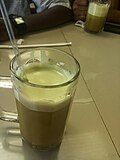
[[File:Sugarcanejuice.jpg|thumb|Sugarcane juice]] | |||
[[File:Making the guarapa from the sugarcane.jpg|thumb|Machine used to crush sugar cane to obtain the juice]] | |||
'''Sugarcane juice''' is the liquid extracted from pressed [[sugarcane]]. It is consumed as a beverage in many places, especially where sugarcane is commercially grown, such as [[Southeast Asia]], the [[Indian subcontinent]], [[North Africa]], mainly [[Egypt]], and also in [[South America]], especially [[Brazil]]. | |||
Sugarcane juice is obtained by crushing peeled sugarcane in a mill and is one of the main precursors of [[rum]]. | |||
==Health risks== | |||
[[File:A video of Sugarcane juice extraction.ogv|thumb|A mechanical method of extracting sugarcane juice]] | |||
There are some diseases that can be transmitted by raw sugarcane, such as [[leptospirosis]].<ref>{{cite web|url=https://www.business.qld.gov.au/industry/agriculture/species/diseases-disorders/animals/leptospirosis|title=Leptospirosis|first=Agriculture and|last=Fisheries|website=Business.qld.gov.au|access-date=1 November 2018|archive-date=26 March 2016|archive-url=https://web.archive.org/web/20160326194554/https://www.business.qld.gov.au/industry/agriculture/species/diseases-disorders/animals/leptospirosis|url-status=live}}</ref> In Brazil, sugarcane juice has been linked to cases of [[Chagas disease]], as sugarcane can contain traces of its responsible pathogen, ''[[Trypanosoma cruzi]]'', left by infected insects if not properly cleaned.<ref>{{cite web |url=http://www.fiocruz.br/chagas/cgi/cgilua.exe/sys/start.htm?sid=11 |title=Perguntas frequentes |website=Fundação Oswaldo Cruz |language=pt |archive-url=https://web.archive.org/web/20170815140129/http://www.fiocruz.br/chagas/cgi/cgilua.exe/sys/start.htm?sid=11 |archive-date=2017-08-15}}</ref> | |||
Drinking sugarcane juice in Egypt may pose health risks due to contamination with the [[mycotoxin]]s [[Aflatoxin|aflatoxin B<sub>1</sub>]] and [[fumonisin B1|fumonisin B<sub>1</sub>]].<ref>{{cite journal |last1=Abdallah |first1=Mohamed F. |last2=Krska |first2=Rudolf |last3=Sulyok |first3=Michael |title=Mycotoxin Contamination in Sugarcane Grass and Juice: First Report on Detection of Multiple Mycotoxins and Exposure Assessment for Aflatoxins B1 and G1 in Humans |journal=Toxins |date=2016 |volume=8 |issue=11 |page=343 |doi=10.3390/toxins8110343|pmid=27869706 |pmc=5127139 |doi-access=free }}</ref><ref>{{cite journal |last1=Abdallah |first1=Mohamed F. |last2=Audenaert |first2=Kris |last3=Lust |first3=Leonie |last4=Landschoot |first4=Sofie |last5=Bekaert |first5=Boris |last6=Haesaert |first6=Geert |last7=De Boevre |first7=Marthe |last8=De Saeger |first8=Sarah |title=Risk characterization and quantification of mycotoxins and their producing fungi in sugarcane juice: A neglected problem in a widely-consumed traditional beverage |journal=Food Control |date=1 February 2020 |volume=108 |article-number=106811 |doi=10.1016/j.foodcont.2019.106811}}</ref> | |||
==Countries== | |||
===Brazil=== | |||
Sugarcane juice, known locally as ''caldo de cana'',<ref>{{cite web |title=Brazilian Street Food - A Dica do Dia |url=https://rioandlearn.com/brazilian-street-food/ |website=Rio & Learn |access-date=3 April 2021 |date=28 September 2015 |archive-date=22 April 2021 |archive-url=https://web.archive.org/web/20210422173653/https://rioandlearn.com/brazilian-street-food/ |url-status=live }}</ref> or ''garapa'', is commonly sold by street vendors in [[Brazil]].<ref>{{cite web |last1=Andrade |first1=Maria do Carmo |last2=Joaquim Nabuco Foudantion |title=Sugarcane Juice (Caldo de Cana) |url=http://basilio.fundaj.gov.br/pesquisaescolar_en/index.php?option=com_content&id=1258:sugarcane-juice |website=basilio.fundaj.gov.br |publisher=Government of Brasil |access-date=3 April 2021 |location=Recife, Brazil |archive-date=22 May 2022 |archive-url=https://web.archive.org/web/20220522141101/http://basilio.fundaj.gov.br/pesquisaescolar_en/index.php?option=com_content&id=1258:sugarcane-juice |url-status=live }}</ref> In a process similar to that of the street vendors of India, machines are used to press the sugarcane and the juice is extracted.<ref>{{cite web |title=Sugar Cane Juice aka "Caldo de Cana" |url=https://colorfulfoodie.com/sugar-cane-juice-aka-caldo-de-cana/ |website=Colorful Foodie |access-date=3 April 2021 |date=9 April 2015 |archive-date=19 April 2022 |archive-url=https://web.archive.org/web/20220419141822/https://colorfulfoodie.com/sugar-cane-juice-aka-caldo-de-cana/ |url-status=live }}</ref> It is sometimes served with lime or pineapple juice. | |||
===Egypt=== | |||
In [[Egypt]], sugarcane juice is known as ''asab'' and is sold in juice shops around the country. The largest juice shop in Egypt is in [[Saft El Laban]], [[Giza]]. Egyptians also mix lemon with ''asab'' and let it ferment to produce a fermented variant of the drink. The most highly prized ''asab'' comes from [[Minya, Egypt]].<ref name="Taylor">{{cite book|author1=Bruce Kraig|title=Street Food around the World|author2=Colleen Taylor Sen|date=2013|publisher=ABC-CLIO|isbn=978-1-59884-955-4|page=130}}</ref> | |||
===India=== | |||
Sugarcane juice is sold by street vendors throughout [[India]]. The vendors put the sugarcane in a machine, which presses and extracts the sugarcane juice out. Sugarcane juice is usually served with a dash of lime and/or ginger juice. It is a very popular drink, especially during summer months, as a refreshing form of heat relief.<ref name="Bharadwaj2018">{{cite book|author=Monisha Bharadwaj|title=Indian Cookery Course|url=https://books.google.com/books?id=1N1dDwAAQBAJ&pg=PT1093|date=16 July 2018|publisher=Octopus Books|isbn=978-0-85783-593-2|pages=1093–}}</ref> | |||
Before sugarcane was introduced to the southern region, it had already been cultivated for many centuries in Southeast Asia and India for its sweet juice, which was used to produce crude sugar. When Jesuit priests began growing sugarcane in what is now downtown New Orleans in 1751, they faced challenges in efficiently converting its juice into sugar due to the high costs, unreliability, and lack of profitability. However, by the 1790s, businessman Etienne de Bore, along with skilled sugar maker Antoine Morin from Santo Domingo, successfully refined sugarcane juice into granulated sugar, thereby achieving profitability in the process.<ref>{{Cite book |last=SCOTT R. |first=SIMMONS |title=Sugar and Sugarcane |publisher=The University of North Carolina Press |year=2014 |isbn=978-0-8078-3146-5 |edition=APA 7th |publication-date=2014 |pages=267–269}}</ref> | |||
===Indonesia=== | |||
[[File:Es Air Tebu (Sugarcane juice) seller.JPG|thumb|''Es air tebu'', iced sugarcane juice sold by street vendor in [[Jakarta]], Indonesia.]] | |||
In [[Indonesia]], sugarcane juice drink is called ''minuman sari tebu''. The iced sugar cane juice is called ''es tebu''.<ref>{{Cite web|url=https://student.cnnindonesia.com/inspirasi/20170105142051-454-184300/kisah-di-balik-segarnya-minuman-es-tebu/|title=Kisah di Balik Segarnya Minuman Es Tebu|website=CNN Indonesia|language=id|access-date=2017-11-15|archive-date=2017-11-15|archive-url=https://web.archive.org/web/20171115201237/https://student.cnnindonesia.com/inspirasi/20170105142051-454-184300/kisah-di-balik-segarnya-minuman-es-tebu/}}</ref> In [[Indonesian language|Indonesian]], ''tebu'' is sugarcane and ''es'' is ice. It is one of the traditional beverages commonly sold street-side in Indonesia.<ref>{{Cite book|url=https://books.google.com/books?id=DDBCAgAAQBAJ&q=es+tebu+indonesia&pg=PA36|title=Minuman Tradisional Indonesia|last=W|first=Rian Yulianto|publisher=Gulajava Ministudio|language=id |page=36}}</ref> The sugarcane plant has been cultivated in Java since ancient times. The earliest record comes from a 9th-century inscription, dated from the [[Medang Kingdom|Medang Mataram]] period, that describes a sweet drink called ''Nalaka Rasa'', which translates as "sugarcane juice".<ref>{{Cite news|url=https://travel.tempo.co/read/848941/hanya-ada-di-candi-sojiwan-menu-hidangan-raja-mataram-kuno|title=Hanya Ada Di Candi Sojiwan: Menu Hidangan Raja Mataram Kuno|last=Widjanarko|first=Tulus|work=Tempo|access-date=2017-11-15|language=id|archive-date=2017-09-29|archive-url=https://web.archive.org/web/20170929044958/https://travel.tempo.co/read/848941/hanya-ada-di-candi-sojiwan-menu-hidangan-raja-mataram-kuno|url-status=live}}</ref> | |||
The juice is extracted using a pressing machine to squeeze the sugary [[sap]] from sugarcane. The machine might be human-powered, or powered by a gasoline engine or electricity. The juice sold there is always served cold with ice cubes. Traditionally, it is sold throughout the country, especially among [[Street food of Indonesia|street vendors]] that set their stall on the street side. Today, cleaner vendors work in [[food court]]s of malls and shopping centers.<ref>{{Cite news|url=http://peluangusaha.kontan.co.id/news/menyedot-laba-manis-minuman-tebu|title=Menyedot laba manis minuman tebu|last=Mediatama|first=Grahanusa|work=kontan.co.id|access-date=2017-11-15|language=id|archive-date=2017-11-15|archive-url=https://web.archive.org/web/20171115201331/http://peluangusaha.kontan.co.id/news/menyedot-laba-manis-minuman-tebu|url-status=live}}</ref> | |||
===Kenya=== | |||
Sugarcane juice is popular drink, commonly sold in juice shops around the country.{{Citation needed|date=March 2026}} | |||
[[File:Sugarcane Juice.jpg|thumb|Sugarcane drink]] | |||
===Madagascar=== | |||
In the eastern region of [[Madagascar]], sugarcane juice is fermented to make an inexpensive alcoholic beverage called ''betsa-betsa''. The drink is popular with locals because it is cheaper than beer.<ref>{{cite book|last1=Bradt|first1=Hilary|url=https://books.google.com/books?id=yeG1AwAAQBAJ&q=betsa-betsa&pg=PA107|title=Madagascar|last2=Austin|first2=Daniel|date=1 July 2014|publisher=Bradt Travel Guides|isbn=978-1-84162-498-3|via=Google Books}}</ref> | |||
===Myanmar=== | |||
[[File:Yangon sugarcane press.jpg|thumb|A Burmese street vendor in Yangon prepares sugarcane juice.]] | |||
In [[Myanmar]], sugarcane juice is known as ''kyan ye'' (ကြံရည်) and is available throughout the country.<ref>{{Cite web|last=|first=|date=2018-03-15|title=နွေရာသီနဲ့ လိုက်ဖက်တဲ့ သဘာဝ ကြံရည် သောက်ခြင်းရဲ့ ကျန်းမာရေး ကောင်းကျိုး ၆ ခု|url=https://burma.irrawaddy.com/lifestyle/2018/03/15/154167.html|url-status=live|archive-url=https://web.archive.org/web/20201025100809/https://burma.irrawaddy.com/lifestyle/2018/03/15/154167.html|archive-date=2020-10-25|access-date=2021-01-12|website=ဧရာဝတီ|language=my}}</ref> It is typically brewed during the summertime, and optionally blended with [[Lime (fruit)|lime]], [[jujube]], or [[Orange (fruit)|orange]].<ref>{{Cite web|last=|first=|date=6 April 2016|title=နွေရာသီနဲ့ ကြံရည်|url=https://myfoodmyanmar.com/sugar-cane/|url-status=live|archive-url=https://web.archive.org/web/20210922223834/https://myfoodmyanmar.com/sugar-cane/|archive-date=2021-09-22|access-date=2021-01-12|website=MyFood Myanmar|language=my}}</ref> | |||
===Pakistan=== | |||
In 2019, the [[government of Pakistan]] declared sugarcane juice to be [[Pakistan]]'s "national drink".<ref>{{cite news|url=https://nation.com.pk/25-Jan-2019/government-declares-sugarcane-juice-as-national-drink-of-pakistan|title=Govt declares sugarcane juice as 'national drink' of Pakistan|newspaper=The Nation|date=25 January 2019|access-date=10 February 2019|archive-date=10 February 2019|archive-url=https://web.archive.org/web/20190210034543/https://nation.com.pk/25-Jan-2019/government-declares-sugarcane-juice-as-national-drink-of-pakistan|url-status=live}}</ref> | |||
===United States=== | |||
In the [[United States]], where the FDA regulates the description of [[ingredient]]s on food labels, the term "evaporated cane juice" cannot be used because it misleads consumers to believe that cane juice is similar to fruit or vegetable juices.<ref name=fda-guide2016/> Instead, the FDA recommends "cane sugar" or another term determined by manufacturers who should "review the final guidance and consider whether their labeling terminology accurately describes the basic nature and characterizing properties of the sweetener used".<ref name="fda-fedreg2016">{{cite web |title=Federal Register: Ingredients Declared as Evaporated Cane Juice; Guidance for Industry; Availability |url=https://www.federalregister.gov/documents/2016/05/26/2016-12402/ingredients-declared-as-evaporated-cane-juice-guidance-for-industry-availability |publisher=Center for Food Safety and Applied Nutrition, US Food and Drug Administration |access-date=22 August 2019 |date=25 May 2016 |archive-date=22 August 2019 |archive-url=https://web.archive.org/web/20190822135334/https://www.federalregister.gov/documents/2016/05/26/2016-12402/ingredients-declared-as-evaporated-cane-juice-guidance-for-industry-availability |url-status=live }}</ref><ref name="fda-guide2016">{{cite web |title=Ingredients Declared as Evaporated Cane Juice: Guidance for Industry |url=https://www.fda.gov/media/97827/download |publisher=Center for Food Safety and Applied Nutrition, US Food and Drug Administration |access-date=22 August 2019 |date=1 May 2016 |archive-date=14 December 2019 |archive-url=https://web.archive.org/web/20191214093521/https://www.fda.gov/media/97827/download |url-status=live }}</ref> | |||
===Vietnam=== | |||
[[File:Manh Squeezing Sugar Cane Juice - Dien Bien Phu - Vietnam (48159230787).jpg|thumb|A man is squeezing sugarcane juice for guests in [[Điện Biên]], Vietnam.]] | |||
Sugarcane juice, known as {{Lang|vi|nước mía}} or {{Lang|vi|mía đá}}, is common in [[Vietnam]] as a drink. Other fruit juices may be added to balance the sweetness, such as [[kumquat]]<ref>{{cite web | url = http://www.flavorboulevard.com/sugarcane-juice-is-sweetest-at-the-throat/ | title = Sweetest at the throat | date = 30 March 2010 | access-date = 7 November 2011 | archive-date = 11 November 2011 | archive-url = https://web.archive.org/web/20111111130708/http://www.flavorboulevard.com/sugarcane-juice-is-sweetest-at-the-throat/ | url-status = usurped }}</ref> or [[chanh muối]]. It used to be sold at street stalls in plastic bags, now in disposable plastic cups filled with ice or bottled.<ref>{{cite web | url = http://www.vietnam-beauty.com/food-a-drink/vietnamese-drink/23-vietnamese-drink-/189--nuoc-mia-or-sugar-cane-juice-.html | title = Nuoc mia, or sugar-cane juice | date = 6 November 2008 | access-date = 7 November 2011 | archive-date = 21 September 2011 | archive-url = https://web.archive.org/web/20110921102316/http://www.vietnam-beauty.com/food-a-drink/vietnamese-drink/23-vietnamese-drink-/189--nuoc-mia-or-sugar-cane-juice-.html | url-status = live }}</ref> | |||
==See also== | |||
{{portal|Drink}} | |||
* [[List of Indian drinks]] | |||
* [[List of juices]] | |||
==References== | ==References== | ||
{{ | {{Reflist}} | ||
{{Sugar}}{{Juice}}{{DEFAULTSORT:Sugar Cane Juice}} | |||
[[Category:Syrup]] | [[Category:Syrup]] | ||
[[Category:Sugar-based drinks|Juice]] | |||
[[Category:Non-alcoholic drinks]] | |||
[[Category:Pakistani drinks]] | |||
[[Category:Brazilian drinks]] | |||
[[Category:Burmese cuisine]] | |||
[[Category:Cambodian drinks]] | |||
[[Category:Indian drinks]] | |||
[[Category:Articles containing video clips]] | |||
[[Category:Vegetable juice]] | |||
Latest revision as of 13:27, 24 March 2026


Sugarcane juice is the liquid extracted from pressed sugarcane. It is consumed as a beverage in many places, especially where sugarcane is commercially grown, such as Southeast Asia, the Indian subcontinent, North Africa, mainly Egypt, and also in South America, especially Brazil. Sugarcane juice is obtained by crushing peeled sugarcane in a mill and is one of the main precursors of rum.
Health risks[edit | edit source]
There are some diseases that can be transmitted by raw sugarcane, such as leptospirosis.[1] In Brazil, sugarcane juice has been linked to cases of Chagas disease, as sugarcane can contain traces of its responsible pathogen, Trypanosoma cruzi, left by infected insects if not properly cleaned.[2]
Drinking sugarcane juice in Egypt may pose health risks due to contamination with the mycotoxins aflatoxin B1 and fumonisin B1.[3][4]
Countries[edit | edit source]
Brazil[edit | edit source]
Sugarcane juice, known locally as caldo de cana,[5] or garapa, is commonly sold by street vendors in Brazil.[6] In a process similar to that of the street vendors of India, machines are used to press the sugarcane and the juice is extracted.[7] It is sometimes served with lime or pineapple juice.
Egypt[edit | edit source]
In Egypt, sugarcane juice is known as asab and is sold in juice shops around the country. The largest juice shop in Egypt is in Saft El Laban, Giza. Egyptians also mix lemon with asab and let it ferment to produce a fermented variant of the drink. The most highly prized asab comes from Minya, Egypt.[8]
India[edit | edit source]
Sugarcane juice is sold by street vendors throughout India. The vendors put the sugarcane in a machine, which presses and extracts the sugarcane juice out. Sugarcane juice is usually served with a dash of lime and/or ginger juice. It is a very popular drink, especially during summer months, as a refreshing form of heat relief.[9]
Before sugarcane was introduced to the southern region, it had already been cultivated for many centuries in Southeast Asia and India for its sweet juice, which was used to produce crude sugar. When Jesuit priests began growing sugarcane in what is now downtown New Orleans in 1751, they faced challenges in efficiently converting its juice into sugar due to the high costs, unreliability, and lack of profitability. However, by the 1790s, businessman Etienne de Bore, along with skilled sugar maker Antoine Morin from Santo Domingo, successfully refined sugarcane juice into granulated sugar, thereby achieving profitability in the process.[10]
Indonesia[edit | edit source]
_seller.JPG)
In Indonesia, sugarcane juice drink is called minuman sari tebu. The iced sugar cane juice is called es tebu.[11] In Indonesian, tebu is sugarcane and es is ice. It is one of the traditional beverages commonly sold street-side in Indonesia.[12] The sugarcane plant has been cultivated in Java since ancient times. The earliest record comes from a 9th-century inscription, dated from the Medang Mataram period, that describes a sweet drink called Nalaka Rasa, which translates as "sugarcane juice".[13]
The juice is extracted using a pressing machine to squeeze the sugary sap from sugarcane. The machine might be human-powered, or powered by a gasoline engine or electricity. The juice sold there is always served cold with ice cubes. Traditionally, it is sold throughout the country, especially among street vendors that set their stall on the street side. Today, cleaner vendors work in food courts of malls and shopping centers.[14]
Kenya[edit | edit source]
Sugarcane juice is popular drink, commonly sold in juice shops around the country.[citation needed]

Madagascar[edit | edit source]
In the eastern region of Madagascar, sugarcane juice is fermented to make an inexpensive alcoholic beverage called betsa-betsa. The drink is popular with locals because it is cheaper than beer.[15]
Myanmar[edit | edit source]

In Myanmar, sugarcane juice is known as kyan ye (ကြံရည်) and is available throughout the country.[16] It is typically brewed during the summertime, and optionally blended with lime, jujube, or orange.[17]
Pakistan[edit | edit source]
In 2019, the government of Pakistan declared sugarcane juice to be Pakistan's "national drink".[18]
United States[edit | edit source]
In the United States, where the FDA regulates the description of ingredients on food labels, the term "evaporated cane juice" cannot be used because it misleads consumers to believe that cane juice is similar to fruit or vegetable juices.[19] Instead, the FDA recommends "cane sugar" or another term determined by manufacturers who should "review the final guidance and consider whether their labeling terminology accurately describes the basic nature and characterizing properties of the sweetener used".[20][19]
Vietnam[edit | edit source]
.jpg)
Sugarcane juice, known as nước mía or mía đá, is common in Vietnam as a drink. Other fruit juices may be added to balance the sweetness, such as kumquat[21] or chanh muối. It used to be sold at street stalls in plastic bags, now in disposable plastic cups filled with ice or bottled.[22]
See also[edit | edit source]
References[edit | edit source]
- ↑ Fisheries, Agriculture and. "Leptospirosis". Business.qld.gov.au. Archived from the original on 26 March 2016. Retrieved 1 November 2018.
- ↑ "Perguntas frequentes". Fundação Oswaldo Cruz (in português). Archived from the original on 2017-08-15.
- ↑ Abdallah, Mohamed F.; Krska, Rudolf; Sulyok, Michael (2016). "Mycotoxin Contamination in Sugarcane Grass and Juice: First Report on Detection of Multiple Mycotoxins and Exposure Assessment for Aflatoxins B1 and G1 in Humans". Toxins. 8 (11): 343. doi:10.3390/toxins8110343. PMC 5127139. PMID 27869706.
- ↑ Abdallah, Mohamed F.; Audenaert, Kris; Lust, Leonie; Landschoot, Sofie; Bekaert, Boris; Haesaert, Geert; De Boevre, Marthe; De Saeger, Sarah (1 February 2020). "Risk characterization and quantification of mycotoxins and their producing fungi in sugarcane juice: A neglected problem in a widely-consumed traditional beverage". Food Control. 108 106811. doi:10.1016/j.foodcont.2019.106811.
- ↑ "Brazilian Street Food - A Dica do Dia". Rio & Learn. 28 September 2015. Archived from the original on 22 April 2021. Retrieved 3 April 2021.
- ↑ Andrade, Maria do Carmo; Joaquim Nabuco Foudantion. "Sugarcane Juice (Caldo de Cana)". basilio.fundaj.gov.br. Recife, Brazil: Government of Brasil. Archived from the original on 22 May 2022. Retrieved 3 April 2021.
- ↑ "Sugar Cane Juice aka "Caldo de Cana"". Colorful Foodie. 9 April 2015. Archived from the original on 19 April 2022. Retrieved 3 April 2021.
- ↑ Bruce Kraig; Colleen Taylor Sen (2013). Street Food around the World. ABC-CLIO. p. 130. ISBN 978-1-59884-955-4.
- ↑ Monisha Bharadwaj (16 July 2018). Indian Cookery Course. Octopus Books. pp. 1093–. ISBN 978-0-85783-593-2.
- ↑ SCOTT R., SIMMONS (2014). Sugar and Sugarcane (APA 7th ed.). The University of North Carolina Press. pp. 267–269. ISBN 978-0-8078-3146-5.
- ↑ "Kisah di Balik Segarnya Minuman Es Tebu". CNN Indonesia (in Bahasa Indonesia). Archived from the original on 2017-11-15. Retrieved 2017-11-15.
- ↑ W, Rian Yulianto. Minuman Tradisional Indonesia (in Bahasa Indonesia). Gulajava Ministudio. p. 36.
- ↑ Widjanarko, Tulus. "Hanya Ada Di Candi Sojiwan: Menu Hidangan Raja Mataram Kuno". Tempo (in Bahasa Indonesia). Archived from the original on 2017-09-29. Retrieved 2017-11-15.
- ↑ Mediatama, Grahanusa. "Menyedot laba manis minuman tebu". kontan.co.id (in Bahasa Indonesia). Archived from the original on 2017-11-15. Retrieved 2017-11-15.
- ↑ Bradt, Hilary; Austin, Daniel (1 July 2014). Madagascar. Bradt Travel Guides. ISBN 978-1-84162-498-3 – via Google Books.
- ↑ "နွေရာသီနဲ့ လိုက်ဖက်တဲ့ သဘာဝ ကြံရည် သောက်ခြင်းရဲ့ ကျန်းမာရေး ကောင်းကျိုး ၆ ခု". ဧရာဝတီ (in မြန်မာဘာသာ). 2018-03-15. Archived from the original on 2020-10-25. Retrieved 2021-01-12.
- ↑ "နွေရာသီနဲ့ ကြံရည်". MyFood Myanmar (in မြန်မာဘာသာ). 6 April 2016. Archived from the original on 2021-09-22. Retrieved 2021-01-12.
- ↑ "Govt declares sugarcane juice as 'national drink' of Pakistan". The Nation. 25 January 2019. Archived from the original on 10 February 2019. Retrieved 10 February 2019.
- ↑ 19.0 19.1 "Ingredients Declared as Evaporated Cane Juice: Guidance for Industry". Center for Food Safety and Applied Nutrition, US Food and Drug Administration. 1 May 2016. Archived from the original on 14 December 2019. Retrieved 22 August 2019.
- ↑ "Federal Register: Ingredients Declared as Evaporated Cane Juice; Guidance for Industry; Availability". Center for Food Safety and Applied Nutrition, US Food and Drug Administration. 25 May 2016. Archived from the original on 22 August 2019. Retrieved 22 August 2019.
- ↑ "Sweetest at the throat". 30 March 2010. Archived from the original on 11 November 2011. Retrieved 7 November 2011.
- ↑ "Nuoc mia, or sugar-cane juice". 6 November 2008. Archived from the original on 21 September 2011. Retrieved 7 November 2011.