

imported>Billjones94 No edit summary |
SwagataDash (talk | contribs) cleanup |
||
| Line 1: | Line 1: | ||
{{Short description|Musical instrument from the Indian subcontinent}} | |||
{{Other uses|Dhak (disambiguation){{!}}Dhak}} | {{Other uses|Dhak (disambiguation){{!}}Dhak}} | ||
{{Use dmy dates|date= | {{EngvarB|date=September 2024}} | ||
[[File:Dhak at Dhakeshwari Temple.jpg|thumb|Dhak at Dhakeshwari Temple]] | {{Use dmy dates|date=September 2024}} | ||
[[File:Dhak at Dhakeshwari Temple.jpg|thumb|Dhak at [[Dhakeshwari Temple]]]] | |||
{{Listen | {{Listen | ||
| filename = Durga Puja Dhak Dhol.ogg | | filename = Durga Puja Dhak Dhol.ogg | ||
| Line 9: | Line 11: | ||
| pos = right | | pos = right | ||
}} | }} | ||
{{Culture of Bengal}} | |||
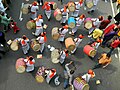
The '''dhak''' is a huge [[membranophone]] instrument from [[Bengal]] and [[Assam]].<ref name="Barthakur">{{cite book |last1=Barthakur |first1=Dilip Ranjan |title=The Music and Musical Instruments of North Eastern India |date=2003 |publisher=Mittal Publications |isbn=978-81-7099-881-5 |page=97 |url=https://books.google.com/books?id=oP4vH-4oSEcC&dq=dhak+instrument&pg=PA97}}</ref> The shapes differ from the almost cylindrical to the barrel. The manner of stretching the hide over the mouths and lacing also varies. It suspended from the neck, tied to the waist and kept on the lap or the ground, and usually played with wooden sticks. The left side is coated to give it a heavier sound.<ref name="instrument">{{cite web | url = http://www.beatofindia.com/mainpages/instruments.htm| title = Instruments| access-date = 13 January 2008 | work =Percussions | publisher = beatofindia.com }}</ref> | |||
It is of medieval origin,<ref name="Kuppuswamy">{{cite book |last1=Kuppuswamy |first1=Gowri |last2=Hariharan |first2=Muthuswamy |title=Indian Music: A Perspective |date=1980 |publisher=Sundeep Prakashan |isbn=978-0-8364-0629-0 |page=152 |url=https://books.google.com/books?id=c3oHAQAAMAAJ&q=dhak+instrument+origin}}</ref> and is used in Hindu religious festivals of the region, especially of [[Sakta]] and [[Shaiva]] traditions, including [[Durga Puja]], [[Kali Puja]] and [[Charak Puja]].<ref name="Barthakur"/><ref name="Folklore">{{cite book |title=Folk-lore |date=1975 |publisher=Indian Publications |pages=429, 430 |url=https://books.google.com/books?id=IMvjAAAAMAAJ&q=dhak+instrument+origin}}</ref> | |||
The drum beats, mostly played by the [[Bengali Hindu]] community, along with the ''[[arati]]'' (invocation dance) forms an integral part of [[Durga Puja]] unique to [[Bengal]].<ref name="Kuppuswamy"/><ref name="Folklore"/><ref name="Durga">{{cite web | url = http://www.durga-puja.org/tradition.html | title = Traditions of Durga Puja| access-date = 13 January 2008 | publisher = Society for confluence of festivals in India }}</ref> The [[Tea-garden community|tea-tribes]] of Assam play ''dhak'' along with ''[[Nagara (drum)|nagara]]''.<ref name="Barthakur"/> | |||
''[[The Statesman (India)|The Statesman]]'' wrote, "Durga Puja does not assume the festive aura without the maddening beats of the dhak, the large drum that | ''[[The Statesman (India)|The Statesman]]'' wrote, "Durga Puja does not assume the festive aura without the maddening beats of the dhak, the large drum that people hang around their necks and play with two thin sticks to infuse the frenzied rhythm into listeners. Those enchanting beats are enough to conjure up the sights and smells of Durga Puja."<ref name="Statesman2">{{cite news |last=Bhattachatya |first=Kajari |date=26 September 2006 |title=Beats of changing time |newspaper=The Statesman |location=Kolkata}}</ref> | ||
It is also played in Islamic festivals like [[Muharram]] in Bengal.<ref>{{cite news |last1=Dutta |first1=Koushik |date=2 October 2017 |title=In this Bengal village Hindu dhakis beat drums for Muharram procession |url=https://www.hindustantimes.com/kolkata/in-this-bengal-village-hindu-dhakis-beat-drums-for-muharram-procession/story-OS1JP2lMDV049JTX7NrzoN.html |work=Hindustan Times |access-date=22 September 2024}}</ref> | |||
<gallery> | <gallery> | ||
File:বীরভূম জেলার মনসা পূজায় ঢাকিরা.jpg|Bengali drummers during Manasa Puja in [[Birbhum]] | File:বীরভূম জেলার মনসা পূজায় ঢাকিরা.jpg|Bengali drummers during Manasa Puja in [[Birbhum]], [[West Bengal]] | ||
File:BD Dhaki.JPG|Bengal drummer and a dhaki | File:BD Dhaki.JPG|Bengal drummer and a dhaki | ||
File:Dhak 2010 Arnab Dutta.JPG|A | File:Dhak 2010 Arnab Dutta.JPG|A ''dhaki'' with his magnificent dhak at a South Kolkata Durga Puja pandal, 2010. | ||
File:Dhaki Bazaar - Sealdah Railway Station - Kolkata 2011-10-03 030246.JPG|Dhak players | File:Dhaki Bazaar - Sealdah Railway Station - Kolkata 2011-10-03 030246.JPG|Dhak players, [[Sealdah]], [[Kolkata]] | ||
File: | File:Pohela boishakh rally.jpg|[[Pohela Boishakh]] procession from [[Dhaka University]], [[Dhaka]], [[Bangladesh]] | ||
</gallery> | </gallery> | ||
| Line 32: | Line 36: | ||
{{Reflist}} | {{Reflist}} | ||
==External links== | |||
{{Commons category}} | {{Commons category}} | ||
{{Indian musical instruments}} | {{Indian musical instruments}} | ||
| Line 39: | Line 44: | ||
[[Category:Bangladeshi musical instruments]] | [[Category:Bangladeshi musical instruments]] | ||
[[Category:Indian musical instruments]] | [[Category:Indian musical instruments]] | ||
[[Category: | [[Category:Music of West Bengal]] | ||
{{India-music-stub}} | {{India-music-stub}} | ||
{{ | {{Membranophone-instrument-stub}} | ||
Latest revision as of 23:15, 4 December 2025


Template:Culture of Bengal The dhak is a huge membranophone instrument from Bengal and Assam.[1] The shapes differ from the almost cylindrical to the barrel. The manner of stretching the hide over the mouths and lacing also varies. It suspended from the neck, tied to the waist and kept on the lap or the ground, and usually played with wooden sticks. The left side is coated to give it a heavier sound.[2]
It is of medieval origin,[3] and is used in Hindu religious festivals of the region, especially of Sakta and Shaiva traditions, including Durga Puja, Kali Puja and Charak Puja.[1][4]
The drum beats, mostly played by the Bengali Hindu community, along with the arati (invocation dance) forms an integral part of Durga Puja unique to Bengal.[3][4][5] The tea-tribes of Assam play dhak along with nagara.[1]
The Statesman wrote, "Durga Puja does not assume the festive aura without the maddening beats of the dhak, the large drum that people hang around their necks and play with two thin sticks to infuse the frenzied rhythm into listeners. Those enchanting beats are enough to conjure up the sights and smells of Durga Puja."[6]
It is also played in Islamic festivals like Muharram in Bengal.[7]
-
 Bengali drummers during Manasa Puja in Birbhum, West Bengal
 -
 Bengal drummer and a dhaki
 -
 A dhaki with his magnificent dhak at a South Kolkata Durga Puja pandal, 2010.
 -

-


See also[edit | edit source]
References[edit | edit source]
- ↑ 1.0 1.1 1.2 Barthakur, Dilip Ranjan (2003). The Music and Musical Instruments of North Eastern India. Mittal Publications. p. 97. ISBN 978-81-7099-881-5.
- ↑ "Instruments". Percussions. beatofindia.com. Retrieved 13 January 2008.
- ↑ 3.0 3.1 Kuppuswamy, Gowri; Hariharan, Muthuswamy (1980). Indian Music: A Perspective. Sundeep Prakashan. p. 152. ISBN 978-0-8364-0629-0.
- ↑ 4.0 4.1 Folk-lore. Indian Publications. 1975. pp. 429, 430.
- ↑ "Traditions of Durga Puja". Society for confluence of festivals in India. Retrieved 13 January 2008.
- ↑ Bhattachatya, Kajari (26 September 2006). "Beats of changing time". The Statesman. Kolkata.
- ↑ Dutta, Koushik (2 October 2017). "In this Bengal village Hindu dhakis beat drums for Muharram procession". Hindustan Times. Retrieved 22 September 2024.
External links[edit | edit source]
| Wind (Sushir) |  | |
|---|---|---|
| Plucked Stringed (Tat) | ||
| Bowed Stringed (Vitat) | ||
| Membranous Percussion (Avanaddh) | ||
| Non-Membranous Percussion (Ghan) | ||
| Other | ||
| Historical/ possibly extinct | ||
 | This article about the music of India is a stub. You can help Bharatpedia by expanding it. |