



m Removed empty portal template using script |
No edit summary |
||
| Line 1: | Line 1: | ||
{{ | {{Short description|Principal object of faith in theism}} | ||
{{ | {{pp|small=yes}} | ||
{{About|the supreme being in monotheistic belief systems|powerful supernatural beings considered divine or sacred in polytheistic structures|Deity|God in specific religions|Conceptions of God|other uses}} | |||
{{Use dmy dates|date=July 2025}} | |||
{{multiple image | {{multiple image | ||
| footer = | | footer = '''Left to right, top to bottom''': representations of God in [[Christianity]], [[Islam]], [[Judaism]], [[Baháʼí Faith]], [[Zoroastrianism]], and [[Hinduism]] | ||
| perrow = 2 | | perrow = 2 | ||
| total_width = 300 | | total_width = 300 | ||
| image1 = Michelangelo, Creation of Adam | | image1 = Michelangelo, Creation of Adam 04.jpg | ||
| image2 = | | image2 = Istanbul, Hagia Sophia, Allah.jpg | ||
| image3 = | | image3 = Tetragrammaton Sefardi.jpg | ||
| image4 = | | image4 = 051907 Wilmette IMG 1404 The Greatest Name.jpg | ||
| image5 | | image5 = Naqshe Rostam Darafsh Ordibehesht 93 (35).JPG | ||
| image6 = Vishnu_from_Gita_Govinda.jpg | |||
| | |||
}} | }} | ||
In [[monotheistic]] [[religious belief]] [[Belief#Belief_systems|systems]],<ref> | |||
:[https://dictionary.cambridge.org/dictionary/english/religion religion] [[Cambridge University Press]] | |||
:[https://www.merriam-webster.com/dictionary/religion religion] [[Merriam-Webster]] | |||
</ref> '''God''' is usually viewed as the [[Supreme deity|supreme being]], [[creator deity|creator]], and principal object of [[faith]].<ref name="Swinburne"/> In [[polytheistic]] belief, a [[Deity|god]] is "a spirit or being believed to have created, or to control some part of the [[universe]] or life, for which such a deity is often worshipped".<ref>{{multiref | {{Cite dictionary |entry=god |dictionary=Cambridge Dictionary}} | {{Cite dictionary |entry=God |dictionary=Merriam-Webster English Dictionary |archive-date=20 February 2023 |url=https://www.merriam-webster.com/dictionary/god |archive-url=https://web.archive.org/web/20230220102221/https://www.merriam-webster.com/dictionary/god |url-status=live |title=God Definition & Meaning - Merriam-Webster }} }}</ref> Belief in the existence of at least one deity, who may interact with the world, is called [[theism]].<ref>{{multiref | {{Cite dictionary |entry=Theism |url=https://www.dictionary.com/browse/theism |access-date=2023-11-13 |dictionary=Dictionary.com |archive-date=2 December 2023 |archive-url=https://web.archive.org/web/20231202194557/https://www.dictionary.com/browse/theism |url-status=live }} | {{Cite dictionary |entry=Theism |url=https://www.merriam-webster.com/dictionary/theism |access-date=2023-11-13 |dictionary=Merriam-Webster English Dictionary |archive-date=14 May 2011 |archive-url=https://web.archive.org/web/20110514194441/http://www.merriam-webster.com/dictionary/theism |url-status=live |title=Definition of THEISM }} }}</ref> | |||
[[Conceptions of God]] vary considerably. Many notable theologians and philosophers have developed arguments for and against the [[existence of God]].<ref name="Plantinga" /> [[Atheism]] rejects the belief in any deity. [[Agnosticism]] is the belief that the existence of God is unknown or [[unknowable]]. Some theists view knowledge concerning God as derived from faith. God is often conceived as the greatest entity in existence.<ref name="Swinburne">{{Cite book |last=Swinburne |first=R. G. |author-link=Richard Swinburne |title=The Oxford Companion to Philosophy |publisher=Oxford University Press |year=1995 |editor-last=Honderich |editor-first=Ted |editor-link=Ted Honderich |chapter=God}}</ref> God is often believed to be the cause of all things and so is seen as the creator, [[God the Sustainer|sustainer]], and ruler of the universe. God is often thought of as [[incorporeal]] and [[Transcendence (religion)|independent]] of the material creation.<ref name="Swinburne" /><ref>{{Cite book |last=Bordwell |first=David |title=Catechism of the Catholic Church |publisher=Continuum |year=2002 |isbn=978-0-860-12324-8 |pages=84}}</ref><ref>{{Cite web |title=Catechism of the Catholic Church |via=IntraText |url=https://www.vatican.va/archive/ENG0015/__P17.HTM |url-status=dead |archive-url=https://web.archive.org/web/20130303003725/https://www.vatican.va/archive/ENG0015/__P17.HTM |archive-date=3 March 2013 |access-date=30 December 2016}}</ref> <!-- comment out because of {{cite book | first=Jacqueline | last=Lagrée | editor-last=Lacoste | editor-first=Jean-Yves | title=Encyclopedia of Christian Theology | publisher=Routledge | date=2005 | isbn=978-1-57958-332-3 | chapter=Pantheism | chapter-url=https://books.google.com/books?id=Dl4UAQAAIAAJ&q=Acts%252017:28%2520%2522panentheism%2522 | access-date=23 January 2026 | page=1181 | volume=3}}: which was initially called [[pantheism]],<ref name=Thomson>Ann Thomson; Bodies of Thought: Science, Religion, and the Soul in the Early Enlightenment, 2008, page 54.</ref><ref>{{cite book|last=Raphson|first=Joseph|title=De spatio reali|year=1697|publisher=Londini|page=2|language=la}}</ref><ref>{{cite web|last=Suttle|first=Gary|title=Joseph Raphson: 1648–1715|url=http://naturepantheist.org/raph-son.html|publisher=Pantheist Association for Nature|access-date=7 September 2012|archive-date=7 April 2023|archive-url=https://web.archive.org/web/20230407140352/http://naturepantheist.org/raph-son.html|url-status=dead}}</ref> although church theologians, in attacking pantheism, described pantheism as the belief that God is the material universe itself.<ref name="Worman">Worman, J. H., "Pantheism", in ''Cyclopædia of Biblical, Theological, and Ecclesiastical Literature, Volume 1'', John McClintock, James Strong (Eds), Harper & Brothers, 1896, pp. 616–624.</ref><ref>Worman cites Wegscheider, ''Institutiones theologicae dogmaticae'', p. 250.</ref>--> God is sometimes seen as [[omnibenevolent]], while [[deism]] holds that God is not involved with humanity apart from creation. | |||
Some traditions attach spiritual significance to maintaining a relationship with God, often involving acts such as [[worship]] and [[prayer]], and see God as the source of all [[moral obligation]].<ref name="Swinburne" /> God is sometimes described without reference [[Gender of God|to gender]], but more often is referred to using gender-specific terminology. God is referred to by different [[Names of God|names]] depending on the language and cultural tradition, sometimes with different titles of God used in reference to God's various attributes. | |||
==Etymology and usage== | ==Etymology and usage== | ||
{{Main|God (word)}} | {{Main|God (word)}} | ||
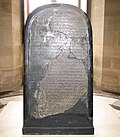
[[File:Mesha Stele (511142469) (cropped).jpg|thumb|upright=1.2|The [[Mesha Stele]] bears the earliest known reference (840 BCE) to the Israelite God Yahweh.]] | |||
The earliest written form of the Germanic word ''God'' comes from the 6th-century {{lang|la|[[Codex Argenteus]]}}, containing a [[Gothic language|Gothic]] translation of the [[Bible]]. The English word itself is derived from the [[Proto-Germanic]] *ǥuđan. The reconstructed [[Proto-Indo-European]] form {{lang|ine-x-proto|ǵhu-tó-m}} was probably based on the root {{lang|ine-x-proto|ǵhau(ə)-}}, which meant either 'to call' or 'to invoke'.<ref>The ulterior etymology is disputed. Apart from the unlikely hypothesis of adoption from a foreign tongue, the OTeut. "ghuba" implies as its preTeut-type either "*ghodho-m" or "*ghodto-m". The former does not appear to admit of explanation; but the latter would represent the neut. pple. of a root "gheu-". There are two Aryan roots of the required form ("*g,heu-" with palatal aspirate) one with meaning 'to invoke' (Skr. "hu") the other 'to pour, to offer sacrifice' (Skr "hu", Gr. χεηi;ν, OE "geotàn" Yete v). [[Oxford English Dictionary|Oxford English Dictionary Compact Edition, G, p. 267]].</ref> The Germanic words for ''God'' were originally [[Grammatical gender|neuter]], but during the process of the [[Christianization]] of the [[Germanic people]]s from their indigenous [[Germanic paganism]], the words became a [[Grammatical gender|masculine syntactic form]].<ref name="BARNHART323">Barnhart, Robert K. (1995). ''The Barnhart Concise Dictionary of Etymology: the Origins of American English Words'', p. 323. [[HarperCollins]]. {{ISBN|0062700847}}.</ref> In English, capitalization is used when the word is used as a [[proper noun]], as well as for other names by which a god is known. Consequently, the capitalized form of ''god'' is not used for multiple gods or when used to refer to the generic idea of a [[deity]].<ref>[[Webster's New World Dictionary]]; "God n. ME [Middle English] < OE [Old English], akin to Ger gott, Goth guth, prob. < IE base *ĝhau-, to call out to, invoke > Sans havaté, (he) calls upon; 1. any of various beings conceived of as supernatural, immortal, and having special powers over the lives and affairs of people and the course of nature; deity, esp. a male deity: typically considered objects of worship; 2. an image that is worshiped; idol 3. a person or thing deified or excessively honored and admired; 4. [G-] in monotheistic religions, the creator and ruler of the universe, regarded as eternal, infinite, all-powerful, and all-knowing; Supreme Being; the Almighty" | |||
</ref><ref>[http://dictionary.reference.com/browse/God Dictionary.com] {{Webarchive|url=https://web.archive.org/web/20090419052813/http://dictionary.reference.com/browse/God |date=19 April 2009 }}; "God /gɒd/ noun: 1. the one Supreme Being, the creator and ruler of the universe. 2. the Supreme Being considered with reference to a particular attribute. 3. (lowercase) one of several deities, esp. a male deity, presiding over some portion of worldly affairs. 4. (often lowercase) a supreme being according to some particular conception: the God of mercy. 5. Christian Science. the Supreme Being, understood as Life, Truth, Love, Mind, Soul, Spirit, Principle. 6. (lowercase) an image of a deity; an idol. 7. (lowercase) any deified person or object. 8. (often lowercase) Gods, Theater. 8a. the upper balcony in a theater. 8b. the spectators in this part of the balcony."</ref> | |||
God | The English word ''God'' and its counterparts in other languages are normally used for any and all conceptions and, in spite of significant differences between religions, the term remains an English translation common to all. | ||
[[ | The [[Hebrew language|Hebrew]] word for 'god' is [[El (god)|El]], which also as a proper noun referred to the chief deity in [[ancient Semitic religions]]. In the [[Hebrew Bible]], God is also given a personal name, [[Yahweh]], in contrast to the genetic name, and in origin possibly the name of an [[Edomite]] or [[Midianite]] deity who was adopted into [[Yahwism|ancient Israelite religion]].<ref name="Parke-Taylor2006">{{cite book |last1=Parke-Taylor |first1=G. H. |title=Yahweh: The Divine Name in the Bible |date=1 January 2006 |publisher=[[Wilfrid Laurier University Press]] |isbn=978-0889206526 |page=4}}</ref> In many English translations of the [[Bible]], Yahweh is translated as "the LORD" with "Lord" in all caps.<ref name="Barton2006">{{cite book |author=Barton |first=G. A. |title=A Sketch of Semitic Origins: Social and Religious |publisher=Kessinger Publishing |year=2006 |isbn=978-1428615755}}</ref> [[Jah]] or Yah is an abbreviation of Jahweh/Yahweh, and often sees usage by Jews and [[Christians]] in the interjection "[[Hallelujah]]", meaning 'praise Jah', which is used to give God glory.<ref name="Loewen2020">{{cite book |last1=Loewen |first1=Jacob A. |title=The Bible in Cross Cultural Perspective |date=1 June 2020 |publisher=William Carey |isbn=978-1645083047 |page=182 |edition=Revised}}</ref> In [[Judaism]], some of the Hebrew titles of God are considered [[Names of God in Judaism|holy names]]. | ||
[[ | {{tlit|ar|[[Allāh]]}} ({{langx|ar|الله}}) is the Arabic term with no plural used by Muslims and Arabic-speaking Christians and Jews meaning 'the God', while {{tlit|ar|[[ʾilāh]]}} ({{lang|ar|إِلَٰه}}, plural {{tlit|ar|`āliha}} {{lang|ar|آلِهَة}}) is the term used for a deity or a god in general.<ref>{{cite web |url=https://www.pbs.org/empires/islam/faithgod.html |title=God |work=Islam: Empire of Faith |publisher=PBS |access-date=18 December 2010 |archive-date=27 March 2014 |archive-url=https://web.archive.org/web/20140327034958/http://www.pbs.org/empires/islam/faithgod.html |url-status=live}}</ref><ref>"Islam and Christianity", ''Encyclopedia of Christianity'' (2001): Arabic-speaking [[Christians]] and [[Jew]]s also refer to God as ''Allāh''.</ref><ref>{{Cite encyclopedia |title=Allah |encyclopedia=Encyclopaedia of Islam Online |last=Gardet |first=L.}}</ref> [[Muslims]] also use a [[Names of God in Islam|multitude of other titles]] for God. | ||
< | |||
''Baha'', the "greatest" name for God in the [[Baháʼí Faith]], is Arabic for "All-Glorious". | In [[Hinduism]], [[Brahman]] is often considered a [[monistic]] concept of God.<ref>Levine, Michael P. (2002). ''Pantheism: A Non-Theistic Concept of Deity'', p. 136.</ref> God may also be given a proper name in monotheistic currents of Hinduism which emphasize the [[personal god|personal nature of God]], with early references to his name as [[Krishna]]-[[Vasudeva]] in [[Bhagavata]] or later [[Vishnu]] and [[Hari]].<ref name="Hastings541">{{Harvnb|Hastings|1925–2003|p=540|url=https://books.google.com/books?id=Kaz58z--NtUC&pg=PA540&vq=Krishna&cad=1_1}}.</ref> [[Sang Hyang Widhi Wasa]] is the term used in [[Balinese Hinduism]].<ref>McDaniel, June (2013), A Modern Hindu Monotheism: Indonesian Hindus as 'People of the Book'. The Journal of Hindu Studies, Oxford University Press, {{doi|10.1093/jhs/hit030}}.</ref> | ||
In [[Chinese folk religion|Chinese religion]], [[Shangdi]] is conceived as the [[progenitor]] of the universe, intrinsic to it and constantly bringing order to it. | |||
[[Ahura Mazda]] is the name for God used in [[Zoroastrianism]]. "Mazda", or rather the Avestan stem-form ''Mazdā-'', nominative ''Mazdå'', reflects Proto-Iranian ''*Mazdāh (female)''. It is generally taken to be the proper name of the spirit, and like its [[Sanskrit]] cognate {{tlit|sa|medhā}} means 'intelligence' or 'wisdom'. Both the Avestan and Sanskrit words reflect [[Proto-Indo-Iranian]] ''*mazdhā-'', from [[Proto-Indo-European]] mn̩sdʰeh<sub>1</sub>, literally meaning 'placing (''dʰeh<sub>1</sub>'') one's mind (''*mn̩-s'')', hence 'wise'.{{Sfn|Boyce|1983|p=685}} Meanwhile [[Names of God in Zoroastrianism|101 other names]] are also in use.<ref>Kidder, David S.; Oppenheim, Noah D. The Intellectual Devotional: Revive Your Mind, Complete Your Education, and Roam confidently with the cultured class, p. 364.</ref> | |||
[[Waheguru]] ({{langx|pa|{{IAST|vāhigurū}}}}) is a term most often used in [[Sikhism]] to refer to God.<ref>Duggal, Kartar Singh (1988). ''Philosophy and Faith of Sikhism'', p. ix.</ref> It means 'Wonderful Teacher' in the Punjabi language. ''Vāhi'' (a [[Middle Persian]] borrowing) means 'wonderful', and ''[[guru]]'' ({{langx|sa|{{IAST|guru}}}}) is a term denoting 'teacher'. Waheguru is also described by some as an experience of ecstasy which is beyond all description. The most common usage of the word ''Waheguru'' is in the greeting Sikhs use with each other—''Waheguru Ji Ka Khalsa, Waheguru Ji Ki Fateh'', "Wonderful Lord's [[Khalsa]], Victory is to the Wonderful Lord." | |||
''Baha'', the "greatest" name for God in the [[Baháʼí Faith]], is Arabic for "All-Glorious".<ref>Baháʾuʾlláh, Joyce Watanabe (2006). A Feast for the Soul: Meditations on the Attributes of God : ... p. x.</ref> | |||
Other names for God include [[Aten]]<ref>Assmann, Jan. ''Religion and Cultural Memory: Ten Studies'', Stanford University Press 2005, p. 59.</ref> in ancient Egyptian [[Atenism]] where Aten was proclaimed to be the one "true" supreme being and creator of the universe,<ref>[[Miriam Lichtheim|Lichtheim, M.]] (1980). ''Ancient Egyptian Literature'', Vol. 2, p. 96.</ref> [[Chukwu]] in [[Igbo people|Igbo]],<ref>{{Cite book |last1=Afigbo |first1=A. E |title=Myth, history and society: the collected works of Adiele Afigbo |last2=Falola |first2=Toyin |date=2006 |publisher=Africa World Press |isbn=978-1592214198 |location=Trenton, New Jersey |language=En-us |oclc=61361536 }}</ref> and [[Hayyi Rabbi]] in [[Mandaeism]].<ref name="Buckley 2002">{{cite book |last=Buckley |first=Jorunn Jacobsen |title=The Mandaeans: ancient texts and modern people |publisher=Oxford University Press |year=2002 |isbn=0195153855 |publication-place=New York |oclc=65198443}}</ref><ref name=Nashmi>{{Citation |last=Nashmi |first=Yuhana |title=Contemporary Issues for the Mandaean Faith |website=Mandaean Associations Union |date=24 April 2013 |url=http://www.mandaeanunion.com/history-english/item/488-mandaean-faith |access-date=28 December 2021 |archive-date=31 October 2021 |archive-url=https://web.archive.org/web/20211031155605/http://www.mandaeanunion.com/history-english/item/488-mandaean-faith |url-status=live}}</ref> | |||
==General conceptions== | ==General conceptions== | ||
===Existence=== | |||
{{Main|Existence of God}} | |||
{{See also|Theism|Atheism|Agnosticism}} | |||
[[File:St-thomas-aquinasFXD.jpg|thumb|upright|[[Thomas Aquinas]] summed up [[Quinque viae|five main arguments]] as proofs for God's existence. Painting by [[Carlo Crivelli]], 1476.]] | |||
[[File:Système de la Nature.jpg|thumb|upright|''[[The System of Nature]]'' (1770) argues that belief in God is based on fear, lack of understanding and [[anthropomorphism]].]] | |||
The existence of God and the nature of God are subjects of debate in [[theology]], [[philosophy of religion]] and [[popular culture]].<ref>See e.g. ''The Rationality of Theism'' quoting [[Quentin Smith]], "God is not 'dead' in academia; it returned to life in the late 1960s." They {{who|date=June 2025}} cite the shift from hostility towards theism in Paul Edwards's ''Encyclopedia of Philosophy'' (1967) to sympathy towards theism in the more recent ''[[Routledge Encyclopedia of Philosophy]]''.</ref> In philosophical terms, the question of the existence of God involves the disciplines of [[epistemology]] (the nature and scope of knowledge) and [[ontology]] (study of the nature of [[being]] or [[existence]]) and the [[Value theory|theory of value]] (since some definitions of God include "perfection"). | |||
[[Ontological argument]]s refer to any argument for the existence of God that is based on ''a priori'' reasoning.<ref>{{cite web |url=https://plato.stanford.edu/entries/ontological-arguments/ |title=Ontological Arguments |publisher=Stanford Encyclopedia of Philosophy |access-date=27 December 2022 |archive-date=25 May 2023 |archive-url=https://web.archive.org/web/20230525190107/https://plato.stanford.edu/entries/ontological-arguments/ |url-status=live}}</ref> Notable ontological arguments were formulated by [[Anselm of Canterbury|Anselm]] and [[René Descartes]].<ref>{{cite book |editor-last=Kreeft |editor-first=Peter |title=Summa of the Summa |year=1990 |publisher=Ignatius Press |pages=65–69 |first=Thomas |last=Aquinas}}</ref> [[Cosmological argument]]s use concepts around the origin of the universe to argue for the existence of God. | |||
The [[ | The [[teleological argument]], also called "argument from design", uses the complexity within the universe as a proof of the existence of God.<ref>{{cite encyclopedia |url=https://plato.stanford.edu/entries/teleological-arguments/ |entry=Teleological Arguments for God’s Existence |encyclopedia=Stanford Encyclopedia of Philosophy |orig-date=2005 |date=10 June 2005 |last1=Ratzsch |first1=Del |last2=Koperski |first2=Jeffrey |title=Teleological Arguments for God's Existence |access-date=30 December 2022 |archive-date=7 October 2019 |archive-url=https://web.archive.org/web/20191007141418/https://plato.stanford.edu/entries/teleological-arguments/ |url-status=live}}</ref> It is countered that the [[Fine-tuned universe|fine tuning]] required for a stable universe with life on earth is illusory, as humans are only able to observe the small part of this universe that succeeded in making such observation possible, called the [[anthropic principle]], and so would not learn of, for example, life on other planets or of [[multiverse|universes]] that did not occur because of different [[Dimensionless physical constant|laws of physics]].<ref>{{cite web |url=https://plato.stanford.edu/entries/fine-tuning/ |title=Fine-Tuning |website=The Stanford Encyclopedia of Philosophy |publisher=Center for the Study of Language and Information (CSLI), Stanford University |access-date=December 29, 2022 |date=Aug 22, 2017 |archive-date=10 October 2023 |archive-url=https://web.archive.org/web/20231010234820/https://plato.stanford.edu/entries/fine-tuning/ |url-status=live}}</ref> Non-theists have argued that complex processes that have natural explanations yet to be discovered are referred to the supernatural, called [[god of the gaps]]. Other theists, such as [[John Henry Newman]] who believed [[theistic evolution]] was acceptable, have also argued against versions of the teleological argument and held that it is limiting of God to view him having to only intervene specially in some instances rather than having complex processes designed to create order.<ref>{{cite journal |last1=Chappell |first1=Jonathan |year=2015 |title=A Grammar of Descent: John Henry Newman and the Compatibility of Evolution with Christian Doctrine |journal=Science and Christian Belief |volume=27 |issue=2 |pages=180–206 |doi= |pmid= |bibcode=}}</ref> | ||
[[ | The [[argument from beauty]] states that this universe happens to contain special beauty in it and that there would be no particular reason for this over aesthetic neutrality other than God.<ref>{{cite book |author=Swinburne |first=Richard |title=The Existence of God |publisher=Oxford University Press |year=2004 |isbn=978-0199271689 |edition=2nd |pages=190–91}}</ref> This has been countered by pointing to the existence of ugliness in the universe.<ref>{{cite book |title=The existence of God |publisher=Watts & Co. |page=75 |edition=1}}</ref> This has also been countered by arguing that beauty has no objective reality and so the universe could be seen as ugly or that humans have made what is more beautiful than nature.<ref>''Minority Report'', H. L. Mencken's Notebooks, Knopf, 1956.</ref> | ||
=== | The [[argument from morality]] argues for the existence of God given the assumption of the objective existence of [[moral realism|moral]]s.<ref>{{cite book |title=Atheism: A Philosophical Justification |publisher=Temple University Press |year=1992 |pages=213–214 |author=Martin, Michael |isbn=978-0877229438}}</ref> While prominent non-theistic philosophers such as the atheist [[J. L. Mackie]] agreed that the argument is valid, they disagreed with its premises. [[David Hume]] argued that there is no basis to believe in objective moral truths while biologist [[E. O. Wilson]] theorized that the feelings of morality are a by-product of natural selection in humans and would not exist independent of the mind.<ref>{{cite book |last1=Craig |first1=William Lane |title=The Blackwell Companion to Natural Theology |last2=Moreland |first2=J. P. |publisher=John Wiley & Sons |year=2011 |isbn=978-1444350852 |page=393}}</ref> Philosopher [[Michael Lou Martin]] argued that a subjective account for morality can be acceptable. Similar to the argument from morality is the [[Argument from morality#Argument for conscience|argument from conscience]] which argues for the existence of God given the existence of a conscience that informs of right and wrong, even against prevailing moral codes. Philosopher [[John Locke]] instead argued that conscience is a social construct and thus could lead to contradicting morals.<ref>{{cite book |author=Parkinson |first=G. H. R. |title=An Encyclopedia of Philosophy |publisher=Taylor & Francis |year=1988 |isbn=978-0415003230 |pages=344–345}}</ref> | ||
[[ | [[Atheism]] is, in a broad sense, the rejection of [[belief]] in the existence of deities.<ref>Nielsen 2013</ref><ref>Edwards 2005"</ref> [[Agnosticism]] is the view that the [[truth value]]s of certain claims—especially [[metaphysical]] and religious claims such as [[Existence of God|whether God]], the [[divine]] or the [[supernatural]] exist—are unknown and perhaps unknowable.<ref>[[Thomas Henry Huxley]], an English biologist, was the first to come up with the word ''agnostic'' in 1869 {{Cite book |last=Dixon |first=Thomas |title=Science and Religion: A Very Short Introduction |publisher=Oxford University Press |year=2008 |location=Oxford |page=63 |isbn=978-0199295517}} However, earlier authors and published works have promoted an agnostic points of view. They include [[Protagoras]], a 5th-century BCE Greek philosopher. {{cite web |url=http://www.iep.utm.edu/p/protagor.htm |title=The Internet Encyclopedia of Philosophy – Protagoras (c. 490 – c. 420 BCE) |access-date=6 October 2008 |archive-url=https://web.archive.org/web/20081014181706/http://www.iep.utm.edu/p/protagor.htm |archive-date=14 October 2008 |url-status=live}}</ref><ref name="Hepburn">{{cite encyclopedia |year=2005 |title=Agnosticism |encyclopedia=[[The Encyclopedia of Philosophy]] |publisher=MacMillan Reference US (Gale) |last=Hepburn |first=Ronald W. |orig-date=1967 |editor=Borchert |editor-first=Donald M. |edition=2nd |volume=1 |page=92 |isbn=978-0028657806 |quote=In the most general use of the term, agnosticism is the view that we do not know whether there is a God or not.}} (p. 56 in 1967 edition).</ref><ref name="RoweRoutledge">{{cite encyclopedia |year=1998 |title=Agnosticism |encyclopedia=[[Routledge Encyclopedia of Philosophy]] |publisher=Taylor & Francis |url=https://books.google.com/books?id=VQ-GhVWTH84C&q=agnosticism&pg=PA122 |last=Rowe |first=William L. |author-link=William L. Rowe |isbn=978-0415073103 |editor-first=Edward |editor-last=Craig |access-date=11 November 2020 |archive-date=23 May 2024 |archive-url=https://web.archive.org/web/20240523094732/https://books.google.com/books?id=VQ-GhVWTH84C&q=agnosticism&pg=PA122 |url-status=live}}</ref><ref>{{cite encyclopedia |year=2012 <!--|access-date=22 July 2013--> |entry=agnostic, agnosticism |dictionary=Oxford English Dictionary Online |publisher=Oxford University Press |edition=3rd}}</ref> [[Theism]] generally holds that God exists objectively and independently of human thought and is sometimes used to refer to any belief in God or gods. | ||
Some view the existence of God as an empirical question. [[Richard Dawkins]] states that "a universe with a god would be a completely different kind of universe from one without, and it would be a scientific difference".<ref name="Dawkins">{{cite news |last=Dawkins |first=Richard |author-link=Richard Dawkins |title=Why There Almost Certainly Is No God |url=http://www.huffingtonpost.com/richard-dawkins/why-there-almost-certainl_b_32164.html |access-date=10 January 2007 |work=The Huffington Post |date=23 October 2006 |archive-date=6 October 2018 |archive-url=https://web.archive.org/web/20181006010610/https://www.huffingtonpost.com/richard-dawkins/why-there-almost-certainl_b_32164.html |url-status=live}}</ref> [[Carl Sagan]] argued that the doctrine of a Creator of the Universe was difficult to prove or disprove and that the only conceivable scientific discovery that could disprove the existence of a Creator (not necessarily a God) would be the discovery that the universe is infinitely old.<ref>{{cite book |title=The Demon Haunted World |page=278 |last=Sagan |first=Carl |author-link=Carl Sagan |year=1996 |publisher=Ballantine Books |location=New York |isbn=978-0345409461}}</ref> Some theologians, such as [[Alister McGrath]], argue that the existence of God is not a question that can be answered using the [[scientific method]].<ref name="mcgrath2005">{{cite book |author=McGrath |first=Alister E. |url=https://books.google.com/books?id=V9dr6167AJ8C |title=Dawkins' God: genes, memes, and the meaning of life |publisher=Wiley-Blackwell |year=2005 |isbn=978-1405125390}}</ref><ref name="barackman2001">{{cite book |author=Barackman |first=Floyd H. |url=https://books.google.com/books?id=Jb5aRB7OxWsC |title=Practical Christian Theology: Examining the Great Doctrines of the Faith |publisher=Kregel Academic |year=2001 |isbn=978-0825423802}}</ref> | |||
[[Agnostic]] [[Stephen Jay Gould]] argued that science and religion are not in conflict and proposed an approach dividing the world of philosophy into what he called "[[non-overlapping magisteria]]" (NOMA).<ref>{{cite book |title=Leonardo's Mountain of Clams and the Diet of Worms |last=Gould |first=Stephen J. |page=274 |publisher=Jonathan Cape |year=1998 |isbn=978-0224050432}}</ref> In this view, questions of the [[supernatural]], such as those relating to the [[existence]] and nature of God, are [[metaphysics|non]]-[[empirical]] and are the proper domain of [[theology]]. The methods of science should then be used to answer any empirical question about the natural world, and theology should be used to answer questions about ultimate meaning and moral value. In this view, the perceived lack of any empirical footprint from the magisterium of the supernatural onto natural events makes science the sole player in the natural world.<ref name="Dawkins-Delusion">{{cite book |title=The God Delusion |last=Dawkins |first=Richard |author-link=Richard Dawkins |year=2006 |publisher=Bantam Press |location=Great Britain |isbn=978-0618680009}}</ref> [[Stephen Hawking]] and co-author [[Leonard Mlodinow]] state in their 2010 book, ''[[The Grand Design (book)|The Grand Design]]'', that it is reasonable to ask who or what created the universe, but if the answer is God, then the question has merely been deflected to that of who created God. Both authors claim, however, that it is possible to answer these questions purely within the realm of science and without invoking divine beings.<ref>{{cite book |author=Hawking |first1=Stephen |url=https://archive.org/details/granddesign0000hawk |title=The Grand Design |last2=Mlodinow |first2=Leonard |publisher=Bantam Books |year=2010 |isbn=978-0553805376 |page=[https://archive.org/details/granddesign0000hawk/page/172 172] |url-access=registration}}</ref><ref>Krauss, L. ''A Universe from Nothing''. Free Press, New York. 2012. {{ISBN|978-1451624458}}.</ref> | |||
|author = | |||
| | |||
|title = | |||
|isbn = 978- | |||
|page = | |||
}}</ref> | |||
===Oneness=== | |||
{{Main|Deity|Monotheism|Henotheism}} | |||
[[File:Shield-Trinity-Scutum-Fidei-English.svg|thumb|upright|Trinitarians believe that the Father, the Son, and the Holy Spirit are three distinct persons sharing a single nature or essence.]] | |||
A deity, or "god" (with [[lowercase]] ''g''), refers to a supernatural being.<ref name="OBrien">{{cite book |last1=O'Brien |first1=Jodi |url=https://books.google.com/books?id=_nyHS4WyUKEC |title=Encyclopedia of Gender and Society |publisher=Sage |year=2009 |isbn=978-1412909167 |location=Los Angeles |page=191 |access-date=28 June 2017 |archive-date=13 January 2023 |archive-url=https://web.archive.org/web/20230113144056/https://books.google.com/books?id=_nyHS4WyUKEC |url-status=live}}</ref> [[Monotheism]] is the belief that there is only one deity, referred to as "God" (with uppercase ''g''). Comparing or equating other entities to God is viewed as [[idolatry]] in monotheism, and is often strongly condemned. [[God in Judaism|Judaism]] is one of the oldest monotheistic traditions in the world.<ref>{{Cite web |url=https://www.bbc.co.uk/religion/religions/judaism/ |title=BBC – Religion: Judaism |website=www.bbc.co.uk |access-date=31 August 2022 |archive-date=5 August 2022 |archive-url=https://web.archive.org/web/20220805174338/https://www.bbc.co.uk/religion/religions/judaism/ |url-status=live}}</ref> Islam's most fundamental concept is ''[[tawhid]]'', meaning 'oneness' or 'uniqueness'.<ref>{{Cite encyclopedia |title=Allah, Tawhid |encyclopedia=Encyclopædia Britannica Online |last=Gimaret |first=D.}}</ref> The first [[pillar of Islam]] is an [[Shahada|oath]] that forms the basis of the religion and which non-Muslims wishing to convert must recite, declaring that, "I testify that there is no deity except God."<ref>Mohammad, N. 1985. "The doctrine of jihad: An introduction". ''[[Journal of Law and Religion]]'' 3(2): 381–397.</ref> | |||
|title= | |||
| | |||
| | |||
| | |||
}} | |||
</ref> | |||
The [[ancient Greece|ancient Greek]] philosopher [[Xenophanes]] referred to "One god greatest among gods and men", highlighting one "God" who is greater than the multiple "gods".<ref>{{cite SEP|title=Xenophanes|Xenophanes|author-first=James|author-last=Lesher|url-id=Xenophanes|date=Summer 2023}}</ref> | |||
In Christianity, the [[doctrine of the Trinity]] describes [[God in Christianity|God]] as one God in [[God the Father|Father]], [[God the Son|Son]] ([[Jesus]]), and [[Holy Spirit (Christianity)|Holy Spirit]].<ref>{{cite web |url=http://www.whataboutjesus.com/grace/actions-god-series/what-trinity?page=0,0 |title=What Is the Trinity? |url-status=dead |archive-url=https://web.archive.org/web/20140219020335/http://www.whataboutjesus.com/grace/actions-god-series/what-trinity?page=0%2C0 |archive-date=19 February 2014}}</ref> In past centuries, this fundamental mystery of the Christian faith was also summarized by the Latin formula ''Sancta Trinitas, Unus Deus'' (Holy Trinity, Unique God), reported in the ''[[Litany of the Blessed Virgin Mary|Litanias Lauretanas]]''. | |||
[[ | |||
[[God in Hinduism|God]] is viewed differently by diverse strands of the [[Hindu religion]], with most Hindus having faith in a [[Brahman|supreme reality]] (''Brahman'') who can be manifested in numerous chosen deities. Thus, the religion is sometimes characterized as ''Polymorphic Monotheism''.<ref>{{cite web |author=Lipner |first=Julius |date= |title=Hindu deities |url=https://www.khanacademy.org/humanities/art-asia/beginners-guide-asian-culture/hindu-art-culture/a/hindu-deities |access-date=6 September 2022 |archive-date=7 September 2022 |archive-url=https://web.archive.org/web/20220907001823/https://www.khanacademy.org/humanities/art-asia/beginners-guide-asian-culture/hindu-art-culture/a/hindu-deities |url-status=live}}</ref> [[Henotheism]] is the belief and worship of a single god at a time while accepting the validity of worshiping other deities.<ref>Müller, Max. (1878), ''Lectures on the Origin and Growth of Religion: As Illustrated by the Religions of India''. London, England: Longmans, Green and Company.</ref> [[Monolatry]] is the belief in a single deity worthy of worship while accepting the existence of other deities.<ref>{{citation |last=McConkie |first=Bruce R. |title=[[Mormon Doctrine]] |page=351 |year=1979 |edition=2nd |location=Salt Lake City, Utah |publisher=Bookcraft |author-link=Bruce R. McConkie}}.</ref> | |||
===Transcendence=== | |||
{{See also|Pantheism|Panentheism}} | |||
[[Transcendence (religion)|Transcendence]] is the aspect of God's nature that is completely independent of the material universe and its physical laws. Many supposed characteristics of God are described in human terms. [[Anselm of Canterbury|Anselm]] thought that God did not feel emotions such as anger or love, but appeared to do so through our imperfect understanding. The incongruity of judging "being" against something that might not exist, led many medieval philosophers approach to knowledge of God through negative attributes, called [[Negative theology]]. For example, one should not say that God is wise, but can say that God is not ignorant (i.e. in some way God has some properties of knowledge). Christian theologian [[Alister McGrath]] writes that one has to understand a "personal god" as an analogy. "To say that God is like a person is to affirm the divine ability and willingness to relate to others. This does not imply that God is human, or located at a specific point in the universe."<ref>{{Cite book |first=Alister |last=McGrath |author-link=Alister McGrath |title=Christian Theology: An Introduction |publisher=Blackwell |year=2006 |isbn=978-1405153607 |page=205}}</ref> | |||
== | [[Pantheism]] holds that God is the universe and the universe is God and denies that God transcends the Universe.<ref>{{cite web |date=17 May 2007 |title=Pantheism |url=https://stanford.library.sydney.edu.au/archives/spr2008/entries/pantheism/ |access-date=11 September 2022 |publisher=Stanford Encyclopedia of Philosophy |archive-date=11 September 2022 |archive-url=https://web.archive.org/web/20220911224648/https://stanford.library.sydney.edu.au/archives/spr2008/entries/pantheism/ |url-status=live}}</ref> For pantheist philosopher [[Baruch Spinoza]], the whole of the natural universe is made of one substance, God, or its equivalent, Nature.<ref>{{cite book |last=Curley |first=Edwin M. |year=1985 |title=The Collected Works of Spinoza |publisher=Princeton University Press |isbn=978-0691072227}}</ref><ref>{{cite encyclopedia |url=http://plato.stanford.edu/archives/fall2012/entries/spinoza/ |entry=Baruch Spinoza |encyclopedia=Stanford Encyclopedia of Philosophy |orig-date=2001 |date=21 August 2012 |last1=Nadler |first1=Steven |title=Baruch Spinoza |access-date=6 December 2012 |archive-date=13 November 2022 |archive-url=https://web.archive.org/web/20221113053208/https://plato.stanford.edu/archives/fall2012/entries/spinoza/ |url-status=live}}</ref> Pantheism is sometimes objected to as not providing any meaningful explanation of God with the German philosopher [[Arthur Schopenhauer]] stating, "Pantheism is only a euphemism for atheism."<ref>{{cite web |date=1 October 2012 |title=Pantheism |url=https://plato.stanford.edu/entries/pantheism/ |access-date=18 November 2022 |publisher=Stanford Encyclopedia of Philosophy |archive-date=15 September 2018 |archive-url=https://web.archive.org/web/20180915080407/https://plato.stanford.edu/entries/pantheism/ |url-status=live}}</ref> [[Pandeism]] holds that God was a separate entity but then [[God becomes the universe|became the universe]].<ref name="Dawe">{{cite book |author=Dawe |first=Alan H. |title=The God Franchise: A Theory of Everything |year=2011 |isbn=978-0473201142 |page=48 |publisher=Alan H. Dawe}} | ||
</ref><ref>{{cite book |author=Bradley |first=Paul |title=This Strange Eventful History: A Philosophy of Meaning |year=2011 |isbn=978-0875868769 |page=156 |publisher=Algora |quote=Pandeism combines the concepts of Deism and Pantheism with a god who creates the universe and then becomes it.}}</ref> [[Panentheism]] holds that God contains, but is not identical to, the Universe.<ref>Culp, John (2013). [http://plato.stanford.edu/cgi-bin/encyclopedia/archinfo.cgi?entry=panentheism "Panentheism,"] {{Webarchive|url=https://web.archive.org/web/20151016023813/http://plato.stanford.edu/cgi-bin/encyclopedia/archinfo.cgi?entry=panentheism|date=16 October 2015}} ''Stanford Encyclopedia of Philosophy'', Spring.</ref><ref>{{cite book |author=Rogers |first=Peter C. |title=Ultimate Truth, Book 1 |year=2009 |isbn=978-1438979687 |page=121 |publisher=AuthorHouse}}</ref> | |||
===Creator=== | |||
{{See also|Creator deity}} | |||
[[File:Blake God Blessing.jpg|thumb|upright|''God Blessing the Seventh Day'', 1805 watercolor painting by [[William Blake]]]] | |||
[[ | God is often viewed as the cause of all that exists. For [[Pythagoreanism|Pythagorean]]s, [[Monad (philosophy)|Monad]] variously referred to [[divinity]], the first being or an indivisible origin.<ref>Fairbanks, Arthur, Ed., "The First Philosophers of Greece". K. Paul, Trench, Trubner. London, England, 1898, p. 145.</ref> The philosophy of [[Plato]] and [[Plotinus]] refers to "[[Henology|The One]]", which is the first principle of reality that is "beyond" being<ref>Dodds, E. R. "The Parmenides of Plato and the Origin of the Neoplatonic 'One'". ''The Classical Quarterly'', Jul–Oct 1928, vol. 22, p. 136.</ref> and is both the source of the Universe and the [[teleological]] purpose of all things.<ref>{{cite book |last=Brenk |first=Frederick |date=January 2016 |title="Theism" and Related Categories in the Study of Ancient Religions |chapter=Pagan Monotheism and Pagan Cult |chapter-url=https://classicalstudies.org/annual-meeting/147/abstract/pagan-monotheism-and-pagan-cult |publisher=[[Society for Classical Studies]], University of Pennsylvania |location=Philadelphia |volume=75 |issue=4 |access-date=5 November 2022 |archive-date=6 May 2017 |archive-url=https://web.archive.org/web/20170506035740/https://classicalstudies.org/annual-meeting/147/abstract/pagan-monotheism-and-pagan-cult |url-status=live}} [https://samreligions.org/2014/12/30/theism-and-related-categories-in-the-study-of-ancient-religions/ SCS/AIA Annual Meeting] {{Webarchive|url=https://web.archive.org/web/20220303063811/https://samreligions.org/2014/12/30/theism-and-related-categories-in-the-study-of-ancient-religions/ |date=3 March 2022 }}</ref> [[Aristotle]] theorized a [[first uncaused cause]] for all motion in the universe and viewed it as perfectly beautiful, immaterial, unchanging and indivisible. [[Aseity]] is the property of not depending on any cause other than itself for its existence. [[Avicenna]] held that there must be a [[Proof of the Truthful|necessarily existent]] guaranteed to exist by its essence—it cannot "not" exist—and that humans identify this as God.<ref>{{cite encyclopedia |title=From the necessary existent to God |first=Peter |last=Adamson |editor-first=Peter |editor-last=Adamson |encyclopedia=Interpreting Avicenna: Critical Essays |url=https://books.google.com/books?id=OeVribsJbgUC |year=2013 |publisher=[[Cambridge University Press]] |isbn=978-0521190732 |page=170}}</ref> [[Secondary causation]] refers to God creating the laws of the Universe which then can change themselves within the [[clockwork universe|framework of those laws]]. In addition to the initial creation, [[occasionalism]] refers to the idea that the Universe would not by default continue to exist from one instant to the next and so would need to rely on God as a [[God the Sustainer|sustainer]]. While [[divine providence]] refers to any intervention by God, it is usually used to refer to "special providence", where there is an extraordinary intervention by God, such as [[miracle]]s.<ref>{{cite encyclopedia |url=http://www.encyclopedia.com/topic/Providence.aspx#1O101-Providence |title=Providence |encyclopedia=The Concise Oxford Dictionary of World Religions |access-date=2014-07-17 |archive-date=17 April 2011 |archive-url=https://web.archive.org/web/20110417135306/http://www.encyclopedia.com/topic/Providence.aspx#1O101-Providence |url-status=live}}</ref><ref>{{cite web |title=Creation, Providence, and Miracle |url=http://www.reasonablefaith.org/creation-providence-and-miracle |publisher=[[Reasonable Faith]] |access-date=2014-05-20 |archive-date=13 May 2017 |archive-url=https://web.archive.org/web/20170513180211/http://www.reasonablefaith.org/creation-providence-and-miracle |url-status=live}}</ref> | ||
=== | ===Omnibenevolence=== | ||
{{Main|Omnibenevolence}} | |||
Deism holds that God exists but does not intervene in the world beyond what was necessary to create it,<ref name="lemos">{{cite book |last=Lemos |first=Ramon M. |title=A Neomedieval Essay in Philosophical Theology |publisher=Lexington Books |year=2001 |isbn=978-0739102503 |page=34}}</ref> such as answering prayers or producing miracles. Deists sometimes attribute this to God having no interest in or not being aware of humanity. Pandeists would hold that God does not intervene because God is the Universe.<ref name="Fuller">{{cite book |author=Fuller |first=Allan R. |title=Thought: The Only Reality |year=2010 |isbn=978-1608445905 |page=79 |publisher=Dog Ear}}</ref> | |||
Of those theists who hold that God has an interest in humanity, most hold that God is omnipotent, omniscient, and omnibenevolent. This belief raises questions about God's responsibility for [[evil]] and [[suffering]] in the world. [[Dystheism]], which is related to [[theodicy]], is a form of theism which holds that God is either not wholly good or is fully malevolent as a consequence of the [[problem of evil]]. | |||
[ | |||
===Omnipotence=== | |||
{{Main|Omnipotence}} | |||
| | |||
Omnipotence (all-powerful) is an attribute often ascribed to God. The [[omnipotence paradox]] is most often framed with the example "Could God create a stone so heavy that even he could not lift it?" as God could either be unable to create that stone or lift that stone and so could not be omnipotent. This is often countered with variations of the argument that omnipotence, like any other attribute ascribed to God, only applies as far as it is noble enough to befit God and thus God cannot lie, or do what is contradictory as that would entail opposing himself.<ref>{{Cite book |publisher=World Wisdom |isbn=978-1933316499 |title=Christianity/Islam : perspectives on esoteric ecumenism : a new translation with selected letters. |location=United Kingdom |year=2008 |last1=Perry |first1=M. |last2=Schuon |first2=F. |last3=Lafouge |first3=J. |page=135}}</ref> | |||
===Omniscience=== | |||
{{Main|Omniscience}} | |||
Omniscience (all-knowing) is an attribute often ascribed to God. This implies that God knows how free agents will choose to act. If God does know this, either their [[free will]] might be illusory or foreknowledge does not imply predestination, and if God does not know it, God may not be omniscient.<ref name="Wierenga">Wierenga, Edward R. "Divine foreknowledge" in [[Audi, Robert]]. ''The Cambridge Companion to Philosophy''. Cambridge University Press, 2001.</ref> [[Open Theism]] limits God's omniscience by contending that, due to the nature of time, God's omniscience does not mean the deity can predict the future and [[process theology]] holds that God does not have [[Immutability (theology)|immutability]], so is affected by his creation. | |||
[[ | ===Immanence=== | ||
[[Theologians]] of [[theistic personalism]] (the view held by [[René Descartes]], [[Isaac Newton]], [[Alvin Plantinga]], [[Richard Swinburne]], [[William Lane Craig]], and most [[Evangelicalism|modern evangelicals]]) argue that God is most generally the ground of all being, [[immanent]] in and transcendent over the whole world of reality, with immanence and transcendence being the contrapletes of personality.<ref>{{Cite web |url=http://www.ditext.com/runes/t.html |title=www.ditext.com |access-date=7 February 2018 |archive-date=4 February 2018 |archive-url=https://web.archive.org/web/20180204214255/http://www.ditext.com/runes/t.html |url-status=live}}</ref> | |||
=== Other concepts === | |||
God has also been conceived as being [[incorporeal]] (immaterial), a [[Personal god|personal]] being, the source of all [[moral obligation]], and the "greatest conceivable existent".<ref name=Swinburne/> These attributes were all supported to varying degrees by the early Jewish, Christian and Muslim theologian philosophers, including [[Maimonides]],<ref name=Edwards /> [[Augustine of Hippo]],<ref name="Edwards">[[Paul Edwards (philosopher)|Edwards, Paul]]. "God and the philosophers" in [[Ted Honderich|Honderich, Ted]]. (ed)''The Oxford Companion to Philosophy'', Oxford University Press, 1995. {{ISBN|978-1615924462}}.</ref> and [[Al-Ghazali]],<ref name=Plantinga>[[Plantinga, Alvin]]. "God, Arguments for the Existence of", ''Routledge Encyclopedia of Philosophy'', Routledge, 2000.</ref> respectively. | |||
==Non-theistic views== | |||
===Religious traditions=== | |||
[[Jainism]] has [[Jainism and non-creationism|generally rejected creationism]], holding that soul substances ([[Jīva (Jainism)|Jīva]]) are uncreated and that time is beginningless.<ref>Nayanar, Prof. A. Chakravarti (2005). ''Samayasāra of Ācārya Kundakunda''. Gāthā 10.310, New Delhi, India: Today & Tomorrows Printer and Publisher. p. 190.</ref> | |||
Some interpretations and traditions of [[Buddhism]] can be conceived as being [[non-theistic]]. [[Creator in Buddhism|Buddhism has generally rejected]] the specific monotheistic view of a [[creator deity]]. The Buddha criticizes the theory of creationism in the [[early Buddhist texts]].<ref>{{Cite book|last1=Thera|first1=Narada|year=2006|title=The Buddha and His Teachings|publisher=Jaico Publishing House|pages=268–269}}</ref><ref>{{Cite journal|last1=Hayes|first1=Richard P. |title=Principled Atheism in the Buddhist Scholastic Tradition|journal=Journal of Indian Philosophy|volume=16|number=1|date=March 1988|page=2 |doi=10.1007/BF00235404 }}</ref> Also, major Indian Buddhist philosophers, such as [[Nagarjuna]], [[Vasubandhu]], [[Dharmakirti]], and [[Buddhaghosa]], consistently critiqued Creator God views put forth by Hindu thinkers.<ref>{{Cite journal|last1=Cheng|first1=Hsueh-Li|title=Nāgārjuna's Approach to the Problem of the Existence of God|journal=Religious Studies|volume=12|number=2|date=June 1976|publisher=Cambridge University Press|pages=207–216 |doi=10.1017/S0034412500009173 }}</ref><ref>{{Cite journal|last1=Hayes|first1=Richard P. |title=Principled Atheism in the Buddhist Scholastic Tradition|journal=Journal of Indian Philosophy|volume=16|number=1|date=March 1988 |pages=5–28 |doi=10.1007/BF00235404 }}</ref><ref>{{Cite book|last1=Harvey|first1=Peter|year=2019|title=Buddhism and Monotheism|publisher=Cambridge University Press|page=1}}</ref> However, as a non-theistic religion, Buddhism leaves the existence of a supreme deity ambiguous. There are significant numbers of Buddhists who believe in God, and there are equally large numbers who deny God's existence or are unsure.<ref>{{cite magazine |last=Khan |first=Razib |date=June 23, 2008 |title=Buddhists do Believe in God |url=https://www.discovermagazine.com/the-sciences/buddhists-do-believe-in-god |magazine=Discover |publisher=Kalmbach Publishing |access-date=26 April 2023 |archive-date=26 April 2023 |archive-url=https://web.archive.org/web/20230426041330/https://www.discovermagazine.com/the-sciences/buddhists-do-believe-in-god |url-status=live}}</ref><ref>{{cite web |url=https://www.pewresearch.org/religion/religious-landscape-study/religious-tradition/buddhist/ |title=Buddhists |website=Pew Research Center |publisher=The Pew Charitable Trusts |access-date=26 April 2023 |archive-date=26 April 2023 |archive-url=https://web.archive.org/web/20230426041330/https://www.pewresearch.org/religion/religious-landscape-study/religious-tradition/buddhist/ |url-status=live}}</ref> | |||
Chinese religions such as [[Confucianism]] and [[Taoism]] are silent on the existence of creator gods. However, keeping with the tradition of [[ancestor veneration in China]], adherents worship the spirits of people such as [[Confucius]] and [[Laozi]] in a similar manner to God.<ref>{{cite web |url=https://education.nationalgeographic.org/resource/confucianism/ |title=Confucianism |website=National Geographic |publisher=National Geographic Society |access-date=26 April 2023 |archive-date=26 April 2023 |archive-url=https://web.archive.org/web/20230426232307/https://education.nationalgeographic.org/resource/confucianism/ |url-status=live}}</ref><ref>{{cite web |url=https://education.nationalgeographic.org/resource/taoism/ |title=Taoism |website=National Geographic |publisher=National Geographic Society |access-date=26 April 2023 |archive-date=26 April 2023 |archive-url=https://web.archive.org/web/20230426232309/https://education.nationalgeographic.org/resource/taoism/ |url-status=live}}</ref> | |||
[[ | |||
{{ | |||
===Anthropology=== | |||
{{See also|Evolutionary origin of religion|Evolutionary psychology of religion|Anthropomorphism}} | |||
Some atheists have argued that a single, omniscient God who is imagined to have created the universe and is particularly attentive to the lives of humans has been imagined and embellished over generations.<ref>{{cite journal |last1=Culotta |first1=E. |year=2009 |title=The origins of religion |journal=Science |volume=326 |issue=5954 |pages=784–787 |bibcode=2009Sci...326..784C |doi=10.1126/science.326_784 |pmid=19892955 |issn=0036-8075}}</ref> | |||
[[Pascal Boyer]] argues that while there is a wide array of supernatural concepts found around the world, in general, supernatural beings tend to behave much like people. The construction of gods and spirits like persons is one of the best known traits of religion. He cites examples from [[Greek mythology]], which is, in his opinion, more like a modern [[soap opera]] than other religious systems.<ref name="boyer">{{cite book |title=Religion Explained |isbn=978-0465006960 |year=2001 |last=Boyer |first=Pascal |author-link=Pascal Boyer |url=https://archive.org/details/religionexplaine00boye |url-access=registration |quote=Admittedly, the Greek gods were extraordinarily anthropomorphic, and Greek mythology really is like the modern soap opera, much more so than other religious systems. |pages=[https://archive.org/details/religionexplaine00boye/page/142/mode/2up?q=soap+opera 142]–243 |publisher=Basic Books |location=New York}}</ref> | |||
[[Bertrand du Castel]] and Timothy Jurgensen demonstrate through formalization that Boyer's explanatory model matches physics' [[epistemology]] in positing not directly observable entities as intermediaries.<ref name="ducasteljurgensen">{{cite book |last1=du Castel |first1=Bertrand |title=Computer Theology |last2=Jurgensen |first2=Timothy M. |publisher=Midori Press |year=2008 |isbn=978-0980182118 |location=Austin, Texas |pages=221–222 -us |author-link=Bertrand du Castel}}</ref> | |||
[[ | Anthropologist Stewart Guthrie contends that people project human features onto non-human aspects of the world because it makes those aspects more familiar. [[Sigmund Freud]] also suggested that god concepts are projections of one's father.<ref>{{cite journal |url=http://commonsenseatheism.com/wp-content/uploads/2009/09/Barrett-Conceptualizing-a-Nonnatural-Entity.pdf |title=Conceptualizing a Nonnatural Entity: Anthropomorphism in God Concepts |year=1996 |last=Barrett |first=Justin |journal=Cognitive Psychology |volume=31 |issue=3 |pages=219–47 |doi=10.1006/cogp.1996.0017 |pmid=8975683 |s2cid=7646340 |access-date=20 November 2015 |archive-date=19 March 2015 |archive-url=https://web.archive.org/web/20150319064701/http://commonsenseatheism.com/wp-content/uploads/2009/09/Barrett-Conceptualizing-a-Nonnatural-Entity.pdf |url-status=live}}</ref> | ||
Likewise, [[Émile Durkheim]] was one of the earliest to suggest that gods represent an extension of human social life to include supernatural beings. In line with this reasoning, psychologist Matt Rossano contends that when humans began living in larger groups, they may have created gods as a means of enforcing morality. In small groups, morality can be enforced by social forces such as gossip or reputation. However, it is much harder to enforce morality using social forces in much larger groups. Rossano indicates that by including ever-watchful gods and spirits, humans discovered an effective strategy for restraining selfishness and building more cooperative groups.<ref name="supernature">{{cite journal |last=Rossano |first=Matt |year=2007 |title=Supernaturalizing Social Life: Religion and the Evolution of Human Cooperation |url=http://www2.selu.edu/Academics/Faculty/mrossano/recentpubs/Supernaturalizing.pdf |url-status=dead |journal=Human Nature |location=Hawthorne, New York |volume=18 |issue=3 |pages=272–294 |doi=10.1007/s12110-007-9002-4 |pmid=26181064 |s2cid=1585551 |archive-url=https://web.archive.org/web/20120303101304/http://www2.selu.edu/Academics/Faculty/mrossano/recentpubs/Supernaturalizing.pdf |archive-date=3 March 2012 |access-date=25 June 2009}}</ref> | |||
===Neuroscience and psychology=== | |||
{{See also|Jungian interpretation of religion}} | |||
Johns Hopkins researchers studying the effects of the "spirit molecule" [[DMT]], which is both an endogenous molecule in the human brain and the active molecule in the psychedelic [[ayahuasca]], found that a large majority of respondents said DMT brought them into contact with a "conscious, intelligent, benevolent, and sacred entity", and describe interactions that oozed joy, trust, love, and kindness. More than half of those who had previously self-identified as atheists described some type of belief in a higher power or God after the experience.<ref>{{cite web |url=https://hub.jhu.edu/magazine/2020/fall/psychedelics-god-atheism/ |title=A spiritual experience |date=17 September 2020 |access-date=11 October 2022 |quote= |archive-date=19 October 2022 |archive-url=https://web.archive.org/web/20221019233542/https://hub.jhu.edu/magazine/2020/fall/psychedelics-god-atheism/ |url-status=live}}</ref> | |||
About a quarter of those afflicted by [[temporal lobe seizure]]s experience what is described as a religious experience<ref>{{cite news |last=Sample |first=Ian |title=Tests of faith |url=https://www.theguardian.com/science/2005/feb/24/1 |access-date=15 October 2022 |work=The Guardian |date=23 February 2005 |archive-date=23 May 2024 |archive-url=https://web.archive.org/web/20240523094847/https://www.theguardian.com/science/2005/feb/24/1 |url-status=live}}</ref> and may become preoccupied by thoughts of God even if they were not previously. Neuroscientist [[V. S. Ramachandran]] hypothesizes that seizures in the temporal lobe, which is closely connected to the emotional center of the brain, the [[limbic system]], may lead to those afflicted to view even banal objects with heightened meaning.<ref>{{cite book |last1=Ramachandran |first1=Vilayanur |last2=Blakeslee |first2=Sandra |title=Phantoms in the brain |edition= |pages=174–187 |year=1998 |publisher=HarperCollins |location=New York |isbn=0688152473 |language=English}}</ref> | |||
Psychologists studying feelings of awe found that participants feeling awe after watching scenes of natural wonders become more likely to believe in a supernatural being and to see events as the result of design, even when given randomly generated numbers.<ref>{{cite magazine |last=Kluger |first=Jeffrey |title=Why There Are No Atheists at the Grand Canyon |url=https://science.time.com/2013/11/27/why-there-are-no-atheists-at-the-grand-canyon/ |access-date=12 October 2022 |magazine=Time |date=27 November 2013 |archive-date=19 October 2022 |archive-url=https://web.archive.org/web/20221019233537/https://science.time.com/2013/11/27/why-there-are-no-atheists-at-the-grand-canyon/ |url-status=live}}</ref> | |||
==Relationship with humanity== | |||
{{anchor|Relationship with creation}} | |||
[[File:Duerer-Prayer.jpg|right|thumb|upright=0.8|''[[Praying Hands (Dürer)|Praying Hands]]'' by [[Albrecht Dürer]]]] | |||
== | ===Worship=== | ||
=== | {{See also|Worship|Prayer|Supplication}} | ||
Theistic religious traditions often require worship of God and sometimes hold that the [[purpose of existence]] is to worship God.<ref name="patheos1">{{cite web |url=http://www.patheos.com/Library/Islam/Beliefs/Human-Nature-and-the-Purpose-of-Existence.html |title=Human Nature and the Purpose of Existence |publisher=Patheos.com |access-date=29 January 2011 |archive-date=29 August 2011 |archive-url=https://web.archive.org/web/20110829020001/http://www.patheos.com/Library/Islam/Beliefs/Human-Nature-and-the-Purpose-of-Existence.html |url-status=live}}</ref><ref>{{qref|51|56|b=y}}.</ref> To address the issue of an all-powerful being demanding to be worshipped, it is held that God does not need or benefit from worship but that worship is for the benefit of the worshipper.<ref>{{cite web |url=https://www.bbc.co.uk/religion/religions/islam/practices/salat.shtml |title=Salat: daily prayers |publisher=BBC |access-date=12 April 2022 |archive-date=22 March 2022 |archive-url=https://web.archive.org/web/20220322040017/https://www.bbc.co.uk/religion/religions/islam/practices/salat.shtml |url-status=live}}</ref> [[Mahatma Gandhi]] expressed the view that God does not need his supplication and that, "Prayer is not an asking. It is a longing of the soul. It is a daily admission of one's weakness."<ref>{{Cite book |title=The Philosophy of Gandhi: A Study of his Basic Ideas |first=Glyn |last=Richards |publisher=Routledge |year=2005 |isbn=1135799342}}</ref> Invoking God in prayer plays a significant role among many believers. Depending on the tradition, God can be viewed as a personal God who is only to be invoked directly while other traditions allow praying to intermediaries, such as [[saint]]s, to [[Intercession|intercede]] on their behalf. Prayer often also includes [[supplication]] such as [[Forgiveness#Religious views|asking forgiveness]]. God is often believed to be forgiving. For example, a [[hadith]] states God would replace a sinless people with one who sinned but still asked repentance.<ref>{{cite web |url=http://en.islamtoday.net/artshow-426-3787.htm |title=Allah would replace you with a people who sin |publisher=islamtoday.net |access-date=13 October 2013 |url-status=dead |archive-url=https://web.archive.org/web/20131014174102/http://en.islamtoday.net/artshow-426-3787.htm |archive-date=14 October 2013}}</ref> [[Sacrifice]] for the sake of God is another act of devotion that includes [[fasting#religious views|fasting]] and [[almsgiving]]. [[Dhikr|Remembrance]] of God in daily life include mentioning interjections [[Alhamdulillah|thanking God]] when feeling gratitude or [[Tasbih|phrases of adoration]], such as repeating [[Japa|chant]]s while performing other activities. | |||
=== | ===Salvation=== | ||
{{ | {{Main|Salvation}} | ||
[[Transtheistic]] religious traditions may believe in the existence of deities but deny any spiritual significance to them. The term has been used to describe certain strands of Buddhism,<ref>Rigopoulos, Antonio. ''The Life and Teachings of Sai Baba of Shirdi'' (1993), p. 372; Houlden, J. L. (Ed.), ''Jesus: The Complete Guide'' (2005), p. 390.</ref> Jainism and [[Stoicism]].<ref>de Gruyter, Walter (1988), ''Writings on Religion'', p. 145.</ref> | |||
[[ | Among religions that do attach spirituality to the relationship with God disagree as how to best worship God and what is [[Divine providence|God's plan]] for mankind. There are different approaches to reconciling the contradictory claims of monotheistic religions. One view is taken by exclusivists, who believe they are the [[chosen people]] or have exclusive access to absolute truth, generally through [[revelation]] or encounter with the Divine, which adherents of other religions do not. Another view is [[religious pluralism]]. A pluralist typically believes that his religion is the right one, but does not deny the partial truth of other religions. The view that all theists actually worship the same god, whether they know it or not, is especially emphasized in the Baháʼí Faith, Hinduism,<ref>See Swami Bhaskarananda, ''Essentials of Hinduism'' (Viveka Press, 2002), {{ISBN|1884852041}}.</ref> and Sikhism.<ref>{{cite web |url=http://www.srigranth.org/servlet/gurbani.gurbani?Action=Page&Param=1350&english=t&id=57718 |title=Sri Guru Granth Sahib |publisher=Sri Granth |access-date=30 June 2011 |archive-date=28 July 2011 |archive-url=https://web.archive.org/web/20110728045943/http://www.srigranth.org/servlet/gurbani.gurbani?Action=Page&Param=1350&english=t&id=57718 |url-status=live}}</ref> The [[Baháʼí Faith]] preaches that [[Manifestation of God (Baháʼí Faith)|divine manifestation]]s include great prophets and teachers of many of the major religious traditions such as Krishna, Buddha, Jesus, Zoroaster, Muhammad, Bahá'ú'lláh and also preaches the unity of all religions and focuses on these multiple epiphanies as necessary for meeting the needs of humanity at different points in history and for different cultures, and as part of a scheme of [[Progressive revelation (Baháʼí)|progressive revelation]] and education of humanity. An example of a pluralist view in Christianity is [[supersessionism]], i.e., the belief that one's religion is the fulfillment of previous religions. A third approach is [[inclusivism|relativistic inclusivism]], where everybody is seen as equally right; an example being [[universalism]]: the doctrine that [[salvation]] is eventually available for everyone. A fourth approach is [[syncretism]], mixing different elements from different religions. An example of syncretism is the [[New Age]] movement. | ||
==Epistemology== | |||
===Faith=== | |||
{{Main|Faith}} | |||
[[Fideism]] is the position that in certain topics, notably theology such as in [[reformed epistemology]], faith is superior than reason in arriving at truths. Some theists argue that there is value to the risk in having faith and that if the arguments for God's existence were as rational as the laws of physics then there would be no risk. Such theists often argue that the heart is attracted to beauty, truth and goodness and so would be best for dictating about God, as illustrated through [[Blaise Pascal]] who said, "The heart has its reasons that reason does not know."<ref>{{cite web |url=https://www.ncregister.com/blog/the-heart-has-its-reasons-that-reason-does-not-know |title=The Heart Has Its Reasons That Reason Does Not Know |publisher=National Catholic Register |last=D’Antuono |first=Matt |date=1 August 2022 |access-date=1 June 2023 |archive-date=8 June 2023 |archive-url=https://web.archive.org/web/20230608024610/https://www.ncregister.com/blog/the-heart-has-its-reasons-that-reason-does-not-know |url-status=live}}</ref> A hadith attributes a quote to God as "I am what my slave thinks of me."<ref>{{cite book |title=A Treasury of Hadith: A Commentary on Nawawi's Selection of Prophetic Traditions |publisher=Kube Publishing Limited |year=2014 |page=199 |author=Ibn Daqiq al-'Id |isbn=978-1847740694}}</ref> Inherent intuition about God is referred to in Islam as ''[[fitra]]'', or "innate nature".<ref>{{Citation |last=Hoover |first=Jon |title=Fiṭra |date=2016-03-02 |url=https://referenceworks.brillonline.com/entries/encyclopaedia-of-islam-3/*-COM_27155 |encyclopedia=Encyclopaedia of Islam, THREE |access-date=2023-11-13 |publisher=Brill |doi=10.1163/1573-3912_ei3_com_27155 |archive-date=28 December 2022 |archive-url=https://web.archive.org/web/20221228111034/https://referenceworks.brillonline.com/entries/encyclopaedia-of-islam-3/*-COM_27155 |url-status=live|url-access=subscription }}.</ref> In Confucian tradition, Confucius and [[Mencius]] promoted that the only justification for right conduct, called the Way, is what is dictated by Heaven, a more or less anthropomorphic higher power, and is implanted in humans and thus there is only one universal foundation for the Way.<ref>{{cite web |url=https://aeon.co/essays/the-influential-confucian-philosopher-you-ve-never-heard-of |title=The Second Sage |publisher=Aeon |access-date=24 March 2023 |archive-date=24 March 2023 |archive-url=https://web.archive.org/web/20230324222651/https://aeon.co/essays/the-influential-confucian-philosopher-you-ve-never-heard-of |url-status=live}}</ref> | |||
===Revelation=== | |||
{{Main|Revelation}} | |||
{{See also|Prophet}} | |||
Revelation refers to some form of message communicated by God. This is usually proposed to occur through the use of [[prophet]]s or [[angel]]s. [[Al-Maturidi]] argued for the need for revelation because even though humans are intellectually capable of realizing God, human desire can divert the intellect and because certain knowledge cannot be known except when specially given to prophets, such as the specifications of acts of worship.<ref>Çakmak, Cenap. ''Islam: A Worldwide Encyclopedia'' [4 volumes] ABC-CLIO 2017, {{ISBN|978-1610692175}}, p. 1014.</ref> It is argued that there is also that which overlaps between what is revealed and what can be derived. According to Islam, one of the earliest revelations to ever be revealed was "If you feel no shame, then do as you wish."<ref>{{Cite book |last=Siddiqui |first=A. R. |title=Qur'anic Keywords: A Reference Guide. |publisher=Kube Publishing Limited |year=2015 |pages=53 |isbn=9780860376767}}</ref> The term [[general revelation]] is used to refer to knowledge revealed about God outside of [[Direct revelation|direct]] or [[Special revelation|special]] revelation such as scriptures. Notably, this includes studying nature, sometimes seen as the [[Book of Nature]].<ref>{{Cite web |url=http://silas.psfc.mit.edu/Faraday/ |title=Michael Faraday: Scientist and Nonconformist |last=Hutchinson |first=Ian |date=14 January 1996 |quote=[[Faraday]] believed that in his scientific researches he was reading the book of nature, which pointed to its creator, and he delighted in it: 'for the book of nature, which we have to read is written by the finger of God.' |access-date=30 November 2022 |archive-date=1 December 2022 |archive-url=https://web.archive.org/web/20221201001723/http://silas.psfc.mit.edu/Faraday/ |url-status=live}}</ref> An idiom in Arabic states, "The Qur'an is a Universe that speaks. The Universe is a silent Qur'an."<ref>{{Cite book |last=Hofmann |first=Murad |title=Islam and Qur'an |publisher=Amana publications |year=2007 |pages=121 |isbn=978-1590080474}}</ref> | |||
{{ | ===Reason=== | ||
On matters of theology, some such as [[Richard Swinburne]], take an [[evidentialist]] position, where a belief is only justified if it has a reason behind it, as opposed to holding it as a [[Foundationalism|foundational belief]].<ref>{{Cite journal |first=Michael |last=Beaty |year=1991 |title=God Among the Philosophers |url=http://www.religion-online.org/showarticle.asp?title=53 |journal=The Christian Century |access-date=20 February 2007 |url-status=dead |archive-url=https://web.archive.org/web/20070109162529/http://www.religion-online.org/showarticle.asp?title=53 |archive-date=9 January 2007}}</ref> [[Athari|Traditionalist theology]] holds that one should not opinionate beyond revelation to understand God's nature and frown upon rationalizations such as [[Kalam|speculative theology]].<ref name=Halverson-36>{{Harvtxt|Halverson|2010|page=[https://archive.org/details/theologycreedsun00halv/page/n44 36]}}.</ref> Notably, for [[Anthropomorphism|anthropomorphic descriptions]] such as the "Hand of God" and [[Attributes of God in Islam|attributes of God]], they neither nullify such texts nor accept a literal hand but leave any ambiguity to God, called ''[[tafwid]]'', without [[Bi-la kaifa|asking how]].<ref name="Hoover 2020">{{cite book |author-last=Hoover |author-first=John |year=2020 |chapter=Early Mamlūk Ashʿarism against Ibn Taymiyya on the Nonliteral Reinterpretation (''taʾwīl'') of God’s Attributes |chapter-url=https://nottingham-repository.worktribe.com/output/3741348 |editor1-last=Shihadeh |editor1-first=Ayman |editor2-last=Thiele |editor2-first=Jan |title=Philosophical Theology in Islam: Later Ashʿarism East and West |location=Leiden and Boston |publisher=Brill |series=Islamicate Intellectual History |volume=5 |pages=195–230 |doi=10.1163/9789004426610_009 |isbn=978-9004426610 |s2cid=219026357 |issn=2212-8662 |access-date=13 November 2022 |archive-date=6 April 2023 |archive-url=https://web.archive.org/web/20230406075456/https://nottingham-repository.worktribe.com/output/3741348 |url-status=live}}</ref><ref name=Halverson-3637>{{harvtxt|Halverson|2010|pages=[https://archive.org/details/theologycreedsun00halv/page/n44 36–37]}}.</ref> [[Physico-theology]] provides arguments for theological topics based on reason.<ref>{{Cite encyclopedia |last1=Chignell |first1=Andrew |title=Natural Theology and Natural Religion |date=2020 |url=https://plato.stanford.edu/archives/fall2020/entries/natural-theology/ |encyclopedia=The Stanford Encyclopedia of Philosophy |editor-last=Zalta |editor-first=Edward N. |access-date=2020-10-09 |edition=Fall 2020 |publisher=Metaphysics Research Lab, Stanford University |last2=Pereboom |first2=Derk |archive-date=18 February 2022 |archive-url=https://web.archive.org/web/20220218132535/https://plato.stanford.edu/archives/fall2020/entries/natural-theology/ |url-status=live}}.</ref> | |||
==Specific characteristics== | |||
{{See also|Attributes of God (disambiguation)}} | |||
===Titles=== | |||
{{Main|Names of God}} | |||
[[File: | {{See also|Names of God in Islam}} | ||
[[File:Allah Names in Chinese Arabic Script.jpg|thumb|upright|99 names of [[Allah]], in Chinese [[Sini (script)|Sini]]]] | |||
In the [[Judeo-Christian]] tradition, "the Bible has been the principal source of the conceptions of God". That the Bible "includes many different images, concepts, and ways of thinking about" God has resulted in perpetual "disagreements about how God is to be conceived and understood".<ref>Fiorenza, Francis Schüssler and Kaufman, Gordon D., "God", Ch 6, in Taylor, Mark C., ed., ''Critical Terms for Religious Studies'' (University of Chicago, 1998/2008), pp. 136–140.</ref> Throughout the Hebrew and Christian Bibles there are titles for God, who revealed his personal name as [[YHWH]] (often vocalized as ''Yahweh'' or ''Jehovah'').<ref name="Parke-Taylor2006"/> One of them is ''[[Elohim]]''. Another one is ''[[El Shaddai]]'', translated 'God Almighty'.<ref>Gen. 17:1; 28:3; 35:11; Ex. 6:31; Ps. 91:1, 2.</ref> A third notable title is ''[[El Elyon]]'', which means 'The High God'.<ref>Gen. 14:19; Ps. 9:2; Dan. 7:18, 22, 25.</ref> Also noted in the [[Hebrew Bible|Hebrew]] and [[Bible#Christian Bible|Christian]] Bibles is the name "[[I Am that I Am]]".<ref>Exodus 3:13–15.</ref><ref name="Parke-Taylor2006"/> | |||
God is described and referred in the [[Quran]] and hadith by certain [[Names of God in Islam|names or attributes]], the most common being ''[[R-Ḥ-M|Al-Rahman]]'', meaning 'Most Compassionate', and ''Al-Rahim'', meaning 'Most Merciful'.<ref name="Ben">{{Cite book |last=Bentley |first=David |title=The 99 Beautiful Names for God for All the People of the Book |publisher=William Carey Library |year=1999 |isbn=978-0878082995}}</ref> Many of these names are also used in the scriptures of the [[Baháʼí Faith]]. | |||
[[ | [[Vaishnavism]], a tradition in Hinduism, has a [[list of titles and names of Krishna]]. | ||
===Gender=== | |||
{{Main|Gender of God}} | |||
The gender of God may be viewed as either a literal or an allegorical aspect of a deity who, in classical Western philosophy, transcends bodily form.<ref>{{cite book |last=Aquinas |first=Thomas |title=Summa Theologica |section=First part: Question 3: The simplicity of God: Article 1: Whether God is a body? |url=http://www.newadvent.org/summa/1003.htm |publisher=New Advent |access-date=22 June 2012 |archive-date=9 November 2011 |archive-url=https://web.archive.org/web/20111109160402/http://newadvent.org/summa/1003.htm |url-status=live}}</ref><ref>{{cite book |url=https://archive.org/details/confessionsaugu00shedgoog |title=The Confessions of Augustine |publisher=Warren F. Draper |year=1885 |editor=Shedd |editor-first=William G. T. |section=Chapter 7}}</ref> [[Polytheistic]] religions commonly attribute to each of ''the gods'' a gender, allowing each to interact with any of the others, and perhaps with humans, sexually. In most monotheistic religions, God has no counterpart with which to relate sexually. Thus, in classical Western philosophy the gender of this one-and-only deity is most likely to be an [[analogical]] statement of how humans and God address, and relate to, each other. Namely, God is seen as begetter of the world and revelation which corresponds to the active (as opposed to the receptive) role in sexual intercourse.<ref name=":1">{{cite book |last1=Lang |first1=David |title=Why Matter Matters: Philosophical and Scriptural Reflections on the Sacraments |year=2002 |publisher=Our Sunday Visitor |chapter=Why Male Priests? |isbn=978-1931709347 |first2=Peter |last2=Kreeft}}</ref> | |||
Biblical sources usually refer to God using male or paternal words and symbolism. Notable exceptions include {{Bibleverse|Genesis||1:26–27|KJV}},<ref>Pagels, Elaine H. [http://holyspirit-shekinah.org/_/what_became_of_god_the_mother-1.htm "What Became of God the Mother? Conflicting Images of God in Early Christianity"] {{Webarchive|url=https://web.archive.org/web/20101123111512/http://holyspirit-shekinah.org/_/what_became_of_god_the_mother-1.htm|date=23 November 2010}} Signs, Vol. 2, No. 2 (Winter 1976), pp. 293–303.</ref><ref>{{cite book |last=Coogan |first=Michael |url=https://archive.org/details/godsexwhatbi00coog/page/175 |title=God and Sex. What the Bible Really Says |publisher=Twelve. Hachette Book Group |year=2010 |isbn=978-0446545259 |edition=1st |location=New York; Boston, Massachusetts |page=[https://archive.org/details/godsexwhatbi00coog/page/175 175] |chapter=6. Fire in Divine Loins: God's Wives in Myth and Metaphor |quote=humans are modeled on ''elohim'', specifically in their sexual differences. |access-date=5 May 2011 |chapter-url=https://books.google.com/books?id=2_gPKQEACAAJ&q=god+and+sex}}</ref> {{Bibleverse|Psalm||123:2–3|KJV}}, and {{Bibleverse|Luke||15:8–10|KJV}} (female); {{Bibleverse|Hosea||11:3–4|KJV}}, {{Bibleverse|Deuteronomy||32:18|KJV}}, {{Bibleverse|Isaiah||66:13|KJV}}, {{Bibleverse|Isaiah||49:15|KJV}}, {{Bibleverse|Isaiah||42:14|KJV}}, {{Bibleverse|Psalm||131:2|KJV}} (a mother); {{Bibleverse|Deuteronomy||32:11–12|KJV}} (a mother eagle); and {{Bibleverse|Matthew||23:37|KJV}} and {{Bibleverse|Luke||13:34|KJV}} (a mother hen). | |||
In [[Sikhism]], [[God in Sikhism|God]] is "Ajuni" (Without Incarnations), which means that God is not bound to any physical forms. This concludes that the All-pervading Lord is Gender-less.<ref>{{Cite web |url=http://www.sikhwomen.com/equality/GodsGender.htm |title=God's Gender |website=www.sikhwomen.com |access-date=5 December 2023 |archive-date=5 December 2023 |archive-url=https://web.archive.org/web/20231205122743/http://www.sikhwomen.com/equality/GodsGender.htm |url-status=live}}</ref> However, the [[Guru Granth Sahib]] constantly refers to God as 'He' and 'Father' (with some exceptions), typically because the Guru Granth Sahib was written in north Indian [[Indo-Aryan language]]s (mixture of [[Punjabi language|Punjabi]] and [[Sant Bhasha]], Sanskrit with influences of Persian) which have no neutral gender. From further insights into the Sikh philosophy, it can be deduced that God is, sometimes, referred to as the Husband to the Soul-brides, in order to make a patriarchal society understand what the relationship with God is like. Also, God is considered to be the Father, Mother, and Companion.<ref>{{Cite web |url=https://www.gurbani.org/articles/webart270.htm |title=IS GOD MALE OR FEMALE? |website=www.gurbani.org |access-date=5 December 2023 |archive-date=5 December 2023 |archive-url=https://web.archive.org/web/20231205122754/https://www.gurbani.org/articles/webart270.htm |url-status=live}}</ref> | |||
In [[ | |||
=== | ===Depiction=== | ||
{{Main|Aniconism}} | |||
{{See also|Incorporeality|God the Father in Western art}} | |||
[[File: | [[File:Naqsh i Rustam. Investiture d'Ardashir 1.jpg|thumb|left|Ahura Mazda (depiction is on the right, with high crown) presents [[Ardashir I]] (left) with the ring of kingship. (Relief at [[Naqsh-e Rustam]], 3rd century CE)]] | ||
In Zoroastrianism, during the early [[Parthian Empire]], [[Ahura Mazda]] was visually represented for worship. This practice ended during the beginning of the [[Sasanian Empire]]. Zoroastrian [[iconoclasm]], which can be traced to the end of the Parthian period and the beginning of the Sassanid, eventually put an end to the use of all images of Ahura Mazda in worship. However, Ahura Mazda continued to be symbolized by a dignified male figure, standing or on horseback, which is found in Sassanian investiture.{{Sfn|Boyce|1983|p=686}} | |||
In the [[ | |||
Deities from Near Eastern cultures are often thought of as [[anthropomorphic]] entities who have a human like body which is, however, not equal to a human body. Such bodies were often thought to be radiant or fiery, of superhuman size or extreme beauty. The ancient deity of the [[Israelites]] ([[Yahweh]]) too was imagined as a transcendent but still anthropomorphic deity.<ref name=Transcendent>Williams, Wesley. "A Body Unlike Bodies: Transcendent Anthropomorphism in Ancient Semitic Tradition and Early Islam". Journal of the American Oriental Society, vol. 129, no. 1, 2009, pp. 19–44. JSTOR, http://www.jstor.org/stable/40593866 {{Webarchive|url=https://web.archive.org/web/20221118183524/https://www.jstor.org/stable/40593866 |date=18 November 2022 }}. Accessed 18 Nov. 2022.</ref> Humans could not see him, because of their impurity in contrast to Yahweh's holiness, Yahweh being described as radiating fire and light which could kill a human if looking at him. Further, more religious or spiritual people tend to have less anthropomorphic depictions of God.<ref name=Shaman/> In Judaism, the [[Torah]] often ascribes human features to God, however, many other passages describe God as formless and otherworldly. Judaism is [[aniconic]], meaning it overly lacks material, physical representations of both the natural and supernatural worlds. Furthermore, the worship of idols is strictly forbidden. The traditional view, elaborated by figures such as [[Maimonides]], reckons that God is wholly incomprehensible and therefore impossible to envision, resulting in a historical tradition of "divine incorporeality". As such, attempting to describe God's "appearance" in practical terms is considered disrespectful to the deity and thus is taboo, and arguably heretical.<ref>{{cite web |last1=Carmel |first1=Reba |title=Maimonides for the 21st Century |url=https://jewishcurrents.org/maimonides-for-the-21st-century |website=Jewish Currents |access-date=19 December 2025 |date=Autumn 2016}}</ref> | |||
[[Gnostic]] cosmogony often depicts the creator god of the Old Testament as an evil lesser deity or [[Demiurge#Gnosticism|Demiurge]], while the higher benevolent god or [[Monad (Gnosticism)|Monad]] is thought of as something beyond comprehension having immeasurable light and not in time or among things that exist, but rather is greater than them in a sense. All people are said to have a piece of God or [[divine spark]] within them which has fallen from the immaterial world into the corrupt material world and is trapped unless [[gnosis]] is attained.<ref>{{cite journal |last1=Bataille |first1=Georges |author-link1=Georges Bataille |title=Base Materialism and Gnosticism |journal=Visions of Excess: Selected Writings, 1927–1939 |date=1930 |page=47}}</ref><ref>{{cite book |first1=Marvin |last1=Meyer |first2=Willis |last2=Barnstone |title=The Gnostic Bible |publisher=Shambhala |chapter=The Secret Book of John |url=http://gnosis.org/naghamm/apocjn-meyer.html |date=June 30, 2009 |access-date=2021-10-15 |archive-date=23 April 2021 |archive-url=https://web.archive.org/web/20210423033025/http://www.gnosis.org/naghamm/apocjn-meyer.html |url-status=live}}</ref><ref>{{cite encyclopedia |first=Rebecca |last=Denova |title=Gnosticism |url=https://www.worldhistory.org/Gnosticism/ |encyclopedia=World History Encyclopedia |date=April 9, 2021 |access-date=2021-10-15 |archive-date=22 February 2022 |archive-url=https://web.archive.org/web/20220222101411/https://www.worldhistory.org/Gnosticism/ |url-status=live}}</ref> | |||
The | [[File:Ascension, sacramentaire de Drogon.jpg|thumb|upright=1.2|Use of the symbolic [[Hand of God (art)|Hand of God]] in the [[Ascension of Christ|Ascension]] from the [[Drogo Sacramentary]], {{circa|850}}]] | ||
Early Christians believed that the words of the [[Gospel of John]] 1:18: "No man has seen God at any time" and numerous other statements were meant to apply not only to God, but to all attempts at the depiction of God.<ref name="James Cornwell page 24">Cornwell, James (2009) ''Saints, Signs, and Symbols: The Symbolic Language of Christian Art'', {{ISBN|081922345X}}. p. 2.</ref> However, later depictions of God are found. Some, such as the [[Hand of God (art)|Hand of God]], are depiction borrowed from Jewish art. Prior to the 10th century no attempt was made to use a human to symbolize [[God the Father]] in [[Western art]].<ref name="James Cornwell page 24" /> Yet, Western art eventually required some way to illustrate the presence of the Father, so through successive representations a set of artistic styles for symbolizing the Father using a man gradually emerged around the 10th century AD. A rationale for the use of a human is the belief that God created the soul of man in the image of his own (thus allowing humans to transcend the other animals). It appears that when early artists designed to represent God the Father, fear and awe restrained them from a usage of the whole human figure. Typically only a small part would be used as the image, usually the hand, or sometimes the face, but rarely a whole human. In many images, the figure of the Son supplants the Father, so a smaller portion of the person of the Father is depicted.<ref name="Adolphe Napoléon Didron pages 169">Didron, Adolphe Napoléon (2003), ''Christian iconography: or The history of Christian art in the Middle Ages'', {{ISBN|0-7661-4075-X}}, p. 169.</ref> By the 12th century depictions of God the Father had started to appear in French [[illuminated manuscript]]s, which as a less public form could often be more adventurous in their iconography, and in stained glass church windows in England. Initially, the head or bust was usually shown in some form of frame of clouds in the top of the picture space, where the Hand of God had formerly appeared; the [[Baptism of Christ]] on the famous [[Baptismal font at St Bartholomew's Church, Liège|baptismal font in Liège]] of [[Rainer of Huy]] is an example from 1118 (a Hand of God is used in another scene). Gradually the amount of the human symbol shown can increase to a half-length figure, then a full-length, usually enthroned, as in [[Giotto]]'s [[fresco]] {{circa|1305}} in [[Padua]].<ref name="ReferenceA">[[Arena Chapel]], at the top of the triumphal arch, ''God sending out the angel of the Annunciation''. See Schiller, I, figure 15.</ref> In the 14th century the [[Naples Bible]] carried a depiction of God the Father in the [[Burning bush]]. By the early 15th century, the [[Très Riches Heures du Duc de Berry]] had a considerable number of symbols, including an elderly but tall and elegant full-length figure walking in the [[Garden of Eden]], which show a considerable diversity of apparent ages and dress. The [[Battistero di San Giovanni (Florence)#Lorenzo Ghiberti|"Gates of Paradise" of the Florence Baptistry]] by [[Lorenzo Ghiberti]], begun in 1425 use a similar tall full-length symbol for the Father. The [[Rohan Book of Hours]] of about 1430 also included depictions of God the Father in half-length human form, which were now becoming standard, and the Hand of God becoming rarer. At the same period other works, such as the large Genesis [[altarpiece]] by the Hamburg painter [[Meister Bertram]], continued to use the old depiction of Christ as ''[[Logos (Christianity)|Logos]]'' in Genesis scenes. In the 15th century there was a brief fashion for depicting all three persons of the Trinity as [[Trinity#Less common types of depiction|similar or identical figures with the usual appearance of Christ]]. In a Trinitarian [[Pietà]], God the Father is often symbolized using a man wearing a papal dress and a papal crown, supporting the dead Christ in his arms.<ref>Earls, Irene (1987). ''Renaissance art: a topical dictionary'', {{ISBN|0313246580}}, pp. 8, 283.</ref> In 1667 the 43rd chapter of the [[Great Moscow Synod]] specifically included a ban on a number of symbolic depictions of God the Father and the Holy Spirit, which then also resulted in a range of other icons being placed on the forbidden list,<ref>Tarasov, Oleg (2004). ''Icon and devotion: sacred spaces in Imperial Russia'', {{ISBN|1861891180}}. p. 185.</ref><ref>{{cite web |url=http://genuineorthodoxchurch.com/moscow_1666.htm |title=Council of Moscow – 1666–1667 |access-date=30 December 2016 |archive-date=13 February 2021 |archive-url=https://web.archive.org/web/20210213222311/http://genuineorthodoxchurch.com/moscow_1666.htm |url-status=live}}</ref> mostly affecting Western-style depictions which had been gaining ground in Orthodox icons. The council also declared that the person of the Trinity who was the "Ancient of Days" was Christ, as ''logos'', not God the Father. However some icons continued to be produced in Russia, as well as Greece, Romania, and other Orthodox countries. | |||
[[File:Istanbul 027 (6445021161).jpg|thumb|left|upright|Arabic script of "Allah" in [[Hagia Sophia]], Istanbul]] | |||
In Islam, Muslims believe that God ([[Allah]]) is beyond all comprehension, and does not resemble any of his creations in any way. Muslims tend to use the least anthropomorphism among monotheists.<ref name="Shaman">Shaman, Nicholas J.; Saide, Anondah R.; and Richert, Rebekah A. "Dimensional structure of and variation in anthropomorphic concepts of God". Frontiers in psychology 9 (2018): 1425.</ref> They are not [[iconodules]] and have religious calligraphy of titles of God instead of pictures.<ref name=":3">{{cite book |author=Lebron |first=Robyn |title=Searching for Spiritual Unity...Can There Be Common Ground? |year=2012 |isbn=978-1462712625 |page=117 |publisher=Crossbooks}}</ref> | |||
==See also== | ==See also== | ||
{{Portal|Mythology|Philosophy|Religion}} | |||
{{ | {{div col|small=no}} | ||
* {{look from|God}} | * {{look from|God}} | ||
* [[ | * [[Apatheism]] | ||
* [[Apeiron (cosmology)]] | * [[Apeiron (cosmology)]] | ||
* [[Demigod]] | * [[Demigod]] | ||
* [[ | * [[Existence of God]] | ||
* [[Gad (son of Jacob)|Gad]], a [[homophone]] term | |||
* [[God complex]] | * [[God complex]] | ||
* [[Relationship between religion and science]] | * [[Relationship between religion and science]] | ||
* [[ | * [[Third man factor]] | ||
{{div col end}} | |||
{{ | |||
==References== | |||
{{reflist| | {{reflist|30em}} | ||
==Bibliography== | ==Bibliography== | ||
{{refbegin}} | {{refbegin}} | ||
* {{cite encyclopedia |last=Boyce |first=Mary |author-link=Mary Boyce |title=Ahura Mazdā |encyclopedia=Encyclopaedia Iranica |location=New York |publisher=Routledge & Kegan Paul |year=1983 |volume=1 |pages=684–687}} | |||
* {{cite book | * {{cite book |last1=Bunnin |first1=Nicholas |last2=Yu |first2=Jiyuan |title=The Blackwell Dictionary of Western Philosophy |year=2008 |publisher=Blackwell |isbn=978-0470997215 |url=https://books.google.com/books?id=LdbxabeToQYC |access-date=14 October 2020 |archive-date=15 August 2023 |archive-url=https://web.archive.org/web/20230815224620/https://books.google.com/books?id=LdbxabeToQYC |url-status=live}} | ||
| last1 | * [[Cliff Pickover|Pickover, Cliff]], ''The Paradox of God and the Science of Omniscience'', Palgrave/St Martin's Press, 2001. {{ISBN|1403964572}}. | ||
| first1 | * [[Francis Collins (geneticist)|Collins, Francis]], ''The Language of God: A Scientist Presents Evidence for Belief'', Free Press, 2006. {{ISBN|0743286391}}. | ||
| last2 | * [[Jack Miles|Miles, Jack]], ''God: A Biography'', Vintage, 1996. {{ISBN|0679743685}}. | ||
| first2 | * [[Armstrong, Karen]], ''A History of God: The 4,000-Year Quest of Judaism, Christianity and Islam'', Ballantine Books, 1994. {{ISBN|0434024562}}. | ||
| title | * [[Paul Tillich]], ''Systematic Theology'', Vol. 1 (Chicago, Illinois: University of Chicago Press, 1951). {{ISBN|0226803376}}. | ||
| year | * {{cite book |last1=Halverson |first1=J. |title=Theology and Creed in Sunni Islam: The Muslim Brotherhood, Ash'arism, and Political Sunnism |year=2010 |publisher=Springer |isbn=978-0230106581 |url=https://books.google.com/books?id=IYzGAAAAQBAJ |access-date=28 May 2023 |archive-date=23 May 2024 |archive-url=https://web.archive.org/web/20240523094748/https://books.google.com/books?id=IYzGAAAAQBAJ |url-status=live}} | ||
| publisher | * {{citation |last=Hastings |first=James Rodney |author-link=James Hastings |editor-first=John A. |editor-last=Selbie |title=Encyclopedia of Religion and Ethics |volume=4 |publisher=Kessinger |location=Edinburgh, Scotland |year=1925–2003 |orig-date=1908–1926 |quote=The encyclopedia will contain articles on all the religions of the world and on all the great systems of ethics. It will aim at containing articles on every religious belief or custom, and on every ethical movement, every philosophical idea, every moral practice. |isbn=978-0766136731 |url=<!-- |access-date=5 March 2008--> |page=476}} | ||
| isbn | * {{Cite book |url=https://archive.org/details/gnosticbible0000unse/page/n6/mode/1up |title=The Gnostic Bible |date=2009 |publisher=Boston : Shambhala |others=Internet Archive |isbn=978-1-59030-631-4 |editor-last=Barnstone |editor-first=Willis |edition=Revised |location=Boston&London |pages=155–185 |editor-last2=Meyer |editor-first2=Marvin}} | ||
| url | |||
}} | |||
* [[Cliff Pickover|Pickover, Cliff]], ''The Paradox of God and the Science of Omniscience'', Palgrave/St Martin's Press, 2001. {{ISBN| | |||
* [[Francis Collins (geneticist)|Collins, Francis]], ''The Language of God: A Scientist Presents Evidence for Belief'', Free Press, 2006. {{ISBN| | |||
* [[Jack Miles|Miles, Jack]], ''God: A Biography'', Vintage, 1996. {{ISBN| | |||
* [[ | |||
* [[Paul Tillich]], ''Systematic Theology'', Vol. 1 (Chicago: University of Chicago Press, 1951). {{ISBN| | |||
* {{ | |||
| | |||
|author-link=James Hastings | |||
| | |||
|title=Encyclopedia of Religion and Ethics | |||
| | |||
|publisher=Kessinger | |||
|location=Edinburgh | |||
|year=1925–2003 | |||
|orig- | |||
|quote=The encyclopedia will contain articles on all the religions of the world and on all the great systems of ethics. It will aim at containing articles on every religious belief or custom, and on every ethical movement, every philosophical idea, every moral practice. | |||
|isbn=978- | |||
|url=<!-- | |||
|access-date=5 March 2008--> | |||
|page=476 | |||
}} | |||
{{refend}} | {{refend}} | ||
==External links== | ==External links== | ||
{{Library resources box}} | |||
{{Sister project links|s=no |b=no}} | {{Sister project links|s=no |b=no}} | ||
{{Spoken | {{Spoken Bharatpedia|God_Article_Spoken_2008.ogg|date=2008-01-06}} | ||
* [http://www.armatabianca.org/eng/padre.php?sottomenu=4 Concept of God in Christianity] | * [http://www.armatabianca.org/eng/padre.php?sottomenu=4 Concept of God in Christianity] {{Webarchive|url=https://web.archive.org/web/20101006005230/http://www.armatabianca.org/eng/padre.php?sottomenu=4 |date=6 October 2010 }} | ||
* [http://www.islam-info.ch/en/Who_is_Allah.htm Concept of God in Islam] {{Webarchive|url=https://web.archive.org/web/20190421081921/http://www.islam-info.ch/en/Who_is_Allah.htm |date=21 April 2019 }} | * [http://www.islam-info.ch/en/Who_is_Allah.htm Concept of God in Islam] {{Webarchive|url=https://web.archive.org/web/20190421081921/http://www.islam-info.ch/en/Who_is_Allah.htm |date=21 April 2019 }} | ||
* [http://www.allaboutgod.com/ God Christian perspective] | * [http://www.allaboutgod.com/ God Christian perspective] | ||
* | |||
* [http://www.aish.com/literacy/concepts/Understanding_God.asp Jewish Literacy] | * {{Webarchive|url=https://web.archive.org/web/20030504073425/http://www.shaivam.org/hipgodco.htm|date=4 May 2003}} Hindu Concept of God | ||
* [http://www.aish.com/literacy/concepts/Understanding_God.asp Jewish Literacy] {{Webarchive|url=https://web.archive.org/web/20101219080545/http://www.aish.com/literacy/concepts/Understanding_God.asp |date=19 December 2010 }} | |||
* [https://www.godsyou.com/who-is-god/ Who is God] | |||
{{Webarchive|url=https://web.archive.org/web/20101219080545/http://www.aish.com/literacy/concepts/Understanding_God.asp |date=19 December 2010 }} | |||
{{Theism}} | {{Theism}} | ||
| Line 396: | Line 275: | ||
{{Theology}} | {{Theology}} | ||
{{Names of God}} | {{Names of God}} | ||
{{Authority control}} | {{Authority control}} | ||
Revision as of 13:54, 25 March 2026


.JPG)

In monotheistic religious belief systems,[1] God is usually viewed as the supreme being, creator, and principal object of faith.[2] In polytheistic belief, a god is "a spirit or being believed to have created, or to control some part of the universe or life, for which such a deity is often worshipped".[3] Belief in the existence of at least one deity, who may interact with the world, is called theism.[4]
Conceptions of God vary considerably. Many notable theologians and philosophers have developed arguments for and against the existence of God.[5] Atheism rejects the belief in any deity. Agnosticism is the belief that the existence of God is unknown or unknowable. Some theists view knowledge concerning God as derived from faith. God is often conceived as the greatest entity in existence.[2] God is often believed to be the cause of all things and so is seen as the creator, sustainer, and ruler of the universe. God is often thought of as incorporeal and independent of the material creation.[2][6][7] God is sometimes seen as omnibenevolent, while deism holds that God is not involved with humanity apart from creation.
Some traditions attach spiritual significance to maintaining a relationship with God, often involving acts such as worship and prayer, and see God as the source of all moral obligation.[2] God is sometimes described without reference to gender, but more often is referred to using gender-specific terminology. God is referred to by different names depending on the language and cultural tradition, sometimes with different titles of God used in reference to God's various attributes.
Etymology and usage
_(cropped).jpg)
The earliest written form of the Germanic word God comes from the 6th-century Codex Argenteus, containing a Gothic translation of the Bible. The English word itself is derived from the Proto-Germanic *ǥuđan. The reconstructed Proto-Indo-European form *ǵhu-tó-m was probably based on the root *ǵhau(ə)-, which meant either 'to call' or 'to invoke'.[8] The Germanic words for God were originally neuter, but during the process of the Christianization of the Germanic peoples from their indigenous Germanic paganism, the words became a masculine syntactic form.[9] In English, capitalization is used when the word is used as a proper noun, as well as for other names by which a god is known. Consequently, the capitalized form of god is not used for multiple gods or when used to refer to the generic idea of a deity.[10][11]
The English word God and its counterparts in other languages are normally used for any and all conceptions and, in spite of significant differences between religions, the term remains an English translation common to all.
The Hebrew word for 'god' is El, which also as a proper noun referred to the chief deity in ancient Semitic religions. In the Hebrew Bible, God is also given a personal name, Yahweh, in contrast to the genetic name, and in origin possibly the name of an Edomite or Midianite deity who was adopted into ancient Israelite religion.[12] In many English translations of the Bible, Yahweh is translated as "the LORD" with "Lord" in all caps.[13] Jah or Yah is an abbreviation of Jahweh/Yahweh, and often sees usage by Jews and Christians in the interjection "Hallelujah", meaning 'praise Jah', which is used to give God glory.[14] In Judaism, some of the Hebrew titles of God are considered holy names.
Template:Tlit (Arabic: الله) is the Arabic term with no plural used by Muslims and Arabic-speaking Christians and Jews meaning 'the God', while Template:Tlit (إِلَٰه, plural Template:Tlit آلِهَة) is the term used for a deity or a god in general.[15][16][17] Muslims also use a multitude of other titles for God.
In Hinduism, Brahman is often considered a monistic concept of God.[18] God may also be given a proper name in monotheistic currents of Hinduism which emphasize the personal nature of God, with early references to his name as Krishna-Vasudeva in Bhagavata or later Vishnu and Hari.[19] Sang Hyang Widhi Wasa is the term used in Balinese Hinduism.[20]
In Chinese religion, Shangdi is conceived as the progenitor of the universe, intrinsic to it and constantly bringing order to it.
Ahura Mazda is the name for God used in Zoroastrianism. "Mazda", or rather the Avestan stem-form Mazdā-, nominative Mazdå, reflects Proto-Iranian *Mazdāh (female). It is generally taken to be the proper name of the spirit, and like its Sanskrit cognate Template:Tlit means 'intelligence' or 'wisdom'. Both the Avestan and Sanskrit words reflect Proto-Indo-Iranian *mazdhā-, from Proto-Indo-European mn̩sdʰeh1, literally meaning 'placing (dʰeh1) one's mind (*mn̩-s)', hence 'wise'.[21] Meanwhile 101 other names are also in use.[22]
Waheguru (Punjabi: vāhigurū) is a term most often used in Sikhism to refer to God.[23] It means 'Wonderful Teacher' in the Punjabi language. Vāhi (a Middle Persian borrowing) means 'wonderful', and guru (Sanskrit: guru) is a term denoting 'teacher'. Waheguru is also described by some as an experience of ecstasy which is beyond all description. The most common usage of the word Waheguru is in the greeting Sikhs use with each other—Waheguru Ji Ka Khalsa, Waheguru Ji Ki Fateh, "Wonderful Lord's Khalsa, Victory is to the Wonderful Lord."
Baha, the "greatest" name for God in the Baháʼí Faith, is Arabic for "All-Glorious".[24]
Other names for God include Aten[25] in ancient Egyptian Atenism where Aten was proclaimed to be the one "true" supreme being and creator of the universe,[26] Chukwu in Igbo,[27] and Hayyi Rabbi in Mandaeism.[28][29]
General conceptions
Existence


The existence of God and the nature of God are subjects of debate in theology, philosophy of religion and popular culture.[30] In philosophical terms, the question of the existence of God involves the disciplines of epistemology (the nature and scope of knowledge) and ontology (study of the nature of being or existence) and the theory of value (since some definitions of God include "perfection").
Ontological arguments refer to any argument for the existence of God that is based on a priori reasoning.[31] Notable ontological arguments were formulated by Anselm and René Descartes.[32] Cosmological arguments use concepts around the origin of the universe to argue for the existence of God.
The teleological argument, also called "argument from design", uses the complexity within the universe as a proof of the existence of God.[33] It is countered that the fine tuning required for a stable universe with life on earth is illusory, as humans are only able to observe the small part of this universe that succeeded in making such observation possible, called the anthropic principle, and so would not learn of, for example, life on other planets or of universes that did not occur because of different laws of physics.[34] Non-theists have argued that complex processes that have natural explanations yet to be discovered are referred to the supernatural, called god of the gaps. Other theists, such as John Henry Newman who believed theistic evolution was acceptable, have also argued against versions of the teleological argument and held that it is limiting of God to view him having to only intervene specially in some instances rather than having complex processes designed to create order.[35]
The argument from beauty states that this universe happens to contain special beauty in it and that there would be no particular reason for this over aesthetic neutrality other than God.[36] This has been countered by pointing to the existence of ugliness in the universe.[37] This has also been countered by arguing that beauty has no objective reality and so the universe could be seen as ugly or that humans have made what is more beautiful than nature.[38]
The argument from morality argues for the existence of God given the assumption of the objective existence of morals.[39] While prominent non-theistic philosophers such as the atheist J. L. Mackie agreed that the argument is valid, they disagreed with its premises. David Hume argued that there is no basis to believe in objective moral truths while biologist E. O. Wilson theorized that the feelings of morality are a by-product of natural selection in humans and would not exist independent of the mind.[40] Philosopher Michael Lou Martin argued that a subjective account for morality can be acceptable. Similar to the argument from morality is the argument from conscience which argues for the existence of God given the existence of a conscience that informs of right and wrong, even against prevailing moral codes. Philosopher John Locke instead argued that conscience is a social construct and thus could lead to contradicting morals.[41]
Atheism is, in a broad sense, the rejection of belief in the existence of deities.[42][43] Agnosticism is the view that the truth values of certain claims—especially metaphysical and religious claims such as whether God, the divine or the supernatural exist—are unknown and perhaps unknowable.[44][45][46][47] Theism generally holds that God exists objectively and independently of human thought and is sometimes used to refer to any belief in God or gods.
Some view the existence of God as an empirical question. Richard Dawkins states that "a universe with a god would be a completely different kind of universe from one without, and it would be a scientific difference".[48] Carl Sagan argued that the doctrine of a Creator of the Universe was difficult to prove or disprove and that the only conceivable scientific discovery that could disprove the existence of a Creator (not necessarily a God) would be the discovery that the universe is infinitely old.[49] Some theologians, such as Alister McGrath, argue that the existence of God is not a question that can be answered using the scientific method.[50][51]
Agnostic Stephen Jay Gould argued that science and religion are not in conflict and proposed an approach dividing the world of philosophy into what he called "non-overlapping magisteria" (NOMA).[52] In this view, questions of the supernatural, such as those relating to the existence and nature of God, are non-empirical and are the proper domain of theology. The methods of science should then be used to answer any empirical question about the natural world, and theology should be used to answer questions about ultimate meaning and moral value. In this view, the perceived lack of any empirical footprint from the magisterium of the supernatural onto natural events makes science the sole player in the natural world.[53] Stephen Hawking and co-author Leonard Mlodinow state in their 2010 book, The Grand Design, that it is reasonable to ask who or what created the universe, but if the answer is God, then the question has merely been deflected to that of who created God. Both authors claim, however, that it is possible to answer these questions purely within the realm of science and without invoking divine beings.[54][55]
Oneness

A deity, or "god" (with lowercase g), refers to a supernatural being.[56] Monotheism is the belief that there is only one deity, referred to as "God" (with uppercase g). Comparing or equating other entities to God is viewed as idolatry in monotheism, and is often strongly condemned. Judaism is one of the oldest monotheistic traditions in the world.[57] Islam's most fundamental concept is tawhid, meaning 'oneness' or 'uniqueness'.[58] The first pillar of Islam is an oath that forms the basis of the religion and which non-Muslims wishing to convert must recite, declaring that, "I testify that there is no deity except God."[59]
The ancient Greek philosopher Xenophanes referred to "One god greatest among gods and men", highlighting one "God" who is greater than the multiple "gods".[60]
In Christianity, the doctrine of the Trinity describes God as one God in Father, Son (Jesus), and Holy Spirit.[61] In past centuries, this fundamental mystery of the Christian faith was also summarized by the Latin formula Sancta Trinitas, Unus Deus (Holy Trinity, Unique God), reported in the Litanias Lauretanas.
God is viewed differently by diverse strands of the Hindu religion, with most Hindus having faith in a supreme reality (Brahman) who can be manifested in numerous chosen deities. Thus, the religion is sometimes characterized as Polymorphic Monotheism.[62] Henotheism is the belief and worship of a single god at a time while accepting the validity of worshiping other deities.[63] Monolatry is the belief in a single deity worthy of worship while accepting the existence of other deities.[64]
Transcendence
Transcendence is the aspect of God's nature that is completely independent of the material universe and its physical laws. Many supposed characteristics of God are described in human terms. Anselm thought that God did not feel emotions such as anger or love, but appeared to do so through our imperfect understanding. The incongruity of judging "being" against something that might not exist, led many medieval philosophers approach to knowledge of God through negative attributes, called Negative theology. For example, one should not say that God is wise, but can say that God is not ignorant (i.e. in some way God has some properties of knowledge). Christian theologian Alister McGrath writes that one has to understand a "personal god" as an analogy. "To say that God is like a person is to affirm the divine ability and willingness to relate to others. This does not imply that God is human, or located at a specific point in the universe."[65]
Pantheism holds that God is the universe and the universe is God and denies that God transcends the Universe.[66] For pantheist philosopher Baruch Spinoza, the whole of the natural universe is made of one substance, God, or its equivalent, Nature.[67][68] Pantheism is sometimes objected to as not providing any meaningful explanation of God with the German philosopher Arthur Schopenhauer stating, "Pantheism is only a euphemism for atheism."[69] Pandeism holds that God was a separate entity but then became the universe.[70][71] Panentheism holds that God contains, but is not identical to, the Universe.[72][73]
Creator

God is often viewed as the cause of all that exists. For Pythagoreans, Monad variously referred to divinity, the first being or an indivisible origin.[74] The philosophy of Plato and Plotinus refers to "The One", which is the first principle of reality that is "beyond" being[75] and is both the source of the Universe and the teleological purpose of all things.[76] Aristotle theorized a first uncaused cause for all motion in the universe and viewed it as perfectly beautiful, immaterial, unchanging and indivisible. Aseity is the property of not depending on any cause other than itself for its existence. Avicenna held that there must be a necessarily existent guaranteed to exist by its essence—it cannot "not" exist—and that humans identify this as God.[77] Secondary causation refers to God creating the laws of the Universe which then can change themselves within the framework of those laws. In addition to the initial creation, occasionalism refers to the idea that the Universe would not by default continue to exist from one instant to the next and so would need to rely on God as a sustainer. While divine providence refers to any intervention by God, it is usually used to refer to "special providence", where there is an extraordinary intervention by God, such as miracles.[78][79]
Omnibenevolence
Deism holds that God exists but does not intervene in the world beyond what was necessary to create it,[80] such as answering prayers or producing miracles. Deists sometimes attribute this to God having no interest in or not being aware of humanity. Pandeists would hold that God does not intervene because God is the Universe.[81]
Of those theists who hold that God has an interest in humanity, most hold that God is omnipotent, omniscient, and omnibenevolent. This belief raises questions about God's responsibility for evil and suffering in the world. Dystheism, which is related to theodicy, is a form of theism which holds that God is either not wholly good or is fully malevolent as a consequence of the problem of evil.
Omnipotence
Omnipotence (all-powerful) is an attribute often ascribed to God. The omnipotence paradox is most often framed with the example "Could God create a stone so heavy that even he could not lift it?" as God could either be unable to create that stone or lift that stone and so could not be omnipotent. This is often countered with variations of the argument that omnipotence, like any other attribute ascribed to God, only applies as far as it is noble enough to befit God and thus God cannot lie, or do what is contradictory as that would entail opposing himself.[82]
Omniscience
Omniscience (all-knowing) is an attribute often ascribed to God. This implies that God knows how free agents will choose to act. If God does know this, either their free will might be illusory or foreknowledge does not imply predestination, and if God does not know it, God may not be omniscient.[83] Open Theism limits God's omniscience by contending that, due to the nature of time, God's omniscience does not mean the deity can predict the future and process theology holds that God does not have immutability, so is affected by his creation.
Immanence
Theologians of theistic personalism (the view held by René Descartes, Isaac Newton, Alvin Plantinga, Richard Swinburne, William Lane Craig, and most modern evangelicals) argue that God is most generally the ground of all being, immanent in and transcendent over the whole world of reality, with immanence and transcendence being the contrapletes of personality.[84]
Other concepts
God has also been conceived as being incorporeal (immaterial), a personal being, the source of all moral obligation, and the "greatest conceivable existent".[2] These attributes were all supported to varying degrees by the early Jewish, Christian and Muslim theologian philosophers, including Maimonides,[85] Augustine of Hippo,[85] and Al-Ghazali,[5] respectively.
Non-theistic views
Religious traditions
Jainism has generally rejected creationism, holding that soul substances (Jīva) are uncreated and that time is beginningless.[86]
Some interpretations and traditions of Buddhism can be conceived as being non-theistic. Buddhism has generally rejected the specific monotheistic view of a creator deity. The Buddha criticizes the theory of creationism in the early Buddhist texts.[87][88] Also, major Indian Buddhist philosophers, such as Nagarjuna, Vasubandhu, Dharmakirti, and Buddhaghosa, consistently critiqued Creator God views put forth by Hindu thinkers.[89][90][91] However, as a non-theistic religion, Buddhism leaves the existence of a supreme deity ambiguous. There are significant numbers of Buddhists who believe in God, and there are equally large numbers who deny God's existence or are unsure.[92][93]
Chinese religions such as Confucianism and Taoism are silent on the existence of creator gods. However, keeping with the tradition of ancestor veneration in China, adherents worship the spirits of people such as Confucius and Laozi in a similar manner to God.[94][95]
Anthropology
Some atheists have argued that a single, omniscient God who is imagined to have created the universe and is particularly attentive to the lives of humans has been imagined and embellished over generations.[96]
Pascal Boyer argues that while there is a wide array of supernatural concepts found around the world, in general, supernatural beings tend to behave much like people. The construction of gods and spirits like persons is one of the best known traits of religion. He cites examples from Greek mythology, which is, in his opinion, more like a modern soap opera than other religious systems.[97]
Bertrand du Castel and Timothy Jurgensen demonstrate through formalization that Boyer's explanatory model matches physics' epistemology in positing not directly observable entities as intermediaries.[98]
Anthropologist Stewart Guthrie contends that people project human features onto non-human aspects of the world because it makes those aspects more familiar. Sigmund Freud also suggested that god concepts are projections of one's father.[99]
Likewise, Émile Durkheim was one of the earliest to suggest that gods represent an extension of human social life to include supernatural beings. In line with this reasoning, psychologist Matt Rossano contends that when humans began living in larger groups, they may have created gods as a means of enforcing morality. In small groups, morality can be enforced by social forces such as gossip or reputation. However, it is much harder to enforce morality using social forces in much larger groups. Rossano indicates that by including ever-watchful gods and spirits, humans discovered an effective strategy for restraining selfishness and building more cooperative groups.[100]
Neuroscience and psychology
Johns Hopkins researchers studying the effects of the "spirit molecule" DMT, which is both an endogenous molecule in the human brain and the active molecule in the psychedelic ayahuasca, found that a large majority of respondents said DMT brought them into contact with a "conscious, intelligent, benevolent, and sacred entity", and describe interactions that oozed joy, trust, love, and kindness. More than half of those who had previously self-identified as atheists described some type of belief in a higher power or God after the experience.[101]
About a quarter of those afflicted by temporal lobe seizures experience what is described as a religious experience[102] and may become preoccupied by thoughts of God even if they were not previously. Neuroscientist V. S. Ramachandran hypothesizes that seizures in the temporal lobe, which is closely connected to the emotional center of the brain, the limbic system, may lead to those afflicted to view even banal objects with heightened meaning.[103]
Psychologists studying feelings of awe found that participants feeling awe after watching scenes of natural wonders become more likely to believe in a supernatural being and to see events as the result of design, even when given randomly generated numbers.[104]
Relationship with humanity

Worship
Theistic religious traditions often require worship of God and sometimes hold that the purpose of existence is to worship God.[105][106] To address the issue of an all-powerful being demanding to be worshipped, it is held that God does not need or benefit from worship but that worship is for the benefit of the worshipper.[107] Mahatma Gandhi expressed the view that God does not need his supplication and that, "Prayer is not an asking. It is a longing of the soul. It is a daily admission of one's weakness."[108] Invoking God in prayer plays a significant role among many believers. Depending on the tradition, God can be viewed as a personal God who is only to be invoked directly while other traditions allow praying to intermediaries, such as saints, to intercede on their behalf. Prayer often also includes supplication such as asking forgiveness. God is often believed to be forgiving. For example, a hadith states God would replace a sinless people with one who sinned but still asked repentance.[109] Sacrifice for the sake of God is another act of devotion that includes fasting and almsgiving. Remembrance of God in daily life include mentioning interjections thanking God when feeling gratitude or phrases of adoration, such as repeating chants while performing other activities.
Salvation
Transtheistic religious traditions may believe in the existence of deities but deny any spiritual significance to them. The term has been used to describe certain strands of Buddhism,[110] Jainism and Stoicism.[111]
Among religions that do attach spirituality to the relationship with God disagree as how to best worship God and what is God's plan for mankind. There are different approaches to reconciling the contradictory claims of monotheistic religions. One view is taken by exclusivists, who believe they are the chosen people or have exclusive access to absolute truth, generally through revelation or encounter with the Divine, which adherents of other religions do not. Another view is religious pluralism. A pluralist typically believes that his religion is the right one, but does not deny the partial truth of other religions. The view that all theists actually worship the same god, whether they know it or not, is especially emphasized in the Baháʼí Faith, Hinduism,[112] and Sikhism.[113] The Baháʼí Faith preaches that divine manifestations include great prophets and teachers of many of the major religious traditions such as Krishna, Buddha, Jesus, Zoroaster, Muhammad, Bahá'ú'lláh and also preaches the unity of all religions and focuses on these multiple epiphanies as necessary for meeting the needs of humanity at different points in history and for different cultures, and as part of a scheme of progressive revelation and education of humanity. An example of a pluralist view in Christianity is supersessionism, i.e., the belief that one's religion is the fulfillment of previous religions. A third approach is relativistic inclusivism, where everybody is seen as equally right; an example being universalism: the doctrine that salvation is eventually available for everyone. A fourth approach is syncretism, mixing different elements from different religions. An example of syncretism is the New Age movement.
Epistemology
Faith
Fideism is the position that in certain topics, notably theology such as in reformed epistemology, faith is superior than reason in arriving at truths. Some theists argue that there is value to the risk in having faith and that if the arguments for God's existence were as rational as the laws of physics then there would be no risk. Such theists often argue that the heart is attracted to beauty, truth and goodness and so would be best for dictating about God, as illustrated through Blaise Pascal who said, "The heart has its reasons that reason does not know."[114] A hadith attributes a quote to God as "I am what my slave thinks of me."[115] Inherent intuition about God is referred to in Islam as fitra, or "innate nature".[116] In Confucian tradition, Confucius and Mencius promoted that the only justification for right conduct, called the Way, is what is dictated by Heaven, a more or less anthropomorphic higher power, and is implanted in humans and thus there is only one universal foundation for the Way.[117]
Revelation
Revelation refers to some form of message communicated by God. This is usually proposed to occur through the use of prophets or angels. Al-Maturidi argued for the need for revelation because even though humans are intellectually capable of realizing God, human desire can divert the intellect and because certain knowledge cannot be known except when specially given to prophets, such as the specifications of acts of worship.[118] It is argued that there is also that which overlaps between what is revealed and what can be derived. According to Islam, one of the earliest revelations to ever be revealed was "If you feel no shame, then do as you wish."[119] The term general revelation is used to refer to knowledge revealed about God outside of direct or special revelation such as scriptures. Notably, this includes studying nature, sometimes seen as the Book of Nature.[120] An idiom in Arabic states, "The Qur'an is a Universe that speaks. The Universe is a silent Qur'an."[121]
Reason
On matters of theology, some such as Richard Swinburne, take an evidentialist position, where a belief is only justified if it has a reason behind it, as opposed to holding it as a foundational belief.[122] Traditionalist theology holds that one should not opinionate beyond revelation to understand God's nature and frown upon rationalizations such as speculative theology.[123] Notably, for anthropomorphic descriptions such as the "Hand of God" and attributes of God, they neither nullify such texts nor accept a literal hand but leave any ambiguity to God, called tafwid, without asking how.[124][125] Physico-theology provides arguments for theological topics based on reason.[126]
Specific characteristics
Titles

In the Judeo-Christian tradition, "the Bible has been the principal source of the conceptions of God". That the Bible "includes many different images, concepts, and ways of thinking about" God has resulted in perpetual "disagreements about how God is to be conceived and understood".[127] Throughout the Hebrew and Christian Bibles there are titles for God, who revealed his personal name as YHWH (often vocalized as Yahweh or Jehovah).[12] One of them is Elohim. Another one is El Shaddai, translated 'God Almighty'.[128] A third notable title is El Elyon, which means 'The High God'.[129] Also noted in the Hebrew and Christian Bibles is the name "I Am that I Am".[130][12]
God is described and referred in the Quran and hadith by certain names or attributes, the most common being Al-Rahman, meaning 'Most Compassionate', and Al-Rahim, meaning 'Most Merciful'.[131] Many of these names are also used in the scriptures of the Baháʼí Faith.
Vaishnavism, a tradition in Hinduism, has a list of titles and names of Krishna.
Gender
The gender of God may be viewed as either a literal or an allegorical aspect of a deity who, in classical Western philosophy, transcends bodily form.[132][133] Polytheistic religions commonly attribute to each of the gods a gender, allowing each to interact with any of the others, and perhaps with humans, sexually. In most monotheistic religions, God has no counterpart with which to relate sexually. Thus, in classical Western philosophy the gender of this one-and-only deity is most likely to be an analogical statement of how humans and God address, and relate to, each other. Namely, God is seen as begetter of the world and revelation which corresponds to the active (as opposed to the receptive) role in sexual intercourse.[134]
Biblical sources usually refer to God using male or paternal words and symbolism. Notable exceptions include Genesis 1:26–27,[135][136] Psalm 123:2–3, and Luke 15:8–10 (female); Hosea 11:3–4, Deuteronomy 32:18, Isaiah 66:13, Isaiah 49:15, Isaiah 42:14, Psalm 131:2 (a mother); Deuteronomy 32:11–12 (a mother eagle); and Matthew 23:37 and Luke 13:34 (a mother hen).
In Sikhism, God is "Ajuni" (Without Incarnations), which means that God is not bound to any physical forms. This concludes that the All-pervading Lord is Gender-less.[137] However, the Guru Granth Sahib constantly refers to God as 'He' and 'Father' (with some exceptions), typically because the Guru Granth Sahib was written in north Indian Indo-Aryan languages (mixture of Punjabi and Sant Bhasha, Sanskrit with influences of Persian) which have no neutral gender. From further insights into the Sikh philosophy, it can be deduced that God is, sometimes, referred to as the Husband to the Soul-brides, in order to make a patriarchal society understand what the relationship with God is like. Also, God is considered to be the Father, Mother, and Companion.[138]
Depiction

In Zoroastrianism, during the early Parthian Empire, Ahura Mazda was visually represented for worship. This practice ended during the beginning of the Sasanian Empire. Zoroastrian iconoclasm, which can be traced to the end of the Parthian period and the beginning of the Sassanid, eventually put an end to the use of all images of Ahura Mazda in worship. However, Ahura Mazda continued to be symbolized by a dignified male figure, standing or on horseback, which is found in Sassanian investiture.[139]
Deities from Near Eastern cultures are often thought of as anthropomorphic entities who have a human like body which is, however, not equal to a human body. Such bodies were often thought to be radiant or fiery, of superhuman size or extreme beauty. The ancient deity of the Israelites (Yahweh) too was imagined as a transcendent but still anthropomorphic deity.[140] Humans could not see him, because of their impurity in contrast to Yahweh's holiness, Yahweh being described as radiating fire and light which could kill a human if looking at him. Further, more religious or spiritual people tend to have less anthropomorphic depictions of God.[141] In Judaism, the Torah often ascribes human features to God, however, many other passages describe God as formless and otherworldly. Judaism is aniconic, meaning it overly lacks material, physical representations of both the natural and supernatural worlds. Furthermore, the worship of idols is strictly forbidden. The traditional view, elaborated by figures such as Maimonides, reckons that God is wholly incomprehensible and therefore impossible to envision, resulting in a historical tradition of "divine incorporeality". As such, attempting to describe God's "appearance" in practical terms is considered disrespectful to the deity and thus is taboo, and arguably heretical.[142]
Gnostic cosmogony often depicts the creator god of the Old Testament as an evil lesser deity or Demiurge, while the higher benevolent god or Monad is thought of as something beyond comprehension having immeasurable light and not in time or among things that exist, but rather is greater than them in a sense. All people are said to have a piece of God or divine spark within them which has fallen from the immaterial world into the corrupt material world and is trapped unless gnosis is attained.[143][144][145]

Early Christians believed that the words of the Gospel of John 1:18: "No man has seen God at any time" and numerous other statements were meant to apply not only to God, but to all attempts at the depiction of God.[146] However, later depictions of God are found. Some, such as the Hand of God, are depiction borrowed from Jewish art. Prior to the 10th century no attempt was made to use a human to symbolize God the Father in Western art.[146] Yet, Western art eventually required some way to illustrate the presence of the Father, so through successive representations a set of artistic styles for symbolizing the Father using a man gradually emerged around the 10th century AD. A rationale for the use of a human is the belief that God created the soul of man in the image of his own (thus allowing humans to transcend the other animals). It appears that when early artists designed to represent God the Father, fear and awe restrained them from a usage of the whole human figure. Typically only a small part would be used as the image, usually the hand, or sometimes the face, but rarely a whole human. In many images, the figure of the Son supplants the Father, so a smaller portion of the person of the Father is depicted.[147] By the 12th century depictions of God the Father had started to appear in French illuminated manuscripts, which as a less public form could often be more adventurous in their iconography, and in stained glass church windows in England. Initially, the head or bust was usually shown in some form of frame of clouds in the top of the picture space, where the Hand of God had formerly appeared; the Baptism of Christ on the famous baptismal font in Liège of Rainer of Huy is an example from 1118 (a Hand of God is used in another scene). Gradually the amount of the human symbol shown can increase to a half-length figure, then a full-length, usually enthroned, as in Giotto's fresco c. 1305 in Padua.[148] In the 14th century the Naples Bible carried a depiction of God the Father in the Burning bush. By the early 15th century, the Très Riches Heures du Duc de Berry had a considerable number of symbols, including an elderly but tall and elegant full-length figure walking in the Garden of Eden, which show a considerable diversity of apparent ages and dress. The "Gates of Paradise" of the Florence Baptistry by Lorenzo Ghiberti, begun in 1425 use a similar tall full-length symbol for the Father. The Rohan Book of Hours of about 1430 also included depictions of God the Father in half-length human form, which were now becoming standard, and the Hand of God becoming rarer. At the same period other works, such as the large Genesis altarpiece by the Hamburg painter Meister Bertram, continued to use the old depiction of Christ as Logos in Genesis scenes. In the 15th century there was a brief fashion for depicting all three persons of the Trinity as similar or identical figures with the usual appearance of Christ. In a Trinitarian Pietà, God the Father is often symbolized using a man wearing a papal dress and a papal crown, supporting the dead Christ in his arms.[149] In 1667 the 43rd chapter of the Great Moscow Synod specifically included a ban on a number of symbolic depictions of God the Father and the Holy Spirit, which then also resulted in a range of other icons being placed on the forbidden list,[150][151] mostly affecting Western-style depictions which had been gaining ground in Orthodox icons. The council also declared that the person of the Trinity who was the "Ancient of Days" was Christ, as logos, not God the Father. However some icons continued to be produced in Russia, as well as Greece, Romania, and other Orthodox countries.
.jpg)
In Islam, Muslims believe that God (Allah) is beyond all comprehension, and does not resemble any of his creations in any way. Muslims tend to use the least anthropomorphism among monotheists.[141] They are not iconodules and have religious calligraphy of titles of God instead of pictures.[152]
See also
References
- ↑
- ↑ 2.0 2.1 2.2 2.3 2.4 Swinburne, R. G. (1995). "God". In Honderich, Ted (ed.). The Oxford Companion to Philosophy. Oxford University Press.
- ↑ Template:Multiref
- ↑ Template:Multiref
- ↑ 5.0 5.1 Plantinga, Alvin. "God, Arguments for the Existence of", Routledge Encyclopedia of Philosophy, Routledge, 2000.
- ↑ Bordwell, David (2002). Catechism of the Catholic Church. Continuum. p. 84. ISBN 978-0-860-12324-8.
- ↑ "Catechism of the Catholic Church". Archived from the original on 3 March 2013. Retrieved 30 December 2016 – via IntraText.
- ↑ The ulterior etymology is disputed. Apart from the unlikely hypothesis of adoption from a foreign tongue, the OTeut. "ghuba" implies as its preTeut-type either "*ghodho-m" or "*ghodto-m". The former does not appear to admit of explanation; but the latter would represent the neut. pple. of a root "gheu-". There are two Aryan roots of the required form ("*g,heu-" with palatal aspirate) one with meaning 'to invoke' (Skr. "hu") the other 'to pour, to offer sacrifice' (Skr "hu", Gr. χεηi;ν, OE "geotàn" Yete v). Oxford English Dictionary Compact Edition, G, p. 267.
- ↑ Barnhart, Robert K. (1995). The Barnhart Concise Dictionary of Etymology: the Origins of American English Words, p. 323. HarperCollins. ISBN 0062700847.
- ↑ Webster's New World Dictionary; "God n. ME [Middle English] < OE [Old English], akin to Ger gott, Goth guth, prob. < IE base *ĝhau-, to call out to, invoke > Sans havaté, (he) calls upon; 1. any of various beings conceived of as supernatural, immortal, and having special powers over the lives and affairs of people and the course of nature; deity, esp. a male deity: typically considered objects of worship; 2. an image that is worshiped; idol 3. a person or thing deified or excessively honored and admired; 4. [G-] in monotheistic religions, the creator and ruler of the universe, regarded as eternal, infinite, all-powerful, and all-knowing; Supreme Being; the Almighty"
- ↑ Dictionary.com Archived 19 April 2009 at the Wayback Machine; "God /gɒd/ noun: 1. the one Supreme Being, the creator and ruler of the universe. 2. the Supreme Being considered with reference to a particular attribute. 3. (lowercase) one of several deities, esp. a male deity, presiding over some portion of worldly affairs. 4. (often lowercase) a supreme being according to some particular conception: the God of mercy. 5. Christian Science. the Supreme Being, understood as Life, Truth, Love, Mind, Soul, Spirit, Principle. 6. (lowercase) an image of a deity; an idol. 7. (lowercase) any deified person or object. 8. (often lowercase) Gods, Theater. 8a. the upper balcony in a theater. 8b. the spectators in this part of the balcony."
- ↑ 12.0 12.1 12.2 Parke-Taylor, G. H. (1 January 2006). Yahweh: The Divine Name in the Bible. Wilfrid Laurier University Press. p. 4. ISBN 978-0889206526.
- ↑ Barton, G. A. (2006). A Sketch of Semitic Origins: Social and Religious. Kessinger Publishing. ISBN 978-1428615755.
- ↑ Loewen, Jacob A. (1 June 2020). The Bible in Cross Cultural Perspective (Revised ed.). William Carey. p. 182. ISBN 978-1645083047.
- ↑ "God". Islam: Empire of Faith. PBS. Archived from the original on 27 March 2014. Retrieved 18 December 2010.
- ↑ "Islam and Christianity", Encyclopedia of Christianity (2001): Arabic-speaking Christians and Jews also refer to God as Allāh.
- ↑ Gardet, L. "Allah". Encyclopaedia of Islam Online.
- ↑ Levine, Michael P. (2002). Pantheism: A Non-Theistic Concept of Deity, p. 136.
- ↑ Hastings 1925–2003, p. 540.
- ↑ McDaniel, June (2013), A Modern Hindu Monotheism: Indonesian Hindus as 'People of the Book'. The Journal of Hindu Studies, Oxford University Press, doi:10.1093/jhs/hit030.
- ↑ Boyce 1983, p. 685.
- ↑ Kidder, David S.; Oppenheim, Noah D. The Intellectual Devotional: Revive Your Mind, Complete Your Education, and Roam confidently with the cultured class, p. 364.
- ↑ Duggal, Kartar Singh (1988). Philosophy and Faith of Sikhism, p. ix.
- ↑ Baháʾuʾlláh, Joyce Watanabe (2006). A Feast for the Soul: Meditations on the Attributes of God : ... p. x.
- ↑ Assmann, Jan. Religion and Cultural Memory: Ten Studies, Stanford University Press 2005, p. 59.
- ↑ Lichtheim, M. (1980). Ancient Egyptian Literature, Vol. 2, p. 96.
- ↑ Afigbo, A. E; Falola, Toyin (2006). Myth, history and society: the collected works of Adiele Afigbo. Trenton, New Jersey: Africa World Press. ISBN 978-1592214198. OCLC 61361536.
- ↑ Buckley, Jorunn Jacobsen (2002). The Mandaeans: ancient texts and modern people. New York: Oxford University Press. ISBN 0195153855. OCLC 65198443.
- ↑ Nashmi, Yuhana (24 April 2013), "Contemporary Issues for the Mandaean Faith", Mandaean Associations Union, archived from the original on 31 October 2021, retrieved 28 December 2021
- ↑ See e.g. The Rationality of Theism quoting Quentin Smith, "God is not 'dead' in academia; it returned to life in the late 1960s." They [who?] cite the shift from hostility towards theism in Paul Edwards's Encyclopedia of Philosophy (1967) to sympathy towards theism in the more recent Routledge Encyclopedia of Philosophy.
- ↑ "Ontological Arguments". Stanford Encyclopedia of Philosophy. Archived from the original on 25 May 2023. Retrieved 27 December 2022.
- ↑ Aquinas, Thomas (1990). Kreeft, Peter (ed.). Summa of the Summa. Ignatius Press. pp. 65–69.
- ↑ Ratzsch, Del; Koperski, Jeffrey (10 June 2005) [2005]. "Teleological Arguments for God's Existence". Teleological Arguments for God's Existence. Stanford Encyclopedia of Philosophy. Archived from the original on 7 October 2019. Retrieved 30 December 2022.
- ↑ "Fine-Tuning". The Stanford Encyclopedia of Philosophy. Center for the Study of Language and Information (CSLI), Stanford University. 22 August 2017. Archived from the original on 10 October 2023. Retrieved 29 December 2022.
- ↑ Chappell, Jonathan (2015). "A Grammar of Descent: John Henry Newman and the Compatibility of Evolution with Christian Doctrine". Science and Christian Belief. 27 (2): 180–206.
- ↑ Swinburne, Richard (2004). The Existence of God (2nd ed.). Oxford University Press. pp. 190–91. ISBN 978-0199271689.
- ↑ The existence of God (1 ed.). Watts & Co. p. 75.
- ↑ Minority Report, H. L. Mencken's Notebooks, Knopf, 1956.
- ↑ Martin, Michael (1992). Atheism: A Philosophical Justification. Temple University Press. pp. 213–214. ISBN 978-0877229438.
- ↑ Craig, William Lane; Moreland, J. P. (2011). The Blackwell Companion to Natural Theology. John Wiley & Sons. p. 393. ISBN 978-1444350852.
- ↑ Parkinson, G. H. R. (1988). An Encyclopedia of Philosophy. Taylor & Francis. pp. 344–345. ISBN 978-0415003230.
- ↑ Nielsen 2013
- ↑ Edwards 2005"
- ↑ Thomas Henry Huxley, an English biologist, was the first to come up with the word agnostic in 1869 Dixon, Thomas (2008). Science and Religion: A Very Short Introduction. Oxford: Oxford University Press. p. 63. ISBN 978-0199295517. However, earlier authors and published works have promoted an agnostic points of view. They include Protagoras, a 5th-century BCE Greek philosopher. "The Internet Encyclopedia of Philosophy – Protagoras (c. 490 – c. 420 BCE)". Archived from the original on 14 October 2008. Retrieved 6 October 2008.
- ↑ Hepburn, Ronald W. (2005) [1967]. "Agnosticism". In Borchert, Donald M. (ed.). The Encyclopedia of Philosophy. Vol. 1 (2nd ed.). MacMillan Reference US (Gale). p. 92. ISBN 978-0028657806.
In the most general use of the term, agnosticism is the view that we do not know whether there is a God or not.
(p. 56 in 1967 edition). - ↑ Rowe, William L. (1998). "Agnosticism". In Craig, Edward (ed.). Routledge Encyclopedia of Philosophy. Taylor & Francis. ISBN 978-0415073103. Archived from the original on 23 May 2024. Retrieved 11 November 2020.
- ↑ "agnostic, agnosticism". Oxford English Dictionary Online (3rd ed.). Oxford University Press. 2012.
- ↑ Dawkins, Richard (23 October 2006). "Why There Almost Certainly Is No God". The Huffington Post. Archived from the original on 6 October 2018. Retrieved 10 January 2007.
- ↑ Sagan, Carl (1996). The Demon Haunted World. New York: Ballantine Books. p. 278. ISBN 978-0345409461.
- ↑ McGrath, Alister E. (2005). Dawkins' God: genes, memes, and the meaning of life. Wiley-Blackwell. ISBN 978-1405125390.
- ↑ Barackman, Floyd H. (2001). Practical Christian Theology: Examining the Great Doctrines of the Faith. Kregel Academic. ISBN 978-0825423802.
- ↑ Gould, Stephen J. (1998). Leonardo's Mountain of Clams and the Diet of Worms. Jonathan Cape. p. 274. ISBN 978-0224050432.
- ↑ Dawkins, Richard (2006). The God Delusion. Great Britain: Bantam Press. ISBN 978-0618680009.
- ↑ Hawking, Stephen; Mlodinow, Leonard (2010). The Grand Design. Bantam Books. p. 172. ISBN 978-0553805376.
- ↑ Krauss, L. A Universe from Nothing. Free Press, New York. 2012. ISBN 978-1451624458.
- ↑ O'Brien, Jodi (2009). Encyclopedia of Gender and Society. Los Angeles: Sage. p. 191. ISBN 978-1412909167. Archived from the original on 13 January 2023. Retrieved 28 June 2017.
- ↑ "BBC – Religion: Judaism". www.bbc.co.uk. Archived from the original on 5 August 2022. Retrieved 31 August 2022.
- ↑ Gimaret, D. "Allah, Tawhid". Encyclopædia Britannica Online.
- ↑ Mohammad, N. 1985. "The doctrine of jihad: An introduction". Journal of Law and Religion 3(2): 381–397.
- ↑ Zalta, Edward N., ed. (Summer 2023). "Xenophanes". Stanford Encyclopedia of Philosophy.
- ↑ "What Is the Trinity?". Archived from the original on 19 February 2014.
- ↑ Lipner, Julius. "Hindu deities". Archived from the original on 7 September 2022. Retrieved 6 September 2022.
- ↑ Müller, Max. (1878), Lectures on the Origin and Growth of Religion: As Illustrated by the Religions of India. London, England: Longmans, Green and Company.
- ↑ McConkie, Bruce R. (1979), Mormon Doctrine (2nd ed.), Salt Lake City, Utah: Bookcraft, p. 351.
- ↑ McGrath, Alister (2006). Christian Theology: An Introduction. Blackwell. p. 205. ISBN 978-1405153607.
- ↑ "Pantheism". Stanford Encyclopedia of Philosophy. 17 May 2007. Archived from the original on 11 September 2022. Retrieved 11 September 2022.
- ↑ Curley, Edwin M. (1985). The Collected Works of Spinoza. Princeton University Press. ISBN 978-0691072227.
- ↑ Nadler, Steven (21 August 2012) [2001]. "Baruch Spinoza". Baruch Spinoza. Stanford Encyclopedia of Philosophy. Archived from the original on 13 November 2022. Retrieved 6 December 2012.
- ↑ "Pantheism". Stanford Encyclopedia of Philosophy. 1 October 2012. Archived from the original on 15 September 2018. Retrieved 18 November 2022.
- ↑ Dawe, Alan H. (2011). The God Franchise: A Theory of Everything. Alan H. Dawe. p. 48. ISBN 978-0473201142.
- ↑ Bradley, Paul (2011). This Strange Eventful History: A Philosophy of Meaning. Algora. p. 156. ISBN 978-0875868769.
Pandeism combines the concepts of Deism and Pantheism with a god who creates the universe and then becomes it.
- ↑ Culp, John (2013). "Panentheism," Archived 16 October 2015 at the Wayback Machine Stanford Encyclopedia of Philosophy, Spring.
- ↑ Rogers, Peter C. (2009). Ultimate Truth, Book 1. AuthorHouse. p. 121. ISBN 978-1438979687.
- ↑ Fairbanks, Arthur, Ed., "The First Philosophers of Greece". K. Paul, Trench, Trubner. London, England, 1898, p. 145.
- ↑ Dodds, E. R. "The Parmenides of Plato and the Origin of the Neoplatonic 'One'". The Classical Quarterly, Jul–Oct 1928, vol. 22, p. 136.
- ↑ Brenk, Frederick (January 2016). "Pagan Monotheism and Pagan Cult". "Theism" and Related Categories in the Study of Ancient Religions. Vol. 75. Philadelphia: Society for Classical Studies, University of Pennsylvania. Archived from the original on 6 May 2017. Retrieved 5 November 2022. SCS/AIA Annual Meeting Archived 3 March 2022 at the Wayback Machine
- ↑ Adamson, Peter (2013). "From the necessary existent to God". In Adamson, Peter (ed.). Interpreting Avicenna: Critical Essays. Cambridge University Press. p. 170. ISBN 978-0521190732.
- ↑ "Providence". The Concise Oxford Dictionary of World Religions. Archived from the original on 17 April 2011. Retrieved 17 July 2014.
- ↑ "Creation, Providence, and Miracle". Reasonable Faith. Archived from the original on 13 May 2017. Retrieved 20 May 2014.
- ↑ Lemos, Ramon M. (2001). A Neomedieval Essay in Philosophical Theology. Lexington Books. p. 34. ISBN 978-0739102503.
- ↑ Fuller, Allan R. (2010). Thought: The Only Reality. Dog Ear. p. 79. ISBN 978-1608445905.
- ↑ Perry, M.; Schuon, F.; Lafouge, J. (2008). Christianity/Islam : perspectives on esoteric ecumenism : a new translation with selected letters. United Kingdom: World Wisdom. p. 135. ISBN 978-1933316499.
- ↑ Wierenga, Edward R. "Divine foreknowledge" in Audi, Robert. The Cambridge Companion to Philosophy. Cambridge University Press, 2001.
- ↑ "www.ditext.com". Archived from the original on 4 February 2018. Retrieved 7 February 2018.
- ↑ 85.0 85.1 Edwards, Paul. "God and the philosophers" in Honderich, Ted. (ed)The Oxford Companion to Philosophy, Oxford University Press, 1995. ISBN 978-1615924462.
- ↑ Nayanar, Prof. A. Chakravarti (2005). Samayasāra of Ācārya Kundakunda. Gāthā 10.310, New Delhi, India: Today & Tomorrows Printer and Publisher. p. 190.
- ↑ Thera, Narada (2006). The Buddha and His Teachings. Jaico Publishing House. pp. 268–269.
- ↑ Hayes, Richard P. (March 1988). "Principled Atheism in the Buddhist Scholastic Tradition". Journal of Indian Philosophy. 16 (1): 2. doi:10.1007/BF00235404.
- ↑ Cheng, Hsueh-Li (June 1976). "Nāgārjuna's Approach to the Problem of the Existence of God". Religious Studies. 12 (2). Cambridge University Press: 207–216. doi:10.1017/S0034412500009173.
- ↑ Hayes, Richard P. (March 1988). "Principled Atheism in the Buddhist Scholastic Tradition". Journal of Indian Philosophy. 16 (1): 5–28. doi:10.1007/BF00235404.
- ↑ Harvey, Peter (2019). Buddhism and Monotheism. Cambridge University Press. p. 1.
- ↑ Khan, Razib (23 June 2008). "Buddhists do Believe in God". Discover. Kalmbach Publishing. Archived from the original on 26 April 2023. Retrieved 26 April 2023.
- ↑ "Buddhists". Pew Research Center. The Pew Charitable Trusts. Archived from the original on 26 April 2023. Retrieved 26 April 2023.
- ↑ "Confucianism". National Geographic. National Geographic Society. Archived from the original on 26 April 2023. Retrieved 26 April 2023.
- ↑ "Taoism". National Geographic. National Geographic Society. Archived from the original on 26 April 2023. Retrieved 26 April 2023.
- ↑ Culotta, E. (2009). "The origins of religion". Science. 326 (5954): 784–787. Bibcode:2009Sci...326..784C. doi:10.1126/science.326_784. ISSN 0036-8075. PMID 19892955.
- ↑ Boyer, Pascal (2001). Religion Explained. New York: Basic Books. pp. 142–243. ISBN 978-0465006960.
Admittedly, the Greek gods were extraordinarily anthropomorphic, and Greek mythology really is like the modern soap opera, much more so than other religious systems.
- ↑ du Castel, Bertrand; Jurgensen, Timothy M. (2008). Computer Theology. Austin, Texas: Midori Press. pp. 221–222 -us. ISBN 978-0980182118.
- ↑ Barrett, Justin (1996). "Conceptualizing a Nonnatural Entity: Anthropomorphism in God Concepts" (PDF). Cognitive Psychology. 31 (3): 219–47. doi:10.1006/cogp.1996.0017. PMID 8975683. S2CID 7646340. Archived (PDF) from the original on 19 March 2015. Retrieved 20 November 2015.
- ↑ Rossano, Matt (2007). "Supernaturalizing Social Life: Religion and the Evolution of Human Cooperation" (PDF). Human Nature. 18 (3). Hawthorne, New York: 272–294. doi:10.1007/s12110-007-9002-4. PMID 26181064. S2CID 1585551. Archived from the original (PDF) on 3 March 2012. Retrieved 25 June 2009.
- ↑ "A spiritual experience". 17 September 2020. Archived from the original on 19 October 2022. Retrieved 11 October 2022.
- ↑ Sample, Ian (23 February 2005). "Tests of faith". The Guardian. Archived from the original on 23 May 2024. Retrieved 15 October 2022.
- ↑ Ramachandran, Vilayanur; Blakeslee, Sandra (1998). Phantoms in the brain. New York: HarperCollins. pp. 174–187. ISBN 0688152473.
- ↑ Kluger, Jeffrey (27 November 2013). "Why There Are No Atheists at the Grand Canyon". Time. Archived from the original on 19 October 2022. Retrieved 12 October 2022.
- ↑ "Human Nature and the Purpose of Existence". Patheos.com. Archived from the original on 29 August 2011. Retrieved 29 January 2011.
- ↑ Template:Qref.
- ↑ "Salat: daily prayers". BBC. Archived from the original on 22 March 2022. Retrieved 12 April 2022.
- ↑ Richards, Glyn (2005). The Philosophy of Gandhi: A Study of his Basic Ideas. Routledge. ISBN 1135799342.
- ↑ "Allah would replace you with a people who sin". islamtoday.net. Archived from the original on 14 October 2013. Retrieved 13 October 2013.
- ↑ Rigopoulos, Antonio. The Life and Teachings of Sai Baba of Shirdi (1993), p. 372; Houlden, J. L. (Ed.), Jesus: The Complete Guide (2005), p. 390.
- ↑ de Gruyter, Walter (1988), Writings on Religion, p. 145.
- ↑ See Swami Bhaskarananda, Essentials of Hinduism (Viveka Press, 2002), ISBN 1884852041.
- ↑ "Sri Guru Granth Sahib". Sri Granth. Archived from the original on 28 July 2011. Retrieved 30 June 2011.
- ↑ D’Antuono, Matt (1 August 2022). "The Heart Has Its Reasons That Reason Does Not Know". National Catholic Register. Archived from the original on 8 June 2023. Retrieved 1 June 2023.
- ↑ Ibn Daqiq al-'Id (2014). A Treasury of Hadith: A Commentary on Nawawi's Selection of Prophetic Traditions. Kube Publishing Limited. p. 199. ISBN 978-1847740694.
- ↑ Hoover, Jon (2 March 2016), "Fiṭra", Encyclopaedia of Islam, THREE, Brill, doi:10.1163/1573-3912_ei3_com_27155, archived from the original on 28 December 2022, retrieved 13 November 2023.
- ↑ "The Second Sage". Aeon. Archived from the original on 24 March 2023. Retrieved 24 March 2023.
- ↑ Çakmak, Cenap. Islam: A Worldwide Encyclopedia [4 volumes] ABC-CLIO 2017, ISBN 978-1610692175, p. 1014.
- ↑ Siddiqui, A. R. (2015). Qur'anic Keywords: A Reference Guide. Kube Publishing Limited. p. 53. ISBN 9780860376767.
- ↑ Hutchinson, Ian (14 January 1996). "Michael Faraday: Scientist and Nonconformist". Archived from the original on 1 December 2022. Retrieved 30 November 2022.
Faraday believed that in his scientific researches he was reading the book of nature, which pointed to its creator, and he delighted in it: 'for the book of nature, which we have to read is written by the finger of God.'
- ↑ Hofmann, Murad (2007). Islam and Qur'an. Amana publications. p. 121. ISBN 978-1590080474.
- ↑ Beaty, Michael (1991). "God Among the Philosophers". The Christian Century. Archived from the original on 9 January 2007. Retrieved 20 February 2007.
- ↑ Halverson (2010, p. 36).
- ↑ Hoover, John (2020). "Early Mamlūk Ashʿarism against Ibn Taymiyya on the Nonliteral Reinterpretation (taʾwīl) of God's Attributes". In Shihadeh, Ayman; Thiele, Jan (eds.). Philosophical Theology in Islam: Later Ashʿarism East and West. Islamicate Intellectual History. Vol. 5. Leiden and Boston: Brill. pp. 195–230. doi:10.1163/9789004426610_009. ISBN 978-9004426610. ISSN 2212-8662. S2CID 219026357. Archived from the original on 6 April 2023. Retrieved 13 November 2022.
- ↑ Halverson (2010, pp. 36–37).
- ↑ Chignell, Andrew; Pereboom, Derk (2020). "Natural Theology and Natural Religion". In Zalta, Edward N. (ed.). The Stanford Encyclopedia of Philosophy (Fall 2020 ed.). Metaphysics Research Lab, Stanford University. Archived from the original on 18 February 2022. Retrieved 9 October 2020..
- ↑ Fiorenza, Francis Schüssler and Kaufman, Gordon D., "God", Ch 6, in Taylor, Mark C., ed., Critical Terms for Religious Studies (University of Chicago, 1998/2008), pp. 136–140.
- ↑ Gen. 17:1; 28:3; 35:11; Ex. 6:31; Ps. 91:1, 2.
- ↑ Gen. 14:19; Ps. 9:2; Dan. 7:18, 22, 25.
- ↑ Exodus 3:13–15.
- ↑ Bentley, David (1999). The 99 Beautiful Names for God for All the People of the Book. William Carey Library. ISBN 978-0878082995.
- ↑ Aquinas, Thomas. "First part: Question 3: The simplicity of God: Article 1: Whether God is a body?". Summa Theologica. New Advent. Archived from the original on 9 November 2011. Retrieved 22 June 2012.
- ↑ Shedd, William G. T., ed. (1885). "Chapter 7". The Confessions of Augustine. Warren F. Draper.
- ↑ Lang, David; Kreeft, Peter (2002). "Why Male Priests?". Why Matter Matters: Philosophical and Scriptural Reflections on the Sacraments. Our Sunday Visitor. ISBN 978-1931709347.
- ↑ Pagels, Elaine H. "What Became of God the Mother? Conflicting Images of God in Early Christianity" Archived 23 November 2010 at the Wayback Machine Signs, Vol. 2, No. 2 (Winter 1976), pp. 293–303.
- ↑ Coogan, Michael (2010). "6. Fire in Divine Loins: God's Wives in Myth and Metaphor". God and Sex. What the Bible Really Says (1st ed.). New York; Boston, Massachusetts: Twelve. Hachette Book Group. p. 175. ISBN 978-0446545259. Retrieved 5 May 2011.
humans are modeled on elohim, specifically in their sexual differences.
- ↑ "God's Gender". www.sikhwomen.com. Archived from the original on 5 December 2023. Retrieved 5 December 2023.
- ↑ "IS GOD MALE OR FEMALE?". www.gurbani.org. Archived from the original on 5 December 2023. Retrieved 5 December 2023.
- ↑ Boyce 1983, p. 686.
- ↑ Williams, Wesley. "A Body Unlike Bodies: Transcendent Anthropomorphism in Ancient Semitic Tradition and Early Islam". Journal of the American Oriental Society, vol. 129, no. 1, 2009, pp. 19–44. JSTOR, http://www.jstor.org/stable/40593866 Archived 18 November 2022 at the Wayback Machine. Accessed 18 Nov. 2022.
- ↑ 141.0 141.1 Shaman, Nicholas J.; Saide, Anondah R.; and Richert, Rebekah A. "Dimensional structure of and variation in anthropomorphic concepts of God". Frontiers in psychology 9 (2018): 1425.
- ↑ Carmel, Reba (Autumn 2016). "Maimonides for the 21st Century". Jewish Currents. Retrieved 19 December 2025.
- ↑ Bataille, Georges (1930). "Base Materialism and Gnosticism". Visions of Excess: Selected Writings, 1927–1939: 47.
- ↑ Meyer, Marvin; Barnstone, Willis (30 June 2009). "The Secret Book of John". The Gnostic Bible. Shambhala. Archived from the original on 23 April 2021. Retrieved 15 October 2021.
- ↑ Denova, Rebecca (9 April 2021). "Gnosticism". World History Encyclopedia. Archived from the original on 22 February 2022. Retrieved 15 October 2021.
- ↑ 146.0 146.1 Cornwell, James (2009) Saints, Signs, and Symbols: The Symbolic Language of Christian Art, ISBN 081922345X. p. 2.
- ↑ Didron, Adolphe Napoléon (2003), Christian iconography: or The history of Christian art in the Middle Ages, ISBN 0-7661-4075-X, p. 169.
- ↑ Arena Chapel, at the top of the triumphal arch, God sending out the angel of the Annunciation. See Schiller, I, figure 15.
- ↑ Earls, Irene (1987). Renaissance art: a topical dictionary, ISBN 0313246580, pp. 8, 283.
- ↑ Tarasov, Oleg (2004). Icon and devotion: sacred spaces in Imperial Russia, ISBN 1861891180. p. 185.
- ↑ "Council of Moscow – 1666–1667". Archived from the original on 13 February 2021. Retrieved 30 December 2016.
- ↑ Lebron, Robyn (2012). Searching for Spiritual Unity...Can There Be Common Ground?. Crossbooks. p. 117. ISBN 978-1462712625.
Bibliography
- Boyce, Mary (1983). "Ahura Mazdā". Encyclopaedia Iranica. Vol. 1. New York: Routledge & Kegan Paul. pp. 684–687.
- Bunnin, Nicholas; Yu, Jiyuan (2008). The Blackwell Dictionary of Western Philosophy. Blackwell. ISBN 978-0470997215. Archived from the original on 15 August 2023. Retrieved 14 October 2020.
- Pickover, Cliff, The Paradox of God and the Science of Omniscience, Palgrave/St Martin's Press, 2001. ISBN 1403964572.
- Collins, Francis, The Language of God: A Scientist Presents Evidence for Belief, Free Press, 2006. ISBN 0743286391.
- Miles, Jack, God: A Biography, Vintage, 1996. ISBN 0679743685.
- Armstrong, Karen, A History of God: The 4,000-Year Quest of Judaism, Christianity and Islam, Ballantine Books, 1994. ISBN 0434024562.
- Paul Tillich, Systematic Theology, Vol. 1 (Chicago, Illinois: University of Chicago Press, 1951). ISBN 0226803376.
- Halverson, J. (2010). Theology and Creed in Sunni Islam: The Muslim Brotherhood, Ash'arism, and Political Sunnism. Springer. ISBN 978-0230106581. Archived from the original on 23 May 2024. Retrieved 28 May 2023.
- Hastings, James Rodney (1925–2003) [1908–1926], Selbie, John A. (ed.), Encyclopedia of Religion and Ethics, vol. 4, Edinburgh, Scotland: Kessinger, p. 476, ISBN 978-0766136731,
The encyclopedia will contain articles on all the religions of the world and on all the great systems of ethics. It will aim at containing articles on every religious belief or custom, and on every ethical movement, every philosophical idea, every moral practice.
- Barnstone, Willis; Meyer, Marvin, eds. (2009). The Gnostic Bible. Internet Archive (Revised ed.). Boston&London: Boston : Shambhala. pp. 155–185. ISBN 978-1-59030-631-4.
{{cite book}}: CS1 maint: publisher location (link)
External links
| Library resources about God |
- Concept of God in Christianity Archived 6 October 2010 at the Wayback Machine
- Concept of God in Islam Archived 21 April 2019 at the Wayback Machine
- God Christian perspective
- Archived 4 May 2003 at the Wayback Machine Hindu Concept of God
- Jewish Literacy Archived 19 December 2010 at the Wayback Machine
- Who is God
Archived 19 December 2010 at the Wayback Machine


| |||||||||||||||||||||||||||||
| |||||||||||||||||||||||||||||