



WikiDwarfBOT (talk | contribs) robot: add new article |
Surojit098 (talk | contribs) m correct layout for clarity |
||
| Line 1: | Line 1: | ||
{{Short description| | {{Short description|History of the British direct rule on the Indian subcontinent}} | ||
{{ | {{more footnotes needed|date=November 2023}} | ||
{{Use British English|date=March 2017}} | |||
{{Use dmy dates|date=March 2017}} | {{Use dmy dates|date=March 2017}} | ||
{{Colonial India}} | {{Colonial India}} | ||
The British Raj lasted until 1947, when the [[Presidencies and provinces of British India|British provinces]] of India were [[Partition of India|partitioned]] into two sovereign dominion states: the ''[[Dominion of India]]'' and the ''[[Dominion of Pakistan]]'', leaving the [[princely state]]s to choose between them. Most of the princely states decided to join either Dominion of India or Dominion of Pakistan, except the state of Jammu and Kashmir. It was only at the last moment that Jammu and Kashmir agreed to sign the "[[Instrument of Accession (Jammu and Kashmir)|Instrument of Accession]]" with India. The two new dominions later became the [[India|Republic of India]] and the [[Pakistan|Islamic Republic of Pakistan]] (the eastern half of which | After the [[Indian Rebellion of 1857]], the British Government took over the administration from [[Company rule in India]] to establish the [[British Raj]] there. The British Raj was the period of ''Crown rule in India'' between 1858 and 1947, for around 200 years of British occupation. The system of governance was instituted in 1858 when the [[Company rule in India|rule]] of the [[East India Company]] was transferred to [[the Crown]] in the person of [[Victoria of the United Kingdom|Queen Victoria]]. | ||
The British Raj in India lasted until 1947, when the [[Presidencies and provinces of British India|British provinces]] of India, despite [[opposition to the partition of India|significant opposition]], were [[Partition of India|partitioned]] into two sovereign dominion states (thus, undermining the idea of Dominion, as the original pre war British Dominions were not sovereign): the ''[[Dominion of India]]'' and the ''[[Dominion of Pakistan]]'', leaving the [[princely state]]s to choose between them. Most of the princely states decided to join either the Dominion of India or the Dominion of Pakistan, except the state of Jammu and Kashmir. It was only at the last moment that Jammu and Kashmir agreed to sign the "[[Instrument of Accession (Jammu and Kashmir)|Instrument of Accession]]" with India. The two new dominions later became the [[India|Republic of India]] and the [[Pakistan|Islamic Republic of Pakistan]] (the eastern half of which became the [[Bangladesh|People's Republic of Bangladesh]] in 1972). The [[British Burma|province of Burma]] in the eastern region of the Indian Empire had been made a separate colony in 1937 and became independent in 1948. | |||
The [[East India Company]] was an English and later British [[joint-stock company]].<ref>The [[Dutch East India Company]] was the first to issue public stock.</ref> It was formed to [[Indian Ocean trade|trade in the Indian Ocean region]], initially with [[Mughal Empire|Mughal India]] and the [[East Indies]], and later with [[Qing dynasty|Qing China]]. The company ended up seizing [[Company rule in India|control of large parts of the Indian subcontinent]], [[European colonisation of Southeast Asia|colonised parts of Southeast Asia]], and colonised [[British Hong Kong|Hong Kong]] after [[First Opium War|a war with Qing China]]. | The [[East India Company]] was an English and later British [[joint-stock company]].<ref>The [[Dutch East India Company]] was the first to issue public stock.</ref> It was formed to [[Indian Ocean trade|trade in the Indian Ocean region]], initially with [[Mughal Empire|Mughal India]] and the [[East Indies]], and later with [[Qing dynasty|Qing China]]. The company ended up seizing [[Company rule in India|control of large parts of the Indian subcontinent]], [[European colonisation of Southeast Asia|colonised parts of Southeast Asia]], and colonised [[British Hong Kong|Hong Kong]] after [[First Opium War|a war with Qing China]]. | ||
| Line 13: | Line 15: | ||
==Effects on the economy== | ==Effects on the economy== | ||
In the later half of the 19th century, both the direct administration of India by the [[British Crown]] and the technological change ushered in by the [[Industrial Revolution|industrial revolution]], had the effect of closely intertwining the economies of India and Great Britain.<ref>{{Harv|Stein| | {{Main|Economy of India under the British Raj}} | ||
In the later half of the 19th century, both the direct administration of India by the [[British Crown]] and the technological change ushered in by the [[Industrial Revolution|industrial revolution]], had the effect of closely intertwining the economies of India and Great Britain.<ref>{{Harv|Stein|2010|p=248}}, {{Harv|Oldenburg|2007}}</ref> In fact, many of the major changes in transport and communications (that are typically associated with Crown Rule of India) had already begun before the Mutiny. Since [[James Broun-Ramsay, 1st Marquess of Dalhousie|Dalhousie]] had embraced the technological change then rampant in Great Britain, India too saw rapid development of all those technologies. Railways, roads, canals, and bridges were rapidly built in India and telegraph links equally rapidly established in order that raw materials, such as cotton, from India's hinterland could be transported more efficiently to ports, such as [[Bombay]], for subsequent export to England.<ref>{{Harv|Oldenburg|2007}}, {{Harv|Stein|2010|pp=248–249}}</ref> Likewise, finished goods from England were transported back just as efficiently, for sale in the burgeoning Indian markets.<ref name=oldenburg>{{Harv|Oldenburg|2007}}</ref> However, unlike Britain itself, where the market risks for the infrastructure development were borne by private investors, in India it was the taxpayers—primarily farmers and farm-labourers—who endured the risks, which, in the end, amounted to £50 million.<ref name="Stein 2010 248">{{Harv|Stein|2010|p=248}}</ref> In spite of these costs, very little skilled employment was created for Indians. By 1920, with a history of 60 years of its construction, only 10 percent of the "superior posts" in the railways were held by Indians.<ref name="Stein 2010 248"/> | |||
The rush of technology was also changing the agricultural economy in India: by the last decade of the 19th century, a large fraction of some raw materials—not only cotton, but also some food-grains—were being exported to faraway markets.<ref name=stein260>{{Harv|Stein| | The rush of technology was also changing the agricultural economy in India: by the last decade of the 19th century, a large fraction of some raw materials—not only cotton, but also some food-grains—were being exported to faraway markets.<ref name=stein260>{{Harv|Stein|2010|p=249}}</ref> Consequently, many small farmers, dependent on the whims of those markets, lost land, animals, and equipment to money-lenders.<ref name=stein260/> More tellingly, the latter half of the 19th century also saw an increase in the number of large-scale [[Famine in India|famines in India]]. Although famines were not new to the subcontinent, these were particularly severe, with tens of millions dying,{{citation needed|date=August 2023}} and with many critics, both British and Indian, laying the blame at the doorsteps of the lumbering colonial administrations.<ref name=stein260/> | ||
Another incontrovertible fact of British rule is that India's population increased more than twofold from 170 million in 1750 to 425 million in 1950, a rough measure of major improvements in public health and nutrition, despite India's cyclical famines.<ref>{{Cite web |last=Masani |first=Zareer |date=2022 |title=THE BRITISH RAJ: An Assessment |url=https://historyreclaimed.co.uk/the-british-raj-an-assessment/}}</ref> | |||
<!--Some of the modernisation associated with the industrial revolution did benefit India during this period. Foreign investors set up jute mills around Calcutta, and Indian merchants set up cotton textile factories in Gujrat and around Bombay. However, this was accompanied by the collapse of traditional handicraft industries which was faced with the ferocious competition of cheap British-made goods. | <!--Some of the modernisation associated with the industrial revolution did benefit India during this period. Foreign investors set up jute mills around Calcutta, and Indian merchants set up cotton textile factories in Gujrat and around Bombay. However, this was accompanied by the collapse of traditional handicraft industries which was faced with the ferocious competition of cheap British-made goods. | ||
--> | --> | ||
| Line 27: | Line 32: | ||
</gallery> | </gallery> | ||
In terms of the longer lasting effects and legacies of the economic impact of the British Raj, the impact predominantly stems from the irregular investment of areas of infrastructure. Simon Carey explains how the investment into Indian society was 'narrowly focused' and favoured the growth of transportation of goods and workers.<ref>{{harvnb|Carey|2012}}</ref> Therefore India has since seen an uneven economic development of society. For example, Acemoglu et al. (2001) identify how the inability of certain areas of rural India to cope with disease and famine best explain this uneven development of the nation.<ref>{{harvnb|Acemoglu|Johnson|Robinson|2001}}</ref> Carey also points out that a lasting impact of the British Raj is the transformation of India into an agricultural trading economy.<ref | In terms of the longer lasting effects and legacies of the economic impact of the British Raj, the impact predominantly stems from the irregular investment of areas of infrastructure. Simon Carey explains how the investment into Indian society was 'narrowly focused' and favoured the growth of transportation of goods and workers.<ref name="auto">{{harvnb|Carey|2012}}</ref> Therefore, India has since seen an uneven economic development of society. For example, Acemoglu et al. (2001) identify how the inability of certain areas of rural India to cope with disease and famine best explain this uneven development of the nation.<ref>{{harvnb|Acemoglu|Johnson|Robinson|2001}}</ref> Carey also points out that a lasting impact of the British Raj is the transformation of India into an agricultural trading economy.<ref name="auto"/> Therefore, some areas of India, predominantly in affluent urban areas, have benefited from the legacies of the British Raj in the long term due to the transformation of Indian economic culture to a production based economy. However, the majority of Indian society has experienced a negative impact of the British Raj, especially in rural and suburban areas, due to the focus of investment into transport such as railways and canals rather than into healthcare and primary education.{{original research inline|date=March 2021}} | ||
==Beginnings of self-government==<!-- This section is linked from [[Indian independence movement]] --> | ==Beginnings of self-government==<!-- This section is linked from [[Indian independence movement]] --> | ||
| Line 37: | Line 42: | ||
<gallery class="center"> | <gallery class="center"> | ||
File:John Morley, 1st Viscount Morley of Blackburn - Project Gutenberg eText 17976.jpg|[[John Morley]], the [[Secretary of State for India]] from 1905 to 1910, and Gladstonian Liberal. The [[Indian Councils Act 1909]], also known as the ''Minto-Morley Reforms'' allowed Indians to be elected to the Legislative Council. | File:John Morley, 1st Viscount Morley of Blackburn - Project Gutenberg eText 17976.jpg|[[John Morley]], the [[Secretary of State for India]] from 1905 to 1910, and Gladstonian Liberal. The [[Indian Councils Act 1909]], also known as the ''Minto-Morley Reforms'' allowed Indians to be elected to the Legislative Council. | ||
File:Delhidurbar pc1911.jpg|Picture post card of the Gordon Highlanders marching past [[George V of the United Kingdom|King George V]] and Queen Mary at the [[Delhi Durbar]] on December | File:Delhidurbar pc1911.jpg|Picture post card of the Gordon Highlanders marching past [[George V of the United Kingdom|King George V]] and Queen Mary at the [[Delhi Durbar]] on 12 December 1911, when the King was crowned [[Emperor of India]]. | ||
File:Indiantroops medical ww1.jpg|Indian medical orderlies attending to wounded soldiers with the ''Mesopotamian Expeditionary Force'' in [[Mesopotamia]] during [[World War I]]. | File:Indiantroops medical ww1.jpg|Indian medical orderlies attending to wounded soldiers with the ''Mesopotamian Expeditionary Force'' in [[Mesopotamia]] during [[World War I]]. | ||
</gallery> | </gallery> | ||
==World War I and its causes== | ==World War I and its causes== | ||
[[World War I]] would prove to be a watershed in the imperial relationship between Britain and India. 1.4 million Indian and British soldiers of the [[British Indian Army]] would [[Indian Army during World War I|take part in the war]] and their participation would have a wider cultural fallout: news of Indian soldiers fighting and dying with British soldiers, as well as soldiers from [[British Dominions|dominions]] like Canada,Australia and New Zealand, would travel to distant corners of the world both in newsprint and by the new medium of the radio.<ref name=brown-p197-198>{{Harvnb|Brown|1994|pp=197–198}}</ref> India's international profile would thereby rise and would continue to rise during the 1920s.<ref name=brown-p197-198/> It was to lead, among other things, to India, under its own name, becoming a [[League of Nations members#1920: founder members|founding member]] of the [[League of Nations]] in 1920 and participating, under the name, "Les Indes Anglaises" (The British Indies), in the [[1920 Summer Olympics]] in Antwerp.<ref>[http://www.la84foundation.org/6oic/OfficialReports/1920/1920.pdf Olympic Games Antwerp 1920: Official Report] {{webarchive|url=https://web.archive.org/web/20110505163318/http://www.la84foundation.org/6oic/OfficialReports/1920/1920.pdf |date=5 May 2011 }}, Nombre de bations representees, p. 168. Quote: "31 Nations avaient accepté l'invitation du Comité Olympique Belge:... la Grèce – la Hollande | [[World War I]] would prove to be a watershed in the imperial relationship between Britain and India. 1.4 million Indian and British soldiers of the [[British Indian Army]] would [[Indian Army during World War I|take part in the war]] and their participation would have a wider cultural fallout: news of Indian soldiers fighting and dying with British soldiers, as well as soldiers from [[British Dominions|dominions]] like Canada, Australia and New Zealand, would travel to distant corners of the world both in newsprint and by the new medium of the radio.<ref name=brown-p197-198>{{Harvnb|Brown|1994|pp=197–198}}</ref> India's international profile would thereby rise and would continue to rise during the 1920s.<ref name=brown-p197-198/> It was to lead, among other things, to India, under its own name, becoming a [[League of Nations members#1920: founder members|founding member]] of the [[League of Nations]] in 1920 and participating, under the name, "Les Indes Anglaises" (The British Indies), in the [[1920 Summer Olympics]] in Antwerp.<ref>[http://www.la84foundation.org/6oic/OfficialReports/1920/1920.pdf Olympic Games Antwerp 1920: Official Report] {{webarchive|url=https://web.archive.org/web/20110505163318/http://www.la84foundation.org/6oic/OfficialReports/1920/1920.pdf |date=5 May 2011 }}, Nombre de bations representees, p. 168. Quote: "31 Nations avaient accepté l'invitation du Comité Olympique Belge:... la Grèce – la Hollande Les Indes Anglaises – l'Italie – le Japon ..."</ref> Back in India, especially among the leaders of the [[Indian National Congress]], it would lead to calls for greater self-government for Indians<ref name=brown-p197-198/> [[Sport in British India|through sport]]. | ||
Les Indes Anglaises – l'Italie – le Japon ..."</ref> Back in India, especially among the leaders of the [[Indian National Congress]], it would lead to calls for greater self-government for Indians | |||
In 1916, in the face of new strength demonstrated by the nationalists with the signing of the [[Lucknow Pact]] and the founding of the [[Home Rule Movement|Home Rule leagues]], and the realisation, after the disaster in the [[Mesopotamian campaign]], that the war would likely last longer, the new Viceroy, [[Frederic Thesiger, 1st Viscount Chelmsford|Lord Chelmsford]], cautioned that the Government of India needed to be more responsive to Indian opinion.<ref name=brown-p203-204/> Towards the end of the year, after discussions with the government in London, he suggested that the British demonstrate their good faith – in light of the Indian war role – through a number of public actions, including awards of titles and honours to princes, granting of commissions in the army to Indians, and removal of the much-reviled cotton excise duty, but most importantly, an announcement of Britain's future plans for India and an indication of some concrete steps.<ref name=brown-p203-204/> After more discussion, in August 1917, the new Liberal [[Secretary of State for India]], [[Edwin Montagu]], announced the British aim of "increasing association of Indians in every branch of the administration, and the gradual development of self-governing institutions, with a view to the progressive realization of responsible government in India as an integral part of the British Empire."<ref name=brown-p203-204/> This envisioned reposing confidence in the educated Indians, so far disdained as an unrepresentative minority, who were described by Montague as "Intellectually our children".<ref name=Metcalf&Metcalf166>{{Harvnb|Metcalf|Metcalf|2006|p=166}}</ref> The pace of the reforms where to be determined by Britain as and when the Indians were seen to have earned it.<ref name="Metcalf&Metcalf166"/> However, although the plan envisioned limited self-government at first only in the provinces – with India emphatically within the British Empire – it represented the first British proposal for any form of representative government in a non-white colony. | In 1916, in the face of new strength demonstrated by the nationalists with the signing of the [[Lucknow Pact]] and the founding of the [[Home Rule Movement|Home Rule leagues]], and the realisation, after the disaster in the [[Mesopotamian campaign]], that the war would likely last longer, the new Viceroy, [[Frederic Thesiger, 1st Viscount Chelmsford|Lord Chelmsford]], cautioned that the Government of India needed to be more responsive to Indian opinion.<ref name=brown-p203-204/> Towards the end of the year, after discussions with the government in London, he suggested that the British demonstrate their good faith – in light of the Indian war role – through a number of public actions, including awards of titles and honours to princes, granting of commissions in the army to Indians, and removal of the much-reviled cotton excise duty, but most importantly, an announcement of Britain's future plans for India and an indication of some concrete steps.<ref name=brown-p203-204/> After more discussion, in August 1917, the new Liberal [[Secretary of State for India]], [[Edwin Montagu]], announced the British aim of "increasing association of Indians in every branch of the administration, and the gradual development of self-governing institutions, with a view to the progressive realization of responsible government in India as an integral part of the British Empire."<ref name=brown-p203-204/> This envisioned reposing confidence in the educated Indians, so far disdained as an unrepresentative minority, who were described by Montague as "Intellectually our children".<ref name=Metcalf&Metcalf166>{{Harvnb|Metcalf|Metcalf|2006|p=166}}</ref> The pace of the reforms where to be determined by Britain as and when the Indians were seen to have earned it.<ref name="Metcalf&Metcalf166"/> However, although the plan envisioned limited self-government at first only in the provinces – with India emphatically within the British Empire – it represented the first British proposal for any form of representative government in a non-white colony. | ||
| Line 52: | Line 56: | ||
Consequently, in 1917, even as Edwin Montagu announced the new constitutional reforms, [[Rowlatt Committee|a sedition committee]] chaired by a British judge, Mr. S. A. T. Rowlatt, was tasked with investigating [[Hindu-German Conspiracy|wartime revolutionary conspiracies]] and the [[Imperial Germany|German]] and [[Bolshevik]] links to the violence in India,<ref name=Lovett>{{Harvnb|Lovett|1920|pp=94, 187–191}}</ref><ref name=Sarkar1921>{{Harvnb|Sarkar|1921|p=137}}</ref><ref name=Tinker92>{{Harvnb|Tinker|1968|p=92}}</ref> with the unstated goal of extending the government's wartime powers.<ref name=brown-p203-204>{{Harvnb|Brown|1994|pp=203–204}}</ref> The Rowlatt committee presented its report in July 1918 and identified three regions of conspiratorial insurgency: [[Bengal]], the [[Bombay presidency]], and the Punjab.<ref name="brown-p203-204"/> To combat subversive acts in these regions, the committee recommended that the government use emergency powers akin to its wartime authority, which included the ability to try cases of sedition by a panel of three judges and without juries, exaction of securities from suspects, governmental overseeing of residences of suspects,<ref name=brown-p203-204/> and the power for provincial governments to arrest and detain suspects in short-term detention facilities and without trial.<ref name=spear190/> | Consequently, in 1917, even as Edwin Montagu announced the new constitutional reforms, [[Rowlatt Committee|a sedition committee]] chaired by a British judge, Mr. S. A. T. Rowlatt, was tasked with investigating [[Hindu-German Conspiracy|wartime revolutionary conspiracies]] and the [[Imperial Germany|German]] and [[Bolshevik]] links to the violence in India,<ref name=Lovett>{{Harvnb|Lovett|1920|pp=94, 187–191}}</ref><ref name=Sarkar1921>{{Harvnb|Sarkar|1921|p=137}}</ref><ref name=Tinker92>{{Harvnb|Tinker|1968|p=92}}</ref> with the unstated goal of extending the government's wartime powers.<ref name=brown-p203-204>{{Harvnb|Brown|1994|pp=203–204}}</ref> The Rowlatt committee presented its report in July 1918 and identified three regions of conspiratorial insurgency: [[Bengal]], the [[Bombay presidency]], and the Punjab.<ref name="brown-p203-204"/> To combat subversive acts in these regions, the committee recommended that the government use emergency powers akin to its wartime authority, which included the ability to try cases of sedition by a panel of three judges and without juries, exaction of securities from suspects, governmental overseeing of residences of suspects,<ref name=brown-p203-204/> and the power for provincial governments to arrest and detain suspects in short-term detention facilities and without trial.<ref name=spear190/> | ||
With the end of World War I, there was also a change in the economic climate. By year's end 1919, 1.5 million Indians had served in the armed services in either combatant or non-combatant roles, and India had provided £146 million in revenue for the war.<ref name=brown195-196>{{Harvnb|Brown|1994|pp=195–196}}</ref> The increased taxes coupled with disruptions in both domestic and international trade had the effect of approximately doubling the index of overall prices in India between 1914 and 1920.<ref name=brown195-196/> Returning war veterans, especially in the Punjab, created a growing unemployment crisis<ref name=stein304>{{Harvnb|Stein| | With the end of World War I, there was also a change in the economic climate. By year's end 1919, 1.5 million Indians had served in the armed services in either combatant or non-combatant roles, and India had provided £146 million in revenue for the war.<ref name=brown195-196>{{Harvnb|Brown|1994|pp=195–196}}</ref> The increased taxes coupled with disruptions in both domestic and international trade had the effect of approximately doubling the index of overall prices in India between 1914 and 1920.<ref name=brown195-196/> Returning war veterans, especially in the Punjab, created a growing unemployment crisis<ref name=stein304>{{Harvnb|Stein|2010|p=294}}</ref> and post-war inflation led to food riots in Bombay, Madras, and Bengal provinces,<ref name=stein304/> a situation that was made only worse by the failure of the 1918–19 monsoon and by profiteering and speculation.<ref name=brown195-196/> The [[Spanish flu|global influenza epidemic]] and the [[Bolshevik Revolution]] of 1917 added to the general jitters; the former among the population already experiencing economic woes,<ref name=stein304/> and the latter among government officials, fearing a similar revolution in India.<ref>{{Harvnb|Ludden|2002|p=208}}</ref> | ||
To combat what it saw as a coming crisis, the government now drafted the Rowlatt committee's recommendations into two [[Rowlatt Acts|Rowlatt Bills]].<ref name=spear190>{{Harvnb|Spear|1990|p=190}}</ref> Although the bills were authorised for legislative consideration by Edwin Montagu, they were done so unwillingly, with the accompanying declaration, "I loathe the suggestion at first sight of preserving the Defence of India Act in peace time to such an extent as Rowlatt and his friends think necessary."<ref name=brown-p203-204/> In the ensuing discussion and vote in the [[Imperial Legislative Council (India)|Imperial Legislative Council]], all Indian members voiced opposition to the bills. The Government of India was nevertheless able to use of its "official majority" to ensure passage of the bills early in 1919.<ref name=brown-p203-204/> However, what it passed, in deference to the Indian opposition, was a lesser version of the first bill, which now allowed extrajudicial powers, but for a period of exactly three years and for the prosecution solely of "anarchical and revolutionary movements," dropping entirely the second bill involving modification of the [[Indian Penal Code]].<ref name=brown-p203-204/> Even so, when it was passed the new [[Rowlatt Act]] aroused widespread indignation throughout India and brought [[Mohandas Gandhi]] to the forefront of the nationalist movement.<ref name=spear190/> | To combat what it saw as a coming crisis, the government now drafted the Rowlatt committee's recommendations into two [[Rowlatt Acts|Rowlatt Bills]].<ref name=spear190>{{Harvnb|Spear|1990|p=190}}</ref> Although the bills were authorised for legislative consideration by Edwin Montagu, they were done so unwillingly, with the accompanying declaration, "I loathe the suggestion at first sight of preserving the Defence of India Act in peace time to such an extent as Rowlatt and his friends think necessary."<ref name=brown-p203-204/> In the ensuing discussion and vote in the [[Imperial Legislative Council (India)|Imperial Legislative Council]], all Indian members voiced opposition to the bills. The Government of India was nevertheless able to use of its "official majority" to ensure passage of the bills early in 1919.<ref name=brown-p203-204/> However, what it passed, in deference to the Indian opposition, was a lesser version of the first bill, which now allowed extrajudicial powers, but for a period of exactly three years and for the prosecution solely of "anarchical and revolutionary movements," dropping entirely the second bill involving modification of the [[Indian Penal Code]].<ref name=brown-p203-204/> Even so, when it was passed the new [[Rowlatt Act]] aroused widespread indignation throughout India and brought [[Mohandas Gandhi]] to the forefront of the nationalist movement.<ref name=spear190/> | ||
| Line 64: | Line 68: | ||
===Round Table Conferences 1930–31–32=== | ===Round Table Conferences 1930–31–32=== | ||
The three [[Round Table Conferences (India)|Round Table Conferences]] of 1930–32 were a series of | {{main|Round Table Conferences (India)}} | ||
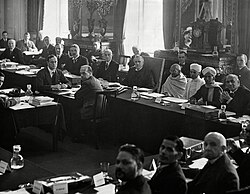
The three [[Round Table Conferences (India)|Round Table Conferences]] of 1930–32 were a series of consultations organised by the British government to discuss constitutional reforms in India. They were conducted on the advice of Muslim leader [[Muhammad Ali Jinnah]] to Viceroy [[Lord Irwin]] and Prime Minister [[Ramsay MacDonald]],<ref>{{cite book|last1=Wolpert|first1=Stanley|title=Jinnah of Pakistan|date=2013|publisher=Oxford University Press|location=Karachi, Pakistan|isbn=978-0-19-577389-7|page=107|edition=15}}</ref><ref>{{cite book |last1=Wolpert |first1=Stanley |title=Shameful Flight |year=2006 |publisher=Oxford University Press |isbn=978-0-19-515198-5 |pages=5–6}}</ref> and the recommendation of the report submitted by the [[Simon Commission]] in May 1930. Demands for [[swaraj]], or self-rule, in India had been growing increasingly strong. By the 1930s, many British politicians believed that India needed to move towards [[dominion status]]. However, there were significant disagreements between the Indian and the British leaders that the conferences could not resolve.<ref>{{cite book|title=Students' Britannica India|url=https://books.google.com/books?id=ISFBJarYX7YC&pg=PA309|year=2000|page=309|isbn = 9780852297605|last1 = Hoiberg|first1 = Dale| publisher=Popular Prakashan }}</ref> | |||
[[File:Gandhi Willingdon caricature 1932.jpg|thumb|left|A cartoon from 1932 depicting Viscount Willingdon on a [[hunger strike]] against Gandhi]] | [[File:Gandhi Willingdon caricature 1932.jpg|thumb|left|A cartoon from 1932 depicting Viscount Willingdon on a [[hunger strike]] against Gandhi]] | ||
| Line 70: | Line 75: | ||
===Willingdon imprisons leaders of Congress=== | ===Willingdon imprisons leaders of Congress=== | ||
In 1932 the Viceroy, [[Freeman Freeman-Thomas, 1st Marquess of Willingdon|Lord Willingdon]], after the failure of the three [[Round Table Conferences (India)]] in London, now confronted Gandhi's Congress in action. The [[India Office]] told Willingdon that he should conciliate only those elements of Indian opinion that were willing to work with the Raj. That did not include Gandhi and the Indian National Congress, which launched its Civil Disobedience Movement on 4 January 1932. Therefore, Willingdon took decisive action.<ref>{{cite book|author=John F. Riddick|title=The History of British India: A Chronology|url=https://books.google.com/books?id=Es6x4u_g19UC&pg=PA110|year=2006|publisher=Greenwood |page=110|isbn=9780313322808}}</ref> He imprisoned Gandhi. He outlawed the Congress; he rounded up all members of the Working Committee and the Provincial Committees and imprisoned them; and he banned Congress youth organisations. In total he imprisoned 80,000 Indian activists. Without most of their leaders, protests were uneven and disorganised, boycotts were ineffective, illegal youth organisations proliferated but were ineffective, more women became involved, and there was terrorism, especially in the North-West Frontier Province. Gandhi remained in prison until 1933.<ref>Brian Roger Tomlinson, ''The Indian National Congress and the Raj, 1929–1942: the penultimate phase'' (Springer, 1976).</ref><ref>Rosemary Rees. ''India 1900–47'' (Heineman, 2006) p 122</ref> Willingdon relied on his military secretary, [[Hastings Ismay, 1st Baron Ismay|Hastings Ismay]], for his personal safety.<ref>{{cite book| title=The Memoirs of General Lord Ismay| | In 1932 the Viceroy, [[Freeman Freeman-Thomas, 1st Marquess of Willingdon|Lord Willingdon]], after the failure of the three [[Round Table Conferences (India)]] in London, now confronted Gandhi's Congress in action. The [[India Office]] told Willingdon that he should conciliate only those elements of Indian opinion that were willing to work with the Raj. That did not include Gandhi and the Indian National Congress, which launched its Civil Disobedience Movement on 4 January 1932. Therefore, Willingdon took decisive action.<ref>{{cite book|author=John F. Riddick|title=The History of British India: A Chronology|url=https://books.google.com/books?id=Es6x4u_g19UC&pg=PA110|year=2006|publisher=Greenwood |page=110|isbn=9780313322808}}</ref> He imprisoned Gandhi. He outlawed the Congress; he rounded up all members of the Working Committee and the Provincial Committees and imprisoned them; and he banned Congress youth organisations. In total he imprisoned 80,000 Indian activists. Without most of their leaders, protests were uneven and disorganised, boycotts were ineffective, illegal youth organisations proliferated but were ineffective, more women became involved, and there was terrorism, especially in the North-West Frontier Province. Gandhi remained in prison until 1933.<ref>Brian Roger Tomlinson, ''The Indian National Congress and the Raj, 1929–1942: the penultimate phase'' (Springer, 1976).</ref><ref>Rosemary Rees. ''India 1900–47'' (Heineman, 2006) p 122</ref> Willingdon relied on his military secretary, [[Hastings Ismay, 1st Baron Ismay|Hastings Ismay]], for his personal safety.<ref>{{cite book |last=Ismay |first=Hastings |author-link=Hastings Ismay, 1st Baron Ismay |title=The Memoirs of General Lord Ismay |year=1974 |orig-year=First published 1960 |edition=Reprint |location=New York |publisher=Viking Press |page=66 |isbn=978-0-8371-6280-5}}</ref> | ||
===Communal Award: 1932=== | ===Communal Award: 1932=== | ||
MacDonald, trying to resolve the critical issue of how Indians would be represented, on 16 August 1932 announced the [[Communal Award]], which retained [[separate electorate]]s for Muslims, Sikhs, and Europeans in India and increased the number of provinces that offered separate electorates to Anglo-Indians and Indian Christians. The Depressed Classes (now known as the [[Dalits]]) obtained a separate electorate. Gandhi, representing the Indian National Congress during negotiations, rejected separate electorates for the Depressed Classes, Europeans, Anglo-Indians, and Indian Christians because, according to historian [[Helen Nugent]], he believed those separate electorates would weaken Congress' claim to be nationally representative. The award went into effect anyway.<ref>{{cite journal |last=Nugent |first=Helen M. |author-link=Helen Nugent |year=1979 |title=The communal award: The process of | MacDonald, trying to resolve the critical issue of how Indians would be represented, on 16 August 1932 announced the [[Communal Award]], which retained [[separate electorate]]s for Muslims, Sikhs, and Europeans in India and increased the number of provinces that offered separate electorates to Anglo-Indians and Indian Christians. The Depressed Classes (now known as the [[Dalits]]) obtained a separate electorate. Gandhi, representing the Indian National Congress during negotiations, rejected separate electorates for the Depressed Classes, Europeans, Anglo-Indians, and Indian Christians because, according to historian [[Helen Nugent]], he believed those separate electorates would weaken Congress' claim to be nationally representative. The award went into effect anyway.<ref>{{cite journal |last=Nugent |first=Helen M. |author-link=Helen Nugent |year=1979 |title=The communal award: The process of decision-making |journal=South Asia: Journal of South Asian Studies |volume=2 |issue=1–2 |pages=112–129 |doi=10.1080/00856407908722988}}</ref> | ||
==Government of India Act (1935)== | ==Government of India Act (1935)== | ||
| Line 84: | Line 89: | ||
With the outbreak of World War II in 1939, the viceroy, [[Victor Hope, 2nd Marquess of Linlithgow|Lord Linlithgow]], declared war on India's behalf without consulting Indian leaders, leading the Congress provincial ministries to resign in protest. The Muslim League, in contrast, supported Britain in the war effort; however, it now took the view that Muslims would be unfairly treated in an independent India dominated by the Congress. Hindus not affiliated with the Congress typically supported the war. The two major Sikh factions, the Unionists and the Akali Dal, supported Britain and successfully urged large numbers of Sikhs to volunteer for the army.<ref>{{cite book|author=Robin Jeffrey|title=What's Happening to India?: Punjab, Ethnic Conflict, and the Test for Federalism|url=https://books.google.com/books?id=qQO_DAAAQBAJ&pg=PA68|year=2016|publisher=Springer|pages=68–69|isbn=9781349234103}}</ref> | With the outbreak of World War II in 1939, the viceroy, [[Victor Hope, 2nd Marquess of Linlithgow|Lord Linlithgow]], declared war on India's behalf without consulting Indian leaders, leading the Congress provincial ministries to resign in protest. The Muslim League, in contrast, supported Britain in the war effort; however, it now took the view that Muslims would be unfairly treated in an independent India dominated by the Congress. Hindus not affiliated with the Congress typically supported the war. The two major Sikh factions, the Unionists and the Akali Dal, supported Britain and successfully urged large numbers of Sikhs to volunteer for the army.<ref>{{cite book|author=Robin Jeffrey|title=What's Happening to India?: Punjab, Ethnic Conflict, and the Test for Federalism|url=https://books.google.com/books?id=qQO_DAAAQBAJ&pg=PA68|year=2016|publisher=Springer|pages=68–69|isbn=9781349234103}}</ref> | ||
===Quit India movement or the Bharat Chhodo Andolan=== | === Quit India movement or the Bharat Chhodo Andolan === | ||
The British sent a high level [[Cripps Mission]] in 1942 to secure Indian nationalists' co-operation in the war effort in exchange for postwar independence and dominion status. Congress demanded immediate independence and the mission failed. Gandhi then launched the [[Quit India Movement]] in August 1942, demanding the immediate withdrawal of the British from India or face nationwide civil disobedience. Along with thousands of other Congress leaders, Gandhi was immediately imprisoned, and the country erupted in violent local episodes led by students and later by peasant political groups, especially in Eastern [[United Provinces of Agra and Oudh|United Provinces]], Bihar, and western Bengal. According to John F. Riddick, from 9 August 1942 to 21 September 1942, the Quit India movement: | The British sent a high level [[Cripps Mission]] in 1942 to secure Indian nationalists' co-operation in the war effort in exchange for postwar independence and dominion status. Congress demanded immediate independence and the mission failed. Gandhi then launched the [[Quit India Movement]] in August 1942, demanding the immediate withdrawal of the British from India or face nationwide civil disobedience. Along with thousands of other Congress leaders, Gandhi was immediately imprisoned, and the country erupted in violent local episodes led by students and later by peasant political groups, especially in Eastern [[United Provinces of Agra and Oudh|United Provinces]], Bihar, and western Bengal. According to John F. Riddick, from 9 August 1942 to 21 September 1942, the Quit India movement: | ||
| Line 93: | Line 98: | ||
Ultimately, the British government realised that India was ungovernable in the long run, and the question for the postwar era became how to exit gracefully and peacefully. | Ultimately, the British government realised that India was ungovernable in the long run, and the question for the postwar era became how to exit gracefully and peacefully. | ||
In 1945, when the World War 2 almost | In 1945, when the World War 2 had almost come to an end, the [[Labour Party (UK)|Labour Party of the United Kingdom]] won elections with a promise to provide independence to India.<ref>{{cite book | last=Studlar | first=D.T. | title=Great Britain: Decline Or Renewal? | publisher=Taylor & Francis | year=2018 | isbn=978-0-429-96865-5 | url=https://books.google.com/books?id=qQDFDwAAQBAJ&pg=PA117 | page=117|quote=The Labour Party promised independence for India in its campaign in the general election of 1945.}}</ref><ref>{{cite book | last=Ram | first=J. | title=V.K. Krishna Menon: A Personal Memoir | publisher=Oxford University Press | year=1997 | isbn=978-0-19-564228-5 | url=https://books.google.com/books?id=PSFuAAAAMAAJ | page=76|quote= Labour Party had promised freedom for India if they came to power | ||
}}</ref> The jailed political prisoners were released | }}</ref> The jailed political prisoners were released the same year.<ref>{{cite book|title=Right to Property in India|page=36|publisher=Deep & Deep Publications|year=1990|author=Naveen Sharma}}</ref> | ||
===Bose and the Indian National Army (INA) === | ===Bose and the Indian National Army (INA)=== | ||
[[Subhas Chandra Bose]], who had been ousted from the Congress Party in 1939 following differences with the more conservative high command,<ref>{{Harvnb|Chaudhuri|1953|p=355}}</ref> turned to Germany and Japan for help with liberating India by force.<ref name=low-bose>{{Harvnb|Low|1993|p=31}}</ref> With Japanese support, he organised the [[Indian National Army]], composed largely of Indian soldiers of the British Indian army who had been captured [[Battle of Singapore|at Singapore]] by the Japanese, including many Sikhs as well as Hindus and Muslims. Japan's [[F Kikan|secret service]] had promoted unrest in Southeast Asia to destabilise the British war effort,<ref>{{Harvnb|Lebra|1977|p=23}}</ref> and came to support a number of puppet and provisional governments in regions under their occupation, such as those of [[Japanese occupation of Burma|Burma]], the [[Philippines]] and [[Vietnam]]; similarly supported was the Provisional Government of [[Azad Hind]] (Free India), presided over by Bose.<ref>{{Harvnb|Lebra|1977|p=31}}</ref><ref name="low-bose" /> Bose's effort, however, was short lived; after the reverses of 1944, the reinforced British Indian Army in 1945 first halted and then reversed the Japanese [[U Go offensive]], beginning the successful part of the [[Burma Campaign]]. | [[Subhas Chandra Bose]], who had been ousted from the Congress Party in 1939 following differences with the more conservative high command,<ref>{{Harvnb|Chaudhuri|1953|p=355}}</ref> turned to Germany and Japan for help with liberating India by force.<ref name=low-bose>{{Harvnb|Low|1993|p=31}}</ref> With Japanese support, he organised the [[Indian National Army]], composed largely of Indian soldiers of the British Indian army who had been captured [[Battle of Singapore|at Singapore]] by the Japanese, including many Sikhs as well as Hindus and Muslims. Japan's [[F Kikan|secret service]] had promoted unrest in Southeast Asia to destabilise the British war effort,<ref>{{Harvnb|Lebra|1977|p=23}}</ref> and came to support a number of puppet and provisional governments in regions under their occupation, such as those of [[Japanese occupation of Burma|Burma]], the [[Philippines]] and [[Vietnam]]; similarly supported was the Provisional Government of [[Azad Hind]] (Free India), presided over by Bose.<ref>{{Harvnb|Lebra|1977|p=31}}</ref><ref name="low-bose" /> Bose's effort, however, was short lived; after the reverses of 1944, the reinforced British Indian Army in 1945 first halted and then reversed the Japanese [[U Go offensive]], beginning the successful part of the [[Burma Campaign]]. | ||
Bose's Indian National Army surrendered with the recapture of Singapore; Bose died in a plane crash soon thereafter. | Bose's Indian National Army surrendered with the recapture of Singapore; Bose died in a plane crash soon thereafter. | ||
The British demanded [[INA trials|trials]] for INA officers, but public opinion—including Congress and even the Indian Army—saw the INA as fighting for Indian independence and demanded a termination. The British eventually backtracked in the face of opposition by the Congress.<ref>{{cite book|last=Moreman|first=Tim|title=The Jungle, Japanese and the British Commonwealth Armies at War, 1941–45: Fighting Methods, Doctrine and Training for Jungle Warfare|url=https://books.google.com/books?id=bsoy_-Ep_0EC|year=2013|publisher=Routledge|isbn=978-1-135-76456-2}}</ref><ref>{{harvnb|Marston2014|pp=130–132}}: "Many Indian Army POWs were perplexed by Congress's sudden support for the INA"</ref> These trials became a galvanising point in the Indian Independence movement for the Indian National Congress.{{sfn|Singh|2003|p=98}}<ref name=Sarkar420>{{Harvnb|Sarkar|1983|p=420}}</ref> | The British demanded [[INA trials|trials]] for INA officers, but public opinion—including Congress and even the Indian Army—saw the INA as fighting for Indian independence and demanded a termination. The British eventually backtracked in the face of opposition by the Congress.<ref>{{cite book|last=Moreman|first=Tim|title=The Jungle, Japanese and the British Commonwealth Armies at War, 1941–45: Fighting Methods, Doctrine and Training for Jungle Warfare|url=https://books.google.com/books?id=bsoy_-Ep_0EC|year=2013|publisher=Routledge|isbn=978-1-135-76456-2}}</ref><ref>{{harvnb|Marston2014|pp=130–132}}: "Many Indian Army POWs were perplexed by Congress's sudden support for the INA"</ref> These trials became a galvanising point in the Indian Independence movement for the Indian National Congress.{{sfn|Singh|2003|p=98}}<ref name=Sarkar420>{{Harvnb|Sarkar|1983|p=420}}</ref> | ||
| Line 107: | Line 112: | ||
Britain borrowed everywhere it could and made heavy purchases of equipment and supplies in India during the war.<ref>{{cite book |author=Dharma Kumar |editor1=Dharma Kumar |editor2=Meghnad Desai |year=1983 |chapter=The Fiscal System |title=The Cambridge Economic History of India |volume=2 |publisher=Cambridge University Press |pages=942–944 |isbn=0-521-22802-6}}</ref> Previously India owed Britain large sums; now it was reversed.<ref>Srinath Raghavan, ''India's War: World War II and the Making of Modern South Asia'' (2016) pp 339–47.</ref> Britain's sterling balances around the world amounted to £3.4 billion in 1945; India's share was £1.3 billion (equivalent to $US 74 billion in 2016 dollars.)<ref>See [https://www.uwyo.edu/numimage/currency.htm "Pounds Sterling to Dollars: Historical Conversion of Currency"]</ref><ref>Marcelo de Paiva Abreu, "India as a creditor: sterling balances, 1940–1953." (Department of Economics, Pontifical Catholic University of Rio de Janeiro, 2015) [http://www.econ.puc-rio.br/uploads/adm/trabalhos/files/td643.pdf online]</ref> In this way the Raj treasury accumulated very large sterling reserves of British pounds that was owed to it by the British treasury. However, Britain treated this as a long-term loan with no interest and no specified repayment date. Just when the money would be made available by London was an issue, for the British treasury was nearly empty by 1945. India's balances totalled to Rs. 17.24 billion in March 1946; of that sum Rs. 15.12 billion [£1.134 billion] was split between India and Pakistan when they became independent in August 1947. They finally got the money and India spent all its share by 1957 which included buying back British owned assets in India.<ref>{{cite book|author=Uma Kapila|title=Indian Economy|url=https://books.google.com/books?id=YIrkHe_6eeAC&pg=PA23|year=2005|publisher=Academic Foundation|page=23|isbn=9788171884292}}</ref> | Britain borrowed everywhere it could and made heavy purchases of equipment and supplies in India during the war.<ref>{{cite book |author=Dharma Kumar |editor1=Dharma Kumar |editor2=Meghnad Desai |year=1983 |chapter=The Fiscal System |title=The Cambridge Economic History of India |volume=2 |publisher=Cambridge University Press |pages=942–944 |isbn=0-521-22802-6}}</ref> Previously India owed Britain large sums; now it was reversed.<ref>Srinath Raghavan, ''India's War: World War II and the Making of Modern South Asia'' (2016) pp 339–47.</ref> Britain's sterling balances around the world amounted to £3.4 billion in 1945; India's share was £1.3 billion (equivalent to $US 74 billion in 2016 dollars.)<ref>See [https://www.uwyo.edu/numimage/currency.htm "Pounds Sterling to Dollars: Historical Conversion of Currency"]</ref><ref>Marcelo de Paiva Abreu, "India as a creditor: sterling balances, 1940–1953." (Department of Economics, Pontifical Catholic University of Rio de Janeiro, 2015) [http://www.econ.puc-rio.br/uploads/adm/trabalhos/files/td643.pdf online]</ref> In this way the Raj treasury accumulated very large sterling reserves of British pounds that was owed to it by the British treasury. However, Britain treated this as a long-term loan with no interest and no specified repayment date. Just when the money would be made available by London was an issue, for the British treasury was nearly empty by 1945. India's balances totalled to Rs. 17.24 billion in March 1946; of that sum Rs. 15.12 billion [£1.134 billion] was split between India and Pakistan when they became independent in August 1947. They finally got the money and India spent all its share by 1957 which included buying back British owned assets in India.<ref>{{cite book|author=Uma Kapila|title=Indian Economy|url=https://books.google.com/books?id=YIrkHe_6eeAC&pg=PA23|year=2005|publisher=Academic Foundation|page=23|isbn=9788171884292}}</ref> | ||
==Transfer of | ==Transfer of power== | ||
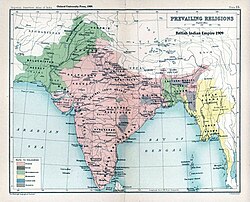
[[File:Brit IndianEmpireReligions3.jpg|left|thumb|'''1909 Prevailing Religions''', Map of British Indian Empire, 1909, showing the prevailing majority religions of the population for different districts.]] | [[File:Brit IndianEmpireReligions3.jpg|left|thumb|'''1909 Prevailing Religions''', Map of British Indian Empire, 1909, showing the prevailing majority religions of the population for different districts.]] | ||
The [[All India Azad Muslim Conference]] gathered in Delhi in April 1940 to voice its support for an [[Opposition to the partition of India|independent and united India]].<ref name="QasmiRobb2017">{{cite book |last1=Qasmi |first1=Ali Usman |last2=Robb |first2=Megan Eaton |title=Muslims against the Muslim League: Critiques of the Idea of Pakistan |date=2017 |publisher=Cambridge University Press |isbn=9781108621236 |page=2 |language=en}}</ref> Its members included several Islamic organisations in India, as well as 1400 nationalist Muslim delegates.<ref name="Haq1970">{{cite book |last1=Haq |first1=Mushir U. |title=Muslim politics in modern India, 1857-1947 |date=1970 |publisher=Meenakshi Prakashan |page=114 |language=en|quote=This was also reflected in one of the resolutions of the Azad Muslim Conference, an organization which attempted to be representative of all the various nationalist Muslim parties and groups in India.}}</ref><ref name="Ahmed2016">{{cite web |last1=Ahmed |first1=Ishtiaq |title=The dissenters |url=https://www.thefridaytimes.com/tft/the-dissenters/ |publisher=[[The Friday Times]] |language=en |date=27 May 2016|quote=However, the book is a tribute to the role of one Muslim leader who steadfastly opposed the Partition of India: the Sindhi leader Allah Bakhsh Soomro. Allah Bakhsh belonged to a landed family. He founded the Sindh | The [[All India Azad Muslim Conference]] gathered in Delhi in April 1940 to voice its support for an [[Opposition to the partition of India|independent and united India]].<ref name="QasmiRobb2017">{{cite book |last1=Qasmi |first1=Ali Usman |last2=Robb |first2=Megan Eaton |title=Muslims against the Muslim League: Critiques of the Idea of Pakistan |date=2017 |publisher=Cambridge University Press |isbn=9781108621236 |page=2 |language=en}}</ref> Its members included several Islamic organisations in India, as well as 1400 nationalist Muslim delegates.<ref name="Haq1970">{{cite book |last1=Haq |first1=Mushir U. |title=Muslim politics in modern India, 1857-1947 |date=1970 |publisher=Meenakshi Prakashan |page=114 |language=en|quote=This was also reflected in one of the resolutions of the Azad Muslim Conference, an organization which attempted to be representative of all the various nationalist Muslim parties and groups in India.}}</ref><ref name="Ahmed2016">{{cite web |last1=Ahmed |first1=Ishtiaq |title=The dissenters |url=https://www.thefridaytimes.com/tft/the-dissenters/ |publisher=[[The Friday Times]] |language=en |date=27 May 2016|quote=However, the book is a tribute to the role of one Muslim leader who steadfastly opposed the Partition of India: the Sindhi leader Allah Bakhsh Soomro. Allah Bakhsh belonged to a landed family. He founded the Sindh People's Party in 1934, which later came to be known as 'Ittehad' or 'Unity Party'. ... Allah Bakhsh was totally opposed to the Muslim League's demand for the creation of Pakistan through a division of India on a religious basis. Consequently, he established the Azad Muslim Conference. In its Delhi session held during April 27–30, 1940 some 1400 delegates took part. They belonged mainly to the lower castes and working class. The famous scholar of Indian Islam, Wilfred Cantwell Smith, feels that the delegates represented a 'majority of India's Muslims'. Among those who attended the conference were representatives of many Islamic theologians and women also took part in the deliberations ... Shamsul Islam argues that the All-India Muslim League at times used intimidation and coercion to silence any opposition among Muslims to its demand for Partition. He calls such tactics of the Muslim League as a 'Reign of Terror'. He gives examples from all over India including the NWFP where the Khudai Khidmatgars remain opposed to the Partition of India.}}</ref><ref name="Ali2017">{{cite web |last1=Ali |first1=Afsar |title=Partition of India and Patriotism of Indian Muslims |url=http://www.milligazette.com/news/15756-partition-of-india-and-patriotism-of-indian-muslims |publisher=[[The Milli Gazette]] |language=en |date=17 July 2017}}</ref> The pro-separatist All-India Muslim League worked to try to silence those nationalist Muslims who stood against the partition of India, often using "intimidation and coercion".<ref name="Ali2017"/><ref name="Ahmed2016"/> The murder of the All India Azad Muslim Conference leader [[Allah Bakhsh Soomro]] also made it easier for the All-India Muslim League to demand the creation of a Pakistan.<ref name="Ali2017"/> | ||
In January 1946, a number of mutinies broke out in the armed services, starting with [[Royal Air Force Mutiny of 1946|that of RAF servicemen]] frustrated with their slow repatriation to Britain.<ref name=judd-mutiny>{{Harv|Judd|2004|pp=172–173}}</ref> The mutinies came to a head with [[The Royal Indian Navy Mutiny|mutiny of the Royal Indian Navy]] in Bombay in February 1946, followed by others in Calcutta, Madras, and Karachi. Although the mutinies were rapidly suppressed, they found much public support in India and | In January 1946, a number of mutinies broke out in the armed services, starting with [[Royal Air Force Mutiny of 1946|that of RAF servicemen]] frustrated with their slow repatriation to Britain.<ref name=judd-mutiny>{{Harv|Judd|2004|pp=172–173}}</ref> The mutinies came to a head with [[The Royal Indian Navy Mutiny|mutiny of the Royal Indian Navy]] in Bombay in February 1946, followed by others in Calcutta, Madras, and Karachi. Although the mutinies were rapidly suppressed, they found much public support in India and spurred the new Labour government in Britain to action, and leading to the Cabinet Mission to India led by the Secretary of State for India, [[Frederick Pethick-Lawrence, 1st Baron Pethick-Lawrence|Lord Pethick Lawrence]], and including [[Stafford Cripps|Sir Stafford Cripps]], who had visited four years before.<ref name=judd-mutiny/> | ||
Also in early 1946, new elections were called in India in which the Congress won electoral victories in eight of the eleven provinces.<ref>{{Harv|Judd|2004|p=172}}</ref> However, the negotiations between the Congress and the Muslim League stumbled over the issue of the partition. Jinnah proclaimed 16 August 1946, [[Direct Action Day]], with the stated goal of peacefully highlighting the demand for a Muslim homeland in [[British India]]. The following day, Hindu-Muslim riots broke out in Calcutta and they quickly spread throughout India. Although the Government of India and the Congress were both shaken by the course of events, in September, a Congress-led interim government was installed, with [[Jawaharlal Nehru]] serving as united India's prime minister. | Also in early 1946, new elections were called in India in which the Congress won electoral victories in eight of the eleven provinces.<ref>{{Harv|Judd|2004|p=172}}</ref> However, the negotiations between the Congress and the Muslim League stumbled over the issue of the partition. Jinnah proclaimed 16 August 1946, [[Direct Action Day]], with the stated goal of peacefully highlighting the demand for a Muslim homeland in [[British India]]. The following day, Hindu-Muslim riots broke out in Calcutta and they quickly spread throughout India. Although the Government of India and the Congress were both shaken by the course of events, in September, a Congress-led interim government was installed, with [[Jawaharlal Nehru]] serving as united India's prime minister. | ||
| Line 122: | Line 127: | ||
==See also== | ==See also== | ||
* [[Company rule in India]] | * [[Company rule in India]] | ||
* [[British East India Company]] | * [[British East India Company]] | ||
==Notes== | ==Notes== | ||
{{Reflist | {{Reflist}} | ||
===Surveys and reference books=== | ===Surveys and reference books=== | ||
*{{Citation | * {{Citation | ||
| last1=Bandyopadhyay | | last1=Bandyopadhyay | ||
| first1=Sekhar | | first1=Sekhar | ||
| year=2004 | | year=2004 | ||
| title=From Plassey to Partition: A History of Modern India | | title=From Plassey to Partition: A History of Modern India | ||
| publisher= | | publisher=Orient Longmans. Pp. xx, 548. | ||
| isbn=81-250-2596-0 | | isbn=81-250-2596-0 | ||
}}. | }}. | ||
* {{Citation | |||
*{{Citation | |||
| last1=Brown | | last1=Brown | ||
| first1=Judith M. | | first1=Judith M. | ||
| year=1994 | | year=1994 | ||
| title=Modern India: The Origins of an Asian Democracy | | title=Modern India: The Origins of an Asian Democracy | ||
| publisher= | | publisher=[[Oxford University Press]]. Pp. xiii, 474 | ||
| isbn=0-19-873113-2 | | isbn=0-19-873113-2 | ||
}}. | }}. | ||
* Buckland, C.E. ''Dictionary of Indian Biography'' (1906) 495pp [https://archive.org/details/bub_gb_InFTmnS4crYC full text] | * Buckland, C.E. ''Dictionary of Indian Biography'' (1906) 495pp [https://archive.org/details/bub_gb_InFTmnS4crYC full text] | ||
*{{Citation | * {{Citation | ||
| last1=Copland | | last1=Copland | ||
| first1=Ian | | first1=Ian | ||
| year=2001 | | year=2001 | ||
| title=India 1885–1947: The Unmaking of an Empire (Seminar Studies in History Series) | | title=India 1885–1947: The Unmaking of an Empire (Seminar Studies in History Series) | ||
| publisher= | | publisher=Pearson Longmans. Pp. 160 | ||
| isbn=0-582-38173-8 | | isbn=0-582-38173-8 | ||
}}. | }}. | ||
*{{Citation | * {{Citation | ||
| last1=Judd | | last1=Judd | ||
| first1=Dennis | | first1=Dennis | ||
| year=2004 | | year=2004 | ||
| title=The Lion and the Tiger: The Rise and Fall of the British Raj, 1600–1947 | | title=The Lion and the Tiger: The Rise and Fall of the British Raj, 1600–1947 | ||
| publisher= | | publisher=[[Oxford University Press]]. Pp. xiii, 280 | ||
| isbn=0-19-280358-1 | | isbn=0-19-280358-1 | ||
}}. | }}. | ||
*{{Citation | * {{Citation | ||
|last1=Keay |first1=John |title=India: A History |date=2000 |publisher=Atlantic Monthly Press |location=New York |isbn=0-87113-800-X}} | |last1=Keay |first1=John |title=India: A History |date=2000 |publisher=Atlantic Monthly Press |location=New York |isbn=0-87113-800-X}} | ||
* {{Citation | |||
*{{Citation | |||
| last1=Ludden | | last1=Ludden | ||
| first1=David | | first1=David | ||
| Line 202: | Line 182: | ||
| url-status=dead | | url-status=dead | ||
}} | }} | ||
*{{Citation | * {{Citation | ||
| editor1-last=Markovits | | editor1-last=Markovits | ||
| editor1-first=Claude | | editor1-first=Claude | ||
| Line 210: | Line 190: | ||
| isbn=1-84331-152-6 | | isbn=1-84331-152-6 | ||
}}. | }}. | ||
*{{Citation | * {{Citation | ||
| last1=Metcalf | | last1=Metcalf | ||
| first1=Barbara | | first1=Barbara | ||
| Line 217: | Line 197: | ||
| year=2006 | | year=2006 | ||
| title=A Concise History of Modern India (Cambridge Concise Histories) | | title=A Concise History of Modern India (Cambridge Concise Histories) | ||
| publisher= | | publisher=[[Cambridge University Press]]. Pp. xxxiii, 372 | ||
| isbn=0-521-68225-8 | | isbn=0-521-68225-8 | ||
}}. | }}. | ||
*{{Citation | * {{Citation | ||
| last1=Peers | | last1=Peers | ||
| first1=Douglas M. | | first1=Douglas M. | ||
| year=2006 | | year=2006 | ||
| title=India under Colonial Rule 1700–1885 | | title=India under Colonial Rule 1700–1885 | ||
| publisher= | | publisher=Pearson Longmans. Pp. xvi, 163 | ||
| isbn=0-582-31738-X | | isbn=0-582-31738-X | ||
}}. | }}. | ||
* Rees, Rosemary. ''India 1900–47'' (Heineman, 2006), textbook. | * Rees, Rosemary. ''India 1900–47'' (Heineman, 2006), textbook. | ||
* Riddick, John F. ''Who Was Who in British India'' (1998); 5000 entries [https://books.google.com/books?id=LI8UAQAAIAAJ excerpt] | * Riddick, John F. ''Who Was Who in British India'' (1998); 5000 entries [https://books.google.com/books?id=LI8UAQAAIAAJ excerpt] | ||
*{{Citation | * {{Citation | ||
| last1=Robb | | last1=Robb | ||
| first1=Peter | | first1=Peter | ||
| year=2004 | | year=2004 | ||
| title=A History of India (Palgrave Essential Histories) | | title=A History of India (Palgrave Essential Histories) | ||
| publisher= | | publisher=Palgrave Macmillan. Pp. xiv, 344 | ||
| isbn=0-333-69129-6 | | isbn=0-333-69129-6 | ||
| url=https://archive.org/details/historyofindia00pete | | url=https://archive.org/details/historyofindia00pete | ||
| url-access=registration | | url-access=registration | ||
}}. | }}. | ||
*{{Citation | * {{Citation | ||
| last1=Sarkar | | last1=Sarkar | ||
| first1=Sumit | | first1=Sumit | ||
| year=1983 | | year=1983 | ||
| title=Modern India: 1885–1947 | | title=Modern India: 1885–1947 | ||
| publisher= | | publisher=Macmillan India Ltd. Pp. xiv, 486 | ||
| isbn=0-333-90425-7 | | isbn=0-333-90425-7 | ||
| url=https://archive.org/details/modernindia1885100sark | | url=https://archive.org/details/modernindia1885100sark | ||
}}. | }}. | ||
*{{Citation | * {{Citation | ||
| last1=Spear | | last1=Spear | ||
| first1=Percival | | first1=Percival | ||
| Line 255: | Line 235: | ||
| year=1990 | | year=1990 | ||
| title=A History of India, Volume 2 | | title=A History of India, Volume 2 | ||
| publisher= | | publisher=Penguin Books. Pp. 298 | ||
| isbn=0-14-013836-6 | | isbn=0-14-013836-6 | ||
}}. | }}. | ||
*{{Citation | * {{Citation | ||
| last1=Stein | | last1=Stein | ||
| first1=Burton | | first1=Burton | ||
| year= | | author-link=Burton Stein | ||
| editor-last=Arnold | |||
| editor-first=David | |||
| editor-link=David Arnold (historian) | |||
| year=2010 | |||
| orig-year=First published 1998 | |||
| title=A History of India | | title=A History of India | ||
| | | url=https://archive.org/details/a-history-of-india-second-edition-2010 | ||
| isbn= | | edition=2nd | ||
| publisher=John Wiley & Sons | |||
| isbn=978-1-4051-9509-6 | |||
}}. | }}. | ||
*{{Citation | * {{Citation | ||
| last1=Wolpert | | last1=Wolpert | ||
| first1=Stanley | | first1=Stanley | ||
| Line 272: | Line 259: | ||
| year=2003 | | year=2003 | ||
| title=A New History of India | | title=A New History of India | ||
| publisher= | | publisher=Oxford University Press. Pp. 544 | ||
| isbn=0-19-516678-7 | | isbn=0-19-516678-7 | ||
}}. | }}. | ||
===Monographs and collections=== | ===Monographs and collections=== | ||
*{{Citation | * {{Citation | ||
| last1=Bayly | | last1=Bayly | ||
| first1=C. A. | | first1=C. A. | ||
| Line 283: | Line 270: | ||
| year=1990 | | year=1990 | ||
| title=Indian Society and the Making of the British Empire (The New Cambridge History of India) | | title=Indian Society and the Making of the British Empire (The New Cambridge History of India) | ||
| publisher= | | publisher=Cambridge University Press. Pp. 248 | ||
| isbn=0-521-38650-0 | | isbn=0-521-38650-0 | ||
}}. | }}. | ||
*{{Citation| last1=Bayly| first1=C. A. | author-link1=Christopher Alan Bayly | * {{Citation| last1=Bayly| first1=C. A. | author-link1=Christopher Alan Bayly | ||
| year=2000| title=Empire and Information: Intelligence Gathering and Social Communication in India, 1780–1870 (Cambridge Studies in Indian History and Society)| publisher= | | year=2000| title=Empire and Information: Intelligence Gathering and Social Communication in India, 1780–1870 (Cambridge Studies in Indian History and Society)| publisher=Cambridge University Press. Pp. 426| isbn=0-521-66360-1}} | ||
*{{Citation | editor-last1 = Brown | editor-first1 = Judith M. | editor-last2 = Louis | editor-first2 = Wm. Roger | year = 2001 | title = Oxford History of the British Empire: The Twentieth Century | publisher = | * {{Citation | editor-last1 = Brown | editor-first1 = Judith M. | editor-last2 = Louis | editor-first2 = Wm. Roger | year = 2001 | title = Oxford History of the British Empire: The Twentieth Century | publisher = Oxford University Press. Pp. 800 | isbn = 0-19-924679-3}} | ||
*{{Citation | * {{Citation | ||
| last1=Chandavarkar | | last1=Chandavarkar | ||
| first1=Rajnarayan | | first1=Rajnarayan | ||
| year=1998 | | year=1998 | ||
| title=Imperial Power and Popular Politics: Class, Resistance and the State in India, 1850–1950 | | title=Imperial Power and Popular Politics: Class, Resistance and the State in India, 1850–1950 | ||
| publisher=(Cambridge Studies in Indian History & Society). | | publisher=(Cambridge Studies in Indian History & Society). [[Cambridge University Press]]. Pp. 400 | ||
| isbn=0-521-59692-0 | | isbn=0-521-59692-0 | ||
}}. | }}. | ||
*{{Citation | * {{Citation | ||
| last1=Copland | | last1=Copland | ||
| first1=Ian | | first1=Ian | ||
| year=2002 | | year=2002 | ||
| title=Princes of India in the Endgame of Empire, 1917–1947 | | title=Princes of India in the Endgame of Empire, 1917–1947 | ||
| publisher=(Cambridge Studies in Indian History & Society). | | publisher=(Cambridge Studies in Indian History & Society). [[Cambridge University Press]]. Pp. 316 | ||
| isbn=0-521-89436-0 | | isbn=0-521-89436-0 | ||
}}. | }}. | ||
* Gilmartin, David. 1988. ''Empire and Islam: Punjab and the Making of Pakistan''. Berkeley: University of California Press. 258 pages. {{ISBN|0-520-06249-3}}. | * Gilmartin, David. 1988. ''Empire and Islam: Punjab and the Making of Pakistan''. Berkeley: University of California Press. 258 pages. {{ISBN|0-520-06249-3}}. | ||
*{{Citation | * {{Citation | ||
| last1=Gould | | last1=Gould | ||
| first1=William | | first1=William | ||
| year=2004 | | year=2004 | ||
| title=Hindu Nationalism and the Language of Politics in Late Colonial India | | title=Hindu Nationalism and the Language of Politics in Late Colonial India | ||
| publisher=(Cambridge Studies in Indian History and Society). | | publisher=(Cambridge Studies in Indian History and Society). [[Cambridge University Press]]. Pp. 320 | ||
| isbn=0-521-83061-3 | | isbn=0-521-83061-3 | ||
}}. | }}. | ||
*{{Citation | * {{Citation | ||
| surname1 = Hyam | | surname1 = Hyam | ||
| given1 = Ronald | | given1 = Ronald | ||
| Line 322: | Line 309: | ||
| isbn = 978-0-521-86649-1 | | isbn = 978-0-521-86649-1 | ||
}}. | }}. | ||
*{{Citation | * {{Citation | ||
| last=Jalal | | last=Jalal | ||
| first=Ayesha | | first=Ayesha | ||
| year=1993 | | year=1993 | ||
| title=The Sole Spokesman: Jinnah, the Muslim League and the Demand for Pakistan | | title=The Sole Spokesman: Jinnah, the Muslim League and the Demand for Pakistan | ||
| publisher= | | publisher=Cambridge University Press, 334 pages | ||
| isbn=0-521-45850-1 | | isbn=0-521-45850-1 | ||
}}. | }}. | ||
*{{Citation | * {{Citation | ||
| last=Khan | | last=Khan | ||
| first=Yasmin | | first=Yasmin | ||
| year=2007 | | year=2007 | ||
| title=The Great Partition: The Making of India and Pakistan | | title=The Great Partition: The Making of India and Pakistan | ||
| publisher= | | publisher=Yale University Press, 250 pages | ||
| isbn=978-0-300-12078-3 | | isbn=978-0-300-12078-3 | ||
| url=https://archive.org/details/greatpartitionma00khan | | url=https://archive.org/details/greatpartitionma00khan | ||
}} | }} | ||
*{{Citation | * {{Citation | ||
| last1=Khosla | | last1=Khosla | ||
| first1=G. D. | | first1=G. D. | ||
| Line 355: | Line 342: | ||
| editor5-first=Mushirul | | editor5-first=Mushirul | ||
| title=The Partition Omnibus: Prelude to Partition/the Origins of the Partition of India 1936-1947/Divide and Quit/Stern Reckoning | | title=The Partition Omnibus: Prelude to Partition/the Origins of the Partition of India 1936-1947/Divide and Quit/Stern Reckoning | ||
| publisher= | | publisher=Oxford University Press | ||
| isbn=0-19-565850-7 | | isbn=0-19-565850-7 | ||
}} | }} | ||
| Line 367: | Line 354: | ||
| isbn = 0-231-03995-6 | | isbn = 0-231-03995-6 | ||
}} | }} | ||
*{{Citation | * {{Citation | ||
| last1=Low | | last1=Low | ||
| first1=D. A. | | first1=D. A. | ||
| year=1993 | | year=1993 | ||
| title=Eclipse of Empire | | title=Eclipse of Empire | ||
| publisher= | | publisher=[[Cambridge University Press]]. Pp. xvi, 366 | ||
| isbn=0-521-45754-8 | | isbn=0-521-45754-8 | ||
}}. | }}. | ||
*{{Citation | * {{Citation | ||
| last1=Low | | last1=Low | ||
| first1=D. A. | | first1=D. A. | ||
| year=2002 | | year=2002 | ||
| title=Britain and Indian Nationalism: The Imprint of Amibiguity 1929–1942 | | title=Britain and Indian Nationalism: The Imprint of Amibiguity 1929–1942 | ||
| publisher= | | publisher=[[Cambridge University Press]]. Pp. 374 | ||
| isbn=0-521-89261-9 | | isbn=0-521-89261-9 | ||
}}. | }}. | ||
*{{Citation | * {{Citation | ||
| editor-last1=Low | | editor-last1=Low | ||
| editor-first1=D. A. | | editor-first1=D. A. | ||
| orig-year=1977| year=2004 | | orig-year=1977| year=2004 | ||
| title=Congress & the Raj: Facets of the Indian Struggle 1917–47 | | title=Congress & the Raj: Facets of the Indian Struggle 1917–47 | ||
| publisher= | | publisher=[[Oxford University Press]]. Pp. xviii, 513 | ||
| isbn=0-19-568367-6 | | isbn=0-19-568367-6 | ||
}}. | }}. | ||
| Line 399: | Line 386: | ||
| isbn = 978-0-521-89975-8 | | isbn = 978-0-521-89975-8 | ||
}} | }} | ||
*{{Citation | * {{Citation | ||
| last=Metcalf | | last=Metcalf | ||
| first=Thomas R. | | first=Thomas R. | ||
| Line 407: | Line 394: | ||
| isbn=81-85054-99-1 | | isbn=81-85054-99-1 | ||
}} | }} | ||
*{{Citation | last = Metcalf | first = Thomas R. | year = 1997 | title = Ideologies of the Raj | publisher = | * {{Citation | last = Metcalf | first = Thomas R. | year = 1997 | title = Ideologies of the Raj | publisher = Cambridge University Press, Pp. 256 | isbn = 0-521-58937-1}} | ||
*{{Citation | editor-last = Porter | editor-first = Andrew | year = 2001 | title = Oxford History of the British Empire: Nineteenth Century | publisher = | * {{Citation | editor-last = Porter | editor-first = Andrew | year = 2001 | title = Oxford History of the British Empire: Nineteenth Century | publisher = Oxford University Press. Pp. 800 | isbn = 0-19-924678-5}} | ||
*{{Citation | last = Ramusack | first = Barbara | year = 2004 | title = The Indian Princes and their States (The New Cambridge History of India) | publisher = | * {{Citation | last = Ramusack | first = Barbara | year = 2004 | title = The Indian Princes and their States (The New Cambridge History of India) | publisher = Cambridge University Press. Pp. 324 | isbn = 0-521-03989-4}} | ||
* Shaikh, Farzana. 1989. ''Community and Consensus in Islam: Muslim Representation in Colonial India, 1860—1947''. Cambridge, UK: Cambridge University Press. 272 pages. {{ISBN|0-521-36328-4}}. | * Shaikh, Farzana. 1989. ''Community and Consensus in Islam: Muslim Representation in Colonial India, 1860—1947''. Cambridge, UK: Cambridge University Press. 272 pages. {{ISBN|0-521-36328-4}}. | ||
*{{Citation | * {{Citation | ||
| last = Singh | | last = Singh | ||
| first = Harkirat | | first = Harkirat | ||
| Line 419: | Line 406: | ||
| isbn = 81-269-0316-3 | | isbn = 81-269-0316-3 | ||
}} | }} | ||
*{{Citation | * {{Citation | ||
| last1=Wolpert | | last1=Wolpert | ||
| first1=Stanley | | first1=Stanley | ||
| year=2006 | | year=2006 | ||
| title=Shameful Flight: The Last Years of the British Empire in India | | title=Shameful Flight: The Last Years of the British Empire in India | ||
| publisher= | | publisher=[[Oxford University Press]] | ||
| isbn=0-19-515198- | | isbn=978-0-19-515198-5 | ||
| url=https://archive.org/details/shamefulflightla00wolp | | url=https://archive.org/details/shamefulflightla00wolp | ||
}}. | }}. | ||
===Articles in journals or collections=== | ===Articles in journals or collections=== | ||
*{{Citation | * {{Citation | ||
| last1 = Acemoglu | | last1 = Acemoglu | ||
| first1 = Daron | | first1 = Daron | ||
| Line 447: | Line 434: | ||
| jstor = 2677930 | | jstor = 2677930 | ||
| doi-access = free | | doi-access = free | ||
| url-access = subscription | |||
}} | }} | ||
*{{citation | * {{citation | ||
| last1 = Banthia | | last1 = Banthia | ||
| first1 = Jayant | | first1 = Jayant | ||
| Line 464: | Line 452: | ||
| pmid = 22053410 | | pmid = 22053410 | ||
}} | }} | ||
*{{Citation | * {{Citation | ||
| last1=Brown | | last1=Brown | ||
| first1=Judith M. | | first1=Judith M. | ||
| Line 475: | Line 463: | ||
| editor2-first=Wm. Roger | | editor2-first=Wm. Roger | ||
| title=Oxford History of the British Empire: The Twentieth Century | | title=Oxford History of the British Empire: The Twentieth Century | ||
| publisher= | | publisher=Oxford University Press | ||
| isbn=0-19-924679-3 | | isbn=0-19-924679-3 | ||
}} | }} | ||
*{{Citation | * {{Citation | ||
| last1 = Carey | | last1 = Carey | ||
| first1 = Simon | | first1 = Simon | ||
| Line 501: | Line 489: | ||
| jstor = 2752872 | | jstor = 2752872 | ||
}} | }} | ||
*{{Citation | * {{Citation | ||
| last = Derbyshire | | last = Derbyshire | ||
| first = I. D. | | first = I. D. | ||
| Line 515: | Line 503: | ||
| s2cid = 146480332 | | s2cid = 146480332 | ||
}} | }} | ||
*{{Citation | * {{Citation | ||
| last = Dyson | | last = Dyson | ||
| first = Tim | | first = Tim | ||
| Line 529: | Line 517: | ||
| pmid = 11622922 | | pmid = 11622922 | ||
}} | }} | ||
*{{Citation | * {{Citation | ||
| last = Dyson | | last = Dyson | ||
| first = Tim | | first = Tim | ||
| Line 543: | Line 531: | ||
| pmid = 11622922 | | pmid = 11622922 | ||
}} | }} | ||
*{{Citation | * {{Citation | ||
| last = Gilmartin | | last = Gilmartin | ||
| first = David | | first = David | ||
| Line 557: | Line 545: | ||
| s2cid = 161655860 | | s2cid = 161655860 | ||
}} | }} | ||
*{{Citation | * {{Citation | ||
| last = Goswami | | last = Goswami | ||
| first = Manu | | first = Manu | ||
| Line 571: | Line 559: | ||
| s2cid = 145013372 | | s2cid = 145013372 | ||
}} | }} | ||
*{{Citation | * {{Citation | ||
| last = Harnetty | | last = Harnetty | ||
| first = Peter | | first = Peter | ||
| Line 585: | Line 573: | ||
| s2cid = 144468476 | | s2cid = 144468476 | ||
}} | }} | ||
*{{Citation | * {{Citation | ||
| last = Klein | | last = Klein | ||
| first = Ira | | first = Ira | ||
| Line 600: | Line 588: | ||
| s2cid = 42173746 | | s2cid = 42173746 | ||
}} | }} | ||
*{{Citation | * {{Citation | ||
| last = Klein | | last = Klein | ||
| first = Ira | | first = Ira | ||
| Line 614: | Line 602: | ||
| s2cid = 143348610 | | s2cid = 143348610 | ||
}} | }} | ||
*{{Citation | * {{Citation | ||
| last1=Moore | | last1=Moore | ||
| first1=Robin J. | | first1=Robin J. | ||
| Line 623: | Line 611: | ||
| editor1-first=Andrew | | editor1-first=Andrew | ||
| title=Oxford History of the British Empire: The Nineteenth Century | | title=Oxford History of the British Empire: The Nineteenth Century | ||
| publisher= | | publisher=Oxford University Press | ||
| isbn=0-19-924678-5 | | isbn=0-19-924678-5 | ||
}} | }} | ||
*{{Citation | * {{Citation | ||
| last1=Moore | | last1=Moore | ||
| first1=Robin J. | | first1=Robin J. | ||
| Line 635: | Line 623: | ||
| editor1-first=Robin | | editor1-first=Robin | ||
| title=Oxford History of the British Empire: Historiography | | title=Oxford History of the British Empire: Historiography | ||
| publisher= | | publisher=Oxford University Press | ||
| isbn=0-19-924680-7 | | isbn=0-19-924680-7 | ||
}} | }} | ||
*{{Citation | * {{Citation | ||
| last1 = Overby | | last1 = Overby | ||
| first1 = Stephanie | | first1 = Stephanie | ||
| Line 646: | Line 634: | ||
| url = https://www.cio.com/article/3030989/the-top-10-it-outsourcing-service-providers-of-the-year.html | | url = https://www.cio.com/article/3030989/the-top-10-it-outsourcing-service-providers-of-the-year.html | ||
}} | }} | ||
*{{Citation | * {{Citation | ||
| last = Ray | | last = Ray | ||
| first = Rajat Kanta | | first = Rajat Kanta | ||
| Line 660: | Line 648: | ||
| s2cid = 145744242 | | s2cid = 145744242 | ||
}} | }} | ||
*{{Citation | * {{Citation | ||
| last1=Raychaudhuri | | last1=Raychaudhuri | ||
| first1=Tapan | | first1=Tapan | ||
| Line 669: | Line 657: | ||
| editor1-first=Robin | | editor1-first=Robin | ||
| title=Oxford History of the British Empire: Historiography | | title=Oxford History of the British Empire: Historiography | ||
| publisher= | | publisher=Oxford University Press | ||
| isbn=0-19-924680-7 | | isbn=0-19-924680-7 | ||
}} | }} | ||
*{{Citation | * {{Citation | ||
| last = Robb | | last = Robb | ||
| first = Peter | | first = Peter | ||
| Line 686: | Line 674: | ||
| s2cid = 145299102 | | s2cid = 145299102 | ||
}} | }} | ||
*{{Citation | * {{Citation | ||
| last = Roy | | last = Roy | ||
| first = Tirthankar | | first = Tirthankar | ||
| Line 716: | Line 704: | ||
| hdl-access = free | | hdl-access = free | ||
}} | }} | ||
*{{Citation | * {{Citation | ||
| last = Simmons | | last = Simmons | ||
| first = Colin | | first = Colin | ||
| Line 730: | Line 718: | ||
| s2cid = 144581168 | | s2cid = 144581168 | ||
}} | }} | ||
*{{Citation | * {{Citation | ||
| last1=Talbot | | last1=Talbot | ||
| first1=Ian | | first1=Ian | ||
| Line 739: | Line 727: | ||
| editor1-first=Robin | | editor1-first=Robin | ||
| title=Oxford History of the British Empire: Historiography | | title=Oxford History of the British Empire: Historiography | ||
| publisher= | | publisher=Oxford University Press | ||
| isbn=0-19-924680-7 | | isbn=0-19-924680-7 | ||
}} | }} | ||
*{{citation | * {{citation | ||
| surname1 = Tinker | | surname1 = Tinker | ||
| given1 = Hugh | | given1 = Hugh | ||
| Line 756: | Line 744: | ||
| s2cid = 150456443 | | s2cid = 150456443 | ||
}}. | }}. | ||
*{{Citation | * {{Citation | ||
| last1=Tomlinson | | last1=Tomlinson | ||
| first1=B. R. | | first1=B. R. | ||
| Line 765: | Line 753: | ||
| editor1-first=Andrew | | editor1-first=Andrew | ||
| title=Oxford History of the British Empire: The Nineteenth Century | | title=Oxford History of the British Empire: The Nineteenth Century | ||
| publisher= | | publisher=Oxford University Press | ||
| isbn=0-19-924678-5 | | isbn=0-19-924678-5 | ||
}} | }} | ||
*{{Citation | * {{Citation | ||
| last1=Washbrook | | last1=Washbrook | ||
| first1=D. A. | | first1=D. A. | ||
| Line 777: | Line 765: | ||
| editor1-first=Andrew | | editor1-first=Andrew | ||
| title=Oxford History of the British Empire: The Nineteenth Century | | title=Oxford History of the British Empire: The Nineteenth Century | ||
| publisher= | | publisher=Oxford University Press | ||
| isbn=0-19-924678-5 | | isbn=0-19-924678-5 | ||
}} | }} | ||
*{{Citation | * {{Citation | ||
| last = Watts | | last = Watts | ||
| first = Sheldon | | first = Sheldon | ||
| Line 787: | Line 775: | ||
| journal = Past & Present | | journal = Past & Present | ||
| publisher = Oxford University Press | | publisher = Oxford University Press | ||
| | | issue = 165 | ||
| pages = 141–181 | | pages = 141–181 | ||
| doi=10.1093/past/165.1.141 | | doi=10.1093/past/165.1.141 | ||
| jstor = 651287 | | jstor = 651287 | ||
| pmid = 22043526 | | pmid = 22043526 | ||
}} | }} | ||
*{{Citation | * {{Citation | ||
| last1=Wylie | | last1=Wylie | ||
| first1=Diana | | first1=Diana | ||
| Line 803: | Line 790: | ||
| editor1-first=Robin | | editor1-first=Robin | ||
| title=Oxford History of the British Empire: Historiography | | title=Oxford History of the British Empire: Historiography | ||
| publisher= | | publisher=Oxford University Press | ||
| isbn=0-19-924680-7 | | isbn=0-19-924680-7 | ||
}} | }} | ||
===Classic | ===Classic histories and gazetteers=== | ||
*{{Citation | * {{Citation | ||
| last = Imperial Gazetteer of India vol. IV | | last = Imperial Gazetteer of India vol. IV | ||
| title = The Indian Empire, Administrative | | title = The Indian Empire, Administrative | ||
| publisher = | | publisher = Clarendon Press. Pp. xxx, 1 map, 552. | ||
| year = 1907 | | year = 1907 | ||
}} | }} | ||
*{{Citation | * {{Citation | ||
| surname1 = Lovett | | surname1 = Lovett | ||
| given1 = Sir Verney | | given1 = Sir Verney | ||
| year = 1920 | | year = 1920 | ||
| title = A History of the Indian Nationalist Movement | | title = A History of the Indian Nationalist Movement | ||
| publisher = | | publisher = Frederick A. Stokes Company | ||
}} | }} | ||
*{{Citation | * {{Citation | ||
| last1=Majumdar | | last1=Majumdar | ||
| first1=R. C. | | first1=R. C. | ||
| Line 831: | Line 817: | ||
| year=1950 | | year=1950 | ||
| title=[[An Advanced History of India]] | | title=[[An Advanced History of India]] | ||
| publisher= | | publisher=Macmillan and Company Limited. 2nd edition. Pp. xiii, 1122, 7 maps, 5 coloured maps. | ||
}}. | }}. | ||
*{{Citation | * {{Citation | ||
| last1=Smith | | last1=Smith | ||
| first1=Vincent A. | | first1=Vincent A. | ||
| year=1921 | | year=1921 | ||
| title=India in the British Period: Being Part III of the Oxford History of India | | title=India in the British Period: Being Part III of the Oxford History of India | ||
| publisher= | | publisher=Clarendon Press. 2nd edition. Pp. xxiv, 316 (469–784) | ||
}}. | }}. | ||
===Tertiary | ===Tertiary sources=== | ||
*{{Citation | * {{Citation | ||
|last1=Oldenburg | |last1=Oldenburg | ||
|first1=Philip | |first1=Philip | ||
|chapter=India: Movement for Freedom | |chapter=India: Movement for Freedom | ||
|archive-url=https://www.webcitation.org/5kwQMax7R?url=http://encarta.msn.com/encyclopedia_761557562_13/India.html | |archive-url=https://archive.today/20240524174651/https://www.webcitation.org/5kwQMax7R?url=http://encarta.msn.com/encyclopedia_761557562_13/India.html | ||
|archive-date= | |archive-date=24 May 2024 | ||
|year=2007 | |year=2007 | ||
|title=Encarta Encyclopedia | |title=Encarta Encyclopedia | ||
|chapter-url=http://encarta.msn.com/encyclopedia_761557562_13/India.html#S133 | |chapter-url=http://encarta.msn.com/encyclopedia_761557562_13/India.html#S133 | ||
|url-status=dead | |url-status=dead | ||
|df=dmy-all | |df=dmy-all | ||
}}. | }}. | ||
*{{Citation | * {{Citation | ||
| last1=Wolpert | | last1=Wolpert | ||
| first1=Stanley | | first1=Stanley | ||
Latest revision as of 23:29, 23 March 2026
 | This article includes a list of general references, but it remains largely unverified because it lacks sufficient corresponding inline citations. (November 2023) |
 Imperial entities of India | |
| Dutch India | 1605–1825 |
|---|---|
| Danish India | 1620–1869 |
| French India | 1668–1954 |
| Casa da Índia | 1434–1833 |
| Portuguese East India Company | 1628–1633 |
| East India Company | 1612–1757 |
| Company rule in India | 1757–1858 |
| British Raj | 1858–1947 |
| British rule in Burma | 1824–1948 |
| Princely states | 1721–1949 |
| Partition of India | 1947 |
After the Indian Rebellion of 1857, the British Government took over the administration from Company rule in India to establish the British Raj there. The British Raj was the period of Crown rule in India between 1858 and 1947, for around 200 years of British occupation. The system of governance was instituted in 1858 when the rule of the East India Company was transferred to the Crown in the person of Queen Victoria.
The British Raj in India lasted until 1947, when the British provinces of India, despite significant opposition, were partitioned into two sovereign dominion states (thus, undermining the idea of Dominion, as the original pre war British Dominions were not sovereign): the Dominion of India and the Dominion of Pakistan, leaving the princely states to choose between them. Most of the princely states decided to join either the Dominion of India or the Dominion of Pakistan, except the state of Jammu and Kashmir. It was only at the last moment that Jammu and Kashmir agreed to sign the "Instrument of Accession" with India. The two new dominions later became the Republic of India and the Islamic Republic of Pakistan (the eastern half of which became the People's Republic of Bangladesh in 1972). The province of Burma in the eastern region of the Indian Empire had been made a separate colony in 1937 and became independent in 1948.
The East India Company was an English and later British joint-stock company.[1] It was formed to trade in the Indian Ocean region, initially with Mughal India and the East Indies, and later with Qing China. The company ended up seizing control of large parts of the Indian subcontinent, colonised parts of Southeast Asia, and colonised Hong Kong after a war with Qing China.
Prelude[edit | edit source]
Effects on the economy[edit | edit source]
In the later half of the 19th century, both the direct administration of India by the British Crown and the technological change ushered in by the industrial revolution, had the effect of closely intertwining the economies of India and Great Britain.[2] In fact, many of the major changes in transport and communications (that are typically associated with Crown Rule of India) had already begun before the Mutiny. Since Dalhousie had embraced the technological change then rampant in Great Britain, India too saw rapid development of all those technologies. Railways, roads, canals, and bridges were rapidly built in India and telegraph links equally rapidly established in order that raw materials, such as cotton, from India's hinterland could be transported more efficiently to ports, such as Bombay, for subsequent export to England.[3] Likewise, finished goods from England were transported back just as efficiently, for sale in the burgeoning Indian markets.[4] However, unlike Britain itself, where the market risks for the infrastructure development were borne by private investors, in India it was the taxpayers—primarily farmers and farm-labourers—who endured the risks, which, in the end, amounted to £50 million.[5] In spite of these costs, very little skilled employment was created for Indians. By 1920, with a history of 60 years of its construction, only 10 percent of the "superior posts" in the railways were held by Indians.[5]
The rush of technology was also changing the agricultural economy in India: by the last decade of the 19th century, a large fraction of some raw materials—not only cotton, but also some food-grains—were being exported to faraway markets.[6] Consequently, many small farmers, dependent on the whims of those markets, lost land, animals, and equipment to money-lenders.[6] More tellingly, the latter half of the 19th century also saw an increase in the number of large-scale famines in India. Although famines were not new to the subcontinent, these were particularly severe, with tens of millions dying,[citation needed] and with many critics, both British and Indian, laying the blame at the doorsteps of the lumbering colonial administrations.[6]
Another incontrovertible fact of British rule is that India's population increased more than twofold from 170 million in 1750 to 425 million in 1950, a rough measure of major improvements in public health and nutrition, despite India's cyclical famines.[7]
-
 Lord Ripon, the Liberal Viceroy of India, who instituted the Famine Code
 -
 The Agra canal (c. 1873), a year away from completion. The canal was closed to navigation in 1904 to increase irrigation and aid in famine-prevention.
 -
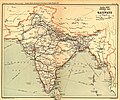 Railway map of India in 1909. Railway construction in India had begun in 1853.
 -
 A 1903 stereographic image of Victoria Terminus, Bombay, by Underwood and Underwood. The station was completed in 1888.


In terms of the longer lasting effects and legacies of the economic impact of the British Raj, the impact predominantly stems from the irregular investment of areas of infrastructure. Simon Carey explains how the investment into Indian society was 'narrowly focused' and favoured the growth of transportation of goods and workers.[8] Therefore, India has since seen an uneven economic development of society. For example, Acemoglu et al. (2001) identify how the inability of certain areas of rural India to cope with disease and famine best explain this uneven development of the nation.[9] Carey also points out that a lasting impact of the British Raj is the transformation of India into an agricultural trading economy.[8] Therefore, some areas of India, predominantly in affluent urban areas, have benefited from the legacies of the British Raj in the long term due to the transformation of Indian economic culture to a production based economy. However, the majority of Indian society has experienced a negative impact of the British Raj, especially in rural and suburban areas, due to the focus of investment into transport such as railways and canals rather than into healthcare and primary education.[original research?]
Beginnings of self-government[edit | edit source]
The first steps were taken toward self-government in British India in the late 19th century with the appointment of Indian counsellors to advise the British viceroy and the establishment of provincial councils with Indian members; the British subsequently widened participation in legislative councils with the Indian Councils Act 1892. Municipal Corporations and District Boards were created for local administration; they included elected Indian members
The Indian Councils Act 1909 – also known as the Morley-Minto Reforms (John Morley was the secretary of state for India, and Gilbert Elliot, fourth earl of Minto, was viceroy) – gave Indians limited roles in the central and provincial legislatures, known as legislative councils. Indians had previously been appointed to legislative councils, but after the reforms some were elected to them. At the centre, the majority of council members continued to be government-appointed officials, and the viceroy was in no way responsible to the legislature. At the provincial level, the elected members, together with unofficial appointees, outnumbered the appointed officials, but responsibility of the governor to the legislature was not contemplated. Morley made it clear in introducing the legislation to the British Parliament that parliamentary self-government was not the goal of the British government.
The Morley-Minto Reforms were a milestone. Step by step, the elective principle was introduced for membership in Indian legislative councils. The "electorate" was limited, however, to a small group of upper-class Indians. These elected members increasingly became an "opposition" to the "official government". The Communal electorates were later extended to other communities and made a political factor of the Indian tendency toward group identification through religion.
-
 John Morley, the Secretary of State for India from 1905 to 1910, and Gladstonian Liberal. The Indian Councils Act 1909, also known as the Minto-Morley Reforms allowed Indians to be elected to the Legislative Council.
 -
 Picture post card of the Gordon Highlanders marching past King George V and Queen Mary at the Delhi Durbar on 12 December 1911, when the King was crowned Emperor of India.
 -
 Indian medical orderlies attending to wounded soldiers with the Mesopotamian Expeditionary Force in Mesopotamia during World War I.


World War I and its causes[edit | edit source]
World War I would prove to be a watershed in the imperial relationship between Britain and India. 1.4 million Indian and British soldiers of the British Indian Army would take part in the war and their participation would have a wider cultural fallout: news of Indian soldiers fighting and dying with British soldiers, as well as soldiers from dominions like Canada, Australia and New Zealand, would travel to distant corners of the world both in newsprint and by the new medium of the radio.[10] India's international profile would thereby rise and would continue to rise during the 1920s.[10] It was to lead, among other things, to India, under its own name, becoming a founding member of the League of Nations in 1920 and participating, under the name, "Les Indes Anglaises" (The British Indies), in the 1920 Summer Olympics in Antwerp.[11] Back in India, especially among the leaders of the Indian National Congress, it would lead to calls for greater self-government for Indians[10] through sport.
In 1916, in the face of new strength demonstrated by the nationalists with the signing of the Lucknow Pact and the founding of the Home Rule leagues, and the realisation, after the disaster in the Mesopotamian campaign, that the war would likely last longer, the new Viceroy, Lord Chelmsford, cautioned that the Government of India needed to be more responsive to Indian opinion.[12] Towards the end of the year, after discussions with the government in London, he suggested that the British demonstrate their good faith – in light of the Indian war role – through a number of public actions, including awards of titles and honours to princes, granting of commissions in the army to Indians, and removal of the much-reviled cotton excise duty, but most importantly, an announcement of Britain's future plans for India and an indication of some concrete steps.[12] After more discussion, in August 1917, the new Liberal Secretary of State for India, Edwin Montagu, announced the British aim of "increasing association of Indians in every branch of the administration, and the gradual development of self-governing institutions, with a view to the progressive realization of responsible government in India as an integral part of the British Empire."[12] This envisioned reposing confidence in the educated Indians, so far disdained as an unrepresentative minority, who were described by Montague as "Intellectually our children".[13] The pace of the reforms where to be determined by Britain as and when the Indians were seen to have earned it.[13] However, although the plan envisioned limited self-government at first only in the provinces – with India emphatically within the British Empire – it represented the first British proposal for any form of representative government in a non-white colony.
Earlier, at the onset of World War I, the reassignment of most of the British army in India to Europe and Mesopotamia had led the previous Viceroy, Lord Harding, to worry about the "risks involved in denuding India of troops."[10] Revolutionary violence had already been a concern in British India; consequently in 1915, to strengthen its powers during what it saw was a time of increased vulnerability, the Government of India passed the Defence of India Act, which allowed it to intern politically dangerous dissidents without due process and added to the power it already had – under the 1910 Press Act – both to imprison journalists without trial and to censor the press.[14] Now, as constitutional reform began to be discussed in earnest, the British began to consider how new moderate Indians could be brought into the fold of constitutional politics and simultaneously, how the hand of established constitutionalists could be strengthened.[14] However, since the reform plan was devised during a time when extremist violence had ebbed as a result of increased wartime governmental control and it now feared a revival of revolutionary violence,[13] the government also began to consider how some of its wartime powers could be extended into peacetime.[14]

Consequently, in 1917, even as Edwin Montagu announced the new constitutional reforms, a sedition committee chaired by a British judge, Mr. S. A. T. Rowlatt, was tasked with investigating wartime revolutionary conspiracies and the German and Bolshevik links to the violence in India,[15][16][17] with the unstated goal of extending the government's wartime powers.[12] The Rowlatt committee presented its report in July 1918 and identified three regions of conspiratorial insurgency: Bengal, the Bombay presidency, and the Punjab.[12] To combat subversive acts in these regions, the committee recommended that the government use emergency powers akin to its wartime authority, which included the ability to try cases of sedition by a panel of three judges and without juries, exaction of securities from suspects, governmental overseeing of residences of suspects,[12] and the power for provincial governments to arrest and detain suspects in short-term detention facilities and without trial.[18]
With the end of World War I, there was also a change in the economic climate. By year's end 1919, 1.5 million Indians had served in the armed services in either combatant or non-combatant roles, and India had provided £146 million in revenue for the war.[19] The increased taxes coupled with disruptions in both domestic and international trade had the effect of approximately doubling the index of overall prices in India between 1914 and 1920.[19] Returning war veterans, especially in the Punjab, created a growing unemployment crisis[20] and post-war inflation led to food riots in Bombay, Madras, and Bengal provinces,[20] a situation that was made only worse by the failure of the 1918–19 monsoon and by profiteering and speculation.[19] The global influenza epidemic and the Bolshevik Revolution of 1917 added to the general jitters; the former among the population already experiencing economic woes,[20] and the latter among government officials, fearing a similar revolution in India.[21]
To combat what it saw as a coming crisis, the government now drafted the Rowlatt committee's recommendations into two Rowlatt Bills.[18] Although the bills were authorised for legislative consideration by Edwin Montagu, they were done so unwillingly, with the accompanying declaration, "I loathe the suggestion at first sight of preserving the Defence of India Act in peace time to such an extent as Rowlatt and his friends think necessary."[12] In the ensuing discussion and vote in the Imperial Legislative Council, all Indian members voiced opposition to the bills. The Government of India was nevertheless able to use of its "official majority" to ensure passage of the bills early in 1919.[12] However, what it passed, in deference to the Indian opposition, was a lesser version of the first bill, which now allowed extrajudicial powers, but for a period of exactly three years and for the prosecution solely of "anarchical and revolutionary movements," dropping entirely the second bill involving modification of the Indian Penal Code.[12] Even so, when it was passed the new Rowlatt Act aroused widespread indignation throughout India and brought Mohandas Gandhi to the forefront of the nationalist movement.[18]
Montagu–Chelmsford Report 1919[edit | edit source]
Meanwhile, Montagu and Chelmsford themselves finally presented their report in July 1918 after a long fact-finding trip through India the previous winter.[22] After more discussion by the government and parliament in Britain, and another tour by the Franchise and Functions Committee for the purpose of identifying who among the Indian population could vote in future elections, the Government of India Act 1919 (also known as the Montagu–Chelmsford Reforms) was passed in December 1919.[22] The new Act enlarged the provincial councils and converted the Imperial Legislative Council into an enlarged Central Legislative Assembly. It also repealed the Government of India's recourse to the "official majority" in unfavourable votes.[22] Although departments like defence, foreign affairs, criminal law, communications and income-tax were retained by the Viceroy and the central government in New Delhi, other departments like public health, education, land-revenue and local self-government were transferred to the provinces.[22] The provinces themselves were now to be administered under a new dyarchical system, whereby some areas like education, agriculture, infrastructure development, and local self-government became the preserve of Indian ministers and legislatures, and ultimately the Indian electorates, while others like irrigation, land-revenue, police, prisons, and control of media remained within the purview of the British governor and his executive council.[22] The new Act also made it easier for Indians to be admitted into the civil service and the army officer corps.
A greater number of Indians were now enfranchised, although, for voting at the national level, they constituted only 10% of the total adult male population, many of whom were still illiterate.[22] In the provincial legislatures, the British continued to exercise some control by setting aside seats for special interests they considered cooperative or useful. In particular, rural candidates, generally sympathetic to British rule and less confrontational, were assigned more seats than their urban counterparts.[22] Seats were also reserved for non-Brahmins, landowners, businessmen, and college graduates. The principal of "communal representation", an integral part of the Minto–Morley Reforms, and more recently of the Congress-Muslim League Lucknow Pact, was reaffirmed, with seats being reserved for Muslims, Sikhs, Indian Christians, Anglo-Indians, and domiciled Europeans, in both provincial and Imperial legislative councils.[22] The Montagu–Chelmsford reforms offered Indians the most significant opportunity yet for exercising legislative power, especially at the provincial level; however, that opportunity was also restricted by the still limited number of eligible voters, by the small budgets available to provincial legislatures, and by the presence of rural and special interest seats that were seen as instruments of British control.[22]

Round Table Conferences 1930–31–32[edit | edit source]
The three Round Table Conferences of 1930–32 were a series of consultations organised by the British government to discuss constitutional reforms in India. They were conducted on the advice of Muslim leader Muhammad Ali Jinnah to Viceroy Lord Irwin and Prime Minister Ramsay MacDonald,[23][24] and the recommendation of the report submitted by the Simon Commission in May 1930. Demands for swaraj, or self-rule, in India had been growing increasingly strong. By the 1930s, many British politicians believed that India needed to move towards dominion status. However, there were significant disagreements between the Indian and the British leaders that the conferences could not resolve.[25]

Willingdon imprisons leaders of Congress[edit | edit source]
In 1932 the Viceroy, Lord Willingdon, after the failure of the three Round Table Conferences (India) in London, now confronted Gandhi's Congress in action. The India Office told Willingdon that he should conciliate only those elements of Indian opinion that were willing to work with the Raj. That did not include Gandhi and the Indian National Congress, which launched its Civil Disobedience Movement on 4 January 1932. Therefore, Willingdon took decisive action.[26] He imprisoned Gandhi. He outlawed the Congress; he rounded up all members of the Working Committee and the Provincial Committees and imprisoned them; and he banned Congress youth organisations. In total he imprisoned 80,000 Indian activists. Without most of their leaders, protests were uneven and disorganised, boycotts were ineffective, illegal youth organisations proliferated but were ineffective, more women became involved, and there was terrorism, especially in the North-West Frontier Province. Gandhi remained in prison until 1933.[27][28] Willingdon relied on his military secretary, Hastings Ismay, for his personal safety.[29]
Communal Award: 1932[edit | edit source]
MacDonald, trying to resolve the critical issue of how Indians would be represented, on 16 August 1932 announced the Communal Award, which retained separate electorates for Muslims, Sikhs, and Europeans in India and increased the number of provinces that offered separate electorates to Anglo-Indians and Indian Christians. The Depressed Classes (now known as the Dalits) obtained a separate electorate. Gandhi, representing the Indian National Congress during negotiations, rejected separate electorates for the Depressed Classes, Europeans, Anglo-Indians, and Indian Christians because, according to historian Helen Nugent, he believed those separate electorates would weaken Congress' claim to be nationally representative. The award went into effect anyway.[30]
Government of India Act (1935)[edit | edit source]
In 1935, after the failure of the Round Table Conferences, the British Parliament approved the Government of India Act 1935, which authorized the establishment of independent legislative assemblies in all provinces of British India, the creation of a central government incorporating both the British provinces and the princely states, and the protection of Muslim minorities.[4] The future Constitution of independent India would owe a great deal to the text of this act.[31] The act also provided for a bicameral national parliament and an executive branch under the purview of the British government. Although the national federation was never realized, nationwide elections for provincial assemblies were held in 1937. Despite initial hesitation, the Congress took part in the elections and won victories in seven of the eleven provinces of British India,[32] and Congress governments, with wide powers, were formed in these provinces. In Great Britain, these victories were to later turn the tide for the idea of Indian independence.[32]
World War II[edit | edit source]
India played a major role in the Allied war effort against both Japan and Germany. It provided over 2 million soldiers, who fought numerous campaigns in the Middle East, and in the India-Burma front and also supplied billions of pounds to the British war effort. The Muslim and Sikh populations were strongly supportive of the British war effort, but the Hindu population was divided. Congress opposed the war, and tens of thousands of its leaders were imprisoned in 1942–45.[33][34][35] A major famine in eastern India led to hundreds of thousands of deaths by starvation, and remains a highly controversial issue regarding Churchill's reluctance to provide emergency food relief.[36]
With the outbreak of World War II in 1939, the viceroy, Lord Linlithgow, declared war on India's behalf without consulting Indian leaders, leading the Congress provincial ministries to resign in protest. The Muslim League, in contrast, supported Britain in the war effort; however, it now took the view that Muslims would be unfairly treated in an independent India dominated by the Congress. Hindus not affiliated with the Congress typically supported the war. The two major Sikh factions, the Unionists and the Akali Dal, supported Britain and successfully urged large numbers of Sikhs to volunteer for the army.[37]
Quit India movement or the Bharat Chhodo Andolan[edit | edit source]
The British sent a high level Cripps Mission in 1942 to secure Indian nationalists' co-operation in the war effort in exchange for postwar independence and dominion status. Congress demanded immediate independence and the mission failed. Gandhi then launched the Quit India Movement in August 1942, demanding the immediate withdrawal of the British from India or face nationwide civil disobedience. Along with thousands of other Congress leaders, Gandhi was immediately imprisoned, and the country erupted in violent local episodes led by students and later by peasant political groups, especially in Eastern United Provinces, Bihar, and western Bengal. According to John F. Riddick, from 9 August 1942 to 21 September 1942, the Quit India movement:
- attacked 550 post offices, 250 railway stations, damaged many rail lines, destroyed 70 police stations, and burned or damaged 85 other government buildings. There were about 2,500 instances of telegraph wires being cut....The Government of India deployed 57 battalions of British troops to restore order.[38]
The police and army crushed the resistance in months. Nationalist leaders were imprisoned until the end of World War 2.[39]
Ultimately, the British government realised that India was ungovernable in the long run, and the question for the postwar era became how to exit gracefully and peacefully.
In 1945, when the World War 2 had almost come to an end, the Labour Party of the United Kingdom won elections with a promise to provide independence to India.[40][41] The jailed political prisoners were released the same year.[42]
Bose and the Indian National Army (INA)[edit | edit source]
Subhas Chandra Bose, who had been ousted from the Congress Party in 1939 following differences with the more conservative high command,[43] turned to Germany and Japan for help with liberating India by force.[44] With Japanese support, he organised the Indian National Army, composed largely of Indian soldiers of the British Indian army who had been captured at Singapore by the Japanese, including many Sikhs as well as Hindus and Muslims. Japan's secret service had promoted unrest in Southeast Asia to destabilise the British war effort,[45] and came to support a number of puppet and provisional governments in regions under their occupation, such as those of Burma, the Philippines and Vietnam; similarly supported was the Provisional Government of Azad Hind (Free India), presided over by Bose.[46][44] Bose's effort, however, was short lived; after the reverses of 1944, the reinforced British Indian Army in 1945 first halted and then reversed the Japanese U Go offensive, beginning the successful part of the Burma Campaign.
Bose's Indian National Army surrendered with the recapture of Singapore; Bose died in a plane crash soon thereafter.
The British demanded trials for INA officers, but public opinion—including Congress and even the Indian Army—saw the INA as fighting for Indian independence and demanded a termination. The British eventually backtracked in the face of opposition by the Congress.[47][48] These trials became a galvanising point in the Indian Independence movement for the Indian National Congress.[49][50]
Finances[edit | edit source]
Britain borrowed everywhere it could and made heavy purchases of equipment and supplies in India during the war.[51] Previously India owed Britain large sums; now it was reversed.[52] Britain's sterling balances around the world amounted to £3.4 billion in 1945; India's share was £1.3 billion (equivalent to $US 74 billion in 2016 dollars.)[53][54] In this way the Raj treasury accumulated very large sterling reserves of British pounds that was owed to it by the British treasury. However, Britain treated this as a long-term loan with no interest and no specified repayment date. Just when the money would be made available by London was an issue, for the British treasury was nearly empty by 1945. India's balances totalled to Rs. 17.24 billion in March 1946; of that sum Rs. 15.12 billion [£1.134 billion] was split between India and Pakistan when they became independent in August 1947. They finally got the money and India spent all its share by 1957 which included buying back British owned assets in India.[55]
Transfer of power[edit | edit source]

The All India Azad Muslim Conference gathered in Delhi in April 1940 to voice its support for an independent and united India.[56] Its members included several Islamic organisations in India, as well as 1400 nationalist Muslim delegates.[57][58][59] The pro-separatist All-India Muslim League worked to try to silence those nationalist Muslims who stood against the partition of India, often using "intimidation and coercion".[59][58] The murder of the All India Azad Muslim Conference leader Allah Bakhsh Soomro also made it easier for the All-India Muslim League to demand the creation of a Pakistan.[59]
In January 1946, a number of mutinies broke out in the armed services, starting with that of RAF servicemen frustrated with their slow repatriation to Britain.[60] The mutinies came to a head with mutiny of the Royal Indian Navy in Bombay in February 1946, followed by others in Calcutta, Madras, and Karachi. Although the mutinies were rapidly suppressed, they found much public support in India and spurred the new Labour government in Britain to action, and leading to the Cabinet Mission to India led by the Secretary of State for India, Lord Pethick Lawrence, and including Sir Stafford Cripps, who had visited four years before.[60]
Also in early 1946, new elections were called in India in which the Congress won electoral victories in eight of the eleven provinces.[61] However, the negotiations between the Congress and the Muslim League stumbled over the issue of the partition. Jinnah proclaimed 16 August 1946, Direct Action Day, with the stated goal of peacefully highlighting the demand for a Muslim homeland in British India. The following day, Hindu-Muslim riots broke out in Calcutta and they quickly spread throughout India. Although the Government of India and the Congress were both shaken by the course of events, in September, a Congress-led interim government was installed, with Jawaharlal Nehru serving as united India's prime minister.
Later that year, the Labour government in Britain, its exchequer exhausted by the recently concluded World War II, decided to end British rule of India, and in early 1947, Britain announced its intention to transfer power no later than June 1948.
As independence approached, the violence between Hindus and Muslims in the provinces of Punjab and Bengal continued unabated. With the British army unprepared for the potential for increased violence, the new viceroy, Louis Mountbatten, advanced the date for the transfer of power, allowing less than six months for a mutually agreed plan for independence. In June 1947, the nationalist leaders, including Nehru and Abul Kalam Azad on behalf of the Congress, Jinnah representing the pro-separatist Muslim League, B. R. Ambedkar representing the Untouchable community, and Master Tara Singh representing the Sikhs, agreed to a partition of the country in opposition to Gandhi's views. In the years leading up to the partition of India, the pro-separatist All-India Muslim League violently drove out Hindus and Sikhs from the western Punjab.[62]
Many millions of Muslim, Sikh, and Hindu refugees trekked across the newly drawn borders. In Punjab, where the new border lines divided the Sikh regions in half, massive bloodshed followed; in Bengal and Bihar, where Gandhi's presence assuaged communal tempers, the violence was more limited. In all, anywhere between 250,000 and 500,000 people on both sides of the new borders died in the violence.[63] On 14 August 1947, the new Dominion of Pakistan came into being, with Muhammad Ali Jinnah sworn in as its first Governor General in Karachi. The following day, 15 August 1947, India, now a smaller Union of India, became an independent country with official ceremonies taking place in New Delhi, with Jawaharlal Nehru assuming the office of the prime minister, and the viceroy, Louis Mountbatten, stayed on as its first Governor General.
See also[edit | edit source]
Notes[edit | edit source]
- ↑ The Dutch East India Company was the first to issue public stock.
- ↑ (Stein 2010, p. 248), (Oldenburg 2007)
- ↑ (Oldenburg 2007), (Stein 2010, pp. 248–249)
- ↑ 4.0 4.1 (Oldenburg 2007)
- ↑ 5.0 5.1 (Stein 2010, p. 248)
- ↑ 6.0 6.1 6.2 (Stein 2010, p. 249)
- ↑ Masani, Zareer (2022). "THE BRITISH RAJ: An Assessment".
- ↑ 8.0 8.1 Carey 2012
- ↑ Acemoglu, Johnson & Robinson 2001
- ↑ 10.0 10.1 10.2 10.3 Brown 1994, pp. 197–198
- ↑ Olympic Games Antwerp 1920: Official Report Archived 5 May 2011 at the Wayback Machine, Nombre de bations representees, p. 168. Quote: "31 Nations avaient accepté l'invitation du Comité Olympique Belge:... la Grèce – la Hollande Les Indes Anglaises – l'Italie – le Japon ..."
- ↑ 12.0 12.1 12.2 12.3 12.4 12.5 12.6 12.7 12.8 Brown 1994, pp. 203–204
- ↑ 13.0 13.1 13.2 Metcalf & Metcalf 2006, p. 166
- ↑ 14.0 14.1 14.2 Brown 1994, pp. 201–203
- ↑ Lovett 1920, pp. 94, 187–191
- ↑ Sarkar 1921, p. 137
- ↑ Tinker 1968, p. 92
- ↑ 18.0 18.1 18.2 Spear 1990, p. 190
- ↑ 19.0 19.1 19.2 Brown 1994, pp. 195–196
- ↑ 20.0 20.1 20.2 Stein 2010, p. 294
- ↑ Ludden 2002, p. 208
- ↑ 22.0 22.1 22.2 22.3 22.4 22.5 22.6 22.7 22.8 Brown 1994, pp. 205–207
- ↑ Wolpert, Stanley (2013). Jinnah of Pakistan (15 ed.). Karachi, Pakistan: Oxford University Press. p. 107. ISBN 978-0-19-577389-7.
- ↑ Wolpert, Stanley (2006). Shameful Flight. Oxford University Press. pp. 5–6. ISBN 978-0-19-515198-5.
- ↑ Hoiberg, Dale (2000). Students' Britannica India. Popular Prakashan. p. 309. ISBN 9780852297605.
- ↑ John F. Riddick (2006). The History of British India: A Chronology. Greenwood. p. 110. ISBN 9780313322808.
- ↑ Brian Roger Tomlinson, The Indian National Congress and the Raj, 1929–1942: the penultimate phase (Springer, 1976).
- ↑ Rosemary Rees. India 1900–47 (Heineman, 2006) p 122
- ↑ Ismay, Hastings (1974) [First published 1960]. The Memoirs of General Lord Ismay (Reprint ed.). New York: Viking Press. p. 66. ISBN 978-0-8371-6280-5.
- ↑ Nugent, Helen M. (1979). "The communal award: The process of decision-making". South Asia: Journal of South Asian Studies. 2 (1–2): 112–129. doi:10.1080/00856407908722988.
- ↑ (Low 1993, pp. 40, 156)
- ↑ 32.0 32.1 (Low 1993, p. 154)
- ↑ Srinath Raghavan, India's War: World War II and the Making of Modern South Asia (2016).
- ↑ Yasmin Khan, India At War: The Subcontinent and the Second World War (2015).
- ↑ Lawrence James, Raj: the making and remaking of British India (1997) pp 545–85
- ↑ Madhusree Mukerjee, Churchill's Secret War: The British Empire and the Ravaging of India during World War II (2010).
- ↑ Robin Jeffrey (2016). What's Happening to India?: Punjab, Ethnic Conflict, and the Test for Federalism. Springer. pp. 68–69. ISBN 9781349234103.
- ↑ John F. Riddick, The History of British India: A Chronology (2006) p 115
- ↑ Srinath Raghavan, India's War: World War II and the Making of Modern South Asia (2016) pp 233–75.
- ↑ Studlar, D.T. (2018). Great Britain: Decline Or Renewal?. Taylor & Francis. p. 117. ISBN 978-0-429-96865-5.
The Labour Party promised independence for India in its campaign in the general election of 1945.
- ↑ Ram, J. (1997). V.K. Krishna Menon: A Personal Memoir. Oxford University Press. p. 76. ISBN 978-0-19-564228-5.
Labour Party had promised freedom for India if they came to power
- ↑ Naveen Sharma (1990). Right to Property in India. Deep & Deep Publications. p. 36.
- ↑ Chaudhuri 1953, p. 355
- ↑ 44.0 44.1 Low 1993, p. 31
- ↑ Lebra 1977, p. 23
- ↑ Lebra 1977, p. 31
- ↑ Moreman, Tim (2013). The Jungle, Japanese and the British Commonwealth Armies at War, 1941–45: Fighting Methods, Doctrine and Training for Jungle Warfare. Routledge. ISBN 978-1-135-76456-2.
- ↑ Marston2014, pp. 130–132: "Many Indian Army POWs were perplexed by Congress's sudden support for the INA"
- ↑ Singh 2003, p. 98.
- ↑ Sarkar 1983, p. 420
- ↑ Dharma Kumar (1983). "The Fiscal System". In Dharma Kumar; Meghnad Desai (eds.). The Cambridge Economic History of India. Vol. 2. Cambridge University Press. pp. 942–944. ISBN 0-521-22802-6.
- ↑ Srinath Raghavan, India's War: World War II and the Making of Modern South Asia (2016) pp 339–47.
- ↑ See "Pounds Sterling to Dollars: Historical Conversion of Currency"
- ↑ Marcelo de Paiva Abreu, "India as a creditor: sterling balances, 1940–1953." (Department of Economics, Pontifical Catholic University of Rio de Janeiro, 2015) online
- ↑ Uma Kapila (2005). Indian Economy. Academic Foundation. p. 23. ISBN 9788171884292.
- ↑ Qasmi, Ali Usman; Robb, Megan Eaton (2017). Muslims against the Muslim League: Critiques of the Idea of Pakistan. Cambridge University Press. p. 2. ISBN 9781108621236.
- ↑ Haq, Mushir U. (1970). Muslim politics in modern India, 1857-1947. Meenakshi Prakashan. p. 114.
This was also reflected in one of the resolutions of the Azad Muslim Conference, an organization which attempted to be representative of all the various nationalist Muslim parties and groups in India.
- ↑ 58.0 58.1 Ahmed, Ishtiaq (27 May 2016). "The dissenters". The Friday Times.
However, the book is a tribute to the role of one Muslim leader who steadfastly opposed the Partition of India: the Sindhi leader Allah Bakhsh Soomro. Allah Bakhsh belonged to a landed family. He founded the Sindh People's Party in 1934, which later came to be known as 'Ittehad' or 'Unity Party'. ... Allah Bakhsh was totally opposed to the Muslim League's demand for the creation of Pakistan through a division of India on a religious basis. Consequently, he established the Azad Muslim Conference. In its Delhi session held during April 27–30, 1940 some 1400 delegates took part. They belonged mainly to the lower castes and working class. The famous scholar of Indian Islam, Wilfred Cantwell Smith, feels that the delegates represented a 'majority of India's Muslims'. Among those who attended the conference were representatives of many Islamic theologians and women also took part in the deliberations ... Shamsul Islam argues that the All-India Muslim League at times used intimidation and coercion to silence any opposition among Muslims to its demand for Partition. He calls such tactics of the Muslim League as a 'Reign of Terror'. He gives examples from all over India including the NWFP where the Khudai Khidmatgars remain opposed to the Partition of India.
- ↑ 59.0 59.1 59.2 Ali, Afsar (17 July 2017). "Partition of India and Patriotism of Indian Muslims". The Milli Gazette.
- ↑ 60.0 60.1 (Judd 2004, pp. 172–173)
- ↑ (Judd 2004, p. 172)
- ↑ Abid, Abdul Majeed (29 December 2014). "The forgotten massacre". The Nation.
On the same dates, Muslim League-led mobs fell with determination and full preparations on the helpless Hindus and Sikhs scattered in the villages of Multan, Rawalpindi, Campbellpur, Jhelum and Sargodha. The murderous mobs were well supplied with arms, such as daggers, swords, spears and fire-arms. (A former civil servant mentioned in his autobiography that weapon supplies had been sent from the NWFP and money was supplied by Delhi-based politicians.) They had bands of stabbers and their auxiliaries, who covered the assailant, ambushed the victim and disposed of his body if necessary. These bands were monetarily subsidized by the Muslim League, and cash payments were made to individual assassins based on the numbers of Hindus and Sikhs who they had killed. There were also regular patrolling parties in jeeps which went about sniping and picking off any stray Hindus and Sikhs. ... Thousands of non-combatants including women and children were killed or injured by mobs, supported by the All India Muslim League.
- ↑ (Khosla 2001, p. 299)
Surveys and reference books[edit | edit source]
- Bandyopadhyay, Sekhar (2004), From Plassey to Partition: A History of Modern India, Orient Longmans. Pp. xx, 548., ISBN 81-250-2596-0.
- Brown, Judith M. (1994), Modern India: The Origins of an Asian Democracy, Oxford University Press. Pp. xiii, 474, ISBN 0-19-873113-2.
- Buckland, C.E. Dictionary of Indian Biography (1906) 495pp full text
- Copland, Ian (2001), India 1885–1947: The Unmaking of an Empire (Seminar Studies in History Series), Pearson Longmans. Pp. 160, ISBN 0-582-38173-8.
- Judd, Dennis (2004), The Lion and the Tiger: The Rise and Fall of the British Raj, 1600–1947, Oxford University Press. Pp. xiii, 280, ISBN 0-19-280358-1.
- Keay, John (2000), India: A History, New York: Atlantic Monthly Press, ISBN 0-87113-800-X
- Ludden, David (2002), India And South Asia: A Short History, Oxford: Oneworld Publications. Pp. xii, 306, ISBN 1-85168-237-6, archived from the original on 16 July 2011, retrieved 4 May 2008
- Markovits, Claude, ed. (2005), A History of Modern India 1480–1950 (Anthem South Asian Studies), Anthem Press. Pp. 607, ISBN 1-84331-152-6.
- Metcalf, Barbara; Metcalf, Thomas R. (2006), A Concise History of Modern India (Cambridge Concise Histories), Cambridge University Press. Pp. xxxiii, 372, ISBN 0-521-68225-8.
- Peers, Douglas M. (2006), India under Colonial Rule 1700–1885, Pearson Longmans. Pp. xvi, 163, ISBN 0-582-31738-X.
- Rees, Rosemary. India 1900–47 (Heineman, 2006), textbook.
- Riddick, John F. Who Was Who in British India (1998); 5000 entries excerpt
- Robb, Peter (2004), A History of India (Palgrave Essential Histories), Palgrave Macmillan. Pp. xiv, 344, ISBN 0-333-69129-6.
- Sarkar, Sumit (1983), Modern India: 1885–1947, Macmillan India Ltd. Pp. xiv, 486, ISBN 0-333-90425-7.
- Spear, Percival (1990), A History of India, Volume 2, Penguin Books. Pp. 298, ISBN 0-14-013836-6.
- Stein, Burton (2010) [First published 1998], Arnold, David (ed.), A History of India (2nd ed.), John Wiley & Sons, ISBN 978-1-4051-9509-6.
- Wolpert, Stanley (2003), A New History of India, Oxford University Press. Pp. 544, ISBN 0-19-516678-7.
Monographs and collections[edit | edit source]
- Bayly, C. A. (1990), Indian Society and the Making of the British Empire (The New Cambridge History of India), Cambridge University Press. Pp. 248, ISBN 0-521-38650-0.
- Bayly, C. A. (2000), Empire and Information: Intelligence Gathering and Social Communication in India, 1780–1870 (Cambridge Studies in Indian History and Society), Cambridge University Press. Pp. 426, ISBN 0-521-66360-1
- Brown, Judith M.; Louis, Wm. Roger, eds. (2001), Oxford History of the British Empire: The Twentieth Century, Oxford University Press. Pp. 800, ISBN 0-19-924679-3
- Chandavarkar, Rajnarayan (1998), Imperial Power and Popular Politics: Class, Resistance and the State in India, 1850–1950, (Cambridge Studies in Indian History & Society). Cambridge University Press. Pp. 400, ISBN 0-521-59692-0.
- Copland, Ian (2002), Princes of India in the Endgame of Empire, 1917–1947, (Cambridge Studies in Indian History & Society). Cambridge University Press. Pp. 316, ISBN 0-521-89436-0.
- Gilmartin, David. 1988. Empire and Islam: Punjab and the Making of Pakistan. Berkeley: University of California Press. 258 pages. ISBN 0-520-06249-3.
- Gould, William (2004), Hindu Nationalism and the Language of Politics in Late Colonial India, (Cambridge Studies in Indian History and Society). Cambridge University Press. Pp. 320, ISBN 0-521-83061-3.
- Hyam, Ronald (2007), Britain's Declining Empire: The Road to Decolonisation 1918–1968., Cambridge University Press., ISBN 978-0-521-86649-1.
- Jalal, Ayesha (1993), The Sole Spokesman: Jinnah, the Muslim League and the Demand for Pakistan, Cambridge University Press, 334 pages, ISBN 0-521-45850-1.
- Khan, Yasmin (2007), The Great Partition: The Making of India and Pakistan, Yale University Press, 250 pages, ISBN 978-0-300-12078-3
- Khosla, G. D. (2001), "Stern Reckoning", in Page, David; Inder Singh, Anita; Moon, Penderal; Khosla, G. D.; Hasan, Mushirul (eds.), The Partition Omnibus: Prelude to Partition/the Origins of the Partition of India 1936-1947/Divide and Quit/Stern Reckoning, Oxford University Press, ISBN 0-19-565850-7
- Lebra, Joyce C. (1977), Japanese Trained Armies in South-East Asia, Columbia University Press, ISBN 0-231-03995-6
- Low, D. A. (1993), Eclipse of Empire, Cambridge University Press. Pp. xvi, 366, ISBN 0-521-45754-8.
- Low, D. A. (2002), Britain and Indian Nationalism: The Imprint of Amibiguity 1929–1942, Cambridge University Press. Pp. 374, ISBN 0-521-89261-9.
- Low, D. A., ed. (2004) [1977], Congress & the Raj: Facets of the Indian Struggle 1917–47, Oxford University Press. Pp. xviii, 513, ISBN 0-19-568367-6.
- Marston, Daniel (2014), The Indian Army and End of the Raj, Cambridge University Press, ISBN 978-0-521-89975-8
- Metcalf, Thomas R. (1991), The Aftermath of Revolt: India, 1857–1870, Riverdale Co. Pub. Pp. 352, ISBN 81-85054-99-1
- Metcalf, Thomas R. (1997), Ideologies of the Raj, Cambridge University Press, Pp. 256, ISBN 0-521-58937-1
- Porter, Andrew, ed. (2001), Oxford History of the British Empire: Nineteenth Century, Oxford University Press. Pp. 800, ISBN 0-19-924678-5
- Ramusack, Barbara (2004), The Indian Princes and their States (The New Cambridge History of India), Cambridge University Press. Pp. 324, ISBN 0-521-03989-4
- Shaikh, Farzana. 1989. Community and Consensus in Islam: Muslim Representation in Colonial India, 1860—1947. Cambridge, UK: Cambridge University Press. 272 pages. ISBN 0-521-36328-4.
- Singh, Harkirat (2003), INA Trials and the Raj, Atlantic Publishers, ISBN 81-269-0316-3
- Wolpert, Stanley (2006), Shameful Flight: The Last Years of the British Empire in India, Oxford University Press, ISBN 978-0-19-515198-5.
Articles in journals or collections[edit | edit source]
- Acemoglu, Daron; Johnson, Simon; Robinson, James A. (December 2001), "The Colonial Origins of Comparative Development: An Empirical Investigation", The American Economic Review, 91 (5): 1369–1401, doi:10.1257/aer.91.5.1369, JSTOR 2677930
- Banthia, Jayant; Dyson, Tim (December 1999), "Smallpox in Nineteenth-Century India", Population and Development Review, 25 (4), Population Council: 649–689, doi:10.1111/j.1728-4457.1999.00649.x, JSTOR 172481, PMID 22053410
- Brown, Judith M. (2001), "India", in Brown, Judith M.; Louis, Wm. Roger (eds.), Oxford History of the British Empire: The Twentieth Century, Oxford University Press, pp. 421–446, ISBN 0-19-924679-3
- Carey, Simon (2012), "The Legacy of British Colonialism in India Post 1947", The New Zealand Review of Economics and Finance, 2: 37–47, ISSN 2324-478X
- Chaudhuri, Niradh C. (December 1953), "Subhas Chandra Bose: His Legacy and Legend", Pacific Affairs, 26 (4): 349–357, JSTOR 2752872
- Derbyshire, I. D. (1987), "Economic Change and the Railways in North India, 1860–1914", Population Studies, 21 (3), Cambridge University Press: 521–545, doi:10.1017/s0026749x00009197, JSTOR 312641, S2CID 146480332
- Dyson, Tim (March 1991), "On the Demography of South Asian Famines: Part I", Population Studies, 45 (1), Taylor & Francis: 5–25, doi:10.1080/0032472031000145056, JSTOR 2174991, PMID 11622922
- Dyson, Tim (July 1991), "On the Demography of South Asian Famines: Part II", Population Studies, 45 (2), Taylor & Francis: 279–297, doi:10.1080/0032472031000145446, JSTOR 2174784, PMID 11622922
- Gilmartin, David (November 1994), "Scientific Empire and Imperial Science: Colonialism and Irrigation Technology in the Indus Basin", The Journal of Asian Studies, 53 (4), Association for Asian Studies: 1127–1149, doi:10.2307/2059236, JSTOR 2059236, S2CID 161655860
- Goswami, Manu (October 1998), "From Swadeshi to Swaraj: Nation, Economy, Territory in Colonial South Asia, 1870 to 1907", Comparative Studies in Society and History, 40 (4), Cambridge University Press: 609–636, doi:10.1017/s0010417598001674, JSTOR 179304, S2CID 145013372
- Harnetty, Peter (July 1991), "'Deindustrialization' Revisited: The Handloom Weavers of the Central Provinces of India, c. 1800–1947", Modern Asian Studies, 25 (3), Cambridge University Press: 455–510, doi:10.1017/S0026749X00013901, JSTOR 312614, S2CID 144468476
- Klein, Ira (1988), "Plague, Policy and Popular Unrest in British India", Modern Asian Studies, 22 (4), Cambridge University Press: 723–755, doi:10.1017/s0026749x00015729, JSTOR 312523, PMID 11617732, S2CID 42173746
- Klein, Ira (July 2000), "Materialism, Mutiny and Modernization in British India", Modern Asian Studies, 34 (3), Cambridge University Press: 545–580, doi:10.1017/S0026749X00003656, JSTOR 313141, S2CID 143348610
- Moore, Robin J. (2001a), "Imperial India, 1858–1914", in Porter, Andrew (ed.), Oxford History of the British Empire: The Nineteenth Century, Oxford University Press, pp. 422–446, ISBN 0-19-924678-5
- Moore, Robin J. (2001b), "India in the 1940s", in Winks, Robin (ed.), Oxford History of the British Empire: Historiography, Oxford University Press, pp. 231–242, ISBN 0-19-924680-7
- Overby, Stephanie (17 May 2019), "The top 10 IT outsourcing service providers of the year", CIO
- Ray, Rajat Kanta (July 1995), "Asian Capital in the Age of European Domination: The Rise of the Bazaar, 1800–1914", Modern Asian Studies, 29 (3), Cambridge University Press: 449–554, doi:10.1017/S0026749X00013986, JSTOR 312868, S2CID 145744242
- Raychaudhuri, Tapan (2001), "India, 1858 to the 1930s", in Winks, Robin (ed.), Oxford History of the British Empire: Historiography, Oxford University Press, pp. 214–230, ISBN 0-19-924680-7
- Robb, Peter (May 1997), "The Colonial State and Constructions of Indian Identity: An Example on the Northeast Frontier in the 1880s", Modern Asian Studies, 31 (2), Cambridge University Press: 245–283, doi:10.1017/s0026749x0001430x, JSTOR 313030, S2CID 145299102
- Roy, Tirthankar (Summer 2002), "Economic History and Modern India: Redefining the Link", The Journal of Economic Perspectives, 16 (3), American Economic Association: 109–130, doi:10.1257/089533002760278749, JSTOR 3216953
- Sarkar, Benoy Kumar (March 1921), "A History of the Indian Nationalist Movement. by Verney Lovett", Political Science Quarterly (Review), 36 (1): 136–138, doi:10.2307/2142669, hdl:2027/coo1.ark:/13960/t3nw01g05, JSTOR 2142669
- Simmons, Colin (1985), "'De-Industrialization', Industrialization and the Indian Economy, c. 1850–1947", Modern Asian Studies, 19 (3), Cambridge University Press: 593–622, doi:10.1017/s0026749x00007745, JSTOR 312453, S2CID 144581168
- Talbot, Ian (2001), "Pakistan's Emergence", in Winks, Robin (ed.), Oxford History of the British Empire: Historiography, Oxford University Press, pp. 253–263, ISBN 0-19-924680-7
- Tinker, Hugh (1968), "India in the First World War and after.", Journal of Contemporary History, 3 (4), Sage Publications: 89–107, doi:10.1177/002200946800300407, ISSN 0022-0094, S2CID 150456443.
- Tomlinson, B. R. (2001), "Economics and Empire: The Periphery and the Imperial Economy", in Porter, Andrew (ed.), Oxford History of the British Empire: The Nineteenth Century, Oxford University Press, pp. 53–74, ISBN 0-19-924678-5
- Washbrook, D. A. (2001), "India, 1818–1860: The Two Faces of Colonialism", in Porter, Andrew (ed.), Oxford History of the British Empire: The Nineteenth Century, Oxford University Press, pp. 395–421, ISBN 0-19-924678-5
- Watts, Sheldon (November 1999), "British Development Policies and Malaria in India 1897-c. 1929", Past & Present (165), Oxford University Press: 141–181, doi:10.1093/past/165.1.141, JSTOR 651287, PMID 22043526
- Wylie, Diana (2001), "Disease, Diet, and Gender: Late Twentieth Century Perspectives on Empire", in Winks, Robin (ed.), Oxford History of the British Empire: Historiography, Oxford University Press, pp. 277–289, ISBN 0-19-924680-7
Classic histories and gazetteers[edit | edit source]
- Imperial Gazetteer of India vol. IV (1907), The Indian Empire, Administrative, Clarendon Press. Pp. xxx, 1 map, 552.
- Lovett, Sir Verney (1920), A History of the Indian Nationalist Movement, Frederick A. Stokes Company
- Majumdar, R. C.; Raychaudhuri, H. C.; Datta, Kalikinkar (1950), An Advanced History of India, Macmillan and Company Limited. 2nd edition. Pp. xiii, 1122, 7 maps, 5 coloured maps..
- Smith, Vincent A. (1921), India in the British Period: Being Part III of the Oxford History of India, Clarendon Press. 2nd edition. Pp. xxiv, 316 (469–784).
Tertiary sources[edit | edit source]
- Oldenburg, Philip (2007), "India: Movement for Freedom", Encarta Encyclopedia
{{citation}}: CS1 maint: deprecated archival service (link). - Wolpert, Stanley (2007), "India: British Imperial Power 1858–1947 (Indian nationalism and the British response, 1885–1920; Prelude to Independence, 1920–1947)", Encyclopædia Britannica.