


robot: Create/upgrade articles. If there is a mistake please report on my talk page. |
AnnettLevi9 (talk | contribs) enhanced lead based on references |
||
| Line 1: | Line 1: | ||
{{ | {{Short description|Poet and journalist (1874-1956)}} | ||
{{Use dmy dates|date=April | {{Use Pakistani English|date=January 2024}} | ||
{{Use dmy dates|date=April 2020}} | |||
{{Infobox person | {{Infobox person | ||
| name = Zafar Ali Khan | | name = Zafar Ali Khan | ||
| image = | | image = Maulana Zafar Ali Khan.jpg | ||
| caption = | | caption = Zafar Ali Khan in 1937 | ||
| birth_name = | | birth_name = | ||
| birth_date = | | birth_date = 1873 | ||
| birth_place = Kot | | birth_place = Kot Marath, [[Sialkot District]], [[Punjab Province (British India)|Punjab]], [[British Raj|British India]] (today [[Pakistan]]) | ||
| death_date = {{ | | death_date = {{death date and age|df=y|1956|11|27|1873}} | ||
| death_place = [[Wazirabad]], [[West Pakistan]], | | death_place = [[Wazirabad]], [[West Pakistan]], Pakistan | ||
| occupation = Poet | | occupation = Islamic scholar <br> Poet <br> Journalist | ||
| relatives = [[Raja Mehdi Ali Khan]] (nephew) | |||
| awards = | | awards = | ||
| imagesize = | | imagesize = | ||
| yearsactive = | | yearsactive = | ||
| Line 18: | Line 19: | ||
}} | }} | ||
[[File:Tomb of Mulana Zafar Ali Khan.jpg|thumb|Tomb of Zafar Ali Khan]] | |||
==Early life== | '''Zafar Ali Khan'''{{Efn|{{langx|ur|{{nastaliq|ظفر علی خان}}|Ẓafar ʿAlī Khān}}}} (1873 – 27 November 1956) was a Pakistani writer, poet, translator and a journalist who used his journalism against the [[British rule]].<ref name="Daechsel2002">{{cite book|author=Markus Daechsel|title=Politics of Self-Expression|url=https://books.google.com/books?id=HsZvwVAlnKIC&pg=PA64|access-date=4 July 2018|date=1 June 2002|publisher=Routledge|via= Google Books|isbn=978-1-134-38371-9|pages=64–}}</ref> He was one of the [[Majlis-e-Ahrar-e-Islam]]'s founding members.<ref name="books.google.com">Ahmad, Syed N. ''[https://books.google.com/books?id=wzm36rEol3sC Origins of Muslim consciousness in India: a world-system perspective]''. New York u.a: Greenwood Press, 1991. p. 175</ref> | ||
Zafar was born into a Punjabi [[ | |||
Well-versed in Islamic as well Western knowledge such as the latest trends in economics, sociology and politics, he has been considered as one of the fathers of [[Urdu]] journalism.<ref>{{Cite news |date=27 November 2014 |title=Maulana Zafar Ali Khan (profile)|url=https://www.nation.com.pk/27-Nov-2014/maulana-zafar-ali-khan |newspaper=The Nation newspaper|access-date=28 January 2024}}</ref> | |||
==Early life and education== | |||
Zafar was born in the [[Sialkot District]] in 1873 into a [[Punjabi Muslims|Punjabi]] family of the [[Muslim Rajputs|Rajput]] [[Janjua]] clan,<ref>{{Cite book |last1=Lord William|first1= Hunter|first2=Narayan |last2=Jagat | |||
|date=1920 |title=Report of the Committee Appointed in the Government of India to Investigate the Disturbances in the Punjab, Etc|url=https://books.google.com/books?id=Vuk2AQAAMAAJ&dq=Jat+Janjuah&pg=PA253|volume=5|pages=253}}</ref> as per the contemporary report of 1920. | |||
He received his early education at Mission High School, [[Wazirabad]], [[Wazirabad District]],<ref name="storyofpakistan">{{cite web|url=https://storyofpakistan.com/maulana-zafar-ali-khan/ |title=Profile of Zafar Ali Khan| website=Storyofpakistan.com website|date= 1 January 2007|access-date= 28 January 2024|url-status=dead|archive-date=14 January 2023|archive-url=https://web.archive.org/web/20230114154804/https://storyofpakistan.com/maulana-zafar-ali-khan/}}</ref> [[matriculate]]d (10th grade) from [[Patiala]], and passed his [[Faculty in Arts (certificate)|intermediate]] (12th grade) from the [[Aligarh Muslim University|Aligarh College]] in 1895. Next, he worked in the [[Post office|postal department]] of the princely state of [[Jammu and Kashmir (princely state)|Jammu and Kashmir]], the same place where his father worked, but resigned over a row with his seniors.<ref name="storyofpakistan" /><ref name="Maulana Zafar Ali Khan 1874-1956">{{cite web |url=http://www.journalismpakistan.com/hall-detail.php?hallid=32&pageid=famed |title=Profile of Maulana Zafar Ali Khan (1874–1956) |publisher=Journalismpakistan.com website |access-date=4 July 2018 |archive-date=5 July 2018 |archive-url=https://web.archive.org/web/20180705003934/http://www.journalismpakistan.com/hall-detail.php?hallid=32&pageid=famed |url-status=dead }}</ref> He rejoined Aligarh College and gained his BA degree from there; stood fifth in his batch. | |||
== Career == | == Career == | ||
=== Journalism === | |||
After graduation, Khan was appointed secretary to a Muslim political leader [[Mohsin-ul-Mulk]], then in [[Bombay]]. Then he worked for some time as a translator in [[Hyderabad state|Hyderabad]], [[Deccan Plateau|Deccan]], rising to the post of Secretary, Home Department. He returned from Hyderabad and took over the daily [[Zamindar (newspaper)|Zamindar]] newspaper from [[Lahore]] in 1908, founded by his father Maulvi Sirajuddin Ahmad in 1903. At one time, this newspaper was an important newspaper of the Punjab.<ref name=storyofpakistan/><ref name=cybercity/><ref name="Maulana Zafar Ali Khan 1874-1956"/><ref name="Jalal2000">{{cite book|author=Ayesha Jalal|title=Self and sovereignty: individual and community in South Asian Islam since 1850|url=https://books.google.com/books?id=GI0ErXsHdR0C&pg=PA184|year=2000|isbn=978-0-415-22077-4|pages=184–|publisher=Psychology Press }}</ref> | |||
Zafar Ali Khan's relationship with the [[Ahmadiyya movement]] was | === Relation with the Ahmadiyya Movement === | ||
Zafar Ali Khan's relationship with the [[Ahmadiyya movement|Ahmadiyya]] was belligerent. He was among the vanguard, who censured Mirza Ghulam Ahmad from Qadian by writing satirical poems against him. He even wrote the preface to the book "His Holiness", which was written as a refutation of the Ahmadiyya movement.<ref>{{Cite web |last=Phoenix |title=His Holiness by Phoenix (Preface by Maulana Zafar Ali Khan) |url=https://ia904702.us.archive.org/29/items/in.ernet.dli.2015.216179/2015.216179.His-Holiness.pdf }}{{Dead link|date=August 2025 |bot=InternetArchiveBot |fix-attempted=yes }}</ref> Later on, when Pakistan was created, he was an ardent participant in the 1953 Tehreek e Khatm e Nabuwat (a movement against the Ahmadis), writing articles against them. | |||
== Poetry == | === Poetry === | ||
He chose to write in Urdu | He chose to write in [[Urdu]]. Khan's interest in poetry began in his childhood. His poems have religious and political sentiments.<ref name="Daechsel2002" /> He was especially versed in impromptu compositions. His poetical output includes ''Baharistan'', ''Nigaristan'', and ''Chamanistan''. His other works are ''Marka-e-Mazhab-o-Science'', ''Ghalba-e-Rum'', ''Sayr-e-Zulmet'' and an opera ''Jang-e-Roos-o-Japan''.<ref name="cybercity" /><ref name="Kanda2005">{{cite book|author=K. C. Kanda |title=Masterpieces of patriotic Urdu poetry: text, translation, and transliteration|url=https://books.google.com/books?id=v6eA4vjTOXsC&pg=PA161|date=1 January 2005|isbn=978-81-207-2893-6|pages=161–|publisher=Sterling Publishers Pvt.}}</ref> | ||
=== Most popular Naats=== | ==== Most popular Naats ==== | ||
* 'Woh | * ''Woh Shama Ujalaa Jis Ne Kiya 40 Baras Tak Ghaaron Mein'' sung by [[Mehdi Hassan]], a [[Radio Pakistan]] production, a popular [[Naat]] written by Zafar Ali Khan<ref>[https://www.youtube.com/watch?v=-mSS2CDcino, A popular Naat written by Zafar Ali Khan on YouTube]</ref> | ||
* '{{lang|hi|Dil jis se zinda hai woh tamanna tum hi tau ho}}' sung by ''Muneeba Sheikh'', a [[Pakistan Television Corporation|Pakistan Television]] production, a popular [[Naat]] written by Zafar Ali Khan<ref>[https://www.musixmatch.com/lyrics/Muniba-Shaikh/Dil-Jis-Se-Zinda-Hai Zafar Ali Khan's Naat] sung by Muneeba Sheikh | * '{{lang|hi|Dil jis se zinda hai woh tamanna tum hi tau ho}}' sung by ''Muneeba Sheikh'', a [[Pakistan Television Corporation|Pakistan Television]] production, a popular [[Naat]] written by Zafar Ali Khan<ref>[https://www.musixmatch.com/lyrics/Muniba-Shaikh/Dil-Jis-Se-Zinda-Hai Zafar Ali Khan's Naat] sung by Muneeba Sheikh</ref> | ||
==Death== | ==Death and legacy== | ||
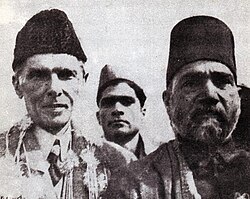
He died on 27 November 1956, Wazirabad, Punjab. His funeral prayer was led by his companion [[Mohammad Abdul Ghafoor Hazarvi]].<ref name=dawn/> | He died on 27 November 1956, and was buried in [[Wazirabad]], Punjab.<ref name=cybercity/> His funeral prayer was led by his companion and friend [[Mohammad Abdul Ghafoor Hazarvi]].<ref name=dawn>{{cite news|author=Rauf Parekh|title=Pakistani writers show renewed interest in Zafar Ali Khan's works|url=https://www.dawn.com/news/765179/pakistani-writers-show-renewed-interest-in-zafar-ali-khans-works|access-date=28 January 2024|newspaper=Dawn newspaper|url-status=dead|date=19 November 2012|archive-date=6 March 2019|archive-url=https://web.archive.org/web/20190306103000/https://www.dawn.com/news/765179/pakistani-writers-show-renewed-interest-in-zafar-ali-khans-works}}</ref>[[File:The Founder with Maulana Zafar Ali Khan in Badshahi Mosque.png|thumb|[[Muhammad Ali Jinnah]] with Maulana Zafar Ali Khan at [[Badshahi Mosque]] in 1940]] | ||
Sahiwal Stadium, а multi-purpose stadium in [[Sahiwal]], Punjab, was renamed as [[Zafar Ali Stadium]] in his honour. It is used for football and cricket games. The stadium holds 10,000 people. | Sahiwal Stadium, а multi-purpose stadium in [[Sahiwal]], Punjab, was renamed as [[Zafar Ali Stadium]] in his honour. It is used for football and cricket games. The stadium holds 10,000 people. | ||
Zafar Ali Khan was an active member of the [[Khilafat Movement]] and a close associate of [[Maulana Muhammad Ali Jauhar]].<ref name=cybercity/> | |||
[[S. M. Ikram]], a noted Pakistani scholar and historian writes about Zafar Ali Khan: | |||
<blockquote> | |||
"He was young, forceful and courageous, and enthusiastically responded to the new political trends. In his hands the Zamindar became the most influential Urdu daily of Northern India and his role in politics was second only to that of Ali Brothers and Abul Kalam Azad during the Khilafat movement".<ref name=storyofpakistan/> | |||
</blockquote> | |||
[[Pakistan Post]] issued a commemorative postage stamp in his honor in its 'Pioneers of Freedom' series.<ref name= | Later, he also served the [[Pakistan Movement]] and was an outspoken activist against [[British rule]].<ref name=cybercity/> Recognising Zafar Ali Khan's contributions to the [[Pakistan Movement]], the Punjab government in Pakistan established a 'Maulana Zafar Ali Khan Trust' that initiated the 'Zafar Ali Khan Award' for outstanding journalists to be awarded every year.<ref>[https://nation.com.pk/lahore/18-Jan-2012/139th-birth-anniversary-of-maulana-zafar-ali-khan-today 'Zafar Ali Khan Award' for outstanding journalists initiated] The Nation newspaper, published 18 January 2012. Retrieved 28 January 2024</ref> A public degree college in Wazirabad is named after him as Government Maulana Zafar Ali Khan Degree College. | ||
===Commemorative postage stamp=== | |||
[[Pakistan Post]] issued a commemorative [[postage stamp]] in his honor in its 'Pioneers of Freedom' series.<ref name=cybercity>{{cite web|url=http://cybercity-online.net/pof/maulana_zafar_ali_khan.html|url-status=dead|archive-date=22 November 2010|archive-url=https://web.archive.org/web/20101122081557/http://cybercity-online.net/pof/maulana_zafar_ali_khan.html|title= Profile and commemorative postage stamp image of Zafar Ali Khan|website=Cybercity-online.net website|access-date= 28 January 2024}}</ref> | |||
==Books== | ==Books== | ||
Some of his notable publications include: | Some of his notable publications include: | ||
===Poetry=== | ===Poetry=== | ||
*''Bahāristān'' | *''Bahāristān''<ref name=cybercity/> | ||
*''Nigāristān'' | *''Nigāristān''<ref name=cybercity/> | ||
*''Camanistān'' | *''Camanistān''<ref name=cybercity/> | ||
*''Rahāristān'' | *''Rahāristān'' | ||
*''Armag̲h̲ān-i Qādiyān'' | *''Armag̲h̲ān-i Qādiyān'' | ||
| Line 62: | Line 78: | ||
===Essays=== | ===Essays=== | ||
*''G̲h̲albah-yi Rūm : ek tārīk̲h̲ī tafsīr'', historical commentary of [[Ar-Rum|Sūrat ar-Rūm]] on the victory of Romans over the Persians and the Muslims over the Meccan polytheists as predicted by Koran in AD 615 | *''G̲h̲albah-yi Rūm: ek tārīk̲h̲ī tafsīr'', historical commentary of [[Ar-Rum|Sūrat ar-Rūm]] on the victory of Romans over the Persians and the Muslims over the Meccan polytheists as predicted by Koran in AD 615<ref name=cybercity/> | ||
*''Taqārīr-i Maulānā Ẓafar ʻAlī K̲h̲ān̲'', speeches of the author, especially in regard with the [[Khilafat movement]] | *''Taqārīr-i Maulānā Ẓafar ʻAlī K̲h̲ān̲'', speeches of the author, especially in regard with the [[Khilafat movement]] | ||
*''Lat̤āʼifuladab'', on the relation between literature and Islam | *''Lat̤āʼifuladab'', on the relation between literature and Islam | ||
*''Mʻaās̲h̲irat'', on the social sciences | *''Mʻaās̲h̲irat'', on the social sciences | ||
*''Jamāluddīn Afg̲h̲ānī : yaʻnī itiḥād-i Islāmī ke muharrik-i aʻzīm, Misr, Ṭarkī, Īrān aur Hindūstān ke z̲arīʻah ʻalim-i Islām man̲'', biography of the Muslim reformer and independence fighter [[Jamāl al-Dīn al-Afghānī]] | *''Jamāluddīn Afg̲h̲ānī: yaʻnī itiḥād-i Islāmī ke muharrik-i aʻzīm, Misr, Ṭarkī, Īrān aur Hindūstān ke z̲arīʻah ʻalim-i Islām man̲'', biography of the Muslim reformer and independence fighter [[Jamāl al-Dīn al-Afghānī]] | ||
===Plays=== | ===Plays=== | ||
*''Jang-i Rus va Japān : yaʻnī ek tārīk̲h̲ī ḍrāmā'', a play on the [[Russo-Japanese War|Russian Japanese War]], 1904–1905 | *''Jang-i Rus va Japān: yaʻnī ek tārīk̲h̲ī ḍrāmā'', a play on the [[Russo-Japanese War|Russian Japanese War]], (1904–1905)<ref name=cybercity/> | ||
===Translations=== | ===Translations=== | ||
*''Jangal buk'', Urdu translation from the English of [[Rudyard Kipling]]'s ''[[Jungle Book]]'' | *''Jangal buk'', Urdu translation from the English of [[Rudyard Kipling]]'s ''[[Jungle Book]]'' | ||
*''Al-Farooq : the life of Omar the Great'', English translation from the Urdu of [[Shibli Nomani]]'s ''[[Al-Farooq (book)|Al-Farooq]]'', a biography of [[Umar]] | *''Al-Farooq: the life of Omar the Great'', English translation from the Urdu of [[Shibli Nomani]]'s ''[[Al-Farooq (book)|Al-Farooq]]'', a biography of [[Umar]] | ||
== See also == | == See also == | ||
| Line 81: | Line 97: | ||
== Notes == | == Notes == | ||
<references group="lower-alpha" />[[File:Quaid-e-Azam with Maulana Zafar Ali Khan.jpg|thumb|[[Quaid-e-Azam]] with Maulana Zafar Ali Khan]] | |||
Maulana would never miss a chance to snub the British government and the Heavens had provided him ample opportunities to carry out his sacred mission. Shaheed Ghazi Ilam Din had killed a blasphemous person and was sent to gallows in the [[Mianwali]] jail. The government buried him in Mianwali which infuriated the Muslims in Punjab. They protested and made a unanimous demand to bring Shaeed's body to [[Lahore]] but no one was prepared to give coverage to their voice as Hindus dominated most of the newspapers in the old Punjab before 1947. A large procession led by Lal Din Qaiser reached the office of [[Zamindar (newspaper)|Zamindar]] in 1903 newspaper which was the only hope for the Muslims at that time and succeeded in getting newspaper coverage for their event. | Maulana would never miss a chance to snub the British government and the Heavens had provided him ample opportunities to carry out his sacred mission. Shaheed Ghazi Ilam Din had killed a blasphemous person and was sent to gallows in the [[Mianwali]] jail. The government buried him in Mianwali which infuriated the Muslims in Punjab. They protested and made a unanimous demand to bring Shaeed's body to [[Lahore]] but no one was prepared to give coverage to their voice as Hindus dominated most of the newspapers in the old Punjab before 1947. A large procession led by Lal Din Qaiser reached the office of [[Zamindar (newspaper)|Zamindar]] in 1903 newspaper which was the only hope for the Muslims at that time and succeeded in getting newspaper coverage for their event. | ||
| Line 98: | Line 114: | ||
[[Category:1874 births]] | [[Category:1874 births]] | ||
[[Category:1956 deaths]] | [[Category:1956 deaths]] | ||
[[Category:Members of the Central Legislative Assembly of India]] | [[Category:Members of the Central Legislative Assembly of India]] | ||
[[Category:Pakistani media personalities]] | [[Category:Pakistani media personalities]] | ||
[[Category:Indian people of World War II]] | [[Category:Indian people of World War II]] | ||
[[Category:People from Wazirabad]] | [[Category:People from Wazirabad]] | ||
[[Category:People from Punjab Province (British India)]] | |||
[[Category:Founders of Majlis-e Ahrar-e Islam]] | |||
Latest revision as of 04:03, 31 December 2025
Zafar Ali Khan | |
|---|---|
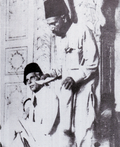
 Zafar Ali Khan in 1937 | |
| Born | 1873 |
| Died | 27 November 1956 (aged 82–83) Wazirabad, West Pakistan, Pakistan |
| Occupation | Islamic scholar Poet Journalist |
| Relatives | Raja Mehdi Ali Khan (nephew) |

Zafar Ali Khan[lower-alpha 1] (1873 – 27 November 1956) was a Pakistani writer, poet, translator and a journalist who used his journalism against the British rule.[1] He was one of the Majlis-e-Ahrar-e-Islam's founding members.[2]
Well-versed in Islamic as well Western knowledge such as the latest trends in economics, sociology and politics, he has been considered as one of the fathers of Urdu journalism.[3]
Early life and education[edit | edit source]
Zafar was born in the Sialkot District in 1873 into a Punjabi family of the Rajput Janjua clan,[4] as per the contemporary report of 1920.
He received his early education at Mission High School, Wazirabad, Wazirabad District,[5] matriculated (10th grade) from Patiala, and passed his intermediate (12th grade) from the Aligarh College in 1895. Next, he worked in the postal department of the princely state of Jammu and Kashmir, the same place where his father worked, but resigned over a row with his seniors.[5][6] He rejoined Aligarh College and gained his BA degree from there; stood fifth in his batch.
Career[edit | edit source]
Journalism[edit | edit source]
After graduation, Khan was appointed secretary to a Muslim political leader Mohsin-ul-Mulk, then in Bombay. Then he worked for some time as a translator in Hyderabad, Deccan, rising to the post of Secretary, Home Department. He returned from Hyderabad and took over the daily Zamindar newspaper from Lahore in 1908, founded by his father Maulvi Sirajuddin Ahmad in 1903. At one time, this newspaper was an important newspaper of the Punjab.[5][7][6][8]
Relation with the Ahmadiyya Movement[edit | edit source]
Zafar Ali Khan's relationship with the Ahmadiyya was belligerent. He was among the vanguard, who censured Mirza Ghulam Ahmad from Qadian by writing satirical poems against him. He even wrote the preface to the book "His Holiness", which was written as a refutation of the Ahmadiyya movement.[9] Later on, when Pakistan was created, he was an ardent participant in the 1953 Tehreek e Khatm e Nabuwat (a movement against the Ahmadis), writing articles against them.
Poetry[edit | edit source]
He chose to write in Urdu. Khan's interest in poetry began in his childhood. His poems have religious and political sentiments.[1] He was especially versed in impromptu compositions. His poetical output includes Baharistan, Nigaristan, and Chamanistan. His other works are Marka-e-Mazhab-o-Science, Ghalba-e-Rum, Sayr-e-Zulmet and an opera Jang-e-Roos-o-Japan.[7][10]
Most popular Naats[edit | edit source]
- Woh Shama Ujalaa Jis Ne Kiya 40 Baras Tak Ghaaron Mein sung by Mehdi Hassan, a Radio Pakistan production, a popular Naat written by Zafar Ali Khan[11]
- 'Dil jis se zinda hai woh tamanna tum hi tau ho' sung by Muneeba Sheikh, a Pakistan Television production, a popular Naat written by Zafar Ali Khan[12]
Death and legacy[edit | edit source]
He died on 27 November 1956, and was buried in Wazirabad, Punjab.[7] His funeral prayer was led by his companion and friend Mohammad Abdul Ghafoor Hazarvi.[13]

Sahiwal Stadium, а multi-purpose stadium in Sahiwal, Punjab, was renamed as Zafar Ali Stadium in his honour. It is used for football and cricket games. The stadium holds 10,000 people.
Zafar Ali Khan was an active member of the Khilafat Movement and a close associate of Maulana Muhammad Ali Jauhar.[7]
S. M. Ikram, a noted Pakistani scholar and historian writes about Zafar Ali Khan:
"He was young, forceful and courageous, and enthusiastically responded to the new political trends. In his hands the Zamindar became the most influential Urdu daily of Northern India and his role in politics was second only to that of Ali Brothers and Abul Kalam Azad during the Khilafat movement".[5]
Later, he also served the Pakistan Movement and was an outspoken activist against British rule.[7] Recognising Zafar Ali Khan's contributions to the Pakistan Movement, the Punjab government in Pakistan established a 'Maulana Zafar Ali Khan Trust' that initiated the 'Zafar Ali Khan Award' for outstanding journalists to be awarded every year.[14] A public degree college in Wazirabad is named after him as Government Maulana Zafar Ali Khan Degree College.
Commemorative postage stamp[edit | edit source]
Pakistan Post issued a commemorative postage stamp in his honor in its 'Pioneers of Freedom' series.[7]
Books[edit | edit source]
Some of his notable publications include:
Poetry[edit | edit source]
- Bahāristān[7]
- Nigāristān[7]
- Camanistān[7]
- Rahāristān
- Armag̲h̲ān-i Qādiyān
- Kulliyāt-i Maulānā Ẓafar ʻAlī K̲h̲ān
- Ḥabsiyāt
- Nashīd-i Shīrāz, collection of Persian poems and articles published in different periodicals
- K̲h̲amistān-i Ḥijāz, poetry about Muhammad
Essays[edit | edit source]
- G̲h̲albah-yi Rūm: ek tārīk̲h̲ī tafsīr, historical commentary of Sūrat ar-Rūm on the victory of Romans over the Persians and the Muslims over the Meccan polytheists as predicted by Koran in AD 615[7]
- Taqārīr-i Maulānā Ẓafar ʻAlī K̲h̲ān̲, speeches of the author, especially in regard with the Khilafat movement
- Lat̤āʼifuladab, on the relation between literature and Islam
- Mʻaās̲h̲irat, on the social sciences
- Jamāluddīn Afg̲h̲ānī: yaʻnī itiḥād-i Islāmī ke muharrik-i aʻzīm, Misr, Ṭarkī, Īrān aur Hindūstān ke z̲arīʻah ʻalim-i Islām man̲, biography of the Muslim reformer and independence fighter Jamāl al-Dīn al-Afghānī
Plays[edit | edit source]
- Jang-i Rus va Japān: yaʻnī ek tārīk̲h̲ī ḍrāmā, a play on the Russian Japanese War, (1904–1905)[7]
Translations[edit | edit source]
- Jangal buk, Urdu translation from the English of Rudyard Kipling's Jungle Book
- Al-Farooq: the life of Omar the Great, English translation from the Urdu of Shibli Nomani's Al-Farooq, a biography of Umar
See also[edit | edit source]
Notes[edit | edit source]

Maulana would never miss a chance to snub the British government and the Heavens had provided him ample opportunities to carry out his sacred mission. Shaheed Ghazi Ilam Din had killed a blasphemous person and was sent to gallows in the Mianwali jail. The government buried him in Mianwali which infuriated the Muslims in Punjab. They protested and made a unanimous demand to bring Shaeed's body to Lahore but no one was prepared to give coverage to their voice as Hindus dominated most of the newspapers in the old Punjab before 1947. A large procession led by Lal Din Qaiser reached the office of Zamindar in 1903 newspaper which was the only hope for the Muslims at that time and succeeded in getting newspaper coverage for their event.
References[edit | edit source]
- ↑ 1.0 1.1 Markus Daechsel (1 June 2002). Politics of Self-Expression. Routledge. pp. 64–. ISBN 978-1-134-38371-9. Retrieved 4 July 2018 – via Google Books.
- ↑ Ahmad, Syed N. Origins of Muslim consciousness in India: a world-system perspective. New York u.a: Greenwood Press, 1991. p. 175
- ↑ "Maulana Zafar Ali Khan (profile)". The Nation newspaper. 27 November 2014. Retrieved 28 January 2024.
- ↑ Lord William, Hunter; Jagat, Narayan (1920). Report of the Committee Appointed in the Government of India to Investigate the Disturbances in the Punjab, Etc. Vol. 5. p. 253.
- ↑ 5.0 5.1 5.2 5.3 "Profile of Zafar Ali Khan". Storyofpakistan.com website. 1 January 2007. Archived from the original on 14 January 2023. Retrieved 28 January 2024.
- ↑ 6.0 6.1 "Profile of Maulana Zafar Ali Khan (1874–1956)". Journalismpakistan.com website. Archived from the original on 5 July 2018. Retrieved 4 July 2018.
- ↑ 7.00 7.01 7.02 7.03 7.04 7.05 7.06 7.07 7.08 7.09 7.10 "Profile and commemorative postage stamp image of Zafar Ali Khan". Cybercity-online.net website. Archived from the original on 22 November 2010. Retrieved 28 January 2024.
- ↑ Ayesha Jalal (2000). Self and sovereignty: individual and community in South Asian Islam since 1850. Psychology Press. pp. 184–. ISBN 978-0-415-22077-4.
- ↑ Phoenix. "His Holiness by Phoenix (Preface by Maulana Zafar Ali Khan)" (PDF).[permanent dead link]
- ↑ K. C. Kanda (1 January 2005). Masterpieces of patriotic Urdu poetry: text, translation, and transliteration. Sterling Publishers Pvt. pp. 161–. ISBN 978-81-207-2893-6.
- ↑ A popular Naat written by Zafar Ali Khan on YouTube
- ↑ Zafar Ali Khan's Naat sung by Muneeba Sheikh
- ↑ Rauf Parekh (19 November 2012). "Pakistani writers show renewed interest in Zafar Ali Khan's works". Dawn newspaper. Archived from the original on 6 March 2019. Retrieved 28 January 2024.
- ↑ 'Zafar Ali Khan Award' for outstanding journalists initiated The Nation newspaper, published 18 January 2012. Retrieved 28 January 2024
.jpg)


- Pages using the JsonConfig extension
- Aligarh Muslim University alumni
- Leaders of the Pakistan Movement
- Pakistani male journalists
- Pakistani writers
- 1874 births
- 1956 deaths
- Members of the Central Legislative Assembly of India
- Pakistani media personalities
- Indian people of World War II
- People from Wazirabad
- People from Punjab Province (British India)
- Founders of Majlis-e Ahrar-e Islam