




robot: Create/upgrade articles. If there is a mistake please report on my talk page. |
m further improved references for consistency and fixed typos for clarity |
||
| Line 1: | Line 1: | ||
{{Short description| | {{Short description|German raid to free Benito Mussolini from prison}} | ||
{{Use dmy dates|date=December 2020}} | |||
{{Use dmy dates|date=December | |||
{{Operational plan | {{Operational plan | ||
| name = Gran Sasso raid | | name = Operation Oak | ||
|subtitle=Gran Sasso raid | |||
| partof = [[World War II]] | | partof = [[World War II]] | ||
| image = Bundesarchiv Bild 101I-567-1503A-07, Gran Sasso, Mussolini mit deutschen Fallschirmjägern.jpg | | image = Bundesarchiv Bild 101I-567-1503A-07, Gran Sasso, Mussolini mit deutschen Fallschirmjägern.jpg | ||
| image_size = 300 | | image_size = 300 | ||
| caption = Mussolini with German commandos | | caption = Mussolini with German commandos | ||
| type = [[ | | type = [[Prison escape]] with outside help | ||
| location = [[Hotel Campo Imperatore]], Italy | | location = [[Hotel Campo Imperatore]], Italy | ||
| coordinates = {{coord|42|26|32.73|N|13|33|31.66|E|type:event_region:IT_scale:50000|display=title}} | | coordinates = {{coord|42|26|32.73|N|13|33|31.66|E|type:event_region:IT_scale:50000|display=title}} | ||
| planned_by = [[Harald Mors]] | | planned_by = [[Harald Mors]] | ||
|planned = Summer 1943 | |||
| target = [[Campo Imperatore]] | | target = [[Campo Imperatore]] | ||
| date = {{start date and age|1943|09|12|df=y}} | | date = {{start date and age|1943|09|12|df=y}} | ||
| Line 18: | Line 19: | ||
| casualties = 2 Italians killed, 10 Germans wounded | | casualties = 2 Italians killed, 10 Germans wounded | ||
}} | }} | ||
The '''Gran Sasso raid''' on 12 September 1943 freed [[Benito Mussolini]] from imprisonment in a hotel on the [[Gran Sasso d'Italia]] [[massif]]. The [[World War II]] operation was codenamed "Operation Oak" (Unternehmen Eiche) by the German military. The raid by [[Fallschirmjäger|German paratroopers]] and [[Waffen-SS]] commandos was personally ordered by [[Adolf Hitler]], approved by General [[Kurt Student]], and planned and executed by Major [[Harald Mors]]. | |||
Operation Oak was marketed as a stunning military feat by Nazi propagandists, aiming to provide a morale boost at a low point in the war for Germany. In fact, the Germans controlled the territory around the hotel and were never in great danger. | |||
== | ==Background== | ||
{{Main|Fall of the Fascist regime in Italy|Armistice of Cassibile|Operation Achse}} | |||
The [[Allied invasion of Sicily]] in July 1943 led to the [[bombing of Rome in World War II]]. On the night of 24 July 1943, the [[Grand Council of Fascism]] passed a [[motion of no confidence]] against prime minister [[Benito Mussolini]].<ref>Katz, Robert. ''The Battle for Rome: the Germans, the Allies, the Partisans, and the Pope, September 1943-June 1944]''. Simon & Schuster, 2003. 20.</ref> On 25 July, King [[Victor Emmanuel III]] arrested Mussolini and replaced him with Marshal [[Pietro Badoglio]].<ref name="fital">Whittam, John. ''Fascist Italy''. [[Manchester University Press]], 1995.</ref>{{rp|130}}<ref name=Annu>Annussek, Greg. ''Hitler's Raid to Save Mussolini: The Most Infamous Commando Operation of World War II''. Hachette Book Group, 2009.</ref>{{rp|22}} The [[Fall of the Fascist regime in Italy|end of Mussolini's Fascist regime]] is known as ''25 Luglio'' in Italy. [[Badoglio I Cabinet|Badoglio's government]] remained allied with the [[Axis powers]] for a few more weeks.<ref name="Trumpener"/> | |||
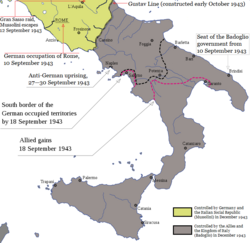
By 17 August, the Allies defeated the Italians and Germans in Sicily, and Italy began secret negotiations to surrender. On 3 September, the [[Allied invasion of Italy]] began and [[Giuseppe Castellano]] signed the [[Armistice of Cassibile]], which ended the nation's war with the Allies.<ref>Cleaver, Thomas McKelvey. ''Mediterranean Sweep: The USAAF in the Italian Campaign''. United Kingdom, [[Bloomsbury Publishing]], 2025. 53.</ref> The armistice was not announced until 8 September. | |||
Badoglio wanted the Allies to move as far north as possible before revealing the truce, knowing the [[German Army (1935–1945)|German army]] would respond by seizing Italian territory. The Nazis launched [[Operation Achse]] on 8 September, occupying key positions in central and northern Italy. Many Italian soldiers simply refused to fight the Germans.<ref name="Trumpener">Trumpener, Ulrich. "[https://books.google.com/books?id=V6_lCAAAQBAJ&pg=PA1351 Achse]" in ''World War II in Europe: An Encyclopedia''. [[Taylor & Francis]], 2015. 1351.</ref> Marshal Badoglio and King Victor Emmanuel III fled to Allied-controlled territory in southern Italy.<ref>Moseley, Ray. ''Mussolini: the Last 600 Days of Il Duce''. Taylor Trade Publishing, 2004. 10.</ref> | |||
[[ | |||
[[ | ==Preparations== | ||
===Mussolini's imprisonment=== | |||
[[File:Bundesarchiv Bild 101I-567-1503A-05, Gran Sasso, Hotel Campo Imperatore.jpg|thumb|upright|[[Hotel Campo Imperatore]].]] | |||
The Badoglio government feared Mussolini's reinstatement by Germany. He was heavily guarded and moved several times.<ref name="Schuster">Shuster, Carl O. "[https://books.google.com/books?id=V6_lCAAAQBAJ&pg=PA1519 Gran Sasso Raid]" in ''World War II in Europe: An Encyclopedia''. Taylor & Francis, 2015. 1519.</ref> When the [[Carabinieri]] arrested Mussolini in Rome on 25 July, they initially brought him to their headquarters in [[Trastevere]]. He was held at the Carabinieri Cadet School until 27 July, when the military police escorted him to [[Gaeta]]. On 28 July, they arrived at an isolated house on [[Ponza]], an island in the [[Tyrrhenian Sea]].<ref name=López18/>{{rp|17–20}} Mussolini was kept there until 7 August. He was held at a private villa on [[La Maddalena]] until 27 August.<ref>Failmezger, Victor. ''Rome – City in Terror: The Nazi Occupation 1943–44''. Bloomsbury Publishing, 2020. 80.</ref> The following day, he was moved to the [[Hotel Campo Imperatore]]. | |||
== Raid == | The Hotel Campo was built on a remote and defendable mountain plateau 2,112 metres above sea level in the [[Gran Sasso d'Italia]] mountain range. A ski station was located next to the hotel. The hotel is shaped like the letter 'd'. Two more hotels shaped as '[[Latin alphabet|v]]' and 'x' to form the Latin word "[[dux]]" (leader) were planned but never built. The title ''[[Duce|Il Duce]]'' derived from ''dux''.<ref name=López18/>{{rp|17–23, 58}} | ||
===German tracking and planning=== | |||
[[File:Italy September 1943.png|thumb|300px|Italian military situation in September 1943. Hotel Campo is just outside L'Aquila (upper left).]] | |||
[[Adolf Hitler]] secretly ordered General [[Kurt Student]] to oversee a mission to liberate Mussolini.<ref name=Foley/>{{rp|62}} ''[[Obersturmbannführer|SS-Obersturmbannführer]]'' [[Herbert Kappler]] learned about Mussolini's transfer from La Maddalena through one of [[Edda Mussolini|Edda Ciano's]] letters.<ref name=Gallo/>{{rp|57}} Kappler also paid informants with counterfeit money created during [[Operation Bernhard]].<ref name=Kuby/> His agents also intercepted a message about security preparations at [[Gran Sasso d'Italia|Gran Sasso]], which indicated Mussolini might be imprisoned there.<ref name=Annu/>{{rp|178}} A German doctor feigned interest in setting up a clinic at the hotel in order to confirm the deposed tyrant was being held there.<ref name="Schuster"/> | |||
''[[Hauptsturmführer]]'' [[Otto Skorzeny]] was detailed to Student.<ref name=Foley/>{{rp|62}} On 8 September, he scouted the Gran Sasso to strategize how to free Mussolini.<ref name=Foley>Foley, Charles. ''[https://archive.org/details/commandoextraord0000fole_t7k4/mode/1up Commando Extraordinary]''. Arms and Armour Press, 1954.</ref>{{rp|72}} The elevation of the hotel made [[parachuting]] risky.<ref name=Infield/>{{rp|38}} [[Harald Mors]] and General Student devised a plan to deliver troops by [[military glider]]. To their surprise, Skorzeny insisted on going along. Several of General Student's paratroopers (''[[Fallschirmjäger]]'') were then replaced by Skorzeny and the [[Schutzstaffel|SS]].<ref name=Kuby/><ref name=Spiegel>Lutteroth, Johanna. ""[https://www.spiegel.de/geschichte/unternehmen-eiche-mussolini-befreiung-aus-der-luft-a-951252.html Mussolini-Rettung 'Unternehmen Eiche': 'Duce, der Führer schickt mich. Sie sind frei!']", ''[[Der Spiegel]]''. September 12, 2013.</ref> | |||
==Raid== | |||
[[File:Bundesarchiv Bild 101I-567-1503C-04, Gran Sasso, Fieseler Fi 156 »Storch«.jpg|thumb|upright|This [[Fieseler Fi 156]] helped Mussolini escape.]] | [[File:Bundesarchiv Bild 101I-567-1503C-04, Gran Sasso, Fieseler Fi 156 »Storch«.jpg|thumb|upright|This [[Fieseler Fi 156]] helped Mussolini escape.]] | ||
By the day of the raid, 12 September, Germany controlled the territory around the Hotel Campo, making Mussolini's rescue far less dangerous. It is unclear why Italy moved Mussolini so far north into the path of Germany's approach.<ref name=Kuby/> | |||
Major Harald Mors commanded the entire operation and led the ground assault. German tanks and armored cars swarmed the base of the mountain while paratroopers and an SS commando unit approached the Hotel Campo by air.<ref name=Gallo/>{{rp|57}} Mors cut all telephone lines. Italian forestry guard Pasqualino Vitocco was killed while attempting to warn the garrison of the attack. Carabiniere Giovanni Natale was killed while preparing to open fire on Mors' troops. Two more carabinieri were slightly wounded by a [[hand grenade]]. These were the only casualties of the operation.<ref>"[https://www.combattentiereduci.it/notizie/pasqualino-vitocco-e-giovanni-natali-due-militari-cancellati-dalla-storia Pasqualino Vitocco e Giovanni Natale, due militari cancellati dalla storia]", Associazione Nazionale Combattenti e Reduci. September 12, 2019.</ref><ref>Fazzini, Andrea. ''L’ospite Della Camera 201: Mussolini a Campo Imperatore''. I edizione, Piemme, 2022.</ref><ref>Patricelli, Marco. ''[https://books.google.com/books?id=eT6ODAAAQBAJ&dq=%22generale+soleti%22&pg=PT148 Settembre 1943: I giorni della vergogna]''. Italy, Editori Laterza, 2014.</ref> | |||
Meanwhile, several [[Henschel Hs 126]] planes took off from [[Pratica di Mare Air Base]] near Rome just after midday. They towed ten [[DFS 230]] gliders, each carrying nine soldiers and a pilot.<ref name=López18/> Italian General [[Fernando Soleti]] was flying with the soldiers. He had been arrested and forced to come in hopes that Mussolini's guards would not fire on an officer they recognized.<ref name=Infield>Infield, Glenn B. ''[https://archive.org/details/skorzenyhitlersc00infi/page/40/mode/1up Skorzeny, Hitler's Commando]''. New York: St. Martin's Press, 1981.</ref>{{rp|40f}} | |||
[[Oberleutnant]] Georg Freiherr von Berlepsch led the airborne operation. The gliders looped to gain altitude over the [[Alban Hills]], but Skorzeny ordered the gliders with his SS troops to skip the maneuver in order to arrive first.<ref name="López">{{cite book|author=Óscar González López|title=Fallschirmjäger at the Gran Sasso|publisher=AF Editores |place=Valladolid |year=2007 |isbn=978-84-96935-00-6}}</ref><ref name=Spiegel/> Skorzeny further disrupted the glider formation by demanding to land near the hotel, which caused one of the aircraft to crash.<ref name=Kuby/> | |||
Mussolini was guarded by dozens of well-equipped Carabinieri. Like their countrymen elsewhere during [[Operation Achse]], they had little interest in shooting at Germans.<ref name=Spiegel/> According to the hotel managers, Mussolini leaned out his window and pleaded for no bloodshed.<ref>Mussolini, Benito. ''[https://archive.org/details/in.ernet.dli.2015.185420/page/n278/mode/1up Benito Mussolini: Memoirs 1942-1943: with Documents Relating to the Period]''. United Kingdom, Weidenfeld And Nicolson, 1949.</ref>{{rp|251}} General Soleti also ordered the guards not to shoot. Mors ascended to the hotel from the valley and introduced himself to Mussolini.<ref name=Infield/>{{rp|43}} The raid was over in a matter of minutes.<ref name=Spiegel/><ref>Evans, Richard J. ''The Third Reich at War''. [[Penguin Press]], 2009. 473f.</ref> German soldiers soon escorted Mussolini out of the hotel and made sure that the moment was photographed and filmed.<ref name=Annu/>{{rp|232f}} | |||
General Student's personal pilot arrived in a [[Fieseler Fi 156 Storch|Fieseler Fi 156 ''Storch'']] for Mussolini. The [[STOL|short takeoff and landing]] plane was at capacity with Mussolini on board, but Skorzeny insisted on overloading the plane by boarding.<ref name=Infield/>{{rp|44}} After an extremely dangerous takeoff, they returned to Pratica di Mare. Mussolini requested to be taken to [[Rocca delle Caminate]].<ref name=Mosely/>{{rp|10}} They continued in a [[Heinkel He 111]] to [[Vienna]], where Mussolini stayed overnight at the [[Hotel Imperial]]. On 14 September, Mussolini was flown to [[Munich]] and then on to East Prussia, where he reunited with Hitler.<ref name="Kuby">[[Erich Kuby|Kuby, Erich]]. ''[https://ulis-buecherecke.ch/pdf_der_krieg/wie_das_3.reich_italien_ruinierte.pdf Verrat Auf Deutsch: Wie Das Dritte Reich Italien Ruinierte]''. Hamburg: Hoffmann und Campe, 1982. 256–263.</ref> | |||
==Aftermath== | |||
[[File:Bundesarchiv Bild 183-J15420, Gran Sasso, Mussolini vor Hotel.jpg|thumb|upright|Mussolini leaving the hotel, flanked by General [[Fernando Soleti]], General Gueri, Karl Radl (holding suitcase).]] | |||
British Prime Minister [[Winston Churchill]] responded to the escape in the [[House of Commons of the United Kingdom|House of Commons]], "Knowing that ''[[Duce|il Duce]]'' was hidden in a safe place and that the Government of Badoglio was committed to handing him over to the Allies, a daring attack, completely beyond all foresight, prevented this from happening."<ref name="López18">{{cite book |last=López |first=Óscar González |url=https://books.google.com/books?id=e8OIDwAAQBAJ |title=Freeing Mussolini: Dismantling the Skorzeny Myth in the Gran Sasso Raid |publisher=Pen & Sword Books |year=2018 |isbn=9781526719997 |place=Barnsley}}</ref> | |||
The operation was a propaganda dream for the Germans. They glamorized it in the pages of ''[[Signal (magazine)|Signal]]''.<ref>Jörgensen, Christer. ''[https://archive.org/details/hitlersespionage0000jorg_v7m5/page/152/mode/1up Hitler's Espionage Machine: German Intelligence Agencies and Operations During World War II]''. Spellmount, 2004.</ref>{{rp|152f}} The Nazis ensured film crews captured the entire operation and distributed it via [[newsreel]].<ref>"Captured Nazi Reels show 'Rescue' of Duce." ''[[The Hollywood Reporter]]'', vol. 76, no. 8. December 2, 1943. 1.</ref> The Germans broadcast a speech purportedly by Mussolini where he boasted, "The liberation-the enterprise was an example of the organization and resolution of the Germans which will live in history—will in the future become legendary."<ref>[[Associated Press]]. "[https://nyti.ms/4oeFZnq 'Mussolini Broadcast' Asks Italians to Fight the Allies]", ''[[The New York Times]]''. September 19, 1943. 1, 42.</ref> | |||
[ | |||
Although the landing at [[Campo Imperatore]] was led by [[First lieutenant|First Lieutenant]] von Berlepsch under Major Mors's command, Skorzeny and the SS would become the face of the triumph.<ref name=Kuby/><ref name=Gallo>Gallo, Patrick J. ''[https://www.jstor.org/stable/j.ctv2ckjq4h.12 The Nazis, the Vatican, and the Jews of Rome]''. [[Purdue University Press]], 2023.</ref>{{rp|56}} Skorzeny was named ''[[Sturmbannführer]]'', awarded the [[Knight's Cross of the Iron Cross]], and dubbed the "most dangerous man in Europe".<ref name="López"/> | |||
Skorzeny | |||
In 1950, Skorzeny published a bestselling autobiography, ''Geheimkommando Skorzeny'' (Secret Commando Skorzeny).<ref>Roberts, Henry L. "[https://www.foreignaffairs.com/reviews/capsule-review/1951-10-01/skorzenys-secret-missions-and-geheimkommando-skorzeny Skorzeny’s Secret Missions and Geheimkommando Skorzeny]", ''[[Foreign Affairs]]''. October 1951.</ref><ref>O'Reilly, Terence. ''Hitler's Irishmen''. Mercier Press, 2008. 283.</ref> He wrote another memoir in 1976, ''Meine Kommandounternehmen'' (My Commando Operations).<ref>Dunphy, John J. ''Unsung Heroes of the Dachau Trials: The Investigative Work of the U.S. Army 7708 War Crimes Group, 1945-1947''. McFarland, Incorporated, Publishers, 2018. 184.</ref> The Nazi legend of his part in the scheme was the dominant narrative for decades. His exaggerated credit overshadowed the genuine role of the paratroopers.<ref name="Trumpener"/><ref name="López18"/> | |||
General Student's paratroopers were shocked to see Skorzeny and the SS given credit for Operation Oak. Major Mors demanded Student correct the record, but Student confessed he did not want to provoke [[Heinrich Himmler]]. Allied media were skeptical of the boasts from Berlin.<ref name=Spiegel/><ref>"[https://nyti.ms/49IzBBv Mussolini Is Taken by Nazis From Italians, Berlin Reports]", ''[[The New York Times]]''. September 13, 1943. 1, 6.</ref> | |||
By all accounts, the man the Germans rescued was broken and bore little resemblance to the swaggering ''Il Duce''. Mussolini had attempted suicide while under arrest.<ref name=Gallo/>{{rp|58}} He had been seriously ill throughout the war, and his health got much worse during captivity.<ref name=Mosely/>{{rp|11}} It was only after reuniting with this family in Munich that he started to come back to life.<ref name=Kuby/> Hitler had to bully Mussolini to return home. Mussolini established the [[Italian Social Republic]], a puppet state in German-occupied northern Italy. It [[collaborationism|collaborated]] with Germany in the fight against the Allies, which now included the Kingdom of Italy.<ref name=fital/>{{rp|130}} | |||
As total defeat loomed in late April 1945, Mussolini and his mistress [[Clara Petacci]] attempted to flee to Switzerland. They were captured by Italian communist partisans and [[Death of Benito Mussolini|summarily executed on 28 April 1945]] near [[Lake Como]].<ref name=Mosely>Moseley, Ray. ''Mussolini's Shadow: the Double Life of Count Galeazzo Ciano''. [[Yale University Press]], 1999.</ref>{{rp|255}} | |||
== See also == | == See also == | ||
* [[Operation Achse]] | * [[Operation Achse]] | ||
== | == References == | ||
{{reflist | {{reflist}} | ||
==Further reading== | |||
*Rescue of Mussolini, [[Foreign Military Studies Office|Foreign Military Studies]], D-318, 24, 102–3, 137–38, RG 338, [[National Archives and Records Administration]]. | |||
*Riscoldati, Mario. "[https://www.carabinieri.it/Internet/ImageStore/Magazines/Rassegna/Rassegna%202023-Numero%20Speciale/ L'ARMA DEI CARABINIERI REALI DALL'ARRESTO DI MUSSOLINI ALLA SUA LIBERAZIONE]", in ''Rassegna''. 2023. 85–105. | |||
*Skorzeny, Otto. ''[https://archive.org/details/meine-kommandounternehmen Meine Kommandounternehmen: Krieg Ohne Fronten]''. 2. Aufl, Limes-Verlag, 1976. | |||
*Skorzeny, Otto. ''[https://archive.org/details/OttoSkorzenyMyCommandoOperations/page/n3/mode/2up My Commando Operations: The Memoirs of Hitler's Most Daring Commando]''. Schiffer Publications, 1995. | |||
*Skorzeny, Otto. ''Skorzeny's Special Missions: The Memoirs of Hitler's Most Daring Commando''. Greenhill Books, 2025. | |||
== External links == | == External links == | ||
* {{commonscat-inline}} | * {{commonscat-inline}} | ||
*[https://www.youtube.com/watch?v=CXj4GAkf_cU German Propaganda Footage showing Rescue of Italian Dictator Benito Mussolini- 22 September 1943], German WWII Archive, [[YouTube]]. | |||
{{Benito Mussolini}} | {{Benito Mussolini}} | ||
| Line 80: | Line 95: | ||
[[Category:Benito Mussolini]] | [[Category:Benito Mussolini]] | ||
[[Category: | [[Category:Special forces of Germany in World War II]] | ||
[[Category:20th century in Abruzzo]] | [[Category:20th century in Abruzzo]] | ||
[[Category:Italian Social Republic]] | [[Category:Italian Social Republic]] | ||
[[Category:Military operations of World War II involving Germany]] | [[Category:Military operations of World War II involving Germany]] | ||
[[Category:Military parachuting in Germany]] | [[Category:Military parachuting in Germany]] | ||
[[Category:Operations involving | [[Category:Operations involving special forces of Germany]] | ||
[[Category:POW escapes and rescues during World War II]] | [[Category:POW escapes and rescues during World War II]] | ||
[[Category:Province of L'Aquila]] | [[Category:Province of L'Aquila]] | ||
[[Category:September 1943 | [[Category:September 1943 in Europe]] | ||
[[Category: | [[Category:Battles and operations of the Italian campaign (World War II)]] | ||
[[Category:World War II raids]] | [[Category:World War II raids]] | ||
[[Category:Attacks on hotels in Europe]] | |||
[[Category:Attacks on buildings and structures in Italy]] | |||
[[Category:Attacks on buildings and structures in 1943]] | |||
[[Category:1943 in Italy]] | |||
[[Category:Conflicts in 1943]] | |||
Latest revision as of 07:20, 12 March 2026
| Operation Oak | |
|---|---|
| Gran Sasso raid Part of World War II | |
 Mussolini with German commandos | |
| Type | Prison escape with outside help |
| Location | Hotel Campo Imperatore, Italy 42°26′32.73″N 13°33′31.66″E / 42.4424250°N 13.5587944°E |
| Planned | Summer 1943 |
| Planned by | Harald Mors |
| Target | Campo Imperatore |
| Date | 12 September 1943 |
| Executed by | |
| Outcome | Benito Mussolini escaped from prison |
| Casualties | 2 Italians killed, 10 Germans wounded |
The Gran Sasso raid on 12 September 1943 freed Benito Mussolini from imprisonment in a hotel on the Gran Sasso d'Italia massif. The World War II operation was codenamed "Operation Oak" (Unternehmen Eiche) by the German military. The raid by German paratroopers and Waffen-SS commandos was personally ordered by Adolf Hitler, approved by General Kurt Student, and planned and executed by Major Harald Mors.
Operation Oak was marketed as a stunning military feat by Nazi propagandists, aiming to provide a morale boost at a low point in the war for Germany. In fact, the Germans controlled the territory around the hotel and were never in great danger.
Background[edit | edit source]
The Allied invasion of Sicily in July 1943 led to the bombing of Rome in World War II. On the night of 24 July 1943, the Grand Council of Fascism passed a motion of no confidence against prime minister Benito Mussolini.[1] On 25 July, King Victor Emmanuel III arrested Mussolini and replaced him with Marshal Pietro Badoglio.[2]:130[3]:22 The end of Mussolini's Fascist regime is known as 25 Luglio in Italy. Badoglio's government remained allied with the Axis powers for a few more weeks.[4]
By 17 August, the Allies defeated the Italians and Germans in Sicily, and Italy began secret negotiations to surrender. On 3 September, the Allied invasion of Italy began and Giuseppe Castellano signed the Armistice of Cassibile, which ended the nation's war with the Allies.[5] The armistice was not announced until 8 September.
Badoglio wanted the Allies to move as far north as possible before revealing the truce, knowing the German army would respond by seizing Italian territory. The Nazis launched Operation Achse on 8 September, occupying key positions in central and northern Italy. Many Italian soldiers simply refused to fight the Germans.[4] Marshal Badoglio and King Victor Emmanuel III fled to Allied-controlled territory in southern Italy.[6]
Preparations[edit | edit source]
Mussolini's imprisonment[edit | edit source]

The Badoglio government feared Mussolini's reinstatement by Germany. He was heavily guarded and moved several times.[7] When the Carabinieri arrested Mussolini in Rome on 25 July, they initially brought him to their headquarters in Trastevere. He was held at the Carabinieri Cadet School until 27 July, when the military police escorted him to Gaeta. On 28 July, they arrived at an isolated house on Ponza, an island in the Tyrrhenian Sea.[8]:17–20 Mussolini was kept there until 7 August. He was held at a private villa on La Maddalena until 27 August.[9] The following day, he was moved to the Hotel Campo Imperatore.
The Hotel Campo was built on a remote and defendable mountain plateau 2,112 metres above sea level in the Gran Sasso d'Italia mountain range. A ski station was located next to the hotel. The hotel is shaped like the letter 'd'. Two more hotels shaped as 'v' and 'x' to form the Latin word "dux" (leader) were planned but never built. The title Il Duce derived from dux.[8]:17–23, 58
German tracking and planning[edit | edit source]

Adolf Hitler secretly ordered General Kurt Student to oversee a mission to liberate Mussolini.[10]:62 SS-Obersturmbannführer Herbert Kappler learned about Mussolini's transfer from La Maddalena through one of Edda Ciano's letters.[11]:57 Kappler also paid informants with counterfeit money created during Operation Bernhard.[12] His agents also intercepted a message about security preparations at Gran Sasso, which indicated Mussolini might be imprisoned there.[3]:178 A German doctor feigned interest in setting up a clinic at the hotel in order to confirm the deposed tyrant was being held there.[7]
Hauptsturmführer Otto Skorzeny was detailed to Student.[10]:62 On 8 September, he scouted the Gran Sasso to strategize how to free Mussolini.[10]:72 The elevation of the hotel made parachuting risky.[13]:38 Harald Mors and General Student devised a plan to deliver troops by military glider. To their surprise, Skorzeny insisted on going along. Several of General Student's paratroopers (Fallschirmjäger) were then replaced by Skorzeny and the SS.[12][14]
Raid[edit | edit source]

By the day of the raid, 12 September, Germany controlled the territory around the Hotel Campo, making Mussolini's rescue far less dangerous. It is unclear why Italy moved Mussolini so far north into the path of Germany's approach.[12]
Major Harald Mors commanded the entire operation and led the ground assault. German tanks and armored cars swarmed the base of the mountain while paratroopers and an SS commando unit approached the Hotel Campo by air.[11]:57 Mors cut all telephone lines. Italian forestry guard Pasqualino Vitocco was killed while attempting to warn the garrison of the attack. Carabiniere Giovanni Natale was killed while preparing to open fire on Mors' troops. Two more carabinieri were slightly wounded by a hand grenade. These were the only casualties of the operation.[15][16][17]
Meanwhile, several Henschel Hs 126 planes took off from Pratica di Mare Air Base near Rome just after midday. They towed ten DFS 230 gliders, each carrying nine soldiers and a pilot.[8] Italian General Fernando Soleti was flying with the soldiers. He had been arrested and forced to come in hopes that Mussolini's guards would not fire on an officer they recognized.[13]:40f
Oberleutnant Georg Freiherr von Berlepsch led the airborne operation. The gliders looped to gain altitude over the Alban Hills, but Skorzeny ordered the gliders with his SS troops to skip the maneuver in order to arrive first.[18][14] Skorzeny further disrupted the glider formation by demanding to land near the hotel, which caused one of the aircraft to crash.[12]
Mussolini was guarded by dozens of well-equipped Carabinieri. Like their countrymen elsewhere during Operation Achse, they had little interest in shooting at Germans.[14] According to the hotel managers, Mussolini leaned out his window and pleaded for no bloodshed.[19]:251 General Soleti also ordered the guards not to shoot. Mors ascended to the hotel from the valley and introduced himself to Mussolini.[13]:43 The raid was over in a matter of minutes.[14][20] German soldiers soon escorted Mussolini out of the hotel and made sure that the moment was photographed and filmed.[3]:232f
General Student's personal pilot arrived in a Fieseler Fi 156 Storch for Mussolini. The short takeoff and landing plane was at capacity with Mussolini on board, but Skorzeny insisted on overloading the plane by boarding.[13]:44 After an extremely dangerous takeoff, they returned to Pratica di Mare. Mussolini requested to be taken to Rocca delle Caminate.[21]:10 They continued in a Heinkel He 111 to Vienna, where Mussolini stayed overnight at the Hotel Imperial. On 14 September, Mussolini was flown to Munich and then on to East Prussia, where he reunited with Hitler.[12]
Aftermath[edit | edit source]

British Prime Minister Winston Churchill responded to the escape in the House of Commons, "Knowing that il Duce was hidden in a safe place and that the Government of Badoglio was committed to handing him over to the Allies, a daring attack, completely beyond all foresight, prevented this from happening."[8]
The operation was a propaganda dream for the Germans. They glamorized it in the pages of Signal.[22]:152f The Nazis ensured film crews captured the entire operation and distributed it via newsreel.[23] The Germans broadcast a speech purportedly by Mussolini where he boasted, "The liberation-the enterprise was an example of the organization and resolution of the Germans which will live in history—will in the future become legendary."[24]
Although the landing at Campo Imperatore was led by First Lieutenant von Berlepsch under Major Mors's command, Skorzeny and the SS would become the face of the triumph.[12][11]:56 Skorzeny was named Sturmbannführer, awarded the Knight's Cross of the Iron Cross, and dubbed the "most dangerous man in Europe".[18]
In 1950, Skorzeny published a bestselling autobiography, Geheimkommando Skorzeny (Secret Commando Skorzeny).[25][26] He wrote another memoir in 1976, Meine Kommandounternehmen (My Commando Operations).[27] The Nazi legend of his part in the scheme was the dominant narrative for decades. His exaggerated credit overshadowed the genuine role of the paratroopers.[4][8]
General Student's paratroopers were shocked to see Skorzeny and the SS given credit for Operation Oak. Major Mors demanded Student correct the record, but Student confessed he did not want to provoke Heinrich Himmler. Allied media were skeptical of the boasts from Berlin.[14][28]
By all accounts, the man the Germans rescued was broken and bore little resemblance to the swaggering Il Duce. Mussolini had attempted suicide while under arrest.[11]:58 He had been seriously ill throughout the war, and his health got much worse during captivity.[21]:11 It was only after reuniting with this family in Munich that he started to come back to life.[12] Hitler had to bully Mussolini to return home. Mussolini established the Italian Social Republic, a puppet state in German-occupied northern Italy. It collaborated with Germany in the fight against the Allies, which now included the Kingdom of Italy.[2]:130
As total defeat loomed in late April 1945, Mussolini and his mistress Clara Petacci attempted to flee to Switzerland. They were captured by Italian communist partisans and summarily executed on 28 April 1945 near Lake Como.[21]:255
See also[edit | edit source]
References[edit | edit source]
- ↑ Katz, Robert. The Battle for Rome: the Germans, the Allies, the Partisans, and the Pope, September 1943-June 1944]. Simon & Schuster, 2003. 20.
- ↑ 2.0 2.1 Whittam, John. Fascist Italy. Manchester University Press, 1995.
- ↑ 3.0 3.1 3.2 Annussek, Greg. Hitler's Raid to Save Mussolini: The Most Infamous Commando Operation of World War II. Hachette Book Group, 2009.
- ↑ 4.0 4.1 4.2 Trumpener, Ulrich. "Achse" in World War II in Europe: An Encyclopedia. Taylor & Francis, 2015. 1351.
- ↑ Cleaver, Thomas McKelvey. Mediterranean Sweep: The USAAF in the Italian Campaign. United Kingdom, Bloomsbury Publishing, 2025. 53.
- ↑ Moseley, Ray. Mussolini: the Last 600 Days of Il Duce. Taylor Trade Publishing, 2004. 10.
- ↑ 7.0 7.1 Shuster, Carl O. "Gran Sasso Raid" in World War II in Europe: An Encyclopedia. Taylor & Francis, 2015. 1519.
- ↑ 8.0 8.1 8.2 8.3 8.4 López, Óscar González (2018). Freeing Mussolini: Dismantling the Skorzeny Myth in the Gran Sasso Raid. Barnsley: Pen & Sword Books. ISBN 9781526719997.
- ↑ Failmezger, Victor. Rome – City in Terror: The Nazi Occupation 1943–44. Bloomsbury Publishing, 2020. 80.
- ↑ 10.0 10.1 10.2 Foley, Charles. Commando Extraordinary. Arms and Armour Press, 1954.
- ↑ 11.0 11.1 11.2 11.3 Gallo, Patrick J. The Nazis, the Vatican, and the Jews of Rome. Purdue University Press, 2023.
- ↑ 12.0 12.1 12.2 12.3 12.4 12.5 12.6 Kuby, Erich. Verrat Auf Deutsch: Wie Das Dritte Reich Italien Ruinierte. Hamburg: Hoffmann und Campe, 1982. 256–263.
- ↑ 13.0 13.1 13.2 13.3 Infield, Glenn B. Skorzeny, Hitler's Commando. New York: St. Martin's Press, 1981.
- ↑ 14.0 14.1 14.2 14.3 14.4 Lutteroth, Johanna. ""Mussolini-Rettung 'Unternehmen Eiche': 'Duce, der Führer schickt mich. Sie sind frei!'", Der Spiegel. September 12, 2013.
- ↑ "Pasqualino Vitocco e Giovanni Natale, due militari cancellati dalla storia", Associazione Nazionale Combattenti e Reduci. September 12, 2019.
- ↑ Fazzini, Andrea. L’ospite Della Camera 201: Mussolini a Campo Imperatore. I edizione, Piemme, 2022.
- ↑ Patricelli, Marco. Settembre 1943: I giorni della vergogna. Italy, Editori Laterza, 2014.
- ↑ 18.0 18.1 Óscar González López (2007). Fallschirmjäger at the Gran Sasso. Valladolid: AF Editores. ISBN 978-84-96935-00-6.
- ↑ Mussolini, Benito. Benito Mussolini: Memoirs 1942-1943: with Documents Relating to the Period. United Kingdom, Weidenfeld And Nicolson, 1949.
- ↑ Evans, Richard J. The Third Reich at War. Penguin Press, 2009. 473f.
- ↑ 21.0 21.1 21.2 Moseley, Ray. Mussolini's Shadow: the Double Life of Count Galeazzo Ciano. Yale University Press, 1999.
- ↑ Jörgensen, Christer. Hitler's Espionage Machine: German Intelligence Agencies and Operations During World War II. Spellmount, 2004.
- ↑ "Captured Nazi Reels show 'Rescue' of Duce." The Hollywood Reporter, vol. 76, no. 8. December 2, 1943. 1.
- ↑ Associated Press. "'Mussolini Broadcast' Asks Italians to Fight the Allies", The New York Times. September 19, 1943. 1, 42.
- ↑ Roberts, Henry L. "Skorzeny’s Secret Missions and Geheimkommando Skorzeny", Foreign Affairs. October 1951.
- ↑ O'Reilly, Terence. Hitler's Irishmen. Mercier Press, 2008. 283.
- ↑ Dunphy, John J. Unsung Heroes of the Dachau Trials: The Investigative Work of the U.S. Army 7708 War Crimes Group, 1945-1947. McFarland, Incorporated, Publishers, 2018. 184.
- ↑ "Mussolini Is Taken by Nazis From Italians, Berlin Reports", The New York Times. September 13, 1943. 1, 6.
Further reading[edit | edit source]
- Rescue of Mussolini, Foreign Military Studies, D-318, 24, 102–3, 137–38, RG 338, National Archives and Records Administration.
- Riscoldati, Mario. "L'ARMA DEI CARABINIERI REALI DALL'ARRESTO DI MUSSOLINI ALLA SUA LIBERAZIONE", in Rassegna. 2023. 85–105.
- Skorzeny, Otto. Meine Kommandounternehmen: Krieg Ohne Fronten. 2. Aufl, Limes-Verlag, 1976.
- Skorzeny, Otto. My Commando Operations: The Memoirs of Hitler's Most Daring Commando. Schiffer Publications, 1995.
- Skorzeny, Otto. Skorzeny's Special Missions: The Memoirs of Hitler's Most Daring Commando. Greenhill Books, 2025.
External links[edit | edit source]
- Pages using the JsonConfig extension
- Pages using infobox military operation with unknown parameters
- Benito Mussolini
- Special forces of Germany in World War II
- 20th century in Abruzzo
- Italian Social Republic
- Military operations of World War II involving Germany
- Military parachuting in Germany
- Operations involving special forces of Germany
- POW escapes and rescues during World War II
- Province of L'Aquila
- September 1943 in Europe
- Battles and operations of the Italian campaign (World War II)
- World War II raids
- Attacks on hotels in Europe
- Attacks on buildings and structures in Italy
- Attacks on buildings and structures in 1943
- 1943 in Italy
- Conflicts in 1943