






Ajay Kumar (talk | contribs) Created a new article Tag: nowiki added |
Sylvester41C (talk | contribs) small updated details as per guidelines additionally and corrected details |
||
| Line 11: | Line 11: | ||
}} | }} | ||
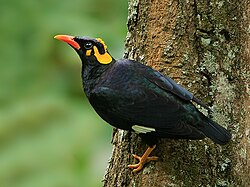
'''Starlings''' are small to medium-sized [[passerine]] [[bird]]s | '''Starlings''' are small to medium-sized [[passerine|passerine (perching)]] [[bird]]s known for the often dark, glossy iridescent sheen of their plumage; their complex vocalizations including mimicking; and their distinctive, often elaborate [[swarm behaviour|swarming]] behavior, known as '''[[Starlings#Murmuration|murmuration]]'''. | ||
All members of the family ''Sturnidae'', commonly called sturnids, are known collectively as starlings. The Sturnidae are named for the genus ''[[Sturnus]]'', which in turn comes from the [[Latin]] word for starling, ''sturnus''. The family contains 128 species which are divided into 36 genera. Many Asian species, particularly the larger ones, are called [[myna]]s, and many African species are known as [[Lamprotornis|glossy starlings]] because of their [[iridescence|iridescent]] [[Feather|plumage]]. Starlings are native to Europe, Asia, and Africa, as well as northern Australia and the islands of the tropical [[Pacific]]. Several European and Asian species have been introduced to these areas, as well as [[North America]], [[Hawaii]], and [[New Zealand]], where they generally compete for habitats with native birds and are considered to be [[invasive species]]. The starling species familiar to most people in Europe and North America is the [[common starling]], and throughout much of [[Asia]] and the Pacific. | |||
Having strong feet, their flight is strong and direct, and they are very [[gregarious]]. Their preferred habitat is fairly open country, they eat [[insect]]s and [[fruit]], and most species nest in holes and lay blue or white [[bird egg|eggs]]. Several species live around human habitation and are effectively [[omnivore]]s. Many species search for prey such as [[Beetle#Reproduction and development|grub]]s by "open-bill probing", that is, forcefully opening the bill after inserting it into a crevice, thus expanding the hole and exposing the prey; this behaviour is referred to as ''zirkeln'' (pronounced {{IPA|de|ˈtsɪʁkl̩n|}}), after the [[German language|German]] word ''Zirkel'' for a [[Compass (drawing tool)|pair of compasses]].<ref>{{cite journal |author1=East R. |author2=R. P. Pottinger |name-list-style=amp |title=(''Sturnus vulgaris'' L.) predation on grass grub (''Costelytra zealandica'' (White), Melolonthinae) populations in Canterbury |journal=New Zealand Journal of Agricultural Research |date=November 1975 |volume=18 |issue=4 |pages=417–452 |issn=0028-8233 |doi=10.1080/00288233.1975.10421071 |doi-access=free |hdl=10182/2197 |hdl-access=free }} (See p.429.)</ref> | |||
Starlings have diverse and complex vocalizations and have been known to embed sounds from their surroundings into their own calls, including [[car alarm]]s and human speech patterns. The birds can recognize particular individuals by their calls and | Starlings have diverse and complex vocalizations and have been known to embed sounds from their surroundings into their own calls, including [[car alarm]]s and human speech patterns. The birds can recognize particular individuals by their calls and have been the subject of research into the evolution of [[human language]].<ref>{{ cite web | last=Zimmer | first=Carl | date=2 May 2006 | url=https://www.nytimes.com/2006/05/02/science/02song.html | title=Starlings' listening skills may shed light on language evolution | work=The New York Times | access-date=14 January 2009}}</ref> | ||
==Description== | ==Description== | ||
| Line 23: | Line 23: | ||
Starlings are medium-sized [[passerines]].<ref name="HBW">{{cite book |last1=Craig |first1=Adrian |last2=Feare |first2=Chris |editor1=del Hoyo, Josep |editor2=Elliott, Andrew |editor3=Christie, David |contribution=Family Sturnidae (Starlings) |title=Handbook of the Birds of the World. Volume 14: Bush-shrikes to Old World Sparrows |pages=654–709 |year=2009 |location=Barcelona |publisher=Lynx Edicions |isbn=978-84-96553-50-7 |title-link=Handbook of the Birds of the World}}</ref> The shortest-bodied species is [[Kenrick's starling]] (''Poeoptera kenricki''), at {{cvt|15|cm|in|frac=2|abbr=on}}, but the lightest-weight species is [[Abbott's starling]] (''Poeoptera femoralis''), which is {{cvt|34|g|oz|frac=8|abbr=on}}. The largest starling, going on standard measurements and perhaps weight, is the [[Nias hill myna]] (''Gracula robusta''). This species can measure up to {{cvt|36|cm|in|frac=2|abbr=on}}, and in domestication they can weigh up to {{cvt|400|g|oz|frac=2|abbr=on}}. Rivaling the prior species in bulk if not dimensions, the [[myna]]s of the genus ''[[Mino (bird)|Mino]]'' are also large, especially the [[yellow-faced myna|yellow-faced]] (''M. dumontii'') and [[long-tailed myna]]s (''M. kreffti''). The longest species in the family is the [[white-necked myna]] (''Streptocitta albicollis''), which can measure up to {{cvt|50|cm|in|frac=2|abbr=on}}, although around 60% in this [[magpie]]-like species is comprised by its very long tail.<ref>{{cite book |last1=Feare |first1=Chris |last2=Craig |first2=Adrian |year=1998 |title=Starlings and Mynas |series=Helm Identification Guide |location=London |publisher=A&C Black |isbn=978-0713639612}}</ref> | Starlings are medium-sized [[passerines]].<ref name="HBW">{{cite book |last1=Craig |first1=Adrian |last2=Feare |first2=Chris |editor1=del Hoyo, Josep |editor2=Elliott, Andrew |editor3=Christie, David |contribution=Family Sturnidae (Starlings) |title=Handbook of the Birds of the World. Volume 14: Bush-shrikes to Old World Sparrows |pages=654–709 |year=2009 |location=Barcelona |publisher=Lynx Edicions |isbn=978-84-96553-50-7 |title-link=Handbook of the Birds of the World}}</ref> The shortest-bodied species is [[Kenrick's starling]] (''Poeoptera kenricki''), at {{cvt|15|cm|in|frac=2|abbr=on}}, but the lightest-weight species is [[Abbott's starling]] (''Poeoptera femoralis''), which is {{cvt|34|g|oz|frac=8|abbr=on}}. The largest starling, going on standard measurements and perhaps weight, is the [[Nias hill myna]] (''Gracula robusta''). This species can measure up to {{cvt|36|cm|in|frac=2|abbr=on}}, and in domestication they can weigh up to {{cvt|400|g|oz|frac=2|abbr=on}}. Rivaling the prior species in bulk if not dimensions, the [[myna]]s of the genus ''[[Mino (bird)|Mino]]'' are also large, especially the [[yellow-faced myna|yellow-faced]] (''M. dumontii'') and [[long-tailed myna]]s (''M. kreffti''). The longest species in the family is the [[white-necked myna]] (''Streptocitta albicollis''), which can measure up to {{cvt|50|cm|in|frac=2|abbr=on}}, although around 60% in this [[magpie]]-like species is comprised by its very long tail.<ref>{{cite book |last1=Feare |first1=Chris |last2=Craig |first2=Adrian |year=1998 |title=Starlings and Mynas |series=Helm Identification Guide |location=London |publisher=A&C Black |isbn=978-0713639612}}</ref> | ||
Less sexual dimorphism is seen in [[plumage]], but with only 25 species showing such differences between the two sexes. The plumage of the starling is often brightly coloured due to [[iridescence]]; this colour is derived from the structure of the feathers, not from any pigment. Some species of Asian starling have [[Crest (feathers)|crests]] or erectile feathers on the crest. Other ornamentation includes elongated tail feathers and brightly coloured bare areas on the face. These colours can be derived from pigments, or as in the [[Bali | Less sexual dimorphism is seen in [[plumage]], but with only 25 species showing such differences between the two sexes. The plumage of the starling is often brightly coloured due to [[iridescence]]; this colour is derived from the structure of the feathers, not from any pigment. Some species of Asian starling have [[Crest (feathers)|crests]] or erectile feathers on the crest. Other ornamentation includes elongated tail feathers and brightly coloured bare areas on the face. These colours can be derived from pigments, or as in the [[Bali myna]], structural colour, caused by light scattering off parallel collagen fibers. The irises of many species are red and yellow, although those of younger birds are much darker.<ref name="HBW" /> | ||
==Distribution, habitat and movements== | ==Distribution, habitat and movements== | ||
[[File:Chestnut-tailed Starling I IMG 2508.jpg|thumb|The [[chestnut-tailed starling]] is a partial migrant over much of the east of its range, but its movements are poorly understood.]] | [[File:Chestnut-tailed Starling I IMG 2508.jpg|thumb|The [[chestnut-tailed starling]] is a partial migrant over much of the east of its range, but its movements are poorly understood.]] | ||
Starlings inhabit a wide range of habitats from the [[Arctic Circle]] to the [[Equator]]. | Starlings inhabit a wide range of habitats from the [[Arctic Circle]] to the [[Equator]]. The only habitats they do not typically occupy are very dry sandy [[desert]]s. The family is naturally absent from the Americas and from large parts of Australia, but it is present over the majority of Europe, Africa, and Asia. The genus ''[[Aplonis]]'' has also spread widely across the islands of the Pacific, reaching [[Polynesia]], [[Melanesia]], and [[Micronesia]]<ref name = "HBW"/> (in addition one species in the genus ''[[Mino (bird)|Mino]]'' has reached the [[Solomon Islands]]<ref>{{cite book|last=Doughty|first=Chris |author2=Day, Nicholas |author3=Andrew Plant|title=Birds of the Solomons, Vanuatu & New Caledonia|publisher=Christopher Helm|location=London|year=1999|isbn=978-0-7136-4690-0}}</ref>). Also, a species of this genus is the only starling found in northern Australia.<ref name = "HBW"/> | ||
Asian species are most common in evergreen forests; 39 species found in Asia are predominantly forest birds as opposed to 24 found in more open or human modified environments. In contrast to this, African species are more likely to be found in open woodlands and savannah; 33 species are open-area specialists compared to 13 true forest species. The high diversity of species found in Asia and Africa is not matched by Europe, which has one widespread (and very common) species and two more restricted species. The [[European starling]] is both highly widespread and extremely | Asian species are most common in evergreen forests; 39 species found in Asia are predominantly forest birds as opposed to 24 found in more open or human modified environments. In contrast to this, African species are more likely to be found in open woodlands and savannah; 33 species are open-area specialists compared to 13 true forest species. The high diversity of species found in Asia and Africa is not matched by Europe, which has one widespread (and very common) species and two more restricted species. The [[European starling]] is both highly widespread and extremely eclectic in its habitat, occupying most types of open habitat. Like many other starling species, it has also adapted readily to human-modified habitat, including farmland, orchards, plantations, and urban areas.<ref name = "HBW"/> | ||
Some species of starlings are [[bird migration|migratory]], either entirely, like [[Shelley's starling]], which breeds in [[Ethiopia]] and [[Somaliland]] and migrates to [[Kenya]], [[Tanzania]], and [[Somalia]], or like the [[white-shouldered starling]], which is migratory in part of its range, but is resident in others.<ref name = "HBW"/> | Some species of starlings are [[bird migration|migratory]], either entirely, like [[Shelley's starling]], which breeds in [[Ethiopia]] and [[Somaliland]] and migrates to [[Kenya]], [[Tanzania]], and [[Somalia]], or like the [[white-shouldered starling]], which is migratory in part of its range, but is resident in others.<ref name = "HBW"/> | ||
The European starling was purposely introduced to North America in the 1870s through the 1890s by multiple [[acclimatisation society|acclimatisation societies]], organizations dedicated to introducing European flora and fauna into North America for cultural and economic reasons.<ref name="Fugate2021">{{cite journal |last1=Fugate |first1=Lauren |last2=Miller |first2=John MacNeill |title=Shakespeare's Starlings: Literary History and the Fictions of Invasiveness |journal=Environmental Humanities |date=November 1, 2021 |volume=13 |issue=2 |pages=301–322 |doi=10.1215/22011919-9320167 |s2cid=243468840 |url=https://read.dukeupress.edu/environmental-humanities/article/13/2/301/234995/Shakespeare-s-StarlingsLiterary-History-and-the |access-date=November 26, 2021 |issn=2201-1919|doi-access=free }}</ref> A persistent story alleges that [[Eugene Schieffelin]], chairman of the [[American Acclimatization Society]], decided all birds mentioned by [[William Shakespeare]] should be in North America, leading to the introduction of the starling to the U.S.; however, this claim is more fiction than fact.<ref name="Mirsky">{{cite journal |url=https://www.scientificamerican.com/article.cfm?id=call-of-the-reviled|date=May 23, 2008 |journal=Scientific American |title=Shakespeare to blame for introduction of European starlings to U.S |first1=Steve |last1=Mirsky |access-date=November 14, 2012}}</ref><ref name=Fugate2021 /> While Schieffelin and other members of the society did release starlings in [[Central Park]] in 1890, the birds had already been in the U.S. since at least the mid-1870s, and Schieffelin was not inspired to do so by Shakespeare's works.<ref name=Fugate2021 /> | The European starling was purposely introduced to North America in the 1870s through the 1890s by multiple [[acclimatisation society|acclimatisation societies]], organizations dedicated to introducing European flora and fauna into North America for cultural and economic reasons.<ref name="Fugate2021">{{cite journal |last1=Fugate |first1=Lauren |last2=Miller |first2=John MacNeill |title=Shakespeare's Starlings: Literary History and the Fictions of Invasiveness |journal=Environmental Humanities |date=November 1, 2021 |volume=13 |issue=2 |pages=301–322 |doi=10.1215/22011919-9320167 |s2cid=243468840 |url=https://read.dukeupress.edu/environmental-humanities/article/13/2/301/234995/Shakespeare-s-StarlingsLiterary-History-and-the |access-date=November 26, 2021 |issn=2201-1919|doi-access=free }}</ref> A persistent story alleges that [[Eugene Schieffelin]], chairman of the [[American Acclimatization Society]], decided all birds mentioned by [[William Shakespeare]] should be in North America, leading to the introduction of the starling to the U.S.; however, this claim is more fiction than fact.<ref name="Mirsky">{{cite journal |url=https://www.scientificamerican.com/article.cfm?id=call-of-the-reviled|date=May 23, 2008 |journal=Scientific American |title=Shakespeare to blame for introduction of European starlings to U.S |first1=Steve |last1=Mirsky |access-date=November 14, 2012}}</ref><ref name=Fugate2021 /> While Schieffelin and other members of the society did release starlings in [[Central Park]] in 1890, the birds had already been in the U.S. since at least the mid-1870s, and Schieffelin was not inspired to do so by Shakespeare's works.<ref name=Fugate2021 /> | ||
==Behavior== | |||
Starlings imitate a variety of avian species and have a repertoire of about 15–20 distinct imitations. They also imitate a few sounds other than those of wild birds. The calls of abundant species or calls that are simple in frequency structure and show little amplitude modulation are preferentially imitated. Dialects of mimicked sounds can be local.<ref name = "HBW"/> | |||
== | The Starling's sociality is particularly evident in their roosting behavior; in the nonbreeding season, some roosts can number in the thousands.<ref name = "HBW"/> | ||
===Murmuration<!--'Murmuration' redirects here-->=== | |||
[[File:Spectacular Starlings at Newport Wetlands Nature Reserve, Cymru, Wales.webm|thumb|[[Swarm behaviour|Murmuration]] of common starlings at [[Newport Wetlands Nature Reserve]], Wales]] | [[File:Spectacular Starlings at Newport Wetlands Nature Reserve, Cymru, Wales.webm|thumb|[[Swarm behaviour|Murmuration]] of common starlings at [[Newport Wetlands Nature Reserve]], Wales]] | ||
A highly social bird, most starlings associate in flocks of varying sizes throughout the year and are widely known for a distinctive, often dramatic [[swarm behaviour|swarming behavior]] known as murmuration<ref name=King2012>{{cite journal |vauthors=King AJ, Sumpter DJ |title=Murmurations |journal=Current Biology |volume=22 |issue=4 |pages=R112–4 |date=2012 |pmid=22361142 |doi=10.1016/j.cub.2011.11.033 |doi-access=free|bibcode=2012CBio...22.R112K }}</ref> — a simultaneously synchronized and seemingly random flock movement characterized by sudden, erratic direction changes without an observable leader.<ref name="wings"/> | |||
=== | The sharp pushing, pulling, diving, pulsating and swooping of the flock in response to the individual movements may confuse and discourage predators such as falcons, providing a collective protection.<ref name="murm"/> The term ''murmuration'' derives from the low, indistinct sounds of a dense flock's wings — i.e., the ''murmor''.<ref name="wings">{{cite web | ||
|title = Starling Murmurations: A Complete Guide on this Phenomenon | |||
|publisher = Birdfact.com | |||
|author = | |||
|date = September 14, 2023 | |||
|url = https://birdfact.com/birds/starling/starling-murmuration}}</ref> | |||
Initial study by ornithologist [[Edmund Selous]] (1887-1934) sought to explain the murmuration of starlings through the idea of [[Telepathy|thought-transference]].<ref name="synchronize"/> By 2013, physicists in Italy along with mechanical and aerospace engineers working with [[Princeton University]], determined that no single bird could control a flock, and certainly not the movements of more than a thousand birds. Researchers used a computer simulation to determine that each bird synchronized with its seven closest neighbors, creating overlapping groups that communicated their movements — focusing on three simple parameters: attraction, repulsion and angular alignment.<ref name="synchronize">{{cite web | |||
|title = The Secrets and Science Behind Starling Murmurations | |||
|publisher = Howstuffworks.com | |||
|author = John Donovan | |||
|date = 9 August 2019 | |||
|url = https://animals.howstuffworks.com/birds/starling-murmurations.htm}}</ref> Thus the flock moves as each individual bird synchronizes with its nearest group.<ref name="wings"/> Researchers also confirmed that a particular shape to the flock formation worked most efficiently for data accuracy — and specifically in starlings, a pancake shape. Thinner, thicker or spherical shapes did not improve performance, rather optimal performance was related to a pancake flock shape.<ref name="pancake">{{cite web | |||
|title = Birds of a feather … track seven neighbors to flock together | |||
|publisher = Princeton University, Office of Engineering Communications | |||
|author = Anna Azvolinsky | |||
|date = February 7, 2013 | |||
|url = https://www.princeton.edu/news/2013/02/07/birds-feather-track-seven-neighbors-flock-together}}</ref> | |||
They noted that "information moves across the flock very quickly and with nearly no degradation,"<ref name="lost"/> describing it as "a high signal-to-noise ratio"<ref name="lost"/> enabled by a bird's very high temporal resolution: they can receive and process certain information more quickly than humans and can "see faster" than humans."<ref name="synchronize"/> Unlike the [[Telephone game|children's game of telephone]] where a message is sequentially passed from person to person and very quickly loses information, researchers determined that almost no information is lost across a starling flock.<ref name="lost">{{cite web | |||
|title = How Do Starling Flocks Create Those Mesmerizing Murmurations? | |||
|publisher = Cornell Lab | |||
|author = Andrea Alfano | |||
|date = February 21, 2025 | |||
|url = https://www.allaboutbirds.org/news/how-do-starling-flocks-create-those-mesmerizing-murmurations/}}</ref> | |||
Starling murmurations can last from a few seconds up to 45 minutes; can involve few birds or up to tens of thousands;<ref name="murm">{{cite web | |||
|title = You get one split second': The story behind a viral bird photo | |||
|publisher = CNN | |||
|author = Oscar Holland | |||
|date = February 13, 2025 | |||
|url = https://www.cnn.com/2025/02/13/style/james-crombie-starling-murmurations-snap/index.html}}</ref> may include other species of starlings or species from other families; and sometimes form abstract dramatic shapes, patterns or subtle gradations.<ref name="murm"/> In [[Denmark]], where murmurations have been estimated to involve a million starlings, the phenomenon is called the Black Sun, or ''Sort sol'' in Danish.<ref name="black">{{cite web | |||
|title = The Black Sun in Denmark | |||
|publisher = denmark.net | |||
|author = Craig Hewitt | |||
|date = 23 November 2012 | |||
|url = https://denmark.net/black-sun-denmark/}}</ref> In Ireland, starlings’ numbers are boosted during winter, as migrating flocks arrive from breeding grounds around Western Europe and Scandinavia. | |||
===Diet and feeding=== | ===Diet and feeding=== | ||
[[File:Aplonis opaca.jpg|thumb|[[Micronesian starling]]s have been observed feeding on the eggs of [[seabird]]s.]] | [[File:Aplonis opaca.jpg|thumb|[[Micronesian starling]]s have been observed feeding on the eggs of [[seabird]]s.]] | ||
[[File:2 starlings and a robin on grape arbor. - DPLA - 9cd7742aa67b676375f64c4402dee2c2.jpg|left|thumb|Two starlings and an American robin (right) on grape arbor: The American robin is plucking a grape. Robins and starlings cause serious damage to ripening grapes in California and elsewhere.]] | [[File:2 starlings and a robin on grape arbor. - DPLA - 9cd7742aa67b676375f64c4402dee2c2.jpg|left|thumb|Two starlings and an American robin (right) on grape arbor: The American robin is plucking a grape. Robins and starlings cause serious damage to ripening grapes in California and elsewhere.]] | ||
The diets of the starlings are usually dominated by fruits and insects. Many species are important dispersers of seeds, in Asia and Africa, for example, [[white sandalwood]] and [[Indian banyan]]. In addition to trees, they are also important dispersers of [[parasitic]] [[mistletoe]]s. In South Africa, the [[red-winged starling]] is an important disperser of the [[introduced species|introduced]] ''[[Acacia cyclops]]''. Starlings have been observed feeding on fermenting over-ripe fruit, which led to the speculation that they might become intoxicated by the alcohol.<ref name = "HBW"/> | The diets of the starlings are usually dominated by fruits and insects. Many species are important dispersers of seeds, in Asia and Africa, for example, [[white sandalwood]] and [[Indian banyan]]. In addition to trees, they are also important dispersers of [[parasitic]] [[mistletoe]]s. In South Africa, the [[red-winged starling]] is an important disperser of the [[introduced species|introduced]] ''[[Acacia cyclops]]''. Starlings have been observed feeding on fermenting over-ripe fruit, which led to the speculation that they might become intoxicated by the alcohol.<ref name = "HBW"/> | ||
Laboratory experiments on European starlings have found that they have disposal enzymes that allow them to break down alcohol very quickly.<ref>{{cite journal|last=Prinzinger |first=R.|author2=Hakimi G.A. |year=1996|title=Alcohol resorption and alcohol degradation in the European Starling ''Sturnus vulgaris''|journal=Journal für Ornithologie|volume=137|issue=3|pages=319–327|doi=10.1007/BF01651072|s2cid=31680169}}</ref> In addition to consuming fruits, many starlings also consume [[nectar]]. The extent to which starlings are important [[pollinator]]s is unknown, but at least some are, such as the [[slender-billed starling]] of alpine East Africa, which pollinates [[megaherb|giant]] [[lobelia]]s.<ref name = "HBW"/> | Laboratory experiments on European starlings have found that they have disposal enzymes that allow them to break down alcohol very quickly.<ref>{{cite journal|last=Prinzinger |first=R.|author2=Hakimi G.A. |year=1996|title=Alcohol resorption and alcohol degradation in the European Starling ''Sturnus vulgaris''|journal=Journal für Ornithologie|volume=137|issue=3|pages=319–327|doi=10.1007/BF01651072|bibcode= |s2cid=31680169}}</ref> In addition to consuming fruits, many starlings also consume [[nectar]]. The extent to which starlings are important [[pollinator]]s is unknown, but at least some are, such as the [[slender-billed starling]] of alpine East Africa, which pollinates [[megaherb|giant]] [[lobelia]]s.<ref name = "HBW"/> | ||
==Systematics== | ==Systematics== | ||
{{update section|date=December 2019}} | {{update section|date=December 2019}} | ||
The starling family Sturnidae was introduced (as Sturnidia) by French [[polymath]] [[Constantine Samuel Rafinesque]] in 1815.<ref>{{ cite book | last=Rafinesque | first=Constantine Samuel | author-link=Constantine Samuel Rafinesque | year=1815 | title=Analyse de la nature ou, Tableau de l'univers et des corps organisés | volume=1815 | publisher=Self-published | place=Palermo | language=fr | page=68 | url=https://www.biodiversitylibrary.org/page/48310146 }}</ref><ref>{{cite book | last=Bock | first=Walter J. | year=1994 | title=History and Nomenclature of Avian Family-Group Names | series=Bulletin of the American Museum of Natural History | volume= | The starling family Sturnidae was introduced (as Sturnidia) by French [[polymath]] [[Constantine Samuel Rafinesque]] in 1815.<ref>{{ cite book | last=Rafinesque | first=Constantine Samuel | author-link=Constantine Samuel Rafinesque | year=1815 | title=Analyse de la nature ou, Tableau de l'univers et des corps organisés | volume=1815 | publisher=Self-published | place=Palermo | language=fr | page=68 | url=https://www.biodiversitylibrary.org/page/48310146 }}</ref><ref>{{cite book | last=Bock | first=Walter J. | year=1994 | title=History and Nomenclature of Avian Family-Group Names | series=Bulletin of the American Museum of Natural History | volume= 222 | publisher=American Museum of Natural History | place=New York | pages=157, 252 | hdl=2246/830 }}<!--Linked page allows download of the 48MB pdf--></ref> | ||
The starlings belong to the [[Taxonomic rank|superfamily]] Muscicapoidea, together with [[thrush (bird)|thrush]]es, [[Old World flycatcher|flycatcher]]s and [[chat (bird)|chat]]s, as well as [[dippers]], which are quite distant relatives, and [[Mimidae]] (thrashers and mockingbirds). The latter are apparently the Sturnidae's closest living relatives, replace them in the [[Americas]], and have a rather similar but more solitary lifestyle. They are [[morphology (biology)|morphologically]] quite similar too—a partly [[albinistic]] specimen of a mimid, mislabelled as to suggest an Old World origin, was for many decades believed to represent an extinct starling (see [[Rodrigues starling]] for details). | The starlings belong to the [[Taxonomic rank|superfamily]] Muscicapoidea, together with [[thrush (bird)|thrush]]es, [[Old World flycatcher|flycatcher]]s and [[chat (bird)|chat]]s, as well as [[dippers]], which are quite distant relatives, and [[Mimidae]] (thrashers and mockingbirds). The latter are apparently the Sturnidae's closest living relatives, replace them in the [[Americas]], and have a rather similar but more solitary lifestyle. They are [[morphology (biology)|morphologically]] quite similar too—a partly [[albinistic]] specimen of a mimid, mislabelled as to suggest an Old World origin, was for many decades believed to represent an extinct starling (see [[Rodrigues starling]] for details). | ||
| Line 59: | Line 97: | ||
The [[oxpecker]]s are sometimes placed here as a [[subfamily]], but the weight of evidence has shifted towards granting them full family status as a more [[basal (biology)|basal]] member of the Sturnidae-Mimidae group, derived from an early expansion into Africa. | The [[oxpecker]]s are sometimes placed here as a [[subfamily]], but the weight of evidence has shifted towards granting them full family status as a more [[basal (biology)|basal]] member of the Sturnidae-Mimidae group, derived from an early expansion into Africa. | ||
Usually, the starlings are considered a family, as is done here. Sibley & Monroe<ref>{{ cite book | last1=Sibley | first1=Charles Gald | author1-link=Charles Sibley | last2=Monroe | first2=Burt L. Jr. | year=1990 | title=Distribution and Taxonomy of the Birds of the World: A Study in Molecular Evolution | publisher=Yale University Press | location=New Haven, CT | isbn=978-0-300-04969-5 }}</ref> included the mimids in the family and demoted the starlings to [[tribe (biology)|tribe]] rank, as '''Sturnini'''. This treatment was used by Zuccon et al.<ref name=zuccon>{{cite journal | last1 = Zuccon | first1 = Dario | last2 = Cibois | first2 = Alice | last3 = Pasquet | first3 = Eric | last4 = Ericson | first4 = Per G.P. | year = 2006 | title = Nuclear and mitochondrial sequence data reveal the major lineages of starlings, mynas and related taxa | journal = Molecular Phylogenetics and Evolution | volume = 41 | issue = 2| pages = 333–344 | doi = 10.1016/j.ympev.2006.05.007 | pmid = 16806992 }}</ref> However, the grouping of Sibley & Monroe is overly coarse due to methodological drawbacks of their [[DNA-DNA hybridization]] technique and most of their proposed revisions of taxonomic [[rank (zoology)|rank]] have not been accepted (see for example [[Ciconiiformes]]). The all-inclusive Sturnidae grouping conveys little information about [[biogeography]], and obscures the evolutionary distinctness of the three lineages. Establishing a valid name for the [[clade]] consisting of Sibley/Monroe's "pan-Sturnidae" would nonetheless be desirable to contrast them with the other major lineages of Muscicapoidea. | Usually, the starlings are considered a family, as is done here. Sibley & Monroe<ref>{{ cite book | last1=Sibley | first1=Charles Gald | author1-link=Charles Sibley | last2=Monroe | first2=Burt L. Jr. | year=1990 | title=Distribution and Taxonomy of the Birds of the World: A Study in Molecular Evolution | publisher=Yale University Press | location=New Haven, CT | isbn=978-0-300-04969-5 }}</ref> included the mimids in the family and demoted the starlings to [[tribe (biology)|tribe]] rank, as '''Sturnini'''. This treatment was used by Zuccon et al.<ref name=zuccon>{{cite journal | last1 = Zuccon | first1 = Dario | last2 = Cibois | first2 = Alice | last3 = Pasquet | first3 = Eric | last4 = Ericson | first4 = Per G.P. | year = 2006 | title = Nuclear and mitochondrial sequence data reveal the major lineages of starlings, mynas and related taxa | journal = Molecular Phylogenetics and Evolution | volume = 41 | issue = 2| pages = 333–344 | doi = 10.1016/j.ympev.2006.05.007 | pmid = 16806992 | bibcode = 2006MolPE..41..333Z }}</ref> However, the grouping of Sibley & Monroe is overly coarse due to methodological drawbacks of their [[DNA-DNA hybridization]] technique and most of their proposed revisions of taxonomic [[rank (zoology)|rank]] have not been accepted (see for example [[Ciconiiformes]]). The all-inclusive Sturnidae grouping conveys little information about [[biogeography]], and obscures the evolutionary distinctness of the three lineages. Establishing a valid name for the [[clade]] consisting of Sibley/Monroe's "pan-Sturnidae" would nonetheless be desirable to contrast them with the other major lineages of Muscicapoidea. | ||
Starlings probably originated in the general area of [[East Asia]], perhaps towards the southwestern Pacific, as | Starlings probably originated in the general area of [[East Asia]], perhaps towards the southwestern Pacific, as inferred by the number of [[plesiomorph]]ic lineages to occur there. Expansion into Africa appears to have occurred later, as most [[Synapomorphy|derived]] forms are found there. An alternative scenario would be African origin for the entire "sturnoid" group,<ref name=zuccon/> with the oxpeckers representing an ancient [[Relict (biology)|relict]] and the mimids arriving in South America. This is contradicted by the North American distribution of the most [[basal (biology)|basal]] Mimidae.<ref name=zuccon/><ref name=cibois>{{cite journal | last1 = Cibois | first1 = A. | last2 = Cracraft | first2 = J. | year = 2004 | title = Assessing the passerine 'tapestry': phylogenetic relationships of the Muscicapoidea inferred from nuclear DNA sequences | journal = Molecular Phylogenetics and Evolution | volume = 32 | issue = 1| pages = 264–273 | doi = 10.1016/j.ympev.2003.12.002 | pmid = 15186812 }}</ref> | ||
As the fossil record is limited to quite [[Holocene|Recent]]<!-- capitalization is correct—synonym for "Quaternary" --> forms, the proposed [[Early Miocene]] (about 25–20 [[mya (unit)|Mya]]) divergence dates for the "sturnoids" lineages must be considered extremely tentative. Given the overall evidence for the origin of most [[Passeri]] families in the first half of the [[Miocene]], it appears to be not too far off the mark, however.<ref name=zuccon/> | As the fossil record is limited to quite [[Holocene|Recent]]<!-- capitalization is correct—synonym for "Quaternary" --> forms, the proposed [[Early Miocene]] (about 25–20 [[mya (unit)|Mya]]) divergence dates for the "sturnoids" lineages must be considered extremely tentative. Given the overall evidence for the origin of most [[Passeri]] families in the first half of the [[Miocene]], it appears to be not too far off the mark, however.<ref name=zuccon/> | ||
{{asof|2007|post=,}} recent studies<ref name=zuccon/><ref name=cibois/> identified two major [[clade]]s of this family, corresponding to the generally drab, often striped, largish "atypical [[myna]]s" and other mainly Asian-Pacific lineages, and the often smaller, sometimes highly [[apomorph]]ic [[taxa]] which are most common in Africa and the Palearctic, usually have metallic coloration, and in a number of species also bright [[carotinoid]] plumage colors on the underside. Inside this latter group, there is a clade consisting of species which, again, are usually not too brightly colored, and which consists of the "typical" myna-''[[Sturnus]]'' assemblage. | |||
The [[Philippine creeper]]s, a single genus of three species of [[treecreeper]]-like birds, appear to be highly [[apomorph]]ic members of the more initial radiation of the Sturnidae.<ref name=zuccon/> While this may seem odd at first glance, their placement has always been contentious. In addition, [[biogeography]] virtually rules out a close relationship of Philippine creepers and treecreepers, as neither the latter nor their close relatives seem to have ever reached [[Wallacea]], let alone the [[Philippines]]. Nonetheless, their inclusion in the Sturnidae is not entirely final and eventually, they may remain a separate family. | The [[Philippine creeper]]s, a single genus of three species of [[treecreeper]]-like birds, appear to be highly [[apomorph]]ic members of the more initial radiation of the Sturnidae.<ref name=zuccon/> While this may seem odd at first glance, their placement has always been contentious. In addition, [[biogeography]] virtually rules out a close relationship of Philippine creepers and treecreepers, as neither the latter nor their close relatives seem to have ever reached [[Wallacea]], let alone the [[Philippines]]. Nonetheless, their inclusion in the Sturnidae is not entirely final and eventually, they may remain a separate family. | ||
Genus sequence follows traditional treatments. This is apparently not entirely correct, with ''Scissirostrum'' closer to ''Aplonis'' than to ''Gracula'', for example, and ''[[Acridotheres]]'' among the most advanced genera. Too few taxa have yet been studied as regards their relationships, however, thus a change in the sequence has to wait | Genus sequence follows traditional treatments. This is apparently not entirely correct, with ''Scissirostrum'' closer to ''Aplonis'' than to ''Gracula'', for example, and ''[[Acridotheres]]'' among the most advanced genera. Too few taxa have yet been studied as regards their relationships, however, thus a change in the sequence has to wait for further studies. | ||
=== | As of 2023, the review by Lovette & Rubenstein (2008) is the most recent work on the phylogeny of the group.<ref>{{Cite journal | last1=Lovette | first1=I.J. | last2=McCleery | first2=B.V. | last3=Talaba | first3=A.L. | last4=Rubenstein | first4=D.R. | date=2008 | title=A complete species-level molecular phylogeny for the "Eurasian" starlings (Sturnidae: ''Sturnus'', ''Acridotheres'', and allies): Recent diversification in a highly social and dispersive avian group | journal=Molecular Phylogenetics and Evolution | volume=47 | issue=1 | pages=251–260 | doi=10.1016/j.ympev.2008.01.020 | doi-access=free | pmid=18321732 | bibcode=2008MolPE..47..251L }}</ref> This taxonomy is also based on the order of the [[International Ornithologists' Union|IOC]].<ref name=":0">{{Cite web|title=Nuthatches, Wallcreeper, treecreepers, mockingbirds, starlings, oxpeckers – IOC World Bird List|url=https://www.worldbirdnames.org/new/bow/nuthatch/|access-date=2021-07-29|language=en-US}}</ref> | ||
=== '' | === Clades === | ||
{| class="wikitable" | |||
|+Oriental-Australasian clade | |||
!Genus | |||
!Species | |||
!Image | |||
|- | |||
|'''''[[Acridotheres]]''''' | |||
| | |||
* [[Great myna]] (''A. grandis'') | |||
* [[Crested myna]] (''A. cristatellus'') | |||
* [[Javan myna]] (''A. javanicus'') | |||
* [[Pale-bellied myna]], (''A. cinereus'') | |||
* [[Jungle myna]] (''A. fuscus'') | |||
* [[Collared myna]] (''A. albocinctus'') | |||
* [[Bank myna]] (''A. ginginianus'') | |||
* [[Common myna]] (''A. tristis'') | |||
* [[Black-winged myna]] (''A. melanopterus'') | |||
* [[Burmese myna]] (''A. burmannicus'') | |||
* [[Vinous-breasted myna]] (''A. leucocephalus'') | |||
|[[File:Acridotheres tristis 40973073.jpg|frameless]] | |||
[[Common myna]] (''A. tristis'') | |||
|- | |||
|'''''[[Agropsar]]''''' | |||
{{Small|(sometimes included in ''Sturnus'' or ''Sturnia'')}} | |||
| | |||
* [[Daurian starling]] (''A. sturninus'') | |||
* [[Chestnut-cheeked starling]] (''A. philippinensis'') | |||
|[[File:Agropsar sturninus - Kent Ridge Park.jpg|frameless]] | |||
[[Daurian starling]] | |||
(''A. sturninus'') | |||
|- | |||
|'''''[[Ampeliceps]]''''' | |||
| | |||
* [[Golden-crested myna]] (''A. coronatus'') | |||
|[[File:Golden-crested Myna (cropped).jpg|frameless]] | |||
[[Golden-crested myna]] | |||
(''A. coronatus'') | |||
|- | |||
|'''''[[Aplonis]]''''' | |||
|22 extant, | |||
3 recently [[extinct]] | |||
|[[File:Metallic Starling 7115.jpg|frameless]] | |||
[[Metallic starling]] | |||
(''A. metallica'') | |||
|- | |||
|'''''[[Basilornis]]''''' | |||
| | |||
*[[Sulawesi myna]] (''B. celebensis'') | |||
* [[Helmeted myna]] (''B. galeatus'') | |||
* [[Long-crested myna]] (''B. corythaix'') | |||
|[[File:Basilornis celebensis 339643073.jpg|frameless]] | |||
[[Sulawesi myna]] | |||
(''B. celebensis'') | |||
|- | |||
|'''''[[Enodes]]''''' | |||
| | |||
* [[Fiery-browed starling|Fiery-browed myna]] (''E. erythrophris'') | |||
|[[File:Enodes erythrophris 64408767.jpg|frameless]] | |||
[[Fiery-browed starling|Fiery-browed myna]] | |||
(''E. erythrophris'') | |||
|- | |||
|'''''[[Apo myna|Goodfellowia]]''''' | |||
| | |||
* [[Apo myna]] (''G. miranda'') | |||
|[[File:8454 Apo Myna 2 (cropped).jpg|frameless]] | |||
[[Apo myna]] | |||
(''G. miranda'') | |||
|- | |||
|'''''[[Gracula]]''''' | |||
| | |||
* [[Sri Lanka hill myna|Sri lanka hill myna]] (''G. ptilogenys'') | |||
* [[Common hill myna]] (''G. religiosa'') | |||
* [[Southern hill myna]] (''G. indica'') | |||
* [[Tenggara hill myna]] (''G. venerata'') | |||
|[[File:Starling bird (India, 2012).jpg|frameless]] | |||
[[Southern hill myna]] | |||
(''G. indica'') | |||
|- | |||
|'''''[[Gracupica]]''''' | |||
| | |||
* [[Black-collared starling]] ''(G. nigricollis'') | |||
* [[Indian pied myna]] (''G. contra'') | |||
* [[Siamese pied myna]] (''G. floweri'') | |||
* [[Javan pied myna]] (''G. jalla'') | |||
|[[File:Pied Myna (Gracupica contra) (33248972795) (cropped).jpg|frameless]] | |||
[[Indian pied myna]] | |||
(''G. contra'') | |||
|- | |||
|'''''[[Leucopsar]]''''' | |||
| | |||
* [[Bali myna]] (''L. rothschildi'') | |||
|[[File:Bali starling hkg.jpg|frameless]] | |||
[[Bali myna]] | |||
(''L. rothschildi'') | |||
|- | |||
|'''''[[Mino (bird)|Mino]]''''' | |||
| | |||
*[[Yellow-faced myna]] (''M. dumontii'') | |||
* [[Golden myna]] (''M. anais'') | |||
* [[Long-tailed myna]] (''M. kreffti'') | |||
|[[File:Yellow faced Myna (Mino dumontii) (11184702626).jpg|frameless]] | |||
[[Yellow-faced myna]] | |||
(''M. dumontii'') | |||
|- | |||
|'''''[[Coleto|Sarcops]]''''' | |||
| | |||
* [[Coleto]] (''S. calvus'') | |||
|[[File:Hanging Coleto (cropped).jpg|frameless]] | |||
[[Coleto]] | |||
(''S. calvus'') | |||
|- | |||
|'''''[[Scissirostrum]]''''' | |||
| | |||
* [[Grosbeak starling]] (''S. dubium'') | |||
|[[File:Finch-billed Myna.jpg|frameless]] | |||
[[Grosbeak starling]] | |||
(''S. dubium'') | |||
|- | |||
|'''''[[Spodiopsar]]''''' | |||
| | |||
* [[Red-billed starling]] (''S. sericeus'') | |||
* [[White-cheeked starling]] (''S. cineraceus'') | |||
|[[File:Watching (11435011245).jpg|frameless]] | |||
[[White-cheeked starling]] | |||
(''S. cineraceus'') | |||
|- | |||
|'''''[[Streptocitta]]''''' | |||
| | |||
*[[White-necked myna]] (''S. albicollis'') | |||
* [[Bare-eyed myna]] (''S. albertinae'') | |||
|[[File:White-necked myna - (Streptocitta albicollis) (cropped).jpg|frameless]] | |||
[[White-necked myna]] | |||
(''S. albicollis'') | |||
|- | |||
|'''''[[Sturnia]]''''' | |||
{{Small|(sometimes included in ''Sturnus'')}} | |||
| | |||
* [[White-shouldered starling]] (''S. sinensis'') | |||
* [[Chestnut-tailed starling]] (''S. malabarica'') | |||
* [[White-headed starling]] (''S. erythropygia'') | |||
* [[Malabar starling]] (''S. blythii'') | |||
* [[Brahminy starling]] (''S. pagodarum'') | |||
|[[File:Brahminy starling (Sturnia pagodarum) - 1 (cropped).jpg|frameless]] | |||
[[Brahminy starling]] | |||
(''S. pagodarum'') | |||
|- | |||
|'''''[[Sturnornis]]''''' | |||
| | |||
* [[White-faced starling]] (''S. albofrontatus'') | |||
|[[File:Flickr - Rainbirder - White-faced Starling (Sturnia albofrontata).jpg|frameless]] | |||
[[White-faced starling]] | |||
(''S. albofrontatus'') | |||
|- | |||
|'''†''[[Fregilupus]]''''' | |||
| | |||
* [[Hoopoe starling]] (†''F. varius'') | |||
|[[File:Huppe de Bourbon-Etourneau de la Réunion, - collection d'animaux disparus, Musée de zoologie de Lausanne.jpg|frameless]] | |||
[[Hoopoe starling]] | |||
(†''F. varius'') | |||
|- | |||
|'''†''[[Necropsar]]''''' | |||
| | |||
* [[Rodrigues starling]] (†''N. rodericanus'') | |||
|[[File:Rodrigues Starling.jpg|frameless]] | |||
[[Rodrigues starling]] | |||
(†''N. rodericanus'') | |||
|} | |||
{| class="wikitable" | |||
|+Afrotropical-Palearctic clade | |||
!Genus | |||
!Species | |||
!Image | |||
|- | |||
|'''''[[Arizelopsar]]''''' | |||
| | |||
* [[Abbott's starling]] (''A. femoralis'') | |||
|[[File:Abbott's Starling (adult) (cropped).jpg|frameless]] | |||
[[Abbott's starling]] | |||
(''A. femoralis'') | |||
|- | |||
|'''''[[Cinnyricinclus]]''''' | |||
| | |||
* [[Violet-backed starling]] (''C. leucogaster'') | |||
|[[File:Violet-backed Starling - Mkuze - Natal S4E8871 (22382980057) (cropped).jpg|frameless]] | |||
[[Violet-backed starling]] | |||
(''C. leucogaster'') | |||
|- | |||
|'''''[[Creatophora]]''''' | |||
| | |||
* [[Wattled starling]] (''C. cinerea'') | |||
|[[File:Day 81 Wattled Starling (Creatophora cinerea) male ... (53847424633) (cropped).jpg|frameless]] | |||
[[Wattled starling]] | |||
(''C. cinerea'') | |||
|- | |||
|'''''[[Grafisia]]''''' | |||
| | |||
* [[White-collared starling]] (''G. torquata'') | |||
|[[File:Grafisia Torquata (White-collared Starling) (cropped).jpg|frameless]] | |||
[[White-collared starling]] | |||
(''G. torquata'') | |||
|- | |||
|'''''[[Hartlaubius]]''''' | |||
| | |||
* [[Madagascar starling]] (''H. auratus'') | |||
|[[File:Hartlaubius auratus.jpg|frameless]] | |||
[[Madagascar starling]] | |||
(''H. auratus'') | |||
|- | |||
|'''''[[Hylopsar]]''''' | |||
| | |||
* [[Purple-headed starling]] (''H. purpureiceps'') | |||
* [[Copper-tailed starling]] (''H. cupreocauda'') | |||
|[[File:Purple-headed Starling (cropped).jpg|frameless]] | |||
[[Purple-headed starling]] | |||
(''H. purpureiceps'') | |||
|- | |||
|'''''[[Lamprotornis]]''''' | |||
{{Small|(sometimes included in ''Sturnus'')}} | |||
| | |||
*[[Cape starling]] ''L. nitens'') | |||
* [[Greater blue-eared starling]] (''L. chalybaeus'') | |||
* [[Lesser blue-eared starling]] (''L. chloropterus'') | |||
* [[Miombo blue-eared starling]] (''L. elisabeth'') | |||
* [[Bronze-tailed starling]] (''L. chalcurus'') | |||
* [[Splendid starling]] (''L. splendidus'') | |||
* [[Principe starling]] (''L. ornatus'') | |||
* [[Emerald starling]] (''L. iris'') | |||
* [[Purple starling]] (''L. purpureus'') | |||
* [[Rüppell's starling]] (''L. purpuroptera'') | |||
* [[Long-tailed glossy starling]] (''L. caudatus'') | |||
* [[Golden-breasted starling]] (''L. regius'') | |||
* [[Meves's starling]] (''L. mevesii'') | |||
* [[Burchell's starling]] (''L. australis'') | |||
* [[Sharp-tailed starling]] (''L. acuticaudus'') | |||
* [[Superb starling]] (''L. superbus'') | |||
* [[Hildebrandt's starling]] (''L. hildebrandti'') | |||
* [[Shelley's starling]] (''L. shelleyi'') | |||
* [[Chestnut-bellied starling]] (''L. pulcher'') | |||
* [[Ashy starling]] (''L. unicolor'') | |||
* [[Fischer's starling]] (''L. fischeri'') | |||
* [[Pied starling]] (''L. bicolor'') | |||
* [[White-crowned starling]] (''L. albicapillus'') | |||
* '''Genus ''[[Rhabdornis]]''''' | |[[File:Greater blue-eared starling (Lamprotornis chalybaeus nordmanni) Kruger (cropped).jpg|frameless]] | ||
[[Greater blue-eared starling]] | |||
(''L. chalybaeus'') | |||
|- | |||
|'''''[[Neocichla]]''''' | |||
| | |||
* [[Babbling starling]] (''N. gutturalis'') | |||
|[[File:Naturalis Biodiversity Center - RMNH.AVES.144138 1 - Neocichla gutturalis subsp. - Sturnidae - bird skin specimen.jpeg|frameless]] | |||
[[Babbling starling]] | |||
(''N. gutturalis'') | |||
|- | |||
|'''''[[Notopholia]]''''' | |||
| | |||
* [[Black-bellied starling]] (''N. corusca'') | |||
|[[File:Black-bellied Glossy-Starling - Mkuze - Natal S4E8977 (22775346556).jpg|frameless]] | |||
[[Black-bellied starling]] | |||
(''N. corusca'') | |||
|- | |||
|'''''[[Onychognathus]]''''' | |||
| | |||
* [[Red-winged starling]] (''O. morio'') | |||
* [[Slender-billed starling]] (''O. tenuirostris'') | |||
* [[Chestnut-winged starling]] (''O. fulgidus'') | |||
* [[Waller's starling]] (''O. walleri'') | |||
* [[Somali starling]] (''O. blythii'') | |||
* [[Socotra starling]] (''O. frater'') | |||
* [[Tristram's starling]] (''O. tristramii'') | |||
* [[Pale-winged starling]] (''O. nabouroup'') | |||
* [[Bristle-crowned starling]] (''O. salvadorii'') | |||
* [[White-billed starling]] (''O. albirostris'') | |||
* [[Neumann's starling]] (''O. neumanni'') | |||
|[[File:Red Winged Starling on Table Mountain Cape Town 016.jpg|frameless]] | |||
[[Red-winged starling]] | |||
(''O. morio'') | |||
|- | |||
|'''''[[Rosy starling|Pastor]]''''' | |||
| | |||
* [[Rosy starling]] (''P. roseus'') | |||
|[[File:Pastor roseus by Koshy Koshy.jpg|frameless]] | |||
[[Rosy starling]] | |||
(''P. roseus'') | |||
|- | |||
|'''''[[Pholia]]''''' | |||
| | |||
* [[Sharpe's starling]] (''P. sharpii'') | |||
|[[File:PholidaugesSharpiiKeulemans.jpg|frameless]] | |||
[[Sharpe's starling]] | |||
(''P. sharpii'') | |||
|- | |||
|'''''[[Poeoptera]]''''' | |||
| | |||
* [[Kenrick's starling]] (''P. kenricki'') | |||
* [[Narrow-tailed starling]] (''P. lugubris'') | |||
* [[Stuhlmann's starling]] (''P. stuhlmanni'') | |||
|[[File:Stuhlmann's Starling cropped.jpg|frameless]] | |||
[[Stuhlmann's starling]] | |||
(''P. stuhlmanni'') | |||
|- | |||
|'''''[[Saroglossa]]''''' | |||
| | |||
* [[Spot-winged starling]] (''S. spilopterus'') | |||
|[[File:斑翅椋鸟 Spot-winged Starling (Saroglossa spilopterus) (cropped).jpg|frameless]] | |||
[[Spot-winged starling]] | |||
(''S. spilopterus'') | |||
|- | |||
|'''''[[Speculipastor]]''''' | |||
| | |||
* [[Magpie starling]] (''S. bicolor'') | |||
|[[File:Speculipastor bicolor (cropped).jpg|frameless]] | |||
[[Magpie starling]] | |||
(''S. bicolor'') | |||
|- | |||
|'''''[[Sturnus]]''''' | |||
| | |||
* [[Common starling]] (''S. vulgaris'') | |||
* [[Spotless starling]] (''S. unicolor'') | |||
|[[File:Sturnus vulgaris Paris (cropped).jpg|frameless]] | |||
[[Common starling]] | |||
(''S. vulgaris'') | |||
|} | |||
{| class="wikitable" | |||
|+''Rhabdornis'' clade | |||
!Genus | |||
!Species | |||
!Image | |||
|- | |||
|'''''[[Rhabdornis]]''''' | |||
| | |||
* [[Stripe-headed rhabdornis]] (''R. mystacalis'') | |||
* [[Grand rhabdornis]] (''R. grandis'') | |||
* [[Stripe-breasted rhabdornis]] (''R. inornatus'') | |||
* [[Visayan rhabdornis]] (''R. rabori'') | |||
|[[File:Grand Rhabdornis (cropped).jpg|frameless]] | |||
[[Grand rhabdornis]] | |||
(''R. grandis'') | |||
= | |} | ||
{| class="wikitable" | |||
|+Unresolved | |||
!Genus | |||
!Species | |||
!Image | |||
|- | |||
|'''†''[[Cryptopsar]]''''' | |||
| | |||
* [[Mauritius starling]] (''C. ischyrhynchus'') | |||
|[[File:Mauritius starling.jpg|frameless]] | |||
[[Mauritius starling]] | |||
(''C. ischyrhynchus'') | |||
|} | |||
The [[extinct]] [[Mascarene]] starlings were formerly of uncertain relationships, but are now thought to belong to the Oriental-Australasian clade, being allied with the [[Bali myna]].<ref name=":0" /> However, while the two more recent species (''Fregipilus'' and ''Necropsar'') have been classified, the prehistoric ''Cryptopsar'' has not. | The [[extinct]] [[Mascarene]] starlings were formerly of uncertain relationships, but are now thought to belong to the Oriental-Australasian clade, being allied with the [[Bali myna]].<ref name=":0" /> However, while the two more recent species (''Fregipilus'' and ''Necropsar'') have been classified, the prehistoric ''Cryptopsar'' has not. | ||
==References== | ==References== | ||
| Line 178: | Line 471: | ||
==External links== | ==External links== | ||
* | {{Portal|Birds}} | ||
* | *{{Commons category-inline|Sturnidae}} | ||
*{{Wikispecies inline|Sturnidae}} | |||
{{Taxonbar|from=Q185237}} | {{Taxonbar|from=Q185237}} | ||
Latest revision as of 03:44, 13 March 2026
| Starling | |
|---|---|

| |
| Hildebrandt's starling (Lamprotornis hildebrandti) | |
Scientific classification 
| |
| : | [[Template:Taxonomy/Sturnidae]] Rafinesque, 1815 |
| Genera | |
|
Nearly 30, see text. | |
Starlings are small to medium-sized passerine (perching) birds known for the often dark, glossy iridescent sheen of their plumage; their complex vocalizations including mimicking; and their distinctive, often elaborate swarming behavior, known as murmuration.
All members of the family Sturnidae, commonly called sturnids, are known collectively as starlings. The Sturnidae are named for the genus Sturnus, which in turn comes from the Latin word for starling, sturnus. The family contains 128 species which are divided into 36 genera. Many Asian species, particularly the larger ones, are called mynas, and many African species are known as glossy starlings because of their iridescent plumage. Starlings are native to Europe, Asia, and Africa, as well as northern Australia and the islands of the tropical Pacific. Several European and Asian species have been introduced to these areas, as well as North America, Hawaii, and New Zealand, where they generally compete for habitats with native birds and are considered to be invasive species. The starling species familiar to most people in Europe and North America is the common starling, and throughout much of Asia and the Pacific.
Having strong feet, their flight is strong and direct, and they are very gregarious. Their preferred habitat is fairly open country, they eat insects and fruit, and most species nest in holes and lay blue or white eggs. Several species live around human habitation and are effectively omnivores. Many species search for prey such as grubs by "open-bill probing", that is, forcefully opening the bill after inserting it into a crevice, thus expanding the hole and exposing the prey; this behaviour is referred to as zirkeln (pronounced [ˈtsɪʁkl̩n]), after the German word Zirkel for a pair of compasses.[1]
Starlings have diverse and complex vocalizations and have been known to embed sounds from their surroundings into their own calls, including car alarms and human speech patterns. The birds can recognize particular individuals by their calls and have been the subject of research into the evolution of human language.[2]
Description[edit | edit source]
.jpg)
Starlings are medium-sized passerines.[3] The shortest-bodied species is Kenrick's starling (Poeoptera kenricki), at 15 cm (6 in), but the lightest-weight species is Abbott's starling (Poeoptera femoralis), which is 34 g (1+1⁄4 oz). The largest starling, going on standard measurements and perhaps weight, is the Nias hill myna (Gracula robusta). This species can measure up to 36 cm (14 in), and in domestication they can weigh up to 400 g (14 oz). Rivaling the prior species in bulk if not dimensions, the mynas of the genus Mino are also large, especially the yellow-faced (M. dumontii) and long-tailed mynas (M. kreffti). The longest species in the family is the white-necked myna (Streptocitta albicollis), which can measure up to 50 cm (19+1⁄2 in), although around 60% in this magpie-like species is comprised by its very long tail.[4]
Less sexual dimorphism is seen in plumage, but with only 25 species showing such differences between the two sexes. The plumage of the starling is often brightly coloured due to iridescence; this colour is derived from the structure of the feathers, not from any pigment. Some species of Asian starling have crests or erectile feathers on the crest. Other ornamentation includes elongated tail feathers and brightly coloured bare areas on the face. These colours can be derived from pigments, or as in the Bali myna, structural colour, caused by light scattering off parallel collagen fibers. The irises of many species are red and yellow, although those of younger birds are much darker.[3]
Distribution, habitat and movements[edit | edit source]

Starlings inhabit a wide range of habitats from the Arctic Circle to the Equator. The only habitats they do not typically occupy are very dry sandy deserts. The family is naturally absent from the Americas and from large parts of Australia, but it is present over the majority of Europe, Africa, and Asia. The genus Aplonis has also spread widely across the islands of the Pacific, reaching Polynesia, Melanesia, and Micronesia[3] (in addition one species in the genus Mino has reached the Solomon Islands[5]). Also, a species of this genus is the only starling found in northern Australia.[3]
Asian species are most common in evergreen forests; 39 species found in Asia are predominantly forest birds as opposed to 24 found in more open or human modified environments. In contrast to this, African species are more likely to be found in open woodlands and savannah; 33 species are open-area specialists compared to 13 true forest species. The high diversity of species found in Asia and Africa is not matched by Europe, which has one widespread (and very common) species and two more restricted species. The European starling is both highly widespread and extremely eclectic in its habitat, occupying most types of open habitat. Like many other starling species, it has also adapted readily to human-modified habitat, including farmland, orchards, plantations, and urban areas.[3]
Some species of starlings are migratory, either entirely, like Shelley's starling, which breeds in Ethiopia and Somaliland and migrates to Kenya, Tanzania, and Somalia, or like the white-shouldered starling, which is migratory in part of its range, but is resident in others.[3]
The European starling was purposely introduced to North America in the 1870s through the 1890s by multiple acclimatisation societies, organizations dedicated to introducing European flora and fauna into North America for cultural and economic reasons.[6] A persistent story alleges that Eugene Schieffelin, chairman of the American Acclimatization Society, decided all birds mentioned by William Shakespeare should be in North America, leading to the introduction of the starling to the U.S.; however, this claim is more fiction than fact.[7][6] While Schieffelin and other members of the society did release starlings in Central Park in 1890, the birds had already been in the U.S. since at least the mid-1870s, and Schieffelin was not inspired to do so by Shakespeare's works.[6]
Behavior[edit | edit source]
Starlings imitate a variety of avian species and have a repertoire of about 15–20 distinct imitations. They also imitate a few sounds other than those of wild birds. The calls of abundant species or calls that are simple in frequency structure and show little amplitude modulation are preferentially imitated. Dialects of mimicked sounds can be local.[3]
The Starling's sociality is particularly evident in their roosting behavior; in the nonbreeding season, some roosts can number in the thousands.[3]
Murmuration[edit | edit source]
A highly social bird, most starlings associate in flocks of varying sizes throughout the year and are widely known for a distinctive, often dramatic swarming behavior known as murmuration[8] — a simultaneously synchronized and seemingly random flock movement characterized by sudden, erratic direction changes without an observable leader.[9]
The sharp pushing, pulling, diving, pulsating and swooping of the flock in response to the individual movements may confuse and discourage predators such as falcons, providing a collective protection.[10] The term murmuration derives from the low, indistinct sounds of a dense flock's wings — i.e., the murmor.[9]
Initial study by ornithologist Edmund Selous (1887-1934) sought to explain the murmuration of starlings through the idea of thought-transference.[11] By 2013, physicists in Italy along with mechanical and aerospace engineers working with Princeton University, determined that no single bird could control a flock, and certainly not the movements of more than a thousand birds. Researchers used a computer simulation to determine that each bird synchronized with its seven closest neighbors, creating overlapping groups that communicated their movements — focusing on three simple parameters: attraction, repulsion and angular alignment.[11] Thus the flock moves as each individual bird synchronizes with its nearest group.[9] Researchers also confirmed that a particular shape to the flock formation worked most efficiently for data accuracy — and specifically in starlings, a pancake shape. Thinner, thicker or spherical shapes did not improve performance, rather optimal performance was related to a pancake flock shape.[12]
They noted that "information moves across the flock very quickly and with nearly no degradation,"[13] describing it as "a high signal-to-noise ratio"[13] enabled by a bird's very high temporal resolution: they can receive and process certain information more quickly than humans and can "see faster" than humans."[11] Unlike the children's game of telephone where a message is sequentially passed from person to person and very quickly loses information, researchers determined that almost no information is lost across a starling flock.[13]
Starling murmurations can last from a few seconds up to 45 minutes; can involve few birds or up to tens of thousands;[10] may include other species of starlings or species from other families; and sometimes form abstract dramatic shapes, patterns or subtle gradations.[10] In Denmark, where murmurations have been estimated to involve a million starlings, the phenomenon is called the Black Sun, or Sort sol in Danish.[14] In Ireland, starlings’ numbers are boosted during winter, as migrating flocks arrive from breeding grounds around Western Europe and Scandinavia.
Diet and feeding[edit | edit source]


The diets of the starlings are usually dominated by fruits and insects. Many species are important dispersers of seeds, in Asia and Africa, for example, white sandalwood and Indian banyan. In addition to trees, they are also important dispersers of parasitic mistletoes. In South Africa, the red-winged starling is an important disperser of the introduced Acacia cyclops. Starlings have been observed feeding on fermenting over-ripe fruit, which led to the speculation that they might become intoxicated by the alcohol.[3]
Laboratory experiments on European starlings have found that they have disposal enzymes that allow them to break down alcohol very quickly.[15] In addition to consuming fruits, many starlings also consume nectar. The extent to which starlings are important pollinators is unknown, but at least some are, such as the slender-billed starling of alpine East Africa, which pollinates giant lobelias.[3]
Systematics[edit | edit source]
 | This section needs to be updated. (December 2019) |
The starling family Sturnidae was introduced (as Sturnidia) by French polymath Constantine Samuel Rafinesque in 1815.[16][17] The starlings belong to the superfamily Muscicapoidea, together with thrushes, flycatchers and chats, as well as dippers, which are quite distant relatives, and Mimidae (thrashers and mockingbirds). The latter are apparently the Sturnidae's closest living relatives, replace them in the Americas, and have a rather similar but more solitary lifestyle. They are morphologically quite similar too—a partly albinistic specimen of a mimid, mislabelled as to suggest an Old World origin, was for many decades believed to represent an extinct starling (see Rodrigues starling for details).


The oxpeckers are sometimes placed here as a subfamily, but the weight of evidence has shifted towards granting them full family status as a more basal member of the Sturnidae-Mimidae group, derived from an early expansion into Africa.
Usually, the starlings are considered a family, as is done here. Sibley & Monroe[18] included the mimids in the family and demoted the starlings to tribe rank, as Sturnini. This treatment was used by Zuccon et al.[19] However, the grouping of Sibley & Monroe is overly coarse due to methodological drawbacks of their DNA-DNA hybridization technique and most of their proposed revisions of taxonomic rank have not been accepted (see for example Ciconiiformes). The all-inclusive Sturnidae grouping conveys little information about biogeography, and obscures the evolutionary distinctness of the three lineages. Establishing a valid name for the clade consisting of Sibley/Monroe's "pan-Sturnidae" would nonetheless be desirable to contrast them with the other major lineages of Muscicapoidea.
Starlings probably originated in the general area of East Asia, perhaps towards the southwestern Pacific, as inferred by the number of plesiomorphic lineages to occur there. Expansion into Africa appears to have occurred later, as most derived forms are found there. An alternative scenario would be African origin for the entire "sturnoid" group,[19] with the oxpeckers representing an ancient relict and the mimids arriving in South America. This is contradicted by the North American distribution of the most basal Mimidae.[19][20]
As the fossil record is limited to quite Recent forms, the proposed Early Miocene (about 25–20 Mya) divergence dates for the "sturnoids" lineages must be considered extremely tentative. Given the overall evidence for the origin of most Passeri families in the first half of the Miocene, it appears to be not too far off the mark, however.[19]
As of 2007,[update] recent studies[19][20] identified two major clades of this family, corresponding to the generally drab, often striped, largish "atypical mynas" and other mainly Asian-Pacific lineages, and the often smaller, sometimes highly apomorphic taxa which are most common in Africa and the Palearctic, usually have metallic coloration, and in a number of species also bright carotinoid plumage colors on the underside. Inside this latter group, there is a clade consisting of species which, again, are usually not too brightly colored, and which consists of the "typical" myna-Sturnus assemblage.
The Philippine creepers, a single genus of three species of treecreeper-like birds, appear to be highly apomorphic members of the more initial radiation of the Sturnidae.[19] While this may seem odd at first glance, their placement has always been contentious. In addition, biogeography virtually rules out a close relationship of Philippine creepers and treecreepers, as neither the latter nor their close relatives seem to have ever reached Wallacea, let alone the Philippines. Nonetheless, their inclusion in the Sturnidae is not entirely final and eventually, they may remain a separate family.
Genus sequence follows traditional treatments. This is apparently not entirely correct, with Scissirostrum closer to Aplonis than to Gracula, for example, and Acridotheres among the most advanced genera. Too few taxa have yet been studied as regards their relationships, however, thus a change in the sequence has to wait for further studies.
As of 2023, the review by Lovette & Rubenstein (2008) is the most recent work on the phylogeny of the group.[21] This taxonomy is also based on the order of the IOC.[22]
Clades[edit | edit source]
| Genus | Species | Image |
|---|---|---|
| Acridotheres |
|

Common myna (A. tristis) |
| Agropsar
(sometimes included in Sturnus or Sturnia) |
|

Daurian starling (A. sturninus) |
| Ampeliceps |
|
.jpg)
Golden-crested myna (A. coronatus) |
| Aplonis | 22 extant,
3 recently extinct |

Metallic starling (A. metallica) |
| Basilornis |
|

Sulawesi myna (B. celebensis) |
| Enodes |
|

Fiery-browed myna (E. erythrophris) |
| Goodfellowia |
|
.jpg)
Apo myna (G. miranda) |
| Gracula |
|
.jpg)
Southern hill myna (G. indica) |
| Gracupica |
|
_(33248972795)_(cropped).jpg)
Indian pied myna (G. contra) |
| Leucopsar |
|

Bali myna (L. rothschildi) |
| Mino |
|
_(11184702626).jpg)
Yellow-faced myna (M. dumontii) |
| Sarcops |
|
.jpg)
Coleto (S. calvus) |
| Scissirostrum |
|

Grosbeak starling (S. dubium) |
| Spodiopsar |
|
.jpg)
White-cheeked starling (S. cineraceus) |
| Streptocitta |
|
_(cropped).jpg)
White-necked myna (S. albicollis) |
| Sturnia
(sometimes included in Sturnus) |
|
_-_1_(cropped).jpg)
Brahminy starling (S. pagodarum) |
| Sturnornis |
|
.jpg)
White-faced starling (S. albofrontatus) |
| †Fregilupus |
|

Hoopoe starling (†F. varius) |
| †Necropsar |
|

Rodrigues starling (†N. rodericanus) |
_(cropped).jpg)
_(cropped).jpg)
_male_..._(53847424633)_(cropped).jpg)
_(cropped).jpg)

.jpg)
_Kruger_(cropped).jpg)

.jpg)


_(cropped).jpg)
.jpg)
.jpg)
| Genus | Species | Image |
|---|---|---|
| Rhabdornis |
|
.jpg)
Grand rhabdornis (R. grandis) |
| Genus | Species | Image |
|---|---|---|
| †Cryptopsar |
|

Mauritius starling (C. ischyrhynchus) |
The extinct Mascarene starlings were formerly of uncertain relationships, but are now thought to belong to the Oriental-Australasian clade, being allied with the Bali myna.[22] However, while the two more recent species (Fregipilus and Necropsar) have been classified, the prehistoric Cryptopsar has not.
References[edit | edit source]
- ↑ East R. & R. P. Pottinger (November 1975). "(Sturnus vulgaris L.) predation on grass grub (Costelytra zealandica (White), Melolonthinae) populations in Canterbury". New Zealand Journal of Agricultural Research. 18 (4): 417–452. doi:10.1080/00288233.1975.10421071. hdl:10182/2197. ISSN 0028-8233. (See p.429.)
- ↑ Zimmer, Carl (2 May 2006). "Starlings' listening skills may shed light on language evolution". The New York Times. Retrieved 14 January 2009.
- ↑ 3.00 3.01 3.02 3.03 3.04 3.05 3.06 3.07 3.08 3.09 Craig, Adrian; Feare, Chris (2009). "Family Sturnidae (Starlings)". In del Hoyo, Josep; Elliott, Andrew; Christie, David (eds.). Handbook of the Birds of the World. Volume 14: Bush-shrikes to Old World Sparrows. Barcelona: Lynx Edicions. pp. 654–709. ISBN 978-84-96553-50-7.
- ↑ Feare, Chris; Craig, Adrian (1998). Starlings and Mynas. Helm Identification Guide. London: A&C Black. ISBN 978-0713639612.
- ↑ Doughty, Chris; Day, Nicholas; Andrew Plant (1999). Birds of the Solomons, Vanuatu & New Caledonia. London: Christopher Helm. ISBN 978-0-7136-4690-0.
- ↑ 6.0 6.1 6.2 Fugate, Lauren; Miller, John MacNeill (November 1, 2021). "Shakespeare's Starlings: Literary History and the Fictions of Invasiveness". Environmental Humanities. 13 (2): 301–322. doi:10.1215/22011919-9320167. ISSN 2201-1919. S2CID 243468840. Retrieved November 26, 2021.
- ↑ Mirsky, Steve (May 23, 2008). "Shakespeare to blame for introduction of European starlings to U.S". Scientific American. Retrieved November 14, 2012.
- ↑ King AJ, Sumpter DJ (2012). "Murmurations". Current Biology. 22 (4): R112–4. Bibcode:2012CBio...22.R112K. doi:10.1016/j.cub.2011.11.033. PMID 22361142.
- ↑ 9.0 9.1 9.2 "Starling Murmurations: A Complete Guide on this Phenomenon". Birdfact.com. September 14, 2023.
- ↑ 10.0 10.1 10.2 Oscar Holland (February 13, 2025). "You get one split second': The story behind a viral bird photo". CNN.
- ↑ 11.0 11.1 11.2 John Donovan (9 August 2019). "The Secrets and Science Behind Starling Murmurations". Howstuffworks.com.
- ↑ Anna Azvolinsky (February 7, 2013). "Birds of a feather … track seven neighbors to flock together". Princeton University, Office of Engineering Communications.
- ↑ 13.0 13.1 13.2 Andrea Alfano (February 21, 2025). "How Do Starling Flocks Create Those Mesmerizing Murmurations?". Cornell Lab.
- ↑ Craig Hewitt (23 November 2012). "The Black Sun in Denmark". denmark.net.
- ↑ Prinzinger, R.; Hakimi G.A. (1996). "Alcohol resorption and alcohol degradation in the European Starling Sturnus vulgaris". Journal für Ornithologie. 137 (3): 319–327. doi:10.1007/BF01651072. S2CID 31680169.
- ↑ Rafinesque, Constantine Samuel (1815). Analyse de la nature ou, Tableau de l'univers et des corps organisés (in français). Vol. 1815. Palermo: Self-published. p. 68.
- ↑ Bock, Walter J. (1994). History and Nomenclature of Avian Family-Group Names. Bulletin of the American Museum of Natural History. Vol. 222. New York: American Museum of Natural History. pp. 157, 252. hdl:2246/830.
- ↑ Sibley, Charles Gald; Monroe, Burt L. Jr. (1990). Distribution and Taxonomy of the Birds of the World: A Study in Molecular Evolution. New Haven, CT: Yale University Press. ISBN 978-0-300-04969-5.
- ↑ 19.0 19.1 19.2 19.3 19.4 19.5 Zuccon, Dario; Cibois, Alice; Pasquet, Eric; Ericson, Per G.P. (2006). "Nuclear and mitochondrial sequence data reveal the major lineages of starlings, mynas and related taxa". Molecular Phylogenetics and Evolution. 41 (2): 333–344. Bibcode:2006MolPE..41..333Z. doi:10.1016/j.ympev.2006.05.007. PMID 16806992.
- ↑ 20.0 20.1 Cibois, A.; Cracraft, J. (2004). "Assessing the passerine 'tapestry': phylogenetic relationships of the Muscicapoidea inferred from nuclear DNA sequences". Molecular Phylogenetics and Evolution. 32 (1): 264–273. doi:10.1016/j.ympev.2003.12.002. PMID 15186812.
- ↑ Lovette, I.J.; McCleery, B.V.; Talaba, A.L.; Rubenstein, D.R. (2008). "A complete species-level molecular phylogeny for the "Eurasian" starlings (Sturnidae: Sturnus, Acridotheres, and allies): Recent diversification in a highly social and dispersive avian group". Molecular Phylogenetics and Evolution. 47 (1): 251–260. Bibcode:2008MolPE..47..251L. doi:10.1016/j.ympev.2008.01.020. PMID 18321732.
- ↑ 22.0 22.1 "Nuthatches, Wallcreeper, treecreepers, mockingbirds, starlings, oxpeckers – IOC World Bird List". Retrieved 2021-07-29.