


No edit summary |
m cleanup section for accuracy to improve readability |
||
| Line 1: | Line 1: | ||
{{Short description|Ancient region in Karnataka}} | |||
{{more citations needed|date=October 2014}} | |||
{{Use Indian English|date=December 2016}} | |||
{{Use dmy dates|date=December 2016}} | |||
[[File:Kuntala coinage 400-300 BCE.jpg|thumb|Kuntala coinage 400-300 BCE]] | [[File:Kuntala coinage 400-300 BCE.jpg|thumb|Kuntala coinage 400-300 BCE]] | ||
The '''Kuntala country''' is an ancient Indian political region | The '''Kuntala country''' is an ancient Indian political region which included the north-western parts of [[Mysore]] and the southern parts of the [[Bombay Presidency]].<ref>{{Cite book |quote=The Kuntala country which included the north-western parts of Mysore and the southern parts of the Bombay Presidency.|url=http://archive.org/details/in.ernet.dli.2015.107941 |title=Annual Report Of Mysore 1886 To 1903 |pages=1 |language=English}}</ref> Kuntala coins are available since estimated 600-450 BCE.<ref name=kuntalacoin>{{citation |title=Kuntala Coins|url=http://coinindia.com/galleries-kuntala.html|ref=kuntalacoin}}></ref> Kuntala formed one of the divisions of Southern India as late as 10th-12th centuries A.D. (other regions were: [[Chola]], [[Chera Dynasty|Chera]], [[Pandyan Dynasty|Pandya]] [[Telangana]] and [[Andhra in Indian epic literature|Andhra]]). Each developed its own culture and administration. The [[Talagunda]] inscriptions mention [[Balligavi]] and nearby regions as parts of Kuntala. Inscriptions in Kubaturu near Anavatti mention Kubaturu as the Kuntalanagara. Kuntala is revered as one of the three great countries of Chalukya period in inscriptions. | ||
[[File:The First South Asian coins 400-300 BCE, Room 33 exhibit of the British Museum.jpg|thumb| | [[File:The First South Asian coins 400-300 BCE, Room 33 exhibit of the British Museum.jpg|thumb|Map showing the ancient Indian coinage from Kuntala region, 3rd-4th century BC.]] | ||
== Scriptural references == | == Scriptural references == | ||
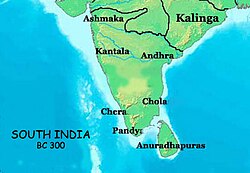
[[File:South India in BC 300.jpg|thumb|South India in 300 BCE]] | [[File:South India in BC 300.jpg|thumb|South India in 300 BCE, Kuntala]] | ||
Kannada Mahabharata mentions the visit of Krishna and Arjuna to Kuntala during Ashwamedha when Chandrahasa was the king of Kuntala who sends two of his children along with Arjuna for the further campaigns. | Kannada Mahabharata mentions the visit of Krishna and Arjuna to Kuntala during Ashwamedha when Chandrahasa was the king of Kuntala who sends two of his children along with Arjuna for the further campaigns. | ||
[[Indian copper plate inscriptions|Copperplate]]s issued by the [[Yadavas of Devagiri]] mention the [[Nāga]]s as its oldest known rulers.<ref name=kuntala >{{cite book|last1=Moraes|first1=George Mark|title=The Kadamba Kula: A History of Ancient and Mediaeval Karnataka|date=1931|publisher=Asian Educational Services|isbn=9788120605954|pages=1–7|edition=AES reprint,illustrated|ref=kuntala}}</ref> [[Rashtrakutas]], [[Satavahanas]], [[Vakatakas]], [[Chalukyas]], [[Chutus]], [[Vishnukundina]] have ruled Kuntala, as suggested by stone inscriptions and copperplates.<ref name=rulers >{{cite book|title=Encyclopaedia of Ancient Indian Geography, Volume 2|date=2002|publisher=Genesis Publishing Pvt Ltd|isbn=9788177552997|pages= 403–404|edition=Edited by Subodh Kapoor|ref=rulers}}</ref> Kuntala is identified with ''{{IAST|Raṭṭapāḍi}}'' which is translated as settlements of the ''[[Rashtrakuta dynasty|{{IAST|Raṭṭa}}s]]''.<ref name=ratta>{{cite book|title=Karnataka State Gazetteer: Belgaum|date=1987|publisher=Director of Print, Stationery and Publications at the Government Press }}</ref> Copperplates of [[Pulakeshin II]] speak of him as the king of three ''{{IAST|Mahārāṣṭraka}}s'', Kuntala being one of the ''Maharashtrakas'' (other two being [[Vidarbha]], and [[Konkan]] region of 99,000 villages. | [[Indian copper plate inscriptions|Copperplate]]s issued by the [[Yadavas of Devagiri]] mention the [[Nāga]]s as its oldest known rulers.<ref name=kuntala >{{cite book|last1=Moraes|first1=George Mark|title=The Kadamba Kula: A History of Ancient and Mediaeval Karnataka|date=1931|publisher=Asian Educational Services|isbn=9788120605954|pages=1–7|edition=AES reprint, illustrated|ref=kuntala}}</ref> [[Rashtrakutas]], [[Satavahanas]], [[Vakatakas]], [[Chalukyas]], [[Chutus]], [[Vishnukundina]] have ruled Kuntala, as suggested by stone inscriptions and copperplates.<ref name=rulers >{{cite book|title=Encyclopaedia of Ancient Indian Geography, Volume 2|date=2002|publisher=Genesis Publishing Pvt Ltd|isbn=9788177552997|pages= 403–404|edition=Edited by Subodh Kapoor|ref=rulers}}</ref> Kuntala is identified with ''{{IAST|Raṭṭapāḍi}}'' which is translated as settlements of the ''[[Rashtrakuta dynasty|{{IAST|Raṭṭa}}s]]''.<ref name=ratta>{{cite book|title=Karnataka State Gazetteer: Belgaum|date=1987|publisher=Director of Print, Stationery and Publications at the Government Press }}</ref> Copperplates of [[Pulakeshin II]] speak of him as the king of three ''{{IAST|Mahārāṣṭraka}}s'', Kuntala being one of the ''Maharashtrakas'' (other two being [[Vidarbha]], and [[Konkan]] region of 99,000 villages. | ||
[[Kalidasa]] mentions as Kuntala and the lord of Kuntala (as ''{{IAST|Kuntalānāmadhīśa}}, {{IAST|Kuntalādhipati}}, {{IAST|Kuntalādhīśa}}'') in his works.<ref name="maha">{{cite web |last1=Satara district (Revised edition) |title=Maharashtra state gazetteers |url=https://gazetteers.maharashtra.gov.in/Satara/english/SDGrevised/2%20HISTORY.pdf |accessdate=4 October 2014 |publisher=Government of Maharashtra |page=15}}</ref> | |||
== In popular culture == | |||
[[Devasena (character)|Devsena]], the heroine in the [[S. S. Rajamouli|director S. S. Rajamouli]]'s film [[Baahubali 2: The Conclusion|Bahubali 2: The Conclusion]] was the [[princess]] of Kuntala Kingdom. | |||
== | |||
[ | |||
== Citations == | == Citations == | ||
{{reflist}} | {{reflist}} | ||
[[Category: | [[Category:Former monarchies of India]] | ||
[[Category:Regions of India]] | [[Category:Regions of India]] | ||
[[Category:History of Karnataka | [[Category:History of Karnataka]] | ||
[[Category:History of Maharashtra]] | [[Category:History of Maharashtra]] | ||
{{Karnataka-stub}} | {{Karnataka-stub}} | ||
Latest revision as of 22:59, 28 March 2026
 | This article needs more citations. (October 2014) |

The Kuntala country is an ancient Indian political region which included the north-western parts of Mysore and the southern parts of the Bombay Presidency.[1] Kuntala coins are available since estimated 600-450 BCE.[2] Kuntala formed one of the divisions of Southern India as late as 10th-12th centuries A.D. (other regions were: Chola, Chera, Pandya Telangana and Andhra). Each developed its own culture and administration. The Talagunda inscriptions mention Balligavi and nearby regions as parts of Kuntala. Inscriptions in Kubaturu near Anavatti mention Kubaturu as the Kuntalanagara. Kuntala is revered as one of the three great countries of Chalukya period in inscriptions.

Scriptural references[edit | edit source]

Kannada Mahabharata mentions the visit of Krishna and Arjuna to Kuntala during Ashwamedha when Chandrahasa was the king of Kuntala who sends two of his children along with Arjuna for the further campaigns.
Copperplates issued by the Yadavas of Devagiri mention the Nāgas as its oldest known rulers.[3] Rashtrakutas, Satavahanas, Vakatakas, Chalukyas, Chutus, Vishnukundina have ruled Kuntala, as suggested by stone inscriptions and copperplates.[4] Kuntala is identified with Raṭṭapāḍi which is translated as settlements of the Raṭṭas.[5] Copperplates of Pulakeshin II speak of him as the king of three Mahārāṣṭrakas, Kuntala being one of the Maharashtrakas (other two being Vidarbha, and Konkan region of 99,000 villages.
Kalidasa mentions as Kuntala and the lord of Kuntala (as Kuntalānāmadhīśa, Kuntalādhipati, Kuntalādhīśa) in his works.[6]
In popular culture[edit | edit source]
Devsena, the heroine in the director S. S. Rajamouli's film Bahubali 2: The Conclusion was the princess of Kuntala Kingdom.
Citations[edit | edit source]
- ↑ Annual Report Of Mysore 1886 To 1903. p. 1.
The Kuntala country which included the north-western parts of Mysore and the southern parts of the Bombay Presidency.
- ↑ Kuntala Coins>
- ↑ Moraes, George Mark (1931). The Kadamba Kula: A History of Ancient and Mediaeval Karnataka (AES reprint, illustrated ed.). Asian Educational Services. pp. 1–7. ISBN 9788120605954.
- ↑ Encyclopaedia of Ancient Indian Geography, Volume 2 (Edited by Subodh Kapoor ed.). Genesis Publishing Pvt Ltd. 2002. pp. 403–404. ISBN 9788177552997.
- ↑ Karnataka State Gazetteer: Belgaum. Director of Print, Stationery and Publications at the Government Press. 1987.
- ↑ Satara district (Revised edition). "Maharashtra state gazetteers" (PDF). Government of Maharashtra. p. 15. Retrieved 4 October 2014.
 | This Karnataka-related article is a stub. You can help Bharatpedia by expanding it. |