





->BD2412 m →top: Missing space after ref tag., replaced: /ref>I → /ref> I, /ref>T → /ref> T |
m minor expand citations to improve readability and added references |
||
| Line 1: | Line 1: | ||
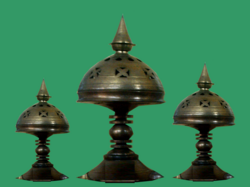
[[Image:Assam Xorai.png|thumb|A set of ''Xorais'' on display]] | {{AI-generated|date=September 2025}}[[Image:Assam Xorai.png|thumb|A set of ''Xorais'' on display]] | ||
[[Image:Xorai welcome to Kaziranga.jpg|thumb|Two extra large ''Xorais'' being used by the roadside welcoming visitors to [[Kaziranga National Park]]]] | [[Image:Xorai welcome to Kaziranga.jpg|thumb|Two extra large ''Xorais'' being used by the roadside welcoming visitors to [[Kaziranga National Park]]]] | ||
The '''''Xorai''''' ({{IPA | The '''''Xorai''''' ({{IPA|as|xɔɹaɪ}}), a manufactured [[bell metal]] product is one of the traditional symbols of [[Assam]], which is considered as an article of great respect by the people of Assam.<ref>{{Cite web|url=https://assam.gov.in/en/main/CULTURE%20OF%20ASSAM|title=Culture of Assam {{!}} ASSAM GOVERNMENT|website=assam.gov.in|access-date=2019-07-02}}</ref><ref>{{Cite news|url=https://www.thehindu.com/life-and-style/insiders-guide-assam-to-mizoram/article19854549.ece|title=Insider's guide: Assam to Mizoram|last=Mathew|first=Elizabeth|date=2017-10-13|work=The Hindu|access-date=2019-07-02|language=en-IN|issn=0971-751X}}</ref><ref>{{Cite news|url=https://www.thehindu.com/entertainment/movies/giving-voice-to-the-voiceless/article25133281.ece|title=Giving voice to the voiceless|last=Baruah|first=Parthajit|date=2018-10-05|work=The Hindu|access-date=2019-07-02|language=en-IN|issn=0971-751X}}</ref> In simplistic terms it is an offering tray with a stand at the bottom which is used in felicitations also.<ref>{{Cite web|url=https://www.news18.com/photogallery/politics/rahul-gandhis-49th-birthday-glimpses-from-his-life-in-pictures-2193333.html|title=Rahul Gandhi's 49th Birthday: Glimpses from His Life in Pictures|date=2019-06-19|website=News18|access-date=2019-07-02}}</ref><ref>{{Cite web|url=https://www.telegraphindia.com/north-east/hima-feted-for-her-golden-track-feat/cid/1666893|title=Hima feted for her golden track feat|website=telegraphindia.com|language=en|access-date=2019-07-02}}</ref> There are ''Xorai''s with or without a cover on the top. [[Hajo]] and [[Sarthebari]] are the most important centers of traditional bell-metal and brass crafts in Assam.<ref>{{Cite web|url=https://www.telegraphindia.com/north-east/time-to-give-the-makers-a-xorai/cid/1620693|title=Time to give the makers a xorai|website=telegraphindia.com|language=en|access-date=2019-07-02}}</ref> | ||
==Usage== | ==Usage== | ||
*As an offering tray for ''tamul-pan'' ([[betel nut]]s and [[betel|betel leaves]]) to guests as a sign of welcome and thanks.<ref>{{Cite web|url=https://www.hindustantimes.com/cricket/sourav-ganguly-speaks-about-ms-dhoni-s-position-leading-into-the-world-cup/story-9NaHPRRTs3oPUZ3lMf9LDM.html|title=Sourav Ganguly speaks about MS | *As an offering tray for ''tamul-pan'' ([[betel nut]]s and [[betel|betel leaves]]) to guests as a sign of welcome and thanks.<ref>{{Cite web|url=https://www.hindustantimes.com/cricket/sourav-ganguly-speaks-about-ms-dhoni-s-position-leading-into-the-world-cup/story-9NaHPRRTs3oPUZ3lMf9LDM.html|title=Sourav Ganguly speaks about MS Dhoni's position leading into the World Cup|date=2018-10-22|website=Hindustan Times|language=en|access-date=2019-07-02}}</ref> | ||
*As an offering tray for food and other items placed in front of the altar (''naamghar'') for blessing by the Lord. | *As an offering tray for food and other items placed in front of the altar (''naamghar'') for blessing by the Lord. | ||
*As a decorative symbol in traditional functions such as during [[Bihu dance]]s (modern usage) | *As a decorative symbol in traditional functions such as during [[Bihu dance]]s (modern usage) | ||
| Line 10: | Line 10: | ||
[[File:সঁফুৰা.JPG|thumb|Xorai]] | [[File:সঁফুৰা.JPG|thumb|Xorai]] | ||
[[File:Tamulpanor Xorai Assam.JPG|thumb|Xorai with [[Gamosa]], [[Areca nut|Tamul]] and [[Betel|Paan]], a tradition in Assam]] | [[File:Tamulpanor Xorai Assam.JPG|thumb|Xorai with [[Gamosa]], [[Areca nut|Tamul]] and [[Betel|Paan]], a tradition in Assam]] | ||
==History and origin== | |||
The tradition of using the '''Xorai''' dates back to ancient Assam, with records suggesting its prevalence during the [[Chutia kingdom|Chutia]]<ref> Bhuyan, S.K, Satsari Buranji,p.58, "ফ্ৰাচেংমুঙলৈ দিলে সুবৰ্ণৰ শৰাই ২ খন,পাটি ২ টা.."</ref> and [[Ahom kingdom|Ahom]] and earlier periods. It was traditionally used in royal courts, religious rituals, and community ceremonies. Over the centuries, the Xorai has remained a consistent symbol of honour and hospitality in Assamese culture.<ref>{{Cite news |title=Assam's Xorai is more than just a metal artifact |url=https://www.outlookindia.com/outlooktraveller/explore/story/70480/the-assamese-xorai-and-its-cultural-importance |work=Outlook Traveller |date=2020-06-15 |access-date=2025-07-23}}</ref> | |||
==Manufacturing process== | |||
Xorais are typically crafted using [[bell metal]], an alloy of copper and tin. Traditional artisans, especially in [[Sarthebari]] and [[Hajo]], follow a manual process that includes melting, casting, hammering, and engraving. The production requires exceptional skill, usually passed down through generations.<ref>{{Cite web |title=Sarthebari: The Bell Metal Town of Assam |url=https://www.india.com/travel/articles/sarthebari-the-bell-metal-town-of-assam-3521869/ |website=India.com |access-date=2025-07-23}}</ref> | |||
==Symbolism and cultural significance== | |||
In Assamese society, the Xorai is regarded as a sacred and symbolic object. It is often used to present offerings to guests, elders, and deities, embodying respect, purity, and goodwill. Its presence in religious and social rituals represents a deep-rooted cultural connection and spiritual reverence.<ref>{{Cite web |url=https://www.downtoearth.org.in/blog/culture/an-iconic-symbol-of-assamese-culture-the-xorai-78931 |title=An iconic symbol of Assamese culture: The Xorai |website=Down To Earth |access-date=2025-07-23 }}{{Dead link|date=August 2025 |bot=InternetArchiveBot |fix-attempted=yes }}</ref> | |||
==Modern adaptations== | |||
While the traditional use of the Xorai continues, it is increasingly adapted as a decorative and symbolic gift in modern settings. It is often presented during state ceremonies, academic convocations, and cultural festivals. Designer versions are also produced as showpieces or awards.<ref>{{Cite news |title=From Tradition to Trend: How Xorai Found Its Place in Modern Ceremonies |url=https://www.eastmojo.com/assam/2021/10/20/xorai-symbol-of-assamese-tradition-now-a-modern-icon/ |work=EastMojo |date=2021-10-20 |access-date=2025-07-23 }}{{Dead link|date=August 2025 |bot=InternetArchiveBot |fix-attempted=yes }}</ref> | |||
==Representation in media and events== | |||
Xorai is frequently showcased in Assamese literature, films, documentaries, and advertisements. During events like [[Assam Day]], [[Rongali Bihu]], and official state receptions, the Xorai is prominently displayed or gifted to dignitaries as a cultural ambassador of Assam.<ref>{{Cite web |title=Xorai: An Emblem of Assamese Identity in Global Platforms |url=https://www.thehillstimes.in/featured/xorai-an-emblem-of-assamese-identity |website=The Hills Times |access-date=2025-07-23 }}{{Dead link|date=August 2025 |bot=InternetArchiveBot |fix-attempted=yes }}</ref> | |||
==Comparison with similar items in other cultures== | |||
Objects similar to Xorai exist in other Asian cultures—for example, the ''thali'' in North India or ''phan'' in Thailand. However, the Xorai's craftsmanship, materials, and ceremonial function are unique to Assam, making it a distinct marker of the region’s heritage.<ref>{{Cite web |title=Cultural Objects of the East: A Comparative Overview |url=https://www.sahapedia.org/cultural-objects-east-comparative-overview |website=Sahapedia |access-date=2025-07-23 }}{{Dead link|date=August 2025 |bot=InternetArchiveBot |fix-attempted=yes }}</ref> | |||
==See also== | ==See also== | ||
| Line 15: | Line 33: | ||
*[[Bell and brass metal crafts of Assam]] | *[[Bell and brass metal crafts of Assam]] | ||
*[[Traditional crafts of Assam]] | *[[Traditional crafts of Assam]] | ||
== References == | ==References== | ||
<references /> | <references /> | ||
{{Assam-stub}} | |||
[[Category:Culture of Assam]] | [[Category:Culture of Assam]] | ||
[[Category:Objects used in Hindu worship]] | [[Category:Objects used in Hindu worship]] | ||
Revision as of 16:14, 26 February 2026


The Xorai (Assamese pronunciation: [xɔɹaɪ]), a manufactured bell metal product is one of the traditional symbols of Assam, which is considered as an article of great respect by the people of Assam.[1][2][3] In simplistic terms it is an offering tray with a stand at the bottom which is used in felicitations also.[4][5] There are Xorais with or without a cover on the top. Hajo and Sarthebari are the most important centers of traditional bell-metal and brass crafts in Assam.[6]
Usage
- As an offering tray for tamul-pan (betel nuts and betel leaves) to guests as a sign of welcome and thanks.[7]
- As an offering tray for food and other items placed in front of the altar (naamghar) for blessing by the Lord.
- As a decorative symbol in traditional functions such as during Bihu dances (modern usage)
- As a gift to a person of honour during felicitations (modern usage)


History and origin
The tradition of using the Xorai dates back to ancient Assam, with records suggesting its prevalence during the Chutia[8] and Ahom and earlier periods. It was traditionally used in royal courts, religious rituals, and community ceremonies. Over the centuries, the Xorai has remained a consistent symbol of honour and hospitality in Assamese culture.[9]
Manufacturing process
Xorais are typically crafted using bell metal, an alloy of copper and tin. Traditional artisans, especially in Sarthebari and Hajo, follow a manual process that includes melting, casting, hammering, and engraving. The production requires exceptional skill, usually passed down through generations.[10]
Symbolism and cultural significance
In Assamese society, the Xorai is regarded as a sacred and symbolic object. It is often used to present offerings to guests, elders, and deities, embodying respect, purity, and goodwill. Its presence in religious and social rituals represents a deep-rooted cultural connection and spiritual reverence.[11]
Modern adaptations
While the traditional use of the Xorai continues, it is increasingly adapted as a decorative and symbolic gift in modern settings. It is often presented during state ceremonies, academic convocations, and cultural festivals. Designer versions are also produced as showpieces or awards.[12]
Representation in media and events
Xorai is frequently showcased in Assamese literature, films, documentaries, and advertisements. During events like Assam Day, Rongali Bihu, and official state receptions, the Xorai is prominently displayed or gifted to dignitaries as a cultural ambassador of Assam.[13]
Comparison with similar items in other cultures
Objects similar to Xorai exist in other Asian cultures—for example, the thali in North India or phan in Thailand. However, the Xorai's craftsmanship, materials, and ceremonial function are unique to Assam, making it a distinct marker of the region’s heritage.[14]
See also
References
- ↑ "Culture of Assam | ASSAM GOVERNMENT". assam.gov.in. Retrieved 2019-07-02.
- ↑ Mathew, Elizabeth (2017-10-13). "Insider's guide: Assam to Mizoram". The Hindu. ISSN 0971-751X. Retrieved 2019-07-02.
- ↑ Baruah, Parthajit (2018-10-05). "Giving voice to the voiceless". The Hindu. ISSN 0971-751X. Retrieved 2019-07-02.
- ↑ "Rahul Gandhi's 49th Birthday: Glimpses from His Life in Pictures". News18. 2019-06-19. Retrieved 2019-07-02.
- ↑ "Hima feted for her golden track feat". telegraphindia.com. Retrieved 2019-07-02.
- ↑ "Time to give the makers a xorai". telegraphindia.com. Retrieved 2019-07-02.
- ↑ "Sourav Ganguly speaks about MS Dhoni's position leading into the World Cup". Hindustan Times. 2018-10-22. Retrieved 2019-07-02.
- ↑ Bhuyan, S.K, Satsari Buranji,p.58, "ফ্ৰাচেংমুঙলৈ দিলে সুবৰ্ণৰ শৰাই ২ খন,পাটি ২ টা.."
- ↑ "Assam's Xorai is more than just a metal artifact". Outlook Traveller. 2020-06-15. Retrieved 2025-07-23.
- ↑ "Sarthebari: The Bell Metal Town of Assam". India.com. Retrieved 2025-07-23.
- ↑ "An iconic symbol of Assamese culture: The Xorai". Down To Earth. Retrieved 2025-07-23.[permanent dead link]
- ↑ "From Tradition to Trend: How Xorai Found Its Place in Modern Ceremonies". EastMojo. 2021-10-20. Retrieved 2025-07-23.[permanent dead link]
- ↑ "Xorai: An Emblem of Assamese Identity in Global Platforms". The Hills Times. Retrieved 2025-07-23.[permanent dead link]
- ↑ "Cultural Objects of the East: A Comparative Overview". Sahapedia. Retrieved 2025-07-23.[permanent dead link]