


m →top: robot: undoing own edit |
corrected information based on references for consistency |
||
| Line 4: | Line 4: | ||
{{Infobox military conflict | {{Infobox military conflict | ||
| conflict = 1987–1989 JVP insurrection | | conflict = 1987–1989 JVP insurrection | ||
| partof = the [[Cold War]] and [[Sri Lankan Civil War]] | | partof = the [[Cold War]] and [[Sri Lankan civil war|Sri Lankan Civil War]] | ||
| date = {{Start and end dates|1987|4|15|1989|12|29|df=yes}}<br />({{Age in years, months and days|1987|3|15|1989|12|29}}) | | date = {{Start and end dates|1987|4|15|1989|12|29|df=yes}}<br />({{Age in years, months and days|1987|3|15|1989|12|29}}) | ||
| place = [[Sri Lanka]] | | place = [[Sri Lanka]] | ||
| image = | | image = File:Sla-on-patrol-dec-88.jpg | ||
| image_size = | | image_size = 300 | ||
| caption = | | caption = Sri Lankan army on patrol in a village to combat the Insurgents | ||
| territory = | | territory = | ||
| result = [[Government of Sri Lanka|Sri Lankan Government]] victory | | result = [[Government of Sri Lanka|Sri Lankan Government]] victory | ||
* Emergency conditions in South-western and Central provinces lifted | * Emergency conditions in South-western and Central provinces lifted | ||
* Insurgency declined following the fall of the [[Eastern | * Insurgency declined following the fall of the [[Eastern Bloc]] | ||
| combatant1 = {{plainlist| | | combatant1 = {{plainlist| | ||
* {{flag|Sri Lanka}} | * {{flag|Sri Lanka}} | ||
* {{flag|India}} | * {{flag|India}} | ||
}} | }} | ||
---- | ---- | ||
| Line 27: | Line 23: | ||
* [[Eagles of the Central Hills]] | * [[Eagles of the Central Hills]] | ||
* [[Black Cat group|Black Cats]] | * [[Black Cat group|Black Cats]] | ||
* ''... | * ''...and at least 8 other minor groups'' | ||
* '''Anti-JVP leftist militias:''' | * '''Anti-JVP leftist militias:''' | ||
* {{flagicon image|Communist Hammer and Sickle flag.svg}} | * {{flagicon image|Communist Hammer and Sickle flag.svg}} [[Peoples Revolutionary Red Army]] | ||
* {{flagicon image|Communist Hammer and Sickle flag.svg}} | * {{flagicon image|Communist Hammer and Sickle flag.svg}} [[Vikalpa Kandayama]]<ref>''Recolonisation'': ''Foreign Funded NGOs in Sri Lanka''. p. 233</ref> | ||
}} | }} | ||
| combatant2 = {{flagicon image|Communist Hammer and Sickle flag.svg}} [[Janatha Vimukthi Peramuna]] | | combatant2 = {{flagicon image|Communist Hammer and Sickle flag.svg}} [[Janatha Vimukthi Peramuna]] | ||
* [[Deshapremi Janatha Viyaparaya]] | * [[Deshapremi Janatha Viyaparaya]] | ||
** [[Patriotic People's Armed Troops]] | ** [[Patriotic People's Armed Troops]] | ||
| commander1 = {{plainlist| | | commander1 = {{plainlist| | ||
* {{flagdeco|Sri Lanka}} [[J.R Jayawardene]] | * {{flagdeco|Sri Lanka}} [[J. R. Jayawardene]] | ||
* {{flagdeco|Sri Lanka}} [[Ranasinghe Premadasa]] | * {{flagdeco|Sri Lanka}} [[Ranasinghe Premadasa]] | ||
* {{flagdeco|Sri Lanka}} [[Ranjan Wijeratne]] | * {{flagdeco|Sri Lanka}} [[Ranjan Wijeratne]] | ||
| Line 54: | Line 41: | ||
}} | }} | ||
| commander2 = {{plainlist| | | commander2 = {{plainlist| | ||
* {{flagicon image|Communist Hammer and Sickle flag.svg}} [[Rohana Wijeweera]] | * {{flagicon image|Communist Hammer and Sickle flag.svg}} [[Rohana Wijeweera]][[File:Skull and crossbones.svg|15px|link=Extrajudicial killing]] | ||
* {{flagicon image|Communist Hammer and Sickle flag.svg}} [[Upatissa Gamanayake]] | * {{flagicon image|Communist Hammer and Sickle flag.svg}} [[Upatissa Gamanayake]][[File:Skull and crossbones.svg|15px|link=Extrajudicial killing]] | ||
* {{flagicon image|Communist Hammer and Sickle flag.svg}} [[Saman Piyasiri Fernando|Keerthi Vijayabahu]]{{KIA}} | * {{flagicon image|Communist Hammer and Sickle flag.svg}} [[Saman Piyasiri Fernando|Keerthi Vijayabahu]]{{KIA}} | ||
* {{flagicon image|Communist Hammer and Sickle flag.svg}} [[Somawansa Amarasinghe]]{{surrendered}} | * {{flagicon image|Communist Hammer and Sickle flag.svg}} [[Somawansa Amarasinghe]]{{surrendered}} | ||
* {{flagicon image|Communist Hammer and Sickle flag.svg}} [[Shantha Bandara]]{{KIA}} | * {{flagicon image|Communist Hammer and Sickle flag.svg}} [[Shantha Bandara]]{{KIA}} | ||
* {{flagicon image|Communist Hammer and Sickle flag.svg}} [[Lalith Wijerathna]] | * {{flagicon image|Communist Hammer and Sickle flag.svg}} [[Lalith Wijerathna]][[File:Skull and crossbones.svg|15px|link=Extrajudicial killing]] | ||
* {{flagicon image|Communist Hammer and Sickle flag.svg}} Ranjitham Gunarathnam | * {{flagicon image|Communist Hammer and Sickle flag.svg}} Ranjitham Gunarathnam[[File:Skull and crossbones.svg|15px|link=Extrajudicial killing]] | ||
}} | }} | ||
| units1 = {{plainlist| | | units1 = {{plainlist| | ||
| Line 70: | Line 56: | ||
{{plainlist| | {{plainlist| | ||
* [[Sri Lanka Civil Defence Force]] | * [[Sri Lanka Civil Defence Force]] | ||
* {{flagdeco|India|army}} [[Indian Peace Keeping Force]] | * {{flagdeco|India|army}} [[Indian Peace Keeping Force]] | ||
}} | }} | ||
| Line 84: | Line 69: | ||
}} | }} | ||
| strength2 = {{plainlist| | | strength2 = {{plainlist| | ||
* 2,000 members<ref name='bma'>{{harvnb|Matthews|1989|page=5}}</ref><ref name=thesis2>{{Cite thesis|title=The Patriotic Struggle of Janatha Vimukthi Peramuna: A Reappraisal|author=Owen Bennet|url=http://jvpthesis.weebly.com/uploads/2/6/9/5/26951649/jvp_thisis_final_1.pdf}}</ref> | * 2,000 members<ref name='bma'>{{harvnb|Matthews|1989|page=5}}</ref><ref name=thesis2>{{Cite thesis|title=The Patriotic Struggle of Janatha Vimukthi Peramuna: A Reappraisal|author=Owen Bennet|url=http://jvpthesis.weebly.com/uploads/2/6/9/5/26951649/jvp_thisis_final_1.pdf|access-date=25 August 2014|archive-date=30 December 2021|archive-url=https://web.archive.org/web/20211230193253/http://jvpthesis.weebly.com/uploads/2/6/9/5/26951649/jvp_thisis_final_1.pdf|url-status=live}}</ref> | ||
* | * 80,000+ supporters | ||
}} | }} | ||
| casualties1 = {{plainlist| | | casualties1 = {{plainlist| | ||
| Line 94: | Line 79: | ||
* {{flagdeco|India|army}} 14 Jawans killed by the DJV, 1 heavy infantry vehicle destroyed{{efn|On July 25, 1989 DJV blew up a truckload of Indian soldiers killing 14 of them before seizing all their weapons{{efn|[[#Insurgency in Kallar]]}}}} | * {{flagdeco|India|army}} 14 Jawans killed by the DJV, 1 heavy infantry vehicle destroyed{{efn|On July 25, 1989 DJV blew up a truckload of Indian soldiers killing 14 of them before seizing all their weapons{{efn|[[#Insurgency in Kallar]]}}}} | ||
}} | }} | ||
| casualties2 = | | casualties2 = 10,000–60,000 captured and/or killed | ||
20,000+ disappeared | |||
| casualties3 = {{plainlist| | | casualties3 = {{plainlist| | ||
* '''Total killed:''' 60,000–80,000 | * '''Total killed:''' 60,000–80,000 | ||
* '''Disappeared:''' 20,000+<ref>{{Cite book|title=Country Reports on Human Rights Practices: Report Submitted to{{nbsp}}..., Volume 997|page=1698|year=1988|publisher=U.S. Government printing office|url=https://books.google.com/books?id=yS82AAAAIAAJ}}</ref><ref>{{Cite book|url=http://asiafoundation.org/wp-content/uploads/2017/10/SriLanka-StateofConflictandViolence.pdf|title=Sri Lanka – State of Conflict and Violence|publisher=[[Asia Foundation]]|chapter=JVP Insurgency}}</ref> | * '''Disappeared:''' 20,000+<ref>{{Cite book|title=Country Reports on Human Rights Practices: Report Submitted to{{nbsp}}..., Volume 997|page=1698|year=1988|publisher=U.S. Government printing office|url=https://books.google.com/books?id=yS82AAAAIAAJ|access-date=9 February 2021|archive-date=28 September 2024|archive-url=https://web.archive.org/web/20240928001755/https://books.google.com/books?id=yS82AAAAIAAJ|url-status=live}}</ref><ref>{{Cite book|url=http://asiafoundation.org/wp-content/uploads/2017/10/SriLanka-StateofConflictandViolence.pdf|title=Sri Lanka – State of Conflict and Violence|publisher=[[Asia Foundation]]|chapter=JVP Insurgency|access-date=23 January 2021|archive-date=26 April 2024|archive-url=https://web.archive.org/web/20240426191941/https://asiafoundation.org/wp-content/uploads/2017/10/SriLanka-StateofConflictandViolence.pdf|url-status=live}}</ref> | ||
}} | }} | ||
}} | }} | ||
| Line 103: | Line 89: | ||
{{Communism sidebar}} | {{Communism sidebar}} | ||
The '''1987–1989 JVP insurrection''', also known as the '''1988–1989 revolt''' or the '''JVP troubles''', was an armed revolt in [[Sri Lanka]] | The '''1987–1989 JVP insurrection''', also known as the '''1988–1989 revolt''' or the '''JVP troubles''', was an armed revolt in [[Sri Lanka]] led by the [[Marxism–Leninism|Marxist–Leninist]] [[Janatha Vimukthi Peramuna]] (JVP) against the [[Government of Sri Lanka]], then led by the right-wing [[United National Party]] (UNP). The insurrection, like the previous one in [[1971 JVP insurrection|1971]], was unsuccessful. The main phase of the insurrection was a [[low-intensity conflict]] that lasted from April 1987 to December 1989.{{efn|The first attacks took place in 1986 but many historians consider this to be the prelude to an open insurrection.}} The insurgents led by the JVP resorted to [[subversion]], [[List of people assassinated by the Janatha Vimukthi Peramuna|assassinations]], raids, and attacks on military and civilian targets<ref>{{Cite book|title=Patterns of Global Terrorism|publisher=[[U.S Department of State]]|url=https://books.google.com/books?id=QzJDzxlbch0C|year=1990|access-date=9 February 2021|archive-date=28 September 2024|archive-url=https://web.archive.org/web/20240928001755/https://books.google.com/books?id=QzJDzxlbch0C|url-status=live}}</ref> while the Sri Lankan government reacted through [[counter-insurgency]] operations to suppress the revolt using army and paramilitary groups who were allegedly backed by government. | ||
[[Guerrilla warfare|Guerrilla]] forces of the insurrection were led by the military branch of the JVP, the [[Deshapremi Janatha Viyaparaya]]. The insurgency reached its peak in 1988 and impacted all Sri Lankan civilians, including those without any political stake in the situation. Attacks on civilians by pro-government guerrillas began after the | [[Guerrilla warfare|Guerrilla]] forces of the insurrection were led by the military branch of the JVP, the [[Deshapremi Janatha Viyaparaya]] (DJV). The insurgency reached its peak in 1988 and impacted all Sri Lankan civilians, including those without any political stake in the situation. Attacks on civilians by pro-government guerrillas began after the [[1988 Sri Lankan presidential election|election]] of president [[Ranasinghe Premadasa]]. A period of mass killings by the government began soon after the ceasefire of the [[Sri Lankan civil war]] and the expulsion of the [[Indian Peace Keeping Force]], resulting in the death of many Sri Lankan civilians and multiple Indian [[expatriate]]s. | ||
JVP received support from its one-time enemy, the [[Sri Lanka Freedom Party]] (SLFP). However, this alliance broke down following the SLFP's participation in the provincial elections which the JVP and the [[Liberation Tigers of Tamil Eelam]] (LTTE) openly boycotted. The government lifted the ban on both parties in 1987, hoping that they would participate in the elections, but this attempt ultimately failed. For over two years, the state saw mass militancy of youth and workers, mass execution | The JVP received support from its one-time enemy, the [[Sri Lanka Freedom Party]] (SLFP). However, this alliance broke down following the SLFP's participation in the provincial elections which the JVP and the [[Liberation Tigers of Tamil Eelam]] (LTTE) openly boycotted. The government lifted the ban on both parties in 1987, hoping that they would participate in the elections, but this attempt ultimately failed. For over two years, the state saw mass militancy of youth and workers, mass execution, and feuds between government militias and the JVP. Anti-JVP militias allegedly backed by the UNP government also caused violence, including the [[Black Cat group]], the [[Eagles of the Central Hills]] and the leftist [[Peoples Revolutionary Red Army|People's Revolutionary Red Army]] along with nine to eleven other groups. | ||
In 1989, [[Sri Lanka Armed Forces]] launched [[Operation Combine]] (Ops Combine). | In 1989, [[Sri Lanka Armed Forces]] launched [[Operation Combine]] (Ops Combine). Even after revolutionary leader, [[Rohana Wijeweera]] was killed, the insurgency persisted. Violence escalated when the DJV leader [[Keerthi Vijayabahu]] took over. DJV members also operated in the LTTE-occupied areas of [[Trincomalee]] against the Sri Lanka Armed Forces and the IPKF. The DJV was supported by [[Tamil militants]] so that it could also operate as a front against the Indian forces. Many smaller anti-government groups gave up the armed struggle, but the largest threats persisted, with the DJV continuing to operate as an armed group until December 1989. [[Ranjan Wijeratne]], who played a major role in the Ops Combine, claimed he was ready to launch a similar counterinsurgency against the LTTE. Wijeratne was [[Havelock Road bombing|assassinated]] in 1991, which led to the outbreak of the second phase of the Sri Lanka-LTTE conflict, known as the [[Eelam War II|Second Eelam War]]. | ||
==Background== | ==Background== | ||
===History of Janatha Vimukthi Peramuna=== | ===History of Janatha Vimukthi Peramuna=== | ||
{{main|Janatha Vimukthi Peramuna|Ceylonese protests against the Vietnam War}} | {{main|Janatha Vimukthi Peramuna|Ceylonese protests against the Vietnam War}} | ||
Founded by communist [[Rohana Wijeweera]], the [[Janatha Vimukthi Peramuna|Janatha Vmukthi Peramuna]] (JVP) is known for its revolutionary youth background. The organization was banned more than once when the group was first involved in | Founded by communist [[Rohana Wijeweera]], the [[Janatha Vimukthi Peramuna|Janatha Vmukthi Peramuna]] (JVP) is known for its revolutionary youth background. The organization was banned more than once when the group was first involved in [[Anti-Americanism|Anti-American]] [[Ceylonese protests against the Vietnam War|protests against the Vietnam War]] in the 1970s. Since then, the movement was called the "''[[Che Guevara]] clique"'' (a nickname the JVP did not claim) by the Sri Lankan government and international media.<ref>{{Cite journal|last=Uyangoda|first=Jayadeva|date=2008|title=The Janatha Vimukthi Peramuna Split|url=https://www.jstor.org/stable/40277655|journal=Economic and Political Weekly|volume=43|issue=18|pages=8–10|jstor=40277655|issn=0012-9976|jstor-access=free|access-date=2 February 2021|archive-date=17 August 2021|archive-url=https://web.archive.org/web/20210817013541/https://www.jstor.org/stable/40277655|url-status=live}}</ref> The group was first internationally recognized as a political party when it participated in a communist youth conference in [[Havana]], [[Cuba]] in 1978.<ref>{{Cite book|publisher=Institute of Fundamental Studies|title=Sri Lanka, a Lost Revolution?: The Inside Story of the JVP|year=1990|chapter=Leadership, Cadre and the Organization}}</ref> | ||
=== 1971 JVP Insurrection === | === 1971 JVP Insurrection === | ||
{{main|1971 JVP Insurrection}} | {{main|1971 JVP Insurrection}} | ||
[[Rohana Wijeweera | The JVP launched an open revolt against Prime Minister [[Sirimavo Bandaranaike|Sirimavo Bandaranaike's]] government in April 1971. While the government was caught off guard, it was able to subdue the insurgency in a matter of weeks. The insurgency may have led to the death of 4,000–5,000 people. Over 20,000 suspected rebels, mostly young people, were arrested in the period that followed the insurrection, but most were released after rehabilitation. The Sri Lankan government called upon [[India]] for military assistance, however Indian involvement was less known at the time of the insurrection.{{sfn|Kadian|1990|page=90-91}}<ref name=IndianAndJVP>{{Cite journal|title=Sri Lanka in 1987: Indian Intervention and Resurgence of the JVP|last=Pfaffenburger|first=B.|journal=[[Asian Survey]]|volume=28|number=2|date=1988|pages=137–147|doi=10.2307/2644815|jstor=2644815|jstor-access=free}}</ref> | ||
Rohana Wijeweera and the other major leaders of the insurgency were sentenced to prison and the JVP was banned as a political party. However, all of them were released in 1977 by new Prime Minister [[J. R. Jayewardene]] after the [[United National Party|UNP]] won the [[1977 Sri Lankan parliamentary election|general elections]] after running on a platform of amnesty for those prosecuted by the infamous [[Criminal Justice Commission (Sri Lanka)|Criminal Justice Commission]]. | |||
=== Tamil insurgency and pro-United States policy === | === Tamil insurgency and pro-United States policy === | ||
During the mid-1980s, as the [[Sri Lankan Civil War | During the mid-1980s, as the [[Sri Lankan civil war|Sri Lankan Civil War]] with Tamil militants in the north became more intense, there was a significant shift in the ideology and goals of the JVP. Initially Marxist in orientation, the JVP claimed to represent the oppressed of both the [[Sri Lankan Tamils|Tamil]] and [[Sinhalese people|Sinhalese]] communities. Later, however, the group increasingly began to identify as a [[Sinhalese nationalist]] organization, opposing any compromise with the Tamil insurgency.<ref name='Four'>{{Cite book|title=History of the JVP|publisher=Niyamuwa|url=http://www.jvpsrilanka.com/english/download/1168/|year=2014|isbn=978-955-8696-39-2|via=jvpsrilanka.lk|access-date=15 February 2021|archive-date=20 March 2022|archive-url=https://web.archive.org/web/20220320190038/http://www.jvpsrilanka.com/english/download/1168/|url-status=live}}</ref> | ||
=== Third ban === | |||
Rohana Wijeweera | Rohana Wijeweera received the third-highest number of votes in the [[1982 Sri Lankan presidential election|1982 presidential elections]], and the Jayawardene government feared the increasing popularity of the JVP. | ||
JVP | The JVP would continue to be involved in more controversy along with the [[Nava Sama Samaja Party]] following an assembly held on 6 July 1983, which was held in support of Tamil civilians; at the assembly, NSSP leader [[Vikramabahu Karunaratne]] defended the Tamil insurgency.{{sfn|Dissanayake|2002|page=58}} The government was greatly threatened by these parties, and alleged that three socialist parties were preparing to topple the government.<ref>{{cite book|title=Human Rights in Developing Countries: A Yearbook on Countries Receiving Norwegian Aid|year=1986|location=Norway|publisher=Norwegian University Press|page=242}}</ref> The Jayawardene government also alleged that the JVP was involved in the [[Black July]] riots, but provided no concrete evidence. Due to these allegations, Jayawardene banned the party, a move which was suspected to be due to his fear of losing future elections to [[Leftist parties in Sri Lanka|leftist parties]] as he was highly pro-U.S. and anti-Soviet due to his anti-Indian policy.<ref name="Four" /><ref>{{Cite journal|url=http://www.jstor.org/stable/312963|title=Thoroughly Modern Revolutionaries: The JVP in Sri Lanka|publisher=Cambridge University Press|jstor=312963|last1=Moore|first1=Mick|journal=[[Modern Asian Studies]]|year=1993|volume=27|issue=3|pages=593–642|doi=10.1017/S0026749X00010908|jstor-access=free|access-date=12 February 2021|archive-date=27 June 2023|archive-url=https://web.archive.org/web/20230627030405/https://www.jstor.org/stable/312963|url-status=live|url-access=subscription}}</ref> It is also to be noted that during this time, Jayawardene degraded diplomatic relations with [[socialist state|socialist countries]] like [[Cuba]] and the [[Soviet Union]].{{sfn|Moore|1993|page=18}} | ||
== Preparation == | == Preparation == | ||
Having been banned and driven underground, the JVP began preparing to overthrow the government. They targeted political opponents, carried out robberies in the form of [[Bank robbery|bank heists]] to collect funds, and began acquiring weapons, usually pistols and shotguns from owners who had gained gun licenses from the government. Thereafter, they planned to raid armories of the government, which had deployed its forces to the north and east of the country to counter the Tamil insurgency.<ref>{{Cite news|url=http://archives.dailynews.lk/2010/03/08/fea03.asp|title=The birth of JVP fear psychosis|volume=1|author=Geoff Wijesinghe|publisher=Daily News.lk}}</ref><ref>{{Cite book|title=JVP 1969–1989|url=https://books.google.com/books?id=GucfAAAAIAAJ|last=Alles|first=A.C.|author-link=A.C Alles|year = 1991}}</ref>{{sfn|Alles|1991|page= 286}} | Having been banned and driven underground, the JVP began preparing to overthrow the government. They targeted political opponents, carried out robberies in the form of [[Bank robbery|bank heists]] to collect funds, and began acquiring weapons, usually pistols and shotguns from owners who had gained gun licenses from the government. Thereafter, they planned to raid armories of the government, which had deployed its forces to the north and east of the country to counter the Tamil insurgency.<ref>{{Cite news|url=http://archives.dailynews.lk/2010/03/08/fea03.asp|title=The birth of JVP fear psychosis|volume=1|author=Geoff Wijesinghe|publisher=Daily News.lk|access-date=17 January 2021|archive-date=19 October 2023|archive-url=https://web.archive.org/web/20231019005523/http://archives.dailynews.lk/2010/03/08/fea03.asp|url-status=live}}</ref><ref>{{Cite book|title=JVP 1969–1989|url=https://books.google.com/books?id=GucfAAAAIAAJ|last=Alles|first=A.C.|author-link=A.C Alles|year = 1991}}</ref>{{sfn|Alles|1991|page= 286}} | ||
The politburo members of the insurrection were Rohana Wijeweera, [[Upatissa Gamanayake]], Sumith Athukorala, [[D. M. Ananda]], [[Saman Piyasiri Fernando]], [[Piyadasa Ranasinghe]], [[H. B. Herath]], [[Gunaratne Wanasinghe]], [[P. R. B. Wimalarathna]], [[Somawansa Amarasinghe]], [[Shantha Bandara]], [[Nandathilaka Galappaththi]] and [[Lalith Wijerathna]].<ref>{{Cite web |title="Siri Aiya" the Great Survivor: Saga of JVP Stalwart Somawansa Amarasinghe |url=http://dbsjeyaraj.com/dbsj/archives/40665 | The politburo members of the insurrection were Rohana Wijeweera, [[Upatissa Gamanayake]], Sumith Athukorala, [[D. M. Ananda]], [[Saman Piyasiri Fernando]], [[Piyadasa Ranasinghe]], [[H. B. Herath]], [[Gunaratne Wanasinghe]], [[P. R. B. Wimalarathna]], [[Somawansa Amarasinghe]], [[Shantha Bandara]], [[Nandathilaka Galappaththi]] and [[Lalith Wijerathna]].<ref>{{Cite web |title="Siri Aiya" the Great Survivor: Saga of JVP Stalwart Somawansa Amarasinghe |url=http://dbsjeyaraj.com/dbsj/archives/40665 |access-date=2021-06-13 |website=dbsjeyaraj |date=18 April 2015 |archive-date=1 July 2022 |archive-url=https://web.archive.org/web/20220701144102/https://dbsjeyaraj.com/dbsj/archives/40665 |url-status=dead }}</ref> Until 1987, no arms were available for the youth military arm of the JVP, the [[Deshapremi Janatha Viyaparaya]] (DJV) to train their soldiers. The collection of weapons for this purpose began in early 1987, and weapons training began in mid-1987, with deserters from the army providing instruction.<ref name='erasing3'/> | ||
During this period, police inspectors reported their pistols to be missing and landlords were given shotguns by the police to defend themselves. The DJV stole weapons and ammunition from military bases, defense academies, and landlords. A spike in gun thefts were reported from [[Balangoda]], [[Deniyaya]], [[Hakmana, Matara|Hakmana]], and [[Nochchiyagama Divisional Secretariat|Nochchiyagama]] in 1987. There were reports in May 1987 that an increasing number of youths were stealing such weapons from police stations in the south. 600 weapons, mostly shotguns, were taken by DJV in July 1987.<ref>{{cite journal|last=Mathews|first=Bruce|title=The Janatha Vimukthi Peramuna and the politics of the underground in Sri Lanka|journal=The Round Table|issn=0035-8533}}</ref><ref name='erasing3'/> | During this period, police inspectors reported their pistols to be missing and landlords were given shotguns by the police to defend themselves. The DJV stole weapons and ammunition from military bases, defense academies, and landlords. A spike in gun thefts were reported from [[Balangoda]], [[Deniyaya]], [[Hakmana, Matara|Hakmana]], and [[Nochchiyagama Divisional Secretariat|Nochchiyagama]] in 1987. There were reports in May 1987 that an increasing number of youths were stealing such weapons from police stations in the south. 600 weapons, mostly shotguns, were taken by DJV in July 1987.<ref>{{cite journal|last=Mathews|first=Bruce|title=The Janatha Vimukthi Peramuna and the politics of the underground in Sri Lanka|journal=The Round Table|issn=0035-8533}}</ref><ref name='erasing3'/> | ||
Armed with these stolen weapons, DJV members were trained in universities and were joined by new members from lower castes. At the start of the insurgency, it was estimated by western diplomats that of the 10,000 armed | Armed with these stolen weapons, DJV members were trained in universities and were joined by new members from lower castes.{{citation needed|date=January 2024}} At the start of the insurgency, it was estimated by western diplomats that of the 10,000 armed carders of the DJV, approximately 3,000 were well trained.<ref name='thesis2'/> According to [[Somawansa Amarasinghe]], a Central Committee member of the JVP, these groups were also provided aid by North Korea since 1970.<ref>{{Cite news|last=Farrel|first=Tom|title=North Korea's Role in Sri Lanka's Bloody Insurgencies|publisher=[[NKNews]]|url=http://www.nknews.org/2014/03/north-koreas-role-in-sri-lankas-bloody-insurgencies|year=2014|access-date=12 March 2021|archive-date=23 November 2021|archive-url=https://web.archive.org/web/20211123213636/https://www.nknews.org/2014/03/north-koreas-role-in-sri-lankas-bloody-insurgencies|url-status=live}}</ref> | ||
==Prelude to open insurrection== | ==Prelude to open insurrection== | ||
| Line 149: | Line 136: | ||
===Early attacks=== | ===Early attacks=== | ||
====Attack on the Pallekele Army Camp==== | |||
{{see also|Attack on the Pallekele detachment}} | {{see also|Attack on the Pallekele detachment}} | ||
On 15 April 1987, JVP attacked the Pallekele | On 15 April 1987, JVP attacked the army detachment in Pallekele in [[Kandy]]. An unknown amount of carders, under the directions of [[Shantha Bandara]] and [[Premakumar Gunaratnam]], the JVP seized twelve [[Type 56 assault rifle]]s, seven sub-machine guns, and ammunition. | ||
====Indo-Sri Lanka Accord==== | |||
On 26 May 1987, [[Sri Lankan Armed Forces]] launched the [[Vadamarachchi Operation]] (English: "Operation Liberation") with the objective of defeating the LTTE militarily and re-establishing government control in areas dominated by Tamil militants.<ref>{{cite journal |last1=Rajapaksa |first1=Gotabhaya |title=Sri Lanka's national security |journal=Prism: A Journal of the Center for Complex Operations |date=2013 |volume=4 |issue=4 |pages=139–155 |url=http://www.intelros.ru/pdf/Prism/2014_4_4/9.pdf |access-date=13 February 2020 |location=Russia |archive-date=12 July 2021 |archive-url=https://web.archive.org/web/20210712171804/http://www.intelros.ru/pdf/Prism/2014_4_4/9.pdf |url-status=live }}</ref> However, the second phase of Operation Liberation was abandoned with the Indian intervention with [[Operation Poomalai]], which led to the signing of the [[Indo-Sri Lanka Accord]] in [[Colombo]] on 29 July 1987 and the arrival of the first troops of the [[Indian Peace Keeping Force]] (IPKF) on 30 July. These events were widely unpopular among the general public in Sri Lanka as well as the Sri Lankan Armed Forces. Protests in the Southern parts of the island that began against the Indo-Sri Lanka Accord turned into rioting and government imposed a curfew to control the rioting and establish normalcy. On 31 July 1987, government party member of parliament [[Jinadasa Weerasinghe]] was shot dead, which was blamed on the JVP.<ref>{{cite news |title=Memories of a Horrific Day in Parliament |url=https://ceylontoday.lk/2022/08/20/memories-of-a-horrific-day-in-parliament/ |access-date=15 January 2024 |publisher=Ceylon Today |archive-date=28 September 2024 |archive-url=https://web.archive.org/web/20240928001848/https://ceylontoday.lk/2022/08/20/memories-of-a-horrific-day-in-parliament/ |url-status=live }}</ref> | |||
Events of LTTE and JVP took place parallel to each other. Shortly after the LTTE stopped and attacked a spate of heavy vehicles in the northern province, | <!--Events of LTTE and JVP took place parallel to each other. Shortly after the LTTE stopped and attacked a spate of heavy vehicles in the northern province, | ||
the JVP started to raid heavy military installments in the central province. These were even located in the [[de facto]] ''Tamil Eelam''.<ref>{{cite book|title= India's Sri Lanka Fiasco: Peace Keepers at War | the JVP started to raid heavy military installments in the central province. These were even located in the [[de facto]] ''Tamil Eelam''.<ref>{{cite book|title= India's Sri Lanka Fiasco: Peace Keepers at War | ||
|last= Kadian | |last= Kadian | ||
|first= Rajesh | |first= Rajesh | ||
|year= 1990 | |year= 1990 | ||
|publisher= Vision Books | |||
|isbn= 9788170940630 | |isbn= 9788170940630 | ||
}} | }} | ||
</ref> | </ref> | ||
{{sfn|Kadian|1990|pages=80-81}} | {{sfn|Kadian|1990|pages=80-81}}--> | ||
The prospect of Tamil autonomy in the north together with the presence of Indian troops stirred up a wave of Sinhalese nationalism and the sudden growth of anti-government violence by the DJV which had emerged as an offshoot of the JVP and was led by [[Saman Piyasiri Fernando]].{{sfn|Pfaffenburger|1988|page=3}} On 7 June 1987, Sri Lanka Air Force Base, [[SLAF Katunayake]], and the [[Kotelawala Defence Academy]] were attacked. Weapons and ammunition were stolen, while four of the attackers were killed. These attacks were led by the | ====Attacks on military instaltions in the South==== | ||
The prospect of Tamil autonomy in the north and East together with the presence of Indian troops stirred up a wave of Sinhalese nationalism and the sudden growth of anti-government violence by the DJV which had emerged as an offshoot of the JVP and was led by [[Saman Piyasiri Fernando]].{{sfn|Pfaffenburger|1988|page=3}} On 7 June 1987, Sri Lanka Air Force Base, [[SLAF Katunayake]], and the [[Kotelawala Defence Academy]] were attacked. Weapons and ammunition were stolen, while four of the attackers were killed. These attacks were led by the militant unit, [[Patriotic People's Armed Troops]].{{sfn|Guneratne|1990|page=270}} Afterwards, DJV claimed responsibility and a [[Criminal Investigation Department (Sri Lanka)|Criminal Investigation Department]] investigation resulted in the arrest of thirteen JVP members. | |||
====Attack in the Parliament==== | |||
{{main|1987 grenade attack in the Sri Lankan Parliament}} | |||
The beginning of the insurgency was marked when [[BBC]] correspondent [[John Rettie]] received a call from an unknown caller who spoke English claiming he had an organization that consisted of 2,000 fighters and was ready to overthrow the Sri Lankan government. Rettie received this call after the Sri Lankan parliament was attacked.<ref>{{Cite news|title=Sri Lanka Fears Infiltration by Outlawed Group : Mysterious Sinhalese Extremists Suspected in Parliament Grenade, Gun Attack|date=30 August 1987|last=Tempest|first=Rone|via=[[Los Angeles Times]]}}</ref><ref>{{Cite news|title=SRI LANKA ATTACK MISSES PRESIDENT; 1 KILLED, 14 HURT|date=19 August 1987|agency=Associated Press|via=[[New York Times]]}}</ref> | On 18 August, when the first parliamentary group meeting took place after the Indo-Sri Lanka Accord, an [[1987 grenade attack in the Sri Lankan Parliament|assassination attempt]] was made on the president and prime minister by the DJV: resulting in the death of [[Keerthisena Abeywickrama]], District Minister for Matara and one other.{{sfn|Nubin|2002|page=92}} [[Lalith Athulathmudali]], the Minister of National Security and Deputy Minister of Defence, was also severely wounded.{{sfn|Guneratne|1990|page=271}}{{sfn|Pfaffenburger|1988|page=7}} | ||
The beginning of the insurgency was marked when a few days later the [[BBC]] correspondent [[John Rettie]] received a call from an unknown caller who spoke English claiming he had an organization that consisted of 2,000 fighters and was ready to overthrow the Sri Lankan government. Rettie received this call after the Sri Lankan parliament was attacked.<ref>{{Cite news|title=Sri Lanka Fears Infiltration by Outlawed Group : Mysterious Sinhalese Extremists Suspected in Parliament Grenade, Gun Attack|date=30 August 1987|last=Tempest|first=Rone|via=[[Los Angeles Times]]}}</ref><ref>{{Cite news|title=SRI LANKA ATTACK MISSES PRESIDENT; 1 KILLED, 14 HURT|date=19 August 1987|agency=Associated Press|via=[[New York Times]]}}</ref> | |||
On 4 October 1987, 50 members of the DJV raided a security forces camp in [[Trincomalee]]; DJV succeeded and stole 6 [[Type 56 assault rifle|T-56 assault rifles]], 3 shotguns, [[.303 British]] rifles, and ammunition.{{sfn|Guneratne|1990|page=272}} | |||
===Intimidation tactics=== | ===Intimidation tactics=== | ||
After this, the DJV launched a campaign of intimidation against the government and ruling [[United National Party]] (UNP) | After this, the DJV launched a campaign of intimidation against the government and the ruling party: [[United National Party]] (UNP), killing a large amount of its members and MPs as well as members of other political parties. Organized into cells of multiple Joint Commands based mostly in [[Kandy]] in the centre of the island, the JVP murdered upwards of thousands of people between 1988 and 1989. Throughout this period, it crippled the country with enforced [[hartal]]s (general strikes) for two years. Individuals or organizations were intimidated via messages, posters, or graffiti that appeared overnight. Those that did not cooperate were killed, with their family members often harmed as well. Executions were mostly carried out during the night with JVP/DJV militants coming to the homes of victims and carrying them away to be tortured, executed, and left as an example. Most of these victims were killed by the [[Type 56 assault rifle]] or handmade [[Galkatas]] rifles. In most cases, the funerals of these victims were not allowed by the JVP, traditional last rites were forbidden, and the caskets were to be carried below knee level as a mark of disrespect. Acts of sabotage on government property were common, with electric transformers being a common target. Tire burning was also practised by the JVP at times. With these techniques of sabotage and intimidation, the JVP was able to bring the country to standstill.<ref name='erasing3'/><ref name="erasing">{{cite web|title=LankaWeb – ERASING THE EELAM VICTORY Part 17 C 9|url=http://www.lankaweb.com/news/items/2020/09/20/erasing-the-eelam-victory-part-17-c-9/|access-date=January 23, 2021|newspaper=Lankaweb.com|archive-date=19 October 2023|archive-url=https://web.archive.org/web/20231019210417/https://www.lankaweb.com/news/items/2020/09/20/erasing-the-eelam-victory-part-17-c-9/|url-status=live}}</ref> | ||
===Assassinations=== | ===Assassinations=== | ||
| Line 175: | Line 173: | ||
==== Political assassinations ==== | ==== Political assassinations ==== | ||
Officials were targeted after receiving death threats which demanded that the victims leave the United National Party, victims of this manner of assassination included the wife of the MP for Karandeniya district [[Daya Sepali Senadheera]] | Officials were targeted after receiving death threats which demanded that the victims leave the United National Party, victims of this manner of assassination included the wife of the MP for Karandeniya district [[Daya Sepali Senadheera]]; [[Galagedara, Central Province|Galagedara]] MP [[W.M.P.G. Banda]], and [[Borella]] MP [[Lesley Ranagal]].<ref>{{Cite web |url=http://www.island.lk/2008/01/23/features1.html |title=The Island- Features |access-date=18 January 2021 |archive-date=3 March 2016 |archive-url=https://web.archive.org/web/20160303221946/http://www.island.lk/2008/01/23/features1.html |url-status=dead }}</ref> | ||
As the insurgency escalated, numerous public figures were assassinated by the JVP. Harsha Abhayawardene, the UNP Secretary General, was killed by JVP gunmen in [[Wellawatte]] on 23 December 1987, DJV gunmen fired T-56 guns on full-automatic killing three others. [[Lionel Jayatilleke]], Minister of Relief and Rehabilitation, was shot dead on 26 September 1988 near a temple in an attack which killed three other people.<ref>{{cite news|url=http://noolaham.net/project/34/3306/3306.pdf|title=UNP Chairmen gunned down|newspaper=[[Tamil Times]]|year=1988|issue=1|pages=3–4}}</ref><ref>{{cite news|url=http://www.nytimes.com/1988/09/27/world/cabinet-minister-slain-in-sri-lanka.html |title=Cabinet Minister slain in Sri Lanka|newspaper=[[New York Times]]|date=27 September 1988 |access-date=6 March 2021}}</ref> 7 February 1988, Mervyn Cooray, MP for [[Panadura]], survived an assassination attempt. On 1 May, the newly elected UNP Secretary General Nandalal Fernando was also killed and the [[Galle District]] Minister was shot dead later that month. On 21 October, Tudor Keerthinanda, a UNP Working Committee Member, was killed. | As the insurgency escalated, numerous public figures were assassinated by the JVP. On 1 October 1987, the [[Lanka Sama Samaja Party]] and [[Ceylon Communist Party]] offices were attacked and burnt, while former Deputy Minister for Education and MP for Matara, [[B. Y. Tudawe]] was shot, but survived.<ref>{{cite book |last1=Rubin |first1=Barnett R. |title=Cycles of Violence: Human Rights in Sri Lanka Since the Indo-Sri Lanka Agreement |year=1987 |page=74 |publisher=Human Rights Watch |isbn=9780938579434 |url=https://books.google.com/books?id=b7F-dUh5_j8C&q=B.+Y.+Tudawe+MP&pg=PA74 |access-date=4 November 2019 |archive-date=28 September 2024 |archive-url=https://web.archive.org/web/20240928001800/https://books.google.com/books?id=b7F-dUh5_j8C&q=B.+Y.+Tudawe+MP&pg=PA74#v=snippet&q=B.%20Y.%20Tudawe%20MP&f=false |url-status=live }}</ref> [[Harsha Abhayawardene]], the UNP Secretary General, was killed by JVP gunmen in [[Wellawatte]] on 23 December 1987, DJV gunmen fired T-56 guns on full-automatic killing three others. [[Lionel Jayatilleke]], Minister of Relief and Rehabilitation, was shot dead on 26 September 1988 near a temple in an attack which killed three other people.<ref>{{cite news|url=http://noolaham.net/project/34/3306/3306.pdf|title=UNP Chairmen gunned down|newspaper=[[Tamil Times]]|year=1988|issue=1|pages=3–4|access-date=18 January 2021|archive-date=19 October 2023|archive-url=https://web.archive.org/web/20231019210416/https://noolaham.net/project/34/3306/3306.pdf|url-status=live}}</ref><ref>{{cite news|url=http://www.nytimes.com/1988/09/27/world/cabinet-minister-slain-in-sri-lanka.html|title=Cabinet Minister slain in Sri Lanka|newspaper=[[New York Times]]|date=27 September 1988|access-date=6 March 2021|archive-date=15 July 2023|archive-url=https://web.archive.org/web/20230715085004/https://www.nytimes.com/1988/09/27/world/cabinet-minister-slain-in-sri-lanka.html|url-status=live}}</ref> On 7 February 1988, [[Mervyn Cooray]], MP for [[Panadura]], survived an assassination attempt. On 1 May, the newly elected UNP Secretary General [[Nandalal Fernando]] was also killed and the [[Galle District]] Minister [[G. V. S. de Silva]] was shot dead later that month. On 21 October, Tudor Keerthinanda, a UNP Working Committee Member, was killed. | ||
====Assassination and funeral of Vijaya Kumaratunga==== | ====Assassination and funeral of Vijaya Kumaratunga==== | ||
{{main|Assassination of Vijaya Kumaratunga}} | {{main|Assassination of Vijaya Kumaratunga}} | ||
Kumaratunga's funeral, on 21 February 1988, attracted huge crowds and was the first funeral to be broadcast live on Sri Lankan television. It was held at [[Independence Memorial Hall|Independence Memorial Square]] in Colombo as a [[state funeral]], even though he represented the opposition to the UNP government. The day of his assassination is widely known as "The Horrible Tuesday" or "The Darkest Tuesday in Sri Lankan History".{{citation needed|date=July 2015}} His death is still mourned by many people in Sri Lanka.<ref name="vijaya-20-years-bbc">{{cite news|date=19 February 2008|title=Devolution only solution – CBK (Vijaya's 20th Death Anniversary)|work=BBC News|url=http://www.bbc.co.uk/sinhala/news/story/2008/02/080219_chandrika_vijaya.shtml}}</ref><ref>{{harvnb|Chandraprema|1991|pages=97–98}}</ref> | [[Vijaya Kumaratunga]]'s assassination was one of the turning points of the insurgency. Pro-Kumaratunga groups attacked suspects of both government forces and the DJV with the help given by other socialist anti-insurgent militias.<ref name="amnesty">[http://www.amnesty.org/download/Documents/200000/asa370211990eng.pdf Amnesty report: 1988 Sri Lanka] {{Webarchive|url=https://web.archive.org/web/20210712171808/http://www.amnesty.org/download/Documents/200000/asa370211990eng.pdf |date=12 July 2021 }} [[Amnesty International]]</ref><ref>{{Cite web|url=https://www.colombotelegraph.com/index.php/the-prra-killers-diary-ranil-w-rajitha-r-and-the-left/|title=The PRRA Killer's Diary: Ranil W, Rajitha R And The Left|first=Colombo|last=Telegraph|date=27 February 2014|access-date=20 December 2022|archive-date=27 April 2024|archive-url=https://web.archive.org/web/20240427073840/https://www.colombotelegraph.com/index.php/the-prra-killers-diary-ranil-w-rajitha-r-and-the-left/|url-status=live}}</ref> Kumaratunga was shot in the head with a [[Type 56 assault rifle]] outside his home in the outskirts of [[Colombo]] on 16 February 1988 by Lionel Ranasinghe, known as Gamini. Ranasinghe confessed to the murder under questioning by the [[Criminal Investigation Department (Sri Lanka)|Criminal Investigation Department]], saying that he had been carrying out orders given to him by the DJV.<ref>{{Cite web|url=http://www.lankalibrary.com/pol/vijaya2.htm|title=WWW Virtual Library: Confessions of Vijaya's killer|website=www.lankalibrary.com|access-date=6 November 2020|archive-date=8 April 2023|archive-url=https://web.archive.org/web/20230408091013/http://www.lankalibrary.com/pol/vijaya2.htm|url-status=live}}</ref> However, a [[Presidential Commission of Inquiry|presidential commission report]] appointed in 1994 by Kumaratunga widow [[Chandrika Kumaratunga]] claimed that President [[Ranasinghe Premadasa]] of the UNP and two government ministers, [[Gamini Lokuge]] and [[Ranjan Wijeratne]], were behind the Kumaranatunga assassination.<ref>{{Cite web|url=https://archives.sundayobserver.lk/2004/03/21/new03.html|archive-url=https://web.archive.org/web/20150924112040/http://www.sundayobserver.lk/2004/03/21/new03.html|url-status=live|title=Vijaya Kumaratunga assassination was a UNP conspiracy: Gamini Lokuge's gun alleged death weapon (Sunday Observer, 21 March 2004)|archive-date=24 September 2015}}</ref> | ||
Kumaratunga's funeral, on 21 February 1988, attracted huge crowds and was the first funeral to be broadcast live on Sri Lankan television. It was held at [[Independence Memorial Hall|Independence Memorial Square]] in Colombo as a [[state funeral]], even though he represented the opposition to the UNP government. The day of his assassination is widely known as "The Horrible Tuesday" or "The Darkest Tuesday in Sri Lankan History".{{citation needed|date=July 2015}} His death is still mourned by many people in Sri Lanka.<ref name="vijaya-20-years-bbc">{{cite news|date=19 February 2008|title=Devolution only solution – CBK (Vijaya's 20th Death Anniversary)|work=BBC News|url=https://www.bbc.com/sinhala/news/story/2008/02/080219_chandrika_vijaya|access-date=6 November 2020|archive-date=11 November 2012|archive-url=https://web.archive.org/web/20121111131812/http://www.bbc.co.uk/sinhala/news/story/2008/02/080219_chandrika_vijaya.shtml|url-status=live}}</ref><ref>{{harvnb|Chandraprema|1991|pages=97–98}}</ref> | |||
==== Military and police assassinations ==== | ==== Military and police assassinations ==== | ||
One of the key police officers leading the effort to counter the JVP, [[Senior Superintendent of Police]] Terrence Perera, was killed by gunmen in [[Battaramulla]] on 3 December 1987. 1989 saw the killing of Senior Superintendent of Police Bennet Perera, who was gunned down at [[Dehiwala-Mount Lavinia|Mount Lavinia]] on 1 May 1989. The [[Assistant Superintendent of Police]] was killed on 23 August 1989, and Captain B. M. Perera of the military police was shot dead in Moratuwa on 12 September 1989.<ref name="thesis2" /> | One of the key police officers leading the effort to counter the JVP, [[Senior Superintendent of Police]] [[Terrence Perera]], was killed by gunmen in [[Battaramulla]] on 3 December 1987. 1989 saw the killing of Senior Superintendent of Police Bennet Perera, who was gunned down at [[Dehiwala-Mount Lavinia|Mount Lavinia]] on 1 May 1989. The [[Assistant Superintendent of Police]] was killed on 23 August 1989, and Captain B. M. Perera of the military police was shot dead in Moratuwa on 12 September 1989.<ref name="thesis2" /> | ||
==== Killing of dissidents ==== | ==== Killing of dissidents ==== | ||
JVP killings were not limited to those in government or the higher classes. Close to 50 school principals and tea estate owners were killed in 1988 and 1989 for defying JVP orders sent via short memos known as ''chits''.<ref name="thesis2" /> | JVP killings were not limited to those in government or the higher classes. Close to 50 school principals and tea estate owners were killed in 1988 and 1989 for defying JVP orders sent via short memos known as ''chits''.<ref name="thesis2" /> | ||
Many other professionals were also killed for defying JVP orders including Dr. [[Gladys Jayawardene]],{{efn|She was also the sister of J.R Jayawardene which may have been a reason for the assassination of her.}} broadcaster [[Premakeerthi de Alwis]], newscaster [[Sagarika Gomes]], engineer D. C. Athukorale, and corporate director Liayana Pathirana. Many wealthy businessmen were also killed, including the Shanmugam brothers, [[K. Gunaratnam]], and Shabeer Hussain. Several [[Non-resident Indian and person of Indian origin|Indian expatriates]] were also killed, including the Banshalls working at the Pelwatta Sugar Factory, D. K. Sundaram, P. Nadar Weeramuni, and Ann Herchoi.<ref name="nation1">{{cite news |title=JVP – A never-ending power struggle |url=https://www.nation.lk/2008/05/18/newsfe1.htm |access-date=13 March 2021 |publisher=The Nation |last=Jancz |first= Frederica| author-link=Frederica Jansz}}</ref><ref>{{Cite news|newspaper=[[Tamil Times]]|year=1988|title=Indian Nationals Killed|page=6}}</ref> | Many other professionals were also killed for defying JVP orders including Dr. [[Gladys Jayawardene]],{{efn|She was also the sister of J.R Jayawardene which may have been a reason for the assassination of her.}} broadcaster [[Premakeerthi de Alwis]], newscaster [[Sagarika Gomes]], engineer D. C. Athukorale, and corporate director Liayana Pathirana. Many wealthy businessmen were also killed, including the Shanmugam brothers, [[K. Gunaratnam]], and Shabeer Hussain. Several [[Non-resident Indian and person of Indian origin|Indian expatriates]] were also killed, including the Banshalls working at the Pelwatta Sugar Factory, D. K. Sundaram, P. Nadar Weeramuni, and Ann Herchoi.<ref name="nation1">{{cite news |title=JVP – A never-ending power struggle |url=https://www.nation.lk/2008/05/18/newsfe1.htm |access-date=13 March 2021 |publisher=The Nation |last=Jancz |first=Frederica |author-link=Frederica Jansz |archive-date=7 July 2022 |archive-url=https://web.archive.org/web/20220707013949/https://www.nation.lk/2008/05/18/newsfe1.htm |url-status=dead }}</ref><ref>{{Cite news|newspaper=[[Tamil Times]]|year=1988|title=Indian Nationals Killed|page=6}}</ref> | ||
During the insurgency, JVP assassinated a total of 117 members of the United Socialist Alliance<ref>{{Cite web|title=Bloody betrayal, by Dilrukshi Handunnetti (The Sunday Leader, 22 February 2004)|url=http://www.thesundayleader.lk/archive/20040222/spotlight-1.htm}}</ref> which includes the [[Eelam People's Revolutionary Liberation Front|EPRLF]], [[Nava Sama Samaja Party|NSSP]], [[Communist Party of Sri Lanka|CPSL]], [[TELO]] and the [[Sri Lanka Mahajana Pakshaya]].<ref>[http://telo.org/?p=214215 Vijaya's Killing and the JVP] {{Dead link|date=July 2021 |bot=InternetArchiveBot |fix-attempted=yes }}, [[Tamil Eelam Liberation Organization]]</ref> PD Wimalasena, a veteran trade union activist of the LSSP was killed in May 1989; a year prior, LW Panditha, a Communist Party trade union activist, was killed in Dematagoda. Gamini Medagedara, another Communist Party member, was killed at Polonnaruwa. KAD Saddhatissa, a retired school principal living in [[Akuressa]] and supporter of Communist party, was killed while he was sick and in bed. His son was also allegedly killed. JVP then ordered his villagers not to put up white flags. Six members of an NSSP family were killed at Pujapitya in Katu.<ref>{{Cite web|date=September 23, 2020|title=ERASING THE EELAM VICTORY Part 17 C 11|url=http://www.lankaweb.com/news/items/2020/09/23/erasing-the-eelam-victory-part-17-c-11}}</ref> | During the insurgency, JVP assassinated a total of 117 members of the United Socialist Alliance<ref>{{Cite web|title=Bloody betrayal, by Dilrukshi Handunnetti (The Sunday Leader, 22 February 2004)|url=http://www.thesundayleader.lk/archive/20040222/spotlight-1.htm|access-date=14 November 2020|archive-date=17 January 2020|archive-url=https://web.archive.org/web/20200117181416/http://www.thesundayleader.lk/archive/20040222/spotlight-1.htm|url-status=dead}}</ref> which includes the [[Eelam People's Revolutionary Liberation Front|EPRLF]], [[Nava Sama Samaja Party|NSSP]], [[Communist Party of Sri Lanka|CPSL]], [[TELO]] and the [[Sri Lanka Mahajana Pakshaya]].<ref>[http://telo.org/?p=214215 Vijaya's Killing and the JVP] {{Dead link|date=July 2021 |bot=InternetArchiveBot |fix-attempted=yes }}, [[Tamil Eelam Liberation Organization]]</ref> PD Wimalasena, a veteran trade union activist of the LSSP was killed in May 1989; a year prior, LW Panditha, a Communist Party trade union activist, was killed in Dematagoda. Gamini Medagedara, another Communist Party member, was killed at Polonnaruwa. KAD Saddhatissa, a retired school principal living in [[Akuressa]] and supporter of Communist party, was killed while he was sick and in bed. His son was also allegedly killed. JVP then ordered his villagers not to put up white flags. Six members of an NSSP family were killed at Pujapitya in Katu.<ref>{{Cite web|date=September 23, 2020|title=ERASING THE EELAM VICTORY Part 17 C 11|url=http://www.lankaweb.com/news/items/2020/09/23/erasing-the-eelam-victory-part-17-c-11|access-date=27 January 2021|archive-date=18 October 2023|archive-url=https://web.archive.org/web/20231018225449/https://www.lankaweb.com/news/items/2020/09/23/erasing-the-eelam-victory-part-17-c-11/|url-status=live}}</ref> | ||
===1989 attacks=== | ===1989 attacks=== | ||
In 1989, the government accused the DJV of having caused the death of over 35,000 people, mostly government supporters<ref>{{cite news|title=President of Sri Lanka Pins Hopes on Consensus|newspaper=The Globe and Mail|date=5 May 1989|page=12}}</ref> Another report, however, states that the JVP and its militia, the [[Deshapremi Janatha Viyaparaya]] (DJV), were responsible for "more than 10,000" deaths thus supporting evidence of the number of deaths caused by the government.<ref>"Insurgents: Tigers North, Marxists South", Asiaweek, 30 June 1989, p. 20</ref><ref>Nowak M. and T. Swinehart, eds., Human Rights in Developing Countries 1989, (Kehl, Strasbourg, and Arlington: N.P. Engel, 1989), p. 336</ref> The JVP also expressed its patriotic ideals from 1986; when its fighters (PPF) called for a boycott of Indian goods and gave warning to all Indian nationals to leave the island before 14 June 1989<ref>"Sri Lanka: Blood, Toil, Tears and Onions", The Economist, 10 June 1989, p. 32</ref> | In 1989, the government accused the DJV of having caused the death of over 35,000 people, mostly government supporters<ref>{{cite news|title=President of Sri Lanka Pins Hopes on Consensus|newspaper=The Globe and Mail|date=5 May 1989|page=12}}</ref> Another report, however, states that the JVP and its militia, the [[Deshapremi Janatha Viyaparaya]] (DJV), were responsible for "more than 10,000" deaths thus supporting evidence of the number of deaths caused by the government.<ref>"Insurgents: Tigers North, Marxists South", Asiaweek, 30 June 1989, p. 20</ref><ref>Nowak M. and T. Swinehart, eds., Human Rights in Developing Countries 1989, (Kehl, Strasbourg, and Arlington: N.P. Engel, 1989), p. 336</ref> The JVP also expressed its patriotic ideals from 1986; when its fighters (PPF) called for a boycott of Indian goods and gave warning to all Indian nationals to leave the island before 14 June 1989<ref>"Sri Lanka: Blood, Toil, Tears and Onions", The Economist, 10 June 1989, p. 32</ref> | ||
At the beginning of August 1989, seven people died following encounters between the JVP and police forces<ref>"Sri Lanka: affrontements", Libération, 8 August 1989</ref> A leading Buddhist monk was gunned down by the JVP on 3 August 1989<ref>"Sri Lanka: The Loss of Innocence", Asiaweek, 25 August 1989, p. 29</ref> Later | At the beginning of August 1989, seven people died following encounters between the JVP and police forces<ref>"Sri Lanka: affrontements", Libération, 8 August 1989</ref> A leading Buddhist monk was gunned down by the JVP on 3 August 1989.<ref>"Sri Lanka: The Loss of Innocence", Asiaweek, 25 August 1989, p. 29</ref> Later that month, a top journalist and some civilians were killed by the JVP, while some of its own supporters died in the encounters.<ref>"Top Journalist, 38 Others Slain in Sri Lanka", ''The Globe and Mail'', 14 August 1989, p. A8; "At Least 23 Reported Killed in Sri Lankan Fighting", ''The Globe and Mail'', 12 August 1989, p. A7</ref> A successful strike by transportation and health workers were called by the JVP in mid-August 1989, thus showing the extent of JVP unionist support. At the end of August 1989, the JVP threatened to target soldiers' families if they did not resign from governmental forces. The threats were carried out soon after, in the context of another strike organized by the JVP on 28 August<ref>"Massacre of 14 Civilians Seen as Retaliatory", ''The Globe and Mail'', 30 August 1989, p. A13; "Sri Lanka Paralyzed by Radical-Led Strike", ''The Globe and Mail'', 29 August 1989, p. A13; Zecchini L. "Quand les massacres répondent aux massacres", Le Monde, 28 August 1989</ref> | ||
Violent clashes occurred again at the beginning of October 1989, leading to the deaths of 59 | Violent clashes occurred again at the beginning of October 1989, leading to the deaths of 59 people during the 7–8 October weekend alone.<ref>"Sri Lanka: rupture du cessez-le-feu", Libération, 10 octobre 1989</ref> At the beginning of November 1989, clashes between JVP and government forces caused at least 60 deaths in the space of 24 hours.<ref>"Sri Lanka: soixante morts", La Presse, 7 novembre 1989</ref> One deputy of the United National Party was assassinated by JVP gunmen on 25 June 1989, a few days after the imposition of a state of emergency throughout Sri Lanka, imposed by the government as result of an increase in civil strife <ref>"Sri Lanka: assassinat", Libération, 26 June 1989</ref> The following day, the JVP called for a general strike in [[Colombo]] and warned residents to remain indoors because of fighting in the streets.<ref>"A Chance for Peace in Sri Lanka", Asiaweek, 7 July 1989, p. 32</ref><ref>[[Canada]]: [[Immigration and Refugee Board of Canada]], Sri Lanka: What were the activities of the Janatha Vimukthi Peramuna (JVP) and its militia in 1989</ref> | ||
As the JVP threatened to attack the Indian High Commission and India House in Sri Lanka, India brought its firepower to [[Colombo]]. Having informed the government, India airlifted a heavily armed contingent of troops to [[Ratmalana]]. The | As the JVP threatened to attack the Indian High Commission and India House in Sri Lanka, India brought its firepower to [[Colombo]]. Having informed the government, India airlifted a heavily armed contingent of troops to [[Ratmalana]]. The troops landed at the Ratmalana air base on July 27 to fight against the DJV. The government tried to resist but it however failed to resist the troops. Indian troops took up position at the High Commission and India House. The Indian High Commission asserted that its troops would protect Indian lives and property regardless of the consequences. Indian troops also took up positions at the Taj Samuda, where many Indian diplomatic staff took refuge. They were forced to move into the Taj in the second week of June 1989, as the JVP posed a heavy threat.<ref>{{Cite web|url=http://pdfs.island.lk/defence/20130206_101.html|title=Premadasa's plan goes awry as JVP opens up new front|author=Shamindra Fernando|access-date=8 February 2021|archive-date=29 June 2022|archive-url=https://web.archive.org/web/20220629222417/http://pdfs.island.lk/defence/20130206_101.html|url-status=dead}}</ref> | ||
JVP had a good spy network which they used to extort money. In 1989 JVP came to the home of garment exporter Ramya Weerakoon and demanded money. "Come out you and your daughters, We're the Patriotic People's Movement" they said. They mentioned a bank account to which Ramya had received a remittance for a shipment sent out earlier. She said the payment was for raw material for the new shipment. "We don't care," the militants said. "Our leaders have ordered us to take Rs 50,000 from you. We will come here tomorrow. Have the money ready." they said further. The next day they came at 9.30 pm and took the money away. Weapons were purchased for Rs. 50,000 from Nimrods.<ref name='erasing3'>{{Cite web|url=http://www.lankaweb.com/news/items/2020/09/23/erasing-the-eelam-victory-part-17-c-11|title=Erasing the Eelam victory|date=23 September 2020|author=Nimalka Pieris}}</ref> | JVP had a good spy network which they used to extort money. In 1989 JVP came to the home of garment exporter [[Noel Weerakoon|Ramya Weerakoon]] and demanded money. "Come out you and your daughters, We're the Patriotic People's Movement" they said. They mentioned a bank account to which Ramya had received a remittance for a shipment sent out earlier. She said the payment was for raw material for the new shipment. "We don't care," the militants said. "Our leaders have ordered us to take Rs 50,000 from you. We will come here tomorrow. Have the money ready." they said further. The next day they came at 9.30 pm and took the money away. Weapons were purchased for Rs. 50,000 from Nimrods.<ref name='erasing3'>{{Cite web|url=http://www.lankaweb.com/news/items/2020/09/23/erasing-the-eelam-victory-part-17-c-11|title=Erasing the Eelam victory|date=23 September 2020|author=Nimalka Pieris|access-date=27 January 2021|archive-date=18 October 2023|archive-url=https://web.archive.org/web/20231018225449/https://www.lankaweb.com/news/items/2020/09/23/erasing-the-eelam-victory-part-17-c-11/|url-status=live}}</ref> | ||
JVP brought forward not thousands but ten thousands of workers aside its militant background. Most tea plantation workers in the southern Ratnapura district went on strikes from 7 September 1989 in response to a call by the JVP. Neither the imposition of emergency nor the threat of dismissal had any effect on the rebelling workers, possibly because of the social forces the JVP inspired. The striking workers also could not be dismissed as that might have resulted in a wave of sympathy strikes in other sectors.<ref name='erasing3'/> JVP was highly accepted not just by the lower classes or oppressed workers but even middle classes due to the patriotic ideals it has shown. Private transport was nearly impossible, not even three-wheelers were allowed in streets.<ref>{{Cite web|url=https://www.lankaweb.com/news/items/2020/09/21/erasing-the-eelam-victory-part-17-c-10/|title=LankaWeb – ERASING THE EELAM VICTORY Part 17 C 10}}</ref> | JVP brought forward not thousands but ten thousands of workers aside its militant background. Most tea plantation workers in the southern Ratnapura district went on strikes from 7 September 1989 in response to a call by the JVP. Neither the imposition of emergency nor the threat of dismissal had any effect on the rebelling workers, possibly because of the social forces the JVP inspired. The striking workers also could not be dismissed as that might have resulted in a wave of sympathy strikes in other sectors.<ref name='erasing3'/> JVP was highly accepted not just by the lower classes or oppressed workers but even middle classes due to the patriotic ideals it has shown. Private transport was nearly impossible, not even three-wheelers were allowed in streets.<ref>{{Cite web|url=https://www.lankaweb.com/news/items/2020/09/21/erasing-the-eelam-victory-part-17-c-10/|title=LankaWeb – ERASING THE EELAM VICTORY Part 17 C 10|access-date=20 December 2022|archive-date=28 September 2023|archive-url=https://web.archive.org/web/20230928113400/https://www.lankaweb.com/news/items/2020/09/21/erasing-the-eelam-victory-part-17-c-10/|url-status=live}}</ref> | ||
The JVP used various militant arms to attack the enemy. The most notable was the Patriotic People's Movement of Sri Lanka commonly known in the country as the Patriotic People's Front. It had various other sub-guerrilla groups such as the [[Patriotic People's Battalion]] and the [[People's Militant Front]]. The students' wing was named the Patriotic Students' Union.<ref>{{Cite web|title=JVP Insurgency II: Deaths|url=http://www.lankaweb.com/news/items/2015/08/10/jvp-insurgency-ii-death-strikes-724-bhikkus|author=Dharman Wickramatne}}</ref><ref>{{Cite web|url=http://www.srilankaguardian.org/2007/11/second-jvp-insurgency-part-one.html|title=The Second JVP Insurgency (Part One)}}</ref> JVP also had a quantity of quick firing automatic rifles better than what the IPKF had. Peradeniya undergraduates were armed with lethal weapons.<ref name='erasing3'/> | The JVP used various militant arms to attack the enemy. The most notable was the Patriotic People's Movement of Sri Lanka commonly known in the country as the Patriotic People's Front. It had various other sub-guerrilla groups such as the [[Patriotic People's Battalion]] and the [[People's Militant Front]]. The students' wing was named the Patriotic Students' Union.<ref>{{Cite web|title=JVP Insurgency II: Deaths|url=http://www.lankaweb.com/news/items/2015/08/10/jvp-insurgency-ii-death-strikes-724-bhikkus|author=Dharman Wickramatne|access-date=3 January 2021|archive-date=19 October 2023|archive-url=https://web.archive.org/web/20231019211924/https://www.lankaweb.com/news/items/2015/08/10/jvp-insurgency-ii-death-strikes-724-bhikkus/|url-status=live}}</ref><ref>{{Cite web|url=http://www.srilankaguardian.org/2007/11/second-jvp-insurgency-part-one.html|title=The Second JVP Insurgency (Part One)|access-date=17 January 2021|archive-date=7 July 2023|archive-url=https://web.archive.org/web/20230707232826/http://www.srilankaguardian.org/2007/11/second-jvp-insurgency-part-one.html|url-status=live}}</ref> JVP also had a quantity of quick firing automatic rifles better than what the IPKF had. Peradeniya undergraduates were armed with lethal weapons.<ref name='erasing3'/> | ||
==== Destruction of property ==== | ==== Destruction of property ==== | ||
The JVP destroyed 113 vehicles owned by politicians, 76 houses of police officers, various homes of Indian businessmen, 553 C. T. B. buses, 15 C. T. B. depots, and a C. T. B. workshop. It destroyed various foreign construction projects.<ref name="sunday">http://www.thesundayleader.lk/archive/20040215/spotlight-more.htm | The JVP destroyed 113 vehicles owned by politicians, 76 houses of police officers, various homes of Indian businessmen, 553 C.T.B. buses, 15 C.T.B. depots, and a C.T.B. workshop. It destroyed various foreign construction projects.<ref name="sunday">[https://web.archive.org/web/20110105024037/http://www.thesundayleader.lk/archive/20040215/spotlight-more.htm The Sunday Leader]</ref> | ||
JVP did not hold as aggressive a campaign against government property until the government launched a counter-insurgency. The group then destroyed 16 trains, 12 rail tracks, and 24 railway stations. In addition, the DJV sabotaged 132 electric transformers, 13 pylons, 69 power lines, two power stations, 25 electric meters, and nine electricity sub stations.<ref name="sunday" /> | JVP did not hold as aggressive a campaign against government property until the government launched a counter-insurgency. The group then destroyed 16 trains, 12 rail tracks, and 24 railway stations. In addition, the DJV sabotaged 132 electric transformers, 13 pylons, 69 power lines, two power stations, 25 electric meters, and nine electricity sub stations.<ref name="sunday" /> | ||
| Line 219: | Line 218: | ||
===Insurgency in Kallar=== | ===Insurgency in Kallar=== | ||
The DJV was active in [[Trincomalee]] which the LTTE declared its capital city. The first notable activity was when 50 members of the DJV raided the camp in Kallar{{efn|Also known as Kallaruppu in Tamil and Kallaru after the Sinhalization}} prior to the heavy deployment of the IPKF.{{efn|as mentioned previously in | The DJV was active in [[Trincomalee]] which the LTTE declared its capital city. The first notable activity was when 50 members of the DJV raided the camp in Kallar{{efn|Also known as Kallaruppu in Tamil and Kallaru after the Sinhalization}} prior to the heavy deployment of the IPKF.{{efn|as mentioned previously in | ||
[[#Early attacks]]}} After a 20-minute gunfight, the DJV captured the camp.<ref name="erasing2">{{Cite web|title=ERASING THE EELAM VICTORY Part 17 C 8|url=http://www.lankaweb.com/news/items/2020/09/16/erasing-the-eelam-victory-part-17-c-8|access-date=24 January 2021|publisher=Lankaweb}}</ref> The DJVs Trincomalee sector killed 14 Jawans in a landmine blast in 1989. Many at the time | [[#Early attacks]]}} After a 20-minute gunfight, the DJV captured the camp.<ref name="erasing2">{{Cite web|title=ERASING THE EELAM VICTORY Part 17 C 8|url=http://www.lankaweb.com/news/items/2020/09/16/erasing-the-eelam-victory-part-17-c-8|access-date=24 January 2021|publisher=Lankaweb|archive-date=19 October 2023|archive-url=https://web.archive.org/web/20231019005552/https://www.lankaweb.com/news/items/2020/09/16/erasing-the-eelam-victory-part-17-c-8/|url-status=live}}</ref> The DJVs Trincomalee sector killed 14 Jawans in a landmine blast in 1989. Many at the time were unaware of this attack, and in order to avoid conflict with the Indian army, JVP did not claim responsibility.<ref>{{Cite AV media|last=Jeyaraj|first=DBS|url=http://dbsjeyaraj.com/dbsj/archives/37896|title=How the JVP Fought a Guerilla War Against the Indian Army in Trincomalee|author-link=|access-date=18 January 2021|archive-date=31 January 2023|archive-url=https://web.archive.org/web/20230131030852/https://dbsjeyaraj.com/dbsj/archives/37896|url-status=dead}}</ref> | ||
Multiple Tamil groups{{efn|''For citation and information, see'' [[List of Sri Lankan Tamil militant groups]]}} assisted the JVP through the links that Premakumar Gunaratnam established to certain militant groups active in [[Trincomalee]] who were also in conflict with government authorities and the [[LTTE]]. Wijeweera himself visited an EPRLF camp to get training for the JVP cadre. Some members of the JVP also went to the Northern Province to get training. It is alleged that the [[People's Liberation Organisation of Tamil Eelam]] (PLOTE) directly supplied landmines to the JVP and gave them training on the usage of landmines as well.<ref name="erasing2" />{{sfn|Guneratne|1990|pages=45–47}}{{sfn|Guneratne|1993|pages=228–318}}<ref name="erasing" />{{sfn|Alles|1991|page=308}}<ref>{{harvnb|Chandraprema|1991|page=141}}</ref> | Multiple Tamil groups{{efn|''For citation and information, see'' [[List of Sri Lankan Tamil militant groups]]}} assisted the JVP through the links that Premakumar Gunaratnam established to certain militant groups active in [[Trincomalee]] who were also in conflict with government authorities and the [[LTTE]]. Wijeweera himself visited an EPRLF camp to get training for the JVP cadre. Some members of the JVP also went to the Northern Province to get training. It is alleged that the [[People's Liberation Organisation of Tamil Eelam]] (PLOTE) directly supplied landmines to the JVP and gave them training on the usage of landmines as well.<ref name="erasing2" />{{sfn|Guneratne|1990|pages=45–47}}{{sfn|Guneratne|1993|pages=228–318}}<ref name="erasing" />{{sfn|Alles|1991|page=308}}<ref>{{harvnb|Chandraprema|1991|page=141}}</ref> | ||
| Line 229: | Line 228: | ||
====Paramilitary counter-insurgency==== | ====Paramilitary counter-insurgency==== | ||
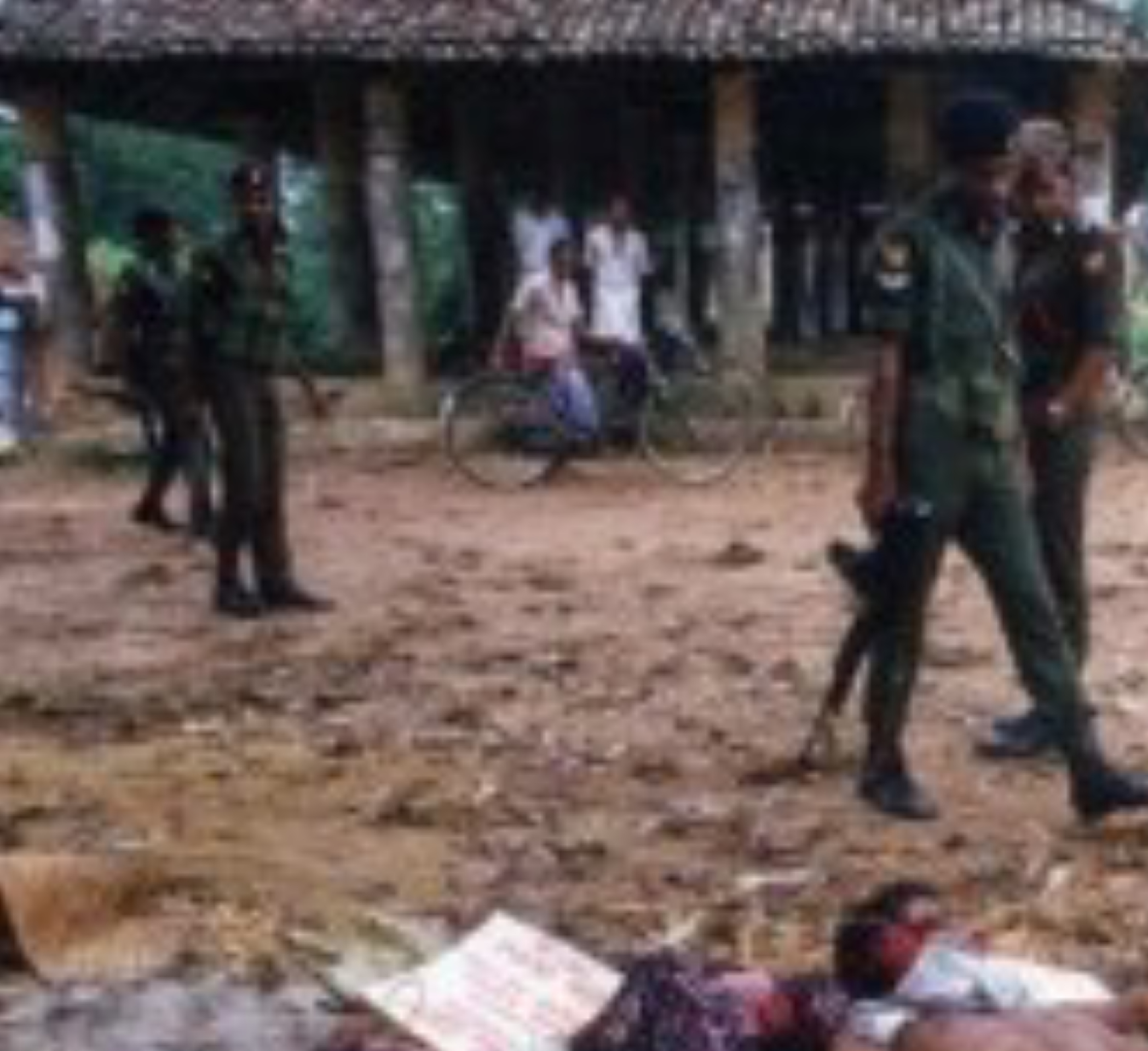
[[Image:After-PRRA.jpg|right|240px|thumb|Sri Lanka Army looks at dead bodies of suspected JVP members killed by the People's Revolutionary Red Army]] | [[Image:After-PRRA.jpg|right|240px|thumb|Sri Lanka Army looks at dead bodies of suspected JVP members killed by the [[Peoples Revolutionary Red Army|People's Revolutionary Red Army]]]] | ||
However, in 1989 Ranasinghe Premadasa was elected president amidst a mass boycott of elections by multiple militant organizations. He openly supported the LTTE in order to end the threats to the government. Without the support of the Sri Lankan government, the STF trained with the aid of [[United Kingdom]] and the [[Israeli Defence Forces]] (IDF) were not strong enough to take on the insurgency alone.<ref>{{Cite news|title=The Opposition within|location=India, Sri Lanka|publisher=Indiatoday.in|year=1988|url=http://www.indiatoday.in/magazine/neighbours/story/19880115-sri-lanka-janatha-vimukthi-peramuna-unleashes-reign-of-terror-on-united-national-party-796883-1988-01-15}}</ref> When the JVP offensive came to a peak, government paramilitaries such as the '[[Black Cat group|Black Cats]]', 'Yellow Cats', 'Scorpions' and '[[Eagles of the Hill Country|Eagles]]' were used in order resist the insurgency.{{sfn|Guneratne|1990|page=295}}<ref name='erasing' /> | However, in 1989 Ranasinghe Premadasa was elected president amidst a mass boycott of elections by multiple militant organizations. He openly supported the LTTE in order to end the threats to the government. Without the support of the Sri Lankan government, the STF trained with the aid of [[United Kingdom]] and the [[Israeli Defence Forces]] (IDF) were not strong enough to take on the insurgency alone.<ref>{{Cite news|title=The Opposition within|location=India, Sri Lanka|publisher=Indiatoday.in|year=1988|url=http://www.indiatoday.in/magazine/neighbours/story/19880115-sri-lanka-janatha-vimukthi-peramuna-unleashes-reign-of-terror-on-united-national-party-796883-1988-01-15|access-date=22 February 2021|archive-date=2 May 2021|archive-url=https://web.archive.org/web/20210502045513/https://www.indiatoday.in/magazine/neighbours/story/19880115-sri-lanka-janatha-vimukthi-peramuna-unleashes-reign-of-terror-on-united-national-party-796883-1988-01-15|url-status=live}}</ref> When the JVP offensive came to a peak, government paramilitaries such as the '[[Black Cat group|Black Cats]]', 'Yellow Cats', 'Scorpions' and '[[Eagles of the Hill Country|Eagles]]' were used in order resist the insurgency.{{sfn|Guneratne|1990|page=295}}<ref name='erasing' /> | ||
These paramilitary groups were involved in mass killings of Sri Lankan civilians during their operations. In reaction to a DJV attack on military personnel which killed fifteen soldiers, members of the Eagles paramilitary group launched an attack and killed more than 82 suspected JVP supporters. All victims of the attack were unarmed, and victims included children and Indian Tamils.<ref name="latimes">{{cite news|date=17 September 1989|title=Sri Lanka Gunmen Massacre 82 Civilians in Village Rampages|work=Los Angeles Times|agency=Associated Press|url= | These paramilitary groups were involved in mass killings of Sri Lankan civilians during their operations. In reaction to a DJV attack on military personnel which killed fifteen soldiers, members of the Eagles paramilitary group launched an attack and killed more than 82 suspected JVP supporters. All victims of the attack were unarmed, and victims included children and Indian Tamils.<ref name="latimes">{{cite news|date=17 September 1989|title=Sri Lanka Gunmen Massacre 82 Civilians in Village Rampages|work=Los Angeles Times|agency=Associated Press|url=https://www.latimes.com/archives/la-xpm-1989-09-17-mn-501-story.html|url-status=live|access-date=17 August 2018|archive-url=https://web.archive.org/web/20180401165212/http://articles.latimes.com/1989-09-17/news/mn-501_1_sri-lanka|archive-date=1 April 2018}}</ref><ref>{{Cite news|title=Gunmen Kill 82 Sinhalese in Sri Lanka|work=The New York Times|date=17 September 1989|url=https://www.nytimes.com/1989/09/17/world/gunmen-kill-82-sinhalese-in-sri-lanka.html|access-date=18 November 2020|archive-date=17 September 2018|archive-url=https://web.archive.org/web/20180917152032/https://www.nytimes.com/1989/09/17/world/gunmen-kill-82-sinhalese-in-sri-lanka.html|url-status=live}}</ref> In a similar incident on 5 October, the Eagles killed fourteen members of the staff of the [[Peradeniya University massacre|University of Peradeniya]]. Later claiming responsibility for the attack, the Eagles claimed that the victims were JVP supporters which engineered the murder of Captain T.E. Nagahawatte, the Assistant Registrar of the university and a volunteer officer.<ref>{{Cite book|title=UN Human Rights Committee Decisions on Communications from Sri Lanka|page=46,52}}</ref><ref>{{Cite book|title=Sri Lanka: Extrajudicial Executions, 'Disappearances' and Torture, 1987 to 1990|publisher=Amnesty International|location=United Kingdom}}</ref> | ||
Even when responsibility for these mass killings were claimed, security forces would deny all knowledge of missing or killed persons. When relatives inquired about missing persons at police stations or army camps, they would sometimes refuse to register any complaint. While sometimes the bodies of those taken away were allowed to be identified by relatives, in other cases those who were abducted or killed were never traced. Some of the missing people were later found to be in the custody of security forces, being arrested and detained for indeterminate periods without trial, lending evidence to the participation of regular security forces in paramilitary operations.<ref name="amnesty" /> In addition to these abductions and mass killings, [[gang rape]] or other forms of rape by both paramilitary groups and official soldiers was also observed.<ref name="amnesty" /><ref>{{cite journal|year=2016|url=http://www.ijcv.org/index.php/ijcv/article/download/3075/pdf/14756|title=Sri Lanka|pages=11–23|journal=International Journal of Conflict and Violence|last=Braithewaite|first=John|publisher=Australian National University}}</ref> | Even when responsibility for these mass killings were claimed, security forces would deny all knowledge of missing or killed persons. When relatives inquired about missing persons at police stations or army camps, they would sometimes refuse to register any complaint. While sometimes the bodies of those taken away were allowed to be identified by relatives, in other cases those who were abducted or killed were never traced. Some of the missing people were later found to be in the custody of security forces, being arrested and detained for indeterminate periods without trial, lending evidence to the participation of regular security forces in paramilitary operations.<ref name="amnesty" /> In addition to these abductions and mass killings, [[gang rape]] or other forms of rape by both paramilitary groups and official soldiers was also observed.<ref name="amnesty" /><ref>{{cite journal|year=2016|url=http://www.ijcv.org/index.php/ijcv/article/download/3075/pdf/14756|title=Sri Lanka|pages=11–23|journal=International Journal of Conflict and Violence|last=Braithewaite|first=John|publisher=Australian National University|access-date=18 March 2021|archive-date=18 October 2023|archive-url=https://web.archive.org/web/20231018225506/https://www.ijcv.org/index.php/ijcv/article/download/3075/pdf/14756|url-status=live}}</ref> | ||
====Detention camps==== | ====Detention camps==== | ||
In response to the JVP attacks, the government has been accused of using [[Internment|detention camps]] in order to put down the JVP insurrection. These camps were said to be run by units of the police who were officially tasked with disarming the rebels.<ref name="wsws">{{cite web|title=Sri Lankan government exploits allegations of murder and torture against opposition – World Socialist Web Site|url=https://www.wsws.org/en/articles/2000/08/sri-a26.html|access-date=11 November 2016|publisher=wsws.org}}</ref><ref>{{Cite web|url=http://reliefweb.int/sites/reliefweb.int/files/resources/04234216454178AFC12576B20038FF61-Full_Report.pdf|title=Commissions of inquiry in Sri Lanka}}</ref><ref>{{Cite web|title=Atrocities of Janatha Vimukthi Peramuna (JVP) or|url=http://www.tchr.net/civil_and_pol_jvp_army_deserters.htm|access-date=28 September 2016|website=www.tchr.net}}</ref><ref>{{Cite web|title=Anura Kumara apologises in London for JVP's 1988–89 terror|url= | In response to the JVP attacks, the government has been accused of using [[Internment|detention camps]] in order to put down the JVP insurrection. These camps were said to be run by units of the police who were officially tasked with disarming the rebels.<ref name="wsws">{{cite web|title=Sri Lankan government exploits allegations of murder and torture against opposition – World Socialist Web Site|date=26 August 2000|url=https://www.wsws.org/en/articles/2000/08/sri-a26.html|access-date=11 November 2016|publisher=wsws.org|archive-date=18 October 2023|archive-url=https://web.archive.org/web/20231018225450/https://www.wsws.org/en/articles/2000/08/sri-a26.html|url-status=live}}</ref><ref>{{Cite web|url=http://reliefweb.int/sites/reliefweb.int/files/resources/04234216454178AFC12576B20038FF61-Full_Report.pdf|title=Commissions of inquiry in Sri Lanka|access-date=22 November 2020|archive-date=21 January 2022|archive-url=https://web.archive.org/web/20220121032655/https://reliefweb.int/sites/reliefweb.int/files/resources/04234216454178AFC12576B20038FF61-Full_Report.pdf|url-status=live}}</ref><ref>{{Cite web|title=Atrocities of Janatha Vimukthi Peramuna (JVP) or|url=http://www.tchr.net/civil_and_pol_jvp_army_deserters.htm|access-date=28 September 2016|website=www.tchr.net|archive-date=1 April 2023|archive-url=https://web.archive.org/web/20230401171927/http://tchr.net/civil_and_pol_jvp_army_deserters.htm|url-status=live}}</ref><ref>{{Cite web|title=Anura Kumara apologises in London for JVP's 1988–89 terror|url=https://archives.sundayobserver.lk/2014/06/01/pol03.asp|url-status=live|archive-url=https://web.archive.org/web/20161001182426/http://www.sundayobserver.lk/2014/06/01/pol03.asp|archive-date=1 October 2016|access-date=28 September 2016|website=www.sundayobserver.lk}}</ref><ref>{{Cite web|date=6 February 2013|title=JVP says Matale mass grave has remains of 200 torture victims ::. Latest Sri Lanka News|url=http://www.onlanka.com/news/jvp-says-matale-mass-grave-has-remains-of-200-torture-victims.html|access-date=28 September 2016|language=en-US|archive-date=18 October 2023|archive-url=https://web.archive.org/web/20231018225445/https://www.onlanka.com/news/jvp-says-matale-mass-grave-has-remains-of-200-torture-victims.html|url-status=live}}</ref> It is believed that 5,000 to 10,000 JVP rebels were either tortured or killed in camps established across the country. The largest camp was in [[Batalanda detention centre|Batalanda]] and was run by the Black Cat paramilitary group, with [[Ranil Wickremesinghe]] having been accused of being the political authority in charge of overseeing the detention camp.<ref>{{Cite web|title=Demons of Batalanda: Who was behind them? – LNW Today|url=http://www.lankanewsweb.today/english/archives/4609|url-status=dead|archive-url=https://web.archive.org/web/20161002064124/http://www.lankanewsweb.today/english/archives/4609|archive-date=2 October 2016|access-date=28 September 2016|website=www.lankanewsweb.today}}</ref> After the insurrection, a Batalanda commission was appointed to look into violations of human rights which took place at the Batalanda detention camp. The commission recommended that legal action be taken against Wickremesinghe, although ultimately no action was taken against him.<ref>{{Cite web|url=https://www.sundaytimes.lk/120212/News/nws_28.html|title=Vijaya assassination: Politics kills police professionalism|website=www.sundaytimes.lk|access-date=20 December 2022|archive-date=20 December 2022|archive-url=https://web.archive.org/web/20221220015809/https://www.sundaytimes.lk/120212/News/nws_28.html|url-status=live}}</ref><ref>{{cite web|title=Lalith Athulathmudali's Assassination –Fact or Fiction?|url=http://www.ceylontoday.lk/print20170401CT20170630.php?id=20301|access-date=22 November 2020|archive-date=23 August 2017|archive-url=https://web.archive.org/web/20170823165521/http://www.ceylontoday.lk/print20170401CT20170630.php?id=20301|url-status=dead}}</ref> | ||
===Notable attacks=== | ===Notable attacks=== | ||
| Line 254: | Line 253: | ||
* 1989 Auxiliary Force Training Camp at Pannala attack | * 1989 Auxiliary Force Training Camp at Pannala attack | ||
* 1989 Panagoda Cantonment attack | * 1989 Panagoda Cantonment attack | ||
* [[Deshapremi Janatha Viyaparaya#1989 Landmine attack on the IPKF|1989 | * [[Deshapremi Janatha Viyaparaya#1989 Landmine attack on the IPKF|1989 landmine attack on the IPKF]] | ||
* 1989 | * 1989 Colombo Police Field Force Headquarters attack | ||
* More attacks on certain police stations.<ref>{{Cite web|title=Interview with Gnanadass|url=http://www.thesundayleader.lk/archive/20011202/interviews.htm|archive-url=https://web.archive.org/web/20170720053610/http://www.thesundayleader.lk/archive/20011202/interviews.htm|archive-date=20 July 2017}}</ref> | * More attacks on certain police stations.<ref>{{Cite web|title=Interview with Gnanadass|url=http://www.thesundayleader.lk/archive/20011202/interviews.htm|archive-url=https://web.archive.org/web/20170720053610/http://www.thesundayleader.lk/archive/20011202/interviews.htm|archive-date=20 July 2017}}</ref> | ||
| Line 277: | Line 276: | ||
===Attacks on provisional elections=== | ===Attacks on provisional elections=== | ||
The JVP in opposition to the [[13th Amendment to the Constitution of Sri Lanka|13th Amendment]] which was brought as a suggestion from India, formed the National Salvation Front with the Sri Lanka Freedom Party (SLFP) but felt betrayed when the SLFP participated in elections | The JVP in opposition to the [[13th Amendment to the Constitution of Sri Lanka|13th Amendment]] which was brought as a suggestion from India, formed the National Salvation Front with the Sri Lanka Freedom Party (SLFP) but felt betrayed when the SLFP participated in elections and began a violent campaign against them as well.<ref name='nation1'/><ref>{{cite journal |last1=Cave |first1=Rosy |last2=Manoharan |first2=N. |title=Resistance to Reform; Submission to Status Quo: Security Sector Reform in Sri Lanka |journal=South Asian Survey |date=1 July 2009 |volume=16 |issue=2 |pages=291–314 |doi=10.1177/097152310901600208 |s2cid=154090420 |language=en |issn=0971-5231}}</ref><ref name=TT1288>{{cite journal|title=JVP Turns its Guns and Bombs Against SLMP|journal=[[Tamil Times]]|date=December 1988|volume=VIII|issue=1|page=19|url=http://noolaham.net/project/34/3317/3317.pdf|issn=0266-4488|access-date=19 January 2021|archive-date=13 May 2024|archive-url=https://web.archive.org/web/20240513145023/https://noolaham.net/project/34/3317/3317.pdf|url-status=live}}</ref>{{efn|See [[#Assassination and funeral of Vijaya Kumaratunga]]}} | ||
== Impact on civilians == | == Impact on civilians == | ||
| Line 285: | Line 284: | ||
===Attacks on security forces' families=== | ===Attacks on security forces' families=== | ||
The JVP made a serious misjudgment when, through the DJV, it called for the killing of members of the families of the security personnel. This destroyed the small but significant amount of support that it enjoyed among the lower ranks of the armed forces, and made it possible for the government to justify its [[State terrorism in Sri Lanka|campaign of terror]].<ref>{{Cite web|url=https://www.lankanewsweb.net/67-general-news/2052-a-bribery-case-against-raththaran|title=Gotabaya Rajapaksha}}</ref> | The JVP made a serious misjudgment when, through the DJV, it called for the killing of members of the families of the security personnel. This destroyed the small but significant amount of support that it enjoyed among the lower ranks of the armed forces, and made it possible for the government to justify its [[State terrorism in Sri Lanka|campaign of terror]].<ref>{{Cite web|url=https://www.lankanewsweb.net/67-general-news/2052-a-bribery-case-against-raththaran|title=Gotabaya Rajapaksha|access-date=1 December 2020|archive-date=2 May 2021|archive-url=https://web.archive.org/web/20210502073913/https://www.lankanewsweb.net/67-general-news/2052-a-bribery-case-against-raththaran|url-status=dead}}</ref> | ||
Most notable of the attacks on families of the security personal was the attack on a family of [[Deputy Inspector General of Police]] Premadasa when on 24 July 1988 his ancestral home in [[Bope-Poddala Divisional Secretariat|Poddala]] was surrounded and set ablaze by suspected members of the JVP. Following this, Udugampola began a ruthless crackdown of the JVP in the Southern and Central provinces.<ref name="nation1"/><ref>{{Cite book|title=The Island of Blood|author=Anita Pratap|author-link=Anita Pratap}}</ref> | Most notable of the attacks on families of the security personal was the attack on a family of [[Deputy Inspector General of Police]] Premadasa Udugampola when on 24 July 1988 his ancestral home in [[Bope-Poddala Divisional Secretariat|Poddala]] was surrounded and set ablaze by suspected members of the JVP. Following this, Udugampola began a ruthless crackdown of the JVP in the Southern and Central provinces.<ref name="nation1"/><ref>{{Cite book|title=The Island of Blood|author=Anita Pratap|author-link=Anita Pratap}}</ref> | ||
As a means of pacifying the support base of the JVP, a wide range of acts of cruelty including the [[torture]] and [[mass murder]] of school children, who were allegedly JVP supporters, was carried out by the state.<ref> | As a means of pacifying the support base of the JVP, a wide range of acts of cruelty including the [[torture]] and [[mass murder]] of school children, who were allegedly JVP supporters, was carried out by the state.<ref> | ||
| Line 301: | Line 300: | ||
==Internal conflict post-insurrection== | ==Internal conflict post-insurrection== | ||
{{main|Operation Combine}} | {{main|Operation Combine}} | ||
Government forces attached to [[Operation Combine]] captured JVP leader [[Rohana Wijeweera]] in [[Ulapane]] and brought him to Colombo, where the government claimed on 13 November 1989 that Wijeweera was shot and killed. Although the Government won a decisive military victory there were credible accusations of brutality and extrajudicial killings.<ref name=PFTCOV>{{cite news |last1=Ferdinando |first1=Shamindra |title=President fails to capitalize on victory over JVP War on terror revisited |url=http://pdfs.island.lk/defence/20130318_118.html |access-date=21 February 2021 |publisher=Island.lk }}</ref><ref>''Political Killings in Southern Sri Lanka'', [[International Alert]], [[London]] 1989</ref> | |||
Government forces attached to [[Operation Combine]] captured JVP leader [[Rohana Wijeweera]] in [[Ulapane]] and brought him to Colombo, where the government claimed on 13 November 1989 that Wijeweera was shot and killed. Although the Government won a decisive military victory there were credible accusations of brutality and extrajudicial killings.<ref name=PFTCOV>{{cite news |last1=Ferdinando |first1=Shamindra |title=President fails to capitalize on victory over JVP War on terror revisited |url=http://pdfs.island.lk/defence/20130318_118.html |access-date=21 February 2021 |publisher=Island.lk |archive-date=29 June 2022 |archive-url=https://web.archive.org/web/20220629222911/http://pdfs.island.lk/defence/20130318_118.html |url-status=dead }}</ref><ref>''Political Killings in Southern Sri Lanka'', [[International Alert]], [[London]] 1989</ref> | |||
On 27 December 1989, a special police team led by SSP Lionel Gunathilake arrested Saman Piyasiri Fernando along with his mother and fiancé at [[Koswatte]], [[Nawala]]. [[Lalith Wijerathna]], Upali Jayaweera, Ranjitham Gunaratnam, Gamini Wijegunasekara, and Shantha Bandara tried to regroup following these events, but government forces managed to capture them and subsequently killed them in December 1989. The leadership of the JVP was transferred to [[Somawansa Amarasinghe]]. It is believed that Lalith Wijerathna was captured sometime later in Colombo by a special police team from Kandy in either late December 1989 or early January 1990. When the government reported the deaths of all of the major leaders of the insurgent party, over 15,000 troops surrendered and gave up their arms. Achieving a decisive military victory over the JVP, the government forced the party to return to democratic and nonviolent politics under the leadership of [[Somawansa Amarasinghe]].<ref name=PFTCOV/> | On 27 December 1989, a special police team led by SSP Lionel Gunathilake arrested Saman Piyasiri Fernando along with his mother and fiancé at [[Koswatte]], [[Nawala]]. [[Lalith Wijerathna]], Upali Jayaweera, Ranjitham Gunaratnam, Gamini Wijegunasekara, and Shantha Bandara tried to regroup following these events, but government forces managed to capture them and subsequently killed them in December 1989. The leadership of the JVP was transferred to [[Somawansa Amarasinghe]]. It is believed that Lalith Wijerathna was captured sometime later in Colombo by a special police team from Kandy in either late December 1989 or early January 1990. When the government reported the deaths of all of the major leaders of the insurgent party, over 15,000 troops surrendered and gave up their arms. Achieving a decisive military victory over the JVP, the government forced the party to return to democratic and nonviolent politics under the leadership of [[Somawansa Amarasinghe]].<ref name=PFTCOV/> | ||
| Line 311: | Line 310: | ||
== Fatalities == | == Fatalities == | ||
{{Further|List of assassinations of the Second JVP Insurrection|Enforced disappearances in Sri Lanka}} | {{Further|List of assassinations of the Second JVP Insurrection|Enforced disappearances in Sri Lanka}} | ||
A European delegation estimated the total death toll to be 60,000, while other estimates have placed the death toll at 35,000.<ref name="casualties-hrw">{{cite web |title=SRI LANKA |url=https://www.hrw.org/reports/1990/WR90/ASIA.BOU-11.htm#P731_163022 |publisher=Human Rights Watch |access-date=2018-06-24}}</ref> For [[genocide studies]], it was an example of [[politicide]] that happened in a democratic regime, and resulted in the killing of at least 13,000 and 30,000 JVP members and its alleged supporters.<ref>{{cite book|last=Harff|first=Barbara|year=2017|chapter=The Comparative Analysis of Mass Atrocities and Genocide|chapter-url=https://link.springer.com/content/pdf/10.1007%2F978-3-319-54463-2_12.pdf|editor-last=Gleditish|editor-first=N. P.|title=R.J. Rummel: An Assessment of His Many Contributions|volume=37|series=SpringerBriefs on Pioneers in Science and Practice|location=New York City, New York|publisher=Springer | A European delegation estimated the total death toll to be 60,000, while other estimates have placed the death toll at 35,000.<ref name="casualties-hrw">{{cite web |title=SRI LANKA |url=https://www.hrw.org/reports/1990/WR90/ASIA.BOU-11.htm#P731_163022 |publisher=Human Rights Watch |access-date=2018-06-24 |archive-date=28 December 2016 |archive-url=https://web.archive.org/web/20161228103104/https://www.hrw.org/reports/1990/WR90/ASIA.BOU-11.htm#P731_163022 |url-status=live }}</ref> For [[genocide studies]], it was an example of [[politicide]] that happened in a democratic regime, and resulted in the killing of at least 13,000 and 30,000 JVP members and its alleged supporters.<ref>{{cite book|last=Harff|first=Barbara|year=2017|chapter=The Comparative Analysis of Mass Atrocities and Genocide|chapter-url=https://link.springer.com/content/pdf/10.1007%2F978-3-319-54463-2_12.pdf|editor-last=Gleditish|editor-first=N. P.|title=R.J. Rummel: An Assessment of His Many Contributions|volume=37|series=SpringerBriefs on Pioneers in Science and Practice|location=New York City, New York|publisher=Springer|doi=10.1007/978-3-319-54463-2_12|doi-access=free|isbn=978-3-319-54463-2|access-date=30 August 2021|pages=117–118|archive-date=26 November 2021|archive-url=https://web.archive.org/web/20211126183601/https://link.springer.com/content/pdf/10.1007%2F978-3-319-54463-2_12.pdf|url-status=live}}</ref> | ||
===Killings by group=== | ===Killings by group=== | ||
| Line 317: | Line 316: | ||
* DJV [[Deshapremi Janatha Viyaparaya#Type of attacks|killed]] around 6,000 people who were mostly police or armed forces. It also killed 41 Buddhist Monks and 2 Christian Clergy. However, only the killings that happened between 1988 and 1989 are counted by investigators | * DJV [[Deshapremi Janatha Viyaparaya#Type of attacks|killed]] around 6,000 people who were mostly police or armed forces. It also killed 41 Buddhist Monks and 2 Christian Clergy. However, only the killings that happened between 1988 and 1989 are counted by investigators | ||
* A group named Draa killed 26 Indian soldiers | * A group named Draa killed 26 Indian soldiers | ||
* The PRRA and SRRA killed around 1,000 people<ref>{{Cite news|title=The Sunday Leader: Spotlight|date=15 February 2004|url=http://www.thesundayleader.lk/archive/20040215/spotlight-more.htm|author=Frederica Jancz|publisher=[[The Sunday Leader]]}}</ref> | * The PRRA and SRRA killed around 1,000 people<ref>{{Cite news|title=The Sunday Leader: Spotlight|date=15 February 2004|url=http://www.thesundayleader.lk/archive/20040215/spotlight-more.htm|author=Frederica Jancz|publisher=[[The Sunday Leader]]|access-date=1 January 2021|archive-date=8 February 2017|archive-url=https://web.archive.org/web/20170208044947/http://www.thesundayleader.lk/archive/20040215/spotlight-more.htm|url-status=dead}}</ref> | ||
* [[Ukussa paramilitary]] killed 80–100 people in the Kandy massacre and 14–20 people in the [[Peradeniya massacre]] | * [[Ukussa paramilitary]] killed 80–100 people in the Kandy massacre and 14–20 people in the [[Peradeniya massacre]] | ||
* The [[Black Cat group]] killed 300 members of the CPSL and a number of people in the Eppawela attack<ref>CartoonistsRights. ''[http://www.cartoonistsrights.org/cartoonists_rights_free_speech.php?id=40 Sri Lanka] {{webarchive |url=https://web.archive.org/web/20120919195217/http://www.cartoonistsrights.org/cartoonists_rights_free_speech.php?id=40 |date=September 19, 2012 }}''</ref><ref>{{Cite book|url=http://www.amnesty.org/download/Documents/200000/asa370201990en.pdf|title=Sri Lanka brief: A human rights crisis|isbn=0-86210-185-9|chapter=THE SOUTHWEST|year=1990}}</ref><ref>{{Cite web|url=https://web.archive.org/web/20080216194922/http://www.dailymirror.lk/2005/08/06/life/3.asp| | * The [[Black Cat group]] killed 300 members of the CPSL and a number of people in the Eppawela attack<ref>CartoonistsRights. ''[http://www.cartoonistsrights.org/cartoonists_rights_free_speech.php?id=40 Sri Lanka] {{webarchive |url=https://web.archive.org/web/20120919195217/http://www.cartoonistsrights.org/cartoonists_rights_free_speech.php?id=40 |date=September 19, 2012 }}''</ref><ref>{{Cite book|url=http://www.amnesty.org/download/Documents/200000/asa370201990en.pdf|title=Sri Lanka brief: A human rights crisis|isbn=0-86210-185-9|chapter=THE SOUTHWEST|year=1990|publisher=Amnesty International Publications|access-date=18 February 2021|archive-date=28 September 2024|archive-url=https://web.archive.org/web/20240928001755/http://www.amnesty.org/download/Documents/200000/asa370201990en.pdf|url-status=live}}</ref><ref>{{Cite web|url=http://www.dailymirror.lk/2005/08/06/life/3.asp|title= Daily Mirror - Opinion |date=16 February 2008|archive-url=https://web.archive.org/web/20080216194922/http://www.dailymirror.lk/2005/08/06/life/3.asp |archive-date=16 February 2008 }}</ref> | ||
===United Nations research=== | ===United Nations research=== | ||
| Line 325: | Line 324: | ||
===Calls for further investigations=== | ===Calls for further investigations=== | ||
International jurist [[Neelan Thiruchelvam]], in a speech at the ICES-Colombo, indicated that the appropriate investigations into the [[forced disappearances|disappearances]] of civilians, including many children in the [[Sathurukondan massacre|Sathurukondan]], [[Eastern University massacre|Eastern University]], [[Mylanthanai massacre|Mylanthanai]] and the mass murder and burial of school children at Sooriyakanda, were being hampered by the adoption of [[emergency]] [[regulations]], which were contributing to a climate of impunity. He called for the partial, if not complete, revocation of emergency regulation so that an impartial inquiry into these incidents could take place.<ref> | International jurist [[Neelan Thiruchelvam]], in a speech at the ICES-Colombo, indicated that the appropriate investigations into the [[forced disappearances|disappearances]] of civilians, including many children in the [[Sathurukondan massacre|Sathurukondan]], [[Eastern University massacre|Eastern University]], [[Mylanthanai massacre|Mylanthanai]] and the mass murder and burial of school children at Sooriyakanda, were being hampered by the adoption of [[emergency]] [[regulations]], which were contributing to a climate of impunity. He called for the partial, if not complete, revocation of emergency regulation so that an impartial inquiry into these incidents could take place.<ref>{{usurped|1=[https://web.archive.org/web/20120208082545/http://www.icescolombo.org/Neelan/ps060994.htm Speech by Neelan Tiruchelvam at the Debate on the Emergency]}}</ref> These attempts also failed and Thiruchelvam was later assassinated by the LTTE.<ref>{{cite book |last= Salter |first= M.|title=To End a Civil War|date=2015|publisher=Hurst Publishers|pages=40–41}}</ref> | ||
== Aftermath == | == Aftermath == | ||
By 1991, the JVP still existed as a pressure group or an organization regardless of the government operations to stop its activity.<ref>{{Cite book|url=https://books.google.com/books?id=IGnFuDexMVoC|publisher=[[Central Intelligence Agency]]|title=The World Factbook, 1991|series=CIA – The World Factbook|year=1991}}</ref> Following the insurrection, the JVP was relaunched and participated in electoral politics. At the [[2004 Sri Lankan parliamentary election|parliamentary elections held on 2 April 2004]], the party was part of the [[United People's Freedom Alliance]] that won 45.6% of the popular vote and 105 out of 225 seats. As the second partner in this alliance it once again became part of the government. It also supported the winning candidate [[Mahinda Rajapaksa]] in the [[2005 Sri Lankan presidential election|2005 parliamentary election]]. Along with the UNP it supported General [[Sarath Fonseka]] in the [[2010 Sri Lankan presidential election|2010 presidential election]].<ref>Hughes, Dhana (2013). "'Retired' Insurgents: Recreating Life after Sri Lanka's Terror." ''Contemporary South Asia''. '''21''' (1): 72–74. {{doi| 10.1080/09584935.2012.75758}}.</ref> | By 1991, the JVP still existed as a pressure group or an organization regardless of the government operations to stop its activity.<ref>{{Cite book|url=https://books.google.com/books?id=IGnFuDexMVoC|publisher=[[Central Intelligence Agency]]|title=The World Factbook, 1991|series=CIA – The World Factbook|year=1991|access-date=22 February 2021|archive-date=28 September 2024|archive-url=https://web.archive.org/web/20240928001757/https://books.google.com/books?id=IGnFuDexMVoC|url-status=live}}</ref> Following the insurrection, the JVP was relaunched and participated in electoral politics. At the [[2004 Sri Lankan parliamentary election|parliamentary elections held on 2 April 2004]], the party was part of the [[United People's Freedom Alliance]] that won 45.6% of the popular vote and 105 out of 225 seats. As the second partner in this alliance it once again became part of the government. It also supported the winning candidate [[Mahinda Rajapaksa]] in the [[2005 Sri Lankan presidential election|2005 parliamentary election]]. Along with the UNP it supported General [[Sarath Fonseka]] in the [[2010 Sri Lankan presidential election|2010 presidential election]].<ref>Hughes, Dhana (2013). "'Retired' Insurgents: Recreating Life after Sri Lanka's Terror." ''Contemporary South Asia''. '''21''' (1): 72–74. {{doi| 10.1080/09584935.2012.75758}}.</ref> | ||
==In popular media== | ==In popular media== | ||
| Line 338: | Line 337: | ||
==Leaders of the insurrection== | ==Leaders of the insurrection== | ||
After the ban, JVP was reorganized in April 1984 and its pre-1983 members in the Politburo were Wijeweera, Gamanayake, Sumith Athukorala, Piyadasa Ranasinghe and Wanasinghe. In the same year, Galappaththi, Shantha Bandara, Saman Piyasiri, Somawansa Amarasinghe, D. M. Ananda | After the ban, JVP was reorganized in April 1984 and its pre-1983 members in the Politburo were Wijeweera, Gamanayake, Sumith Athukorala, Piyadasa Ranasinghe and Wanasinghe. In the same year, Galappaththi, Shantha Bandara, Saman Piyasiri, Somawansa Amarasinghe, D. M. Ananda were included. Later, during the Second insurrection, H. B. Herath, P. R. B. Wimalarathna and Lalith Wijerathna also joined. Accordingly, out of the 13 main leaders of the 2nd JVP uprising, 8 were involved in the April 1971 uprising. Also, four of them were university graduates.<ref>{{Cite web |title=Here is the profile of the leaders of the 2nd JVP uprising! |url=http://www.silumina.lk/2021/01/09/දේශපාලනය/ජවිපෙ-2වැනි-කැරැල්ලේ-නාය%C2%ADක%C2%ADයන්ගේ-පැටි%C2%ADකි%C2%ADරිය-මෙන්න |access-date=2021-06-13 |website=Silumina |date=8 January 2021 }}</ref> | ||
{| class="wikitable" | {| class="wikitable" | ||
|+ 13 Politburo Leaders during 1987 insurrection | |+ 13 Politburo Leaders during 1987 insurrection | ||
|- | |- | ||
! Name !! Date of | ! Name !! Date of birth !! Post of JVP !! Spouse (no. of children) !! Education !! Date of death | ||
|- | |- | ||
| [[Rohana Wijeweera]] || 14 July 1943 || Leader || Chithrangani Fernando (06) || Dharmasoka College, Ambalangoda || 13 November 1989 | | [[Rohana Wijeweera]] || 14 July 1943 || Leader || Chithrangani Fernando (06) || Dharmasoka College, Ambalangoda || 13 November 1989 | ||
| Line 381: | Line 380: | ||
* [[Foreign relations of North Korea]] | * [[Foreign relations of North Korea]] | ||
* [[Cocos Island Mutiny]] | * [[Cocos Island Mutiny]] | ||
* [[List of attacks on civilians attributed to the Janatha Vimukthi Peramuna]] | |||
* [[List of attacks on civilians attributed to Sri Lankan government forces]] | |||
== Notes == | == Notes == | ||
| Line 391: | Line 392: | ||
==Bibliography== | ==Bibliography== | ||
===Books=== | ===Books=== | ||
* {{cite book|last=Gunasekara|first=Prinse|title=A lost generation: Sri Lanka in Crisis|year=1998|isbn=955-202-82-64}} | * {{cite book|last=Gunasekara|first=Prinse|title=A lost generation: Sri Lanka in Crisis|year=1998|publisher=S. Godage & Brothers |isbn=955-202-82-64}} | ||
* {{cite book|last=Guneratne|first=Rohan|url=http://www.st-andrews.ac.uk/~www_sem/IR/research/cstpv-old/Lostrevo.htm|title=Sri Lanka, a Lost Revolution?: The Inside Story of the JVP|year=1990|publisher=Institute of Fundamental Studies|location=Sri Lanka|archive-url=https://web.archive.org/web/20050822073446/http://www.st-andrews.ac.uk/~www_sem/IR/research/cstpv-old/Lostrevo.htm|archive-date=22 August 2005}} | * {{cite book|last=Guneratne|first=Rohan|url=http://www.st-andrews.ac.uk/~www_sem/IR/research/cstpv-old/Lostrevo.htm|title=Sri Lanka, a Lost Revolution?: The Inside Story of the JVP|year=1990|publisher=Institute of Fundamental Studies|location=Sri Lanka|archive-url=https://web.archive.org/web/20050822073446/http://www.st-andrews.ac.uk/~www_sem/IR/research/cstpv-old/Lostrevo.htm|archive-date=22 August 2005}} | ||
* {{cite book|last=Guneratne|first=Rohan|url=http://www.st-andrews.ac.uk/~www_sem/IR/research/cstpv-old/IndiaIntervention.htm|title=Indian Intervention in Sri Lanka|year=1993|isbn=955-95199-0-5|archive-url=https://web.archive.org/web/20060228172707/http://www.st-andrews.ac.uk/~www_sem/IR/research/cstpv-old/IndiaIntervention.htm|archive-date=28 February 2006}} | * {{cite book|last=Guneratne|first=Rohan|url=http://www.st-andrews.ac.uk/~www_sem/IR/research/cstpv-old/IndiaIntervention.htm|title=Indian Intervention in Sri Lanka|year=1993|publisher=South Asian Network on Conflict Research |isbn=955-95199-0-5|archive-url=https://web.archive.org/web/20060228172707/http://www.st-andrews.ac.uk/~www_sem/IR/research/cstpv-old/IndiaIntervention.htm|archive-date=28 February 2006}} | ||
* {{cite book|last=Dissanayake|first=T.|title=War or Peace in Sri Lanka|year=2002|isbn=9555720029}} | * {{cite book|last=Dissanayake|first=T.|title=War or Peace in Sri Lanka|year=2002|isbn=9555720029}} | ||
* {{cite book|first=Rajesh|last=Kadian|title=India's Sri Lanka Fiasco: Peace Keepers at War|url=https://books.google.com/books?id=36VHAAAAMAAJ|access-date=30 June 2021|year=1990|publisher=Vision Books|isbn=978-81-7094-063-0}} | |||
* {{cite book|title=Sri Lanka: Current Issues and Historical Background|last=Nubin|first=Walter|publisher=Nova publications|year=2002}} | * {{cite book|title=Sri Lanka: Current Issues and Historical Background|last=Nubin|first=Walter|publisher=Nova publications|year=2002}} | ||
===Accounts=== | ===Accounts=== | ||
* {{cite book|last= Chandraprema|first= C.A.|title= The Years of Terror|location= Sri Lanka|year= 1991|isbn= 9559029037}} | * {{cite book|last= Chandraprema|first= C.A.|title= The Years of Terror|location= Sri Lanka|publisher=Lake House Bookshop|year= 1991|isbn= 9559029037}} | ||
* {{cite book|last= Pratap|first= Anita|location= India|title= The Island of Blood: Sri Lanka}} | * {{cite book|last= Pratap|first= Anita|location= India|title= The Island of Blood: Sri Lanka}} | ||
| Line 419: | Line 421: | ||
{{Cold War}} | {{Cold War}} | ||
{{DEFAULTSORT: | {{DEFAULTSORT:JVP insurrection}} | ||
[[Category:1987–1989 JVP insurrection| ]] | [[Category:1987–1989 JVP insurrection| ]] | ||
[[Category:Anti-Indian sentiment in Asia]] | [[Category:Anti-Indian sentiment in Asia]] | ||
| Line 433: | Line 429: | ||
[[Category:20th-century conflicts]] | [[Category:20th-century conflicts]] | ||
[[Category:Cold War rebellions]] | [[Category:Cold War rebellions]] | ||
[[Category:Communism in Sri Lanka]] | [[Category:Communism in Sri Lanka]] | ||
[[Category:Communist rebellions]] | [[Category:Communist rebellions]] | ||
| Line 441: | Line 436: | ||
[[Category:Wars involving Sri Lanka]] | [[Category:Wars involving Sri Lanka]] | ||
[[Category:Insurgencies in Asia]] | [[Category:Insurgencies in Asia]] | ||
[[Category:Sri Lankan | [[Category:Sri Lankan civil war]] | ||
[[Category:Wars involving India]] | [[Category:Wars involving India]] | ||
[[Category:Guerrilla wars]] | [[Category:Guerrilla wars]] | ||
| Line 447: | Line 442: | ||
[[Category:Socialism in Sri Lanka]] | [[Category:Socialism in Sri Lanka]] | ||
[[Category:Rebellions in Sri Lanka]] | [[Category:Rebellions in Sri Lanka]] | ||
Latest revision as of 20:02, 13 March 2026
 | This article may require cleanup to meet Bharatpedia's quality standards. The specific problem is: Merge Bibliography and References (December 2022) |
| 1987–1989 JVP insurrection | |||||||
|---|---|---|---|---|---|---|---|
| Part of the Cold War and Sri Lankan Civil War | |||||||
 Sri Lankan army on patrol in a village to combat the Insurgents | |||||||
| |||||||
| Belligerents | |||||||
| |||||||
| Commanders and leaders | |||||||
| Units involved | |||||||
| |||||||
| Strength | |||||||
| |||||||
| Casualties and losses | |||||||
|
10,000–60,000 captured and/or killed 20,000+ disappeared | ||||||



Template:Politics of Sri Lanka Template:Communism sidebar
The 1987–1989 JVP insurrection, also known as the 1988–1989 revolt or the JVP troubles, was an armed revolt in Sri Lanka led by the Marxist–Leninist Janatha Vimukthi Peramuna (JVP) against the Government of Sri Lanka, then led by the right-wing United National Party (UNP). The insurrection, like the previous one in 1971, was unsuccessful. The main phase of the insurrection was a low-intensity conflict that lasted from April 1987 to December 1989.[lower-alpha 3] The insurgents led by the JVP resorted to subversion, assassinations, raids, and attacks on military and civilian targets[7] while the Sri Lankan government reacted through counter-insurgency operations to suppress the revolt using army and paramilitary groups who were allegedly backed by government.
Guerrilla forces of the insurrection were led by the military branch of the JVP, the Deshapremi Janatha Viyaparaya (DJV). The insurgency reached its peak in 1988 and impacted all Sri Lankan civilians, including those without any political stake in the situation. Attacks on civilians by pro-government guerrillas began after the election of president Ranasinghe Premadasa. A period of mass killings by the government began soon after the ceasefire of the Sri Lankan civil war and the expulsion of the Indian Peace Keeping Force, resulting in the death of many Sri Lankan civilians and multiple Indian expatriates.
The JVP received support from its one-time enemy, the Sri Lanka Freedom Party (SLFP). However, this alliance broke down following the SLFP's participation in the provincial elections which the JVP and the Liberation Tigers of Tamil Eelam (LTTE) openly boycotted. The government lifted the ban on both parties in 1987, hoping that they would participate in the elections, but this attempt ultimately failed. For over two years, the state saw mass militancy of youth and workers, mass execution, and feuds between government militias and the JVP. Anti-JVP militias allegedly backed by the UNP government also caused violence, including the Black Cat group, the Eagles of the Central Hills and the leftist People's Revolutionary Red Army along with nine to eleven other groups.
In 1989, Sri Lanka Armed Forces launched Operation Combine (Ops Combine). Even after revolutionary leader, Rohana Wijeweera was killed, the insurgency persisted. Violence escalated when the DJV leader Keerthi Vijayabahu took over. DJV members also operated in the LTTE-occupied areas of Trincomalee against the Sri Lanka Armed Forces and the IPKF. The DJV was supported by Tamil militants so that it could also operate as a front against the Indian forces. Many smaller anti-government groups gave up the armed struggle, but the largest threats persisted, with the DJV continuing to operate as an armed group until December 1989. Ranjan Wijeratne, who played a major role in the Ops Combine, claimed he was ready to launch a similar counterinsurgency against the LTTE. Wijeratne was assassinated in 1991, which led to the outbreak of the second phase of the Sri Lanka-LTTE conflict, known as the Second Eelam War.
Background[edit | edit source]
History of Janatha Vimukthi Peramuna[edit | edit source]
Founded by communist Rohana Wijeweera, the Janatha Vmukthi Peramuna (JVP) is known for its revolutionary youth background. The organization was banned more than once when the group was first involved in Anti-American protests against the Vietnam War in the 1970s. Since then, the movement was called the "Che Guevara clique" (a nickname the JVP did not claim) by the Sri Lankan government and international media.[8] The group was first internationally recognized as a political party when it participated in a communist youth conference in Havana, Cuba in 1978.[9]
1971 JVP Insurrection[edit | edit source]
The JVP launched an open revolt against Prime Minister Sirimavo Bandaranaike's government in April 1971. While the government was caught off guard, it was able to subdue the insurgency in a matter of weeks. The insurgency may have led to the death of 4,000–5,000 people. Over 20,000 suspected rebels, mostly young people, were arrested in the period that followed the insurrection, but most were released after rehabilitation. The Sri Lankan government called upon India for military assistance, however Indian involvement was less known at the time of the insurrection.[10][11]
Rohana Wijeweera and the other major leaders of the insurgency were sentenced to prison and the JVP was banned as a political party. However, all of them were released in 1977 by new Prime Minister J. R. Jayewardene after the UNP won the general elections after running on a platform of amnesty for those prosecuted by the infamous Criminal Justice Commission.
Tamil insurgency and pro-United States policy[edit | edit source]
During the mid-1980s, as the Sri Lankan Civil War with Tamil militants in the north became more intense, there was a significant shift in the ideology and goals of the JVP. Initially Marxist in orientation, the JVP claimed to represent the oppressed of both the Tamil and Sinhalese communities. Later, however, the group increasingly began to identify as a Sinhalese nationalist organization, opposing any compromise with the Tamil insurgency.[12]
Third ban[edit | edit source]
Rohana Wijeweera received the third-highest number of votes in the 1982 presidential elections, and the Jayawardene government feared the increasing popularity of the JVP.
The JVP would continue to be involved in more controversy along with the Nava Sama Samaja Party following an assembly held on 6 July 1983, which was held in support of Tamil civilians; at the assembly, NSSP leader Vikramabahu Karunaratne defended the Tamil insurgency.[13] The government was greatly threatened by these parties, and alleged that three socialist parties were preparing to topple the government.[14] The Jayawardene government also alleged that the JVP was involved in the Black July riots, but provided no concrete evidence. Due to these allegations, Jayawardene banned the party, a move which was suspected to be due to his fear of losing future elections to leftist parties as he was highly pro-U.S. and anti-Soviet due to his anti-Indian policy.[12][15] It is also to be noted that during this time, Jayawardene degraded diplomatic relations with socialist countries like Cuba and the Soviet Union.[16]
Preparation[edit | edit source]
Having been banned and driven underground, the JVP began preparing to overthrow the government. They targeted political opponents, carried out robberies in the form of bank heists to collect funds, and began acquiring weapons, usually pistols and shotguns from owners who had gained gun licenses from the government. Thereafter, they planned to raid armories of the government, which had deployed its forces to the north and east of the country to counter the Tamil insurgency.[17][18][19]
The politburo members of the insurrection were Rohana Wijeweera, Upatissa Gamanayake, Sumith Athukorala, D. M. Ananda, Saman Piyasiri Fernando, Piyadasa Ranasinghe, H. B. Herath, Gunaratne Wanasinghe, P. R. B. Wimalarathna, Somawansa Amarasinghe, Shantha Bandara, Nandathilaka Galappaththi and Lalith Wijerathna.[20] Until 1987, no arms were available for the youth military arm of the JVP, the Deshapremi Janatha Viyaparaya (DJV) to train their soldiers. The collection of weapons for this purpose began in early 1987, and weapons training began in mid-1987, with deserters from the army providing instruction.[21]
During this period, police inspectors reported their pistols to be missing and landlords were given shotguns by the police to defend themselves. The DJV stole weapons and ammunition from military bases, defense academies, and landlords. A spike in gun thefts were reported from Balangoda, Deniyaya, Hakmana, and Nochchiyagama in 1987. There were reports in May 1987 that an increasing number of youths were stealing such weapons from police stations in the south. 600 weapons, mostly shotguns, were taken by DJV in July 1987.[22][21]
Armed with these stolen weapons, DJV members were trained in universities and were joined by new members from lower castes.[citation needed] At the start of the insurgency, it was estimated by western diplomats that of the 10,000 armed carders of the DJV, approximately 3,000 were well trained.[4] According to Somawansa Amarasinghe, a Central Committee member of the JVP, these groups were also provided aid by North Korea since 1970.[23]
Prelude to open insurrection[edit | edit source]
On 15 December 1986, the JVP abducted and murdered Daya Pathirana, leader of the Independent Students' Union (ISU) of the University of Colombo, who was a rival of the Socialist Students Union, the student wing of the JVP. By this time, the JVP had been designated as a terrorist organization by the Jayawardene government.
JVP carried out small scale bombings throughout 1986, but what marked the beginning of the pre-insurgency took place on 7 May 1986, when the JVP claimed responsibility for a large bombing in the Colombo Central Telegram office which killed 14 and coordinated anti-Indian propaganda in Sinhalese universities.[24]
Insurgency[edit | edit source]
.jpg)
Early attacks[edit | edit source]
Attack on the Pallekele Army Camp[edit | edit source]
On 15 April 1987, JVP attacked the army detachment in Pallekele in Kandy. An unknown amount of carders, under the directions of Shantha Bandara and Premakumar Gunaratnam, the JVP seized twelve Type 56 assault rifles, seven sub-machine guns, and ammunition.
Indo-Sri Lanka Accord[edit | edit source]
On 26 May 1987, Sri Lankan Armed Forces launched the Vadamarachchi Operation (English: "Operation Liberation") with the objective of defeating the LTTE militarily and re-establishing government control in areas dominated by Tamil militants.[25] However, the second phase of Operation Liberation was abandoned with the Indian intervention with Operation Poomalai, which led to the signing of the Indo-Sri Lanka Accord in Colombo on 29 July 1987 and the arrival of the first troops of the Indian Peace Keeping Force (IPKF) on 30 July. These events were widely unpopular among the general public in Sri Lanka as well as the Sri Lankan Armed Forces. Protests in the Southern parts of the island that began against the Indo-Sri Lanka Accord turned into rioting and government imposed a curfew to control the rioting and establish normalcy. On 31 July 1987, government party member of parliament Jinadasa Weerasinghe was shot dead, which was blamed on the JVP.[26]
Attacks on military instaltions in the South[edit | edit source]
The prospect of Tamil autonomy in the north and East together with the presence of Indian troops stirred up a wave of Sinhalese nationalism and the sudden growth of anti-government violence by the DJV which had emerged as an offshoot of the JVP and was led by Saman Piyasiri Fernando.[27] On 7 June 1987, Sri Lanka Air Force Base, SLAF Katunayake, and the Kotelawala Defence Academy were attacked. Weapons and ammunition were stolen, while four of the attackers were killed. These attacks were led by the militant unit, Patriotic People's Armed Troops.[28] Afterwards, DJV claimed responsibility and a Criminal Investigation Department investigation resulted in the arrest of thirteen JVP members.
Attack in the Parliament[edit | edit source]
On 18 August, when the first parliamentary group meeting took place after the Indo-Sri Lanka Accord, an assassination attempt was made on the president and prime minister by the DJV: resulting in the death of Keerthisena Abeywickrama, District Minister for Matara and one other.[29] Lalith Athulathmudali, the Minister of National Security and Deputy Minister of Defence, was also severely wounded.[30][31]
The beginning of the insurgency was marked when a few days later the BBC correspondent John Rettie received a call from an unknown caller who spoke English claiming he had an organization that consisted of 2,000 fighters and was ready to overthrow the Sri Lankan government. Rettie received this call after the Sri Lankan parliament was attacked.[32][33]
On 4 October 1987, 50 members of the DJV raided a security forces camp in Trincomalee; DJV succeeded and stole 6 T-56 assault rifles, 3 shotguns, .303 British rifles, and ammunition.[34]
Intimidation tactics[edit | edit source]
After this, the DJV launched a campaign of intimidation against the government and the ruling party: United National Party (UNP), killing a large amount of its members and MPs as well as members of other political parties. Organized into cells of multiple Joint Commands based mostly in Kandy in the centre of the island, the JVP murdered upwards of thousands of people between 1988 and 1989. Throughout this period, it crippled the country with enforced hartals (general strikes) for two years. Individuals or organizations were intimidated via messages, posters, or graffiti that appeared overnight. Those that did not cooperate were killed, with their family members often harmed as well. Executions were mostly carried out during the night with JVP/DJV militants coming to the homes of victims and carrying them away to be tortured, executed, and left as an example. Most of these victims were killed by the Type 56 assault rifle or handmade Galkatas rifles. In most cases, the funerals of these victims were not allowed by the JVP, traditional last rites were forbidden, and the caskets were to be carried below knee level as a mark of disrespect. Acts of sabotage on government property were common, with electric transformers being a common target. Tire burning was also practised by the JVP at times. With these techniques of sabotage and intimidation, the JVP was able to bring the country to standstill.[21][35]
Assassinations[edit | edit source]
Political assassinations[edit | edit source]
Officials were targeted after receiving death threats which demanded that the victims leave the United National Party, victims of this manner of assassination included the wife of the MP for Karandeniya district Daya Sepali Senadheera; Galagedara MP W.M.P.G. Banda, and Borella MP Lesley Ranagal.[36]
As the insurgency escalated, numerous public figures were assassinated by the JVP. On 1 October 1987, the Lanka Sama Samaja Party and Ceylon Communist Party offices were attacked and burnt, while former Deputy Minister for Education and MP for Matara, B. Y. Tudawe was shot, but survived.[37] Harsha Abhayawardene, the UNP Secretary General, was killed by JVP gunmen in Wellawatte on 23 December 1987, DJV gunmen fired T-56 guns on full-automatic killing three others. Lionel Jayatilleke, Minister of Relief and Rehabilitation, was shot dead on 26 September 1988 near a temple in an attack which killed three other people.[38][39] On 7 February 1988, Mervyn Cooray, MP for Panadura, survived an assassination attempt. On 1 May, the newly elected UNP Secretary General Nandalal Fernando was also killed and the Galle District Minister G. V. S. de Silva was shot dead later that month. On 21 October, Tudor Keerthinanda, a UNP Working Committee Member, was killed.
Assassination and funeral of Vijaya Kumaratunga[edit | edit source]
Vijaya Kumaratunga's assassination was one of the turning points of the insurgency. Pro-Kumaratunga groups attacked suspects of both government forces and the DJV with the help given by other socialist anti-insurgent militias.[40][41] Kumaratunga was shot in the head with a Type 56 assault rifle outside his home in the outskirts of Colombo on 16 February 1988 by Lionel Ranasinghe, known as Gamini. Ranasinghe confessed to the murder under questioning by the Criminal Investigation Department, saying that he had been carrying out orders given to him by the DJV.[42] However, a presidential commission report appointed in 1994 by Kumaratunga widow Chandrika Kumaratunga claimed that President Ranasinghe Premadasa of the UNP and two government ministers, Gamini Lokuge and Ranjan Wijeratne, were behind the Kumaranatunga assassination.[43]
Kumaratunga's funeral, on 21 February 1988, attracted huge crowds and was the first funeral to be broadcast live on Sri Lankan television. It was held at Independence Memorial Square in Colombo as a state funeral, even though he represented the opposition to the UNP government. The day of his assassination is widely known as "The Horrible Tuesday" or "The Darkest Tuesday in Sri Lankan History".[citation needed] His death is still mourned by many people in Sri Lanka.[44][45]
Military and police assassinations[edit | edit source]
One of the key police officers leading the effort to counter the JVP, Senior Superintendent of Police Terrence Perera, was killed by gunmen in Battaramulla on 3 December 1987. 1989 saw the killing of Senior Superintendent of Police Bennet Perera, who was gunned down at Mount Lavinia on 1 May 1989. The Assistant Superintendent of Police was killed on 23 August 1989, and Captain B. M. Perera of the military police was shot dead in Moratuwa on 12 September 1989.[4]
Killing of dissidents[edit | edit source]
JVP killings were not limited to those in government or the higher classes. Close to 50 school principals and tea estate owners were killed in 1988 and 1989 for defying JVP orders sent via short memos known as chits.[4]
Many other professionals were also killed for defying JVP orders including Dr. Gladys Jayawardene,[lower-alpha 4] broadcaster Premakeerthi de Alwis, newscaster Sagarika Gomes, engineer D. C. Athukorale, and corporate director Liayana Pathirana. Many wealthy businessmen were also killed, including the Shanmugam brothers, K. Gunaratnam, and Shabeer Hussain. Several Indian expatriates were also killed, including the Banshalls working at the Pelwatta Sugar Factory, D. K. Sundaram, P. Nadar Weeramuni, and Ann Herchoi.[46][47]
During the insurgency, JVP assassinated a total of 117 members of the United Socialist Alliance[48] which includes the EPRLF, NSSP, CPSL, TELO and the Sri Lanka Mahajana Pakshaya.[49] PD Wimalasena, a veteran trade union activist of the LSSP was killed in May 1989; a year prior, LW Panditha, a Communist Party trade union activist, was killed in Dematagoda. Gamini Medagedara, another Communist Party member, was killed at Polonnaruwa. KAD Saddhatissa, a retired school principal living in Akuressa and supporter of Communist party, was killed while he was sick and in bed. His son was also allegedly killed. JVP then ordered his villagers not to put up white flags. Six members of an NSSP family were killed at Pujapitya in Katu.[50]
1989 attacks[edit | edit source]
In 1989, the government accused the DJV of having caused the death of over 35,000 people, mostly government supporters[51] Another report, however, states that the JVP and its militia, the Deshapremi Janatha Viyaparaya (DJV), were responsible for "more than 10,000" deaths thus supporting evidence of the number of deaths caused by the government.[52][53] The JVP also expressed its patriotic ideals from 1986; when its fighters (PPF) called for a boycott of Indian goods and gave warning to all Indian nationals to leave the island before 14 June 1989[54] At the beginning of August 1989, seven people died following encounters between the JVP and police forces[55] A leading Buddhist monk was gunned down by the JVP on 3 August 1989.[56] Later that month, a top journalist and some civilians were killed by the JVP, while some of its own supporters died in the encounters.[57] A successful strike by transportation and health workers were called by the JVP in mid-August 1989, thus showing the extent of JVP unionist support. At the end of August 1989, the JVP threatened to target soldiers' families if they did not resign from governmental forces. The threats were carried out soon after, in the context of another strike organized by the JVP on 28 August[58]
Violent clashes occurred again at the beginning of October 1989, leading to the deaths of 59 people during the 7–8 October weekend alone.[59] At the beginning of November 1989, clashes between JVP and government forces caused at least 60 deaths in the space of 24 hours.[60] One deputy of the United National Party was assassinated by JVP gunmen on 25 June 1989, a few days after the imposition of a state of emergency throughout Sri Lanka, imposed by the government as result of an increase in civil strife [61] The following day, the JVP called for a general strike in Colombo and warned residents to remain indoors because of fighting in the streets.[62][63]
As the JVP threatened to attack the Indian High Commission and India House in Sri Lanka, India brought its firepower to Colombo. Having informed the government, India airlifted a heavily armed contingent of troops to Ratmalana. The troops landed at the Ratmalana air base on July 27 to fight against the DJV. The government tried to resist but it however failed to resist the troops. Indian troops took up position at the High Commission and India House. The Indian High Commission asserted that its troops would protect Indian lives and property regardless of the consequences. Indian troops also took up positions at the Taj Samuda, where many Indian diplomatic staff took refuge. They were forced to move into the Taj in the second week of June 1989, as the JVP posed a heavy threat.[64]
JVP had a good spy network which they used to extort money. In 1989 JVP came to the home of garment exporter Ramya Weerakoon and demanded money. "Come out you and your daughters, We're the Patriotic People's Movement" they said. They mentioned a bank account to which Ramya had received a remittance for a shipment sent out earlier. She said the payment was for raw material for the new shipment. "We don't care," the militants said. "Our leaders have ordered us to take Rs 50,000 from you. We will come here tomorrow. Have the money ready." they said further. The next day they came at 9.30 pm and took the money away. Weapons were purchased for Rs. 50,000 from Nimrods.[21]
JVP brought forward not thousands but ten thousands of workers aside its militant background. Most tea plantation workers in the southern Ratnapura district went on strikes from 7 September 1989 in response to a call by the JVP. Neither the imposition of emergency nor the threat of dismissal had any effect on the rebelling workers, possibly because of the social forces the JVP inspired. The striking workers also could not be dismissed as that might have resulted in a wave of sympathy strikes in other sectors.[21] JVP was highly accepted not just by the lower classes or oppressed workers but even middle classes due to the patriotic ideals it has shown. Private transport was nearly impossible, not even three-wheelers were allowed in streets.[65]
The JVP used various militant arms to attack the enemy. The most notable was the Patriotic People's Movement of Sri Lanka commonly known in the country as the Patriotic People's Front. It had various other sub-guerrilla groups such as the Patriotic People's Battalion and the People's Militant Front. The students' wing was named the Patriotic Students' Union.[66][67] JVP also had a quantity of quick firing automatic rifles better than what the IPKF had. Peradeniya undergraduates were armed with lethal weapons.[21]
Destruction of property[edit | edit source]
The JVP destroyed 113 vehicles owned by politicians, 76 houses of police officers, various homes of Indian businessmen, 553 C.T.B. buses, 15 C.T.B. depots, and a C.T.B. workshop. It destroyed various foreign construction projects.[68]
JVP did not hold as aggressive a campaign against government property until the government launched a counter-insurgency. The group then destroyed 16 trains, 12 rail tracks, and 24 railway stations. In addition, the DJV sabotaged 132 electric transformers, 13 pylons, 69 power lines, two power stations, 25 electric meters, and nine electricity sub stations.[68]
Calls for ceasefire[edit | edit source]
In September 1989 President Premadasa convened an all-party conference to discuss proposals to resolve the crisis.[69] The JVP refused to attend, however, and the main opposition party, SLFP, pulled out at the end of October and gave up arms. The opposition United Socialist Alliance (USA) also boycotted the proceedings along with the JVP.[40] The LTTE agreed and gave up arms with their demands of expelling the IPKF being met. As of late 1989, the JVP was the only remaining significant threat to the Sri Lankan Government.
Insurgency in Kallar[edit | edit source]
The DJV was active in Trincomalee which the LTTE declared its capital city. The first notable activity was when 50 members of the DJV raided the camp in Kallar[lower-alpha 5] prior to the heavy deployment of the IPKF.[lower-alpha 6] After a 20-minute gunfight, the DJV captured the camp.[70] The DJVs Trincomalee sector killed 14 Jawans in a landmine blast in 1989. Many at the time were unaware of this attack, and in order to avoid conflict with the Indian army, JVP did not claim responsibility.[71]
Multiple Tamil groups[lower-alpha 7] assisted the JVP through the links that Premakumar Gunaratnam established to certain militant groups active in Trincomalee who were also in conflict with government authorities and the LTTE. Wijeweera himself visited an EPRLF camp to get training for the JVP cadre. Some members of the JVP also went to the Northern Province to get training. It is alleged that the People's Liberation Organisation of Tamil Eelam (PLOTE) directly supplied landmines to the JVP and gave them training on the usage of landmines as well.[70][72][73][35][74][75]
Counter-insurgency operations[edit | edit source]
Early counter insurgency efforts began under the Jayawardene government, but these failed to slow or resist the insurgency in any meaningful way. The JVP continued to violently fight back against government forces, causing a kind of fear paralysis among military and police forces.[35][76][77]
Paramilitary counter-insurgency[edit | edit source]

However, in 1989 Ranasinghe Premadasa was elected president amidst a mass boycott of elections by multiple militant organizations. He openly supported the LTTE in order to end the threats to the government. Without the support of the Sri Lankan government, the STF trained with the aid of United Kingdom and the Israeli Defence Forces (IDF) were not strong enough to take on the insurgency alone.[78] When the JVP offensive came to a peak, government paramilitaries such as the 'Black Cats', 'Yellow Cats', 'Scorpions' and 'Eagles' were used in order resist the insurgency.[79][35]
These paramilitary groups were involved in mass killings of Sri Lankan civilians during their operations. In reaction to a DJV attack on military personnel which killed fifteen soldiers, members of the Eagles paramilitary group launched an attack and killed more than 82 suspected JVP supporters. All victims of the attack were unarmed, and victims included children and Indian Tamils.[80][81] In a similar incident on 5 October, the Eagles killed fourteen members of the staff of the University of Peradeniya. Later claiming responsibility for the attack, the Eagles claimed that the victims were JVP supporters which engineered the murder of Captain T.E. Nagahawatte, the Assistant Registrar of the university and a volunteer officer.[82][83]
Even when responsibility for these mass killings were claimed, security forces would deny all knowledge of missing or killed persons. When relatives inquired about missing persons at police stations or army camps, they would sometimes refuse to register any complaint. While sometimes the bodies of those taken away were allowed to be identified by relatives, in other cases those who were abducted or killed were never traced. Some of the missing people were later found to be in the custody of security forces, being arrested and detained for indeterminate periods without trial, lending evidence to the participation of regular security forces in paramilitary operations.[40] In addition to these abductions and mass killings, gang rape or other forms of rape by both paramilitary groups and official soldiers was also observed.[40][84]
Detention camps[edit | edit source]
In response to the JVP attacks, the government has been accused of using detention camps in order to put down the JVP insurrection. These camps were said to be run by units of the police who were officially tasked with disarming the rebels.[85][86][87][88][89] It is believed that 5,000 to 10,000 JVP rebels were either tortured or killed in camps established across the country. The largest camp was in Batalanda and was run by the Black Cat paramilitary group, with Ranil Wickremesinghe having been accused of being the political authority in charge of overseeing the detention camp.[90] After the insurrection, a Batalanda commission was appointed to look into violations of human rights which took place at the Batalanda detention camp. The commission recommended that legal action be taken against Wickremesinghe, although ultimately no action was taken against him.[91][92]
Notable attacks[edit | edit source]
Although much of the insurgency was a low-intensity conflict, with targeted assassinations and intimidation forming the majority of the conflict, major attacks include the 1987 grenade attack in the Sri Lankan Parliament and 1989 Temple of the Tooth attack. In addition, the militant wing of the JVP led by Saman Piyasiri Fernando staged several major attacks on military installations in the south of the island and a small number in the East were led by Premakumar Gunaratnam.
Attacks on military installations[edit | edit source]
- April 1987 Pallekele Army Camp attack
- 1987 Kallar Army Camp attack[70]
- Kallar Indian Peacekeeping Force camp attack
- May 1987 SLAF Katunayake camp and Kotelawala Defence Academy attacks
- April 1988 SLAF Katunayake camp attack
- 1988 Pannala Nation Air Force camp
- 1988 Kumbukke Army camp
- 1989 Auxiliary Force Training Camp at Pannala attack
- 1989 Panagoda Cantonment attack
- 1989 landmine attack on the IPKF
- 1989 Colombo Police Field Force Headquarters attack
- More attacks on certain police stations.[93]
Prison uprisings[edit | edit source]
- 1987 Bogambara Prison attack
- 1988 Magazine prison break
Attacks on civilian targets[edit | edit source]
- 1986 Colombo Telegraph office bombing
- 1987 grenade attack in the Sri Lankan Parliament
- 1988 Kathireshan Hindu temple bombing[94]
- 1989 Temple of the Tooth attack
- Attack on the Kataragama Temple
In many of attacks, the JVP through the DJV targeted the armories capturing weapons and ammunition that it claimed to use against Indian Peace Keeping Forces.[95] In total the JVP killed 342 police personnel, 209 armed forces personnel and 98 Sri Lankan home guards in combat, with many more being killed outside direct conflict.[46] DJV also used landmines to destroy various infantry vehicles.[35][70]
Anti-India campaign[edit | edit source]
Aside its military activity, the JVP conducted a social campaign against the Indian intervention. In 1986, even prior to the signing of the Indo-Lanka deal, JVP began delivering posters warning about a possible Indian invasion. The JVP undertook numerous anti-Indian propaganda efforts, including protest strikes, prohibition of wearing the Indian Sari, and boycotts of Indian goods.[96] Despite their openly anti-Indian sentiment, the JVP denied any violence against Indian Tamils.[97]
The ideology of the JVP may have rapidly changed, but some speculated that it may have been split in two, one faction more nationalistic than the other.[98][99] The JVPs propaganda, made people rethink whether the Indian Army actually wanted to defend the island or annex its territory indirectly. By 1988, however, the Indian Army had already suffered over 500 casualties fighting only the Tamil militants.[100]
Attacks on provisional elections[edit | edit source]
The JVP in opposition to the 13th Amendment which was brought as a suggestion from India, formed the National Salvation Front with the Sri Lanka Freedom Party (SLFP) but felt betrayed when the SLFP participated in elections and began a violent campaign against them as well.[46][101][102][lower-alpha 8]
Impact on civilians[edit | edit source]

Attacks on security forces' families[edit | edit source]
The JVP made a serious misjudgment when, through the DJV, it called for the killing of members of the families of the security personnel. This destroyed the small but significant amount of support that it enjoyed among the lower ranks of the armed forces, and made it possible for the government to justify its campaign of terror.[103]
Most notable of the attacks on families of the security personal was the attack on a family of Deputy Inspector General of Police Premadasa Udugampola when on 24 July 1988 his ancestral home in Poddala was surrounded and set ablaze by suspected members of the JVP. Following this, Udugampola began a ruthless crackdown of the JVP in the Southern and Central provinces.[46][104]
As a means of pacifying the support base of the JVP, a wide range of acts of cruelty including the torture and mass murder of school children, who were allegedly JVP supporters, was carried out by the state.[105][106] In one case, security forces allegedly opened fire on a rally convened by the JVP on 28 July 1989, killing 129 people.[107]
Methods of killing[edit | edit source]
Multiple violent ways of murder was reported to media, throughout the insurgency. The practice of Necklacing was at its peak in the country since the late 1970s. Many alleged supporters of the JVP were killed on the streets with the message tagged in their heads "This is what happens when you join the JVP". Anyone who spoke out against the police was sentenced to death and was killed with methods similar to what the JVP used.[106][108]
Other Sinhalese nationalists[edit | edit source]
A vigilante group named Deshapremi Sinhala Tharuna Peramuna (English: Patriotic Sinhala Youth Front) was formed around 1989. The group used the infamous slogan "Ape ekata thopee dolahak" (transl. Twelve of Yours, for that one of us). Soon it emerged in bloody combat against the Patriotic People's Front.[109] One death threat issued by the group read:
Dear Grandfather/Grandmother/Mother/Sister, we know that your son/brother/husband is engaged in brutal murder under the pretence of patriotism. Your son/brother/husband, the so-called patriot, has cruelly taken the lives of mothers like you, of sisters, of innocent little children. In addition he has started killing the family members of the heroic Sinhalese soldiers who fought with the Tamil Tigers and sacrificed their lives, in order to protect the motherland. "It is not amongst us, ourselves, the Sinhalese people, that your son/brother/husband has launched the conflict in the name of patriotism? Is it then right that you, the wife/mother/sister of this person who engages in human murder of children should be free to live? Is it not justified to put you to death? From this moment, you and all your family members must be ready to die. May you attain peace in the afterlife! – Patriotic Sinhala Youth Front.
Internal conflict post-insurrection[edit | edit source]
Government forces attached to Operation Combine captured JVP leader Rohana Wijeweera in Ulapane and brought him to Colombo, where the government claimed on 13 November 1989 that Wijeweera was shot and killed. Although the Government won a decisive military victory there were credible accusations of brutality and extrajudicial killings.[110][111]
On 27 December 1989, a special police team led by SSP Lionel Gunathilake arrested Saman Piyasiri Fernando along with his mother and fiancé at Koswatte, Nawala. Lalith Wijerathna, Upali Jayaweera, Ranjitham Gunaratnam, Gamini Wijegunasekara, and Shantha Bandara tried to regroup following these events, but government forces managed to capture them and subsequently killed them in December 1989. The leadership of the JVP was transferred to Somawansa Amarasinghe. It is believed that Lalith Wijerathna was captured sometime later in Colombo by a special police team from Kandy in either late December 1989 or early January 1990. When the government reported the deaths of all of the major leaders of the insurgent party, over 15,000 troops surrendered and gave up their arms. Achieving a decisive military victory over the JVP, the government forced the party to return to democratic and nonviolent politics under the leadership of Somawansa Amarasinghe.[110]
Some sectors of the JVP opposed the peace deal and urged remaining insurgents to continue fighting. The secondary wings of the JVP continued to fight under the leadership of D.M. Ananda. However, after his death, the party lost a majority of its supporters and was no longer able to continue its insurrection.[112][113]
Fatalities[edit | edit source]
A European delegation estimated the total death toll to be 60,000, while other estimates have placed the death toll at 35,000.[114] For genocide studies, it was an example of politicide that happened in a democratic regime, and resulted in the killing of at least 13,000 and 30,000 JVP members and its alleged supporters.[115]
Killings by group[edit | edit source]
 | This section needs additional citations for verification. (March 2021) |
- DJV killed around 6,000 people who were mostly police or armed forces. It also killed 41 Buddhist Monks and 2 Christian Clergy. However, only the killings that happened between 1988 and 1989 are counted by investigators
- A group named Draa killed 26 Indian soldiers
- The PRRA and SRRA killed around 1,000 people[116]
- Ukussa paramilitary killed 80–100 people in the Kandy massacre and 14–20 people in the Peradeniya massacre
- The Black Cat group killed 300 members of the CPSL and a number of people in the Eppawela attack[117][118][119]
United Nations research[edit | edit source]
Three members of the Working Group on Enforced or Involuntary Disappearances (WGEID) of the United Nations Commission on Human Rights visited Sri Lanka from 7 to 17 October 1991 and from 5 to 15 October 1992 at the invitation of the Sri Lankan government. Prior to the 1992 visit, the WGEID had attributed 4,932 cases of "disappearances" to the Government of Sri Lanka and had received reports from various reliable sources about approximately 9,000 cases that had not been processed. The WGEID considers only cases of "disappearances" in which the government is involved; thus, although the WGEID acknowledged it received information about people who disappeared at the hands of the JVP and the LTTE, it could not consider those cases in its report. The WGEID reported its findings to the Commission in February 1993, issuing a series of recommendations, including one that the PCIIRP expand its mandate to investigate the thousands of cases reported prior to its establishment.[120][121]
Calls for further investigations[edit | edit source]
International jurist Neelan Thiruchelvam, in a speech at the ICES-Colombo, indicated that the appropriate investigations into the disappearances of civilians, including many children in the Sathurukondan, Eastern University, Mylanthanai and the mass murder and burial of school children at Sooriyakanda, were being hampered by the adoption of emergency regulations, which were contributing to a climate of impunity. He called for the partial, if not complete, revocation of emergency regulation so that an impartial inquiry into these incidents could take place.[122] These attempts also failed and Thiruchelvam was later assassinated by the LTTE.[123]
Aftermath[edit | edit source]
By 1991, the JVP still existed as a pressure group or an organization regardless of the government operations to stop its activity.[124] Following the insurrection, the JVP was relaunched and participated in electoral politics. At the parliamentary elections held on 2 April 2004, the party was part of the United People's Freedom Alliance that won 45.6% of the popular vote and 105 out of 225 seats. As the second partner in this alliance it once again became part of the government. It also supported the winning candidate Mahinda Rajapaksa in the 2005 parliamentary election. Along with the UNP it supported General Sarath Fonseka in the 2010 presidential election.[125]
In popular media[edit | edit source]
A documentary film of the second JVP insurgency titled Udugan Yamaya was released in 2006. It was screened in The Times London film festival that same year.
A movie based on Wijeweera's backstory called Ginnen Upan Seethala was released in 2017 featuring many of the events that took place between 1977 and 1987.
Tom Clancy's Ghost Recon Predator is loosely based on the insurgencies of Sri Lanka. It features combat with a group named 'People's Action Front' which is a reference to the 'People's Liberation Front'.
Leaders of the insurrection[edit | edit source]
After the ban, JVP was reorganized in April 1984 and its pre-1983 members in the Politburo were Wijeweera, Gamanayake, Sumith Athukorala, Piyadasa Ranasinghe and Wanasinghe. In the same year, Galappaththi, Shantha Bandara, Saman Piyasiri, Somawansa Amarasinghe, D. M. Ananda were included. Later, during the Second insurrection, H. B. Herath, P. R. B. Wimalarathna and Lalith Wijerathna also joined. Accordingly, out of the 13 main leaders of the 2nd JVP uprising, 8 were involved in the April 1971 uprising. Also, four of them were university graduates.[126]
| Name | Date of birth | Post of JVP | Spouse (no. of children) | Education | Date of death |
|---|---|---|---|---|---|
| Rohana Wijeweera | 14 July 1943 | Leader | Chithrangani Fernando (06) | Dharmasoka College, Ambalangoda | 13 November 1989 |
| Upatissa Gamanayake | 17 October 1948 | Chief Secretary | S. Karunawathi (02) | Ganthalawala Maha Vidyalaya | 13 November 1989 |
| Sumith Athukorala | 7 May 1949 | Administrative & Finance Secretary | Sujatha Wijenayake (01) | Weeraketiya Maha Vidyalaya | 3 May 1988 |
| Piyadasa Ranasinghe | 1946 | Organizing Secretary | Seelawathi Senasinghe (01) | Weeraketiya Maha Vidyalaya | 15 November 1989 |
| Gunaratne Wanasinghe | 1948 | Headquarters Coordinator | Wimala Wanasinghe (01) | Keenadeniya Maha Vidyalaya | 15 November 1989 |
| Nandathilaka Galappaththi | 2 February 1949 | Educational Secretary | Tamara Ranjani (01) | Debarawewa Maha Vidyalaya | 10 September 1989 |
| Shantha Bandara | 3 September 1954 | Publicity Secretary & Youth Leader | Indu Kanthiratne (01) | Trinity College, Kandy Government Science College, Matale |
6 January 1990 |
| Saman Piyasiri Fernando | 23 March 1958 | Military Wing Leader | Was about to get engaged to Indrani | Galahiriyawa Central College | 29 December 1989 |
| Somawansa Amarasinghe | 5 June 1943 | International network, Human rights & Intellectual property Coordinator |
Pamara Kumari Herath (01) | Kalutara Vidyalaya | 15 June 2016 |
| D. M. Ananda | 2 February 1957 | Student, Bhikku & Women's wing Leader | — |
Ratmale Rathanasena Pirivena | 15 November 1989 |
| H. B. Herath | 24 June 1954 | Regional Political & Military Wing Leader | Was about to get engaged | Medawachchiya Maha Vidyalaya | 13 November 1989 |
| P. R. B. Wimalarathna | 4 May 1946 | Union Leader | Kamani Jayasekara (03) | Vidyaloka Vidyalaya, Trinco | 29 September 1989 |
| Lalith Wijerathna | 1 January 1958 | Regional Political & Military Wing Leader | Was about to get engaged to Mangala Herath | Hunumulla Central College | 6 January 1990 |
See also[edit | edit source]
- Easter Sunday Raid
- Naxalite-Maoist insurgency
- 2019 Sri Lanka Easter bombings
- Ceylonese protests against the Vietnam War
- Ceylon Communist Party (Maoist)
- Jathika Nidahas Peramuna
- Foreign relations of North Korea
- Cocos Island Mutiny
- List of attacks on civilians attributed to the Janatha Vimukthi Peramuna
- List of attacks on civilians attributed to Sri Lankan government forces
Notes[edit | edit source]
- ↑ #Insurgency in Kallar
- ↑ On July 25, 1989 DJV blew up a truckload of Indian soldiers killing 14 of them before seizing all their weapons[lower-alpha 1]
- ↑ The first attacks took place in 1986 but many historians consider this to be the prelude to an open insurrection.
- ↑ She was also the sister of J.R Jayawardene which may have been a reason for the assassination of her.
- ↑ Also known as Kallaruppu in Tamil and Kallaru after the Sinhalization
- ↑ as mentioned previously in #Early attacks
- ↑ For citation and information, see List of Sri Lankan Tamil militant groups
- ↑ See #Assassination and funeral of Vijaya Kumaratunga
References[edit | edit source]
- ↑ Recolonisation: Foreign Funded NGOs in Sri Lanka. p. 233
- ↑ Kodikara, Shelton U. (July 1989). "The Continuing Crisis in Sri Lanka: The JVP, Indian Troops, and Tamil Politics". Asian Survey. 29 (7). University of California press: 716–724. doi:10.2307/2644676. JSTOR 2644676.
- ↑ Matthews 1989, p. 5
- ↑ 4.0 4.1 4.2 4.3 Owen Bennet. The Patriotic Struggle of Janatha Vimukthi Peramuna: A Reappraisal (PDF) (Thesis). Archived (PDF) from the original on 30 December 2021. Retrieved 25 August 2014.
- ↑ Country Reports on Human Rights Practices: Report Submitted to ..., Volume 997. U.S. Government printing office. 1988. p. 1698. Archived from the original on 28 September 2024. Retrieved 9 February 2021.
- ↑ "JVP Insurgency". Sri Lanka – State of Conflict and Violence (PDF). Asia Foundation. Archived (PDF) from the original on 26 April 2024. Retrieved 23 January 2021.
- ↑ Patterns of Global Terrorism. U.S Department of State. 1990. Archived from the original on 28 September 2024. Retrieved 9 February 2021.
- ↑ Uyangoda, Jayadeva (2008). "The Janatha Vimukthi Peramuna Split". Economic and Political Weekly. 43 (18): 8–10. ISSN 0012-9976. JSTOR 40277655. Archived from the original on 17 August 2021. Retrieved 2 February 2021.
- ↑ "Leadership, Cadre and the Organization". Sri Lanka, a Lost Revolution?: The Inside Story of the JVP. Institute of Fundamental Studies. 1990.
- ↑ Kadian 1990, p. 90-91.
- ↑ Pfaffenburger, B. (1988). "Sri Lanka in 1987: Indian Intervention and Resurgence of the JVP". Asian Survey. 28 (2): 137–147. doi:10.2307/2644815. JSTOR 2644815.
- ↑ 12.0 12.1 History of the JVP. Niyamuwa. 2014. ISBN 978-955-8696-39-2. Archived from the original on 20 March 2022. Retrieved 15 February 2021 – via jvpsrilanka.lk.
- ↑ Dissanayake 2002, p. 58.
- ↑ Human Rights in Developing Countries: A Yearbook on Countries Receiving Norwegian Aid. Norway: Norwegian University Press. 1986. p. 242.
- ↑ Moore, Mick (1993). "Thoroughly Modern Revolutionaries: The JVP in Sri Lanka". Modern Asian Studies. 27 (3). Cambridge University Press: 593–642. doi:10.1017/S0026749X00010908. JSTOR 312963. Archived from the original on 27 June 2023. Retrieved 12 February 2021.
- ↑ Moore 1993, p. 18.
- ↑ Geoff Wijesinghe. "The birth of JVP fear psychosis". Vol. 1. Daily News.lk. Archived from the original on 19 October 2023. Retrieved 17 January 2021.
- ↑ Alles, A.C. (1991). JVP 1969–1989.
- ↑ Alles 1991, p. 286.
- ↑ ""Siri Aiya" the Great Survivor: Saga of JVP Stalwart Somawansa Amarasinghe". dbsjeyaraj. 18 April 2015. Archived from the original on 1 July 2022. Retrieved 13 June 2021.
- ↑ 21.0 21.1 21.2 21.3 21.4 21.5 Nimalka Pieris (23 September 2020). "Erasing the Eelam victory". Archived from the original on 18 October 2023. Retrieved 27 January 2021.
- ↑ Mathews, Bruce. "The Janatha Vimukthi Peramuna and the politics of the underground in Sri Lanka". The Round Table. ISSN 0035-8533.
- ↑ Farrel, Tom (2014). "North Korea's Role in Sri Lanka's Bloody Insurgencies". NKNews. Archived from the original on 23 November 2021. Retrieved 12 March 2021.
- ↑ Political Terrorism: A New Guide To Actors, Authors, Concepts, Data Bases, Theories, And Literature. Transaction publishers. 1988. pp. 644, 665. ISBN 9781412815666.
- ↑ Rajapaksa, Gotabhaya (2013). "Sri Lanka's national security" (PDF). Prism: A Journal of the Center for Complex Operations. 4 (4). Russia: 139–155. Archived (PDF) from the original on 12 July 2021. Retrieved 13 February 2020.
- ↑ "Memories of a Horrific Day in Parliament". Ceylon Today. Archived from the original on 28 September 2024. Retrieved 15 January 2024.
- ↑ Pfaffenburger 1988, p. 3.
- ↑ Guneratne 1990, p. 270.
- ↑ Nubin 2002, p. 92.
- ↑ Guneratne 1990, p. 271.
- ↑ Pfaffenburger 1988, p. 7.
- ↑ Tempest, Rone (30 August 1987). "Sri Lanka Fears Infiltration by Outlawed Group : Mysterious Sinhalese Extremists Suspected in Parliament Grenade, Gun Attack" – via Los Angeles Times.
- ↑ "SRI LANKA ATTACK MISSES PRESIDENT; 1 KILLED, 14 HURT". Associated Press. 19 August 1987 – via New York Times.
- ↑ Guneratne 1990, p. 272.
- ↑ 35.0 35.1 35.2 35.3 35.4 "LankaWeb – ERASING THE EELAM VICTORY Part 17 C 9". Lankaweb.com. Archived from the original on 19 October 2023. Retrieved 23 January 2021.
- ↑ "The Island- Features". Archived from the original on 3 March 2016. Retrieved 18 January 2021.
- ↑ Rubin, Barnett R. (1987). Cycles of Violence: Human Rights in Sri Lanka Since the Indo-Sri Lanka Agreement. Human Rights Watch. p. 74. ISBN 9780938579434. Archived from the original on 28 September 2024. Retrieved 4 November 2019.
- ↑ "UNP Chairmen gunned down" (PDF). Tamil Times. No. 1. 1988. pp. 3–4. Archived (PDF) from the original on 19 October 2023. Retrieved 18 January 2021.
- ↑ "Cabinet Minister slain in Sri Lanka". New York Times. 27 September 1988. Archived from the original on 15 July 2023. Retrieved 6 March 2021.
- ↑ 40.0 40.1 40.2 40.3 Amnesty report: 1988 Sri Lanka Archived 12 July 2021 at the Wayback Machine Amnesty International
- ↑ Telegraph, Colombo (27 February 2014). "The PRRA Killer's Diary: Ranil W, Rajitha R And The Left". Archived from the original on 27 April 2024. Retrieved 20 December 2022.
- ↑ "WWW Virtual Library: Confessions of Vijaya's killer". www.lankalibrary.com. Archived from the original on 8 April 2023. Retrieved 6 November 2020.
- ↑ "Vijaya Kumaratunga assassination was a UNP conspiracy: Gamini Lokuge's gun alleged death weapon (Sunday Observer, 21 March 2004)". Archived from the original on 24 September 2015.
- ↑ "Devolution only solution – CBK (Vijaya's 20th Death Anniversary)". BBC News. 19 February 2008. Archived from the original on 11 November 2012. Retrieved 6 November 2020.
- ↑ Chandraprema 1991, pp. 97–98
- ↑ 46.0 46.1 46.2 46.3 Jancz, Frederica. "JVP – A never-ending power struggle". The Nation. Archived from the original on 7 July 2022. Retrieved 13 March 2021.
- ↑ "Indian Nationals Killed". Tamil Times. 1988. p. 6.
- ↑ "Bloody betrayal, by Dilrukshi Handunnetti (The Sunday Leader, 22 February 2004)". Archived from the original on 17 January 2020. Retrieved 14 November 2020.
- ↑ Vijaya's Killing and the JVP [permanent dead link], Tamil Eelam Liberation Organization
- ↑ "ERASING THE EELAM VICTORY Part 17 C 11". 23 September 2020. Archived from the original on 18 October 2023. Retrieved 27 January 2021.
- ↑ "President of Sri Lanka Pins Hopes on Consensus". The Globe and Mail. 5 May 1989. p. 12.
- ↑ "Insurgents: Tigers North, Marxists South", Asiaweek, 30 June 1989, p. 20
- ↑ Nowak M. and T. Swinehart, eds., Human Rights in Developing Countries 1989, (Kehl, Strasbourg, and Arlington: N.P. Engel, 1989), p. 336
- ↑ "Sri Lanka: Blood, Toil, Tears and Onions", The Economist, 10 June 1989, p. 32
- ↑ "Sri Lanka: affrontements", Libération, 8 August 1989
- ↑ "Sri Lanka: The Loss of Innocence", Asiaweek, 25 August 1989, p. 29
- ↑ "Top Journalist, 38 Others Slain in Sri Lanka", The Globe and Mail, 14 August 1989, p. A8; "At Least 23 Reported Killed in Sri Lankan Fighting", The Globe and Mail, 12 August 1989, p. A7
- ↑ "Massacre of 14 Civilians Seen as Retaliatory", The Globe and Mail, 30 August 1989, p. A13; "Sri Lanka Paralyzed by Radical-Led Strike", The Globe and Mail, 29 August 1989, p. A13; Zecchini L. "Quand les massacres répondent aux massacres", Le Monde, 28 August 1989
- ↑ "Sri Lanka: rupture du cessez-le-feu", Libération, 10 octobre 1989
- ↑ "Sri Lanka: soixante morts", La Presse, 7 novembre 1989
- ↑ "Sri Lanka: assassinat", Libération, 26 June 1989
- ↑ "A Chance for Peace in Sri Lanka", Asiaweek, 7 July 1989, p. 32
- ↑ Canada: Immigration and Refugee Board of Canada, Sri Lanka: What were the activities of the Janatha Vimukthi Peramuna (JVP) and its militia in 1989
- ↑ Shamindra Fernando. "Premadasa's plan goes awry as JVP opens up new front". Archived from the original on 29 June 2022. Retrieved 8 February 2021.
- ↑ "LankaWeb – ERASING THE EELAM VICTORY Part 17 C 10". Archived from the original on 28 September 2023. Retrieved 20 December 2022.
- ↑ Dharman Wickramatne. "JVP Insurgency II: Deaths". Archived from the original on 19 October 2023. Retrieved 3 January 2021.
- ↑ "The Second JVP Insurgency (Part One)". Archived from the original on 7 July 2023. Retrieved 17 January 2021.
- ↑ 68.0 68.1 The Sunday Leader
- ↑ Nubin 2002, p. 93.
- ↑ 70.0 70.1 70.2 70.3 "ERASING THE EELAM VICTORY Part 17 C 8". Lankaweb. Archived from the original on 19 October 2023. Retrieved 24 January 2021.
- ↑ Jeyaraj, DBS. How the JVP Fought a Guerilla War Against the Indian Army in Trincomalee. Archived from the original on 31 January 2023. Retrieved 18 January 2021.
- ↑ Guneratne 1990, pp. 45–47.
- ↑ Guneratne 1993, pp. 228–318.
- ↑ Alles 1991, p. 308.
- ↑ Chandraprema 1991, p. 141
- ↑ Human rights in developing nations. p. 357.
- ↑ Uyangoda. 1993.
- ↑ "The Opposition within". India, Sri Lanka: Indiatoday.in. 1988. Archived from the original on 2 May 2021. Retrieved 22 February 2021.
- ↑ Guneratne 1990, p. 295.
- ↑ "Sri Lanka Gunmen Massacre 82 Civilians in Village Rampages". Los Angeles Times. Associated Press. 17 September 1989. Archived from the original on 1 April 2018. Retrieved 17 August 2018.
- ↑ "Gunmen Kill 82 Sinhalese in Sri Lanka". The New York Times. 17 September 1989. Archived from the original on 17 September 2018. Retrieved 18 November 2020.
- ↑ UN Human Rights Committee Decisions on Communications from Sri Lanka. p. 46,52.
- ↑ Sri Lanka: Extrajudicial Executions, 'Disappearances' and Torture, 1987 to 1990. United Kingdom: Amnesty International.
- ↑ Braithewaite, John (2016). "Sri Lanka". International Journal of Conflict and Violence. Australian National University: 11–23. Archived from the original on 18 October 2023. Retrieved 18 March 2021.
- ↑ "Sri Lankan government exploits allegations of murder and torture against opposition – World Socialist Web Site". wsws.org. 26 August 2000. Archived from the original on 18 October 2023. Retrieved 11 November 2016.
- ↑ "Commissions of inquiry in Sri Lanka" (PDF). Archived (PDF) from the original on 21 January 2022. Retrieved 22 November 2020.
- ↑ "Atrocities of Janatha Vimukthi Peramuna (JVP) or". www.tchr.net. Archived from the original on 1 April 2023. Retrieved 28 September 2016.
- ↑ "Anura Kumara apologises in London for JVP's 1988–89 terror". www.sundayobserver.lk. Archived from the original on 1 October 2016. Retrieved 28 September 2016.
- ↑ "JVP says Matale mass grave has remains of 200 torture victims ::. Latest Sri Lanka News". 6 February 2013. Archived from the original on 18 October 2023. Retrieved 28 September 2016.
- ↑ "Demons of Batalanda: Who was behind them? – LNW Today". www.lankanewsweb.today. Archived from the original on 2 October 2016. Retrieved 28 September 2016.
- ↑ "Vijaya assassination: Politics kills police professionalism". www.sundaytimes.lk. Archived from the original on 20 December 2022. Retrieved 20 December 2022.
- ↑ "Lalith Athulathmudali's Assassination –Fact or Fiction?". Archived from the original on 23 August 2017. Retrieved 22 November 2020.
- ↑ "Interview with Gnanadass". Archived from the original on 20 July 2017.
- ↑ Dexter Cruez (17 February 1988). "Hand Grenades Kill At Least Five Believed to be Tamils; Film Star Shot". Associated Press.
- ↑ "Missed opportunities, War on terror revisited". Archived from the original on 25 January 2013. Retrieved 1 August 2019.
- ↑ Chattopadhyaya, Haraparasad (1994). "The Indo-Lanka agreement". Ethnic Unrest in Modern Sri Lanka: An Account of Sinhalese and Tamil Race Relations. India: MD publications. ISBN 9788185880525 – via Google books.
- ↑ Guneratne, Rohan. "JVP's Anti-India Campaign", Indian Intervention in Sri Lanka. South Asian Network on Conflict Research, Colombo, 1994. ISBN 955-95199-0-5
- ↑ Guneratne 1990, p. 81-83.
- ↑ T. Subaratnam (2011). "The JVP and Tamil militancy". The Bottom Line. Archived from the original on 29 September 2008.
- ↑ Matthews, Bruce (1989). "Sri Lanka in 1988: Seeds of the Accord". Asian Survey. 29 (2). University of California: 229–235. doi:10.2307/2644584. JSTOR 2644584.
- ↑ Cave, Rosy; Manoharan, N. (1 July 2009). "Resistance to Reform; Submission to Status Quo: Security Sector Reform in Sri Lanka". South Asian Survey. 16 (2): 291–314. doi:10.1177/097152310901600208. ISSN 0971-5231. S2CID 154090420.
- ↑ "JVP Turns its Guns and Bombs Against SLMP" (PDF). Tamil Times. VIII (1): 19. December 1988. ISSN 0266-4488. Archived (PDF) from the original on 13 May 2024. Retrieved 19 January 2021.
- ↑ "Gotabaya Rajapaksha". Archived from the original on 2 May 2021. Retrieved 1 December 2020.
- ↑ Anita Pratap. The Island of Blood.
- ↑ JVP: Lessons for the Genuine Left Archived 2007-10-13 at the Wayback Machine
- ↑ 106.0 106.1 Gananath Obeyesekere, "Narratives of the self: Chevalier Peter Dillon's Fijian cannibal adventures", in Barbara Creed, Jeanette Hoorn, Body Trade: captivity, cannibalism and colonialism in the Pacific, Routledge, 2001, p. 100. ISBN 0-415-93884-8. "The 'time of dread' was roughly 1985–89, when ethnic Sinhalese youth took over vast areas of the country and practiced enormous atrocities; they were only eliminated by equally dreadful state terrorism."
- ↑ "Sri Lanka: Time For Tea". The Economist. 5 August 1989. p. 33.
- ↑ Anna Niestat (2008). Recurring Nightmare: State Responsibility for "disappearances" and Abductions in Sri Lanka. Human Rights Watch. pp. 19–. GGKEY:UXWF05XJ0X5. Retrieved 10 April 2013.
- ↑ Chandraprema 1991, pp. 296–297
- ↑ 110.0 110.1 Ferdinando, Shamindra. "President fails to capitalize on victory over JVP War on terror revisited". Island.lk. Archived from the original on 29 June 2022. Retrieved 21 February 2021.
- ↑ Political Killings in Southern Sri Lanka, International Alert, London 1989
- ↑ Rajesh Venugopal (2008). The Politics of the Janatha Vimukthi Peramuna.
- ↑ C.A Chandraprema (1991). pp. 17.
- ↑ "SRI LANKA". Human Rights Watch. Archived from the original on 28 December 2016. Retrieved 24 June 2018.
- ↑ Harff, Barbara (2017). "The Comparative Analysis of Mass Atrocities and Genocide" (PDF). In Gleditish, N. P. (ed.). R.J. Rummel: An Assessment of His Many Contributions. SpringerBriefs on Pioneers in Science and Practice. Vol. 37. New York City, New York: Springer. pp. 117–118. doi:10.1007/978-3-319-54463-2_12. ISBN 978-3-319-54463-2. Archived (PDF) from the original on 26 November 2021. Retrieved 30 August 2021.
- ↑ Frederica Jancz (15 February 2004). "The Sunday Leader: Spotlight". The Sunday Leader. Archived from the original on 8 February 2017. Retrieved 1 January 2021.
- ↑ CartoonistsRights. Sri Lanka Archived September 19, 2012, at the Wayback Machine
- ↑ "THE SOUTHWEST". Sri Lanka brief: A human rights crisis (PDF). Amnesty International Publications. 1990. ISBN 0-86210-185-9. Archived (PDF) from the original on 28 September 2024. Retrieved 18 February 2021.
- ↑ "Daily Mirror - Opinion". 16 February 2008. Archived from the original on 16 February 2008.
- ↑ AI Feb. 1998, 2–5
- ↑ United States Citizenship and Immigration Services, Sri Lanka: Information on the current status of the People's Liberation Front (Janatha Vimukthi Peramuna – JVP) in the south of Sri Lanka, 2 December 1998
- ↑ Speech by Neelan Tiruchelvam at the Debate on the Emergency[usurped]
- ↑ Salter, M. (2015). To End a Civil War. Hurst Publishers. pp. 40–41.
- ↑ The World Factbook, 1991. CIA – The World Factbook. Central Intelligence Agency. 1991. Archived from the original on 28 September 2024. Retrieved 22 February 2021.
- ↑ Hughes, Dhana (2013). "'Retired' Insurgents: Recreating Life after Sri Lanka's Terror." Contemporary South Asia. 21 (1): 72–74. doi: 10.1080/09584935.2012.75758.
- ↑ "Here is the profile of the leaders of the 2nd JVP uprising!". Silumina. 8 January 2021. Retrieved 13 June 2021.
Bibliography[edit | edit source]
Books[edit | edit source]
- Gunasekara, Prinse (1998). A lost generation: Sri Lanka in Crisis. S. Godage & Brothers. ISBN 955-202-82-64.
- Guneratne, Rohan (1990). Sri Lanka, a Lost Revolution?: The Inside Story of the JVP. Sri Lanka: Institute of Fundamental Studies. Archived from the original on 22 August 2005.
- Guneratne, Rohan (1993). Indian Intervention in Sri Lanka. South Asian Network on Conflict Research. ISBN 955-95199-0-5. Archived from the original on 28 February 2006.
- Dissanayake, T. (2002). War or Peace in Sri Lanka. ISBN 9555720029.
- Kadian, Rajesh (1990). India's Sri Lanka Fiasco: Peace Keepers at War. Vision Books. ISBN 978-81-7094-063-0. Retrieved 30 June 2021.
- Nubin, Walter (2002). Sri Lanka: Current Issues and Historical Background. Nova publications.
Accounts[edit | edit source]
- Chandraprema, C.A. (1991). The Years of Terror. Sri Lanka: Lake House Bookshop. ISBN 9559029037.
- Pratap, Anita. The Island of Blood: Sri Lanka. India.
Further reading[edit | edit source]
- Rebellion, Repression and the Struggle for Justice in Sri Lanka : The Lionel Bopage Story by Michael Colin Cooke, Agahas Publishers, Colombo (2011) ISBN 978-0300051308
- Gunaratna, Rohan. (1998). Sri Lanka's Ethnic Crisis and National Security, Colombo: South Asian Network on Conflict Research. ISBN 955-8093-00-9
- An Exceptional Collapse of the Rule of Law: Told Through Stories by Families of the Disappeared in Sri Lanka, Edited by Shyamali Puvimanasinghe, researched by Moon Jeong Ho and Bruce Van Voorhuis, Published by the Asian Legal Resource Center and Asian Human rights Commission (Hong Kong) and the 'Families of the Disappeared' (Sri Lanka), 2004.
- Holt, John. The Sri Lanka Reader: History, Culture, Politics. Duke University Press, 2011 WR.
- Warfare and armed conflicts : a statistical encyclopedia of casualty and other figures, 1492–2015, Page XV.
External links[edit | edit source]
- JVP's Official Website
- SRI LANKA – A LOST REVOLUTION? The Inside Story of the JVP by Rohan Gunaratna (dead links)
- J.R Jayawardene in the U.S, (18 June 1984)
Template:JVP Template:Sri Lankan Civil War graphical timeline Template:Armed Conflicts Involving Sri Lanka Template:Sri Lankan coups