



CleanupBot (talk | contribs) m →top: robot: remove incorrect protection templates |
improved article |
||
| Line 1: | Line 1: | ||
{{Short description|Community in South-Western India}} | |||
{{Short description| | |||
{{Use Indian English|date=July 2018}} | {{Use Indian English|date=July 2018}} | ||
{{Use dmy dates|date=July 2018}} | {{Use dmy dates|date=July 2018}} | ||
{{Infobox ethnic group | {{Infobox ethnic group | ||
|group | | group = Tulu Gowda | ||
| native_name = 10 Kutumba 18 Gothra | | native_name = 10 Kutumba 18 Gothra | ||
|image = | | image = | ||
|image_caption = | | image_caption = | ||
|poptime | | poptime = | ||
|popplace | | popplace = [[Dakshina Kannada]], [[Kodagu]], [[Kasaragod]] and [[Udupi]] | ||
|languages =[[Tulu language|Tulu]],{{sfn |Thurston |Rangachari|1909 |p=271 }}<ref name="Tulu" | | region1 = [[Dakshina Kannada]] | ||
|religions =[[Hinduism]] | | pop1 = 300,000 | ||
|related | | ref1 = <ref>{{Cite web|url=https://timesofindia.indiatimes.com/city/mangaluru/gowdas-demand-more-representation-from-their-community/articleshow/19154651.cms|title=Gowdas demand more representation from their community|date=23 March 2013|via=The Economic Times - The Times of India}}</ref> | ||
| region2 = [[Kodagu]] | |||
| pop2 = 150,000 | |||
| ref2 = | |||
| languages = [[Tulu language|Tulu]],{{sfn |Thurston |Rangachari|1909 |p=271 }}<ref name="Tulu" /> [[Arebhashe dialect|Arebhashe]] | |||
| religions = [[Hinduism]] | |||
| related = | |||
}} | }} | ||
'''Tulu Gowda''' and Arebhashe Gowda are a community primarily found in South Canara District, Kodagu District (Coorg), Indian state of [[Karnataka]] and [[Bandadka]] village of Kasaragod.<ref name=indiatimes19154651>{{cite news |title=Gowdas demand more representation from their community |url=https://timesofindia.indiatimes.com/city/mangaluru/gowdas-demand-more-representation-from-their-community/articleshow/19154651.cms |access-date=15 January 2025 |work=The Times of India |date=23 March 2013}}</ref> They are officially considered a subsect of the [[Vokkaliga]] community but are culturally and linguistically different.<ref name="Tulu">{{Cite magazine|url=https://www.indiatoday.in/opinion/aravind-gowda/story/karnataka-sadananda-gowda-faces-caste-war-in-bjp-141190-2011-09-15|title=Caste war heats up as Sadananda isn't Gowda enough|author=Aravind Gowda |date=September 15, 2011 |magazine=India Today}}</ref> They speak Tulu and Arebhashe.<ref name="ThurstonRangachari1909">{{harvnb|Thurston|Rangachari|1909}}</ref><ref>{{cite book |last1=Miller |first1=Frederic P. |last2=Vandome |first2=Agnes F. |last3=McBrewster |first3=John |title=Kodagu Gowda |date=2010 |publisher=VDM Publishing |isbn=978-6131607578}}</ref><ref>{{Cite book |last=Gough |first=Kathleen |url=https://books.google.com/books?id=GZwD7EqLcAUC&q=Rural+Society+in+Southeast+India+Draupadi |title=Rural Society in Southeast India |date=2008 |publisher=Cambridge University Press |isbn=978-0-521-04019-8 |language=en}}</ref> | |||
'''Tulu Gowda''' and Arebhashe Gowda | |||
== History == | == History == | ||
They were originally called Natha Pantha and Shaivas, owing allegiance to Sringeri Matha. During Emperor [[Vishnuvardhana]]’s rule, they became Vaishnavites and worshiped [[Tirupati]] [[Venkateswara|Venkataramana]] (Balaji of Tirupati) and Sabbakka (Sharada of Sringeri). They then settled in the Mangalore-Udupi (Dakshina Kannada-Udupi) region where they spoke the [[Tulu language]]. They are said to have ''10 Kutumba and 18 Bari'' as their primordial root families, from which a ''Nūru Mane'' or "hundred families" arose. | They were originally called Natha Pantha and Shaivas, owing allegiance to Sringeri Matha.{{Citation needed|reason=Reliable source needed|date=December 2024}} During Emperor [[Vishnuvardhana]]’s rule, they became Vaishnavites and worshiped [[Tirupati]] [[Venkateswara|Venkataramana]] (Balaji of Tirupati) and Sabbakka (Sharada of Sringeri).{{Citation needed|reason=Reliable source needed|date=December 2024}} They then settled in the Mangalore-Udupi (Dakshina Kannada-Udupi) region where they spoke the [[Tulu language]].{{Citation needed|reason=Reliable source needed|date=December 2024}} They are said to have ''10 Kutumba and 18 Bari'' as their primordial root families, from which a ''Nūru Mane'' or "hundred families" arose.{{Citation needed|reason=Reliable source needed|date=December 2024}} They then migrated to Coorg (Kodagu) from the Mangalore-Udupi (Dakshina Kannada-Udupi) region, to settle among the Canarese ([[Kannada language|Kannada]]) speaking peoples.<ref name="Dr._Kodi_Kushalappa_Gowda1976">{{cite book|author=Dr. Kodi Kushalappa Gowda|title=Gowda Kannada|year=1976|publisher=Annamalai University}}</ref> | ||
== Community system == | == Community system == | ||
They have a somewhat elaborate system of caste government. In every village there are two headmen, the Grāma Gowda and the | They have a somewhat elaborate system of caste government.<ref>{{cite book |last1=ಚಿನ್ನಪ್ಪ ಗೌಡ |first1=ಕೂಡೂರು |title=ಗೌಡ ಜನಾಂಗ - ಇತಿಹಾಸ ಮತ್ತು ಸಂಸ್ಕೃತಿ |date=2003 |publisher=ಒಕ್ಕಲಿಗರ ಯಾನೆ ಗೌಡರ ಸೇವಾ ಸಂಘ (ರಿ) ಮಂಗಳೂರು |page=91 |url=https://archive.org/details/karavalijanapada0000drpu/karavalijanapada0000drpu/page/101/mode/1up |access-date=18 March 2025}}</ref> In every village there are two headmen, the Grāma Gowda and the ottu Gauda. For every group of eight or nine villages there is another head called the Māganē Gauda, and for every nine Māganēs there is a yet higher authority called the Kattēmanēyava.<ref>{{Cite web|url=https://en.wikisource.org/wiki/Page:Castes_and_Tribes_of_Southern_India,_Volume_2.djvu/302|title=Page:Castes and Tribes of Southern India, Volume 2.djvu/302 – Wikisource, the free online library|website=en.wikisource.org}}</ref>[[File:Administrative setup Tulu and Arebhashe Gowdas.jpg|thumb|Administrative and judicial setup|border]] | ||
== Domestic culture == | == Domestic culture == | ||
=== Marriage system === | === Marriage system === | ||
The caste is divided into eighteen baris or balis, which are of the usual exogamous character, same bari men, women not to marry, they | [[File:Song sung while doing aarti for married couples in Arebaase.webm|thumb|Sobane Song sung while doing marriage]] | ||
The caste is divided into eighteen baris or balis, which are of the usual exogamous character, same bari men, women not to marry, they belong to close cousins.<ref name="ThurstonRangachari1909" /> | |||
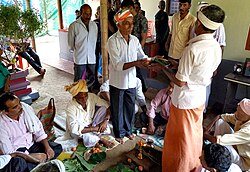
[[File:Gowda Community Marrage Program - Vilya Shastra at Puttur on 2.12 (5).jpg|thumb|Tulu Gowda Marriage Program – Vīḷya śāstra at Puttur]] | [[File:Gowda Community Marrage Program - Vilya Shastra at Puttur on 2.12 (5).jpg|thumb|Tulu Gowda Marriage Program – Vīḷya śāstra at Puttur]] | ||
In Dakshina Kannada both the groups of Gowdas Tulu and 'Arebhashe' | In Dakshina Kannada both the groups of Gowdas Tulu and 'Arebhashe' prepare meat or any Non [[Vegetarian]] food during marriage and Gruhaprevesha (House warming functions.{{Citation needed|reason=Reliable source needed|date=December 2024}} Tulu Gowdas of Puttur Seeme invariably conduct Marriage and Gruha Pravesha as per Vaidhika Practice.{{sfn| Anantharaja Gowda|2015|p=153}} | ||
[[File:Madurangi Rituals in Tulunadu.jpg|thumb|Madrrangi Shastra of Gowda Culture]] | |||
At the time of Marriage, bridegroom's father offers ₹10¼ to the girls | At the time of Marriage, bridegroom's father offers ₹10¼ to the girls parents out of this ₹6¼ is to be sent to Gurumaṭha (Sringeri Matha) through Ūra gauḍa for Girls Mutheidegu (for seeking longer life for the couple).{{Citation needed|reason=Reliable source needed|date=December 2024}} Oora Gowda thus collects such offering during the Marriages held under his jurisdiction and hands over the same to Maagane Gowda and through him to Kattemane.{{Citation needed|reason=Reliable source needed|date=December 2024}} Kattemane Gowda takes it over to Guru Matha (Sringeri Matha) once in a year and seeks blessings from Maṭhādhipati on behalf of married couple.{{Citation needed|reason=Reliable source needed|date=December 2024}} Oora Gowda occupies an important position in all JEEVANAVARTHANA PRACTICES of Tulu Gowdas of Puttur region. In his absence Othu Gowda takes over his responsibility.{{Citation needed|reason=Reliable source needed|date=December 2024}} Gowdas follow [[Patrilineal]] succession procedure{{Citation needed|reason=Reliable source needed|date=December 2024}}. Eldest male member in the Joint family is the Head of the family.{{Citation needed|reason=Reliable source needed|date=December 2024}} Ūra gauḍa of the village is nominated by Kattemane Head.{{Citation needed|reason=Reliable source needed|date=December 2024}} In all functions starting from "Veelya Shastra" (Engagement) up to the marriage the Ūra gauḍa recites an Invocation and Declaration in loud voice which states as | ||
;Transliteration in Tulu | ;Transliteration in Tulu | ||
{{quote|Bāṇḍavereḍelā, Aramanetagaleḍēla, | {{quote|Bāṇḍavereḍelā, Aramanetagaleḍēla, | ||
Gurumanetagleḍelā, patt kuṭumo padnenmo barita banduleḍlā, kaṭṭemanetāgleḍlā, māgane ill tāgleḍlā, ūra gauḍrerḍlā, itn̄cina binnereḍlā, battinan̄cina binneḍlā kēnondu baṅgēra bidara (anana purdar) panpi anagalā, nandere baritā (ponnana pudar) ponnaglā tāḷi kaṭṭubō panper.}} | Gurumanetagleḍelā, patt kuṭumo padnenmo barita banduleḍlā, kaṭṭemanetāgleḍlā, māgane ill tāgleḍlā, ūra gauḍrerḍlā, itn̄cina binnereḍlā, battinan̄cina binneḍlā kēnondu baṅgēra bidara (anana purdar) panpi anagalā, nandere baritā (ponnana pudar) ponnaglā tāḷi kaṭṭubō panper.}} | ||
;In English: | ;In English: | ||
{{quote| | {{quote|People of Royalty (Ikkeri), People of Guru Matha (Sringeri Math), Relatives from ten original families and eighteen Gothras of Gowdas, Kattemane (Seeme) Gowdare, Maagane mane (Nada) gowdare, Oora gowdare (Village Head), Relatives of this village, Guest relatives who gathered from distance places we take your permission for the (Name of Boy) from Nander Bali to tie the Mangala soothra to the (Name of the Girl) from Bangera Bali.}} | ||
At this moment the gathered relatives and public will declare their assent saying "Edde Karyo Panpere" (a good work | At this moment the gathered relatives and public will declare their assent saying "Edde Karyo Panpere" (a good work ritual).{{Citation needed|reason=Reliable source needed|date=December 2024}} This Declaration is the same as the recital in Sullia and Kodagu region which is in Kannada.{{Citation needed|reason=Reliable source needed|date=December 2024}} Here the reference to "Aramane and Gurumane" is essentially to royalty of Ikkeri and Sringeri Mathadhipathies respectively.{{sfn|Anantharaja Gowda|2015|p=154}} | ||
Generally there is no 'Dowry' system among Gowda clan on the other hand Boys father offers a Kanya shulka to | Generally, there is no 'Dowry' system among Gowda clan on the other hand Boys father offers a Kanya shulka to the girls' parents a sum of ₹16¼.<ref>{{cite journal |last1=Badikana |first1=Vishwanatha |title=Okkoralu |journal=Okkoralu-Visheshanka |language=kn |issue=Gowda Samaja, Puttur}}</ref> | ||
=== Bari Paddati === | === Bari Paddati === | ||
The caste is divided into eighteen{{sfn|Thurston|Rangachari|1909|p=269}} baris or balis, which are of the usual exogamous character. The names of some of these are as follows: Bangāra (gold), Nandara, Malāra (a bundle of glass bangles, as carried about for sale), Sālu, Hemmana (pride or conceit), Kabru, Gōli (Portulaca oleracea, a pot-herb), Basruvōgaru (basru, belly), Balasanna, Kabar, Gundana, Chalyera, Mulyera, Nayera and Karbannāya.<ref name="ThurstonRangachari1909p270">[[# | The caste is divided into eighteen{{sfn|Thurston|Rangachari|1909|p=269}} baris or balis, which are of the usual exogamous character.<ref>{{cite book |last1=ಬಿಳಿಮಲೆ |first1=ಪುರುಷೋತ್ತಮ |title=ಕರಾವಳಿ ಜಾನಪದ |date=1990 |publisher=ಡಾ{{!}} ಪುರುಷೋತ್ತಮ ಬಿಳಿಮಲೆ |page=101 |url=https://archive.org/details/karavalijanapada0000drpu/karavalijanapada0000drpu/page/100/mode/1up |access-date=18 March 2025}}</ref> The names of some of these are as follows: Bangāra (gold), Nandara, Malāra (a bundle of glass bangles, as carried about for sale), Sālu, Hemmana (pride or conceit), Kabru, Gōli (Portulaca oleracea, a pot-herb), Basruvōgaru (basru, belly), Balasanna, Kabar, Gundana, Chalyera, Mulyera, Nayera and Karbannāya.<ref name="ThurstonRangachari1909p270">[[#CITEREFThurstonRangachari1909|Thurston Rangachari (1909)]], p.270</ref>{{sfn|Anantharaja Gowda|2015|p=143-145}}<ref name="auto">Puttur Anantharaja Gowda (2015). "IN PURSUIT OF OUR ROOTS". Bengaluru: Tenkila Publications</ref> | ||
== Arsaya == | == Arsaya == | ||
Once a year, mostly in the | Once a year, mostly in the Tulu month of ''Kaarthel'' (June–July), the Gowdas perform a ceremony for the propitiation of all deceased ancestors.<ref name="ThurstonRangachari1909p271">[[#CITEREFThurstonRangachari1909|Thurston Rangachari (1909)]], p.271</ref> They have a special preference for Venkatarāmaswāmi, to whom they make money offerings once a year in September.{{Citation needed|reason=Reliable source needed|date=December 2024}} It should reach [[Tirupati]] as an offering, which mostly includes [[coins]], [[Black pepper|pepper]], rupee notes.<ref>Valase, Sangarsha, Samanvaya By Purushothama Bilimale, ''Akruthi Publication Mangaluru, 2019 Pg: 216''</ref> | ||
== Indian Freedom movement == | == Indian Freedom movement == | ||
{{Main| Amara Sullia Freedom Movement of 1837}} | {{Main|Amara Sullia Freedom Movement of 1837}} | ||
The Arebhashe Gowdas and Tulu Gowdas were historically involved in a rebellion against British rule in [[Kanara|Canara]] | The Arebhashe Gowdas and Tulu Gowdas were historically involved in a rebellion against British rule in [[Kanara|Canara]]. [[Kedambadi Ramaiah Gowda]] from Sulya rebelled against the British and hoisted ''Jangama'' (Lingayite monk) Kalyanaswamy's flag in ''Bavuta Gudde'' in Mangalore and ruled for 13 days. This was one of the earliest Indian independence struggles against British rule 1834.<ref name="archive201106041056">{{Cite web |title=The Hindu : Karnataka / Madikeri News : Appaiah Gowda memorial to honour freedom fighter |url=http://www.hindu.com/2005/05/19/stories/2005051901540300.htm |archive-url=https://web.archive.org/web/20110604105616/http://www.hindu.com/2005/05/19/stories/2005051901540300.htm |archive-date=2011-06-04 |access-date=2025-11-03 |website=The Hindu}}</ref><ref name="deccanherald316458">{{Cite web |title=Account of an uprising |url=https://www.deccanherald.com/content/316458/account-uprising.html |access-date=2025-11-03 |website=Deccan Herald |language=en}}</ref><ref name="deccanherald316455">{{Cite web |title=Fate of the insurgents |url=https://www.deccanherald.com/content/316455/fate-insurgents.html |access-date=2025-11-03 |website=Deccan Herald |language=en}}</ref> | ||
== References == | == References == | ||
{{Reflist|colwidth=30em}} | {{Reflist|colwidth=30em}} | ||
== | == Further reading == | ||
{{refbegin}} | {{refbegin}} | ||
* {{cite book|last1=Thurston|first1=Edgar|last2=Rangachari|first2=K.|title=Castes and tribes of southern India|volume=II (C to J)|publisher=Government Press|location=Madras|year=1909|isbn= | * {{cite book |last1=Thurston |first1=Edgar |last2=Rangachari |first2=K. |title=Castes and tribes of southern India |volume=II (C to J) |publisher=Government Press |location=Madras |year=1909 |isbn=9789369422180 |pages=269–272 |url=https://archive.org/details/castestribesofso02thuruoft/page/n5/mode/2up |access-date=3 August 2021}} | ||
* {{cite book| | * {{cite book |last1= Kushalappa Gowda |first1=Kodi |title=Gowda Kannada |year=1970 |author-link=K. Kushalappa Gowda |publisher=Annamalai University |url=https://archive.org/details/gowdakannada-arebashe}} | ||
* {{cite book|last1=Gowda|first1=Puttur | * {{cite book |last1=Anantharaja Gowda |first1= Puttur |title=In Pursuit of Our Roots |publisher=Tenkila Publications |year=2015 |location=Bengaluru |url=https://archive.org/details/are.in_pursuit_of_our_roots_final}} | ||
{{refend}} | {{refend}} | ||
== | == External links == | ||
{{ | {{Commons category|Arebhashe and Tulu Gowda Culture}} | ||
{{Wikisource|Castes and Tribes of Southern India/Gauda}} | {{Wikisource|Castes and Tribes of Southern India/Gauda}} | ||
| Line 77: | Line 78: | ||
[[Category:Tuluva]] | [[Category:Tuluva]] | ||
[[Category:Hindu communities]] | [[Category:Hindu communities]] | ||
[[Category:South Indian communities]] | |||
[[Category:Indian castes]] | |||
Latest revision as of 22:37, 19 November 2025
10 Kutumba 18 Gothra | |
|---|---|
| Regions with significant populations | |
| Dakshina Kannada, Kodagu, Kasaragod and Udupi | |
| Dakshina Kannada | 300,000[1] |
| Kodagu | 150,000 |
| Languages | |
| Tulu,[2][3] Arebhashe | |
| Religion | |
| Hinduism | |
Tulu Gowda and Arebhashe Gowda are a community primarily found in South Canara District, Kodagu District (Coorg), Indian state of Karnataka and Bandadka village of Kasaragod.[4] They are officially considered a subsect of the Vokkaliga community but are culturally and linguistically different.[3] They speak Tulu and Arebhashe.[5][6][7]
History[edit | edit source]
They were originally called Natha Pantha and Shaivas, owing allegiance to Sringeri Matha.[citation needed] During Emperor Vishnuvardhana’s rule, they became Vaishnavites and worshiped Tirupati Venkataramana (Balaji of Tirupati) and Sabbakka (Sharada of Sringeri).[citation needed] They then settled in the Mangalore-Udupi (Dakshina Kannada-Udupi) region where they spoke the Tulu language.[citation needed] They are said to have 10 Kutumba and 18 Bari as their primordial root families, from which a Nūru Mane or "hundred families" arose.[citation needed] They then migrated to Coorg (Kodagu) from the Mangalore-Udupi (Dakshina Kannada-Udupi) region, to settle among the Canarese (Kannada) speaking peoples.[8]
Community system[edit | edit source]
They have a somewhat elaborate system of caste government.[9] In every village there are two headmen, the Grāma Gowda and the ottu Gauda. For every group of eight or nine villages there is another head called the Māganē Gauda, and for every nine Māganēs there is a yet higher authority called the Kattēmanēyava.[10]

Domestic culture[edit | edit source]
Marriage system[edit | edit source]
The caste is divided into eighteen baris or balis, which are of the usual exogamous character, same bari men, women not to marry, they belong to close cousins.[5]
.jpg)
In Dakshina Kannada both the groups of Gowdas Tulu and 'Arebhashe' prepare meat or any Non Vegetarian food during marriage and Gruhaprevesha (House warming functions.[citation needed] Tulu Gowdas of Puttur Seeme invariably conduct Marriage and Gruha Pravesha as per Vaidhika Practice.[11]

At the time of Marriage, bridegroom's father offers ₹10¼ to the girls parents out of this ₹6¼ is to be sent to Gurumaṭha (Sringeri Matha) through Ūra gauḍa for Girls Mutheidegu (for seeking longer life for the couple).[citation needed] Oora Gowda thus collects such offering during the Marriages held under his jurisdiction and hands over the same to Maagane Gowda and through him to Kattemane.[citation needed] Kattemane Gowda takes it over to Guru Matha (Sringeri Matha) once in a year and seeks blessings from Maṭhādhipati on behalf of married couple.[citation needed] Oora Gowda occupies an important position in all JEEVANAVARTHANA PRACTICES of Tulu Gowdas of Puttur region. In his absence Othu Gowda takes over his responsibility.[citation needed] Gowdas follow Patrilineal succession procedure[citation needed]. Eldest male member in the Joint family is the Head of the family.[citation needed] Ūra gauḍa of the village is nominated by Kattemane Head.[citation needed] In all functions starting from "Veelya Shastra" (Engagement) up to the marriage the Ūra gauḍa recites an Invocation and Declaration in loud voice which states as
- Transliteration in Tulu
Bāṇḍavereḍelā, Aramanetagaleḍēla, Gurumanetagleḍelā, patt kuṭumo padnenmo barita banduleḍlā, kaṭṭemanetāgleḍlā, māgane ill tāgleḍlā, ūra gauḍrerḍlā, itn̄cina binnereḍlā, battinan̄cina binneḍlā kēnondu baṅgēra bidara (anana purdar) panpi anagalā, nandere baritā (ponnana pudar) ponnaglā tāḷi kaṭṭubō panper.
- In English
People of Royalty (Ikkeri), People of Guru Matha (Sringeri Math), Relatives from ten original families and eighteen Gothras of Gowdas, Kattemane (Seeme) Gowdare, Maagane mane (Nada) gowdare, Oora gowdare (Village Head), Relatives of this village, Guest relatives who gathered from distance places we take your permission for the (Name of Boy) from Nander Bali to tie the Mangala soothra to the (Name of the Girl) from Bangera Bali.
At this moment the gathered relatives and public will declare their assent saying "Edde Karyo Panpere" (a good work ritual).[citation needed] This Declaration is the same as the recital in Sullia and Kodagu region which is in Kannada.[citation needed] Here the reference to "Aramane and Gurumane" is essentially to royalty of Ikkeri and Sringeri Mathadhipathies respectively.[12]
Generally, there is no 'Dowry' system among Gowda clan on the other hand Boys father offers a Kanya shulka to the girls' parents a sum of ₹16¼.[13]
Bari Paddati[edit | edit source]
The caste is divided into eighteen[14] baris or balis, which are of the usual exogamous character.[15] The names of some of these are as follows: Bangāra (gold), Nandara, Malāra (a bundle of glass bangles, as carried about for sale), Sālu, Hemmana (pride or conceit), Kabru, Gōli (Portulaca oleracea, a pot-herb), Basruvōgaru (basru, belly), Balasanna, Kabar, Gundana, Chalyera, Mulyera, Nayera and Karbannāya.[16][17][18]
Arsaya[edit | edit source]
Once a year, mostly in the Tulu month of Kaarthel (June–July), the Gowdas perform a ceremony for the propitiation of all deceased ancestors.[19] They have a special preference for Venkatarāmaswāmi, to whom they make money offerings once a year in September.[citation needed] It should reach Tirupati as an offering, which mostly includes coins, pepper, rupee notes.[20]
Indian Freedom movement[edit | edit source]
The Arebhashe Gowdas and Tulu Gowdas were historically involved in a rebellion against British rule in Canara. Kedambadi Ramaiah Gowda from Sulya rebelled against the British and hoisted Jangama (Lingayite monk) Kalyanaswamy's flag in Bavuta Gudde in Mangalore and ruled for 13 days. This was one of the earliest Indian independence struggles against British rule 1834.[21][22][23]
References[edit | edit source]
- ↑ "Gowdas demand more representation from their community". 23 March 2013 – via The Economic Times - The Times of India.
- ↑ Thurston & Rangachari 1909, p. 271.
- ↑ 3.0 3.1 Aravind Gowda (15 September 2011). "Caste war heats up as Sadananda isn't Gowda enough". India Today.
- ↑ "Gowdas demand more representation from their community". The Times of India. 23 March 2013. Retrieved 15 January 2025.
- ↑ 5.0 5.1 Thurston & Rangachari 1909
- ↑ Miller, Frederic P.; Vandome, Agnes F.; McBrewster, John (2010). Kodagu Gowda. VDM Publishing. ISBN 978-6131607578.
- ↑ Gough, Kathleen (2008). Rural Society in Southeast India. Cambridge University Press. ISBN 978-0-521-04019-8.
- ↑ Dr. Kodi Kushalappa Gowda (1976). Gowda Kannada. Annamalai University.
- ↑ ಚಿನ್ನಪ್ಪ ಗೌಡ, ಕೂಡೂರು (2003). ಗೌಡ ಜನಾಂಗ - ಇತಿಹಾಸ ಮತ್ತು ಸಂಸ್ಕೃತಿ. ಒಕ್ಕಲಿಗರ ಯಾನೆ ಗೌಡರ ಸೇವಾ ಸಂಘ (ರಿ) ಮಂಗಳೂರು. p. 91. Retrieved 18 March 2025.
- ↑ "Page:Castes and Tribes of Southern India, Volume 2.djvu/302 – Wikisource, the free online library". en.wikisource.org.
- ↑ Anantharaja Gowda 2015, p. 153.
- ↑ Anantharaja Gowda 2015, p. 154.
- ↑ Badikana, Vishwanatha. "Okkoralu". Okkoralu-Visheshanka (in ಕನ್ನಡ) (Gowda Samaja, Puttur).
- ↑ Thurston & Rangachari 1909, p. 269.
- ↑ ಬಿಳಿಮಲೆ, ಪುರುಷೋತ್ತಮ (1990). ಕರಾವಳಿ ಜಾನಪದ. ಡಾ| ಪುರುಷೋತ್ತಮ ಬಿಳಿಮಲೆ. p. 101. Retrieved 18 March 2025.
- ↑ Thurston Rangachari (1909), p.270
- ↑ Anantharaja Gowda 2015, p. 143-145.
- ↑ Puttur Anantharaja Gowda (2015). "IN PURSUIT OF OUR ROOTS". Bengaluru: Tenkila Publications
- ↑ Thurston Rangachari (1909), p.271
- ↑ Valase, Sangarsha, Samanvaya By Purushothama Bilimale, Akruthi Publication Mangaluru, 2019 Pg: 216
- ↑ "The Hindu : Karnataka / Madikeri News : Appaiah Gowda memorial to honour freedom fighter". The Hindu. Archived from the original on 4 June 2011. Retrieved 3 November 2025.
- ↑ "Account of an uprising". Deccan Herald. Retrieved 3 November 2025.
- ↑ "Fate of the insurgents". Deccan Herald. Retrieved 3 November 2025.
Further reading[edit | edit source]
- Thurston, Edgar; Rangachari, K. (1909). Castes and tribes of southern India. Vol. II (C to J). Madras: Government Press. pp. 269–272. ISBN 9789369422180. Retrieved 3 August 2021.
- Kushalappa Gowda, Kodi (1970). Gowda Kannada. Annamalai University.
- Anantharaja Gowda, Puttur (2015). In Pursuit of Our Roots. Bengaluru: Tenkila Publications.