



m Removing protection template from an unprotected page |
small improved content as per guidelines additionally and improved wording |
||
| Line 1: | Line 1: | ||
{{Short description|Roman Empire | {{Short description|Continuation of the Roman Empire (330–1453)}} | ||
{{Redirect|Byzantine}} | {{Redirect|Byzantine}} | ||
{{Protection padlock|small=yes}} | |||
{{Use dmy dates|date=October 2023}} | |||
{{ | {{Use British English|date=July 2019}} | ||
{{Use dmy dates|date= | {{Infobox former country | ||
{{ | |||
{{Infobox country | |||
| conventional_long_name = Byzantine Empire | | conventional_long_name = Byzantine Empire | ||
| life_span = 330–1453 | |||
| life_span = | |||
| image_map = Justinian555AD.png | | image_map = Justinian555AD.png | ||
| image_map_caption = The empire in 555 under [[Justinian | | image_map_size = 320px | ||
| image_map_caption = The empire in 555 under [[Justinian I]], its greatest extent since the fall of the [[Western Roman Empire]], [[vassal state|vassals]] shaded in pink | |||
| capital = [[Constantinople]] | |||
| capital = [[Constantinople]] | | common_languages = [[Medieval Greek|Greek]] | ||
| national_languages = | |||
| common_languages | | religion = [[Christianity as the Roman state religion|Christianity]] ([[State religion|official]]) | ||
| government_type = [[Absolute monarchy]] | |||
| title_leader = [[List of Byzantine emperors|Notable emperors]] | | title_leader = [[List of Byzantine emperors|Notable emperors]] | ||
| leader1 = [[Constantine the Great|Constantine I]] | | leader1 = [[Constantine the Great|Constantine I]] | ||
| year_leader1 = 306–337 | | year_leader1 = 306–337 | ||
| leader2 = [[Theodosius | | leader2 = [[Theodosius I]] | ||
| year_leader2 = | | year_leader2 = 379–395 | ||
| leader3 = [[ | | leader3 = [[Theodosius II]] | ||
| year_leader3 = | | year_leader3 = 408–450 | ||
| leader4 = [[Justinian I]] | | leader4 = [[Justinian I]] | ||
| year_leader4 = 527–565 | | year_leader4 = 527–565 | ||
| leader5 = [[ | | leader5 = [[Heraclius]] | ||
| year_leader5 = | | year_leader5 = 610–641 | ||
| leader6 = [[ | | leader6 = [[Leo III the Isaurian|Leo III]] | ||
| year_leader6 = | | year_leader6 = 717–741 | ||
| leader7 = [[ | | leader7 = [[Nikephoros II Phokas|Nikephoros II]] | ||
| year_leader7 = | | year_leader7 = 963–969 | ||
| leader8 = [[ | | leader8 = [[John I Tzimiskes|John I]] | ||
| year_leader8 = | | year_leader8 = 969–976 | ||
| leader9 = [[Basil | | leader9 = [[Basil II]] | ||
| year_leader9 = | | year_leader9 = 976–1025 | ||
| leader10 = [[ | | leader10 = [[Alexios I Komnenos|Alexios I]] | ||
| year_leader10 = | | year_leader10 = 1081–1118 | ||
| leader11 = [[ | | leader11 = [[John II Komnenos|John II]] | ||
| year_leader11 = | | year_leader11 = 1118–1143 | ||
| leader12 = [[Manuel I Komnenos|Manuel I]] | | leader12 = [[Manuel I Komnenos|Manuel I]] | ||
| year_leader12 = 1143–1180 | | year_leader12 = 1143–1180 | ||
| Line 59: | Line 44: | ||
| leader14 = [[Constantine XI Palaiologos|Constantine XI]] | | leader14 = [[Constantine XI Palaiologos|Constantine XI]] | ||
| year_leader14 = 1449–1453 | | year_leader14 = 1449–1453 | ||
| era = [[Late | | era = [[Late antiquity]] to {{nwr|[[Late Middle Ages]]}} | ||
| stat_year1 = 457 | | stat_year1 = 457 | ||
| | | ref_pop1 = {{sfn|Treadgold|1997|p=137}} | ||
| stat_pop1 = 16,000,000 | |||
| | | stat_area1 = 2,350,000 | ||
| | | stat_year2 = 565 | ||
| ref_pop2 = {{sfn|Treadgold|1997|p=278}} | |||
| | | stat_pop2 = 20,000,000 | ||
| stat_pop2 = | | stat_area2 = 3,400,000 | ||
| stat_year3 = 775 | | stat_year3 = 775 | ||
| | | ref_pop3 = {{sfn|Treadgold|1997|p=236}} | ||
| stat_pop3 = 7,000,000 | | stat_pop3 = 7,000,000 | ||
| stat_area3 = 880,000 | |||
| stat_year4 = 1025 | | stat_year4 = 1025 | ||
| stat_pop4 = 12,000,000 | | stat_pop4 = 12,000,000 | ||
| stat_area4 = 1,675,000 | |||
| ref_pop4 = {{sfn|Treadgold|1997|p=570}} | |||
| stat_year5 = 1320 | | stat_year5 = 1320 | ||
| | | ref_pop5 = {{sfn|Treadgold|1997|p=236}} | ||
| stat_pop5 = 2,000,000 | | stat_pop5 = 2,000,000 | ||
| currency = [[Solidus (coin)|Solidus]], [[ | | currency = [[Solidus (coin)|Solidus]], [[follis]], and [[hyperpyron]] | ||
}} | }} | ||
The '''Byzantine Empire''', | The '''Byzantine Empire''', also known as the '''Eastern Roman Empire''', was the continuation of the [[Roman Empire]] centred on [[Constantinople]] during [[late antiquity]] and the [[Middle Ages]]. Having survived [[History of the Roman Empire|the events]] that caused the [[fall of the Western Roman Empire]] in the 5th century{{Nbsp}}AD, it endured until the [[fall of Constantinople]] to the [[Ottoman Empire]] in 1453. The term 'Byzantine Empire' was coined only after its demise; its citizens used the term 'Roman Empire' and called themselves '[[Rhomaioi (endonym)|Romans]]'.{{Efn|{{Langx|grc-x-medieval|Ῥωμαῖοι|Rhōmaîoi}}. Due to the imperial seat's move to [[Byzantium]], the [[Christianity as the Roman state religion|adoption of state Christianity]], and the predominance of [[Medieval Greek|Greek]] instead of [[Latin]], most historians make a distinction between the earlier ''Roman Empire'' and the later ''Byzantine Empire''.{{sfnm|Millar|2006|1pp=2, 15|Kaldellis|2007|2pp=2–3}}}} | ||
During the | During the early centuries of the Roman Empire, the western provinces were [[Romanization (cultural)|Latinised]], but the eastern parts kept their [[Hellenistic culture]]. [[Constantine the Great|Constantine I]] ({{Reign|324|337}}) legalised [[Christianity]] and moved the capital to Constantinople. [[Theodosius I]] ({{Reign|379|395|lk=no}}) made Christianity the [[state religion]] and Greek gradually replaced Latin for official use. The empire adopted a defensive strategy and, throughout its remaining history, experienced recurring cycles of decline and recovery. | ||
The | The Byzantine Empire reached its greatest extent under the reign of [[Justinian I]] ({{Reign|527|565|lk=no}}), who briefly reconquered much of Italy and the western [[Mediterranean Sea|Mediterranean coast]]. A [[Plague of Justinian|plague began]] around 541, and a [[Byzantine–Sasanian War of 602–628|prolonged warfare with Persia]] placed fiscal and military strain on the empire, contributing to political and strategic challenges in the decades that followed. In the 630s and 640s the [[early Muslim conquests|Arab conquests]] defeated Byzantine field armies in [[Roman Syria|Syria]] and [[Roman Egypt|Egypt]], resulting in the permanent loss of those provinces to the [[Rashidun Caliphate]]. In 698, Africa [[Battle of Carthage (698)|was lost]] to the [[Umayyad Caliphate]], but the empire stabilised under the [[Byzantine Empire under the Isaurian dynasty|Isaurian dynasty]]. It expanded once more under the [[Macedonian dynasty]], experiencing [[Macedonian Renaissance|a two-century-long renaissance]]. Thereafter, periods of civil war and [[Seljuk dynasty|Seljuk]] incursion resulted in the loss of most of [[Anatolia|Asia Minor]]. The empire recovered during the [[Komnenian restoration]], and Constantinople remained the largest and wealthiest city in Europe until the 13th century. | ||
The empire was largely dismantled in 1204, following the [[sack of Constantinople]] during the [[Fourth Crusade]]; its former territories [[Partitio terrarum imperii Romaniae|were then divided]] into competing Greek [[rump state]]s and [[Frankokratia|Latin realms]]. Despite the eventual [[Byzantine Empire under the Palaiologos dynasty|recovery of Constantinople]] in 1261, the reconstituted empire wielded only regional power during its final two centuries. Its remaining territories were progressively annexed by the Ottomans in [[Byzantine–Ottoman wars|a series of wars]] fought in the 14th and 15th centuries. The fall of Constantinople to the Ottomans in 1453 brought the empire to an end. | |||
The fall of Constantinople to the | |||
== Nomenclature == | == Nomenclature == | ||
{{See also|Names of the Greeks}} | {{See also|Names of the Greeks}} | ||
The Byzantine Empire | The empire's inhabitants, generally known as [[Demography of the Byzantine Empire|Byzantines]], regarded themselves as [[Roman people#Survival of the Roman Empire in the east|Romans]] (in Greek, {{Lang|grc|Ῥωμαῖοι}} or {{transliteration|grc|[[Romaioi]]}}).{{sfnm|Kaldellis|2022a|1pp=351|2a1=Aschenbrenner|2a2=Ransohoff|2y=2022a|2p=1}} Similarly, their Islamic contemporaries called their empire the "land of the Romans" ({{transliteration|ar|Bilād al-Rūm}}).{{sfn|Aschenbrenner|Ransohoff|2022a|p=1}} After 800 AD, Western Europe called them "Greeks" ({{lang|la|Graeci}}), as the Papacy and medieval German emperors regarded themselves as the true inheritors of Roman identity.{{sfnm|Kaldellis|2023|1p=2|2a1=Aschenbrenner|2a2=Ransohoff|2y=2022a|2p=2}} The adjective "Byzantine", derived from [[Byzantium|{{transliteration|grc|Byzantion}}]] ({{lang|la|Byzantium}} in Latin), the name of the Greek settlement [[Constantinople]] was established on, was only used to describe the inhabitants of the city; it did not refer to the empire, called {{transliteration|grc|Rhomanía}} ({{Lang|grc|Ῥωμανία}} or "Romanland") by its citizens.{{sfnm|Kaldellis|2022a|1pp=349, 351|2a1=Cormack|2a2=Haldon|2a3=Jeffreys|2y=2008|2p=4}} | ||
Following the empire's fall, [[early modern]] scholars referred to it by many names, including the "Eastern Empire", the "Low Empire", the "Late Empire", the "Empire of the Greeks", "Empire of Constantinople", and "Roman Empire".{{sfn|Aschenbrenner|Ransohoff|2022a|p=2}} The increasing use of "Byzantine" and "Byzantine Empire" may have started with [[Theodore Metochites]]{{sfn|Magdalino|2025|pp=41-43}} or [[Laonikos Chalkokondyles]] whose work was widely propagated by [[Hieronymus Wolf]].{{sfn|Kaldellis|2022a|p=352}} "Byzantine" was used adjectivally alongside terms such as "Empire of the Greeks" until the 19th century.{{sfn|Kaldellis|2022a|pp=352, 355, 357}} It is now the primary term, used to refer to all aspects of the empire; a minority of modern historians believe it should not be used because it was originally a prejudicial and inaccurate term.{{sfnm|Kaldellis|2023|1pp=2–3|2a1=Cormack|2a2=Haldon|2a3=Jeffreys|2y=2008|2p=4|3a1=Stouraitis|3y=2022b|3pp=20, 29, 31, 33-36|Treadgold|2025|4pp=xiii–xiv}} | |||
== History == | == History == | ||
{{Main|History of the Byzantine Empire}} | {{Main|History of the Byzantine Empire}} | ||
=== | ===<span class="anchor" id="Definition, terminology and starting date"></span>Start date=== | ||
Given the significant overlap in historiographical [[periodization|periodisation]]s of "[[Later Roman Empire|Late Roman history]]", "[[late antiquity]]", and "Byzantine history", there is no consensus on a foundation date for the Byzantine Empire. Scholarship with links to Greece or [[Eastern Orthodoxy]] has customarily placed it in the early 300s.{{sfn|Cameron|2002|pp=190–191}} The growth of the study of "late antiquity" has led to some historians setting a start date in the seventh or eighth centuries.{{sfnm|Cameron|2002|1pp=166, 191|Kaldellis|2015|Howard-Johnston|2024|3p=7}} Others believe a "new empire" began during changes {{circa|300}}{{Nbsp}}AD.{{sfn|Kaldellis|2023|pp=3, 34}} Geoffrey Greatrex believes that it is impossible to precisely date the foundation of the Byzantine Empire.{{sfn|Greatrex|2008|p=232}} | |||
=== | |||
[[ | |||
=== Pre-518: Constantinian, Theodosian, and Leonid dynasties === | |||
{{Further|Byzantine Empire under the Constantinian and Valentinianic dynasties|Byzantine Empire under the Theodosian dynasty|Byzantine Empire under the Leonid dynasty}} | |||
=== | [[File:Tetrarchy map3.jpg|thumb|upright=1.2|Four-way division of the [[Roman Empire]] under the [[Tetrarchy]] system established by [[Diocletian]]|alt=A map showing the division of the Roman empire {{circa|300}}]] | ||
{{ | Between the 3rd and 1st centuries{{Nbsp}}BC, the [[Roman Republic]] established [[hegemony]] over the [[eastern Mediterranean]], while [[Ancient Rome#Government|its government]] developed into the one-person rule of [[Roman emperors|an emperor]].{{sfn|Greatrex|2008|p=233}} The [[Roman Empire]] enjoyed a period of [[Pax Romana|relative stability]] until [[Crisis of the Third Century|the 3rd century AD]], when external threats and internal crises caused it to splinter, as regional armies acclaimed their generals as "[[Barracks emperor|soldier-emperors]]".{{sfnm|Greatrex|2008|1p=233|Kaldellis|2023|2pp=16-17|Treadgold|1997|3p=7}} One of these, [[Diocletian]] ({{reign|284|305}}), recognised that the state was too big to be ruled by a single person.{{sfn|Greatrex|2008|p=233}} He instituted the [[Tetrarchy]], a system which divided the empire into eastern and western halves.{{sfnm|Kaldellis|2023|1pp=17–18|Treadgold|1997|2pp=15, 17–18}} The Tetrarchy quickly failed, but the division of the empire proved an enduring concept.{{sfnm|Greatrex|2008|1p=235|Kaldellis|2023|2pp=17–18|Treadgold|1997|3p=14}} | ||
[[ | |||
[[Constantine I]] ({{reign|306|337|link=no}}) secured absolute power in 324.{{sfn|Greatrex|2008|p=235}} Over the next six years, he rebuilt the city of Byzantium as a new [[capital city|capital]] that he called "New Rome" (later named [[Constantinople]]).{{sfnm|Greatrex|2008|1p=235|Treadgold|1997|2pp=39–40|Kaldellis|2023|3pp=18}} The old capital [[Rome]] was farther from the prosperous eastern provinces and in a less strategically important location; it was not esteemed by the "soldier-emperors", who ruled from the frontiers, or by the empire's population.{{sfn|Kaldellis|2023|pp=17, 20}} [[Constitutio Antoniniana|Having been granted citizenship]], they considered themselves just as Roman as those in the city of Rome.{{sfn|Kaldellis|2023|pp=18–20}} He continued reforms of the empire's military and civil administration and instituted the [[solidus (coin)|gold solidus]] as a stable currency.{{sfnm|Greatrex|2008|1pp=235–236|Kaldellis|2023|2pp=43–44}} He [[Constantine the Great and Christianity|favoured Christianity]] and became an opponent of paganism.{{sfnm|Greatrex|2008|1pp=236–237|Kaldellis|2023|2pp=81–84|Treadgold|1997|3pp=31–33, 40–42}} Constantine's dynasty prioritised [[Perso-Roman wars of 337–361|a lengthy conflict]] against the comparably powerful [[Sasanian Empire|Sasanid Persia]] and ended in 363 with the death of his nephew [[Julian (emperor)|Julian]].{{sfnm|Greatrex|2008|1p=238|Kaldellis|2023|2pp=93, 98, 111-112|Treadgold|1997|3pp=52-53, 59–62}} The reign of the short [[Valentinianic dynasty]], marked by [[Gothic Wars#Fourth century|wars against the Goths]], religious debates, and anti-corruption campaigns, ended in the East with the death of [[Valens]] at the [[Battle of Adrianople]] in 378.{{sfnm|Greatrex|2008|1pp=239–240|Kaldellis|2023|2pp=114–118, 121–123|Treadgold|1997|3pp=63–67}} | |||
[[File:Roman-empire-395AD.svg|thumb|upright=1.2|Division of the empire after the death of Theodosius I in 395{{Legend|#85d295|The Western Roman Empire}} {{Legend|#ed9595|The Byzantine/Eastern Roman Empire}}|alt=A map showing the Western and Eastern Roman empires {{circa|395}}, divided in the Balkans and North Africa]] | |||
Valens's successor, [[Theodosius I|Theodosius I]] ({{reign|379|395|link=no}}), secured peace in the east by allowing the [[Goths]] to settle in Roman territory;{{sfnm|Greatrex|2008|1p=240|Kaldellis|2023|2pp=128–129|Treadgold|1997|3p=73}} he also twice intervened in the western half, defeating the usurpers [[Magnus Maximus]] and [[Eugenius]] in 388 and 394, respectively.{{sfnm|Greatrex|2008|1p=241|Kaldellis|2023|2pp=129-130, 135–137|Treadgold|1997|3pp=74–75}} He [[Persecution of pagans under Theodosius I|actively condemned paganism]], confirmed the primacy of [[Nicene Christianity|Nicene Orthodoxy]] over [[Arianism]] in the East, and established [[Christianity as the Roman state religion]].{{sfnm|Greatrex|2008|1pp=240–241|Kaldellis|2023|2pp=126–128|Treadgold|1997|3pp=70-74}} He was the last emperor to rule both the western and eastern halves of the empire.{{sfn|Kaldellis|2023|p=136}} After his death, the West was destabilised but the East thrived due to the civilian administrators who continued to hold power.{{sfnm|Kaldellis|2023|1p=165|Treadgold|1997|2p=87}} [[Theodosius II|Theodosius II]] ({{reign|408|450|link=no}}) largely left the rule of the East to officials such as [[Anthemius (praetorian prefect)|Anthemius]], who constructed the [[Theodosian Walls]].{{sfn|Kaldellis|2023|pp=165–167, 244}} Constantinople had now entrenched itself as the empire's capital.{{sfnm|Greatrex|2008|1p=242|Kaldellis|2023|2pp=15, 20-21}} | |||
==== | Aside from Constantinople's walls, Theodosius' reign was also marked by the compilation of the ''[[Codex Theodosianus]]''{{sfnm|Shepard|2009|1p=22-23|Treadgold|1997|2pp=91-92}} and the theological dispute over [[Nestorianism]] (a doctrine later deemed [[heretical]]).{{sfnm|Greatrex|2008|1p=242|Kaldellis|2023|2p=173|Treadgold|1997|3pp=92}} His reign also saw the arrival of [[Attila]]'s [[Huns]], who ravaged the [[Balkans]], leading to a large [[tribute]] being exacted from the eastern empire.{{sfnm|Kaldellis|2023|1pp=193–196|Treadgold|1997|2pp=94–95}} Attila switched his attention to the [[Fall of the Western Roman Empire|rapidly-deteriorating western empire]],{{sfnm|Kaldellis|2023|1p=200|Treadgold|1997|2p=209}} and his people fractured after his death in 453.{{sfnm|Greatrex|2008|pp=242–243}} Later, [[Leo I (emperor)|Leo I]] ({{reign|457|474|link=no}}) failed in his [[Basiliscus#Military career|468 attempt to reconquer]] the [[Fall of the Western Roman Empire|West]].{{sfnm|Kaldellis|2023|1pp=209|Greatrex|2008|2pp=243|Treadgold|1997|3pp=153}} The warlord [[Odoacer]] deposed [[Romulus Augustulus]] in 476 and after the assassination of his titular successor [[Julius Nepos]] in 480, abolished the office of western emperor.{{sfnm|Greatrex|2008|1pp=244|Kaldellis|2023|2pp=214|Treadgold|1997|3pp=158–159}} | ||
{{ | |||
[[ | Through a combination of fortune and good political decisions, the Eastern Empire never experienced rebellious barbarian vassals or rule by barbarian warlords—the problems which ensured the downfall of the West.{{sfn|Kaldellis|2023|pp=243–245}} [[Zeno (emperor)|Zeno]] ({{reign|474|491|link=no}}) convinced the problematic [[Ostrogoth]] king [[Theodoric the Great|Theodoric]] to take control of Italy from Odoacer;{{sfnm|Greatrex|2008|1p=244|Kaldellis|2023|2pp=220|Treadgold|1997|3pp=162, 164}} dying when the empire was at peace, he was succeeded by [[Anastasius I Dicorus|Anastasius I]] ({{reign|491|518|link=no}}).{{sfnm|Greatrex|2008|1p=244|Kaldellis|2023|2pp=220|Treadgold|1997|3pp=164}} His belief in [[monophysitism]] brought occasional issues, but Anastasius was a capable administrator and instituted successful financial reforms including the abolition of the [[Collatio lustralis|chrysargyron tax]].{{sfnm|Greatrex|2008|1p=244|Kaldellis|2023|2pp=224}} He was the first emperor since Diocletian not to face any serious problems affecting the empire during his reign.{{sfn|Treadgold|1997|p=172}} | ||
[[ | |||
=== 518–717: Justinian and Heraclian dynasties === | |||
{{Further|Byzantine Empire under the Justinian dynasty|Byzantine Empire under the Heraclian dynasty}} | |||
{{Multiple image | {{Multiple image | ||
| align | | perrow = 2 | ||
| image1 | | align = right | ||
| image1 = Mosaic of Justinianus I - Basilica San Vitale (Ravenna).jpg | |||
| alt1 | | alt1 = A close up photograph of a mosaic of a person painted on a golden coloured background. The person has a dark brown cloth covering up his upper body till the neck, three jewels on his right shoulder, a crown with two pendants each hanging from both ends and an aura like circle around his head | ||
| image2 = Belisarius mosaic.jpg | |||
| image2 | | alt2 = A close up photograph of a mosaic of a person painted on a golden coloured background. The person has a white cloth covering up his upper body till the neck, an embroidered pattern on his right shoulder, wavy hair, a stubble beard and a moustache | ||
| footer = Emperor [[Justinian I]] (''left'') and his general [[Belisarius]] (''right''). [[Mosaic]]s, 6th century, from the [[Basilica of San Vitale]], Ravenna, Italy | |||
| alt2 | | direction = | ||
| total_width = 270 | |||
| footer | |||
| direction | |||
| total_width = | |||
}} | }} | ||
<!--The Acacian schism should be discussed in the Religion section. Whether the renovatio imperii existed at all is not within the scope of this article.--> | |||
The reign of [[Justinian I|Justinian I]] was a high point in east Roman history.{{sfn|Haldon|2008a|p=250}} Following his accession in 527, the legal code was rewritten as the ''[[Corpus Juris Civilis]]'', which streamlined Roman law across the empire;{{sfnm|Louth|2009a|1pp=108–109|Kaldellis|2023|2pp=269–271|Treadgold|1997|3pp=179}} he reasserted imperial control over religion and morality through purges of pagans, heretics, and other "deviants";{{sfnm|Kaldellis|2023|1pp=272|Louth|2009a|2pp=116|Treadgold|1997|3pp=80}} and having ruthlessly subdued [[Nika riots|the 532 Nika revolt]] he rebuilt much of Constantinople, including the [[Hagia Sophia]].{{sfnm|Louth|2009a|1pp=111, 120|Kaldellis|2023|2pp=274–276}} Justinian I took advantage of the confusion, following Theoderic the Ostrogoth's death, to attempt the reconquest of Italy.{{sfn|Haldon|2008a|p=252}} The [[Vandal Kingdom]] in North Africa [[Vandalic War|was subjugated in late 533]] by the general [[Belisarius]],{{sfnm|Kaldellis|2023|1p=281|Moorhead|2009|2p=202}} who [[Gothic War (535–554)|then invaded Italy]]; the [[Ostrogothic Kingdom]] mostly ended in 554.{{sfnm|Kaldellis|2023|1pp=306|Moorhead|2009|2p=209|Haldon|2008a|3p=253}} | |||
In | In the 540s, Justinian began to suffer reversals on multiple fronts.{{sfn|Kaldellis|2023|p=297}} Capitalising on Constantinople's preoccupation with the West, [[Khosrow I|Khosrow I]] of the Sasanian Empire invaded Byzantine territory and sacked [[Antioch]] in 540.{{sfnm|Kaldellis|2023|1p=297|Treadgold|1997|2pp=193–194|Haldon|2008a|3pp=252–253}} [[Plague of Justinian|A devastating plague]] killed a large proportion of the population and severely reduced the empire's social and financial stability.{{sfn|Kaldellis|2023|pp=300–301}} The most difficult period of the Ostrogothic war, against their king [[Totila]], came during this decade;{{sfn|Kaldellis|2023|p=305}} while divisions among Justinian's advisors undercut the administration's response.{{sfnm|Treadgold|1997|1pp=197–198, 201|Kaldellis|2023|2pp=298, 305–306}} He also did not fully heal the divisions in [[Chalcedonian Christianity]], as the [[Second Council of Constantinople|fifth ecumenical council]] failed to make a real difference.{{sfnm|Treadgold|1997|1pp=210–211, 214|Louth|2009a|2pp=117–118|Haldon|2008a|3p=253}} Justinian died in 565; his reign was more successful than any other emperor, yet he left behind an unstable empire.{{sfnm|Kaldellis|2023|1pp=318–319|Treadgold|1997|2p=217}} | ||
=== | [[Justin II|Justin II]] ({{reign|565|578}}) inherited an empire stretched thin both financially and territorially.{{sfn|Haldon|2008a|p=254}} He was soon at war on many fronts.{{sfnm|Haldon|2008a|1p=254|Treadgold|1997|3pp=220–221}} Fearing the aggressive [[Pannonian Avars|Avars]], the [[Lombards]] conquered much of northern Italy by 572.{{sfnm|Haldon|2008a|1p=254|Treadgold|1997|2pp=220–221}} The [[Byzantine–Sasanian War of 572–591|Sasanian wars restarted]] in the same year, and would not conclude until 591;{{sfn|Haldon|2008a|p=254}} by this time, the Avars and [[Slavic migrations to the Balkans|Slavs had repeatedly invaded the Balkans]], causing great instability.{{sfnm|Louth|2009a|1pp=126–127|Haldon|2008a|2p=254|Kaldellis|2023|3pp=336}} [[Maurice (emperor)|Maurice]] [[Maurice's Balkan campaigns|campaigned extensively in the region]] during the 590s, and although he re-established Byzantine control up to the [[Danube River|Danube]], he pushed his troops too far in 602—they mutinied, proclaimed an officer named [[Phocas]] as emperor, and executed Maurice.{{sfnm|Kaldellis|2023|1pp=336–338|Treadgold|1997|2pp=234–235|Haldon|2008a|3p=254}} The Sasanians seized their moment and [[Byzantine–Sasanian War of 602–628|reopened hostilities]];{{sfnm|Kaldellis|2023|1pp=347-348|Louth|2009b|2pp=226}} Phocas was unable to cope and soon faced [[Heraclian revolt|a major rebellion]] led by [[Heraclius]].{{sfn|Kaldellis|2023|p=348}} Phocas lost Constantinople in 610 and was executed;{{sfnm|Haldon|2008a|1p=254|Louth|2009b|2pp=226}} this destructive civil war accelerated the empire's decline.{{sfnm|Kaldellis|2023|1pp=349|Treadgold|1997|2p=241}} | ||
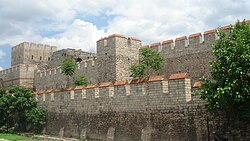
[[File:Walls of Constantinople.JPG|thumb|left|upright=1.2|The [[Walls of Constantinople|Theodosian Walls]] of Constantinople, very important during the [[siege of Constantinople (717–718)|717–718 siege]]|alt=A photograph of a large double-layered fortification.]] | |||
Under [[Khosrow II|Khosrow II]], the Sassanids occupied the [[Levant]] and Egypt and advanced into Asia Minor, and the Avars and Slavs raided in the Balkans.{{sfnm|Haldon|2008a|1pp=254–255|Treadgold|1997|2pp=290-293|Kaldellis|2023|3pp=352, 355-356, 360}} The Empire's control of Italy also weakened.{{sfn|Haldon|2008a|pp=254–255}} After successfully repelling [[Siege of Constantinople (626)|a siege of Constantinople]] in 626,{{sfn|Haldon|2008a|p=255}} Heraclius won a decisive victory at the [[Battle of Nineveh (627)|Battle of Nineveh]],{{sfn|Treadgold|1997|p=398}} eventually defeating the Sassanids later that year.{{sfnm|Kaldellis|2023|1pp=365-366|Louth|2009b|2pp=227–229}} The triumph would prove short-lived.{{sfnm|Louth|2009b|1p=229|Kaldellis|2023|2p=372}} The [[early Muslim conquests|Arab conquests]] soon saw the [[Muslim conquest of the Levant|conquest of the Levant]], [[Arab conquest of Egypt|Egypt]], and [[Muslim conquest of Persia|the Sassanid Empire]] by the newly formed Arab [[Rashidun Caliphate]].{{sfnm|Kaldellis|2023|1p=375|Haldon|2008a|2p=256|Louth|2009b|3pp=229–230}} By Heraclius' death in 641, the empire had been severely reduced economically and territorially—the loss of the wealthy eastern provinces had deprived the empire of as much as three-quarters of its revenue.{{sfnm|Kaldellis|2023|1p=387|Haldon|2008a|2p=256}} | |||
The next century is poorly documented.{{sfn|Kaldellis|2023|p=387}} [[Arab–Byzantine wars#Arab attacks on Anatolia and sieges of Constantinople|Arab raids into Asia Minor]] started quickly, and the Empire responded by holding fortified centres and avoiding battle wherever possible.{{sfnm|Haldon|2008a|1p=257|Kaldellis|2023|2p=387}} Although Anatolia was invaded annually, it avoided permanent Arab occupation.{{sfn|Kaldellis|2023|p=387}} The outbreak of the [[First Fitna]] in 656 gave the Empire breathing space, which it used sensibly:{{sfn|Kaldellis|2023|p=389}} some order was restored in the Balkans by [[Constans II|Constans II]] ({{reign|641|668|link=no}}){{sfn|Louth|2009b|pp=230–231}} following his administrative reorganisation which over time evolved into the "[[Theme (Byzantine district)|theme system]]", a structure that allocated troops to defend specific provinces.{{sfnm|Treadgold|1997|1pp=315–316|Louth|2009b|2pp=239–240}} [[Constantine IV]] ({{reign|668|685|link=no}}) repelled the Arab efforts to [[Siege of Constantinople (674–678)|capture Constantinople in the 670s]] using [[Greek fire]],{{sfnm|Treadgold|1997|1pp=323–327|Haldon|2008a|2p=258|Louth|2009b|3pp=233}} but suffered a reversal against the [[Bulgars]], who soon established [[First Bulgarian Empire|an empire in the northern Balkans]].{{sfnm|Kaldellis|2023|1p=403|Haldon|2008a|2pp=257–258|Louth|2009b|3pp=233}} Nevertheless, he had done enough to secure the empire's position,{{sfn|Louth|2009b|p=235}} especially as the [[Umayyad Caliphate]] was undergoing [[Second Fitna|another civil war]].{{sfn|Kaldellis|2023|p=403}} | |||
Beginning in 695, when Constantine's son [[Justinian II|Justinian II]] was first deposed, the empire entered an [[Twenty Years' Anarchy|era of political instability]] that lasted for the next 22 years.{{sfnm|Haldon|2008a|1p=257|Kaldellis|2023|2pp=438–440|Auzépy|2009|3p=265}} While Justinian had stabilised the situation with the divided Arabs,{{sfn|Haldon|2008a|p=257}} the threat of the reconstituted caliphate was met by [[Leo III the Isaurian|Leo III]] when he [[siege of Constantinople (717–718)|repelled the 717–718 siege]], the first serious challenge against Arab expansion.{{sfnm|Haldon|2008a|1p=257|Auzépy|2009|2p=265}} | |||
[[ | |||
=== | === 718–867: Isaurian, Nikephorian, and Amorian dynasties === | ||
{{Further|Byzantine Empire under the Isaurian dynasty|Byzantine Empire under the Nikephorian dynasty|Byzantine Empire under the Amorian dynasty}} | |||
[[File:Solidus-Leo III and Constantine V-sb1504.jpg|thumb|Gold ''solidus'' of [[Leo III the Isaurian|Leo III]] (left) and his son and heir, [[Constantine V]] (right)|alt=Two gold coins, each depicting a man]] | |||
The emperors Leo III ({{reign|717|741}}) and [[Constantine V]] ({{reign|741|775|lk=no}}) were very effective leaders, both in government and warfare.{{sfnm|Haldon|2008a|1pp=258–259|Kaldellis|2023|2pp=443}} They withstood continued Arab attacks,{{sfnm|Haldon|2008a|1pp=257|Auzépy|2009|2pp=255}} as well as civil war and natural disasters.{{sfnm|Kaldellis|2023|1pp=450-451|Auzépy|2009|2pp=255, 258-259}} Constantine's success reestablished the state as a major regional power.{{sfn|Haldon|2008a|p=259}} Leo's reign produced the ''[[Ecloga]]'', a code of law that evolved that of Justinian I.{{sfnm|Kaldellis|2023|1pp=444–445|Auzépy|2009|2pp=275–276}} He also continued to reform the theme system in order to lead offensive campaigns against the Muslims,{{sfnm|Auzépy|2009|p=255}} culminating in [[Battle of Akroinon|a notable victory in 740]].{{sfnm|Auzépy|2009|1pp=265-269|Kaegi|2009|2pp=386|Kaldellis|2023|3p=450}} Constantine overcame an early civil war against his brother-in-law [[Artabasdos]], created stability against the new [[Abbasid Caliphate]], [[Constantine V#Repeated campaigns against the Bulgarians|campaigned successfully]] against the Bulgars, and continued to make administrative and military reforms.{{sfnm|Haldon|2008a|1p=260|Kaldellis|2023|2pp=450-451, 453-454}} Due to both emperors' support for the [[Byzantine Iconoclasm]], where the use of [[icon|religious icons]] was banned, they were later vilified by biased authors, creating issues that continue to impact modern scholarship;{{sfnm|Kaldellis|2023|1pp=443, 447–449|Haldon|2008a|2pp=258, 260–261|Auzépy|2009|3pp=253–254}} Constantine's reign also saw the loss of [[Ravenna]] to the [[Kingdom of the Lombards|Lombards]], and the beginning of a split from the [[Papal States|Roman papacy]].{{sfnm|Kaldellis|2023|1pp=459–561|Auzépy|2009|2pp=284–287}} | |||
=== | In 780, Empress [[Irene of Athens|Irene]] assumed power as regent for her son [[Constantine VI]].{{sfnm|Haldon|2008a|1p=261|Treadgold|2002|2pp=141–142|Magdalino|2002|3p=170}} Although she was a capable administrator who temporarily resolved the iconoclasm controversy,{{sfnm|Haldon|2008a|1p=261|Kaldellis|2023|2pp=464–469}} the empire was destabilised by her conflict with her son. The Bulgars and Abbasids inflicted numerous defeats on the Byzantine armies, and the papacy crowned [[Charlemagne]] as Roman emperor in 800.{{sfnm|Kaldellis|2023|1pp=470–473|Magdalino|2002|2pp=169–171|Haldon|2008a|3p=261}} In 802, the unpopular Irene was overthrown by [[Nikephoros I|Nikephoros I]]; he reformed the empire's administration but died [[Battle of Pliska|in battle against the Bulgars]] in 811.{{sfnm|Kaldellis|2023|1pp=473–474, 478–481}} Military defeats and societal disorder, especially the resurgence of iconoclasm, characterised the next eighteen years.{{sfnm|Holmes|2008|1p=265|Auzépy|2009|2pp=257, 259, 289|Kaldellis|2023|3pp=482–483, 485–491}} | ||
[[File:Byzantine Empire 814.svg|thumb|The Byzantine Empire {{Circa|814}}|alt=Map centred on Western Europe. The territories of the Byzantine Empire are shaded dark green; namely the Italian islands, southern Greece, south-central Bulgaria, southern Crimea and most of Turkey.]] | |||
[[File: | |||
Stability was somewhat restored during the reign of [[Theophilos (emperor)|Theophilos]] ({{reign|829|842|link=no}}). He capitalised on economic growth to complete construction programmes, including rebuilding the [[Walls of Constantinople#Sea walls|sea walls of Constantinople]], overhaul provincial governance, and wage inconclusive campaigns against the Abbasids.{{sfnm|Kaldellis|2023|1pp=491–495|Holmes|2008|2p=265|Auzépy|2009|3pp=273–274}} After his death, his empress [[Theodora (wife of Theophilos)|Theodora]], ruling on behalf of her son [[Michael III|Michael III]], permanently extinguished the iconoclastic movement;{{sfnm|Kaldellis|2023|1pp=498–501|Holmes|2008|2p=266}} the empire prospered under their sometimes-fraught rule. Michael was posthumously vilified by historians loyal to the dynasty of his successor [[Basil I|Basil I]], who had him assassinated in 867 and was credited with his predecessor's achievements.{{sfnm|Holmes|2008|1pp=265–266|Kaldellis|2023|2pp=504–505|Auzépy|2009|3p=254|Tougher|2009|4pp=292–293, 296}} | |||
=== 867–1081: Macedonian and Doukas dynasties === | |||
{{Further|Byzantine Empire under the Macedonian dynasty|Byzantine Empire under the Doukas dynasty}} | |||
Basil I ({{reign|867|886}}) continued Michael's policies.{{sfnm|Tougher|2009|1pp=292, 296|Holmes|2008|2p=266}} His armies campaigned with mixed results in Italy but [[Battle of Bathys Ryax|defeated]] the [[Paulician principality of Tephrike|Paulicians of Tephrike]].{{sfnm|Holmes|2008|1p=266|Kaldellis|2023|2pp=522–524|Treadgold|1997|3pp=455–458}} His successor [[Leo VI the Wise|Leo VI]] ({{reign|886|912|link=no}}){{efn|Leo VI was officially the son of Basil I, but a persistent rumour alleged that he had been fathered by Michael III, who had previously taken Leo's mother [[Eudokia Ingerina]] as his mistress. One of Leo's first acts was to rebury Michael III in Basil's mausoleum in the [[Church of the Holy Apostles]] complex, which exacerbated the rumours.{{sfnm|Tougher|2009|1p=296|Kaldellis|2023|2p=526}}}} compiled and propagated a huge number of written works. These included the ''[[Basilika]]'', a Greek translation of Justinian I's legal code incorporating over 100 new laws created by Leo; the ''[[Tactica of Emperor Leo VI the Wise|Tactica]]'', a military treatise; and the ''[[Book of the Prefect|Book of the Eparch]]'', a manual on Constantinople's trading regulations.{{sfnm|Shepard|2009b|1pp=493, 496–498|Kaldellis|2023|2pp=429–433|Holmes|2008|3p=267}} In non-literary contexts Leo was less successful: the empire [[Siege of Taormina (902)|lost in Sicily]] and [[Battle of Boulgarophygon|against the Bulgarians]],{{sfnm|Holmes|2008|1p=267|Kaldellis|2023|2pp=534–535}} and he provoked theological scandal by marrying four times in an attempt to father a legitimate heir.{{sfnm|Kaldellis|2023|1pp=537–539|Holmes|2008|2p=267|Shepard|2009b|3p=503}} | |||
The early reign of this heir, [[Constantine VII]], was tumultuous, as his mother [[Zoe Karbonopsina|Zoe]], his uncle [[Alexander (Byzantine emperor)|Alexander]], the patriarch [[Nicholas Mystikos|Nicholas]], the powerful [[Simeon I of Bulgaria|Simeon I of Bulgaria]], and other influential figures jockeyed for power.{{sfnm|Shepard|2009b|1p=505|Kaldellis|2023|2pp=540–543|Holmes|2008|3p=267}} In 920, the admiral [[Romanos I Lekapenos|Romanos I]] used his fleet to secure power, crowning himself and demoting Constantine to the position of junior co-emperor.{{sfnm|Kaldellis|2023|1pp=543–544|Shepard|2009b|2pp=505–507}} His reign, marked by [[Byzantine–Bulgarian war of 913–927#Peace treaty|the end of the war against Bulgaria]] and successes in the east under the general [[John Kourkouas]], ended in 944 due to the machinations of his sons, whom Constantine then usurped.{{sfnm|Shepard|2009b|1pp=508–509|Kaldellis|2023|2pp=546–552|Holmes|2008|3p=268}} Constantine's ineffectual sole rule has often been construed as [[Macedonian Renaissance|the zenith of Byzantine learning]], but the works compiled were largely intended to legitimise and glorify the emperor's [[Macedonian dynasty]].{{sfnm|Kaldellis|2023|1pp=553–555|Holmes|2008|2p=268}} [[Romanos II|His son and successor]] died young; under two soldier-emperors, [[Nikephoros II Phokas|Nikephoros II]] ({{reign|963|969|link=no}}) and [[John I Tzimiskes]] ({{reign|969|976|link=no}}), the army claimed numerous military successes, including the [[Byzantine conquest of Cilicia|conquest of Cilicia]] and [[Siege of Antioch (968–969)|Antioch]], and a [[Sviatoslav's invasion of Bulgaria|victory against Bulgaria and the Kievan Rus']] in 971. John in particular was an astute administrator who reformed military structures and implemented effective fiscal policies.{{sfnm|Kaldellis|2023|1pp=563–573|Holmes|2008| 2pp=268–269|Magdalino|2002|3p=176}} | |||
[[ | |||
After John's death, Constantine VII's grandsons [[Basil II|Basil II]] and [[Constantine VIII]] ruled jointly for half a century, although the latter exercised no real power.{{sfn|Holmes|2008|p=268}} Their early reign was occupied by conflicts against two prominent generals, [[Bardas Skleros]] and [[Bardas Phokas the Younger|Bardas Phokas]], which ended in 989 after the former's death and the latter's submission, and a power struggle against the eunuch [[Basil Lekapenos|Basileios]], who was dismissed in 985.{{sfnm|Shepard|2009b|1pp=522–526|Magdalino|2002|2p=202|Kaldellis|2023|3pp=573–578}} Basil, who never married or had children, subsequently refused to delegate any authority: he sidelined the military establishment by taking personal command of the army and promoting officers loyal to him.{{sfnm|Shepard|2009b|1pp=526, 531|Kaldellis|2023|2pp=578–579|Holmes|2008|3p=269}} His reign witnessed [[Byzantine conquest of Bulgaria|the decades-long campaign against Bulgaria]], which ended in total Byzantine victory at the [[Battle of Kleidion]] in 1014.{{sfnm|Holmes|2008|1p=269|Shepard|2009b|2pp=526–29|Kaldellis|2023|3pp=579–582}} Diplomatic efforts, critical for this success,{{sfnm|Shepard|2009b|1p=529|Holmes|2008|2p=271}} also contributed to the [[Byzantine–Georgian treaty of 1022|annexation of several Georgian provinces]] in the 1020s and coexistence with the new [[Fatimid Caliphate]].{{sfnm|Kaldellis|2023|1p=584|Holmes|2008|2pp=270–271|Magdalino|2002|3p=180}} When he died in 1025, Basil's empire stretched from the Danube and Sicily in the west to the [[Euphrates]] in the east; his swift expansion was unaccompanied by administrative reforms.{{sfnm|Shepard|2009b|1pp=531–536|Holmes|2008|2p=271}} | |||
The | [[File:The seizure of Edessa in Syria by the Byzantine army and the Arabic counterattack from the Chronicle of John Skylitzes.jpg|thumb|upright=1.3|The seizure of [[Edessa]] (1031) by the Byzantines under [[George Maniakes]] and the counterattack by the [[Seljuk Turks]]|alt=Depiction of an army attacking a walled town]] | ||
After Constantine VIII's death in 1028, his daughters, the empresses [[Zoe Porphyrogenita|Zoe]] ({{reign|1028|1050|link=no}}) and [[Theodora Porphyrogenita|Theodora]] ({{reign|1042|1056|link=no}}), held the keys to power: four emperors ([[Romanos III Argyros|Romanos III]], [[Michael IV the Paphlagonian|Michael IV]], [[Michael V Kalaphates|Michael V]], and [[Constantine IX Monomachos|Constantine IX]]) ruled only because of their connection to Zoe, while [[Michael VI Bringas|Michael VI]] ({{reign|1056|1057|link=no}}) was selected by Theodora.{{sfnm|Magdalino|2002|1pp=202–203|Holmes|2008|2pp=271–272|Angold|2009|3pp=587–588|Kaldellis|2023|4pp=588–589}} This political instability, regular budget deficits, a series of expensive military failures, and other problems connected to over-extension led to substantial issues in the empire;{{sfnm|Kaldellis|2023|1pp=590, 593|Magdalino|2002|2pp=181–182|Angold|2009|3pp=587–598}} its strategic focus moved from maintaining its hegemony to prioritising defence.{{sfn|Kaldellis|2023|p=602}} | |||
{{ | |||
[[ | |||
The | The empire soon came under sustained assault on three fronts, from the [[Byzantine–Seljuk wars|Seljuk Turks in the east]], the [[Pechenegs|Pecheneg nomads]] in the north, and the [[Norman conquest of southern Italy|Normans in the west]]. The Byzantine army struggled to confront these enemies, who did not organise themselves as traditional states, and were thus untroubled by defeats in set-piece battles.{{sfnm|Holmes|2008|1pp=272–273|Magdalino|2002|2p=182|Kaldellis|2023|3p=636}} In 1071 [[Bari]], the last remaining Byzantine settlement in Italy, was [[Siege of Bari|captured by the Normans]], while the Seljuks won a decisive victory at the [[Battle of Manzikert]], taking the emperor [[Romanos IV Diogenes]] prisoner.{{sfnm|Holmes|2008|1p=273|Magdalino|2002|2pp=184–185, 189}} The latter event sparked a decade-long civil war, and as a result the Seljuks took possession of Anatolia up to the [[Sea of Marmara]].{{sfnm|Kaldellis|2023|1pp=629–637|Angold|2009|2pp=609–610}} | ||
In | === 1081–1204: Komnenos and Angelos dynasties === | ||
{{further|Byzantine Empire under the Komnenos dynasty|Byzantine Empire under the Angelos dynasty}} | |||
One prominent general, [[Alexios I Komnenos|Alexios I]], usurped the throne in 1081. In contrast to the prior turmoil, the three reigns of Alexios ({{reign|1081|1118}}), his son [[John II Komnenos|John II]] ({{reign|1118|1143|link=no}}), and his grandson [[Manuel I Komnenos|Manuel I]] ({{reign|1143|1180|link=no}}) lasted a century and [[Komnenian restoration|restored the empire's regional authority]] for the final time.{{sfnm|Holmes|2008|1pp=273–274|Angold|2009|2p=611}} Alexios immediately faced the Normans under [[Robert Guiscard]] and [[Byzantine–Norman wars#First Norman invasion of the Balkans (1081–1085)|repelled them through warfare and diplomacy]].{{sfnm|Kaldellis|2023|1pp=639–642|Holmes|2008|2p=275|Magdalino|2002|3p=190}} He then targeted the Pechenegs and [[Battle of Levounion|decisively defeated them in 1091]] with help from the [[Cumans]], who were in turn defeated three years later.{{sfnm|Kaldellis|2023|1pp=642–644|Holmes|2008|2p=275|Angold|2009|3pp=611–612}} Finally, looking to recover Asia Minor from the Seljuks, he approached [[Pope Urban II|Pope Urban II]] for help {{circa|1095}}. He did not anticipate the scale of western Christendom's response—the [[First Crusade]] led to the recapture of western Anatolia, although Alexios and its leaders soon fell out.{{sfnm|Holmes|2008|1p=275|Magdalino|2002|2p=190|Angold|2009|3pp=621–623}} The rest of his reign was spent [[Treaty of Devol|dealing with the Normans]] and Seljuks, establishing a new, loyal aristocracy to ensure stability, and carrying out fiscal and ecclesiastical reforms.{{sfnm|Holmes|2008|1pp=274–275|Angold|2009|2pp=612–613, 619–621, 623–625|Kaldellis|2023|3pp=645–647, 659–663}} | |||
[[File:Comnenus mosaics Hagia Sophia.jpg|thumb|A [[mosaic]] from the [[Hagia Sophia]] of Constantinople (modern Istanbul), depicting [[Mary, mother of Jesus|Mary]] and [[Jesus]], flanked by [[John II Komnenos|John II Komnenos]] (left) and his wife [[Irene of Hungary]] (right), 12th century|alt=A mosaic depicting a haloed woman holding a baby, flanked by a man and woman, both crowned and haloed]] | |||
Alexios' concentration of power in the hands of his [[Komnenos dynasty]] meant the most serious political threats came from within the imperial family—before his coronation, John II had to overcome [[Irene Doukaina|his mother Irene]] and [[Anna Komnene|his sister Anna]], and the primary threat during his reign was [[Isaac Komnenos (son of Alexios I)|his brother Isaac]].{{sfnm|Holmes|2008|1p=274|Magdalino|2009|2pp=629–630}} John campaigned annually and extensively—he fought the Pechenegs in 1122, the [[Byzantine–Hungarian War (1127–1129)|Hungarians in the late 1120s]], and the Seljuks throughout his reign, waging [[Byzantine–Seljuk wars#Byzantine counter-attack: 1118–1180|large campaigns in Syria]] in his final years—but he did not achieve large territorial gains.{{sfnm|Holmes|2008|1p=275|Magdalino|2009|2pp=631–633|Kaldellis|2023|3pp=664–670}} In 1138, John raised the imperial standard over the Crusader [[Principality of Antioch]] to intimidate the city into allying with the Byzantines, but did not attack, fearing that it would provoke western Christendom to respond.{{sfnm|Kaldellis|2023|1p=669|Holmes|2008|2p=275}} | |||
[[ | |||
Manuel I used his father's overflowing imperial treasury in pursuit of his ambitions, and also to secure the empire's position in an increasingly multilateral geopolitical landscape.{{sfnm|Kaldellis|2023|1pp=670, 676–677|Magdalino|2009|2pp=644–646}} Through a combination of [[Byzantine diplomacy|diplomacy and bribery]], he cultivated a ring of allies and clients around the empire: the Turks of the [[Sultanate of Rum]], the [[Kingdom of Hungary (1000–1301)|Kingdom of Hungary]], the [[Armenian Kingdom of Cilicia|Cilician Armenians]], Balkan princes, Italian and Dalmatian cities, and most importantly Antioch and the [[Crusader States]], marrying [[Maria of Antioch|one of their princesses]] in 1161.{{sfnm|Kaldellis|2023|1pp=678, 683–688|Holmes|2008|2pp=275–276}} Manuel averted the threat of war during the tumultuous passage of the [[Second Crusade]] through Byzantine territories in 1147, but the campaign's failure was blamed on the Byzantines by western contemporaries.{{sfnm|Kaldellis|2023|1pp=679–681|Magdalino|2009|2pp=637–638}} He was less successful militarily: an invasion of [[Kingdom of Sicily|Sicily]] was decisively defeated by [[William I of Sicily|King William I]] in 1156, leading to tensions with [[Frederick Barbarossa]], the Holy Roman Emperor;{{sfnm|Kaldellis|2023|1pp=682–683|Magdalino|2002|2p=194|Magdalino|2009|3pp=638–641}} two decades later, an invasion of Anatolia was resoundingly defeated at the [[Battle of Myriokephalon]].{{sfnm|Magdalino|2009|1pp=643–644|Kaldellis|2023|2pp=692–693}} | |||
[[File:Eugène Ferdinand Victor Delacroix 012.jpg|thumb|[[Entry of the Crusaders in Constantinople|''The Entry of the Crusaders into Constantinople'']], by [[Eugène Delacroix]] (1840)|alt=A painting of an army marching into a city gate with much smoke in the background]] | |||
Manuel's death left the empire rudderless and it soon came under intense pressure.{{sfnm|Kaldellis|2023|1p=695}} His son [[Alexios II Komnenos|Alexios II]] was too young to rule, and his troubled regency was overthrown by his uncle [[Andronikos I Komnenos]]: he was replaced by [[Isaac II Angelos|Isaac II]] in 1185.{{sfnm|Magdalino|2002|1p=194|Holmes|2008|2p=276}} Centrifugal forces swirled at the borders as ambitious rulers seized their chance: Hungary and the Turks captured Byzantine territories, [[Isaac Komnenos of Cyprus|an exiled Komnenian prince]] seized Cyprus; and most injuriously, [[Uprising of Asen and Peter|a revolt in 1185]] caused the foundation of a [[Second Bulgarian Empire|resurrected Bulgarian state]].{{sfnm|Holmes|2008|1p=276|Magdalino|2002|2pp=194–195|Magdalino|2009|3p=655}} Relations with the West deteriorated further after Constantinople allied with [[Saladin]], the vanquisher of the [[Third Crusade]], whose leaders also fought against Byzantium as they passed through its territory.{{sfnm|Magdalino|2002|1pp=195–196|Magdalino|2009|2pp=648–651|Kaldellis|2023|3pp=706–710}} In 1195, Isaac II was deposed by his brother [[Alexios III Angelos|Alexios III]]; this quarrel proved fatal.{{sfn|Holmes|2008|p=276}} | |||
{{ | |||
[[ | |||
The | The [[Fourth Crusade]] was originally intended to target [[Ayyubid Sultanate|Egypt]], but amid strategic difficulties, Isaac II's son [[Alexios IV Angelos|Alexios Angelos]] convinced the crusaders to restore his father to the throne in exchange for a huge tribute.{{sfnm|Kaldellis|2023|1pp=718–720|Magdalino|2009|2pp=651–652}} They [[Siege of Constantinople (1203)|attacked Constantinople in 1203]], reinstating Isaac II and his son to the throne. The new rulers swiftly grew unpopular and were deposed by [[Alexios V Doukas|Alexios V]], an event used by the crusaders as a pretext to [[Sack of Constantinople|sack the city in April 1204]], ransacking the wealth it had accumulated over nine centuries.{{sfnm|Kaldellis|2023|1pp=720–724|Magdalino|2009|2pp=652–653}} | ||
=== 1204–1453: Palaiologos dynasty === | |||
{{Further|Byzantine Empire under the Palaiologos dynasty}} | |||
[[File:LatinEmpire2.png|thumb|upright=1.15|The partition of the empire following the [[Fourth Crusade]], {{Circa|1204}}{{sfnm|Laiou|2008|1p=280|Kaldellis|2023|2pp=733–734|Reinert|2002|3pp=250–253|Angold|2009b|4p=731}}|alt=A map showing the competing states after the Fourth Crusade.]] | |||
Byzantine territories fragmented into competing political entities. The crusaders crowned [[Baldwin I, Latin Emperor|Baldwin I]] as the ruler of a new [[Latin Empire]] in Constantinople; it soon suffered [[Battle of Adrianople (1205)|a crushing defeat]] against the Bulgarians in 1205. It also failed to expand west or east, where three Greek successor states had formed: the [[Empire of Nicaea]] and the [[Empire of Trebizond]] in Asia Minor, and the [[Despotate of Epirus]] on the Adriatic. The Venetians acquired many ports and islands, and the [[Principality of Achaea]] emerged in southern Greece.{{sfnm|Laiou|2008|1p=280|Kaldellis|2023|2pp=733–734|Reinert|2002|3pp=250–253|Angold|2009b|4p=731}} Trebizond [[Siege of Sinope|lost]] the key port of [[Sinop, Turkey|Sinope]] in 1214 and thereafter was unable to affect matters away from the southeastern Black Sea.{{sfnm|Kaldellis|2023|1pp=755–758|Angold|2009b|2p=737}} For a time, it seemed that Epirus was the one most likely to reclaim Constantinople from the Latins, and its ruler [[Theodore Komnenos Doukas|Theodore Doukas]] crowned himself emperor, but he suffered a critical defeat at the [[Battle of Klokotnitsa]] in 1230, and Epirote power waned.{{sfnm|Laiou|2008|1p=283|Reinert|2002|2p=254|Angold|2009b|3pp=737–738|Kaldellis|2023|4pp=766–770}} | |||
[[ | |||
Nicaea, ruled by the [[Laskaris|Laskarid dynasty]] and composed of a mixture of Byzantine refugees and native Greeks, blocked the Latins and the Seljuks of Rum from expanding east and west respectively.{{sfnm|Reinert|2002|1p=253|Kaldellis|2023|2pp=760–762}} [[John III Doukas Vatatzes|John III]] ({{reign|1221|1254}}) was a very capable emperor.{{sfnm|Kaldellis|2023|1pp=771|Laiou|2008|2pp=282–283}} His [[protectionist]] economic policies strongly encouraged Nicaean [[Autarky|self-sufficiency]],{{sfnm|Angold|2009b|1p=740|Laiou|2008|2pp=282–283|Kaldellis|2023|3p=772}} and he made many diplomatic treaties, especially after [[Mongol Empire|Mongol]] armies [[Mongol invasion of Bulgaria and Serbia|ravaged Bulgaria]] and [[Battle of Köse Dağ|defeated Rum]] between 1237 and 1243. This chaos was an opportunity for John, and he fought many successful campaigns against the states disrupted by the [[Mongol invasions]].{{sfnm|Kaldellis|2023|1pp=774–781|Reinert|2002|2p=254}} Soon after his death, [[John IV Laskaris|his grandson]] was usurped by [[Michael VIII Palaiologos|Michael VIII]], founder of the [[Palaiologos|Palaiologos dynasty]], who [[Reconquest of Constantinople|recaptured Constantinople]] in 1261.{{sfnm|Laiou|2008|1p=283|Reinert|2002|2p=254}} | |||
==== | Michael desired to restore the empire's glory through a rebuilding programme in Constantinople, clever diplomatic alliances, and expansionist wars in Europe.{{sfnm|Reinert|2002|1pp=256–257|Laiou|2008|2p=286}} He staved off the threatening [[Charles I of Anjou]] first by recognising papal primacy and certain Catholic doctrines at the 1274 [[Second Council of Lyon]], and then by aiding the [[Sicilian Vespers]] against Charles in 1282.{{sfnm|Reinert|2002|1pp=257–258|Laiou|2009|2pp=803–804}} However, his religious concessions were despised by most of the populace, and were repudiated by his successor [[Andronikos II Palaiologos|Andronikos II]] ({{reign|1282|1328}}).{{sfnm|Reinert|2002|1pp=258|Laiou|2008|2p=287}} He and his grandson [[Andronikos III Palaiologos|Andronikos III]] ({{reign|1328|1341}}) led several campaigns to restore imperial influence, succeeding in Epirus and Thessaly. They also made several critical mistakes, including dismissing the fleet in 1285, hiring the mercenary [[Catalan Company]], who turned on the Byzantines, in the 1300s, and fighting each other between 1320 and 1328.{{sfnm|Laiou|2008|1pp=287–288|Reinert|2002|2pp=260–263|Kaldellis|2023|3p=847}} A disastrous civil war between 1341 and 1354 caused long-term economic difficulties, while the [[Ottoman Turks]] gradually expanded.{{sfnm|Laiou|2008|1pp=289–290|Reinert|2002|2pp=265–268}} | ||
{{ | |||
[[File: | [[File:Le siège de Constantinople (1453) by Jean Le Tavernier after 1455.jpg|thumb|upright|The [[Fall of Constantinople|siege of Constantinople]] in 1453, depicted in a 15th-century French miniature|alt=A painting of a siege of a city]] | ||
The diminished and weak Byzantine state only survived for another century through effective diplomacy and fortunately timed external events.{{sfn|Laiou|2008|p=291}} The Ottomans gradually subjugated Anatolia and simultaneously expanded into Europe from 1354, taking [[Philippopolis (Thrace)|Philippopolis]] in 1363, [[Adrianopolis]] in 1369, and [[Thessalonica]] in 1387.{{sfnm|Laiou|2008|1p=291|Reinert|2002|2pp=268–269}} Emperors were crowned and deposed at the whim of the Venetians, Genoese, and Ottomans.{{sfn|Laiou|2009|p=829}} After [[Manuel II Palaiologos|Manuel II]] ({{reign|1391|1425}}) refused to pay homage to Sultan [[Bayezid I]] in 1394, [[Siege of Constantinople (1394–1402)|Constantinople was besieged]] until the rampaging warlord [[Timur]] decisively [[Battle of Ankara|defeated Bayezid]] in 1402, with the city perilously close to surrender.{{sfnm|Reinert|2002|1pp=273–274|Laiou|2009|2pp=831–832|Kaldellis|2023|3pp=887–889}} | |||
Manuel II oversaw two decades of peace while the [[Ottoman Interregnum|Ottomans convulsed in civil war]].{{sfnm|Reinert|2002|1pp=274–276|Laiou|2008|2p=292|Kaldellis|2023|3pp=892–894}} In 1421, his unsuccessful backing of the claimant [[Mustafa Çelebi]] led to a [[Siege of Constantinople (1422)|renewed Turkish assault]].{{sfn|Reinert|2002|p=276}} Although [[John VIII Palaiologos|John VIII]] ({{reign|1425|1448}}) reconciled with the Catholic West at the [[Council of Florence]], his empire steadily diminished.{{sfnm|Reinert|2002|1pp=278–279|Kaldellis|2023|2pp=903–908}} In 1452, Sultan [[Mehmed II]] resolved to capture Constantinople, and laid siege early the following year. On 29 May 1453, [[Fall of Constantinople|the city was captured]], the last emperor, [[Constantine XI Palaiologos|Constantine XI]], died in battle, and the Byzantine Empire ended.{{sfnm|Reinert|2002|1pp=280–283|Laiou|2008|2pp=292–293|Kaldellis|2023|3pp=910–914}} | |||
== Structures of the state == | |||
{{Multiple image | |||
| footer = | |||
| align = right | |||
| direction = vertical | |||
| image1 = Byzantine Empire Themata-750-en.svg | |||
| width1 = 220 | |||
| alt1 = A map centred on Turkey. From west to east and north to south with the corresponding colours in brackets; are the themes of Opsikion (light purple), Thracesians (light grey), Cibyrrhaeots (light green), Optimatoi (green), Anatolic (brown), Bucellarians (orange) and Armeniacs (purple). On the map are marked the major rivers; the Aegean, Black and Mediterranean Seas; the cities of Ephesos, Constantinople, Ancyra, Tarsus, Adana, Antioch and Edessa; and the islands of Samos, Crete and Cyprus. | |||
| caption1 = The ''themes'' of Asia Minor, {{Circa|750}} | |||
| image2 = Byzantine Empire Themata-950-en.svg | |||
| width2 = 220 | |||
| alt2 = A map centred on Turkey. From west to east and north to south with the corresponding colours in brackets; are the themes of Opsikion (light purple), Samos (dark grey), Thracesians (light grey), Cibyrrhaeots (light green), Optimatoi (dark grey), Anatolic and Seleucia (brown), Bucellarians (orange), Paphlagonia (navy blue), Cappadocia (green), Charsianon (pink), Armeniacs (purple), Lycandus and Mesopotamia (brown), Sebastea (blue), Koloneia (dark green) and Chaldia (light blue). On the map are marked the major rivers; the Aegean, Black and Mediterranean Seas; the cities of Ephesos, Constantinople, Ancyra, Tarsus, Adana, Antioch and Edessa; and the islands of Crete and Cyprus. | |||
| caption2 = The ''themes'' of Asia Minor, {{Circa|950|lk=off}} | |||
}} | |||
=== Governance === | |||
{{See also|Subdivisions of the Byzantine Empire}} | |||
Diocletian and Constantine's 4th-century reforms reorganised the empire's provinces into overarching [[Roman diocese|Dioceses]] and then into [[Praetorian prefecture]]s, separating the army from the civil administration.{{sfnm|Louth|2005|1pp=306–308|Treadgold|1997b|2pp=82–83}} The central government, led by the [[Roman emperor|emperor]] from the time of the earlier [[pax romana]] and into the late [[Byzantine Empire under the Palaiologos dynasty|Palaiologan era]], typically focused on the military, foreign relations, administering the law, and collecting taxes.{{sfnm|Browning|1992|1p=98|Stewart|2022|2pp=10-11}} A person usually ascended into the position of emperor [[Coronation of the Byzantine emperor|after a ceremony]]. The [[Byzantine senate|senate]] evolved into a ceremonial body within the imperial court.{{sfnm|Kaldellis|2023|1p=35|Howard-Johnston|2024|2p=8|Browning|1992|3p=98}} | |||
Cities had been a collection of self-governing communities with central government and church representatives from the 5th century.{{sfnm|Browning|1992|1p=98|Kaldellis|2023|2p=185}} However, constant warfare significantly altered this, as regular raids and ongoing conflict led to power centralising due to the empire's fight for survival.{{sfnm|Browning|1992|1p=98|Howard-Johnston|2024|2p=67|Kaldellis|2023|3pp=397, 407–409}} After the 7th century, the prefectures were abandoned, and in the 9th century, the provinces were divided into administrative units called [[Theme (Byzantine district)|''themes'' (or ''themata'')]], governed solely by a military commander (''[[strategos]]'').{{sfnm|Louth|2005|1p=303|Treadgold|1997b|2pp=430–431|Kaldellis|2023|3pp=418, 421}} | |||
=== Law === | |||
{{Main|Byzantine law}} | |||
Theodosius II ({{reign|408|450|link=no}}) formalised [[Roman law]] by appointing five jurists as principal authorities and compiling legislation issued since Constantine's reign into the [[Codex Theodosianus]].{{sfnm|Kaldellis|2023|Stein|1999|Kaiser|2015|1p=168|3p=120|2pp=14, 16, 28}} This process culminated in the ''[[Corpus Juris Civilis]]'' under Justinian I ({{reign|527|565|link=no}}), who commissioned a complete standardisation of imperial decrees since Hadrian's time and resolved conflicting legal opinions of the jurists.{{sfnm|Gregory|2010|Stein|1999|1p=135|2pp=33–35|Dingledy|2019|3pp=2–14|Kaiser|2015|4pp=123–126}} The result became the definitive legal authority. This body of law covered [[Civil law (legal system)|civil matters]] and also [[public law]], including imperial power and administrative organisation.{{sfnm|Stein|1999|1p=8|2a1=Merryman|2a2=Pérez-Perdomo|2y=2007|2p=21}} After 534, Justinian issued the [[Novellae Constitutiones|Novellae (New Laws)]] in Greek, which marked a transition from Roman to Byzantine law. Legal historian Bernard Stolte distinguishes Roman law as this because Western Europe inherited law through the Latin texts of the ''Corpus Juris Civilis'' only.{{sfnm|Stolte|2015|1pp=356, 370|Stolte|2018|2pp=231–232}} | |||
{{ | |||
[[ | |||
[[ | |||
Zachary Chitwood argues that the ''Corpus Juris Civilis'' was largely inaccessible in Latin, particularly in the provinces.{{sfn|Chitwood|2017|p=23}} Following the 7th-century Arab conquests, people began questioning the development and application of law, leading to stronger ties between law and Christianity.{{sfn|Chitwood|2017|p=185}} This context influenced Leo III ({{Reign|717|741|link=no}}) to develop the ''[[Ecloga]]'', which placed an emphasis on humanity.{{sfnm|Chitwood|2017|1p=185|Nicol|1988|2pp=23–24|2p=65}} The Ecloga inspired practical legal texts like the ''Farmers' Law, Seamen's Law,'' and ''Soldiers' Law'', which Chitwood suggests were used daily in the provinces as companions to the ''Corpus Juris Civilis''.{{sfn|Chitwood|2017|pp=23, 132, 364}} During the Macedonian dynasty, efforts to reform law began with the publication of the ''Procheiron'' and the ''Eisagoge'', which aimed to define the emperor's power under prevailing laws, and to replace the ''Ecloga'' due to its association with [[iconoclasm]].{{sfnm|Browning|1992|Kaldellis|2023|Chitwood|2017|1p=97|2p=529|3pp=25–32, 44}} Leo VI ({{Reign|886|912|link=no}}) completed a [[Codification (law)|complete codification]] of Roman law in Greek through the ''[[Basilika]]'', a work of 60 books which became the foundation of Byzantine law.{{sfnm|Browning|1992|Chitwood|2017|Kaldellis|2023|1pp=97–98|2pp=32–35|3p=529}} In 1345, Constantine Harmenopoulos compiled the ''[[Constantine Harmenopoulos|Hexabiblos]]'', a six-volume law book derived from various Byzantine legal sources.{{sfn|Stein|1999|p=35}} | |||
=== Christianity and the Church === | |||
{{Main|Christianity as the Roman state religion}} | |||
{{See also|History of Christianity|History of the Eastern Orthodox Church#Byzantine period|History of the Jews in the Byzantine Empire}} | |||
Christianity, bolstered by [[Constantine the Great|Constantine]]'s support, began shaping all aspects of life in the early Byzantine Empire.{{sfnm|Papaconstantinou|2016|1p=xxxii|Cameron|2016|2p=31|Cameron|2006b|3pp=544-551|Drake|2007|4pp=418, 422|Greatrex|2008|5p=236}} Despite the transition, the historian [[Anthony Kaldellis]] views Christianity as "bringing no economic, social, or political changes to the state other than being more deeply integrated into it".{{sfn|Kaldellis|2023|pp=141, 186, 342}} When the Roman state in the West collapsed politically, cultural differences began to divide the Christian churches of the East and West.{{sfnm|Brown|1976|1p=8|Löhr|2007|2p=9}} Internal disputes within the Eastern churches led to the migration of monastic communities to Rome, exacerbating tensions between Rome and Constantinople.{{sfnm|Kaldellis|2023|1p=390|Cameron|2017|2at=A United Church, chapter 1}} These disputes,{{efn|[[Arianism]], one of the first major controversies, shook the empire until it was addressed by the [[Nicene Creed]].{{sfnm|1a1=Berndt|1a2=Steinacher|1y=2014|1pp=1-2, 8-19|2a1=Löhr|2y=2007|2p=14}} Other controversies persisted, leading to schisms, such as debates on the fundamental definitions of Christ's nature at the [[Council of Chalcedon]] in 451.{{sfnm|Sabo|2018|1pp=vi, 9|Löhr|2007|2pp=14–23}}}} particularly in Egypt and the eastern Mediterranean, eventually split the church into three branches: [[Chalcedonian Christianity|Chalcedonian]], Monophysite (Coptic), and [[Church of the East|Nestorian]].{{sfnm|Adams|2021|1p=366|Micheau|2006|2pp=373, 375}} The Chalcedonian group maintained dominance within the empire's territories, while the Monophysite and Nestorian branches largely fell under Muslim rule in the 7th century.{{sfn|Micheau|2006|pp=373-374, 376}} | |||
==== | Eastern patriarchs frequently sought the Papacy's mediation in doctrinal and practical matters, but the pope's authority was not universally acknowledged, even in nearby regions like Northern Italy.{{sfnm|Nicholson|1960|1pp=54, 60|2a1=Casiday| 2a2=Norris|2y=2007a|2p=3}} By 600, the Slavic settlement of the Balkans disrupted communication between Rome and Constantinople, further widening the divide.{{Sfnm|Louth|2008|1p=47|Kolbaba|2008|2pp=214-215}} The Arab and Lombard invasions, and the increased [[Franks|Frankish]] presence, deepened this estrangement and intensified disputes over jurisdiction and authority between the two spiritual centres.{{Sfn|Kolbaba|2008|pp=213–215, 218-221}} Differences in ritual and theology, such as the use of [[Azymite|unleavened bread]] and the [[Filioque|Filioque clause]], as well as divergences in ecclesiology—[[plenitudo potestatis]] versus the authority of [[Ecumenical Councils]]—and issues of mutual respect, contributed to the separation of Western Christianity from Eastern Christianity.{{Sfnm|Meyendorff|1979|1pp=95,97 101|Kolbaba|2008|2p=223}} This separation began by 597 and culminated in 1054 during the [[East–West Schism]].{{Sfnm|Brown|2008|1p=13|Kolbaba|2008|2p=223}} | ||
[[ | |||
== Warfare == | |||
===Military evolution=== | |||
{{Main|Eastern Roman army|Byzantine army|Byzantine navy}} | |||
==== | In the late 6th century, following Justinian I's wars, seven mobile [[field armies]] called ''[[comitatenses]]'', numbering around 150,000 troops, were deployed around the empire; they remained the finest armies in Europe.{{sfnm|Treadgold|1995|1pp=63–64, 206|Haldon|1999|2p=67}} They were aided by twenty-five frontier garrisons of approximately 195,000 lower-quality ''[[limitanei]]'' troops.{{sfnm|Treadgold|1995|1pp=63, 204|Haldon|1999|2p=67|Decker|2013|3p=71}} Additional troops included [[Foederati|subsidised allied forces]] and [[imperial guard|imperial guard units]] like the ''[[Scholae Palatinae]]''.{{sfn|Haldon|1999|p=68}} Naval forces were limited: [[flotilla]]s were based at key locations, while 30,000 oarsmen were assembled to row 500, mostly requisitioned, [[Maritime transport|transports]] to support the [[Vandalic War]] in Africa in 533.{{sfnm|Treadgold|1995|1pp=63–64|Haldon|1999|2pp=68–69|Haldon|2008b|3p=554}} | ||
The losses suffered in the 7th-century [[Early Muslim conquests|Arab conquests]] led to fundamental changes.{{sfnm|Haldon|1999|1p=74|Decker|2013|2p=74}} The field armies were withdrawn into the core Anatolian territories and assigned to settle in specific districts, which became known as ''themata'' and eventually replaced the [[Roman province#Late imperial period|old provinces]].{{sfnm|Treadgold|1995|1p=23|Haldon|2008b|2pp=554–555}} The thematic armies, supported by the proceeds of their districts, came to resemble a provincial [[militia]] with a small professional core, aided by foreign mercenaries and imperial regiments at Constantinople.{{sfnm|Haldon|2008b|1pp=555–556|Kaldellis|2021a|2p=463}} To defend against [[Early Caliphate navy|its new Muslim enemy]], the navy was similarly reorganised into several provincialised fleets.{{sfnm|Haldon|1999|1p=74|Haldon|2008b|2p=559}} It became the dominant power in the eastern Mediterranean, with [[dromon]]s equipped with [[Greek fire]] proving crucial on several occasions.{{sfnm|Decker|2013|1pp=207–208, 222–224|Kaldellis|2021a|2p=463|Howard-Johnston|2008|3p=947}} | |||
=== | As the 8th-century empire stabilised, the thematic militias proved rebellious and only suitable for defensive operations.{{sfnm|Kaldellis|2021a|1p=463|Treadgold|1995|2pp=25, 209|Decker|2013|3pp=77–78}} The professional ''[[Tagma (military)|tagmata]]'' regiments, first introduced in the mid-700s and consisting of native Byzantine units alongside foreign forces such as the [[Varangian Guard]], had completely replaced them by the 11th century.{{sfnm|Haldon|1999|1p=92|Decker|2013|2pp=78–82}} The mobile ''tagmata'', suitable for offensive warfare, evolved new tactical and strategic structures;{{sfn|Haldon|2008b|p=556}} the late 10th-century army, perhaps the highest-quality force the empire produced, numbered approximately 140,000, up from below 100,000 in the late 700s.{{sfnm|Treadgold|1995|1p=67|Kaldellis|2021a|2p=463|Kaldellis|2023|3p=562}} However, its defensive capacities were neglected, especially during the 11th-century civil wars, leading to the loss of Anatolia to the Seljuks.{{sfnm|Haldon|2008b|1p=557|Treadgold|1995|2pp=214–218}} The navy had also been reduced, as the empire increasingly relied on potentially hostile powers such as [[Republic of Venice|Venice]].{{sfn|Haldon|2008b|p=560}} | ||
[[ | |||
Post-1081 reforms re-established an effective army; the institution of [[feudal]]-like ''[[pronoia]]'' grants provided revenue to individuals in exchange for soldiers.{{sfnm|Haldon|2008b|1p=557|Kaldellis|2021a|2p=464|Bartusis|1997|3pp=5–6}} The new army heavily relied on foreign mercenaries alongside indigenous Byzantine troops, but the financial demands of a standing army proved too much for the Byzantine state, which succumbed to the [[Fourth Crusade]] in 1204.{{sfnm|Haldon|2008b|1p=557|Bartusis|1997|2pp=5–7|Decker|2013|3p=82}} The [[Byzantine army (Palaiologan era)|army of the Palaiologan dynasty]], which retook Constantinople in 1261, was generally composed of a similar mix of mercenaries and indigenous troops, but it had lost all offensive capability by the late 1200s.{{sfnm|Haldon|2008b|1pp=557–558|Decker|2013|2pp=82–83}} The empire's continued survival depended on foreign armies; attempts in the 1340s to rebuild the fleet, unwisely disbanded in 1284, were forcibly halted by [[Republic of Genoa|Genoa]].{{sfnm|Haldon|2008b|1pp=558–560|Kaldellis|2023|2pp=812, 860–861}} No post-1204 Byzantine field army fielded more than 5,000 troops, and less than 8,000 defended [[Fall of Constantinople|the final siege of Constantinople]] in 1453.{{sfnm|Decker|2013|1p=40|Haldon|2008b|2p=559}} | |||
=== Diplomacy === | |||
{{Further|Byzantine diplomacy|Foreign relations of the Byzantine Empire}} | |||
[[File:John the Grammarian as ambassador before Theophilos and Mamun.jpg|thumb|left|upright=1.15|The embassy of [[Patriarch John VII of Constantinople|John the Grammarian]] in 829, sent by emperor [[Theophilos (emperor)|Theophilos]] to the Abbasid caliph [[Al-Ma'mun]]|alt=Manuscript illustration of an embassy travelling between two rulers]] | |||
Byzantine strategy was primarily defensive, aside from the brief period of aggression between the ninth and eleventh centuries, because of the empire's habitual lack of resources.{{sfnm|Howard-Johnston|2008|1p=940|Kaldellis|2021a|2p=463}} To avoid risky and expensive military campaigns, the Byzantines [[Byzantine diplomacy|engaged in extensive diplomatic efforts]].{{sfnm|Haldon|1999|1p=278|Decker|2013|2p=130|Kaldellis|2021a|3p=465}} These took various forms, including: formal embassies, client management, alliance or peace negotiations, political marriages, [[propaganda]] and bribery, or even [[espionage]] and assassination.{{sfnm|Decker|2013|1p=130, 135–137|Kazhdan|1990|2pp=15–17}} | |||
== | Defensively oriented Byzantine diplomacy was intended to protect the ''[[Ecumene|oikoumenē]]'', the civilised Christian world which the empire rightfully ruled.{{sfnm|Kazhdan|1990|1pp=10–11|Decker|2013|2p=129}} The decline of the key [[Limitrophe states|''limitrophe'' system]], wherein client states along the borders served as intermediaries between the empire and other large enemies, exposed the empire to attack. By the eleventh century, Byzantine diplomacy was more bilateral and balanced.{{sfn|Kazhdan|1990|pp=11–15, 18–21}} Although it lost some important advantages post-1204, diplomacy, including the still-influential Orthodox church, was nevertheless a central element in the empire's lengthy survival until 1453.{{sfnm|Howard-Johnston|2008|1p=945|Kazhdan|1990|2pp=20–21|Bartusis|1997|3p=348|Kaldellis|2021a|4p=466}} | ||
{{ | |||
== Society == | |||
=== Demography === | |||
{{Main|Demography of the Byzantine Empire}} | |||
{{See also|Rhomaioi (endonym)}} | |||
Scholars associate the Roman, Hellenic, and Christian imperial identities with the general population, but there is ongoing debate about how these and other regional identities blended together.{{sfnm|Stewart|2022|1pp=2-7, 10|Muthesius|2022|2pp=81, 96|Kaldellis|2022b|3pp=248, 258|Pohl|2018|4p=20|Stouraitis|2018|5pp=125-127}} | |||
As many as 27 million people lived in the empire at its peak in 540, but this fell to 12 million by 800.{{Sfnm|Treadgold|1997b|1pp=197, 384–385|Kaldellis|2023|2pp=21–22|Stathakopoulos|2008|3p=310}} Although plague and territorial losses to Arab Muslim invaders weakened the empire, it eventually recovered and by the near end of the [[Macedonian dynasty]] in 1025, the population is estimated to have been as high as 18 million.{{Sfnm|Stathakopoulos|2008|1p=312|Treadgold|1997b|2pp=931–932}} A few decades after the recapture of Constantinople in 1282, the empire's population was in the range of 3–5 million; by 1312, the number had dropped to 2 million.{{Sfnm|Stathakopoulos|2008|1p=313|Treadgold|1997b|2p=1112}} By the time the Ottoman Turks captured Constantinople, there were only 50,000 people in the city, one-tenth of its population in its prime.{{Sfnm|Stathakopoulos|2008|1pp=310, 314|Stathakopoulos|2023|2p=31|Kaldellis|2023|3p=21}} | |||
=== Cuisine and dining === | |||
{{Main|Byzantine cuisine}} | |||
== | Feasting was central to the culture.{{sfn|Bryer|2008|p=673}} By the 10th century, dining shifted from [[Triclinium|reclining]] to tables with clean linen.{{sfn|Ash|1995|pp=244-245}} The introduction of the [[fork]] and [[salad dressing]] (with [[food oil|oil]] and [[vinegar]]) further shaped Italian and Western traditions.{{Sfnm|Ash|1995|1p=244|Decker|2008|2p=496}} Classical Greco-Roman era foods were common such as the condiment {{lang|grc-Latn|[[garum|garos]]}} (similar to fermented [[fish sauce]]s today) as well as the still popular [[baklava]].{{Sfnm|Faas|2005|1pp=184–185|Bryer|2008|2p=671|Ash|1995|3p=233|Vryonis|1971|4p=482}} Fruits like [[aubergine]] and [[orange (fruit)|orange]], unknown during classical times, were added to diets.{{Sfn|Davidson|2014|p=123}} Foods that have continued into the modern era include the cured meat [[pastirma|paston]], [[Feta]] cheese, salt roe similar to the modern [[boutargue]], Black sea [[caviar]], [[tiropita]], [[dolma]]des, and the soup {{lang|grc-Latn|[[tarhana|trachanas]]}}.{{Sfnm|Ash|1995|1p=244|Davidson|2014|2p=123|Bryer|2008|3p=671|Salaman|1986|4p=184}} There were famed medieval sweet wines such as the [[Malvasia]] from [[Monemvasia]], the [[Commandaria]], and the eponymous [[Rumney wine]] which were drunk, as were [[millet beer]] (known as {{lang|grc-Latn|boza}}) and [[retsina]].{{Sfnm|Bryer|2008|1pp=672-673|Unwin|2010|2p=185}} | ||
{{ | |||
[[ | |||
=== Recreation === | |||
[[File:Tabula - boardgame - Zeno game.svg|thumb|A game of [[tabula (game)|τάβλι (tabula)]] played by the [[Byzantine]] emperor [[Zeno (emperor)|Zeno]] in 480 and recorded by [[Agathias]] in {{Circa|530}} because of a very unlucky dice throw for Zeno (red){{Sfn|Horn|Schädler|2019}}|alt=A depiction of a board game]] | |||
[[Chariot racing|Chariot races]] were held from the early era until 1204, becoming one of the world's longest continuous sporting events.{{sfnm|Jeffreys|2008a|1pp=681-682|Kaldellis|2023|2p=13, 138}} [[Mime artist|Mimes]], the [[pantomime]] and some wild animal shows were prominent until the 6th century.{{sfn|Jeffreys|2008a|p=680}} Because Christian bishops and pagan philosophers did not like these activities, the state's funding for them ceased, leading to their decline and a move to private entertainment and sporting.{{sfnm|Jeffreys|2008a|1pp=678-683|Kaldellis|2023 |2pp=187, 233}} A Persian version of polo introduced by the Crusaders called [[Tzykanisterion|Tzykanion]] was played by the nobility and urban aristocracy in major cities during the middle and late eras, as was the sport of jousting introduced from the West.{{Sfnm|Kazhdan|1991a|1p=2137, "Tzykanisterion" |Kazanaki-Lappa|2002|2p=643|Jeffreys |2008a|3p=683 |Kaldellis|2023|4pp=672, 844}} Over time, [[Board game|game boards]] like [[Tabula (game)|tavli]] became increasingly popular.{{Sfn|Jeffreys|2008a|p=683}} | |||
{{ | |||
=== Language === | |||
{{further|Medieval Greek}} | |||
{{Multiple image | {{Multiple image | ||
| align = right | |||
| align | | image1 = Mudil_Psalter.jpg | ||
| width1 = 140 | |||
| image1 | | alt1 = A photograph of two pages of a book written in a Greek script. The lower portions of both pages are damaged. | ||
| width1 | | caption1 = | ||
| alt1 | | image2 = Joshua_Roll.jpg | ||
| caption1 = | | width2 = 146 | ||
| image2 | | alt2 = A photograph of an illustrated manuscript written in Greek. At the left are two people who are standing talking to a person who is seated, while 5 soldiers listen. At the right are a group of soldiers going somewhere. | ||
| width2 | | caption2 = | ||
| alt2 | | footer = Left: The Mudil Psalter, the oldest complete [[psalter]] in the Coptic language ([[Coptic Museum]], Egypt, [[Coptic Cairo]]).<br /> | ||
| caption2 = The | Right: The [[Joshua Roll]], a 10th-century illuminated Greek manuscript possibly made in Constantinople ([[Vatican Library]], Rome). | ||
}} | }} | ||
[[Latin language|Latin]] and [[Greek language|Greek]] were the primary languages of the late Roman Empire, with the former prevalent in the west and the latter in the east.{{sfn|Horrocks|2008|p=778}} Although Latin was historically important in the military, legal system, and government, its use declined in Byzantine territories from 400 AD.{{sfnm|Horrocks|2010|1p=208|Rochette|2023|2pp=282–283}} Greek had begun to replace it even in those functions by the time of [[Justinian I]] ({{reign|527|565|link=no}}), who may have tried to arrest Latin's decline. Its extinction in the east was thereafter inevitable.{{sfnm|Horrocks|2008|1p=778|Rochette|2023|2pp=283–284}} A similar process of linguistic [[Hellenization]] occurred in Asia Minor, whose inhabitants had mostly abandoned their indigenous languages for Greek by early Byzantine times.{{sfn|Horrocks|2010|pp=208–209}} Still, much of the population of the empire would have known neither Latin nor Greek, especially in rural areas—their languages included [[Armenian language|Armenian]] in [[Byzantine Armenia]], [[Aramaic]] dialects such as [[Syriac language|Syriac]] in Mesopotamia and the Levant, [[Coptic language|Coptic]] in Egypt, [[Phoenician language|Phoenician]] on the Levant coast and in [[Carthage]], and [[Berber languages|Berber]] in rural North Africa.{{sfnm|Horrocks|2008|1pp=778–779|Horrocks|2010|2pp=207–210}} | |||
The empire lost its linguistic diversity in the wars of the 7th and 8th centuries, becoming overwhelmingly Greek-speaking.{{sfn|Treadgold|2002|p=142}} During this troubled period, classical [[Attic Greek]]—one of the [[Register (sociolinguistics)|linguistic registers]] the Byzantine Greeks inherited—fell out of use, while the [[vernacular|everyday vernacular]] registers were still used.{{sfn|Browning|1982|p=51}} As the empire gained some stability from the 9th century onwards, and especially after the [[Komnenian restoration]], Attic Greek came back into fashion for written works. In a phenomenon called [[diglossia]], the gap between vernacular spoken Greek, which was rarely written in published works, and literary registers only spoken in formal contexts, became very wide.{{sfnm|Browning|1982|1p=51|Horrocks|2008|2pp=781–782}} | |||
During the [[Byzantine Empire under the Palaiologos dynasty|Palaiologan period]], although classically written works remained the normal style, Western-inspired writers began to use more vernacular elements, especially for [[Romance (prose fiction)|romances]] or near-contemporary histories. One example is the ''[[Chronicle of the Morea]]'', probably written by a French immigrant who was ignorant of formal Greek literature and who incorporated spoken Greek into his work.{{sfnm|Horrocks|2008|1p=783|Horrocks|2010|2pp=216–218|3a1=Jeffreys|3a2=Mango|3y=2002|3pp=298–300}} All such written vernacular was in verse form, becoming the ancestor of [[modern Greek]] poetry, while prose remained classically written.{{sfnm|Browning|1982|1pp=51–52|2a1=Jeffreys|2a2=Mango|2y=2002|2p=299}} | |||
== | == Economy == | ||
{{Main|Byzantine | {{Main|Byzantine economy}} | ||
{{Further|Byzantine silk|Sino-Roman relations}} | |||
The | The empire's geographic and maritime advantages reduced the costs of transporting goods and facilitated trade, making it a key driver of economic growth from antiquity and through the post-classical period.{{sfnm|Whittow|2009|1p=473|2a1=Laiou|2a2=Morrisson|2y=2007|2p=13}} Infrastructure, including roads, public buildings, and the legal system, supported trade and other economic activities.{{sfn|Laiou|Morrisson|2007|p=24}} Regions like Asia Minor, the Aegean islands, Egypt, the Levant, and Africa thrived as mature economic centres despite political challenges and military insecurities.{{sfnm|Whittow|2009|1p=467|2a1=Laiou|2a2=Morrisson|2y=2007|2p=246}} From the mid-6th century onward, plagues, invasions, and wars caused populations and economies to decline, leading to the collapse of the ancient economy.{{sfnm|Whittow|2009|1pp=472, 474, 479|Laiou|2002c|2p=698|3a1=Laiou|3a2=Morrisson|3y=2007|3p=24}} Major cities like Constantinople, Antioch, [[Alexandria]], and [[Thessaloniki]] continued to support substantial populations exceeding 100,000, while the countryside transitioned into fortified settlements.{{sfnm|Laiou|2002a|1p=177|2a1=Laiou|2a2=Morrisson|2y=2007|2pp=25-26}} These rural areas developed into hamlets and villages, reflecting an economic shift between historical periods towards more efficient land use.{{sfnm|Whittow|2009|1p=465, 471|2a1=Laiou|2a2=Morrisson|2y=2007|2pp=25-26, 232}} | ||
Low population density prompted emperors to encourage migration and resettlement, stimulating agriculture and demographic growth.{{sfn|Laiou|Morrisson|2007|pp=44-46}} By the 9th century, the economy began to revive, marked by increased agricultural production and urban expansion.{{sfnm|Whittow|2009|1pp=473-474|Laiou|2002a|2pp=269-270}} Advances in science, technical knowledge, and literacy gave the empire a competitive edge over its neighbours.{{sfn|Laiou|Morrisson|2007|pp=19-22, 24}} The 11th and 12th centuries witnessed consistent and rapid population growth, marking the peak of this revival.{{sfnm|Whittow|2009|1p=476|2a1=Laiou|2a2=Morrisson|2y=2007|2pp=90-92}} Italian merchants, particularly the Venetians, Genoese, and Pisans, took control of international trade, thus reducing the influence of native merchants.{{sfnm|Whittow|2009|1pp=473-476|Laiou|2002a|2pp=25, 402}} The political system grew increasingly extractive and authoritarian, contributing to the empire's collapse in 1204.{{sfnm|Laiou|2002a|1p=23|Laiou|2002b|2p=1164|3a1=Laiou|3a2=Morrisson|3y=2007|3p=233}} | |||
The fall of Constantinople during the Fourth Crusade in 1204 destroyed centuries of its wealth.{{sfn|Magdalino|2002b|p=535}} Large landholdings were confiscated, and the empire fragmented into smaller rump states ruled by competing factions, making governance inefficient and increasing the costs of doing business.{{sfnm|Kaldellis|2023|1p=739|2a1=Laiou|2a2=Morrisson|2y=2007|2pp=167-168}} The state gradually lost control over trade practices, price regulations, the outflow of precious metals, and possibly even the minting of coins.{{Sfn|Matschke|2002|pp=805–806}} Italian merchants further dominated trade as the events of 1204 opened the Black Sea to Western merchants, permanently altering the empire's fortunes.{{sfnm|Whittow|2009|1p=477|Matschke|2002|2pp=771-772|3a1=Laiou|3a2=Morrisson|3y=2007|3p=203}} Farmers and manufacturers increasingly produced goods for local use and were affected by the insecurity of constant warfare.{{sfnm|Matschke|2002|1p=779|2a1=Laiou|2a2=Morrisson|2y=2007|2p=168}} Despite these challenges, the empire's mixed economy (characterised by state interventions, public works, and market liberalisation){{sfn|Laiou|2002c|p=754}} remained a model of medieval economic adaptability, even as it deteriorated under external pressures.{{sfnm|Whittow|2009|1p=471|2a1=Laiou|2a2=Morrisson|2y=2007|2pp=232-235}} | |||
== Arts and sciences == | |||
===Art and architecture=== | |||
{{main|Byzantine art|Byzantine architecture}} | |||
{{multiple image | {{multiple image | ||
| perrow = 2 | | perrow = 2 | ||
| total_width = | | total_width = 340 | ||
| | | image1 = Spas vsederzhitel sinay.jpg | ||
| | | image2 = Hosios Loukas Katholikon (nave, South-West squinch) - Baptism - detail 02.jpg | ||
| | | image3 = Meister von Nerezi 001.jpg | ||
| | | image4 = Ivoire Barberini - Musée du Louvre Objets d'art OA 9063 ; MND 211.jpg | ||
| | | image5 = Hagia Sophia in Istanbul (focused on the original Roman building).jpg | ||
| footer = | | footer = Clockwise, from top left: | ||
* [[Christ Pantocrator (Sinai)|Christ Pantocrator]] icon, 6th century, [[Sinai Monastery]] | |||
* [[Hosios Loukas]] mosaics, detail, early 11th century | |||
* [[Barberini ivory]], an early 6th-century ivory diptych{{sfn|Cormack|2018|p=39}} | |||
* The [[Hagia Sophia]] exterior | |||
* ''Dead Christ and Mourners'', {{circa|1164}}, [[Church of Saint Panteleimon, Gorno Nerezi|Gorno Nerezi]]{{sfn|James|2003|loc=§ para. 3}} | |||
}} | }} | ||
Subjects in [[Byzantine art]] were primarily [[Christian art|Christian]] and typically non-naturalistic in their representation.{{sfn|James|2003|loc=§ paras. 2 and 13}} Emerging from both the [[Early Christian art and architecture|earliest Christian]] and [[Late Antique art]],{{sfnm|1a1=Rodley|1y=1994|1p=2|2a1=Cormack|2y=2018|2pp=11–12}} many early examples were lost amid the [[Persecution of Christians in the Roman Empire|Roman Persecutions]]; the fragmented mosaics of the 3rd-century [[Dura-Europos church]] are a unique exception.{{sfn|Rodley|1994|pp=12–14}} Such [[Byzantine mosaics]], known for their [[gold ground]] style, became a hallmark of the empire, displaying both secular and sacred themes in diverse places, including churches ([[Basilica of San Vitale]]), the circus ([[Hippodrome of Constantinople]]), and the [[Great Palace of Constantinople]].{{sfnm|1a1=Rodley|1y=1994|1p=34|2a1=James|2y=2003|2loc=§ paras. 3–4}} The early 6th-century reign of Justinian I saw systemic developments: [[religious art]] came to dominate, and once-popular public marble and bronze [[monumental sculpture]] fell out of favour due to [[pagan]] associations.{{sfnm|1a1=Rodley|1y=1994|1pp=32–33, 56–57|2a1=Cormack|2y=2018|2p=14}} Justinian commissioned the monumental [[Hagia Sophia]] church, and its influential elements became architectural hallmarks for the empire: the immense size, large [[dome]], innovative use of [[pendentive]]s and highly decorative interior were imitated as far north as the [[Cathedral of Saint Sophia, Novgorod|Cathedral of Saint Sophia]] in [[Novgorod]] and the [[Saint Sophia Cathedral, Kyiv|Saint Sophia Cathedral]] in [[Kiev]]<!--See WP:KIEV-->.{{sfnm|1a1=James|1y=2003|1loc=§ para. 10|2a1=Cormack|2y=2018|2pp=33–40|3a1=Curl|3a2=Wilson|3y=2021|3loc=§ paras. 3 and 5}} The Hagia Sophia's creators, the engineer-architects [[Isidore of Miletus]] and [[Anthemius of Tralles]], are uniquely esteemed;{{sfnm|1a1=Rodley|1y=1994|1p=67}} most Byzantine artists were unrecorded and typically deemed to have little importance.{{sfn|James|2003|loc=§ para. 7}} | |||
Smaller-scale art flourished throughout the entire Byzantine period: costly [[ivory carving]]s—often as diptychs ([[Barberini ivory]]) or triptychs ([[Harbaville Triptych]])—featured imperial commemorations or religious scenes and were particularly valued, as were [[metalwork]] and [[Byzantine enamel|enamel]]s.{{sfnm|1a1=James|1y=2003|1loc=§ para. 4|2a1=Cormack|2y=2018|2p=39}} Other costly objects included [[Byzantine illuminated manuscripts|illuminated manuscripts]], which were lavishly illustrated for a wide range of texts, and [[Byzantine silk|silk]]s, often dyed in the prized [[imperial purple]]; both became highly popular in Western Europe.{{sfn|James|2003|loc=§ paras. 4–5}} The rise of small, portable [[icon]] paintings, used for both public and private religious worship, grew increasingly controversial.{{sfnm|1a1=Rodley|1y=1994|1pp=101–102|2a1=Cormack|2y=2018|2p=2}} During two periods of [[Byzantine Iconoclasm]] (726–843), possibly influenced by [[Aniconism in Islam|Islamic prohibitions on religious images]],{{sfn|Lowden|1997|pp=147–148}} icons were suppressed and enormous amounts of figurative religious art was destroyed.{{sfn|Matthews|Platt|1997|p=185}} [[Iconoclast]]s condemned their use, likening them to pagan [[idolatry]] and ascribing recent [[Byzantine–Arab wars (780–1180)#Raids under the last Umayyads and the rise of Iconoclasm|Umayyad defeats]] as [[divine retribution]] for their use. [[Iconophile]]s eventually prevailed, maintaining their essential use for [[veneration]], considered distinct from [[worship]], and found precedent in [[gospel]] references.{{sfnm|1a1=Rodley|1y=1994|1pp=115–116|2a1=Lowden|2y=1997|2pp=147–151}} | |||
[[Macedonian art (Byzantine)|Post-iconoclast Macedonian art]] (867–1056) saw a [[Macedonian Renaissance|cultural renaissance]], and many artworks from this period survive.{{sfnm|1a1=Rodley|1y=1994|1p=132|2a1=Lowden|2y=1997|2pp=187–188}} Subjects and styles became standardised, particularly [[cross-in-square]] churches, and already-existing frontality and [[symmetry]] evolved into a dominant artistic aesthetic, observable in the small [[Pala d'Oro]] enamel and the large mosaics of the [[Hosios Loukas]], [[Daphni Monastery|Daphni]], and [[Nea Moni of Chios|Nea Moni]] monasteries.{{sfnm|1a1=James|1y=2003|1loc=§ para. 3|2a1=Cormack|2y=2018|2pp=146–147}} The subsequent Komnenos-Angelos periods (1081–1204) saw increased imperial patronage, alongside figurative artwork of increased emotional expression (''Dead Christ and Mourners'', {{circa|1164}}).{{sfn|James|2003|loc=§ para. 3}} Byzantine artistic influence spread widely to [[Norman–Arab–Byzantine culture|Norman Sicily]] (the ''[[Madrid Skylitzes]]'') and Venice (the mosaics of [[St Mark's Basilica]]).{{sfn|James|2003|loc=§ para. 3}} Serbian churches flourished, as three successive [[Medieval Serbian architecture|schools of architecture]]—[[Raška architectural school|Raška]] (1170–1282), [[Serbo-Byzantine architecture|Byzantine Serbia]] (1282–1355), and [[Morava architectural school|Morava]] (1355–1489)—combined a [[Romanesque architecture|Romanesque]] aesthetic with increasingly voluminous decorations and domes.{{sfn|Curl|Wilson|2021|loc=§ para. 7}} As smaller [[Palaeologan Renaissance#Art and architecture|Palaeologan artworks]] (1261–1453) gained [[relic]] status in Western Europe—many looted in the 1204 Fourth Crusade—they greatly influenced the [[Italo-Byzantine]] style of [[Cimabue]], [[Duccio]], and later [[Giotto]]; the latter is traditionally regarded by art historians as the inaugurator of [[Italian Renaissance painting]].{{sfnm|1a1=Rodley|1y=1994|1p=166|2a1=Cormack|2y=2018|2pp=159, 186|3a1=Andronikou|3y=2022|3pp=2–4}} | |||
=== Literature === | |||
{{Main|Byzantine literature}} | |||
[[Byzantine literature]] concerns all [[Greek literature]] from the [[Middle Ages]].{{sfn|Browning|2022|loc=§ para. 1}} Although the empire was [[Languages of the Roman Empire|linguistically diverse]], the vast majority of extant texts are in [[medieval Greek]],{{sfn|Papaioannou|2021a|pp=1–2, 5–7}} in two [[Diglossia|diglossic]] variants: a scholarly form based on [[Attic Greek]], and a [[vernacular]] based on [[Koine Greek]].{{sfn|Browning|1991a}} Most contemporary scholars consider all medieval Greek texts to be literature,{{sfn|Papaioannou|2021a|p=10}} but some offer varying constraints.{{sfnm|1a1=Kazhdan|1y=1999|1p=1|2a1=van Dieten|2y=1980|2pp=101–105}} The literature's early period ({{circa|330–650}}) was dominated by the competing cultures of [[Hellenistic period|Hellenism]], [[Eastern Orthodox Church|Christianity]] and [[Religion in ancient Rome|Paganism]].{{sfnm|1a1=Browning|1y=2022|1loc=§ paras. 1–2|2a1=Kaldellis|2y=2021|2pp=162–163}} The [[Church Fathers#Greek Fathers|Greek Church Fathers]]—educated in an Ancient Greek [[rhetoric]] tradition—sought to synthesise these influences.{{sfn|Browning|2022|loc=§ para. 1}} Important early writers include [[John Chrysostom]], [[Pseudo-Dionysius the Areopagite]] and [[Procopius]], all of whom aimed to reinvent older forms to fit the empire.{{sfn|Kazhdan|1991b|p=1236}} Theological [[miracle]] stories were particularly innovative and popular;{{sfn|Kazhdan|1991b|p=1236}} the ''[[Sayings of the Desert Fathers]]'' (''Apophthegmata Patrum'') were copied in nearly every Byzantine monastery.{{sfn|Martín|2021|p=685}} During the [[Byzantine Dark Ages]] ({{circa|650–800|lk=no}}), production of literature mostly stopped, though some important theologians were active, such as [[Maximus the Confessor]], [[Germanus I of Constantinople]] and [[John of Damascus]].{{sfn|Kazhdan|1991b|p=1236}} | |||
The subsequent cultural Macedonian Renaissance ({{circa|800–1000|lk=no}}; the "Encyclopedism period") saw a renewed proliferation of literature and revived the earlier Hellenic-Christian synthesis.{{sfn|Browning|2022|loc=§ para. 1}} Works by [[Homer]], [[List of ancient Greek philosophers|Ancient Greek philosophers]] and [[Greek tragedy|tragedians]] were translated, and [[hagiography]] was heavily reorganised.{{sfn|Kazhdan|1991b|p=1236}} After this early flowering of monastic literature, there was a dearth until [[Symeon the New Theologian]] in the late 10th century.{{sfn|Kazhdan|1991b|p=1236}} A new generation ({{circa|1000–1250|lk=no}}), including Symeon, [[Michael Psellos]] and [[Theodore Prodromos]], rejected the Encyclopedist emphasis on order, and were interested in individual-focused ideals variously concerning [[Christian mysticism|mysticism]], [[authorial voice]], heroism, humour and love.{{sfn|Kazhdan|1991b|pp=1236–1237}} This included the Hellenistic-inspired [[Byzantine romance]] and [[chivalry|chivalric]] approaches in rhetoric, historiography and the influential epic ''[[Digenes Akritas]]''.{{sfn|Kazhdan|1991b|p=1236}} The empire's final centuries saw a renewal of hagiography and increased Western influence, leading to mass Greek to Latin translations.{{sfn|Kazhdan|1991b|p=1237}} Authors such as [[Gemistos Plethon]] and [[Bessarion]] exemplified a new focus on human [[vice]]s alongside the preservation of classical traditions, the latter greatly influenced the [[Italian Renaissance]].{{sfn|Kazhdan|1991b|p=1237}} | |||
=== | ===Music=== | ||
{{ | {{Main|Byzantine music}} | ||
{{CSS image crop | |||
|Image = Mosaic of the Female Musicians.jpg | |||
{{ | |bSize = 350 | ||
| | |cWidth = 260 | ||
| | |cHeight = 190 | ||
| | |oTop = 25 | ||
| | |oLeft = 45 | ||
| | |Location = right | ||
| | |alt = A cropped image of a mosaic, which depicts two women playing a church organ like instrument | ||
| | |Description = Late 4th-century "Mosaic of the Musicians" playing the [[pipe organ|organ]], [[aulos]], and [[lyre]] from a Byzantine villa in [[Maryamin, Hama|Maryamin]], Syria{{sfn|Ring|1994|p=318}} | ||
| | |||
| | |||
}} | }} | ||
[[Byzantine music]] is eclectically descended from early [[Plainsong|Christian plainsong]], [[Jewish music]], and a variety of [[ancient music]]; its exact connections to [[Musical system of ancient Greece|ancient Greek music]] remain uncertain.{{sfnm|1a1=Velimirović|1y=1990|1pp=28–29|2a1=Conomos|2y=1991|2p=1426}} It included both [[Sacred music|sacred]] and [[Secular music|secular]] traditions, but the latter is little known, whereas the former remains the central music of [[Eastern Orthodox]] liturgy into the 21st century.{{sfnm|1a1=Conomos|1y=1991|1pp=1424–1426|2a1=Levy|2a2=Troelsgård|2y=2016|2loc=§ Introduction}} The empire's church music, known as Byzantine [[chant]], was exclusively unaccompanied [[Monody|monodic]] vocal music, sung in Greek.{{sfn|Velimirović|1990|pp=26–27, 29}} From the 8th century, chant melodies were governed by the ''[[Oktōēchos]]'' framework, a set of eight [[Mode (music)|modes]]—[[echos]] ({{lang|grc|ἦχος}}; {{lit.|sound}})—each of these provide predetermined [[Motif (music)|motivic]] formulae for composition.{{sfnm|1a1=Velimirović|1y=1990|1pp=45–46|2a1=Conomos|2y=1991|2p=1425|3a1=Levy|3a2=Troelsgård|3y=2016|3loc=§5 "System of eight modes ('oktōēchos')", §7 "Formulaic chants"}} These formulae were chosen for proper [[text stress]] and occasionally for [[text painting]], then collated through [[centonisation]] into [[hymn]]s or [[psalm]]s.{{sfnm|1a1=Velimirović|1y=1990|1p=29|2a1=Levy|2a2=Troelsgård|2y=2016|2loc=§7 "Formulaic chants"}} | |||
[[ | Byzantine chant was central to the [[Byzantine Rite]]; the earliest music was not [[musical notation|notated]],{{sfn|Velimirović|1990|pp=26–27}} including early mono[[strophic]] short hymns like the [[troparion]].{{sfn|Levy|Troelsgård|2016|loc=§10 "Syllabic hymn settings"}} Proto-[[Ekphonetic notation]] (9th century onwards) marked simple [[recitation]] patterns. The [[neumatic]] Palaeo-Byzantine notation system emerged in the 10th century, and the Middle Byzantine "Round Notation" from the mid-12th century onwards is the first fully [[:wikt:diastematic|diastematic]] scheme.{{sfnm|1a1=Velimirović|1y=1990|1pp=48–51|2a1=Levy|2a2=Troelsgård|2y=2016|2loc=§3 "Melodic notation"}} Several major forms developed alongside [[List of Byzantine composers|well-known composers]]: the long [[kontakion]] (5th century onwards), popularised by [[Romanos the Melodist]]; the also-extensive [[Canon (hymnography)|kanōn]] (late 7th century onwards), developed by [[Andrew of Crete]]; and the shorter [[sticheron]] (at least 8th century onwards), championed by [[Kassia]].{{sfnm|1a1=Conomos|1y=1991|1p=1425|2a1=Levy|2a2=Troelsgård|2y=2016|2loc=§3 "Melodic notation"|3a1=Mellas|3y=2020|3p=2}} By the Palaiologan period, the dominance of strict compositional rules lessened and [[John Koukouzeles]] led a new school favouring a more [[Ornament (music)|ornamental]] "kalophonic" style which deeply informed post-empire Neo-Byzantine music.{{sfn|Conomos|1991|pp=1425–1426}} | ||
Secular music, often state-sponsored, was ubiquitous in daily life and featured in a variety of ceremonies, festivals, and theatre.{{sfn|Touliatos|2001|loc=§ Introduction}} Secular vocal music was rarely notated, and extant manuscripts date much later, suggesting the tradition was passed through [[oral tradition]] and likely [[improvised]].{{sfn|Touliatos|2001|loc=§ "Sources"}} Prohibited for liturgical use, a wide variety of Byzantine [[Musical instrument|instrument]]s flourished in secular contexts, although no notated instrumental music survives.{{sfn|Conomos|Kazhdan|1991|p=1426}} It is uncertain to what extent instrumentalists improvised or if they doubled vocalists monophonically or [[Heterophony|heterophonically]].{{sfnm|1a1=Conomos|1a2=Kazhdan|1y=1991|1p=1426|2a1=Touliatos|2y=2001|2loc=§2 "Instruments and performing practice"}} Among the best known instruments are the [[hydraulic organ]], used for circus and imperial court events; the [[Music of ancient Greece|ancient Greek]]-descended [[aulos]], a [[wind instrument]]; the [[tambouras]], a plucked [[string instrument]]; and mostly popularly, the [[Byzantine lyra]].{{sfnm|1a1=Conomos|1a2=Kazhdan|1y=1991|1p=1426|2a1=Touliatos|2y=2001|2loc=§2 "Instruments and performing practice"}} Prominent genres included [[acclamatio]]n chants of laudation or salutation; the celebratory [[Acritic songs]]; symposia instrumental [[banquet]]s, based on ancient [[symposium]]s; and [[dance music]].{{sfn|Touliatos|2001|loc=§3 "Genres and composers"}} | |||
=== | === Science and technology === | ||
{{Main|Byzantine | {{Main|Byzantine science}} | ||
{{See also|List of Byzantine inventions|Byzantine philosophy|List of Byzantine scholars}} | |||
[[File:20131203 Istanbul 048.jpg|thumb|left|upright=1.15|Interior of the [[Hagia Sophia]]; the influence of [[Archimedes]]' principles of solid geometry is evident.|alt=A photograph of the interior of a building built with blue arches and pillars and ornate yellow walls]] | |||
=== | The scholars of the empire played a principal role in transmitting classical knowledge to the [[Greek contributions to the Islamic world|Islamic world]] and [[Italian Renaissance|Renaissance Italy]], as well as producing commentaries that helped expand scientific knowledge.{{sfnm|Robins|1993|1pp=8-9|Lazaris|2020a|2p=17|Telelis|2020|3p=186}} This medieval Greek scholarship was not only based on scientific treatises from antiquity but also drew from Islamic, Latin, and Hebrew works, which helped spearhead new developments as late as the 11th and 12th centuries.{{sfnm|1a1=Lazaris|1y=2020a|1pp=3, 11|2a1=Inglebert|2y=2020|2p=27|3a1=Tatakes|3a2=Moutafakis|3y=2003|3p=180}} Although the Empire is sometimes not associated with scientific innovation or major discoveries,{{sfnm|Mango|2008|1p=958|2a1=Nicolaidis et al.|2y=2016|2pp=544–545}} its scientific contributions have also been described as underestimated.{{sfn|Tihon|2013|p=206}} Incomplete assessments of Byzantine texts{{sfn|Tihon|2013|p=206}} and the challenges of applying modern definitions of science to pre-modern contexts are factors in these ongoing debates.{{sfn|Lazaris|2020a|pp=1–5}} | ||
{{ | |||
[[File:Liquid fire granades Chania.jpg|thumb|upright|Ceramic grenades which were filled with [[Greek fire]], surrounded by [[caltrop]]s, 10th–12th century, [[National Historical Museum (Greece)|National Historical Museum]], Athens|alt=Two pots surrounded by caltrops]] | |||
= | Key people passed on important traditions that underpinned this scholarship, especially in the realms of philosophy, geometry, astronomy, and grammar.{{Sfn|Manolova|2020|p=66}} For example, the Hagia Sophia architect [[Isidore of Miletus]] ({{Circa|530}}), compiled [[Archimedes]]' works which [[Leo the Mathematician]] ({{Circa|850|lk=no}}) incorporated into formal courses, and is why the [[Archimedes Palimpsest]] is known today.{{Sfnm|Manolova|2020|1p=66|Jones|2005|2p=520-521}} [[John Philoponus]] and his critiques of [[Aristotelian physics]], the pharmacologist [[Pedanius Dioscorides]], and Ptolematic geography and astronomy had an important influence on western science, as seen with [[Ptolemy]]'s influence on [[Nicolaus Copernicus|Copernicus]] and Philoponus on [[Bonaventure]], [[Gersonides]], [[Jean Buridan|Buridan]], [[Nicole Oresme|Oresme]] and [[Galileo Galilei|Galileo]].{{sfnm|Wildberg|2018|1p=|Lindberg|1992|2p=162}} | ||
{{ | |||
{{ | |||
| | |||
| | |||
| | |||
| | |||
| | |||
| | |||
| | |||
| | |||
[[ | |||
Military innovations included the [[Stirrup|riding stirrup]] which provided stability for mounted archers and dramatically transformed the army; a specialised type of [[horseshoe]]; the [[Lateen|lateen sail]], which improved a ship's responsiveness to wind; and [[Greek fire]]—an incendiary weapon capable of burning even when doused with water, first appearing around the time of the [[Siege of Constantinople (674–678)]].{{sfnm|Lazaris|2020a|1p=16|Salmon|2020|2pp=445-446|Partington|1999|3p=13}} In [[Byzantine medicine|healthcare]], the empire pioneered the concept of the hospital as an institution offering medical care and the possibility of a cure for the patients, rather than merely being a place to die.{{sfnm|Lindberg|1992|1p=349|Nutton|1984|2p=9|Miller|1997|3pp=ix, 3–4|Bennett|2016|4pp=7-14}} | |||
== Legacy == | |||
{{Main|Legacy of the Roman Empire}} | |||
=== Political aftermath === | |||
{{See also|Succession to the Byzantine Empire}} | |||
[[File:Eastern Mediterranean 1450.svg|thumb|The Eastern Mediterranean just before the [[Fall of Constantinople]]|alt=A map centred on Greece and Turkey in 1450 AD. The Byzantine Empire holds only Southern Greece and northwestern Turkey]] | |||
=== | After Constantinople fell, the Ottomans quickly absorbed the remaining independent territories, including [[Acciaioli family|Acciaiuoli]] Athens in 1458, Morea in 1460, Trebizond in 1461, and [[Gattilusio|Gattilusi]] [[Lesbos]] in 1462.{{sfnm|Kaldellis|2023|1p=914|Nicol|1993|2pp=407-408|Bryer|2009|3p=856}} They dismantled the Empire's political and secular institutions, leaving the impoverished Church to manage what would be later called the ''[[Rum Millet]]'', primarily as a tool for taxing its followers.{{sfnm|Kaldellis|2023|1pp=914–915|Bryer|2009|2p=869 |Papademetriou|2015|3p=52}} As the sole sovereign Orthodox state, Russia developed the [[Moscow, third Rome|Third Rome doctrine]], emphasising its cultural heritage as distinct from Western Europe, because the latter had inherited much of the empire's secular learning.{{sfnm|Seton-Watson|1967|1p=31|Kaldellis|2023|2p=901|Mango|2008|3pp=960-961}} The [[Danubian Principalities]] became a haven for Orthodox Christians and [[Phanariots|Phanariot]] Greeks who sought to recreate a Byzantine Greek Empire.{{sfn|Clark|2000|p=215}} In modern Greece, members of the ''Rum Millet'' [[Names of the Greeks#Romans (Ῥωμαῖοι)|increasingly identified as Greeks]], eventually leading to a [[Greek War of Independence|successful war of independence]] in the 19th century.{{sfnm|Kaldellis|2023|1p=915|Treadgold|1997b|2p=1125}} The modern Greek state nearly doubled its territory through the pursuit of the [[Megali Idea]]—a vision of reclaiming the former lands of the eastern empire—achieving limited success during the [[Crimean War]] but making significant gains during the [[Balkan Wars]].{{sfnm|1a1=Ivanova|1a2=Anderson|1y=2024|1p=1240|2a1=Kaldellis|2y=2022b|2p=360}} | ||
[[ | |||
{{ | Since the 15th century, Byzantine history has been deeply politicised, woven into nationalist, colonialist, and imperialist narratives.{{sfnm|1a1=Ivanova|1a2=Anderson|1y=2024|1pp=1233, 1235, 1248|2a1=Aschenbrenner|2a2=Ransohoff|2y=2022b|2p=372|3a1=Kaldellis|3y=2022b|3p=352}} This politicisation appears not only in Greece but also in Bulgarian, Romanian, Serbian, Hungarian, and Turkish nationalism, as well as in former French and Russian imperialist agendas.{{sfnm|1a1=Ivanova|1a2=Anderson|1y=2024|1pp=1229-41, 1234, 1238|2a1=Haarer|2y=2010|2pp=18–19}} In the English-speaking world, interpretations of Byzantine history frequently surface in political debates, alongside the growing appreciation for its legacy.{{sfnm|1a1=Ivanova|1a2=Anderson|1y=2024|1p=1248|2a1=Haarer|2y=2010|2pp=10-12|3a1=Goldwyn|3y=2022|3p=325|4a2=Mango|4y=2008|4p=958}} The complexity of this history makes it a sensitive topic, especially regarding Greece's role in Europe's evolving sense of identity and the origin stories of many European nations.{{sfnm|1a1=Ivanova|1a2=Anderson|1y=2024|1p=1248|2a1=Haarer|2y=2010|2p=18-19|3a1=Stewart|3y=2022|3p=3|4a1=Kaldellis|4y=2023|4pp=2-3|5a1=Cameron|5y=2010|5pp=177-178}} | ||
=== Cultural aftermath === | |||
{{See also|Succession of the Roman Empire|Greek scholars in the Renaissance}} | {{See also|Succession of the Roman Empire|Greek scholars in the Renaissance}} | ||
[[File: | [[File:Sousoší Cyrila a Metoděje 09.jpg|thumb|Monument to [[Saints Cyril and Methodius|St. Cyril and St. Methodius]], Byzantine missionaries to the Slavs, on [[Radhošť|Mt. Radhošť]] in Czechia|alt=A photograph of statue, which depicts two bearded and hooded men; the one on the left is holding up a cross and the one on the right is holding up a book]] | ||
The Byzantine Empire distinctively blended Roman political traditions, Greek literary heritage, and Christianity, creating the civilisational framework that laid the foundation for medieval Europe.{{sfnm|Kaldellis|2023|1pp=3-4|Cameron|2010|2p=175}} The Empire preserved European civilisation by acting as a shield against forces from Eurasian Steppe people such as the Avars, Bulgars, Cumans, Huns, Pechenegs, and Turks.{{sfnm|Mango|2008|1pp=958-959|Obolensky|1994|2p=3}} | |||
The empire's legal codes significantly influenced the civil law traditions of continental Europe, Russia, Latin America, Ethiopia, and even the English-speaking common law countries; and possibly influenced Islamic legal traditions as well.{{sfnm|Stolte|2015|2a1=Merryman|2a2=Pérez-Perdomo|2y=2007|Stein|1999|1pp=10–11|2pp=367–368|3p=36}}{{sfn|Salogubova|Zenkov|2018}} It also preserved and transmitted classical learning and manuscripts, making important contributions to the intellectual revival which fuelled [[Renaissance humanism|Italian humanism]].{{sfnm|Cameron|2010|1p=165|Mango|2008|2p=960}} | |||
{{ | |||
The Byzantine Empire played a pivotal role in shaping Christianity by supporting early Church fathers and the decisions of Church councils; developing the institution of [[Christian monasticism|monasticism]]; and fostering the [[Eastern Orthodoxy|Orthodox tradition]] which continues to define much of Eastern European identity.{{sfnm|Poppe|1991|1p=25|Cameron|2010|2p=261|Mango|2008|3p=358}} It was also instrumental in preserving the Greek language and is credited with developing the [[Glagolitic script|Glagolitic alphabet]], which later evolved into the [[Cyrillic script]] and [[Old Church Slavonic]].{{sfnm|Poppe|1991|1p=25|Ivanič|2016|2p=127|Mango|2008|3pp=959, 961}} These innovations provided the first literary language for the Slavs and formed the educational foundation for all Slavic nations.{{sfnm|Poppe|1991|1p=25|Ivanič|2016|2p=127|Cameron|2010|3p=165|Shepard|2006|4pp=7–8}} | |||
== See also == | == See also == | ||
* [[List of Byzantine emperors]] | |||
* [[Byzantine dress]] | |||
* [[Family tree of Byzantine emperors]] | * [[Family tree of Byzantine emperors]] | ||
* [[List of Byzantine revolts and civil wars]] | * [[List of Byzantine revolts and civil wars]] | ||
* [[List of Byzantine wars]] | * [[List of Byzantine wars]] | ||
* [[List of Roman dynasties]] | * [[List of Roman dynasties]] | ||
* [[ | * [[Outline of the Byzantine Empire]] | ||
{{clear}} | |||
== References == | == References == | ||
=== Notes === | === Notes === | ||
{{ | {{Notelist}} | ||
=== Citations === | === Citations === | ||
{{Reflist | {{Reflist}} | ||
=== | == Bibliography == | ||
=== | === Books === | ||
{{Refbegin| | {{Refbegin|30em|indent=yes}} | ||
* {{ | * {{cite book |last=Andronikou |first=Anthi |year=2022 |title=Italy, Cyprus, and Artistic Exchange in the Medieval Mediterranean |publisher=Cambridge University Press |location=Cambridge |isbn=978-1-316-51092-6 |url={{google books|plainurl=y|id=vkeEEAAAQBAJ}}}} | ||
* {{Cite book |last= | * {{Cite book |last=Ash |first=John |author-link=John Ash (writer) |url=https://archive.org/details/byzantinejourney00ashj |title=A Byzantine Journey |publisher=Random House |date=1995 |isbn=978-1-84511-307-0 |location=New York |url-access=registration}} | ||
* {{ | * {{cite book |last=Bartusis |first=Mark |date=1997 |title=The late Byzantine army: arms and society, 1204-1453 |publisher=University of Pennsylvania Press |location=Philadelphia |isbn=978-0-8122-1620-2}} | ||
* {{ | * {{cite book |last1=Berndt |first1=Guido M. |author1-link=:de:Guido M. Berndt |last2=Steinacher |first2=Roland |author2-link=Roland Steinacher |year=2014 |title=Arianism: Roman Heresy and Barbarian Creed |url=https://books.google.com/books?id=8RsGDAAAQBAJ |location=London |publisher=Routledge |edition=1st |isbn=978-1-4094-4659-0}} | ||
* {{cite book |last=Bennett |first=David |title=Medicine and Pharmacy in Byzantine Hospitals: A Study of the Extant Formularies |isbn=978-0-3678-7908-2 |year=2016 |publisher=Routledge |location=London}} | |||
* {{Cite book |last= | * {{Cite book |last=Browning |first=Robert |url=https://archive.org/details/byzantineempire/ |title=The Byzantine Empire |publisher=The Catholic University of America Press |date=1992 |isbn=978-0-8132-0754-4 |location=Washington DC |url-access=registration |author-link=Robert Browning (Byzantinist)}} | ||
* {{Cite book |last= | * {{Cite book |last=Cameron |first=Averil |title=The Byzantines |date=2010 |publisher=Wiley-Blackwell |isbn=978-1-4051-9833-2 |series=The Peoples of Europe |location=Oxford}} | ||
* {{ | * {{cite book |last=Cameron |first=Averil |author-link=Averil Cameron |title=Byzantine Christianity: A Very Brief History |publisher=Society for Promoting Christian Knowledge |year=2017|isbn=9780281076147 |location=London}} | ||
* {{Cite | * {{Cite book |last=Chitwood |first=Zachary |url=https://www.cambridge.org/core/books/byzantine-legal-culture-and-the-roman-legal-tradition-8671056/EDF3AD1A74C4461805235605257DF9D6 |title=Byzantine Legal Culture and the Roman Legal Tradition, 867–1056 |date=2017 |publisher=Cambridge University Press |isbn=978-1-107-18256-1 |location=Cambridge}} | ||
* {{Cite | * {{Cite book |last=Clark |first=Victoria |url=https://archive.org/details/unset0000unse_o2c0 |title=Why Angels Fall: A Journey through Orthodox Europe from Byzantium to Kosovo |publisher=Macmillan |date=2000 |isbn=978-0-312-23396-9 |location=London}} | ||
* {{cite book |last=Constantelos |first=Demetrios |author-link=Demetrios Constantelos |title=Christian Hellenism: Essays and Studies in Continuity and Change |year=1998 |publisher=Aristides D. Caratzas |series=Studies in the Social & Religious History of the Medieval Greek World |volume=3 |location=New Rochelle |isbn=978-0-89241-588-5 |url=https://archive.org/details/christianhelleni0000cons/mode/2up |url-access=registration}} | |||
* {{ | * {{cite book |last=Cormack |first=Robin |author-link=Robin Cormack |year=2018 |orig-year=2000 |title=Byzantine Art |edition=2nd |publisher=Oxford University Press |location=Oxford |isbn=978-0-19-877879-0 |url={{google books|plainurl=y|id=JnlQDwAAQBAJ}} }} | ||
* {{Cite book |last=Davidson |first=Alan |editor-first1=Tom |editor-last1=Jaine |author-link=Alan Davidson (food writer) |url=https://books.google.com/books?id=RL6LAwAAQBAJ |title=The Oxford Companion to Food |location=Oxford |publisher=Oxford University Press |date=2014 |isbn=978-0-19-967733-7 |access-date=20 June 2015 |archive-date=14 May 2016 |archive-url=https://web.archive.org/web/20160514144822/https://books.google.com/books?id=RL6LAwAAQBAJ |url-status=live |editor1-link=Tom Jaine}} | |||
* {{Cite book |last= | * {{cite book |last=Decker |first=Michael |date=2013 |title=The Byzantine Art of War |publisher=Westholme Publishing |location=[[Yardley, Pennsylvania|Yardley]] |isbn=978-1-5941-6168-1}} | ||
* {{Cite book |last=Faas |first=Patrick |url=https://books.google.com/books?id=YXGlAr17oekC |title=Around the Roman Table: Food and Feasting in Ancient Rome |publisher=University of Chicago Press |date=2005 |isbn=978-0-226-23347-5 |orig-date=1994 |access-date=20 June 2015 |archive-date=30 July 2016 |archive-url=https://web.archive.org/web/20160730151401/https://books.google.com/books?id=YXGlAr17oekC |url-status=live |location=Chicago}} | |||
* {{ | * {{Cite book |url=https://books.google.com/books?id=a5GFAgAAQBAJ |last=Garland |first=Lynda |author-link=Lynda Garland |title=Byzantine Empresses: Women and Power in Byzantium, AD 527–1204 |publisher=Routledge |location=London |date=1999 |isbn=978-0-415-14688-3 |access-date=21 June 2022 |archive-date=16 January 2021 |archive-url=https://web.archive.org/web/20210116221034/https://books.google.com/books?id=a5GFAgAAQBAJ |url-status=live}} | ||
* {{Cite book |last=Gregory |first=Timothy E. |title=A History of Byzantium |publisher=Wiley-Blackwell |date=2010 |isbn=978-1-4051-8471-7 |location=Malden |author-link=Timothy E. Gregory}} | |||
* {{cite book |last=Haldon |first=John |author-link=John Haldon |date=1999 |title=Warfare, State and Society in the Byzantine World |publisher=[[UCL Press]] |location=London |isbn=978-1-8572-8495-9}} | |||
* {{Cite book |last=Harris |first=Jonathan |title=Constantinople: Capital of Byzantium |date=2017 |publisher=Bloomsbury Academic |isbn=978-1-4742-5466-3 |edition=Second |location=London}} | |||
* {{Cite book |last= | * {{Cite book |last=Hodgkin |first=Thomas |title=Early Church history to the death of Constantine |date=1892 |edition = Third | publisher=Simpkin, Marshall, Hamilton, Kent |location=London | url = https://books.google.com/books?id=5fBMAQAAMAAJ}} | ||
* {{ | * {{cite book |title=Greek: A History of the Language and its Speakers |year=2010 |last1=Horrocks |first1=Geoffrey |isbn=978-1-4051-3415-6 |edition=2nd |publisher=Wiley |author-link1=Geoffrey Horrocks (philologist)}} | ||
* {{Cite book |last= | * {{Cite book |last=Howard-Johnston |first=James |title=Byzantium: Economy, Society, Institutions 600–1100 |date=2024 |publisher=Oxford University Press |isbn=9780198897880 |location=Oxford}} | ||
* {{Cite book |last= | * {{Cite book |last=Kaldellis |first=Anthony |author-link=Anthony Kaldellis |title=Hellenism in Byzantium: The Transformations of Greek Identity and the Reception of the Classical Tradition |publisher=Cambridge University Press |date=2007 |isbn=978-0-521-87688-9 |location=Cambridge}} | ||
* {{Cite book |last= | * {{cite book |last=Kaldellis |first=Anthony |title=The New Roman Empire: A History of Byzantium |date=2023 |location=New York |publisher=Oxford University Press |author-mask=3 |isbn=978-0197549322}} | ||
* {{Cite book |last= | * {{Cite book |last1=Kazhdan |first1=Alexander Petrovich |author-link=Alexander Kazhdan |title=Change in Byzantine Culture in the Eleventh and Twelfth Centuries |last2=Wharton |first2=Annabel Jane |author-link2=Annabel Jane Wharton |publisher=University of California Press |year=1990 |isbn=9780520069626 |series=Transformation of the Classical Heritage |volume=7 |location=Berkeley}} | ||
* {{ | * {{cite book |last=Kazhdan |first=Alexander |year=1999 |title=A History of Byzantine Literature (650–850) |publisher=Institute for Byzantine Research |location=Athens |url=https://archive.org/details/Kazhdan1999ByzLit01/mode/2up |url-access=registration |isbn=978-960-371-010-3 |author-mask=3}} | ||
* {{Cite book | | * {{Cite book |last1=Laiou |first1=Angeliki E. |title=The Byzantine Economy |url=https://www.cambridge.org/core/books/byzantine-economy/59786C4CA132FDEAA9F7F31472FAC2CB |publisher=Cambridge University Press |location=Cambridge |date=2007 |isbn=978-0-521-84978-4 |last2=Morrisson |first2=Cécile}} | ||
* {{Cite book |last=Lindberg |first=David |author-link=David C. Lindberg |title=The Beginnings of Western Science |title-link=The Beginnings of Western Science |publisher=University of Chicago Press |year=1992 |isbn=9780226482057 |location=Chicago}} | |||
* {{ | * {{cite book |doi=10.1017/CHO9780511974007 |title=The Cambridge History of Science |volume=2: Medieval Science |year=2013 |editor-last1=Lindberg |editor-first1=David C. |editor-last2=Shank |editor-first2=Michael H. |isbn=978-0-511-97400-7 |publisher=Cambridge University Press}} | ||
* {{Cite book | | ** {{harvc |last=Tihon |first=Anne |c=Science in the Byzantine Empire |year=2013 |in1=Lindberg |in2=Shank |pages=190–206}} | ||
* {{Cite book |last= | * {{cite book |last=Lowden |first=John |author-link=John Lowden |year=1997 |title=Early Christian & Byzantine Art |publisher=Phaidon Press |location=London |isbn=978-0-7148-3168-8 |url-access=registration |url=https://archive.org/details/isbn_2900714831687}} | ||
* {{ | * {{cite book |last1=Matthews |first1=Roy T. |last2=Platt |first2=F. DeWitt |title=The Western Humanities |date=1997|publisher=Michigan State University|isbn=9781559344333|location=East Lansing}} | ||
* {{ | * {{cite book |last=Mellas |first=Andrew |year=2020 |title=Liturgy and the Emotions in Byzantium: Compunction and Hymnody |publisher=Cambridge University Press |location=Cambridge |isbn=978-1-108-76736-1}} | ||
* {{ | * {{Cite book |last1=Merryman |first1=John Henry |url=https://www.worldcat.org/title/ocm81252739 |title=The Civil Law Tradition: An Introduction to the Legal Systems of Europe and Latin America |last2=Pérez-Perdomo |first2=Rogelio |date=2007 |publisher=Stanford University Press |isbn=978-0-8047-5568-9 |edition=3rd |location=Stanford, California |author1-link=John Henry Merryman}} | ||
* {{ | * {{cite book |last=Meyendorff |first=John |author-link=:ru:Мейендорф, Иван Феофилович |title=Byzantine Theology: Historical Trends and Doctrinal Themes |publisher=Fordham University Press |year=1979 |edition=illustrated, reprint, revised |isbn=978-0-8232-0967-5 |location=New York |url=https://www.thetbs.org/study-materials/wp-content/uploads/2023/02/Byzantine-Theology-Historical-Trends-and-Doctrinal-Themes-by-John-Meyendorff-z-lib.org_.epub_.pdf |archive-url=https://web.archive.org/web/20240823182542/https://www.thetbs.org/study-materials/wp-content/uploads/2023/02/Byzantine-Theology-Historical-Trends-and-Doctrinal-Themes-by-John-Meyendorff-z-lib.org_.epub_.pdf |archive-date=23 August 2024 |url-status=live}} | ||
* {{ | * {{Cite book |last=Millar |first=Fergus |author-link=Fergus Millar |url=https://archive.org/details/greekromanempire00ferg |title=A Greek Roman Empire: Power and Belief under Theodosius II (408–450) |publisher=University of California Press |date=2006 |isbn=978-0-520-24703-1 |location=Berkeley}} | ||
* {{Cite book | | * {{cite book |last=Miller |first=Timothy S. |title=The Birth of the Hospital in the Byzantine Empire |isbn=978-0-8018-5657-0 |location=Baltimore|publisher=Johns Hopkins University Press |year=1997}} | ||
* {{ | * {{cite book |first=Donald M. |last=Nicol |author-link=Donald Nicol |title=The Last Centuries of Byzantium, 1261–1453 |edition=2nd |url=https://books.google.com/books?id=y2d6OHLqwEsC |year=1993 |publisher=Rupert Hart-Davis |location=London |isbn=9780521439916 |access-date=11 December 2023 |archive-date=9 July 2023 |archive-url=https://web.archive.org/web/20230709030914/https://books.google.com/books?id=y2d6OHLqwEsC |url-status=live}} | ||
* {{Cite book |last= | |||
* {{ | |||
* {{ | |||
* {{Cite book |last=Obolensky |first=Dimitri |title=Byzantium and the Slavs |publisher=St Vladimir's Seminary Press |date=1994 |isbn=978-0-88141-008-2 |location=Yonkers |author-link=Dimitri Obolensky}} | * {{Cite book |last=Obolensky |first=Dimitri |title=Byzantium and the Slavs |publisher=St Vladimir's Seminary Press |date=1994 |isbn=978-0-88141-008-2 |location=Yonkers |author-link=Dimitri Obolensky}} | ||
* {{Cite | * {{Cite book |last=Partington |first=J. R. |author-link=J. R. Partington |title=A History of Greek Fire and Gunpowder |publisher=The Johns Hopkins University Press |year=1999 |isbn=9780801859540 |location=Baltimore}} | ||
* {{Cite book |last= | * {{Cite book |last=Ring |first=Trudy |url=https://books.google.com/books?id=R44VRnNCzAYC |title=International Dictionary of Historic Places: Middle East and Africa |publisher=Taylor & Francis |date=1994 |isbn=978-1-884964-03-9 |volume=4 |access-date=23 October 2016 |archive-date=9 June 2019 |archive-url=https://web.archive.org/web/20190609091417/https://books.google.com/books?id=R44VRnNCzAYC |url-status=live |location=London}} | ||
* {{Cite book |last=Robins |first=Robert Henry |title=The Byzantine Grammarians: Their Place in History |publisher=Mouton de Gruyter |date=1993 |isbn=978-3-11-013574-9 |location=Berlin |author-link=R. H. Robins}} | |||
* {{cite book |last=Rodley |first=Lyn |year=1994 |title=Byzantine Art and Architecture: An Introduction |publisher=Cambridge University Press |location=Cambridge |isbn=978-0-521-35724-1 |url=https://archive.org/details/byzantineartarch0000rodl/page/n3/mode/2up |url-access=registration}} | |||
* {{Cite book |last=Rosser |first=John H. |title=Historical Dictionary of Byzantium |date=2011 |publisher=Scarecrow Press |isbn=9780810874770 |location=Lanham, Maryland}} | |||
* {{Cite book |last= | * {{Cite book |last=Rotman |first=Youval |title=Byzantine Slavery and the Mediterranean World |date=2009 |publisher=Harvard University Press |isbn=978-0-674-03611-6 |location=Cambridge, Massachusetts}} | ||
* {{ | * {{Cite book |last=Rotman |first=Youval |title=Slaveries of the First Millennium |date=2022 |publisher=Amsterdam University Press |isbn=978-1-64189-172-1 |author-mask=3 |location=Amsterdam |doi=10.2307/j.ctv2175h0p |jstor=j.ctv2175h0p}} | ||
* {{cite book |last1=Sabo |first1=Theodore |title=From Monophysitism to Nestorianism: AD 431–681 |date=2018 |publisher=Cambridge Scholars Publishing |isbn=978-1-5275-0959-7|location=Newcastle upon Tyne}} | |||
* {{Cite book | | * {{Cite book |last=Seton-Watson |first=Hugh |title=The Russian Empire, 1801–1917 |publisher=Oxford University Press |date=1967 |isbn=978-0-1982-2152-4 |author-link=Hugh Seton-Watson |location=London |url-access=registration |url=https://archive.org/details/russianempire1800000seto/mode/2up}} | ||
* {{Cite book |last= | * {{Cite book |last=Stathakopoulos |first=Dionysios Ch. |title=A Short History of the Byzantine Empire |date=2023 |publisher=Bloomsbury Academic |isbn=978-1-350-23340-9 |series=Short Histories |location=London}} | ||
* {{ | * {{Cite book |last=Stein |first=Peter |url=http://dx.doi.org/10.1017/cbo9780511814723 |title=Roman Law in European History |date=1999 |publisher=Cambridge University Press |isbn=978-0-521-64372-6 |location=Cambridge |doi=10.1017/cbo9780511814723 |author-link=Peter Stein (legal scholar)}} | ||
* {{ | * {{Cite book |location=London |url=https://www.taylorfrancis.com/books/9781136727870 |title=The Byzantine World |date=2010 |publisher=Routledge |isbn=978-1-136-72787-0 |editor-last=Stephenson |editor-first=Paul}} | ||
* {{Cite book |last= | * {{Cite book |last1=Tatakes |first1=Vasileios N. |title=Byzantine Philosophy |last2=Moutafakis |first2=Nicholas J. |publisher=Hackett |date=2003 |isbn=978-0-8722-0563-5 |location=Indianapolis}} | ||
* {{Cite book |last=Treadgold |first=Warren T. |title=Byzantium and its Army: 284–1081 |date=1995 |publisher=Stanford University Press |isbn=978-0-8047-3163-8 |location=Stanford |author-link=Warren Treadgold}} | |||
* {{Cite book |last= | |||
* {{Cite book |last= | |||
* {{Cite book | |||
* {{Cite book |last1=Tatakes |first1=Vasileios N. |title | |||
* {{Cite book |last=Treadgold |first=Warren |title=Byzantium and | |||
* {{A History of the Byzantine State and Society}} | * {{A History of the Byzantine State and Society}} | ||
* {{Cite book | | * {{Cite book |last=Treadgold |first=Warren T. |title=A History of the Byzantine State and Society |date=1997b |publisher=Stanford University Press |isbn=978-0-8047-7937-1 |location=Redwood City}} | ||
* {{Cite book |last= | * {{cite book|last = Treadgold |first = Warren |author-link = Warren Treadgold |title= A Concise History of Byzantium, 25th Anniversary Edition |year =2025 |publisher = Bloomsbury Academic |isbn = 978-1-350-54133-7 |url= {{GBurl|zYNJEQAAQBAJ}} }} | ||
* {{Cite book |last= | * {{Cite book |last=Unwin |first=P. T. H. |title=Wine and the Vine: An Historical Geography of Viticulture and the Wine Trade |date=2010 |publisher=Routledge |isbn=978-0-415-14416-2 |location=London}} | ||
* {{Cite book |last=Vryonis |first=Speros |author-link=Speros Vryonis |url=https://books.google.com/books?id=wBpIAAAAMAAJ |title=The Decline of Medieval Hellenism in Asia Minor and the Process of Islamization from the Eleventh through the Fifteenth Century |publisher=University of California Press |date=1971 |isbn=978-0-520-01597-5 |location=Berkeley |access-date=25 June 2016 |archive-date=26 June 2020 |archive-url=https://web.archive.org/web/20200626102729/https://books.google.com/books?id=wBpIAAAAMAAJ |url-status=live}} | |||
* {{ | {{Refend}} | ||
* {{ | |||
* {{ | === Journals === | ||
* {{ | {{Refbegin|30em|indent=yes}} | ||
* {{cite journal |last=Adams |first=Robert Merrihew |author-link=Robert Merrihew Adams |title=Nestorius and Nestorianism |year=2021 |journal=The Monist |volume=104 |issue=3 |pages=366–375 |doi=10.1093/monist/onab005}} | |||
* {{Cite | * {{cite journal |last=Brown |first=Peter |author-link=Peter Brown (historian) |title=Eastern and Western Christendom in Late Antiquity: A Parting of the Way |journal=Studies in Church History |year=1976 |volume=13 |pages=1–24 |doi=10.1017/S0424208400006574}} | ||
* {{Cite | * {{cite journal |last=Browning |first=Robert |author-link=Robert Browning (Byzantinist) |date=1982 |title=Greek diglossia yesterday and today |journal=[[International Journal of the Sociology of Language]] |issue=35 |pages=49–68 |doi=10.1515/ijsl.1982.35.49}} | ||
* {{cite journal |last=Cameron |first=Averil |title=Late Antiquity and Byzantium: An Identity Problem |journal=[[Byzantine and Modern Greek Studies]] |year=2016 |volume=40 |issue=1 |pages=27–37 |doi=10.1017/byz.2015.4}} | |||
* {{cite journal |last=van Dieten |first=Jan Louis |year=1980 |title=Die Byzantinische Literatur – Eine Literatur Ohne Geschichte? |trans-title=Byzantine Literature – A Literature Without History? |language=de |journal=[[Historische Zeitschrift]] |volume=231 |issue=H 1 |pages=101–109 |doi=10.1524/hzhz.1980.231.jg.101 |jstor=27621785}} | |||
* {{Cite conference |last=Dingledy |first=Frederick |date=2019-05-02 |title=The Corpus Juris Civilis: A Guide to Its History and Use |doi=10.31228/osf.io/meq6c |journal=Legal Reference Services Quarterly |volume=35 |issue=4 |doi-access=free}} | |||
* {{Cite journal |last=Harper |first=Kyle |date=2010 |title=Slave Prices in Late Antiquity (and in the Very Long Term) |url=https://www.jstor.org/stable/27809564 |journal=Historia: Zeitschrift für Alte Geschichte |volume=59 |issue=2 |pages=206–238 |doi=10.25162/historia-2010-0013 |issn=0018-2311 |jstor=27809564 |s2cid=160720781}} | |||
* {{Cite conference |last1=Horn |first1=Fred |title=Foundations of Digital Archæoludology |date=2019-05-31 |arxiv=1905.13516 |access-date=2025-01-10 |last2=Schädler |first2=Ulrich |chapter=3.4 Forensic Game Reconstruction |pages=9–10 |url=https://www.researchgate.net/publication/336574703}} | |||
* {{cite journal |last=Ivanič |first=Peter |title=The Origins of Christianity in the Territory of Czech and Slovak Republics Within the Contexts of Written Sources |url=https://www.academia.edu/70908086 |journal=European Journal of Science and Theology |volume=12 |issue=6 |date=2016 |pages=123–130 |access-date=9 June 2023 |archive-date=6 June 2023 |archive-url=https://web.archive.org/web/20230606030707/https://www.academia.edu/70908086 |url-status=live}} | |||
* {{Cite journal |last1=Ivanova |first1=Mirela |last2=Anderson |first2=Benjamin |date=2024-10-01 |title=The Politics of Byzantine Studies: Between Nations and Empires |url=https://academic.oup.com/ehr/article/139/600/1230/7742107 |journal=The English Historical Review |volume=139 |issue=600 |pages=1230–1249 |doi=10.1093/ehr/ceae159 |issn=0013-8266 |doi-access=free}} | |||
* {{cite journal |first=Alexander |last=Jones |title=The Works of Archimedes: Translation and Commentary. Volume 1: The Two Books On the Sphere and the Cylinder |journal=Notices of the AMS |volume=52 |issue=5 |url=https://www.ams.org/notices/200505/rev-jones.pdf |url-status=live |archive-url=https://web.archive.org/web/20220302190047/https://www.ams.org/notices/200505/rev-jones.pdf |archive-date=2 March 2022 |year=2005 |pages=520–525}} | |||
* {{Cite journal |last=Karras |first=Valerie A. |date=2004 |title=Female Deacons in the Byzantine Church |url=https://www.jstor.org/stable/4146526 |journal=Church History |volume=73 |issue=2 |pages=272–316 |doi=10.1017/S000964070010928X |jstor=4146526 |s2cid=161817885 |issn=0009-6407 |access-date=2 February 2024 |archive-date=5 March 2016 |archive-url=https://web.archive.org/web/20160305131943/http://www.jstor.org/stable/4146526 |url-status=live}} | |||
* {{Cite journal |last=Kazhdan |first=Alexander |date=1990a |title=Byzantine Hagiography and Sex in the Fifth to Twelfth Centuries |url=https://www.jstor.org/stable/1291623 |journal=Dumbarton Oaks Papers |volume=44 |pages=131–143 |doi=10.2307/1291623 |jstor=1291623 |issn=0070-7546 |access-date=30 January 2024 |url-access=subscription}} | |||
* {{Cite journal |last=Lavan |first=Myles |date=2016 |title=The Spread of Roman Citizenship, 14–212 ce: Quantification in the Face of High Uncertainty |url=https://academic.oup.com/past/article-abstract/230/1/3/2460651?redirectedFrom=fulltext |journal=Past & Present |issue=230 |pages=3–46 |doi=10.1093/pastj/gtv043 |issn=0031-2746 |hdl=10023/12646 |hdl-access=free |url-access=subscription}} | |||
* {{Cite journal |last=Magdalino |first=Paul |date=2025-12-18 |title=The Foundation of Constantinople and the Beginnings of Byzantine Studies |url=https://doi.org/10.66292/ebpb.2025.02 |journal=Études byzantines et post-byzantines |volume=7 |pages=23–43 |doi=10.66292/ebpb.2025.02 |issn=0259-0913}} | |||
* {{cite journal |last=Nicholson |first=Graham |title=The Understanding of Papal Supremacy as Revealed in the Letters of Pope Gregory the Great |journal=Theological Studies |volume=11 |year=1960 |pages=25–51 |url=https://www.medievalists.net/wp-content/uploads/2009/04/Understanding-of-Papal-Supremacy.pdf |archive-url=https://web.archive.org/web/20231107095542/https://www.medievalists.net/wp-content/uploads/2009/04/Understanding-of-Papal-Supremacy.pdf |archive-date=7 November 2023 |url-status=live}} | |||
*{{cite journal |doi=10.1086/688704 |title=Science and Orthodox Christianity: An Overview |year=2016 |last1=Nicolaidis |first1=Efthymios |last2=Delli |first2=Eudoxie |last3=Livanos |first3=Nikolaos |last4=Tampakis |first4=Kostas |last5=Vlahakis |first5=George |journal=Isis |volume=107 |issue=3 |pages=542–566 |pmid=28707856 |ref={{SfnRef|Nicolaidis et al.|2016}}}} | |||
* {{cite journal |last=Poppe |first=Andrzej |year=1991 |title=Christianity and Ideological change in Kievan Rus': The First Hundred Years |journal=Canadian-American Slavic Studies |volume=25 |issue=1–4 |pages=3–26 |doi=10.1163/221023991X00038}} | |||
* {{Cite journal |title=Review of: Response: Rotman on Lenski on Youval Rotman, Byzantine Slavery and the Mediterranean World |first=Youval |last=Rotman |url=https://bmcr.brynmawr.edu/2010/2010.07.02 |journal=Bryn Mawr Classical Review |issn=1055-7660 |access-date=9 January 2024 |archive-date=9 January 2024 |date=2010-07-02 |archive-url=https://web.archive.org/web/20240109104527/https://bmcr.brynmawr.edu/2010/2010.07.02 |url-status=live}} | |||
* {{Cite journal |last1=Salogubova |first1=Elena |last2=Zenkov |first2=Alan |date=2018-06-15 |title=Roman Law's Influence on Russian Civil Law and Procedure |journal=Russian Law Journal |volume=6 |issue=2 |pages=118–133 |doi=10.17589/2309-8678-2018-6-2-118-133 <!--|doi-broken-date=3 April 2025--> |doi-broken-date=16 August 2025 |issn=2312-3605 |url=https://core.ac.uk/download/pdf/234045831.pdf |archive-url=https://web.archive.org/web/20250110105849/https://core.ac.uk/download/pdf/234045831.pdf |archive-date=10 January 2025 |url-status=live}} | |||
{{Refend}} | |||
=== Book chapters and encyclopaedias === | |||
{{Refbegin|30em|indent=yes}} | |||
* {{Cite book |editor-last=Angold |editor-first=Michael |title=The Cambridge History of Christianity |publisher=Cambridge University Press |year=2006 |volume=5 |isbn=9781139054089 |editor-link=Michael Angold |location=Cambridge}} | |||
** {{harvc |last=Micheau |first=Françoise |c=Eastern Christianities (Eleventh to Fourteenth Century): Copts, Melkites, Nestorians and Jacobites |year=2006 |in=Angold |pp=371–403}} | |||
** {{harvc |last=Shepard |first=Jonathan |author-link=Jonathan Shepard |c=The Byzantine Commonwealth 1000–1550 |in=Angold |year=2006 |pp=1–52}} | |||
* {{Cite book |title=The Invention of Byzantium in Early Modern Europe |publisher=Harvard University Press |year=2022 |isbn=978-0-88402-484-2 |last2=Ransohoff |first2=Jake |last1=Aschenbrenner |first1=Nathanael |location=Washington DC}} | |||
** {{harvc |last2=Ransohoff |first2=Jake |pages=1–23 |c=Introduction |last1=Aschenbrenner |first1=Nathanael |in1=Aschenbrenner |in2=Ransohoff |anchor-year=2022a |year=2022}} | |||
** {{harvc |pages=349–367 |chapter=From "Empire of the Greeks" to "Byzantium" |last=Kaldellis |first=Anthony |author-link=Anthony Kaldellis |in1=Aschenbrenner |in2=Ransohoff |year=2022 |anchor-year=2022a }} | |||
** {{harvc |last2=Ransohoff |first2=Jake |pages=369–382 |c=Conclusion |last1=Aschenbrenner |first1=Nathanael |in1=Aschenbrenner |in2=Ransohoff |anchor-year=2022b |year=2022}} | |||
* {{cite encyclopedia |last=Browning |first=Robert |editor-last1=Lucas |editor-first1=Donald William |editor-link1=D. W. Lucas |editor-last2=Mackridge |editor-first2=Peter A. |editor-link2=Peter Mackridge |year=2022 |title=Greek Literature: Byzantine Literature |encyclopedia=[[Encyclopædia Britannica]] |publisher=Encyclopædia Britannica |location=Chicago |url=https://www.britannica.com/art/Greek-literature/Byzantine-literature#ref299806}} | |||
* {{cite book |last=Cameron |first=Averil |author-link=Averil Cameron |date=2002 |chapter=The 'Long' Late Antiquity: A Twentieth-Century Model |title=Classics in Progress: Essays on Ancient Greece and Rome |editor-last=Wiseman |editor-first=T. P. |editor-link=T. P. Wiseman |publisher=Oxford University Press |location=Oxford |pages=165–191 |chapter-url=https://www.academia.edu/11134386 |access-date=12 December 2023 |archive-date=9 February 2024 |archive-url=https://web.archive.org/web/20240209191020/https://www.academia.edu/11134386 |url-status=live |isbn=9780197263235}} | |||
* {{Cite book |title=The Cambridge History of Christianity |year=2007 |publisher=Cambridge University Press |volume=2 |editor1-last=Casiday |editor1-first=Augustine |editor2-last=Norris |editor2-first=Frederick W. |isbn=9781139054133 |location=Cambridge}} | |||
** {{harvc |last=Casiday |first=Augustine |last2=Norris |first2=Frederick W. |c=Introduction |year=2007 |in1=Casiday |in2=Norris |anchor-year=2007a |pp=1–5}} | |||
** {{harvc |last=Drake |first=Harold A. |author-link=Harold A. Drake |c=The Church, Society and Political Power |pp=403–428 |in1=Casiday |in2=Norris |year=2007}} | |||
** {{harvc |last=Löhr |first=Winrich |c=Western Christianities |pp=7–51 |in1=Casiday |in2=Norris |year=2007}} | |||
* {{cite book |editor-last1=Cormack |editor-first1=Robin |year=2008 |title=The Oxford Handbook of Byzantine Studies |isbn=978-0-1917-4352-8 |publisher=Oxford University Press |location=Oxford |editor-link=Robin Cormack |url=https://archive.org/details/the-oxford-handbook-of-byzantine-studies-oxford-handbooks-jeffreys-elizabeth-hal/mode/2up |editor-last2=Haldon |editor-first2=John F. |editor-last3=Jeffreys |editor-first3=Elizabeth |editor-link2=John Haldon |editor-link3=Elizabeth Jeffreys}} | |||
** {{harvc |last=Brandes |first=Wolfram |c=Revenues and Expenditure |in1=Cormack |year=2008 |pages=562–570 |in2=Haldon |in3=Jeffreys}} | |||
** {{harvc |last=Bryer |first=Anthony |author-link=Anthony Bryer |in=Cormack |year=2008 |c=Food, Wine, and Feasting |pages=669–676 |in2=Haldon |in3=Jeffreys}} | |||
** {{harvc |last=Decker |first=Michael |in=Cormack |year=2008 |c=Everyday Technologies |pages=492–502 |in2=Haldon |in3=Jeffreys}} | |||
** {{harvc |last=Greatrex |first=Geoffrey |c=Political-Historical Survey, c. 250–518 |in=Cormack |year=2008 |pages=233–248 |in2=Haldon |in3=Jeffreys}} | |||
** {{harvc |last=Haldon |first=John F. |c=Political-Historical Survey, c. 518–800 |in=Cormack |year=2008 |author-link=John Haldon |anchor-year=2008a |pages=249–263 |in2=Haldon |in3=Jeffreys}} | |||
** {{harvc |last=Haldon |first=John F. |c=The Army |in=Cormack |year=2008 |author-link=John Haldon |anchor-year=2008b |pages=554–561 |in2=Haldon |in3=Jeffreys}} | |||
** {{harvc |last=Harvey |first=Alan |c=The Village |in=Cormack |year=2008 |pages=328–334 |in2=Haldon |in3=Jeffreys}} | |||
** {{harvc |last=Holmes |first=Catherine |c=Political-Historical Survey, 800–1204 |in=Cormack |year=2008 |pages=264–279 |in2=Haldon |in3=Jeffreys}} | |||
** {{harvc |last1=Horrocks |first1=Geoffrey |c=Language |in1=Cormack |year=2008 |pages=777–784 |in2=Haldon |in3=Jeffreys}} | |||
** {{harvc |last=Howard-Johnston |first=James F |c=Byzantium and Its Neighbours |in=Cormack |year=2008 |author-link=James Howard-Johnston |pages=939–956 |in2=Haldon |in3=Jeffreys}} | |||
** {{harvc |last=Jeffreys |first=Elizabeth |in=Cormack |year=2008 |anchor-year=2008a |c=Entertainments, Theatre, And Hippodrome |pages=677–684 |author-link=Elizabeth Jeffreys |in2=Haldon |in3=Jeffreys}} | |||
** {{harvc |last=Jeffreys |first=Michael |c=Literacy |in=Cormack |year=2008 |pages=796–802 |in2=Haldon |in3=Jeffreys}} | |||
** {{harvc |last=Laiou |first=Angeliki |author-link=Angeliki Laiou |c=Political-Historical Survey, 1204–1453 |in=Cormack |year=2008 |pages=280–294 |in2=Haldon |in3=Jeffreys}} | |||
** {{harvc |last=Mango |first=Cyril |c=Byzantium's Role in World History |in1=Cormack |year=2008 |pages=957–961 |in2=Haldon |in3=Jeffreys |author-link=Cyril Mango}} | |||
** {{harvc |last=Stathakopoulos |first=Dionysios Ch. |c=Population, Demography, and Disease |in=Cormack |year=2008 |pages=309–316 |in2=Haldon |in3=Jeffreys}} | |||
* {{cite encyclopedia |last1=Curl |first1=James Stevens |author-link1=James Stevens Curl |last2=Wilson |first2=Susan |year=2021 |encyclopedia=The Oxford Dictionary of Architecture |title=Byzantine Architecture |edition=3rd Edition Revised<!--Distinct from 3rd Edition not revised--> |publisher=Oxford University Press |location=Oxford |isbn=978-0-19-191874-2 |url=https://www.oxfordreference.com/display/10.1093/acref/9780191918742.001.0001/acref-9780191918742-e-755 |url-access=subscription}} | |||
* {{Cite book |last=Garland |first=Lynda |title=Byzantine Women: Varieties of Experience, 800–1200 |date=2006 |publisher=Ashgate |isbn=978-0-7546-5737-8 |series=Publications for the Centre for Hellenic Studies, King's College, London |location=Aldershot, Burlington}} | |||
** {{harvc |last=Dawson |first=Timothy |c=Propriety, Practicality, Pleasure: The Parameters of Women's Dress in Byzantium, A.D. 1000–1200 |in=Garland |year=2006 |pages=41–76}} | |||
* {{cite book |last=Grosdidier de Matons |first=Jean |year=1967 |chapter=La Femme dans l'Empire Byzantin |trans-chapter=Women in the Byzantine Empire |title=Histoire Mondiale de la Femme: Préhistoire et antiquité |trans-title=World History of Women: Prehistory and Antinquity |volume=I |pages=11–43 |language=fr |location=Paris |publisher=Nouvelle librairie de France |oclc=490034792 |editor-last=Grimal |editor-first=Pierre |editor-link=Pierre Grimal}} | |||
* {{Cite book |last=Haarer |first=F. K. |chapter=Writing Histories of Byzantium: The Historiography of Byzantine History |date=2010 |title=A Companion to Byzantium |pages=9–21 |url=https://onlinelibrary.wiley.com/doi/10.1002/9781444320015.ch2 |access-date=2025-01-16 |publisher=John Wiley & Sons |doi=10.1002/9781444320015.ch2 |isbn=978-1-4443-2001-5 |location=London |editor-first=Liz |editor-last=James |editor-link=Liz James}} | |||
* {{cite encyclopedia |last=James |first=Liz |author-link=Liz James |editor-last=Brigstocke |editor-first=Hugh |year=2003 |orig-year=2001 |encyclopedia=The Oxford Companion to Western Art |title=Byzantine Art |publisher=Oxford University Press |location=Oxford |isbn=978-0-19-866203-7 |url-access=subscription |url=https://www.oxfordreference.com/view/10.1093/acref/9780198662037.001.0001/acref-9780198662037-e-423}} | |||
* {{cite book |editor1-last=Johnson |editor1-first=Scott Fitzgerald |title=The Oxford Handbook of Late Antiquity |date=2015 |publisher=Oxford University Press |isbn=978-0-19-027753-6 |url=https://books.google.com/books?id=KEYSDAAAQBAJ |location=Oxford}} | |||
** {{harvc |last=Kaiser |first=Wolfgang |c=Justinian and the Corpus Iuris Civilis |in=Johnson |year=2015 |pp=119–148}} | |||
** {{harvc |last=Stolte |first=Bernard H. |c=The Law of New Rome: Byzantine Law |in=Johnson |year=2015 |pp=355–373}} | |||
* {{cite web |last=Kaldellis |first=Anthony |title=Late Antiquity Dissolves |date=18 September 2015 |website=Marginalia: Forum on Late Antiquity and the Humanities |access-date=12 December 2023 |url=https://themarginaliareview.com/late-antiquity-dissolves-by-anthony-kaldellis/ |archive-date=13 December 2023 |archive-url=https://web.archive.org/web/20231213011114/https://themarginaliareview.com/late-antiquity-dissolves-by-anthony-kaldellis/ |url-status=live |author-link=Anthony Kaldellis}} | |||
* {{Cite book |last=Kaldellis |first=Anthony |title=The Oxford World History of Empire: Volume Two: The History of Empires |publisher=Oxford University Press |year=2021a |editor-last=Fibiger Bang |editor-first=Peter |editor1-link=Peter Fibiger Bang |chapter=The Byzantine Empire (641–1453 CE) |pages=450–467 |editor-last2=Bayly |editor-first2=C. A. |editor2-link=Christopher Bayly |editor-last3=Scheidel |editor-first3=Walter |editor3-link=Walter Scheidel |isbn=9780197532768 |location=New York |author-mask=3}} | |||
* {{Cite book |title=Oxford Dictionary of Byzantium |publisher=Oxford University Press |date=1991a |isbn=978-0-19-504652-6 |editor-last=Kazhdan |editor-first=Alexander Petrovich |location=Oxford |volume=2 |url=https://archive.org/details/the-oxfrod-dictionary-of-byzantium-vol.-1-oup-1991/The%20Oxfrod%20Dictionary%20of%20Byzantium_Vol.%202_OUP_1991/mode/2up |editor-link=Alexander Kazhdan}} | |||
** {{harvc |last=Browning |first=Robert |author-link=Robert Browning (Byzantinist) |url-access=subscription |in=Kazhdan |year=1991a |url=https://www.oxfordreference.com/view/10.1093/acref/9780195046526.001.0001/acref-9780195046526-e-3001 |c=Language |pages=1175–1177}} | |||
** {{harvc |last=Conomos |first=Dimitri E. |year=1991a |anchor-year=1991 |chapter-url=https://archive.org/details/the-oxfrod-dictionary-of-byzantium-vol.-1-oup-1991/The%20Oxfrod%20Dictionary%20of%20Byzantium_Vol.%202_OUP_1991/page/1419/mode/2up |pages=1424–1426 |c=Music |in=Kazhdan}} | |||
** {{harvc |last1=Conomos |first1=Dimitri E. |last2=Kazhdan |first2=Alexander |year=1991a |chapter-url=https://archive.org/details/the-oxfrod-dictionary-of-byzantium-vol.-1-oup-1991/The%20Oxfrod%20Dictionary%20of%20Byzantium_Vol.%202_OUP_1991/page/1421/mode/2up |pages=1426–1427 |c=Musical Instruments |in=Kazhdan |anchor-year=1991}} | |||
** {{harvc |last=Kazhdan |first=Alexander Petrovich |year=1991a |chapter-url=https://archive.org/details/the-oxfrod-dictionary-of-byzantium-vol.-1-oup-1991/The%20Oxfrod%20Dictionary%20of%20Byzantium_Vol.%202_OUP_1991/page/1228/mode/2up |pages=1234–1237 |c=Literature |in=Kazhdan |anchor-year=1991b}} | |||
* {{Cite book |title=The Economic History of Byzantium. From the Seventh Through the Fifteenth Century |volume=1 |publisher=Dumbarton Oaks |year=2002a |editor-last=Laiou |editor-first=Angeliki E. |location=Washington DC |url=https://archive.org/details/economicbizant/mode/2up |isbn=9780884022886 |editor-link=Angeliki Laiou}} | |||
* {{Cite book |title=The Economic History of Byzantium. From the Seventh Through the Fifteenth Century |volume=2 |publisher=Dumbarton Oaks |year=2002b |editor-first=Angeliki E. |editor-last=Laiou |location=Washington DC |isbn=978-0884022886}} | |||
** {{harvc |pages=625–632|c=Medieval Athens |chapter-url=https://web.archive.org/web/20120218231247/http://www.doaks.org/publications/doaks_online_publications/EconHist/EHB29.pdf |last=Kazanaki-Lappa |first=Maria |in=Laiou |year=2002b |anchor-year=2002}} | |||
** {{harvc |last=Laiou |first=Angeliki E. |c=Exchange and Trade, Seventh-Twelfth Centuries |pages=681–754 |in=Laiou |year=2002b |anchor-year=2002c |chapter-url=https://web.archive.org/web/20130930114425/http://www.doaks.org/resources/publications/doaks-online-publications/byzantine-studies/the-economic-history-of-byzantium/ehb36-trade}} | |||
** {{harvc |pages=519–527 |chapter=Medieval Constantinople: Built Environment and Urban Development |chapter-url=https://web.archive.org/web/20130930114407/http://www.doaks.org/resources/publications/doaks-online-publications/byzantine-studies/the-economic-history-of-byzantium/ehb20-cp |last=Magdalino |first=Paul |author-link=Paul Magdalino |in=Laiou |year=2002b |anchor-year=2002b}} | |||
** {{harvc |pages=771–806 |chapter=Commerce, Trade, Markets, and Money: Thirteenth-Fifteenth Centuries |chapter-url=https://web.archive.org/web/20130930114138/http://www.doaks.org/resources/publications/doaks-online-publications/byzantine-studies/the-economic-history-of-byzantium/ehb37-trade-late |last=Matschke |first=Klaus-Peter |in=Laiou |year=2002b |anchor-year=2002}} | |||
* {{cite book |last=Lazaris |first=Stavros |title=A Companion to Byzantine Science |series=Brill's Companions to the Byzantine World |volume=6 |publisher=Brill |location=Leiden |year=2020 |doi=10.1163/9789004414617 |isbn=978-90-04-41461-7}} | |||
** {{harvc |last=Lazaris |first=Stavros |c=Introduction |in=Lazaris |year=2020 |pages=1–26 |anchor-year=2020a}} | |||
** {{harvc |last=Inglebert |first=Herv |c=1. ‘Inner’ and ‘Outer’ Knowledge: the Debate between Faith and Reason in Late Antiquity |in=Lazaris |year=2020 |pages=27–52}} | |||
** {{harvc |last=Manolova |first=Divna |c=2. Science Teaching and Learning Methods in Byzantium |in=Lazaris |year=2020 |pages=53–104}} | |||
** {{harvc |last=Telelis |first=Ioannis |c=5. Meteorology and Physics in Byzantium |in=Lazaris |year=2020 |pages=177–201}} | |||
** {{harvc |last=Salmon |first=Thomas |c=12. The Byzantine Science of Warfare: from Treatises to Battlefield |in=Lazaris |year=2020 |pages=429–463}} | |||
* {{Cite book |last=Lenski |first=Noel |chapter=Slavery in the Byzantine Empire |date=2021-08-12 |title=The Cambridge World History of Slavery |pages=453–481 |publisher=Cambridge University Press |isbn=978-1-139-02472-3 |volume=2: AD 500–AD 1420 |location=Cambridge |doi=10.1017/9781139024723.019 |editor1-first=Craig |editor1-last=Perry |editor2-last=Eltis |editor2-first=David |editor3-last=Engerman |editor3-first=Stanley L. |editor3-link=Stanley Engerman |editor4-last=Richardson |editor4-first=David}} | |||
* {{cite encyclopedia |last=Levy |first=Kenneth |others=Revised by Christian Troelsgård |editor-first1=Christian |editor-last1=Troelsgård |year=2016 |orig-year=2001 |encyclopedia=[[Grove Music Online]] |title=Byzantine Chant |publisher=Oxford University Press |location=Oxford |doi=10.1093/gmo/9781561592630.article.04494 |isbn=978-1-56159-263-0 |url-access=subscription |url=https://www.oxfordmusiconline.com/grovemusic/view/10.1093/gmo/9781561592630.001.0001/omo-9781561592630-e-0000004494 |ref={{sfnRef|Levy|Troelsgård|2016}} |author-link=Kenneth Levy}} {{Grove Music subscription}} | |||
* {{cite book |title=New Cambridge Medieval History |volume=1: c. 500 – c. 700 |last=Louth |first=Andrew |author-link=Andrew Louth |date=2005 |chapter=The Byzantine Empire in the Seventh Century |pages=289–316 |isbn=9781139053938 |editor1-last=Fouracre |editor1-first=Paul |editor1-link=Paul Fouracre}} | |||
* {{Cite book |url=https://www.worldcat.org/title/ocm50270189 |title=The Oxford History of Byzantium |date=2002 |publisher=Oxford University Press |isbn=978-0-19-814098-6 |editor-last=Mango |editor-first=Cyril A. |location=Oxford |editor-link=Cyril Mango}} | |||
** {{harvc |last1=Jeffreys |first1=Elizabeth |author-link1=Elizabeth Jeffreys |last2=Mango |first2=Cyril |author-link2=Cyril Mango |c=Towards a Franco-Greek Culture |in=Mango |year=2002 |pages=294–305}} | |||
** {{harvc |last=Magdalino |first=Paul |c=The Medieval Empire (780–1204) |in=Mango |year=2002 |author-link=Paul Magdalino |pages=169–213}} | |||
** {{harvc |last=Reinert |first=Stephen W. |c=Fragmentation (1204–1453) |in=Mango |year=2002 |pages=248–283}} | |||
** {{harvc |last=Treadgold |first=Warren |c=The Struggle for Survival (641–780) |in=Mango |year=2002 |author-link=Warren Treadgold |pages=129–152}} | |||
* {{Cite book |editor1-last=Mitchell |editor1-first=Margaret M. |editor1-link=Margaret M. Mitchell |editor2-last=Young |editor2-first=Frances |editor2-link=Frances Young |title=The Cambridge History of Christianity |volume=1 |publisher=Cambridge University Press |isbn=978-1-139-05483-6 |year=2006 |location=Cambridge}} | |||
** {{harvc |last=Cameron |first=Averil |year=2006 |c=Constantine and the 'Peace of the Church' |anchor-year=2006b |in1=Mitchell |in2=Young |pp=538–551 |author-link=Averil Cameron}} | |||
* {{Cite book |last=Nicol |first=Donald M. |title=The Cambridge History of Medieval Political Thought, c. 350–c. 1450 |title-link=The Cambridge History of Political Thought |publisher=Cambridge University Press |date=1988 |isbn=978-0-52-142388-5 |editor-last=Burns |editor-first=J. H. |pages=51–79 |chapter=Byzantine Political Thought |author-link=Donald Nicol |editor-link=J. H. Burns |location=Cambridge |chapter-url=https://books.google.com/books?id=jEa8Iv5wJ0IC&pg=PA51}} | |||
* {{Cite book |editor1-last=Noble |editor1-first=Thomas F. X. |editor2-last=Smith |editor2-first=Julia M. H. |year=2008 |isbn=978-1-139-05422-5 |title=The Cambridge History of Christianity |volume=3 |publisher=Cambridge University Press |editor2-link=Julia M. H. Smith |location=Cambridge}} | |||
** {{harvc |last=Brown |first=Peter |author-link=Peter Brown (historian) |year=2008 |c=Introduction: Christendom, c. 600 |in1=Noble |in2=Smith |pp=1–18}} | |||
** {{harvc |last=Kolbaba |first=Tia M. |c=Latin and Greek Christians |pp=213–229 |in1=Noble |in2=Smith |year=2008}} | |||
** {{harvc |last=Louth |first=Andrew |author-link=Andrew Louth |c=The Emergence of Byzantine Orthodoxy, 600–1095 |in1=Noble |in2=Smith |year=2008 |pp=46–64}} | |||
* {{Cite book |last=Nutton |first=Vivian |author-link=Vivian Nutton |chapter=From Galen to Alexander, Aspects of Medicine and Medical Practice in Late Antiquity |pages=1–14 |editor-last=Scarborough |editor-first=John |title=Symposium on Byzantine Medicine |year=1984 |publisher=Dumbarton Oaks |series=Dumbarton Oaks Papers |volume=38 |jstor=1291489 |isbn=9780884021391 |url=https://www.doaks.org/resources/publications/series/dopapers/for-readers/past-issues/volume-38 |location=Washington DC |doi=10.2307/1291489 |chapter-url=https://archive.org/details/DOP38_02_Nutton/mode/2up}} | |||
* {{cite book |last=Papaconstantinou |first=Arietta |title=Conversion in Late Antiquity: Christianity, Islam, and Beyond |year=2016 |publisher=Routledge |chapter=Introduction |pages=xv–xxxvii |isbn=978-1-4094-5738-1 |location=London |author-link=Arietta Papaconstantinou}} | |||
* {{cite book |editor-last=Papaioannou |editor-first=Stratis |year=2021 |title=The Oxford Handbook of Byzantine Literature |publisher=Oxford University Press |location=New York |isbn=978-0-19-935176-3}} | |||
** {{harvc |last=Kaldellis |first=Anthony |year=2021 |chapter=The Reception of Classical Literature and Ancient Myth |in=Papaioannou |pages=162–179 |author-link=Anthony Kaldellis}} | |||
** {{harvc |last=Martín |first=Inmaculada Pérez |year=2021 |chapter=Modes of Manuscript Transmission (Ninth–Fifteenth Centuries) |in=Papaioannou |pages=682–706}} | |||
** {{harvc |last=Papaioannou |first=Stratis |year=2021 |anchor-year=2021a |chapter=What Is Byzantine Literature? An Introduction |in=Papaioannou |pages=1–18}} | |||
* {{Cite book |last=Papademetriou |first=Tom |chapter=The Millet System Revisited |date=2015-02-01 |title=Render unto the Sultan |pages=19–62 |publisher=Oxford University Press |location=Oxford |doi=10.1093/acprof:oso/9780198717898.003.0002 |isbn=978-0-19-871789-8}} | |||
* {{Cite book |url=https://www.degruyter.com/document/doi/10.1515/9783110598384/html |title=Transformations of Romanness: Early Medieval Regions and Identities |date=2018-06-25 |publisher=De Gruyter |doi=10.1515/9783110598384 |hdl=10278/3702393 |isbn=978-3-11-059838-4 |editor-last=Pohl |editor-first=Walter |editor-last2=Gantner |editor-first2=Clemens |editor-last3=Grifoni |editor-first3=Cinzia |editor-last4=Pollheimer-Mohaupt |editor-first4=Marianne}} | |||
** {{harvc |last1=Pohl |first1=Walter |c=1 Introduction: Early medieval Romanness – a multiple identity |in=Pohl |in2=Gantner |in3=Grifoni |in4=Pollheimer-Mohaupt |year=2018 |pp=3-39}} | |||
** {{harvc |last1=Stouraitis |first1=Ioannis |c=Byzantine Romanness: From geopolitical to ethnic conceptions|in=Pohl |in2=Gantner |in3=Grifoni |in4=Pollheimer-Mohaupt |year=2018 |pp=123-39}} | |||
* {{Cite book |last=Rochette |first=Bruno |chapter=The Attitude of the Roman Emperors towards Language Practices |title=Social Factors in the Latinization of the Roman West |year=2023 |location=Oxford |chapter-url=https://academic.oup.com/book/55330/chapter/428805545 |editor1-last=Mullen |editor1-first=Alex |access-date=2023-12-22 |edition=1st |publisher=Oxford University Press |language=en |isbn=978-0-19-888729-4 |author-mask=3 |editor1-link=Alex Mullen (academic) |url=https://academic.oup.com/book/55330}} | |||
* {{Cite book |last=Salaman |first=Rena |url=https://archive.org/details/bub_gb_rbDzAYGcUa8C/page/184 |title=Oxford Symposium on Food & Cookery 1984 & 1985: Cookery: Science, Lore & Books: Proceedings (Introduction by Alan Davidson) |publisher=Prospect Books |date=1986 |isbn=978-0-907325-16-1 |editor-last=Jaine |editor-first=Tom |location=London |pages=[https://archive.org/details/bub_gb_rbDzAYGcUa8C/page/184 184–187] |chapter=The Case of the Missing Fish, or ''Dolmathon'' Prolegomena |chapter-url=https://books.google.com/books?id=jYa3J6xrjt4C |editor-link=Tom Jaine}} | |||
* {{cite book |last=Kazhdan |first=Alexander |chapter=The Notion of Byzantine Diplomacy |editor-last=Shepard |editor-first=Jonathan |year=1990 |title=Byzantine Diplomacy: Papers of the Twenty-fourth Spring Symposium of Byzantine Studies |isbn=9780860783381 |publisher=Variorum |location=Cambridge |editor-link=Jonathan Shepard |author-link=Alexander Kazhdan |pages=3–24}} | |||
* {{Cite book |editor-first1=Jonathan |editor-last1=Shepard |date=2009 |title=[[The Cambridge History of the Byzantine Empire|The Cambridge History of the Byzantine Empire c. 500–1492]] |publisher=Cambridge University Press |location=Cambridge |isbn=978-0-5117-5670-2}} | |||
** {{harvc |last=Angold |first=Michael |author-link=Michael Angold |c=Belle Époque or Crisis? (1025–1118) |in=Shepard |year=2009 |pp=583–626}} | |||
** {{harvc |last=Angold |first=Michael |author-link=Michael Angold |c=After the Fourth Crusade: the Greek Rump States and the Recovery of Byzantium |in=Shepard |year=2009 |anchor-year=2009b |pp=731–758}} | |||
** {{harvc |last=Auzépy |first=Marie-France |c=State of Emergency (700–850) |in=Shepard |year=2009 |pp=251–291}} | |||
** {{harvc |last=Bryer |first=Anthony |c=The Roman Orthodox World (1393–1492) |in=Shepard |year=2009 |pp=465–492 |author-link=Anthony Bryer}} | |||
** {{harvc |last=Kaegi |first=Walter Emil |author-link=Walter Kaegi |c=Confronting Islam: Emperors Versus Caliphs (641 – c. 850) |in=Shepard |year=2009 |pp=365–394}} | |||
** {{harvc |last=Laiou |first=Angeliki |c=The Palaiologoi And The World Around Them (1261–1400) |in=Shepard |year=2009 |pp=803–833}} | |||
** {{harvc |last=Louth |first=Andrew |author-link=Andrew Louth |c=Justinian and his legacy (500–600) |in=Shepard |year=2009 |anchor-year=2009a |pp=97–129}} | |||
** {{harvc |last=Louth |first=Andrew |author-link=Andrew Louth |c=Byzantium Transforming (600–700) |in=Shepard |year=2009 |pp=221–248 |anchor-year=2009b}} | |||
** {{harvc |last=Magdalino |first=Paul |author-link=Paul Magdalino |c=The Empire of the Komnenoi (1118–1204) |in=Shepard |year=2009 |pp=627–663}} | |||
** {{harvc |last=Moorhead |first=John |author-link=John Moorhead |c=Western Approaches (500–600) |in=Shepard |year=2009}} | |||
** {{harvc |last=Shepard |first=Jonathan |author-link=Jonathan Shepard |c=Equilibrium to Expansion (886–1025) |in=Shepard |year=2009 |anchor-year=2009b |pp=493–536}} | |||
** {{harvc |last=Tougher |first=Shaun |c=After Iconoclasm (850–886) |in=Shepard |year=2009 |pp=292–304}} | |||
** {{harvc |last=Whittow |first=Mark |c=The Middle Byzantine Economy (600–1204) |in=Shepard |year=2009 |pp=465–492 |author-link=Mark Whittow}} | |||
* {{Cite book |title=The Routledge Handbook on Identity in Byzantium |date=2022 |publisher=Routledge |isbn=978-0-367-14341-1 |editor-last=Stewart |editor-first=Michael Edward |series=The Routledge History Handbooks |location=New York |editor-last2=Parnell |editor-first2=David Alan |editor-last3=Whately |editor-first3=Conor}} | |||
** {{harvc |last=Stewart |first=Michael |c=Finding Byzantium |in1=Stewart |in2=Parnell |in3=Whately |year=2022 |pp=1–15}} | |||
** {{harvc |last1=Muthesius |first1=Anna |c=Imperial identity: Byzantine silks, art, autocracy, theocracy, and the image of the Basileia|in1=Stewart| in2=Parnell |in3=Whately |year=2022 |pp=81-103}} | |||
** {{harvc |last1=Kaldellis |first1=Anthony |c=Provincial identities in Byzantium|in1=Stewart| in2=Parnell |in3=Whately |year=2022 |anchor-year=2022b |pp=248-261}} | |||
** {{harvc |last=Goldwyn |first=Adam J. |c=Byzantium in the American Alt-Right Imagination: Paradigms of the Medieval Greek Past Among Men's Rights Activists and White Supremacists |year=2022 |pp=424–436 |in1=Stewart| in2=Parnell |in3=Whately}} | |||
* {{Cite book |last=Stolte |first=Bernard |url=https://academic.oup.com/edited-volume/27972/chapter/211607076 |chapter=Byzantine Law: The Law of the New Rome |date=2018 |publisher=Oxford University Press |editor-last=Pihlajamäki |editor-first=Heikki |volume=1 |doi=10.1093/oxfordhb/9780198785521.013.10 |editor-last2=Dubber |editor-first2=Markus D. |editor-last3=Godfrey |editor-first3=Mark |pages=230–249 |location=Oxford |title=The Oxford Handbook of European Legal History |isbn=9780191827426}} | |||
* {{Cite book |url=https://academic.oup.com/edinburgh-scholarship-online/book/51597 |title=Identities and Ideologies in the Medieval East Roman World |date=2022-10-31 |publisher=Edinburgh University Press |isbn=978-1-4744-9362-8 |editor-last=Stouraitis |editor-first=Yannis |edition=1 |language=en |doi=10.3366/edinburgh/9781474493628.001.0001}} | |||
** {{harvc |last=Stouraitis |first=Yannis |c=1 Is Byzantinism an Orientalism? Reflections on Byzantium's Constructed Identities and Debated Ideologies |in1=Stouraitis |year=2022 |anchor-year=2022b |pp=19-47}} | |||
* {{Cite book |title=The Byzantines |date=1997 |last=Talbot |first=Alice-Mary |author-link=Alice-Mary Talbot |chapter=Chapter 5: Women |publisher=University of Chicago Press |isbn=978-0-226-09791-6 |editor-last=Cavallo |editor-first=Guglielmo |editor1-link=Guglielmo Cavallo |location=Chicago |pages=117–143}} | |||
* {{cite encyclopedia |last=Touliatos |first=Diane |year=2001 |encyclopedia=[[Grove Music Online]] |title=Byzantine Secular Music |publisher=Oxford University Press |location=Oxford |doi=10.1093/gmo/9781561592630.article.48192 |isbn=978-1-56159-263-0 |url-access=subscription |url=https://www.oxfordmusiconline.com/grovemusic/view/10.1093/gmo/9781561592630.001.0001/omo-9781561592630-e-0000048192}} {{Grove Music subscription}} | |||
* {{cite book |last=Velimirović |first=Miloš |author-link=Miloš Velimirović |editor-first1=Richard |editor-last1=Crocker |editor-first2=David |editor-last2=Hiley |editor-link2=David Hiley |year=1990 |title=The New Oxford History of Music |volume=II: The Early Middle Ages To 1300 |chapter=Byzantine Chant |pages=26–68 |edition=2nd |publisher=Oxford University Press |location=Oxford |isbn=978-0-19-316329-4 |url=https://archive.org/details/new-oxford-history-of-music/New%20Oxford%20History%20of%20Music%202a%20The%20Early%20Middle%20Ages%20to%201300%20II/mode/2up}} | |||
* {{Cite book |last=Wildberg |first=Christian |author-link=Christian Wildberg |chapter-url=https://plato.stanford.edu/archives/win2021/entries/philoponus/ |title=The Stanford Encyclopedia of Philosophy |date=2018 |publisher=Metaphysics Research Lab, Stanford University |editor-last=Zalta |editor-first=Edward N. |editor-link=Edward N. Zalta |access-date=8 February 2025 |chapter=John Philoponus |edition=Winter 2021}} | |||
{{Refend}} | {{Refend}} | ||
== Further reading == | == Further reading == | ||
{{ | {{Library resources box |onlinebooks = yes}} | ||
* {{Cite book |last=Ball |first=Jennifer |date=2005 |title=Byzantine Dress: Representations of Secular Dress in Eighth- to Twelfth-Century Painting |url=https://books.google.com/books?id=cksBDgAAQBAJ |edition=1st |series=The New Middle Ages |location=New York |publisher=Palgrave Macmillan |isbn=978-1-4039-6700-8}} | |||
* {{Cite book |last= | * {{harvc |last=Sarris |first=Peter |c=The Eastern Roman Empire from Constantine to Heraclius (306–641) |in=Mango |year=2002 |pages=19–70}} | ||
* {{ | |||
== External links == | == External links == | ||
* {{In Our Time|Byzantine Empire|p00547j9|Byzantine_Empire}} | * {{In Our Time|Byzantine Empire|p00547j9|Byzantine_Empire}} | ||
* [http://www.anders.com/lectures/lars_brownworth/12_byzantine_rulers/ 12 Byzantine Rulers] {{Webarchive|url=https://web.archive.org/web/20160718092221/http://www.anders.com/lectures/lars_brownworth/12_byzantine_rulers/ |date=18 July 2016}} by Lars Brownworth of [[The Stony Brook School]]; audio lectures. | |||
* [http://www.anders.com/lectures/lars_brownworth/12_byzantine_rulers/ 12 Byzantine Rulers] {{Webarchive|url=https://web.archive.org/web/20160718092221/http://www.anders.com/lectures/lars_brownworth/12_byzantine_rulers/ |date=18 July 2016 }} by Lars Brownworth of [[The Stony Brook School]]; audio lectures | |||
* [http://www.cit.gu.edu.au/~s285238/Roman/RomanEmpire.html 18 centuries of Roman Empire by Howard Wiseman] (Maps of the Roman/Byzantine Empire throughout its lifetime). | * [http://www.cit.gu.edu.au/~s285238/Roman/RomanEmpire.html 18 centuries of Roman Empire by Howard Wiseman] (Maps of the Roman/Byzantine Empire throughout its lifetime). | ||
* [https://web.archive.org/web/20080410123427/http://www.doaks.org/Byzantine.html Byzantine studies homepage] at [[Dumbarton Oaks]]. Includes links to numerous electronic texts. | * [https://web.archive.org/web/20080410123427/http://www.doaks.org/Byzantine.html Byzantine studies homepage] at [[Dumbarton Oaks]]. Includes links to numerous electronic texts. | ||
* [http://www.fordham.edu/halsall/byzantium/ Byzantium: Byzantine studies on the Internet]. Links to various online resources. | * [http://www.fordham.edu/halsall/byzantium/ Byzantium: Byzantine studies on the Internet]. {{Webarchive|url=https://web.archive.org/web/20141008060507/http://www.fordham.edu/halsall/byzantium/ |date=8 October 2014}}. Links to various online resources. | ||
* [https://web.archive.org/web/20111107172532/http://homepage.mac.com/paulstephenson/trans.html Translations from Byzantine Sources: The Imperial Centuries, c. 700–1204]. Online sourcebook. | * [https://web.archive.org/web/20111107172532/http://homepage.mac.com/paulstephenson/trans.html Translations from Byzantine Sources: The Imperial Centuries, c. 700–1204]. Online sourcebook. | ||
* [http://www.deremilitari.org/ De Re Militari]. Resources for medieval history, including numerous translated sources on the Byzantine wars. | * [http://www.deremilitari.org/ De Re Militari]. Resources for medieval history, including numerous translated sources on the Byzantine wars. | ||
* [http://www.fordham.edu/halsall/sbook1c.html Medieval Sourcebook: Byzantium]. Numerous primary sources on Byzantine history. | * [http://www.fordham.edu/halsall/sbook1c.html Medieval Sourcebook: Byzantium], hosted by [[Fordham University]]. {{Webarchive|url=https://web.archive.org/web/20140814170022/http://www.fordham.edu/halsall/sbook1c.html |date=14 August 2014}}. Numerous primary sources on Byzantine history. | ||
* [http://www.univie.ac.at/byzantine/ Bibliography on Byzantine Material Culture and Daily Life]. Hosted by the [[University of Vienna]]; in English. | * [http://www.univie.ac.at/byzantine/ Bibliography on Byzantine Material Culture and Daily Life]. Hosted by the [[University of Vienna]]; in English. | ||
* [http://www.ellopos.net/elpenor/greek-texts/greek-resources-constantinople.asp Constantinople Home Page]. Links to texts, images and videos on Byzantium. | * [http://www.ellopos.net/elpenor/greek-texts/greek-resources-constantinople.asp Constantinople Home Page]. Links to texts, images and videos on Byzantium. | ||
| Line 948: | Line 637: | ||
* [http://www.oeaw.ac.at/byzanz/ Institute for Byzantine Studies of the Austrian Academy of Sciences (with further resources and a repository with papers on various aspects of the Byzantine Empire)] | * [http://www.oeaw.ac.at/byzanz/ Institute for Byzantine Studies of the Austrian Academy of Sciences (with further resources and a repository with papers on various aspects of the Byzantine Empire)] | ||
{{Byzantine Empire topics |state = collapsed}} | |||
{{Byzantine Empire topics |state = collapsed }} | |||
{{Navboxes | {{Navboxes | ||
|list = | | list = | ||
{{Empires}} | {{Empires}} | ||
{{History of Turkey timeline}} | {{History of Turkey timeline}} | ||
| Line 960: | Line 648: | ||
}} | }} | ||
{{Subject bar | {{Subject bar | ||
|portal1 = Ancient Rome | | portal1 = Ancient Rome | ||
|portal2 = Byzantine Empire | | portal2 = Byzantine Empire | ||
|portal3 = Christianity | | portal3 = Christianity | ||
|portal4 = Greece | | portal4 = Greece | ||
|portal5 = Middle Ages | | portal5 = Middle Ages | ||
|commons = y | | commons = y | ||
|s = y | | s = y | ||
|wikt = y | | wikt = y | ||
|wikt-search = Byzantine | | wikt-search = Byzantine | ||
|voy = y | | voy = y | ||
}} | }} | ||
{{Authority control}} | {{Authority control}} | ||
[[Category:Byzantine Empire| ]] | [[Category:Byzantine Empire| ]] | ||
[[Category: | [[Category:1453 disestablishments in Asia]] | ||
[[Category:1453 disestablishments in Europe]] | |||
[[Category:330s establishments]] | [[Category:330s establishments]] | ||
[[Category:Christendom]] | [[Category:Christendom]] | ||
[[Category: | [[Category:Former Christian states]] | ||
[[Category:Former countries in Africa]] | [[Category:Former countries in Africa]] | ||
[[Category:Former countries in Europe]] | |||
[[Category:Former countries in the Balkans]] | [[Category:Former countries in the Balkans]] | ||
[[Category:Former countries in West Asia]] | [[Category:Former countries in West Asia]] | ||
[[Category:Former empires]] | |||
[[Category:Former transcontinental empires]] | |||
[[Category:States and territories disestablished in 1453]] | |||
[[Category:States and territories established in the 390s]] | |||
[[Category:Tributary states of the Ottoman Empire]] | [[Category:Tributary states of the Ottoman Empire]] | ||
Latest revision as of 23:14, 26 March 2026
Byzantine Empire | |
|---|---|
| 330–1453 | |
 The empire in 555 under Justinian I, its greatest extent since the fall of the Western Roman Empire, vassals shaded in pink | |
| Capital | Constantinople |
| Common languages | Greek |
| Religion | Christianity (official) |
| Government | Absolute monarchy |
| Notable emperors | |
• 306–337 | Constantine I |
• 379–395 | Theodosius I |
• 408–450 | Theodosius II |
• 527–565 | Justinian I |
• 610–641 | Heraclius |
• 717–741 | Leo III |
• 963–969 | Nikephoros II |
• 969–976 | John I |
• 976–1025 | Basil II |
• 1081–1118 | Alexios I |
• 1118–1143 | John II |
• 1143–1180 | Manuel I |
• 1261–1282 | Michael VIII |
• 1449–1453 | Constantine XI |
| Historical era | Late antiquity to Template:Nwr |
| Area | |
| 457 | 2,350,000 km2 (910,000 sq mi) |
| 565 | 3,400,000 km2 (1,300,000 sq mi) |
| 775 | 880,000 km2 (340,000 sq mi) |
| 1025 | 1,675,000 km2 (647,000 sq mi) |
| Population | |
• 457[1] | 16,000,000 |
• 565[2] | 20,000,000 |
• 775[3] | 7,000,000 |
• 1025[4] | 12,000,000 |
• 1320[3] | 2,000,000 |
| Currency | Solidus, follis, and hyperpyron |
The Byzantine Empire, also known as the Eastern Roman Empire, was the continuation of the Roman Empire centred on Constantinople during late antiquity and the Middle Ages. Having survived the events that caused the fall of the Western Roman Empire in the 5th century AD, it endured until the fall of Constantinople to the Ottoman Empire in 1453. The term 'Byzantine Empire' was coined only after its demise; its citizens used the term 'Roman Empire' and called themselves 'Romans'.[lower-alpha 1]
During the early centuries of the Roman Empire, the western provinces were Latinised, but the eastern parts kept their Hellenistic culture. Constantine I (r. 324–337) legalised Christianity and moved the capital to Constantinople. Theodosius I (r. 379–395) made Christianity the state religion and Greek gradually replaced Latin for official use. The empire adopted a defensive strategy and, throughout its remaining history, experienced recurring cycles of decline and recovery.
The Byzantine Empire reached its greatest extent under the reign of Justinian I (r. 527–565), who briefly reconquered much of Italy and the western Mediterranean coast. A plague began around 541, and a prolonged warfare with Persia placed fiscal and military strain on the empire, contributing to political and strategic challenges in the decades that followed. In the 630s and 640s the Arab conquests defeated Byzantine field armies in Syria and Egypt, resulting in the permanent loss of those provinces to the Rashidun Caliphate. In 698, Africa was lost to the Umayyad Caliphate, but the empire stabilised under the Isaurian dynasty. It expanded once more under the Macedonian dynasty, experiencing a two-century-long renaissance. Thereafter, periods of civil war and Seljuk incursion resulted in the loss of most of Asia Minor. The empire recovered during the Komnenian restoration, and Constantinople remained the largest and wealthiest city in Europe until the 13th century.
The empire was largely dismantled in 1204, following the sack of Constantinople during the Fourth Crusade; its former territories were then divided into competing Greek rump states and Latin realms. Despite the eventual recovery of Constantinople in 1261, the reconstituted empire wielded only regional power during its final two centuries. Its remaining territories were progressively annexed by the Ottomans in a series of wars fought in the 14th and 15th centuries. The fall of Constantinople to the Ottomans in 1453 brought the empire to an end.
Nomenclature[edit | edit source]
The empire's inhabitants, generally known as Byzantines, regarded themselves as Romans (in Greek, Ῥωμαῖοι or Romaioi).[6] Similarly, their Islamic contemporaries called their empire the "land of the Romans" (Bilād al-Rūm).[7] After 800 AD, Western Europe called them "Greeks" (Graeci), as the Papacy and medieval German emperors regarded themselves as the true inheritors of Roman identity.[8] The adjective "Byzantine", derived from Byzantion (Byzantium in Latin), the name of the Greek settlement Constantinople was established on, was only used to describe the inhabitants of the city; it did not refer to the empire, called Rhomanía (Ῥωμανία or "Romanland") by its citizens.[9]
Following the empire's fall, early modern scholars referred to it by many names, including the "Eastern Empire", the "Low Empire", the "Late Empire", the "Empire of the Greeks", "Empire of Constantinople", and "Roman Empire".[10] The increasing use of "Byzantine" and "Byzantine Empire" may have started with Theodore Metochites[11] or Laonikos Chalkokondyles whose work was widely propagated by Hieronymus Wolf.[12] "Byzantine" was used adjectivally alongside terms such as "Empire of the Greeks" until the 19th century.[13] It is now the primary term, used to refer to all aspects of the empire; a minority of modern historians believe it should not be used because it was originally a prejudicial and inaccurate term.[14]
History[edit | edit source]
Start date[edit | edit source]
Given the significant overlap in historiographical periodisations of "Late Roman history", "late antiquity", and "Byzantine history", there is no consensus on a foundation date for the Byzantine Empire. Scholarship with links to Greece or Eastern Orthodoxy has customarily placed it in the early 300s.[15] The growth of the study of "late antiquity" has led to some historians setting a start date in the seventh or eighth centuries.[16] Others believe a "new empire" began during changes c. 300 AD.[17] Geoffrey Greatrex believes that it is impossible to precisely date the foundation of the Byzantine Empire.[18]
Pre-518: Constantinian, Theodosian, and Leonid dynasties[edit | edit source]

Between the 3rd and 1st centuries BC, the Roman Republic established hegemony over the eastern Mediterranean, while its government developed into the one-person rule of an emperor.[19] The Roman Empire enjoyed a period of relative stability until the 3rd century AD, when external threats and internal crises caused it to splinter, as regional armies acclaimed their generals as "soldier-emperors".[20] One of these, Diocletian (r. 284–305), recognised that the state was too big to be ruled by a single person.[19] He instituted the Tetrarchy, a system which divided the empire into eastern and western halves.[21] The Tetrarchy quickly failed, but the division of the empire proved an enduring concept.[22]
Constantine I (r. 306–337) secured absolute power in 324.[23] Over the next six years, he rebuilt the city of Byzantium as a new capital that he called "New Rome" (later named Constantinople).[24] The old capital Rome was farther from the prosperous eastern provinces and in a less strategically important location; it was not esteemed by the "soldier-emperors", who ruled from the frontiers, or by the empire's population.[25] Having been granted citizenship, they considered themselves just as Roman as those in the city of Rome.[26] He continued reforms of the empire's military and civil administration and instituted the gold solidus as a stable currency.[27] He favoured Christianity and became an opponent of paganism.[28] Constantine's dynasty prioritised a lengthy conflict against the comparably powerful Sasanid Persia and ended in 363 with the death of his nephew Julian.[29] The reign of the short Valentinianic dynasty, marked by wars against the Goths, religious debates, and anti-corruption campaigns, ended in the East with the death of Valens at the Battle of Adrianople in 378.[30]

Valens's successor, Theodosius I (r. 379–395), secured peace in the east by allowing the Goths to settle in Roman territory;[31] he also twice intervened in the western half, defeating the usurpers Magnus Maximus and Eugenius in 388 and 394, respectively.[32] He actively condemned paganism, confirmed the primacy of Nicene Orthodoxy over Arianism in the East, and established Christianity as the Roman state religion.[33] He was the last emperor to rule both the western and eastern halves of the empire.[34] After his death, the West was destabilised but the East thrived due to the civilian administrators who continued to hold power.[35] Theodosius II (r. 408–450) largely left the rule of the East to officials such as Anthemius, who constructed the Theodosian Walls.[36] Constantinople had now entrenched itself as the empire's capital.[37]
Aside from Constantinople's walls, Theodosius' reign was also marked by the compilation of the Codex Theodosianus[38] and the theological dispute over Nestorianism (a doctrine later deemed heretical).[39] His reign also saw the arrival of Attila's Huns, who ravaged the Balkans, leading to a large tribute being exacted from the eastern empire.[40] Attila switched his attention to the rapidly-deteriorating western empire,[41] and his people fractured after his death in 453.[42] Later, Leo I (r. 457–474) failed in his 468 attempt to reconquer the West.[43] The warlord Odoacer deposed Romulus Augustulus in 476 and after the assassination of his titular successor Julius Nepos in 480, abolished the office of western emperor.[44]
Through a combination of fortune and good political decisions, the Eastern Empire never experienced rebellious barbarian vassals or rule by barbarian warlords—the problems which ensured the downfall of the West.[45] Zeno (r. 474–491) convinced the problematic Ostrogoth king Theodoric to take control of Italy from Odoacer;[46] dying when the empire was at peace, he was succeeded by Anastasius I (r. 491–518).[47] His belief in monophysitism brought occasional issues, but Anastasius was a capable administrator and instituted successful financial reforms including the abolition of the chrysargyron tax.[48] He was the first emperor since Diocletian not to face any serious problems affecting the empire during his reign.[49]
518–717: Justinian and Heraclian dynasties[edit | edit source]
.jpg)

The reign of Justinian I was a high point in east Roman history.[50] Following his accession in 527, the legal code was rewritten as the Corpus Juris Civilis, which streamlined Roman law across the empire;[51] he reasserted imperial control over religion and morality through purges of pagans, heretics, and other "deviants";[52] and having ruthlessly subdued the 532 Nika revolt he rebuilt much of Constantinople, including the Hagia Sophia.[53] Justinian I took advantage of the confusion, following Theoderic the Ostrogoth's death, to attempt the reconquest of Italy.[54] The Vandal Kingdom in North Africa was subjugated in late 533 by the general Belisarius,[55] who then invaded Italy; the Ostrogothic Kingdom mostly ended in 554.[56]
In the 540s, Justinian began to suffer reversals on multiple fronts.[57] Capitalising on Constantinople's preoccupation with the West, Khosrow I of the Sasanian Empire invaded Byzantine territory and sacked Antioch in 540.[58] A devastating plague killed a large proportion of the population and severely reduced the empire's social and financial stability.[59] The most difficult period of the Ostrogothic war, against their king Totila, came during this decade;[60] while divisions among Justinian's advisors undercut the administration's response.[61] He also did not fully heal the divisions in Chalcedonian Christianity, as the fifth ecumenical council failed to make a real difference.[62] Justinian died in 565; his reign was more successful than any other emperor, yet he left behind an unstable empire.[63]
Justin II (r. 565–578) inherited an empire stretched thin both financially and territorially.[64] He was soon at war on many fronts.[65] Fearing the aggressive Avars, the Lombards conquered much of northern Italy by 572.[66] The Sasanian wars restarted in the same year, and would not conclude until 591;[64] by this time, the Avars and Slavs had repeatedly invaded the Balkans, causing great instability.[67] Maurice campaigned extensively in the region during the 590s, and although he re-established Byzantine control up to the Danube, he pushed his troops too far in 602—they mutinied, proclaimed an officer named Phocas as emperor, and executed Maurice.[68] The Sasanians seized their moment and reopened hostilities;[69] Phocas was unable to cope and soon faced a major rebellion led by Heraclius.[70] Phocas lost Constantinople in 610 and was executed;[71] this destructive civil war accelerated the empire's decline.[72]

Under Khosrow II, the Sassanids occupied the Levant and Egypt and advanced into Asia Minor, and the Avars and Slavs raided in the Balkans.[73] The Empire's control of Italy also weakened.[74] After successfully repelling a siege of Constantinople in 626,[75] Heraclius won a decisive victory at the Battle of Nineveh,[76] eventually defeating the Sassanids later that year.[77] The triumph would prove short-lived.[78] The Arab conquests soon saw the conquest of the Levant, Egypt, and the Sassanid Empire by the newly formed Arab Rashidun Caliphate.[79] By Heraclius' death in 641, the empire had been severely reduced economically and territorially—the loss of the wealthy eastern provinces had deprived the empire of as much as three-quarters of its revenue.[80]
The next century is poorly documented.[81] Arab raids into Asia Minor started quickly, and the Empire responded by holding fortified centres and avoiding battle wherever possible.[82] Although Anatolia was invaded annually, it avoided permanent Arab occupation.[81] The outbreak of the First Fitna in 656 gave the Empire breathing space, which it used sensibly:[83] some order was restored in the Balkans by Constans II (r. 641–668)[84] following his administrative reorganisation which over time evolved into the "theme system", a structure that allocated troops to defend specific provinces.[85] Constantine IV (r. 668–685) repelled the Arab efforts to capture Constantinople in the 670s using Greek fire,[86] but suffered a reversal against the Bulgars, who soon established an empire in the northern Balkans.[87] Nevertheless, he had done enough to secure the empire's position,[88] especially as the Umayyad Caliphate was undergoing another civil war.[89]
Beginning in 695, when Constantine's son Justinian II was first deposed, the empire entered an era of political instability that lasted for the next 22 years.[90] While Justinian had stabilised the situation with the divided Arabs,[91] the threat of the reconstituted caliphate was met by Leo III when he repelled the 717–718 siege, the first serious challenge against Arab expansion.[92]
718–867: Isaurian, Nikephorian, and Amorian dynasties[edit | edit source]

The emperors Leo III (r. 717–741) and Constantine V (r. 741–775) were very effective leaders, both in government and warfare.[93] They withstood continued Arab attacks,[94] as well as civil war and natural disasters.[95] Constantine's success reestablished the state as a major regional power.[96] Leo's reign produced the Ecloga, a code of law that evolved that of Justinian I.[97] He also continued to reform the theme system in order to lead offensive campaigns against the Muslims,[98] culminating in a notable victory in 740.[99] Constantine overcame an early civil war against his brother-in-law Artabasdos, created stability against the new Abbasid Caliphate, campaigned successfully against the Bulgars, and continued to make administrative and military reforms.[100] Due to both emperors' support for the Byzantine Iconoclasm, where the use of religious icons was banned, they were later vilified by biased authors, creating issues that continue to impact modern scholarship;[101] Constantine's reign also saw the loss of Ravenna to the Lombards, and the beginning of a split from the Roman papacy.[102]
In 780, Empress Irene assumed power as regent for her son Constantine VI.[103] Although she was a capable administrator who temporarily resolved the iconoclasm controversy,[104] the empire was destabilised by her conflict with her son. The Bulgars and Abbasids inflicted numerous defeats on the Byzantine armies, and the papacy crowned Charlemagne as Roman emperor in 800.[105] In 802, the unpopular Irene was overthrown by Nikephoros I; he reformed the empire's administration but died in battle against the Bulgars in 811.[106] Military defeats and societal disorder, especially the resurgence of iconoclasm, characterised the next eighteen years.[107]

Stability was somewhat restored during the reign of Theophilos (r. 829–842). He capitalised on economic growth to complete construction programmes, including rebuilding the sea walls of Constantinople, overhaul provincial governance, and wage inconclusive campaigns against the Abbasids.[108] After his death, his empress Theodora, ruling on behalf of her son Michael III, permanently extinguished the iconoclastic movement;[109] the empire prospered under their sometimes-fraught rule. Michael was posthumously vilified by historians loyal to the dynasty of his successor Basil I, who had him assassinated in 867 and was credited with his predecessor's achievements.[110]
867–1081: Macedonian and Doukas dynasties[edit | edit source]
Basil I (r. 867–886) continued Michael's policies.[111] His armies campaigned with mixed results in Italy but defeated the Paulicians of Tephrike.[112] His successor Leo VI (r. 886–912)[lower-alpha 2] compiled and propagated a huge number of written works. These included the Basilika, a Greek translation of Justinian I's legal code incorporating over 100 new laws created by Leo; the Tactica, a military treatise; and the Book of the Eparch, a manual on Constantinople's trading regulations.[114] In non-literary contexts Leo was less successful: the empire lost in Sicily and against the Bulgarians,[115] and he provoked theological scandal by marrying four times in an attempt to father a legitimate heir.[116]
The early reign of this heir, Constantine VII, was tumultuous, as his mother Zoe, his uncle Alexander, the patriarch Nicholas, the powerful Simeon I of Bulgaria, and other influential figures jockeyed for power.[117] In 920, the admiral Romanos I used his fleet to secure power, crowning himself and demoting Constantine to the position of junior co-emperor.[118] His reign, marked by the end of the war against Bulgaria and successes in the east under the general John Kourkouas, ended in 944 due to the machinations of his sons, whom Constantine then usurped.[119] Constantine's ineffectual sole rule has often been construed as the zenith of Byzantine learning, but the works compiled were largely intended to legitimise and glorify the emperor's Macedonian dynasty.[120] His son and successor died young; under two soldier-emperors, Nikephoros II (r. 963–969) and John I Tzimiskes (r. 969–976), the army claimed numerous military successes, including the conquest of Cilicia and Antioch, and a victory against Bulgaria and the Kievan Rus' in 971. John in particular was an astute administrator who reformed military structures and implemented effective fiscal policies.[121]
After John's death, Constantine VII's grandsons Basil II and Constantine VIII ruled jointly for half a century, although the latter exercised no real power.[122] Their early reign was occupied by conflicts against two prominent generals, Bardas Skleros and Bardas Phokas, which ended in 989 after the former's death and the latter's submission, and a power struggle against the eunuch Basileios, who was dismissed in 985.[123] Basil, who never married or had children, subsequently refused to delegate any authority: he sidelined the military establishment by taking personal command of the army and promoting officers loyal to him.[124] His reign witnessed the decades-long campaign against Bulgaria, which ended in total Byzantine victory at the Battle of Kleidion in 1014.[125] Diplomatic efforts, critical for this success,[126] also contributed to the annexation of several Georgian provinces in the 1020s and coexistence with the new Fatimid Caliphate.[127] When he died in 1025, Basil's empire stretched from the Danube and Sicily in the west to the Euphrates in the east; his swift expansion was unaccompanied by administrative reforms.[128]

After Constantine VIII's death in 1028, his daughters, the empresses Zoe (r. 1028–1050) and Theodora (r. 1042–1056), held the keys to power: four emperors (Romanos III, Michael IV, Michael V, and Constantine IX) ruled only because of their connection to Zoe, while Michael VI (r. 1056–1057) was selected by Theodora.[129] This political instability, regular budget deficits, a series of expensive military failures, and other problems connected to over-extension led to substantial issues in the empire;[130] its strategic focus moved from maintaining its hegemony to prioritising defence.[131]
The empire soon came under sustained assault on three fronts, from the Seljuk Turks in the east, the Pecheneg nomads in the north, and the Normans in the west. The Byzantine army struggled to confront these enemies, who did not organise themselves as traditional states, and were thus untroubled by defeats in set-piece battles.[132] In 1071 Bari, the last remaining Byzantine settlement in Italy, was captured by the Normans, while the Seljuks won a decisive victory at the Battle of Manzikert, taking the emperor Romanos IV Diogenes prisoner.[133] The latter event sparked a decade-long civil war, and as a result the Seljuks took possession of Anatolia up to the Sea of Marmara.[134]
1081–1204: Komnenos and Angelos dynasties[edit | edit source]
One prominent general, Alexios I, usurped the throne in 1081. In contrast to the prior turmoil, the three reigns of Alexios (r. 1081–1118), his son John II (r. 1118–1143), and his grandson Manuel I (r. 1143–1180) lasted a century and restored the empire's regional authority for the final time.[135] Alexios immediately faced the Normans under Robert Guiscard and repelled them through warfare and diplomacy.[136] He then targeted the Pechenegs and decisively defeated them in 1091 with help from the Cumans, who were in turn defeated three years later.[137] Finally, looking to recover Asia Minor from the Seljuks, he approached Pope Urban II for help c. 1095. He did not anticipate the scale of western Christendom's response—the First Crusade led to the recapture of western Anatolia, although Alexios and its leaders soon fell out.[138] The rest of his reign was spent dealing with the Normans and Seljuks, establishing a new, loyal aristocracy to ensure stability, and carrying out fiscal and ecclesiastical reforms.[139]

Alexios' concentration of power in the hands of his Komnenos dynasty meant the most serious political threats came from within the imperial family—before his coronation, John II had to overcome his mother Irene and his sister Anna, and the primary threat during his reign was his brother Isaac.[140] John campaigned annually and extensively—he fought the Pechenegs in 1122, the Hungarians in the late 1120s, and the Seljuks throughout his reign, waging large campaigns in Syria in his final years—but he did not achieve large territorial gains.[141] In 1138, John raised the imperial standard over the Crusader Principality of Antioch to intimidate the city into allying with the Byzantines, but did not attack, fearing that it would provoke western Christendom to respond.[142]
Manuel I used his father's overflowing imperial treasury in pursuit of his ambitions, and also to secure the empire's position in an increasingly multilateral geopolitical landscape.[143] Through a combination of diplomacy and bribery, he cultivated a ring of allies and clients around the empire: the Turks of the Sultanate of Rum, the Kingdom of Hungary, the Cilician Armenians, Balkan princes, Italian and Dalmatian cities, and most importantly Antioch and the Crusader States, marrying one of their princesses in 1161.[144] Manuel averted the threat of war during the tumultuous passage of the Second Crusade through Byzantine territories in 1147, but the campaign's failure was blamed on the Byzantines by western contemporaries.[145] He was less successful militarily: an invasion of Sicily was decisively defeated by King William I in 1156, leading to tensions with Frederick Barbarossa, the Holy Roman Emperor;[146] two decades later, an invasion of Anatolia was resoundingly defeated at the Battle of Myriokephalon.[147]

Manuel's death left the empire rudderless and it soon came under intense pressure.[148] His son Alexios II was too young to rule, and his troubled regency was overthrown by his uncle Andronikos I Komnenos: he was replaced by Isaac II in 1185.[149] Centrifugal forces swirled at the borders as ambitious rulers seized their chance: Hungary and the Turks captured Byzantine territories, an exiled Komnenian prince seized Cyprus; and most injuriously, a revolt in 1185 caused the foundation of a resurrected Bulgarian state.[150] Relations with the West deteriorated further after Constantinople allied with Saladin, the vanquisher of the Third Crusade, whose leaders also fought against Byzantium as they passed through its territory.[151] In 1195, Isaac II was deposed by his brother Alexios III; this quarrel proved fatal.[152]
The Fourth Crusade was originally intended to target Egypt, but amid strategic difficulties, Isaac II's son Alexios Angelos convinced the crusaders to restore his father to the throne in exchange for a huge tribute.[153] They attacked Constantinople in 1203, reinstating Isaac II and his son to the throne. The new rulers swiftly grew unpopular and were deposed by Alexios V, an event used by the crusaders as a pretext to sack the city in April 1204, ransacking the wealth it had accumulated over nine centuries.[154]
1204–1453: Palaiologos dynasty[edit | edit source]

Byzantine territories fragmented into competing political entities. The crusaders crowned Baldwin I as the ruler of a new Latin Empire in Constantinople; it soon suffered a crushing defeat against the Bulgarians in 1205. It also failed to expand west or east, where three Greek successor states had formed: the Empire of Nicaea and the Empire of Trebizond in Asia Minor, and the Despotate of Epirus on the Adriatic. The Venetians acquired many ports and islands, and the Principality of Achaea emerged in southern Greece.[155] Trebizond lost the key port of Sinope in 1214 and thereafter was unable to affect matters away from the southeastern Black Sea.[156] For a time, it seemed that Epirus was the one most likely to reclaim Constantinople from the Latins, and its ruler Theodore Doukas crowned himself emperor, but he suffered a critical defeat at the Battle of Klokotnitsa in 1230, and Epirote power waned.[157]
Nicaea, ruled by the Laskarid dynasty and composed of a mixture of Byzantine refugees and native Greeks, blocked the Latins and the Seljuks of Rum from expanding east and west respectively.[158] John III (r. 1221–1254) was a very capable emperor.[159] His protectionist economic policies strongly encouraged Nicaean self-sufficiency,[160] and he made many diplomatic treaties, especially after Mongol armies ravaged Bulgaria and defeated Rum between 1237 and 1243. This chaos was an opportunity for John, and he fought many successful campaigns against the states disrupted by the Mongol invasions.[161] Soon after his death, his grandson was usurped by Michael VIII, founder of the Palaiologos dynasty, who recaptured Constantinople in 1261.[162]
Michael desired to restore the empire's glory through a rebuilding programme in Constantinople, clever diplomatic alliances, and expansionist wars in Europe.[163] He staved off the threatening Charles I of Anjou first by recognising papal primacy and certain Catholic doctrines at the 1274 Second Council of Lyon, and then by aiding the Sicilian Vespers against Charles in 1282.[164] However, his religious concessions were despised by most of the populace, and were repudiated by his successor Andronikos II (r. 1282–1328).[165] He and his grandson Andronikos III (r. 1328–1341) led several campaigns to restore imperial influence, succeeding in Epirus and Thessaly. They also made several critical mistakes, including dismissing the fleet in 1285, hiring the mercenary Catalan Company, who turned on the Byzantines, in the 1300s, and fighting each other between 1320 and 1328.[166] A disastrous civil war between 1341 and 1354 caused long-term economic difficulties, while the Ottoman Turks gradually expanded.[167]
_by_Jean_Le_Tavernier_after_1455.jpg)
The diminished and weak Byzantine state only survived for another century through effective diplomacy and fortunately timed external events.[168] The Ottomans gradually subjugated Anatolia and simultaneously expanded into Europe from 1354, taking Philippopolis in 1363, Adrianopolis in 1369, and Thessalonica in 1387.[169] Emperors were crowned and deposed at the whim of the Venetians, Genoese, and Ottomans.[170] After Manuel II (r. 1391–1425) refused to pay homage to Sultan Bayezid I in 1394, Constantinople was besieged until the rampaging warlord Timur decisively defeated Bayezid in 1402, with the city perilously close to surrender.[171]
Manuel II oversaw two decades of peace while the Ottomans convulsed in civil war.[172] In 1421, his unsuccessful backing of the claimant Mustafa Çelebi led to a renewed Turkish assault.[173] Although John VIII (r. 1425–1448) reconciled with the Catholic West at the Council of Florence, his empire steadily diminished.[174] In 1452, Sultan Mehmed II resolved to capture Constantinople, and laid siege early the following year. On 29 May 1453, the city was captured, the last emperor, Constantine XI, died in battle, and the Byzantine Empire ended.[175]
Structures of the state[edit | edit source]


Governance[edit | edit source]
Diocletian and Constantine's 4th-century reforms reorganised the empire's provinces into overarching Dioceses and then into Praetorian prefectures, separating the army from the civil administration.[176] The central government, led by the emperor from the time of the earlier pax romana and into the late Palaiologan era, typically focused on the military, foreign relations, administering the law, and collecting taxes.[177] A person usually ascended into the position of emperor after a ceremony. The senate evolved into a ceremonial body within the imperial court.[178]
Cities had been a collection of self-governing communities with central government and church representatives from the 5th century.[179] However, constant warfare significantly altered this, as regular raids and ongoing conflict led to power centralising due to the empire's fight for survival.[180] After the 7th century, the prefectures were abandoned, and in the 9th century, the provinces were divided into administrative units called themes (or themata), governed solely by a military commander (strategos).[181]
Law[edit | edit source]
Theodosius II (r. 408–450) formalised Roman law by appointing five jurists as principal authorities and compiling legislation issued since Constantine's reign into the Codex Theodosianus.[182] This process culminated in the Corpus Juris Civilis under Justinian I (r. 527–565), who commissioned a complete standardisation of imperial decrees since Hadrian's time and resolved conflicting legal opinions of the jurists.[183] The result became the definitive legal authority. This body of law covered civil matters and also public law, including imperial power and administrative organisation.[184] After 534, Justinian issued the Novellae (New Laws) in Greek, which marked a transition from Roman to Byzantine law. Legal historian Bernard Stolte distinguishes Roman law as this because Western Europe inherited law through the Latin texts of the Corpus Juris Civilis only.[185]
Zachary Chitwood argues that the Corpus Juris Civilis was largely inaccessible in Latin, particularly in the provinces.[186] Following the 7th-century Arab conquests, people began questioning the development and application of law, leading to stronger ties between law and Christianity.[187] This context influenced Leo III (r. 717–741) to develop the Ecloga, which placed an emphasis on humanity.[188] The Ecloga inspired practical legal texts like the Farmers' Law, Seamen's Law, and Soldiers' Law, which Chitwood suggests were used daily in the provinces as companions to the Corpus Juris Civilis.[189] During the Macedonian dynasty, efforts to reform law began with the publication of the Procheiron and the Eisagoge, which aimed to define the emperor's power under prevailing laws, and to replace the Ecloga due to its association with iconoclasm.[190] Leo VI (r. 886–912) completed a complete codification of Roman law in Greek through the Basilika, a work of 60 books which became the foundation of Byzantine law.[191] In 1345, Constantine Harmenopoulos compiled the Hexabiblos, a six-volume law book derived from various Byzantine legal sources.[192]
Christianity and the Church[edit | edit source]
Christianity, bolstered by Constantine's support, began shaping all aspects of life in the early Byzantine Empire.[193] Despite the transition, the historian Anthony Kaldellis views Christianity as "bringing no economic, social, or political changes to the state other than being more deeply integrated into it".[194] When the Roman state in the West collapsed politically, cultural differences began to divide the Christian churches of the East and West.[195] Internal disputes within the Eastern churches led to the migration of monastic communities to Rome, exacerbating tensions between Rome and Constantinople.[196] These disputes,[lower-alpha 3] particularly in Egypt and the eastern Mediterranean, eventually split the church into three branches: Chalcedonian, Monophysite (Coptic), and Nestorian.[199] The Chalcedonian group maintained dominance within the empire's territories, while the Monophysite and Nestorian branches largely fell under Muslim rule in the 7th century.[200]
Eastern patriarchs frequently sought the Papacy's mediation in doctrinal and practical matters, but the pope's authority was not universally acknowledged, even in nearby regions like Northern Italy.[201] By 600, the Slavic settlement of the Balkans disrupted communication between Rome and Constantinople, further widening the divide.[202] The Arab and Lombard invasions, and the increased Frankish presence, deepened this estrangement and intensified disputes over jurisdiction and authority between the two spiritual centres.[203] Differences in ritual and theology, such as the use of unleavened bread and the Filioque clause, as well as divergences in ecclesiology—plenitudo potestatis versus the authority of Ecumenical Councils—and issues of mutual respect, contributed to the separation of Western Christianity from Eastern Christianity.[204] This separation began by 597 and culminated in 1054 during the East–West Schism.[205]
Warfare[edit | edit source]
Military evolution[edit | edit source]
In the late 6th century, following Justinian I's wars, seven mobile field armies called comitatenses, numbering around 150,000 troops, were deployed around the empire; they remained the finest armies in Europe.[206] They were aided by twenty-five frontier garrisons of approximately 195,000 lower-quality limitanei troops.[207] Additional troops included subsidised allied forces and imperial guard units like the Scholae Palatinae.[208] Naval forces were limited: flotillas were based at key locations, while 30,000 oarsmen were assembled to row 500, mostly requisitioned, transports to support the Vandalic War in Africa in 533.[209]
The losses suffered in the 7th-century Arab conquests led to fundamental changes.[210] The field armies were withdrawn into the core Anatolian territories and assigned to settle in specific districts, which became known as themata and eventually replaced the old provinces.[211] The thematic armies, supported by the proceeds of their districts, came to resemble a provincial militia with a small professional core, aided by foreign mercenaries and imperial regiments at Constantinople.[212] To defend against its new Muslim enemy, the navy was similarly reorganised into several provincialised fleets.[213] It became the dominant power in the eastern Mediterranean, with dromons equipped with Greek fire proving crucial on several occasions.[214]
As the 8th-century empire stabilised, the thematic militias proved rebellious and only suitable for defensive operations.[215] The professional tagmata regiments, first introduced in the mid-700s and consisting of native Byzantine units alongside foreign forces such as the Varangian Guard, had completely replaced them by the 11th century.[216] The mobile tagmata, suitable for offensive warfare, evolved new tactical and strategic structures;[217] the late 10th-century army, perhaps the highest-quality force the empire produced, numbered approximately 140,000, up from below 100,000 in the late 700s.[218] However, its defensive capacities were neglected, especially during the 11th-century civil wars, leading to the loss of Anatolia to the Seljuks.[219] The navy had also been reduced, as the empire increasingly relied on potentially hostile powers such as Venice.[220]
Post-1081 reforms re-established an effective army; the institution of feudal-like pronoia grants provided revenue to individuals in exchange for soldiers.[221] The new army heavily relied on foreign mercenaries alongside indigenous Byzantine troops, but the financial demands of a standing army proved too much for the Byzantine state, which succumbed to the Fourth Crusade in 1204.[222] The army of the Palaiologan dynasty, which retook Constantinople in 1261, was generally composed of a similar mix of mercenaries and indigenous troops, but it had lost all offensive capability by the late 1200s.[223] The empire's continued survival depended on foreign armies; attempts in the 1340s to rebuild the fleet, unwisely disbanded in 1284, were forcibly halted by Genoa.[224] No post-1204 Byzantine field army fielded more than 5,000 troops, and less than 8,000 defended the final siege of Constantinople in 1453.[225]
Diplomacy[edit | edit source]

Byzantine strategy was primarily defensive, aside from the brief period of aggression between the ninth and eleventh centuries, because of the empire's habitual lack of resources.[226] To avoid risky and expensive military campaigns, the Byzantines engaged in extensive diplomatic efforts.[227] These took various forms, including: formal embassies, client management, alliance or peace negotiations, political marriages, propaganda and bribery, or even espionage and assassination.[228]
Defensively oriented Byzantine diplomacy was intended to protect the oikoumenē, the civilised Christian world which the empire rightfully ruled.[229] The decline of the key limitrophe system, wherein client states along the borders served as intermediaries between the empire and other large enemies, exposed the empire to attack. By the eleventh century, Byzantine diplomacy was more bilateral and balanced.[230] Although it lost some important advantages post-1204, diplomacy, including the still-influential Orthodox church, was nevertheless a central element in the empire's lengthy survival until 1453.[231]
Society[edit | edit source]
Demography[edit | edit source]
Scholars associate the Roman, Hellenic, and Christian imperial identities with the general population, but there is ongoing debate about how these and other regional identities blended together.[232]
As many as 27 million people lived in the empire at its peak in 540, but this fell to 12 million by 800.[233] Although plague and territorial losses to Arab Muslim invaders weakened the empire, it eventually recovered and by the near end of the Macedonian dynasty in 1025, the population is estimated to have been as high as 18 million.[234] A few decades after the recapture of Constantinople in 1282, the empire's population was in the range of 3–5 million; by 1312, the number had dropped to 2 million.[235] By the time the Ottoman Turks captured Constantinople, there were only 50,000 people in the city, one-tenth of its population in its prime.[236]
Cuisine and dining[edit | edit source]
Feasting was central to the culture.[237] By the 10th century, dining shifted from reclining to tables with clean linen.[238] The introduction of the fork and salad dressing (with oil and vinegar) further shaped Italian and Western traditions.[239] Classical Greco-Roman era foods were common such as the condiment garos (similar to fermented fish sauces today) as well as the still popular baklava.[240] Fruits like aubergine and orange, unknown during classical times, were added to diets.[241] Foods that have continued into the modern era include the cured meat paston, Feta cheese, salt roe similar to the modern boutargue, Black sea caviar, tiropita, dolmades, and the soup trachanas.[242] There were famed medieval sweet wines such as the Malvasia from Monemvasia, the Commandaria, and the eponymous Rumney wine which were drunk, as were millet beer (known as boza) and retsina.[243]
Recreation[edit | edit source]

Chariot races were held from the early era until 1204, becoming one of the world's longest continuous sporting events.[245] Mimes, the pantomime and some wild animal shows were prominent until the 6th century.[246] Because Christian bishops and pagan philosophers did not like these activities, the state's funding for them ceased, leading to their decline and a move to private entertainment and sporting.[247] A Persian version of polo introduced by the Crusaders called Tzykanion was played by the nobility and urban aristocracy in major cities during the middle and late eras, as was the sport of jousting introduced from the West.[248] Over time, game boards like tavli became increasingly popular.[249]
Language[edit | edit source]


Right: The Joshua Roll, a 10th-century illuminated Greek manuscript possibly made in Constantinople (Vatican Library, Rome).
Latin and Greek were the primary languages of the late Roman Empire, with the former prevalent in the west and the latter in the east.[250] Although Latin was historically important in the military, legal system, and government, its use declined in Byzantine territories from 400 AD.[251] Greek had begun to replace it even in those functions by the time of Justinian I (r. 527–565), who may have tried to arrest Latin's decline. Its extinction in the east was thereafter inevitable.[252] A similar process of linguistic Hellenization occurred in Asia Minor, whose inhabitants had mostly abandoned their indigenous languages for Greek by early Byzantine times.[253] Still, much of the population of the empire would have known neither Latin nor Greek, especially in rural areas—their languages included Armenian in Byzantine Armenia, Aramaic dialects such as Syriac in Mesopotamia and the Levant, Coptic in Egypt, Phoenician on the Levant coast and in Carthage, and Berber in rural North Africa.[254]
The empire lost its linguistic diversity in the wars of the 7th and 8th centuries, becoming overwhelmingly Greek-speaking.[255] During this troubled period, classical Attic Greek—one of the linguistic registers the Byzantine Greeks inherited—fell out of use, while the everyday vernacular registers were still used.[256] As the empire gained some stability from the 9th century onwards, and especially after the Komnenian restoration, Attic Greek came back into fashion for written works. In a phenomenon called diglossia, the gap between vernacular spoken Greek, which was rarely written in published works, and literary registers only spoken in formal contexts, became very wide.[257]
During the Palaiologan period, although classically written works remained the normal style, Western-inspired writers began to use more vernacular elements, especially for romances or near-contemporary histories. One example is the Chronicle of the Morea, probably written by a French immigrant who was ignorant of formal Greek literature and who incorporated spoken Greek into his work.[258] All such written vernacular was in verse form, becoming the ancestor of modern Greek poetry, while prose remained classically written.[259]
Economy[edit | edit source]
The empire's geographic and maritime advantages reduced the costs of transporting goods and facilitated trade, making it a key driver of economic growth from antiquity and through the post-classical period.[260] Infrastructure, including roads, public buildings, and the legal system, supported trade and other economic activities.[261] Regions like Asia Minor, the Aegean islands, Egypt, the Levant, and Africa thrived as mature economic centres despite political challenges and military insecurities.[262] From the mid-6th century onward, plagues, invasions, and wars caused populations and economies to decline, leading to the collapse of the ancient economy.[263] Major cities like Constantinople, Antioch, Alexandria, and Thessaloniki continued to support substantial populations exceeding 100,000, while the countryside transitioned into fortified settlements.[264] These rural areas developed into hamlets and villages, reflecting an economic shift between historical periods towards more efficient land use.[265]
Low population density prompted emperors to encourage migration and resettlement, stimulating agriculture and demographic growth.[266] By the 9th century, the economy began to revive, marked by increased agricultural production and urban expansion.[267] Advances in science, technical knowledge, and literacy gave the empire a competitive edge over its neighbours.[268] The 11th and 12th centuries witnessed consistent and rapid population growth, marking the peak of this revival.[269] Italian merchants, particularly the Venetians, Genoese, and Pisans, took control of international trade, thus reducing the influence of native merchants.[270] The political system grew increasingly extractive and authoritarian, contributing to the empire's collapse in 1204.[271]
The fall of Constantinople during the Fourth Crusade in 1204 destroyed centuries of its wealth.[272] Large landholdings were confiscated, and the empire fragmented into smaller rump states ruled by competing factions, making governance inefficient and increasing the costs of doing business.[273] The state gradually lost control over trade practices, price regulations, the outflow of precious metals, and possibly even the minting of coins.[274] Italian merchants further dominated trade as the events of 1204 opened the Black Sea to Western merchants, permanently altering the empire's fortunes.[275] Farmers and manufacturers increasingly produced goods for local use and were affected by the insecurity of constant warfare.[276] Despite these challenges, the empire's mixed economy (characterised by state interventions, public works, and market liberalisation)[277] remained a model of medieval economic adaptability, even as it deteriorated under external pressures.[278]
Arts and sciences[edit | edit source]
Art and architecture[edit | edit source]

_-_Baptism_-_detail_02.jpg)


.jpg)
- Christ Pantocrator icon, 6th century, Sinai Monastery
- Hosios Loukas mosaics, detail, early 11th century
- Barberini ivory, an early 6th-century ivory diptych[279]
- The Hagia Sophia exterior
- Dead Christ and Mourners, c. 1164, Gorno Nerezi[280]
Subjects in Byzantine art were primarily Christian and typically non-naturalistic in their representation.[281] Emerging from both the earliest Christian and Late Antique art,[282] many early examples were lost amid the Roman Persecutions; the fragmented mosaics of the 3rd-century Dura-Europos church are a unique exception.[283] Such Byzantine mosaics, known for their gold ground style, became a hallmark of the empire, displaying both secular and sacred themes in diverse places, including churches (Basilica of San Vitale), the circus (Hippodrome of Constantinople), and the Great Palace of Constantinople.[284] The early 6th-century reign of Justinian I saw systemic developments: religious art came to dominate, and once-popular public marble and bronze monumental sculpture fell out of favour due to pagan associations.[285] Justinian commissioned the monumental Hagia Sophia church, and its influential elements became architectural hallmarks for the empire: the immense size, large dome, innovative use of pendentives and highly decorative interior were imitated as far north as the Cathedral of Saint Sophia in Novgorod and the Saint Sophia Cathedral in Kiev.[286] The Hagia Sophia's creators, the engineer-architects Isidore of Miletus and Anthemius of Tralles, are uniquely esteemed;[287] most Byzantine artists were unrecorded and typically deemed to have little importance.[288]
Smaller-scale art flourished throughout the entire Byzantine period: costly ivory carvings—often as diptychs (Barberini ivory) or triptychs (Harbaville Triptych)—featured imperial commemorations or religious scenes and were particularly valued, as were metalwork and enamels.[289] Other costly objects included illuminated manuscripts, which were lavishly illustrated for a wide range of texts, and silks, often dyed in the prized imperial purple; both became highly popular in Western Europe.[290] The rise of small, portable icon paintings, used for both public and private religious worship, grew increasingly controversial.[291] During two periods of Byzantine Iconoclasm (726–843), possibly influenced by Islamic prohibitions on religious images,[292] icons were suppressed and enormous amounts of figurative religious art was destroyed.[293] Iconoclasts condemned their use, likening them to pagan idolatry and ascribing recent Umayyad defeats as divine retribution for their use. Iconophiles eventually prevailed, maintaining their essential use for veneration, considered distinct from worship, and found precedent in gospel references.[294]
Post-iconoclast Macedonian art (867–1056) saw a cultural renaissance, and many artworks from this period survive.[295] Subjects and styles became standardised, particularly cross-in-square churches, and already-existing frontality and symmetry evolved into a dominant artistic aesthetic, observable in the small Pala d'Oro enamel and the large mosaics of the Hosios Loukas, Daphni, and Nea Moni monasteries.[296] The subsequent Komnenos-Angelos periods (1081–1204) saw increased imperial patronage, alongside figurative artwork of increased emotional expression (Dead Christ and Mourners, c. 1164).[280] Byzantine artistic influence spread widely to Norman Sicily (the Madrid Skylitzes) and Venice (the mosaics of St Mark's Basilica).[280] Serbian churches flourished, as three successive schools of architecture—Raška (1170–1282), Byzantine Serbia (1282–1355), and Morava (1355–1489)—combined a Romanesque aesthetic with increasingly voluminous decorations and domes.[297] As smaller Palaeologan artworks (1261–1453) gained relic status in Western Europe—many looted in the 1204 Fourth Crusade—they greatly influenced the Italo-Byzantine style of Cimabue, Duccio, and later Giotto; the latter is traditionally regarded by art historians as the inaugurator of Italian Renaissance painting.[298]
Literature[edit | edit source]
Byzantine literature concerns all Greek literature from the Middle Ages.[299] Although the empire was linguistically diverse, the vast majority of extant texts are in medieval Greek,[300] in two diglossic variants: a scholarly form based on Attic Greek, and a vernacular based on Koine Greek.[301] Most contemporary scholars consider all medieval Greek texts to be literature,[302] but some offer varying constraints.[303] The literature's early period (c. 330–650) was dominated by the competing cultures of Hellenism, Christianity and Paganism.[304] The Greek Church Fathers—educated in an Ancient Greek rhetoric tradition—sought to synthesise these influences.[299] Important early writers include John Chrysostom, Pseudo-Dionysius the Areopagite and Procopius, all of whom aimed to reinvent older forms to fit the empire.[305] Theological miracle stories were particularly innovative and popular;[305] the Sayings of the Desert Fathers (Apophthegmata Patrum) were copied in nearly every Byzantine monastery.[306] During the Byzantine Dark Ages (c. 650–800), production of literature mostly stopped, though some important theologians were active, such as Maximus the Confessor, Germanus I of Constantinople and John of Damascus.[305]
The subsequent cultural Macedonian Renaissance (c. 800–1000; the "Encyclopedism period") saw a renewed proliferation of literature and revived the earlier Hellenic-Christian synthesis.[299] Works by Homer, Ancient Greek philosophers and tragedians were translated, and hagiography was heavily reorganised.[305] After this early flowering of monastic literature, there was a dearth until Symeon the New Theologian in the late 10th century.[305] A new generation (c. 1000–1250), including Symeon, Michael Psellos and Theodore Prodromos, rejected the Encyclopedist emphasis on order, and were interested in individual-focused ideals variously concerning mysticism, authorial voice, heroism, humour and love.[307] This included the Hellenistic-inspired Byzantine romance and chivalric approaches in rhetoric, historiography and the influential epic Digenes Akritas.[305] The empire's final centuries saw a renewal of hagiography and increased Western influence, leading to mass Greek to Latin translations.[308] Authors such as Gemistos Plethon and Bessarion exemplified a new focus on human vices alongside the preservation of classical traditions, the latter greatly influenced the Italian Renaissance.[308]
Music[edit | edit source]
![Late 4th-century "Mosaic of the Musicians" playing the organ, aulos, and lyre from a Byzantine villa in Maryamin, Syria[309]](/wiki/File:Mosaic_of_the_Female_Musicians.jpg)
Byzantine music is eclectically descended from early Christian plainsong, Jewish music, and a variety of ancient music; its exact connections to ancient Greek music remain uncertain.[310] It included both sacred and secular traditions, but the latter is little known, whereas the former remains the central music of Eastern Orthodox liturgy into the 21st century.[311] The empire's church music, known as Byzantine chant, was exclusively unaccompanied monodic vocal music, sung in Greek.[312] From the 8th century, chant melodies were governed by the Oktōēchos framework, a set of eight modes—echos (ἦχος; Template:Lit.)—each of these provide predetermined motivic formulae for composition.[313] These formulae were chosen for proper text stress and occasionally for text painting, then collated through centonisation into hymns or psalms.[314]
Byzantine chant was central to the Byzantine Rite; the earliest music was not notated,[315] including early monostrophic short hymns like the troparion.[316] Proto-Ekphonetic notation (9th century onwards) marked simple recitation patterns. The neumatic Palaeo-Byzantine notation system emerged in the 10th century, and the Middle Byzantine "Round Notation" from the mid-12th century onwards is the first fully diastematic scheme.[317] Several major forms developed alongside well-known composers: the long kontakion (5th century onwards), popularised by Romanos the Melodist; the also-extensive kanōn (late 7th century onwards), developed by Andrew of Crete; and the shorter sticheron (at least 8th century onwards), championed by Kassia.[318] By the Palaiologan period, the dominance of strict compositional rules lessened and John Koukouzeles led a new school favouring a more ornamental "kalophonic" style which deeply informed post-empire Neo-Byzantine music.[319]
Secular music, often state-sponsored, was ubiquitous in daily life and featured in a variety of ceremonies, festivals, and theatre.[320] Secular vocal music was rarely notated, and extant manuscripts date much later, suggesting the tradition was passed through oral tradition and likely improvised.[321] Prohibited for liturgical use, a wide variety of Byzantine instruments flourished in secular contexts, although no notated instrumental music survives.[322] It is uncertain to what extent instrumentalists improvised or if they doubled vocalists monophonically or heterophonically.[323] Among the best known instruments are the hydraulic organ, used for circus and imperial court events; the ancient Greek-descended aulos, a wind instrument; the tambouras, a plucked string instrument; and mostly popularly, the Byzantine lyra.[323] Prominent genres included acclamation chants of laudation or salutation; the celebratory Acritic songs; symposia instrumental banquets, based on ancient symposiums; and dance music.[324]
Science and technology[edit | edit source]

The scholars of the empire played a principal role in transmitting classical knowledge to the Islamic world and Renaissance Italy, as well as producing commentaries that helped expand scientific knowledge.[325] This medieval Greek scholarship was not only based on scientific treatises from antiquity but also drew from Islamic, Latin, and Hebrew works, which helped spearhead new developments as late as the 11th and 12th centuries.[326] Although the Empire is sometimes not associated with scientific innovation or major discoveries,[327] its scientific contributions have also been described as underestimated.[328] Incomplete assessments of Byzantine texts[328] and the challenges of applying modern definitions of science to pre-modern contexts are factors in these ongoing debates.[329]

Key people passed on important traditions that underpinned this scholarship, especially in the realms of philosophy, geometry, astronomy, and grammar.[330] For example, the Hagia Sophia architect Isidore of Miletus (c. 530), compiled Archimedes' works which Leo the Mathematician (c. 850) incorporated into formal courses, and is why the Archimedes Palimpsest is known today.[331] John Philoponus and his critiques of Aristotelian physics, the pharmacologist Pedanius Dioscorides, and Ptolematic geography and astronomy had an important influence on western science, as seen with Ptolemy's influence on Copernicus and Philoponus on Bonaventure, Gersonides, Buridan, Oresme and Galileo.[332]
Military innovations included the riding stirrup which provided stability for mounted archers and dramatically transformed the army; a specialised type of horseshoe; the lateen sail, which improved a ship's responsiveness to wind; and Greek fire—an incendiary weapon capable of burning even when doused with water, first appearing around the time of the Siege of Constantinople (674–678).[333] In healthcare, the empire pioneered the concept of the hospital as an institution offering medical care and the possibility of a cure for the patients, rather than merely being a place to die.[334]
Legacy[edit | edit source]
Political aftermath[edit | edit source]

After Constantinople fell, the Ottomans quickly absorbed the remaining independent territories, including Acciaiuoli Athens in 1458, Morea in 1460, Trebizond in 1461, and Gattilusi Lesbos in 1462.[335] They dismantled the Empire's political and secular institutions, leaving the impoverished Church to manage what would be later called the Rum Millet, primarily as a tool for taxing its followers.[336] As the sole sovereign Orthodox state, Russia developed the Third Rome doctrine, emphasising its cultural heritage as distinct from Western Europe, because the latter had inherited much of the empire's secular learning.[337] The Danubian Principalities became a haven for Orthodox Christians and Phanariot Greeks who sought to recreate a Byzantine Greek Empire.[338] In modern Greece, members of the Rum Millet increasingly identified as Greeks, eventually leading to a successful war of independence in the 19th century.[339] The modern Greek state nearly doubled its territory through the pursuit of the Megali Idea—a vision of reclaiming the former lands of the eastern empire—achieving limited success during the Crimean War but making significant gains during the Balkan Wars.[340]
Since the 15th century, Byzantine history has been deeply politicised, woven into nationalist, colonialist, and imperialist narratives.[341] This politicisation appears not only in Greece but also in Bulgarian, Romanian, Serbian, Hungarian, and Turkish nationalism, as well as in former French and Russian imperialist agendas.[342] In the English-speaking world, interpretations of Byzantine history frequently surface in political debates, alongside the growing appreciation for its legacy.[343] The complexity of this history makes it a sensitive topic, especially regarding Greece's role in Europe's evolving sense of identity and the origin stories of many European nations.[344]
Cultural aftermath[edit | edit source]

The Byzantine Empire distinctively blended Roman political traditions, Greek literary heritage, and Christianity, creating the civilisational framework that laid the foundation for medieval Europe.[345] The Empire preserved European civilisation by acting as a shield against forces from Eurasian Steppe people such as the Avars, Bulgars, Cumans, Huns, Pechenegs, and Turks.[346]
The empire's legal codes significantly influenced the civil law traditions of continental Europe, Russia, Latin America, Ethiopia, and even the English-speaking common law countries; and possibly influenced Islamic legal traditions as well.[347][348] It also preserved and transmitted classical learning and manuscripts, making important contributions to the intellectual revival which fuelled Italian humanism.[349]
The Byzantine Empire played a pivotal role in shaping Christianity by supporting early Church fathers and the decisions of Church councils; developing the institution of monasticism; and fostering the Orthodox tradition which continues to define much of Eastern European identity.[350] It was also instrumental in preserving the Greek language and is credited with developing the Glagolitic alphabet, which later evolved into the Cyrillic script and Old Church Slavonic.[351] These innovations provided the first literary language for the Slavs and formed the educational foundation for all Slavic nations.[352]
See also[edit | edit source]
- List of Byzantine emperors
- Byzantine dress
- Family tree of Byzantine emperors
- List of Byzantine revolts and civil wars
- List of Byzantine wars
- List of Roman dynasties
- Outline of the Byzantine Empire
References[edit | edit source]
Notes[edit | edit source]
- ↑ Medieval Greek: Ῥωμαῖοι, romanized: Rhōmaîoi. Due to the imperial seat's move to Byzantium, the adoption of state Christianity, and the predominance of Greek instead of Latin, most historians make a distinction between the earlier Roman Empire and the later Byzantine Empire.[5]
- ↑ Leo VI was officially the son of Basil I, but a persistent rumour alleged that he had been fathered by Michael III, who had previously taken Leo's mother Eudokia Ingerina as his mistress. One of Leo's first acts was to rebury Michael III in Basil's mausoleum in the Church of the Holy Apostles complex, which exacerbated the rumours.[113]
- ↑ Arianism, one of the first major controversies, shook the empire until it was addressed by the Nicene Creed.[197] Other controversies persisted, leading to schisms, such as debates on the fundamental definitions of Christ's nature at the Council of Chalcedon in 451.[198]
Citations[edit | edit source]
- ↑ Treadgold 1997, p. 137.
- ↑ Treadgold 1997, p. 278.
- ↑ 3.0 3.1 Treadgold 1997, p. 236.
- ↑ Treadgold 1997, p. 570.
- ↑ Millar 2006, pp. 2, 15; Kaldellis 2007, pp. 2–3.
- ↑ Kaldellis 2022a, pp. 351; Aschenbrenner & Ransohoff 2022a, p. 1.
- ↑ Aschenbrenner & Ransohoff 2022a, p. 1.
- ↑ Kaldellis 2023, p. 2; Aschenbrenner & Ransohoff 2022a, p. 2.
- ↑ Kaldellis 2022a, pp. 349, 351; Cormack, Haldon & Jeffreys 2008, p. 4.
- ↑ Aschenbrenner & Ransohoff 2022a, p. 2.
- ↑ Magdalino 2025, pp. 41-43.
- ↑ Kaldellis 2022a, p. 352.
- ↑ Kaldellis 2022a, pp. 352, 355, 357.
- ↑ Kaldellis 2023, pp. 2–3; Cormack, Haldon & Jeffreys 2008, p. 4; Stouraitis 2022b, pp. 20, 29, 31, 33-36; Treadgold 2025, pp. xiii–xiv.
- ↑ Cameron 2002, pp. 190–191.
- ↑ Cameron 2002, pp. 166, 191; Kaldellis 2015; Howard-Johnston 2024, p. 7.
- ↑ Kaldellis 2023, pp. 3, 34.
- ↑ Greatrex 2008, p. 232.
- ↑ 19.0 19.1 Greatrex 2008, p. 233.
- ↑ Greatrex 2008, p. 233; Kaldellis 2023, pp. 16-17; Treadgold 1997, p. 7.
- ↑ Kaldellis 2023, pp. 17–18; Treadgold 1997, pp. 15, 17–18.
- ↑ Greatrex 2008, p. 235; Kaldellis 2023, pp. 17–18; Treadgold 1997, p. 14.
- ↑ Greatrex 2008, p. 235.
- ↑ Greatrex 2008, p. 235; Treadgold 1997, pp. 39–40; Kaldellis 2023, pp. 18.
- ↑ Kaldellis 2023, pp. 17, 20.
- ↑ Kaldellis 2023, pp. 18–20.
- ↑ Greatrex 2008, pp. 235–236; Kaldellis 2023, pp. 43–44.
- ↑ Greatrex 2008, pp. 236–237; Kaldellis 2023, pp. 81–84; Treadgold 1997, pp. 31–33, 40–42.
- ↑ Greatrex 2008, p. 238; Kaldellis 2023, pp. 93, 98, 111-112; Treadgold 1997, pp. 52-53, 59–62.
- ↑ Greatrex 2008, pp. 239–240; Kaldellis 2023, pp. 114–118, 121–123; Treadgold 1997, pp. 63–67.
- ↑ Greatrex 2008, p. 240; Kaldellis 2023, pp. 128–129; Treadgold 1997, p. 73.
- ↑ Greatrex 2008, p. 241; Kaldellis 2023, pp. 129-130, 135–137; Treadgold 1997, pp. 74–75.
- ↑ Greatrex 2008, pp. 240–241; Kaldellis 2023, pp. 126–128; Treadgold 1997, pp. 70-74.
- ↑ Kaldellis 2023, p. 136.
- ↑ Kaldellis 2023, p. 165; Treadgold 1997, p. 87.
- ↑ Kaldellis 2023, pp. 165–167, 244.
- ↑ Greatrex 2008, p. 242; Kaldellis 2023, pp. 15, 20-21.
- ↑ Shepard 2009, p. 22-23; Treadgold 1997, pp. 91-92.
- ↑ Greatrex 2008, p. 242; Kaldellis 2023, p. 173; Treadgold 1997, pp. 92.
- ↑ Kaldellis 2023, pp. 193–196; Treadgold 1997, pp. 94–95.
- ↑ Kaldellis 2023, p. 200; Treadgold 1997, p. 209.
- ↑ Greatrex 2008.
- ↑ Kaldellis 2023, pp. 209; Greatrex 2008, pp. 243; Treadgold 1997, pp. 153.
- ↑ Greatrex 2008, pp. 244; Kaldellis 2023, pp. 214; Treadgold 1997, pp. 158–159.
- ↑ Kaldellis 2023, pp. 243–245.
- ↑ Greatrex 2008, p. 244; Kaldellis 2023, pp. 220; Treadgold 1997, pp. 162, 164.
- ↑ Greatrex 2008, p. 244; Kaldellis 2023, pp. 220; Treadgold 1997, pp. 164.
- ↑ Greatrex 2008, p. 244; Kaldellis 2023, pp. 224.
- ↑ Treadgold 1997, p. 172.
- ↑ Haldon 2008a, p. 250.
- ↑ Louth 2009a, pp. 108–109; Kaldellis 2023, pp. 269–271; Treadgold 1997, pp. 179.
- ↑ Kaldellis 2023, pp. 272; Louth 2009a, pp. 116; Treadgold 1997, pp. 80.
- ↑ Louth 2009a, pp. 111, 120; Kaldellis 2023, pp. 274–276.
- ↑ Haldon 2008a, p. 252.
- ↑ Kaldellis 2023, p. 281; Moorhead 2009, p. 202.
- ↑ Kaldellis 2023, pp. 306; Moorhead 2009, p. 209; Haldon 2008a, p. 253.
- ↑ Kaldellis 2023, p. 297.
- ↑ Kaldellis 2023, p. 297; Treadgold 1997, pp. 193–194; Haldon 2008a, pp. 252–253.
- ↑ Kaldellis 2023, pp. 300–301.
- ↑ Kaldellis 2023, p. 305.
- ↑ Treadgold 1997, pp. 197–198, 201; Kaldellis 2023, pp. 298, 305–306.
- ↑ Treadgold 1997, pp. 210–211, 214; Louth 2009a, pp. 117–118; Haldon 2008a, p. 253.
- ↑ Kaldellis 2023, pp. 318–319; Treadgold 1997, p. 217.
- ↑ 64.0 64.1 Haldon 2008a, p. 254.
- ↑ Haldon 2008a, p. 254; Treadgold 1997.
- ↑ Haldon 2008a, p. 254; Treadgold 1997, pp. 220–221.
- ↑ Louth 2009a, pp. 126–127; Haldon 2008a, p. 254; Kaldellis 2023, pp. 336.
- ↑ Kaldellis 2023, pp. 336–338; Treadgold 1997, pp. 234–235; Haldon 2008a, p. 254.
- ↑ Kaldellis 2023, pp. 347-348; Louth 2009b, pp. 226.
- ↑ Kaldellis 2023, p. 348.
- ↑ Haldon 2008a, p. 254; Louth 2009b, pp. 226.
- ↑ Kaldellis 2023, pp. 349; Treadgold 1997, p. 241.
- ↑ Haldon 2008a, pp. 254–255; Treadgold 1997, pp. 290-293; Kaldellis 2023, pp. 352, 355-356, 360.
- ↑ Haldon 2008a, pp. 254–255.
- ↑ Haldon 2008a, p. 255.
- ↑ Treadgold 1997, p. 398.
- ↑ Kaldellis 2023, pp. 365-366; Louth 2009b, pp. 227–229.
- ↑ Louth 2009b, p. 229; Kaldellis 2023, p. 372.
- ↑ Kaldellis 2023, p. 375; Haldon 2008a, p. 256; Louth 2009b, pp. 229–230.
- ↑ Kaldellis 2023, p. 387; Haldon 2008a, p. 256.
- ↑ 81.0 81.1 Kaldellis 2023, p. 387.
- ↑ Haldon 2008a, p. 257; Kaldellis 2023, p. 387.
- ↑ Kaldellis 2023, p. 389.
- ↑ Louth 2009b, pp. 230–231.
- ↑ Treadgold 1997, pp. 315–316; Louth 2009b, pp. 239–240.
- ↑ Treadgold 1997, pp. 323–327; Haldon 2008a, p. 258; Louth 2009b, pp. 233.
- ↑ Kaldellis 2023, p. 403; Haldon 2008a, pp. 257–258; Louth 2009b, pp. 233.
- ↑ Louth 2009b, p. 235.
- ↑ Kaldellis 2023, p. 403.
- ↑ Haldon 2008a, p. 257; Kaldellis 2023, pp. 438–440; Auzépy 2009, p. 265.
- ↑ Haldon 2008a, p. 257.
- ↑ Haldon 2008a, p. 257; Auzépy 2009, p. 265.
- ↑ Haldon 2008a, pp. 258–259; Kaldellis 2023, pp. 443.
- ↑ Haldon 2008a, pp. 257; Auzépy 2009, pp. 255.
- ↑ Kaldellis 2023, pp. 450-451; Auzépy 2009, pp. 255, 258-259.
- ↑ Haldon 2008a, p. 259.
- ↑ Kaldellis 2023, pp. 444–445; Auzépy 2009, pp. 275–276.
- ↑ Auzépy 2009.
- ↑ Auzépy 2009, pp. 265-269; Kaegi 2009, pp. 386; Kaldellis 2023, p. 450.
- ↑ Haldon 2008a, p. 260; Kaldellis 2023, pp. 450-451, 453-454.
- ↑ Kaldellis 2023, pp. 443, 447–449; Haldon 2008a, pp. 258, 260–261; Auzépy 2009, pp. 253–254.
- ↑ Kaldellis 2023, pp. 459–561; Auzépy 2009, pp. 284–287.
- ↑ Haldon 2008a, p. 261; Treadgold 2002, pp. 141–142; Magdalino 2002, p. 170.
- ↑ Haldon 2008a, p. 261; Kaldellis 2023, pp. 464–469.
- ↑ Kaldellis 2023, pp. 470–473; Magdalino 2002, pp. 169–171; Haldon 2008a, p. 261.
- ↑ Kaldellis 2023, pp. 473–474, 478–481.
- ↑ Holmes 2008, p. 265; Auzépy 2009, pp. 257, 259, 289; Kaldellis 2023, pp. 482–483, 485–491.
- ↑ Kaldellis 2023, pp. 491–495; Holmes 2008, p. 265; Auzépy 2009, pp. 273–274.
- ↑ Kaldellis 2023, pp. 498–501; Holmes 2008, p. 266.
- ↑ Holmes 2008, pp. 265–266; Kaldellis 2023, pp. 504–505; Auzépy 2009, p. 254; Tougher 2009, pp. 292–293, 296.
- ↑ Tougher 2009, pp. 292, 296; Holmes 2008, p. 266.
- ↑ Holmes 2008, p. 266; Kaldellis 2023, pp. 522–524; Treadgold 1997, pp. 455–458.
- ↑ Tougher 2009, p. 296; Kaldellis 2023, p. 526.
- ↑ Shepard 2009b, pp. 493, 496–498; Kaldellis 2023, pp. 429–433; Holmes 2008, p. 267.
- ↑ Holmes 2008, p. 267; Kaldellis 2023, pp. 534–535.
- ↑ Kaldellis 2023, pp. 537–539; Holmes 2008, p. 267; Shepard 2009b, p. 503.
- ↑ Shepard 2009b, p. 505; Kaldellis 2023, pp. 540–543; Holmes 2008, p. 267.
- ↑ Kaldellis 2023, pp. 543–544; Shepard 2009b, pp. 505–507.
- ↑ Shepard 2009b, pp. 508–509; Kaldellis 2023, pp. 546–552; Holmes 2008, p. 268.
- ↑ Kaldellis 2023, pp. 553–555; Holmes 2008, p. 268.
- ↑ Kaldellis 2023, pp. 563–573; Holmes 2008, pp. 268–269; Magdalino 2002, p. 176.
- ↑ Holmes 2008, p. 268.
- ↑ Shepard 2009b, pp. 522–526; Magdalino 2002, p. 202; Kaldellis 2023, pp. 573–578.
- ↑ Shepard 2009b, pp. 526, 531; Kaldellis 2023, pp. 578–579; Holmes 2008, p. 269.
- ↑ Holmes 2008, p. 269; Shepard 2009b, pp. 526–29; Kaldellis 2023, pp. 579–582.
- ↑ Shepard 2009b, p. 529; Holmes 2008, p. 271.
- ↑ Kaldellis 2023, p. 584; Holmes 2008, pp. 270–271; Magdalino 2002, p. 180.
- ↑ Shepard 2009b, pp. 531–536; Holmes 2008, p. 271.
- ↑ Magdalino 2002, pp. 202–203; Holmes 2008, pp. 271–272; Angold 2009, pp. 587–588; Kaldellis 2023, pp. 588–589.
- ↑ Kaldellis 2023, pp. 590, 593; Magdalino 2002, pp. 181–182; Angold 2009, pp. 587–598.
- ↑ Kaldellis 2023, p. 602.
- ↑ Holmes 2008, pp. 272–273; Magdalino 2002, p. 182; Kaldellis 2023, p. 636.
- ↑ Holmes 2008, p. 273; Magdalino 2002, pp. 184–185, 189.
- ↑ Kaldellis 2023, pp. 629–637; Angold 2009, pp. 609–610.
- ↑ Holmes 2008, pp. 273–274; Angold 2009, p. 611.
- ↑ Kaldellis 2023, pp. 639–642; Holmes 2008, p. 275; Magdalino 2002, p. 190.
- ↑ Kaldellis 2023, pp. 642–644; Holmes 2008, p. 275; Angold 2009, pp. 611–612.
- ↑ Holmes 2008, p. 275; Magdalino 2002, p. 190; Angold 2009, pp. 621–623.
- ↑ Holmes 2008, pp. 274–275; Angold 2009, pp. 612–613, 619–621, 623–625; Kaldellis 2023, pp. 645–647, 659–663.
- ↑ Holmes 2008, p. 274; Magdalino 2009, pp. 629–630.
- ↑ Holmes 2008, p. 275; Magdalino 2009, pp. 631–633; Kaldellis 2023, pp. 664–670.
- ↑ Kaldellis 2023, p. 669; Holmes 2008, p. 275.
- ↑ Kaldellis 2023, pp. 670, 676–677; Magdalino 2009, pp. 644–646.
- ↑ Kaldellis 2023, pp. 678, 683–688; Holmes 2008, pp. 275–276.
- ↑ Kaldellis 2023, pp. 679–681; Magdalino 2009, pp. 637–638.
- ↑ Kaldellis 2023, pp. 682–683; Magdalino 2002, p. 194; Magdalino 2009, pp. 638–641.
- ↑ Magdalino 2009, pp. 643–644; Kaldellis 2023, pp. 692–693.
- ↑ Kaldellis 2023, p. 695.
- ↑ Magdalino 2002, p. 194; Holmes 2008, p. 276.
- ↑ Holmes 2008, p. 276; Magdalino 2002, pp. 194–195; Magdalino 2009, p. 655.
- ↑ Magdalino 2002, pp. 195–196; Magdalino 2009, pp. 648–651; Kaldellis 2023, pp. 706–710.
- ↑ Holmes 2008, p. 276.
- ↑ Kaldellis 2023, pp. 718–720; Magdalino 2009, pp. 651–652.
- ↑ Kaldellis 2023, pp. 720–724; Magdalino 2009, pp. 652–653.
- ↑ 155.0 155.1 Laiou 2008, p. 280; Kaldellis 2023, pp. 733–734; Reinert 2002, pp. 250–253; Angold 2009b, p. 731.
- ↑ Kaldellis 2023, pp. 755–758; Angold 2009b, p. 737.
- ↑ Laiou 2008, p. 283; Reinert 2002, p. 254; Angold 2009b, pp. 737–738; Kaldellis 2023, pp. 766–770.
- ↑ Reinert 2002, p. 253; Kaldellis 2023, pp. 760–762.
- ↑ Kaldellis 2023, pp. 771; Laiou 2008, pp. 282–283.
- ↑ Angold 2009b, p. 740; Laiou 2008, pp. 282–283; Kaldellis 2023, p. 772.
- ↑ Kaldellis 2023, pp. 774–781; Reinert 2002, p. 254.
- ↑ Laiou 2008, p. 283; Reinert 2002, p. 254.
- ↑ Reinert 2002, pp. 256–257; Laiou 2008, p. 286.
- ↑ Reinert 2002, pp. 257–258; Laiou 2009, pp. 803–804.
- ↑ Reinert 2002, pp. 258; Laiou 2008, p. 287.
- ↑ Laiou 2008, pp. 287–288; Reinert 2002, pp. 260–263; Kaldellis 2023, p. 847.
- ↑ Laiou 2008, pp. 289–290; Reinert 2002, pp. 265–268.
- ↑ Laiou 2008, p. 291.
- ↑ Laiou 2008, p. 291; Reinert 2002, pp. 268–269.
- ↑ Laiou 2009, p. 829.
- ↑ Reinert 2002, pp. 273–274; Laiou 2009, pp. 831–832; Kaldellis 2023, pp. 887–889.
- ↑ Reinert 2002, pp. 274–276; Laiou 2008, p. 292; Kaldellis 2023, pp. 892–894.
- ↑ Reinert 2002, p. 276.
- ↑ Reinert 2002, pp. 278–279; Kaldellis 2023, pp. 903–908.
- ↑ Reinert 2002, pp. 280–283; Laiou 2008, pp. 292–293; Kaldellis 2023, pp. 910–914.
- ↑ Louth 2005, pp. 306–308; Treadgold 1997b, pp. 82–83.
- ↑ Browning 1992, p. 98; Stewart 2022, pp. 10-11.
- ↑ Kaldellis 2023, p. 35; Howard-Johnston 2024, p. 8; Browning 1992, p. 98.
- ↑ Browning 1992, p. 98; Kaldellis 2023, p. 185.
- ↑ Browning 1992, p. 98; Howard-Johnston 2024, p. 67; Kaldellis 2023, pp. 397, 407–409.
- ↑ Louth 2005, p. 303; Treadgold 1997b, pp. 430–431; Kaldellis 2023, pp. 418, 421.
- ↑ Kaldellis 2023, p. 168; Stein 1999, pp. 14, 16, 28; Kaiser 2015, p. 120.
- ↑ Gregory 2010, p. 135; Stein 1999, pp. 33–35; Dingledy 2019, pp. 2–14; Kaiser 2015, pp. 123–126.
- ↑ Stein 1999, p. 8; Merryman & Pérez-Perdomo 2007, p. 21.
- ↑ Stolte 2015, pp. 356, 370; Stolte 2018, pp. 231–232.
- ↑ Chitwood 2017, p. 23.
- ↑ Chitwood 2017, p. 185.
- ↑ Chitwood 2017, p. 185; Nicol 1988, p. 65.
- ↑ Chitwood 2017, pp. 23, 132, 364.
- ↑ Browning 1992, p. 97; Kaldellis 2023, p. 529; Chitwood 2017, pp. 25–32, 44.
- ↑ Browning 1992, pp. 97–98; Chitwood 2017, pp. 32–35; Kaldellis 2023, p. 529.
- ↑ Stein 1999, p. 35.
- ↑ Papaconstantinou 2016, p. xxxii; Cameron 2016, p. 31; Cameron 2006b, pp. 544-551; Drake 2007, pp. 418, 422; Greatrex 2008, p. 236.
- ↑ Kaldellis 2023, pp. 141, 186, 342.
- ↑ Brown 1976, p. 8; Löhr 2007, p. 9.
- ↑ Kaldellis 2023, p. 390; Cameron 2017.
- ↑ Berndt & Steinacher 2014, pp. 1-2, 8-19; Löhr 2007, p. 14.
- ↑ Sabo 2018, pp. vi, 9; Löhr 2007, pp. 14–23.
- ↑ Adams 2021, p. 366; Micheau 2006, pp. 373, 375.
- ↑ Micheau 2006, pp. 373-374, 376.
- ↑ Nicholson 1960, pp. 54, 60; Casiday & Norris 2007a, p. 3.
- ↑ Louth 2008, p. 47; Kolbaba 2008, pp. 214-215.
- ↑ Kolbaba 2008, pp. 213–215, 218-221.
- ↑ Meyendorff 1979, pp. 95,97 101; Kolbaba 2008, p. 223.
- ↑ Brown 2008, p. 13; Kolbaba 2008, p. 223.
- ↑ Treadgold 1995, pp. 63–64, 206; Haldon 1999, p. 67.
- ↑ Treadgold 1995, pp. 63, 204; Haldon 1999, p. 67; Decker 2013, p. 71.
- ↑ Haldon 1999, p. 68.
- ↑ Treadgold 1995, pp. 63–64; Haldon 1999, pp. 68–69; Haldon 2008b, p. 554.
- ↑ Haldon 1999, p. 74; Decker 2013, p. 74.
- ↑ Treadgold 1995, p. 23; Haldon 2008b, pp. 554–555.
- ↑ Haldon 2008b, pp. 555–556; Kaldellis 2021a, p. 463.
- ↑ Haldon 1999, p. 74; Haldon 2008b, p. 559.
- ↑ Decker 2013, pp. 207–208, 222–224; Kaldellis 2021a, p. 463; Howard-Johnston 2008, p. 947.
- ↑ Kaldellis 2021a, p. 463; Treadgold 1995, pp. 25, 209; Decker 2013, pp. 77–78.
- ↑ Haldon 1999, p. 92; Decker 2013, pp. 78–82.
- ↑ Haldon 2008b, p. 556.
- ↑ Treadgold 1995, p. 67; Kaldellis 2021a, p. 463; Kaldellis 2023, p. 562.
- ↑ Haldon 2008b, p. 557; Treadgold 1995, pp. 214–218.
- ↑ Haldon 2008b, p. 560.
- ↑ Haldon 2008b, p. 557; Kaldellis 2021a, p. 464; Bartusis 1997, pp. 5–6.
- ↑ Haldon 2008b, p. 557; Bartusis 1997, pp. 5–7; Decker 2013, p. 82.
- ↑ Haldon 2008b, pp. 557–558; Decker 2013, pp. 82–83.
- ↑ Haldon 2008b, pp. 558–560; Kaldellis 2023, pp. 812, 860–861.
- ↑ Decker 2013, p. 40; Haldon 2008b, p. 559.
- ↑ Howard-Johnston 2008, p. 940; Kaldellis 2021a, p. 463.
- ↑ Haldon 1999, p. 278; Decker 2013, p. 130; Kaldellis 2021a, p. 465.
- ↑ Decker 2013, p. 130, 135–137; Kazhdan 1990, pp. 15–17.
- ↑ Kazhdan 1990, pp. 10–11; Decker 2013, p. 129.
- ↑ Kazhdan 1990, pp. 11–15, 18–21.
- ↑ Howard-Johnston 2008, p. 945; Kazhdan 1990, pp. 20–21; Bartusis 1997, p. 348; Kaldellis 2021a, p. 466.
- ↑ Stewart 2022, pp. 2-7, 10; Muthesius 2022, pp. 81, 96; Kaldellis 2022b, pp. 248, 258; Pohl 2018, p. 20; Stouraitis 2018, pp. 125-127.
- ↑ Treadgold 1997b, pp. 197, 384–385; Kaldellis 2023, pp. 21–22; Stathakopoulos 2008, p. 310.
- ↑ Stathakopoulos 2008, p. 312; Treadgold 1997b, pp. 931–932.
- ↑ Stathakopoulos 2008, p. 313; Treadgold 1997b, p. 1112.
- ↑ Stathakopoulos 2008, pp. 310, 314; Stathakopoulos 2023, p. 31; Kaldellis 2023, p. 21.
- ↑ Bryer 2008, p. 673.
- ↑ Ash 1995, pp. 244-245.
- ↑ Ash 1995, p. 244; Decker 2008, p. 496.
- ↑ Faas 2005, pp. 184–185; Bryer 2008, p. 671; Ash 1995, p. 233; Vryonis 1971, p. 482.
- ↑ Davidson 2014, p. 123.
- ↑ Ash 1995, p. 244; Davidson 2014, p. 123; Bryer 2008, p. 671; Salaman 1986, p. 184.
- ↑ Bryer 2008, pp. 672-673; Unwin 2010, p. 185.
- ↑ Horn & Schädler 2019.
- ↑ Jeffreys 2008a, pp. 681-682; Kaldellis 2023, p. 13, 138.
- ↑ Jeffreys 2008a, p. 680.
- ↑ Jeffreys 2008a, pp. 678-683; Kaldellis 2023, pp. 187, 233.
- ↑ Kazhdan 1991a, p. 2137, "Tzykanisterion"; Kazanaki-Lappa 2002, p. 643; Jeffreys 2008a, p. 683; Kaldellis 2023, pp. 672, 844.
- ↑ Jeffreys 2008a, p. 683.
- ↑ Horrocks 2008, p. 778.
- ↑ Horrocks 2010, p. 208; Rochette 2023, pp. 282–283.
- ↑ Horrocks 2008, p. 778; Rochette 2023, pp. 283–284.
- ↑ Horrocks 2010, pp. 208–209.
- ↑ Horrocks 2008, pp. 778–779; Horrocks 2010, pp. 207–210.
- ↑ Treadgold 2002, p. 142.
- ↑ Browning 1982, p. 51.
- ↑ Browning 1982, p. 51; Horrocks 2008, pp. 781–782.
- ↑ Horrocks 2008, p. 783; Horrocks 2010, pp. 216–218; Jeffreys & Mango 2002, pp. 298–300.
- ↑ Browning 1982, pp. 51–52; Jeffreys & Mango 2002, p. 299.
- ↑ Whittow 2009, p. 473; Laiou & Morrisson 2007, p. 13.
- ↑ Laiou & Morrisson 2007, p. 24.
- ↑ Whittow 2009, p. 467; Laiou & Morrisson 2007, p. 246.
- ↑ Whittow 2009, pp. 472, 474, 479; Laiou 2002c, p. 698; Laiou & Morrisson 2007, p. 24.
- ↑ Laiou 2002a, p. 177; Laiou & Morrisson 2007, pp. 25-26.
- ↑ Whittow 2009, p. 465, 471; Laiou & Morrisson 2007, pp. 25-26, 232.
- ↑ Laiou & Morrisson 2007, pp. 44-46.
- ↑ Whittow 2009, pp. 473-474; Laiou 2002a, pp. 269-270.
- ↑ Laiou & Morrisson 2007, pp. 19-22, 24.
- ↑ Whittow 2009, p. 476; Laiou & Morrisson 2007, pp. 90-92.
- ↑ Whittow 2009, pp. 473-476; Laiou 2002a, pp. 25, 402.
- ↑ Laiou 2002a, p. 23; Laiou 2002b, p. 1164; Laiou & Morrisson 2007, p. 233.
- ↑ Magdalino 2002b, p. 535.
- ↑ Kaldellis 2023, p. 739; Laiou & Morrisson 2007, pp. 167-168.
- ↑ Matschke 2002, pp. 805–806.
- ↑ Whittow 2009, p. 477; Matschke 2002, pp. 771-772; Laiou & Morrisson 2007, p. 203.
- ↑ Matschke 2002, p. 779; Laiou & Morrisson 2007, p. 168.
- ↑ Laiou 2002c, p. 754.
- ↑ Whittow 2009, p. 471; Laiou & Morrisson 2007, pp. 232-235.
- ↑ Cormack 2018, p. 39.
- ↑ 280.0 280.1 280.2 James 2003, § para. 3.
- ↑ James 2003, § paras. 2 and 13.
- ↑ Rodley 1994, p. 2; Cormack 2018, pp. 11–12.
- ↑ Rodley 1994, pp. 12–14.
- ↑ Rodley 1994, p. 34; James 2003, § paras. 3–4.
- ↑ Rodley 1994, pp. 32–33, 56–57; Cormack 2018, p. 14.
- ↑ James 2003, § para. 10; Cormack 2018, pp. 33–40; Curl & Wilson 2021, § paras. 3 and 5.
- ↑ Rodley 1994, p. 67.
- ↑ James 2003, § para. 7.
- ↑ James 2003, § para. 4; Cormack 2018, p. 39.
- ↑ James 2003, § paras. 4–5.
- ↑ Rodley 1994, pp. 101–102; Cormack 2018, p. 2.
- ↑ Lowden 1997, pp. 147–148.
- ↑ Matthews & Platt 1997, p. 185.
- ↑ Rodley 1994, pp. 115–116; Lowden 1997, pp. 147–151.
- ↑ Rodley 1994, p. 132; Lowden 1997, pp. 187–188.
- ↑ James 2003, § para. 3; Cormack 2018, pp. 146–147.
- ↑ Curl & Wilson 2021, § para. 7.
- ↑ Rodley 1994, p. 166; Cormack 2018, pp. 159, 186; Andronikou 2022, pp. 2–4.
- ↑ 299.0 299.1 299.2 Browning 2022, § para. 1.
- ↑ Papaioannou 2021a, pp. 1–2, 5–7.
- ↑ Browning 1991a.
- ↑ Papaioannou 2021a, p. 10.
- ↑ Kazhdan 1999, p. 1; van Dieten 1980, pp. 101–105.
- ↑ Browning 2022, § paras. 1–2; Kaldellis 2021, pp. 162–163.
- ↑ 305.0 305.1 305.2 305.3 305.4 305.5 Kazhdan 1991b, p. 1236.
- ↑ Martín 2021, p. 685.
- ↑ Kazhdan 1991b, pp. 1236–1237.
- ↑ 308.0 308.1 Kazhdan 1991b, p. 1237.
- ↑ Ring 1994, p. 318.
- ↑ Velimirović 1990, pp. 28–29; Conomos 1991, p. 1426.
- ↑ Conomos 1991, pp. 1424–1426; Levy & Troelsgård 2016, § Introduction.
- ↑ Velimirović 1990, pp. 26–27, 29.
- ↑ Velimirović 1990, pp. 45–46; Conomos 1991, p. 1425; Levy & Troelsgård 2016, §5 "System of eight modes ('oktōēchos')", §7 "Formulaic chants".
- ↑ Velimirović 1990, p. 29; Levy & Troelsgård 2016, §7 "Formulaic chants".
- ↑ Velimirović 1990, pp. 26–27.
- ↑ Levy & Troelsgård 2016, §10 "Syllabic hymn settings".
- ↑ Velimirović 1990, pp. 48–51; Levy & Troelsgård 2016, §3 "Melodic notation".
- ↑ Conomos 1991, p. 1425; Levy & Troelsgård 2016, §3 "Melodic notation"; Mellas 2020, p. 2.
- ↑ Conomos 1991, pp. 1425–1426.
- ↑ Touliatos 2001, § Introduction.
- ↑ Touliatos 2001, § "Sources".
- ↑ Conomos & Kazhdan 1991, p. 1426.
- ↑ 323.0 323.1 Conomos & Kazhdan 1991, p. 1426; Touliatos 2001, §2 "Instruments and performing practice".
- ↑ Touliatos 2001, §3 "Genres and composers".
- ↑ Robins 1993, pp. 8-9; Lazaris 2020a, p. 17; Telelis 2020, p. 186.
- ↑ Lazaris 2020a, pp. 3, 11; Inglebert 2020, p. 27; Tatakes & Moutafakis 2003, p. 180.
- ↑ Mango 2008, p. 958; Nicolaidis et al. 2016, pp. 544–545.
- ↑ 328.0 328.1 Tihon 2013, p. 206.
- ↑ Lazaris 2020a, pp. 1–5.
- ↑ Manolova 2020, p. 66.
- ↑ Manolova 2020, p. 66; Jones 2005, p. 520-521.
- ↑ Wildberg 2018; Lindberg 1992, p. 162.
- ↑ Lazaris 2020a, p. 16; Salmon 2020, pp. 445-446; Partington 1999, p. 13.
- ↑ Lindberg 1992, p. 349; Nutton 1984, p. 9; Miller 1997, pp. ix, 3–4; Bennett 2016, pp. 7-14.
- ↑ Kaldellis 2023, p. 914; Nicol 1993, pp. 407-408; Bryer 2009, p. 856.
- ↑ Kaldellis 2023, pp. 914–915; Bryer 2009, p. 869; Papademetriou 2015, p. 52.
- ↑ Seton-Watson 1967, p. 31; Kaldellis 2023, p. 901; Mango 2008, pp. 960-961.
- ↑ Clark 2000, p. 215.
- ↑ Kaldellis 2023, p. 915; Treadgold 1997b, p. 1125.
- ↑ Ivanova & Anderson 2024, p. 1240; Kaldellis 2022b, p. 360.
- ↑ Ivanova & Anderson 2024, pp. 1233, 1235, 1248; Aschenbrenner & Ransohoff 2022b, p. 372; Kaldellis 2022b, p. 352.
- ↑ Ivanova & Anderson 2024, pp. 1229-41, 1234, 1238; Haarer 2010, pp. 18–19.
- ↑ Ivanova & Anderson 2024, p. 1248; Haarer 2010, pp. 10-12; Goldwyn 2022, p. 325.
- ↑ Ivanova & Anderson 2024, p. 1248; Haarer 2010, p. 18-19; Stewart 2022, p. 3; Kaldellis 2023, pp. 2-3; Cameron 2010, pp. 177-178.
- ↑ Kaldellis 2023, pp. 3-4; Cameron 2010, p. 175.
- ↑ Mango 2008, pp. 958-959; Obolensky 1994, p. 3.
- ↑ Stolte 2015, pp. 10–11; Merryman & Pérez-Perdomo 2007, pp. 367–368; Stein 1999, p. 36.
- ↑ Salogubova & Zenkov 2018.
- ↑ Cameron 2010, p. 165; Mango 2008, p. 960.
- ↑ Poppe 1991, p. 25; Cameron 2010, p. 261; Mango 2008, p. 358.
- ↑ Poppe 1991, p. 25; Ivanič 2016, p. 127; Mango 2008, pp. 959, 961.
- ↑ Poppe 1991, p. 25; Ivanič 2016, p. 127; Cameron 2010, p. 165; Shepard 2006, pp. 7–8.
Bibliography[edit | edit source]
Books[edit | edit source]
- Andronikou, Anthi (2022). Italy, Cyprus, and Artistic Exchange in the Medieval Mediterranean. Cambridge: Cambridge University Press. ISBN 978-1-316-51092-6.
- Ash, John (1995). A Byzantine Journey. New York: Random House. ISBN 978-1-84511-307-0.
- Bartusis, Mark (1997). The late Byzantine army: arms and society, 1204-1453. Philadelphia: University of Pennsylvania Press. ISBN 978-0-8122-1620-2.
- Berndt, Guido M. [in Deutsch]; Steinacher, Roland (2014). Arianism: Roman Heresy and Barbarian Creed (1st ed.). London: Routledge. ISBN 978-1-4094-4659-0.
- Bennett, David (2016). Medicine and Pharmacy in Byzantine Hospitals: A Study of the Extant Formularies. London: Routledge. ISBN 978-0-3678-7908-2.
- Browning, Robert (1992). The Byzantine Empire. Washington DC: The Catholic University of America Press. ISBN 978-0-8132-0754-4.
- Cameron, Averil (2010). The Byzantines. The Peoples of Europe. Oxford: Wiley-Blackwell. ISBN 978-1-4051-9833-2.
- Cameron, Averil (2017). Byzantine Christianity: A Very Brief History. London: Society for Promoting Christian Knowledge. ISBN 9780281076147.
- Chitwood, Zachary (2017). Byzantine Legal Culture and the Roman Legal Tradition, 867–1056. Cambridge: Cambridge University Press. ISBN 978-1-107-18256-1.
- Clark, Victoria (2000). Why Angels Fall: A Journey through Orthodox Europe from Byzantium to Kosovo. London: Macmillan. ISBN 978-0-312-23396-9.
- Constantelos, Demetrios (1998). Christian Hellenism: Essays and Studies in Continuity and Change. Studies in the Social & Religious History of the Medieval Greek World. Vol. 3. New Rochelle: Aristides D. Caratzas. ISBN 978-0-89241-588-5.
- Cormack, Robin (2018) [2000]. Byzantine Art (2nd ed.). Oxford: Oxford University Press. ISBN 978-0-19-877879-0.
- Davidson, Alan (2014). Jaine, Tom (ed.). The Oxford Companion to Food. Oxford: Oxford University Press. ISBN 978-0-19-967733-7. Archived from the original on 14 May 2016. Retrieved 20 June 2015.
- Decker, Michael (2013). The Byzantine Art of War. Yardley: Westholme Publishing. ISBN 978-1-5941-6168-1.
- Faas, Patrick (2005) [1994]. Around the Roman Table: Food and Feasting in Ancient Rome. Chicago: University of Chicago Press. ISBN 978-0-226-23347-5. Archived from the original on 30 July 2016. Retrieved 20 June 2015.
- Garland, Lynda (1999). Byzantine Empresses: Women and Power in Byzantium, AD 527–1204. London: Routledge. ISBN 978-0-415-14688-3. Archived from the original on 16 January 2021. Retrieved 21 June 2022.
- Gregory, Timothy E. (2010). A History of Byzantium. Malden: Wiley-Blackwell. ISBN 978-1-4051-8471-7.
- Haldon, John (1999). Warfare, State and Society in the Byzantine World. London: UCL Press. ISBN 978-1-8572-8495-9.
- Harris, Jonathan (2017). Constantinople: Capital of Byzantium (Second ed.). London: Bloomsbury Academic. ISBN 978-1-4742-5466-3.
- Hodgkin, Thomas (1892). Early Church history to the death of Constantine (Third ed.). London: Simpkin, Marshall, Hamilton, Kent.
- Horrocks, Geoffrey (2010). Greek: A History of the Language and its Speakers (2nd ed.). Wiley. ISBN 978-1-4051-3415-6.
- Howard-Johnston, James (2024). Byzantium: Economy, Society, Institutions 600–1100. Oxford: Oxford University Press. ISBN 9780198897880.
- Kaldellis, Anthony (2007). Hellenism in Byzantium: The Transformations of Greek Identity and the Reception of the Classical Tradition. Cambridge: Cambridge University Press. ISBN 978-0-521-87688-9.
- ——— (2023). The New Roman Empire: A History of Byzantium. New York: Oxford University Press. ISBN 978-0197549322.
- Kazhdan, Alexander Petrovich; Wharton, Annabel Jane (1990). Change in Byzantine Culture in the Eleventh and Twelfth Centuries. Transformation of the Classical Heritage. Vol. 7. Berkeley: University of California Press. ISBN 9780520069626.
- ——— (1999). A History of Byzantine Literature (650–850). Athens: Institute for Byzantine Research. ISBN 978-960-371-010-3.
- Laiou, Angeliki E.; Morrisson, Cécile (2007). The Byzantine Economy. Cambridge: Cambridge University Press. ISBN 978-0-521-84978-4.
- Lindberg, David (1992). The Beginnings of Western Science. Chicago: University of Chicago Press. ISBN 9780226482057.
- Lindberg, David C.; Shank, Michael H., eds. (2013). The Cambridge History of Science. Vol. 2: Medieval Science. Cambridge University Press. doi:10.1017/CHO9780511974007. ISBN 978-0-511-97400-7.
- Script error: No such module "Harvc".
- Lowden, John (1997). Early Christian & Byzantine Art. London: Phaidon Press. ISBN 978-0-7148-3168-8.
- Matthews, Roy T.; Platt, F. DeWitt (1997). The Western Humanities. East Lansing: Michigan State University. ISBN 9781559344333.
- Mellas, Andrew (2020). Liturgy and the Emotions in Byzantium: Compunction and Hymnody. Cambridge: Cambridge University Press. ISBN 978-1-108-76736-1.
- Merryman, John Henry; Pérez-Perdomo, Rogelio (2007). The Civil Law Tradition: An Introduction to the Legal Systems of Europe and Latin America (3rd ed.). Stanford, California: Stanford University Press. ISBN 978-0-8047-5568-9.
- Meyendorff, John [in русский] (1979). Byzantine Theology: Historical Trends and Doctrinal Themes (PDF) (illustrated, reprint, revised ed.). New York: Fordham University Press. ISBN 978-0-8232-0967-5. Archived (PDF) from the original on 23 August 2024.
- Millar, Fergus (2006). A Greek Roman Empire: Power and Belief under Theodosius II (408–450). Berkeley: University of California Press. ISBN 978-0-520-24703-1.
- Miller, Timothy S. (1997). The Birth of the Hospital in the Byzantine Empire. Baltimore: Johns Hopkins University Press. ISBN 978-0-8018-5657-0.
- Nicol, Donald M. (1993). The Last Centuries of Byzantium, 1261–1453 (2nd ed.). London: Rupert Hart-Davis. ISBN 9780521439916. Archived from the original on 9 July 2023. Retrieved 11 December 2023.
- Obolensky, Dimitri (1994). Byzantium and the Slavs. Yonkers: St Vladimir's Seminary Press. ISBN 978-0-88141-008-2.
- Partington, J. R. (1999). A History of Greek Fire and Gunpowder. Baltimore: The Johns Hopkins University Press. ISBN 9780801859540.
- Ring, Trudy (1994). International Dictionary of Historic Places: Middle East and Africa. Vol. 4. London: Taylor & Francis. ISBN 978-1-884964-03-9. Archived from the original on 9 June 2019. Retrieved 23 October 2016.
- Robins, Robert Henry (1993). The Byzantine Grammarians: Their Place in History. Berlin: Mouton de Gruyter. ISBN 978-3-11-013574-9.
- Rodley, Lyn (1994). Byzantine Art and Architecture: An Introduction. Cambridge: Cambridge University Press. ISBN 978-0-521-35724-1.
- Rosser, John H. (2011). Historical Dictionary of Byzantium. Lanham, Maryland: Scarecrow Press. ISBN 9780810874770.
- Rotman, Youval (2009). Byzantine Slavery and the Mediterranean World. Cambridge, Massachusetts: Harvard University Press. ISBN 978-0-674-03611-6.
- ——— (2022). Slaveries of the First Millennium. Amsterdam: Amsterdam University Press. doi:10.2307/j.ctv2175h0p. ISBN 978-1-64189-172-1. JSTOR j.ctv2175h0p.
- Sabo, Theodore (2018). From Monophysitism to Nestorianism: AD 431–681. Newcastle upon Tyne: Cambridge Scholars Publishing. ISBN 978-1-5275-0959-7.
- Seton-Watson, Hugh (1967). The Russian Empire, 1801–1917. London: Oxford University Press. ISBN 978-0-1982-2152-4.
- Stathakopoulos, Dionysios Ch. (2023). A Short History of the Byzantine Empire. Short Histories. London: Bloomsbury Academic. ISBN 978-1-350-23340-9.
- Stein, Peter (1999). Roman Law in European History. Cambridge: Cambridge University Press. doi:10.1017/cbo9780511814723. ISBN 978-0-521-64372-6.
- Stephenson, Paul, ed. (2010). The Byzantine World. London: Routledge. ISBN 978-1-136-72787-0.
- Tatakes, Vasileios N.; Moutafakis, Nicholas J. (2003). Byzantine Philosophy. Indianapolis: Hackett. ISBN 978-0-8722-0563-5.
- Treadgold, Warren T. (1995). Byzantium and its Army: 284–1081. Stanford: Stanford University Press. ISBN 978-0-8047-3163-8.
- Template:A History of the Byzantine State and Society
- Treadgold, Warren T. (1997b). A History of the Byzantine State and Society. Redwood City: Stanford University Press. ISBN 978-0-8047-7937-1.
- Treadgold, Warren (2025). A Concise History of Byzantium, 25th Anniversary Edition. Bloomsbury Academic. ISBN 978-1-350-54133-7.
- Unwin, P. T. H. (2010). Wine and the Vine: An Historical Geography of Viticulture and the Wine Trade. London: Routledge. ISBN 978-0-415-14416-2.
- Vryonis, Speros (1971). The Decline of Medieval Hellenism in Asia Minor and the Process of Islamization from the Eleventh through the Fifteenth Century. Berkeley: University of California Press. ISBN 978-0-520-01597-5. Archived from the original on 26 June 2020. Retrieved 25 June 2016.
Journals[edit | edit source]
- Adams, Robert Merrihew (2021). "Nestorius and Nestorianism". The Monist. 104 (3): 366–375. doi:10.1093/monist/onab005.
- Brown, Peter (1976). "Eastern and Western Christendom in Late Antiquity: A Parting of the Way". Studies in Church History. 13: 1–24. doi:10.1017/S0424208400006574.
- Browning, Robert (1982). "Greek diglossia yesterday and today". International Journal of the Sociology of Language (35): 49–68. doi:10.1515/ijsl.1982.35.49.
- Cameron, Averil (2016). "Late Antiquity and Byzantium: An Identity Problem". Byzantine and Modern Greek Studies. 40 (1): 27–37. doi:10.1017/byz.2015.4.
- van Dieten, Jan Louis (1980). "Die Byzantinische Literatur – Eine Literatur Ohne Geschichte?" [Byzantine Literature – A Literature Without History?]. Historische Zeitschrift (in Deutsch). 231 (H 1): 101–109. doi:10.1524/hzhz.1980.231.jg.101. JSTOR 27621785.
- Dingledy, Frederick (2 May 2019). The Corpus Juris Civilis: A Guide to Its History and Use. Legal Reference Services Quarterly. Vol. 35, no. 4. doi:10.31228/osf.io/meq6c.
- Harper, Kyle (2010). "Slave Prices in Late Antiquity (and in the Very Long Term)". Historia: Zeitschrift für Alte Geschichte. 59 (2): 206–238. doi:10.25162/historia-2010-0013. ISSN 0018-2311. JSTOR 27809564. S2CID 160720781.
- Horn, Fred; Schädler, Ulrich (31 May 2019). "3.4 Forensic Game Reconstruction". Foundations of Digital Archæoludology. pp. 9–10. arXiv:1905.13516. Retrieved 10 January 2025.
- Ivanič, Peter (2016). "The Origins of Christianity in the Territory of Czech and Slovak Republics Within the Contexts of Written Sources". European Journal of Science and Theology. 12 (6): 123–130. Archived from the original on 6 June 2023. Retrieved 9 June 2023.
- Ivanova, Mirela; Anderson, Benjamin (1 October 2024). "The Politics of Byzantine Studies: Between Nations and Empires". The English Historical Review. 139 (600): 1230–1249. doi:10.1093/ehr/ceae159. ISSN 0013-8266.
- Jones, Alexander (2005). "The Works of Archimedes: Translation and Commentary. Volume 1: The Two Books On the Sphere and the Cylinder" (PDF). Notices of the AMS. 52 (5): 520–525. Archived (PDF) from the original on 2 March 2022.
- Karras, Valerie A. (2004). "Female Deacons in the Byzantine Church". Church History. 73 (2): 272–316. doi:10.1017/S000964070010928X. ISSN 0009-6407. JSTOR 4146526. S2CID 161817885. Archived from the original on 5 March 2016. Retrieved 2 February 2024.
- Kazhdan, Alexander (1990a). "Byzantine Hagiography and Sex in the Fifth to Twelfth Centuries". Dumbarton Oaks Papers. 44: 131–143. doi:10.2307/1291623. ISSN 0070-7546. JSTOR 1291623. Retrieved 30 January 2024.
- Lavan, Myles (2016). "The Spread of Roman Citizenship, 14–212 ce: Quantification in the Face of High Uncertainty". Past & Present (230): 3–46. doi:10.1093/pastj/gtv043. hdl:10023/12646. ISSN 0031-2746.
- Magdalino, Paul (18 December 2025). "The Foundation of Constantinople and the Beginnings of Byzantine Studies". Études byzantines et post-byzantines. 7: 23–43. doi:10.66292/ebpb.2025.02. ISSN 0259-0913.
- Nicholson, Graham (1960). "The Understanding of Papal Supremacy as Revealed in the Letters of Pope Gregory the Great" (PDF). Theological Studies. 11: 25–51. Archived (PDF) from the original on 7 November 2023.
- Nicolaidis, Efthymios; Delli, Eudoxie; Livanos, Nikolaos; Tampakis, Kostas; Vlahakis, George (2016). "Science and Orthodox Christianity: An Overview". Isis. 107 (3): 542–566. doi:10.1086/688704. PMID 28707856.
- Poppe, Andrzej (1991). "Christianity and Ideological change in Kievan Rus': The First Hundred Years". Canadian-American Slavic Studies. 25 (1–4): 3–26. doi:10.1163/221023991X00038.
- Rotman, Youval (2 July 2010). "Review of: Response: Rotman on Lenski on Youval Rotman, Byzantine Slavery and the Mediterranean World". Bryn Mawr Classical Review. ISSN 1055-7660. Archived from the original on 9 January 2024. Retrieved 9 January 2024.
- Salogubova, Elena; Zenkov, Alan (15 June 2018). "Roman Law's Influence on Russian Civil Law and Procedure" (PDF). Russian Law Journal. 6 (2): 118–133. doi:10.17589/2309-8678-2018-6-2-118-133 ( (inactive $1) 16 August 2025). ISSN 2312-3605. Archived (PDF) from the original on 10 January 2025.
{{cite journal}}: CS1 maint: DOI inactive as of August 2025 (link)
Book chapters and encyclopaedias[edit | edit source]
- Angold, Michael, ed. (2006). The Cambridge History of Christianity. Vol. 5. Cambridge: Cambridge University Press. ISBN 9781139054089.
- Script error: No such module "Harvc".
- Script error: No such module "Harvc".
- Aschenbrenner, Nathanael; Ransohoff, Jake (2022). The Invention of Byzantium in Early Modern Europe. Washington DC: Harvard University Press. ISBN 978-0-88402-484-2.
- Script error: No such module "Harvc".
- Script error: No such module "Harvc".
- Script error: No such module "Harvc".
- Browning, Robert (2022). "Greek Literature: Byzantine Literature". In Lucas, Donald William; Mackridge, Peter A. (eds.). Encyclopædia Britannica. Chicago: Encyclopædia Britannica.
- Cameron, Averil (2002). "The 'Long' Late Antiquity: A Twentieth-Century Model". In Wiseman, T. P. (ed.). Classics in Progress: Essays on Ancient Greece and Rome. Oxford: Oxford University Press. pp. 165–191. ISBN 9780197263235. Archived from the original on 9 February 2024. Retrieved 12 December 2023.
- Casiday, Augustine; Norris, Frederick W., eds. (2007). The Cambridge History of Christianity. Vol. 2. Cambridge: Cambridge University Press. ISBN 9781139054133.
- Script error: No such module "Harvc".
- Script error: No such module "Harvc".
- Script error: No such module "Harvc".
- Cormack, Robin; Haldon, John F.; Jeffreys, Elizabeth, eds. (2008). The Oxford Handbook of Byzantine Studies. Oxford: Oxford University Press. ISBN 978-0-1917-4352-8.
- Script error: No such module "Harvc".
- Script error: No such module "Harvc".
- Script error: No such module "Harvc".
- Script error: No such module "Harvc".
- Script error: No such module "Harvc".
- Script error: No such module "Harvc".
- Script error: No such module "Harvc".
- Script error: No such module "Harvc".
- Script error: No such module "Harvc".
- Script error: No such module "Harvc".
- Script error: No such module "Harvc".
- Script error: No such module "Harvc".
- Script error: No such module "Harvc".
- Script error: No such module "Harvc".
- Script error: No such module "Harvc".
- Curl, James Stevens; Wilson, Susan (2021). "Byzantine Architecture". The Oxford Dictionary of Architecture (3rd Edition Revised ed.). Oxford: Oxford University Press. ISBN 978-0-19-191874-2.
- Garland, Lynda (2006). Byzantine Women: Varieties of Experience, 800–1200. Publications for the Centre for Hellenic Studies, King's College, London. Aldershot, Burlington: Ashgate. ISBN 978-0-7546-5737-8.
- Script error: No such module "Harvc".
- Grosdidier de Matons, Jean (1967). "La Femme dans l'Empire Byzantin" [Women in the Byzantine Empire]. In Grimal, Pierre (ed.). Histoire Mondiale de la Femme: Préhistoire et antiquité [World History of Women: Prehistory and Antinquity] (in français). Vol. I. Paris: Nouvelle librairie de France. pp. 11–43. OCLC 490034792.
- Haarer, F. K. (2010). "Writing Histories of Byzantium: The Historiography of Byzantine History". In James, Liz (ed.). A Companion to Byzantium. London: John Wiley & Sons. pp. 9–21. doi:10.1002/9781444320015.ch2. ISBN 978-1-4443-2001-5. Retrieved 16 January 2025.
- James, Liz (2003) [2001]. "Byzantine Art". In Brigstocke, Hugh (ed.). The Oxford Companion to Western Art. Oxford: Oxford University Press. ISBN 978-0-19-866203-7.
- Johnson, Scott Fitzgerald, ed. (2015). The Oxford Handbook of Late Antiquity. Oxford: Oxford University Press. ISBN 978-0-19-027753-6.
- Script error: No such module "Harvc".
- Script error: No such module "Harvc".
- Kaldellis, Anthony (18 September 2015). "Late Antiquity Dissolves". Marginalia: Forum on Late Antiquity and the Humanities. Archived from the original on 13 December 2023. Retrieved 12 December 2023.
- ——— (2021a). "The Byzantine Empire (641–1453 CE)". In Fibiger Bang, Peter; Bayly, C. A.; Scheidel, Walter (eds.). The Oxford World History of Empire: Volume Two: The History of Empires. New York: Oxford University Press. pp. 450–467. ISBN 9780197532768.
- Kazhdan, Alexander Petrovich, ed. (1991a). Oxford Dictionary of Byzantium. Vol. 2. Oxford: Oxford University Press. ISBN 978-0-19-504652-6.
- Script error: No such module "Harvc".
- Script error: No such module "Harvc".
- Script error: No such module "Harvc".
- Script error: No such module "Harvc".
- Laiou, Angeliki E., ed. (2002a). The Economic History of Byzantium. From the Seventh Through the Fifteenth Century. Vol. 1. Washington DC: Dumbarton Oaks. ISBN 9780884022886.
- Laiou, Angeliki E., ed. (2002b). The Economic History of Byzantium. From the Seventh Through the Fifteenth Century. Vol. 2. Washington DC: Dumbarton Oaks. ISBN 978-0884022886.
- Script error: No such module "Harvc".
- Script error: No such module "Harvc".
- Script error: No such module "Harvc".
- Script error: No such module "Harvc".
- Lazaris, Stavros (2020). A Companion to Byzantine Science. Brill's Companions to the Byzantine World. Vol. 6. Leiden: Brill. doi:10.1163/9789004414617. ISBN 978-90-04-41461-7.
- Script error: No such module "Harvc".
- Script error: No such module "Harvc".
- Script error: No such module "Harvc".
- Script error: No such module "Harvc".
- Script error: No such module "Harvc".
- Lenski, Noel (12 August 2021). "Slavery in the Byzantine Empire". In Perry, Craig; Eltis, David; Engerman, Stanley L.; Richardson, David (eds.). The Cambridge World History of Slavery. Vol. 2: AD 500–AD 1420. Cambridge: Cambridge University Press. pp. 453–481. doi:10.1017/9781139024723.019. ISBN 978-1-139-02472-3.
- Levy, Kenneth (2016) [2001]. "Byzantine Chant". In Troelsgård, Christian (ed.). Grove Music Online. Revised by Christian Troelsgård. Oxford: Oxford University Press. doi:10.1093/gmo/9781561592630.article.04494. ISBN 978-1-56159-263-0. (subscription, Bharatlibrary access, or UK public library membership required)
- Louth, Andrew (2005). "The Byzantine Empire in the Seventh Century". In Fouracre, Paul (ed.). New Cambridge Medieval History. Vol. 1: c. 500 – c. 700. pp. 289–316. ISBN 9781139053938.
- Mango, Cyril A., ed. (2002). The Oxford History of Byzantium. Oxford: Oxford University Press. ISBN 978-0-19-814098-6.
- Script error: No such module "Harvc".
- Script error: No such module "Harvc".
- Script error: No such module "Harvc".
- Script error: No such module "Harvc".
- Mitchell, Margaret M.; Young, Frances, eds. (2006). The Cambridge History of Christianity. Vol. 1. Cambridge: Cambridge University Press. ISBN 978-1-139-05483-6.
- Script error: No such module "Harvc".
- Nicol, Donald M. (1988). "Byzantine Political Thought". In Burns, J. H. (ed.). The Cambridge History of Medieval Political Thought, c. 350–c. 1450. Cambridge: Cambridge University Press. pp. 51–79. ISBN 978-0-52-142388-5.
- Noble, Thomas F. X.; Smith, Julia M. H., eds. (2008). The Cambridge History of Christianity. Vol. 3. Cambridge: Cambridge University Press. ISBN 978-1-139-05422-5.
- Script error: No such module "Harvc".
- Script error: No such module "Harvc".
- Script error: No such module "Harvc".
- Nutton, Vivian (1984). "From Galen to Alexander, Aspects of Medicine and Medical Practice in Late Antiquity". In Scarborough, John (ed.). Symposium on Byzantine Medicine. Dumbarton Oaks Papers. Vol. 38. Washington DC: Dumbarton Oaks. pp. 1–14. doi:10.2307/1291489. ISBN 9780884021391. JSTOR 1291489.
- Papaconstantinou, Arietta (2016). "Introduction". Conversion in Late Antiquity: Christianity, Islam, and Beyond. London: Routledge. pp. xv–xxxvii. ISBN 978-1-4094-5738-1.
- Papaioannou, Stratis, ed. (2021). The Oxford Handbook of Byzantine Literature. New York: Oxford University Press. ISBN 978-0-19-935176-3.
- Script error: No such module "Harvc".
- Script error: No such module "Harvc".
- Script error: No such module "Harvc".
- Papademetriou, Tom (1 February 2015). "The Millet System Revisited". Render unto the Sultan. Oxford: Oxford University Press. pp. 19–62. doi:10.1093/acprof:oso/9780198717898.003.0002. ISBN 978-0-19-871789-8.
- Pohl, Walter; Gantner, Clemens; Grifoni, Cinzia; Pollheimer-Mohaupt, Marianne, eds. (25 June 2018). Transformations of Romanness: Early Medieval Regions and Identities. De Gruyter. doi:10.1515/9783110598384. hdl:10278/3702393. ISBN 978-3-11-059838-4.
- Script error: No such module "Harvc".
- Script error: No such module "Harvc".
- ——— (2023). "The Attitude of the Roman Emperors towards Language Practices". In Mullen, Alex (ed.). Social Factors in the Latinization of the Roman West (1st ed.). Oxford: Oxford University Press. ISBN 978-0-19-888729-4. Retrieved 22 December 2023.
- Salaman, Rena (1986). "The Case of the Missing Fish, or Dolmathon Prolegomena". In Jaine, Tom (ed.). Oxford Symposium on Food & Cookery 1984 & 1985: Cookery: Science, Lore & Books: Proceedings (Introduction by Alan Davidson). London: Prospect Books. pp. 184–187. ISBN 978-0-907325-16-1.
- Kazhdan, Alexander (1990). "The Notion of Byzantine Diplomacy". In Shepard, Jonathan (ed.). Byzantine Diplomacy: Papers of the Twenty-fourth Spring Symposium of Byzantine Studies. Cambridge: Variorum. pp. 3–24. ISBN 9780860783381.
- Shepard, Jonathan, ed. (2009). The Cambridge History of the Byzantine Empire c. 500–1492. Cambridge: Cambridge University Press. ISBN 978-0-5117-5670-2.
- Script error: No such module "Harvc".
- Script error: No such module "Harvc".
- Script error: No such module "Harvc".
- Script error: No such module "Harvc".
- Script error: No such module "Harvc".
- Script error: No such module "Harvc".
- Script error: No such module "Harvc".
- Script error: No such module "Harvc".
- Script error: No such module "Harvc".
- Script error: No such module "Harvc".
- Script error: No such module "Harvc".
- Script error: No such module "Harvc".
- Script error: No such module "Harvc".
- Stewart, Michael Edward; Parnell, David Alan; Whately, Conor, eds. (2022). The Routledge Handbook on Identity in Byzantium. The Routledge History Handbooks. New York: Routledge. ISBN 978-0-367-14341-1.
- Script error: No such module "Harvc".
- Script error: No such module "Harvc".
- Script error: No such module "Harvc".
- Script error: No such module "Harvc".
- Stolte, Bernard (2018). "Byzantine Law: The Law of the New Rome". In Pihlajamäki, Heikki; Dubber, Markus D.; Godfrey, Mark (eds.). The Oxford Handbook of European Legal History. Vol. 1. Oxford: Oxford University Press. pp. 230–249. doi:10.1093/oxfordhb/9780198785521.013.10. ISBN 9780191827426.
- Stouraitis, Yannis, ed. (31 October 2022). Identities and Ideologies in the Medieval East Roman World (1 ed.). Edinburgh University Press. doi:10.3366/edinburgh/9781474493628.001.0001. ISBN 978-1-4744-9362-8.
- Script error: No such module "Harvc".
- Talbot, Alice-Mary (1997). "Chapter 5: Women". In Cavallo, Guglielmo (ed.). The Byzantines. Chicago: University of Chicago Press. pp. 117–143. ISBN 978-0-226-09791-6.
- Touliatos, Diane (2001). "Byzantine Secular Music". Grove Music Online. Oxford: Oxford University Press. doi:10.1093/gmo/9781561592630.article.48192. ISBN 978-1-56159-263-0. (subscription, Bharatlibrary access, or UK public library membership required)
- Velimirović, Miloš (1990). "Byzantine Chant". In Crocker, Richard; Hiley, David (eds.). The New Oxford History of Music. Vol. II: The Early Middle Ages To 1300 (2nd ed.). Oxford: Oxford University Press. pp. 26–68. ISBN 978-0-19-316329-4.
- Wildberg, Christian (2018). "John Philoponus". In Zalta, Edward N. (ed.). The Stanford Encyclopedia of Philosophy (Winter 2021 ed.). Metaphysics Research Lab, Stanford University. Retrieved 8 February 2025.
Further reading[edit | edit source]
| Library resources about Byzantine Empire |
- Ball, Jennifer (2005). Byzantine Dress: Representations of Secular Dress in Eighth- to Twelfth-Century Painting. The New Middle Ages (1st ed.). New York: Palgrave Macmillan. ISBN 978-1-4039-6700-8.
- Script error: No such module "Harvc".
External links[edit | edit source]
- Template:In Our Time
- 12 Byzantine Rulers Archived 18 July 2016 at the Wayback Machine by Lars Brownworth of The Stony Brook School; audio lectures.
- 18 centuries of Roman Empire by Howard Wiseman (Maps of the Roman/Byzantine Empire throughout its lifetime).
- Byzantine studies homepage at Dumbarton Oaks. Includes links to numerous electronic texts.
- Byzantium: Byzantine studies on the Internet. Archived 8 October 2014 at the Wayback Machine. Links to various online resources.
- Translations from Byzantine Sources: The Imperial Centuries, c. 700–1204. Online sourcebook.
- De Re Militari. Resources for medieval history, including numerous translated sources on the Byzantine wars.
- Medieval Sourcebook: Byzantium, hosted by Fordham University. Archived 14 August 2014 at the Wayback Machine. Numerous primary sources on Byzantine history.
- Bibliography on Byzantine Material Culture and Daily Life. Hosted by the University of Vienna; in English.
- Constantinople Home Page. Links to texts, images and videos on Byzantium.
- Byzantium in Crimea: Political History, Art and Culture.
- Institute for Byzantine Studies of the Austrian Academy of Sciences (with further resources and a repository with papers on various aspects of the Byzantine Empire)
Template:Byzantine Empire topics
Lua error in Module:Sister_project_links at line 463: attempt to index field 'wikibase' (a nil value).
- Articles containing Medieval Greek-language text
- Pages using the JsonConfig extension
- Articles containing Ancient Greek (to 1453)-language text
- Byzantine Empire
- 1453 disestablishments in Asia
- 1453 disestablishments in Europe
- 330s establishments
- Christendom
- Former Christian states
- Former countries in Africa
- Former countries in Europe
- Former countries in the Balkans
- Former countries in West Asia
- Former empires
- Former transcontinental empires
- States and territories disestablished in 1453
- States and territories established in the 390s
- Tributary states of the Ottoman Empire