




Ajay Kumar (talk | contribs) Created a new article |
MDPOliva97 (talk | contribs) quick adjust article after review and updated info |
||
| Line 1: | Line 1: | ||
{{Short description|Areas historically influenced by Chinese culture}} | {{Short description|Areas historically influenced by Chinese culture}} | ||
{{About|a group of nations historically influenced by Chinese culture|3=Sinosphere (disambiguation)}} | {{About|a group of nations historically influenced by Chinese culture|3=Sinosphere (disambiguation)}} | ||
{{Redirect|East Asian cultural sphere|the Japanese imperialist concept| | {{Redirect|East Asian cultural sphere|3=Greater East Asia Co-Prosperity Sphere|the Japanese imperialist concept}} | ||
{{broader|Culture of East Asia}} | |||
{{Use dmy dates|date=April 2023}} | {{Use dmy dates|date=April 2023}} | ||
{{Infobox Chinese | {{Infobox Chinese | ||
| Line 7: | Line 8: | ||
| pic = East Asian Cultural Sphere.svg | | pic = East Asian Cultural Sphere.svg | ||
| picsize = 300px | | picsize = 300px | ||
| order = ts | | order = ts | ||
| t = 東亞文化圈 | | t = {{ubl|東亞文化圈|漢字文化圈}} | ||
| s = 东亚文化圈 | | s = {{ubl|东亚文化圈|汉字文化圈}} | ||
| l = East Asian cultural sphere | | l = {{ubl|East Asian cultural sphere|Chinese character cultural sphere}} | ||
| p = Dōngyà wénhuà quān | | p = {{ubl|Dōngyà wénhuà quān|Hànzì wénhuà quān}} | ||
| bpmf = ㄉㄨㄥ ㄧㄚˋ ㄨㄣˊ ㄏㄨㄚˋ ㄑㄩㄢ | | bpmf = {{ubl|ㄉㄨㄥ ㄧㄚˋ ㄨㄣˊ ㄏㄨㄚˋ ㄑㄩㄢ|ㄏㄢˋ ㄗˋ ㄨㄣˊ ㄏㄨㄚˋ ㄑㄩㄢ}} | ||
| j = | | j = {{ubl|Dung1aa3 man4faa3hyun1|Hon3zi6 man4faa3hyun1}} | ||
| wuu = ton-ia ven-ho-chioe | | wuu = {{ubl|ton-ia ven-ho-chioe|hoe-zr ven-ho-chioe}} | ||
| poj = Tang-a bûn-hòa-khoan | | poj = {{ubl|Tang-a bûn-hòa-khoan|Hàn-jī bûn-hòa-khoan}} | ||
| tl = Tang-a bûn-huà- | | tl = {{ubl|Tang-a bûn-huà-khua|Hàn-jī bûn-huà-khuan}} | ||
| buc = Dĕ̤ng Ā ùng-huá-kuŏng | | buc = {{ubl|Dĕ̤ng Ā ùng-huá-kuŏng|Háng-cê ùng-huá-kuŏng}} | ||
| phfs = Tûng-â vùn-fa-khiên | | phfs = {{ubl|Tûng-â vùn-fa-khiên|Hon-sṳ vùn-fa-khiên}} | ||
| kanji = 東亜文化圏 | | kanji = {{ubl|東亜文化圏|漢字文化圏}} | ||
| | | revhep = {{ubl|tō-a bunkaken|kanji bunkaken}} | ||
| | | kunrei = {{ubl|Tou-A Bunkaken|Kanzi Bunkaken}} | ||
| kunrei = | | hanja = {{ubl|東亞文化圈|漢字文化圈}} | ||
| hanja = 東亞文化圈 | | hangul = {{ubl|동아문화권|한자문화권}} | ||
| hangul = 동아문화권 | | rr = {{ubl|Dong-a Munhwagwon|Hanja Munhwagwon}} | ||
| rr = Dong-a Munhwagwon | | mr = {{ubl|Tong'a Munhwakwŏn|Hancha Munhwakwŏn}} | ||
| mr = Tong'a Munhwakwŏn | | qn = {{ubl|Vùng văn hóa Á Đông|Vùng văn hóa Đông Á|Vùng văn hóa chữ Hán}} | ||
| qn = Vùng văn hóa Á Đông | | chunom = {{ubl|塳文化亞東|塳文化東亞|塳文化𡨸漢}} | ||
| chunom = 塳文化亞東 | | mi = {{ubl|{{IPAc-cmn|d|ong|1|.|ya|4|-|wen|2|.|h|ua|4|-|quan|1}}|{{IPAc-cmn|h|an|4|.|zi|4|-|wen|2|.|h|ua|4|-|quan|1}}}} | ||
| | | ci = {{ubl|{{IPAc-yue|d|ung|1|.|aa|3|-|m|an|4|.|f|aa|3|.|h|yun|1|}}{{!}}{{IPAc-yue|h|on|3|.|z|i|6|-|m|an|4|.|f|aa|3|.|h|yun|1|}} | ||
| | | y = {{ubl|Dūng'a màhnfahyūn|Honjih màhnfahyūn}} | ||
| | | tp = {{ubl|Dong-yà wún-huà cyuan|Hàn-zìh wún-huà cyuan}} | ||
| | | w = {{ubl|{{tonesup|Tung1-ya4 wen2-hua4 chʻüan1}}|{{tonesup|Han4-tzu4 wen2-hua4 chʻüan1}}}} | ||
| | }} | ||
| Mongolian = ᠳᠤᠷᠤᠨᠠ ᠵᠢᠨ ᠰᠥᠶᠥᠯ ᠤᠨ ᠬᠦᠷᠢᠶᠡ | |||
}} | }} | ||
{{Contains special characters|Vietnamese}} | {{Contains special characters|Vietnamese}} | ||
[[File:Chinese Dragon 2012.jpg | [[File:Chinese Dragon 2012.jpg|thumb|[[Chinese dragon]]s, legendary creatures in Sinosphere mythology and culture]] | ||
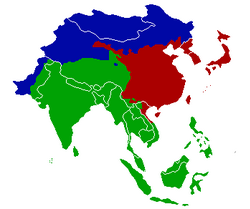
[[File: | [[File:Character-sphere.png|thumb|A map of the families of [[List of writing systems|writing systems]] in East Asia, Southeast Asia, and South Asia. Red: [[Chinese characters]]; Green: [[Brahmi script]]; Blue: [[Aramaic alphabet|Aramaic]] ([[Mongolian script]], [[Manchu alphabet]], [[Old Uyghur alphabet]], and [[Arabic script]]).]] | ||
[[File:China, Vietnam, Korea and Japan in 1100 AD.svg|thumb|Map of the Sinosphere nations (Japan, Korea, China and Vietnam) in the 11th century]] | |||
The '''Sinosphere''',{{sfnm|1a1=Fogel|1y=2009|2a1=Matisoff|2y=1990}} also known as the '''East Asian cultural sphere''',{{sfnm|1a1=Lowe|1a2=Yasuhara|1y=2016|2a1=Choi|2y=2010}} or the '''Sinic world''', | The '''Sinosphere''',{{sfnm|1a1=Fogel|1y=2009|2a1=Matisoff|2y=1990}} also known as the '''Chinese cultural sphere''',<ref name="CCS">{{Cite journal|last1=Zhang|first1=Linjun|last2=Han|first2=Zaizhu|last3=Zhang|first3=Yang|year=2022|title=Reading Acquisition of Chinese as a Second/Foreign Language|url= https://books.google.com/books?id=8PrKEAAAQBAJ&dq=sinosphere+chinese+cultural+sphere&pg=PA131|journal=Frontiers in Psychology|volume=12|page=131|isbn=978-2-832-52952-2 |access-date=26 December 2023}}</ref> '''East Asian cultural sphere''',{{sfnm|1a1=Lowe|1a2=Yasuhara|1y=2016|2a1=Choi|2y=2010}} or the '''Sinic world''',{{sfn|Reischauer|1974}} encompasses multiple countries in [[East Asia]] and [[Southeast Asia]] that were historically heavily influenced by [[Chinese culture]].{{sfn|Reischauer|1974}}<ref name="Fuchs" /> The Sinosphere comprises [[China]], [[Taiwan]], [[Japan]], [[Korea]], [[Vietnam]] and historically the [[Ryukyu Kingdom]].{{sfnm|1a1=Lowe|1a2=Yasuhara|1y=2016|2a1=Wang|2y=2015|3a1=Denecke|3a2=Nguyen|3y=2017}} [[Singapore]] might also be included due to modern-era [[overseas Chinese]] migration.<ref>{{Cite journal|last=Gold|first=Thomas B.|year=1993|title=Go with Your Feelings: Hong Kong and Taiwan Popular Culture in Greater China|journal=The China Quarterly|volume=136|issue=136|pages=907–925|doi=10.1017/S0305741000032380|jstor=655596|s2cid=154597583 |issn=0305-7410}}</ref> The Sinosphere is different from the [[Sinophone]] world, which indicates regions where the [[Chinese language]] is spoken.<ref>{{Cite book|last=Hee|first=Wai-Siam|title=Remapping the Sinophone: The Cultural Production of Chinese-Language Cinema in Singapore and Malaya before and during the Cold War|year=2019|publisher=Hong Kong University Press|doi=10.2307/j.ctvx1hwmg |jstor=j.ctvx1hwmg|isbn=978-9-888-52803-5|s2cid=213443949}}</ref> | ||
[[ | [[Imperial China]] was a major regional power in Eastern Asia and exerted influence on [[tributary system of China|tributary]] states and neighboring states, including Japan, Korea and Vietnam.{{efn|Vietnam and Korea remained tributary states of China for much of their histories, while Japan only submitted fully to Chinese [[regional hegemony]] during the [[Muromachi period]].<ref>{{Cite book|last=Kang, David C. |title=East Asia before the West: five centuries of trade and tribute|year=2012|publisher=Columbia University Press|isbn=978-0-231-15319-5|edition=Paperback|location=New York}}</ref><ref>Howe, Christopher. The Origins of Japanese Trade Supremacy: Development and Technology in Asia. p. 337</ref>}} These interactions brought ideological and cultural influences rooted in [[Confucianism]], [[Taoism]] and [[East Asian Buddhism]]. The four cultures were ruled by their respective emperors under similar administrative systems, furthermore, the adoption of the Confucian-based [[imperial examination]] system deeply influenced the bureaucracy and social structure of Korea and Vietnam. [[List of Chinese inventions|Chinese inventions]] influenced, and were in turn influenced by, innovations of the other cultures in governance, philosophy, science, and the arts.<ref>{{Cite book |editor-first=Nanxiu |editor-last=Qian |editor2-first=Richard J. |editor2-last=Smith |editor3-first=Bowei |editor3-last=Zhang |title=Rethinking the Sinosphere: Poetics, Aesthetics, and Identity Formation|publisher=Cambria |year=2020|isbn=978-1-604-97990-9}}</ref><ref>{{Cite book |editor-first=Nanxiu |editor-last=Qian |editor2-first=Richard J. |editor2-last=Smith |editor3-first=Bowei |editor3-last=Zhang |title=Reexamining the Sinosphere: Cultural Transmissions and Transformations in East Asia|publisher=Cambria|year=2020|isbn=978-1-604-97987-9}}</ref><ref>{{multiref | {{Cite book |title=Confucius in East Asia: Confucianism's History in China, Korea, Japan, and Vietnam |publisher=Association for Asian Studies |author1=Jeffrey L. Richey|year=2013 |isbn=978-0-924-30473-6}} | {{cite book |title=East Asian Confucianism: Interactions and Innovations |publisher=Rutgers University |editor1=Ching-I Tu |year=2010 |isbn=978-0-615-38932-5}} | {{Cite book |title=East Asian Confucianisms: Texts in Contexts |publisher=National Taiwan University Press |editor1-first=Chun-chieh |editor1-last=Huang |year=2015 |isbn=978-3-847-10408-7}} }}</ref> [[Literary Chinese]] became the written [[lingua franca]] for bureaucracy and communications,<ref>{{Cite book |last1=Denecke |first1=Wiebke |url=https://books.google.com/books?id=tO4wDgAAQBAJ&dq=Written+Classical+Chinese+became+the+regional+lingua+franca+for+literary&pg=PA518 |title=The Oxford Handbook of Classical Chinese Literature (1000 BCE-900 CE) |last2=Li |first2=Wai-yee |last3=Tian |first3=Xiaofei |year=2017 |publisher=Oxford University Press |isbn=978-0-199-35659-1}}</ref> and [[Chinese characters]] became locally adapted as [[kanji]] in Japan, [[hanja]] in Korea, and {{langr|vi|[[chữ Hán]]}} in Vietnam.<ref>{{Cite book |last1=Asher |first1=R. E. |url=https://books.google.com/books?id=R0xWDwAAQBAJ&dq=Chinese+characters+were+adapted+to+local+uses,+and+Japanese+or+Korean+or+Vietnamese&pg=PR187 |title=Atlas of the World's Languages |last2=Moseley |first2=Christopher |date=19 April 2018 |publisher=Routledge |isbn=978-1-317-85108-0}}</ref><ref>{{Cite book |last1=Lacoste |first1=Véronique |url=https://books.google.com/books?id=SIHnBQAAQBAJ&dq=Chinese+characters+were+adapted+to+local+uses,+and+Japanese+or+Korean+or+Vietnamese&pg=PA296 |title=Indexing Authenticity: Sociolinguistic Perspectives |last2=Leimgruber |first2=Jakob |last3=Breyer |first3=Thiemo |date=14 October 2014 |publisher=Walter de Gruyter |isbn=978-3-110-34701-2}}</ref> | ||
The literary importance of classical Chinese was moderated as Japan, Korea and Vietnam invented their own [[phonogram (linguistics)|phonographic]] writing systems, with Japan developing the [[katakana]] and [[hiragana]] scripts, Korea creating the [[hangul]], and Vietnam initially developing {{langr|vi|[[chữ Nôm]]}} but replacing it with [[Latin alphabet]]-based [[Vietnamese alphabet]] since 1910s due to [[French Indochina|French colonization]]. However Classical Chinese or modified versions of it such as [[kanbun]] and the [[Idu script]] remained in official use until the modern era.<ref>{{harvcoltxt|Robert|2006}}</ref>{{sfn|Li|2020|p=78, 90, 102-106}} In the 21st century, ideological and cultural influences of Taoism, Confucianism, and Buddhism remain visible in [[high culture]] and social doctrines. | |||
==Terminology== | ==Terminology== | ||
Ancient China | Ancient China was one of the [[Cradle of civilization|cradles of civilization]], with the emergent cultures that arose from the migration of [[Han Chinese|Han]] settlers from the [[Yellow River]] generally regarded as the origin of the East Asian world.<ref>{{Cite web |date=9 September 2020 |title=Huang He Valley |url=http://www.nationalgeographic.org/encyclopedia/huang-he-valley/ |access-date=4 May 2022 |website=National Geographic Society}}</ref> | ||
Japanese historian {{Interlanguage link|Nishijima Sadao|lt=|ja|西嶋定生|WD=}} (1919–1998), professor emeritus at the [[University of Tokyo]], | Japanese historian {{Interlanguage link|Nishijima Sadao|lt=|ja|西嶋定生|WD=}} (1919–1998), professor emeritus at the [[University of Tokyo]], coined the term {{Nihongo3|'East Asian Cultural Sphere'|東亜文化圏|Tōa bunka-ken}} to refer to an East Asian cultural sphere distinct from the cultures of the West. According to Nishijima, this cultural sphere—which includes China, Japan, Korea, and Vietnam—shared the philosophy of [[Confucianism]], the religion of [[Buddhism]], and similar political and social structures stemming from a background of historical [[Classical Chinese]] scholars.<ref name="Fuchs">Wang Hui, "'Modernity and 'Asia' in the Study of Chinese History," in Eckhardt Fuchs, Benedikt Stuchtey, eds.,''Across cultural borders: historiography in global perspective'' [https://books.google.com/books?id=4wtBb5sWLyYC&pg=PA322] (Rowman & Littlefield, 2002 {{ISBN|978-0-7425-1768-4}}), p. 322.</ref> It has also been informally referred to as the "[[chopsticks]] sphere" due to perceived native use of these utensils across the region.<ref>{{Cite conference |title=Achieving Quality Assurance and Moving to a World Class University in the 21st Century |conference=American Institute in Taiwan (AIT) & Blackboard Education Executive Symposium |url=https://files.eric.ed.gov/fulltext/ED543062.pdf |last=Lee |first=Lung-Sheng Steven |date=2013-06-04 |location=Taipei, Taiwan|via=Institute of Education Science}}</ref>{{sfn|Wang|2015|pp=67–92}} | ||
===Etymology=== | ===Etymology=== | ||
The term ''{{linktext|Sinosphere}}'' is derived from ''{{linktext|Sino-}}'' 'China' ({{cf.}} [[Sinophone]]) + ''{{linktext|-sphere}}'', in the sense of the [[sphere of influence]] under the influence of a country.<ref>{{Cite book |last=Handel |first=Zev |url=https://books.google.com/books?id=wTCbDwAAQBAJ&dq=term+Sinosphere&pg=PA10 |title=Sinography: The Borrowing and Adaptation of the Chinese Script |year=2019 |publisher=Brill |isbn=978-90-04-35222-3}}</ref> | |||
The [[CJK]] languages—Chinese, Japanese, Korean—each use cognate terms to translate English ''sphere'': | |||
* Chinese | * Chinese {{tlit|zh|quān}} ({{ZH|{{linktext|圈}}}}; 'circle', 'ring', 'pen') | ||
* Japanese | * Japanese {{tlit|ja|ken}} ({{lang|ja|圏、けん}}; 'sphere', 'circle', 'range', 'radius') | ||
* Korean | * Korean {{tlit|ko|gwon}} ({{lang|ko|권}}; from {{lang|ko-Hani|圏}}) | ||
Unlike the other languages | Unlike with the other languages of the Sinosphere, the corresponding Vietnamese cognate {{lang|vi|khuyên}} {{lang|vi-Hani|圈}} is not used to mean 'sphere' or 'area'.{{efn|In Vietnamese, {{lang|vi|khuyên}} ({{lang|vi-Hani|圈}}) has the meaning of 'earring'. The sense of the word as meaning 'sphere' is only found in Literary Chinese texts.}} Instead, {{lang|vi|vùng}} ('region', 'area') is used. The Chinese {{lang|zh|東亞文化圈}} is translated in Vietnamese as {{lang|vi|Vùng văn hóa Á Đông}} ({{lang|vi-Hani|塳文化亞東}}). | ||
In Ryukyuan languages, 圏 | In the [[Ryukyuan languages]], {{lang|ryu-Hani|圏}} ({{lang|ryu|ちん}}; {{tlit|ryu|chin}}) is not used to mean 'sphere', 'area', or 'domain' and only appears in ''[[kammun]]'' texts written by Ryukyuans. Instead, {{lang|ryu-Hani|世}} ({{tlit|ryu|yu}}) is used to mean 'world' or 'sphere'. As such, {{ZH|漢字文化圏}} and {{ZH|東亜文化圏}} would be translated as {{tlit|ryu|kanjii tiigata nu yu}} ({{lang|ryu-Hani|漢字一型ぬ世}}) and {{tlit|ryu|too-a tiigata nu yu}} ({{lang|ryu-Hani|東亜一型ぬ世}}), respectively. | ||
[[Victor H. Mair]] discussed the origins of these | [[Victor H. Mair]] discussed the origins of these 'culture sphere' terms.<ref>Victor Mair, [http://languagelog.ldc.upenn.edu/nll/?p=4306 Sinophone and Sinosphere], [[Language Log]], 8 November 2012.</ref> | ||
The Chinese {{ | The Chinese {{tlit|zh|wénhuà quān}} ({{ZH|文化圈}}) dates to a 1941 translation for the German term {{lang|de|[[Kulturkreis]]}}, ('culture circle, field'), which the Austrian ethnologists [[Fritz Graebner]] and [[Wilhelm Schmidt (linguist)|Wilhelm Schmidt]] proposed. Japanese historian {{Interlanguage link|Nishijima Sadao|lt=|ja|西嶋定生|WD=}} coined the expressions {{nihongo|''Kanji bunka ken''|漢字文化圏||'Chinese-character culture sphere'}} and {{nihongo|''Chuka bunka ken''|中華文化圏||'Chinese culture sphere'}}, which China later re-borrowed as [[loanwords]]. | ||
The Sinosphere may be taken to be synonymous to [[History of China#Ancient China|Ancient China]] and its descendant civilizations as well as the "Far Eastern civilizations" (the Mainland and the Japanese ones). In | The Sinosphere may be taken to be synonymous to [[History of China#Ancient China|Ancient China]] and its descendant civilizations as well as the "Far Eastern civilizations" (the Mainland and the Japanese ones). In Toynbee's ''[[A Study of History]]'' (1934–1961), the Sinosphere is presented as among the major "units of study", along with the [[Western world|Western]], Islamic, Eastern Orthodox, and Indic civilizations.<ref>See the "family tree" of Toynbee's "civilizations" in any edition of Toynbee's work, or e.g. as Fig.1 on p.16 of: ''The Rhythms of History: A Universal Theory of Civilizations'', By Stephen Blaha. Pingree-Hill Publishing, 2002. {{ISBN|0-9720795-7-2}}.</ref> | ||
=== Comparisons with the West === | |||
British historian [[Arnold J. Toynbee]] | British historian [[Arnold J. Toynbee]] lists the Far Eastern civilization as one of the main civilizations outlined in his book ''[[A Study of History]]''. He proposes that the initial "Sinic civilization" originating in the Yellow River basin gradually grew into the subsequent "Far Eastern civilization", which extended to the Yangzi region and into Korea and Japan.<ref name="Sun p.154">{{cite book|last=Sun|first=Lung-kee|url=https://books.google.com/books?id=O9_U-XdJ3iYC&pg=PA154|title=The Chinese National Character: From Nationalhood to Individuality|publisher=M.E. Sharpe|year=2002|isbn=978-0-7656-3936-3|page=154}}</ref> Commonalities within the Far Eastern civilization were the result of developing from a "Sinic universal state".<ref name="Sun p.188" /> Toynbee contrasts this "affiliation" relationship between the Sinic and Far Eastern civilizations with the "apparentation-affiliation" relationship between the Hellenic and Western civilizations.<ref name="Sun p.188">{{cite book|last=Sun|first=Lung-kee|url=https://books.google.com/books?id=0ZgRtzGLG_oC&pg=PA188|title=The Chinese National Character: From Nationalhood to Individuality|publisher=M.E. Sharpe|year=2002|isbn=978-0-7656-0826-0|page=188}}</ref> | ||
American [[sinologist]] and historian [[Edwin O. Reischauer]] also | American [[sinologist]] and historian [[Edwin O. Reischauer]] also groups China, Japan, Korea, and Vietnam into a cultural sphere that he calls the "Sinic world", a group of centralized states that share a Confucian ethical philosophy. Reischauer states that this culture originated in northern China, and compares the relationship between northern China and East Asia to that of [[Greco-Roman world|Greco-Roman civilization]] and Europe. The elites of East Asia were tied together through a common written language based on Chinese characters, much in the way that Latin functioned in Europe.{{sfn|Reischauer|1974}} | ||
American political scientist [[Samuel P. Huntington]] | In his book ''[[The Clash of Civilizations]]'', American political scientist [[Samuel P. Huntington]] considers the Sinic world as one of the modern (post–[[Cold War]]) civilizations. He notes that "all scholars recognize the existence of either a single distinct Chinese civilization dating back to at least 1500 B.C. and perhaps a thousand years earlier, or of two Chinese civilizations, one succeeding the other, in the early centuries of the Christian epoch".<ref>''The Clash of Civilizations and the Remaking of World Order.'' (New York: Simon & Schuster, 1996; {{ISBN|0684811642}}), [https://books.google.com/books?id=Iq75qmi3Og8C p. 45]</ref> Huntington's Sinic civilization includes China, North Korea, South Korea, Vietnam, and Chinese communities in Southeast Asia.<ref name="Davis">{{cite book|author=William E. Davis|url=https://books.google.com/books?id=w1okRtHKiLIC&pg=PA197|title=Peace and Prosperity in an Age of Incivility|publisher=University Press of America|year=2006|isbn=978-0-7618-3248-5|page=197}}</ref> Of the many civilizations that Huntington discusses, the Sinic world is the only one that is based on a cultural, rather than religious, identity.<ref name="Blinnikov">{{cite book|author=Michail S. Blinnikov|url=https://books.google.com/books?id=QcoodEOmnMUC&pg=PA132|title=A Geography of Russia and Its Neighbors|publisher=Guilford Press|year=2011|isbn=978-1-60623-933-9|page=132}}</ref> Huntington theorizes that in a post–Cold War world, humanity "[identifies] with cultural groups: tribes, ethnic groups, religious communities [and] at the broadest level, civilizations".<ref name="Sun p.032">{{cite book|author=Lung-kee Sun|url=https://books.google.com/books?id=0ZgRtzGLG_oC&pg=PA32|title=The Chinese National Character: From Nationalhood to Individuality|publisher=M.E. Sharpe|year=2002|isbn=978-0-7656-0826-0|page=32}}</ref><ref name="Gusterson">{{cite book|author=Hugh Gusterson|url=https://books.google.com/books?id=iHJRW0GI31MC&pg=PA124|title=People of the bomb: portraits of America's nuclear complex|publisher=U of Minnesota Press|year=2004|isbn=978-0-8166-3860-4|page=124}}</ref> One exception is Japan, which Huntington considers as a distinct civilization.<ref>{{Cite book |last1=McCormack |first1=Gavan |url=https://books.google.com/books?id=CWqlDAAAQBAJ&dq=Huntington+considered+Japan+as+a+distinct+civilization.&pg=PT152 |title=The Emptiness of Japanese Affluence |last2=Field |first2=Norma |date=8 July 2016 |publisher=Routledge |isbn=978-1-315-49935-2}}</ref> | ||
==Culture== | ==Culture== | ||
{{Multiple image | |||
| direction = vertical | |||
| image1 = Meridian Gate (Citadel of Hue) 20190917-2.jpg | |||
| image2 = Meridian Gate (Forbidden City) 2015 December.jpg | |||
| caption2 = The Meridian Gates of [[Meridian Gate (Huế)|Huế]] (top) and [[Meridian Gate|Beijing]] (bottom). Chinese architecture has had a major influence on the East Asian architectural styles of Vietnam, Korea, and Japan. | |||
}} | |||
[[File:Tsunami by hokusai 19th century.jpg|thumb|[[The Great Wave off Kanagawa|Great Wave off Kanagawa]], one of the most famous Japanese woodblock prints ]]Cultural commonalities among the Sinosphere countries reflect their shared source of influence from Imperial China. | |||
=== Structure of the personal name === | |||
{{Main|Chinese name|Japanese name|Korean name|Vietnamese name}} | |||
The structure of personal names in the Sinosphere follows the surname-first order, also known as the [[Eastern name order]]. Additionally, [[Korean name|Korean]] and [[Vietnamese name|Vietnamese]] personal name share a structure similar to [[Chinese name|Chinese one]], in that they have some monosyllabic surnames in common (e.g. [[Lee (surname 李)|Lee]], [[Chen (surname)|Chen]],..), and full names typically consist of about two to four Chinese characters. | |||
===Arts=== | ===Arts=== | ||
* '''Architecture''': Countries of the East Asian cultural sphere ([[Japanese architecture|Japan]], [[Korean architecture|Korea]], [[Vietnamese architecture|Vietnam]], [[Taiwanese architecture|Taiwan]]) share a common architectural style stemming from the [[Chinese architecture|architecture of ancient China]].<ref>{{Cite book | url=https://books.google.com/books?id=tA_3y2XsMMsC | title=How to Prepare for the AP World History| isbn= | * '''[[Chinese Architecture|Architecture]]''': Countries of the East Asian cultural sphere ([[Japanese architecture|Japan]], [[Korean architecture|Korea]], [[Architecture of Mongolia|Mongolia]], [[Vietnamese architecture|Vietnam]], [[Taiwanese architecture|Taiwan]], [[Architecture of Hong Kong|Hong Kong]]) share a common architectural style stemming from the [[Chinese architecture|architecture of ancient China]].<ref>{{Cite book | url=https://books.google.com/books?id=tA_3y2XsMMsC | title=How to Prepare for the AP World History| isbn=978-0-7641-1816-6| last1=McCannon| first1=John| date=February 2002| publisher=Barrons Educational Series}}</ref> | ||
* '''Calligraphy''': ''[[Caoshu]]'' is a cursive [[Script styles|script style]] used in Chinese and East Asian calligraphy.<ref>{{Cite book |last=Pan |first=Lu |url=https://books.google.com/books?id=rJbzCQAAQBAJ&dq=Caoshu+is+a+cursive+script-style+used+in+Chinese+and+East+Asian+calligraphy.&pg=PA12 |title=Aestheticizing Public Space: Street Visual Politics in East Asian Cities |date=22 June 2015 |publisher=Intellect Books |isbn=978-1-78320-453-3}}</ref> | * '''[[Chinese Calligraphy|Calligraphy]]''': ''[[Cursive script (East Asia)|Caoshu]]'' is a cursive [[Script styles|script style]] used in Chinese and East Asian calligraphy.<ref>{{Cite book |last=Pan |first=Lu |url=https://books.google.com/books?id=rJbzCQAAQBAJ&dq=Caoshu+is+a+cursive+script-style+used+in+Chinese+and+East+Asian+calligraphy.&pg=PA12 |title=Aestheticizing Public Space: Street Visual Politics in East Asian Cities |date=22 June 2015 |publisher=Intellect Books |isbn=978-1-78320-453-3}}</ref> | ||
* '''Cinema''': see [[Cinema of Hong Kong|Hong Kong cinema]], [[Cinema of Taiwan|Taiwanese cinema]], [[Cinema of China|Chinese cinema]], [[Cinema of Japan|Japanese cinema]], [[Cinema of Korea|Korean cinema]], [[Vietnamese cinema]] | * '''Cinema''': see [[Cinema of Hong Kong|Hong Kong cinema]], [[Cinema of Taiwan|Taiwanese cinema]], [[Cinema of China|Chinese cinema]], [[Cinema of Japan|Japanese cinema]], [[Cinema of Korea|Korean cinema]], [[Vietnamese cinema]] | ||
* '''Comic''': see [[ | * '''Comic''': see ''[[manga]]'' (Japanese comics), ''[[manhua]]'' (Chinese comics), ''[[manhwa]]'' (Korean comics), ''[[truyện tranh]]'' (Vietnamese comics) | ||
* '''Martial arts''': see ''[[Chinese martial arts| | * '''Gardening''': The art of cultivating miniature trees and landscapes: see ''[[bonsai]]'' (Japanese), ''[[penjing]]'' (Chinese), ''[[bunjae]]'' (Korean), ''[[hòn non bộ]]'' (Vietnamese) | ||
* '''Music''': [[List of Chinese musical instruments|Chinese musical instruments]], such as ''[[erhu]]'', have influenced those of [[ | * '''Martial arts''': see ''[[Chinese martial arts|gōngfu]]'' (kung fu; Chinese martial arts); ''[[taekwondo]]'' and ''[[hapkido]]'' (Korean martial arts); ''[[karate]]'', ''[[aikido]]'', ''[[judo]]'', ''[[jujutsu]]'' and ''[[sumo]]'' (Japanese martial arts); ''[[vovinam]]'' and ''[[Nhất Nam|nhất nam]]'' (Vietnamese martial arts) | ||
* '''Clothing''': [[ | * '''Music''': [[List of Chinese musical instruments|Chinese musical instruments]], such as the ''[[erhu]]'', have influenced those of [[Traditional music of Korea|Korea]], [[Music of Japan|Japan]], [[Music of Taiwan|Taiwan]], [[Music of Hong Kong|Hong Kong]], and [[Music of Vietnam|Vietnam]] and [[Yazheng]] influenced Japan ([[Koto (instrument)|''koto'']]), Korea(''[[gayageum]]'') and Mongolia (''[[yatga]]''). | ||
* '''Clothing''': ''[[hanfu]]'', ''[[hanbok]]'', [[việt phục]], and ''[[wafuku]]'' all use silk. [[Jade]] jewelry and ornaments are also highly valued throughout East Asia and Southeast Asia. | |||
{{gallery|mode=packed|height=200 | |||
|File:Officials.jpeg|[[Ming dynasty]]'s mandarins in imperial costume | |||
|File:Sim_Hwan-ji.jpg|[[Joseon]]'s Sim Hwan-ji in [[Gwanbok]] | |||
|File:Prince Mikasa Takahito wearing Sokutai.jpg| Japanese prince [[Takahito, Prince Mikasa|Takahito]] in [[Sokutai]]|File:Nam Giao3.jpg|Vietnamese officials wearing [[Mianfu]] during the Nam Giao ceremony}} | |||
[[File:3Z3A3707.jpg|thumb|[[Mongolian calligraphy]] is deeply influenced by the Sinosphere.]] | |||
===Cuisine=== | ===Cuisine=== | ||
| Line 93: | Line 109: | ||
{{See also|Chinese cuisine|List of Chinese dishes|Vietnamese cuisine|Japanese cuisine|Korean cuisine|Taiwanese cuisine}} | {{See also|Chinese cuisine|List of Chinese dishes|Vietnamese cuisine|Japanese cuisine|Korean cuisine|Taiwanese cuisine}} | ||
The cuisine of East Asia shares many of the same ingredients and techniques. [[Chopsticks]] are used as an eating utensil in all of the core East Asian countries.<ref name="Davidson">{{cite book|last=Davidson|first=Alan|url=https://books.google.com/books?id=zcNdB_sl2JkC&pg=PA22|title=Food in Motion: The Migration of Foodstuffs and Cookery Techniques : Proceedings : Oxford Symposium 1983|publisher=Oxford Symposium|year=1981|isbn=978-0-907325-07-9|page=22}}</ref> The use of soy sauce, which is made from fermenting soybeans, is also widespread in the region.<ref>{{Cite book |last=Katz |first=Sandor Ellix |url=https://books.google.com/books?id=-zmLa205d0QC&dq=use+of+soy+sauce,+which+is+made+from+fermenting+soybeans,+is+also+widespread+in+east+asia&pg=PA325 |title=The Art of Fermentation: New York Times Bestseller |date=14 May 2012 |publisher=Chelsea Green Publishing |isbn=978-1-60358-364-0}}</ref> | The cuisine of East Asia shares many of the same ingredients and techniques. [[Chopsticks]] are used as an eating utensil in all of the core East Asian countries.<ref name="Davidson">{{cite book|last=Davidson|first=Alan|url=https://books.google.com/books?id=zcNdB_sl2JkC&pg=PA22|title=Food in Motion: The Migration of Foodstuffs and Cookery Techniques : Proceedings: Oxford Symposium 1983|publisher=Oxford Symposium|year=1981|isbn=978-0-907325-07-9|page=22}}</ref> The use of soy sauce, which is made from fermenting soybeans, is also widespread in the region.<ref>{{Cite book |last=Katz |first=Sandor Ellix |url=https://books.google.com/books?id=-zmLa205d0QC&dq=use+of+soy+sauce,+which+is+made+from+fermenting+soybeans,+is+also+widespread+in+east+asia&pg=PA325 |title=The Art of Fermentation: New York Times Bestseller |date=14 May 2012 |publisher=Chelsea Green Publishing |isbn=978-1-60358-364-0}}</ref> | ||
Rice is the staple food in all of East Asia and is a major focus of [[food security]].<ref name="Chern">{{cite book|author1=Wen S. Chern|url=https://books.google.com/books?id=zcOmGXTqYWMC&pg=PA2|title=Food security in Asia: economics and policies|author2=Colin A. Carter|author3=Shun-yi Shei|publisher=Edward Elgar Publishing|year=2000|isbn=978-1-78254-334-3|page=2}}</ref> People who have no rice are often seen as having no food. Moreover, in East Asian countries such as Japan (御飯; | Rice is the staple food in all of East Asia and is a major focus of [[food security]].<ref name="Chern">{{cite book|author1=Wen S. Chern|url=https://books.google.com/books?id=zcOmGXTqYWMC&pg=PA2|title=Food security in Asia: economics and policies|author2=Colin A. Carter|author3=Shun-yi Shei|publisher=Edward Elgar Publishing|year=2000|isbn=978-1-78254-334-3|page=2}}</ref> People who have no rice are often seen as having no food. Moreover, in East Asian countries such as Japan ({{Lang|ja|御飯}}; {{Transliteration|ja|gohan}}), Korea (밥; ''bap''), and Vietnam (''cơm;'' 𩚵 or 粓), the word for "cooked rice" can embody the meaning of food in general.<ref name="Davidson" /> | ||
Popular terms associated with East Asian cuisine include [[Tapioca balls|boba]], [[kimchi]], [[sushi]], [[hot pot]], tea, [[dim sum]], [[ramen]], as well as [[phở]], [[sashimi]], [[udon]], and [[chả giò]] | Popular terms associated with East Asian cuisine include [[Tapioca balls|boba]], [[kimchi]], [[sushi]], [[hot pot]], tea, [[dim sum]], [[ramen]], as well as [[phở]], [[sashimi]], [[udon]], and [[chả giò]].<ref name="Kim">{{cite book|last1=Kim|first1=Kwang-Ok|title=Re-Orienting Cuisine: East Asian Foodways in the Twenty-First Century|date=1 February 2015|publisher=Berghahn Books, Incorporated|isbn=978-1-78238-563-9|page=14}}</ref> | ||
===Traditions=== | ===Traditions=== | ||
* '''Fashion''': see ''[[ | * '''Fashion''': see ''[[hanfu]]'' and ''[[cheongsam]]'' (or ''qipao'') (Chinese and Manchu); [[Vietnamese clothing]] (Vietnamese, including ''[[áo dài]]''); Mongolian clothing ([[Deel (clothing)|deel]]) ''[[hanbok]]'' (Korean); ''[[kimono]]'' and ''[[wafuku]]'' (Japanese) | ||
* '''Dance''': The [[lion dance]] is a form of traditional dance in [[Culture of China|Chinese culture]] and other East Asian countries, in which performers mimic a lion's movements | * '''Dance''': The [[lion dance]] is a form of traditional dance in [[Culture of China|Chinese culture]] and other East Asian countries, in which performers in a lion costume mimic a lion's movements to bring good luck and fortune. Aside from China, versions of the lion dance are found in Japan, Korea, Vietnam, Tibet, and Taiwan. Lion dances are usually performed during [[Lunar New Year]] celebrations. | ||
* '''New Year''': China (''[[Chinese New Year|Zhōngguó Xīn Nián]]''), Korea (''[[ | * '''New Year''': China (''[[Chinese New Year|Zhōngguó Xīn Nián]]''), Korea (''[[Seollal]]''), Vietnam (''[[Tết Nguyên Đán]]''), Mongolia ([[Tsagaan Sar|''Tsagaan sar'']]), Japan (''[[Koshōgatsu]]''), and Taiwan traditionally observe the same Lunar New Year. However, Japan has moved its New Year ({{Lang|ja-latn|[[Shōgatsu]]}}) to fit the Western [[New Year]] since the [[Meiji Restoration]].{{citation needed|date=November 2020}} Although mainland Japan no longer celebrates Lunar New Year, some indigenous minority ethnic groups in Japan still do, such as the [[Ryukyuan people]] ([[Okinawans]]). Okinawa has traditionally observed the Lunar New Year because of heavy Chinese influence in its past. Okinawans still celebrate and partake in many traditions for Lunar New Year, though to less of an extent than Western New Year.<ref>{{cite web |title=Tradition: Okinawa Lunar New Year Celebration |url=https://travelthruhistory.com/tradition-onikawa-lunar-new-year-celebration/ |website=Travelthruhistory |date=20 January 2010 |access-date=1 July 2021}}</ref> | ||
===Literature=== | ===Literature=== | ||
{{Main|Adoption of Chinese literary culture}} | {{Main|Adoption of Chinese literary culture}} | ||
[[File:佛說大報父母恩重經 Sinosphere.png|thumb|Illustrated editions of the [[Sutra of Filial Piety]] (佛說大報父母恩重經) in Korean (left), Vietnamese (center), and Japanese (right). The Korean edition includes [[Hangul]] annotations, the Vietnamese edition includes a [[Giải âm]] translation, and the Japanese edition includes [[Kanbun]] glossing.]] | |||
East Asian literary culture is based on the use of [[Literary Chinese]], which became the medium of scholarship, administration, and government across the region. Although Vietnam, Korea, and Japan each developed vernacular writing systems for their languages, these were limited to popular literature.<ref name="Kornicki">{{citation|last=Kornicki|first=P.F.|title=New Word Order: Transnational Themes in Book History|pages=65–79|year=2011|postscript=.|editor1-last=Chakravorty|editor1-first=Swapan|chapter=A transnational approach to East Asian book history|chapter-url=https://books.google.com/books?id=bjJBrKfCKIYC&pg=PA65|publisher=Worldview Publications|isbn=978-81-920651-1-3|author-link=Peter Kornicki|editor2-last=Gupta|editor2-first=Abhijit}}{{Harvnb|Kornicki|2011|pp=75–77}}</ref> Literary Chinese remained the medium of formal writing until the late 19th and early 20th centuries, when it was swept away by rising nationalism and displaced by vernacular writing.{{sfnp|Kornicki|2011|pp=66–67}} | |||
Though they did not use Chinese for spoken communication, each country had its own tradition of reading texts aloud, the so-called [[Sino-Xenic pronunciations]], which provide clues to the pronunciation of [[Middle Chinese]]. Chinese words with these pronunciations were also borrowed extensively by local vernaculars and today comprise over half their vocabularies.{{sfnp|Miyake|2004|pp=98–99}} [[Vernacular Chinese|Vernacular or standard Chinese]] encompassing [[varieties of Chinese]] also developed alongside the use of Literary Chinese. | |||
Books in Literary Chinese were widely distributed. By the 7th century and possibly earlier, [[woodblock printing]] had been developed in China. At first, it was used only to copy Buddhist scriptures, but later secular works were also printed. By the 13th century, metal [[movable type]] was used by government printers in Korea but seems to have not been extensively used in China, Vietnam, or Japan. At the same time, manuscript reproduction remained important until the late 19th century.{{sfnp|Kornicki|2011|p=68}} | Books in Literary Chinese were widely distributed. By the 7th century and possibly earlier, [[woodblock printing]] had been developed in China. At first, it was used only to copy Buddhist scriptures, but later secular works were also printed. By the 13th century, metal [[movable type]] was used by government printers in Korea but seems to have not been extensively used in China, Vietnam, or Japan. At the same time, manuscript reproduction remained important until the late 19th century.{{sfnp|Kornicki|2011|p=68}} | ||
Japan's [[textual scholarship]] had Chinese origins, which made Japan one of the birthplaces of modern [[ | Japan's [[textual scholarship]] had Chinese origins, which made Japan one of the birthplaces of modern [[sinology]].<ref>"Given Japan's strong tradition of Chinese textual scholarship, encouraged further by visits by eminent Chinese scholars since the early 20th century, Japan has been one of the birthplaces of modern sinology outside China" Early China – A Social and Cultural History, page 11. Cambridge University Press.</ref> | ||
The [[Four Books and Five Classics]] are the authoritative books of [[Confucianism]], which were used to study for civil service examinations in [[Imperial examination|China]], [[Gwageo|Korea]], and [[Confucian court examination system in Vietnam|Vietnam]]. | |||
==Philosophy and religion== | ==Philosophy and religion== | ||
{{Main|East Asian religions|Eastern philosophy#East Asian philosophies|l2 = East Asian philosophies|3 = Three teachings}} | {{Main|East Asian religions|Eastern philosophy#East Asian philosophies|l2 = East Asian philosophies|3 = Three teachings}} | ||
''[[The Art of War]]'', ''[[Tao Te Ching]]'', ''[[I Ching]]'', and ''[[Analects]]'' are classic Chinese texts that have been influential in East Asian history.<ref>{{Cite web |last=Willett-Wei |first=Megan |title=30 Books That Changed the Course of History |url=https://www.businessinsider.com/books-that-changed-history-2014-12 |access-date=4 May 2022 |website=Business Insider}}</ref> | ''[[The Art of War]]'', ''[[Tao Te Ching]]'', ''[[I Ching]]'', and ''[[Analects]]'' are classic Chinese texts that have been influential in East Asian history.<ref>{{Cite web |last=Willett-Wei |first=Megan |title=30 Books That Changed the Course of History |url=https://www.businessinsider.com/books-that-changed-history-2014-12 |access-date=4 May 2022 |website=Business Insider}}</ref> More generally, the philosophies and practices of Taoism, Buddhism, and Confucianism have had long-standing and deep-rooted influence in Sinosphere countries. | ||
===Taoism=== | ===Taoism=== | ||
{{Main|Taoism}} | {{Main|Taoism}} | ||
{{More citations needed section|date=November 2024}} | |||
According to this belief, the wisdom of the ''tao'' is the only source of the universe and | Taoism has influenced countries throughout the Sinosphere. The Taoist school of thought emerged in China from the teachings of [[Lao Tse]]. It follows the search for the ''tao'', a concept that is equivalent to a 'path' or 'course' and represents the cosmic force that creates the universe and all things. According to this belief, the wisdom of the ''tao'' is the only source of the universe and represents a natural path of life events. Thus, the adherents of Taoism follow the search for ''tao'', which represents the strength of the universe. | ||
The most important text in Taoism, the ''[[Tao Te Ching]]'' ("Book of the Way and Virtue", c. 300 BC), declares that the ''tao'' is the "source" of the universe, thus considered a creative principle, but not as a deity. Nature manifests itself spontaneously, without a higher intention, and it is up to humans to integrate, through "non-action" (''wu wei'') and spontaneity (''zi ran''), to its flow and rhythms, to achieve happiness and a long life. | The most important text in Taoism, the ''[[Tao Te Ching]]'' ("Book of the Way and Virtue", c. 300 BC), declares that the ''tao'' is the "source" of the universe, thus considered a creative principle, but not as a deity. Nature manifests itself spontaneously, without a higher intention, and it is up to humans to integrate, through "non-action" (''wu wei'') and spontaneity (''zi ran''), to its flow and rhythms, in order to achieve happiness and a long life. | ||
Taoism is a combination of teachings from various sources | Taoism is a combination of teachings from various sources; it manifests as a system that can be philosophical, religious, or ethical. The tradition can also be presented as a worldview and a way of life.<ref>{{Citation |last=Hansen |first=Chad |title=Daoism |date=2024 |encyclopedia=The Stanford Encyclopedia of Philosophy |editor-last=Zalta |editor-first=Edward N. |url=https://plato.stanford.edu/entries/daoism/ |access-date=2024-09-20 |edition=Summer 2024 |publisher=Metaphysics Research Lab, Stanford University |editor2-last=Nodelman |editor2-first=Uri}}</ref> | ||
===Buddhism=== | ===Buddhism=== | ||
{{Main|East Asian Buddhism}} | {{Main|East Asian Buddhism}} | ||
{{ | [[File:Red Japanese temple (Unsplash).jpg|thumb|[[Mahayana]] Buddhism, a religion particular to the Sinic world ]]Buddhist philosophy is guided by the teachings of the Buddha, which lead the individual to [[Enlightenment in Buddhism|enlightenment]] through meditative practices, mindfulness, and reflection on their daily actions. The belief is that physical and spiritual awareness leads to a state of enlightenment called ''[[nirvana]]'', which, according to Buddha, is the highest state of meditation. In this state the individual finds peace and tranquility above the oscillations of thoughts and emotions and is rid of the inherent suffering of the physical world.<ref>{{Cite web |title=Buddhism |url=https://education.nationalgeographic.org/resource/buddhism |access-date=2023-11-13 |website=education.nationalgeographic.org |language=en}}</ref> | ||
[[East Asian Buddhism|Buddhism in the Sinosphere]] is or derives from [[Mahayana Buddhism]], a sect which is seen to be intertwined within [[Taoism]] and [[Confucianism]].<ref>{{Cite journal |last1=Lin |first1=Yi-Ying |last2=Swanson |first2=Dena Phillips |last3=Rogge |first3=Ronald David |date=2021 |title=The Three Teachings of East Asia (TTEA) Inventory: Developing and Validating a Measure of the Interrelated Ideologies of Confucianism, Buddhism, and Taoism |journal=Frontiers in Psychology |volume=12 |article-number=626122 |doi=10.3389/fpsyg.2021.626122 |pmid=33732190 |pmc=7956942 |issn=1664-1078 |doi-access=free }}</ref> It advocates for altruism and compassion, as well as understanding and escaping from [[suffering]] in relation to [[karma]].<ref>{{Cite web |last= |first= |title=Death and Dying in Buddhism |url=https://www.bristol.ac.uk/religion/buddhist-centre/projects/bdr/chaplains/online-guide.html |access-date=2023-11-13 |website=www.bristol.ac.uk |language=en-GB}}</ref> [[Vegetarianism]] or [[veganism]] is followed by more [[Monasticism|monastic]] or devout Buddhists of this sect, and even among lay Buddhists, as it leads to compassion for all living, sentient beings.<ref>{{Cite journal |last=Tseng |first=Ampere A. |date=2020-02-01 |title=Equivalent Reduction in Greenhouse Gas Emissions by Mahayana Buddhists Practicing Vegetarian Diets |journal=Journal of Religion and Health |language=en |volume=59 |issue=1 |pages=598–613 |doi=10.1007/s10943-017-0511-0 |pmid=29058160 |s2cid=33627817 |issn=1573-6571}}</ref><ref>{{Cite book |last=Kapleau |first=Philip |date=1986 |title=To cherish all life:a Buddhist case for becomingvegetarian |edition=2nd |url=https://buddhism.lib.ntu.edu.tw/DLMBS/jp/search/search_detail.jsp?seq=288089 |publisher=The Zen Center |location=Rochester, New York |isbn=0-940306-00-X |language=en}}</ref><ref>{{cite journal |last=Davidson |first=Jo Ann |date=Fall 2003 |title=World Religions and the Vegetarian Diet |url=https://digitalcommons.andrews.edu/cgi/viewcontent.cgi?article=1216&context=jats |journal=[[Journal of the Adventist Theological Society]] |volume=14 |issue=2 |pages=114–130}}</ref> | |||
===Confucianism=== | ===Confucianism=== | ||
{{Main|Confucianism}} | |||
[[File:Confucius Statue at the Confucius Temple.jpg|thumb|upright|[[Confucianism]] plays a crucial part in East Asian culture.]] | [[File:Confucius Statue at the Confucius Temple.jpg|thumb|upright|[[Confucianism]] plays a crucial part in East Asian culture.]] | ||
[[File:Constellation of Literature pavilion - Temple of Literature, Hanoi - DSC04688.JPG|thumb|[[Temple of Literature, Hanoi]]. Confucian education and [[imperial examination]]s played a huge role in creating scholars and [[Mandarin (bureaucrat)|mandarins]] (bureaucrats) for East Asian dynasties.]] | [[File:Constellation of Literature pavilion - Temple of Literature, Hanoi - DSC04688.JPG|thumb|[[Temple of Literature, Hanoi]]. Confucian education and [[imperial examination]]s played a huge role in creating scholars and [[Mandarin (bureaucrat)|mandarins]] (bureaucrats) for East Asian dynasties.]]The countries of China, Japan, Korea, and Vietnam share a Confucian philosophical worldview.{{sfn|Reischauer|1974}} Confucianism is a [[humanism|humanistic]]<ref name="juergensmeyer">{{cite book |title=Religion in global civil society |last=Juergensmeyer |first=Mark |author-link=Mark Juergensmeyer |year= 2005|publisher=[[Oxford University Press]]|isbn=978-0-19-518835-6 |page=70}}</ref> philosophy that believes that human beings are teachable, improvable, and perfectible through personal and communal endeavor, especially including self-cultivation and self-creation. Confucianism focuses on the cultivation of virtue and maintenance of ethics, the most basic of which are:<ref name="craig">[[Edward Craig (philosopher)|Craig, Edward]]. ''Philosophy: A Very Short Introduction''. {{ISBN|0-19-285421-6}} p. 536</ref> | ||
The countries of China, Japan, Korea, and Vietnam share a Confucian philosophical worldview. | |||
* ''[[Ren (Confucianism)|rén]]'' ({{lang|zh|仁}}): an obligation of [[altruism]] and humaneness for other individuals | * ''[[Ren (Confucianism)|rén]]'' ({{lang|zh|仁}}): an obligation of [[altruism]] and humaneness for other individuals | ||
* ''[[Yi (Confucianism)|yì]]'' ({{lang|zh|义}}/{{lang|zh|義}}): the upholding of righteousness and the moral disposition to do good | * ''[[Yi (Confucianism)|yì]]'' ({{lang|zh|义}}/{{lang|zh|義}}): the upholding of righteousness and the moral disposition to do good | ||
| Line 153: | Line 167: | ||
{{Main|Neo-Confucianism}} | {{Main|Neo-Confucianism}} | ||
[[Mid-Imperial China|Mid-Imperial Chinese]] philosophy is primarily defined by the development of [[neo-Confucianism]] | [[Mid-Imperial China|Mid-Imperial Chinese]] philosophy is primarily defined by the development of [[neo-Confucianism]], which has its origins in the [[Tang dynasty]]. The Confucianist scholar [[Han Yu]] is seen as a forebear of the neo-Confucianists of the [[Song dynasty]].<ref name="Huang">{{cite book |last=Huang |first=Siu-Chi |year=1999 |title=Essentials of Neo-Confucianism: Eight Major Philosophers of the Song and Ming Periods |publisher=[[Greenwood Publishing]] |location=Westport, Connecticut |isbn=978-0-313-26449-8 |page=5}}</ref> The Song dynasty philosopher [[Zhou Dunyi]] is seen as the first true "pioneer" of neo-Confucianism, using Taoist metaphysics as a framework for his ethical philosophy.<ref name="chan">{{Harvnb|Chan|1963|p=460}}.</ref> | ||
Elsewhere in East Asia, [[Japanese philosophy]] began to develop as indigenous [[Shinto]] beliefs fused with Buddhism, Confucianism, and other schools of [[Chinese philosophy]]. | Elsewhere in East Asia, [[Japanese philosophy]] began to develop as indigenous [[Shinto]] beliefs fused with Buddhism, Confucianism, and other schools of [[Chinese philosophy]]. Similarly, in [[Korean philosophy]], elements of [[Korean Shamanism|shamanism]] were integrated into the [[Korean Confucianism|neo-Confucianism]] imported from China. In Vietnam, neo-Confucianism, along with Taoism and Buddhism, were also developed into Vietnam's own {{Lang|vnm|Tam giáo}}, which together with [[Vietnamese folk religion]] shaped [[Vietnamese philosophy]]. | ||
===Other religions=== | ===Other religions=== | ||
Though not commonly identified with | Though not commonly identified with East Asia, the following religions have been influential in its history. | ||
[[Christianity]] is the most popular religion in [[Christianity in Korea|South Korea]], followed by Buddhism.<ref name=":8" /> Significant Christian communities are also found in [[Christianity in China|mainland China]], [[Christianity in Hong Kong|Hong Kong]], [[Christianity in Macau|Macau]], [[Christianity in Taiwan|Taiwan]], [[Christianity in Singapore|Singapore]], [[Christianity in Japan|Japan]], and [[Christianity in Vietnam|Vietnam]].<ref name="Global Christianity">{{cite web |author=Analysis |date=19 December 2011 |title=Global Christianity |url=http://www.pewforum.org/Christian/Global-Christianity-exec.aspx |access-date=17 August 2012 |publisher=Pew Research Center |archive-date=26 December 2018 |archive-url=https://web.archive.org/web/20181226061838/http://www.pewforum.org/christian/global-christianity-exec.aspx }}</ref> In recent years, various [[Christian denomination|denominations]] of Christianity, mainly [[Protestantism]] and [[Catholicism]], have gained popularity in these areas, due to its own version of spirituality and [[Charity (practice)|charitability]].<ref>{{Cite journal |last=Lai |first=Whalen |date=1992 |title=Chinese Buddhist and Christian Charities: A Comparative History |journal=Buddhist-Christian Studies |volume=12 |pages=5–33 |doi=10.2307/1389952 |jstor=1389952 |issn=0882-0945}}</ref><ref>{{Cite journal| title=The Charism of Charity in East Asian Culture: Reinterpretation of the Spirit of Simplicity, Humility, and Charitythe | author=Sung-Hae Kim S.C | journal=Vincentian Heritage Journal | volume=18 | issue=2 | url=https://via.library.depaul.edu/cgi/viewcontent.cgi?referer=&httpsredir=1&article=1185&context=vhj | archive-url=https://web.archive.org/web/20231113174733/https://via.library.depaul.edu/cgi/viewcontent.cgi?referer=&httpsredir=1&article=1185&context=vhj | archive-date=2023-11-13}}</ref> However, it is unlikely to supersede the more natively rooted Buddhism, except in places like [[Religion in South Korea|South Korea]] where Protestantism is more popular.<ref name=":8">{{Cite journal |last=Choi |first=Hyaeweol |title=The Sacred and the Secular: Protestant Christianity as Lived Experience in Modern Korea: An Introduction |url=https://read.dukeupress.edu/journal-of-korean-studies/article/25/2/279/166817/The-Sacred-and-the-Secular-Protestant-Christianity |access-date=2023-11-13 |journal=Journal of Korean Studies|date=2020 |volume=25 |issue=2 |pages=279–289 |doi=10.1215/07311613-8551979 }}</ref> In Vietnam, [[Catholic Church in Vietnam|Roman Catholicism]] is prominent, and early Christian missionaries played a historical role in romanizing the Vietnamese language prior to [[French Indochina|French colonial rule]].<ref>{{Cite journal |last=N. V. Hai |first=Peter |date=2012 |title=A Brief History of the Catholic Church in Vietnam |url=https://core.ac.uk/download/235950177.pdf |journal=East Asian Pastoral Review |volume=49 |issue=1 |pages=109–130}}</ref> | |||
* In South Korea, mainland China, and Hong Kong, Protestantism is the most common denomination, followed by Catholicism. | |||
* In Taiwan, most follow [[Presbyterianism]], followed by Catholicism. | |||
* In Vietnam and Macau, Catholicism is more common, followed by Protestantism. | |||
* In Japan, of the minority that are Christian, 60% were Protestant and the rest were Roman Catholic.<ref>{{Cite web |date=2019-11-22 |title=A Little Faith: Christianity and the Japanese |url=https://www.nippon.com/en/japan-topics/g00769/a-little-faith-christianity-and-the-japanese.html |access-date=2023-11-13 |website=nippon.com |language=en}}</ref> | |||
* In places with a Chinese majority but the potential for English as a first language, such as [[Religion in Singapore|Singapore]], Christianity is becoming more popular, with the most popular being Protestant branches, followed by Catholicism.<ref>{{Cite web |last=McCracken |first=Brett |date=2018-09-24 |title=How the Gospel Takes Root in 'Crazy Rich' Singapore |url=https://www.thegospelcoalition.org/article/gospel-takes-root-crazy-rich-singapore/ |access-date=2023-11-13 |website=The Gospel Coalition |language=en-US}}</ref><ref>{{Cite web |title=STATISTICS SINGAPORE – Infographic – General Household Survey 2015 |url=https://www.singstat.gov.sg/-/media/files/visualising_data/infographics/ghs/highlights-of-ghs2015.pdf |url-status=live |archive-url=https://web.archive.org/web/20181113234554/https://www.singstat.gov.sg/-/media/files/visualising_data/infographics/ghs/highlights-of-ghs2015.pdf |archive-date=13 November 2018 |website=STATISTICS SINGAPORE}}</ref> | |||
[[Islam in China|Islam]] has been practiced in China since the 7th century CE.<ref name="Pillsbury">{{citation |last=Pillsbury |first=B. L. K. |title=Muslim History in China: A 1300-year Chronology |journal=Journal of Muslim Minority Affairs |volume=3 |issue=2 |pages=10–29 |year=1981 |doi=10.1080/02666958108715833}}.</ref> It is the most popular religion in [[Xinjiang]] and has significant communities in [[Ningxia]]. | |||
{{See also|Islam in Hong Kong|Islam in Macau|Islam in Taiwan|Islam in Japan|Islam in Korea|Islam in Singapore|Islam in Vietnam}} | |||
For [[Hinduism]], see [[Hinduism in Vietnam]], [[Hinduism in China]]. | |||
No specific religious affiliation may also be practiced, and is often the most cited in several aforementioned countries.{{Citation needed|date=May 2025}} However, regardless of religious affiliations, most people in the Sinosphere are entwined with traces of Buddhism, Confucianism, and Taoism, or native religions and philosophies. | |||
==Language== | ==Language== | ||
[[File:Numbers in Chinese and Sinoxenic languages.png|thumb|upright=1.75|Numbers in Chinese and Sinoxenic languages]] | [[File:Numbers in Chinese and Sinoxenic languages.png|thumb|upright=1.75|Numbers in Chinese and Sinoxenic languages]] | ||
===Languages and language families=== | ===Languages and language families=== | ||
The following language families are found in and around the East Asian cultural sphere. Some have historically contributed to the vocabulary or development of Sinitic languages, | The following language families are found in and around the East Asian cultural sphere. Some have historically contributed to the vocabulary or development of Sinitic languages, while others have been influenced by them to some degree. Only some of these languages are highly indebted to [[Literary Chinese]] and thus relevant to the East Asian cultural sphere. | ||
{{clear}} | |||
{| class="wikitable" | |||
|+ | |||
!Language family | |||
!Regions spoken | |||
!Major languages | |||
!Note | |||
!Ref | |||
|- | |||
|[[Sino-Tibetan languages|Sino-Tibetan]] | |||
|China (PRC & ROC/Taiwan), Singapore, Myanmar, [[Christmas Island]], Bhutan, [[northeast India]], [[Kashmir]], parts of Nepal | |||
|[[Varieties of Chinese]], [[Tibetic languages]], [[Burmese language|Burmese]] | |||
|These are thought to have originated around the [[Yellow River]], north of the [[Yangtze]]. | |||
|<ref>{{Cite journal |last1=Jin |first1=Li |last2=Wuyun Pan |last3=Yan |first3=Shi |last4=Zhang |first4=Menghan |date=24 April 2019 |title=Phylogenetic evidence for Sino-Tibetan origin in northern China in the Late Neolithic |journal=Nature |language=en |volume=569 |issue=7754 |pages=112–115 |bibcode=2019Natur.569..112Z |doi=10.1038/s41586-019-1153-z |issn=1476-4687 |pmid=31019300 |s2cid=129946000}}</ref><ref>{{cite journal |last1=Sagart |first1=Laurent |last2=Jacques |first2=Guillaume |last3=Lai |first3=Yunfan |last4=Ryder |first4=Robin J. |last5=Thouzeau |first5=Valentin |last6=Greenhill |first6=Simon J. |last7=List |first7=Johann-Mattis |year=2019 |title=Dated language phylogenies shed light on the ancestry of Sino-Tibetan |journal=Proceedings of the National Academy of Sciences |volume=116 |issue=21 |pages=10317–10322 |bibcode=2019PNAS..11610317S |doi=10.1073/pnas.1817972116 |pmc=6534992 |pmid=31061123 |doi-access=free}}</ref> | |||
|- | |||
|[[Austronesian languages|Austronesian]] | |||
|Taiwan, Brunei, [[Timor-Leste]], Indonesia, Philippines, Singapore, Malaysia, [[Cocos (Keeling) Islands]], Christmas Island, Madagascar, most of Oceania | |||
|[[Formosan languages]], [[Malaysian Malay|Malay]], [[Indonesian language|Indonesian]], [[Filipino language|Filipino]], [[Malagasy language|Malagasy]], [[Māori language|Māori]] | |||
| | |||
|<ref>{{cite conference |last1=Fox |first1=James |date=19–20 August 2004 |title=Current Developments in Comparative Austronesian Studies |url=https://digitalcollections.anu.edu.au/handle/1885/43158 |conference=Symposium Austronesia, Pascasarjana Linguististik dan Kajian Budaya Universitas Udayana |oclc=677432806 |journal=ANU Research Publications |place=Bali}}</ref><ref>{{Cite journal |last1=Trejaut |first1=Jean A |last2=Kivisild |first2=Toomas |last3=Loo |first3=Jun Hun |last4=Lee |first4=Chien Liang |last5=He |first5=Chun Lin |last6=Hsu |first6=Chia Jung |last7=Li |first7=Zheng Yuan |last8=Lin |first8=Marie |last9=Penny |first9=David |display-authors=3 |date=2005 |title=Traces of Archaic Mitochondrial Lineages Persist in Austronesian-Speaking Formosan Populations |journal=PLOS Biology |language=en |volume=3 |issue=8 |article-number=e247 |doi=10.1371/journal.pbio.0030247 |pmc=1166350 |pmid=15984912 |doi-access=free}}</ref> | |||
|- | |||
|[[Turkic languages|Turkic]] | |||
|China, Russia, Turkmenistan, Kyrgyzstan, Uzbekistan, Kazakhstan, Azerbaijan, Iran, Cyprus, Turkey | |||
|[[Kazakh language|Kazakh]], [[Kyrgyz language|Kyrgyz]], [[Uyghur language|Uyghur]], [[Uzbek language|Uzbek]], [[Azerbaijani language|Azerbaijani]], [[Turkish language|Turkish]] | |||
| | |||
|<ref>{{Cite journal |last1=Yunusbayev |first1=Bayazit |last2=Metspalu |first2=Mait |last3=Metspalu |first3=Ene |last4=Valeev |first4=Albert |last5=Litvinov |first5=Sergei |last6=Valiev |first6=Ruslan |last7=Akhmetova |first7=Vita |last8=Balanovska |first8=Elena |last9=Balanovsky |first9=Oleg |display-authors=3 |date=21 April 2015 |title=The Genetic Legacy of the Expansion of Turkic-Speaking Nomads across Eurasia |journal=PLOS Genetics |volume=11 |issue=4 |article-number=e1005068 |doi=10.1371/journal.pgen.1005068 |issn=1553-7390 |pmc=4405460 |pmid=25898006 |doi-access=free}}</ref><ref>{{Cite book |last1=Blench |first1=Roger |url=https://books.google.com/books?id=48iKiprsRMwC&pg=PA203 |title=Archaeology and Language II: Archaeological Data and Linguistic Hypotheses |last2=Spriggs |first2=Matthew |publisher=Routledge |year=2003 |isbn=978-1-134-82869-2 |page=203}}</ref><ref name="Robbeets">{{Cite web |title=Transeurasian theory: A case of farming/language dispersal |url=https://www.researchgate.net/publication/320915864 |access-date=13 March 2019 |website=ResearchGate}}</ref> | |||
|- | |||
|[[Austroasiatic languages|Austroasiatic]] | |||
|Vietnam, Cambodia | |||
|[[Vietnamese language|Vietnamese]], [[Khmer language|Khmer]] | |||
| | |||
| | |||
|- | |||
|[[Kra–Dai languages|Kra-Dai]] | |||
|Thailand, Laos, parts of southern China | |||
|[[Zhuang language|Zhuang]], [[Thai language|Thai]], [[Lao language|Lao]] | |||
| | |||
| | |||
|- | |||
|[[Mongolic languages|Mongolic]] | |||
|Mongolia, China, Russia | |||
|[[Oirat language|Oirat]], [[Mongolian language|Mongolian]], [[Monguor language|Monguor]], [[Dongxiang language|Dongxiang]], [[Buryat language|Buryat]] | |||
| | |||
| | |||
|- | |||
|[[Tungusic languages|Tungusic]] | |||
|China, Russia | |||
|[[Evenki language|Evenki]], [[Manchu language|Manchu]], [[Xibe language|Xibe]] | |||
| | |||
| | |||
|- | |||
|[[Koreanic languages|Koreanic]] | |||
|Korea | |||
|[[Korean language|Korean]], [[Jeju language|Jeju]] | |||
| | |||
| | |||
|- | |||
|[[Japonic languages|Japonic]] | |||
|Japan | |||
|[[Japanese language|Japanese]], [[Ryukyuan language|Ryukyuan]], [[Hachijo language|Hachijo]] | |||
| | |||
| | |||
|- | |||
|[[Ainu languages|Ainu]] | |||
|Japan | |||
|[[Hokkaido Ainu]] | |||
|The only surviving Ainu language is Hokkaido Ainu. | |||
| | |||
|} | |||
The core languages of the East Asian cultural sphere are predominantly Chinese, Japanese, Korean, and Vietnamese ([[CJKV]]), and their respective variants. These are well-documented to have historically used Chinese characters, with Japanese, Korean, and Vietnamese each having roughly 60% of their vocabulary derived from Chinese.<ref>{{Cite book|title=Colonialism and language policy in Viet Nam|last=DeFrancis, John |date=1977|publisher=Mouton|isbn=90-279-7643-0|location=The Hague|oclc=4230408}}</ref><ref>{{Cite book|title=The Korean language|last=Sohn |first=Ho-min|author-link=Ho-min Sohn|date=1999|publisher=Cambridge University Press|isbn=0-521-36123-0|location=Cambridge, UK|oclc=40200082}}</ref><ref>{{Cite book|title=The languages of Japan|last=Shibatani, Masayoshi.|date=1990|publisher=Cambridge University Press|others=柴谷, 方良, 1944-|isbn=0-521-36070-6|edition=Reprint 1994|location=Cambridge [England]|oclc=19456186}}</ref> There is a small set of minor languages that are comparable to the core East Asian languages, such as [[Zhuang languages|Zhuang]] and [[Hmong–Mien languages|Hmong-Mien]]. They are often overlooked, since neither have their own country nor heavily export their culture, but Zhuang has been written in [[Hanzi]]-inspired characters called [[Sawndip]] for over 1,000 years. Hmong, while having supposedly lacked a writing system until modern history, is also suggested to have a similar percentage of Chinese loans to the core CJKV languages.<ref>{{Cite book|title=Hmong-Mien language history|last=Ratliff, Martha Susan.|date=2010|publisher=Pacific Linguistics|isbn=978-0-85883-615-0|oclc=741956124}}</ref> | |||
Due to the common usage of Chinese characters across East Asian nations, Chinese, Japanese, Korean, and Vietnamese people traditionally can engage in written communication using [[Classical Chinese|Literary Chinese]] without knowing other people's spoken language, a method called [[brushtalk]].<ref name=":0">{{Cite journal |last1=Li |first1=David Chor-Shing |last2=Aoyama |first2=Reijiro |last3=Wong |first3=Tak-sum |date=6 February 2020 |title=Silent conversation through Brushtalk (筆談): The use of Sinitic as a scripta franca in early modern East Asia |url=https://www.degruyter.com/document/doi/10.1515/glochi-2019-0027/html |journal=De Gruyter |volume=6 |pages=1–24|doi=10.1515/glochi-2019-0027 |hdl=10397/88406 |hdl-access=free |url-access=subscription }}</ref> | |||
As a result, Japanese, Korean, and Vietnamese are also deemed [[Sinoxenic languages|Sino-Xenic languages]] that are highly influenced by ancient forms of Literary Chinese.<ref name=":5">{{Citation |last=Osterkamp |first=Sven |title=Sino-Xenic Readings |date=2015-12-30 |url=https://referenceworks.brillonline.com/entries/encyclopedia-of-chinese-language-and-linguistics/sino-xenic-readings-COM_00000388 |access-date=2023-11-10 |publisher=Brill |language=en |encyclopedia=Encyclopedia of Chinese Language and Linguistics}}</ref><ref name=":6">{{Citation |title=Korean, Vietnamese and Japanese language are so similar to Mandarin(原來韓文、越南文、日文跟中文這麼像) | date=24 June 2017 |url=https://www.youtube.com/watch?v=RcR2n8-2m-o |access-date=2023-11-10 |language=en}}</ref> | |||
{{clear}} | |||
===Writing systems=== | ===Writing systems=== | ||
[[File:Writing Systems 2.png|thumb|upright=1.5|Writing systems around the world]] | [[File:Writing Systems 2.png|thumb|upright=1.5|Writing systems around the world]] | ||
{| class="wikitable | {| class="wikitable mw-collapsible" | ||
|+ {{Sronly|Writing systems of the Far East}} | |+ {{Sronly|Writing systems of the Far East}} | ||
!Writing system | ! colspan="2" |Writing system | ||
!Regions | !Regions used | ||
|- | |- | ||
|[[Logograms]] | | rowspan="3" |[[Logograms]] | ||
|China, Japan, Korea | |[[Hanzi]] and its variants | ||
|China, Japan, Korea, Singapore, Vietnam*, Taiwan | |||
|- | |- | ||
| | |[[Dongba symbols]] | ||
|China (used by the [[Naxi people|Naxi]] ethnic minorities in China) | |China (used by the [[Naxi people|Naxi]] ethnic minorities in China) | ||
|- | |- | ||
|[[Syllabary]] | |[[Chữ Nôm]] | ||
|Vietnam*, China ([[Dongxing, Guangxi]]), still used by the [[Gin people]] today{{Citation needed|date=December 2024}} | |||
|- | |||
| rowspan="2" |[[Syllabary]] | |||
|[[Kana]] | |||
|Japan | |Japan | ||
|- | |- | ||
| | |[[Yi script]] | ||
|China (used by the [[Yi people|Yi]] ethnic minorities in China) | |China (used by the [[Yi people|Yi]] ethnic minorities in China) | ||
|- | |- | ||
|[[Semi-syllabary]] | |[[Semi-syllabary]] | ||
|Taiwan and historically | |[[Bopomofo]] | ||
|Taiwan, and historically mainland China. Used to aid in the learning of Hanzi, especially reading and writing, in elementary schools. On the mainland it is used only in the ''[[Xiandai Hanyu Cidian]]''. | |||
|- | |- | ||
|[[Alphabet]] | | rowspan="4" |[[Alphabet]] | ||
|[[Latin script|Latin]] | |||
|Vietnam, China (used by some ethnic minorities in China, such as the [[Miao people]]); Taiwan ([[Tâi-uân Lô-má-jī Phing-im Hong-àn|Tâi-lô Latin script]] for the [[Taiwanese Hokkien]] language) | |Vietnam, China (used by some ethnic minorities in China, such as the [[Miao people]]); Taiwan ([[Tâi-uân Lô-má-jī Phing-im Hong-àn|Tâi-lô Latin script]] for the [[Taiwanese Hokkien]] language) | ||
|- | |- | ||
| | |[[Hangul]] | ||
|Korea, China (used by the [[Choson people|Choson]] ethnic minorities in northeastern China) | |Korea, China (used by the [[Choson people|Choson]] ethnic minorities in northeastern China) | ||
|- | |- | ||
| | |[[Cyrillic]] | ||
|Mongolia (though there is a movement to switch back to [[Mongolian script]])<ref>{{Cite web|url=https://soranews24.com/2013/09/27/why-reading-their-own-language-gives-mongolians-a-headache/|title=Why reading their own language gives Mongolians a headache|date=26 September 2013|website=SoraNews24|access-date=27 April 2019}}</ref> | |Mongolia (though there is a movement to switch back to [[Mongolian script]])<ref>{{Cite web|url=https://soranews24.com/2013/09/27/why-reading-their-own-language-gives-mongolians-a-headache/|title=Why reading their own language gives Mongolians a headache|date=26 September 2013|website=SoraNews24|access-date=27 April 2019}}</ref> | ||
|- | |- | ||
| | |[[Mongolian alphabet|Mongolian]] | ||
|Mongolia*, China ([[Inner Mongolia]]) | |Mongolia*, China ([[Inner Mongolia]]) | ||
|- | |- | ||
| | | rowspan="2" |[[Abugida]] | ||
| | |[[Brahmic scripts]] of Indian origin | ||
| | |||
|Singapore, China (Tibet, [[Xishuangbanna Dai Autonomous Prefecture]]) | |Singapore, China (Tibet, [[Xishuangbanna Dai Autonomous Prefecture]]) | ||
|- | |- | ||
| | |[[Pollard script]] | ||
|China (used by the [[Hmong people|Hmong]] ethnic minorities in China) | |China (used by the [[Hmong people|Hmong]] ethnic minorities in China) | ||
|- | |- | ||
|[[Abjad]] | |[[Abjad]] | ||
|[[Uyghur Arabic alphabet]] | |||
|China ([[Xinjiang]]) | |China ([[Xinjiang]]) | ||
|- | |- | ||
| colspan=" | | colspan="3" |<small>* Official usage historically. Currently used unofficially.</small> | ||
|} | |} | ||
[[Chinese characters]] are considered the common culture that unifies the languages and cultures of many East Asian nations. Today, mainland China, Malaysia, and Singapore use [[Simplified Chinese characters]], whereas Taiwan, Hong Kong, and Macau use [[Traditional Chinese characters]]. | |||
[[ | |||
[[ | |||
Historically, Japan, Korea, and Vietnam have also used Chinese characters. Today, they are still used in Japan and South Korea, albeit in different forms. | |||
Japan still uses [[kanji]] but has also invented [[kana]], inspired by the [[Chinese cursive script]]. | Japan still uses [[kanji]] but has also invented [[kana]], inspired by the [[Chinese cursive script]]. | ||
Korea used to write in [[hanja]] but has invented an alphabetic system called [[hangul]] | Korea used to write in [[hanja]] but has invented an alphabetic system called [[hangul]] that is nowadays the majority script. However, hanja is still a required subject in South Korea schools. Most names are also written in hanja. Hanja is also studied and used in academia, newspapers, and law—areas where a lot of scholarly terms and [[Sino-Korean vocabulary|Sino-Korean loanwords]] are used and necessary to distinguish between otherwise ambiguous homonyms. | ||
Vietnam used to write in [[History of writing in Vietnam|chữ Hán]] (Chinese characters) in [[Literary Chinese in Vietnam|Classical Chinese]] texts (Hán văn). In the 8th century, | Vietnam used to write in [[History of writing in Vietnam|chữ Hán]] (Chinese characters) in [[Literary Chinese in Vietnam|Classical Chinese]] texts ({{Lang|vnm|Hán văn}}). In the 8th century, the Vietnamese began inventing many of their own [[chữ Nôm]] characters. Since French colonization, they have switched to using a modified version of the Latin alphabet called [[Vietnamese alphabet|chữ Quốc ngữ]]. Chinese characters had a long and great influence on Vietnamese history and literature, and thus still hold a special place in Vietnamese culture. In Vietnam (and North Korea), chữ Hán can be seen in temples, cemeteries, and monuments as well as serving as decorative motifs in art and design. | ||
Zhuang people are similar to the Vietnamese in that they used to write in Sawgun (Chinese characters) and have invented many of their own characters, called [[Sawndip]]. Sawndip is still used informally and in traditional settings, but in 1957, | Zhuang people are similar to the Vietnamese in that they used to write in Sawgun (Chinese characters) and have invented many of their own characters, called [[Sawndip]]. Sawndip is still used informally and in traditional settings, but the Chinese government officially promotes the use of an alphabetical script, which it introduced in 1957, for the language.<ref>{{Cite book|title=Multilingualism in China: the politics of writing reforms for minority languages, 1949–2002|last=Zhou, Minglang |date=24 October 2012|isbn=978-3-11-092459-6|location=Berlin|oclc=868954061}}</ref> | ||
==Economy and trade== | ==Economy and trade== | ||
===Business culture=== | ===Business culture=== | ||
The business cultures of East Asia are heavily influenced by Confucianism. | The business cultures of East Asia are heavily influenced by Buddhism, Confucianism, and Taoism. Common factors across the Sinosphere tend to place great emphasis and respect towards traits of humility and conformity.<ref>{{Cite journal |last=Li |first=Jin |date=2016-04-02 |title=Humility in learning: A Confucian perspective * |url=http://www.tandfonline.com/doi/full/10.1080/03057240.2016.1168736 |journal=Journal of Moral Education |language=en |volume=45 |issue=2 |pages=147–165 |doi=10.1080/03057240.2016.1168736 |issn=0305-7240 |s2cid=148115682|url-access=subscription }}</ref><ref>{{Cite journal |last=Cheng |first=Stephen K. K. |date=1990 |title=Understanding the Culture and Behaviour of East Asians — A Confucian Perspective |url=http://journals.sagepub.com/doi/10.3109/00048679009062907 |journal=Australian & New Zealand Journal of Psychiatry |language=en |volume=24 |issue=4 |pages=510–515 |doi=10.3109/00048679009062907 |issn=0004-8674 |pmid=2073227 |s2cid=8389994|url-access=subscription }}</ref><ref>{{Cite web |date=2021 |title=Japanese Culture - Core Concepts |url=http://culturalatlas.sbs.com.au/japanese-culture/japanese-culture-core-concepts |access-date=2023-11-09 |website=Cultural Atlas |language=en}}</ref><ref>{{Cite web |date=2016 |title=Vietnamese Culture - Core Concepts |url=http://culturalatlas.sbs.com.au/vietnamese-culture/vietnamese-culture-core-concepts |access-date=2023-11-09 |website=Cultural Atlas |language=en}}</ref> | ||
Japan often features hierarchically organized [[List of companies of Japan|companies]], and [[Japanese work environment]]s place a high value on [[interpersonal relationship]]s.<ref>{{cite book|url=https://books.google.com/books?id=JUyRNpVtt5oC&pg=PA69|title=Where cultures meet; a cross-cultural comparison of business meeting styles|publisher=Hogeschool van Amsterdam|isbn=978-90-79646-17-3|page=69}}</ref> A leader of a Japanese company is typically valued on their ability to maintain social harmony, and to unify or bring together their employees, rather than simply being the top decision maker.<ref>{{Cite web |title=Japanese Business Structures |url=https://www.worldbusinessculture.com/country-profiles/japan/business-structures/ |access-date=2023-05-15 |website=World Business Culture |date=31 July 2019 |language=en-GB}}</ref><ref name="culturalatlas.sbs.com.au">{{Cite web |title=Japanese Culture - Business Culture |url=http://culturalatlas.sbs.com.au/japanese-culture/japanese-culture-business-culture |access-date=2023-05-15 |website=Cultural Atlas |date=January 2021 |language=en}}</ref> | |||
Maintaining face is usually how business and social relationships work in East Asia, whereas aggressively patronising others, or criticising them publicly in front of others, tend to be the ways to lose business relationships.<ref name="culturalatlas.sbs.com.au"/><ref | Korean businesses, adhering to Confucian values, are structured around a [[patriarchy|patriarchal]] family governed by [[filial piety]] ({{lang-zh|labels=no|t={{linktext|孝順}}}}) between management and employees, where knowing one's place within the hierarchy, and showing respect for a person's age and status, are very important in Korean society. It is not uncommon for people in a Korean office to refer to others as their seniors ({{Transliteration|ko|seonbae}}) or their juniors ({{Transliteration|ko|hubae}}). A person's position within a company usually reflects their age, and juniors tend to listen to their seniors without pause.<ref name="Luong">{{cite book | author1= Timothy Book |author2= Hy V.. Luong |title = Culture and economy: the shaping of capitalism in eastern Asia |url = https://books.google.com/books?id=AR3arRgfltkC&pg=PA131 |access-date = 26 May 2013|year= 1999 |publisher= University of Michigan Press |isbn = 978-0-472-08598-9 |page = 131}}</ref> Koreans value maintaining a social harmonious environment that allows a worker's {{Transliteration|ko|kibun}} (mood or emotional feelings) to remain balanced.<ref name=":0" /> | ||
Maintaining face is usually how business and social relationships work in East Asia, whereas aggressively patronising others, or criticising them publicly in front of others, tend to be the ways to lose business relationships.<ref name="culturalatlas.sbs.com.au" /><ref>{{Cite web |title=Korean business culture and etiquette |url=https://asialinkbusiness.com.au/republic-of-korea/conducting-business-in-korea/korean-business-culture-and-etiquette?doNothing=1 |access-date=2023-05-15 |website=Asialink Business |language=en}}</ref> In Chinese business culture, there is a high value on nurturing relationships using the social concept of ''[[guanxi]]'', which refers to a state of having personal trust and a solid relationship with someone, and can involve exchanging favours and have moral obligations to one another.<ref>{{Cite web |title=Understanding the concept of 'guanxi' |url=https://asialinkbusiness.com.au/china/conducting-business-in-china/understanding-the-concept-of-guanxi?doNothing=1 |access-date=2023-05-15 |website=Asialink Business |language=en}}</ref><ref>{{Cite web |title=Guanxi: What it is, History, How it Works, FAQ |url=https://www.investopedia.com/terms/g/guanxi.asp |access-date=2023-05-15 |website=Investopedia |language=en}}</ref> | |||
Vietnamese culture tends to be hierarchical by age and seniority. The Vietnamese prefer to work with those who they trust, extending this to business relations that often are maintained between peers and relatives. Women have an important role in Vietnamese culture (owing to their historical status as [[Trưng sisters|soldiers]]). Interpersonal relationships are also highly valued. Vietnamese businesspeople may take spoken word as fact. Maintaining face is highly important—anger or displaying temper will reduce trust. When there are disruptions in harmony, Vietnamese may use silence as a way of allowing any tension to simmer down.<ref>{{Cite web |date=2016 |title=Vietnamese Culture - Business Culture |url=http://culturalatlas.sbs.com.au/vietnamese-culture/vietnamese-culture-business-culture |access-date=2023-11-09 |website=Cultural Atlas |language=en}}</ref><ref>{{Cite web |title=Business culture in Viet Nam |url=https://my.nzte.govt.nz/article/business-culture-in-viet-nam |access-date=2023-11-09 |website=my.nzte.govt.nz}}</ref> | |||
===History=== | ===History=== | ||
During the [[Industrial Revolution]], East Asia modernized and became an area of economic power, starting with the [[Meiji Restoration]] in the late 19th century, when Japan rapidly transformed itself into the only industrial power outside the North Atlantic area.<ref name="Ikeo">{{cite book|author=Aiko Ikeo|url=https://books.google.com/books?id=4wI02db8VtwC&pg=PA12|title=Economic Development in Twentieth-Century East Asia: The International Context|date=4 January 2002|publisher=Taylor & Francis|isbn=978-0-203-02704-2|page=12}}</ref> | During the [[Industrial Revolution]], East Asia modernized and became an area of economic power, starting with the [[Meiji Restoration]] in the late 19th century, when Japan rapidly transformed itself into the only industrial power outside the North Atlantic area.<ref name="Ikeo">{{cite book|author=Aiko Ikeo|url=https://books.google.com/books?id=4wI02db8VtwC&pg=PA12|title=Economic Development in Twentieth-Century East Asia: The International Context|date=4 January 2002|publisher=Taylor & Francis|isbn=978-0-203-02704-2|page=12}}</ref> | ||
==== | ====Postwar economies==== | ||
Hong Kong | Hong Kong's successful post–WWII economy, based on developing strong textile and manufacturing industries, led to the territory's categorization as one of the [[Four Asian Tigers]].<ref name="Harrington">Compare: {{cite book | author1 = J. James W. Harrington |author2= Barney Warf |title = Industrial Location: Principles, Practice, and Policy |url = https://books.google.com/books?id=NBKjj5Wq6N0C&pg=PA199 |year= 1995 |publisher= Routledge |isbn = 978-0-415-10479-1 |page = 199 | quote = As the textile industry began to abandon places with high labor costs in the western industrialized world, it began to sprout up in a variety of Third World locations, in particular the famous 'Four Tiger' nations of East Asia: South Korea, Taiwan, Hong Kong, and Singapore. Textiles were particularly important in the early industrialization of South Korea, while garment production was more significant to Hong Kong.}}</ref> South Korea followed a similar route, developing its textile industry.<ref name="Harrington" /> After the post–WWII [[Division of Korea#US occupation of southern Korea|US military occupation]] of the country, the [[Korean War]], and the ultimate division of the peninsula, South Korea experienced what has become known as the [[Miracle on the Han River]], with the rise of [[chaebol]]s like Samsung and LG strongly driving its economy. As of 2023, South Korea had the 12th largest economy in the world by nominal GDP.<ref>{{Cite web |last=Pham |first=Peter |title=What Is South Korea's Secret Weapon? |url=https://www.forbes.com/sites/peterpham/2018/05/31/what-is-south-koreas-secret-weapon/ |access-date=2023-05-15 |website=Forbes |language=en}}</ref><ref>{{Cite news |title=South Korea's Chaebol |language=en |work=Bloomberg.com |url=https://www.bloomberg.com/quicktake/republic-samsung |access-date=2023-05-15}}</ref> | ||
[[Lost Decade (Japan)|Japanese economic growth stagnated]] in the 1990s; yet it currently remains the world's 3rd largest economy by nominal GDP.{{As of?|date=May 2025|reason=This is outdated.}} Presently, higher growth in the region has been experienced by China and the [[Tiger Cub Economies]] of Southeast Asia, particularly Vietnam.<ref>{{Cite web|url=https://www.afr.com/news/politics/world/why-south-korea-risks-following-japan-into-economic-stagnation-20180821-h1491c|title=Why South Korea risks following Japan into economic stagnation|date=21 August 2018|website=Australian Financial Review|access-date=27 April 2019}}</ref><ref>{{cite web|url=https://www.brookings.edu/opinions/japans-shrinking-economy/|title=Japan's Shrinking Economy|last=Abe|first=Naoki|date=12 February 2010|website=Brookings|access-date=27 April 2019}}</ref><ref>{{Cite web|url=https://www.scmp.com/comment/insight-opinion/article/2074773/rise-and-demise-asias-four-little-dragons|title=The rise and demise of Asia's four little dragons|date=28 February 2017|website=South China Morning Post|access-date=27 April 2019}}</ref><ref>{{Cite web|url=https://spe.org/en/print-article/?art=4508|title=YPs' Guide To: Southeast Asia—How Tiger Cubs Are Becoming Rising Tigers|website=spe.org|access-date=27 April 2019}}</ref> | |||
The impact of the [[Vietnam War]] | The impact of the [[Vietnam War]] was devastating. Vietnam only started opening its economy through ''[[Đổi Mới]]'' reforms in 1986, and the [[United States–Vietnam relations#Rapprochement|US lifted its embargo on Vietnam]] only in 1995. Since then, the [[Vietnamese economy]] has been developing at a rapid pace. | ||
====Modern era==== | ====Modern era==== | ||
Up until the early 2010s, Vietnamese trade was heavily dependent on China | [[File:Association of Southeast Asian Nations (orthographic projection).svg|thumb|[[ASEAN]] nations map. [[Singapore]], one of the most successful Southeast Asian states, may also be considered as Sinosphere in some circumstances (due to its majority [[overseas Chinese]] population). ]] | ||
Up until the early 2010s, Vietnamese trade was heavily dependent on China. Most Chinese-Vietnamese people are from Cantonese background, and can speak Cantonese and Vietnamese, which share many linguistic similarities.<ref>{{Citation |title=My thoughts on Cantonese as a Viet | date=3 January 2023 |url=https://www.youtube.com/watch?v=5NNPaJF2_7Q |access-date=2023-11-10 |language=en}}</ref> Vietnam, one of the [[Jim O'Neill, Baron O'Neill of Gatley#Next Eleven|Next Eleven]] countries {{as of | 2005 | lc = on}}, is regarded as a rising economic [[Power (international relations)|power]] in Southeast Asia.<ref>{{Cite web|url=https://www.weforum.org/agenda/2018/09/how-vietnam-became-an-economic-miracle/|title=The story behind Viet Nam's miracle growth|website=World Economic Forum|date=11 September 2018 |access-date=27 April 2019}}</ref> | |||
Since the [[reform and opening up]], China's economy has grown rapidly. In 2020, the country had become the 2nd and 1st-largest economy in the world respectively by nominal GDP and [[GDP (PPP)]].<ref>{{Cite web |title=China Is Now the World's Largest Economy. We Shouldn't Be Shocked. |url=https://www.belfercenter.org/publication/china-now-worlds-largest-economy-we-shouldnt-be-shocked |access-date=2023-05-15 |website=Belfer Center for Science and International Affairs |date=15 October 2020 |language=en}}</ref><ref>{{Cite web |last=Baker |first=Dean |date=2020-12-26 |title=China Has the World's Largest Economy: Get Over It |url=https://cepr.net/china-has-the-worlds-largest-economy-get-over-it/ |access-date=2023-05-15 |website=Center for Economic and Policy Research |language=en-US}}</ref> | |||
Although Greater China, Japan, and Korea all have extensive links with the rest of [[ASEAN]], Vietnam is the only Sinosphere country that is formally part of ASEAN as a [[Southeast Asia]]n country. Singapore, a highly developed economy, is also a part of ASEAN with a population that is significantly [[overseas Chinese]]. The economies of [[Economy of China|China]] and [[Economy of Japan|Japan]] are respectively the world's second- and third-[[List of countries by GDP (Nominal)|largest economies by nominal GDP]], and both are highly influential globally in terms of cultural exportation. South Korea was the 13th largest in 2022 by nominal GDP and has been highly influential as well, with the popularity of the [[Korean wave]] since the 1990s. North Korea was the 107th largest, and Vietnam the 35th largest, by nominal GDP in 2023.{{Citation needed|date=May 2025}} | |||
Sinosphere countries are involved in various economic groups and initiatives, including: | |||
* [[Belt and Road Initiative]] | * [[Belt and Road Initiative]] | ||
| Line 278: | Line 381: | ||
* [[East Asian Community]] | * [[East Asian Community]] | ||
* [[Regional Comprehensive Economic Partnership]] | * [[Regional Comprehensive Economic Partnership]] | ||
== Relations == | |||
Mutual relations stem from hundreds to thousands of years of history between each Sinosphere state, originating from trade, cultural flow, conquest, and the spread of Classical Chinese writing. Despite these long historical connections, racism and [[xenophobia]] stemming from deep-rooted historical, economic, political, or regional differences has also been a major concern. In addition to mutual relations, "[[Little China (ideology)|Little China]]" ideologies have been espoused in Vietnam, Japan, and Korea. Proponents of such ideologies claim that their country is the legitimate successor of previous Chinese states and civilizations. | |||
China has had direct relations with its immediate neighbors since at least the first century BC. The [[Han dynasty]] conquered parts of northern Vietnam in 111 BC, and northern Korea in 109 BC (although Chinese influence there had begun earlier). Chinese rule and influence continued to impact [[Vietnam under Chinese rule|Vietnam]] and [[History of Sino-Korean relations|Korea]].<ref name=":3">{{Citation |last=Woodside |first=Alexander |title=Lost Modernities |date=2006-05-30 |url=https://www.degruyter.com/document/doi/10.4159/9780674045347-intro/html |work=Introduction |pages=1–16 |access-date=2023-10-30 |publisher=Harvard University Press |language=en |doi=10.4159/9780674045347-intro |isbn=978-0-674-04534-7|url-access=subscription }}</ref> China–Vietnam relations are tied to historical confrontations and the transfer of cultural and philosophical thoughts emanating from China to Vietnam. Although the countries are currently similar politically, their relations can also sometimes be fraught and unsound.<ref>{{Cite journal |last1=Kang |first1=David C. |last2=Nguyen |first2=Dat X. |last3=Fu |first3=Ronan Tse-min |last4=Shaw |first4=Meredith |date=2019 |title=War, Rebellion, and Intervention under Hierarchy: Vietnam–China Relations, 1365 to 1841 |url=http://journals.sagepub.com/doi/10.1177/0022002718772345 |journal=Journal of Conflict Resolution |language=en |volume=63 |issue=4 |pages=896–922 |doi=10.1177/0022002718772345 |issn=0022-0027 |s2cid=158733115|url-access=subscription }}</ref><ref>{{cite journal |last=Chen |first=Xi |date=2020 |title=Study on the Value Identity of Chinese and Vietnamese Culture of Song Genius |journal=Advances in Social Science, Education and Humanities Research |volume=469 |pages=257–263}}</ref><ref>{{Cite web |title=The China Factor in Vietnam's Multidirectional Foreign Policy |url=https://thediplomat.com/2023/04/the-china-factor-in-vietnams-multidirectional-foreign-policy/ |access-date=2023-11-08 |website=thediplomat.com |language=en-US}}</ref> | |||
The various [[Baiyue]] peoples ({{Langx|vi|Bách Việt|4=Hundred Yue's}}) were vaguely but historically connected to the southern Chinese and Vietnamese. In the past, [<nowiki/>[[wiktionary:粵|粵]]] (''Yue'', ''Viet'', [[Cantonese]]) was interchangeable with the homophonous character that today refers specifically to the Vietnamese [<nowiki/>[[wiktionary:越|越]]] (''Yue'', ''Viet'', [[Vietnamese language|Vietnamese]]). Cantonese scholars looked through earlier Chinese sources to find historical information about the Việt/Yue, whether recorded with [粵] or [越].<ref name=":7">{{Cite journal |last=Kelley |first=Liam C. |date=2012-07-01 |title=The Biography of the Hồng Bàng Clan as a Medieval Vietnamese Invented Tradition |url=https://online.ucpress.edu/jvs/article/7/2/87/60674/The-Biography-of-the-H-ng-Bang-Clan-as-a-Medieval |journal=Journal of Vietnamese Studies |language=en |volume=7 |issue=2 |pages=87–130 |doi=10.1525/vs.2012.7.2.87 |issn=1559-372X|url-access=subscription }}</ref> | |||
Vietnam and Korea had semi-official encounters when both countries' envoys met in China from the 16th to 19th centuries.<ref name="Youn Dae-Yeong">{{cite journal |last=Youn |first=Dae-Yong |date=2014 |title=The Loss of Vietnam: Korean Views of Vietnam in the Late Nineteenth and Early Twentieth Centuries |journal=Journal of Vietnamese Studies |volume=9 |issue=1 |pages=62–95 |doi=10.1525/vs.2014.9.1.62 |jstor=10.1525/vs.2014.9.1.62}}</ref><ref name=":4">{{Cite speech |last=Park |first=Joon-woo |event=4th Annual Conference on Korea and Vietnam: The National experiences and foreign Policies of Middle Powers |location=Shorenstein APARC, [[Stanford University]] |date=2012-03-02 |url=https://fsi-live.s3.us-west-1.amazonaws.com/s3fs-public/Transcipt_Luncheon_Speech_WEB.pdf |title=Korea and Vietnam: the Bilateral Relations}}</ref> Despite the geographical distance, the countries share parallels, such as colonial rule and political division.<ref name=":4" /> South Korea was involved with South Vietnam in the controversial Vietnam War.<ref>{{Cite journal |last1=Harrison |first1=Mark |last2=Yim |first2=Sung Vin |date=2017 |title=War on Two Fronts: The Fight against Parasites in Korea and Vietnam |journal=Med. Hist. |volume=61 |issue=3 |pages=401–423 |doi=10.1017/mdh.2017.35 |doi-access=free|pmc=5471985 |pmid=28604294}}</ref> Today, Vietnam uniquely maintains good relations both with democratic states (like the US and South Korea) and with its historic communist allies (like China and North Korea).<ref name=":10">{{Cite web |date=2023-07-03 |title=Caution needed in developing defense ties with Vietnam, North Korea's comrade |url=https://www.koreatimes.co.kr/www/nation/2023/11/205_354172.html |access-date=2023-11-08 |website=koreatimes |language=en}}</ref> Although courteous, Vietnam's separate relations with North Korea and South Korea are made delicate by the tensions on the Korean peninsula. Vietnam was used as neutral ground for the 2019 North Korean–US summit.<ref>{{Cite web |title=The ups and downs of the Vietnam–North Korea relationship {{!}} Lowy Institute |url=https://www.lowyinstitute.org/the-interpreter/ups-downs-vietnam-north-korea-relationship |access-date=2023-11-08 |website=www.lowyinstitute.org |language=en}}</ref><ref name=":10" /><ref>{{Cite web |title=My decade watching the Korean peninsula: the delicacy of peace {{!}} Lowy Institute |url=https://www.lowyinstitute.org/the-interpreter/my-decade-watching-korean-peninsula-delicacy-peace |access-date=2023-11-08 |website=www.lowyinstitute.org |language=en}}</ref> | |||
China has influenced Japan for around two millennia. Historically, Japan emulated many cultural and philosophical thoughts from China, with many Japanese undertaking studies that came from China or via Korea.<ref name=":2">{{cite book |last1=Henshall |first1=Kenneth G. |date=2004 |title=A History of Japan |url=https://link.springer.com/content/pdf/10.1057/9780230502925.pdf |language=en |doi=10.1057/9780230502925 |isbn=978-1-4039-1272-5}}</ref> Culture, trade, and military confrontation has been a major focal point between the two as well, and relations can become very fraught.<ref>{{Cite journal |last=Tamamoto |first=Masaru |date=2005 |title=How Japan Imagines China and Sees Itself |journal=World Policy Journal |volume=22 |issue=4 |pages=55–62 |doi=10.1215/07402775-2006-1002 |issn=0740-2775 |jstor=40209995}}</ref> | |||
Japan's links with Southeast Asia were mainly through maritime trade stemming from the 16th century.<ref>Owen, Norman G., Chandler, David. ''The Emergence of Modern Southeast Asia'' (p. 107). [University of Hawai{{okina}}i Press University of Hawaiʻi Press], 2005. {{ISBN|0-8248-2841-0}}</ref> Japan's relations with Vietnam via China goes further back, to the 8th century.<ref name="nussbaum3">[[Louis-Frédéric|Nussbaum, Louis-Frédéric]]. (2005). [https://books.google.com/books?id=p2QnPijAEmEC&pg=PA3&dq= "Abe no Nakamaro, "]''Japan Encyclopedia'', p. 3.</ref><ref name="National-Archives-of-Japan-45th-Anniversary-Early-Associations">{{cite web |author=Japan and Vietnam - Archival Records on Our History (Joint Project Celebrating the 45th Anniversary of Japan-Viet Nam Diplomatic Relations) |date=2018 |title=Japan and Vietnam § Early Associations. |url=https://www.archives.go.jp/event/jp_vn45/english/ch01.html |access-date=4 October 2022 |publisher=[[National Archives of Japan]] |language=en}}</ref> Although some residual grievances about Japan's historical colonization in Asia may remain, as well as existing political differences, the relation has mostly been of mutualism.<ref>{{Cite web |title=East Asian Tensions and the Lessons From Hanoi |url=https://thediplomat.com/2023/10/east-asian-tensions-and-the-lessons-from-hanoi/ |access-date=2023-10-30 |website=thediplomat.com |language=en-US}}</ref><ref>{{Citation |last1=Do |first1=Thuy T. |title=Vietnam–Japan Relations: Moving beyond Economic Cooperation? |date=2018 |url=https://www.cambridge.org/core/books/vietnams-foreign-policy-under-doi-moi/vietnamjapan-relations-moving-beyond-economic-cooperation/6C0F13C3AA3D3870F98041993DA24716 |work=Vietnam's Foreign Policy under Doi Moi |pages=96–116 |editor-last=Tsvetov |editor-first=Anton |access-date=2023-10-30 |series=Lectures, Workshops, and Proceedings of International Conferences |publisher=ISEAS–Yusof Ishak Institute |isbn=978-981-4818-15-5 |last2=Dinh |first2=Julia Luong |editor2-last=Le |editor2-first=Hong Hiep}}</ref> However, instances of mistreatment, such as abuse towards Vietnamese laborers in Japan, has surfaced.<ref>{{Cite news |date=2023-10-26 |title=Vietnamese trainee worker in Japan recalls violence, struggle to switch jobs |language=en |work=Mainichi Daily News |url=https://mainichi.jp/english/articles/20231026/p2a/00m/0na/018000c |access-date=2023-11-08}}</ref><ref>{{Cite web |date=2023-09-06 |title=Japan is no longer an attractive destination for Vietnamese workers |url=https://www.eastasiaforum.org/2023/09/06/japan-is-no-longer-an-attractive-destination-for-vietnamese-workers/ |access-date=2023-11-08 |website=East Asia Forum |language=en}}</ref> | |||
Korea and Japan have had extensive links in terms of culture, trade, political contact, and military confrontations. The [[history of Japan–Korea relations]] extends for over 15 centuries, with many ideas from mainland Asia flowing into Japan via Korea in historical times.<ref name=":2" /> Although geographically close, the two countries are culturally distinct from one another and may harbor contrasting military and historical viewpoints, where relations can turn fraught, especially in the context of Japanese colonization.<ref>{{Cite web |author=Kwan-young Kim |title=Japan and Korea: A Turbulent History |url=https://www.lehigh.edu/~rfw1/courses/1999/spring/ir163/Papers/pdf/kwk2.pdf |archive-url=https://web.archive.org/web/20040924045006/http://www.lehigh.edu:80/%7Erfw1/courses/1999/spring/ir163/Papers/pdf/kwk2.pdf |archive-date=2004-09-24}}</ref><ref>{{cite book |url=https://link.springer.com/content/pdf/10.1057/978-1-137-54103-1.pdf |title='History Wars' and Reconciliation in Japan and Korea |date=2017 |isbn=978-1-137-54102-4 |editor-last1=Lewis |editor-first1=Michael |doi=10.1057/978-1-137-54103-1}}</ref><ref>{{Cite journal |last=Kim |first=Ji Young |date=2014 |title=Escaping the Vicious Cycle: Symbolic Politics and History Disputes Between South Korea and Japan |url=https://muse.jhu.edu/pub/1/article/713971 |journal=Asian Perspective |volume=38 |issue=1 |pages=31–60 |doi=10.1353/apr.2014.0001 |issn=2288-2871 |s2cid=145641537|url-access=subscription }}</ref> | |||
Korea and China relations are extensive and several millennia old. Much cultural and intellectual trade has transferred into Korea from China.<ref name=":3" /> The states have also partaken in several military confrontations, with parts of Korea being subsumed by Chinese rule since 109 BC.<ref name=":3" /> Much of the history between Korea and China focused on Northeast Asia, and played a role in transmitting knowledge to Japan.<ref name=":2" /> [[Three Kingdoms of Korea|Korea]] has also shared relations with [[Manchuria]] and [[Northeast China]],<ref name=":9">{{Cite journal |last=Yun |first=Peter |date=2016 |title=Guest Editor's Introduction: Manchuria and Korea in East Asian History |url=https://ijkh.khistory.org/upload/pdf/ijkh-21-1-1.pdf |journal=International Journal of Korean History |volume=21 |issue=1 |pages=1–10 |doi=10.22372/ijkh.2016.21.1.1}}</ref> which themselves practiced a form of [[Sinicization of the Manchus|cultural assimilation]] with the [[Han Chinese|Han]] Chinese.<ref name=":52">{{Cite book |last=Huang |first=Pei |url=https://muse.jhu.edu/book/26221 |title=Reorienting the Manchus: A Study of Sinicization, 1583-1795 |date=2011 |publisher=East Asia Program, Cornell University |isbn=978-1-933947-92-1 |language=en}}</ref> Modern relations between China and Korea can become fraught.<ref>{{Cite journal |last=Chung |first=Jae Ho |date=2012 |title=Korean Views of Korea-China Relations: Evolving Perceptions and Upcoming Challenges |url=https://muse.jhu.edu/pub/1/article/713929 |journal=Asian Perspective |volume=36 |issue=2 |pages=219–236 |doi=10.1353/apr.2012.0008 |issn=2288-2871 |s2cid=140590108|url-access=subscription }}</ref> | |||
==See also== | ==See also== | ||
{{Portal|Society|China|Taiwan|Hong Kong|Japan|North Korea|South Korea|Vietnam|Politics}} | {{Portal|Society|China|Taiwan|Hong Kong|Japan|North Korea|South Korea|Vietnam|Politics}} | ||
{{Div col| | {{Div col}} | ||
* | * {{annotated link|Greater China}} | ||
* {{annotated link|Sinosphere (linguistics)}} | |||
* [[Adoption of Chinese literary culture]] | * [[Adoption of Chinese literary culture]] | ||
* | * {{annotated link|Sinophone|Sinophone world}} | ||
* | * {{annotated link|Sino-Xenic pronunciations|Sino-xenic vocabulary}} | ||
* | * {{annotated link|Chinese influence on Korean culture}} | ||
* [[Chinese influence on Japanese culture]] | * [[Chinese influence on Japanese culture]] | ||
* | * {{annotated link|Ryukyuan culture}} | ||
* | * {{annotated link|Baiyue}} | ||
* [[I Ching's influence]] | * [[I Ching's influence]] | ||
* [[List of tributary states of China | * [[List of countries and territories where Chinese is an official language]] | ||
* {{annotated link|List of tributary states of China}} | |||
* [[List of Confucian states and dynasties]] | * [[List of Confucian states and dynasties]] | ||
* | * {{annotated link|Little China (ideology)}} | ||
* '' | * {{annotated link|Chinese Empire}} | ||
* [[ | * {{annotated link|Celestial Empire}} | ||
* [[ | * {{annotated link|Pax Sinica|''Pax Sinica''}} | ||
* [[ | * {{annotated link|Sinicization}} | ||
* {{annotated link|Cultural area}} | |||
* [[Culture of East Asia]] | |||
* {{annotated link|Brushtalk}} | |||
* {{annotated link|Indosphere}} | |||
{{Div col end}} | |||
'''Internal relations''' | |||
{{Div col}} | |||
* {{annotated link|China–Vietnam relations}} | |||
* {{annotated link|China–Japan relations}} | |||
* {{annotated link|China–South Korea relations}} | |||
* {{annotated link|China–North Korea relations}} | |||
* [[History of Japan–Korea relations]] | |||
* {{annotated link|Japan–South Korea relations}} | |||
* {{annotated link|Japan–North Korea relations}} | |||
* {{annotated link|Japan–Vietnam relations}} | |||
* {{annotated link|North Korea–Vietnam relations}} | |||
* [[North Korea–South Korea relations]] | |||
* {{annotated link|South Korea–Vietnam relations}} | |||
{{Div col end}} | {{Div col end}} | ||
| Line 312: | Line 450: | ||
===Sources=== | ===Sources=== | ||
{{refbegin|}} | {{refbegin|}} | ||
* {{cite book|last=Ankerl|first=Guy|series=Global communication without universal civilization|volume=1|title=Coexisting contemporary civilizations : Arabo-Muslim, Bharati, Chinese, and Western|publisher=INU Press|location=Geneva, Switzerland|isbn=978-2-88155-004-1|year=2000}} | * {{cite book|last=Ankerl|first=Guy|series=Global communication without universal civilization|volume=1|title=Coexisting contemporary civilizations: Arabo-Muslim, Bharati, Chinese, and Western|publisher=INU Press|location=Geneva, Switzerland|isbn=978-2-88155-004-1|year=2000}} | ||
* {{citation |last=Chan|first=Wing-tsit |title=A Sourcebook of Chinese Philosophy |year=1963 |publisher=Princeton University Press |location=Princeton |isbn=978-0-691-07137-4}} | * {{citation |last=Chan|first=Wing-tsit |title=A Sourcebook of Chinese Philosophy |year=1963 |publisher=Princeton University Press |location=Princeton |isbn=978-0-691-07137-4}} | ||
* {{cite journal|last=Choi|first=JungBong|title=Of the East Asian Cultural Sphere: Theorizing Cultural Regionalization|journal=China Review|volume=10|number=2|date=2010| | * {{cite journal|last=Choi|first=JungBong|title=Of the East Asian Cultural Sphere: Theorizing Cultural Regionalization|journal=China Review|volume=10|number=2|date=2010|pages=109–136|publisher=[[The Chinese University of Hong Kong Press]]|jstor=23462332 }} | ||
* {{cite book| | * {{cite book|last1=Denecke|first1=Wiebke|last2=Nguyen|first2=Nam|editor-first1=Wiebke |editor-first2=Wai-Yee |editor-first3=Xiaofei |editor-last1=Denecke |editor-last2=Li |editor-last3=Tian |chapter=Shared Literary Heritage in the East Asian Sinographic Sphere|title=The Oxford Handbook of Classical Chinese Literature|date=2017|doi=10.1093/oxfordhb/9780199356591.013.33|pages=510–532|isbn=978-0-19-935659-1 }} | ||
* {{cite book|last=Elman|first=Benjamin A|title=Rethinking East Asian Languages, Vernaculars, and Literacies, 1000–1919|publisher=Brill|location=Leiden|isbn=978- | * {{cite book|editor-last=Elman|editor-first=Benjamin A|title=Rethinking East Asian Languages, Vernaculars, and Literacies, 1000–1919|publisher=Brill|location=Leiden|isbn=978-90-04-27927-8|year=2014| url=https://brill.com/view/title/26299}} | ||
* Joshua Fogel, "The Sinic World," in [[Ainslie Thomas Embree]], [[Carol Gluck]], ed., ''Asia in Western and World History a Guide for Teaching.'' (Armonk, N.Y.: M.E. Sharpe, Columbia Project on Asia in the Core Curriculum, 1997). {{ISBN|0585027331|}}. Access may be limited to NetLibrary affiliated libraries. [http://www.netlibrary.com/urlapi.asp?action=summary&v=1&bookid=1603 EBSCOhost Login] | * Joshua Fogel, "The Sinic World," in [[Ainslie Thomas Embree]], [[Carol Gluck]], ed., ''Asia in Western and World History a Guide for Teaching.'' (Armonk, N.Y.: M.E. Sharpe, Columbia Project on Asia in the Core Curriculum, 1997). {{ISBN|0585027331|}}. Access may be limited to NetLibrary affiliated libraries. [http://www.netlibrary.com/urlapi.asp?action=summary&v=1&bookid=1603 EBSCOhost Login] | ||
* {{cite book|last1=Fogel|first1=Joshua A.|title=Articulating the Sinosphere : Sino-Japanese relations in space and time|date=2009|publisher=Harvard University Press|location=Cambridge, Mass.|series=Edwin O. Reischauer Lectures|isbn=978-0-674-03259-0|edition=[Online-Ausg.]}} | * {{cite book|last1=Fogel|first1=Joshua A.|title=Articulating the Sinosphere: Sino-Japanese relations in space and time|date=2009|publisher=Harvard University Press|location=Cambridge, Mass.|series=Edwin O. Reischauer Lectures|isbn=978-0-674-03259-0|edition=[Online-Ausg.]}} | ||
* {{cite book|last1=Holcombe|first1=Charles|title=A history of East Asia : from the origins of civilization to the twenty-first century|date=2011|publisher=Cambridge University Press|location=Cambridge, England|isbn=978- | * {{cite book|last1=Holcombe|first1=Charles|title=A history of East Asia: from the origins of civilization to the twenty-first century|date=2011|publisher=Cambridge University Press|location=Cambridge, England|isbn=978-0-521-73164-5|edition=1st published.|pages=1–10|chapter=Introduction: What is East Asia|chapter-url=https://books.google.com/books?id=rHeb7wQu0xIC&q=Holcombe+History+of+East+Asia}} | ||
* {{cite book|last=Holcombe|first=Charles|title=The Genesis of East Asia, 221 B.C.-A.D. 907|year=2001|publisher=Association for Asian Studies and University of | * {{cite book|last=Holcombe|first=Charles|title=The Genesis of East Asia, 221 B.C.-A.D. 907|year=2001|publisher=Association for Asian Studies and University of Hawaiʻi Press|location=Honolulu|author-mask=2|isbn=978-0-8248-2415-0|edition=[Online-Ausg.]}} | ||
* {{cite book|last=Huang|first=Chun-chieh|title=East Asian Confucianisms: Texts in Contexts|publisher=National Taiwan University Press and Vandenhoeck & Ruprecht|location=Taipei and Göttingen, Germany|isbn= | * {{cite book|last=Huang|first=Chun-chieh|title=East Asian Confucianisms: Texts in Contexts|publisher=National Taiwan University Press and Vandenhoeck & Ruprecht|location=Taipei and Göttingen, Germany|isbn=978-3-8471-0408-7|year=2015}} | ||
* {{cite book|last1=Lowe|first1=Roy|first2=Yoshihito|last2=Yasuhara|chapter=Higher learning in ancient Korea, Japan and Vietnam: The East Asian cultural sphere and the Imperial Chinese|title=The Origins of Higher Learning|year=2016|publisher=[[Routledge]]|isbn= | * {{citation|last=Li|first=Yu|year=2020|title=The Chinese Writing System in Asia}} | ||
* {{cite journal|last=Matisoff|first=James A.|title=On 'Megalocomparison'|journal=[[Language (journal)|Language]]|date=1990|volume=66|issue=1| | * {{cite book|last1=Lowe|first1=Roy|first2=Yoshihito|last2=Yasuhara|chapter=Higher learning in ancient Korea, Japan and Vietnam: The East Asian cultural sphere and the Imperial Chinese|title=The Origins of Higher Learning|year=2016|publisher=[[Routledge]]|isbn=978-1-315-72855-1}} | ||
* {{cite journal|last=Matisoff|first=James A.|title=On 'Megalocomparison'|journal=[[Language (journal)|Language]]|date=1990|volume=66|issue=1|pages=106–120|doi=10.1353/lan.1990.0035 |s2cid=210072878 }} | |||
* {{cite book |given=Marc Hideo |surname=Miyake |author-link=Marc Hideo Miyake |title=Old Japanese: A Phonetic Reconstruction |publisher=RoutledgeCurzon |year=2004 |url={{Google books|k2tX-KFeuaQC|page=98|plainurl=yes}} |isbn =978-0-415-30575-4}} | * {{cite book |given=Marc Hideo |surname=Miyake |author-link=Marc Hideo Miyake |title=Old Japanese: A Phonetic Reconstruction |publisher=RoutledgeCurzon |year=2004 |url={{Google books|k2tX-KFeuaQC|page=98|plainurl=yes}} |isbn =978-0-415-30575-4}} | ||
* {{cite journal|last=Reischauer|first=Edwin O.|title=The Sinic World in Perspective|journal=Foreign Affairs|year=1974|volume=52|issue=2|pages=341–348|doi=10.2307/20038053|jstor=20038053}} | * {{cite journal|last=Reischauer|first=Edwin O.|title=The Sinic World in Perspective|journal=Foreign Affairs|year=1974|volume=52|issue=2|pages=341–348|doi=10.2307/20038053|jstor=20038053|url=https://www.foreignaffairs.com/articles/asia/1974-01-01/sinic-world-perspective|issn=0015-7120|url-access=subscription}} | ||
* {{cite book |last=Wang |first=Edward |title=Chopsticks: A Cultural and Culinary History |publisher=[[Cambridge University Press]] |year=2015 |isbn= | * {{Cite journal |last=Robert |first=Jean-Noël |year=2006 |title=Hieroglossia, a Proposal |url=http://nirc.nanzan-u.ac.jp/publications/Bulletin_and_Shoho/pdf/30-Robert.pdf |url-status=dead |journal=Nanzan Institute for Religion & Culture Bulletin |issue=30 |pages=25–48 |s2cid=171363016 |archive-url=https://web.archive.org/web/20110601120228/http://nirc.nanzan-u.ac.jp/publications/Bulletin_and_Shoho/pdf/30-Robert.pdf |archive-date=2011-06-01 |access-date=2011-01-04 |authorlink=Jean-Noël Robert}} | ||
* {{cite book |last=Wang |first=Edward |title=Chopsticks: A Cultural and Culinary History |publisher=[[Cambridge University Press]] |year=2015 |isbn=978-1-139-16185-5 |pages=67–92 |doi=10.1017/CBO9781139161855}} | |||
{{refend}} | {{refend}} | ||
| Line 333: | Line 473: | ||
{{East Asian topics}} | {{East Asian topics}} | ||
{{Eastern world}} | |||
{{Authority control}} | {{Authority control}} | ||
| Line 341: | Line 482: | ||
[[Category:East Asia]] | [[Category:East Asia]] | ||
[[Category:Southeast Asia]] | [[Category:Southeast Asia]] | ||
[[Category:East | [[Category:Culture of East Asia]] | ||
[[Category:Foreign relations of China]] | [[Category:Foreign relations of China]] | ||
[[Category: | [[Category:Culture of Japan]] | ||
[[Category: | [[Category:Culture of Korea]] | ||
[[Category: | [[Category:Culture of Vietnam]] | ||
[[Category:Spheres of influence]] | [[Category:Spheres of influence]] | ||
[[Category:Eastern culture]] | |||
[[Category:Geopolitics of the Pacific Ocean]] | |||
Latest revision as of 18:46, 28 March 2026
| Sinosphere |
|---|


The Sinosphere,[1] also known as the Chinese cultural sphere,[2] East Asian cultural sphere,[3] or the Sinic world,[4] encompasses multiple countries in East Asia and Southeast Asia that were historically heavily influenced by Chinese culture.[4][5] The Sinosphere comprises China, Taiwan, Japan, Korea, Vietnam and historically the Ryukyu Kingdom.[6] Singapore might also be included due to modern-era overseas Chinese migration.[7] The Sinosphere is different from the Sinophone world, which indicates regions where the Chinese language is spoken.[8]
Imperial China was a major regional power in Eastern Asia and exerted influence on tributary states and neighboring states, including Japan, Korea and Vietnam.[lower-alpha 1] These interactions brought ideological and cultural influences rooted in Confucianism, Taoism and East Asian Buddhism. The four cultures were ruled by their respective emperors under similar administrative systems, furthermore, the adoption of the Confucian-based imperial examination system deeply influenced the bureaucracy and social structure of Korea and Vietnam. Chinese inventions influenced, and were in turn influenced by, innovations of the other cultures in governance, philosophy, science, and the arts.[11][12][13] Literary Chinese became the written lingua franca for bureaucracy and communications,[14] and Chinese characters became locally adapted as kanji in Japan, hanja in Korea, and Template:Langr in Vietnam.[15][16]
The literary importance of classical Chinese was moderated as Japan, Korea and Vietnam invented their own phonographic writing systems, with Japan developing the katakana and hiragana scripts, Korea creating the hangul, and Vietnam initially developing Template:Langr but replacing it with Latin alphabet-based Vietnamese alphabet since 1910s due to French colonization. However Classical Chinese or modified versions of it such as kanbun and the Idu script remained in official use until the modern era.[17][18] In the 21st century, ideological and cultural influences of Taoism, Confucianism, and Buddhism remain visible in high culture and social doctrines.
Terminology[edit | edit source]
Ancient China was one of the cradles of civilization, with the emergent cultures that arose from the migration of Han settlers from the Yellow River generally regarded as the origin of the East Asian world.[19]
Japanese historian Nishijima Sadao (1919–1998), professor emeritus at the University of Tokyo, coined the term Template:Nihongo3 to refer to an East Asian cultural sphere distinct from the cultures of the West. According to Nishijima, this cultural sphere—which includes China, Japan, Korea, and Vietnam—shared the philosophy of Confucianism, the religion of Buddhism, and similar political and social structures stemming from a background of historical Classical Chinese scholars.[5] It has also been informally referred to as the "chopsticks sphere" due to perceived native use of these utensils across the region.[20][21]
Etymology[edit | edit source]
The term Sinosphere is derived from Sino- 'China' (Template:Cf. Sinophone) + -sphere, in the sense of the sphere of influence under the influence of a country.[22]
The CJK languages—Chinese, Japanese, Korean—each use cognate terms to translate English sphere:
- Chinese Template:Tlit (Template:ZH; 'circle', 'ring', 'pen')
- Japanese Template:Tlit (圏、けん; 'sphere', 'circle', 'range', 'radius')
- Korean Template:Tlit (권; from 圏)
Unlike with the other languages of the Sinosphere, the corresponding Vietnamese cognate khuyên 圈 is not used to mean 'sphere' or 'area'.[lower-alpha 2] Instead, vùng ('region', 'area') is used. The Chinese 東亞文化圈 is translated in Vietnamese as Vùng văn hóa Á Đông (塳文化亞東).
In the Ryukyuan languages, 圏 (ちん; Template:Tlit) is not used to mean 'sphere', 'area', or 'domain' and only appears in kammun texts written by Ryukyuans. Instead, 世 (Template:Tlit) is used to mean 'world' or 'sphere'. As such, Template:ZH and Template:ZH would be translated as Template:Tlit (漢字一型ぬ世) and Template:Tlit (東亜一型ぬ世), respectively.
Victor H. Mair discussed the origins of these 'culture sphere' terms.[23] The Chinese Template:Tlit (Template:ZH) dates to a 1941 translation for the German term Kulturkreis, ('culture circle, field'), which the Austrian ethnologists Fritz Graebner and Wilhelm Schmidt proposed. Japanese historian Nishijima Sadao coined the expressions Kanji bunka ken (漢字文化圏, 'Chinese-character culture sphere') and Chuka bunka ken (中華文化圏, 'Chinese culture sphere'), which China later re-borrowed as loanwords. The Sinosphere may be taken to be synonymous to Ancient China and its descendant civilizations as well as the "Far Eastern civilizations" (the Mainland and the Japanese ones). In Toynbee's A Study of History (1934–1961), the Sinosphere is presented as among the major "units of study", along with the Western, Islamic, Eastern Orthodox, and Indic civilizations.[24]
Comparisons with the West[edit | edit source]
British historian Arnold J. Toynbee lists the Far Eastern civilization as one of the main civilizations outlined in his book A Study of History. He proposes that the initial "Sinic civilization" originating in the Yellow River basin gradually grew into the subsequent "Far Eastern civilization", which extended to the Yangzi region and into Korea and Japan.[25] Commonalities within the Far Eastern civilization were the result of developing from a "Sinic universal state".[26] Toynbee contrasts this "affiliation" relationship between the Sinic and Far Eastern civilizations with the "apparentation-affiliation" relationship between the Hellenic and Western civilizations.[26]
American sinologist and historian Edwin O. Reischauer also groups China, Japan, Korea, and Vietnam into a cultural sphere that he calls the "Sinic world", a group of centralized states that share a Confucian ethical philosophy. Reischauer states that this culture originated in northern China, and compares the relationship between northern China and East Asia to that of Greco-Roman civilization and Europe. The elites of East Asia were tied together through a common written language based on Chinese characters, much in the way that Latin functioned in Europe.[4]
In his book The Clash of Civilizations, American political scientist Samuel P. Huntington considers the Sinic world as one of the modern (post–Cold War) civilizations. He notes that "all scholars recognize the existence of either a single distinct Chinese civilization dating back to at least 1500 B.C. and perhaps a thousand years earlier, or of two Chinese civilizations, one succeeding the other, in the early centuries of the Christian epoch".[27] Huntington's Sinic civilization includes China, North Korea, South Korea, Vietnam, and Chinese communities in Southeast Asia.[28] Of the many civilizations that Huntington discusses, the Sinic world is the only one that is based on a cultural, rather than religious, identity.[29] Huntington theorizes that in a post–Cold War world, humanity "[identifies] with cultural groups: tribes, ethnic groups, religious communities [and] at the broadest level, civilizations".[30][31] One exception is Japan, which Huntington considers as a distinct civilization.[32]
Culture[edit | edit source]
_20190917-2.jpg)
_2015_December.jpg)

Cultural commonalities among the Sinosphere countries reflect their shared source of influence from Imperial China.
Structure of the personal name[edit | edit source]
The structure of personal names in the Sinosphere follows the surname-first order, also known as the Eastern name order. Additionally, Korean and Vietnamese personal name share a structure similar to Chinese one, in that they have some monosyllabic surnames in common (e.g. Lee, Chen,..), and full names typically consist of about two to four Chinese characters.
Arts[edit | edit source]
- Architecture: Countries of the East Asian cultural sphere (Japan, Korea, Mongolia, Vietnam, Taiwan, Hong Kong) share a common architectural style stemming from the architecture of ancient China.[33]
- Calligraphy: Caoshu is a cursive script style used in Chinese and East Asian calligraphy.[34]
- Cinema: see Hong Kong cinema, Taiwanese cinema, Chinese cinema, Japanese cinema, Korean cinema, Vietnamese cinema
- Comic: see manga (Japanese comics), manhua (Chinese comics), manhwa (Korean comics), truyện tranh (Vietnamese comics)
- Gardening: The art of cultivating miniature trees and landscapes: see bonsai (Japanese), penjing (Chinese), bunjae (Korean), hòn non bộ (Vietnamese)
- Martial arts: see gōngfu (kung fu; Chinese martial arts); taekwondo and hapkido (Korean martial arts); karate, aikido, judo, jujutsu and sumo (Japanese martial arts); vovinam and nhất nam (Vietnamese martial arts)
- Music: Chinese musical instruments, such as the erhu, have influenced those of Korea, Japan, Taiwan, Hong Kong, and Vietnam and Yazheng influenced Japan (koto), Korea(gayageum) and Mongolia (yatga).
- Clothing: hanfu, hanbok, việt phục, and wafuku all use silk. Jade jewelry and ornaments are also highly valued throughout East Asia and Southeast Asia.


Cuisine[edit | edit source]
The cuisine of East Asia shares many of the same ingredients and techniques. Chopsticks are used as an eating utensil in all of the core East Asian countries.[35] The use of soy sauce, which is made from fermenting soybeans, is also widespread in the region.[36]
Rice is the staple food in all of East Asia and is a major focus of food security.[37] People who have no rice are often seen as having no food. Moreover, in East Asian countries such as Japan (御飯; gohan), Korea (밥; bap), and Vietnam (cơm; 𩚵 or 粓), the word for "cooked rice" can embody the meaning of food in general.[35]
Popular terms associated with East Asian cuisine include boba, kimchi, sushi, hot pot, tea, dim sum, ramen, as well as phở, sashimi, udon, and chả giò.[38]
Traditions[edit | edit source]
- Fashion: see hanfu and cheongsam (or qipao) (Chinese and Manchu); Vietnamese clothing (Vietnamese, including áo dài); Mongolian clothing (deel) hanbok (Korean); kimono and wafuku (Japanese)
- Dance: The lion dance is a form of traditional dance in Chinese culture and other East Asian countries, in which performers in a lion costume mimic a lion's movements to bring good luck and fortune. Aside from China, versions of the lion dance are found in Japan, Korea, Vietnam, Tibet, and Taiwan. Lion dances are usually performed during Lunar New Year celebrations.
- New Year: China (Zhōngguó Xīn Nián), Korea (Seollal), Vietnam (Tết Nguyên Đán), Mongolia (Tsagaan sar), Japan (Koshōgatsu), and Taiwan traditionally observe the same Lunar New Year. However, Japan has moved its New Year (Shōgatsu) to fit the Western New Year since the Meiji Restoration.[citation needed] Although mainland Japan no longer celebrates Lunar New Year, some indigenous minority ethnic groups in Japan still do, such as the Ryukyuan people (Okinawans). Okinawa has traditionally observed the Lunar New Year because of heavy Chinese influence in its past. Okinawans still celebrate and partake in many traditions for Lunar New Year, though to less of an extent than Western New Year.[39]
Literature[edit | edit source]

East Asian literary culture is based on the use of Literary Chinese, which became the medium of scholarship, administration, and government across the region. Although Vietnam, Korea, and Japan each developed vernacular writing systems for their languages, these were limited to popular literature.[40] Literary Chinese remained the medium of formal writing until the late 19th and early 20th centuries, when it was swept away by rising nationalism and displaced by vernacular writing.[41]
Though they did not use Chinese for spoken communication, each country had its own tradition of reading texts aloud, the so-called Sino-Xenic pronunciations, which provide clues to the pronunciation of Middle Chinese. Chinese words with these pronunciations were also borrowed extensively by local vernaculars and today comprise over half their vocabularies.[42] Vernacular or standard Chinese encompassing varieties of Chinese also developed alongside the use of Literary Chinese.
Books in Literary Chinese were widely distributed. By the 7th century and possibly earlier, woodblock printing had been developed in China. At first, it was used only to copy Buddhist scriptures, but later secular works were also printed. By the 13th century, metal movable type was used by government printers in Korea but seems to have not been extensively used in China, Vietnam, or Japan. At the same time, manuscript reproduction remained important until the late 19th century.[43]
Japan's textual scholarship had Chinese origins, which made Japan one of the birthplaces of modern sinology.[44]
The Four Books and Five Classics are the authoritative books of Confucianism, which were used to study for civil service examinations in China, Korea, and Vietnam.
Philosophy and religion[edit | edit source]
The Art of War, Tao Te Ching, I Ching, and Analects are classic Chinese texts that have been influential in East Asian history.[45] More generally, the philosophies and practices of Taoism, Buddhism, and Confucianism have had long-standing and deep-rooted influence in Sinosphere countries.
Taoism[edit | edit source]
 | This section needs more citations. (November 2024) |
Taoism has influenced countries throughout the Sinosphere. The Taoist school of thought emerged in China from the teachings of Lao Tse. It follows the search for the tao, a concept that is equivalent to a 'path' or 'course' and represents the cosmic force that creates the universe and all things. According to this belief, the wisdom of the tao is the only source of the universe and represents a natural path of life events. Thus, the adherents of Taoism follow the search for tao, which represents the strength of the universe.
The most important text in Taoism, the Tao Te Ching ("Book of the Way and Virtue", c. 300 BC), declares that the tao is the "source" of the universe, thus considered a creative principle, but not as a deity. Nature manifests itself spontaneously, without a higher intention, and it is up to humans to integrate, through "non-action" (wu wei) and spontaneity (zi ran), to its flow and rhythms, in order to achieve happiness and a long life.
Taoism is a combination of teachings from various sources; it manifests as a system that can be philosophical, religious, or ethical. The tradition can also be presented as a worldview and a way of life.[46]
Buddhism[edit | edit source]
.jpg)
Buddhist philosophy is guided by the teachings of the Buddha, which lead the individual to enlightenment through meditative practices, mindfulness, and reflection on their daily actions. The belief is that physical and spiritual awareness leads to a state of enlightenment called nirvana, which, according to Buddha, is the highest state of meditation. In this state the individual finds peace and tranquility above the oscillations of thoughts and emotions and is rid of the inherent suffering of the physical world.[47]
Buddhism in the Sinosphere is or derives from Mahayana Buddhism, a sect which is seen to be intertwined within Taoism and Confucianism.[48] It advocates for altruism and compassion, as well as understanding and escaping from suffering in relation to karma.[49] Vegetarianism or veganism is followed by more monastic or devout Buddhists of this sect, and even among lay Buddhists, as it leads to compassion for all living, sentient beings.[50][51][52]
Confucianism[edit | edit source]


The countries of China, Japan, Korea, and Vietnam share a Confucian philosophical worldview.[4] Confucianism is a humanistic[53] philosophy that believes that human beings are teachable, improvable, and perfectible through personal and communal endeavor, especially including self-cultivation and self-creation. Confucianism focuses on the cultivation of virtue and maintenance of ethics, the most basic of which are:[54]
- rén (仁): an obligation of altruism and humaneness for other individuals
- yì (义/義): the upholding of righteousness and the moral disposition to do good
- lǐ (礼/禮): a system of norms and propriety that determines how a person should properly act in everyday life
Neo-Confucianism[edit | edit source]
Mid-Imperial Chinese philosophy is primarily defined by the development of neo-Confucianism, which has its origins in the Tang dynasty. The Confucianist scholar Han Yu is seen as a forebear of the neo-Confucianists of the Song dynasty.[55] The Song dynasty philosopher Zhou Dunyi is seen as the first true "pioneer" of neo-Confucianism, using Taoist metaphysics as a framework for his ethical philosophy.[56]
Elsewhere in East Asia, Japanese philosophy began to develop as indigenous Shinto beliefs fused with Buddhism, Confucianism, and other schools of Chinese philosophy. Similarly, in Korean philosophy, elements of shamanism were integrated into the neo-Confucianism imported from China. In Vietnam, neo-Confucianism, along with Taoism and Buddhism, were also developed into Vietnam's own Tam giáo, which together with Vietnamese folk religion shaped Vietnamese philosophy.
Other religions[edit | edit source]
Though not commonly identified with East Asia, the following religions have been influential in its history.
Christianity is the most popular religion in South Korea, followed by Buddhism.[57] Significant Christian communities are also found in mainland China, Hong Kong, Macau, Taiwan, Singapore, Japan, and Vietnam.[58] In recent years, various denominations of Christianity, mainly Protestantism and Catholicism, have gained popularity in these areas, due to its own version of spirituality and charitability.[59][60] However, it is unlikely to supersede the more natively rooted Buddhism, except in places like South Korea where Protestantism is more popular.[57] In Vietnam, Roman Catholicism is prominent, and early Christian missionaries played a historical role in romanizing the Vietnamese language prior to French colonial rule.[61]
- In South Korea, mainland China, and Hong Kong, Protestantism is the most common denomination, followed by Catholicism.
- In Taiwan, most follow Presbyterianism, followed by Catholicism.
- In Vietnam and Macau, Catholicism is more common, followed by Protestantism.
- In Japan, of the minority that are Christian, 60% were Protestant and the rest were Roman Catholic.[62]
- In places with a Chinese majority but the potential for English as a first language, such as Singapore, Christianity is becoming more popular, with the most popular being Protestant branches, followed by Catholicism.[63][64]
Islam has been practiced in China since the 7th century CE.[65] It is the most popular religion in Xinjiang and has significant communities in Ningxia.
For Hinduism, see Hinduism in Vietnam, Hinduism in China.
No specific religious affiliation may also be practiced, and is often the most cited in several aforementioned countries.[citation needed] However, regardless of religious affiliations, most people in the Sinosphere are entwined with traces of Buddhism, Confucianism, and Taoism, or native religions and philosophies.
Language[edit | edit source]

Languages and language families[edit | edit source]
The following language families are found in and around the East Asian cultural sphere. Some have historically contributed to the vocabulary or development of Sinitic languages, while others have been influenced by them to some degree. Only some of these languages are highly indebted to Literary Chinese and thus relevant to the East Asian cultural sphere.
| Language family | Regions spoken | Major languages | Note | Ref |
|---|---|---|---|---|
| Sino-Tibetan | China (PRC & ROC/Taiwan), Singapore, Myanmar, Christmas Island, Bhutan, northeast India, Kashmir, parts of Nepal | Varieties of Chinese, Tibetic languages, Burmese | These are thought to have originated around the Yellow River, north of the Yangtze. | [66][67] |
| Austronesian | Taiwan, Brunei, Timor-Leste, Indonesia, Philippines, Singapore, Malaysia, Cocos (Keeling) Islands, Christmas Island, Madagascar, most of Oceania | Formosan languages, Malay, Indonesian, Filipino, Malagasy, Māori | [68][69] | |
| Turkic | China, Russia, Turkmenistan, Kyrgyzstan, Uzbekistan, Kazakhstan, Azerbaijan, Iran, Cyprus, Turkey | Kazakh, Kyrgyz, Uyghur, Uzbek, Azerbaijani, Turkish | [70][71][72] | |
| Austroasiatic | Vietnam, Cambodia | Vietnamese, Khmer | ||
| Kra-Dai | Thailand, Laos, parts of southern China | Zhuang, Thai, Lao | ||
| Mongolic | Mongolia, China, Russia | Oirat, Mongolian, Monguor, Dongxiang, Buryat | ||
| Tungusic | China, Russia | Evenki, Manchu, Xibe | ||
| Koreanic | Korea | Korean, Jeju | ||
| Japonic | Japan | Japanese, Ryukyuan, Hachijo | ||
| Ainu | Japan | Hokkaido Ainu | The only surviving Ainu language is Hokkaido Ainu. |
The core languages of the East Asian cultural sphere are predominantly Chinese, Japanese, Korean, and Vietnamese (CJKV), and their respective variants. These are well-documented to have historically used Chinese characters, with Japanese, Korean, and Vietnamese each having roughly 60% of their vocabulary derived from Chinese.[73][74][75] There is a small set of minor languages that are comparable to the core East Asian languages, such as Zhuang and Hmong-Mien. They are often overlooked, since neither have their own country nor heavily export their culture, but Zhuang has been written in Hanzi-inspired characters called Sawndip for over 1,000 years. Hmong, while having supposedly lacked a writing system until modern history, is also suggested to have a similar percentage of Chinese loans to the core CJKV languages.[76]
Due to the common usage of Chinese characters across East Asian nations, Chinese, Japanese, Korean, and Vietnamese people traditionally can engage in written communication using Literary Chinese without knowing other people's spoken language, a method called brushtalk.[77]
As a result, Japanese, Korean, and Vietnamese are also deemed Sino-Xenic languages that are highly influenced by ancient forms of Literary Chinese.[78][79]
Writing systems[edit | edit source]

| Writing system | Regions used | |
|---|---|---|
| Logograms | Hanzi and its variants | China, Japan, Korea, Singapore, Vietnam*, Taiwan |
| Dongba symbols | China (used by the Naxi ethnic minorities in China) | |
| Chữ Nôm | Vietnam*, China (Dongxing, Guangxi), still used by the Gin people today[citation needed] | |
| Syllabary | Kana | Japan |
| Yi script | China (used by the Yi ethnic minorities in China) | |
| Semi-syllabary | Bopomofo | Taiwan, and historically mainland China. Used to aid in the learning of Hanzi, especially reading and writing, in elementary schools. On the mainland it is used only in the Xiandai Hanyu Cidian. |
| Alphabet | Latin | Vietnam, China (used by some ethnic minorities in China, such as the Miao people); Taiwan (Tâi-lô Latin script for the Taiwanese Hokkien language) |
| Hangul | Korea, China (used by the Choson ethnic minorities in northeastern China) | |
| Cyrillic | Mongolia (though there is a movement to switch back to Mongolian script)[80] | |
| Mongolian | Mongolia*, China (Inner Mongolia) | |
| Abugida | Brahmic scripts of Indian origin | Singapore, China (Tibet, Xishuangbanna Dai Autonomous Prefecture) |
| Pollard script | China (used by the Hmong ethnic minorities in China) | |
| Abjad | Uyghur Arabic alphabet | China (Xinjiang) |
| * Official usage historically. Currently used unofficially. | ||
Chinese characters are considered the common culture that unifies the languages and cultures of many East Asian nations. Today, mainland China, Malaysia, and Singapore use Simplified Chinese characters, whereas Taiwan, Hong Kong, and Macau use Traditional Chinese characters.
Historically, Japan, Korea, and Vietnam have also used Chinese characters. Today, they are still used in Japan and South Korea, albeit in different forms.
Japan still uses kanji but has also invented kana, inspired by the Chinese cursive script.
Korea used to write in hanja but has invented an alphabetic system called hangul that is nowadays the majority script. However, hanja is still a required subject in South Korea schools. Most names are also written in hanja. Hanja is also studied and used in academia, newspapers, and law—areas where a lot of scholarly terms and Sino-Korean loanwords are used and necessary to distinguish between otherwise ambiguous homonyms.
Vietnam used to write in chữ Hán (Chinese characters) in Classical Chinese texts (Hán văn). In the 8th century, the Vietnamese began inventing many of their own chữ Nôm characters. Since French colonization, they have switched to using a modified version of the Latin alphabet called chữ Quốc ngữ. Chinese characters had a long and great influence on Vietnamese history and literature, and thus still hold a special place in Vietnamese culture. In Vietnam (and North Korea), chữ Hán can be seen in temples, cemeteries, and monuments as well as serving as decorative motifs in art and design.
Zhuang people are similar to the Vietnamese in that they used to write in Sawgun (Chinese characters) and have invented many of their own characters, called Sawndip. Sawndip is still used informally and in traditional settings, but the Chinese government officially promotes the use of an alphabetical script, which it introduced in 1957, for the language.[81]
Economy and trade[edit | edit source]
Business culture[edit | edit source]
The business cultures of East Asia are heavily influenced by Buddhism, Confucianism, and Taoism. Common factors across the Sinosphere tend to place great emphasis and respect towards traits of humility and conformity.[82][83][84][85]
Japan often features hierarchically organized companies, and Japanese work environments place a high value on interpersonal relationships.[86] A leader of a Japanese company is typically valued on their ability to maintain social harmony, and to unify or bring together their employees, rather than simply being the top decision maker.[87][88]
Korean businesses, adhering to Confucian values, are structured around a patriarchal family governed by filial piety (孝順) between management and employees, where knowing one's place within the hierarchy, and showing respect for a person's age and status, are very important in Korean society. It is not uncommon for people in a Korean office to refer to others as their seniors (seonbae) or their juniors (hubae). A person's position within a company usually reflects their age, and juniors tend to listen to their seniors without pause.[89] Koreans value maintaining a social harmonious environment that allows a worker's kibun (mood or emotional feelings) to remain balanced.[77]
Maintaining face is usually how business and social relationships work in East Asia, whereas aggressively patronising others, or criticising them publicly in front of others, tend to be the ways to lose business relationships.[88][90] In Chinese business culture, there is a high value on nurturing relationships using the social concept of guanxi, which refers to a state of having personal trust and a solid relationship with someone, and can involve exchanging favours and have moral obligations to one another.[91][92]
Vietnamese culture tends to be hierarchical by age and seniority. The Vietnamese prefer to work with those who they trust, extending this to business relations that often are maintained between peers and relatives. Women have an important role in Vietnamese culture (owing to their historical status as soldiers). Interpersonal relationships are also highly valued. Vietnamese businesspeople may take spoken word as fact. Maintaining face is highly important—anger or displaying temper will reduce trust. When there are disruptions in harmony, Vietnamese may use silence as a way of allowing any tension to simmer down.[93][94]
History[edit | edit source]
During the Industrial Revolution, East Asia modernized and became an area of economic power, starting with the Meiji Restoration in the late 19th century, when Japan rapidly transformed itself into the only industrial power outside the North Atlantic area.[95]
Postwar economies[edit | edit source]
Hong Kong's successful post–WWII economy, based on developing strong textile and manufacturing industries, led to the territory's categorization as one of the Four Asian Tigers.[96] South Korea followed a similar route, developing its textile industry.[96] After the post–WWII US military occupation of the country, the Korean War, and the ultimate division of the peninsula, South Korea experienced what has become known as the Miracle on the Han River, with the rise of chaebols like Samsung and LG strongly driving its economy. As of 2023, South Korea had the 12th largest economy in the world by nominal GDP.[97][98]
Japanese economic growth stagnated in the 1990s; yet it currently remains the world's 3rd largest economy by nominal GDP.[as of?] Presently, higher growth in the region has been experienced by China and the Tiger Cub Economies of Southeast Asia, particularly Vietnam.[99][100][101][102]
The impact of the Vietnam War was devastating. Vietnam only started opening its economy through Đổi Mới reforms in 1986, and the US lifted its embargo on Vietnam only in 1995. Since then, the Vietnamese economy has been developing at a rapid pace.
Modern era[edit | edit source]
.svg)
Up until the early 2010s, Vietnamese trade was heavily dependent on China. Most Chinese-Vietnamese people are from Cantonese background, and can speak Cantonese and Vietnamese, which share many linguistic similarities.[103] Vietnam, one of the Next Eleven countries as of 2005[update], is regarded as a rising economic power in Southeast Asia.[104]
Since the reform and opening up, China's economy has grown rapidly. In 2020, the country had become the 2nd and 1st-largest economy in the world respectively by nominal GDP and GDP (PPP).[105][106]
Although Greater China, Japan, and Korea all have extensive links with the rest of ASEAN, Vietnam is the only Sinosphere country that is formally part of ASEAN as a Southeast Asian country. Singapore, a highly developed economy, is also a part of ASEAN with a population that is significantly overseas Chinese. The economies of China and Japan are respectively the world's second- and third-largest economies by nominal GDP, and both are highly influential globally in terms of cultural exportation. South Korea was the 13th largest in 2022 by nominal GDP and has been highly influential as well, with the popularity of the Korean wave since the 1990s. North Korea was the 107th largest, and Vietnam the 35th largest, by nominal GDP in 2023.[citation needed]
Sinosphere countries are involved in various economic groups and initiatives, including:
- Belt and Road Initiative
- Shanghai Cooperation Organization
- ASEAN, ASEAN Plus Three, AFTA
- East Asia Summit
- East Asian Community
- Regional Comprehensive Economic Partnership
Relations[edit | edit source]
Mutual relations stem from hundreds to thousands of years of history between each Sinosphere state, originating from trade, cultural flow, conquest, and the spread of Classical Chinese writing. Despite these long historical connections, racism and xenophobia stemming from deep-rooted historical, economic, political, or regional differences has also been a major concern. In addition to mutual relations, "Little China" ideologies have been espoused in Vietnam, Japan, and Korea. Proponents of such ideologies claim that their country is the legitimate successor of previous Chinese states and civilizations.
China has had direct relations with its immediate neighbors since at least the first century BC. The Han dynasty conquered parts of northern Vietnam in 111 BC, and northern Korea in 109 BC (although Chinese influence there had begun earlier). Chinese rule and influence continued to impact Vietnam and Korea.[107] China–Vietnam relations are tied to historical confrontations and the transfer of cultural and philosophical thoughts emanating from China to Vietnam. Although the countries are currently similar politically, their relations can also sometimes be fraught and unsound.[108][109][110]
The various Baiyue peoples (Vietnamese: Bách Việt, lit. 'Hundred Yue's') were vaguely but historically connected to the southern Chinese and Vietnamese. In the past, [粵] (Yue, Viet, Cantonese) was interchangeable with the homophonous character that today refers specifically to the Vietnamese [越] (Yue, Viet, Vietnamese). Cantonese scholars looked through earlier Chinese sources to find historical information about the Việt/Yue, whether recorded with [粵] or [越].[111]
Vietnam and Korea had semi-official encounters when both countries' envoys met in China from the 16th to 19th centuries.[112][113] Despite the geographical distance, the countries share parallels, such as colonial rule and political division.[113] South Korea was involved with South Vietnam in the controversial Vietnam War.[114] Today, Vietnam uniquely maintains good relations both with democratic states (like the US and South Korea) and with its historic communist allies (like China and North Korea).[115] Although courteous, Vietnam's separate relations with North Korea and South Korea are made delicate by the tensions on the Korean peninsula. Vietnam was used as neutral ground for the 2019 North Korean–US summit.[116][115][117]
China has influenced Japan for around two millennia. Historically, Japan emulated many cultural and philosophical thoughts from China, with many Japanese undertaking studies that came from China or via Korea.[118] Culture, trade, and military confrontation has been a major focal point between the two as well, and relations can become very fraught.[119]
Japan's links with Southeast Asia were mainly through maritime trade stemming from the 16th century.[120] Japan's relations with Vietnam via China goes further back, to the 8th century.[121][122] Although some residual grievances about Japan's historical colonization in Asia may remain, as well as existing political differences, the relation has mostly been of mutualism.[123][124] However, instances of mistreatment, such as abuse towards Vietnamese laborers in Japan, has surfaced.[125][126]
Korea and Japan have had extensive links in terms of culture, trade, political contact, and military confrontations. The history of Japan–Korea relations extends for over 15 centuries, with many ideas from mainland Asia flowing into Japan via Korea in historical times.[118] Although geographically close, the two countries are culturally distinct from one another and may harbor contrasting military and historical viewpoints, where relations can turn fraught, especially in the context of Japanese colonization.[127][128][129]
Korea and China relations are extensive and several millennia old. Much cultural and intellectual trade has transferred into Korea from China.[107] The states have also partaken in several military confrontations, with parts of Korea being subsumed by Chinese rule since 109 BC.[107] Much of the history between Korea and China focused on Northeast Asia, and played a role in transmitting knowledge to Japan.[118] Korea has also shared relations with Manchuria and Northeast China,[130] which themselves practiced a form of cultural assimilation with the Han Chinese.[131] Modern relations between China and Korea can become fraught.[132]
See also[edit | edit source]
- Greater China – Region with cultural ties to Chinese people
- Sinosphere (linguistics)
- Adoption of Chinese literary culture
- Sinophone world
- Sino-xenic vocabulary – Regular systems for reading Chinese characters in Japan, Korea, and Vietnam
- Chinese influence on Korean culture
- Chinese influence on Japanese culture
- Ryukyuan culture
- Baiyue
- I Ching's influence
- List of countries and territories where Chinese is an official language
- List of tributary states of China
- List of Confucian states and dynasties
- Little China (ideology)
- Chinese Empire
- Celestial Empire
- Pax Sinica
- Sinicization
- Cultural area
- Culture of East Asia
- Brushtalk
- Indosphere – Culturo-linguistic area of Asia
Internal relations
- China–Vietnam relations
- China–Japan relations
- China–South Korea relations
- China–North Korea relations
- History of Japan–Korea relations
- Japan–South Korea relations
- Japan–North Korea relations
- Japan–Vietnam relations
- North Korea–Vietnam relations
- North Korea–South Korea relations
- South Korea–Vietnam relations
Notes[edit | edit source]
- ↑ Vietnam and Korea remained tributary states of China for much of their histories, while Japan only submitted fully to Chinese regional hegemony during the Muromachi period.[9][10]
- ↑ In Vietnamese, khuyên (圈) has the meaning of 'earring'. The sense of the word as meaning 'sphere' is only found in Literary Chinese texts.
References[edit | edit source]
Citations[edit | edit source]
- ↑ Fogel 2009; Matisoff 1990.
- ↑ Zhang, Linjun; Han, Zaizhu; Zhang, Yang (2022). "Reading Acquisition of Chinese as a Second/Foreign Language". Frontiers in Psychology. 12: 131. ISBN 978-2-832-52952-2. Retrieved 26 December 2023.
- ↑ Lowe & Yasuhara 2016; Choi 2010.
- ↑ 4.0 4.1 4.2 4.3 Reischauer 1974.
- ↑ 5.0 5.1 Wang Hui, "'Modernity and 'Asia' in the Study of Chinese History," in Eckhardt Fuchs, Benedikt Stuchtey, eds.,Across cultural borders: historiography in global perspective [1] (Rowman & Littlefield, 2002 ISBN 978-0-7425-1768-4), p. 322.
- ↑ Lowe & Yasuhara 2016; Wang 2015; Denecke & Nguyen 2017.
- ↑ Gold, Thomas B. (1993). "Go with Your Feelings: Hong Kong and Taiwan Popular Culture in Greater China". The China Quarterly. 136 (136): 907–925. doi:10.1017/S0305741000032380. ISSN 0305-7410. JSTOR 655596. S2CID 154597583.
- ↑ Hee, Wai-Siam (2019). Remapping the Sinophone: The Cultural Production of Chinese-Language Cinema in Singapore and Malaya before and during the Cold War. Hong Kong University Press. doi:10.2307/j.ctvx1hwmg. ISBN 978-9-888-52803-5. JSTOR j.ctvx1hwmg. S2CID 213443949.
- ↑ Kang, David C. (2012). East Asia before the West: five centuries of trade and tribute (Paperback ed.). New York: Columbia University Press. ISBN 978-0-231-15319-5.
- ↑ Howe, Christopher. The Origins of Japanese Trade Supremacy: Development and Technology in Asia. p. 337
- ↑ Qian, Nanxiu; Smith, Richard J.; Zhang, Bowei, eds. (2020). Rethinking the Sinosphere: Poetics, Aesthetics, and Identity Formation. Cambria. ISBN 978-1-604-97990-9.
- ↑ Qian, Nanxiu; Smith, Richard J.; Zhang, Bowei, eds. (2020). Reexamining the Sinosphere: Cultural Transmissions and Transformations in East Asia. Cambria. ISBN 978-1-604-97987-9.
- ↑ Template:Multiref
- ↑ Denecke, Wiebke; Li, Wai-yee; Tian, Xiaofei (2017). The Oxford Handbook of Classical Chinese Literature (1000 BCE-900 CE). Oxford University Press. ISBN 978-0-199-35659-1.
- ↑ Asher, R. E.; Moseley, Christopher (19 April 2018). Atlas of the World's Languages. Routledge. ISBN 978-1-317-85108-0.
- ↑ Lacoste, Véronique; Leimgruber, Jakob; Breyer, Thiemo (14 October 2014). Indexing Authenticity: Sociolinguistic Perspectives. Walter de Gruyter. ISBN 978-3-110-34701-2.
- ↑ Robert (2006)
- ↑ Li 2020, p. 78, 90, 102-106.
- ↑ "Huang He Valley". National Geographic Society. 9 September 2020. Retrieved 4 May 2022.
- ↑ Lee, Lung-Sheng Steven (4 June 2013). Achieving Quality Assurance and Moving to a World Class University in the 21st Century (PDF). American Institute in Taiwan (AIT) & Blackboard Education Executive Symposium. Taipei, Taiwan – via Institute of Education Science.
- ↑ Wang 2015, pp. 67–92.
- ↑ Handel, Zev (2019). Sinography: The Borrowing and Adaptation of the Chinese Script. Brill. ISBN 978-90-04-35222-3.
- ↑ Victor Mair, Sinophone and Sinosphere, Language Log, 8 November 2012.
- ↑ See the "family tree" of Toynbee's "civilizations" in any edition of Toynbee's work, or e.g. as Fig.1 on p.16 of: The Rhythms of History: A Universal Theory of Civilizations, By Stephen Blaha. Pingree-Hill Publishing, 2002. ISBN 0-9720795-7-2.
- ↑ Sun, Lung-kee (2002). The Chinese National Character: From Nationalhood to Individuality. M.E. Sharpe. p. 154. ISBN 978-0-7656-3936-3.
- ↑ 26.0 26.1 Sun, Lung-kee (2002). The Chinese National Character: From Nationalhood to Individuality. M.E. Sharpe. p. 188. ISBN 978-0-7656-0826-0.
- ↑ The Clash of Civilizations and the Remaking of World Order. (New York: Simon & Schuster, 1996; ISBN 0684811642), p. 45
- ↑ William E. Davis (2006). Peace and Prosperity in an Age of Incivility. University Press of America. p. 197. ISBN 978-0-7618-3248-5.
- ↑ Michail S. Blinnikov (2011). A Geography of Russia and Its Neighbors. Guilford Press. p. 132. ISBN 978-1-60623-933-9.
- ↑ Lung-kee Sun (2002). The Chinese National Character: From Nationalhood to Individuality. M.E. Sharpe. p. 32. ISBN 978-0-7656-0826-0.
- ↑ Hugh Gusterson (2004). People of the bomb: portraits of America's nuclear complex. U of Minnesota Press. p. 124. ISBN 978-0-8166-3860-4.
- ↑ McCormack, Gavan; Field, Norma (8 July 2016). The Emptiness of Japanese Affluence. Routledge. ISBN 978-1-315-49935-2.
- ↑ McCannon, John (February 2002). How to Prepare for the AP World History. Barrons Educational Series. ISBN 978-0-7641-1816-6.
- ↑ Pan, Lu (22 June 2015). Aestheticizing Public Space: Street Visual Politics in East Asian Cities. Intellect Books. ISBN 978-1-78320-453-3.
- ↑ 35.0 35.1 Davidson, Alan (1981). Food in Motion: The Migration of Foodstuffs and Cookery Techniques : Proceedings: Oxford Symposium 1983. Oxford Symposium. p. 22. ISBN 978-0-907325-07-9.
- ↑ Katz, Sandor Ellix (14 May 2012). The Art of Fermentation: New York Times Bestseller. Chelsea Green Publishing. ISBN 978-1-60358-364-0.
- ↑ Wen S. Chern; Colin A. Carter; Shun-yi Shei (2000). Food security in Asia: economics and policies. Edward Elgar Publishing. p. 2. ISBN 978-1-78254-334-3.
- ↑ Kim, Kwang-Ok (1 February 2015). Re-Orienting Cuisine: East Asian Foodways in the Twenty-First Century. Berghahn Books, Incorporated. p. 14. ISBN 978-1-78238-563-9.
- ↑ "Tradition: Okinawa Lunar New Year Celebration". Travelthruhistory. 20 January 2010. Retrieved 1 July 2021.
- ↑ Kornicki, P.F. (2011), "A transnational approach to East Asian book history", in Chakravorty, Swapan; Gupta, Abhijit (eds.), New Word Order: Transnational Themes in Book History, Worldview Publications, pp. 65–79, ISBN 978-81-920651-1-3.Kornicki 2011, pp. 75–77
- ↑ Kornicki (2011), pp. 66–67.
- ↑ Miyake (2004), pp. 98–99.
- ↑ Kornicki (2011), p. 68.
- ↑ "Given Japan's strong tradition of Chinese textual scholarship, encouraged further by visits by eminent Chinese scholars since the early 20th century, Japan has been one of the birthplaces of modern sinology outside China" Early China – A Social and Cultural History, page 11. Cambridge University Press.
- ↑ Willett-Wei, Megan. "30 Books That Changed the Course of History". Business Insider. Retrieved 4 May 2022.
- ↑ Hansen, Chad (2024), "Daoism", in Zalta, Edward N.; Nodelman, Uri (eds.), The Stanford Encyclopedia of Philosophy (Summer 2024 ed.), Metaphysics Research Lab, Stanford University, retrieved 20 September 2024
- ↑ "Buddhism". education.nationalgeographic.org. Retrieved 13 November 2023.
- ↑ Lin, Yi-Ying; Swanson, Dena Phillips; Rogge, Ronald David (2021). "The Three Teachings of East Asia (TTEA) Inventory: Developing and Validating a Measure of the Interrelated Ideologies of Confucianism, Buddhism, and Taoism". Frontiers in Psychology. 12 626122. doi:10.3389/fpsyg.2021.626122. ISSN 1664-1078. PMC 7956942. PMID 33732190.
- ↑ "Death and Dying in Buddhism". www.bristol.ac.uk. Retrieved 13 November 2023.
- ↑ Tseng, Ampere A. (1 February 2020). "Equivalent Reduction in Greenhouse Gas Emissions by Mahayana Buddhists Practicing Vegetarian Diets". Journal of Religion and Health. 59 (1): 598–613. doi:10.1007/s10943-017-0511-0. ISSN 1573-6571. PMID 29058160. S2CID 33627817.
- ↑ Kapleau, Philip (1986). To cherish all life:a Buddhist case for becomingvegetarian (2nd ed.). Rochester, New York: The Zen Center. ISBN 0-940306-00-X.
- ↑ Davidson, Jo Ann (Fall 2003). "World Religions and the Vegetarian Diet". Journal of the Adventist Theological Society. 14 (2): 114–130.
- ↑ Juergensmeyer, Mark (2005). Religion in global civil society. Oxford University Press. p. 70. ISBN 978-0-19-518835-6.
- ↑ Craig, Edward. Philosophy: A Very Short Introduction. ISBN 0-19-285421-6 p. 536
- ↑ Huang, Siu-Chi (1999). Essentials of Neo-Confucianism: Eight Major Philosophers of the Song and Ming Periods. Westport, Connecticut: Greenwood Publishing. p. 5. ISBN 978-0-313-26449-8.
- ↑ Chan 1963, p. 460.
- ↑ 57.0 57.1 Choi, Hyaeweol (2020). "The Sacred and the Secular: Protestant Christianity as Lived Experience in Modern Korea: An Introduction". Journal of Korean Studies. 25 (2): 279–289. doi:10.1215/07311613-8551979. Retrieved 13 November 2023.
- ↑ Analysis (19 December 2011). "Global Christianity". Pew Research Center. Archived from the original on 26 December 2018. Retrieved 17 August 2012.
- ↑ Lai, Whalen (1992). "Chinese Buddhist and Christian Charities: A Comparative History". Buddhist-Christian Studies. 12: 5–33. doi:10.2307/1389952. ISSN 0882-0945. JSTOR 1389952.
- ↑ Sung-Hae Kim S.C. "The Charism of Charity in East Asian Culture: Reinterpretation of the Spirit of Simplicity, Humility, and Charitythe". Vincentian Heritage Journal. 18 (2). Archived from the original on 13 November 2023.
- ↑ N. V. Hai, Peter (2012). "A Brief History of the Catholic Church in Vietnam" (PDF). East Asian Pastoral Review. 49 (1): 109–130.
- ↑ "A Little Faith: Christianity and the Japanese". nippon.com. 22 November 2019. Retrieved 13 November 2023.
- ↑ McCracken, Brett (24 September 2018). "How the Gospel Takes Root in 'Crazy Rich' Singapore". The Gospel Coalition. Retrieved 13 November 2023.
- ↑ "STATISTICS SINGAPORE – Infographic – General Household Survey 2015" (PDF). STATISTICS SINGAPORE. Archived (PDF) from the original on 13 November 2018.
- ↑ Pillsbury, B. L. K. (1981), "Muslim History in China: A 1300-year Chronology", Journal of Muslim Minority Affairs, 3 (2): 10–29, doi:10.1080/02666958108715833.
- ↑ Jin, Li; Wuyun Pan; Yan, Shi; Zhang, Menghan (24 April 2019). "Phylogenetic evidence for Sino-Tibetan origin in northern China in the Late Neolithic". Nature. 569 (7754): 112–115. Bibcode:2019Natur.569..112Z. doi:10.1038/s41586-019-1153-z. ISSN 1476-4687. PMID 31019300. S2CID 129946000.
- ↑ Sagart, Laurent; Jacques, Guillaume; Lai, Yunfan; Ryder, Robin J.; Thouzeau, Valentin; Greenhill, Simon J.; List, Johann-Mattis (2019). "Dated language phylogenies shed light on the ancestry of Sino-Tibetan". Proceedings of the National Academy of Sciences. 116 (21): 10317–10322. Bibcode:2019PNAS..11610317S. doi:10.1073/pnas.1817972116. PMC 6534992. PMID 31061123.
- ↑ Fox, James (19–20 August 2004). Current Developments in Comparative Austronesian Studies. Symposium Austronesia, Pascasarjana Linguististik dan Kajian Budaya Universitas Udayana. ANU Research Publications. Bali. OCLC 677432806.
- ↑ Trejaut, Jean A; Kivisild, Toomas; Loo, Jun Hun; et al. (2005). "Traces of Archaic Mitochondrial Lineages Persist in Austronesian-Speaking Formosan Populations". PLOS Biology. 3 (8) e247. doi:10.1371/journal.pbio.0030247. PMC 1166350. PMID 15984912.
- ↑ Yunusbayev, Bayazit; Metspalu, Mait; Metspalu, Ene; et al. (21 April 2015). "The Genetic Legacy of the Expansion of Turkic-Speaking Nomads across Eurasia". PLOS Genetics. 11 (4) e1005068. doi:10.1371/journal.pgen.1005068. ISSN 1553-7390. PMC 4405460. PMID 25898006.
- ↑ Blench, Roger; Spriggs, Matthew (2003). Archaeology and Language II: Archaeological Data and Linguistic Hypotheses. Routledge. p. 203. ISBN 978-1-134-82869-2.
- ↑ "Transeurasian theory: A case of farming/language dispersal". ResearchGate. Retrieved 13 March 2019.
- ↑ DeFrancis, John (1977). Colonialism and language policy in Viet Nam. The Hague: Mouton. ISBN 90-279-7643-0. OCLC 4230408.
- ↑ Sohn, Ho-min (1999). The Korean language. Cambridge, UK: Cambridge University Press. ISBN 0-521-36123-0. OCLC 40200082.
- ↑ Shibatani, Masayoshi. (1990). The languages of Japan. 柴谷, 方良, 1944- (Reprint 1994 ed.). Cambridge [England]: Cambridge University Press. ISBN 0-521-36070-6. OCLC 19456186.
- ↑ Ratliff, Martha Susan. (2010). Hmong-Mien language history. Pacific Linguistics. ISBN 978-0-85883-615-0. OCLC 741956124.
- ↑ 77.0 77.1 Li, David Chor-Shing; Aoyama, Reijiro; Wong, Tak-sum (6 February 2020). "Silent conversation through Brushtalk (筆談): The use of Sinitic as a scripta franca in early modern East Asia". De Gruyter. 6: 1–24. doi:10.1515/glochi-2019-0027. hdl:10397/88406.
- ↑ Osterkamp, Sven (30 December 2015), "Sino-Xenic Readings", Encyclopedia of Chinese Language and Linguistics, Brill, retrieved 10 November 2023
- ↑ Korean, Vietnamese and Japanese language are so similar to Mandarin(原來韓文、越南文、日文跟中文這麼像), 24 June 2017, retrieved 10 November 2023
- ↑ "Why reading their own language gives Mongolians a headache". SoraNews24. 26 September 2013. Retrieved 27 April 2019.
- ↑ Zhou, Minglang (24 October 2012). Multilingualism in China: the politics of writing reforms for minority languages, 1949–2002. Berlin. ISBN 978-3-11-092459-6. OCLC 868954061.
{{cite book}}: CS1 maint: location missing publisher (link) - ↑ Li, Jin (2 April 2016). "Humility in learning: A Confucian perspective *". Journal of Moral Education. 45 (2): 147–165. doi:10.1080/03057240.2016.1168736. ISSN 0305-7240. S2CID 148115682.
- ↑ Cheng, Stephen K. K. (1990). "Understanding the Culture and Behaviour of East Asians — A Confucian Perspective". Australian & New Zealand Journal of Psychiatry. 24 (4): 510–515. doi:10.3109/00048679009062907. ISSN 0004-8674. PMID 2073227. S2CID 8389994.
- ↑ "Japanese Culture - Core Concepts". Cultural Atlas. 2021. Retrieved 9 November 2023.
- ↑ "Vietnamese Culture - Core Concepts". Cultural Atlas. 2016. Retrieved 9 November 2023.
- ↑ Where cultures meet; a cross-cultural comparison of business meeting styles. Hogeschool van Amsterdam. p. 69. ISBN 978-90-79646-17-3.
- ↑ "Japanese Business Structures". World Business Culture. 31 July 2019. Retrieved 15 May 2023.
- ↑ 88.0 88.1 "Japanese Culture - Business Culture". Cultural Atlas. January 2021. Retrieved 15 May 2023.
- ↑ Timothy Book; Hy V.. Luong (1999). Culture and economy: the shaping of capitalism in eastern Asia. University of Michigan Press. p. 131. ISBN 978-0-472-08598-9. Retrieved 26 May 2013.
- ↑ "Korean business culture and etiquette". Asialink Business. Retrieved 15 May 2023.
- ↑ "Understanding the concept of 'guanxi'". Asialink Business. Retrieved 15 May 2023.
- ↑ "Guanxi: What it is, History, How it Works, FAQ". Investopedia. Retrieved 15 May 2023.
- ↑ "Vietnamese Culture - Business Culture". Cultural Atlas. 2016. Retrieved 9 November 2023.
- ↑ "Business culture in Viet Nam". my.nzte.govt.nz. Retrieved 9 November 2023.
- ↑ Aiko Ikeo (4 January 2002). Economic Development in Twentieth-Century East Asia: The International Context. Taylor & Francis. p. 12. ISBN 978-0-203-02704-2.
- ↑ 96.0 96.1 Compare: J. James W. Harrington; Barney Warf (1995). Industrial Location: Principles, Practice, and Policy. Routledge. p. 199. ISBN 978-0-415-10479-1.
As the textile industry began to abandon places with high labor costs in the western industrialized world, it began to sprout up in a variety of Third World locations, in particular the famous 'Four Tiger' nations of East Asia: South Korea, Taiwan, Hong Kong, and Singapore. Textiles were particularly important in the early industrialization of South Korea, while garment production was more significant to Hong Kong.
- ↑ Pham, Peter. "What Is South Korea's Secret Weapon?". Forbes. Retrieved 15 May 2023.
- ↑ "South Korea's Chaebol". Bloomberg.com. Retrieved 15 May 2023.
- ↑ "Why South Korea risks following Japan into economic stagnation". Australian Financial Review. 21 August 2018. Retrieved 27 April 2019.
- ↑ Abe, Naoki (12 February 2010). "Japan's Shrinking Economy". Brookings. Retrieved 27 April 2019.
- ↑ "The rise and demise of Asia's four little dragons". South China Morning Post. 28 February 2017. Retrieved 27 April 2019.
- ↑ "YPs' Guide To: Southeast Asia—How Tiger Cubs Are Becoming Rising Tigers". spe.org. Retrieved 27 April 2019.
- ↑ My thoughts on Cantonese as a Viet, 3 January 2023, retrieved 10 November 2023
- ↑ "The story behind Viet Nam's miracle growth". World Economic Forum. 11 September 2018. Retrieved 27 April 2019.
- ↑ "China Is Now the World's Largest Economy. We Shouldn't Be Shocked". Belfer Center for Science and International Affairs. 15 October 2020. Retrieved 15 May 2023.
- ↑ Baker, Dean (26 December 2020). "China Has the World's Largest Economy: Get Over It". Center for Economic and Policy Research. Retrieved 15 May 2023.
- ↑ 107.0 107.1 107.2 Woodside, Alexander (30 May 2006), "Lost Modernities", Introduction, Harvard University Press, pp. 1–16, doi:10.4159/9780674045347-intro, ISBN 978-0-674-04534-7, retrieved 30 October 2023
{{citation}}: CS1 maint: work parameter with ISBN (link) - ↑ Kang, David C.; Nguyen, Dat X.; Fu, Ronan Tse-min; Shaw, Meredith (2019). "War, Rebellion, and Intervention under Hierarchy: Vietnam–China Relations, 1365 to 1841". Journal of Conflict Resolution. 63 (4): 896–922. doi:10.1177/0022002718772345. ISSN 0022-0027. S2CID 158733115.
- ↑ Chen, Xi (2020). "Study on the Value Identity of Chinese and Vietnamese Culture of Song Genius". Advances in Social Science, Education and Humanities Research. 469: 257–263.
- ↑ "The China Factor in Vietnam's Multidirectional Foreign Policy". thediplomat.com. Retrieved 8 November 2023.
- ↑ Kelley, Liam C. (1 July 2012). "The Biography of the Hồng Bàng Clan as a Medieval Vietnamese Invented Tradition". Journal of Vietnamese Studies. 7 (2): 87–130. doi:10.1525/vs.2012.7.2.87. ISSN 1559-372X.
- ↑ Youn, Dae-Yong (2014). "The Loss of Vietnam: Korean Views of Vietnam in the Late Nineteenth and Early Twentieth Centuries". Journal of Vietnamese Studies. 9 (1): 62–95. doi:10.1525/vs.2014.9.1.62. JSTOR 10.1525/vs.2014.9.1.62.
- ↑ 113.0 113.1 Park, Joon-woo (2 March 2012). Korea and Vietnam: the Bilateral Relations (PDF) (Speech). 4th Annual Conference on Korea and Vietnam: The National experiences and foreign Policies of Middle Powers. Shorenstein APARC, Stanford University.
- ↑ Harrison, Mark; Yim, Sung Vin (2017). "War on Two Fronts: The Fight against Parasites in Korea and Vietnam". Med. Hist. 61 (3): 401–423. doi:10.1017/mdh.2017.35. PMC 5471985. PMID 28604294.
- ↑ 115.0 115.1 "Caution needed in developing defense ties with Vietnam, North Korea's comrade". koreatimes. 3 July 2023. Retrieved 8 November 2023.
- ↑ "The ups and downs of the Vietnam–North Korea relationship | Lowy Institute". www.lowyinstitute.org. Retrieved 8 November 2023.
- ↑ "My decade watching the Korean peninsula: the delicacy of peace | Lowy Institute". www.lowyinstitute.org. Retrieved 8 November 2023.
- ↑ 118.0 118.1 118.2 Henshall, Kenneth G. (2004). A History of Japan (PDF). doi:10.1057/9780230502925. ISBN 978-1-4039-1272-5.
- ↑ Tamamoto, Masaru (2005). "How Japan Imagines China and Sees Itself". World Policy Journal. 22 (4): 55–62. doi:10.1215/07402775-2006-1002. ISSN 0740-2775. JSTOR 40209995.
- ↑ Owen, Norman G., Chandler, David. The Emergence of Modern Southeast Asia (p. 107). [University of HawaiTemplate:Okinai Press University of Hawaiʻi Press], 2005. ISBN 0-8248-2841-0
- ↑ Nussbaum, Louis-Frédéric. (2005). "Abe no Nakamaro, "Japan Encyclopedia, p. 3.
- ↑ Japan and Vietnam - Archival Records on Our History (Joint Project Celebrating the 45th Anniversary of Japan-Viet Nam Diplomatic Relations) (2018). "Japan and Vietnam § Early Associations". National Archives of Japan. Retrieved 4 October 2022.
{{cite web}}: CS1 maint: numeric names: authors list (link) - ↑ "East Asian Tensions and the Lessons From Hanoi". thediplomat.com. Retrieved 30 October 2023.
- ↑ Do, Thuy T.; Dinh, Julia Luong (2018), Tsvetov, Anton; Le, Hong Hiep (eds.), "Vietnam–Japan Relations: Moving beyond Economic Cooperation?", Vietnam's Foreign Policy under Doi Moi, Lectures, Workshops, and Proceedings of International Conferences, ISEAS–Yusof Ishak Institute, pp. 96–116, ISBN 978-981-4818-15-5, retrieved 30 October 2023
{{citation}}: CS1 maint: work parameter with ISBN (link) - ↑ "Vietnamese trainee worker in Japan recalls violence, struggle to switch jobs". Mainichi Daily News. 26 October 2023. Retrieved 8 November 2023.
- ↑ "Japan is no longer an attractive destination for Vietnamese workers". East Asia Forum. 6 September 2023. Retrieved 8 November 2023.
- ↑ Kwan-young Kim. "Japan and Korea: A Turbulent History" (PDF). Archived from the original (PDF) on 24 September 2004.
- ↑ Lewis, Michael, ed. (2017). 'History Wars' and Reconciliation in Japan and Korea (PDF). doi:10.1057/978-1-137-54103-1. ISBN 978-1-137-54102-4.
- ↑ Kim, Ji Young (2014). "Escaping the Vicious Cycle: Symbolic Politics and History Disputes Between South Korea and Japan". Asian Perspective. 38 (1): 31–60. doi:10.1353/apr.2014.0001. ISSN 2288-2871. S2CID 145641537.
- ↑ Yun, Peter (2016). "Guest Editor's Introduction: Manchuria and Korea in East Asian History" (PDF). International Journal of Korean History. 21 (1): 1–10. doi:10.22372/ijkh.2016.21.1.1.
- ↑ Huang, Pei (2011). Reorienting the Manchus: A Study of Sinicization, 1583-1795. East Asia Program, Cornell University. ISBN 978-1-933947-92-1.
- ↑ Chung, Jae Ho (2012). "Korean Views of Korea-China Relations: Evolving Perceptions and Upcoming Challenges". Asian Perspective. 36 (2): 219–236. doi:10.1353/apr.2012.0008. ISSN 2288-2871. S2CID 140590108.
Sources[edit | edit source]
- Ankerl, Guy (2000). Coexisting contemporary civilizations: Arabo-Muslim, Bharati, Chinese, and Western. Global communication without universal civilization. Vol. 1. Geneva, Switzerland: INU Press. ISBN 978-2-88155-004-1.
- Chan, Wing-tsit (1963), A Sourcebook of Chinese Philosophy, Princeton: Princeton University Press, ISBN 978-0-691-07137-4
- Choi, JungBong (2010). "Of the East Asian Cultural Sphere: Theorizing Cultural Regionalization". China Review. 10 (2). The Chinese University of Hong Kong Press: 109–136. JSTOR 23462332.
- Denecke, Wiebke; Nguyen, Nam (2017). "Shared Literary Heritage in the East Asian Sinographic Sphere". In Denecke, Wiebke; Li, Wai-Yee; Tian, Xiaofei (eds.). The Oxford Handbook of Classical Chinese Literature. pp. 510–532. doi:10.1093/oxfordhb/9780199356591.013.33. ISBN 978-0-19-935659-1.
- Elman, Benjamin A, ed. (2014). Rethinking East Asian Languages, Vernaculars, and Literacies, 1000–1919. Leiden: Brill. ISBN 978-90-04-27927-8.
- Joshua Fogel, "The Sinic World," in Ainslie Thomas Embree, Carol Gluck, ed., Asia in Western and World History a Guide for Teaching. (Armonk, N.Y.: M.E. Sharpe, Columbia Project on Asia in the Core Curriculum, 1997). ISBN 0585027331. Access may be limited to NetLibrary affiliated libraries. EBSCOhost Login
- Fogel, Joshua A. (2009). Articulating the Sinosphere: Sino-Japanese relations in space and time. Edwin O. Reischauer Lectures ([Online-Ausg.] ed.). Cambridge, Mass.: Harvard University Press. ISBN 978-0-674-03259-0.
- Holcombe, Charles (2011). "Introduction: What is East Asia". A history of East Asia: from the origins of civilization to the twenty-first century (1st published. ed.). Cambridge, England: Cambridge University Press. pp. 1–10. ISBN 978-0-521-73164-5.
- —— (2001). The Genesis of East Asia, 221 B.C.-A.D. 907 ([Online-Ausg.] ed.). Honolulu: Association for Asian Studies and University of Hawaiʻi Press. ISBN 978-0-8248-2415-0.
- Huang, Chun-chieh (2015). East Asian Confucianisms: Texts in Contexts. Taipei and Göttingen, Germany: National Taiwan University Press and Vandenhoeck & Ruprecht. ISBN 978-3-8471-0408-7.
- Li, Yu (2020), The Chinese Writing System in Asia
- Lowe, Roy; Yasuhara, Yoshihito (2016). "Higher learning in ancient Korea, Japan and Vietnam: The East Asian cultural sphere and the Imperial Chinese". The Origins of Higher Learning. Routledge. ISBN 978-1-315-72855-1.
- Matisoff, James A. (1990). "On 'Megalocomparison'". Language. 66 (1): 106–120. doi:10.1353/lan.1990.0035. S2CID 210072878.
- Miyake, Marc Hideo (2004). Old Japanese: A Phonetic Reconstruction. RoutledgeCurzon. ISBN 978-0-415-30575-4.
- Reischauer, Edwin O. (1974). "The Sinic World in Perspective". Foreign Affairs. 52 (2): 341–348. doi:10.2307/20038053. ISSN 0015-7120. JSTOR 20038053.
- Robert, Jean-Noël (2006). "Hieroglossia, a Proposal" (PDF). Nanzan Institute for Religion & Culture Bulletin (30): 25–48. S2CID 171363016. Archived from the original (PDF) on 1 June 2011. Retrieved 4 January 2011.
- Wang, Edward (2015). Chopsticks: A Cultural and Culinary History. Cambridge University Press. pp. 67–92. doi:10.1017/CBO9781139161855. ISBN 978-1-139-16185-5.
External links[edit | edit source]
- Asia for Educators. Weatherhead East Asian Institute, Columbia University.
- Pages using the JsonConfig extension
- Articles needing additional references from November 2024
- Articles containing Vinmavis-language text
- Vague or ambiguous time from May 2025
- Chinese culture
- Chinese nationalism
- Country classifications
- Cultural regions
- East Asia
- Southeast Asia
- Culture of East Asia
- Foreign relations of China
- Culture of Japan
- Culture of Korea
- Culture of Vietnam
- Spheres of influence
- Eastern culture
- Geopolitics of the Pacific Ocean