


imported>KylieTastic -thumb |
mNo edit summary |
||
| Line 1: | Line 1: | ||
{{short description|Diwan of Travancore}} | {{short description|Diwan of Travancore}} | ||
{{For|the 1962 Malayalam film| | {{For|the 1962 Malayalam film|Veluthampi Dalawa (film)}} | ||
{{Use Indian English|date=May 2017}} | {{Use Indian English|date=May 2017}} | ||
{{Infobox | {{Use dmy dates|date=October 2021}} | ||
| honorific-prefix = | {{more citations needed|date=March 2022}} | ||
| name = | {{Keralahistory}} | ||
| honorific-suffix = | {{Infobox officeholder | ||
| honorific-prefix = | |||
| name = Velu Thampi Dalawa | |||
| honorific-suffix = | |||
| image = File:Veluthampi.JPG | | image = File:Veluthampi.JPG | ||
| imagesize = | | imagesize = | ||
| caption = Statue of Veluthampi Dalawa at Mannadi in [[Adoor]] | | caption = Statue of Veluthampi Dalawa at Mannadi in [[Adoor]] | ||
| office1 = [[Diwan (title)|Diwan]] of [[Travancore]] | | office1 = [[Diwan (title)|Diwan]] of [[Kingdom of Travancore]] | ||
| term_start1 = 1802 | | term_start1 = 1802 | ||
| term_end1 = 1809 | | term_end1 = 1809 | ||
| monarch1 = | | monarch1 = | ||
| predecessor1 = [[Jayanthan Sankaran Nampoothiri]] | | predecessor1 = [[Jayanthan Sankaran Nampoothiri]] | ||
| successor1 = | | successor1 = Ummini Thampi | ||
| term_start2 = | | term_start2 = | ||
| term_end2 = | | term_end2 = | ||
| Line 22: | Line 24: | ||
| monarch2 = [[Avittom Thirunal Balarama Varma|Balarama Varma]] | | monarch2 = [[Avittom Thirunal Balarama Varma|Balarama Varma]] | ||
| birth_date = 6 May 1765 | | birth_date = 6 May 1765 | ||
| birth_place = [[Thalakulam]],[[Travancore]] | | birth_place = [[Thalakulam]], [[Travancore]] | ||
| death_date = 1809 | | death_date = 1809 | ||
| death_place = [[Mannadi]],[[Travancore]] | | death_place = [[Mannadi]], [[Travancore]] | ||
| parents = Manakkara Kunju Mayatti Pillai <br> Valiyamma Pillai Thankachi | |||
}} | }} | ||
'''Chempakaraman | '''Velayudhan Chempakaraman Thampi of''' '''Thalakulam''' (1765–1809) was the [[Dewan|Dalawa]] or Prime Minister of the Indian kingdom of [[Travancore]] between 1802 and 1809 during the reign of [[Balarama Varma|Bala Rama Varma]] Kulasekhara Perumal. He is best known for being one of the earliest individuals to rebel against the [[British East India Company]]'s authority in India. | ||
==Early life== | ==Early life== | ||
Velayudhan Thampi was born in a [[Nair]] family to Manakkara Kunju Mayatti [[Pillai (Kerala title)|Pillai]] and his wife | Velayudhan Thampi was born in a [[Nair]] family to Manakkara Kunju Mayatti [[Pillai (Kerala title)|Pillai]] and his wife Valiyamma Pillai [[Thampi|Thankachi]] of Thalakkulam. He was born on 6 May 1765 in the village of Thalakkulam in Travancore which is in the [[Southern Division (Travancore)|southern district]] of [[Travancore|Travancore State]], Kerala (present day [[Kanyakumari district]], Tamilnadu). His full title was "Valiya Veettil Thampi ''Chempakaraman'' Velayudhan" being from the family that held the ownership of the province and the high title of ''[[Chempakaraman]]'' for their services to the modern state created by Maharajah Marthanda Varma. He was the grandson of Ettmar Varma Thampuran of Thattari Kovilakam, Parappanadu Swarupam. | ||
Velu Thampi, was appointed a ''Kariakkar'' or [[Tahsildar]] at [[Mavelikkara]] during the initial years of the reign of Maharajah Dharmaraja Ramavarma.<ref>{{cite web|url=https://books.google.com/books?id=P-O1AAAAIAAJ&q=Valli+Amma+Pilla|title=Dewan Velu Tampi and the British|first=B.|last=Sobhanan|date=27 April 1978|publisher=Kerala Historical Society|via=Google Books}}</ref><ref>{{cite news|url=https://www.thehindu.com/features/metroplus/Home-of-the-brave/article14304563.ece|title=Home of the brave|first=Sharat Sunder|last=Rajeev|newspaper=The Hindu|date=6 May 2016|via= | Velu Thampi, was appointed a ''Kariakkar'' or [[Tahsildar]] at [[Mavelikkara]] during the initial years of the reign of Maharajah Dharmaraja Ramavarma.<ref>{{cite web|url=https://books.google.com/books?id=P-O1AAAAIAAJ&q=Valli+Amma+Pilla|title=Dewan Velu Tampi and the British|first=B.|last=Sobhanan|date=27 April 1978|publisher=Kerala Historical Society|via=Google Books}}</ref><ref>{{cite news|url=https://www.thehindu.com/features/metroplus/Home-of-the-brave/article14304563.ece|title=Home of the brave|first=Sharat Sunder|last=Rajeev|newspaper=The Hindu|date=6 May 2016|via=thehindu.com}}</ref><ref>{{cite web|url=https://www.newindianexpress.com/cities/kochi/2018/jun/18/a-real-to-reel-story-of-a-warrior-1829557.html|title=A real to reel story of a warrior|website=The New Indian Express}}</ref> | ||
==Rise to Dalawaship== | ==Rise to Dalawaship== | ||
Bala Rama Varma was one of [[Travancore]]'s least popular sovereigns whose reign was marked by unrest and various internal and external political problems.<ref>{{Cite web|title=TRAVANCORE UNDER BRITISH RULE|url=https://shodhganga.inflibnet.ac.in/jspui/bitstream/10603/280251/3/03_chapter1.pdf|website=shodhganga.inflibnet.ac.in}}</ref> He became rajah at the age of sixteen and fell under the influence of the corrupt nobleman [[Jayanthan Sankaran Nampoothiri]] from the [[Zamorin of Calicut]]'s kingdom. One of the first atrocities of his reign was the | Bala Rama Varma was one of [[Travancore]]'s least popular sovereigns whose reign was marked by unrest and various internal and external political problems.<ref>{{Cite web|title=TRAVANCORE UNDER BRITISH RULE|url=https://shodhganga.inflibnet.ac.in/jspui/bitstream/10603/280251/3/03_chapter1.pdf|website=shodhganga.inflibnet.ac.in}}</ref> He became rajah at the age of sixteen and fell under the influence of the corrupt nobleman [[Jayanthan Sankaran Nampoothiri]] from the [[Zamorin of Calicut]]'s kingdom. One of the first atrocities of his reign was the deposition, arrest and poisoning of [[Raja Kesavadas]],<ref>P. Shungunny Menon. History of Travancore. Page 245.</ref> the then [[Dewan]] of Travancore. Sankaran Nampoothiri was subsequently appointed Dewan (Prime Minister) assisted by two other ministers. The state treasury was soon empty due to corruption so it was decided to collect money by ordering the [[tahsildar]]s (district officers) to pay large amounts of money which were determined without any reference to the revenue of the districts. Velu Thampi, the [[Tahasildar]](Karyakar) of a southern district, was ordered to pay Rs. 3000 to which he responded that he needed three days to pay. Velu Thampi returned to his district, gathered the people and an uprising ensued. People from all parts of Travancore united to surround the palace and demand the immediate dismissal and banishment of Jayanthan Sankaran Nampoothiri. They also demanded that his two ministers ([[Thachil Matthoo Tharakan|Matthoo Tharakan]], Sankaranarayanan Chetty) be brought to a public place then undergo flogging and have their ears cut off. The punishments were duly carried out and the two ministers were put in jail at [[Trivandrum]]. Velu Thampi was later appointed the Dalawa of Travancore.<ref>P. Shungunny Menon. Thiruvithancore Charitram. (History of Travancore). Page 245-251.</ref> | ||
==Career as Dalawa== | ==Career as Dalawa== | ||
[[Image:Dalava.jpg|thumb|200px|Sculpture of Velu | [[Image:Dalava.jpg|thumb|200px|Sculpture of Velu Thampi Dalawa in the Secretariat campus, [[Thiruvananthapuram]]]] | ||
After Velu Thampi became Dalawa of Travancore he faced serious opposition from two relatives of the late Raja Kesavadas who sought assistance to get rid of him from their associates in [[Bombay]]. These letters were intercepted and presented to the Maharajah in a negative light and he ordered the immediate execution of the two men, Chempakaraman Kumaran Pillai and Erayiman Pillai. Having cleared the way, Velu Thampi became Dalawa with no opposition. The [[Madras Presidency|Madras Government]] sanctioned his appointment within a few months. | After Velu Thampi became Dalawa of Travancore, he faced serious opposition from two relatives of the late Raja Kesavadas who sought assistance to get rid of him from their associates in [[Bombay]]. These letters were intercepted and presented to the Maharajah in a negative light and he ordered the immediate execution of the two men, Chempakaraman Kumaran Pillai and Erayiman Pillai. Having cleared the way, Velu Thampi became established as the Dalawa with no opposition. The [[Madras Presidency|Madras Government]] sanctioned his appointment within a few months. | ||
Velu Thampi was not an able statesman like [[Ramayyan Dalawa]] or Raja Kesavadas, his immediate two predecessors. He was of rebellious nature. Within three years of the death of Raja Kesavadas the country was plagued with corruption and various problems caused by the banished Namboodiri Dalawa. Velu Thampi resorted to harsh punishments with a view to improve the situation. Flogging, cutting off of ears and noses as well as nailing people to trees were some of the punishments adopted during his term as Dalawa. Nevertheless, his harsh measures produced results and peace and order were restored within a year of Velu Thampi's accession to the Dalawaship.{{citation needed|date=January 2018}} | Even though Velu Thampi tried to enforce justice, he was not an able statesman like [[Ramayyan Dalawa]] or Raja Kesavadas, his immediate two predecessors. He was not diplomatic, but was of a rebellious, abrasive nature. Within three years of the death of Raja Kesavadas the country was plagued with corruption and various problems caused by the banished Namboodiri Dalawa. Velu Thampi resorted to harsh punishments with a view to improve the situation. Flogging, cutting off of ears and noses as well as nailing people to trees were some of the punishments adopted during his term as Dalawa. He was also very strict in punishing wrong doers. Nevertheless, his harsh measures produced results and peace and order were restored within a year of Velu Thampi's accession to the Dalawaship.{{citation needed|date=January 2018}} | ||
== | ==Initial intrigues against the Dalawa== | ||
The Dalawa's undue severity and overbearing conduct resulted in resentment amongst | The Dalawa's undue severity and overbearing conduct resulted in resentment amongst the [[Nair]] nobility, the very same people who had assisted his rise to power. A conspiracy was formed against him under the influence of Kunjunilam Pillai, a powerful Travancore cabinet official who succeeded in getting the Maharajah to sign a royal warrant to arrest and immediately execute Velu Thampi Dalawa.<ref>pg 422,The Travancore State Manual, V Nagam Aiyah, Dewan Peischar of Travancore, 1906, Travancore Government Press</ref> The Dalawa was at [[Allepey]] when he received news of the conspiracy and immediately rushed to [[Kochi|Cochin]] to meet the [[British Resident]], Col. [[Colin Macaulay]], who, by that time, had become a good friend. Col. Macaulay had already received evidence that Kunjunilam Pillai had a major hand in the murder of Raja Kesavadas and therefore he armed Dalawa Velu Thampi with a small force of British soldiers and sent him to Trivandrum to investigate Kunjunilam Pillai's conspiracy. Pillai was found guilty of murder and conspiracy and punished accordingly. With this obstacle removed, Velu Thampi regained his former influence.<ref>pg 423,The Travancore State Manual, V Nagam Aiyah, Dewan Peischar of Travancore, 1906, Travancore Government Press</ref>{{citation needed|date=January 2018}} | ||
==Mutiny of the Nair troops== | ==Mutiny of the Nair troops== | ||
The armies of Travancore consisted mainly of members of the [[Nair]] group of castes. Velu Thampi's 1804 proposal to reduce their allowances was met with immediate discontent. The troops believed that the idea had come from the British and immediately resolved to assassinate both Col. Macaulay and Velu Thampi. Velu Thampi fled | The armies of Travancore consisted mainly of members of the [[Nair]] group of castes. Velu Thampi's 1804 proposal to reduce their allowances was met with immediate discontent. The troops believed that the idea had come from the British and immediately resolved to assassinate both Col. Macaulay and Velu Thampi. Velu Thampi fled again back to [[Kochi|Cochin]] to seek refuge with Col. Macaulay. The Nairs marched to Trivandrum with a ten thousand strong army of sepoys and demanded that the Maharajah immediately dismiss the Dalawa and end any alliance with the British. Meanwhile, the Resident and the Dalawa collected forces at Cochin and, assisted by the Carnatic Brigade, marched to Trivandrum and put an end to the mutiny. Several of its leaders were executed in the most gruesome manner. One Krishna Pillai, a commander of a regiment, had his legs tied to two elephants which were then driven in opposite directions, tearing his body into two, in the presence of the Dalawa; even at that time, Krishna Pillai was riposting Velu Thambi's tuants with harsh criticism of his own against Thambi.<ref>pg 424,The Travancore State Manual, V Nagam Aiyah, Dewan Peischar of Travancore, 1906, Travancore Government Press</ref><ref>Page 309,P. Shungunny Menon. Thiruvithancore Charitram. (History of Travancore), Higginbotham and Co, Madras, 1878</ref> | ||
==Alliance with the British== | ==Alliance with the British== | ||
The Treaty signed with the British East India Company by the popular Maharajah [[Dharma Raja]] Rama Varma in 1795 was revised in what is known as the Treaty of 1805 (according to the English East India Company's policy of "Subordinate Isolation") after the insurrection of the Nair troops in Travancore. It increased the British Indian force stationed in Travancore and the amount of money to be paid as tribute to the British, though the expenditure of the State in maintaining its own standing army was drastically cut. This was the main change brought about in the Treaty of 1805.<ref>pages 312-317, Page 309,P. Shungunny Menon. Thiruvithancore Charitram. (History of Travancore), Higginbotham and Co, Madras, 1878</ref>{{citation needed|date=January 2018}} | The Treaty signed with the British East India Company by the popular Maharajah [[Dharma Raja]] Rama Varma in 1795 was revised in what is known as the Treaty of 1805 (according to the English East India Company's policy of "Subordinate Isolation") after the insurrection of the Nair troops in Travancore. It increased the British Indian force stationed in Travancore and the amount of money to be paid as tribute to the British, though the expenditure of the State in maintaining its own standing army was drastically cut. This was the main change brought about in the Treaty of 1805.<ref>pages 312-317, Page 309,P. Shungunny Menon. Thiruvithancore Charitram. (History of Travancore), Higginbotham and Co, Madras, 1878</ref>{{citation needed|date=January 2018}} | ||
== | ==The state of affairs immediately prior to the war== | ||
Travancore was | The Tranvancore-British Alliance had started in 1730s when the British had supported Travancore against the Dutch during the [[Travancore-Dutch War]]. This relationship had strengthened considerably during the [[Mysorean invasion of Kerala]], especially during the attack on the [[Battle of the Nedumkotta]] which was used as a ''casus belli'' by the British against Mysore, since the action against Travancore breached the clauses of [[Treaty of Mangalore]] between Mysore and the British which had provided protection, thus leading to the [[Third Anglo-Mysore War]]. The British forces marched on to Mysore in aid of Tranvancore and Tipu lost the war. | ||
After the Mysore wars and the death of [[Tipu Sultan]], Travancore, owing to all its internal problems and external wars of the previous decades, found herself facing a serious financial crisis. The ratification of the Treaty with the British by Velu Thampi was intended to help Tranvancore improve its finances significantly, but the action created serious discontent as it increased the dependence of Travancore on the British and also made it indebted to the English Company. In spite of being fully aware of the financial crisis in Travancore, the Resident, Col. Macaulay, pressed Dalawa Velu Thampi for immediate payment of the large amount of the agreed war costs and the expenses of putting down the mutiny of the Nair troops. The Dalawa instigated the Majarajah to write to the Madras government requesting the recall of the Resident and appointment of a new Resident; this request was denied. But this action, perceived as ingratitude by Col. Macaulay who had twice saved Dalawa Thampi, irrevocably broke down the friendship between the former friends. The Resident pressurised the Dalawa for payments immediately. | |||
The Dalawa was now disillusioned with the British whom he had considered | The Dalawa was now also disillusioned with the British whom he had considered as friends and who considered any "aggression on Travancore as an aggression on themselves" as per the previous treaties. His frustruation materialised in the form of the assassination of the ambassador of the Resident in the Tranvancore court. The Maharajah, who by now also had reasons to be cautious of his Dalawa, had communicated his discontent with the Dalawa to this ambassador, a certain Sthanapathy Subba Iyer. This information was known to the [[Maharajah]]s wife, Arumana Amma, a noblewomen of the Arumana Ammaveedu family. She was a lady of influence, who apparently communicated Royal secrets to the Dalawa, and she informed the Dalawa of the Maharajah's intention to dismiss him, with support from the Resident. This increased the anger of the Dalawa towards the British. He felt that the Resident, in addition to demanding impossible amounts of money, had now started interfering with the internal affairs of the state.{{citation needed|date=January 2018}}. Following this, Subba Iyer, the envoy of the Resident, who had met up with the Dalawa for discussions, was found dead, ostensibly due to a snake bite.<ref>Page 333,P. Shungunny Menon. Thiruvithancore Charitram. (History of Travancore), Higginbotham and Co, Madras, 1878</ref> | ||
At the same time, in the neighbouring [[Kingdom of Cochin]], Paliyath Govindan Achan, the powerful Dalawa of Cochin, was involved in feuds with some of the other | At the same time, in the neighbouring [[Kingdom of Cochin]], Paliyath Govindan Achan, the powerful Dalawa of Cochin, was involved in deadly feuds of his own with some of the other Nair nobility of Cochin. He had the army commander-in-chief, along with a previous minister, seized and drowned in the river at Chanamangalom. He then attempted to kidnap and murder his rival and sworn enemy, the finance minister Nadavarampathu Kunju Krishna Menon. The Maharajah of Cochin was forced to give Nadavarampathu Kunju Krishna Menon refuge in his own palace at Vellarapilli and then sent for Col. Macaulay and requested him to protect Kunju Krishna Menon. Col. Macaulay took Kunju Krishna Menon to the British Residence at Cochin under his own protection.<ref>Page 334,P. Shungunny Menon. Thiruvithancore Charitram. (History of Travancore), Higginbotham and Co, Madras, 1878</ref> This act angered Paliyath Achan who then decided to kill not only Kunju Krishna Menon, but also his protector Col. Macaulay as well. | ||
==Insurrection== | ==Insurrection== | ||
{{unreferenced section|date=April 2012}} | {{unreferenced section|date=April 2012}} | ||
[[File:മണ്ണടി ക്ഷേത്രം.jpg|thumb|The [[Mannadi]] Temple, where Thampi committed suicide]] | [[File:മണ്ണടി ക്ഷേത്രം.jpg|thumb|The [[Mannadi]] Temple, where Thampi committed suicide]] | ||
Velu Thampi Dalawa and the Paliath Achan, Govindan [[Menon (subcaste)|Menon]], met and decided on the extirpation of the British Resident and end of British supremacy in their respective states. Dalawa Velu Thampi organised recruits, strengthened forts and stored up ammunition while similar preparations was made by the Paliath Achan in [[Kochi|Cochin]]. Velu Thampi appealed to the Zamorin of [[Kozhikode|Calicut]] and to the French for assistance, but both did not acknowledge the request.<ref>Page 334,P. Shungunny Menon. Thiruvithancore Charitram. (History of Travancore), Higginbotham and Co, Madras, 1878</ref> The plan of the Paliath Achan and Velu Thampi was to | Velu Thampi Dalawa and the Paliath Achan, Govindan [[Menon (subcaste)|Menon]], met and decided on the extirpation of the British Resident and end of British supremacy in their respective states. Dalawa Velu Thampi organised recruits, strengthened forts and stored up ammunition while similar preparations was made by the Paliath Achan in [[Kochi|Cochin]]. Velu Thampi appealed to the Zamorin of [[Kozhikode|Calicut]] and to the French for assistance, but both did not acknowledge the request.<ref>Page 334,P. Shungunny Menon. Thiruvithancore Charitram. (History of Travancore), Higginbotham and Co, Madras, 1878</ref> The plan of the Paliath Achan and Velu Thampi was to join forces and attack the Fort of Cochin, storm the defences and murder the British Resident [[Colin Macaulay]] and Kunju Krishna Menon. Under the leadership of Vaikom Padmanabha Pillai, troops from the garrisons at Alleppey, Alangad and Paravoor were transferred stealthily through the backwaters in covered boats to Kalvathy<ref>page 336, A History of Travancore, author P Shungoonnoy Menon, Dewan Peischar of Travancore, 1878, published by Higginbotham and Co, Madras</ref> where they met up with four thousand of Paliyath Achan's followers.<ref>page 344, A History of Travancore, author P Shungoonnoy Menon, Dewan Peischar of Travancore, 1878, published by Higginbotham and Co, Madras</ref> | ||
On the night of | On the night of 28 December 1808, this united force attacked the Resident's palace and overwhelmed the Indian guards and domestics, but due to the warning of a native domestic, the Resident and Kunju Krishna Menon managed to escape the attacking army and flee to a frigate, the ''HMS Piedmontese'', which had been anchored in Cochin harbour. Almost simultaneously, the rebels attacked the British garrison at Quilon on 30 December 1808, but were repulsed. Dissatisfied with the failure to capture or kill the Resident, as well as the failure at Quilon, Velu Thampi moved south from Cochin and on 11 January 1809 (1st Makaram 984 M.E.), he issued his famous Kundara Proclamation in which he exhorted the nation to throw out the British.<ref>pg 434-436,The Travancore State Manual, V Nagam Aiyah, Dewan Peischar of Travancore, 1906, Travancore Government Press</ref> He then organised another force to attack the British garrison at [[Quilon]] and the [[Battle of Quilon]]<ref name="History of Travancore">{{cite news|url=https://www.thehindu.com/todays-paper/tp-features/tp-fridayreview/a-place-in-history/article3218611.ece|title=A place in history|newspaper=The Hindu|date=30 June 2006|via=thehindu.com}}</ref> took place on 15 January 1809 in which Velu Thampi's force lost 15 guns and suffered many casualties. | ||
Velu Thampi sent a part of his force to launch | Velu Thampi then sent a part of his force to launch another amphibious attack on the British garrison at Cochin, which was defended by Major Hewitt. On 18 January 1809, the rebel forces at Quilon were totally defeated when they attempted to storm the Quilon garrison. On 19 January 1809, the Cochin garrison, supported by the frigate ''HMS Piedmontese'', along with some boats manned by Nair soldiers loyal to Paliyath Achan's many rivals and enemies amongst the Cochin nobility, successfully repelled another amphibious attack on the Cochin garrison.<ref>pg 438,The Travancore State Manual, V Nagam Aiyah, Dewan Peischar of Travancore, 1906, Travancore Government Press</ref> On 30 January 1809, a small force of 3 military officers and 30 European soldiers, en route to Kochi, were captured and executed on the Dalawa's orders at Purakkad, even though one of the officers, Surgeon Hume, had treated Velu Thampi in the past.<ref>pg 439,The Travancore State Manual, V Nagam Aiyah, Dewan Peischar of Travancore, 1906, Travancore Government Press</ref> A sick lady, who was a member of this party, was permitted to travel unharmed to Cochin, since it was contrary to the laws of Travancore to kill women.<ref>page 338, A History of Travancore, author P Shungoonnoy Menon, Dewan Peischar of Travancore, 1878, published by Higginbotham and Co, Madras</ref> | ||
In the aftermath of the battle, Velu Thampi moved to the southern border to bolster the defence at Aramboly pass located at [[Aralvaimozhi]]. The two mile long fortifications | In the aftermath of the battle at Quilon, Velu Thampi moved to the southern border of Travancore to bolster the defence at Aramboly pass located at [[Aralvaimozhi]]. The two mile long fortifications at the Aramboly pass were guarded by masonry walls and had around 50 artillery pieces covering the road from [[Palayamkottai]] to defend it in the event of a frontal attack from that road. On 6 February 1809, a force under the Hon. Col. St. Leger marched from [[Tiruchirappalli]] and reached the fortified lines at Aramboly. On the morning of 10 February 1809, the British attacked the flanks of the fortified lines from the southern mountain and Velu Thampi fled from Aramboly.<ref>pg 440-441,The Travancore State Manual, V Nagam Aiyah, Dewan Peischar of Travancore, 1906, Travancore Government Press</ref> The British forces moved into the interior of Travancore on 17 February 1809, and were held up by Thampi's men who were entrenched in a fortified dugout in [[Kottar]]. These soldiers were routed by Col. McLeod and within a few days, the strategic forts of Udayagiri and Padmanabhapuram fell to the British without a fight. On hearing the news, the rebels at Quilon dispersed and Col. Chalmers approached Trivandrum from the North and the Hon. Col. St. Leger approached from the south, in a pincer movement.<ref>pg 442,The Travancore State Manual, V Nagam Aiyah, Dewan Peischar of Travancore, 1906, Travancore Government Press</ref> | ||
Velu Thampi fled from Trivandrum to [[Kilimanoor]] and the Maharajah turned against | ==Death of Velu Thampi== | ||
On hearing about the approach of the British forces, Velu Thampi fled from Trivandrum to [[Kilimanoor]] and the Maharajah, who officially, hitherto, had stayed neutral, suddenly turned against Dalawa Thampi and denounced him. On 24 February 1809, the Hon. Col. St. Leger had a letter delivered to the Maharajah demanding the surrender of Dalawa Thambi.<ref>page 351, A History of Travancore, author P Shungoonnoy Menon, Dewan Peischar of Travancore, 1878, published by Higginbotham and Co, Madras</ref> The Maharajah appointed one of his nobility, Marthandam Eravi Ummini Thampi, a sworn enemy of Velu Thampi, as the mediator between Travancore and the British. Ummini Thampi reached the British forces who were camped at Pappenamcode and conveyed the Maharajah's terms to them. A reward of 50,000 Travancore Rupees, a princely sum in those days, was offered for Velu Thampi's capture and both Travancore and British officers were deployed to find him. On 18 March 1809, the Maharajah appointed Ummuni Thampi as Dalawa with the blessings of the British. His officials tracked the former Dalawa Velu Thampi to the forests of Kunnathoor. Velu fled from there and took refuge with a priest at Mannadi. A local shopkeeper on noticing that an impoverished servant had some expensive gold utensils on his person, informed Dalawa Ummini Thampi's soldiers. This servant, who was an employee of the former Dalawa, was arrested by the new Dalawa's officials, who then inerrogated him to elicit all the information regarding Velu Thampi. On hearing this, Velu Thampi and his brother Padmanabhan Thampi, fled to the Bhagavathy temple at Mannadi. There when the temple was surrounded by the would-be captors who demanded that he surrender to them, the former Dalawa Velu Thampi committed suicide with his dagger <ref>https://www.thehindu.com/news/cities/Thiruvananthapuram/velu-thampi-dalawas-sword-of-rebellion-takes-centre-stage/article4706870.ece</ref> {{citation needed|date=January 2018}}. Velu Thampi's brother Padmanabhan Thampi was caught at the scene. The body of Velu Thampi was exposed in the gibbet at Kannammoola.<ref>{{Cite news|url=https://www.thehindu.com/features/metroplus/Home-of-the-brave/article14304563.ece|title=Home of the brave|newspaper=The Hindu|date=6 May 2016|last1=Rajeev|first1=Sharat Sunder}}</ref> Lord Minto, the then Governor General, strongly condemned this act, describing the act as "repugnant to the feelings of common humanity and the principles of a civilised government".<ref>pg 445,The Travancore State Manual, V Nagam Aiyah, Dewan Peischar of Travancore, 1906, Travancore Government Press</ref> | |||
==Aftermath== | ==Aftermath of the rebellion== | ||
During the trial for the murder of prisoners on the | During the trial for the murder of prisoners on the 30 January 1809 at Purrakad beach, Padmanabhan Thampi was found guilty of complicity in the act and was hanged at Trivandrum on 10 April 1809. Dalawa Ummuni Thampi took a brutal revenge on the family of his sworn enemy Dalawa Velu Thampi by levelling their ancestral house to the ground and had most of Velu Thampi's family banished to the Maldives. Other leaders such as Vaikom Padmanabha Pillai were executed by hanging at key locations such as Quilon, Purakkad and Palthuruthee.<ref>page 349, A History of Travancore, author P Shungoonnoy Menon, Dewan Peischar of Travancore, 1878, published by Higginbotham and Co, Madras</ref> The Paliyath Achan surrendered to the British and was exiled first to Madras and then to Benares where he died in 1835.<ref>Menon, A. Sreedhara (1967). A Survey of Kerala History. Kerala: Sahithya Pravarthaka Company. pp. 322, 323, 324, 325</ref> His nemesis, Kunju Krishna Menon prospered and later became the Dalawa of Cochin; in the later years, one of his daughters married one of the Maharajahs of Travancore. Maharajah Balarama Varma died in 1810 and Maharani [[Gowri Lakshmi Bayi]] took charge of the Kingdom first as Maharani and then as Queen Regent. Col. Macaulay retired in 1810 and left for Great Britain. Ummini Thampi Dalawa retired in 1811 and the then British resident, Col. [[John Munro, 9th of Teaninich]] was appointed as Dalawa. The reign of Maharani [[Gowri Lakshmi Bayi]] was a very englightened one and resulted in reduction of taxes, increased social justice, establishment of schools and hospitals. | ||
The [[Government of Kerala]] instituted a memorial to Dalawa Velu Thampi, a research centre, a museum, a park and a statue at Mannadi near [[Adoor]]. Another statue of Velu Thampi Dalawa can be found in front of the Secretariat of Kerala in Trivandrum. | The [[Government of Kerala]] instituted a memorial to Dalawa Velu Thampi, a research centre, a museum, a park and a statue at Mannadi near [[Adoor]]. Another statue of Velu Thampi Dalawa can be found in front of the Secretariat of Kerala in Trivandrum. | ||
== In popular culture == | == In popular culture == | ||
''[[Veluthambi Dalawa (film)|Veluthampi Dalawa]]'' is a 1962 Indian [[Malayalam]]-language based on the life of the Dewan. Directed by G. Viswanath, it stars [[Kottarakkara Sreedharan Nair]] in the titular role. | ''[[Veluthambi Dalawa (film)|Veluthampi Dalawa]]'' is a 1962 Indian [[Malayalam]]-language film based on the life of the Dewan. Directed by G. Viswanath, it stars [[Kottarakkara Sreedharan Nair]] in the titular role. | ||
==Honours== | ==Honours== | ||
[[File:Velu Thampi Dalawa Museum, Mannadi.jpg|thumb|Velu Thampi Dalawa Museum, Mannadi]] | [[File:Velu Thampi Dalawa Museum, Mannadi.jpg|thumb|Velu Thampi Dalawa Museum, Mannadi]] | ||
The sword that was used by Velu Thampi Dalawa in his fight against the British, was kept with the Kilimanoor royal family, for about 150 years. It was presented in 1957, to India's then president Rajendra Prasad by a member of the royal family. On 20 June 2010 it was brought back to Kerala and was placed in the Napier Museum (Art Museum)Thiruvananthapuram, Kerala.<ref> | The sword that was used by Velu Thampi Dalawa in his fight against the British, was kept with the Kilimanoor royal family, for about 150 years. It was presented in 1957, to India's then president Rajendra Prasad by a member of the royal family. On 20 June 2010 it was brought back to Kerala and was placed in the Napier Museum (Art Museum)Thiruvananthapuram, Kerala.<ref>{{cite web |url=http://www.hindu.com/2010/06/21/stories/2010062160660300.htm |title=The Hindu : Kerala / Thiruvananthapuram News : Dalawa's sword comes home |website=www.hindu.com |access-date=17 January 2022 |archive-url=https://web.archive.org/web/20100626110035/http://www.hindu.com/2010/06/21/stories/2010062160660300.htm |archive-date=26 June 2010 |url-status=dead}}</ref> | ||
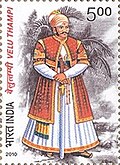
[[File:Stamp_of_India_-_2010_-_Colnect_259571_-_Velu_Thampi.jpeg|thumb|Stamp of Velu Thampi]] | |||
A commemorative postage stamp on him was issued on 6 May 2010.<ref>{{cite web |url=http://www.indiapost.gov.in/Stamps2010.aspx|title=Stamps | A commemorative postage stamp on him was issued on 6 May 2010.<ref>{{cite web|url=http://www.indiapost.gov.in/Stamps2010.aspx|title=Stamps – 2010|publisher=Department of Posts, Indian government|access-date=2 August 2013|archive-date=14 August 2013|archive-url=https://web.archive.org/web/20130814101038/http://www.indiapost.gov.in/Stamps2010.aspx|url-status=dead}}</ref> | ||
==Notes== | ==Notes== | ||
{{Reflist | {{Reflist}} | ||
==External links== | ==External links== | ||
{{Commons category}} | {{Commons category}} | ||
* [http://www.boloji.com/astro/00334a.htm Nangol Houses of Travancore] | * [http://www.boloji.com/astro/00334a.htm Nangol Houses of Travancore] {{Webarchive|url=https://web.archive.org/web/20080907124235/http://boloji.com/astro/00334a.htm |date=7 September 2008 }} | ||
{{Kingdom of Travancore}} | {{Kingdom of Travancore}} | ||
Latest revision as of 14:18, 15 March 2026
 | This article needs more citations. (March 2022) |
| Part of a series on the |
| History of Kerala |
|---|
  |

Velu Thampi Dalawa | |
|---|---|
 Statue of Veluthampi Dalawa at Mannadi in Adoor | |
| Diwan of Kingdom of Travancore | |
| In office 1802–1809 | |
| Preceded by | Jayanthan Sankaran Nampoothiri |
| Succeeded by | Ummini Thampi |
| Monarch | Balarama Varma |
| Personal details | |
| Born | 6 May 1765 Thalakulam, Travancore |
| Died | 1809 Mannadi, Travancore |
| Parent(s) | Manakkara Kunju Mayatti Pillai Valiyamma Pillai Thankachi |
Velayudhan Chempakaraman Thampi of Thalakulam (1765–1809) was the Dalawa or Prime Minister of the Indian kingdom of Travancore between 1802 and 1809 during the reign of Bala Rama Varma Kulasekhara Perumal. He is best known for being one of the earliest individuals to rebel against the British East India Company's authority in India.
Early life[edit | edit source]
Velayudhan Thampi was born in a Nair family to Manakkara Kunju Mayatti Pillai and his wife Valiyamma Pillai Thankachi of Thalakkulam. He was born on 6 May 1765 in the village of Thalakkulam in Travancore which is in the southern district of Travancore State, Kerala (present day Kanyakumari district, Tamilnadu). His full title was "Valiya Veettil Thampi Chempakaraman Velayudhan" being from the family that held the ownership of the province and the high title of Chempakaraman for their services to the modern state created by Maharajah Marthanda Varma. He was the grandson of Ettmar Varma Thampuran of Thattari Kovilakam, Parappanadu Swarupam. Velu Thampi, was appointed a Kariakkar or Tahsildar at Mavelikkara during the initial years of the reign of Maharajah Dharmaraja Ramavarma.[1][2][3]
Rise to Dalawaship[edit | edit source]
Bala Rama Varma was one of Travancore's least popular sovereigns whose reign was marked by unrest and various internal and external political problems.[4] He became rajah at the age of sixteen and fell under the influence of the corrupt nobleman Jayanthan Sankaran Nampoothiri from the Zamorin of Calicut's kingdom. One of the first atrocities of his reign was the deposition, arrest and poisoning of Raja Kesavadas,[5] the then Dewan of Travancore. Sankaran Nampoothiri was subsequently appointed Dewan (Prime Minister) assisted by two other ministers. The state treasury was soon empty due to corruption so it was decided to collect money by ordering the tahsildars (district officers) to pay large amounts of money which were determined without any reference to the revenue of the districts. Velu Thampi, the Tahasildar(Karyakar) of a southern district, was ordered to pay Rs. 3000 to which he responded that he needed three days to pay. Velu Thampi returned to his district, gathered the people and an uprising ensued. People from all parts of Travancore united to surround the palace and demand the immediate dismissal and banishment of Jayanthan Sankaran Nampoothiri. They also demanded that his two ministers (Matthoo Tharakan, Sankaranarayanan Chetty) be brought to a public place then undergo flogging and have their ears cut off. The punishments were duly carried out and the two ministers were put in jail at Trivandrum. Velu Thampi was later appointed the Dalawa of Travancore.[6]
Career as Dalawa[edit | edit source]

After Velu Thampi became Dalawa of Travancore, he faced serious opposition from two relatives of the late Raja Kesavadas who sought assistance to get rid of him from their associates in Bombay. These letters were intercepted and presented to the Maharajah in a negative light and he ordered the immediate execution of the two men, Chempakaraman Kumaran Pillai and Erayiman Pillai. Having cleared the way, Velu Thampi became established as the Dalawa with no opposition. The Madras Government sanctioned his appointment within a few months.
Even though Velu Thampi tried to enforce justice, he was not an able statesman like Ramayyan Dalawa or Raja Kesavadas, his immediate two predecessors. He was not diplomatic, but was of a rebellious, abrasive nature. Within three years of the death of Raja Kesavadas the country was plagued with corruption and various problems caused by the banished Namboodiri Dalawa. Velu Thampi resorted to harsh punishments with a view to improve the situation. Flogging, cutting off of ears and noses as well as nailing people to trees were some of the punishments adopted during his term as Dalawa. He was also very strict in punishing wrong doers. Nevertheless, his harsh measures produced results and peace and order were restored within a year of Velu Thampi's accession to the Dalawaship.[citation needed]
Initial intrigues against the Dalawa[edit | edit source]
The Dalawa's undue severity and overbearing conduct resulted in resentment amongst the Nair nobility, the very same people who had assisted his rise to power. A conspiracy was formed against him under the influence of Kunjunilam Pillai, a powerful Travancore cabinet official who succeeded in getting the Maharajah to sign a royal warrant to arrest and immediately execute Velu Thampi Dalawa.[7] The Dalawa was at Allepey when he received news of the conspiracy and immediately rushed to Cochin to meet the British Resident, Col. Colin Macaulay, who, by that time, had become a good friend. Col. Macaulay had already received evidence that Kunjunilam Pillai had a major hand in the murder of Raja Kesavadas and therefore he armed Dalawa Velu Thampi with a small force of British soldiers and sent him to Trivandrum to investigate Kunjunilam Pillai's conspiracy. Pillai was found guilty of murder and conspiracy and punished accordingly. With this obstacle removed, Velu Thampi regained his former influence.[8][citation needed]
Mutiny of the Nair troops[edit | edit source]
The armies of Travancore consisted mainly of members of the Nair group of castes. Velu Thampi's 1804 proposal to reduce their allowances was met with immediate discontent. The troops believed that the idea had come from the British and immediately resolved to assassinate both Col. Macaulay and Velu Thampi. Velu Thampi fled again back to Cochin to seek refuge with Col. Macaulay. The Nairs marched to Trivandrum with a ten thousand strong army of sepoys and demanded that the Maharajah immediately dismiss the Dalawa and end any alliance with the British. Meanwhile, the Resident and the Dalawa collected forces at Cochin and, assisted by the Carnatic Brigade, marched to Trivandrum and put an end to the mutiny. Several of its leaders were executed in the most gruesome manner. One Krishna Pillai, a commander of a regiment, had his legs tied to two elephants which were then driven in opposite directions, tearing his body into two, in the presence of the Dalawa; even at that time, Krishna Pillai was riposting Velu Thambi's tuants with harsh criticism of his own against Thambi.[9][10]
Alliance with the British[edit | edit source]
The Treaty signed with the British East India Company by the popular Maharajah Dharma Raja Rama Varma in 1795 was revised in what is known as the Treaty of 1805 (according to the English East India Company's policy of "Subordinate Isolation") after the insurrection of the Nair troops in Travancore. It increased the British Indian force stationed in Travancore and the amount of money to be paid as tribute to the British, though the expenditure of the State in maintaining its own standing army was drastically cut. This was the main change brought about in the Treaty of 1805.[11][citation needed]
The state of affairs immediately prior to the war[edit | edit source]
The Tranvancore-British Alliance had started in 1730s when the British had supported Travancore against the Dutch during the Travancore-Dutch War. This relationship had strengthened considerably during the Mysorean invasion of Kerala, especially during the attack on the Battle of the Nedumkotta which was used as a casus belli by the British against Mysore, since the action against Travancore breached the clauses of Treaty of Mangalore between Mysore and the British which had provided protection, thus leading to the Third Anglo-Mysore War. The British forces marched on to Mysore in aid of Tranvancore and Tipu lost the war.
After the Mysore wars and the death of Tipu Sultan, Travancore, owing to all its internal problems and external wars of the previous decades, found herself facing a serious financial crisis. The ratification of the Treaty with the British by Velu Thampi was intended to help Tranvancore improve its finances significantly, but the action created serious discontent as it increased the dependence of Travancore on the British and also made it indebted to the English Company. In spite of being fully aware of the financial crisis in Travancore, the Resident, Col. Macaulay, pressed Dalawa Velu Thampi for immediate payment of the large amount of the agreed war costs and the expenses of putting down the mutiny of the Nair troops. The Dalawa instigated the Majarajah to write to the Madras government requesting the recall of the Resident and appointment of a new Resident; this request was denied. But this action, perceived as ingratitude by Col. Macaulay who had twice saved Dalawa Thampi, irrevocably broke down the friendship between the former friends. The Resident pressurised the Dalawa for payments immediately.
The Dalawa was now also disillusioned with the British whom he had considered as friends and who considered any "aggression on Travancore as an aggression on themselves" as per the previous treaties. His frustruation materialised in the form of the assassination of the ambassador of the Resident in the Tranvancore court. The Maharajah, who by now also had reasons to be cautious of his Dalawa, had communicated his discontent with the Dalawa to this ambassador, a certain Sthanapathy Subba Iyer. This information was known to the Maharajahs wife, Arumana Amma, a noblewomen of the Arumana Ammaveedu family. She was a lady of influence, who apparently communicated Royal secrets to the Dalawa, and she informed the Dalawa of the Maharajah's intention to dismiss him, with support from the Resident. This increased the anger of the Dalawa towards the British. He felt that the Resident, in addition to demanding impossible amounts of money, had now started interfering with the internal affairs of the state.[citation needed]. Following this, Subba Iyer, the envoy of the Resident, who had met up with the Dalawa for discussions, was found dead, ostensibly due to a snake bite.[12]
At the same time, in the neighbouring Kingdom of Cochin, Paliyath Govindan Achan, the powerful Dalawa of Cochin, was involved in deadly feuds of his own with some of the other Nair nobility of Cochin. He had the army commander-in-chief, along with a previous minister, seized and drowned in the river at Chanamangalom. He then attempted to kidnap and murder his rival and sworn enemy, the finance minister Nadavarampathu Kunju Krishna Menon. The Maharajah of Cochin was forced to give Nadavarampathu Kunju Krishna Menon refuge in his own palace at Vellarapilli and then sent for Col. Macaulay and requested him to protect Kunju Krishna Menon. Col. Macaulay took Kunju Krishna Menon to the British Residence at Cochin under his own protection.[13] This act angered Paliyath Achan who then decided to kill not only Kunju Krishna Menon, but also his protector Col. Macaulay as well.
Insurrection[edit | edit source]
|

Velu Thampi Dalawa and the Paliath Achan, Govindan Menon, met and decided on the extirpation of the British Resident and end of British supremacy in their respective states. Dalawa Velu Thampi organised recruits, strengthened forts and stored up ammunition while similar preparations was made by the Paliath Achan in Cochin. Velu Thampi appealed to the Zamorin of Calicut and to the French for assistance, but both did not acknowledge the request.[14] The plan of the Paliath Achan and Velu Thampi was to join forces and attack the Fort of Cochin, storm the defences and murder the British Resident Colin Macaulay and Kunju Krishna Menon. Under the leadership of Vaikom Padmanabha Pillai, troops from the garrisons at Alleppey, Alangad and Paravoor were transferred stealthily through the backwaters in covered boats to Kalvathy[15] where they met up with four thousand of Paliyath Achan's followers.[16]
On the night of 28 December 1808, this united force attacked the Resident's palace and overwhelmed the Indian guards and domestics, but due to the warning of a native domestic, the Resident and Kunju Krishna Menon managed to escape the attacking army and flee to a frigate, the HMS Piedmontese, which had been anchored in Cochin harbour. Almost simultaneously, the rebels attacked the British garrison at Quilon on 30 December 1808, but were repulsed. Dissatisfied with the failure to capture or kill the Resident, as well as the failure at Quilon, Velu Thampi moved south from Cochin and on 11 January 1809 (1st Makaram 984 M.E.), he issued his famous Kundara Proclamation in which he exhorted the nation to throw out the British.[17] He then organised another force to attack the British garrison at Quilon and the Battle of Quilon[18] took place on 15 January 1809 in which Velu Thampi's force lost 15 guns and suffered many casualties.
Velu Thampi then sent a part of his force to launch another amphibious attack on the British garrison at Cochin, which was defended by Major Hewitt. On 18 January 1809, the rebel forces at Quilon were totally defeated when they attempted to storm the Quilon garrison. On 19 January 1809, the Cochin garrison, supported by the frigate HMS Piedmontese, along with some boats manned by Nair soldiers loyal to Paliyath Achan's many rivals and enemies amongst the Cochin nobility, successfully repelled another amphibious attack on the Cochin garrison.[19] On 30 January 1809, a small force of 3 military officers and 30 European soldiers, en route to Kochi, were captured and executed on the Dalawa's orders at Purakkad, even though one of the officers, Surgeon Hume, had treated Velu Thampi in the past.[20] A sick lady, who was a member of this party, was permitted to travel unharmed to Cochin, since it was contrary to the laws of Travancore to kill women.[21]
In the aftermath of the battle at Quilon, Velu Thampi moved to the southern border of Travancore to bolster the defence at Aramboly pass located at Aralvaimozhi. The two mile long fortifications at the Aramboly pass were guarded by masonry walls and had around 50 artillery pieces covering the road from Palayamkottai to defend it in the event of a frontal attack from that road. On 6 February 1809, a force under the Hon. Col. St. Leger marched from Tiruchirappalli and reached the fortified lines at Aramboly. On the morning of 10 February 1809, the British attacked the flanks of the fortified lines from the southern mountain and Velu Thampi fled from Aramboly.[22] The British forces moved into the interior of Travancore on 17 February 1809, and were held up by Thampi's men who were entrenched in a fortified dugout in Kottar. These soldiers were routed by Col. McLeod and within a few days, the strategic forts of Udayagiri and Padmanabhapuram fell to the British without a fight. On hearing the news, the rebels at Quilon dispersed and Col. Chalmers approached Trivandrum from the North and the Hon. Col. St. Leger approached from the south, in a pincer movement.[23]
Death of Velu Thampi[edit | edit source]
On hearing about the approach of the British forces, Velu Thampi fled from Trivandrum to Kilimanoor and the Maharajah, who officially, hitherto, had stayed neutral, suddenly turned against Dalawa Thampi and denounced him. On 24 February 1809, the Hon. Col. St. Leger had a letter delivered to the Maharajah demanding the surrender of Dalawa Thambi.[24] The Maharajah appointed one of his nobility, Marthandam Eravi Ummini Thampi, a sworn enemy of Velu Thampi, as the mediator between Travancore and the British. Ummini Thampi reached the British forces who were camped at Pappenamcode and conveyed the Maharajah's terms to them. A reward of 50,000 Travancore Rupees, a princely sum in those days, was offered for Velu Thampi's capture and both Travancore and British officers were deployed to find him. On 18 March 1809, the Maharajah appointed Ummuni Thampi as Dalawa with the blessings of the British. His officials tracked the former Dalawa Velu Thampi to the forests of Kunnathoor. Velu fled from there and took refuge with a priest at Mannadi. A local shopkeeper on noticing that an impoverished servant had some expensive gold utensils on his person, informed Dalawa Ummini Thampi's soldiers. This servant, who was an employee of the former Dalawa, was arrested by the new Dalawa's officials, who then inerrogated him to elicit all the information regarding Velu Thampi. On hearing this, Velu Thampi and his brother Padmanabhan Thampi, fled to the Bhagavathy temple at Mannadi. There when the temple was surrounded by the would-be captors who demanded that he surrender to them, the former Dalawa Velu Thampi committed suicide with his dagger [25] [citation needed]. Velu Thampi's brother Padmanabhan Thampi was caught at the scene. The body of Velu Thampi was exposed in the gibbet at Kannammoola.[26] Lord Minto, the then Governor General, strongly condemned this act, describing the act as "repugnant to the feelings of common humanity and the principles of a civilised government".[27]
Aftermath of the rebellion[edit | edit source]
During the trial for the murder of prisoners on the 30 January 1809 at Purrakad beach, Padmanabhan Thampi was found guilty of complicity in the act and was hanged at Trivandrum on 10 April 1809. Dalawa Ummuni Thampi took a brutal revenge on the family of his sworn enemy Dalawa Velu Thampi by levelling their ancestral house to the ground and had most of Velu Thampi's family banished to the Maldives. Other leaders such as Vaikom Padmanabha Pillai were executed by hanging at key locations such as Quilon, Purakkad and Palthuruthee.[28] The Paliyath Achan surrendered to the British and was exiled first to Madras and then to Benares where he died in 1835.[29] His nemesis, Kunju Krishna Menon prospered and later became the Dalawa of Cochin; in the later years, one of his daughters married one of the Maharajahs of Travancore. Maharajah Balarama Varma died in 1810 and Maharani Gowri Lakshmi Bayi took charge of the Kingdom first as Maharani and then as Queen Regent. Col. Macaulay retired in 1810 and left for Great Britain. Ummini Thampi Dalawa retired in 1811 and the then British resident, Col. John Munro, 9th of Teaninich was appointed as Dalawa. The reign of Maharani Gowri Lakshmi Bayi was a very englightened one and resulted in reduction of taxes, increased social justice, establishment of schools and hospitals.
The Government of Kerala instituted a memorial to Dalawa Velu Thampi, a research centre, a museum, a park and a statue at Mannadi near Adoor. Another statue of Velu Thampi Dalawa can be found in front of the Secretariat of Kerala in Trivandrum.
In popular culture[edit | edit source]
Veluthampi Dalawa is a 1962 Indian Malayalam-language film based on the life of the Dewan. Directed by G. Viswanath, it stars Kottarakkara Sreedharan Nair in the titular role.
Honours[edit | edit source]

The sword that was used by Velu Thampi Dalawa in his fight against the British, was kept with the Kilimanoor royal family, for about 150 years. It was presented in 1957, to India's then president Rajendra Prasad by a member of the royal family. On 20 June 2010 it was brought back to Kerala and was placed in the Napier Museum (Art Museum)Thiruvananthapuram, Kerala.[30]

A commemorative postage stamp on him was issued on 6 May 2010.[31]
Notes[edit | edit source]
- ↑ Sobhanan, B. (27 April 1978). "Dewan Velu Tampi and the British". Kerala Historical Society – via Google Books.
- ↑ Rajeev, Sharat Sunder (6 May 2016). "Home of the brave". The Hindu – via thehindu.com.
- ↑ "A real to reel story of a warrior". The New Indian Express.
- ↑ "TRAVANCORE UNDER BRITISH RULE" (PDF). shodhganga.inflibnet.ac.in.
- ↑ P. Shungunny Menon. History of Travancore. Page 245.
- ↑ P. Shungunny Menon. Thiruvithancore Charitram. (History of Travancore). Page 245-251.
- ↑ pg 422,The Travancore State Manual, V Nagam Aiyah, Dewan Peischar of Travancore, 1906, Travancore Government Press
- ↑ pg 423,The Travancore State Manual, V Nagam Aiyah, Dewan Peischar of Travancore, 1906, Travancore Government Press
- ↑ pg 424,The Travancore State Manual, V Nagam Aiyah, Dewan Peischar of Travancore, 1906, Travancore Government Press
- ↑ Page 309,P. Shungunny Menon. Thiruvithancore Charitram. (History of Travancore), Higginbotham and Co, Madras, 1878
- ↑ pages 312-317, Page 309,P. Shungunny Menon. Thiruvithancore Charitram. (History of Travancore), Higginbotham and Co, Madras, 1878
- ↑ Page 333,P. Shungunny Menon. Thiruvithancore Charitram. (History of Travancore), Higginbotham and Co, Madras, 1878
- ↑ Page 334,P. Shungunny Menon. Thiruvithancore Charitram. (History of Travancore), Higginbotham and Co, Madras, 1878
- ↑ Page 334,P. Shungunny Menon. Thiruvithancore Charitram. (History of Travancore), Higginbotham and Co, Madras, 1878
- ↑ page 336, A History of Travancore, author P Shungoonnoy Menon, Dewan Peischar of Travancore, 1878, published by Higginbotham and Co, Madras
- ↑ page 344, A History of Travancore, author P Shungoonnoy Menon, Dewan Peischar of Travancore, 1878, published by Higginbotham and Co, Madras
- ↑ pg 434-436,The Travancore State Manual, V Nagam Aiyah, Dewan Peischar of Travancore, 1906, Travancore Government Press
- ↑ "A place in history". The Hindu. 30 June 2006 – via thehindu.com.
- ↑ pg 438,The Travancore State Manual, V Nagam Aiyah, Dewan Peischar of Travancore, 1906, Travancore Government Press
- ↑ pg 439,The Travancore State Manual, V Nagam Aiyah, Dewan Peischar of Travancore, 1906, Travancore Government Press
- ↑ page 338, A History of Travancore, author P Shungoonnoy Menon, Dewan Peischar of Travancore, 1878, published by Higginbotham and Co, Madras
- ↑ pg 440-441,The Travancore State Manual, V Nagam Aiyah, Dewan Peischar of Travancore, 1906, Travancore Government Press
- ↑ pg 442,The Travancore State Manual, V Nagam Aiyah, Dewan Peischar of Travancore, 1906, Travancore Government Press
- ↑ page 351, A History of Travancore, author P Shungoonnoy Menon, Dewan Peischar of Travancore, 1878, published by Higginbotham and Co, Madras
- ↑ https://www.thehindu.com/news/cities/Thiruvananthapuram/velu-thampi-dalawas-sword-of-rebellion-takes-centre-stage/article4706870.ece
- ↑ Rajeev, Sharat Sunder (6 May 2016). "Home of the brave". The Hindu.
- ↑ pg 445,The Travancore State Manual, V Nagam Aiyah, Dewan Peischar of Travancore, 1906, Travancore Government Press
- ↑ page 349, A History of Travancore, author P Shungoonnoy Menon, Dewan Peischar of Travancore, 1878, published by Higginbotham and Co, Madras
- ↑ Menon, A. Sreedhara (1967). A Survey of Kerala History. Kerala: Sahithya Pravarthaka Company. pp. 322, 323, 324, 325
- ↑ "The Hindu : Kerala / Thiruvananthapuram News : Dalawa's sword comes home". www.hindu.com. Archived from the original on 26 June 2010. Retrieved 17 January 2022.
- ↑ "Stamps – 2010". Department of Posts, Indian government. Archived from the original on 14 August 2013. Retrieved 2 August 2013.
External links[edit | edit source]
- Nangol Houses of Travancore Archived 7 September 2008 at the Wayback Machine


- Pages using the JsonConfig extension
- Articles needing additional references from March 2022
- Articles needing additional references from April 2012
- Diwans of Travancore
- History of Kollam
- Malayali people
- People from Kanyakumari district
- 1809 deaths
- 1765 births
- 18th-century Indian people
- 18th-century Indian politicians
- 19th-century Indian people
- 19th-century Indian politicians