



No edit summary |
slightly cleaned up structure based on references further and cleaned formatting based on references |
||
| Line 1: | Line 1: | ||
{{ | {{Short description|Dynasty from southern India}} | ||
{{Use dmy dates|date=August 2019}} | {{Use dmy dates|date=August 2019}} | ||
{{Use Indian English|date=August 2019}} | {{Use Indian English|date=August 2019}} | ||
{{Infobox country | {{Infobox country | ||
|conventional_long_name = Ay | | conventional_long_name = Ay dynasty | ||
|common_name = Ay dynasty | | common_name = Ay dynasty | ||
|religion = [[Hinduism]] | | Official language = | ||
|p1 = | | religion = [[Hinduism]] | ||
|p2 = | | p1 = | ||
|s1 = | | p2 = | ||
|s2 = | | s1 = Venad (historical region) | ||
|s3 = | | s2 = | ||
|year_start = | | s3 = | ||
|year_end = | | year_start = | ||
| year_end = | |||
|date_start = | | date_start = | ||
|date_end = | | date_end = | ||
|event_start = | | event_start = | ||
|event_end = | | event_end = | ||
|image_coat = | | image_coat = | ||
|symbol_type = | | symbol_type = | ||
|image_map = | | image_map = | ||
|image_map_caption = | {{Location map+|Kerala|width=200|float=center | ||
|capital = | |caption= | ||
*Podiyil | |places= | ||
*[[Vizhinjam]] (medieval) | {{Location map~|Kerala|lat_deg=8.379167|lon_deg=76.991389|position=top|marksize=0|label_size=100|label=AYS (AY-VELS)}} | ||
| | }} | ||
| image_map_caption = | |||
|title_leader = | | capital = * Podiyil Hills or the Aykudi (early historic)<ref name=":034">{{harvp|Narayanan|2013|pp=191–193, 435–437}}</ref> | ||
|leader1 = | * [[Vizhinjam]] (medieval) | ||
| | | Official_languages = | ||
|leader2 = | | government_type = | ||
|year_leader2 = | * Chieftaincy (early historic) | ||
|leader3 = | * [[Monarchy]] (medieval) | ||
|year_leader3 = | | title_leader = | ||
|leader4 = | | leader1 = | ||
|year_leader4 = | | year_leader = | ||
|leader5 = | | leader2 = | ||
|year_leader5 = | | year_leader2 = | ||
|currency = | | leader3 = | ||
|category= | | year_leader3 = | ||
|footnotes = | | leader4 = | ||
|demonym=|area_km2=|area_rank=|GDP_PPP=|GDP_PPP_year=|HDI=|HDI_year=|today=}} | | year_leader4 = | ||
| leader5 = | |||
| year_leader5 = | |||
| currency = | |||
| category = | |||
| footnotes = | |||
| demonym = | |||
| area_km2 = | |||
| area_rank = | |||
| GDP_PPP = | |||
| GDP_PPP_year = | |||
| HDI = | |||
| HDI_year = | |||
| today = {{plainlist| | |||
*[[Kerala]] | |||
*[[Tamil Nadu]] | |||
}} | |||
}} | |||
'''Ay dynasty''' was | '''Ay dynasty''' (transliteration: Āy, {{IPA|ta|aːj|IPA}}), also known as '''Kupaka''' in medieval period,<ref name=":134">{{harvp|Narayanan|2013|p=179}}</ref>{{efn|The title "Kupaka" (Attingal; in Malayalam) was later used to denote the ruler of Venad, the successor state to the Ay kingdom in south India.<ref>{{cite journal |author=Vielle |first=Christophe |year=2011 |title=Real and Ideal Kings in Matrilineal Kerala |url= |journal=Religions of South Asia |volume=5 |issue=1/2 |page=368 |doi=10.1558/rosa.v5i1/2.365 |issn=1751-2689|hdl=2078.1/129594 |hdl-access=free }}</ref>|}} was an Indian dynasty which controlled the south-western tip of the [[Indian peninsula|peninsula]], from the early historic period up to the medieval period.<ref name=":62">{{Cite journal |last=Ganesh |first=K. N. |date=2009 |title=Historical Geography of Natu in South India with Special Reference to Kerala |journal=Indian Historical Review |volume=36 |issue=1 |pages=3–21 |doi=10.1177/037698360903600102 |issn=0376-9836 |s2cid=145359607}}</ref> The clan traditionally held sway over the port of [[Vizhinjam]], the fertile region of [[Nanjinad]], and southern parts of the spice-producing [[Western Ghats|Western Ghat]] mountains.<ref name=":134" /> The Ays were traditionally subject to the [[Pandya dynasty|Pandya]] rulers of Madurai.<ref name=":2">{{Cite book |last=Veuthat |first=Kesavan |url=https://orientblackswan.com/details?id=9788125046516 |title=The Political Structure of Early Medieval South India |publisher=Orient Longman |year=1993 |location=New Delhi |pages=113-114 |chapter=The Role of the Chiefs}}</ref> | ||
The Ay formed one of the major | The Ay formed one of the major rulers of early historic [[Kerala]], along with the [[Chera dynasty|Cheras]] of central Kerala and the [[Mushika dynasty|rulers of Ezhimalai]] in the north.<ref name=":0">{{Cite journal |last=Gurukkal |first=Rajan |date=2002 |title=Did State Exist in the Pre-Pallavan Tamil Region |journal=Proceedings of the Indian History Congress |volume=63 |pages=138–150 |jstor=44158082 |issn=2249-1937}}</ref><ref name=":034" /> [[List of Graeco-Roman geographers|Greek geographer]] [[Claudius Ptolemy]] (2nd century CE) described the "Aioi" territory as extending from the [[Pamba River|Baris (Pamba)]] to [[Kanyakumari|Cape Comorin (Kanyakumari)]].<ref name="Sreedhara Menon">{{Cite book |last=Menon |first=A. Sreedhara |url=https://books.google.com/books?id=FVsw35oEBv4C&q=chera+dynasty |title=A Survey of Kerala History |publisher=D C Books |year=2007 |isbn=978-81-264-1578-6 |location=Kerala |pages=97–98|orig-year=1967}}</ref> The [[Indian elephant|elephant]] was the emblem of the early historic Ay rulers.<ref name="Sreedhara Menon" /> | ||
The | The Ay kingdom, whose ancient rulers could, at that time, be considered among the several "political chiefs", functioned as a buffer state between the powerful [[Pandyan dynasty|Pandyas]]/[[Chola dynasty|Cholas]] and the [[Chera dynasty|Cheras (Kerala)]] during the medieval period.<ref name="Sreedhara Menon" /><ref name=":24">{{Cite book |last=Veluthat |first=Kesavan |url=https://global.oup.com/academic/product/the-early-medieval-in-south-india-9780198069140 |title=The Early Medieval in South India |date=2009 |publisher=Oxford University Press |location=Delhi |pages=38-39, 180, 186 and 254}}</ref> A number of kings such as Chadayan Karunanthan (''c.'' 788/89 CE), Karunandatakkan "Srivallabha" (r. ''c.'' 856/57 – 884 CE), and [[Vikramaditya Varaguna|Vikramaditya "Varaguna"]] (r. ''c.'' 884 – 911/920 CE) figure as the Ay chiefs of the port of Vizhinjam.<ref name=":034" /><ref name=":232">{{Cite thesis |last=Gurukkal |first=Rajan |title=The Agrarian System and Socio-Political Organisation Under the Early Pandyas c. CE 600–1000 |degree=PhD |pages=29–30 |hdl=10603/14532 |hdl-access=free |institution=Jawaharlal Nehru University |year=1984 <!-- we don't attribute thesis advisors |editor-last=Champakalakshmi |editor-first=R.-->}}</ref> Shifts in allegiance between the [[Pandya dynasty|Pandyas]] and [[Chera dynasty|Cheras]] persisted, with the Ay rulers adopting Pandya surnames, yet they refrained from using Pandya regnal years in their inscriptions, signalling their continued autonomy despite their affiliation.<ref name=":2" /> Historians assume that the Ay were a leading power in south Kerala till c. 10th century CE.<ref name=":83">{{Cite thesis | degree= PhD |last=Ganesh |first=K. N. |hdl=10603/16385 |hdl-access=free |title=Agrarian Relations and Political Authority in Medieval Travancore (AD 1300–1750) |institution=Jawaharlal Nehru University |year=1987 <!-- no thesis advisor credit included |editor-last=Champakalakshmi |editor-first=R.--> |pages=22–25}}</ref> | ||
== | == Origins == | ||
The medieval Ay lineage claimed its origins from the hill-chiefs the same name (the Ays) from early historic (pre-[[Pallava dynasty|Pallava]]) south India.<ref name=":0" /><ref name=":62" /> Members of the Ay family – of the [[Pothigai|Podiyil Hills (the Aykudi)]] – were related to the early historic [[Chera dynasty|Cheras]] of central Kerala.<ref name=":034" /> | |||
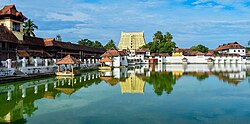
[[Padmanabhaswamy Temple|Sri Padmanabhaswamy]] was the tutelary deity of the medieval Ay family.<ref name="Sreedhara Menon1">{{Cite book |last=Menon |first=A. Sreedhara |url=https://books.google.com/books?id=FVsw35oEBv4C&q=chera+dynasty |title=A Survey of Kerala History |publisher=D C Books |year=2007 |isbn=978-81-264-1578-6 |location=Kerala (India) |pages=102|orig-year=1967}}</ref> The medieval Ay claimed that they belonged to the [[Yadava]]/[[Nanda (Hinduism)|Nanda]] or [[Vrishni]] lineage (Parthivapuram Grant and Paliyam Copper Plates).<ref name=":72">{{Cite journal |last=Ganesh |first=K. N. |date=1990 |title=The Process of State Formation in Travancore |journal=Studies in History |volume=6 |issue=1 |pages=15–33 |doi=10.1177/025764309000600102 |issn=0257-6430 |s2cid=162972188}}</ref><ref name=":1">{{Cite book |last=Aiya |first=V. Nagam |url=https://books.google.com/books?id=HTJuAAAAMAAJ&q=travancore+royaL+family+ay |title=The Travancore State Manual |publisher=Kerala Gazetteers Department, Government of Kerala |year=1999 |isbn=978-81-85499-32-1 |volume=1 |language=en |orig-year=1906}}</ref> This claim was advanced by the later rulers of [[Venad]] and [[Travancore]].<ref name=":72" /> Ays are also described as having come to the south India from [[Dvārakā|Dwaraka]] along with sage [[Agastya]].<ref name="Sreedhara Menon" /> | |||
=== Relation to Travancore Royal Family === | |||
It is speculated that after the decline of the Ays, some branches of the Ay family moved their headquarters to [[Thiruvalla]] and settled in the vicinity of Kadapra ([[Niranam]]).<ref name=":3">{{Cite book |last=Chackochan |first=P. L. |url=https://shodhganga.inflibnet.ac.in/handle/10603/563332 |title=Historical and Cultural Geography of Venadu (Travancore) c. AD 1124-1729 |date=1979 |work= |publisher=Deccan College Post Graduate And Research Institute |pages=36-37 |hdl=10603/563332}}</ref> They seem to have appeared in the 12th and 13th centuries as the Chirayavay branch, claiming descent from the "[[Yadava|Yadu Kula]]", and ruled near Thiruvalla with Athanthuruthi as their headquarters.<ref name=":3" /> In the second half of the 13th century, the Chirayavay branch merged with the Kizhperur branch of the Venad family.<ref name=":3" /> A branch of the Ay family, which had established itself at Thrippappur, also appears to have later merged with the Kizhperur house.<ref name="Sreedhara Menon3" /> | |||
== History == | |||
[[File:Thiruvananthapuram Padmanabhaswamy Temple.jpg|thumb|[[Padmanabhaswamy Temple|Sri Padmanabhaswamy]] was the tutelary deity of the medieval Ay family|335x335px]] | |||
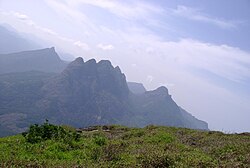
[[File:Pothigai Hills Range.jpg|thumbnail|[[Pothigai|Podiyil Hills]] (the Aykudi)|335x335px]] | |||
The Ay clan was one of the major hill-chiefs (or the [[Velir|Vels]]) of early historic south India.<ref name="Sreedhara Menon" /><ref name=":s24">{{Cite book |last=Veluthat |first=Kesavan |url=https://global.oup.com/academic/product/the-early-medieval-in-south-india-9780198069140 |title=The Early Medieval in South India |date=2009 |publisher=Oxford University Press |location=Delhi |pages=38-39 and 334}}</ref> Members of the Ay family – of the [[Pothigai|Podiyil Hills or the Aykudi]] – were related to the early historic [[Chera dynasty|Cheras]] of central Kerala/western Tamil Nadu.<ref name=":034"/> In [[Sangam literature|ancient Tamil literature]], they are represented as falling under the influence of the [[Pandya dynasty|Pandyas]] at certain times and under the Chera sphere of control at others.<ref name=":2" /> Towards the close of the early historic period, [[Pandyan dynasty|Pandya]] supremacy might have extended to the Ay territory (through it is likely that the Ay gained their independence during the [[Kalabhra dynasty|Kalabhra]] period).<ref name=":034"/><ref name="Sreedhara Menon" /> | |||
=== Ay chieftains of early historic south India === | === Ay chieftains of early historic south India === | ||
A number of Ay chiefs such as Andiran, Titiyan and Atiyan are mentioned in the early Tamil poems.<ref name=":034"/> | A number of Ay (Ay-Vel) chiefs — such as Andiran, Titiyan, and Atiyan — are mentioned in the [[Sangam literature|early Tamil poems (the Sangam Collection)]].<ref name=":034" /><ref name=":s24" />.These rulers were renowned for their possession of numerous elephants, their palaces, [[Chariot|chariots]], and horses, and for their control over the mountainous marches of the southernmost section of the [[Western Ghats]], including the prominent [[Pothigai|Podiyil Hill]].<ref name=":520M">{{cite book |last1=Sastri |first1=K. A. Nilakanta |author-link1= |url=http://indianculture.gov.in/ebooks/comprehensive-history-india-vol-ii-mauryas-and-satavahanas |title=Comprehensive History of India, vol. 2: The Mauryas and Satavahanas |publisher=Orient Longman |year=1957 |isbn= |location=Bombay |pages=527-28 |chapter= |orig-year=}}</ref> | ||
Ay Andiran is praised by early Tamil poets such as Uraiyur Enicheri Muda Mochiyar, Turaiyur Odaikizhar, and Kuttuvan Kiranar in the [[Purananuru]].<ref name=":034" /> He is described there as the "Lord of Podiyil Mala" in the southern Western Ghats and is said to have defeated the Kongu chief and driven him as far as the Sea.<ref name="Sreedhara Menon" /> Andiran was an elder contemporary of the famous [[Chera dynasty|Chera]] ruler Antuvan Cheral, dated to around c. 140 CE.<ref name=":20">{{cite book |last1=Sastri |first1=K. A. Nilakanta |author-link1= |url=http://indianculture.gov.in/ebooks/comprehensive-history-india-vol-ii-mauryas-and-satavahanas |title=Comprehensive History of India, vol. 2: The Mauryas and Satavahanas |publisher=Orient Longman |year=1957 |isbn= |location=Bombay |pages=517-18 |chapter= |orig-year=}}</ref><ref name="Sreedhara Menon" /><ref name=":520M" /> Ay Titiyan, also known as Podiyil Chelvan, is praised by Paranar and Bhuta Pandya (the [[Pandya dynasty|Pandya]] ruler) in the [[Akanaṉūṟu|Akananuru]], and it appears that he served as a vassal of Bhuta Pandya.<ref name="Sreedhara Menon" /><ref name=":034" /> Ay Atiyan, the successor of Ay Titiyan, is mentioned by Paranar and Madurai Kanakkayanar in the Akananuru; these poets also note that Podiyil Mala, the Ay stronghold, later became the property of Pachupun Pandya ("the Azhakiya Pandya"), the successor of Bhuta Pandya.<ref name=":034" /> An Ay ruler also participated in the famous battle of Talai-yalankanam, in which the Pandya chief Nedum Chezhiyan defeated several of his enemies.<ref name="Sreedhara Menon" /> | |||
Originally, the entire region of [[Venad kingdom|Venad]] ("Vel+nadu", meaning "the country of the Vel people", who were related to the Ay family) formed part of the larger Ay-Vel territory, and members of the Ay family served as chieftains of this Vel country.<ref name=":b">{{harvp|Narayanan|2013|p=75}}</ref><ref name=":c">{{harvp|Narayanan|2013|p=106}}</ref> Veliyan Venmal Nallini, or "Venmal Nallini, the daughter of the Veliyan", was the wife of the renowned Chera ruler Utiyan Cheralatan, dated to around c. 130 CE.<ref name=":c" /><ref name=":20" /> Another prominent figure, "Veliyan Venman" Ay Eyinan—possibly the son of the same Veliyan—was among the warriors assembled by the famous Chera ruler [[Perum Cheral Irumporai]] (c. 190 CE) to oppose Nannan of [[Ezhimalai]] (fl. c. 180 CE) in the well-known battle of Pazhi. Eyinan, who had once shared a friendship with Nannan, is said to have fallen during the course of the battle while fighting against certain Minjili or Njimili.<ref name=":520">{{cite book |last1=Sastri |first1=K. A. Nilakanta |author-link1= |url=http://indianculture.gov.in/ebooks/comprehensive-history-india-vol-ii-mauryas-and-satavahanas |title=Comprehensive History of India, vol. 2: The Mauryas and Satavahanas |publisher=Orient Longman |year=1957 |isbn= |location=Bombay |pages=511 and 538 |chapter= |orig-year=}}</ref> | |||
=== Pandya | === As medieval political chiefs === | ||
[[File:Trivandrum Museum Stone Inscription | [[File:Siva_as_"Tripurantaka"_in_Vizhinjam_Cave_Temple_(Trivandrum,_Kerala).jpg|thumb|Siva as "Tripurantaka" in Vizhinjam Cave Temple.]] | ||
The Ay rulers of early medieval south India were among several local "political chiefs" who acknowledged the authority of major dynasties such as the [[Chera dynasty|Cheras]] or the [[Pandya dynasty|Pandyas]]. Along with the [[Mushika dynasty|Mushikas or the Ezhimala rulers]] of northern Kerala, the Ays notably traced their lineage back to the early historic period. This ancient ancestry distinguished them from other chiefly families in Kerala, who were typically of more recent origin or had been "nominated" by the medieval Cheras.<ref name=":24" /> However, shifts in allegiance between the Pandyas and the Cheras persisted. Although the Ay rulers adopted Pandya royal surnames such as "Srivallabha" and "Varaguna", they did not employ Pandya regnal years in their inscriptions, indicating a degree of autonomy despite the association.<ref name=":2" />[[File:Trivandrum Museum Stone Inscription (Pandya dynasty, "Maran Chatayan" Jatila Parantaka).jpg|thumb|Trivandrum Museum Stone Inscription of Maran Chadayan (latter half of the 8th century)|354x354px]] | |||
Inscriptional evidence indicates that renewed [[Pandya dynasty|Pandya]] incursions into the southern Kerala began in the mid-8th century CE. Around 765 CE, [[Pandyan dynasty|Pandya]] king Jatila Paranthaka/Nedum "Maran" Chadayan Varaguna I (r. 765–815 CE) notably sacked the Ay port of [[Vizhinjam]] by defeating the Vel chieftain (the "Vel Mannan", who might have been related to the Ay family) and took possession of the Ay-Vel country ("the fertile country along with its magnificent treasures") (Madras Museum Plates of Jatila Parantaka, 17th regnal year).<ref name=":83" /><ref name=":d">{{harvp|Narayanan |2013|pp=93–94}}</ref> This event is perhaps also remembered in the Velvikkudi plates (3rd regnal year, Nedum Chadayan) as "the suppression of the rebellious Ay-Vel" (or at the battle of "nattukkurumbu").<ref name=":d" /> | |||
The Pandya foray into | The Pandya foray into southern Kerala may have drawn the medieval Chera rulers into the conflict, leading to a prolonged Pandya–Ay/Chera struggle.<ref name=":d" /> It is recorded that the Pandya king "Maran Chadayan" Jatila Paranthaka destroyed a fort at Aruviyoor (identified with Aruvikkarai near [[Thalakulam]]) by defeating Ay ruler Chadayan Karunanthan of "Malai Nadu" in 788/789 CE (dated to 23rd regnal year, Kalukumalai inscription).<ref name=":c" /> In 792 CE (27th regnal year, Jatila Paranthaka), the Chera warriors (the Cheramanar Padai) are seen fighting for a fort at [[Vizhinjam]] and at Karaikkotta (identified with Karaikkodu near [[Thalakulam]]) against a commander of Maran Chadayan (Trivandrum Museum Stone Inscription of Maran Chadayan).<ref name=":b" /> | ||
By the 9th century CE, as a result of the encroachments of the Pandyas and the medieval [[Chera-Perumal kingdom|Chera rulers]], the ancient Ay territory was partitioned into two portions.<ref name=":f">{{harvp|Narayanan|2013|pp=94–95}}</ref> [[Venad]] (or the Country of the Vel People), with its headquarters at [[Kollam]], came under influence of the medieval [[Chera-Perumal kingdom|Chera rulers of Kerala]]<ref name=":83" /> while the Ay kingdom, or what remained of it, based at [[Vizhinjam]], came under the influence of the Pandya ruler Srimara Srivallabha (r. 815–862).<ref name=":f" /><ref name=":62" /> This corroborated by the Larger Cinnamanur Plates, which record a victory of king Srivallabha at the port of Vizhinjam.<ref name=":e2">{{harvp|Narayanan|2013|p=107}}</ref> Karunanthadakkkan "Srivallabha" (r. c. 856/57–884), who served as the Ay vassal under Srimara Srivallabha, is particularly noted for founding the Parthivapuram Salai.''<ref name=":e2" /><ref name=":32" />'' | |||
Srimara Srivallabha was succeeded on the [[Pandya dynasty|Pandya]] throne by Varaguna II (r. 862–885 CE).<ref name=":034" /> The Ay kings of Vizhinjam continued as vassals of the Pandyas, as indicated by the Pandya surname ("Varaguna") borne by king [[Vikramaditya Varaguna|Vikramaditya]] (r. c. 884–911/920 CE<ref name=":232"/>).<ref name=":034" /> | |||
The Pandyas were defeated in the "great battle of Sripurambiyam" around 885 CE.<ref name=":f2">{{harvp|Narayanan |2013|pp=96–98}}</ref> The considerable influence of the Chera rulers in the Ay country following this battle is evident in two records discovered from the region.<ref name=":f2" /> The first is an inscription of Kizhan Adikal Ravi Neeli, queen of the Chera ruler [[Vijayaraga]], preserved at Tirunandikkara, a Shiva temple located in the Ay country.''<ref name=":f2" /><ref name=":e3">{{harvp|Narayanan|2013|pp=109–110}}</ref>'' The second is the [[Paliyam copper plates]], which record large land grants made in c. 898 CE by the Ay ruler Vikramaditya "Varaguna" to a [[Buddhism|Buddhist]] [[vihara]] in the Chera Perumal kingdom.''<ref name=":034" /><ref name=":24" />'' | |||
The | The later years of Vikramaditya's reign may have coincided with the [[Chola dynasty|Chola]] conquest of the Pandya country under king [[Parantaka I]] (c. 910 AD). It is therefore likely that the Ays were liberated from Pandya overlordship during this period.<ref name=":Sa4">{{Cite book |last=Narayanan |first=M. G. S. |url=https://books.google.com/books?id=2vp0SW6Gj3IC |title=Cultural Symbiosis in Kerala |publisher=Kerala Historical Society |year=1972 |location=Trivandrum |pages=15–16 |chapter=Vikramaditya Varaguna and Srimulavasa Vihara}}</ref> Inscriptions of [[Parantaka I]] (907 — 955 AD) have been found at [[Courtallam|Kuttalam]] (24th and 36th regnal year) and at [[Suchindram]] (40th regnal year) within the Ay country.<ref>{{harvp|Narayanan|2013|p=98 and 111}}</ref> | ||
== Legacy == | |||
In general, the influence of the Kerala rulers — such as the chieftains of [[Venad]], who owed allegiance to the medieval Chera rulers — seems to have extended into the southern Ay territory in the 10th century CE.<ref name=":83" /><ref name=":034" /> By the early 11th century, the entire region, including the port of [[Vizhinjam]] and [[Cape Comorin]], had come under the control of the imperial [[Chola dynasty|Cholas]].<ref name=":034" /> The Senur inscription of emperor [[Rajaraja I]], dated to 1005 AD, notably mentions only the ruler of [[Kollam]] (i. e., Venad) in southern Kerala.<ref name=":g">{{harvp|Narayanan|2013|pp=118–119, 137–138}}</ref> | |||
There is a possibility that the Venad chieftains, following the Chola raids, attempted to recapture the old Ay region. Emperor [[Rajadhiraja Chola|Rajadhiraja]] claims to have "confined the undaunted king of Venadu [back] to the Che[ra]natu [from the Ay country]... and liberated the [Ay?] king of Kupaka... and put on a fresh garland of Vanchi flowers after the capturing Kantalur Salai while the strong Villavan [the Chera king] hid himself in terror inside the jungle" (an event dated to c. 1018/19 CE<ref name=":034" />).<ref name=":83" /> | |||
A branch of the Ay family, which had established itself at Thrippappur and exercised control over the [[Padmanabhaswamy Temple]], later appears to have merged with the Kizhperur house, the ruling lineage of [[Venad]].<ref name="Sreedhara Menon3">{{Cite book |last=Menon |first=A. Sreedhara |url=https://books.google.com/books?id=FVsw35oEBv4C&q=chera+dynasty |title=A Survey of Kerala History |publisher=D C Books |year=2007 |isbn=978-81-264-1578-6 |location=Kerala |page=102 |orig-year=1967}}</ref> | |||
== Major medieval Ay grants == | == Major medieval Ay grants == | ||
{| class="wikitable" style="width: 75%;" | {| class="wikitable" style="width: 75%;" | ||
|+Major medieval Ay grants<ref name=": | |+Major medieval Ay grants<ref name=":232"/> | ||
!Grant name | !Grant name | ||
!Date | !Date | ||
! | !Summary | ||
! | !Image | ||
|- | |- | ||
! colspan="4" | | ! colspan="4" |Karunanthadakkan Srivallabha (r. c. 856/57–884 CE) | ||
|- | |- | ||
|[[Parthasarathy temple, Parthivapuram|Parthivapuram Grant]] | |[[Parthasarathy temple, Parthivapuram|Parthivapuram Grant]] | ||
(Trivandrum Huzur Office Plates) | (Trivandrum Huzur Office Plates) or (the "Huzur Office Plates of Kokkarunandadakkar") | ||
| | | | ||
* Tamil (ending portion in Sanskrit)<ref name=":32">{{Cite book|last=Rao|first=T. A. Gopinatha|title=Three Inscriptions of Kokkarunandadakkar|publisher=Government of Travancore | * Regnal year 9 = 865/66 CE ([[Elamkulam Kunjan Pillai|Ilamkulam]]; Narayanan, 1972)<ref name=":S">{{Cite book |last=Narayanan |first=M. G. S. |url=https://books.google.com/books?id=2vp0SW6Gj3IC |title=Cultural Symbiosis in Kerala |publisher=Kerala Historical Society |year=1972 |location=Trivandrum |pages=10–13, 45 |chapter=Vikramaditya Varaguna and Srimulavasa Vihara}}</ref> | ||
* Establishment of Vishnu | * Regnal year 9 = 869 CE (Krishnan, 1989)<ref>{{Cite journal |last=Krishnan |first=K. G. |date=1989 |title=Pārthivapuram Inscription of (Kollam) Year 98+1 |url=https://ignca.gov.in/Asi_data/79612.pdf |journal=Epigraphia Indica |publisher=Archaeological Survey of India |volume=XLI: 1975-76 |pages=3 of pp. 1-6}}</ref> | ||
* Establishment of Parthivapuram [[Śālā|Salai]] with the temple<ref name=":32" /><ref name="Scharfe2018">{{cite book|author= | | | ||
* Mentions the 'Rules of Parthivapuram Salai'<ref name=":32" /><ref name="Scharfe2018"/> | * Tamil (ending portion in Sanskrit).<ref name=":32">{{Cite book |last=Rao |first=T. A. Gopinatha |url=https://archive.org/details/in.ernet.dli.2015.367520 |title=Three Inscriptions of Kokkarunandadakkar |publisher=Government of Travancore |isbn= |edition=1910 |series=Travancore Archaeological Series |date=1910 |volume=I |location=Madras |pages=10–14 and 14–15}}</ref> | ||
* Calls the king a member of the 'Nanda and Yadava family'.<ref name=":32" /> | * Establishment of [[Parthasarathy temple, Parthivapuram|Parthasarathy Vishnu Temple]], Parthivapuram.<ref name=":32" /><ref name="Scharfe2018"/> | ||
* Establishment of Parthivapuram [[Śālā|Salai]] with the temple.<ref name=":32" /><ref name="Scharfe2018">{{cite book |author=Scharfe |first=Hartmut |url=https://books.google.com/books?id=GMyiDwAAQBAJ&pg=PA175 |title=Education in Ancient India |publisher=Brill Academic |year=2002 |isbn=978-90-474-0147-6 |pages=175–176}}</ref> | |||
* Mentions the 'Rules of Parthivapuram Salai'.<ref name=":32" /><ref name="Scharfe2018"/> | |||
* Calls the king a member of the '[[Nanda (Hinduism)|Nanda]] and Yadava family'.<ref name=":32" /> | |||
| [[File:Parthivapuram Grant (9th century AD).png|Parthivapuram Grant|center|frameless|304x304px]] | | [[File:Parthivapuram Grant (9th century AD).png|Parthivapuram Grant|center|frameless|304x304px]] | ||
|- | |- | ||
|Tiruvidaikkodu inscription I | |Tiruvidaikkodu inscription I | ||
|Regnal year 14 = 870 | |Regnal year 14 = 870 CE | ||
(Narayanan, 1972) | |||
| | | | ||
* Tamil (Vattezhuthu)<ref name=": | * Tamil (Vattezhuthu)<ref name=":32" /> | ||
* A private donation to the Tiruvidaikkodu Shiva temple<ref name=": | * A private donation to the Tiruvidaikkodu Shiva temple.<ref name=":32" /> | ||
|[[File:Tiruvidaikkodu inscription I (9th century AD), south India.png|Tiruvidaikkodu inscription I|293x293px|center|frameless]] | |[[File:Tiruvidaikkodu inscription I (9th century AD), south India.png|Tiruvidaikkodu inscription I|293x293px|center|frameless]] | ||
|- | |- | ||
|Tiruvidaikkodu inscription II | |Tiruvidaikkodu inscription II | ||
|Regnal year 22 = 878 | |Regnal year 22 = 878/79 CE (Narayanan, 1972)<ref name=":S" /> | ||
| | | | ||
* Tamil (Vattezhuthu)<ref name=": | * Tamil (Vattezhuthu)<ref name=":32" /> | ||
* Donation to the Tiruvidaikkodu Shiva temple by Karunanthadakkkan Srivallabha <ref name=": | * Donation to the Tiruvidaikkodu Shiva temple by Karunanthadakkkan Srivallabha.<ref name=":32" /> | ||
| | | | ||
|- | |- | ||
! colspan="4" | | ! colspan="4" |[[Vikramaditya Varaguna]] | ||
(r. c. 884–911/920 CE) | |||
|- | |- | ||
|Thirunandikkarai (Trivandrum Huzur Office Plates) | |Thirunandikkarai (Trivandrum Huzur Office Plates) | ||
|Regnal year 8 = 892 | |Regnal year 8 = 892 CE (Narayanan, 1972) | ||
| | | | ||
* Tamil (Tamil script with Grantha)<ref name=":TTH" /> | * Tamil (Tamil script with Grantha).<ref name=":TTH" /> | ||
*Murukan Chendi as | *Murukan Chendi as the Ay-kula Mahadevi.<ref name=":TTH">{{Cite book |last=Rao |first=T. A. Gopinatha |url=https://archive.org/details/in.ernet.dli.2015.367520 |title=The Huzur Office Plate of Vikramaditya Varaguna |publisher=Government of Travancore |isbn= |edition=1910 |series=Travancore Archaeological Series |date=1910 |volume=I |location=Madras |pages=02–03}}</ref> | ||
* Donation of land by | * Donation of land by Vikramaditya to Murukan Chendi.<ref name=":TTH" /> | ||
|[[File:Thirunandikkarai Inscription (Vikramaditya Varaguna).png|Thirunandikkarai Inscription|293x293px|center|frameless]] | |[[File:Thirunandikkarai Inscription (Vikramaditya Varaguna).png|Thirunandikkarai Inscription|293x293px|center|frameless]] | ||
|- | |- | ||
|[[Paliyam Copper Plates]] | |[[Paliyam Copper Plates]] | ||
|898 AD<ref name=": | |Regnal year 15 = 898 CE (Revised from 925 AD, Narayanan, 1972)<ref name=":34">{{harvp|Narayanan |2013|pp=75, 93–94, 96–98, 106–107, 109–110, 118–119, 137–138, 179}}</ref><ref name=":S3">{{Cite book |last=Narayanan |first=M. G. S. |url=https://books.google.com/books?id=2vp0SW6Gj3IC |title=Cultural Symbiosis in Kerala |publisher=Kerala Historical Society |year=1972 |location=Trivandrum |pages=10-13 and 45 |chapter=Vikramaditya Varaguna and Srimulavasa Vihara}}</ref> | ||
| | | | ||
* A large land donation to a [[Buddhism|Buddhist]] vihara in central Kerala by Vikramaditya Varaguna.<ref name=": | * A large land donation to a [[Buddhism|Buddhist]] vihara in central Kerala by Vikramaditya Varaguna.<ref name=":34" /><ref name=":TP">{{Cite book |last=Rao |first=T. A. Gopinatha |url=https://books.google.com/books?id=8WETy9zpa3EC |title=Two Inscriptions of Vikramaditya Varaguna |publisher=Government of Travancore |isbn= |edition=1912 |series=Travancore Archaeological Series |date=1912 |volume=XII |location=Madras |pages=192–93}}</ref> | ||
|[[File:Paliyam copper plate (Vikramaditya Varaguna).jpg|Paliyam Copper Plates|367x367px|center|frameless]] | |[[File:Paliyam copper plate (Vikramaditya Varaguna).jpg|Paliyam Copper Plates|367x367px|center|frameless]] | ||
|- | |||
|Thirupparappu Plates<ref name=":89">{{Cite book |last=Rao |first=T. A. Gopinatha |url=https://books.google.com/books?id=8WETy9zpa3EC |title=Tirupparappu Fragmentary Set of Copper-Plates |publisher=Government of Travancore |isbn= |edition=1912 |series=Travancore Archaeological Series |date=1912 |volume=XIII |location=Madras |pages=197–99}}</ref><ref name=":232"/> | |||
|9th century CE<ref name=":89"/> | |||
| | |||
* Mentions king Karunanthadakkkan Srivallabha.<ref name=":89"/> | |||
|[[File:Tirupparappu fragmentary copper plate inscription (Ay dynasty).jpg|Thirupparappu Plates|293x293px|center|frameless]] | |||
|} | |} | ||
==See also== | ==See also== | ||
* [[Velir]] | |||
* [[Vizhinjam]] | * [[Vizhinjam]] | ||
* [[Pandya dynasty]] | * [[Pandya dynasty]] | ||
* [[Chera dynasty]] | * [[Chera dynasty]] | ||
*[[Chera | * [[Chera Perumals of Makotai|Cheras of Makotai]] | ||
== Notes == | |||
{{notelist}} | |||
== References == | == References == | ||
===Sources=== | |||
* {{Cite book |last=Narayanan |first=M. G. S. |url=https://books.google.com/books?id=0YDCngEACAAJ |title=Perumals of Kerala |publisher=CosmoBooks |year=2013 |isbn=9788188765072 |location=Thrissur (Kerala) |orig-date=1972}} | |||
===Citations=== | |||
{{Reflist}} | {{Reflist}} | ||
{{coord missing|Kerala|Tamil Nadu}} | {{coord missing|Kerala|Tamil Nadu}} | ||
{{Tribes and kingdoms of the Mahabharata |state=collapsed}} | {{Tribes and kingdoms of the Mahabharata |state=collapsed}} | ||
{{DEFAULTSORT:Ay Kingdom}} | {{DEFAULTSORT:Ay Kingdom}} | ||
[[Category:History of Kerala]] | [[Category:History of Kerala]] | ||
[[Category: | [[Category:South Indian dynasties]] | ||
[[Category: | [[Category:Hindu dynasties]] | ||
Latest revision as of 02:09, 14 March 2026
Ay dynasty | |||||||
|---|---|---|---|---|---|---|---|
 AYS (AY-VELS) | |||||||
| Capital | |||||||
| Religion | Hinduism | ||||||
| Government |
| ||||||
| |||||||
| Today part of | |||||||

Ay dynasty (transliteration: Āy, IPA: [aːj]), also known as Kupaka in medieval period,[2][lower-alpha 1] was an Indian dynasty which controlled the south-western tip of the peninsula, from the early historic period up to the medieval period.[4] The clan traditionally held sway over the port of Vizhinjam, the fertile region of Nanjinad, and southern parts of the spice-producing Western Ghat mountains.[2] The Ays were traditionally subject to the Pandya rulers of Madurai.[5]
The Ay formed one of the major rulers of early historic Kerala, along with the Cheras of central Kerala and the rulers of Ezhimalai in the north.[6][1] Greek geographer Claudius Ptolemy (2nd century CE) described the "Aioi" territory as extending from the Baris (Pamba) to Cape Comorin (Kanyakumari).[7] The elephant was the emblem of the early historic Ay rulers.[7]
The Ay kingdom, whose ancient rulers could, at that time, be considered among the several "political chiefs", functioned as a buffer state between the powerful Pandyas/Cholas and the Cheras (Kerala) during the medieval period.[7][8] A number of kings such as Chadayan Karunanthan (c. 788/89 CE), Karunandatakkan "Srivallabha" (r. c. 856/57 – 884 CE), and Vikramaditya "Varaguna" (r. c. 884 – 911/920 CE) figure as the Ay chiefs of the port of Vizhinjam.[1][9] Shifts in allegiance between the Pandyas and Cheras persisted, with the Ay rulers adopting Pandya surnames, yet they refrained from using Pandya regnal years in their inscriptions, signalling their continued autonomy despite their affiliation.[5] Historians assume that the Ay were a leading power in south Kerala till c. 10th century CE.[10]
Origins[edit | edit source]
The medieval Ay lineage claimed its origins from the hill-chiefs the same name (the Ays) from early historic (pre-Pallava) south India.[6][4] Members of the Ay family – of the Podiyil Hills (the Aykudi) – were related to the early historic Cheras of central Kerala.[1]
Sri Padmanabhaswamy was the tutelary deity of the medieval Ay family.[11] The medieval Ay claimed that they belonged to the Yadava/Nanda or Vrishni lineage (Parthivapuram Grant and Paliyam Copper Plates).[12][13] This claim was advanced by the later rulers of Venad and Travancore.[12] Ays are also described as having come to the south India from Dwaraka along with sage Agastya.[7]
Relation to Travancore Royal Family[edit | edit source]
It is speculated that after the decline of the Ays, some branches of the Ay family moved their headquarters to Thiruvalla and settled in the vicinity of Kadapra (Niranam).[14] They seem to have appeared in the 12th and 13th centuries as the Chirayavay branch, claiming descent from the "Yadu Kula", and ruled near Thiruvalla with Athanthuruthi as their headquarters.[14] In the second half of the 13th century, the Chirayavay branch merged with the Kizhperur branch of the Venad family.[14] A branch of the Ay family, which had established itself at Thrippappur, also appears to have later merged with the Kizhperur house.[15]
History[edit | edit source]


The Ay clan was one of the major hill-chiefs (or the Vels) of early historic south India.[7][16] Members of the Ay family – of the Podiyil Hills or the Aykudi – were related to the early historic Cheras of central Kerala/western Tamil Nadu.[1] In ancient Tamil literature, they are represented as falling under the influence of the Pandyas at certain times and under the Chera sphere of control at others.[5] Towards the close of the early historic period, Pandya supremacy might have extended to the Ay territory (through it is likely that the Ay gained their independence during the Kalabhra period).[1][7]
Ay chieftains of early historic south India[edit | edit source]
A number of Ay (Ay-Vel) chiefs — such as Andiran, Titiyan, and Atiyan — are mentioned in the early Tamil poems (the Sangam Collection).[1][16].These rulers were renowned for their possession of numerous elephants, their palaces, chariots, and horses, and for their control over the mountainous marches of the southernmost section of the Western Ghats, including the prominent Podiyil Hill.[17]
Ay Andiran is praised by early Tamil poets such as Uraiyur Enicheri Muda Mochiyar, Turaiyur Odaikizhar, and Kuttuvan Kiranar in the Purananuru.[1] He is described there as the "Lord of Podiyil Mala" in the southern Western Ghats and is said to have defeated the Kongu chief and driven him as far as the Sea.[7] Andiran was an elder contemporary of the famous Chera ruler Antuvan Cheral, dated to around c. 140 CE.[18][7][17] Ay Titiyan, also known as Podiyil Chelvan, is praised by Paranar and Bhuta Pandya (the Pandya ruler) in the Akananuru, and it appears that he served as a vassal of Bhuta Pandya.[7][1] Ay Atiyan, the successor of Ay Titiyan, is mentioned by Paranar and Madurai Kanakkayanar in the Akananuru; these poets also note that Podiyil Mala, the Ay stronghold, later became the property of Pachupun Pandya ("the Azhakiya Pandya"), the successor of Bhuta Pandya.[1] An Ay ruler also participated in the famous battle of Talai-yalankanam, in which the Pandya chief Nedum Chezhiyan defeated several of his enemies.[7]
Originally, the entire region of Venad ("Vel+nadu", meaning "the country of the Vel people", who were related to the Ay family) formed part of the larger Ay-Vel territory, and members of the Ay family served as chieftains of this Vel country.[19][20] Veliyan Venmal Nallini, or "Venmal Nallini, the daughter of the Veliyan", was the wife of the renowned Chera ruler Utiyan Cheralatan, dated to around c. 130 CE.[20][18] Another prominent figure, "Veliyan Venman" Ay Eyinan—possibly the son of the same Veliyan—was among the warriors assembled by the famous Chera ruler Perum Cheral Irumporai (c. 190 CE) to oppose Nannan of Ezhimalai (fl. c. 180 CE) in the well-known battle of Pazhi. Eyinan, who had once shared a friendship with Nannan, is said to have fallen during the course of the battle while fighting against certain Minjili or Njimili.[21]
As medieval political chiefs[edit | edit source]
.jpg)
The Ay rulers of early medieval south India were among several local "political chiefs" who acknowledged the authority of major dynasties such as the Cheras or the Pandyas. Along with the Mushikas or the Ezhimala rulers of northern Kerala, the Ays notably traced their lineage back to the early historic period. This ancient ancestry distinguished them from other chiefly families in Kerala, who were typically of more recent origin or had been "nominated" by the medieval Cheras.[8] However, shifts in allegiance between the Pandyas and the Cheras persisted. Although the Ay rulers adopted Pandya royal surnames such as "Srivallabha" and "Varaguna", they did not employ Pandya regnal years in their inscriptions, indicating a degree of autonomy despite the association.[5]
.jpg)
Inscriptional evidence indicates that renewed Pandya incursions into the southern Kerala began in the mid-8th century CE. Around 765 CE, Pandya king Jatila Paranthaka/Nedum "Maran" Chadayan Varaguna I (r. 765–815 CE) notably sacked the Ay port of Vizhinjam by defeating the Vel chieftain (the "Vel Mannan", who might have been related to the Ay family) and took possession of the Ay-Vel country ("the fertile country along with its magnificent treasures") (Madras Museum Plates of Jatila Parantaka, 17th regnal year).[10][22] This event is perhaps also remembered in the Velvikkudi plates (3rd regnal year, Nedum Chadayan) as "the suppression of the rebellious Ay-Vel" (or at the battle of "nattukkurumbu").[22]
The Pandya foray into southern Kerala may have drawn the medieval Chera rulers into the conflict, leading to a prolonged Pandya–Ay/Chera struggle.[22] It is recorded that the Pandya king "Maran Chadayan" Jatila Paranthaka destroyed a fort at Aruviyoor (identified with Aruvikkarai near Thalakulam) by defeating Ay ruler Chadayan Karunanthan of "Malai Nadu" in 788/789 CE (dated to 23rd regnal year, Kalukumalai inscription).[20] In 792 CE (27th regnal year, Jatila Paranthaka), the Chera warriors (the Cheramanar Padai) are seen fighting for a fort at Vizhinjam and at Karaikkotta (identified with Karaikkodu near Thalakulam) against a commander of Maran Chadayan (Trivandrum Museum Stone Inscription of Maran Chadayan).[19]
By the 9th century CE, as a result of the encroachments of the Pandyas and the medieval Chera rulers, the ancient Ay territory was partitioned into two portions.[23] Venad (or the Country of the Vel People), with its headquarters at Kollam, came under influence of the medieval Chera rulers of Kerala[10] while the Ay kingdom, or what remained of it, based at Vizhinjam, came under the influence of the Pandya ruler Srimara Srivallabha (r. 815–862).[23][4] This corroborated by the Larger Cinnamanur Plates, which record a victory of king Srivallabha at the port of Vizhinjam.[24] Karunanthadakkkan "Srivallabha" (r. c. 856/57–884), who served as the Ay vassal under Srimara Srivallabha, is particularly noted for founding the Parthivapuram Salai.[24][25]
Srimara Srivallabha was succeeded on the Pandya throne by Varaguna II (r. 862–885 CE).[1] The Ay kings of Vizhinjam continued as vassals of the Pandyas, as indicated by the Pandya surname ("Varaguna") borne by king Vikramaditya (r. c. 884–911/920 CE[9]).[1]
The Pandyas were defeated in the "great battle of Sripurambiyam" around 885 CE.[26] The considerable influence of the Chera rulers in the Ay country following this battle is evident in two records discovered from the region.[26] The first is an inscription of Kizhan Adikal Ravi Neeli, queen of the Chera ruler Vijayaraga, preserved at Tirunandikkara, a Shiva temple located in the Ay country.[26][27] The second is the Paliyam copper plates, which record large land grants made in c. 898 CE by the Ay ruler Vikramaditya "Varaguna" to a Buddhist vihara in the Chera Perumal kingdom.[1][8]
The later years of Vikramaditya's reign may have coincided with the Chola conquest of the Pandya country under king Parantaka I (c. 910 AD). It is therefore likely that the Ays were liberated from Pandya overlordship during this period.[28] Inscriptions of Parantaka I (907 — 955 AD) have been found at Kuttalam (24th and 36th regnal year) and at Suchindram (40th regnal year) within the Ay country.[29]
Legacy[edit | edit source]
In general, the influence of the Kerala rulers — such as the chieftains of Venad, who owed allegiance to the medieval Chera rulers — seems to have extended into the southern Ay territory in the 10th century CE.[10][1] By the early 11th century, the entire region, including the port of Vizhinjam and Cape Comorin, had come under the control of the imperial Cholas.[1] The Senur inscription of emperor Rajaraja I, dated to 1005 AD, notably mentions only the ruler of Kollam (i. e., Venad) in southern Kerala.[30]
There is a possibility that the Venad chieftains, following the Chola raids, attempted to recapture the old Ay region. Emperor Rajadhiraja claims to have "confined the undaunted king of Venadu [back] to the Che[ra]natu [from the Ay country]... and liberated the [Ay?] king of Kupaka... and put on a fresh garland of Vanchi flowers after the capturing Kantalur Salai while the strong Villavan [the Chera king] hid himself in terror inside the jungle" (an event dated to c. 1018/19 CE[1]).[10]
A branch of the Ay family, which had established itself at Thrippappur and exercised control over the Padmanabhaswamy Temple, later appears to have merged with the Kizhperur house, the ruling lineage of Venad.[15]
Major medieval Ay grants[edit | edit source]
| Grant name | Date | Summary | Image |
|---|---|---|---|
| Karunanthadakkan Srivallabha (r. c. 856/57–884 CE) | |||
| Parthivapuram Grant
(Trivandrum Huzur Office Plates) or (the "Huzur Office Plates of Kokkarunandadakkar") |
|||
| Tiruvidaikkodu inscription I | Regnal year 14 = 870 CE
(Narayanan, 1972) |
,_south_India.png) | |
| Tiruvidaikkodu inscription II | Regnal year 22 = 878/79 CE (Narayanan, 1972)[31] | ||
| Vikramaditya Varaguna
(r. c. 884–911/920 CE) | |||
| Thirunandikkarai (Trivandrum Huzur Office Plates) | Regnal year 8 = 892 CE (Narayanan, 1972) | .png) | |
| Paliyam Copper Plates | Regnal year 15 = 898 CE (Revised from 925 AD, Narayanan, 1972)[35][36] | .jpg) | |
| Thirupparappu Plates[38][9] | 9th century CE[38] |
|
.jpg) |
.png)
See also[edit | edit source]
Notes[edit | edit source]
References[edit | edit source]
Sources[edit | edit source]
- Narayanan, M. G. S. (2013) [1972]. Perumals of Kerala. Thrissur (Kerala): CosmoBooks. ISBN 9788188765072.
Citations[edit | edit source]
- ↑ 1.00 1.01 1.02 1.03 1.04 1.05 1.06 1.07 1.08 1.09 1.10 1.11 1.12 1.13 1.14 1.15 Narayanan (2013), pp. 191–193, 435–437
- ↑ 2.0 2.1 Narayanan (2013), p. 179
- ↑ Vielle, Christophe (2011). "Real and Ideal Kings in Matrilineal Kerala". Religions of South Asia. 5 (1/2): 368. doi:10.1558/rosa.v5i1/2.365. hdl:2078.1/129594. ISSN 1751-2689.
- ↑ 4.0 4.1 4.2 Ganesh, K. N. (2009). "Historical Geography of Natu in South India with Special Reference to Kerala". Indian Historical Review. 36 (1): 3–21. doi:10.1177/037698360903600102. ISSN 0376-9836. S2CID 145359607.
- ↑ 5.0 5.1 5.2 5.3 Veuthat, Kesavan (1993). "The Role of the Chiefs". The Political Structure of Early Medieval South India. New Delhi: Orient Longman. pp. 113–114.
- ↑ 6.0 6.1 Gurukkal, Rajan (2002). "Did State Exist in the Pre-Pallavan Tamil Region". Proceedings of the Indian History Congress. 63: 138–150. ISSN 2249-1937. JSTOR 44158082.
- ↑ 7.00 7.01 7.02 7.03 7.04 7.05 7.06 7.07 7.08 7.09 Menon, A. Sreedhara (2007) [1967]. A Survey of Kerala History. Kerala: D C Books. pp. 97–98. ISBN 978-81-264-1578-6.
- ↑ 8.0 8.1 8.2 Veluthat, Kesavan (2009). The Early Medieval in South India. Delhi: Oxford University Press. pp. 38–39, 180, 186 and 254.
- ↑ 9.0 9.1 9.2 9.3 Gurukkal, Rajan (1984). The Agrarian System and Socio-Political Organisation Under the Early Pandyas c. CE 600–1000 (PhD thesis). Jawaharlal Nehru University. pp. 29–30. hdl:10603/14532.
- ↑ 10.0 10.1 10.2 10.3 10.4 Ganesh, K. N. (1987). Agrarian Relations and Political Authority in Medieval Travancore (AD 1300–1750) (PhD thesis). Jawaharlal Nehru University. pp. 22–25. hdl:10603/16385.
- ↑ Menon, A. Sreedhara (2007) [1967]. A Survey of Kerala History. Kerala (India): D C Books. p. 102. ISBN 978-81-264-1578-6.
- ↑ 12.0 12.1 Ganesh, K. N. (1990). "The Process of State Formation in Travancore". Studies in History. 6 (1): 15–33. doi:10.1177/025764309000600102. ISSN 0257-6430. S2CID 162972188.
- ↑ Aiya, V. Nagam (1999) [1906]. The Travancore State Manual. Vol. 1. Kerala Gazetteers Department, Government of Kerala. ISBN 978-81-85499-32-1.
- ↑ 14.0 14.1 14.2 Chackochan, P. L. (1979). Historical and Cultural Geography of Venadu (Travancore) c. AD 1124-1729. Deccan College Post Graduate And Research Institute. pp. 36–37. hdl:10603/563332.
- ↑ 15.0 15.1 Menon, A. Sreedhara (2007) [1967]. A Survey of Kerala History. Kerala: D C Books. p. 102. ISBN 978-81-264-1578-6.
- ↑ 16.0 16.1 Veluthat, Kesavan (2009). The Early Medieval in South India. Delhi: Oxford University Press. pp. 38-39 and 334.
- ↑ 17.0 17.1 Sastri, K. A. Nilakanta (1957). Comprehensive History of India, vol. 2: The Mauryas and Satavahanas. Bombay: Orient Longman. pp. 527–28.
- ↑ 18.0 18.1 Sastri, K. A. Nilakanta (1957). Comprehensive History of India, vol. 2: The Mauryas and Satavahanas. Bombay: Orient Longman. pp. 517–18.
- ↑ 19.0 19.1 Narayanan (2013), p. 75
- ↑ 20.0 20.1 20.2 Narayanan (2013), p. 106
- ↑ Sastri, K. A. Nilakanta (1957). Comprehensive History of India, vol. 2: The Mauryas and Satavahanas. Bombay: Orient Longman. pp. 511 and 538.
- ↑ 22.0 22.1 22.2 Narayanan (2013), pp. 93–94
- ↑ 23.0 23.1 Narayanan (2013), pp. 94–95
- ↑ 24.0 24.1 Narayanan (2013), p. 107
- ↑ 25.00 25.01 25.02 25.03 25.04 25.05 25.06 25.07 25.08 25.09 Rao, T. A. Gopinatha (1910). Three Inscriptions of Kokkarunandadakkar. Travancore Archaeological Series. Vol. I (1910 ed.). Madras: Government of Travancore. pp. 10–14 and 14–15.
- ↑ 26.0 26.1 26.2 Narayanan (2013), pp. 96–98
- ↑ Narayanan (2013), pp. 109–110
- ↑ Narayanan, M. G. S. (1972). "Vikramaditya Varaguna and Srimulavasa Vihara". Cultural Symbiosis in Kerala. Trivandrum: Kerala Historical Society. pp. 15–16.
- ↑ Narayanan (2013), p. 98 and 111
- ↑ Narayanan (2013), pp. 118–119, 137–138
- ↑ 31.0 31.1 Narayanan, M. G. S. (1972). "Vikramaditya Varaguna and Srimulavasa Vihara". Cultural Symbiosis in Kerala. Trivandrum: Kerala Historical Society. pp. 10–13, 45.
- ↑ Krishnan, K. G. (1989). "Pārthivapuram Inscription of (Kollam) Year 98+1" (PDF). Epigraphia Indica. XLI: 1975-76. Archaeological Survey of India: 3 of pp. 1-6.
- ↑ 33.0 33.1 33.2 Scharfe, Hartmut (2002). Education in Ancient India. Brill Academic. pp. 175–176. ISBN 978-90-474-0147-6.
- ↑ 34.0 34.1 34.2 Rao, T. A. Gopinatha (1910). The Huzur Office Plate of Vikramaditya Varaguna. Travancore Archaeological Series. Vol. I (1910 ed.). Madras: Government of Travancore. pp. 02–03.
- ↑ 35.0 35.1 Narayanan (2013), pp. 75, 93–94, 96–98, 106–107, 109–110, 118–119, 137–138, 179
- ↑ Narayanan, M. G. S. (1972). "Vikramaditya Varaguna and Srimulavasa Vihara". Cultural Symbiosis in Kerala. Trivandrum: Kerala Historical Society. pp. 10-13 and 45.
- ↑ Rao, T. A. Gopinatha (1912). Two Inscriptions of Vikramaditya Varaguna. Travancore Archaeological Series. Vol. XII (1912 ed.). Madras: Government of Travancore. pp. 192–93.
- ↑ 38.0 38.1 38.2 Rao, T. A. Gopinatha (1912). Tirupparappu Fragmentary Set of Copper-Plates. Travancore Archaeological Series. Vol. XIII (1912 ed.). Madras: Government of Travancore. pp. 197–99.