


Ajay Kumar (talk | contribs) Created a new article |
m fixed details additionally to improve readability |
||
| Line 1: | Line 1: | ||
{{Short description|Brazilian earth observation satellite}} | |||
{{Use British English|date=February 2021}} | {{Use British English|date=February 2021}} | ||
{{Use dmy dates|date=February 2021}} | {{Use dmy dates|date=February 2021}} | ||
| Line 12: | Line 13: | ||
| COSPAR_ID = 2021-015A | | COSPAR_ID = 2021-015A | ||
| SATCAT = 47699 | | SATCAT = 47699 | ||
| website = {{ | | website = {{URL|http://www.inpe.br/amazonia1/en/|Amazon Mission}} | ||
| mission_duration = {{time interval|2021-02-28 04:54:00||show=ymd}} (elapsed)<br />4 years (planned) <ref name="amazoniabrochure"/> | | mission_duration = {{time interval|2021-02-28 04:54:00||show=ymd}} (elapsed)<br />4 years (planned)<ref name="amazoniabrochure"/> | ||
| orbits_completed = | | orbits_completed = | ||
| spacecraft_bus = MMP | | spacecraft_bus = MMP | ||
| manufacturer = INPE | | manufacturer = INPE | ||
| launch_mass = {{cvt|637|kg}} <ref name="amazoniabrochure">{{cite web|url=https://www.isro.gov.in/pslv-c51-amazonia-1/pslv-c51-amazonia-1-brochure|title=PSLV-C51/Amazonia-1 Brochure|publisher=ISRO|date=23 February 2021|access-date=23 February 2021|archive-date=23 February 2021|archive-url=https://web.archive.org/web/20210223104252/https://www.isro.gov.in/pslv-c51-amazonia-1/pslv-c51-amazonia-1-brochure|url-status=dead}}</ref> | | launch_mass = {{cvt|637|kg}}<ref name="amazoniabrochure">{{cite web|url=https://www.isro.gov.in/pslv-c51-amazonia-1/pslv-c51-amazonia-1-brochure|title=PSLV-C51/Amazonia-1 Brochure|publisher=ISRO|date=23 February 2021|access-date=23 February 2021|archive-date=23 February 2021|archive-url=https://web.archive.org/web/20210223104252/https://www.isro.gov.in/pslv-c51-amazonia-1/pslv-c51-amazonia-1-brochure|url-status=dead}}</ref> | ||
| power = | | power = | ||
| Line 33: | Line 34: | ||
| orbit_reference = [[Geocentric orbit]] | | orbit_reference = [[Geocentric orbit]] | ||
| orbit_regime = [[Sun-synchronous orbit]] | | orbit_regime = [[Sun-synchronous orbit]] | ||
| orbit_periapsis = {{cvt|748.6|km}}<ref name="n2yo">{{cite web|url=http://www.n2yo.com/satellite/?s=47699|title=Amazonia 1| | | orbit_periapsis = {{cvt|748.6|km}}<ref name="n2yo">{{cite web|url=http://www.n2yo.com/satellite/?s=47699|title=Amazonia 1|website=n2yo.com|access-date=February 28, 2021}}</ref> | ||
| orbit_apoapsis = {{cvt|764.4|km}}<ref name="n2yo"/> | | orbit_apoapsis = {{cvt|764.4|km}}<ref name="n2yo"/> | ||
| orbit_inclination = 98.5089°<ref name="n2yo"/> | | orbit_inclination = 98.5089°<ref name="n2yo"/> | ||
| Line 57: | Line 58: | ||
}} | }} | ||
The '''Amazônia-1''' or '''SSR-1''' (in [[Portuguese language|Portuguese]]: ''Satélite de Sensoriamento Remoto-1''), is the | The '''Amazônia-1''' or '''SSR-1''' (in [[Portuguese language|Portuguese]]: ''Satélite de Sensoriamento Remoto-1''), is the second [[Earth observation satellite]] developed entirely in [[Brazil]], the first being the [[Satélite_de_Coleta_de_Dados|SCD]] series of earth orbiters launched in 1993 which are still in operation.<ref>{{cite web |url=http://www.inovacaotecnologica.com.br/noticias/noticia.php?artigo=amazonia-1-sera-o-primeiro-satelite-totalmente-desenvolvido-pelo-brasil|trans-title=Amazonia-1 will be the first satellite developed entirely by Brazil|language=Portuguese|title=Amazônia-1 será o primeiro satélite totalmente desenvolvido pelo Brasil|date=22 July 2008 |access-date=April 9, 2013}}</ref> Argentinian company [[INVAP]] supplied some components like the main computer, attitude controls and sensors. Brazilian scientists also exchanged information and gave inputs to the Argentine team in the development of such equipment to better suit their needs, and also received training on how to operate it.<ref>{{Cite web|last=ANIMUS|date=2021-02-28|title=Se lanzó Amazonia-1, el primer satélite brasileño con componentes de INVAP|url=https://www.invap.com.ar/se-lanzo-amazonia-1-el-primer-satelite-brasileno-con-componentes-de-invap/|access-date=2021-03-06|website=INVAP - Investigación Aplicada|language=es-ES}}</ref> | ||
Operations will be joint with the [[China–Brazil Earth Resources Satellite program]] (CBERS-4) satellite.<ref>{{cite web|url=http://noticias.terra.com.br/ciencia/interna/0,,OI3465463-EI301,00.html|trans-title=INPE acquires components for the satellite Amazonia-1|language=Portuguese|title=Inpe adquire componentes para o satélite Amazônia-1|access-date=April 9, 2013}}</ref> | The satelite was launched at 04:54:00 [[Coordinated Universal Time|UTC]] (10:24:00 [[Indian Standard Time|IST]]) on 28 February 2021.<ref>{{cite web|url=http://www.obt.inpe.br/OBT/noticias/definido-o-lancamento-do-satelite-brasileiro-amazonia-1|title=Definido o lançamento do satélite brasileiro Amazonia-1 — Coordenação-Geral de Observação da Terra|website=obt.inpe.br|access-date=2018-12-16|archive-date=16 December 2018|archive-url=https://web.archive.org/web/20181216074909/http://www.obt.inpe.br/OBT/noticias/definido-o-lancamento-do-satelite-brasileiro-amazonia-1|url-status=dead}}</ref><ref name=":0">{{cite web|url=http://www.inpe.br/noticias/noticia.php?Cod_Noticia=5358|title=Satélite Amazônia-1 começa a ser fechado para a realização de testes ambientais|website=inpe.br|language=pt-br|access-date=2020-02-23}}</ref><ref>{{cite web|title=Satélite de monitoramento da Amazônia deverá ser lançado em fevereiro|url=https://www.gov.br/pt-br/noticias/educacao-e-pesquisa/2020/07/satelite-de-monitoramento-da-amazonia-devera-ser-lancado-em-fevereiro|access-date=2020-07-26|publisher=Governo do Brasil|language=pt-br}}</ref> Operations will be joint with the [[China–Brazil Earth Resources Satellite program]] (CBERS-4) satellite.<ref>{{cite web|url=http://noticias.terra.com.br/ciencia/interna/0,,OI3465463-EI301,00.html|trans-title=INPE acquires components for the satellite Amazonia-1|language=Portuguese|title=Inpe adquire componentes para o satélite Amazônia-1|access-date=April 9, 2013}}</ref> | ||
== Background == | == Background == | ||
| Line 75: | Line 76: | ||
In the latest review of the PNAE, published in January 2013, the Amazônia-1 resurfaced with the same name, and even successors were planned (Amazon-1B in 2017 and Amazon-2 in 2018). However, with polar orbit as a design feature, the release dates of these satellites can not be met. The Amazônia-1 schedule is already delayed by two years.<ref>[http://www.aeb.gov.br/wp-content/uploads/2013/01/PNAE-Portugues.pdf PROGRAMA NACIONAL DE ATIVIDADES ESPACIAIS 2012-2021] {{Webarchive|url=https://web.archive.org/web/20160322032820/http://www.aeb.gov.br/wp-content/uploads/2013/01/PNAE-Portugues.pdf |date=22 March 2016 }} [[Brazilian Space Agency]] 22 January 2013 Retrieved 15 May 2016</ref> | In the latest review of the PNAE, published in January 2013, the Amazônia-1 resurfaced with the same name, and even successors were planned (Amazon-1B in 2017 and Amazon-2 in 2018). However, with polar orbit as a design feature, the release dates of these satellites can not be met. The Amazônia-1 schedule is already delayed by two years.<ref>[http://www.aeb.gov.br/wp-content/uploads/2013/01/PNAE-Portugues.pdf PROGRAMA NACIONAL DE ATIVIDADES ESPACIAIS 2012-2021] {{Webarchive|url=https://web.archive.org/web/20160322032820/http://www.aeb.gov.br/wp-content/uploads/2013/01/PNAE-Portugues.pdf |date=22 March 2016 }} [[Brazilian Space Agency]] 22 January 2013 Retrieved 15 May 2016</ref> | ||
The satellite was originally supposed to launch on a Brazilian [[VLS-1]] rocket, but the program was cancelled. | The satellite was originally supposed to launch on a Brazilian [[VLS-1]] rocket, but the program was cancelled. | ||
The satellite was successfully launched on 28 February 2021 aboard ISRO's [[Polar Satellite Launch Vehicle]] ([[PSLV-C51]]) from the First Launch Pad of [[Satish Dhawan Space Centre]].<ref name="latam2020">{{cite news|date=11 May 2018|title=Amazonia-1 será lanzado en 2020|language=spanish|agency=LATAM Satelital |url=http://latamsatelital.com/16255-2/|access-date=11 May 2018}}</ref><ref name=":0"/><ref name="pslvc51"/> The cost of launch was nearly USD 26 million.<ref>{{Cite web |date=2021-03-08 |title=Brazilian-made satellite begins deforestation monitoring mission |url=https://brazilian.report/tech/2021/03/08/first-brazilian-made-satellite-begins-deforestation-monitoring-mission/ |access-date=2022-04-06 |website=The Brazilian Report |language=en-US}}</ref> | The satellite was successfully launched on 28 February 2021 aboard ISRO's [[Polar Satellite Launch Vehicle]] ([[PSLV-C51]]) from the First Launch Pad of [[Satish Dhawan Space Centre]].<ref name="latam2020">{{cite news|date=11 May 2018|title=Amazonia-1 será lanzado en 2020|language=spanish|agency=LATAM Satelital |url=http://latamsatelital.com/16255-2/|access-date=11 May 2018}}</ref><ref name=":0"/><ref name="pslvc51"/> The cost of launch was nearly USD 26 million.<ref>{{Cite web |date=2021-03-08 |title=Brazilian-made satellite begins deforestation monitoring mission |url=https://brazilian.report/tech/2021/03/08/first-brazilian-made-satellite-begins-deforestation-monitoring-mission/ |access-date=2022-04-06 |website=The Brazilian Report |language=en-US}}</ref> | ||
| Line 92: | Line 93: | ||
* Period of Earth imaging: 4 days | * Period of Earth imaging: 4 days | ||
* Optical sighting wide imaging (camera with 3 bands in the [[Visible spectrum|visible]] (VIS) and 1 band in the [[Near-infrared spectroscopy|near-infrared]] (NIR)) | * Optical sighting wide imaging (camera with 3 bands in the [[Visible spectrum|visible]] (VIS) and 1 band in the [[Near-infrared spectroscopy|near-infrared]] (NIR)) | ||
* Observation range: {{cvt|850|km}} <ref name=":1">{{cite web|url=https://spaceflight.com/spaceflight-awarded-contract-to-launch-brazils-amazonia-1-spacecraft/|title=Spaceflight Awarded Contract to Launch Brazil's Amazonia-1 Spacecraft|date=2018-12-18|publisher=Spaceflight.com|access-date=2020-01-23}}</ref> with {{cvt|60|m}} resolution. | * Observation range: {{cvt|850|km}}<ref name=":1">{{cite web|url=https://spaceflight.com/spaceflight-awarded-contract-to-launch-brazils-amazonia-1-spacecraft/|title=Spaceflight Awarded Contract to Launch Brazil's Amazonia-1 Spacecraft|date=2018-12-18|publisher=Spaceflight.com|access-date=2020-01-23}}</ref> with {{cvt|60|m}} resolution. | ||
* Platform: Multi-Mission Platform (MMP) | * Platform: Multi-Mission Platform (MMP) | ||
* Weight: {{cvt|637|kg}} | * Weight: {{cvt|637|kg}} | ||
| Line 105: | Line 106: | ||
== Gallery == | == Gallery == | ||
{{Gallery|File:AMZ1 WFI 20210303 Bolivia.jpg|Colored composition showing the Manuripi-Heath Amazon National Wildlife Reserve, in Bolivia.|File:AMZ1 WFI 20210303 SaoPaulo.jpg|Real color image showing the metropolitan region of São Paulo and its surroundings.|File:AMZ1 WFI 20210303 RepresaSobradinho.jpg|True color image showing the Sobradinho reservoir, Rio São Francisco, and its surroundings.|File:AMZ1 WFI 20210303 Ibotirama.jpg|True color image of the city of Ibotirama, BA, the São Francisco River, and surroundings.|File:AMZ1 WFI 20210303 RiodeJaneiro.jpg|Colored composition showing the metropolitan region of Rio de Janeiro and its surroundings|File:Burketown, Australia - Image captured by the Amazônia-1 satellite on May 12, 2021.jpg|Burketown, Australia on 12 May 2021|File: | {{Gallery|File:AMZ1 WFI 20210303 Bolivia.jpg|Colored composition showing the Manuripi-Heath Amazon National Wildlife Reserve, in Bolivia.|File:AMZ1 WFI 20210303 SaoPaulo.jpg|Real color image showing the metropolitan region of São Paulo and its surroundings.|File:AMZ1 WFI 20210303 RepresaSobradinho.jpg|True color image showing the Sobradinho reservoir, Rio São Francisco, and its surroundings.|File:AMZ1 WFI 20210303 Ibotirama.jpg|True color image of the city of Ibotirama, BA, the São Francisco River, and surroundings.|File:AMZ1 WFI 20210303 RiodeJaneiro.jpg|Colored composition showing the metropolitan region of Rio de Janeiro and its surroundings|File:Burketown, Australia - Image captured by the Amazônia-1 satellite on May 12, 2021.jpg|Burketown, Australia on 12 May 2021|File:Capitais do Brasil pelo Amazonia-1 Brazil's capitals from Amazonia-1 Curitiba PR (51714921452).jpg|Ilha do Mel and Curitiba on 11 April 2021|File:Capitais do Brasil pelo Amazonia-1 Brazil's capitals from Amazonia-1 Brasília DF (51715717881).jpg|Brasília on 11 April 2021|File:Sinop - Image captured by the Amazônia-1 satellite on 5 May 2021.jpg| Sinop on 5 May 2021|title=Images by Wide Field Imager|width=150|height=100|align=center|footer=via INPE}} | ||
== See also == | == See also == | ||
| Line 114: | Line 115: | ||
{{Reflist}} | {{Reflist}} | ||
{{Commons category | {{Commons category}} | ||
{{Brazil space program}} | {{Brazil space program}} | ||
{{Orbital launches in 2021}} | {{Orbital launches in 2021}} | ||
| Line 123: | Line 124: | ||
[[Category:Earth observation satellites of Brazil]] | [[Category:Earth observation satellites of Brazil]] | ||
[[Category:Earth imaging satellites]] | [[Category:Earth imaging satellites]] | ||
Latest revision as of 02:44, 13 March 2026
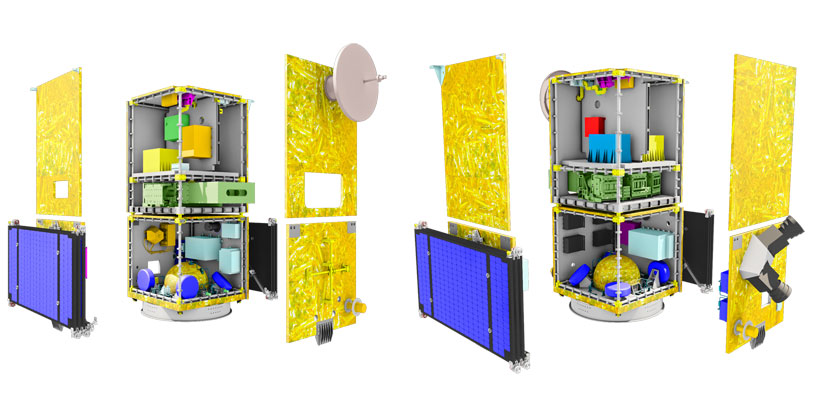
 Amazônia-1 coupled with Payload Module. | |
| Names | SSR-1 Satélite de Sensoriamento Remoto-1 |
|---|---|
| Mission type | Earth observation |
| Operator | INPE |
| COSPAR ID | 2021-015A |
| SATCAT no. | 47699 |
| Website | Amazon Mission |
| Mission duration | 5 years, 5 months and 13 days (elapsed) 4 years (planned)[1] |
| Spacecraft properties | |
| Bus | MMP |
| Manufacturer | INPE |
| Launch mass | 637 kg (1,404 lb)[1] |
| Start of mission | |
| Launch date | 28 February 2021, 04:54 UTC[2][3] |
| Rocket | PSLV-C51[4] |
| Launch site | First Launch Pad, Satish Dhawan Space Centre |
| Contractor | NewSpace India Limited[5] |
| Orbital parameters | |
| Reference system | Geocentric orbit |
| Regime | Sun-synchronous orbit |
| Semi-major axis | 7,127 km (4,429 mi)[6] |
| Eccentricity | 0.011083[6] |
| Perigee altitude | 748.6 km (465.2 mi)[6] |
| Apogee altitude | 764.4 km (475.0 mi)[6] |
| Inclination | 98.5089°[6] |
| Period | 99.8 minutes[6] |
| RAAN | 135.0747°[6] |
| Argument of perigee | 261.1190°[6] |
| Mean anomaly | 98.8578°[6] |
| Epoch | 28 February 2021 |
| Main camera | |
| Name | Advanced Wide Field Imager (AWFI) |
| Collecting area | 850 km (530 mi) |
| Wavelengths | VIS-NIR band |
| Resolution | 60 m (200 ft) |
 Amazônia-1 patch satellite | |
The Amazônia-1 or SSR-1 (in Portuguese: Satélite de Sensoriamento Remoto-1), is the second Earth observation satellite developed entirely in Brazil, the first being the SCD series of earth orbiters launched in 1993 which are still in operation.[7] Argentinian company INVAP supplied some components like the main computer, attitude controls and sensors. Brazilian scientists also exchanged information and gave inputs to the Argentine team in the development of such equipment to better suit their needs, and also received training on how to operate it.[8]
The satelite was launched at 04:54:00 UTC (10:24:00 IST) on 28 February 2021.[9][10][11] Operations will be joint with the China–Brazil Earth Resources Satellite program (CBERS-4) satellite.[12]
Background[edit | edit source]

In the early 1990s, the design of SSR (Satélite de Sensoriamento Remoto) satellites, Amazônia-1 precursor, was revised and Instituto Nacional de Pesquisas Espaciais (INPE) technicians proposed replacing the polar orbit by an equatorial orbit, and this proposal was accepted. That made sense at that time as Brazil already had polar orbit coverage with the CBERS satellites. SSR-1 suffered several delays, either by lack of resources, or bid disputes. The effective start only occurred in 2001, when a contract was signed for the development of a multi-mission platform specifically, at the time, for this purpose.
In 2001, a joint study between the INPE and German Aerospace Center (DLR) was published, found that most of the SSR-1 requirements can be met by two sensors: the Camera VIS / NIR and other MIR.[13] However, with the publication PNAE=(?) review in 2005, the SSR-1 ceased to be a priority.
Update[edit | edit source]

Between September and October 2012, a structural model of the Amazônia-1 satellite was subjected to a series of vibration test.
In the latest review of the PNAE, published in January 2013, the Amazônia-1 resurfaced with the same name, and even successors were planned (Amazon-1B in 2017 and Amazon-2 in 2018). However, with polar orbit as a design feature, the release dates of these satellites can not be met. The Amazônia-1 schedule is already delayed by two years.[14]
The satellite was originally supposed to launch on a Brazilian VLS-1 rocket, but the program was cancelled.
The satellite was successfully launched on 28 February 2021 aboard ISRO's Polar Satellite Launch Vehicle (PSLV-C51) from the First Launch Pad of Satish Dhawan Space Centre.[15][10][4] The cost of launch was nearly USD 26 million.[16]

Post-launch[edit | edit source]
On March 2, 2021, journalist and science communicator Salvador Nogueira reported that according to trackers in the United States, the satellite may be tipping over in its orbit, but that the situation wasn't irreversible.[17] This occurred after the satellite was put into "mission mode," which triggered a safety program where the satellite was in an attitude that ensured its solar panels were exposed to the Sun.[18] The journalist later posted on Twitter that the situation may be due to the satellite's release and that it had already been resolved, but is awaiting word from INPE.[19] Later Clezio di Nardin, INPE's director, confirmed that the satellite operates normally and is going through the qualification phase, which will last until March 15.[20] The position of Clezio di Nardin and of Marcos Pontes, Minister of Science, was that nothing unusual had happened.[18]
Features[edit | edit source]

The current design features are as follows:
- Orbit: Sun-synchronous orbit
- Period of Earth imaging: 4 days
- Optical sighting wide imaging (camera with 3 bands in the visible (VIS) and 1 band in the near-infrared (NIR))
- Observation range: 850 km (530 mi)[21] with 60 m (200 ft) resolution.
- Platform: Multi-Mission Platform (MMP)
- Weight: 637 kg (1,404 lb)
Instruments[edit | edit source]
- Advanced Wide Field Imager (AWFI), is a 60 m (200 ft) resolution camera.[22]
Amazônia-2[edit | edit source]
The Amazônia-2 satellite was planned for launch in 2022 to replace its predecessor.[23]
Gallery[edit | edit source]
-
 Colored composition showing the Manuripi-Heath Amazon National Wildlife Reserve, in Bolivia.
 -
 Real color image showing the metropolitan region of São Paulo and its surroundings.
 -
 True color image showing the Sobradinho reservoir, Rio São Francisco, and its surroundings.
 -
 True color image of the city of Ibotirama, BA, the São Francisco River, and surroundings.
 -
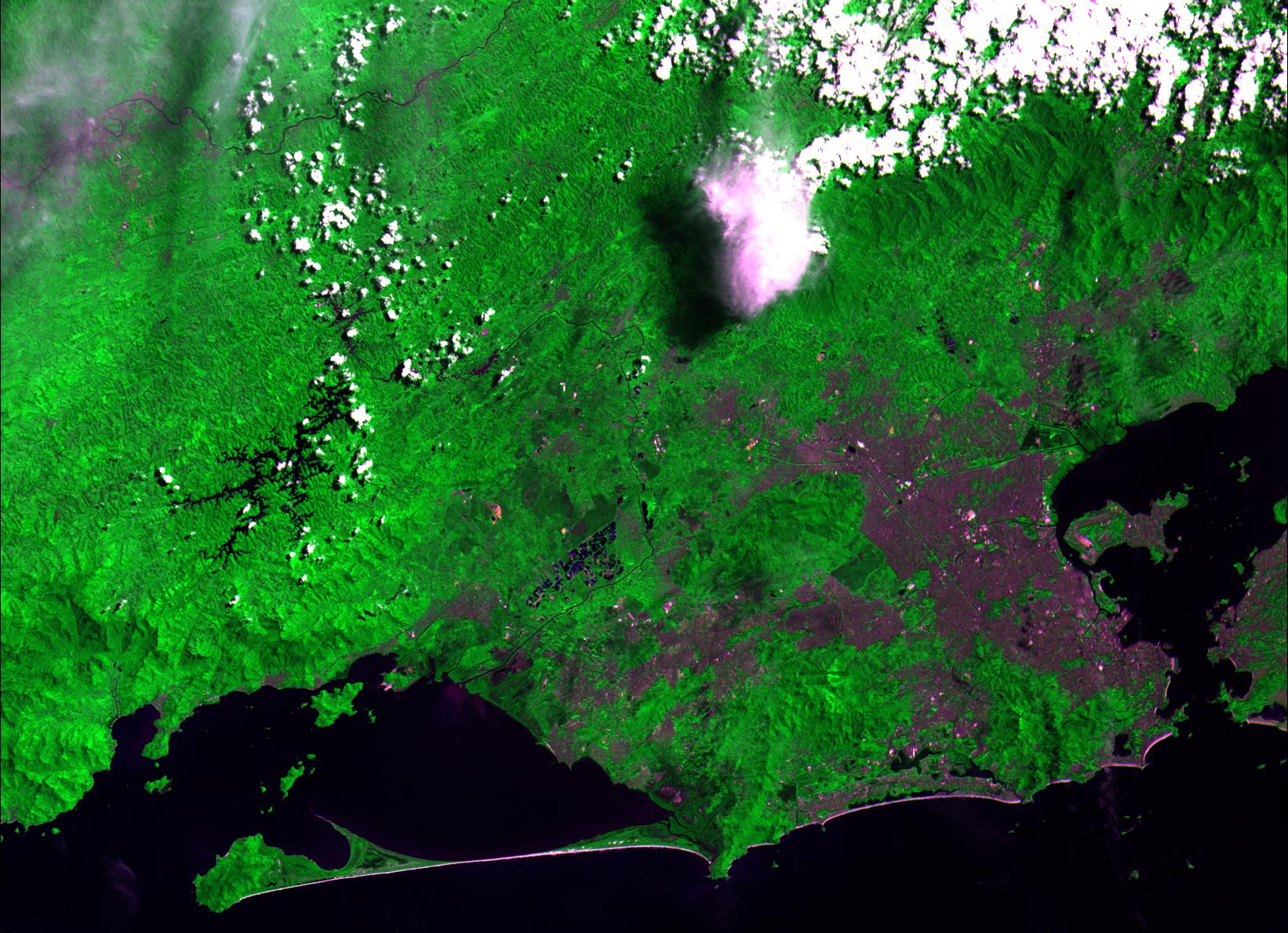 Colored composition showing the metropolitan region of Rio de Janeiro and its surroundings
 -
 Burketown, Australia on 12 May 2021
 -
 Ilha do Mel and Curitiba on 11 April 2021
 -
 Brasília on 11 April 2021
 -
 Sinop on 5 May 2021


.jpg)
.jpg)

See also[edit | edit source]
References[edit | edit source]
- ↑ 1.0 1.1 "PSLV-C51/Amazonia-1 Brochure". ISRO. 23 February 2021. Archived from the original on 23 February 2021. Retrieved 23 February 2021.
- ↑ "Lançamento do satélite Amazonia 1 adiado para o dia 28 de fevereiro". Retrieved 14 January 2021.
- ↑ "Satélite brasileiro é embarcado para a Índia para lançamento". Retrieved 1 January 2021.
- ↑ 4.0 4.1 "ISRO to kick off 2021 by launching its first Indian start-up passenger into space aboard the PSLV-C51". Business Insider. 17 December 2020.
- ↑ "PSLV-C51, the first dedicated launch by NSIL, successfully launches Amazonia-1 and 18 Co-passenger satellites from Sriharikota". ISRO. Archived from the original on 19 March 2022. Retrieved 28 February 2021.
- ↑ 6.0 6.1 6.2 6.3 6.4 6.5 6.6 6.7 6.8 "Amazonia 1". n2yo.com. Retrieved 28 February 2021.
- ↑ "Amazônia-1 será o primeiro satélite totalmente desenvolvido pelo Brasil" [Amazonia-1 will be the first satellite developed entirely by Brazil] (in Portuguese). 22 July 2008. Retrieved 9 April 2013.
{{cite web}}: CS1 maint: unrecognized language (link) - ↑ ANIMUS (28 February 2021). "Se lanzó Amazonia-1, el primer satélite brasileño con componentes de INVAP". INVAP - Investigación Aplicada (in español). Retrieved 6 March 2021.
- ↑ "Definido o lançamento do satélite brasileiro Amazonia-1 — Coordenação-Geral de Observação da Terra". obt.inpe.br. Archived from the original on 16 December 2018. Retrieved 16 December 2018.
- ↑ 10.0 10.1 "Satélite Amazônia-1 começa a ser fechado para a realização de testes ambientais". inpe.br (in português do Brasil). Retrieved 23 February 2020.
- ↑ "Satélite de monitoramento da Amazônia deverá ser lançado em fevereiro" (in português do Brasil). Governo do Brasil. Retrieved 26 July 2020.
- ↑ "Inpe adquire componentes para o satélite Amazônia-1" [INPE acquires components for the satellite Amazonia-1] (in Portuguese). Retrieved 9 April 2013.
{{cite web}}: CS1 maint: unrecognized language (link) - ↑ Rudorff, Bernardo (10/04/2003), O SATÉLITE DE SENSORIAMENTO REMOTO SSR-1 PARA MONITORAMENTO DA AMAZÔNIA, INPE, Retrieved 15 May 2016
- ↑ PROGRAMA NACIONAL DE ATIVIDADES ESPACIAIS 2012-2021 Archived 22 March 2016 at the Wayback Machine Brazilian Space Agency 22 January 2013 Retrieved 15 May 2016
- ↑ "Amazonia-1 será lanzado en 2020" (in spanish). LATAM Satelital. 11 May 2018. Retrieved 11 May 2018.
{{cite news}}: CS1 maint: unrecognized language (link) - ↑ "Brazilian-made satellite begins deforestation monitoring mission". The Brazilian Report. 8 March 2021. Retrieved 6 April 2022.
- ↑ "Satélite Brasileiro Amazônia-1 pode estar fora de controle, afirmam especialistas" (in português do Brasil). 3 March 2021. Archived from the original on 3 March 2021. Retrieved 3 March 2021.
- ↑ 18.0 18.1 "Depois de apuros em modo de 'sobrevivência', Amazônia-1 já faz imagens do Brasil" (in português do Brasil). 7 March 2021. Archived from the original on 8 March 2021. Retrieved 8 March 2021.
- ↑ @salnog (3 March 2021). "UPDATE na história do Amazonia-1. PARECE que o caso da rotação anômala veio na liberação e agora já está estabilizado/recuperado. Mas seguimos aguardando manifestação oficial do Inpe" (Tweet) (in português do Brasil) – via Twitter.
- ↑ Salvador Nogueira (3 March 2021). "Inpe diz que operação do Amazônia-1 está normal" (in português do Brasil). Archived from the original on 3 March 2021. Retrieved 3 March 2021.
- ↑ "Spaceflight Awarded Contract to Launch Brazil's Amazonia-1 Spacecraft". Spaceflight.com. 18 December 2018. Retrieved 23 January 2020.
- ↑ "The Ceos Database: Instrument Summary - AWFI". Database.eohandbook.com. Retrieved 8 March 2014.
- ↑ "Plano Diretor 2011 - 2015" (PDF). Inpe.br. Retrieved 8 March 2014.
Template:Brazil space program
Template:Orbital launches in 2021
Template:Rest of the World Reconnaissance Satellites