

imported>Ddum5347 No edit summary |
further reworked citations to improve readability and fixed typos as per guidelines |
||
| Line 2: | Line 2: | ||
{{Speciesbox | {{Speciesbox | ||
| name = Yellow (golden) monitor lizard | | name = Yellow (golden) monitor lizard | ||
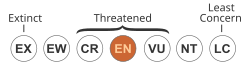
| status = | | status = EN | ||
| status_system = | | status_system = IUCN3.1 | ||
| status_ref = <ref name=iucn>{{cite iucn | | status_ref = <ref name=iucn>{{cite iucn |title=''Varanus flavescens'' |name-list-style=amp |author=Das, A. |author2=Hasan, M.K. |author3=Bhattarai, S. |author4=Wangyal, J. |author5=Mohapatra, P. |date=2021 |article-number=e.T22872A127899602 |doi=10.2305/IUCN.UK.2021-2.RLTS.T22872A127899602.en |access-date=22 January 2022}}</ref> | ||
| status2 = CITES_A1 | |||
| status2_system = CITES | |||
| status2_ref = <ref name=iucn/> | |||
| image = Varanus flavescens1.jpg | | image = Varanus flavescens1.jpg | ||
| genus = Varanus | | genus = Varanus | ||
| Line 10: | Line 13: | ||
| species = flavescens | | species = flavescens | ||
| authority = (Hardwicke & Gray, 1827) | | authority = (Hardwicke & Gray, 1827) | ||
| synonyms = | | synonyms = | ||
| range_map = | | range_map = | ||
| range_map_caption = | | range_map_caption = | ||
}} | }} | ||
The '''yellow monitor''' | The '''yellow monitor''' ('''''Varanus flavescens''''') or '''golden monitor''' is a [[monitor lizard]] native to [[South Asia]].<ref name=iucn/> | ||
==Description== | ==Description== | ||
''Varanus flavescens'' has subcorneal teeth, scarcely compressed. Its snout is short and convex, measuring a little less than the distance from the anterior border of the orbit to the anterior border of the ear; ''canthus rostralis'' distinct. Its nostril an oblique slit, a little nearer to the end of the snout than to the orbit. | The yellow monitor is a medium-sized monitor, measuring between {{cvt|45|and|95|cm}} including the [[tail]] and weighing up to {{cvt|1.45|kg}}.<ref name=GhimireShah>{{cite journal |last1=Ghimire |first1=H. R. |last2=Shah |first2=K. B. |year=2014 |title=Status and habitat ecology of the Yellow Monitor, ''Varanus flavescens'', in the Southeastern part of Kanchanpur District, Nepal |journal=Herpetological Conservation and Biology |volume=9 |issue=2 |pages=387–393 |url=http://www.herpconbio.org/Volume_9/Issue_2/Ghimire_Shah_2014.pdf}}</ref> It has subcorneal teeth, scarcely compressed. Its snout is short and convex, measuring a little less than the distance from the anterior border of the orbit to the anterior border of the ear; ''canthus rostralis'' distinct. Its nostril is an oblique slit, a little nearer to the end of the snout than to the orbit. The digits are short with the length of the fourth toe, measured from its articulation with the tarsus to the base of the claw, not exceeding the length of the femur. The tail of the yellow monitor is feebly compressed and keeled above. The head scales are small and subequal; the median series of supraocular scales slightly dilated transversely. The scales on upper surfaces are moderate, oval and keeled. Abdominal scales are smooth and in 65 to 75 transverse rows. Caudal scales are keeled; the caudal keel with a very low, doubly toothed crest. Adults are olive or yellowish brown above, with irregular darker markings which are generally confluent into broad cross bars; a blackish temporal streak; lower surfaces yellowish, with rather indistinct brown cross bars, which are most distinct on the throat. Young individuals are dark brown above, with yellow spots confluent into crossbars; lower surfaces yellow, with dark brown cross bars.<ref>Boulenger, G. A. 1890. Fauna of British India. Reptilia and Batrachia.</ref> | ||
Each tooth position has only a single replacement teeth in waiting at any given time.<ref>{{Cite journal |last=Maho |first=T. |last2=Reisz |first2=R. R. |date=2024 |title=Exceptionally rapid tooth development and ontogenetic changes in the feeding apparatus of the Komodo dragon |url=https://journals.plos.org/plosone/article?id=10.1371/journal.pone.0295002 |journal=PLOS One |volume=19 |issue=2 |article-number=e0295002 |doi=10.1371/journal.pone.0295002 |pmc=10849390 |pmid=38324523 |doi-access=free}}</ref> | |||
== | ==Distribution and habitat == | ||
[[File:Yellow monitor lizard.jpg|thumb|In [[Terai]], Nepal]] | |||
The yellow monitor occurs in the flood plains of the [[Indus]], [[Ganges]] and [[Brahmaputra]] rivers in [[India]], [[Pakistan]], [[Nepal]] and [[Bangladesh]].<ref name=iucn/> It inhabits wet areas, the edges of forest and vicinity of human settlements and agricultural land. Due to its short hind toes, it is not efficient at climbing trees.<ref name=GhimireShah/> | |||
==Behaviour and ecology== | |||
The yellow monitors [[Thermoregulation|thermoregulates]] by moving between sunny and shady areas, similar to other diurnal lizards. There is also one report of a yellow monitor lying on a pile of hot ash left by a human-lit fire, seemingly to gain heat from it.<ref name=AlRazi2014>{{cite journal |last1=Al-Razi, H. |last2=Baki, M. |last3=Alam, S.M.I. |year=2014 |title=''Varanus flavescens'' (yellow monitor): Thermoregulation |url=https://www.researchgate.net/publication/269114224 |journal=Herpetological Bulletin |volume=129 |pages=27–28}}</ref> | |||
It may be capable of [[Play (activity)|play]] behaviour. A yellow monitor in a wetland was observed alternating between swimming in a vertical position and floating motionlessly.<ref name=Khandakar2020>{{cite journal |last1=Khandakar, N. |last2=Jeny, K.N. |last3=Islam, S. |last4= Hakim, M.A. |last5= Pony, M. |year=2020 |title=Play behavior by a Yellow Monitor, ''Varanus flavescens'' (Hardwicke and Gray 1827) |doi=10.17161/randa.v27i2.14261 |journal=Herpetological Bulletin |volume=27 |issue=2 |pages=257–258|doi-access=free }}</ref> | |||
== | ==Threats== | ||
[[File:Yellow Monitor Lizard.jpg|thumb|A carcass of a yellow monitor in [[Basai Wetland]], India]] | |||
Direct killing is the major threat to the | The yellow monitor is threatened by hunting for its meat and skin in all range countries. Its preferred habitat is threatened due to encroachment, pollution and conversion to landfills.<ref name=iucn/> | ||
Direct killing is the major threat to the yellow monitor in Kanchanpur District of far-western Nepal, as local people are afraid of it. It is also used as food, for medicinal purpose, and its skin has been offered for sale in wildlife markets..<ref name=Ghimire_al2014>{{cite journal |last1=Ghimire, H. R. |last2=Phuyal, S. |last3=Shah, K. B. |year=2014 |title=Protected species outside the protected areas: People's attitude, threats and conservation of the Yellow Monitor (''Varanus flavescens'') in the Far-western Lowlands of Nepal |doi=10.1016/j.jnc.2014.08.003 |journal=Journal for Nature Conservation |volume=22 |issue=6 |pages=497–503 |bibcode=2014JNatC..22..497G}}</ref> | |||
==Conservation== | ==Conservation== | ||
International trade of the yellow monitor is regulated under [[CITES Appendix I]]; it is listed as a legally protected species in India under Schedule I of the [[Wild Life (Protection) Act, 1972]], in Nepal under the National Parks and Wildlife Conservation Act 1973, and in Bangladesh under the Wildlife (Conservation and Security) Act 2012.<ref name=iucn/> | |||
== | ==References== | ||
{{Reflist}} | {{Reflist}} | ||
* [[Walter Auffenberg|Auffenberg W.]] Rahman H. Iffat F. Perveen Z. 1989. A Study of Varanus flavescens Hardwicke and Gray (Sauria varanidae). Journal of the Bombay Natural History Society 86 (3): 286–307 | |||
* [[Walter Auffenberg|Auffenberg W.]] Rahman H. Iffat F. Perveen Z. 1989 A | * {{cite journal | last1 = Visser | first1 = G. J. | year = 1985 | title = Notizen zur Brutbiologie des Gelbwarans ''Varanus'' (''Empagusia'') ''flavescens'' (Hardwicke & Gray 1827) im Zoo Rotterdam |journal =Salamandra |volume=21 | issue = 2/3| pages = 161–168}} | ||
* Whitaker, R. 1981 Bangladesh - Monitors and turtles Hamadryad 6 (3): 7–9 | |||
* {{cite journal | last1 = Visser | first1 = G. J. | year = 1985 | title = Notizen zur Brutbiologie des Gelbwarans Varanus (Empagusia) flavescens ( | |||
* Whitaker, | |||
==External links== | ==External links== | ||
{{commons}} | |||
* {{NRDB species|genus=Varanus|species=flavescens}} | * {{NRDB species|genus=Varanus|species=flavescens}} | ||
| Line 60: | Line 57: | ||
{{Taxonbar|from=Q598687}} | {{Taxonbar|from=Q598687}} | ||
[[Category: | [[Category:Varanus]] | ||
[[Category:Reptiles of Bangladesh]] | [[Category:Reptiles of Bangladesh]] | ||
[[Category: | [[Category:Lizards of India]] | ||
[[Category:Reptiles of Nepal]] | [[Category:Reptiles of Nepal]] | ||
[[Category:Reptiles of Pakistan]] | [[Category:Reptiles of Pakistan]] | ||
[[Category:Reptiles described in 1827]] | [[Category:Reptiles described in 1827]] | ||
[[Category:Taxa named by Thomas Hardwicke]] | |||
[[Category:Taxa named by John Edward Gray]] | |||
Latest revision as of 09:40, 16 December 2025
| Yellow (golden) monitor lizard | |
|---|---|

| |
Scientific classification 
| |
| Family: | Varanidae |
| Genus: | Varanus |
| Subgenus: | Empagusia |
| Species: | V. flavescens
|
| Binomial name | |
| Varanus flavescens (Hardwicke & Gray, 1827)
| |
The yellow monitor (Varanus flavescens) or golden monitor is a monitor lizard native to South Asia.[1]
Description[edit | edit source]
The yellow monitor is a medium-sized monitor, measuring between 45 and 95 cm (18 and 37 in) including the tail and weighing up to 1.45 kg (3.2 lb).[2] It has subcorneal teeth, scarcely compressed. Its snout is short and convex, measuring a little less than the distance from the anterior border of the orbit to the anterior border of the ear; canthus rostralis distinct. Its nostril is an oblique slit, a little nearer to the end of the snout than to the orbit. The digits are short with the length of the fourth toe, measured from its articulation with the tarsus to the base of the claw, not exceeding the length of the femur. The tail of the yellow monitor is feebly compressed and keeled above. The head scales are small and subequal; the median series of supraocular scales slightly dilated transversely. The scales on upper surfaces are moderate, oval and keeled. Abdominal scales are smooth and in 65 to 75 transverse rows. Caudal scales are keeled; the caudal keel with a very low, doubly toothed crest. Adults are olive or yellowish brown above, with irregular darker markings which are generally confluent into broad cross bars; a blackish temporal streak; lower surfaces yellowish, with rather indistinct brown cross bars, which are most distinct on the throat. Young individuals are dark brown above, with yellow spots confluent into crossbars; lower surfaces yellow, with dark brown cross bars.[3]
Each tooth position has only a single replacement teeth in waiting at any given time.[4]
Distribution and habitat[edit | edit source]

The yellow monitor occurs in the flood plains of the Indus, Ganges and Brahmaputra rivers in India, Pakistan, Nepal and Bangladesh.[1] It inhabits wet areas, the edges of forest and vicinity of human settlements and agricultural land. Due to its short hind toes, it is not efficient at climbing trees.[2]
Behaviour and ecology[edit | edit source]
The yellow monitors thermoregulates by moving between sunny and shady areas, similar to other diurnal lizards. There is also one report of a yellow monitor lying on a pile of hot ash left by a human-lit fire, seemingly to gain heat from it.[5]
It may be capable of play behaviour. A yellow monitor in a wetland was observed alternating between swimming in a vertical position and floating motionlessly.[6]
Threats[edit | edit source]

The yellow monitor is threatened by hunting for its meat and skin in all range countries. Its preferred habitat is threatened due to encroachment, pollution and conversion to landfills.[1] Direct killing is the major threat to the yellow monitor in Kanchanpur District of far-western Nepal, as local people are afraid of it. It is also used as food, for medicinal purpose, and its skin has been offered for sale in wildlife markets..[7]
Conservation[edit | edit source]
International trade of the yellow monitor is regulated under CITES Appendix I; it is listed as a legally protected species in India under Schedule I of the Wild Life (Protection) Act, 1972, in Nepal under the National Parks and Wildlife Conservation Act 1973, and in Bangladesh under the Wildlife (Conservation and Security) Act 2012.[1]
References[edit | edit source]
- ↑ 1.0 1.1 1.2 1.3 1.4 1.5 Das, A.; Hasan, M.K.; Bhattarai, S.; Wangyal, J. & Mohapatra, P. (2021). "Varanus flavescens". IUCN Red List of Threatened Species. 2021 e.T22872A127899602. doi:10.2305/IUCN.UK.2021-2.RLTS.T22872A127899602.en. Retrieved 22 January 2022.
- ↑ 2.0 2.1 Ghimire, H. R.; Shah, K. B. (2014). "Status and habitat ecology of the Yellow Monitor, Varanus flavescens, in the Southeastern part of Kanchanpur District, Nepal" (PDF). Herpetological Conservation and Biology. 9 (2): 387–393.
- ↑ Boulenger, G. A. 1890. Fauna of British India. Reptilia and Batrachia.
- ↑ Maho, T.; Reisz, R. R. (2024). "Exceptionally rapid tooth development and ontogenetic changes in the feeding apparatus of the Komodo dragon". PLOS One. 19 (2) e0295002. doi:10.1371/journal.pone.0295002. PMC 10849390. PMID 38324523.
- ↑ Al-Razi, H.; Baki, M.; Alam, S.M.I. (2014). "Varanus flavescens (yellow monitor): Thermoregulation". Herpetological Bulletin. 129: 27–28.
- ↑ Khandakar, N.; Jeny, K.N.; Islam, S.; Hakim, M.A.; Pony, M. (2020). "Play behavior by a Yellow Monitor, Varanus flavescens (Hardwicke and Gray 1827)". Herpetological Bulletin. 27 (2): 257–258. doi:10.17161/randa.v27i2.14261.
- ↑ Ghimire, H. R.; Phuyal, S.; Shah, K. B. (2014). "Protected species outside the protected areas: People's attitude, threats and conservation of the Yellow Monitor (Varanus flavescens) in the Far-western Lowlands of Nepal". Journal for Nature Conservation. 22 (6): 497–503. Bibcode:2014JNatC..22..497G. doi:10.1016/j.jnc.2014.08.003.
- Auffenberg W. Rahman H. Iffat F. Perveen Z. 1989. A Study of Varanus flavescens Hardwicke and Gray (Sauria varanidae). Journal of the Bombay Natural History Society 86 (3): 286–307
- Visser, G. J. (1985). "Notizen zur Brutbiologie des Gelbwarans Varanus (Empagusia) flavescens (Hardwicke & Gray 1827) im Zoo Rotterdam". Salamandra. 21 (2/3): 161–168.
- Whitaker, R. 1981 Bangladesh - Monitors and turtles Hamadryad 6 (3): 7–9