

m further cleaned up structure for accuracy and fixed typos |
|||
| Line 1: | Line 1: | ||
{{ | {{Short description|Species of mammal}} | ||
{{For|the village in Iran|Markhor, Iran}} | |||
{{Use British English|date=September 2024}} | |||
{{Use dmy dates|date=September 2024}} | |||
{{Speciesbox | |||
| name = Markhor | | name = Markhor | ||
| image = Markhor.jpg | | image = Markhor Schraubenziege Capra falconeri Zoo Augsburg-02.jpg | ||
| image_caption = | | image_caption = Male markhor in captivity at the [[Augsburg Zoo]] in [[Bavaria]], Germany | ||
| status = NT | | status = NT | ||
| status_system = IUCN3.1 | |||
| status_system = | | status_ref = <ref name=iucn>{{cite iucn |title=''Capra falconeri'' |author1=Michel, S. |author2=Rosen Michel, T. |name-list-style=amp |article-number=e.T3787A97218336 |doi=10.2305/IUCN.UK.2015-4.RLTS.T3787A82028427.en |year=2015 |errata=2016 |access-date=16 January 2022}}</ref> | ||
| status_ref = <ref name= | | status2 = CITES_A1 | ||
| | | status2_system = CITES | ||
| | | status2_ref = <ref name=iucn/> | ||
| | | taxon = Capra falconeri<ref name = MSW3>{{MSW3 Artiodactyla |id=14200772 |pages=701 |heading=Species ''Capra falconeri''}}</ref> | ||
| | | authority = ([[Johann Andreas Wagner|Wagner]], 1839) | ||
| | | subdivision_ranks = Subspecies | ||
| | | subdivision = See text | ||
| | | range_map = Capra falconeri map.gif | ||
| range_map_caption = Distribution of the markhor | |||
| | }} | ||
|range_map=Capra falconeri map.gif}} | The '''markhor''' ('''''Capra falconeri''''') {{IPAc-en|ˈ|m|ɑr|k|ɔr}} is a large wild [[Capra (genus)|''Capra'']] species native to the mountain regions at the crossroads of [[Central Asia|Central]] and [[South Asia]], including the [[Karakoram]] and [[Himalayas]]. It occurs in parts of [[Turkmenistan]], [[Uzbekistan]], [[Tajikistan]], [[Afghanistan]], [[Pakistan]], and [[India]]. It has been listed on the [[IUCN Red List]] as [[Near Threatened]] since 2015.<ref name=iucn/> | ||
The ''' | The markhor is the [[national animal]] of Pakistan, where it is also known as the '''screw-horn''' or '''screw-horned goat'''. The word "markhor" is derived from the Persian word ''markhar'', meaning "curly" because of its curly horns. The word, which comes from both [[Pashto language|Pashto]] and mainly classical [[Persian language]]s, is combined from "mar" and "khor" and more literally means "snake eater", referencing the ancient belief that the markhor would actively kill and consume snakes.<ref name=Sharma1990>{{cite book |last1=Sharma |first1=S. D. |title=Semantics and Syntax: Indian Loan Words in English: a Linguistic, Cultural, Literary & Historical Study |date=1990 |publisher=Prakash Book Depot |page=83}}</ref> | ||
Markhor | ==Description== | ||
Markhor adults stand {{cvt|65|to|115|cm}} at the shoulder, are {{cvt|132|to|186|cm}} long and weigh from {{cvt|32|to|110|kg}}.<ref name="fact"/> They have the highest maximum shoulder height among the species in the genus ''[[Capra (genus)|Capra]]'', but is surpassed in length and weight by the [[Siberian ibex]].<ref>{{cite journal |author1=Fedosenko, A. K. |author2=Blank, D. A. |name-list-style=amp |year=2001 |title=''Capra sibirica'' |journal=Mammalian Species |pages=1–13 |volume=675 |s2cid=198969400 |doi=10.1644/1545-1410(2001)675<0001:CS>2.0.CO;2 |url=http://www.science.smith.edu/departments/Biology/VHAYSSEN/msi/pdf/675_Capra_sibirica.pdf}}</ref> The coat is of a grizzled, light brown to black colour, and is smooth and short in [[summer]], while growing longer and thicker in [[winter]]. The fur of the lower legs is black and white. Markhor are [[sexually dimorphic]], with males having longer hair on the chin, throat, chest, and shanks.<ref name="fact"/> Females are redder in colour, with shorter hair and a short, black beard, and are maneless.<ref name=sterndale>{{cite book |author=Sterndale, R. A. |year=1884 |title=Natural History of the Mammalia of India and Ceylon |publisher=Thacker, Spink, and Co. |place=Calcutta |chapter=''Capra megaceros'' The Markhor |pages=441–444 |chapter-url=https://archive.org/details/naturalhistoryof00ster/page/441/mode/1up}}</ref> Both sexes have tightly curled, corkscrew-like horns, which close together at the head, but spread upwards toward the tips. The horns of males can grow up to {{cvt|160|cm}} long, and up to {{cvt|25|cm}} in females.<ref name=fact>{{cite web |url=http://www.ultimateungulate.com/Artiodactyla/Capra_falconeri.html |title=''Capra falconeri'' Markhor |date=2007 |work=Ultimate Ungulate |access-date=18 November 2009 |archive-date=20 December 2007 |archive-url=https://web.archive.org/web/20071220140305/http://www.ultimateungulate.com/Artiodactyla/Capra_falconeri.html |url-status=dead }}</ref><ref>{{cite book|title=Shooting in the Himalayas: a journal of sporting adventures and travel in Chinese Tartary, Ladac, Thibet, Cashmere, &c |author=Markham, F. |publisher=R. Bentley |year=1854}}</ref> | |||
== Distribution and habitat == | |||
[[File:Capra falconeri at the Columbus Zoo-2011 07 11 IMG 0786.JPG|thumb|Female with young, at the [[Columbus Zoo and Aquarium]]]] | |||
The markhor is adapted to mountainous terrain and lives at elevations of {{cvt|600|to|3600|m}}. It inhabits [[Shrubland|shrub]] forests made up primarily of [[oak]]s (''Quercus ilex''), [[pine]]s (''Pinus gerardiana''), and [[juniper]]s (''Juniperus macropoda'').<ref name=iucn/> | |||
In Central Asia, the Bukharan markhor formerly lived in most of the mountains stretching along the north banks of the Upper [[Amu Darya]] and the [[Panj River]]s from [[Turkmenistan]] to Tajikistan; two to three scattered populations now occur in a greatly reduced distribution. It is limited to the region between lower Pyanj and the [[Vakhsh River]]s near [[Kulyab]] in Tajikistan, and in the Kugitangtau Range in Uzbekistan and Turkmenistan.<ref name=iucn/> | |||
In Afghanistan, the markhor is limited to the east in the high and mountainous monsoon forests of [[Laghman Province|Laghman]] and [[Nuristan]]. Until 1978, it survived in the country only in the [[Kabul Gorge]] and the [[Kohe Safi]] area of [[Kapissa]], and in some isolated pockets in between. It now lives the most inaccessible regions of its once wider range in the mountains of Kapissa and [[Kabul Province]]s, after having been driven from its original habitat by intensive poaching.<ref name=iucn/> | |||
In [[Pakistan]], it is restricted to the [[Indus River]] and [[Kunar River]] and their tributaries; its present range consists of many small, isolated areas in [[Balochistan (Pakistan)|Baluchistan]], [[Khyber Pakhtunkhwa]] and [[Dera Ghazi Khan District]]. Along the Indus, it inhabits both banks from Jalkot in [[Kohistan District, North West Frontier Province|Kohistan District]] upstream to near the Tungas village in [[Baltistan]], with Gakuch being its western limit up the [[Gilgit River]], Chalt up the [[Hunza River]], and the Parishing Valley up the [[Astore River]]. It occurs also around [[Chitral]] and the border areas with Afghanistan, where it inhabits a number of valleys along the Kunar River from Arandu on the west bank and [[Drosh]] on the east bank, up to Shoghor along the Lutkho River, and as far as Barenis along the [[Mastuj River]]. The largest population currently lives in [[Chitral National Park]] in Pakistan.<ref name=iucn/> | |||
== References == | In India, the markhor is restricted to a portion of the [[Pir Panjal]] range in southwestern [[Jammu and Kashmir (union territory)|Jammu and Kashmir]]. Throughout this range, markhor populations are scattered, starting east of the [[Banihal]] Pass about {{cvt|50|km}} from the [[Chenab River]] on the Jammu–Srinagar highway westward to the disputed border with Pakistan. It still occurs in catchments of the Limber and Lachipora Rivers in the Jhelum Valley Forest Division and around [[Shupiyan]] to the south of Srinagar.<ref name=iucn/> | ||
{{Reflist}}{{ | |||
[[Category: | ==Behaviour and ecology== | ||
The markhor is [[Diurnality|diurnal]] and mainly active in the early morning and late afternoon. Its diets shift seasonally; in the spring and summer, it [[Grazing (behaviour)|graze]]s, but turns to [[Browsing (predation)|browsing]] in winter, sometimes standing on its hind legs to reach high branches. The [[Rut (mammalian reproduction)|mating season]] is during winter, when males fight each other by lunging, locking of [[Horn (anatomy)|horns]], and attempting to push each other off balance. The [[gestation period]] lasts 135–170 days, and usually results in the birth of one or two kids, and occasionally three. Markhor live in herds, usually numbering nine animals, composed of adult females and their young. Adult males are largely solitary. Adult females and kids comprise most of the markhor population, with adult females making up 32% and kids making up 31%. Adult males comprise 19% of the population, while subadults (males aged 2–3 years) make up 12%, and yearlings (females aged 12–24 months) 9%.<ref name="panthera.org" /> Their alarm call closely resembles the bleating of domestic goats.<ref name="fact"/> Early in the season, the males and females may be found together on the open, grassy patches and clear slopes among the forest. During the summer, the males remain in the forest, while the females generally climb to the highest rocky ridges above.<ref name="sterndale"/> | |||
In the spring, the females stay closer to cliffs in areas with more rock coverage to provide protection for their offspring. The males stay in higher elevated areas with more access to vegetation for foraging so as to improve their body condition.<ref>{{Cite journal |date=2017 |title=Security, size, or sociality: what makes markhor (''Capra falconeri'') sexually segregate? |author1=Ahmad, R. |author2=Sharma, N. |author3=Mishra, C. |author4=Singh, N. J. |author5=Rawat, G.S. |author6=Bhatnagar, Y.V. |journal=Journal of Mammalogy |volume=99 |issue=1 |pages=55–63 |doi=10.1093/jmammal/gyx155 |doi-access=free}}</ref> | |||
===Predators=== | |||
[[Eurasian lynx]] (''Lynx lynx''), [[snow leopard]] (''Panthera uncia''), [[Himalayan wolf]] (''Canis lupus chanco''), and [[brown bear]] (''Ursus arctos'') are the main predators of the markhor.<ref name="panthera.org">{{cite journal |last1=Michel |first1=S. |last2=Michel |first2=T. |last3=Saidov |first3=A. |last4=Karimov |first4=K. |last5=Alidodov|first5=M. |last6=Kholmatov|first6=I. |title=Population status of Heptner's markhor ''Capra falconeri heptneri'' in Tajikistan: challenges for conservation |journal=Oryx |volume=49|issue=3 |date=2014 |pages=506–513 |doi=10.1017/s0030605313000860 |doi-access=free}}</ref><ref>{{cite web |title=Dietary spectrum in Himalayan wolves: comparative analysis of prey choice in conspecifics across high-elevation rangelands of Asia |url= https://cdn.downtoearth.org.in/library/0.69048700_1565775720_dietary-spectrum-in-himalayan-wolves.pdf |last1=Lyngdoh |first1=S. B. |last2=Habib |first2=B. |last3=Shrotriya |first3=S. |date=2019 |website=Down to Earth |access-date=7 August 2020}}</ref> The [[golden eagle]] (''Aquila chrysaetos'') has been reported to prey upon young markhor. The markhor possess keen eyesight and a strong sense of smell to detect nearby [[Predation|predators]]. Markhor are very aware of their surroundings and on high alert; in exposed areas, they are quick to spot and flee from predators.<ref>{{cite web|last1=Sajjad |first1=A. |title=Conservation and status of Markhor (''Capra falconeri'') in the northern parts of North West Frontier Province, Pakistan |url=http://www.cfc.umt.edu/nwfp/docs/SajjadAli%20pp%20final.pdf |archive-url=https://web.archive.org/web/20101229214100/http://www.cfc.umt.edu/nwfp/docs/SajjadAli%20pp%20final.pdf |archive-date=2010-12-29}}</ref> | |||
== Taxonomy == | |||
[[File:Capra falconeri Yumemigasaki Zoo P6269554.jpg|thumb|Captive markhor in a zoo in [[Kanagawa Prefecture]], Japan]] | |||
[[File:Capra falconeri hepteneri.jpg|thumb|Captive Bukharan markhor in [[Los Angeles Zoo]]]] | |||
''Aegoceros (Capra) Falconeri'' was the [[scientific name]] proposed by [[Johann Andreas Wagner]] in 1839 based on a female specimen from the Indian Himalayas.<ref>{{cite journal |author=Wagner, J.A. |date=1839 |title=Beschreibung einiger neuer oder wenig bekannter Säugethiere, welche von Herrn Baron von Hügel in Indien gesammelt wurden |pages=429–432 |journal=Gelehrte Anzeigen der Königlich Bayerischen Akademie der Wissenschaften zu München |volume=9 |issue=183 |url=https://archive.org/details/gelehrteanzeig0910bayeuoft/page/214/mode/2up}}</ref> | |||
Three subspecies have been recognised as [[valid name (zoology)|valid taxa]]:<ref name=MSW3/><ref name=iucn/> | |||
* [[Astor markhor]] (''C. f. falconeri'', {{small|Wagner, 1839}}) has large, flat horns, branching widely and then going up nearly straight with only a half turn.<ref name="greatsmall">{{cite book |author=Lydekker, R. |year=1900 |title=The great and small game of India, Burma, and Tibet |place=London |publisher=R. Ward |chapter=The Astor Markhor |pages=109–113 |chapter-url=https://archive.org/details/greatsmallgameof1900lyde/page/108/mode/2up}}</ref> It is considered [[Synonym (taxonomy)|synonymous]] with the Kashmir markhor ''Capra falconeri cashmiriensis''.<ref name=iucn/> | |||
* Kabul markhor (''C. f. megaceros'', {{small|Hutton, 1842}}) has horns with a slight corkscrew, as well as a twist.<ref name=sterndale/> A [[junior synonym]] is ''C. f. jerdoni''.<ref name=iucn/> | |||
* Bukharan markhor (''C. f. heptneri'', {{small|Zalkin, 1945}}) | |||
===Relationship with the domestic goat=== | |||
Some authors have postulated that the markhor is the ancestor of some breeds of the [[domestic goat]]. The [[Angora goat]] has been regarded by some as a direct descendant of the Central Asian markhor.<ref>{{cite book |author=Hayes, J. L. |year=1868 |place=Boston |title=The Angora goat; its origin, culture and products |url=https://archive.org/details/angoragoatitsori00haye/page/12}}</ref><ref>{{cite book |author=Schreiner, O. |year=1898 |place=London |publisher=Longmans |title=Angora goat ...: and, A paper on the ostrich ... |url=https://books.google.com/books?id=73omAQAAMAAJ}}</ref> | |||
Evidence for markhors crossbreeding with domestic goats has been found. One study suggested that 35.7% of captive markhors in the analysis from three different zoos had mitochondrial DNA from domestic goats.<ref>{{cite journal |last1=Hammer |first1=S. |title=Evidence for introgressive hybridization of captive markhor (Capra falconeri) with domestic goat: cautions for reintroduction |journal=Biochemical Genetics |date=2008 |volume=46 |issue=3/4 |pages=216–226 |doi=10.1007/s10528-008-9145-y |pmid=18228130 |s2cid=7408515}}</ref> Other authors have suggested that markhor may have been the ancestor of some Egyptian goat breeds, based on their similar horns, though the lack of an anterior keel on the horns of the markhor belies any close relationship.<ref name=goat>{{cite book |author=Clutton-Brock, J. |url=https://books.google.com/books?id=cgL-EbbB8a0C&dq=markhor+falconeri&pg=PA77|title=A natural history of domesticated mammals |publisher=Cambridge University Press |year=1999 |isbn=0-521-63495-4 |access-date= 2011-07-10}}</ref> | |||
The [[Changthangi]] domestic goat of [[Ladakh]] and [[Tibet]] may derive from the markhor.<ref>{{cite journal|volume=43|issue=1|pages=3–14 |year=2002 |title=A study on the Changthangi pashmina and the Bakerwali goat breeds in Kashmir: I. Analysis of blood protein polymorphisms and genetic variability within and between the populations|author1=Menrad, M. |author2=Stier, C.-H. |author3=Geldermann, H. |author4=Gall, C.F. |journal=Small Ruminant Research |doi=10.1016/S0921-4488(01)00265-6}}</ref> The [[Girgentana goat]] of [[Sicily]] is thought to have been bred from markhor,<ref>[http://www.capragirgentana.it/La%20Girgentana.htm La Capra Girgentana] {{Webarchive|url=https://web.archive.org/web/20230901055628/http://www.capragirgentana.it/La%20Girgentana.htm |date=1 September 2023 }}. Capragirgentana.it. Retrieved on 2011-07-10.</ref> as is the [[Bilberry goat]] of [[Ireland]].<ref>{{cite news |url=http://www.irishtimes.com/newspaper/features/2009/0825/1224253192011.html |title=Between a rock and a goat's place in Waterford |work=[[Irish Times]] |date=August 2009}}</ref> The Kashmiri [[feral]] herd of about 200 individuals on the [[Great Orme]] [[limestone]] [[headland]] of [[Wales]] are derived from a herd maintained at [[Windsor Great Park]] belonging to [[Victoria of the United Kingdom|Queen Victoria]].<ref>[http://www.llandudno.com/goats.html The Great Orem in Llandudno North Wales] {{webarchive|url=https://web.archive.org/web/20100908132338/http://www.llandudno.com/goats.html |date=2010-09-08 }}. Llandudno.com. Retrieved on 2011-07-10.</ref> | |||
Fecal samples taken from markhor and domestic goats indicate that a serious level of competition exists for food between the two species. The competition for food between herbivores is believed to have significantly reduced the standing crop of forage in the Himalaya–Karkoram–Hindukush ranges. Domestic livestock have an advantage over wild herbivores, since the density of their herds often pushes their competitors out of the best grazing areas, and decreased forage availability has a negative effect on female fertility.<ref>{{cite journal |last1=Ashraf |first1=N. |title=Competition for food between the markhor and domestic goat in Chitral, Pakistan |journal=Turkish Journal of Zoology|date=2014|volume=38|issue=2|pages=191–198|doi=10.3906/zoo-1306-6|doi-access=free}}</ref> | |||
Genetic studies suggest that the markhor diverged early from other ''Capra'' species, making it one of the most evolutionary distinct wild goats. ''Capra falconeri'' forms a well-supported clade, meaning it is genetically distinct and monophyletic descended from a common ancestor not shared with other species in the genus.<ref>{{Cite journal |last1=Jordan |first1=Steve |last2=Naderi |first2=Saeid |last3=Rezaei |first3=Hamid-Reza |last4=Luikart |first4=Gordon |date=2025-10-27 |title=A phylogeny for genus Capra based on extensive sampling of wild populations |journal=PLOS ONE |language=en |volume=20 |issue=10 |article-number=e0334624 |doi=10.1371/journal.pone.0334624 |doi-access=free |issn=1932-6203}}</ref> | |||
==Threats== | |||
Hunting for meat as a means of subsistence or trade in wildlife parts adds to the growing problem for wildlife managers in many countries. [[Poaching]], with its indirect impacts as disturbance, increasing fleeing distances and resulting reduction of effective habitat size, is by far the most important factor threatening the survival of the markhor populations.<ref name="secem.es">{{cite web|last1=Michel|first1=Stefan|title=CONSERVATION OF TAJIK MARKHOR (Capra falconeri heptneri) AND URIAL (Ovis vignei) IN TAJIKISTAN AND ADJACENT AFGHANISTAN|url=http://www.secem.es/wp-content/uploads/2013/03/Galemys-22-NE-25-Michel-407-419.pdf|access-date=20 October 2014|archive-date=24 September 2015|archive-url=https://web.archive.org/web/20150924100839/http://www.secem.es/wp-content/uploads/2013/03/Galemys-22-NE-25-Michel-407-419.pdf|url-status=dead}}</ref> The most important types of poachers seem to be local inhabitants, state border guards, the latter usually relying on local hunting guides, and Afghans, illegally crossing the border. Poaching causes fragmentation of the population into small islands, where the remaining subpopulations are prone to extinction.<ref name="secem.es"/> The markhor is a valued trophy hunting prize for its spiral horns. The Pakistani government issued several tags in an attempt to save the species, which since the introduction of hunting, the species has seen a remarkable rebound. The continuing declines of markhor populations finally caught the attention of the international community.<ref>{{cite web|author=Rosser, Naseer|author2=Nigel|name-list-style=amp|author3=Alison M., Tareen|author4=Leader-Williams|title=Chapter 4: The Precautionary Principle, Uncertainty And Trophy Hunting: A Review Of The Torghar Population Of Central Asian Markhor Capra Falconeri|url=http://connection.ebscohost.com/c/articles/34724994|publisher=Points of View Reference Center|access-date=22 October 2014}}</ref> | |||
===Hunting=== | |||
[[File:Markhor Horns (5779055412).jpg|thumb|Markhor]] | |||
In [[British India]], the markhor was considered to be among the most challenging game species, because of the danger involved in stalking and pursuing it in mountainous terrain.<ref>{{cite book |author=Macintyre, D. |title=Hindu-Koh: Wanderings and Wild Sport on and Beyond the Himalayas (1853–1854) |publisher=Asian Educational Services |year=1996 |isbn=81-206-0851-8}}</ref> According to Arthur Brinckman in his ''The Rifle in Cashmere'', "a man who is a good walker will never wish for any finer sport than [[Siberian ibex|ibex]] or markhoor shooting".<ref name="shooting">{{cite book|author=Brinckman, A. |title=The rifle in Cashmere: a narrative of shooting expeditions in Ladak, Cashmere, Punjaub, etc., with advice on travelling, shooting, and stalking: to which are added notes on army reform and Indian politics |url=https://archive.org/details/rifleincashmere00bringoog/page/n167|access-date=10 July 2011 |year=1862 |publisher=Smith, Elder |pages=148–}}</ref> [[Elliott Roosevelt I]] wrote of how he shot two markhor in 1881, his first on 8 July, his second on 1 August.<ref>{{cite book|author=Roosevelt, T. IV |title=Hunting in Many Lands |url=https://books.google.com/books?id=DyB3zVfJdIkC |access-date=10 July 2011 |date=2008 |publisher=Clapham Press |isbn=978-1-4437-7183-2}}</ref> | |||
Although hunting markhor in Afghanistan is illegal, it has been traditionally hunted in [[Nuristan]] and [[Laghman Province]]s, and this may have intensified during the [[War in Afghanistan (2001–present)|War in Afghanistan]]. In Pakistan, hunting markhor is legal as part of a conservation process; expensive hunting licenses are available from the Pakistani government that allow the hunting of old markhors, which are no longer good for breeding purposes.<ref>{{cite news |date=2006 |title=A $55,000 wild Markhor chase |work=Daily Times |url=http://www.dailytimes.com.pk/default.asp?page=2006\03\31\story_31-3-2006_pg11_7 |access-date=25 December 2012}}</ref> In India, hunting markhor is illegal, but it is poached for food and for its horns, which are thought to have medicinal properties.<ref name=iucn/> | |||
The markhor is listed as [[near threatened]] on the [[IUCN Red List]]; as of 2013, the population was estimated at 5,800 individuals that was projected to be stable in view of ongoing conservation efforts.<ref name=iucn/> | |||
== Conservation == | |||
In India, the markhor is a fully protected Schedule I species under the Jammu and Kashmir's Wildlife (Protection) Act of 1978.<ref name=iucn/> | |||
In 1973, two reserves were established in Tajikistan: Dashtijum Strict Reserve with {{cvt|20000|ha}} and Dashtijum Reserve with {{cvt|53000|ha}}. Though these reserves exist to protect and conserve the markhor population, the regulations are poorly enforced, making poaching common, as is [[habitat destruction]].<ref name=iucn/><ref name="panthera.org"/> Although markhors still face ongoing threats, recent studies have shown considerable success regarding the conservation approach that began in the 1900s, when a local hunter was persuaded by a hunting tourist to stop poaching markhors. The local hunter established a conservancy that inspired two other local organizations called Morkhur and Muhofiz. These organizations expect that their efforts will not only protect the markhor but also allow for the sustainable exploitation of the species. This approach has proven to be more effective than the protection of lands that lack enforcement and security.<ref name="panthera.org" /> | |||
On 2 May 2024, the [[United Nations General Assembly]] declared 24 May as the [[International Day of Markhor]], recognizing the importance of conservation of the species.<ref>{{cite web |title=International Day of the Markhor |url=https://www.un.org/en/observances/markhor-day}}</ref><ref>{{cite web |title=Resolution adopted by the General Assembly on 2 May 2024 {{!}} 78/278. International Day of the Markhor |url=https://documents.un.org/api/symbol/access?j=N2412809&t=pdf |publisher=United Nations}}</ref> | |||
==In culture== | |||
{{multiple image | |||
|total_width=400 | |||
|perrow=2 | |||
|image1=Stamp of India - 1996 - Colnect 163294 - Markhor Capra falconeri.jpeg | |||
|image2=Stamp of Tajikistan - 1993 - Colnect 326708 - Bukharan Markhor Capra falconeri heptneri.jpeg | |||
|footer=Markhor on [[postal stamp]]s of [[India]] (left) and [[Tajikistan]] (right) | |||
}} | |||
The markhor is the [[national animal]] of [[Pakistan]].<ref>{{cite book |last=Taus-Bolstad |first=Stacy |title=Pakistan in Pictures |url=https://books.google.com/books?id=K9QbtVadL_gC&q=national+animal+Pakistan+Markhor&pg=PA15 |access-date=25 December 2012 |year=2003 |publisher=[[Lerner Publishing Group#Twenty-First Century Books|Twenty-First Century Books]] |isbn=978-0-8225-4682-5 |page=15}}</ref> It was one of the 72 animals featured on the [[World Wide Fund for Nature|World Wide Fund for Nature Conservation Coin Collection]] in 1976. Markhor [[marionettes]] are used in the Afghan [[puppet]] shows known as ''[[buz-baz]]''. The markhor has also been mentioned in a [[Pakistani]] [[computer-animated film]] known as ''[[Allahyar and the Legend of Markhor]]''.<ref>IMDB(2018)https://www.imdb.com/title/tt7955106/</ref> | |||
===Etymology=== | |||
The name is thought to be derived from [[Persian language]] — a conjunction of {{lang|fa-Latn|mâr}} ({{wikt-lang|fa|مار}}, "[[snake]], [[Serpent (symbolism)|serpent]]") and the suffix {{lang|fa-Latn|khor}} ({{wikt-lang|fa|خوردن|‏خور‎}},<!-- bidi marks to force browsers to show the two parameters the right way round in source editing --> "-eater"), interpreted to represent the animal's alleged ability to kill snakes, or as a reference to its corkscrew-like horns, which are somewhat reminiscent of coiling snakes.<ref name=fact/> | |||
In folklore, the markhor is believed to kill and eat serpents. Thereafter, while chewing the [[cud]], a foam-like substance comes out of its mouth that drops on the ground and dries. This foam-like substance is sought after by the local people, who believe it is useful in extracting the poison from snakebites.<ref name=museo>{{cite web|title=Markhor|url=http://www.museodelacaza.org/markhor/?lang=en|website=Museo de la Caza Los Yebenes|access-date=9 April 2017}}</ref> | |||
==References== | |||
{{Reflist}} | |||
== External links == | |||
{{Commons category|Capra falconeri}} | |||
*{{cite AV media |people=Mueenuddin, N. |date=2020 |title=Himalayan Lynx Filmed Hunting Markhor in Pakistan for First Time |medium=Motion picture |url=https://www.youtube.com/watch?v=bp7v7ERduuA |archive-url=https://ghostarchive.org/varchive/youtube/20211222/bp7v7ERduuA |archive-date=2021-12-22 |url-status=live|publisher=WWF Pakistan}}{{cbignore}} | |||
* [https://readnational.com/markhor-national-animal-of-pakistan/ Markhor Pakistan National Animal] | |||
{{Artiodactyla|R.3}} | |||
{{National symbols of Pakistan}} | |||
{{Taxonbar|from=Q187927}} | |||
[[Category:Capra (genus)]] | |||
[[Category:Fauna of the Himalayas]] | |||
[[Category:Mammals of Asia]] | |||
[[Category:Mammals of Pakistan]] | |||
[[Category:National symbols of Pakistan]] | [[Category:National symbols of Pakistan]] | ||
[[Category:Mammals described in 1839]] | |||
[[Category:Mammals | |||
Latest revision as of 03:48, 17 February 2026
| Markhor | |
|---|---|

| |
| Male markhor in captivity at the Augsburg Zoo in Bavaria, Germany | |
Scientific classification 
| |
| : | [[Template:Taxonomy/Capra]] |
| Species: | Template:Taxonomy/CapraC. falconeri[1]
|
| Binomial name | |
| Template:Taxonomy/CapraCapra falconeri[1] (Wagner, 1839)
| |
| Subspecies | |
|
See text | |

| |
| Distribution of the markhor | |
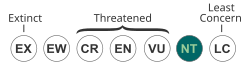
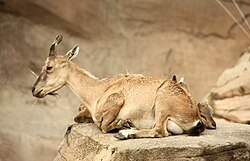
The markhor (Capra falconeri) /ˈmɑːrkɔːr/ is a large wild Capra species native to the mountain regions at the crossroads of Central and South Asia, including the Karakoram and Himalayas. It occurs in parts of Turkmenistan, Uzbekistan, Tajikistan, Afghanistan, Pakistan, and India. It has been listed on the IUCN Red List as Near Threatened since 2015.[2]
The markhor is the national animal of Pakistan, where it is also known as the screw-horn or screw-horned goat. The word "markhor" is derived from the Persian word markhar, meaning "curly" because of its curly horns. The word, which comes from both Pashto and mainly classical Persian languages, is combined from "mar" and "khor" and more literally means "snake eater", referencing the ancient belief that the markhor would actively kill and consume snakes.[3]
Description[edit | edit source]
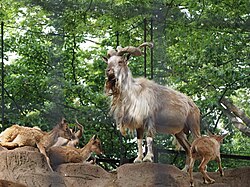
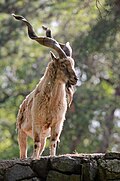
Markhor adults stand 65 to 115 cm (26 to 45 in) at the shoulder, are 132 to 186 cm (52 to 73 in) long and weigh from 32 to 110 kg (71 to 243 lb).[4] They have the highest maximum shoulder height among the species in the genus Capra, but is surpassed in length and weight by the Siberian ibex.[5] The coat is of a grizzled, light brown to black colour, and is smooth and short in summer, while growing longer and thicker in winter. The fur of the lower legs is black and white. Markhor are sexually dimorphic, with males having longer hair on the chin, throat, chest, and shanks.[4] Females are redder in colour, with shorter hair and a short, black beard, and are maneless.[6] Both sexes have tightly curled, corkscrew-like horns, which close together at the head, but spread upwards toward the tips. The horns of males can grow up to 160 cm (63 in) long, and up to 25 cm (9.8 in) in females.[4][7]
Distribution and habitat[edit | edit source]

The markhor is adapted to mountainous terrain and lives at elevations of 600 to 3,600 m (2,000 to 11,800 ft). It inhabits shrub forests made up primarily of oaks (Quercus ilex), pines (Pinus gerardiana), and junipers (Juniperus macropoda).[2]
In Central Asia, the Bukharan markhor formerly lived in most of the mountains stretching along the north banks of the Upper Amu Darya and the Panj Rivers from Turkmenistan to Tajikistan; two to three scattered populations now occur in a greatly reduced distribution. It is limited to the region between lower Pyanj and the Vakhsh Rivers near Kulyab in Tajikistan, and in the Kugitangtau Range in Uzbekistan and Turkmenistan.[2]
In Afghanistan, the markhor is limited to the east in the high and mountainous monsoon forests of Laghman and Nuristan. Until 1978, it survived in the country only in the Kabul Gorge and the Kohe Safi area of Kapissa, and in some isolated pockets in between. It now lives the most inaccessible regions of its once wider range in the mountains of Kapissa and Kabul Provinces, after having been driven from its original habitat by intensive poaching.[2]
In Pakistan, it is restricted to the Indus River and Kunar River and their tributaries; its present range consists of many small, isolated areas in Baluchistan, Khyber Pakhtunkhwa and Dera Ghazi Khan District. Along the Indus, it inhabits both banks from Jalkot in Kohistan District upstream to near the Tungas village in Baltistan, with Gakuch being its western limit up the Gilgit River, Chalt up the Hunza River, and the Parishing Valley up the Astore River. It occurs also around Chitral and the border areas with Afghanistan, where it inhabits a number of valleys along the Kunar River from Arandu on the west bank and Drosh on the east bank, up to Shoghor along the Lutkho River, and as far as Barenis along the Mastuj River. The largest population currently lives in Chitral National Park in Pakistan.[2]
In India, the markhor is restricted to a portion of the Pir Panjal range in southwestern Jammu and Kashmir. Throughout this range, markhor populations are scattered, starting east of the Banihal Pass about 50 km (31 mi) from the Chenab River on the Jammu–Srinagar highway westward to the disputed border with Pakistan. It still occurs in catchments of the Limber and Lachipora Rivers in the Jhelum Valley Forest Division and around Shupiyan to the south of Srinagar.[2]
Behaviour and ecology[edit | edit source]
The markhor is diurnal and mainly active in the early morning and late afternoon. Its diets shift seasonally; in the spring and summer, it grazes, but turns to browsing in winter, sometimes standing on its hind legs to reach high branches. The mating season is during winter, when males fight each other by lunging, locking of horns, and attempting to push each other off balance. The gestation period lasts 135–170 days, and usually results in the birth of one or two kids, and occasionally three. Markhor live in herds, usually numbering nine animals, composed of adult females and their young. Adult males are largely solitary. Adult females and kids comprise most of the markhor population, with adult females making up 32% and kids making up 31%. Adult males comprise 19% of the population, while subadults (males aged 2–3 years) make up 12%, and yearlings (females aged 12–24 months) 9%.[8] Their alarm call closely resembles the bleating of domestic goats.[4] Early in the season, the males and females may be found together on the open, grassy patches and clear slopes among the forest. During the summer, the males remain in the forest, while the females generally climb to the highest rocky ridges above.[6]
In the spring, the females stay closer to cliffs in areas with more rock coverage to provide protection for their offspring. The males stay in higher elevated areas with more access to vegetation for foraging so as to improve their body condition.[9]
Predators[edit | edit source]
Eurasian lynx (Lynx lynx), snow leopard (Panthera uncia), Himalayan wolf (Canis lupus chanco), and brown bear (Ursus arctos) are the main predators of the markhor.[8][10] The golden eagle (Aquila chrysaetos) has been reported to prey upon young markhor. The markhor possess keen eyesight and a strong sense of smell to detect nearby predators. Markhor are very aware of their surroundings and on high alert; in exposed areas, they are quick to spot and flee from predators.[11]
Taxonomy[edit | edit source]


Aegoceros (Capra) Falconeri was the scientific name proposed by Johann Andreas Wagner in 1839 based on a female specimen from the Indian Himalayas.[12]
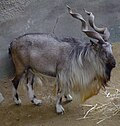
Three subspecies have been recognised as valid taxa:[1][2]
- Astor markhor (C. f. falconeri,
Wagner, 1839) has large, flat horns, branching widely and then going up nearly straight with only a half turn.[13] It is considered synonymous with the Kashmir markhor Capra falconeri cashmiriensis.[2]
- Kabul markhor (C. f. megaceros,
Hutton, 1842) has horns with a slight corkscrew, as well as a twist.[6] A junior synonym is C. f. jerdoni.[2]
- Bukharan markhor (C. f. heptneri,
Zalkin, 1945)
Relationship with the domestic goat[edit | edit source]
Some authors have postulated that the markhor is the ancestor of some breeds of the domestic goat. The Angora goat has been regarded by some as a direct descendant of the Central Asian markhor.[14][15] Evidence for markhors crossbreeding with domestic goats has been found. One study suggested that 35.7% of captive markhors in the analysis from three different zoos had mitochondrial DNA from domestic goats.[16] Other authors have suggested that markhor may have been the ancestor of some Egyptian goat breeds, based on their similar horns, though the lack of an anterior keel on the horns of the markhor belies any close relationship.[17] The Changthangi domestic goat of Ladakh and Tibet may derive from the markhor.[18] The Girgentana goat of Sicily is thought to have been bred from markhor,[19] as is the Bilberry goat of Ireland.[20] The Kashmiri feral herd of about 200 individuals on the Great Orme limestone headland of Wales are derived from a herd maintained at Windsor Great Park belonging to Queen Victoria.[21]
Fecal samples taken from markhor and domestic goats indicate that a serious level of competition exists for food between the two species. The competition for food between herbivores is believed to have significantly reduced the standing crop of forage in the Himalaya–Karkoram–Hindukush ranges. Domestic livestock have an advantage over wild herbivores, since the density of their herds often pushes their competitors out of the best grazing areas, and decreased forage availability has a negative effect on female fertility.[22]
Genetic studies suggest that the markhor diverged early from other Capra species, making it one of the most evolutionary distinct wild goats. Capra falconeri forms a well-supported clade, meaning it is genetically distinct and monophyletic descended from a common ancestor not shared with other species in the genus.[23]
Threats[edit | edit source]
Hunting for meat as a means of subsistence or trade in wildlife parts adds to the growing problem for wildlife managers in many countries. Poaching, with its indirect impacts as disturbance, increasing fleeing distances and resulting reduction of effective habitat size, is by far the most important factor threatening the survival of the markhor populations.[24] The most important types of poachers seem to be local inhabitants, state border guards, the latter usually relying on local hunting guides, and Afghans, illegally crossing the border. Poaching causes fragmentation of the population into small islands, where the remaining subpopulations are prone to extinction.[24] The markhor is a valued trophy hunting prize for its spiral horns. The Pakistani government issued several tags in an attempt to save the species, which since the introduction of hunting, the species has seen a remarkable rebound. The continuing declines of markhor populations finally caught the attention of the international community.[25]
Hunting[edit | edit source]
.jpg)
In British India, the markhor was considered to be among the most challenging game species, because of the danger involved in stalking and pursuing it in mountainous terrain.[26] According to Arthur Brinckman in his The Rifle in Cashmere, "a man who is a good walker will never wish for any finer sport than ibex or markhoor shooting".[27] Elliott Roosevelt I wrote of how he shot two markhor in 1881, his first on 8 July, his second on 1 August.[28]
Although hunting markhor in Afghanistan is illegal, it has been traditionally hunted in Nuristan and Laghman Provinces, and this may have intensified during the War in Afghanistan. In Pakistan, hunting markhor is legal as part of a conservation process; expensive hunting licenses are available from the Pakistani government that allow the hunting of old markhors, which are no longer good for breeding purposes.[29] In India, hunting markhor is illegal, but it is poached for food and for its horns, which are thought to have medicinal properties.[2]
The markhor is listed as near threatened on the IUCN Red List; as of 2013, the population was estimated at 5,800 individuals that was projected to be stable in view of ongoing conservation efforts.[2]
Conservation[edit | edit source]
In India, the markhor is a fully protected Schedule I species under the Jammu and Kashmir's Wildlife (Protection) Act of 1978.[2] In 1973, two reserves were established in Tajikistan: Dashtijum Strict Reserve with 20,000 ha (49,000 acres) and Dashtijum Reserve with 53,000 ha (130,000 acres). Though these reserves exist to protect and conserve the markhor population, the regulations are poorly enforced, making poaching common, as is habitat destruction.[2][8] Although markhors still face ongoing threats, recent studies have shown considerable success regarding the conservation approach that began in the 1900s, when a local hunter was persuaded by a hunting tourist to stop poaching markhors. The local hunter established a conservancy that inspired two other local organizations called Morkhur and Muhofiz. These organizations expect that their efforts will not only protect the markhor but also allow for the sustainable exploitation of the species. This approach has proven to be more effective than the protection of lands that lack enforcement and security.[8]
On 2 May 2024, the United Nations General Assembly declared 24 May as the International Day of Markhor, recognizing the importance of conservation of the species.[30][31]
In culture[edit | edit source]


The markhor is the national animal of Pakistan.[32] It was one of the 72 animals featured on the World Wide Fund for Nature Conservation Coin Collection in 1976. Markhor marionettes are used in the Afghan puppet shows known as buz-baz. The markhor has also been mentioned in a Pakistani computer-animated film known as Allahyar and the Legend of Markhor.[33]
Etymology[edit | edit source]
The name is thought to be derived from Persian language — a conjunction of mâr (مار, "snake, serpent") and the suffix khor (خور, "-eater"), interpreted to represent the animal's alleged ability to kill snakes, or as a reference to its corkscrew-like horns, which are somewhat reminiscent of coiling snakes.[4]
In folklore, the markhor is believed to kill and eat serpents. Thereafter, while chewing the cud, a foam-like substance comes out of its mouth that drops on the ground and dries. This foam-like substance is sought after by the local people, who believe it is useful in extracting the poison from snakebites.[34]
References[edit | edit source]
- ↑ 1.0 1.1 Template:MSW3 Artiodactyla
- ↑ 2.00 2.01 2.02 2.03 2.04 2.05 2.06 2.07 2.08 2.09 2.10 2.11 2.12 2.13 2.14 Michel, S. & Rosen Michel, T. (2015). "Capra falconeri". IUCN Red List of Threatened Species. 2015 e.T3787A97218336. doi:10.2305/IUCN.UK.2015-4.RLTS.T3787A82028427.en. Retrieved 16 January 2022.
{{cite journal}}: Unknown parameter|errata=ignored (help) - ↑ Sharma, S. D. (1990). Semantics and Syntax: Indian Loan Words in English: a Linguistic, Cultural, Literary & Historical Study. Prakash Book Depot. p. 83.
- ↑ 4.0 4.1 4.2 4.3 4.4 "Capra falconeri Markhor". Ultimate Ungulate. 2007. Archived from the original on 20 December 2007. Retrieved 18 November 2009.
- ↑ Fedosenko, A. K. & Blank, D. A. (2001). "Capra sibirica" (PDF). Mammalian Species. 675: 1–13. doi:10.1644/1545-1410(2001)675<0001:CS>2.0.CO;2. S2CID 198969400.
- ↑ 6.0 6.1 6.2 Sterndale, R. A. (1884). "Capra megaceros The Markhor". Natural History of the Mammalia of India and Ceylon. Calcutta: Thacker, Spink, and Co. pp. 441–444.
- ↑ Markham, F. (1854). Shooting in the Himalayas: a journal of sporting adventures and travel in Chinese Tartary, Ladac, Thibet, Cashmere, &c. R. Bentley.
- ↑ 8.0 8.1 8.2 8.3 Michel, S.; Michel, T.; Saidov, A.; Karimov, K.; Alidodov, M.; Kholmatov, I. (2014). "Population status of Heptner's markhor Capra falconeri heptneri in Tajikistan: challenges for conservation". Oryx. 49 (3): 506–513. doi:10.1017/s0030605313000860.
- ↑ Ahmad, R.; Sharma, N.; Mishra, C.; Singh, N. J.; Rawat, G.S.; Bhatnagar, Y.V. (2017). "Security, size, or sociality: what makes markhor (Capra falconeri) sexually segregate?". Journal of Mammalogy. 99 (1): 55–63. doi:10.1093/jmammal/gyx155.
- ↑ Lyngdoh, S. B.; Habib, B.; Shrotriya, S. (2019). "Dietary spectrum in Himalayan wolves: comparative analysis of prey choice in conspecifics across high-elevation rangelands of Asia" (PDF). Down to Earth. Retrieved 7 August 2020.
- ↑ Sajjad, A. "Conservation and status of Markhor (Capra falconeri) in the northern parts of North West Frontier Province, Pakistan" (PDF). Archived from the original (PDF) on 29 December 2010.
- ↑ Wagner, J.A. (1839). "Beschreibung einiger neuer oder wenig bekannter Säugethiere, welche von Herrn Baron von Hügel in Indien gesammelt wurden". Gelehrte Anzeigen der Königlich Bayerischen Akademie der Wissenschaften zu München. 9 (183): 429–432.
- ↑ Lydekker, R. (1900). "The Astor Markhor". The great and small game of India, Burma, and Tibet. London: R. Ward. pp. 109–113.
- ↑ Hayes, J. L. (1868). The Angora goat; its origin, culture and products. Boston.
{{cite book}}: CS1 maint: location missing publisher (link) - ↑ Schreiner, O. (1898). Angora goat ...: and, A paper on the ostrich ... London: Longmans.
- ↑ Hammer, S. (2008). "Evidence for introgressive hybridization of captive markhor (Capra falconeri) with domestic goat: cautions for reintroduction". Biochemical Genetics. 46 (3/4): 216–226. doi:10.1007/s10528-008-9145-y. PMID 18228130. S2CID 7408515.
- ↑ Clutton-Brock, J. (1999). A natural history of domesticated mammals. Cambridge University Press. ISBN 0-521-63495-4. Retrieved 10 July 2011.
- ↑ Menrad, M.; Stier, C.-H.; Geldermann, H.; Gall, C.F. (2002). "A study on the Changthangi pashmina and the Bakerwali goat breeds in Kashmir: I. Analysis of blood protein polymorphisms and genetic variability within and between the populations". Small Ruminant Research. 43 (1): 3–14. doi:10.1016/S0921-4488(01)00265-6.
- ↑ La Capra Girgentana Archived 1 September 2023 at the Wayback Machine. Capragirgentana.it. Retrieved on 2011-07-10.
- ↑ "Between a rock and a goat's place in Waterford". Irish Times. August 2009.
- ↑ The Great Orem in Llandudno North Wales Archived 2010-09-08 at the Wayback Machine. Llandudno.com. Retrieved on 2011-07-10.
- ↑ Ashraf, N. (2014). "Competition for food between the markhor and domestic goat in Chitral, Pakistan". Turkish Journal of Zoology. 38 (2): 191–198. doi:10.3906/zoo-1306-6.
- ↑ Jordan, Steve; Naderi, Saeid; Rezaei, Hamid-Reza; Luikart, Gordon (27 October 2025). "A phylogeny for genus Capra based on extensive sampling of wild populations". PLOS ONE. 20 (10) e0334624. doi:10.1371/journal.pone.0334624. ISSN 1932-6203.
- ↑ 24.0 24.1 Michel, Stefan. "CONSERVATION OF TAJIK MARKHOR (Capra falconeri heptneri) AND URIAL (Ovis vignei) IN TAJIKISTAN AND ADJACENT AFGHANISTAN" (PDF). Archived from the original (PDF) on 24 September 2015. Retrieved 20 October 2014.
- ↑ Rosser, Naseer; Nigel; Alison M., Tareen & Leader-Williams. "Chapter 4: The Precautionary Principle, Uncertainty And Trophy Hunting: A Review Of The Torghar Population Of Central Asian Markhor Capra Falconeri". Points of View Reference Center. Retrieved 22 October 2014.
- ↑ Macintyre, D. (1996). Hindu-Koh: Wanderings and Wild Sport on and Beyond the Himalayas (1853–1854). Asian Educational Services. ISBN 81-206-0851-8.
- ↑ Brinckman, A. (1862). The rifle in Cashmere: a narrative of shooting expeditions in Ladak, Cashmere, Punjaub, etc., with advice on travelling, shooting, and stalking: to which are added notes on army reform and Indian politics. Smith, Elder. pp. 148–. Retrieved 10 July 2011.
- ↑ Roosevelt, T. IV (2008). Hunting in Many Lands. Clapham Press. ISBN 978-1-4437-7183-2. Retrieved 10 July 2011.
- ↑ "A $55,000 wild Markhor chase". Daily Times. 2006. Retrieved 25 December 2012.
- ↑ "International Day of the Markhor".
- ↑ "Resolution adopted by the General Assembly on 2 May 2024 | 78/278. International Day of the Markhor". United Nations.
- ↑ Taus-Bolstad, Stacy (2003). Pakistan in Pictures. Twenty-First Century Books. p. 15. ISBN 978-0-8225-4682-5. Retrieved 25 December 2012.
- ↑ IMDB(2018)https://www.imdb.com/title/tt7955106/
- ↑ "Markhor". Museo de la Caza Los Yebenes. Retrieved 9 April 2017.
External links[edit | edit source]
- Mueenuddin, N. (2020). Himalayan Lynx Filmed Hunting Markhor in Pakistan for First Time (Motion picture). WWF Pakistan. Archived from the original on 22 December 2021.
- Markhor Pakistan National Animal