

>KyloRen3 Image |
m enhance content additionally and improved wording |
||
| Line 1: | Line 1: | ||
{{Short description| | {{Short description|Emperor of Vijayanagara from 1529 to 1542}} | ||
{{More citations needed|date=October 2020}} | {{More citations needed|date=October 2020}} | ||
| Line 5: | Line 5: | ||
{{Use Indian English|date=February 2016}} | {{Use Indian English|date=February 2016}} | ||
{{Infobox royalty | {{Infobox royalty | ||
| reign = | | reign = 30 November 1529 – June 1542 | ||
| father = [[Tuluva Narasa Nayaka]] | | coronation = 30 November 1529 <br> [[Vijayanagara]], Vijayanagara Empire | ||
| mother = | | title = [[King of Kings|Rajadhiraja]] | ||
| spouse = | | succession = [[Vijayanagara Empire|Emperor of Vijayanagara]] | ||
| issue = [[Venkata I]] | | predecessor = [[Krishnadevaraya]] | ||
| image = | | successor = [[Venkata I]] | ||
| caption = | | birth_date = | ||
| birth_place = [[Vijayanagara]], [[Vijayanagara Empire]] (modern day [[Hampi]], [[Karnataka]], [[India]]) | |||
| father = [[Tuluva Narasa Nayaka]] | |||
| mother = Obamamba<ref>{{cite book |last1=Ayyangar | |||
|first1=Krishnaswamy |title=Sources of Vijayanagar History |date=1919 |publisher=University of Madras |location=Chennai |page=16 }}</ref> | |||
| death_date = June 1542<ref name="w860">{{cite web | title=History of Medieval Deccan | first=H. K. | last=Sherwani | url=https://ia801501.us.archive.org/33/items/in.ernet.dli.2015.127053/2015.127053.History-Of-Medieval-Deccan-Vol-i-1295-1724_text.pdf | access-date=12 November 2025 | page=316}}</ref> | |||
| death_place = [[Tirumala]], [[Vijayanagara Empire]] (present-day [[Karnataka]], [[India]]) | |||
| spouse = [[Tirumalamba]]<br/>Varadambika | |||
| spouse-type = Consorts | |||
| dynasty = [[Tuluva Dynasty|Tuluva]] | |||
| religion = [[Hinduism]] | |||
| issue = [[Venkata I]] | |||
| image = File:Achyutadevaraya and his consort Varadarajamma.jpg | |||
| caption = Achyutadevaraya (left) and his consort Varadambika (right) | |||
}} | }} | ||
{{ | '''Achyuta Deva Raya''' (died June 1542) was a [[Vijayanagara Empire|emperor of Vijayanagara]] who succeeded his older brother, [[Krishnadevaraya]], after the latter's death in 1529.<ref>{{Cite book |first=Kenneth |last=Pletcher |url=https://books.google.com/books?id=VsujRFvaHI8C&pg=PA155 |title=The History of India |date=2010-08-15 |publisher=The Rosen Publishing Group, Inc |isbn=978-1-61530-122-5 |pages=155 |language=en}}</ref> | ||
During his reign, [[Fernao Nuniz]], a Portuguese-Jewish traveller, chronicler and horse trader visited India and spent three years in Vijayanagara.<ref>{{Cite book |last=Datta |first=Nonica |url=https://books.google.com/books?id=zQxuAAAAMAAJ |title=Indian History: Ancient and medieval |date=2003 |publisher=Encyclopaedia Britannica (India) and Popular Prakashan, Mumbai |isbn=978-81-7991-067-2 |pages=292 |language=en}}</ref> | |||
[[ | Achyutaraya patronised the [[Kannada]] poet Chatu Vittalanatha, the great composer and singer [[Purandaradasa]], one of the major proponents of [[Carnatic music]], and the [[Sanskrit]] scholar Rajanatha Dindima II. Upon his death, the succession was disputed. His son [[Venkata I]] succeeded him but ruled for a very short period and was killed in a chaotic succession dispute in which many claimants to the throne were killed. The dispute ended when his nephew, (younger brother's son) [[Sadasiva Raya]], finally became the emperor while yet a child, under the regency of [[Rama Raya (statesman)|Rama Raya]], a son-in-law of Krishnadevaraya. His wife's name was probably Varadambika. Sadasiva Raya was probably the son of Varadambika's sister Hemavati and her husband Ranga Raya. | ||
==Reign== | ==Reign== | ||
The time when Achyuta Deva Raya became the emperor was by no means a favorable one. The peace and prosperity of the halcyon days under Krishnadevaraya were coming to an end. Feudatories and enemies were waiting for an opportunity to bring down the empire. In addition, Achyuta Deva Raya had to contend with the powerful [[Rama Raya]], who was competing for the throne. | |||
The time when Achyuta Deva Raya became the | |||
While the works of Nuniz speak very lowly of Achyuta Deva Raya as being a | While the works of [[Fernão Nunes|Nuniz]] speak very lowly of Achyuta Deva Raya as being a monarch given to vices and cruelty, there is enough evidence to prove that the emperor was indeed noteworthy in his own right and fought hard to keep the prosperity of the empire alive. He had been personally chosen by Krishnadevaraya himself as a capable successor, handpicked to assume the imperial throne.<ref>{{Cite book |last=Stein |first=Burton |url=https://books.google.com/books?id=OpxeaYQbGDMC&pg=PA67 |title=The New Cambridge History of India: Vijayanagara |date=1990 |publisher=Cambridge University Press |isbn=978-0-521-26693-2 |pages=67 |language=en}}</ref> | ||
Ismail Adil Shah of Bijapur invaded and captured the Raichur doab. | The [[Turco-Persian|Turko-Persian]] Sultan [[Ismail Adil Shah]] of [[Bijapur Sultanate|Bijapur]] invaded and captured the Raichur doab.<ref>{{Cite book |last=Khan |first=Iqtidar Alam |url=https://books.google.com/books?id=iGSKTttoa3IC&pg=PA12 |title=Historical Dictionary of Medieval India |date=2008-04-25 |publisher=Scarecrow Press |isbn=978-0-8108-6401-6 |pages=13 |language=en}}</ref> The [[Gajapatis]] of Orissa and [[Quli Qutub Shah]] of [[Golconda Sultanate]] were defeated and pushed back. Achyuta Deva Raya along with his general Salakaraju Tirumala went on a southern campaign to bring the governors of [[Travancore]] and [[Ummathur]] under control. They were successful. Then they attacked the doab north of the [[Tungabhadra]] and recaptured the forts of [[Raichur Fort|Raichur]] and [[Mudgal]] successfully.<ref>{{Cite book |url=https://books.google.com/books?id=MazdaWXQFuQC&pg=RA1-PA152 |title=Indian History |date=1988 |publisher=Allied Publishers |isbn=978-81-8424-568-4 |pages=152 |language=en}}</ref> | ||
The two Sanskrit works '' | The two Sanskrit works ''Achyutarayabhyudaya'' ({{Lit|Exaltation of Achyutaraya}}) and ''Varadambikaparinaya'' ({{Lit|Wedding of Varadambika}}) describe the emperor's life and reign in detail.<ref>{{Cite book |last=Mukherjee |first=Sujit |url=https://books.google.com/books?id=YCJrUfVtZxoC&pg=PA410-IA1 |title=A Dictionary of Indian Literature: Beginnings-1850 |date=1998 |publisher=Orient Blackswan |isbn=978-81-250-1453-9 |pages=410 |language=en}}</ref> | ||
Throughout his rule, Achyuta Deva Raya had to contend with the manipulations of Rama Raya who in his powerful capacity had replaced many of the faithful servants of the | Throughout his rule, Achyuta Deva Raya had to contend with the manipulations of [[Rama Raya]] who in his powerful capacity had replaced many of the faithful servants of the Empire in high ranking positions with men of his own favour. On more than one occasion the [[Bahmani Sultanate|Bahmani Sultans]] were brought in to play the role of mediator between the emperor and [[Aliya Rama Raya]] in the game of power sharing. This would further weaken the Empire. Around 1540, Rama Raya imprisoned Achyuta Deva Raya in a coup. | ||
In 1542 Achyuta Deva Raya died, and was succeeded by his young son of | In 1542, Achyuta Deva Raya died, and was succeeded by his young son of Venkata I (Venkata Raya or Venkatadri Raya). But he was soon killed, and [[Sadasiva Raya]] became the new emperor. Rama Raya became the [[regent|imperial regent]] and let very little governance in the hands of Sadasiva Raya. | ||
The Tiruvengalanatha temple was built at | The Tiruvengalanatha temple was built at Vijayanagara during his reign. It has become popularly known by his name as [[Achyutaraya temple]], rather than by the name of the deity [[Venkateswara]] to whom the temple was dedicated. | ||
{{clear left}} | |||
<gallery> | |||
File:Shiva temple (1539 AD) at Timmalapura.jpg|The Shiva temple at [[Timmalapura]] was constructed in 1539 CE during the reign of Achyuta Deva Raya | |||
File:Kannada inscription of 1539 AD at Shiva temple in Timmalapura.jpg|Kannada inscription of emperor Achyuta Deva Raya dated 1539 CE in the Shiva temple in Timmalapura | |||
File:Kannada inscription of Achuta Raya (1536 AD) at Vitthala temple in Hampi.JPG|Kannada inscription (1536 CE) of emperor Achyuta Deva Raya on molding of Vittala temple in Hampi | |||
File:Kannada inscription (1536 AD) of Achyuta Raya at entrance to Vitthala temple in Hampi.JPG|Kannada inscription (1536 CE) of emperor Achyuta Deva Raya at the Vittala temple in Hampi | |||
File:View from within the Shiva temple at Timmalapura 2.jpg|Shiva temple built by emperor Achyuta Deva Raya at Timmalapura near Hampi | |||
</gallery> | |||
==References== | ==References== | ||
* Prof K.A. Nilakanta Sastri, History of South India, From Prehistoric times to fall of Vijayanagar, 1955, OUP, New Delhi (Reprinted 2002) | {{Reflist}} | ||
* Prof [[K. A. Nilakanta Sastri]], ''History of South India, From Prehistoric times to fall of Vijayanagar'', 1955, OUP, New Delhi (Reprinted 2002) | |||
==External links== | ==External links== | ||
{{ | {{commons category-inline}} | ||
* [ | * [https://coinindia.com/galleries-vijayanagar2.html Coins] | ||
* [ | * [https://www.hampionline.com/photogallery/show.php?gallery=achyutaraya_temple Pictures of temple on HampiOnline.com] | ||
* [http://indiatourism.ws/hampi/achyuta_rayas_temple/ Achyuta Rayas Temple Photographs, 2013] | * [http://indiatourism.ws/hampi/achyuta_rayas_temple/ Achyuta Rayas Temple Photographs, 2013] {{Webarchive|url=https://web.archive.org/web/20191109092943/http://indiatourism.ws/hampi/achyuta_rayas_temple/ |date=9 November 2019 }} | ||
* [ | * [https://www.hampionline.com/attractions/ Learn more about Achyutaraya Temple on HampiOnline.com] | ||
{{S-start}} | {{S-start}} | ||
| Line 57: | Line 72: | ||
{{DEFAULTSORT:Raya, Achyuta Deva}} | {{DEFAULTSORT:Raya, Achyuta Deva}} | ||
[[Category: | [[Category:Year of birth missing]] | ||
[[Category:1542 deaths]] | [[Category:1542 deaths]] | ||
[[Category:16th-century Indian monarchs]] | [[Category:16th-century Indian monarchs]] | ||
[[Category:Hindu monarchs]] | [[Category:Hindu monarchs]] | ||
[[Category:Indian Hindus]] | [[Category:Indian Hindus]] | ||
[[Category: | [[Category:Vijayanagara emperors]] | ||
[[Category: | [[Category:Tuluva dynasty]] | ||
Latest revision as of 02:54, 10 February 2026
 | This article needs more citations. (October 2020) |
| Achyuta Deva Raya | |
|---|---|
| Rajadhiraja | |
 Achyutadevaraya (left) and his consort Varadambika (right) | |
| Emperor of Vijayanagara | |
| Reign | 30 November 1529 – June 1542 |
| Coronation | 30 November 1529 Vijayanagara, Vijayanagara Empire |
| Predecessor | Krishnadevaraya |
| Successor | Venkata I |
| Born | Vijayanagara, Vijayanagara Empire (modern day Hampi, Karnataka, India) |
| Died | June 1542[1] Tirumala, Vijayanagara Empire (present-day Karnataka, India) |
| Consorts | Tirumalamba Varadambika |
| Issue | Venkata I |
| Dynasty | Tuluva |
| Father | Tuluva Narasa Nayaka |
| Mother | Obamamba[2] |
| Religion | Hinduism |
Achyuta Deva Raya (died June 1542) was a emperor of Vijayanagara who succeeded his older brother, Krishnadevaraya, after the latter's death in 1529.[3]
During his reign, Fernao Nuniz, a Portuguese-Jewish traveller, chronicler and horse trader visited India and spent three years in Vijayanagara.[4]
Achyutaraya patronised the Kannada poet Chatu Vittalanatha, the great composer and singer Purandaradasa, one of the major proponents of Carnatic music, and the Sanskrit scholar Rajanatha Dindima II. Upon his death, the succession was disputed. His son Venkata I succeeded him but ruled for a very short period and was killed in a chaotic succession dispute in which many claimants to the throne were killed. The dispute ended when his nephew, (younger brother's son) Sadasiva Raya, finally became the emperor while yet a child, under the regency of Rama Raya, a son-in-law of Krishnadevaraya. His wife's name was probably Varadambika. Sadasiva Raya was probably the son of Varadambika's sister Hemavati and her husband Ranga Raya.
Reign[edit | edit source]
The time when Achyuta Deva Raya became the emperor was by no means a favorable one. The peace and prosperity of the halcyon days under Krishnadevaraya were coming to an end. Feudatories and enemies were waiting for an opportunity to bring down the empire. In addition, Achyuta Deva Raya had to contend with the powerful Rama Raya, who was competing for the throne.
While the works of Nuniz speak very lowly of Achyuta Deva Raya as being a monarch given to vices and cruelty, there is enough evidence to prove that the emperor was indeed noteworthy in his own right and fought hard to keep the prosperity of the empire alive. He had been personally chosen by Krishnadevaraya himself as a capable successor, handpicked to assume the imperial throne.[5]
The Turko-Persian Sultan Ismail Adil Shah of Bijapur invaded and captured the Raichur doab.[6] The Gajapatis of Orissa and Quli Qutub Shah of Golconda Sultanate were defeated and pushed back. Achyuta Deva Raya along with his general Salakaraju Tirumala went on a southern campaign to bring the governors of Travancore and Ummathur under control. They were successful. Then they attacked the doab north of the Tungabhadra and recaptured the forts of Raichur and Mudgal successfully.[7]
The two Sanskrit works Achyutarayabhyudaya (lit. 'Exaltation of Achyutaraya') and Varadambikaparinaya (lit. 'Wedding of Varadambika') describe the emperor's life and reign in detail.[8]
Throughout his rule, Achyuta Deva Raya had to contend with the manipulations of Rama Raya who in his powerful capacity had replaced many of the faithful servants of the Empire in high ranking positions with men of his own favour. On more than one occasion the Bahmani Sultans were brought in to play the role of mediator between the emperor and Aliya Rama Raya in the game of power sharing. This would further weaken the Empire. Around 1540, Rama Raya imprisoned Achyuta Deva Raya in a coup.
In 1542, Achyuta Deva Raya died, and was succeeded by his young son of Venkata I (Venkata Raya or Venkatadri Raya). But he was soon killed, and Sadasiva Raya became the new emperor. Rama Raya became the imperial regent and let very little governance in the hands of Sadasiva Raya.
The Tiruvengalanatha temple was built at Vijayanagara during his reign. It has become popularly known by his name as Achyutaraya temple, rather than by the name of the deity Venkateswara to whom the temple was dedicated.
-
 The Shiva temple at Timmalapura was constructed in 1539 CE during the reign of Achyuta Deva Raya
 -
 Kannada inscription of emperor Achyuta Deva Raya dated 1539 CE in the Shiva temple in Timmalapura
 -
 Kannada inscription (1536 CE) of emperor Achyuta Deva Raya on molding of Vittala temple in Hampi
 -
 Kannada inscription (1536 CE) of emperor Achyuta Deva Raya at the Vittala temple in Hampi
 -
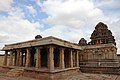 Shiva temple built by emperor Achyuta Deva Raya at Timmalapura near Hampi
_at_Timmalapura.jpg)

_at_Vitthala_temple_in_Hampi.JPG)
_of_Achyuta_Raya_at_entrance_to_Vitthala_temple_in_Hampi.JPG)

References[edit | edit source]
- ↑ Sherwani, H. K. "History of Medieval Deccan" (PDF). p. 316. Retrieved 12 November 2025.
- ↑ Ayyangar, Krishnaswamy (1919). Sources of Vijayanagar History. Chennai: University of Madras. p. 16.
- ↑ Pletcher, Kenneth (15 August 2010). The History of India. The Rosen Publishing Group, Inc. p. 155. ISBN 978-1-61530-122-5.
- ↑ Datta, Nonica (2003). Indian History: Ancient and medieval. Encyclopaedia Britannica (India) and Popular Prakashan, Mumbai. p. 292. ISBN 978-81-7991-067-2.
- ↑ Stein, Burton (1990). The New Cambridge History of India: Vijayanagara. Cambridge University Press. p. 67. ISBN 978-0-521-26693-2.
- ↑ Khan, Iqtidar Alam (25 April 2008). Historical Dictionary of Medieval India. Scarecrow Press. p. 13. ISBN 978-0-8108-6401-6.
- ↑ Indian History. Allied Publishers. 1988. p. 152. ISBN 978-81-8424-568-4.
- ↑ Mukherjee, Sujit (1998). A Dictionary of Indian Literature: Beginnings-1850. Orient Blackswan. p. 410. ISBN 978-81-250-1453-9.
- Prof K. A. Nilakanta Sastri, History of South India, From Prehistoric times to fall of Vijayanagar, 1955, OUP, New Delhi (Reprinted 2002)
External links[edit | edit source]
- Coins
- Pictures of temple on HampiOnline.com
- Achyuta Rayas Temple Photographs, 2013 Archived 9 November 2019 at the Wayback Machine
- Learn more about Achyutaraya Temple on HampiOnline.com
| Preceded by Krishnadevaraya |
Vijayanagar empire 1529–1542 |
Succeeded by Sadashiva Raya |