




>Chariotrider555 Rv unsourced changes |
MarieDevore (talk | contribs) m small refined information for accuracy and improved wording to improve readability |
||
| Line 1: | Line 1: | ||
{{About|character from | {{Short description|King of Kosala and father of Rama in the epic Ramayana}} | ||
{{Use dmy dates|date= | {{About|character from Indian epic Ramayana|Maurya King|Dasharatha Maurya|the film|Dasharatha (film)}} | ||
{{Use Indian English|date= | {{Use dmy dates|date=December 2021}} | ||
{{Use Indian English|date=December 2021}} | |||
{{Infobox royalty | |||
{{Infobox | | type = Hindu | ||
|type= Hindu | | birth_name = Nemi | ||
|birth_name= Nemi | | birth_place = [[Ayodhya (Ramayana)|Ayodhya]], [[Kosala]], [[Bharatavarsha]] (modern-day [[Uttar Pradesh]], [[India]]) | ||
|birth_place=[[Ayodhya]], [[Kosala]] ( | | death_place = Ayodhya, Kosala, Bharatavarsha (modern-day Uttar Pradesh, India) | ||
|death_place=Ayodhya, | | image = King Dasharatha Raja Sabha.jpg | ||
|image=King Dasharatha | | caption = King Dasharatha sitting on his throne | ||
|caption = King Dasharatha | | succession = [[Maharaja]] of [[Kosala]] | ||
|predecessor = [[Aja of Kosala|Aja]] | | predecessor = [[Aja of Kosala|Aja]] | ||
| | |successor = [[Rama]] | ||
|spouse=[[ | | dynasty = [[Solar Dynasty|Suryavamsha]] | ||
| | | spouse = {{unbulleted list|[[Kaikeyi]]|[[Kausalya]]|[[Sumitra]]|350 junior wives<ref>{{cite web|title=Valmiki Ramayana - Ayodhya Kanda - Sarga 34 |url=https://www.valmikiramayan.net/utf8/ayodhya/sarga34/ayodhya_34_frame.htm}}</ref>}} | ||
|father=[[Aja of Kosala|Aja]] | | issue = {{unbulleted list|[[Rama]] (son)|[[Bharata (Ramayana)|Bharata]] (son)|[[Lakshmana]] (son)|[[Shatrughna]] (son)|[[Shanta]] (daughter according to few recensions)}} | ||
|mother=Indumati | | father = [[Aja of Kosala|Aja]] | ||
| mother = Indumati | |||
}} | }} | ||
== | '''Dasharatha''' ({{Langx|sa|दशरथ}}, [[IAST]]: Daśaratha; born '''Nemi''') was the king of [[Kosala]], with its capital at [[Ayodhya (Ramayana)|Ayodhya]], in the Hindu epic ''[[Ramayana]]''. Dasharatha married [[Kausalya]], [[Sumitra]] and [[Kaikeyi]]. He was the father of [[Rama]], the protagonist of the epic Ramayana,<ref>{{Cite web |last=Das |first=Subhamoy |date=September 7, 2018 |title=The Hindu Epic Ramayana |url=https://www.learnreligions.com/the-story-of-ramayana-1770169 |website=learnreligions}}</ref> [[Bharata (Ramayana)|Bharata]], [[Lakshmana]], and [[Shatrughna]]. Dasharatha also finds mention in the ''[[Vishnu Purana]]''.<ref>{{Cite web | url=https://www.valmikiramayan.net/utf8/ayodhya/sarga34/ayodhya_34_frame.htm | title=Valmiki Ramayana - Ayodhya Kanda - Sarga 34}}</ref> | ||
==Legend== | |||
Dasharatha was the son of | === Early life and marriage === | ||
King Dasharatha was believed to be an incarnation of Manu, the son of [[Brahma]]. | |||
Dasharatha | Dasharatha was born as the son of King [[Aja of Kosala]] and Indumati of [[Vidarbha Kingdom|Vidarbha]].<ref>{{Citation|title=Schistosomiasis: Schistosoma mansoni Tf/aja Alnassir and Charles H. King|date=2009-11-23|url=http://dx.doi.org/10.1201/9781498713672-28|work=Medical Parasitology|pages=140–150|publisher=CRC Press|doi=10.1201/9781498713672-28|isbn=9780429089657|access-date=2022-01-13|url-access=subscription}}</ref>{{failed verification|citation is about Medical Parasitology|date=January 2025}} He was originally named Nemi, but he acquired the moniker ''Dasharatha'' ('ten chariots') as his chariot could move in all ten directions, fly, and return to earth, and he could fight with ease in all of these directions.<ref>{{Cite book|last=Kalidasa|url=https://books.google.com/books?id=Gbr7nQEACAAJ|title=The Dynasty of Raghu|date=2012-04-10|publisher=CreateSpace Independent Publishing Platform|isbn=978-1-4751-7250-8|language=en|author-link=Kalidasa}}</ref>{{request quotation|date=January 2025}} | ||
Dasharatha | Dasharatha became the ruler of Kosala after the death of his father. He was a great warrior who subjugated many of the neighbouring kingdoms with his prowess and slew many [[asuras]] in battle.<ref>{{Cite journal |last=Arya |first=Samarendra Narayań |date=1990 |title=Historicity of Ayodhya |url=https://www.jstor.org/stable/44148186 |journal=Proceedings of the Indian History Congress |volume=51 |pages=44–48 |jstor=44148186 |issn=2249-1937}}</ref><ref>[http://www.valmikiramayan.net/bala/sarga1/bala_1_frame.htm Baal Kaand — Valmiki Ramayana]</ref> | ||
== | According to the ''[[Ramayana#Ayodhyā Kāṇḍa|Ayodhyā Kāṇḍa]]'' of the ''Ramayana'' (in chapter 34, verses 10–13), King Dasharatha had around 350 wives, three of whom were his favourite queens: [[Kausalya]] was his chief queen, [[Sumitra]] was his second queen [[Kaikeyi]] was his third queen. Kausalya hailed from the kingdom of [[Dakshina Kosala]], Sumitra from [[Kingdom of Kashi|Kashi]], and Kaikeyi from the [[Kekeya Kingdom]].<ref>{{Cite journal |last=Publication |first=Tjprc |date=2013-10-31 |title=Images of Mother in Ramayana and Sundiata. A Comparative Critique |url=https://www.academia.edu/4884393 |journal=International Journal of English and Literature }}</ref><ref>{{citation |url =https://www.thehindu.com/society/faith/sumitra-is-calm-and-composed/article66941470.ece |title=Sumitra is calm and composed |work=The Hindu |date=8 June 2023 |accessdate=21 September 2023}}</ref><ref>{{Cite book|last=Patel|first=Vaishnavi|url=https://books.google.com/books?id=9mk7EAAAQBAJ|title=Kaikeyi|date=26 April 2022|publisher=Orbit|isbn=9780759557314|language=en}}</ref> | ||
=== Yajñas to beget sons === | |||
[[File:Dasharatha give Payasa to his wives.jpg|thumb|180px|left|Dasharatha gives [[payasa]] to his wives]] | |||
[[File:After_the_successful_completion_of_Yagna,_the_Lord_of_Fire,_Agnidev_appeared_and_gave_a_bowl_of_sweet_to_the_King_of_Ayodhya.jpg|thumb|The Fire Figure giving Payasa to Dasharatha]] | |||
Dasharatha ruled over Ayodhyā, but he lacked a son to carry on his dynasty. He decided to perform a [[Puthrakamesti yagnam]] in order to beget a son. His counsellor and charioteer, Sumantra, told him of a prophecy that by bringing the sage [[Rishyasringa]] to Ayodhyā, he would beget sons.<ref>{{Cite book |url=https://www.jstor.org/stable/j.ctt1bmzkgh |title=The Rāmāyaṇa of Vālmīki: An Epic of Ancient India, Volume II: Ayodhyakāṇḍa |date=1986 |publisher=Princeton University Press|jstor=j.ctt1bmzkgh }}</ref> To fulfil the prophecy, Dasharatha traveled to [[Anga]], where king [[Romapada]]'s daughter [[Shanta]] was married to Rishyasringa. Bringing Rishyasringa to Kosala, he instructed the [[Brahmin]]s to perform the Puthrakamesti yagnam. After the Puthrakamesti yagnam was properly performed, a Putrīyā Iṣṭi was performed for the attainment of sons.<ref name=":1">{{Cite journal |last=Goldman |first=Sally J. Sutherland |date=2018 |title=Women at the Margins: Gender and Religious Anxieties in Vālmīki's Rāmāyaṇa |url=https://www.jstor.org/stable/10.7817/jameroriesoci.138.1.0045 |journal=Journal of the American Oriental Society |volume=138 |issue=1 |pages=45–72 |doi=10.7817/jameroriesoci.138.1.0045 |jstor=10.7817/jameroriesoci.138.1.0045 |issn=0003-0279}}</ref> | |||
[[File:Dasaratha sets out toward Angada to invite Rsyasrnga to his abode,C.1597-1605.jpg|thumb|Dasharatha going to Anga to invite Rishyashringa,his son-in-law]] | |||
[[File:Agnipuruṣa rises from the sacred fire.jpg|thumb|left|Agnipuruṣa rises from the sacred fire with divine boon]] | |||
[[File:Dasharatha four sons.jpg|thumb|Dasharatha with his four sons]] | |||
During its performance, a figure emerged from the fire carrying a vessel of celestial porridge. Dasharatha offers half of this divine food to [[Kausalya]], a quarter to [[Sumitra]] (i.e., literally 'half of that which remained'), an eighth to [[Kaikeyi]] (i.e., again, 'half of that which remained'), and then, upon reflection, gives the final eighth to Sumitra again. Kausalya gives birth to the prince [[Rama]] and Kaikeyi to [[Bharata (Ramayana)|Bharata]].<ref>{{Cite book |last=Goldman |first=Robert P. |title=The Rāmāyaṇa of Vālmīki: An Epic of Ancient India |publisher=Princeton University Press |year=1984 |volume=I: Bālakāṇḍa |pages=136–161}}</ref><ref>{{Cite web |title=The Ramayana in Sanskrit: Book 1: Chapter 15 |url=https://www.sacred-texts.com/hin/rys/rys1015.htm}}</ref> and Sumitra became the mother of [[Lakshmana]] and [[Shatrughna]] | |||
[[File:Rama and his brothers in the company of Raja Dashratha and his three queens.jpg|thumb|Rama and his brothers in the company of Raja Dashratha and his three queens.]] | |||
=== Kaikeyi's boons and Rama's exile === | |||
[[File:Kaikeyi_vilap.jpg|thumb|Kaikeyi asks her boons from Dasharatha]] | |||
[[File: | [[File:The four sons of Dasharatha circumambulate the altar during their marriage rites.jpg|thumb|The four sons of Dasharatha circumambulate the altar during their marriage rites]] | ||
In a battle between the [[Deva (Hinduism)|devas]] and the [[asura]]s, Dasharatha rode to [[Devaloka]], accompanied by Kaikeyi, to help [[Indra]] fight against the asuras. The devas were at a disadvantage due to the sorcery employed by [[Shambara]] and his army of asuras. Dasharatha, riding a chariot, faced the asuras in ten directions at the same time. In this battle, his chariot had to be turned to every direction in a swift manner. During the battle, the bolt of one of the wheels slipped out, and the wheel was about to disengage when Kaikeyi inserted her thumb in the hole of the bolt, and kept the chariot steady. When the king learnt of this, he was pleased, and offered her two boons. The queen said that she would ask for those two boons in the future, as she wished for nothing right then and there.<ref>{{Cite web|url=https://www.sacred-texts.com/hin/rys/rys2039.htm|title=The Ramayana in Sanskrit: Book 2: Chapter 39}}</ref> | |||
[[File:King Dasharatha grieves inconsolably at his obligation to banish Rama to the forest.jpg|thumb|King Dasharatha grieving the exile of his son Rama]] | |||
[[Manthara]], Kaikeyi's maid, feared that Kaikeyi would lose her status as chief queen at court if Rama ascended the throne, as Kausalya would thus become queen mother. Manthara later convinced Kaikeyi to demand two boons granted to her years earlier by Dasharatha. King Dasharatha will be obliged to fulfill them. | |||
[[File: Kaikeyi told that according to the two boons granted by Dasaratha Rama should go to the forest for 14 years and Bharata must become the king.jpg|thumb|Kaikeyi invokes the two boons granted to her by Dasharatha]] | |||
As her two boons, Kaikeyi demanded that Bharata be crowned king, and Rama be sent to the forest for a period of fourteen years.<ref>{{cite book|author = Mani, Vettam|title = Puranic Encyclopaedia: A Comprehensive Dictionary With Special Reference to the Epic and Puranic Literature|url = https://archive.org/details/puranicencyclopa00maniuoft|publisher = Motilal Banarsidass|year = 1975|location = Delhi|isbn = 0-8426-0822-2}}</ref> | |||
[[File:Rama taking leave of Dasharatha.jpg|thumb|left|Rama taking Dashratha’s leave]] | |||
=== Killing of Shravana Kumara and death === | |||
[[File:Dashrath Raja and Shravan.jpg|thumb|Dasharatha kills Shravana Kumara]] | |||
[[File:The-death-of-King-Dasharatha-the-father-of-Rama-Photo-credit-The-Metropolitan-Museum-of-Art.jpg|thumb|left|The death of King Dasharatha the father of Rama]] | |||
After Rama's departure to the forest, Dasharatha lay in his bed with a wailing Kaushalya. He suddenly remembered an incident which had occurred in his past. He narrated to Kausalya and Sumitra about how, by accident, he had killed a young man named [[Shravana Kumara|Shravan]]a, mistaking him to be a deer.<ref>{{Cite web |last=www.wisdomlib.org |date=2020-09-21 |title=The king recalls a former evil deed [Chapter 63] |url=https://www.wisdomlib.org/hinduism/book/the-ramayana-of-valmiki/d/doc424040.html |access-date=2022-08-02 |website=www.wisdomlib.org |language=en}}</ref> | |||
Dasharatha, who was then the crown prince, had gone hunting on the banks of River Sarayu. He was an expert in hunting by determining the direction of sound and heard the gurgle of an animal drinking water. Mistaking it to be deer, Dasharatha shot an arrow. He became mortified when he heard a human cry as the arrow found its target. Dasharatha hurried there to find a boy lying sprawled on the banks of the river with an arrow lodged in his chest. Dasharatha was aghast and profusely apologised to the young Shravana trying to revive and help him. The boy forgave Dasharatha for his unintentional, unrighteous act, and demanded that Dasharatha pull the arrow out of his chest. He also told him to take the pitcher of water to his blind parents, who must be waiting for him since they were thirsty because of all the travel. The boy died from his injury. | |||
[[File:The blind hermit and his wife mourn their son, who was slain accidentally by Dasaratha.jpg|thumb|right|180x180px|The blind hermit and his wife mourn their son, who was slain accidentally by Dasarath.]] | |||
Dasharatha approached the blind couple and told them about their son's unfortunate death. The parents, grief-stricken, cursed Prince Dasharatha: "Just as we are suffering and dying due to the separation from our beloved son, you too shall have the same fate."<ref name="indiatoday2008">[https://www.indiatoday.in/magazine/offtrack/story/20080602-an-unfinished-ancient-tale-736413-2008-05-23 An unfinished ancient tale]. IndiaToday.in. 2008-05-23. Retrieved 2012-09-14.</ref> | |||
[[File:King Dasharatha cremates Shravana and his aged Parents.jpg|thumb|left|251x251px|Dasharatha cremates Shravana and his parents (painting by Laharu of Chamba)]] | |||
Dasharatha concluded the chapter by saying that his end was near and the curse of Shravana's parents had taken effect.<ref>{{Cite web |last=www.wisdomlib.org |date=2020-09-21 |title=Overborne by grief the king yields up his life [Chapter 64] |url=https://www.wisdomlib.org/hinduism/book/the-ramayana-of-valmiki/d/doc424041.html |access-date=2022-08-01 |website=www.wisdomlib.org |language=en}}</ref> | |||
== In popular culture == | |||
== | === Films === | ||
* Aditya Varma portrayed Dasharatha in the 1997 Telugu film ''[[Ramayanam (1997 film)|Ramayanam]]''.<ref>{{cite web | url=http://www.andhratoday.com/movie/RAMAYANA.htm | archive-url=https://web.archive.org/web/19980213002122/http://www.andhratoday.com/movie/RAMAYANA.htm | archive-date=13 February 1998 | title=Ramayanam Reviews }}</ref> | |||
* Dilip Sinha voiced Dasharatha in the 2010 animated Hindi film ''[[Ramayana: The Epic]]''.<ref>{{Cite news|url=http://www.indianexpress.com/news/Epic-Effort/682610/|last=Nagpaul D'souza|first=Dipti|title=Epic Effort|date=17 September 2010|accessdate=18 September 2010|work=Indian Express|agency=The Indian Express Limited}}</ref> | |||
* Rajesh Dubey portrayed him in the 2024 Hindi film ''[[Singham Again]]''. | |||
[[ | === Television === | ||
* [[Bal Dhuri]] portrayed Dasharatha in the 1987 series ''[[Ramayan (1987 TV series)|Ramayan]]''.<ref>{{cite web|last1=Dalrymple|first1=William|author-link1=William Dalrymple (historian)|title=All Indian life is here|url=https://www.theguardian.com/artanddesign/2008/aug/23/art.ramayana|work=[[The Daily Telegraph]]|access-date=15 February 2018|archive-url=https://web.archive.org/web/20130902143318/http://www.theguardian.com/artanddesign/2008/aug/23/art.ramayana|archive-date=2 September 2013|date=23 August 2008}}</ref> | |||
* [[Gajendra Chauhan]] portrayed Dasharatha in the 2002 series ''[[Ramayan (2002 TV series)|Ramayan]]''. | |||
* Pankaj Kalra portrayed Dasharatha in the 2008 series ''[[Ramayan (2008 TV series)|Ramayan]]''. | |||
* [[Mihir Mishra]] portrayed Dasharatha in the 2011 series ''[[Devon Ke Dev...Mahadev]]''. | |||
* [[Rishabh Shukla]] portrayed Dasharatha in 2000 series ''[[Vishnu Puran (TV series)|Vishnu Puran]]'' and 2012 series ''[[Ramayan (2012 TV series)|Ramayan]]''. | |||
* Yogesh Mahajan portrayed Dasharatha in the 2015 series ''[[Sankat Mochan Mahabali Hanumaan]]''. | |||
* [[Dalip Tahil]] portrayed Dasharatha in the 2015 series ''[[Siya Ke Ram]]''.<ref>{{cite news|url=http://timesofindia.indiatimes.com/tv/news/hindi/Siya-Ke-Ram-Everything-you-want-to-know-about-the-show/photostory/49574651.cms|title=StarPlus' Siya Ke Ram: Everything you should know about the show|work=The Times of India|access-date=21 November 2015}}</ref> | |||
* [[Ankur Nayyar]] portrayed Dasharatha in the 2018 series ''[[Ram Siya Ke Luv Kush]]''.<ref>{{Cite web|url=https://www.pinkvilla.com/node/|title=Ram Siya Ke Luv Kush|website=PINKVILLA|language=en|access-date=2019-08-05|archive-date=3 December 2020|archive-url=https://web.archive.org/web/20201203010609/https://www.pinkvilla.com/node/|url-status=dead}}</ref> | |||
* [[Shishir Sharma]] portrayed Kausalya in the 2021 web series ''Ramyug''.<ref>{{cite web |title=Ramyug first impression: Kunal Kohli's retelling of Lord Ram's story misses the mark |url=https://indianexpress.com/article/entertainment/web-series/ramyug-first-impression-kunal-kohli-mx-player-7303122 |website=The Indian Express |access-date=31 July 2023 |language=en |date=6 May 2021}}</ref> | |||
* [[Aarav Chowdhary]] portrayed Dasharatha in the 2024 series ''[[Shrimad Ramayan]]''.<ref>{{Cite web |title=Shrimad Ramayan Review, Episodes 1 and 2: A cinematic visual spectacle on small screen |url=https://www.pinkvilla.com/tv/news/shrimad-ramayan-review-episodes-1-and-2-a-cinematic-visual-spectacle-on-small-screen-1269662?amp |access-date=4 January 2024 |website=Pinkvilla |language=en}}</ref> | |||
* Sandeep Mohan portrayed Dasharatha in 2024 DD National series [[Kakabhushundi Ramayan- Anasuni Kathayein]]. | |||
== | ====YouTube ==== | ||
Dasharatha | * Dinesh Gurjar portrayed Dasharatha in 2024 YouTube series Valmiki Ramayan. | ||
=== Novels === | |||
* The character appears under the name Dasharath in Vaishnavi Patel's 2022 novel ''[[Kaikeyi (novel)|Kaikeyi]]''. | |||
==See also== | ==See also== | ||
*[[ | {{Portal|Hinduism|India}} | ||
* [[Kausalya]] | |||
* [[Sumitra]] | |||
* [[Kaikeyi]] | |||
==References== | ==References== | ||
{{Reflist}} | {{Reflist}} | ||
==Further reading== | |||
* [https://www.gutenberg.org/ebooks/24869 Ramayana, translated in English by] [[Ralph T. H. Griffith|Griffith]], from [[Project Gutenberg]] | |||
* {{citation |last=Bhalla |first=Prem P. |title=The Story Of Sri Ram |url=https://books.google.com/books?id=xiv9_Cp3OtQC&pg=PA24 |date=1 January 2009 |publisher=Peacock Books |isbn=978-81-248-0191-8 }} | |||
==External links== | ==External links== | ||
{{commons category| | {{commons category|Daśaratha}} | ||
* [https://www.gutenberg.org/ebooks/24869 Ramayana, translated in English by] [[Ralph T. H. Griffith|Griffith]], from [[Project Gutenberg]] | * [https://www.gutenberg.org/ebooks/24869 Ramayana, translated in English by] [[Ralph T. H. Griffith|Griffith]], from [[Project Gutenberg]] | ||
{{Ramayana}}{{Authority control}} | {{Ramayana}}{{Authority control}} | ||
[[Category:Ayodhya]] | [[Category:Ayodhya]] | ||
[[Category: | [[Category:Characters in the Ramayana]] | ||
[[Category: | [[Category:Solar dynasty]] | ||
[[Category:Mythological kings of Kosala]] | |||
Latest revision as of 10:09, 15 March 2026
| Dasharatha | |
|---|---|
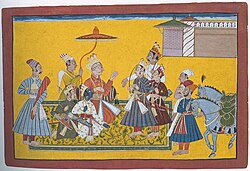
 King Dasharatha sitting on his throne | |
| Maharaja of Kosala | |
| Predecessor | Aja |
| Successor | Rama |
| Born | Nemi Ayodhya, Kosala, Bharatavarsha (modern-day Uttar Pradesh, India) |
| Died | Ayodhya, Kosala, Bharatavarsha (modern-day Uttar Pradesh, India) |
| Spouse | |
| Issue |
|
| Dynasty | Suryavamsha |
| Father | Aja |
| Mother | Indumati |
Dasharatha (Sanskrit: दशरथ, IAST: Daśaratha; born Nemi) was the king of Kosala, with its capital at Ayodhya, in the Hindu epic Ramayana. Dasharatha married Kausalya, Sumitra and Kaikeyi. He was the father of Rama, the protagonist of the epic Ramayana,[2] Bharata, Lakshmana, and Shatrughna. Dasharatha also finds mention in the Vishnu Purana.[3]
Legend[edit | edit source]
Early life and marriage[edit | edit source]
King Dasharatha was believed to be an incarnation of Manu, the son of Brahma.
Dasharatha was born as the son of King Aja of Kosala and Indumati of Vidarbha.[4][failed verification] He was originally named Nemi, but he acquired the moniker Dasharatha ('ten chariots') as his chariot could move in all ten directions, fly, and return to earth, and he could fight with ease in all of these directions.[5][need quotation to verify]
Dasharatha became the ruler of Kosala after the death of his father. He was a great warrior who subjugated many of the neighbouring kingdoms with his prowess and slew many asuras in battle.[6][7]
According to the Ayodhyā Kāṇḍa of the Ramayana (in chapter 34, verses 10–13), King Dasharatha had around 350 wives, three of whom were his favourite queens: Kausalya was his chief queen, Sumitra was his second queen Kaikeyi was his third queen. Kausalya hailed from the kingdom of Dakshina Kosala, Sumitra from Kashi, and Kaikeyi from the Kekeya Kingdom.[8][9][10]
Yajñas to beget sons[edit | edit source]


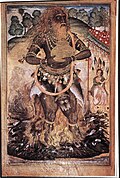
Dasharatha ruled over Ayodhyā, but he lacked a son to carry on his dynasty. He decided to perform a Puthrakamesti yagnam in order to beget a son. His counsellor and charioteer, Sumantra, told him of a prophecy that by bringing the sage Rishyasringa to Ayodhyā, he would beget sons.[11] To fulfil the prophecy, Dasharatha traveled to Anga, where king Romapada's daughter Shanta was married to Rishyasringa. Bringing Rishyasringa to Kosala, he instructed the Brahmins to perform the Puthrakamesti yagnam. After the Puthrakamesti yagnam was properly performed, a Putrīyā Iṣṭi was performed for the attainment of sons.[12]


During its performance, a figure emerged from the fire carrying a vessel of celestial porridge. Dasharatha offers half of this divine food to Kausalya, a quarter to Sumitra (i.e., literally 'half of that which remained'), an eighth to Kaikeyi (i.e., again, 'half of that which remained'), and then, upon reflection, gives the final eighth to Sumitra again. Kausalya gives birth to the prince Rama and Kaikeyi to Bharata.[13][14] and Sumitra became the mother of Lakshmana and Shatrughna

Kaikeyi's boons and Rama's exile[edit | edit source]


In a battle between the devas and the asuras, Dasharatha rode to Devaloka, accompanied by Kaikeyi, to help Indra fight against the asuras. The devas were at a disadvantage due to the sorcery employed by Shambara and his army of asuras. Dasharatha, riding a chariot, faced the asuras in ten directions at the same time. In this battle, his chariot had to be turned to every direction in a swift manner. During the battle, the bolt of one of the wheels slipped out, and the wheel was about to disengage when Kaikeyi inserted her thumb in the hole of the bolt, and kept the chariot steady. When the king learnt of this, he was pleased, and offered her two boons. The queen said that she would ask for those two boons in the future, as she wished for nothing right then and there.[15]

Manthara, Kaikeyi's maid, feared that Kaikeyi would lose her status as chief queen at court if Rama ascended the throne, as Kausalya would thus become queen mother. Manthara later convinced Kaikeyi to demand two boons granted to her years earlier by Dasharatha. King Dasharatha will be obliged to fulfill them.

As her two boons, Kaikeyi demanded that Bharata be crowned king, and Rama be sent to the forest for a period of fourteen years.[16]

Killing of Shravana Kumara and death[edit | edit source]


After Rama's departure to the forest, Dasharatha lay in his bed with a wailing Kaushalya. He suddenly remembered an incident which had occurred in his past. He narrated to Kausalya and Sumitra about how, by accident, he had killed a young man named Shravana, mistaking him to be a deer.[17]
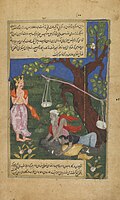
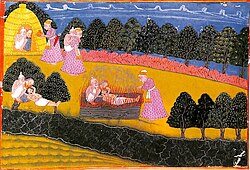
Dasharatha, who was then the crown prince, had gone hunting on the banks of River Sarayu. He was an expert in hunting by determining the direction of sound and heard the gurgle of an animal drinking water. Mistaking it to be deer, Dasharatha shot an arrow. He became mortified when he heard a human cry as the arrow found its target. Dasharatha hurried there to find a boy lying sprawled on the banks of the river with an arrow lodged in his chest. Dasharatha was aghast and profusely apologised to the young Shravana trying to revive and help him. The boy forgave Dasharatha for his unintentional, unrighteous act, and demanded that Dasharatha pull the arrow out of his chest. He also told him to take the pitcher of water to his blind parents, who must be waiting for him since they were thirsty because of all the travel. The boy died from his injury.

Dasharatha approached the blind couple and told them about their son's unfortunate death. The parents, grief-stricken, cursed Prince Dasharatha: "Just as we are suffering and dying due to the separation from our beloved son, you too shall have the same fate."[18]

Dasharatha concluded the chapter by saying that his end was near and the curse of Shravana's parents had taken effect.[19]
In popular culture[edit | edit source]
Films[edit | edit source]
- Aditya Varma portrayed Dasharatha in the 1997 Telugu film Ramayanam.[20]
- Dilip Sinha voiced Dasharatha in the 2010 animated Hindi film Ramayana: The Epic.[21]
- Rajesh Dubey portrayed him in the 2024 Hindi film Singham Again.
Television[edit | edit source]
- Bal Dhuri portrayed Dasharatha in the 1987 series Ramayan.[22]
- Gajendra Chauhan portrayed Dasharatha in the 2002 series Ramayan.
- Pankaj Kalra portrayed Dasharatha in the 2008 series Ramayan.
- Mihir Mishra portrayed Dasharatha in the 2011 series Devon Ke Dev...Mahadev.
- Rishabh Shukla portrayed Dasharatha in 2000 series Vishnu Puran and 2012 series Ramayan.
- Yogesh Mahajan portrayed Dasharatha in the 2015 series Sankat Mochan Mahabali Hanumaan.
- Dalip Tahil portrayed Dasharatha in the 2015 series Siya Ke Ram.[23]
- Ankur Nayyar portrayed Dasharatha in the 2018 series Ram Siya Ke Luv Kush.[24]
- Shishir Sharma portrayed Kausalya in the 2021 web series Ramyug.[25]
- Aarav Chowdhary portrayed Dasharatha in the 2024 series Shrimad Ramayan.[26]
- Sandeep Mohan portrayed Dasharatha in 2024 DD National series Kakabhushundi Ramayan- Anasuni Kathayein.
YouTube[edit | edit source]
- Dinesh Gurjar portrayed Dasharatha in 2024 YouTube series Valmiki Ramayan.
Novels[edit | edit source]
- The character appears under the name Dasharath in Vaishnavi Patel's 2022 novel Kaikeyi.
See also[edit | edit source]


References[edit | edit source]
- ↑ "Valmiki Ramayana - Ayodhya Kanda - Sarga 34".
- ↑ Das, Subhamoy (7 September 2018). "The Hindu Epic Ramayana". learnreligions.
- ↑ "Valmiki Ramayana - Ayodhya Kanda - Sarga 34".
- ↑ "Schistosomiasis: Schistosoma mansoni Tf/aja Alnassir and Charles H. King", Medical Parasitology, CRC Press, pp. 140–150, 23 November 2009, doi:10.1201/9781498713672-28, ISBN 9780429089657, retrieved 13 January 2022
{{citation}}: CS1 maint: work parameter with ISBN (link) - ↑ Kalidasa (10 April 2012). The Dynasty of Raghu. CreateSpace Independent Publishing Platform. ISBN 978-1-4751-7250-8.
- ↑ Arya, Samarendra Narayań (1990). "Historicity of Ayodhya". Proceedings of the Indian History Congress. 51: 44–48. ISSN 2249-1937. JSTOR 44148186.
- ↑ Baal Kaand — Valmiki Ramayana
- ↑ Publication, Tjprc (31 October 2013). "Images of Mother in Ramayana and Sundiata. A Comparative Critique". International Journal of English and Literature.
- ↑ "Sumitra is calm and composed", The Hindu, 8 June 2023, retrieved 21 September 2023
- ↑ Patel, Vaishnavi (26 April 2022). Kaikeyi. Orbit. ISBN 9780759557314.
- ↑ The Rāmāyaṇa of Vālmīki: An Epic of Ancient India, Volume II: Ayodhyakāṇḍa. Princeton University Press. 1986. JSTOR j.ctt1bmzkgh.
- ↑ Goldman, Sally J. Sutherland (2018). "Women at the Margins: Gender and Religious Anxieties in Vālmīki's Rāmāyaṇa". Journal of the American Oriental Society. 138 (1): 45–72. doi:10.7817/jameroriesoci.138.1.0045. ISSN 0003-0279. JSTOR 10.7817/jameroriesoci.138.1.0045.
- ↑ Goldman, Robert P. (1984). The Rāmāyaṇa of Vālmīki: An Epic of Ancient India. Vol. I: Bālakāṇḍa. Princeton University Press. pp. 136–161.
- ↑ "The Ramayana in Sanskrit: Book 1: Chapter 15".
- ↑ "The Ramayana in Sanskrit: Book 2: Chapter 39".
- ↑ Mani, Vettam (1975). Puranic Encyclopaedia: A Comprehensive Dictionary With Special Reference to the Epic and Puranic Literature. Delhi: Motilal Banarsidass. ISBN 0-8426-0822-2.
- ↑ www.wisdomlib.org (21 September 2020). "The king recalls a former evil deed [Chapter 63]". www.wisdomlib.org. Retrieved 2 August 2022.
- ↑ An unfinished ancient tale. IndiaToday.in. 2008-05-23. Retrieved 2012-09-14.
- ↑ www.wisdomlib.org (21 September 2020). "Overborne by grief the king yields up his life [Chapter 64]". www.wisdomlib.org. Retrieved 1 August 2022.
- ↑ "Ramayanam Reviews". Archived from the original on 13 February 1998.
- ↑ Nagpaul D'souza, Dipti (17 September 2010). "Epic Effort". Indian Express. The Indian Express Limited. Retrieved 18 September 2010.
- ↑ Dalrymple, William (23 August 2008). "All Indian life is here". The Daily Telegraph. Archived from the original on 2 September 2013. Retrieved 15 February 2018.
- ↑ "StarPlus' Siya Ke Ram: Everything you should know about the show". The Times of India. Retrieved 21 November 2015.
- ↑ "Ram Siya Ke Luv Kush". PINKVILLA. Archived from the original on 3 December 2020. Retrieved 5 August 2019.
- ↑ "Ramyug first impression: Kunal Kohli's retelling of Lord Ram's story misses the mark". The Indian Express. 6 May 2021. Retrieved 31 July 2023.
- ↑ "Shrimad Ramayan Review, Episodes 1 and 2: A cinematic visual spectacle on small screen". Pinkvilla. Retrieved 4 January 2024.
Further reading[edit | edit source]
- Ramayana, translated in English by Griffith, from Project Gutenberg
- Bhalla, Prem P. (1 January 2009), The Story Of Sri Ram, Peacock Books, ISBN 978-81-248-0191-8
.jpg)