




m Removing protection template from an unprotected page |
No edit summary |
||
| Line 1: | Line 1: | ||
{{Short description|President of the United States from 1901 to 1909}} | {{Short description|President of the United States from 1901 to 1909}} | ||
{{About other people|the president of the United States}} | {{About other people|the president of the United States}} | ||
{{ | {{Pp-vandalism|small=yes}} | ||
{{Use American English|date=February | {{Use American English|date=February 2025}} | ||
{{Use mdy dates|date= | {{Use mdy dates|date=July 2025}} | ||
{{Infobox officeholder | {{Infobox officeholder | ||
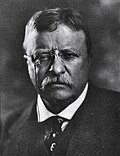
| image | | image = Theodore Roosevelt by the Pach Bros (4x5 cropped).jpg | ||
| caption | | caption = Roosevelt in 1904 | ||
| | | order1 = 26th | ||
| | | office1 = President of the United States | ||
| | | vice_president1 = {{Plain list| | ||
* | * Vacant (1901–1905){{Efn|Roosevelt was vice president under McKinley and became president after McKinley's assassination in 1901. This was prior to the adoption of the [[Twenty-fifth Amendment to the United States Constitution|Twenty-fifth Amendment]] in 1967, and a vacancy in the office of vice president was not filled until the next election and inauguration.}} | ||
* {{longitem|[[Charles W. Fairbanks]] | * {{longitem|[[Charles W. Fairbanks]] (1905–1909)}} | ||
}} | }} | ||
| | | term_start1 = September 14, 1901 | ||
| | | term_end1 = March 4, 1909 | ||
| | | predecessor1 = [[William McKinley]] | ||
| | | successor1 = [[William Howard Taft]] | ||
| order2 | | order2 = 25th | ||
| office2 | | office2 = Vice President of the United States | ||
| president2 | | president2 = William McKinley | ||
| term_start2 | | term_start2 = March 4, 1901 | ||
| term_end2 | | term_end2 = September 14, 1901 | ||
| predecessor2 | | predecessor2 = [[Garret Hobart]] | ||
| successor2 | | successor2 = Charles W. Fairbanks | ||
| order3 | | order3 = 33rd | ||
| office3 | | office3 = Governor of New York | ||
| lieutenant3 | | lieutenant3 = [[Timothy L. Woodruff]] | ||
| term_start3 | | term_start3 = January 1, 1899 | ||
| term_end3 | | term_end3 = December 31, 1900 | ||
| predecessor3 | | predecessor3 = [[Frank S. Black]] | ||
| successor3 | | successor3 = [[Benjamin Barker Odell Jr.]] | ||
| office4 = [[Assistant Secretary of the Navy]] | |||
| office4 | | president4 = William McKinley | ||
| president4 | | term_start4 = April 19, 1897 | ||
| term_start4 | | term_end4 = May 10, 1898 | ||
| term_end4 | | predecessor4 = [[William McAdoo (New Jersey politician)|William McAdoo]] | ||
| predecessor4 | | successor4 = [[Charles Herbert Allen]] | ||
| successor4 | | office5 = [[President of the New York City Board of Police Commissioners]] | ||
| office5 | | appointer5 = [[William Lafayette Strong]] | ||
| appointer5 | | term_start5 = May 6, 1895 | ||
| term_start5 | | term_end5 = April 19, 1897 | ||
| term_end5 | | predecessor5 = James J. Martin | ||
| successor5 = [[Frank Moss (lawyer)|Frank Moss]] | |||
| predecessor5 | | state_assembly6 = New York | ||
| successor5 | | district6 = [[New York's 21st State Assembly district|21st]] | ||
| | | term_start6 = January 1, 1883 | ||
| | | term_end6 = December 31, 1884 | ||
| predecessor6 = William J. Trimble | |||
| successor6 = [[Henry A. Barnum]] | |||
| birth_date = {{birth date|1858|10|27}} | |||
| birth_name = Theodore Roosevelt{{nbsp}}Jr.<!--Nbsp is needed for readers on mobile devices--> | |||
| birth_place = New York City, U.S. | |||
| | | death_date = {{death date and age|1919|1|6|1858|10|27}} | ||
| | | death_place = [[Oyster Bay, New York]], U.S. | ||
| resting_place = [[Youngs Memorial Cemetery]] | |||
| party = [[Republican Party (United States)|Republican]] (1880–1912, 1916–1919) | |||
| other_party = [[Bull Moose Party]] (1912–1916) | |||
| spouse = {{unbulleted list|{{marriage|[[Alice Hathaway Lee Roosevelt|Alice Lee]]|October 27, 1880|February 14, 1884|end=died}}|{{marriage|[[Edith Carow]]|December 2, 1886}}}} | |||
| children = 6 | |||
| relatives = [[Roosevelt family]] | |||
| | | alma_mater = {{unbulleted list|[[Harvard University]] ([[Bachelor of Arts|AB]])|[[Columbia Law School|Columbia University]]}} | ||
| | | occupation = {{flatlist| | ||
| birth_date | * Author | ||
| birth_name | * conservationist | ||
| birth_place | * explorer | ||
| death_date | * historian | ||
| death_place | * naturalist | ||
| resting_place | * [[police commissioner]] | ||
| party | * politician | ||
| | * soldier | ||
| spouse | |||
| children | |||
* [[ | |||
* | |||
}} | }} | ||
| signature = Theodore Roosevelt Signature-2.svg | |||
| signature_alt = Cursive signature in ink | |||
| awards = [[Nobel Peace Prize]] (1906) | |||
| signature | | allegiance = United States | ||
| signature_alt | | branch = [[United States Army]] | ||
| awards | | service_years = {{unbulleted list|1882–1886 (guard)|1898}} | ||
| branch | | rank = [[Colonel (United States)|Colonel]] | ||
| | | unit = [[New York Army National Guard]] | ||
| rank | | mawards = [[Medal of Honor]] {{avoid wrap|([[Posthumous award|posthumous]], 2001)}} | ||
| mawards | | commands = [[1st U.S. Volunteer Cavalry]] | ||
| commands | | battles = {{tree list}} | ||
| battles | |||
* [[Spanish–American War]] | * [[Spanish–American War]] | ||
** [[Battle of Las Guasimas]] | ** [[Battle of Las Guasimas]] | ||
** [[Battle of San Juan Hill]] | ** [[Battle of San Juan Hill]] | ||
{{tree list/end}} | {{tree list/end}} | ||
| module | | module = {{Listen|pos=center|embed=yes|filename=Right of the People.ogg|title=Theodore Roosevelt's voice|type=speech|description=Roosevelt giving a speech during his [[1912 United States presidential election|second presidential campaign]]<br />Recorded 1912}} | ||
}} | }} | ||
{{Theodore Roosevelt series}} | {{Theodore Roosevelt series}} | ||
Roosevelt | '''Theodore Roosevelt Jr.'''{{efn|Pronounced {{IPAc-en|ˈ|r|oʊ|z|ə|v|ɛ|l|t}} {{respell|ROH|zə|velt}}}} (October 27, 1858 – January 6, 1919), also known as '''Teddy''' or '''T.{{nbsp}}R.''', was the 26th [[president of the United States]], serving from 1901 to 1909. Roosevelt previously was involved in [[New York (state)|New York]] politics, including serving as the state's [[List of governors of New York|33rd governor]] for two years. He served as the 25th [[Vice President of the United States|vice president]] under President [[William McKinley]] for six months in 1901, assuming the presidency after [[Assassination of William McKinley|McKinley's assassination]]. As president, Roosevelt emerged as a leader of the [[History of the Republican Party (United States)|Republican Party]] and became a driving force for [[United States antitrust law|anti-trust]] and [[Progressive Era]] policies. | ||
Roosevelt | A sickly child with debilitating [[asthma]], Roosevelt overcame health problems through [[The Strenuous Life|his strenuous life]]. He was [[homeschooled]] and began a lifelong naturalist avocation before attending [[Harvard University]]. His book ''[[The Naval War of 1812]]'' established his reputation as a historian and popular writer. Roosevelt became the leader of the reform faction of Republicans in the [[New York State Legislature]]. His first wife [[Alice Hathaway Lee Roosevelt]] and mother [[Martha Bulloch Roosevelt]] died on the same night, devastating him psychologically. He recuperated by buying and operating a cattle ranch in [[the Dakotas]]. Roosevelt served as the [[assistant secretary of the Navy]] under McKinley, and in 1898 helped plan the [[Spanish–American War|successful naval war against Spain]]. He resigned to help form and lead the [[Rough Riders]], a unit that fought the [[Spanish Army]] in [[Cuba]] to great publicity. Returning a war hero, Roosevelt was [[1898 New York state election|elected New York's governor in 1898]]. Because the New York state party leadership disliked his ambitious state agenda, they convinced McKinley to choose him as his running mate in the [[1900 United States presidential election|1900 presidential election]]. The McKinley–Roosevelt ticket won a landslide victory. | ||
Roosevelt [[First inauguration of Theodore Roosevelt|began his presidency]] at age 42 when [[Assassination of William McKinley|McKinley was assassinated]]. He thus became (and remains) the youngest person to assume the position. As a leader of [[Progressivism in the United States|the progressive movement]], he championed his "[[Square Deal]]" domestic policies, which called for fairness for all citizens, breaking bad [[Trust (business)|trusts]], regulating railroads, and [[Pure Food and Drug Act|pure food and drugs]]. Roosevelt prioritized [[Conservation movement|conservation]] and established [[List of national parks of the United States|national parks]], [[List of national forests of the United States|forests]], and [[List of national monuments of the United States|monuments]] to preserve U.S. natural resources. In [[Foreign policy of the Theodore Roosevelt administration|foreign policy]], he [[Roosevelt Corollary|focused on Central America]], beginning construction of the [[Panama Canal]]. Roosevelt expanded the U.S. Navy and sent the [[Great White Fleet]] on a world tour to project naval power. His [[Treaty of Portsmouth|successful efforts]] to end the [[Russo-Japanese War]] won him the 1906 [[Nobel Peace Prize]], the first non-European to win a [[Nobel Prize]]. Roosevelt was [[1904 United States presidential election|elected to a full term in 1904]] and convinced [[William Howard Taft]] to succeed him in 1908. | |||
[[ | |||
Roosevelt's | Roosevelt grew frustrated with Taft's brand of conservatism yet failed to win the [[1912 Republican Party presidential primaries|1912 Republican presidential nomination]]. He founded the [[Bull Moose Party]] and ran in [[1912 United States presidential election|1912]]; the split allowed the [[History of the Democratic Party (United States)|Democrat]] [[Woodrow Wilson]] to win. Roosevelt led a [[Roosevelt–Rondon Scientific Expedition|four-month expedition to the Amazon basin]], where he nearly died of [[tropical disease]]. During World War I, he criticized Wilson for keeping the U.S. out; his offer to lead volunteers to France was rejected. Roosevelt's health deteriorated and he died in 1919. [[Historical rankings of presidents of the United States#1982 Murray–Blessing|Polls of historians and political scientists]] rank him as one of the greatest American presidents. | ||
Roosevelt | ==Early life and education== | ||
[[File:TR Age 11 Paris.jpg|thumb|left|upright=.75|Roosevelt aged 11]] | |||
Theodore Roosevelt Jr. was born on October 27, 1858, at [[Theodore Roosevelt Birthplace National Historic Site|28 East 20th Street]] in [[Manhattan]].{{sfn|Morris|1979|p=3}} His parents were [[Martha Bulloch Roosevelt|Martha Stewart Bulloch]] and businessman [[Theodore Roosevelt Sr.]] He had an older sister Anna (called [[Bamie Roosevelt|Bamie]]), a younger brother [[Elliott Roosevelt (socialite)|Elliott]], and a younger sister [[Corinne Roosevelt Robinson|Corinne]].<ref>{{Cite web|title=Anna Roosevelt – Theodore Roosevelt Birthplace National Historic Site (U.S. National Park Service)|url=https://www.nps.gov/thrb/learn/historyculture/annaroosevelt.htm|access-date=April 4, 2021|publisher=National Park Service|archive-date=May 17, 2021|archive-url=https://web.archive.org/web/20210517084507/https://www.nps.gov/thrb/learn/historyculture/annaroosevelt.htm|url-status=dead}}</ref> | |||
Roosevelt's youth was shaped by his poor health and debilitating asthma attacks, which terrified him and his parents. Doctors had no cure.{{Sfn|McCullough|1981|pp=[https://books.google.com/books?id=nuzmvrqPvdIC&pg=PA93 93–108]}} Nevertheless, he was energetic and mischievously inquisitive.{{Sfn|Putnam|1958|pp=23–27}} His lifelong interest in [[zoology]] began at age seven when he saw a dead [[Pinniped|seal]] at a market; after obtaining the seal's head, Roosevelt and his cousins formed the "Roosevelt Museum of Natural History". Having learned the rudiments of [[taxidermy]], he filled his makeshift museum with animals he killed or caught. At age nine, he recorded his observations in a paper entitled "The Natural History of Insects".<ref name="environment">{{Cite web | publisher = PBS | url = https://www.pbs.org/wgbh/amex/tr/envir.html | title = TR's Legacy — The Environment | access-date = March 6, 2006 | archive-date = December 24, 2008 | archive-url = https://web.archive.org/web/20081224215129/http://www.pbs.org/wgbh/amex/tr/envir.html }}</ref> | |||
Family trips, including tours of Europe in 1869 and 1870, and [[Khedivate of Egypt|Egypt]] in 1872, shaped his cosmopolitan perspective.{{Sfn|Roosevelt|1913|p=13}} Hiking with his family in the [[Alps]] in 1869, Roosevelt discovered the benefits of physical exertion to minimize his asthma and bolster his spirits.{{Sfn|Putnam|1958|pp=63–70}} Roosevelt began a heavy regimen of exercise. After being manhandled by older boys on the way to a camping trip, he found a boxing coach to train him.{{Sfn|Testi|1995|pp=1516–1517}}{{Sfn|Roosevelt|1913|pp=32–33}} | |||
===Education=== | ===Education=== | ||
Roosevelt was | Roosevelt was homeschooled. Biographer [[H. W. Brands]] wrote that, "The most obvious drawback...was uneven coverage of...various areas of...knowledge."{{Sfn|Brands|1997|page=49}} He was solid in geography and bright in history, biology, French, and German; however, he struggled in mathematics and the classical languages. | ||
In September 1876, he entered [[Harvard University]]. His father instructed him to, "take care of your morals first, your health next, and finally your studies."<ref>{{cite book|first=Edward P.|last=Kohn|title=Heir to the Empire City: New York and the Making of Theodore Roosevelt|url=https://books.google.com/books?id=EcZWAAAAQBAJ&pg=PT26|year=2013|page=26|publisher=Basic Books |isbn=978-0-465-06975-0|access-date=April 15, 2017|archive-date=April 15, 2017|archive-url=https://web.archive.org/web/20170415213639/https://books.google.com/books?id=EcZWAAAAQBAJ&pg=PT26|url-status=live}}</ref> His father's sudden death in 1878 devastated Roosevelt.{{Sfn|Miller|1992|pp=80–82}} He inherited US$60,000 (equivalent to ${{Format price|{{Inflation|US-GDP|60,000|1878|r=-4}}}} in {{Inflation/year|US-GDP}}), on which he could live comfortably for the rest of his life.<ref name=NYT14>{{cite news|url=https://www.nytimes.com/times-insider/2014/07/18/1878-theodore-roosevelt-inherits-a-fortune/|title=First Glimpses: 1878: Theodore Roosevelt Inherits a Fortune|date=July 18, 2014|first=Mark|last=Bulik|newspaper=[[The New York Times]]|archive-url=https://web.archive.org/web/20201222113116/https://www.nytimes.com/times-insider/2014/07/18/1878-theodore-roosevelt-inherits-a-fortune/|access-date=December 22, 2020|archive-date=December 22, 2020}}</ref> | |||
His father, a devout [[Presbyterianism|Presbyterian]], had regularly led the family in prayers. While at Harvard, young adult Theodore emulated him by teaching Sunday School for more than three years at the Episcopal [[Christ Church (Cambridge, Massachusetts)|Christ Church]] in [[Cambridge, Massachusetts]]. When the minister at Christ Church insisted he become an Episcopalian to continue teaching, Roosevelt declined, and began teaching a mission class in a poor section of Cambridge.<ref>{{cite book |last=McCullough |first=David |author-link=David McCullough |title=[[Mornings on Horseback]]: The Story of an Extraordinary Family, a Vanished Way of Life and the Unique Child Who Became Theodore Roosevelt |publisher=Simon & Schuster |year=1982 |isbn=978-0-6714-4754-0 }}</ref> | |||
[[ | Roosevelt did well in science, philosophy, and rhetoric courses, but struggled in Latin and Greek. He was already an accomplished naturalist and a published [[Ornithology|ornithologist]], and studied biology intently. He read prodigiously with an almost photographic memory.{{Sfn|Brands|1997|p=62}} Roosevelt participated in rowing and [[Harvard Boxing Club|boxing]], and was a member of the [[Alpha Delta Phi]] literary society, the [[Delta Kappa Epsilon]] fraternity, and the prestigious [[Porcellian Club]]. In 1880, Roosevelt graduated [[Phi Beta Kappa]] (22nd of 177) with an [[Bachelors of Arts|A.B.]] ''[[magna cum laude]]''. [[Henry F. Pringle]] wrote: | ||
{{blockquote|Roosevelt, attempting to analyze his college career and weigh the benefits he had received, felt that he had obtained little from Harvard. He had been depressed by the formalistic treatment of many subjects, by the rigidity, the attention to minutiae that were important in themselves, but which somehow were never linked up with the whole.{{sfn|Pringle|1931|p=27}}}} | |||
Roosevelt gave up his plan of studying natural science and attended [[Columbia Law School]], moving back into his family's home in New York. Although Roosevelt was an able student, he found law to be irrational.{{Sfn|Brands|1997|pp=110–112, 123–133. quote p. 126}} Determined to enter politics, Roosevelt began attending meetings at Morton Hall, the headquarters of New York's 21st District Republican Association. Though Roosevelt's father had been a prominent member of the [[History of the Republican Party (United States)|Republican Party]], Roosevelt made an unorthodox career choice for someone of his class, as most of Roosevelt's peers refrained from becoming too closely involved in politics. Roosevelt found allies in the local Republican Party and defeated a Republican state assemblyman tied closely to the political machine of Senator [[Roscoe Conkling]]. After his election victory, Roosevelt dropped out of law school, later saying, "I intended to be one of the governing class."{{Sfn|Brands|1997|pp=110–112, 123–133. quote p. 126}} | |||
===Naval history and strategy=== | |||
While at Harvard, Roosevelt began a systematic study of the role played by the [[United States Navy]] in the [[War of 1812]].{{Sfn|Roosevelt|1913|p=35}}{{Sfn|Morris|1979|p=565}} He published ''[[The Naval War of 1812]]'' in 1882. The book included comparisons of British and American leadership down to the ship-to-ship level. It was praised for its scholarship and style, and remains a standard study of the war.<ref name="mjcrawford1">{{cite journal|last1=Crawford|first1=Michael J.|title=The Lasting Influence of Theodore Roosevelt's Naval War of 1812|journal=International Journal of Naval History|date=April 2002|volume=1|issue=1|url=http://www.ijnhonline.org/wp-content/uploads/2012/01/pdf_crawford.pdf|access-date=October 6, 2017|archive-url=https://web.archive.org/web/20180713113248/http://www.ijnhonline.org/wp-content/uploads/2012/01/pdf_crawford.pdf|archive-date=July 13, 2018}}</ref> | |||
Some believed Roosevelt's naval ideas were derived from author [[Alfred Thayer Mahan]], who popularized a concept that only nations with significant naval power had been able to influence history, dominate oceans, exert their diplomacy to the fullest, and defend their borders,<ref>{{Cite journal |last1=Karsten |first1=Peter |year=1971 |title=The Nature of "Influence": Roosevelt, Mahan and the Concept of Sea Power |journal=American Quarterly |volume=23 |issue=4 |pages=585–600 |doi=10.2307/2711707 |issn=0003-0678 |jstor=2711707}}</ref><ref>Richard W. Turk, ''The Ambiguous Relationship: Theodore Roosevelt and Alfred Thayer Mahan'' (1987) [https://www.questia.com/library/2008464/the-ambiguous-relationship-theodore-roosevelt-and online] {{Webarchive|url=https://web.archive.org/web/20160611162223/https://www.questia.com/library/2008464/the-ambiguous-relationship-theodore-roosevelt-and|date=June 11, 2016}}</ref> but naval historian Nicholas Danby states that Roosevelt's ideas predated meeting Mahan or reading his work.<ref>{{Cite magazine |last=Danby |first=Nicholas |date=February 2021 |title=The Roots of Roosevelt's Navalism |url=https://www.usni.org/magazines/naval-history-magazine/2021/february/roots-roosevelts-navalism |magazine=[[Naval History]]}}</ref> | |||
==New York State Assemblyman (1883-1884)== | |||
In [[1881 New York state election|1881]], Roosevelt won election to the [[New York State Assembly]], representing the [[New York's 21st State Assembly district|21st district]], which was centered on the "Silk Stocking District" of New York County's [[Upper East Side]]. He served in the [[105th New York State Legislature|1882]], [[106th New York State Legislature|1883]], and [[107th New York State Legislature|1884]] sessions of the legislature. | |||
Roosevelt began making his mark immediately. He blocked a corrupt effort of financier [[Jay Gould]] to lower his taxes. Roosevelt exposed the collusion of Gould and Judge [[Theodoric R. Westbrook|Theodore Westbrook]] and successfully argued for an investigation, aiming for the judge to be impeached. Although the investigation committee rejected the impeachment, Roosevelt had exposed corruption in [[Albany, New York|Albany]] and assumed a high and positive profile in New York publications.{{Sfn|Brands|1997|pp=134–140}} | |||
Roosevelt's anti-corruption efforts helped him win re-election in [[1882 New York state election|1882]] by a margin greater than two-to-one, an achievement made more impressive by the victory that Democratic gubernatorial candidate [[Grover Cleveland]] won in Roosevelt's district.{{Sfn|Miller|1992|pp=138–139}} With Senator Conkling's [[Stalwart (politics)|Stalwart]] faction of the Republican Party in disarray following the [[assassination of President James Garfield]], Roosevelt won election as party leader in the state assembly. He allied with Governor Cleveland to win passage of a civil service reform bill.{{Sfn|Miller|1992|pp=140–142}} Roosevelt won re-election and sought the office of [[Speaker of the New York State Assembly|Speaker]], but [[Titus Sheard]] obtained the position.<ref>{{Cite news |date=January 1, 1884 |title=Mr Sheard to be Speaker |url=https://timesmachine.nytimes.com/timesmachine/1884/01/01/106134466.pdf |url-status=live |archive-url=https://web.archive.org/web/20210225073137/https://timesmachine.nytimes.com/timesmachine/1884/01/01/106134466.pdf |archive-date=February 25, 2021 |access-date=June 13, 2018 |work=The New York Times}}</ref>{{Sfn|Miller|1992|p=153}} Roosevelt served as Chairman of the Committee on Affairs of Cities, during which he wrote more bills than any other legislator.<ref>{{Cite journal |last=Kohn |first=Edward P. |date=2009 |title='A Most Revolting State of Affairs': Theodore Roosevelt's Aldermanic Bill and the New York Assembly City Investigating Committee of 1884 |journal=American Nineteenth Century History |volume=10 |issue=1 |pages=71–92|doi=10.1080/14664650802299909 |hdl=11693/48381 |hdl-access=free }}</ref> | |||
== | ==Military service (1882-1886; 1898)== | ||
===State | ===New York National Guard=== | ||
[[File: | While serving in the [[New York State Assembly]], he commissioned as a Second Lieutenant in the 8th Regiment [[New York Army National Guard|New York Army National Guard]], serving a part time capacity for 4 years. He left with the rank of Captain.<ref> https://www.nationalguard.mil/Resources/Image-Gallery/Historical-Paintings/Presidential-Series/Theodore-Roosevelt/?utm_source=copilot.com </ref><ref> https://www.ngef.org/guardmuster/roosevelt-theodore/ </ref><ref> https://www.raabcollection.com/presidential-autographs/roosevelt-new-york-national-guard </ref> | ||
===Rough Riders=== | |||
{{Further|Rough Riders}} | |||
[[File:Theodore Rooseveltnewtry.jpg|thumb|upright=.8|Colonel Roosevelt in 1898]] | |||
With the beginning of the [[Spanish–American War]] in 1898, Roosevelt resigned as Assistant Secretary of the Navy. Along with Army Colonel [[Leonard Wood]], he formed the [[Rough Riders|First U.S. Volunteer Cavalry Regiment]].<ref name="LOC">{{cite web | url=https://www.loc.gov/rr/hispanic/1898/roughriders.html | title=The World of 1989: The Spanish–American War; Rough Riders | publisher=Library of Congress | access-date=February 7, 2015 | archive-date=February 7, 2015 | archive-url=https://web.archive.org/web/20150207100632/http://www.loc.gov/rr/hispanic/1898/roughriders.html | url-status=live }}</ref> His wife and many friends begged Roosevelt to remain in Washington, but Roosevelt was determined to see battle. When the newspapers reported the formation of the new regiment, Roosevelt and Wood were flooded with applications.{{Sfn|Miller|1992|pp=272–274}} Referred to by the press as the "Rough Riders", it was one of many temporary units active only during the war.{{Sfn|Samuels|1997|p=148}} | |||
The regiment trained for several weeks in [[San Antonio, Texas]]; in his autobiography, Roosevelt wrote that his experience with the [[New York National Guard]] enabled him to immediately begin teaching basic soldiering skills.<ref>{{cite book |last=Roosevelt |first=Theodore |date=2014 |title=Theodore Roosevelt: An Autobiography |url=https://books.google.com/books?id=TwHCAwAAQBAJ&pg=PA244 |publisher=The Floating Press |page=244 |isbn=978-1-77653-337-4 |access-date=February 9, 2015 |archive-date=November 19, 2016 |archive-url=https://web.archive.org/web/20161119023721/https://books.google.com/books?id=TwHCAwAAQBAJ&pg=PA244 |url-status=live }}</ref> Diversity characterized the regiment, which included [[Ivy League]]rs, athletes, frontiersmen, [[Native Americans in the United States|Native Americans]], hunters, miners, former soldiers, tradesmen, and sheriffs. The Rough Riders were part of the cavalry division commanded by former Confederate general [[Joseph Wheeler]]. Roosevelt and his men landed in [[Daiquirí]], Cuba, on June 23, 1898, and marched to [[Siboney, Cuba|Siboney]]. Wheeler sent the Rough Riders on a parallel road northwest running along a ridge up from the beach. Roosevelt took command of the regiment; he had his first experience in combat when the Rough Riders met Spanish troops in a skirmish known as the [[Battle of Las Guasimas]]. They fought their way through Spanish resistance and, together with the Regulars, forced the Spaniards to abandon their positions.<ref name="The Rough Riders">{{Cite book | last = Roosevelt | first = Theodore | author-link = Theodore Roosevelt | year = 1898 | chapter-url = http://www.bartleby.com/51/ | title = The Rough Riders | chapter = III | page = 2 | publisher = Bartleby | access-date = August 8, 2008 | archive-date = July 23, 2008 | archive-url = https://web.archive.org/web/20080723190331/http://bartleby.com/51/ | url-status = live }}</ref> | |||
[[File:TR San Juan Hill 1898.jpg|thumb|Colonel Roosevelt and the [[Rough Riders]] along with members of the 3rd Volunteers and the [[10th Cavalry Regiment (United States)|10th Cavalry Regiment]] after capturing [[Kettle Hill]] in [[Cuba]] during the [[Spanish–American War]] in July 1898]] | |||
On July 1, in a combined assault with the Regulars, under Roosevelt's leadership, the Rough Riders became famous for charges up [[Kettle Hill]] and San Juan Hill. Roosevelt was the only soldier on horseback, as he rode back and forth between rifle pits at the forefront of the advance up Kettle Hill, an advance that he urged despite the absence of orders. He was forced to walk up the last part of Kettle Hill because his horse had been entangled in [[barbed wire]]. The assaults would become known as the Battle of San Juan Heights. The victories came at a cost of 200 killed and 1,000 wounded.{{Sfn|Brands|1997|p=356}} | |||
In August, Roosevelt and other officers demanded the soldiers be returned home. Roosevelt recalled San Juan Heights as "the great day of my life". After returning to civilian life, Roosevelt preferred to be known as "Colonel Roosevelt" or "The Colonel"; "Teddy" remained much more popular with the public, though Roosevelt openly despised that moniker.<ref name= HandyBook>{{cite book| last= Matuz| first = Roger | title = The Handy Presidents Answer Book | url= https://archive.org/details/handypresidentsa0000matu| url-access= registration| year = 2004 | publisher=Visible Ink Press |page=[https://archive.org/details/handypresidentsa0000matu/page/474/mode/2up 474] |isbn=978-0-7808-0773-0}}</ref> | |||
==Cattle rancher in Dakota== | ==Cattle rancher in Dakota== | ||
[[File: | [[File:Theodore Roosevelt with hunting suit and rifle 3a24199u original.jpg|thumb|Roosevelt as a [[Badlands]] hunter in 1885]] | ||
Roosevelt first visited the [[Dakota Territory]] in 1883 to hunt [[bison]]. | Roosevelt first visited the [[Dakota Territory]] in 1883 to hunt [[bison]]. Exhilarated by the [[western lifestyle]] and with the cattle business booming, Roosevelt invested $14,000 (equivalent to ${{Format price|{{Inflation|US-GDP|14,000|1883|r=-4}}}} in {{Inflation/year|US-GDP}}) in hope of becoming a prosperous cattle rancher. For several years, he shuttled between his home in New York and ranch in Dakota.<ref>{{Cite web |title=Theodore Roosevelt the Rancher |url=https://www.nps.gov/thro/learn/historyculture/theodore-roosevelt-the-rancher.htm |url-status=live |archive-url=https://web.archive.org/web/20190902213054/https://www.nps.gov/thro/learn/historyculture/theodore-roosevelt-the-rancher.htm |archive-date=September 2, 2019 |access-date=November 27, 2019 |publisher=[[National Park Service]]}}</ref> | ||
Following the [[1884 United States presidential election]], Roosevelt built [[Elkhorn Ranch]] {{cvt|35|mi|km}} north of the [[boomtown]] of [[Medora, North Dakota]]. Roosevelt learned to ride western style, rope, and hunt on the banks of the [[Little Missouri River (North Dakota)|Little Missouri]]. A cowboy, he said, possesses, "few of the emasculated, milk-and-water moralities admired by the pseudo-philanthropists; but he does possess, to a very high degree, the stern, manly qualities that are invaluable to a nation".<ref>{{Cite book |last=Roosevelt |first=Theodore |url=https://books.google.com/books?id=BY4-AAAAYAAJ&pg=PA56 |title=Ranch Life and the Hunting Trail |publisher=Century |others=Illustrated by [[Frederic Remington]] |year=1902 |location=New York |pages=55–56 |access-date=October 17, 2015 |orig-date=1888 |archive-url=https://web.archive.org/web/20150407023213/http://books.google.com/books?id=BY4-AAAAYAAJ&pg=PA56 |archive-date=April 7, 2015 |url-status=live}}</ref><ref>{{Cite book |last=Morrisey |first=Will |url=https://books.google.com/books?id=oS2Kcqjl-VgC&pg=PA41 |title=The Dilemma of Progressivism: How Roosevelt, Taft, and Wilson Reshaped the American Regime of Self-Government |publisher=Rowman & Littlefield |year=2009 |isbn=978-0-7425-6618-7 |page=41 |access-date=October 17, 2015 |archive-url=https://web.archive.org/web/20150406172847/http://books.google.com/books?id=oS2Kcqjl-VgC&pg=PA41 |archive-date=April 6, 2015 |url-status=live}}</ref> He wrote about frontier life for national magazines and published books: ''Hunting Trips of a Ranchman'', ''Ranch Life and the Hunting-Trail'', and ''The Wilderness Hunter''.{{sfn|Brands|1997|p=191}} | |||
Roosevelt successfully led efforts to organize ranchers to address the problems of overgrazing and other shared concerns, which resulted in the formation of the Little Missouri Stockmen's Association. He formed the [[Boone and Crockett Club]], whose primary goal was the conservation of large game animals and their habitats.{{sfn|Brands|1997|p=189}} In 1886, Roosevelt served as a [[Sheriffs in the United States|deputy sheriff]] in [[Billings County, North Dakota]]. He and ranch hands hunted down three boat thieves.<ref>{{Cite web |last=[[Theodore Roosevelt National Park]] |title=Roosevelt Pursues the Boat Thieves |url=https://www.nps.gov/thro/learn/historyculture/roosevelt-pursues-boat-thieves.htm}}</ref> | |||
[[ | |||
The severe [[winter of 1886–1887]] wiped out his herd and over half of his $80,000 investment (equivalent to ${{Format price|{{Inflation|US-GDP|80,000|1887|r=-4}}}} in {{Inflation/year|US-GDP}}).{{sfn|Morris|1979|p=376}}<ref>{{Cite web |title=Theodore Roosevelt the Rancher |url=https://www.nps.gov/thro/historyculture/theodore-roosevelt-the-rancher.htm |url-status=live |archive-url=https://web.archive.org/web/20150208112452/http://www.nps.gov/thro/historyculture/theodore-roosevelt-the-rancher.htm |archive-date=February 8, 2015 |access-date=January 13, 2015 |website=nps.gov |publisher=[[National Park Service]] |quote=The blow proved disastrous for Roosevelt, who lost over half of his $80,000 investment, the equivalent of approximately $1.7 million today.}}</ref> He ended his ranching life and returned to New York, where he escaped the damaging label of an ineffectual intellectual.{{Sfn|Miller|1992|pp=163–164}} | |||
==Reentering public life== | ==Reentering public life== | ||
Upon Roosevelt's return to New York | Upon Roosevelt's return to New York, Republican leaders approached him about running for [[mayor of New York City]] in the [[1886 New York City mayoral election|1886 election]].{{sfn|Kohn|2006}} Roosevelt accepted the nomination despite having little hope against [[Labor Party (United States, 19th century)|United Labor Party]] candidate [[Henry George]] and Democrat [[Abram Hewitt]]. Roosevelt campaigned hard, but Hewitt won with 41%, taking the votes of many Republicans who feared George's radical policies. George was held to 31%, and Roosevelt took third with 27%.<ref name=everything>{{cite book|last=Sharp|first=Arthur G.|title=The Everything Theodore Roosevelt Book: The Extraordinary Life of an American Icon|url=https://books.google.com/books?id=QSdqR6Wp31wC&pg=PA78|year=2011|publisher=Adams Media|pages=78–79|isbn=978-1-4405-2729-6|access-date=October 17, 2015|archive-date=April 7, 2015|archive-url=https://web.archive.org/web/20150407023635/http://books.google.com/books?id=QSdqR6Wp31wC&pg=PA78|url-status=live}}</ref>{{sfn|Miller|1992|pp=183–185}} Fearing his political career might never recover, Roosevelt turned to writing ''The Winning of the West'', tracking the westward movement of Americans; it was a great success, earning favorable reviews and selling all copies from the first printing.{{sfn|Miller|1992|pp=197–200}}<ref>{{Cite journal |last=Utley |first=George B. |date=1944 |title=Theodore Roosevelt's the Winning of the West: Some Unpublished Letters |url=https://www.jstor.org/stable/1916697 |journal=The Mississippi Valley Historical Review |volume=30 |issue=4 |pages=495–506 |doi=10.2307/1916697 |issn=0161-391X}}</ref> | ||
===Civil Service Commission=== | ===Civil Service Commission=== | ||
After [[Benjamin Harrison]] unexpectedly defeated Blaine for the presidential nomination at the [[1888 Republican National Convention]], Roosevelt gave [[Stump speech (politics)|stump speeches]] in the Midwest in support of Harrison.{{Sfn|Miller|1992|p=201}} On the insistence of [[Henry Cabot Lodge]], President Harrison appointed Roosevelt to the [[United States Civil Service Commission]], where he served until 1895.{{Sfn|Miller|1992|p=203}} While many of his predecessors had approached the office as a [[sinecure]],{{Sfn|Miller|1992|pp=206–207}} Roosevelt | After [[Benjamin Harrison]] unexpectedly defeated Blaine for the presidential nomination at the [[1888 Republican National Convention]], Roosevelt gave [[Stump speech (politics)|stump speeches]] in the Midwest in support of Harrison.{{Sfn|Miller|1992|p=201}} On the insistence of [[Henry Cabot Lodge]], President Harrison appointed Roosevelt to the [[United States Civil Service Commission]], where he served until 1895.{{Sfn|Miller|1992|p=203}} While many of his predecessors had approached the office as a [[sinecure]],{{Sfn|Miller|1992|pp=206–207}} Roosevelt fought the [[spoils system|spoilsmen]] and demanded enforcement of civil service laws.{{Sfn|Thayer|1919|loc=ch. VI|pp=1–2}} ''[[The Sun (New York)|The Sun]]'' described Roosevelt as "irrepressible, belligerent, and enthusiastic".{{Sfn|Bishop|2007|p=[https://books.google.com/books?id=KPMEAAAAYAAJ&q=Theodore+Roosevelt+and+His+Time+Shown+in+His+Own+Letters 51]}} Roosevelt clashed with Postmaster General [[John Wanamaker]], who handed out patronage positions to Harrison supporters, and Roosevelt's attempt to force out several postal workers damaged Harrison politically.{{Sfn|Miller|1992|pp=216–221}} Despite Roosevelt's support for Harrison's reelection in the [[1892 U.S. presidential election|1892 presidential election]], the winner, Grover Cleveland, reappointed him.{{Sfn|Bishop|2007|p=[https://books.google.com/books?id=KPMEAAAAYAAJ&q=Theodore+Roosevelt+and+His+Time+Shown+in+His+Own+Letters 53]}} Roosevelt's close friend and biographer, [[Joseph Bucklin Bishop]], described his assault on the spoils system: | ||
{{Blockquote | The very citadel of spoils politics, the hitherto impregnable fortress that had existed unshaken since it was erected on the foundation laid by [[Andrew Jackson]], was tottering to its fall under the assaults of this audacious and irrepressible young man... Whatever may have been the feelings of the (fellow Republican party) President (Harrison)—and there is little doubt that he had no idea when he appointed Roosevelt that he would prove to be so veritable a bull in a china shop—he refused to remove him and stood by him firmly till the end of his term.{{Sfn|Bishop|2007|p=[https://books.google.com/books?id=KPMEAAAAYAAJ&q=Theodore+Roosevelt+and+His+Time+Shown+in+His+Own+Letters 51]}}}} | {{Blockquote|The very citadel of spoils politics, the hitherto impregnable fortress that had existed unshaken since it was erected on the foundation laid by [[Andrew Jackson]], was tottering to its fall under the assaults of this audacious and irrepressible young man... Whatever may have been the feelings of the (fellow Republican party) President (Harrison)—and there is little doubt that he had no idea when he appointed Roosevelt that he would prove to be so veritable a bull in a china shop—he refused to remove him and stood by him firmly till the end of his term.{{Sfn|Bishop|2007|p=[https://books.google.com/books?id=KPMEAAAAYAAJ&q=Theodore+Roosevelt+and+His+Time+Shown+in+His+Own+Letters 51]}}}} | ||
===New York City Police Commissioner=== | ===New York City Police Commissioner=== | ||
In 1894, | In 1894, reform Republicans approached Roosevelt about running for Mayor of New York again; he declined, mostly due to his wife's resistance to being removed from the Washington social set. Soon after, he realized he had missed an opportunity to reinvigorate a dormant political career. He retreated to the Dakotas; Edith regretted her role in the decision and vowed there would be no repeat.{{Sfn|Brands|1997|pp=265–268}} | ||
[[William Lafayette Strong]] won the 1894 mayoral election and offered Roosevelt a position on the board of the [[New York City Police Commissioner]]s.{{Sfn|Miller|1992|p=201}}<ref>"A Chronology". [[Theodore Roosevelt Association]] [http://www.theodoreroosevelt.org/site/c.elKSIdOWIiJ8H/b.9260727/k.7F11/A_Chronology.htm online]; {{Webarchive|url=https://web.archive.org/web/20190304232503/http://www.theodoreroosevelt.org/site/c.elKSIdOWIiJ8H/b.9260727/k.7F11/A_Chronology.htm |date=March 4, 2019 }}. Accessed December 2, 2018</ref> Roosevelt became president of commissioners and radically reformed the police force: he implemented regular inspections of firearms and physical exams, appointed recruits based on their physical and mental qualifications rather than political affiliation, established [[Meritorious Service Medal (United States)|Meritorious Service Medals]], closed corrupt police hostelries, and had telephones installed in station houses.<ref>Jay Stuart Berman (1987), ''Police Administration and Progressive Reform: Theodore Roosevelt as Police Commissioner of New York''</ref> | |||
In 1894, Roosevelt met [[Jacob Riis]], the [[muckraker|muckraking]] ''[[The Sun (New York City)|Evening Sun]]'' journalist who was opening the eyes of New Yorkers to the terrible conditions of the city's immigrants with such books as ''[[How the Other Half Lives]]''. Riis described how his book affected Roosevelt: | |||
Roosevelt | {{Blockquote|When Roosevelt read [my] book, he came... No one ever helped as he did. For two years we were brothers in (New York City's crime-ridden) [[Mulberry Street (Manhattan)|Mulberry Street]]. When he left I had seen its golden age... There is very little ease where Theodore Roosevelt leads, as we all of us found out. The lawbreaker found it out who predicted scornfully that he would "knuckle down to politics the way they all did", and lived to respect him, though he swore at him, as the one of them all who was stronger than pull... that was what made the age golden, that for the first time a moral purpose came into the street. In the light of it everything was transformed.<ref>{{Cite book | last = Riis | first = Jacob A | title = The Making of an American | chapter = XIII | page = 3 | publisher = Bartleby}}</ref>}} | ||
== | Roosevelt made a habit of walking officers' [[Beat (police)|beats]] at night and early in the morning to make sure that they were on duty.{{Sfn|Brands|1997|p=277}} He made a concerted effort to uniformly enforce New York's [[Raines law|Sunday closing law]]; in this, he ran up against [[Thomas C. Platt|Tom Platt]] and [[Tammany Hall]]—he was notified the Police Commission was being legislated out of existence. His crackdowns led to protests. Invited to one large demonstration, not only did he accept, but he delighted in the insults and lampoons directed at him, and earned goodwill.<ref name="Bully Pulpit">{{cite book |last=Goodwin |first=Doris Kearns |author-link=Doris Kearns Goodwin |title=The Bully Pulpit: Theodore Roosevelt, William Howard Taft, and the Golden Age of Journalism |url=https://archive.org/details/isbn_9781416547860 |date=2013 |publisher=Simon & Schuster |isbn=978-1-4165-4787-7 |edition=First Simon & Schuster hardcover}}</ref> Roosevelt chose to defer rather than split with his party.{{Sfn|Brands|1997|p=293}} | ||
==Assistant Secretary of the Navy (1897-1898)== | |||
[[File:LC-USZC4-701 (17518506711).jpg|thumb|The [[Asiatic Squadron]] destroying the Spanish fleet in the [[Battle of Manila Bay]] on May 1, 1898]] | [[File:LC-USZC4-701 (17518506711).jpg|thumb|The [[Asiatic Squadron]] destroying the Spanish fleet in the [[Battle of Manila Bay]] on May 1, 1898]] | ||
In the [[1896 United States presidential election|1896 presidential election]], Roosevelt backed [[Thomas Brackett Reed]] for the Republican nomination, but [[William McKinley]] won the nomination and defeated [[William Jennings Bryan]] in the general election.{{Sfn|Miller|1992|pp=242–243}} Roosevelt strongly opposed Bryan's [[free silver]] platform, viewing many of Bryan's followers as dangerous fanatics. He gave campaign speeches for McKinley.{{Sfn|Miller|1992|pp=243–246}} Urged by Senator Henry Cabot Lodge, President McKinley appointed Roosevelt as the [[Assistant Secretary of the Navy]] in 1897.<ref>{{Cite journal |first=David |last=Lemelin |title=Theodore Roosevelt as Assistant Secretary of the Navy: Preparing America for the World Stage |journal=History Matters |year=2011 |pages=13–34}}</ref> Secretary of the Navy [[John D. Long]] was in poor health and left many major decisions to Roosevelt. Influenced by [[Alfred Thayer Mahan]], Roosevelt called for a build-up in naval strength, particularly the construction of [[battleship]]s.{{Sfn|Miller|1992|p=253}} Roosevelt also began pressing his national security views regarding the Pacific and the Caribbean on McKinley and was adamant that Spain be ejected from Cuba.{{Sfn|Brands|1997|pp=310–212}} He explained his priorities to one of the Navy's planners in late 1897: | |||
{{Blockquote|I would regard war with Spain from two viewpoints: first, the advisability on the grounds both of humanity and self-interest of interfering on behalf of the Cubans, and of taking one more step toward the complete freeing of America from European dominion; second, the benefit done our people by giving them something to think of which is not material gain, and especially the benefit done our military forces by trying both the Navy and Army in actual practice.{{Sfn|Roosevelt|2001|pp=157–158}}}} | |||
On February 15, 1898, the armored cruiser {{USS|Maine|ACR-1|6}} exploded in the harbor of [[Havana, Cuba]], killing hundreds of crew. While Roosevelt and many other Americans blamed Spain for the explosion, McKinley sought a diplomatic solution.{{Sfn|Miller|1992|pp=267–268}} Without approval from Long or McKinley, Roosevelt sent out orders to several naval vessels to prepare for war.{{Sfn|Miller|1992|pp=267–268}}{{Sfn|Brands|1997|pp=325–326}} [[George Dewey]], who had received an appointment to lead the [[Asiatic Squadron]] with the backing of Roosevelt, later credited his victory at the [[Battle of Manila Bay]] to Roosevelt's orders.{{Sfn|Miller|1992|pp=261, 268}} After giving up hope of a peaceful solution, McKinley asked Congress to declare war on Spain, beginning the [[Spanish–American War]].{{Sfn|Miller|1992|pp=271–272}} | |||
{{ | |||
[[ | |||
==Governor of New York (1899-1900)== | |||
Shortly after Roosevelt's return, Republican Congressman [[Lemuel E. Quigg]], a lieutenant of New York machine boss [[Thomas C. Platt]], asked Roosevelt to run in the [[1898 New York state election|1898 gubernatorial election]]. Prospering politically from the [[Platt machine]], Roosevelt's rise to power was marked by the pragmatic decisions of Platt, who disliked Roosevelt. Platt feared Roosevelt would oppose his interests in office and was reluctant to propel Roosevelt to the forefront of national politics, but needed a strong candidate due to the unpopularity of the incumbent Republican governor, [[Frank S. Black]]. Roosevelt agreed to become the nominee and to try not to "make war" with the Republican establishment once in office. Roosevelt defeated Black in the Republican caucus, and faced Democrat [[Augustus Van Wyck]], a well-respected judge, in the general election.{{Sfn|Miller|1992|pp=309–311, 318}} Roosevelt campaigned on his war record, winning by just 1%.{{Sfn|Morris|1979|pp=674–687}} | |||
As governor, Roosevelt learned about economic issues and political techniques that proved valuable in his presidency. He studied the problems of trusts, monopolies, labor relations, and conservation. G. Wallace Chessman argues that Roosevelt's program "rested firmly upon the concept of the square deal by a neutral state". The rules for the Square Deal were "honesty in public affairs, an equitable sharing of privilege and responsibility, and subordination of party and local concerns to the interests of the state at large".{{Sfn|Chessman|1965|p=6}} | |||
By holding twice-daily press conferences—an innovation—Roosevelt remained connected with his middle-class base.{{Sfn|Morris|1979|p=693}} Roosevelt successfully pushed the Ford Franchise-Tax bill, which taxed public franchises granted by the state and controlled by corporations, declaring that "a corporation which derives its powers from the State, should pay to the State a just percentage of its earnings as a return for the privileges it enjoys".<ref>{{cite book | first = Theodore | last = Roosevelt | title = The Roosevelt Policy: Speeches, Letters and State Papers, Relating to Corporate Wealth and Closely Allied Topics, of Theodore Roosevelt, President of the United States | url = https://books.google.com/books?id=bJ8-AAAAYAAJ&pg=PA2 | year = 1908 | page = 2 | access-date = October 17, 2015 | archive-date = April 6, 2015 | archive-url = https://web.archive.org/web/20150406171230/http://books.google.com/books?id=bJ8-AAAAYAAJ&pg=PA2 | url-status = live }}</ref> He rejected Platt worries that this approached Bryanite Socialism, explaining that without it, New York voters might get angry and adopt public ownership of streetcar lines and other franchises.{{Sfn|Brands|1997|pp=378–379}} | |||
Power to make appointments to policy-making positions was a key role for the governor. Platt insisted he be consulted on major appointments; Roosevelt appeared to comply, but then made his own decisions. Historians marvel that Roosevelt managed to appoint so many first-rate people with Platt's approval. He even enlisted Platt's help in securing reform, such as in spring 1899, when Platt pressured state senators to vote for a civil service bill that the secretary of the Civil Service Reform Association called "superior to any civil service statute heretofore secured in America".{{Sfn|Chessman|1965|p=79}} | |||
Chessman argues that as governor, Roosevelt developed the principles that shaped his presidency, especially insistence upon the public responsibility of large corporations, publicity as a first remedy for trusts, regulation of railroad rates, mediation of the conflict of capital and labor, conservation of natural resources and protection of the poor.{{Sfn|Chessman|1965|p=6}} Roosevelt sought to position himself against the excesses of large corporations and radical movements.{{Sfn|Miller|1992|p=322}} | |||
As chief executive of the most populous state, Roosevelt was widely considered a potential presidential candidate, and supporters such as [[William Allen White]] encouraged him to run.{{Sfn|Miller|1992|pp=331–333}} Roosevelt had no interest in challenging McKinley for the nomination in 1900 and was denied his preferred post of [[Secretary of War]]. As his term progressed, Roosevelt pondered a 1904 run, but was uncertain about whether he should seek re-election as governor in 1900.{{Sfn|Miller|1992|pp=333–334}} | |||
==Vice presidency (1901)== | |||
{{Main|1900 United States presidential election}} | |||
In November 1899, Vice President [[Garret Hobart]] died, leaving an open spot on the 1900 Republican national ticket. Though Henry Cabot Lodge and others urged him to run for vice president in 1900, Roosevelt issued a public statement saying that he would not accept the nomination.{{Sfn|Miller|1992|pp=333–334, 338}} Eager to be rid of Roosevelt, Platt nonetheless began a newspaper campaign in favor of Roosevelt's nomination.{{Sfn|Miller|1992|p=338}} Roosevelt attended the [[1900 Republican National Convention]] as a state delegate and struck a bargain with Platt: Roosevelt would accept the nomination if the convention offered it to him but would otherwise serve another term as governor. Platt asked Pennsylvania party boss [[Matthew Quay]] to lead the campaign for Roosevelt's nomination, and Quay outmaneuvered [[Mark Hanna]] at the convention to put Roosevelt on the ticket.{{Sfn|Miller|1992|pp=340–341}} Roosevelt won the nomination unanimously.{{Sfn|Miller|1992|p=342}} | |||
Roosevelt's vice-presidential campaigning proved highly energetic and a match for Democratic presidential nominee William Jennings Bryan's barnstorming style. In a whirlwind campaign that displayed his energy to the public, Roosevelt made 480 stops in 23 states. He denounced the radicalism of Bryan, contrasting it with the heroism of those who won the war against Spain. Bryan had strongly supported the war itself, but he denounced the annexation of the [[Philippines]] as [[imperialism]]. Roosevelt countered that it was best for the [[Filipinos]] to have stability and the Americans to have a proud place in the world. The voters gave McKinley an even larger victory than that which he had achieved in 1896.{{Sfn|Brands|1997|pp=388–405}}<ref>John M. Hilpert, ''American Cyclone: Theodore Roosevelt and His 1900 Whistle-Stop Campaign'' (U Press of Mississippi, 2015).</ref> | |||
G | Roosevelt took office as vice president in March 1901. The office was a powerless sinecure and did not suit Roosevelt's aggressive temperament.<ref>{{Cite journal | first = G Wallace | last = Chessman | title = Theodore Roosevelt's Campaign Against the Vice-Presidency | url = https://archive.org/details/sim_historian_spring-1952_14_2/page/172 | journal = Historian | year = 1952 | volume = 14 | number = 2 | pages = 173–190 | doi=10.1111/j.1540-6563.1952.tb00132.x}}</ref> Roosevelt's six months as vice president were uneventful and boring for a man of action. He had no power; he presided over the Senate for a mere four days before it adjourned.{{Sfn|Miller|1992|p=346}} On September 2, 1901, Roosevelt first publicized an [[aphorism]] that thrilled his supporters: "[[Big Stick ideology|Speak softly and carry a big stick, and you will go far."]]<ref>{{cite news |last=Woltman |first=Nick |date=August 31, 2015 |title=Roosevelt's 'big stick' line at State Fair stuck...later |url=https://www.twincities.com/2015/08/31/roosevelts-big-stick-line-at-state-fair-stuck-later/ |work=[[Twin Cities Pioneer Press]] |access-date=June 9, 2020 |archive-date=June 10, 2020 |archive-url=https://web.archive.org/web/20200610043645/https://www.twincities.com/2015/08/31/roosevelts-big-stick-line-at-state-fair-stuck-later/ |url-status=live }}</ref> | ||
==Presidential elections== | |||
===Presidential election of 1884=== | |||
{{See also|1884 United States presidential election}} | |||
With numerous presidential hopefuls, Roosevelt supported Senator [[George F. Edmunds]] of Vermont. The state Republican Party preferred incumbent president, [[Chester Arthur]], who was known for passing the [[Pendleton Civil Service Reform Act]]. Roosevelt succeeded in influencing the Manhattan delegates at the state convention. He then took control of the convention, bargaining through the night and outmaneuvering supporters of Arthur and [[James G. Blaine]]; consequently, he gained a national reputation as a key politician in his state.{{sfn|Putnam|1958|pp=413–424}} | |||
Roosevelt attended the [[1884 Republican National Convention]] in [[Chicago]], where he gave a speech convincing delegates to nominate African American [[John R. Lynch]], an Edmunds supporter, to be temporary chair. Roosevelt fought alongside the [[Mugwump]] reformers against Blaine. However, Blaine gained support from Arthur's and Edmunds's delegates, and won the nomination. In a crucial moment of his budding career, Roosevelt resisted the demand of fellow Mugwumps that he bolt from Blaine. He bragged: "We achieved a victory in getting up a combination to beat the Blaine nominee for temporary chairman...this needed...skill, boldness and energy... to get the different factions to come in... to defeat the common foe."{{sfn|Brands|1997|p=171}} He was impressed by an invitation to speak before an audience of ten thousand, the largest crowd he had addressed up to then. | |||
{{ | |||
Having gotten a taste of national politics, Roosevelt felt less aspiration for advocacy on the state level; he retired to his new "Chimney Butte Ranch" on the [[Little Missouri River (North Dakota)|Little Missouri River]].{{sfn|Putnam|1958|pp=445–450}} Roosevelt refused to join other Mugwumps in supporting Cleveland, the [[History of the United States Democratic Party|Democratic]] nominee in the general election. After Blaine won the nomination, Roosevelt carelessly said he would give "hearty support to any decent Democrat". He distanced himself from the promise, saying that it had not been meant "for publication".{{sfn|Pringle|1956|p=61}} When a reporter asked if he would support Blaine, Roosevelt replied, "I decline to answer."{{sfn|Putnam|1958|p=445}} In the end, he realized he had to support Blaine to maintain his role in the party and did so in a press release.{{sfn|Putnam|1958|p=467}} Having lost the support of many reformers, and still reeling from the deaths of his wife and mother, Roosevelt decided to retire from politics and moved to [[North Dakota]].{{Sfn|Miller|1992|p=161}} | |||
===Presidential election of 1904=== | |||
{{Main|1904 United States presidential election}} | |||
[[File:ElectoralCollege1904.svg|thumb|upright=1.4|Electoral College results of the 1904 election]] | |||
With the waning of Thomas Platt's power, Roosevelt faced little effective opposition for the 1904 nomination.{{Sfn|Miller|1992|pp=437–438}} In deference to [[Mark Hanna]]'s conservative loyalists, Roosevelt at first offered the party chairmanship to [[Cornelius Bliss]], but he declined. Roosevelt turned to his own man, [[George B. Cortelyou]] of New York, the first Secretary of Commerce and Labor. To buttress his hold on the party's nomination, Roosevelt made it clear that anyone opposing Cortelyou would be considered opposing the President.{{Sfn|Brands|1997|pp=501–503}} The President secured his own nomination, but his preferred vice-presidential running mate, [[Robert R. Hitt]], was not nominated.{{Sfn|Brands|1997|p=504}} Senator [[Charles W. Fairbanks|Charles Warren Fairbanks]] of Indiana, a favorite of conservatives, gained the nomination.{{Sfn|Miller|1992|pp=437–438}} | |||
While Roosevelt followed the tradition of incumbents in not actively campaigning on the stump, he sought to control the campaign's message through specific instructions to Cortelyou. He also attempted to manage the press's release of White House statements by forming the [[Ananias Club]]. Any journalist who repeated a statement made by the president without approval was penalized by restriction of further access.{{Sfn|Brands|1997|p=507}} | |||
The Democratic Party's nominee in 1904 was [[Alton B. Parker|Alton Brooks Parker]]. Democratic newspapers charged that Republicans were extorting large campaign contributions from corporations, putting ultimate responsibility on Roosevelt himself.{{Sfn|Chambers|1974|pp=215–216}} Roosevelt denied corruption while at the same time ordering Cortelyou to return $100,000 (equivalent to ${{Format price|{{Inflation|US-GDP|100,000|1904|r=-4}}}} in {{Inflation-year|US-GDP}}) of a campaign contribution from [[Standard Oil]].{{Sfn|Chambers|1974|p=216}} Parker said that Roosevelt was accepting corporate donations to keep damaging information from the [[Bureau of Corporations]] from going public.{{Sfn|Chambers|1974|p=216}} Roosevelt strongly denied Parker's charge and responded that he would "go into the Presidency unhampered by any pledge, promise, or understanding of any kind, sort, or description...".{{Sfn|Chambers|1974|pp=216–217}} Allegations from Parker and the Democrats, however, had little impact on the election, as Roosevelt promised to give every American a "[[Square Deal|square deal]]".{{Sfn|Chambers|1974|pp=216–217}} Roosevelt won 56% of the popular vote to Parker's 38%, and won the [[Electoral College (United States)|Electoral College]] vote 336 to 140. Before his [[Second inauguration of Theodore Roosevelt|inauguration ceremony]], Roosevelt declared that he would not serve another term.{{Sfn|Brands|1997|pp=513–514}} Democrats would continue to charge Roosevelt and the Republicans of being influenced by corporate donations.{{Sfn|Chambers|1974|pp=217–218}} | |||
===Presidential election of 1908=== | |||
{{Main|1908 United States presidential election}} | |||
= | Roosevelt enjoyed being president but believed limited terms provided a check against dictatorship. He decided to honor his 1904 pledge not to run for a third term. Though he favored Secretary of State [[Elihu Root]] as his successor, Root's ill health made him unsuitable. New York Governor [[Charles Evans Hughes]] was a strong candidate and shared Roosevelt's progressivism, but Roosevelt considered him too independent. He settled on his Secretary of War, [[William Howard Taft]], who had been his friend since 1890 and consistently supported Roosevelt's policies.{{Sfn|Miller|1992|pp=483–485}} Roosevelt was determined to install the successor of his choice, and wrote to Taft: "Dear Will: Do you want any action about those federal officials? I will break their necks with the utmost cheerfulness if you say the word!" Just weeks later, he branded as "false and malicious" the charge he was using the offices at his disposal to favor Taft.{{Sfn|Brands|1997|p=626}} At the 1908 Republican convention, many chanted "four years more" of a Roosevelt presidency, but Taft won the nomination after Henry Cabot Lodge made it clear Roosevelt was not interested.{{Sfn|Miller|1992|pp=488–489}} | ||
{{ | |||
In the 1908 election, Taft easily defeated Democratic nominee [[William Jennings Bryan]]. Taft promoted progressivism emphasizing the rule of law; he preferred that judges, rather than politicians, make decisions about fairness. However, Taft proved to be a less adroit politician than Roosevelt, lacking the energy, personal magnetism, and public support that made Roosevelt so formidable. When Roosevelt realized lowering the tariff would create severe tensions inside the Republican Party, he stopped talking about it. Taft, ignoring the risks, tackled the tariff boldly, resulting in the [[Payne-Aldrich Tariff]] of 1909, which alienated reformers on all sides. While the crisis was building inside the Party, Roosevelt was touring Africa and Europe, allowing Taft space.<ref>{{Cite journal |jstor= 1902605 |title= William Howard Taft and the Payne-Aldrich Tariff |journal= The Mississippi Valley Historical Review|volume= 50 |issue= 3 |pages= 424–442 |last1= Solvick |first1= Stanley D. |year= 1963 |doi= 10.2307/1902605}}</ref> | |||
===Presidential election of 1912=== | |||
{{Main|1912 United States presidential election}} | |||
====Republican primaries and convention==== | |||
[[File:For Auld Lang Syne - Leonard Raven-Hill.jpg|thumb|''Punch'' in May 1912, depicting no-holds-barred fight between William Howard Taft and Roosevelt]] | |||
In November 1911, a group of Ohio Republicans endorsed Roosevelt for the party's nomination for president. Roosevelt conspicuously declined to refuse a nomination. Soon thereafter, Roosevelt said, "I am really sorry for Taft... I am sure he means well, but he means well feebly, and he does not know how! He is utterly unfit for leadership and this is a time when we need leadership." In January 1912, Roosevelt declared "if the people make a draft on me I shall not decline to serve".{{Sfn|Brands|1997|p=698}} Roosevelt spoke before the Constitutional Convention in Ohio, identifying as a progressive and endorsing progressive reforms—even endorsing popular review of state judicial decisions.{{Sfn|Brands|1997|p=703}} In reaction to Roosevelt's proposals Taft said, "Such extremists are not progressives—they are political emotionalists or neurotics".{{Sfn|Brands|1997|p=709}} | |||
Roosevelt began to envision himself as the savior of the party from defeat in the upcoming election. In February 1912 in [[Boston]], Roosevelt said, "I will accept the nomination for president if it is tendered to me".{{Sfn|Brands|1997|p=705}}<ref name="gloriousr">{{cite book | title = The Glorious Burden: The American Presidency | url = https://archive.org/details/gloriousburden00lora | url-access = registration | last=Lorant |first= Stefan |year= 1968 |page= [https://archive.org/details/gloriousburden00lora/page/512 512] | publisher = Harper & Row | isbn = 0-06-012686-8}}</ref> Elihu Root and Henry Cabot Lodge thought division would lead to defeat in the election, while Taft believed he would be defeated either in the primary or general election.{{Sfn|Brands|1997|p=706}} | |||
In | |||
The 1912 primaries represented the first extensive use of the [[United States presidential primary|presidential primary]], a reform achievement of the progressive movement.<ref>{{cite book|last=Norrander|first=Barbara|title=The Imperfect Primary: Oddities, Biases, and Strengths of U.S. Presidential Nomination Politics|date=2015|publisher=Routledge|page=14|url=https://books.google.com/books?id=KbSgBgAAQBAJ|isbn=978-1-317-55332-8|access-date=October 6, 2017|archive-date=August 14, 2021|archive-url=https://web.archive.org/web/20210814074817/https://books.google.com/books?id=KbSgBgAAQBAJ|url-status=live}}</ref> The [[Republican Party presidential primaries, 1912|Republican primaries]] in the South, where party regulars dominated, went for Taft, as did New York, Indiana, Michigan, Kentucky, and Massachusetts. Meanwhile, Roosevelt won in Illinois, Minnesota, Nebraska, South Dakota, California, Maryland, Ohio, and Pennsylvania.<ref>Norman M. Wilensky, ''Conservatives in the Progressive Era: The Taft Republicans of 1912'' (1965) pp. 61–62.</ref> At the [[1912 Republican National Convention]] in Chicago, Taft won the nomination on the first ballot.{{Sfn|Miller|1992|pp=524–526}} | |||
According to [[Lewis L. Gould]], in 1912 <blockquote> Roosevelt saw Taft as the agent of "the forces of reaction and of political crookedness".... Roosevelt had become the most dangerous man in American history, said Taft, "because of his hold upon the less intelligent voters and the discontented." The Republican National Committee, dominated by the Taft forces, awarded 235 delegates to the president and 19 to Roosevelt...Roosevelt believed himself entitled to 72 delegates from Arizona, California, Texas and Washington that had been given to Taft. Firm in his conviction that the nomination was being stolen from him, Roosevelt ....told cheering supporters that there was "a great moral issue" at stake and he should have "sixty to eighty lawfully elected delegates" added to his total....Roosevelt ended his speech declaring: "Fearless of the future; unheeding of our individual fates; with unflinching hearts and undimmed eyes; we stand at Armageddon, and we battle for the Lord!"<ref>{{cite magazine|first=Lewis L. |last=Gould|title=1912 Republican Convention: Return of the Rough Rider|magazine=Smithsonian Magazine'|date=August 2008 |url=https://www.smithsonianmag.com/history/1912-republican-convention-855607/}}</ref></blockquote> | |||
==== | ====Progressive Party==== | ||
Roosevelt | {{See also|New Nationalism (Theodore Roosevelt)|Bull Moose Party}} | ||
[[File:Perkins-pinchot.JPG|thumb|A 1912 cartoon depicting George Perkins (left, with checkbook symbolizing control of money) and [[Amos Pinchot]] (wielding an endorsement from Roosevelt campaign manager Senator [[Joseph M. Dixon]]) in battle for Progressive Party control]] | |||
Once his defeat appeared probable, Roosevelt announced he would "accept the progressive nomination on a progressive platform and I shall fight to the end, win or lose". Roosevelt prophetically said, "My feeling is that the Democrats will probably win if they nominate a progressive".{{Sfn|Brands|1997|p=717}} Roosevelt left the Republican Party and created the Progressive Party.{{sfn|Miller|1992|p=526}}{{Sfn|Gould|2008a|pp=127–128}} Leadership of the new party included a range of reformers. [[Jane Addams]] campaigned vigorously for the party as a breakthrough in social reform.<ref>Allen F. Davis (1973), ''American Heroine: The Life and Legend of Jane Addams'', pp. 185–197.</ref> [[Gifford Pinchot]] represented environmentalists and anti-trust crusaders. Publisher [[Frank Munsey]] provided cash<ref>Marena Cole, ''"A Progressive Conservative": The Roles of George Perkins and Frank Munsey in the Progressive Party Campaign of 1912'' (PhD dissertation, Tufts University ProQuest Dissertations Publishing, 2017. 10273522).</ref> and [[George Walbridge Perkins|George W. Perkins]], a Wall Street financier came from the [[efficiency movement]]. He handled the new party's finances efficiently but was distrusted by many reformers.<ref>John A. Garraty (1960), ''Right-Hand Man: The Life of George W. Perkins'', pp. 264–284.</ref> | |||
{{ | |||
Governor [[Hiram Johnson]] controlled the California party, forcing out the Taft supporters. He was nominated as Roosevelt's running mate.<ref>{{cite journal | doi=10.2307/3636471 | jstor=3636471 | last1=Lincoln | first1=A. | title=Theodore Roosevelt, Hiram Johnson, and the Vice-Presidential Nomination of 1912 | journal=Pacific Historical Review | year=1959 | volume=28 | issue=3 | pages=267–283 }}</ref> Roosevelt's platform echoed his radical 1907–1908 proposals, calling for vigorous government intervention to protect the people from selfish interests: | |||
{{blockquote|To destroy this invisible Government, to dissolve the [[wikt:unholy alliance|unholy alliance]] between corrupt business and corrupt politics is the first task of the statesmanship of the day.<ref>{{Cite news | first = Patricia | last = O'Toole |title=The War of 1912 |date=June 25, 2006 |work=[[Time Magazine]] | url = http://www.time.com/time/magazine/article/0,9171,1207791-2,00.html | archive-url = https://web.archive.org/web/20060703102342/http://www.time.com/time/magazine/article/0,9171,1207791-2,00.html | archive-date = July 3, 2006 |access-date=August 8, 2008}}</ref>{{Sfn|Roosevelt|1913|loc = [http://www.bartleby.com/55/15b.html XV. The Peace of Righteousness, Appendix B]}} This country belongs to the people. Its resources, its business, its laws, its institutions, should be utilized, maintained, or altered in whatever manner will best promote the general interest. This assertion is explicit... Mr. Wilson must know that every monopoly in the United States opposes the Progressive party... I challenge him... to name the monopoly that did support the Progressive party, whether... the Sugar Trust, the US Steel Trust, the Harvester Trust, the Standard Oil Trust, the Tobacco Trust, or any other... Ours was the only program to which they objected, and they supported either Mr. Wilson or Mr. Taft.{{Sfn|Thayer|1919|loc=Chapter XXII|pp=25–31}}}} | |||
{{ | |||
[[ | |||
Though many Progressive party activists in the North opposed the steady loss of civil rights for blacks, Roosevelt ran a "[[Lily-white movement|lily-white]]" campaign in the South. Rival all-white and all-black delegations from southern states arrived at the Progressive national convention, and Roosevelt decided to seat the all-white delegations.<ref>{{Cite journal |jstor = 2191208|title = The South and the Progressive Lily White Party of 1912|url = https://archive.org/details/sim_journal-of-southern-history_1940-05_6_2/page/236|journal = The Journal of Southern History|volume = 6|issue = 2|pages = 237–247|last1 = Mowry|first1 = George E.|year = 1940|doi = 10.2307/2191208}}</ref><ref>{{Cite journal |jstor = 2715292|title = The Negro as a Factor in the Campaign of 1912|journal = The Journal of Negro History|volume = 32|issue = 1|pages = 81–99|last1 = Link|first1 = Arthur S.|year = 1947|doi = 10.2307/2715292| s2cid=150222134 }}</ref><ref>{{Cite journal |jstor = 23515317|title = Theodore Roosevelt and the South in 1912|url = https://archive.org/details/sim_north-carolina-historical-review_1946-07_23_3/page/312|journal = The North Carolina Historical Review|volume = 23|issue = 3|pages = 313–324|last1 = Link|first1 = Arthur S.|year = 1946}}</ref> Nevertheless, he won few votes outside traditional Republican strongholds. Out of 1,100 counties in the South, Roosevelt won two counties in Alabama, one in Arkansas, seven in North Carolina, three in Georgia, 17 in Tennessee, two in Texas, one in Virginia, and none in Florida, Louisiana, Mississippi, or South Carolina.<ref>Edgar Eugene Robinson, ''The Presidential Vote 1896–1932'' (1947), pp. 65–127.</ref> | |||
====Attempted assassination==== | |||
{{Main|Attempted assassination of Theodore Roosevelt}} | |||
=== | On October 14, 1912, while arriving at a campaign event in [[Milwaukee]], Roosevelt was shot by saloonkeeper [[John Schrank]], who believed the ghost of assassinated president [[William McKinley]] had directed him to kill Roosevelt.<ref>{{cite news |url=https://www.nytimes.com/1943/09/17/archives/schrank-who-shot-t-roosevelt-dies-insane-man-had-no-visitors-in-31.html |title=Schrank, Who Shot T. Roosevelt, Dies |date=September 17, 1943 |work=The New York Times |page=23 |access-date=May 6, 2021 |url-access=limited |archive-date=May 6, 2021 |archive-url=https://web.archive.org/web/20210506155913/https://www.nytimes.com/1943/09/17/archives/schrank-who-shot-t-roosevelt-dies-insane-man-had-no-visitors-in-31.html |url-status=live }}</ref><ref>Stan Gores, "The attempted assassination of Teddy Roosevelt". ''Wisconsin Magazine of History'' (1970) 53#4: 269–277 [https://content.wisconsinhistory.org/digital/collection/wmh/id/25324/rec/1 online]; {{Webarchive|url=https://web.archive.org/web/20210126010614/https://content.wisconsinhistory.org/digital/collection/wmh/id/25324/rec/1 |date=January 26, 2021 }}</ref> The bullet lodged in Roosevelt's chest after penetrating his eyeglass case and passing through a 50-page folded copy of the speech titled "[[s::Progressive Cause Greater Than Any Individual|Progressive Cause Greater Than Any Individual]]".<ref>{{cite web | title = Artifacts | url = http://www.wisconsinhistory.org/museum/artifacts/archives/001692.asp | publisher = Wisconsin Historical Society | access-date = September 14, 2010 | archive-date = November 5, 2010 | archive-url = https://web.archive.org/web/20101105085613/http://www.wisconsinhistory.org/museum/artifacts/archives/001692.asp | url-status= live }}</ref> Schrank was disarmed and captured by Roosevelt's [[Shorthand|stenographer]], [[Elbert E. Martin]] as he attempted to fire a second time, and might have been lynched had Roosevelt not shouted for Schrank to remain unharmed.<ref>{{Cite book|last=Congress|first=United States|url=https://books.google.com/books?id=YnQelRTN9AEC&q=frank+bukovsky+theodore+roosevelt&pg=SL1-PA1146|title=Congressional Record: Proceedings and Debates of the ... Congress|date=1951|publisher=U.S. Government Printing Office|access-date=October 31, 2020|archive-date=August 14, 2021|archive-url=https://web.archive.org/web/20210814104934/https://books.google.com/books?id=YnQelRTN9AEC&q=frank+bukovsky+theodore+roosevelt&pg=SL1-PA1146|url-status=live}}</ref> Roosevelt assured the crowd he was all right, then ordered police to take Schrank and make sure no violence was done to him.<ref name="remey">{{cite book |first1=Oliver E. |last1=Remey |first2=Henry F. |last2=Cochems |first3=Wheeler P. |last3=Bloodgood |title=The Attempted Assassination of Ex-President Theodore Roosevelt |publisher=The Progressive Publishing Company |year=1912 |page=192 |url=http://www.gutenberg.org/ebooks/21261 |access-date=March 20, 2018 |archive-date=June 21, 2018 |archive-url=https://web.archive.org/web/20180621170923/http://www.gutenberg.org/ebooks/21261 |url-status=live }}</ref> | ||
{{ | |||
As an experienced hunter and anatomist, Roosevelt correctly concluded that since he was not coughing blood, the bullet had not reached his lung. He declined to go to hospital immediately and instead delivered a [[s:I have just been shot|90-minute speech]] with blood seeping into his shirt.<ref>{{cite web |url= http://www.doctorzebra.com/prez/z_x26a_g.htm |title= Medical History of American Presidents |publisher= Doctor Zebra |access-date= September 14, 2010 |archive-date= October 20, 2010 |archive-url= https://web.archive.org/web/20101020003715/http://doctorzebra.com/prez/z_x26a_g.htm |url-status= live }}</ref>{{unreliable source?|date=September 2021}} Only afterwards did he accept medical attention. Probes and an [[x-ray]] showed the bullet had lodged in Roosevelt's chest muscle, but did not penetrate the [[pleura]]. Doctors concluded it would be less dangerous to leave it than attempt to remove it, and Roosevelt carried the bullet in him for the rest of his life.<ref>{{cite web |url=http://www.theodoreroosevelt.org/life/timeline.htm |title=Roosevelt Timeline |publisher=Theodore Roosevelt |access-date=September 14, 2010 |archive-date=May 29, 2010 |archive-url=https://web.archive.org/web/20100529022345/http://www.theodoreroosevelt.org/life/timeline.htm |url-status=live }}</ref><ref>Gerard Helferich, ''Theodore Roosevelt and the Assassin: Madness, Vengeance, and the Campaign of 1912'' (2013)</ref> Taft and Democratic nominee [[Woodrow Wilson]] suspended their campaigning until Roosevelt resumed his. When asked if the shooting would affect his election campaign, he said to the reporter "I'm fit as a bull moose." The bull moose became a symbol of Roosevelt and the Progressive Party, and it often was referred to as the Bull Moose Party. He spent two weeks recuperating before returning to campaign. He wrote a friend about the bullet, "I do not mind it any more than if it were in my waistcoat-pocket."<ref>{{cite book |last1=Roosevelt |first1=Theodore |editor1-last=Bishop |editor1-first=Joseph Bucklin |title=The Works of Theodore Roosevelt, Volume 24 - Theodore Roosevelt and His Times Shown in His Own Letters |date=1926 |publisher=[[C. Scribner's Sons]] |page=405 |url=https://books.google.com/books?id=rYunAPADRLAC&pg=PA405 |access-date=January 20, 2024}}</ref> | |||
====Democratic victory==== | |||
After the Democrats nominated Governor Woodrow Wilson, Roosevelt did not expect to win the election, as Wilson had compiled a record attractive to progressive Democrats who might have considered voting for Roosevelt.{{Sfn|Miller|1992|p=529}} Roosevelt still campaigned vigorously, and the election developed into a two-person contest despite Taft's quiet presence. Roosevelt respected Wilson, but they differed on various issues; Wilson opposed federal intervention regarding [[women's suffrage]] or [[child labor]], and attacked Roosevelt's tolerance of large businesses.{{Sfn|Miller|1992|pp=529–530}} | |||
Roosevelt won 4.1 million votes (27%), compared to Taft's 3.5 million (23%) and Wilson's 6.3 million (42%). Wilson scored a landslide in the [[Electoral College (United States)|Electoral College]] with 435 electoral votes; Roosevelt 88, and Taft 8. Pennsylvania was the only eastern state won by Roosevelt; in the Midwest, he carried Michigan, Minnesota, and South Dakota; in the West, California, and Washington.{{Sfn|Gould|2008a|p=132}} Roosevelt garnered a [[List of third party performances in United States presidential elections|higher share of the popular vote]] than any other third-party presidential candidate in history and won the most states of any third-party candidate after the Civil War.<ref name="cnnthirdparty1">{{cite news|last1=Dexter|first1=Jim|title=How third-party candidates affect elections|url=http://news.blogs.cnn.com/2010/03/10/how-third-party-candidates-affect-elections/|access-date=November 7, 2016|publisher=CNN|date=March 10, 2010|archive-date=November 13, 2016|archive-url=https://web.archive.org/web/20161113080626/http://news.blogs.cnn.com/2010/03/10/how-third-party-candidates-affect-elections/|url-status=dead}}</ref> | |||
==Presidency (1901–1909)== | |||
{{ | {{Main|Presidency of Theodore Roosevelt}} | ||
[[File:Theodore Roosevelt by John Singer Sargent, 1903.jpg|thumb|Official [[White House]] portrait of Roosevelt by [[John Singer Sargent]] in 1903]] | |||
Roosevelt | On September 6, 1901, President McKinley was attending the [[Pan-American Exposition]] in [[Buffalo, New York]], when he [[Assassination of William McKinley|was shot]] by anarchist [[Leon Czolgosz]]. Roosevelt, vacationing in [[Isle La Motte, Vermont]],<ref>{{Cite web|url=https://www.hmdb.org/m.asp?m=74729|title=Theodore Roosevelt's Visit to Isle la Motte Historical Marker|access-date=February 22, 2022|archive-date=February 22, 2022|archive-url=https://web.archive.org/web/20220222173837/https://www.hmdb.org/m.asp?m=74729|url-status=live}}</ref> traveled to Buffalo to visit McKinley in the hospital. When McKinley seemed to recover, Roosevelt resumed his vacation.<ref>{{Cite web|url=https://www.trsite.org/learn/the-day-of-the-inauguration|title=The Inauguration|access-date=February 22, 2022|archive-date=February 22, 2022|archive-url=https://web.archive.org/web/20220222173838/https://www.trsite.org/learn/the-day-of-the-inauguration|url-status=live}}</ref> When McKinley's condition worsened, Roosevelt rushed back to Buffalo. He was in [[North Creek, New York|North Creek]] when he learned of McKinley's death on September 14. Roosevelt then continued to Buffalo and was [[First inauguration of Theodore Roosevelt|sworn in as the 26th president]] at the [[Theodore Roosevelt Inaugural National Historic Site|Ansley Wilcox House]].{{sfn|Miller|1992|pp=348–352}} | ||
McKinley's supporters were uneasy about Roosevelt, with Ohio Senator [[Mark Hanna]] particularly bitter, given his strong opposition at the convention. Although Roosevelt assured party leaders that he would adhere to McKinley's policies and retained his cabinet, he sought to establish himself as the party's leader and position himself for the 1904 election.{{Sfn|Miller|1992|pp=354–356}} Roosevelt's ascension to the presidency was met with concern by conservative Republicans, with historian [[Doris Kearns Goodwin]] noting that: | |||
{{blockquote|Conservatives, who had utterly dominated the Republican Party for three decades, feared the impulsive young president would prove a "bucking bronco," upsetting the alliance between business and government that had delivered unparalled prosperity at the turn of the century. Reformers hoped Roosevelt's vigorous leadership would refashion the Republican Party into the progressive force it had been under Abraham Lincoln, endeavoring to spread prosperity beyond the wealthy few to the common man.{{Sfn|Goodwin|2013|p=[https://www.google.co.uk/books/edition/The_Bully_Pulpit/4W7Q-qr_TSAC?pg=PA279 279–280]}}}} | |||
Adding to this point, Kearns has noted that | |||
{{Blockquote|Throughout his career, Roosevelt had struggled to reconcile party allegiance with the drive to address social problems, a balancing act that became more difficult as the troubling aspects of industrialization intensified. While he considered himself conservative in relation to the Populists, he believed that his party was in thrall to reactionaries who so "dreaded radicalism" that they "distrusted anything that was progressive." Precisely such men dominated both chambers of Congress, Roosevelt lamented. He would work to "push" them forward but recognized that genuine progress would require a direct appeal to the people, "the masters of both of us." To reach the general public, he would enlist the new breed of independent journalists, without whose "active support," he later acknowledged, he "would have been powerless."{{Sfn|Goodwin|2013|p=[https://www.google.co.uk/books/edition/The_Bully_Pulpit/4W7Q-qr_TSAC?pg=PA280 281]}}}} | |||
Shortly after taking office, Roosevelt invited [[Booker T. Washington]] to dinner at the White House, sparking a bitter reaction across the heavily segregated South.<ref>Dewey W. Grantham, "Dinner at the White House: Theodore Roosevelt, Booker T. Washington, and the South." ''Tennessee Historical Quarterly'' (1958) 17.2: 112–130 [https://www.jstor.org/stable/42621372 online] {{Webarchive|url=https://web.archive.org/web/20211023060345/https://www.jstor.org/stable/42621372 |date=October 23, 2021 }}</ref> While Roosevelt initially planned more dinners with Washington, he later avoided further invitations in favor of business appointments to retain political support in the white South.{{Sfn|Brands|1997|pp=422–423}}{{Sfn|Morris|2001|p=58}} | |||
===Domestic policies: The Square Deal=== | |||
{{Further|Square Deal}} | |||
{{Main|Political positions of Theodore Roosevelt}} | |||
When he assumed the presidency, Roosevelt reassured many [[Fiscal conservatism|fiscal conservatives]], stating that "the mechanism of modern business is so delicate that extreme care must be taken not to interfere with it in a spirit of rashness or ignorance."{{Sfn|Leuchtenburg|2015|pp=30–31}} The following year, Roosevelt asserted the president's independence from business interests by opposing the merger which created the [[Northern Securities Company]], and many were surprised that any president, much less an unelected one, would challenge powerful banker [[J.P. Morgan]].{{Sfn|Leuchtenburg|2015|pp=32–33}} In his last two years as president, Roosevelt became increasingly distrustful of [[big business]], despite its close ties to the Republican Party.<ref>Gary Murphy in "Theodore Roosevelt, Presidential Power and the Regulation of the Market" in {{harvnb|Ricard|2011|pp=154–172}}</ref> Roosevelt sought to replace the 19th-century ''[[laissez-faire]]'' economic environment with a new economic model which included a larger regulatory role for the federal government, which was central to his political ideology of [[Progressive conservatism|progressive conservatism]]. He believed that 19th-century entrepreneurs had risked their fortunes on innovations and new businesses, and that these capitalists had been rightly rewarded. By contrast, he believed that 20th-century capitalists risked little but nonetheless reaped huge and, given the lack of risk, unjust, economic rewards. Without a redistribution of wealth away from the upper class, Roosevelt feared that the country would turn to radicals or fall to revolution.{{Sfn|Morris|2001|pp= 430–431, 436}} His [[Square Deal]] domestic program had three main goals: conservation of natural resources, control of corporations, and consumer protection. The Square Deal evolved into his program of "[[New Nationalism (Theodore Roosevelt)|New Nationalism]]", which emphasized the priority of labor over capital interests and a need to more effectively control corporate creation and combination, and proposed a ban on corporate political contributions.{{Sfn|Brands|1997|p=675}} | |||
=== | ====Trust busting and regulation==== | ||
[[ | Roosevelt was hailed as the "trust-buster" for his aggressive use of the 1890 [[Sherman Antitrust Act]], compared to his predecessors.{{sfn|Ruddy|2016}} He viewed big business as essential to the American economy, prosecuting only "bad trusts" that restrained trade and charged unfair prices.{{Sfn|Miller|1992|pp=365–366}} Roosevelt brought 44 antitrust suits, breaking up the [[Northern Securities Company]], the largest railroad monopoly, and regulating [[Standard Oil]], the largest oil company.{{sfn|Ruddy|2016}} His predecessors, Benjamin Harrison, Grover Cleveland, and William McKinley, had together prosecuted only 18 antitrust violations.{{sfn|Ruddy|2016}} | ||
Roosevelt | After winning large majorities in the [[1902 United States elections|1902 elections]], Roosevelt proposed creating the [[United States Department of Commerce and Labor]], which included the [[Bureau of Corporations]]. Congress was receptive to the department but skeptical of the antitrust powers Roosevelt wanted within the Bureau. Roosevelt appealed to the public, pressuring Congress, which overwhelmingly passed his version of the bill.{{Sfn|Miller|1992|pp=378–381}} | ||
House Speaker [[Joseph Gurney Cannon]] commented on Roosevelt's desire for executive branch control: "That fellow at the other end of the avenue wants everything from the birth of Christ to the death of the devil." Biographer Brands notes, "Even his friends occasionally wondered whether there wasn't any custom or practice too minor for him to try to regulate, update or otherwise improve."{{Sfn|Brands|1997|pp=552–553}} Roosevelt's willingness to exercise power extended to attempted rule changes in [[American football]], forcing retention of martial arts classes at the [[U.S. Naval Academy]], revising disciplinary rules, altering the design of a disliked coin, and ordering simplified spellings for 300 words, though he rescinded the latter after ridicule from the press and a House protest.{{Sfn|Brands|1997|pp=553–556}} | |||
=== | ====Coal strike==== | ||
{{ | {{main|Coal strike of 1902}} | ||
In May 1902, [[United Mine Workers|anthracite coal miners]] went on strike, threatening a national energy shortage. After threatening the coal operators with federal troops, Roosevelt won their agreement to dispute arbitration by a commission, stopping the strike. The accord with [[J. P. Morgan]] resulted in miners getting more pay for fewer hours but no union recognition.{{Sfn|Harbaugh|1963|pp= 165–179}}{{Sfn|Brands|1997|pp=450–483}} Roosevelt said, "My action on labor should always be considered in connection with my action as regards capital, and both are reducible to my favorite formula—a square deal for every man."{{Sfn|Brands|1997|p=509}} He was the first president to help settle a labor dispute.{{Sfn|Miller|1992|pp=376–377}} | |||
====Prosecuted misconduct==== | |||
During Roosevelt's second year in office, corruption was uncovered in the [[Bureau of Indian Affairs|Indian Service]], the [[United States General Land Office]], and the [[United States Post Office Department|Post Office Department]]. He prosecuted corrupt Indian agents who had cheated [[Native American tribes]] out of land parcels. Land fraud and speculation involving Oregon timberlands led to him and [[Ethan A. Hitchcock (Interior)|Ethan A. Hitchcock]] forcing General Land Office Commissioner [[Binger Hermann]] from office in November 1902. Special prosecutor [[Francis J. Heney]] obtained 146 indictments in the Oregon Land Office bribery ring.{{Sfn|Chambers|1974|p=207}} Roosevelt also prosecuted 44 postal employees on charges of bribery and fraud.{{Sfn|Chambers|1974|p=208}} Historians agree he moved "quickly and decisively" to address misconduct in his administration.{{Sfn|Chambers|1974|p=209}} | |||
====Railroads==== | |||
{{Main|Hepburn Act}} | |||
Merchants complained that some railroad rates were too high. In the 1906 [[Hepburn Act]], Roosevelt sought to give the [[Interstate Commerce Commission]] (ICC) the power to regulate rates, but the Senate, led by conservative [[Nelson Aldrich]], resisted. Roosevelt worked with Democratic Senator [[Benjamin Tillman]] to pass the bill. They ultimately reached a compromise that gave the ICC the power to replace existing rates with "just-and-reasonable" maximum rates, allowing railroads to appeal to federal courts on what was "reasonable".{{Sfn|Miller|1992|pp=453–459}}{{sfn|Blum|1977|pp=89–117}} The Hepburn Act also granted the ICC regulatory power over pipeline fees, storage contracts, and other aspects of railroad operations.{{Sfn|Morris|2001|pp=445–448}} | |||
====Pure food and drugs==== | |||
Roosevelt responded to public outrage over abuses in the food packing industry by pushing Congress to pass the [[Meat Inspection Act]] of 1906 and the [[Pure Food and Drug Act]]. Conservatives initially opposed the bill, but [[Upton Sinclair]]'s ''[[The Jungle]]'', published in 1906, galvanized support for reform.{{Sfn|Miller|1992|pp=459–460}} The Meat Inspection Act banned misleading labels and [[preservatives]] with harmful chemicals. The Pure Food and Drug Act banned impure or falsely labeled food and drugs from being made, sold, and shipped. Roosevelt served as honorary president of the [[American School Hygiene Association]] from 1907 to 1908 and convened the first White House Conference on the Care of Dependent Children in 1909.<ref name = "ProgHealth21">{{cite book|title=The progressive era's health reform movement: a historical dictionary|first1=Ruth C.|last1=Engs|url=https://books.google.com/books?id=mNeGQRBgd_MC|pages=20–22|publisher=Praeger|year=2003|isbn=0-275-97932-6|access-date=October 17, 2015|archive-date=April 7, 2015|archive-url=https://web.archive.org/web/20150407023133/http://books.google.com/books?id=mNeGQRBgd_MC|url-status=live}}</ref> | |||
==== | ====Conservation==== | ||
{{Main|Presidency of Theodore Roosevelt#Conservation}} | |||
[[File:President Theodore Roosevelt Driving Through the Wawona Tunnel Tree, in Yellowstone National Park (14994749857).jpg|thumb|Roosevelt driving through a [[Sequoiadendron giganteum|sequoia]] [[Wawona Tree|tree tunnel]]]] | |||
[[File: | |||
Roosevelt | Roosevelt was proudest of his work in conserving natural resources and extending federal protection to land and wildlife.{{sfn|Bakari|2016}} He worked closely with Interior Secretary [[James Rudolph Garfield]] and Chief of the United States Forest Service [[Gifford Pinchot]] to enact a series of conservation programs that met resistance from Western Congress members, such as [[Charles William Fulton]].{{Sfn|Miller|1992|pp=469–471}} Nonetheless, Roosevelt established the [[United States Forest Service]], signed the creation of five [[National parks (United States)|National Parks]], and signed the 1906 [[Antiquities Act]], under which he proclaimed 18 new [[U.S. National Monument]]s. He also established the first 51 [[bird reserve]]s, four [[game preservation|game preserves]], and 150 [[United States National Forest|National Forests]]. The area of the United States he placed under public protection totals approximately {{convert|230|e6acre|km2|sp=us|abbr=off}}.{{sfn|Brinkley|2009}} Roosevelt was the first honorary member of the [[Camp Fire Club|Camp-Fire Club of America]].<ref>{{cite web |last1=Hornaday |first1=William |title=Membership Nominations |url=https://wcsarchives.libraryhost.com/repositories/2/archival_objects/13160 |website=Wildlife Conservation Society |access-date=February 27, 2023}}</ref> | ||
Roosevelt extensively used [[Executive order (United States)|executive orders]] to protect forest and wildlife lands during his presidency.<ref>{{cite book |title=Executing the Constitution: Putting the President Back Into the Constitution |url=https://books.google.com/books?id=qgzmexCI734C&pg=PA53 |year=2006 |publisher=State University of New York Press |page=53 |isbn=978-0-7914-8190-5 |access-date=August 17, 2016 |archive-date=November 19, 2016 |archive-url=https://web.archive.org/web/20161119073515/https://books.google.com/books?id=qgzmexCI734C&pg=PA53 |url-status=live }}</ref> By the end of his second term, Roosevelt used executive orders to reserve {{convert|150|e6acre|km2|sigfig=1|abbr=off|sp=us}} of forestry land.<ref name="Take up Your Pen">{{cite book|last1=Dodds|first1=Graham|title=Take up Your Pen|date=2013|publisher=University of Pennsylvania|isbn=978-0-8122-4511-0|page=144}}</ref> Roosevelt was unapologetic about his use of executive orders to protect the environment, despite Congress's perception that he was encroaching on too many lands.<ref name="Take up Your Pen"/> Eventually, Senator [[Charles William Fulton|Charles Fulton]] attached an amendment to an agricultural appropriations bill preventing the president from reserving further land.<ref name="Take up Your Pen"/> Before signing the bill, Roosevelt established an [[midnight forests|additional 21 forest reserves]], waiting until the last minute to sign it into law.<ref name="ReferenceA">{{cite book|last1=Dodds|first1=Graham|title=Take up Your Pen|date=2013|publisher=University of Pennsylvania|isbn=978-0-8122-4511-0|page=146}}</ref> In total, Roosevelt established 121 forest reserves in 31 states through executive orders.<ref name="ReferenceA"/> Roosevelt issued 1,081 executive orders, more than any previous president except for [[Grover Cleveland]] (253). The first 25 presidents issued a total of 1,262 executive orders.<ref name="executiveorders">{{cite web|url=http://www.presidency.ucsb.edu/data/orders.php|title=Executive Orders|publisher=UCSB|access-date=August 17, 2016|archive-date=August 20, 2016|archive-url=https://web.archive.org/web/20160820213947/http://www.presidency.ucsb.edu/data/orders.php|url-status=live}}</ref> | |||
=== | ====Business panic of 1907==== | ||
[[File:Roosevelt | {{Further|Panic of 1907}} | ||
[[File:Theodore Roosevelt by Harris & Ewing Studio, 1907.jpg|thumb|A 1907 portrait of Roosevelt by [[Harris & Ewing]]]] | |||
In 1907, Roosevelt faced the greatest domestic economic crisis since the [[Panic of 1893]]. Wall Street's stock market entered a slump in early 1907, and many investors blamed Roosevelt's regulatory policies for the decline in stock prices.{{Sfn|Morris|2001|pp=495–496}} Roosevelt ultimately helped calm the crisis by meeting with the leaders of [[U.S. Steel]] on November 4, 1907, and approving their plan to purchase a Tennessee steel company near bankruptcy—its failure would ruin a major New York bank.{{sfn|Gould|2011|p=239}} | |||
However, in August, Roosevelt had exploded in anger at the super-rich for their economic malfeasance, calling them "malefactors of great wealth" in a major speech, "The Puritan Spirit and the Regulation of Corporations". Trying to restore confidence, he blamed the crisis primarily on Europe, but then, after saluting the unbending rectitude of the Puritans, he went on: | |||
{{Blockquote|It may well be that the determination of the government...to punish certain malefactors of great wealth, has been responsible for something of the trouble; at least to the extent of having caused these men to combine to bring about as much financial stress as possible, in order to discredit the policy of the government and thereby secure a reversal of that policy, so that they may enjoy unmolested the fruits of their own evil-doing.<ref>{{cite book |last=Roosevelt |first=Theodore |editor-first=Hermann |editor-last=Hagedorn |editor-link= Hermann Hagedorn |title=The Works of Theodore Roosevelt |volume=18 - American Problems |date=1925 |publisher=[[Scribner & Sons]] |page=99 |chapter-url=https://books.google.com/books?id=4u4h58niE8cC&pg=PA99 |access-date=January 19, 2024 |chapter=13 - The Puritan Spirit and the Regulation of Corporations" (speech of August 20, 1907)}}</ref>}} | |||
Regarding the very wealthy, Roosevelt privately scorned, "their entire unfitness to govern the country, and ... the lasting damage they do by much of what they think are the legitimate big business operations of the day".<ref>Roosevelt to [[William Henry Moody]], September 21, 1907, in {{harvnb|Morison|1952|loc=5:802}}</ref> | |||
===Foreign policy=== | |||
{{American nationalism|politicians}} | |||
{{Main|Foreign policy of the Theodore Roosevelt administration}} | |||
In the analysis by [[Henry Kissinger]], Roosevelt was the first president to develop the guideline that it was the duty of the United States to make its enormous power and potential influence felt globally. The idea of being a passive "city on the hill" model that others could look up to, he rejected. Roosevelt, trained in biology, was a [[social Darwinist]] who believed in survival of the fittest. The international world in his view was a realm of violence and conflict. The United States had all the economic and geographical potential to be the fittest nation on the globe.{{Sfn|Kissinger|1994|pp=38–40}} The United States had a duty to act decisively. For example, in terms of the [[Monroe Doctrine]], the United States had to prevent European incursions in the Western Hemisphere. But there was more, as he expressed in his [[Roosevelt Corollary]] to the Monroe Doctrine: the U.S. had to be the policeman of the region because unruly, corrupt smaller nations had to be controlled, and if United States did not do it, European powers would in fact intervene and develop their own base of power in the hemisphere in contravention to the Monroe Doctrine.{{Sfn|Kissinger|1994|pp=38–39}} | |||
Roosevelt was a conservative [[Realism (international relations)|realist]] in his foreign policy approach.<ref>{{cite journal |first1=Stephen G. |last1=Walker |first2=Mark |last2=Schafer |title=Theodore Roosevelt and Woodrow Wilson as cultural icons of US foreign policy |journal=[[Political Psychology]] |volume=28 |issue=6 |year=2007 |pages=747–776 |doi=10.1111/j.1467-9221.2007.00602.x }}</ref> He deplored many of the increasingly popular idealistic liberal themes, such as were promoted by [[William Jennings Bryan]], the anti-imperialists, and [[Woodrow Wilson]]. Kissinger says he rejected the efficacy of international law. Roosevelt argued that if a country could not protect its own interests, the international community could not help very much. He ridiculed disarmament proposals that were increasingly common. He saw no likelihood of an international power capable of checking wrongdoing on a major scale. As for world government: | |||
{{Blockquote|I regard the Wilson–Bryan attitude of trusting to fantastic peace treaties, too impossible promises, to all kinds of scraps of paper without any backing in efficient force, as abhorrent. It is infinitely better for a nation and for the world to have the [[Frederick the Great]] and [[Otto von Bismarck|Bismarck]] tradition as regards foreign policy than to have the Bryan or Bryan–Wilson attitude as a permanent national attitude.... A milk-and-water righteousness unbacked by force is...as wicked as and even more mischievous than force divorced from righteousness.{{Sfn|Kissinger|1994|p=40}}}} | |||
= | On his international outlook, Roosevelt favored [[spheres of influence]], whereby one great power would generally prevail, such as the United States in the Western Hemisphere or Great Britain in the Indian subcontinent. Japan fit that role and he approved. However, he had deep distrust of both Germany and Russia.{{Sfn|Kissinger|1994|pp=40–42}} | ||
==== Japan ==== | |||
The American [[Newlands Resolution|annexation of Hawaii]] in 1898 was stimulated in part by fear that [[Empire of Japan|Japan]] would dominate or seize the Hawaiian Republic.<ref>{{cite Q |Q138414027 |last=Morgan |first=William Michael}}</ref> Similarly, Germany was the alternative to American takeover of the Philippines in 1900, and Tokyo strongly preferred the U.S. to take over. As the U.S. became a naval world power, it needed to find a way to avoid a military confrontation in the Pacific with Japan.<ref>{{Cite journal |last=Eyre |first=James K. Jr. |date=1942 |title=Japan and the American Annexation of the Philippines |journal=Pacific Historical Review |volume=11 |issue=1 |doi=10.2307/3632998 |jstor=3632998 |pages=55–71}}</ref> | |||
Roosevelt | In the 1890s, Roosevelt had been an ardent [[American imperialism|imperialist]] and vigorously defended the permanent acquisition of the Philippines in the 1900 campaign. After the [[Philippine–American War|local insurrection]] ended in 1902, Roosevelt wished to have a strong U.S. presence in the region as a symbol of democratic values, but he did not envision any new acquisitions. One of Roosevelt's priorities was the maintenance of friendly relations with Japan.<ref>{{Cite book |last=Green |first=Michael J. |author-link=Michael Jonathan Green |title=By More Than Providence: Grand Strategy and American Power in the Asia Pacific Since 1783 |date=2019 |pages=78–113}}</ref><ref>{{Cite book |last=Neu |first=Charles E. |title=An Uncertain Friendship: Theodore Roosevelt and Japan, 1906–1909 |date=1967 |pages=310–319}}</ref> From 1904 to 1905 [[Russo-Japanese War|Japan and Russia were at war]]. Both sides asked Roosevelt to mediate a peace conference, held successfully in [[Portsmouth, New Hampshire]]. Roosevelt won the [[Nobel Peace Prize]] for his efforts.<ref>{{Cite book |last=Masayoshi |first=Matsumura |title=Rethinking the Russo-Japanese War, 1904–5 |date=2008 |publisher=Global Oriental |pages=50–60 |chapter=Theodore Roosevelt and the Portsmouth Peace Conference: The Riddle and Ripple of his Forbearance}}</ref> | ||
Though he proclaimed that the United States would be neutral during the [[Russo-Japanese War]], Roosevelt secretly favored Imperial Japan to emerge victorious against the Russian Empire.{{Sfn|Kissinger|1994|pp=41–42}} In California, [[Anti-Japanese sentiment in the United States|anti-Japanese hostility was growing]], and Tokyo protested. Roosevelt negotiated a [[Gentlemen's Agreement of 1907|"Gentleman's Agreement" in 1907]]. It ended explicit discrimination against the Japanese, and Japan agreed not to allow unskilled immigrants into the United States.{{Sfn|Neu|1967|pp=263–280}} The [[Great White Fleet]] of American battleships visited Japan in 1908. Roosevelt intended to emphasize the superiority of the American fleet over the smaller Japanese navy, but instead of resentment, the visitors arrived to a joyous welcome. This goodwill facilitated the [[Root–Takahira Agreement]] of November 1908 which reaffirmed the status quo of Japanese control of Korea and American control of the Philippines.<ref>{{Cite journal |last=Bailey |first=Thomas A. |author-link=Thomas A. Bailey |date=1940 |title=The Root-Takahira Agreement of 1908 |journal=Pacific Historical Review |volume=9 |issue=1 |doi=10.2307/3634124 |jstor=3634124 |pages=19–35}}</ref>{{Sfn|Brands|1997|pp=614–616}} | |||
==== China ==== | |||
Following the [[Boxer Rebellion]], foreign powers, including the United States, required China to pay indemnities as part of the [[Boxer Protocol|Boxer protocol]]. In 1908, Roosevelt appropriated these indemnities for the [[Boxer Indemnity Scholarship]]s, which funded tens of thousands of Chinese students to study in the U.S. over the next 40 years.<ref name=":Minami">{{Cite book |last=Minami |first=Kazushi |title=People's Diplomacy: How Americans and Chinese Transformed US-China Relations during the Cold War |date=2024 |publisher=[[Cornell University Press]] |isbn=9781501774157 |location=Ithaca, NY}}</ref>{{Rp|page=91}} | |||
==== | ====Europe==== | ||
Success in the war against Spain and the new empire, plus having the largest economy in the world, meant that the United States had emerged as a world power.<ref>Walter LaFeber, "The 'Lion in the Path': The US Emergence as a World Power." ''Political Science Quarterly'' 101.5 (1986): 705-718 [https://www.jstor.org/stable/2150973 online] {{Webarchive|url=https://web.archive.org/web/20211023062833/https://www.jstor.org/stable/2150973 |date=October 23, 2021 }}</ref> Roosevelt searched for ways to win recognition for the position abroad.{{Sfn|Miller|1992|pp=382–383}} He also played a major role in mediating the [[First Moroccan Crisis]] by calling the [[Algeciras Conference]], which averted war between France and Germany.{{Sfn|Miller|1992|pp=450–451}} | |||
Roosevelt's presidency saw the strengthening of ties with Great Britain. [[The Great Rapprochement]] had begun with British support of the United States during the Spanish–American War, and it continued as Britain withdrew its fleet from the Caribbean in favor of directing most of its attention to the rising [[Anglo-German naval arms race|German naval threat]].{{Sfn|Miller|1992|pp=387–388}} In 1901, Britain and the U.S. signed the [[Hay–Pauncefote Treaty]], abrogating the [[Clayton–Bulwer Treaty]], which had prevented the U.S. from constructing a canal connecting the Pacific and the Atlantic Ocean.{{Sfn|Miller|1992|pp=399–400}} The long-standing [[Alaska boundary dispute]] was settled on terms favorable to the U.S.; as Roosevelt later put it, this "settled the last serious trouble between the British Empire and ourselves."{{Sfn|Miller|1992|pp=397–398}} | |||
====Latin America and the Panama Canal==== | |||
As president, Roosevelt primarily directed the nation's overseas ambitions towards the Caribbean, especially locations that had a bearing on the defense of his pet project, the [[Panama Canal]].{{Sfn|Brands|1997|pp=615–616}} Roosevelt also increased the size of the navy, and by the end of his second term, the U.S. had more battleships than any country other than Britain. The Panama Canal, when it opened in 1914, allowed the U.S. Navy to rapidly move back and forth from the Pacific to the Caribbean to European waters.{{Sfn|Miller|1992|p=384}} | |||
In December 1902, the Germans, British, and Italians blockaded the ports of [[Venezuela]] to force the repayment of delinquent loans. Roosevelt was particularly concerned about the motives of German Emperor [[Wilhelm II, German Emperor|Wilhelm II]]. He succeeded in getting the three nations to agree to arbitration by tribunal at [[The Hague]], and successfully defused the [[Venezuela Crisis of 1902–1903|crisis]].{{Sfn|Brands|1997|p=464}} The latitude granted to the Europeans by the arbiters was in part responsible for the "[[Roosevelt Corollary]]" to the [[Monroe Doctrine]], which the President issued in 1904: <blockquote>Chronic wrongdoing or an impotence which results in a general loosening of the ties of civilized society, may in America, as elsewhere, ultimately require intervention by some civilized nation, and in the Western Hemisphere, the adherence of the United States to the Monroe doctrine may force the United States, however reluctantly, in flagrant cases of such wrongdoing or impotence, to the exercise of an international police power.{{Sfn|Brands|1997|p=527}}</blockquote> | |||
{{ | |||
==== | [[File:Panama canal cartoon 1903.jpg|thumb|upright=1.4|Roosevelt felt American dominance of the region was essential to building the [[Panama Canal]]. He used military dominance to ensure [[separation of Panama from Colombia|Panama successfully revolted]] and achieved independence in 1903.]] | ||
Two possible routes for an [[History of the Panama Canal|isthmus canal]] in Central America were under consideration: through [[Nicaragua]] and through Panama, which was then a rebellious district within [[Colombia]]. Roosevelt persuaded Congress to approve the Panamanian alternative, and a treaty was approved, only to be rejected by the Colombian government. When the Panamanians learned of this, a rebellion followed, was supported by Roosevelt, and succeeded. A [[Hay–Bunau-Varilla Treaty|treaty]] with the new Panama government for construction of the canal was reached in 1903.{{Sfn|Brands|1997|pp=482–486}} Roosevelt received criticism for paying the bankrupt Panama Canal Company and the New Panama Canal Company $40 million (equivalent to ${{Format price|{{Inflation|US-GDP|40,000,000|1903|r=-7}}}} in {{Inflation-year|US-GDP}}) for the rights and equipment to build the canal.{{Sfn|Chambers|1974|p=209}} Critics charged that an American investor syndicate divided the large payment among themselves. There was also controversy over whether a French company engineer influenced Roosevelt in choosing the Panama route for the canal over the Nicaragua route. Roosevelt denied charges of corruption. In January 1909, Roosevelt, in an unprecedented move, brought criminal libel charges against the ''[[New York World]]'' and the ''[[Indianapolis News]]'' known as the "Roosevelt-Panama Libel Cases".{{Sfn|Chambers|1974|pp=209–210}} Both cases were dismissed by U.S. District Courts, and on January 3, 1911, the U.S. Supreme Court upheld the lower courts' rulings.{{Sfn|Chambers|1974|pp=213–214}} Historians are sharply critical of Roosevelt's criminal prosecutions of the newspapers but are divided on whether actual corruption took place.{{Sfn|Chambers|1974|p=215}} | |||
In | In 1906, following a disputed election, an insurrection ensued in Cuba; Roosevelt sent Taft, the Secretary of War, to monitor the situation; he was convinced that he had the authority to unilaterally authorize Taft to deploy Marines, if necessary, without congressional approval.{{Sfn|Brands|1997|p=570}} | ||
Examining the work of numerous scholars, Ricard reports that: | |||
The | <blockquote>The most striking evolution in the twenty-first-century historiography of Theodore Roosevelt is the switch from a partial arraignment of the imperialist to a quasi-unanimous celebration of the master diplomatist.... [Recent works] have underlined cogently Roosevelt's exceptional statesmanship in the construction of the nascent twentieth-century "special relationship". ...The twenty-sixth president's reputation as a brilliant diplomatist and real politician has undeniably reached new heights in the twenty-first century... yet, his Philippine policy still prompts criticism.{{sfn|Ricard|2014}}</blockquote> | ||
====Roosevelt | On November 6, 1906, Roosevelt was the first president to depart the continental United States on an official diplomatic trip. Roosevelt made a 17-day trip to Panama and Puerto Rico.<ref name="Forslund">{{cite web |last1=Forslund |first1=Catherine |title="Off for the Ditch" - Theodore and Edith Roosevelt Visit Panama in 1906 |url=https://www.whitehousehistory.org/off-for-the-ditch |publisher=[[White House Historical Association]] |access-date=January 14, 2024 |date=2010}}</ref><ref>{{cite web |title=Presidential and Secretaries Travels Abroad - Theodore Roosevelt |url=https://history.state.gov/departmenthistory/travels/president/roosevelt-theodore |publisher=Office of the Historian, Foreign Service Institute, [[United States Department of State]] |access-date=January 14, 2024}}</ref><ref>{{cite web |last1=Thomas |first1=Heather |title=Theodore Roosevelt: A President of "Firsts" |url=https://blogs.loc.gov/headlinesandheroes/2020/06/theodore-roosevelt-a-president-of-firsts/ |access-date=January 14, 2024 |date=June 4, 2020 |quote=The first president to leave the country during his time in office—On November 9, 1906, Roosevelt embarks from the Chesapeake Bay aboard the U.S.S. Louisiana to inspect the construction of the Panama Canal,}}</ref> He visited the Panama Canal worksite and attended diplomatic receptions in both Panama and Puerto Rico.<ref name="Forslund"/> | ||
=== | ===Media=== | ||
[[File:Go Away Little Man Charles Green Bush.jpg|thumb|A 1903 cartoon, "Go Away, Little Man, and Don't Bother Me", depicting Roosevelt intimidating [[Colombia]] to acquire the [[Panama Canal Zone]]]] | |||
Building on McKinley's effective use of the press, Roosevelt made the White House the center of news every day, providing interviews and photo opportunities. After noticing the reporters huddled outside the White House in the rain one day, he gave them their own room inside, effectively inventing the presidential [[press briefing]]. The grateful press, with unprecedented access to the White House, rewarded Roosevelt with ample coverage.<ref name="american chronicle">{{Cite news|url=http://www.americanchronicle.com/articles/6883 |publisher=American Chronicle |date=March 15, 2006 |title=Happy Anniversary to the first scheduled presidential press conference—93 years young! |first=Robert |last=Rouse |archive-url=https://web.archive.org/web/20080913094418/http://www.americanchronicle.com/articles/6883 |archive-date=September 13, 2008}}</ref> Aside from the Roosevelt-Panama Libel Cases, Roosevelt normally enjoyed very close relationships with the press. While out of office, he made a living as a writer and magazine editor. He loved talking with intellectuals, authors, and writers. He drew the line, however, at exposé-oriented scandal-mongering journalists who, during his term, sent magazine subscriptions soaring by their attacks on corrupt politicians, mayors, and corporations. Roosevelt himself was not usually a target, but a speech of his from 1906 coined the term "[[muckraker]]" for unscrupulous journalists making wild charges.<ref>{{cite book| first1 = Arthur| last1 = Weinberg| first2 = Lila Shaffer| last2 = Weinberg| title = The Muckrakers| url = https://books.google.com/books?id=HXMFrIZ68gwC&pg=PA59| year = 1961| publisher = University of Illinois Press| pages = 58–66| access-date = October 17, 2015| archive-date = April 27, 2016| archive-url = https://web.archive.org/web/20160427212030/https://books.google.com/books?id=HXMFrIZ68gwC&pg=PA59| url-status = live}} Reprint: {{ISBN|978-0-252-06986-4}}.</ref> | |||
Roosevelt left | ===Second term=== | ||
[[ | As his second term progressed, Roosevelt moved to the left of his Republican Party base and called for a series of reforms, most of which Congress failed to pass.{{Sfn|Gould|2012|p=2}}{{Failed verification|date=August 2024|talk="promoted policies to the left"|reason=the cited page 2 content does not support this sentence}} Roosevelt's influence waned as he approached the end of his second term, which he promised to not run again after its conclusion, and his concentration of power provoked a backlash from many Congressmen.{{Sfn|Miller|1992|pp=463–464}} He sought a national [[Incorporation (business)|incorporation]] law, called for a federal [[Income tax in the United States|income tax]] (despite the Supreme Court's ruling in ''[[Pollock v. Farmers' Loan & Trust Co.]]''), and an [[Estate tax in the United States|inheritance tax]]. Roosevelt called for limits on the use of court injunctions against labor unions during strikes; injunctions were a powerful weapon that mostly helped business. He wanted an employee liability law for industrial injuries (pre-empting state laws) and an [[Eight-hour day|eight-hour work day]] for federal employees. In other areas, he also sought a [[postal savings system]] (to provide competition for local banks), and he asked for campaign reform laws.{{sfn|Ricard|2011|pp=160–166}} | ||
The | The election of 1904 continued to be a source of contention between Republicans and Democrats. A Congressional investigation in 1905 revealed that corporate executives donated tens of thousands of dollars in 1904 to the [[Republican National Committee]]. In 1908, a month before the general presidential election, Governor [[Charles N. Haskell]] of Oklahoma, former Democratic Treasurer, said that Senators beholden to Standard Oil lobbied Roosevelt, in the summer of 1904, to authorize the leasing of Indian oil lands by Standard Oil subsidiaries. He said Roosevelt overruled his [[United States Secretary of Interior|Secretary of the Interior]] [[Ethan A. Hitchcock (Interior)|Ethan A. Hitchcock]] and granted a pipeline franchise to run through the [[Osage Nation|Osage lands]] to the Prairie Oil and Gas Company. The New York ''Sun'' made a similar accusation and said that Standard Oil, a refinery that financially benefited from the pipeline, had contributed $150,000 to the Republicans in 1904 (equivalent to ${{Format price|{{Inflation|US-GDP|150,000|1904|r=-5}}}} in {{Inflation-year|US-GDP}}) after Roosevelt's alleged reversal allowing the pipeline franchise. Roosevelt branded Haskell's allegation as "a lie, pure and simple".{{Sfn|Chambers|1974|p=219}} | ||
====Rhetoric of righteousness==== | |||
Roosevelt's rhetoric was characterized by an intense moralism of personal righteousness.<ref>{{Cite book |last=Dorsey |first=Leroy G. |title=-Rhetoric and Reform in the Progressive Era, A Rhetorical History of the United States: Significant Moments in American Public Discourse |date=2003 |publisher=Michigan State University Press |editor-last=Hogan |editor-first=J. Michael |volume=6 |pages=49–83 |chapter=Preaching Morality in Modern America: Theodore Roosevelt's Rhetorical Progressivism}}</ref><ref>{{Cite book |last=Hawley |first=Joshua D. |author-link=Josh Hawley |title=Theodore Roosevelt: Preacher of Righteousness |date=2008 |page=xvii}}</ref><ref>See also ''The Independent'' (February 6, 1908) [https://books.google.com/books?id=RjAPAQAAIAAJ&dq=%22justified+by+the+advocacy+of+a+system+of+morality%22&pg=PA275 p. 274 online]</ref> The tone was typified by his denunciation of "predatory wealth" in a message he sent Congress in January 1908 calling for passage of new labor laws: | |||
{{Blockquote|Predatory wealth--of the wealth accumulated on a giant scale by all forms of iniquity, ranging from the oppression of wageworkers to unfair and unwholesome methods of crushing out competition, and to defrauding the public by stock jobbing and the manipulation of securities. Certain wealthy men of this stamp, whose conduct should be abhorrent to every man of ordinarily decent conscience, and who commit the hideous wrong of teaching our young men that phenomenal business success must ordinarily be based on dishonesty, have during the last few months made it apparent that they have banded together to work for a reaction. Their endeavor is to overthrow and discredit all who honestly administer the law, to prevent any additional legislation which would check and restrain them, and to secure if possible a freedom from all restraint which will permit every unscrupulous wrongdoer to do what he wishes unchecked provided he has enough money....The methods by which the Standard Oil people and those engaged in the other combinations of which I have spoken above have achieved great fortunes can only be justified by the advocacy of a system of morality which would also justify every form of criminality on the part of a labor union, and every form of violence, corruption, and fraud, from murder to bribery and ballot box stuffing in politics.<ref>{{Cite speech |last=Roosevelt |first=Theodore |date=January 31, 1908 |title=Special message to Congress |url=https://www.presidency.ucsb.edu/documents/message-congress-workers-compensation |series=The American Presidency Project}} in {{harv|Morison|1952|loc=vol 5 pp. 1580, 1587}}</ref>}} | |||
===Roosevelt and racial issues=== | |||
{{Further|Booker T. Washington dinner at the White House|Brownsville affair|Political positions of Theodore Roosevelt#Race relations}} | |||
In 1890 to 1919 there was a sharp decline --a "nadir"--in the political and social status of African Americans in the South as well as the North.<ref>Pero Gaglo Dagbovie, "Reflections on Conventional Portrayals of the African American Experience during the Progressive Era or 'the Nadir' " ''Journal of the Gilded Age and Progressive Era'' 13#1 (2014): 4-27. </ref> On the positive side Roosevelt included black soldiers in his Rough Rider unit in 1898. He invited the nation's leading Black spokesman. [[Booker T. Washington]] to dinner at the White House in October 1901, and routinely took Washington's advice in how to distribute patronage jobs to Black Republicans.<ref>Dewey W. Grantham, "Dinner at the White House: Theodore Roosevelt, Booker T. Washington, and the South." ''Tennessee Historical Quarterly'' (1958): 112-130.</ref><ref>Robert J. Norrell, ''Up from History: The Life of Booker T. Washington'' (2009) see index at p. 498.</ref> | |||
Roosevelt' | More and more, however, he supported the downward trend.<ref>Adam D. Burns, " 'Half a Southerner': President Roosevelt, African Americans and the South." in ''A Companion to Theodore Roosevelt'' (2011):198-215.</ref> <ref>Seth M. Scheiner, "President Theodore Roosevelt and the Negro" ''Journal of Negro History'' 47:3 (1962): 169-182. [https://doi.org/10.2307/2716500 online]</ref><ref>Thomas G. Dyer, ''Theodore Roosevelt and the Idea of Race'' (1980) pp. 89-122 </ref> | ||
During a southern tour in 1905 he admonished the African American voters to accept [[white supremacy]] and boasted to whites that his mother was from Georgia.<ref>Edward O. Frantz, "Roosevelt Rides Roughshod: TR's Southern Tour, 1905", in ''The Door of Hope: Republican Presidents and the First Southern Strategy, 1877-1933'' (Gainesville, FL, 2011; online edn, Florida Scholarship Online, September 14, 2011), https://doi.org/10.5744/florida/9780813036533.003.0006, [https://academic.oup.com/florida-scholarship-online/book/28990/chapter-abstract/241236997 Oxford Academic website] </ref> In the middle of his second term the President dismissed an entire battalion of black soldiers who colluded and refused to obey his explicit orders to report the names of soldiers who attacked white civilians in [[Brownsville affair|Brownsville, Texas]].<ref>Mary Stuckey, "Establishing the rhetorical presidency through presidential rhetoric: Theodore Roosevelt and the Brownsville Raid." ''Quarterly Journal of Speech'' 92.3 (2006): 287-309. [https://www.researchgate.net/profile/Mary-Stuckey/publication/232881231_Establishing_the_Rhetorical_Presidency_through_Presidential_Rhetoric_Theodore_Roosevelt_and_the_Brownsville_Raid/links/577cf28c08ae3f37c5d57134/Establishing-the-Rhetorical-Presidency-through-Presidential-Rhetoric-Theodore-Roosevelt-and-the-Brownsville-Raid.pdf online] </ref> In 1912 when launching the [[Bull Moose Party]], he mobilized only white men in the South, while President Taft was mobilizing both races there.<ref>Arthur S. Link, "The Negro as a Factor in the Campaign of 1912." ''The Journal of Negro History'', vol. 32, no. 1, 1947, pp. 95f. [https://doi.org/10.2307/2715292 JSTOR website] </ref> | |||
==Post-presidency (1909–1919)== | |||
===The Great Rapprochement with Great Britain=== | |||
The [[Great Rapprochement]] was the convergence of diplomatic, political, military, and economic objectives of the United States and Great Britain from 1895 to 1915. Roosevelt played a central role through his close contacts with British intellectuals and politicians and in his diplomatic work regarding the Panama Canal.<ref>Howard K. Beale, "Roosevelt and the cementing of an Anglo American Entente", in Beale, ''Theodore Roosevelt and the Rise of America to World Power''. (Johns Hopkins University Press. 1956) pp. 81–171. [https://archive.org/details/theodoreroosevel0000beal online]</ref><ref>Bradford Perkins, ''The great rapprochement, England and the United States, 1895 to 1914'' (1968).</ref> The British welcomed Roosevelt, as seen in the [[Alaska boundary dispute]]. The British diplomats voted with Roosevelt's diplomats to deny Canada's claim to an ocean port that would allow access to the gold mines in the Canadian Yukon. The Canadians felt betrayed by the British control of Canadian foreign policy in order to appease the United States.<ref>Thomas A. Bailey, "Theodore Roosevelt and the Alaska Boundary Settlement", ''Canadian Historical Review'' (1937) 18#2 pp. 123-130.</ref> | |||
In 1915–1917 Roosevelt was the leading proponent of America entering the war on the side of Great Britain. In October 1916, campaigning for the Republican ticket to defeat President Woodrow Wilson's reelection, Roosevelt lashed out:<blockquote> President Wilson's ignoble shirking of responsibility has been clothed in an utterly misleading phrase, the phrase of a coward, ''He kept us out of war.'' In actual reality, war has been creeping nearer and nearer... and we face it without policy, plan, purpose or preparation.<ref>Edmund Morris, ''Colonel Roosevelt'' (2010) p. 469.</ref></blockquote> | |||
Roosevelt argued that the United States had a moral obligation to support the Allies and that neutrality, as President Wilson promised, was both cowardly and dangerous.<ref>D.H. Burton, "Theodore Roosevelt and the Special Relationship with Britain: Roosevelt was one of the chief architects of an Anglo-American understanding that survived many diplomatic crises." ''History Today'' 23#8 ( August 1973)[https://www.historytoday.com/archive/theodore-roosevelt-and-special-relationship-britain online]</ref><ref>John Milton Cooper, ''The Warrior and the Priest: Woodrow Wilson and Theodore Roosevelt'' (Harvard UP, 1983). pp. 303–323.</ref> | |||
===Republican Party schism=== | |||
Roosevelt had attempted to refashion Taft into a copy of himself, but recoiled as Taft began to display his individuality. He was offended on election night when Taft indicated his success had been possible not just through Roosevelt, but also Taft's half-brother [[Charles Phelps Taft]]. Roosevelt was further alienated when Taft did not consult him about cabinet appointments.{{Sfn|Brands|1997|pp=665–666}} Roosevelt and other progressives were ideologically dissatisfied over Taft's conservation policies and his handling of the tariff, when he concentrated power with conservative party leaders in Congress.{{Sfn|Miller|1992|pp=502–503}} Others have argued that Taft abided by the goals and procedures of the "[[Square Deal]]" promoted by Roosevelt in his first term. The problem was Roosevelt and the more radical progressives had moved on to more aggressive goals, such as curbing the judiciary, which Taft rejected.<ref>Stanley D. Solvick, "The Conservative as Progressive: William Howard Taft and the Politics of the Square Deal" ''Northwest Ohio Quarterly'' (1967) 39#3 pp. 38–48.</ref> | |||
Roosevelt urged progressives to take control of the Republican Party, and to avoid splitting it in a way that would hand the presidency to the Democrats in 1912. To that end, Roosevelt publicly expressed optimism about the Taft Administration after meeting with the president in June 1910.{{Sfn|Miller|1992|pp=512–513}} | |||
Roosevelt | ==== Dispute over court power ==== | ||
Roosevelt gave speeches in the West in the late summer and early fall of 1910 in which he severely criticized the nation's judiciary. Roosevelt not only attacked the [[Supreme Court of the United States|Supreme Court's]] 1905 decision in ''[[Lochner v. New York]]'', he accused federal courts of undermining democracy, branding the suspect jurists "fossilized judges", and compared their tendency to strike down progressive reform legislation, to Justice [[Roger B. Taney]]'s ruling in ''[[Dred Scott v. Sandford]]'' (1857). To ensure the constitution served the public interests, Roosevelt joined other progressives in calling for the "judicial recall", which would enable popular majorities to remove judges from office and reverse unpopular judicial decisions. This attack horrified Taft, who, though he privately agreed that ''Lochner'' and other decisions had been poorly decided, was an adamant believer in judicial authority preserving constitutional government. His horror was shared with other prominent members of the elite legal community, and solidified in Taft's mind that Roosevelt must not be permitted to regain the presidency.<ref>{{Cite journal |last=Istre |first=Logan Stagg |date=2021 |title=Bench over Ballot: The Fight for Judicial Supremacy and the New Constitutional Politics, 1910–1916 |url=https://www.cambridge.org/core/product/identifier/S1537781420000079/type/journal_article |journal=The Journal of the Gilded Age and Progressive Era |volume=20 |issue=1 |pages=2–23 |doi=10.1017/S1537781420000079 |issn=1537-7814|url-access=subscription }}</ref> | |||
=== | ==== Roosevelt's "New Nationalism" ==== | ||
[[File:TR smiling in automobile.tif|thumb|Roosevelt after leaving office in October 1910]] | |||
[[File:Theodore Roosevelt and Archibald Hoxsey (1910).jpg|thumb|Roosevelt and pilot [[Archibald Hoxsey]] in [[St. Louis]] in October 1910]] | |||
In August 1910, Roosevelt escalated the rivalry with a speech at [[Osawatomie, Kansas]], which was the most radical of his career. It marked his public break with Taft and conservative Republicans. Advocating a program he called the "[[New Nationalism (Theodore Roosevelt)|New Nationalism]]", Roosevelt emphasized the priority of labor over capital interests and the need to control corporate creation and combination. He called for a ban on corporate political contributions.{{Sfn|Brands|1997|p=675}} Returning to New York, Roosevelt began a battle to take control of the state Republican party from [[William Barnes Jr.]]. Taft had pledged his support to Roosevelt in this endeavor, and Roosevelt was outraged when Taft's support failed to materialize at the 1910 state convention.{{Sfn|Miller|1992|pp=515–516}} Roosevelt campaigned for the Republicans in the [[1910 United States elections|1910 elections]], in which the Democrats gained control of the House for the first time since 1892. Among the newly elected Democrats was [[New York State Senate|New York State senator]] [[Franklin D. Roosevelt]], who argued he represented his distant cousin's policies better than his Republican opponent.{{Sfn|Miller|1992|p=517}} | |||
The Republican progressives interpreted the defeats as a compelling argument for reorganization of the party in 1911.{{Sfn|Brands|1997|p=683}} Senator [[Robert M. La Follette]] joined with Pinchot, William White, and California Governor [[Hiram Johnson]] to create the National Progressive Republican League; their objectives were to defeat the power of political bossism at the state level and replace Taft at the national level.{{Sfn|Miller|1992|p=518}} Despite his skepticism of the league, Roosevelt expressed general support for progressive principles. Between January and April 1911, Roosevelt wrote articles for ''The Outlook'', defending what he called "the great movement of our day, the progressive nationalist movement against special privilege, and in favor of an honest and efficient political and [[industrial democracy]]".{{Sfn|Brands|1997|p=684}} With Roosevelt apparently uninterested in running in 1912, La Follette declared his own candidacy in June 1911.{{Sfn|Miller|1992|p=518}} Roosevelt continually criticized Taft after the 1910 elections, and the break between them became final after the Justice Department filed an [[antitrust]] lawsuit against [[US Steel]] in September 1911; Roosevelt was humiliated because he had personally approved an acquisition the Justice Department was now challenging. However, Roosevelt was still unwilling to run against Taft in 1912; he hoped to run in 1916 against whichever Democrat beat Taft in 1912.{{Sfn|Miller|1992|p=519}} | |||
====Battling Taft over arbitration treaties==== | |||
Taft as a world leader arbitrated for world peace. In 1911 he and Secretary of State [[Philander C. Knox]] negotiated treaties with Britain and France providing that differences be arbitrated. Disputes had to be submitted to the [[Hague Conventions of 1899 and 1907#Hague Convention of 1907|Hague Court]] or another tribunal. These were signed in August 1911, but had to be ratified by a two-thirds vote of the Senate. Neither Taft nor Knox consulted with Senate leaders during negotiations. By then many Republicans were opposed to Taft, and the president felt lobbying too hard for the treaties might cause their defeat. He made speeches supporting the treaties in October, but the Senate added amendments Taft could not accept, killing them.<ref>[[David H. Burton]], ''William Howard Taft: Confident Peacemaker'' (2004) pp. 82–83.</ref> | |||
Arbitration revealed a dispute among American progressives. One faction, led by Taft looked to it as the best alternative to warfare. Taft was a constitutional lawyer, understanding the legal issues.<ref>John E. Noyes, "William Howard Taft and the Taft Arbitration Treaties." ''Villanova Law Review'' 56 (2011): 535+ [https://digitalcommons.law.villanova.edu/cgi/viewcontent.cgi?article=1017&context=vlr online] {{Webarchive|url=https://web.archive.org/web/20200726081308/https://digitalcommons.law.villanova.edu/cgi/viewcontent.cgi?article=1017&context=vlr |date=July 26, 2020 }}</ref> Taft's base was the conservative business community that supported peace movements before 1914. However, he failed to mobilize them. The businessmen believed economic rivalries were the cause of war, and that trade led to an interdependent world that would make war expensive and useless.<ref>{{Cite journal |jstor = 1894200|title = Taft, Roosevelt, and the Arbitration Treaties of 1911|journal = The Journal of American History|volume = 53|issue = 2|pages = 279–298|last1 = Campbell|first1 = John P.|year = 1966|doi = 10.2307/1894200}}</ref> However, an opposing faction, led by Roosevelt, ridiculed arbitration as foolhardy idealism, and insisted on the realism of war as the only solution to serious international disputes. Roosevelt worked with close friend Senator Henry Cabot Lodge to impose those amendments that ruined the treaties. Roosevelt was acting to sabotage Taft's campaign promises.<ref>E. James Hindman, "The General Arbitration Treaties of William Howard Taft." ''Historian'' 36.1 (1973): 52–65. [https://www.jstor.org/stable/24443896 online] {{Webarchive|url=https://web.archive.org/web/20210308151007/https://www.jstor.org/stable/24443896 |date=March 8, 2021 }}</ref> At a deeper level, Roosevelt truly believed arbitration was a naïve solution and great issues had to be decided by war. The Rooseveltian approach incorporated a near-mystical faith of the ennobling nature of war. It endorsed jingoistic nationalism as opposed to the businessmen's calculation of profit and national interest.<ref>{{cite book|first=Melvin I.|last=Urofsky|title=The American Presidents: Critical Essays|url=https://books.google.com/books?id=L5WNAgAAQBAJ&pg=PA323|year=2004|publisher=Routledge|page=323|isbn=978-1-135-58137-4|access-date=May 26, 2019|archive-date=August 14, 2021|archive-url=https://web.archive.org/web/20210814210056/https://books.google.com/books?id=L5WNAgAAQBAJ&pg=PA323|url-status=live}}</ref><ref>Campbell, 1996</ref> | |||
=== | ===Africa and Europe (1909–1910)=== | ||
{{ | [[File:Roosevelt safari elephant.jpg|thumb|Roosevelt standing next to the elephant he shot on a safari in [[Africa]]]] | ||
[[ | In March 1909, the ex-president left for the [[Smithsonian-Roosevelt African Expedition]].<ref name="Science1908">{{cite journal|journal=Science|date= December 18, 1908 | volume = 28 | issue = 729|pages=876–877|jstor=1635075|doi= 10.1126/science.28.729.876| title= President Roosevelt's African Trip | pmid = 17743798|bibcode= 1908Sci....28..876. }}</ref> Roosevelt's party landed in [[Mombasa]] in [[British East Africa|East Africa]] and traveled to the [[Belgian Congo]] before following the Nile River to [[Khartoum]] in modern [[Sudan]]. Well-financed by [[Andrew Carnegie]] and by his own writings, Roosevelt's party hunted for specimens for the [[Smithsonian Institution]] and [[American Museum of Natural History]].<ref name="SIA">{{cite web|title= Roosevelt African Expedition Collects for SI|url= http://siarchives.si.edu/collections/siris_sic_193|publisher= [[Smithsonian Institution Archives]]|access-date= April 10, 2012|archive-date= December 12, 2012|archive-url= https://web.archive.org/web/20121212161053/http://siarchives.si.edu/collections/siris_sic_193|url-status= live}}</ref> The group, led by hunter-tracker R.J. Cunninghame, included scientists from the Smithsonian, and was joined by [[Frederick Selous]], famous big game hunter and explorer. Participants included [[Kermit Roosevelt]], [[Edgar Alexander Mearns]], [[Edmund Heller]], and [[John Alden Loring]].<ref>{{cite book |first1=George A. |last1=Cevasco |first2=Richard P. |last2=Harmond |name-list-style=amp |title=Modern American Environmentalists: A Biographical Encyclopedia |url=https://books.google.com/books?id=mTSIPaCr2DYC&pg=PA444 |year=2009 |publisher=JHU Press |page=444 |isbn=978-0-8018-9524-1 |access-date=October 17, 2015 |archive-date=November 16, 2015 |archive-url=https://web.archive.org/web/20151116092353/https://books.google.com/books?id=mTSIPaCr2DYC&pg=PA444 |url-status=live }}</ref> The team killed or trapped 11,400 animals,<ref name="SIA" /> from insects and moles to hippopotamuses and elephants. The 1,000 large animals included 512 [[Big-game hunting|big game]] animals, including six rare [[White rhinoceros|white rhinos]]. Tons of salted carcasses and skins were shipped to Washington; it took years to mount them all. Regarding the large number taken, Roosevelt said, "I can be condemned only if the existence of the [[National Museum of Natural History|National Museum]], the American Museum of Natural History, and all similar zoological institutions are to be condemned".{{Sfn|O'Toole|2005|p=67}} He wrote a detailed account of the trip in ''African Game Trails''.<ref>{{cite book |url=https://archive.org/details/africangametrail01roos |title=African Game Trails | first =Theodore |last=Roosevelt |year=1910|publisher=New York, C. Scribner's sons }}</ref> | ||
Roosevelt | After his safari, Roosevelt traveled north to embark on a tour of Europe. Stopping first in Egypt, he commented favorably on British rule, stating Egypt was not yet ready for independence.{{Sfn|Miller|1992|p=505}} He refused a meeting with the [[Pope Pius X|Pope]] due to a dispute over a group of [[Methodists]] active in Rome. He met with Emperor [[Franz Joseph]] of [[Austria-Hungary]], Kaiser [[Wilhelm II]] of Germany, King [[George V]] of Great Britain, and other leaders. In Oslo, Roosevelt delivered a speech calling for limitations on naval armaments, a strengthening of the [[Permanent Court of Arbitration]], and the creation of a "League of Peace" among the world powers.{{Sfn|Miller|1992|pp=505–509}} He delivered the [[Romanes Lecture]] at Oxford, where he denounced those who sought parallels between the evolution of animal life and the development of society.{{Sfn|Miller|1992|p=511}} Though Roosevelt attempted to avoid domestic politics, he quietly met with [[Gifford Pinchot]], who related his disappointment with the [[Taft Administration]].{{Sfn|Miller|1992|pp=506–507}} Pinchot had been forced to resign as head of the forest service after clashing with Taft's Interior Secretary, [[Richard Ballinger]]. Roosevelt returned to the U.S. in June 1910.{{Sfn|Miller|1992|pp=503, 511}} Four months later, Roosevelt became the first U.S. president to fly in a plane, staying aloft for 4 minutes in a [[Wright brothers]]-designed craft.<ref>{{cite web |url=https://airandspace.si.edu/multimedia-gallery/si-93-9672jpg |title=Theodore Roosevelt – First Presidential Flight, 1910 |website=National Air and Space Museum |date=November 3, 2016 |access-date=June 17, 2022 |archive-date=May 24, 2021 |archive-url=https://web.archive.org/web/20210524142502/https://airandspace.si.edu/multimedia-gallery/si-93-9672jpg |url-status=live }}</ref> | ||
Roosevelt relied on [[Andrew Carnegie]] for financing his expedition. In return, Carnegie asked the ex-president to mediate the growing conflict between the cousins who ruled Britain and Germany. Roosevelt started to, but the scheme collapsed when [[King Edward VII]] suddenly died. [[David Nasaw]] argues Roosevelt systematically deceived and manipulated Carnegie and held the elderly man in contempt.<ref>David Nasaw, ''Carnegie'' (2006) pp. 650–652, 729–738.</ref><ref>{{cite journal |first=Richard Jr. |last=Ernsberger |title=A Fool for Peace |journal=[[The Journal of American History|American History]] |date=October 2018 |volume=53 |issue=4 |postscript=none}}; an interview with Nasaw.</ref> | |||
=== | ===South American expedition (1913–1914)=== | ||
{{ | {{Main|Roosevelt–Rondon Scientific Expedition}} | ||
[[File:River-doubt-team.jpg|thumb|Left to right (seated): Father John Augustine Zahm, Cândido Rondon, Kermit Roosevelt, Cherrie, Miller, four Brazilians, Roosevelt, Fiala. Only Roosevelt, Kermit, Cherrie, Rondon, and the Brazilians traveled down the River of Doubt.]] | |||
In 1907 a friend of Roosevelt's, [[John Augustine Zahm]], invited Roosevelt to help plan a research expedition to South America. To finance it, Roosevelt obtained support from the American Museum of Natural History in return for promising to bring back new animal specimens. Roosevelt's popular book, ''Through the Brazilian Wilderness''<ref>{{Cite book |last=Roosevelt |first=Theodore |url=http://www.s4ulanguages.com/theodore.html |title=Through the Brazilian Wilderness |publisher=S4u languages |date=1914 |edition=1st |format=facsimile |hdl=2027/nyp.33433081694915 |access-date=February 25, 2010 |archive-url=https://web.archive.org/web/20100228180135/http://www.s4ulanguages.com/theodore.html |archive-date=February 28, 2010 |url-status=live |hdl-access=free}}</ref> describes his expedition into the Brazilian jungle in 1913 as a member of the Roosevelt–Rondon Scientific Expedition, co-named after its leader, Brazilian [[Cândido Rondon]]. | |||
Roosevelt's | |||
Once in South America, a more ambitious goal was added: to find the headwaters of the river Duvida and trace it north to the [[Madeira River|Madeira]] and thence to the [[Amazon River]]. Duvida was later renamed [[Roosevelt River]]. Roosevelt's crew consisted of his son [[Kermit Roosevelt|Kermit]], Colonel Rondon, naturalist [[George Kruck Cherrie]], Brazilian Lieutenant João Lira, team physician José Antonio Cajazeira, and 16 skilled paddlers and porters.<ref>{{Cite wikisource |last=Roosevelt |first=Theodore |date=1914 |chapter=The Start |title=Through the Brazilian Wilderness}}</ref> The initial expedition started tenuously on December 9, 1913, at the height of rainy season. The trip down Duvida started on February 27, 1914.{{sfn|Millard|2009|pp=267–270}} | |||
Roosevelt suffered a minor leg wound after he jumped in to try to prevent canoes from smashing against the rocks. The flesh wound he received, however, soon gave him [[tropical fever]] that resembled the [[malaria]] he had contracted while in Cuba.<ref name="oimjjac">{{Cite book |last=Marx |first=Rudolph |title=The Health of The President: Theodore Roosevelt |date=October 31, 2011 |publisher=Health guidance}}</ref> The infection weakened Roosevelt so greatly that six weeks in, he had to be attended to constantly by the expedition's physician and Kermit. By then, he could not walk because of the infection and an infirmity in the other leg, due to a [[1902 Pittsfield Streetcar Incident|traffic accident]] a decade earlier. Roosevelt had chest pains and a fever that soared to {{convert|103|°F|°C|abbr=on}} and made him delirious. Regarding his condition as a threat to others' survival, Roosevelt insisted he be left behind to allow the poorly provisioned expedition to proceed, preparing to commit suicide with [[morphine]]. Only an appeal by his son persuaded him to continue.{{sfn|Millard|2009|pp=267–270}} | |||
Despite Roosevelt's continued decline and loss of {{convert|50|lb|kg}}, Rondon reduced the pace for map-making, which required regular stops to fix their position by sun-based survey. Upon Roosevelt's return to New York, friends and family were startled by his physical appearance and fatigue. Roosevelt wrote, perhaps prophetically, to a friend that it had cut his life short by ten years. For the rest of his few remaining years, he would be plagued by flare-ups of malaria and leg inflammations so severe as to require surgery.{{Sfn|Thayer|1919|pp=4–7}} Before Roosevelt had even completed his sea voyage home, critics raised doubts over his claims of exploring and navigating a completely uncharted river over {{convert|625|mi|km}} long. When he had recovered sufficiently, he addressed a standing-room-only convention organized in Washington, by the [[National Geographic Society]] and satisfactorily defended his claims.{{sfn|Millard|2009|pp=267–270}} | |||
==Writer== | ===Writer=== | ||
{{main|Theodore Roosevelt bibliography}} | {{main|Theodore Roosevelt bibliography}} | ||
{{Listen | |||
| filename = Roosevelt - Address to the Boys Progressive League.ogg | |||
| title = Address to the Boys Progressive League | |||
| description = A speech by Roosevelt as a former President | |||
}} | |||
Roosevelt was a prolific author, writing with passion on subjects ranging from foreign policy to the importance of the national park system. Roosevelt was also an avid reader of poetry. Poet [[Robert Frost]] said that Roosevelt "was our kind. He quoted poetry to me. He knew poetry."<ref>{{cite web |url= http://www.igougo.com/review-r1150273-Light_gone_out_-_TR_at_the_Library_of_Congress.html |title= "Light gone out" – TR at the Library of Congress – Jefferson's Legacy: The Library of Congress Review |publisher= IgoUgo |access-date= October 31, 2011 |archive-date= April 6, 2012 |archive-url= https://web.archive.org/web/20120406202634/http://www.igougo.com/review-r1150273-Light_gone_out_-_TR_at_the_Library_of_Congress.html |url-status= live }}</ref> | |||
== | As an editor of ''[[The Outlook (New York City)|The Outlook]]'', Roosevelt had weekly access to a large, educated national audience. In all, Roosevelt wrote about 18 books (each in several editions), including his autobiography,<ref>{{Cite book | last = Roosevelt | first = Theodore | author-link = Theodore Roosevelt | title = An Autobiography | publisher = Echo Library | year = 2006 | url = https://books.google.com/books?id=VZi1sGSjFfEC | isbn = 978-1-4068-0155-2 | access-date = September 5, 2020 | archive-date = January 28, 2021 | archive-url = https://web.archive.org/web/20210128003931/https://books.google.com/books?id=VZi1sGSjFfEC | url-status = live }}</ref> ''The Rough Riders'',<ref>{{Cite book | last = Roosevelt | first = Theodore | author-link = Theodore Roosevelt | title = The Rough Riders | publisher = The Review of Reviews Company | year = 1904 | url = https://archive.org/details/roughriders00roos}}</ref> ''History of the Naval War of 1812'',<ref>{{Cite book | last = Roosevelt | first = Theodore | author-link = Theodore Roosevelt | title = The Naval War of 1812 | publisher = G.P. Putnam's Sons | year = 1900 | url = https://books.google.com/books?id=6xkbAAAAIAAJ | access-date = September 5, 2020 | archive-date = August 14, 2021 | archive-url = https://web.archive.org/web/20210814113845/https://books.google.com/books?id=6xkbAAAAIAAJ | url-status = live }}</ref> and others on subjects such as ranching, explorations, and wildlife. His most ambitious book was the four-volume narrative ''The Winning of the West'', focused on the [[American frontier]] in the 18th and early 19th centuries. Roosevelt said that the American character—indeed a new "American race"—had emerged from the heroic wilderness hunters and Indian fighters, acting on the frontier with little government help.<ref>Richard Slotkin, "Nostalgia and progress: Theodore Roosevelt's myth of the frontier". ''American Quarterly'' (1981) 33#5 pp: 608–637. [http://wesscholar.wesleyan.edu/cgi/viewcontent.cgi?article=1031&context=div2facpubs&sei-redir=1&referer=http%3A%2F%2Fscholar.google.com%2Fscholar%3Fq%3D%2527%2527The%2BWinning%2Bof%2Bthe%2BWest%2527%2527%252C%2Bfrontier%2BRoosevelt%2B%2B%2522American%2Brace%2522%26btnG%3D%26hl%3Den%26as_sdt%3D0%252C27#search=%22Winning%20West%2C%20frontier%20Roosevelt%20American%20race%22 online] {{Webarchive|url=https://web.archive.org/web/20140908140330/http://wesscholar.wesleyan.edu/cgi/viewcontent.cgi?article=1031&context=div2facpubs&sei-redir=1&referer=http%3A%2F%2Fscholar.google.com%2Fscholar%3Fq%3D%2527%2527The%2BWinning%2Bof%2Bthe%2BWest%2527%2527%252C%2Bfrontier%2BRoosevelt%2B%2B%2522American%2Brace%2522%26btnG%3D%26hl%3Den%26as_sdt%3D0%252C27#search=%22Winning%20West%2C%20frontier%20Roosevelt%20American%20race%22 |date=September 8, 2014 }}</ref> | ||
Roosevelt | In 1905, Roosevelt became embroiled in a widely publicized literary debate known as the [[nature fakers controversy]]. A few years earlier, naturalist [[John Burroughs]] had published an article entitled "Real and Sham Natural History" in the ''[[Atlantic Monthly]]'', attacking popular writers of the day such as [[Ernest Thompson Seton]], [[Charles G. D. Roberts]], and [[William J. Long]] for their fantastical representations of wildlife. Roosevelt agreed with Burroughs's criticisms and published several essays denouncing the booming genre of "naturalistic" animal stories as "yellow journalism of the woods". It was the President himself who popularized the negative term "nature faker" to describe writers who depicted their animal characters with excessive anthropomorphism.<ref>{{Cite news| last = Carson | first = Gerald | date = February 1971 | url = http://www.americanheritage.com/content/tr-and-%E2%80%9Cnature-fakers%E2%80%9D | title = Roosevelt and the 'nature fakers' | newspaper = American Heritage Magazine | volume = 22 | issue = 2 | access-date = January 5, 2013 | archive-date = January 11, 2013 | archive-url = https://web.archive.org/web/20130111125718/http://www.americanheritage.com/content/tr-and-%E2%80%9Cnature-fakers%E2%80%9D | url-status = live }}</ref> | ||
===Final years=== | |||
{{See also|Roosevelt's World War I volunteers}} | |||
[[File:TheodoreRooseveltportrait.jpg|thumb|Roosevelt {{circa}} 1914–1918]] | |||
Roosevelt returned to the U.S. in May 1914. Though he was outraged by the [[Presidency of Woodrow Wilson|Wilson Administration]]'s conclusion of a treaty that expressed "sincere regret" for the way in which the U.S. had acquired the [[Panama Canal Zone]], he was impressed by many reforms passed. Roosevelt made campaign appearances for the Progressives, but the [[1914 United States elections|1914 elections]] were a disaster for the fledgling third party.{{Sfn|Miller|1992|pp=539–540}} Roosevelt began to envision another campaign for president, this time with himself at the head of the Republican Party, but conservative party leaders remained opposed to Roosevelt.{{Sfn|Miller|1992|pp=548–549}} In hopes of engineering a joint nomination, the Progressives scheduled the [[1916 Progressive National Convention]] at the same time as the [[1916 Republican National Convention]]. When the Republicans nominated Charles Evans Hughes, Roosevelt declined the Progressive nomination and urged his Progressive followers to support the Republican candidate.{{Sfn|Miller|1992|pp=550–551}} Though Roosevelt had long disliked Hughes, he disliked Wilson even more, and campaigned energetically for the Republican nominee. However, Wilson won the [[1916 United States presidential election|1916 election]] by a narrow margin.{{Sfn|Miller|1992|pp=552–553}} The Progressives disappeared as a party, and Roosevelt and many of his followers rejoined the Republican Party.<ref name="mmcgeary1">{{cite journal|last1=McGeary|first1=M. Nelson|title=Gifford Pinchot's Years of Frustration, 1917–1920|journal=The Pennsylvania Magazine of History and Biography|date=July 1959|volume=83|issue=3|pages=327–342|jstor=20089210}}</ref> | |||
=== | ====World War I==== | ||
Roosevelt | When the First World War began in 1914, Roosevelt strongly supported the [[Allies of World War I|Allies]] and demanded a harsher policy against Germany, especially regarding submarine warfare. Roosevelt angrily denounced the foreign policy of Wilson, calling it a failure regarding the [[Rape of Belgium|atrocities in Belgium]] and the violations of American rights.{{sfn|Brands|1997|pp=749–751, 806–809}} In 1916, while campaigning for Hughes, Roosevelt repeatedly denounced Irish Americans and German Americans whom he described as unpatriotic; he insisted that one had to be 100% American, not a "[[hyphenated American]]" who juggled multiple loyalties. In March 1917, Congress gave Roosevelt the authority to raise a maximum of four divisions similar to the [[Rough Riders]].{{sfn|Roosevelt|1917|p=347}}<ref name="NYT-1917-0313">{{cite news |title=Enroll Westerners for Service in War; Movement to Register Men of That Region Begun at the Rocky Mountain Club. Headed by Major Burnham. John Hays Hammond and Others of Prominence Reported to be Supporting Plan |newspaper=New York Times |date=March 13, 1917 |page=11 |url=https://timesmachine.nytimes.com/timesmachine/1917/03/13/98245601.pdf |access-date=June 30, 2013 |archive-date=February 25, 2021 |archive-url=https://web.archive.org/web/20210225031802/https://timesmachine.nytimes.com/timesmachine/1917/03/13/98245601.pdf |url-status=live }}</ref> However, President Wilson announced to the press that he would not send Roosevelt and his volunteers to France, but instead an American Expeditionary Force under the command of General [[John J. Pershing]].<ref name="NYT-1917-0517">{{cite news |title=Will Not Send Roosevelt; Wilson Not to Avail Himself of Volunteer Authority at Present |newspaper=The New York Times |date=May 19, 1917 |issn=0362-4331}}</ref> Roosevelt never forgave Wilson, and published ''The Foes of Our Own Household'', an indictment of the sitting president.{{sfn|Roosevelt|1917}}{{sfn|Brands|1997|pp=781–784}}<ref>{{Cite book | last = Cramer | first = CH | title = Newton D. Baker | year = 1961 |pages=110–113}}</ref> Roosevelt's youngest son, [[Quentin Roosevelt|Quentin]], a pilot with the American forces in France, was killed when shot down behind German lines on July 14, 1918, aged 20. Roosevelt never recovered from his loss.{{sfn|Dalton|2002|p=507}} | ||
====League of Nations==== | |||
{{Further|League to Enforce Peace}} | |||
Roosevelt was an early supporter of the modern view that there needs to be a global order. In his Nobel prize address of 1910, he said, "it would be a master stroke if those great Powers honestly bent on peace would form a League of Peace, not only to keep the peace among themselves, but to prevent, by force if necessary, its being broken by others."{{sfn|Pringle|1931|p=519}} It would have executive power such as the [[Hague Conventions of 1899 and 1907]] lacked. He called for American participation. | |||
When World War I broke out, Roosevelt proposed "a World League for the Peace of Righteousness", in September 1914, which would preserve sovereignty but limit armaments and require arbitration. He added it should be "solemnly covenanted that if any nations refused to abide by the decisions of such a court, then others draw the sword in behalf of peace and justice."<ref>{{cite book |author=J. Lee Thompson |title=Never Call Retreat: Theodore Roosevelt and the Great War |url=https://books.google.com/books?id=WQyxAgAAQBAJ&pg=PA33 |year=2014 |pages=32–34 |publisher=Springer |isbn=978-1-137-30653-1 |access-date=January 30, 2019 |archive-date=August 15, 2021 |archive-url=https://web.archive.org/web/20210815041942/https://books.google.com/books?id=WQyxAgAAQBAJ&pg=PA33 |url-status=live }}</ref><ref>{{cite book |first=Richard M. |last=Gamble |title=The War for Righteousness: Progressive Christianity, the Great War, and the Rise of the Messianic Nation |url=https://books.google.com/books?id=uOJ6CgAAQBAJ&pg=PT98 |year=2014 |pages=97–98 |publisher=Open Road Media |isbn=978-1-4976-4679-7 |access-date=January 31, 2019 |archive-date=August 13, 2021 |archive-url=https://web.archive.org/web/20210813075543/https://books.google.com/books?id=uOJ6CgAAQBAJ&pg=PT98 |url-status=live }}</ref> In 1915 he outlined this plan more specifically, urging nations guarantee their entire military force, if necessary, against any nation that refused to carry out arbitration decrees or violated rights of other nations. Though Roosevelt had some concerns about the impact on United States sovereignty, he insisted that such a league would only work if the United States participated as one of the "joint guarantors".{{Sfn|Miller|1992|pp=562–564}} Roosevelt referred to this plan in a 1918 speech as "the most feasible for...a league of nations".<ref>William Clinton Olson, " Theodore Roosevelt's Conception of an International League" ''World Affairs Quarterly'' (1959) 29#3 pp. 329–353.</ref><ref>Stephen Wertheim, "The league that wasn't: American designs for a legalist-sanctionist league of nations and the intellectual origins of international organization, 1914–1920." ''Diplomatic History'' 35.5 (2011): 797–836.</ref> By this time Wilson was strongly hostile to Roosevelt and Lodge and developed his own plans for a different League of Nations. It became reality along Wilson's lines at the [[Paris Peace Conference (1919–1920)|Paris Peace Conference]] in 1919. Roosevelt denounced Wilson's approach but died before it was adopted at Paris. However, Lodge was willing to accept it with serious reservations. In the end, on March 19, 1920, Wilson had Democratic Senators vote against the League with the [[Lodge Reservations]] and the United States never joined the [[League of Nations]].<ref>David Mervin, "[[Henry Cabot Lodge]] and the League of Nations." ''Journal of American Studies'' 4#2 (1971): 201–214. [https://www.jstor.org/stable/27552941 online] {{Webarchive|url=https://web.archive.org/web/20190130220721/https://www.jstor.org/stable/27552941 |date=January 30, 2019 }}</ref> | |||
====Final political activities==== | |||
[[File:1914 - Theodore Roosevelt on balcony of Hotel Allen.jpg|thumb|Former President Theodore Roosevelt in [[Allentown, Pennsylvania]] in 1914]] | |||
Roosevelt's attacks on Wilson helped the Republicans win control of Congress in the midterm elections of 1918. He declined a request from New York Republicans to run for another gubernatorial term, but attacked Wilson's [[Fourteen Points]], calling instead for the unconditional surrender of Germany. Though his health was uncertain, he was seen as a leading contender for the 1920 Republican nomination, but insisted that, "If they take me, they'll have to take me without a single modification of the things that I have always stood for!"{{Sfn|Miller|1992|p=559}} He wrote to [[William Allen White]], "I wish to do everything in my power to make the Republican Party the Party of sane, constructive radicalism, just as it was under Lincoln." Accordingly, he told the 1918 state convention of the Maine Republican Party that he stood for old-age pensions, insurance for sickness and unemployment, construction of public housing for low-income families, the reduction of working hours, aid to farmers, and more regulation of large corporations.{{Sfn|Miller|1992|p=559}} | |||
{{ | |||
= | While his political profile remained high, Roosevelt's physical condition deteriorated throughout 1918 due to the long-term effects of jungle diseases. He was hospitalized for seven weeks and never fully recovered.{{Sfn|Miller|1992|pp=564–566}} | ||
Roosevelt | ==Death== | ||
[[File:Theodore and Edith Roosevelt Grave.jpg|thumb|Theodore and [[Edith Roosevelt]]'s Grave at Youngs Memorial Cemetery]] | |||
On the night of January 5, 1919, Roosevelt suffered breathing problems. After receiving treatment from his physician, George W. Faller, he felt better and went to bed. Roosevelt's last words were either "Please put out that light, James"<ref name="DeathNews"/> or "James, will you please put out the light.",<ref>{{Cite book|last=Bleyer|first=Bill|url=https://books.google.com/books?id=CCjVDAAAQBAJ&q=amos+married+Annie+Sagamore&pg=PA81 |title=Sagamore Hill: Theodore Roosevelt's Summer White House| page=8 |date=October 3, 2016|publisher=Arcadia Publishing|isbn=978-1-62585-707-1}}</ref><ref>{{cite news |title=Roosevelt's 'Please Put Out the Light' His Last Words, Says Witness of His End |url=https://www.nytimes.com/1926/08/03/archives/roosevelts-please-put-out-the-light-his-last-words-says-witness-of.html |access-date=September 10, 2024 |newspaper=[[The New York Times]] |date=August 3, 1926 |page=9}}</ref> said to his family servant [[James E. Amos]]. Between 4:00 and 4:15 the next morning, Roosevelt died at the age of 60 in his sleep at [[Sagamore Hill (house)|Sagamore Hill]] of a [[pulmonary embolism]].<ref name="DeathNews">{{cite news |title=Theodore Roosevelt Dies Suddenly at Oyster Bay Home; Nation Shocked, Pays Tribute to Former President; Our Flag on All Seas and in All Lands at Half Mast |url=https://www.nytimes.com/learning/general/onthisday/big/0106.html |newspaper= The New York Times |date= January 1919 |access-date=February 28, 2017 |archive-date=February 18, 2017 |archive-url=https://web.archive.org/web/20170218090119/http://www.nytimes.com/learning/general/onthisday/big/0106.html |url-status=live }}</ref> | |||
Upon receiving word of his death, his son Archibald telegraphed his siblings: "The old lion is dead."{{sfn|Dalton|2002|p=507}} Woodrow Wilson's vice president, [[Thomas R. Marshall]], said that "Death had to take Roosevelt sleeping, for if he had been awake, there would have been a fight."<ref>{{Cite book | last = Manners | first = William | title = TR and Will: A Friendship that Split the Republican Party| publisher = Harcourt, Brace & World | year = 1969}}</ref> Following a private farewell service in the North Room at Sagamore Hill, a simple funeral was held at [[Christ Episcopal Church in Oyster Bay]] on January 8.{{sfn|Morris|2010|p=556}} Vice President Marshall, former New York Governor [[Charles Evans Hughes]], Senators [[Warren G. Harding]] and [[Henry Cabot Lodge]], and former President [[William Howard Taft]] were among the mourners.{{sfn|Morris|2010|p=556}} The procession route to [[Youngs Memorial Cemetery]] was lined with spectators and a squad of mounted policemen who had ridden from New York City.{{sfn|Morris|2010|pp=554, 556–557}} Roosevelt was buried on a hillside overlooking Oyster Bay.{{sfn|Morris|2010|pp=554, 557}} | |||
Roosevelt was a | |||
==Legacy== | ==Legacy== | ||
Historians credit Roosevelt for changing the nation's political system by | Historians credit Roosevelt for changing the nation's political system by placing the "[[bully pulpit]]" of the presidency at center stage and emphasizing [[Character (persona)|character]] as much as issues. His accomplishments include trust busting and conservationism. He is a hero to [[Modern liberalism in the United States|liberals]] and [[Progressivism in the United States|progressives]] for his early proposals that foreshadowed the modern welfare state, including [[Direct tax|federal taxation]], [[Labour movement|labor reforms]], and more [[direct democracy]]. [[Conservationists]] admire Roosevelt for prioritizing the [[Environmentalism|environment]] and [[Altruism|selflessness]] towards future generations. [[Conservatism in the United States|Conservatives]] and [[American nationalism|nationalists]] respect his commitment to [[Law and order (politics)|law and order]], [[Civic engagement|civic duty]], and [[Military history of the United States|military values]]. Dalton states, "Today he is heralded as the architect of the modern presidency, as a world leader who boldly reshaped the office to meet the needs of the new century."{{Sfn|Dalton|2002|pp=4–5}} | ||
Liberals and [[ | Liberals and [[Socialism in the United States|socialists]] criticize his [[Intervention (international law)|interventionist]] and [[American imperialism|imperialist]] approach, while [[Libertarianism in the United States|libertarians]] reject his vision of the welfare state. [[Historical rankings of presidents of the United States|Historians typically rank]] Roosevelt among the top five presidents.<ref>{{Cite web|title=Theodore Roosevelt Biography: Impact and Legacy|website=American President|url=http://www.americanpresident.org/history/theodoreroosevelt/biography/ImpactLegacy.common.shtml|year=2003|publisher=[[Miller Center of Public Affairs]]|archive-url=https://web.archive.org/web/20050418002524/http://www.americanpresident.org/history/theodoreroosevelt/biography/ImpactLegacy.common.shtml|archive-date=April 18, 2005}}</ref><ref>{{cite web|title=Legacy: Theodore Roosevelt|url=https://www.pbs.org/wgbh/amex/presidents/26_t_roosevelt/t_roosevelt_legacy.html|publisher=PBS|archive-url=https://web.archive.org/web/20040417225355/https://www.pbs.org/wgbh/amex/presidents/26_t_roosevelt/t_roosevelt_legacy.html|archive-date=April 17, 2004}}</ref> | ||
===Persona and masculinity=== | ===Persona and masculinity=== | ||
[[File:Many Roles of Theodore Roosevelt.JPG|thumb | [[File:Many Roles of Theodore Roosevelt.JPG|thumb|upright=1.6|A 1910 cartoon depicting Roosevelt's many roles from 1899 to 1910]] | ||
Dalton says Roosevelt is remembered as "one of the most picturesque personalities who has ever enlivened the landscape".{{Sfn|Dalton|2002|p=5}} His friend, historian [[Henry Adams]], proclaimed: "Roosevelt, more than any other man... showed the singular primitive quality that belongs to ultimate matter—the quality that medieval theology assigned to God—he was pure act. | Dalton says Roosevelt is remembered as "one of the most picturesque personalities who has ever enlivened the landscape".{{Sfn|Dalton|2002|p=5}} His friend, historian [[Henry Adams]], proclaimed: "Roosevelt, more than any other man... showed the singular primitive quality that belongs to ultimate matter—the quality that medieval theology assigned to God—he was pure act".<ref>{{cite book| first =Henry | last = Adams | title =The Education of Henry Adams: An Autobiography| publisher =Houghton Mifflin Company |url= https://archive.org/details/educationofhenry002024mbp | year=1918|page= [https://archive.org/details/educationofhenry002024mbp/page/n436 417]}}</ref> Cooper compared him with Woodrow Wilson, highlighting their roles as warrior and priest.{{Sfn|Cooper|1983}} Dalton stressed Roosevelt's strenuous life.{{Sfn|Dalton|2002}} Brands calls Roosevelt "the last [[Romanticism|romantic]]", viewing his romantic notion of life as emerging from his belief in physical bravery as the highest virtue.{{Sfn|Brands|1997|p=x}} [[Henry F. Pringle]], who won the [[Pulitzer Prize]] for ''Theodore Roosevelt'' (1931), stated the "Roosevelt of later years was the most adolescent of men."{{sfn|Pringle|1931|p=4}} | ||
Roosevelt | Roosevelt as the exemplar of American masculinity has become a major theme.{{Sfn|Testi|1995|p=1513}}<ref>D. G. Daniels, "Theodore Roosevelt and Gender Roles" ''Presidential Studies Quarterly'' (1996) 26#3 pp. 648–665</ref> He often warned that men were becoming too complacent, failing in their duties to propagate the race and exhibit masculine vigor.<ref>{{Cite journal | first = Leroy G | last = Dorsey | title = Managing Women's Equality: Theodore Roosevelt, the Frontier Myth, and the Modern Woman | journal = Rhetoric & Public Affairs | year = 2013 | volume = 16 | number = 3 | page = 425 | doi=10.1353/rap.2013.0037| s2cid = 144278936 }}</ref> Historian [[Serge Ricard]] noted that Roosevelt's advocacy of the "Strenuous Life" made him an ideal subject for psycho-historical analysis of aggressive manhood in his era.<ref>{{Cite journal | first = Serge | last = Ricard | title = Review | journal = The Journal of Military History | year = 2005 | volume = 69 | number = 2 |pages = 536–537 | doi=10.1353/jmh.2005.0123| s2cid = 153729793 }}</ref> He promoted competitive sports for physically strengthening American men<ref name=":0" /> and supported organizations like the [[Boy Scouts of America|Boy Scouts]], to mold and strengthen the character of American boys.<ref>{{cite book | publisher =Boy Scouts of America | title =Boy Scouts Handbook | edition =original | url =https://books.google.com/books?id=GighAgAAQBAJ&pg=PT374 | year =1911 | pages =374–376 | access-date =October 17, 2015 | archive-date =October 16, 2015 | archive-url =https://web.archive.org/web/20151016124911/https://books.google.com/books?id=GighAgAAQBAJ&pg=PT374 | url-status =live }} Reprint: {{ISBN|978-1-62636-639-8}}.</ref> Brands shows that heroic displays of bravery were central to Roosevelt's image: | ||
{{Blockquote | What makes the hero a hero is the romantic notion that he stands above the tawdry give and take of everyday politics, occupying an ethereal realm where partisanship gives way to patriotism, and division to unity, and where the nation regains its lost innocence...{{Sfn|Brands|1997|p=372}}}} In 1902, [[Théobald Chartran]] was commissioned to paint Roosevelt's presidential portrait.<ref name=":2">{{Cite news |date=September 8, 2022 |title=The presidents who hated their presidential portraits |newspaper=The Washington Post |url=https://www.washingtonpost.com/history/2022/09/07/presidential-portraits-trump-obama-biden/ |access-date=August 4, 2023 |issn=0190-8286}}</ref><ref>{{Cite web |date=June 21, 2019 |title=A Tale of Two Painters: Theodore Roosevelt's Portraits |publisher=Boundary Stones |url=https://boundarystones.weta.org/2019/06/21/tale-two-painters-theodore-roosevelts-portraits |access-date=August 4, 2023}}</ref> Roosevelt hid it in a closet before having it destroyed because it made him look like a "meek kitten".<ref name=":2" /> Roosevelt instead chose [[John Singer Sargent]] to paint his portrait.<ref name=":2" /> | |||
===Memorials and cultural depictions=== | |||
{{ | {{Main|List of memorials to Theodore Roosevelt|Cultural depictions of Theodore Roosevelt}} | ||
{{multiple image | {{multiple image | ||
| | | total_width = 450 | ||
| direction = | | direction = horizontal | ||
| image1 = | | image1 = Dean Franklin - 06.04.03 Mount Rushmore Monument (by-sa)-3 new.jpg | ||
| caption1 = Roosevelt, second from right, on [[Mount Rushmore]] | |||
| caption1 = | |||
| image2 = MtRushmore TR close.jpg | | image2 = MtRushmore TR close.jpg | ||
| caption2 = A close up of Roosevelt's face on Mount Rushmore | |||
| caption2 = A close | |||
}} | }} | ||
Roosevelt was included with Presidents [[George Washington]], [[Thomas Jefferson]], and [[Abraham Lincoln]] at the [[Mount Rushmore|Mount Rushmore Memorial]], designed in 1927.<ref>{{cite book|last1=Domek|first1=Tom|last2=Hayes|first2=Robert E.|title=Mt. Rushmore and Keystone|date=2006|publisher=Arcadia Publishing}}</ref><ref>{{cite book|last1=Fite|first1=Gibert C.|title=Mount Rushmore|date=2003|publisher=Mount Rushmore History Association|isbn=0-9646798-5-X}}</ref> | |||
{{ | |||
| | |||
| | |||
| | |||
| | |||
== | Roosevelt's "[[Big stick ideology|Speak Softly and Carry a Big Stick]]" ideology is still quoted by politicians and columnists—not only in English, but in many translations.<ref>{{cite magazine |last=Fung |first=Brian |date=September 24, 2012 |title=What Does Teddy Roosevelt's 'Big Stick' Line Really Mean, Anyway? |url=https://www.theatlantic.com/politics/archive/2012/09/what-does-teddy-roosevelts-big-stick-line-really-mean-anyway/262579/ |magazine=The Atlantic|publisher=Emerson Collective |access-date=June 10, 2020 |archive-date=July 26, 2020 |archive-url=https://web.archive.org/web/20200726060142/https://www.theatlantic.com/politics/archive/2012/09/what-does-teddy-roosevelts-big-stick-line-really-mean-anyway/262579/ |url-status=live }}</ref> Another popular legacy is the [[teddy bear]]—named after him following an incident on a hunting trip in [[Mississippi]] in 1902.{{Sfn|Leuchtenburg|2015|p=30}} | ||
}} | |||
== | For his gallantry at San Juan Hill, Roosevelt's commanders recommended him for the [[Medal of Honor]]. However, the recommendation lacked any eyewitnesses, and the effort was tainted by Roosevelt's lobbying of the War Department.{{sfn|Mears|2018|pp=153–154}} In the 1990s, Roosevelt's supporters again recommended the award, which was denied by the [[Secretary of the Army]] on the basis the decorations board determined "Roosevelt's bravery in battle did not rise to the level that would justify the Medal of Honor and, indeed, it did not rise to the level of men who fought in that engagement."{{sfn|Mears|2018|p=154}} Nevertheless, politicians apparently convinced the secretary to reconsider and reverse himself, leading to the charge it was a "politically motivated award".{{sfn|Mears|2018|p=155}} In 2001, President [[Bill Clinton]] awarded Theodore Roosevelt the Medal of Honor for his charge.<ref name=MoH2001>{{cite book|last=Woodall|first=James R.|title=Williams-Ford Texas A and M University Military History: Texas Aggie Medals of Honor: Seven Heroes of World War II|url=https://books.google.com/books?id=QBSRPbx44bIC&pg=PA18|year=2010|publisher=Texas A&M University Press|page=18|isbn=978-1-60344-253-4|access-date=October 17, 2015|archive-date=April 7, 2015|archive-url=https://web.archive.org/web/20150407004916/http://books.google.com/books?id=QBSRPbx44bIC&pg=PA18|url-status=live}}</ref> He is the only president to have received it.<ref>{{cite web|last1=Dorr|first1=Robert F.|title=Theodore Roosevelt's Medal of Honor|url=https://www.defensemedianetwork.com/stories/theodore-roosevelts-medal-of-honor/|publisher=Defense Media Network|date=July 1, 2015|access-date=February 12, 2018|archive-date=February 13, 2018|archive-url=https://web.archive.org/web/20180213080429/https://www.defensemedianetwork.com/stories/theodore-roosevelts-medal-of-honor/|url-status=live}}</ref> | ||
{{ | |||
== | The [[United States Navy]] named two ships for Roosevelt: the {{USS|Theodore Roosevelt|SSBN-600}}, a submarine in commission from 1961 to 1982, and the {{USS|Theodore Roosevelt|CVN-71}}, an [[aircraft carrier]] on active duty in the [[United States Atlantic Fleet|Atlantic Fleet]] since 1986. Roosevelt has appeared on five U.S. Postage stamps, the first being issued in 1922.<ref>''Scott Specialized Catalogue of US Stamps'', pp. 79, 108, 137, 667, 668</ref> In 1956, the [[United States Postal Service]] released a 6¢ [[Liberty Issue]] postage stamp honoring Roosevelt. A 32¢ stamp was issued in 1998, as part of the [[Celebrate the Century]] series.<ref>{{cite web|title=Up 1900s Celebrate The Century Issues|url=http://arago.si.edu/index.asp?con=1&cmd=1&tid=2041381|publisher=Smithsonian National Postal Museum|access-date=June 18, 2015|date=January 1, 1998|archive-date=June 18, 2015|archive-url=https://web.archive.org/web/20150618202114/http://arago.si.edu/index.asp?con=1&cmd=1&tid=2041381}}</ref> [[Theodore Roosevelt National Park]] in [[North Dakota]] is named after him.<ref>{{cite magazine |title=Theodore Roosevelt National Park |department=Travel |url=https://www.nationalgeographic.com/travel/national-parks/theodore-roosevelt-national-park |magazine=National Geographic |access-date=August 17, 2018 |date=November 5, 2009 |archive-date=August 17, 2018 |archive-url=https://web.archive.org/web/20180817161229/https://www.nationalgeographic.com/travel/national-parks/theodore-roosevelt-national-park/ }}</ref> The [[America the Beautiful Quarters]] series features Roosevelt riding a horse on the national park's quarter. Asteroid [[188693 Roosevelt]], discovered in 2005, was named after him.<ref name="MPC-object">{{cite web | ||
{{ | |||
<ref name="MPC-object">{{cite web | |||
|title = (188693) Roosevelt | |title = (188693) Roosevelt | ||
|work = Minor Planet Center | |work = Minor Planet Center | ||
| Line 629: | Line 532: | ||
|archive-url = https://web.archive.org/web/20210308120054/https://www.minorplanetcenter.net/db_search/show_object?object_id=188693 | |archive-url = https://web.archive.org/web/20210308120054/https://www.minorplanetcenter.net/db_search/show_object?object_id=188693 | ||
|url-status = live | |url-status = live | ||
}}</ref> | }}</ref> The official {{MoMP|188693|naming citation}} was published by the [[Minor Planet Center]] on November 8, 2019 ({{small|[[Minor Planet Circulars|M.P.C.]] 118221}}).<ref name="MPC-Circulars-Archive">{{cite web | ||
<ref name="MPC-Circulars-Archive">{{cite web | |||
|title = MPC/MPO/MPS Archive | |title = MPC/MPO/MPS Archive | ||
|work = Minor Planet Center | |work = Minor Planet Center | ||
| Line 639: | Line 540: | ||
|archive-url = https://web.archive.org/web/20101007190852/https://www.minorplanetcenter.net/iau/ECS/MPCArchive/MPCArchive_TBL.html | |archive-url = https://web.archive.org/web/20101007190852/https://www.minorplanetcenter.net/iau/ECS/MPCArchive/MPCArchive_TBL.html | ||
|url-status = live | |url-status = live | ||
}}</ref> | }}</ref> [[Robert Peary]] named the [[Roosevelt Range]] and [[Roosevelt Land]] after him.<ref>{{Cite book|url=https://www.scribd.com/book/380583976/Race-to-the-Top-of-the-World-Richard-Byrd-and-the-First-Flight-to-the-North-Pole|title=Race to the Top of the World: Richard Byrd and the First Flight to the North Pole |first=Sheldon |last=Bart |via=www.scribd.com}}</ref> | ||
}} < | Roosevelt has also been portrayed in films and television series such as ''[[Brighty of the Grand Canyon]]'', ''[[The Wind and the Lion]]'', ''[[Rough Riders (film)|Rough Riders]]'', ''[[My Friend Flicka (TV series)|My Friend Flicka]]'',<ref>{{cite web|url=http://ctva.biz/US/Western/MyFriendFlicka.htm|title=My Friend Flicka|publisher=Classic Television Archives|access-date=March 18, 2009|archive-date=January 21, 2011|archive-url=https://web.archive.org/web/20110121120755/http://ctva.biz/US/Western/MyFriendFlicka.htm|url-status=live}}</ref>'' and [[Law of the Plainsman]].'' [[Robin Williams]] portrayed Roosevelt in the form of a wax [[mannequin]] that comes to life in ''[[Night at the Museum]]'' and its sequels.{{sfn|Cullinane|2017}}<ref>{{cite web|url=https://variety.com/2014/scene/news/robin-williams-ben-stiller-night-at-the-museum-premiere-1201378034/|title=Ben Stiller, 'Night at the Museum' Cast Honor Robin Williams at Premiere|last=Chi|first=Paul|date=December 12, 2014|website=[[Variety (magazine)|Variety]]|access-date=October 24, 2022}}</ref><ref>{{cite web|url=https://www.hollywoodreporter.com/lists/hollywood-best-presidents-movies-and-tv/morgan-freeman-as-tom-beck/|title=24 of Hollywood's Best Presidents in Movies and TV|date=February 21, 2022|website=[[The Hollywood Reporter]]|access-date=October 24, 2022}}</ref> Roosevelt is the leader of the American civilization in the video game ''[[Civilization VI]]''.<ref>{{Cite web |title=Teddy Roosevelt will kill you with culture in 'Civilization VI' |url=https://www.digitaltrends.com/gaming/civilization-vi-roosevelt-culture/ |access-date=March 8, 2022 |first=Gabe |last=Gurwin |website=[[Digital Trends]] |date=June 20, 2016 |archive-date=March 8, 2022 |archive-url=https://web.archive.org/web/20220308164606/https://www.digitaltrends.com/gaming/civilization-vi-roosevelt-culture/ |url-status=live }}</ref> Beginning in 1965, [[Al Sheehan]] produced an annual musical spectacular on the [[history of North Dakota]] performed at the [[Medora Musical]], which included a portrayal of Roosevelt in the [[Badlands]].<ref>{{Cite news|last=Kvamme|first=Thomas A.|title=Wollan is mastermind behind Medora Musical|date=June 10, 2003|work=[[Williston Herald]]|url=http://www.willistonherald.com/news/wollan-is-mastermind-behind-medora-musical/article_55284df3-e6de-57e8-a359-5be10faef72e.html|access-date=July 7, 2025}}</ref><ref>{{cite news|title=Believed a first of its kind anywhere is Ranchorama|date=July 17, 1967|newspaper=[[The Bismarck Tribune]]|page=39|url=https://www.newspapers.com/article/the-bismarck-tribune-sheehan-1967/180184059/}}</ref> | ||
== | For 80 years, [[Equestrian Statue of Theodore Roosevelt (New York City)|an equestrian statue]] of Roosevelt, sitting above a [[Native Americans in the United States|Native American]] and an [[African American]], stood in front of New York's [[American Museum of Natural History]]. In 2022, after years of lobbying by activists, the statue was removed. Museum president [[Ellen V. Futter]] said the decision did not reflect a judgment about Roosevelt but the sculpture's "hierarchical composition".<ref>{{cite news |url=https://www.theartnewspaper.com/2022/01/20/theodore-roosevelt-statue-amnh-removed |title=Controversial statue of Theodore Roosevelt removed from American Museum of Natural History |date=January 20, 2022 |work=The Art Newspaper |first=Benjamin |last=Sutton |access-date=January 25, 2022 |archive-date=January 21, 2022 |archive-url=https://web.archive.org/web/20220121040700/https://www.theartnewspaper.com/2022/01/20/theodore-roosevelt-statue-amnh-removed |url-status=live }}</ref><ref name=pogrebin>{{cite news |work=The New York Times |access-date=June 21, 2020 |date=June 21, 2020 |url=https://www.nytimes.com/2020/06/21/arts/design/roosevelt-statue-to-be-removed-from-museum-of-natural-history.html |first=Robin |last=Pogrebin |title=Roosevelt Statue to Be Removed From Museum of Natural History |archive-date=June 21, 2020 |archive-url=https://web.archive.org/web/20200621231116/https://www.nytimes.com/2020/06/21/arts/design/roosevelt-statue-to-be-removed-from-museum-of-natural-history.html |url-status=live }}</ref> | ||
{{ | |||
=== | ===Audiovisual media=== | ||
{{ | Roosevelt was one of the first presidents whose voice was recorded for posterity. Several of his recorded speeches survive.<ref>{{Cite web | format = audio clips | url = http://vvl.lib.msu.edu/list.php?view_keywords=speaker_roosevelt,%20theodore | title = Vincent Voice Library | publisher = [[Michigan State University]] | access-date = July 17, 2012 | archive-url = https://web.archive.org/web/20130603142019/http://vvl.lib.msu.edu/list.php?view_keywords=speaker_roosevelt,%20theodore | archive-date = June 3, 2013}}</ref> A 1912 voice recording of ''The Right of the People to Rule'',<ref>{{cite web|url = http://www.lib.msu.edu/uri-res/N2L?urn:x-msulib::vvl:DB512 |title=MSU |access-date=September 14, 2010}}</ref> which preserves Roosevelt's lower timbre ranges particularly well for its time, is available from the [[Michigan State University]] libraries. The audio clip sponsored by the Authentic History Center includes his defense<ref>{{Cite book |title=Progressive Principles |last=Roosevelt |first=Theodore |author-link=Theodore Roosevelt |editor-last=Youngman |editor-first=Elmer H |year=1913a |publisher=Progressive National Service |page=215 |url=https://books.google.com/books?id=qLYJAAAAIAAJ |access-date=April 14, 2009 |archive-date=December 22, 2020 |archive-url=https://web.archive.org/web/20201222104526/https://books.google.com/books?id=qLYJAAAAIAAJ |url-status=live }}</ref> of the Progressive Party in 1912, wherein he proclaims it the "party of the people" – in contrast with the other major parties. | ||
{{multiple image | |||
| align = center | |||
| width = 300 | |||
| image1 = Teddy Roosevelt, San Francisco, 1903.ogg | |||
| caption1 = Parade for the school children down [[Van Ness Avenue]] in [[San Francisco]] | |||
| image2 = Teddy Roosevelt video montage.ogg | |||
| caption2 = Collection of film clips of Roosevelt | |||
}} | |||
==Personal life== | |||
=== First marriage and widowerhood === | |||
In 1880, Roosevelt married socialite [[Alice Hathaway Lee Roosevelt|Alice Hathaway Lee]].{{sfn|Miller|1992|p=104}} Their daughter, [[Alice Roosevelt Longworth|Alice Lee Roosevelt]], was born on February 12, 1884. Two days later, the new mother died of undiagnosed [[kidney failure]], on the same day as Roosevelt's mother Martha died of [[typhoid fever]]. In his diary, Roosevelt wrote a large "X" on the page and then, "The light has gone out of my life." Distraught, Roosevelt left baby Alice in the care of his sister Bamie while he grieved; he assumed custody of Alice when she was three.{{sfn|Miller|1992|pp=154–158}} For the rest of his life, he rarely spoke about his wife Alice and did not write about her in his autobiography.{{Sfn|Morris|1979|p=232}} | |||
{{ | |||
After the deaths of his wife and mother, Roosevelt focused on his work, specifically by re-energizing a legislative investigation into corruption of the [[New York City government]], which arose from a bill proposing power be centralized in the mayor's office.{{sfn|Brands|1997|p=166}} | |||
=== Second marriage and widowerhood === | |||
[[File:Smithsonian - NPG - Roosevelt - NPG 81 126.jpg|thumb|Roosevelt and members of [[Roosevelt family|his family]]. Left to right: [[Ethel Roosevelt Derby|Ethel]], [[Kermit Roosevelt|Kermit]], [[Quentin Roosevelt|Quentin]], [[Edith Roosevelt|Edith]], [[Theodore Roosevelt Jr.|Theodore III (Ted)]], Theodore, [[Archibald Roosevelt|Archibald]], [[Alice Roosevelt Longworth|Alice]], and [[Nicholas Longworth]]]] | |||
On December 2, 1886, Roosevelt married his childhood friend, [[Edith Roosevelt|Edith Kermit Carow]], at [[St George's, Hanover Square]], in [[London]], England.<ref>{{Cite book |last=Forslund |first=Catherine |title=2016 |pages=298–319 |chapter=Edith Kermit Carow Roosevelt: The Victorian Modern First Lady}}</ref><ref>{{Cite book |title=The Letters and Friendships of Sir Cecil Spring Rice |date=1929 |publisher=Constable & Co |editor-last=Gwynn |editor-first=Stephen |page=121}}</ref> Roosevelt felt deeply troubled that his second marriage was soon after the death of his first wife and he faced resistance from his sisters.{{Sfn|Miller|1992|pp=181–182}} The couple had five children: [[Theodore Roosevelt Jr.|Theodore "Ted" III]] in 1887, [[Kermit Roosevelt|Kermit]] in 1889, [[Ethel Roosevelt Derby|Ethel]] in 1891, [[Archibald Roosevelt|Archibald]] in 1894, and [[Quentin Roosevelt|Quentin]] in 1897. They also raised Roosevelt's daughter from his first marriage, [[Alice Roosevelt Longworth|Alice]], who often clashed with her stepmother.{{sfn|Miller|1992|pp=193–194}} | |||
===Character and beliefs=== | |||
[[File:SagamoreHill.JPG|thumb|[[Sagamore Hill]], Roosevelt's estate on [[Long Island]]]] | |||
British scholar [[Marcus Cunliffe]] evaluates the liberal argument that Roosevelt was an opportunist, exhibitionist, and imperialist. Cunliffe praises Roosevelt's versatility, his respect for law, and his sincerity. He argues that Roosevelt's foreign policy was better than his detractors allege. Cunliffe calls him "a big man in several respects".{{sfn|Cunliffe|1955}} | |||
Roosevelt was a [[Freemason]]<ref>{{cite web |title= Theodore Roosevelt |url= http://mdmasons.org/about-md-masons/famous-masons/theodore-roosevelt/ |website= mdmasons.org |publisher= The Grand Lodge of Maryland |access-date= February 15, 2021 |archive-date= November 16, 2020 |archive-url= https://web.archive.org/web/20201116174241/http://mdmasons.org/about-md-masons/famous-masons/theodore-roosevelt/ |url-status= live }}</ref> and member of the [[Sons of the American Revolution]].<ref>{{Cite web|url= http://www.sar.org/About/Origins |title= The Origins of the SAR |publisher= SAR |access-date= January 15, 2011 |archive-date= July 3, 2016 |archive-url= https://web.archive.org/web/20160703221050/https://www.sar.org/About/Origins |url-status= live }}</ref> He was also a member of [[The Explorers Club]].<ref>{{Cite web |last=MacEacheran |first=Mike |title=The secret travel club that's been everywhere |date=January 17, 2019 |url=https://www.bbc.com/travel/article/20190116-the-secret-travel-club-thats-been-everywhere |access-date=July 3, 2023 |publisher=BBC}}</ref> | |||
{{ | Roosevelt had a lifelong interest in pursuing what he called, in an 1899 speech, "[[The Strenuous Life]]". To this end, he exercised regularly and took up boxing, tennis, hiking, rowing, polo, and horseback riding.{{Sfn|Thayer|1919|loc=Chapter XVII|pp=22–24}} As governor of New York, he boxed with sparring partners several times each week, a practice he regularly continued as president until being hit so hard in the face he became blind in his left eye (a fact not made public until many years later). Roosevelt began to believe in the utility of [[jiu-jitsu]] training after training with [[Yamashita Yoshitsugu|Yoshitsugu Yamashita]]. Concerned that the U.S. would lose its military supremacy to rising powers like Japan, Roosevelt began to advocate for jiu-jitsu training for American soldiers.<ref name= ":0">{{Cite journal |last= Rouse |first= Wendy |date= November 1, 2015 |title= Jiu-Jitsuing Uncle SamThe Unmanly Art of Jiu-Jitsu and the Yellow Peril Threat in the Progressive Era United States |url= https://online.ucpress.edu/phr/article-abstract/84/4/448/81155/Jiu-Jitsuing-Uncle-SamThe-Unmanly-Art-of-Jiu-Jitsu?redirectedFrom=fulltext |journal= Pacific Historical Review |volume= 84 |issue= 4 |pages= 448–477 |doi= 10.1525/phr.2015.84.4.448 |issn= 0030-8684 |access-date= February 9, 2021 |archive-date= February 14, 2021 |archive-url= https://web.archive.org/web/20210214233936/https://online.ucpress.edu/phr/article-abstract/84/4/448/81155/Jiu-Jitsuing-Uncle-SamThe-Unmanly-Art-of-Jiu-Jitsu?redirectedFrom=fulltext |url-status= live |url-access= subscription }}</ref> Roosevelt was an enthusiastic [[singlestick]] player and, according to ''[[Harper's Weekly]]'', showed up at a White House reception with his arm bandaged after a bout with General [[Leonard Wood]] in 1905.<ref>{{cite book |last= Amberger |first= J Christoph |title= Secret History of the Sword Adventures in Ancient Martial Arts |year= 1998 |publisher= Multi-Media Books |isbn= 1-892515-04-0}}</ref> | ||
[[File:1905 cartoon Theodore Roosevelt first and war first in peace.jpg|thumb|"The Man of the Hour", depicting Roosevelt as warrior in 1898 and peacemaker in 1905, settling war between [[Russia]] and [[Japan]]]] | |||
Historians have often emphasized Roosevelt's warrior persona.<ref>Kathleen Dalton notes that historians have preferred retelling the "oft-repeated accounts of warmongering." {{harvnb|Dalton|2002|p=522}}</ref> Richard D. White Jr states, "Roosevelt's warrior spirit framed his views of national politics, [and] international relations."<ref>{{cite book |author= Richard D. White Jr |title= Roosevelt the Reformer: Theodore Roosevelt as Civil Service Commissioner, 1889–1895 |url= https://books.google.com/books?id=58CjuCB9m0MC&pg=PA146 |year= 2003 |publisher= U of Alabama Press |page= 146 |isbn= 978-0-8173-1361-6 |access-date= July 18, 2019 |archive-date= December 13, 2020 |archive-url= https://web.archive.org/web/20201213223410/https://books.google.com/books?id=58CjuCB9m0MC&pg=PA146 |url-status= live }}</ref> He took aggressive positions regarding war with Spain in 1898, [[History of the Panama Canal|Colombia in 1903]],<ref>Richard W. Turk, "The United States Navy and the 'Taking' of Panama, 1901–1903." ''Journal of Military History'' 38.3 (1974): 92+.</ref> and especially with Germany, from 1915 to 1917. As a demonstration of American naval might, he sent the [[Great White Fleet]] around the world in 1907–1909.<ref>{{cite journal |first=James R. |last=Holmes |title='A Striking Thing': Leadership, Strategic Communications, and Roosevelt's Great White Fleet |journal=[[Naval War College Review]] |volume=61 |number=1 |year=2008 |pages=50–67 |url=https://apps.dtic.mil/dtic/tr/fulltext/u2/a519197.pdf |url-status=live |archive-url=https://web.archive.org/web/20220117073854/https://apps.dtic.mil/dtic/tr/fulltext/u2/a519197.pdf |archive-date=January 17, 2022 }}</ref> He boasted in his autobiography: | |||
{{blockquote|When I left the Presidency I finished seven and a half years of administration, during which not one shot had been fired against a foreign foe. We were at absolute peace, and there was no nation in the world with whom a war cloud threatened, no nation in the world whom we had wronged, or from whom we had anything to fear. The cruise of the battle fleet was not the least of the causes which ensured so peaceful an outlook.{{sfn|Roosevelt|1913|p=602}}}} | |||
Historian [[Howard K. Beale]] has argued: | |||
{{blockquote|He and his associates came close to seeking war for its own sake. Ignorant of modern war, Roosevelt romanticized war. ... Like many young men tamed by civilization into law-abiding but adventurous living, he needed an outlet for the pent-up primordial man in him and found it in fighting and killing, vicariously or directly, in hunting or in war. Indeed he had a fairly good time in war when war came. ... There was something dull and effeminate about peace. ... He gloried in war, was thrilled by military history, and placed warlike qualities high in his scale of values. Without consciously desiring it, he thought a little war now and then stimulated admirable qualities in men. Certainly preparedness for war did.{{sfn|Beale|1956|p=48}}}} | |||
Roosevelt often praised moral behavior but apparently never made a spiritual confession of his own faith. After the 1884 death of his wife, he almost never mentioned Jesus in public or private. His rejection of dogma and spirituality, says biographer William Harbaugh, led to a broad tolerance.{{Sfn|Harbaugh|1963|pp= 214–217}} Roosevelt publicly encouraged church attendance and was a conscientious churchgoer himself, a lifelong adherent of the [[Reformed Church in America|Dutch Reformed church]]. When gas rationing was introduced during the First World War, he walked the three miles from his home to the local church and back, even after a serious operation.{{sfn|Reisner|1922|p=355}} According to Christian Reisner, "Religion was as natural to Mr. Roosevelt as breathing",{{sfn|Reisner|1922|p=324}} and when the travel library for Roosevelt's famous [[Smithsonian–Roosevelt African Expedition|Smithsonian-sponsored African expedition]] was being assembled, the Bible was, according to his sister, "the first book selected".{{sfn|Reisner|1922|p=306}} In an address delivered to the Long Island Bible Society in 1901, Roosevelt declared that: | |||
{{blockquote |Every thinking man, when he thinks, realizes what a very large number of people tend to forget, that the teachings of the Bible are so interwoven and entwined with our whole civic and social life that it would be literally—I do not mean figuratively, I mean literally—impossible for us to figure to ourselves what that life would be if these teachings were removed. We would lose almost all the standards by which we now judge both public and private morals; all the standards toward which we, with more or less of resolution, strive to raise ourselves. Almost every man who has by his lifework added to the sum of human achievement of which the race is proud, has based his lifework largely upon the teachings of the Bible ... Among the greatest men a disproportionately large number have been diligent and close students of the Bible at first hand.{{sfn|Reisner|1922|p=306}}}} | |||
== | ==See also== | ||
{{ | {{Portal|Biography|Environment|History|New York City|New York (state)|Politics|United States}} | ||
* [[Electoral history of Theodore Roosevelt]] | |||
* [[List of famous big game hunters]] | |||
* | * [[List of presidents of the United States]] | ||
* [[List of presidents of the United States by previous experience]] | |||
* | * [[Presidents of the United States on U.S. postage stamps]] | ||
* | * {{SS|Roosevelt|1905}} | ||
* {{SS|President Roosevelt|1921}} | |||
* {{SS|President Roosevelt|1944}} | |||
* [[Teddy bear#History|Teddy bear]] | |||
* | * [[Theodore Roosevelt Digital Library]] | ||
* | |||
* {{ | |||
* {{ | |||
* {{ | |||
* | |||
* | |||
=== | ==Notes== | ||
{{Notelist}} | |||
{{ | |||
== | ==References== | ||
{{reflist}} | |||
==Sources== | |||
{{Main|Bibliography of Theodore Roosevelt|Theodore Roosevelt bibliography|l2 = Books Written by Theodore Roosevelt}} | |||
{{refbegin|30em}} | {{refbegin|30em}} | ||
* {{cite journal|last=Bakari|first= Mohamed El-Kamel|title=Mapping the 'Anthropocentric-ecocentric'Dualism in the History of American Presidency: The Good, the Bad, and the Ambivalent|journal=Journal of Studies in Social Sciences|volume= 14|issue= 2 |year=2016}} | |||
* | * {{cite book | last = Beale | first = Howard K. | year = 1956 | title = Theodore Roosevelt and the Rise of America to World Power | publisher = Johns Hopkins Press |url=https://archive.org/details/theodoreroosevel0000beal }} | ||
* {{cite book | last = Bishop | first = Joseph Bucklin | year = 2007 | title = Theodore Roosevelt's Letters to His Children | publisher = Wildside Press | isbn = 978-1-434-48394-2}} | |||
* | * {{cite book | author-link = John Morton Blum| last = Blum | first = John Morton | year = 1977|edition=2nd | title = The Republican Roosevelt| publisher = Harvard University Press}} | ||
* | * {{cite book | author-link = H. W. Brands | last = Brands | first = Henry William | year = 1997 | title = TR: The Last Romantic | publisher = Basic Books | url = https://archive.org/details/trlastromantic00bran | isbn = 978-0-465-06958-3 }} | ||
* | * {{cite book| year= 2009| title= The Wilderness Warrior: Theodore Roosevelt and the Crusade for America| url= https://archive.org/details/wildernesswarrio00brin_0| url-access= registration| last= Brinkley| first= Douglas| author-link= Douglas Brinkley| publisher= HarperCollins| isbn= 978-0-06-056528-2}} | ||
* | * {{cite book |last=Chambers|first=John W. |editor1-last=Woodward |editor1-first=C. Vann |title=Responses of the Presidents to Charges of Misconduct |publisher=Delacorte Press|pages=207–237 |year=1974 |isbn=0-440-05923-2}} | ||
* | * {{cite book | last = Chessman | first = G. Wallace | year = 1965 | title = Governor Theodore Roosevelt: The Albany Apprenticeship, 1898–1900}} | ||
* {{cite book | last = Cooper | first = John Milton | author-link = John Milton Cooper | year = 1983 | url = https://archive.org/details/warriorpries00coop | url-access = registration | title = The Warrior and the Priest: Woodrow Wilson and Theodore Roosevelt | publisher = Harvard University Press | isbn = 978-0-674-94751-1 }} | |||
* {{ | * {{cite book |last=Cullinane |first=Michael Patrick |title=Theodore Roosevelt's Ghost: The History and Memory of an American Icon |publisher=LSU Press |year=2017 |isbn=978-0-8071-6672-7 }} | ||
* {{ | * {{cite journal|last=Cunliffe|first= Marcus|title=Theodore Roosevelt, President of the United States 1901–1908|journal=History Today|year=1955|volume= 4|issue=9|pages=592–601}} | ||
* {{ | * {{cite book | last = Dalton | first = Kathleen | year = 2002 | title = Theodore Roosevelt: A Strenuous Life | publisher = Knopf Doubleday Publishing | url = https://archive.org/details/theodoreroosevel00dalt | url-access = registration | isbn = 0-679-76733-9 }} | ||
* {{ | * {{cite book | last = Gould | first = Lewis L. | year = 2008a | title = Four Hats in the Ring: The 1912 Election and the Birth of Modern American Politics | publisher = University Press of Kansas | isbn = 978-0-7006-1564-3 }} | ||
* {{ | * {{cite book | last = Gould | first = Lewis L. | year = 2011 | title = The Presidency of Theodore Roosevelt | edition = 2nd|url=https://archive.org/details/presidencyoftheo0000goul_k0b9}} | ||
* {{cite book | last = Gould | first = Lewis L. | year = 2012 |author-link=Lewis L. Gould|url = https://archive.org/details/theodoreroosevel00goul | url-access = registration | title = Theodore Roosevelt | publisher = Oxford University Press | isbn = 978-0-19-979701-1 }} | |||
* {{ | * {{cite book | last = Harbaugh | first = William Henry | year = 1963 | title = The Life and Times of Theodore Roosevelt | url = https://archive.org/details/powerandresponsi012652mbp | publisher = Farrar, Straus And Cudahy }} | ||
* {{ | * {{Cite book |last=Kissinger |first=Henry |author-link=Henry Kissinger |title=Diplomacy |title-link=Diplomacy (Kissinger book) |date=1994 |publisher=Simon & Schuster |isbn=0-671-51099-1}} | ||
* {{ | * {{cite journal | last = Kohn | first = Edward P. | title = A Necessary Defeat: Theodore Roosevelt and the New York Mayoral Election of 1886 | journal = New York History | volume = 87 |year=2006 | issue = 2 | pages=205–227| jstor = 23183358 |url=https://www.jstor.org/stable/23183358}} | ||
* {{ | * {{cite book|last1=Leuchtenburg|first1=William E.|title=The American President: From Teddy Roosevelt to Bill Clinton|date=2015|publisher=Oxford University Press}} | ||
* {{ | * {{cite book | first = David | last = McCullough | author-link = David McCullough | year = 1981 | title = Mornings on Horseback: The Story of an Extraordinary Family, a Vanished Way of Life and the Unique Child Who Became Theodore Roosevelt | url = https://books.google.com/books?id=nuzmvrqPvdIC | publisher = Simon & Schuster | isbn = 978-0-7432-1830-6 | access-date = October 17, 2015 | archive-date = April 7, 2015 | archive-url = https://web.archive.org/web/20150407082109/http://books.google.com/books?id=nuzmvrqPvdIC | url-status = live }} | ||
* {{ | * {{Cite book |last=Mears |first=Dwight S. |title=The Medal of Honor: The Evolution of America's Highest Military Decoration |publisher=University Press of Kansas |year=2018 |isbn=978-0-7006-2665-6}} | ||
* {{cite book|last=Millard|first=C|title=The river of doubt: Theodore Roosevelt's darkest journey|year=2009}} | |||
* {{ | * {{cite book | last = Miller | first = Nathan | year = 1992 | url = https://archive.org/details/theodoreroosevel00mill | url-access = registration | title = Theodore Roosevelt: A Life | publisher = William Morrow & Co | isbn = 978-0-688-06784-7 }} | ||
* {{cite | * {{cite book|editor-last=Morison|editor-first=Elting E|title=The letters of Theodore Roosevelt|publisher=Harvard University Press|year=1952}} | ||
* {{cite book | author-link = Edmund Morris (writer) | last = Morris | first = Edmund | year = 1979 | url = https://archive.org/details/riseoftheodorero00morr | url-access = registration | title = The Rise of Theodore Roosevelt | volume = 1. To 1901 | publisher = Coward, McCann & Geoghegan | isbn = 978-0-698-10783-0 }} | |||
** {{cite book | last = Morris | first = Edmund | year = 2001 | url = https://archive.org/details/theodorerex00edmu | url-access = registration | title = Theodore Rex | volume = 2. To 1909 }} | |||
** {{cite book | last = Morris | first = Edmund | year = 2010 | title = Colonel Roosevelt | volume = 3 | url = https://books.google.com/books?id=ouQVJQ1C7PIC | publisher = Random House | isbn = 978-0-679-60415-0 | access-date = December 12, 2016 | archive-date = March 13, 2022 | archive-url = https://web.archive.org/web/20220313192039/https://books.google.com/books?id=ouQVJQ1C7PIC | url-status = live }} | |||
* {{cite book | last = O'Toole | first = Patricia | author-link = Patricia O'Toole | year = 2005 | title = When Trumpets Call: Theodore Roosevelt after the White House | publisher = Simon & Schuster | isbn = 0-684-86477-0 | url = https://archive.org/details/whentrumpetscall00otoo }} | |||
* {{cite book | last = Pringle | first = Henry F. | year = 1931 | url = https://archive.org/details/isbn_0156889439 | url-access = registration | title = Theodore Roosevelt | author-link = Henry F. Pringle }} | |||
* {{cite book | last = Pringle | first = Henry F. | year = 1956 | url = https://archive.org/details/theodoreroosevel00prin | url-access = registration | title = Theodore Roosevelt | publisher = Harcourt, Brace | edition = 2nd }} | |||
* {{cite book | last = Putnam | first = Carleton | year = 1958 | url = https://archive.org/details/theodoreroosevel0000putn | url-access = registration | title = Theodore Roosevelt | volume = I: The Formative Years | author-link = Carleton Putnam }} | |||
* {{cite book |title= Roosevelt's Religion |last= Reisner |first= Christian F. |publisher= The Abingdon Press |year= 1922 }} | |||
* {{cite book |editor-last=Ricard |editor-first=Serge |year=2011 |title=A Companion to Theodore Roosevelt |publisher=Wiley |isbn=978-1-4443-3140-0 }} | |||
* {{cite web|last=Ricard|first= Serge|title=H-Diplo Essay No. 116 - The State of Theodore Roosevelt Studies|url=http://h-diplo.org/essays/PDF/E116.pdf |publisher=H-Diplo - H-Net network on Diplomatic History and International Affairs, Michigan State University Department of History|year=2014 |archive-url=https://web.archive.org/web/20141027133122/http://h-diplo.org/essays/PDF/E116.pdf |archive-date=October 27, 2014 }} | |||
* {{cite book | last = Roosevelt | first = Theodore | title = Autobiography | year = 1913| publisher = [[Macmillan Publishers|Macmillan]]|url=https://archive.org/details/theodorerooseve05roosgoog }} | |||
* {{cite book |last=Roosevelt |first=Theodore |title=The Foes of Our Own Household |date=1917 |url=https://archive.org/details/foesourownhouse00roosgoog |author-mask=3 |author-link=Theodore Roosevelt |publisher=George H. Doran |lccn=17025965 }} | |||
* {{cite book | last = Roosevelt | first = Theodore | title = The Works of Theodore Roosevelt, Volumes 1-24 | publisher=[[C. Scribner's Sons]]|year = 1926 | edition = Memorial|ref=none}} | |||
* {{cite web | last = Roosevelt | first = Theodore | title = Theodore Roosevelt Association Cyclopedia | orig-date = 1941| url=https://www.theodoreroosevelt.org/content.aspx?page_id=22&club_id=991271&module_id=339179 | date=1989| edition=Revised 2nd | editor1-last = Hart | editor2-last = Ferleger | editor1-first = Albert Bushnell | editor2-first = Herbert Ronald|ref=none}} | |||
* {{cite book | last = Roosevelt | first = Theodore | title = The Selected Letters | year = 2001 | publisher = Cooper Square Press | isbn = 978-0-8154-1126-0| editor-last = Brands | editor-first = HW|url=https://archive.org/details/selectedletterso00roos}} | |||
* {{cite book |last=Ruddy|first=Daniel|title=Theodore the Great: Conservative Crusader|publisher=Regnery History |date=2016 |isbn=978-1-62157-441-5}} | |||
* {{cite book| last=Samuels| first=Peggy| year=1997| title=Teddy Roosevelt at San Juan: The Making of a President| url=https://books.google.com/books?id=1v7PSGbzhDwC| publisher=Texas A&M UP| isbn=978-0-89096-771-3| access-date=October 17, 2015| archive-date=April 7, 2015| archive-url=https://web.archive.org/web/20150407081231/http://books.google.com/books?id=1v7PSGbzhDwC| url-status=live}} | |||
* {{Cite journal|first=Arnaldo |last=Testi|title=The gender of reform politics: Theodore Roosevelt and the culture of masculinity|journal=Journal of American History|volume= 81|issue=4 |year=1995|pages=1509–1533|doi=10.2307/2081647 |jstor=2081647 |url=https://www.academia.edu/1143163 |archive-url=https://web.archive.org/web/20191025180531/https://www.academia.edu/1143163/The_Gender_of_Reform_Politics_Theodore_Roosevelt_and_the_Culture_of_Masculinity_1995_full_text_teaching_material_ |archive-date=October 25, 2019 }} | |||
* {{cite book| last = Thayer| first = William Roscoe| year = 1919| title = Theodore Roosevelt: an intimate biography| url = https://archive.org/details/in.ernet.dli.2015.168636| publisher = Houghton Mifflin}} | |||
* {{cite book | last = Watts | first = Sarah | year = 2003 | title = Rough Rider in the White House: Theodore Roosevelt and the Politics of Desire|ref=none}} | |||
{{refend}} | {{refend}} | ||
==External links== | ==External links== | ||
{{Sister project links|wikt=Roosevelt |b=no |n=no |s=Author:Theodore Roosevelt |v=no}} | {{Sister project links|wikt=Roosevelt |b=no |n=no |s=Author:Theodore Roosevelt |v=no}} | ||
===Organizations=== | ===Organizations=== | ||
| Line 816: | Line 665: | ||
* [http://www.theodorerooseveltcenter.org/ Theodore Roosevelt Center] at [[Dickinson State University]] | * [http://www.theodorerooseveltcenter.org/ Theodore Roosevelt Center] at [[Dickinson State University]] | ||
* [https://web.archive.org/web/20180606131421/http://www.hcl.harvard.edu/libraries/houghton/collections/roosevelt.cfm Theodore Roosevelt Collection], at the [[Houghton Library]], Harvard University | * [https://web.archive.org/web/20180606131421/http://www.hcl.harvard.edu/libraries/houghton/collections/roosevelt.cfm Theodore Roosevelt Collection], at the [[Houghton Library]], Harvard University | ||
* [ | * [https://guides.loc.gov/theodore-roosevelt-hunting-library Theodore Roosevelt Hunting Library] at the [https://www.loc.gov Library of Congress], Washington, DC. | ||
* [http://www.historicjournalism.com/theodore-roosevelt.html Theodore Roosevelt's journalism at The Archive of American Journalism] | * [http://www.historicjournalism.com/theodore-roosevelt.html Theodore Roosevelt's journalism at The Archive of American Journalism] | ||
* [https://web.archive.org/web/20170814084741/http://www.amnh.org/explore/science-topics/theodore-roosevelt Theodore Roosevelt American Museum of Natural History] | * [https://web.archive.org/web/20170814084741/http://www.amnh.org/explore/science-topics/theodore-roosevelt Theodore Roosevelt American Museum of Natural History] | ||
* {{Gutenberg author | id=729}} | * {{Gutenberg author | id=729}} | ||
* {{Internet Archive author |sname=Theodore Roosevelt}} | * {{Internet Archive author |sname=Theodore Roosevelt}} | ||
* {{Librivox author |id=1471}} | * {{Librivox author |id=1471}} | ||
===Media=== | ===Media=== | ||
* [[iarchive:theoroos1912|Theodore Roosevelt Speech Edison Recordings Campaign - 1912]], audio recording | |||
* [ | |||
* {{NYTtopic|people/r/theodore_roosevelt}} | * {{NYTtopic|people/r/theodore_roosevelt}} | ||
* [http://www.c-span.org/video/?151618-1/life-portrait-theodore-roosevelt "Life Portrait of Theodore Roosevelt"], from [[C-SPAN]]'s ''[[American Presidents: Life Portraits]]'', September 3, 1999 | * [http://www.c-span.org/video/?151618-1/life-portrait-theodore-roosevelt "Life Portrait of Theodore Roosevelt"], from [[C-SPAN]]'s ''[[American Presidents: Life Portraits]]'', September 3, 1999 | ||
* [http://www.c-span.org/video/?165366-1/writings-theodore-roosevelt "Writings of Theodore Roosevelt"] from [[C-SPAN]]'s ''[[American Writers: A Journey Through History]]'' | * [http://www.c-span.org/video/?165366-1/writings-theodore-roosevelt "Writings of Theodore Roosevelt"] from [[C-SPAN]]'s ''[[American Writers: A Journey Through History]]'' | ||
* [https://theodorerooseveltcenter.org/Research/Digital-Library/Record?libID=o285073 "The Abyssinian treatment administered to Standard Oil"], in which Roosevelt can be heard pronouncing his last name | |||
===Other=== | ===Other=== | ||
* [http://www.theodore-roosevelt.com/ Almanac of Theodore Roosevelt]; {{Webarchive|url=https://web.archive.org/web/20210501200726/http://www.theodore-roosevelt.com/ |date=May 1, 2021 }} | |||
* [http://www.theodore-roosevelt.com/ Almanac of Theodore Roosevelt] {{Webarchive|url=https://web.archive.org/web/20210501200726/http://www.theodore-roosevelt.com/ |date=May 1, 2021 }} | |||
* [https://www.loc.gov/rr/program/bib/presidents/troosevelt/index.html Theodore Roosevelt: A Resource Guide] – [[Library of Congress]] | * [https://www.loc.gov/rr/program/bib/presidents/troosevelt/index.html Theodore Roosevelt: A Resource Guide] – [[Library of Congress]] | ||
* {{Nobelprize}} | * {{Nobelprize}} | ||
{{Theodore Roosevelt}} | {{Theodore Roosevelt}} | ||
| Line 850: | Line 693: | ||
{{s-ttl|title=Member of the [[New York State Assembly|New York Assembly]]<br />from the 21st district|years=1882–1884}} | {{s-ttl|title=Member of the [[New York State Assembly|New York Assembly]]<br />from the 21st district|years=1882–1884}} | ||
{{s-aft|after=[[Henry A. Barnum]]}} | {{s-aft|after=[[Henry A. Barnum]]}} | ||
{{s-bef|before=[[Thomas G. Alvord]]}} | {{s-bef|before=[[Thomas G. Alvord]]}} | ||
{{s-ttl|title=Minority Leader of the [[New York State Assembly|New York Assembly]]|years=1883}} | {{s-ttl|title=Minority Leader of the [[New York State Assembly|New York Assembly]]|years=1883}} | ||
{{s-aft|after=[[Frank Rice (politician)|Frank Rice]]}} | {{s-aft|after=[[Frank Rice (politician)|Frank Rice]]}} | ||
{{s-civ}} | {{s-civ}} | ||
{{s-break}} | {{s-break}} | ||
| Line 860: | Line 701: | ||
{{s-ttl|title=[[New York City Police Commissioner|Superintendent of the New York City Police Department]]|years=1895–1897}} | {{s-ttl|title=[[New York City Police Commissioner|Superintendent of the New York City Police Department]]|years=1895–1897}} | ||
{{s-aft|after=[[John McCullagh (superintendent)|John McCullagh]]}} | {{s-aft|after=[[John McCullagh (superintendent)|John McCullagh]]}} | ||
{{s-gov}} | {{s-gov}} | ||
{{s-bef|before=[[William McAdoo (New Jersey)|William McAdoo]]}} | {{s-bef|before=[[William McAdoo (New Jersey)|William McAdoo]]}} | ||
{{s-ttl|title=[[Assistant Secretary of the Navy]]|years=1897–1898}} | {{s-ttl|title=[[Assistant Secretary of the Navy]]|years=1897–1898}} | ||
{{s-aft|after=[[Charles Herbert Allen]]}} | {{s-aft|after=[[Charles Herbert Allen]]}} | ||
{{s-ppo}} | {{s-ppo}} | ||
{{s-bef|before=[[Frank S. Black]]}} | {{s-bef|before=[[Frank S. Black]]}} | ||
{{s-ttl|title=[[Republican Party (United States)|Republican]] nominee for [[Governor of New York]]|years=[[1898 New York state election|1898]]}} | {{s-ttl|title=[[Republican Party (United States)|Republican]] nominee for [[Governor of New York]]|years=[[1898 New York state election|1898]]}} | ||
{{s-aft|after=[[Benjamin Odell (politician)|Benjamin Odell]]}} | {{s-aft|after=[[Benjamin Odell (politician)|Benjamin Odell]]}} | ||
{{s-bef|before=[[Garret Hobart]]}} | {{s-bef|before=[[Garret Hobart]]}} | ||
{{s-ttl|title=[[Republican Party (United States)|Republican]] [[List of United States Republican Party presidential tickets|nominee]] for Vice President of the United States|years=[[1900 United States presidential election|1900]]}} | {{s-ttl|title=[[Republican Party (United States)|Republican]] [[List of United States Republican Party presidential tickets|nominee]] for Vice President of the United States|years=[[1900 United States presidential election|1900]]}} | ||
{{s-aft|after=[[Charles W. Fairbanks]]}} | {{s-aft|after=[[Charles W. Fairbanks]]}} | ||
{{s-bef|before=[[William McKinley]]}} | {{s-bef|before=[[William McKinley]]}} | ||
{{s-ttl|title=[[Republican Party (United States)|Republican]] [[List of United States Republican Party presidential tickets|nominee]] for President of the United States|years=[[1904 United States presidential election|1904]]}} | {{s-ttl|title=[[Republican Party (United States)|Republican]] [[List of United States Republican Party presidential tickets|nominee]] for President of the United States|years=[[1904 United States presidential election|1904]]}} | ||
{{s-aft|after=[[William Howard Taft]]}} | {{s-aft|after=[[William Howard Taft]]}} | ||
{{s-new|party}} | {{s-new|party}} | ||
{{s-ttl|title=[[Progressive Party (United States, 1912)|Progressive]] nominee for President of the United States|years=[[1912 United States presidential election|1912]]}} | {{s-ttl|title=[[Progressive Party (United States, 1912)|Progressive]] nominee for President of the United States|years=[[1912 United States presidential election|1912]]}} | ||
{{s-non|reason=Party dissolved}} | {{s-non|reason=Party dissolved}} | ||
{{s-off}} | {{s-off}} | ||
{{s-bef|before=[[Frank S. Black]]}} | {{s-bef|before=[[Frank S. Black]]}} | ||
{{s-ttl|title=[[Governor of New York]]|years=1899–1900}} | {{s-ttl|title=[[Governor of New York]]|years=1899–1900}} | ||
{{s-aft|after=[[Benjamin Barker Odell Jr.]]}} | {{s-aft|after=[[Benjamin Barker Odell Jr.]]}} | ||
{{s-bef|before=[[Garret Hobart]]}} | {{s-bef|before=[[Garret Hobart]]}} | ||
{{s-ttl|title=[[Vice President of the United States]]|years=1901}} | {{s-ttl|title=[[Vice President of the United States]]|years=1901}} | ||
{{s-aft|after=[[Charles W. Fairbanks]]}} | {{s-aft|after=[[Charles W. Fairbanks]]}} | ||
{{s-bef|before=[[William McKinley]]}} | {{s-bef|before=[[William McKinley]]}} | ||
{{s-ttl|title=[[President of the United States]]|years=1901–1909}} | {{s-ttl|title=[[President of the United States]]|years=1901–1909}} | ||
{{s-aft|after=[[William Howard Taft]]}} | {{s-aft|after=[[William Howard Taft]]}} | ||
{{s-ach}} | {{s-ach}} | ||
{{s-bef|before=[[Bertha von Suttner]]}} | {{s-bef|before=[[Bertha von Suttner]]}} | ||
| Line 902: | Line 734: | ||
{{s-end}} | {{s-end}} | ||
}} | }} | ||
{{Navboxes | {{Navboxes | ||
|title=Articles related to Theodore Roosevelt | |title=Articles related to Theodore Roosevelt | ||
|list1= | |list1= | ||
{{US | {{American Historical Association presidents}} | ||
{{ | {{Conservatism US footer}} | ||
{{Eleanor Roosevelt}} | |||
{{Governors of New York}} | {{Governors of New York}} | ||
{{ | {{Hall of Fame for Great Americans}} | ||
{{Historical left-wing third party presidential tickets (U.S.)}} | {{Historical left-wing third party presidential tickets (U.S.)}} | ||
{{1906 Nobel Prize winners}} | {{1906 Nobel Prize winners}} | ||
{{Mount Rushmore}} | {{Mount Rushmore}} | ||
{{ | {{Nobel Peace Prize Laureates 1901–1925}} | ||
{{Progressivism US footer}} | |||
{{Rough Riders}} | {{Rough Riders}} | ||
{{Teddy bears}} | {{Teddy bears}} | ||
{{ | {{T Roosevelt cabinet}} | ||
{{United States presidential election, 1900}} | {{United States presidential election, 1900}} | ||
{{United States presidential election, 1904}} | {{United States presidential election, 1904}} | ||
{{United States presidential election, 1912}} | {{United States presidential election, 1912}} | ||
{{ | {{US Presidents}} | ||
{{USRepPresNominees}} | |||
{{USSecNavy}} | |||
{{USVicePresidents}} | |||
}} | }} | ||
{{Authority control}} | {{Authority control}} | ||
| Line 932: | Line 763: | ||
[[Category:Theodore Roosevelt| ]] | [[Category:Theodore Roosevelt| ]] | ||
[[Category:1858 births]] | [[Category:1858 births]] | ||
[[Category:1919 deaths]] | |||
[[Category:1900 United States vice-presidential candidates]] | [[Category:1900 United States vice-presidential candidates]] | ||
[[Category: | [[Category:19th-century American diarists]] | ||
[[Category:19th-century American explorers]] | |||
[[Category:19th-century American | |||
[[Category:19th-century American historians]] | [[Category:19th-century American historians]] | ||
[[Category:19th-century American male writers]] | [[Category:19th-century American male writers]] | ||
[[Category:19th-century American politicians]] | |||
[[Category:19th-century members of the New York State Legislature]] | |||
[[Category:20th-century American diarists]] | |||
[[Category:20th-century American explorers]] | |||
[[Category:20th-century American male writers]] | [[Category:20th-century American male writers]] | ||
[[Category:20th-century American non-fiction writers]] | [[Category:20th-century American non-fiction writers]] | ||
[[Category:20th-century presidents of the United States]] | [[Category:20th-century presidents of the United States]] | ||
[[Category:20th-century vice presidents of the United States]] | [[Category:20th-century vice presidents of the United States]] | ||
[[Category:Aphorists]] | |||
[[Category:American autobiographers]] | [[Category:American autobiographers]] | ||
[[Category:American bibliophiles]] | |||
[[Category:American conservationists]] | [[Category:American conservationists]] | ||
[[Category:American essayists]] | [[Category:American essayists]] | ||
[[Category:American hunters]] | [[Category:American hunters]] | ||
[[Category:American male judoka]] | [[Category:American male judoka]] | ||
[[Category:American male non-fiction writers]] | [[Category:American male non-fiction writers]] | ||
[[Category:American nationalists]] | [[Category:American nationalists]] | ||
[[Category:American naval historians]] | [[Category:American naval historians]] | ||
[[Category:American Nobel laureates]] | [[Category:American Nobel laureates]] | ||
[[Category:American people of Dutch descent]] | |||
[[Category:American political party founders]] | [[Category:American political party founders]] | ||
[[Category:American political writers]] | [[Category:American political writers]] | ||
[[Category:Articles containing video clips]] | [[Category:Articles containing video clips]] | ||
[[Category:Bulloch family]] | [[Category:Bulloch family]] | ||
[[Category:Candidates in the 1904 United States presidential election]] | [[Category:Candidates in the 1904 United States presidential election]] | ||
[[Category:Candidates in the 1912 United States presidential election]] | [[Category:Candidates in the 1912 United States presidential election]] | ||
| Line 977: | Line 805: | ||
[[Category:Members of the American Academy of Arts and Letters]] | [[Category:Members of the American Academy of Arts and Letters]] | ||
[[Category:Members of the American Philosophical Society]] | [[Category:Members of the American Philosophical Society]] | ||
[[Category:Members of the Sons of the American Revolution]] | |||
[[Category:Military personnel from New York City]] | [[Category:Military personnel from New York City]] | ||
[[Category:New York (state) Progressives (1912)]] | [[Category:New York (state) Progressives (1912)]] | ||
[[Category:New York City police commissioners]] | |||
[[Category:Nobel Peace Prize laureates]] | [[Category:Nobel Peace Prize laureates]] | ||
[[Category:Panama Canal]] | |||
[[Category:People associated with the American Museum of Natural History]] | [[Category:People associated with the American Museum of Natural History]] | ||
[[Category:People from Oyster Bay | [[Category:People blind in one eye]] | ||
[[Category:People from Oyster Bay, New York]] | |||
[[Category:Politicians from New York City]] | [[Category:Politicians from New York City]] | ||
[[Category:Presidents of the American Historical Association]] | [[Category:Presidents of the American Historical Association]] | ||
[[Category:Presidents of the United States]] | [[Category:Presidents of the United States]] | ||
[[Category:Presidents of the United States who were Freemasons]] | |||
[[Category:Progressive Era in the United States]] | [[Category:Progressive Era in the United States]] | ||
[[Category:Ranchers from North Dakota]] | [[Category:Ranchers from North Dakota]] | ||
[[Category:Republican Party (United States) presidential nominees]] | |||
[[Category:Republican Party (United States) vice presidential nominees]] | |||
[[Category:Republican Party governors of New York (state)]] | [[Category:Republican Party governors of New York (state)]] | ||
[[Category:Republican Party members of the New York State Assembly]] | [[Category:Republican Party members of the New York State Assembly]] | ||
[[Category:Republican Party presidents of the United States]] | [[Category:Republican Party presidents of the United States]] | ||
[[Category:Republican Party vice presidents of the United States]] | [[Category:Republican Party vice presidents of the United States]] | ||
[[Category:Roosevelt family|Theodore]] | [[Category:Roosevelt family|Theodore]] | ||
[[Category:Rough Riders]] | [[Category:Rough Riders]] | ||
[[Category:Schuyler family]] | [[Category:Schuyler family]] | ||
[[Category:Spanish–American War recipients of the Medal of Honor]] | [[Category:Spanish–American War recipients of the Medal of Honor]] | ||
[[Category:United States Army Medal of Honor recipients]] | [[Category:United States Army Medal of Honor recipients]] | ||
[[Category:United States Army officers]] | [[Category:United States Army officers]] | ||
[[Category:United States | [[Category:United States assistant secretaries of the navy]] | ||
[[Category:Vice presidents of the United States]] | [[Category:Vice presidents of the United States]] | ||
[[Category:Writers from New York (state)]] | [[Category:Writers from New York (state)]] | ||
Latest revision as of 20:57, 28 March 2026
Theodore Roosevelt | |
|---|---|
.jpg) Roosevelt in 1904 | |
| 26th President of the United States | |
| In office September 14, 1901 – March 4, 1909 | |
| Preceded by | William McKinley |
| Succeeded by | William Howard Taft |
| 25th Vice President of the United States | |
| In office March 4, 1901 – September 14, 1901 | |
| President | William McKinley |
| Preceded by | Garret Hobart |
| Succeeded by | Charles W. Fairbanks |
| 33rd Governor of New York | |
| In office January 1, 1899 – December 31, 1900 | |
| Lieutenant | Timothy L. Woodruff |
| Preceded by | Frank S. Black |
| Succeeded by | Benjamin Barker Odell Jr. |
| Assistant Secretary of the Navy | |
| In office April 19, 1897 – May 10, 1898 | |
| President | William McKinley |
| Preceded by | William McAdoo |
| Succeeded by | Charles Herbert Allen |
| President of the New York City Board of Police Commissioners | |
| In office May 6, 1895 – April 19, 1897 | |
| Appointed by | William Lafayette Strong |
| Preceded by | James J. Martin |
| Succeeded by | Frank Moss |
| Member of the New York State Assembly from the 21st district | |
| In office January 1, 1883 – December 31, 1884 | |
| Preceded by | William J. Trimble |
| Succeeded by | Henry A. Barnum |
| Personal details | |
| Born | Theodore Roosevelt Jr. October 27, 1858 New York City, U.S. |
| Died | January 6, 1919 (aged 60) Oyster Bay, New York, U.S. |
| Resting place | Youngs Memorial Cemetery |
| Political party | Republican (1880–1912, 1916–1919) |
| Spouse(s) | |
| Children | 6 |
| Relatives | Roosevelt family |
| Alma mater | |
| Occupation |
|
| Civilian awards | Nobel Peace Prize (1906) |
| Signature |  |
| Military service | |
| Allegiance | United States |
| Branch/service | United States Army |
| Rank | Colonel |
| Unit | New York Army National Guard |
| Commands | 1st U.S. Volunteer Cavalry |
| Battles/wars | |
| Military awards | Medal of Honor Template:Avoid wrap |
Template:Theodore Roosevelt series
Theodore Roosevelt Jr.[lower-alpha 2] (October 27, 1858 – January 6, 1919), also known as Teddy or T. R., was the 26th president of the United States, serving from 1901 to 1909. Roosevelt previously was involved in New York politics, including serving as the state's 33rd governor for two years. He served as the 25th vice president under President William McKinley for six months in 1901, assuming the presidency after McKinley's assassination. As president, Roosevelt emerged as a leader of the Republican Party and became a driving force for anti-trust and Progressive Era policies.
A sickly child with debilitating asthma, Roosevelt overcame health problems through his strenuous life. He was homeschooled and began a lifelong naturalist avocation before attending Harvard University. His book The Naval War of 1812 established his reputation as a historian and popular writer. Roosevelt became the leader of the reform faction of Republicans in the New York State Legislature. His first wife Alice Hathaway Lee Roosevelt and mother Martha Bulloch Roosevelt died on the same night, devastating him psychologically. He recuperated by buying and operating a cattle ranch in the Dakotas. Roosevelt served as the assistant secretary of the Navy under McKinley, and in 1898 helped plan the successful naval war against Spain. He resigned to help form and lead the Rough Riders, a unit that fought the Spanish Army in Cuba to great publicity. Returning a war hero, Roosevelt was elected New York's governor in 1898. Because the New York state party leadership disliked his ambitious state agenda, they convinced McKinley to choose him as his running mate in the 1900 presidential election. The McKinley–Roosevelt ticket won a landslide victory.
Roosevelt began his presidency at age 42 when McKinley was assassinated. He thus became (and remains) the youngest person to assume the position. As a leader of the progressive movement, he championed his "Square Deal" domestic policies, which called for fairness for all citizens, breaking bad trusts, regulating railroads, and pure food and drugs. Roosevelt prioritized conservation and established national parks, forests, and monuments to preserve U.S. natural resources. In foreign policy, he focused on Central America, beginning construction of the Panama Canal. Roosevelt expanded the U.S. Navy and sent the Great White Fleet on a world tour to project naval power. His successful efforts to end the Russo-Japanese War won him the 1906 Nobel Peace Prize, the first non-European to win a Nobel Prize. Roosevelt was elected to a full term in 1904 and convinced William Howard Taft to succeed him in 1908.
Roosevelt grew frustrated with Taft's brand of conservatism yet failed to win the 1912 Republican presidential nomination. He founded the Bull Moose Party and ran in 1912; the split allowed the Democrat Woodrow Wilson to win. Roosevelt led a four-month expedition to the Amazon basin, where he nearly died of tropical disease. During World War I, he criticized Wilson for keeping the U.S. out; his offer to lead volunteers to France was rejected. Roosevelt's health deteriorated and he died in 1919. Polls of historians and political scientists rank him as one of the greatest American presidents.
Early life and education[edit | edit source]

Theodore Roosevelt Jr. was born on October 27, 1858, at 28 East 20th Street in Manhattan.[1] His parents were Martha Stewart Bulloch and businessman Theodore Roosevelt Sr. He had an older sister Anna (called Bamie), a younger brother Elliott, and a younger sister Corinne.[2]
Roosevelt's youth was shaped by his poor health and debilitating asthma attacks, which terrified him and his parents. Doctors had no cure.[3] Nevertheless, he was energetic and mischievously inquisitive.[4] His lifelong interest in zoology began at age seven when he saw a dead seal at a market; after obtaining the seal's head, Roosevelt and his cousins formed the "Roosevelt Museum of Natural History". Having learned the rudiments of taxidermy, he filled his makeshift museum with animals he killed or caught. At age nine, he recorded his observations in a paper entitled "The Natural History of Insects".[5]
Family trips, including tours of Europe in 1869 and 1870, and Egypt in 1872, shaped his cosmopolitan perspective.[6] Hiking with his family in the Alps in 1869, Roosevelt discovered the benefits of physical exertion to minimize his asthma and bolster his spirits.[7] Roosevelt began a heavy regimen of exercise. After being manhandled by older boys on the way to a camping trip, he found a boxing coach to train him.[8][9]
Education[edit | edit source]
Roosevelt was homeschooled. Biographer H. W. Brands wrote that, "The most obvious drawback...was uneven coverage of...various areas of...knowledge."[10] He was solid in geography and bright in history, biology, French, and German; however, he struggled in mathematics and the classical languages.
In September 1876, he entered Harvard University. His father instructed him to, "take care of your morals first, your health next, and finally your studies."[11] His father's sudden death in 1878 devastated Roosevelt.[12] He inherited US$60,000 (equivalent to $Format price error: cannot parse value "Error when using {{Inflation}}: |index=US-GDP (parameter 1) not a recognized index." in 2019), on which he could live comfortably for the rest of his life.[13]
His father, a devout Presbyterian, had regularly led the family in prayers. While at Harvard, young adult Theodore emulated him by teaching Sunday School for more than three years at the Episcopal Christ Church in Cambridge, Massachusetts. When the minister at Christ Church insisted he become an Episcopalian to continue teaching, Roosevelt declined, and began teaching a mission class in a poor section of Cambridge.[14]
Roosevelt did well in science, philosophy, and rhetoric courses, but struggled in Latin and Greek. He was already an accomplished naturalist and a published ornithologist, and studied biology intently. He read prodigiously with an almost photographic memory.[15] Roosevelt participated in rowing and boxing, and was a member of the Alpha Delta Phi literary society, the Delta Kappa Epsilon fraternity, and the prestigious Porcellian Club. In 1880, Roosevelt graduated Phi Beta Kappa (22nd of 177) with an A.B. magna cum laude. Henry F. Pringle wrote:
Roosevelt, attempting to analyze his college career and weigh the benefits he had received, felt that he had obtained little from Harvard. He had been depressed by the formalistic treatment of many subjects, by the rigidity, the attention to minutiae that were important in themselves, but which somehow were never linked up with the whole.[16]
Roosevelt gave up his plan of studying natural science and attended Columbia Law School, moving back into his family's home in New York. Although Roosevelt was an able student, he found law to be irrational.[17] Determined to enter politics, Roosevelt began attending meetings at Morton Hall, the headquarters of New York's 21st District Republican Association. Though Roosevelt's father had been a prominent member of the Republican Party, Roosevelt made an unorthodox career choice for someone of his class, as most of Roosevelt's peers refrained from becoming too closely involved in politics. Roosevelt found allies in the local Republican Party and defeated a Republican state assemblyman tied closely to the political machine of Senator Roscoe Conkling. After his election victory, Roosevelt dropped out of law school, later saying, "I intended to be one of the governing class."[17]
[edit | edit source]
While at Harvard, Roosevelt began a systematic study of the role played by the United States Navy in the War of 1812.[18][19] He published The Naval War of 1812 in 1882. The book included comparisons of British and American leadership down to the ship-to-ship level. It was praised for its scholarship and style, and remains a standard study of the war.[20]
Some believed Roosevelt's naval ideas were derived from author Alfred Thayer Mahan, who popularized a concept that only nations with significant naval power had been able to influence history, dominate oceans, exert their diplomacy to the fullest, and defend their borders,[21][22] but naval historian Nicholas Danby states that Roosevelt's ideas predated meeting Mahan or reading his work.[23]
New York State Assemblyman (1883-1884)[edit | edit source]
In 1881, Roosevelt won election to the New York State Assembly, representing the 21st district, which was centered on the "Silk Stocking District" of New York County's Upper East Side. He served in the 1882, 1883, and 1884 sessions of the legislature.
Roosevelt began making his mark immediately. He blocked a corrupt effort of financier Jay Gould to lower his taxes. Roosevelt exposed the collusion of Gould and Judge Theodore Westbrook and successfully argued for an investigation, aiming for the judge to be impeached. Although the investigation committee rejected the impeachment, Roosevelt had exposed corruption in Albany and assumed a high and positive profile in New York publications.[24]
Roosevelt's anti-corruption efforts helped him win re-election in 1882 by a margin greater than two-to-one, an achievement made more impressive by the victory that Democratic gubernatorial candidate Grover Cleveland won in Roosevelt's district.[25] With Senator Conkling's Stalwart faction of the Republican Party in disarray following the assassination of President James Garfield, Roosevelt won election as party leader in the state assembly. He allied with Governor Cleveland to win passage of a civil service reform bill.[26] Roosevelt won re-election and sought the office of Speaker, but Titus Sheard obtained the position.[27][28] Roosevelt served as Chairman of the Committee on Affairs of Cities, during which he wrote more bills than any other legislator.[29]
Military service (1882-1886; 1898)[edit | edit source]
New York National Guard[edit | edit source]
While serving in the New York State Assembly, he commissioned as a Second Lieutenant in the 8th Regiment New York Army National Guard, serving a part time capacity for 4 years. He left with the rank of Captain.[30][31][32]
Rough Riders[edit | edit source]

With the beginning of the Spanish–American War in 1898, Roosevelt resigned as Assistant Secretary of the Navy. Along with Army Colonel Leonard Wood, he formed the First U.S. Volunteer Cavalry Regiment.[33] His wife and many friends begged Roosevelt to remain in Washington, but Roosevelt was determined to see battle. When the newspapers reported the formation of the new regiment, Roosevelt and Wood were flooded with applications.[34] Referred to by the press as the "Rough Riders", it was one of many temporary units active only during the war.[35]
The regiment trained for several weeks in San Antonio, Texas; in his autobiography, Roosevelt wrote that his experience with the New York National Guard enabled him to immediately begin teaching basic soldiering skills.[36] Diversity characterized the regiment, which included Ivy Leaguers, athletes, frontiersmen, Native Americans, hunters, miners, former soldiers, tradesmen, and sheriffs. The Rough Riders were part of the cavalry division commanded by former Confederate general Joseph Wheeler. Roosevelt and his men landed in Daiquirí, Cuba, on June 23, 1898, and marched to Siboney. Wheeler sent the Rough Riders on a parallel road northwest running along a ridge up from the beach. Roosevelt took command of the regiment; he had his first experience in combat when the Rough Riders met Spanish troops in a skirmish known as the Battle of Las Guasimas. They fought their way through Spanish resistance and, together with the Regulars, forced the Spaniards to abandon their positions.[37]

On July 1, in a combined assault with the Regulars, under Roosevelt's leadership, the Rough Riders became famous for charges up Kettle Hill and San Juan Hill. Roosevelt was the only soldier on horseback, as he rode back and forth between rifle pits at the forefront of the advance up Kettle Hill, an advance that he urged despite the absence of orders. He was forced to walk up the last part of Kettle Hill because his horse had been entangled in barbed wire. The assaults would become known as the Battle of San Juan Heights. The victories came at a cost of 200 killed and 1,000 wounded.[38]
In August, Roosevelt and other officers demanded the soldiers be returned home. Roosevelt recalled San Juan Heights as "the great day of my life". After returning to civilian life, Roosevelt preferred to be known as "Colonel Roosevelt" or "The Colonel"; "Teddy" remained much more popular with the public, though Roosevelt openly despised that moniker.[39]
Cattle rancher in Dakota[edit | edit source]

Roosevelt first visited the Dakota Territory in 1883 to hunt bison. Exhilarated by the western lifestyle and with the cattle business booming, Roosevelt invested $14,000 (equivalent to $Format price error: cannot parse value "Error when using {{Inflation}}: |index=US-GDP (parameter 1) not a recognized index." in 2019) in hope of becoming a prosperous cattle rancher. For several years, he shuttled between his home in New York and ranch in Dakota.[40]
Following the 1884 United States presidential election, Roosevelt built Elkhorn Ranch 35 mi (56 km) north of the boomtown of Medora, North Dakota. Roosevelt learned to ride western style, rope, and hunt on the banks of the Little Missouri. A cowboy, he said, possesses, "few of the emasculated, milk-and-water moralities admired by the pseudo-philanthropists; but he does possess, to a very high degree, the stern, manly qualities that are invaluable to a nation".[41][42] He wrote about frontier life for national magazines and published books: Hunting Trips of a Ranchman, Ranch Life and the Hunting-Trail, and The Wilderness Hunter.[43]
Roosevelt successfully led efforts to organize ranchers to address the problems of overgrazing and other shared concerns, which resulted in the formation of the Little Missouri Stockmen's Association. He formed the Boone and Crockett Club, whose primary goal was the conservation of large game animals and their habitats.[44] In 1886, Roosevelt served as a deputy sheriff in Billings County, North Dakota. He and ranch hands hunted down three boat thieves.[45]
The severe winter of 1886–1887 wiped out his herd and over half of his $80,000 investment (equivalent to $Format price error: cannot parse value "Error when using {{Inflation}}: |index=US-GDP (parameter 1) not a recognized index." in 2019).[46][47] He ended his ranching life and returned to New York, where he escaped the damaging label of an ineffectual intellectual.[48]
Reentering public life[edit | edit source]
Upon Roosevelt's return to New York, Republican leaders approached him about running for mayor of New York City in the 1886 election.[49] Roosevelt accepted the nomination despite having little hope against United Labor Party candidate Henry George and Democrat Abram Hewitt. Roosevelt campaigned hard, but Hewitt won with 41%, taking the votes of many Republicans who feared George's radical policies. George was held to 31%, and Roosevelt took third with 27%.[50][51] Fearing his political career might never recover, Roosevelt turned to writing The Winning of the West, tracking the westward movement of Americans; it was a great success, earning favorable reviews and selling all copies from the first printing.[52][53]
Civil Service Commission[edit | edit source]
After Benjamin Harrison unexpectedly defeated Blaine for the presidential nomination at the 1888 Republican National Convention, Roosevelt gave stump speeches in the Midwest in support of Harrison.[54] On the insistence of Henry Cabot Lodge, President Harrison appointed Roosevelt to the United States Civil Service Commission, where he served until 1895.[55] While many of his predecessors had approached the office as a sinecure,[56] Roosevelt fought the spoilsmen and demanded enforcement of civil service laws.[57] The Sun described Roosevelt as "irrepressible, belligerent, and enthusiastic".[58] Roosevelt clashed with Postmaster General John Wanamaker, who handed out patronage positions to Harrison supporters, and Roosevelt's attempt to force out several postal workers damaged Harrison politically.[59] Despite Roosevelt's support for Harrison's reelection in the 1892 presidential election, the winner, Grover Cleveland, reappointed him.[60] Roosevelt's close friend and biographer, Joseph Bucklin Bishop, described his assault on the spoils system:
The very citadel of spoils politics, the hitherto impregnable fortress that had existed unshaken since it was erected on the foundation laid by Andrew Jackson, was tottering to its fall under the assaults of this audacious and irrepressible young man... Whatever may have been the feelings of the (fellow Republican party) President (Harrison)—and there is little doubt that he had no idea when he appointed Roosevelt that he would prove to be so veritable a bull in a china shop—he refused to remove him and stood by him firmly till the end of his term.[58]
New York City Police Commissioner[edit | edit source]
In 1894, reform Republicans approached Roosevelt about running for Mayor of New York again; he declined, mostly due to his wife's resistance to being removed from the Washington social set. Soon after, he realized he had missed an opportunity to reinvigorate a dormant political career. He retreated to the Dakotas; Edith regretted her role in the decision and vowed there would be no repeat.[61]
William Lafayette Strong won the 1894 mayoral election and offered Roosevelt a position on the board of the New York City Police Commissioners.[54][62] Roosevelt became president of commissioners and radically reformed the police force: he implemented regular inspections of firearms and physical exams, appointed recruits based on their physical and mental qualifications rather than political affiliation, established Meritorious Service Medals, closed corrupt police hostelries, and had telephones installed in station houses.[63]
In 1894, Roosevelt met Jacob Riis, the muckraking Evening Sun journalist who was opening the eyes of New Yorkers to the terrible conditions of the city's immigrants with such books as How the Other Half Lives. Riis described how his book affected Roosevelt:
When Roosevelt read [my] book, he came... No one ever helped as he did. For two years we were brothers in (New York City's crime-ridden) Mulberry Street. When he left I had seen its golden age... There is very little ease where Theodore Roosevelt leads, as we all of us found out. The lawbreaker found it out who predicted scornfully that he would "knuckle down to politics the way they all did", and lived to respect him, though he swore at him, as the one of them all who was stronger than pull... that was what made the age golden, that for the first time a moral purpose came into the street. In the light of it everything was transformed.[64]
Roosevelt made a habit of walking officers' beats at night and early in the morning to make sure that they were on duty.[65] He made a concerted effort to uniformly enforce New York's Sunday closing law; in this, he ran up against Tom Platt and Tammany Hall—he was notified the Police Commission was being legislated out of existence. His crackdowns led to protests. Invited to one large demonstration, not only did he accept, but he delighted in the insults and lampoons directed at him, and earned goodwill.[66] Roosevelt chose to defer rather than split with his party.[67]
[edit | edit source]
.jpg)
In the 1896 presidential election, Roosevelt backed Thomas Brackett Reed for the Republican nomination, but William McKinley won the nomination and defeated William Jennings Bryan in the general election.[68] Roosevelt strongly opposed Bryan's free silver platform, viewing many of Bryan's followers as dangerous fanatics. He gave campaign speeches for McKinley.[69] Urged by Senator Henry Cabot Lodge, President McKinley appointed Roosevelt as the Assistant Secretary of the Navy in 1897.[70] Secretary of the Navy John D. Long was in poor health and left many major decisions to Roosevelt. Influenced by Alfred Thayer Mahan, Roosevelt called for a build-up in naval strength, particularly the construction of battleships.[71] Roosevelt also began pressing his national security views regarding the Pacific and the Caribbean on McKinley and was adamant that Spain be ejected from Cuba.[72] He explained his priorities to one of the Navy's planners in late 1897:
I would regard war with Spain from two viewpoints: first, the advisability on the grounds both of humanity and self-interest of interfering on behalf of the Cubans, and of taking one more step toward the complete freeing of America from European dominion; second, the benefit done our people by giving them something to think of which is not material gain, and especially the benefit done our military forces by trying both the Navy and Army in actual practice.[73]
On February 15, 1898, the armored cruiser Template:USS exploded in the harbor of Havana, Cuba, killing hundreds of crew. While Roosevelt and many other Americans blamed Spain for the explosion, McKinley sought a diplomatic solution.[74] Without approval from Long or McKinley, Roosevelt sent out orders to several naval vessels to prepare for war.[74][75] George Dewey, who had received an appointment to lead the Asiatic Squadron with the backing of Roosevelt, later credited his victory at the Battle of Manila Bay to Roosevelt's orders.[76] After giving up hope of a peaceful solution, McKinley asked Congress to declare war on Spain, beginning the Spanish–American War.[77]
Governor of New York (1899-1900)[edit | edit source]
Shortly after Roosevelt's return, Republican Congressman Lemuel E. Quigg, a lieutenant of New York machine boss Thomas C. Platt, asked Roosevelt to run in the 1898 gubernatorial election. Prospering politically from the Platt machine, Roosevelt's rise to power was marked by the pragmatic decisions of Platt, who disliked Roosevelt. Platt feared Roosevelt would oppose his interests in office and was reluctant to propel Roosevelt to the forefront of national politics, but needed a strong candidate due to the unpopularity of the incumbent Republican governor, Frank S. Black. Roosevelt agreed to become the nominee and to try not to "make war" with the Republican establishment once in office. Roosevelt defeated Black in the Republican caucus, and faced Democrat Augustus Van Wyck, a well-respected judge, in the general election.[78] Roosevelt campaigned on his war record, winning by just 1%.[79]
As governor, Roosevelt learned about economic issues and political techniques that proved valuable in his presidency. He studied the problems of trusts, monopolies, labor relations, and conservation. G. Wallace Chessman argues that Roosevelt's program "rested firmly upon the concept of the square deal by a neutral state". The rules for the Square Deal were "honesty in public affairs, an equitable sharing of privilege and responsibility, and subordination of party and local concerns to the interests of the state at large".[80]
By holding twice-daily press conferences—an innovation—Roosevelt remained connected with his middle-class base.[81] Roosevelt successfully pushed the Ford Franchise-Tax bill, which taxed public franchises granted by the state and controlled by corporations, declaring that "a corporation which derives its powers from the State, should pay to the State a just percentage of its earnings as a return for the privileges it enjoys".[82] He rejected Platt worries that this approached Bryanite Socialism, explaining that without it, New York voters might get angry and adopt public ownership of streetcar lines and other franchises.[83]
Power to make appointments to policy-making positions was a key role for the governor. Platt insisted he be consulted on major appointments; Roosevelt appeared to comply, but then made his own decisions. Historians marvel that Roosevelt managed to appoint so many first-rate people with Platt's approval. He even enlisted Platt's help in securing reform, such as in spring 1899, when Platt pressured state senators to vote for a civil service bill that the secretary of the Civil Service Reform Association called "superior to any civil service statute heretofore secured in America".[84]
Chessman argues that as governor, Roosevelt developed the principles that shaped his presidency, especially insistence upon the public responsibility of large corporations, publicity as a first remedy for trusts, regulation of railroad rates, mediation of the conflict of capital and labor, conservation of natural resources and protection of the poor.[80] Roosevelt sought to position himself against the excesses of large corporations and radical movements.[85]
As chief executive of the most populous state, Roosevelt was widely considered a potential presidential candidate, and supporters such as William Allen White encouraged him to run.[86] Roosevelt had no interest in challenging McKinley for the nomination in 1900 and was denied his preferred post of Secretary of War. As his term progressed, Roosevelt pondered a 1904 run, but was uncertain about whether he should seek re-election as governor in 1900.[87]
Vice presidency (1901)[edit | edit source]
In November 1899, Vice President Garret Hobart died, leaving an open spot on the 1900 Republican national ticket. Though Henry Cabot Lodge and others urged him to run for vice president in 1900, Roosevelt issued a public statement saying that he would not accept the nomination.[88] Eager to be rid of Roosevelt, Platt nonetheless began a newspaper campaign in favor of Roosevelt's nomination.[89] Roosevelt attended the 1900 Republican National Convention as a state delegate and struck a bargain with Platt: Roosevelt would accept the nomination if the convention offered it to him but would otherwise serve another term as governor. Platt asked Pennsylvania party boss Matthew Quay to lead the campaign for Roosevelt's nomination, and Quay outmaneuvered Mark Hanna at the convention to put Roosevelt on the ticket.[90] Roosevelt won the nomination unanimously.[91]
Roosevelt's vice-presidential campaigning proved highly energetic and a match for Democratic presidential nominee William Jennings Bryan's barnstorming style. In a whirlwind campaign that displayed his energy to the public, Roosevelt made 480 stops in 23 states. He denounced the radicalism of Bryan, contrasting it with the heroism of those who won the war against Spain. Bryan had strongly supported the war itself, but he denounced the annexation of the Philippines as imperialism. Roosevelt countered that it was best for the Filipinos to have stability and the Americans to have a proud place in the world. The voters gave McKinley an even larger victory than that which he had achieved in 1896.[92][93]
Roosevelt took office as vice president in March 1901. The office was a powerless sinecure and did not suit Roosevelt's aggressive temperament.[94] Roosevelt's six months as vice president were uneventful and boring for a man of action. He had no power; he presided over the Senate for a mere four days before it adjourned.[95] On September 2, 1901, Roosevelt first publicized an aphorism that thrilled his supporters: "Speak softly and carry a big stick, and you will go far."[96]
Presidential elections[edit | edit source]
Presidential election of 1884[edit | edit source]
With numerous presidential hopefuls, Roosevelt supported Senator George F. Edmunds of Vermont. The state Republican Party preferred incumbent president, Chester Arthur, who was known for passing the Pendleton Civil Service Reform Act. Roosevelt succeeded in influencing the Manhattan delegates at the state convention. He then took control of the convention, bargaining through the night and outmaneuvering supporters of Arthur and James G. Blaine; consequently, he gained a national reputation as a key politician in his state.[97]
Roosevelt attended the 1884 Republican National Convention in Chicago, where he gave a speech convincing delegates to nominate African American John R. Lynch, an Edmunds supporter, to be temporary chair. Roosevelt fought alongside the Mugwump reformers against Blaine. However, Blaine gained support from Arthur's and Edmunds's delegates, and won the nomination. In a crucial moment of his budding career, Roosevelt resisted the demand of fellow Mugwumps that he bolt from Blaine. He bragged: "We achieved a victory in getting up a combination to beat the Blaine nominee for temporary chairman...this needed...skill, boldness and energy... to get the different factions to come in... to defeat the common foe."[98] He was impressed by an invitation to speak before an audience of ten thousand, the largest crowd he had addressed up to then.
Having gotten a taste of national politics, Roosevelt felt less aspiration for advocacy on the state level; he retired to his new "Chimney Butte Ranch" on the Little Missouri River.[99] Roosevelt refused to join other Mugwumps in supporting Cleveland, the Democratic nominee in the general election. After Blaine won the nomination, Roosevelt carelessly said he would give "hearty support to any decent Democrat". He distanced himself from the promise, saying that it had not been meant "for publication".[100] When a reporter asked if he would support Blaine, Roosevelt replied, "I decline to answer."[101] In the end, he realized he had to support Blaine to maintain his role in the party and did so in a press release.[102] Having lost the support of many reformers, and still reeling from the deaths of his wife and mother, Roosevelt decided to retire from politics and moved to North Dakota.[103]
Presidential election of 1904[edit | edit source]

With the waning of Thomas Platt's power, Roosevelt faced little effective opposition for the 1904 nomination.[104] In deference to Mark Hanna's conservative loyalists, Roosevelt at first offered the party chairmanship to Cornelius Bliss, but he declined. Roosevelt turned to his own man, George B. Cortelyou of New York, the first Secretary of Commerce and Labor. To buttress his hold on the party's nomination, Roosevelt made it clear that anyone opposing Cortelyou would be considered opposing the President.[105] The President secured his own nomination, but his preferred vice-presidential running mate, Robert R. Hitt, was not nominated.[106] Senator Charles Warren Fairbanks of Indiana, a favorite of conservatives, gained the nomination.[104]
While Roosevelt followed the tradition of incumbents in not actively campaigning on the stump, he sought to control the campaign's message through specific instructions to Cortelyou. He also attempted to manage the press's release of White House statements by forming the Ananias Club. Any journalist who repeated a statement made by the president without approval was penalized by restriction of further access.[107]
The Democratic Party's nominee in 1904 was Alton Brooks Parker. Democratic newspapers charged that Republicans were extorting large campaign contributions from corporations, putting ultimate responsibility on Roosevelt himself.[108] Roosevelt denied corruption while at the same time ordering Cortelyou to return $100,000 (equivalent to $Format price error: cannot parse value "Error when using {{Inflation}}: |index=US-GDP (parameter 1) not a recognized index." in 2019) of a campaign contribution from Standard Oil.[109] Parker said that Roosevelt was accepting corporate donations to keep damaging information from the Bureau of Corporations from going public.[109] Roosevelt strongly denied Parker's charge and responded that he would "go into the Presidency unhampered by any pledge, promise, or understanding of any kind, sort, or description...".[110] Allegations from Parker and the Democrats, however, had little impact on the election, as Roosevelt promised to give every American a "square deal".[110] Roosevelt won 56% of the popular vote to Parker's 38%, and won the Electoral College vote 336 to 140. Before his inauguration ceremony, Roosevelt declared that he would not serve another term.[111] Democrats would continue to charge Roosevelt and the Republicans of being influenced by corporate donations.[112]
Presidential election of 1908[edit | edit source]
Roosevelt enjoyed being president but believed limited terms provided a check against dictatorship. He decided to honor his 1904 pledge not to run for a third term. Though he favored Secretary of State Elihu Root as his successor, Root's ill health made him unsuitable. New York Governor Charles Evans Hughes was a strong candidate and shared Roosevelt's progressivism, but Roosevelt considered him too independent. He settled on his Secretary of War, William Howard Taft, who had been his friend since 1890 and consistently supported Roosevelt's policies.[113] Roosevelt was determined to install the successor of his choice, and wrote to Taft: "Dear Will: Do you want any action about those federal officials? I will break their necks with the utmost cheerfulness if you say the word!" Just weeks later, he branded as "false and malicious" the charge he was using the offices at his disposal to favor Taft.[114] At the 1908 Republican convention, many chanted "four years more" of a Roosevelt presidency, but Taft won the nomination after Henry Cabot Lodge made it clear Roosevelt was not interested.[115]
In the 1908 election, Taft easily defeated Democratic nominee William Jennings Bryan. Taft promoted progressivism emphasizing the rule of law; he preferred that judges, rather than politicians, make decisions about fairness. However, Taft proved to be a less adroit politician than Roosevelt, lacking the energy, personal magnetism, and public support that made Roosevelt so formidable. When Roosevelt realized lowering the tariff would create severe tensions inside the Republican Party, he stopped talking about it. Taft, ignoring the risks, tackled the tariff boldly, resulting in the Payne-Aldrich Tariff of 1909, which alienated reformers on all sides. While the crisis was building inside the Party, Roosevelt was touring Africa and Europe, allowing Taft space.[116]
Presidential election of 1912[edit | edit source]
Republican primaries and convention[edit | edit source]

In November 1911, a group of Ohio Republicans endorsed Roosevelt for the party's nomination for president. Roosevelt conspicuously declined to refuse a nomination. Soon thereafter, Roosevelt said, "I am really sorry for Taft... I am sure he means well, but he means well feebly, and he does not know how! He is utterly unfit for leadership and this is a time when we need leadership." In January 1912, Roosevelt declared "if the people make a draft on me I shall not decline to serve".[117] Roosevelt spoke before the Constitutional Convention in Ohio, identifying as a progressive and endorsing progressive reforms—even endorsing popular review of state judicial decisions.[118] In reaction to Roosevelt's proposals Taft said, "Such extremists are not progressives—they are political emotionalists or neurotics".[119]
Roosevelt began to envision himself as the savior of the party from defeat in the upcoming election. In February 1912 in Boston, Roosevelt said, "I will accept the nomination for president if it is tendered to me".[120][121] Elihu Root and Henry Cabot Lodge thought division would lead to defeat in the election, while Taft believed he would be defeated either in the primary or general election.[122]
The 1912 primaries represented the first extensive use of the presidential primary, a reform achievement of the progressive movement.[123] The Republican primaries in the South, where party regulars dominated, went for Taft, as did New York, Indiana, Michigan, Kentucky, and Massachusetts. Meanwhile, Roosevelt won in Illinois, Minnesota, Nebraska, South Dakota, California, Maryland, Ohio, and Pennsylvania.[124] At the 1912 Republican National Convention in Chicago, Taft won the nomination on the first ballot.[125]
According to Lewis L. Gould, in 1912
Roosevelt saw Taft as the agent of "the forces of reaction and of political crookedness".... Roosevelt had become the most dangerous man in American history, said Taft, "because of his hold upon the less intelligent voters and the discontented." The Republican National Committee, dominated by the Taft forces, awarded 235 delegates to the president and 19 to Roosevelt...Roosevelt believed himself entitled to 72 delegates from Arizona, California, Texas and Washington that had been given to Taft. Firm in his conviction that the nomination was being stolen from him, Roosevelt ....told cheering supporters that there was "a great moral issue" at stake and he should have "sixty to eighty lawfully elected delegates" added to his total....Roosevelt ended his speech declaring: "Fearless of the future; unheeding of our individual fates; with unflinching hearts and undimmed eyes; we stand at Armageddon, and we battle for the Lord!"[126]
Progressive Party[edit | edit source]

Once his defeat appeared probable, Roosevelt announced he would "accept the progressive nomination on a progressive platform and I shall fight to the end, win or lose". Roosevelt prophetically said, "My feeling is that the Democrats will probably win if they nominate a progressive".[127] Roosevelt left the Republican Party and created the Progressive Party.[128][129] Leadership of the new party included a range of reformers. Jane Addams campaigned vigorously for the party as a breakthrough in social reform.[130] Gifford Pinchot represented environmentalists and anti-trust crusaders. Publisher Frank Munsey provided cash[131] and George W. Perkins, a Wall Street financier came from the efficiency movement. He handled the new party's finances efficiently but was distrusted by many reformers.[132]
Governor Hiram Johnson controlled the California party, forcing out the Taft supporters. He was nominated as Roosevelt's running mate.[133] Roosevelt's platform echoed his radical 1907–1908 proposals, calling for vigorous government intervention to protect the people from selfish interests:
To destroy this invisible Government, to dissolve the unholy alliance between corrupt business and corrupt politics is the first task of the statesmanship of the day.[134][135] This country belongs to the people. Its resources, its business, its laws, its institutions, should be utilized, maintained, or altered in whatever manner will best promote the general interest. This assertion is explicit... Mr. Wilson must know that every monopoly in the United States opposes the Progressive party... I challenge him... to name the monopoly that did support the Progressive party, whether... the Sugar Trust, the US Steel Trust, the Harvester Trust, the Standard Oil Trust, the Tobacco Trust, or any other... Ours was the only program to which they objected, and they supported either Mr. Wilson or Mr. Taft.[136]
Though many Progressive party activists in the North opposed the steady loss of civil rights for blacks, Roosevelt ran a "lily-white" campaign in the South. Rival all-white and all-black delegations from southern states arrived at the Progressive national convention, and Roosevelt decided to seat the all-white delegations.[137][138][139] Nevertheless, he won few votes outside traditional Republican strongholds. Out of 1,100 counties in the South, Roosevelt won two counties in Alabama, one in Arkansas, seven in North Carolina, three in Georgia, 17 in Tennessee, two in Texas, one in Virginia, and none in Florida, Louisiana, Mississippi, or South Carolina.[140]
Attempted assassination[edit | edit source]
On October 14, 1912, while arriving at a campaign event in Milwaukee, Roosevelt was shot by saloonkeeper John Schrank, who believed the ghost of assassinated president William McKinley had directed him to kill Roosevelt.[141][142] The bullet lodged in Roosevelt's chest after penetrating his eyeglass case and passing through a 50-page folded copy of the speech titled "Progressive Cause Greater Than Any Individual".[143] Schrank was disarmed and captured by Roosevelt's stenographer, Elbert E. Martin as he attempted to fire a second time, and might have been lynched had Roosevelt not shouted for Schrank to remain unharmed.[144] Roosevelt assured the crowd he was all right, then ordered police to take Schrank and make sure no violence was done to him.[145]
As an experienced hunter and anatomist, Roosevelt correctly concluded that since he was not coughing blood, the bullet had not reached his lung. He declined to go to hospital immediately and instead delivered a 90-minute speech with blood seeping into his shirt.[146][unreliable source?] Only afterwards did he accept medical attention. Probes and an x-ray showed the bullet had lodged in Roosevelt's chest muscle, but did not penetrate the pleura. Doctors concluded it would be less dangerous to leave it than attempt to remove it, and Roosevelt carried the bullet in him for the rest of his life.[147][148] Taft and Democratic nominee Woodrow Wilson suspended their campaigning until Roosevelt resumed his. When asked if the shooting would affect his election campaign, he said to the reporter "I'm fit as a bull moose." The bull moose became a symbol of Roosevelt and the Progressive Party, and it often was referred to as the Bull Moose Party. He spent two weeks recuperating before returning to campaign. He wrote a friend about the bullet, "I do not mind it any more than if it were in my waistcoat-pocket."[149]
Democratic victory[edit | edit source]
After the Democrats nominated Governor Woodrow Wilson, Roosevelt did not expect to win the election, as Wilson had compiled a record attractive to progressive Democrats who might have considered voting for Roosevelt.[150] Roosevelt still campaigned vigorously, and the election developed into a two-person contest despite Taft's quiet presence. Roosevelt respected Wilson, but they differed on various issues; Wilson opposed federal intervention regarding women's suffrage or child labor, and attacked Roosevelt's tolerance of large businesses.[151]
Roosevelt won 4.1 million votes (27%), compared to Taft's 3.5 million (23%) and Wilson's 6.3 million (42%). Wilson scored a landslide in the Electoral College with 435 electoral votes; Roosevelt 88, and Taft 8. Pennsylvania was the only eastern state won by Roosevelt; in the Midwest, he carried Michigan, Minnesota, and South Dakota; in the West, California, and Washington.[152] Roosevelt garnered a higher share of the popular vote than any other third-party presidential candidate in history and won the most states of any third-party candidate after the Civil War.[153]
Presidency (1901–1909)[edit | edit source]

On September 6, 1901, President McKinley was attending the Pan-American Exposition in Buffalo, New York, when he was shot by anarchist Leon Czolgosz. Roosevelt, vacationing in Isle La Motte, Vermont,[154] traveled to Buffalo to visit McKinley in the hospital. When McKinley seemed to recover, Roosevelt resumed his vacation.[155] When McKinley's condition worsened, Roosevelt rushed back to Buffalo. He was in North Creek when he learned of McKinley's death on September 14. Roosevelt then continued to Buffalo and was sworn in as the 26th president at the Ansley Wilcox House.[156]
McKinley's supporters were uneasy about Roosevelt, with Ohio Senator Mark Hanna particularly bitter, given his strong opposition at the convention. Although Roosevelt assured party leaders that he would adhere to McKinley's policies and retained his cabinet, he sought to establish himself as the party's leader and position himself for the 1904 election.[157] Roosevelt's ascension to the presidency was met with concern by conservative Republicans, with historian Doris Kearns Goodwin noting that:
Conservatives, who had utterly dominated the Republican Party for three decades, feared the impulsive young president would prove a "bucking bronco," upsetting the alliance between business and government that had delivered unparalled prosperity at the turn of the century. Reformers hoped Roosevelt's vigorous leadership would refashion the Republican Party into the progressive force it had been under Abraham Lincoln, endeavoring to spread prosperity beyond the wealthy few to the common man.[158]
Adding to this point, Kearns has noted that
Throughout his career, Roosevelt had struggled to reconcile party allegiance with the drive to address social problems, a balancing act that became more difficult as the troubling aspects of industrialization intensified. While he considered himself conservative in relation to the Populists, he believed that his party was in thrall to reactionaries who so "dreaded radicalism" that they "distrusted anything that was progressive." Precisely such men dominated both chambers of Congress, Roosevelt lamented. He would work to "push" them forward but recognized that genuine progress would require a direct appeal to the people, "the masters of both of us." To reach the general public, he would enlist the new breed of independent journalists, without whose "active support," he later acknowledged, he "would have been powerless."[159]
Shortly after taking office, Roosevelt invited Booker T. Washington to dinner at the White House, sparking a bitter reaction across the heavily segregated South.[160] While Roosevelt initially planned more dinners with Washington, he later avoided further invitations in favor of business appointments to retain political support in the white South.[161][162]
Domestic policies: The Square Deal[edit | edit source]
When he assumed the presidency, Roosevelt reassured many fiscal conservatives, stating that "the mechanism of modern business is so delicate that extreme care must be taken not to interfere with it in a spirit of rashness or ignorance."[163] The following year, Roosevelt asserted the president's independence from business interests by opposing the merger which created the Northern Securities Company, and many were surprised that any president, much less an unelected one, would challenge powerful banker J.P. Morgan.[164] In his last two years as president, Roosevelt became increasingly distrustful of big business, despite its close ties to the Republican Party.[165] Roosevelt sought to replace the 19th-century laissez-faire economic environment with a new economic model which included a larger regulatory role for the federal government, which was central to his political ideology of progressive conservatism. He believed that 19th-century entrepreneurs had risked their fortunes on innovations and new businesses, and that these capitalists had been rightly rewarded. By contrast, he believed that 20th-century capitalists risked little but nonetheless reaped huge and, given the lack of risk, unjust, economic rewards. Without a redistribution of wealth away from the upper class, Roosevelt feared that the country would turn to radicals or fall to revolution.[166] His Square Deal domestic program had three main goals: conservation of natural resources, control of corporations, and consumer protection. The Square Deal evolved into his program of "New Nationalism", which emphasized the priority of labor over capital interests and a need to more effectively control corporate creation and combination, and proposed a ban on corporate political contributions.[167]
Trust busting and regulation[edit | edit source]
Roosevelt was hailed as the "trust-buster" for his aggressive use of the 1890 Sherman Antitrust Act, compared to his predecessors.[168] He viewed big business as essential to the American economy, prosecuting only "bad trusts" that restrained trade and charged unfair prices.[169] Roosevelt brought 44 antitrust suits, breaking up the Northern Securities Company, the largest railroad monopoly, and regulating Standard Oil, the largest oil company.[168] His predecessors, Benjamin Harrison, Grover Cleveland, and William McKinley, had together prosecuted only 18 antitrust violations.[168]
After winning large majorities in the 1902 elections, Roosevelt proposed creating the United States Department of Commerce and Labor, which included the Bureau of Corporations. Congress was receptive to the department but skeptical of the antitrust powers Roosevelt wanted within the Bureau. Roosevelt appealed to the public, pressuring Congress, which overwhelmingly passed his version of the bill.[170]
House Speaker Joseph Gurney Cannon commented on Roosevelt's desire for executive branch control: "That fellow at the other end of the avenue wants everything from the birth of Christ to the death of the devil." Biographer Brands notes, "Even his friends occasionally wondered whether there wasn't any custom or practice too minor for him to try to regulate, update or otherwise improve."[171] Roosevelt's willingness to exercise power extended to attempted rule changes in American football, forcing retention of martial arts classes at the U.S. Naval Academy, revising disciplinary rules, altering the design of a disliked coin, and ordering simplified spellings for 300 words, though he rescinded the latter after ridicule from the press and a House protest.[172]
Coal strike[edit | edit source]
In May 1902, anthracite coal miners went on strike, threatening a national energy shortage. After threatening the coal operators with federal troops, Roosevelt won their agreement to dispute arbitration by a commission, stopping the strike. The accord with J. P. Morgan resulted in miners getting more pay for fewer hours but no union recognition.[173][174] Roosevelt said, "My action on labor should always be considered in connection with my action as regards capital, and both are reducible to my favorite formula—a square deal for every man."[175] He was the first president to help settle a labor dispute.[176]
Prosecuted misconduct[edit | edit source]
During Roosevelt's second year in office, corruption was uncovered in the Indian Service, the United States General Land Office, and the Post Office Department. He prosecuted corrupt Indian agents who had cheated Native American tribes out of land parcels. Land fraud and speculation involving Oregon timberlands led to him and Ethan A. Hitchcock forcing General Land Office Commissioner Binger Hermann from office in November 1902. Special prosecutor Francis J. Heney obtained 146 indictments in the Oregon Land Office bribery ring.[177] Roosevelt also prosecuted 44 postal employees on charges of bribery and fraud.[178] Historians agree he moved "quickly and decisively" to address misconduct in his administration.[179]
Railroads[edit | edit source]
Merchants complained that some railroad rates were too high. In the 1906 Hepburn Act, Roosevelt sought to give the Interstate Commerce Commission (ICC) the power to regulate rates, but the Senate, led by conservative Nelson Aldrich, resisted. Roosevelt worked with Democratic Senator Benjamin Tillman to pass the bill. They ultimately reached a compromise that gave the ICC the power to replace existing rates with "just-and-reasonable" maximum rates, allowing railroads to appeal to federal courts on what was "reasonable".[180][181] The Hepburn Act also granted the ICC regulatory power over pipeline fees, storage contracts, and other aspects of railroad operations.[182]
Pure food and drugs[edit | edit source]
Roosevelt responded to public outrage over abuses in the food packing industry by pushing Congress to pass the Meat Inspection Act of 1906 and the Pure Food and Drug Act. Conservatives initially opposed the bill, but Upton Sinclair's The Jungle, published in 1906, galvanized support for reform.[183] The Meat Inspection Act banned misleading labels and preservatives with harmful chemicals. The Pure Food and Drug Act banned impure or falsely labeled food and drugs from being made, sold, and shipped. Roosevelt served as honorary president of the American School Hygiene Association from 1907 to 1908 and convened the first White House Conference on the Care of Dependent Children in 1909.[184]
Conservation[edit | edit source]
.jpg)
Roosevelt was proudest of his work in conserving natural resources and extending federal protection to land and wildlife.[185] He worked closely with Interior Secretary James Rudolph Garfield and Chief of the United States Forest Service Gifford Pinchot to enact a series of conservation programs that met resistance from Western Congress members, such as Charles William Fulton.[186] Nonetheless, Roosevelt established the United States Forest Service, signed the creation of five National Parks, and signed the 1906 Antiquities Act, under which he proclaimed 18 new U.S. National Monuments. He also established the first 51 bird reserves, four game preserves, and 150 National Forests. The area of the United States he placed under public protection totals approximately 230 million acres (930,000 square kilometers).[187] Roosevelt was the first honorary member of the Camp-Fire Club of America.[188]
Roosevelt extensively used executive orders to protect forest and wildlife lands during his presidency.[189] By the end of his second term, Roosevelt used executive orders to reserve 150 million acres (600,000 square kilometers) of forestry land.[190] Roosevelt was unapologetic about his use of executive orders to protect the environment, despite Congress's perception that he was encroaching on too many lands.[190] Eventually, Senator Charles Fulton attached an amendment to an agricultural appropriations bill preventing the president from reserving further land.[190] Before signing the bill, Roosevelt established an additional 21 forest reserves, waiting until the last minute to sign it into law.[191] In total, Roosevelt established 121 forest reserves in 31 states through executive orders.[191] Roosevelt issued 1,081 executive orders, more than any previous president except for Grover Cleveland (253). The first 25 presidents issued a total of 1,262 executive orders.[192]
Business panic of 1907[edit | edit source]

In 1907, Roosevelt faced the greatest domestic economic crisis since the Panic of 1893. Wall Street's stock market entered a slump in early 1907, and many investors blamed Roosevelt's regulatory policies for the decline in stock prices.[193] Roosevelt ultimately helped calm the crisis by meeting with the leaders of U.S. Steel on November 4, 1907, and approving their plan to purchase a Tennessee steel company near bankruptcy—its failure would ruin a major New York bank.[194]
However, in August, Roosevelt had exploded in anger at the super-rich for their economic malfeasance, calling them "malefactors of great wealth" in a major speech, "The Puritan Spirit and the Regulation of Corporations". Trying to restore confidence, he blamed the crisis primarily on Europe, but then, after saluting the unbending rectitude of the Puritans, he went on:
It may well be that the determination of the government...to punish certain malefactors of great wealth, has been responsible for something of the trouble; at least to the extent of having caused these men to combine to bring about as much financial stress as possible, in order to discredit the policy of the government and thereby secure a reversal of that policy, so that they may enjoy unmolested the fruits of their own evil-doing.[195]
Regarding the very wealthy, Roosevelt privately scorned, "their entire unfitness to govern the country, and ... the lasting damage they do by much of what they think are the legitimate big business operations of the day".[196]
Foreign policy[edit | edit source]
In the analysis by Henry Kissinger, Roosevelt was the first president to develop the guideline that it was the duty of the United States to make its enormous power and potential influence felt globally. The idea of being a passive "city on the hill" model that others could look up to, he rejected. Roosevelt, trained in biology, was a social Darwinist who believed in survival of the fittest. The international world in his view was a realm of violence and conflict. The United States had all the economic and geographical potential to be the fittest nation on the globe.[197] The United States had a duty to act decisively. For example, in terms of the Monroe Doctrine, the United States had to prevent European incursions in the Western Hemisphere. But there was more, as he expressed in his Roosevelt Corollary to the Monroe Doctrine: the U.S. had to be the policeman of the region because unruly, corrupt smaller nations had to be controlled, and if United States did not do it, European powers would in fact intervene and develop their own base of power in the hemisphere in contravention to the Monroe Doctrine.[198]
Roosevelt was a conservative realist in his foreign policy approach.[199] He deplored many of the increasingly popular idealistic liberal themes, such as were promoted by William Jennings Bryan, the anti-imperialists, and Woodrow Wilson. Kissinger says he rejected the efficacy of international law. Roosevelt argued that if a country could not protect its own interests, the international community could not help very much. He ridiculed disarmament proposals that were increasingly common. He saw no likelihood of an international power capable of checking wrongdoing on a major scale. As for world government:
I regard the Wilson–Bryan attitude of trusting to fantastic peace treaties, too impossible promises, to all kinds of scraps of paper without any backing in efficient force, as abhorrent. It is infinitely better for a nation and for the world to have the Frederick the Great and Bismarck tradition as regards foreign policy than to have the Bryan or Bryan–Wilson attitude as a permanent national attitude.... A milk-and-water righteousness unbacked by force is...as wicked as and even more mischievous than force divorced from righteousness.[200]
On his international outlook, Roosevelt favored spheres of influence, whereby one great power would generally prevail, such as the United States in the Western Hemisphere or Great Britain in the Indian subcontinent. Japan fit that role and he approved. However, he had deep distrust of both Germany and Russia.[201]
Japan[edit | edit source]
The American annexation of Hawaii in 1898 was stimulated in part by fear that Japan would dominate or seize the Hawaiian Republic.[202] Similarly, Germany was the alternative to American takeover of the Philippines in 1900, and Tokyo strongly preferred the U.S. to take over. As the U.S. became a naval world power, it needed to find a way to avoid a military confrontation in the Pacific with Japan.[203]
In the 1890s, Roosevelt had been an ardent imperialist and vigorously defended the permanent acquisition of the Philippines in the 1900 campaign. After the local insurrection ended in 1902, Roosevelt wished to have a strong U.S. presence in the region as a symbol of democratic values, but he did not envision any new acquisitions. One of Roosevelt's priorities was the maintenance of friendly relations with Japan.[204][205] From 1904 to 1905 Japan and Russia were at war. Both sides asked Roosevelt to mediate a peace conference, held successfully in Portsmouth, New Hampshire. Roosevelt won the Nobel Peace Prize for his efforts.[206]
Though he proclaimed that the United States would be neutral during the Russo-Japanese War, Roosevelt secretly favored Imperial Japan to emerge victorious against the Russian Empire.[207] In California, anti-Japanese hostility was growing, and Tokyo protested. Roosevelt negotiated a "Gentleman's Agreement" in 1907. It ended explicit discrimination against the Japanese, and Japan agreed not to allow unskilled immigrants into the United States.[208] The Great White Fleet of American battleships visited Japan in 1908. Roosevelt intended to emphasize the superiority of the American fleet over the smaller Japanese navy, but instead of resentment, the visitors arrived to a joyous welcome. This goodwill facilitated the Root–Takahira Agreement of November 1908 which reaffirmed the status quo of Japanese control of Korea and American control of the Philippines.[209][210]
China[edit | edit source]
Following the Boxer Rebellion, foreign powers, including the United States, required China to pay indemnities as part of the Boxer protocol. In 1908, Roosevelt appropriated these indemnities for the Boxer Indemnity Scholarships, which funded tens of thousands of Chinese students to study in the U.S. over the next 40 years.[211](p91)
Europe[edit | edit source]
Success in the war against Spain and the new empire, plus having the largest economy in the world, meant that the United States had emerged as a world power.[212] Roosevelt searched for ways to win recognition for the position abroad.[213] He also played a major role in mediating the First Moroccan Crisis by calling the Algeciras Conference, which averted war between France and Germany.[214]
Roosevelt's presidency saw the strengthening of ties with Great Britain. The Great Rapprochement had begun with British support of the United States during the Spanish–American War, and it continued as Britain withdrew its fleet from the Caribbean in favor of directing most of its attention to the rising German naval threat.[215] In 1901, Britain and the U.S. signed the Hay–Pauncefote Treaty, abrogating the Clayton–Bulwer Treaty, which had prevented the U.S. from constructing a canal connecting the Pacific and the Atlantic Ocean.[216] The long-standing Alaska boundary dispute was settled on terms favorable to the U.S.; as Roosevelt later put it, this "settled the last serious trouble between the British Empire and ourselves."[217]
Latin America and the Panama Canal[edit | edit source]
As president, Roosevelt primarily directed the nation's overseas ambitions towards the Caribbean, especially locations that had a bearing on the defense of his pet project, the Panama Canal.[218] Roosevelt also increased the size of the navy, and by the end of his second term, the U.S. had more battleships than any country other than Britain. The Panama Canal, when it opened in 1914, allowed the U.S. Navy to rapidly move back and forth from the Pacific to the Caribbean to European waters.[219]
In December 1902, the Germans, British, and Italians blockaded the ports of Venezuela to force the repayment of delinquent loans. Roosevelt was particularly concerned about the motives of German Emperor Wilhelm II. He succeeded in getting the three nations to agree to arbitration by tribunal at The Hague, and successfully defused the crisis.[220] The latitude granted to the Europeans by the arbiters was in part responsible for the "Roosevelt Corollary" to the Monroe Doctrine, which the President issued in 1904:
Chronic wrongdoing or an impotence which results in a general loosening of the ties of civilized society, may in America, as elsewhere, ultimately require intervention by some civilized nation, and in the Western Hemisphere, the adherence of the United States to the Monroe doctrine may force the United States, however reluctantly, in flagrant cases of such wrongdoing or impotence, to the exercise of an international police power.[221]

Two possible routes for an isthmus canal in Central America were under consideration: through Nicaragua and through Panama, which was then a rebellious district within Colombia. Roosevelt persuaded Congress to approve the Panamanian alternative, and a treaty was approved, only to be rejected by the Colombian government. When the Panamanians learned of this, a rebellion followed, was supported by Roosevelt, and succeeded. A treaty with the new Panama government for construction of the canal was reached in 1903.[222] Roosevelt received criticism for paying the bankrupt Panama Canal Company and the New Panama Canal Company $40 million (equivalent to $Format price error: cannot parse value "Error when using {{Inflation}}: |index=US-GDP (parameter 1) not a recognized index." in 2019) for the rights and equipment to build the canal.[179] Critics charged that an American investor syndicate divided the large payment among themselves. There was also controversy over whether a French company engineer influenced Roosevelt in choosing the Panama route for the canal over the Nicaragua route. Roosevelt denied charges of corruption. In January 1909, Roosevelt, in an unprecedented move, brought criminal libel charges against the New York World and the Indianapolis News known as the "Roosevelt-Panama Libel Cases".[223] Both cases were dismissed by U.S. District Courts, and on January 3, 1911, the U.S. Supreme Court upheld the lower courts' rulings.[224] Historians are sharply critical of Roosevelt's criminal prosecutions of the newspapers but are divided on whether actual corruption took place.[225]
In 1906, following a disputed election, an insurrection ensued in Cuba; Roosevelt sent Taft, the Secretary of War, to monitor the situation; he was convinced that he had the authority to unilaterally authorize Taft to deploy Marines, if necessary, without congressional approval.[226]
Examining the work of numerous scholars, Ricard reports that:
The most striking evolution in the twenty-first-century historiography of Theodore Roosevelt is the switch from a partial arraignment of the imperialist to a quasi-unanimous celebration of the master diplomatist.... [Recent works] have underlined cogently Roosevelt's exceptional statesmanship in the construction of the nascent twentieth-century "special relationship". ...The twenty-sixth president's reputation as a brilliant diplomatist and real politician has undeniably reached new heights in the twenty-first century... yet, his Philippine policy still prompts criticism.[227]
On November 6, 1906, Roosevelt was the first president to depart the continental United States on an official diplomatic trip. Roosevelt made a 17-day trip to Panama and Puerto Rico.[228][229][230] He visited the Panama Canal worksite and attended diplomatic receptions in both Panama and Puerto Rico.[228]
Media[edit | edit source]

Building on McKinley's effective use of the press, Roosevelt made the White House the center of news every day, providing interviews and photo opportunities. After noticing the reporters huddled outside the White House in the rain one day, he gave them their own room inside, effectively inventing the presidential press briefing. The grateful press, with unprecedented access to the White House, rewarded Roosevelt with ample coverage.[231] Aside from the Roosevelt-Panama Libel Cases, Roosevelt normally enjoyed very close relationships with the press. While out of office, he made a living as a writer and magazine editor. He loved talking with intellectuals, authors, and writers. He drew the line, however, at exposé-oriented scandal-mongering journalists who, during his term, sent magazine subscriptions soaring by their attacks on corrupt politicians, mayors, and corporations. Roosevelt himself was not usually a target, but a speech of his from 1906 coined the term "muckraker" for unscrupulous journalists making wild charges.[232]
Second term[edit | edit source]
As his second term progressed, Roosevelt moved to the left of his Republican Party base and called for a series of reforms, most of which Congress failed to pass.[233][failed verification – see discussion] Roosevelt's influence waned as he approached the end of his second term, which he promised to not run again after its conclusion, and his concentration of power provoked a backlash from many Congressmen.[234] He sought a national incorporation law, called for a federal income tax (despite the Supreme Court's ruling in Pollock v. Farmers' Loan & Trust Co.), and an inheritance tax. Roosevelt called for limits on the use of court injunctions against labor unions during strikes; injunctions were a powerful weapon that mostly helped business. He wanted an employee liability law for industrial injuries (pre-empting state laws) and an eight-hour work day for federal employees. In other areas, he also sought a postal savings system (to provide competition for local banks), and he asked for campaign reform laws.[235]
The election of 1904 continued to be a source of contention between Republicans and Democrats. A Congressional investigation in 1905 revealed that corporate executives donated tens of thousands of dollars in 1904 to the Republican National Committee. In 1908, a month before the general presidential election, Governor Charles N. Haskell of Oklahoma, former Democratic Treasurer, said that Senators beholden to Standard Oil lobbied Roosevelt, in the summer of 1904, to authorize the leasing of Indian oil lands by Standard Oil subsidiaries. He said Roosevelt overruled his Secretary of the Interior Ethan A. Hitchcock and granted a pipeline franchise to run through the Osage lands to the Prairie Oil and Gas Company. The New York Sun made a similar accusation and said that Standard Oil, a refinery that financially benefited from the pipeline, had contributed $150,000 to the Republicans in 1904 (equivalent to $Format price error: cannot parse value "Error when using {{Inflation}}: |index=US-GDP (parameter 1) not a recognized index." in 2019) after Roosevelt's alleged reversal allowing the pipeline franchise. Roosevelt branded Haskell's allegation as "a lie, pure and simple".[236]
Rhetoric of righteousness[edit | edit source]
Roosevelt's rhetoric was characterized by an intense moralism of personal righteousness.[237][238][239] The tone was typified by his denunciation of "predatory wealth" in a message he sent Congress in January 1908 calling for passage of new labor laws:
Predatory wealth--of the wealth accumulated on a giant scale by all forms of iniquity, ranging from the oppression of wageworkers to unfair and unwholesome methods of crushing out competition, and to defrauding the public by stock jobbing and the manipulation of securities. Certain wealthy men of this stamp, whose conduct should be abhorrent to every man of ordinarily decent conscience, and who commit the hideous wrong of teaching our young men that phenomenal business success must ordinarily be based on dishonesty, have during the last few months made it apparent that they have banded together to work for a reaction. Their endeavor is to overthrow and discredit all who honestly administer the law, to prevent any additional legislation which would check and restrain them, and to secure if possible a freedom from all restraint which will permit every unscrupulous wrongdoer to do what he wishes unchecked provided he has enough money....The methods by which the Standard Oil people and those engaged in the other combinations of which I have spoken above have achieved great fortunes can only be justified by the advocacy of a system of morality which would also justify every form of criminality on the part of a labor union, and every form of violence, corruption, and fraud, from murder to bribery and ballot box stuffing in politics.[240]
Roosevelt and racial issues[edit | edit source]
In 1890 to 1919 there was a sharp decline --a "nadir"--in the political and social status of African Americans in the South as well as the North.[241] On the positive side Roosevelt included black soldiers in his Rough Rider unit in 1898. He invited the nation's leading Black spokesman. Booker T. Washington to dinner at the White House in October 1901, and routinely took Washington's advice in how to distribute patronage jobs to Black Republicans.[242][243]
More and more, however, he supported the downward trend.[244] [245][246]
During a southern tour in 1905 he admonished the African American voters to accept white supremacy and boasted to whites that his mother was from Georgia.[247] In the middle of his second term the President dismissed an entire battalion of black soldiers who colluded and refused to obey his explicit orders to report the names of soldiers who attacked white civilians in Brownsville, Texas.[248] In 1912 when launching the Bull Moose Party, he mobilized only white men in the South, while President Taft was mobilizing both races there.[249]
Post-presidency (1909–1919)[edit | edit source]
The Great Rapprochement with Great Britain[edit | edit source]
The Great Rapprochement was the convergence of diplomatic, political, military, and economic objectives of the United States and Great Britain from 1895 to 1915. Roosevelt played a central role through his close contacts with British intellectuals and politicians and in his diplomatic work regarding the Panama Canal.[250][251] The British welcomed Roosevelt, as seen in the Alaska boundary dispute. The British diplomats voted with Roosevelt's diplomats to deny Canada's claim to an ocean port that would allow access to the gold mines in the Canadian Yukon. The Canadians felt betrayed by the British control of Canadian foreign policy in order to appease the United States.[252]
In 1915–1917 Roosevelt was the leading proponent of America entering the war on the side of Great Britain. In October 1916, campaigning for the Republican ticket to defeat President Woodrow Wilson's reelection, Roosevelt lashed out:
President Wilson's ignoble shirking of responsibility has been clothed in an utterly misleading phrase, the phrase of a coward, He kept us out of war. In actual reality, war has been creeping nearer and nearer... and we face it without policy, plan, purpose or preparation.[253]
Roosevelt argued that the United States had a moral obligation to support the Allies and that neutrality, as President Wilson promised, was both cowardly and dangerous.[254][255]
Republican Party schism[edit | edit source]
Roosevelt had attempted to refashion Taft into a copy of himself, but recoiled as Taft began to display his individuality. He was offended on election night when Taft indicated his success had been possible not just through Roosevelt, but also Taft's half-brother Charles Phelps Taft. Roosevelt was further alienated when Taft did not consult him about cabinet appointments.[256] Roosevelt and other progressives were ideologically dissatisfied over Taft's conservation policies and his handling of the tariff, when he concentrated power with conservative party leaders in Congress.[257] Others have argued that Taft abided by the goals and procedures of the "Square Deal" promoted by Roosevelt in his first term. The problem was Roosevelt and the more radical progressives had moved on to more aggressive goals, such as curbing the judiciary, which Taft rejected.[258]
Roosevelt urged progressives to take control of the Republican Party, and to avoid splitting it in a way that would hand the presidency to the Democrats in 1912. To that end, Roosevelt publicly expressed optimism about the Taft Administration after meeting with the president in June 1910.[259]
Dispute over court power[edit | edit source]
Roosevelt gave speeches in the West in the late summer and early fall of 1910 in which he severely criticized the nation's judiciary. Roosevelt not only attacked the Supreme Court's 1905 decision in Lochner v. New York, he accused federal courts of undermining democracy, branding the suspect jurists "fossilized judges", and compared their tendency to strike down progressive reform legislation, to Justice Roger B. Taney's ruling in Dred Scott v. Sandford (1857). To ensure the constitution served the public interests, Roosevelt joined other progressives in calling for the "judicial recall", which would enable popular majorities to remove judges from office and reverse unpopular judicial decisions. This attack horrified Taft, who, though he privately agreed that Lochner and other decisions had been poorly decided, was an adamant believer in judicial authority preserving constitutional government. His horror was shared with other prominent members of the elite legal community, and solidified in Taft's mind that Roosevelt must not be permitted to regain the presidency.[260]
Roosevelt's "New Nationalism"[edit | edit source]
.jpg)
In August 1910, Roosevelt escalated the rivalry with a speech at Osawatomie, Kansas, which was the most radical of his career. It marked his public break with Taft and conservative Republicans. Advocating a program he called the "New Nationalism", Roosevelt emphasized the priority of labor over capital interests and the need to control corporate creation and combination. He called for a ban on corporate political contributions.[167] Returning to New York, Roosevelt began a battle to take control of the state Republican party from William Barnes Jr.. Taft had pledged his support to Roosevelt in this endeavor, and Roosevelt was outraged when Taft's support failed to materialize at the 1910 state convention.[261] Roosevelt campaigned for the Republicans in the 1910 elections, in which the Democrats gained control of the House for the first time since 1892. Among the newly elected Democrats was New York State senator Franklin D. Roosevelt, who argued he represented his distant cousin's policies better than his Republican opponent.[262]
The Republican progressives interpreted the defeats as a compelling argument for reorganization of the party in 1911.[263] Senator Robert M. La Follette joined with Pinchot, William White, and California Governor Hiram Johnson to create the National Progressive Republican League; their objectives were to defeat the power of political bossism at the state level and replace Taft at the national level.[264] Despite his skepticism of the league, Roosevelt expressed general support for progressive principles. Between January and April 1911, Roosevelt wrote articles for The Outlook, defending what he called "the great movement of our day, the progressive nationalist movement against special privilege, and in favor of an honest and efficient political and industrial democracy".[265] With Roosevelt apparently uninterested in running in 1912, La Follette declared his own candidacy in June 1911.[264] Roosevelt continually criticized Taft after the 1910 elections, and the break between them became final after the Justice Department filed an antitrust lawsuit against US Steel in September 1911; Roosevelt was humiliated because he had personally approved an acquisition the Justice Department was now challenging. However, Roosevelt was still unwilling to run against Taft in 1912; he hoped to run in 1916 against whichever Democrat beat Taft in 1912.[266]
Battling Taft over arbitration treaties[edit | edit source]
Taft as a world leader arbitrated for world peace. In 1911 he and Secretary of State Philander C. Knox negotiated treaties with Britain and France providing that differences be arbitrated. Disputes had to be submitted to the Hague Court or another tribunal. These were signed in August 1911, but had to be ratified by a two-thirds vote of the Senate. Neither Taft nor Knox consulted with Senate leaders during negotiations. By then many Republicans were opposed to Taft, and the president felt lobbying too hard for the treaties might cause their defeat. He made speeches supporting the treaties in October, but the Senate added amendments Taft could not accept, killing them.[267]
Arbitration revealed a dispute among American progressives. One faction, led by Taft looked to it as the best alternative to warfare. Taft was a constitutional lawyer, understanding the legal issues.[268] Taft's base was the conservative business community that supported peace movements before 1914. However, he failed to mobilize them. The businessmen believed economic rivalries were the cause of war, and that trade led to an interdependent world that would make war expensive and useless.[269] However, an opposing faction, led by Roosevelt, ridiculed arbitration as foolhardy idealism, and insisted on the realism of war as the only solution to serious international disputes. Roosevelt worked with close friend Senator Henry Cabot Lodge to impose those amendments that ruined the treaties. Roosevelt was acting to sabotage Taft's campaign promises.[270] At a deeper level, Roosevelt truly believed arbitration was a naïve solution and great issues had to be decided by war. The Rooseveltian approach incorporated a near-mystical faith of the ennobling nature of war. It endorsed jingoistic nationalism as opposed to the businessmen's calculation of profit and national interest.[271][272]
Africa and Europe (1909–1910)[edit | edit source]

In March 1909, the ex-president left for the Smithsonian-Roosevelt African Expedition.[273] Roosevelt's party landed in Mombasa in East Africa and traveled to the Belgian Congo before following the Nile River to Khartoum in modern Sudan. Well-financed by Andrew Carnegie and by his own writings, Roosevelt's party hunted for specimens for the Smithsonian Institution and American Museum of Natural History.[274] The group, led by hunter-tracker R.J. Cunninghame, included scientists from the Smithsonian, and was joined by Frederick Selous, famous big game hunter and explorer. Participants included Kermit Roosevelt, Edgar Alexander Mearns, Edmund Heller, and John Alden Loring.[275] The team killed or trapped 11,400 animals,[274] from insects and moles to hippopotamuses and elephants. The 1,000 large animals included 512 big game animals, including six rare white rhinos. Tons of salted carcasses and skins were shipped to Washington; it took years to mount them all. Regarding the large number taken, Roosevelt said, "I can be condemned only if the existence of the National Museum, the American Museum of Natural History, and all similar zoological institutions are to be condemned".[276] He wrote a detailed account of the trip in African Game Trails.[277]
After his safari, Roosevelt traveled north to embark on a tour of Europe. Stopping first in Egypt, he commented favorably on British rule, stating Egypt was not yet ready for independence.[278] He refused a meeting with the Pope due to a dispute over a group of Methodists active in Rome. He met with Emperor Franz Joseph of Austria-Hungary, Kaiser Wilhelm II of Germany, King George V of Great Britain, and other leaders. In Oslo, Roosevelt delivered a speech calling for limitations on naval armaments, a strengthening of the Permanent Court of Arbitration, and the creation of a "League of Peace" among the world powers.[279] He delivered the Romanes Lecture at Oxford, where he denounced those who sought parallels between the evolution of animal life and the development of society.[280] Though Roosevelt attempted to avoid domestic politics, he quietly met with Gifford Pinchot, who related his disappointment with the Taft Administration.[281] Pinchot had been forced to resign as head of the forest service after clashing with Taft's Interior Secretary, Richard Ballinger. Roosevelt returned to the U.S. in June 1910.[282] Four months later, Roosevelt became the first U.S. president to fly in a plane, staying aloft for 4 minutes in a Wright brothers-designed craft.[283]
Roosevelt relied on Andrew Carnegie for financing his expedition. In return, Carnegie asked the ex-president to mediate the growing conflict between the cousins who ruled Britain and Germany. Roosevelt started to, but the scheme collapsed when King Edward VII suddenly died. David Nasaw argues Roosevelt systematically deceived and manipulated Carnegie and held the elderly man in contempt.[284][285]
South American expedition (1913–1914)[edit | edit source]

In 1907 a friend of Roosevelt's, John Augustine Zahm, invited Roosevelt to help plan a research expedition to South America. To finance it, Roosevelt obtained support from the American Museum of Natural History in return for promising to bring back new animal specimens. Roosevelt's popular book, Through the Brazilian Wilderness[286] describes his expedition into the Brazilian jungle in 1913 as a member of the Roosevelt–Rondon Scientific Expedition, co-named after its leader, Brazilian Cândido Rondon.
Once in South America, a more ambitious goal was added: to find the headwaters of the river Duvida and trace it north to the Madeira and thence to the Amazon River. Duvida was later renamed Roosevelt River. Roosevelt's crew consisted of his son Kermit, Colonel Rondon, naturalist George Kruck Cherrie, Brazilian Lieutenant João Lira, team physician José Antonio Cajazeira, and 16 skilled paddlers and porters.[287] The initial expedition started tenuously on December 9, 1913, at the height of rainy season. The trip down Duvida started on February 27, 1914.[288]
Roosevelt suffered a minor leg wound after he jumped in to try to prevent canoes from smashing against the rocks. The flesh wound he received, however, soon gave him tropical fever that resembled the malaria he had contracted while in Cuba.[289] The infection weakened Roosevelt so greatly that six weeks in, he had to be attended to constantly by the expedition's physician and Kermit. By then, he could not walk because of the infection and an infirmity in the other leg, due to a traffic accident a decade earlier. Roosevelt had chest pains and a fever that soared to 103 °F (39 °C) and made him delirious. Regarding his condition as a threat to others' survival, Roosevelt insisted he be left behind to allow the poorly provisioned expedition to proceed, preparing to commit suicide with morphine. Only an appeal by his son persuaded him to continue.[288]
Despite Roosevelt's continued decline and loss of 50 pounds (23 kg), Rondon reduced the pace for map-making, which required regular stops to fix their position by sun-based survey. Upon Roosevelt's return to New York, friends and family were startled by his physical appearance and fatigue. Roosevelt wrote, perhaps prophetically, to a friend that it had cut his life short by ten years. For the rest of his few remaining years, he would be plagued by flare-ups of malaria and leg inflammations so severe as to require surgery.[290] Before Roosevelt had even completed his sea voyage home, critics raised doubts over his claims of exploring and navigating a completely uncharted river over 625 miles (1,006 km) long. When he had recovered sufficiently, he addressed a standing-room-only convention organized in Washington, by the National Geographic Society and satisfactorily defended his claims.[288]
Writer[edit | edit source]

Roosevelt was a prolific author, writing with passion on subjects ranging from foreign policy to the importance of the national park system. Roosevelt was also an avid reader of poetry. Poet Robert Frost said that Roosevelt "was our kind. He quoted poetry to me. He knew poetry."[291]
As an editor of The Outlook, Roosevelt had weekly access to a large, educated national audience. In all, Roosevelt wrote about 18 books (each in several editions), including his autobiography,[292] The Rough Riders,[293] History of the Naval War of 1812,[294] and others on subjects such as ranching, explorations, and wildlife. His most ambitious book was the four-volume narrative The Winning of the West, focused on the American frontier in the 18th and early 19th centuries. Roosevelt said that the American character—indeed a new "American race"—had emerged from the heroic wilderness hunters and Indian fighters, acting on the frontier with little government help.[295]
In 1905, Roosevelt became embroiled in a widely publicized literary debate known as the nature fakers controversy. A few years earlier, naturalist John Burroughs had published an article entitled "Real and Sham Natural History" in the Atlantic Monthly, attacking popular writers of the day such as Ernest Thompson Seton, Charles G. D. Roberts, and William J. Long for their fantastical representations of wildlife. Roosevelt agreed with Burroughs's criticisms and published several essays denouncing the booming genre of "naturalistic" animal stories as "yellow journalism of the woods". It was the President himself who popularized the negative term "nature faker" to describe writers who depicted their animal characters with excessive anthropomorphism.[296]
Final years[edit | edit source]

Roosevelt returned to the U.S. in May 1914. Though he was outraged by the Wilson Administration's conclusion of a treaty that expressed "sincere regret" for the way in which the U.S. had acquired the Panama Canal Zone, he was impressed by many reforms passed. Roosevelt made campaign appearances for the Progressives, but the 1914 elections were a disaster for the fledgling third party.[297] Roosevelt began to envision another campaign for president, this time with himself at the head of the Republican Party, but conservative party leaders remained opposed to Roosevelt.[298] In hopes of engineering a joint nomination, the Progressives scheduled the 1916 Progressive National Convention at the same time as the 1916 Republican National Convention. When the Republicans nominated Charles Evans Hughes, Roosevelt declined the Progressive nomination and urged his Progressive followers to support the Republican candidate.[299] Though Roosevelt had long disliked Hughes, he disliked Wilson even more, and campaigned energetically for the Republican nominee. However, Wilson won the 1916 election by a narrow margin.[300] The Progressives disappeared as a party, and Roosevelt and many of his followers rejoined the Republican Party.[301]
World War I[edit | edit source]
When the First World War began in 1914, Roosevelt strongly supported the Allies and demanded a harsher policy against Germany, especially regarding submarine warfare. Roosevelt angrily denounced the foreign policy of Wilson, calling it a failure regarding the atrocities in Belgium and the violations of American rights.[302] In 1916, while campaigning for Hughes, Roosevelt repeatedly denounced Irish Americans and German Americans whom he described as unpatriotic; he insisted that one had to be 100% American, not a "hyphenated American" who juggled multiple loyalties. In March 1917, Congress gave Roosevelt the authority to raise a maximum of four divisions similar to the Rough Riders.[303][304] However, President Wilson announced to the press that he would not send Roosevelt and his volunteers to France, but instead an American Expeditionary Force under the command of General John J. Pershing.[305] Roosevelt never forgave Wilson, and published The Foes of Our Own Household, an indictment of the sitting president.[306][307][308] Roosevelt's youngest son, Quentin, a pilot with the American forces in France, was killed when shot down behind German lines on July 14, 1918, aged 20. Roosevelt never recovered from his loss.[309]
League of Nations[edit | edit source]
Roosevelt was an early supporter of the modern view that there needs to be a global order. In his Nobel prize address of 1910, he said, "it would be a master stroke if those great Powers honestly bent on peace would form a League of Peace, not only to keep the peace among themselves, but to prevent, by force if necessary, its being broken by others."[310] It would have executive power such as the Hague Conventions of 1899 and 1907 lacked. He called for American participation.
When World War I broke out, Roosevelt proposed "a World League for the Peace of Righteousness", in September 1914, which would preserve sovereignty but limit armaments and require arbitration. He added it should be "solemnly covenanted that if any nations refused to abide by the decisions of such a court, then others draw the sword in behalf of peace and justice."[311][312] In 1915 he outlined this plan more specifically, urging nations guarantee their entire military force, if necessary, against any nation that refused to carry out arbitration decrees or violated rights of other nations. Though Roosevelt had some concerns about the impact on United States sovereignty, he insisted that such a league would only work if the United States participated as one of the "joint guarantors".[313] Roosevelt referred to this plan in a 1918 speech as "the most feasible for...a league of nations".[314][315] By this time Wilson was strongly hostile to Roosevelt and Lodge and developed his own plans for a different League of Nations. It became reality along Wilson's lines at the Paris Peace Conference in 1919. Roosevelt denounced Wilson's approach but died before it was adopted at Paris. However, Lodge was willing to accept it with serious reservations. In the end, on March 19, 1920, Wilson had Democratic Senators vote against the League with the Lodge Reservations and the United States never joined the League of Nations.[316]
Final political activities[edit | edit source]

Roosevelt's attacks on Wilson helped the Republicans win control of Congress in the midterm elections of 1918. He declined a request from New York Republicans to run for another gubernatorial term, but attacked Wilson's Fourteen Points, calling instead for the unconditional surrender of Germany. Though his health was uncertain, he was seen as a leading contender for the 1920 Republican nomination, but insisted that, "If they take me, they'll have to take me without a single modification of the things that I have always stood for!"[317] He wrote to William Allen White, "I wish to do everything in my power to make the Republican Party the Party of sane, constructive radicalism, just as it was under Lincoln." Accordingly, he told the 1918 state convention of the Maine Republican Party that he stood for old-age pensions, insurance for sickness and unemployment, construction of public housing for low-income families, the reduction of working hours, aid to farmers, and more regulation of large corporations.[317]
While his political profile remained high, Roosevelt's physical condition deteriorated throughout 1918 due to the long-term effects of jungle diseases. He was hospitalized for seven weeks and never fully recovered.[318]
Death[edit | edit source]

On the night of January 5, 1919, Roosevelt suffered breathing problems. After receiving treatment from his physician, George W. Faller, he felt better and went to bed. Roosevelt's last words were either "Please put out that light, James"[319] or "James, will you please put out the light.",[320][321] said to his family servant James E. Amos. Between 4:00 and 4:15 the next morning, Roosevelt died at the age of 60 in his sleep at Sagamore Hill of a pulmonary embolism.[319]
Upon receiving word of his death, his son Archibald telegraphed his siblings: "The old lion is dead."[309] Woodrow Wilson's vice president, Thomas R. Marshall, said that "Death had to take Roosevelt sleeping, for if he had been awake, there would have been a fight."[322] Following a private farewell service in the North Room at Sagamore Hill, a simple funeral was held at Christ Episcopal Church in Oyster Bay on January 8.[323] Vice President Marshall, former New York Governor Charles Evans Hughes, Senators Warren G. Harding and Henry Cabot Lodge, and former President William Howard Taft were among the mourners.[323] The procession route to Youngs Memorial Cemetery was lined with spectators and a squad of mounted policemen who had ridden from New York City.[324] Roosevelt was buried on a hillside overlooking Oyster Bay.[325]
Legacy[edit | edit source]
Historians credit Roosevelt for changing the nation's political system by placing the "bully pulpit" of the presidency at center stage and emphasizing character as much as issues. His accomplishments include trust busting and conservationism. He is a hero to liberals and progressives for his early proposals that foreshadowed the modern welfare state, including federal taxation, labor reforms, and more direct democracy. Conservationists admire Roosevelt for prioritizing the environment and selflessness towards future generations. Conservatives and nationalists respect his commitment to law and order, civic duty, and military values. Dalton states, "Today he is heralded as the architect of the modern presidency, as a world leader who boldly reshaped the office to meet the needs of the new century."[326]
Liberals and socialists criticize his interventionist and imperialist approach, while libertarians reject his vision of the welfare state. Historians typically rank Roosevelt among the top five presidents.[327][328]
Persona and masculinity[edit | edit source]

Dalton says Roosevelt is remembered as "one of the most picturesque personalities who has ever enlivened the landscape".[329] His friend, historian Henry Adams, proclaimed: "Roosevelt, more than any other man... showed the singular primitive quality that belongs to ultimate matter—the quality that medieval theology assigned to God—he was pure act".[330] Cooper compared him with Woodrow Wilson, highlighting their roles as warrior and priest.[331] Dalton stressed Roosevelt's strenuous life.[332] Brands calls Roosevelt "the last romantic", viewing his romantic notion of life as emerging from his belief in physical bravery as the highest virtue.[333] Henry F. Pringle, who won the Pulitzer Prize for Theodore Roosevelt (1931), stated the "Roosevelt of later years was the most adolescent of men."[334]
Roosevelt as the exemplar of American masculinity has become a major theme.[335][336] He often warned that men were becoming too complacent, failing in their duties to propagate the race and exhibit masculine vigor.[337] Historian Serge Ricard noted that Roosevelt's advocacy of the "Strenuous Life" made him an ideal subject for psycho-historical analysis of aggressive manhood in his era.[338] He promoted competitive sports for physically strengthening American men[339] and supported organizations like the Boy Scouts, to mold and strengthen the character of American boys.[340] Brands shows that heroic displays of bravery were central to Roosevelt's image:
What makes the hero a hero is the romantic notion that he stands above the tawdry give and take of everyday politics, occupying an ethereal realm where partisanship gives way to patriotism, and division to unity, and where the nation regains its lost innocence...[341]
In 1902, Théobald Chartran was commissioned to paint Roosevelt's presidential portrait.[342][343] Roosevelt hid it in a closet before having it destroyed because it made him look like a "meek kitten".[342] Roosevelt instead chose John Singer Sargent to paint his portrait.[342]
Memorials and cultural depictions[edit | edit source]
-3_new.jpg)

Roosevelt was included with Presidents George Washington, Thomas Jefferson, and Abraham Lincoln at the Mount Rushmore Memorial, designed in 1927.[344][345]
Roosevelt's "Speak Softly and Carry a Big Stick" ideology is still quoted by politicians and columnists—not only in English, but in many translations.[346] Another popular legacy is the teddy bear—named after him following an incident on a hunting trip in Mississippi in 1902.[347]
For his gallantry at San Juan Hill, Roosevelt's commanders recommended him for the Medal of Honor. However, the recommendation lacked any eyewitnesses, and the effort was tainted by Roosevelt's lobbying of the War Department.[348] In the 1990s, Roosevelt's supporters again recommended the award, which was denied by the Secretary of the Army on the basis the decorations board determined "Roosevelt's bravery in battle did not rise to the level that would justify the Medal of Honor and, indeed, it did not rise to the level of men who fought in that engagement."[349] Nevertheless, politicians apparently convinced the secretary to reconsider and reverse himself, leading to the charge it was a "politically motivated award".[350] In 2001, President Bill Clinton awarded Theodore Roosevelt the Medal of Honor for his charge.[351] He is the only president to have received it.[352]
The United States Navy named two ships for Roosevelt: the Template:USS, a submarine in commission from 1961 to 1982, and the Template:USS, an aircraft carrier on active duty in the Atlantic Fleet since 1986. Roosevelt has appeared on five U.S. Postage stamps, the first being issued in 1922.[353] In 1956, the United States Postal Service released a 6¢ Liberty Issue postage stamp honoring Roosevelt. A 32¢ stamp was issued in 1998, as part of the Celebrate the Century series.[354] Theodore Roosevelt National Park in North Dakota is named after him.[355] The America the Beautiful Quarters series features Roosevelt riding a horse on the national park's quarter. Asteroid 188693 Roosevelt, discovered in 2005, was named after him.[356] The official Template:MoMP was published by the Minor Planet Center on November 8, 2019 ( M.P.C. 118221).[357] Robert Peary named the Roosevelt Range and Roosevelt Land after him.[358]
Roosevelt has also been portrayed in films and television series such as Brighty of the Grand Canyon, The Wind and the Lion, Rough Riders, My Friend Flicka,[359] and Law of the Plainsman. Robin Williams portrayed Roosevelt in the form of a wax mannequin that comes to life in Night at the Museum and its sequels.[360][361][362] Roosevelt is the leader of the American civilization in the video game Civilization VI.[363] Beginning in 1965, Al Sheehan produced an annual musical spectacular on the history of North Dakota performed at the Medora Musical, which included a portrayal of Roosevelt in the Badlands.[364][365]
For 80 years, an equestrian statue of Roosevelt, sitting above a Native American and an African American, stood in front of New York's American Museum of Natural History. In 2022, after years of lobbying by activists, the statue was removed. Museum president Ellen V. Futter said the decision did not reflect a judgment about Roosevelt but the sculpture's "hierarchical composition".[366][367]
Audiovisual media[edit | edit source]
Roosevelt was one of the first presidents whose voice was recorded for posterity. Several of his recorded speeches survive.[368] A 1912 voice recording of The Right of the People to Rule,[369] which preserves Roosevelt's lower timbre ranges particularly well for its time, is available from the Michigan State University libraries. The audio clip sponsored by the Authentic History Center includes his defense[370] of the Progressive Party in 1912, wherein he proclaims it the "party of the people" – in contrast with the other major parties.
Personal life[edit | edit source]
First marriage and widowerhood[edit | edit source]
In 1880, Roosevelt married socialite Alice Hathaway Lee.[371] Their daughter, Alice Lee Roosevelt, was born on February 12, 1884. Two days later, the new mother died of undiagnosed kidney failure, on the same day as Roosevelt's mother Martha died of typhoid fever. In his diary, Roosevelt wrote a large "X" on the page and then, "The light has gone out of my life." Distraught, Roosevelt left baby Alice in the care of his sister Bamie while he grieved; he assumed custody of Alice when she was three.[372] For the rest of his life, he rarely spoke about his wife Alice and did not write about her in his autobiography.[373]
After the deaths of his wife and mother, Roosevelt focused on his work, specifically by re-energizing a legislative investigation into corruption of the New York City government, which arose from a bill proposing power be centralized in the mayor's office.[374]
Second marriage and widowerhood[edit | edit source]

On December 2, 1886, Roosevelt married his childhood friend, Edith Kermit Carow, at St George's, Hanover Square, in London, England.[375][376] Roosevelt felt deeply troubled that his second marriage was soon after the death of his first wife and he faced resistance from his sisters.[377] The couple had five children: Theodore "Ted" III in 1887, Kermit in 1889, Ethel in 1891, Archibald in 1894, and Quentin in 1897. They also raised Roosevelt's daughter from his first marriage, Alice, who often clashed with her stepmother.[378]
Character and beliefs[edit | edit source]

British scholar Marcus Cunliffe evaluates the liberal argument that Roosevelt was an opportunist, exhibitionist, and imperialist. Cunliffe praises Roosevelt's versatility, his respect for law, and his sincerity. He argues that Roosevelt's foreign policy was better than his detractors allege. Cunliffe calls him "a big man in several respects".[379]
Roosevelt was a Freemason[380] and member of the Sons of the American Revolution.[381] He was also a member of The Explorers Club.[382] Roosevelt had a lifelong interest in pursuing what he called, in an 1899 speech, "The Strenuous Life". To this end, he exercised regularly and took up boxing, tennis, hiking, rowing, polo, and horseback riding.[383] As governor of New York, he boxed with sparring partners several times each week, a practice he regularly continued as president until being hit so hard in the face he became blind in his left eye (a fact not made public until many years later). Roosevelt began to believe in the utility of jiu-jitsu training after training with Yoshitsugu Yamashita. Concerned that the U.S. would lose its military supremacy to rising powers like Japan, Roosevelt began to advocate for jiu-jitsu training for American soldiers.[339] Roosevelt was an enthusiastic singlestick player and, according to Harper's Weekly, showed up at a White House reception with his arm bandaged after a bout with General Leonard Wood in 1905.[384]

Historians have often emphasized Roosevelt's warrior persona.[385] Richard D. White Jr states, "Roosevelt's warrior spirit framed his views of national politics, [and] international relations."[386] He took aggressive positions regarding war with Spain in 1898, Colombia in 1903,[387] and especially with Germany, from 1915 to 1917. As a demonstration of American naval might, he sent the Great White Fleet around the world in 1907–1909.[388] He boasted in his autobiography:
When I left the Presidency I finished seven and a half years of administration, during which not one shot had been fired against a foreign foe. We were at absolute peace, and there was no nation in the world with whom a war cloud threatened, no nation in the world whom we had wronged, or from whom we had anything to fear. The cruise of the battle fleet was not the least of the causes which ensured so peaceful an outlook.[389]
Historian Howard K. Beale has argued:
He and his associates came close to seeking war for its own sake. Ignorant of modern war, Roosevelt romanticized war. ... Like many young men tamed by civilization into law-abiding but adventurous living, he needed an outlet for the pent-up primordial man in him and found it in fighting and killing, vicariously or directly, in hunting or in war. Indeed he had a fairly good time in war when war came. ... There was something dull and effeminate about peace. ... He gloried in war, was thrilled by military history, and placed warlike qualities high in his scale of values. Without consciously desiring it, he thought a little war now and then stimulated admirable qualities in men. Certainly preparedness for war did.[390]
Roosevelt often praised moral behavior but apparently never made a spiritual confession of his own faith. After the 1884 death of his wife, he almost never mentioned Jesus in public or private. His rejection of dogma and spirituality, says biographer William Harbaugh, led to a broad tolerance.[391] Roosevelt publicly encouraged church attendance and was a conscientious churchgoer himself, a lifelong adherent of the Dutch Reformed church. When gas rationing was introduced during the First World War, he walked the three miles from his home to the local church and back, even after a serious operation.[392] According to Christian Reisner, "Religion was as natural to Mr. Roosevelt as breathing",[393] and when the travel library for Roosevelt's famous Smithsonian-sponsored African expedition was being assembled, the Bible was, according to his sister, "the first book selected".[394] In an address delivered to the Long Island Bible Society in 1901, Roosevelt declared that:
Every thinking man, when he thinks, realizes what a very large number of people tend to forget, that the teachings of the Bible are so interwoven and entwined with our whole civic and social life that it would be literally—I do not mean figuratively, I mean literally—impossible for us to figure to ourselves what that life would be if these teachings were removed. We would lose almost all the standards by which we now judge both public and private morals; all the standards toward which we, with more or less of resolution, strive to raise ourselves. Almost every man who has by his lifework added to the sum of human achievement of which the race is proud, has based his lifework largely upon the teachings of the Bible ... Among the greatest men a disproportionately large number have been diligent and close students of the Bible at first hand.[394]
See also[edit | edit source]
- Electoral history of Theodore Roosevelt
- List of famous big game hunters
- List of presidents of the United States
- List of presidents of the United States by previous experience
- Presidents of the United States on U.S. postage stamps
- SS Roosevelt (1905)
- SS President Roosevelt (1921)
- SS President Roosevelt (1944)
- Teddy bear
- Theodore Roosevelt Digital Library
Notes[edit | edit source]
- ↑ Roosevelt was vice president under McKinley and became president after McKinley's assassination in 1901. This was prior to the adoption of the Twenty-fifth Amendment in 1967, and a vacancy in the office of vice president was not filled until the next election and inauguration.
- ↑ Pronounced /ˈroʊzəvɛlt/ ROH-zə-velt
References[edit | edit source]
- ↑ Morris 1979, p. 3.
- ↑ "Anna Roosevelt – Theodore Roosevelt Birthplace National Historic Site (U.S. National Park Service)". National Park Service. Archived from the original on May 17, 2021. Retrieved April 4, 2021.
- ↑ McCullough 1981, pp. 93–108.
- ↑ Putnam 1958, pp. 23–27.
- ↑ "TR's Legacy — The Environment". PBS. Archived from the original on December 24, 2008. Retrieved March 6, 2006.
- ↑ Roosevelt 1913, p. 13.
- ↑ Putnam 1958, pp. 63–70.
- ↑ Testi 1995, pp. 1516–1517.
- ↑ Roosevelt 1913, pp. 32–33.
- ↑ Brands 1997, p. 49.
- ↑ Kohn, Edward P. (2013). Heir to the Empire City: New York and the Making of Theodore Roosevelt. Basic Books. p. 26. ISBN 978-0-465-06975-0. Archived from the original on April 15, 2017. Retrieved April 15, 2017.
- ↑ Miller 1992, pp. 80–82.
- ↑ Bulik, Mark (July 18, 2014). "First Glimpses: 1878: Theodore Roosevelt Inherits a Fortune". The New York Times. Archived from the original on December 22, 2020. Retrieved December 22, 2020.
- ↑ McCullough, David (1982). Mornings on Horseback: The Story of an Extraordinary Family, a Vanished Way of Life and the Unique Child Who Became Theodore Roosevelt. Simon & Schuster. ISBN 978-0-6714-4754-0.
- ↑ Brands 1997, p. 62.
- ↑ Pringle 1931, p. 27.
- ↑ 17.0 17.1 Brands 1997, pp. 110–112, 123–133. quote p. 126.
- ↑ Roosevelt 1913, p. 35.
- ↑ Morris 1979, p. 565.
- ↑ Crawford, Michael J. (April 2002). "The Lasting Influence of Theodore Roosevelt's Naval War of 1812" (PDF). International Journal of Naval History. 1 (1). Archived from the original (PDF) on July 13, 2018. Retrieved October 6, 2017.
- ↑ Karsten, Peter (1971). "The Nature of "Influence": Roosevelt, Mahan and the Concept of Sea Power". American Quarterly. 23 (4): 585–600. doi:10.2307/2711707. ISSN 0003-0678. JSTOR 2711707.
- ↑ Richard W. Turk, The Ambiguous Relationship: Theodore Roosevelt and Alfred Thayer Mahan (1987) online Archived June 11, 2016, at the Wayback Machine
- ↑ Danby, Nicholas (February 2021). "The Roots of Roosevelt's Navalism". Naval History.
- ↑ Brands 1997, pp. 134–140.
- ↑ Miller 1992, pp. 138–139.
- ↑ Miller 1992, pp. 140–142.
- ↑ "Mr Sheard to be Speaker" (PDF). The New York Times. January 1, 1884. Archived (PDF) from the original on February 25, 2021. Retrieved June 13, 2018.
- ↑ Miller 1992, p. 153.
- ↑ Kohn, Edward P. (2009). "'A Most Revolting State of Affairs': Theodore Roosevelt's Aldermanic Bill and the New York Assembly City Investigating Committee of 1884". American Nineteenth Century History. 10 (1): 71–92. doi:10.1080/14664650802299909. hdl:11693/48381.
- ↑ https://www.nationalguard.mil/Resources/Image-Gallery/Historical-Paintings/Presidential-Series/Theodore-Roosevelt/?utm_source=copilot.com
- ↑ https://www.ngef.org/guardmuster/roosevelt-theodore/
- ↑ https://www.raabcollection.com/presidential-autographs/roosevelt-new-york-national-guard
- ↑ "The World of 1989: The Spanish–American War; Rough Riders". Library of Congress. Archived from the original on February 7, 2015. Retrieved February 7, 2015.
- ↑ Miller 1992, pp. 272–274.
- ↑ Samuels 1997, p. 148.
- ↑ Roosevelt, Theodore (2014). Theodore Roosevelt: An Autobiography. The Floating Press. p. 244. ISBN 978-1-77653-337-4. Archived from the original on November 19, 2016. Retrieved February 9, 2015.
- ↑ Roosevelt, Theodore (1898). "III". The Rough Riders. Bartleby. p. 2. Archived from the original on July 23, 2008. Retrieved August 8, 2008.
- ↑ Brands 1997, p. 356.
- ↑ Matuz, Roger (2004). The Handy Presidents Answer Book. Visible Ink Press. p. 474. ISBN 978-0-7808-0773-0.
- ↑ "Theodore Roosevelt the Rancher". National Park Service. Archived from the original on September 2, 2019. Retrieved November 27, 2019.
- ↑ Roosevelt, Theodore (1902) [1888]. Ranch Life and the Hunting Trail. Illustrated by Frederic Remington. New York: Century. pp. 55–56. Archived from the original on April 7, 2015. Retrieved October 17, 2015.
- ↑ Morrisey, Will (2009). The Dilemma of Progressivism: How Roosevelt, Taft, and Wilson Reshaped the American Regime of Self-Government. Rowman & Littlefield. p. 41. ISBN 978-0-7425-6618-7. Archived from the original on April 6, 2015. Retrieved October 17, 2015.
- ↑ Brands 1997, p. 191.
- ↑ Brands 1997, p. 189.
- ↑ Theodore Roosevelt National Park. "Roosevelt Pursues the Boat Thieves".
- ↑ Morris 1979, p. 376.
- ↑ "Theodore Roosevelt the Rancher". nps.gov. National Park Service. Archived from the original on February 8, 2015. Retrieved January 13, 2015.
The blow proved disastrous for Roosevelt, who lost over half of his $80,000 investment, the equivalent of approximately $1.7 million today.
- ↑ Miller 1992, pp. 163–164.
- ↑ Kohn 2006.
- ↑ Sharp, Arthur G. (2011). The Everything Theodore Roosevelt Book: The Extraordinary Life of an American Icon. Adams Media. pp. 78–79. ISBN 978-1-4405-2729-6. Archived from the original on April 7, 2015. Retrieved October 17, 2015.
- ↑ Miller 1992, pp. 183–185.
- ↑ Miller 1992, pp. 197–200.
- ↑ Utley, George B. (1944). "Theodore Roosevelt's the Winning of the West: Some Unpublished Letters". The Mississippi Valley Historical Review. 30 (4): 495–506. doi:10.2307/1916697. ISSN 0161-391X.
- ↑ 54.0 54.1 Miller 1992, p. 201.
- ↑ Miller 1992, p. 203.
- ↑ Miller 1992, pp. 206–207.
- ↑ Thayer 1919, pp. 1–2, ch. VI.
- ↑ 58.0 58.1 Bishop 2007, p. 51.
- ↑ Miller 1992, pp. 216–221.
- ↑ Bishop 2007, p. 53.
- ↑ Brands 1997, pp. 265–268.
- ↑ "A Chronology". Theodore Roosevelt Association online; Archived March 4, 2019, at the Wayback Machine. Accessed December 2, 2018
- ↑ Jay Stuart Berman (1987), Police Administration and Progressive Reform: Theodore Roosevelt as Police Commissioner of New York
- ↑ Riis, Jacob A. "XIII". The Making of an American. Bartleby. p. 3.
- ↑ Brands 1997, p. 277.
- ↑ Goodwin, Doris Kearns (2013). The Bully Pulpit: Theodore Roosevelt, William Howard Taft, and the Golden Age of Journalism (First Simon & Schuster hardcover ed.). Simon & Schuster. ISBN 978-1-4165-4787-7.
- ↑ Brands 1997, p. 293.
- ↑ Miller 1992, pp. 242–243.
- ↑ Miller 1992, pp. 243–246.
- ↑ Lemelin, David (2011). "Theodore Roosevelt as Assistant Secretary of the Navy: Preparing America for the World Stage". History Matters: 13–34.
- ↑ Miller 1992, p. 253.
- ↑ Brands 1997, pp. 310–212.
- ↑ Roosevelt 2001, pp. 157–158.
- ↑ 74.0 74.1 Miller 1992, pp. 267–268.
- ↑ Brands 1997, pp. 325–326.
- ↑ Miller 1992, pp. 261, 268.
- ↑ Miller 1992, pp. 271–272.
- ↑ Miller 1992, pp. 309–311, 318.
- ↑ Morris 1979, pp. 674–687.
- ↑ 80.0 80.1 Chessman 1965, p. 6.
- ↑ Morris 1979, p. 693.
- ↑ Roosevelt, Theodore (1908). The Roosevelt Policy: Speeches, Letters and State Papers, Relating to Corporate Wealth and Closely Allied Topics, of Theodore Roosevelt, President of the United States. p. 2. Archived from the original on April 6, 2015. Retrieved October 17, 2015.
- ↑ Brands 1997, pp. 378–379.
- ↑ Chessman 1965, p. 79.
- ↑ Miller 1992, p. 322.
- ↑ Miller 1992, pp. 331–333.
- ↑ Miller 1992, pp. 333–334.
- ↑ Miller 1992, pp. 333–334, 338.
- ↑ Miller 1992, p. 338.
- ↑ Miller 1992, pp. 340–341.
- ↑ Miller 1992, p. 342.
- ↑ Brands 1997, pp. 388–405.
- ↑ John M. Hilpert, American Cyclone: Theodore Roosevelt and His 1900 Whistle-Stop Campaign (U Press of Mississippi, 2015).
- ↑ Chessman, G Wallace (1952). "Theodore Roosevelt's Campaign Against the Vice-Presidency". Historian. 14 (2): 173–190. doi:10.1111/j.1540-6563.1952.tb00132.x.
- ↑ Miller 1992, p. 346.
- ↑ Woltman, Nick (August 31, 2015). "Roosevelt's 'big stick' line at State Fair stuck...later". Twin Cities Pioneer Press. Archived from the original on June 10, 2020. Retrieved June 9, 2020.
- ↑ Putnam 1958, pp. 413–424.
- ↑ Brands 1997, p. 171.
- ↑ Putnam 1958, pp. 445–450.
- ↑ Pringle 1956, p. 61.
- ↑ Putnam 1958, p. 445.
- ↑ Putnam 1958, p. 467.
- ↑ Miller 1992, p. 161.
- ↑ 104.0 104.1 Miller 1992, pp. 437–438.
- ↑ Brands 1997, pp. 501–503.
- ↑ Brands 1997, p. 504.
- ↑ Brands 1997, p. 507.
- ↑ Chambers 1974, pp. 215–216.
- ↑ 109.0 109.1 Chambers 1974, p. 216.
- ↑ 110.0 110.1 Chambers 1974, pp. 216–217.
- ↑ Brands 1997, pp. 513–514.
- ↑ Chambers 1974, pp. 217–218.
- ↑ Miller 1992, pp. 483–485.
- ↑ Brands 1997, p. 626.
- ↑ Miller 1992, pp. 488–489.
- ↑ Solvick, Stanley D. (1963). "William Howard Taft and the Payne-Aldrich Tariff". The Mississippi Valley Historical Review. 50 (3): 424–442. doi:10.2307/1902605. JSTOR 1902605.
- ↑ Brands 1997, p. 698.
- ↑ Brands 1997, p. 703.
- ↑ Brands 1997, p. 709.
- ↑ Brands 1997, p. 705.
- ↑ Lorant, Stefan (1968). The Glorious Burden: The American Presidency. Harper & Row. p. 512. ISBN 0-06-012686-8.
- ↑ Brands 1997, p. 706.
- ↑ Norrander, Barbara (2015). The Imperfect Primary: Oddities, Biases, and Strengths of U.S. Presidential Nomination Politics. Routledge. p. 14. ISBN 978-1-317-55332-8. Archived from the original on August 14, 2021. Retrieved October 6, 2017.
- ↑ Norman M. Wilensky, Conservatives in the Progressive Era: The Taft Republicans of 1912 (1965) pp. 61–62.
- ↑ Miller 1992, pp. 524–526.
- ↑ Gould, Lewis L. (August 2008). "1912 Republican Convention: Return of the Rough Rider". Smithsonian Magazine'.
- ↑ Brands 1997, p. 717.
- ↑ Miller 1992, p. 526.
- ↑ Gould 2008a, pp. 127–128.
- ↑ Allen F. Davis (1973), American Heroine: The Life and Legend of Jane Addams, pp. 185–197.
- ↑ Marena Cole, "A Progressive Conservative": The Roles of George Perkins and Frank Munsey in the Progressive Party Campaign of 1912 (PhD dissertation, Tufts University ProQuest Dissertations Publishing, 2017. 10273522).
- ↑ John A. Garraty (1960), Right-Hand Man: The Life of George W. Perkins, pp. 264–284.
- ↑ Lincoln, A. (1959). "Theodore Roosevelt, Hiram Johnson, and the Vice-Presidential Nomination of 1912". Pacific Historical Review. 28 (3): 267–283. doi:10.2307/3636471. JSTOR 3636471.
- ↑ O'Toole, Patricia (June 25, 2006). "The War of 1912". Time Magazine. Archived from the original on July 3, 2006. Retrieved August 8, 2008.
- ↑ Roosevelt 1913, XV. The Peace of Righteousness, Appendix B.
- ↑ Thayer 1919, pp. 25–31, Chapter XXII.
- ↑ Mowry, George E. (1940). "The South and the Progressive Lily White Party of 1912". The Journal of Southern History. 6 (2): 237–247. doi:10.2307/2191208. JSTOR 2191208.
- ↑ Link, Arthur S. (1947). "The Negro as a Factor in the Campaign of 1912". The Journal of Negro History. 32 (1): 81–99. doi:10.2307/2715292. JSTOR 2715292. S2CID 150222134.
- ↑ Link, Arthur S. (1946). "Theodore Roosevelt and the South in 1912". The North Carolina Historical Review. 23 (3): 313–324. JSTOR 23515317.
- ↑ Edgar Eugene Robinson, The Presidential Vote 1896–1932 (1947), pp. 65–127.
- ↑ "Schrank, Who Shot T. Roosevelt, Dies". The New York Times. September 17, 1943. p. 23. Archived from the original on May 6, 2021. Retrieved May 6, 2021.
- ↑ Stan Gores, "The attempted assassination of Teddy Roosevelt". Wisconsin Magazine of History (1970) 53#4: 269–277 online; Archived January 26, 2021, at the Wayback Machine
- ↑ "Artifacts". Wisconsin Historical Society. Archived from the original on November 5, 2010. Retrieved September 14, 2010.
- ↑ Congress, United States (1951). Congressional Record: Proceedings and Debates of the ... Congress. U.S. Government Printing Office. Archived from the original on August 14, 2021. Retrieved October 31, 2020.
- ↑ Remey, Oliver E.; Cochems, Henry F.; Bloodgood, Wheeler P. (1912). The Attempted Assassination of Ex-President Theodore Roosevelt. The Progressive Publishing Company. p. 192. Archived from the original on June 21, 2018. Retrieved March 20, 2018.
- ↑ "Medical History of American Presidents". Doctor Zebra. Archived from the original on October 20, 2010. Retrieved September 14, 2010.
- ↑ "Roosevelt Timeline". Theodore Roosevelt. Archived from the original on May 29, 2010. Retrieved September 14, 2010.
- ↑ Gerard Helferich, Theodore Roosevelt and the Assassin: Madness, Vengeance, and the Campaign of 1912 (2013)
- ↑ Roosevelt, Theodore (1926). Bishop, Joseph Bucklin (ed.). The Works of Theodore Roosevelt, Volume 24 - Theodore Roosevelt and His Times Shown in His Own Letters. C. Scribner's Sons. p. 405. Retrieved January 20, 2024.
- ↑ Miller 1992, p. 529.
- ↑ Miller 1992, pp. 529–530.
- ↑ Gould 2008a, p. 132.
- ↑ Dexter, Jim (March 10, 2010). "How third-party candidates affect elections". CNN. Archived from the original on November 13, 2016. Retrieved November 7, 2016.
- ↑ "Theodore Roosevelt's Visit to Isle la Motte Historical Marker". Archived from the original on February 22, 2022. Retrieved February 22, 2022.
- ↑ "The Inauguration". Archived from the original on February 22, 2022. Retrieved February 22, 2022.
- ↑ Miller 1992, pp. 348–352.
- ↑ Miller 1992, pp. 354–356.
- ↑ Goodwin 2013, p. 279–280.
- ↑ Goodwin 2013, p. 281.
- ↑ Dewey W. Grantham, "Dinner at the White House: Theodore Roosevelt, Booker T. Washington, and the South." Tennessee Historical Quarterly (1958) 17.2: 112–130 online Archived October 23, 2021, at the Wayback Machine
- ↑ Brands 1997, pp. 422–423.
- ↑ Morris 2001, p. 58.
- ↑ Leuchtenburg 2015, pp. 30–31.
- ↑ Leuchtenburg 2015, pp. 32–33.
- ↑ Gary Murphy in "Theodore Roosevelt, Presidential Power and the Regulation of the Market" in Ricard 2011, pp. 154–172
- ↑ Morris 2001, pp. 430–431, 436.
- ↑ 167.0 167.1 Brands 1997, p. 675.
- ↑ 168.0 168.1 168.2 Ruddy 2016.
- ↑ Miller 1992, pp. 365–366.
- ↑ Miller 1992, pp. 378–381.
- ↑ Brands 1997, pp. 552–553.
- ↑ Brands 1997, pp. 553–556.
- ↑ Harbaugh 1963, pp. 165–179.
- ↑ Brands 1997, pp. 450–483.
- ↑ Brands 1997, p. 509.
- ↑ Miller 1992, pp. 376–377.
- ↑ Chambers 1974, p. 207.
- ↑ Chambers 1974, p. 208.
- ↑ 179.0 179.1 Chambers 1974, p. 209.
- ↑ Miller 1992, pp. 453–459.
- ↑ Blum 1977, pp. 89–117.
- ↑ Morris 2001, pp. 445–448.
- ↑ Miller 1992, pp. 459–460.
- ↑ Engs, Ruth C. (2003). The progressive era's health reform movement: a historical dictionary. Praeger. pp. 20–22. ISBN 0-275-97932-6. Archived from the original on April 7, 2015. Retrieved October 17, 2015.
- ↑ Bakari 2016.
- ↑ Miller 1992, pp. 469–471.
- ↑ Brinkley 2009.
- ↑ Hornaday, William. "Membership Nominations". Wildlife Conservation Society. Retrieved February 27, 2023.
- ↑ Executing the Constitution: Putting the President Back Into the Constitution. State University of New York Press. 2006. p. 53. ISBN 978-0-7914-8190-5. Archived from the original on November 19, 2016. Retrieved August 17, 2016.
- ↑ 190.0 190.1 190.2 Dodds, Graham (2013). Take up Your Pen. University of Pennsylvania. p. 144. ISBN 978-0-8122-4511-0.
- ↑ 191.0 191.1 Dodds, Graham (2013). Take up Your Pen. University of Pennsylvania. p. 146. ISBN 978-0-8122-4511-0.
- ↑ "Executive Orders". UCSB. Archived from the original on August 20, 2016. Retrieved August 17, 2016.
- ↑ Morris 2001, pp. 495–496.
- ↑ Gould 2011, p. 239.
- ↑ Roosevelt, Theodore (1925). "13 - The Puritan Spirit and the Regulation of Corporations" (speech of August 20, 1907)". In Hagedorn, Hermann (ed.). The Works of Theodore Roosevelt. Vol. 18 - American Problems. Scribner & Sons. p. 99. Retrieved January 19, 2024.
- ↑ Roosevelt to William Henry Moody, September 21, 1907, in Morison 1952, 5:802
- ↑ Kissinger 1994, pp. 38–40.
- ↑ Kissinger 1994, pp. 38–39.
- ↑ Walker, Stephen G.; Schafer, Mark (2007). "Theodore Roosevelt and Woodrow Wilson as cultural icons of US foreign policy". Political Psychology. 28 (6): 747–776. doi:10.1111/j.1467-9221.2007.00602.x.
- ↑ Kissinger 1994, p. 40.
- ↑ Kissinger 1994, pp. 40–42.
- ↑
- ↑ Eyre, James K. Jr. (1942). "Japan and the American Annexation of the Philippines". Pacific Historical Review. 11 (1): 55–71. doi:10.2307/3632998. JSTOR 3632998.
- ↑ Green, Michael J. (2019). By More Than Providence: Grand Strategy and American Power in the Asia Pacific Since 1783. pp. 78–113.
- ↑ Neu, Charles E. (1967). An Uncertain Friendship: Theodore Roosevelt and Japan, 1906–1909. pp. 310–319.
- ↑ Masayoshi, Matsumura (2008). "Theodore Roosevelt and the Portsmouth Peace Conference: The Riddle and Ripple of his Forbearance". Rethinking the Russo-Japanese War, 1904–5. Global Oriental. pp. 50–60.
- ↑ Kissinger 1994, pp. 41–42.
- ↑ Neu 1967, pp. 263–280.
- ↑ Bailey, Thomas A. (1940). "The Root-Takahira Agreement of 1908". Pacific Historical Review. 9 (1): 19–35. doi:10.2307/3634124. JSTOR 3634124.
- ↑ Brands 1997, pp. 614–616.
- ↑ Minami, Kazushi (2024). People's Diplomacy: How Americans and Chinese Transformed US-China Relations during the Cold War. Ithaca, NY: Cornell University Press. ISBN 9781501774157.
- ↑ Walter LaFeber, "The 'Lion in the Path': The US Emergence as a World Power." Political Science Quarterly 101.5 (1986): 705-718 online Archived October 23, 2021, at the Wayback Machine
- ↑ Miller 1992, pp. 382–383.
- ↑ Miller 1992, pp. 450–451.
- ↑ Miller 1992, pp. 387–388.
- ↑ Miller 1992, pp. 399–400.
- ↑ Miller 1992, pp. 397–398.
- ↑ Brands 1997, pp. 615–616.
- ↑ Miller 1992, p. 384.
- ↑ Brands 1997, p. 464.
- ↑ Brands 1997, p. 527.
- ↑ Brands 1997, pp. 482–486.
- ↑ Chambers 1974, pp. 209–210.
- ↑ Chambers 1974, pp. 213–214.
- ↑ Chambers 1974, p. 215.
- ↑ Brands 1997, p. 570.
- ↑ Ricard 2014.
- ↑ 228.0 228.1 Forslund, Catherine (2010). ""Off for the Ditch" - Theodore and Edith Roosevelt Visit Panama in 1906". White House Historical Association. Retrieved January 14, 2024.
- ↑ "Presidential and Secretaries Travels Abroad - Theodore Roosevelt". Office of the Historian, Foreign Service Institute, United States Department of State. Retrieved January 14, 2024.
- ↑ Thomas, Heather (June 4, 2020). "Theodore Roosevelt: A President of "Firsts"". Retrieved January 14, 2024.
The first president to leave the country during his time in office—On November 9, 1906, Roosevelt embarks from the Chesapeake Bay aboard the U.S.S. Louisiana to inspect the construction of the Panama Canal,
- ↑ Rouse, Robert (March 15, 2006). "Happy Anniversary to the first scheduled presidential press conference—93 years young!". American Chronicle. Archived from the original on September 13, 2008.
- ↑ Weinberg, Arthur; Weinberg, Lila Shaffer (1961). The Muckrakers. University of Illinois Press. pp. 58–66. Archived from the original on April 27, 2016. Retrieved October 17, 2015. Reprint: ISBN 978-0-252-06986-4.
- ↑ Gould 2012, p. 2.
- ↑ Miller 1992, pp. 463–464.
- ↑ Ricard 2011, pp. 160–166.
- ↑ Chambers 1974, p. 219.
- ↑ Dorsey, Leroy G. (2003). "Preaching Morality in Modern America: Theodore Roosevelt's Rhetorical Progressivism". In Hogan, J. Michael (ed.). -Rhetoric and Reform in the Progressive Era, A Rhetorical History of the United States: Significant Moments in American Public Discourse. Vol. 6. Michigan State University Press. pp. 49–83.
- ↑ Hawley, Joshua D. (2008). Theodore Roosevelt: Preacher of Righteousness. p. xvii.
- ↑ See also The Independent (February 6, 1908) p. 274 online
- ↑ Roosevelt, Theodore (January 31, 1908). Special message to Congress (Speech). The American Presidency Project. in (Morison 1952, vol 5 pp. 1580, 1587)
- ↑ Pero Gaglo Dagbovie, "Reflections on Conventional Portrayals of the African American Experience during the Progressive Era or 'the Nadir' " Journal of the Gilded Age and Progressive Era 13#1 (2014): 4-27.
- ↑ Dewey W. Grantham, "Dinner at the White House: Theodore Roosevelt, Booker T. Washington, and the South." Tennessee Historical Quarterly (1958): 112-130.
- ↑ Robert J. Norrell, Up from History: The Life of Booker T. Washington (2009) see index at p. 498.
- ↑ Adam D. Burns, " 'Half a Southerner': President Roosevelt, African Americans and the South." in A Companion to Theodore Roosevelt (2011):198-215.
- ↑ Seth M. Scheiner, "President Theodore Roosevelt and the Negro" Journal of Negro History 47:3 (1962): 169-182. online
- ↑ Thomas G. Dyer, Theodore Roosevelt and the Idea of Race (1980) pp. 89-122
- ↑ Edward O. Frantz, "Roosevelt Rides Roughshod: TR's Southern Tour, 1905", in The Door of Hope: Republican Presidents and the First Southern Strategy, 1877-1933 (Gainesville, FL, 2011; online edn, Florida Scholarship Online, September 14, 2011), https://doi.org/10.5744/florida/9780813036533.003.0006, Oxford Academic website
- ↑ Mary Stuckey, "Establishing the rhetorical presidency through presidential rhetoric: Theodore Roosevelt and the Brownsville Raid." Quarterly Journal of Speech 92.3 (2006): 287-309. online
- ↑ Arthur S. Link, "The Negro as a Factor in the Campaign of 1912." The Journal of Negro History, vol. 32, no. 1, 1947, pp. 95f. JSTOR website
- ↑ Howard K. Beale, "Roosevelt and the cementing of an Anglo American Entente", in Beale, Theodore Roosevelt and the Rise of America to World Power. (Johns Hopkins University Press. 1956) pp. 81–171. online
- ↑ Bradford Perkins, The great rapprochement, England and the United States, 1895 to 1914 (1968).
- ↑ Thomas A. Bailey, "Theodore Roosevelt and the Alaska Boundary Settlement", Canadian Historical Review (1937) 18#2 pp. 123-130.
- ↑ Edmund Morris, Colonel Roosevelt (2010) p. 469.
- ↑ D.H. Burton, "Theodore Roosevelt and the Special Relationship with Britain: Roosevelt was one of the chief architects of an Anglo-American understanding that survived many diplomatic crises." History Today 23#8 ( August 1973)online
- ↑ John Milton Cooper, The Warrior and the Priest: Woodrow Wilson and Theodore Roosevelt (Harvard UP, 1983). pp. 303–323.
- ↑ Brands 1997, pp. 665–666.
- ↑ Miller 1992, pp. 502–503.
- ↑ Stanley D. Solvick, "The Conservative as Progressive: William Howard Taft and the Politics of the Square Deal" Northwest Ohio Quarterly (1967) 39#3 pp. 38–48.
- ↑ Miller 1992, pp. 512–513.
- ↑ Istre, Logan Stagg (2021). "Bench over Ballot: The Fight for Judicial Supremacy and the New Constitutional Politics, 1910–1916". The Journal of the Gilded Age and Progressive Era. 20 (1): 2–23. doi:10.1017/S1537781420000079. ISSN 1537-7814.
- ↑ Miller 1992, pp. 515–516.
- ↑ Miller 1992, p. 517.
- ↑ Brands 1997, p. 683.
- ↑ 264.0 264.1 Miller 1992, p. 518.
- ↑ Brands 1997, p. 684.
- ↑ Miller 1992, p. 519.
- ↑ David H. Burton, William Howard Taft: Confident Peacemaker (2004) pp. 82–83.
- ↑ John E. Noyes, "William Howard Taft and the Taft Arbitration Treaties." Villanova Law Review 56 (2011): 535+ online Archived July 26, 2020, at the Wayback Machine
- ↑ Campbell, John P. (1966). "Taft, Roosevelt, and the Arbitration Treaties of 1911". The Journal of American History. 53 (2): 279–298. doi:10.2307/1894200. JSTOR 1894200.
- ↑ E. James Hindman, "The General Arbitration Treaties of William Howard Taft." Historian 36.1 (1973): 52–65. online Archived March 8, 2021, at the Wayback Machine
- ↑ Urofsky, Melvin I. (2004). The American Presidents: Critical Essays. Routledge. p. 323. ISBN 978-1-135-58137-4. Archived from the original on August 14, 2021. Retrieved May 26, 2019.
- ↑ Campbell, 1996
- ↑ "President Roosevelt's African Trip". Science. 28 (729): 876–877. December 18, 1908. Bibcode:1908Sci....28..876.. doi:10.1126/science.28.729.876. JSTOR 1635075. PMID 17743798.
- ↑ 274.0 274.1 "Roosevelt African Expedition Collects for SI". Smithsonian Institution Archives. Archived from the original on December 12, 2012. Retrieved April 10, 2012.
- ↑ Cevasco, George A. & Harmond, Richard P. (2009). Modern American Environmentalists: A Biographical Encyclopedia. JHU Press. p. 444. ISBN 978-0-8018-9524-1. Archived from the original on November 16, 2015. Retrieved October 17, 2015.
- ↑ O'Toole 2005, p. 67.
- ↑ Roosevelt, Theodore (1910). African Game Trails. New York, C. Scribner's sons.
- ↑ Miller 1992, p. 505.
- ↑ Miller 1992, pp. 505–509.
- ↑ Miller 1992, p. 511.
- ↑ Miller 1992, pp. 506–507.
- ↑ Miller 1992, pp. 503, 511.
- ↑ "Theodore Roosevelt – First Presidential Flight, 1910". National Air and Space Museum. November 3, 2016. Archived from the original on May 24, 2021. Retrieved June 17, 2022.
- ↑ David Nasaw, Carnegie (2006) pp. 650–652, 729–738.
- ↑ Ernsberger, Richard Jr. (October 2018). "A Fool for Peace". American History. 53 (4); an interview with Nasaw.
- ↑ Roosevelt, Theodore (1914). Through the Brazilian Wilderness (facsimile) (1st ed.). S4u languages. hdl:2027/nyp.33433081694915. Archived from the original on February 28, 2010. Retrieved February 25, 2010.
- ↑ Roosevelt, Theodore (1914). . – via Wikisource.
- ↑ 288.0 288.1 288.2 Millard 2009, pp. 267–270.
- ↑ Marx, Rudolph (October 31, 2011). The Health of The President: Theodore Roosevelt. Health guidance.
- ↑ Thayer 1919, pp. 4–7.
- ↑ ""Light gone out" – TR at the Library of Congress – Jefferson's Legacy: The Library of Congress Review". IgoUgo. Archived from the original on April 6, 2012. Retrieved October 31, 2011.
- ↑ Roosevelt, Theodore (2006). An Autobiography. Echo Library. ISBN 978-1-4068-0155-2. Archived from the original on January 28, 2021. Retrieved September 5, 2020.
- ↑ Roosevelt, Theodore (1904). The Rough Riders. The Review of Reviews Company.
- ↑ Roosevelt, Theodore (1900). The Naval War of 1812. G.P. Putnam's Sons. Archived from the original on August 14, 2021. Retrieved September 5, 2020.
- ↑ Richard Slotkin, "Nostalgia and progress: Theodore Roosevelt's myth of the frontier". American Quarterly (1981) 33#5 pp: 608–637. online Archived September 8, 2014, at the Wayback Machine
- ↑ Carson, Gerald (February 1971). "Roosevelt and the 'nature fakers'". American Heritage Magazine. Vol. 22, no. 2. Archived from the original on January 11, 2013. Retrieved January 5, 2013.
- ↑ Miller 1992, pp. 539–540.
- ↑ Miller 1992, pp. 548–549.
- ↑ Miller 1992, pp. 550–551.
- ↑ Miller 1992, pp. 552–553.
- ↑ McGeary, M. Nelson (July 1959). "Gifford Pinchot's Years of Frustration, 1917–1920". The Pennsylvania Magazine of History and Biography. 83 (3): 327–342. JSTOR 20089210.
- ↑ Brands 1997, pp. 749–751, 806–809.
- ↑ Roosevelt 1917, p. 347.
- ↑ "Enroll Westerners for Service in War; Movement to Register Men of That Region Begun at the Rocky Mountain Club. Headed by Major Burnham. John Hays Hammond and Others of Prominence Reported to be Supporting Plan" (PDF). New York Times. March 13, 1917. p. 11. Archived (PDF) from the original on February 25, 2021. Retrieved June 30, 2013.
- ↑ "Will Not Send Roosevelt; Wilson Not to Avail Himself of Volunteer Authority at Present". The New York Times. May 19, 1917. ISSN 0362-4331.
- ↑ Roosevelt 1917.
- ↑ Brands 1997, pp. 781–784.
- ↑ Cramer, CH (1961). Newton D. Baker. pp. 110–113.
- ↑ 309.0 309.1 Dalton 2002, p. 507.
- ↑ Pringle 1931, p. 519.
- ↑ J. Lee Thompson (2014). Never Call Retreat: Theodore Roosevelt and the Great War. Springer. pp. 32–34. ISBN 978-1-137-30653-1. Archived from the original on August 15, 2021. Retrieved January 30, 2019.
- ↑ Gamble, Richard M. (2014). The War for Righteousness: Progressive Christianity, the Great War, and the Rise of the Messianic Nation. Open Road Media. pp. 97–98. ISBN 978-1-4976-4679-7. Archived from the original on August 13, 2021. Retrieved January 31, 2019.
- ↑ Miller 1992, pp. 562–564.
- ↑ William Clinton Olson, " Theodore Roosevelt's Conception of an International League" World Affairs Quarterly (1959) 29#3 pp. 329–353.
- ↑ Stephen Wertheim, "The league that wasn't: American designs for a legalist-sanctionist league of nations and the intellectual origins of international organization, 1914–1920." Diplomatic History 35.5 (2011): 797–836.
- ↑ David Mervin, "Henry Cabot Lodge and the League of Nations." Journal of American Studies 4#2 (1971): 201–214. online Archived January 30, 2019, at the Wayback Machine
- ↑ 317.0 317.1 Miller 1992, p. 559.
- ↑ Miller 1992, pp. 564–566.
- ↑ 319.0 319.1 "Theodore Roosevelt Dies Suddenly at Oyster Bay Home; Nation Shocked, Pays Tribute to Former President; Our Flag on All Seas and in All Lands at Half Mast". The New York Times. January 1919. Archived from the original on February 18, 2017. Retrieved February 28, 2017.
- ↑ Bleyer, Bill (October 3, 2016). Sagamore Hill: Theodore Roosevelt's Summer White House. Arcadia Publishing. p. 8. ISBN 978-1-62585-707-1.
- ↑ "Roosevelt's 'Please Put Out the Light' His Last Words, Says Witness of His End". The New York Times. August 3, 1926. p. 9. Retrieved September 10, 2024.
- ↑ Manners, William (1969). TR and Will: A Friendship that Split the Republican Party. Harcourt, Brace & World.
- ↑ 323.0 323.1 Morris 2010, p. 556.
- ↑ Morris 2010, pp. 554, 556–557.
- ↑ Morris 2010, pp. 554, 557.
- ↑ Dalton 2002, pp. 4–5.
- ↑ "Theodore Roosevelt Biography: Impact and Legacy". American President. Miller Center of Public Affairs. 2003. Archived from the original on April 18, 2005.
- ↑ "Legacy: Theodore Roosevelt". PBS. Archived from the original on April 17, 2004.
- ↑ Dalton 2002, p. 5.
- ↑ Adams, Henry (1918). The Education of Henry Adams: An Autobiography. Houghton Mifflin Company. p. 417.
- ↑ Cooper 1983.
- ↑ Dalton 2002.
- ↑ Brands 1997, p. x.
- ↑ Pringle 1931, p. 4.
- ↑ Testi 1995, p. 1513.
- ↑ D. G. Daniels, "Theodore Roosevelt and Gender Roles" Presidential Studies Quarterly (1996) 26#3 pp. 648–665
- ↑ Dorsey, Leroy G (2013). "Managing Women's Equality: Theodore Roosevelt, the Frontier Myth, and the Modern Woman". Rhetoric & Public Affairs. 16 (3): 425. doi:10.1353/rap.2013.0037. S2CID 144278936.
- ↑ Ricard, Serge (2005). "Review". The Journal of Military History. 69 (2): 536–537. doi:10.1353/jmh.2005.0123. S2CID 153729793.
- ↑ 339.0 339.1 Rouse, Wendy (November 1, 2015). "Jiu-Jitsuing Uncle SamThe Unmanly Art of Jiu-Jitsu and the Yellow Peril Threat in the Progressive Era United States". Pacific Historical Review. 84 (4): 448–477. doi:10.1525/phr.2015.84.4.448. ISSN 0030-8684. Archived from the original on February 14, 2021. Retrieved February 9, 2021.
- ↑ Boy Scouts Handbook (original ed.). Boy Scouts of America. 1911. pp. 374–376. Archived from the original on October 16, 2015. Retrieved October 17, 2015. Reprint: ISBN 978-1-62636-639-8.
- ↑ Brands 1997, p. 372.
- ↑ 342.0 342.1 342.2 "The presidents who hated their presidential portraits". The Washington Post. September 8, 2022. ISSN 0190-8286. Retrieved August 4, 2023.
- ↑ "A Tale of Two Painters: Theodore Roosevelt's Portraits". Boundary Stones. June 21, 2019. Retrieved August 4, 2023.
- ↑ Domek, Tom; Hayes, Robert E. (2006). Mt. Rushmore and Keystone. Arcadia Publishing.
- ↑ Fite, Gibert C. (2003). Mount Rushmore. Mount Rushmore History Association. ISBN 0-9646798-5-X.
- ↑ Fung, Brian (September 24, 2012). "What Does Teddy Roosevelt's 'Big Stick' Line Really Mean, Anyway?". The Atlantic. Emerson Collective. Archived from the original on July 26, 2020. Retrieved June 10, 2020.
- ↑ Leuchtenburg 2015, p. 30.
- ↑ Mears 2018, pp. 153–154.
- ↑ Mears 2018, p. 154.
- ↑ Mears 2018, p. 155.
- ↑ Woodall, James R. (2010). Williams-Ford Texas A and M University Military History: Texas Aggie Medals of Honor: Seven Heroes of World War II. Texas A&M University Press. p. 18. ISBN 978-1-60344-253-4. Archived from the original on April 7, 2015. Retrieved October 17, 2015.
- ↑ Dorr, Robert F. (July 1, 2015). "Theodore Roosevelt's Medal of Honor". Defense Media Network. Archived from the original on February 13, 2018. Retrieved February 12, 2018.
- ↑ Scott Specialized Catalogue of US Stamps, pp. 79, 108, 137, 667, 668
- ↑ "Up 1900s Celebrate The Century Issues". Smithsonian National Postal Museum. January 1, 1998. Archived from the original on June 18, 2015. Retrieved June 18, 2015.
- ↑ "Theodore Roosevelt National Park". Travel. National Geographic. November 5, 2009. Archived from the original on August 17, 2018. Retrieved August 17, 2018.
- ↑ "(188693) Roosevelt". Minor Planet Center. Archived from the original on March 8, 2021. Retrieved November 21, 2019.
- ↑ "MPC/MPO/MPS Archive". Minor Planet Center. Archived from the original on October 7, 2010. Retrieved November 21, 2019.
- ↑ Bart, Sheldon. Race to the Top of the World: Richard Byrd and the First Flight to the North Pole – via www.scribd.com.
- ↑ "My Friend Flicka". Classic Television Archives. Archived from the original on January 21, 2011. Retrieved March 18, 2009.
- ↑ Cullinane 2017.
- ↑ Chi, Paul (December 12, 2014). "Ben Stiller, 'Night at the Museum' Cast Honor Robin Williams at Premiere". Variety. Retrieved October 24, 2022.
- ↑ "24 of Hollywood's Best Presidents in Movies and TV". The Hollywood Reporter. February 21, 2022. Retrieved October 24, 2022.
- ↑ Gurwin, Gabe (June 20, 2016). "Teddy Roosevelt will kill you with culture in 'Civilization VI'". Digital Trends. Archived from the original on March 8, 2022. Retrieved March 8, 2022.
- ↑ Kvamme, Thomas A. (June 10, 2003). "Wollan is mastermind behind Medora Musical". Williston Herald. Retrieved July 7, 2025.
- ↑ "Believed a first of its kind anywhere is Ranchorama". The Bismarck Tribune. July 17, 1967. p. 39.
- ↑ Sutton, Benjamin (January 20, 2022). "Controversial statue of Theodore Roosevelt removed from American Museum of Natural History". The Art Newspaper. Archived from the original on January 21, 2022. Retrieved January 25, 2022.
- ↑ Pogrebin, Robin (June 21, 2020). "Roosevelt Statue to Be Removed From Museum of Natural History". The New York Times. Archived from the original on June 21, 2020. Retrieved June 21, 2020.
- ↑ "Vincent Voice Library". Michigan State University. Archived from the original (audio clips) on June 3, 2013. Retrieved July 17, 2012.
- ↑ "MSU". Retrieved September 14, 2010.
- ↑ Roosevelt, Theodore (1913a). Youngman, Elmer H (ed.). Progressive Principles. Progressive National Service. p. 215. Archived from the original on December 22, 2020. Retrieved April 14, 2009.
- ↑ Miller 1992, p. 104.
- ↑ Miller 1992, pp. 154–158.
- ↑ Morris 1979, p. 232.
- ↑ Brands 1997, p. 166.
- ↑ Forslund, Catherine. "Edith Kermit Carow Roosevelt: The Victorian Modern First Lady". 2016. pp. 298–319.
- ↑ Gwynn, Stephen, ed. (1929). The Letters and Friendships of Sir Cecil Spring Rice. Constable & Co. p. 121.
- ↑ Miller 1992, pp. 181–182.
- ↑ Miller 1992, pp. 193–194.
- ↑ Cunliffe 1955.
- ↑ "Theodore Roosevelt". mdmasons.org. The Grand Lodge of Maryland. Archived from the original on November 16, 2020. Retrieved February 15, 2021.
- ↑ "The Origins of the SAR". SAR. Archived from the original on July 3, 2016. Retrieved January 15, 2011.
- ↑ MacEacheran, Mike (January 17, 2019). "The secret travel club that's been everywhere". BBC. Retrieved July 3, 2023.
- ↑ Thayer 1919, pp. 22–24, Chapter XVII.
- ↑ Amberger, J Christoph (1998). Secret History of the Sword Adventures in Ancient Martial Arts. Multi-Media Books. ISBN 1-892515-04-0.
- ↑ Kathleen Dalton notes that historians have preferred retelling the "oft-repeated accounts of warmongering." Dalton 2002, p. 522
- ↑ Richard D. White Jr (2003). Roosevelt the Reformer: Theodore Roosevelt as Civil Service Commissioner, 1889–1895. U of Alabama Press. p. 146. ISBN 978-0-8173-1361-6. Archived from the original on December 13, 2020. Retrieved July 18, 2019.
- ↑ Richard W. Turk, "The United States Navy and the 'Taking' of Panama, 1901–1903." Journal of Military History 38.3 (1974): 92+.
- ↑ Holmes, James R. (2008). "'A Striking Thing': Leadership, Strategic Communications, and Roosevelt's Great White Fleet" (PDF). Naval War College Review. 61 (1): 50–67. Archived (PDF) from the original on January 17, 2022.
- ↑ Roosevelt 1913, p. 602.
- ↑ Beale 1956, p. 48.
- ↑ Harbaugh 1963, pp. 214–217.
- ↑ Reisner 1922, p. 355.
- ↑ Reisner 1922, p. 324.
- ↑ 394.0 394.1 Reisner 1922, p. 306.
Sources[edit | edit source]
- Bakari, Mohamed El-Kamel (2016). "Mapping the 'Anthropocentric-ecocentric'Dualism in the History of American Presidency: The Good, the Bad, and the Ambivalent". Journal of Studies in Social Sciences. 14 (2).
- Beale, Howard K. (1956). Theodore Roosevelt and the Rise of America to World Power. Johns Hopkins Press.
- Bishop, Joseph Bucklin (2007). Theodore Roosevelt's Letters to His Children. Wildside Press. ISBN 978-1-434-48394-2.
- Blum, John Morton (1977). The Republican Roosevelt (2nd ed.). Harvard University Press.
- Brands, Henry William (1997). TR: The Last Romantic. Basic Books. ISBN 978-0-465-06958-3.
- Brinkley, Douglas (2009). The Wilderness Warrior: Theodore Roosevelt and the Crusade for America. HarperCollins. ISBN 978-0-06-056528-2.
- Chambers, John W. (1974). Woodward, C. Vann (ed.). Responses of the Presidents to Charges of Misconduct. Delacorte Press. pp. 207–237. ISBN 0-440-05923-2.
- Chessman, G. Wallace (1965). Governor Theodore Roosevelt: The Albany Apprenticeship, 1898–1900.
- Cooper, John Milton (1983). The Warrior and the Priest: Woodrow Wilson and Theodore Roosevelt. Harvard University Press. ISBN 978-0-674-94751-1.
- Cullinane, Michael Patrick (2017). Theodore Roosevelt's Ghost: The History and Memory of an American Icon. LSU Press. ISBN 978-0-8071-6672-7.
- Cunliffe, Marcus (1955). "Theodore Roosevelt, President of the United States 1901–1908". History Today. 4 (9): 592–601.
- Dalton, Kathleen (2002). Theodore Roosevelt: A Strenuous Life. Knopf Doubleday Publishing. ISBN 0-679-76733-9.
- Gould, Lewis L. (2008a). Four Hats in the Ring: The 1912 Election and the Birth of Modern American Politics. University Press of Kansas. ISBN 978-0-7006-1564-3.
- Gould, Lewis L. (2011). The Presidency of Theodore Roosevelt (2nd ed.).
- Gould, Lewis L. (2012). Theodore Roosevelt. Oxford University Press. ISBN 978-0-19-979701-1.
- Harbaugh, William Henry (1963). The Life and Times of Theodore Roosevelt. Farrar, Straus And Cudahy.
- Kissinger, Henry (1994). Diplomacy. Simon & Schuster. ISBN 0-671-51099-1.
- Kohn, Edward P. (2006). "A Necessary Defeat: Theodore Roosevelt and the New York Mayoral Election of 1886". New York History. 87 (2): 205–227. JSTOR 23183358.
- Leuchtenburg, William E. (2015). The American President: From Teddy Roosevelt to Bill Clinton. Oxford University Press.
- McCullough, David (1981). Mornings on Horseback: The Story of an Extraordinary Family, a Vanished Way of Life and the Unique Child Who Became Theodore Roosevelt. Simon & Schuster. ISBN 978-0-7432-1830-6. Archived from the original on April 7, 2015. Retrieved October 17, 2015.
- Mears, Dwight S. (2018). The Medal of Honor: The Evolution of America's Highest Military Decoration. University Press of Kansas. ISBN 978-0-7006-2665-6.
- Millard, C (2009). The river of doubt: Theodore Roosevelt's darkest journey.
- Miller, Nathan (1992). Theodore Roosevelt: A Life. William Morrow & Co. ISBN 978-0-688-06784-7.
- Morison, Elting E, ed. (1952). The letters of Theodore Roosevelt. Harvard University Press.
- Morris, Edmund (1979). The Rise of Theodore Roosevelt. Vol. 1. To 1901. Coward, McCann & Geoghegan. ISBN 978-0-698-10783-0.
- Morris, Edmund (2001). Theodore Rex. Vol. 2. To 1909.
- Morris, Edmund (2010). Colonel Roosevelt. Vol. 3. Random House. ISBN 978-0-679-60415-0. Archived from the original on March 13, 2022. Retrieved December 12, 2016.
- O'Toole, Patricia (2005). When Trumpets Call: Theodore Roosevelt after the White House. Simon & Schuster. ISBN 0-684-86477-0.
- Pringle, Henry F. (1931). Theodore Roosevelt.
- Pringle, Henry F. (1956). Theodore Roosevelt (2nd ed.). Harcourt, Brace.
- Putnam, Carleton (1958). Theodore Roosevelt. Vol. I: The Formative Years.
- Reisner, Christian F. (1922). Roosevelt's Religion. The Abingdon Press.
- Ricard, Serge, ed. (2011). A Companion to Theodore Roosevelt. Wiley. ISBN 978-1-4443-3140-0.
- Ricard, Serge (2014). "H-Diplo Essay No. 116 - The State of Theodore Roosevelt Studies" (PDF). H-Diplo - H-Net network on Diplomatic History and International Affairs, Michigan State University Department of History. Archived from the original (PDF) on October 27, 2014.
- Roosevelt, Theodore (1913). Autobiography. Macmillan.
- ——— (1917). The Foes of Our Own Household. George H. Doran. LCCN 17025965.
- Roosevelt, Theodore (1926). The Works of Theodore Roosevelt, Volumes 1-24 (Memorial ed.). C. Scribner's Sons.
- Roosevelt, Theodore (1989) [1941]. Hart, Albert Bushnell; Ferleger, Herbert Ronald (eds.). "Theodore Roosevelt Association Cyclopedia" (Revised 2nd ed.).
- Roosevelt, Theodore (2001). Brands, HW (ed.). The Selected Letters. Cooper Square Press. ISBN 978-0-8154-1126-0.
- Ruddy, Daniel (2016). Theodore the Great: Conservative Crusader. Regnery History. ISBN 978-1-62157-441-5.
- Samuels, Peggy (1997). Teddy Roosevelt at San Juan: The Making of a President. Texas A&M UP. ISBN 978-0-89096-771-3. Archived from the original on April 7, 2015. Retrieved October 17, 2015.
- Testi, Arnaldo (1995). "The gender of reform politics: Theodore Roosevelt and the culture of masculinity". Journal of American History. 81 (4): 1509–1533. doi:10.2307/2081647. JSTOR 2081647. Archived from the original on October 25, 2019.
- Thayer, William Roscoe (1919). Theodore Roosevelt: an intimate biography. Houghton Mifflin.
- Watts, Sarah (2003). Rough Rider in the White House: Theodore Roosevelt and the Politics of Desire.
External links[edit | edit source]
Organizations[edit | edit source]
Libraries and collections[edit | edit source]
- Theodore Roosevelt Presidential Library Medora, North Dakota.
- Theodore Roosevelt Center at Dickinson State University
- Theodore Roosevelt Collection, at the Houghton Library, Harvard University
- Theodore Roosevelt Hunting Library at the Library of Congress, Washington, DC.
- Theodore Roosevelt's journalism at The Archive of American Journalism
- Theodore Roosevelt American Museum of Natural History
- Works by Theodore Roosevelt at Project Gutenberg
- Works by or about Theodore Roosevelt at Internet Archive
- Works by Theodore Roosevelt at LibriVox (public domain audiobooks)

Media[edit | edit source]
- Theodore Roosevelt Speech Edison Recordings Campaign - 1912, audio recording
- "Theodore Roosevelt collected news and commentary". The New York Times.
- "Life Portrait of Theodore Roosevelt", from C-SPAN's American Presidents: Life Portraits, September 3, 1999
- "Writings of Theodore Roosevelt" from C-SPAN's American Writers: A Journey Through History
- "The Abyssinian treatment administered to Standard Oil", in which Roosevelt can be heard pronouncing his last name
Other[edit | edit source]
- Almanac of Theodore Roosevelt; Archived May 1, 2021, at the Wayback Machine
- Theodore Roosevelt: A Resource Guide – Library of Congress
- Theodore Roosevelt on Nobelprize.org
- Pages using the JsonConfig extension
- Nobelprize template using Wikidata property P8024
- Theodore Roosevelt
- 1858 births
- 1919 deaths
- 1900 United States vice-presidential candidates
- 19th-century American diarists
- 19th-century American explorers
- 19th-century American historians
- 19th-century American male writers
- 19th-century American politicians
- 19th-century members of the New York State Legislature
- 20th-century American diarists
- 20th-century American explorers
- 20th-century American male writers
- 20th-century American non-fiction writers
- 20th-century presidents of the United States
- 20th-century vice presidents of the United States
- Aphorists
- American autobiographers
- American bibliophiles
- American conservationists
- American essayists
- American hunters
- American male judoka
- American male non-fiction writers
- American nationalists
- American naval historians
- American Nobel laureates
- American people of Dutch descent
- American political party founders
- American political writers
- Bulloch family
- Candidates in the 1904 United States presidential election
- Candidates in the 1912 United States presidential election
- Candidates in the 1916 United States presidential election
- Deaths from pulmonary embolism
- English-language spelling reform advocates
- Explorers of Amazonia
- Governors of New York (state)
- Hall of Fame for Great Americans inductees
- Harvard Advocate alumni
- Harvard College alumni
- Members of the American Academy of Arts and Letters
- Members of the American Philosophical Society
- Members of the Sons of the American Revolution
- Military personnel from New York City
- New York (state) Progressives (1912)
- New York City police commissioners
- Nobel Peace Prize laureates
- Panama Canal
- People associated with the American Museum of Natural History
- People blind in one eye
- People from Oyster Bay, New York
- Politicians from New York City
- Presidents of the American Historical Association
- Presidents of the United States
- Presidents of the United States who were Freemasons
- Progressive Era in the United States
- Ranchers from North Dakota
- Republican Party (United States) presidential nominees
- Republican Party (United States) vice presidential nominees
- Republican Party governors of New York (state)
- Republican Party members of the New York State Assembly
- Republican Party presidents of the United States
- Republican Party vice presidents of the United States
- Roosevelt family
- Rough Riders
- Schuyler family
- Spanish–American War recipients of the Medal of Honor
- United States Army Medal of Honor recipients
- United States Army officers
- United States assistant secretaries of the navy
- Vice presidents of the United States
- Writers from New York (state)