
imported>Marcocapelle →External links: more specific categorization |
m expanded content |
||
| Line 1: | Line 1: | ||
{{Short description|18th century Indian Jain ascetic}} | |||
{{Infobox religious biography | {{Infobox religious biography | ||
| honorific-prefix = Acharya | | honorific-prefix = Acharya | ||
| name = Vijayanandsuri | | name = Vijayanandsuri | ||
| image = Vijayanandsuri Muni Atmaramji Jain monk.jpg | | image = Vijayanandsuri Muni Atmaramji Jain monk.jpg | ||
| caption = | | caption = | ||
| religion = [[Jainism]] | | religion = [[Jainism]] | ||
| sect = [[ | | sect = [[Śvetāmbara]] | ||
| official_name = Acharya Vijayanand Suri | | official_name = Acharya Vijayanand Suri | ||
| birth_name = | | birth_name = | ||
| birth_date = {{Birth date|1837|4|6|df=y}} | | birth_date = {{Birth date|1837|4|6|df=y}} | ||
| birth_place = Lehra, [[Punjab Province (British India)|Punjab]], [[British India]] | | birth_place = Lehra, [[Punjab Province (British India)|Punjab]], [[British India]] | ||
| death_date = {{death date and age|1896|5|20|1837|4|6|df=y}} | | death_date = {{death date and age|1896|5|20|1837|4|6|df=y}} | ||
| death_place = [[Gujranwala]], [[Punjab Province (British India)|Punjab]], [[British India]] | | death_place = [[Gujranwala]], [[Punjab Province (British India)|Punjab]], [[British India]] | ||
| initiation_name = Anandvijay (earlier Atmaram) | | initiation_name = Anandvijay (earlier Atmaram) | ||
| initiator = Muni Buddhivijay | | initiator = Muni Buddhivijay | ||
| initiation_place = [[Ahmedabad]] | | initiation_place = [[Ahmedabad]] | ||
| initiation_date = 1876 | | initiation_date = 1876 | ||
| works = ''Jain Tattvadarsh'', ''Agyana Timira Bhaskara'', ''Tattva Nirnaya Prāsād'' | | works = ''Jain Tattvadarsh'', ''Agyana Timira Bhaskara'', ''Tattva Nirnaya Prāsād'' | ||
| successor = [[Vallabhsuri]] | | successor = [[Vallabhsuri]] | ||
| burial_place = [[Atmaramji Samadhi]] (Cremated remains), [[Gujranwala]], [[Pakistan]] | |||
}} | }} | ||
Acharya '''Vijayanand Suri''' ( | Acharya '''Vijayanand Suri''' (6 April 1837 – 20 May 1896), also known as '''Atmaramji of [[Gujranwala]]''', was the first [[Swetambar]] [[Murtipujaka]] [[Jain]] monk in modern times to receive the title of [[Acharya]].<ref>Mangilal Bhutoria, Itihas ki Amar Bel- Oswal, Priyadarshi Prakashan, Calcutta, 1988</ref><ref name="Cort2009" /> Born and raised in [[Punjab]], he was initiated as a [[Sthanakvasi]] monk and later joined the Murtipujaka tradition. He travelled extensively in [[Gujarat]], [[Rajputana]] and Punjab; he organised and reformed Jain community, ascetic orders and literature. He wrote several books in Hindi and was invited to the first World Parliament of Religions in 1893 which was attended by [[Virchand Gandhi]] later.<ref>{{Cite web |title=A short account of the life of Shrimat Vijayanandsuri |url=https://jainqq.org/explore/007301/9?highlight=Vijayanandsuri}}</ref> | ||
==Early life== | ==Early life== | ||
| Line 26: | Line 28: | ||
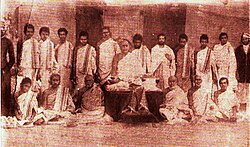
[[File:Atmaram Disciples.jpg|thumb|left|Vijayanandsuri with his disciples in [[Ajmer]] in [[Vikram Samvat|VS]] 1946]] | [[File:Atmaram Disciples.jpg|thumb|left|Vijayanandsuri with his disciples in [[Ajmer]] in [[Vikram Samvat|VS]] 1946]] | ||
{{Jainism}} | {{Jainism}} | ||
He was born on 6 April 1837 CE (Chaitra Shukla 1 [[Vikram Samvat]] 1893) in Lehara, Punjab to Ganeshchandra and Rupdevi. He was born in a | He was born on 6 April 1837 CE (Chaitra Shukla 1 [[Vikram Samvat]] 1893) in Lehara, Punjab to Ganeshchandra and Rupdevi. He was born in a Hindu family.<ref>[https://openlibrary.org/books/OL1835357M/The_Chicago_prashnottar_or_questions_and_answers_on_Jainism_for_the_Parliament_of_Religions_held_at_ The Chicago prashnottar, or questions and answers on Jainism for the Parliament of Religions held at Chicago, U.S.A. in 1893 1st ed. by Ātmānanda, Published by Atmanand Jain Pustak Pracharak Mandal, Agra, 1918 ]</ref> His father was an army official of [[Ranjit Singh]]. His father died in his early childhood and he was raised by his mother. He was given to Sheth Jodhmal of Jira, Punjab for education in VS 1903. He studied Hindi and arithmetic. He came into contact with Sthanakvasi monks during his school life. A couple of influential Sthanakavasi monks initiated him in 1853 (VS 1910) at the age of sixteen and was given the name of Atmaram.<ref name="Cort2009">{{cite book|author=John Cort|title=Framing the Jina : Narratives of Icons and Idols in Jain History: Narratives of Icons and Idols in Jain History|url=https://books.google.com/books?id=MDBpq23-0QoC&pg=PA7|access-date=June 24, 2013|date=November 16, 2009|publisher=Oxford University Press|isbn=978-0-19-973957-8|pages=5–8}}</ref><ref name="University2001">{{cite book|author=John E. Cort|title=Jains in the World : Religious Values and Ideology in India: Religious Values and Ideology in India|url=https://books.google.com/books?id=PZk-4HOMzsoC&pg=PA42|access-date=6 August 2014|date=22 March 2001|publisher=Oxford University Press|isbn=978-0-19-803037-9|pages=42–46}}</ref><ref name="CP">{{cite book|author=Vijayanandsuri|title=The Chicago-Prashnottar: Or Questions and Answers on Jainism for the Parliament of Religions Held at Chicago, U.S.A. in 1893|url=https://books.google.com/books?id=BY9QAQAAMAAJ|year=1918|publisher=Atmanand Jain Pustak Pracharak Mandal|pages=iii–vi|chapter=Short account of Life of Shrimat Vijayanandsuri, popularly known as Atmaramji}} [https://archive.org/details/chicagoprashnott00atma Alt URL]</ref> | ||
==Ascetic career== | ==Ascetic career== | ||
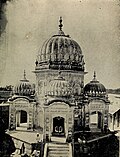
[[File:Shrine of Vijayanandsuri Atmaramji Gujranwala.jpg|thumb|left|Memorial shrine in [[Gujranwala]]. From Chicago Prashnottar, 1918]] | [[File:Shrine of Vijayanandsuri Atmaramji Gujranwala.jpg|thumb|left|[[Atmaramji Samadhi|Memorial shrine]] in [[Gujranwala]]. From Chicago Prashnottar, 1918]] | ||
<!---[[File:Wall Painting unknown Sikh era architecture Parao road, Gujranwala..jpg|thumb|left|Modern Wall Painting, sign "Thana Sabzi Mandi, Guzaranwala". It is now a police station.]]---> | <!---[[File:Wall Painting unknown Sikh era architecture Parao road, Gujranwala..jpg|thumb|left|Modern Wall Painting, sign "Thana Sabzi Mandi, Guzaranwala". It is now a police station.]]---> | ||
Atmaram began the study of Jain scriptures along with his fellow ascetics. He was later joined by a ''Yati'' of [[Tapa Gaccha]] lineage. After several years of study, he was convinced that the Sthanakavasi position of opposition of Idol-worshiping contradicted the scriptures.<ref name="Cort2009" /> Later in 1876 (VS 1943), he was initiated again as a Murtipujaka monk in [[Ahmedabad]] by Muni Buddhivijay, also known as Buterayji of Tapa Gaccha who himself was Sthanakvasi monk before. He was given a new name, Anandvijay. | Atmaram began the study of Jain scriptures along with his fellow ascetics. He was later joined by a ''Yati'' of [[Tapa Gaccha]] lineage. After several years of study, he was convinced that the Sthanakavasi position of opposition of Idol-worshiping contradicted the scriptures.<ref name="Cort2009" /> Later in 1876 (VS 1943), he was initiated again as a Murtipujaka monk in [[Ahmedabad]] by Muni Buddhivijay, also known as Buterayji of Tapa Gaccha who himself was Sthanakvasi monk before. He was given a new name, Anandvijay. | ||
| Line 36: | Line 38: | ||
Penguin reference library, Penguin UK, 2010</ref> | Penguin reference library, Penguin UK, 2010</ref> | ||
He travelled extensively in Gujarat and Punjab. He convinced to open Jain Bhandaras (libraries) with Jain literature kept closed for | He travelled extensively in Gujarat and Punjab. He convinced to open Jain Bhandaras (libraries) with Jain literature kept closed to people for years and had texts copied and examined by scholars. He brought this literature to light and instilled a sense of identity among Jains. In 1893, he was invited to participate in the first ever [[Parliament of the World's Religions#1893 Parliament|World Parliament of Religions]] at [[Chicago]] and since Jain monks do not travel overseas he sent [[Virchand Gandhi]] to United States to participate in the World Parliament of Religions. He won silver medal in 1893 at Chicago and was covered by many USA periodicals.<ref>Jainism: The World of Conquerors By Natubhai Shah, 1998 Sussex Academic Press</ref> Based on questions that he had received from the organizers of the Parliament, he wrote a book for the occasion entitled ''The Chicago-Prashnottar'' or ''Questions and Answers on Jainism for the Parliament of Religions Held at Chicago USA in 1893''. He was instrumental in reviving the tradition of fully initiated monks (''Samvegi sadhu''). He also convinced many Sthankvasis in the Punjab to join the Murtipujaka tradition. About 15000 people converted to Jainism due to his efforts. He also encouraged the construction and renovation of Jain temples. He had helped orientalist [[Rudolf Hoernlé]] in his studies on Jainism.<ref name="CP"/> | ||
He died in [[Gujranwala]] (now in [[Pakistan]]) on 20 May 1896 (Jayeshtha Shukla 8 VS 1953).<ref name="University2001"/> A memorial shrine dedicated to him was built there by Lala Mayadas Nanakchand Bhabras.<ref name="CP"/><ref name=":0">{{Cite web|date=2019-05-28|title=The legend of Atmaram Ji's Samadhi|url=https://dailytimes.com.pk/402564/the-legend-of-atmaram-jis-samadhi/|access-date=2020-06-30|website=Daily Times|language=en-US}}</ref> His footprints along with the ''chhatri'' (cenotaph) over them, are moved to [[Lahore Fort]] Museum. Some artefacts and decorations were also moved.<ref>[https://farm9.static.flickr.com/8047/8112713857_fc1c0c0fa8_b.jpg Foot prints of Atmaram ji]</ref><ref name=":1">{{Cite web|title=Samadhi of Atmaram Ji declared as 'special premises' {{!}} Pakistan Today|url=https://www.pakistantoday.com.pk/2019/05/27/samadhi-of-atmaram-ji-declared-as-declared-as-special-premises/|access-date=2020-06-30|website=www.pakistantoday.com.pk}}</ref> The shrine was mistakenly identified as the memorial of Punjab ruler [[Ranjit Singh]]'s grandfather Charat Singh.<ref name=":2">{{Cite web|last=orientalarchitecture.com|title=Atmaramji Shrine, Gujranwala, Pakistan|url=https://www.orientalarchitecture.com/sid/1220/pakistan/gujranwala/atmaramji-shrine|access-date=2020-06-30|website=Asian Architecture|language=EN}}</ref><ref name=":1" /> | He died in [[Gujranwala]] (now in [[Pakistan]]) on 20 May 1896 (Jayeshtha Shukla 8 VS 1953).<ref name="University2001"/> A memorial shrine dedicated to him was built there by Lala Mayadas Nanakchand Bhabras.<ref name="CP"/><ref name=":0">{{Cite web|date=2019-05-28|title=The legend of Atmaram Ji's Samadhi|url=https://dailytimes.com.pk/402564/the-legend-of-atmaram-jis-samadhi/|access-date=2020-06-30|website=Daily Times|language=en-US}}</ref> His footprints along with the ''chhatri'' (cenotaph) over them, are moved to [[Lahore Fort]] Museum. Some artefacts and decorations were also moved.<ref>[https://farm9.static.flickr.com/8047/8112713857_fc1c0c0fa8_b.jpg Foot prints of Atmaram ji]</ref><ref name=":1">{{Cite web|title=Samadhi of Atmaram Ji declared as 'special premises' {{!}} Pakistan Today|url=https://www.pakistantoday.com.pk/2019/05/27/samadhi-of-atmaram-ji-declared-as-declared-as-special-premises/|access-date=2020-06-30|website=www.pakistantoday.com.pk}}</ref> The shrine was mistakenly identified as the memorial of Punjab ruler [[Ranjit Singh]]'s grandfather Charat Singh.<ref name=":2">{{Cite web|last=orientalarchitecture.com|title=Atmaramji Shrine, Gujranwala, Pakistan|url=https://www.orientalarchitecture.com/sid/1220/pakistan/gujranwala/atmaramji-shrine|access-date=2020-06-30|website=Asian Architecture|language=EN}}</ref><ref name=":1" /> | ||
The shrine came under the local police in 1984 and used as a police station until 2003 when most offices were moved to new place. The central chamber was used as | The shrine came under the local police in 1984 and used as a police station until 2003 when most offices were moved to new place. The central chamber was used as an office of the Gujranwala Deputy Police Superintendent. The building was used by traffic police until 2015.<ref name=":2" /> In 2019, it was declared as a protected monument by the [[Government of Punjab, Pakistan]].<ref name=":0" /><ref name=":1" /> The samadhi was visited by Jain Acharya Gachadhipati Dharmadhurandhar Suri on May 28, 2023, along with other Jain munis and lay Jains after a gap to more than 75 years.<ref>{{Cite web |url=https://palisirohionline.in/2023/05/28/dharm-dhulandhr-jain-santh/ |title=पूजनीय आत्म वल्लभजी के गुरुदेव आत्मारामजी समाधि धाम में जैनाचार्य पूजनीय धर्मधुरंधर जी मा.सा का आगमन, PALI SIROHI ONLINE, Nagendra Agrawal, May 28, 2023 |access-date=June 7, 2023 |archive-date=June 7, 2023 |archive-url=https://web.archive.org/web/20230607032036/https://palisirohionline.in/2023/05/28/dharm-dhulandhr-jain-santh/ |url-status=dead }}</ref> | ||
==Works== | ==Works== | ||
[[File:Vijayanandsuri.jpg|thumb|Idol of Vijayanandsuriji at Jain Golden Temple,Hosiyarpur,[[Punjab]]]] | |||
He wrote a number of books in Hindi, including ''The Chicago-Prashnottar'' or ''Questions and Answers on Jainism for the Parliament of Religions Held at Chicago USA in 1893'' which was translated into English and published in 1918. His other important works are ''Jain Tattvadarsh'', ''Agyana Timira Bhaskara'', ''Samyaktva-shalyadwara'' and ''Tattva Nirnaya Prāsād''.<ref name="CP"/> | He wrote a number of books in Hindi, including ''The Chicago-Prashnottar'' or ''Questions and Answers on Jainism for the Parliament of Religions Held at Chicago USA in 1893'' which was translated into English and published in 1918. His other important works are ''Jain Tattvadarsh'', ''Agyana Timira Bhaskara'', ''Samyaktva-shalyadwara'' and ''Tattva Nirnaya Prāsād''.<ref name="CP"/> | ||
| Line 49: | Line 52: | ||
His monkhood lineage has large number of ascetics which roughly covers {{1/4}} of all current ascetics of Tapa Gaccha. Major ascetic groupings are Atma-Vallabh Samuday, Prem-Ramchandra Suri and Prem-Bhuvanbhanu Suri Samuday.<ref name="Cort2009" /> | His monkhood lineage has large number of ascetics which roughly covers {{1/4}} of all current ascetics of Tapa Gaccha. Major ascetic groupings are Atma-Vallabh Samuday, Prem-Ramchandra Suri and Prem-Bhuvanbhanu Suri Samuday.<ref name="Cort2009" /> | ||
==See also== | |||
*[[Devardhigani Kshamashraman]] | |||
*[[Hemachandra]] | |||
*[[Hiravijaya]] | |||
*[[Yashovijaya]] | |||
==References== | ==References== | ||
| Line 54: | Line 63: | ||
==External links== | ==External links== | ||
* [http://www.dli.ernet.in/handle/2015/55511 The Chicago-prashnottar (English) on Digital Library of India] | * [http://www.dli.ernet.in/handle/2015/55511 The Chicago-prashnottar (English) on Digital Library of India] {{Webarchive|url=https://web.archive.org/web/20161220130207/http://www.dli.ernet.in/handle/2015/55511 |date=2016-12-20 }} | ||
* [http://www.herenow4u.net/index.php?id=75830 Biographical article of 1935 on Atmaram] | * [http://www.herenow4u.net/index.php?id=75830 Biographical article of 1935 on Atmaram] | ||
* [http://www.herenow4u.net/index.php?id=79541 Invitation of 1893, World religion Parliament to Acharya Vijayanandsuri/Muni Atmaram] | * [http://www.herenow4u.net/index.php?id=79541 Invitation of 1893, World religion Parliament to Acharya Vijayanandsuri/Muni Atmaram] | ||
| Line 63: | Line 72: | ||
[[Category:Jain acharyas]] | [[Category:Jain acharyas]] | ||
[[Category: | [[Category:Indian nonviolence advocates]] | ||
[[Category:1821 births]] | [[Category:1821 births]] | ||
[[Category:1896 deaths]] | [[Category:1896 deaths]] | ||
[[Category:Indian Jain monks]] | [[Category:Indian Jain monks]] | ||
[[Category:19th-century Indian Jain writers]] | [[Category:19th-century Indian Jain writers]] | ||
[[Category:19th-century Jain monks]] | [[Category:19th-century Jain monks]] | ||
[[Category:19th-century Indian monks]] | [[Category:19th-century Indian monks]] | ||
[[Category:People from Gujranwala]] | [[Category:People from Gujranwala]] | ||
[[Category:Jain reformers]] | [[Category:Jain reformers]] | ||
[[Category: | [[Category:Śvetāmbara monks]] | ||
[[Category:People from Punjab Province (British India)]] | |||
Latest revision as of 01:39, 26 March 2026
Acharya Vijayanandsuri | |
|---|---|
 | |
| Official name | Acharya Vijayanand Suri |
| Personal | |
| Born | 6 April 1837 Lehra, Punjab, British India |
| Died | 20 May 1896 (aged 59) |
| Religion | Jainism |
| Sect | Śvetāmbara |
| Notable work(s) | Jain Tattvadarsh, Agyana Timira Bhaskara, Tattva Nirnaya Prāsād |
| Religious career | |
| Successor | Vallabhsuri |
| Initiation | Anandvijay (earlier Atmaram) 1876 Ahmedabad by Muni Buddhivijay |
Acharya Vijayanand Suri (6 April 1837 – 20 May 1896), also known as Atmaramji of Gujranwala, was the first Swetambar Murtipujaka Jain monk in modern times to receive the title of Acharya.[1][2] Born and raised in Punjab, he was initiated as a Sthanakvasi monk and later joined the Murtipujaka tradition. He travelled extensively in Gujarat, Rajputana and Punjab; he organised and reformed Jain community, ascetic orders and literature. He wrote several books in Hindi and was invited to the first World Parliament of Religions in 1893 which was attended by Virchand Gandhi later.[3]
Early life[edit | edit source]


| Part of a series on |
| Jainism |
|---|
 |
He was born on 6 April 1837 CE (Chaitra Shukla 1 Vikram Samvat 1893) in Lehara, Punjab to Ganeshchandra and Rupdevi. He was born in a Hindu family.[4] His father was an army official of Ranjit Singh. His father died in his early childhood and he was raised by his mother. He was given to Sheth Jodhmal of Jira, Punjab for education in VS 1903. He studied Hindi and arithmetic. He came into contact with Sthanakvasi monks during his school life. A couple of influential Sthanakavasi monks initiated him in 1853 (VS 1910) at the age of sixteen and was given the name of Atmaram.[2][5][6]
Ascetic career[edit | edit source]

Atmaram began the study of Jain scriptures along with his fellow ascetics. He was later joined by a Yati of Tapa Gaccha lineage. After several years of study, he was convinced that the Sthanakavasi position of opposition of Idol-worshiping contradicted the scriptures.[2] Later in 1876 (VS 1943), he was initiated again as a Murtipujaka monk in Ahmedabad by Muni Buddhivijay, also known as Buterayji of Tapa Gaccha who himself was Sthanakvasi monk before. He was given a new name, Anandvijay.
In 1886, he was conferred the title of Acharya by the congregation of Palitana during his Chaturmas (four months stay during rainy season) there. This was a notable event because since four centuries, there wasn't an ascetic who was conferred with the title of Acharya. He was the first Acharya of contemporary Jain history as till then only Yatis were conferred with the title.[5] As a result of reforms advocated by him, the influence of yatis declined, although the yatis still survive in some locations.[7]
He travelled extensively in Gujarat and Punjab. He convinced to open Jain Bhandaras (libraries) with Jain literature kept closed to people for years and had texts copied and examined by scholars. He brought this literature to light and instilled a sense of identity among Jains. In 1893, he was invited to participate in the first ever World Parliament of Religions at Chicago and since Jain monks do not travel overseas he sent Virchand Gandhi to United States to participate in the World Parliament of Religions. He won silver medal in 1893 at Chicago and was covered by many USA periodicals.[8] Based on questions that he had received from the organizers of the Parliament, he wrote a book for the occasion entitled The Chicago-Prashnottar or Questions and Answers on Jainism for the Parliament of Religions Held at Chicago USA in 1893. He was instrumental in reviving the tradition of fully initiated monks (Samvegi sadhu). He also convinced many Sthankvasis in the Punjab to join the Murtipujaka tradition. About 15000 people converted to Jainism due to his efforts. He also encouraged the construction and renovation of Jain temples. He had helped orientalist Rudolf Hoernlé in his studies on Jainism.[6]
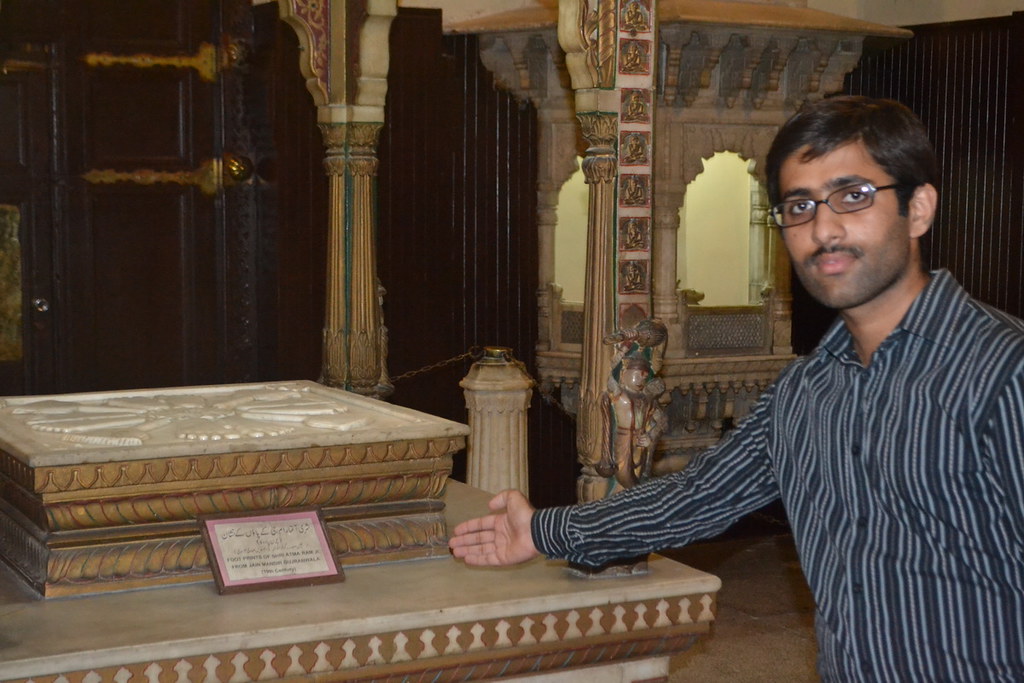
He died in Gujranwala (now in Pakistan) on 20 May 1896 (Jayeshtha Shukla 8 VS 1953).[5] A memorial shrine dedicated to him was built there by Lala Mayadas Nanakchand Bhabras.[6][9] His footprints along with the chhatri (cenotaph) over them, are moved to Lahore Fort Museum. Some artefacts and decorations were also moved.[10][11] The shrine was mistakenly identified as the memorial of Punjab ruler Ranjit Singh's grandfather Charat Singh.[12][11]
The shrine came under the local police in 1984 and used as a police station until 2003 when most offices were moved to new place. The central chamber was used as an office of the Gujranwala Deputy Police Superintendent. The building was used by traffic police until 2015.[12] In 2019, it was declared as a protected monument by the Government of Punjab, Pakistan.[9][11] The samadhi was visited by Jain Acharya Gachadhipati Dharmadhurandhar Suri on May 28, 2023, along with other Jain munis and lay Jains after a gap to more than 75 years.[13]
Works[edit | edit source]

He wrote a number of books in Hindi, including The Chicago-Prashnottar or Questions and Answers on Jainism for the Parliament of Religions Held at Chicago USA in 1893 which was translated into English and published in 1918. His other important works are Jain Tattvadarsh, Agyana Timira Bhaskara, Samyaktva-shalyadwara and Tattva Nirnaya Prāsād.[6]
Legacy[edit | edit source]
He used to give more importance to education and established several libraries and Pathshala (religious schools) in Punjab. Later Vallabhsuri, his disciple, built many schools, hospitals and educational institutes. He was given the title of Navyug Nirmata (builder of a new era) by Vallabhsuri.[6]
His monkhood lineage has large number of ascetics which roughly covers 1⁄4 of all current ascetics of Tapa Gaccha. Major ascetic groupings are Atma-Vallabh Samuday, Prem-Ramchandra Suri and Prem-Bhuvanbhanu Suri Samuday.[2]
See also[edit | edit source]
References[edit | edit source]
- ↑ Mangilal Bhutoria, Itihas ki Amar Bel- Oswal, Priyadarshi Prakashan, Calcutta, 1988
- ↑ 2.0 2.1 2.2 2.3 John Cort (November 16, 2009). Framing the Jina : Narratives of Icons and Idols in Jain History: Narratives of Icons and Idols in Jain History. Oxford University Press. pp. 5–8. ISBN 978-0-19-973957-8. Retrieved June 24, 2013.
- ↑ "A short account of the life of Shrimat Vijayanandsuri".
- ↑ The Chicago prashnottar, or questions and answers on Jainism for the Parliament of Religions held at Chicago, U.S.A. in 1893 1st ed. by Ātmānanda, Published by Atmanand Jain Pustak Pracharak Mandal, Agra, 1918
- ↑ 5.0 5.1 5.2 John E. Cort (22 March 2001). Jains in the World : Religious Values and Ideology in India: Religious Values and Ideology in India. Oxford University Press. pp. 42–46. ISBN 978-0-19-803037-9. Retrieved 6 August 2014.
- ↑ 6.0 6.1 6.2 6.3 6.4 Vijayanandsuri (1918). "Short account of Life of Shrimat Vijayanandsuri, popularly known as Atmaramji". The Chicago-Prashnottar: Or Questions and Answers on Jainism for the Parliament of Religions Held at Chicago, U.S.A. in 1893. Atmanand Jain Pustak Pracharak Mandal. pp. iii–vi. Alt URL
- ↑ The Penguin Handbook of the World's Living Religions Penguin reference library, Penguin UK, 2010
- ↑ Jainism: The World of Conquerors By Natubhai Shah, 1998 Sussex Academic Press
- ↑ 9.0 9.1 "The legend of Atmaram Ji's Samadhi". Daily Times. 2019-05-28. Retrieved 2020-06-30.
- ↑ Foot prints of Atmaram ji
- ↑ 11.0 11.1 11.2 "Samadhi of Atmaram Ji declared as 'special premises' | Pakistan Today". www.pakistantoday.com.pk. Retrieved 2020-06-30.
- ↑ 12.0 12.1 orientalarchitecture.com. "Atmaramji Shrine, Gujranwala, Pakistan". Asian Architecture. Retrieved 2020-06-30.
- ↑ "पूजनीय आत्म वल्लभजी के गुरुदेव आत्मारामजी समाधि धाम में जैनाचार्य पूजनीय धर्मधुरंधर जी मा.सा का आगमन, PALI SIROHI ONLINE, Nagendra Agrawal, May 28, 2023". Archived from the original on June 7, 2023. Retrieved June 7, 2023.
External links[edit | edit source]
- The Chicago-prashnottar (English) on Digital Library of India Archived 2016-12-20 at the Wayback Machine
- Biographical article of 1935 on Atmaram
- Invitation of 1893, World religion Parliament to Acharya Vijayanandsuri/Muni Atmaram
| Gods | |||||
|---|---|---|---|---|---|
| Philosophy | |||||
| Branches |
| ||||
| Practices | |||||
| Literature | |||||
| Symbols |
| ||||
| Ascetics | |||||
| Scholars | |||||
| Community | |||||
| Jainism in |
| ||||
| Jainism and | |||||
| Dynasties and empires | |||||
| Related | |||||
| Lists | |||||
| Navboxes | |||||