

fixed section for clarity and cleaned formatting |
|||
| Line 1: | Line 1: | ||
{{short description|Indian saint}} | {{short description|Indian saint}} | ||
{{Use dmy dates|date=October 2018}} | {{Use dmy dates|date=October 2018}} | ||
{{Use Indian English|date=October 2018}} | {{Use Indian English|date=October 2018}}{{more citations needed|date=November 2010}}[[File:Mausoleum Dawoodi Bohra Duwat, Burhanpur era.jpg|thumb|Dargah-e-Hakimi]] | ||
{{more citations needed|date=November 2010}} | |||
[[File:Mausoleum Dawoodi Bohra Duwat, Burhanpur era.jpg|thumb|Dargah-e-Hakimi]] | |||
{{Ismailism}} | {{Ismailism}} | ||
'''Syedi Abdul Qadir Hakimuddin''' (1665-1730 AD) was a [[Dawoodi Bohra]] [[saint]] | '''Syedi Abdul Qadir Hakimuddin''' (1665-1730 AD) was a [[Dawoodi Bohra]] [[saint]]. He is buried in [[Burhanpur]], [[India]]. His tomb complex 'Dargah-e-Hakimi' includes [[mosques]], gardens, and visitor accommodations.<ref>{{cite web |url=http://www.khandwa.nic.in/burhanpur/burhanpur.htm |title=Burhanpur |publisher=Khandwa.nic.in |date=2003-08-15 |accessdate=2013-08-17 |url-status=dead |archiveurl=https://web.archive.org/web/20130201062501/http://www.khandwa.nic.in/burhanpur/burhanpur.htm |archivedate=2013-02-01 }}</ref> | ||
==Early life== | ==Early life== | ||
He was born in the period of 34th Dai Syedna Badruddin Bin Mulla Raj on the 14th of Jamadil Awwal 1077 H (1665 AD). | He was born in the period of 34th Dai Syedna Badruddin Bin Mulla Raj on the 14th of Jamadil Awwal 1077 H (1665 AD). | ||
His father [[Syedi Bava Mulla Khan]] visited the | His father [[Syedi Bava Mulla Khan]] visited the 35th Dai Syedna Abdul Taiyeb Zakiuddin in Ahmedabad and presented Syedi Abdul Qadir Hakimuddin in ''Khumus'' (one fifth of earnings to be presented in the name of god as Mulla Khan was having five sons) on the Dai's request.<ref>{{cite web | url=https://www.instagram.com/reel/CO5q82NJnF5/ | title=Instagram }}</ref><ref>{{cite web | url=https://bohraculture.blogspot.com/2014/01/syedi-abdul-qadir-hakimuddin-bin-bawa.html | title=Dawoodi Bohra's: Syedi Abdul Qadir Hakimuddin bin Bawa Mulla Khan Mazoon of dawoodi bohra }}</ref><ref>{{Cite web |date=August 2014 |title=MAZOON OF THE 38TH DAI AL-MUTLAQ SYEDNA ISMAIL BADRUDDIN (SANI) |url=https://fatemidawat.files.wordpress.com/2014/08/syedi-abdulqadir-hakimuddin-biography-1435-btq1.pdf |access-date=September 11, 2024 |website=fatemidawat.files.wordpress.com}}</ref> | ||
==Title== | ==Title== | ||
He was presented the status of | He was presented the status of ''Haddiyat'' (sheikh) by 36th Dai Syedna Kalimuddin. He was made Mukasir Al Dawat by Syedna Noor Mohammed Nooruddin and elevated to Mazoon (2nd in command) Al Dawat by 38th Dai Syedna [[Ismail Badruddin]]. The 39th Dai Syedna Ibrahim Vajihuddin was the son of Syedi Abdulquadir Hakimuddin. | ||
==Books== | ==Books== | ||
He | He some of the Books of Dawat including ''Bulohar'' and ''Buzazaf''.<ref>{{cite web|url=http://www.sfjamaat.org/sf/aqh.html |title=Saiyedi Abdul Qadir Hakimuddin (R.A) - Anjuman-e-Najmi |publisher=Sfjamaat.org |date= |accessdate=2013-08-17}}</ref> He wrote in [[Urdu]], [[Sanskrit]], [[Persian language|Persian]] and [[Arabic]]. He translated Sanskrit into Arabic in a book called ''Qalila Wadhima''.<ref>{{Citation |last=Svašek |first=Maruška |title=Aesthetics of Religion |chapter=Aestheticisation and the Production of (Religious) Space in Chennai |date=2017 |pages=301–322 |publisher=De Gruyter |language=en |doi=10.1515/9783110461015-013 |isbn=978-3-11-046101-5}} | ||
</ref><ref>{{Cite web |title=Aesthetics of Religion: A Connective Concept 9783110458756 |url=https://dokumen.pub/aesthetics-of-religion-a-connective-concept-9783110458756.html |access-date=2023-11-16 |website=dokumen.pub |language=en}}</ref> | |||
==Miracles== | ==Miracles== | ||
The 17th-century saint was known for his piety, humility and | The 17th-century saint was known for his piety, humility and erudition. He came to Burhanpur as his way of preaching Islam. He could recite the entire Quran from memory in childhood. Legend has it that one day while travelling through a forest, he was reciting the Quran when a tiger walked by. The animal sat before the scholar, and quietly walked away once the recitation was over. When Syedi Hakimudin died in 1730 AD (1142 AH, 5th Shawwal), his enemies exhumed his body after 22 days, but were shocked to find a fresh and fragrant body. Over the years, people's faith grew in his miraculous powers. | ||
Thousands of | The word ''hakim'' denotes a healer and thousands of Bohras flock to his shrine, taking a ''mannat'' (vow) for ''shifa'' (cure) from disease and seeking health for both the body and the soul. It is said that whoever comes there with a prayer on her/his lips, does not go away disappointed. Those who have their prayers answered, their sick loved ones cured, their sinking businesses nursed back to health, and their other problems solved, come back with a generous offering. | ||
Thousands of pilgrims are served non-vegetarian food, complete with dessert, tender mutton and basmati rice, and fruit.<ref>{{cite web | url=https://www.youtube.com/watch?v=nm_KbZz7Gx0 | title=- YouTube | website=[[YouTube]] }}</ref><ref>{{cite web | url=https://burhanpurdiary.in/dargah-e-hakimi-burhanpur/ | title=Dargah-E-Hakimi Burhanpur | date=16 November 2022 }}</ref> | |||
==Lineage== | ==Lineage== | ||
[[Dawoodi Bohra]] | Abdul Qadir Hakimuddin is the ancestor of nine [[Dawoodi Bohra]] Dais: Syedna [[Mohammed Ezzuddin]], Syedna [[Tayyeb Zainuddin]], Syedna [[Abdul Qadir Najmuddin]], Syedna [[Abdul Husain Husamuddin]], Syedna [[Mohammed Burhanuddin I]], Syedna [[Abdullah Badruddin]], Syedna [[Taher Saifuddin]], Syedna [[Mohammed Burhanuddin]], and Syedna [[Mufaddal Saifuddin]]. The tree shown below illustrate the clear link.<ref>Family tree available at Risalah no.SMS00 {{cite book|title=رسالة النعي المسماة - حكمة الغيبة القدسانية الابدية Hikmah al-Ghaybah al-Qudsāniyyah al-Abadiyyah|last=His Holiness|first=Syedna Aali Qadr Mufaddal Saifuddin Saheb}}, Year: |1435H|1436H|2016|-</ref> | ||
==Photo gallery== | ==Photo gallery== | ||
Dargah-e-Hakimi | Dargah-e-Hakimi | ||
<gallery perrow="5"> | <gallery perrow="5"> | ||
Image:Main entrance Dargah-e-Hakimi.jpg| Main entrance Dargah-e-Hakimi | Image:Main entrance Dargah-e-Hakimi.jpg| Main entrance Dargah-e-Hakimi | ||
Image:Reception dargah -e-Hakimi.jpg|Reception | Image:Reception dargah -e-Hakimi.jpg|Reception Dargah-e-Hakimi | ||
Image:Resedential bungalow for visitor Dargah-e hakimi.jpg| Residential bungalow for | Image:Resedential bungalow for visitor Dargah-e hakimi.jpg| Residential bungalow type accommodation for visitors at Dargah-e-Hakimi | ||
Image:Dining hall Dargah-e-Hakimi,Burhanpur.jpg| Dining hall Dargah-e-Hakimi | Image:Dining hall Dargah-e-Hakimi,Burhanpur.jpg| Dining hall or Faiz at Dargah-e-Hakimi | ||
Image:Dargah -e-Hakimi garden, Burhanpur.jpg|Dargah -e-Hakimi | Image:Dargah -e-Hakimi garden, Burhanpur.jpg|Sehan (marble patio) Dargah-e-Hakimi | ||
</gallery> | </gallery> | ||
| Line 46: | Line 43: | ||
* [https://web.archive.org/web/20060401043316/http://archive.mumineen.org/publications/Dargah_Hakimi/burhanpur_history.html Burhanpur History] | * [https://web.archive.org/web/20060401043316/http://archive.mumineen.org/publications/Dargah_Hakimi/burhanpur_history.html Burhanpur History] | ||
* [https://web.archive.org/web/20060512091919/http://archive.mumineen.org/publications/Dargah_Hakimi/duathistory.html Syedi AbdulQader Hakimuddin] | * [https://web.archive.org/web/20060512091919/http://archive.mumineen.org/publications/Dargah_Hakimi/duathistory.html Syedi AbdulQader Hakimuddin] | ||
{{Family tree Moulai Tarmal/Bharmal to Syedna Burhanuddin}}. | |||
{{DEFAULTSORT:Abdul Qadir Hakimuddin}} | {{DEFAULTSORT:Abdul Qadir Hakimuddin}} | ||
[[Category:Dawoodi | [[Category:Dawoodi Bohra people]] | ||
[[Category:People from Burhanpur]] | [[Category:People from Burhanpur]] | ||
[[Category:1665 births]] | [[Category:1665 births]] | ||
[[Category:1730 deaths]] | [[Category:1730 deaths]] | ||
Latest revision as of 15:56, 31 December 2025
 | This article needs more citations. (November 2010) |

| Part of a series on Shīa Islam
Isma'ilism |
|---|
 |
Syedi Abdul Qadir Hakimuddin (1665-1730 AD) was a Dawoodi Bohra saint. He is buried in Burhanpur, India. His tomb complex 'Dargah-e-Hakimi' includes mosques, gardens, and visitor accommodations.[1]
Early life[edit | edit source]
He was born in the period of 34th Dai Syedna Badruddin Bin Mulla Raj on the 14th of Jamadil Awwal 1077 H (1665 AD).
His father Syedi Bava Mulla Khan visited the 35th Dai Syedna Abdul Taiyeb Zakiuddin in Ahmedabad and presented Syedi Abdul Qadir Hakimuddin in Khumus (one fifth of earnings to be presented in the name of god as Mulla Khan was having five sons) on the Dai's request.[2][3][4]
Title[edit | edit source]
He was presented the status of Haddiyat (sheikh) by 36th Dai Syedna Kalimuddin. He was made Mukasir Al Dawat by Syedna Noor Mohammed Nooruddin and elevated to Mazoon (2nd in command) Al Dawat by 38th Dai Syedna Ismail Badruddin. The 39th Dai Syedna Ibrahim Vajihuddin was the son of Syedi Abdulquadir Hakimuddin.
Books[edit | edit source]
He some of the Books of Dawat including Bulohar and Buzazaf.[5] He wrote in Urdu, Sanskrit, Persian and Arabic. He translated Sanskrit into Arabic in a book called Qalila Wadhima.[6][7]
Miracles[edit | edit source]
The 17th-century saint was known for his piety, humility and erudition. He came to Burhanpur as his way of preaching Islam. He could recite the entire Quran from memory in childhood. Legend has it that one day while travelling through a forest, he was reciting the Quran when a tiger walked by. The animal sat before the scholar, and quietly walked away once the recitation was over. When Syedi Hakimudin died in 1730 AD (1142 AH, 5th Shawwal), his enemies exhumed his body after 22 days, but were shocked to find a fresh and fragrant body. Over the years, people's faith grew in his miraculous powers.
The word hakim denotes a healer and thousands of Bohras flock to his shrine, taking a mannat (vow) for shifa (cure) from disease and seeking health for both the body and the soul. It is said that whoever comes there with a prayer on her/his lips, does not go away disappointed. Those who have their prayers answered, their sick loved ones cured, their sinking businesses nursed back to health, and their other problems solved, come back with a generous offering.
Thousands of pilgrims are served non-vegetarian food, complete with dessert, tender mutton and basmati rice, and fruit.[8][9]
Lineage[edit | edit source]
Abdul Qadir Hakimuddin is the ancestor of nine Dawoodi Bohra Dais: Syedna Mohammed Ezzuddin, Syedna Tayyeb Zainuddin, Syedna Abdul Qadir Najmuddin, Syedna Abdul Husain Husamuddin, Syedna Mohammed Burhanuddin I, Syedna Abdullah Badruddin, Syedna Taher Saifuddin, Syedna Mohammed Burhanuddin, and Syedna Mufaddal Saifuddin. The tree shown below illustrate the clear link.[10]
Photo gallery[edit | edit source]
Dargah-e-Hakimi
-
 Main entrance Dargah-e-Hakimi
 -
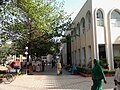 Reception Dargah-e-Hakimi
 -
 Residential bungalow type accommodation for visitors at Dargah-e-Hakimi
 -
 Dining hall or Faiz at Dargah-e-Hakimi
 -
 Sehan (marble patio) Dargah-e-Hakimi


References[edit | edit source]
- ↑ "Burhanpur". Khandwa.nic.in. 15 August 2003. Archived from the original on 1 February 2013. Retrieved 17 August 2013.
- ↑ "Instagram".
- ↑ "Dawoodi Bohra's: Syedi Abdul Qadir Hakimuddin bin Bawa Mulla Khan Mazoon of dawoodi bohra".
- ↑ "MAZOON OF THE 38TH DAI AL-MUTLAQ SYEDNA ISMAIL BADRUDDIN (SANI)" (PDF). fatemidawat.files.wordpress.com. August 2014. Retrieved 11 September 2024.
- ↑ "Saiyedi Abdul Qadir Hakimuddin (R.A) - Anjuman-e-Najmi". Sfjamaat.org. Retrieved 17 August 2013.
- ↑ Svašek, Maruška (2017), "Aestheticisation and the Production of (Religious) Space in Chennai", Aesthetics of Religion, De Gruyter, pp. 301–322, doi:10.1515/9783110461015-013, ISBN 978-3-11-046101-5
- ↑ "Aesthetics of Religion: A Connective Concept 9783110458756". dokumen.pub. Retrieved 16 November 2023.
- ↑ "- YouTube". YouTube.
- ↑ "Dargah-E-Hakimi Burhanpur". 16 November 2022.
- ↑ Family tree available at Risalah no.SMS00 His Holiness, Syedna Aali Qadr Mufaddal Saifuddin Saheb. رسالة النعي المسماة - حكمة الغيبة القدسانية الابدية Hikmah al-Ghaybah al-Qudsāniyyah al-Abadiyyah., Year: |1435H|1436H|2016|-
External links[edit | edit source]
Template:Family tree Moulai Tarmal/Bharmal to Syedna Burhanuddin.