

No edit summary |
slightly add citations per standard format further and fixed typos |
||
| Line 1: | Line 1: | ||
{{ | {{Short description|Ruler of the Kingdom of Mysore}} | ||
{{Use Indian English|date=June 2015}} | {{Use Indian English|date=June 2015}} | ||
{{Use dmy dates|date=June 2015}} | {{Use dmy dates|date=June 2015}} | ||
| Line 6: | Line 6: | ||
| border = | | border = | ||
| realm = Mysore | | realm = Mysore | ||
| coatofarms = | | coatofarms = Royal coat of arms of the Kingdom of Mysore.svg | ||
| coatofarmssize = | | coatofarmssize = | ||
| coatofarmscaption = | | coatofarmscaption = Royal coat of arms (1893) | ||
| image = | | image = | ||
| caption | | caption = | ||
| first_monarch = [[Yaduraya Wodeyar]] | | first_monarch = [[Yaduraya Wodeyar]] | ||
| last_monarch = [[Jayachamaraja Wodeyar]] | | last_monarch = [[Jayachamaraja Wodeyar]] | ||
| style = [[Highness|His Highness]] | | style = [[Highness|His Highness]] | ||
| residence = [[Mysore Palace]] | | residence = [[Mysore Palace]] | ||
| began = 1399 | | began = 1399 | ||
| ended = 26 January 1950 | | ended = 26 January 1950 | ||
}} | }} | ||
The '''Maharaja of Mysore''' was the king and principal ruler of the [[Kingdom of Mysore]] between the late 14th century to 1947, and briefly of the [[princely state]] of [[Mysore State|Mysore]] in the [[Dominion of India]] between August 1947 and January 1950. | |||
'''Maharaja of Mysore''' was the principal | |||
In the late 14th century CE, the [[Vijayanagara Empire]] appointed local chieftains called [[polygar|poleygar]]s. [[Yaduraya Wodeyar]], a Vijayanagara chieftain, took control in the [[Mysore]] region, and adopted the title ''raja'' (king) in 1399 CE. [[Chamaraja Wodeyar III]] (1513–1553 CE) built a small fort and a settlement named Mahisuranagara (buffalo town) near the [[Kaveri River]], around which the [[Mysore State|state of Mysore]] developed later. After the decline of the Vijayanagara Empire, [[Timmaraja Wodeyar II]] declared independence and assumed the title of ''Maharaja'' (great king) of Mysore. | |||
The kingdom expanded significantly during the reigns of [[Kanthirava Narasaraja I]] (1638–1659 CE) and [[Dodda Kempadevaraja]] (1659–1673 CE). The kingdom became weak in the 18th century CE, and during the reign of [[Krishnaraja Wodeyar II]], [[Hyder Ali]] gained power as ''[[dalvoy]]'' (commander-in-chief) in 1761, thus reducing the maharaja to a nominal ruler. Hyder Ali’s son [[Tipu Sultan|Tipu]] ruled Mysore as the [[sultan]] from 1782 to 1799 until his defeat in the [[Anglo-Mysore wars]]. | |||
In 1799, the [[British Empire]] took control of Mysore and restored it to the [[Wadiyar dynasty]], and [[Krishnaraja Wadiyar III]] became the maharaja. The British ruled Mysore directly through the [[Mysore Commission]] from 1831 to 1881. The power was restored to the Wadiyars in 1881, when [[Chamarajendra Wadiyar X]] was crowned as the king. Several administrative reforms, industries, education and infrastructure projects were implemented during the reign of Chamarajendra X and his successor [[Krishnaraja Wadiyar IV]]. [[Jayachamaraja Wadiyar]] ascended to the throne in 1940, and was the last recognised maharaja, as India achieved independence in 1947. He remained a nominal ruler until India became a republic in 1950, and the honorary title of maharaja was abolished in 1971. | |||
== | == Origins == | ||
In the late 14th century CE, in the [[Vijayanagara Empire|Vijayanagara]], the administration and protection of the various regions were designated to the respective local chieftains.<ref>{{cite book|title=Vijayanagara, City and Empire|year=1985|publisher=Steiner Publishing|editor1=Anna Libera Dallapiccola|editor2=Stephanie Zingel-Avé Lallemant}}</ref> The chiefs were known by the name of ''[[polygar|poleygar]]'' ([[Kannada]]: ''pāLegāra'' meaning 'chieftain') during the early days of the fiefdom,{{sfn|Stein|1987|p=82}}{{sfn|Manor|1975|p=33}} Protection of the regions in and around present-day [[Mysore]] was given to [[Yaduraya Wodeyar]], the Vijayanagara chieftain stationed in the region at that time.<ref name="Chamundi">{{cite book |last=Simmons |first=Caleb |url=https://books.google.com/books?id=60pbEAAAQBAJ |title=Singing the Goddess into Place: Locality, Myth, and Social Change in Chamundi of the Hill, a Kannada Folk Ballad |date=2022 |publisher=State University of New York Press |isbn=978-1-4384-8867-7 |pages=61–70; 181–187}}</ref> The local chief, who was till then known by the title of ''[[polygar|poleygar]]'' ([[Kannada]]: ''pāLegāra'' meaning 'chieftain') during the early days of the fiefdom,{{sfn|Stein|1987|p=82}}{{sfn|Manor|1975|p=33}} Yaduraya later took over the title of ''raja'' ([[Sanskrit]] and Kannada for king–of especially a small region) in 1399 CE.<ref name="Chamundi"/><ref>{{cite book |url=https://books.google.com/books?id=OcQrAAAAYAAJ |title=Arms & Armoury of the Mysore Palace |last1=Talwar |first1=H. T. |date=1994 |publisher=Directorate of Archaeology & Museums in Karnataka |page=7 }}</ref> | |||
[[Chamaraja Wodeyar III]], who ruled from 1513 to 1553 CE, over the territory consisting of few villages close to the [[Kaveri river]], constructed a small fort and named it 'Mahisuranagara' (Kannada for buffalo town).{{sfn|Simmons|2019|p=6}}{{sfn|Ramusack|2004|p=28}} Though the region was referred to as 'mahishaka' in early Indian literature,<ref>{{cite book |url=https://books.google.com/books?id=xLsLAAAAIAAJ |title=Cultural profiles of Mysore City |date=1 January 1978 |publisher=Anthropological Survey of India |archive-url=https://web.archive.org/web/20170320151346/https://books.google.com/books?id=xLsLAAAAIAAJ |archive-date=20 March 2017 |url-status=live}}</ref><ref>{{cite web |last=Vasudeva |first=Rashmi |date=3 November 2006 |title=Land of milk and honey |work=[[Deccan Herald]] |url=http://archive.deccanherald.com/Deccanherald/Nov32006/sesame1148592006112.asp |url-status=dead |access-date=12 November 2007 |archive-url=https://web.archive.org/web/20140319162402/http://archive.deccanherald.com/Deccanherald/Nov32006/sesame1148592006112.asp |archive-date=19 March 2014}}</ref> the later state of [[Mysore State|Mysore]] developed around the twon.{{sfn|Stein|1987|p=82}}{{sfn|Simmons|2019|p=6}}{{sfn|Michell|1995|pages=17–}} | |||
{{ | |||
== Maharaja == | |||
{{Further|List of Maharajas of Mysore}} | |||
With the decline of the Vijayanagara Empire, Chamaraja Wodeyar III's son and successor [[Timmaraja Wodeyar II]] declared independence and assumed the title of ''[[Maharaja]]'' (Sanskrit and Kannada, [great] king)<ref>{{cite book |author=Tej Ram Sharma |title=A |url=https://books.google.com/books?id=fWVZWjNAcAgC |year=1989 |publisher=Concept Publishing Company |isbn=81-7022-251-6 |quote=... Literally Maharaja means 'a great king'...}}</ref>) of Mysore.{{sfn|Kamath|2001|pp=220, 226, 234}} During the reigns of [[Kanthirava Narasaraja I]] (1638-1659 CE) and [[Dodda Kempadevaraja]] (1659-1673 CE), the territory of the kingdom was expanded significantly.<ref>{{Harvnb|Imperial Gazetteer of India: Provincial Series|1908|p=20}}</ref>{{sfn|Michell|1995|p=20}} However, the kingdom started to become weak under the rule of [[Dodda Krishnaraja I]] (1714-1732 CE).<ref>{{cite book |last=Wilks |first=Mark |url=https://books.google.com/books?id=SlzbN6GpTTQC |title=Historical Sketches of the South of India, in an Attempt to Trace the History of Mysoor, Etc |date=1869 }}</ref> Hence, during the later reign of [[Krishnaraja Wodeyar II]] (1734-1766), [[Hyder Ali]], who was a soldier in the kingdom, took over as the ''[[dalvoy]]'' (commander-in-chief) and the maharaja was reduced to a nominal rule.<ref>{{cite book|last=Sampath|first=Vikram|title=Tipu Sultan: The Saga of Mysore's Interregnum (1760–1799)| publisher=[[Penguin Random House]]|date=2024| isbn=978-93-6790-094-9|page=59}}</ref> Ali's son [[Tipu Sultan|Tipu]] proclaimed himself as the [[Sultan]] of Mysore and ruled from 1782-1799 CE.<ref>{{cite book|last=Balakrishna|first=Sandeep|title=Tipu Sultan- The Tyrant of Mysore|publisher=RARE Publications| date=2015|isbn=978-2-76590-832-6|page=48=}}</ref><ref>{{cite book |last1=Robson |first1=Francis |url=https://archive.org/details/in.ernet.dli.2015.514522/page/n3/mode/2up |title=The Life Of Hyder Ally: With an Account of His Usurpation of the Kingdom of Mysore |date=1786 |publisher=S Hooper, High Holborn |location=London |access-date=24 January 2022}}</ref> | |||
== | In 1799CE, after the defeat of Tipu in the [[Anglo-Mysore wars]], the region came under the control of the [[British Empire]], and the [[Wadiyar dynasty|Wadiyars]] were restored as the maharajas.<ref>{{cite book|last=Rao Bahadur|first=Rajakaryaprasakta|title= Mysore State Gazetter|year=1936|publisher=[[Mysore State]]|page=266}}</ref> [[Krishnaraja Wadiyar III]] was restored as the maharaja under his [[Lakshmi Ammani Devi|his grandmother]]'s regency.<ref>{{cite book |last=Naravane |first=M. S. |title=Battles of the Honourable East India Company: Making of the Raj |place=New Delhi |publisher=A.P.H. Publishing Corporation |year=2014 |isbn=978-8-13130-034-3 |pages=172–181}}</ref> While Krishnaraja's reigned lasted for nearly seventy years, till 1868, he was not in control of the kingdom from 1831. In 1831, citing maladministration, the British took direct control of the [[princely state]] of Mysore and instituted the [[Mysore Commission]]. The region was ruled by British Commissioners, while the maharaja remained without actual power.<ref>{{cite book |last=Rice |first=B.L. |url=https://archive.org/details/mysoregazetteerc01rice |title=Mysore. A Gazetteer Compiled for Government. Revised Edition. Volume 1 |publisher=Archiband Constable and Company |year=1897 |place=London |page=434}}</ref> Krishnaraja III was considered a great patron of arts, and he instituted the first [[English school]], which later became a precursor to the [[Mysore University]].<ref>{{cite web |date=4 April 2014 |title=Krishnaraja Wodeyar III |url=http://www.kamat.com/kalranga/deccan/wodeyars/mummadi.htm |access-date=16 June 2015 |work=Wodeyars of Mysore |publisher=Kamat's Potpourri}}</ref><ref>{{cite web |author=Laura Durnford |title=Games afoot |url=http://www.radionetherlands.nl/features/cultureandhistory/041215doc |url-status=dead |archive-url=https://web.archive.org/web/20070510034728/http://www.radionetherlands.nl/features/cultureandhistory/041215doc |archive-date=10 May 2007 |access-date=8 October 2007 |work=Radio Netherlands |date=15 December 2004 |df=dmy-all}}</ref> | ||
== | Though, Krishnaraja III appealed for a return of power, it was rejected, and the deposed king died a dejected man.<ref>{{cite web |date=22 June 2003 |title=Diwans take over |work=[[The Hindu]] |url=http://www.thehindu.com/thehindu/mp/2002/08/15/stories/2002081500220200.htm |access-date=2022-12-26 |archive-url=https://web.archive.org/web/20030622220420/http://www.thehindu.com/thehindu/mp/2002/08/15/stories/2002081500220200.htm |archive-date=22 June 2003 }}</ref> [[Chamarajendra Wadiyar X]] ascended the throne on 23 September 1868. The state had been under the direct administration of the British Raj since 1831, was restored to the Wadiyar dynasty by an instrument of rendition in 1881, and Chamarajendra X was officially handed the reins in the same year.<ref name="DH">{{cite web|url=https://www.deccanherald.com/content/608087/a-legacy-art-architecture.html|title=A legacy of art & architecture|work=[[Deccan Herald]]|date=17 April 2017|access-date=1 June 2025}}</ref><ref>{{cite book|url=https://www.rarebooksocietyofindia.org/book_archive/196174216674_10151602566726675.pdf|title=Chamarajendra Wadiyar X}}</ref> Chamarajendra X ruled till 1894, and during his reign, various irrigation and industrial projects were carried out. He divided the state into several administrative divisions, and established the [[Karnataka Legislative Assembly|Mysore Representative Assembly]] in 1881, one of the earliest legislative institutions in princely India. He founded several schools including [[Maharaja's College, Mysore]] and [[Oriental Research Institute Mysore]], textile mills, and expanded mining activities at the [[Kolar Gold Fields]]. Several buildings including the [[Bangalore Palace]] and [[Lalbagh Glass House]] in Bangalore, [[Dufferin Clock Tower]], and [[Mysore Zoo]] in Mysore, and the [[The Fernhills Palace, Ooty|Fernhills Palace]] in [[Ooty]] were built during his reign. He started the annual Dasara Industrial Exhibition, patronised several artisans, and established agricultural banks.<ref name="DH"/><ref>{{cite book |last=Assembly |first=Karnataka (India) Legislature Legislative |url=https://books.google.com/books?id=cV9NMwEACAAJ |title=The History of Karnataka Legislature: The Mysore Representative Assembly |date=1989 |publisher=Government Suburban Press }}</ref> | ||
[[Krishna Raja Wadiyar IV]] ascended to the throne in 1895 after the death of his father, Chamarajendra X, in 1894. During his reign, the [[Mysore Legislative Council]] was established in 1907. He also established several educational institutions, hospitals, research institutes and industries.<ref>{{cite web|url=https://www.deccanherald.com/india/karnataka/how-education-shaped-krishnaraja-wadiyar-iv-into-a-progressive-ruler-3863224|title=How education shaped Krishnaraja Wadiyar IV into a progressive ruler|date=16 January 2026|access-date=1 March 2026|work=[[Deccan Herald]]}}</ref><ref>{{cite web |last=Raj |first=Nirmal |date=March 2015 |title=Distribution of Social Justice by Rajashri Krishnaraj Wodeyar IV |url=http://epratrust.com/articles/upload/30.Prof.%20Nirmal%20Raj.pdf? |url-status=dead |archive-url=https://web.archive.org/web/20170630013329/http://epratrust.com/articles/upload/30.Prof.%20Nirmal%20Raj.pdf |archive-date=30 June 2017 |publisher=EPRA International Journal of Economic and Business Review |issn=2349-0187}}</ref> After Krishnaraja IV died in 1940, [[Jayachamaraja Wadiyar]] ascended the throne, and he was the last maharaja of the state. During Jayachamaraja's reign, several educational and research institutes were established, and the [[Hindustan Aeronautics Limited]] was established in 1940. As India gained [[Independence Day (India)|independence]] from [[British Raj|British Crown]] in 1947, crown allies ceded into the [[Dominion of India]], and the maharaja continued as a nominal ruler till January 1950.<ref name="BM">{{cite web|url=https://bangaloremirror.indiatimes.com/bangalore/others/remembering-the-maharaja-who-was-a-maverick-a-genius/articleshow/92940737.cms|title=Remembering the Maharaja who was a maverick, a genius|work=Bangalore Mirror|date=18 July 2022|access-date=1 June 2025}}</ref> | |||
<gallery mode="nolines"> | |||
File:Rajawodeyar.jpg|[[Raja Wodeyar I]] (1578–1617) | |||
File:Kanthirava.jpg|[[Kanthirava Narasaraja I]] (1638–1659) | |||
File:Chikkadevaraja.jpg|[[Chikka Devaraja]] ((1673–1704) | |||
File:Krishnaraja I.jpg|[[Dodda Krishnaraja I]] (1714–1732) | |||
File:Krishnaraja_Wadiyar_III,_Maharaja_of_Mysore.jpg|[[Krishnaraja Wodeyar III]] (1799–1868) | |||
File:Chamaraja Wodeyar 1863-94.jpg|[[Chamarajendra Wadiyar X]] (1868–1894) | |||
File:Nalvadi_Krishnaraja_Wodeyar_1881-1940.jpg|[[Krishna Raja Wadiyar IV]] (1894–1940) | |||
File:Court_portrait_of_Jayachamarajendra_Wadiyar_of_Mysore.jpg|[[Jayachamarajendra Wadiyar]] (1940–1950) | |||
</gallery> | |||
== Aftermath == | |||
After Indian became a [[Republic Day (India)|republic]] in 1950, the role of maharaja was replaced with that of ''rajpramukh'' and later [[Governor of Karnataka|governor]]. In the democratic system, the governor is appointed by the [[President of India|President]].<ref>{{cite book |author=[[Durga Das Basu]] |title=Introduction to the Constitution of India |year= 1960 |publisher=LexisNexis Butterworths Wadhwa |isbn=978-81-8038-559-9 |pages=237, 241–44}}}</ref> However, like most kings in India at that time, the maharaja and his successors were allowed an annual payment or [[Privy purse in India|privy purse]], certain privileges, and the use of the title of "Maharaja".{{sfn|Ramusack|2004|p=273|ps=: "The crucial document was the Instrument of Accession by which rulers ceded to the legislatures of India or Pakistan control over defence, external affairs, and communications. In return for these concessions, the princes were to be guaranteed a privy purse in perpetuity and certain financial and symbolic privileges such as exemption from customs duties, the use of their titles, the right to fly their state flags on their cars, and to have police protection."}} However, after the [[Privy_Purse_in_India#Abolition|26th Amendment]] to the [[Constitution of India]] was enacted in 1971, the titles and privy purse were discontinued.<ref>{{citation |title=The Constitution (26 Amendment) Act, 1971 |url=https://www.india.gov.in/my-government/constitution-india/amendments/constitution-india-twenty-sixth-amendment-act-1971 |work=indiacode.nic.in |year=1971 |publisher=Government of India |access-date=9 November 2011}}</ref>{{sfn|Ramusack|2004|p=278|ps=: "Through a constitutional amendment passed in 1971, Indira Gandhi stripped the princes of the '''titles''', privy purses and regal privileges which her father's government had granted."}}<ref>{{cite book |last=Schmidt |first=Karl J. |url=https://archive.org/details/atlassurveyofsou0000schm |title=An atlas and survey of South Asian history |publisher=M.E. Sharpe |year=1995 |isbn=978-1-56324-334-9 |page=[https://archive.org/details/atlassurveyofsou0000schm/page/78 78] |quote=Although the Indian states were alternately requested or forced into union with either India or Pakistan, the real death of princely India came when the Twenty-sixth Amendment Act (1971) abolished the princes' '''titles''', privileges, and privy purses. |url-access=registration}}</ref> | |||
==See also== | ==See also== | ||
* [[ | * [[Dewan of Mysore]] | ||
==References== | == References == | ||
{{reflist}} | {{reflist}} | ||
== Bibliography == | |||
*{{cite book|last=Imperial Gazetteer of India: Provincial Series |title=Mysore and Coorg |year=1908 |publisher=Calcutta: Superintendent of Government Printing. Pp. xvii, 365, 1 map. |url=https://books.google.com/books?id=lgO2AAAAIAAJ}} | |||
* {{cite book |last=Kamath |first=Suryanath U. |orig-year=1980 |year=2001 |title=A concise history of Karnataka: from pre-historic times to the present |publisher=Jupiter books |location=Bangalore |oclc=7796041 |lccn=80905179 |author-link=Suryanath U. Kamath}} | |||
* {{cite journal|last = Manor|first = James|title=Princely Mysore before the Storm: The State-Level Political System of India's Model State, 1920–1936|journal = Modern Asian Studies|volume=9|issue=1|year = 1975|pages=31–58|jstor=311796|doi=10.1017/s0026749x00004868| s2cid=146415366 }} | |||
* {{cite book|last=Michell|first=George|title=Architecture and Art of Southern India: Vijayanagara and the successor states: 1350–1750|publisher=[[Cambridge University Press]]|year =1995|isbn=0-521-44110-2|url=https://books.google.com/books?id=W6bphUvvPf4C}} | |||
* {{cite book| last = Ramusack | first = Barbara | year = 2004 | title = The Indian Princes and their States | publisher =[[Cambridge University Press]] | isbn = 0-521-03989-4}} | |||
*{{cite book|last=Simmons|first=Caleb|title=Devotional Sovereignty: Kingship and Religion in India|url=https://books.google.com/books?id=bsHADwAAQBAJ|year=2019|publisher=[[Oxford University Press]]|isbn=978-0-19-008890-3}} | |||
* {{cite book|last = Stein|first = Burton|author-link=Burton Stein|title = Vijayanagara | publisher=[[Cambridge University Press]]|year = 1987|isbn=0-521-26693-9}} | |||
==External links== | ==External links== | ||
* [https://web.archive.org/web/20120401044533/http://www.mysorepalace.gov.in/ Virtual Tour of Mysore Palace] | * [https://web.archive.org/web/20120401044533/http://www.mysorepalace.gov.in/ Virtual Tour of Mysore Palace] (archived 10 April 2012) | ||
{{Mysore topics}} | |||
{{Authority control}} | |||
[[Category:Kings of Mysore|.]] | [[Category:Kings of Mysore|.]] | ||
Latest revision as of 01:11, 23 March 2026
| Maharaja of Mysore | |
|---|---|
 Royal coat of arms (1893) | |
| Details | |
| Style | His Highness |
| First monarch | Yaduraya Wodeyar |
| Last monarch | Jayachamaraja Wodeyar |
| Formation | 1399 |
| Abolition | 26 January 1950 |
| Residence | Mysore Palace |
The Maharaja of Mysore was the king and principal ruler of the Kingdom of Mysore between the late 14th century to 1947, and briefly of the princely state of Mysore in the Dominion of India between August 1947 and January 1950.
In the late 14th century CE, the Vijayanagara Empire appointed local chieftains called poleygars. Yaduraya Wodeyar, a Vijayanagara chieftain, took control in the Mysore region, and adopted the title raja (king) in 1399 CE. Chamaraja Wodeyar III (1513–1553 CE) built a small fort and a settlement named Mahisuranagara (buffalo town) near the Kaveri River, around which the state of Mysore developed later. After the decline of the Vijayanagara Empire, Timmaraja Wodeyar II declared independence and assumed the title of Maharaja (great king) of Mysore.
The kingdom expanded significantly during the reigns of Kanthirava Narasaraja I (1638–1659 CE) and Dodda Kempadevaraja (1659–1673 CE). The kingdom became weak in the 18th century CE, and during the reign of Krishnaraja Wodeyar II, Hyder Ali gained power as dalvoy (commander-in-chief) in 1761, thus reducing the maharaja to a nominal ruler. Hyder Ali’s son Tipu ruled Mysore as the sultan from 1782 to 1799 until his defeat in the Anglo-Mysore wars.
In 1799, the British Empire took control of Mysore and restored it to the Wadiyar dynasty, and Krishnaraja Wadiyar III became the maharaja. The British ruled Mysore directly through the Mysore Commission from 1831 to 1881. The power was restored to the Wadiyars in 1881, when Chamarajendra Wadiyar X was crowned as the king. Several administrative reforms, industries, education and infrastructure projects were implemented during the reign of Chamarajendra X and his successor Krishnaraja Wadiyar IV. Jayachamaraja Wadiyar ascended to the throne in 1940, and was the last recognised maharaja, as India achieved independence in 1947. He remained a nominal ruler until India became a republic in 1950, and the honorary title of maharaja was abolished in 1971.
Origins[edit | edit source]
In the late 14th century CE, in the Vijayanagara, the administration and protection of the various regions were designated to the respective local chieftains.[1] The chiefs were known by the name of poleygar (Kannada: pāLegāra meaning 'chieftain') during the early days of the fiefdom,[2][3] Protection of the regions in and around present-day Mysore was given to Yaduraya Wodeyar, the Vijayanagara chieftain stationed in the region at that time.[4] The local chief, who was till then known by the title of poleygar (Kannada: pāLegāra meaning 'chieftain') during the early days of the fiefdom,[2][3] Yaduraya later took over the title of raja (Sanskrit and Kannada for king–of especially a small region) in 1399 CE.[4][5]
Chamaraja Wodeyar III, who ruled from 1513 to 1553 CE, over the territory consisting of few villages close to the Kaveri river, constructed a small fort and named it 'Mahisuranagara' (Kannada for buffalo town).[6][7] Though the region was referred to as 'mahishaka' in early Indian literature,[8][9] the later state of Mysore developed around the twon.[2][6][10]
Maharaja[edit | edit source]
With the decline of the Vijayanagara Empire, Chamaraja Wodeyar III's son and successor Timmaraja Wodeyar II declared independence and assumed the title of Maharaja (Sanskrit and Kannada, [great] king)[11]) of Mysore.[12] During the reigns of Kanthirava Narasaraja I (1638-1659 CE) and Dodda Kempadevaraja (1659-1673 CE), the territory of the kingdom was expanded significantly.[13][14] However, the kingdom started to become weak under the rule of Dodda Krishnaraja I (1714-1732 CE).[15] Hence, during the later reign of Krishnaraja Wodeyar II (1734-1766), Hyder Ali, who was a soldier in the kingdom, took over as the dalvoy (commander-in-chief) and the maharaja was reduced to a nominal rule.[16] Ali's son Tipu proclaimed himself as the Sultan of Mysore and ruled from 1782-1799 CE.[17][18]
In 1799CE, after the defeat of Tipu in the Anglo-Mysore wars, the region came under the control of the British Empire, and the Wadiyars were restored as the maharajas.[19] Krishnaraja Wadiyar III was restored as the maharaja under his his grandmother's regency.[20] While Krishnaraja's reigned lasted for nearly seventy years, till 1868, he was not in control of the kingdom from 1831. In 1831, citing maladministration, the British took direct control of the princely state of Mysore and instituted the Mysore Commission. The region was ruled by British Commissioners, while the maharaja remained without actual power.[21] Krishnaraja III was considered a great patron of arts, and he instituted the first English school, which later became a precursor to the Mysore University.[22][23]
Though, Krishnaraja III appealed for a return of power, it was rejected, and the deposed king died a dejected man.[24] Chamarajendra Wadiyar X ascended the throne on 23 September 1868. The state had been under the direct administration of the British Raj since 1831, was restored to the Wadiyar dynasty by an instrument of rendition in 1881, and Chamarajendra X was officially handed the reins in the same year.[25][26] Chamarajendra X ruled till 1894, and during his reign, various irrigation and industrial projects were carried out. He divided the state into several administrative divisions, and established the Mysore Representative Assembly in 1881, one of the earliest legislative institutions in princely India. He founded several schools including Maharaja's College, Mysore and Oriental Research Institute Mysore, textile mills, and expanded mining activities at the Kolar Gold Fields. Several buildings including the Bangalore Palace and Lalbagh Glass House in Bangalore, Dufferin Clock Tower, and Mysore Zoo in Mysore, and the Fernhills Palace in Ooty were built during his reign. He started the annual Dasara Industrial Exhibition, patronised several artisans, and established agricultural banks.[25][27]
Krishna Raja Wadiyar IV ascended to the throne in 1895 after the death of his father, Chamarajendra X, in 1894. During his reign, the Mysore Legislative Council was established in 1907. He also established several educational institutions, hospitals, research institutes and industries.[28][29] After Krishnaraja IV died in 1940, Jayachamaraja Wadiyar ascended the throne, and he was the last maharaja of the state. During Jayachamaraja's reign, several educational and research institutes were established, and the Hindustan Aeronautics Limited was established in 1940. As India gained independence from British Crown in 1947, crown allies ceded into the Dominion of India, and the maharaja continued as a nominal ruler till January 1950.[30]
-
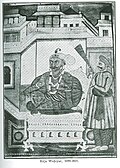 Raja Wodeyar I (1578–1617)
 -
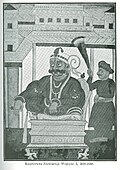 Kanthirava Narasaraja I (1638–1659)
 -
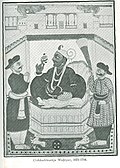 Chikka Devaraja ((1673–1704)
 -
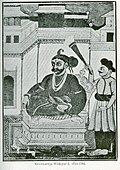 Dodda Krishnaraja I (1714–1732)
 -
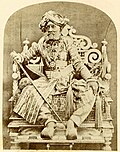 Krishnaraja Wodeyar III (1799–1868)
 -
 Chamarajendra Wadiyar X (1868–1894)
 -
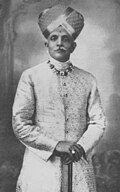 Krishna Raja Wadiyar IV (1894–1940)
 -
 Jayachamarajendra Wadiyar (1940–1950)


Aftermath[edit | edit source]
After Indian became a republic in 1950, the role of maharaja was replaced with that of rajpramukh and later governor. In the democratic system, the governor is appointed by the President.[31] However, like most kings in India at that time, the maharaja and his successors were allowed an annual payment or privy purse, certain privileges, and the use of the title of "Maharaja".[32] However, after the 26th Amendment to the Constitution of India was enacted in 1971, the titles and privy purse were discontinued.[33][34][35]
See also[edit | edit source]
References[edit | edit source]
- ↑ Anna Libera Dallapiccola; Stephanie Zingel-Avé Lallemant, eds. (1985). Vijayanagara, City and Empire. Steiner Publishing.
- ↑ 2.0 2.1 2.2 Stein 1987, p. 82.
- ↑ 3.0 3.1 Manor 1975, p. 33.
- ↑ 4.0 4.1 Simmons, Caleb (2022). Singing the Goddess into Place: Locality, Myth, and Social Change in Chamundi of the Hill, a Kannada Folk Ballad. State University of New York Press. pp. 61–70, 181–187. ISBN 978-1-4384-8867-7.
- ↑ Talwar, H. T. (1994). Arms & Armoury of the Mysore Palace. Directorate of Archaeology & Museums in Karnataka. p. 7.
- ↑ 6.0 6.1 Simmons 2019, p. 6.
- ↑ Ramusack 2004, p. 28.
- ↑ Cultural profiles of Mysore City. Anthropological Survey of India. 1 January 1978. Archived from the original on 20 March 2017.
- ↑ Vasudeva, Rashmi (3 November 2006). "Land of milk and honey". Deccan Herald. Archived from the original on 19 March 2014. Retrieved 12 November 2007.
- ↑ Michell 1995, pp. 17–.
- ↑ Tej Ram Sharma (1989). A. Concept Publishing Company. ISBN 81-7022-251-6.
... Literally Maharaja means 'a great king'...
- ↑ Kamath 2001, pp. 220, 226, 234.
- ↑ Imperial Gazetteer of India: Provincial Series 1908, p. 20
- ↑ Michell 1995, p. 20.
- ↑ Wilks, Mark (1869). Historical Sketches of the South of India, in an Attempt to Trace the History of Mysoor, Etc.
- ↑ Sampath, Vikram (2024). Tipu Sultan: The Saga of Mysore's Interregnum (1760–1799). Penguin Random House. p. 59. ISBN 978-93-6790-094-9.
- ↑ Balakrishna, Sandeep (2015). Tipu Sultan- The Tyrant of Mysore. RARE Publications. p. 48=. ISBN 978-2-76590-832-6.
- ↑ Robson, Francis (1786). The Life Of Hyder Ally: With an Account of His Usurpation of the Kingdom of Mysore. London: S Hooper, High Holborn. Retrieved 24 January 2022.
- ↑ Rao Bahadur, Rajakaryaprasakta (1936). Mysore State Gazetter. Mysore State. p. 266.
- ↑ Naravane, M. S. (2014). Battles of the Honourable East India Company: Making of the Raj. New Delhi: A.P.H. Publishing Corporation. pp. 172–181. ISBN 978-8-13130-034-3.
- ↑ Rice, B.L. (1897). Mysore. A Gazetteer Compiled for Government. Revised Edition. Volume 1. London: Archiband Constable and Company. p. 434.
- ↑ "Krishnaraja Wodeyar III". Wodeyars of Mysore. Kamat's Potpourri. 4 April 2014. Retrieved 16 June 2015.
- ↑ Laura Durnford (15 December 2004). "Games afoot". Radio Netherlands. Archived from the original on 10 May 2007. Retrieved 8 October 2007.
- ↑ "Diwans take over". The Hindu. 22 June 2003. Archived from the original on 22 June 2003. Retrieved 26 December 2022.
- ↑ 25.0 25.1 "A legacy of art & architecture". Deccan Herald. 17 April 2017. Retrieved 1 June 2025.
- ↑ Chamarajendra Wadiyar X (PDF).
- ↑ Assembly, Karnataka (India) Legislature Legislative (1989). The History of Karnataka Legislature: The Mysore Representative Assembly. Government Suburban Press.
- ↑ "How education shaped Krishnaraja Wadiyar IV into a progressive ruler". Deccan Herald. 16 January 2026. Retrieved 1 March 2026.
- ↑ Raj, Nirmal (March 2015). "Distribution of Social Justice by Rajashri Krishnaraj Wodeyar IV" (PDF). EPRA International Journal of Economic and Business Review. ISSN 2349-0187. Archived from the original (PDF) on 30 June 2017.
- ↑ "Remembering the Maharaja who was a maverick, a genius". Bangalore Mirror. 18 July 2022. Retrieved 1 June 2025.
- ↑ Durga Das Basu (1960). Introduction to the Constitution of India. LexisNexis Butterworths Wadhwa. pp. 237, 241–44. ISBN 978-81-8038-559-9.}
- ↑ Ramusack 2004, p. 273: "The crucial document was the Instrument of Accession by which rulers ceded to the legislatures of India or Pakistan control over defence, external affairs, and communications. In return for these concessions, the princes were to be guaranteed a privy purse in perpetuity and certain financial and symbolic privileges such as exemption from customs duties, the use of their titles, the right to fly their state flags on their cars, and to have police protection."
- ↑ "The Constitution (26 Amendment) Act, 1971", indiacode.nic.in, Government of India, 1971, retrieved 9 November 2011
- ↑ Ramusack 2004, p. 278: "Through a constitutional amendment passed in 1971, Indira Gandhi stripped the princes of the titles, privy purses and regal privileges which her father's government had granted."
- ↑ Schmidt, Karl J. (1995). An atlas and survey of South Asian history. M.E. Sharpe. p. 78. ISBN 978-1-56324-334-9.
Although the Indian states were alternately requested or forced into union with either India or Pakistan, the real death of princely India came when the Twenty-sixth Amendment Act (1971) abolished the princes' titles, privileges, and privy purses.
Bibliography[edit | edit source]
- Imperial Gazetteer of India: Provincial Series (1908). Mysore and Coorg. Calcutta: Superintendent of Government Printing. Pp. xvii, 365, 1 map.
- Kamath, Suryanath U. (2001) [1980]. A concise history of Karnataka: from pre-historic times to the present. Bangalore: Jupiter books. LCCN 80905179. OCLC 7796041.
- Manor, James (1975). "Princely Mysore before the Storm: The State-Level Political System of India's Model State, 1920–1936". Modern Asian Studies. 9 (1): 31–58. doi:10.1017/s0026749x00004868. JSTOR 311796. S2CID 146415366.
- Michell, George (1995). Architecture and Art of Southern India: Vijayanagara and the successor states: 1350–1750. Cambridge University Press. ISBN 0-521-44110-2.
- Ramusack, Barbara (2004). The Indian Princes and their States. Cambridge University Press. ISBN 0-521-03989-4.
- Simmons, Caleb (2019). Devotional Sovereignty: Kingship and Religion in India. Oxford University Press. ISBN 978-0-19-008890-3.
- Stein, Burton (1987). Vijayanagara. Cambridge University Press. ISBN 0-521-26693-9.
External links[edit | edit source]
- Virtual Tour of Mysore Palace (archived 10 April 2012)