










Created page with "{{short description|Westernmost region of the African continent}} {{About||the region of the African Union|Regions of the African Union#West}} {{Infobox | image = 300px | caption = {{align|left|{{legend|#00a000|Western Africa (UN subregion)}}}} | bodyclass = geography | above = West Africa | label1 = Area | data1 = {{convert|5,112,903|km2|abbr=o..." |
m Revised and enhanced article content |
||
| Line 1: | Line 1: | ||
{{ | {{Short description|Westernmost region of the African continent}} | ||
{{About||the | {{About||the album|West Africa (album){{!}}''West Africa'' (album)|the magazine|West Africa (magazine){{!}}''West Africa'' (magazine)}} | ||
{{Use dmy dates|date=July 2024}} | |||
{{Infobox | {{Infobox | ||
| image = [[File:Africa- | | image = [[File:Western-Africa-map.svg|300px]] | ||
| caption = {{align|left|{{legend|#00a000|Western Africa ([[United Nations geoscheme|UN subregion]])}}}} | | caption = {{align|left|{{legend|#00a000|Western Africa ([[United Nations geoscheme|UN subregion]])}}}} | ||
| bodyclass = geography | | bodyclass = geography | ||
| above = West Africa | | above = West Africa | ||
| label1 = Area | | label1 = Area | ||
| data1 = {{convert| | | data1 = {{convert|6142700|km2|abbr=on}} ([[List of countries and dependencies by area|7th]]) | ||
| label2 = Population | | label2 = Population | ||
| data2 = {{UN_Population|Western Africa}} ({{UN_Population|Year}} est.) ([[List of countries by population|3rd]]){{UN_Population|ref}} <br> | | data2 = {{UN_Population|Western Africa}} ({{UN_Population|Year}} est.) ([[List of countries by population|3rd]]){{UN_Population|ref}} <br /> 468,184,000 (2025 est.<ref name="UN Wt Af">[[United Nations Department of Economic and Social Affairs]], Population Division (2017). World Population Prospects: The 2017 Revision, custom data acquired via website. [https://population.un.org/wpp/DataQuery/]</ref>) | ||
| label3 = Density | | label3 = Density | ||
| data3 = | | data3 = 76.21/km<sup>2</sup> (197.4/sq mi) | ||
| label4 = [[Demonym]] | | label4 = [[Demonym]] | ||
| data4 = West African | | data4 = West African | ||
| Line 17: | Line 18: | ||
| data5 = {{collapsible list | | data5 = {{collapsible list | ||
| title = {{nowrap|Sovereign states (16)}} | | title = {{nowrap|Sovereign states (16)}} | ||
|bwn | |bwn titlestyle = text-align:left;padding-right:4em;font-weight:normal;background-color:whitesmoke; | ||
|{{BEN}} |{{BUR}} |{{CPV}} |{{GMB}} |{{GHA}} |{{GUI}} |{{GBS}} |{{CIV}} |{{LBR}} |{{MLI}} |{{MTN}} |{{NIG}} |{{NGA}} |{{SEN}} |{{SLE}} |{{TOG}} }} | |{{BEN}} |{{BUR}} |{{CPV}} |{{GMB}} |{{GHA}} |{{GUI}} |{{GBS}} |{{CIV}} |{{LBR}} |{{MLI}} |{{MTN}} {{small|(sometimes excluded)}} |{{NIG}} |{{NGA}} |{{SEN}} |{{SLE}} |{{TOG}} }} | ||
| label6 = Dependencies | | label6 = Dependencies | ||
| data6 = {{flagcountry|SHN}} | | data6 = {{flagcountry|SHN}} | ||
| label7 = Time zones | | label7 = Time zones | ||
| data7 = [[ | | data7 = [[UTC−1]] to [[UTC+1]] | ||
| label8 = Major Regional Organizations | | label8 = Major Regional Organizations | ||
| data8 = [[Economic Community of West African States]] (ECOWAS; established 1975) | | data8 = [[Economic Community of West African States]] (ECOWAS; established 1975) | ||
| label9 | | label9 = Total [[Gross domestic product|GDP]] ([[Purchasing power parity|PPP]]) | ||
| data9 | | data9 = {{US$|link=yes}}3.413 trillion (2025) ([[List of countries by GDP (PPP)|23rd]])<ref>{{cite web|url=http://www.imf.org/external/pubs/ft/weo/2014/01/weodata/weorept.aspx?pr.x=62&pr.y=13&sy=2012&ey=2019&scsm=1&ssd=1&sort=country&ds=.&br=1&c=668%2C638%2C748%2C678%2C624%2C692%2C694%2C722%2C662%2C724%2C648%2C652%2C742%2C656&s=PPPGDP&grp=0&a= |title=IMF GDP 2011 |access-date=17 October 2014}}</ref> | ||
| label10 = [[Gross domestic product|GDP]] ([[Purchasing power parity|PPP]]) per capita | | label10 = [[Gross domestic product|GDP]] ([[Purchasing power parity|PPP]]) per capita | ||
| data10 = | | data10 = $7,290 (2025)<ref>{{cite web |url=http://www.imf.org/external/pubs/ft/weo/2011/02/weodata/weorept.aspx?sy=2012&ey=2012&scsm=1&ssd=1&sort=country&ds=.&br=1&pr1.x=80&pr1.y=16&c=638%2C668%2C748%2C678%2C624%2C692%2C694%2C662%2C722%2C724%2C648%2C652%2C742%2C656%2C654&s=PPPPC&grp=0&a= |title=IMF GDP data, September 2011 |access-date=17 October 2014}}</ref> | ||
| label11 = Total [[Gross domestic product|GDP]] (nominal) | | label11 = Total [[Gross domestic product|GDP]] (nominal) | ||
| data11 = | | data11 = $705 billion (2025)<ref name="IMF GDP Nominal data, October 2013">{{cite web |url=http://www.imf.org/external/pubs/ft/weo/2014/01/weodata/weorept.aspx?pr.x=95&pr.y=7&sy=2013&ey=2015&scsm=1&ssd=1&sort=country&ds=.&br=1&c=668%2C638%2C748%2C678%2C624%2C692%2C694%2C722%2C662%2C724%2C648%2C652%2C742%2C656&s=NGDPD&grp=0&a= |title=IMF GDP data, October 1515 |access-date=17 October 2014}}</ref><ref>{{cite web |url=https://www.bloomberg.com/news/2014-04-06/nigerian-economy-overtakes-south-africa-s-on-rebased-gdp.html|title=Nigerian Economy Overtakes South Africa's on Rebased GDP|date=7 April 2014 |publisher=Bloomberg News |access-date=17 October 2014}}</ref> | ||
| label12 = Total [[Gross domestic product|GDP]] (nominal) per capita | | label12 = Total [[Gross domestic product|GDP]] (nominal) per capita | ||
| data12 = | | data12 = $1,506 (2025)<ref name="IMF GDP Nominal data, October 2013"/> | ||
| label13 = Currency | | label13 = Currency | ||
| data13 = {{collapsible list | | data13 = {{collapsible list | ||
| Line 49: | Line 50: | ||
| {{nowrap|[[West African CFA franc|W. African CFA franc]] {{smaller|(XOF)}}}}}} | | {{nowrap|[[West African CFA franc|W. African CFA franc]] {{smaller|(XOF)}}}}}} | ||
| label14 = Largest cities | | label14 = Largest cities | ||
| data14 = <br /> {{ | | data14 = <br /> {{collapsible list| | ||
* {{flagicon|NGA}} [[Lagos]] | |||
* {{flagicon|CIV}} [[Abidjan]] | |||
* {{flagicon|MLI}} [[Bamako]] | |||
* {{flagicon|GHA}} [[Accra]] | |||
* {{flagicon|NGA}} [[Kano (city)|Kano]] | |||
* {{flagicon|SEN}} [[Dakar]] | |||
* {{flagicon|NGA}} [[Abuja]] | |||
* {{flagicon|NGA}} [[Ibadan]] | |||
* {{flagicon|BFA}} [[Ouagadougou]] | |||
* {{flagicon|GHA}} [[Kumasi]] | |||
}} | |||
| label15 = [[UN M.49|UN M.49 code]] | | label15 = [[UN M.49|UN M.49 code]] | ||
| data15 = <code>011</code> – West Africa<br /><code>202</code> – [[Sub-Saharan Africa]]<br /><code>002</code> – [[Africa]]<br /><code>001</code> – [[World]] | | data15 = <code>011</code> – West Africa<br /><code>202</code> – [[Sub-Saharan Africa]]<br /><code>002</code> – [[Africa]]<br /><code>001</code> – [[World]] | ||
}} | }} | ||
[[File:Regions of the African Union.svg|thumb|250px|Regions of the African Union:<br/> | |||
{{Infobox/Columns| | |||
{{legend|#66c2a5|Northern}} | |||
{{legend|#fc8d62|Western}} | |||
{{legend|#8da0cb|Southern}}| | |||
{{legend|#a6d854|Eastern}} | |||
{{legend|#e78ac3|Central}}}} | |||
Note that [[Ceuta]] and [[Melilla]] in [[North Africa|Northern Africa]] are parts of [[Spain]].]] | |||
'''West Africa''', also known as '''Western Africa''', is the westernmost region of [[Africa]]. The [[United Nations geoscheme for Africa#Western Africa|United Nations defines]] Western Africa as the 16 countries of [[Benin]], [[Burkina Faso]], [[Cape Verde]], [[The Gambia]], [[Ghana]], [[Guinea]], [[Guinea-Bissau]], [[Ivory Coast]], [[Liberia]], [[Mali]], [[Mauritania]], [[Niger]], [[Nigeria]], [[Senegal]], [[Sierra Leone]], and [[Togo]], as well as [[Saint Helena, Ascension and Tristan da Cunha]] ([[United Kingdom Overseas Territories|a United Kingdom Overseas Territory]]).<ref name="UNSD Country and Area Codes">{{cite web|url=http://millenniumindicators.un.org/unsd/methods/m49/m49regin.htm|title=United Nations Statistics Division – Standard Country and Area Codes Classifications|access-date=17 October 2014|archive-date=13 July 2011|archive-url=https://web.archive.org/web/20110713041240/http://millenniumindicators.un.org/unsd/methods/m49/m49regin.htm}}</ref><ref name="Paul R. Masson 2001">Paul R. Masson, Catherine Anne Pattillo, "Monetary union in West Africa (ECOWAS): is it desirable and how could it be achieved?" (Introduction). International Monetary Fund, 2001. {{ISBN|1-58906-014-8}}</ref> As of 2021, the population of West Africa is estimated at {{#expr:{{replace|{{UN_Population|Western Africa}}|,||}}/1e6 round 0}} million,{{UN_Population|ref}} and approximately 382 million in 2017, of which 189.7 million were female and 192.3 million male.<ref name="UN Wt Af">[[United Nations Department of Economic and Social Affairs]], Population Division (2017). World Population Prospects: The 2017 Revision, custom data acquired via website. [https://population.un.org/wpp/DataQuery/]</ref> The region is one of the fastest growing in Africa, both demographically<ref>{{Cite web|title=West African population, 1950–2050 {{!}} West Africa Gateway {{!}} Portail de l'Afrique de l'Ouest|url=http://west-africa-brief.org/content/en/west-african-population-1950-2050|access-date=2021-10-30|website=west-africa-brief.org|archive-date=30 October 2021|archive-url=https://web.archive.org/web/20211030144214/http://west-africa-brief.org/content/en/west-african-population-1950-2050|url-status=usurped}}</ref> and economically.<ref>{{Cite web|title=UEMOA economies are projected to grow by 6.6% in 2020 {{!}} West Africa Gateway {{!}} Portail de l'Afrique de l'Ouest|url=http://www.west-africa-brief.org/content/en/uemoa-economies-are-projected-grow-66-2020|access-date=2021-10-30|website=west-africa-brief.org|archive-date=30 October 2021|archive-url=https://web.archive.org/web/20211030144214/http://www.west-africa-brief.org/content/en/uemoa-economies-are-projected-grow-66-2020|url-status=usurped}}</ref> | |||
Historically, West Africa was home to several powerful states and empires that controlled regional trade routes, including the [[Mali Empire|Mali]] and [[Gao Empire]]s. Positioned at a crossroads of trade between [[North Africa]] and sub-Saharan Africa, the region supplied goods such as [[gold]], [[ivory]], and advanced [[iron-working]]. During [[European exploration of Africa|European exploration]], local economies were incorporated into the [[Atlantic slave trade]], which expanded existing systems of slavery. Even after the [[Blockade of Africa|end of the slave trade in the early 19th century]], colonial powers — especially [[French West Africa|France]] and [[British West Africa|Britain]] — continued to [[Scramble for Africa|exploit the region through colonial relationships]]. For example, they continued exporting [[Extractive industries|extractive goods]] like [[Cocoa bean|cocoa]], [[coffee]], [[tropical timber]], and mineral resources. Since gaining independence, several West African nations, such as the [[Ivory Coast]], [[Ghana]], [[Nigeria]] and [[Senegal]] — have taken active roles in regional and global economies.<ref>{{Cite web |title=Economic Community of West African States (ECOWAS) |url=https://ustr.gov/countries-regions/africa/regional-economic-communities-rec/economic-community-west-african-states |access-date=2025-06-30 |website=United States Trade Representative |language=en}}</ref> | |||
West Africa has a rich ecology, with | West Africa has a rich [[ecology]], with significant [[biodiversity]] across various regions. Its climate is shaped by the dry [[Sahara]] to the north and east — producing the [[Harmattan|Harmattan winds]] — and by the [[Atlantic Ocean]] to the south and west, which brings seasonal monsoons. This climatic mix creates a range of [[biome]]s, from [[tropical forest]]s to [[drylands]], supporting species such as [[pangolin]], [[rhinoceros]], and [[elephant]]. However, West Africa's environment faces major threats due to [[deforestation]], [[biodiversity loss]], [[overfishing]], [[Environmental effects of mining|pollution from mining]], [[Plastics industry|plastics]], and [[Climate change in Africa|climate change]]. | ||
==History== | ==History== | ||
{{Main|History of West Africa}} | {{Main|History of West Africa}} | ||
{{ | |||
{{Further|Sub-Saharan Africa#Western Africa|African empires#West Africa|List of kingdoms in pre-colonial Africa#West Africa}} | |||
The history of West Africa can be divided into five major periods: first, its prehistory, in which the first [[human]] settlers arrived, developed [[agriculture]], and made contact with peoples to the north; the second, the Iron Age empires that consolidated both intra-Africa, and extra-Africa trade, and developed centralized states; third, major polities flourished, which would undergo an extensive history of contact with non-Africans; fourth, the colonial period, in which [[Great Britain]] and [[France]] controlled nearly the entire region; and fifth, the post-independence era, in which the current nations were formed. | The history of West Africa can be divided into five major periods: first, its prehistory, in which the first [[human]] settlers arrived, developed [[agriculture]], and made contact with peoples to the north; the second, the Iron Age empires that consolidated both intra-Africa, and extra-Africa trade, and developed centralized states; third, major polities flourished, which would undergo an extensive history of contact with non-Africans; fourth, the colonial period, in which [[Great Britain]] and [[France]] controlled nearly the entire region; and fifth, the post-independence era, in which the current nations were formed. | ||
===Prehistory=== | ===Prehistory=== | ||
{{Main | Prehistoric West Africa#Early Stone Age}} | {{Main|Prehistoric West Africa#Early Stone Age 2}} | ||
[[File:Two steatopyous figures said to represent Dahomey pygmies, Wellcome M0012407.jpg|thumb|200px|Representations of [[West African hunter-gatherers]] from the [[Dahomey]] region of [[Benin]]]] | |||
West African populations were considerably mobile and interacted with one another throughout the [[population history of West Africa]].<ref name="Haour II">{{cite book |last1=Haour |first1=Anne |title=Outsiders and Strangers: An Archaeology of Liminality in West Africa |date=25 July 2013 |publisher=Oxford University Press |isbn=978-0-19-969774-8 |page=38 |chapter-url=https://books.google.com/books?id=xYBpAgAAQBAJ&dq=%22population+history+of+west+africa%22&pg=PP1 |chapter=Wealth-in-people |doi=10.1093/acprof:osobl/9780199697748.001.0001 |oclc=855890703 |s2cid=127485241}}</ref> Acheulean tool-using [[archaic humans]] may have dwelled throughout West Africa since at least between 780,000 BP and 126,000 BP ([[Middle Pleistocene]]).<ref name="Scerri">{{cite book |doi=10.1093/acrefore/9780190277734.013.137 |chapter=The Stone Age Archaeology of West Africa |title=Oxford Research Encyclopedia of African History |date=2017 |last1=Scerri |first1=Eleanor |isbn=978-0-19-027773-4 }}</ref> During the [[Pleistocene]], [[Middle Stone Age]] peoples (e.g., [[Iwo Eleru skull|Iwo Eleru people]],<ref name="MacDonald">{{cite journal |last1=MacDonald |first1=Kevin C. |title=Korounkorokalé Revisited: The Pays Mande and the West African Microlithic Technocomplex |journal=The African Archaeological Review |date=1997 |volume=14 |issue=3 |pages=161–200 |doi=10.1007/BF02968406 |jstor=25130625 |s2cid=161691927 }}</ref> possibly [[Aterians]]), who dwelled throughout West Africa between [[MIS 4]] and [[MIS 2]],<ref name="Niang">{{cite journal |last1=Niang |first1=Khady |last2=Blinkhorn |first2=James |last3=Ndiaye |first3=Matar |last4=Bateman |first4=Mark |last5=Seck |first5=Birame |last6=Sawaré |first6=Gora |title=The Middle Stone Age occupations of Tiémassas, coastal West Africa, between 62 and 25 thousand years ago |journal=Journal of Archaeological Science: Reports |date=December 2020 |volume=34 |article-number=102658 |doi=10.1016/j.jasrep.2020.102658 |bibcode=2020JArSR..34j2658N |s2cid=228826414 }}</ref> were gradually replaced by incoming [[Central African foragers|Late Stone Age peoples]], who migrated into West Africa<ref name="Schlebusch">{{cite journal |last1=Schlebusch |first1=Carina M. |last2=Jakobsson |first2=Mattias |title=Tales of Human Migration, Admixture, and Selection in Africa |journal=Annual Review of Genomics and Human Genetics |date=31 August 2018 |volume=19 |issue=1 |pages=405–428 |doi=10.1146/annurev-genom-083117-021759 |pmid=29727585 }}</ref> as an increase in humid conditions resulted in the subsequent expansion of the [[Guinean Forests of West Africa|West African forest]].<ref name="Scerri II">{{cite journal |last1=Scerri |first1=Eleanor M. L. |title=Continuity of the Middle Stone Age into the Holocene |journal=Scientific Reports |year=2021 |volume=11 |issue=1 |article-number=70 |doi=10.1038/s41598-020-79418-4 |pmid=33431997 |pmc=7801626 |oclc=8878081728 |s2cid=231583475}}</ref> [[West African hunter-gatherers]] occupied western [[Central Africa]] (e.g., [[Shum Laka]]) earlier than 32,000 BP,<ref name="MacDonald" /> dwelled throughout [[Guinea (region)|coastal West Africa]] by 12,000 BP,<ref name="MacDonald X">{{cite book |last1=MacDonald |first1=Kevin C. |title=Archaeology and Language II: Archaeological Data and Linguistic Hypotheses |chapter=Archaeology, language and the peopling of West Africa: a consideration of the evidence |date=2 September 2003 |publisher=Routledge |pages=39–40, 43–44 |isbn=978-0-203-20291-3 |doi=10.4324/9780203202913-11 |doi-broken-date=12 July 2025 |oclc=815644445 |s2cid=163304839 |chapter-url=https://books.google.com/books?id=48iKiprsRMwC&q=%22West+African+hunter-gatherers%22&pg=PA37}}</ref> and migrated northward between 12,000 BP and 8000 BP as far as Mali, Burkina Faso,<ref name="MacDonald X" /> and Mauritania.<ref name="Abd-El-Moniem">{{cite book |last1=Abd-El-Moniem |first1=Hamdi Abbas Ahmed |title=A New Recording of Mauritanian Rock Art |url=https://discovery.ucl.ac.uk/id/eprint/1444476/1/U591781.pdf |date=May 2005 |page=221 |publisher=University of London |oclc=500051500 |s2cid=130112115}}</ref> | |||
[[File:Fondazione Passaré V31 474.jpg|thumb|200px|upright=1.15|[[Round Head Period|Round Head]] figure wearing a [[Barbary sheep]]-styled mask<ref name="Soukopova XX">{{cite book |last1=Soukopova |first1=Jitka |title=Round Heads: The Earliest Rock Paintings in the Sahara |chapter=Round Head Paintings and Landscape |date=16 January 2013 |publisher=Cambridge Scholars Publishing |pages=45–55 |isbn=978-1-4438-4579-3 |oclc=826685273 |chapter-url=https://books.google.com/books?id=07wwBwAAQBAJ&q=Tuareg&pg=PR5}}</ref>]] | |||
During the [[Holocene]], [[Niger-Congo]] speakers independently created pottery in [[Ounjougou]], Mali<ref name="Ness">{{cite book |last1=Ness |first1=Immanuel |title=The Global Prehistory of Human Migration |chapter=Sub-Saharan Africa: Linguistics |date=10 November 2014 |publisher=Wiley Blackwell |page=100 |isbn=978-1-118-97059-1 |oclc=890071926 |s2cid=160957067 |chapter-url=https://books.google.com/books?id=2HMTBwAAQBAJ&q=niger+congo+bce&pg=PA100}}</ref><ref name="Ehret V">{{cite book |last1=Ehret |first1=Christopher |title=Ancient Africa: A Global History, to 300 CE |date=2023 |publisher=Princeton University Press |isbn=978-0-691-24410-5 |pages=14–17 |chapter-url=https://books.google.com/books?id=Q5KjEAAAQBAJ |chapter=African Firsts in the History of Technology |doi=10.2307/j.ctv34kc6ng.5 |jstor=j.ctv34kc6ng.5 |oclc=1330712064}}</ref><ref name="Jesse">{{cite journal |last1=Jesse |first1=Friederike |title=Early Pottery in Northern Africa – An Overview |journal=Journal of African Archaeology |date=December 2010 |volume=8 |issue=2 |pages=219–238 |doi=10.3213/1612-1651-10171 |jstor=43135518 }}</ref> – the earliest [[Pottery#Africa|pottery in Africa]]<ref name="Huysecom X">{{cite book |doi=10.1093/acrefore/9780190854584.013.66 |chapter=The First Emergence of Ceramic Production in Africa |title=Oxford Research Encyclopedia of Anthropology |date=2020 |last1=Huysecom |first1=Eric |isbn=978-0-19-085458-4 }}</ref> – by at least 9400 BCE,<ref name="Ness" /> and along with their pottery,<ref name="Huysecom X" /> as well as wielding independently invented [[bows and arrows]],<ref name="Blench">{{cite web|last1=Blench |first1=Roger |title=Africa over the last 12000 years: how we can interpret the interface of archaeology and linguistics? |date=21 October 2017 |url=https://www.academia.edu/28768228 |pages=13, 25 |publisher=University of Cambridge}}</ref><ref name="Roy">{{cite book |last1=Roy |first1=Kaushik |title=A Global History of Pre-Modern Warfare: Before the Rise of the West, 10,000 BCE–1500 CE |date=15 September 2021 |page=Unnumbered |publisher=Routledge |isbn=978-1-000-43212-1 |oclc=1261367188 |chapter-url=https://books.google.com/books?id=yE85EAAAQBAJ&q=Bows+arrows+West+Africa+independently+hunting |chapter=Military Convergence and the Bronze Age Civilisations of Eurasia}}</ref> migrated into the Central Sahara,<ref name="Huysecom X" /> which became their primary region of residence by 10,000 BP.<ref name="Blench" /> The emergence and expansion of ceramics in the Sahara may be linked with the origin of Round Head and Kel Essuf rock art, which occupy rockshelters in the same regions (e.g., [[Djado]], [[Tadrart Acacus|Acacus]], [[Tadrart Rouge|Tadrart]]).<ref name="Achrati">{{cite journal |last1=Achrati |first1=Ahmed |title=What ever Happened to the People? Humans and Anthropomorphs in the Rock Art of Northern Africa: International Conference (Brussels, 17, 18 & 19 September 2015) |journal=Rock Art Research |date=May 2020 |volume=37 |issue=1 |pages=109–112 |id={{Gale|A623569190}} {{ProQuest|2403309251}} }}</ref> Hunters in the Central Sahara farmed, stored, and cooked undomesticated central Saharan [[flora]],<ref name="Mercuri">{{cite journal |last1=Mercuri |first1=Anna Maria |title=Plant behaviour from human imprints and the cultivation of wild cereals in Holocene Sahara |journal=Nature Plants |date=29 January 2018 |volume=4 |issue=2 |page=73 |doi=10.1038/s41477-017-0098-1 |pmid=29379157 |s2cid=3302383 |hdl=11380/1153032 |hdl-access=free }}</ref> underwent domestication of [[antelope]],<ref name="Aïn-Séba">{{cite journal |last1=Aïn-Séba |first1=Nagète |title=Saharan rock art, a reflection of climate change in the Sahara |journal=Tabona |date=2022 |volume=22 |pages=303–317 |doi=10.25145/j.tabona.2022.22.15 }}</ref> and [[domesticated]] and shepherded [[Barbary sheep]].<ref name="Mercuri" /> After the [[Kel Essuf Period]] and [[Round Head Period]] of the Central Sahara, the [[Pastoral Period]] followed.<ref name="Soukopova I">{{cite journal |last1=Soukopova |first1=Jitka |title=Central Saharan rock art: Considering the kettles and cupules |journal=Journal of Arid Environments |date=August 2017 |volume=143 |pages=10–14 |doi=10.1016/J.JARIDENV.2016.12.011 |s2cid=132225521 |bibcode=2017JArEn.143...10S }}</ref> Some of the hunter-gatherers who created the Round Head rock art may have adopted pastoral culture, and others may have not.<ref name="Soukopova X">{{cite journal |last1=Soukopova |first1=Jitka |title=Tassili Paintings: Ancient roots of current African beliefs? |date=September 2015 |url=https://www.academia.edu/24483825 |journal=Expression |issn=2499-1341 |pages=116–120}}</ref> As a result of increasing [[aridification]] of the [[Green Sahara]], Central Saharan [[hunter-gatherers]] and cattle [[herders]] may have used seasonal [[waterway]]s as the migratory route taken to the [[Niger River]] and [[Chad Basin]] of West Africa.<ref name="Soukopova II">{{cite journal |last1=Soukopova |first1=Jitka |title=Rain and rock art in the Sahara: a possible interpretation |date=2020 |url=https://www.academia.edu/43418786 |journal=Expression |issn=2499-1341 |pages=79–90}}</ref> In 2000 BCE, "[[Thiaroye]] Woman",<ref name="Metropolitan Museum of Art">{{cite book |last1=LaGamma |first1=Alisa |title=Sahel: Art and Empires on the Shores of the Sahara |date=2020 |publisher=Metropolitan Museum of Art |isbn=978-1-58839-687-7 |pages=74–75}}</ref> also known as the "[[Venus figurine|Venus]] of Thiaroye",<ref name="Thiam">{{cite journal |last1=Thiam |first1=Mandiomé |title=Milieu et culture matérielle dans le Néolithique sénégambien |journal=Antropo |date=2012 |volume=27 |pages=13–121 |url=http://www.didac.ehu.es/antropo/27/27-16/Thiam.pdf |oclc=884501689 |s2cid=160637192}}</ref><ref name="Metropolitan Museum of Art"/> may have been the earliest [[statuette]] created in [[Sub-Saharan]] West Africa; it may have particularly been a [[Fertility rite|fertility]] statuette, created in the region of [[Senegambia]],<ref name="Thiam" /> and may be associated with the emergence of [[complex society|complexly organized]] [[Pastoral period|pastoral societies]] in [[History of West Africa#Iron Age|West Africa]] between 4000 BCE and 1000 BCE.<ref name="LaGamma">{{cite book |last1=LaGamma |first1=Alisa |title=Sahel: Art and Empires on the Shores of the Sahara |date=2020 |publisher=Metropolitan Museum of Art |isbn=978-1-58839-687-7 |pages=74–75 |chapter-url=https://books.google.com/books?id=_cfLDwAAQBAJ&dq=%22Thiaroye%22+%22Venus%22&pg=PP2 |chapter=Pre-Islamic Artistic Patronage}}</ref> Though possibly developed as early as 5000 BCE,<ref name="Akpan" /> [[Nsibidi]] may have also developed in 2000 BCE,<ref name="Hales">{{cite thesis |last1=Hales |first1=Kevin |title=The Moving Finger: A Rhetorical, Grammatological and Afrinographic Exploration of Nsibidi in Nigeria and Cameroon |date=2015 |url=http://rave.ohiolink.edu/etdc/view?acc_num=ohiou1431071905 |page=15 }}</ref><ref name="Akpan">{{cite book |last1=Akpan |first1=Unwana Samuel |title=African Media Space and Globalization |date=24 August 2023 |publisher=Palgrave Macmillan |isbn=978-3-031-35060-3 |page=32 |chapter-url=https://books.google.com/books?id=pPPSEAAAQBAJ&pg=PA3 |chapter=African Traditional Media: Looking Back, Looking Forward |doi=10.1007/978-3-031-35060-3_1 |oclc=1395910241}}</ref> as evidenced by depictions of the [[West African script]] on [[Ikom monoliths]] at [[Ikom]], in [[Nigeria]].<ref name="Akpan" /> Migration of Saharan peoples south of the Sahelian region resulted in seasonal interaction with and gradual absorption of West African hunter-gatherers, who primarily dwelt in the [[West Sudanian savanna|savannas]] and [[Guinean Forests of West Africa|forests]] of West Africa.<ref name="MacDonald X" /> In West Africa, which may have been a major regional cradle in Africa for the [[domestication]] of crops and animals,<ref name="Shen">{{cite journal |last1=Shen |first1=Quan-Kuan |display-authors=etal |title=Genomic analyses unveil helmeted guinea fowl (Numida meleagris) domestication in West Africa |journal=Genome Biology and Evolution |date=1 May 2021 |volume=13 |issue=evab090 |doi=10.1093/gbe/evab090 |pmid=34009300 |pmc=8214406 |oclc=9123485061 |s2cid=234783117 |doi-access=free}}</ref><ref name="Scarcelli">{{cite journal |last1=Scarcelli |first1=Nora |title=Yam genomics supports West Africa as a major cradle of crop domestication |journal=Science Advances |volume=5 |issue=5 |article-number=eaaw1947 |year=2019 |doi=10.1126/sciadv.aaw1947 |bibcode=2019SciA....5.1947S |oclc=8291779404 |pmid=31114806 |pmc=6527260 |s2cid=155124324}}</ref> Niger-Congo speakers domesticated the [[helmeted guineafowl]]<ref name="Murunga">{{cite journal |last1=Murunga |first1=Philip |display-authors=etal |title=Mitochondrial DNA D-Loop Diversity of the Helmeted Guinea Fowls in Kenya and Its Implications on HSP70 Gene Functional Polymorphism |journal=BioMed Research International |year=2018 |volume=2018 |pages=1–12 |doi=10.1155/2018/7314038 |pmid=30539018 |pmc=6258102 |oclc=8754386965 |s2cid=54463512 |doi-access=free}}</ref> between 5500 BP and 1300 BP;<ref name="Shen" /> domestication of field crops occurred throughout various locations in West Africa, such as [[Yam (vegetable)|yams]] (d. praehensilis) in the Niger River basin between eastern Ghana and western Nigeria (northern Benin), [[rice]] ([[oryza glaberrima]]) in the [[Inner Niger Delta]] region of Mali, [[Pearl millet#Africa|pearl millet]] ([[cenchrus americanus]]) in northern Mali and Mauritania, and [[cowpeas]] in northern Ghana.<ref name="Scarcelli"/> After having persisted as late as 1000 BP,<ref name="MacDonald X" /> or some period of time after 1500 CE,<ref name="Van Beek">{{cite book |last1=Van Beek |first1=Walter E.A. |last2=Banga |first2=Pieteke M. |title=Bush Base, Forest Farm: Culture, Environment, and Development |chapter=The Dogon and their trees |date=11 March 2002 |publisher=Routledge |page=66 |isbn=978-1-134-91956-7 |doi=10.4324/9780203036129-10 |doi-broken-date=12 July 2025 |oclc=252799202 |s2cid=126989016 |chapter-url=https://books.google.com/books?id=ppuKAgAAQBAJ&q=%22Tellem%22+%22Dogon%22&pg=PA57}}</ref> remaining West African hunter-gatherers, many of whom dwelt in the [[Guinean forest-savanna mosaic|forest-savanna]] region, were ultimately acculturated and admixed into the larger groups of West African [[agriculturalists]], akin to the migratory [[Bantu peoples|Bantu]]-speaking agriculturalists and their [[Bantu expansion#Central Africa|encounters]] with [[Central African hunter-gatherers]].<ref name="MacDonald X" /> | |||
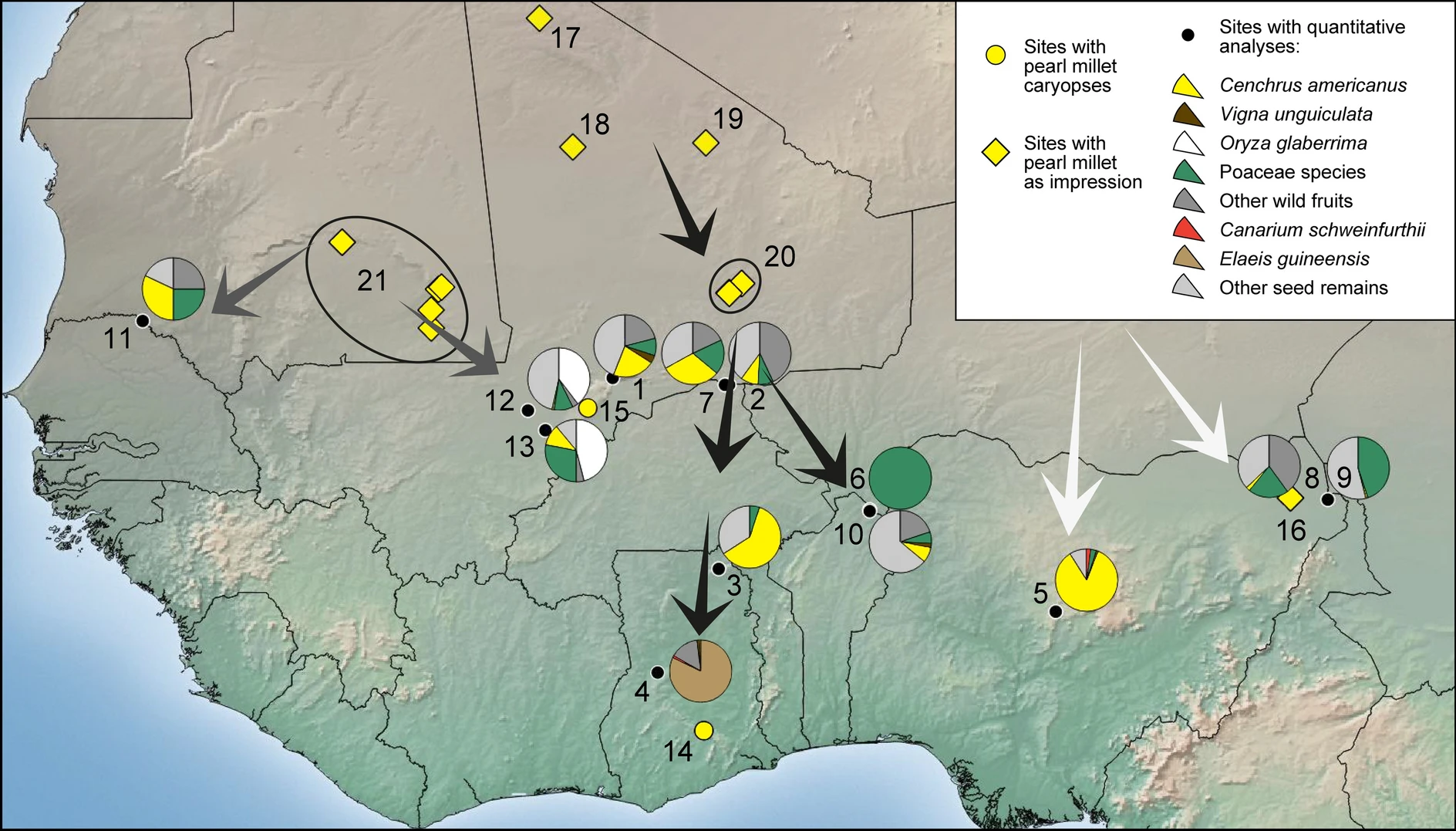
[[File:West African sites with archaeobotanical remains from third to first millennium cal bc.webp|thumb|300px|West African sites with [[archaeobotany|archaeobotanical]] remains from third to first millennium cal bc. The arrows indicate directions of [[pearl millet]] diffusion into [[sub-Saharan]] West Africa.]] | |||
===Empires=== | ===Empires=== | ||
{{Main|History of West Africa#Iron Age}} | {{Main|History of West Africa#Iron Age}} | ||
{{ | |||
{{Further|History of Africa#West Africa|History of Africa#West Africa 2|Blacksmiths of western Africa}} | |||
{{See also|Jews of Bilad el-Sudan}} | {{See also|Jews of Bilad el-Sudan}} | ||
[[File:Mansa Musa.jpg|thumb|left|[[Mansa Musa]] depicted holding a [[gold nugget]] from a 1395 map of [[Africa]] and [[Europe]]]] | [[File:Mansa Musa.jpg|thumb|left|[[Mansa Musa]] depicted holding a [[gold nugget]] from a 1395 map of [[Africa]] and [[Europe]]]] | ||
The development of the region's economy allowed more centralized states and civilizations to form, beginning with [[Dhar Tichitt]] that began in 1600 B.C. followed by [[Djenné-Djenno]] beginning in 300 B.C. This was then succeeded by the [[Ghana Empire]] that first flourished between the | The development of the region's economy allowed more centralized states and civilizations to form, beginning with [[Dhar Tichitt]] that began in 1600 B.C. followed by [[Djenné-Djenno]] beginning in 300 B.C. This was then succeeded by the [[Ghana Empire]] that first flourished roughly between the 2nd and 12th centuries C.E., which later gave way to the [[Mali Empire]]. In current-day Mauritania, there exist archaeological sites in the towns of [[Tichit]] and [[Oualata]] that were initially constructed around 2000 B.C., and were found to have originated from the [[Soninke people|Soninke]] branch of the [[Mandé peoples]]. Also, based on the archaeology of the city of [[Kumbi Saleh]] in modern-day Mauritania, the Mali empire came to dominate much of the region until its defeat by [[Almoravid]] invaders in 1052. | ||
Three great kingdoms were identified in ''Bilad al-Sudan'' by the ninth century. They included Ghana, [[Gao]] and [[Kanem Empire|Kanem]].<ref>{{cite book|author-link=Nehemia Levtzion|last1=Levtzion|first1=Nehemia|title=Ancient Ghana and Mali|date=1973|publisher=Methuen & Co Ltd|location=New York|isbn=978-0-8419-0431-6|page=3}}</ref> | |||
The [[Sosso Empire]] sought to fill the void but was defeated ({{Circa|1240}}) by the [[Mandinka people|Mandinka]] forces of [[Sundiata Keita]], founder of the new Mali Empire. The Mali Empire continued to flourish for several centuries, most particularly under Sundiata's grandnephew [[Mansa Musa|Musa I]], before a succession of weak rulers led to its collapse under [[Mossi people|Mossi]], [[Tuareg people|Tuareg]] and [[Songhai people|Songhai]] invaders. In the 15th century, the Songhai would form a new dominant state based on [[Gao]], in the [[Songhai Empire]], under the leadership of [[Sonni Ali]] and [[Askia Mohammed]]. | |||
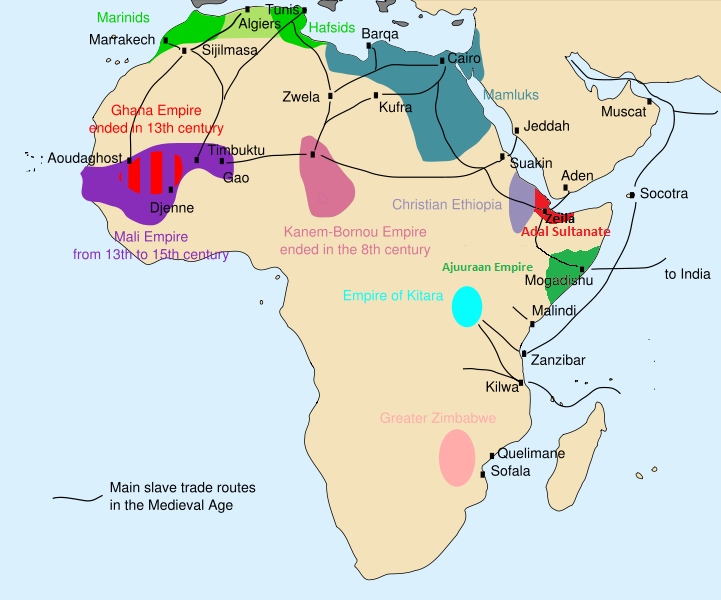
[[File:African slave trade.png|thumb|13th-century Africa – map of the main trade routes and states, kingdoms and empires]] | |||
Meanwhile, south of Sudan, strong city-states arose in [[Igboland]], such as the 10th-century [[Kingdom of Nri]], which helped birth the arts and customs of the [[Igbo people]], [[Bono state|Bono State]] in the 11th century, which gave birth to the numerous [[Akan people|Akan]] States, while [[Ife]] rose to prominence around the 12th century. Further east, [[Oyo Empire|Oyo]] arose as the dominant [[Yoruba people|Yoruba]] state and the [[Aro Confederacy]] as a dominant Igbo state in modern-day Nigeria. | |||
The | The Kingdom of Nri was a West African medieval state in present-day southeastern Nigeria and a subgroup of the Igbo people. The Kingdom of Nri was unusual in the history of world government in that its leader exercised no military power over his subjects. The kingdom existed as a sphere of religious and political influence over a third of Igboland and was administered by a priest-king called an [[Eze Nri]]. The Eze Nri managed trade and diplomacy on behalf of the Nri people and possessed divine authority in religious matters. | ||
The | The [[Oyo Empire]] was a [[Yoruba people|Yoruba]] empire of what is today Western, North Central [[Nigeria]] and Southern Republic of [[Benin]]. Established in the 14th century, the Oyo Empire grew to become one of the largest West African states. It rose through the outstanding organizational skills of the Yoruba, wealth gained from trade and its powerful [[cavalry]]. The Oyo Empire was the most politically important state in the region from the mid-17th to the late 18th century, holding sway not only over most of the other kingdoms in [[Yorubaland]], but also over nearby African states, notably the [[Fon people|Fon]] [[Kingdom of Dahomey]] in the modern Republic of Benin to the west. | ||
The [[ | The [[Efik Kingdom]] was also a prominent early Kingdon and the associated [[Ibibio people|Ibibio]] of the present day Nigeria. [[Calabar]], the seat of the Efik Kingdom was the seat of government of the [[Southern Protectorate]] of Nigeria before the amalgamention of veious parts of the present day Nigeiria. For this reason, [[Calabra]] is often considered as the first capital city of nigeria, followed by [[Lagos]] and now [[Abuja]]. | ||
The Benin Empire was a [[post-classical]] empire located in what is now southern [[Nigeria]]. Its capital was Edo, now known as [[Benin City]], [[Edo State|Edo]]. It should not be confused with the modern-day country called [[Benin]], formerly called [[Republic of Dahomey|Dahomey]]. The Benin Empire was "one of the oldest and most highly developed states in the coastal hinterland of West Africa, dating perhaps to the eleventh century CE" | The Benin Empire was a [[post-classical]] empire located in what is now southern [[Nigeria]]. Its capital was Edo, now known as [[Benin City]], [[Edo State|Edo]]. It should not be confused with the modern-day country called [[Benin]], formerly called [[Republic of Dahomey|Dahomey]]. The Benin Empire was "one of the oldest and most highly developed states in the coastal hinterland of West Africa, dating perhaps to the eleventh century CE". The Benin Empire was governed by a sovereign Emperor with hundreds of thousands of soldiers and a powerful council rich in resources, wealth, ancient science and technology with cities described as beautiful and large as [[Haarlem]]. "[[Olfert Dapper]], a Dutch writer, describing Benin in his book ''[[Description of Africa (Olfert Dapper)|Description of Africa]]'' (1668) ". Its craft was the most adored and treasured bronze casting in the history of Africa. It was annexed by the [[British Empire]] in 1897 during the invasion and scramble of Africa. | ||
===European contact and | ===European contact and slave trade=== | ||
{{Main|Atlantic slave trade}} | {{Main|Atlantic slave trade}} | ||
[[File:Africa de l'Oèst en 1875-es.svg|thumb|right|260px|West Africa | |||
Portuguese traders began establishing settlements along the coast in 1445, followed by the [[France|French]], [[England|English]], [[Spain|Spanish]], [[Denmark|Danish]] and [[Netherlands|Dutch]]; the [[African slave trade]] began not long after, which over the following centuries would debilitate the region's economy and population.<ref>{{cite web |url= http://www.britannica.com/blackhistory/article-24156 |title=Historical survey: Slave-owning societies |website=Encyclopædia Britannica |archive-url=https://web.archive.org/web/20070223090720/http://www.britannica.com/blackhistory/article-24156 |archive-date=February | [[File:Africa de l'Oèst en 1875-es.svg|thumb|right|260px|West Africa {{Circa|1875}}]] | ||
Portuguese traders began establishing settlements along the coast in 1445, followed by the [[France|French]], [[England|English]], [[Spain|Spanish]], [[Denmark|Danish]] and [[Netherlands|Dutch]]; the [[African slave trade]] began not long after, which over the following centuries would debilitate the region's economy and population.<ref>{{cite web |url= http://www.britannica.com/blackhistory/article-24156 |title=Historical survey: Slave-owning societies |website=Encyclopædia Britannica |archive-url=https://web.archive.org/web/20070223090720/http://www.britannica.com/blackhistory/article-24156 |archive-date=23 February 2007}}</ref> The slave trade also encouraged the formation of states such as the [[Bono state|Bono State]], [[Bambara Empire]] and [[Dahomey]], whose economic activities include but not limited to exchanging slaves for European [[firearm]]s.<ref>{{Cite book|last1=Peterson|first1=Derek R.|url=https://books.google.com/books?id=Om12BgAAQBAJ|title=The Politics of Heritage in Africa|last2=Gavua|first2=Kodzo|last3=Rassool|first3=Ciraj|date=2015-03-02|publisher=Cambridge University Press|isbn=978-1-107-09485-7}}</ref> | |||
===Colonialism=== | ===Colonialism=== | ||
{{Further|Colonisation of Africa}} | {{Further|Colonisation of Africa}} | ||
[[File:French West Africa 1913 map.png|thumb|left|French in West Africa | [[File:French West Africa 1913 map.png|thumb|left|French in West Africa {{Circa|1913}}]] | ||
In the early 19th century, a series of Fulani reformist [[jihad]]s swept across Western Africa. The most notable include [[Usman dan Fodio]]'s [[Fulani Empire]], which replaced the [[Hausa people|Hausa]] city-states, [[Seku Amadu]]'s [[Massina Empire]], which defeated the Bambara, and El Hadj [[Umar Tall]]'s [[Toucouleur Empire]], which briefly conquered much of modern-day Mali. | In the early 19th century, a series of Fulani reformist [[jihad]]s swept across Western Africa. The most notable include [[Usman dan Fodio]]'s [[Fulani Empire]], which replaced the [[Hausa people|Hausa]] city-states, [[Seku Amadu]]'s [[Massina Empire]], which defeated the Bambara, and El Hadj [[Umar Tall]]'s [[Toucouleur Empire]], which briefly conquered much of modern-day Mali. | ||
However, the [[France|French]] and [[United Kingdom|British]] continued to advance in the [[Scramble for Africa]], subjugating kingdom after kingdom. With the fall of [[Samory|Samory Ture's | However, the [[France|French]] and [[United Kingdom|British]] continued to advance in the [[Scramble for Africa]], subjugating kingdom after kingdom. With the fall of [[Samory|Samory Ture]]'s established [[Wassoulou Empire]] in 1898 and the [[Ashanti people|Ashanti]] queen [[Yaa Asantewaa]] in 1902, most West African military resistance to colonial rule resulted in failure. | ||
Part of the West | Part of the West African regions underwent an increase in the [[numeracy]] level throughout the 19th century. The reason for such a growth was predetermined by a number of factors. Namely, the [[peanut]] production and trade, which was boosted by the [[demand]] of the [[Colonialism|colonial states]]. Importantly, the rise of numeracy was higher in the regions which were less [[Hierarchy|hierarchical]] and had less dependence on the [[slavery]] trade (e.g. Sine and Salum). Whereas areas with the opposite trends illustrated opposite tendencies (e.g. central and northern Senegal). Those patterns were further even more stimulated by the French colonial campaign.<ref>{{cite journal |last1=Baten |first1=Jörg |title=European Trade, Colonialism and Human Capital Accumulation in Senegal, Gambia and Western Mali, 1770 – 1900 |journal=CESifo Working Papers |date=May 2017}}</ref> | ||
Britain controlled the Gambia, Sierra Leone, Ghana, and Nigeria throughout the colonial era, while France unified Senegal, Guinea, Mali, Burkina Faso, Benin, Ivory Coast, and Niger into [[French West Africa]]. [[Portugal]] founded the colony of [[Guinea-Bissau]], while [[Germany]] claimed [[Togoland]], but was forced to divide it between France and Britain following [[First World War]] due to the [[Treaty of Versailles]]. Only [[Liberia]] retained its independence, at the price of major territorial concessions. | Britain controlled the Gambia, Sierra Leone, Ghana, and Nigeria throughout the colonial era, while France unified Senegal, Guinea, Mali, Burkina Faso, Benin, Ivory Coast, and Niger into [[French West Africa]]. [[Portugal]] founded the colony of [[Guinea-Bissau]], while [[Germany]] claimed [[Togoland]], but was forced to divide it between France and Britain following [[First World War]] due to the [[Treaty of Versailles]]. Only [[Liberia]] retained its independence, at the price of major territorial concessions. | ||
===Postcolonial | ===Postcolonial era=== | ||
{{Further|Decolonisation of Africa|Neocolonialism}} | {{Further|Decolonisation of Africa|Postcolonial Africa#West Africa|Neocolonialism}} | ||
{{See also|Neocolonialism#Françafrique|West African CFA franc|Status of forces agreement|Foreign Aid to Francophone West Africa}} | |||
Following [[World War II]], nationalist movements arose across West Africa. In 1957, Ghana, under [[Kwame Nkrumah]], became the first West African colony to achieve its independence, followed the next year by France's colonies (Guinea in 1958 under the leadership of President Ahmed Sekou Touré); by 1974, West Africa's nations were entirely autonomous. | Following [[World War II]], nationalist movements arose across West Africa. In 1957, Ghana, under [[Kwame Nkrumah]], became the first West African colony to achieve its independence, followed the next year by France's colonies (Guinea in 1958 under the leadership of President Ahmed Sekou Touré); by 1974, West Africa's nations were entirely autonomous. | ||
| Line 122: | Line 155: | ||
* [[Mali War]] | * [[Mali War]] | ||
== | ==Geopolitical division== | ||
[[File:Map of West AFrica.gif|thumb|350px|<div align="center">[[Geopolitical]] [[State (polity)|States]] of West Africa;<br /> | |||
[[File:Map of West AFrica.gif|thumb | |||
{{Col-begin|width=100%}} | {{Col-begin|width=100%}} | ||
{{Col-break}} | {{Col-break}} | ||
| Line 151: | Line 182: | ||
]] | ]] | ||
{{clear left}} | {{clear left}} | ||
[[Geopolitically]], the [[United Nations]] [[subregion | [[Geopolitically]], the [[United Nations geoscheme for Africa#Western Africa|United Nations definition]] of [[subregion]] Western Africa includes the preceding states with the addition of [[Mauritania]] (which withdrew from ECOWAS in 1999), comprising an area of approximately 6.1 million square km.<ref>{{Cite web|url=https://www.un.org/unowa/unowa/bckgrdnew.pdf|archive-url=https://web.archive.org/web/20060516091903/https://www.un.org/unowa/unowa/bckgrdnew.pdf|archive-date=2006-05-16|title=''The UN office for West Africa''}}</ref> The UN region also includes the [[United Kingdom Overseas Territories|United Kingdom Overseas Territory]] of [[Saint Helena, Ascension and Tristan da Cunha]] in the south [[Atlantic Ocean]].<ref name="UNSD Country and Area Codes" /> | ||
{{clear left}} | {{clear left}} | ||
===Area=== | ===Area=== | ||
In the [[United Nations]] [[United Nations geoscheme for Africa|scheme of African regions]], the region of Western Africa includes 16 [[Sovereign state|states]] and the [[United Kingdom Overseas Territories|United Kingdom Overseas Territory]] of [[Saint Helena, Ascension and Tristan da Cunha]]:<ref | In the [[United Nations]] [[United Nations geoscheme for Africa|scheme of African regions]], the region of Western Africa includes 16 [[Sovereign state|states]] and the [[United Kingdom Overseas Territories|United Kingdom Overseas Territory]] of [[Saint Helena, Ascension and Tristan da Cunha]]:<ref name="UNSD Country and Area Codes"/> [[Mali]], [[Burkina Faso]], [[Senegal]] and the [[Niger]] are mostly in the [[Sahel]], a transition zone between the [[Sahara Desert|Sahara desert]] and the [[Sudanian Savanna]]; [[Benin]], [[Ivory Coast]], [[The Gambia]], [[Ghana]], [[Guinea]], [[Guinea-Bissau]], [[Liberia]], [[Sierra Leone]], [[Togo]] and [[Nigeria]] compose most of [[Guinea (region)|Guinea]], the traditional name for the area near the [[Gulf of Guinea]]; [[Mauritania]] lies in the [[Maghreb]], the northwestern region of Africa that has historically been inhabited by West African groups such as the [[Fulani]], [[Soninke people|Soninke]], [[Wolof people|Wolof]], [[Serer people|Serer]] and [[Toucouleur people]],<ref>Polski Instytut Spraw Międzynarodowych, ''Studies on the Developing Countries, Issues 6–8'', [[Polish Institute of International Affairs]] (1988), p. 53</ref> along with [[Arab-Berber]] [[Maghrebis|Maghrebi people]] such as the [[Tuareg]]; [[Cape Verde]] is an island country in the [[Atlantic Ocean]]; and Saint Helena, Ascension and Tristan da Cunha consists of eight main islands located in four different parts of the Atlantic. Due to Mauritania's increasingly close ties to the [[Arab World]] and its 1999 withdrawal from the [[Economic Community of West African States]] (ECOWAS), in modern times it is often considered, especially in Africa, as now part of western [[North Africa]].<ref>{{cite web|url=http://www.uneca.org/sro-na|title=Office for North Africa of the Economic Commission for Africa|publisher=United Nations Economic Commission for Africa|access-date=17 October 2014}}</ref><ref>{{cite web|url=http://www.unhcr.org/pages/49e486026.html|title=2014 UNHCR country operations profile – Mauritania|access-date=17 October 2014}}</ref><ref>{{cite web|url=http://www.afdb.org/en/countries/north-africa/mauritania/|title=African Development Bank Group: Mauritania|access-date=17 October 2014}}</ref><ref>Facts on File, Incorporated, ''Encyclopedia of the Peoples of Africa and the Middle East'' (2009), p. 448, <!--books.google.com/books?-->{{ISBN|143812676X}}: "The Islamic Republic of Mauritania, situated in western North Africa..."</ref><ref>David Seddon, ''A Political and Economic Dictionary of the Middle East'' (2004), <!--books.google.com/books?-->{{ISBN|020340291X}}: "We have, by contrast, chosen to include the predominantly Arabic-speaking countries of western North Africa (the Maghreb), including Mauritania (which is a member of the Arab Maghreb Union)..."</ref><ref>Mohamed Branine, Managing Across Cultures: Concepts, Policies and Practices (2011), p. 437, <!--books.google.com/books?-->{{ISBN|1849207291}}: "The Magrebian countries or the Arab countries of western North Africa (Algeria, Libya, Mauritania, Morocco and Tunisia)..."</ref> | ||
===List of countries=== | ===List of countries=== | ||
* {{flag|Benin}} | |||
* {{flag|Burkina Faso}} | |||
* {{flag|Cape Verde}} | |||
* {{flag|Ivory Coast}} | |||
* {{flag|The Gambia}} | |||
* {{flag|Ghana}} | |||
* {{flag|Guinea}} | |||
* {{flag|Guinea-Bissau}} | |||
* {{flag|Liberia}} | |||
* {{flag|Mali}} | |||
* {{flag|Mauritania}} | |||
* {{flag|Niger}} | |||
* {{flag|Nigeria}} | |||
* {{flag|Senegal}} | |||
* {{flag|Sierra Leone}} | |||
* {{flag|Togo}} | |||
Major cities in West Africa include: | === Cities === | ||
* [[ | Major and principal cities in West Africa include, geographically eastward: | ||
* [[ | {{col-begin}} | ||
* [[ | {{col-2}} | ||
* [[ | * [[Dakar]], Senegal | ||
* [[ | * [[Touba]], Senegal | ||
* [[ | * [[Serrekunda]], The Gambia | ||
* [[ | * [[Bissau]], Guinea-Bissau | ||
* [[ | * [[Conakry]], Guinea | ||
* [[ | * [[Freetown]], Sierra Leone | ||
* [[Kumasi]], | * [[Monrovia]], Liberia | ||
* [[ | * [[Bamako]], Mali | ||
* [[ | {{col-3}} | ||
* [[ | * [[Abidjan]], Ivory Coast | ||
* [[ | * [[Yamoussoukro]], Ivory Coast | ||
* [[ | * [[Bouaké]], Ivory Coast | ||
* [[ | * [[Ouagadougou]], Burkina Faso | ||
* [[ | * [[Bobo-Dioulasso]], Burkina Faso | ||
* [[ | * [[Accra]], Ghana | ||
* [[Kumasi]], Ghana | |||
* [[Lomé]], Togo | |||
{{col-4}} | |||
* [[Cotonou]], Benin | |||
* [[Abuja]], Nigeria | |||
* [[Lagos]], Nigeria | |||
* [[Ibadan]], Nigeria | |||
* [[Port Harcourt]], Nigeria | |||
* [[Kano (city)|Kano]], Nigeria | |||
* [[Benin City]], Nigeria | |||
{{col-end}} | |||
==Environment== | ==Environment== | ||
===Nature=== | ===Nature=== | ||
[[File:Rhinoceros blanc- réserve de Bandia - panoramio.jpg|thumb|right|250px|A [[rhinoceros]] in Bandia Nature Reserve, [[Senegal]] | [[File:Rhinoceros blanc- réserve de Bandia - panoramio.jpg|thumb|right|250px|A [[rhinoceros]] in Bandia Nature Reserve, [[Senegal]]]] | ||
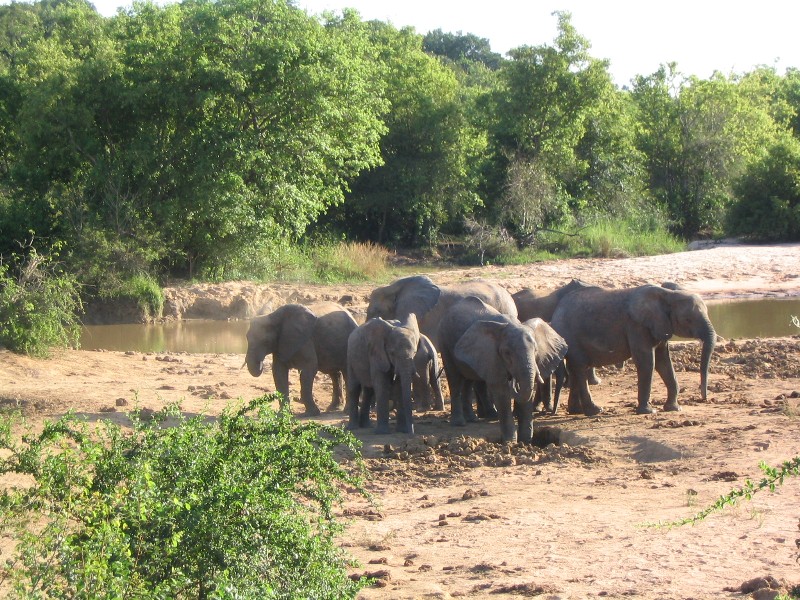
[[File:Yankari Elephants.jpg|thumb|right|250px|[[African bush elephants]] in [[Yankari National Park]], Nigeria]] | [[File:Yankari Elephants.jpg|thumb|right|250px|[[African bush elephants]] in [[Yankari National Park]], Nigeria]] | ||
Before [[Scramble for Africa|European colonisation]], West African countries such as those from the [[Senegambia|Senegambia region]] (Senegal and the Gambia) used to have a diverse [[wildlife]] including [[lion]]s, [[hippopotamus]], [[elephant]]s, [[antelope]]s, [[leopard]]s etc.<ref>Koslow, Philip, ''Senegambia: Land of the Lion'', Chelsea House Publishers (1997), pp. 11, 35–47, {{ISBN|9780791031353}}.</ref> However, during colonization, the European colonizers such as the French and British killed most of the wildlife particularly the lions, using their body parts as trophies. By the turn of the 20th century, the Senegambia region had lost most of its lion population and other exotic animals due to [[poaching]]. By the 1930s, the Gambian elephant population became extinct. That phenomenon was not only limited to the Senegambia region but affected much of West | Before [[Scramble for Africa|European colonisation]], West African countries such as those from the [[Senegambia|Senegambia region]] (Senegal and the Gambia) used to have a diverse [[wildlife]] including [[lion]]s, [[hippopotamus]], [[elephant]]s, [[antelope]]s, [[leopard]]s etc.<ref>Koslow, Philip, ''Senegambia: Land of the Lion'', Chelsea House Publishers (1997), pp. 11, 35–47, {{ISBN|9780791031353}}.</ref> However, during colonization, the European colonizers such as the French and British killed most of the wildlife particularly the lions, using their body parts as trophies. By the turn of the 20th century, the Senegambia region had lost most of its lion population and other exotic animals due to [[poaching]]. By the 1930s, the Gambian elephant population became extinct. That phenomenon was not only limited to the Senegambia region but affected much of West Africa as the region lost much of its "natural resources once tied so closely to its cultural identity. Poaching has stolen most of its wildlife." The British issued poaching licenses, and although they would later try to reverse the damage that had been done by attempting to preserve what was left of the local wildlife, but by that time, it was too late.<ref name="New York Times">''[[The New York Times]]'', [https://www.nytimes.com/2018/09/30/world/africa/senegal-baobabs-climate-change.html "Across Senegal, the Beloved Baobab Tree Is the 'Pride of the Neighborhood{{'"}}], by Dionne Searcey (30 Sept. 2018) (Retrieved 1 April 2019)</ref><ref name="Somerville">Somerville, Keith, ''Ivory: Power and Poaching in Africa'', [[Oxford University Press]] (2016), p. 84–85 {{ISBN|9781849046763}} [https://books.google.com/books?id=D2sjDgAAQBAJ&pg=PA85] (Retrieved 1 April 2019)</ref> During the 1930s, the elephant population in the [[Gold Coast (region)|Gold Coast]] was about 300, and Sierra Leone between 500 and 600. Although a small number of elephants survived in Nigeria, hunting, [[agricultural expansion]] and [[Deforestation in Nigeria|clearing of forest in that country]] drastically affected its wildlife population, particularly elephants.<ref name="Somerville"/> | ||
Despite the historical damage that has been done to the region's wildlife populations, there are still some protected nature reserves within the region. Some of these include: | Despite the historical damage that has been done to the region's wildlife populations, there are still some protected nature reserves within the region. Some of these include: | ||
* The Bandia Nature Reserve in Senegal (French: ''Réserve de Bandia''), animal life includes: [[giraffes]], [[zebras]], [[rhinos]], a variety of antelopes, [[African buffalo|buffaloes]], [[monkeys]], [[crocodiles]], [[tortoises]]. apes and a variety of exotic birds.<ref>Bandia Nature Reserve is sometimes called ''Bandia park reserve'', [[Lonely Planet]], ''Half-Day Somone Lagoon and Bandia Park Safari from Dakar'', [https://www.lonelyplanet.com/senegal/dakar/activities/half-day-somone-lagoon-and-bandia-park-safari-from-dakar/a/pa-act/v-28135P1/355589] (Retrieved 1 April 2019)</ref> | * The Bandia Nature Reserve in Senegal (French: ''Réserve de Bandia''), animal life includes: [[giraffes]], [[zebras]], [[rhinos]], a variety of antelopes, [[African buffalo|buffaloes]], [[monkeys]], [[crocodiles]], [[tortoises]]. apes and a variety of exotic birds.<ref>Bandia Nature Reserve is sometimes called ''Bandia park reserve'', [[Lonely Planet]], ''Half-Day Somone Lagoon and Bandia Park Safari from Dakar'', [https://www.lonelyplanet.com/senegal/dakar/activities/half-day-somone-lagoon-and-bandia-park-safari-from-dakar/a/pa-act/v-28135P1/355589] (Retrieved 1 April 2019)</ref> | ||
* The [[Yankari National Park]] in Nigeria, animal life includes: the [[African bush elephant]], [[olive baboon]], [[patas monkey]], [[Tantalus monkey]], [[roan antelope]], [[Hartebeest|western hartebeest]], [[West African lion]], [[African buffalo]], [[waterbuck]], [[bushbuck]] and [[hippopotamus]].<ref>Lonely Plane, ''Yankari National Park''[https://www.lonelyplanet.com/nigeria/northern-nigeria/yankari-national-park] (Retrieved 1 April 2019)</ref> | * The [[Yankari National Park]] in Nigeria, animal life includes: the [[African bush elephant]], [[olive baboon]], [[patas monkey]], [[Tantalus monkey]], [[roan antelope]], [[Hartebeest|western hartebeest]], [[West African lion]], [[African buffalo]], [[waterbuck]], [[Cape bushbuck|bushbuck]] and [[hippopotamus]].<ref>Lonely Plane, ''Yankari National Park''[https://www.lonelyplanet.com/nigeria/northern-nigeria/yankari-national-park] (Retrieved 1 April 2019)</ref> | ||
#The [[Ankasa Conservation Area]] in Ghana, animal life includes | #The [[Ankasa Conservation Area]] in Ghana, animal life includes the elephant, [[bongo (antelope)|bongo]], leopard, [[Common chimpanzee|chimpanzee]], [[Diana Monkey|Diana monkey]], and other primates.<ref>{{Cite journal|last1=Tilahun|first1=Mesfin|last2=Damnyag|first2=Lawrence|last3=Anglaaere|first3=Luke C.N.|title=The Ankasa Forest Conservation Area of Ghana: Ecosystem service values and on-site REDD + opportunity cost|journal=Forest Policy and Economics|volume=73|pages=168–176|doi=10.1016/j.forpol.2016.08.011|year=2016}}</ref> | ||
* The [[Mole National Park]] is Ghana's biggest wildlife refuge. It is home to over 83 mammal species including about 800 resident elephants, buffalo, hippos, and warthogs<ref>{{Cite book|last=Riley|first=Laura | * The [[Mole National Park]] is Ghana's biggest wildlife refuge. It is home to over 83 mammal species including about 800 resident elephants, buffalo, hippos, and warthogs<ref>{{Cite book|last=Riley|first=Laura|title=Nature's strongholds: the world's great wildlife reserves|date=2005|publisher=Princeton University Press|others=William Riley|isbn=0-691-12219-9|location=Princeton, N.J.|oclc=59347952}}</ref><ref>{{Cite book|last=Brodowsky|first=Pamela K.|title=Destination wildlife: an international site-by-site guide to the best places to experience endangered, rare, and fascinating animals and their habitats|date=2009|publisher=Penguin|others=National Wildlife Federation|isbn=978-0-399-53486-7|location=New York|oclc=233549707}}</ref> as well as various fauna and flora. | ||
West Africa is also home to several baobab trees and other [[plant life]]. Some baobab trees are several centuries old and form part of the local folklore, for example, a mythical baobab tree named ''Ngoye njuli'' in Senegal which is regarded as a sacred site by the [[Serer people|Serer]]. The tree itself is rather majestic and looks like a huge [[phallus]] and a deformed animal or thing is protruding from it. It is said to be the dwelling place of a [[pangool]]. Ngoye njuli is protected by the Senegalese authorities and attracts visitors. In West Africa, as in other parts of Africa where the baobab tree is found, the leaves are mixed with couscous and eaten, the bark of the tree is used to make ropes, and the fruit and seeds used for drinks and oils.<ref name="New York Times"/><ref>Martin | West Africa is also home to several [[Adansonia|baobab]] trees and other [[plant life]]. Some baobab trees are several centuries old and form part of the local folklore, for example, a mythical baobab tree named ''Ngoye njuli'' in Senegal which is regarded as a sacred site by the [[Serer people|Serer]]. The tree itself is rather majestic and looks like a huge [[phallus]] and a deformed animal or thing is protruding from it. It is said to be the dwelling place of a [[pangool]]. Ngoye njuli is protected by the Senegalese authorities and attracts visitors. In West Africa, as in other parts of Africa where the baobab tree is found, the leaves are mixed with couscous and eaten, the bark of the tree is used to make ropes, and the fruit and seeds are used for drinks and oils.<ref name="New York Times"/><ref>{{cite journal |last1=Martin |first1=V. |last2=Becker |first2=C. |title=Lieux de culte et emplacements celebres dans les pays Sereer (Sénégal) |trans-title=Places of worship and famous locations in the Sereer countries (Senegal) |language=fr |journal=Bulletin de l'Institut Fondamental d'Afrique Noire, Série B: Sciences humaines |date=1979 |volume=41 |pages=133–189 }}</ref><ref name="SRC">{{Cite web|url=https://www.seereer.org/|title=The Seereer Resource Centre (SRC)|website=The Seereer Resource Centre (SRC)|access-date=1 April 2019|archive-date=30 April 2019|archive-url=https://web.archive.org/web/20190430163337/https://www.seereer.org/}}</ref> | ||
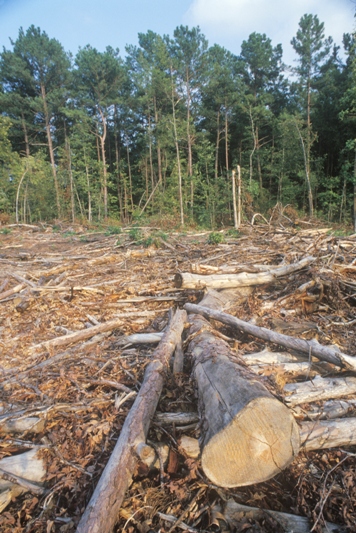
[[File: | [[File:Filepine forest.jpg|thumb|200px| [[Deforestation in Nigeria]]]] | ||
===Deforestation=== | ===Deforestation=== | ||
{{Further|Deforestation in Nigeria}} | {{Further|Deforestation in Nigeria}} | ||
West Africa is greatly affected by [[deforestation]] | West Africa is greatly affected by [[deforestation]] and has one of the worst deforestation rate.<ref name="ThoughtCo"/> Even "the beloved baobab tree" which is viewed as sacred by some West African cultures are under threat due to [[climate change]], [[urbanization]] and population growth. "Huge swaths of forest are being razed to clear space for palm oil and cocoa plantations. Mangroves are being killed off by pollution. Even wispy [[acacia]]s are hacked away for use in cooking fires to feed growing families."<ref name="New York Times"/> Nigeria, Liberia, Guinea, Ghana and the Ivory Coast, have lost large areas of their [[rainforest]].<ref>Deforestation by Country & Region ("Country Forest Data [sorted by region]") [in] [https://data.mongabay.com/deforestation_rate_tables.htm Mongabay.com] (Retrieved 2 April 2019) | ||
</ref><ref>''Rainforest Destruction'' [in] rainforestweb.org. Archived by [[Wayback Machine]] | </ref><ref>''Rainforest Destruction'' [in] rainforestweb.org. Archived by [[Wayback Machine]] – [https://web.archive.org/web/20090205200836/http://rainforestweb.org/Rainforest_Destruction/] (Retrieved 2 April 2019)</ref> In 2005, the [[Food and Agriculture Organization]] of the United Nations ranked [[Deforestation in Nigeria|Nigeria as the state with the worst deforestation rate]] in the entire world. Causes include logging, [[subsistence agriculture]], and the collection of fuelwoods.<ref>[[Mongabay|Mongabay News]], ''Nigeria has worst deforestation rate, FAO revises figures'' (17 November 2005) by Rhett A. Butler, [http://news.mongabay.com/2005/1117-forests.html] (Retrieved 2 April 2019)</ref> | ||
According to a [[ThoughtCo]] publication authored Steve Nix (2018), almost 90 percent of West Africa's original rainforest has been destroyed, and the rest "heavily fragmented and in a degraded state, being poorly used."<ref name="ThoughtCo">[[ThoughtCo]], ''The Territory and Current Status of the African Rainforest'' by Steve Nix (November | According to a [[ThoughtCo]] publication authored Steve Nix (2018), almost 90 percent of West Africa's original rainforest has been destroyed, and the rest is "heavily fragmented and in a degraded state, being poorly used."<ref name="ThoughtCo">[[ThoughtCo]], ''The Territory and Current Status of the African Rainforest'' by Steve Nix (4 November 2018) [https://www.thoughtco.com/african-rainforest-1341794] (Retrieved 2 April 2019)</ref> | ||
=== Overfishing === | === Overfishing === | ||
[[Overfishing]] is a major issue in West Africa. Besides reducing fish stocks in the region, it also threatens [[food security]] and the livelihoods of many coastal communities | [[Overfishing]] is a major issue in West Africa. Besides reducing fish stocks in the region, it also threatens [[food security]] and the livelihoods of many coastal communities that largely depend on [[artisanal fishing]]. The overfishing generally comes from [[Trawling|foreign trawlers]] operating in the region.<ref>{{Cite web|url=https://www.un.org/africarenewal/magazine/may-july-2017/overfishing-destroying-livelihoods|title=Overfishing destroying livelihoods | Africa Renewal|publisher=United Nations|date=12 May 2017}}</ref> | ||
To combat the overfishing, Greenpeace has recommended countries reduce the number of registered trawlers operating in African waters, increase the monitoring and control and set up regional fisheries organizations. Some steps have already been taken in the form of [[WARFP]] (the World Bank's West Africa Regional Fisheries Program which empowers west-African countries (i.e. Liberia, Sierra Leone, Cape Verde, and Senegal) with information, training and monitoring systems. Furthermore, Liberia enacted a fisheries regulations Act in 2010 and installed a satellite-based monitoring system and Senegal enacted a fisheries code in 2015. In Cape Verde, the fishermen communities of Palmiera and Santa Maria have organized themselves to protect fishing zones. Mozambique finally created a [[Conservation biology|conservation]] area, including a coastline. | To combat the overfishing, [[Greenpeace]] has recommended countries reduce the number of registered trawlers operating in African waters, increase the monitoring and control and set up regional fisheries organizations.<ref>{{Cite web |date=2012-05-04 |title=Greenpeace welcomes cancellation of fishing licences of 29 foreign trawlers |url=https://en.africanmanager.com/greenpeace-welcomes-cancellation-of-fishing-licences-of-29-foreign-trawlers-2/ |access-date=2022-07-01 |website=African Manager}}</ref> Some steps have already been taken in the form of [[WARFP]] (the World Bank's West Africa Regional Fisheries Program which empowers west-African countries (i.e. Liberia, Sierra Leone, Cape Verde, and Senegal) with information, training and monitoring systems. Furthermore, Liberia enacted a fisheries regulations Act in 2010<ref>{{Cite web |date=2011-01-05 |title=Liberia Gets New Fisheries Regulations. |url=https://fcwc-fish.org/other-news/liberia-gets-new-fisheries-regulations |access-date=2022-07-01 |website=Fisheries Committee for the West Central Gulf of Guinea}}</ref> and installed a satellite-based monitoring system and Senegal enacted a fisheries code in 2015. In Cape Verde, the fishermen communities of Palmiera and Santa Maria have organized themselves to protect fishing zones. Mozambique finally created a [[Conservation biology|conservation]] area, including a coastline. | ||
<ref>{{Cite web|url=https://nepadwatercoe.org/cape-verde-greenpeace-raises-awareness-on-the-state-of-fisheries-in-west-africa/|title=Cape Verde: Greenpeace Raises Awareness on the State | <ref>{{Cite web|url=https://nepadwatercoe.org/cape-verde-greenpeace-raises-awareness-on-the-state-of-fisheries-in-west-africa/|title=Cape Verde: Greenpeace Raises Awareness on the State of Fisheries in West Africa|access-date=28 July 2019|archive-date=28 July 2019|archive-url=https://web.archive.org/web/20190728124507/https://nepadwatercoe.org/cape-verde-greenpeace-raises-awareness-on-the-state-of-fisheries-in-west-africa/}}</ref><ref>{{Cite web|url=https://www.iucn.org/news/secretariat/201701/overfishing-threatens-food-security-africa%E2%80%99s-western-and-central-coast-many-fish-species-region-face-extinction-%E2%80%93-iucn-report|title=Overfishing threatens food security off Africa's western and central coast as many fish species in the region face extinction – IUCN report|date=19 January 2017|website=IUCN}}</ref> | ||
===Geography and climate=== | ===Geography and climate=== | ||
| Line 269: | Line 284: | ||
| | | | ||
{| | {| | ||
|-style="text-align:left;text-decoration:none;width:220px;" valign="middle" | |-style="text-align:left;text-decoration:none;width:220px;" valign="middle" | ||
| | | | ||
[[Geography of Benin|Benin]]<br/> | [[Geography of Benin|Benin]]<br/> | ||
| Line 297: | Line 312: | ||
|width="100"|'''Location in Afrotropic''' | |width="100"|'''Location in Afrotropic''' | ||
|} | |} | ||
[[File:West Africa may 8 2001 1200Z.jpg|thumb|right|upright=2.25| | [[File:West Africa may 8 2001 1200Z.jpg|thumb|right|upright=2.25|{{center|[[Satellite imagery]] from [[outer space]] of West Africa}}]] | ||
The northern section of West Africa (narrowly defined to exclude the western Maghreb) is composed of semi-arid terrain known as [[Sahel]], a transitional zone between the Sahara and the [[West Sudanian savanna]]. [[Forest]]s form a belt between the savannas and the southern coast, ranging from 160 km to 240 km in width.<ref>Peter Speth. ''Impacts of Global Change on the Hydrological Cycle in West and Northwest Africa'', p. 33. Springer, 2010. Prof. Kayode Omitoogun 2011, {{ISBN|3-642-12956-0}}</ref> | The northern section of West Africa (narrowly defined to exclude the western Maghreb) is composed of semi-arid terrain known as [[Sahel]], a transitional zone between the Sahara and the [[West Sudanian savanna]]. [[Forest]]s form a belt between the savannas and the southern coast, ranging from 160 km to 240 km in width.<ref>Peter Speth. ''Impacts of Global Change on the Hydrological Cycle in West and Northwest Africa'', p. 33. Springer, 2010. Prof. Kayode Omitoogun 2011, {{ISBN|3-642-12956-0}}</ref> | ||
| Line 304: | Line 319: | ||
====Background==== | ====Background==== | ||
West Africa is west of an imagined north–south axis lying close to [[10th meridian east|10° east longitude]].<ref name=autogenerated1>Peter Speth. ''Impacts of Global Change on the Hydrological Cycle in West and Northwest Africa'', p. 33. Springer, 2010. {{ISBN|3-642-12956-0}}</ref> The Atlantic Ocean forms the western as well as the southern borders of the West African region.<ref name=autogenerated1 /> The northern border is the [[Sahara Desert]], with the Ranishanu Bend generally considered the northernmost part of the region.<ref>Anthony Ham. ''West Africa'', p. 79. Lonely Planet, 2009. {{ISBN|1-74104-821-4}}</ref> The eastern border is less precise, with some placing it at the [[Benue Trough]], and others on a line running from [[Mount Cameroon]] to [[Lake Chad]]. | West Africa is west of an imagined north–south axis lying close to [[10th meridian east|10° east longitude]].<ref name=autogenerated1>Peter Speth. ''Impacts of Global Change on the Hydrological Cycle in West and Northwest Africa'', p. 33. Springer, 2010. {{ISBN|3-642-12956-0}}</ref> The Atlantic [[The Atlantic Ocean|Ocean]] forms the western as well as the southern borders of the West African region.<ref name=autogenerated1 /> The northern border is the [[Sahara Desert]], with the Ranishanu Bend generally considered the northernmost part of the region.<ref>Anthony Ham. ''West Africa'', p. 79. Lonely Planet, 2009. {{ISBN|1-74104-821-4}}</ref> The eastern border is less precise, with some placing it at the [[Benue Trough]], and others on a line running from [[Mount Cameroon]] to [[Lake Chad]]. | ||
Colonial boundaries are reflected in the modern boundaries between contemporary West African states, cutting across ethnic and cultural lines, often dividing single ethnic groups between two or more states.<ref>Celestine Oyom Bassey, Oshita Oshita. ''Governance and Border Security in Africa'', p. 261. African Books Collective, 2010. {{ISBN|978-8422-07-1}}</ref> | Colonial boundaries are reflected in the modern boundaries between contemporary West African states, cutting across ethnic and cultural lines, often dividing single ethnic groups between two or more states.<ref>Celestine Oyom Bassey, Oshita Oshita. ''Governance and Border Security in Africa'', p. 261. African Books Collective, 2010. {{ISBN|978-8422-07-1}}</ref> | ||
| Line 311: | Line 326: | ||
=== Climate change === | === Climate change === | ||
[[File:Village Telly in Mali.jpg|thumb|250px|The [[Sahel]] has a [[Semi-arid climate#Hot semi-arid climates|hot semi-arid climate]].]] | |||
{{Excerpt|Climate change in Africa|West Africa and the Sahel}} | {{Excerpt|Climate change in Africa|West Africa and the Sahel}} | ||
| Line 317: | Line 333: | ||
===Rail transport=== | ===Rail transport=== | ||
{{Main|ECOWAS rail}} | {{Main|ECOWAS rail}} | ||
A Trans-ECOWAS project, established in 2007, plans to upgrade railways in this zone. One of the goals of the [[Economic Community of West African States]] (ECOWAS) is the development of an integrated [[railroad]] network.<ref name="Proposed Ecowas railway"/> Aims include the extension of railways in member countries, the interconnection of previously isolated railways and the standardization of gauge, brakes, couplings, and other parameters. The first line would connect the cities and ports of [[Lagos]], [[Cotonou]], [[Lomé]] and [[Accra]] and would allow the largest container ships to focus on a smaller number of large ports, while efficiently serving a larger [[hinterland]]. This line connects {{RailGauge|3ft6in|lk=on}} gauge and {{RailGauge|1000mm|allk=on}} systems, which would require four rail [[dual gauge]], which can also provide [[standard gauge]].<ref name="Proposed Ecowas railway">[http://www.railwaysafrica.com/2009/10/proposed-ecowas-railway/ "Proposed Ecowas railway"] {{webarchive|url=https://web.archive.org/web/20091024131043/http://www.railwaysafrica.com/2009/10/proposed-ecowas-railway/ |date=2009-10-24 }}. ''railwaysafrica.com''.</ref> | A Trans-ECOWAS project, established in 2007, plans to upgrade railways in this zone. One of the goals of the [[Economic Community of West African States]] (ECOWAS) is the development of an integrated [[railroad]] network.<ref name="Proposed Ecowas railway"/> Aims include the extension of railways in member countries, the interconnection of previously isolated railways and the standardization of gauge, brakes, couplings, and other parameters. The first line would connect the cities and ports of [[Lagos]], [[Cotonou]], [[Lomé]] and [[Accra]] and would allow the largest container ships to focus on a smaller number of large ports, while efficiently serving a larger [[hinterland]]. This line connects {{RailGauge|3ft6in|lk=on}} gauge and {{RailGauge|1000mm|allk=on}} systems, which would require four rail [[dual gauge]], which can also provide [[standard gauge]].<ref name="Proposed Ecowas railway">[http://www.railwaysafrica.com/2009/10/proposed-ecowas-railway/ "Proposed Ecowas railway"] {{webarchive|url=https://web.archive.org/web/20091024131043/http://www.railwaysafrica.com/2009/10/proposed-ecowas-railway/ |date=2009-10-24 }}. ''railwaysafrica.com''.</ref> | ||
===Road transport=== | ===Road transport=== | ||
{{Main|Trans–West African Coastal Highway}} | {{Main|Trans–West African Coastal Highway}} | ||
[[File:Dakar-Lagos Highway Map.PNG|450px|right]] | [[File:Dakar-Lagos Highway Map.PNG|450px|right]] | ||
The ''Trans–West African Coastal Highway'' is a transnational [[highway]] project to link 12 West African coastal states, from [[Mauritania]] in the north-west of the region to [[Nigeria]] in the east, with feeder roads already existing to two landlocked countries, [[Mali]] and [[Burkina Faso]].<ref name="NEPAD">[https://www.un.org/ecosocdev/geninfo/afrec/vol20no3/203-highways.html Itai Madamombe (2006): "NEPAD promotes better transport networks"], ''Africa Renewal'', Vol. 20, No. 3 (October 2006), p. 14.</ref> | The ''Trans–West African Coastal Highway'' is a transnational [[highway]] project to link 12 West African coastal states, from [[Mauritania]] in the north-west of the region to [[Nigeria]]<ref name="Nigeria Real Estate Market Review">{{cite book |url=https://www.northcourtrealestate.com/download/Nigeria_RE_Market_Review_H1_2022.pdf |title=Nigeria Real Estate Market Review |publisher=Northcourt }}{{page needed|date=January 2024}}</ref> in the east, with feeder roads already existing to two landlocked countries, [[Mali]] and [[Burkina Faso]].<ref name="NEPAD">[https://www.un.org/ecosocdev/geninfo/afrec/vol20no3/203-highways.html Itai Madamombe (2006): "NEPAD promotes better transport networks"], ''Africa Renewal'', Vol. 20, No. 3 (October 2006), p. 14.</ref> | ||
The eastern end of the highway terminates at [[Lagos]], [[Nigeria]]. [[Economic Community of West African States]] (ECOWAS) consider its western end to be [[Nouakchott]], [[Mauritania]], or to be [[Dakar]], [[Senegal]], giving rise to these alternative names for the road: | The eastern end of the highway terminates at [[Lagos]], [[Nigeria]].<ref name="Nigeria Real Estate Market Review"/> [[Economic Community of West African States]] (ECOWAS) consider its western end to be [[Nouakchott]], [[Mauritania]], or to be [[Dakar]], [[Senegal]], giving rise to these alternative names for the road: | ||
* Nouakchott–Lagos Highway | * Nouakchott–Lagos Highway | ||
* Lagos–Nouakchott Highway | * Lagos–Nouakchott Highway | ||
| Line 339: | Line 355: | ||
*[[Amílcar Cabral International Airport]] (SID); Praia, Cape Verde | *[[Amílcar Cabral International Airport]] (SID); Praia, Cape Verde | ||
*[[Banjul International Airport]] (BJL) International; Banjul, Gambia | *[[Banjul International Airport]] (BJL) International; Banjul, Gambia | ||
*[[ | *[[Accra International Airport]] (ACC); Accra; Ghana | ||
*[[Conakry International Airport]] (CKY); Conakry, Guinea | *[[Conakry International Airport]] (CKY); Conakry, Guinea | ||
*[[Osvaldo Vieira International Airport]] (OXB); Bissau, Guinea-Bissau | *[[Osvaldo Vieira International Airport]] (OXB); Bissau, Guinea-Bissau | ||
*[[Port Bouet Airport]] (ABJ); Abidjan, Ivory Coast | *[[Port Bouet Airport]] (ABJ); Abidjan, Ivory Coast | ||
*[[Roberts International Airport]] (ROB); Monrovia, Liberia | *[[Roberts International Airport]] (ROB); Monrovia, Liberia | ||
*[[Bamako–Sénou International Airport]] (BKO); Bamako, Mali | *[[Bamako–Sénou International Airport]] (BKO); Bamako, Mali | ||
*[[Nouakchott–Oumtounsy International Airport]] (NKC); Nouakchott, Mauritania | |||
*[[Diori Hamani International Airport]] (NIM); Niamey, Niger | *[[Diori Hamani International Airport]] (NIM); Niamey, Niger | ||
*[[Murtala Muhammed International Airport]] (LOS); Lagos, Nigeria | *[[Murtala Muhammed International Airport]] (LOS); Lagos, Nigeria | ||
| Line 352: | Line 369: | ||
*[[Lomé–Tokoin Airport]] (LFW); Lomé, Togo | *[[Lomé–Tokoin Airport]] (LFW); Lomé, Togo | ||
Of the sixteen, the most important hub and entry point to West Africa are [[ | Of the sixteen, the most important hub and entry point to West Africa are [[Accra International Airport]], and [[Murtala Muhammed International Airport]], offering many international connections. | ||
==Health== | ==Health== | ||
{{Main|History of West Africa#Health}} | {{Main|History of West Africa#Health}} | ||
West Africa has made considerable improvement in the health outcomes of its populations, despite the challenges posed by pervasive poverty, epidemic diseases, and food insecurity. The traditional communicable diseases of HIV/AIDS, malaria, and tuberculosis are still the major reasons for mortality. Primary health care is the best answer to curing diseases, as it provides the basic preventive strategies and it reduce the rate of child and maternal morbidity and mortality—two of the most preventable outcomes that can prolong life expectancy at birth.<ref>{{Cite book |last=Azevedo |first=Mario J. |title=Historical Perspectives on the State of Health and Health Systems in Africa, Volume II |chapter=The State of Health System(s) in Africa: Challenges and Opportunities |date=February 2017 |series=African Histories and Modernities |pages=1–73 |doi=10.1007/978-3-319-32564-4_1|pmc=7123888 |isbn=978-3-319-32563-7 }}</ref> Recently, mental health problems are on the rise in West Africa, as they are in many other world regions. However, the subject is largely a taboo, and professional treatment is still rare.<ref>{{cite web |last1=Abi|first1=Samir|title=Metaphysical explanations|url=https://www.dandc.eu/en/article/west-africa-traditional-or-religious-practices-are-often-preferred-method-treating-mental|website=D+C, Development and Cooperation|date=12 June 2019 }}</ref> | |||
==Culture== | ==Culture== | ||
Despite the wide variety of cultures in West Africa, from [[Nigeria]] through to [[Senegal]], there are general similarities in [[Boubou (clothing)|dress]], [[West African cuisine|cuisine]], [[Music of West Africa|music]] and culture that are not shared extensively with groups outside the geographic region. This long history of cultural exchange predates the colonization era of the region and can be approximately placed at the time of the [[Ghana Empire]] (proper: [[Wagadou]] Empire), [[Mali Empire]] or perhaps before these empires. | [[File:Hawan nasarawa 3.jpg|thumb|[[Kano Emirate Council|Emir of Kano]] in Nigeria]] | ||
Despite the wide variety of cultures in West Africa, from [[Nigeria]] through to [[Senegal]], there are general similarities in [[Boubou (clothing)|dress]], [[West African cuisine|cuisine]], [[Music of West Africa|music]] and culture that are not shared extensively with groups outside the geographic region. This long history of cultural exchange predates the colonization era of the region and can be approximately placed at the time of the [[Ghana Empire]] (proper: [[Wagadou]] Empire), [[Mali Empire]] or perhaps before these empires. West Africa varies a series of tribes and cultures that have combined a diverse regional subculture.<ref>{{Cite book |title=The History of West Africa |publisher=Routledge |year=2018 |isbn=978-1138094144}}</ref> | |||
===Art=== | ===Art=== | ||
| Line 365: | Line 384: | ||
===Traditional architecture=== | ===Traditional architecture=== | ||
{{ | {{Further|Architecture of Africa#West Africa}} | ||
[[File:Airport in Timbuktu.jpg|thumb|right|A street and airport in | [[File:Airport in Timbuktu.jpg|thumb|right|A street and airport in [[Timbuktu]], Mali, showing the Sudano-Sahelian architectural style of the West African interior]] | ||
The main traditional styles of building (in conjunction with modern styles) are the distinct [[Sudano-Sahelian architecture|Sudano-Sahelian]] style in inland areas, and the coastal forest styles more reminiscent of other sub-Saharan areas. They differ greatly in construction due to the demands made by the variety of climates in the area, from tropical humid forests to arid grasslands and deserts. Despite the architectural differences, buildings perform similar functions, including the [[compound (enclosure)|compound]] structure central to West African family life or strict distinction between the private and public worlds needed to maintain taboos or social etiquette. | The main traditional styles of building (in conjunction with modern styles) are the distinct [[Sudano-Sahelian architecture|Sudano-Sahelian]] style in inland areas, and the coastal forest styles more reminiscent of other sub-Saharan areas. They differ greatly in construction due to the demands made by the variety of climates in the area, from tropical humid forests to arid grasslands and deserts. Despite the architectural differences, buildings perform similar functions, including the [[compound (enclosure)|compound]] structure central to West African family life or the strict distinction between the private and public worlds needed to maintain taboos or social etiquette.<ref>{{Cite book |title=African Architecture: Evolution and Transformation |publisher=Smithsonian Institution Press |year=1998 |isbn=978-1560987429}}</ref> | ||
===Clothing=== | ===Clothing=== | ||
{{ | {{Further|Folk costume#Western Africa}} | ||
[[File:Philip Emeagwali in white "agbada.".jpg|thumb|left|[[Philip Emeagwali]] wearing the [[Boubou (clothing)| | [[File:Philip Emeagwali in white "agbada.".jpg|thumb|left|[[Philip Emeagwali]] wearing the [[Boubou (clothing)|boubou]] (or ''agbada''), a traditional robe symbolic of West Africa]] | ||
In contrast to other parts of the continent south of the [[Sahara Desert]], the concepts of [[hem]]ming and [[embroidered|embroidering]] clothing have been traditionally common to West Africa for centuries, demonstrated by the production of various [[breeches]], [[shirts]], [[tunic]]s and [[jackets]]. As a result, the | In contrast to other parts of the continent south of the [[Sahara Desert]], the concepts of [[hem]]ming and [[embroidered|embroidering]] clothing have been traditionally common to West Africa for centuries, demonstrated by the production of various [[breeches]], [[shirts]], [[tunic]]s and [[jackets]]. As a result, the people of the region's diverse nations wear a wide variety of clothing with underlying similarities. Typical pieces of West African formal attire include the knee-to-ankle-length, flowing [[Boubou (clothing)|boubou]] robe, [[dashiki]], and [[Senegalese]] [[kaftan]] (also known as ''agbada'' and ''babariga''), which has its origins in the clothing of nobility of various West African empires in the 12th century. Traditional half-sleeved, hip-long, woven smocks or tunics (known as ''fugu'' in Gurunsi, ''riga'' in Hausa) – worn over a pair of baggy trousers—are another popular garment.<ref>Barbara K. Nordquist, Susan B. Aradeon, Howard University. School of Human Ecology, Museum of African Art (U.S.). ''Traditional African dress and textiles: an exhibition of the Susan B. Aradeon collection of West African dress at the Museum of African Art'' (1975), pp. 9–15.</ref> In the coastal regions stretching from southern Ivory Coast to Benin, a huge rectangular cloth is wrapped under one arm, draped over a shoulder, and held in one of the wearer's hands—coincidentally, reminiscent of [[Ancient Rome|Romans]]' [[toga]]s. The best-known of these toga-like garments is the [[Kente]] (made by the [[Akan people]] of [[Ghana]] and [[Ivory Coast]]), who wear them as a gesture of national pride. | ||
===Cuisine=== | ===Cuisine=== | ||
{{Main|West African cuisine}} | {{Main|West African cuisine}} | ||
Scores of foreign visitors to West African nations (e.g., [[merchant|traders]], [[historians]], [[emigrant]]s, colonists, missionaries) have benefited from its citizens' generosity, and even left with a piece of its cultural heritage, via its foods. | {{Further|History of West Africa#Cuisine|African cuisine#West Africa|List of African cuisines#West African cuisine}} | ||
[[File:Jollof rice.jpg|thumb|right|[[Jollof rice]] or ''benachin'', one of many Pan–West African dishes found only in West Africa]] | |||
Scores of foreign visitors to West African nations (e.g., [[merchant|traders]], [[historians]], [[emigrant]]s, colonists, missionaries) have benefited from its citizens' generosity, and even left with a piece of its cultural heritage, via its foods. West African cuisines have had a significant influence on those of [[Western culture|Western civilization]] for centuries; several dishes of West African origin are currently enjoyed in the [[Caribbean]] (such as the [[West Indies]] and [[Haiti]]); Australia; the US (particularly [[Louisiana]], [[Virginia]], [[North Carolina|North]] and [[South Carolina]]); Italy; and other countries. Although some of these recipes have been altered to suit the sensibilities of their adopters, they retain a distinct West African essence.<ref>Chidi Asika-Enahoro. ''A Slice of Africa: Exotic West African Cuisines'', Introduction. iUniverse, 2004. {{ISBN|0-595-30528-8}}.{{page needed|date=January 2024}}</ref> | |||
West | West African cuisines include fish (especially among the coastal areas), meat, vegetables, and fruits—most of which are grown by the nation's local farmers. In spite of the obvious differences among the various local cuisines in this multinational region, the foods display more similarities than differences. The small difference may be in the ingredients used. Most foods are cooked via boiling or frying. Commonly featured, starchy vegetables include [[Yam (vegetable)|yam]]s, [[Plantain (cooking)|plantain]]s, [[cassava]], and sweet potatoes.<ref>Pamela Goyan Kittler, Kathryn Sucher. ''Food and Culture'', p. 212. Cengage Learning, 2007. {{ISBN|0-495-11541-X}}.</ref> Rice is also a staple food, as is the [[Serer people]]'s [[sorghum]] [[couscous]] (called {{-"}}''chereh''{{-"}} in [[Serer language|Serer]]) particularly in Senegal and [[the Gambia]].<ref>[[UNESCO]]. The Case for indigenous West African food culture, p. 4. BREDA series, Vol. 9 (1995), [http://unesdoc.unesco.org/images/0010/001055/105546E.pdf (UNESCO)].</ref> [[Jollof rice]]—originally from the [[Kingdom of Jolof]] (now part of modern-day Senegal) but has spread to the Wolofs of Gambia—is also enjoyed in many Western nations, as well;<ref>Alan Davidson, Tom Jaine. ''The Oxford Companion to Food'', p. 423. Oxford University Press, 2006. {{ISBN|0-19-280681-5}}.</ref> [[Maafe|Mafé]] (proper: {{-"}}''tigh-dege-na{{-"}}'' or ''domodah'') from [[Mali]] (via the [[Bambara people|Bambara]] and [[Mandinka people|Mandinka]])<ref>''Mafé'' or ''maafe'' is a Wolof word for it, the proper name is ''"domodah"'' among the [[Mandinka people]] of [[Senegal]] and [[Gambia]], who are the originators of this dish, or {{-"}}''tigh-dege-na''{{-"}} among the [[Bambara people]] or Mandinka people of [[Mali]]. "Domodah" is also used by all [[Senegambians]] borrowed from the [[Mandinka language]].</ref>—a peanut-butter stew served with rice;<ref>James McCann. ''Stirring the Pot: A History of African Cuisine'', p. 132. Ohio University Press, 2009. {{ISBN|0-89680-272-8}}.</ref><ref>Emma Gregg, Richard Trillo. ''Rough Guide to The Gambia'', p. 39. Rough Guides, 2003. {{ISBN|1-84353-083-X}}.</ref> [[Akara]] (fried bean balls seasoned with spices served with sauce and bread) from Nigeria is a favorite breakfast for Gambians and Senegalese, as well as a favorite side snack or side dish in [[Brazil]] and the [[Caribbean]] just as it is in West Africa. It is said that its exact origin may be from [[Yorubaland]] in Nigeria.<ref>[[Carole Boyce Davies]] (ed.), ''Encyclopedia of the African Diaspora: Origins, Experiences and Culture'', Volume 1, p. 72. ABC-CLIO, 2008. {{ISBN|1-85109-700-7}}.</ref><ref>Toyin Ayeni. ''I Am a Nigerian, Not a Terrorist'', p. 2. Dog Ear Publishing, 2010. {{ISBN|1-60844-735-9}}.</ref> [[Fufu]] (from the [[Twi language]], a dough served with a spicy stew or sauce—for example, [[okra]] stew) from [[Ghana]] is enjoyed throughout the region and beyond even in [[Central Africa]] with their own versions of it.<ref>Dayle Hayes, Rachel Laudan. ''Food and Nutrition''. Dayle Hayes, Rachel Laudan, editorial advisers. Volume 7, p. 1097. Marshall Cavendish, 2008. {{ISBN|0-7614-7827-2}}.</ref> Dishes such as [[taguella]] and [[eghajira]]. are popular among the [[Tuareg people]].<ref>{{Cite web|title=Customs & Cuisine of Niger {{!}} Amman Imman {{!}} Dining for Women|url=https://diningforwomen.org/customsandcuisine/customs-cuisine-of-niger-amman-imman/|access-date=2020-05-29|archive-date=20 September 2020|archive-url=https://web.archive.org/web/20200920183119/https://diningforwomen.org/customsandcuisine/customs-cuisine-of-niger-amman-imman/}}</ref> | ||
===Recreation and sports=== | ===Recreation and sports=== | ||
| Line 389: | Line 409: | ||
The board game [[oware]] is quite popular in many parts of Southern Africa. The word ''"Oware"'' originates from the [[Akan people]] of Ghana. However, virtually all African peoples have a version of this board game.<ref>''West Africa'', issues 4106–4119, pp. 1487–8. Afrimedia International, (1996)</ref> The major [[multi-sport event]] of West Africa is the ECOWAS Games which commenced at the [[2012 ECOWAS Games]]. | The board game [[oware]] is quite popular in many parts of Southern Africa. The word ''"Oware"'' originates from the [[Akan people]] of Ghana. However, virtually all African peoples have a version of this board game.<ref>''West Africa'', issues 4106–4119, pp. 1487–8. Afrimedia International, (1996)</ref> The major [[multi-sport event]] of West Africa is the ECOWAS Games which commenced at the [[2012 ECOWAS Games]]. | ||
[[Association football|Football]] is also a pastime enjoyed by many, either spectating or playing. The major national teams of West Africa, the [[Ghana national football team]], the [[Ivory Coast national football team]], and the [[Nigeria national football team]] regularly win the [[Africa Cup of Nations]].<ref>[https://www.bbc.co.uk/blogs/piersedwards/2010/11/why_does_the_west_dominate_afr.html "Why does the West dominate African football?"] BBC.</ref> Major [[football team]]s of West Africa are [[Asante Kotoko SC]] and [[Accra Hearts of Oak SC]] of the [[Ghana Premier League]], [[Enyimba International F.C.|Enyimba International]] of the [[Nigerian Premier League]] and [[ASEC Mimosas]] of the [[Ligue 1 (Ivory Coast)]]. The | [[Association football|Football]] is also a pastime enjoyed by many, either spectating or playing. The major national teams of West Africa, the [[Ghana national football team]], the [[Ivory Coast national football team]], and the [[Nigeria national football team]] regularly win the [[Africa Cup of Nations]].<ref>[https://www.bbc.co.uk/blogs/piersedwards/2010/11/why_does_the_west_dominate_afr.html "Why does the West dominate African football?"] BBC.</ref> Major [[football team]]s of West Africa are [[Asante Kotoko SC]] and [[Accra Hearts of Oak SC]] of the [[Ghana Premier League]], [[Enyimba International F.C.|Enyimba International]] of the [[Nigerian Premier League]] and [[ASEC Mimosas]] of the [[Ligue 1 (Ivory Coast)]]. The football governing body of West Africa is the [[West African Football Union]] (WAFU) and the major tournament is the [[West African Club Championship]] and [[WAFU Nations Cup]], along with the annual individual award of [[West African Footballer of the Year]].<ref>{{cite news|url=http://news.bbc.co.uk/sport1/hi/football/africa/7642679.stm|title=Wafu Cup to make a comeback |date=29 September 2008|publisher=BBC Sport|access-date=15 July 2015}}</ref><ref name="WAFU split-2">{{cite web |url=http://www.goal.com/en/news/89/africa/2011/05/17/2490472/caf-have-split-the-west-african-football-union-into-two-separate- |title=Caf have split the West African Football Union into two separate zones |publisher=Goal |date=17 May 2011 |access-date=15 July 2014}}</ref> | ||
===Music=== | ===Music=== | ||
{{Main|Music of West Africa}} | {{Main|Music of West Africa}} | ||
{{ | |||
{{Further|Music of Africa#West, Central, Southeast and South Africa|Sub-Saharan African music traditions#West Africa}} | |||
[[File:TalkingDrum.jpg|thumb|left|The [[talking drum]] is an instrument unique to West Africa.]] | [[File:TalkingDrum.jpg|thumb|left|The [[talking drum]] is an instrument unique to West Africa.]] | ||
[[Mbalax]], [[Highlife]], [[Fuji music|Fuji]], [[Afrobeat]], and [[Afrobeats]] are modern musical genres of West Africa and its diaspora. | [[Mbalax]], [[Highlife]], [[Fuji music|Fuji]], [[Afrobeat]], and [[Afrobeats]] are modern musical genres of West Africa and its diaspora. | ||
| Line 399: | Line 420: | ||
====Griot artists==== | ====Griot artists==== | ||
[[File:Bijoutier et joueurs de kora.jpg|thumb|Kora-playing [[griots]] in [[Senegal]], 1900. Both the [[Kora (instrument)|Kora]], a 21-stringed harp-lute, and the griot musical | [[File:Bijoutier et joueurs de kora.jpg|thumb|Kora-playing [[griots]] in [[Senegal]], 1900. Both the [[Kora (instrument)|Kora]], a 21-stringed harp-lute, and the griot musical caste are unique to West Africa.]] | ||
[[Griot]] artists and praise-singing is an important musical tradition related to the oral history of West African culture. Traditionally, musical and oral history as conveyed over generations by griots are typical of West African culture in [[Mandé peoples|Mande]], [[Wolof people|Wolof]], [[Songhai people|Songhay]], [[Serer people|Serer]] and, to some extent, [[Fula people|Fula]] areas in the far west. A hereditary caste occupying the fringes of society, the griots were charged with memorizing the histories of local rulers and personages and the caste was further broken down into music-playing griots (similar to [[bard]]s) and non-music playing griots. Like Praise-singers, the griot's main profession was musical acquisition and prowess, and patrons were the sole means of financial support. Modern griots enjoy higher status in the patronage of rich individuals in places such as [[Mali]], [[Senegal]], [[Mauritania]] and [[Guinea]], and to some extent make up the vast majority of musicians in these countries. Examples of modern popular griot artists include | [[Griot]] artists and praise-singing is an important musical tradition related to the oral history of West African culture. Traditionally, musical and oral history as conveyed over generations by griots are typical of West African culture in [[Mandé peoples|Mande]], [[Wolof people|Wolof]], [[Songhai people|Songhay]], [[Serer people|Serer]] and, to some extent, [[Fula people|Fula]] areas in the far west. A hereditary caste occupying the fringes of society, the griots were charged with memorizing the histories of local rulers and personages and the caste was further broken down into music-playing griots (similar to [[bard]]s) and non-music-playing griots. Like Praise-singers, the griot's main profession was musical acquisition and prowess, and patrons were the sole means of financial support. Modern griots enjoy higher status in the patronage of rich individuals in places such as [[Mali]], [[Senegal]], [[The Gambia|Gambia]], [[Mauritania]] and [[Guinea]], and to some extent make up the vast majority of musicians in these countries. Examples of modern popular griot artists include [[Youssou N'Dour]], [[Mamadou Diabate]], [[Sona Jobarteh|Sona Jobareteh]], and [[Toumani Diabate]]. | ||
In other areas of West Africa, primarily among the [[Hausa people|Hausa]], [[Mossi people|Mossi]], [[Dagomba people|Dagomba]] and [[Yoruba people|Yoruba]] in the area encompassing [[Burkina Faso]], northern [[Ghana]], [[Nigeria]] and [[Niger]], the traditional profession of non-hereditary praise-singers, [[minstrels]], bards and poets play a vital role in extending the public show of power, lineage and prestige of traditional rulers through their exclusive patronage. Like the griot tradition, praise singers are charged with knowing the details of specific historical events and royal lineages, but more importantly need to be capable of poetic improvisation and creativity, with knowledge of traditional songs directed towards showing a patron's financial and political or religious power. Competition between Praise-singing ensembles and | In other areas of West Africa, primarily among the [[Hausa people|Hausa]], [[Mossi people|Mossi]], [[Dagomba people|Dagomba]] and [[Yoruba people|Yoruba]] in the area encompassing [[Burkina Faso]], northern [[Ghana]], [[Nigeria]] and [[Niger]], the traditional profession of non-hereditary praise-singers, [[minstrels]], bards and poets play a vital role in extending the public show of power, lineage and prestige of traditional rulers through their exclusive patronage. Like the griot tradition, praise singers are charged with knowing the details of specific historical events and royal lineages, but more importantly need to be capable of poetic improvisation and creativity, with knowledge of traditional songs directed towards showing a patron's financial and political or religious power. Competition between Praise-singing ensembles and artists is high, and artists responsible for any extraordinarily skilled prose, musical compositions, and panegyric songs are lavishly rewarded with money, clothing, provisions and other luxuries by patrons who are usually politicians, rulers, Islamic clerics and merchants; these successful praise-singers rise to national stardom. Examples include [[Mamman Shata]], [[Souley Konko]], [[Fati Niger]], [[Saadou Bori]] and [[Dan Maraya]]. In the case of Niger, numerous praise songs are composed and shown on television in praise of local rulers, Islamic clerics, and politicians. | ||
===Theatre=== | ===Theatre=== | ||
{{ | {{Further|History of theatre#West African theatre}} | ||
===Film industry=== | ===Film industry=== | ||
{{ | {{Further|Cinema of Africa#West Africa}} | ||
[[Nollywood]] of Nigeria, is the main film industry of West Africa. The Nigerian cinema industry is the second largest film industry in terms of number of annual film productions, ahead of the [[Cinema of the United States|American film industry]] in [[Hollywood, Los Angeles|Hollywood]].<ref>{{cite web |access-date=30 September 2009 |url=https://www.un.org/apps//news/story.asp?NewsID=30707&Cr=nigeria&Cr1= |title=Nigeria surpasses Hollywood as world's second-largest film producer – UN |publisher=United Nations |date=5 May 2009}}</ref> [[Cinema of Senegal|Senegal]] and [[Cinema of Ghana|Ghana]] also have long traditions of producing films. The late [[Ousmane Sembène]], the Senegalese film director, producer and writer is from the region, as is the [[Ghanaian]] [[Shirley Frimpong-Manso]]. | [[Nollywood]] of Nigeria, is the main film industry of West Africa. The Nigerian cinema industry is the second largest film industry in terms of number of annual film productions, ahead of the [[Cinema of the United States|American film industry]] in [[Hollywood, Los Angeles|Hollywood]].<ref>{{cite web |access-date=30 September 2009 |url=https://www.un.org/apps//news/story.asp?NewsID=30707&Cr=nigeria&Cr1= |title=Nigeria surpasses Hollywood as world's second-largest film producer – UN |publisher=United Nations |date=5 May 2009}}</ref> [[Cinema of Senegal|Senegal]] and [[Cinema of Ghana|Ghana]] also have long traditions of producing films. The late [[Ousmane Sembène]], the Senegalese film director, producer and writer is from the region, as is the [[Ghanaian]] [[Shirley Frimpong-Manso]]. | ||
=== Writing systems === | |||
{{Further|Writing systems of Africa#West Africa}}{{Expand section|date=September 2025}} | |||
* [[Vai syllabary|Vai]] [[Vai (Unicode block)|(Unicode block)]] | |||
* [[Tifinagh]] [[Tifinagh (Unicode block)|(Unicode block)]] | |||
==Religion== | ==Religion== | ||
===Christianity=== | |||
{{Further|Christianity in Africa|Religion in Africa#Christianity}} | |||
[[File:Basilica of the Most Holy Trinity, Onitsha.jpg|thumb|Cathedral [[Basilica]] of the Most [[Trinity|Holy Trinity]], [[Onitsha]], Nigeria]] | |||
[[Christianity]] is largely practiced in west Africa [[Christians]].<ref>{{cite journal |last1=Johnson |first1=Todd M. |last2=Zurlo |first2=Gina A. |last3=Hickman |first3=Albert W. |last4=Crossing |first4=Peter F. |title=Christianity 2018: More African Christians and Counting Martyrs |journal=International Bulletin of Mission Research |date=November 2017 |volume=42 |issue=1 |pages=20–28 |doi=10.1177/2396939317739833 |s2cid=165905763 }}</ref> Christianity was largely introduced from the late 18th century onward, when missionaries from European countries brought the religion to the region.<ref>Robert O. Collins. ''African History: Western African History'', p. 153. Markus Wiener Publishers, 1990. {{ISBN|1-55876-015-6}}</ref> West African Christians are predominantly [[Catholic Church|Roman Catholic]] or [[Anglicanism|Anglican]]; some [[Evangelical Christianity|Evangelical]] churches have also been established. Christianity is the predominant religion in [[Ghana]], [[Togo]], [[Benin Republic]], [[Liberia]] to coastal parts of [[Sierra Leone]] and southern part of [[Religion in Nigeria|Nigeria]] and [[Ivory Coast]] . elements of traditional African religion are mixed with Christianity.<ref>Emmanuel Kwaku Akyeampong. ''Themes in West Africa's History'', p. 152. James Currey Publishers, 2006. {{ISBN|0-85255-995-X}}</ref> | |||
===Islam=== | ===Islam=== | ||
{{Further|Islam in Africa|Religion in Africa#Islam}} | {{Further|Islam in Africa|Religion in Africa#Islam}} | ||
[[File:Djenné Moschee.jpg|thumb|right|upright=1.25|The 13th-century [[Great Mosque of Djenné]] is a superb example of the indigenous [[Sahelian architecture|Sahelian architectural]] style prevalent in the Savannah and Sahelian interior of West Africa. It is listed an [[UNESCO World Heritage Site]].]] | [[File:Djenné Moschee.jpg|thumb|right|upright=1.25|The 13th-century [[Great Mosque of Djenné]] is a superb example of the indigenous [[Sahelian architecture|Sahelian architectural]] style prevalent in the Savannah and Sahelian interior of West Africa. It is listed an [[UNESCO World Heritage Site]].]] | ||
[[Islam]] is | [[Islam]] is largely practiced in the West African interior and the far west coast of the continent and was introduced to the region by traders in the 8th century. Islamic rules on livelihood, values, dress and practices had a profound effect on the populations and cultures in their predominant areas, so much so that the concept of tribalism{{Vague|date=June 2024}} is less observed by Islamized groups like the [[Wolof people|Wolof]], [[Hausa people|Hausa]], [[Fula people|Fula]], [[Songhai people|Songhai]], [[Zarma people|Zarma]] or [[Soninke people|Soninke]], than they are by non-Islamized groups.<ref>{{cite web|url=https://www.ucalgary.ca/applied_history/tutor/islam/fractured/westAfrica.html|title=The Islamic World to 1600: The Fractured Caliphate and the Regional Dynasties (West Africa)<!-- Bot generated title -->|archive-url=https://web.archive.org/web/20131025134820/http://www.ucalgary.ca/applied_history/tutor/islam/fractured/westAfrica.html|archive-date=2013-10-25}}</ref> Ethnic intermarriage and shared cultural icons are established through a superseded commonality of belief or community, known as [[ummah]].<ref>''Muslim Societies in African History (New Approaches to African History)'', David Robinson, Chapter 1.</ref> Traditional Muslim areas include [[Senegal]], [[Gambia]], [[Mali]], [[Mauritania]], [[Guinea]], [[Niger]]; the upper coast of [[Sierra Leone]] the western, northern and far-eastern regions of [[Burkina Faso]]; and the northern half of [[Nigeria]] and [[Ivory Coast]].<ref>{{Cite web |title=Spread of Islam in West Africa (part 1 of 3): The Empire of Ghana |url=https://www.islamreligion.com/articles/304/spread-of-islam-in-west-africa-part-1 |access-date=2026-02-25 |website=www.islamreligion.com |language=en}}</ref> | ||
===African traditional=== | ===African traditional=== | ||
{{Further|Traditional African religion#West Africa|West African Vodun|Religion in Africa#African Traditional Religion}} | {{Further|Traditional African religion#West Africa|West African Vodun|Religion in Africa#African Traditional Religion}} | ||
[[File:Voodo-altar.jpg|thumb|left|upright=0.7|Voodoo altar with several fetishes in [[Abomey]], Benin]] | [[File:Voodo-altar.jpg|thumb|left|upright=0.7|Voodoo altar with several fetishes in [[Abomey]], Benin]] | ||
[[Traditional African religion]]s (noting the many different belief systems) are the oldest belief systems among the populations of this region, and include [[Akan religion]], [[Yoruba religion]], [[Odinani]]-[[Igbo people|Igbo]], and [[Serer religion]]. They are [[Spirituality|spiritual]] | [[Traditional African religion]]s (noting the many different belief systems) are the oldest belief systems among the populations of this region, and include [[Akan religion]], [[Yoruba religion]], [[Odinani]]-[[Igbo people|Igbo]], and [[Serer religion]]. They are [[Spirituality|spiritual]] [[creed]]s that also perform other functions such as preserving the historical and cultural heritage of the people,<ref>John S. Mbiti. ''Introduction to African Religion'', p. 19. East African Publishers, 1992. {{ISBN|9966-46-928-1}}</ref> and "West African tribal groups" blend social and [[religious ritual]]s together to the point where there is usually not "much distinction" between them.<ref name=":02">{{Cite book |last=Salamone |first=Frank A. |title=Encyclopedia of Religious Rites, Rituals, and Festivals |publisher=[[Routledge]] |year=2004 |isbn=0-415-94180-6 |editor-last=Levinson |editor-first=David |location=New York |page=9}}</ref> Although traditional beliefs vary from one place to the next, there are more similarities than differences.<ref>William J. Duiker, Jackson J. Spielvogel. ''World History: To 1800'', p. 224. Cengage Learning, 2006. {{ISBN|0-495-05053-9}}</ref> | ||
Most traditional religious organizations "do not have a formal hierarchy of [[priest]]s."<ref name=":02" /> Group rituals are usually overseen by tribal elders who, "within many cultures", "serve as the main religious figures and determine the time, nature, and intricacies of rituals", or [[Shamanism|shaman]] priests who can use magic to heal, control fate, and connect to the spirit world.<ref name=":02" /> | |||
==Demographics and languages== | ==Demographics and languages== | ||
{{ | {{further|Demographics of Africa|List of ethnic groups of Africa#West Africa|List of African countries by population|African diaspora|Writing systems of Africa#West Africa}} | ||
[[File:Recent Language Family map.png|thumb]] | [[File:Recent Language Family map.png|thumb|407x407px|Language family map of West Africa]] | ||
West Africans primarily speak [[Niger–Congo languages]], belonging mostly, though not exclusively, to its non-Bantu branches, though some [[Nilo-Saharan]] and [[Afroasiatic languages|Afro-Asiatic]] speaking groups are also found in West Africa. The Niger–Congo-speaking [[Yoruba | Native West Africans primarily speak [[Niger–Congo languages]], belonging mostly, though not exclusively, to its non-Bantu branches, though some [[Nilo-Saharan]] and [[Afroasiatic languages|Afro-Asiatic]] speaking groups are also found in West Africa. The Niger–Congo-speaking [[Yoruba people|Yoruba]], [[Igbo people|Igbo]], [[Fulani]], [[Akan people|Akan]] and [[Wolof people|Wolof]] ethnic groups are the largest and most influential. In the central Sudan/Sahel, [[Mandinka people|Mandinka]] or [[Mandé peoples|Mande]] groups are most significant. Chadic-speaking groups, most prominently including the [[Hausa people|Hausa]], and Nilo-Saharan-speaking communities, such as the [[Songhai people|Songhai]], [[Kanuri people|Kanuri]] and [[Zarma people|Zarma]], are found in the eastern parts of the Sahel bordering [[Central Africa]]. In [[Mali]], [[Niger]], and [[Burkina Faso]], the nomadic [[Tuareg]] speak the [[Tuareg language]], a Berber language. The population of West Africa is estimated at {{#expr:{{replace|{{UN_Population|Western Africa}}|,||}}/1e6 round 0}} million{{UN_Population|ref}} people as of {{UN_Population|Year}}. | ||
Colonial languages also play a pivotal cultural and political role, being adopted as the official languages of most countries in the region, as well as ''linguae franca'' in communication between the region's various ethnic groups. For historical reasons, Western European languages such as [[French language|French]], [[English language|English]] and [[Portuguese language|Portuguese]] predominate in Southern and Coastal subregions, whilst [[Arabic language|Arabic]] (in its [[Maghrebi Arabic|Maghrebi]] varieties) spreads inland northwards. | Colonial languages also play a pivotal cultural and political role, being adopted as the official languages of most countries in the region, as well as ''linguae franca'' in communication between the region's various ethnic groups. For historical reasons, Western European languages such as [[French language|French]], [[English language|English]] and [[Portuguese language|Portuguese]] predominate in Southern and Coastal subregions, whilst [[Arabic language|Arabic]] (in its [[Maghrebi Arabic|Maghrebi]] varieties) spreads inland northwards. | ||
==Architecture== | |||
''Further information in the sections of [[Architecture of Africa]]:'' | |||
* [[Architecture of Africa#North Africa|Prehistoric West African Architecture]] | |||
* [[Architecture of Africa#West Africa|Ancient West African Architecture]] | |||
* [[Architecture of Africa#West Africa 2|Medieval West African Architecture]] | |||
==Science and technology== | ==Science and technology== | ||
''Further information in the sections of [[History of science and technology in Africa]]:'' | ''Further information in the sections of [[History of science and technology in Africa]]:'' | ||
{{Div col|small=yes}} | |||
* [[History of science and technology in Africa#West Africa and the Sahel|Education]] | * [[History of science and technology in Africa#West Africa and the Sahel|Education]] | ||
* [[History of science and technology in Africa#West Africa and the Sahel 2|Astronomy]] | * [[History of science and technology in Africa#West Africa and the Sahel 2|Astronomy]] | ||
| Line 449: | Line 488: | ||
* [[History of science and technology in Africa#West Africa and the Sahel 8|Commerce]] | * [[History of science and technology in Africa#West Africa and the Sahel 8|Commerce]] | ||
* [[History of science and technology in Africa#West Africa 5|By country]] | * [[History of science and technology in Africa#West Africa 5|By country]] | ||
{{Div col end}} | |||
==Economic and regional organizations== | ==Economic and regional organizations== | ||
| Line 457: | Line 497: | ||
=== West African Monetary Union === | === West African Monetary Union === | ||
The [[West African Monetary Union]] (or UEMOA from its name in French, ''Union économique et monétaire ouest-africaine'') is limited to the eight, mostly Francophone countries that employ the [[CFA franc]] as their common currency. The [[ | The [[West African Monetary Union]] (or UEMOA from its name in French, ''Union économique et monétaire ouest-africaine'') is limited to the eight, mostly Francophone countries that employ the [[CFA franc]] as their common currency. The [[Liptako–Gourma Authority]] of Mali, Niger, and Burkina Faso seeks to jointly develop the contiguous areas of the three countries. | ||
===Women's peace movement=== | ===Women's peace movement=== | ||
Since the adoption of the [[United Nations Security Council Resolution 1325]] in 2000, women have been engaged in rebuilding war-torn Africa. Starting with the [[Women of Liberia Mass Action for Peace]] and Women in Peacebuilding Network (WIPNET), the [[peace movement]] has grown to include women across West Africa. | Since the adoption of the [[United Nations Security Council Resolution 1325]] in 2000, women have been engaged in rebuilding war-torn Africa. Starting with the [[Women of Liberia Mass Action for Peace]] and Women in Peacebuilding Network (WIPNET), the [[peace movement]] has grown to include women across West Africa. | ||
Established on May | Established on 8 May 2006, [[Women Peace and Security Network – Africa]] (WIPSEN-Africa), is a women-focused, women-led [[Pan-African]] non-governmental organization based in [[Ghana]].<ref name="About WIPSEN">{{cite web|url=http://www.wipsen-africa.org/wipsen/about/?lang=en-us|title=WIPSEN|access-date=17 October 2014}}</ref> The organization focuses on empowering women to have a role in political and peace governance in Africa.<ref name="About WIPSEN"/> It has a presence in Ghana, [[Nigeria]], [[Ivory Coast]], [[Liberia]] and [[Sierra Leone]]. Regional leaders of [[nonviolent resistance]] include [[Leymah Gbowee]],<ref>{{cite news | title = WIPSEN EMPOWERS WOMEN…To fight for their rights | url = http://todaygh.com/2011/03/14/wipsen-empowers-women-to-fight-for-their-rights/ | date = 11 December 2010 | work = Ghana Media Group | format = article | archive-url = https://web.archive.org/web/20110917084605/http://todaygh.com/2011/03/14/wipsen-empowers-women-to-fight-for-their-rights/ | archive-date = 17 September 2011 }}</ref> [[Comfort Freeman]], and [[Aya Virginie Toure]]. | ||
''[[Pray the Devil Back to Hell]]'' is a documentary film about the origin of this peace movement. The film has been used as an advocacy tool in post-conflict zones like [[Sudan]] and [[Zimbabwe]], mobilizing African women to petition for peace and security.<ref>[http://www.mediaglobal.org/article/2009-11-01/pray-the-devil-back-to-hell-documentary-serves-as-advocacy-tool-in-post-conflict-zones/ November 2009 MEDIAGLOBAL] {{webarchive|url=https://web.archive.org/web/20100710093803/http://www.mediaglobal.org/article/2009-11-01/pray-the-devil-back-to-hell-documentary-serves-as-advocacy-tool-in-post-conflict-zones/ |date=2010-07-10 }}</ref> | ''[[Pray the Devil Back to Hell]]'' is a documentary film about the origin of this peace movement. The film has been used as an advocacy tool in post-conflict zones like [[Sudan]] and [[Zimbabwe]], mobilizing African women to petition for peace and security.<ref>[http://www.mediaglobal.org/article/2009-11-01/pray-the-devil-back-to-hell-documentary-serves-as-advocacy-tool-in-post-conflict-zones/ November 2009 MEDIAGLOBAL] {{webarchive|url=https://web.archive.org/web/20100710093803/http://www.mediaglobal.org/article/2009-11-01/pray-the-devil-back-to-hell-documentary-serves-as-advocacy-tool-in-post-conflict-zones/ |date=2010-07-10 }}</ref> | ||
| Line 478: | Line 518: | ||
| alt3= | | alt3= | ||
| width3= 320 | | width3= 320 | ||
| footer= | | footer= [[Bird's-eye view]] of the West Africa [[City]] of [[Lagos]], [[Lagos State]], [[Nigeria]] | ||
| footer_background=#BBDD99 | | footer_background=#BBDD99 | ||
| background color=#BBDD99 | | background color=#BBDD99 | ||
| Line 485: | Line 525: | ||
{{multiple image | {{multiple image | ||
| image1= Abuja, Federal Capital Territory 3.jpg | | image1 = Abuja, Federal Capital Territory 3.jpg | ||
| alt1= | | alt1 = | ||
| width1= 368 | | width1 = 368 | ||
| image2= Abuja, Federal Capital Territory 2.jpg | | image2 = Abuja, Federal Capital Territory 2.jpg | ||
| alt2= | | alt2 = | ||
| width2= 368 | | width2 = 368 | ||
| image3= Abuja, Federal Capital Territory.jpg | | image3 = Abuja, Federal Capital Territory.jpg | ||
| alt3= | | alt3 = | ||
| width3= 368 | | width3 = 368 | ||
| footer= | | footer = [[Bird's-eye view]] of the West Africa [[City]] of [[Abuja]], [[Federal Capital Territory (Nigeria)|Federal Capital Territory]], Nigeria | ||
| footer_background=#BBDD99 | | footer_background = #BBDD99 | ||
| background color=#BBDD99 | | background color = #BBDD99 | ||
| footer_align=center | | footer_align = center | ||
}} | }} | ||
{{multiple image | {{multiple image | ||
| image1= City Of Accra.jpg | | image1 = City Of Accra.jpg | ||
| alt1= | | alt1 = | ||
| width1= 335 | | width1 = 335 | ||
| image2= City of Accra.jpg | | image2 = City of Accra.jpg | ||
| alt2= | | alt2 = | ||
| width2= 437 | | width2 = 437 | ||
| image3= Modern Accra Buildings.jpg | | image3 = Modern Accra Buildings.jpg | ||
| alt3= | | alt3 = | ||
| width3=335 | | width3 = 335 | ||
| footer= | | footer = [[Bird's-eye view]] of the West Africa [[City]] of [[Accra]], [[Greater Accra Region|Greater Accra]], [[Ghana]] | ||
| footer_background=#BBDD99 | | footer_background = #BBDD99 | ||
| background color=#BBDD99 | | background color = #BBDD99 | ||
| footer_align=center | | footer_align = center | ||
}} | }} | ||
{{multiple image | {{multiple image | ||
| image1= AbidjanSib.JPG | | image1 = AbidjanSib.JPG | ||
| alt1= | | alt1 = | ||
| image2 = Abidjan-Plateau1.JPG | |||
| image2= Abidjan-Plateau1.JPG | | alt2 = | ||
| alt2= | | image3 = Abidjanpyramid.JPG | ||
| alt3 = | |||
| image3= Abidjanpyramid.JPG | | footer = [[Bird's-eye view]] of the West Africa [[City]] of [[Abidjan]], [[Lagunes Region|Lagunes]], [[Ivory Coast]] | ||
| alt3= | | footer_background = #BBDD99 | ||
| background color = #BBDD99 | |||
| footer= | | footer_align = center | ||
| footer_background=#BBDD99 | | width = 369 | ||
| background color=#BBDD99 | |||
| footer_align=center | |||
| width=369 | |||
}} | }} | ||
{{multiple image | {{multiple image | ||
| image1= Aerial View of Kumasi in 2003.jpg | | image1 = Aerial View of Kumasi in 2003.jpg | ||
| alt1= | | alt1 = | ||
| width1= 352 | | width1 = 352 | ||
| image2= Ghana Commercial Bank in Kumasi.jpg | | image2 = Ghana Commercial Bank in Kumasi.jpg | ||
| alt2= | | alt2 = | ||
| width2= 352 | | width2 = 352 | ||
| image3= Gravity Road, Kumasi.jpg | | image3 = Gravity Road, Kumasi.jpg | ||
| alt3= | | alt3 = | ||
| width3= 398 | | width3 = 398 | ||
| footer= | | footer = [[Bird's-eye view]] of the West Africa [[City]] of [[Kumasi]], [[Ashanti Region|Ashanti]], Ghana | ||
| footer_background=#BBDD99 | | footer_background = #BBDD99 | ||
| background color=#BBDD99 | | background color = #BBDD99 | ||
| footer_align=center | | footer_align = center | ||
}} | }} | ||
{{multiple image | {{multiple image | ||
| image1= | | image1 = | ||
| alt1= | | alt1 = | ||
| width1= 342 | | width1 = 342 | ||
| image2= PortHacourt1.jpg | | image2 = PortHacourt1.jpg | ||
| alt2= | | alt2 = | ||
| width2= 295 | | width2 = 295 | ||
| image3= Pitakwa.jpg | | image3 = Pitakwa.jpg | ||
| alt3= | | alt3 = | ||
| width3= 465 | | width3 = 465 | ||
| footer= | | footer = [[Bird's-eye view]] of the West Africa [[City]] of [[Port Harcourt]], [[Rivers State]], Nigeria | ||
| footer_background=#BBDD99 | | footer_background = #BBDD99 | ||
| background color=#BBDD99 | | background color = #BBDD99 | ||
| footer_align=center | | footer_align = center | ||
}} | }} | ||
{{clear}} | {{clear}} | ||
| Line 581: | Line 619: | ||
File:Monrovia Street.jpg|[[Monrovia]], Liberia | File:Monrovia Street.jpg|[[Monrovia]], Liberia | ||
File:Place des explorateurs, Koulouba - Bamako.jpg|[[Bamako]], Mali | File:Place des explorateurs, Koulouba - Bamako.jpg|[[Bamako]], Mali | ||
File:Nouakchott.jpg|[[Nouakchott]], Mauritania | |||
File: | File:View_of_Abuja_from_Katampe_hill_01.jpg|[[Abuja]], Nigeria | ||
File: | File:A_drone_footage_of_Accra_central,_Ghana.jpg|[[Accra]], Ghana | ||
File:Quartier_d'Affaires_au_Plateau_à_Abidjan_(29916932210).jpg|[[Abidjan]], Ivory Coast | |||
File:Yamoussoukro - panoramio.jpg|[[Yamoussoukro]], Ivory Coast | |||
File:Overlooking_Jamestown_from_the_south.jpg|[[Jamestown, Saint Helena|Jamestown]], Saint Helena, Ascension and Tristan da Cunha | |||
</gallery> | </gallery> | ||
==See also== | ==See also== | ||
{{portal|Africa|Geography<!-- |Western Africa -->}} | {{portal|Africa|Geography<!-- |Western Africa -->}} | ||
<!-- {{ | <!-- {{Wikipedia-Books}} --> | ||
<!-- {{main|Outline of Western Africa|Index of Western Africa-related articles}} --> | <!-- {{main|Outline of Western Africa|Index of Western Africa-related articles}} --> | ||
<!-- *[[Bibliography of Western Africa]] --> | <!-- *[[Bibliography of Western Africa]] --> | ||
* | * {{annotated link|African historiography}} | ||
* | * {{annotated link|Agroecology in West Africa}} | ||
* | * {{annotated link|Ajami}} | ||
* | * {{annotated link|Ebola virus epidemic in West Africa}} | ||
* | * {{annotated link|List of regions of Africa}} | ||
* | * {{annotated link|Manillas}}, a form of archaic money unique to West Africa | ||
* | * {{annotated link|N'Ko script}} | ||
* | * {{annotated link|North Africa}} | ||
* | * {{annotated link|Nsibidi|Nsibidi Script}}, an indigenously developed West African writing system | ||
* | * {{annotated link|Sub-Saharan Africa}} | ||
** {{annotated link|Central Africa}} | |||
** {{annotated link|East Africa}} | |||
** {{annotated link|Southern Africa}} | |||
* {{annotated link|Vai syllabary}} | |||
* {{annotated link|West African Craton}} | |||
* {{annotated link|Western Sahara}} | |||
==References== | ==References== | ||
{{Reflist | {{Reflist}} | ||
==Further reading== | ==Further reading== | ||
| Line 616: | Line 661: | ||
* Dueppen, Stephen A. "The archaeology of West Africa, ca. 800 BCE to 1500 CE." ''History Compass'' 14.6 (2016): 247–263. | * Dueppen, Stephen A. "The archaeology of West Africa, ca. 800 BCE to 1500 CE." ''History Compass'' 14.6 (2016): 247–263. | ||
* Edgerton, Robert B. ''The Fall of the Asante Empire: The Hundred-Year War For Africa'S Gold Coast'' (2002). | * Edgerton, Robert B. ''The Fall of the Asante Empire: The Hundred-Year War For Africa'S Gold Coast'' (2002). | ||
* Fage, J. D. | * Fage, J. D. ''A Guide to Original Sources for Precolonial Western Africa Published in European Languages'' (2nd ed. 1994); updated in Stanley B. Alpern, ed. ''Guide to Original Sources for Precolonial Western Africa'' (2006). | ||
* Festus, Jacob et al. eds. ''History of West Africa'' (Vol. 1, 1989). | * Festus, Jacob et al. eds. ''History of West Africa'' (Vol. 1, 1989). | ||
* Greene, S. E. ''Sacred Sites and the Colonial Encounter: A History of Meaning and Memory in Ghana'' (2002). | * Greene, S. E. ''Sacred Sites and the Colonial Encounter: A History of Meaning and Memory in Ghana'' (2002). | ||
| Line 623: | Line 668: | ||
* Hayward, Derek F., and Julius Oguntoyinbo. ''Climatology of West Africa'' (Routledge, 2019). | * Hayward, Derek F., and Julius Oguntoyinbo. ''Climatology of West Africa'' (Routledge, 2019). | ||
* Hopkins, Antony Gerald. ''An economic history of West Africa'' (2014) [https://archive.org/details/economichistoryo0000hopk online]. | * Hopkins, Antony Gerald. ''An economic history of West Africa'' (2014) [https://archive.org/details/economichistoryo0000hopk online]. | ||
* Huber, Caroline, Lyn Finelli, and Warren Stevens. "The economic and social burden of the 2014 Ebola outbreak in West Africa." ''Journal of infectious diseases 218.Supplement_5'' (2018): | * Huber, Caroline, Lyn Finelli, and Warren Stevens. "The economic and social burden of the 2014 Ebola outbreak in West Africa." ''Journal of infectious diseases 218.Supplement_5'' (2018): S698–S704. | ||
* Kane, Ousmane Oumar, ''Beyond Timbuktu: An Intellectual History of Muslim West Africa'' (2016). | * Kane, Ousmane Oumar, ''Beyond Timbuktu: An Intellectual History of Muslim West Africa'' (2016). | ||
* Lavallée | * {{cite journal |last1=Lavallée |first1=Emmanuelle |last2=Roubaud |first2=François |title=Corruption in the Informal Sector: Evidence from West Africa |journal=The Journal of Development Studies |date=3 June 2019 |volume=55 |issue=6 |pages=1067–1080 |doi=10.1080/00220388.2018.1438597 |s2cid=158886041 |url=https://basepub.dauphine.psl.eu/handle/123456789/24991 |archive-date=25 February 2024 |access-date=6 January 2024 |archive-url=https://web.archive.org/web/20240225213442/https://basepub.dauphine.psl.eu/handle/123456789/24991 }} | ||
* Law | * {{cite journal |last1=Law |first1=Robin |title=Human Sacrifice in Pre-Colonial West Africa |journal=African Affairs |date=1985 |volume=84 |issue=334 |pages=53–87 |doi=10.1093/oxfordjournals.afraf.a097676 |jstor=722523 }} | ||
* Mann | * {{cite journal |last1=Mann |first1=Gregory |title=Locating Colonial Histories: Between France and West Africa |journal=The American Historical Review |date=2005 |volume=110 |issue=2 |pages=409–434 |doi=10.1086/ahr/110.2.409 |jstor=10.1086/531320 }} | ||
* Martinez-Alvarez | * {{cite journal |last1=Martinez-Alvarez |first1=Melisa |last2=Jarde |first2=Alexander |last3=Usuf |first3=Effua |last4=Brotherton |first4=Helen |last5=Bittaye |first5=Mustapha |last6=Samateh |first6=Ahmadou L |last7=Antonio |first7=Martin |last8=Vives-Tomas |first8=Joan |last9=D'Alessandro |first9=Umberto |last10=Roca |first10=Anna |title=COVID-19 pandemic in west Africa |journal=The Lancet Global Health |date=May 2020 |volume=8 |issue=5 |pages=e631–e632 |doi=10.1016/S2214-109X(20)30123-6 |pmid=32246918 |pmc=7186549 }} | ||
* Mazrui, Ali A. ''Islam and the English language in East and West Africa'' (Routledge, 2017). | * Mazrui, Ali A. ''Islam and the English language in East and West Africa'' (Routledge, 2017). | ||
* Meillassoux, Claude, ed. ''The development of indigenous trade and markets in West Africa: studies presented and discussed at the tenth International African seminar at Fourah Bay college, Freetown, | * Meillassoux, Claude, ed. ''The development of indigenous trade and markets in West Africa: studies presented and discussed at the tenth International African seminar at Fourah Bay college, Freetown, December 1969'' (Routledge, 2018). | ||
* Mendonsa, Eugene L. ''West Africa: An Introduction to Its History'' (2002) | * Mendonsa, Eugene L. ''West Africa: An Introduction to Its History'' (2002) | ||
* O'Brien, Donal Cruise, Richard Rathbone, John Dunn, eds. ''Contemporary West African States'' (2002) [https://archive.org/details/contemporarywest00crui online free to borrow] | * O'Brien, Donal Cruise, Richard Rathbone, John Dunn, eds. ''Contemporary West African States'' (2002) [https://archive.org/details/contemporarywest00crui online free to borrow] | ||
* Soares | * {{cite journal |last1=Soares |first1=Benjamin |title=The Historiography of Islam in West Africa: An Anthropologist's View |journal=The Journal of African History |date=March 2014 |volume=55 |issue=1 |pages=27–36 |doi=10.1017/S0021853713000819 |hdl=1887/25369 |s2cid=162823960 |hdl-access=free }} | ||
* Tonkin, Elizabeth. ''Narrating our pasts: The social construction of oral history'' (Cambridge university press, 1995), on West Africa | * Tonkin, Elizabeth. ''Narrating our pasts: The social construction of oral history'' (Cambridge university press, 1995), on West Africa | ||
* Westermann, Diedrich, and Margaret Arminel Bryan. ''The Languages of West Africa: Handbook of African Languages'' (Routledge, 2017). | * Westermann, Diedrich, and Margaret Arminel Bryan. ''The Languages of West Africa: Handbook of African Languages'' (Routledge, 2017). | ||
==External links== | ==External links== | ||
{{ | {{sister project links|d=Q4412|c=Category:West Africa|n=no|b=no|v=no|voy=West Africa|m=no|mw=no|s=no|wikt=no|species=no}} | ||
*[http://www.columbia.edu/cu/lweb/indiv/africa/cuvl/West.html#tbl ''West Africa by Region and Country''] – African Studies at [[Columbia University]] | *[http://www.columbia.edu/cu/lweb/indiv/africa/cuvl/West.html#tbl ''West Africa by Region and Country''] – African Studies at [[Columbia University]] | ||
*[http://www.ouestaf.com/ ouestaf.com] – Ouestaf, a West African online newspaper {{in lang|fr}} | *[http://www.ouestaf.com/ ouestaf.com] – Ouestaf, a West African online newspaper {{in lang|fr}} | ||
*[http://www.loccidental.net/ Loccidental] – An online West African newspaper {{in lang|fr}} | *[http://www.loccidental.net/ Loccidental] {{Webarchive|url=https://web.archive.org/web/20060307145452/http://www.loccidental.net/ |date=7 March 2006 }} – An online West African newspaper {{in lang|fr}} | ||
*[http://www.westafricareview.com/ West Africa Review] – An e-journal on West Africa research and scholarship {{in lang|en}} | *[http://www.westafricareview.com/ West Africa Review] – An e-journal on West Africa research and scholarship {{in lang|en}} | ||
*[http://www.wdl.org/en/item/638 The Voyage of the Sieur Le Maire, to the Canary Islands, Cape-Verde, Senegal, and Gambia] is the first published writing about Western Africa, dating from 1695 {{in lang|en}} | *[http://www.wdl.org/en/item/638 The Voyage of the Sieur Le Maire, to the Canary Islands, Cape-Verde, Senegal, and Gambia] is the first published writing about Western Africa, dating from 1695 {{in lang|en}} | ||
| Line 652: | Line 696: | ||
{{coord|12|N|3|E|source:wikidata|display=title}} | {{coord|12|N|3|E|source:wikidata|display=title}} | ||
[[Category:West Africa | [[Category:West Africa]] | ||
[[Category:Geography of West Africa]] | |||
[[Category:Regions of Africa]] | [[Category:Regions of Africa]] | ||
Latest revision as of 17:44, 25 February 2026
| West Africa | |
|---|---|
 Western Africa (UN subregion) | |
| Area | 6,142,700 km2 (2,371,700 sq mi) (7th) |
| Population | 381,202,440 (2018 est.) (3rd)[1][2] 468,184,000 (2025 est.[3]) |
| Density | 76.21/km2 (197.4/sq mi) |
| Demonym | West African |
| Countries | Sovereign states (16)
|
| Dependencies | Template:Country data SHN |
| Time zones | UTC−1 to UTC+1 |
| Major Regional Organizations | Economic Community of West African States (ECOWAS; established 1975) |
| Total GDP (PPP) | US$3.413 trillion (2025) (23rd)[4] |
| GDP (PPP) per capita | $7,290 (2025)[5] |
| Total GDP (nominal) | $705 billion (2025)[6][7] |
| Total GDP (nominal) per capita | $1,506 (2025)[6] |
| Currency | List
|
| Largest cities | |
| UN M.49 code | 011 – West Africa202 – Sub-Saharan Africa002 – Africa001 – World |

| Northern Western Southern | Eastern Central |
West Africa, also known as Western Africa, is the westernmost region of Africa. The United Nations defines Western Africa as the 16 countries of Benin, Burkina Faso, Cape Verde, The Gambia, Ghana, Guinea, Guinea-Bissau, Ivory Coast, Liberia, Mali, Mauritania, Niger, Nigeria, Senegal, Sierra Leone, and Togo, as well as Saint Helena, Ascension and Tristan da Cunha (a United Kingdom Overseas Territory).[8][9] As of 2021, the population of West Africa is estimated at 381 million,[1][2] and approximately 382 million in 2017, of which 189.7 million were female and 192.3 million male.[3] The region is one of the fastest growing in Africa, both demographically[10] and economically.[11]
Historically, West Africa was home to several powerful states and empires that controlled regional trade routes, including the Mali and Gao Empires. Positioned at a crossroads of trade between North Africa and sub-Saharan Africa, the region supplied goods such as gold, ivory, and advanced iron-working. During European exploration, local economies were incorporated into the Atlantic slave trade, which expanded existing systems of slavery. Even after the end of the slave trade in the early 19th century, colonial powers — especially France and Britain — continued to exploit the region through colonial relationships. For example, they continued exporting extractive goods like cocoa, coffee, tropical timber, and mineral resources. Since gaining independence, several West African nations, such as the Ivory Coast, Ghana, Nigeria and Senegal — have taken active roles in regional and global economies.[12]
West Africa has a rich ecology, with significant biodiversity across various regions. Its climate is shaped by the dry Sahara to the north and east — producing the Harmattan winds — and by the Atlantic Ocean to the south and west, which brings seasonal monsoons. This climatic mix creates a range of biomes, from tropical forests to drylands, supporting species such as pangolin, rhinoceros, and elephant. However, West Africa's environment faces major threats due to deforestation, biodiversity loss, overfishing, pollution from mining, plastics, and climate change.
History[edit | edit source]
The history of West Africa can be divided into five major periods: first, its prehistory, in which the first human settlers arrived, developed agriculture, and made contact with peoples to the north; the second, the Iron Age empires that consolidated both intra-Africa, and extra-Africa trade, and developed centralized states; third, major polities flourished, which would undergo an extensive history of contact with non-Africans; fourth, the colonial period, in which Great Britain and France controlled nearly the entire region; and fifth, the post-independence era, in which the current nations were formed.
Prehistory[edit | edit source]

West African populations were considerably mobile and interacted with one another throughout the population history of West Africa.[13] Acheulean tool-using archaic humans may have dwelled throughout West Africa since at least between 780,000 BP and 126,000 BP (Middle Pleistocene).[14] During the Pleistocene, Middle Stone Age peoples (e.g., Iwo Eleru people,[15] possibly Aterians), who dwelled throughout West Africa between MIS 4 and MIS 2,[16] were gradually replaced by incoming Late Stone Age peoples, who migrated into West Africa[17] as an increase in humid conditions resulted in the subsequent expansion of the West African forest.[18] West African hunter-gatherers occupied western Central Africa (e.g., Shum Laka) earlier than 32,000 BP,[15] dwelled throughout coastal West Africa by 12,000 BP,[19] and migrated northward between 12,000 BP and 8000 BP as far as Mali, Burkina Faso,[19] and Mauritania.[20]

During the Holocene, Niger-Congo speakers independently created pottery in Ounjougou, Mali[22][23][24] – the earliest pottery in Africa[25] – by at least 9400 BCE,[22] and along with their pottery,[25] as well as wielding independently invented bows and arrows,[26][27] migrated into the Central Sahara,[25] which became their primary region of residence by 10,000 BP.[26] The emergence and expansion of ceramics in the Sahara may be linked with the origin of Round Head and Kel Essuf rock art, which occupy rockshelters in the same regions (e.g., Djado, Acacus, Tadrart).[28] Hunters in the Central Sahara farmed, stored, and cooked undomesticated central Saharan flora,[29] underwent domestication of antelope,[30] and domesticated and shepherded Barbary sheep.[29] After the Kel Essuf Period and Round Head Period of the Central Sahara, the Pastoral Period followed.[31] Some of the hunter-gatherers who created the Round Head rock art may have adopted pastoral culture, and others may have not.[32] As a result of increasing aridification of the Green Sahara, Central Saharan hunter-gatherers and cattle herders may have used seasonal waterways as the migratory route taken to the Niger River and Chad Basin of West Africa.[33] In 2000 BCE, "Thiaroye Woman",[34] also known as the "Venus of Thiaroye",[35][34] may have been the earliest statuette created in Sub-Saharan West Africa; it may have particularly been a fertility statuette, created in the region of Senegambia,[35] and may be associated with the emergence of complexly organized pastoral societies in West Africa between 4000 BCE and 1000 BCE.[36] Though possibly developed as early as 5000 BCE,[37] Nsibidi may have also developed in 2000 BCE,[38][37] as evidenced by depictions of the West African script on Ikom monoliths at Ikom, in Nigeria.[37] Migration of Saharan peoples south of the Sahelian region resulted in seasonal interaction with and gradual absorption of West African hunter-gatherers, who primarily dwelt in the savannas and forests of West Africa.[19] In West Africa, which may have been a major regional cradle in Africa for the domestication of crops and animals,[39][40] Niger-Congo speakers domesticated the helmeted guineafowl[41] between 5500 BP and 1300 BP;[39] domestication of field crops occurred throughout various locations in West Africa, such as yams (d. praehensilis) in the Niger River basin between eastern Ghana and western Nigeria (northern Benin), rice (oryza glaberrima) in the Inner Niger Delta region of Mali, pearl millet (cenchrus americanus) in northern Mali and Mauritania, and cowpeas in northern Ghana.[40] After having persisted as late as 1000 BP,[19] or some period of time after 1500 CE,[42] remaining West African hunter-gatherers, many of whom dwelt in the forest-savanna region, were ultimately acculturated and admixed into the larger groups of West African agriculturalists, akin to the migratory Bantu-speaking agriculturalists and their encounters with Central African hunter-gatherers.[19]

Empires[edit | edit source]

The development of the region's economy allowed more centralized states and civilizations to form, beginning with Dhar Tichitt that began in 1600 B.C. followed by Djenné-Djenno beginning in 300 B.C. This was then succeeded by the Ghana Empire that first flourished roughly between the 2nd and 12th centuries C.E., which later gave way to the Mali Empire. In current-day Mauritania, there exist archaeological sites in the towns of Tichit and Oualata that were initially constructed around 2000 B.C., and were found to have originated from the Soninke branch of the Mandé peoples. Also, based on the archaeology of the city of Kumbi Saleh in modern-day Mauritania, the Mali empire came to dominate much of the region until its defeat by Almoravid invaders in 1052.
Three great kingdoms were identified in Bilad al-Sudan by the ninth century. They included Ghana, Gao and Kanem.[43]
The Sosso Empire sought to fill the void but was defeated (c. 1240) by the Mandinka forces of Sundiata Keita, founder of the new Mali Empire. The Mali Empire continued to flourish for several centuries, most particularly under Sundiata's grandnephew Musa I, before a succession of weak rulers led to its collapse under Mossi, Tuareg and Songhai invaders. In the 15th century, the Songhai would form a new dominant state based on Gao, in the Songhai Empire, under the leadership of Sonni Ali and Askia Mohammed.

Meanwhile, south of Sudan, strong city-states arose in Igboland, such as the 10th-century Kingdom of Nri, which helped birth the arts and customs of the Igbo people, Bono State in the 11th century, which gave birth to the numerous Akan States, while Ife rose to prominence around the 12th century. Further east, Oyo arose as the dominant Yoruba state and the Aro Confederacy as a dominant Igbo state in modern-day Nigeria.
The Kingdom of Nri was a West African medieval state in present-day southeastern Nigeria and a subgroup of the Igbo people. The Kingdom of Nri was unusual in the history of world government in that its leader exercised no military power over his subjects. The kingdom existed as a sphere of religious and political influence over a third of Igboland and was administered by a priest-king called an Eze Nri. The Eze Nri managed trade and diplomacy on behalf of the Nri people and possessed divine authority in religious matters.
The Oyo Empire was a Yoruba empire of what is today Western, North Central Nigeria and Southern Republic of Benin. Established in the 14th century, the Oyo Empire grew to become one of the largest West African states. It rose through the outstanding organizational skills of the Yoruba, wealth gained from trade and its powerful cavalry. The Oyo Empire was the most politically important state in the region from the mid-17th to the late 18th century, holding sway not only over most of the other kingdoms in Yorubaland, but also over nearby African states, notably the Fon Kingdom of Dahomey in the modern Republic of Benin to the west.
The Efik Kingdom was also a prominent early Kingdon and the associated Ibibio of the present day Nigeria. Calabar, the seat of the Efik Kingdom was the seat of government of the Southern Protectorate of Nigeria before the amalgamention of veious parts of the present day Nigeiria. For this reason, Calabra is often considered as the first capital city of nigeria, followed by Lagos and now Abuja.
The Benin Empire was a post-classical empire located in what is now southern Nigeria. Its capital was Edo, now known as Benin City, Edo. It should not be confused with the modern-day country called Benin, formerly called Dahomey. The Benin Empire was "one of the oldest and most highly developed states in the coastal hinterland of West Africa, dating perhaps to the eleventh century CE". The Benin Empire was governed by a sovereign Emperor with hundreds of thousands of soldiers and a powerful council rich in resources, wealth, ancient science and technology with cities described as beautiful and large as Haarlem. "Olfert Dapper, a Dutch writer, describing Benin in his book Description of Africa (1668) ". Its craft was the most adored and treasured bronze casting in the history of Africa. It was annexed by the British Empire in 1897 during the invasion and scramble of Africa.
European contact and slave trade[edit | edit source]

Portuguese traders began establishing settlements along the coast in 1445, followed by the French, English, Spanish, Danish and Dutch; the African slave trade began not long after, which over the following centuries would debilitate the region's economy and population.[44] The slave trade also encouraged the formation of states such as the Bono State, Bambara Empire and Dahomey, whose economic activities include but not limited to exchanging slaves for European firearms.[45]
Colonialism[edit | edit source]

In the early 19th century, a series of Fulani reformist jihads swept across Western Africa. The most notable include Usman dan Fodio's Fulani Empire, which replaced the Hausa city-states, Seku Amadu's Massina Empire, which defeated the Bambara, and El Hadj Umar Tall's Toucouleur Empire, which briefly conquered much of modern-day Mali.
However, the French and British continued to advance in the Scramble for Africa, subjugating kingdom after kingdom. With the fall of Samory Ture's established Wassoulou Empire in 1898 and the Ashanti queen Yaa Asantewaa in 1902, most West African military resistance to colonial rule resulted in failure.
Part of the West African regions underwent an increase in the numeracy level throughout the 19th century. The reason for such a growth was predetermined by a number of factors. Namely, the peanut production and trade, which was boosted by the demand of the colonial states. Importantly, the rise of numeracy was higher in the regions which were less hierarchical and had less dependence on the slavery trade (e.g. Sine and Salum). Whereas areas with the opposite trends illustrated opposite tendencies (e.g. central and northern Senegal). Those patterns were further even more stimulated by the French colonial campaign.[46]
Britain controlled the Gambia, Sierra Leone, Ghana, and Nigeria throughout the colonial era, while France unified Senegal, Guinea, Mali, Burkina Faso, Benin, Ivory Coast, and Niger into French West Africa. Portugal founded the colony of Guinea-Bissau, while Germany claimed Togoland, but was forced to divide it between France and Britain following First World War due to the Treaty of Versailles. Only Liberia retained its independence, at the price of major territorial concessions.
Postcolonial era[edit | edit source]
Following World War II, nationalist movements arose across West Africa. In 1957, Ghana, under Kwame Nkrumah, became the first West African colony to achieve its independence, followed the next year by France's colonies (Guinea in 1958 under the leadership of President Ahmed Sekou Touré); by 1974, West Africa's nations were entirely autonomous.
Since independence, many West African nations have been submerged under political instability, with notable civil wars in Nigeria, Sierra Leone, Liberia, and Ivory Coast, and a succession of military coups in Ghana and Burkina Faso.
Since the end of colonialism, the region has been the stage for some brutal conflicts, including:
- Nigerian Civil War
- First Liberian Civil War
- Second Liberian Civil War
- Guinea-Bissau Civil War
- Ivorian Civil War
- Sierra Leone Rebel War
- Mali War
Geopolitical division[edit | edit source]

| * Benin * Burkina Faso * Cape Verde * Ivory Coast * The Gambia | * Ghana * Guinea * Guinea-Bissau * Liberia * Mali | * Niger * Nigeria * Senegal * Sierra Leone * Togo |
Geopolitically, the United Nations definition of subregion Western Africa includes the preceding states with the addition of Mauritania (which withdrew from ECOWAS in 1999), comprising an area of approximately 6.1 million square km.[47] The UN region also includes the United Kingdom Overseas Territory of Saint Helena, Ascension and Tristan da Cunha in the south Atlantic Ocean.[8]
Area[edit | edit source]
In the United Nations scheme of African regions, the region of Western Africa includes 16 states and the United Kingdom Overseas Territory of Saint Helena, Ascension and Tristan da Cunha:[8] Mali, Burkina Faso, Senegal and the Niger are mostly in the Sahel, a transition zone between the Sahara desert and the Sudanian Savanna; Benin, Ivory Coast, The Gambia, Ghana, Guinea, Guinea-Bissau, Liberia, Sierra Leone, Togo and Nigeria compose most of Guinea, the traditional name for the area near the Gulf of Guinea; Mauritania lies in the Maghreb, the northwestern region of Africa that has historically been inhabited by West African groups such as the Fulani, Soninke, Wolof, Serer and Toucouleur people,[48] along with Arab-Berber Maghrebi people such as the Tuareg; Cape Verde is an island country in the Atlantic Ocean; and Saint Helena, Ascension and Tristan da Cunha consists of eight main islands located in four different parts of the Atlantic. Due to Mauritania's increasingly close ties to the Arab World and its 1999 withdrawal from the Economic Community of West African States (ECOWAS), in modern times it is often considered, especially in Africa, as now part of western North Africa.[49][50][51][52][53][54]
List of countries[edit | edit source]
 Benin
Benin Burkina Faso
- File:Flag of Cape Verde.svg Cape Verde
 Ivory Coast
 The Gambia
 Ghana
Ghana Guinea
 Guinea-Bissau
 Liberia
 Mali
Mali Mauritania
 Niger
Niger Nigeria
 Senegal
 Sierra Leone
 Togo
Togo
Cities[edit | edit source]
Major and principal cities in West Africa include, geographically eastward:
|
|
|
Environment[edit | edit source]
Nature[edit | edit source]


Before European colonisation, West African countries such as those from the Senegambia region (Senegal and the Gambia) used to have a diverse wildlife including lions, hippopotamus, elephants, antelopes, leopards etc.[55] However, during colonization, the European colonizers such as the French and British killed most of the wildlife particularly the lions, using their body parts as trophies. By the turn of the 20th century, the Senegambia region had lost most of its lion population and other exotic animals due to poaching. By the 1930s, the Gambian elephant population became extinct. That phenomenon was not only limited to the Senegambia region but affected much of West Africa as the region lost much of its "natural resources once tied so closely to its cultural identity. Poaching has stolen most of its wildlife." The British issued poaching licenses, and although they would later try to reverse the damage that had been done by attempting to preserve what was left of the local wildlife, but by that time, it was too late.[56][57] During the 1930s, the elephant population in the Gold Coast was about 300, and Sierra Leone between 500 and 600. Although a small number of elephants survived in Nigeria, hunting, agricultural expansion and clearing of forest in that country drastically affected its wildlife population, particularly elephants.[57]
Despite the historical damage that has been done to the region's wildlife populations, there are still some protected nature reserves within the region. Some of these include:
- The Bandia Nature Reserve in Senegal (French: Réserve de Bandia), animal life includes: giraffes, zebras, rhinos, a variety of antelopes, buffaloes, monkeys, crocodiles, tortoises. apes and a variety of exotic birds.[58]
- The Yankari National Park in Nigeria, animal life includes: the African bush elephant, olive baboon, patas monkey, Tantalus monkey, roan antelope, western hartebeest, West African lion, African buffalo, waterbuck, bushbuck and hippopotamus.[59]
- The Ankasa Conservation Area in Ghana, animal life includes the elephant, bongo, leopard, chimpanzee, Diana monkey, and other primates.[60]
- The Mole National Park is Ghana's biggest wildlife refuge. It is home to over 83 mammal species including about 800 resident elephants, buffalo, hippos, and warthogs[61][62] as well as various fauna and flora.
West Africa is also home to several baobab trees and other plant life. Some baobab trees are several centuries old and form part of the local folklore, for example, a mythical baobab tree named Ngoye njuli in Senegal which is regarded as a sacred site by the Serer. The tree itself is rather majestic and looks like a huge phallus and a deformed animal or thing is protruding from it. It is said to be the dwelling place of a pangool. Ngoye njuli is protected by the Senegalese authorities and attracts visitors. In West Africa, as in other parts of Africa where the baobab tree is found, the leaves are mixed with couscous and eaten, the bark of the tree is used to make ropes, and the fruit and seeds are used for drinks and oils.[56][63][64]

Deforestation[edit | edit source]
West Africa is greatly affected by deforestation and has one of the worst deforestation rate.[65] Even "the beloved baobab tree" which is viewed as sacred by some West African cultures are under threat due to climate change, urbanization and population growth. "Huge swaths of forest are being razed to clear space for palm oil and cocoa plantations. Mangroves are being killed off by pollution. Even wispy acacias are hacked away for use in cooking fires to feed growing families."[56] Nigeria, Liberia, Guinea, Ghana and the Ivory Coast, have lost large areas of their rainforest.[66][67] In 2005, the Food and Agriculture Organization of the United Nations ranked Nigeria as the state with the worst deforestation rate in the entire world. Causes include logging, subsistence agriculture, and the collection of fuelwoods.[68]
According to a ThoughtCo publication authored Steve Nix (2018), almost 90 percent of West Africa's original rainforest has been destroyed, and the rest is "heavily fragmented and in a degraded state, being poorly used."[65]
Overfishing[edit | edit source]
Overfishing is a major issue in West Africa. Besides reducing fish stocks in the region, it also threatens food security and the livelihoods of many coastal communities that largely depend on artisanal fishing. The overfishing generally comes from foreign trawlers operating in the region.[69]
To combat the overfishing, Greenpeace has recommended countries reduce the number of registered trawlers operating in African waters, increase the monitoring and control and set up regional fisheries organizations.[70] Some steps have already been taken in the form of WARFP (the World Bank's West Africa Regional Fisheries Program which empowers west-African countries (i.e. Liberia, Sierra Leone, Cape Verde, and Senegal) with information, training and monitoring systems. Furthermore, Liberia enacted a fisheries regulations Act in 2010[71] and installed a satellite-based monitoring system and Senegal enacted a fisheries code in 2015. In Cape Verde, the fishermen communities of Palmiera and Santa Maria have organized themselves to protect fishing zones. Mozambique finally created a conservation area, including a coastline. [72][73]
Geography and climate[edit | edit source]
West Africa, broadly defined to include the western portion of the Maghreb (Western Sahara, Morocco, Algeria, and Tunisia), occupies an area in excess of 6,140,000 km2, or approximately one-fifth of Africa. The vast majority of this land is plains lying less than 300 meters above sea level, though isolated high points exist in numerous states along the southern shore of West Africa.[74]
| Western Afrotropical realm | |||
|
 |
 | |
| State | The biostate | Location in Afrotropic |

The northern section of West Africa (narrowly defined to exclude the western Maghreb) is composed of semi-arid terrain known as Sahel, a transitional zone between the Sahara and the West Sudanian savanna. Forests form a belt between the savannas and the southern coast, ranging from 160 km to 240 km in width.[75]
The northwest African region of Mauritania periodically suffers country-wide plagues of locusts which consume water, salt and crops on which the human population relies.[76]
Background[edit | edit source]
West Africa is west of an imagined north–south axis lying close to 10° east longitude.[74] The Atlantic Ocean forms the western as well as the southern borders of the West African region.[74] The northern border is the Sahara Desert, with the Ranishanu Bend generally considered the northernmost part of the region.[77] The eastern border is less precise, with some placing it at the Benue Trough, and others on a line running from Mount Cameroon to Lake Chad.
Colonial boundaries are reflected in the modern boundaries between contemporary West African states, cutting across ethnic and cultural lines, often dividing single ethnic groups between two or more states.[78]
In contrast to most of Central, Southern, and Southeast Africa, West Africa is not populated by Bantu-speaking peoples.[79]
Climate change[edit | edit source]

Transport[edit | edit source]
Rail transport[edit | edit source]
A Trans-ECOWAS project, established in 2007, plans to upgrade railways in this zone. One of the goals of the Economic Community of West African States (ECOWAS) is the development of an integrated railroad network.[80] Aims include the extension of railways in member countries, the interconnection of previously isolated railways and the standardization of gauge, brakes, couplings, and other parameters. The first line would connect the cities and ports of Lagos, Cotonou, Lomé and Accra and would allow the largest container ships to focus on a smaller number of large ports, while efficiently serving a larger hinterland. This line connects 3 ft 6 in (1,067 mm) gauge and 1,000 mm (3 ft 3+3⁄8 in) metre gauge systems, which would require four rail dual gauge, which can also provide standard gauge.[80]
Road transport[edit | edit source]

The Trans–West African Coastal Highway is a transnational highway project to link 12 West African coastal states, from Mauritania in the north-west of the region to Nigeria[81] in the east, with feeder roads already existing to two landlocked countries, Mali and Burkina Faso.[82]
The eastern end of the highway terminates at Lagos, Nigeria.[81] Economic Community of West African States (ECOWAS) consider its western end to be Nouakchott, Mauritania, or to be Dakar, Senegal, giving rise to these alternative names for the road:
- Nouakchott–Lagos Highway
- Lagos–Nouakchott Highway
- Dakar–Lagos Highway
- Lagos–Dakar Highway
- Trans-African Highway 7 in the Trans-African Highway network
Air transport[edit | edit source]
The capitals' airports include:
- Cadjehoun Airport (COO) International; Cotonou, Benin
- Ouagadougou Airport (OUA); Ouagadougou, Burkina Faso
- Amílcar Cabral International Airport (SID); Praia, Cape Verde
- Banjul International Airport (BJL) International; Banjul, Gambia
- Accra International Airport (ACC); Accra; Ghana
- Conakry International Airport (CKY); Conakry, Guinea
- Osvaldo Vieira International Airport (OXB); Bissau, Guinea-Bissau
- Port Bouet Airport (ABJ); Abidjan, Ivory Coast
- Roberts International Airport (ROB); Monrovia, Liberia
- Bamako–Sénou International Airport (BKO); Bamako, Mali
- Nouakchott–Oumtounsy International Airport (NKC); Nouakchott, Mauritania
- Diori Hamani International Airport (NIM); Niamey, Niger
- Murtala Muhammed International Airport (LOS); Lagos, Nigeria
- Saint Helena Airport; Jamestown, Saint Helena
- Blaise Diagne International Airport (DSS); Dakar, Senegal
- Lungi International Airport (FNA); Freetown, Sierra Leone
- Lomé–Tokoin Airport (LFW); Lomé, Togo
Of the sixteen, the most important hub and entry point to West Africa are Accra International Airport, and Murtala Muhammed International Airport, offering many international connections.
Health[edit | edit source]
West Africa has made considerable improvement in the health outcomes of its populations, despite the challenges posed by pervasive poverty, epidemic diseases, and food insecurity. The traditional communicable diseases of HIV/AIDS, malaria, and tuberculosis are still the major reasons for mortality. Primary health care is the best answer to curing diseases, as it provides the basic preventive strategies and it reduce the rate of child and maternal morbidity and mortality—two of the most preventable outcomes that can prolong life expectancy at birth.[83] Recently, mental health problems are on the rise in West Africa, as they are in many other world regions. However, the subject is largely a taboo, and professional treatment is still rare.[84]
Culture[edit | edit source]

Despite the wide variety of cultures in West Africa, from Nigeria through to Senegal, there are general similarities in dress, cuisine, music and culture that are not shared extensively with groups outside the geographic region. This long history of cultural exchange predates the colonization era of the region and can be approximately placed at the time of the Ghana Empire (proper: Wagadou Empire), Mali Empire or perhaps before these empires. West Africa varies a series of tribes and cultures that have combined a diverse regional subculture.[85]
Art[edit | edit source]
Traditional architecture[edit | edit source]

The main traditional styles of building (in conjunction with modern styles) are the distinct Sudano-Sahelian style in inland areas, and the coastal forest styles more reminiscent of other sub-Saharan areas. They differ greatly in construction due to the demands made by the variety of climates in the area, from tropical humid forests to arid grasslands and deserts. Despite the architectural differences, buildings perform similar functions, including the compound structure central to West African family life or the strict distinction between the private and public worlds needed to maintain taboos or social etiquette.[86]
Clothing[edit | edit source]

In contrast to other parts of the continent south of the Sahara Desert, the concepts of hemming and embroidering clothing have been traditionally common to West Africa for centuries, demonstrated by the production of various breeches, shirts, tunics and jackets. As a result, the people of the region's diverse nations wear a wide variety of clothing with underlying similarities. Typical pieces of West African formal attire include the knee-to-ankle-length, flowing boubou robe, dashiki, and Senegalese kaftan (also known as agbada and babariga), which has its origins in the clothing of nobility of various West African empires in the 12th century. Traditional half-sleeved, hip-long, woven smocks or tunics (known as fugu in Gurunsi, riga in Hausa) – worn over a pair of baggy trousers—are another popular garment.[87] In the coastal regions stretching from southern Ivory Coast to Benin, a huge rectangular cloth is wrapped under one arm, draped over a shoulder, and held in one of the wearer's hands—coincidentally, reminiscent of Romans' togas. The best-known of these toga-like garments is the Kente (made by the Akan people of Ghana and Ivory Coast), who wear them as a gesture of national pride.
Cuisine[edit | edit source]

Scores of foreign visitors to West African nations (e.g., traders, historians, emigrants, colonists, missionaries) have benefited from its citizens' generosity, and even left with a piece of its cultural heritage, via its foods. West African cuisines have had a significant influence on those of Western civilization for centuries; several dishes of West African origin are currently enjoyed in the Caribbean (such as the West Indies and Haiti); Australia; the US (particularly Louisiana, Virginia, North and South Carolina); Italy; and other countries. Although some of these recipes have been altered to suit the sensibilities of their adopters, they retain a distinct West African essence.[88]
West African cuisines include fish (especially among the coastal areas), meat, vegetables, and fruits—most of which are grown by the nation's local farmers. In spite of the obvious differences among the various local cuisines in this multinational region, the foods display more similarities than differences. The small difference may be in the ingredients used. Most foods are cooked via boiling or frying. Commonly featured, starchy vegetables include yams, plantains, cassava, and sweet potatoes.[89] Rice is also a staple food, as is the Serer people's sorghum couscous (called Template:-"cherehTemplate:-" in Serer) particularly in Senegal and the Gambia.[90] Jollof rice—originally from the Kingdom of Jolof (now part of modern-day Senegal) but has spread to the Wolofs of Gambia—is also enjoyed in many Western nations, as well;[91] Mafé (proper: Template:-"tigh-dege-naTemplate:-" or domodah) from Mali (via the Bambara and Mandinka)[92]—a peanut-butter stew served with rice;[93][94] Akara (fried bean balls seasoned with spices served with sauce and bread) from Nigeria is a favorite breakfast for Gambians and Senegalese, as well as a favorite side snack or side dish in Brazil and the Caribbean just as it is in West Africa. It is said that its exact origin may be from Yorubaland in Nigeria.[95][96] Fufu (from the Twi language, a dough served with a spicy stew or sauce—for example, okra stew) from Ghana is enjoyed throughout the region and beyond even in Central Africa with their own versions of it.[97] Dishes such as taguella and eghajira. are popular among the Tuareg people.[98]
Recreation and sports[edit | edit source]

The board game oware is quite popular in many parts of Southern Africa. The word "Oware" originates from the Akan people of Ghana. However, virtually all African peoples have a version of this board game.[99] The major multi-sport event of West Africa is the ECOWAS Games which commenced at the 2012 ECOWAS Games.
Football is also a pastime enjoyed by many, either spectating or playing. The major national teams of West Africa, the Ghana national football team, the Ivory Coast national football team, and the Nigeria national football team regularly win the Africa Cup of Nations.[100] Major football teams of West Africa are Asante Kotoko SC and Accra Hearts of Oak SC of the Ghana Premier League, Enyimba International of the Nigerian Premier League and ASEC Mimosas of the Ligue 1 (Ivory Coast). The football governing body of West Africa is the West African Football Union (WAFU) and the major tournament is the West African Club Championship and WAFU Nations Cup, along with the annual individual award of West African Footballer of the Year.[101][102]
Music[edit | edit source]

Mbalax, Highlife, Fuji, Afrobeat, and Afrobeats are modern musical genres of West Africa and its diaspora. Traditional folk music is also well-preserved. Some types of folk music are religious in nature such as the "Tassou" tradition used in Serer religion.[103]
Griot artists[edit | edit source]

Griot artists and praise-singing is an important musical tradition related to the oral history of West African culture. Traditionally, musical and oral history as conveyed over generations by griots are typical of West African culture in Mande, Wolof, Songhay, Serer and, to some extent, Fula areas in the far west. A hereditary caste occupying the fringes of society, the griots were charged with memorizing the histories of local rulers and personages and the caste was further broken down into music-playing griots (similar to bards) and non-music-playing griots. Like Praise-singers, the griot's main profession was musical acquisition and prowess, and patrons were the sole means of financial support. Modern griots enjoy higher status in the patronage of rich individuals in places such as Mali, Senegal, Gambia, Mauritania and Guinea, and to some extent make up the vast majority of musicians in these countries. Examples of modern popular griot artists include Youssou N'Dour, Mamadou Diabate, Sona Jobareteh, and Toumani Diabate.
In other areas of West Africa, primarily among the Hausa, Mossi, Dagomba and Yoruba in the area encompassing Burkina Faso, northern Ghana, Nigeria and Niger, the traditional profession of non-hereditary praise-singers, minstrels, bards and poets play a vital role in extending the public show of power, lineage and prestige of traditional rulers through their exclusive patronage. Like the griot tradition, praise singers are charged with knowing the details of specific historical events and royal lineages, but more importantly need to be capable of poetic improvisation and creativity, with knowledge of traditional songs directed towards showing a patron's financial and political or religious power. Competition between Praise-singing ensembles and artists is high, and artists responsible for any extraordinarily skilled prose, musical compositions, and panegyric songs are lavishly rewarded with money, clothing, provisions and other luxuries by patrons who are usually politicians, rulers, Islamic clerics and merchants; these successful praise-singers rise to national stardom. Examples include Mamman Shata, Souley Konko, Fati Niger, Saadou Bori and Dan Maraya. In the case of Niger, numerous praise songs are composed and shown on television in praise of local rulers, Islamic clerics, and politicians.
Theatre[edit | edit source]
Film industry[edit | edit source]
Nollywood of Nigeria, is the main film industry of West Africa. The Nigerian cinema industry is the second largest film industry in terms of number of annual film productions, ahead of the American film industry in Hollywood.[104] Senegal and Ghana also have long traditions of producing films. The late Ousmane Sembène, the Senegalese film director, producer and writer is from the region, as is the Ghanaian Shirley Frimpong-Manso.
Writing systems[edit | edit source]
![[icon]](/wiki/File:Wiki_letter_w_cropped.svg) | This section needs expansion. You can help by adding to it. (September 2025) |
Religion[edit | edit source]
Christianity[edit | edit source]

Christianity is largely practiced in west Africa Christians.[105] Christianity was largely introduced from the late 18th century onward, when missionaries from European countries brought the religion to the region.[106] West African Christians are predominantly Roman Catholic or Anglican; some Evangelical churches have also been established. Christianity is the predominant religion in Ghana, Togo, Benin Republic, Liberia to coastal parts of Sierra Leone and southern part of Nigeria and Ivory Coast . elements of traditional African religion are mixed with Christianity.[107]
Islam[edit | edit source]

Islam is largely practiced in the West African interior and the far west coast of the continent and was introduced to the region by traders in the 8th century. Islamic rules on livelihood, values, dress and practices had a profound effect on the populations and cultures in their predominant areas, so much so that the concept of tribalism[vague] is less observed by Islamized groups like the Wolof, Hausa, Fula, Songhai, Zarma or Soninke, than they are by non-Islamized groups.[108] Ethnic intermarriage and shared cultural icons are established through a superseded commonality of belief or community, known as ummah.[109] Traditional Muslim areas include Senegal, Gambia, Mali, Mauritania, Guinea, Niger; the upper coast of Sierra Leone the western, northern and far-eastern regions of Burkina Faso; and the northern half of Nigeria and Ivory Coast.[110]
African traditional[edit | edit source]

Traditional African religions (noting the many different belief systems) are the oldest belief systems among the populations of this region, and include Akan religion, Yoruba religion, Odinani-Igbo, and Serer religion. They are spiritual creeds that also perform other functions such as preserving the historical and cultural heritage of the people,[111] and "West African tribal groups" blend social and religious rituals together to the point where there is usually not "much distinction" between them.[112] Although traditional beliefs vary from one place to the next, there are more similarities than differences.[113]
Most traditional religious organizations "do not have a formal hierarchy of priests."[112] Group rituals are usually overseen by tribal elders who, "within many cultures", "serve as the main religious figures and determine the time, nature, and intricacies of rituals", or shaman priests who can use magic to heal, control fate, and connect to the spirit world.[112]
Demographics and languages[edit | edit source]

Native West Africans primarily speak Niger–Congo languages, belonging mostly, though not exclusively, to its non-Bantu branches, though some Nilo-Saharan and Afro-Asiatic speaking groups are also found in West Africa. The Niger–Congo-speaking Yoruba, Igbo, Fulani, Akan and Wolof ethnic groups are the largest and most influential. In the central Sudan/Sahel, Mandinka or Mande groups are most significant. Chadic-speaking groups, most prominently including the Hausa, and Nilo-Saharan-speaking communities, such as the Songhai, Kanuri and Zarma, are found in the eastern parts of the Sahel bordering Central Africa. In Mali, Niger, and Burkina Faso, the nomadic Tuareg speak the Tuareg language, a Berber language. The population of West Africa is estimated at 381 million[1][2] people as of 2018.
Colonial languages also play a pivotal cultural and political role, being adopted as the official languages of most countries in the region, as well as linguae franca in communication between the region's various ethnic groups. For historical reasons, Western European languages such as French, English and Portuguese predominate in Southern and Coastal subregions, whilst Arabic (in its Maghrebi varieties) spreads inland northwards.
Architecture[edit | edit source]
Further information in the sections of Architecture of Africa:
- Prehistoric West African Architecture
- Ancient West African Architecture
- Medieval West African Architecture
Science and technology[edit | edit source]
Further information in the sections of History of science and technology in Africa:
Economic and regional organizations[edit | edit source]

Economic Community of West Africa[edit | edit source]
West African Monetary Union[edit | edit source]
The West African Monetary Union (or UEMOA from its name in French, Union économique et monétaire ouest-africaine) is limited to the eight, mostly Francophone countries that employ the CFA franc as their common currency. The Liptako–Gourma Authority of Mali, Niger, and Burkina Faso seeks to jointly develop the contiguous areas of the three countries.
Women's peace movement[edit | edit source]
Since the adoption of the United Nations Security Council Resolution 1325 in 2000, women have been engaged in rebuilding war-torn Africa. Starting with the Women of Liberia Mass Action for Peace and Women in Peacebuilding Network (WIPNET), the peace movement has grown to include women across West Africa.
Established on 8 May 2006, Women Peace and Security Network – Africa (WIPSEN-Africa), is a women-focused, women-led Pan-African non-governmental organization based in Ghana.[114] The organization focuses on empowering women to have a role in political and peace governance in Africa.[114] It has a presence in Ghana, Nigeria, Ivory Coast, Liberia and Sierra Leone. Regional leaders of nonviolent resistance include Leymah Gbowee,[115] Comfort Freeman, and Aya Virginie Toure.
Pray the Devil Back to Hell is a documentary film about the origin of this peace movement. The film has been used as an advocacy tool in post-conflict zones like Sudan and Zimbabwe, mobilizing African women to petition for peace and security.[116]
Gallery[edit | edit source]
Cityscapes of the largest cities[edit | edit source]


Capital cities of West Africa[edit | edit source]
- Capital cities of West Africa
-
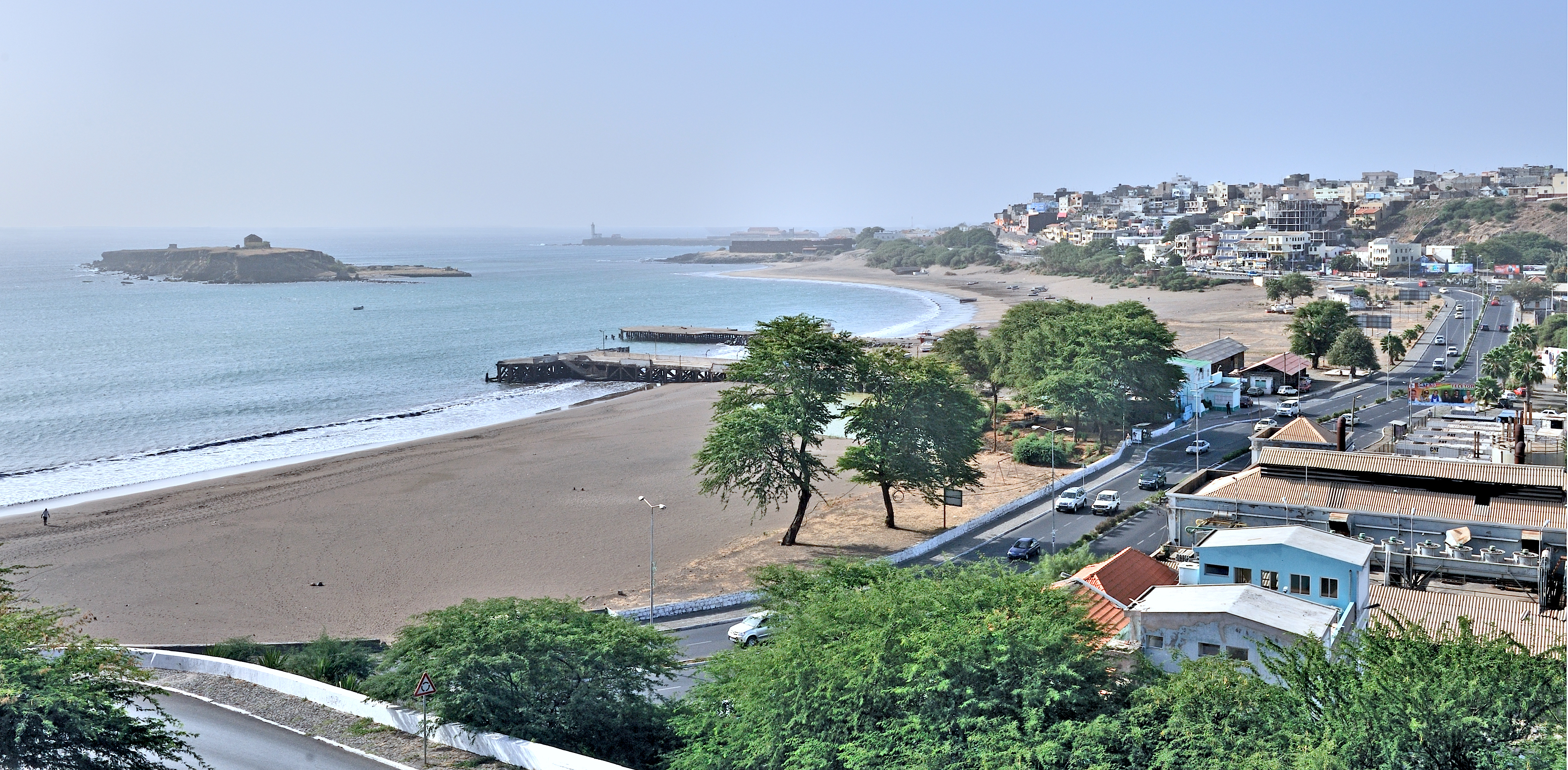 Praia, Cape Verde
 -
 Dakar, Senegal
 -
 Lomé, Togo
 -
 Porto-Novo, Benin
 -
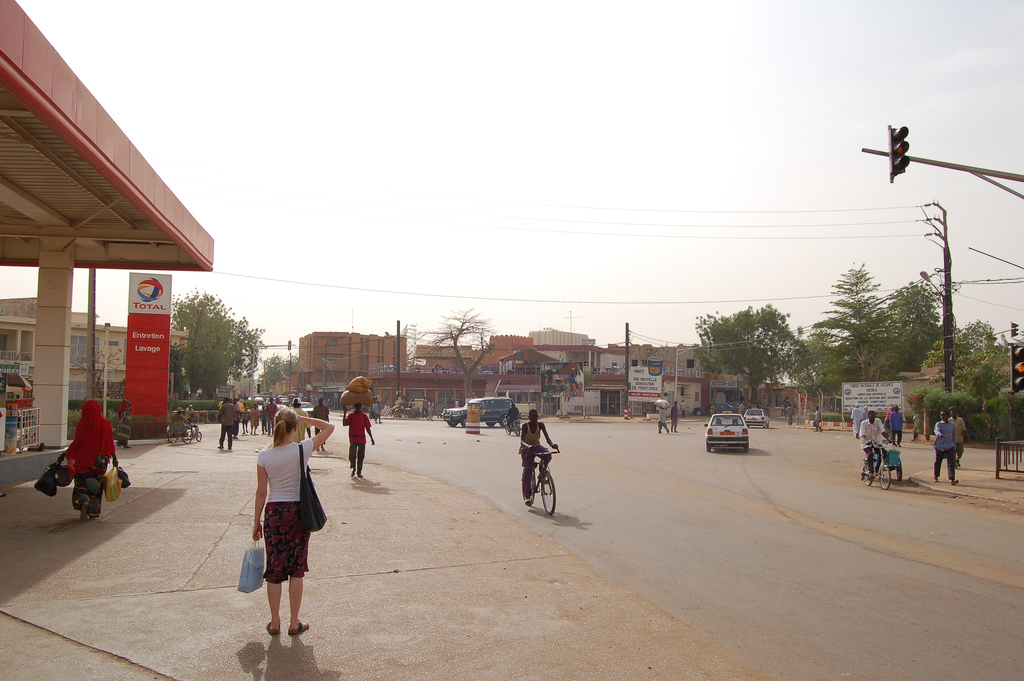 Niamey, Niger
 -
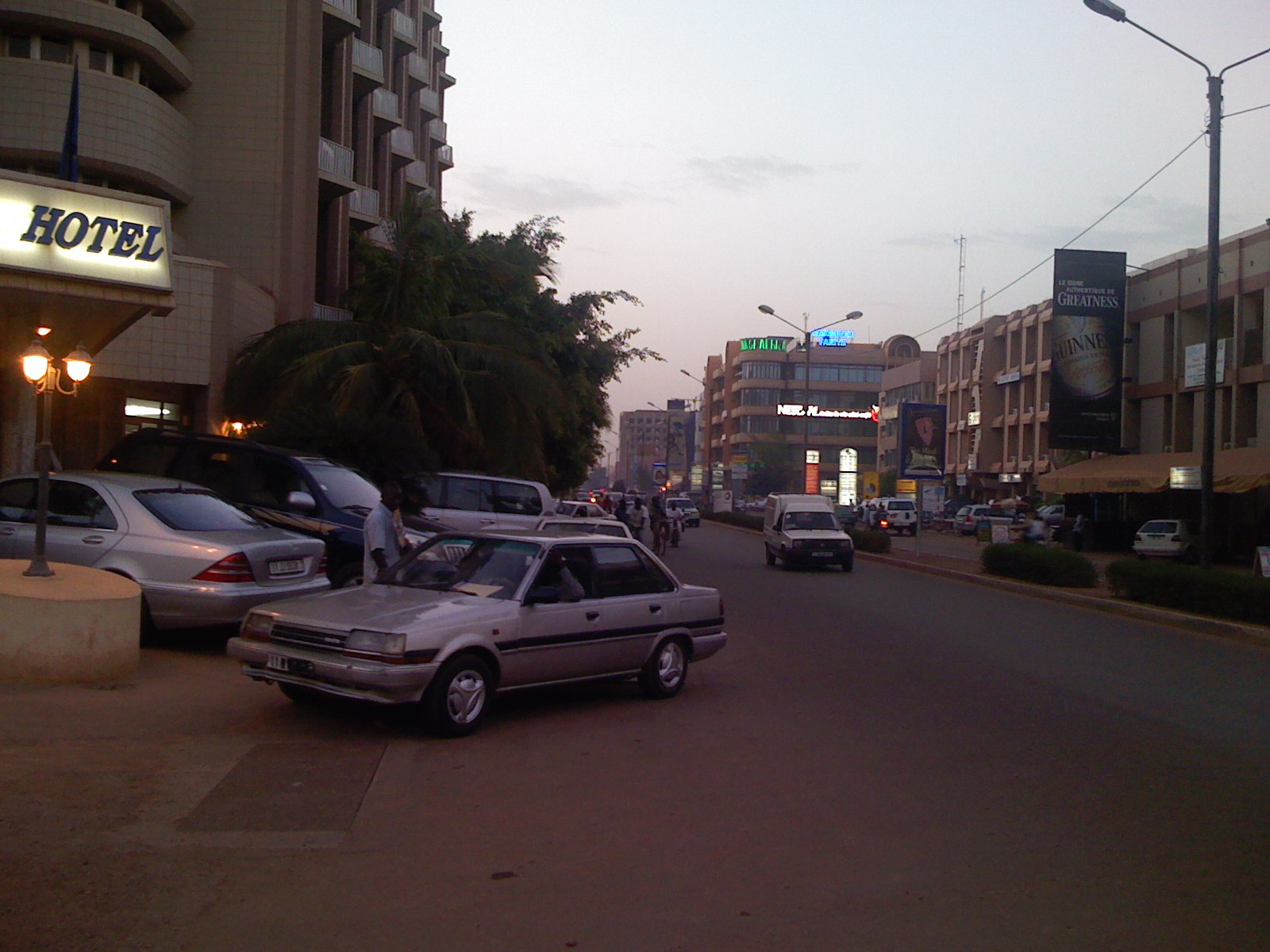 Ouagadougou, Burkina Faso
 -
 Freetown, Sierra Leone
 -
 Banjul, Gambia
 -
 Conakry, Guinea
 -
 Bissau, Guinea-Bissau
 -
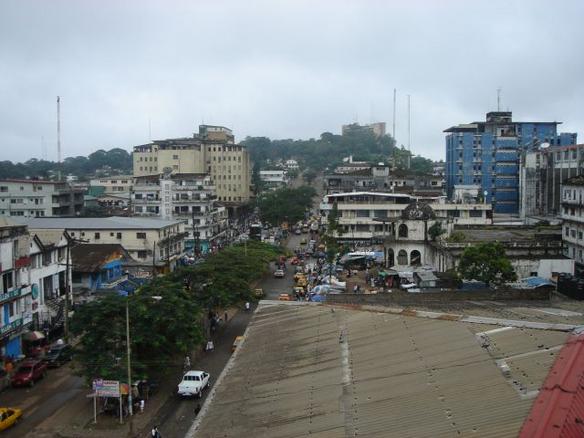 Monrovia, Liberia
 -
 Bamako, Mali
 -
 Nouakchott, Mauritania
 -
 Abuja, Nigeria
 -
 Accra, Ghana
 -
 Abidjan, Ivory Coast
 -
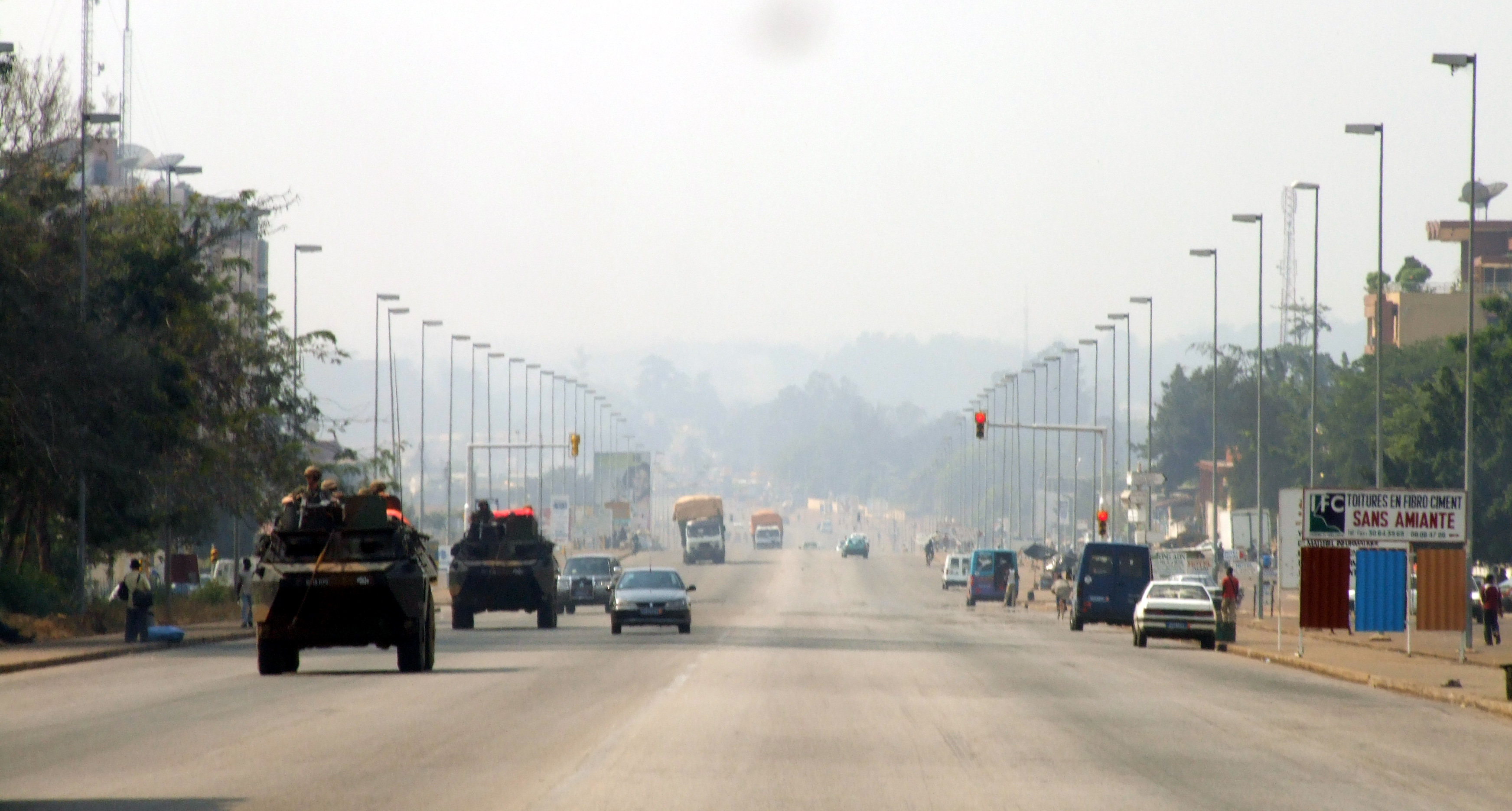 Yamoussoukro, Ivory Coast
 -
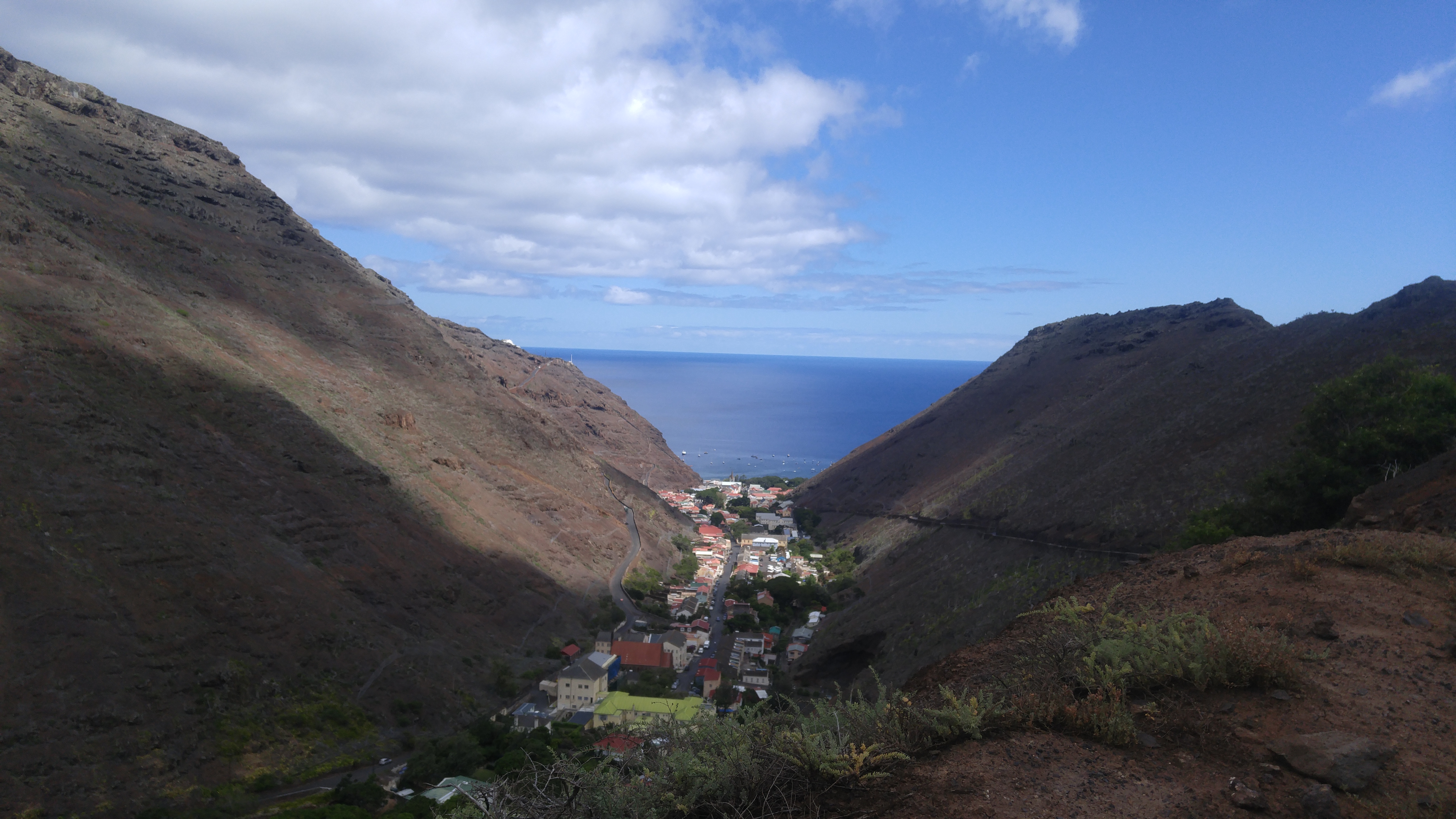 Jamestown, Saint Helena, Ascension and Tristan da Cunha


.jpg)


.jpg)


See also[edit | edit source]
- African historiography
- Agroecology in West Africa
- Ajami
- Ebola virus epidemic in West Africa
- List of regions of Africa
- Manillas, a form of archaic money unique to West Africa
- N'Ko script
- North Africa – Northernmost region of Africa
- Nsibidi Script, an indigenously developed West African writing system
- Sub-Saharan Africa – Region south of the Sahara Desert
- Central Africa
- East Africa – Eastern region of the African continent
- Southern Africa
- Vai syllabary
- West African Craton
- Western Sahara
References[edit | edit source]
- ↑ 1.0 1.1 1.2 ""World Population prospects – Population division"". population.un.org. United Nations Department of Economic and Social Affairs, Population Division. Retrieved 9 November 2019.
- ↑ 2.0 2.1 2.2 ""Overall total population" – World Population Prospects: The 2019 Revision" (xslx). population.un.org (custom data acquired via website). United Nations Department of Economic and Social Affairs, Population Division. Retrieved 9 November 2019.
- ↑ 3.0 3.1 United Nations Department of Economic and Social Affairs, Population Division (2017). World Population Prospects: The 2017 Revision, custom data acquired via website. [1]
- ↑ "IMF GDP 2011". Retrieved 17 October 2014.
- ↑ "IMF GDP data, September 2011". Retrieved 17 October 2014.
- ↑ 6.0 6.1 "IMF GDP data, October 1515". Retrieved 17 October 2014.
- ↑ "Nigerian Economy Overtakes South Africa's on Rebased GDP". Bloomberg News. 7 April 2014. Retrieved 17 October 2014.
- ↑ 8.0 8.1 8.2 "United Nations Statistics Division – Standard Country and Area Codes Classifications". Archived from the original on 13 July 2011. Retrieved 17 October 2014.
- ↑ Paul R. Masson, Catherine Anne Pattillo, "Monetary union in West Africa (ECOWAS): is it desirable and how could it be achieved?" (Introduction). International Monetary Fund, 2001. ISBN 1-58906-014-8
- ↑ "West African population, 1950–2050 | West Africa Gateway | Portail de l'Afrique de l'Ouest". west-africa-brief.org. Archived from the original on 30 October 2021. Retrieved 30 October 2021.
- ↑ "UEMOA economies are projected to grow by 6.6% in 2020 | West Africa Gateway | Portail de l'Afrique de l'Ouest". west-africa-brief.org. Archived from the original on 30 October 2021. Retrieved 30 October 2021.
- ↑ "Economic Community of West African States (ECOWAS)". United States Trade Representative. Retrieved 30 June 2025.
- ↑ Haour, Anne (25 July 2013). "Wealth-in-people". Outsiders and Strangers: An Archaeology of Liminality in West Africa. Oxford University Press. p. 38. doi:10.1093/acprof:osobl/9780199697748.001.0001. ISBN 978-0-19-969774-8. OCLC 855890703. S2CID 127485241.
- ↑ Scerri, Eleanor (2017). "The Stone Age Archaeology of West Africa". Oxford Research Encyclopedia of African History. doi:10.1093/acrefore/9780190277734.013.137. ISBN 978-0-19-027773-4.
- ↑ 15.0 15.1 MacDonald, Kevin C. (1997). "Korounkorokalé Revisited: The Pays Mande and the West African Microlithic Technocomplex". The African Archaeological Review. 14 (3): 161–200. doi:10.1007/BF02968406. JSTOR 25130625. S2CID 161691927.
- ↑ Niang, Khady; Blinkhorn, James; Ndiaye, Matar; Bateman, Mark; Seck, Birame; Sawaré, Gora (December 2020). "The Middle Stone Age occupations of Tiémassas, coastal West Africa, between 62 and 25 thousand years ago". Journal of Archaeological Science: Reports. 34 102658. Bibcode:2020JArSR..34j2658N. doi:10.1016/j.jasrep.2020.102658. S2CID 228826414.
- ↑ Schlebusch, Carina M.; Jakobsson, Mattias (31 August 2018). "Tales of Human Migration, Admixture, and Selection in Africa". Annual Review of Genomics and Human Genetics. 19 (1): 405–428. doi:10.1146/annurev-genom-083117-021759. PMID 29727585.
- ↑ Scerri, Eleanor M. L. (2021). "Continuity of the Middle Stone Age into the Holocene". Scientific Reports. 11 (1) 70. doi:10.1038/s41598-020-79418-4. OCLC 8878081728. PMC 7801626. PMID 33431997. S2CID 231583475.
- ↑ 19.0 19.1 19.2 19.3 19.4 MacDonald, Kevin C. (2 September 2003). "Archaeology, language and the peopling of West Africa: a consideration of the evidence". Archaeology and Language II: Archaeological Data and Linguistic Hypotheses. Routledge. pp. 39–40, 43–44. doi:10.4324/9780203202913-11 ( (inactive $1) 12 July 2025). ISBN 978-0-203-20291-3. OCLC 815644445. S2CID 163304839.
{{cite book}}: CS1 maint: DOI inactive as of July 2025 (link) - ↑ Abd-El-Moniem, Hamdi Abbas Ahmed (May 2005). A New Recording of Mauritanian Rock Art (PDF). University of London. p. 221. OCLC 500051500. S2CID 130112115.
- ↑ Soukopova, Jitka (16 January 2013). "Round Head Paintings and Landscape". Round Heads: The Earliest Rock Paintings in the Sahara. Cambridge Scholars Publishing. pp. 45–55. ISBN 978-1-4438-4579-3. OCLC 826685273.
- ↑ 22.0 22.1 Ness, Immanuel (10 November 2014). "Sub-Saharan Africa: Linguistics". The Global Prehistory of Human Migration. Wiley Blackwell. p. 100. ISBN 978-1-118-97059-1. OCLC 890071926. S2CID 160957067.
- ↑ Ehret, Christopher (2023). "African Firsts in the History of Technology". Ancient Africa: A Global History, to 300 CE. Princeton University Press. pp. 14–17. doi:10.2307/j.ctv34kc6ng.5. ISBN 978-0-691-24410-5. JSTOR j.ctv34kc6ng.5. OCLC 1330712064.
- ↑ Jesse, Friederike (December 2010). "Early Pottery in Northern Africa – An Overview". Journal of African Archaeology. 8 (2): 219–238. doi:10.3213/1612-1651-10171. JSTOR 43135518.
- ↑ 25.0 25.1 25.2 Huysecom, Eric (2020). "The First Emergence of Ceramic Production in Africa". Oxford Research Encyclopedia of Anthropology. doi:10.1093/acrefore/9780190854584.013.66. ISBN 978-0-19-085458-4.
- ↑ 26.0 26.1 Blench, Roger (21 October 2017). "Africa over the last 12000 years: how we can interpret the interface of archaeology and linguistics?". University of Cambridge. pp. 13, 25.
- ↑ Roy, Kaushik (15 September 2021). "Military Convergence and the Bronze Age Civilisations of Eurasia". A Global History of Pre-Modern Warfare: Before the Rise of the West, 10,000 BCE–1500 CE. Routledge. p. Unnumbered. ISBN 978-1-000-43212-1. OCLC 1261367188.
- ↑ Achrati, Ahmed (May 2020). "What ever Happened to the People? Humans and Anthropomorphs in the Rock Art of Northern Africa: International Conference (Brussels, 17, 18 & 19 September 2015)". Rock Art Research. 37 (1): 109–112. Template:Gale ProQuest 2403309251.
- ↑ 29.0 29.1 Mercuri, Anna Maria (29 January 2018). "Plant behaviour from human imprints and the cultivation of wild cereals in Holocene Sahara". Nature Plants. 4 (2): 73. doi:10.1038/s41477-017-0098-1. hdl:11380/1153032. PMID 29379157. S2CID 3302383.
- ↑ Aïn-Séba, Nagète (2022). "Saharan rock art, a reflection of climate change in the Sahara". Tabona. 22: 303–317. doi:10.25145/j.tabona.2022.22.15.
- ↑ Soukopova, Jitka (August 2017). "Central Saharan rock art: Considering the kettles and cupules". Journal of Arid Environments. 143: 10–14. Bibcode:2017JArEn.143...10S. doi:10.1016/J.JARIDENV.2016.12.011. S2CID 132225521.
- ↑ Soukopova, Jitka (September 2015). "Tassili Paintings: Ancient roots of current African beliefs?". Expression: 116–120. ISSN 2499-1341.
- ↑ Soukopova, Jitka (2020). "Rain and rock art in the Sahara: a possible interpretation". Expression: 79–90. ISSN 2499-1341.
- ↑ 34.0 34.1 LaGamma, Alisa (2020). Sahel: Art and Empires on the Shores of the Sahara. Metropolitan Museum of Art. pp. 74–75. ISBN 978-1-58839-687-7.
- ↑ 35.0 35.1 Thiam, Mandiomé (2012). "Milieu et culture matérielle dans le Néolithique sénégambien" (PDF). Antropo. 27: 13–121. OCLC 884501689. S2CID 160637192.
- ↑ LaGamma, Alisa (2020). "Pre-Islamic Artistic Patronage". Sahel: Art and Empires on the Shores of the Sahara. Metropolitan Museum of Art. pp. 74–75. ISBN 978-1-58839-687-7.
- ↑ 37.0 37.1 37.2 Akpan, Unwana Samuel (24 August 2023). "African Traditional Media: Looking Back, Looking Forward". African Media Space and Globalization. Palgrave Macmillan. p. 32. doi:10.1007/978-3-031-35060-3_1. ISBN 978-3-031-35060-3. OCLC 1395910241.
- ↑ Hales, Kevin (2015). The Moving Finger: A Rhetorical, Grammatological and Afrinographic Exploration of Nsibidi in Nigeria and Cameroon (Thesis). p. 15.
- ↑ 39.0 39.1 Shen, Quan-Kuan; et al. (1 May 2021). "Genomic analyses unveil helmeted guinea fowl (Numida meleagris) domestication in West Africa". Genome Biology and Evolution. 13 (evab090). doi:10.1093/gbe/evab090. OCLC 9123485061. PMC 8214406. PMID 34009300. S2CID 234783117.
- ↑ 40.0 40.1 Scarcelli, Nora (2019). "Yam genomics supports West Africa as a major cradle of crop domestication". Science Advances. 5 (5) eaaw1947. Bibcode:2019SciA....5.1947S. doi:10.1126/sciadv.aaw1947. OCLC 8291779404. PMC 6527260. PMID 31114806. S2CID 155124324.
- ↑ Murunga, Philip; et al. (2018). "Mitochondrial DNA D-Loop Diversity of the Helmeted Guinea Fowls in Kenya and Its Implications on HSP70 Gene Functional Polymorphism". BioMed Research International. 2018: 1–12. doi:10.1155/2018/7314038. OCLC 8754386965. PMC 6258102. PMID 30539018. S2CID 54463512.
- ↑ Van Beek, Walter E.A.; Banga, Pieteke M. (11 March 2002). "The Dogon and their trees". Bush Base, Forest Farm: Culture, Environment, and Development. Routledge. p. 66. doi:10.4324/9780203036129-10 ( (inactive $1) 12 July 2025). ISBN 978-1-134-91956-7. OCLC 252799202. S2CID 126989016.
{{cite book}}: CS1 maint: DOI inactive as of July 2025 (link) - ↑ Levtzion, Nehemia (1973). Ancient Ghana and Mali. New York: Methuen & Co Ltd. p. 3. ISBN 978-0-8419-0431-6.
- ↑ "Historical survey: Slave-owning societies". Encyclopædia Britannica. Archived from the original on 23 February 2007.
- ↑ Peterson, Derek R.; Gavua, Kodzo; Rassool, Ciraj (2 March 2015). The Politics of Heritage in Africa. Cambridge University Press. ISBN 978-1-107-09485-7.
- ↑ Baten, Jörg (May 2017). "European Trade, Colonialism and Human Capital Accumulation in Senegal, Gambia and Western Mali, 1770 – 1900". CESifo Working Papers.
- ↑ "The UN office for West Africa" (PDF). Archived from the original (PDF) on 16 May 2006.
- ↑ Polski Instytut Spraw Międzynarodowych, Studies on the Developing Countries, Issues 6–8, Polish Institute of International Affairs (1988), p. 53
- ↑ "Office for North Africa of the Economic Commission for Africa". United Nations Economic Commission for Africa. Retrieved 17 October 2014.
- ↑ "2014 UNHCR country operations profile – Mauritania". Retrieved 17 October 2014.
- ↑ "African Development Bank Group: Mauritania". Retrieved 17 October 2014.
- ↑ Facts on File, Incorporated, Encyclopedia of the Peoples of Africa and the Middle East (2009), p. 448, ISBN 143812676X: "The Islamic Republic of Mauritania, situated in western North Africa..."
- ↑ David Seddon, A Political and Economic Dictionary of the Middle East (2004), ISBN 020340291X: "We have, by contrast, chosen to include the predominantly Arabic-speaking countries of western North Africa (the Maghreb), including Mauritania (which is a member of the Arab Maghreb Union)..."
- ↑ Mohamed Branine, Managing Across Cultures: Concepts, Policies and Practices (2011), p. 437, ISBN 1849207291: "The Magrebian countries or the Arab countries of western North Africa (Algeria, Libya, Mauritania, Morocco and Tunisia)..."
- ↑ Koslow, Philip, Senegambia: Land of the Lion, Chelsea House Publishers (1997), pp. 11, 35–47, ISBN 9780791031353.
- ↑ 56.0 56.1 56.2 The New York Times, "Across Senegal, the Beloved Baobab Tree Is the 'Pride of the Neighborhood'", by Dionne Searcey (30 Sept. 2018) (Retrieved 1 April 2019)
- ↑ 57.0 57.1 Somerville, Keith, Ivory: Power and Poaching in Africa, Oxford University Press (2016), p. 84–85 ISBN 9781849046763 [2] (Retrieved 1 April 2019)
- ↑ Bandia Nature Reserve is sometimes called Bandia park reserve, Lonely Planet, Half-Day Somone Lagoon and Bandia Park Safari from Dakar, [3] (Retrieved 1 April 2019)
- ↑ Lonely Plane, Yankari National Park[4] (Retrieved 1 April 2019)
- ↑ Tilahun, Mesfin; Damnyag, Lawrence; Anglaaere, Luke C.N. (2016). "The Ankasa Forest Conservation Area of Ghana: Ecosystem service values and on-site REDD + opportunity cost". Forest Policy and Economics. 73: 168–176. doi:10.1016/j.forpol.2016.08.011.
- ↑ Riley, Laura (2005). Nature's strongholds: the world's great wildlife reserves. William Riley. Princeton, N.J.: Princeton University Press. ISBN 0-691-12219-9. OCLC 59347952.
- ↑ Brodowsky, Pamela K. (2009). Destination wildlife: an international site-by-site guide to the best places to experience endangered, rare, and fascinating animals and their habitats. National Wildlife Federation. New York: Penguin. ISBN 978-0-399-53486-7. OCLC 233549707.
- ↑ Martin, V.; Becker, C. (1979). "Lieux de culte et emplacements celebres dans les pays Sereer (Sénégal)" [Places of worship and famous locations in the Sereer countries (Senegal)]. Bulletin de l'Institut Fondamental d'Afrique Noire, Série B: Sciences humaines (in français). 41: 133–189.
- ↑ "The Seereer Resource Centre (SRC)". The Seereer Resource Centre (SRC). Archived from the original on 30 April 2019. Retrieved 1 April 2019.
- ↑ 65.0 65.1 ThoughtCo, The Territory and Current Status of the African Rainforest by Steve Nix (4 November 2018) [5] (Retrieved 2 April 2019)
- ↑ Deforestation by Country & Region ("Country Forest Data [sorted by region]") [in] Mongabay.com (Retrieved 2 April 2019)
- ↑ Rainforest Destruction [in] rainforestweb.org. Archived by Wayback Machine – [6] (Retrieved 2 April 2019)
- ↑ Mongabay News, Nigeria has worst deforestation rate, FAO revises figures (17 November 2005) by Rhett A. Butler, [7] (Retrieved 2 April 2019)
- ↑ "Overfishing destroying livelihoods | Africa Renewal". United Nations. 12 May 2017.
- ↑ "Greenpeace welcomes cancellation of fishing licences of 29 foreign trawlers". African Manager. 4 May 2012. Retrieved 1 July 2022.
- ↑ "Liberia Gets New Fisheries Regulations". Fisheries Committee for the West Central Gulf of Guinea. 5 January 2011. Retrieved 1 July 2022.
- ↑ "Cape Verde: Greenpeace Raises Awareness on the State of Fisheries in West Africa". Archived from the original on 28 July 2019. Retrieved 28 July 2019.
- ↑ "Overfishing threatens food security off Africa's western and central coast as many fish species in the region face extinction – IUCN report". IUCN. 19 January 2017.
- ↑ 74.0 74.1 74.2 Peter Speth. Impacts of Global Change on the Hydrological Cycle in West and Northwest Africa, p. 33. Springer, 2010. ISBN 3-642-12956-0
- ↑ Peter Speth. Impacts of Global Change on the Hydrological Cycle in West and Northwest Africa, p. 33. Springer, 2010. Prof. Kayode Omitoogun 2011, ISBN 3-642-12956-0
- ↑ National Geographic, February 2013, p. 8.
- ↑ Anthony Ham. West Africa, p. 79. Lonely Planet, 2009. ISBN 1-74104-821-4
- ↑ Celestine Oyom Bassey, Oshita Oshita. Governance and Border Security in Africa, p. 261. African Books Collective, 2010. ISBN 978-8422-07-1
- ↑ Ian Shaw, Robert Jameson. A Dictionary of Archaeology, p. 28. Wiley-Blackwell, 2002. ISBN 0-631-23583-3
- ↑ 80.0 80.1 "Proposed Ecowas railway" Archived 2009-10-24 at the Wayback Machine. railwaysafrica.com.
- ↑ 81.0 81.1 Nigeria Real Estate Market Review (PDF). Northcourt.[page needed]
- ↑ Itai Madamombe (2006): "NEPAD promotes better transport networks", Africa Renewal, Vol. 20, No. 3 (October 2006), p. 14.
- ↑ Azevedo, Mario J. (February 2017). "The State of Health System(s) in Africa: Challenges and Opportunities". Historical Perspectives on the State of Health and Health Systems in Africa, Volume II. African Histories and Modernities. pp. 1–73. doi:10.1007/978-3-319-32564-4_1. ISBN 978-3-319-32563-7. PMC 7123888.
- ↑ Abi, Samir (12 June 2019). "Metaphysical explanations". D+C, Development and Cooperation.
- ↑ The History of West Africa. Routledge. 2018. ISBN 978-1138094144.
{{cite book}}: Check|isbn=value: checksum (help) - ↑ African Architecture: Evolution and Transformation. Smithsonian Institution Press. 1998. ISBN 978-1560987429.
{{cite book}}: Check|isbn=value: checksum (help) - ↑ Barbara K. Nordquist, Susan B. Aradeon, Howard University. School of Human Ecology, Museum of African Art (U.S.). Traditional African dress and textiles: an exhibition of the Susan B. Aradeon collection of West African dress at the Museum of African Art (1975), pp. 9–15.
- ↑ Chidi Asika-Enahoro. A Slice of Africa: Exotic West African Cuisines, Introduction. iUniverse, 2004. ISBN 0-595-30528-8.[page needed]
- ↑ Pamela Goyan Kittler, Kathryn Sucher. Food and Culture, p. 212. Cengage Learning, 2007. ISBN 0-495-11541-X.
- ↑ UNESCO. The Case for indigenous West African food culture, p. 4. BREDA series, Vol. 9 (1995), (UNESCO).
- ↑ Alan Davidson, Tom Jaine. The Oxford Companion to Food, p. 423. Oxford University Press, 2006. ISBN 0-19-280681-5.
- ↑ Mafé or maafe is a Wolof word for it, the proper name is "domodah" among the Mandinka people of Senegal and Gambia, who are the originators of this dish, or Template:-"tigh-dege-naTemplate:-" among the Bambara people or Mandinka people of Mali. "Domodah" is also used by all Senegambians borrowed from the Mandinka language.
- ↑ James McCann. Stirring the Pot: A History of African Cuisine, p. 132. Ohio University Press, 2009. ISBN 0-89680-272-8.
- ↑ Emma Gregg, Richard Trillo. Rough Guide to The Gambia, p. 39. Rough Guides, 2003. ISBN 1-84353-083-X.
- ↑ Carole Boyce Davies (ed.), Encyclopedia of the African Diaspora: Origins, Experiences and Culture, Volume 1, p. 72. ABC-CLIO, 2008. ISBN 1-85109-700-7.
- ↑ Toyin Ayeni. I Am a Nigerian, Not a Terrorist, p. 2. Dog Ear Publishing, 2010. ISBN 1-60844-735-9.
- ↑ Dayle Hayes, Rachel Laudan. Food and Nutrition. Dayle Hayes, Rachel Laudan, editorial advisers. Volume 7, p. 1097. Marshall Cavendish, 2008. ISBN 0-7614-7827-2.
- ↑ "Customs & Cuisine of Niger | Amman Imman | Dining for Women". Archived from the original on 20 September 2020. Retrieved 29 May 2020.
- ↑ West Africa, issues 4106–4119, pp. 1487–8. Afrimedia International, (1996)
- ↑ "Why does the West dominate African football?" BBC.
- ↑ "Wafu Cup to make a comeback". BBC Sport. 29 September 2008. Retrieved 15 July 2015.
- ↑ "Caf have split the West African Football Union into two separate zones". Goal. 17 May 2011. Retrieved 15 July 2014.
- ↑ Ali Colleen Neff, Tassou: the Ancient Spoken Word of African Women. 2010.
- ↑ "Nigeria surpasses Hollywood as world's second-largest film producer – UN". United Nations. 5 May 2009. Retrieved 30 September 2009.
- ↑ Johnson, Todd M.; Zurlo, Gina A.; Hickman, Albert W.; Crossing, Peter F. (November 2017). "Christianity 2018: More African Christians and Counting Martyrs". International Bulletin of Mission Research. 42 (1): 20–28. doi:10.1177/2396939317739833. S2CID 165905763.
- ↑ Robert O. Collins. African History: Western African History, p. 153. Markus Wiener Publishers, 1990. ISBN 1-55876-015-6
- ↑ Emmanuel Kwaku Akyeampong. Themes in West Africa's History, p. 152. James Currey Publishers, 2006. ISBN 0-85255-995-X
- ↑ "The Islamic World to 1600: The Fractured Caliphate and the Regional Dynasties (West Africa)". Archived from the original on 25 October 2013.
- ↑ Muslim Societies in African History (New Approaches to African History), David Robinson, Chapter 1.
- ↑ "Spread of Islam in West Africa (part 1 of 3): The Empire of Ghana". www.islamreligion.com. Retrieved 25 February 2026.
- ↑ John S. Mbiti. Introduction to African Religion, p. 19. East African Publishers, 1992. ISBN 9966-46-928-1
- ↑ 112.0 112.1 112.2 Salamone, Frank A. (2004). Levinson, David (ed.). Encyclopedia of Religious Rites, Rituals, and Festivals. New York: Routledge. p. 9. ISBN 0-415-94180-6.
- ↑ William J. Duiker, Jackson J. Spielvogel. World History: To 1800, p. 224. Cengage Learning, 2006. ISBN 0-495-05053-9
- ↑ 114.0 114.1 "WIPSEN". Retrieved 17 October 2014.
- ↑ "WIPSEN EMPOWERS WOMEN…To fight for their rights". Ghana Media Group. 11 December 2010. Archived from the original (article) on 17 September 2011.
- ↑ November 2009 MEDIAGLOBAL Archived 2010-07-10 at the Wayback Machine
Further reading[edit | edit source]
- Akyeampong, Emmanuel Kwaku. Themes in West Africa's History (2006).
- Brydon, Lynne. "Constructing Avatime: questions of history and identity in a West African polity, c. 1690s to the twentieth century." Journal of African History 49.1 (2008): 23–42. online
- Collins, Robert O. African History: Western African History (1990).
- Davidson, Basil. A History of West Africa, 1000–1800 (1978), numerous editions
- Delavignette, Robert. Freedom and Authority in French West Africa (Routledge, 2018).
- Dueppen, Stephen A. "The archaeology of West Africa, ca. 800 BCE to 1500 CE." History Compass 14.6 (2016): 247–263.
- Edgerton, Robert B. The Fall of the Asante Empire: The Hundred-Year War For Africa'S Gold Coast (2002).
- Fage, J. D. A Guide to Original Sources for Precolonial Western Africa Published in European Languages (2nd ed. 1994); updated in Stanley B. Alpern, ed. Guide to Original Sources for Precolonial Western Africa (2006).
- Festus, Jacob et al. eds. History of West Africa (Vol. 1, 1989).
- Greene, S. E. Sacred Sites and the Colonial Encounter: A History of Meaning and Memory in Ghana (2002).
- Griswold, Wendy. Writing African women: Gender, popular culture and literature in West Africa (Zed Books Ltd., 2017).
- Ham, Anthony. West Africa (2013) online.
- Hayward, Derek F., and Julius Oguntoyinbo. Climatology of West Africa (Routledge, 2019).
- Hopkins, Antony Gerald. An economic history of West Africa (2014) online.
- Huber, Caroline, Lyn Finelli, and Warren Stevens. "The economic and social burden of the 2014 Ebola outbreak in West Africa." Journal of infectious diseases 218.Supplement_5 (2018): S698–S704.
- Kane, Ousmane Oumar, Beyond Timbuktu: An Intellectual History of Muslim West Africa (2016).
- Lavallée, Emmanuelle; Roubaud, François (3 June 2019). "Corruption in the Informal Sector: Evidence from West Africa". The Journal of Development Studies. 55 (6): 1067–1080. doi:10.1080/00220388.2018.1438597. S2CID 158886041. Archived from the original on 25 February 2024. Retrieved 6 January 2024.
- Law, Robin (1985). "Human Sacrifice in Pre-Colonial West Africa". African Affairs. 84 (334): 53–87. doi:10.1093/oxfordjournals.afraf.a097676. JSTOR 722523.
- Mann, Gregory (2005). "Locating Colonial Histories: Between France and West Africa". The American Historical Review. 110 (2): 409–434. doi:10.1086/ahr/110.2.409. JSTOR 10.1086/531320.
- Martinez-Alvarez, Melisa; Jarde, Alexander; Usuf, Effua; Brotherton, Helen; Bittaye, Mustapha; Samateh, Ahmadou L; Antonio, Martin; Vives-Tomas, Joan; D'Alessandro, Umberto; Roca, Anna (May 2020). "COVID-19 pandemic in west Africa". The Lancet Global Health. 8 (5): e631–e632. doi:10.1016/S2214-109X(20)30123-6. PMC 7186549. PMID 32246918.
- Mazrui, Ali A. Islam and the English language in East and West Africa (Routledge, 2017).
- Meillassoux, Claude, ed. The development of indigenous trade and markets in West Africa: studies presented and discussed at the tenth International African seminar at Fourah Bay college, Freetown, December 1969 (Routledge, 2018).
- Mendonsa, Eugene L. West Africa: An Introduction to Its History (2002)
- O'Brien, Donal Cruise, Richard Rathbone, John Dunn, eds. Contemporary West African States (2002) online free to borrow
- Soares, Benjamin (March 2014). "The Historiography of Islam in West Africa: An Anthropologist's View". The Journal of African History. 55 (1): 27–36. doi:10.1017/S0021853713000819. hdl:1887/25369. S2CID 162823960.
- Tonkin, Elizabeth. Narrating our pasts: The social construction of oral history (Cambridge university press, 1995), on West Africa
- Westermann, Diedrich, and Margaret Arminel Bryan. The Languages of West Africa: Handbook of African Languages (Routledge, 2017).
External links[edit | edit source]
- West Africa by Region and Country – African Studies at Columbia University
- ouestaf.com – Ouestaf, a West African online newspaper (in French)
- Loccidental Archived 7 March 2006 at the Wayback Machine – An online West African newspaper (in French)
- West Africa Review – An e-journal on West Africa research and scholarship (in English)
- The Voyage of the Sieur Le Maire, to the Canary Islands, Cape-Verde, Senegal, and Gambia is the first published writing about Western Africa, dating from 1695 (in English)