



imported>Hindian1947 No edit summary |
m Improved article clarity and structure |
||
| Line 5: | Line 5: | ||
{{Infobox Tibetan Buddhist monastery | {{Infobox Tibetan Buddhist monastery | ||
|name =Shanti Stupa | |name =Shanti Stupa | ||
|image = | |image = Leh, Shanti Stupa, Ladakh, India.jpg | ||
|image size = | |image size = | ||
|alt =4 | |alt =4 | ||
| Line 11: | Line 11: | ||
|coordinates = {{coord|34|10|25|N|77|34|29|E|type:landmark_region:IN-JK|display=inline,title}} | |coordinates = {{coord|34|10|25|N|77|34|29|E|type:landmark_region:IN-JK|display=inline,title}} | ||
|map_caption = Location within India | |map_caption = Location within India | ||
|location_country = India | |location_country = India {{citation needed|date=February 2022}} | ||
|location= | |location=Chanspa, [[Leh district]], [[Ladakh]], [[India]] | ||
|founded_by = Ladakh Shanti Stupa Committee under Bhikshu Gyomyo Nakamura{{Citation needed|date=November 2010}} | |founded_by = Ladakh Shanti Stupa Committee under Bhikshu Gyomyo Nakamura{{Citation needed|date=November 2010}} | ||
|founded = | |founded = 2011 | ||
|architecture = | |architecture =Bhikshu Gyomyo Nakamura | ||
|footnotes = | |footnotes = | ||
}} | }} | ||
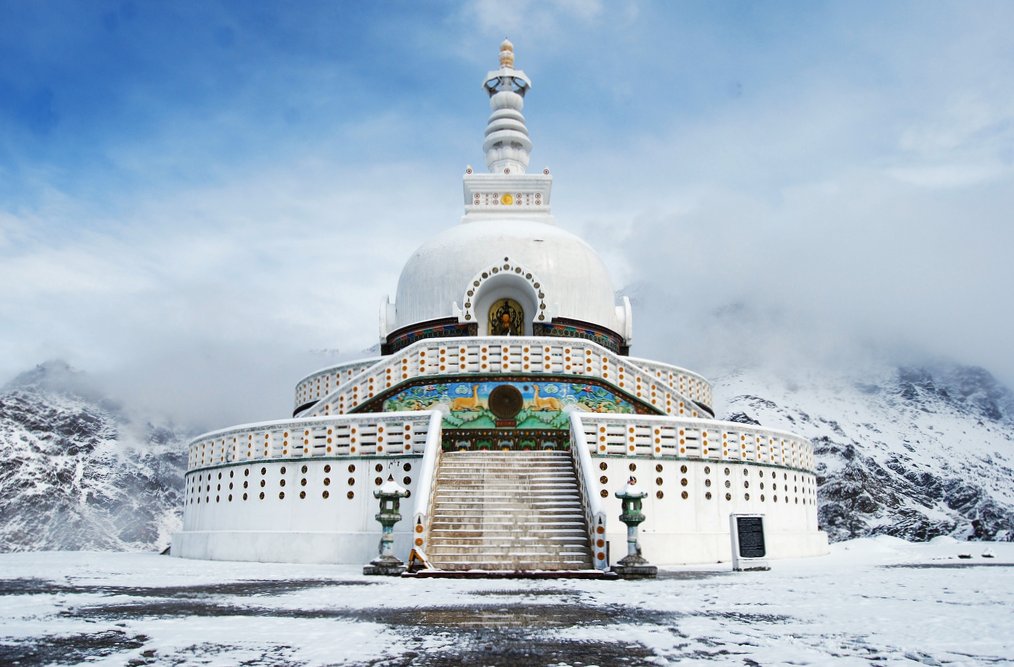
'''Shanti Stupa''' is a [[Buddhism|Buddhist]] white-domed [[ | '''Shanti Stupa''' is a [[Buddhism|Buddhist]] white-domed [[Stupa]] (chorten) on a hilltop in Chanspa, [[Leh district]], [[Ladakh]], in north [[India]].<ref name="Temples"/> It was built in 1991 by Japanese Buddhist monk [[Bhikshu Gyomyo Nakamura|Gyomyo Nakamura]]. The Shanti Stupa holds the [[relic]]s of the [[Gautama Buddha|Buddha]] at its base, enshrined by the [[14th Dalai Lama]].<ref>{{cite web |title= Leh|url=http://www.ndtv.com/ndtvtravels/travel_xtopspot.aspx?topspot=Leh |publisher=[[NDTV]] }}</ref> The Stupa has become a tourist attraction not only due to its religious significance but also due to its location which provides panoramic views of the surrounding landscape. | ||
==Construction== | ==Construction== | ||
The Shanti Stupa was built by both Japanese Buddhists and Ladakh Buddhists. | The Shanti Stupa was built by both Japanese Buddhists and Ladakh Buddhists. The original idea belonged to The Great King Ashoka{{cn|date=June 2023}}. [[Nichidatsu Fujii]] implemented his idea to modern time as a symbol of peace.<ref name = "bhasin"/> The mission of Nichidatsu Fujii was to build Shanti Stupa as a symbol of peace.{{cn|date=June 2023}} | ||
Construction of the Shanti Stupa began in April 1983 under the supervision of [[Bhikshu Gyomyo Nakamura]] and | Construction of the Shanti Stupa began in April 1983 under the supervision of [[Bhikshu Gyomyo Nakamura]], and [[19th Kushok Bakula Rinpoche|Kushok Bakula]], a [[Head Lama]] of Ladakh, helped his activities from New Delhi because he was member of the Minority Commission of Govt of India. The project was built with the help of Ladakhi Buddhists, who offered voluntary labour, and financially supported by Japanese Buddhists as well as Indian supporters. The then [[Prime Minister of India]], [[Indira Gandhi]], sanctioned the construction of a vehicular road to the stupa in 1984.<ref name = "bhasin"/> The Indian Army continued support during the construction period. The State Government of J&K provided construction materials for this project.{{Citation needed|date=October 2011}} The 14th [[Dalai Lama]], [[14th Dalai Lama|Tenzin Gyatso]] inaugurated foundation of Stupa in August 1985.<ref name="Temples">{{cite web|url=https://www.buddhist-temples.com/buddhist-monastery/ladakh/shanti-stupa.html|title=Shanti Stupa|publisher=Buddhist-temples.com|access-date=19 October 2009}}</ref><ref name = "bhasin"/><ref name="bajwa"/> | ||
==Description and significance== | ==Description and significance== | ||
[[File:Shanti stupa main buddha.jpg|thumb|upright|Main Buddha]] | [[File:Shanti stupa main buddha.jpg|thumb|upright|Main Buddha]] | ||
[[File:Shanti Stupa ( Winters).jpg|thumb|Shanti Stupa in winter]] | [[File:Shanti Stupa ( Winters).jpg|thumb|Shanti Stupa in winter]] | ||
The Shanti Stupa features the photograph of the | The Shanti Stupa features the photograph of the Dalai Lama with the relics of the Buddha at its base.<ref name = "bhasin"/> The Stupa is built as a two-level structure. The first level features the central reliicc of [[Dharmachakra]] with deer on each side. A central golden Buddha image sits on a platform depicting the "turning wheel of Dharma" (Dharmachakra). The second level has reliefs depicting the "birth" of Buddha, the death of Buddha (''mahanirvana'') and Buddha "defeating the devils" while meditating.<ref>The titles of the reliefs are given on the plaques under the reliefs at the Shanti Stupa.</ref> Both levels feature a series of smaller meditating Buddha reliefs. | ||
The Shanti Stupa was built to promote world peace and prosperity and to commemorate 2500 years of Buddhism.<ref name="Temples"/><ref name = "bhasin"/> It is considered a symbol of the ties between the people of Japan and | The Shanti Stupa was built to promote world peace and prosperity and to commemorate 2500 years of Buddhism.<ref name="Temples"/><ref name = "bhasin"/> It is considered a symbol of the ties between the people of Japan and India.<ref name = "bhasin"/> | ||
==Tourist attraction== | ==Tourist attraction== | ||
Since its inauguration, Shanti Stupa has become a popular tourist attraction. According to ''[[The Hindu]]'' it is the "most famous tourist attraction" around Leh, though its architectural style is different from the Ladakhi style.<ref name="Temples"/><ref>{{cite news|url=http://www.hindu.com/2005/08/21/stories/2005082100341100.htm|archive-url=https://web.archive.org/web/20060412080709/http://www.hindu.com/2005/08/21/stories/2005082100341100.htm|url-status=dead|archive-date=12 April 2006|title=Ladakh monuments cry for renovation |last=Luv Puri|date= 21 August 2005|work=[[The Hindu]]|access-date=1 December 2009}}</ref> The Shanti Stupa overlooks the city of Leh, providing panoramic views of the city, the village of | Since the time of its inauguration, Shanti Stupa has become a popular tourist attraction. According to ''[[The Hindu]]'' it is the "most famous tourist attraction" around Leh, though its architectural style is different from the Ladakhi style.<ref name="Temples"/><ref>{{cite news|url=http://www.hindu.com/2005/08/21/stories/2005082100341100.htm|archive-url=https://web.archive.org/web/20060412080709/http://www.hindu.com/2005/08/21/stories/2005082100341100.htm|url-status=dead|archive-date=12 April 2006|title=Ladakh monuments cry for renovation |last=Luv Puri|date= 21 August 2005|work=[[The Hindu]]|access-date=1 December 2009}}</ref> The Shanti Stupa overlooks the city of Leh, providing panoramic views of the city, the village of Chanspa, [[Namgyal Tsemo]] in the distance and the surrounding mountains.<ref>{{cite book|title=Frommer's India|date=4 March 2008|publisher=Wiley Publishing Inc.|location=Hoboken, NJ, USA|pages=524|url=https://books.google.com/books?id=qMqBvtL_nI0C&q=shanti+stupa+Ladakh&pg=PT534 | isbn=978-0-470-16908-7}}</ref><ref name="visitladakh">{{cite web|url=http://www.visitladakh.com/places-to-see/leh-.html|archive-url=https://web.archive.org/web/20191122201140/http://www.visitladakh.com/places-to-see/leh-.html|url-status=dead|archive-date=22 November 2019|title=Leh: Places to see|work=VISITLADAKH.COM |access-date=1 December 2009}}</ref> Sunrise and sunset are considered to provide the best views from Shanti Stupa.<ref name = "tour"/> The Stupa is illuminated with lights at night. The Stupa is open for tourists between 8:00 a.m. and 8:00 p.m.<ref name="tour">{{cite web|url=http://www.buddhist-tourism.com/countries/india/temples-monuments/shanti-stupa.html|archive-url=https://web.archive.org/web/20070702132706/http://www.buddhist-tourism.com/countries/india/temples-monuments/shanti-stupa.html|url-status=dead|archive-date=2 July 2007|title=Shanti Stupa|year=2007|work=Buddhist-Tourism.Com|access-date=1 December 2009}}</ref> | ||
[[File:Shanti Stupa on the hills in Leh.jpg|centre|thumb|350px|Shanti Stupa, Leh]] | [[File:Shanti Stupa on the hills in Leh.jpg|centre|thumb|350px|Shanti Stupa, Leh]] | ||
==Access== | ==Access== | ||
Situated at a height of {{convert|3609|m|ft}},<ref name="bajwa">{{cite book|last= Jagir Singh Bajwa, Ravinder Kaur|title=Tourism Management|pages=117|url=https://books.google.com/books?id=TVXCiwdwPxsC&q=shanti+stupa+Ladakh&pg=PA117 | isbn=978-81-313-0047-3 | year=2007 | publisher=APH Publishing}}</ref> the | [[File:Shanti Stupa with nature's tricolor, Leh.jpg|thumb|A distant view of Shanti Stupa in Leh]] | ||
Situated at a height of {{convert|3609|m|ft}},<ref name="bajwa">{{cite book|last= Jagir Singh Bajwa, Ravinder Kaur|title=Tourism Management|pages=117|url=https://books.google.com/books?id=TVXCiwdwPxsC&q=shanti+stupa+Ladakh&pg=PA117 | isbn=978-81-313-0047-3 | year=2007 | publisher=APH Publishing}}</ref> the Stupa is located {{convert|5|km|mi}} from [[Leh]] - the former capital of Ladakh - on a steep hill facing the [[Leh Palace]].<ref name = "bhasin">{{cite book|last= Bhasin|first=Sanjeev Kumar|title=Amazing land Ladakh: places, people, and culture|pages=119–20|chapter=Shanti Stupa|chapter-url=https://books.google.com/books?id=8IZloNzI8BgC&q=shanti+stupa+Ladakh&pg=PA120 | isbn=978-81-7387-186-3 | year=2006 | publisher=Indus Publishing}}</ref> The Stupa can be reached by a drivable road or on foot using a series of 555 steep steps to the hilltop. | |||
==See also== | ==See also== | ||
*[[Peace Pagoda]] | *[[Peace Pagoda]] | ||
*[[ | *[[Bhikshu Gyomyo Nakamura]] | ||
==Notes== | ==Notes== | ||
| Line 62: | Line 59: | ||
[[Category:1991 establishments in Jammu and Kashmir]] | [[Category:1991 establishments in Jammu and Kashmir]] | ||
[[Category:Buildings and structures in Ladakh]] | [[Category:Buildings and structures in Ladakh]] | ||
[[Category:20th-century architecture in India]] | |||
Latest revision as of 08:52, 9 December 2025
| Shanti Stupa | |
|---|---|
| Religion | |
| Affiliation | Tibetan Buddhism |
| Location | |
| Location | Chanspa, Leh district, Ladakh, India |
| Country | India [citation needed] |
| Lua error in Module:Infobox_mapframe at line 197: attempt to index field 'wikibase' (a nil value). | |
| Coordinates | 34°10′25″N 77°34′29″E / 34.17361°N 77.57472°E |
| Architecture | |
| Style | Bhikshu Gyomyo Nakamura |
| Founder | Ladakh Shanti Stupa Committee under Bhikshu Gyomyo Nakamura[citation needed] |
| Established | 2011 |
Shanti Stupa is a Buddhist white-domed Stupa (chorten) on a hilltop in Chanspa, Leh district, Ladakh, in north India.[1] It was built in 1991 by Japanese Buddhist monk Gyomyo Nakamura. The Shanti Stupa holds the relics of the Buddha at its base, enshrined by the 14th Dalai Lama.[2] The Stupa has become a tourist attraction not only due to its religious significance but also due to its location which provides panoramic views of the surrounding landscape.
Construction[edit | edit source]
The Shanti Stupa was built by both Japanese Buddhists and Ladakh Buddhists. The original idea belonged to The Great King Ashoka[citation needed]. Nichidatsu Fujii implemented his idea to modern time as a symbol of peace.[3] The mission of Nichidatsu Fujii was to build Shanti Stupa as a symbol of peace.[citation needed]
Construction of the Shanti Stupa began in April 1983 under the supervision of Bhikshu Gyomyo Nakamura, and Kushok Bakula, a Head Lama of Ladakh, helped his activities from New Delhi because he was member of the Minority Commission of Govt of India. The project was built with the help of Ladakhi Buddhists, who offered voluntary labour, and financially supported by Japanese Buddhists as well as Indian supporters. The then Prime Minister of India, Indira Gandhi, sanctioned the construction of a vehicular road to the stupa in 1984.[3] The Indian Army continued support during the construction period. The State Government of J&K provided construction materials for this project.[citation needed] The 14th Dalai Lama, Tenzin Gyatso inaugurated foundation of Stupa in August 1985.[1][3][4]
Description and significance[edit | edit source]

.jpg)
The Shanti Stupa features the photograph of the Dalai Lama with the relics of the Buddha at its base.[3] The Stupa is built as a two-level structure. The first level features the central reliicc of Dharmachakra with deer on each side. A central golden Buddha image sits on a platform depicting the "turning wheel of Dharma" (Dharmachakra). The second level has reliefs depicting the "birth" of Buddha, the death of Buddha (mahanirvana) and Buddha "defeating the devils" while meditating.[5] Both levels feature a series of smaller meditating Buddha reliefs.
The Shanti Stupa was built to promote world peace and prosperity and to commemorate 2500 years of Buddhism.[1][3] It is considered a symbol of the ties between the people of Japan and India.[3]
Tourist attraction[edit | edit source]
Since the time of its inauguration, Shanti Stupa has become a popular tourist attraction. According to The Hindu it is the "most famous tourist attraction" around Leh, though its architectural style is different from the Ladakhi style.[1][6] The Shanti Stupa overlooks the city of Leh, providing panoramic views of the city, the village of Chanspa, Namgyal Tsemo in the distance and the surrounding mountains.[7][8] Sunrise and sunset are considered to provide the best views from Shanti Stupa.[9] The Stupa is illuminated with lights at night. The Stupa is open for tourists between 8:00 a.m. and 8:00 p.m.[9]

Access[edit | edit source]

Situated at a height of 3,609 metres (11,841 ft),[4] the Stupa is located 5 kilometres (3.1 mi) from Leh - the former capital of Ladakh - on a steep hill facing the Leh Palace.[3] The Stupa can be reached by a drivable road or on foot using a series of 555 steep steps to the hilltop.
See also[edit | edit source]
Notes[edit | edit source]
- ↑ 1.0 1.1 1.2 1.3 "Shanti Stupa". Buddhist-temples.com. Retrieved 19 October 2009.
- ↑ "Leh". NDTV.
- ↑ 3.0 3.1 3.2 3.3 3.4 3.5 3.6 Bhasin, Sanjeev Kumar (2006). "Shanti Stupa". Amazing land Ladakh: places, people, and culture. Indus Publishing. pp. 119–20. ISBN 978-81-7387-186-3.
- ↑ 4.0 4.1 Jagir Singh Bajwa, Ravinder Kaur (2007). Tourism Management. APH Publishing. p. 117. ISBN 978-81-313-0047-3.
- ↑ The titles of the reliefs are given on the plaques under the reliefs at the Shanti Stupa.
- ↑ Luv Puri (21 August 2005). "Ladakh monuments cry for renovation". The Hindu. Archived from the original on 12 April 2006. Retrieved 1 December 2009.
- ↑ Frommer's India. Hoboken, NJ, USA: Wiley Publishing Inc. 4 March 2008. p. 524. ISBN 978-0-470-16908-7.
- ↑ "Leh: Places to see". VISITLADAKH.COM. Archived from the original on 22 November 2019. Retrieved 1 December 2009.
- ↑ 9.0 9.1 "Shanti Stupa". Buddhist-Tourism.Com. 2007. Archived from the original on 2 July 2007. Retrieved 1 December 2009.
