

ImportMaster (talk | contribs) robot: import pages using Special:Import |
Updated formatting and improved readability |
||
| Line 1: | Line 1: | ||
{{ | {{Short description|Water reservoir}} | ||
{{Use dmy dates|date=December 2022}} | |||
| | |||
}} | |||
[[File:குளம்.JPG|thumb|right|A tank in [[Tamil Nadu]]]] | [[File:குளம்.JPG|thumb|right|A tank in [[Tamil Nadu]]]] | ||
[[ | An '''irrigation tank''' or '''tank''' is an artificial [[reservoir]] of any size. In countries like Sri Lanka and India they are part of historic methods of [[Rainwater harvesting|harvesting and preserving rainwater]], critical in regions without [[Perennial water|perennial]] [[water resources]]. A tank is often an [[Water bund|earthen bund]] (embankment or levee) constructed across a long slope to collect and store [[surface water]] from the above [[Drainage basin|catchment]] and by taking advantage of local [[topography]]. The water would be used primarily for agriculture and drinking water, but also for bathing and rituals.<ref name="Tank management">{{cite web |title=Tank management |url=http://www.rainwaterharvesting.org/Rural/Dhan.htm |access-date=2006-10-17 |website=rainwaterharvesting.org |publisher=Centre for Science and Environment}}</ref> The word tank is the English language substitute for several vernacular terms.<ref name="glossary">{{cite web |title=Architecture on the Indian Subcontinent – glossary |url=http://www.indoarch.org/arch_glossary.php |url-status=usurped |archive-url=https://web.archive.org/web/20061106230438/http://www.indoarch.org/arch_glossary.php |archive-date=6 November 2006 |access-date=2006-12-18 |website=indoarch.org}}</ref> | ||
In | |||
|url=http://www.rainwaterharvesting.org/Rural/ | |||
|title= | |||
|access-date=2006- | |||
}}</ref> | |||
'''Tank irrigation''', or reservoir irrigation, utilizes tanks and connected [[sluice]]s and channels to direct water to the crops. This [[surface irrigation]] method can be used to grow crops like rice.<ref name=":1">{{Cite book |last=Shah |first=Esha |url=https://edepot.wur.nl/139417 |title=Social Designs: Tank Irrigation Technology and Agrarian Transformation in Karnataka, South India |publisher=Thesis published by Orient Longman as a part of Wageningen University Water Resources Series |year=2003 |isbn=90-5808-827-8 |pages=3, 34, 37 |via=Wageningen University}}</ref> Tank irrigation in Thailand is a newer method of irrigation as compared to peninsular India.<ref>{{Citation |last1=Easter |first1=K. William |title=Tank Irrigation In India And Thailand: An Example Of Common Property Resource Management |date=1986 |url=https://ideas.repec.org/p/ags/umaesp/13888.html |pages=1, 5 |series=Staff Papers Series |publisher=University of Minnesota, Department of Applied Economics |last2=Palanisami |first2=Kuppannan|journal=Staff Papers }}</ref> Similar small-scale reservoir based irrigation methods using earthen bunds are used in countries like Ghana.<ref>{{Cite book |url=https://www.nzdl.org/cgi-bin/library?e=d-00000-00---off-0fnl2%2e2--00-0----0-10-0---0---0direct-10---4-------0-1l--11-en-50---20-about---00-0-1-00-0-0-11----0-0-&a=d&c=fnl2.2&cl=CL1.4&d=HASHa7909460293ada0236fd7d.4.2.2.10 |title=Sourcebook of Alternative Technologies for Freshwater Augmentation in Africa (UNEP-IETC) |year=1998 |chapter=Chapter 1.1.8 and 1.1.9 |via=New Zealand Digital Library Project, University of Waikato}}</ref> | |||
|url= | |||
| | |||
| | |||
}}</ref> | |||
A '''tank cascade''' is a system of irrigation tanks in single or multiple chains where water from a higher tank flows into lower tanks. Examples of tank cascades include [[ Tank cascade system| Sri Lanka's tank cascade system]],<ref>{{Cite journal |last1=Geekiyanage |first1=Nalaka |last2=Pushpakumara |first2=D.K.N.G. |date=2013 |title=Ecology of ancient Tank Cascade Systems in island Sri Lanka |journal=Journal of Marine and Island Cultures |language=en |volume=2 |issue=2 |pages=93–101 |doi=10.1016/j.imic.2013.11.001|doi-access=free |bibcode=2013JMICu...2...93G }}</ref> the Indian city of Bangalore's cascading [[Lakes in Bangalore|lakes]] in the Varthur lake series,<ref>{{Cite journal |last1=Sudarshan |first1=P. |last2=Mahesh |first2=M.K. |last3=Ramachandra |first3=T.V. |date=2020 |title=Dynamics of Metal Pollution in Sediment and Macrophytes of Varthur Lake, Bangalore |url=https://link.springer.com/10.1007/s00128-020-02816-x |journal=Bulletin of Environmental Contamination and Toxicology |language=en |volume=104 |issue=4 |pages=411–417 |doi=10.1007/s00128-020-02816-x |pmid=32152684 |bibcode=2020BuECT.104..411S |s2cid=212642148 |issn=0007-4861|url-access=subscription }}</ref> and the Indian city of [[Madurai]]'s Vandiyur tank cascade system.<ref name=":0">{{Cite journal |last1=Srivastava |first1=Aman |last2=Chinnasamy |first2=Pennan |date=2021 |title=Water management using traditional tank cascade systems: a case study of semi-arid region of Southern India |journal=SN Applied Sciences |language=en |volume=3 |issue=3 |pages=281 |doi=10.1007/s42452-021-04232-0 |s2cid=234022533 |issn=2523-3963|doi-access=free }}</ref> | |||
| | |||
|title= | |||
| | |||
| | |||
}}</ref> | |||
|url= | |||
|title= | |||
| | |||
| | |||
}}</ref> | |||
== | == Structure and features == | ||
[[File:Sri Lanka tank cascade system aerial and elevation diagrams.jpg|thumb|Tank cascade system diagram, aerial and elevation views, Sri Lanka]] | |||
A tank consists of a shallow bed area near the inlet(s) and a relatively deeper bed area near the bund.<ref>{{Cite book |last1=Chakrapani |first1=B.K. |url=https://archive.org/details/Wetlands1989 |title=Survey of Irrigation Tanks as Wetland Bird Habitats in the Bangalore area, India |last2=Desai |first2=Milind |last3=George |first3=Joseph |last4=Karthikeyan |first4=S. |last5=Krishna |first5=M.B. |last6=Kumar |first6=U. Harish |last7=Naveein |first7=O.C. |last8=Sridhar |first8=S. |last9=Srinivasa |first9=T.S. |publisher=[[Birdwatchers' Field Club of Bangalore]] |year=1990 |page=6 |via=Internet Archive |last10=N. |first10=Srinivasan |last11=S. |first11=Subramanya}}</ref> The inlet is fed by an upstream catchment area and stream or canals.<ref name=":0" /> As part of an irrigation system, a number of sluices at the deeper bund area allows water to be fed into surface canals which distribute water to crops within the tank command area.<ref name=":0" /> A surplus/waste weir or the overflow outlet allows water to drain into a downstream tank.<ref name=":0" /> | |||
The bund or embankment is an uneven bow or crescent-shaped structure.<ref name=":1" /> Depending on the landscape the length could vary widely from two to many kilometers. The bund is a few meters high.<ref name=":1" /> Irrigation tanks provide features that allow for other useful products such as fishes, grass, and silt.<ref>{{Cite journal |last1=Aubriot |first1=Olivia |last2=Prabhakar |first2=P. Ignatius |date=2011 |title=Water institutions and the 'Revival' of Tanks in South India: What is at Stake Locally? |url=https://www.water-alternatives.org/index.php/alldoc/articles/Vol4/v4issue3/145-a4-3-4/file |journal=Water Alternatives |volume=4 |issue=3 |pages=332}}</ref> | |||
==Modern tank management== | |||
In India there are approximately 120,000 small-scale tanks, irrigating about 41,200 km² in semi-arid areas of India.<ref>{{cite journal |last1=Anbumozhi |first1=V. |last2=Matsumoto |first2=K. |last3=Yamaji |first3=E. |year=2001 |title=Towards Improved Performance of Irrigation Tanks in Semi-Arid Regions of India: Modernization Opportunities and Challenges |journal=Irrigation and Drainage Systems |volume=15 |issue=4 |pages=293–309 |doi=10.1023/A:1014420822465 |id={{INIST|13552012}} |s2cid=110086216}}</ref> This constitutes about one third of the total irrigated land in South India.<ref>{{cite journal |last1=Arumugam |first1=N. |last2=Mohan |first2=S. |last3=Ramaprasad |first3=R. |year=1997 |title=Sustainable Development and Management of Tank Irrigation Systems in South India |journal=Water International |volume=22 |issue=2 |pages=90–97 |doi=10.1080/02508069708686676 |bibcode=1997WatIn..22...90A |id={{INIST|2829920}}}}</ref> The development of large-scale water management methods and hydroelectric generation have replaced much of the local efforts and community management of water.<ref>{{cite web |title=Bird monitoring at Rampura and Kalkere tanks |url=http://en.arocha.org/india/index5.html |url-status=dead |archive-url=https://web.archive.org/web/20070222103324/http://en.arocha.org/india/index5.html |archive-date=22 February 2007 |access-date=2006-10-17 |publisher=[[A Rocha]]}}</ref> | |||
[[Ralegaon Siddhi]] is an example of a village that revitalised its ancient tank system. In 1975 the village was [[drought]]-stricken. The village tank could not hold water as the earthen [[reservoir|embankment dam]] wall leaked. Work began with the [[percolation]] tank construction by the villagers to repair the embankment. Once this was fixed, the village's seven wells below the tank filled with water in the summer. Now the village has a supply of water throughout the year.<ref>{{cite web |title=Ralegan Siddhi : A village Transformed |url=http://www.rainwaterharvesting.org/Rural/Ralegan.htm |access-date=2006-10-30 |website=rainwaterharvesting.org}}</ref> | |||
The | |||
|url=http:// | |||
|access-date=2006-10- | |||
}}</ref> | |||
In 2006 Sri Lanka had over 11,000 tanks.<ref>{{Cite journal |last1=Shah |first1=Tushaar |last2=Samad |first2=Madar |last3=Ariyarantne |first3=Ranjith |last4=Jinapala |first4=K |date=2013 |title=Ancient Small-Tank Irrigation in Sri Lanka: Continuity and Change |journal=Economic and Political Weekly |volume=48 |issue=11 |pages=58–65 |jstor=23391422 |issn=0012-9976 }}</ref> | |||
== | == Other types of tanks == | ||
< | Other types of tanks in the subcontinent include [[temple tank]]s and [[stepwell]]s.<ref>{{cite web |title=Architecture of the Indian Subcontinent – glossary |url=http://www.indoarch.org/arch_glossary.php |access-date=2006-10-17 |publisher=Indian Architecture |archive-date=6 March 2012 |archive-url=https://web.archive.org/web/20120306200130/http://www.indoarch.org/arch_glossary.php |url-status=usurped }}</ref> Temple tanks are water storage tanks that combine the practical and sacred.<ref>{{cite book |last=Thapar |first=Binda |title=Introduction to Indian Architecture |publisher=Periplus Editions |year=2004 |isbn=978-0-7946-0011-2 |location=Singapore |page=24 |chapter=Architecture and Water}}</ref> Many temple tanks are decaying and drying up today.<ref>{{cite web |last=Walia |first=Varinder |date=June 1, 2006 |title=Ponds, tanks relics of a bygone era |url=https://www.tribuneindia.com/2006/20060601/aplus.htm |access-date=2006-10-17 |publisher=The Tribune AmritsarPlus Online Edition}}</ref> Since ancient times, the design of water storage has been important in Indian architecture.<ref>{{cite web |title=Architecture – Stepwells |url=https://southasia.ucla.edu/culture/architecture/stepwells/ |url-status=live |archive-url=https://web.archive.org/web/20070216004806/http://www.sscnet.ucla.edu/southasia/Culture/Archit/Stepw.html |archive-date=16 February 2007 |access-date=2007-01-09 |website=southasia.ucla.edu}}</ref> Stepwells were often used for leisure, providing relief from daytime heat. This led to the building of some significant ornamental and architectural features, often associated with dwellings and in urban areas. It also ensured their survival as monuments. An example of the art of tank design is the large, geometrically spectacular stepped tank at [[Vijayanagara]], the capital of the [[Vijayanagara Empire]], surrounding the modern town of [[Hampi]].<ref>{{cite web |title=Great Tank |url=http://www.art-and-archaeology.com/india/hampi/lt01.html |access-date=2007-01-13 |publisher=art-and-archaeology}}</ref><gallery> | ||
< | File:ShrineInTankVijayanagara.jpg|A shrine in a ruined tank at [[Vijayanagara]] in [[Karnataka]] | ||
File:Badami countryside.jpg|A tank at [[Badami]] in [[Karnataka]] | |||
File:Bawdi.jpg|A [[bavdi]] at [[Shekhawati]] in [[Rajasthan]] | |||
File: | File:Johad.JPG|A [[johad]] at [[Thathawata]] in [[Rajasthan]] | ||
File:Trikuteshwara well.JPG|A well at [[Trikuteshwara]] temple in [[Karnataka]] | |||
File:Schacht Adalaj Stepwell.jpg|[[Adalaj Stepwell]] in [[Gujarat]] | |||
</gallery> | </gallery> | ||
==See also== | == See also == | ||
*[[ | * [[Permaculture]] | ||
*[[ | * [[Dam (agricultural reservoir)]] | ||
==References== | ==References== | ||
{{Reflist}} | {{Reflist}} | ||
Palanisami | |||
== Further reading == | |||
* {{Cite book |last1=Palanisami |first1=K. |title=Tank Irrigation in the 21st Century – What Next? |last2=Easter |first2=K.W. |publisher=Jain Book Agency |year=2000 |isbn=9788171415588}} | |||
* {{Cite journal |last1=Van Meter |first1=Kimberly J. |last2=Steiff |first2=Michael |last3=McLaughlin |first3=Daniel L. |last4=Basu |first4=Nandita B. |date=2016 |title=The socioecohydrology of rainwater harvesting in India: understanding water storage and release dynamics across spatial scales |url=https://hess.copernicus.org/articles/20/2629/2016/ |journal=Hydrology and Earth System Sciences |language=en |volume=20 |issue=7 |pages=2629–2647 |doi=10.5194/hess-20-2629-2016 |bibcode=2016HESS...20.2629V |issn=1607-7938|doi-access=free |hdl=10919/95857 |hdl-access=free }} | |||
* {{Cite web |last=Hooja |first=Rima |title=Channeling Nature: Hydraulics, Traditional Knowledge Systems, And Water Resource Management in India – A Historical Perspective |url=https://www.infinityfoundation.com/mandala/t_pr/t_pr_hooja_book_frameset.htm |publisher=Infinity Foundation}} | |||
* {{Cite journal |last1=Mukherji |first1=Aditi |last2=Rawat |first2=Stuti |last3=Shah |first3=Tushaar |date=2013 |title=Major Insights from India's Minor Irrigation Censuses: 1986-87 to 2006-07 |journal=[[Economic and Political Weekly]] |volume=48 |issue=26/27 |pages=115–124 |jstor=23527239 |issn=0012-9976}} | |||
* {{Cite journal |last=Fernando |first=A. Denis N. |date=1980 |title=Major ancient irrigation works of Sri Lanka |journal=Journal of the Sri Lanka Branch of the Royal Asiatic Society |volume=22 |pages=1–24 |jstor=45277707 |issn=1013-9818 }} | |||
* {{Citation |last1=Critchley |first1=Will |title=Water harvesting. A Manual for the Design and Construction of Water Harvesting Schemes for Plant Production. |date=1991 |url=https://www.fao.org/3/u3160e/u3160e00.htm#Contents |publisher=Food and Agriculture Organization |last2=Siegert |first2=Klaus |last3=Chapman |first3=C}} | |||
==External links== | ==External links== | ||
* | * {{Cite AV media |url=https://www.youtube.com/watch?v=BuYGS5pLRZg |title=Permaculture Water Management. This farm cracked the code#1: Water Wizard of Oregon |date=August 7, 2022 |last=Millison |first=Andrew |type=YouTube |author-link=Andrew Millison}} | ||
[[Category:Irrigation in India]] | [[Category:Irrigation in India]] | ||
[[Category:Water supply and sanitation in India]] | [[Category:Water supply and sanitation in India]] | ||
[[Category:Irrigation in Sri Lanka]] | |||
[[Category:Irrigation tanks in Sri Lanka]] | |||
[[Category:Rainwater harvesting]] | |||
Latest revision as of 14:31, 10 June 2025

An irrigation tank or tank is an artificial reservoir of any size. In countries like Sri Lanka and India they are part of historic methods of harvesting and preserving rainwater, critical in regions without perennial water resources. A tank is often an earthen bund (embankment or levee) constructed across a long slope to collect and store surface water from the above catchment and by taking advantage of local topography. The water would be used primarily for agriculture and drinking water, but also for bathing and rituals.[1] The word tank is the English language substitute for several vernacular terms.[2]
Tank irrigation, or reservoir irrigation, utilizes tanks and connected sluices and channels to direct water to the crops. This surface irrigation method can be used to grow crops like rice.[3] Tank irrigation in Thailand is a newer method of irrigation as compared to peninsular India.[4] Similar small-scale reservoir based irrigation methods using earthen bunds are used in countries like Ghana.[5]
A tank cascade is a system of irrigation tanks in single or multiple chains where water from a higher tank flows into lower tanks. Examples of tank cascades include Sri Lanka's tank cascade system,[6] the Indian city of Bangalore's cascading lakes in the Varthur lake series,[7] and the Indian city of Madurai's Vandiyur tank cascade system.[8]
Structure and features[edit | edit source]

A tank consists of a shallow bed area near the inlet(s) and a relatively deeper bed area near the bund.[9] The inlet is fed by an upstream catchment area and stream or canals.[8] As part of an irrigation system, a number of sluices at the deeper bund area allows water to be fed into surface canals which distribute water to crops within the tank command area.[8] A surplus/waste weir or the overflow outlet allows water to drain into a downstream tank.[8]
The bund or embankment is an uneven bow or crescent-shaped structure.[3] Depending on the landscape the length could vary widely from two to many kilometers. The bund is a few meters high.[3] Irrigation tanks provide features that allow for other useful products such as fishes, grass, and silt.[10]
Modern tank management[edit | edit source]
In India there are approximately 120,000 small-scale tanks, irrigating about 41,200 km² in semi-arid areas of India.[11] This constitutes about one third of the total irrigated land in South India.[12] The development of large-scale water management methods and hydroelectric generation have replaced much of the local efforts and community management of water.[13]
Ralegaon Siddhi is an example of a village that revitalised its ancient tank system. In 1975 the village was drought-stricken. The village tank could not hold water as the earthen embankment dam wall leaked. Work began with the percolation tank construction by the villagers to repair the embankment. Once this was fixed, the village's seven wells below the tank filled with water in the summer. Now the village has a supply of water throughout the year.[14]
In 2006 Sri Lanka had over 11,000 tanks.[15]
Other types of tanks[edit | edit source]
Other types of tanks in the subcontinent include temple tanks and stepwells.[16] Temple tanks are water storage tanks that combine the practical and sacred.[17] Many temple tanks are decaying and drying up today.[18] Since ancient times, the design of water storage has been important in Indian architecture.[19] Stepwells were often used for leisure, providing relief from daytime heat. This led to the building of some significant ornamental and architectural features, often associated with dwellings and in urban areas. It also ensured their survival as monuments. An example of the art of tank design is the large, geometrically spectacular stepped tank at Vijayanagara, the capital of the Vijayanagara Empire, surrounding the modern town of Hampi.[20]
-
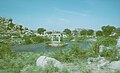 A shrine in a ruined tank at Vijayanagara in Karnataka
 -

-

-

-
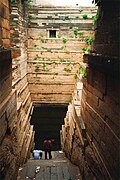 A well at Trikuteshwara temple in Karnataka
 -


See also[edit | edit source]
References[edit | edit source]
- ↑ "Tank management". rainwaterharvesting.org. Centre for Science and Environment. Retrieved 17 October 2006.
- ↑ "Architecture on the Indian Subcontinent – glossary". indoarch.org. Archived from the original on 6 November 2006. Retrieved 18 December 2006.
- ↑ 3.0 3.1 3.2 Shah, Esha (2003). Social Designs: Tank Irrigation Technology and Agrarian Transformation in Karnataka, South India. Thesis published by Orient Longman as a part of Wageningen University Water Resources Series. pp. 3, 34, 37. ISBN 90-5808-827-8 – via Wageningen University.
- ↑ Easter, K. William; Palanisami, Kuppannan (1986), "Tank Irrigation In India And Thailand: An Example Of Common Property Resource Management", Staff Papers, Staff Papers Series, University of Minnesota, Department of Applied Economics: 1, 5
- ↑ "Chapter 1.1.8 and 1.1.9". Sourcebook of Alternative Technologies for Freshwater Augmentation in Africa (UNEP-IETC). 1998 – via New Zealand Digital Library Project, University of Waikato.
- ↑ Geekiyanage, Nalaka; Pushpakumara, D.K.N.G. (2013). "Ecology of ancient Tank Cascade Systems in island Sri Lanka". Journal of Marine and Island Cultures. 2 (2): 93–101. Bibcode:2013JMICu...2...93G. doi:10.1016/j.imic.2013.11.001.
- ↑ Sudarshan, P.; Mahesh, M.K.; Ramachandra, T.V. (2020). "Dynamics of Metal Pollution in Sediment and Macrophytes of Varthur Lake, Bangalore". Bulletin of Environmental Contamination and Toxicology. 104 (4): 411–417. Bibcode:2020BuECT.104..411S. doi:10.1007/s00128-020-02816-x. ISSN 0007-4861. PMID 32152684. S2CID 212642148.
- ↑ 8.0 8.1 8.2 8.3 Srivastava, Aman; Chinnasamy, Pennan (2021). "Water management using traditional tank cascade systems: a case study of semi-arid region of Southern India". SN Applied Sciences. 3 (3): 281. doi:10.1007/s42452-021-04232-0. ISSN 2523-3963. S2CID 234022533.
- ↑ Chakrapani, B.K.; Desai, Milind; George, Joseph; Karthikeyan, S.; Krishna, M.B.; Kumar, U. Harish; Naveein, O.C.; Sridhar, S.; Srinivasa, T.S.; N., Srinivasan; S., Subramanya (1990). Survey of Irrigation Tanks as Wetland Bird Habitats in the Bangalore area, India. Birdwatchers' Field Club of Bangalore. p. 6 – via Internet Archive.
- ↑ Aubriot, Olivia; Prabhakar, P. Ignatius (2011). "Water institutions and the 'Revival' of Tanks in South India: What is at Stake Locally?". Water Alternatives. 4 (3): 332.
- ↑ Anbumozhi, V.; Matsumoto, K.; Yamaji, E. (2001). "Towards Improved Performance of Irrigation Tanks in Semi-Arid Regions of India: Modernization Opportunities and Challenges". Irrigation and Drainage Systems. 15 (4): 293–309. doi:10.1023/A:1014420822465. S2CID 110086216. Template:INIST.
- ↑ Arumugam, N.; Mohan, S.; Ramaprasad, R. (1997). "Sustainable Development and Management of Tank Irrigation Systems in South India". Water International. 22 (2): 90–97. Bibcode:1997WatIn..22...90A. doi:10.1080/02508069708686676. Template:INIST.
- ↑ "Bird monitoring at Rampura and Kalkere tanks". A Rocha. Archived from the original on 22 February 2007. Retrieved 17 October 2006.
- ↑ "Ralegan Siddhi : A village Transformed". rainwaterharvesting.org. Retrieved 30 October 2006.
- ↑ Shah, Tushaar; Samad, Madar; Ariyarantne, Ranjith; Jinapala, K (2013). "Ancient Small-Tank Irrigation in Sri Lanka: Continuity and Change". Economic and Political Weekly. 48 (11): 58–65. ISSN 0012-9976. JSTOR 23391422.
- ↑ "Architecture of the Indian Subcontinent – glossary". Indian Architecture. Archived from the original on 6 March 2012. Retrieved 17 October 2006.
- ↑ Thapar, Binda (2004). "Architecture and Water". Introduction to Indian Architecture. Singapore: Periplus Editions. p. 24. ISBN 978-0-7946-0011-2.
- ↑ Walia, Varinder (1 June 2006). "Ponds, tanks relics of a bygone era". The Tribune AmritsarPlus Online Edition. Retrieved 17 October 2006.
- ↑ "Architecture – Stepwells". southasia.ucla.edu. Archived from the original on 16 February 2007. Retrieved 9 January 2007.
- ↑ "Great Tank". art-and-archaeology. Retrieved 13 January 2007.
Further reading[edit | edit source]
- Palanisami, K.; Easter, K.W. (2000). Tank Irrigation in the 21st Century – What Next?. Jain Book Agency. ISBN 9788171415588.
- Van Meter, Kimberly J.; Steiff, Michael; McLaughlin, Daniel L.; Basu, Nandita B. (2016). "The socioecohydrology of rainwater harvesting in India: understanding water storage and release dynamics across spatial scales". Hydrology and Earth System Sciences. 20 (7): 2629–2647. Bibcode:2016HESS...20.2629V. doi:10.5194/hess-20-2629-2016. hdl:10919/95857. ISSN 1607-7938.
- Hooja, Rima. "Channeling Nature: Hydraulics, Traditional Knowledge Systems, And Water Resource Management in India – A Historical Perspective". Infinity Foundation.
- Mukherji, Aditi; Rawat, Stuti; Shah, Tushaar (2013). "Major Insights from India's Minor Irrigation Censuses: 1986-87 to 2006-07". Economic and Political Weekly. 48 (26/27): 115–124. ISSN 0012-9976. JSTOR 23527239.
- Fernando, A. Denis N. (1980). "Major ancient irrigation works of Sri Lanka". Journal of the Sri Lanka Branch of the Royal Asiatic Society. 22: 1–24. ISSN 1013-9818. JSTOR 45277707.
- Critchley, Will; Siegert, Klaus; Chapman, C (1991), Water harvesting. A Manual for the Design and Construction of Water Harvesting Schemes for Plant Production., Food and Agriculture Organization
External links[edit | edit source]
- Millison, Andrew (7 August 2022). Permaculture Water Management. This farm cracked the code#1: Water Wizard of Oregon (YouTube).