



WikiDwarfBOT (talk | contribs) Cleanup: Spelling fix. |
Expanded content with additional details |
||
| Line 1: | Line 1: | ||
{{Short description| | {{Short description|1747–1823 Afghan empire founded by Ahmad Shah Durrani}} | ||
{{Redirect|Afghan Empire|the 14th century state|Delhi Sultanate}} | |||
{{About||the Durrani dynasty|Durrani dynasty|other uses|Durrani (disambiguation)}} | {{About||the Durrani dynasty|Durrani dynasty|other uses|Durrani (disambiguation)}} | ||
{{Use dmy dates|date=August 2021}} | |||
{{Use Oxford spelling|date=March 2022}} | |||
{{Infobox country | {{Infobox country | ||
| native_name = {{native name|ps|د | | native_name = {{native name|ps|{{nq|د درانيانو ټولواکمني}}|italic=no}}<br />{{native name|fa|{{nq|امپراتوری درانیها}}|italic=no}} | ||
| conventional_long_name = Durrani Empire | | conventional_long_name = Durrani Empire | ||
<br>Durrani Kingdom | |||
| era = [[Early modern period]] | | era = [[Early modern period]] | ||
| status = {{ubl|1747–1823 | | status = {{ubl|1747–1823; 1839–1843 (Empire)|[[Herat (1793–1863)|1793–1863 (Herat)]]}} | ||
| year_start = July 1747 | | year_start = July 1747 | ||
| event_start = Dynasty established by [[Ahmad Shah Durrani]] | | event_start = Dynasty established by [[Ahmad Shah Durrani]] | ||
| year_end = 1863 | | year_end = 9 June 1863 | ||
| event2 = [[Shah | | event2 = [[Emirate of Afghanistan|Decline]] | ||
| | | date_event2 = 1823 | ||
| event3 = [[First Anglo-Afghan War|Restoration]] | |||
| date_event3 = 7 August 1839 | |||
| event4 = [[Shahpur Shah Durrani|Fall of Kabul]] | |||
| date_event4 = April 1843 | |||
| event_end = [[Herat campaign of 1862–1863|Fall of Herat]] | |||
| p1 = Afsharid Iran | | p1 = Afsharid Iran | ||
| flag_p1 = Afsharid Imperial Standard (3 Stripes).svg | | flag_p1 = Afsharid Imperial Standard (3 Stripes).svg | ||
| Line 17: | Line 26: | ||
| flag_p2 = Alam of the Mughal Empire.svg | | flag_p2 = Alam of the Mughal Empire.svg | ||
| border_p2 = no | | border_p2 = no | ||
| p4 = Khanate of Bukhara{{!}}{{nobr|Bukhara Khanate}} | | p4 = Khanate of Bukhara{{!}}{{nobr|Bukhara Khanate}} | ||
| flag_p4 = | | flag_p4 = | ||
| border_p4 = no | | border_p4 = no | ||
| s1 = | | s1 = Principality of Kabul | ||
| flag_s1 = | | flag_s1 = | ||
| s2 = | | s2 = Herat (1793–1863){{!}}{{nobr|Kingdom of Herat}} | ||
| flag_s2 = | | flag_s2 = Flag of Herat until 1842.svg | ||
| s3 = | | s3 = Principality of Kandahar | ||
| flag_s3 = | | flag_s3 = | ||
| s4 = | | s4 = Maimana Khanate | ||
| s5 = | | s5 = Sikh Empire | ||
| today = [[Afghanistan]]<br | | flag_s5 = Sikh Empire flag.svg | ||
| life_span = {{ubl|1747–1823 (Empire)|1793–1863 (Herat | | today = [[Afghanistan]]<br>[[Pakistan]]<br>[[Iran]]<br>[[India]]<br>[[Turkmenistan]]<br>[[Tajikistan]] | ||
| image_flag = Flag of | | life_span = {{ubl|1747–1823; 1839–1843 (Empire)|1793–1863 (Herat)}} | ||
| flag_caption = | | image_flag = File:Flag of the Durrani Kingdom.svg | ||
| | | flag_caption = Flag | ||
| | | image_coat = Seal of Ahmad Shah Durrani.svg | ||
| | | symbol_width = 55px | ||
| | | symbol_type = Seal of [[Ahmad Shah Durrani]] | ||
| image_map_caption = Map of the Afghan Empire and its vassals<br />under [[Ahmad Shah Durrani]] in 1761 | |||
| capital = {{ubl|[[Kandahar]] (1747–1776)|[[Kabul]] (1776–1823), as summer capital|[[Peshawar]] (1776–1823); as winter capital{{efn|"Timur Shah transferred the Durrani capital from Qandahar in 1775–76. Kabul and Peshawar then shared time as the dual Durrani capital cities, the former during the summer and the latter during the winter season." Quoted from {{harvp|Hanifi|2011|p=[https://books.google.com/books?id=kh1hpPLSpcEC&pg=PA185 185 n, 3]}}.}}{{efn|"Like the [[Kushan Empire|Kushans]], the Afghan kings favoured Peshawar as a winter residence, and were aggrieved when the upstart Sikh kingdom snatched it in 1818 and levelled its buildings." Quoted from {{harvp|Singh|2008|p=191}}.}}|[[Herat]] (1793–1863){{efn|"[The Sadozai kingdom] continued to exist in Herat until the city finally fell to Dost Muhammad Khan in 1862."{{sfnp|Lee|1996|p=[https://books.google.com/books?id=nYaamE_3kD4C&pg=PA116 116]}}}}}} | |||
| common_languages = {{ubl|[[Pashto language|Pashto]] (dynastic, poetry, initially used in bureaucracy){{efn|Ahmad Shah Durrani wrote poetry in Pashto.{{sfn|Schimmel|1975|p=12}}}}{{sfn|Schimmel|1975|p=12}}|[[Persian language|Persian]] (chancery, chief court language, historiographical works, diplomacy){{efn|"Despite Ahmad Shah Durrani's flirtations with founding a Pashto-based bureaucracy, when the capital moved from Qandahar to Kabul in 1772, Durrani and post-Durrani Afghanistan retained Persian as its chancery and chief court language." Quoted from {{harvp|Green|2019|p=42}}.}}<ref>{{cite encyclopedia |last=Archambault |first=Hannah |date=19 April 2023 |title=Afghan Circulations in the Persianate World, c. 1000–1800 |encyclopedia=Oxford Research Encyclopedia of Asian History |access-date=16 October 2023 |url=https://doi.org/10.1093/acrefore/9780190277727.013.700 |url-access=subscription }}</ref><ref>{{cite encyclopedia |last=Hanifi |first=Shah Mahmoud |date=15 August 2022 |title=Deciphering the History of Modern Afghanistan |encyclopedia=Oxford Research Encyclopedia of Asian History |access-date=16 October 2023 |url=https://doi.org/10.1093/acrefore/9780190277727.013.321 |url-access=subscription }}</ref>}} | |||
| capital = {{ubl|[[Kandahar]] | | religion = [[Sunni Islam]] {{Small|(official)}} | ||
| common_languages = {{ubl|[[Pashto language|Pashto]] | | government_type = [[Elective monarchy]] | ||
| religion = [[Sunni Islam]] | |||
| government_type = [[Elective | |||
| title_leader = [[List of monarchs of Afghanistan|Shah]] | | title_leader = [[List of monarchs of Afghanistan|Shah]] | ||
| leader1 = [[Ahmad Shah Durrani]] | | leader1 = [[Ahmad Shah Durrani]] | ||
| year_leader1 = 1747–1772 | | year_leader1 = 1747–1772 {{Small|(first)}} | ||
| leader2 = [[Shahpur Shah Durrani]] {{Small|(Empire)}} | |||
| | | year_leader2 = 1842–1843 {{Small|(last)}} | ||
| leader3 = [[Shah Nawaz Khan (Afghan ruler)|Shah Nawaz Khan]] {{Small|(Herat)}} | |||
| | | year_leader3 = 1863 {{Small|(last)}} | ||
| | | stat_pop1 = 14 million<ref>{{Cite book |last=Noelle |first=Christine |date=1997 |title=State and Tribe in Nineteenth Century Afghanistan The Reign of Amir Dost Muhammad Khan (1826–1863) |publisher=Routledge |isbn=9780700706297 |p=[https://books.google.ca/books?id=Mf2cvE5jYrYC&pg=PA15 15] }}</ref> | ||
| | |||
| | |||
| | |||
| stat_pop1 = 14 million<ref>{{Cite book |last=Noelle |first=Christine |title=State and Tribe in Nineteenth Century Afghanistan The Reign of Amir Dost Muhammad Khan ( | |||
| currency = | | currency = | ||
| | | area_km2 = 2,000,000<ref>{{cite encyclopedia |last=Bosin |first=Yury V. |date=2009 |title=Durrani empire, popular protests, 1747–1823 |editor=Immanuel Ness |encyclopedia=International Encyclopedia of Revolution and Protest |publisher=Blackwell Publishing |p=1029 |url=https://www.unm.edu/~ybosin/documents/durrani.pdf }}</ref> | ||
| | |||
| | |||
| | |||
| | |||
| | |||
| | |||
}} | }} | ||
The '''Durrani Empire''',{{efn|{{ublist|{{langx|ps|د درانيانو ټولواکمني|Də Durrānyāno Ṭolwākmani}}, {{IPA|ps|d̪ə d̪u(ɾ).ɾɑn.jɑ.no ʈol.wɑk.ma.ni|pron}}|{{langx|prs|{{nq|امپراتوری درانیها}}|Imparātūrī-yi Durrānīhā|label=[[Dari|Persian]]}}, {{IPA|prs|ʔɪm.pʰä.ɾɑː.t̪ʰuː.ɾíː‿jɪ d̪uɾ.ɾɑː.níː‿ɦɑː|pron}}}}}} colloquially known as the '''Kingdom of Afghanistan''',<ref>{{cite book |last=Tate |first=George P. |date=2009 |orig-date=1911 |title=The Kingdom of Afghanistan: A Historical Sketch |publisher=BiblioBazaar |isbn=9781115584029 |url=https://books.google.com/books?id=fhF-BvWVmYIC }}</ref><ref>{{cite book |last1=Sabahuddin |first1=Abdul |date=2008 |title=History of Afghanistan |publisher=Global Vision Publishing House |isbn=9788182202467 |url=https://books.google.com/books?id=XfDYtxfOvTYC&pg=PA45}}</ref><ref>{{cite journal |last=Huntington |first=Ellsworth |date=1907 |title=The Anglo-Russian Agreement as to Tibet, Afghanistan, and Persia |journal=Bulletin of the American Geographical Society |volume=39 |issue=11 |pp=653-658 |url=https://www.jstor.org/stable/198436 }}</ref> and as the '''Afghan Empire'''<ref>{{cite encyclopedia |editor1-last=Dupree |editor1-first=Louis |editor1-link=Louis Dupree (professor) |display-editors=etal |date=2010 |title=Last Afghan empire |encyclopedia=[[Britannica.com]] |access-date=20 January 2026 |url=https://www.britannica.com/place/Afghanistan/The-first-Muslim-dynasties#ref21392 }}</ref> or the '''Sadozai Kingdom''',{{sfnp|Lee|1996|p=[https://books.google.com/books?id=nYaamE_3kD4C&pg=PA116 116]}} was an [[Afghanistan|Afghan]] empire founded by the [[Durrani]] tribe of [[Pashtuns]] under [[Ahmad Shah Durrani]]<!-- Use given name (Ahmad) to avoid confusion with similarly named figures. --> in 1747, which spanned parts of [[Central Asia]], the [[Iranian plateau]], and the [[Indian subcontinent]]. At its peak, it ruled over present-day [[Afghanistan]], much of [[Pakistan]], parts of northeastern and southeastern [[Iran]], eastern [[Turkmenistan]], and northwestern [[India]].<ref>{{cite book|url=http://www.khyber.org/books/pdf/ahmad-shah-baba.pdf |title=Ahmad Shah Durrani: Father of Modern Afghanistan |last=Singh |first=Ganda |publisher=Asia Publishing House |date=1959 |access-date=2013-02-07 |url-status=usurped |archive-url=https://web.archive.org/web/20130207183925/http://www.khyber.org/books/pdf/ahmad-shah-baba.pdf |archive-date=2013-02-07}}</ref>{{sfnp|Lee|1996|p=[https://books.google.com/books?id=nYaamE_3kD4C&pg=PA190 190]}} Next to the [[Ottoman Empire]], the Durrani Empire is considered to be among the most significant [[List of Muslim states and dynasties|Islamic empires]] of the second half of the 18th century.{{efn|"Next to the [[Ottoman Empire]], the Durrani Empire was the greatest Muslim empire of the second half of the eighteenth century." Quoted from {{harvp|Dupree|1980|p=[https://archive.org/details/dli.pahar.3556/page/334/mode/1up 334]}}.}} | |||
The '''Durrani Empire''' | Ahmad was the son of Muhammad Zaman Khan (an [[Afghan (ethnonym)|Afghan]] chieftain of the [[Durrani|Abdali tribe]]) and the commander of [[Nader Shah|Nader Shah Afshar]]. Following Afshar's death in June 1747, Ahmad secured Afghanistan by taking [[Kandahar]], [[Ghazni]], [[Kabul]], and [[Peshawar]]. After his accession as the nation's king, he changed his tribal name from ''Abdali'' to ''Durrani''. In 1749, the [[Mughal Empire]] had ceded sovereignty over much of northwestern India to the Afghans; Ahmad then set out westward to take possession of [[Mashhad]], which was ruled by the [[Afsharid dynasty]] under [[Shahrokh Shah]], who also acknowledged Afghan suzerainty.<ref>{{Cite book |last1=Mojtahed-Zadeh |first1=Pirouz |year=2006 |title=Boundary Politics and International Boundaries of Iran<!-- omit the subtitle: the one given at Google Books is truncated and the full one, visible at Universal Publishers, is too long --> |isbn=9781581129335 |publisher=Universal-Publishers |p=[https://books.google.com/books?id=9o0IRPpvDjkC&pg=PA164 164] }}</ref> Subsequently, Ahmad sent an army to subdue the areas north of the [[Hindu Kush]] down to the [[Amu Darya]], and in short order, all of the different [[Pashtun tribes|Afghan tribes]] began to join his cause. Under Ahmad, [[Indian campaign of Ahmad Shah Durrani|the Afghans invaded India on eight occasions]], subjugating parts of [[Kashmir]] and the majority of [[Punjab]]. In early 1757, [[Sack of Delhi (1757)|he sacked Delhi]], but permitted Mughal emperor [[Alamgir II]] to remain in nominal control as long as he acknowledged Afghan suzerainty over the regions south of the [[Indus River]], until Sutlej river. | ||
Ahmad | Following Ahmad's death in 1772, his son [[Timur Shah Durrani]] became the next ruler of the [[Durrani dynasty]]. Under Timur, the city of Kabul became the new capital of the Durrani Empire while Peshawar served as its [[List of countries with multiple capitals#More than one capital in the past|winter capital]]. However, the empire had begun to crumble by this time,{{sfnp|Malleson|1878|p=[https://books.google.ca/books?id=0ec2AQAAMAAJ&pg=PA298 298]}} and [[Afghan-Sikh wars|faced territorial losses]] of Peshawar, Multan and Kashmir to the [[Sikh Empire]] in the early 19th century.<ref>{{Cite book |last=Siddique |first=Abubakar |date=2014 |title=The Pashtun Question: The Unresolved Key to the Future of Pakistan and Afghanistan |publisher=Hurst |isbn=978-1-84904-292-5 |p=[https://books.google.com/books?id=PkVeBAAAQBAJ&pg=PA31 31] }}</ref> The dynasty would become heirs of Afghanistan for generations, up until [[Dost Mohammad Khan|Dost Muhammad Khan]] and the [[Barakzai dynasty]] deposed the Durrani dynasty in Kabul, leading to its supersession by the [[Emirate of Afghanistan]]. The Durrani Empire is considered to be the foundational polity of the modern [[Nation state|nation-state]] of Afghanistan, with Ahmad being credited as its [[Father of the Nation]].<ref>{{Cite CIA World Factbook |country=Afghanistan |access-date=25 January 2026 }}</ref> | ||
==History== | |||
==Reign of Ahmad Shah Durrani (1747–1772)== | ===Reign of Ahmad Shah Durrani (1747–1772)=== | ||
===Foundation of the Afghan state=== | ====Foundation of the Afghan state==== | ||
In 1709, [[Mirwais Hotak]] chief of the [[Ghilji]] tribe of [[Kandahar Province]], gained independence from the [[Safavid dynasty|Safavid]] Persians. From 1722 to 1725, his son [[Mahmud Hotak]] briefly ruled large parts of [[Iran]] and declared himself as ''Shah of Persia''. However, the [[Hotak dynasty]] came to a complete end in 1738 after being toppled and banished by the [[Afsharid dynasty|Afsharids]] who were led by [[Nader Shah Afshar]] of [[Persia]]. | In 1709, [[Mirwais Hotak]] chief of the [[Ghilji]] tribe of [[Kandahar Province]], gained independence from the [[Safavid dynasty|Safavid]] Persians. From 1722 to 1725, his son [[Mahmud Hotak]] briefly ruled large parts of [[Iran]] and declared himself as ''Shah of Persia''. However, the [[Hotak dynasty]] came to a complete end in 1738 after being toppled and banished by the [[Afsharid dynasty|Afsharids]] who were led by [[Nader Shah Afshar]] of [[Persia]]. | ||
The year 1747 marks the definitive appearance of an Afghan political entity independent of both the Persian and [[Mughal Empire|Mughal]] empires.<ref>{{ | The year 1747 marks the definitive appearance of an Afghan political entity independent of both the Persian and [[Mughal Empire|Mughal]] empires.<ref>{{Encyclopædia Iranica Online |last=Balland |first=Daniel |date=2018 |orig-date=1983 |title=Afghanistan: x. Political History |url=http://iranicaonline.org/articles/afghanistan-x-political-history }}</ref> In June of that year a ''[[jirga|loya jirga]]'' (grand council) was called into session. The ''jirga'' lasted for nine days and two chief contestants emerged: Hajji Jamal Khan of the Mohammadzai lineage and Ahmad Khan of the Sadozai. Mohammad Sabir Khan, a noted ''darwish'' (holy man), who had earlier predicted that Ahmad Khan would be the leader of the Afghans, rose in the ''jirga'' and said | ||
{{Blockquote|Why all this verbose talk? God has created Ahmad Khan a much greater man than any of you; his life is the most noble of all the Afghan families. Maintain, therefore, God's work, for His wrath will weigh heavily upon you if you destroy it.}} | {{Blockquote|Why all this verbose talk? God has created Ahmad Khan a much greater man than any of you; his life is the most noble of all the Afghan families. Maintain, therefore, God's work, for His wrath will weigh heavily upon you if you destroy it.}} | ||
Ahmad Khan reputedly hesitated to accept the open decision of the ''jirga'', so Sabir Khan again intervened. He placed some wheat or barley sheaves in Ahmad Khan's turban, and crowned him '' | Ahmad Khan reputedly hesitated to accept the open decision of the ''jirga'', so Sabir Khan again intervened. He placed some wheat or barley sheaves in Ahmad Khan's turban, and crowned him ''Pādshah, Durr-i-Durrān'' (Shah, Pearl of the Pearls).{{sfnp|Dupree|1980|p=[https://archive.org/details/dli.pahar.3556/page/333/mode/1up 333]}} The ''jirga'' concluded near the city of Kandahar with [[Ahmad Shah Durrani]] being selected as the new leader of the Afghans, thus the Durrani dynasty was founded. Despite being younger than the other contenders, Ahmad Shah had several overriding factors in his favor. He belonged to a respectable family of political background, especially since his father had served as [[list of governors of Herat|Governor of Herat]] who died in a battle defending the Afghans. | ||
===Early victories=== | ====Early victories==== | ||
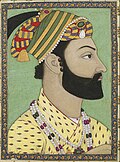
[[File:Portrait of Ahmad-Shah Durrani. Mughal miniature. ca. 1757, Bibliothèque nationale de France.jpg|thumb|Portrait of [[Ahmad Shah Durrani]], c. 1757]] | [[File:Portrait of Ahmad-Shah Durrani. Mughal miniature. ca. 1757, Bibliothèque nationale de France.jpg|thumb|Portrait of [[Ahmad Shah Durrani]], c. 1757]] | ||
One of Ahmad Shah's first military actions was to capture [[Qalati Ghilji]] and [[Ghazni]] from the [[Ghilji]], and wrest [[Kabul]] and [[Peshawar]] from Mughal-appointed governor Nasir Khan. In 1749, the Mughal Emperor [[Ahmad Shah Bahadur]] was induced to cede [[Sindh Province|Sindh]], the [[Punjab region]] and the important trans [[Indus River]] to Ahmad Shah Durrani in order to save his capital from Afghan attack. | One of Ahmad Shah's first military actions was to capture [[Qalati Ghilji]] and [[Ghazni]] from the [[Ghilji]], and wrest [[Kabul]] and [[Peshawar]] from Mughal-appointed governor Nasir Khan. In 1749, the Mughal Emperor [[Ahmad Shah Bahadur]] was induced to cede [[Sindh Province|Sindh]], the [[Punjab region]] and the important trans [[Indus River]] to Ahmad Shah Durrani in order to save his capital from Afghan attack.{{sfnp|Runion|2017|p=[https://books.google.ca/books?id=cBbHEAAAQBAJ&pg=PA69 69]}} Having thus gained substantial territories to the east without a fight, [[Durrani Campaign to Khorasan (1754-55)|Ahmad Shah turned westward]] to take possession of [[Mashhad]], which was ruled by Nader Shah Afshar's grandson, [[Shahrukh Afshar]]. Ahmad Shah next sent an army to subdue the areas north of the [[Hindu Kush]] mountains. In short order, the powerful army brought under its control the [[Tajik people|Tajik]], [[Hazara people|Hazara]], [[Uzbeks|Uzbek]], [[Turkmen people|Turkmen]], and other tribes of northern Afghanistan. Ahmad Shah invaded the remnants of the Mughal Empire a third time, and then a fourth, consolidating control over the Kashmir and Punjab regions, with [[Lahore]] being governed by Afghans. He sacked Delhi in 1757 but permitted the Mughal dynasty to remain in nominal control of the city as long as the ruler acknowledged Ahmad Shah's suzerainty over Punjab, Sindh, and Kashmir. Leaving his second son [[Timur Shah Durrani|Timur Shah]] to safeguard his interests, Ahmad Shah left India to return to Afghanistan. | ||
====Relations with China==== | |||
{{main|Durrani-Qing relations}} | |||
[[File:Route of Khwāja Mirhan’s embassy from Fayzabad to Beijing, through Central and East Asia.png|thumb|Map of the route the Afghan embassy undertook to the Qing dynasty in 1763|alt=Route of the Afghan embassy to Beijing]] | |||
Fazil Biy, the ruler of [[Khanate of Kokand|Kokand]], and other Kyrgyz chieftains pleaded to Ahmad Shah to aid them against Qing expansionism. Ahmad Shah, delighted to use a casus belli in the name of [[Islam]], accepted, and occupied the regions between [[Tashkent]] and [[Kokand]] in 1763, though later withdrawing by 1764 as any alliance failed to be forged.{{sfnp|Newby|2005|p=[https://books.google.com/books?id=KTmO416hNQ8C&pg=PA34 34]}}<ref>{{Cite book |editor-last1=Adle |editor-first1=Chahryar |editor-last2=Habib |editor-first2=Irfan |editor-last3=Baipakov |editor-first3=Karl M. |date=2003 |title=History of civilizations of Central Asia |volume=5 - Development in contrast: from the sixteenth to the mid-nineteenth century |publisher=UNESCO Publishing |isbn=9789231038761 |url=https://unesdoc.unesco.org/ark:/48223/pf0000130205 |p=[https://books.google.ca/books?id=AzG5llo3YCMC&pg=PA75 75] }}</ref> | |||
In 1763, Ahmad Shah had dispatched an embassy to the [[Qing]]. His aims in this are unknown, however, an embassy allowed Ahmad Shah to establish himself as an emperor. The letter he sent to the Qing emperor [[Qianlong]] is missing, but from the Qing reply, the letter was likely dedicated to his conquests and victory at [[Third Battle of Panipat|Panipat]], alongside Qing expansion.{{sfnp|Eijk|Khan|2023|pp=715-6}} | |||
The letter positioned Ahmad Shah's expansions as bringing order and stability to areas overrun with rebels and lawlessness (in reference to his [[#Military campaigns|campaigns in Iran and India]]). The battle of Panipat was strongly detailed in the letter, in what was likely a fath-nama, meaning a victory letter or declaration to celebrate a victory. The Qing emperor ignored the effective threat.{{sfnp|Eijk|Khan|2023|pp=716-7}} | |||
In the second part of the letter, Qianlong appeared much more defensive, justifying the [[Dzungar–Qing Wars|Qing conquest of the Dzungars]] and the [[Revolt of the Altishahr Khojas|Altishahr Khojas]]. He accused them of causing devastation and laying false accusations against him. A report also suggested that Ahmad Shah considered the territories the Qing claimed belonged to the Muslims. In reality, Ahmad Shah possibly wanted to establish spheres of influence, which was similarly done with the [[Ottoman Empire|Ottomans]] which divided [[Iran]] between them, and a [[#Turkestan (1751–1768)|treaty with Bukhara]] that had established the [[Amu Darya]] as the border.{{sfnp|Eijk|Khan|2023|pp=717-8}} | |||
{{Quote box |quote = Why has your Khan dispatched you? Has your Khan not sent you to appear at an audience with the brilliance of our Great Lord? Our Great Lord is the ruler who has united All under Heaven. Besides you Afghans, as soon as people from the West, Russia, even the former Zunghars came, all of them promptly prostrated themselves before the Great Lord. He is like Heaven; do you not bow before Heaven?{{sfn|Eijk|Khan|2023|p=708}} | |||
|author = A Qing grand councillor, remarking at the Afghan envoy's refusal to Kowtow | |||
|width = 30% | |||
|align = right | |||
}} | |||
When the Afghan embassy had arrived in Beijing, the chief envoy, Khwaja Mirhan, had refused to [[kowtow]] before the Qing emperor. The Qing officials, in shock, demanded he kowtow, to which Mirhan eventually acquiesced. This incident damaged the Qing-Afghan relations and Qianlong cut ties with the Afghans following this. No immediate consequence occurred, and the envoy was shown favor.{{sfnp|Eijk|Khan|2023|pp=718-20}} | |||
Mirhan's refusal likely came out of religious reasons, but the Qing received it as Ahmad Shah declaring himself equal to Qianlong. From Qianlong's view, he saw the Afghans as a significant power and attempted to impress the envoy and in contrast, Ahmad Shah, of the Qing empire. This was especially done in motivation of Altishahr's recent conquest and concerns over stability in the region.{{sfnp|Eijk|Khan|2023|pp=720-4}} | |||
{{multiple image|perrow = 2|total_width=300 | |||
| align = right | |||
| image1 = Horse Chaoni'er.jpg | |||
| width1 = 180 | |||
| alt1 = | |||
| link1 = Four Afghan Steeds | |||
| image2 = Horse Laiyuanliu.jpg | |||
| width2 = 130 | |||
| alt2 = | |||
| link2 = Four Afghan Steeds | |||
| image3 = Horse Yuekulai.jpg | |||
| width3 = 130 | |||
| alt3 = | |||
| link3 = Four Afghan Steeds | |||
| image4 = Horse Lingkunbai.jpg | |||
| width4 = 130 | |||
| alt4 = | |||
| link4 = Four Afghan Steeds | |||
| footer = Depiction of the four Afghan horses sent by Ahmad Shah, painted by Qing court painter [[Giuseppe Castiglione (Jesuit painter)|Giuseppe Castiglione]] | |||
}} | |||
Ahmad Shah's gifts to the Qing emperor included [[Four Afghan Steeds|four horses]], which were painted by the Qing court painter, [[Giuseppe Castiglione (Jesuit painter)|Giuseppe Castiglione]]. Nonetheless, by the time of the envoy's return journey to Afghanistan, Qianlong made preparations to secure Qing territories.{{sfnp|Eijk|Khan|2023|pp=724-6}} | |||
In 1759, as the revolt of the [[Revolt of the Altishahr Khojas|Altishahr Khojas]] crumbled, two descendants of the Afaqi Sufi lineage crossed into Badakhshan, being pursued by the Qing forces. Fude, the Qing general of the expedition, demanded that Sultan Shah, the ruler of Badakhshan, to arrest the brothers. Sultan Shah accepted, likely wishing to receive Qing military aid against the Durrani Empire. Distrust occurred, however, due to the Afaqi descendants residing in Badakhshan for months, including Sultan Shah's initial refusal to hand them over, possibly intending to send them to [[Bukhara]]. Qianlong threatened invasion, which did not occur as one of the descendant's remains were sent to [[Yarkand]].{{sfnp|Eijk|Khan|2023|pp=726-9}} | |||
The death of the Afaqi brothers spurned relations with the Afghans, causing Sultan Shah to plead to the Qing, claiming that Ahmad Shah intended to exact revenge for their deaths. No immediate Afghan invasion occurred. The Qing however, faced numerous frustrations with their tributaries in [[Central Asia]], alongside a major insurrection in [[Uqturpan County|Uch-Turfan]] that required tremendous effort to defeat.{{sfnp|Eijk|Khan|2023|pp=729-30}} | |||
As a result, Qianlong adopted a policy of strict non-interference, realizing that Qing troops in Altishahr were significantly stretched and spread thin. The Afghans, however, seen as a threat, would show the weakness of Qing control in the region.{{sfnp|Eijk|Khan|2023|pp=730-2}} | |||
In August 1768, Qianlong was informed of the Afghan invasion of Badakhshan led by Shah Wali Khan in May, with Afghan forces seizing Sultan Shah's capital, [[Fayzabad, Badakhshan|Fayzabad]]. A Qing agent, Yunggui, held the position that the Qing should interfere in the conflict. Qianlong, however, affirmed that military intervention would irrational, and strictly forbade any military interference. Historians see this as surprising, as the invasion by the Afghans threatened the Qing Empire itself.{{sfnp|Eijk|Khan|2023|p=732}} | |||
[[File:万国来朝图 Badakhshan delegates (拔達克山) in Peking in 1761.jpg|thumb|right|Delegates from Badakhshan in [[Peking]], 1761]] | |||
Qing sources affirm that the Afghans established Sarimsaq, a child of the Afaqi's who escaped to Badakhshan, in [[Kunduz]]. Qianlong was distraught, as another possible revolt could revolve around Sarimsaq, especially after reports came of Muslim travelers and funds being sent to Sarimsaq. This still did not convince Qianlong to act, and he refused to send any negative response to Ahmad Shah at all. During this, Sultan Shah defeated the Afghan governor and reoccupied his capital, but feared another Afghan invasion, sending desperate letters to the Qing in the winter of 1768 to ask for help, claiming that Ahmad Shah would invade next year.{{sfnp|Eijk|Khan|2023|p=733}} | |||
Qianlong rebutted, blaming Sultan Shah for provoking the conflict with the Afghans and affirmed that he would only fight the Afghans if they actually invaded Qing territory. Sultan Shah wrote a letter to [[Emin Khoja]] in response in August 1769, expecting aid as he was a vassal, only to find himself abandoned. In December 1769, Sultan Shah wrote another letter that accused Qianlong of failing to uphold his duties. Qianlong rebuked him, and stated that under no circumstances would the Qing aid him.{{sfnp|Eijk|Khan|2023|p=733-4}} | |||
{{Quote box | |||
| quote = We have long known that you have previously presented gifts to the Afghans. That you now have no more options but to evade the issue just shows that you are paying tribute to the Afghans! […] If you cannot protect your own lands, and wish to submit to the Afghans, then suit yourself! […] If you wish to rely on our armies to serve your enmities and to subjugate your neighboring tribes, then we will under no circumstances provide you with our troops.{{sfn|Eijk|Khan|2023|p=734}} | |||
| author = Qianlong's reply to Sultan Shah's plea for aid against Ahmad Shah | |||
| width = 30% | |||
| align = right | |||
}} | |||
Qianlong had initially considered the Afghans [[Tributary state|tributaries]], but after the former incident, he no longer even sought the prospect of any form of Durrani submission. His reply to Sultan Shah effectively saw the Qing recognize the Afghans as a rival power to them, with Qianlong recognizing that the Afghans were unable to be treated like tributaries. Rather than aiding the ruler of Badakhshan as his initial policy implicated him to, Qianlong instead justified the Afghan invasion, prompted to by overextended armies, the distance, and stability. Instead, gambling on the difficult terrain between the Afghan and Qing realms for safety.{{sfnp|Eijk|Khan|2023|pp=734-5}} Within the year, Ahmad Shah occupied Badakhshan and Sultan Shah was executed.{{sfnp|Newby|2005|p=[https://books.google.com/books?id=KTmO416hNQ8C&pg=PA43 43]}} | |||
===Third Battle of Panipat=== | ====Third Battle of Panipat==== | ||
{{Main|Third Battle of Panipat}} | {{Main|Third Battle of Panipat}} | ||
The [[Mughal power]] in northern India had been declining after the death of Emperor [[Aurangzeb]], who died in 1707. In 1751–52, the ''Ahamdiya'' treaty was signed between the [[Maratha Empire|Marathas]] and [[Mughal Empire|Mughals]], when [[Balaji Bajirao]] was the [[Peshwa]].<ref | [[File:The Third battle of Panipat 13 January 1761.jpg|thumb|[[Ahmad Shah Durrani]] and his coalition decisively defeat the [[Maratha Confederacy]], during the [[Third Battle of Panipat]] and restored the [[Mughal Empire]] to [[Shah Alam II]].<ref>{{cite book |last=Ikram |first=S. Mohamad |author-link=S. M. Ikram |date=1964 |editor-last=Embree |editor-first=Ainslie T. |editor-link=Ainslie Embree |title=Muslim Civilization in India |publisher=[[Columbia University Press]] |at=pp. [https://archive.org/details/muslimcivilizati00ikra/page/254/mode/1up 254-76] (Ch. XIX - "A Century of Political Decline: 1707–1803")}}</ref>]] | ||
The [[Mughal power]] in northern India had been declining after the death of Emperor [[Aurangzeb]], who died in 1707. In 1751–52, the ''Ahamdiya'' treaty was signed between the [[Maratha Empire|Marathas]] and [[Mughal Empire|Mughals]], when [[Balaji Bajirao]] was the [[Peshwa]].<ref>{{cite book |last=Patil |first=Vishwas |author-link=Vishwas Patil |date=2005 |title=Panipat |location=[[Mumbaī]] |publisher=Navabhārata Sāhitya Mandira |oclc=57710656 |lang=gu }}</ref>{{pn|date=January 2026}} Through this treaty, the Marathas controlled virtually the whole of India from their capital at [[Pune]] and the Mughal rule was restricted only to Delhi (the Mughals remained the nominal heads of Delhi). Marathas were now straining to expand their area of control towards the Northwest of India. Ahmad Shah [[Sack of Delhi (1757)|sacked the Mughal capital]] and withdrew with the booty he coveted. To counter the Afghans, Peshwa Balaji Bajirao sent [[Raghunathrao]]. He defeated the Rohillas and Afghan garrisons in Punjab and succeeded in ousting Timur Shah and his court from India and brought Lahore, Multan, Kashmir and other subahs on the Indian side of Attock under Maratha rule.{{sfnp|Roy|2004|pp=[https://books.google.com/books?id=jpXijlqeRpIC&pg=PA80 80–1]}} Thus, upon his return to Kandahar in 1757, Ahmad was forced to return to India and face the formidable attacks of the Maratha Confederacy. | |||
[[File:Huang Qing Zhigong Tu, 1769, Muslim from Afghanistan (愛烏罕回人).jpg|thumb|left|upright=0.8|Muslim man from Afghanistan (愛烏罕回人). [[Huang Qing Zhigong Tu]], 1769]] | [[File:Huang Qing Zhigong Tu, 1769, Muslim from Afghanistan (愛烏罕回人).jpg|thumb|left|upright=0.8|Muslim man from Afghanistan (愛烏罕回人). [[Huang Qing Zhigong Tu]], 1769]] | ||
Ahmad Shah declared a [[jihad]] (or [[Islam]]ic holy war) against the [[Maratha Empire|Marathas]], and warriors from various Afghan tribes joined his army, including the [[Baloch people]] under the command of [[Khan of Kalat]] Mir [[Nasir I of Kalat]]. [[Suba Khan Tanoli]] (Zabardast Khan) was selected as army chief of all military forces. Early skirmishes were followed by victory for the Afghans against the much larger Maratha garrisons in Northwest India and by 1759 Ahmad Shah and his army had reached Lahore and were poised to confront the Marathas. Ahmad Shah Durrani was famous for winning wars much larger than his army{{ | Ahmad Shah declared a [[jihad]] (or [[Islam]]ic holy war) against the [[Maratha Empire|Marathas]], and warriors from various Afghan tribes joined his army, including the [[Baloch people]] under the command of [[Khan of Kalat]] Mir [[Nasir I of Kalat]]. [[Suba Khan Tanoli]] (Zabardast Khan) was selected as army chief of all military forces. Early skirmishes were followed by victory for the Afghans against the much larger Maratha garrisons in Northwest India and by 1759 Ahmad Shah and his army had reached Lahore and were poised to confront the Marathas. Ahmad Shah Durrani was famous for winning wars much larger than his army{{citation needed|date=February 2023}}. By 1760, the Maratha groups had coalesced into a big enough army under the command of Sadashivrao Bhau. Once again, [[Panipat]] was the scene of a confrontation between two warring contenders for control of northern India. The Third Battle of Panipat (14 January 1761), fought between largely Muslim and largely Hindu armies was waged along a twelve-kilometer front. There were rebellions in the north in the region of [[Bukhara]]. The Durranis decisively defeated the Marathas in the [[Third Battle of Panipat]] on 14 January 1761.{{sfnp|Roy|2004|pp=[https://books.google.com/books?id=jpXijlqeRpIC&pg=PA84 84–94]}} The defeat at Panipat resulted in heavy losses for the Marathas, and was a huge setback for Peshwa Balaji Rao. He received the news of the defeat of Panipat on 24 January 1761 at [[Bhilsa]], while leading a reinforcement force. Besides several important generals, he had lost his own son [[Vishwasrao]] in the Battle of Panipat. He died on 23 June 1761, and was succeeded by his younger son [[Madhavrao I|Madhav Rao I]].<ref>{{cite book |last=Chhabra |first=G.S. |date=2005 |title=Advance Study in the History of Modern India |volume=1 (1707–1803) |publisher=Lotus Press |isbn=9788189093068 |pp=[https://books.google.com/books?id=UkDi6rVbckoC&pg=PA29 29–47] }}</ref> | ||
===Final years=== | ====Final years==== | ||
[[File:Bala_Hisar_Fort.jpg|thumb|The [[Bala Hissar, Peshawar|Bala Hissar]] fort in [[Peshawar]] was one of the royal residences of the Durrani kings.]] | [[File:Bala_Hisar_Fort.jpg|thumb|The [[Bala Hissar, Peshawar|Bala Hissar]] fort in [[Peshawar]] was one of the royal residences of the Durrani kings.]] | ||
The victory at Panipat was the high point of Ahmad Shah's—and Afghan—power. However, even prior to his death, the empire began to unravel. In 1762, Ahmad Shah crossed the passes from Afghanistan for the sixth time to subdue the [[Sikh Empire|Sikhs]]. From this time and on, the domination and control of the Empire began to loosen, and by the time of Durrani's death he had lost parts of Punjab to the Sikhs, as well as earlier losses of northern territories to the Uzbeks, necessitating a compromise with them. | The victory at Panipat was the high point of Ahmad Shah's—and Afghan—power. However, even prior to his death, the empire began to unravel. In 1762, Ahmad Shah crossed the passes from Afghanistan for the sixth time to subdue the [[Sikh Empire|Sikhs]]. From this time and on, the domination and control of the Empire began to loosen, and by the time of Durrani's death he had lost parts of Punjab to the Sikhs, as well as earlier losses of northern territories to the Uzbeks, necessitating a compromise with them.{{sfnp|Runion|2017|p=[https://books.google.ca/books?id=cBbHEAAAQBAJ&pg=PA71 71]}} | ||
He assaulted Lahore and, after taking their holy city of [[Amritsar]], massacred thousands of [[Sikh]] inhabitants, destroyed their revered [[Harmandir Sahib|Golden Temple]].<ref>{{cite book |first=Purnima | | He assaulted Lahore and, after taking their holy city of [[Amritsar]], massacred thousands of [[Sikh]] inhabitants, destroyed their revered [[Harmandir Sahib|Golden Temple]].<ref>{{cite book |last=Dhavan |first=Purnima |date=2011 |title=When Sparrows Became Hawks: The Making of the Sikh Warrior Tradition, 1699-1799 |publisher=Oxford Univ. Press |isbn=9780199756551 |p=112 |url=https://archive.org/details/whensparrowsbeca0000dhav/page/n6/mode/1up}}</ref> Within two years, the Sikhs rebelled again and rebuilt their holy city of Amritsar. Ahmad Shah tried several more times to subjugate the Sikhs permanently, but failed. Durrani's forces instigated the [[Vaḍḍā Ghallūghārā]] when they killed thousands of Sikhs in the [[Punjab region|Punjab]] in 1762.<ref>{{cite book |last=Singh |first=Khushwant |date=1978 |title=A History of the Sikhs |volume=I - 1469–1839 |location=Delhi |publisher=Oxford Univ. Press |pp=144-5, 154 }}</ref>{{efn|"''Ghallughara'' is a Punjabi word meaning large scale massacre of people or carnage or holocaust. Two events in Sikh history are particularly known as ''ghallugharas''. | ||
rebellions in the north, and eventually he and the Uzbek Emir of [[Emirate of Bukhara|Bukhara]] agreed that the Amu Darya would mark the division of their lands. Ahmad Shah retired to his home in the mountains east of Kandahar, where he died in 1772.<ref>{{cite book | 1. Chhota Ghallughara .......[and] 2. Wadda Ghallughara : This took place in | ||
1762 AD. Ahmad Shah Abdali had invaded India again in 1761 AD. This time his main aim was to teach the Sikhs a lesson for capturing Lahore and other important areas. ..... On February 3, 1762 AD he caught up with the Sikh families at Kupp near Malerkotla comprising 35000 women and children. Despite the efforts of Jassa Singh Ahluwalia and other Sikh generals, Abdali was successful in killing every Sikh man, woman and child who was camping at Kupp on February 5, 1762 AD. This massacre has become known in Sikh history as ''Wadda Glzallughara'' (major holocaust)." Quoted from {{harvp|Singha|2005|p=76}}.}}<ref>{{cite book |last=Latif |first=Syad Muhammad |date=1891 |title=The History of Punjab from the Remotest Antiquity to the Present Time |location=[[Kolkata]] |publisher=Central Press |p=[https://archive.org/details/in.ernet.dli.2015.34649/page/n304/mode/1up 282-3] }}</ref> Ahmad Shah also faced other rebellions in the north, and eventually he and the Uzbek Emir of [[Emirate of Bukhara|Bukhara]] agreed that the Amu Darya would mark the division of their lands. Ahmad Shah retired to his home in the mountains east of Kandahar, where he died in 1772.<ref>{{cite book |last1=Reddy |first1=L. R. |date=2002 |title=Inside Afghanistan: end of the Taliban era? |publisher=APH Publishing |isbn=9788176483193 |p=[https://books.google.com/books?id=NubtDf2T3cAC&pg=PA65 65] }}</ref> He had succeeded to a remarkable degree in balancing tribal alliances and hostilities, and in directing tribal energies away from rebellion. He earned recognition as Ahmad Shah Baba, or "Father" of Afghanistan.{{sfnp|Singh|2008|p=191}} | |||
===Other Durrani rulers in the Empire (1772–1823)=== | |||
==Other Durrani rulers in the Empire (1772–1823)== | |||
[[Ahmed Shah Abdali|Ahmad Shah]]'s successors governed so ineptly during a period of profound unrest that within fifty years of his death, the Durrani empire ''per se'' was at an end, and Afghanistan was embroiled in civil war. Much of the territory conquered by Ahmad Shah fell to others in this half century. By 1818, the [[Sadozai (Pastun tribe)|Sadozai]] rulers who succeeded Ahmad Shah controlled little more than Kabul and the surrounding territory within a 160-kilometer radius. They not only lost the outlying territories but also alienated other tribes and lineages among the Durrani Pashtuns. | [[Ahmed Shah Abdali|Ahmad Shah]]'s successors governed so ineptly during a period of profound unrest that within fifty years of his death, the Durrani empire ''per se'' was at an end, and Afghanistan was embroiled in civil war. Much of the territory conquered by Ahmad Shah fell to others in this half century. By 1818, the [[Sadozai (Pastun tribe)|Sadozai]] rulers who succeeded Ahmad Shah controlled little more than Kabul and the surrounding territory within a 160-kilometer radius. They not only lost the outlying territories but also alienated other tribes and lineages among the Durrani Pashtuns. | ||
===Humayun Mirza (1772)=== | ====Humayun Mirza (1772)==== | ||
Prior to his death, [[Ahmad Shah Durrani|Ahmad Shah]] announced that his son, [[Timur Shah]], would inherit the empire. This was controversial in the court, as many powerul military and tribal leaders had supported Ahmad Shah's elder son, [[Ahmad Shah Durrani#Children and succession|Sulaiman Shah]]; they attempted to convince Ahmad Shah to change his mind. However, Ahmad Shah said he felt that Sulaiman was violent, unpopular with the Kandahari [[Durranis]], and would be an inferior leader. Timur's appointment would also possibly limit the power held by Senior Generals and the Durrani Tribal Council.{{sfnp|Lee|2022|p=[https://books.google.ca/books?id=asR9DwAAQBAJ&pg=PA144 144]}} Timur was in [[Herat]], however far from his ailing father; Begi Khan Bamizai and [[Sardar Jahan Khan]] used this opportunity to turn Ahmad Shah against his son. When Timur came to see his father, he turned him away. Recognizing that a conflict with his brother was imminent, Timur began building his forces; in this task he was interrupted by Darwish 'Ali Khan's revolt, an action was that possibly orchestrated by those loyal to [[Ahmad Shah Durrani#Children and succession|Sulaiman]]. Timur promised Darwish Ali pardon and power, then executed him after he arrived in Herat.{{sfnp|Lee|2022|p=145}} | |||
Upon Ahmad Shah's death in 1772, Shah Wali Khan and Sardar Jahan Khan pretended that the Shah was not dead, merely ill, and was being kept separate from all but the most trusted officials. They began a march, with his body, to the capital, [[Kandahar]]; upon arriving, they told Sulaiman of his father's death and declared Sulaiman was to be king. Timur received word of this from Amirs who had turned against Shah Wali, and he too went to Kandahar.{{sfnp|Lee|2022|p=145}} The two sides met at [[Farah, Afghanistan|Farah]], where Shah Wali and his sons were assassinated.{{r|n=Katib2013_55|r={{harvp|Katib|2013|pp=[https://archive.org/details/the-history-of-afghanistan-fayz-muhammad-katib-hazarahs-siraj-al-tawarikh-by-r.-/page/n181/mode/1up 55-6]}}.}} Shah Sulayman surrendered to Timur Shah and became loyal, according to Amir Habibullah Khan.{{r|Katib2013_55}} Timur Shah ascended the throne in November 1772.{{sfnp|Katib|2013|pp=[https://archive.org/details/the-history-of-afghanistan-fayz-muhammad-katib-hazarahs-siraj-al-tawarikh-by-r.-/page/n182/mode/1up 56-7]}}[[File:City of Kandahar, with main bazaar and citadel, Afghanistan. Wellcome V0050533.jpg|thumb|City of [[Kandahar]], its principal bazaar and citadel, as seen from the Nakkara Khauna]] | |||
====Timur Shah (1772–1793)==== | |||
{{main|Timur Shah Durrani|Battle of Rohtas (1779)|Siege of Multan (1780)}} | |||
[[File:Coin of Timur Shah Durrani (as Nizam of the Punjab), minted in Lahore, dated 1757-1758.jpg|thumb|right|Coin of [[Timur Shah Durrani]] as ''Nizam of the Punjab'', minted in [[Lahore]], dated 1757/8]] | [[File:Coin of Timur Shah Durrani (as Nizam of the Punjab), minted in Lahore, dated 1757-1758.jpg|thumb|right|Coin of [[Timur Shah Durrani]] as ''Nizam of the Punjab'', minted in [[Lahore]], dated 1757/8]] | ||
====Zaman Shah (1793–1801)==== | |||
{{Main|Zaman Shah Durrani}} | |||
[[File:Emperor Zaman Shah Durrani of Afghanistan.jpg|thumb|left|[[Zaman Shah Durrani]] being enthroned]] | [[File:Emperor Zaman Shah Durrani of Afghanistan.jpg|thumb|left|[[Zaman Shah Durrani]] being enthroned]] | ||
After the death of Timur Shah, three of his sons, the governors of Kandahar, Herat and Kabul, contended for the succession. [[Zaman Shah]], governor of Kabul, held the field by virtue of being in control of the capital, and became shah at the age of twenty-three. Many of his half-brothers were imprisoned on their arrival in the capital for the purpose, ironically, of electing a new shah. The quarrels among Timur's descendants that threw Afghanistan into turmoil also provided the pretext for the interventions of outside forces. | After the death of Timur Shah, three of his sons, the governors of Kandahar, Herat and Kabul, contended for the succession. [[Zaman Shah]], governor of Kabul, held the field by virtue of being in control of the capital, and became shah at the age of twenty-three. Many of his half-brothers were imprisoned on their arrival in the capital for the purpose, ironically, of electing a new shah. The quarrels among Timur's descendants that threw Afghanistan into turmoil also provided the pretext for the interventions of outside forces. | ||
| Line 148: | Line 186: | ||
The efforts of the Sadozai heirs of Timur to impose a true monarchy on the truculent Pashtun tribes, and their efforts to rule absolutely and without the advice of the other major Pashtun tribal leaders, were ultimately unsuccessful. The [[Sikhs]] started to rise under the command of Sikh chief, [[Ranjit Singh]], who succeeded in wresting power from Zaman's forces. Later, when Zaman was blinded by his brother, Ranjit Singh gave him asylum in Punjab. | The efforts of the Sadozai heirs of Timur to impose a true monarchy on the truculent Pashtun tribes, and their efforts to rule absolutely and without the advice of the other major Pashtun tribal leaders, were ultimately unsuccessful. The [[Sikhs]] started to rise under the command of Sikh chief, [[Ranjit Singh]], who succeeded in wresting power from Zaman's forces. Later, when Zaman was blinded by his brother, Ranjit Singh gave him asylum in Punjab. | ||
Zaman's downfall was triggered by his attempts to consolidate power. Although it had been through the support of the Barakzai chief, Painda Khan Barakzai, that he had come to the throne, Zaman soon began to remove prominent Barakzai leaders from positions of power and replace them with men of his own lineage, the Sadozai. This upset the delicate balance of Durrani tribal politics that Ahmad Shah had established and may have prompted Painda Khan and other Durrani chiefs to plot against the shah. Painda Khan and the chiefs of the [[Nurzai]] and the [[Alizai tribe|Alizai]] Durrani clans were executed, as was the chief of the [[Qizilbash]] clan. Painda Khan's son fled to Iran and pledged the substantial support of his Barakzai followers to a rival claimant to the throne, Zaman's younger brother, [[Mahmud Shah Durrani|Mahmud Shah]]. The clans of the chiefs Zaman had executed joined forces with the rebels, and they took Kandahar without bloodshed. [[Mahmud Shah Durrani|Mahmud Shah]] had then proceeded to march to Kabul, where he met Zaman Shah and his army on the way from Ghanzi to Kabul, Zaman Shah was decisively defeated, including portions of his army fleeing to Mahmud Shah's cause. Mahmud Shah ordered the lancing of Zaman Shah's eyes, and had succeeded Zaman Shah on the throne of the Durrani Empire. | Zaman's downfall was triggered by his attempts to consolidate power. Although it had been through the support of the Barakzai chief, Painda Khan Barakzai, that he had come to the throne, Zaman soon began to remove prominent Barakzai leaders from positions of power and replace them with men of his own lineage, the Sadozai. This upset the delicate balance of Durrani tribal politics that Ahmad Shah had established and may have prompted Painda Khan and other Durrani chiefs to plot against the shah. Painda Khan and the chiefs of the [[Nurzai]] and the [[Alizai tribe|Alizai]] Durrani clans were executed, as was the chief of the [[Qizilbash]] clan. Painda Khan's son fled to Iran and pledged the substantial support of his Barakzai followers to a rival claimant to the throne, Zaman's younger brother, [[Mahmud Shah Durrani|Mahmud Shah]]. The clans of the chiefs Zaman had executed joined forces with the rebels, and they took Kandahar without bloodshed. [[Mahmud Shah Durrani|Mahmud Shah]] had then proceeded to march to Kabul, where he met Zaman Shah and his army on the way from Ghanzi to Kabul, Zaman Shah was decisively defeated, including portions of his army fleeing to Mahmud Shah's cause. Mahmud Shah ordered the lancing of Zaman Shah's eyes, and had succeeded Zaman Shah on the throne of the Durrani Empire.{{sfnp|Lee|2022|pp=[https://books.google.ca/books?id=asR9DwAAQBAJ&pg=PA162 162-3]}} | ||
===Mahmud Shah (first reign, 1801–1803)=== | ====Mahmud Shah (first reign, 1801–1803)==== | ||
{{main|Mahmud Shah Durrani}} | {{main|Mahmud Shah Durrani}} | ||
Zaman Shah's overthrow in 1801 was not the end of civil strife in Afghanistan, but the beginning of even greater violence. Mahmud Shah's first reign lasted for only two years before he was replaced by [[Shuja Shah Durrani|Shuja Shah]]. | Zaman Shah's overthrow in 1801 was not the end of civil strife in Afghanistan, but the beginning of even greater violence. Mahmud Shah's first reign lasted for only two years before he was replaced by [[Shuja Shah Durrani|Shuja Shah]]. | ||
===Shuja Shah (1803–1809 and 1839–1842)=== | ====Shuja Shah (1803–1809 and 1839–1842)==== | ||
{{Main|Shuja Shah Durrani}} | {{Main|Shuja Shah Durrani}} | ||
[[File:The main street in the bazaar at Caubul.jpg|thumb|The main street in the bazaar at [[Kabul]], 1842 James Atkinson watercolour painting.]] | [[File:The main street in the bazaar at Caubul.jpg|thumb|The main street in the bazaar at [[Kabul]], 1842 James Atkinson watercolour painting.]] | ||
[[File:Order of the Durrani Empire Afghanistan received by Sir Thomas Willshire 1789 1862.jpg|thumb|[[Order of the Durrani Empire]], founded by Shuja Shah in 1839.]] | [[File:Order of the Durrani Empire Afghanistan received by Sir Thomas Willshire 1789 1862.jpg|thumb|[[Order of the Durrani Empire]], founded by Shuja Shah in 1839.]] | ||
Yet another of Timur Shah's sons, Shuja Shah (or Shah Shuja), ruled for only six years. On June 7, 1809, Shuja Shah signed a treaty with the [[British East India Company|British]], which included a clause stating that he would oppose the passage of foreign troops through his territories. This agreement, the first Afghan pact with a European power, stipulated joint action in case of [[France|Franco]]-Persian aggression against Afghan or British dominions. Only a few weeks after signing the agreement, Shuja was deposed by his predecessor, Mahmud. Much later, he was reinstated by the British, ruling during 1839–1842. Two of his sons also ruled for a brief period in 1842. | Yet another of Timur Shah's sons, Shuja Shah (or Shah Shuja), ruled for only six years. On June 7, 1809, Shuja Shah signed a treaty with the [[British East India Company|British]], which included a clause stating that he would oppose the passage of foreign troops through his territories. This agreement, the first Afghan pact with a European power, stipulated joint action in case of [[France|Franco]]-Persian aggression against Afghan or British dominions. Only a few weeks after signing the agreement, Shuja was deposed by his predecessor, Mahmud. Much later, he was reinstated by the British, ruling during 1839–1842. Two of his sons also ruled for a brief period in 1842. | ||
===Mahmud Shah (second reign, 1809–1818)=== | ====Mahmud Shah (second reign, 1809–1818)==== | ||
{{main|Mahmud Shah Durrani}} | {{main|Mahmud Shah Durrani}} | ||
Mahmud's second reign lasted 9 years, where he had further attempted to consolidate power, but was deposed by his brother in 1818, Mahmud's reign was also disputed in 1810, while he was campaigning, another one of [[Timur Shah Durrani]]'s sons had seized the throne, but was defeated by Shah Mahmud in 1810. | Mahmud's second reign lasted 9 years, where he had further attempted to consolidate power, but was deposed by his brother in 1818, Mahmud's reign was also disputed in 1810, while he was campaigning, another one of [[Timur Shah Durrani]]'s sons had seized the throne, but was defeated by Shah Mahmud in 1810. | ||
===Abbas Mirza (1810)=== | ====Abbas Mirza (1810)==== | ||
While Mahmud Shah was campaigning in 1810, another one of Timur Shah's sons placed himself in rule at Kabul. Abbas Mirza ruled for a short period of time before being defeated by Mahmud Shah once he returned from campaign. | While Mahmud Shah was campaigning in 1810, another one of Timur Shah's sons placed himself in rule at Kabul. Abbas Mirza ruled for a short period of time before being defeated by Mahmud Shah once he returned from campaign. | ||
===Sultan Ali Shah (1818–1819)=== | ====Sultan Ali Shah (1818–1819)==== | ||
{{Main|Ali Shah Durrani}} | {{Main|Ali Shah Durrani}} | ||
===Ayub Shah (1819–1823)=== | Ali Shah was another son of [[Timur Shah Durrani|Timur Shah]]. He seized power for a brief period in 1818–1819. in 1818 or 1819, He was strangled by his brother, Isma'il.{{sfnp|Lee|2022}}{{pn|date=January 2026}} | ||
====Ayub Shah (1819–1823)==== | |||
{{Main|Ayub Shah Durrani}} | {{Main|Ayub Shah Durrani}} | ||
==Durrani Herat (1793–1863)== | Ayub Shah was another son of Timur Shah, who took control of the Durrani Empire after the death of Ali Shah Durrani.<ref>{{Cite web |date=11 January 2024 |title=History of Ancient Pakistan - Durrani Empire (c. 1747–1826 CE) |website=The Land Of Pure People |url=https://thelandofpurepeople.com/durrani-empire-c-1747-1826-ce/ |access-date=12 July 2025 }}</ref> The Durrani Empire lost its control over [[Kashmir]] to the Sikh Empire in the [[Battle of Shopian]] in 1819.<ref name="Chopra 1928 26">{{cite thesis |last=Chopra |first=Gulshan Lall |date=1928 |title=The Panjab as a Sovereign State, 1799-1839 |degree=University of London, PhD |location=[[Lahore]] |publisher=Uttar Chand Kapur and Sons |pp=[https://archive.org/details/in.ernet.dli.2015.435/page/n44/mode/1up 25-6] }}</ref> Ayub Shah was himself later deposed, and presumably killed in 1823.<ref>{{cite web |title=Durranis |website=State Bank of Pakistan Museum |url=https://www.sbp.org.pk/Museum/coins_Durranis.htm}}</ref> | ||
===Durrani Herat (1793–1863)=== | |||
{{main|Herat (1793-1863)}} | {{main|Herat (1793-1863)}} | ||
==Shah Shuja and the First Anglo Afghan War (1839–1842)== | {{Expand section|date=October 2023}} | ||
In the 19th century as a whole, [[United Kingdom of Great Britain and Ireland|Britain]] and [[Russian Empire|Russia]] were interlocked in a battle for influence in South Asia. Russian advance was trudging through Central Asia, while the British were landing in the masses on the Indian subcontinent. The "Army of the Indus", full of both British and Indian infantrymen and cavalrymen, | |||
===Shah Shuja and the First Anglo Afghan War (1839–1842)=== | |||
{{main|First Anglo-Afghan War}} | |||
In the 19th century as a whole, [[United Kingdom of Great Britain and Ireland|Britain]] and [[Russian Empire|Russia]] were interlocked in a battle for influence in South Asia. Russian advance was trudging through Central Asia, while the British were landing in the masses on the Indian subcontinent. The "Army of the Indus", full of both British and Indian infantrymen and cavalrymen, was intent on restoring [[Shah Shuja Durrani]], the deposed monarch to the throne of Afghanistan. By March 1839, the British had already crossed into the [[Emirate of Kabul|Emirate of Afghanistan]]. | |||
==Military== | ==Military== | ||
The Durrani military was based on cavalry armed with flintlocks who performed hit-and-run attacks, combining new technology in firearms with Turco-Mongol tactics.<ref>{{cite book | | The Durrani military was based on cavalry armed with flintlocks who performed hit-and-run attacks, combining new technology in firearms with Turco-Mongol tactics.<ref>{{cite book |last=Black |first=Jeremy |date=2012 |editor-last=Keegan |editor-first=John |title=War in the Eighteenth-Century World |edition=eBook |publisher=Macmillan International Higher Education |isbn=978-0230370005 |page=79}}</ref> The core of the Durrani army were the 10,000 ''sher-bacha'' (blunderbuss)-carrying mounted [[ghilman|ghulams]] (slave-soldiers) of which a third were previously Shia soldiers ([[Qizilbash]]) of Nader Shah. Many others were also former troops of Nader Shah. The bulk of the army were Afghan irregular tribal cavalry armed with lance and broadsword. Mounted archers were still used but were uncommon due to the difficulty of training them. Infantry played a very small role in the Durrani army and, with the exception of light [[swivel gun]]s mounted on camels, the [[Zamburak]], so did artillery.<ref>{{cite book |last=Gommans |first=Jos |author-link=Jos Gommans |date=2018 |title=The Indian Frontier: Horse and Warband in the Making of Empires |publisher=Routledge |isbn=9781032652597 |at=Ch. 6}}</ref> | ||
== List of monarchs == | |||
=== Empire (1747–1823; 1839–1842) === | |||
{{Succession table monarch|name1=[[Ahmad Shah Durrani]]|native1=احمد شاه دراني|life1=1720 – 16 October 1772|reignstart1=July 1747|reignend1=16 October 1772|family1=[[Durrani dynasty|Durrani]]|image1=Periodo mogul, ritratto di ahmad shah abdali, delhi, 1750 ca. 02.jpg|name2=Sulaiman Shah Durrani|native2=سليمان شاه دراني|life2=Unknown|reignstart2=16 October 1772|reignend2=November 1772|family2=[[Durrani dynasty|Durrani]]|name3=[[Timur Shah Durrani]]|reignstart3=November 1772|reignend3=20 May 1793|family3=[[Durrani dynasty|Durrani]]|life3=December 1746 – 20 May 1793|image3=Temur-Shah.jpg|name4=[[Zaman Shah Durrani]]|reignstart4=20 May 1793|reignend4=25 July 1801|family4=[[Durrani dynasty|Durrani]]|name5=[[Mahmud Shah Durrani]]<br>(1st reign)|reignstart5=25 July 1801|family5=[[Durrani dynasty|Durrani]]|image2=Sin foto.svg|name6=[[Shuja Shah Durrani]]<br>(1st reign)|name7=[[Mahmud Shah Durrani]]<br>(2nd reign)|name8=Abbas Shah Durrani|image4=Shah-Zaman-Khan.jpg|image5=Depiction of Shah Mahmud Durrani.jpg|image6=Lithograph of Shah Shujah in 1843.jpg|image7=Depiction of Shah Mahmud Durrani.jpg|family6=[[Durrani dynasty|Durrani]]|family7=[[Durrani dynasty|Durrani]]|image8=Sin foto.svg|family8=[[Durrani dynasty|Durrani]]|life4=1767 – 13 September 1845|life5=1769 – 18 April 1829|life6=4 November 1785 – 5 April 1842|life7=1769 – 18 April 1829|life8=Died February 1811|life9=1769 – 18 April 1829|life10=Died December 1818|life11=Died 1 October 1837|reignstart6=13 July 1803|reignstart7=3 May 1809|reignstart8=February 1811|reignstart9=February 1811|reignstart10=September 1818|reignstart11=December 1818|reignend5=13 July 1803|reignend6=3 May 1809|reignend7=February 1811|reignend8=February 1811|reignend9=September 1818|reignend10=December 1818|reignend11=1823|name9=[[Mahmud Shah Durrani]]<br>(3rd reign)|name10=[[Ali Shah Durrani]]|name11=[[Ayub Shah Durrani]]|family9=[[Durrani dynasty|Durrani]]|family10=[[Durrani dynasty|Durrani]]|family11=[[Durrani dynasty|Durrani]]|image9=Depiction of Shah Mahmud Durrani.jpg|image10=Sin foto.svg|image11=Ayub Shah Durrani. Watercolour by a Company artist, Punjab, ca.1865.jpg|native3=تېمور شاه دراني|native4=زمان شاه دراني|native5=محمود شاه دراني|native6=شجاع شاه دراني|native7=محمود شاه دراني|native8=عباس شاه دراني|native9=محمود شاه دراني|native10=علي شاه دراني|native11=ايوب شاه دراني|family12=[[Durrani dynasty|Durrani]]|family13=[[Durrani dynasty|Durrani]]|family14=[[Durrani dynasty|Durrani]]|name12=[[Shuja Shah Durrani]]<br>(2nd reign)|name13=[[Fateh Jang Durrani]]|name14=[[Shahpur Shah Durrani]]|native12=شجاع شاه دراني|native13=فتح جنگ دراني|native14=شاهپور شاه دراني|image12=Lithograph of Shah Shujah in 1843.jpg|image13=Prince Futty Jung.jpg|image14=Sin foto.svg|life12=4 November 1785 – 5 April 1842|life13=Died 25 June 1855|life14=Died 1884|reignstart12=7 August 1839|reignstart13=5 April 1842|reignstart14=12 October 1842|reignend12=5 April 1842|reignend13=12 October 1842|reignend14=December 1842}} | |||
=== Kandahar (1793–1795) === | |||
{{Succession table monarch|name1=Humayun Shah Durrani|native1=همایون شاه درانی|life1=Died December 1795|reignstart1=May 1793|reignend1=December 1795|family1=[[Durrani dynasty|Sadozai]]|image1=Humayun Mirza Durrani.png|notes1=Rose in revolt against his uterine brother King [[Zaman Shah Durrani]] by attempting to conquer [[Kandahar]] in three separate occasions}} | |||
=== Herat (1793–1863) === | |||
{{Succession table monarch|name1=[[Mahmud Shah Durrani]]|native1=|life1=1769 – 18 April 1829|reignstart1=20 May 1793|reignend1=14 October 1797|family1=[[Durrani dynasty|Sadozai]]|image1=Depiction of Shah Mahmud Durrani.jpg|name2=Firuz al-Din Mirza Durrani|native2=|life2=Unknown|reignstart2=25 July 1801|reignend2=September 1818|family2=[[Durrani dynasty|Sadozai]]|name3=[[Fateh Khan Barakzai|Fath Ali Khan]]|reignstart3=September 1818|reignend3=1826|family3=[[Barakzai dynasty|Barakzai]]|life3=1758 – August 1818|image3=Sin foto.svg|name4=[[Mahmud Shah Durrani]]|reignstart4=1826|reignend4=March 1842|family4=[[Durrani dynasty|Sadozai]]|name5=[[Kamran Mirza Durrani]]|reignstart5=March 1842|family5=[[Durrani dynasty|Sadozai]]|image2=Sin foto.svg|name6=[[Yar Muhammad Khan Alakozai|Yar Mohammad Khan]]|name7=Said Mohammad Khan|name8=[[Mohammad-Yusuf Mirza Durrani|Mohammad Yusuf Mirza Durrani]]|image4=Depiction of Shah Mahmud Durrani.jpg|image5=Shahzada Kamran Durrani.jpeg|image6=Yar Mohammad Khan Alakozai.png|image7=Sin foto.svg|family6=[[Alakozai]]|family7=[[Alakozai]]|image8=Sin foto.svg|family8=[[Durrani dynasty|Sadozai]]|life4=1769 – 18 April 1829|life5=Died 1842|life6=1790–1851|life7=Unknown|life8=Died March 1857|life9=Unknown|life10=Died January 1863|life11=Unknown|life12=2 July 1872 – 20 February 1919|life13=7 April 1875 – 31 May 1920|life14=1 June 1892 – 26 April 1960|reignstart6=23 June 1851|reignstart7=15 September 1855|reignstart8=28 April 1856|reignstart9=25 October 1856|reignstart10=27 July 1857|reignstart11=6 March 1863|reignend5=23 June 1851|reignend6=15 September 1855|reignend7=28 April 1856|reignend8=25 October 1856|reignend9=September 1857|reignend10=6 March 1863|reignend11=27 June 1863|name9=Isa Khan Bardurrani|name10=[[Sultan Ahmad Khan]]|name11=[[Shah Nawaz Khan (Afghan ruler)|Shah Nawaz Khan]]|family9=[[Rohilla|Bardurrani]]|family10=[[Barakzai dynasty|Barakzai]]|family11=[[Barakzai dynasty|Barakzai]]|image9=Sin foto.svg|image10=Sin foto.svg|image11=Sin foto.svg}} | |||
==See also== | ==See also== | ||
{{History of Afghanistan}} | {{History of Afghanistan}} | ||
{{Pashtuns}} | {{Pashtuns}} | ||
* [[List of Durrani Wazirs]] | |||
* [[Indian campaign of Ahmad Shah Durrani]] | * [[Indian campaign of Ahmad Shah Durrani]] | ||
* [[List of Pashtun empires and dynasties]] | * [[List of Pashtun empires and dynasties]] | ||
==Notes== | ==Notes== | ||
| Line 199: | Line 256: | ||
==Sources== | ==Sources== | ||
*{{cite book |last=Malleson |first=George Bruce | | * {{cite book |last=Dupree |first=Louis |author-link=Louis Dupree (professor) |date=1980 |title=Afghanistan |publisher=Princeton Univ. Press |isbn=0691000239 |url=https://archive.org/details/dli.pahar.3556/page/n1/mode/1up }} | ||
*{{cite book |first=AnneMarie | | * {{Cite journal |last1=Eijk |first1=Juul |last2=Khan |first2=Timur |date=2023 |title='Do You Not Bow before Heaven?': The First Qing- Durrānī Encounter, the Tributary Non-relationship, and Disorder on a Shared Frontier |journal=Journal of the Economic and Social History of the Orient |volume=66 |issue=5–6 |pp=707–741 |doi=10.1163/15685209-12341605 |issn=1568-5209 |doi-access=free |url=https://brill.com/downloadpdf/view/journals/jesh/66/5-6/article-p707_5.pdf }} | ||
*{{cite book |last=Singh |first=Ganda |year=1959 |title=Ahmad Shah Durrani: Father of Modern Afghanistan |publisher=Asia Publishing House |location=London |oclc=4341271}} | * {{cite book |last=Elphinstone |first=Mountstuart |author-link=Mountstuart Elphinstone |title=An account of the kingdom of Caubul, and its dependencies in Persia, Tartary and India: comprising a view of the Afghaun nation and a history of the Dooraunee monarchy |location=London |publisher=Longman, Hurst, Rees, Orme, and Brown |year=1815 |url=https://archive.org/details/anaccountkingdo00unkngoog}} | ||
*{{cite book |last= | * {{cite book |last=Fraser-Tytler |first=William Kerr |year=1953 |title=Afghanistan: A Study of Political Developments in Central and Southern Asia |publisher=Oxford University Press |location=London |oclc=409453}} | ||
*{{cite book |last=Tanner |first=Stephen |year=2002 |title=Afghanistan: a military history from Alexander the Great to the fall of the Taliban |publisher=Da Capo Press |location=New York |isbn=0-306-81164-2 | * {{cite book |last=Green |first=Nile |author-link=Nile Green |date=2019 |chapter=The Rise of New Imperial and National Languages (ca. 1800 – ca. 1930) |editor-last=Green |editor-first=Nile |title=The Persianate World: The Frontiers of a Eurasian Lingua Franca |publisher=University of California Press |isbn=978-0520972100 }} | ||
* {{cite book |last=Hanifi |first=Shah Mahmoud |date=2011 |title=Connecting Histories in Afghanistan: Market Relations and State Formation on a Colonial Frontier |publisher=[[Stanford University Press]] |isbn=9780804777773 |access-date=2012-08-04 |url=https://books.google.com/books?id=kh1hpPLSpcEC }} | |||
* {{cite book |last1=Katib |first1=Fayz Muhammad |date=2013 |orig-date=1912 |others=Translated by R.D. Mcchesney |title=The History Of Afghanistan (Sirāj Al Tawārīkh) |volume=1 - The Saduza’i Era 1747-1843 |publisher=Brill |isbn=9789004234925 |url=https://archive.org/details/the-history-of-afghanistan-fayz-muhammad-katib-hazarahs-siraj-al-tawarikh-by-r.-/page/n3/mode/1up |access-date=21 January 2026 }} | |||
* {{cite book |last=Lee |first=Jonathan L. |date=1996 |title=The Ancient Supremacy: Bukhara, Afghanistan and the Battle for Balkh, 1731–1901 |edition=illustrated |publisher=Brill |isbn=9004103996 |access-date=8 March 2013 |url=https://books.google.com/books?id=nYaamE_3kD4C }} | |||
* {{cite book |last1=Lee |first1=Jonathan L. |date=2022 |title=Afghanistan A History From 1260 To The Present |publisher=Reaktion Books |isbn=9781789145885 |url=https://books.google.ca/books?id=asR9DwAAQBAJ |access-date=24 January 2026}} | |||
* {{cite book |last=Malleson |first=George Bruce |date=1878 |title=History of Afghanistan, from the Earliest Period to the Outbreak of the War of 1878 |location=London |publisher=W.H. Allen & Co. |oclc=4219393 |url=https://books.google.ca/books?id=0ec2AQAAMAAJ |via=Google Books }} | |||
* {{Cite book |last=Newby |first=Laura J. |date=2005 |title=The Empire And the Khanate: A Political History of Qing Relations With Khoqand C1760-1860 |publisher=Brill |isbn=9789004145504 |url=https://books.google.com/books?id=KTmO416hNQ8C }} | |||
* {{cite book |last=Roy |first=Kaushik |date=2004 |title=India's Historic Battles: From Alexander the Great to Kargil |publisher=Orient Blackswan |isbn=9788178241098 |url=https://books.google.com/books?id=jpXijlqeRpIC }} | |||
* {{cite book |last=Runion |first=Meredith L. |date=2017 |title=The History of Afghanistan |edition=2nd, illustrated |publisher=Greenwood |isbn=9781610697774 |access-date=25 January 2026 |url=https://books.google.ca/books?id=cBbHEAAAQBAJ }} | |||
* {{cite book |last=Schimmel |first=AnneMarie |date=1975 |title=Pain and Grace: A study of Two Mystical Writers of Eighteenth-Century Muslim India |publisher=Brill }} | |||
* {{cite book |last=Singh |first=Ganda |year=1959 |title=Ahmad Shah Durrani: Father of Modern Afghanistan |publisher=Asia Publishing House |location=London |oclc=4341271}} | |||
*{{cite book |last=Singh |first=Sarina |date=2008 |title=Pakistan and the Karakoram Highway |publisher=Lonely Planet |isbn=9781741045420 |access-date=10 August 2012 |url=https://books.google.com/books?id=zn8I4qEew9oC }} | |||
* {{cite encyclopedia |last=Singha |first=H.S. |date=2005 |orig-date=2000 |title=Ghallughara |encyclopedia=The Encyclopedia of Sikhism |location=New Delhi |publisher=Hemkunt |isbn=8170103010 |url=https://dn790000.ca.archive.org/0/items/TheEncyclopediaOfSikhism/TheEncyclopediaOfSikhism.pdf }} | |||
* {{cite book |last=Tanner |first=Stephen |year=2002 |title=Afghanistan: a military history from Alexander the Great to the fall of the Taliban |publisher=Da Capo Press |location=New York |isbn=0-306-81164-2}} | |||
==External links== | ==External links== | ||
{{commons category|Durrani Empire}} | |||
*[http://www.bl.uk/reshelp/findhelpregion/asia/afghanistan/afghanistancollection/1747to1809/sources1747to1809.html Afghanistan 1747–1809: Sources in the India Office Records] | *[http://www.bl.uk/reshelp/findhelpregion/asia/afghanistan/afghanistancollection/1747to1809/sources1747to1809.html Afghanistan 1747–1809: Sources in the India Office Records] {{Webarchive|url=https://web.archive.org/web/20110907000255/http://www.bl.uk/reshelp/findhelpregion/asia/afghanistan/afghanistancollection/1747to1809/sources1747to1809.html |date=7 September 2011 }} | ||
*[https://web.archive.org/web/20100812115521/http://www.afghan-web.com/bios/yest/abdali.html Biography of Ahmad Shah Abdali (Durrani)] | *[https://web.archive.org/web/20100812115521/http://www.afghan-web.com/bios/yest/abdali.html Biography of Ahmad Shah Abdali (Durrani)] | ||
*[http://www.afghanland.com/history/ahmadshah.html Ahmad Shah Baba] | *[http://www.afghanland.com/history/ahmadshah.html Ahmad Shah Baba] | ||
*[http://www.khyber.org/pashtotribes/a/abdali.shtml History of Abdali tribe] | *{{usurped|1=[https://web.archive.org/web/20120305075437/http://www.khyber.org/pashtotribes/a/abdali.shtml History of Abdali tribe]}} | ||
*[http://www.bijanomrani.com/?p=afgan_search_unit Afghanistan and the Search for Unity] Article on Durrani methods of government, published in ''Asian Affairs'', Volume 38, Issue 2, 2007, pp. 145–157. | *[http://www.bijanomrani.com/?p=afgan_search_unit Afghanistan and the Search for Unity] Article on Durrani methods of government, published in ''Asian Affairs'', Volume 38, Issue 2, 2007, pp. 145–157. | ||
| Line 220: | Line 289: | ||
[[Category:Durrani Empire| ]] | [[Category:Durrani Empire| ]] | ||
[[Category:Durrani dynasty|.]] | [[Category:Durrani dynasty|.]] | ||
[[Category: | [[Category:Former monarchies in Afghan history]] | ||
[[Category: | [[Category:Former monarchies of India]] | ||
[[Category:Former Islamic monarchies]] | [[Category:Former Islamic monarchies]] | ||
[[Category: | [[Category:Muslim period in the Indian subcontinent]] | ||
[[Category:Modern history of Afghanistan]] | [[Category:Modern history of Afghanistan]] | ||
[[Category:History of Khyber Pakhtunkhwa]] | [[Category:History of Khyber Pakhtunkhwa]] | ||
[[Category:States and territories established in 1747]] | [[Category:States and territories established in 1747]] | ||
| Line 237: | Line 304: | ||
[[Category:19th century in Afghanistan]] | [[Category:19th century in Afghanistan]] | ||
[[Category:18th century in the Mughal Empire]] | [[Category:18th century in the Mughal Empire]] | ||
Latest revision as of 23:42, 21 March 2026
Durrani Empire
Durrani Kingdom | |||||||||||||||||||||
|---|---|---|---|---|---|---|---|---|---|---|---|---|---|---|---|---|---|---|---|---|---|
| |||||||||||||||||||||
 Flag
 Seal of Ahmad Shah Durrani
| |||||||||||||||||||||
| Status |
| ||||||||||||||||||||
| Capital |
| ||||||||||||||||||||
| Common languages |
| ||||||||||||||||||||
| Religion | Sunni Islam (official) | ||||||||||||||||||||
| Government | Elective monarchy | ||||||||||||||||||||
| Shah | |||||||||||||||||||||
• 1747–1772
(first) | Ahmad Shah Durrani | ||||||||||||||||||||
• 1842–1843
(last) | Shahpur Shah Durrani (Empire) | ||||||||||||||||||||
• 1863
(last) | Shah Nawaz Khan (Herat) | ||||||||||||||||||||
| Historical era | Early modern period | ||||||||||||||||||||
• Dynasty established by Ahmad Shah Durrani | July 1747 | ||||||||||||||||||||
• Decline | 1823 | ||||||||||||||||||||
| 7 August 1839 | |||||||||||||||||||||
| April 1843 | |||||||||||||||||||||
| 9 June 1863 | |||||||||||||||||||||
| Area | |||||||||||||||||||||
• Total | 2,000,000[5] km2 (770,000 sq mi) | ||||||||||||||||||||
| Population | |||||||||||||||||||||
• | 14 million[6] | ||||||||||||||||||||
| |||||||||||||||||||||
| Today part of | Afghanistan Pakistan Iran India Turkmenistan Tajikistan | ||||||||||||||||||||


The Durrani Empire,[lower-alpha 6] colloquially known as the Kingdom of Afghanistan,[7][8][9] and as the Afghan Empire[10] or the Sadozai Kingdom,[1] was an Afghan empire founded by the Durrani tribe of Pashtuns under Ahmad Shah Durrani in 1747, which spanned parts of Central Asia, the Iranian plateau, and the Indian subcontinent. At its peak, it ruled over present-day Afghanistan, much of Pakistan, parts of northeastern and southeastern Iran, eastern Turkmenistan, and northwestern India.[11][12] Next to the Ottoman Empire, the Durrani Empire is considered to be among the most significant Islamic empires of the second half of the 18th century.[lower-alpha 7]
Ahmad was the son of Muhammad Zaman Khan (an Afghan chieftain of the Abdali tribe) and the commander of Nader Shah Afshar. Following Afshar's death in June 1747, Ahmad secured Afghanistan by taking Kandahar, Ghazni, Kabul, and Peshawar. After his accession as the nation's king, he changed his tribal name from Abdali to Durrani. In 1749, the Mughal Empire had ceded sovereignty over much of northwestern India to the Afghans; Ahmad then set out westward to take possession of Mashhad, which was ruled by the Afsharid dynasty under Shahrokh Shah, who also acknowledged Afghan suzerainty.[13] Subsequently, Ahmad sent an army to subdue the areas north of the Hindu Kush down to the Amu Darya, and in short order, all of the different Afghan tribes began to join his cause. Under Ahmad, the Afghans invaded India on eight occasions, subjugating parts of Kashmir and the majority of Punjab. In early 1757, he sacked Delhi, but permitted Mughal emperor Alamgir II to remain in nominal control as long as he acknowledged Afghan suzerainty over the regions south of the Indus River, until Sutlej river.
Following Ahmad's death in 1772, his son Timur Shah Durrani became the next ruler of the Durrani dynasty. Under Timur, the city of Kabul became the new capital of the Durrani Empire while Peshawar served as its winter capital. However, the empire had begun to crumble by this time,[14] and faced territorial losses of Peshawar, Multan and Kashmir to the Sikh Empire in the early 19th century.[15] The dynasty would become heirs of Afghanistan for generations, up until Dost Muhammad Khan and the Barakzai dynasty deposed the Durrani dynasty in Kabul, leading to its supersession by the Emirate of Afghanistan. The Durrani Empire is considered to be the foundational polity of the modern nation-state of Afghanistan, with Ahmad being credited as its Father of the Nation.[16]
History[edit | edit source]
Reign of Ahmad Shah Durrani (1747–1772)[edit | edit source]
Foundation of the Afghan state[edit | edit source]
In 1709, Mirwais Hotak chief of the Ghilji tribe of Kandahar Province, gained independence from the Safavid Persians. From 1722 to 1725, his son Mahmud Hotak briefly ruled large parts of Iran and declared himself as Shah of Persia. However, the Hotak dynasty came to a complete end in 1738 after being toppled and banished by the Afsharids who were led by Nader Shah Afshar of Persia.
The year 1747 marks the definitive appearance of an Afghan political entity independent of both the Persian and Mughal empires.[17] In June of that year a loya jirga (grand council) was called into session. The jirga lasted for nine days and two chief contestants emerged: Hajji Jamal Khan of the Mohammadzai lineage and Ahmad Khan of the Sadozai. Mohammad Sabir Khan, a noted darwish (holy man), who had earlier predicted that Ahmad Khan would be the leader of the Afghans, rose in the jirga and said
Why all this verbose talk? God has created Ahmad Khan a much greater man than any of you; his life is the most noble of all the Afghan families. Maintain, therefore, God's work, for His wrath will weigh heavily upon you if you destroy it.
Ahmad Khan reputedly hesitated to accept the open decision of the jirga, so Sabir Khan again intervened. He placed some wheat or barley sheaves in Ahmad Khan's turban, and crowned him Pādshah, Durr-i-Durrān (Shah, Pearl of the Pearls).[18] The jirga concluded near the city of Kandahar with Ahmad Shah Durrani being selected as the new leader of the Afghans, thus the Durrani dynasty was founded. Despite being younger than the other contenders, Ahmad Shah had several overriding factors in his favor. He belonged to a respectable family of political background, especially since his father had served as Governor of Herat who died in a battle defending the Afghans.
Early victories[edit | edit source]

One of Ahmad Shah's first military actions was to capture Qalati Ghilji and Ghazni from the Ghilji, and wrest Kabul and Peshawar from Mughal-appointed governor Nasir Khan. In 1749, the Mughal Emperor Ahmad Shah Bahadur was induced to cede Sindh, the Punjab region and the important trans Indus River to Ahmad Shah Durrani in order to save his capital from Afghan attack.[19] Having thus gained substantial territories to the east without a fight, Ahmad Shah turned westward to take possession of Mashhad, which was ruled by Nader Shah Afshar's grandson, Shahrukh Afshar. Ahmad Shah next sent an army to subdue the areas north of the Hindu Kush mountains. In short order, the powerful army brought under its control the Tajik, Hazara, Uzbek, Turkmen, and other tribes of northern Afghanistan. Ahmad Shah invaded the remnants of the Mughal Empire a third time, and then a fourth, consolidating control over the Kashmir and Punjab regions, with Lahore being governed by Afghans. He sacked Delhi in 1757 but permitted the Mughal dynasty to remain in nominal control of the city as long as the ruler acknowledged Ahmad Shah's suzerainty over Punjab, Sindh, and Kashmir. Leaving his second son Timur Shah to safeguard his interests, Ahmad Shah left India to return to Afghanistan.
Relations with China[edit | edit source]

Fazil Biy, the ruler of Kokand, and other Kyrgyz chieftains pleaded to Ahmad Shah to aid them against Qing expansionism. Ahmad Shah, delighted to use a casus belli in the name of Islam, accepted, and occupied the regions between Tashkent and Kokand in 1763, though later withdrawing by 1764 as any alliance failed to be forged.[20][21]
In 1763, Ahmad Shah had dispatched an embassy to the Qing. His aims in this are unknown, however, an embassy allowed Ahmad Shah to establish himself as an emperor. The letter he sent to the Qing emperor Qianlong is missing, but from the Qing reply, the letter was likely dedicated to his conquests and victory at Panipat, alongside Qing expansion.[22]
The letter positioned Ahmad Shah's expansions as bringing order and stability to areas overrun with rebels and lawlessness (in reference to his campaigns in Iran and India). The battle of Panipat was strongly detailed in the letter, in what was likely a fath-nama, meaning a victory letter or declaration to celebrate a victory. The Qing emperor ignored the effective threat.[23]
In the second part of the letter, Qianlong appeared much more defensive, justifying the Qing conquest of the Dzungars and the Altishahr Khojas. He accused them of causing devastation and laying false accusations against him. A report also suggested that Ahmad Shah considered the territories the Qing claimed belonged to the Muslims. In reality, Ahmad Shah possibly wanted to establish spheres of influence, which was similarly done with the Ottomans which divided Iran between them, and a treaty with Bukhara that had established the Amu Darya as the border.[24]
A Qing grand councillor, remarking at the Afghan envoy's refusal to Kowtow
When the Afghan embassy had arrived in Beijing, the chief envoy, Khwaja Mirhan, had refused to kowtow before the Qing emperor. The Qing officials, in shock, demanded he kowtow, to which Mirhan eventually acquiesced. This incident damaged the Qing-Afghan relations and Qianlong cut ties with the Afghans following this. No immediate consequence occurred, and the envoy was shown favor.[26]
Mirhan's refusal likely came out of religious reasons, but the Qing received it as Ahmad Shah declaring himself equal to Qianlong. From Qianlong's view, he saw the Afghans as a significant power and attempted to impress the envoy and in contrast, Ahmad Shah, of the Qing empire. This was especially done in motivation of Altishahr's recent conquest and concerns over stability in the region.[27]
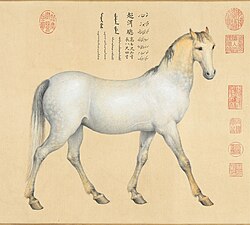


Ahmad Shah's gifts to the Qing emperor included four horses, which were painted by the Qing court painter, Giuseppe Castiglione. Nonetheless, by the time of the envoy's return journey to Afghanistan, Qianlong made preparations to secure Qing territories.[28]
In 1759, as the revolt of the Altishahr Khojas crumbled, two descendants of the Afaqi Sufi lineage crossed into Badakhshan, being pursued by the Qing forces. Fude, the Qing general of the expedition, demanded that Sultan Shah, the ruler of Badakhshan, to arrest the brothers. Sultan Shah accepted, likely wishing to receive Qing military aid against the Durrani Empire. Distrust occurred, however, due to the Afaqi descendants residing in Badakhshan for months, including Sultan Shah's initial refusal to hand them over, possibly intending to send them to Bukhara. Qianlong threatened invasion, which did not occur as one of the descendant's remains were sent to Yarkand.[29]
The death of the Afaqi brothers spurned relations with the Afghans, causing Sultan Shah to plead to the Qing, claiming that Ahmad Shah intended to exact revenge for their deaths. No immediate Afghan invasion occurred. The Qing however, faced numerous frustrations with their tributaries in Central Asia, alongside a major insurrection in Uch-Turfan that required tremendous effort to defeat.[30]
As a result, Qianlong adopted a policy of strict non-interference, realizing that Qing troops in Altishahr were significantly stretched and spread thin. The Afghans, however, seen as a threat, would show the weakness of Qing control in the region.[31]
In August 1768, Qianlong was informed of the Afghan invasion of Badakhshan led by Shah Wali Khan in May, with Afghan forces seizing Sultan Shah's capital, Fayzabad. A Qing agent, Yunggui, held the position that the Qing should interfere in the conflict. Qianlong, however, affirmed that military intervention would irrational, and strictly forbade any military interference. Historians see this as surprising, as the invasion by the Afghans threatened the Qing Empire itself.[32]
_in_Peking_in_1761.jpg)
Qing sources affirm that the Afghans established Sarimsaq, a child of the Afaqi's who escaped to Badakhshan, in Kunduz. Qianlong was distraught, as another possible revolt could revolve around Sarimsaq, especially after reports came of Muslim travelers and funds being sent to Sarimsaq. This still did not convince Qianlong to act, and he refused to send any negative response to Ahmad Shah at all. During this, Sultan Shah defeated the Afghan governor and reoccupied his capital, but feared another Afghan invasion, sending desperate letters to the Qing in the winter of 1768 to ask for help, claiming that Ahmad Shah would invade next year.[33]
Qianlong rebutted, blaming Sultan Shah for provoking the conflict with the Afghans and affirmed that he would only fight the Afghans if they actually invaded Qing territory. Sultan Shah wrote a letter to Emin Khoja in response in August 1769, expecting aid as he was a vassal, only to find himself abandoned. In December 1769, Sultan Shah wrote another letter that accused Qianlong of failing to uphold his duties. Qianlong rebuked him, and stated that under no circumstances would the Qing aid him.[34]
Qianlong's reply to Sultan Shah's plea for aid against Ahmad Shah
Qianlong had initially considered the Afghans tributaries, but after the former incident, he no longer even sought the prospect of any form of Durrani submission. His reply to Sultan Shah effectively saw the Qing recognize the Afghans as a rival power to them, with Qianlong recognizing that the Afghans were unable to be treated like tributaries. Rather than aiding the ruler of Badakhshan as his initial policy implicated him to, Qianlong instead justified the Afghan invasion, prompted to by overextended armies, the distance, and stability. Instead, gambling on the difficult terrain between the Afghan and Qing realms for safety.[36] Within the year, Ahmad Shah occupied Badakhshan and Sultan Shah was executed.[37]
Third Battle of Panipat[edit | edit source]

The Mughal power in northern India had been declining after the death of Emperor Aurangzeb, who died in 1707. In 1751–52, the Ahamdiya treaty was signed between the Marathas and Mughals, when Balaji Bajirao was the Peshwa.[39][page needed] Through this treaty, the Marathas controlled virtually the whole of India from their capital at Pune and the Mughal rule was restricted only to Delhi (the Mughals remained the nominal heads of Delhi). Marathas were now straining to expand their area of control towards the Northwest of India. Ahmad Shah sacked the Mughal capital and withdrew with the booty he coveted. To counter the Afghans, Peshwa Balaji Bajirao sent Raghunathrao. He defeated the Rohillas and Afghan garrisons in Punjab and succeeded in ousting Timur Shah and his court from India and brought Lahore, Multan, Kashmir and other subahs on the Indian side of Attock under Maratha rule.[40] Thus, upon his return to Kandahar in 1757, Ahmad was forced to return to India and face the formidable attacks of the Maratha Confederacy.
.jpg)
Ahmad Shah declared a jihad (or Islamic holy war) against the Marathas, and warriors from various Afghan tribes joined his army, including the Baloch people under the command of Khan of Kalat Mir Nasir I of Kalat. Suba Khan Tanoli (Zabardast Khan) was selected as army chief of all military forces. Early skirmishes were followed by victory for the Afghans against the much larger Maratha garrisons in Northwest India and by 1759 Ahmad Shah and his army had reached Lahore and were poised to confront the Marathas. Ahmad Shah Durrani was famous for winning wars much larger than his army[citation needed]. By 1760, the Maratha groups had coalesced into a big enough army under the command of Sadashivrao Bhau. Once again, Panipat was the scene of a confrontation between two warring contenders for control of northern India. The Third Battle of Panipat (14 January 1761), fought between largely Muslim and largely Hindu armies was waged along a twelve-kilometer front. There were rebellions in the north in the region of Bukhara. The Durranis decisively defeated the Marathas in the Third Battle of Panipat on 14 January 1761.[41] The defeat at Panipat resulted in heavy losses for the Marathas, and was a huge setback for Peshwa Balaji Rao. He received the news of the defeat of Panipat on 24 January 1761 at Bhilsa, while leading a reinforcement force. Besides several important generals, he had lost his own son Vishwasrao in the Battle of Panipat. He died on 23 June 1761, and was succeeded by his younger son Madhav Rao I.[42]
Final years[edit | edit source]

The victory at Panipat was the high point of Ahmad Shah's—and Afghan—power. However, even prior to his death, the empire began to unravel. In 1762, Ahmad Shah crossed the passes from Afghanistan for the sixth time to subdue the Sikhs. From this time and on, the domination and control of the Empire began to loosen, and by the time of Durrani's death he had lost parts of Punjab to the Sikhs, as well as earlier losses of northern territories to the Uzbeks, necessitating a compromise with them.[43]
He assaulted Lahore and, after taking their holy city of Amritsar, massacred thousands of Sikh inhabitants, destroyed their revered Golden Temple.[44] Within two years, the Sikhs rebelled again and rebuilt their holy city of Amritsar. Ahmad Shah tried several more times to subjugate the Sikhs permanently, but failed. Durrani's forces instigated the Vaḍḍā Ghallūghārā when they killed thousands of Sikhs in the Punjab in 1762.[45][lower-alpha 8][46] Ahmad Shah also faced other rebellions in the north, and eventually he and the Uzbek Emir of Bukhara agreed that the Amu Darya would mark the division of their lands. Ahmad Shah retired to his home in the mountains east of Kandahar, where he died in 1772.[47] He had succeeded to a remarkable degree in balancing tribal alliances and hostilities, and in directing tribal energies away from rebellion. He earned recognition as Ahmad Shah Baba, or "Father" of Afghanistan.[48]
Other Durrani rulers in the Empire (1772–1823)[edit | edit source]
Ahmad Shah's successors governed so ineptly during a period of profound unrest that within fifty years of his death, the Durrani empire per se was at an end, and Afghanistan was embroiled in civil war. Much of the territory conquered by Ahmad Shah fell to others in this half century. By 1818, the Sadozai rulers who succeeded Ahmad Shah controlled little more than Kabul and the surrounding territory within a 160-kilometer radius. They not only lost the outlying territories but also alienated other tribes and lineages among the Durrani Pashtuns.
Humayun Mirza (1772)[edit | edit source]
Prior to his death, Ahmad Shah announced that his son, Timur Shah, would inherit the empire. This was controversial in the court, as many powerul military and tribal leaders had supported Ahmad Shah's elder son, Sulaiman Shah; they attempted to convince Ahmad Shah to change his mind. However, Ahmad Shah said he felt that Sulaiman was violent, unpopular with the Kandahari Durranis, and would be an inferior leader. Timur's appointment would also possibly limit the power held by Senior Generals and the Durrani Tribal Council.[49] Timur was in Herat, however far from his ailing father; Begi Khan Bamizai and Sardar Jahan Khan used this opportunity to turn Ahmad Shah against his son. When Timur came to see his father, he turned him away. Recognizing that a conflict with his brother was imminent, Timur began building his forces; in this task he was interrupted by Darwish 'Ali Khan's revolt, an action was that possibly orchestrated by those loyal to Sulaiman. Timur promised Darwish Ali pardon and power, then executed him after he arrived in Herat.[50]
Upon Ahmad Shah's death in 1772, Shah Wali Khan and Sardar Jahan Khan pretended that the Shah was not dead, merely ill, and was being kept separate from all but the most trusted officials. They began a march, with his body, to the capital, Kandahar; upon arriving, they told Sulaiman of his father's death and declared Sulaiman was to be king. Timur received word of this from Amirs who had turned against Shah Wali, and he too went to Kandahar.[50] The two sides met at Farah, where Shah Wali and his sons were assassinated.[51] Shah Sulayman surrendered to Timur Shah and became loyal, according to Amir Habibullah Khan.[52] Timur Shah ascended the throne in November 1772.[53]

Timur Shah (1772–1793)[edit | edit source]
,_minted_in_Lahore,_dated_1757-1758.jpg)
Zaman Shah (1793–1801)[edit | edit source]

After the death of Timur Shah, three of his sons, the governors of Kandahar, Herat and Kabul, contended for the succession. Zaman Shah, governor of Kabul, held the field by virtue of being in control of the capital, and became shah at the age of twenty-three. Many of his half-brothers were imprisoned on their arrival in the capital for the purpose, ironically, of electing a new shah. The quarrels among Timur's descendants that threw Afghanistan into turmoil also provided the pretext for the interventions of outside forces.
The efforts of the Sadozai heirs of Timur to impose a true monarchy on the truculent Pashtun tribes, and their efforts to rule absolutely and without the advice of the other major Pashtun tribal leaders, were ultimately unsuccessful. The Sikhs started to rise under the command of Sikh chief, Ranjit Singh, who succeeded in wresting power from Zaman's forces. Later, when Zaman was blinded by his brother, Ranjit Singh gave him asylum in Punjab.
Zaman's downfall was triggered by his attempts to consolidate power. Although it had been through the support of the Barakzai chief, Painda Khan Barakzai, that he had come to the throne, Zaman soon began to remove prominent Barakzai leaders from positions of power and replace them with men of his own lineage, the Sadozai. This upset the delicate balance of Durrani tribal politics that Ahmad Shah had established and may have prompted Painda Khan and other Durrani chiefs to plot against the shah. Painda Khan and the chiefs of the Nurzai and the Alizai Durrani clans were executed, as was the chief of the Qizilbash clan. Painda Khan's son fled to Iran and pledged the substantial support of his Barakzai followers to a rival claimant to the throne, Zaman's younger brother, Mahmud Shah. The clans of the chiefs Zaman had executed joined forces with the rebels, and they took Kandahar without bloodshed. Mahmud Shah had then proceeded to march to Kabul, where he met Zaman Shah and his army on the way from Ghanzi to Kabul, Zaman Shah was decisively defeated, including portions of his army fleeing to Mahmud Shah's cause. Mahmud Shah ordered the lancing of Zaman Shah's eyes, and had succeeded Zaman Shah on the throne of the Durrani Empire.[54]
Mahmud Shah (first reign, 1801–1803)[edit | edit source]
Zaman Shah's overthrow in 1801 was not the end of civil strife in Afghanistan, but the beginning of even greater violence. Mahmud Shah's first reign lasted for only two years before he was replaced by Shuja Shah.
Shuja Shah (1803–1809 and 1839–1842)[edit | edit source]


Yet another of Timur Shah's sons, Shuja Shah (or Shah Shuja), ruled for only six years. On June 7, 1809, Shuja Shah signed a treaty with the British, which included a clause stating that he would oppose the passage of foreign troops through his territories. This agreement, the first Afghan pact with a European power, stipulated joint action in case of Franco-Persian aggression against Afghan or British dominions. Only a few weeks after signing the agreement, Shuja was deposed by his predecessor, Mahmud. Much later, he was reinstated by the British, ruling during 1839–1842. Two of his sons also ruled for a brief period in 1842.
Mahmud Shah (second reign, 1809–1818)[edit | edit source]
Mahmud's second reign lasted 9 years, where he had further attempted to consolidate power, but was deposed by his brother in 1818, Mahmud's reign was also disputed in 1810, while he was campaigning, another one of Timur Shah Durrani's sons had seized the throne, but was defeated by Shah Mahmud in 1810.
Abbas Mirza (1810)[edit | edit source]
While Mahmud Shah was campaigning in 1810, another one of Timur Shah's sons placed himself in rule at Kabul. Abbas Mirza ruled for a short period of time before being defeated by Mahmud Shah once he returned from campaign.
Sultan Ali Shah (1818–1819)[edit | edit source]
Ali Shah was another son of Timur Shah. He seized power for a brief period in 1818–1819. in 1818 or 1819, He was strangled by his brother, Isma'il.[55][page needed]
Ayub Shah (1819–1823)[edit | edit source]
Ayub Shah was another son of Timur Shah, who took control of the Durrani Empire after the death of Ali Shah Durrani.[56] The Durrani Empire lost its control over Kashmir to the Sikh Empire in the Battle of Shopian in 1819.[57] Ayub Shah was himself later deposed, and presumably killed in 1823.[58]
Durrani Herat (1793–1863)[edit | edit source]
![[icon]](/wiki/File:Wiki_letter_w_cropped.svg) | This section needs expansion. You can help by adding to it. (October 2023) |
Shah Shuja and the First Anglo Afghan War (1839–1842)[edit | edit source]
In the 19th century as a whole, Britain and Russia were interlocked in a battle for influence in South Asia. Russian advance was trudging through Central Asia, while the British were landing in the masses on the Indian subcontinent. The "Army of the Indus", full of both British and Indian infantrymen and cavalrymen, was intent on restoring Shah Shuja Durrani, the deposed monarch to the throne of Afghanistan. By March 1839, the British had already crossed into the Emirate of Afghanistan.
Military[edit | edit source]
The Durrani military was based on cavalry armed with flintlocks who performed hit-and-run attacks, combining new technology in firearms with Turco-Mongol tactics.[59] The core of the Durrani army were the 10,000 sher-bacha (blunderbuss)-carrying mounted ghulams (slave-soldiers) of which a third were previously Shia soldiers (Qizilbash) of Nader Shah. Many others were also former troops of Nader Shah. The bulk of the army were Afghan irregular tribal cavalry armed with lance and broadsword. Mounted archers were still used but were uncommon due to the difficulty of training them. Infantry played a very small role in the Durrani army and, with the exception of light swivel guns mounted on camels, the Zamburak, so did artillery.[60]
List of monarchs[edit | edit source]
Empire (1747–1823; 1839–1842)[edit | edit source]
Template:Succession table monarch
Kandahar (1793–1795)[edit | edit source]
Template:Succession table monarch
Herat (1793–1863)[edit | edit source]
Template:Succession table monarch
See also[edit | edit source]
Template:History of Afghanistan Template:Pashtuns
Notes[edit | edit source]
- ↑ "Timur Shah transferred the Durrani capital from Qandahar in 1775–76. Kabul and Peshawar then shared time as the dual Durrani capital cities, the former during the summer and the latter during the winter season." Quoted from Hanifi (2011), p. 185 n, 3.
- ↑ "Like the Kushans, the Afghan kings favoured Peshawar as a winter residence, and were aggrieved when the upstart Sikh kingdom snatched it in 1818 and levelled its buildings." Quoted from Singh (2008), p. 191.
- ↑ "[The Sadozai kingdom] continued to exist in Herat until the city finally fell to Dost Muhammad Khan in 1862."[1]
- ↑ Ahmad Shah Durrani wrote poetry in Pashto.[2]
- ↑ "Despite Ahmad Shah Durrani's flirtations with founding a Pashto-based bureaucracy, when the capital moved from Qandahar to Kabul in 1772, Durrani and post-Durrani Afghanistan retained Persian as its chancery and chief court language." Quoted from Green (2019), p. 42.
- ↑
- Pashto: د درانيانو ټولواکمني, romanized: Də Durrānyāno Ṭolwākmani, pronounced [d̪ə d̪u(ɾ).ɾɑn.jɑ.no ʈol.wɑk.ma.ni]
- Persian: امپراتوری درانیها, romanized: Imparātūrī-yi Durrānīhā, pronounced [ʔɪm.pʰä.ɾɑː.t̪ʰuː.ɾíː‿jɪ d̪uɾ.ɾɑː.níː‿ɦɑː]
- ↑ "Next to the Ottoman Empire, the Durrani Empire was the greatest Muslim empire of the second half of the eighteenth century." Quoted from Dupree (1980), p. 334.
- ↑ "Ghallughara is a Punjabi word meaning large scale massacre of people or carnage or holocaust. Two events in Sikh history are particularly known as ghallugharas. 1. Chhota Ghallughara .......[and] 2. Wadda Ghallughara : This took place in 1762 AD. Ahmad Shah Abdali had invaded India again in 1761 AD. This time his main aim was to teach the Sikhs a lesson for capturing Lahore and other important areas. ..... On February 3, 1762 AD he caught up with the Sikh families at Kupp near Malerkotla comprising 35000 women and children. Despite the efforts of Jassa Singh Ahluwalia and other Sikh generals, Abdali was successful in killing every Sikh man, woman and child who was camping at Kupp on February 5, 1762 AD. This massacre has become known in Sikh history as Wadda Glzallughara (major holocaust)." Quoted from Singha (2005), p. 76.
References[edit | edit source]
- ↑ 1.0 1.1 Lee (1996), p. 116.
- ↑ 2.0 2.1 Schimmel 1975, p. 12.
- ↑ Archambault, Hannah (19 April 2023). "Afghan Circulations in the Persianate World, c. 1000–1800". Oxford Research Encyclopedia of Asian History. Retrieved 16 October 2023.
- ↑ Hanifi, Shah Mahmoud (15 August 2022). "Deciphering the History of Modern Afghanistan". Oxford Research Encyclopedia of Asian History. Retrieved 16 October 2023.
- ↑ Bosin, Yury V. (2009). "Durrani empire, popular protests, 1747–1823" (PDF). In Immanuel Ness (ed.). International Encyclopedia of Revolution and Protest. Blackwell Publishing. p. 1029.
- ↑ Noelle, Christine (1997). State and Tribe in Nineteenth Century Afghanistan The Reign of Amir Dost Muhammad Khan (1826–1863). Routledge. p. 15. ISBN 9780700706297.
- ↑ Tate, George P. (2009) [1911]. The Kingdom of Afghanistan: A Historical Sketch. BiblioBazaar. ISBN 9781115584029.
- ↑ Sabahuddin, Abdul (2008). History of Afghanistan. Global Vision Publishing House. ISBN 9788182202467.
- ↑ Huntington, Ellsworth (1907). "The Anglo-Russian Agreement as to Tibet, Afghanistan, and Persia". Bulletin of the American Geographical Society. 39 (11): 653–658.
- ↑ Dupree, Louis; et al., eds. (2010). "Last Afghan empire". Britannica.com. Retrieved 20 January 2026.
- ↑ Singh, Ganda (1959). Ahmad Shah Durrani: Father of Modern Afghanistan (PDF). Asia Publishing House. Archived from the original on 7 February 2013. Retrieved 7 February 2013.
- ↑ Lee (1996), p. 190.
- ↑ Mojtahed-Zadeh, Pirouz (2006). Boundary Politics and International Boundaries of Iran. Universal-Publishers. p. 164. ISBN 9781581129335.
- ↑ Malleson (1878), p. 298.
- ↑ Siddique, Abubakar (2014). The Pashtun Question: The Unresolved Key to the Future of Pakistan and Afghanistan. Hurst. p. 31. ISBN 978-1-84904-292-5.
- ↑ "Afghanistan". The World Factbook (2026 ed.). Central Intelligence Agency. Retrieved 25 January 2026.
- ↑ Template:Encyclopædia Iranica Online
- ↑ Dupree (1980), p. 333.
- ↑ Runion (2017), p. 69.
- ↑ Newby (2005), p. 34.
- ↑ Adle, Chahryar; Habib, Irfan; Baipakov, Karl M., eds. (2003). History of civilizations of Central Asia. Vol. 5 - Development in contrast: from the sixteenth to the mid-nineteenth century. UNESCO Publishing. p. 75. ISBN 9789231038761.
- ↑ Eijk & Khan (2023), pp. 715-6.
- ↑ Eijk & Khan (2023), pp. 716-7.
- ↑ Eijk & Khan (2023), pp. 717-8.
- ↑ Eijk & Khan 2023, p. 708.
- ↑ Eijk & Khan (2023), pp. 718-20.
- ↑ Eijk & Khan (2023), pp. 720-4.
- ↑ Eijk & Khan (2023), pp. 724-6.
- ↑ Eijk & Khan (2023), pp. 726-9.
- ↑ Eijk & Khan (2023), pp. 729-30.
- ↑ Eijk & Khan (2023), pp. 730-2.
- ↑ Eijk & Khan (2023), p. 732.
- ↑ Eijk & Khan (2023), p. 733.
- ↑ Eijk & Khan (2023), p. 733-4.
- ↑ Eijk & Khan 2023, p. 734.
- ↑ Eijk & Khan (2023), pp. 734-5.
- ↑ Newby (2005), p. 43.
- ↑ Ikram, S. Mohamad (1964). Embree, Ainslie T. (ed.). Muslim Civilization in India. Columbia University Press. pp. 254-76 (Ch. XIX - "A Century of Political Decline: 1707–1803").
- ↑ Patil, Vishwas (2005). Panipat (in ગુજરાતી). Mumbaī: Navabhārata Sāhitya Mandira. OCLC 57710656.
- ↑ Roy (2004), pp. 80–1.
- ↑ Roy (2004), pp. 84–94.
- ↑ Chhabra, G.S. (2005). Advance Study in the History of Modern India. Vol. 1 (1707–1803). Lotus Press. pp. 29–47. ISBN 9788189093068.
- ↑ Runion (2017), p. 71.
- ↑ Dhavan, Purnima (2011). When Sparrows Became Hawks: The Making of the Sikh Warrior Tradition, 1699-1799. Oxford Univ. Press. p. 112. ISBN 9780199756551.
- ↑ Singh, Khushwant (1978). A History of the Sikhs. Vol. I - 1469–1839. Delhi: Oxford Univ. Press. pp. 144–5, 154.
- ↑ Latif, Syad Muhammad (1891). The History of Punjab from the Remotest Antiquity to the Present Time. Kolkata: Central Press. p. 282-3.
- ↑ Reddy, L. R. (2002). Inside Afghanistan: end of the Taliban era?. APH Publishing. p. 65. ISBN 9788176483193.
- ↑ Singh (2008), p. 191.
- ↑ Lee (2022), p. 144.
- ↑ 50.0 50.1 Lee (2022), p. 145.
- ↑ Cite error: Invalid
<ref>tag; no text was provided for refs named{{{1}}} - ↑ Cite error: Invalid
<ref>tag; no text was provided for refs namedKatib2013_55 - ↑ Katib (2013), pp. 56-7.
- ↑ Lee (2022), pp. 162-3.
- ↑ Lee (2022).
- ↑ "History of Ancient Pakistan - Durrani Empire (c. 1747–1826 CE)". The Land Of Pure People. 11 January 2024. Retrieved 12 July 2025.
- ↑ Chopra, Gulshan Lall (1928). The Panjab as a Sovereign State, 1799-1839 (University of London, PhD thesis). Lahore: Uttar Chand Kapur and Sons. pp. 25-6.
- ↑ "Durranis". State Bank of Pakistan Museum.
- ↑ Black, Jeremy (2012). Keegan, John (ed.). War in the Eighteenth-Century World (eBook ed.). Macmillan International Higher Education. p. 79. ISBN 978-0230370005.
- ↑ Gommans, Jos (2018). The Indian Frontier: Horse and Warband in the Making of Empires. Routledge. Ch. 6. ISBN 9781032652597.
Sources[edit | edit source]
- Dupree, Louis (1980). Afghanistan. Princeton Univ. Press. ISBN 0691000239.
- Eijk, Juul; Khan, Timur (2023). "'Do You Not Bow before Heaven?': The First Qing- Durrānī Encounter, the Tributary Non-relationship, and Disorder on a Shared Frontier" (PDF). Journal of the Economic and Social History of the Orient. 66 (5–6): 707–741. doi:10.1163/15685209-12341605. ISSN 1568-5209.
- Elphinstone, Mountstuart (1815). An account of the kingdom of Caubul, and its dependencies in Persia, Tartary and India: comprising a view of the Afghaun nation and a history of the Dooraunee monarchy. London: Longman, Hurst, Rees, Orme, and Brown.
- Fraser-Tytler, William Kerr (1953). Afghanistan: A Study of Political Developments in Central and Southern Asia. London: Oxford University Press. OCLC 409453.
- Green, Nile (2019). "The Rise of New Imperial and National Languages (ca. 1800 – ca. 1930)". In Green, Nile (ed.). The Persianate World: The Frontiers of a Eurasian Lingua Franca. University of California Press. ISBN 978-0520972100.
- Hanifi, Shah Mahmoud (2011). Connecting Histories in Afghanistan: Market Relations and State Formation on a Colonial Frontier. Stanford University Press. ISBN 9780804777773. Retrieved 4 August 2012.
- Katib, Fayz Muhammad (2013) [1912]. The History Of Afghanistan (Sirāj Al Tawārīkh). Vol. 1 - The Saduza’i Era 1747-1843. Translated by R.D. Mcchesney. Brill. ISBN 9789004234925. Retrieved 21 January 2026.
- Lee, Jonathan L. (1996). The Ancient Supremacy: Bukhara, Afghanistan and the Battle for Balkh, 1731–1901 (illustrated ed.). Brill. ISBN 9004103996. Retrieved 8 March 2013.
- Lee, Jonathan L. (2022). Afghanistan A History From 1260 To The Present. Reaktion Books. ISBN 9781789145885. Retrieved 24 January 2026.
- Malleson, George Bruce (1878). History of Afghanistan, from the Earliest Period to the Outbreak of the War of 1878. London: W.H. Allen & Co. OCLC 4219393 – via Google Books.
- Newby, Laura J. (2005). The Empire And the Khanate: A Political History of Qing Relations With Khoqand C1760-1860. Brill. ISBN 9789004145504.
- Roy, Kaushik (2004). India's Historic Battles: From Alexander the Great to Kargil. Orient Blackswan. ISBN 9788178241098.
- Runion, Meredith L. (2017). The History of Afghanistan (2nd, illustrated ed.). Greenwood. ISBN 9781610697774. Retrieved 25 January 2026.
- Schimmel, AnneMarie (1975). Pain and Grace: A study of Two Mystical Writers of Eighteenth-Century Muslim India. Brill.
- Singh, Ganda (1959). Ahmad Shah Durrani: Father of Modern Afghanistan. London: Asia Publishing House. OCLC 4341271.
- Singh, Sarina (2008). Pakistan and the Karakoram Highway. Lonely Planet. ISBN 9781741045420. Retrieved 10 August 2012.
- Singha, H.S. (2005) [2000]. "Ghallughara" (PDF). The Encyclopedia of Sikhism. New Delhi: Hemkunt. ISBN 8170103010.
- Tanner, Stephen (2002). Afghanistan: a military history from Alexander the Great to the fall of the Taliban. New York: Da Capo Press. ISBN 0-306-81164-2.
External links[edit | edit source]
- Afghanistan 1747–1809: Sources in the India Office Records Archived 7 September 2011 at the Wayback Machine
- Biography of Ahmad Shah Abdali (Durrani)
- Ahmad Shah Baba
- History of Abdali tribe[usurped]
- Afghanistan and the Search for Unity Article on Durrani methods of government, published in Asian Affairs, Volume 38, Issue 2, 2007, pp. 145–157.
Template:Durrani dynasty Template:Pashtun Template:Islam in South Asia
- Pages with Pashto IPA
- Pages with Dari IPA
- Pages using the JsonConfig extension
- Durrani Empire
- Durrani dynasty
- Former monarchies in Afghan history
- Former monarchies of India
- Former Islamic monarchies
- Muslim period in the Indian subcontinent
- Modern history of Afghanistan
- History of Khyber Pakhtunkhwa
- States and territories established in 1747
- States and territories disestablished in 1823
- States and territories established in 1839
- States and territories disestablished in 1842
- 1747 establishments in Asia
- 1823 disestablishments in Asia
- 18th century in Afghanistan
- 19th century in Afghanistan
- 18th century in the Mughal Empire