



Ajay Kumar (talk | contribs) Created a new article |
SabinaGuffey (talk | contribs) m Article updated with improved flow |
||
| Line 1: | Line 1: | ||
{{Short description|Horse of Alexander the Great}} | |||
{{Other uses|Bucephalus (disambiguation)}} | {{Other uses|Bucephalus (disambiguation)}} | ||
{{citation style|date=March 2026}} | |||
{{Infobox animal | |||
| name = Bucephalus <!--- Is "Bucephalas" or "Bucephalus" the more common/grammatically correct name? ---> | |||
| image = File:Seleucos I Bucephalos coin.jpg | |||
| landscape = <!-- yes, if wide image, otherwise leave blank --> | |||
| alt = <!-- descriptive text for use by speech synthesis (text-to-speech) software --> | |||
| caption = Coin depicting Bucephalas, issued by [[Seleucus I Nicator]]. Note the horns on his head, from a literal interpretation of his name, which means "ox-head". | |||
| othername = | |||
| species = [[Horse]] | |||
| breed = | |||
| gender = Male | |||
| birth_name = <!-- (or hatch_name= value; for non-mammals) --> | |||
| birth_date = {{circa|355 BC}} | |||
| birth_place = <!-- (or hatch_place= value; for non-mammals)--> | |||
| death_date = June 326 BC (aged 30) | |||
| death_place = [[Punjab|Pentapotamia]], [[Macedonian Empire]] <small>(modern-day [[Pakistan]])</small> | |||
| death_cause = | |||
| resting_place = [[Bucephala and Nicaea|Bucephala]] | |||
| nationality = <!-- use only when necessary per [[WP:INFONAT]] --> | |||
| occupation = Warhorse | |||
| years_active = 344 BC – 326 BC | |||
| known_for = | |||
| tricks = | |||
| awards = | |||
| title = | |||
| term = | |||
| predecessor = | |||
| successor = | |||
| owner = [[Alexander III of Macedon]] | |||
| residence = | |||
| parents = | |||
| mate = | |||
| children = | |||
| footnotes = | |||
}} | |||
Bucephalus | '''Bucephalus''' ({{IPAc-en|b|juː|.|ˈ|s|ɛ|.|f|ə|.|l|ə|s|}}; {{langx|grc|Βουκεφᾰ́λᾱς|translit=Boukephalas}}; {{Circa|355 BC}} – June 326 BC) or '''Bucephalas''', was the [[horse]] of [[Alexander the Great]], and one of the most famous horses of [[classical antiquity]].<ref>{{cite news |url= https://www.worldhistory.org/Bucephalus/|title=The Bucephalus|newspaper=World History Encyclopedia|date=6 October 2011|first1=Donald|last1=Wasson}}</ref> According to the ''[[Alexander Romance]]'' (1.15), the name "Bucephalus" literally means "ox-headed" (from {{langx|grc|[[wiktionary:βοῦς#Ancient_Greek|βοῦς]]|translit=bûs|lit=[[ox]]|label=none}} and {{langx|el|[[wiktionary:κεφαλή#Ancient_Greek|κεφᾰλή]]|translit=cephălē|lit=head|label=none}}), and supposedly comes from a [[Bucephalus (brand)|brand]] (or scar) on the thigh of the horse that looked like an ox's head.<ref name=":0">{{Cite book |last=Kouymjian |first=Dickran |url=https://www.academia.edu/3079908 |title=Byzantium and Renaissances. Dialogue of Cultures, Heritage of Antiquity, Tradition and Modernity |date=2012 |publisher=University of Warsaw Press |pages=209–216 |chapter=Did Byzantine Iconography Influence the Large Cycle of the Life of Alexander the Great in Armenian Manuscripts?}}</ref> | ||
Ancient historical accounts<ref>The primary (actually secondary) accounts are two: [[Plutarch]]'s ''Life of Alexander'', 6, and [[Arrian]]'s ''[[Anabasis Alexandri]]'' V.19.</ref> state that Bucephalus's breed was that of the "best [[Thessaly|Thessalian]] strain", and that he died in what is now [[Punjab, Pakistan|Punjab]], [[Pakistan]], after the [[Battle of the Hydaspes]] in 326 BC. Alexander was so grieved at the loss of his horse that he named [[List of cities founded by Alexander the Great|one of the many cities he founded]] after him, as [[Alexandria Bucephalus]]. | |||
== Taming of Bucephalus == | == Taming of Bucephalus == | ||
[[File:Alexander & Bucephalus by John Steell.JPG|thumb| | [[File:Alexander & Bucephalus by John Steell.JPG|thumb|left|A statue by [[John Steell]] showing Alexander taming Bucephalus]] | ||
A massive creature with a massive head, Bucephalus is described as having a black coat with a large white star on his brow.{{Citation needed|date=November 2021}} | A massive creature with a massive head, Bucephalus is described as having a black coat with a large white star on his brow.{{Citation needed|date=November 2021}} He is also supposed to have had a "[[Horse markings#Other identifying features|wall eye]]" (blue eye),{{Citation needed|date=November 2021}} and his breeding was that of the "best [[Thessaly|Thessalian]] strain". | ||
[[Plutarch]] says in 344 BC, at twelve or thirteen years of age, Alexander of [[Macedonia (ancient kingdom)|Macedonia]] won the horse by making a wager with his father: | [[Plutarch]] says<ref name="Plut6">{{cite Plutarch|Alexander|6}}</ref> that in 344 BC, at twelve or thirteen years of age, Alexander of [[Macedonia (ancient kingdom)|Macedonia]] won the horse by making a wager with his father: a horse dealer named Philonicus the Thessalian offered Bucephalus to [[Philip II of Macedon|King Philip II]] for the remarkably high sum of 13 [[talent (measurement)|talents]].{{efn|Loeb (1919) values one talent at £235, or $1,200; Thayer gives $15,600 (2007).<ref name="Plut6"/>}} Because no one could tame the animal, Philip was not interested. However, Alexander was, and he offered to pay himself should he fail. | ||
Alexander was given a chance and surprised all by subduing | Alexander was given a chance and surprised all by subduing the horse. He spoke soothingly to the horse and turned its head toward the sun so that it could no longer see its own shadow, which had been the cause of its distress. Dropping his fluttering [[cloak]] as well, Alexander successfully tamed the horse. Plutarch says that the incident so impressed Philip that he told the boy, "O my son, look thee out a kingdom equal to and worthy of thyself, for Macedonia is too little for thee."<ref name="Plut6"/> Philip's speech strikes the only false note in the anecdote, according to A. R. Anderson,<ref>Anderson 1930:3 and 17ff.</ref> who noted his words as the embryo of the legend fully developed in the ''History of Alexander the Great'' I.15, 17. | ||
The ''[[Alexander Romance]]'' presents a mythic variant of Bucephalus's origin. In this tale, the colt, whose heroic attributes surpassed even those of [[Pegasus]], is bred and presented to Philip on his own [[estate (land)|estate]]s. | The ''[[Alexander Romance]]'' presents a mythic variant of Bucephalus's origin. In this tale, the colt, whose heroic attributes surpassed even those of [[Pegasus]], is bred and presented to Philip on his own [[estate (land)|estate]]s. The mythic attributes of the animal are further reinforced in the romance by the [[Delphic Oracle]] who tells Philip that the destined king of the world will be the one who rides Bucephalus, a horse with the mark of the ox's head on his haunch. | ||
== Alexander and Bucephalus == | == Alexander and Bucephalus == | ||
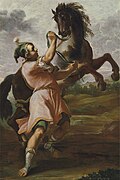
[[File:Domenico Maria Canuti - Alexander and Bucephalus.jpeg|thumb|left|upright|''Alexander and Bucephalus'' by [[Domenico Maria Canuti]], 17th century]] | |||
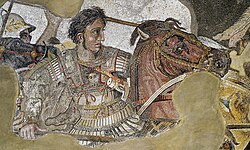
[[File:Alexander the Great mosaic.jpg|thumb|right|Alexander and Bucephalus in combat at the [[Battle of Issus]] portrayed in the [[Alexander Mosaic]]]] | [[File:Alexander the Great mosaic.jpg|thumb|right|Alexander and Bucephalus in combat at the [[Battle of Issus]] portrayed in the [[Alexander Mosaic]]]] | ||
[[File:Benjamin Robert Haydon (1786-1846) - Alexander the Great (356–323 BC), Taming Bucephalus - 485149 - National Trust.jpg|thumb|''[[Alexander the Great Taming Bucephalus]]'' by [[Benjamin Robert Haydon]], 1826]] | |||
As one of his chargers, Bucephalus served Alexander in numerous battles. | As one of his chargers, Bucephalus served Alexander in numerous battles. | ||
The value which Alexander placed on Bucephalus emulated his hero and supposed ancestor [[Achilles]], who claimed that his horses were | The value which Alexander placed on Bucephalus emulated his hero and supposed ancestor [[Achilles]], who claimed that his horses were "known to excel all others—for they are immortal. [[Poseidon]] gave them to my father [[Peleus]], who in his turn gave them to me."<ref>Homer, ''The Iliad'', Book XXIII.</ref> | ||
[[Arrian]] states, with [[Onesicritus]] as his source, that Bucephalus died at the age of thirty. | [[Arrian]] states, with [[Onesicritus]] as his source, that Bucephalus died at the age of thirty. Other sources, however, give as the cause of death not old age or weariness, but fatal injuries at the [[Battle of the Hydaspes]] (June 326 BC), in which Alexander's army defeated [[King Porus]]. Alexander promptly founded a city, [[Alexandria Bucephalous|Bucephala]], in honour of his horse. It was on the west bank of the [[Jhelum River|Hydaspes river]] (modern-day [[Jhelum (City)|Jhelum]] in [[Pakistan]]).<ref>Rolf Winkes, "Boukephalas", ''Miscellanea Mediterranea'' (''Archaeologia Transatlantica XVIII'') Providence [[2000 in literature|2000]], pp. 101–107.</ref> The modern-day town of [[Jalalpur Sharif]], outside Jhelum, is said to be where Bucephalus is buried.<ref>[[Michael Wood (historian)|Michael Wood]], "In the footsteps of Alexander the Great".</ref> | ||
The legend of Bucephalus grew in association with that of Alexander, beginning with the fiction that they were born simultaneously: some of the later versions of the [[Alexander Romance]] also synchronized the hour of their death.<ref>Andrew Runni Anderson, "Bucephalas and His Legend" ''The American Journal of Philology'' '''51'''.1 (1930:1–21).</ref> | The legend of Bucephalus grew in association with that of Alexander, beginning with the fiction that they were born simultaneously: some of the later versions of the ''[[Alexander Romance]]'' also synchronized the hour of their death.<ref>Andrew Runni Anderson, "Bucephalas and His Legend" ''The American Journal of Philology'' '''51'''.1 (1930:1–21).</ref> The Bucephalus appears in almost all versions of the ''[[Armenian Alexander Romance]]'', and visual illustrations in the surviving manuscripts of this text sometimes represent scenes with the Bucephalus.<ref name=":0" /> | ||
== See also == | == See also == | ||
* [[List of historical horses]] | * [[List of historical horses]] | ||
* [[List of fictional horses]] | * [[List of fictional horses]] | ||
==Notes== | == Notes == | ||
{{notelist}} | {{notelist}} | ||
| Line 45: | Line 77: | ||
* {{Commons-inline}} | * {{Commons-inline}} | ||
{{Authority control}} | {{Authority control}} | ||
| Line 52: | Line 83: | ||
[[Category:Alexander the Great in legend]] | [[Category:Alexander the Great in legend]] | ||
[[Category:Ancient Greece]] | [[Category:Ancient Greece]] | ||
[[Category:History of | [[Category:History of Punjab]] | ||
[[Category:Individual warhorses]] | [[Category:Individual warhorses]] | ||
[[Category:Individual male horses]] | [[Category:Individual male horses]] | ||
Latest revision as of 04:13, 21 March 2026
 | This article has an unclear citation style. |
 Coin depicting Bucephalas, issued by Seleucus I Nicator. Note the horns on his head, from a literal interpretation of his name, which means "ox-head". | |
| Species | Horse |
|---|---|
| Born | c. 355 BC |
| Died | June 326 BC (aged 30) Pentapotamia, Macedonian Empire (modern-day Pakistan) |
| Resting place | Bucephala |
| Occupation | Warhorse |
| Years active | 344 BC – 326 BC |
| Owner | Alexander III of Macedon |
Bucephalus (/bjuː.ˈsɛ.fə.ləs/; Ancient Greek: Βουκεφᾰ́λᾱς, romanized: Boukephalas; c. 355 BC – June 326 BC) or Bucephalas, was the horse of Alexander the Great, and one of the most famous horses of classical antiquity.[1] According to the Alexander Romance (1.15), the name "Bucephalus" literally means "ox-headed" (from βοῦς, bûs, 'ox' and κεφᾰλή, cephălē, 'head'), and supposedly comes from a brand (or scar) on the thigh of the horse that looked like an ox's head.[2]
Ancient historical accounts[3] state that Bucephalus's breed was that of the "best Thessalian strain", and that he died in what is now Punjab, Pakistan, after the Battle of the Hydaspes in 326 BC. Alexander was so grieved at the loss of his horse that he named one of the many cities he founded after him, as Alexandria Bucephalus.
Taming of Bucephalus[edit | edit source]

A massive creature with a massive head, Bucephalus is described as having a black coat with a large white star on his brow.[citation needed] He is also supposed to have had a "wall eye" (blue eye),[citation needed] and his breeding was that of the "best Thessalian strain".
Plutarch says[4] that in 344 BC, at twelve or thirteen years of age, Alexander of Macedonia won the horse by making a wager with his father: a horse dealer named Philonicus the Thessalian offered Bucephalus to King Philip II for the remarkably high sum of 13 talents.[lower-alpha 1] Because no one could tame the animal, Philip was not interested. However, Alexander was, and he offered to pay himself should he fail.
Alexander was given a chance and surprised all by subduing the horse. He spoke soothingly to the horse and turned its head toward the sun so that it could no longer see its own shadow, which had been the cause of its distress. Dropping his fluttering cloak as well, Alexander successfully tamed the horse. Plutarch says that the incident so impressed Philip that he told the boy, "O my son, look thee out a kingdom equal to and worthy of thyself, for Macedonia is too little for thee."[4] Philip's speech strikes the only false note in the anecdote, according to A. R. Anderson,[5] who noted his words as the embryo of the legend fully developed in the History of Alexander the Great I.15, 17.
The Alexander Romance presents a mythic variant of Bucephalus's origin. In this tale, the colt, whose heroic attributes surpassed even those of Pegasus, is bred and presented to Philip on his own estates. The mythic attributes of the animal are further reinforced in the romance by the Delphic Oracle who tells Philip that the destined king of the world will be the one who rides Bucephalus, a horse with the mark of the ox's head on his haunch.
Alexander and Bucephalus[edit | edit source]


_-_Alexander_the_Great_(356%E2%80%93323_BC),_Taming_Bucephalus_-_485149_-_National_Trust.jpg)
As one of his chargers, Bucephalus served Alexander in numerous battles.
The value which Alexander placed on Bucephalus emulated his hero and supposed ancestor Achilles, who claimed that his horses were "known to excel all others—for they are immortal. Poseidon gave them to my father Peleus, who in his turn gave them to me."[6]
Arrian states, with Onesicritus as his source, that Bucephalus died at the age of thirty. Other sources, however, give as the cause of death not old age or weariness, but fatal injuries at the Battle of the Hydaspes (June 326 BC), in which Alexander's army defeated King Porus. Alexander promptly founded a city, Bucephala, in honour of his horse. It was on the west bank of the Hydaspes river (modern-day Jhelum in Pakistan).[7] The modern-day town of Jalalpur Sharif, outside Jhelum, is said to be where Bucephalus is buried.[8]
The legend of Bucephalus grew in association with that of Alexander, beginning with the fiction that they were born simultaneously: some of the later versions of the Alexander Romance also synchronized the hour of their death.[9] The Bucephalus appears in almost all versions of the Armenian Alexander Romance, and visual illustrations in the surviving manuscripts of this text sometimes represent scenes with the Bucephalus.[2]
See also[edit | edit source]
Notes[edit | edit source]
References[edit | edit source]
- ↑ Wasson, Donald (6 October 2011). "The Bucephalus". World History Encyclopedia.
- ↑ 2.0 2.1 Kouymjian, Dickran (2012). "Did Byzantine Iconography Influence the Large Cycle of the Life of Alexander the Great in Armenian Manuscripts?". Byzantium and Renaissances. Dialogue of Cultures, Heritage of Antiquity, Tradition and Modernity. University of Warsaw Press. pp. 209–216.
- ↑ The primary (actually secondary) accounts are two: Plutarch's Life of Alexander, 6, and Arrian's Anabasis Alexandri V.19.
- ↑ 4.0 4.1 4.2 Plutarch, Parallel Lives, "Life of Alexander" 6 (ed. Clough 1859; ed. Loeb).
- ↑ Anderson 1930:3 and 17ff.
- ↑ Homer, The Iliad, Book XXIII.
- ↑ Rolf Winkes, "Boukephalas", Miscellanea Mediterranea (Archaeologia Transatlantica XVIII) Providence 2000, pp. 101–107.
- ↑ Michael Wood, "In the footsteps of Alexander the Great".
- ↑ Andrew Runni Anderson, "Bucephalas and His Legend" The American Journal of Philology 51.1 (1930:1–21).