

RobbyAyres (talk | contribs) Structure improved and content revised |
CleanupBot (talk | contribs) m Robot: Replacing encoded entity with character |
||
| Line 14: | Line 14: | ||
| mother = Vijayādevī | | mother = Vijayādevī | ||
| height = 450 ''[[Dhanusha (unit)|dhanush]]'' (1,350 meters) | | height = 450 ''[[Dhanusha (unit)|dhanush]]'' (1,350 meters) | ||
| age = 72 lakh purvas (508.032 x 10 | | age = 72 lakh purvas (508.032 x 10<sup>18</sup> years old) | ||
| tree = ''Saptaparna'' ([[Alstonia scholaris]]) | | tree = ''Saptaparna'' ([[Alstonia scholaris]]) | ||
| predecessor = [[Rishabhanatha]] | | predecessor = [[Rishabhanatha]] | ||
| Line 20: | Line 20: | ||
| birth_place = [[Ayodhya (Ramayana)|Ayodhya]] | | birth_place = [[Ayodhya (Ramayana)|Ayodhya]] | ||
| dynasty = [[Solar dynasty|Ikṣvākuvaṁśa]] | | dynasty = [[Solar dynasty|Ikṣvākuvaṁśa]] | ||
| siblings = [[Sagara (Hinduism)#Jainism|Sagara]] | | siblings = [[Sagara (Hinduism)#Jainism|Sagara]] <br> (step-brother/cousin) | ||
}} | }} | ||
{{Jainism}} | {{Jainism}} | ||
| Line 26: | Line 26: | ||
==In Jain texts== | ==In Jain texts== | ||
Ajitnatha (lit. invincible){{sfn|Vijay K. Jain|2015|p=183}} was the second [[tirthankara]] of the present age, ''avasarpini'' (half [[Jain cosmology#Time cycle|time cycle]] in [[Jain cosmology]]) according to [[Jainism]].{{sfn|Tukol|1980|p=31}} Ajitnatha was born in the town of Saketa to King Jitashatru and Queen Vijaya at [[Ayodhya (Ramayana)|Ayodhya]] (Vinita-Saketa) | Ajitnatha (lit. invincible){{sfn|Vijay K. Jain|2015|p=183}} was the second [[tirthankara]] of the present age, ''avasarpini'' (half [[Jain cosmology#Time cycle|time cycle]] in [[Jain cosmology]]) according to [[Jainism]].{{sfn|Tukol|1980|p=31}} Ajitnatha was born in the town of Saketa to King Jitashatru and Queen Vijaya at [[Ayodhya (Ramayana)|Ayodhya]] (Vinita-Saketa)<ref name=":0">{{Cite book |last=Shah |first=Umakant Premanand |url=https://books.google.com/books?id=m_y_P4duSXsC&q=jaina+rupa+mandana |title=Jaina-rūpa-maṇḍana |date=1987 |publisher=Abhinav Publications |isbn=978-81-7017-208-6 |location=New Delhi |pages=128 |language=en |trans-title=Jaina Iconography}}</ref> in the [[Ikshvaku dynasty]] on ''magha-shukla-dashmi'' (the tenth day of the bright half of the month of ''[[Magha (month)|Magha]]'').{{sfn|Tukol|1980|p=31}} His height was 450 [[Dhanusha (unit)|bows]] or 2,700 feets.{{sfn|Finegan|1952|p=190}}{{sfn|Finegan|1952|p=191}} He lived for a span of 72 [[lakh]] ''[[purva]]''.{{sfn|Vijay K. Jain|2015|p=183}}{{sfn|Finegan|1952|p=190}} | ||
According to [[Hemachandra]], he was named Ajita because the king father was unable to defeat his mother in gambling until he was in her womb. ''Uttarapurana'', a Digambara text, explains that he was named Ajita because he could not be defeated by sins or all heretics. | According to [[Hemachandra]], he was named Ajita because the king father was unable to defeat his mother in gambling until he was in her womb. ''Uttarapurana'', a Digambara text, explains that he was named Ajita because he could not be defeated by sins or all heretics.<ref name=":0" /> He attained ''kevala jnana'' under the ''saptaparna'' tree ([[Alstonia scholaris]])<ref name=":0" /> and ''[[Moksha (Jainism)|Moksha]]'' on ''chaitra-shukla-panchmi'' (fifth day of the bright half of the month of ''[[Chaitra]]'') from [[Shikharji]].{{sfn|Krishna|Amirthalingam|2014|p=46}}{{sfn|Vijay K. Jain|2015|p=183}}<ref name=":0" /> He had 90 ''[[Ganadhara]]s'' and Simhasena was his chief among them. Falgu (according to [[Śvetāmbara|Swetambara]] tradition) or Prakubja (according to [[Digambara]] tradition) was a chief of his order of the nuns.{{sfn|Vijay K. Jain|2015|p=183}}<ref name=":0" /> | ||
The ''[[Yajurveda]]'' mentions the name of Ajitanatha, but the meaning is not clear. According to Jain traditions, his younger cousin brother was [[King Sagara|Sagara]]. Sagara, who became the second [[Chakravartin]], is known from the traditions of both [[Hinduism|Hindu]] and Jain scriptures. | The ''[[Yajurveda]]'' mentions the name of Ajitanatha, but the meaning is not clear. According to Jain traditions, his younger cousin brother was [[King Sagara|Sagara]]. Sagara, who became the second [[Chakravartin]], is known from the traditions of both [[Hinduism|Hindu]] and Jain scriptures.<ref>{{citation |last=Jain |first=Kailash Chandra |title=Antiquity of Jainism |url=http://www.fas.harvard.edu/~pluralsm/affiliates/jainism/article/antiquity.htm |publisher=[[Jainism Literature Center]] |author-link=Kailash Chandra Jain}}</ref><ref name=":0" /> | ||
Ajitanatha is said to have been born 50 ''lakh crore sagara'' after his predecessor, [[Rishabhanatha]].{{sfn|Finegan|1952|p=190}} His successor, [[Sambhavanatha]], is said to have been born 30 ''lakh crore sagara'' after him.{{sfn|Finegan|1952|p=190}} | Ajitanatha is said to have been born 50 ''lakh crore sagara'' after his predecessor, [[Rishabhanatha]].{{sfn|Finegan|1952|p=190}} His successor, [[Sambhavanatha]], is said to have been born 30 ''lakh crore sagara'' after him.{{sfn|Finegan|1952|p=190}} | ||
== Iconography == | == Iconography == | ||
[[Śvetāmbara|Swetambara]] as well as [[Digambara]] sects consider his complexion golden and elephant as his symbol. | [[Śvetāmbara|Swetambara]] as well as [[Digambara]] sects consider his complexion golden and elephant as his symbol.<ref name=":0" /> He is associated with ''saptaparna'' tree; Mahayaksha as attendant [[Yaksha]]; and Ajita (as per Swetambra) or Rohini (as per Digambara) as attendant [[Yakshi]]s.{{sfn|Tandon|2002|p=44}}<ref name=":0" /> The elephant, symbol of Ajitanatha, is a [[vahana]] (mount) of the Mahayakshya and Ajita Yakshi seems named after Ajitanatha.<ref name=":0" /> | ||
==In literature, art and architecture== | ==In literature, art and architecture== | ||
| Line 48: | Line 48: | ||
* [[Chaturmukha Basadi, Gerusoppa]] | * [[Chaturmukha Basadi, Gerusoppa]] | ||
* [[Dehra Temple]] | * [[Dehra Temple]] | ||
<gallery> | |||
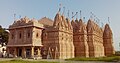
File:Kutch Bhadreshwar Jain Temple.jpg|[[Vasai Jain Temple]] | File:Kutch Bhadreshwar Jain Temple.jpg|[[Vasai Jain Temple]] | ||
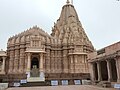
File:Tarangaji Jain temple.jpg|[[Taranga Jain temple|Taranga]], [[Gujarat]] (1121 AD) constructed by [[Kumarapala (Chaulukya dynasty)|King Kumarapala]] | File:Tarangaji Jain temple.jpg|[[Taranga Jain temple|Taranga]], [[Gujarat]] (1121 AD) constructed by [[Kumarapala (Chaulukya dynasty)|King Kumarapala]] | ||
File:Rangmandap, Taranga Jain Temple.jpg|[[Mandapa|Rang mandapa]] of the [[Śvetāmbara|Svetambara]] Jain Temple at Taranga which was originally constructed by [[Kumarapala (Chaulukya dynasty)|Kumarpala]] in 1161 | File:Rangmandap, Taranga Jain Temple.jpg|[[Mandapa|Rang mandapa]] of the [[Śvetāmbara|Svetambara]] Jain Temple at Taranga which was originally constructed by [[Kumarapala (Chaulukya dynasty)|Kumarpala]] in 1161 | ||
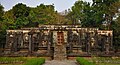
File:Chaturmukha basadi, Gerusoppa (cropped).jpg|[[Chaturmukha Basadi, Gerusoppa]] | File:Chaturmukha basadi, Gerusoppa (cropped).jpg|[[Chaturmukha Basadi, Gerusoppa]] | ||
</gallery> | |||
==See also== | ==See also== | ||
Latest revision as of 11:54, 22 March 2026
| Ajitanatha | |
|---|---|
2nd Jain Tirthankara | |
 Tirthankara Ajitnatha at Shri Ajitnath Bhagwan Shwetamber Jain Derasar, Taranga | |
| Venerated in | Jainism |
| Predecessor | Rishabhanatha |
| Successor | Sambhavanatha |
| Symbol | Elephant |
| Height | 450 dhanush (1,350 meters) |
| Age | 72 lakh purvas (508.032 x 10¹⁸ years old) |
| Tree | Saptaparna (Alstonia scholaris) |
| Color | Golden |
| Personal information | |
| Born | |
| Parents |
|
| Siblings | Sagara (step-brother/cousin) |
| Dynasty | Ikṣvākuvaṁśa |
| Part of a series on |
| Jainism |
|---|
 |
Ajitanatha (lit. invincible) was the second tirthankara of the present age, avasarpini (half time cycle) according to Jainism. He was born to king Jitashatru and Queen Vijaya at Ayodhya in the Ikshvaku dynasty. He was a liberated soul which has destroyed all of its karma.
In Jain texts[edit | edit source]
Ajitnatha (lit. invincible)[1] was the second tirthankara of the present age, avasarpini (half time cycle in Jain cosmology) according to Jainism.[2] Ajitnatha was born in the town of Saketa to King Jitashatru and Queen Vijaya at Ayodhya (Vinita-Saketa)[3] in the Ikshvaku dynasty on magha-shukla-dashmi (the tenth day of the bright half of the month of Magha).[2] His height was 450 bows or 2,700 feets.[4][5] He lived for a span of 72 lakh purva.[1][4]
According to Hemachandra, he was named Ajita because the king father was unable to defeat his mother in gambling until he was in her womb. Uttarapurana, a Digambara text, explains that he was named Ajita because he could not be defeated by sins or all heretics.[3] He attained kevala jnana under the saptaparna tree (Alstonia scholaris)[3] and Moksha on chaitra-shukla-panchmi (fifth day of the bright half of the month of Chaitra) from Shikharji.[6][1][3] He had 90 Ganadharas and Simhasena was his chief among them. Falgu (according to Swetambara tradition) or Prakubja (according to Digambara tradition) was a chief of his order of the nuns.[1][3]
The Yajurveda mentions the name of Ajitanatha, but the meaning is not clear. According to Jain traditions, his younger cousin brother was Sagara. Sagara, who became the second Chakravartin, is known from the traditions of both Hindu and Jain scriptures.[7][3]
Ajitanatha is said to have been born 50 lakh crore sagara after his predecessor, Rishabhanatha.[4] His successor, Sambhavanatha, is said to have been born 30 lakh crore sagara after him.[4]
Iconography[edit | edit source]
Swetambara as well as Digambara sects consider his complexion golden and elephant as his symbol.[3] He is associated with saptaparna tree; Mahayaksha as attendant Yaksha; and Ajita (as per Swetambra) or Rohini (as per Digambara) as attendant Yakshis.[8][3] The elephant, symbol of Ajitanatha, is a vahana (mount) of the Mahayakshya and Ajita Yakshi seems named after Ajitanatha.[3]
In literature, art and architecture[edit | edit source]
Literature[edit | edit source]
- The Ajitha purana, by Ranna narrates the story of Ajitanatha.
- Ajitashanti Stotra compiled by Nandisena in 7th century is a praise to Ajitnatha and Shantinatha.[9]
Major temples[edit | edit source]
- Taranga Jain Temple
- Vasai Jain Temple in Bhadresar
- Bandhaji[citation needed]
- Chaturmukha Basadi, Gerusoppa
- Dehra Temple
-
-
-
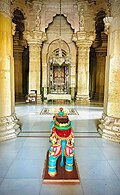 Rang mandapa of the Svetambara Jain Temple at Taranga which was originally constructed by Kumarpala in 1161
 -


.jpg)
See also[edit | edit source]
References[edit | edit source]
Citations[edit | edit source]
- ↑ 1.0 1.1 1.2 1.3 Vijay K. Jain 2015, p. 183.
- ↑ 2.0 2.1 Tukol 1980, p. 31.
- ↑ 3.0 3.1 3.2 3.3 3.4 3.5 3.6 3.7 3.8 Shah, Umakant Premanand (1987). Jaina-rūpa-maṇḍana [Jaina Iconography]. New Delhi: Abhinav Publications. p. 128. ISBN 978-81-7017-208-6.
- ↑ 4.0 4.1 4.2 4.3 Finegan 1952, p. 190.
- ↑ Finegan 1952, p. 191.
- ↑ Krishna & Amirthalingam 2014, p. 46.
- ↑ Jain, Kailash Chandra, Antiquity of Jainism, Jainism Literature Center
- ↑ Tandon 2002, p. 44.
- ↑ Cort 2001, p. 236.
Sources[edit | edit source]
- Finegan, Jack (1952), The archeology of world religions, Princeton University Press
- Jain, Vijay K. (2015), Acarya Samantabhadra's Svayambhustotra: Adoration of The Twenty-four Tirthankara, Vikalp Printers, ISBN 978-81-903639-7-6, archived from the original on 16 September 2015,
 This article incorporates text from this source, which is in the public domain.
 - Krishna, Nanditha; Amirthalingam, M. (2014) [2013], Sacred Plants of India, Penguin Books, ISBN 978-9-351-18691-5
- Tandon, Om Prakash (2002) [1968], Jaina Shrines in India (1 ed.), New Delhi: Publications Division, Ministry of Information and Broadcasting, Government of India, ISBN 81-230-1013-3
- Tukol, T. K. (1980), Compendium of Jainism, Dharwad: University of Karnataka
- Johnson, Helen M. (1931), Ajitanathacaritra (Book 2 of the Trishashti Shalaka Purusha Caritra), Baroda Oriental Institute
- Cort, John E. (2001), Jains in the World: Religious Values and Ideology in India, Oxford University Press, ISBN 9780198030379
| Gods | |||||
|---|---|---|---|---|---|
| Philosophy | |||||
| Branches |
| ||||
| Practices | |||||
| Literature | |||||
| Symbols |
| ||||
| Ascetics | |||||
| Scholars | |||||
| Community | |||||
| Jainism in |
| ||||
| Jainism and | |||||
| Dynasties and empires | |||||
| Related | |||||
| Lists | |||||
| Navboxes | |||||
