
Article enhanced with better details |
CleanupBot (talk | contribs) m Robot: Replacing encoded entity with character |
||
| Line 18: | Line 18: | ||
| awards = | | awards = | ||
| honorific_prefix = [[Ustad]] | | honorific_prefix = [[Ustad]] | ||
| native_name = | | native_name = <!-- please don't add this [[WP:INDICSCRIPT]]--> | ||
| signature = Ustad Ahmad Lahori seal.png | | signature = Ustad Ahmad Lahori seal.png | ||
}} | }} | ||
'''[[Ustad]] Ahmad Lahori''' ({{Lit|Master Ahmad of [[Lahore]]}}; {{circa}}1580–1649), | '''[[Ustad]] Ahmad Lahori''' ({{Lit|Master Ahmad of [[Lahore]]}}; {{circa}}1580–1649),<ref name=d>{{Cite book |last1=Curl |first1=James Stevens |url=https://books.google.com/books?id=4Lu6BwAAQBAJ&pg=PA11 |title=The Oxford Dictionary of Architecture |last2=Wilson |first2=Susan |date=2015 |publisher=Oxford University Press |isbn=978-0-19-967498-5 |pages=11 |language=en}}</ref> also known as '''Ahmad Ma'mar Lahori''' ({{Lit|Ahmad the Architect}}), was an architect and engineer of the [[Mughal Empire]] who served as the chief architect during the reign of [[Shah Jahan]]. He designed the [[Red Fort]] in [[Delhi]] and was probably also responsible for the design of the [[Taj Mahal]] in [[Agra]], along with Mir Abd-ul Karim and Makramat Khan. He is regarded as one of the greatest architects of the [[17th century|17th-century]].<ref>{{Citation |last=Curl |first=James Stevens |title=Ahmad, Ustad |date=2006 |work=A Dictionary of Architecture and Landscape Architecture |url=https://www.oxfordreference.com/display/10.1093/acref/9780198606789.001.0001/acref-9780198606789-e-5245 |access-date=2025-02-27 |publisher=Oxford University Press |language=en |doi=10.1093/acref/9780198606789.013.5245 |isbn=978-0-19-860678-9 |quote=Master Ahmad of Lahore, also known as Ahmad Mi'mar (Ahmad the Architect), became chief architect to Shah Jahan (reigned 1628–58). He is credited with the design of the huge Red Fort at Delhi (1639–48), and may have designed the Tâj Mahal (mausoleum of Arjumand Banu Begum, known as Mumtaz Mahal (d.1631) at Agra (1631–48 and later). If these and other attributions are correct, he was one of the greatest architects of C17.}}</ref> | ||
He was also one of the leading architects responsible for the establishment of the imperial city of [[Old Delhi|Shahjahanabad]]. His architecture is a combination of [[Indo-Islamic architecture|Indo-Islamic]] and [[Persian architecture|Persian]] architectural styles, and thus, a major instance of [[Indo-Persian culture]]. | He was also one of the leading architects responsible for the establishment of the imperial city of [[Old Delhi|Shahjahanabad]]. His architecture is a combination of [[Indo-Islamic architecture|Indo-Islamic]] and [[Persian architecture|Persian]] architectural styles, and thus, a major instance of [[Indo-Persian culture]]. | ||
| Line 27: | Line 27: | ||
== Life == | == Life == | ||
[[File:Ustad Ahmad Lahori's deposit of "Five Qasidas" in Kitab Khana Amrao.jpg|thumb|Ustad Ahmad Lahori's deposit of "Five Qasidas" in Kitab Khana Amrao]] | [[File:Ustad Ahmad Lahori's deposit of "Five Qasidas" in Kitab Khana Amrao.jpg|thumb|Ustad Ahmad Lahori's deposit of "Five Qasidas" in Kitab Khana Amrao]] | ||
Ahmad Lahori was from a family of [[Timurid Empire|Timurid]] architects, originally from [[Herat]]. Ustad Ahmad Lahori hailed from the city of [[Lahore]] in [[Pakistan]], as his ''[[nisba (onomastics)|nisba]]'' indicates. | Ahmad Lahori was from a family of [[Timurid Empire|Timurid]] architects, originally from [[Herat]]. Ustad Ahmad Lahori hailed from the city of [[Lahore]] in [[Pakistan]], as his ''[[nisba (onomastics)|nisba]]'' indicates.<ref>{{cite journal| last=Balasubramaniam |first=R. |url= https://books.google.com/books?id=qjdEi89Q34kC&q=ahmad |title=New insights on architects of Tāj|journal=Indian Journal of History of Science|volume= 44| issue=3 |date= 2009|issn=2454-9991|oclc=1398048453 |publisher= National Institute of Sciences of India|page=391|via=[[University of California]] }}</ref> He has been described as an [[Persians in the Mughal Empire|Indian of Iranian heritage]] and also as a [[Punjabis|Punjabi]].<ref name="Janin">{{cite book|last1=Janin|first1=Hunt|title=The Pursuit of Learning in the Islamic World, 610-2003|date=2006|isbn=978-0786429042|page=124|publisher=McFarland |url=https://books.google.com/books?id=KTWDxDEY-Q0C&q=Ahmad+Lahori+Indian%7CPersian&pg=PA124|access-date=17 November 2021}}</ref><ref>{{Cite book|page=89|oclc=85485369 |last=Chopra |first=Ravindra Mohan |url=https://books.google.com/books?id=pyRuAAAAMAAJ |title=Indo-Iranian Cultural Relations Through the Ages |date=2005|via=[[University of Michigan]] |publisher=Iran Society |language=en}}</ref><ref>{{cite journal | last=Srivastava |first=Prof. R. P. |url= https://books.google.com/books?id=g2FRAAAAYAAJ|title=Patiala: Its Artistic and Cultural Significance|location=London|journal= The Sikh Courier|oclc=265579842|issn=0037-511X |orig-year= |volume= 10 |issue=4 |date= 1981|via=[[University of Virginia]]|publisher= Sikh Cultural Society of Great Britain |page= 16 |quote=Nadir-ul-Asar Ahmad Mimar Lahori Shahjehani was also a Punjabi who designed the Taj Mahal of Agra.}}</ref> Even after his family's migration to [[Delhi]], his family is still referred to by the epithet "Lahori".<ref>{{cite journal |author=Kanwar, H. I. S|url=https://books.google.com/books?id=wn9CAAAAYAAJ&q= |title= Ustad Ahmed Lahori |journal= Islamic Culture| volume=48 |pages=11–32 |editor1= [[Marmaduke William Pickthall|Pickthall, Marmaduke William]] |editor2= [[Muhammad Asad|Asad, Muhammad]] |date=1974 |publisher=Islamic Culture Board| ISSN=0021-1834}}</ref> He was a skilled engineer who later in life was given the title of ''Nadir-ul-Asar'' ("wonder of the age") by [[Shah Jahan]].<ref name="s">{{Cite book |last=Necipoğlu |first=Gülru |url=https://books.google.com/books?id=xHXEDwAAQBAJ&pg=PA155 |title=The Topkapi Scroll: Geometry and Ornament in Islamic Architecture |date=1996-03-01 |publisher=Getty Publications |isbn=978-0-89236-335-3 |language=en|page=155}}</ref> Two of his three sons,<ref>{{cite book |editor-first=David |editor-last=Pingree |editor-link=David Pingree |title=Census of the Exact Sciences in Sanskrit Series A |volume=1 |publisher=American Philosophical Society |year=1970 |page=39 |url=https://archive.org/details/PingreeCESS/Pingree_CESS_A1_1970/ }}</ref> [[Ataullah Rashidi]] and [[Lutfullah Muhandis]], also became architects, as did some of his grandsons,<ref name="s" /> [[Shah Kalim Allah Jahanabadi]] one among them.<ref>{{cite book |first=Chanchal |last=Dadlani |chapter=Innovation, Appropriation, and Representation: Mughal Architectural Ornament in the Eighteenth Century |editor1=Gülru Necipoglu |editor2=Alina Payne |title=Histories of Ornament: From Global to Local |year=2016 |publisher=Princeton University Press |isbn=9780691167282 |page=183 |url=https://books.google.com/books?id=9nACCwAAQBAJ }}</ref> Ahmad Lahori was learned also in the arts of [[geometry]], [[arithmetic]] and [[astronomy]], and according to his son Lutfullah was familiar with the [[Euclid]]'s ''[[Euclid's Elements|Elements]]'' and [[Ptolemy]]'s ''[[Almagest]]''.<ref name=s/> | ||
==Career== | ==Career== | ||
In 1631, Shah Jahan appointed him for the construction of [[Taj Mahal]]. The construction project employed some 20,000 artisans under the guidance of a board of architects led by Ahmad Lahori. The project took twelve years to manifest into reality. | In 1631, Shah Jahan appointed him for the construction of [[Taj Mahal]]. The construction project employed some 20,000 artisans under the guidance of a board of architects led by Ahmad Lahori. The project took twelve years to manifest into reality.<ref name=i>{{Cite book |last=Khan (Arshi) |first=I. N. |url=https://books.google.com/books?id=teHRAgAAQBAJ&pg=PT38 |title=BLACK TAJ MAHAL: The Emperor's Missing Tomb |date=2015-08-28 |publisher=Black Taj Project |isbn=978-81-927479-0-3 |language=en|page=38}}</ref> Afterwards, he was relocated to Delhi where the emperor commissioned him for the construction of the new imperial city, [[Shahjahanabad]]'','' in 1639.<ref name=i/> The building of the city, including the [[Red Fort]], was complete by 1648. | ||
In writings by Lahori's son, Lutfullah Muhandis, two architects are mentioned by name: Ustad Ahmad Lahori | In writings by Lahori's son, Lutfullah Muhandis, two architects are mentioned by name: Ustad Ahmad Lahori<ref name="unesco">[https://whc.unesco.org/en/list/252/ Taj Mahal Description and Profile (Ahmad Lahori, architect of the emperor)] UNESCO.org website, Retrieved 17 November 2021</ref><ref name="B65">Begley and Desai (1989), p.65</ref> and Mir Abd-ul Karim.<ref name="A212">Asher, p.212</ref> Ustad Ahmad Lahori laid the foundations of the Red Fort at Delhi, which was built between 1638 and 1648. Mir Abd-ul Karim counted as the favourite architect of the previous emperor, [[Jahangir]], and is mentioned as a supervisor, together with Makramat Khan, for the construction of the Taj Mahal.<ref name="A212" /> | ||
<gallery heights="180" mode="packed" perrow="5" caption="Ahmad Lahori's major works"> | |||
File:Delhi fort.jpg|[[Red Fort]]'s [[Lahori Gate, Red Fort, Delhi|Lahori Gate]] in Delhi | File:Delhi fort.jpg|[[Red Fort]]'s [[Lahori Gate, Red Fort, Delhi|Lahori Gate]] in Delhi | ||
File:Covered market past the Lahore gate entrance in Red Fort.jpg|Covered bazaar in [[Old Delhi]] | File:Covered market past the Lahore gate entrance in Red Fort.jpg|Covered bazaar in [[Old Delhi]] | ||
</gallery> | |||
==See also== | ==See also== | ||
| Line 43: | Line 43: | ||
== Notes == | == Notes == | ||
<references group="lower-alpha" /> | |||
==References== | ==References== | ||
{{Reflist}} | {{Reflist}} | ||
Latest revision as of 10:55, 22 March 2026
Ahmad Lahori | |
|---|---|
 Miniature painting of Ustad Ahmad Mimar Lahori | |
| Born | c. 1580 |
| Died | c. 1649 (aged 68–69) |
| Occupation | Architect |
| Buildings | Red Fort |
| Projects | |
| Signature | |
 | |
Ustad Ahmad Lahori (lit. 'Master Ahmad of Lahore'; c.1580–1649),[1] also known as Ahmad Ma'mar Lahori (lit. 'Ahmad the Architect'), was an architect and engineer of the Mughal Empire who served as the chief architect during the reign of Shah Jahan. He designed the Red Fort in Delhi and was probably also responsible for the design of the Taj Mahal in Agra, along with Mir Abd-ul Karim and Makramat Khan. He is regarded as one of the greatest architects of the 17th-century.[2]
He was also one of the leading architects responsible for the establishment of the imperial city of Shahjahanabad. His architecture is a combination of Indo-Islamic and Persian architectural styles, and thus, a major instance of Indo-Persian culture.
Life[edit | edit source]

Ahmad Lahori was from a family of Timurid architects, originally from Herat. Ustad Ahmad Lahori hailed from the city of Lahore in Pakistan, as his nisba indicates.[3] He has been described as an Indian of Iranian heritage and also as a Punjabi.[4][5][6] Even after his family's migration to Delhi, his family is still referred to by the epithet "Lahori".[7] He was a skilled engineer who later in life was given the title of Nadir-ul-Asar ("wonder of the age") by Shah Jahan.[8] Two of his three sons,[9] Ataullah Rashidi and Lutfullah Muhandis, also became architects, as did some of his grandsons,[8] Shah Kalim Allah Jahanabadi one among them.[10] Ahmad Lahori was learned also in the arts of geometry, arithmetic and astronomy, and according to his son Lutfullah was familiar with the Euclid's Elements and Ptolemy's Almagest.[8]
Career[edit | edit source]
In 1631, Shah Jahan appointed him for the construction of Taj Mahal. The construction project employed some 20,000 artisans under the guidance of a board of architects led by Ahmad Lahori. The project took twelve years to manifest into reality.[11] Afterwards, he was relocated to Delhi where the emperor commissioned him for the construction of the new imperial city, Shahjahanabad, in 1639.[11] The building of the city, including the Red Fort, was complete by 1648.
In writings by Lahori's son, Lutfullah Muhandis, two architects are mentioned by name: Ustad Ahmad Lahori[12][13] and Mir Abd-ul Karim.[14] Ustad Ahmad Lahori laid the foundations of the Red Fort at Delhi, which was built between 1638 and 1648. Mir Abd-ul Karim counted as the favourite architect of the previous emperor, Jahangir, and is mentioned as a supervisor, together with Makramat Khan, for the construction of the Taj Mahal.[14]
- Ahmad Lahori's major works
-
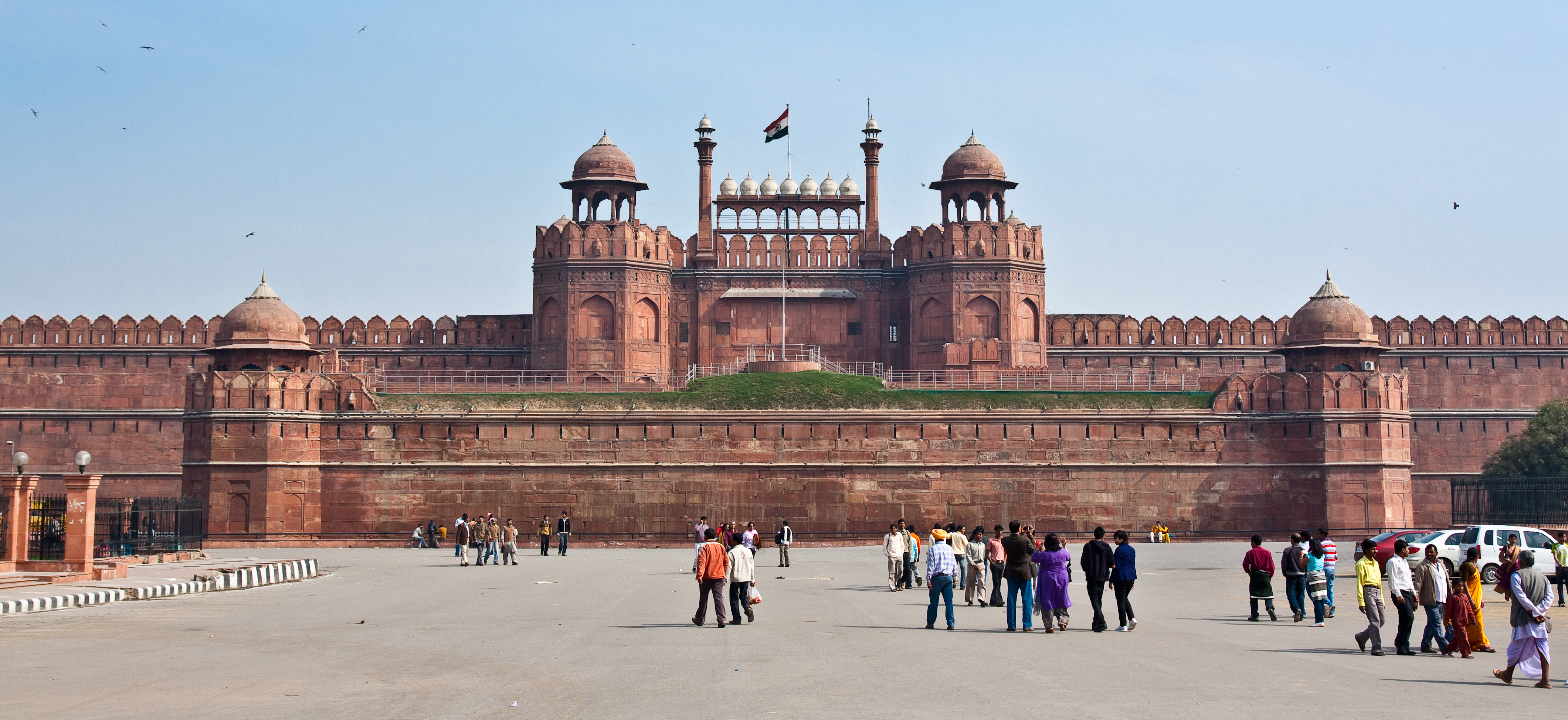 Red Fort's Lahori Gate in Delhi
 -
 Covered bazaar in Old Delhi


See also[edit | edit source]
- Ustad Isa, another architect of the Taj Mahal
Notes[edit | edit source]
References[edit | edit source]
- ↑ Curl, James Stevens; Wilson, Susan (2015). The Oxford Dictionary of Architecture. Oxford University Press. p. 11. ISBN 978-0-19-967498-5.
- ↑ Curl, James Stevens (2006), "Ahmad, Ustad", A Dictionary of Architecture and Landscape Architecture, Oxford University Press, doi:10.1093/acref/9780198606789.013.5245, ISBN 978-0-19-860678-9, retrieved 27 February 2025,
Master Ahmad of Lahore, also known as Ahmad Mi'mar (Ahmad the Architect), became chief architect to Shah Jahan (reigned 1628–58). He is credited with the design of the huge Red Fort at Delhi (1639–48), and may have designed the Tâj Mahal (mausoleum of Arjumand Banu Begum, known as Mumtaz Mahal (d.1631) at Agra (1631–48 and later). If these and other attributions are correct, he was one of the greatest architects of C17.
{{citation}}: CS1 maint: work parameter with ISBN (link) - ↑ Balasubramaniam, R. (2009). "New insights on architects of Tāj". Indian Journal of History of Science. 44 (3). National Institute of Sciences of India: 391. ISSN 2454-9991. OCLC 1398048453 – via University of California.
- ↑ Janin, Hunt (2006). The Pursuit of Learning in the Islamic World, 610-2003. McFarland. p. 124. ISBN 978-0786429042. Retrieved 17 November 2021.
- ↑ Chopra, Ravindra Mohan (2005). Indo-Iranian Cultural Relations Through the Ages. Iran Society. p. 89. OCLC 85485369 – via University of Michigan.
- ↑ Srivastava, Prof. R. P. (1981). "Patiala: Its Artistic and Cultural Significance". The Sikh Courier. 10 (4). London: Sikh Cultural Society of Great Britain: 16. ISSN 0037-511X. OCLC 265579842 – via University of Virginia.
Nadir-ul-Asar Ahmad Mimar Lahori Shahjehani was also a Punjabi who designed the Taj Mahal of Agra.
- ↑ Kanwar, H. I. S (1974). Pickthall, Marmaduke William; Asad, Muhammad (eds.). "Ustad Ahmed Lahori". Islamic Culture. 48. Islamic Culture Board: 11–32. ISSN 0021-1834.
- ↑ 8.0 8.1 8.2 Necipoğlu, Gülru (1 March 1996). The Topkapi Scroll: Geometry and Ornament in Islamic Architecture. Getty Publications. p. 155. ISBN 978-0-89236-335-3.
- ↑ Pingree, David, ed. (1970). Census of the Exact Sciences in Sanskrit Series A. Vol. 1. American Philosophical Society. p. 39.
- ↑ Dadlani, Chanchal (2016). "Innovation, Appropriation, and Representation: Mughal Architectural Ornament in the Eighteenth Century". In Gülru Necipoglu; Alina Payne (eds.). Histories of Ornament: From Global to Local. Princeton University Press. p. 183. ISBN 9780691167282.
- ↑ 11.0 11.1 Khan (Arshi), I. N. (28 August 2015). BLACK TAJ MAHAL: The Emperor's Missing Tomb. Black Taj Project. p. 38. ISBN 978-81-927479-0-3.
- ↑ Taj Mahal Description and Profile (Ahmad Lahori, architect of the emperor) UNESCO.org website, Retrieved 17 November 2021
- ↑ Begley and Desai (1989), p.65
- ↑ 14.0 14.1 Asher, p.212
Further reading[edit | edit source]
|