

Updated entries and formatting |
CleanupBot (talk | contribs) m Robot: Replacing encoded entity with character |
||
| Line 23: | Line 23: | ||
| subdivision_type2 = [[List of districts of India|District]] | | subdivision_type2 = [[List of districts of India|District]] | ||
| subdivision_name2 = [[Tirunelveli district|Tirunelveli]] | | subdivision_name2 = [[Tirunelveli district|Tirunelveli]] | ||
| established_title = | | established_title = <!-- Established --> | ||
| established_date = | | established_date = | ||
| founder = | | founder = | ||
| Line 57: | Line 57: | ||
== History == | == History == | ||
The spread of Islam led to the city's expansion between 400 and 700 years ago. | The spread of Islam led to the city's expansion between 400 and 700 years ago.<ref>{{cite web | url=http://www.nellaieruvadi.com/history.asp | archive-url=https://web.archive.org/web/20041205063439/http://nellaieruvadi.com/history.asp | url-status=usurped | archive-date=5 December 2004 | title=History of Nellai Eruvadi }}</ref> According to local tradition, Eruvadi was subject to Islamic conquest by a Sufi warrior-saint named [[Saiyid Ibrahim]] with his 3,000 warrior disciples, in the twelfth century.<ref>[[Susan Bayly|Bayly, Susan]]. ''Saints, goddesses, and kings: Muslims and Christians in South Indian Society, 1700–1900''. Cambridge [England: Cambridge University Press, 1989. Print.</ref><ref>Marshall, P. J.. ''The eighteenth century in Indian history: evolution or revolution?.'' New Delhi: Oxford University Press, 2003. Print.</ref> The city has spread to Puliyur on the north side of the river with the streets ending at the river bank. The ancient people of Eruvadi were good at cultivation, trade and finance; they joined with the army of King [[Pandian Kulasekaran]] and went to fight with [[Cheran King]] and won the battle near Panakudi when Cheran King tried to occupy the Pandian kingdom. Eruvadi is also called Pulianjuvanam. There is an inscription at Muhaam Jumma Masjid about the name Pulianjuvanam.<ref>{{Cite web |url=http://www.nellaieruvadi.com/article/images/posted/NellaiEruvadi_Article_1191_3_2012524-423.jpg |title=Archived copy |access-date=20 April 2014 |archive-url=https://web.archive.org/web/20140421082805/http://www.nellaieruvadi.com/article/images/posted/NellaiEruvadi_Article_1191_3_2012524-423.jpg |archive-date=21 April 2014 |url-status=usurped }}</ref> | ||
==Demography== | ==Demography== | ||
{{Pie chart | {{Pie chart | ||
|thumb = right | |thumb = right | ||
|caption = Religion in Eruvadi (2011) | |caption = Religion in Eruvadi (2011)<ref name="census2011">{{cite web |title=Population by religion community – 2011 |url=http://www.censusindia.gov.in/2011census/C-01/DDW00C-01%20MDDS.XLS |website=Census of India, 2011 |publisher=The Registrar General & Census Commissioner, India |archiveurl=https://web.archive.org/web/20150825155850/http://www.censusindia.gov.in/2011census/C-01/DDW00C-01%20MDDS.XLS |archivedate=25 August 2015}}</ref> | ||
|label1 = [[Islam]] | |label1 = [[Islam]] | ||
|color1 = Green | |color1 = Green | ||
| Line 97: | Line 97: | ||
| Northwest = | | Northwest = | ||
}} | }} | ||
<gallery> | |||
Eruvadi view05.jpg|The seventh street of Eruvadi. At the background is the "oosi pothai" and "irattai pothai". | Eruvadi view05.jpg|The seventh street of Eruvadi. At the background is the "oosi pothai" and "irattai pothai". | ||
Eruvadi view07.jpg|The view on the direction of "elavanikkudi pothai" from the Baith-As-Salaam masjid minera. | Eruvadi view07.jpg|The view on the direction of "elavanikkudi pothai" from the Baith-As-Salaam masjid minera. | ||
| Line 103: | Line 103: | ||
Eruvadi view09.jpg|The view of the houses, as seen directly under your feet from the Baith-As-Salaam masjid minera. | Eruvadi view09.jpg|The view of the houses, as seen directly under your feet from the Baith-As-Salaam masjid minera. | ||
Eruvadi misc31.jpg|Another view of Eruvadi North Main Road. | Eruvadi misc31.jpg|Another view of Eruvadi North Main Road. | ||
</gallery> | |||
==References== | ==References== | ||
Latest revision as of 10:30, 22 March 2026
 | This article needs more citations. (September 2020) |
Eruvadi
Nellai Eruvai | |
|---|---|
Town | |
  Eruvadi Location in Tamil Nadu, India | |
| Coordinates: 8°26′45″N 77°36′17″E / 8.44583°N 77.60472°E | |
| Country |  India India |
| State | Tamil Nadu |
| District | Tirunelveli |
| Government | |
| • Type | Panchayath |
| Languages | |
| • Official | Tamil |
| Time zone | UTC+5:30 (IST) |
| PIN | 627103 |
| Telephone code | 91 4637 |
| Vehicle registration | TN 72 |
| Website | http://www.nellaieruvadi.com/ |
Eruvadi is a small town panchayath in Tirunelveli district in the state of Tamil Nadu, India.
History[edit | edit source]
The spread of Islam led to the city's expansion between 400 and 700 years ago.[1] According to local tradition, Eruvadi was subject to Islamic conquest by a Sufi warrior-saint named Saiyid Ibrahim with his 3,000 warrior disciples, in the twelfth century.[2][3] The city has spread to Puliyur on the north side of the river with the streets ending at the river bank. The ancient people of Eruvadi were good at cultivation, trade and finance; they joined with the army of King Pandian Kulasekaran and went to fight with Cheran King and won the battle near Panakudi when Cheran King tried to occupy the Pandian kingdom. Eruvadi is also called Pulianjuvanam. There is an inscription at Muhaam Jumma Masjid about the name Pulianjuvanam.[4]
Demography[edit | edit source]
- Islam (58.4%)
- Hinduism (36.6%)
- Christianity (4.98%)
Religion[edit | edit source]
Eruvadi has Muslim, Hindu and Christian population and each community has their place of worship.
- Total - 18068
- Muslims - 58.41%
- Hindus - 36.61%
- Christians - 4.98%
Adjacent communities[edit | edit source]
Places adjacent to Eruvadi | ||||||||||
|---|---|---|---|---|---|---|---|---|---|---|
| ||||||||||


-
 The seventh street of Eruvadi. At the background is the "oosi pothai" and "irattai pothai".
 -
 The view on the direction of "elavanikkudi pothai" from the Baith-As-Salaam masjid minera.
 -
 Some of the houses in the 7th and 6th street. The 6th street is where you can see the electrical posts.
 -
 The view of the houses, as seen directly under your feet from the Baith-As-Salaam masjid minera.
 -
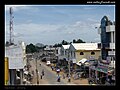 Another view of Eruvadi North Main Road.


References[edit | edit source]
- ↑ "History of Nellai Eruvadi". Archived from the original on 5 December 2004.
- ↑ Bayly, Susan. Saints, goddesses, and kings: Muslims and Christians in South Indian Society, 1700–1900. Cambridge [England: Cambridge University Press, 1989. Print.
- ↑ Marshall, P. J.. The eighteenth century in Indian history: evolution or revolution?. New Delhi: Oxford University Press, 2003. Print.
- ↑ "Archived copy". Archived from the original on 21 April 2014. Retrieved 20 April 2014.
{{cite web}}: CS1 maint: archived copy as title (link) - ↑ "Population by religion community – 2011". Census of India, 2011. The Registrar General & Census Commissioner, India. Archived from the original on 25 August 2015.
