



m Page refined with updated information Tag: Reverted |
m Reverted edit by Developer.mubin (talk) to last revision by [[User:imported>Qwerfjkl|imported>Qwerfjkl]] Tag: Rollback |
||
| Line 1: | Line 1: | ||
{{short description|Type of turban}} | {{short description|Type of turban}} | ||
{{Use dmy dates|date= | {{Use dmy dates|date=July 2017}} | ||
{{Use British English|date=July 2017}} | {{Use British English|date=July 2017}} | ||
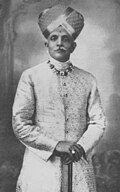
[[File:Nalvadi Krishnaraja Wodeyar 1881-1940.jpg|thumb|right| | [[File:Nalvadi Krishnaraja Wodeyar 1881-1940.jpg|thumb|right|250px|Colourful and royal Mysuru peta worn by Maharaja Nalvadi Krishna Raja Wadiyar]] | ||
The '''''Mysuru peta''''' is | The '''''Mysuru peta''''' (''peta'' is a [[Kannada]] word which means [[turban]] in [[English language|English]]) is the classical royal Indian attire worn by the erstwhile [[King]]s of [[Mysore|Mysuru]], called the [[Wodeyar]]s (1399 to 1947), of the Kingdom of Mysuru. Wodeyars wore a richly bejeweled turban made of [[silk]] and jari ([[gold]] threaded [[lace]]) to match with colorful dresses as part of the royal dress.<ref name="mysore">[http://www.mapsofindia.com/mysore/peta-turban.html Mysore Peta/Turban]</ref> | ||
Administrators under the [[King]], such as the [[Dewans]]' (Prime Minister appointed by the King) and other senior officials who swayed considerable power in matters of state administration also wore the Mysuru peta.<ref name="mysore"/> | |||
After India became independent in 1947 and the princely state merged with the Indian union, the traditional Mysuru peta has been retained as a symbol of heritage and cultural antecedents and distinguished people are honoured by the award of a Mysore peta with a [[shawl]] in formal functions.<ref name="mysore"/> | |||
== Ancient tradition == | |||
[[File:jcrw1.jpg|right|thumb|250px|Jayachamrajendra Wodeyar in traditional Mysuru peta with Queen [[Elizabeth II of the United Kingdom|Elizabeth II]]]] | |||
[[File:Concert Mysorepalace.jpg|thumb|A concert inside [[Mysore Palace|Mysuru Palace]], where musicians wearing Mysore peta]] | |||
Kings wore the traditional Mysuru peta as headgear during the [[Durbar (court)|Durbar]] (court of Indian or princley state's kings) time or in a ceremonial procession during the Dassara celebrations and or during joint ceremonial parades with the visiting royal dignitaries from foreign countries.<ref name="mysore" /> | |||
[[File:Sir M. Vishweswariah.JPG|thumb|200px|[[Bharat Ratna]] [[Sir M V|Mokshagundam Vishveshwaraiah]], [[Dewan]] of [[Mysore|Mysuru]], in traditional Mysore peta worn by top administrators of [[Mysore Kingdom|Mysuru Kingdom]]]] | |||
It was expected that the men attending King's [[royal court|court]] wore the conventional attire called the durbar dress which comprised a black long coat with white trousers and a compulsory Mysuru peta (turban).<ref>[[Turban]]</ref> | |||
' | |||
==Design== | |||
The attractive and colourful turban is a [[headdress]] made up of long [[scarf]]–like single piece of cloth made of [[silk]] or [[cotton]] wound round the head cap and is often decorated with jari border (golden or silver laces) and beautiful metal [[pendants]] that adds to its glory and grandeur. | |||
& | In the early 1930s, the "Imperial Hatworks" located in heritage buildings called the Hatworks Boulevard (150 years old history), at No. 32, Cunningham Road, [[Bangalore|Bengaluru]], used to make the "pretied Mysuru peta" for the [[Maharajah of Mysore|Maharajah of Mysuru]]. This place was owned by Manackjee who had set up shop after studying hatmaking in the [[UK]]. But this shop closed down a few years after Manackjee's death in 1959. The old–world ambiance of the Hatworks Boulevard has been restored as a minor tourist place with a [[boutique]], [[France|French]] [[spa]], [[Coffeehouse|cafe]]–and–[[pastry]] shop, an [[art gallery]] (through a tie–up with Crimson Art Gallery), a home furnishing store, an art costume jewellery store and a shop selling custom–made [[marble]] pieces.<ref>[http://bangalorebuzz.blogspot.com/2005/05/adapting-to-preserve-beauty.html Adapting to preserve beauty]</ref> | ||
== See also == | == Social and religious tradition == | ||
* [[ | [[File:Coorgi Dress Doll.jpg|upright|thumb|Dolls in Kodava attire of Kodagu]] | ||
* [[ | |||
The people of the [[Mysore district|Mysuru district]] and the [[Kodagu district]] feel proud to wear turbans called Mysuru peta. In Kodagu district, it is part of the traditional dress worn on special occasions such as [[wedding]]s. Men wear a turban during religious ceremonies to portray respect and reverence towards the [[Supreme Being]]. Distinguished people are honoured by the award of a Mysuru peta in formal functions.<ref>[http://www.culturalindia.net/indian-clothing/turban.html Cultural India: Indian Clothing: Turban]</ref> | |||
==University Convocation cap== | |||
[[Convocation]] caps are adorned by students and faculty during convocation ceremonies. This practice has been changed by the Inter–University Board (IUB) of [[Karnataka]], which has ruled that students passing out of the nine universities in Karnataka shall no longer wear the traditional black cap – the [[mortarboard]] (as it was considered a British legacy) - during their proud moments. Instead, universities have been given the option of using the traditional Mysuru peta. | |||
The academic cap or square, commonly known as the "mortarboard", a symbol of the academia is a flat square [[hat]] with a [[tassel]] suspended from a [[button]] in the top centre of the board. The tassel is made of a cluster of silk [[thread (yarn)|thread]]s, which are fastened by a button at one end and fixed at the centre of the headpiece. In [[Karnataka University]] Convocation, students have now the option to wear the Karnataka's traditional Mysuru peta, a turban made of silk or cotton cloth with jari tied to the head in a traditional way (tied Mysuru petas or turbans are readily marketed for the purpose in most major cities of the state).<ref>http://timesofindia.indiatimes.com/articleshow/1670080.cms Mysore peta in, graduation cap out</ref> | |||
==See also== | |||
* [[Kodagu]] | |||
* [[Mysore|Mysuru]] | |||
* [[Culture of Mysore|Culture of Mysuru]] | |||
==References== | ==References== | ||
{{Reflist}}{{Clothing in South Asia}} | {{Reflist}}{{Mysore Kingdom series}}{{Clothing in South Asia}} | ||
[[Category:Culture of Karnataka]] | [[Category:Culture of Karnataka]] | ||
[[Category:Indian headgear]] | [[Category:Indian headgear]] | ||
[[Category:Kingdom of Mysore]] | [[Category:Kingdom of Mysore]] | ||
Latest revision as of 21:58, 21 March 2026

The Mysuru peta (peta is a Kannada word which means turban in English) is the classical royal Indian attire worn by the erstwhile Kings of Mysuru, called the Wodeyars (1399 to 1947), of the Kingdom of Mysuru. Wodeyars wore a richly bejeweled turban made of silk and jari (gold threaded lace) to match with colorful dresses as part of the royal dress.[1]
Administrators under the King, such as the Dewans' (Prime Minister appointed by the King) and other senior officials who swayed considerable power in matters of state administration also wore the Mysuru peta.[1]
After India became independent in 1947 and the princely state merged with the Indian union, the traditional Mysuru peta has been retained as a symbol of heritage and cultural antecedents and distinguished people are honoured by the award of a Mysore peta with a shawl in formal functions.[1]
Ancient tradition[edit | edit source]


Kings wore the traditional Mysuru peta as headgear during the Durbar (court of Indian or princley state's kings) time or in a ceremonial procession during the Dassara celebrations and or during joint ceremonial parades with the visiting royal dignitaries from foreign countries.[1]

It was expected that the men attending King's court wore the conventional attire called the durbar dress which comprised a black long coat with white trousers and a compulsory Mysuru peta (turban).[2]
Design[edit | edit source]
The attractive and colourful turban is a headdress made up of long scarf–like single piece of cloth made of silk or cotton wound round the head cap and is often decorated with jari border (golden or silver laces) and beautiful metal pendants that adds to its glory and grandeur.
In the early 1930s, the "Imperial Hatworks" located in heritage buildings called the Hatworks Boulevard (150 years old history), at No. 32, Cunningham Road, Bengaluru, used to make the "pretied Mysuru peta" for the Maharajah of Mysuru. This place was owned by Manackjee who had set up shop after studying hatmaking in the UK. But this shop closed down a few years after Manackjee's death in 1959. The old–world ambiance of the Hatworks Boulevard has been restored as a minor tourist place with a boutique, French spa, cafe–and–pastry shop, an art gallery (through a tie–up with Crimson Art Gallery), a home furnishing store, an art costume jewellery store and a shop selling custom–made marble pieces.[3]
Social and religious tradition[edit | edit source]

The people of the Mysuru district and the Kodagu district feel proud to wear turbans called Mysuru peta. In Kodagu district, it is part of the traditional dress worn on special occasions such as weddings. Men wear a turban during religious ceremonies to portray respect and reverence towards the Supreme Being. Distinguished people are honoured by the award of a Mysuru peta in formal functions.[4]
University Convocation cap[edit | edit source]
Convocation caps are adorned by students and faculty during convocation ceremonies. This practice has been changed by the Inter–University Board (IUB) of Karnataka, which has ruled that students passing out of the nine universities in Karnataka shall no longer wear the traditional black cap – the mortarboard (as it was considered a British legacy) - during their proud moments. Instead, universities have been given the option of using the traditional Mysuru peta.
The academic cap or square, commonly known as the "mortarboard", a symbol of the academia is a flat square hat with a tassel suspended from a button in the top centre of the board. The tassel is made of a cluster of silk threads, which are fastened by a button at one end and fixed at the centre of the headpiece. In Karnataka University Convocation, students have now the option to wear the Karnataka's traditional Mysuru peta, a turban made of silk or cotton cloth with jari tied to the head in a traditional way (tied Mysuru petas or turbans are readily marketed for the purpose in most major cities of the state).[5]
See also[edit | edit source]
References[edit | edit source]
- ↑ 1.0 1.1 1.2 1.3 Mysore Peta/Turban
- ↑ Turban
- ↑ Adapting to preserve beauty
- ↑ Cultural India: Indian Clothing: Turban
- ↑ http://timesofindia.indiatimes.com/articleshow/1670080.cms Mysore peta in, graduation cap out