













robot: Trimming article to decrease server load |
Page refined with updated information |
||
| Line 1: | Line 1: | ||
{{Short description|Capital of Khyber Pakhtunkhwa, Pakistan}} | |||
{{About|the city in Pakistan}} | |||
{{Redirect|Peshawari|other uses|Peshawari (disambiguation)}} | |||
{{pp-pc}} | |||
{{Use Pakistani English|date=August 2014}} | |||
{{Use dmy dates|date=June 2025}} | |||
{{Infobox settlement | |||
| name = Peshawar | |||
| other_name = | |||
| native_name = {{hlist|{{lang|ur|{{Nastaliq|پشاور}}}}|{{lang|ps|پېښور}}|{{lang|hnd|{{Nastaliq|پشور}}}}}} | |||
| settlement_type = [[List of cities in Pakistan by population|Metropolis]] | |||
| image_skyline = {{multiple image | |||
| border = infobox | |||
| total_width = 280 | |||
| image_style = border:1; | |||
| perrow = 1/2/2/2/1 | |||
| caption_align = center | |||
| image1 = Islamia College Peshawar (Public Sector University), Khyber Pakhtunkhwa, Pakistan cropped.jpg | |||
|caption1 = [[Islamia College University]] | |||
| image2 = Scenery_of_Peshawar.jpg | |||
|caption2 = [[Valley of Peshawar|City Exteriors]] | |||
| image3 = Bala Hisar Fort.jpg | |||
|caption3 = [[Bala Hissar, Peshawar|Bala Hissar]] | |||
| image4 = MKmosque.jpg | |||
|caption4 = [[Mahabat Khan Mosque]] | |||
| image5 = Sethi_House_Peshawar.jpg | |||
|caption5 = [[Sethi Mohallah]] | |||
| image6 = Ghanta Ghar Peshawar.jpg | |||
| caption6 = [[Cunningham Clock Tower]] | |||
| image7 = University_of_Peshawar.jpg | |||
| caption7 = [[University of Peshawar]] | |||
| image8 = Bab-e-Khyber.jpg | |||
|caption8 = [[Bab-e-Khyber]] | |||
}} | |||
| image_caption = | |||
| image_size = 300px | |||
| image_flag = Peshawar City Flag.png | |||
| image_seal = | |||
| image_shield = | |||
| nickname = City of Flowers<ref>{{Cite web |url=https://nation.com.pk/02-Mar-2018/peshawar-the-city-of-flowers |title=Peshawar – The city of flowers |date=2 March 2018 |website=The Nation |access-date=13 June 2020 |archive-date=16 October 2021 |archive-url=https://web.archive.org/web/20211016140320/https://nation.com.pk/02-Mar-2018/peshawar-the-city-of-flowers |url-status=live }}</ref> | |||
| motto = | |||
| image_map = | |||
| map_caption = | |||
| pushpin_map = Khyber Pakhtunkhwa#Pakistan | |||
| pushpin_relief = | |||
| pushpin_label_position = right | |||
| pushpin_map_caption = Location within Khyber Pakhtunkhwa##Location within Pakistan | |||
| coordinates = {{coord|34|00|52|N|71|34|03|E|region:PK|display=inline,title}} | |||
| subdivision_type = Country | |||
| subdivision_name = {{flag|Pakistan}} | |||
| subdivision_type1 = [[Administrative units of Pakistan|Province]] | |||
| subdivision_type2 = [[List of districts in Khyber Pakhtunkhwa|District]] | |||
| subdivision_name1 = {{flag|Khyber Pakhtunkhwa}} | |||
| subdivision_name2 = [[Peshawar District]] | |||
| established_title = | |||
| seat_type = | |||
| seat = | |||
| parts_type = [[Union councils of Pakistan|Union councils]] | |||
| parts = 92 | |||
| government_footnotes = <ref>{{cite news |url=https://www.samaa.tv/news/2021/12/kps-new-lg-system-structure-powers-and-voting-process/ |title=KP's new LG system: structure, powers, and voting process |date=17 December 2021 |access-date=5 January 2022 |publisher=SAMAA TV |archive-date=5 January 2022 |archive-url=https://web.archive.org/web/20220105174410/https://www.samaa.tv/news/2021/12/kps-new-lg-system-structure-powers-and-voting-process/ |url-status=live }}</ref><ref>{{cite web |url=https://www.lgkp.gov.pk/districts/district-peshawar/ |title=District Peshawar |access-date=18 January 2022 |website=Department of Local Government, [[Government of Khyber Pakhtunkhwa]] |archive-date=18 January 2022 |archive-url=https://web.archive.org/web/20220118182717/https://www.lgkp.gov.pk/districts/district-peshawar/ |url-status=live }}</ref> | |||
| government_type = [[Mayor–council government|Mayor–council]] | |||
| governing_body = [[Local government in Pakistan#District|District government]] | |||
| leader_title = [[Mayor of Peshawar|Mayor]] | |||
| leader_name = Zubair Ali<ref>{{cite news |url=https://www.dawn.com/news/1664848 |title=Major upset for PTI as JUI-F wins Peshawar mayor seat |date=21 December 2021 |access-date=5 January 2022 |work=[[Dawn (newspaper)|Dawn]]|location=[[Pakistan]] |archive-date=5 January 2022 |archive-url=https://web.archive.org/web/20220105082956/https://www.dawn.com/news/1664848 |url-status=live }}</ref> | |||
| leader_party = [[Jamiat Ulema-e-Islam (F)|JUI-F]] | |||
| leader_title1 = | |||
| leader_name1 = | |||
| unit_pref = | |||
| area_footnotes = | |||
| area_metro_km2 = 1257 | |||
| area_total_km2 = 215 | |||
| area_land_km2 = | |||
| area_water_km2 = | |||
| area_water_percent = | |||
| elevation_footnotes = | |||
| elevation_m = 331 | |||
| elevation_max_m = 450 | |||
| elevation_min_m = | |||
| total_type = City | |||
| population_total = 1,905,975 | |||
| population_as_of = [[2023 Census of Pakistan|2023]] | |||
| population_rank = [[List of cities in Pakistan by population|8th, Pakistan]] | |||
| population_footnotes = <ref>{{cite web |url=http://www.citypopulation.de/Pakistan-100T.html |title=Pakistan: Provinces and Major Cities – Population Statistics, Maps, Charts, Weather and Web Information |publisher=citypopulation.de |access-date=10 May 2020 |archive-date=4 October 2018 |archive-url=https://web.archive.org/web/20181004170407/http://www.citypopulation.de/Pakistan-100T.html |url-status=live }}</ref> | |||
| population_density_km2 = auto | |||
| population_note = | |||
| population_demonym = Peshawari | |||
| postal_code_type = Postal code | |||
| postal_code = 25000 | |||
| area_code = 091 (+92) | |||
| unemployment_rate = | |||
| blank_name_sec1 = Languages | |||
| blank_info_sec1 = [[Pashto]], [[Hindko]] | |||
| website = {{URL|https://cmgp.gkp.pk/}} | |||
| footnotes = | |||
| title = | |||
| leader_title2 = Commissioner | |||
| leader_name2 = Riaz Khan Mehsud<ref>{{Cite web |last= |first= |date=2025-06-18 |title=Commissioner defends ‘Drug-Free Peshawar’ campaign |url=https://www.thenews.com.pk/print/1322309-commissioner-defends-drug-free-peshawar-campaign |access-date=2025-12-14 |website=www.thenews.com.pk |language=en-US}}</ref> | |||
| leader_title3 = [[Deputy Commissioner (Pakistan)|Deputy Commissioner]] | |||
| leader_name3 = Sanaullah Khan<ref>{{Cite web |date=2025-12-03 |title=4 arrested for illegal mining in Peshawar |url=https://www.nation.com.pk/03-Dec-2025/4-arrested-illegal-mining-peshawar |access-date=2025-12-14 |website=The Nation |language=en-US}}</ref> | |||
| timezone = [[Pakistan Standard Time|PKT]] | |||
| utc_offset = +5:00 | |||
| timezone_DST = | |||
| utc_offset_DST = | |||
}} | |||
==Etymology== | '''Peshawar'''{{efn|name=naming|English pronunciation: {{IPAc-en|p|@|'|S|ɑː|w|ər}};<ref>{{Cite encyclopedia |url=http://www.lexico.com/definition/Peshawar |archive-url=https://web.archive.org/web/20210518050547/https://www.lexico.com/definition/Peshawar |url-status=dead |archive-date=18 May 2021 |title=Peshawar |dictionary=[[Lexico]] UK English Dictionary |publisher=[[Oxford University Press]]}}</ref> {{langx|ur|پشاور}} {{IPA|ur|pɪˈʃaː.ʋər||UR_Peshawar2.ogg}}; {{langx|ps|پېښور}} {{IPA|ps|peˈʂə.wər, peˈʃə.wər, peˈçə.wər, peˈxə.wər||PK_Peshawar.ogg}}; {{langx|hnd|پشور}} {{IPA|hnd|pɪˈʃɔːɾ||HK_Peshawar.ogg|pronunciation}}}} is the capital and [[List of cities in Khyber Pakhtunkhwa by population|largest city]] of the [[Administrative units of Pakistan|Pakistani province]] of [[Khyber Pakhtunkhwa]]. It is the [[List of cities in Pakistan by population|eighth-most populous]] Pakistani city, with a population of over 1.9 million.<ref name=":3">{{Cite web |title=2023 Census KP |url=https://www.pbs.gov.pk/sites/default/files/population/2023/KP.pdf |website=Pakistan Bureau of Statistics}}</ref><ref name="nwfp">{{cite web |url=http://www.nwfp.gov.pk/AIS-page.php?pageName=Introduction&DistId=1&DeptId=1&LangId=1 |title=NWFP Introduction |publisher=Government of Khyber-Pakhtunkhwa |access-date=12 December 2007 |archive-url=https://web.archive.org/web/20071030055502/http://www.nwfp.gov.pk/AIS-page.php?pageName=Introduction&DistId=1&DeptId=1&LangId=1 |archive-date=30 October 2007 |url-status=live}}</ref> It is situated in the north-west of the country, lying in the [[Valley of Peshawar]], a broad area situated east of the [[Khyber Pass]]. | ||
Peshawar is derived from ''' | |||
Peshawar's recorded history dates back to at least sixth century BC, making it one of the [[List of oldest continuously inhabited cities#Asia#Central and South Asia|oldest continuously inhabited cities in South Asia]].<ref>{{Cite web |date=3 July 2010 |title=Peshawar: Oldest Living City in South Asia |url=https://www.dawn.com/news/880603/peshawar-oldest-living-city-in-south-asia |access-date=9 May 2021 |website=[[Dawn (newspaper)|Dawn]] |language=en |archive-date=8 May 2021 |archive-url=https://web.archive.org/web/20210508143831/https://www.dawn.com/news/880603/peshawar-oldest-living-city-in-south-asia |url-status=live }}</ref><ref>{{Cite book |last=Nadiem |first=Ihsan H. |url=https://books.google.com/books?id=9_1tAAAAMAAJ&q=peshawar+history |title=Peshawar: Heritage, History, Monuments |date=2007 |publisher=Sang-e-Meel Publications |isbn=978-969-35-1971-6 |language=en}}</ref> One of the principal cities of the [[Gandhara|ancient Gandhara]], Peshawar served as the capital of the [[Kushan Empire]] during the rule of [[Kanishka the Great]], in the second century CE.<ref name="Baloch2004">{{cite book |last1=Baloch |first1=Sikandar Khan |title=In the Wonderland of Asia, Gilgit & Baltistan |date=2004 |publisher=Sang-e-Meel Publications |isbn=9789693516142 |page=124 |language=en |quote=Within the next decade, emerged the great kingdom of Gandhra under the great Kushan king Kaniskha (125-160 AD). The seat of his central government was Purushpura which is today known as Peshawar.}}</ref><ref name="Chaurasia2002">{{cite book |last1=Chaurasia |first1=Radhey Shyam |title=History of Ancient India: Earliest Times to 1000 A.D. |date=2002 |publisher=Atlantic Publishers & Dist |isbn=9788126900275 |page=148 |language=en |quote=Kanishka's coins have been found as far as Ghaznipur and Gorakhpur. These point to the wide extent of his Indian dominion which stretched from Gandhara to Banaras. The eastern portion of this empire was governed by Mahakshatrapa and a Kshatrapa while the northern portion by military governors. He fixed his capital at Purushpura or Peshawar which he adorned with many noble buildings.}}</ref><ref>{{cite book |title=The Listener, Volume 39 |date=1948 |publisher=[[British Broadcasting Corporation]] |page=27 |language=en |quote=Of course the Kushan capital established by Kanishka in India was at Purushpura—Peshawar—not Mathura, where the Saka satraps had held sway and probably continued under the overlordship of the Kushans.}}</ref> A variety of [[Islamic rulers in the Indian subcontinent|Muslim empires]] ruled the city following the [[battle of Peshawar (1001)|conquest of Peshawar]] by the [[Ghaznavids]] from the [[Hindu Shahis]], in 1001 CE. It was an important trading centre in the [[Mughal Empire]], later serving as the winter capital of the [[Durrani Empire]] from 1776 until the capture of the city by the [[Sikh Empire]] in 1823. In 1849, the city was captured by the [[British East India Company|East India Company]] and subsequently became part of [[British Raj]]. In 1901, Peshawar became capital of the [[North-West Frontier Province]] after it was created from the northwestern districts of [[Punjab Province (British India)|Punjab Province]]. Following the [[Partition of British India]] it became part of Pakistan, in 1947. | |||
Peshawar is a major [[Culture|cultural]], [[Politics|political]] and [[Economy|economic]] centre of the region. During the colonial period and well into the early years after independence, the [[Lingua franca|''lingua franca'']] of Peshawar was [[Hindko]];<ref name=":5" /> in the succeeding decades, the rapid [[urbanization]] and the high rate of [[Rural flight|migration from the rural]] and [[Federally Administered Tribal Areas|tribal areas]] of the province, as well as the influx of [[Afghans in Pakistan|Afghan refugees]] following the [[Soviet–Afghan War]], transformed Peshawar from Hindko to a [[Pashto]]-speaking city.<ref>{{Cite book |last=Nadiem |first=Ihsan H. |author-link=Ihsan H. Nadiem |url=https://books.google.com/books?id=9_1tAAAAMAAJ&q=Peshawaris+hindko |title=Peshawar: Heritage, History, Monuments |date=2007 |publisher=Sang-e-Meel Publications |isbn=978-969-35-1971-6 |pages=15 |language=en |quote=With the influx of these refugees the language pattern of the Peshawar City also changed drastically as they managed to assimilate in the local populace with comparative ease... Pashto-speaking population overwhelmingly dominating the Hindko or Peshawari-speaking populace (also known as Khaari–urban) in the city.}}</ref><ref name=":5">{{Cite book |last=Dani |first=Ahmad Hasan |author-link=Ahmad Hasan Dani |url=https://books.google.com/books?id=9yduAAAAMAAJ |title=Peshawar: Historic City of the Frontier |date=1995 |publisher=Sang-e-Meel Publications |isbn=978-969-35-0554-2 |pages=12 |language=en |quote=The Afghan migration to the city of Peshawar has completely changed the character of the city. Peshawar, which was regarded as a ‘Khar’ (city)—a home of town dwellers engaged in trade and business—by the rurally oriented Pathans, is no longer the same today. The Pathans, or rather the Afghans, have made Peshawar as their own city. The [[Hindko language]], which was the common lingua franca of the [[Peshawaris]], as it was the language of the business class, has almost lost its place. Pashto has now become more dominant and so has increased the number of Pathans in the city.}}</ref><ref name=":alimia" /> Today Peshawar is largely populated by [[Pashtuns]], although the original urban population, known as [[Peshawari people|Peshoris]], still has a significant presence in the central areas of the old Walled City.<ref>{{cite web |title=PAKISTAN: THE PASHTUN LOSE PATIENCE |url=https://www.a2globalrisk.com/analysis/asia-pacific/pakistan--the-pashtun-lose-patience |website=a2globalrisk.com |access-date=30 October 2019 |archive-date=28 October 2019 |archive-url=https://web.archive.org/web/20191028153617/https://www.a2globalrisk.com/analysis/asia-pacific/pakistan--the-pashtun-lose-patience |url-status=dead}}</ref><ref name=":alimia">{{Cite book |last=Alimia |first=Sanaa |chapter-url=https://books.google.com/books?id=8R5oEAAAQBAJ&pg=PA85 |title=Refugee Cities: How Afghans Changed Urban Pakistan |date=2022 |publisher=University of Pennsylvania Press |isbn=978-1-5128-2279-3 |pages=85–9 |language=en |chapter=Peshawar's Afghan Transformation |quote=}}</ref><ref>{{Cite web |title=Languages |url=https://kp.gov.pk/page/languages |access-date=21 August 2025 |website=Khyber Pakhtunkhwa Official Web Portal |quote=Hindko, (a Punjabi dialect) is spoken in the majority in Hazara Division and also in the central old city areas of Nowshera, Kohat, and Peshawar city.}}</ref> | |||
== Etymology == | |||
[[File:Peshawar Main Street by Panjab Digital Library.jpg|thumb|A vintage photo postcard of the main street, Peshawar. Digitized by [[Panjab Digital Library]].]] | |||
The modern name of the city "Peshawar" is possibly derived from the reconstructed Sanskrit word "Purushapura" ({{Langx|sa|पुरुषपुर|Puruṣapura|City of Men' or 'City of Purusha}}).<ref name="Hiro2012">{{cite book |last1=Hiro |first1=Dilip |title=Apocalyptic Realm: Jihadists in South Asia |date=2012 |publisher=[[Yale University Press]] |isbn=978-0-300-17378-9 |language=en |quote=Of the sixteen gates of the historic walled city of Peshawar (derivative of Purushapura, meaning "town of men" in Sanskrit), the best known is the Kabuli Gate.}}</ref><ref name="Jones2019">{{cite book |last1=Jones |first1=Barry |title=Dictionary of World Biography: Sixth edition |date=2019 |publisher=ANU Press |isbn=978-1-76046-287-1 |page=469 |language=en |quote=His empire extended to Afghanistan, parts of Iran and northern India-Pakistan, and his capital Purushpura is the modern Peshawar, where he built an enormous stupa. He sent Buddhist missionaries to China.}}</ref><ref name="books.google.com">{{cite book |title=Journal of the Royal Asiatic Society of Great Britain & Ireland |url=https://archive.org/details/journalroyalasi11irelgoog |access-date=13 December 2012 |year=1834 |publisher=Royal Asiatic Society of Great Britain & Ireland. |pages=[https://archive.org/details/journalroyalasi11irelgoog/page/n138 114]–}}</ref> It was named so by [[Akbar|Mughal Emperor Akbar]] from its old name ''Parashawar'', the meaning of which Akbar did not understand.<ref>{{Cite book |last=Dept |first=North-West Frontier Province (Pakistan) Information |url=https://books.google.com/books?id=rqQ0AQAAIAAJ&q=Pesh+Awardan+Akbar |title=Yearbook |date=1955 |language=en |access-date=7 November 2020 |archive-date=7 March 2022 |archive-url=https://web.archive.org/web/20220307070345/https://books.google.com/books?id=rqQ0AQAAIAAJ&q=Pesh+Awardan+Akbar |url-status=live }}</ref><ref name="auto">{{Cite book |last=Nadiem |first=Ihsan H. |url=https://books.google.com/books?id=9_1tAAAAMAAJ&q=Pesh+Awardan+Akbar |title=Peshawar: Heritage, History, Monuments |date=2007 |publisher=Sang-e-Meel Publications |isbn=978-969-35-1971-6 |language=en |access-date=7 November 2020 |archive-date=7 March 2022 |archive-url=https://web.archive.org/web/20220307070251/https://books.google.com/books?id=9_1tAAAAMAAJ&q=Pesh+Awardan+Akbar |url-status=live }}</ref> The ruler of the city during its founding may have been a Hindu [[raja]] named Purush; the word ''[[pur (Vedic)|pur]]'' means "city" in Sanskrit.<ref name="Jaffar1952">{{cite book |last1=Jaffar |first1=S. M. |title=An Introduction to Peshawar |date=1952 |publisher=S.M.S. Khan |language=en |quote=The old name Purushapura is said to have been derived from Purush, a Raja whose seat of government it is stated to have been.}}</ref><ref name="GOP1954">{{cite book |title=The North-West Frontier Province Year Book |date=1954 |publisher=[[Government of Pakistan]] |page=47 |language=en |quote=The old name Purushpura is said to have been derived from Purush, after a Raja whose seat of government it is stated to have been.}}</ref><ref name="CottonBurnMeyer1909">{{cite book |last1=Cotton |first1=James Sutherland |last2=Burn |first2=Sir Richard |last3=Meyer |first3=Sir William Stevenson |title=Imperial Gazetteer of India |url=https://archive.org/details/bub_gb_UT0KAQAAIAAJ |date=1909 |publisher=Clarendon Press |page=[https://archive.org/details/bub_gb_UT0KAQAAIAAJ/page/n503 463] |language=en |quote=Purushapura, seat of king Purush, Peshawar probably derived from, xx. 124.}}</ref> Sanskrit, written in the [[Kharosthi]] script, was the literary language (along with [[Gandhari Prakrit]]) employed by the [[Buddhism|Buddhist]] kingdoms which ruled over the area during its earliest recorded period.<ref>{{Cite book |url=https://books.google.com/books?id=rtYskEpemWgC&q=gandhara+sanskrit&pg=PA143 |title=Gandharan Buddhism: Archaeology, Art, and Texts |last1=Behrendt |first1=Kurt |last2=Brancaccio |first2=Pia |date=1 November 2011 |publisher=UBC Press |isbn=978-0-7748-4128-3 |language=en |access-date=3 October 2020 |archive-date=7 March 2022 |archive-url=https://web.archive.org/web/20220307070249/https://books.google.com/books?id=rtYskEpemWgC&q=gandhara+sanskrit&pg=PA143 |url-status=live }}</ref> The city's name may also be derived from the Sanskrit name for "City of Flowers", ''Poshapura'', a name found in an ancient Kharosthi inscription that may refer to Peshawar.<ref>{{Cite book |url=https://books.google.com/books?id=R8QGAQAAIAAJ&q=peshawar+poshapura |title=Peshawar: Historic City of the Frontier |last=Dani |first=Ahmad Hasan |date=1969 |publisher=Khyber Mail Press |language=en |access-date=3 October 2020 |archive-date=7 March 2022 |archive-url=https://web.archive.org/web/20220307070252/https://books.google.com/books?id=R8QGAQAAIAAJ&q=peshawar+poshapura |url-status=live }}</ref> | |||
Chinese Buddhist monk [[Xuanzang]]'s seventh-century account of a city in Gandhara called the city ''Po-la-sha-pu-lo'' ([[Chinese language|Chinese]]: 布路沙布邏, ''bùlùshābùló'')'','' and an earlier 5th century account by [[Faxian]] records the city's name as ''Fou-lou-sha'' ([[Chinese language|Chinese]]: 弗樓沙, ''fùlóushā'')'','' the Chinese equivalent of the Sanskrit name of the city, Purushapura.<ref>{{cite book |title=Bulletin of the Asia Institute, Volume 7 |date=1994 |publisher=[[Wayne State University Press]] |pages=55 |language=en |quote=As the Fu-lou-sha of Fa-hsien is also identifiable as Peshawar, the fifth-century Chinese transcription of Purushapura can clearly be equated with the seventh-century Pu-lu-sha, the equivalent syllables for pu-lo, representing the Sanskrit pura ...}}</ref><ref>{{Cite book |url=https://books.google.com/books?id=lOj_AwAAQBAJ&q=fu+lou+sha&pg=PA239 |title=A Record of Buddhist Monasteries in Lo-Yang |last=Yang |first=Hsüan-chih |date=14 July 2014 |publisher=Princeton University Press |isbn=978-1-4008-5754-8 |language=en |access-date=3 October 2020 |archive-date=7 March 2022 |archive-url=https://web.archive.org/web/20220307070258/https://books.google.com/books?id=lOj_AwAAQBAJ&q=fu+lou+sha&pg=PA239 |url-status=live }}</ref> An ancient inscription from the Shapur era identifies a city in the Gandhara valley by the name ''pskbvr,'' which may be a reference to Peshawar.<ref>{{Cite book |url=https://books.google.com/books?id=P9oUAAAAIAAJ&q=peshawar+%E2%80%9Cold+persian%E2%80%9D&pg=PA370 |title=Analecta Orientalia Posthumous Writings and Selected Minor Works |publisher=Brill Archive |language=en |access-date=3 October 2020 |archive-url=https://web.archive.org/web/20220307070302/https://books.google.com/books?id=P9oUAAAAIAAJ&q=peshawar+%E2%80%9Cold+persian%E2%80%9D&pg=PA370 |archive-date=7 March 2022 |url-status=live}}</ref> | |||
The Arab historian and geographer [[al-Masudi]] noted that by the mid-tenth century, the city was known as ''Parashāwar''. The name was noted to be ''Purshawar'' and ''Purushavar'' by [[al-Biruni]].<ref name="asc-centralasia.edu.pk">{{Cite web |url=https://www.asc-centralasia.edu.pk/Issue_69/07_waqar.html |title=Ancient Peshawar:Historical Review of Some of its Socio-Religious and Cultural Aspects |website=asc-centralasia.edu.pk |access-date=19 July 2019 |quote=The famous Muslim historian and geographer al-Masudi (871–957 AD), also known as the 'Herodotus of the Arabs' for he wrote a 30-volume history of the world, spelt Peshawar as Pershadwar. Purshawar or Purushavar: Abu Rayhan Al-Biruni (973–1048 AD), the Arab geographer and historian records two variants for Peshawar; Purshawar and Purushavar. |archive-date=19 July 2019 |archive-url=https://web.archive.org/web/20190719134124/https://www.asc-centralasia.edu.pk/Issue_69/07_waqar.html |url-status=dead }}</ref> | |||
The city began to be known as ''Peshāwar'' by the era of Emperor Akbar.<ref name="bosworth" /> The current name is said by some to have been based upon the [[Persian language|Persian]] word for "frontier town"<ref name="bosworth">{{cite book |last1=Bosworth |first1=Clifford Edmund |title=Historic Cities of the Islamic World |date=2007 |publisher=BRILL |isbn=9789004153882 |url=https://books.google.com/books?id=UB4uSVt3ulUC&q=ancient+peshawar |access-date=24 March 2017 |archive-date=7 March 2022 |archive-url=https://web.archive.org/web/20220307070250/https://books.google.com/books?id=UB4uSVt3ulUC&q=ancient+peshawar |url-status=live }}</ref> or, more literally, "forward city", though transcription errors and linguistic shifts may account for the city's new name. One theory suggests that the city's name is derived from the Persian name "Pesh Awardan", meaning "place of first arrival" or "frontier city", as Peshawar was the first city in the Indian subcontinent after crossing the [[Khyber Pass]].<ref>{{Cite book |url=https://archive.org/details/peshawarhistoric0000dani |url-access=registration |quote=Peshawar has long been known as "the Fountier—town." Standing right at the mout of the world-famous Khyber Pass, it holds the key to the gateway of the subcontinent of Pakistan and India. |title=Peshawar: Historic City of the Frontier |last=Dani |first=Ahmad Hasan |date=1995 |publisher=Sang-e-Meel Publications |isbn=9789693505542 |language=en}}</ref><ref>{{Cite book |url=https://books.google.com/books?id=Wkg8AAAAMAAJ&q=pesh+awardan+peshawar |title=Journal of the Research Society of Pakistan |last=Pakistan |first=Research Society of |date=1965 |language=en |access-date=3 October 2020 |archive-date=7 March 2022 |archive-url=https://web.archive.org/web/20220307070252/https://books.google.com/books?id=Wkg8AAAAMAAJ&q=pesh+awardan+peshawar |url-status=live }}</ref> Akbar's bibliographer, [[Abu'l-Fazl ibn Mubarak]], lists the city's name as both ''Parashāwar'', transcribed in Persian as {{langx|fa|پَرَشَاوَر|label=none}},<ref>{{cite book |title=Journal of the Research Society of Pakistan, Volume 2, Issue 1 – Volume 3, Issue 2 |date=1965 |publisher=Research Society of Pakistan |url=https://books.google.com/books?id=Wkg8AAAAMAAJ&q=parashawar |access-date=3 October 2020 |archive-date=7 March 2022 |archive-url=https://web.archive.org/web/20220307070255/https://books.google.com/books?id=Wkg8AAAAMAAJ&q=parashawar |url-status=live }}</ref> and ''Peshāwar'' ({{langx|fa|پشاور|label=none}}).<ref>{{cite journal |title=Journal of Central Asia |journal=Journal of Central Asia |year=1996 |volume=19}}</ref> | |||
== History == | == History == | ||
Peshawar | {{Main|History of Peshawar|Timeline of Peshawar}} | ||
[[File:Joppen 1907 India in the 2nd Century A.D.jpg|thumb|In [[Outline of ancient India|ancient Indian subcontinent]], the city of Purushapura (which became Peshawar), was established near the [[Gandhara]]n capital city of [[Pushkalavati]]]] | |||
{{Quote box | |||
| title = Historical affiliations | |||
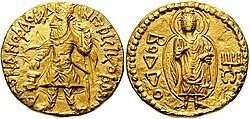
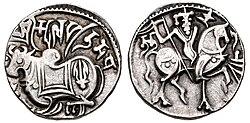
| quote = [[Gandhara Kingdom]] (538 – 518 BC)<br>[[File:Standard of Cyrus the Great (Blue).svg|20px]] [[Achaemenid Empire]] (518 – 326 BC)<br>[[File:Vergina Sun WIPO.svg|20px]] [[Macedonian Empire]] (326 – 312 BCE)<br>[[File:Vergina Sun WIPO.svg|20px]] [[Seleucid Empire]] (312 – 303 BC)<br>[[File:Ashoka Chakra.svg|20px]] [[Maurya Empire]] (303 – 185 BC)<br>[[File:Coin of Hippostratos.jpg|28px]] [[Indo-Greek Kingdom]] (185 – 85 BC)<br>[[File:Machene.jpg|28px]] [[Indo-Scythian Kingdom]] (85 – 60 BC)<br>[[File:Hippostratos.jpg|28px]] [[Indo-Greek Kingdom]] (60 – 48 BC)<br>[[File:Whitehead Coins of the Punjab Museum Plate XI Azes Demeter and Hermes.jpg|28px]] [[Indo-Scythian Kingdom]] (48 BC – 20 CE)<br>[[File:Gondophares.jpg|28px]] [[Indo-Parthian Kingdom]] (20 – 60 CE)<br>[[File:Coin of Kanishka I.jpg|28px]] [[Kushan Empire]] (60 – 242 CE)<br>[[File:Derafsh Kaviani flag of the late Sassanid Empire.svg|20px]] [[Sassanid Empire]]/[[File:Hormizd I Kushanshah Merv mint.jpg|28px]] [[Kushano-Sasanian Kingdom]] (242 – 360 CE)<br>[[File:Garuda emblem.png|22px]] [[Gupta Empire]] (360 – 410 CE)<br>[[File:Kidarite Tamga.png|20px]] [[Kidarite Kingdom]] (410 – 465)<br>[[File:Alchon Tamga.png|20px]] [[Alchon Huns|Alchon Kingdom]] (465 – 560)<br>[[File:Nezak_Crown.png|20px]] [[Alchon Huns|Alchon]]—[[Nezak Huns|Nezak Kingdom]] (560 – 665)<br>[[File:Tamgha of the Turk Shahis.png|20px]] [[Turk Shahis|Turk Shahi Kingdom]] (665 – 843)<br>[[File:Hindu Shahis Spalapatideva type, Kabul mint.jpg|28px]] [[Hindu Shahis|Hindu Shahi Kingdom]] (843 – 1001)<br>[[File:Mahmud coin minted in Ghazni.jpg|28px]] [[Ghaznavid Empire]] (1001 – 1180)<br>[[File:Mu'izz al-Din Muhammad. AH 599-602 AD 1171-1206.jpg|28px]] [[Ghurid Empire]] (1180 – 1206)<br>[[Nasir ad-Din Qabacha|Qabacha State]] (1206 – 1214)<br>[[File:Taj al-Din Yildiz. AH 602-612 AD 1206-1215 Ghazna (Ghazni) mint. Dated AH 604 (AD 1207-8).jpg|28px]] [[Taj al-Din Yildiz|Yildiz State]] (1214 – 1215)<br>[[File:Khwarizm Shahs. 'Ala al-Din Muhammad II. AH 596-617 AD 1200-1220 Citing Abbasid caliph a1-Nasir. Ghazna (Ghazni) mint.jpg|28px]] [[Khwarazmian Empire]] (1215 – 1221)<br>[[File:Imperial Seal of the Mongols 1246.svg|23px]] [[Mongol Empire]] (1221 – 1221)<br>[[File:Khwarizm Shahs. Jalal al-Din Mangubarni. AH 617-628 AD 1220-1231. AR Double Dirhem (20mm, 5.90 g, 1h). Qal 'a Nay mint.jpg|28px]] [[Khwarazmian Empire]] (1221 – 1224)<br>[[File:Imperial Seal of the Mongols 1246.svg|23px]] [[Mongol Empire]] (1224 – 1226)<br>[[File:Khwarizm Shahs. Jalal al-Din Mangubarni. AH 617-628 AD 1220-1231. AR Double Dirhem (20mm, 5.90 g, 1h). Qal 'a Nay mint.jpg|28px]] [[Khwarazmian Empire]] (1226 – 1228)<br>{{flagicon image|Delhi Sultanate Flag.svg|border=no}} [[Delhi Sultanate]] (1228 – 1241)<br>{{flagicon image|Flag of the Chagatai Khanate.svg|border=no}} [[Chagatai Khanate]] (1241 – 1307)<br>{{flagicon image|Delhi Sultanate Flag.svg|border=no}} [[Delhi Sultanate]] (1307 – 1398)<br>{{flagicon image|Timurid.svg|border=no}} [[Timurid Empire]] (1398 – 1414)<br>{{flagicon image|Delhi Sultanate Flag.svg|border=no}} [[Delhi Sultanate]] (1414 – 1526)<br>{{flagicon image|Alam of the Mughal Empire.svg|border=no}} [[Mughal Empire]] (1526 – 1540)<br>[[File:Seal of Sher Shah Suri.png|20px]] [[Sur Empire]] (1540 – 1555)<br>{{flagicon image|Alam of the Mughal Empire.svg|border=no}} [[Mughal Empire]] (1555 – 1586)<br>[[Roshani movement]] (1586 – 1587)<br>{{flagicon image|Alam of the Mughal Empire.svg|border=no}} [[Mughal Empire]] (1587 – 1738)<br>{{flagicon image|Nadir Shah Flag.svg|border=no}} [[Afsharid Empire]] (1738 – 1747)<br>[[File:Seal of Ahmad Shah Durrani.svg|20px]] [[Durrani Empire]] (1747 – 1758)<br>{{flagicon image|Flag of the Maratha Empire.svg|border=}} [[Maratha Empire]] (1758 – 1759)<br>{{flagicon image|Flag of Herat until 1842.svg|border=no}} [[Durrani Empire]] (1759 – 1818)<br>{{flagicon image|Sikh Empire flag.svg|border=no}} [[Sikh Empire]] (1818 – 1849)<br>{{flagicon image|Flag of the British East India Company (1707).svg|border=no}} [[East India Company]] (1849 – 1858)<br>{{flagicon image|British Raj Red Ensign.svg|border=no}} [[British Raj]] (1858 – 1947)<br>{{flag|Pakistan}} (1947 – present) | |||
| align = left | |||
| width = 23em | |||
| fontsize = 90% | |||
| bgcolor = GhostWhite | |||
}} | |||
=== Ancient history === | |||
==== Foundation ==== | |||
Peshawar was established as the city of ''Puruṣapura'',<ref name="Hiro2012" /><ref name="Chandra1977">{{cite book |last1=Chandra |first1=Moti |title=Trade And Trade Routes In Ancient India |publisher=Abhinav Publications |isbn=9788170170556 |url=https://books.google.com/books?id=rDL4kA7SWkEC&dq=ancient+peshawar&pg=PA10 |access-date=24 March 2017 |year=1977 |archive-date=7 March 2022 |archive-url=https://web.archive.org/web/20220307070259/https://books.google.com/books?id=rDL4kA7SWkEC&dq=ancient+peshawar&pg=PA10 |url-status=live }}</ref><ref name="Rishi1982">{{cite book |last1=Rishi |first1=Weer Rajendra |title=India & Russia: Linguistic & Cultural Affinity |date=1982 |publisher=Roma Publications |language=English |quote=The capital of Kushan Empire was Purushpura, the modern Peshawar.}}</ref> on the Gandhara Plains in the broad [[Valley of Peshawar]], after the 100 CE.<ref name="Heitzman2008">{{cite book |last1=Heitzman |first1=James |title=The City in South Asia |date=2008 |publisher=[[Routledge]] |isbn=978-1-134-28962-2 |language=English |quote=Taxila long played the role of the eastern capital, in the region known as Gandhara, alongside the region's western capital Pushkaravati or Charsadda, which attracted traders along the northern bank of the Khyber River until its eclipse by the city of Purushapura (later Peshawar) established by the second century CE (Deloche 1993, 1: 31–2).}}</ref><ref name="Sandhu2000">{{cite book |last1=Sandhu |first1=Gurcharn Singh |title=A military history of ancient India |date=2000 |publisher=Vision Books |page=24 |language=English}}</ref> It may have been named after a Hindu raja, who ruled the city, who was known as Purush.<ref name="Jaffar1952" /> The city likely first existed as a small village in the fifth century BCE,<ref name="Grandeur">{{cite book |last1=Samad |first1=Rafi U. |title=The Grandeur of Gandhara: The Ancient Buddhist Civilization of the Swat, Peshawar, Kabul and Indus Valleys |date=2011 |publisher=Algora Publishing |isbn=978-0-87586-859-2 |url=https://books.google.com/books?id=pNUwBYGYgxsC&dq=purushapura&pg=PA119 |access-date=28 November 2021 |archive-date=7 March 2022 |archive-url=https://web.archive.org/web/20220307070314/https://books.google.com/books?id=pNUwBYGYgxsC&dq=purushapura&pg=PA119 |url-status=live }}</ref> near the ancient Gandharan capital city of Pushkalavati, near present-day [[Charsadda]].<ref name="Pakhtunkhwa">{{cite web |url=http://pakhtunkhwa.com/html/body_nwfp_in_search_of_a_name.html |title=NWFP in search of a name |work=pakhtunkhwa.com |access-date=24 January 2016 |url-status=dead |archive-url=https://web.archive.org/web/20160131042427/http://pakhtunkhwa.com/html/body_nwfp_in_search_of_a_name.html |archive-date=31 January 2016}}</ref><ref name="books.google.com" /><ref>{{cite book |last1=Caroe |first1=Olaf |title=Book on The Pathans – 550 BC |date=1957 |publisher=Macmillan Company |isbn=978-0-19-577221-0}}</ref> | |||
==== Greek invasion ==== | |||
In the winter of 327–26 BCE, [[Alexander the Great]] subdued the Valley of Peshawar during his [[Indian campaign of Alexander the Great|invasion of the Indus Valley]],<ref>{{cite book |last1=Fuller |first1=J.F.C. |title=The Generalship Of Alexander The Great |date=2004 |publisher=Da Capo Press |isbn=978-0-306-81330-6 |url=https://books.google.com/books?id=kDy97Y6lZGUC&q=peshawar&pg=PA71 }}{{Dead link|date=February 2024 |bot=InternetArchiveBot |fix-attempted=yes }}</ref> as well as the nearby [[Swat (Pakistan)|Swat]] and [[Buner Valley|Buner]] valleys.<ref>{{cite book |last=Luniya |first=Bhanwarlal Nathuram |title=Life and Culture in Ancient India: From the Earliest Times to 1000 AD |year=1978 |publisher=Lakshmi Narain Agarwal |lccn=78907043}}</ref> Following Alexander's conquest, the Valley of Peshawar came under the suzerainty of [[Seleucus I Nicator]], founder of the [[Seleucid Empire]]. A locally made vase fragment that was found in Peshawar depicts a scene from [[Sophocles]]' play ''[[Antigone (Sophocles play)|Antigone]]''.<ref>{{cite book |last1=Tarn |first1=William Woodthorpe |title=The Greeks in Bactria and India |date=2010 |publisher=Cambridge University Press |isbn=978-1-108-00941-6 |url=https://books.google.com/books?id=-HeJS3nE9cAC&q=purushapura+bactria |access-date=28 March 2017 |archive-date=14 April 2021 |archive-url=https://web.archive.org/web/20210414155821/https://books.google.com/books?id=-HeJS3nE9cAC&q=purushapura+bactria |url-status=live }}</ref> | |||
==== Mauryan empire ==== | |||
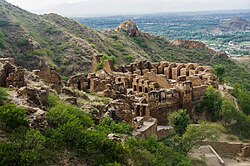
[[File:Takht-e-bahi.jpg|thumb|The nearby [[Takht-i-Bahi]] monastery was established in 46 CE,<ref name="H. Bivar 1983, p.197">A. D. H. Bivar, "The History of Eastern Iran", in Ehsan Yarshater (ed.), ''The Cambridge History of Iran,'' Vol.3 (1), ''The Seleucid, Parthian and Sasanian Periods,'' London, Cambridge University Press, 1983, p.197.</ref> and was once a major centre of Buddhist learning.]] | |||
Following the [[Seleucid–Mauryan war]], the region was ceded to the [[Mauryan Empire]] in 303 BCE.<ref name="Pandey1963" /> Around 300 BCE, the Greek diplomat and historian [[Megasthenes]] noted that Purushapura was the western terminus of a Mauryan road that connected the city to the empire's capital at ''[[Pataliputra]]'', near the city of [[Patna]] in the modern-day Indian state of [[Bihar]].<ref name="Pandey1963">{{cite book |last1=Pandey |first1=Mithila Sharan |title=The Historical Geography and Topography of Bihar |date=1963 |publisher=Motilal Banarsidass |page=198 |language=en |quote=Under the Mauryas, when Pataliputra was the capital of the whole empire, a road ran from Tamralipti, which was probably then on or very near the coast, to Purushapura in the north-west.}}</ref><ref name="silk road">{{cite book |last1=Elisseeff |first1=Vadime |title=The Silk Roads: Highways of Culture and Commerce |date=1998 |publisher=Berghahn Books |isbn=978-1-57181-222-3 |pages=175}}</ref> | |||
As Mauryan power declined, the [[Greco-Bactrian Kingdom]] based in modern Afghanistan declared its independence from the Seleucid Empire, and quickly seized the region around 190 BCE.<ref name="H. Bivar 1983, p.197" /> The city was then captured by [[Gondophares]], founder of the [[Indo-Parthian Kingdom]]. Gondophares established the nearby ''[[Takht-i-Bahi]]'' monastery in 46 CE.<ref name="H. Bivar 1983, p.197" /> | |||
==== Kushan empire ==== | |||
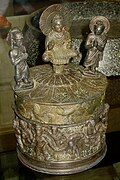
[[File:KanishkaCasket.JPG|thumb|left|150px|Peshawar's [[Kanishka stupa]] once kept sacred [[Buddhism|Buddhist]] relics in the [[Kanishka casket]].]] | |||
In the first century CE, Purushapura came under control of [[Kujula Kadphises]], founder of the [[Kushan Empire]].<ref name="Abrams2000">{{cite book |last1=Abrams |first1=Harry N. |title=The Year One: Art of the Ancient World East and West |date=2000 |publisher=[[Metropolitan Museum of Art]] |isbn=978-0-87099-961-1 |pages=133 |language=en |quote=The late-first—early-second-century-A.D. rule of Kanishka, the third Kushan emperor, was administered from two capitals, Purushapura (Peshawar), near the Khyber Pass, and Mathura, in northern India.}}</ref> It was made the empire's winter capital.<ref name="Le" /> The Kushan's summer capital at ''Kapisi'' (modern [[Bagram]], [[Afghanistan]])<ref name="Chandra">{{cite book |url=https://books.google.com/books?id=rDL4kA7SWkEC&dq=ancient+peshawar&pg=PA10 |title=Trade And Trade Routes In Ancient India |last1=Chandra |first1=Moti |publisher=Abhinav Publications |year=1977 |isbn=9788170170556 |access-date=24 March 2017 |archive-date=7 March 2022 |archive-url=https://web.archive.org/web/20220307070306/https://books.google.com/books?id=rDL4kA7SWkEC&dq=ancient+peshawar&pg=PA10 |url-status=live }}</ref> was seen as the secondary capital of the empire,<ref name="Le" /> while Puruṣapura was considered to be the empire's primary capital.<ref name="Le">{{cite book |last1=Le |first1=Huu Phuoc |url=https://books.google.com/books?id=9jb364g4BvoC&q=hephthalite+peshawar&pg=PA51 |title=Buddhist Architecture |date=2010 |publisher=Grafikol |isbn=978-0-9844043-0-8 |pages=51 |access-date=24 March 2017 |archive-url=https://web.archive.org/web/20220307070259/https://books.google.com/books?id=9jb364g4BvoC&q=hephthalite+peshawar&pg=PA51 |archive-date=7 March 2022 |url-status=live}}</ref> Ancient Peshawar's population was estimated to be 120,000, which would make it the seventh-most populous city in the world at the time.<ref>{{cite web |title=Top 10 Cities of the Year 100 |url=http://geography.about.com/library/weekly/aa011201b.htm |work=Education > Geography (sourced from Four Thousand Years of Urban Growth: An Historical Census by Tertius Chandler. 1987, St. David's University Press) |publisher=About.com |access-date=13 December 2012 |first=Matt |last=Rosenberg |author2=Tertius Chandler |year=2012 |archive-date=5 October 2013 |archive-url=https://web.archive.org/web/20131005065844/http://geography.about.com/library/weekly/aa011201b.htm |url-status=live }}</ref><ref name="Grandeur" /> As a devout Buddhist, the emperor built the grand ''Kanishka [[Mahavihara]]'' monastery.<ref>{{cite book |last1=Wink |first1=Andre |title=Al-Hind, the Making of the Indo-Islamic World: Early Medieval India and the Expansion of Islam 7th–11th Centuries |date=2002 |publisher=Brill |isbn=978-0-391-04173-8}}</ref> After his death, the magnificent [[Kanishka stupa]] was built in Peshawar to house Buddhist relics. The golden age of Kushan empire in Peshawar ended in 232 CE with the death of the last great Kushan king, [[Vasudeva I]]. | |||
Around 260 CE, the armies of the [[Sasanid Empire|Sasanid]] Emperor [[Shapur I]] launched an attack against Peshawar,<ref>{{cite book |last1=Puri |first1=Baij Nath |title=Buddhism in Central Asia |date=1987 |publisher=Motilal Banarsidass |isbn=9788120803725}}</ref> and severely damaged Buddhist monuments and monasteries throughout the Valley of Peshawar.<ref name="Grandeur" /> Shapur's campaign also resulted in damage to the city's monumental stupa and monastery.<ref name="Grandeur" /> The Kushans were made subordinate to the Sasanids and their power rapidly dwindled,<ref>{{cite book |last1=Wink |first1=Andre |title=Al-Hind: The Slavic Kings and the Islamic conquest, 11th–13th centuries |date=2002 |publisher=BRILL |isbn=978-0-391-04174-5}}</ref> as the Sasanids blocked lucrative trade routes westward out of the city.<ref name="Grandeur" /> | |||
Kushan Emperor [[Kanishka III]] was able to temporarily reestablish control over the entire Valley of Peshawar after Shapur's invasion,<ref name="Grandeur" /> but the city was then captured by the Central Asian [[Kidarites|Kidarite kingdom]] in the early 400s CE.<ref>{{cite book |last1=Ahmad |first1=Hasan Dani |title=History of Civilizations of Central Asia: The crossroads of civilizations: A.D. 250 to 750 |date=1999 |publisher=Motilal Banarsidass Publ |isbn=9788120815407 |url=https://books.google.com/books?id=FcKtIPVQ6REC&q=Huna&pg=PA116 |access-date=29 March 2017 |archive-date=7 March 2022 |archive-url=https://web.archive.org/web/20220307070303/https://books.google.com/books?id=FcKtIPVQ6REC&q=Huna&pg=PA116 |url-status=live }}</ref> | |||
==== White Huns ==== | |||
The [[Hephthalite Empire|White Huns]] devastated ancient Peshawar in the 460s CE,<ref>{{cite book |last1=Saletore |first1=Bhasker Anand |title=India's Diplomatic Relations with the East |date=1960 |publisher=Popular Book Depot}}</ref> and ravaged the entire region of Gandhara, destroying its numerous monasteries.<ref name="Basic Books">{{cite book |last1=Wriggins |first1=Sally |title=The Silk Road Journey With Xuanzang |date=2008 |publisher=Basic Books |isbn=978-0-7867-2544-1 |url=https://books.google.com/books?id=eSYKO5zLgZkC&q=xuanzang+peshawar&pg=PT60 |access-date=29 March 2017 |archive-date=7 March 2022 |archive-url=https://web.archive.org/web/20220307070303/https://books.google.com/books?id=eSYKO5zLgZkC&q=xuanzang+peshawar&pg=PT60 |url-status=live }}</ref> The Kanishka stupa was rebuilt during the White Hun era with the construction of a tall wooden superstructure, built atop a stone base,<ref name="Le" /> and crowned with a 13-layer copper-[[gilding|gilded]] ''[[Chatra (umbrella)|chatra]]''.<ref name="Le" /> In the 400s CE, the [[China|Chinese]] Buddhist [[pilgrim]] ''[[Faxian]]'' visited the structure and described it as "the highest of all the towers" in [[Jambudvipa|the "terrestrial world"]],<ref name="Le" /> which ancient travelers claimed was up to {{cvt|560|ft|m}} tall,<ref name="Le" /> though modern estimates suggest a height of {{cvt|400|ft|m}}.<ref name="Le" /> | |||
In 520 CE the Chinese monk [[Song Yun]] visited Gandhara and ancient Peshawar during the White Hun era, and noted that it was in conflict with nearby ''Kapisa''.<ref name="autogenerated1962">{{cite book |last1=Cotton |first1=James |title=Imperial Gazetteer of India:Gazetteers of British India, 1833–1962 Volume 20 of Imperial Gazetteer of India |url=https://archive.org/details/imperialgazettee20grea |date=1908 |publisher=Clarendon}}</ref><ref name=":6">{{cite book |last1=Dani |first1=Ahmad Hasan |url=https://archive.org/details/peshawarhistoric0000dani |title=Peshawar: Historic City of the Frontier |date=1995 |publisher=Sang-e-Meel Publications |isbn=9789693505542 |pages=12 |url-access=registration}}</ref> The Chinese monk and traveler [[Xuanzang]] visited ancient Peshawar around 630 CE,<ref>{{cite book |last1=hastings |first1=captain e. g. g. |title=report of the regular settlement of the peshawar district of the punjab |date=1878 |publisher=Oxford University |url=https://books.google.com/books?id=7JoIAAAAQAAJ&q=sung+yun+peshawar&pg=PA312 |access-date=29 March 2017 |archive-date=7 March 2022 |archive-url=https://web.archive.org/web/20220307070311/https://books.google.com/books?id=7JoIAAAAQAAJ&q=sung+yun+peshawar&pg=PA312 |url-status=live }}</ref> after ''Kapisa'' victory, and expressed lament that the city and its great Buddhist monuments had decayed to ruin<ref>{{cite book |last1=Zhang |first1=Guiyong |title=Chinese History: Middle ages |date=1978 |publisher=China Academy |url=https://books.google.com/books?id=PQdGAAAAMAAJ&q=peshawar+middle+ages |access-date=24 March 2017 |archive-date=7 March 2022 |archive-url=https://web.archive.org/web/20220307070311/https://books.google.com/books?id=PQdGAAAAMAAJ&q=peshawar+middle+ages |url-status=live }}</ref>—although some monks studying [[Theravada Buddhism]] continued to study at the monastery's ruins.<ref>{{cite book |last1=Heirman |first1=Ann |last2=Bumbacher |first2=Stephan Peter |title=The Spread of Buddhism |date=2007 |publisher=BRILL |isbn=9789047420064}}</ref> Xuanzang estimated that only about 1,000 families continued in a small quarter among the ruins of the former grand capital.<ref name="Basic Books" /> | |||
=== Medieval history === | |||
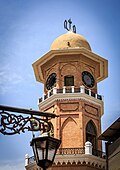
[[File:ClockTower-peshawar.jpg|thumb|Clock Tower Peshawar]] | |||
Until the mid-seventh century, the residents of ancient Peshawar were ruled by [[Turk Shahis|Kabul Shahis]], who were then displaced by the [[Hindu Shahi]]s of [[Kabul]].<ref name="autogenerated1962" /> Islam is believed to have been first introduced to the [[Buddhism|Buddhist]], [[Hindu]] and other indigenous inhabitants of Puruṣapura in the later seventh century. | |||
==== Ghaznavid empire ==== | |||
{{Further|Battle of Peshawar (1001)}} | |||
In 986–87 CE, Peshawar's first encounter with Muslim armies occurred when [[Sabuktigin]] invaded the area and fought the Hindu Shahis under their king, Anandpal.<ref name="bosworth" /> | |||
On 28 November 1001, Sabuktigin's son [[Mahmud Ghazni]] decisively defeated the army of [[Jayapala|Raja Jayapala]], son of Anandpal, at the [[Battle of Peshawar (1001)|Battle of Peshawar]],<ref>{{cite book |last=Bosworth |first=C.E. |title=The Ghaznavids 994–1040 |url=https://archive.org/details/ghaznavids0000unse |url-access=registration |publisher=Edinburgh University Press |date=1963}}</ref> and established rule of the [[Ghaznavid Empire]] in the Peshawar region. During the Ghaznavid era, Peshawar served as an important stop between the Afghan plateau, and the Ghaznavid garrison city of [[Lahore]].<ref name="bosworth" /> During the tenth–12th century, Peshawar served as a headquarters for Hindu [[Nath]] Panthi Yogis,<ref name="Chandra" /> who in turn are believed to have extensively interacted with Muslim Sufi mystics.<ref name="Chandra" /> | |||
As the first Pashtun tribe to settle in the region, the [[Dilazak]] Pashtuns began settling in the Valley of Peshawar,<ref name="Muhammad Hayat Khan p 346-3472">"Taareekh-e-Hazara" (Urdu) by Dr. Sher Bahadur Khan Panni_first edition_1969 p 295-313,"Taareekh-e-Wadi-e-Chhachh and Aqwaam-e-Chhachh" (Urdu) by Manzoor Awan p 175-182, "Afghanistan and its inhabitants" translation of Muhammad Hayat Khan's book by Henry B Priestley_1874 (reproduced by Sang-e-Meel Publications_Pakistan_1981) p-55/56, p- 197/198, "Da Pasto Qabeelo Shajre o Mene" (Pashto) by Muhammad Umar Rond Miakhel_2001 p 346-347</ref> and are believed to have settled regions up to the [[Indus River]] by the 11th century.<ref name="Muhammad Hayat Khan p 346-3472">"Taareekh-e-Hazara" (Urdu) by Dr. Sher Bahadur Khan Panni_first edition_1969 p 295-313,"Taareekh-e-Wadi-e-Chhachh and Aqwaam-e-Chhachh" (Urdu) by Manzoor Awan p 175-182, "Afghanistan and its inhabitants" translation of Muhammad Hayat Khan's book by Henry B Priestley_1874 (reproduced by Sang-e-Meel Publications_Pakistan_1981) p-55/56, p- 197/198, "Da Pasto Qabeelo Shajre o Mene" (Pashto) by Muhammad Umar Rond Miakhel_2001 p 346-347</ref> The Arab historian and geographer [[al-Masudi]] noted that by the mid tenth century, the city had become known as ''Parashāwar''. | |||
==== Delhi sultanate ==== | |||
In 1179–80, [[Muhammad Ghori]] captured Peshawar, though the city was then destroyed in the early 1200s at the hands of the [[Mongol Empire|Mongols]].<ref name="bosworth" /> Peshawar was an important regional centre under the [[Lodi dynasty]] of [[Delhi Sultanate]]. | |||
Several other Pashtun tribe began settling rural regions around Peshawar in the late 15th and 16th centuries.<ref name="G.P.Tate 1911 Page 12">"The Kingdom of Afghanistan – A Historical Sketch" by G.P.Tate (1911), Reproduced by 'Indus Publications' (1973) Page 12 (Foot Note)</ref> The Ghoryakhel and Khashi ''Khel'' tribe pushed the Dilazak Pashtun tribes east of the Indus River following a battle in 1515 near the city of [[Mardan]].<ref name="G.P.Tate 1911 Page 12" /> [[Hindko]] continued to be the language of trade and business in the city.<ref name=":6" /> | |||
=== Early modern history === | |||
==== Mughal empire ==== | |||
[[File:MohabbatKhanMosque.png|thumb|Bestowed by Mohabbat Khan, the Mughal governor in 1630, the white-marble façade of the [[Mohabbat Khan Mosque]] is one of Peshawar's most iconic sights.]] | |||
In July 1526, Emperor [[Babur]] captured Peshawar.<ref name="Miers2">{{cite book |last1=Henry Miers |first1=Elliot |url=https://books.google.com/books?id=w2AGBNfe8ZQC&q=peshawar&pg=PA25 |title=The History of India, as Told by Its Own Historians: The Muhammadan Period |date=21 March 2013 |publisher=Cambridge University Press |isbn=978-1-108-05587-1 |publication-date=2013 |access-date=3 October 2020 |orig-year=1867 |archive-url=https://web.archive.org/web/20220307070321/https://books.google.com/books?id=w2AGBNfe8ZQC&q=peshawar&pg=PA25 |archive-date=7 March 2022 |url-status=live}}</ref> During Babur's rule, the city was known as ''Begram'', and he rebuilt the city's fort.<ref>{{cite book |last1=Aykroyd |first1=Clarissa |url=https://archive.org/details/pakistan0000aykr |title=Pakistan |date=2005 |publisher=Mason Crest Publishers |isbn=978-1-59084-839-5 |url-access=registration}}</ref> Babur used the city as a base for expeditions to other nearby towns.<ref name="bosworth2">{{cite book |last1=Bosworth |first1=Clifford Edmund |url=https://books.google.com/books?id=UB4uSVt3ulUC&q=ancient+peshawar |title=Historic Cities of the Islamic World |date=2007 |publisher=BRILL |isbn=9789004153882 |access-date=24 March 2017 |archive-url=https://web.archive.org/web/20220307070250/https://books.google.com/books?id=UB4uSVt3ulUC&q=ancient+peshawar |archive-date=7 March 2022 |url-status=live}}</ref> Peshawar remained an important centre on trade routes between India and Central Asia during [[Mughal Empire|Mughal period]]. The Peshawar region was a cosmopolitan region in which goods, peoples, and ideas would pass along trade routes.<ref name="Richards" /> Its importance as a trade centre is highlighted by the destruction of over one thousand camel-loads of merchandise following an accidental fire at Bala Hissar fort in 1586.<ref name="Richards">{{cite book |last=Richards |first=John F. |title=The Mughal Empire |date=1995 |publisher=Cambridge University Press |isbn=978-0-521-56603-2 |url=https://books.google.com/books?id=HHyVh29gy4QC&q=peshawar+mughal&pg=PA50 |access-date=24 March 2017 |archive-date=7 March 2022 |archive-url=https://web.archive.org/web/20220307070309/https://books.google.com/books?id=HHyVh29gy4QC&q=peshawar+mughal&pg=PA50 |url-status=live }}</ref> Under the reign of Babur's son, [[Humayun]], direct Mughal rule over the city was briefly challenged with the rise of the Pashtun king, [[Sher Shah Suri]], who began construction of the famous [[Grand Trunk Road]] in the 16th century. Mughal rule in the area was tenuous, as Mughal suzerainty was only firmly exercised in the Peshawar valley, while the neighbouring valley of Swat was under Mughal rule only during the reign of [[Akbar]].<ref>Akbar Nama, trans. H. Beveridge, vol. 3, p. 715 quoted in Dani, Peshawar. p. 102. Whereas according to Nizam ai-Din Ahmad it was "on the [next day]" that Akbar sent Zain Khan Kukah "with a well equipped army against the Afghans of Sawad (Swat) and Bajaur, for the extirpation of those turbulent tubes," Khwajah Nizam al-Din Ahmad, The Tabaqat-i-Akbari: (A History of India from the early Musalman Invasions to the thirty-eight year of the reign of Akbar), vol. 2, trans, Brajendra Nath De. rev. and ed, Baini Prashad, low Price Publications, Delhi, 1992, p, 607.</ref> | |||
Peshawar was an important trading centre on the Grand Trunk Road.<ref name="silk road" /> During Akbar's rule, the name of the city changed from ''Begram'' to ''Peshawar''.<ref name="bosworth" /> In 1586, Pashtuns rose against Mughal rule during the Roshani Revolt under the leadership of [[Pir Roshan|Bayazid Pir Roshan]],<ref name="CUP Archive">{{cite book |title=The Cambridge History of India, Volume 3 |date=1928 |publisher=CUP Archive}}</ref> founder of the egalitarian [[Roshani movement]], who assembled Pashtun armies in an attempted rebellion against the Mughals. The Roshani followers laid siege to the city until 1587.<ref name="CUP Archive" /> | |||
Peshawar was bestowed with its own set of ''Shalimar Gardens'' during the reign of [[Shah Jahan]],<ref>Ahmad, Hasan Dani (1999). History of Civilizations of Central Asia: The crossroads of civilizations: A.D. 250 to 750. Motilal Banarsidass Publ. {{ISBN|9788120815407}}. Retrieved 29 March 2017</ref> which no longer exist. Emperor [[Aurangzeb]]'s governor of Kabul, Mohabbat Khan used Peshawar as his winter capital during the 17th century, and bestowed the city with its famous [[Mohabbat Khan Mosque]] in 1630.<ref name="bosworth" /> | |||
[[Yusufzai]] tribes rose against Mughal rule during the Yusufzai Revolt of 1667,<ref name="Richards" /> and engaged in pitched-battles with Mughal battalions nearby [[Attock]].<ref name="Richards" /> [[Afridi]] tribes resisted Mughal rule during the Afridi Revolt of the 1670s.<ref name="Richards" /> The Afridis massacred a Mughal battalion in the nearby [[Khyber Pass]] in 1672 and shut the pass to lucrative trade routes.<ref name=richards>{{citation |title=The Mughal Empire |chapter=Imperial expansion under Aurangzeb 1658–1869. Testing the limits of the empire: the Northwest. |volume=5 |series=New Cambridge history of India: The Mughals and their contemporaries |first=John F. |last=Richards |author-link=John F. Richards |edition=illustrated, reprint |publisher=Cambridge University Press |year=1996 |isbn=978-0-521-56603-2 |pages=170–171 |chapter-url=https://books.google.com/books?id=SrdiVPsFRYIC |access-date=24 March 2017 |archive-date=31 December 2013 |archive-url=https://web.archive.org/web/20131231220430/http://books.google.com/books?id=SrdiVPsFRYIC |url-status=live }}</ref> Mughal armies led by Emperor Aurangzeb himself regained control of the entire area in 1674.<ref name="Richards" /> | |||
Following Aurangzeb's death in 1707, his son [[Bahadur Shah I]], former governor of Peshawar and Kabul, was selected to be the Mughal Emperor. As Mughal power declined following the death of Emperor Aurangzeb, the empire's defenses were weakened.<ref>{{cite book |last1=Wynbrandt |first1=James |title=A Brief History of Pakistan |date=2009 |publisher=Infobase |isbn=978-0-8160-6184-6 |url-access=registration |url=https://archive.org/details/briefhistoryofpa0000wynb}}</ref> | |||
On 18 November 1738, Peshawar was captured from the Mughal governor Nawab Nasir Khan by the [[Afsharid dynasty|Afsharid]] armies during the [[Nader Shah's invasion of the Mughal Empire|Persian invasion of the Mughal Empire]] under [[Nader Shah]].<ref>{{cite book |last1=Sharma |first1=S.R. |title=Mughal Empire in India: A Systematic Study Including Source Material, Volume 3 |publisher=Atlantic Publishers & Dist |isbn=9788171568192 |url=https://books.google.com/books?id=4j_VLlGqVSoC&q=peshawar+mughal&pg=PA728 |access-date=24 March 2017 |year=1999 |archive-date=7 March 2022 |archive-url=https://web.archive.org/web/20220307070326/https://books.google.com/books?id=4j_VLlGqVSoC&q=peshawar+mughal&pg=PA728 |url-status=live }}</ref><ref>{{cite book |last1=Nadiem |first1=Ihsan H. |title=Peshawar: heritage, history, monuments |date=2007 |publisher=Sang-e-Meel |isbn=9789693519716}}</ref> | |||
==== Durrani Empire ==== | |||
[[File:Bala_Hisar_Fort.jpg|thumb|220px|Peshawar's [[Bala Hissar, Peshawar|Bala Hissar]] fort was once the royal residence of the Durrani Afghan kings.]] | |||
In 1747, Peshawar was taken by [[Ahmad Shah Durrani]], founder of the Afghan [[Durrani Empire]].<ref>{{Cite book |url=https://books.google.com/books?id=YZJcAQAAQBAJ&q=peshawar+capture+durrani+empire&pg=PA204 |title=A Concise History of Afghanistan in 25 Volumes, Volume 14 |access-date=29 December 2014 |isbn=978-1-4907-1441-7 |last1=Alikuzai |first1=Hamid Wahed |date=October 2013 |publisher=Trafford |archive-date=27 November 2021 |archive-url=https://web.archive.org/web/20211127151423/https://books.google.com/books?id=YZJcAQAAQBAJ&q=peshawar+capture+durrani+empire&pg=PA204 |url-status=live }}</ref> The city was captured in spring of 1758<ref>{{cite book |author=Alexander Mikaberidze |url=https://books.google.com/books?id=jBBYD2J2oE4C |title=Conflict and Conquest in the Islamic World: A Historical Encyclopedia [2 Volumes] |date=22 July 2011 |publisher=Abc-Clio |isbn=9781598843378 |page=43 |quote=The Marathas, assisted by Sikhs, defeated the Afghans and captured Attock, Peshwar and Multan in the spring of 1758}}</ref><ref>{{Cite book |last=Black |first=Jeremy |url=https://books.google.com/books?id=zcEcBQAAQBAJ&q=Attock+and+peshwar&pg=PA82 |title=War in the Eighteenth-Century World |date=7 December 2012 |publisher=Macmillan International Higher Education |isbn=978-0-230-37000-5 |language=en}}{{Dead link|date=February 2024|bot=InternetArchiveBot|fix-attempted=yes}}</ref> by the [[Maratha Confederacy]] in alliance with the [[Sikhs]].<ref>{{cite book |last1=Gupta |first1=Hari Ram |url=https://books.google.com/books?id=TmU9AAAAMAAJ |title=Marathas and Panipat |year=1961 |page=94}}</ref><ref name="mehta2">{{Cite book |last=Mehta |first=Jaswant Lal |title=Advanced Study in the History of Modern India 1707–1813 |publisher=New Dawn Press, Incorporated |year=2005 |isbn=978-1-932705-54-6 |pages=236, 256, 260}} "The province of Multan and northwest frontier were also overrun by Marathas and the forts of Peshawar and Attock were garrisoned by their troops"</ref><ref>{{Cite book |last=Pletcher |first=Kenneth |url=https://books.google.com/books?id=VsujRFvaHI8C&pg=PA198 |title=The History of India |publisher=Britannica Educational Pub. |year=2010 |isbn=978-1-61530-122-5 |pages=198}}</ref> Before that, the fort of Peshawar was being guarded by Durrani troops under [[Timur Shah Durrani]] and Jahan Khan. When [[Raghunathrao]], [[Malhar Rao Holkar]] and Sikh alliance of [[Charat Singh]] and [[Jassa Singh Ahluwalia]] left Peshawar, [[Tukoji Rao Holkar]] was appointed as the representative in this area ofgain the sub-continent.<ref name="ReferenceA2">Third Battle of Panipat by Abhas Verma {{ISBN|9788180903397}} Bharatiya Kala Prakashan</ref><ref name="mehta2">{{Cite book |last=Mehta |first=Jaswant Lal |title=Advanced Study in the History of Modern India 1707–1813 |publisher=New Dawn Press, Incorporated |year=2005 |isbn=978-1-932705-54-6 |pages=236, 256, 260}} "The province of Multan and northwest frontier were also overrun by Marathas and the forts of Peshawar and Attock were garrisoned by their troops"</ref><ref>{{Cite book |last=Sharma |first=S. R. |url=https://books.google.com/books?id=4j_VLlGqVSoC&q=extended+their+sway+upto+Multan&pg=PA763 |title=Mughal Empire in India: A Systematic Study Including Source Material |date=1999 |publisher=Atlantic Publishers & Dist |isbn=978-81-7156-817-8 |language=en}}</ref> | |||
In the following year Ahmad Shah agin occupied the city. Under the reign of his son [[Timur Shah Durrani|Timur Shah]], the Mughal practice of using Kabul as a summer capital and Peshawar as a winter capital was reintroduced,<ref name="bosworth" /><ref name="Hanifi2011">{{cite book |first=Shah |last=Hanifi |title=Connecting Histories in Afghanistan: Market Relations and State Formation on a Colonial Frontier |url=https://books.google.com/books?id=kh1hpPLSpcEC |access-date=13 December 2012 |date=11 February 2011 |publisher=Stanford University Press |isbn=978-0-8047-7777-3 |quote=Timur Shah transferred the Durrani capital from Qandahar during the period of 1775 and 1776. Kabul and Peshawar then shared time as the dual capital cities of Durrani, the former during the summer and the latter during the winter season. |archive-date=15 August 2021 |archive-url=https://web.archive.org/web/20210815092453/https://books.google.com/books?id=kh1hpPLSpcEC |url-status=live }}</ref> with the practice maintained until the [[Sikh]] invasion.<ref name="Olaf">Caroe, Olaf (1957) The Pathans.</ref> Peshawar's [[Bala Hissar, Peshawar|Bala Hissar Fort]] served as the residence of Afghan kings during their winter stay in Peshawar, and it was noted to be the main centre of trade between [[Bukhara]] and India by British explorer [[William Moorcroft (explorer)|William Moorcroft]] during the late 1700s.<ref name="hopkins">{{cite book |last1=Hopkins |first1=B. |title=The Making of Modern Afghanistan |date=2008 |publisher=Springer |isbn=978-0-230-22876-4}}</ref> Peshawar was at the centre of a productive agricultural region that provided much of north India's dried fruit.<ref name="hopkins" /> | |||
Timur Shah's grandson, [[Mahmud Shah Durrani]], became king, and quickly seized Peshawar from his half-brother, [[Shah Shuja Durrani]].<ref name="UNESCO" /> Shah Shujah was then himself proclaimed king in 1803, and recaptured Peshawar while Mahmud Shah was imprisoned at Bala Hissar fort until his eventual escape.<ref name="UNESCO" /> In 1809, the British sent an emissary to the court of Shah Shujah in Peshawar, marking the first diplomatic meeting between the British and Afghans.<ref name="UNESCO" /> His half-brother Mahmud Shah then allied himself with the ''Barakzai'' Pashtuns, and captured Peshawar once again and reigned until the [[Battle of Nowshera]] in March 1823.<ref name="UNESCO" /> | |||
==== Sikh Empire ==== | |||
[[Ranjit Singh]] invaded Peshawar in 1818, but handed its rule to Peshawar Sardars as vassals.<ref name="Sikhs">{{cite book |last1=Rai |first1=Jyoti |last2=Singh |first2=Patwant |title=Empire of the Sikhs: The Life and Times of Maharaja Ranjit Singh |date=2008 |publisher=Peter Owen Publishers |isbn=978-0-7206-1371-1}}</ref><ref name="lee">{{Cite book |last=Lee |first=Jonathan |title=Afghanistan: A History from 1260 to the Present |publisher=Reaktion Books |year=2019 |isbn=978-1-78914-010-1 |pages=188 |language=English}}</ref> Following the Sikh victory against [[Azim Khan]] at the Nowshera in March 1823, Ranjit Singh captured Peshawar again and reinstated Yar Mohammed as the governor.<ref name="lee" /><ref name="Sikhs" /> By 1830, Peshawar's economy was noted by Scottish explorer [[Alexander Burnes]] to have sharply declined,<ref name=hopkins /> with Ranjit Singh's forces having destroyed the city's palace and agricultural fields.<ref name=hopkins /> | |||
Much of Peshawar's caravan trade from [[Kabul]] ceased on account of skirmishes between Afghan and Sikh forces,<ref name=hopkins /> as well as a punitive tax levied on merchants by Ranjit Singh's forces.<ref name=hopkins /> Singh's government also required Peshawar to forfeit much of its leftover agricultural output to the Sikhs as tribute,<ref name=hopkins /> while agriculture was further decimated by a collapse of the dried fruit market in north India.<ref name=hopkins /> Singh appointed Neapolitan mercenary [[Paolo Avitabile]] as administrator of Peshawar, who is remembered for having unleashed a reign of terror. His time in Peshawar is known as a time of "gallows and gibbets". The city's famous Mahabat Khan, built in 1630 in the Jeweler's Bazaar, was badly damaged and desecrated by the Sikh conquerors.<ref name="heritage.gov.pk">{{cite web |title=History of Peshawar |url=http://www.heritage.gov.pk/html_Pages/historic_peshawar.htm |publisher=National Fund for Cultural Heritage |access-date=13 December 2012 |first=Asghar |last=Javed |year=1999–2004 |archive-date=27 February 2004 |archive-url=https://web.archive.org/web/20040227044829/http://www.heritage.gov.pk/html_Pages/historic_peshawar.htm |url-status=live }}</ref> | |||
The Sikh Empire formally [[Capture of Peshawar (1834)|annexed Peshawar in 1834]] following advances from the armies of [[Hari Singh Nalwa]]<ref name="Sikhs" />—bringing the city under direct control of the Sikh Empire's ''Lahore Durbar''.<ref name="Sikhs" /> An 1835 attempt by [[Dost Mohammad Khan|Dost Muhammad Khan]] to re-occupy the city was unsuccessful after being unable to breach the Peshawar fort's defenses.<ref>{{Cite book |last=Lee |first=Jonathan |title=Afghanistan: A History from 1260 to the Present |publisher=Reaktion Books |year=2019 |isbn=978-1-78914-010-1 |pages=208 |language=English}}</ref> Sikh settlers from Punjab were settled in the city during Sikh rule. The city's only remaining [[Gurdwara]]s were built by [[Hari Singh Nalwa]] to accommodate the newly settled Sikhs.<ref>{{cite web |title=Gurudwara Bhai Joga Singh at Peshawar |url=http://www.allaboutsikhs.com/gurudwaras-in-pakistan/gurudwara-bhai-joga-singh-at-peshawar |work=All About Sikhs – your Gateway to Sikhism |publisher=Gateway to Sikhism |access-date=13 December 2012 |first=Iqbal |last=Qaiser |year=2012 |archive-date=25 April 2013 |archive-url=https://web.archive.org/web/20130425220253/http://www.allaboutsikhs.com/gurudwaras-in-pakistan/gurudwara-bhai-joga-singh-at-peshawar |url-status=live }}</ref> The Sikhs also rebuilt the Bala Hissar fort during their occupation of the city.<ref name="UNESCO">{{cite book |last1=Dani |first1=Ahmad Hasan |title=History of Civilizations of Central Asia: Development in contrast : from the sixteenth to the mid-nineteenth century |date=2003 |publisher=UNESCO |isbn=9789231038761}}</ref> | |||
==== British Raj ==== | |||
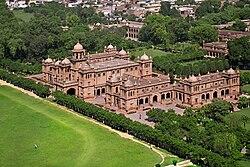
[[File:Islamia College Peshawar 2.jpg|thumb|The British-era [[Islamia College University|Islamia College]] was built in an [[Indo-Saracenic Revival architecture|Indo-Saracenic Revival]] style.]] | |||
[[File:Sethi House Peshawar.jpg |thumb|Built for wealthy [[Peshawaris|Peshawari]] merchants in a Central Asian architectural style, the [[Sethi Mohallah]] features several homes dating from the British era.]] | |||
Following the defeat of the Sikhs in the [[First Anglo-Sikh War]] in 1845–46 and the [[Second Anglo-Sikh War]] in 1849, some of their territories were captured by the British [[East India Company]]. The British re-established stability in the wake of ruinous Sikh rule.<ref name=hopkins /> During the [[Indian Rebellion of 1857|Sepoy Rebellion of 1857]], the 4,000 members of the native garrison were disarmed without bloodshed;<ref name=":4" /> the absence of conflict during the rebellion meant that Peshawar was not affected by the widespread devastation that was experienced throughout the rest of British India and local chieftains sided with the British after the incident.<ref name=":4">[[Charles Allen (writer)|Charles Allen]], ''Soldier Sahibs'', p.276</ref> | |||
The British laid out the vast [[Peshawar Cantonment]] to the west of the city in 1868, and made the city its frontier headquarters.<ref name="Schofield, Victoria 2003 page 47">Schofield, Victoria, "Afghan Frontier: Feuding and Fighting in Central Asia", London: Tauris Parke Paperbacks (2003), page 47</ref> Additionally, several projects were initiated in Peshawar, including linkage of the city by railway to the rest of British India and renovation of the Mohabbat Khan mosque that had been desecrated by the Sikhs.<ref name="heritage.gov.pk" /> British suzerainty over regions west of Peshawar was cemented in 1893 by Sir [[Mortimer Durand]], foreign secretary of the British Indian government, who collaboratively [[Durand Line|demarcated the border]] between British controlled territories in India and Afghanistan. | |||
The British built [[Cunningham clock tower]] in celebration of the [[Golden Jubilee of Queen Victoria]], and in 1906 built the Victoria Hall (now home of the [[Peshawar Museum]]) in memory of [[Queen Victoria]].<ref name="heritage.gov.pk" /> The British introduced Western-style education into Peshawar with the establishment of [[Edwardes College]] and [[Islamia College University|Islamia College]] in 1901 and 1913, along with several schools run by the [[Anglican Church]].<ref name="heritage.gov.pk" /> For better administration of the region, Peshawar and the adjoining districts were separated from the Punjab Province in 1901;<ref>{{cite book|url=https://books.google.com/books?id=nKdraLI-c0wC&pg=PA15 |page=15 | title=Changes in the Socio-economic Structures in Rural North-West Pakistan | isbn=978-3-8175-0408-4 | last1=Khan | first1=Mohammad Asif | year=2007 |publisher=Mohammad Asif Khan }}</ref> the [[North-West Frontier Province (1901–55)|North-West Frontier Province]] was separated from Punjab Province in 1901, after which Peshawar became capital of the new province.<ref name="bosworth" /> | |||
[[Communal riots]] broke out in the old city of Peshawar during the spring of 1910, when the annual [[Hinduism|Hindu]] festival of [[Holi]] coincided with [[Barawafat]], the annual [[Islam|Muslim]] day of mourning, resulting in a considerable loss of life along with hundreds of [[looted]] businesses and injuries.{{efn|name=1921CensusQuote|"The date of the Hindu festival of Holi coincided with Barawafat, the Musalman day of mourning, in 1910, which led to a very serious riot between the Hindus and Musalmans of the Peshawar City resulting in a considerable loss of life. There was a wholescale plunder of Hindu houses and shops."<ref name="1921Census">{{cite web|url=https://www.jstor.org/stable/saoa.crl.25430163|jstor=saoa.crl.25430163 |access-date=10 February 2023|title=Census of India 1921. Vol. 14, North-west Frontier Province : Part I, Report; part II, Tables |year=1922 }}</ref>{{rp|92–93}}}}<ref name="1910Riots">Rehman, Noor & Khan, Aman Ullah. 2020. "[http://pu.edu.pk/images/journal/HistoryPStudies/PDF_Files/2_v33_2_2020.pdf "Maro Hindu Ko" (Kill the Hindus): Communal Violence in Peshawar City: A Historical Perspective]" In ''[http://pu.edu.pk/home/journal/40 Journal of the Punjab University Historical Society]''. Volume: 33, No. 02, July – December 2020</ref> A month prior, in February 1910, prominent community religious leaders met with officials and agreed that Holi would be solely celebrated in predominantly Hindu neighbourhoods of the city, notably in Andar Shehr and Karim Pura.{{efn|"On 22nd February 1910, a meeting of leading Muslims and Hindu leaders was called by deputy commissioner of Peshawar at the Municipal Hall in which arrangements regarding the upcoming festivals were discussed and a committee was established consisting of prominent leaders from both sides. It was decided in the meeting that the Holi should be celebrated quietly until the 25th March. There should be only two processions, namely from the Hindu quarter of Andar Shahr to that of Karimpura and vice-versa. The Muslim of the city should not join the procession and the troops should celebrate Holi in their lines and some leading men from both sides will supervise the arrangement at Hasting Memorial and other at Clock Tower."<ref name="1910Riots" />{{rp|23–24}}}} On 21 March 1910, however, rumors of [[musician]]s from [[Amritsar]] and a dancing boy from [[Haripur, Pakistan|Haripur]] being brought into the city for Holi celebrations, led to a group of individuals who were marking Barawafat into forming a mob with the intention of stopping the [[procession]].{{efn|On 21 March the Deputy Commissioner was informed by deputy superintendent of police Zain ul Abidin that the situation in the city is not good as Hindu brought some musicians from Amritsar and a dancing boy from Hari Pur and they are intending to lead the procession on an unauthorized route. The superintendent of police suggested the deputy commissioner that the Holi should not be allowed as the situations going to create clash. Mr. Blackway sent some Hindu leader to enquire the situation. These Hindu gentlemen assured the deputy commissioner that the situation is friendly and nothing bad is going to be happened. There is no musician with the Holi and it would follow the old route. At the same time some Muslim leaders reported to the deputy commissioner about the Muslim mob who intended to stop the Holi procession. They also suggested that Holi procession should be stopped to avoid an expected clash between the two communities. However, after the surety of the Hindu leaders that there are no musicians and dancing boys and that the procession is not going on an unauthorized route the deputy commissioner was stuck to follow his old plan. This was the point which was misunderstood and created communal violence in the city.<ref name="1910Riots" />{{rp|24}}}} Despite Muslim and Hindu [[community leader]]s calling for calm, both parties ultimately clashed at the Asamai Gate, when the Holi procession was ''en route'' to [[Dargah Pir Ratan Nath Jee]], with a Hindu procession member stabbing a Muslim individual in the mob.{{efn|Around 8 pm when the Holi procession at Asa Mai gate was about to depart on the route to Pir Rathan Nath Dharamshala sub inspector Kanhya Lal who was posted at Chita Khuo informed the police head quarter that a mob of Muslim also assembled to stop it and the two mobs started abusing each other. Leaders from both sides tried to control the situation but the people from both sides refused to pay any heed to their leaders. Meanwhile, a Hindu Mahr Singh stabbed a Muslim with knife. Mahr Singh was chased by the mob and captured him at Bara Bazar. At the same time two Muslims Jani and Ahmad were killed by Hindu with knives. Police report for 21 March 1911, provides that two Muslim were killed and three wounded while from Hindu side two people were killed and eleven were wounded and eleven shops were broken.<ref name="1910Riots" />{{rp|24}}}} [[Riot]]s ensued for the following three days, involved individuals from outlying [[Federally Administered Tribal Areas|tribal regions]] who had entered the city, with a mob at Bara Bazar allegedly chanting "''Maro Hindu Ko''" (Kill the Hindus).{{efn|When the funeral party was ousted from the city a riffraff of Muslim consisting of people from trans-border areas and Afghanistan remained in the city that started plundering and broke 285 shops. A violent clash was started in which two Hindus and one Muslim was killed... The next day on 23 March the looting of shops started again. The first case was reported in Ramdas Bazar where the Muslim despite the Military and Police patrolling looted the Hindu shops. A Hindu, reader of Nawab of Landi fired and wounded two Muslim. The local Hindu during investigation denied the fact but Military intelligence reported that he fired and wounded two people. He was arrested and sent on trial under India Penal Code. Two Hindu were killed at Ram Das Bazar. It was also reported that in Mewa Mandi a mob of Afridi and Mohmand tribes started plundering and looted many shops. People from tribal areas were also involved in this looting. 11 shops were broken in Ram Das Bazar that day... The official records about the events of the day had self-contradictory statements. The starting paragraphs of police and commissioner reports claims that everything was good at the start of the day but after a while the situation was out of control in the whole city. For instance, police reports provides that around 10:00 am, in Karimpura a police constable Chettan Ram was struck on head and the mob at Bara Bazar started the slogan "Maro Hindu Ko".<ref name="1910Riots" />{{rp|25}}}} Estimates detail the riots resulted in a total of 451 damaged shops and homes, primarily belonging to members of the Hindu community, while at least 4 Muslims and 6 Hindus were killed, alongside hundreds of injuries.<ref name="1910Riots" /> | |||
[[File:Edwardes College Side View.JPG|thumb|[[Edwardes College]] was built during the British-era, and is now one of Peshawar's most prestigious educational institutions.]] | |||
Peshawar emerged as a centre for both [[Hindkowans|Hindkowan]] and [[Pashtun people|Pashtun]] intellectuals during the British era. Hindko speakers, known as [[Peshawaris|Peshoris]], were responsible for the dominant culture for most of the time that Peshawar was under British rule.<ref>The Frontier Town of Peshawar. A Brief History by Sayed Amjad Hussain.</ref> Peshawar was also home to a non-violent resistance movement led by [[Ghaffar Khan]], a disciple of [[Mahatma Gandhi]]. In April 1930, Khan, leading a large group of his followers, protested in Qissa Khwani Bazaar against discriminatory laws that had been enacted by the colonial government; hundreds were killed when a detachment of the [[British Indian Army]] [[Qissa Khwani Bazaar massacre|opened fire on the demonstrators]].<ref>{{cite web |title=PESHAWAR: Qissa Khwani martyrs remembered |url=http://archives.dawn.com/2008/04/24/local36.htm |work=DAWN The Internet Edition |publisher=DAWN Media Group |access-date=13 December 2012 |author=APP |date=24 April 2008 |archive-date=12 March 2011 |archive-url=https://web.archive.org/web/20110312042251/http://archives.dawn.com/2008/04/24/local36.htm |url-status=live }}</ref> | |||
=== Modern era === | |||
In 1947, Peshawar became part of the newly created state of Pakistan, and emerged as a cultural centre in the country's northwest. The [[partition of India]] saw the departure of many Hindko-speaking Hindus and Sikhs who held key positions in the economy of Peshawar, weakening the historical presence of Hindko language in the city.<ref name=":7" /><ref name="Bahri1986">{{cite book |year=1986 |page=50 |quote=Essentially, what has occurred is an occupation by Pashto-speaking Pathans of key areas in the urban economy of the province which before 1947 were traditionally exercised by Hindko- speaking Hindus and Sikhs. |title=Papers in language and linguistics, Volume 1 |publisher=Bahri Publications}}</ref><ref name="GeijbelsAddleton">{{cite book |page=38 |quote=Shackle suggests Hindko simply means "Indian language' and describes it as a "collective label for the variety of Indo-Aryan dialects either alongside or in vicinity of Pushto in the northwest of the country'. Hindko is the most significant linguistic minority in the NWFP, represented in nearly one-fifth (18.7%) of the province's total households. ... The Influence of Pushto on Hazara appears to have become more pronounced, due in part to an Influx of Pashtuns replacing the Hindko-speaking Sikhs and Hindus who formerly held key trading positions and who departed at independence. |title=The rise and development of Urdu and the importance of regional languages in Pakistan |publisher=Christian Study Centre}}</ref> The [[University of Peshawar]] was established in the city in 1950, and augmented by the amalgamation of nearby British-era institutions into the university.<ref>{{cite book |last1=Dani |first1=Ahmad Hasan |title=Peshawar: Historic City of the Frontier |date=1995 |publisher=Sang-e-Meel Publications |isbn=9789693505542 |url=https://archive.org/details/peshawarhistoric0000dani |url-access=registration |quote=peshawar independence. |access-date=14 June 2017}}</ref> Until the mid-1950s, Peshawar was enclosed within a city wall and sixteen gates. In the 1960s, Peshawar was a base for a [[Central Intelligence Agency|CIA]] operation to spy on the [[Soviet Union]], with the [[1960 U-2 incident]] resulting in an aircraft shot down by the Soviets that flew from Peshawar. From the 1960s until the late 1970s, Peshawar was a major stop on the famous [[Hippie trail]].<ref>{{cite news |title=The Lonely Planet Journey: The Hippie Trail |url=https://www.independent.co.uk/travel/europe/the-lonely-planet-journey-the-hippie-trail-6257275.html |access-date=14 June 2017 |work=The Independent |date=5 November 2011 |archive-date=15 June 2017 |archive-url=https://web.archive.org/web/20170615005133/http://www.independent.co.uk/travel/europe/the-lonely-planet-journey-the-hippie-trail-6257275.html |url-status=live }}</ref> | |||
During the [[Soviet–Afghan War]] in the 1980s, Peshawar served as a political centre for the [[CIA]] and the [[Inter-Services Intelligence]]-trained [[Afghan Mujahideen|mujahideen]] groups based in the camps of [[Afghan refugees]]. It also served as the primary destination for large numbers of Afghan refugees. By 1980, 100,000 refugees a month were entering the province,<ref name="UNHCR">{{cite web |author1=Afghanistan Research and Evaluation Unit |title=AFGHANS IN PESHAWAR Migration, Settlements and Social Networks |url=http://www.unhcr.org/43e754da2.pdf |website=Collective for Social Science Research |publisher=[[United Nations High Commissioner for Refugees]] |access-date=5 April 2017 |date=January 2006 |archive-date=5 April 2017 |archive-url=https://web.archive.org/web/20170405172225/http://www.unhcr.org/43e754da2.pdf |url-status=live }}</ref> with 25% of all refugees living in Peshawar district in 1981.<ref name="UNHCR" /> The arrival of large numbers of Afghan refugees strained Peshawar's infrastructure,<ref name="murtaza" /> and drastically altered the city's demography.<ref name="murtaza">{{cite news |last1=HAIDER |first1=MURTAZA |title=Of refugees, cities and cultures |url=https://www.dawn.com/news/728044 |access-date=5 April 2017 |work=Dawn |date=20 June 2012 |archive-date=6 January 2019 |archive-url=https://web.archive.org/web/20190106221140/https://www.dawn.com/news/728044 |url-status=live }}</ref> | |||
Like much of northwest Pakistan, Peshawar has been severely affected by violence from the attacks by the terrorist group, [[Tehrik-i-Taliban]]. Local poets' [[shrine]]s have been targeted by the [[Tehrik-i-Taliban Pakistan|Pakistani Taliban]],<ref>{{cite news |title=Sufi shrine bombed, in push to "Talibanize" Pakistan |url=http://www.asianews.it/index.php?l=en&art=14662&size=A |access-date=13 December 2012 |newspaper=AsiaNews.it |date=3 June 2009 |first=Qaiser |last=Felix |agency=AsiaNews CF |archive-date=31 May 2014 |archive-url=https://web.archive.org/web/20140531105018/http://www.asianews.it/index.php?l=en&art=14662&size=A |url-status=live }}</ref> a [[suicide bomb]] [[Peshawar church bombing|attack]] targeted the historic [[All Saints Church, Peshawar|All Saints Church]] in 2013, and most notably the [[2014 Peshawar school massacre]] in which Taliban militants killed 132 school children. Peshawar suffered 111 acts of [[terrorism in Pakistan|terror]] in 2010,<ref name="SPDC" /> which had declined to 18 in 2014,<ref name="SPDC" /> before the launch of [[Operation Zarb-e-Azb]], which further reduced acts of violence throughout Pakistan. A large attack on a [[2022 Peshawar mosque attack|Shiite mosque in the city]] killed dozens and injured 200 people on 4 March 2022. In January 2023, another [[2023 Peshawar mosque bombing|terrorist attack]] occurred at Peshawar in which 100 people were killed.<ref name="Al Jazeera 2023">{{cite web | title=Death toll from Pakistan mosque bombing rises to 100 – Crime News | publisher=Al Jazeera | date=31 January 2023 | url=https://www.aljazeera.com/news/2023/1/31/pakistan-rescue-operation-peshawar-mosque-suicide-bombing | access-date=23 February 2023}}</ref> | |||
== Geography == | |||
[[File:Pakistan Khyber Pass IMG 9928.jpg|thumb|right|The city serves as a gateway to the [[Khyber Pass]], whose beginning is marked by the Khyber Gate.]] | |||
=== Topography === | |||
[[File:KhyberPassPakistan_enh2.jpg|thumb|Peshawar sits at the eastern end of the [[Khyber Pass]], which has been used as a trade route since the [[Kushan Empire|Kushan]] era approximately 2,000 years ago.]] | |||
Peshawar is located in the broad Valley of Peshawar, which is surrounded by mountain ranges on three sides, with the fourth opening to the Punjab plains. The city is located in the generally level base of the valley, known as the Gandhara Plains.<ref name="Chandra" /> | |||
=== Climate === | |||
{{Main|Climate of Peshawar}} | |||
With an influence from the local steppe climate, Peshawar features a [[hot semi-arid climate]] ([[Köppen climate classification|Köppen]] ''BSh''), with very hot, prolonged summers and brief, mild to cool winters. Winter in Peshawar starts in November and ends in late March, though it sometimes extends into mid-April, while the summer months are from mid-May to mid-September. The mean maximum summer temperature surpasses {{cvt|40|C|F}} during the hottest month, and the mean minimum temperature is {{cvt|25|C|F}}. The mean minimum temperature during the coolest month is {{cvt|4|C|F}}, while the maximum is {{cvt|18.3|C|F}}. | |||
Peshawar is not a [[monsoon]] region, unlike other parts of Pakistan; however, rainfall occurs in both winter and summer. Due to western disturbances, the winter rainfall shows a higher record between the months of February and April. The highest amount of winter rainfall, measuring {{cvt|236|mm|in}}, was recorded in February 2007,<ref name="Peshawar climate data">{{cite web |title=Peshawar Climate Data |url=http://www.pakmet.com.pk:80/cdpc/Climate/Peshawar_Climate_Data.txt |website=PakMet |publisher=Climate Data Processing Centre (CDPC), Pakistan Meteorological Department, Karachi. |access-date=26 June 2016 |url-status=unfit |archive-url=https://web.archive.org/web/20100613053333/http://www.pakmet.com.pk/cdpc/Climate/Peshawar_Climate_Data.txt |archive-date=13 June 2010}}</ref> while the highest summer rainfall of {{cvt|402|mm|in}} was recorded in July 2010;<ref name="Pakistan Rainfall july 2010">{{cite web |title=RAINFALL STATEMENT JULY-2010 |url=http://www.pakmet.com.pk:80/FFD/index_files/rainfalljuly10.htm |website=PakMet |publisher=Climate data Processing Centre (CDPC), Pakistan Meteorological Department, Karachi |access-date=26 June 2016 |url-status=unfit |archive-url=https://web.archive.org/web/20100820185911/http://www.pakmet.com.pk/FFD/index_files/rainfalljuly10.htm |archive-date=20 August 2010}}</ref> during this month, a record-breaking rainfall level of {{cvt|274|mm|in}} fell within a 24-hour period on 29 July 2010<ref name="Pakistan Rainfall july 2010" />—the previous record was {{cvt|187|mm|in}} of rain, recorded in April 2009.<ref name="Peshawar climate data" /> The average winter rainfall levels are higher than those of summer. Based on a 30-year record, the average annual precipitation level was recorded as {{cvt|400|mm|in}} and the highest annual rainfall level of {{cvt|904.5|mm|in}} was recorded in 2003.<ref name="Peshawar climate data" /> Wind speeds vary during the year, from {{cvt|5|kn|mph km/h|lk=in}} in December to {{cvt|24|kn|mph km/h}} in June. The relative humidity varies from 46% in June to 76% in August. The highest temperature of {{cvt|50|C|F}} was recorded on 18 June 1995,<ref name="Peshawar climate data" /> while the lowest {{cvt|-3.9|C|F}} occurred on 7 January 1970.<ref name="Peshawar climate data" /> | |||
{{Peshawar weatherbox}}According to the World Air Quality Report 2024, Peshawar is one of the world's most polluted city.<ref>{{Cite web |title=World's Most Polluted Cities 2024 {{!}} AQI Ranking |url=https://www.aqi.in/world-most-polluted-cities |access-date=19 March 2025 |website=www.aqi.in |language=en}}</ref> | |||
=== Cityscape === | |||
Peshawar's urban typology is similar to other ancient cities in South Asia, such as Lahore, Multan and Delhi – all of which were founded near a major river, and included an old walled city, as well as a royal citadel.<ref>{{Cite book |last=Tahir |first=M. Athar |url=https://books.google.com/books?id=uHQMAQAAMAAJ&q=peshawar+cityscape |title=Frontier Facets: Pakistan's North-West Frontier Province |date=2007 |publisher=National Book Foundation; Lahore |language=en}}</ref> | |||
Historically, the old city of Peshawar was a heavily guarded citadel that consisted of high walls. In the 21st century, only remnants of the walls remain, but the houses and [[havelis]] continue to be structures of significance. Most of the houses are constructed of unbaked bricks, with the incorporation of wooden structures for protection against earthquakes, with many composed of wooden doors and latticed wooden balconies. Numerous examples of the city's old architecture can still be seen in areas such as [[Sethi Mohallah]]. In the old city, located in inner-Peshawar, many historic monuments and bazaars exist in the 21st century, including the Mohabbat Khan Mosque, [[Kotla Mohsin Khan]], [[Chowk Yadgar]] and the [[Qissa Khawani Bazaar]]. Due to the damage caused by rapid growth and development, the old walled city has been identified as an area that urgently requires restoration and protection.<ref>{{Cite web |last= |first= |date=1 August 2015 |title=Work to restore Peshawar walled city soon |url=http://www.dawn.com/news/1197733 |access-date=24 August 2025 |website=Dawn |language=en}}</ref> | |||
The walled city was surrounded by several main gates that served as the main entry points into the city — in January 2012, an announcement was made that the government plans to address the damage that has left the gates largely non-existent over time, with all of the gates targeted for restoration.<ref name="Ali">{{cite news |title=Restoring heritage: Kabuli Gate being rebuilt in old city |url=http://tribune.com.pk/story/328577/restoring-heritage-kabuli-gate-being-rebuilt-in-old-city/ |access-date=13 December 2012 |newspaper=The Express Tribune |date=29 January 2012 |author=Manzoor Ali |agency=The Express Tribune News Network |archive-date=27 April 2012 |archive-url=https://web.archive.org/web/20120427105614/http://tribune.com.pk/story/328577/restoring-heritage-kabuli-gate-being-rebuilt-in-old-city/ |url-status=live }}</ref> | |||
== | <gallery mode="packed" heights="134"> | ||
File:Peshawarbazaar.jpg|A view of old Peshawar's famous [[Qissa Khawani Bazaar]]. | |||
File:Oldpeshawarcity.jpg|Much of Peshawar's old city still features examples of traditional style architecture. | |||
File:Qissa_Khwani_Bazaar,_Peshawar,_Pakistan_-_panoramio_-_franek2.jpg|Some buildings in the old city feature carved wooden balconies. | |||
</gallery> | |||
== Demographics == | == Demographics == | ||
=== | {{Historical populations | ||
Peshawar is mostly [[ | |title= | ||
|type= | |||
|align= | |||
|direction= | |||
|width= | |||
|state= | |||
|shading= | |||
|pop_name= | |||
|percentages= | |||
|footnote= | |||
|source={{efn|1891–1941: Data for the entirety of the town of Peshawar, which included Peshawar Municipality and Peshawar Cantonment.<ref name="Census1941"/>{{rp|19}}|name="PeshawarCity1891to1941"}}<ref name="Census1891"/><ref name="Census1901"/><ref name="Census1911"/><ref name="Census1921"/><ref name="Census1931"/><ref name="Census1941"/><ref name="pocketbook2006">{{cite book |last1=Elahi |first1=Asad |year=2006 |chapter=2: Population |chapter-url=http://www.pbs.gov.pk/sites/default/files/other/pocket_book2006/2.pdf |title=Pakistan Statistical Pocket Book 2006 |url=http://www.pbs.gov.pk/content/pakistan-statistical-pocket-book-2006 |publisher=Government of Pakistan: Statistics Division |place=Islamabad, Pakistan |publication-date=2006 |page=28 |access-date=29 March 2018 |archive-date=30 March 2018 |archive-url=https://web.archive.org/web/20180330211332/http://www.pbs.gov.pk/content/pakistan-statistical-pocket-book-2006 |url-status=live }}</ref><ref name="census2017">{{cite web |url=http://www.pbscensus.gov.pk/sites/default/files/bwpsr/kp/PESHAWAR_BLOCKWISE.pdf |title=POPULATION AND HOUSEHOLD DETAIL FROM BLOCK TO DISTRICT LEVEL: KHYBER PAKHTUNKHWA (PESHAWAR DISTRICT) |date=3 January 2018 |access-date=23 April 2018 |publisher=[[Pakistan Bureau of Statistics]] |archive-date=12 June 2018 |archive-url=https://web.archive.org/web/20180612111509/http://www.pbscensus.gov.pk/sites/default/files/bwpsr/kp/PESHAWAR_BLOCKWISE.pdf |url-status=dead}}</ref><ref>{{cite report |year=2017 |title=DISTRICT WISE CENSUS RESULTS CENSUS 2017 |url=http://www.pbscensus.gov.pk/sites/default/files/DISTRICT_WISE_CENSUS_RESULTS_CENSUS_2017.pdf |archive-url=https://web.archive.org/web/20170829164748/http://www.pbscensus.gov.pk/sites/default/files/DISTRICT_WISE_CENSUS_RESULTS_CENSUS_2017.pdf |archive-date=29 August 2017 |publisher=Pakistan Bureau of Statistics |page=13 |access-date=29 March 2018}}</ref><br />Macrotrends (2021)[http://piketty.pse.ens.fr/files/ideologie/data/CensusIndia/CensusIndia1921/CensusIndia1921IndiaTables.pdf Census of India (1921)] | |||
|1881 |79982 | |||
|1891 |84191 | |||
|1901 |95147 | |||
|1911 |97935 | |||
|1921 |104452 | |||
|1931 |121866 | |||
|1941 |173420 | |||
|1951 |151776 | |||
|1961 |218000 | |||
|1972 |273000 | |||
|1981 |555000 | |||
|1998 |982816 | |||
|2017 |1,964,102 | |||
|2023|1,905,975 | |||
}} | |||
=== Population === | |||
According to the [[2023 Pakistani census|2023 census]], Peshawar was the 8th largest city of Pakistan<ref name="Samaa">{{cite web |url=https://www.samaa.tv/pakistan/2017/08/pakistans-10-populous-cities-revealed/ |title=Pakistan's 10 most populous cities revealed |publisher=[[Samaa TV]] |access-date=28 August 2017 |archive-date=6 January 2019 |archive-url=https://web.archive.org/web/20190106221114/https://www.samaa.tv/news/2017/08/pakistans-10-populous-cities-revealed/ |url-status=live }}</ref> and the [[List of cities in Khyber Pakhtunkhwa by population|largest city in Khyber Pakhtunkhwa]] with a population of 1,905,975.<ref>{{Cite web |title=AREA, POPULATION BY SEX, SEX RATIO, POPULATION DENSITY, URBAN POPULATION, HOUSEHOLD SIZE AND ANNUAL GROWTH RATE, CENSUS-2023, KHYBER PAKHTUNKHWA |url=https://www.pbs.gov.pk/sites/default/files/population/2023/tables/table_1_kp_districts.pdf}}</ref> Its population is five times higher than the second-largest city in the province. | |||
==== Afghan refugees ==== | |||
Peshawar has hosted Afghan refugees since the start of the [[War in Afghanistan (1978–present)|Afghan civil war]] in 1978, though the rate of migration drastically increased following the [[Soviet–Afghan War|Soviet invasion of Afghanistan]] in 1979. The arrival of large numbers of Afghan refugees strained Peshawar's infrastructure,<ref name="murtaza" /> and drastically altered the city's demography.<ref name="murtaza" /> During the 1988 national elections, an estimated 100,000 Afghans refugees were illegally registered to vote in Peshawar.<ref>{{cite news |title=Pakistan Restricts Afghan. Refugees |url=https://www.nytimes.com/1988/11/16/world/pakistan-restricts-afghan-refugees.html |access-date=13 December 2012 |newspaper=The New York Times |date=16 November 1988 |first=Donatella |last=Lorch |agency=The New York Times Company |archive-date=6 January 2019 |archive-url=https://web.archive.org/web/20190106221215/https://www.nytimes.com/1988/11/16/world/pakistan-restricts-afghan-refugees.html |url-status=live }}</ref> In 2012, it was estimated that Afghans constituted 28% of the city's total population, and that the numbers could be higher.<ref>{{Cite book |last=Alimia |first=Sanaa |title=Refugee cities: how Afghans changed urban Pakistan |date=2022 |publisher=University of Pennsylvania Press |isbn=978-1-5128-2279-3 |edition= |location=Philadelphia |pages=88}}</ref> | |||
With the influx of Afghan refugees into Peshawar, the city became a hub for Afghan musicians and artists,<ref>{{cite news |title=PESHAWAR: Refugee musicians keep Afghan music alive |url=http://www.dawn.com/2001/12/25/local22.htm |access-date=13 December 2012 |newspaper=DAWN The Internet Edition |date=24 December 2001 |first=Intikhab |last=Amir |agency=DAWN Group of Newspapers |archive-date=9 November 2010 |archive-url=https://web.archive.org/web/20101109170435/http://www.dawn.com/2001/12/25/local22.htm |url-status=live }}</ref> as well as a major centre of [[Pashto literature]].<ref>{{cite book |url=https://books.google.com/books?id=PSFBDAAAQBAJ&q=peshawar+hindko+pashto |title=The Languages and Linguistics of South Asia: A Comprehensive Guide |date=24 May 2016 |publisher=Walter de Gruyter GmbH & Co KG |isbn=978-3-11-042330-3 |editor1-last=Hock |editor1-first=Hans Henrich |editor1-link=Hans Henrich Hock |pages=299 |access-date=5 April 2017 |editor2-last=Bashir |editor2-first=Elena |editor2-link=Elena Bashir |archive-date=7 March 2022 |archive-url=https://web.archive.org/web/20220307070329/https://books.google.com/books?id=PSFBDAAAQBAJ&q=peshawar+hindko+pashto |url-status=live }}</ref> Some Afghan refugees have established successful businesses in Peshawar, and play an important role in the city's economy.<ref name="tribune.com.pk">{{cite news |title=Fragile economy of Peshawar and policy failure |url=https://tribune.com.pk/story/1145097/fragile-economy-peshawar-policy-failure/ |access-date=7 April 2017 |work=The Tribune |date=20 July 2016 |archive-date=6 January 2019 |archive-url=https://web.archive.org/web/20190106221242/https://tribune.com.pk/story/1145097/fragile-economy-peshawar-policy-failure/ |url-status=live }}</ref> | |||
==== Peshoris ==== | |||
[[Peshawaris]], also known as ''Peshoris'', are the Hindko-speaking urban community which has inhabited the city since the ancient period,<ref name=":alimia" /> mostly associated with [[trade]], [[business]] and [[education]]. Peshoris formed majority in the city until the 1960s.<ref>{{Cite web |last=Hussain |first=Dr. Sayed Amjad |date=9 August 2024 |title=Story of a Map of Peshawar |url=https://www.thefridaytimes.com/29-Aug-2024/story-of-a-map-of-peshawar |access-date=21 August 2025 |website=[[The Friday Times]] |language=en}}</ref> Today they are a minority ethnic group mostly confined to the old [[Mahallah|neighbourhoods]] in the Walled City.<ref name=":5" /> | |||
=== Languages === | |||
{{Pie chart | |||
| thumb = right | |||
| caption = Languages by number of speakers (urban) in the [[Peshawar Tehsil]], 2023<ref name="2023censuslanguage">{{cite web |title=7th Population and Housing Census – Detailed Results: Table 11 |url=https://www.pbs.gov.pk/sites/default/files/population/2023/tables/kp/dcr/table_11.pdf |website=[[Pakistan Bureau of Statistics]] }}</ref> | |||
| label1 = [[Pashto]] | |||
| value1 = 87.8 | |||
| color1 = green | |||
| label2 = [[Hindko language|Hindko]] | |||
| value2 = 5.57 | |||
| color2 = maroon | |||
| value3 = 4.11 | |||
| color3 = red | |||
| label3 = [[Urdu]] | |||
| label4 = [[Punjabi language|Punjabi]] | |||
| label5 = Others | |||
| color5 = grey | |||
| value4 = 1.12 | |||
| value5 = 1.40 | |||
}}{{Pie chart | |||
| thumb = right | |||
| caption = Languages by number of speakers in the Peshawar City, 1951<ref>{{Cite web |date=1951 |title=Census of Pakistan, VOLUME 4 1951. North-West Frontier Province: Report & Tables |url=https://censusindia.gov.in/nada/index.php/catalog/31337/download/34518/1371_1951_REP.pdf |website=Manager of Publications, Government of Pakistan, Karachi}}</ref> | |||
| label1 = [[Pashto]] | |||
| value1 = 75.27 | |||
| color1 = green | |||
| label2 = [[Punjabi language|Punjabi]]{{efn|Hindko was described under Punjabi in the 1951 census of Pakistan.}} | |||
| value2 = 19.52 | |||
| color2 = maroon | |||
| value3 = 3.91 | |||
| color3 = red | |||
| label3 = [[Urdu]] | |||
| label4 = [[Persian language|Persian]] | |||
| label5 = Others | |||
| color5 = grey | |||
| value4 = 0.55 | |||
| value5 = 0.75 | |||
| color4 = blue | |||
}} | |||
[[Pashto]] is the major language spoken in Peshawar city today, while [[Hindko language|Hindko]] was historically the language of street, and is still spoken in the Old City.<ref name=":7">{{Cite journal |last=Shackle |first=Christopher |author-link=Christopher Shackle |year=1980 |doi=10.1017/S0041977X00137401 |issn=0041-977X |volume=43 |issue=3<!-- |pages=482–510--> |title=Hindko in Kohat and Peshawar |journal=Bulletin of the School of Oriental and African Studies |pages=496–97 |s2cid=129436200}}</ref><ref>{{Cite web |last=Asadullah |first=M. |date=1 January 2025 |title=Indigenous Peshawaris: A Saga Of Cultural Diminishment |url=https://thefridaytimes.com/01-Jan-2025/indigenous-peshawaris-a-saga-of-cultural-diminishment |access-date=20 August 2025 |website=[[The Friday Times]] |language=en}}</ref> Though English is used in the city's educational institutions, while Urdu is understood throughout the city – as the national language of the country.<ref name="Mills">{{cite book |last1=Mills |first1=Margaret Ann |url=https://books.google.com/books?id=08R9DujEOfwC&q=peshawar+language&pg=PA307 |title=Gender, Genre, and Power in South Asian Expressive Traditions |date=1994 |publisher=Motilal Banarsidass |isbn=9788120811782 |page=307 |access-date=3 October 2020 |archive-date=7 March 2022 |archive-url=https://web.archive.org/web/20220307070314/https://books.google.com/books?id=08R9DujEOfwC&q=peshawar+language&pg=PA307 |url-status=live }}</ref> Hindko speakers in Peshawar increasingly assimilate elements of Pashto and Urdu into their speech.<ref>{{cite book |url=https://books.google.com/books?id=PSFBDAAAQBAJ&q=peshawar+hindko+pashto |title=The Languages and Linguistics of South Asia: A Comprehensive Guide |date=24 May 2016 |publisher=Walter de Gruyter GmbH & Co KG |isbn=978-3-11-042330-3 |editor1-last=Hock |editor1-first=Hans Henrich |editor1-link=Hans Henrich Hock |pages=291 |access-date=5 April 2017 |editor2-last=Bashir |editor2-first=Elena |editor2-link=Elena Bashir |archive-date=7 March 2022 |archive-url=https://web.archive.org/web/20220307070323/https://books.google.com/books?id=PSFBDAAAQBAJ&q=peshawar+hindko+pashto |url-status=live }}</ref> | |||
=== Religion === | |||
Peshawar is overwhelmingly Muslim, with Muslims making up 98.5% of the city's population in the 1998 census.<ref name="Pattan">{{cite book |title=Peshawar District: Socio-political Profile |date=2006 |publisher=Pattan Development Organization}}</ref> Christians make up the second largest religious group with around 20,000 adherents, while over 7,000 members of the [[Ahmadiyya Community]] live in Peshawar.<ref name="Pattan" /> [[Hindu]]s and [[Sikh]]s are also found in the city − though most of the city's Hindu and Sikh community migrated ''en masse'' to India following the [[Partition of British India]] in 1947. | |||
Though the city's Sikh population drastically declined after Partition, the Sikh community has been bolstered in Peshawar by the arrival of approximately 4,000 Sikh refugees from conflict in the [[Federally Administered Tribal Areas]];<ref>{{cite web |title=Historic Gurdwara in Peshawar to Reopen for Worship |url=http://news.outlookindia.com/items.aspx?artid=750961 |work=Outlook India.com |publisher=The Outlook Group |access-date=13 December 2012 |first=M |last=Zulqernain |date=10 February 2012 |url-status=dead |archive-url=https://web.archive.org/web/20130425183548/http://news.outlookindia.com/items.aspx?artid=750961 |archive-date=25 April 2013}}</ref> In 2008, the largest Sikh population in Pakistan was located in Peshawar.<ref>{{cite news |title=Pakistan: The Embattled Sikhs in Taliban Territory |url=http://www.time.com/time/world/article/0,8599,2032514,00.html |archive-url=https://web.archive.org/web/20101206025136/http://www.time.com/time/world/article/0,8599,2032514,00.html |url-status=dead |archive-date=6 December 2010 |access-date=13 December 2012 |newspaper=Time World |date=22 November 2010 |first=Rania |last=Abouzeid |agency=Time Inc}}</ref> Sikhs in Peshawar self-identify as Pashtuns and speak [[Pashto language|Pashto]] as their mother tongue.<ref>{{cite web |url=http://www.newslinemagazine.com/2008/10/the-frontier-singhs/ |title=The Frontier Singhs &#124; News & Politics &#124; Newsline |access-date=17 August 2014 |url-status=dead |archive-url=https://archive.today/20130411112422/http://www.newslinemagazine.com/2008/10/the-frontier-singhs/ |archive-date=11 April 2013}}</ref> There was a small, but, thriving [[Judaism|Jewish]] community until the late 1940s. After the partition and the emergence of the [[State of Israel]], Jews left for Israel.<ref>{{Cite news |url=https://www.tabletmag.com/sections/news/articles/pakistans-jewish-ghosts |title=Where Are Pakistan's Jews Hiding? |date=4 April 2013 |website=Tablet Magazine |access-date=4 March 2021 |archive-date=4 March 2021 |archive-url=https://web.archive.org/web/20210304162054/https://www.tabletmag.com/sections/news/articles/pakistans-jewish-ghosts |url-status=live }}</ref> | |||
<div style="overflow-x:auto; border: 1px solid #AAA; padding-left: 0.1em; padding-right: 0.1em"> | |||
{| class="wikitable sortable" | |||
|+ Religious groups in Peshawar City (1868–2023){{efn|1868–1941: Data for the entirety of the town of Peshawar, which included Peshawar Municipality and Peshawar Cantonment.<ref name="Census1941"/>{{rp|19}}<br><br>2017–2023: Urban population of Peshawar District.<ref name="Census2017B"/><ref name="Census2023B"/>|name="PeshawarCity1868to2023"}} | |||
! rowspan="2" |[[Religion in Pakistan|Religious]]<br>group | |||
! colspan="2" |1868<ref name="Census1868">{{cite web|url=https://www.jstor.org/stable/saoa.crl.25057644 |jstor=saoa.crl.25057644 |access-date=7 July 2024 |title=Report on the census of the Punjab taken on 10th January, 1868. |year=1868 |pages=66 |last1=(India) |first1=Punjab }}</ref> | |||
! colspan="2" |1881<ref name="Census1881">{{cite web|url=https://www.jstor.org/stable/saoa.crl.25057656 |jstor=saoa.crl.25057656 |access-date=14 January 2024 |title=Census of India, 1881 Report on the Census of the Panjáb Taken on the 17th of February 1881, vol. I. |year=1881 }}</ref><ref name="Census1881B">{{cite web|url=https://www.jstor.org/stable/saoa.crl.25057657 |jstor=saoa.crl.25057657 |access-date=14 January 2024 |title=Census of India, 1881 Report on the Census of the Panjáb Taken on the 17th of February 1881, vol. II. |year=1881 }}</ref>{{rp|520}} | |||
! colspan="2" |1891<ref name="Census1891">{{cite web|url=https://www.jstor.org/stable/saoa.crl.25318666 |jstor=saoa.crl.25318666 |access-date=30 December 2023 |title=Census of India, 1891. General tables for British provinces and feudatory states. |year=1891 |last1=Baines |first1=Jervoise Athelstane |author2=India Census Commissioner |volume=1 }}</ref>{{rp|68}} | |||
! colspan="2" |1901<ref name="Census1901">{{cite web|url=https://www.jstor.org/stable/saoa.crl.25352838 |jstor=saoa.crl.25352838 |access-date=30 December 2023 |title=Census of India 1901. Vol. 1A, India. Pt. 2, Tables. |year=1901}}</ref>{{rp|44}} | |||
! colspan="2" |1911<ref name="Census1911">{{cite web|url=https://www.jstor.org/stable/saoa.crl.25393779 |jstor=saoa.crl.25393779 |access-date=30 December 2023 |title=Census of India, 1911. Vol. 1., Pt. 2, Tables. |year=1911 |last1=Edward Albert Gait |first1=Sir |author2=India Census Commissioner |volume=2 |publisher=Calcutta, Supt. Govt. Print., India, 1913. }}</ref>{{rp|23}} | |||
! colspan="2" |1921<ref name="Census1921">{{cite web|url=https://www.jstor.org/stable/saoa.crl.25394121 |jstor=saoa.crl.25394121 |access-date=30 December 2023 |title=Census of India 1921. Vol. 1, India. Pt. 2, Tables. |year=1921}}</ref>{{rp|25}} | |||
! colspan="2" |1931<ref name="Census1931">{{cite web|url=https://www.jstor.org/stable/saoa.crl.25793233|jstor=saoa.crl.25793233 |access-date=30 December 2023 |title=Census of India, 1931, vol. XV. North-west frontier province. Part I-Report. Part II-Tables |last1=Mallam |first1=G. L. |last2=Dundas |first2=A. D. F. |year=1933 |publisher=Peshawar, Printed by the manager, Government stationery and printing, 1933. }}</ref>{{rp|258}} | |||
! colspan="2" |1941<ref name="Census1941">{{cite web|url=https://www.jstor.org/site/south-asia-open-archives/saoa/censusofindia1941-28216851/|title=CENSUS OF INDIA, 1941 VOLUME X NORTH-WEST FRONTIER PROVINCE|access-date=30 December 2023}}</ref>{{rp|19}} | |||
! colspan="2" |2017<ref name="Census2017B">{{cite web|url=https://www.pbs.gov.pk/content/final-results-census-2017|title=Final Results (Census-2017)|access-date=30 December 2023}}</ref> | |||
! colspan="2" |2023<ref name="Census2023B">{{cite web|url=https://www.pbs.gov.pk/digital-census/detailed-results|title=7th Population and Housing Census – Detailed Results Table-9 Population by sex, religion and rural/urban|website=Pakistan Bureau of Statistics|access-date=28 December 2024}}</ref> | |||
|- | |||
![[Population|{{abbr|Pop.|Population}}]] | |||
!{{Abbr|%|percentage}} | |||
!{{abbr|Pop.|Population}} | |||
!{{Abbr|%|percentage}} | |||
!{{abbr|Pop.|Population}} | |||
!{{Abbr|%|percentage}} | |||
!{{abbr|Pop.|Population}} | |||
!{{Abbr|%|percentage}} | |||
!{{abbr|Pop.|Population}} | |||
!{{Abbr|%|percentage}} | |||
!{{abbr|Pop.|Population}} | |||
!{{Abbr|%|percentage}} | |||
!{{abbr|Pop.|Population}} | |||
!{{Abbr|%|percentage}} | |||
!{{abbr|Pop.|Population}} | |||
!{{Abbr|%|percentage}} | |||
!{{abbr|Pop.|Population}} | |||
!{{Abbr|%|percentage}} | |||
!{{abbr|Pop.|Population}} | |||
!{{Abbr|%|percentage}} | |||
|- | |||
| [[Islam]] [[File:Star and Crescent.svg|15px]] | |||
| 54,977 | |||
| {{Percentage | 54977 | 81264 | 2 }} | |||
| 57,378 | |||
| {{Percentage | 57378 | 79982 | 2 }} | |||
| 60,269 | |||
| {{Percentage | 60269 | 84191 | 2 }} | |||
| 68,352 | |||
| {{Percentage | 68352 | 95147 | 2 }} | |||
| 73,198 | |||
| {{Percentage | 73198 | 97935 | 2 }} | |||
| 73,882 | |||
| {{Percentage | 73882 | 104432 | 2 }} | |||
| 86,369 | |||
| {{Percentage | 86369 | 121866 | 2 }} | |||
| 122,972 | |||
| {{Percentage | 122972 | 173420 | 2 }} | |||
| 1,942,636 | |||
| {{Percentage | 1942636 | 1969823 | 2 }} | |||
| 1,872,113 | |||
| {{Percentage | 1872113 | 1899560 | 2 }} | |||
|- | |||
| [[Hinduism]] [[File:Om.svg|15px]] | |||
| 21,802 | |||
| {{Percentage | 21802 | 81264 | 2 }} | |||
| 18,105 | |||
| {{Percentage | 18105 | 79982 | 2 }} | |||
| 15,501 | |||
| {{Percentage | 15501 | 84191 | 2 }} | |||
| 18,552 | |||
| {{Percentage | 18552 | 95147 | 2 }} | |||
| 16,328 | |||
| {{Percentage | 16328 | 97935 | 2 }} | |||
| 21,001 | |||
| {{Percentage | 21001 | 104432 | 2 }} | |||
| 21,973 | |||
| {{Percentage | 21973 | 121866 | 2 }} | |||
| 31,630 | |||
| {{Percentage | 31630 | 173420 | 2 }} | |||
| 1,720 | |||
| {{Percentage | 1720 | 1969823 | 2 }} | |||
| 1,726 | |||
| {{Percentage | 1726 | 1899560 | 2 }} | |||
|- | |||
| [[Christianity]] [[File:Christian cross.svg|15px]] | |||
| 3,379 | |||
| {{Percentage | 3379 | 81264 | 2 }} | |||
| {{N/a}} | |||
| {{N/a}} | |||
| 3,629 | |||
| {{Percentage | 3629 | 84191 | 2 }} | |||
| 3,063 | |||
| {{Percentage | 3063 | 95147 | 2 }} | |||
| 3,132 | |||
| {{Percentage | 3132 | 97935 | 2 }} | |||
| 3,414 | |||
| {{Percentage | 3414 | 104432 | 2 }} | |||
| 4,854 | |||
| {{Percentage | 4854 | 121866 | 2 }} | |||
| 2,586 | |||
| {{Percentage | 2586 | 173420 | 2 }} | |||
| 22,032 | |||
| {{Percentage | 22032 | 1969823 | 2 }} | |||
| 23,638 | |||
| {{Percentage | 23638 | 1899560 | 2 }} | |||
|- | |||
| [[Sikhism]] [[File:Khanda.svg|15px]] | |||
| 994 | |||
| {{Percentage | 994 | 81264 | 2 }} | |||
| 1,465 | |||
| {{Percentage | 1465 | 79982 | 2 }} | |||
| 4,755 | |||
| {{Percentage | 4755 | 84191 | 2 }} | |||
| 5,144 | |||
| {{Percentage | 5144 | 95147 | 2 }} | |||
| 5,026 | |||
| {{Percentage | 5026 | 97935 | 2 }} | |||
| 6,152 | |||
| {{Percentage | 6152 | 104432 | 2 }} | |||
| 8,630 | |||
| {{Percentage | 8630 | 121866 | 2 }} | |||
| 14,245 | |||
| {{Percentage | 14245 | 173420 | 2 }} | |||
| {{N/a}} | |||
| {{N/a}} | |||
| 1,441 | |||
| {{Percentage | 1441 | 1899560 | 2 }} | |||
|- | |||
| [[Jainism]] [[File:Jain_Prateek_Chihna.svg|15px]] | |||
| {{N/a}} | |||
| {{N/a}} | |||
| 3 | |||
| {{Percentage | 3 | 79982 | 2 }} | |||
| 0 | |||
| {{Percentage | 0 | 84191 | 2 }} | |||
| 0 | |||
| {{Percentage | 0 | 95147 | 2 }} | |||
| 3 | |||
| {{Percentage | 3 | 97935 | 2 }} | |||
| 3 | |||
| {{Percentage | 3 | 104432 | 2 }} | |||
| {{N/a}} | |||
| {{N/a}} | |||
| {{N/a}} | |||
| {{N/a}} | |||
| {{N/a}} | |||
| {{N/a}} | |||
| {{N/a}} | |||
| {{N/a}} | |||
|- | |||
| [[Zoroastrianism]] [[File:Faravahar.svg|15px]] | |||
| {{N/a}} | |||
| {{N/a}} | |||
| {{N/a}} | |||
| {{N/a}} | |||
| 33 | |||
| {{Percentage | 33 | 84191 | 2 }} | |||
| 34 | |||
| {{Percentage | 34 | 95147 | 2 }} | |||
| 47 | |||
| {{Percentage | 47 | 97935 | 2 }} | |||
| 20 | |||
| {{Percentage | 20 | 104432 | 2 }} | |||
| 29 | |||
| {{Percentage | 29 | 121866 | 2 }} | |||
| 14 | |||
| {{Percentage | 14 | 173420 | 2 }} | |||
| {{N/a}} | |||
| {{N/a}} | |||
| 0 | |||
| {{Percentage | 0 | 1899560 | 2 }} | |||
|- | |||
| [[Judaism]] [[File:Star_of_David.svg|15px]] | |||
| {{N/a}} | |||
| {{N/a}} | |||
| {{N/a}} | |||
| {{N/a}} | |||
| 4 | |||
| {{Percentage | 4 | 84191 | 2 }} | |||
| {{N/a}} | |||
| {{N/a}} | |||
| 1 | |||
| {{Percentage | 1 | 97935 | 2 }} | |||
| 0 | |||
| {{Percentage | 0 | 104432 | 2 }} | |||
| 11 | |||
| {{Percentage | 11 | 121866 | 2 }} | |||
| 70 | |||
| {{Percentage | 70 | 173420 | 2 }} | |||
| {{N/a}} | |||
| {{N/a}} | |||
| {{N/a}} | |||
| {{N/a}} | |||
|- | |||
| [[Buddhism]] [[File:Dharma_Wheel_(2).svg|15px]] | |||
| {{N/a}} | |||
| {{N/a}} | |||
| {{N/a}} | |||
| {{N/a}} | |||
| 0 | |||
| {{Percentage | 0 | 84191 | 2 }} | |||
| 0 | |||
| {{Percentage | 0 | 95147 | 2 }} | |||
| 0 | |||
| {{Percentage | 0 | 97935 | 2 }} | |||
| 0 | |||
| {{Percentage | 0 | 104432 | 2 }} | |||
| {{N/a}} | |||
| {{N/a}} | |||
| {{N/a}} | |||
| {{N/a}} | |||
| {{N/a}} | |||
| {{N/a}} | |||
| {{N/a}} | |||
| {{N/a}} | |||
|- | |||
| [[Ahmadiyya]] [[File:Liwa-e-Ahmadiyya_1-2.svg|15px]] | |||
| {{N/a}} | |||
| {{N/a}} | |||
| {{N/a}} | |||
| {{N/a}} | |||
| {{N/a}} | |||
| {{N/a}} | |||
| {{N/a}} | |||
| {{N/a}} | |||
| {{N/a}} | |||
| {{N/a}} | |||
| {{N/a}} | |||
| {{N/a}} | |||
| {{N/a}} | |||
| {{N/a}} | |||
| {{N/a}} | |||
| {{N/a}} | |||
| 924 | |||
| {{Percentage | 924 | 1969823 | 2 }} | |||
| 166 | |||
| {{Percentage | 166 | 1899560 | 2 }} | |||
|- | |||
| Others | |||
| 112 | |||
| {{Percentage | 112 | 81264 | 2 }} | |||
| 3,031 | |||
| {{Percentage | 3031 | 79982 | 2 }} | |||
| 0 | |||
| {{Percentage | 0 | 84191 | 2 }} | |||
| 2 | |||
| {{Percentage | 2 | 95147 | 2 }} | |||
| 0 | |||
| {{Percentage | 0 | 97935 | 2 }} | |||
| 0 | |||
| {{Percentage | 0 | 104432 | 2 }} | |||
| 0 | |||
| {{Percentage | 0 | 121866 | 2 }} | |||
| 1,903 | |||
| {{Percentage | 1903 | 173420 | 2 }} | |||
| 2,511 | |||
| {{Percentage | 2511 | 1969823 | 2 }} | |||
| 476 | |||
| {{Percentage | 476 | 1899560 | 2 }} | |||
|- | |||
! Total population | |||
! 81,264 | |||
! {{Percentage | 81264 | 81264 | 2 }} | |||
! 79,982 | |||
! {{Percentage | 79982 | 79982 | 2 }} | |||
! 84,191 | |||
! {{Percentage | 84191 | 84191 | 2 }} | |||
! 95,147 | |||
! {{Percentage | 95147 | 95147 | 2 }} | |||
! 97,935 | |||
! {{Percentage | 97935 | 97935 | 2 }} | |||
! 104,432 | |||
! {{Percentage | 104432 | 104432 | 2 }} | |||
! 121,866 | |||
! {{Percentage | 121866 | 121866 | 2 }} | |||
! 173,420 | |||
! {{Percentage | 173420 | 173420 | 2 }} | |||
! 1,969,823 | |||
! {{Percentage | 1969823 | 1969823 | 2 }} | |||
! 1,899,560 | |||
! {{Percentage | 1899560 | 1899560 | 2 }} | |||
|} | |||
</div> | |||
== Economy == | |||
[[File:City center Peshawar city.jpg|thumb|City Center Road is the major trade zone in Peshawar.]] | |||
Peshawar's economic importance has historically been linked to its privileged position at the entrance to the [[Khyber Pass]] – the ancient travel route by which most trade between Central Asia and the Indian subcontinent passed. Peshawar's economy also benefited from tourism in the mid-20th century, as the city formed a crucial part of the [[Hippie trail]]. | |||
Peshawar's estimated monthly per capita income was ₨55,246 in 2015, compared to ₨117,924 in [[Islamabad]],<ref name="SPDC" /> and ₨66,359 in [[Karachi]].<ref name="SPDC" /> Peshawar's surrounding region is also relatively poor − Khyber Pakhtunkhwa's cities on average have an urban per capita income that is 20% less than Pakistan's national average for urban residents.<ref name="SPDC">{{cite web |url=http://www.spdc.org.pk/Data/Publication/PDF/AR2014-15.pdf |title=SOCIAL DEVELOPMENT IN PAKISTAN ANNUAL REVIEW 2014–15 |year=2016 |publisher=SOCIAL POLICY AND DEVELOPMENT CENTRE |access-date=8 April 2017 |archive-date=5 April 2020 |archive-url=https://web.archive.org/web/20200405051228/https://www.spdc.org.pk/Data/Publication/PDF/AR2014-15.pdf |url-status=dead}}</ref> | |||
Peshawar was noted by the [[World Bank]] in 2014 to be at the helm of a nationwide movement to create an ecosystem for entrepreneurship, freelance jobs, and technology.<ref>{{cite news |title=Putting Peshawar at the Helm of Digital Change: Youth, Technology, and Innovation |url=http://www.worldbank.org/en/news/feature/2014/05/23/putting-peshawar-at-the-helm-of-digital-change |access-date=7 April 2017 |publisher=World Bank |date=23 May 2014 |archive-date=7 April 2017 |archive-url=https://web.archive.org/web/20170407144251/http://www.worldbank.org/en/news/feature/2014/05/23/putting-peshawar-at-the-helm-of-digital-change |url-status=live }}</ref> The city has been host to the World Bank assisted Digital Youth Summit<ref>{{Cite web |title=Digital Youth Summit |url=http://digitalyouthsummit.pk/ |archive-url=https://web.archive.org/web/20170407144301/http://digitalyouthsummit.pk/ |archive-date=7 April 2017 |access-date=24 August 2025 |website=digitalyouthsummit.pk |language=en}}</ref> — an annual event to connect the city and province's youths to opportunities in the [[digital economy]]. The 2017 event hosted 100 speakers including several international speakers, and approximately 3,000 delegates in attendance.<ref>{{cite web |title=Digital Youth Summit |url=http://digitalyouthsummit.pk/ |access-date=7 April 2017 |archive-date=7 April 2017 |archive-url=https://web.archive.org/web/20170407144301/http://digitalyouthsummit.pk/ |url-status=live }}</ref> | |||
=== Industry === | |||
Peshawar's Industrial Estate on Jamrud Road is an industrial zone established in the 1960s on 868 acres. The industrial estate hosts furniture, marble industries, and food processing industries, though many of its plots remain underutilized.<ref>{{cite book |last1=IBP, Inc. |title=Pakistan: Doing Business and Investing in Pakistan: Strategic, Practical Information, Regulations, Contacts |date=1 June 2015 |publisher=Lulu |isbn=978-1-5145-2747-4}}</ref> The Hayatabad Industrial Estate hosts 646 industrial units in Peshawar's western suburbs, though several of the units are no longer in use.<ref name="CPEC-inspired economic zones">{{cite news |title=CPEC-inspired economic zones |url=https://www.dawn.com/news/1228970 |access-date=7 April 2017 |work=Dawn |date=28 December 2015 |archive-date=6 January 2019 |archive-url=https://web.archive.org/web/20190106221227/https://www.dawn.com/news/1228970 |url-status=live }}</ref> As part of the [[China Pakistan Economic Corridor]], 4 [[special economic zone]]s are to be established in the province, with roads, electricity, gas, water, and security to be provided by the government.<ref name="CPEC-inspired economic zones" /> The nearby Hattar SEZ is envisioned to provide employment to 30,000 people,<ref name="CPEC-inspired economic zones" /> and is being developed at a cost of approximately $200 million with completion expected in 2017.<ref name="CPEC-inspired economic zones" /> | |||
=== Employment === | |||
As a result of large numbers of displaced persons in the city, only 12% of Peshawar's residents were employed in the formalized economy in 2012.<ref name="tribune.com.pk" /> Approximately 41% of residents in 2012 were employed in personal services, while 55% of Afghan refugees in the city in 2012 were daily wage earners.<ref name="tribune.com.pk" /> By 2016, Pakistan had adopted a policy to repatriate Afghan refugees. | |||
Wages for unskilled workers in Peshawar grew on average 9.1% per year between 2002 and 2008. Following the outbreak of widespread Islamist violence in 2007, wages rose only 1.5% between 2008 and 2014. Real wages dropped for some skilled craftsmen during the period between 2008 and 2014.<ref name="SPDC" /> | |||
=== Constraints === | |||
Peshawar's economy has been negatively impacted by political instability since 1979 resulting from the [[War in Afghanistan]] and subsequent strain on Peshawar's infrastructure from the influx of refugees.<ref name="tribune.com.pk" /> The poor security environment resulting from Islamist violence also impacted the city's economy. With the launch of [[Operation Zarb-e-Azb]] in 2014, the country's security environment has drastically improved.<ref>{{cite news |title=Violence-related fatalities in Balochistan, Punjab increased in 2016 |url=http://www.dawn.com/news/1306301 |access-date=9 February 2017 |work=Dawn |date=4 January 2017 |archive-date=11 February 2017 |archive-url=https://web.archive.org/web/20170211080215/http://www.dawn.com/news/1306301 |url-status=live }}</ref> | |||
The metropolitan economy suffers from poor infrastructure. The city's economy has also been adversely impacted by shortages of electricity and natural gas.<ref>{{cite news |title=Pakistan's Peshawar hopes for economic boost |url=http://www.aljazeera.com/video/asia/2015/01/pakistan-peshawar-hopes-economic-boost-2015146622659471.html |access-date=7 April 2017 |publisher=Al Jazeera |date=4 January 2015 |archive-date=7 April 2017 |archive-url=https://web.archive.org/web/20170407233251/http://www.aljazeera.com/video/asia/2015/01/pakistan-peshawar-hopes-economic-boost-2015146622659471.html |url-status=live }}</ref> The $54 billion [[China Pakistan Economic Corridor]] will generate over 10,000 MW by 2018<ref name="Daily Time">{{cite news |title=Parliamentary body on CPEC expresses concern over coal import |url=http://www.dailytimes.com.pk/national/19-Nov-2015/parliamentary-body-on-cpec-expresses-concern-over-coal-import |access-date=11 December 2015 |work=Daily Times |date=19 November 2015 |url-status=dead |archive-url=https://web.archive.org/web/20151222105640/http://www.dailytimes.com.pk/national/19-Nov-2015/parliamentary-body-on-cpec-expresses-concern-over-coal-import |archive-date=22 December 2015}}</ref> – greater than the current electricity deficit of approximately 4,500 MW.<ref name="Dunya News">{{cite news |title=Electricity shortfall increases to 4,500 MW |url=http://dunyanews.tv/en/Pakistan/286627-Electricity-shortfall-increases-to-4500-MW |access-date=11 December 2015 |publisher=Dunya News |date=29 June 2015 |archive-date=18 July 2020 |archive-url=https://web.archive.org/web/20200718200828/http://dunyanews.tv/en/Pakistan/286627-Electricity-shortfall-increases-to-4500-MW |url-status=live }}</ref> | |||
Poor transportation is estimated to cause a loss of 4–6% of the Pakistani [[GDP]].<ref>{{cite news |title=Transport policy: need of the day |url=https://www.dawn.com/news/1314522 |access-date=7 April 2017 |work=Dawn |date=13 February 2017 |quote="Inefficiencies in the performance of the transport sector costs Pakistan's economy 4-6pc of GDP", said Werner E. Liepach, ADB Country Director. |archive-date=20 September 2020 |archive-url=https://web.archive.org/web/20200920002534/https://www.dawn.com/news/1314522 |url-status=live }}</ref> Peshawar for decades has suffered from chaotic, mismanaged, and inadequate public transportation and the poor public transportation also has been detrimental to the city's economy.<ref>{{cite news |title=Peshawar Mass Transit Project Brief |url=http://www.urbanpolicyunit.gkp.pk/MTS%20Project%20Brief.pdf |access-date=7 April 2017 |agency=Urban Policy Unit |archive-url=https://web.archive.org/web/20140801190105/http://www.urbanpolicyunit.gkp.pk/MTS%20Project%20Brief.pdf |archive-date=1 August 2014 |url-status=dead}}</ref> Therefore, the government has since a new rapid bus service called [[TransPeshawar|BRT Peshawar]] covering the entire Peshawar. BRT Peshawar is now believed to be one the most advanced BRT of Pakistan<ref name=":2">{{Cite web |last2=Shinwari |first1=Manzoor |last1=Ali |first2=Ibrahim |date=14 August 2020 |title=PM inaugurates much-awaited Peshawar BRT project |url=https://www.dawn.com/news/1574288 |access-date=5 April 2021 |website=Dawn|location=Pakistan |language=en |archive-date=12 May 2021 |archive-url=https://web.archive.org/web/20210512171011/https://www.dawn.com/news/1574288 |url-status=live }}</ref> | |||
== Transportation == | |||
=== Road === | |||
[[File:Phase 3 Chowk.jpg|thumb|New [[Overpass|flyovers]], such as this one near the suburb of [[Hayatabad]], have been constructed in recent years to improve traffic flow.]] | |||
Peshawar's east–west growth axis is centred on the historic [[Grand Trunk Road]] that connects Peshawar to [[Islamabad]] and [[Lahore]]. The road is roughly paralleled by the [[M1 motorway (Pakistan)|M-1 Motorway]] between Peshawar and Islamabad, while the [[M-2 motorway (Pakistan)|M-2 Motorway]] provides an alternate route to Lahore from Islamabad. The Grand Trunk Road also provides access to the Afghan border via the [[Khyber Pass]], with onwards connections to [[Kabul]] and [[Central Asia]] via the [[Salang Pass]]. | |||
Peshawar is to be completely encircled by the [[Peshawar Ring Road]] in order to divert traffic away from the city's congested centre. The road is currently under construction, with some portions open to traffic. | |||
The [[Karakoram Highway]] provides access between the Peshawar region and western China, and an alternate route to Central Asia via [[Kashgar]] in the Chinese region of [[Xinjiang]]. | |||
The [[Indus Highway]] provides access to points south of Peshawar, with a terminus in the southern port city of [[Karachi]] via [[Dera Ismail Khan]] and northern [[Sindh]]. The {{cvt|1.9|km|mi|1}} [[Kohat Tunnel]] south of Peshawar provides access to the city of [[Kohat]] along the Indus Highway. | |||
==== Motorways ==== | |||
Peshawar is connected to [[Islamabad]] and [[Rawalpindi]] by the 155 kilometre long [[M1 motorway (Pakistan)|M-1 Motorway]]. The motorway also links Peshawar to major cities in the province, such as [[Charsadda]] and [[Mardan]]. The M-1 motorway continues onwards to [[Lahore]] as part of the [[M-2 motorway (Pakistan)|M-2 motorway]]. | |||
Pakistan's motorway network links Peshawar to Faisalabad by the [[M4 motorway (Pakistan)|M-4 Motorway]], while a new motorway network to [[Karachi]] is being built as part of the [[China Pakistan Economic Corridor]]. | |||
The [[E35 expressway (Pakistan)|Hazara Motorway]], constructed as part of CPEC, is providing control-access motorway travel all the way to [[Mansehra]] and [[Thakot]] via the M-1 and Hazara Motorways. | |||
=== Rail === | |||
[[Peshawar Cantonment railway station]] serves as the terminus for Pakistan's {{cvt|1687|km|mi}}-long [[Karachi–Peshawar Railway Line|Main Line-1]] railway that connects the city to the port city of [[Karachi]] and passes through the [[Peshawar City railway station]]. The Peshawar to Karachi route is served by the ''[[Awam Express]]'', ''[[Khushhal Khan Khattak Express]]'', and the ''[[Khyber Mail (passenger train)|Khyber Mail]]'' services. | |||
The entire Main Line-1 railway track between Karachi and Peshawar is to be overhauled at a cost of $3.65&nbsp;billion for the first phase of the project,<ref>{{cite web |title=Purchase of power: payments to Chinese companies to be facilitated through revolving fund |website=Business Recorder |access-date=6 December 2015 |date= 5 December 2015 |url=https://www.brecorder.com/news/4356623 |url-status=live |archive-url= https://web.archive.org/web/20240314195201/https://www.brecorder.com/news/4356623 |archive-date= 14 March 2024 }}</ref> with completion by 2021.<ref>{{cite news |title=Pakistan to get Chinese funds for upgrading rail links, building pipeline |url=http://www.hindustantimes.com/world/pakistan-to-get-chinese-funds-for-upgrading-rail-links-building-pipeline/story-pI5fBFrrL6tEuJRe0m3v2O.html |first1=Imtiaz |last1=Ahmad |access-date=9 August 2016 |work=Hindustan Times |date=10 June 2016 |quote=The project is planned to be completed in two phases in five years by 2021. The first phase will be completed by December 2017 and the second by 2021. |archive-date=11 August 2020 |archive-url=https://web.archive.org/web/20200811074118/https://www.hindustantimes.com/world/pakistan-to-get-chinese-funds-for-upgrading-rail-links-building-pipeline/story-pI5fBFrrL6tEuJRe0m3v2O.html |url-status=live }}</ref> Upgrading the railway line will permit train travel at speeds of 160 kilometres per hour, versus the average {{cvt|60 to 105|km/h}} speed currently possible on existing tracks.<ref>{{cite news |title=Karachi-Peshawar railway line being upgraded under CPEC |url=http://www.dailytimes.com.pk/national/22-Jan-2016/karachi-peshawar-railway-line-being-upgraded-under-cpec |access-date=10 February 2016 |work=Daily Times |date=22 January 2016 |archive-date=10 August 2017 |archive-url=https://web.archive.org/web/20170810012047/http://www.dailytimes.com.pk/national/22-Jan-2016/karachi-peshawar-railway-line-being-upgraded-under-cpec |url-status=dead }}</ref> | |||
Peshawar was also once the terminus of the ''[[Khyber train safari]]'', a tourist-oriented train that provided rail access to [[Landi Kotal]]. The service was discontinued as the security situation west of Peshawar deteriorated with the beginning of the region's Taliban insurgency. | |||
=== Air === | |||
Peshawar is served by the [[Bacha Khan International Airport]], located in the [[Peshawar Cantonment]]. The airport served 1,255,303 passengers between 2014 and 2015,<ref name="caapakistan.com.pk">"[http://www.caapakistan.com.pk/AT/AT-EO-Stats.aspx Statistical Information of CAA Pakistan]", [[CAA Pakistan]], updated on 14 March 2016. {{Webarchive|url=https://web.archive.org/web/20160326084634/http://caapakistan.com.pk/AT/AT-EO-Stats.aspx |date=26 March 2016 }}.</ref> the vast majority of whom were international travelers.<ref name="caapakistan.com.pk" /> The airport offers direct flights throughout Pakistan, as well as to [[Qatar]], [[Saudi Arabia]], and the [[United Arab Emirates]]. | |||
=== Public transit === | |||
[[TransPeshawar|BRT Peshawar]] is a modern & third generation rapid bus service of Peshawar, which has started its service on 13 August 2020.<ref>{{Cite web |date=14 August 2020 |title=Imran Khan inaugurates BRT service in Peshawar |url=https://nation.com.pk/14-Aug-2020/imran-khan-inaugurates-brt-service-in-peshawar |access-date=5 April 2021 |website=The Nation |language=en |archive-date=2 December 2020 |archive-url=https://web.archive.org/web/20201202185048/https://nation.com.pk/14-Aug-2020/imran-khan-inaugurates-brt-service-in-peshawar |url-status=live }}</ref> It has 30 stations and 244 buses, which covers area from [[Chamkani, Peshawar|Chamkani]] to [[Karkhano Market]]. BRT Peshawar has replaced Peshawar's old, chaotic, dilapidated, and inadequate transportation system. The system has 30 stations and is mostly at grade, with four kilometres of elevated sections.<ref name="ADB" /> The system also contains 3.5 kilometres of underpasses.<ref name="ADB">{{cite web |title=Peshawar Sustainable Bus Rapid Transit Corridor Project |url=https://www.adb.org/sites/default/files/project-documents/48289/48289-002-eia-01.pdf |publisher=Asian Development Bank |access-date=24 March 2017 |date=February 2017 |archive-date=22 March 2017 |archive-url=https://web.archive.org/web/20170322203427/https://www.adb.org/sites/default/files/project-documents/48289/48289-002-eia-01.pdf |url-status=live }}</ref> BRT Peshawar is also complemented by a feeder system, with an additional 100 stations along those feeder lines.<ref name=":2" /> | |||
[[File:Pesbrt.jpg|thumb|Peshawar has one of the most advanced Metro (BRT) systems.]] | |||
=== Intercity bus === | |||
Peshawar is well-served by private buses (locally referred to as "flying coaches") and vans that offer frequent connections to throughout Khyber Pakhtunkhwa, as well as all major cities of Pakistan. The city's [[Daewoo Express]] bus terminal is located along the [[Grand Trunk Road|G.T. Road]] adjacent to the departure points for several other transportation companies.<ref>{{cite web |url=http://www.daewoo.com.pk/terminal_view.asp?menu_set=5&submenu_set=1&page_title=Peshawar&terminal_code=25 |title=Daewoo Express Peshawar |work=Daewoo Express |access-date=13 January 2017 |archive-date=5 January 2017 |archive-url=https://web.archive.org/web/20170105101524/http://daewoo.com.pk/terminal_view.asp?menu_set=5&submenu_set=1&page_title=Peshawar&terminal_code=25 |url-status=dead }}</ref> | |||
== Administration == | |||
=== Politics === | |||
Peshawar has historically served as the political centre of the region, and is currently the capital city of Khyber Pakhtunkhwa province. The city and province have been historically regarded to be strongholds of the [[Awami National Party]] – a secular [[Socialism in Pakistan|left-wing]] and moderate-nationalist party.<ref name="Rug Pandits, Yasir">{{cite web |last1=Sheikh |first1=Yasir |title=Areas of political influence in Pakistan: right-wing vs left-wing |url=http://rugpundits.com/2012/11/05/areas-of-political-influence-in-pakistan-right-wing-vs-left-wing/ |website=rugpundits.com |publisher=Rug Pandits, Yasir |access-date=29 May 2015 |location=Karachi, Sindh |date=5 November 2012 |archive-date=30 May 2015 |archive-url=https://web.archive.org/web/20150530024013/http://rugpundits.com/2012/11/05/areas-of-political-influence-in-pakistan-right-wing-vs-left-wing/ |url-status=live }}</ref><ref name="Rug Pandits, Yasir Sheikh">{{cite web |last1=Sheikh |first1=Yasir |title=Political spectrum of Khyber Pakhtunkhwa (KP) – Part I: ANP, PPP & MMA |url=http://rugpundits.com/2013/02/09/political-spectrum-of-khyber-pakhtunkhwa-kp-part-i-anp-ppp-mma/. |website=rugpundits.com |publisher=Rug Pandits, Yasir Sheikh |access-date=29 May 2015 |location=Islamabad |date=9 February 2013 |archive-date=30 May 2015 |archive-url=https://web.archive.org/web/20150530053654/http://rugpundits.com/2013/02/09/political-spectrum-of-khyber-pakhtunkhwa-kp-part-i-anp-ppp-mma/ |url-status=live }}</ref> The [[Pakistan Peoples Party]] had also enjoyed considerable support in the province due to its [[Socialism in Pakistan|socialist agenda]].<ref name="Rug Pandits, Yasir" /> | |||
Despite being a centre for leftist politics in Khyber Pakhtunkhwa, Peshawar is still generally known throughout Pakistan for its social conservatism.<ref name="Rakodi">{{cite book |editor1-last=Rakodi |editor1-first=Carole |title=Religion, Religious Organisations and Development: Scrutinising Religious Perceptions and Organisations |date=4 April 2016 |publisher=Routledge |isbn=978-1-134-91247-6 |url=https://books.google.com/books?id=u1PhCwAAQBAJ&q=peshawar+liberal+conservative&pg=PA55 |access-date=6 April 2017 |archive-date=7 March 2022 |archive-url=https://web.archive.org/web/20220307070310/https://books.google.com/books?id=u1PhCwAAQBAJ&q=peshawar+liberal+conservative&pg=PA55 |url-status=live }}</ref> Sunni Muslims in the city are regarded to be socially conservative,<ref name="Rakodi" /> while the city's Shia population is considered to be more socially liberal.<ref name="Rakodi" /> | |||
A plurality of voters in Khyber Pakhtunkhwa province, of which Peshawar is the capital, elected one of Pakistan's only religiously based provincial governments during the period of military dictatorship of [[Pervez Musharraf]]. A ground-swell of anti-American sentiment after the 2001 [[United States invasion of Afghanistan]] contributed to the Islamist coalition's victory.<ref name="Time" /> | |||
The Islamists introduced a range of social restrictions following the election of the Islamist [[Muttahida Majlis-e-Amal]] coalition in 2002, though Islamic [[Shariah]] law was never fully enacted.<ref name="Time" /> Restrictions on public musical performances were introduced, as well as a ban prohibiting music to be played in any public places, including on public transportation – which lead to the creation of a thriving underground music scene in Peshawar.<ref name="Tirmizi">{{cite news |title=Peshawar underground: It's difficult to be a rock star in the land the epitomises conservatism, yet something shocking is happening. There is a rock scene waiting to burst out of the Khyber Pakhtunkhwa. Rahim Shah was just the beginning, Sajid and Zeeshan were proof that originality can spring out of unlikely places and there are others who are making their riffs and ragas heard... slowly, but surely. |url=http://jang.com.pk/thenews/jun2007-weekly/nos-24-06-2007/instep/mainissue.htm |access-date=13 December 2012 |newspaper=The News on Sunday Instep |date=24 June 2007 |first=Maria |last=Tirmizi |author2=Rizwan-ul-Haq |archive-date=25 August 2012 |archive-url=https://web.archive.org/web/20120825024510/http://jang.com.pk/thenews/jun2007-weekly/nos-24-06-2007/instep/mainissue.htm |url-status=live }}</ref> In 2005, the coalition successfully passed the "Prohibition of Use of Women in Photograph Bill, 2005,"<ref name="Clarke">{{cite book |last1=Clarke |first1=Michael E. |last2=Misra |first2=Ashutosh |title=Pakistan's Stability Paradox: Domestic, Regional and International Dimensions |date=1 March 2013 |publisher=Routledge |isbn=978-1-136-63934-0 |url=https://books.google.com/books?id=fpSpAgAAQBAJ&q=virtue+vice+pakistan+2002&pg=PA21 |access-date=6 April 2017 |archive-date=7 March 2022 |archive-url=https://web.archive.org/web/20220307070309/https://books.google.com/books?id=fpSpAgAAQBAJ&q=virtue+vice+pakistan+2002&pg=PA21 |url-status=live }}</ref> leading to the removal of all public advertisements in Peshawar that featured women.<ref>{{cite news |title=PESHAWAR: Advertisers forced to deface billboards |url=https://www.dawn.com/news/190452/peshawar-advertisers-forced-to-deface-billboards |access-date=6 April 2017 |work=Dawn |date=3 May 2006 |archive-date=7 April 2017 |archive-url=https://web.archive.org/web/20170407144320/https://www.dawn.com/news/190452/peshawar-advertisers-forced-to-deface-billboards |url-status=live }}</ref> | |||
The religious coalition was swept out of power by the secular and leftist [[Awami National Party]] in elections after the fall of Musharraf in 2008,<ref name="Time">{{cite news |last1=Robinson |first1=Simon |title=Religion's Defeat in Pakistan's Election |url=http://content.time.com/time/world/article/0,8599,1718614,00.html |access-date=6 April 2017 |agency=Time |date=29 February 2008 |archive-date=7 April 2017 |archive-url=https://web.archive.org/web/20170407233148/http://content.time.com/time/world/article/0,8599,1718614,00.html |url-status=live }}</ref> leading to the removal of the MMA's socially conservative laws.<ref>{{cite news |title=Musicians in Pakistan's northwest long for better times |url=https://www.reuters.com/article/us-pakistan-music-idUSISL3885020080316 |access-date=7 April 2017 |work=Reuters |date=15 March 2008 |archive-date=7 April 2017 |archive-url=https://web.archive.org/web/20170407144453/http://www.reuters.com/article/us-pakistan-music-idUSISL3885020080316 |url-status=live }}</ref> 62% of eligible voters voted in the election.<ref name="SPDC" /> The Awami National Party was targeted by Taliban militants, with hundreds of its members having been assassinated by the [[Pakistani Taliban]].<ref>{{cite news |title='Pakistan's liberal Pashtuns are losing the battle' |url=http://www.dw.com/en/pakistans-liberal-pashtuns-are-losing-the-battle/a-16477304 |access-date=6 April 2017 |publisher=Deutsche Welle |date=24 December 2012 |archive-date=7 April 2017 |archive-url=https://web.archive.org/web/20170407150001/http://www.dw.com/en/pakistans-liberal-pashtuns-are-losing-the-battle/a-16477304 |url-status=live }}</ref> | |||
In 2013, the centrist [[Pakistan Tehreek-e-Insaf]] was elected to power in the province on an anti-corruption platform. Peshawar city recorded a voter turnout of 80% for the 2013 elections.<ref name="SPDC" /> | |||
=== Municipal services === | |||
86% of Peshawar's households have access to municipal piped water as of 2015,<ref name="SPDC" /> though 39% of Peshawar's households purchase water from private companies in 2015.<ref name="SPDC" /> | |||
42% of Peshawar households are connected to municipal sewerage as of 2015.<ref name="SPDC" /> | |||
== Culture == | |||
=== Music === | |||
After the 2002 Islamist government implemented restrictions on public musical performances, a thriving underground music scene took root in Peshawar.<ref name="Tirmizi" /> After the start of Pakistani Taliban insurgency in 2007–2008, militants began targeting members of Peshawar's cultural establishment. By 2007, Taliban militants began a widespread campaign of bombings against music and video shops across the Peshawar region, leading to the closure of many others.<ref>{{cite news |title=Pakistan "Taliban" bombs shops in morality bid |url=http://uk.reuters.com/article/pakistan-talibanisation-idUKNOA34792920070613 |access-date=7 April 2017 |work=Reuters |date=13 June 2007 |archive-date=7 April 2017 |archive-url=https://web.archive.org/web/20170407144337/http://uk.reuters.com/article/pakistan-talibanisation-idUKNOA34792920070613 |url-status=dead }}</ref> In 2009, Pashto musical artist [[Ayman Udas]] was assassinated by Taliban militants on the city's outskirts. In June 2012, a Pashto singer, [[Ghazala Javed]], and her father were killed in Peshawar, after they had fled rural Khyber Pakhtunkhwa for the relative security of Peshawar.<ref>{{cite news |title=The Music Doesn't Stop in Peshawar |url=http://www.indianexpress.com/news/the-music-doesn-t-stop-in-peshawar/968383 |access-date=13 December 2012 |newspaper=The Indian Express: Journalism of Courage |date=30 June 2012 |first=Raza |last=Rumi |author2=Manzoor Ali |archive-date=14 August 2013 |archive-url=https://web.archive.org/web/20130814232140/http://www.indianexpress.com/news/the-music-doesn-t-stop-in-peshawar/968383/ |url-status=live }}</ref> | |||
Musicians began to return to the city by 2016,<ref name="aljazeera.com">{{cite news |title=Music returns to Pakistan's Peshawar |url=http://www.aljazeera.com/news/2016/05/music-returns-pakistan-peshawar-city-160526091916539.html |access-date=7 April 2017 |publisher=Al Jazeera |date=26 May 2016 |archive-date=6 April 2017 |archive-url=https://web.archive.org/web/20170406184151/http://www.aljazeera.com/news/2016/05/music-returns-pakistan-peshawar-city-160526091916539.html |url-status=live }}</ref> with a security environment greatly improved following the [[Operation Zarb-e-Azb]] in 2014 to eradicate militancy in the country. In 2016, the provincial government announced a monthly income of $300 to 500 musicians in order to help support their work,<ref name="aljazeera.com" /> as well as a $5 million fund to "revive the rich cultural heritage of the province".<ref name="aljazeera.com" /> | |||
[[File:Peshawar Museum.JPG|thumb|Peshawar Museum]] | |||
=== Museums === | |||
The [[Peshawar Museum]] was founded in 1907 in memory of [[Queen Victoria]]. The building features an amalgamation of British, South Asian, Hindu, Buddhist and [[Mughal Empire|Mughal]] Islamic architectural styles. The museum's collection has almost 14,000 items, and is well known for its collection of [[Greco-Buddhist art]]. The museum's ancient collection features pieces from the [[Gandhara]]n, [[Kushan Empire|Kushan]], [[Parthian Empire|Parthian]], and Indo-Scythian periods. | |||
== Notable people == | |||
{{Main|List of people from Peshawar}} | |||
== Education == | |||
[[File:Beautiful view of Peshawar Uni museum.jpg|thumb|Museum of Peshawar University]] | |||
[[File:FAST Peshawar campus.jpg|thumb|FAST Peshawar Campus]] | |||
{{Main|List of universities in Peshawar}} | |||
Numerous educational institutes — schools, colleges and universities — are located in Peshawar. 21.6% of children between the ages of 5 and 9 were not enrolled in any school in 2013,<ref name="SPDC" /> while 16.6% of children in the 10 to 14 age range were out of school.<ref name="SPDC" /> | |||
Currently, Peshawar has universities for all major disciplines ranging from [[Humanities]], [[General science|General Sciences]], [[Science]]s, [[Engineering]], [[Medicine|Medical]], [[Agriculture]] and [[Management science|Management Sciences]]. The first public sector university, [[University of Peshawar]]<ref>{{Cite web |url=http://www.uop.edu.pk/ |title=University of Peshawar |last=UoP |first=CITS |website=University of Peshawar |access-date=21 December 2017 |archive-date=19 December 2017 |archive-url=https://web.archive.org/web/20171219102400/http://www.uop.edu.pk/ |url-status=live }}</ref> (UOP) was established in October 1950 by the first [[Prime Minister of Pakistan]]. [[University of Engineering and Technology, Peshawar]]<ref>{{Cite web |url=http://www.uetpeshawar.edu.pk/ |title=University of Engineering & Technology, Peshawar, Pakistan |website=uetpeshawar.edu.pk |access-date=21 December 2017 |archive-date=2 December 2017 |archive-url=https://web.archive.org/web/20171202111919/http://www.uetpeshawar.edu.pk/ |url-status=dead}}</ref> was established in 1980 while [[University of Agriculture, Peshawar|Agriculture University Peshawar]]<ref>{{Cite web |url=http://www.aup.edu.pk/ |title=The University of Agriculture, Peshawar-Pakistan |website=aup.edu.pk |access-date=21 December 2017 |archive-date=24 December 2017 |archive-url=https://web.archive.org/web/20171224131819/http://www.aup.edu.pk/ |url-status=live }}</ref> started working in 1981. The first private sector university [[CECOS University of Information Technology and Emerging Sciences|CECOS University of IT and Emerging Sciences]]<ref>{{Cite web |url=http://www.cecos.edu.pk/ |title=CECOS – University of Information Technology and Emerging Sciences |website=cecos.edu.pk |language=en-US |access-date=21 December 2017 |archive-date=24 December 2017 |archive-url=https://web.archive.org/web/20171224055353/http://www.cecos.edu.pk/ |url-status=live }}</ref> was established in 1986. [[Institute of Management Sciences (Peshawar)|Institute of Management Sciences]] started functioning in 1995, which become degree awarding institution in 2005.<ref>{{Cite web |url=http://www.imsciences.edu.pk/ |title=IMSciences |website=imsciences.edu.pk |language=en-gb |access-date=21 December 2017 |archive-date=24 December 2017 |archive-url=https://web.archive.org/web/20171224205338/http://www.imsciences.edu.pk/ |url-status=live }}</ref> | |||
There are currently 9 Medical colleges in Peshawar, 2 in public sector while 7 in private sector.<ref>{{Cite web |url=https://www.pmc.gov.pk/Colleges/PrivateMedicalColleges |title=RECOGNIZED MEDICAL COLLEGES IN PAKISTAN |website=pmdc.org.pk |access-date=21 December 2017 |url-status=dead |archive-url=https://web.archive.org/web/20100819060118/http://www.pmdc.org.pk/AboutUs/RecognizedMedicalDentalColleges/tabid/109/Default.aspx |archive-date=19 August 2010}}</ref> The first Medical College, [[Khyber Medical College]],<ref name="Newspaper">{{Cite news |url=https://www.dawn.com/news/660792 |title=University status for Khyber Medical College planned |last=Newspaper |first=the |date=21 September 2011 |work=Dawn|location=Pakistan |access-date=21 December 2017 |language=en-US |archive-date=13 December 2017 |archive-url=https://web.archive.org/web/20171213012006/https://www.dawn.com/news/660792 |url-status=live }}</ref> was established in 1954 as part of [[University of Peshawar]]. The first Medical University, [[Khyber Medical University]]<ref>{{Cite web |url=https://www.kmu.edu.pk/ |title=Khyber Medical University {{!}} Committed to Excellence in Medical Education and Research |website=kmu.edu.pk |language=en |access-date=21 December 2017 |archive-date=24 December 2017 |archive-url=https://web.archive.org/web/20171224144037/http://kmu.edu.pk/ |url-status=live }}</ref><ref name="Newspaper" /> while a women only Medical college, [[Khyber Girls Medical College]] was established in 2007. | |||
At the start of the 21st century, a host of new private sector universities started working in Peshawar. [[Qurtuba University]],<ref>{{Cite web |url=http://www.qurtuba.edu.pk/ |title=Qurtuba University of Science & Information Technology |website=qurtuba.edu.pk |language=en-gb |access-date=21 December 2017 |archive-date=18 December 2017 |archive-url=https://web.archive.org/web/20171218235155/http://qurtuba.edu.pk/ |url-status=live }}</ref> [[Sarhad University of Science and Information Technology|Sarhad University of Science and IT]],<ref>{{Cite web |url=http://www.suit.edu.pk/ |title=Sarhad University |website=suit.edu.pk |language=en |access-date=21 December 2017 |archive-date=19 December 2017 |archive-url=https://web.archive.org/web/20171219200654/http://www.suit.edu.pk/ |url-status=live }}</ref> [[National University of Computer and Emerging Sciences|Fast University, Peshawar Campus]]<ref>{{Cite web |url=http://pwr.nu.edu.pk/ |title=FAST-NUCES Peshawar {{!}} National University of Computer and Emerging Sciences |website=pwr.nu.edu.pk |language=en-US |access-date=21 December 2017 |archive-date=19 December 2017 |archive-url=https://web.archive.org/web/20171219153117/http://pwr.nu.edu.pk/ |url-status=live }}</ref> and [[City University of Science and Information Technology, Peshawar|City University of Science and IT]]<ref>{{Cite web |url=http://www.cityuniversity.edu.pk/cusitnew/index.php |title=CUSIT: City University of Science and Information Technology, Peshawar |website=cityuniversity.edu.pk |access-date=21 December 2017 |archive-date=25 December 2017 |archive-url=https://web.archive.org/web/20171225172421/http://www.cityuniversity.edu.pk/cusitnew/index.php |url-status=dead }}</ref> were established in 2001 while [[Gandhara University]]<ref>{{Cite web |url=http://www.gandhara.edu.pk/ |title=Gandhara University Peshawar Pakistan: Home Page |website=gandhara.edu.pk |access-date=21 December 2017 |archive-date=1 January 2018 |archive-url=https://web.archive.org/web/20180101013915/http://www.gandhara.edu.pk/ |url-status=live }}</ref> was inaugurated in 2002 and [[Abasyn University]]<ref>{{Cite web |url=http://abasyn.edu.pk/ |title=Abasyn University |website=abasyn.edu.pk |language=en |access-date=21 December 2017 |archive-date=20 December 2017 |archive-url=https://web.archive.org/web/20171220091258/http://abasyn.edu.pk/ |url-status=live }}</ref> in 2007. | |||
[[Shaheed Benazir Bhutto Women University]],<ref>{{Cite web |url=http://www.sbbwu.edu.pk/sbbwu/ |title=Shaheed Benazir Bhutto Women University Peshawar |last=SBBWU |first=ITC |website=sbbwu.edu.pk |access-date=21 December 2017 |archive-date=20 December 2017 |archive-url=https://web.archive.org/web/20171220122440/http://www.sbbwu.edu.pk/sbbwu/ |url-status=live }}</ref><ref>{{Cite news |url=https://www.dawn.com/news/1370646 |title=Universities asked to promote research |last=Report |first=Bureau |date=15 November 2017 |work=Dawn|location=Pakistan |access-date=21 December 2017 |language=en-US |archive-date=22 December 2017 |archive-url=https://web.archive.org/web/20171222052403/https://www.dawn.com/news/1370646 |url-status=live }}</ref> the first women university of Peshawar, started working in 2009 while private sector [[IQRA National University]]<ref>{{Cite web |url=http://www.inu.edu.pk/ |title=IQRA NAtional University {{!}} Peshawar, Hayatabad |website=inu.edu.pk |language=en-GB |access-date=21 December 2017 |archive-date=26 December 2018 |archive-url=https://web.archive.org/web/20181226013547/http://inu.edu.pk/ |url-status=live }}</ref> was established in 2012. | |||
Apart from good range of universities, Peshawar has host of high quality [[further education]] (Post School) educational institutes. The most renowned are, [[Edwardes College]] founded in 1900 by Herbert Edwardes, is the oldest college in the province and [[Islamia College Peshawar]], which was established in 1913. Islamia College became university and named as [[Islamia College University]] in 2008.<ref>{{Cite news |url=https://www.dawn.com/news/1144436 |title=Khattak lauds academic standard of Islamia College University |last=Report |first=Bureau |date=14 November 2014 |work=Dawn|location=Pakistan |access-date=21 December 2017 |language=en-US |archive-date=22 December 2017 |archive-url=https://web.archive.org/web/20171222090814/https://www.dawn.com/news/1144436 |url-status=live }}</ref> | |||
The following is a list of some of the public and private universities and colleges in Peshawar: | |||
<!-- New links in alphabetical order please --> | |||
*[[Abasyn University]] (Abasyn University, Peshawar) | |||
*[[Agricultural University (Peshawar)]] | |||
*[[CECOS University of IT and Emerging Sciences]] | |||
*[[City University of Science and Information Technology, Peshawar]] | |||
*[[Edwardes College]] | |||
*[[Forward Degree College]] | |||
*[[Frontier Women University]] | |||
*[[Gandhara University]] | |||
*[[Government College Hayatabad Peshawar]] | |||
*[[Government College Peshawar]] | |||
*[[Government Girls Degree College, Peshawar]] | |||
*[[Government Superior Science College Peshawar]] | |||
*[[IMSciences]] (Institute of Management Sciences) | |||
*[[Iqra National University, Peshawar]] (formerly Peshawar Campus of Iqra University Karachi) | |||
*[[Islamia College University]] | |||
*[[Jinnah College for Women]] | |||
*Jinnah Medical College | |||
*[[Khyber Girls Medical College]] | |||
*[[Khyber Medical College]] | |||
*[[Khyber Medical University]] | |||
*[[National University of Computer and Emerging Sciences]], Peshawar Campus (NU-FAST) | |||
*Pakistan Forest Institute, Peshawar | |||
*Peshawar Medical College | |||
*Kabir Medical College | |||
*Sardar Begum Dental College | |||
*[[Preston University (Pakistan)|Preston University]] | |||
*[[Qurtuba University]] (Qurtuba University of Science & Information Technology) | |||
*[[Rehman Medical College]] | |||
*[[Sarhad University of Science and Information Technology]] | |||
*[[Shaheed Benazir Bhutto Women University]] | |||
*[[University of Agriculture, Peshawar]] | |||
*[[University of Engineering and Technology, Peshawar]] | |||
*[[University of Peshawar]] | |||
The Pakistani military operates Army Public School Peshawar. It was the site of the [[2014 Peshawar school massacre]].<ref>{{cite web|url=https://www.aljazeera.com/features/2015/12/16/remembering-the-peshawar-school-massacre|title=Remembering the Peshawar school massacre|publisher=[[Al Jazeera Arabic|Al Jazeera]]|date=16 December 2015|access-date=28 June 2023}}</ref> | |||
== Landmarks == | |||
The following is a list of other significant landmarks in the city that still exist in the 21st century: | |||
*'''General''' | |||
**[[Governor's House (Peshawar)|Governor's House]] | |||
**Peshawar Garrison Club – situated on [[Sir Syed Ahmed Khan|Sir Syed]] Road near the Mall | |||
**[[Kotla Mohsin Khan]] – the residence of Mazullah Khan, 17th-century Pashtu poet | |||
**[[Qissa Khwani Bazaar]] | |||
**[[Kapoor Haveli]] Former residence of [[Prithviraj Kapoor]] – famous actor | |||
*'''Forts''' | |||
**[[Bala Hissar, Peshawar|Bala Hisar Fort]] | |||
*'''Colonial monuments''' | |||
**[[Chowk Yadgar]] (formerly the "Hastings Memorial") | |||
**[[Cunningham clock tower]] – built in 1900 and called "[[Cunningham clock tower|Ghanta Ghar]]" | |||
*'''Buddhist''' | |||
**[[Gorkhatri]] – an ancient site of Buddha's alms or begging bowl, and the headquarters of Syed Ahmad Shaheed, Governor Avitabile | |||
**[[Pashto Academy]] – the site of an ancient Buddhist university | |||
**[[Kanishka stupa|Shahji ki Dheri]] – the site of the famous [[Kanishka stupa]] | |||
*'''Hindu''' | |||
**Panch Tirath – an ancient Hindu site with five sacred ponds | |||
**[[Gorkhatri]] – sacred site for Hindu [[yogi]]s<ref>[[Baburnama|Babur Nama]] Page 141 published by Penguin</ref> | |||
**Guru [[Gorkhnath]] temple | |||
**Aasamai temple – near Lady Reading Hospital (LRH)<ref>{{cite web |last=Ahmad |first=Riaz |url=http://tribune.com.pk/story/565613/the-sacred-four-the-decline-of-hindu-holy-sites-in-peshawar |title=The sacred four: The decline of Hindu holy sites in Peshawar|work=The Express Tribune |access-date=3 August 2013 |date=19 June 2013 |archive-date=24 June 2013 |archive-url=https://web.archive.org/web/20130624052532/http://tribune.com.pk/story/565613/the-sacred-four-the-decline-of-hindu-holy-sites-in-peshawar/ |url-status=live }}</ref> | |||
*'''Sikh''' | |||
**[[Gurdwara|Sikh Gurudwara]] at Jogan Shah | |||
*'''Parks''' | |||
**[[Army Stadium, Peshawar|Army Stadium]] | |||
**[[Wazir Bagh]] – laid in 1802, by Fatteh Khan, Prime Minister of [[Shah Mahmud Khan]] | |||
**[[Ali Mardan Khan]] Gardens (also known as Khalid bin Waleed Park) – formerly named "Company Bagh" | |||
**[[Shahi Bagh]] – a small portion constitutes the site of [[Arbab Niaz Stadium]] | |||
**[[Jinnah Park, Peshawar|Jinnah Park]] – A park on GT Road opposite [[Bala Hissar, Peshawar|Balahisar fort]] | |||
**[[Tatara Park]] – A Park located in [[Hayatabad]] | |||
**Bagh e Naran – A large park in [[Hayatabad]]. A portion of the park also has a Zoo. | |||
*'''Mosques''' | |||
**[[Mohabbat Khan Mosque]] | |||
**[[Qasim Ali Khan Mosque]] | |||
*'''Museums''' | |||
**[[Peshawar Museum]] | |||
*'''Zoo''' | |||
**[[Peshawar Zoo]] | |||
== Sports == | |||
There are hosts of sporting facilities in Peshawar. The most renowned are [[Arbab Niaz Stadium]],<ref>{{Cite web |url=http://www.espncricinfo.com/pakistan/content/ground/58988.html |title=Arbab Niaz Stadium {{!}} Pakistan {{!}} Cricket Grounds {{!}} ESPN Cricinfo |publisher=ESPNcricinfo |access-date=24 December 2017 |archive-date=8 December 2017 |archive-url=https://web.archive.org/web/20171208181914/http://www.espncricinfo.com/pakistan/content/ground/58988.html |url-status=live }}</ref> and Hayatabad Cricket Stadium, which are the International cricket grounds of Peshawar and [[Qayyum Stadium]],<ref>{{cite web | url=https://www.pakistantoday.com.pk/2022/12/22/cm-kp-mehmood-khan-inaugurates-state-of-the-art-hayatabad-cricket-stadium/ | title=CM KP Mehmood Khan inaugurates state-of-the-art Hayatabad Cricket Stadium | date=22 December 2022 }}</ref><ref name=":0">{{Cite web |url=http://www.radiotnn.com/construction-work-on-kps-second-largest-sports-complex-completes-in-charsadda/ |title=Construction work on KP's second largest sports complex completes in Charsadda |website=radiotnn.com |language=en-US |access-date=24 December 2017 |date=12 July 2016 |archive-date=29 July 2017 |archive-url=https://web.archive.org/web/20170729055929/http://www.radiotnn.com/construction-work-on-kps-second-largest-sports-complex-completes-in-charsadda/ |url-status=live }}</ref> which is the multi sports facilities located in [[Peshawar Cantonment]]. | |||
Cricket is the most popular sport in Peshawar<ref>{{Cite news |url=https://www.dawn.com/news/1207531 |title=From bombs to trophies, cricket thrives in Peshawar |last=AFP |date=17 September 2015 |work=Dawn|location=Pakistan |access-date=24 December 2017 |language=en-US |archive-date=24 December 2017 |archive-url=https://web.archive.org/web/20171224214410/https://www.dawn.com/news/1207531 |url-status=live }}</ref> with [[Arbab Niaz Stadium]] as the main ground coupled with Cricket Academy. There is also small cricket ground, [[Peshawar Gymkhana Ground]],<ref>{{Cite news |url=https://tribune.com.pk/story/1139019/teams-refuse-play-gymkhana-cricket-ground/ |title=Teams refuse to play at Gymkhana Cricket Ground – The Express Tribune |date=11 July 2016 |work=The Express Tribune |access-date=24 December 2017 |language=en-US |archive-date=29 September 2017 |archive-url=https://web.archive.org/web/20170929213620/https://tribune.com.pk/story/1139019/teams-refuse-play-gymkhana-cricket-ground/ |url-status=live }}</ref> which is located adjacent to [[Arbab Niaz Stadium]], a popular club cricket ground. The oldest international cricket ground in Peshawar however is [[Peshawar Club Ground]], which hosted the first ever [[Test match (cricket)|test match]] between Pakistan and India in 1955.<ref>{{Cite web |url=http://www.espncricinfo.com/ci/content/ground/58991.html |title=Peshawar Club Ground {{!}} Pakistan {{!}} Cricket Grounds {{!}} ESPN Cricinfo |publisher=ESPNcricinfo |access-date=24 December 2017 |archive-date=6 January 2019 |archive-url=https://web.archive.org/web/20190106221739/http://www.espncricinfo.com/ci/content/ground/58991.html |url-status=live }}</ref> The [[Peshawar Zalmi]] represents the city in the [[Pakistan Super League]].<ref>{{cite web |url=https://peshawarzalmi.com/ |title=Peshawar Zalmi Home page |work=Peshawar Zalmi |access-date=13 January 2017 |archive-date=6 January 2019 |archive-url=https://web.archive.org/web/20190106221305/https://www.peshawarzalmi.com/ |url-status=live }}</ref> | |||
In 1975, the first sports complex, [[Qayyum Stadium]] was built in Peshawar<ref name=":0" /> while [[Hayatabad Sports Complex]] was built in the early 1990s.<ref>{{Cite news |url=https://dailytimes.com.pk/72917/as-sports-facilities-decline-in-peshawar-so-do-sports-stars/ |title=As sports facilities decline in Peshawar, so do sports stars – Daily Times |date=29 June 2016 |work=Daily Times |access-date=24 December 2017 |language=en-US |archive-date=25 December 2017 |archive-url=https://web.archive.org/web/20171225091855/https://dailytimes.com.pk/72917/as-sports-facilities-decline-in-peshawar-so-do-sports-stars/ |url-status=live }}</ref> Both Qayyum Stadium and Hayatabad Sports Complexes are multiple sports complexes with facilities for all major indoor and outdoor sports such as [[association football|football]],<ref name=":1">{{Cite news |url=https://www.dawn.com/news/250547/www.tupernic.com |title=Pakistan and Qatar clash today: Olympic qualifier |date=6 June 2007 |work=Dawn|location=Pakistan |access-date=24 December 2017 |language=en-US |archive-date=24 December 2017 |archive-url=https://web.archive.org/web/20171224214312/https://www.dawn.com/news/250547/www.tupernic.com |url-status=live }}</ref> [[Field hockey|Field Hockey ground]],<ref>{{Cite news |url=http://nation.com.pk/06-Oct-2016/imran-inaugurates-hayatabad-sports-complex |title=Imran inaugurates Hayatabad Sports Complex |work=The Nation |access-date=24 December 2017 |language=en-US |archive-date=24 December 2017 |archive-url=https://web.archive.org/web/20171224214443/http://nation.com.pk/06-Oct-2016/imran-inaugurates-hayatabad-sports-complex |url-status=live }}</ref> [[Squash (sport)|Squash]], [[Swimming (sport)|Swimming]], Gymnasium, Board Games section, [[Wrestling]], [[Boxing]] and [[Badminton]]. In 1991, Qayyum Stadium hosted Barcelona Olympics Qualifier Football match between Pakistan and Qatar<ref name=":1" /> plus it also hosted National Games in 2010.<ref>{{Cite news |url=https://tribune.com.pk/story/94032/playing-for-peace-peshawar-all-set-for-31st-national-games/ |title=Playing for peace: Peshawar all set for 31st National Games – The Express Tribune |date=24 December 2010 |work=The Express Tribune |access-date=24 December 2017 |language=en-US |archive-date=24 December 2017 |archive-url=https://web.archive.org/web/20171224214503/https://tribune.com.pk/story/94032/playing-for-peace-peshawar-all-set-for-31st-national-games/ |url-status=live }}</ref> [[Field hockey|Hockey]] and [[Squash (sport)|squash]] are also popular in Peshawar. | |||
;Professional sports teams from Peshawar | |||
{|class="wikitable sortable" | |||
|- | |||
! scope="col" |Club | |||
! scope="col" |League | |||
! scope="col" |Sport | |||
! scope="col" |Venue | |||
! scope="col" |Established | |||
|- | |||
! scope="row" style="font-weight: normal; text-align: left;" |[[Peshawar Zalmi]] | |||
|[[Pakistan Super League]] | |||
|[[Cricket]] | |||
|[[Arbab Niaz Stadium]] | |||
|2015 | |||
|- | |||
! scope="row" style="font-weight: normal; text-align: left;" |[[Peshawar Panthers]] | |||
|[[Haier T20 Cup|National T20 League]]/[[National One-day Championship]] | |||
|[[Cricket]] | |||
|[[Arbab Niaz Stadium]] | |||
|2004 | |||
|- | |||
! scope="row" style="font-weight: normal; text-align: left;" |[[Peshawar Haiders]] | |||
|[[Super Kabaddi League]] | |||
|[[Kabaddi]] | |||
|[[Tehmas Khan Football Stadium Peshawar|Tehmas Khan Stadium]] | |||
|2018 | |||
|- | |||
! scope="row" style="font-weight: normal; text-align: left;" |Tribe F.C. Peshawar | |||
|[[Geo Super Football League]] | |||
|[[Association football|Football]] | |||
|[[Qayyum Stadium]] | |||
|2007 | |||
|} | |||
== Twin towns and sister cities == | |||
{{Main|List of twin towns and sister cities in Pakistan}} | |||
Peshawar is [[Sister city|twinned]] with: | |||
*{{flagicon|IDN}} [[Makassar]], Indonesia<ref>{{cite news |title=Indonesia seeking to enhance trade with Khyber-Pakhtunkhwa |url=http://tribune.com.pk/story/317118/indonesia-seeking-to-enhance-trade-with-khyber-pakhtunkhwa/ |access-date=13 December 2012 |newspaper=The Express Tribune |date=6 January 2012 |first=Umer |last=Farooq |agency=The Express Tribune News Network |archive-date=6 January 2019 |archive-url=https://web.archive.org/web/20190106221247/https://tribune.com.pk/story/317118/indonesia-seeking-to-enhance-trade-with-khyber-pakhtunkhwa/ |url-status=live }}</ref> | |||
*{{flagicon|CHN}} [[Ürümqi]], China<ref>{{cite news|title=KP-hosted event reaffirms Sino-Pak partnership, shared resolve to take bilateral cooperation to new heights|url=https://www.pakistantoday.com.pk/2025/06/04/kp-hosted-event-reaffirms-sino-pak-partnership-shared-resolve-to-take-bilateral-cooperation-to-new-heights/|access-date=4 June 2025|newspaper=Pakistan Today|date=4 June 2025|archive-date=4 June 2025|archive-url=https://web.archive.org/web/20250604211456/https://www.pakistantoday.com.pk/2025/06/04/kp-hosted-event-reaffirms-sino-pak-partnership-shared-resolve-to-take-bilateral-cooperation-to-new-heights|url-status=live}}</ref> | |||
== See also == | |||
{{Portal bar|Pakistan}} | |||
*[[Peshawari chappal]] | |||
*[[Peshawari turban]] | |||
*[[Karkhano]] | |||
*[[Kushan Empire]] | |||
*[[Kanishka]] | |||
*[[Bacha Khan]] | |||
*[[Khudai Khidmatgar]] | |||
*[[2014 Peshawar school attack]] | |||
*[[2020 Peshawar school bombing]] | |||
*[[Chapli Kabab]] | |||
== Notes == | |||
{{notelist}} | |||
== References == | |||
{{Reflist}} | |||
=== | === Bibliography === | ||
{{See also|Timeline of Peshawar#Bibliography|l1=Bibliography of the history of Peshawar}} | |||
{{refbegin}} | |||
*Ahmad, Aisha and Boase, Roger. 2003. "Pashtun Tales from the Pakistan-Afghan Frontier: From the Pakistan-Afghan Frontier." Saqi Books (1 March 2003). {{ISBN|0-86356-438-0}}. | |||
*Beal, Samuel. 1884. "Si-Yu-Ki: Buddhist Records of the Western World, by Hiuen Tsiang." 2 vols. Trans. by Samuel Beal. London. Reprint: Delhi. Oriental Books Reprint Corporation. 1969. | |||
*Beal, Samuel. 1911. "The Life of Hiuen-Tsiang by the Shaman Hwui Li, with an Introduction containing an account of the Works of I-Tsing". Trans. by Samuel Beal. London. 1911. Reprint: Munshiram Manoharlal, New Delhi. 1973. | |||
*[[Ahmad Hasan Dani|Dani, Ahmad Hasan]]. 1985. "[https://www.bolnews.com/pakistan/2020/04/pm-imran-khan-to-visit-peshawar-amid-coronavirus-outbreak/ Peshawar] {{Webarchive|url=https://web.archive.org/web/20200627114755/https://www.bolnews.com/pakistan/2020/04/pm-imran-khan-to-visit-peshawar-amid-coronavirus-outbreak/ |date=27 June 2020 }}: Historic city of the Frontier" Sang-e-Meel Publications (1995). {{ISBN|969-35-0554-9}}. | |||
*Dobbins, K. Walton. 1971. "The Stūpa and Vihāra of Kanishka I". The Asiatic Society of Bengal Monograph Series, Vol. XVIII. Calcutta. | |||
*Elphinstone, Mountstuart. 1815. "An account of the Kingdom of Caubul and its dependencies in Persia, Tartary, and India; comprising a view of the Afghaun nation." Akadem. Druck- u. Verlagsanst (1969). | |||
*Foucher, M. A. 1901. "Notes sur la geographie ancienne du Gandhâra (commentaire à un chaptaire de Hiuen-Tsang)." ''BEFEO'' No. 4, Oct. 1901, pp.&nbsp;322–369. | |||
*Hargreaves, H. (1910–11): "Excavations at Shāh-jī-kī Dhērī"; ''Archaeological Survey of India, 1910–11'', pp.&nbsp;25–32. | |||
*Hill, John E. 2003. "[http://depts.washington.edu/silkroad/texts/hhshu/hou_han_shu.html Annotated Translation of the Chapter on the Western Regions according to the ''Hou Hanshu''] {{Webarchive|url=https://web.archive.org/web/20110606034202/http://depts.washington.edu/silkroad/texts/hhshu/hou_han_shu.html |date=6 June 2011 }}." 2nd Draft Edition. | |||
*Hill, John E. 2004. "[http://depts.washington.edu/silkroad/texts/weilue/weilue.html The Peoples of the West from the Weilue] {{Webarchive|url=https://web.archive.org/web/20171223070446/http://depts.washington.edu/silkroad/texts/weilue/weilue.html |date=23 December 2017 }}" 魏略 ''by Yu Huan'' 魚豢'': A Third Century Chinese Account Composed between 239 and 265 CE.'' Draft annotated English translation. | |||
*[[Hopkirk, Peter]]. 1984. "[[The Great Game: The Struggle for Empire in Central Asia]]" Kodansha Globe; Reprint edition. {{ISBN|1-56836-022-3}}. | |||
*[[William Moorcroft (traveller)|Moorcroft, William]] and [[Trebeck, George]]. 1841. "Travels in the Himalayan Provinces of Hindustan and the Panjab; in Ladakh and Kashmir, in Peshawar, Kabul, Kunduz, and Bokhara... from 1819 to 1825", Vol. II. Reprint: New Delhi, Sagar Publications, 1971. | |||
*Reeves, Richard. 1985. "Passage to Peshawar: Pakistan: Between the Hindu Kush and the Arabian Sea." Holiday House September 1985. {{ISBN|0-671-60539-9}}. | |||
*Imran, Imran Rashid. 2006. "Baghaat-i-Peshawar." Sarhad Conservation Network. July 2006. | |||
*Imran, Imran Rashid. 2012. "Peshawar – Faseel-e-Shehr aur Darwazay." Sarhad Conservation Network. March 2012. | |||
{{refend}} | |||
== | == External links == | ||
{{Sister project links|Peshawar}} | |||
*{{Wikivoyage inline}} | |||
{{ | {{PeshawarTopics}} | ||
{{ | {{Neighbourhoods of Peshawar}} | ||
{{ | {{PakistanCities}} | ||
{{Authority control}} | |||
[[Category:Peshawar| ]] | [[Category:Peshawar| ]] | ||
[[Category:Populated places in Peshawar District]] | |||
[[Category:Cities in Khyber Pakhtunkhwa]] | |||
[[Category:Capitals of Pakistan]] | |||
[[Category:Metropolitan areas of Pakistan]] | |||
[[Category:Populated places along the Silk Road]] | |||
[[Category:Populated places established in the 5th millennium BC]] | |||
[[Category:Cities in Pakistan]] | |||
Revision as of 00:01, 14 March 2026
Lua error in Module:Effective_protection_level at line 16: attempt to index field 'FlaggedRevs' (a nil value).
Peshawar
| |
|---|---|
 Flag | |
| Nickname: City of Flowers<ref>"Peshawar – The city of flowers". The Nation. 2 March 2018. Archived from the original on 16 October 2021. Retrieved 13 June 2020.</ref> | |
| Lua error in Module:Location_map at line 851: Unable to find the specified location map definition: "Module:Location map/data/Khyber Pakhtunkhwa" does not exist. | |
| Coordinates: 34°00′52″N 71°34′03″E / 34.01444°N 71.56750°E | |
| Country |  Pakistan Pakistan |
| Province | Template:Country data Khyber Pakhtunkhwa |
| District | Peshawar District |
| Union councils | 92 |
| Government <ref>"KP's new LG system: structure, powers, and voting process". SAMAA TV. 17 December 2021. Archived from the original on 5 January 2022. Retrieved 5 January 2022.</ref><ref>"District Peshawar". Department of Local Government, Government of Khyber Pakhtunkhwa. Archived from the original on 18 January 2022. Retrieved 18 January 2022.</ref> | |
| • Type | Mayor–council |
| • Body | District government |
| • Mayor | Zubair Ali<ref>"Major upset for PTI as JUI-F wins Peshawar mayor seat". Dawn. Pakistan. 21 December 2021. Archived from the original on 5 January 2022. Retrieved 5 January 2022.</ref> (JUI-F) |
| • Commissioner | Riaz Khan Mehsud<ref>"Commissioner defends 'Drug-Free Peshawar' campaign". www.thenews.com.pk. 18 June 2025. Retrieved 14 December 2025.</ref> |
| • Deputy Commissioner | Sanaullah Khan<ref>"4 arrested for illegal mining in Peshawar". The Nation. 3 December 2025. Retrieved 14 December 2025.</ref> |
| Area | |
| • City | 215 km2 (83 sq mi) |
| • Metro | 1,257 km2 (485 sq mi) |
| Elevation | 331 m (1,086 ft) |
| Highest elevation | 450 m (1,480 ft) |
| Population (2023)<ref>"Pakistan: Provinces and Major Cities – Population Statistics, Maps, Charts, Weather and Web Information". citypopulation.de. Archived from the original on 4 October 2018. Retrieved 10 May 2020.</ref> | |
| • City | 1,905,975 |
| • Rank | 8th, Pakistan |
| • Density | 8,900/km2 (23,000/sq mi) |
| Demonym | Peshawari |
| Time zone | UTC+5:00 (PKT) |
| Postal code | 25000 |
| Area code | 091 (+92) |
| Languages | Pashto, Hindko |
| Website | cmgp |
,_Khyber_Pakhtunkhwa,_Pakistan_cropped.jpg)


Peshawar[lower-alpha 1] is the capital and largest city of the Pakistani province of Khyber Pakhtunkhwa. It is the eighth-most populous Pakistani city, with a population of over 1.9 million.<ref name=":3">"2023 Census KP" (PDF). Pakistan Bureau of Statistics.</ref><ref name="nwfp">"NWFP Introduction". Government of Khyber-Pakhtunkhwa. Archived from the original on 30 October 2007. Retrieved 12 December 2007.</ref> It is situated in the north-west of the country, lying in the Valley of Peshawar, a broad area situated east of the Khyber Pass.
Peshawar's recorded history dates back to at least sixth century BC, making it one of the oldest continuously inhabited cities in South Asia.<ref>"Peshawar: Oldest Living City in South Asia". Dawn. 3 July 2010. Archived from the original on 8 May 2021. Retrieved 9 May 2021.</ref><ref>Nadiem, Ihsan H. (2007). Peshawar: Heritage, History, Monuments. Sang-e-Meel Publications. ISBN 978-969-35-1971-6.</ref> One of the principal cities of the ancient Gandhara, Peshawar served as the capital of the Kushan Empire during the rule of Kanishka the Great, in the second century CE.<ref name="Baloch2004">Baloch, Sikandar Khan (2004). In the Wonderland of Asia, Gilgit & Baltistan. Sang-e-Meel Publications. p. 124. ISBN 9789693516142. Within the next decade, emerged the great kingdom of Gandhra under the great Kushan king Kaniskha (125-160 AD). The seat of his central government was Purushpura which is today known as Peshawar.
</ref><ref name="Chaurasia2002">Chaurasia, Radhey Shyam (2002). History of Ancient India: Earliest Times to 1000 A.D. Atlantic Publishers & Dist. p. 148. ISBN 9788126900275. Kanishka's coins have been found as far as Ghaznipur and Gorakhpur. These point to the wide extent of his Indian dominion which stretched from Gandhara to Banaras. The eastern portion of this empire was governed by Mahakshatrapa and a Kshatrapa while the northern portion by military governors. He fixed his capital at Purushpura or Peshawar which he adorned with many noble buildings.
</ref><ref>The Listener, Volume 39. British Broadcasting Corporation. 1948. p. 27. Of course the Kushan capital established by Kanishka in India was at Purushpura—Peshawar—not Mathura, where the Saka satraps had held sway and probably continued under the overlordship of the Kushans.
</ref> A variety of Muslim empires ruled the city following the conquest of Peshawar by the Ghaznavids from the Hindu Shahis, in 1001 CE. It was an important trading centre in the Mughal Empire, later serving as the winter capital of the Durrani Empire from 1776 until the capture of the city by the Sikh Empire in 1823. In 1849, the city was captured by the East India Company and subsequently became part of British Raj. In 1901, Peshawar became capital of the North-West Frontier Province after it was created from the northwestern districts of Punjab Province. Following the Partition of British India it became part of Pakistan, in 1947.
Peshawar is a major cultural, political and economic centre of the region. During the colonial period and well into the early years after independence, the lingua franca of Peshawar was Hindko;<ref name=":5" /> in the succeeding decades, the rapid urbanization and the high rate of migration from the rural and tribal areas of the province, as well as the influx of Afghan refugees following the Soviet–Afghan War, transformed Peshawar from Hindko to a Pashto-speaking city.<ref>Nadiem, Ihsan H. (2007). Peshawar: Heritage, History, Monuments. Sang-e-Meel Publications. p. 15. ISBN 978-969-35-1971-6. With the influx of these refugees the language pattern of the Peshawar City also changed drastically as they managed to assimilate in the local populace with comparative ease... Pashto-speaking population overwhelmingly dominating the Hindko or Peshawari-speaking populace (also known as Khaari–urban) in the city.
</ref><ref name=":5">Dani, Ahmad Hasan (1995). Peshawar: Historic City of the Frontier. Sang-e-Meel Publications. p. 12. ISBN 978-969-35-0554-2. The Afghan migration to the city of Peshawar has completely changed the character of the city. Peshawar, which was regarded as a 'Khar' (city)—a home of town dwellers engaged in trade and business—by the rurally oriented Pathans, is no longer the same today. The Pathans, or rather the Afghans, have made Peshawar as their own city. The Hindko language, which was the common lingua franca of the Peshawaris, as it was the language of the business class, has almost lost its place. Pashto has now become more dominant and so has increased the number of Pathans in the city.
</ref><ref name=":alimia" /> Today Peshawar is largely populated by Pashtuns, although the original urban population, known as Peshoris, still has a significant presence in the central areas of the old Walled City.<ref>"PAKISTAN: THE PASHTUN LOSE PATIENCE". a2globalrisk.com. Archived from the original on 28 October 2019. Retrieved 30 October 2019.</ref><ref name=":alimia">Alimia, Sanaa (2022). "Peshawar's Afghan Transformation". Refugee Cities: How Afghans Changed Urban Pakistan. University of Pennsylvania Press. pp. 85–9. ISBN 978-1-5128-2279-3.</ref><ref>"Languages". Khyber Pakhtunkhwa Official Web Portal. Retrieved 21 August 2025. Hindko, (a Punjabi dialect) is spoken in the majority in Hazara Division and also in the central old city areas of Nowshera, Kohat, and Peshawar city.
</ref>
Etymology

The modern name of the city "Peshawar" is possibly derived from the reconstructed Sanskrit word "Purushapura" (Sanskrit: पुरुषपुर, romanized: Puruṣapura, lit. 'City of Men' or 'City of Purusha').<ref name="Hiro2012">Hiro, Dilip (2012). Apocalyptic Realm: Jihadists in South Asia. Yale University Press. ISBN 978-0-300-17378-9. Of the sixteen gates of the historic walled city of Peshawar (derivative of Purushapura, meaning "town of men" in Sanskrit), the best known is the Kabuli Gate.
</ref><ref name="Jones2019">Jones, Barry (2019). Dictionary of World Biography: Sixth edition. ANU Press. p. 469. ISBN 978-1-76046-287-1. His empire extended to Afghanistan, parts of Iran and northern India-Pakistan, and his capital Purushpura is the modern Peshawar, where he built an enormous stupa. He sent Buddhist missionaries to China.
</ref><ref name="books.google.com">Journal of the Royal Asiatic Society of Great Britain & Ireland. Royal Asiatic Society of Great Britain & Ireland. 1834. pp. 114–. Retrieved 13 December 2012.</ref> It was named so by Mughal Emperor Akbar from its old name Parashawar, the meaning of which Akbar did not understand.<ref>Dept, North-West Frontier Province (Pakistan) Information (1955). Yearbook. Archived from the original on 7 March 2022. Retrieved 7 November 2020.</ref><ref name="auto">Nadiem, Ihsan H. (2007). Peshawar: Heritage, History, Monuments. Sang-e-Meel Publications. ISBN 978-969-35-1971-6. Archived from the original on 7 March 2022. Retrieved 7 November 2020.</ref> The ruler of the city during its founding may have been a Hindu raja named Purush; the word pur means "city" in Sanskrit.<ref name="Jaffar1952">Jaffar, S. M. (1952). An Introduction to Peshawar. S.M.S. Khan. The old name Purushapura is said to have been derived from Purush, a Raja whose seat of government it is stated to have been.
</ref><ref name="GOP1954">The North-West Frontier Province Year Book. Government of Pakistan. 1954. p. 47. The old name Purushpura is said to have been derived from Purush, after a Raja whose seat of government it is stated to have been.
</ref><ref name="CottonBurnMeyer1909">Cotton, James Sutherland; Burn, Sir Richard; Meyer, Sir William Stevenson (1909). Imperial Gazetteer of India. Clarendon Press. p. 463. Purushapura, seat of king Purush, Peshawar probably derived from, xx. 124.
</ref> Sanskrit, written in the Kharosthi script, was the literary language (along with Gandhari Prakrit) employed by the Buddhist kingdoms which ruled over the area during its earliest recorded period.<ref>Behrendt, Kurt; Brancaccio, Pia (1 November 2011). Gandharan Buddhism: Archaeology, Art, and Texts. UBC Press. ISBN 978-0-7748-4128-3. Archived from the original on 7 March 2022. Retrieved 3 October 2020.</ref> The city's name may also be derived from the Sanskrit name for "City of Flowers", Poshapura, a name found in an ancient Kharosthi inscription that may refer to Peshawar.<ref>Dani, Ahmad Hasan (1969). Peshawar: Historic City of the Frontier. Khyber Mail Press. Archived from the original on 7 March 2022. Retrieved 3 October 2020.</ref>
Chinese Buddhist monk Xuanzang's seventh-century account of a city in Gandhara called the city Po-la-sha-pu-lo (Chinese: 布路沙布邏, bùlùshābùló), and an earlier 5th century account by Faxian records the city's name as Fou-lou-sha (Chinese: 弗樓沙, fùlóushā), the Chinese equivalent of the Sanskrit name of the city, Purushapura.<ref>Bulletin of the Asia Institute, Volume 7. Wayne State University Press. 1994. p. 55. As the Fu-lou-sha of Fa-hsien is also identifiable as Peshawar, the fifth-century Chinese transcription of Purushapura can clearly be equated with the seventh-century Pu-lu-sha, the equivalent syllables for pu-lo, representing the Sanskrit pura ...
</ref><ref>Yang, Hsüan-chih (14 July 2014). A Record of Buddhist Monasteries in Lo-Yang. Princeton University Press. ISBN 978-1-4008-5754-8. Archived from the original on 7 March 2022. Retrieved 3 October 2020.</ref> An ancient inscription from the Shapur era identifies a city in the Gandhara valley by the name pskbvr, which may be a reference to Peshawar.<ref>Analecta Orientalia Posthumous Writings and Selected Minor Works. Brill Archive. Archived from the original on 7 March 2022. Retrieved 3 October 2020.</ref>
The Arab historian and geographer al-Masudi noted that by the mid-tenth century, the city was known as Parashāwar. The name was noted to be Purshawar and Purushavar by al-Biruni.<ref name="asc-centralasia.edu.pk">"Ancient Peshawar:Historical Review of Some of its Socio-Religious and Cultural Aspects". asc-centralasia.edu.pk. Archived from the original on 19 July 2019. Retrieved 19 July 2019. The famous Muslim historian and geographer al-Masudi (871–957 AD), also known as the 'Herodotus of the Arabs' for he wrote a 30-volume history of the world, spelt Peshawar as Pershadwar. Purshawar or Purushavar: Abu Rayhan Al-Biruni (973–1048 AD), the Arab geographer and historian records two variants for Peshawar; Purshawar and Purushavar.
</ref>
The city began to be known as Peshāwar by the era of Emperor Akbar.<ref name="bosworth" /> The current name is said by some to have been based upon the Persian word for "frontier town"<ref name="bosworth">Bosworth, Clifford Edmund (2007). Historic Cities of the Islamic World. BRILL. ISBN 9789004153882. Archived from the original on 7 March 2022. Retrieved 24 March 2017.</ref> or, more literally, "forward city", though transcription errors and linguistic shifts may account for the city's new name. One theory suggests that the city's name is derived from the Persian name "Pesh Awardan", meaning "place of first arrival" or "frontier city", as Peshawar was the first city in the Indian subcontinent after crossing the Khyber Pass.<ref>Dani, Ahmad Hasan (1995). Peshawar: Historic City of the Frontier. Sang-e-Meel Publications. ISBN 9789693505542. Peshawar has long been known as "the Fountier—town." Standing right at the mout of the world-famous Khyber Pass, it holds the key to the gateway of the subcontinent of Pakistan and India.
</ref><ref>Pakistan, Research Society of (1965). Journal of the Research Society of Pakistan. Archived from the original on 7 March 2022. Retrieved 3 October 2020.</ref> Akbar's bibliographer, Abu'l-Fazl ibn Mubarak, lists the city's name as both Parashāwar, transcribed in Persian as پَرَشَاوَر,<ref>Journal of the Research Society of Pakistan, Volume 2, Issue 1 – Volume 3, Issue 2. Research Society of Pakistan. 1965. Archived from the original on 7 March 2022. Retrieved 3 October 2020.</ref> and Peshāwar (پشاور).<ref>"Journal of Central Asia". Journal of Central Asia. 19. 1996.</ref>
History

.svg) Achaemenid Empire (518 – 326 BC)<br>
Achaemenid Empire (518 – 326 BC)<br> Macedonian Empire (326 – 312 BCE)<br> Seleucid Empire (312 – 303 BC)<br>
 Maurya Empire (303 – 185 BC)<br>
 Indo-Greek Kingdom (185 – 85 BC)<br>
 Indo-Scythian Kingdom (85 – 60 BC)<br>File:Hippostratos.jpg Indo-Greek Kingdom (60 – 48 BC)<br>
 Indo-Scythian Kingdom (48 BC – 20 CE)<br>
 Indo-Parthian Kingdom (20 – 60 CE)<br>
 Kushan Empire (60 – 242 CE)<br>
 Sassanid Empire/
 Kushano-Sasanian Kingdom (242 – 360 CE)<br>
 Gupta Empire (360 – 410 CE)<br>
 Kidarite Kingdom (410 – 465)<br>
 Alchon Kingdom (465 – 560)<br>
 Alchon—Nezak Kingdom (560 – 665)<br>
 Turk Shahi Kingdom (665 – 843)<br>
 Hindu Shahi Kingdom (843 – 1001)<br>
 Ghaznavid Empire (1001 – 1180)<br>
 Ghurid Empire (1180 – 1206)<br>Qabacha State (1206 – 1214)<br>
_mint._Dated_AH_604_(AD_1207-8).jpg) Yildiz State (1214 – 1215)<br>
Yildiz State (1214 – 1215)<br>_mint.jpg) Khwarazmian Empire (1215 – 1221)<br>
Khwarazmian Empire (1215 – 1221)<br> Mongol Empire (1221 – 1221)<br>
._Qal_%27a_Nay_mint.jpg) Khwarazmian Empire (1221 – 1224)<br> Mongol Empire (1224 – 1226)<br> Khwarazmian Empire (1226 – 1228)<br>
Khwarazmian Empire (1221 – 1224)<br> Mongol Empire (1224 – 1226)<br> Khwarazmian Empire (1226 – 1228)<br> Delhi Sultanate (1228 – 1241)<br>
 Chagatai Khanate (1241 – 1307)<br> Delhi Sultanate (1307 – 1398)<br>
 Timurid Empire (1398 – 1414)<br> Delhi Sultanate (1414 – 1526)<br>
 Mughal Empire (1526 – 1540)<br>
 Sur Empire (1540 – 1555)<br> Mughal Empire (1555 – 1586)<br>Roshani movement (1586 – 1587)<br> Mughal Empire (1587 – 1738)<br>
 Afsharid Empire (1738 – 1747)<br>
 Durrani Empire (1747 – 1758)<br>
 Maratha Empire (1758 – 1759)<br>
 Durrani Empire (1759 – 1818)<br>
 Sikh Empire (1818 – 1849)<br>
 East India Company (1849 – 1858)<br>
 British Raj (1858 – 1947)<br> Pakistan (1947 – present)
Ancient history
Foundation
Peshawar was established as the city of Puruṣapura,<ref name="Hiro2012" /><ref name="Chandra1977">Chandra, Moti (1977). Trade And Trade Routes In Ancient India. Abhinav Publications. ISBN 9788170170556. Archived from the original on 7 March 2022. Retrieved 24 March 2017.</ref><ref name="Rishi1982">Rishi, Weer Rajendra (1982). India & Russia: Linguistic & Cultural Affinity. Roma Publications. The capital of Kushan Empire was Purushpura, the modern Peshawar.
</ref> on the Gandhara Plains in the broad Valley of Peshawar, after the 100 CE.<ref name="Heitzman2008">Heitzman, James (2008). The City in South Asia. Routledge. ISBN 978-1-134-28962-2. Taxila long played the role of the eastern capital, in the region known as Gandhara, alongside the region's western capital Pushkaravati or Charsadda, which attracted traders along the northern bank of the Khyber River until its eclipse by the city of Purushapura (later Peshawar) established by the second century CE (Deloche 1993, 1: 31–2).
</ref><ref name="Sandhu2000">Sandhu, Gurcharn Singh (2000). A military history of ancient India. Vision Books. p. 24.</ref> It may have been named after a Hindu raja, who ruled the city, who was known as Purush.<ref name="Jaffar1952" /> The city likely first existed as a small village in the fifth century BCE,<ref name="Grandeur">Samad, Rafi U. (2011). The Grandeur of Gandhara: The Ancient Buddhist Civilization of the Swat, Peshawar, Kabul and Indus Valleys. Algora Publishing. ISBN 978-0-87586-859-2. Archived from the original on 7 March 2022. Retrieved 28 November 2021.</ref> near the ancient Gandharan capital city of Pushkalavati, near present-day Charsadda.<ref name="Pakhtunkhwa">"NWFP in search of a name". pakhtunkhwa.com. Archived from the original on 31 January 2016. Retrieved 24 January 2016.</ref><ref name="books.google.com" /><ref>Caroe, Olaf (1957). Book on The Pathans – 550 BC. Macmillan Company. ISBN 978-0-19-577221-0.</ref>
Greek invasion
In the winter of 327–26 BCE, Alexander the Great subdued the Valley of Peshawar during his invasion of the Indus Valley,<ref>Fuller, J.F.C. (2004). The Generalship Of Alexander The Great. Da Capo Press. ISBN 978-0-306-81330-6.[permanent dead link]</ref> as well as the nearby Swat and Buner valleys.<ref>Luniya, Bhanwarlal Nathuram (1978). Life and Culture in Ancient India: From the Earliest Times to 1000 AD. Lakshmi Narain Agarwal. LCCN 78907043.</ref> Following Alexander's conquest, the Valley of Peshawar came under the suzerainty of Seleucus I Nicator, founder of the Seleucid Empire. A locally made vase fragment that was found in Peshawar depicts a scene from Sophocles' play Antigone.<ref>Tarn, William Woodthorpe (2010). The Greeks in Bactria and India. Cambridge University Press. ISBN 978-1-108-00941-6. Archived from the original on 14 April 2021. Retrieved 28 March 2017.</ref>
Mauryan empire

Following the Seleucid–Mauryan war, the region was ceded to the Mauryan Empire in 303 BCE.<ref name="Pandey1963" /> Around 300 BCE, the Greek diplomat and historian Megasthenes noted that Purushapura was the western terminus of a Mauryan road that connected the city to the empire's capital at Pataliputra, near the city of Patna in the modern-day Indian state of Bihar.<ref name="Pandey1963">Pandey, Mithila Sharan (1963). The Historical Geography and Topography of Bihar. Motilal Banarsidass. p. 198. Under the Mauryas, when Pataliputra was the capital of the whole empire, a road ran from Tamralipti, which was probably then on or very near the coast, to Purushapura in the north-west.
</ref><ref name="silk road">Elisseeff, Vadime (1998). The Silk Roads: Highways of Culture and Commerce. Berghahn Books. p. 175. ISBN 978-1-57181-222-3.</ref>
As Mauryan power declined, the Greco-Bactrian Kingdom based in modern Afghanistan declared its independence from the Seleucid Empire, and quickly seized the region around 190 BCE.<ref name="H. Bivar 1983, p.197" /> The city was then captured by Gondophares, founder of the Indo-Parthian Kingdom. Gondophares established the nearby Takht-i-Bahi monastery in 46 CE.<ref name="H. Bivar 1983, p.197" />
Kushan empire

In the first century CE, Purushapura came under control of Kujula Kadphises, founder of the Kushan Empire.<ref name="Abrams2000">Abrams, Harry N. (2000). The Year One: Art of the Ancient World East and West. Metropolitan Museum of Art. p. 133. ISBN 978-0-87099-961-1. The late-first—early-second-century-A.D. rule of Kanishka, the third Kushan emperor, was administered from two capitals, Purushapura (Peshawar), near the Khyber Pass, and Mathura, in northern India.
</ref> It was made the empire's winter capital.<ref name="Le" /> The Kushan's summer capital at Kapisi (modern Bagram, Afghanistan)<ref name="Chandra">Chandra, Moti (1977). Trade And Trade Routes In Ancient India. Abhinav Publications. ISBN 9788170170556. Archived from the original on 7 March 2022. Retrieved 24 March 2017.</ref> was seen as the secondary capital of the empire,<ref name="Le" /> while Puruṣapura was considered to be the empire's primary capital.<ref name="Le">Le, Huu Phuoc (2010). Buddhist Architecture. Grafikol. p. 51. ISBN 978-0-9844043-0-8. Archived from the original on 7 March 2022. Retrieved 24 March 2017.</ref> Ancient Peshawar's population was estimated to be 120,000, which would make it the seventh-most populous city in the world at the time.<ref>Rosenberg, Matt; Tertius Chandler (2012). "Top 10 Cities of the Year 100". Education > Geography (sourced from Four Thousand Years of Urban Growth: An Historical Census by Tertius Chandler. 1987, St. David's University Press). About.com. Archived from the original on 5 October 2013. Retrieved 13 December 2012.</ref><ref name="Grandeur" /> As a devout Buddhist, the emperor built the grand Kanishka Mahavihara monastery.<ref>Wink, Andre (2002). Al-Hind, the Making of the Indo-Islamic World: Early Medieval India and the Expansion of Islam 7th–11th Centuries. Brill. ISBN 978-0-391-04173-8.</ref> After his death, the magnificent Kanishka stupa was built in Peshawar to house Buddhist relics. The golden age of Kushan empire in Peshawar ended in 232 CE with the death of the last great Kushan king, Vasudeva I.
Around 260 CE, the armies of the Sasanid Emperor Shapur I launched an attack against Peshawar,<ref>Puri, Baij Nath (1987). Buddhism in Central Asia. Motilal Banarsidass. ISBN 9788120803725.</ref> and severely damaged Buddhist monuments and monasteries throughout the Valley of Peshawar.<ref name="Grandeur" /> Shapur's campaign also resulted in damage to the city's monumental stupa and monastery.<ref name="Grandeur" /> The Kushans were made subordinate to the Sasanids and their power rapidly dwindled,<ref>Wink, Andre (2002). Al-Hind: The Slavic Kings and the Islamic conquest, 11th–13th centuries. BRILL. ISBN 978-0-391-04174-5.</ref> as the Sasanids blocked lucrative trade routes westward out of the city.<ref name="Grandeur" />
Kushan Emperor Kanishka III was able to temporarily reestablish control over the entire Valley of Peshawar after Shapur's invasion,<ref name="Grandeur" /> but the city was then captured by the Central Asian Kidarite kingdom in the early 400s CE.<ref>Ahmad, Hasan Dani (1999). History of Civilizations of Central Asia: The crossroads of civilizations: A.D. 250 to 750. Motilal Banarsidass Publ. ISBN 9788120815407. Archived from the original on 7 March 2022. Retrieved 29 March 2017.</ref>
White Huns
The White Huns devastated ancient Peshawar in the 460s CE,<ref>Saletore, Bhasker Anand (1960). India's Diplomatic Relations with the East. Popular Book Depot.</ref> and ravaged the entire region of Gandhara, destroying its numerous monasteries.<ref name="Basic Books">Wriggins, Sally (2008). The Silk Road Journey With Xuanzang. Basic Books. ISBN 978-0-7867-2544-1. Archived from the original on 7 March 2022. Retrieved 29 March 2017.</ref> The Kanishka stupa was rebuilt during the White Hun era with the construction of a tall wooden superstructure, built atop a stone base,<ref name="Le" /> and crowned with a 13-layer copper-gilded chatra.<ref name="Le" /> In the 400s CE, the Chinese Buddhist pilgrim Faxian visited the structure and described it as "the highest of all the towers" in the "terrestrial world",<ref name="Le" /> which ancient travelers claimed was up to 560 ft (170 m) tall,<ref name="Le" /> though modern estimates suggest a height of 400 ft (120 m).<ref name="Le" />
In 520 CE the Chinese monk Song Yun visited Gandhara and ancient Peshawar during the White Hun era, and noted that it was in conflict with nearby Kapisa.<ref name="autogenerated1962">Cotton, James (1908). Imperial Gazetteer of India:Gazetteers of British India, 1833–1962 Volume 20 of Imperial Gazetteer of India. Clarendon.</ref><ref name=":6">Dani, Ahmad Hasan (1995). Peshawar: Historic City of the Frontier. Sang-e-Meel Publications. p. 12. ISBN 9789693505542.</ref> The Chinese monk and traveler Xuanzang visited ancient Peshawar around 630 CE,<ref>hastings, captain e. g. g. (1878). report of the regular settlement of the peshawar district of the punjab. Oxford University. Archived from the original on 7 March 2022. Retrieved 29 March 2017.</ref> after Kapisa victory, and expressed lament that the city and its great Buddhist monuments had decayed to ruin<ref>Zhang, Guiyong (1978). Chinese History: Middle ages. China Academy. Archived from the original on 7 March 2022. Retrieved 24 March 2017.</ref>—although some monks studying Theravada Buddhism continued to study at the monastery's ruins.<ref>Heirman, Ann; Bumbacher, Stephan Peter (2007). The Spread of Buddhism. BRILL. ISBN 9789047420064.</ref> Xuanzang estimated that only about 1,000 families continued in a small quarter among the ruins of the former grand capital.<ref name="Basic Books" />
Medieval history

Until the mid-seventh century, the residents of ancient Peshawar were ruled by Kabul Shahis, who were then displaced by the Hindu Shahis of Kabul.<ref name="autogenerated1962" /> Islam is believed to have been first introduced to the Buddhist, Hindu and other indigenous inhabitants of Puruṣapura in the later seventh century.
In 986–87 CE, Peshawar's first encounter with Muslim armies occurred when Sabuktigin invaded the area and fought the Hindu Shahis under their king, Anandpal.<ref name="bosworth" />
On 28 November 1001, Sabuktigin's son Mahmud Ghazni decisively defeated the army of Raja Jayapala, son of Anandpal, at the Battle of Peshawar,<ref>Bosworth, C.E. (1963). The Ghaznavids 994–1040. Edinburgh University Press.</ref> and established rule of the Ghaznavid Empire in the Peshawar region. During the Ghaznavid era, Peshawar served as an important stop between the Afghan plateau, and the Ghaznavid garrison city of Lahore.<ref name="bosworth" /> During the tenth–12th century, Peshawar served as a headquarters for Hindu Nath Panthi Yogis,<ref name="Chandra" /> who in turn are believed to have extensively interacted with Muslim Sufi mystics.<ref name="Chandra" />
As the first Pashtun tribe to settle in the region, the Dilazak Pashtuns began settling in the Valley of Peshawar,<ref name="Muhammad Hayat Khan p 346-3472">"Taareekh-e-Hazara" (Urdu) by Dr. Sher Bahadur Khan Panni_first edition_1969 p 295-313,"Taareekh-e-Wadi-e-Chhachh and Aqwaam-e-Chhachh" (Urdu) by Manzoor Awan p 175-182, "Afghanistan and its inhabitants" translation of Muhammad Hayat Khan's book by Henry B Priestley_1874 (reproduced by Sang-e-Meel Publications_Pakistan_1981) p-55/56, p- 197/198, "Da Pasto Qabeelo Shajre o Mene" (Pashto) by Muhammad Umar Rond Miakhel_2001 p 346-347</ref> and are believed to have settled regions up to the Indus River by the 11th century.<ref name="Muhammad Hayat Khan p 346-3472">"Taareekh-e-Hazara" (Urdu) by Dr. Sher Bahadur Khan Panni_first edition_1969 p 295-313,"Taareekh-e-Wadi-e-Chhachh and Aqwaam-e-Chhachh" (Urdu) by Manzoor Awan p 175-182, "Afghanistan and its inhabitants" translation of Muhammad Hayat Khan's book by Henry B Priestley_1874 (reproduced by Sang-e-Meel Publications_Pakistan_1981) p-55/56, p- 197/198, "Da Pasto Qabeelo Shajre o Mene" (Pashto) by Muhammad Umar Rond Miakhel_2001 p 346-347</ref> The Arab historian and geographer al-Masudi noted that by the mid tenth century, the city had become known as Parashāwar.
Delhi sultanate
In 1179–80, Muhammad Ghori captured Peshawar, though the city was then destroyed in the early 1200s at the hands of the Mongols.<ref name="bosworth" /> Peshawar was an important regional centre under the Lodi dynasty of Delhi Sultanate.
Several other Pashtun tribe began settling rural regions around Peshawar in the late 15th and 16th centuries.<ref name="G.P.Tate 1911 Page 12">"The Kingdom of Afghanistan – A Historical Sketch" by G.P.Tate (1911), Reproduced by 'Indus Publications' (1973) Page 12 (Foot Note)</ref> The Ghoryakhel and Khashi Khel tribe pushed the Dilazak Pashtun tribes east of the Indus River following a battle in 1515 near the city of Mardan.<ref name="G.P.Tate 1911 Page 12" /> Hindko continued to be the language of trade and business in the city.<ref name=":6" />
Early modern history
Mughal empire

In July 1526, Emperor Babur captured Peshawar.<ref name="Miers2">Henry Miers, Elliot (21 March 2013) [1867]. The History of India, as Told by Its Own Historians: The Muhammadan Period. Cambridge University Press (published 2013). ISBN 978-1-108-05587-1. Archived from the original on 7 March 2022. Retrieved 3 October 2020.</ref> During Babur's rule, the city was known as Begram, and he rebuilt the city's fort.<ref>Aykroyd, Clarissa (2005). Pakistan. Mason Crest Publishers. ISBN 978-1-59084-839-5.</ref> Babur used the city as a base for expeditions to other nearby towns.<ref name="bosworth2">Bosworth, Clifford Edmund (2007). Historic Cities of the Islamic World. BRILL. ISBN 9789004153882. Archived from the original on 7 March 2022. Retrieved 24 March 2017.</ref> Peshawar remained an important centre on trade routes between India and Central Asia during Mughal period. The Peshawar region was a cosmopolitan region in which goods, peoples, and ideas would pass along trade routes.<ref name="Richards" /> Its importance as a trade centre is highlighted by the destruction of over one thousand camel-loads of merchandise following an accidental fire at Bala Hissar fort in 1586.<ref name="Richards">Richards, John F. (1995). The Mughal Empire. Cambridge University Press. ISBN 978-0-521-56603-2. Archived from the original on 7 March 2022. Retrieved 24 March 2017.</ref> Under the reign of Babur's son, Humayun, direct Mughal rule over the city was briefly challenged with the rise of the Pashtun king, Sher Shah Suri, who began construction of the famous Grand Trunk Road in the 16th century. Mughal rule in the area was tenuous, as Mughal suzerainty was only firmly exercised in the Peshawar valley, while the neighbouring valley of Swat was under Mughal rule only during the reign of Akbar.<ref>Akbar Nama, trans. H. Beveridge, vol. 3, p. 715 quoted in Dani, Peshawar. p. 102. Whereas according to Nizam ai-Din Ahmad it was "on the [next day]" that Akbar sent Zain Khan Kukah "with a well equipped army against the Afghans of Sawad (Swat) and Bajaur, for the extirpation of those turbulent tubes," Khwajah Nizam al-Din Ahmad, The Tabaqat-i-Akbari: (A History of India from the early Musalman Invasions to the thirty-eight year of the reign of Akbar), vol. 2, trans, Brajendra Nath De. rev. and ed, Baini Prashad, low Price Publications, Delhi, 1992, p, 607.</ref>
Peshawar was an important trading centre on the Grand Trunk Road.<ref name="silk road" /> During Akbar's rule, the name of the city changed from Begram to Peshawar.<ref name="bosworth" /> In 1586, Pashtuns rose against Mughal rule during the Roshani Revolt under the leadership of Bayazid Pir Roshan,<ref name="CUP Archive">The Cambridge History of India, Volume 3. CUP Archive. 1928.</ref> founder of the egalitarian Roshani movement, who assembled Pashtun armies in an attempted rebellion against the Mughals. The Roshani followers laid siege to the city until 1587.<ref name="CUP Archive" />
Peshawar was bestowed with its own set of Shalimar Gardens during the reign of Shah Jahan,<ref>Ahmad, Hasan Dani (1999). History of Civilizations of Central Asia: The crossroads of civilizations: A.D. 250 to 750. Motilal Banarsidass Publ. ISBN 9788120815407. Retrieved 29 March 2017</ref> which no longer exist. Emperor Aurangzeb's governor of Kabul, Mohabbat Khan used Peshawar as his winter capital during the 17th century, and bestowed the city with its famous Mohabbat Khan Mosque in 1630.<ref name="bosworth" />
Yusufzai tribes rose against Mughal rule during the Yusufzai Revolt of 1667,<ref name="Richards" /> and engaged in pitched-battles with Mughal battalions nearby Attock.<ref name="Richards" /> Afridi tribes resisted Mughal rule during the Afridi Revolt of the 1670s.<ref name="Richards" /> The Afridis massacred a Mughal battalion in the nearby Khyber Pass in 1672 and shut the pass to lucrative trade routes.<ref name=richards>Richards, John F. (1996), "Imperial expansion under Aurangzeb 1658–1869. Testing the limits of the empire: the Northwest.", The Mughal Empire, New Cambridge history of India: The Mughals and their contemporaries, vol. 5 (illustrated, reprint ed.), Cambridge University Press, pp. 170–171, ISBN 978-0-521-56603-2, archived from the original on 31 December 2013, retrieved 24 March 2017</ref> Mughal armies led by Emperor Aurangzeb himself regained control of the entire area in 1674.<ref name="Richards" />
Following Aurangzeb's death in 1707, his son Bahadur Shah I, former governor of Peshawar and Kabul, was selected to be the Mughal Emperor. As Mughal power declined following the death of Emperor Aurangzeb, the empire's defenses were weakened.<ref>Wynbrandt, James (2009). A Brief History of Pakistan. Infobase. ISBN 978-0-8160-6184-6.</ref>
On 18 November 1738, Peshawar was captured from the Mughal governor Nawab Nasir Khan by the Afsharid armies during the Persian invasion of the Mughal Empire under Nader Shah.<ref>Sharma, S.R. (1999). Mughal Empire in India: A Systematic Study Including Source Material, Volume 3. Atlantic Publishers & Dist. ISBN 9788171568192. Archived from the original on 7 March 2022. Retrieved 24 March 2017.</ref><ref>Nadiem, Ihsan H. (2007). Peshawar: heritage, history, monuments. Sang-e-Meel. ISBN 9789693519716.</ref>
Durrani Empire

In 1747, Peshawar was taken by Ahmad Shah Durrani, founder of the Afghan Durrani Empire.<ref>Alikuzai, Hamid Wahed (October 2013). A Concise History of Afghanistan in 25 Volumes, Volume 14. Trafford. ISBN 978-1-4907-1441-7. Archived from the original on 27 November 2021. Retrieved 29 December 2014.</ref> The city was captured in spring of 1758<ref>Alexander Mikaberidze (22 July 2011). Conflict and Conquest in the Islamic World: A Historical Encyclopedia [2 Volumes]. Abc-Clio. p. 43. ISBN 9781598843378. The Marathas, assisted by Sikhs, defeated the Afghans and captured Attock, Peshwar and Multan in the spring of 1758
</ref><ref>Black, Jeremy (7 December 2012). War in the Eighteenth-Century World. Macmillan International Higher Education. ISBN 978-0-230-37000-5.[permanent dead link]</ref> by the Maratha Confederacy in alliance with the Sikhs.<ref>Gupta, Hari Ram (1961). Marathas and Panipat. p. 94.</ref><ref name="mehta2">Mehta, Jaswant Lal (2005). Advanced Study in the History of Modern India 1707–1813. New Dawn Press, Incorporated. pp. 236, 256, 260. ISBN 978-1-932705-54-6. "The province of Multan and northwest frontier were also overrun by Marathas and the forts of Peshawar and Attock were garrisoned by their troops"</ref><ref>Pletcher, Kenneth (2010). The History of India. Britannica Educational Pub. p. 198. ISBN 978-1-61530-122-5.</ref> Before that, the fort of Peshawar was being guarded by Durrani troops under Timur Shah Durrani and Jahan Khan. When Raghunathrao, Malhar Rao Holkar and Sikh alliance of Charat Singh and Jassa Singh Ahluwalia left Peshawar, Tukoji Rao Holkar was appointed as the representative in this area ofgain the sub-continent.<ref name="ReferenceA2">Third Battle of Panipat by Abhas Verma ISBN 9788180903397 Bharatiya Kala Prakashan</ref><ref name="mehta2">Mehta, Jaswant Lal (2005). Advanced Study in the History of Modern India 1707–1813. New Dawn Press, Incorporated. pp. 236, 256, 260. ISBN 978-1-932705-54-6. "The province of Multan and northwest frontier were also overrun by Marathas and the forts of Peshawar and Attock were garrisoned by their troops"</ref><ref>Sharma, S. R. (1999). Mughal Empire in India: A Systematic Study Including Source Material. Atlantic Publishers & Dist. ISBN 978-81-7156-817-8.</ref>
In the following year Ahmad Shah agin occupied the city. Under the reign of his son Timur Shah, the Mughal practice of using Kabul as a summer capital and Peshawar as a winter capital was reintroduced,<ref name="bosworth" /><ref name="Hanifi2011">Hanifi, Shah (11 February 2011). Connecting Histories in Afghanistan: Market Relations and State Formation on a Colonial Frontier. Stanford University Press. ISBN 978-0-8047-7777-3. Archived from the original on 15 August 2021. Retrieved 13 December 2012. Timur Shah transferred the Durrani capital from Qandahar during the period of 1775 and 1776. Kabul and Peshawar then shared time as the dual capital cities of Durrani, the former during the summer and the latter during the winter season.
</ref> with the practice maintained until the Sikh invasion.<ref name="Olaf">Caroe, Olaf (1957) The Pathans.</ref> Peshawar's Bala Hissar Fort served as the residence of Afghan kings during their winter stay in Peshawar, and it was noted to be the main centre of trade between Bukhara and India by British explorer William Moorcroft during the late 1700s.<ref name="hopkins">Hopkins, B. (2008). The Making of Modern Afghanistan. Springer. ISBN 978-0-230-22876-4.</ref> Peshawar was at the centre of a productive agricultural region that provided much of north India's dried fruit.<ref name="hopkins" />
Timur Shah's grandson, Mahmud Shah Durrani, became king, and quickly seized Peshawar from his half-brother, Shah Shuja Durrani.<ref name="UNESCO" /> Shah Shujah was then himself proclaimed king in 1803, and recaptured Peshawar while Mahmud Shah was imprisoned at Bala Hissar fort until his eventual escape.<ref name="UNESCO" /> In 1809, the British sent an emissary to the court of Shah Shujah in Peshawar, marking the first diplomatic meeting between the British and Afghans.<ref name="UNESCO" /> His half-brother Mahmud Shah then allied himself with the Barakzai Pashtuns, and captured Peshawar once again and reigned until the Battle of Nowshera in March 1823.<ref name="UNESCO" />
Sikh Empire
Ranjit Singh invaded Peshawar in 1818, but handed its rule to Peshawar Sardars as vassals.<ref name="Sikhs">Rai, Jyoti; Singh, Patwant (2008). Empire of the Sikhs: The Life and Times of Maharaja Ranjit Singh. Peter Owen Publishers. ISBN 978-0-7206-1371-1.</ref><ref name="lee">Lee, Jonathan (2019). Afghanistan: A History from 1260 to the Present. Reaktion Books. p. 188. ISBN 978-1-78914-010-1.</ref> Following the Sikh victory against Azim Khan at the Nowshera in March 1823, Ranjit Singh captured Peshawar again and reinstated Yar Mohammed as the governor.<ref name="lee" /><ref name="Sikhs" /> By 1830, Peshawar's economy was noted by Scottish explorer Alexander Burnes to have sharply declined,<ref name=hopkins /> with Ranjit Singh's forces having destroyed the city's palace and agricultural fields.<ref name=hopkins />
Much of Peshawar's caravan trade from Kabul ceased on account of skirmishes between Afghan and Sikh forces,<ref name=hopkins /> as well as a punitive tax levied on merchants by Ranjit Singh's forces.<ref name=hopkins /> Singh's government also required Peshawar to forfeit much of its leftover agricultural output to the Sikhs as tribute,<ref name=hopkins /> while agriculture was further decimated by a collapse of the dried fruit market in north India.<ref name=hopkins /> Singh appointed Neapolitan mercenary Paolo Avitabile as administrator of Peshawar, who is remembered for having unleashed a reign of terror. His time in Peshawar is known as a time of "gallows and gibbets". The city's famous Mahabat Khan, built in 1630 in the Jeweler's Bazaar, was badly damaged and desecrated by the Sikh conquerors.<ref name="heritage.gov.pk">Javed, Asghar (1999–2004). "History of Peshawar". National Fund for Cultural Heritage. Archived from the original on 27 February 2004. Retrieved 13 December 2012.</ref>
The Sikh Empire formally annexed Peshawar in 1834 following advances from the armies of Hari Singh Nalwa<ref name="Sikhs" />—bringing the city under direct control of the Sikh Empire's Lahore Durbar.<ref name="Sikhs" /> An 1835 attempt by Dost Muhammad Khan to re-occupy the city was unsuccessful after being unable to breach the Peshawar fort's defenses.<ref>Lee, Jonathan (2019). Afghanistan: A History from 1260 to the Present. Reaktion Books. p. 208. ISBN 978-1-78914-010-1.</ref> Sikh settlers from Punjab were settled in the city during Sikh rule. The city's only remaining Gurdwaras were built by Hari Singh Nalwa to accommodate the newly settled Sikhs.<ref>Qaiser, Iqbal (2012). "Gurudwara Bhai Joga Singh at Peshawar". All About Sikhs – your Gateway to Sikhism. Gateway to Sikhism. Archived from the original on 25 April 2013. Retrieved 13 December 2012.</ref> The Sikhs also rebuilt the Bala Hissar fort during their occupation of the city.<ref name="UNESCO">Dani, Ahmad Hasan (2003). History of Civilizations of Central Asia: Development in contrast : from the sixteenth to the mid-nineteenth century. UNESCO. ISBN 9789231038761.</ref>
British Raj


Following the defeat of the Sikhs in the First Anglo-Sikh War in 1845–46 and the Second Anglo-Sikh War in 1849, some of their territories were captured by the British East India Company. The British re-established stability in the wake of ruinous Sikh rule.<ref name=hopkins /> During the Sepoy Rebellion of 1857, the 4,000 members of the native garrison were disarmed without bloodshed;<ref name=":4" /> the absence of conflict during the rebellion meant that Peshawar was not affected by the widespread devastation that was experienced throughout the rest of British India and local chieftains sided with the British after the incident.<ref name=":4">Charles Allen, Soldier Sahibs, p.276</ref>
The British laid out the vast Peshawar Cantonment to the west of the city in 1868, and made the city its frontier headquarters.<ref name="Schofield, Victoria 2003 page 47">Schofield, Victoria, "Afghan Frontier: Feuding and Fighting in Central Asia", London: Tauris Parke Paperbacks (2003), page 47</ref> Additionally, several projects were initiated in Peshawar, including linkage of the city by railway to the rest of British India and renovation of the Mohabbat Khan mosque that had been desecrated by the Sikhs.<ref name="heritage.gov.pk" /> British suzerainty over regions west of Peshawar was cemented in 1893 by Sir Mortimer Durand, foreign secretary of the British Indian government, who collaboratively demarcated the border between British controlled territories in India and Afghanistan.
The British built Cunningham clock tower in celebration of the Golden Jubilee of Queen Victoria, and in 1906 built the Victoria Hall (now home of the Peshawar Museum) in memory of Queen Victoria.<ref name="heritage.gov.pk" /> The British introduced Western-style education into Peshawar with the establishment of Edwardes College and Islamia College in 1901 and 1913, along with several schools run by the Anglican Church.<ref name="heritage.gov.pk" /> For better administration of the region, Peshawar and the adjoining districts were separated from the Punjab Province in 1901;<ref>Khan, Mohammad Asif (2007). Changes in the Socio-economic Structures in Rural North-West Pakistan. Mohammad Asif Khan. p. 15. ISBN 978-3-8175-0408-4.</ref> the North-West Frontier Province was separated from Punjab Province in 1901, after which Peshawar became capital of the new province.<ref name="bosworth" />
Communal riots broke out in the old city of Peshawar during the spring of 1910, when the annual Hindu festival of Holi coincided with Barawafat, the annual Muslim day of mourning, resulting in a considerable loss of life along with hundreds of looted businesses and injuries.[lower-alpha 2]<ref name="1910Riots">Rehman, Noor & Khan, Aman Ullah. 2020. ""Maro Hindu Ko" (Kill the Hindus): Communal Violence in Peshawar City: A Historical Perspective" In Journal of the Punjab University Historical Society. Volume: 33, No. 02, July – December 2020</ref> A month prior, in February 1910, prominent community religious leaders met with officials and agreed that Holi would be solely celebrated in predominantly Hindu neighbourhoods of the city, notably in Andar Shehr and Karim Pura.Cite error: Invalid <ref> tag; refs with no name must have content On 21 March 1910, however, rumors of musicians from Amritsar and a dancing boy from Haripur being brought into the city for Holi celebrations, led to a group of individuals who were marking Barawafat into forming a mob with the intention of stopping the procession.Cite error: Invalid <ref> tag; refs with no name must have content Despite Muslim and Hindu community leaders calling for calm, both parties ultimately clashed at the Asamai Gate, when the Holi procession was en route to Dargah Pir Ratan Nath Jee, with a Hindu procession member stabbing a Muslim individual in the mob.Cite error: Invalid <ref> tag; refs with no name must have content Riots ensued for the following three days, involved individuals from outlying tribal regions who had entered the city, with a mob at Bara Bazar allegedly chanting "Maro Hindu Ko" (Kill the Hindus).Cite error: Invalid <ref> tag; refs with no name must have content Estimates detail the riots resulted in a total of 451 damaged shops and homes, primarily belonging to members of the Hindu community, while at least 4 Muslims and 6 Hindus were killed, alongside hundreds of injuries.<ref name="1910Riots" />

Peshawar emerged as a centre for both Hindkowan and Pashtun intellectuals during the British era. Hindko speakers, known as Peshoris, were responsible for the dominant culture for most of the time that Peshawar was under British rule.<ref>The Frontier Town of Peshawar. A Brief History by Sayed Amjad Hussain.</ref> Peshawar was also home to a non-violent resistance movement led by Ghaffar Khan, a disciple of Mahatma Gandhi. In April 1930, Khan, leading a large group of his followers, protested in Qissa Khwani Bazaar against discriminatory laws that had been enacted by the colonial government; hundreds were killed when a detachment of the British Indian Army opened fire on the demonstrators.<ref>APP (24 April 2008). "PESHAWAR: Qissa Khwani martyrs remembered". DAWN The Internet Edition. DAWN Media Group. Archived from the original on 12 March 2011. Retrieved 13 December 2012.</ref>
Modern era
In 1947, Peshawar became part of the newly created state of Pakistan, and emerged as a cultural centre in the country's northwest. The partition of India saw the departure of many Hindko-speaking Hindus and Sikhs who held key positions in the economy of Peshawar, weakening the historical presence of Hindko language in the city.<ref name=":7" /><ref name="Bahri1986">Papers in language and linguistics, Volume 1. Bahri Publications. 1986. p. 50. Essentially, what has occurred is an occupation by Pashto-speaking Pathans of key areas in the urban economy of the province which before 1947 were traditionally exercised by Hindko- speaking Hindus and Sikhs.
</ref><ref name="GeijbelsAddleton">The rise and development of Urdu and the importance of regional languages in Pakistan. Christian Study Centre. p. 38. Shackle suggests Hindko simply means "Indian language' and describes it as a "collective label for the variety of Indo-Aryan dialects either alongside or in vicinity of Pushto in the northwest of the country'. Hindko is the most significant linguistic minority in the NWFP, represented in nearly one-fifth (18.7%) of the province's total households. ... The Influence of Pushto on Hazara appears to have become more pronounced, due in part to an Influx of Pashtuns replacing the Hindko-speaking Sikhs and Hindus who formerly held key trading positions and who departed at independence.
</ref> The University of Peshawar was established in the city in 1950, and augmented by the amalgamation of nearby British-era institutions into the university.<ref>Dani, Ahmad Hasan (1995). Peshawar: Historic City of the Frontier. Sang-e-Meel Publications. ISBN 9789693505542. Retrieved 14 June 2017. peshawar independence.
</ref> Until the mid-1950s, Peshawar was enclosed within a city wall and sixteen gates. In the 1960s, Peshawar was a base for a CIA operation to spy on the Soviet Union, with the 1960 U-2 incident resulting in an aircraft shot down by the Soviets that flew from Peshawar. From the 1960s until the late 1970s, Peshawar was a major stop on the famous Hippie trail.<ref>"The Lonely Planet Journey: The Hippie Trail". The Independent. 5 November 2011. Archived from the original on 15 June 2017. Retrieved 14 June 2017.</ref>
During the Soviet–Afghan War in the 1980s, Peshawar served as a political centre for the CIA and the Inter-Services Intelligence-trained mujahideen groups based in the camps of Afghan refugees. It also served as the primary destination for large numbers of Afghan refugees. By 1980, 100,000 refugees a month were entering the province,<ref name="UNHCR">Afghanistan Research and Evaluation Unit (January 2006). "AFGHANS IN PESHAWAR Migration, Settlements and Social Networks" (PDF). Collective for Social Science Research. United Nations High Commissioner for Refugees. Archived (PDF) from the original on 5 April 2017. Retrieved 5 April 2017.</ref> with 25% of all refugees living in Peshawar district in 1981.<ref name="UNHCR" /> The arrival of large numbers of Afghan refugees strained Peshawar's infrastructure,<ref name="murtaza" /> and drastically altered the city's demography.<ref name="murtaza">HAIDER, MURTAZA (20 June 2012). "Of refugees, cities and cultures". Dawn. Archived from the original on 6 January 2019. Retrieved 5 April 2017.</ref>
Like much of northwest Pakistan, Peshawar has been severely affected by violence from the attacks by the terrorist group, Tehrik-i-Taliban. Local poets' shrines have been targeted by the Pakistani Taliban,<ref>Felix, Qaiser (3 June 2009). "Sufi shrine bombed, in push to "Talibanize" Pakistan". AsiaNews.it. AsiaNews CF. Archived from the original on 31 May 2014. Retrieved 13 December 2012.</ref> a suicide bomb attack targeted the historic All Saints Church in 2013, and most notably the 2014 Peshawar school massacre in which Taliban militants killed 132 school children. Peshawar suffered 111 acts of terror in 2010,<ref name="SPDC" /> which had declined to 18 in 2014,<ref name="SPDC" /> before the launch of Operation Zarb-e-Azb, which further reduced acts of violence throughout Pakistan. A large attack on a Shiite mosque in the city killed dozens and injured 200 people on 4 March 2022. In January 2023, another terrorist attack occurred at Peshawar in which 100 people were killed.<ref name="Al Jazeera 2023">"Death toll from Pakistan mosque bombing rises to 100 – Crime News". Al Jazeera. 31 January 2023. Retrieved 23 February 2023.</ref>
Geography

Topography

Peshawar is located in the broad Valley of Peshawar, which is surrounded by mountain ranges on three sides, with the fourth opening to the Punjab plains. The city is located in the generally level base of the valley, known as the Gandhara Plains.<ref name="Chandra" />
Climate
With an influence from the local steppe climate, Peshawar features a hot semi-arid climate (Köppen BSh), with very hot, prolonged summers and brief, mild to cool winters. Winter in Peshawar starts in November and ends in late March, though it sometimes extends into mid-April, while the summer months are from mid-May to mid-September. The mean maximum summer temperature surpasses 40 °C (104 °F) during the hottest month, and the mean minimum temperature is 25 °C (77 °F). The mean minimum temperature during the coolest month is 4 °C (39 °F), while the maximum is 18.3 °C (64.9 °F).
Peshawar is not a monsoon region, unlike other parts of Pakistan; however, rainfall occurs in both winter and summer. Due to western disturbances, the winter rainfall shows a higher record between the months of February and April. The highest amount of winter rainfall, measuring 236 mm (9.3 in), was recorded in February 2007,<ref name="Peshawar climate data">"Peshawar Climate Data". PakMet. Climate Data Processing Centre (CDPC), Pakistan Meteorological Department, Karachi. Archived from the original on 13 June 2010. Retrieved 26 June 2016.</ref> while the highest summer rainfall of 402 mm (15.8 in) was recorded in July 2010;<ref name="Pakistan Rainfall july 2010">"RAINFALL STATEMENT JULY-2010". PakMet. Climate data Processing Centre (CDPC), Pakistan Meteorological Department, Karachi. Archived from the original on 20 August 2010. Retrieved 26 June 2016.</ref> during this month, a record-breaking rainfall level of 274 mm (10.8 in) fell within a 24-hour period on 29 July 2010<ref name="Pakistan Rainfall july 2010" />—the previous record was 187 mm (7.4 in) of rain, recorded in April 2009.<ref name="Peshawar climate data" /> The average winter rainfall levels are higher than those of summer. Based on a 30-year record, the average annual precipitation level was recorded as 400 mm (16 in) and the highest annual rainfall level of 904.5 mm (35.61 in) was recorded in 2003.<ref name="Peshawar climate data" /> Wind speeds vary during the year, from 5 kn (5.8 mph; 9.3 km/h) in December to 24 kn (28 mph; 44 km/h) in June. The relative humidity varies from 46% in June to 76% in August. The highest temperature of 50 °C (122 °F) was recorded on 18 June 1995,<ref name="Peshawar climate data" /> while the lowest −3.9 °C (25.0 °F) occurred on 7 January 1970.<ref name="Peshawar climate data" />
Template:Peshawar weatherboxAccording to the World Air Quality Report 2024, Peshawar is one of the world's most polluted city.<ref>"World's Most Polluted Cities 2024 | AQI Ranking". www.aqi.in. Retrieved 19 March 2025.</ref>
Cityscape
Peshawar's urban typology is similar to other ancient cities in South Asia, such as Lahore, Multan and Delhi – all of which were founded near a major river, and included an old walled city, as well as a royal citadel.<ref>Tahir, M. Athar (2007). Frontier Facets: Pakistan's North-West Frontier Province. National Book Foundation; Lahore.</ref>
Historically, the old city of Peshawar was a heavily guarded citadel that consisted of high walls. In the 21st century, only remnants of the walls remain, but the houses and havelis continue to be structures of significance. Most of the houses are constructed of unbaked bricks, with the incorporation of wooden structures for protection against earthquakes, with many composed of wooden doors and latticed wooden balconies. Numerous examples of the city's old architecture can still be seen in areas such as Sethi Mohallah. In the old city, located in inner-Peshawar, many historic monuments and bazaars exist in the 21st century, including the Mohabbat Khan Mosque, Kotla Mohsin Khan, Chowk Yadgar and the Qissa Khawani Bazaar. Due to the damage caused by rapid growth and development, the old walled city has been identified as an area that urgently requires restoration and protection.<ref>"Work to restore Peshawar walled city soon". Dawn. 1 August 2015. Retrieved 24 August 2025.</ref>
The walled city was surrounded by several main gates that served as the main entry points into the city — in January 2012, an announcement was made that the government plans to address the damage that has left the gates largely non-existent over time, with all of the gates targeted for restoration.<ref name="Ali">Manzoor Ali (29 January 2012). "Restoring heritage: Kabuli Gate being rebuilt in old city". The Express Tribune. The Express Tribune News Network. Archived from the original on 27 April 2012. Retrieved 13 December 2012.</ref>
<gallery mode="packed" heights="134"> File:Peshawarbazaar.jpg|A view of old Peshawar's famous Qissa Khawani Bazaar. File:Oldpeshawarcity.jpg|Much of Peshawar's old city still features examples of traditional style architecture. File:Qissa_Khwani_Bazaar,_Peshawar,_Pakistan_-_panoramio_-_franek2.jpg|Some buildings in the old city feature carved wooden balconies. </gallery>
Demographics
| Year | Pop. | ±% |
|---|---|---|
| 1881 | 79,982 | — |
| 1891 | 84,191 | +5.3% |
| 1901 | 95,147 | +13.0% |
| 1911 | 97,935 | +2.9% |
| 1921 | 104,452 | +6.7% |
| 1931 | 121,866 | +16.7% |
| 1941 | 173,420 | +42.3% |
| 1951 | 151,776 | −12.5% |
| 1961 | 218,000 | +43.6% |
| 1972 | 273,000 | +25.2% |
| 1981 | 555,000 | +103.3% |
| 1998 | 982,816 | +77.1% |
| 2017 | 1,964,102 | +99.8% |
| 2023 | 1,905,975 | −3.0% |
Source: [lower-alpha 3]<ref name="Census1891"/><ref name="Census1901"/><ref name="Census1911"/><ref name="Census1921"/><ref name="Census1931"/><ref name="Census1941"/><ref name="pocketbook2006">Elahi, Asad (2006). "2: Population" (PDF). Pakistan Statistical Pocket Book 2006. Islamabad, Pakistan: Government of Pakistan: Statistics Division. p. 28. Archived from the original on 30 March 2018. Retrieved 29 March 2018.{{cite book}}: CS1 maint: publisher location (link)</ref><ref name="census2017">"POPULATION AND HOUSEHOLD DETAIL FROM BLOCK TO DISTRICT LEVEL: KHYBER PAKHTUNKHWA (PESHAWAR DISTRICT)" (PDF). Pakistan Bureau of Statistics. 3 January 2018. Archived from the original (PDF) on 12 June 2018. Retrieved 23 April 2018.</ref><ref>DISTRICT WISE CENSUS RESULTS CENSUS 2017 (PDF) (Report). Pakistan Bureau of Statistics. 2017. p. 13. Archived from the original (PDF) on 29 August 2017. Retrieved 29 March 2018.</ref><br />Macrotrends (2021)Census of India (1921) | ||
Population
According to the 2023 census, Peshawar was the 8th largest city of Pakistan<ref name="Samaa">"Pakistan's 10 most populous cities revealed". Samaa TV. Archived from the original on 6 January 2019. Retrieved 28 August 2017.</ref> and the largest city in Khyber Pakhtunkhwa with a population of 1,905,975.<ref>"AREA, POPULATION BY SEX, SEX RATIO, POPULATION DENSITY, URBAN POPULATION, HOUSEHOLD SIZE AND ANNUAL GROWTH RATE, CENSUS-2023, KHYBER PAKHTUNKHWA" (PDF).</ref> Its population is five times higher than the second-largest city in the province.
Afghan refugees
Peshawar has hosted Afghan refugees since the start of the Afghan civil war in 1978, though the rate of migration drastically increased following the Soviet invasion of Afghanistan in 1979. The arrival of large numbers of Afghan refugees strained Peshawar's infrastructure,<ref name="murtaza" /> and drastically altered the city's demography.<ref name="murtaza" /> During the 1988 national elections, an estimated 100,000 Afghans refugees were illegally registered to vote in Peshawar.<ref>Lorch, Donatella (16 November 1988). "Pakistan Restricts Afghan. Refugees". The New York Times. The New York Times Company. Archived from the original on 6 January 2019. Retrieved 13 December 2012.</ref> In 2012, it was estimated that Afghans constituted 28% of the city's total population, and that the numbers could be higher.<ref>Alimia, Sanaa (2022). Refugee cities: how Afghans changed urban Pakistan. Philadelphia: University of Pennsylvania Press. p. 88. ISBN 978-1-5128-2279-3.</ref>
With the influx of Afghan refugees into Peshawar, the city became a hub for Afghan musicians and artists,<ref>Amir, Intikhab (24 December 2001). "PESHAWAR: Refugee musicians keep Afghan music alive". DAWN The Internet Edition. DAWN Group of Newspapers. Archived from the original on 9 November 2010. Retrieved 13 December 2012.</ref> as well as a major centre of Pashto literature.<ref>Hock, Hans Henrich; Bashir, Elena, eds. (24 May 2016). The Languages and Linguistics of South Asia: A Comprehensive Guide. Walter de Gruyter GmbH & Co KG. p. 299. ISBN 978-3-11-042330-3. Archived from the original on 7 March 2022. Retrieved 5 April 2017.</ref> Some Afghan refugees have established successful businesses in Peshawar, and play an important role in the city's economy.<ref name="tribune.com.pk">"Fragile economy of Peshawar and policy failure". The Tribune. 20 July 2016. Archived from the original on 6 January 2019. Retrieved 7 April 2017.</ref>
Peshoris
Peshawaris, also known as Peshoris, are the Hindko-speaking urban community which has inhabited the city since the ancient period,<ref name=":alimia" /> mostly associated with trade, business and education. Peshoris formed majority in the city until the 1960s.<ref>Hussain, Dr. Sayed Amjad (9 August 2024). "Story of a Map of Peshawar". The Friday Times. Retrieved 21 August 2025.</ref> Today they are a minority ethnic group mostly confined to the old neighbourhoods in the Walled City.<ref name=":5" />
Languages
- Pashto (75.3%)
- Punjabi[lower-alpha 4] (19.5%)
- Urdu (3.91%)
- Persian (0.55%)
- Others (0.75%)
Pashto is the major language spoken in Peshawar city today, while Hindko was historically the language of street, and is still spoken in the Old City.<ref name=":7">Shackle, Christopher (1980). "Hindko in Kohat and Peshawar". Bulletin of the School of Oriental and African Studies. 43 (3<, !--): 496–97. doi:10.1017/S0041977X00137401. ISSN 0041-977X. S2CID 129436200.</ref><ref>Asadullah, M. (1 January 2025). "Indigenous Peshawaris: A Saga Of Cultural Diminishment". The Friday Times. Retrieved 20 August 2025.</ref> Though English is used in the city's educational institutions, while Urdu is understood throughout the city – as the national language of the country.<ref name="Mills">Mills, Margaret Ann (1994). Gender, Genre, and Power in South Asian Expressive Traditions. Motilal Banarsidass. p. 307. ISBN 9788120811782. Archived from the original on 7 March 2022. Retrieved 3 October 2020.</ref> Hindko speakers in Peshawar increasingly assimilate elements of Pashto and Urdu into their speech.<ref>Hock, Hans Henrich; Bashir, Elena, eds. (24 May 2016). The Languages and Linguistics of South Asia: A Comprehensive Guide. Walter de Gruyter GmbH & Co KG. p. 291. ISBN 978-3-11-042330-3. Archived from the original on 7 March 2022. Retrieved 5 April 2017.</ref>
Religion
Peshawar is overwhelmingly Muslim, with Muslims making up 98.5% of the city's population in the 1998 census.<ref name="Pattan">Peshawar District: Socio-political Profile. Pattan Development Organization. 2006.</ref> Christians make up the second largest religious group with around 20,000 adherents, while over 7,000 members of the Ahmadiyya Community live in Peshawar.<ref name="Pattan" /> Hindus and Sikhs are also found in the city − though most of the city's Hindu and Sikh community migrated en masse to India following the Partition of British India in 1947.
Though the city's Sikh population drastically declined after Partition, the Sikh community has been bolstered in Peshawar by the arrival of approximately 4,000 Sikh refugees from conflict in the Federally Administered Tribal Areas;<ref>Zulqernain, M (10 February 2012). "Historic Gurdwara in Peshawar to Reopen for Worship". Outlook India.com. The Outlook Group. Archived from the original on 25 April 2013. Retrieved 13 December 2012.</ref> In 2008, the largest Sikh population in Pakistan was located in Peshawar.<ref>Abouzeid, Rania (22 November 2010). "Pakistan: The Embattled Sikhs in Taliban Territory". Time World. Time Inc. Archived from the original on 6 December 2010. Retrieved 13 December 2012.</ref> Sikhs in Peshawar self-identify as Pashtuns and speak Pashto as their mother tongue.<ref>"The Frontier Singhs | News & Politics | Newsline". Retrieved 17 August 2014.{{cite web}}: CS1 maint: deprecated archival service (link)</ref> There was a small, but, thriving Jewish community until the late 1940s. After the partition and the emergence of the State of Israel, Jews left for Israel.<ref>"Where Are Pakistan's Jews Hiding?". Tablet Magazine. 4 April 2013. Archived from the original on 4 March 2021. Retrieved 4 March 2021.</ref>
<div style="overflow-x:auto; border: 1px solid #AAA; padding-left: 0.1em; padding-right: 0.1em">
| Religious<br>group | 1868<ref name="Census1868">(India), Punjab (1868). "Report on the census of the Punjab taken on 10th January, 1868". p. 66. JSTOR saoa.crl.25057644. Retrieved 7 July 2024.</ref> | 1881<ref name="Census1881">"Census of India, 1881 Report on the Census of the Panjáb Taken on the 17th of February 1881, vol. I." 1881. JSTOR saoa.crl.25057656. Retrieved 14 January 2024.</ref><ref name="Census1881B">"Census of India, 1881 Report on the Census of the Panjáb Taken on the 17th of February 1881, vol. II". 1881. JSTOR saoa.crl.25057657. Retrieved 14 January 2024.</ref>:520 | 1891<ref name="Census1891">Baines, Jervoise Athelstane; India Census Commissioner (1891). "Census of India, 1891. General tables for British provinces and feudatory states". JSTOR saoa.crl.25318666. Retrieved 30 December 2023.</ref>:68 | 1901<ref name="Census1901">"Census of India 1901. Vol. 1A, India. Pt. 2, Tables". 1901. JSTOR saoa.crl.25352838. Retrieved 30 December 2023.</ref>:44 | 1911<ref name="Census1911">Edward Albert Gait, Sir; India Census Commissioner (1911). "Census of India, 1911. Vol. 1., Pt. 2, Tables". Calcutta, Supt. Govt. Print., India, 1913. JSTOR saoa.crl.25393779. Retrieved 30 December 2023.</ref>:23 | 1921<ref name="Census1921">"Census of India 1921. Vol. 1, India. Pt. 2, Tables". 1921. JSTOR saoa.crl.25394121. Retrieved 30 December 2023.</ref>:25 | 1931<ref name="Census1931">Mallam, G. L.; Dundas, A. D. F. (1933). "Census of India, 1931, vol. XV. North-west frontier province. Part I-Report. Part II-Tables". Peshawar, Printed by the manager, Government stationery and printing, 1933. JSTOR saoa.crl.25793233. Retrieved 30 December 2023.</ref>:258 | 1941<ref name="Census1941">"CENSUS OF INDIA, 1941 VOLUME X NORTH-WEST FRONTIER PROVINCE". Retrieved 30 December 2023.</ref>:19 | 2017<ref name="Census2017B">"Final Results (Census-2017)". Retrieved 30 December 2023.</ref> | 2023<ref name="Census2023B">"7th Population and Housing Census – Detailed Results Table-9 Population by sex, religion and rural/urban". Pakistan Bureau of Statistics. Retrieved 28 December 2024.</ref> | ||||||||||
|---|---|---|---|---|---|---|---|---|---|---|---|---|---|---|---|---|---|---|---|---|
| Pop. | % | Pop. | % | Pop. | % | Pop. | % | Pop. | % | Pop. | % | Pop. | % | Pop. | % | Pop. | % | Pop. | % | |
Islam 
|
54,977 | 67.65% | 57,378 | 71.74% | 60,269 | 71.59% | 68,352 | 71.84% | 73,198 | 74.74% | 73,882 | 70.75% | 86,369 | 70.87% | 122,972 | 70.91% | 1,942,636 | 98.62% | 1,872,113 | 98.56% |
Hinduism 
|
21,802 | 26.83% | 18,105 | 22.64% | 15,501 | 18.41% | 18,552 | 19.5% | 16,328 | 16.67% | 21,001 | 20.11% | 21,973 | 18.03% | 31,630 | 18.24% | 1,720 | 0.09% | 1,726 | 0.09% |
Christianity 
|
3,379 | 4.16% | N/A | N/A | 3,629 | 4.31% | 3,063 | 3.22% | 3,132 | 3.2% | 3,414 | 3.27% | 4,854 | 3.98% | 2,586 | 1.49% | 22,032 | 1.12% | 23,638 | 1.24% |
Sikhism 
|
994 | 1.22% | 1,465 | 1.83% | 4,755 | 5.65% | 5,144 | 5.41% | 5,026 | 5.13% | 6,152 | 5.89% | 8,630 | 7.08% | 14,245 | 8.21% | N/A | N/A | 1,441 | 0.08% |
Jainism 
|
N/A | N/A | 3 | 0% | 0 | 0% | 0 | 0% | 3 | 0% | 3 | 0% | N/A | N/A | N/A | N/A | N/A | N/A | N/A | N/A |
Zoroastrianism 
|
N/A | N/A | N/A | N/A | 33 | 0.04% | 34 | 0.04% | 47 | 0.05% | 20 | 0.02% | 29 | 0.02% | 14 | 0.01% | N/A | N/A | 0 | 0% |
Judaism 
|
N/A | N/A | N/A | N/A | 4 | 0% | N/A | N/A | 1 | 0% | 0 | 0% | 11 | 0.01% | 70 | 0.04% | N/A | N/A | N/A | N/A |
Buddhism .svg)
|
N/A | N/A | N/A | N/A | 0 | 0% | 0 | 0% | 0 | 0% | 0 | 0% | N/A | N/A | N/A | N/A | N/A | N/A | N/A | N/A |
Ahmadiyya 
|
N/A | N/A | N/A | N/A | N/A | N/A | N/A | N/A | N/A | N/A | N/A | N/A | N/A | N/A | N/A | N/A | 924 | 0.05% | 166 | 0.01% |
| Others | 112 | 0.14% | 3,031 | 3.79% | 0 | 0% | 2 | 0% | 0 | 0% | 0 | 0% | 0 | 0% | 1,903 | 1.1% | 2,511 | 0.13% | 476 | 0.03% |
| Total population | 81,264 | 100% | 79,982 | 100% | 84,191 | 100% | 95,147 | 100% | 97,935 | 100% | 104,432 | 100% | 121,866 | 100% | 173,420 | 100% | 1,969,823 | 100% | 1,899,560 | 100% |
</div>
Economy

Peshawar's economic importance has historically been linked to its privileged position at the entrance to the Khyber Pass – the ancient travel route by which most trade between Central Asia and the Indian subcontinent passed. Peshawar's economy also benefited from tourism in the mid-20th century, as the city formed a crucial part of the Hippie trail.
Peshawar's estimated monthly per capita income was ₨55,246 in 2015, compared to ₨117,924 in Islamabad,<ref name="SPDC" /> and ₨66,359 in Karachi.<ref name="SPDC" /> Peshawar's surrounding region is also relatively poor − Khyber Pakhtunkhwa's cities on average have an urban per capita income that is 20% less than Pakistan's national average for urban residents.<ref name="SPDC">"SOCIAL DEVELOPMENT IN PAKISTAN ANNUAL REVIEW 2014–15" (PDF). SOCIAL POLICY AND DEVELOPMENT CENTRE. 2016. Archived from the original (PDF) on 5 April 2020. Retrieved 8 April 2017.</ref>
Peshawar was noted by the World Bank in 2014 to be at the helm of a nationwide movement to create an ecosystem for entrepreneurship, freelance jobs, and technology.<ref>"Putting Peshawar at the Helm of Digital Change: Youth, Technology, and Innovation". World Bank. 23 May 2014. Archived from the original on 7 April 2017. Retrieved 7 April 2017.</ref> The city has been host to the World Bank assisted Digital Youth Summit<ref>"Digital Youth Summit". digitalyouthsummit.pk. Archived from the original on 7 April 2017. Retrieved 24 August 2025.</ref> — an annual event to connect the city and province's youths to opportunities in the digital economy. The 2017 event hosted 100 speakers including several international speakers, and approximately 3,000 delegates in attendance.<ref>"Digital Youth Summit". Archived from the original on 7 April 2017. Retrieved 7 April 2017.</ref>
Industry
Peshawar's Industrial Estate on Jamrud Road is an industrial zone established in the 1960s on 868 acres. The industrial estate hosts furniture, marble industries, and food processing industries, though many of its plots remain underutilized.<ref>IBP, Inc. (1 June 2015). Pakistan: Doing Business and Investing in Pakistan: Strategic, Practical Information, Regulations, Contacts. Lulu. ISBN 978-1-5145-2747-4.</ref> The Hayatabad Industrial Estate hosts 646 industrial units in Peshawar's western suburbs, though several of the units are no longer in use.<ref name="CPEC-inspired economic zones">"CPEC-inspired economic zones". Dawn. 28 December 2015. Archived from the original on 6 January 2019. Retrieved 7 April 2017.</ref> As part of the China Pakistan Economic Corridor, 4 special economic zones are to be established in the province, with roads, electricity, gas, water, and security to be provided by the government.<ref name="CPEC-inspired economic zones" /> The nearby Hattar SEZ is envisioned to provide employment to 30,000 people,<ref name="CPEC-inspired economic zones" /> and is being developed at a cost of approximately $200 million with completion expected in 2017.<ref name="CPEC-inspired economic zones" />
Employment
As a result of large numbers of displaced persons in the city, only 12% of Peshawar's residents were employed in the formalized economy in 2012.<ref name="tribune.com.pk" /> Approximately 41% of residents in 2012 were employed in personal services, while 55% of Afghan refugees in the city in 2012 were daily wage earners.<ref name="tribune.com.pk" /> By 2016, Pakistan had adopted a policy to repatriate Afghan refugees.
Wages for unskilled workers in Peshawar grew on average 9.1% per year between 2002 and 2008. Following the outbreak of widespread Islamist violence in 2007, wages rose only 1.5% between 2008 and 2014. Real wages dropped for some skilled craftsmen during the period between 2008 and 2014.<ref name="SPDC" />
Constraints
Peshawar's economy has been negatively impacted by political instability since 1979 resulting from the War in Afghanistan and subsequent strain on Peshawar's infrastructure from the influx of refugees.<ref name="tribune.com.pk" /> The poor security environment resulting from Islamist violence also impacted the city's economy. With the launch of Operation Zarb-e-Azb in 2014, the country's security environment has drastically improved.<ref>"Violence-related fatalities in Balochistan, Punjab increased in 2016". Dawn. 4 January 2017. Archived from the original on 11 February 2017. Retrieved 9 February 2017.</ref>
The metropolitan economy suffers from poor infrastructure. The city's economy has also been adversely impacted by shortages of electricity and natural gas.<ref>"Pakistan's Peshawar hopes for economic boost". Al Jazeera. 4 January 2015. Archived from the original on 7 April 2017. Retrieved 7 April 2017.</ref> The $54 billion China Pakistan Economic Corridor will generate over 10,000 MW by 2018<ref name="Daily Time">"Parliamentary body on CPEC expresses concern over coal import". Daily Times. 19 November 2015. Archived from the original on 22 December 2015. Retrieved 11 December 2015.</ref> – greater than the current electricity deficit of approximately 4,500 MW.<ref name="Dunya News">"Electricity shortfall increases to 4,500 MW". Dunya News. 29 June 2015. Archived from the original on 18 July 2020. Retrieved 11 December 2015.</ref>
Poor transportation is estimated to cause a loss of 4–6% of the Pakistani GDP.<ref>"Transport policy: need of the day". Dawn. 13 February 2017. Archived from the original on 20 September 2020. Retrieved 7 April 2017. "Inefficiencies in the performance of the transport sector costs Pakistan's economy 4-6pc of GDP", said Werner E. Liepach, ADB Country Director.
</ref> Peshawar for decades has suffered from chaotic, mismanaged, and inadequate public transportation and the poor public transportation also has been detrimental to the city's economy.<ref>"Peshawar Mass Transit Project Brief" (PDF). Urban Policy Unit. Archived from the original (PDF) on 1 August 2014. Retrieved 7 April 2017.</ref> Therefore, the government has since a new rapid bus service called BRT Peshawar covering the entire Peshawar. BRT Peshawar is now believed to be one the most advanced BRT of Pakistan<ref name=":2">Ali, Manzoor; Shinwari, Ibrahim (14 August 2020). "PM inaugurates much-awaited Peshawar BRT project". Dawn. Pakistan. Archived from the original on 12 May 2021. Retrieved 5 April 2021.</ref>
Transportation
Road

Peshawar's east–west growth axis is centred on the historic Grand Trunk Road that connects Peshawar to Islamabad and Lahore. The road is roughly paralleled by the M-1 Motorway between Peshawar and Islamabad, while the M-2 Motorway provides an alternate route to Lahore from Islamabad. The Grand Trunk Road also provides access to the Afghan border via the Khyber Pass, with onwards connections to Kabul and Central Asia via the Salang Pass.
Peshawar is to be completely encircled by the Peshawar Ring Road in order to divert traffic away from the city's congested centre. The road is currently under construction, with some portions open to traffic.
The Karakoram Highway provides access between the Peshawar region and western China, and an alternate route to Central Asia via Kashgar in the Chinese region of Xinjiang.
The Indus Highway provides access to points south of Peshawar, with a terminus in the southern port city of Karachi via Dera Ismail Khan and northern Sindh. The 1.9 km (1.2 mi) Kohat Tunnel south of Peshawar provides access to the city of Kohat along the Indus Highway.
Motorways
Peshawar is connected to Islamabad and Rawalpindi by the 155 kilometre long M-1 Motorway. The motorway also links Peshawar to major cities in the province, such as Charsadda and Mardan. The M-1 motorway continues onwards to Lahore as part of the M-2 motorway.
Pakistan's motorway network links Peshawar to Faisalabad by the M-4 Motorway, while a new motorway network to Karachi is being built as part of the China Pakistan Economic Corridor.
The Hazara Motorway, constructed as part of CPEC, is providing control-access motorway travel all the way to Mansehra and Thakot via the M-1 and Hazara Motorways.
Rail
Peshawar Cantonment railway station serves as the terminus for Pakistan's 1,687 km (1,048 mi)-long Main Line-1 railway that connects the city to the port city of Karachi and passes through the Peshawar City railway station. The Peshawar to Karachi route is served by the Awam Express, Khushhal Khan Khattak Express, and the Khyber Mail services.
The entire Main Line-1 railway track between Karachi and Peshawar is to be overhauled at a cost of $3.65 billion for the first phase of the project,<ref>"Purchase of power: payments to Chinese companies to be facilitated through revolving fund". Business Recorder. 5 December 2015. Archived from the original on 14 March 2024. Retrieved 6 December 2015.</ref> with completion by 2021.<ref>Ahmad, Imtiaz (10 June 2016). "Pakistan to get Chinese funds for upgrading rail links, building pipeline". Hindustan Times. Archived from the original on 11 August 2020. Retrieved 9 August 2016. The project is planned to be completed in two phases in five years by 2021. The first phase will be completed by December 2017 and the second by 2021.
</ref> Upgrading the railway line will permit train travel at speeds of 160 kilometres per hour, versus the average 60 to 105 km/h (37 to 65 mph) speed currently possible on existing tracks.<ref>"Karachi-Peshawar railway line being upgraded under CPEC". Daily Times. 22 January 2016. Archived from the original on 10 August 2017. Retrieved 10 February 2016.</ref>
Peshawar was also once the terminus of the Khyber train safari, a tourist-oriented train that provided rail access to Landi Kotal. The service was discontinued as the security situation west of Peshawar deteriorated with the beginning of the region's Taliban insurgency.
Air
Peshawar is served by the Bacha Khan International Airport, located in the Peshawar Cantonment. The airport served 1,255,303 passengers between 2014 and 2015,<ref name="caapakistan.com.pk">"Statistical Information of CAA Pakistan", CAA Pakistan, updated on 14 March 2016. Archived 26 March 2016 at the Wayback Machine.</ref> the vast majority of whom were international travelers.<ref name="caapakistan.com.pk" /> The airport offers direct flights throughout Pakistan, as well as to Qatar, Saudi Arabia, and the United Arab Emirates.
Public transit
BRT Peshawar is a modern & third generation rapid bus service of Peshawar, which has started its service on 13 August 2020.<ref>"Imran Khan inaugurates BRT service in Peshawar". The Nation. 14 August 2020. Archived from the original on 2 December 2020. Retrieved 5 April 2021.</ref> It has 30 stations and 244 buses, which covers area from Chamkani to Karkhano Market. BRT Peshawar has replaced Peshawar's old, chaotic, dilapidated, and inadequate transportation system. The system has 30 stations and is mostly at grade, with four kilometres of elevated sections.<ref name="ADB" /> The system also contains 3.5 kilometres of underpasses.<ref name="ADB">"Peshawar Sustainable Bus Rapid Transit Corridor Project" (PDF). Asian Development Bank. February 2017. Archived (PDF) from the original on 22 March 2017. Retrieved 24 March 2017.</ref> BRT Peshawar is also complemented by a feeder system, with an additional 100 stations along those feeder lines.<ref name=":2" />

Intercity bus
Peshawar is well-served by private buses (locally referred to as "flying coaches") and vans that offer frequent connections to throughout Khyber Pakhtunkhwa, as well as all major cities of Pakistan. The city's Daewoo Express bus terminal is located along the G.T. Road adjacent to the departure points for several other transportation companies.<ref>"Daewoo Express Peshawar". Daewoo Express. Archived from the original on 5 January 2017. Retrieved 13 January 2017.</ref>
Administration
Politics
Peshawar has historically served as the political centre of the region, and is currently the capital city of Khyber Pakhtunkhwa province. The city and province have been historically regarded to be strongholds of the Awami National Party – a secular left-wing and moderate-nationalist party.<ref name="Rug Pandits, Yasir">Sheikh, Yasir (5 November 2012). "Areas of political influence in Pakistan: right-wing vs left-wing". rugpundits.com. Karachi, Sindh: Rug Pandits, Yasir. Archived from the original on 30 May 2015. Retrieved 29 May 2015.</ref><ref name="Rug Pandits, Yasir Sheikh">Sheikh, Yasir (9 February 2013). "Political spectrum of Khyber Pakhtunkhwa (KP) – Part I: ANP, PPP & MMA". rugpundits.com. Islamabad: Rug Pandits, Yasir Sheikh. Archived from the original on 30 May 2015. Retrieved 29 May 2015.</ref> The Pakistan Peoples Party had also enjoyed considerable support in the province due to its socialist agenda.<ref name="Rug Pandits, Yasir" />
Despite being a centre for leftist politics in Khyber Pakhtunkhwa, Peshawar is still generally known throughout Pakistan for its social conservatism.<ref name="Rakodi">Rakodi, Carole, ed. (4 April 2016). Religion, Religious Organisations and Development: Scrutinising Religious Perceptions and Organisations. Routledge. ISBN 978-1-134-91247-6. Archived from the original on 7 March 2022. Retrieved 6 April 2017.</ref> Sunni Muslims in the city are regarded to be socially conservative,<ref name="Rakodi" /> while the city's Shia population is considered to be more socially liberal.<ref name="Rakodi" />
A plurality of voters in Khyber Pakhtunkhwa province, of which Peshawar is the capital, elected one of Pakistan's only religiously based provincial governments during the period of military dictatorship of Pervez Musharraf. A ground-swell of anti-American sentiment after the 2001 United States invasion of Afghanistan contributed to the Islamist coalition's victory.<ref name="Time" />
The Islamists introduced a range of social restrictions following the election of the Islamist Muttahida Majlis-e-Amal coalition in 2002, though Islamic Shariah law was never fully enacted.<ref name="Time" /> Restrictions on public musical performances were introduced, as well as a ban prohibiting music to be played in any public places, including on public transportation – which lead to the creation of a thriving underground music scene in Peshawar.<ref name="Tirmizi">Tirmizi, Maria; Rizwan-ul-Haq (24 June 2007). "Peshawar underground: It's difficult to be a rock star in the land the epitomises conservatism, yet something shocking is happening. There is a rock scene waiting to burst out of the Khyber Pakhtunkhwa. Rahim Shah was just the beginning, Sajid and Zeeshan were proof that originality can spring out of unlikely places and there are others who are making their riffs and ragas heard... slowly, but surely". The News on Sunday Instep. Archived from the original on 25 August 2012. Retrieved 13 December 2012.</ref> In 2005, the coalition successfully passed the "Prohibition of Use of Women in Photograph Bill, 2005,"<ref name="Clarke">Clarke, Michael E.; Misra, Ashutosh (1 March 2013). Pakistan's Stability Paradox: Domestic, Regional and International Dimensions. Routledge. ISBN 978-1-136-63934-0. Archived from the original on 7 March 2022. Retrieved 6 April 2017.</ref> leading to the removal of all public advertisements in Peshawar that featured women.<ref>"PESHAWAR: Advertisers forced to deface billboards". Dawn. 3 May 2006. Archived from the original on 7 April 2017. Retrieved 6 April 2017.</ref>
The religious coalition was swept out of power by the secular and leftist Awami National Party in elections after the fall of Musharraf in 2008,<ref name="Time">Robinson, Simon (29 February 2008). "Religion's Defeat in Pakistan's Election". Time. Archived from the original on 7 April 2017. Retrieved 6 April 2017.</ref> leading to the removal of the MMA's socially conservative laws.<ref>"Musicians in Pakistan's northwest long for better times". Reuters. 15 March 2008. Archived from the original on 7 April 2017. Retrieved 7 April 2017.</ref> 62% of eligible voters voted in the election.<ref name="SPDC" /> The Awami National Party was targeted by Taliban militants, with hundreds of its members having been assassinated by the Pakistani Taliban.<ref>"'Pakistan's liberal Pashtuns are losing the battle'". Deutsche Welle. 24 December 2012. Archived from the original on 7 April 2017. Retrieved 6 April 2017.</ref>
In 2013, the centrist Pakistan Tehreek-e-Insaf was elected to power in the province on an anti-corruption platform. Peshawar city recorded a voter turnout of 80% for the 2013 elections.<ref name="SPDC" />
Municipal services
86% of Peshawar's households have access to municipal piped water as of 2015,<ref name="SPDC" /> though 39% of Peshawar's households purchase water from private companies in 2015.<ref name="SPDC" />
42% of Peshawar households are connected to municipal sewerage as of 2015.<ref name="SPDC" />
Culture
Music
After the 2002 Islamist government implemented restrictions on public musical performances, a thriving underground music scene took root in Peshawar.<ref name="Tirmizi" /> After the start of Pakistani Taliban insurgency in 2007–2008, militants began targeting members of Peshawar's cultural establishment. By 2007, Taliban militants began a widespread campaign of bombings against music and video shops across the Peshawar region, leading to the closure of many others.<ref>"Pakistan "Taliban" bombs shops in morality bid". Reuters. 13 June 2007. Archived from the original on 7 April 2017. Retrieved 7 April 2017.</ref> In 2009, Pashto musical artist Ayman Udas was assassinated by Taliban militants on the city's outskirts. In June 2012, a Pashto singer, Ghazala Javed, and her father were killed in Peshawar, after they had fled rural Khyber Pakhtunkhwa for the relative security of Peshawar.<ref>Rumi, Raza; Manzoor Ali (30 June 2012). "The Music Doesn't Stop in Peshawar". The Indian Express: Journalism of Courage. Archived from the original on 14 August 2013. Retrieved 13 December 2012.</ref>
Musicians began to return to the city by 2016,<ref name="aljazeera.com">"Music returns to Pakistan's Peshawar". Al Jazeera. 26 May 2016. Archived from the original on 6 April 2017. Retrieved 7 April 2017.</ref> with a security environment greatly improved following the Operation Zarb-e-Azb in 2014 to eradicate militancy in the country. In 2016, the provincial government announced a monthly income of $300 to 500 musicians in order to help support their work,<ref name="aljazeera.com" /> as well as a $5 million fund to "revive the rich cultural heritage of the province".<ref name="aljazeera.com" />

Museums
The Peshawar Museum was founded in 1907 in memory of Queen Victoria. The building features an amalgamation of British, South Asian, Hindu, Buddhist and Mughal Islamic architectural styles. The museum's collection has almost 14,000 items, and is well known for its collection of Greco-Buddhist art. The museum's ancient collection features pieces from the Gandharan, Kushan, Parthian, and Indo-Scythian periods.
Notable people
Education


Numerous educational institutes — schools, colleges and universities — are located in Peshawar. 21.6% of children between the ages of 5 and 9 were not enrolled in any school in 2013,<ref name="SPDC" /> while 16.6% of children in the 10 to 14 age range were out of school.<ref name="SPDC" />
Currently, Peshawar has universities for all major disciplines ranging from Humanities, General Sciences, Sciences, Engineering, Medical, Agriculture and Management Sciences. The first public sector university, University of Peshawar<ref>UoP, CITS. "University of Peshawar". University of Peshawar. Archived from the original on 19 December 2017. Retrieved 21 December 2017.</ref> (UOP) was established in October 1950 by the first Prime Minister of Pakistan. University of Engineering and Technology, Peshawar<ref>"University of Engineering & Technology, Peshawar, Pakistan". uetpeshawar.edu.pk. Archived from the original on 2 December 2017. Retrieved 21 December 2017.</ref> was established in 1980 while Agriculture University Peshawar<ref>"The University of Agriculture, Peshawar-Pakistan". aup.edu.pk. Archived from the original on 24 December 2017. Retrieved 21 December 2017.</ref> started working in 1981. The first private sector university CECOS University of IT and Emerging Sciences<ref>"CECOS – University of Information Technology and Emerging Sciences". cecos.edu.pk. Archived from the original on 24 December 2017. Retrieved 21 December 2017.</ref> was established in 1986. Institute of Management Sciences started functioning in 1995, which become degree awarding institution in 2005.<ref>"IMSciences". imsciences.edu.pk. Archived from the original on 24 December 2017. Retrieved 21 December 2017.</ref>
There are currently 9 Medical colleges in Peshawar, 2 in public sector while 7 in private sector.<ref>"RECOGNIZED MEDICAL COLLEGES IN PAKISTAN". pmdc.org.pk. Archived from the original on 19 August 2010. Retrieved 21 December 2017.</ref> The first Medical College, Khyber Medical College,<ref name="Newspaper">Newspaper, the (21 September 2011). "University status for Khyber Medical College planned". Dawn. Pakistan. Archived from the original on 13 December 2017. Retrieved 21 December 2017.</ref> was established in 1954 as part of University of Peshawar. The first Medical University, Khyber Medical University<ref>"Khyber Medical University | Committed to Excellence in Medical Education and Research". kmu.edu.pk. Archived from the original on 24 December 2017. Retrieved 21 December 2017.</ref><ref name="Newspaper" /> while a women only Medical college, Khyber Girls Medical College was established in 2007.
At the start of the 21st century, a host of new private sector universities started working in Peshawar. Qurtuba University,<ref>"Qurtuba University of Science & Information Technology". qurtuba.edu.pk. Archived from the original on 18 December 2017. Retrieved 21 December 2017.</ref> Sarhad University of Science and IT,<ref>"Sarhad University". suit.edu.pk. Archived from the original on 19 December 2017. Retrieved 21 December 2017.</ref> Fast University, Peshawar Campus<ref>"FAST-NUCES Peshawar | National University of Computer and Emerging Sciences". pwr.nu.edu.pk. Archived from the original on 19 December 2017. Retrieved 21 December 2017.</ref> and City University of Science and IT<ref>"CUSIT: City University of Science and Information Technology, Peshawar". cityuniversity.edu.pk. Archived from the original on 25 December 2017. Retrieved 21 December 2017.</ref> were established in 2001 while Gandhara University<ref>"Gandhara University Peshawar Pakistan: Home Page". gandhara.edu.pk. Archived from the original on 1 January 2018. Retrieved 21 December 2017.</ref> was inaugurated in 2002 and Abasyn University<ref>"Abasyn University". abasyn.edu.pk. Archived from the original on 20 December 2017. Retrieved 21 December 2017.</ref> in 2007.
Shaheed Benazir Bhutto Women University,<ref>SBBWU, ITC. "Shaheed Benazir Bhutto Women University Peshawar". sbbwu.edu.pk. Archived from the original on 20 December 2017. Retrieved 21 December 2017.</ref><ref>Report, Bureau (15 November 2017). "Universities asked to promote research". Dawn. Pakistan. Archived from the original on 22 December 2017. Retrieved 21 December 2017. {{cite news}}: |first= has generic name (help)</ref> the first women university of Peshawar, started working in 2009 while private sector IQRA National University<ref>"IQRA NAtional University | Peshawar, Hayatabad". inu.edu.pk. Archived from the original on 26 December 2018. Retrieved 21 December 2017.</ref> was established in 2012.
Apart from good range of universities, Peshawar has host of high quality further education (Post School) educational institutes. The most renowned are, Edwardes College founded in 1900 by Herbert Edwardes, is the oldest college in the province and Islamia College Peshawar, which was established in 1913. Islamia College became university and named as Islamia College University in 2008.<ref>Report, Bureau (14 November 2014). "Khattak lauds academic standard of Islamia College University". Dawn. Pakistan. Archived from the original on 22 December 2017. Retrieved 21 December 2017. {{cite news}}: |first= has generic name (help)</ref>
The following is a list of some of the public and private universities and colleges in Peshawar: <!-- New links in alphabetical order please -->
- Abasyn University (Abasyn University, Peshawar)
- Agricultural University (Peshawar)
- CECOS University of IT and Emerging Sciences
- City University of Science and Information Technology, Peshawar
- Edwardes College
- Forward Degree College
- Frontier Women University
- Gandhara University
- Government College Hayatabad Peshawar
- Government College Peshawar
- Government Girls Degree College, Peshawar
- Government Superior Science College Peshawar
- IMSciences (Institute of Management Sciences)
- Iqra National University, Peshawar (formerly Peshawar Campus of Iqra University Karachi)
- Islamia College University
- Jinnah College for Women
- Jinnah Medical College
- Khyber Girls Medical College
- Khyber Medical College
- Khyber Medical University
- National University of Computer and Emerging Sciences, Peshawar Campus (NU-FAST)
- Pakistan Forest Institute, Peshawar
- Peshawar Medical College
- Kabir Medical College
- Sardar Begum Dental College
- Preston University
- Qurtuba University (Qurtuba University of Science & Information Technology)
- Rehman Medical College
- Sarhad University of Science and Information Technology
- Shaheed Benazir Bhutto Women University
- University of Agriculture, Peshawar
- University of Engineering and Technology, Peshawar
- University of Peshawar
The Pakistani military operates Army Public School Peshawar. It was the site of the 2014 Peshawar school massacre.<ref>"Remembering the Peshawar school massacre". Al Jazeera. 16 December 2015. Retrieved 28 June 2023.</ref>
Landmarks
The following is a list of other significant landmarks in the city that still exist in the 21st century:
- General
- Governor's House
- Peshawar Garrison Club – situated on Sir Syed Road near the Mall
- Kotla Mohsin Khan – the residence of Mazullah Khan, 17th-century Pashtu poet
- Qissa Khwani Bazaar
- Kapoor Haveli Former residence of Prithviraj Kapoor – famous actor
- Forts
- Colonial monuments
- Chowk Yadgar (formerly the "Hastings Memorial")
- Cunningham clock tower – built in 1900 and called "Ghanta Ghar"
- Buddhist
- Gorkhatri – an ancient site of Buddha's alms or begging bowl, and the headquarters of Syed Ahmad Shaheed, Governor Avitabile
- Pashto Academy – the site of an ancient Buddhist university
- Shahji ki Dheri – the site of the famous Kanishka stupa
- Hindu
- Panch Tirath – an ancient Hindu site with five sacred ponds
- Gorkhatri – sacred site for Hindu yogis<ref>Babur Nama Page 141 published by Penguin</ref>
- Guru Gorkhnath temple
- Aasamai temple – near Lady Reading Hospital (LRH)<ref>Ahmad, Riaz (19 June 2013). "The sacred four: The decline of Hindu holy sites in Peshawar". The Express Tribune. Archived from the original on 24 June 2013. Retrieved 3 August 2013.</ref>
- Sikh
- Sikh Gurudwara at Jogan Shah
- Parks
- Army Stadium
- Wazir Bagh – laid in 1802, by Fatteh Khan, Prime Minister of Shah Mahmud Khan
- Ali Mardan Khan Gardens (also known as Khalid bin Waleed Park) – formerly named "Company Bagh"
- Shahi Bagh – a small portion constitutes the site of Arbab Niaz Stadium
- Jinnah Park – A park on GT Road opposite Balahisar fort
- Tatara Park – A Park located in Hayatabad
- Bagh e Naran – A large park in Hayatabad. A portion of the park also has a Zoo.
- Mosques
- Museums
- Zoo
Sports
There are hosts of sporting facilities in Peshawar. The most renowned are Arbab Niaz Stadium,<ref>"Arbab Niaz Stadium | Pakistan | Cricket Grounds | ESPN Cricinfo". ESPNcricinfo. Archived from the original on 8 December 2017. Retrieved 24 December 2017.</ref> and Hayatabad Cricket Stadium, which are the International cricket grounds of Peshawar and Qayyum Stadium,<ref>"CM KP Mehmood Khan inaugurates state-of-the-art Hayatabad Cricket Stadium". 22 December 2022.</ref><ref name=":0">"Construction work on KP's second largest sports complex completes in Charsadda". radiotnn.com. 12 July 2016. Archived from the original on 29 July 2017. Retrieved 24 December 2017.</ref> which is the multi sports facilities located in Peshawar Cantonment.
Cricket is the most popular sport in Peshawar<ref>AFP (17 September 2015). "From bombs to trophies, cricket thrives in Peshawar". Dawn. Pakistan. Archived from the original on 24 December 2017. Retrieved 24 December 2017.</ref> with Arbab Niaz Stadium as the main ground coupled with Cricket Academy. There is also small cricket ground, Peshawar Gymkhana Ground,<ref>"Teams refuse to play at Gymkhana Cricket Ground – The Express Tribune". The Express Tribune. 11 July 2016. Archived from the original on 29 September 2017. Retrieved 24 December 2017.</ref> which is located adjacent to Arbab Niaz Stadium, a popular club cricket ground. The oldest international cricket ground in Peshawar however is Peshawar Club Ground, which hosted the first ever test match between Pakistan and India in 1955.<ref>"Peshawar Club Ground | Pakistan | Cricket Grounds | ESPN Cricinfo". ESPNcricinfo. Archived from the original on 6 January 2019. Retrieved 24 December 2017.</ref> The Peshawar Zalmi represents the city in the Pakistan Super League.<ref>"Peshawar Zalmi Home page". Peshawar Zalmi. Archived from the original on 6 January 2019. Retrieved 13 January 2017.</ref>
In 1975, the first sports complex, Qayyum Stadium was built in Peshawar<ref name=":0" /> while Hayatabad Sports Complex was built in the early 1990s.<ref>"As sports facilities decline in Peshawar, so do sports stars – Daily Times". Daily Times. 29 June 2016. Archived from the original on 25 December 2017. Retrieved 24 December 2017.</ref> Both Qayyum Stadium and Hayatabad Sports Complexes are multiple sports complexes with facilities for all major indoor and outdoor sports such as football,<ref name=":1">"Pakistan and Qatar clash today: Olympic qualifier". Dawn. Pakistan. 6 June 2007. Archived from the original on 24 December 2017. Retrieved 24 December 2017.</ref> Field Hockey ground,<ref>"Imran inaugurates Hayatabad Sports Complex". The Nation. Archived from the original on 24 December 2017. Retrieved 24 December 2017.</ref> Squash, Swimming, Gymnasium, Board Games section, Wrestling, Boxing and Badminton. In 1991, Qayyum Stadium hosted Barcelona Olympics Qualifier Football match between Pakistan and Qatar<ref name=":1" /> plus it also hosted National Games in 2010.<ref>"Playing for peace: Peshawar all set for 31st National Games – The Express Tribune". The Express Tribune. 24 December 2010. Archived from the original on 24 December 2017. Retrieved 24 December 2017.</ref> Hockey and squash are also popular in Peshawar.
- Professional sports teams from Peshawar
| Club | League | Sport | Venue | Established |
|---|---|---|---|---|
| Peshawar Zalmi | Pakistan Super League | Cricket | Arbab Niaz Stadium | 2015 |
| Peshawar Panthers | National T20 League/National One-day Championship | Cricket | Arbab Niaz Stadium | 2004 |
| Peshawar Haiders | Super Kabaddi League | Kabaddi | Tehmas Khan Stadium | 2018 |
| Tribe F.C. Peshawar | Geo Super Football League | Football | Qayyum Stadium | 2007 |
Twin towns and sister cities
Peshawar is twinned with:
 Makassar, Indonesia<ref>Farooq, Umer (6 January 2012). "Indonesia seeking to enhance trade with Khyber-Pakhtunkhwa". The Express Tribune. The Express Tribune News Network. Archived from the original on 6 January 2019. Retrieved 13 December 2012.</ref>
 Ürümqi, China<ref>"KP-hosted event reaffirms Sino-Pak partnership, shared resolve to take bilateral cooperation to new heights". Pakistan Today. 4 June 2025. Archived from the original on 4 June 2025. Retrieved 4 June 2025.</ref>
See also
- Peshawari chappal
- Peshawari turban
- Karkhano
- Kushan Empire
- Kanishka
- Bacha Khan
- Khudai Khidmatgar
- 2014 Peshawar school attack
- 2020 Peshawar school bombing
- Chapli Kabab
Notes
- ↑ English pronunciation: /pəˈʃɑːwər/;<ref>"Peshawar". Lexico UK English Dictionary. Oxford University Press. Archived from the original on 18 May 2021.</ref> Urdu: پشاور [pɪˈʃaː.ʋər]
 [[:Media:UR_Peshawar2.ogg|]] (help·info); Pashto: پېښور [peˈʂə.wər, peˈʃə.wər, peˈçə.wər, peˈxə.wər] [[:Media:PK_Peshawar.ogg|]] (help·info); Hindko: پشور [pɪˈʃɔːɾ] [[:Media:HK_Peshawar.ogg|]] (help·info)
- ↑ Cite error: Invalid
<ref>tag; no text was provided for refs named1921CensusQuote - ↑ Cite error: Invalid
<ref>tag; no text was provided for refs namedPeshawarCity1891to1941 - ↑ Hindko was described under Punjabi in the 1951 census of Pakistan.
- ↑ Cite error: Invalid
<ref>tag; no text was provided for refs namedPeshawarCity1868to2023
References
Bibliography
- Ahmad, Aisha and Boase, Roger. 2003. "Pashtun Tales from the Pakistan-Afghan Frontier: From the Pakistan-Afghan Frontier." Saqi Books (1 March 2003). ISBN 0-86356-438-0.
- Beal, Samuel. 1884. "Si-Yu-Ki: Buddhist Records of the Western World, by Hiuen Tsiang." 2 vols. Trans. by Samuel Beal. London. Reprint: Delhi. Oriental Books Reprint Corporation. 1969.
- Beal, Samuel. 1911. "The Life of Hiuen-Tsiang by the Shaman Hwui Li, with an Introduction containing an account of the Works of I-Tsing". Trans. by Samuel Beal. London. 1911. Reprint: Munshiram Manoharlal, New Delhi. 1973.
- Dani, Ahmad Hasan. 1985. "Peshawar Archived 27 June 2020 at the Wayback Machine: Historic city of the Frontier" Sang-e-Meel Publications (1995). ISBN 969-35-0554-9.
- Dobbins, K. Walton. 1971. "The Stūpa and Vihāra of Kanishka I". The Asiatic Society of Bengal Monograph Series, Vol. XVIII. Calcutta.
- Elphinstone, Mountstuart. 1815. "An account of the Kingdom of Caubul and its dependencies in Persia, Tartary, and India; comprising a view of the Afghaun nation." Akadem. Druck- u. Verlagsanst (1969).
- Foucher, M. A. 1901. "Notes sur la geographie ancienne du Gandhâra (commentaire à un chaptaire de Hiuen-Tsang)." BEFEO No. 4, Oct. 1901, pp. 322–369.
- Hargreaves, H. (1910–11): "Excavations at Shāh-jī-kī Dhērī"; Archaeological Survey of India, 1910–11, pp. 25–32.
- Hill, John E. 2003. "Annotated Translation of the Chapter on the Western Regions according to the Hou Hanshu Archived 6 June 2011 at the Wayback Machine." 2nd Draft Edition.
- Hill, John E. 2004. "The Peoples of the West from the Weilue Archived 23 December 2017 at the Wayback Machine" 魏略 by Yu Huan 魚豢: A Third Century Chinese Account Composed between 239 and 265 CE. Draft annotated English translation.
- Hopkirk, Peter. 1984. "The Great Game: The Struggle for Empire in Central Asia" Kodansha Globe; Reprint edition. ISBN 1-56836-022-3.
- Moorcroft, William and Trebeck, George. 1841. "Travels in the Himalayan Provinces of Hindustan and the Panjab; in Ladakh and Kashmir, in Peshawar, Kabul, Kunduz, and Bokhara... from 1819 to 1825", Vol. II. Reprint: New Delhi, Sagar Publications, 1971.
- Reeves, Richard. 1985. "Passage to Peshawar: Pakistan: Between the Hindu Kush and the Arabian Sea." Holiday House September 1985. ISBN 0-671-60539-9.
- Imran, Imran Rashid. 2006. "Baghaat-i-Peshawar." Sarhad Conservation Network. July 2006.
- Imran, Imran Rashid. 2012. "Peshawar – Faseel-e-Shehr aur Darwazay." Sarhad Conservation Network. March 2012.
External links
Neighbourhoods of Peshawar | ||
|---|---|---|
Administrations: Peshawar Division and Peshawar District | ||
| Cities |
|  |
| Tehsils |
| |
| Towns & councils |
| |
Website: Peshawar District at NRB | ||
- Pages using the JsonConfig extension
- Pages with Urdu IPA
- Pages with Pashto IPA
- Pages with Hindko IPA
- Peshawar
- Populated places in Peshawar District
- Cities in Khyber Pakhtunkhwa
- Capitals of Pakistan
- Metropolitan areas of Pakistan
- Populated places along the Silk Road
- Populated places established in the 5th millennium BC
- Cities in Pakistan