




Ajay Kumar (talk | contribs) Created a new article |
TanjaFreese (talk | contribs) Improved readability and structure |
||
| Line 6: | Line 6: | ||
| image = Indian Water Buffalo Bubalus arnee by Dr Raju Kasambe IMG 0347 (11) (cropped).jpg | | image = Indian Water Buffalo Bubalus arnee by Dr Raju Kasambe IMG 0347 (11) (cropped).jpg | ||
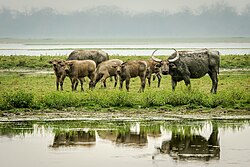
| image_caption = in [[Kaziranga National Park]] | | image_caption = in [[Kaziranga National Park]] | ||
| fossil_range = Middle [[Pleistocene]]-[[Holocene|Present]] | | fossil_range = Middle [[Pleistocene]]-[[Holocene|Present]]<ref>{{cite journal|author1=Suraprasit, K. |author2=Jaegar, J.-J. |author3=Chaimanee, Y. |author4=Chavasseau, O. |author5=Yamee, C. |author6=Tian, P. |author7=Panha, S. |title=The Middle Pleistocene vertebrate fauna from Khok Sung (Nakhon Ratchasima, Thailand): biochronological and paleobiogeographical implications |journal=ZooKeys |date=2016 |issue=613 |pages=1–157 |doi=10.3897/zookeys.613.8309|pmid=27667928 |pmc=5027644 |doi-access=free |bibcode=2016ZooK..613....1S |name-list-style=amp}}</ref> | ||
| status = EN | | status = EN | ||
| status_system = IUCN3.1 | | status_system = IUCN3.1 | ||
| status_ref = | | status_ref = <ref name=iucn>{{cite iucn |title=''Bubalus arnee'' |name-list-style=amp |author=Kaul, R. |author2=Williams, A.C. |author3=rithe, k. |author4=Steinmetz, R. |author5=Mishra, R. |date=2019 |article-number=e.T3129A46364616 |doi=10.2305/IUCN.UK.2019-1.RLTS.T3129A46364616.en |access-date=17 January 2024}}</ref> | ||
| status2 = CITES_A3 | |||
| status2_system = CITES | |||
| status2_ref = <ref name=CITES>{{cite Species+ |id=6811 |title=''Bubalus arnee'' (Kerr, 1792) |access-date=14 November 2025}}</ref> | |||
| genus = Bubalus | | genus = Bubalus | ||
| species = arnee | | species = arnee | ||
| range_map = Asiatic water buffalo 2015.png | | range_map = Asiatic water buffalo 2015.png | ||
| range_map_caption = Wild water buffalo range | | range_map_caption = Wild water buffalo range | ||
| authority = ([[Robert Kerr (writer)|Kerr]], 1792) | | authority = ([[Robert Kerr (writer)|Kerr]], 1792) | ||
| subdivision_ranks = Subspecies | | subdivision_ranks = Subspecies | ||
| Line 23: | Line 25: | ||
}} | }} | ||
The '''wild water buffalo''' ('''''Bubalus arnee'''''), also called '''Asian buffalo''', '''Asiatic buffalo''' and '''wild buffalo''', is a large [[Bovinae|bovine]] native to the [[Indian subcontinent]] and [[Southeast Asia]]. It has been listed as | The '''wild water buffalo''' ('''''Bubalus arnee'''''), also called '''Asian buffalo''', '''Asiatic buffalo''' and '''wild buffalo''', is a large [[Bovinae|bovine]] native to the [[Indian subcontinent]] and [[Southeast Asia]]. It was first described in 1792. | ||
The wild water buffalo is the most likely ancestor of the domestic [[water buffalo]]. It has been listed as [[Endangered species|endangered]] on the [[IUCN Red List]] since 1986, as the global population totals less than 4,000 mature individuals. | |||
==Taxonomy== | ==Taxonomy== | ||
[[File:WaterBuffaloLopburiThailand2300BCE.jpg|thumb|Water buffalo sculpture, [[Lopburi]], Thailand, 2300 BCE]] | [[File:WaterBuffaloLopburiThailand2300BCE.jpg|thumb|Water buffalo sculpture, [[Lopburi]], Thailand, 2300 BCE]] | ||
''Bos arnee'' was the [[scientific name]] proposed by [[Robert Kerr (writer)|Robert Kerr]] in 1792 who described a skull with horns of a buffalo [[zoological specimen]] from [[Bengal]] in northern India. | ''Bos arnee'' was the [[scientific name]] proposed by [[Robert Kerr (writer)|Robert Kerr]] in 1792 who described a skull with horns of a buffalo [[zoological specimen]] from [[Bengal]] in northern India.<ref name=Kerr>{{cite book |last1=Kerr |first1=R. |title=The Animal Kingdom or zoological system of the celebrated Sir Charles Linnaeus. Class I. Mammalia |date=1792 |publisher=A. Strahan & T. Cadell |location=Edinburgh & London |page=336 |chapter-url=https://archive.org/details/animalkingdomorz00linn/page/336 |chapter=Arnee ''Bos arnee''}}</ref> ''Bubalus arnee'' was proposed by [[Charles Hamilton Smith]] in 1827 who introduced the generic name ''Bubalus'' for bovids with large heads, convex-shaped narrow foreheads, laterally bent flat horns, funnel-shaped ears, small [[dewlap]]s and slender tails.<ref>{{cite book |editor1=Griffith, E. |year=1827 |title=The animal kingdom arranged in conformity with its organization|volume=5. Class Mammalia |publisher=Geo. B. Whittaker |location=London |first1=C. H. |last1=Smith |chapter=Sub-genus I. ''Bubalus'' |pages=371–373 |chapter-url=https://archive.org/stream/animalkingdomarr05cuvi#page/370/mode/2up}}</ref> | ||
Later authors subordinated the wild water buffalo under either ''[[Bos]]'', ''Bubalus'' or ''Buffelus''. | Later authors subordinated the wild water buffalo under either ''[[Bos]]'', ''Bubalus'' or ''Buffelus''.<ref>{{cite book |author1=Ellerman, J. R. |author2=Morrison-Scott, T. C. S. |date=1966 |title=Checklist of Palaearctic and Indian mammals 1758 to 1946 |edition=Second |place=London |publisher=British Museum of Natural History |chapter=Genus ''Bubalus'' H. Smith, 1827 |pages=383–384 |chapter-url=https://archive.org/stream/checklistofindia00elle#page/382/mode/2up}}</ref> | ||
In 2003, the [[International Commission on Zoological Nomenclature]] placed ''Bubalus arnee'' on the ''Official List of [[Specific name (zoology)|Specific Names]] in Zoology'', recognizing the validity of this name for a wild species.<ref>{{cite journal |last1=International Commission on Zoological Nomenclature |year=2003 |title=Opinion 2027 (Case 3010). Usage of 17 specific names based on wild species which are pre-dated by or contemporary with those based on domestic animals (Lepidoptera, Osteichthyes, Mammalia) |journal=The Bulletin of Zoological Nomenclature |volume=60 |issue=1 |pages=81–84 |url=https://archive.org/stream/bulletinofzoolog602003int#page/80/mode/2up}}</ref> Most authors have adopted the [[binomen]] ''Bubalus arnee'' for the wild water buffalo as valid for the [[taxon]].<ref>{{cite journal |author1=Gentry, A. |author2=Clutton-Brock, J. |author3=Groves, C. P. |name-list-style=amp |year=2004 |title=The naming of wild animal species and their domestic derivatives |journal=Journal of Archaeological Science |volume=31 |issue=5|pages=645–651 |doi=10.1016/j.jas.2003.10.006 |bibcode=2004JArSc..31..645G |url=https://www.researchgate.net/publication/222518224}}</ref> | |||
The wild water buffalo is the most likely ancestor of the domestic [[water buffalo]].<ref>{{cite journal |author1=Lau, C. H. |author2=Drinkwater, R. D. |author3=Yusoff, K. |author4=Tan, S. G. |author5=Hetzel, D. J. S. |author6=Barker, J. S. F. |year=1998 |title=Genetic diversity of Asian water buffalo (''Bubalus bubalis''): mitochondrial DNA D-loop and cytochrome b sequence variation |journal=Animal Genetics |volume=29 |issue=4 |pages=253–264 |doi= 10.1046/j.1365-2052.1998.00309.x|pmid=9745663 |url=http://psasir.upm.edu.my/id/eprint/40058/1/Genetic%20diversity%20of%20Asian%20water%20buffalo%20%28Bubalus%20bubalis%29.pdf}}</ref><ref name=Groves2006>{{cite book |author=Groves, C. P. |chapter=Domesticated and Commensal Mammals of Austronesia and Their Histories |pages=161–176 |year=2006 |title=The Austranesians |location=Canberra |publisher=Research School of Pacific Studies, The Australian National University |editor=Bellwood, P. |editor2=Fox, J. J. |editor3=Tryon, D.}}</ref> | |||
Only a few [[DNA sequence]]s are available from wild water buffalo populations.<ref>{{cite journal |name-list-style=amp|author=Flamand, J.R.B. |author2=Vankan, D. |author3=Gairhe, K.P. |author4=Duong, H. |author5=Barker, J.S.F. |date=2003 |title=Genetic identification of wild Asian water buffalo in Nepal |journal=Animal Conservation |volume=6 |issue=3 |pages=265–270 |doi=10.1017/s1367943003003329 |bibcode=2003AnCon...6..265F |s2cid=84855572 |url=https://www.researchgate.net/publication/43506186}}</ref> Wild populations are considered to be the [[progenitor]] of the modern domestic water buffalo, but the [[genetic variation]] within the species is unclear, and also how it is related to the domesticated river and [[Carabao]] swamp buffaloes.<ref>{{cite journal |author=Yang, D.Y. |author2=Li Liu |author3=Chen, X. |author4=Speller, C.F. |name-list-style=amp |date=2008 |title=Wild or domesticated: DNA analysis of ancient water buffalo remains from north China |journal=Journal of Archaeological Science |volume=35 |issue=10 |pages=2778–2785 |doi=10.1016/j.jas.2008.05.010 |bibcode=2008JArSc..35.2778Y |url=https://www.sfu.ca/~donyang/adnaweb/Yang%20et%20al.%202008.pdf}}</ref> | |||
== Etymology == | |||
The specific name ''arnee'' is reminiscent of the classical [[Hindi]] word ''arnī'' meaning female wild buffalo.<ref>{{cite book |last=Platts |first=J. T. |author-link=John Thompson Platts |year=1884 |title=A Dictionary of Urdu, Classical Hindi, and English |location=London |publisher=W. H. Allen & Co |page=41 |chapter=अरनी arnī |chapter-url=https://dsal.uchicago.edu/cgi-bin/app/platts_query.py?qs=arn%C4%AB&matchtype=default}}</ref> | |||
==Characteristics== | ==Characteristics== | ||
[[File: Bubalus arnee schaedel.JPG|thumb|Skull of a wild water buffalo in the [[Bavarian State Collection of Zoology]]]] | [[File: Bubalus arnee schaedel.JPG|thumb|Skull of a wild water buffalo in the [[Bavarian State Collection of Zoology]]]] | ||
The wild water buffalo has an ash-gray to black skin. The moderately long, coarse and sparse hair is directed forward from the haunches to the long and narrow head. There is a tuft on the forehead, and the ears are comparatively small. Its head-to-body-length is {{ | The wild water buffalo has an ash-gray to black skin. The moderately long, coarse and sparse hair is directed forward from the haunches to the long and narrow head. There is a tuft on the forehead, and the ears are comparatively small. Its head-to-body-length is {{cvt|240|to|300|cm}} with a {{cvt|60|to|100|cm}} long tail and a shoulder height of {{cvt|150|to|190|cm}}. Both sexes carry horns that are heavy at the base and widely spreading up to {{cvt|2|m}} along the outer edges, exceeding in size the horns of any other living [[bovid]]. The tip of the tail is bushy; the hooves are large and splayed.<ref name=Nowak99>{{cite book |author=Nowak, R. M. |year=1999 |title=Walker's Mammals of the World |volume=1 |location=Baltimore, USA and London, UK |publisher=The Johns Hopkins University Press |isbn= 978-0-8018-5789-8|chapter=Asian water buffalo |chapter-url=https://books.google.com/books?id=7W-DGRILSBoC&pg=PA1147}}</ref> | ||
It is larger and heavier than the domestic water buffalo, and weighs from {{ | It is larger and heavier than the domestic water buffalo, and weighs from {{cvt|600|to|1200|kg}}.<ref name=Aryal2011>{{cite journal |last1=Aryal|first1=A. |last2=Shrestha|first2=T.K. |last3=Ram |first3=A. |last4=Frey |first4=W. |last5=Groves |first5=C.|last6= Hemmer|first6=H. |last7=Dhakal|first7=M. |last8=Koirala |first8=R.J. |last9=Heinen|first9=J. |last10=Raubenheimer |first10=D. |year=2011 |title=Call to conserve the Wild Water Buffalo (''Bubalus arnee'') in Nepal |journal=International Journal of Conservation Science |volume=2 |issue=4 |pages=261–268 |url=http://ijcs.ro/pub/IJCS-11-23-Aryal.pdf}}</ref><ref name=Ahrestani2016>{{cite book |editor1=Ahrestani, F.S. |editor2=Sankaran, M. |last1=Ahrestani |first1=F.S.|last2= Heitkönig |first2=I.M.A. |last3=Matsubayashi|first3=H. |last4=Prins|first4=H.H.T. |title=The Ecology of Large Herbivores in South and Southeast Asia |chapter=Grazing and Browsing by Large Herbivores in South and Southeast Asia |year=2016 |pages=99–120 |series=Ecological Studies |volume=225 |doi=10.1007/978-94-017-7570-0_4 |publisher=Springer |isbn=978-94-017-7570-0}}</ref> The average weight of three captive wild water buffaloes was {{cvt|900|kg}}.<ref>{{cite journal |author1=Class, M. |author2=Lechner-Doll, M. |author3=Streich, W. J. |year=2004 |title=Differences in the range of fecal dry matter content between feeding types of captive wild ruminants |journal=Acta Theriologica |volume=49 |issue=2 |pages=259–267 |doi= 10.1007/bf03192525|s2cid=13441339}}</ref> | ||
It is among the heaviest living wild bovid species, and is slightly smaller than [[gaur]]. | It is among the heaviest living wild bovid species, and is slightly smaller than [[gaur]].<ref>{{cite book |year=2008 |title=A Guide to the Mammals of China |editor1=Smith, A. T. |editor2=Xie, Y. |publisher=Princeton University Press |location=Oxfordshire |isbn=978-1-4008-3411-2 |author1=MacKinon, J. |chapter=Subfamily Bovinae |chapter-url=https://books.google.com/books?id=ka-9f68nPT4C&pg=PA472 |pages=472}}</ref> | ||
==Distribution and habitat== | ==Distribution and habitat== | ||
The wild water buffalo occurs in India, [[Nepal]], [[Bhutan]], [[Thailand]], and [[Cambodia]], with an unconfirmed population in [[Myanmar]]. It has been [[Local extinction|extirpated]] in Bangladesh, [[Laos]], [[Vietnam]] and [[Sri Lanka]].<ref name=iucn/><ref name=Choudhury2010>{{cite book |author=Choudhury, A. |year=2010 |title=The Vanishing Herds: The Wild Water Buffalo |publisher=Gibbon Books |place=Guwahati, India}}</ref> It inhabits wet grasslands, swamps, flood plains and densely vegetated river valleys.<ref name=iucn/> | |||
The wild water buffalo occurs in | |||
In India, it is largely restricted to in and around [[Kaziranga National Park|Kaziranga]], [[Manas National Park|Manas]] and [[Dibru-Saikhowa National Park]]s, [[Laokhowa Wildlife Sanctuary]] and [[Bura Chapori Wildlife Sanctuary]] and in a few scattered pockets in Assam, and in and around [[D'Ering Memorial Wildlife Sanctuary]] in Arunachal Pradesh. A small population survives in [[Balphakram National Park]] in Meghalaya, and in [[Chhattisgarh]] in [[Indravati National Park]] and [[Udanti Wildlife Sanctuary]].<ref name=Choudhury2010/> This population might extend into adjacent parts of [[Odisha, India|Odisha]] and Gadchiroli District of [[Maharashtra]]. In the early 1990s, there may still have been about 3,300–3,500 wild water buffaloes in Assam and the adjacent states of northeast India.<ref name=Choudhury94>{{cite journal |author=Choudhury, A. |year=1994 |title=The decline of the wild water buffalo in northeast India |journal=Oryx |volume=28 |issue=1 |pages=70–73 |doi=10.1017/s0030605300028325|doi-access=free}}</ref> In 1997, the number was assessed at less than 1,500 mature individuals.<ref name=iucn/> | |||
[[File:Asiatic_buffalo.jpg|thumb|A herd of wild water buffaloes in [[Kaziranga National Park]], Assam]] | |||
Many surviving populations are thought to have interbred with [[feral]] or domestic water buffaloes. In the late 1980s, fewer than 100 wild water buffaloes were left in [[Madhya Pradesh]].<ref>{{cite report |author=Divekar, H. K. |author2=Bhusan, B. |name-list-style=amp |year=1988 |title=Status of wild Asiatic buffalo (''Bubalus bubalis'') in the Raipur and Bastar Districts of Madhya Pradesh |publisher=Technical Report of the Bombay Natural History Society of the Salim Ali Nature Conservation Fund, SANCF Report No. 3/1988}}</ref> By 1992, only 50 animals were estimated to have survived there.<ref name=Choudhury94/> | |||
Nepal's only population lives in [[Koshi Tappu Wildlife Reserve]] and has grown from 63 individuals in 1976 to 219 individuals in 2009.<ref>{{cite journal |author1=Heinen, J. T. |year=1993 |title=Population viability and management recommendations for wild water buffalo (''Bubalus bubalis'') in Kosi Tappu Wildlife Reserve, Nepal |journal=Biological Conservation |volume=65 |issue=1 |pages=29–34 |doi=10.1016/0006-3207(93)90193-5 |bibcode=1993BCons..65...29H |url=http://deepblue.lib.umich.edu/bitstream/2027.42/31022/1/0000698.pdf |hdl=2027.42/31022|hdl-access=free}}</ref> In 2016, 18 individuals were translocated from Koshi Tappu Wildlife Reserve to [[Chitwan National Park]].<ref>{{cite journal |author1=Kandel, R. C. |author2=Poudel, R. C. |author3=Sadaula, A. |author4=Kandel, P. |author5=Gairhe, K. P. |author6=Pokheral, C. P. |author7=Bajracharya, S. B. |author8=Chalise, M. K. |author9=Solanki, G. S. |name-list-style=amp |year=2019 |title=Revisiting genetic structure of Wild Buffaloes Bubalus arnee Kerr, 1792 (Mammalia: Artiodactyla: Bovidae) in Koshi Tappu Wildlife Reserve, Nepal: an assessment for translocation programs |journal=Journal of Threatened Taxa |volume=11 |issue=15 |pages=14942–14954 |doi=10.11609/jott.4940.11.15.14942-14954 |doi-access=free}}</ref> | |||
In | [[File:Wild water Buffalo (Bubalus arnee) at Koshi Tappu Wildlife Reserve, Nepal.jpg|thumb|Wild water buffalo at Koshi Tappu Wildlife Reserve, Nepal]] | ||
In and around Bhutan's [[Royal Manas National Park]], a small number of wild water buffaloes occur. This is part of the sub-population that occurs in India's Manas National Park.<ref name=Choudhury2010/> In Myanmar, a few animals live in [[Hukaung Valley Wildlife Sanctuary]].<ref name=iucn/> | |||
In Thailand, wild water buffaloes have been reported to occur in small herds of less than 40 individuals. A population of 25–60 individuals inhabited lowland areas of the [[Huai Kha Khaeng Wildlife Sanctuary]] between December 1999 and April 2001. This population has not grown significantly in 15 years, and is maybe interbreeding with domestic water buffaloes.<ref>{{cite journal |author1=Chaiyarat, R. |author2=Lauhachinda, V. |author3=Kutintara, U. |author4=Bhumpakphan, N. |author5=Prayurasiddhi, T. |year=2004 |title=Population of Wild Water Buffalo (''Bubalus bubalis'') in Huai Kha Khaeng Wildlife Sanctuary, Thailand |journal=Natural History Bulletin Siam Society |volume=52 |issue=2 |pages=151–162 |url=http://www.thaiscience.info/journals/Article/Population%20of%20wild%20water%20buffalo%20%28bubalus%20bubalis%29%20in%20huai%20kha%20khaeng%20wildlife%20sanctuary,%20thailand.pdf |access-date=2011-03-24 |archive-date=2011-07-28 |archive-url=https://web.archive.org/web/20110728134019/http://www.thaiscience.info/journals/Article/Population%20of%20wild%20water%20buffalo%20(bubalus%20bubalis)%20in%20huai%20kha%20khaeng%20wildlife%20sanctuary,%20thailand.pdf }}</ref> | |||
The | The population in Cambodia is confined to a small area of easternmost [[Mondulkiri Province|Mondulkiri]] and possibly [[Ratanakiri Province]]s. Only a few dozen individuals remained as of 2005.<ref>Tordoff, A. W., Timmins, R. J., Maxwell, A., Huy Keavuth, Lic Vuthy and Khou Eang Hourt (eds). (2005). Biological assessment of the Lower Mekong Dry Forests Ecoregion. WWF Greater Mekong Programme. Phnom Penh, Cambodia</ref> | ||
Wild-living populations found elsewhere in Asia, | The wild water buffaloes in [[Sri Lanka]] are thought to be descendants of the introduced domestic [[water buffalo]]. It is unlikely that any true wild water buffaloes remain there today.<ref name=iucn/> | ||
Wild-living populations found elsewhere in Asia, Australia, [[Argentina]] and [[Bolivia]] are [[feral]] domestic water buffaloes.<ref name=Nowak99/> | |||
==Ecology and | ==Ecology and behaviour== | ||
[[File:Indian Water Buffalo Bubalus arnee by Dr Raju Kasambe IMG 0347 (12).JPG|thumb|Water buffalo fighting]] | |||
The wild water buffalo is both [[Diurnality|diurnal]] and [[nocturnal]]. Adult females and their young form stable clans of as many as 30 individuals, which have [[home range]]s of {{cvt|170|to|1000|ha}} that include areas for resting, grazing, wallowing and drinking. Clans are led by old cows, even when bulls accompany the group. Several clans form a herd of 30 to 500 animals that gather at resting areas. Adult males form bachelor groups of up to 10 individuals, with older males often being solitary, and spend the dry season apart from the female clans. They are seasonal breeders in most of their range, typically in October and November. However, some populations breed year round. Dominant males mate with the females of a clan who subsequently drive them off. Their [[gestation period]] is 10 to 11 months, with an inter-birth interval of one year. They typically give birth to a single offspring, although twins are possible. Age at sexual maturity is 18 months for males, and three years for females. The maximum known lifespan is 25 years in the wild.<ref name=Nowak99/> In Assam, herd sizes vary from three to 30 individuals.<ref name=Choudhury2010/> | |||
The wild water buffalo is probably a [[Grazing|grazer]] by preference, feeding mainly on [[graminoid]]s when available, such as [[Cynodon dactylon|Bermuda grass]], and ''[[Cyperus]]'' sedges, but it also eats other [[Herbaceous plant|herb]]s, fruits, and bark, and [[Browsing (predation)|browses]] on trees and shrubs.<ref>{{cite journal |author1=Daniel J. C. |author2=Grubh, B. R. | year=1966 |title=The Indian wild buffalo ''Bubalus bubalis'' (Linn), in peninsular India: a preliminary survey |journal=Journal of the Bombay Natural History Society |volume=63 |pages=32–53 |url=https://www.biodiversitylibrary.org/page/47950304}}</ref> It also feeds on crops, including rice, [[sugarcane]], and [[jute]], sometimes causing considerable damage.<ref>{{cite book |author1=Lēkhakun, B. |author2=McNeely, J. A. |year=1988 |title=Mammals of Thailand |edition=Second |publisher=Saha Karn Bhaet |place=Bangkok, Thailand}}</ref> During the [[Pleistocene]], its diet was far more varied; it foraged in C<sub>3</sub>-dominant forests and woodlands and in C<sub>4</sub>-dominant grasslands, while today it is restricted to the latter type of environment.<ref>{{Cite journal |last1=Shaikh |first1=S. |last2=Bocherens |first2=H. |last3=Suraprasit |first3=K. |date=2025 |title=Stable isotope ecology of Quaternary cervid and bovid species in Southeast Asia with implications for wildlife conservation |journal=[[Scientific Reports]] |volume=15 |issue=1 |article-number=3939 |doi=10.1038/s41598-025-88065-6 |pmc=11785745 |pmid=39890811 |bibcode=2025NatSR..15.3939S }}</ref> | |||
[[Tiger]]s and [[mugger crocodile]]s prey on adult wild water buffaloes, and [[Asian black bear]]s have also been known to kill them. | [[Tiger]]s and [[mugger crocodile]]s prey on adult wild water buffaloes, and [[Asian black bear]]s have also been known to kill them.<ref>Humphrey, S. R., Bain, J. R. (1990). ''Endangered animals of Thailand''. Issue 6 of Flora & Fauna handbook. Sandhill Crane Press. {{ISBN|1-877743-05-4}}</ref> | ||
==Threats== | ==Threats== | ||
A population reduction by at least 50% over the last three generations seems likely given the severity of the threats, especially [[Hybrid (biology)|hybridization]]; this population trend is projected to continue into the future. The most important threats are: | A population reduction by at least 50% over the last three generations seems likely given the severity of the threats, especially [[Hybrid (biology)|hybridization]]; this population trend is projected to continue into the future. The most important threats are:<ref name=iucn/> | ||
* [[interbreeding]] with feral and domestic water buffaloes in and around protected areas; | * [[interbreeding]] with feral and domestic water buffaloes in and around protected areas; | ||
* hunting, especially in Thailand, Cambodia, and Myanmar; | * hunting, especially in Thailand, Cambodia, and Myanmar; | ||
* habitat loss of [[floodplain]] areas due to conversion to agriculture and [[hydropower]] development; | * habitat loss of [[floodplain]] areas due to conversion to agriculture and [[hydropower]] development; | ||
* degradation of [[wetlands]] due to [[invasive species]] such as [[Mikania|stem twiners and lianas]]; | * degradation of [[wetlands]] due to [[invasive species]] such as [[Mikania|stem twiners and lianas]]; | ||
* diseases and [[parasites]] transmitted by domestic | * diseases and [[parasites]] transmitted by domestic livestock; | ||
* [[interspecific competition]] for food and water between wild water buffaloes and | * [[interspecific competition]] for food and water between wild water buffaloes and livestock. | ||
==Conservation== | ==Conservation== | ||
''Bubalus arnee'' is included in [[CITES Appendix III]], and is legally protected in Bhutan, India, Nepal, and Thailand. | ''Bubalus arnee'' is included in [[CITES Appendix III]], and is legally protected in Bhutan, India, Nepal, and Thailand.<ref name=iucn/><ref name=CITES/> | ||
In 2017, 15 wild water buffaloes were [[reintroduced]] into [[Chitwan National Park]] in Nepal to establish a second viable sub-population in the country. | In 2017, 15 wild water buffaloes were [[reintroduced]] into [[Chitwan National Park]] in Nepal to establish a second viable sub-population in the country.<ref>{{cite journal |author=Dhungel G. |author2=Thanet D.R. |name-list-style=amp |year=2019 |title=Investigating Habitat Suitability and Conservation Issues of Re-introduced Wild Water Buffalo in Chitwan National Park, Nepal |journal=Forestry: Journal of Institute of Forestry, Nepal |volume=16 |issue=16 |pages=1–13 |doi=10.3126/forestry.v16i0.28350 |s2cid=216528987 |url=https://www.nepjol.info/index.php/forestry/article/download/28350/23279|doi-access=free }}</ref> | ||
In 2023, 4 wild buffalos were translocated to Udanti-Sitanadi Tiger Reserve to reverse its declining population in the state.<ref>{{Cite news |date=2023-04-16 |title=Translocation of wild buffaloes brings hope for conservation in Chhattisgarh |url=https://timesofindia.indiatimes.com/city/raipur/translocation-of-wild-buffaloes-brings-hope-for-conservation-in-chhattisgarh/articleshow/99535331.cms |access-date=2024-08-12 |work=The Times of India |issn=0971-8257}}</ref> | |||
==References== | ==References== | ||
| Line 96: | Line 108: | ||
{{Artiodactyla|R.4}} | {{Artiodactyla|R.4}} | ||
{{Taxonbar|from=Q1914208}} | {{Taxonbar|from=Q1914208}} | ||
==Notes== | |||
{{NoteFoot}} | |||
[[Category:Water buffalo]] | [[Category:Water buffalo]] | ||
| Line 106: | Line 121: | ||
[[Category:Mammals of Thailand]] | [[Category:Mammals of Thailand]] | ||
[[Category:Mammals described in 1792]] | [[Category:Mammals described in 1792]] | ||
[[Category:Species that are or were threatened by habitat loss]] | |||
[[Category:Symbols of Chhattisgarh]] | [[Category:Symbols of Chhattisgarh]] | ||
[[br:Bubalus]] | [[br:Bubalus]] | ||
Revision as of 16:45, 7 February 2026
| Wild water buffalo Temporal range:
| |
|---|---|
_(cropped).jpg)
| |
| in Kaziranga National Park | |
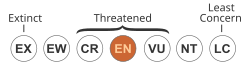 Endangered (IUCN 3.1)<ref name=iucn>Kaul, R.; Williams, A.C.; rithe, k.; Steinmetz, R. & Mishra, R. (2019). "Bubalus arnee". IUCN Red List of Threatened Species. 2019 e.T3129A46364616. doi:10.2305/IUCN.UK.2019-1.RLTS.T3129A46364616.en. Retrieved 17 January 2024.</ref> | |
CITES Appendix III (CITES)<ref name=CITES>"Bubalus arnee (Kerr, 1792)". Species+. UN Environment Programme World Conservation Monitoring Centre. Retrieved 14 November 2025.</ref>
| |
Scientific classification 
| |
| : | [[Template:Taxonomy/Bubalus]] |
| Species: | Template:Taxonomy/BubalusB. arnee
|
| Binomial name | |
| Template:Taxonomy/BubalusBubalus arnee (Kerr, 1792)
| |
| Subspecies | |
| |

| |
| Wild water buffalo range | |
The wild water buffalo (Bubalus arnee), also called Asian buffalo, Asiatic buffalo and wild buffalo, is a large bovine native to the Indian subcontinent and Southeast Asia. It was first described in 1792.
The wild water buffalo is the most likely ancestor of the domestic water buffalo. It has been listed as endangered on the IUCN Red List since 1986, as the global population totals less than 4,000 mature individuals.
Taxonomy

Bos arnee was the scientific name proposed by Robert Kerr in 1792 who described a skull with horns of a buffalo zoological specimen from Bengal in northern India.<ref name=Kerr>Kerr, R. (1792). "Arnee Bos arnee". The Animal Kingdom or zoological system of the celebrated Sir Charles Linnaeus. Class I. Mammalia. Edinburgh & London: A. Strahan & T. Cadell. p. 336.</ref> Bubalus arnee was proposed by Charles Hamilton Smith in 1827 who introduced the generic name Bubalus for bovids with large heads, convex-shaped narrow foreheads, laterally bent flat horns, funnel-shaped ears, small dewlaps and slender tails.<ref>Smith, C. H. (1827). "Sub-genus I. Bubalus". In Griffith, E. (ed.). The animal kingdom arranged in conformity with its organization. Vol. 5. Class Mammalia. London: Geo. B. Whittaker. pp. 371–373.</ref> Later authors subordinated the wild water buffalo under either Bos, Bubalus or Buffelus.<ref>Ellerman, J. R.; Morrison-Scott, T. C. S. (1966). "Genus Bubalus H. Smith, 1827". Checklist of Palaearctic and Indian mammals 1758 to 1946 (Second ed.). London: British Museum of Natural History. pp. 383–384.</ref>
In 2003, the International Commission on Zoological Nomenclature placed Bubalus arnee on the Official List of Specific Names in Zoology, recognizing the validity of this name for a wild species.<ref>International Commission on Zoological Nomenclature (2003). "Opinion 2027 (Case 3010). Usage of 17 specific names based on wild species which are pre-dated by or contemporary with those based on domestic animals (Lepidoptera, Osteichthyes, Mammalia)". The Bulletin of Zoological Nomenclature. 60 (1): 81–84.</ref> Most authors have adopted the binomen Bubalus arnee for the wild water buffalo as valid for the taxon.<ref>Gentry, A.; Clutton-Brock, J. & Groves, C. P. (2004). "The naming of wild animal species and their domestic derivatives". Journal of Archaeological Science. 31 (5): 645–651. Bibcode:2004JArSc..31..645G. doi:10.1016/j.jas.2003.10.006.</ref>
The wild water buffalo is the most likely ancestor of the domestic water buffalo.<ref>Lau, C. H.; Drinkwater, R. D.; Yusoff, K.; Tan, S. G.; Hetzel, D. J. S.; Barker, J. S. F. (1998). "Genetic diversity of Asian water buffalo (Bubalus bubalis): mitochondrial DNA D-loop and cytochrome b sequence variation" (PDF). Animal Genetics. 29 (4): 253–264. doi:10.1046/j.1365-2052.1998.00309.x. PMID 9745663.</ref><ref name=Groves2006>Groves, C. P. (2006). "Domesticated and Commensal Mammals of Austronesia and Their Histories". In Bellwood, P.; Fox, J. J.; Tryon, D. (eds.). The Austranesians. Canberra: Research School of Pacific Studies, The Australian National University. pp. 161–176.</ref>
Only a few DNA sequences are available from wild water buffalo populations.<ref>Flamand, J.R.B.; Vankan, D.; Gairhe, K.P.; Duong, H. & Barker, J.S.F. (2003). "Genetic identification of wild Asian water buffalo in Nepal". Animal Conservation. 6 (3): 265–270. Bibcode:2003AnCon...6..265F. doi:10.1017/s1367943003003329. S2CID 84855572.</ref> Wild populations are considered to be the progenitor of the modern domestic water buffalo, but the genetic variation within the species is unclear, and also how it is related to the domesticated river and Carabao swamp buffaloes.<ref>Yang, D.Y.; Li Liu; Chen, X. & Speller, C.F. (2008). "Wild or domesticated: DNA analysis of ancient water buffalo remains from north China" (PDF). Journal of Archaeological Science. 35 (10): 2778–2785. Bibcode:2008JArSc..35.2778Y. doi:10.1016/j.jas.2008.05.010.</ref>
Etymology
The specific name arnee is reminiscent of the classical Hindi word arnī meaning female wild buffalo.<ref>Platts, J. T. (1884). "अरनी arnī". A Dictionary of Urdu, Classical Hindi, and English. London: W. H. Allen & Co. p. 41.</ref>
Characteristics

The wild water buffalo has an ash-gray to black skin. The moderately long, coarse and sparse hair is directed forward from the haunches to the long and narrow head. There is a tuft on the forehead, and the ears are comparatively small. Its head-to-body-length is 240 to 300 cm (94 to 118 in) with a 60 to 100 cm (24 to 39 in) long tail and a shoulder height of 150 to 190 cm (59 to 75 in). Both sexes carry horns that are heavy at the base and widely spreading up to 2 m (6 ft 7 in) along the outer edges, exceeding in size the horns of any other living bovid. The tip of the tail is bushy; the hooves are large and splayed.<ref name=Nowak99>Nowak, R. M. (1999). "Asian water buffalo". Walker's Mammals of the World. Vol. 1. Baltimore, USA and London, UK: The Johns Hopkins University Press. ISBN 978-0-8018-5789-8.</ref> It is larger and heavier than the domestic water buffalo, and weighs from 600 to 1,200 kg (1,300 to 2,600 lb).<ref name=Aryal2011>Aryal, A.; Shrestha, T.K.; Ram, A.; Frey, W.; Groves, C.; Hemmer, H.; Dhakal, M.; Koirala, R.J.; Heinen, J.; Raubenheimer, D. (2011). "Call to conserve the Wild Water Buffalo (Bubalus arnee) in Nepal" (PDF). International Journal of Conservation Science. 2 (4): 261–268.</ref><ref name=Ahrestani2016>Ahrestani, F.S.; Heitkönig, I.M.A.; Matsubayashi, H.; Prins, H.H.T. (2016). "Grazing and Browsing by Large Herbivores in South and Southeast Asia". In Ahrestani, F.S.; Sankaran, M. (eds.). The Ecology of Large Herbivores in South and Southeast Asia. Ecological Studies. Vol. 225. Springer. pp. 99–120. doi:10.1007/978-94-017-7570-0_4. ISBN 978-94-017-7570-0.</ref> The average weight of three captive wild water buffaloes was 900 kg (2,000 lb).<ref>Class, M.; Lechner-Doll, M.; Streich, W. J. (2004). "Differences in the range of fecal dry matter content between feeding types of captive wild ruminants". Acta Theriologica. 49 (2): 259–267. doi:10.1007/bf03192525. S2CID 13441339.</ref> It is among the heaviest living wild bovid species, and is slightly smaller than gaur.<ref>MacKinon, J. (2008). "Subfamily Bovinae". In Smith, A. T.; Xie, Y. (eds.). A Guide to the Mammals of China. Oxfordshire: Princeton University Press. p. 472. ISBN 978-1-4008-3411-2.</ref>
Distribution and habitat
The wild water buffalo occurs in India, Nepal, Bhutan, Thailand, and Cambodia, with an unconfirmed population in Myanmar. It has been extirpated in Bangladesh, Laos, Vietnam and Sri Lanka.<ref name=iucn/><ref name=Choudhury2010>Choudhury, A. (2010). The Vanishing Herds: The Wild Water Buffalo. Guwahati, India: Gibbon Books.</ref> It inhabits wet grasslands, swamps, flood plains and densely vegetated river valleys.<ref name=iucn/>
In India, it is largely restricted to in and around Kaziranga, Manas and Dibru-Saikhowa National Parks, Laokhowa Wildlife Sanctuary and Bura Chapori Wildlife Sanctuary and in a few scattered pockets in Assam, and in and around D'Ering Memorial Wildlife Sanctuary in Arunachal Pradesh. A small population survives in Balphakram National Park in Meghalaya, and in Chhattisgarh in Indravati National Park and Udanti Wildlife Sanctuary.<ref name=Choudhury2010/> This population might extend into adjacent parts of Odisha and Gadchiroli District of Maharashtra. In the early 1990s, there may still have been about 3,300–3,500 wild water buffaloes in Assam and the adjacent states of northeast India.<ref name=Choudhury94>Choudhury, A. (1994). "The decline of the wild water buffalo in northeast India". Oryx. 28 (1): 70–73. doi:10.1017/s0030605300028325.</ref> In 1997, the number was assessed at less than 1,500 mature individuals.<ref name=iucn/>

Many surviving populations are thought to have interbred with feral or domestic water buffaloes. In the late 1980s, fewer than 100 wild water buffaloes were left in Madhya Pradesh.<ref>Divekar, H. K. & Bhusan, B. (1988). Status of wild Asiatic buffalo (Bubalus bubalis) in the Raipur and Bastar Districts of Madhya Pradesh (Report). Technical Report of the Bombay Natural History Society of the Salim Ali Nature Conservation Fund, SANCF Report No. 3/1988.</ref> By 1992, only 50 animals were estimated to have survived there.<ref name=Choudhury94/>
Nepal's only population lives in Koshi Tappu Wildlife Reserve and has grown from 63 individuals in 1976 to 219 individuals in 2009.<ref>Heinen, J. T. (1993). "Population viability and management recommendations for wild water buffalo (Bubalus bubalis) in Kosi Tappu Wildlife Reserve, Nepal" (PDF). Biological Conservation. 65 (1): 29–34. Bibcode:1993BCons..65...29H. doi:10.1016/0006-3207(93)90193-5. hdl:2027.42/31022.</ref> In 2016, 18 individuals were translocated from Koshi Tappu Wildlife Reserve to Chitwan National Park.<ref>Kandel, R. C.; Poudel, R. C.; Sadaula, A.; Kandel, P.; Gairhe, K. P.; Pokheral, C. P.; Bajracharya, S. B.; Chalise, M. K. & Solanki, G. S. (2019). "Revisiting genetic structure of Wild Buffaloes Bubalus arnee Kerr, 1792 (Mammalia: Artiodactyla: Bovidae) in Koshi Tappu Wildlife Reserve, Nepal: an assessment for translocation programs". Journal of Threatened Taxa. 11 (15): 14942–14954. doi:10.11609/jott.4940.11.15.14942-14954.</ref>
_at_Koshi_Tappu_Wildlife_Reserve,_Nepal.jpg)
In and around Bhutan's Royal Manas National Park, a small number of wild water buffaloes occur. This is part of the sub-population that occurs in India's Manas National Park.<ref name=Choudhury2010/> In Myanmar, a few animals live in Hukaung Valley Wildlife Sanctuary.<ref name=iucn/>
In Thailand, wild water buffaloes have been reported to occur in small herds of less than 40 individuals. A population of 25–60 individuals inhabited lowland areas of the Huai Kha Khaeng Wildlife Sanctuary between December 1999 and April 2001. This population has not grown significantly in 15 years, and is maybe interbreeding with domestic water buffaloes.<ref>Chaiyarat, R.; Lauhachinda, V.; Kutintara, U.; Bhumpakphan, N.; Prayurasiddhi, T. (2004). "Population of Wild Water Buffalo (Bubalus bubalis) in Huai Kha Khaeng Wildlife Sanctuary, Thailand" (PDF). Natural History Bulletin Siam Society. 52 (2): 151–162. Archived from the original (PDF) on 2011-07-28. Retrieved 2011-03-24.</ref>
The population in Cambodia is confined to a small area of easternmost Mondulkiri and possibly Ratanakiri Provinces. Only a few dozen individuals remained as of 2005.<ref>Tordoff, A. W., Timmins, R. J., Maxwell, A., Huy Keavuth, Lic Vuthy and Khou Eang Hourt (eds). (2005). Biological assessment of the Lower Mekong Dry Forests Ecoregion. WWF Greater Mekong Programme. Phnom Penh, Cambodia</ref>
The wild water buffaloes in Sri Lanka are thought to be descendants of the introduced domestic water buffalo. It is unlikely that any true wild water buffaloes remain there today.<ref name=iucn/> Wild-living populations found elsewhere in Asia, Australia, Argentina and Bolivia are feral domestic water buffaloes.<ref name=Nowak99/>
Ecology and behaviour
.JPG)
The wild water buffalo is both diurnal and nocturnal. Adult females and their young form stable clans of as many as 30 individuals, which have home ranges of 170 to 1,000 ha (420 to 2,470 acres) that include areas for resting, grazing, wallowing and drinking. Clans are led by old cows, even when bulls accompany the group. Several clans form a herd of 30 to 500 animals that gather at resting areas. Adult males form bachelor groups of up to 10 individuals, with older males often being solitary, and spend the dry season apart from the female clans. They are seasonal breeders in most of their range, typically in October and November. However, some populations breed year round. Dominant males mate with the females of a clan who subsequently drive them off. Their gestation period is 10 to 11 months, with an inter-birth interval of one year. They typically give birth to a single offspring, although twins are possible. Age at sexual maturity is 18 months for males, and three years for females. The maximum known lifespan is 25 years in the wild.<ref name=Nowak99/> In Assam, herd sizes vary from three to 30 individuals.<ref name=Choudhury2010/>
The wild water buffalo is probably a grazer by preference, feeding mainly on graminoids when available, such as Bermuda grass, and Cyperus sedges, but it also eats other herbs, fruits, and bark, and browses on trees and shrubs.<ref>Daniel J. C.; Grubh, B. R. (1966). "The Indian wild buffalo Bubalus bubalis (Linn), in peninsular India: a preliminary survey". Journal of the Bombay Natural History Society. 63: 32–53.</ref> It also feeds on crops, including rice, sugarcane, and jute, sometimes causing considerable damage.<ref>Lēkhakun, B.; McNeely, J. A. (1988). Mammals of Thailand (Second ed.). Bangkok, Thailand: Saha Karn Bhaet.</ref> During the Pleistocene, its diet was far more varied; it foraged in C<sub>3</sub>-dominant forests and woodlands and in C<sub>4</sub>-dominant grasslands, while today it is restricted to the latter type of environment.<ref>Shaikh, S.; Bocherens, H.; Suraprasit, K. (2025). "Stable isotope ecology of Quaternary cervid and bovid species in Southeast Asia with implications for wildlife conservation". Scientific Reports. 15 (1) 3939. Bibcode:2025NatSR..15.3939S. doi:10.1038/s41598-025-88065-6. PMC 11785745. PMID 39890811.</ref>
Tigers and mugger crocodiles prey on adult wild water buffaloes, and Asian black bears have also been known to kill them.<ref>Humphrey, S. R., Bain, J. R. (1990). Endangered animals of Thailand. Issue 6 of Flora & Fauna handbook. Sandhill Crane Press. ISBN 1-877743-05-4</ref>
Threats
A population reduction by at least 50% over the last three generations seems likely given the severity of the threats, especially hybridization; this population trend is projected to continue into the future. The most important threats are:<ref name=iucn/>
- interbreeding with feral and domestic water buffaloes in and around protected areas;
- hunting, especially in Thailand, Cambodia, and Myanmar;
- habitat loss of floodplain areas due to conversion to agriculture and hydropower development;
- degradation of wetlands due to invasive species such as stem twiners and lianas;
- diseases and parasites transmitted by domestic livestock;
- interspecific competition for food and water between wild water buffaloes and livestock.
Conservation
Bubalus arnee is included in CITES Appendix III, and is legally protected in Bhutan, India, Nepal, and Thailand.<ref name=iucn/><ref name=CITES/>
In 2017, 15 wild water buffaloes were reintroduced into Chitwan National Park in Nepal to establish a second viable sub-population in the country.<ref>Dhungel G. & Thanet D.R. (2019). "Investigating Habitat Suitability and Conservation Issues of Re-introduced Wild Water Buffalo in Chitwan National Park, Nepal". Forestry: Journal of Institute of Forestry, Nepal. 16 (16): 1–13. doi:10.3126/forestry.v16i0.28350. S2CID 216528987.</ref>
In 2023, 4 wild buffalos were translocated to Udanti-Sitanadi Tiger Reserve to reverse its declining population in the state.<ref>"Translocation of wild buffaloes brings hope for conservation in Chhattisgarh". The Times of India. 2023-04-16. ISSN 0971-8257. Retrieved 2024-08-12.</ref>
References
External links
- IUCN Asian Wild Cattle Specialist Group: Water buffalo (Bubalus arnee)
- Wild Cattle Conservation Project
- Animal Info: Wild water buffalo
- Wildlife Trust of India February 2006: Wild buffalo faces extinction
- The Hindu February 2006: Project to conserve wild Asian buffalo
Notes
- Pages using the JsonConfig extension
- IUCN Red List endangered species
- Water buffalo
- Mammals of Bangladesh
- Mammals of Bhutan
- Mammals of Myanmar
- Mammals of Cambodia
- Mammals of India
- Mammals of Nepal
- Mammals of Thailand
- Mammals described in 1792
- Species that are or were threatened by habitat loss
- Symbols of Chhattisgarh