

Ajay Kumar (talk | contribs) Created a new article |
typo fix |
||
| Line 1: | Line 1: | ||
{{Short description|Species of bird}} | {{Short description|Species of bird}} | ||
{{Use dmy dates|date= | {{Use dmy dates|date=October 2023}} | ||
{{Speciesbox | {{Speciesbox | ||
| name = Black-headed ibis | | name = Black-headed ibis | ||
| image = Black-headed Ibis (Threskiornis melanocephalus).jpg | | image = Black-headed Ibis (Threskiornis melanocephalus).jpg | ||
| status = | | image_caption = Wild individual photographed at [[Tirunelveli]], India | ||
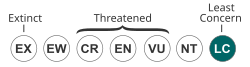
| status = LC | |||
| status_system = IUCN3.1 | | status_system = IUCN3.1 | ||
| status_ref = <ref | | status_ref = <ref>{{cite web |title=Black-Headed Ibis|url= https://www.iucnredlist.org/species/22697516/252063963 |website=IUCN Red List |access-date=14 November 2024 |date=3 June 2024}}</ref> | ||
| taxon = Threskiornis melanocephalus | | taxon = Threskiornis melanocephalus | ||
| authority = ([[John Latham (ornithologist)|Latham]], 1790) | | authority = ([[John Latham (ornithologist)|Latham]], 1790) | ||
| Line 12: | Line 13: | ||
}} | }} | ||
The '''black-headed ibis''' ('''''Threskiornis melanocephalus'''''), also known as the '''Oriental white ibis''', '''Indian white ibis''', and '''black-necked ibis''', is a species of wading [[bird]] of the [[ibis]] family Threskiornithidae which breeds in the [[South Asia|South]] and [[Southeast Asia]] from [[India]] to the west and as far east as [[Japan]].<ref name="iucn status 19 November 2021" /> It is the only native ibis species in its range that has an overall white plumage with a black neck and head. The down-curved beak and legs are also black. Though often referred to as a wetland species, the black-headed ibis forages in a range of natural and man-made habitats. This species of ibis nests only during the rainy season. | The '''black-headed ibis''' ('''''Threskiornis melanocephalus'''''), also known as the '''Oriental white ibis''', '''Indian white ibis''', and '''black-necked ibis''', is a species of wading [[bird]] of the [[ibis]] family Threskiornithidae which breeds in the [[South Asia|South]] and [[Southeast Asia]] from [[India]] to the west and as far east as [[Japan]].<ref name="iucn status 19 November 2021">{{cite iucn |author=BirdLife International |date=2016 |title=''Threskiornis melanocephalus'' |volume=2016 |article-number=e.T22697516A93618317 |doi=10.2305/IUCN.UK.2016-3.RLTS.T22697516A93618317.en |access-date=19 November 2021}}</ref><ref>{{Cite journal |last=Itoh |first=Shingi |date=1986 |title=Records of the Oriental Ibis Threskiornis melanocephalus in Japan |url=https://www.jstage.jst.go.jp/article/jjo1915/34/4/34_4_127/_article |journal=Japanese Journal of Ornithology |volume=34 |issue=4 |pages=127–143 |doi=10.3838/jjo1915.34.127}}</ref> It is the only native ibis species in its range that has an overall white plumage with a black neck and head. The down-curved beak and legs are also black. Though often referred to as a wetland species, the black-headed ibis forages in a range of natural and man-made habitats.<ref name=":4" /> This species of ibis nests only during the rainy season. | ||
== Description == | == Description == | ||
The black-headed ibis is one of several large [[Water bird|waterbird]] species in south and south-east Asia, with adults measuring 65–76 cm in length.<ref name=":1">{{Cite book|title=Handbook of the Birds of the World. Volume 1: Ostrich to Ducks| | The black-headed ibis is one of several large [[Water bird|waterbird]] species in south and south-east Asia, with adults measuring 65–76 cm in length.<ref name=":1">{{Cite book|title=Handbook of the Birds of the World. Volume 1: Ostrich to Ducks|last1=del Hoyo|first1=J.|last2=Elliott|first2=A.|last3=Sargatal|first3=J.|publisher=Lynx Edicions|year=1992|location=Barcelona|pages=472–506}}</ref> The white plumage is starkly contrasted against a conspicuous naked black neck and head, and black down-curved beak. Tails of adults bear light grey ornamental feathers that turn jet black during the breeding season. During the breeding season, bare patches under the wing turn blood-red. The head of some breeding adults gain a blueish tinge, or very rarely have a pink or bright red patch behind the neck.<ref name=":2">{{Cite book|title=Storks, Ibises and Spoonbills of the World|last1=Hancock|first1=J.A.|last2=Kushlan|first2=J.A.|last3=Kahl|first3=M.P.|publisher=Princeton University Press|year=1992|location=New Jersey}}</ref><ref>{{cite journal|author1=Kannan, V.|author2=Manakadan, R.|author3=Sykes, B. R.|year=2010|title=Red patch on the hindneck of Black-headed Ibis Threskiornis melanocephalus in breeding colonies in India|journal=BirdingASIA|volume=14|pages=99–100}}</ref> Some breeding adults also develop tufts of white feathers behind the neck, and rarely also get a yellowish colouration on the breast and back. Sexes are identical but juveniles are identifiable from adults in having greyish feathering on the neck and speckled brown-grey feathering on the wings and back. Like storks and spoonbills, it lacks a true voice-producing mechanism and is silent except for ventriloquistic grunts uttered by pairs at the nest.<ref name=":1" /> | ||
== Distribution and habitat == | == Distribution and habitat == | ||
Black-headed ibis are native to the following countries: [[Bangladesh]], [[Cambodia]], [[China]], [[Hong Kong]], [[India]], [[Indonesia]], [[Malaysia]], [[Myanmar]], [[Nepal]], [[Pakistan]], [[Philippines]], [[Russian Federation]], [[Sri Lanka]], [[Thailand]] and [[Vietnam]]. They are migratory or vagrant in [[Japan]], Republic of [[Korea]], [[Lao People's Democratic Republic]] and [[Mongolia]].<ref name="iucn status 19 November 2021" /> The species is a widespread breeding bird in India, Sri Lanka, Nepal and Myanmar, and has declined considerably to few locations or breeding colonies in Cambodia, Indonesia, Malaysia, Thailand, and Vietnam. The most rapid decline in recent times is suspected to be the population in [[Sumatra]].<ref>Moses, S.; Zöckler, C. (2015) Bird survey Report Ayeyarwaddy Delta November – December 2015. Unpubl. Report for Fauna and Flora International. Fauna and Flora International.</ref> | Black-headed ibis are native to the following countries: [[Bangladesh]], [[Cambodia]], [[China]], [[Hong Kong]], [[India]], [[Indonesia]], [[Malaysia]], [[Myanmar]], [[Nepal]], [[Pakistan]], [[Philippines]], [[Russian Federation]], [[Sri Lanka]], [[Thailand]] and [[Vietnam]]. They are migratory or vagrant in [[Japan]], Republic of [[Korea]], [[Lao People's Democratic Republic]] and [[Mongolia]].<ref name="iucn status 19 November 2021" /> The species is a widespread breeding bird in India, Sri Lanka, Nepal and Myanmar, and has declined considerably to few locations or breeding colonies in Cambodia, Indonesia, Malaysia, Thailand, and Vietnam. The most rapid decline in recent times is suspected to be the population in [[Sumatra]].<ref>Moses, S.; Zöckler, C. (2015) Bird survey Report Ayeyarwaddy Delta November – December 2015. Unpubl. Report for Fauna and Flora International. Fauna and Flora International.</ref> | ||
[[File:Black-Headed Ibis Ranganathittu.jpg|thumb|A black-headed ibis in flight over the [[Ranganathittu Bird Sanctuary]] in [[Karnataka]], India.]] | |||
The black-headed ibis is very versatile being able to use a large variety of natural and man-made habitats. These include freshwater and salt-water marshes, lakes and ponds, as also rice fields, freshly ploughed crop fields, irrigation canals, riversides, reservoirs, urban lakes, open sewage gutters, grazing lots, and garbage dumping sites.<ref name=":2" /><ref name=":3">{{Cite journal |last1=Koli |first1=V.K. |last2=Yaseen |first2=M. |last3=Bhatnagar |first3=C.|year=2013|title=Population status of Painted Stork ''Mycteria leucocephala'' and Black-headed Ibis ''Threskiornis melanocephalus'' in southern Rajasthan, India|journal=Indian Birds |volume=8 |pages=39–41}}</ref><ref name=population>{{Cite journal|last1=Chaudhury|first1=S.|last2=Koli|first2=V.K. |year=2018 |title=Population status, habitat preference, and nesting characteristics of Black-headed Ibis ''Threskiornis melanocephalus'' Latham, 1790 in southern Rajasthan, India |journal=Journal of Asia-Pacific Biodiversity|volume=11|issue=2|pages=223–228 |doi=10.1016/j.japb.2018.01.013|doi-access=free}}</ref><ref name=":4">{{Cite journal|last=Sundar|first=K.S. Gopi|year=2006|title=Flock size, density and habitat selection of four large waterbird species in an agricultural landscape in Uttar Pradesh, India: implications for management |jstor=4132592 |journal=Waterbirds |volume=29 |issue=3 |pages=365–374|doi=10.1675/1524-4695(2006)29[365:FSDAHS]2.0.CO;2}}</ref> Ibis alter use of varied preferred foraging habitats by season in agricultural landscapes such as in south-western [[Uttar Pradesh]] in India. In summer, they largely use and prefer natural marshes and fallow fields, but in the monsoon, spread out more evenly to also use a variety of agricultural fields.<ref name=":4" /> In landscapes that have more forests and rocky hills as in southern Rajasthan, wetlands are the preferred habitats year-round and there is little difference in habitats used in different seasons.<ref name=":3" /><ref>{{Cite journal |last1=Chaudhury |first1=Sunil |last2=Koli |first2=Vijay Kumar |date=2018 |title=Population status, habitat preference, and nesting characteristics of black-headed ibis Threskiornis melanocephalus Latham, 1790 in southern Rajasthan, India |journal=Journal of Asia-Pacific Biodiversity |volume=11 |issue=2 |pages=223–228 |doi=10.1016/j.japb.2018.01.013 |issn=2287-884X |doi-access=free}}</ref> In more urban landscapes, black-headed ibis abundance was positively associated with crop fields, wetlands and open areas.<ref>{{Cite journal |last1=Barik |first1=Souvik |last2=Saha |first2=Goutam Kumar |last3=Mazumdar |first3=Subhendu |date=2022 |title=How the Habitat Features Influence Black-Headed Ibis (''Threskiornis melanocephalus'') in a Suburban Area? A Study from Mid-West Bengal, India |journal=Proceedings of the Zoological Society |language=en |volume=75 |issue=1 |pages=39–47 |doi=10.1007/s12595-021-00385-3 |bibcode=2022PZooS..75...39B |issn=0974-6919}}</ref> Open sewage lines are used more during the dry summers, and ibis increase the use of grazing lands during the monsoon. | |||
== | It nests in heronry colonies near wetlands. It builds a platform nest of sticks, lined with grass and threads.<ref name = population/> Old trees in cities are used for night roosting and for nesting.<ref>{{Cite journal |last1=Koli |first1=Vijay K |last2=Chaudhary |first2=Sunil |last3=Sundar |first3=K. S. Gopi |date=2019 |title=Roosting ecology of Black-headed Ibis (''Threskiornis melanocephala'') in urban and rural areas of southern Rajasthan, India. |journal=Waterbirds |volume=42 |issue=1 |pages=51–60|doi=10.1675/063.042.0106 }}</ref><ref>{{Cite journal |last1=Mehta |first1=Kanishka |last2=Koli |first2=Vijay K |last3=Kittur |first3=Swati |last4=Sundar |first4=K. S. Gopi |date=2024 |title=Can you nest where you roost? Waterbirds use different sites but similar cues to locate roosting and breeding sites in a small Indian city |journal=Urban Ecosystems |volume=27|issue=4 |pages=1279–1290 |doi=10.1007/s11252-023-01454-5 |bibcode=2024UrbEc..27.1279M }}</ref> | ||
An investigation of the daily activity budget of black-headed ibises in a protected wetland showed them to spend the maximum time feeding (48%), followed by resting (23%).<ref>{{Cite journal |last1=Soni |first1=Anjali |last2=Rana |first2=Sarita |date=2023 |title=Behavioural aspects and Activity budgeting of Black Headed Ibis, ''Threskiornis melanocephalus'' and Red Naped Ibis, ''Pseudibis papillosa'' in Dighal (Potential IBA site), Jhajjar, Haryana, India |journal=Asian Journal of Conservation Biology |volume=12 |issue=1 |pages=143–150|doi=10.53562/ajcb.76744 |doi-access=free |doi-broken-date=1 July 2025 }}</ref> | |||
</ | |||
== References == | == References == | ||
{{Commons and category|Threskiornis melanocephalus|Threskiornis melanocephalus}} | |||
{{Reflist}} | {{Reflist}} | ||
| Line 43: | Line 41: | ||
[[Category:Threskiornis|black-headed ibis]] | [[Category:Threskiornis|black-headed ibis]] | ||
[[Category:Ibises]] | |||
[[Category:Birds of India]] | [[Category:Birds of India]] | ||
[[Category:Birds of Sri Lanka]] | [[Category:Birds of Sri Lanka]] | ||
Latest revision as of 23:37, 5 October 2025
| Black-headed ibis | |
|---|---|
.jpg)
| |
| Wild individual photographed at Tirunelveli, India | |
Scientific classification 
| |
| : | [[Template:Taxonomy/Threskiornis]] |
| Species: | Template:Taxonomy/ThreskiornisT. melanocephalus
|
| Binomial name | |
| Template:Taxonomy/ThreskiornisThreskiornis melanocephalus (Latham, 1790)
| |
| Synonyms | |
|
Tantalus melanocephalus Latham, 1790 | |
The black-headed ibis (Threskiornis melanocephalus), also known as the Oriental white ibis, Indian white ibis, and black-necked ibis, is a species of wading bird of the ibis family Threskiornithidae which breeds in the South and Southeast Asia from India to the west and as far east as Japan.[2][3] It is the only native ibis species in its range that has an overall white plumage with a black neck and head. The down-curved beak and legs are also black. Though often referred to as a wetland species, the black-headed ibis forages in a range of natural and man-made habitats.[4] This species of ibis nests only during the rainy season.
Description[edit | edit source]
The black-headed ibis is one of several large waterbird species in south and south-east Asia, with adults measuring 65–76 cm in length.[5] The white plumage is starkly contrasted against a conspicuous naked black neck and head, and black down-curved beak. Tails of adults bear light grey ornamental feathers that turn jet black during the breeding season. During the breeding season, bare patches under the wing turn blood-red. The head of some breeding adults gain a blueish tinge, or very rarely have a pink or bright red patch behind the neck.[6][7] Some breeding adults also develop tufts of white feathers behind the neck, and rarely also get a yellowish colouration on the breast and back. Sexes are identical but juveniles are identifiable from adults in having greyish feathering on the neck and speckled brown-grey feathering on the wings and back. Like storks and spoonbills, it lacks a true voice-producing mechanism and is silent except for ventriloquistic grunts uttered by pairs at the nest.[5]
Distribution and habitat[edit | edit source]
Black-headed ibis are native to the following countries: Bangladesh, Cambodia, China, Hong Kong, India, Indonesia, Malaysia, Myanmar, Nepal, Pakistan, Philippines, Russian Federation, Sri Lanka, Thailand and Vietnam. They are migratory or vagrant in Japan, Republic of Korea, Lao People's Democratic Republic and Mongolia.[2] The species is a widespread breeding bird in India, Sri Lanka, Nepal and Myanmar, and has declined considerably to few locations or breeding colonies in Cambodia, Indonesia, Malaysia, Thailand, and Vietnam. The most rapid decline in recent times is suspected to be the population in Sumatra.[8]

The black-headed ibis is very versatile being able to use a large variety of natural and man-made habitats. These include freshwater and salt-water marshes, lakes and ponds, as also rice fields, freshly ploughed crop fields, irrigation canals, riversides, reservoirs, urban lakes, open sewage gutters, grazing lots, and garbage dumping sites.[6][9][10][4] Ibis alter use of varied preferred foraging habitats by season in agricultural landscapes such as in south-western Uttar Pradesh in India. In summer, they largely use and prefer natural marshes and fallow fields, but in the monsoon, spread out more evenly to also use a variety of agricultural fields.[4] In landscapes that have more forests and rocky hills as in southern Rajasthan, wetlands are the preferred habitats year-round and there is little difference in habitats used in different seasons.[9][11] In more urban landscapes, black-headed ibis abundance was positively associated with crop fields, wetlands and open areas.[12] Open sewage lines are used more during the dry summers, and ibis increase the use of grazing lands during the monsoon.
It nests in heronry colonies near wetlands. It builds a platform nest of sticks, lined with grass and threads.[10] Old trees in cities are used for night roosting and for nesting.[13][14]
An investigation of the daily activity budget of black-headed ibises in a protected wetland showed them to spend the maximum time feeding (48%), followed by resting (23%).[15]
References[edit | edit source]
- ↑ "Black-Headed Ibis". IUCN Red List. 3 June 2024. Retrieved 14 November 2024.
- ↑ 2.0 2.1 BirdLife International (2016). "Threskiornis melanocephalus". IUCN Red List of Threatened Species. 2016 e.T22697516A93618317. doi:10.2305/IUCN.UK.2016-3.RLTS.T22697516A93618317.en. Retrieved 19 November 2021.
- ↑ Itoh, Shingi (1986). "Records of the Oriental Ibis Threskiornis melanocephalus in Japan". Japanese Journal of Ornithology. 34 (4): 127–143. doi:10.3838/jjo1915.34.127.
- ↑ 4.0 4.1 4.2 Sundar, K.S. Gopi (2006). "Flock size, density and habitat selection of four large waterbird species in an agricultural landscape in Uttar Pradesh, India: implications for management". Waterbirds. 29 (3): 365–374. doi:10.1675/1524-4695(2006)29[365:FSDAHS]2.0.CO;2. JSTOR 4132592.
- ↑ 5.0 5.1 del Hoyo, J.; Elliott, A.; Sargatal, J. (1992). Handbook of the Birds of the World. Volume 1: Ostrich to Ducks. Barcelona: Lynx Edicions. pp. 472–506.
- ↑ 6.0 6.1 Hancock, J.A.; Kushlan, J.A.; Kahl, M.P. (1992). Storks, Ibises and Spoonbills of the World. New Jersey: Princeton University Press.
- ↑ Kannan, V.; Manakadan, R.; Sykes, B. R. (2010). "Red patch on the hindneck of Black-headed Ibis Threskiornis melanocephalus in breeding colonies in India". BirdingASIA. 14: 99–100.
- ↑ Moses, S.; Zöckler, C. (2015) Bird survey Report Ayeyarwaddy Delta November – December 2015. Unpubl. Report for Fauna and Flora International. Fauna and Flora International.
- ↑ 9.0 9.1 Koli, V.K.; Yaseen, M.; Bhatnagar, C. (2013). "Population status of Painted Stork Mycteria leucocephala and Black-headed Ibis Threskiornis melanocephalus in southern Rajasthan, India". Indian Birds. 8: 39–41.
- ↑ 10.0 10.1 Chaudhury, S.; Koli, V.K. (2018). "Population status, habitat preference, and nesting characteristics of Black-headed Ibis Threskiornis melanocephalus Latham, 1790 in southern Rajasthan, India". Journal of Asia-Pacific Biodiversity. 11 (2): 223–228. doi:10.1016/j.japb.2018.01.013.
- ↑ Chaudhury, Sunil; Koli, Vijay Kumar (2018). "Population status, habitat preference, and nesting characteristics of black-headed ibis Threskiornis melanocephalus Latham, 1790 in southern Rajasthan, India". Journal of Asia-Pacific Biodiversity. 11 (2): 223–228. doi:10.1016/j.japb.2018.01.013. ISSN 2287-884X.
- ↑ Barik, Souvik; Saha, Goutam Kumar; Mazumdar, Subhendu (2022). "How the Habitat Features Influence Black-Headed Ibis (Threskiornis melanocephalus) in a Suburban Area? A Study from Mid-West Bengal, India". Proceedings of the Zoological Society. 75 (1): 39–47. Bibcode:2022PZooS..75...39B. doi:10.1007/s12595-021-00385-3. ISSN 0974-6919.
- ↑ Koli, Vijay K; Chaudhary, Sunil; Sundar, K. S. Gopi (2019). "Roosting ecology of Black-headed Ibis (Threskiornis melanocephala) in urban and rural areas of southern Rajasthan, India". Waterbirds. 42 (1): 51–60. doi:10.1675/063.042.0106.
- ↑ Mehta, Kanishka; Koli, Vijay K; Kittur, Swati; Sundar, K. S. Gopi (2024). "Can you nest where you roost? Waterbirds use different sites but similar cues to locate roosting and breeding sites in a small Indian city". Urban Ecosystems. 27 (4): 1279–1290. Bibcode:2024UrbEc..27.1279M. doi:10.1007/s11252-023-01454-5.
- ↑ Soni, Anjali; Rana, Sarita (2023). "Behavioural aspects and Activity budgeting of Black Headed Ibis, Threskiornis melanocephalus and Red Naped Ibis, Pseudibis papillosa in Dighal (Potential IBA site), Jhajjar, Haryana, India". Asian Journal of Conservation Biology. 12 (1): 143–150. doi:10.53562/ajcb.76744 ( (inactive $1) 1 July 2025).
{{cite journal}}: CS1 maint: DOI inactive as of July 2025 (link)
Further reading[edit | edit source]
- Grimmett, Inskipp and Inskipp; Birds of India. ISBN 0-691-04910-6