


>Chidananda Kampa m Script-assisted fixes: per CS1 and MOS:ITALICS |
quick fix |
||
| Line 14: | Line 14: | ||
|begins = dawn | |begins = dawn | ||
|ends = after 24 hours | |ends = after 24 hours | ||
| | |date2025 = Mon, 14 April | ||
| | |date2026 = Wed, 15 April | ||
|observances = Bisu kani Bisu Parbo | |observances = Bisu kani Bisu Parbo | ||
|relatedto = [[South and Southeast Asian solar New Year]] | |relatedto = [[South and Southeast Asian solar New Year]] | ||
}} | }} | ||
'''Bisu Parba''' is | '''Bisu Parba''' is a new year and harvest festival of [[Tulunadu]]. It marks the first day of Paggu, which is the first month of [[Tulu calendar]].<ref>{{cite web |title=Souramaana Yugaadi, Bisu Parba, Vishu and Tamil New Year |url=https://www.raveeshkumar.com/2009/04/april14-bisu-vishu-tamil-newyear.html| publisher=Raveesh Kumar | date=13 April 2009 | access-date=10 August 2021 }}</ref><ref>{{cite web |date=April 14, 2009 |title=Mangalore: Bisu Parba, Solar New Year, was celebrated with traditional gaiety |url=https://timesofindia.indiatimes.com/city/mangaluru/Mangalore-Bisu-Parba-Solar-New-Year-was-celebrated-with-traditional-gaiety/articleshow/4401545.cms |website=The Times of India |access-date=14 March 2020 }}</ref> It falls in the middle of April in the [[Gregorian calendar]], on 14 or 15 April every year. | ||
== Background == | == Background == | ||
For residents of Tulunadu, this is a significant annual festival. It is a kind of worshipping nature. According to popular belief, today is lucky for starting new ventures. The people of Tulunadu celebrate the Bisu festival as a symbol of prosperity from the past year and hope to prosper throughout the upcoming year. This festival is known as "Bisu Parba" in Tulunadu.<ref>{{cite web |title=Bisu Parba celebrated with traditional pomp, gaiety |url=https://www.deccanherald.com/content/670458/bisu-parba-celebrated-traditional-pomp.html |website=Deccan Herald |access-date=14 March 2020 |date=14 April 2018}}</ref> | |||
== Celebration == | |||
[[File:Bisu Kani in Tulunadu Coastal Karnataka (46).jpg|thumb|left|Suthye Dipuna]]Get up early in the morning on the day of the feast and put it on the bed in the chamber of God or in the hall. Light the foot lamp and put it in two ends, keep banana leaves and place one cup of [[rice]], two betel leaves, one semi de-husked coconut with {{Transliteration|tcy|muganda}}, a bunch of [[Ixora coccinea]] (also known as jungle geranium Tulu: {{Transliteration|tcy|Kepula poo}}) stick of sandalwood, and wet the sandalwood. This process is called {{Transliteration|tcy|suthye dipuna}}. In front of this {{Transliteration|tcy|suthye}}, grown vegetables, flowers, hinges, fruits, gold ornaments, [[mirror]]s are also placed. | |||
=== Blessings of the elder === | === Blessings of the elder === | ||
[[File:Bisu parbo, to Prostrate and take blessing form elders.jpg|thumb|To Prostrate and take blessing from elders in front of Bisukani]] | [[File:Bisu parbo, to Prostrate and take blessing form elders.jpg|thumb|To Prostrate and take blessing from elders in front of Bisukani]] | ||
All the householders pray together and worship God in front of Bisu Kani. | All the householders pray together and worship God in front of the Bisu Kani. They reconcile with family members as well as strengthen relationships between seniors and juniors. The juniors receive the blessings of the elders on this occasion. Touching the feet of elders is an age-old Indian tradition that is considered to be a mark of respect as well as a blessing. This gesture can be seen in almost all Tuluva families on this occasion. The elders of the house give money to all the minors and they enjoy the feast. Every year, it is a source of good fortune. As part of the Bisu festival, special worship is held in daivaradane chavadi, temples and the sacrificial festival of God. It is common to prepare and enjoy a traditional dish for this special day. Everybody has to go to every house and enjoy the food with the blessings of the elders. The owner of the house puts the Bisu kaṇi (arrangement of fruits and vegetables) on the roof of the house. | ||
== Bisu Kani == | == Bisu Kani == | ||
The festivals in Tulunadu highlight the farmer's life and his affinity with the land he tills.<ref>[https://www.raveeshkumar.com/2008/04/bisu-parba-soura-yugadi-mangalore.html ತುಳುವೆರೆ ಬಿಸು ಪರ್ಬ], April | The festivals in Tulunadu highlight the farmer's life and his affinity with the land he tills.<ref>[https://www.raveeshkumar.com/2008/04/bisu-parba-soura-yugadi-mangalore.html ತುಳುವೆರೆ ಬಿಸು ಪರ್ಬ], 13 April 2008</ref> On the day of the feast, bed of wooden in the chamber of God, daiva or in the hall. Light the foot lamp and put it in two ends, banana leaves placed on floor or bed of wooden is accommodate one pot of water, one cup of rice, two betel leaves, one semi dehusked coconut(with muganda), a bunch of Ixora coccinea (also known as jungle geranium Tulu: ''Kepula poo'') stick of sandalwood, and wet the sandalwood which totally called suthye dipuna. In front of this suthye grown vegetables, flowers, hinges, fruits, gold ornaments, mirrors. tenants were taking the grown vegetables to his boss (''Tulu: Danikulu'') such as brinjal, cucumber, sambar southe, pumpkin, ivy gourd, long yard beans, bottle gourd, okra, and fruits such as [[jackfruit]], banana, cashew apple, jambu nerale, [[mango]], pineapple. [[Arecanut]] and [[coconut]], the part and parcel of local life, was also part of the Kani.<ref>{{cite web |title=Bisu Parba – traditional ceremony observed with pomp and gaiety |url=http://www.mangaloretoday.com/main/Bisu-Parba-traditional-ceremony-observed-with-pomp-and-gaiety.html |website=mangaloretoday.com |access-date=14 March 2020}}</ref> | ||
== Bisu Parba | == Bisu Parba recipe == | ||
[[File:ಮೂಡೆ ಕೊಟ್ಟಿಗೆ moode5.jpg|thumb|Moode]] | [[File:ಮೂಡೆ ಕೊಟ್ಟಿಗೆ moode5.jpg|thumb|Moode]] | ||
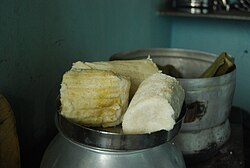
On the occasion of Bisu people are resting at home and preparing special food for breakfast on the day which is mostly "Moode recipe" (English: Screw Pine) which is similar to Kadubu and | On the occasion of Bisu people are resting at home and preparing special food for breakfast on the day which is mostly "Moode recipe" (English: Screw Pine) which is similar to Kadubu and "Uddina dōse recipe" (lentil dosa). For lunch, [[cashew]] nut and green gram curry ({{Transliteration|tcy|bijata kajipu}}), [[cucumber]] {{Transliteration|tcy|puli kajipu}}, ivy gourd dry palya fries and Payaso is served with steamed boiled rice and other accompaniments. Prepare a Tuluva inspired brunch this "Bisu Parba" and enjoy with the members of the family.<ref>{{cite web |last1=Matt |first1=Suprabha S. |title=Celebrate Bisu Parba With Tulunadu Inspired Appealing Brunch Menu |url=https://www.archanaskitchen.com/celebrate-bisu-parba-with-tulunadu-inspired-appealing-brunch-menu |website=Archana's Kitchen |access-date=14 March 2020 }}</ref> | ||
== Kai Bittu Padune == | == Kai Bittu Padune == | ||
Bisu parbo is auspious day for [[Tuluvas]], so on this day morning they keep a side new paddy seeds.<ref>Tulunadina Sasya Janapada by B Shivarama Shetty PHD, Mangaluru University, 1992 P.240</ref> | Bisu parbo is auspious day for [[Tuluvas]], so on this day morning they keep a side new paddy seeds.<ref>Tulunadina Sasya Janapada by B Shivarama Shetty PHD, Mangaluru University, 1992 P.240</ref> | ||
In the evening sowing procedure is carried out on the chin(''Tulu:Puṇi'') of field. Put the paddy seed on the side of the [[mulch]] and shade it with [[Aporosa]] villosa (''Tulu: Saroli'') leaves. And tenants take permission for continuing the practice of planting the following year.<ref> | In the evening sowing procedure is carried out on the chin(''Tulu:Puṇi'') of field. Put the paddy seed on the side of the [[mulch]] and shade it with [[Aporosa]] villosa (''Tulu: Saroli'') leaves. And tenants take permission for continuing the practice of planting the following year.<ref>{{cite news | url=https://timesofindia.indiatimes.com/city/mangaluru/guttu-mane-helps-people-relive-fervour-of-bisu-parba/articleshow/63768002.cms | title=Guttu Mane helps people relive fervour of Bisu Parba | newspaper=The Times of India | first=Jaideep | last=Shenoy | date=15 April 2018 | accessdate=10 August 2021 }}</ref> | ||
== Related festivals == | |||
In adjacent [[Malabar Coast|Malabar]] region a festival called [[Vishu]] with similar customs and ritual significance that of Bisu Parba is celebrated on the same date. Spring harvest festivals such as [[Bihu]], [[Vaisakhi]], [[Puthandu]] etc. too coincides with Bisu Parba.<ref>{{Cite web |title=From Vishu To Bihu: Know The Significance of Vibrant Harvest Festivals Of India |url=https://zeenews.india.com/culture/from-vishu-to-bihu-know-the-significance-of-vibrant-harvest-festivals-of-india-2740032.html |access-date=2024-04-14 |website=Zee News |language=en}}</ref> | |||
== See also == | |||
* [[Keddaso]] | |||
* [[Pattanaje]] | |||
* Koral Parba<ref>{{Cite web |last=Adiga |first=Shrinidhi |title=A harvest festival of bountiful celebrations and bonding |url=https://www.deccanherald.com/specials/a-harvest-festival-of-bountiful-celebrations-and-bonding-2741726 |access-date=2024-04-14 |website=Deccan Herald |language=en}}</ref> | |||
== References == | == References == | ||
| Line 49: | Line 59: | ||
[[Category:Tulu language]] | [[Category:Tulu language]] | ||
[[Category:Religious festivals in India]] | [[Category:Religious festivals in India]] | ||
[[Category:Culture of Tulu Nadu]] | |||
[[Category:New Year in India]] | [[Category:New Year in India]] | ||
[[Category:New Year celebrations]] | [[Category:New Year celebrations]] | ||
[[Category:Tulu Nadu]] | |||
Latest revision as of 12:28, 6 February 2026
| Bisu Parba | |
|---|---|
 Bisu Kani at Puttur | |
| Official name | Bisu Parba |
| Observed by | Tuluvas |
| Type | Religious, Social |
| Observances | Bisu kani Bisu Parbo |
| Begins | dawn |
| Ends | after 24 hours |
| 2025 date | Mon, 14 April |
| 2026 date | Wed, 15 April |
| Related to | South and Southeast Asian solar New Year |
Bisu Parba is a new year and harvest festival of Tulunadu. It marks the first day of Paggu, which is the first month of Tulu calendar.[1][2] It falls in the middle of April in the Gregorian calendar, on 14 or 15 April every year.
Background[edit | edit source]
For residents of Tulunadu, this is a significant annual festival. It is a kind of worshipping nature. According to popular belief, today is lucky for starting new ventures. The people of Tulunadu celebrate the Bisu festival as a symbol of prosperity from the past year and hope to prosper throughout the upcoming year. This festival is known as "Bisu Parba" in Tulunadu.[3]
Celebration[edit | edit source]
.jpg)
Get up early in the morning on the day of the feast and put it on the bed in the chamber of God or in the hall. Light the foot lamp and put it in two ends, keep banana leaves and place one cup of rice, two betel leaves, one semi de-husked coconut with muganda, a bunch of Ixora coccinea (also known as jungle geranium Tulu: Kepula poo) stick of sandalwood, and wet the sandalwood. This process is called suthye dipuna. In front of this suthye, grown vegetables, flowers, hinges, fruits, gold ornaments, mirrors are also placed.
Blessings of the elder[edit | edit source]

All the householders pray together and worship God in front of the Bisu Kani. They reconcile with family members as well as strengthen relationships between seniors and juniors. The juniors receive the blessings of the elders on this occasion. Touching the feet of elders is an age-old Indian tradition that is considered to be a mark of respect as well as a blessing. This gesture can be seen in almost all Tuluva families on this occasion. The elders of the house give money to all the minors and they enjoy the feast. Every year, it is a source of good fortune. As part of the Bisu festival, special worship is held in daivaradane chavadi, temples and the sacrificial festival of God. It is common to prepare and enjoy a traditional dish for this special day. Everybody has to go to every house and enjoy the food with the blessings of the elders. The owner of the house puts the Bisu kaṇi (arrangement of fruits and vegetables) on the roof of the house.
Bisu Kani[edit | edit source]
The festivals in Tulunadu highlight the farmer's life and his affinity with the land he tills.[4] On the day of the feast, bed of wooden in the chamber of God, daiva or in the hall. Light the foot lamp and put it in two ends, banana leaves placed on floor or bed of wooden is accommodate one pot of water, one cup of rice, two betel leaves, one semi dehusked coconut(with muganda), a bunch of Ixora coccinea (also known as jungle geranium Tulu: Kepula poo) stick of sandalwood, and wet the sandalwood which totally called suthye dipuna. In front of this suthye grown vegetables, flowers, hinges, fruits, gold ornaments, mirrors. tenants were taking the grown vegetables to his boss (Tulu: Danikulu) such as brinjal, cucumber, sambar southe, pumpkin, ivy gourd, long yard beans, bottle gourd, okra, and fruits such as jackfruit, banana, cashew apple, jambu nerale, mango, pineapple. Arecanut and coconut, the part and parcel of local life, was also part of the Kani.[5]
Bisu Parba recipe[edit | edit source]

On the occasion of Bisu people are resting at home and preparing special food for breakfast on the day which is mostly "Moode recipe" (English: Screw Pine) which is similar to Kadubu and "Uddina dōse recipe" (lentil dosa). For lunch, cashew nut and green gram curry (bijata kajipu), cucumber puli kajipu, ivy gourd dry palya fries and Payaso is served with steamed boiled rice and other accompaniments. Prepare a Tuluva inspired brunch this "Bisu Parba" and enjoy with the members of the family.[6]
Kai Bittu Padune[edit | edit source]
Bisu parbo is auspious day for Tuluvas, so on this day morning they keep a side new paddy seeds.[7] In the evening sowing procedure is carried out on the chin(Tulu:Puṇi) of field. Put the paddy seed on the side of the mulch and shade it with Aporosa villosa (Tulu: Saroli) leaves. And tenants take permission for continuing the practice of planting the following year.[8]
Related festivals[edit | edit source]
In adjacent Malabar region a festival called Vishu with similar customs and ritual significance that of Bisu Parba is celebrated on the same date. Spring harvest festivals such as Bihu, Vaisakhi, Puthandu etc. too coincides with Bisu Parba.[9]
See also[edit | edit source]
References[edit | edit source]
- ↑ "Souramaana Yugaadi, Bisu Parba, Vishu and Tamil New Year". Raveesh Kumar. 13 April 2009. Retrieved 10 August 2021.
- ↑ "Mangalore: Bisu Parba, Solar New Year, was celebrated with traditional gaiety". The Times of India. 14 April 2009. Retrieved 14 March 2020.
- ↑ "Bisu Parba celebrated with traditional pomp, gaiety". Deccan Herald. 14 April 2018. Retrieved 14 March 2020.
- ↑ ತುಳುವೆರೆ ಬಿಸು ಪರ್ಬ, 13 April 2008
- ↑ "Bisu Parba – traditional ceremony observed with pomp and gaiety". mangaloretoday.com. Retrieved 14 March 2020.
- ↑ Matt, Suprabha S. "Celebrate Bisu Parba With Tulunadu Inspired Appealing Brunch Menu". Archana's Kitchen. Retrieved 14 March 2020.
- ↑ Tulunadina Sasya Janapada by B Shivarama Shetty PHD, Mangaluru University, 1992 P.240
- ↑ Shenoy, Jaideep (15 April 2018). "Guttu Mane helps people relive fervour of Bisu Parba". The Times of India. Retrieved 10 August 2021.
- ↑ "From Vishu To Bihu: Know The Significance of Vibrant Harvest Festivals Of India". Zee News. Retrieved 14 April 2024.
- ↑ Adiga, Shrinidhi. "A harvest festival of bountiful celebrations and bonding". Deccan Herald. Retrieved 14 April 2024.
Template:Festivals of Tulunadu Template:New Year by Calendar