




Riya parik (talk | contribs) m revised |
|||
| Line 1: | Line 1: | ||
{{Short description|Ancient capital of Northern Panchala}} | |||
{{Use dmy dates|date=March 2016}} | {{Use dmy dates|date=March 2016}} | ||
{{Use Indian English|date=March 2016}} | {{Use Indian English|date=March 2016}} | ||
{{Infobox ancient site | {{Infobox ancient site | ||
| name = Ahichchhatra | | name = Ahichchhatra | ||
| native_name = | | native_name = | ||
| alternate_name = | | alternate_name = | ||
| image = | | image = Jain Universal History Diorama in Jain Museum Madhuban 18.jpg | ||
| image_size = 270px | | image_size = 270px | ||
| alt = | | alt = | ||
| caption = | | caption = A diorama in Jain Museum of [[Madhuban, Giridih]] depicting the event at Ahichchhatra | ||
| map_type = South Asia#Uttar Pradesh | | map_type = South Asia#Uttar Pradesh | ||
| map_alt = | | map_alt = | ||
| Line 51: | Line 53: | ||
| designation1_free1value = | | designation1_free1value = | ||
}} | }} | ||
Most of the city was half a mile north-east of the modern village, with a large mound, popularly called the fort, two miles west of this. Several significant finds of sculpture, in both stone and (especially) [[terracotta]] of the early centuries CE, have been made at the site and are now in various museums. Excavations have uncovered nine strata, the lowest from before the 3rd century BCE and the latest from the 11th century CE.<ref>Kala, p. xv</ref> | [[File:GangaTerracottaAhichchhatra.JPG|thumb|upright=1|[[Gupta art|Gupta]] [[terracotta]] of the personified [[Ganges]], 5th-6th century CE, [[National Museum, New Delhi]].<ref>{{cite book |last1=Harle |first1=James C. |title=The Art and Architecture of the Indian Subcontinent |date=January 1994 |publisher=Yale University Press |isbn=978-0-300-06217-5 |page=117 |url=https://books.google.com/books?id=LwcBVvdqyBkC&pg=PA117 |language=en}}</ref>]] | ||
'''Ahichchhatra''' or '''Ahikhet''' ({{langx|sa|अहिच्छत्र}}, {{IAST3|Ahicchatra}}) or '''Ahikshetra''' ({{langx|sa|अहिक्षेत्र}}, {{IAST3|Ahikṣetra}}), near the modern [[Ramnagar, Bareilly|Ramnagar]] village in [[Aonla, Uttar Pradesh|Aonla tehsil]], [[Bareilly district]] in [[Uttar Pradesh]], India, was the ancient [[Capital (political)|capital]] of Northern [[Panchala]], a northern Indian kingdom mentioned in the [[Mahabharata]].<ref name=Malik>{{Cite book |last=Malik |first=Dr Malti |url=https://books.google.com/books?id=bMg-DAAAQBAJ&pg=PA12 |title=History of India |date=2016 |publisher=New Saraswati House India Pvt Ltd |isbn=978-81-7335-498-4 |pages=51–54 |language=en}}</ref> | |||
Most of the city was half a mile north-east of the modern village, with a large mound, popularly called the fort, two miles west of this. Several significant finds of sculpture, in both stone and (especially) [[terracotta]] of the early centuries CE, have been made at the site and are now in various museums. Excavations have uncovered nine strata, the lowest from before the 3rd century BCE and the latest from the 11th century CE.<ref name="dupref">Kala, p. xv</ref> | |||
The city appears to have reached its height during the period of the [[Gupta Empire]]. The region lacks sources of good stone and was a centre for making [[Indian pottery]] at various periods, and in the early CE the temples were decorated with unusually large terracotta [[relief]] panels and sculptures, many of very high quality.<ref>Majumdar, 429-430</ref> | The city appears to have reached its height during the period of the [[Gupta Empire]]. The region lacks sources of good stone and was a centre for making [[Indian pottery]] at various periods, and in the early CE the temples were decorated with unusually large terracotta [[relief]] panels and sculptures, many of very high quality.<ref>Majumdar, 429-430</ref> | ||
==Names== | == Names == | ||
The word ''Ahi'' means ''snake'' or ''Naga'' in [[Sanskrit]]. [[Nāga|Nagas]] were a group of ancient people who worshiped serpents. The word ''khsetra'' means ''region'' in Sanskrit. This implies that Ahi-kshetra was a region of Nagas. | The word ''Ahi'' means ''snake'' or ''Naga'' in [[Sanskrit]]. [[Nāga|Nagas]] were a group of ancient people who worshiped serpents. The word ''{{lang|sa-Latn|khsetra}}'' means ''region'' in Sanskrit. This implies that {{lang|sa-Latn|Ahi-kshetra}} was a region of Nagas. | ||
[[Vividha Tirtha Kalpa]], composed by Jain Acharya Jinaprabha Suri in the 14th century CE, mentions Samkhyāvatǐ as the earlier name of Ahichchhatra and describes two Jain temples dedicated to Parshvanatha in the area. Ahikshetra is mentioned as ''Shankavai Samkhyavati'' in ''Vividhatirthakalpa''.{{sfn|Subodh Kapoor|2002|p=16}} | |||
== History == | |||
According to Jain Tradition, the history of Ahichchhatra traditionally starts from the period of [[Rishabhanatha|1st Tirthankara Rishabhanatha]]. It was visited by all 24 Tirthankaras. Ahichchhatra is believed to be the place where [[Parshvanatha]], the 23rd [[Tirthankar]] of Jainism, attained ''[[Kevala Jnana]]'' (omniscience).<ref>{{Cite web |url=https://uptourism.gov.in/pdf/E-Brochure/ahicchatra_high.pdf |title=Brochure Ahicchatra |access-date=20 April 2022 |archive-date=25 May 2022 |archive-url=https://web.archive.org/web/20220525220525/https://uptourism.gov.in/pdf/E-Brochure/ahicchatra_high.pdf |url-status=dead }}</ref> | |||
Ahichchhatra was one of the sixteen [[Mahajanapadas]].{{sfn|Malik|2016|p=76}} Several ancient Jain [[ayagapata|āyāgapaṭa]] were excavated from this site, including the famous ''Nāṃdighoṣa āyāgapaṭa'' dated early {{circa|15 CE}}.{{sfn|Smith|1901|p=48}}{{sfn|Quintanilla|2007|p=24}}{{sfn|Quintanilla|2000|p=126}} 27 Jain inscriptions discovered here bear dates prior to 100 CE.{{sfn|Royal Asiatic Society of Great Britain and Ireland|1903|pp=5-6}} | |||
[[Alois Anton Führer]] excavated a Jain temple constructed during the reign of [[Indo-Scythians]] dynasty, enhrining idols from 96—152 CE.{{sfn|Murray|1893|p=118}} A number of Jain temples were discovered by [[Alexander Cunningham]] during excavation.{{sfn|Cunningham|1885|p=104}} Many idols, stupas and pillars from the [[Kushan Empire|Kushan]] and [[Gupta Empire|Gupta]] periods have been discovered in Ahichchhatra.{{sfn|UP tourism|Ahicchatra|p=3}} | |||
[[Vividha Tirtha Kalpa]], composed by Śvetāmbara Acharya Jinaprabha Suri in the 14th century CE, mentions Samkhyāvatǐ as the earlier name of Ahichchhatra and describes two Jain temples dedicated to Parshvanatha in the area.{{sfn|Law|1942|p=21}} According to ''Ahicchatra-nagri-kalpa'', this place was visited by Goddess [[Ambika (Jainism)|Ambika]].{{sfn|Tiwari|1989|pp=26-27}} ''Kaivalyamala'', written by Śvetāmbara [[Jain acharya]] Udyotansuri in {{circa|778}} CE,{{sfn|Paniker|1997|p=453}}{{sfn|Mahapatra|1989|p=350}} mentions that Harigupta of the [[Gupta Empire]] took [[diksha]] here.{{sfn|UP tourism|Ahicchatra|p=3}}{{sfn|Shah|1987|p=277}} | |||
Its history reaches back to late [[Vedic]] times, at which time it was capital of the Panchala kingdom. The name is written '''Ahikshetras''' as well as '''Ahi-chhatra''', but the local legend of Adi Raja a Naga Descendent, who formed a Naga canopy over his head, when asleep, shows that the later is his correct form. The fort is said to have been built by the Adi Raja, a [[Nāga]] Descendent from [[Vasuki]]<ref>{{Cite book|last=Kapoor|first=Subodh|url=https://books.google.com/books?id=43Fzt-G_-XYC&dq=ahir+ahicchatra&pg=PA19|title=Encyclopaedia of Ancient Indian Geography|date=2002|publisher=Cosmo Publications|isbn=978-81-7755-298-0|language=en}}</ref> whose future elevation sovereignty was foretold by [[Drona]], when he found him sleeping under the guardianship of a serpent with expended hood. The fort is also called '''Adikot'''.{{sfn|Subodh Kapoor|2002|pp=17-19}} | |||
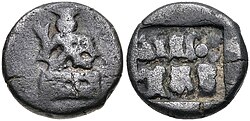
[[File:Panchalas of Adhichhatra.jpg|thumb|Coin of the Panchalas of Ahichhatra (75-50 BCE)<br />Obv. [[Indra]] seated facing on pedestal, holding bifurcated object.<br />Rev. ''Idramitrasa'' in [[Brahmi]], Panchala symbols.]] | |||
The last independent ruler of Ahichatra was [[Achyuta of Panchala|Achyuta Naga]], who was defeated by [[Samudragupta]], after which Panchala was annexed into the [[Gupta Empire]].<ref>Raychaudhuri, H.C. (1972). ''Political History of Ancient India'', Calcutta: University of Calcutta, p.473</ref> The coins of Achyuta found from Ahichatra have a wheel of eight spokes on the reverse and the legend ''Achyu'' on the obverse.<ref>Lahiri, B. (1974). ''Indigenous States of Northern India (Circa 200 B.C. to 320 A.D.) '', Calcutta: University of Calcutta, p.182</ref> | The last independent ruler of Ahichatra was [[Achyuta of Panchala|Achyuta Naga]], who was defeated by [[Samudragupta]], after which Panchala was annexed into the [[Gupta Empire]].<ref>Raychaudhuri, H.C. (1972). ''Political History of Ancient India'', Calcutta: University of Calcutta, p.473</ref> The coins of Achyuta found from Ahichatra have a wheel of eight spokes on the reverse and the legend ''Achyu'' on the obverse.<ref>Lahiri, B. (1974). ''Indigenous States of Northern India (Circa 200 B.C. to 320 A.D.) '', Calcutta: University of Calcutta, p.182</ref> | ||
== Archaeology == | == Archaeology == | ||
The site was briefly explored by Sir [[Alexander Cunningham]] in 1871, and then excavated by the ASI from 1940 for "about five years".<ref | The site was briefly explored by Sir [[Alexander Cunningham]] in 1871, and then excavated by the ASI from 1940 for "about five years".<ref name="dupref" /> The excavations found brick fortifications and continuity of occupation from a period before 600 BCE to 1100 CE.<ref>Lahiri, Bela (1972). ''Indigenous States of Northern India (Circa 200 B.C. to 320 A.D.)'', Calcutta: University of Calcutta, pp.170-88</ref> During the first excavations in 1940–44, the [[Painted Gray Ware]] pottery were found at the earliest level. Ruins of this city could be identified from the [[remote sensing]] imagery of IRS (Indian Remote Sensing) satellites. The ruins reveal that the city had a triangular shape. Recent excavations in Ahichchhatra showed it was first inhabited by the middle of the second millennium BC with [[Ochre Coloured Pottery]] culture people, followed by [[Black and Red Ware]] culture. Around 1000 BC, it reached at least 40 hectares of area, making it one of the largest [[Painted Grey Ware]] culture sites. Evidence of construction of early fortifications were discovered around 1000 BC indicating first urban development.<ref>{{Cite web|url=https://www.educationtimes.com/article/290/20130917201309171524062507304cdb3/What-Lies-Beneath.html|title=What Lies Beneath|last=|first=|date=|website=|archive-url=|archive-date=|access-date=}}</ref><ref>https://www.educationtimes.com/article/290/20130917201309171524062507304cdb3/What-Lies-Beneath.html What lies Beneath, B. R. Mani 2013</ref> Near Ahichchhatra, 2 km to its west there is a big pond which is said to trace its ancestry to the time of Mahabharata. The pond, located in the village of Jagannathpur is said to have been made by the pandavas at the time of their forest dwelling ([[vanvas]]). | ||
In the early Gupta period a section of the city set aside for pottery contained very large firing pits, some 10 or 12 feet deep.<ref>Majumdar, 430</ref> | In the early Gupta period a section of the city set aside for pottery contained very large firing pits, some 10 or 12 feet deep.<ref>Majumdar, 430</ref> | ||
== Jain tradition == | == Jain tradition == | ||
{{Main|Ahichchhatra Jain temples}} | |||
[[File:I38 12karshapana Panchala MACW4540 1ar (8486500958).jpg|thumb|A bronze currency of ½ [[karshapana]] of King Indramitra (ca 75-50 BC?) Of Ahichatra of Panchala. Obv.: Inside a rectangle, a line of 3 symbols, under the name of the king. Rev.: Indra standing on a pedestal without pillars. Dimensions: 15 mm. Weight: 4.18 g.]] | |||
[[File:Coin-of-Achyuta.jpg|thumb|Coin of Achyuta, the last Panchala king, showing an 8-spoked wheel and the king's name: Achyu]] | |||
[[File:Ahichchhatra Shwethambar Tirth (3).jpg|thumb|Ahichchhatra Jain temple]] | |||
Ahichchhatra is believed to be the place where [[Parshvanatha]], the 23rd [[Tirthankar]] of Jainism, attained [[Kevala Jnana]] (omniscience). The temples in Ahichchhatra are built to commemorate [[Parshvanatha]] attaining [[Panch Kalyanaka|Kēvalajñāna kalyāṇaka]].{{sfn|UP tourism|Ahicchatra|p=2}} This temple is dedicated to Parshvanatha and is major Jain pilgrimage center.{{sfn|Jain|2008|p=64}}{{sfn|UP tourism|Uttar Pradesh: A to Z|p=31}} According to [[Uttar Pradesh Tourism]], Ahichhatra Jain Temple witnessed over 4 lakh visitors in 2017.{{sfn|UP tourism|Year-wise Tourist Statistics}} Ahichhatra Jain Mela is the primary festival of this temple and is organized annually in March.{{sfn|UP tourism|Uttar Pradesh: A to Z|p=31}} | |||
== | According to [[Vividha Tirtha Kalpa]], Kamath in an attempt to obstruct Parshvanatha from achieving ''Kevala Jnana'' caused continuous rain. Parshvanatha was immersed in water up to his neck and to protect him the serpent god [[Dharanendra]] held a canopy of thousand hoods over his head and the goddess [[Padmavati (Jainism)|Padmavati]] coiled herself around his body. [[Ahichchhatra Jain temples]] are built to commemorate Parshvanatha attaining [[Panch Kalyanaka|Kēvalajñāna kalyāṇaka]].{{sfn|UP tourism|Ahicchatra|p=2}}{{sfn|Kapoor|2002|p=17}} | ||
==Sculpture from Ahichchhatra== | == Means of approach == | ||
<gallery widths=" | From the Revati Bahoda Khera Station on Chandosi – Bareilly Line, vehicle of Kshetra and other vehicles are available. | ||
* Buses are available from Delhi, Meerut, Aligarh, Lucknow, Kasganj & Badaun. | |||
* Trains are available from Delhi, Bareilly, Agra, Moradabad, Aligarh to Revati Bahoda Khera Station. Vehicles are always available for Ramnagar from Revati Bahoda Khera Station. | |||
* Airport: Delhi 250 km | |||
== Nearby places == | |||
* Nainital – 180 km | |||
* Hastinapur Atishaya Kshetra – 200 km | |||
* Kampilji Atishaya Kshetra – 180 km | |||
* Manglayatan (Aligarh) – 180 km | |||
* Bareilly – 55 km | |||
== Sculpture from Ahichchhatra == | |||
<gallery widths="200" heights="200"> | |||
File:Ahichchhatra excavation - Parshvanatha idol - 7th century BCE.jpg|alt=|23rd Tirthankara Parshvanatha sculpture excavated from Ahichchhatra, 7th century BCE | |||
File:Seated Buddha.jpg|Stone Buddha, c. 1st Century CE, Kushan Period | File:Seated Buddha.jpg|Stone Buddha, c. 1st Century CE, Kushan Period | ||
File:The Hindu God Shiva LACMA M.69.15.1 (2 of 3).jpg|Sandstone Shiva, 3rd century | File:The Hindu God Shiva LACMA M.69.15.1 (2 of 3).jpg|Sandstone Shiva, 3rd century | ||
File:Architectural Panel with Goddess LACMA AC1993.239.6 (cropped).jpg|Terracotta architectural panel with Goddess, Gupta period, 5th century | File:Architectural Panel with Goddess LACMA AC1993.239.6 (cropped).jpg|Terracotta architectural panel with Goddess, Gupta period, 5th century | ||
File:Goddess Yamuna. Delhi National Museum ni01-10.jpg|Gupta period terracotta [[Yamuna]], pair to the Ganga above | File:Goddess Yamuna. Delhi National Museum ni01-10.jpg|Gupta period terracotta [[Yamuna]], pair to the Ganga above | ||
</gallery> | </gallery> | ||
==Notes== | == Notes == | ||
{{ | {{Commons category}} | ||
{{reflist}} | {{reflist}} | ||
==References== | == References == | ||
* Kala, Satish Chandra, ''Terracottas in the Allahabad Museum'', p. xv, Abhinav Publications, 1980, {{ISBN|0391022342}}, 9780391022348, [https://books.google. | * {{cite book |last=Cunningham |first=Alexander | author-link=Alexander Cunningham |title=Report of a Tour in Eastern Rajputana in 1882-83 | volume=20 | series=Archaeological Survey of India |url={{Google books|6M8OAAAAQAAJ|page=104|plainurl=yes}} |year=1885 |publisher=Office of the Superintendent of Government Printing }} | ||
* Kala, Satish Chandra, ''Terracottas in the Allahabad Museum'', p. xv, Abhinav Publications, 1980, {{ISBN|0391022342}}, 9780391022348, [https://books.google.com/books?id=Ha_C1ofYmxoC&pg=PR16-IA2 google books] | |||
* {{citation |editor-first=Subodh |editor-last=Kapoor |url=https://books.google.com/books?id=43Fzt-G_-XYC |title=Encyclopaedia of Ancient Indian Geography |volume=1 |publisher=Cosmo Publications |year=2002 |isbn=81-7755-298-8 |ref={{sfnref|Subodh Kapoor|2002}} }} | * {{citation |editor-first=Subodh |editor-last=Kapoor |url=https://books.google.com/books?id=43Fzt-G_-XYC |title=Encyclopaedia of Ancient Indian Geography |volume=1 |publisher=Cosmo Publications |year=2002 |isbn=81-7755-298-8 |ref={{sfnref|Subodh Kapoor|2002}} }} | ||
*Majumdar, Ramesh Chandra, ''Vakataka | * {{cite book |last=Jain |first=Lakshmi |title=Dropout of Girl-child in Schools |url={{Google books|N8ZNPEflZzgC|page=64|plainurl=yes}} |publisher=Northern Book Centre |isbn=9788172112448 |year=2008}} | ||
* {{cite book | last=Law | first=Bimala Churn | title=Panchalas and their capital Ahichchhatra | volume=67 | series=Memoirs of the Archaeological Survey of India | publisher=[[Archaeological Survey of India]] | url=https://ignca.gov.in/Asi_data/22065.pdf | year=1942 | access-date=27 April 2022 }} | |||
* {{cite book |last=Mahapatra |first=B. P. |title=Constitutional languages | volume=1 | series=The Written Languages of the World: A Survey of the Degree and Modes of Use |url={{Google books|yU8nq-C6wnoC|page=350|plainurl=yes}} |publisher=[[Université Laval]] | isbn=9782763771861 | year=1989 | location=Québec}} | |||
*Majumdar, Ramesh Chandra, ''Vakataka – Gupta Age Circa 200-550 A.D.'', 1986, Motilal Banarsidass Publ., {{ISBN|8120800265}}, 9788120800267, [https://books.google.com/books?id=OswUZtL1_CUC&pg=PA429 google books] | |||
* {{cite book |last=Murray |first=J. | author-link=John Murray III |title=The Academy | volume=44 |url={{Google books|sZd6rztMwS0C|page=118|plainurl=yes}} |publisher=[[John Murray (publishing house)]] | location=[[London]] | year=1893 }} | |||
* {{cite book |last=Paniker |first=K. Ayyappa | author-link=Ayyappa Paniker |title=Constitutional languages | volume=1 | series=Medieval Indian Literature |url={{Google books|KYLpvaKJIMEC|page=453|plainurl=yes}} |publisher=[[Sahitya Akademi]] | isbn=9788126003655 | year=1997 }} | |||
* {{cite journal | last=Quintanilla | first=Sonya Rhie | title=Āyāgapaṭas: Characteristics, Symbolism, and Chronology | url=https://www.jstor.org/stable/3249941 | journal=[[Artibus Asiae]] | volume=60 | issue=1 | year=2000 | pages=79–137 | doi=10.2307/3249941 | jstor=3249941 | access-date=20 April 2022| url-access=subscription }} | |||
* {{cite book |last=Quintanilla |first=Sonya Rhie |title=History of Early Stone Sculpture at Mathura: Ca. 150 BCE - 100 CE |date=2007 |publisher=[[Brill Publishers]] |isbn=9789004155374 |url={{Google books|X7Cb8IkZVSMC|pg=PR24|keywords=|text=|plainurl=yes}} |language=en}} | |||
* {{cite book | author=Royal Asiatic Society of Great Britain and Ireland | author-link=Royal Asiatic Society of Great Britain and Ireland |title=Journal of the Royal Asiatic Society of Great Britain and Ireland |url={{Google books|j-B_DPdTBMEC|page=5|plainurl=yes}} |publisher=Royal Asiatic Society of Great Britain and Ireland | year=1903 }} | |||
* {{cite book |last=Shah | first=Umakant Premanand | author-link=Umakant Premanand Shah | title=Jaina-rūpa-maṇḍana: Jaina iconography | url={{Google books|m_y_P4duSXsC|page=277|keywords=|text=|plainurl=yes}} | date=1987 | publisher=Abhinav Publications | location=[[Delhi]] | isbn=81-7017-208-X }} | |||
* {{cite book |last=Smith |first=Vincent Arthur | author-link=Vincent Arthur Smith |title=The Jain Stûpa and Other Antiquities of Mathurâ | volume=20 | series=New Imperial series |url={{Google books|iQo2AJ3-FnECC|pg=PP48|plainurl=yes}} |year=1901 |publisher=F. Luker, superintendent Government Press }} | |||
* {{cite book | last=Tiwari | first=Dr. Maruti Nandan Prasad | url={{Google books|l0Tt04JDN0kC|page=26|keywords=|text=|plainurl=yes}} | title=Ambika in Jaina Art and Literature | publisher=[[Bharatiya Jnanpith]] | date=1989 }} | |||
* [[Uttar Pradesh Tourism]] | |||
** {{cite web | author=Uttar Pradesh Tourism | url=https://www.uptourism.gov.in/pdf/E-Brochure/UP-Book-opt.pdf | title=Uttar Pradesh: A to Z | publisher=[[Uttar Pradesh Tourism]] | ref={{sfnref|UP tourism|Uttar Pradesh: A to Z}} | access-date=20 April 2022 | archive-date=22 January 2023 | archive-url=https://web.archive.org/web/20230122045228/https://www.uptourism.gov.in/pdf/E-Brochure/UP-Book-opt.pdf | url-status=dead }} | |||
** {{cite web | author=Uttar Pradesh Tourism | url=https://www.uptourism.gov.in/en/article/year-wise-tourist-statistics | title=Year-wise Tourist Statistics | publisher=[[Uttar Pradesh Tourism]] | ref={{sfnref|UP tourism|Year-wise Tourist Statistics}} | access-date=20 April 2022 | archive-date=31 May 2023 | archive-url=https://web.archive.org/web/20230531225103/https://www.uptourism.gov.in/en/article/year-wise-tourist-statistics | url-status=dead }} | |||
** {{cite web | author=Uttar Pradesh Tourism | url=https://uptourism.gov.in/pdf/E-Brochure/ahicchatra_high.pdf | title=Ahicchatra | publisher=[[Uttar Pradesh Tourism]] | ref={{sfnref|UP tourism|Ahicchatra}} | access-date=20 April 2022 | archive-date=25 May 2022 | archive-url=https://web.archive.org/web/20220525220525/https://uptourism.gov.in/pdf/E-Brochure/ahicchatra_high.pdf | url-status=dead }} | |||
{{Portal|India}} | {{Portal|India}} | ||
| Line 117: | Line 154: | ||
[[Category:Jain temples and tirthas]] | [[Category:Jain temples and tirthas]] | ||
[[Category:Indo-Aryan archaeological sites]] | [[Category:Indo-Aryan archaeological sites]] | ||
[[Category:Pañcāla]] | |||
[[Category:Former capitals in India]] | |||
[[Category:Capitals of ancient kingdoms in Uttar Pradesh]] | |||
Latest revision as of 04:22, 14 March 2026
 A diorama in Jain Museum of Madhuban, Giridih depicting the event at Ahichchhatra | |
  Ahichchhatra Shown within South Asia Ahichchhatra is located in Uttar Pradesh Ahichchhatra Ahichchhatra (Uttar Pradesh) | |
| Location | Uttar Pradesh, India |
|---|---|
| Coordinates | 28°22′16″N 79°08′10″E / 28.371°N 79.136°E |
| Type | Temples |
| History | |
| Founded | c. 1500 BCE |
| Cultures | Ochre Coloured Pottery culture, Black and red ware, Painted Grey Ware culture, Gupta Empire |

Ahichchhatra or Ahikhet (Sanskrit: अहिच्छत्र, IAST: Ahicchatra) or Ahikshetra (Sanskrit: अहिक्षेत्र, IAST: Ahikṣetra), near the modern Ramnagar village in Aonla tehsil, Bareilly district in Uttar Pradesh, India, was the ancient capital of Northern Panchala, a northern Indian kingdom mentioned in the Mahabharata.[2]
Most of the city was half a mile north-east of the modern village, with a large mound, popularly called the fort, two miles west of this. Several significant finds of sculpture, in both stone and (especially) terracotta of the early centuries CE, have been made at the site and are now in various museums. Excavations have uncovered nine strata, the lowest from before the 3rd century BCE and the latest from the 11th century CE.[3]
The city appears to have reached its height during the period of the Gupta Empire. The region lacks sources of good stone and was a centre for making Indian pottery at various periods, and in the early CE the temples were decorated with unusually large terracotta relief panels and sculptures, many of very high quality.[4]
Names[edit | edit source]
The word Ahi means snake or Naga in Sanskrit. Nagas were a group of ancient people who worshiped serpents. The word khsetra means region in Sanskrit. This implies that Ahi-kshetra was a region of Nagas.
Vividha Tirtha Kalpa, composed by Jain Acharya Jinaprabha Suri in the 14th century CE, mentions Samkhyāvatǐ as the earlier name of Ahichchhatra and describes two Jain temples dedicated to Parshvanatha in the area. Ahikshetra is mentioned as Shankavai Samkhyavati in Vividhatirthakalpa.[5]
History[edit | edit source]
According to Jain Tradition, the history of Ahichchhatra traditionally starts from the period of 1st Tirthankara Rishabhanatha. It was visited by all 24 Tirthankaras. Ahichchhatra is believed to be the place where Parshvanatha, the 23rd Tirthankar of Jainism, attained Kevala Jnana (omniscience).[6]
Ahichchhatra was one of the sixteen Mahajanapadas.[7] Several ancient Jain āyāgapaṭa were excavated from this site, including the famous Nāṃdighoṣa āyāgapaṭa dated early c. 15 CE.[8][9][10] 27 Jain inscriptions discovered here bear dates prior to 100 CE.[11]
Alois Anton Führer excavated a Jain temple constructed during the reign of Indo-Scythians dynasty, enhrining idols from 96—152 CE.[12] A number of Jain temples were discovered by Alexander Cunningham during excavation.[13] Many idols, stupas and pillars from the Kushan and Gupta periods have been discovered in Ahichchhatra.[14]
Vividha Tirtha Kalpa, composed by Śvetāmbara Acharya Jinaprabha Suri in the 14th century CE, mentions Samkhyāvatǐ as the earlier name of Ahichchhatra and describes two Jain temples dedicated to Parshvanatha in the area.[15] According to Ahicchatra-nagri-kalpa, this place was visited by Goddess Ambika.[16] Kaivalyamala, written by Śvetāmbara Jain acharya Udyotansuri in c. 778 CE,[17][18] mentions that Harigupta of the Gupta Empire took diksha here.[14][19]
Its history reaches back to late Vedic times, at which time it was capital of the Panchala kingdom. The name is written Ahikshetras as well as Ahi-chhatra, but the local legend of Adi Raja a Naga Descendent, who formed a Naga canopy over his head, when asleep, shows that the later is his correct form. The fort is said to have been built by the Adi Raja, a Nāga Descendent from Vasuki[20] whose future elevation sovereignty was foretold by Drona, when he found him sleeping under the guardianship of a serpent with expended hood. The fort is also called Adikot.[21]

Obv. Indra seated facing on pedestal, holding bifurcated object.
Rev. Idramitrasa in Brahmi, Panchala symbols.
The last independent ruler of Ahichatra was Achyuta Naga, who was defeated by Samudragupta, after which Panchala was annexed into the Gupta Empire.[22] The coins of Achyuta found from Ahichatra have a wheel of eight spokes on the reverse and the legend Achyu on the obverse.[23]
Archaeology[edit | edit source]
The site was briefly explored by Sir Alexander Cunningham in 1871, and then excavated by the ASI from 1940 for "about five years".[3] The excavations found brick fortifications and continuity of occupation from a period before 600 BCE to 1100 CE.[24] During the first excavations in 1940–44, the Painted Gray Ware pottery were found at the earliest level. Ruins of this city could be identified from the remote sensing imagery of IRS (Indian Remote Sensing) satellites. The ruins reveal that the city had a triangular shape. Recent excavations in Ahichchhatra showed it was first inhabited by the middle of the second millennium BC with Ochre Coloured Pottery culture people, followed by Black and Red Ware culture. Around 1000 BC, it reached at least 40 hectares of area, making it one of the largest Painted Grey Ware culture sites. Evidence of construction of early fortifications were discovered around 1000 BC indicating first urban development.[25][26] Near Ahichchhatra, 2 km to its west there is a big pond which is said to trace its ancestry to the time of Mahabharata. The pond, located in the village of Jagannathpur is said to have been made by the pandavas at the time of their forest dwelling (vanvas).
In the early Gupta period a section of the city set aside for pottery contained very large firing pits, some 10 or 12 feet deep.[27]
Jain tradition[edit | edit source]
.jpg)

.jpg)
Ahichchhatra is believed to be the place where Parshvanatha, the 23rd Tirthankar of Jainism, attained Kevala Jnana (omniscience). The temples in Ahichchhatra are built to commemorate Parshvanatha attaining Kēvalajñāna kalyāṇaka.[28] This temple is dedicated to Parshvanatha and is major Jain pilgrimage center.[29][30] According to Uttar Pradesh Tourism, Ahichhatra Jain Temple witnessed over 4 lakh visitors in 2017.[31] Ahichhatra Jain Mela is the primary festival of this temple and is organized annually in March.[30]
According to Vividha Tirtha Kalpa, Kamath in an attempt to obstruct Parshvanatha from achieving Kevala Jnana caused continuous rain. Parshvanatha was immersed in water up to his neck and to protect him the serpent god Dharanendra held a canopy of thousand hoods over his head and the goddess Padmavati coiled herself around his body. Ahichchhatra Jain temples are built to commemorate Parshvanatha attaining Kēvalajñāna kalyāṇaka.[28][32]
Means of approach[edit | edit source]
From the Revati Bahoda Khera Station on Chandosi – Bareilly Line, vehicle of Kshetra and other vehicles are available.
- Buses are available from Delhi, Meerut, Aligarh, Lucknow, Kasganj & Badaun.
- Trains are available from Delhi, Bareilly, Agra, Moradabad, Aligarh to Revati Bahoda Khera Station. Vehicles are always available for Ramnagar from Revati Bahoda Khera Station.
- Airport: Delhi 250 km
Nearby places[edit | edit source]
- Nainital – 180 km
- Hastinapur Atishaya Kshetra – 200 km
- Kampilji Atishaya Kshetra – 180 km
- Manglayatan (Aligarh) – 180 km
- Bareilly – 55 km
Sculpture from Ahichchhatra[edit | edit source]
-
 23rd Tirthankara Parshvanatha sculpture excavated from Ahichchhatra, 7th century BCE
 -
 Stone Buddha, c. 1st Century CE, Kushan Period
 -
 Sandstone Shiva, 3rd century
 -
 Terracotta architectural panel with Goddess, Gupta period, 5th century
 -
 Gupta period terracotta Yamuna, pair to the Ganga above


.jpg)
.jpg)

Notes[edit | edit source]
- ↑ Harle, James C. (January 1994). The Art and Architecture of the Indian Subcontinent. Yale University Press. p. 117. ISBN 978-0-300-06217-5.
- ↑ Malik, Dr Malti (2016). History of India. New Saraswati House India Pvt Ltd. pp. 51–54. ISBN 978-81-7335-498-4.
- ↑ 3.0 3.1 Kala, p. xv
- ↑ Majumdar, 429-430
- ↑ Subodh Kapoor 2002, p. 16.
- ↑ "Brochure Ahicchatra" (PDF). Archived from the original (PDF) on 25 May 2022. Retrieved 20 April 2022.
- ↑ Malik 2016, p. 76.
- ↑ Smith 1901, p. 48.
- ↑ Quintanilla 2007, p. 24.
- ↑ Quintanilla 2000, p. 126.
- ↑ Royal Asiatic Society of Great Britain and Ireland 1903, pp. 5-6.
- ↑ Murray 1893, p. 118.
- ↑ Cunningham 1885, p. 104.
- ↑ 14.0 14.1 UP tourism & Ahicchatra, p. 3.
- ↑ Law 1942, p. 21.
- ↑ Tiwari 1989, pp. 26-27.
- ↑ Paniker 1997, p. 453.
- ↑ Mahapatra 1989, p. 350.
- ↑ Shah 1987, p. 277.
- ↑ Kapoor, Subodh (2002). Encyclopaedia of Ancient Indian Geography. Cosmo Publications. ISBN 978-81-7755-298-0.
- ↑ Subodh Kapoor 2002, pp. 17-19.
- ↑ Raychaudhuri, H.C. (1972). Political History of Ancient India, Calcutta: University of Calcutta, p.473
- ↑ Lahiri, B. (1974). Indigenous States of Northern India (Circa 200 B.C. to 320 A.D.) , Calcutta: University of Calcutta, p.182
- ↑ Lahiri, Bela (1972). Indigenous States of Northern India (Circa 200 B.C. to 320 A.D.), Calcutta: University of Calcutta, pp.170-88
- ↑ "What Lies Beneath".
- ↑ https://www.educationtimes.com/article/290/20130917201309171524062507304cdb3/What-Lies-Beneath.html What lies Beneath, B. R. Mani 2013
- ↑ Majumdar, 430
- ↑ 28.0 28.1 UP tourism & Ahicchatra, p. 2.
- ↑ Jain 2008, p. 64.
- ↑ 30.0 30.1 UP tourism & Uttar Pradesh: A to Z, p. 31.
- ↑ UP tourism & Year-wise Tourist Statistics.
- ↑ Kapoor 2002, p. 17.
References[edit | edit source]
- Cunningham, Alexander (1885). Report of a Tour in Eastern Rajputana in 1882-83. Archaeological Survey of India. Vol. 20. Office of the Superintendent of Government Printing.
- Kala, Satish Chandra, Terracottas in the Allahabad Museum, p. xv, Abhinav Publications, 1980, ISBN 0391022342, 9780391022348, google books
- Kapoor, Subodh, ed. (2002), Encyclopaedia of Ancient Indian Geography, vol. 1, Cosmo Publications, ISBN 81-7755-298-8
- Jain, Lakshmi (2008). Dropout of Girl-child in Schools. Northern Book Centre. ISBN 9788172112448.
- Law, Bimala Churn (1942). Panchalas and their capital Ahichchhatra (PDF). Memoirs of the Archaeological Survey of India. Vol. 67. Archaeological Survey of India. Retrieved 27 April 2022.
- Mahapatra, B. P. (1989). Constitutional languages. The Written Languages of the World: A Survey of the Degree and Modes of Use. Vol. 1. Québec: Université Laval. ISBN 9782763771861.
- Majumdar, Ramesh Chandra, Vakataka – Gupta Age Circa 200-550 A.D., 1986, Motilal Banarsidass Publ., ISBN 8120800265, 9788120800267, google books
- Murray, J. (1893). The Academy. Vol. 44. London: John Murray (publishing house).
- Paniker, K. Ayyappa (1997). Constitutional languages. Medieval Indian Literature. Vol. 1. Sahitya Akademi. ISBN 9788126003655.
- Quintanilla, Sonya Rhie (2000). "Āyāgapaṭas: Characteristics, Symbolism, and Chronology". Artibus Asiae. 60 (1): 79–137. doi:10.2307/3249941. JSTOR 3249941. Retrieved 20 April 2022.
- Quintanilla, Sonya Rhie (2007). History of Early Stone Sculpture at Mathura: Ca. 150 BCE - 100 CE. Brill Publishers. ISBN 9789004155374.
- Royal Asiatic Society of Great Britain and Ireland (1903). Journal of the Royal Asiatic Society of Great Britain and Ireland. Royal Asiatic Society of Great Britain and Ireland.
- Shah, Umakant Premanand (1987). Jaina-rūpa-maṇḍana: Jaina iconography. Delhi: Abhinav Publications. ISBN 81-7017-208-X.
- Smith, Vincent Arthur (1901). The Jain Stûpa and Other Antiquities of Mathurâ. New Imperial series. Vol. 20. F. Luker, superintendent Government Press.
- Tiwari, Dr. Maruti Nandan Prasad (1989). Ambika in Jaina Art and Literature. Bharatiya Jnanpith.
- Uttar Pradesh Tourism
- Uttar Pradesh Tourism. "Uttar Pradesh: A to Z" (PDF). Uttar Pradesh Tourism. Archived from the original (PDF) on 22 January 2023. Retrieved 20 April 2022.
- Uttar Pradesh Tourism. "Year-wise Tourist Statistics". Uttar Pradesh Tourism. Archived from the original on 31 May 2023. Retrieved 20 April 2022.
- Uttar Pradesh Tourism. "Ahicchatra" (PDF). Uttar Pradesh Tourism. Archived from the original (PDF) on 25 May 2022. Retrieved 20 April 2022.

