






CleanupBot (talk | contribs) m →Birla Mandirs across India: clean up |
No edit summary |
||
| Line 1: | Line 1: | ||
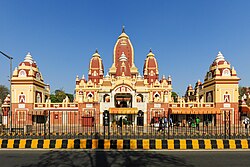
{{Short description|Hindu Temples}}[[File:Laxminarayan Temple in New Delhi 03-2016.jpg|thumb|[[Birla Mandir, Delhi]]]] | {{Short description|Hindu Temples}}[[File:Laxminarayan Temple in New Delhi 03-2016.jpg|thumb|[[Birla Mandir, Delhi|Birla Mandir, New Delhi]]]] | ||
[[File:Birla Mandir astounding Beauty.jpg|alt=|thumb|[[Birla Mandir, Kolkata]]]] | [[File:Birla Mandir astounding Beauty.jpg|alt=|thumb|[[Birla Mandir, Kolkata]]]] | ||
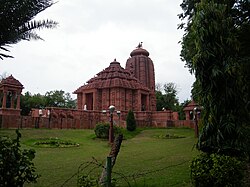
[[File:Sun_Temple_-_GWL_-_F3101_Wiki_Veethi.JPG|thumb|Sun Temple, [[Gwalior]], inspired by the [[Konark Sun Temple]]]] | [[File:Sun_Temple_-_GWL_-_F3101_Wiki_Veethi.JPG|thumb|Sun Temple, [[Gwalior]], inspired by the [[Konark Sun Temple]]]] | ||
[[File:Birla Mandir in Hyderabad, 2015.JPG|thumb|[[Birla Mandir, Hyderabad|Birla Mandir]] in Hyderabad]] | [[File:Birla Mandir in Hyderabad, 2015.JPG|thumb|[[Birla Mandir, Hyderabad|Birla Mandir]] in Hyderabad]] | ||
[[File:Lakshmi Narayan Temple 01.jpg|thumb|Birla Temple at Arera Hills, [[Bhopal]] | [[File:Lakshmi Narayan Temple 01.jpg|thumb|Birla Temple at Arera Hills, [[Bhopal]]]] | ||
[[File:New Vishwanath Temple at BHU 2007.jpg|right|thumb|upright|[[Shri Vishwanath Mandir]] also known as ''Birla Mandir'' in the [[Banaras Hindu University]] campus, [[Varanasi]] | [[File:New Vishwanath Temple at BHU 2007.jpg|right|thumb|upright|[[Shri Vishwanath Mandir]] also known as ''Birla Mandir'' in the [[Banaras Hindu University]] campus, [[Varanasi]]]] | ||
'''Birla | The '''Birla Mandirs (Birla Temples)''' refer to different [[Hindu temple]]s or [[Mandir]]s built by the [[Birla family]] in different cities across India. All these temples are magnificently built, some in white marble or sandstone. The temples are generally located in a prominent location, carefully designed to accommodate a large number of visitors. The worship and discourses are well organized. The first one was built in 1939 in Delhi collectively by [[Jugal Kishore Birla]] and his brothers and their father. Later temples were built by and managed by different branches of the family. For both of the temples in Varanasi, the Birlas joined other donors to support the cost. | ||
== History and | == History and design == | ||
The Birla temples in Delhi and Bhopal were | The Birla temples in Delhi and Bhopal were constructed to fulfill a cultural void in these cities. As these cities were ruled for centuries by Muslim dynasties, these cities did not have any notable temples since the Islamic ruler did not permit the construction of grand Hindu temples with [[shikhara]]s. Delhi, even though it was the capital of India, did not have any outstanding Hindu temples left. During the Mughal period, temples with a shikhara were prohibited until the late Mughal period. The first temple to be built by the Birla family is the Laxminarayan Temple in Delhi, which was opened in 1939. Located at a prominent site,<ref>Backdrop of the Struggle in India; American's impressions of a teeming land. Amid romance, reality, fabulous wealth and dire poverty, there is a yearning for independence. The backdrop of the Freedom Struggle in India, Herbert L. Matthews, New York Times Magazine, September 27, 1942</ref> The temple was designed to be lofty and spacious, suitable for congregational worship or discourses. Although built using modern technology, it very loosely conformed to the [[Hindu temple architecture#Nagara (नागर) architecture|Nagara]] style. The Birlas also built the adjoining Buddhist temple and donated it to the [[Mahabodhi Society]].{{cn|date=August 2021}} | ||
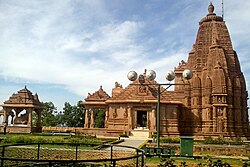
The Birla temples in Delhi, Banaras and | The Birla temples in Delhi, Banaras and Bhopal use modern construction materials and techniques. Later temples are built of marble or sandstone and are constructed usually in the classical style of [[Māru-Gurjara architecture]] (from the [[Chandela]] or [[Chaulukya dynasty]]) of the 10-12th century, with some elements of local, regional styles, such as the [[gopuram]] of the [[Birla Mandir, Hyderabad]], otherwise in the northern Māru-Gurjara style. The Saraswati temple, in the BITS Pilani campus, is one of the very few Sarasvati temples built in modern times (see [[Maihar#Places to visit at Maihar|Sharda Temple, Maihar]]). It is said to be a replica of the [[Kandariya Mahadeva Temple]] of [[Khajuraho]]; however, it is built of white marble and adorned with not only images of Gods but also of philosophers and scientists.<ref>[http://www.gutenberg-e.org/haa01/frames/fhaa03.html Community and Public Culture: The Marwaris in Calcutta 1897-1997, Anne Hardgrove, Philanthropy and Mapping the Kul: Industrialists and Temple Building]</ref> The Gwalior Sun temple is a replica (much reduced in size) of the famous [[Konark Sun Temple]],<ref>Pilgrimage Centres of India, Brajesh Kumar, A.H.W. Sameer series, Diamond Pocket Books (P) Ltd., 2003 p. 103</ref> as it would have appeared before the collapse of the main tower. Anne Hardgrove states: | ||
:A national chain of the "Birla temples," temples of grandiose scale and design, have become major landmarks and part of the cityscapes of Indian urban life in the late twentieth century. The Birla temples exist in conjunction with other large industrial and philanthropic ventures of the wealthy Birla family, including major institutions of technology, medicine, and education. Birla temples have redefined religion to conform to modern ideals of philanthropy and humanitarianism, combining the worship of a deity with a public institution that contributes to civil society. The architectural forms of the two newest Birla temples (''Jaipur and Kolkata'') incorporate innovative, dual-purpose structures into the temple design that alter temple practices to reflect the concerns of modern public culture in a religious site.<ref>[http://www.gutenberg-e.org/haa01/frames/fhaa03.html Community and Public Culture: The Marwaris in Calcutta 1897-1997, Anne Hardgrove, Philanthropy and Mapping the Kul: Industrialists and Temple Building]</ref> | :A national chain of the "Birla temples," temples of grandiose scale and design, have become major landmarks and part of the cityscapes of Indian urban life in the late twentieth century. The Birla temples exist in conjunction with other large industrial and philanthropic ventures of the wealthy Birla family, including major institutions of technology, medicine, and education. Birla temples have redefined religion to conform to modern ideals of philanthropy and humanitarianism, combining the worship of a deity with a public institution that contributes to civil society. The architectural forms of the two newest Birla temples (''Jaipur and Kolkata'') incorporate innovative, dual-purpose structures into the temple design that alter temple practices to reflect the concerns of modern public culture in a religious site.<ref>[http://www.gutenberg-e.org/haa01/frames/fhaa03.html Community and Public Culture: The Marwaris in Calcutta 1897-1997, Anne Hardgrove, Philanthropy and Mapping the Kul: Industrialists and Temple Building]</ref> | ||
| Line 18: | Line 18: | ||
{| class="wikitable" | {| class="wikitable" | ||
|+Birla Temples in India | |+Birla Temples in India | ||
!Sl.No. | |||
!Image | !Image | ||
! Temple | ! Temple | ||
| Line 24: | Line 25: | ||
! Deity | ! Deity | ||
|- | |- | ||
| 1 | |||
|[[File:New Vishwanath Temple at BHU.jpg|100px]] | |[[File:New Vishwanath Temple at BHU.jpg|100px]] | ||
|[[Shri Vishwanath Mandir|Birla Mandir]] | |[[Shri Vishwanath Mandir|Birla Mandir]] | ||
| Line 30: | Line 32: | ||
|[[Shiva]] (Shri Vishwanath) | |[[Shiva]] (Shri Vishwanath) | ||
|- | |- | ||
| 2 | |||
|[[File:Birla Mandir Delhi.jpg|100px]] | |[[File:Birla Mandir Delhi.jpg|100px]] | ||
| [[Laxminarayan Temple]]<ref name=makht>{{cite news |title=Making history with brick and mortar |url=http://www.hindustantimes.com/Making-history-with-brick-and-mortar/Article1-745801.aspx |archive-url=https://archive.today/20121205200651/http://www.hindustantimes.com/Making-history-with-brick-and-mortar/Article1-745801.aspx |url-status=dead |archive-date=December 5, 2012 |publisher=[[Hindustan Times]]|date=September 15, 2011 }}</ref> | | [[Laxminarayan Temple]]<ref name=makht>{{cite news |title=Making history with brick and mortar |url=http://www.hindustantimes.com/Making-history-with-brick-and-mortar/Article1-745801.aspx |archive-url=https://archive.today/20121205200651/http://www.hindustantimes.com/Making-history-with-brick-and-mortar/Article1-745801.aspx |url-status=dead |archive-date=December 5, 2012 |publisher=[[Hindustan Times]]|date=September 15, 2011 }}</ref> | ||
| Line 36: | Line 39: | ||
| [[Lakshmi Narayan]] | | [[Lakshmi Narayan]] | ||
|- | |- | ||
| 3 | |||
|[[File:Budha statue in a Budha Vihar near Birla Mandir Delhi1.JPG|100px]] | |[[File:Budha statue in a Budha Vihar near Birla Mandir Delhi1.JPG|100px]] | ||
| Buddhist Temple (Delhi Center) | | Buddhist Temple (Delhi Center) | ||
| Line 42: | Line 46: | ||
| [[Dharmachakra Pravartana Buddha at Sarnath|Dharmachakra Pravartana Buddha]] | | [[Dharmachakra Pravartana Buddha at Sarnath|Dharmachakra Pravartana Buddha]] | ||
|- | |- | ||
| | | 4 | ||
| | |||
| Birla Mandir | | Birla Mandir | ||
| 1941 - 1961 | | 1941 - 1961 | ||
| Line 48: | Line 53: | ||
| [[Lakshmi Narayan]] | | [[Lakshmi Narayan]] | ||
|- | |- | ||
|5 | |||
| | |||
|Birla Mandir (Gita Mandir) | |||
|1946 | |||
|[[Mathura]] | |||
|[[Radha Krishna]] | |||
|- | |||
| 6 | |||
| | | | ||
|Birla Mandir<ref>{{cite web | url = http://kurukshetra.nic.in/tour/Religious/tirath/Kurukshetra/birlamandir/index.htm | title = Birla Mandir, Kurukushetra | access-date = 2018-02-26 | archive-url = https://web.archive.org/web/20180524100232/http://www.kurukshetra.nic.in/tour/Religious/tirath/Kurukshetra/birlamandir/index.htm | archive-date = 2018-05-24 | url-status = dead }}</ref> | |Birla Mandir<ref>{{cite web |url=http://kurukshetra.nic.in/tour/Religious/tirath/Kurukshetra/birlamandir/index.htm |title=Birla Mandir, Kurukushetra |access-date=2018-02-26 |archive-url=https://web.archive.org/web/20180524100232/http://www.kurukshetra.nic.in/tour/Religious/tirath/Kurukshetra/birlamandir/index.htm |archive-date=2018-05-24 |url-status=dead}}</ref> | ||
| | | 1955 | ||
|[[Kurukshetra]] | |[[Kurukshetra]] | ||
|[[Krishna]] | |[[Krishna]] | ||
|- | |- | ||
| 7 | |||
|[[File:BITS SaraswatiTemple.jpg|100px]] | |[[File:BITS SaraswatiTemple.jpg|100px]] | ||
| Birla Mandir (Sharda Peeth)<ref>{{cite web |url=http://www.templenet.com/Articles/Pilani.html |title= Birla Mandir | | Birla Mandir (Sharda Peeth)<ref>{{cite web |url=http://www.templenet.com/Articles/Pilani.html |title=Birla Mandir |accessdate=2009-10-27 |author=Temple Net |date=}}</ref> | ||
|accessdate=2009-10-27 |author= Temple Net|date= }}</ref> | |||
| 1956-1960 | | 1956-1960 | ||
| [[BITS Pilani]] | | [[BITS Pilani]] | ||
| [[Saraswati]] | | [[Saraswati]] | ||
|- | |- | ||
| 8 | |||
| | | | ||
|Birla Mandir<ref>{{cite book|last1=Sajnani |first1= Dr. Manohar |title=Encyclopedia of Tourism Resources In India (Volume II)|volume=II|isbn=81-7835-018-1|date=2001|publisher=Kalpaz Publications, Delhi|page=23|url=https://books.google.com/books?id=nxtnsT8CdZ4C&q=birla+temple+kurnool&pg=PA23}}</ref><ref> | |Birla Mandir<ref>{{cite book |last1=Sajnani |first1=Dr. Manohar |title=Encyclopedia of Tourism Resources In India (Volume II) |volume=II |isbn=81-7835-018-1 |date=2001 |publisher=Kalpaz Publications, Delhi |page=23 |url=https://books.google.com/books?id=nxtnsT8CdZ4C&q=birla+temple+kurnool&pg=PA23}}</ref><ref> | ||
{{cite book|editor1-last=Bhatt|editor1-first=S.C.|editor2-last=Bhargava |editor2-first=Gopal K .|title=LAND AND PEOPLE of Indian State and Union Territories (In 36 Volumes), Andhra Pradesh, Volume - 2|volume=2|date=2006|isbn=81-7835-358-X|publisher=Kalpaz Publications, Delhi|page=490|url=https://books.google.com/books?id=i4pvVOd2L0cC&q=birla+temple+kurnool&pg=PA490}}</ref><ref>{{cite web | url = http://www.satyanarayanaswamydevasthanam.in | title = Sri Lakshmi Satya Narayana Swamy Devasthanam, Kurnool}}</ref> | {{cite book|editor1-last=Bhatt|editor1-first=S.C.|editor2-last=Bhargava |editor2-first=Gopal K .|title=LAND AND PEOPLE of Indian State and Union Territories (In 36 Volumes), Andhra Pradesh, Volume - 2|volume=2|date=2006|isbn=81-7835-358-X|publisher=Kalpaz Publications, Delhi|page=490|url=https://books.google.com/books?id=i4pvVOd2L0cC&q=birla+temple+kurnool&pg=PA490}}</ref><ref>{{cite web | url = http://www.satyanarayanaswamydevasthanam.in | title = Sri Lakshmi Satya Narayana Swamy Devasthanam, Kurnool}}</ref> | ||
| 1957 | | 1957 | ||
|[[Kurnool]] | |[[Kurnool]] | ||
|[[Lakshmi | |[[Lakshmi Narayan]] | ||
|- | |- | ||
| 9 | |||
|[[File:Lakshmi Narayan Temple 01.jpg|100px]] | |[[File:Lakshmi Narayan Temple 01.jpg|100px]] | ||
| | |[[Lakshmi Narayan Temple, Bhopal]]<ref> | ||
{{ cite web | url =http://www.indiavideo.org/madhyapradesh/travel/birla-mandir-bhopal-4984.php | title = Birla Mandir, Lakshmi Narayan Temple, Bhopal }}</ref> | {{cite web | url =http://www.indiavideo.org/madhyapradesh/travel/birla-mandir-bhopal-4984.php | title = Birla Mandir, Lakshmi Narayan Temple, Bhopal }} </ref> | ||
| 1960 | | 1960 | ||
|[[Bhopal]] | |[[Bhopal]] | ||
|[[Lakshmi Narayan]] | |[[Lakshmi Narayan]] | ||
|- | |- | ||
| 10 | |||
| | | | ||
| [[Birla Mandir, Shahad|Birla Mandir]] | | [[Birla Mandir, Shahad|Birla Mandir]] | ||
| 1965 | | 1965 | ||
| Line 87: | Line 97: | ||
| [[Vithoba]] | | [[Vithoba]] | ||
|- | |- | ||
| 11 | |||
|[[File:Hindu God Shiva Temple.jpg|100px]] | |[[File:Hindu God Shiva Temple.jpg|100px]] | ||
|[[Renukeshwar Mahadev Temple|Renukeshaw Mahadev Temple]] | |[[Renukeshwar Mahadev Temple |Renukeshaw Mahadev Temple]] | ||
| 1972 | | 1972 | ||
|[[Renukoot]] | |[[Renukoot]] | ||
|[[Shiva]] | |[[Shiva]] | ||
|- | |- | ||
| 12 | |||
|[[File:Birla Mandir in Hyderabad, 2015.JPG|100px]] | |[[File:Birla Mandir in Hyderabad, 2015.JPG|100px]] | ||
| [[Birla Mandir, Hyderabad|Birla Mandir]]<ref>{{cite web | | [[Birla Mandir, Hyderabad|Birla Mandir]]<ref>{{cite web |url=http://www.ckbirlagroup.com/art-and-culture.php |title=Lord Venkateshwara Temple(Birla Mandir), Hyderabad}}</ref> | ||
|url=http://www.ckbirlagroup.com/art-and-culture.php | |||
|title= Lord Venkateshwara Temple(Birla Mandir), Hyderabad | |||
}}</ref> | |||
| 1966-1976 | | 1966-1976 | ||
| [[Hyderabad, India|Hyderabad]] | | [[Hyderabad, India|Hyderabad]] | ||
| [[Venkateswara]] | | [[Venkateswara]] | ||
|- | |- | ||
| 13 | |||
|[[File:Birla Mandir astounding Beauty.jpg|alt=|133x133px]] | |[[File:Birla Mandir astounding Beauty.jpg|alt=|133x133px]] | ||
| [[Birla Mandir, Kolkata|Birla Mandir]]<ref>[http://kolkata.clickindia.com/travel/birlamandir.html Birla Mandir in Kolkata | | [[Birla Mandir, Kolkata|Birla Mandir]]<ref>[http://kolkata.clickindia.com/travel/birlamandir.html Birla Mandir in Kolkata – Lakshmi Narayan Temple – Birla Temple in Kolkata – Kolkata<!-- Bot generated title -->] {{webarchive |url=https://web.archive.org/web/20080615133129/http://kolkata.clickindia.com/travel/birlamandir.html |date=June 15, 2008 }}</ref><ref>[https://books.google.com/books?id=eUq9heKpjEIC&dq=Birla+Mandir+in+Kolkata&pg=PA103 Kolkata: City Guide, Goodearth Publications, 2011 - Calcutta, p. 103]</ref> | ||
| 1976-1996 | | 1976-1996 | ||
| [[Kolkata]] | | [[Kolkata]] | ||
| [[Radha Krishna]] | | [[Radha Krishna]] | ||
|- | |- | ||
| 14 | |||
|[[File:Sun Temple - GWL - F3101 Wiki Veethi.JPG|100px]] | |[[File:Sun Temple - GWL - F3101 Wiki Veethi.JPG|100px]] | ||
|Birla Mandir | |Birla Mandir<ref>Gwalior Sun Temple: https://www.bhaktibharat.com/en/mandir/gwalior-sun-temple</ref> | ||
| 1984-1988 | | 1984-1988 | ||
|[[Gwalior]] | |[[Gwalior]] | ||
|[[Surya]] | |[[Surya]] | ||
|- | |- | ||
| 15 | |||
|[[File:Birla mandir jaipur.JPG|100px]] | |[[File:Birla mandir jaipur.JPG|100px]] | ||
|[[Birla Mandir, Jaipur|Birla Mandir]] | |[[Birla Mandir, Jaipur|Birla Mandir]] | ||
| Line 120: | Line 132: | ||
|[[Lakshmi Narayan]] | |[[Lakshmi Narayan]] | ||
|- | |- | ||
| 16 | |||
| | | | ||
|Birla Mandir | |Birla Mandir | ||
| Line 126: | Line 139: | ||
|[[Lakshmi Narayan]] | |[[Lakshmi Narayan]] | ||
|- | |- | ||
| 17 | |||
| | | | ||
|Birla Mandir | |Birla Mandir | ||
| Line 132: | Line 146: | ||
|[[Rama]] | |[[Rama]] | ||
|- | |- | ||
| 18 | |||
| | | | ||
|Birla Mandir | |Birla Mandir | ||
| | | | ||
|[[Nagda]] | |[[Nagda]] | ||
|[[Vishnu]] | |[[Vishnu]] | ||
|- | |- | ||
| 19 | |||
| | | | ||
|Birla Mandir<ref>{{cite web | url = http://www.kokansearch.com/temples/english/temples_in_raigad/birla_mandir/ | title = Birla Ganesh Mandir | access-date = 2018-02-27 | archive-url = https://web.archive.org/web/20180918221710/http://www.kokansearch.com/temples/english/temples_in_raigad/birla_mandir/ | archive-date = 2018-09-18 | url-status = dead }}</ref> | |Birla Mandir<ref>{{cite web |url=http://www.kokansearch.com/temples/english/temples_in_raigad/birla_mandir/ |title=Birla Ganesh Mandir |access-date=2018-02-27 |archive-url=https://web.archive.org/web/20180918221710/http://www.kokansearch.com/temples/english/temples_in_raigad/birla_mandir/ |archive-date=2018-09-18 |url-status=dead}}</ref> | ||
| | | | ||
|[[Alibaug]] | |[[Alibaug]] | ||
|[[Ganesha]] | |[[Ganesha]] | ||
|- | |- | ||
| 20 | |||
| | | | ||
|Birla Mandir<ref>{{cite web | url = http://www.mysambalpur.in/brajarajnagar/ | title = Birla Temple, near Lamtibahal, Brajrajnagar}}</ref> | |Birla Mandir<ref>{{cite web | url = http://www.mysambalpur.in/brajarajnagar/ | title = Birla Temple, near Lamtibahal, Brajrajnagar}}</ref> | ||
| | | | ||
|[[Brajarajnagar]] | |[[Brajarajnagar]] | ||
| [[Vishnu|Laxmi Narayanan]] | | [[Vishnu |Laxmi Narayanan]] | ||
|- | |||
| 21 | |||
| | |||
|Birla Mandir | |||
| | |||
|[[Veraval]] | |||
|[[Lakshmi Narayan]] | |||
|- | |||
| 22 | |||
|[[File:Birla Mandir Goa, India.jpg|100px]] | |||
|[[Birla Radha Krishna Mandir]] | |||
|2023 | |||
|[[Birla Institute of Technology and Science, Pilani – Goa Campus|BITS Pilani Goa]] | |||
|[[Radha Krishna]] | |||
|} | |} | ||
| Line 159: | Line 189: | ||
==References== | ==References== | ||
<references/> | <references/> | ||
{{Birla Mandirs}} | |||
[[Category:Hindu temples in India | [[Category:Hindu temples in India]] | ||
[[Category:Birla Mandir]] | |||
Latest revision as of 09:23, 5 February 2026


The Birla Mandirs (Birla Temples) refer to different Hindu temples or Mandirs built by the Birla family in different cities across India. All these temples are magnificently built, some in white marble or sandstone. The temples are generally located in a prominent location, carefully designed to accommodate a large number of visitors. The worship and discourses are well organized. The first one was built in 1939 in Delhi collectively by Jugal Kishore Birla and his brothers and their father. Later temples were built by and managed by different branches of the family. For both of the temples in Varanasi, the Birlas joined other donors to support the cost.
History and design[edit | edit source]
The Birla temples in Delhi and Bhopal were constructed to fulfill a cultural void in these cities. As these cities were ruled for centuries by Muslim dynasties, these cities did not have any notable temples since the Islamic ruler did not permit the construction of grand Hindu temples with shikharas. Delhi, even though it was the capital of India, did not have any outstanding Hindu temples left. During the Mughal period, temples with a shikhara were prohibited until the late Mughal period. The first temple to be built by the Birla family is the Laxminarayan Temple in Delhi, which was opened in 1939. Located at a prominent site,[1] The temple was designed to be lofty and spacious, suitable for congregational worship or discourses. Although built using modern technology, it very loosely conformed to the Nagara style. The Birlas also built the adjoining Buddhist temple and donated it to the Mahabodhi Society.[citation needed]
The Birla temples in Delhi, Banaras and Bhopal use modern construction materials and techniques. Later temples are built of marble or sandstone and are constructed usually in the classical style of Māru-Gurjara architecture (from the Chandela or Chaulukya dynasty) of the 10-12th century, with some elements of local, regional styles, such as the gopuram of the Birla Mandir, Hyderabad, otherwise in the northern Māru-Gurjara style. The Saraswati temple, in the BITS Pilani campus, is one of the very few Sarasvati temples built in modern times (see Sharda Temple, Maihar). It is said to be a replica of the Kandariya Mahadeva Temple of Khajuraho; however, it is built of white marble and adorned with not only images of Gods but also of philosophers and scientists.[2] The Gwalior Sun temple is a replica (much reduced in size) of the famous Konark Sun Temple,[3] as it would have appeared before the collapse of the main tower. Anne Hardgrove states:
- A national chain of the "Birla temples," temples of grandiose scale and design, have become major landmarks and part of the cityscapes of Indian urban life in the late twentieth century. The Birla temples exist in conjunction with other large industrial and philanthropic ventures of the wealthy Birla family, including major institutions of technology, medicine, and education. Birla temples have redefined religion to conform to modern ideals of philanthropy and humanitarianism, combining the worship of a deity with a public institution that contributes to civil society. The architectural forms of the two newest Birla temples (Jaipur and Kolkata) incorporate innovative, dual-purpose structures into the temple design that alter temple practices to reflect the concerns of modern public culture in a religious site.[4]
Birla Mandirs across India[edit | edit source]


See also[edit | edit source]
References[edit | edit source]
- ↑ Backdrop of the Struggle in India; American's impressions of a teeming land. Amid romance, reality, fabulous wealth and dire poverty, there is a yearning for independence. The backdrop of the Freedom Struggle in India, Herbert L. Matthews, New York Times Magazine, September 27, 1942
- ↑ Community and Public Culture: The Marwaris in Calcutta 1897-1997, Anne Hardgrove, Philanthropy and Mapping the Kul: Industrialists and Temple Building
- ↑ Pilgrimage Centres of India, Brajesh Kumar, A.H.W. Sameer series, Diamond Pocket Books (P) Ltd., 2003 p. 103
- ↑ Community and Public Culture: The Marwaris in Calcutta 1897-1997, Anne Hardgrove, Philanthropy and Mapping the Kul: Industrialists and Temple Building
- ↑ "Making history with brick and mortar". Hindustan Times. September 15, 2011.
{{cite news}}: CS1 maint: deprecated archival service (link) - ↑ "Birla Mandir, Kurukushetra". Archived from the original on 2018-05-24. Retrieved 2018-02-26.
- ↑ Temple Net. "Birla Mandir". Retrieved 2009-10-27.
- ↑ Sajnani, Dr. Manohar (2001). Encyclopedia of Tourism Resources In India (Volume II). Vol. II. Kalpaz Publications, Delhi. p. 23. ISBN 81-7835-018-1.
- ↑ Bhatt, S.C.; Bhargava, Gopal K ., eds. (2006). LAND AND PEOPLE of Indian State and Union Territories (In 36 Volumes), Andhra Pradesh, Volume - 2. Vol. 2. Kalpaz Publications, Delhi. p. 490. ISBN 81-7835-358-X.
- ↑ "Sri Lakshmi Satya Narayana Swamy Devasthanam, Kurnool".
- ↑ "Birla Mandir, Lakshmi Narayan Temple, Bhopal".
- ↑ "Lord Venkateshwara Temple(Birla Mandir), Hyderabad".
- ↑ Birla Mandir in Kolkata – Lakshmi Narayan Temple – Birla Temple in Kolkata – Kolkata Archived June 15, 2008, at the Wayback Machine
- ↑ Kolkata: City Guide, Goodearth Publications, 2011 - Calcutta, p. 103
- ↑ Gwalior Sun Temple: https://www.bhaktibharat.com/en/mandir/gwalior-sun-temple
- ↑ "Birla Ganesh Mandir". Archived from the original on 2018-09-18. Retrieved 2018-02-27.
- ↑ "Birla Temple, near Lamtibahal, Brajrajnagar".