




Ajay Kumar (talk | contribs) Created a new article |
revised |
||
| Line 3: | Line 3: | ||
{{Use mdy dates|date=November 2020}} | {{Use mdy dates|date=November 2020}} | ||
[[File:Lunar module AS12-51-7507.jpg|thumb| | [[File:Lunar module AS12-51-7507.jpg|thumb|The [[Apollo 12]] [[Lunar Module]] ''Intrepid'' prepares to descend towards the surface of the Moon. 1969 [[NASA]] photo by [[Richard F. Gordon Jr.]]]] | ||
[[File:Apollo15RoverMoon.gif|thumb|The [[Lunar Roving Vehicle]] was driven on the Moon's surface during the 1971 [[Apollo 15]] mission]] | |||
The physical exploration of the [[Moon]] began when ''[[Luna 2]]'', a [[space probe]] launched by the [[Soviet Union]], made a [[Deliberate crash landings on extraterrestrial bodies|deliberate impact]] on the surface of the Moon on 14 September, 1959. Prior to that the only available means of lunar exploration had been observations from Earth. The invention of the [[optical telescope]] brought about the first leap in the quality of lunar observations. [[Galileo Galilei]] is generally credited as the first person to use a telescope for astronomical purposes, having made his own telescope in 1609. The mountains and craters on the [[lunar surface]] were among his first observations. | |||
Human exploration of the Moon since Luna 2 has consisted of both crewed and uncrewed missions. [[NASA]]'s [[Apollo program]] has been the only program to [[Moon landing|successfully land humans on the Moon]], which it did six times on the near side in the late 20th century. The first human landing took place in 1969, when the [[Apollo 11]] astronauts [[Buzz Aldrin]] and [[Neil Armstrong]] touched down on the surface in the region of [[Mare Tranquillitatis]], leaving scientific instruments upon the mission's completion and returning [[lunar sample]]s to Earth.<ref>{{cite web |title=Lunar Sample Overview |url=https://www.lpi.usra.edu/lunar/missions/apollo/apollo_11/samples/ |url-status=live |archive-url=https://web.archive.org/web/20210207041628/https://www.lpi.usra.edu/lunar/missions/apollo/apollo_11/samples/ |archive-date=February 7, 2021 |access-date=December 28, 2018 |publisher=Lunar and Planetary Institute}}</ref> All lunar missions had taken place on the lunar [[Near side of the Moon|near side]] until the first soft landing on the [[far side of the Moon]] was made by the [[China National Space Administration|CNSA]] robotic spacecraft [[Chang'e 4]] in early 2019, which successfully deployed the ''[[Yutu-2]]'' robotic lunar rover.<ref>{{cite news |last=Lyons |first=Kate |title=Chang'e 4 landing: China probe makes historic touchdown on far side of the moon |url=https://www.theguardian.com/science/2019/jan/03/china-probe-change-4-land-far-side-moon-basin-crater |url-status=live |archive-url=https://web.archive.org/web/20190103043232/https://www.theguardian.com/science/2019/jan/03/china-probe-change-4-land-far-side-moon-basin-crater |archive-date=3 January 2019 |access-date=3 January 2019 |newspaper=The Guardian}}</ref><ref name="planetary_success">{{cite web |title=China successfully lands Chang'e-4 on far side of Moon |url=http://www.planetary.org/blogs/jason-davis/change4-success.html |url-status=live |archive-url=https://web.archive.org/web/20190103133008/http://www.planetary.org/blogs/jason-davis/change4-success.html |archive-date=3 January 2019 |access-date=3 January 2019}}</ref> On 25 June 2024, CNSA's [[Chang'e 6]] conducted the first lunar sample return from the far side of the Moon.<ref>{{Cite web |last=Jones |first=Andrew |date=2024-01-10 |title=China's Chang'e-6 probe arrives at spaceport for first-ever lunar far side sample mission |url=https://spacenews.com/chinas-change-6-probe-arrives-at-spaceport-for-first-ever-lunar-far-side-sample-mission/ |access-date=2024-06-25 |website=SpaceNews |language=en-US |archive-date=3 May 2024 |archive-url=https://web.archive.org/web/20240503100724/https://spacenews.com/chinas-change-6-probe-arrives-at-spaceport-for-first-ever-lunar-far-side-sample-mission/ |url-status=live }}</ref> | |||
The goals of lunar exploration across all major space agencies focus on the continued survey of the lunar surface through lunar missions in preparation for the eventual establishment of permanent human outposts.<ref>{{Cite web |last=Dangwal |first=Ashish |date=2023-11-22 |title=1st Country With Lunar Outpost, Competition 'Heating-Up' Between US-Led Artemis & China's ILRS |url=https://www.eurasiantimes.com/new-artemis-or-china-led-international-lunar-research-station/ |access-date=2024-05-05 |website=Latest Asian, Middle-East, EurAsian, Indian News |language=en-US}}</ref> | |||
==Pre-telescopic== | |||
{{See also|Lunar theory}} | |||
==Before | [[File:Nebra solstice 2.jpg|thumb|The [[Nebra sky disc]] ({{circa|1800–1600 BCE}}), found near a possibly [[astronomical complex]], most likely depicting the Sun or full Moon, the Moon as a crescent, the [[Pleiades]] and the summer and winter solstices as strips of gold on the side of the disc,<ref name="Meller 2021">{{cite book|url=https://www.academia.edu/80363367|title=Time is power. Who makes time?: 13th Archaeological Conference of Central Germany|chapter=The Nebra Sky Disc – astronomy and time determination as a source of power|last=Meller|first=Harald|date=2021|publisher=Landesmuseum für Vorgeschichte Halle (Saale).|isbn=978-3-948618-22-3}}</ref><ref>{{cite AV media |url=https://www.youtube.com/watch?v=0dlijsmVJ9c&t=760s |title=Concepts of cosmos in the world of Stonehenge |website=British Museum |date=2022}}</ref> with the top representing the [[horizon]]<ref name=":03">{{Cite book |last1=Bohan |first1=Elise |title=Big History |last2=Dinwiddie |first2=Robert |last3=Challoner |first3=Jack |last4=Stuart |first4=Colin |last5=Harvey |first5=Derek |last6=Wragg-Sykes |first6=Rebecca |last7=Chrisp |first7=Peter |last8=Hubbard |first8=Ben |last9=Parker |first9=Phillip |collaboration=Writers |date=February 2016 |publisher=[[DK (publisher)|DK]] |others=Foreword by [[David Christian (historian)|David Christian]] |isbn=978-1-4654-5443-0 |edition=1st American |location=[[New York City|New York]] |page=20 |oclc=940282526}}</ref> and [[north]].]] | ||
{{ | It is believed by some that the oldest [[cave painting]]s from up to 40,000 [[Before present|BP]] of bulls and geometric shapes,<ref name="e093">{{cite web | last=Boyle | first=Rebecca | title=Ancient humans used the moon as a calendar in the sky | website=Science News | date=July 9, 2019 | url=https://www.sciencenews.org/article/moon-time-calendar-ancient-human-art | access-date=May 26, 2024 | archive-date=November 4, 2021 | archive-url=https://web.archive.org/web/20211104145754/https://www.sciencenews.org/article/moon-time-calendar-ancient-human-art | url-status=live }}</ref> or 20–30,000-year-old [[tally stick]]s were used to observe the phases of the Moon, keeping time using the waxing and waning of [[Lunar phases|the Moon's phases]].<ref name=Burton2011>{{cite book | ||
| title=The History of Mathematics: An Introduction | |||
| first=David M. | last=Burton | date=2011 | |||
| page=3 | isbn=978-0077419219 | publisher=Mcgraw-Hill | |||
| url=https://books.google.com/books?id=B6uUCgAAQBAJ&pg=PA3 }}</ref> Aspects of the Moon were identified and aggregated in [[lunar deities]] from [[prehistoric times]] and were eventually documented and put into symbols from the very first instances of [[writing]] in the [[4th millennium BC]]. | |||
One of the earliest known possible depictions of the Moon is a 3,000 BCE rock carving ''[[Orthostat 47]]'' at [[Knowth]], Ireland.<ref name="Knowth">{{cite web |url=https://www.knowth.com/lunar-maps.htm |title=Lunar maps |access-date=September 18, 2019 |archive-date=June 1, 2019 |archive-url=https://web.archive.org/web/20190601184833/https://www.knowth.com/lunar-maps.htm |url-status=live }}</ref><ref name="spacetoday">{{cite web |url=http://www.spacetoday.org/SolSys/Earth/OldStarCharts.html |title=Carved and Drawn Prehistoric Maps of the Cosmos |publisher=Space Today |date=2006 |access-date=April 12, 2007 |url-status=dead |archive-url=https://web.archive.org/web/20120305162253/http://www.spacetoday.org/SolSys/Earth/OldStarCharts.html |archive-date=March 5, 2012 }}</ref> The [[#Crescent|crescent]] depicting the Moon, as with the lunar deity [[Sin (mythology)|Nanna/Sin]], has been found from the 3rd millennium BCE.<ref name=BlackGreen1992>{{cite book |last1=Black |first1=Jeremy |first2=Anthony |last2=Green |title=Gods, Demons and Symbols of Ancient Mesopotamia: An Illustrated Dictionary |url=https://books.google.com/books?id=05LXAAAAMAAJ |publisher=The British Museum Press |year=1992 |isbn=978-0-7141-1705-8 |pages=54, 135 |access-date=October 28, 2017 |archive-date=August 19, 2020 |archive-url=https://web.archive.org/web/20200819021935/https://books.google.com/books?id=05LXAAAAMAAJ&hl=en |url-status=live }}</ref> | |||
The [[ | The oldest named astronomer and poet, [[Enheduanna]], [[Akkadian Empire|Akkadian]] high priestess to the lunar deity Nanna/Sin and princess, daughter of [[Sargon the Great]] ({{circa|2334}} – {{circa|2279}} BCE), had the Moon tracked in her chambers.<ref name="c099">{{cite magazine | last=Winkler | first=Elizabeth | title=The Struggle to Unearth the World's First Author | magazine=The New Yorker | date=2022-11-19 | url=https://www.newyorker.com/books/page-turner/the-struggle-to-unearth-the-worlds-first-author | access-date=2025-02-10}}</ref> The oldest found and identified depiction of the Moon in an astronomical relation to other astronomical features is the [[Nebra sky disc]] from {{circa|1800–1600 BCE}}, depicting features like the [[Pleiades]] next to the Moon.<ref name="g361">{{cite web | title=Nebra Sky Disc | website=State Museum of Prehistory | url=https://www.landesmuseum-vorgeschichte.de/en/nebra-sky-disc | access-date=27 September 2024}}</ref><ref name="k874">{{cite web | last=Simonova | first=Michaela | title=Under the Moonlight: Depictions of the Moon in Art | website=TheCollector | date=January 2, 2022 | url=https://www.thecollector.com/depictions-of-the-moon-in-art/ | access-date=May 26, 2024}}</ref> | ||
The [[Ancient Greece|ancient Greek]] philosopher [[Anaxagoras]], whose non-religious view of the heavens was one cause for his imprisonment and eventual exile,<ref>{{cite web | last = O'Connor | first = J.J. |author2=Robertson, E.F. |date=February 1999 | url = http://www-history.mcs.st-andrews.ac.uk/Biographies/Anaxagoras.html | title = Anaxagoras of Clazomenae | publisher = University of St Andrews | access-date = 2007-04-12}}</ref> reasoned that the Sun and Moon were both giant spherical rocks and that the latter reflected the light of the former. [[Plutarch]], in his book ''On the Face in the Moon's Orb'', suggested that the Moon had deep recesses in which the light of the Sun did not reach and that the spots are nothing but the shadows of rivers or deep chasms. He also entertained the possibility that the Moon was inhabited. [[Aristarchus of Samos|Aristarchus]] [[Aristarchus On the Sizes and Distances|attempted to compute]] the Moon's size and distance from Earth, although his estimated distance of 20 times [[Earth's radius]] (which had been accurately determined by his contemporary [[Eratosthenes]]) proved to be about a third the actual average distance. | |||
[[File:Lunar phases al-Biruni.jpg|thumb|An illustration from [[al-Biruni]]'s astronomical works that explains the different [[phases of the Moon]], with respect to the position of the [[Sun]].]] | |||
Chinese philosophers of the [[Han dynasty]] believed the Moon to be energy equated to ''[[qi]]'' but recognized that the light of the Moon was a reflection of the Sun.<ref name=Needham>{{cite book | last=Needham | first=Joseph | year=1986 | series=Science and Civilization in China | volume=3 | title=Mathematics and the Sciences of the Heavens and Earth | place=Taipei | publisher=Caves Books | page=227; 411–416 | isbn=978-0-521-05801-8}}</ref> Mathematician and astrologer [[Jing Fang]] noted the sphericity of the Moon.<ref name=Needham/> [[Shen Kuo]] of the [[Song dynasty]] created an allegory equating the waxing and waning of the Moon to a round ball of reflective silver that, when doused with white powder and viewed from the side, would appear to be a crescent.<ref name=Needham/> | |||
Indian astronomer [[Aryabhata]] stated in his fifth-century text ''[[Aryabhatiya]]'' that reflected sunlight is what causes the Moon to shine.<ref name="Hayashi08Aryabhata">Hayashi (2008), ''Aryabhata I.''</ref> | |||
Persian astronomer [[Habash al-Hasib al-Marwazi]] conducted various observations at the [[Astronomy in medieval Islam#Observatories|Al-Shammisiyyah observatory]] in [[Baghdad]] between 825 and 835.<ref name=Langermann>{{Cite journal|title=The Book of Bodies and Distances of Habash al-Hasib |last=Langermann |first=Y. Tzvi |journal=[[Centaurus (journal)|Centaurus]] |year=1985 |volume=28 |pages=111–112 |doi=10.1111/j.1600-0498.1985.tb00831.x|issue=2|bibcode=1985Cent...28..108T }}</ref> Using these observations, he estimated the Moon's diameter as 3,037 km (equivalent to 1,519 km radius) and its distance from the Earth as {{convert|215209|mi|km|abbr=on|order=flip}}.<ref name=Langermann/> In the 11th century, the Iraqi physicist [[Alhazen]] investigated moonlight through a number of experiments and observations, concluding it was a combination of the Moon's own light and the Moon's ability to absorb and emit sunlight.<ref name=Toomer-463-4>{{cite journal |first=G. J. |last=Toomer |title=Review: ''Ibn al-Haythams Weg zur Physik'' by Matthias Schramm |journal=Isis |volume=55 |issue=4 |date=December 1964 |pages=463–465 |doi=10.1086/349914}}</ref><ref>{{cite book|title=The Moon & the Western Imagination|pages=75–76|last=Montgomery|first=Scott L.|year=1999|publisher=University of Arizona Press|isbn=9780816519897}}</ref> | |||
[[ | By the [[Middle Ages]], before the invention of the telescope, an increasing number of people began to recognize the Moon as a sphere, though many believed that it was "perfectly smooth".<ref>{{cite web|last=Van Helden |first=A. |year=1995 |url=http://galileo.rice.edu/sci/observations/moon.html |title=The Moon |publisher=Galileo Project |access-date=2007-04-12 |url-status=dead |archive-url=https://web.archive.org/web/20040623085326/http://galileo.rice.edu/sci/observations/Moon.html |archive-date=2004-06-23 }}</ref> | ||
==Telescopic exploration before spaceflight== | |||
{{See also|Selenography}} | |||
[[File: | [[File:Galileo's sketches of the moon.png|thumb|left|150px|[[Galileo Galilei|Galileo]]'s sketches of the Moon from the groundbreaking ''[[Sidereus Nuncius]]''.]] | ||
In 1609, [[Galileo Galilei]] drew one of the first telescopic drawings of the Moon in his book {{lang|la|[[Sidereus Nuncius]]}} and noted that it was not smooth but had mountains and craters. Later in the 17th century, [[Giovanni Battista Riccioli]] and [[Francesco Maria Grimaldi]] drew a map of the Moon and gave many craters the names they still have. On maps, the dark parts of the Moon's surface were called ''maria'' (singular ''mare'') or seas, and the light parts were called ''terrae'' or continents. | |||
[[File:Micrographia Schem 38.jpg|thumb|150px|A study of the Moon from [[Robert Hooke|Robert Hooke's]] ''[[Micrographia]]'', 1665.]] | |||
[[Thomas Harriot]], as well as Galilei, drew the first telescopic representation of the Moon and observed it for several years. His drawings, however, remained unpublished.<ref name="MOO">{{cite web|url=http://galileo.rice.edu/sci/observations/Moon.html |title=The Galileo Project|access-date=2007-09-14 |url-status=dead |archive-url=https://web.archive.org/web/20070905185030/http://galileo.rice.edu/sci/observations/moon.html |archive-date=September 5, 2007 }}</ref> The first map of the Moon was made by the Belgian cosmographer and astronomer [[Michael van Langren]] in 1645.<ref name="MOO"/> Two years later a much more influential effort was published by [[Johannes Hevelius]]. In 1647, Hevelius published ''[[Selenographia]]'', the first treatise entirely devoted to the Moon. Hevelius's nomenclature, although used in [[Protestant]] countries until the eighteenth century, was replaced by the system published in 1651 by the [[Jesuit]] astronomer [[Giovanni Battista Riccioli]], who gave the large naked-eye spots the names of seas and the telescopic spots (since called craters) the names of philosophers and astronomers.<ref name="MOO"/> | |||
[[File:Luna1865 Lewis Morris Rutherfurd.jpg|thumb|left|150px|Photo of the Moon made by [[Lewis Morris Rutherfurd|Lewis Rutherfurd]] in 1865.]] | |||
[[ | In 1753, the Croatian Jesuit and astronomer [[Roger Joseph Boscovich]] discovered the absence of an atmosphere on the Moon. In 1824, [[Franz von Paula Gruithuisen]] explained the formation of craters as a result of [[meteorite]] strikes.<ref>{{cite book | title =Энциклопедия для детей (астрономия)| publisher =Аванта+ | year = 1998| location = Москва| isbn = 978-5-89501-016-7}}</ref> | ||
[[ | |||
The since-disproven possibility that the Moon contains vegetation and is inhabited by [[Moon in science fiction#Life on the Moon|selenites]] was seriously considered by major astronomers of the early modern period even into the first decades of the 19th century. In 1834–1836, [[Wilhelm Beer]] and [[Johann Heinrich Mädler]] published their four-volume ''[[Mappa Selenographica]]'' and the book {{lang|de|Der Mond}} in 1837, which firmly established the conclusion that the Moon has no bodies of water nor any appreciable atmosphere.<ref>{{cite journal |author1=Robens |first=Erich |author2=Stanislaw Halas |date=16 February 2009 |title=Study on the Possible Existence of Water on the Moon |url=http://www.geochronometria.pl/pdf/geo_33/Geo33_04.pdf |journal=Geochronometria |volume=33 |issue=–1 |pages=23–31 |bibcode=2009Gchrm..33...23R |doi=10.2478/v10003-009-0008-2 |access-date=April 9, 2023}}</ref> | |||
{{Clear}} | |||
==Space Race== | ==Space Race== | ||
{{Main|Space Race|Moon landing}} | {{Main|Space Race|Moon landing}} | ||
{{See also|Apollo program|Soviet crewed lunar programs}} | {{See also|Apollo program|Soviet crewed lunar programs}} | ||
The [[Cold War]]-inspired "[[space race]]" and "[[Moon race]]" between the [[Soviet Union]] and the [[United States|United States of America]] accelerated with a focus on the Moon. This included many scientifically important firsts, such as the first photographs of the | [[File:Luna-3 (Memorial Museum of Astronautics).JPG|thumb|200px|Scale model of [[Luna 3]].]] | ||
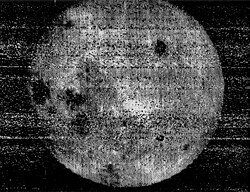
The [[Cold War]]-inspired "[[space race]]" and "[[Moon race]]" between the [[Soviet Union]] and the [[United States|United States of America]] accelerated with a focus on the Moon. This included many scientifically important firsts, such as the first photographs of the [[far side of the Moon]] in 1959 by the Soviet Union, and culminated with the landing of the first humans on the Moon in 1969, seen around the world as one of the pivotal events of the 20th century and human history. | |||
[[File:Luna 3 moon.jpg|thumb|left|200px|The first picture of another world from space, the Moon's far side photographed by [[Luna 3]] in 1959.]] | |||
The first artificial object to fly by the [[Moon]] was uncrewed Soviet probe [[Luna 1]] on 4 January 1959, which went on to be the first probe to achieve a [[heliocentric orbit]] around the Sun.<ref name=nssdc>{{cite web|url=https://nssdc.gsfc.nasa.gov/nmc/spacecraft/display.action?id=1959-012A|title=Luna 1|website=NASA Space Science Data Coordinated Archive}}</ref> Luna 1 was designed to impact the surface of the Moon. | |||
The first probe to impact the surface of the Moon was the Soviet probe [[Luna 2]], which made a hard landing on September 14, 1959, at 21:02:24 UTC. The far side of the Moon was first photographed on 7 October 1959, by the Soviet probe [[Luna 3]]. Though vague by modern standards, the photos showed that the far side of the Moon almost completely lacked [[Lunar mare|maria]]. | |||
[[File: | [[File:First Photo from the Surface of the Moon.jpg|thumb|200px|First photo taken from the surface of the Moon, by [[Luna 9]], February 1966]] | ||
[[ | The first American probe to fly by the Moon was [[Pioneer 4]] on 4 March 1959, which occurred shortly after Luna 1. It was the only success of eight early American probes that attempted to launch to the Moon.<ref>[https://www.nasa.gov/connect/ebooks/beyond_earth_detail.html NASA.gov].</ref> | ||
[[ | In an effort to compete with the Soviet successes, U.S. President [[John F. Kennedy]] proposed the Moon landing in a ''Special Message to the Congress on Urgent National Needs'': | ||
<blockquote>Now it is time to take longer strides – time for a great new American enterprise – time for this nation to take a clearly leading role in space achievement, which in many ways may hold the key to our future on Earth.<br />...For while we cannot guarantee that we shall one day be first, we can guarantee that any failure to make this effort will make us last.<br /> | |||
...I believe that this nation should commit itself to achieving the goal, before this decade is out, of landing a man on the Moon and returning him safely to the Earth. No single space project in this period will be more impressive to mankind, or more important in the long-range exploration of space; and none will be so difficult or expensive to accomplish.<br /> | |||
...let it be clear that I am asking the Congress and the country to accept a firm commitment to a new course of action—a course which will last for many years and carry very heavy costs...<ref name="Special Message">{{cite AV media |people=Kennedy, John F. |date=May 25, 1961 |title=Special Message to Congress on Urgent National Needs |medium=Motion picture (excerpt) |url=http://www.jfklibrary.org/Asset-Viewer/xzw1gaeeTES6khED14P1Iw.aspx |access-date=August 1, 2013 |publisher=John F. Kennedy Presidential Library and Museum |location=Boston, MA |id=Accession Number: TNC:200; Digital Identifier: TNC-200-2}}</ref><ref>{{citation|title=Special Message to the Congress on Urgent National Needs|url=https://en.wikisource.org/wiki/Special_Message_to_the_Congress_on_Urgent_National_Needs}}</ref></blockquote> | |||
[[ | [[File:NASA-Apollo8-Dec24-Earthrise.jpg|thumb|200px|''[[Earthrise]]'' taken by [[William Anders]] of [[Apollo 8]] in December 1968.]] | ||
[[Ranger 1]] launched in August of 1961, just three months after President Kennedy's speech. It would be three more years and six failed [[Ranger program|Ranger missions]] until [[Ranger 7]] returned close-up photos of the lunar surface before impacting it in July 1964. A number of problems with launch vehicles, ground equipment, and spacecraft electronics plagued the [[Ranger program]] and early probe missions. These lessons helped in [[Mariner 2]], the only successful U.S. space probe after Kennedy's famous speech to Congress and before his death in November 1963.<ref>[https://www.nasa.gov/sites/default/files/atoms/files/beyond-earth-tagged.pdf NASA.gov].</ref> U.S. [[Luna programme#Mission success rates|success rates]] improved greatly from [[Ranger 7]] onward. | |||
[[ | In 1966, the USSR accomplished the first soft landings and took the first pictures from the lunar surface during the [[Luna 9]] and [[Luna 13]] missions. | ||
[[File: | [[File:Moon-apollo17-schmitt boulder.jpg|thumb|200px|left|[[Apollo 17]] astronaut [[Harrison Schmitt]] standing next to a boulder at Taurus-Littrow during the third EVA (extravehicular activity).]] | ||
The U.S. followed Ranger with the [[Surveyor program]]<ref>[https://nssdc.gsfc.nasa.gov/nmc/spacecraft/display.action?id=1964-082A NASA.gov] – 24 January 2020,</ref> sending seven [[robotic spacecraft]] to the surface of the Moon. Five of the seven spacecraft soft-landed, investigating whether the [[regolith]] (dust) was shallow enough for astronauts to stand on the Moon. | |||
In September 1968 the Soviet Union's [[Zond 5]] sent tortoises on a circumlunar mission, followed by turtles aboard [[Zond 6]] in November. On December 24, 1968, the crew of [[Apollo 8]]—[[Frank Borman]], [[Jim Lovell|James Lovell]] and [[William Anders]]—became the first human beings to enter lunar orbit and see the far side of the Moon in person. Humans first landed on the Moon on July 20, 1969. The first humans to walk on the lunar surface were [[Neil Armstrong]], commander of the U.S. mission [[Apollo 11]] and his fellow astronaut [[Buzz Aldrin]]. | |||
[[ | The first robot [[lunar rover]] to land on the Moon was the Soviet vessel [[Lunokhod 1]] on 17 November 1970, as part of the [[Lunokhod programme]]. Since then, the last human to stand on the Moon was [[Eugene Cernan]], who, as part of the [[Apollo 17]] mission, walked on the Moon in December 1972. | ||
[[ | [[Moon rock|Moon rock samples]] were brought back to Earth by three Luna missions ([[Luna 16]], [[Luna 20|20]], and [[Luna 24|24]]) and the Apollo missions 11 through 17 (except [[Apollo 13]], which aborted its planned lunar landing). [[Luna 24]] in 1976 was the [[List of lunar probes#1971–1976|last Lunar mission]] by either the Soviet Union or the U.S. until [[Clementine mission|Clementine]] in 1994. Focus shifted to [[Timeline of Solar System exploration#1970s|probes to other planets]], [[space stations]], and the [[Shuttle program]]. | ||
Before the "Moon race" the U.S. had preliminary projects for scientific and military Moon-bases: the [[Lunex Project]] and [[Project Horizon]]. Besides crewed landings, the abandoned [[Soviet crewed lunar programs]] included the building of a multipurpose Moon base "[[Zvezda (moonbase)|Zvezda]]", the first detailed project, complete with mockups of expedition vehicles<ref>{{cite web|url=http://astronautix.com/craft/lekmplex.htm|title=LEK Lunar Expeditionary Complex|work=astronautix.com|access-date=12 June 2015|url-status=dead|archive-url=https://web.archive.org/web/20131208200041/http://www.astronautix.com/craft/lekmplex.htm|archive-date=8 December 2013}}</ref> and surface modules.<ref>{{cite web|url=http://astronautix.com/craft/dlbodule.htm|title=DLB Module|work=astronautix.com|access-date=12 June 2015|url-status=dead|archive-url=https://web.archive.org/web/20140107164731/http://www.astronautix.com/craft/dlbodule.htm|archive-date=7 January 2014}}</ref> | |||
The | <gallery class="center" widths="220"> | ||
File:The Soviet Union 1966 CPA 3317 stamp (Luna 9 on Moon's Surface and 1st Television Program of Moon Pictures on February 4).png|1966 stamp with a drawing of the first soft landed probe [[Luna 9]], next to the first view of the lunar surface photographed by the probe. | |||
</gallery> | |||
==After 1990== | |||
===Japan=== | |||
{{Main|Japanese Lunar Exploration Program}} | |||
[[File:Fullbl.jpg|thumb|right|''[[Cassini–Huygens]]'' took this image during its lunar flyby, before it traveled to [[Saturn]].]] | |||
Japan began its lunar exploration efforts in 1990 with the launch of the ''[[Hiten (spacecraft)|Hiten]]'' spacecraft by the [[Japan Aerospace Exploration Agency]] (JAXA), becoming the third country to place an object in orbit around the Moon. During the mission, Hiten deployed a smaller probe, ''[[Hiten (spacecraft)|Hagoromo]]'', intended to enter lunar orbit. Although the probe was released successfully, its transmitter failed, preventing the return of scientific data. | |||
In | In September of 2007, JAXA launched the ''[[SELENE]]'' spacecraft, also known as "Kaguya." The mission aimed to collect data on the Moon’s origin and geological evolution, as well as to test technologies for future lunar exploration. According to JAXA, the primary objective was "to obtain scientific data of the lunar origin and evolution and to develop the technology for future lunar exploration."<ref name="index">{{cite web |url=http://www.selene.jaxa.jp/index_e.htm |title=Kaguya (SELENE) |access-date=2007-06-25 |publisher=JAXA}}</ref> | ||
In 2013, JAXA initiated the [[Smart Lander for Investigating Moon]] (SLIM) mission, a lunar lander designed to demonstrate high-precision landing capabilities. The lander was initially scheduled for launch in 2021 but was delayed due to postponements related to its ride-share partner, the X-Ray Imaging and Spectroscopy Mission (XRISM). SLIM was launched on 6 September 2023 at 23:42 UTC (7 September 08:42 Japan Standard Time). The spacecraft performed its trans-lunar injection burn on 1 October 2023, entered lunar orbit on 25 December 2023, and successfully landed on 19 January 2024 at 15:20 UTC. With this landing, Japan became the fifth country to achieve a soft landing on the Moon.<ref name="Sample">{{Cite news |last=Sample |first=Ian |date=2024-01-19 |title=Japan's Slim spacecraft lands on moon but struggles to generate power |url=https://www.theguardian.com/science/2024/jan/19/japan-slim-spacecraft-lands-on-moon-but-struggles-to-generate-power |access-date=2024-01-20 |work=The Guardian |language=en-GB |issn=0261-3077 |archive-date=19 January 2024 |archive-url=https://web.archive.org/web/20240119220413/https://www.theguardian.com/science/2024/jan/19/japan-slim-spacecraft-lands-on-moon-but-struggles-to-generate-power |url-status=live }}</ref> | |||
.. | |||
Following the landing, SLIM experienced power generation issues but continued to operate intermittently. As of April 2024, the lander had survived four lunar days and three lunar nights, which are known for extreme temperature variations and pose significant challenges to spacecraft longevity.<ref>{{cite web |last1=Crane |first1=Leah |title=Japan's SLIM moon lander has shockingly survived a third lunar night |url=https://www.newscientist.com/article/2428439-japans-slim-moon-lander-has-shockingly-survived-a-third-lunar-night/ |website=New Scientist |access-date=25 April 2024}}</ref> | |||
===European Space Agency=== | |||
The [[European Space Agency]] launched the lunar orbiter [[SMART 1]] on 27 September 2003, as a low-budget mission aimed at testing new technologies and conducting scientific observations. One of its main objectives was to capture three-dimensional [[X-ray]] and [[thermography|infrared]] images of the Moon’s surface. After a year-long journey, SMART 1 entered lunar [[orbit]] on November 15, 2004. It continued its survey work until September 3, 2006, when mission controllers directed it to impact the Moon deliberately to analyze the resulting debris plume.<ref>{{cite web| url=http://www.esa.int/esaCP/SEMBY5BVLRE_index_0.html| title=SMART-1 Impacts Moon|date=4 September 2006| publisher=ESA| access-date=2006-09-03 |archive-url = https://web.archive.org/web/20061025000823/http://www.esa.int/esaCP/SEMBY5BVLRE_index_0.html <!-- Bot retrieved archive --> |archive-date = 2006-10-25}}</ref> | |||
===China=== | |||
{{main|Chinese Lunar Exploration Program}} | |||
China’s lunar exploration efforts are conducted through the Chinese Lunar Exploration Program, which includes scientific missions and assessments of potential lunar resources such as [[helium-3]], an isotope considered for possible future use in terrestrial energy production.<ref>{{cite web|url=http://space.com/missionlaunches/china_Moon_030304.html |title=China Outlines its Lunar Ambitions |first=Leonard |last=David |publisher=Space.com |date=4 March 2003 |access-date=20 March 2006 |url-status=dead |archive-url=https://web.archive.org/web/20060316214426/http://space.com/missionlaunches/china_moon_030304.html |archive-date=16 March 2006 }}</ref> | |||
The | The [[China National Space Administration]] (CNSA) launched the [[Chang'e 1]] lunar orbiter on 24 October 2007. Initially intended to operate for one year, the mission was extended and concluded with a controlled impact on the Moon on 1 March 2009. A second orbiter, [[Chang'e 2]], was launched on 1 October 2010. | ||
On December | On 14 December 2013, China successfully deployed the [[Chang'e 3]] lander and the ''[[Yutu (rover)|Yutu]]'' rover, becoming the third nation to achieve a lunar soft landing.<ref>{{cite journal |title=Technological advancements and promotion roles of Chang'e-3 lunar probe mission|journal=Sci China Tech Sci |volume=56 |issue=11 |page=2702 |year=2013|doi=10.1007/s11431-013-5377-0 |bibcode=2013ScChE..56.2702S |last1=Sun |first1=Zezhou |last2=Jia |first2=Yang |last3=Zhang |first3=He |s2cid=111801601 }}</ref> It was the first soft landing on the lunar surface since [[Luna 24]] in 1976. The backup spacecraft for Chang'e 3, originally constructed as a contingency, was repurposed for the [[Chang'e 4]] mission, which targeted the far side of the Moon. [[Chang'e 4]] was launched on 7 December 2018<ref>[https://spaceflightnow.com/2018/12/07/china-launches-historic-mission-to-land-on-far-side-of-the-moon/ China launches historic mission to land on far side of the Moon] Stephen Clark, ''Spaceflight Now''. 7 December 2018.</ref> and landed on 3 January 2019.<ref>{{Cite news|url=https://www.theguardian.com/science/2019/jan/03/china-probe-change-4-land-far-side-moon-basin-crater|title=Far side of the moon: China's Chang'e 4 probe makes historic touchdown|last1=Devlin|first1=Hannah|date=3 January 2019|work=The Guardian|access-date=6 June 2019|last2=Lyons|first2=Kate|language=en-GB|issn=0261-3077}}</ref> The ''[[Yutu-2]]'' rover, deployed by Chang'e 4, set a distance record for lunar surface travel.<ref>[https://www.space.com/china-change-4-rover-moon-record.html China's Farside Moon Rover Breaks Lunar Longevity Record.] Leonard David, ''Space.com''. 12 December 2019.</ref> Its findings included the detection of a dust layer up to 12 meters deep in parts of the lunar far side.<ref>[https://www.businessinsider.com/china-lunar-rover-found-thick-dust-on-moon-far-side-2020-2 Morgan McFall (26 February 2020) China's lunar rover finds nearly 40 feet of dust on the far side of the moon]</ref> | ||
A sample return mission, [[Chang'e 5]], was initially planned for 2017 but was delayed following a failure of the [[Long March 5]] launch vehicle.<ref>{{cite news|last1=Nowakowski|first1=Tomasz|title=China Eyes Manned Lunar Landing by 2036|url=http://www.spaceflightinsider.com/organizations/china-national-space-administration/china-eyes-manned-lunar-landing-2036/|access-date=17 August 2017|date=9 August 2017|archive-date=12 November 2020|archive-url=https://web.archive.org/web/20201112013557/https://www.spaceflightinsider.com/organizations/china-national-space-administration/china-eyes-manned-lunar-landing-2036/|url-status=dead}}</ref><ref name="foust">{{cite web |author1=Foust |first=Jeff |date=25 September 2017 |title=Long March 5 failure to postpone China's lunar exploration program |url=http://spacenews.com/long-march-5-failure-to-postpone-chinas-lunar-exploration-program/ |access-date=17 December 2017 |publisher=SpaceNews}}</ref> Following the rocket's successful return to flight in December 2019, CNSA launched Chang'e 5 in late 2020. The mission returned approximately 2 kilograms of lunar material to Earth on 16 December 2020.<ref>{{Cite news|date=16 December 2020|title=China's Chang'e-5 mission returns Moon samples|language=en-GB|work=BBC News|url=https://www.bbc.com/news/science-environment-55323176|access-date=16 December 2020}}</ref> | |||
[[ | The [[Chang'e 6]] mission, launched on 3 May 2024, conducted the first sample return from the lunar far side, specifically the [[Apollo (crater)|Apollo Basin]].<ref name="AJ_FI-20230425">{{cite tweet |number=1650832520978526208 |user=AJ_FI |title=China's Chang'e-6 sample return mission (a first-ever lunar far side sample return) is scheduled to launch in May 2024 and is expected to take 53 days from launch to return module touchdown. Targeting southern area of Apollo basin (~43º S, 154º W) |author=Andrew Jones |date=25 April 2023}}</ref><ref name="Jones">{{cite web |last=Jones |first=Andrew |url=https://spacenews.com/chinas-change-6-probe-arrives-at-spaceport-for-first-ever-lunar-far-side-sample-mission/ |title=China's Chang'e-6 probe arrives at spaceport for first-ever lunar far side sample mission |work=[[SpaceNews]] |date=10 January 2024 |access-date=10 January 2024}}</ref> It carried a small rover, ''Jinchan'', which conducted [[Absorption spectroscopy|infrared spectroscopy]] and captured imagery of the lander on the surface.<ref>{{cite web |last1=Jones |first1=Andrew |title=China's Chang'e-6 is carrying a surprise rover to the moon |url=https://spacenews.com/chinas-change-6-is-carrying-a-surprise-rover-to-the-moon/ |website=SpaceNews |access-date=8 May 2024 |date=6 May 2024 |archive-date=8 May 2024 |archive-url=https://web.archive.org/web/20240508193233/https://spacenews.com/chinas-change-6-is-carrying-a-surprise-rover-to-the-moon/ |url-status=live }}</ref> | ||
The spacecraft’s lander-ascender-rover module separated from its orbiter and returner prior to landing on 1 June 2024 at 22:23 UTC.<ref name="AJ_FI-20240601">{{cite web |last=Jones |first=Andrew |url=https://spacenews.com/change-6-lands-on-far-side-of-the-moon-to-collect-unique-lunar-samples/ |title=Chang'e-6 lands on far side of the moon to collect unique lunar samples |work=[[SpaceNews]] |date=1 June 2024 |access-date=1 June 2024}}</ref><ref name="segeryu240602">{{cite tweet | author= Seger Yu | user= SegerYu | number= 1797042217804337307 | title= 落月时刻 2024-06-02 06:23:15.861 | language= zh }}</ref> The ascender lifted off from the lunar surface on 3 June 2024 at 23:38 UTC, conducted an automated rendezvous and docking in lunar orbit, and transferred its sample container to the return module. The returner successfully landed in [[Inner Mongolia]] on 25 June 2024, completing China’s second lunar sample return mission and the first from the Moon’s far side. | |||
== | ===India=== | ||
[[File: | {{main|Chandrayaan Programme}} | ||
[[File:Chandrayaan1 Spacecraft Discovery Moon Water.jpg|thumb|upright=2|These images show a young lunar crater on the far side of the Moon, as viewed by Chandrayaan-1's Moon Mineralogy Mapper instrument.]] | |||
India's national space agency, the [[Indian Space Research Organisation]] (ISRO), launched [[Chandrayaan-1]], an uncrewed lunar orbiter, on 22 October 2008.<ref>{{cite web |url=http://www.ndtv.com/convergence/ndtv/Moonmission/Election_Story.aspx?id=NEWEN20080069654 |title=NDTV.com: Perfect start, Chandrayaan-1 ready for next step |access-date=22 May 2009 |url-status=dead |archive-url=https://web.archive.org/web/20081212155600/http://www.ndtv.com/convergence/ndtv/moonmission/Election_Story.aspx?id=NEWEN20080069654 |archive-date=12 December 2008 }}</ref> The spacecraft was intended to operate for two years, with scientific objectives including the creation of a three-dimensional atlas of the near and far sides of the Moon and chemical and mineralogical mapping of the lunar surface.<ref>{{cite web|title=Chandrayaan-1 Scientific Objectives|publisher=Indian Space Research Organisation|url=http://www.isro.org/chandrayaan/htmls/objective_scientific.htm|url-status=dead|archive-url=https://web.archive.org/web/20091012110215/http://www.isro.org/Chandrayaan/htmls/objective_scientific.htm|archive-date=12 October 2009}}</ref> | |||
The orbiter released the [[Moon Impact Probe]], which impacted the lunar surface at 15:04 GMT on 14 November 2008.<ref>{{cite news|url=http://news.bbc.co.uk/2/hi/south_asia/7730157.stm|title=India sends probe on to the Moon|publisher=BBC|access-date=16 November 2008|date=14 November 2008}}</ref> Among its key findings, Chandrayaan-1 detected the widespread presence of water molecules in the lunar regolith.<ref>[http://www.voanews.com/english/2009-09-24-voa46.cfm Lunar Missions Detect Water on Moon] {{webarchive|url=https://web.archive.org/web/20091003011229/http://www.voanews.com/english/2009-09-24-voa46.cfm |date=3 October 2009}}</ref> | |||
This mission was succeeded by [[Chandrayaan-2]], launched on 22 July 2019, which entered lunar orbit on 20 August 2019. It carried India’s first lander and rover; however, due to a technical anomaly during the final descent, the lander crashed on the lunar surface.<ref>{{Cite web|url=https://www.isro.gov.in/update/07-sep-2019/chandrayaan-2-latest-update|title=Chandrayaan – 2 Latest Update – ISRO|website=www.isro.gov.in|access-date=7 October 2019|archive-date=8 September 2019|archive-url=https://web.archive.org/web/20190908052939/https://www.isro.gov.in/update/07-sep-2019/chandrayaan-2-latest-update|url-status=dead}}</ref> | |||
[[Chandrayaan-3]], ISRO's third lunar exploration mission, was launched on 14 July 2023 and featured a lander, ''Vikram'', and a rover, ''[[Pragyan (rover)|Pragyan]]''. The lander successfully achieved a soft landing near the lunar south pole on 23 August 2023, making India the fourth country to achieve a soft landing on the Moon and the first to land near the south polar region.<ref>{{Cite news |last=Welle |first=Deutsche |title=India spacecraft first to land on moon's south pole |url=https://www.dw.com/en/india-spacecraft-first-to-land-on-moons-south-pole/a-66605489}}</ref><ref>{{Cite web |date=24 August 2023 |title=India lands spacecraft near south pole of moon in historic first |url=https://www.theguardian.com/science/2023/aug/23/india-chandrayaan-3-moon-landing-mission |archive-url=https://web.archive.org/web/20230824120354/https://www.science.org/content/article/india-makes-history-landing-spacecraft-near-moon-s-south-pole |archive-date=24 August 2023 |access-date=25 August 2023 |website=The Guardian}}</ref><ref>{{Cite news |date=6 July 2023 |title=Chandrayaan-3 launch on July 14, lunar landing on August 23 or 24 |language=en-IN |work=The Hindu |url=https://www.thehindu.com/sci-tech/chandrayaan-3-launch-scheduled-for-july-14-at-235-pm/article67049236.ece |access-date=25 August 2023 |issn=0971-751X}}</ref> | |||
===United States=== | |||
{{Main|Artemis program}} | |||
The [[Ballistic Missile Defense Organization]] and NASA launched the [[Clementine mission]] in 1994 and [[Lunar Prospector]] in 1998. | |||
[[File:Animation of Lunar Reconnaissance Orbiter trajectory.gif |thumb |right |Animation of [[Lunar Reconnaissance Orbiter]]{{'s}} trajectory from June 23, 2009, to June 30, 2009<br />{{legend2|magenta| [[Lunar Reconnaissance Orbiter]]}}{{·}}{{legend2| DarkGoldenrod|[[Moon]]}}]] | [[File:Animation of Lunar Reconnaissance Orbiter trajectory.gif |thumb |right |Animation of [[Lunar Reconnaissance Orbiter]]{{'s}} trajectory from June 23, 2009, to June 30, 2009<br />{{legend2|magenta| [[Lunar Reconnaissance Orbiter]]}}{{·}}{{legend2| DarkGoldenrod|[[Moon]]}}]] | ||
NASA launched the [[Lunar Reconnaissance Orbiter]], on June 18, 2009, which has collected imagery of the Moon's surface. It also carried the Lunar Crater Observation and Sensing Satellite ([[LCROSS]]), which investigated the possible existence of water in the crater [[Cabeus]]. [[Gravity Recovery and Interior Laboratory|GRAIL]] is another mission, launched in 2011. | |||
Following the decades-long lull in lunar exploration in the aftermath of the Cold War, the main push of US lunar exploration goals has coalesced under the Artemis program, formulated in 2017.<ref name="Artemis_home20190519">{{Source-attribution|{{cite web|title=NASA: Moon to Mars|url=https://www.nasa.gov/specials/moontomars/index.html|website=nasa.gov|publisher=NASA|access-date=19 May 2019|archive-date=5 August 2019|archive-url=https://web.archive.org/web/20190805055135/https://www.nasa.gov/specials/moontomars/index.html|url-status=live}}|sentence=yes}}</ref> | |||
===Russia=== | |||
{{Main|Luna-Glob}} | |||
On 10 August 2023, Russia launched the [[Luna 25]] mission, its first mission to the Moon since 1976.<ref>{{cite web | url=https://thehill.com/homenews/space/ap-a-rocket-with-a-lunar-landing-craft-blasts-off-on-russias-first-moon-mission-in-nearly-50-years/ | title=Russia is back on the lunar path. A rocket blasts off on its first moon mission in nearly 50 years | work=The Hill | date=August 11, 2023 }}</ref> On 20 August, it crashed into the Moon after a guidance error that resulted in an anomalous orbit-lowering manoeuvre.<ref name="rsw-luna25">{{cite web |last=Zak |first=Anatoly |url=https://www.russianspaceweb.com/luna-glob-flight.html |title=Luna-Glob mission lifts off |date=19 August 2023 |access-date=20 August 2023 |work=RussianSpaceWeb}}</ref> | |||
===South Korea=== | |||
{{Main|Korean Lunar Exploration Program}} | |||
South Korea launched the lunar orbiter [[Danuri]] on 4 August 2022, and it arrived at the Moon on 16 December 2022. This was the first phase of South Korea's lunar exploration program, with plans to launch another lunar lander and probe.<ref>{{Cite web |title=Danuri, South Korea's first Moon mission |url=https://www.planetary.org/space-missions/kplo |website=The Planetary Society}}</ref> | |||
===Pakistan=== | |||
[[Pakistan]] sent a lunar orbiter called [[ICUBE-Q]] along with Chang'e 6.<ref name="Jones"/> | |||
===Commercial missions=== | |||
In 2007, the X Prize Foundation, together with [[Google]], launched the [[Google Lunar X Prize]] to encourage commercial endeavors to the Moon. A prize of $20 million was to be awarded to the first private venture to get to the Moon with a robotic lander by the end of March 2018, with additional prizes worth $10 million for further milestones.<ref>{{Cite news |url=https://www.nytimes.com/2017/01/24/science/google-lunar-xprize-finalists.html |title=For 5 Contest Finalists, a $20 Million Dash to the Moon |last=Chang |first=Kenneth |date=24 January 2017 |work=The New York Times|access-date=13 July 2017 |issn=0362-4331 |url-status=live |archive-url=https://web.archive.org/web/20170715065721/https://www.nytimes.com/2017/01/24/science/google-lunar-xprize-finalists.html |archive-date=15 July 2017}}</ref><ref name="https://www.space.com_2017-09-25">{{Citation |url=https://www.space.com/37813-google-lunar-x-prize-deadline-extended-march-2018.html |title=Deadline for Google Lunar X Prize Moon Race Extended Through March 2018 |newspaper=space.com |date=16 August 2017 |first=Mike | last=Wall |access-date=25 September 2017 |archive-date=19 September 2017 |archive-url=https://web.archive.org/web/20170919234520/https://www.space.com/37813-google-lunar-x-prize-deadline-extended-march-2018.html |url-status=live }}</ref> As of August 2016, 16 teams were reportedly participating in the competition.<ref>{{Cite news |url=https://www.theguardian.com/science/2016/aug/03/us-startup-moon-express-2017-lunar-mission |title=US startup Moon Express approved to make 2017 lunar mission |last=McCarthy |first=Ciara |date=3 August 2016 |work=The Guardian|access-date=13 July 2017 |issn=0261-3077 |url-status=live |archive-url=https://web.archive.org/web/20170730225106/https://www.theguardian.com/science/2016/aug/03/us-startup-moon-express-2017-lunar-mission |archive-date=30 July 2017}}</ref> In January 2018 the foundation announced that the prize would go unclaimed, as none of the finalist teams would be able to make a launch attempt by the deadline.<ref>{{Cite news |url=https://lunar.xprize.org/news/blog/important-update-google-lunar-xprize |title=An Important Update From Google Lunar XPRIZE |date=23 January 2018 |work=Google Lunar XPRIZE |access-date=12 May 2018 |archive-date=24 January 2018 |archive-url=https://web.archive.org/web/20180124043226/https://lunar.xprize.org/news/blog/important-update-google-lunar-xprize |url-status=dead }}</ref> | |||
In August 2016, the US government granted permission to US-based start-up Moon Express to land on the Moon.<ref name=":0">{{Cite news |url=https://www.space.com/33632-moon-express-private-lunar-landing-approval.html |title=Moon Express Approved for Private Lunar Landing in 2017, a Space First |work=Space.com |access-date=13 July 2017 |url-status=dead |archive-url=https://web.archive.org/web/20170712211615/https://www.space.com/33632-moon-express-private-lunar-landing-approval.html |archive-date=12 July 2017 }}</ref> This marked the first time that a private enterprise was given the right to do so. The decision is regarded as a precedent helping to define regulatory standards for deep-space commercial activity in the future. Previously, private companies were restricted to operating on or around Earth.<ref name=":0"/> | |||
On 29 November 2018, NASA announced that nine commercial companies would compete to win a contract to send small payloads to the Moon in what is known as [[Commercial Lunar Payload Services]]. According to NASA administrator [[Jim Bridenstine]], "We are building a domestic American capability to get back and forth to the surface of the moon.".<ref>{{cite news |last1=Chang |first1=Kenneth |title=NASA's Return to the Moon to Start With Private Companies' Spacecraft |url=https://www.nytimes.com/2018/11/29/science/nasa-moon-landers.html |newspaper=[[The New York Times]] |access-date=29 November 2018 |language=en |date=29 November 2018 |archive-date=1 December 2018 |archive-url=https://web.archive.org/web/20181201011041/https://www.nytimes.com/2018/11/29/science/nasa-moon-landers.html |url-status=live }}</ref> | |||
The | The first commercial mission to the Moon was accomplished by the [[Manfred Memorial Moon Mission]] (4M), led by [[Luxspace|LuxSpace]], an affiliate of German [[OHB System|OHB AG]]. The mission was launched on 23 October 2014 with the Chinese Chang'e 5-T1 test spacecraft, attached to the upper stage of a [[Long March 3C]]/G2 rocket.<ref>{{cite web|url=http://spaceflightnow.com/2014/10/25/first-commercial-mission-to-the-moon-launched-from-china/|title=First commercial mission to the Moon launched from China|publisher=Spaceflight Now|date=25 October 2014|access-date=24 July 2015}}</ref><ref>{{cite web|url=http://www.space.com/27422-china-moon-mission-launch-october.html|title=China Readies Moon Mission for Launch Next Week|publisher=Space.com|date=14 October 2014|access-date=24 July 2015}}</ref> The 4M spacecraft made a Moon flyby on the night of October 28, 2014, after which it entered elliptical Earth orbit, exceeding its designed lifetime by four times.<ref>{{Cite press release|url=http://www.saftbatteries.com/press/press-releases/saft-lithium-batteries-powered-4m-mini-probe-success-world%E2%80%99s-first-privately|title=Saft lithium batteries powered the 4M mini-probe to success on the world's first privately funded Moon mission|publisher=[[Saft Groupe S.A.|Saft]]|place=[[paris]]|date=21 January 2015|access-date=24 July 2015|url-status=dead|archive-url=https://web.archive.org/web/20150724165338/http://www.saftbatteries.com/press/press-releases/saft-lithium-batteries-powered-4m-mini-probe-success-world%E2%80%99s-first-privately|archive-date=24 July 2015}}</ref><ref name="MoonLuxspace">{{cite journal |last1=Moser |first1=H. A. |last2=Ruy |first2=G. |last3=Schwarzenbarth |first3=K. |last4=Frappe |first4=J. -B. |last5=Basesler |first5=K. |last6=Van Shie |first6=B. |date=August 2015 |title=Manfred Memorial Moon Mission (4M): development, operations, and results of a privately funded, low cost lunar flyby |url=https://digitalcommons.usu.edu/cgi/viewcontent.cgi?referer=&httpsredir=1&article=3200&context=smallsat |journal=29th Annual AIAA/USU Conference on Small Satellites |access-date=9 April 2023}}</ref> | ||
The [[Beresheet]] lander, operated by [[Israel Aerospace Industries]] and [[SpaceIL]] impacted the Moon on April 11, 2019, after a failed landing attempt.<ref>{{cite news|url=https://www.timesofisrael.com/israels-beresheet-spacecraft-crashes-during-moon-landing-attempt/|title=Israel's Beresheet spacecraft crashes into the moon during landing attempt|last=Lidman|first=Melanie|website=[[The Times of Israel]]|language=en-US|access-date=2019-10-07 |issn=0040-7909}}</ref> | |||
[[Blue Ghost Mission 1]], a robotic Moon landing mission conducted by [[Firefly Aerospace]], launched on January 15, 2025, and landed on March 2, 2025, at 08:34 UTC. | |||
==Plans== | ==Plans== | ||
{{See also|List of missions to the Moon}} | {{See also|List of missions to the Moon}} | ||
Following the abandoned US [[Constellation program]], plans for crewed flights followed by [[moonbase]]s were declared by Russia, [[ESA]], China, Japan and | Following the abandoned US [[Constellation program]], plans for crewed flights followed by [[moonbase]]s were declared by Russia, [[ESA]], China, Japan, India, and South Korea. All of them intend to continue the exploration of the Moon with more uncrewed spacecraft. | ||
India is planning, and it is studying a potential collaboration with Japan to launch the [[Lunar Polar Exploration Mission]] in 2026–2028. | |||
Russia also announced plans to resume its previously frozen project [[Luna-Glob]], an uncrewed lander and orbiter, which was slated to launch in 2021 but did not manifest.<ref>{{cite web |url=http://www.aviationnow.com/avnow/news/channel_awst_story.jsp?id=news/aw060506p2.xml |title=Russia Plans Ambitious Robotic Lunar Mission |first=Craig |last=Covault |date=2006-06-04}}</ref> In 2015, [[Roscosmos]] stated that Russia plans to place an astronaut on the Moon by 2030, leaving Mars to NASA. The purpose is to work jointly with NASA and avoid a space race.<ref>{{Cite web | url=http://www.ibtimes.co.uk/russia-place-man-moon-by-2030-leaving-mars-nasa-1508202 | title=Russia to place man on Moon by 2030 leaving Mars to NASA| date=2015-06-27}}</ref> | |||
In 2018, NASA released plans to return to the Moon with commercial and international partners as part of an overall agency Exploration Campaign in support of [[Space Policy Directive 1]], giving rise to the [[Artemis program]] and the [[Commercial Lunar Payload Services]] (CLPS). NASA plans to start with robotic missions on the lunar surface, as well as the crewed [[Lunar Gateway]] space station. As of 2019, NASA is issuing contracts to develop new small lunar payload delivery services, develop lunar landers, and conduct more research on the Moon's surface ahead of a human return.<ref>{{Cite web|url=http://www.nasa.gov/feature/nasa-expands-plans-for-moon-exploration-more-missions-more-science|title=NASA Expands Plans for Moon Exploration|last=Warner|first=Cheryl|date=2018-04-30|website=NASA|access-date=2019-04-01}}</ref> The Artemis program involves several flights of the [[Orion (spacecraft)|Orion spacecraft]] and lunar landings from 2022 to 2028.<ref>"National Space Exploration Campaign Report" ([https://www.nasa.gov/sites/default/files/atoms/files/nationalspaceexplorationcampaign.pdf PDF]). NASA. September 2018.</ref><ref>{{cite web|url=https://www.nasa.gov/topics/moon-to-mars/|title=Moon to Mars {{pipe}} NASA|date=June 25, 2018|access-date=2019-06-10}}</ref> | |||
On November 3, 2021, NASA announced it had picked a landing site in the lunar south polar region near the crater [[Shackleton (crater)|Shackleton]] for an uncrewed spacecraft that included NASA's Polar Resources Ice-Mining Experiment-1. The precise location was termed the Shackleton Connecting Ridge, which has near-continuous solar exposure and line-of-sight with Earth for communication.<ref>{{Cite web|url=https://www.space.com/nasa-intuitive-machines-moon-landing-site-ice-mission|title=NASA picks landing site at the moon's south pole for ice-drilling robot|website=[[Space.com]]|date=November 5, 2021}}</ref> | |||
ESA's [[Moonlight Initiative]] aims to create a small network of communication and navigation satellites orbiting the Moon to support the Artemis landings.<ref>[https://www.esa.int/ESA_Multimedia/Videos/2022/11/What_is_ESA_s_Moonlight_initiative What is ESA’s Moonlight initiative?]</ref> These would enable communication with Earth even when out of direct line-of-sight. They would also provide navigation signals similar to the [[Global Positioning System]] on Earth, requiring precision timekeeping. Moonlight planners have proposed creating a new time zone for the Moon for this purpose, culminating in the introduction of the [[Coordinated Lunar Time]] standard in 2024.<ref>{{Cite news |last=Ramirez-Simon |first=Diana |date=2024-04-03 |title=Moon Standard Time? Nasa to create lunar-centric time reference system |url=https://www.theguardian.com/science/2024/apr/02/moon-nasa-coordinated-lunar-time |access-date=2024-04-04 |work=The Guardian |language=en-GB |issn=0261-3077}}</ref> Due to the lower gravity and relative motion, [[Time dilation|time passes more quickly on the Moon]], making every 24-hour period elapse 56 microseconds early when measured from Earth.<ref>[https://www.npr.org/2023/03/11/1162351563/if-daylight-saving-time-seems-tricky-try-figuring-out-the-time-on-the-moon If daylight saving time seems tricky, try figuring out the time on the moon ].</ref> | |||
== See also == | == See also == | ||
{{div col|colwidth=30em}} | |||
{{Portal|Spaceflight|Solar System}} | {{Portal|Spaceflight|Solar System}} | ||
*[[Artemis program]] | *[[Artemis program]] | ||
| Line 144: | Line 194: | ||
*[[List of Apollo astronauts]] | *[[List of Apollo astronauts]] | ||
*[[List of lunar probes]] | *[[List of lunar probes]] | ||
*[[List of missions to the Moon]] | |||
*[[Lunar resources]] | *[[Lunar resources]] | ||
*[[Moon landing]] | *[[Moon landing]] | ||
*[[Timeline of Solar System exploration]] | *[[Timeline of Solar System exploration]] | ||
*[[Starship HLS]] | |||
{{Div col end}} | |||
==References== | ==References== | ||
{{Reflist| | {{Reflist|refs= | ||
<!-- <ref name="slim17">{{Cite news | |||
| author1= Kelly Ng | |||
| url= https://www.bbc.com/news/world-asia-68125589 | |||
| title= Japan: Moon lander Slim comes back to life and resumes mission | |||
| date= 29 January 2024 | |||
| access-date= 31 January 2024 | |||
| website=www.bbc.com | |||
| publisher=[[BBC News]] }} | |||
</ref> | |||
<ref name="slim19">{{Cite news | |||
| author1= Greg Brosnan | |||
| date= 26 February 2024 | |||
| title= Japan Moon lander survives lunar night | |||
| url= https://www.bbc.com/news/science-environment-68400989 | |||
| access-date= 27 February 2024 | |||
| language=en-GB | |||
| website=www.bbc.com | |||
| publisher=[[BBC News]] }} | |||
</ref> | |||
<ref name="slim18">{{Cite news | |||
| author1= Kantaro Komiya | |||
| date= 26 February 2024 | |||
| title= Japan's SLIM moon probe unexpectedly survives lunar night | |||
| url= https://www.reuters.com/technology/space/japans-slim-moon-probe-unexpectedly-survives-lunar-night-2024-02-26/ | |||
| website= www.reuters.com | |||
| publisher= [[Reuters]] }} | |||
</ref> --> | |||
}} | |||
==External links== | ==External links== | ||
{{Commons category|Moon exploration|future space exploration}} | |||
*[https://lunarexploration.esa.int An interactive web documentary about the Moon] – ESA | *[https://lunarexploration.esa.int An interactive web documentary about the Moon] – ESA | ||
*[http://nssdc.gsfc.nasa.gov/planetary/lunar/lunartimeline.html Lunar mission timeline] – NASA | *[http://nssdc.gsfc.nasa.gov/planetary/lunar/lunartimeline.html Lunar mission timeline] – NASA | ||
| Line 169: | Line 254: | ||
[[Category:Discovery and exploration of the Solar System|Exploration of Moon]] | [[Category:Discovery and exploration of the Solar System|Exploration of Moon]] | ||
[[Category:Spaceflight]] | [[Category:Spaceflight]] | ||
[[Category: | [[Category:Lunar science]] | ||
[[Category:Solar System]] | |||
Latest revision as of 16:59, 16 March 2026


The physical exploration of the Moon began when Luna 2, a space probe launched by the Soviet Union, made a deliberate impact on the surface of the Moon on 14 September, 1959. Prior to that the only available means of lunar exploration had been observations from Earth. The invention of the optical telescope brought about the first leap in the quality of lunar observations. Galileo Galilei is generally credited as the first person to use a telescope for astronomical purposes, having made his own telescope in 1609. The mountains and craters on the lunar surface were among his first observations.
Human exploration of the Moon since Luna 2 has consisted of both crewed and uncrewed missions. NASA's Apollo program has been the only program to successfully land humans on the Moon, which it did six times on the near side in the late 20th century. The first human landing took place in 1969, when the Apollo 11 astronauts Buzz Aldrin and Neil Armstrong touched down on the surface in the region of Mare Tranquillitatis, leaving scientific instruments upon the mission's completion and returning lunar samples to Earth.[1] All lunar missions had taken place on the lunar near side until the first soft landing on the far side of the Moon was made by the CNSA robotic spacecraft Chang'e 4 in early 2019, which successfully deployed the Yutu-2 robotic lunar rover.[2][3] On 25 June 2024, CNSA's Chang'e 6 conducted the first lunar sample return from the far side of the Moon.[4]
The goals of lunar exploration across all major space agencies focus on the continued survey of the lunar surface through lunar missions in preparation for the eventual establishment of permanent human outposts.[5]
Pre-telescopic[edit | edit source]

It is believed by some that the oldest cave paintings from up to 40,000 BP of bulls and geometric shapes,[9] or 20–30,000-year-old tally sticks were used to observe the phases of the Moon, keeping time using the waxing and waning of the Moon's phases.[10] Aspects of the Moon were identified and aggregated in lunar deities from prehistoric times and were eventually documented and put into symbols from the very first instances of writing in the 4th millennium BC. One of the earliest known possible depictions of the Moon is a 3,000 BCE rock carving Orthostat 47 at Knowth, Ireland.[11][12] The crescent depicting the Moon, as with the lunar deity Nanna/Sin, has been found from the 3rd millennium BCE.[13]
The oldest named astronomer and poet, Enheduanna, Akkadian high priestess to the lunar deity Nanna/Sin and princess, daughter of Sargon the Great (c. 2334 – c. 2279 BCE), had the Moon tracked in her chambers.[14] The oldest found and identified depiction of the Moon in an astronomical relation to other astronomical features is the Nebra sky disc from c. 1800–1600 BCE, depicting features like the Pleiades next to the Moon.[15][16]
The ancient Greek philosopher Anaxagoras, whose non-religious view of the heavens was one cause for his imprisonment and eventual exile,[17] reasoned that the Sun and Moon were both giant spherical rocks and that the latter reflected the light of the former. Plutarch, in his book On the Face in the Moon's Orb, suggested that the Moon had deep recesses in which the light of the Sun did not reach and that the spots are nothing but the shadows of rivers or deep chasms. He also entertained the possibility that the Moon was inhabited. Aristarchus attempted to compute the Moon's size and distance from Earth, although his estimated distance of 20 times Earth's radius (which had been accurately determined by his contemporary Eratosthenes) proved to be about a third the actual average distance.

Chinese philosophers of the Han dynasty believed the Moon to be energy equated to qi but recognized that the light of the Moon was a reflection of the Sun.[18] Mathematician and astrologer Jing Fang noted the sphericity of the Moon.[18] Shen Kuo of the Song dynasty created an allegory equating the waxing and waning of the Moon to a round ball of reflective silver that, when doused with white powder and viewed from the side, would appear to be a crescent.[18]
Indian astronomer Aryabhata stated in his fifth-century text Aryabhatiya that reflected sunlight is what causes the Moon to shine.[19]
Persian astronomer Habash al-Hasib al-Marwazi conducted various observations at the Al-Shammisiyyah observatory in Baghdad between 825 and 835.[20] Using these observations, he estimated the Moon's diameter as 3,037 km (equivalent to 1,519 km radius) and its distance from the Earth as 346,345 km (215,209 mi).[20] In the 11th century, the Iraqi physicist Alhazen investigated moonlight through a number of experiments and observations, concluding it was a combination of the Moon's own light and the Moon's ability to absorb and emit sunlight.[21][22]
By the Middle Ages, before the invention of the telescope, an increasing number of people began to recognize the Moon as a sphere, though many believed that it was "perfectly smooth".[23]
Telescopic exploration before spaceflight[edit | edit source]

In 1609, Galileo Galilei drew one of the first telescopic drawings of the Moon in his book Sidereus Nuncius and noted that it was not smooth but had mountains and craters. Later in the 17th century, Giovanni Battista Riccioli and Francesco Maria Grimaldi drew a map of the Moon and gave many craters the names they still have. On maps, the dark parts of the Moon's surface were called maria (singular mare) or seas, and the light parts were called terrae or continents.

Thomas Harriot, as well as Galilei, drew the first telescopic representation of the Moon and observed it for several years. His drawings, however, remained unpublished.[24] The first map of the Moon was made by the Belgian cosmographer and astronomer Michael van Langren in 1645.[24] Two years later a much more influential effort was published by Johannes Hevelius. In 1647, Hevelius published Selenographia, the first treatise entirely devoted to the Moon. Hevelius's nomenclature, although used in Protestant countries until the eighteenth century, was replaced by the system published in 1651 by the Jesuit astronomer Giovanni Battista Riccioli, who gave the large naked-eye spots the names of seas and the telescopic spots (since called craters) the names of philosophers and astronomers.[24]

In 1753, the Croatian Jesuit and astronomer Roger Joseph Boscovich discovered the absence of an atmosphere on the Moon. In 1824, Franz von Paula Gruithuisen explained the formation of craters as a result of meteorite strikes.[25]
The since-disproven possibility that the Moon contains vegetation and is inhabited by selenites was seriously considered by major astronomers of the early modern period even into the first decades of the 19th century. In 1834–1836, Wilhelm Beer and Johann Heinrich Mädler published their four-volume Mappa Selenographica and the book Der Mond in 1837, which firmly established the conclusion that the Moon has no bodies of water nor any appreciable atmosphere.[26]
Space Race[edit | edit source]
.JPG)
The Cold War-inspired "space race" and "Moon race" between the Soviet Union and the United States of America accelerated with a focus on the Moon. This included many scientifically important firsts, such as the first photographs of the far side of the Moon in 1959 by the Soviet Union, and culminated with the landing of the first humans on the Moon in 1969, seen around the world as one of the pivotal events of the 20th century and human history.

The first artificial object to fly by the Moon was uncrewed Soviet probe Luna 1 on 4 January 1959, which went on to be the first probe to achieve a heliocentric orbit around the Sun.[27] Luna 1 was designed to impact the surface of the Moon.
The first probe to impact the surface of the Moon was the Soviet probe Luna 2, which made a hard landing on September 14, 1959, at 21:02:24 UTC. The far side of the Moon was first photographed on 7 October 1959, by the Soviet probe Luna 3. Though vague by modern standards, the photos showed that the far side of the Moon almost completely lacked maria.

The first American probe to fly by the Moon was Pioneer 4 on 4 March 1959, which occurred shortly after Luna 1. It was the only success of eight early American probes that attempted to launch to the Moon.[28]
In an effort to compete with the Soviet successes, U.S. President John F. Kennedy proposed the Moon landing in a Special Message to the Congress on Urgent National Needs:
Now it is time to take longer strides – time for a great new American enterprise – time for this nation to take a clearly leading role in space achievement, which in many ways may hold the key to our future on Earth.
...For while we cannot guarantee that we shall one day be first, we can guarantee that any failure to make this effort will make us last.
...I believe that this nation should commit itself to achieving the goal, before this decade is out, of landing a man on the Moon and returning him safely to the Earth. No single space project in this period will be more impressive to mankind, or more important in the long-range exploration of space; and none will be so difficult or expensive to accomplish.
...let it be clear that I am asking the Congress and the country to accept a firm commitment to a new course of action—a course which will last for many years and carry very heavy costs...[29][30]

Ranger 1 launched in August of 1961, just three months after President Kennedy's speech. It would be three more years and six failed Ranger missions until Ranger 7 returned close-up photos of the lunar surface before impacting it in July 1964. A number of problems with launch vehicles, ground equipment, and spacecraft electronics plagued the Ranger program and early probe missions. These lessons helped in Mariner 2, the only successful U.S. space probe after Kennedy's famous speech to Congress and before his death in November 1963.[31] U.S. success rates improved greatly from Ranger 7 onward.
In 1966, the USSR accomplished the first soft landings and took the first pictures from the lunar surface during the Luna 9 and Luna 13 missions.

The U.S. followed Ranger with the Surveyor program[32] sending seven robotic spacecraft to the surface of the Moon. Five of the seven spacecraft soft-landed, investigating whether the regolith (dust) was shallow enough for astronauts to stand on the Moon.
In September 1968 the Soviet Union's Zond 5 sent tortoises on a circumlunar mission, followed by turtles aboard Zond 6 in November. On December 24, 1968, the crew of Apollo 8—Frank Borman, James Lovell and William Anders—became the first human beings to enter lunar orbit and see the far side of the Moon in person. Humans first landed on the Moon on July 20, 1969. The first humans to walk on the lunar surface were Neil Armstrong, commander of the U.S. mission Apollo 11 and his fellow astronaut Buzz Aldrin.
The first robot lunar rover to land on the Moon was the Soviet vessel Lunokhod 1 on 17 November 1970, as part of the Lunokhod programme. Since then, the last human to stand on the Moon was Eugene Cernan, who, as part of the Apollo 17 mission, walked on the Moon in December 1972.
Moon rock samples were brought back to Earth by three Luna missions (Luna 16, 20, and 24) and the Apollo missions 11 through 17 (except Apollo 13, which aborted its planned lunar landing). Luna 24 in 1976 was the last Lunar mission by either the Soviet Union or the U.S. until Clementine in 1994. Focus shifted to probes to other planets, space stations, and the Shuttle program.
Before the "Moon race" the U.S. had preliminary projects for scientific and military Moon-bases: the Lunex Project and Project Horizon. Besides crewed landings, the abandoned Soviet crewed lunar programs included the building of a multipurpose Moon base "Zvezda", the first detailed project, complete with mockups of expedition vehicles[33] and surface modules.[34]
-
 1966 stamp with a drawing of the first soft landed probe Luna 9, next to the first view of the lunar surface photographed by the probe.
.png)
After 1990[edit | edit source]
Japan[edit | edit source]

Japan began its lunar exploration efforts in 1990 with the launch of the Hiten spacecraft by the Japan Aerospace Exploration Agency (JAXA), becoming the third country to place an object in orbit around the Moon. During the mission, Hiten deployed a smaller probe, Hagoromo, intended to enter lunar orbit. Although the probe was released successfully, its transmitter failed, preventing the return of scientific data.
In September of 2007, JAXA launched the SELENE spacecraft, also known as "Kaguya." The mission aimed to collect data on the Moon’s origin and geological evolution, as well as to test technologies for future lunar exploration. According to JAXA, the primary objective was "to obtain scientific data of the lunar origin and evolution and to develop the technology for future lunar exploration."[35]
In 2013, JAXA initiated the Smart Lander for Investigating Moon (SLIM) mission, a lunar lander designed to demonstrate high-precision landing capabilities. The lander was initially scheduled for launch in 2021 but was delayed due to postponements related to its ride-share partner, the X-Ray Imaging and Spectroscopy Mission (XRISM). SLIM was launched on 6 September 2023 at 23:42 UTC (7 September 08:42 Japan Standard Time). The spacecraft performed its trans-lunar injection burn on 1 October 2023, entered lunar orbit on 25 December 2023, and successfully landed on 19 January 2024 at 15:20 UTC. With this landing, Japan became the fifth country to achieve a soft landing on the Moon.[36]
Following the landing, SLIM experienced power generation issues but continued to operate intermittently. As of April 2024, the lander had survived four lunar days and three lunar nights, which are known for extreme temperature variations and pose significant challenges to spacecraft longevity.[37]
European Space Agency[edit | edit source]
The European Space Agency launched the lunar orbiter SMART 1 on 27 September 2003, as a low-budget mission aimed at testing new technologies and conducting scientific observations. One of its main objectives was to capture three-dimensional X-ray and infrared images of the Moon’s surface. After a year-long journey, SMART 1 entered lunar orbit on November 15, 2004. It continued its survey work until September 3, 2006, when mission controllers directed it to impact the Moon deliberately to analyze the resulting debris plume.[38]
China[edit | edit source]
China’s lunar exploration efforts are conducted through the Chinese Lunar Exploration Program, which includes scientific missions and assessments of potential lunar resources such as helium-3, an isotope considered for possible future use in terrestrial energy production.[39]
The China National Space Administration (CNSA) launched the Chang'e 1 lunar orbiter on 24 October 2007. Initially intended to operate for one year, the mission was extended and concluded with a controlled impact on the Moon on 1 March 2009. A second orbiter, Chang'e 2, was launched on 1 October 2010.
On 14 December 2013, China successfully deployed the Chang'e 3 lander and the Yutu rover, becoming the third nation to achieve a lunar soft landing.[40] It was the first soft landing on the lunar surface since Luna 24 in 1976. The backup spacecraft for Chang'e 3, originally constructed as a contingency, was repurposed for the Chang'e 4 mission, which targeted the far side of the Moon. Chang'e 4 was launched on 7 December 2018[41] and landed on 3 January 2019.[42] The Yutu-2 rover, deployed by Chang'e 4, set a distance record for lunar surface travel.[43] Its findings included the detection of a dust layer up to 12 meters deep in parts of the lunar far side.[44]
A sample return mission, Chang'e 5, was initially planned for 2017 but was delayed following a failure of the Long March 5 launch vehicle.[45][46] Following the rocket's successful return to flight in December 2019, CNSA launched Chang'e 5 in late 2020. The mission returned approximately 2 kilograms of lunar material to Earth on 16 December 2020.[47]
The Chang'e 6 mission, launched on 3 May 2024, conducted the first sample return from the lunar far side, specifically the Apollo Basin.[48][49] It carried a small rover, Jinchan, which conducted infrared spectroscopy and captured imagery of the lander on the surface.[50]
The spacecraft’s lander-ascender-rover module separated from its orbiter and returner prior to landing on 1 June 2024 at 22:23 UTC.[51][52] The ascender lifted off from the lunar surface on 3 June 2024 at 23:38 UTC, conducted an automated rendezvous and docking in lunar orbit, and transferred its sample container to the return module. The returner successfully landed in Inner Mongolia on 25 June 2024, completing China’s second lunar sample return mission and the first from the Moon’s far side.
India[edit | edit source]

India's national space agency, the Indian Space Research Organisation (ISRO), launched Chandrayaan-1, an uncrewed lunar orbiter, on 22 October 2008.[53] The spacecraft was intended to operate for two years, with scientific objectives including the creation of a three-dimensional atlas of the near and far sides of the Moon and chemical and mineralogical mapping of the lunar surface.[54]
The orbiter released the Moon Impact Probe, which impacted the lunar surface at 15:04 GMT on 14 November 2008.[55] Among its key findings, Chandrayaan-1 detected the widespread presence of water molecules in the lunar regolith.[56]
This mission was succeeded by Chandrayaan-2, launched on 22 July 2019, which entered lunar orbit on 20 August 2019. It carried India’s first lander and rover; however, due to a technical anomaly during the final descent, the lander crashed on the lunar surface.[57]
Chandrayaan-3, ISRO's third lunar exploration mission, was launched on 14 July 2023 and featured a lander, Vikram, and a rover, Pragyan. The lander successfully achieved a soft landing near the lunar south pole on 23 August 2023, making India the fourth country to achieve a soft landing on the Moon and the first to land near the south polar region.[58][59][60]
United States[edit | edit source]
The Ballistic Missile Defense Organization and NASA launched the Clementine mission in 1994 and Lunar Prospector in 1998.

Lunar Reconnaissance Orbiter · Moon
NASA launched the Lunar Reconnaissance Orbiter, on June 18, 2009, which has collected imagery of the Moon's surface. It also carried the Lunar Crater Observation and Sensing Satellite (LCROSS), which investigated the possible existence of water in the crater Cabeus. GRAIL is another mission, launched in 2011.
Following the decades-long lull in lunar exploration in the aftermath of the Cold War, the main push of US lunar exploration goals has coalesced under the Artemis program, formulated in 2017.[61]
Russia[edit | edit source]
On 10 August 2023, Russia launched the Luna 25 mission, its first mission to the Moon since 1976.[62] On 20 August, it crashed into the Moon after a guidance error that resulted in an anomalous orbit-lowering manoeuvre.[63]
South Korea[edit | edit source]
South Korea launched the lunar orbiter Danuri on 4 August 2022, and it arrived at the Moon on 16 December 2022. This was the first phase of South Korea's lunar exploration program, with plans to launch another lunar lander and probe.[64]
Pakistan[edit | edit source]
Pakistan sent a lunar orbiter called ICUBE-Q along with Chang'e 6.[49]
Commercial missions[edit | edit source]
In 2007, the X Prize Foundation, together with Google, launched the Google Lunar X Prize to encourage commercial endeavors to the Moon. A prize of $20 million was to be awarded to the first private venture to get to the Moon with a robotic lander by the end of March 2018, with additional prizes worth $10 million for further milestones.[65][66] As of August 2016, 16 teams were reportedly participating in the competition.[67] In January 2018 the foundation announced that the prize would go unclaimed, as none of the finalist teams would be able to make a launch attempt by the deadline.[68]
In August 2016, the US government granted permission to US-based start-up Moon Express to land on the Moon.[69] This marked the first time that a private enterprise was given the right to do so. The decision is regarded as a precedent helping to define regulatory standards for deep-space commercial activity in the future. Previously, private companies were restricted to operating on or around Earth.[69]
On 29 November 2018, NASA announced that nine commercial companies would compete to win a contract to send small payloads to the Moon in what is known as Commercial Lunar Payload Services. According to NASA administrator Jim Bridenstine, "We are building a domestic American capability to get back and forth to the surface of the moon.".[70]
The first commercial mission to the Moon was accomplished by the Manfred Memorial Moon Mission (4M), led by LuxSpace, an affiliate of German OHB AG. The mission was launched on 23 October 2014 with the Chinese Chang'e 5-T1 test spacecraft, attached to the upper stage of a Long March 3C/G2 rocket.[71][72] The 4M spacecraft made a Moon flyby on the night of October 28, 2014, after which it entered elliptical Earth orbit, exceeding its designed lifetime by four times.[73][74]
The Beresheet lander, operated by Israel Aerospace Industries and SpaceIL impacted the Moon on April 11, 2019, after a failed landing attempt.[75]
Blue Ghost Mission 1, a robotic Moon landing mission conducted by Firefly Aerospace, launched on January 15, 2025, and landed on March 2, 2025, at 08:34 UTC.
Plans[edit | edit source]
Following the abandoned US Constellation program, plans for crewed flights followed by moonbases were declared by Russia, ESA, China, Japan, India, and South Korea. All of them intend to continue the exploration of the Moon with more uncrewed spacecraft.
India is planning, and it is studying a potential collaboration with Japan to launch the Lunar Polar Exploration Mission in 2026–2028.
Russia also announced plans to resume its previously frozen project Luna-Glob, an uncrewed lander and orbiter, which was slated to launch in 2021 but did not manifest.[76] In 2015, Roscosmos stated that Russia plans to place an astronaut on the Moon by 2030, leaving Mars to NASA. The purpose is to work jointly with NASA and avoid a space race.[77]
In 2018, NASA released plans to return to the Moon with commercial and international partners as part of an overall agency Exploration Campaign in support of Space Policy Directive 1, giving rise to the Artemis program and the Commercial Lunar Payload Services (CLPS). NASA plans to start with robotic missions on the lunar surface, as well as the crewed Lunar Gateway space station. As of 2019, NASA is issuing contracts to develop new small lunar payload delivery services, develop lunar landers, and conduct more research on the Moon's surface ahead of a human return.[78] The Artemis program involves several flights of the Orion spacecraft and lunar landings from 2022 to 2028.[79][80]
On November 3, 2021, NASA announced it had picked a landing site in the lunar south polar region near the crater Shackleton for an uncrewed spacecraft that included NASA's Polar Resources Ice-Mining Experiment-1. The precise location was termed the Shackleton Connecting Ridge, which has near-continuous solar exposure and line-of-sight with Earth for communication.[81]
ESA's Moonlight Initiative aims to create a small network of communication and navigation satellites orbiting the Moon to support the Artemis landings.[82] These would enable communication with Earth even when out of direct line-of-sight. They would also provide navigation signals similar to the Global Positioning System on Earth, requiring precision timekeeping. Moonlight planners have proposed creating a new time zone for the Moon for this purpose, culminating in the introduction of the Coordinated Lunar Time standard in 2024.[83] Due to the lower gravity and relative motion, time passes more quickly on the Moon, making every 24-hour period elapse 56 microseconds early when measured from Earth.[84]
See also[edit | edit source]
- Artemis program
- Colonization of the Moon
- Tourism on the Moon
- Lunar outpost (NASA)
- International Lunar Exploration Working Group
- List of artificial objects on the Moon
- List of Apollo astronauts
- List of lunar probes
- List of missions to the Moon
- Lunar resources
- Moon landing
- Timeline of Solar System exploration
- Starship HLS
References[edit | edit source]
- ↑ "Lunar Sample Overview". Lunar and Planetary Institute. Archived from the original on February 7, 2021. Retrieved December 28, 2018.
- ↑ Lyons, Kate. "Chang'e 4 landing: China probe makes historic touchdown on far side of the moon". The Guardian. Archived from the original on January 3, 2019. Retrieved January 3, 2019.
- ↑ "China successfully lands Chang'e-4 on far side of Moon". Archived from the original on January 3, 2019. Retrieved January 3, 2019.
- ↑ Jones, Andrew (January 10, 2024). "China's Chang'e-6 probe arrives at spaceport for first-ever lunar far side sample mission". SpaceNews. Archived from the original on May 3, 2024. Retrieved June 25, 2024.
- ↑ Dangwal, Ashish (November 22, 2023). "1st Country With Lunar Outpost, Competition 'Heating-Up' Between US-Led Artemis & China's ILRS". Latest Asian, Middle-East, EurAsian, Indian News. Retrieved May 5, 2024.
- ↑ Meller, Harald (2021). "The Nebra Sky Disc – astronomy and time determination as a source of power". Time is power. Who makes time?: 13th Archaeological Conference of Central Germany. Landesmuseum für Vorgeschichte Halle (Saale). ISBN 978-3-948618-22-3.
- ↑ Concepts of cosmos in the world of Stonehenge. British Museum. 2022.
- ↑ Bohan, Elise; Dinwiddie, Robert; Challoner, Jack; Stuart, Colin; Harvey, Derek; Wragg-Sykes, Rebecca; Chrisp, Peter; Hubbard, Ben; Parker, Phillip; et al. (Writers) (February 2016). Big History. Foreword by David Christian (1st American ed.). New York: DK. p. 20. ISBN 978-1-4654-5443-0. OCLC 940282526.
- ↑ Boyle, Rebecca (July 9, 2019). "Ancient humans used the moon as a calendar in the sky". Science News. Archived from the original on November 4, 2021. Retrieved May 26, 2024.
- ↑ Burton, David M. (2011). The History of Mathematics: An Introduction. Mcgraw-Hill. p. 3. ISBN 978-0077419219.
- ↑ "Lunar maps". Archived from the original on June 1, 2019. Retrieved September 18, 2019.
- ↑ "Carved and Drawn Prehistoric Maps of the Cosmos". Space Today. 2006. Archived from the original on March 5, 2012. Retrieved April 12, 2007.
- ↑ Black, Jeremy; Green, Anthony (1992). Gods, Demons and Symbols of Ancient Mesopotamia: An Illustrated Dictionary. The British Museum Press. pp. 54, 135. ISBN 978-0-7141-1705-8. Archived from the original on August 19, 2020. Retrieved October 28, 2017.
- ↑ Winkler, Elizabeth (November 19, 2022). "The Struggle to Unearth the World's First Author". The New Yorker. Retrieved February 10, 2025.
- ↑ "Nebra Sky Disc". State Museum of Prehistory. Retrieved September 27, 2024.
- ↑ Simonova, Michaela (January 2, 2022). "Under the Moonlight: Depictions of the Moon in Art". TheCollector. Retrieved May 26, 2024.
- ↑ O'Connor, J.J.; Robertson, E.F. (February 1999). "Anaxagoras of Clazomenae". University of St Andrews. Retrieved April 12, 2007.
- ↑ 18.0 18.1 18.2 Needham, Joseph (1986). Mathematics and the Sciences of the Heavens and Earth. Science and Civilization in China. Vol. 3. Taipei: Caves Books. p. 227; 411–416. ISBN 978-0-521-05801-8.
- ↑ Hayashi (2008), Aryabhata I.
- ↑ 20.0 20.1 Langermann, Y. Tzvi (1985). "The Book of Bodies and Distances of Habash al-Hasib". Centaurus. 28 (2): 111–112. Bibcode:1985Cent...28..108T. doi:10.1111/j.1600-0498.1985.tb00831.x.
- ↑ Toomer, G. J. (December 1964). "Review: Ibn al-Haythams Weg zur Physik by Matthias Schramm". Isis. 55 (4): 463–465. doi:10.1086/349914.
- ↑ Montgomery, Scott L. (1999). The Moon & the Western Imagination. University of Arizona Press. pp. 75–76. ISBN 9780816519897.
- ↑ Van Helden, A. (1995). "The Moon". Galileo Project. Archived from the original on June 23, 2004. Retrieved April 12, 2007.
- ↑ 24.0 24.1 24.2 "The Galileo Project". Archived from the original on September 5, 2007. Retrieved September 14, 2007.
- ↑ Энциклопедия для детей (астрономия). Москва: Аванта+. 1998. ISBN 978-5-89501-016-7.
- ↑ Robens, Erich; Stanislaw Halas (February 16, 2009). "Study on the Possible Existence of Water on the Moon" (PDF). Geochronometria. 33 (–1): 23–31. Bibcode:2009Gchrm..33...23R. doi:10.2478/v10003-009-0008-2. Retrieved April 9, 2023.
- ↑ "Luna 1". NASA Space Science Data Coordinated Archive.
- ↑ NASA.gov.
- ↑ Kennedy, John F. (May 25, 1961). Special Message to Congress on Urgent National Needs (Motion picture (excerpt)). Boston, MA: John F. Kennedy Presidential Library and Museum. Accession Number: TNC:200; Digital Identifier: TNC-200-2. Retrieved August 1, 2013.
- ↑ Special Message to the Congress on Urgent National Needs
- ↑ NASA.gov.
- ↑ NASA.gov – 24 January 2020,
- ↑ "LEK Lunar Expeditionary Complex". astronautix.com. Archived from the original on December 8, 2013. Retrieved June 12, 2015.
- ↑ "DLB Module". astronautix.com. Archived from the original on January 7, 2014. Retrieved June 12, 2015.
- ↑ "Kaguya (SELENE)". JAXA. Retrieved June 25, 2007.
- ↑ Sample, Ian (January 19, 2024). "Japan's Slim spacecraft lands on moon but struggles to generate power". The Guardian. ISSN 0261-3077. Archived from the original on January 19, 2024. Retrieved January 20, 2024.
- ↑ Crane, Leah. "Japan's SLIM moon lander has shockingly survived a third lunar night". New Scientist. Retrieved April 25, 2024.
- ↑ "SMART-1 Impacts Moon". ESA. September 4, 2006. Archived from the original on October 25, 2006. Retrieved September 3, 2006.
- ↑ David, Leonard (March 4, 2003). "China Outlines its Lunar Ambitions". Space.com. Archived from the original on March 16, 2006. Retrieved March 20, 2006.
- ↑ Sun, Zezhou; Jia, Yang; Zhang, He (2013). "Technological advancements and promotion roles of Chang'e-3 lunar probe mission". Sci China Tech Sci. 56 (11): 2702. Bibcode:2013ScChE..56.2702S. doi:10.1007/s11431-013-5377-0. S2CID 111801601.
- ↑ China launches historic mission to land on far side of the Moon Stephen Clark, Spaceflight Now. 7 December 2018.
- ↑ Devlin, Hannah; Lyons, Kate (January 3, 2019). "Far side of the moon: China's Chang'e 4 probe makes historic touchdown". The Guardian. ISSN 0261-3077. Retrieved June 6, 2019.
- ↑ China's Farside Moon Rover Breaks Lunar Longevity Record. Leonard David, Space.com. 12 December 2019.
- ↑ Morgan McFall (26 February 2020) China's lunar rover finds nearly 40 feet of dust on the far side of the moon
- ↑ Nowakowski, Tomasz (August 9, 2017). "China Eyes Manned Lunar Landing by 2036". Archived from the original on November 12, 2020. Retrieved August 17, 2017.
- ↑ Foust, Jeff (September 25, 2017). "Long March 5 failure to postpone China's lunar exploration program". SpaceNews. Retrieved December 17, 2017.
- ↑ "China's Chang'e-5 mission returns Moon samples". BBC News. December 16, 2020. Retrieved December 16, 2020.
- ↑ Andrew Jones [@AJ_FI] (April 25, 2023). "China's Chang'e-6 sample return mission (a first-ever lunar far side sample return) is scheduled to launch in May 2024 and is expected to take 53 days from launch to return module touchdown. Targeting southern area of Apollo basin (~43º S, 154º W)" (Tweet) – via Twitter.
- ↑ 49.0 49.1 Jones, Andrew (January 10, 2024). "China's Chang'e-6 probe arrives at spaceport for first-ever lunar far side sample mission". SpaceNews. Retrieved January 10, 2024.
- ↑ Jones, Andrew (May 6, 2024). "China's Chang'e-6 is carrying a surprise rover to the moon". SpaceNews. Archived from the original on May 8, 2024. Retrieved May 8, 2024.
- ↑ Jones, Andrew (June 1, 2024). "Chang'e-6 lands on far side of the moon to collect unique lunar samples". SpaceNews. Retrieved June 1, 2024.
- ↑ Seger Yu [@SegerYu] (June 2, 2024). "落月时刻 2024-06-02 06:23:15.861" (Tweet) (in 中文) – via Twitter.
- ↑ "NDTV.com: Perfect start, Chandrayaan-1 ready for next step". Archived from the original on December 12, 2008. Retrieved May 22, 2009.
- ↑ "Chandrayaan-1 Scientific Objectives". Indian Space Research Organisation. Archived from the original on October 12, 2009.
- ↑ "India sends probe on to the Moon". BBC. November 14, 2008. Retrieved November 16, 2008.
- ↑ Lunar Missions Detect Water on Moon Archived 3 October 2009 at the Wayback Machine
- ↑ "Chandrayaan – 2 Latest Update – ISRO". www.isro.gov.in. Archived from the original on September 8, 2019. Retrieved October 7, 2019.
- ↑ Welle, Deutsche. "India spacecraft first to land on moon's south pole".
- ↑ "India lands spacecraft near south pole of moon in historic first". The Guardian. August 24, 2023. Archived from the original on August 24, 2023. Retrieved August 25, 2023.
- ↑ "Chandrayaan-3 launch on July 14, lunar landing on August 23 or 24". The Hindu. July 6, 2023. ISSN 0971-751X. Retrieved August 25, 2023.
- ↑
 This article incorporates text from a publication now in the public domain: "NASA: Moon to Mars". nasa.gov. NASA. Archived from the original on August 5, 2019. Retrieved May 19, 2019.
- ↑ "Russia is back on the lunar path. A rocket blasts off on its first moon mission in nearly 50 years". The Hill. August 11, 2023.
- ↑ Zak, Anatoly (August 19, 2023). "Luna-Glob mission lifts off". RussianSpaceWeb. Retrieved August 20, 2023.
- ↑ "Danuri, South Korea's first Moon mission". The Planetary Society.
- ↑ Chang, Kenneth (January 24, 2017). "For 5 Contest Finalists, a $20 Million Dash to the Moon". The New York Times. ISSN 0362-4331. Archived from the original on July 15, 2017. Retrieved July 13, 2017.
- ↑ Wall, Mike (August 16, 2017), "Deadline for Google Lunar X Prize Moon Race Extended Through March 2018", space.com, archived from the original on September 19, 2017, retrieved September 25, 2017
- ↑ McCarthy, Ciara (August 3, 2016). "US startup Moon Express approved to make 2017 lunar mission". The Guardian. ISSN 0261-3077. Archived from the original on July 30, 2017. Retrieved July 13, 2017.
- ↑ "An Important Update From Google Lunar XPRIZE". Google Lunar XPRIZE. January 23, 2018. Archived from the original on January 24, 2018. Retrieved May 12, 2018.
- ↑ 69.0 69.1 "Moon Express Approved for Private Lunar Landing in 2017, a Space First". Space.com. Archived from the original on July 12, 2017. Retrieved July 13, 2017.
- ↑ Chang, Kenneth (November 29, 2018). "NASA's Return to the Moon to Start With Private Companies' Spacecraft". The New York Times. Archived from the original on December 1, 2018. Retrieved November 29, 2018.
- ↑ "First commercial mission to the Moon launched from China". Spaceflight Now. October 25, 2014. Retrieved July 24, 2015.
- ↑ "China Readies Moon Mission for Launch Next Week". Space.com. October 14, 2014. Retrieved July 24, 2015.
- ↑ "Saft lithium batteries powered the 4M mini-probe to success on the world's first privately funded Moon mission" (Press release). paris: Saft. January 21, 2015. Archived from the original on July 24, 2015. Retrieved July 24, 2015.
- ↑ Moser, H. A.; Ruy, G.; Schwarzenbarth, K.; Frappe, J. -B.; Basesler, K.; Van Shie, B. (August 2015). "Manfred Memorial Moon Mission (4M): development, operations, and results of a privately funded, low cost lunar flyby". 29th Annual AIAA/USU Conference on Small Satellites. Retrieved April 9, 2023.
- ↑ Lidman, Melanie. "Israel's Beresheet spacecraft crashes into the moon during landing attempt". The Times of Israel. ISSN 0040-7909. Retrieved October 7, 2019.
- ↑ Covault, Craig (June 4, 2006). "Russia Plans Ambitious Robotic Lunar Mission".
- ↑ "Russia to place man on Moon by 2030 leaving Mars to NASA". June 27, 2015.
- ↑ Warner, Cheryl (April 30, 2018). "NASA Expands Plans for Moon Exploration". NASA. Retrieved April 1, 2019.
- ↑ "National Space Exploration Campaign Report" (PDF). NASA. September 2018.
- ↑ "Moon to Mars | NASA". June 25, 2018. Retrieved June 10, 2019.
- ↑ "NASA picks landing site at the moon's south pole for ice-drilling robot". Space.com. November 5, 2021.
- ↑ What is ESA’s Moonlight initiative?
- ↑ Ramirez-Simon, Diana (April 3, 2024). "Moon Standard Time? Nasa to create lunar-centric time reference system". The Guardian. ISSN 0261-3077. Retrieved April 4, 2024.
- ↑ If daylight saving time seems tricky, try figuring out the time on the moon .

External links[edit | edit source]
Template:Crewed lunar spacecraft
Template:People who have walked on the Moon Template:Moon colonization Template:Planetary exploration Template:The Moon Template:Solar System