


CleanupBot (talk | contribs) m clean up |
revise |
||
| Line 1: | Line 1: | ||
{{Short description|Division of Jharkhand, India}} | {{Short description|Division of Jharkhand, India}} | ||
{{Use dmy dates|date=July 2019}} | {{Use dmy dates|date=July 2019}}{{Infobox settlement | ||
{{ | | name = Santal Pargana division | ||
| image_map = Santhal Pargana Division.png | |||
| map_caption = Location of Santhal Pargana in Jharkhand | |||
| coordinates = {{coord|24|30|N|87|30|E|region:IN_type:adm2nd|display=inline,title}} | |||
| subdivision_type = Country | |||
| subdivision_name = {{flag|India}} | |||
| subdivision_type1 = State | |||
| subdivision_name1 = [[Jharkhand]] | |||
| established_title = Established | |||
| established_date = 1983 | |||
| seat_type = Headquarters | |||
| seat = [[Dumka]] | |||
| parts_type = Districts | |||
| parts_style = para | |||
| leader_title = [[Divisional commissioner|Commissioner]] | |||
| leader_name = Shri Lalchand Dadel ([[Indian Administrative Service|IAS]]) | |||
| leader_title1 = [[Deputy inspector general of police|DIG]] | |||
| leader_name1 = Shri Amber Lakra ([[Indian Police Service|IPS]]) | |||
| area_total_km2 = 12,601 | |||
| population_total = 69,69,097 | |||
| population_as_of = 2011 | |||
| website = | |||
| type = Division of [[Jharkhand]] | |||
| p1 = [[Godda district|Godda]] | |||
| p2 = [[Deoghar district|Deoghar]] | |||
| p3 = [[Dumka district|Dumka]] | |||
| p4 = [[Jamtara district|Jamtara]] | |||
| p5 = [[Sahibganj district|Sahibganj]] | |||
| p6 = [[Pakur district|Pakur]] | |||
| population_density_km2 = auto | |||
}} | |||
'''Santhal Pargana division''' is an administrative division of the [[India|Indian]] state of [[Jharkhand]]. The division comprises six districts and serves as a key administrative unit of the state. It is overseen by a [[Divisional commissioner|Divisional Commissioner]], while law and order is managed by the [[Deputy inspector general of police|Deputy Inspector General of Police]] (DIG).<ref>{{Cite web |title=Who's Who {{!}} District Dumka, Government of Jharkhand {{!}} India |url=https://dumka.nic.in/about-district/whos-who/ |access-date=2026-01-07 |language=en-US}}</ref><ref>{{Cite web |last=Bharat |first=E. T. V. |date=2025-05-20 |title=कैसे हो जनता का काम, जब संथाल परगना प्रमंडलीय कार्यालय में एक-एक अधिकारी संभाल रहे कई-कई पद। |url=https://www.etvbharat.com/hi/!state/shortage-of-officers-in-santhal-pargana-divisional-office-of-jharkhand-jharkhand-news-jhs25052005924 |access-date=2026-01-07 |website=ETV Bharat News |language=hi}}</ref><ref>{{Cite web |date=2025-11-01 |title=सेवानिवृत्त प्रमंडलीय आयुक्त को दी विदाई |url=https://www.livehindustan.com/jharkhand/deogarh/story-retirement-of-santhal-pargana-commissioner-lalchand-dadel-after-two-and-a-half-years-201761938308909.html |access-date=2026-01-07 |website=www.livehindustan.com |language=hi}}</ref> | |||
| | |||
| | |||
| | |||
| | |||
| | |||
| | |||
| | |||
| | |||
| | |||
| | |||
| | |||
| | |||
| website | |||
| | |||
| | |||
| | |||
| | |||
}} | |||
==Origin of name== | ==Origin of name== | ||
Santal Pargana derives its name from two words: "[[Santhal people|Santal]]", a major inhabited tribe in the region and [[Pargana]], a unit of administration in Persian language used mostly by medieval rulers. | |||
==Location== | ==Location== | ||
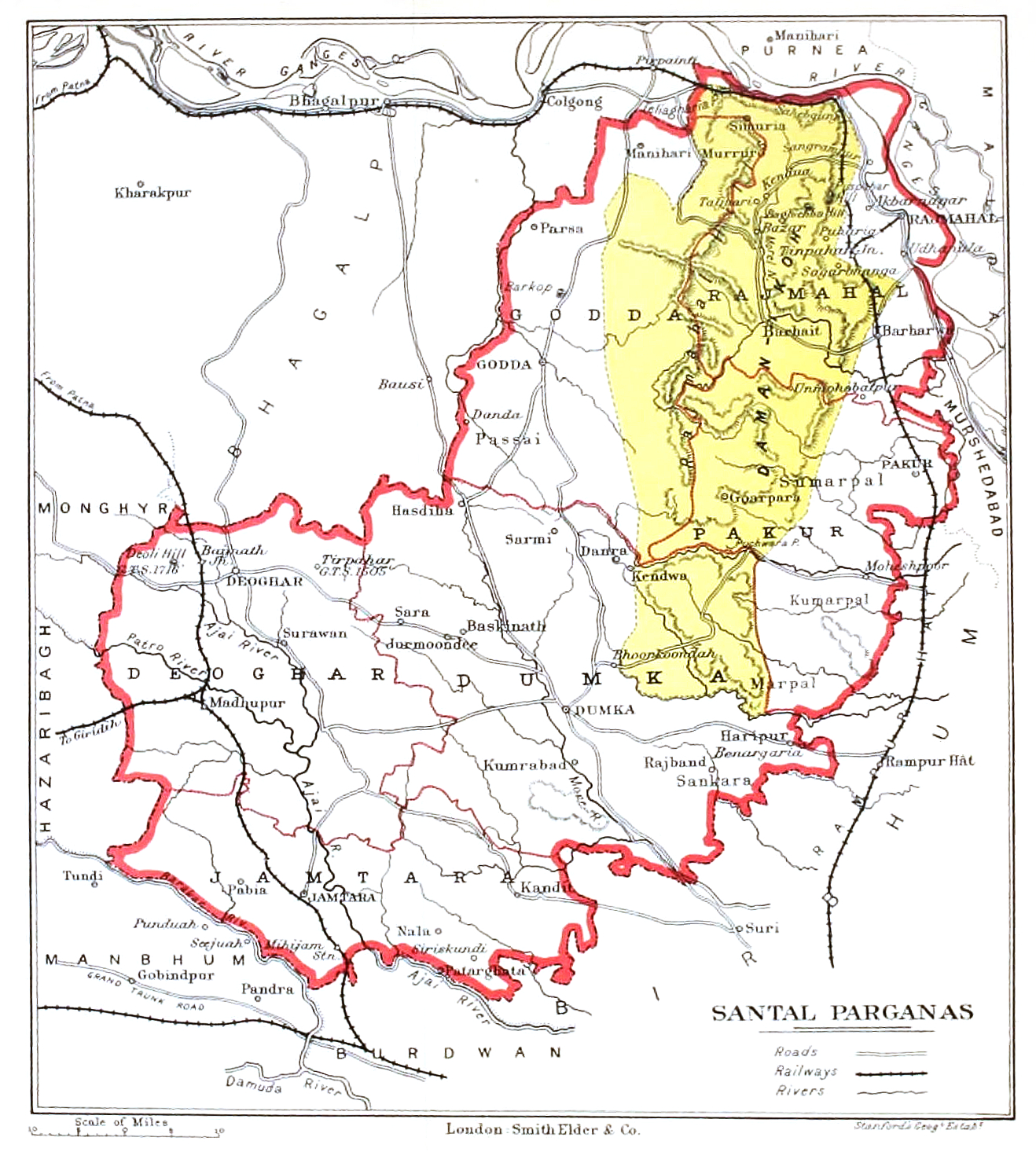
Santal Pargana is one of the divisions of [[Jharkhand]]. Its headquarters is at [[Dumka]]. Presently, this administrative division comprises six districts: [[Godda district|Godda]], [[Deoghar district|Deoghar]], [[Dumka district|Dumka]], [[Jamtara district|Jamtara]], [[Sahebganj district|Sahibganj]] and [[Pakur district|Pakur]]. | |||
[[File:Santal_Parganas.jpg|thumb|Boundary map (1905)]] | [[File:Santal_Parganas.jpg|thumb|Boundary map (1905)]] | ||
==History== | ==History== | ||
This region is mentioned as [[Kajangala]] in different ancient literatures specially in Buddhist literatures. | This region is mentioned as [[Kajangala]] in different ancient literatures specially in Buddhist literatures. | ||
It is mentioned that the Chinese monk-traveller [[Xuanzang]] (Hiuen Tsang) travelled from Champa (recent [[Bhagalpur]]) to Kajangala and then proceeded to [[Pundravardhana]] (recent [[Bangladesh]]) in the 7th century AD. He says that the northern limit of its territory (means [[Sahebganj]]) was not very far from the [[Ganges]]. The forests to the south had plenty of [[elephant]]s. The people were straight forward, talented and devoted to education.<ref name = "Roy">Roy, Niharranjan, ''Bangalir Itihas, Adi Parba'', {{in lang|bn}}, first published 1972, reprint 2005, pp. | It is mentioned that the Chinese monk-traveller [[Xuanzang]] (Hiuen Tsang) travelled from Champa (recent [[Bhagalpur]]) to Kajangala and then proceeded to [[Pundravardhana]] (recent [[Bangladesh]]) in the 7th century AD. He says that the northern limit of its territory (means [[Sahebganj]]) was not very far from the [[Ganges]]. The forests to the south had plenty of [[elephant]]s. The people were straight forward, talented and devoted to education.<ref name = "Roy">Roy, Niharranjan, ''Bangalir Itihas, Adi Parba'', {{in lang|bn}}, first published 1972, reprint 2005, pp. 99–100, 81–93, Dey’s Publishing, 13 Bankim Chatterjee Street, Kolkata, {{ISBN|81-7079-270-3}}</ref> | ||
In the system of [[Permanent Settlement]], British encourage [[Sauria Paharia people|paharia]] of [[Rajmahal hills]] to practice settled agriculture but they refused to cut trees. Then British officials attracted attention to Santals who were ready to clear the forests for settled agriculture. In 1832, a large number of area demarcated as [[Damin-i-koh]] | In the system of [[Permanent Settlement]], British encourage [[Sauria Paharia people|paharia]] of [[Rajmahal hills]] to practice settled agriculture but they refused to cut trees. Then British officials attracted attention to Santals who were ready to clear the forests for settled agriculture. In 1832, a large number of area demarcated as [[Damin-i-koh]]. Santal from [[Cuttack]], [[Dhalbhum]], [[Birbhum]], [[Manbhum]], [[Hazaribagh]] migrated, clear forest tracts and started cultivating these lands as peasants. British collected tax from Santals as revenue. The imposition of taxes, exploitation by [[Zamindar]] and money lenders sparked Santal rebellion. The [[Sidhu and Kanhu Murmu]], two brothers organized and led Santal inhabitants for the [[Santal Revolt]] (Santal Hul) against the Britishers but were defeated.<ref>{{Cite journal|last=Jha|first=Amar Nath|title=Locating the Ancient History of Santal Parganas|date=2009|journal=Proceedings of the Indian History Congress|volume=70|pages=185–196|issn=2249-1937|jstor=44147668}}</ref><ref>{{Cite book|url=https://books.google.com/books?id=9T3zYvKVF98C&q=santhal&pg=PA57|title=This is Our Homeland: A Collection of Essays on the Betrayal of Adivasi|year=2007|access-date= 26 August 2019}}</ref><ref>{{Cite book|url=https://books.google.com/books?id=bMg-DAAAQBAJ&q=santhal+revolt&pg=PA329|title=History of India|isbn=9788173354984|access-date=26 August 2019|last1=Malik|first1=Dr Malti|year=1943 |publisher=New Saraswati House India Pvt }}</ref><ref>{{cite web |url=http://sahibganj.nic.in/en/History.html |title=History, Sahibganj, Jharkhand. |website=sahibganj.nic.in |url-status=dead |archive-url=https://web.archive.org/web/20110927165128/http://sahibganj.nic.in/en/History.html |archive-date=2011-09-27}} </ref><ref>{{Cite web|url=http://wesanthals.tripod.com/id50.html|title = Freedom Struggle}}</ref> Their other siblings namely Chand Murmu, Bhairo Murmu, Phulo Murmu, Jhano Murmu also followed elder brothers leadership for fighting against injustice. | ||
[[File:Attack by 600 Santhals upon a party of 50 sepoys, 40th regiment native infantry.jpg|thumb|Attack by 600 Santhals upon a party of 50 sepoys, 40th regiment native infantry]] | [[File:Attack by 600 Santhals upon a party of 50 sepoys, 40th regiment native infantry.jpg|thumb|Attack by 600 Santhals upon a party of 50 sepoys, 40th regiment native infantry]] | ||
[[File:1907-bengal-sikkim3.jpg|thumb|The [[Santal Parganas]] in a 1907 map of the Bengal area]] | |||
In 1855, during [[British India]], Santal Parganas was created as a district, and was a part of the [[Bengal Presidency]]. Santal Parganas was a district, in undivided [[Bihar]] state, upgraded to a division in 1983.<ref>{{Cite news |title=Santhal pargana |url=https://www.livehindustan.com/jharkhand/story-santal-pargana-was-formed-as-a-district-during-the-british-rule-7524113.html }}</ref> As a consequence of Santal uprising, the British passed the Santhal Parganas Tenancy Act ,1876 which offered some protection for the tribals against exploitation. It prohibits the sale of Adivasi land to non-Adivasis in the Santal Pargana region along present day Jharkhand's border with West Bengal. After Independence of India, the Santal Pargana Tenancy Act, 1949 is the first codified law of tenancy in Santal Pargana division of Jharkhand. When enacted, it supplemented existing British-era tenancy laws and codified some of the customary laws related to tribal land. | |||
==Languages== | ==Demographics== | ||
===Languages=== | |||
{{pie chart | {{pie chart | ||
|thumb=right | |thumb=right | ||
|caption=Languages in Santhal Parganas division (2011)<ref>{{cite web|url=http://www.censusindia.gov.in/2011census/C-16.html|title=Census of India Website : Office of the Registrar General & Census Commissioner, India|website=www.censusindia.gov.in}}</ref> | |caption=Languages in Santhal Parganas division (2011)<ref>{{cite web|url=http://www.censusindia.gov.in/2011census/C-16.html|title=Census of India Website : Office of the Registrar General & Census Commissioner, India|website=www.censusindia.gov.in}}</ref> | ||
|label1 = [[Khortha language| | |label1 = [[Khortha language|Khortha]]|value1 = 29.11 |color1 = red | ||
|label2 = [[Santali language|Santali]] |value2 = 24.25 |color2 = blue | |label2 = [[Santali language|Santali]] |value2 = 24.25 |color2 = blue | ||
|label3 = [[Bengali language|Bengali]] |value3 = 16.11 |color3 = gold | |label3 = [[Bengali language|Bengali]] |value3 = 16.11 |color3 = gold | ||
| Line 66: | Line 66: | ||
|label9 = Others |value9 =2.24 |color9 = gray | |label9 = Others |value9 =2.24 |color9 = gray | ||
}} | }} | ||
It has a population of 6,969,097. | It has a population of 6,969,097. [[Santali language|Santali]], [[Bengali language|Bengali]] and [[Hindi]] are mostly spoken national languages, followed by regional dialect Khorta. | ||
==Religion== | ===Religion=== | ||
{{ pie chart | {{ pie chart | ||
|thumb=right | |thumb=right | ||
|caption=Religions in Santhal Parganas 2011 census | |caption=Religions in Santhal Parganas 2011 census | ||
|label1 = Hindus |value1 = 67.95 |color1 = darkorange | |label1 = [[Hindus]] |value1 = 67.95 |color1 = darkorange | ||
|label2 = Muslims |value2 = 22.73 |color2 = green | |label2 = [[Muslims]] |value2 = 22.73 |color2 = green | ||
|label3 = Christians |value3 = 4.21|color3 = blue | |label3 = [[Christians]] |value3 = 4.21|color3 = blue | ||
|label4 = Sarna |value4 = 4.84|color4 = red | |label4 = [[Sarna (religion)|Sarna]] and [[Sari Dharam]] |value4 = 4.84|color4 = red | ||
|label5 = Others |value5 = 0.27|color5 = Grey | |label5 = Others |value5 = 0.27|color5 = Grey | ||
}} | }} | ||
The majority of the population follows [[Hinduism]]. [[Sari Dharam]] is followed by the [[Santal]] [[tribe]] residents and [[Sarna (religion)|Sarna]] by other tribes. | |||
==References== | ==References== | ||
| Line 85: | Line 86: | ||
{{Santhal Parganas Division}} | {{Santhal Parganas Division}} | ||
[[Category: | [[Category:Divisions of Jharkhand]] | ||
{{Jharkhand-geo-stub}} | {{Jharkhand-geo-stub}} | ||
[[Category:Anga]] | |||
Latest revision as of 15:50, 7 January 2026
Santal Pargana division | |
|---|---|
Division of Jharkhand | |
 Location of Santhal Pargana in Jharkhand | |
| Coordinates: 24°30′N 87°30′E / 24.500°N 87.500°E | |
| Country |  India India |
| State | Jharkhand |
| Established | 1983 |
| Headquarters | Dumka |
| Districts | Godda, Deoghar, Dumka, Jamtara, Sahibganj, Pakur |
| Government | |
| • Commissioner | Shri Lalchand Dadel (IAS) |
| • DIG | Shri Amber Lakra (IPS) |
| Area | |
| • Total | 12,601 km2 (4,865 sq mi) |
| Population (2011) | |
| • Total | 6,969,097 |
| • Density | 550/km2 (1,400/sq mi) |
Santhal Pargana division is an administrative division of the Indian state of Jharkhand. The division comprises six districts and serves as a key administrative unit of the state. It is overseen by a Divisional Commissioner, while law and order is managed by the Deputy Inspector General of Police (DIG).[1][2][3]
Origin of name[edit | edit source]
Santal Pargana derives its name from two words: "Santal", a major inhabited tribe in the region and Pargana, a unit of administration in Persian language used mostly by medieval rulers.
Location[edit | edit source]
Santal Pargana is one of the divisions of Jharkhand. Its headquarters is at Dumka. Presently, this administrative division comprises six districts: Godda, Deoghar, Dumka, Jamtara, Sahibganj and Pakur.

History[edit | edit source]
This region is mentioned as Kajangala in different ancient literatures specially in Buddhist literatures. It is mentioned that the Chinese monk-traveller Xuanzang (Hiuen Tsang) travelled from Champa (recent Bhagalpur) to Kajangala and then proceeded to Pundravardhana (recent Bangladesh) in the 7th century AD. He says that the northern limit of its territory (means Sahebganj) was not very far from the Ganges. The forests to the south had plenty of elephants. The people were straight forward, talented and devoted to education.[4]
In the system of Permanent Settlement, British encourage paharia of Rajmahal hills to practice settled agriculture but they refused to cut trees. Then British officials attracted attention to Santals who were ready to clear the forests for settled agriculture. In 1832, a large number of area demarcated as Damin-i-koh. Santal from Cuttack, Dhalbhum, Birbhum, Manbhum, Hazaribagh migrated, clear forest tracts and started cultivating these lands as peasants. British collected tax from Santals as revenue. The imposition of taxes, exploitation by Zamindar and money lenders sparked Santal rebellion. The Sidhu and Kanhu Murmu, two brothers organized and led Santal inhabitants for the Santal Revolt (Santal Hul) against the Britishers but were defeated.[5][6][7][8][9] Their other siblings namely Chand Murmu, Bhairo Murmu, Phulo Murmu, Jhano Murmu also followed elder brothers leadership for fighting against injustice.


In 1855, during British India, Santal Parganas was created as a district, and was a part of the Bengal Presidency. Santal Parganas was a district, in undivided Bihar state, upgraded to a division in 1983.[10] As a consequence of Santal uprising, the British passed the Santhal Parganas Tenancy Act ,1876 which offered some protection for the tribals against exploitation. It prohibits the sale of Adivasi land to non-Adivasis in the Santal Pargana region along present day Jharkhand's border with West Bengal. After Independence of India, the Santal Pargana Tenancy Act, 1949 is the first codified law of tenancy in Santal Pargana division of Jharkhand. When enacted, it supplemented existing British-era tenancy laws and codified some of the customary laws related to tribal land.
Demographics[edit | edit source]
Languages[edit | edit source]
It has a population of 6,969,097. Santali, Bengali and Hindi are mostly spoken national languages, followed by regional dialect Khorta.
Religion[edit | edit source]
Religions in Santhal Parganas 2011 census
The majority of the population follows Hinduism. Sari Dharam is followed by the Santal tribe residents and Sarna by other tribes.
References[edit | edit source]
- ↑ "Who's Who | District Dumka, Government of Jharkhand | India". Retrieved 7 January 2026.
- ↑ Bharat, E. T. V. (20 May 2025). "कैसे हो जनता का काम, जब संथाल परगना प्रमंडलीय कार्यालय में एक-एक अधिकारी संभाल रहे कई-कई पद।". ETV Bharat News (in हिन्दी). Retrieved 7 January 2026.
- ↑ "सेवानिवृत्त प्रमंडलीय आयुक्त को दी विदाई". www.livehindustan.com (in हिन्दी). 1 November 2025. Retrieved 7 January 2026.
- ↑ Roy, Niharranjan, Bangalir Itihas, Adi Parba, (in Bengali), first published 1972, reprint 2005, pp. 99–100, 81–93, Dey’s Publishing, 13 Bankim Chatterjee Street, Kolkata, ISBN 81-7079-270-3
- ↑ Jha, Amar Nath (2009). "Locating the Ancient History of Santal Parganas". Proceedings of the Indian History Congress. 70: 185–196. ISSN 2249-1937. JSTOR 44147668.
- ↑ This is Our Homeland: A Collection of Essays on the Betrayal of Adivasi. 2007. Retrieved 26 August 2019.
- ↑ Malik, Dr Malti (1943). History of India. New Saraswati House India Pvt. ISBN 9788173354984. Retrieved 26 August 2019.
- ↑ "History, Sahibganj, Jharkhand". sahibganj.nic.in. Archived from the original on 27 September 2011.
- ↑ "Freedom Struggle".
- ↑ "Santhal pargana".
- ↑ "Census of India Website : Office of the Registrar General & Census Commissioner, India". www.censusindia.gov.in.
 | This article related to a location in Jharkhand is a stub. You can help Bharatpedia by expanding it. |