





Ajay Kumar (talk | contribs) Created a new article |
page edit |
||
| Line 1: | Line 1: | ||
{{short description|Small Persian painting on paper}} | {{short description|Small Persian painting on paper}} | ||
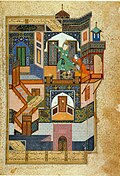
[[File:Yusef Zuleykha.jpg|thumb|[[Yusuf and Zulaikha]] ([[Joseph (son of Jacob)|Joseph]] chased by [[Potiphar's wife]]), by [[Behzād]]. [[:Commons:Category:Bustan of Sa'di, 1488, Herat (National Library of Egypt, Adab Farisi 22)|''Bustan'' of Sa'di]], Herat, 1488, created for Timurid ruler [[Sultan Husayn Bayqara]]]] | |||
<!-- Please respect policy and do not change or consolidate the referencing --> | |||
| | A '''Persian miniature''' ({{langx|fa|نگارگری ایرانی|negârgari-ye Irâni}}) is a small [[Persian painting]] on paper, whether a book illustration or a separate work of art intended to be kept in an album of such works called a ''[[muraqqa]]''. The techniques are broadly comparable to the [[Medieval art|Western Medieval]] and [[Byzantine art|Byzantine]] traditions of [[Miniature (illuminated manuscript)|miniatures]] in [[illuminated manuscript]]s. | ||
| | |||
| | Although there is an equally well-established Persian tradition of wall-painting, the survival rate and state of preservation of miniatures is better, and miniatures are much the best-known form of Persian painting in the West, and many of the most important examples are in Western, or Turkish, museums. Miniature painting became a significant [[genre]] in [[Persian art]] in the 13th century, receiving [[Chinese art|Chinese influence]] after the [[Mongol conquests]], and the highest point in the tradition was reached in the 15th and 16th centuries. The tradition continued, under some Western influence, after this, and has many modern exponents. The Persian miniature was the dominant influence on other [[Islamic miniature|Islamic miniature traditions]], principally the [[Ottoman miniature]] in [[Turkey]], and the [[Mughal painting|Mughal miniature]] in the [[Indian subcontinent]]. | ||
<!-- Please respect policy and do not change or consolidate the referencing --> | |||
A '''Persian miniature''' ( | |||
[[Persian art]] under Islam [[Aniconism in Islam|had never completely forbidden the human figure]], and in the miniature tradition the depiction of figures, often in large numbers, is central. This was partly because the miniature is a private form, kept in a book or album and only shown to those the owner chooses. It was therefore possible to be more free than in wall paintings or other works seen by a wider audience. The [[Quran]] and other purely religious works are not known to have been illustrated in this way, though histories and other works of literature may include religiously related scenes, including those [[Depictions of Muhammad|depicting the Islamic prophet Muhammad]], after 1500 usually without showing his face.<ref>Gruber, throughout; see Welch, 95-97 for one of the most famous examples, illustrated below</ref> | [[Persian art]] under Islam [[Aniconism in Islam|had never completely forbidden the human figure]], and in the miniature tradition the depiction of figures, often in large numbers, is central. This was partly because the miniature is a private form, kept in a book or album and only shown to those the owner chooses. It was therefore possible to be more free than in wall paintings or other works seen by a wider audience. The [[Quran]] and other purely religious works are not known to have been illustrated in this way, though histories and other works of literature may include religiously related scenes, including those [[Depictions of Muhammad|depicting the Islamic prophet Muhammad]], after 1500 usually without showing his face.<ref>Gruber, throughout; see Welch, 95-97 for one of the most famous examples, illustrated below</ref> | ||
| Line 24: | Line 14: | ||
==Style== | ==Style== | ||
[[File:Хафт ауранг Джами 1556-65 Фрир.jpg|thumb|left|Camp scene from late in the classic period, with no frame ({{Circa|1556}}-1565), [[Freer Gallery of Art]], [[Washington, D.C.]]; [[Layla and Majnun|Majnun]] (at top wearing orange) spies on his beloved Layla (standing in tent doorway).]] | [[File:Хафт ауранг Джами 1556-65 Фрир.jpg|thumb|left|Camp scene from late in the classic period, with no frame ({{Circa|1556}}-1565), [[Freer Gallery of Art]], [[Washington, D.C.]]; [[Layla and Majnun|Majnun]] (at top wearing orange) spies on his beloved Layla (standing in tent doorway).]] | ||
The bright and pure colouring of the Persian miniature is one of its most striking features. Normally all the [[pigment]]s used are mineral-based ones which keep their bright colours very well if kept in proper conditions, the main exception being silver, mostly used to depict water, which will oxidize to a rough-edged black over time.<ref>Gray (1930), 22-23</ref> The conventions of Persian miniatures changed slowly; faces are normally youthful and seen in three-quarters view, with a plump rounded lower face better suited to portraying typical Central Asian or Chinese features than those of most Persians. Lighting is even, without shadows or [[chiaroscuro]]. Walls and other surfaces are shown either frontally, or as at (to modern eyes) an angle of about 45 degrees, often giving the modern viewer the unintended impression that a building is (say) hexagonal in plan. Buildings are often shown in complex views, mixing interior views through windows or "cutaways" with exterior views of other parts of a facade. | The bright and pure colouring of the Persian miniature is one of its most striking features. Normally all the [[pigment]]s used are mineral-based ones which keep their bright colours very well if kept in proper conditions, the main exception being silver, mostly used to depict water, which will oxidize to a rough-edged black over time.<ref>Gray (1930), 22-23</ref> The conventions of Persian miniatures changed slowly; faces are normally youthful and seen in three-quarters view, with a plump rounded lower face better suited to portraying typical Central Asian or Chinese features than those of most Persians. Lighting is even, without shadows or [[chiaroscuro]]. Walls and other surfaces are shown either frontally, or as at (to modern eyes) an angle of about 45 degrees, often giving the modern viewer the unintended impression that a building is (say) hexagonal in plan. Buildings are often shown in complex views, mixing interior views through windows or "cutaways" with exterior views of other parts of a facade. Costumes and architecture are always those of the time.<ref>Gray (1930), 22-28; Welch, 35</ref> | ||
Many figures are often depicted, with those in the main scene normally rendered at the same size, and recession (depth in the picture space) indicated by placing more distant figures higher up in the space. More important figures may be somewhat larger than those around them, and battle scenes can be very crowded indeed. Great attention is paid to the background, whether of a landscape or buildings, and the detail and freshness with which plants and animals, the fabrics of tents, hangings or carpets, or tile patterns are shown is one of the great attractions of the form. The dress of figures is equally shown with great care, although artists understandably often avoid depicting the patterned cloth that many would have worn. Animals, especially the horses that very often appear, are mostly shown sideways on; even the love-stories that constitute much of the classic material illustrated are conducted largely in the saddle, as far as the prince-protagonist is concerned.<ref>Gray (1930), 25-26, 44-50</ref> Landscapes are very often mountainous (the plains that make up much of Persia are rarely attempted), this being indicated by a high undulating horizon, and outcrops of bare rock which, like the clouds in the normally small area of sky left above the landscape, are depicted in conventions derived from Chinese art. Even when a scene in a palace is shown, the viewpoint often appears to be from a point some metres in the air.<ref>Gray (1930), 25-26, 48-49, 64</ref> | Many figures are often depicted, with those in the main scene normally rendered at the same size, and recession (depth in the picture space) indicated by placing more distant figures higher up in the space. More important figures may be somewhat larger than those around them, and battle scenes can be very crowded indeed. Great attention is paid to the background, whether of a landscape or buildings, and the detail and freshness with which plants and animals, the fabrics of tents, hangings or carpets, or tile patterns are shown is one of the great attractions of the form. The dress of figures is equally shown with great care, although artists understandably often avoid depicting the patterned cloth that many would have worn. Animals, especially the horses that very often appear, are mostly shown sideways on; even the love-stories that constitute much of the classic material illustrated are conducted largely in the saddle, as far as the prince-protagonist is concerned.<ref>Gray (1930), 25-26, 44-50</ref> Landscapes are very often mountainous (the plains that make up much of Persia are rarely attempted), this being indicated by a high undulating horizon, and outcrops of bare rock which, like the clouds in the normally small area of sky left above the landscape, are depicted in conventions derived from Chinese art. Even when a scene in a palace is shown, the viewpoint often appears to be from a point some metres in the air.<ref>Gray (1930), 25-26, 48-49, 64</ref> | ||
The earliest miniatures appeared unframed horizontally across the page in the middle of text, following Byzantine and Arabic precedents, but in the 14th century the vertical format was introduced, perhaps influenced by Chinese scroll-paintings. | The earliest miniatures appeared unframed horizontally across the page in the middle of text, following Byzantine and Arabic precedents, but in the 14th century the vertical format was introduced, perhaps influenced by Chinese scroll-paintings. This is used in all the luxury manuscripts for the court that constitute the most famous Persian manuscripts, and the vertical format dictates many characteristics of the style.<ref>Sims</ref> | ||
[[File:Saki - Reza Abbasi - Moraqqa’-e Golshan 1609 Golestan Palace.jpg|thumb|''Saki'', album miniature by [[Reza Abbasi]], 1609]] | [[File:Saki - Reza Abbasi - Moraqqa’-e Golshan 1609 Golestan Palace.jpg|thumb|''Saki'', album miniature by [[Reza Abbasi]], 1609]] | ||
The miniatures normally occupy a full page, later sometimes spreading across two pages to regain a square or horizontal "landscape" format. There are often panels of text or captions inside the picture area, which is enclosed in a frame, eventually | The miniatures normally occupy a full page, later sometimes spreading across two pages to regain a square or horizontal "landscape" format. There are often panels of text or captions inside the picture area, which is enclosed in a frame, eventually of several ruled lines with a broader band of gold or colour. The rest of the page is often decorated with dense designs of plants and animals in a muted ''[[grisaille]]'', often gold and brown; text pages without miniatures often also have such borders. In later manuscripts, elements of the miniature begin to expand beyond the frame, which may disappear on one side of the image, or be omitted completely.<ref>OAO (3, ii and elsewhere)</ref> | ||
Another later development was the album miniature, conceived as a single picture rather than a book illustration, though such images may be accompanied by short lyric poems. The withdrawal of Shah [[Tahmasp I]] from commissioning illustrated books in the 1540s probably encouraged artists to transfer to these cheaper works for a wider circle of patrons.<ref>Brend, 164-165</ref> | Another later development was the album miniature, conceived as a single picture rather than a book illustration, though such images may be accompanied by short lyric poems. The withdrawal of Shah [[Tahmasp I]] from commissioning illustrated books in the 1540s probably encouraged artists to transfer to these cheaper works for a wider circle of patrons.<ref>Brend, 164-165</ref> Albums or ''[[muraqqa]]s'' were assembled by collectors with album miniatures, specimen pages of calligraphy, and miniatures taken from older books, to which border paintings were often added when they were remounted. Album miniatures usually showed a few figures on a larger scale, with less attention to the background, and tended to become drawings with some tints of coloured wash, rather than fully painted. | ||
In the example at right the clothes are fully painted, and the background uses the gold grisaille style earlier reserved for marginal decoration, as in the miniature at the head of the article. | In the example at right the clothes are fully painted, and the background uses the gold grisaille style earlier reserved for marginal decoration, as in the miniature at the head of the article. Many were individual portraits, either of notable figures (but initially rarely portraits of rulers), or of idealized beautiful youths. Others were scenes of lovers in a garden or picnics. From about the middle of the 16th century these types of images became dominant, but they gradually declined in quality and originality and tended towards conventional prettiness and sentimentality.<ref>OAO, Sims; Gray (1930), 74-81</ref> | ||
Books were sometimes refurbished and added to after an interval of many years, adding or partly repainting miniatures, changing the border decoration, and making other changes, not all improvements.<ref>OAO</ref> | Books were sometimes refurbished and added to after an interval of many years, adding or partly repainting miniatures, changing the border decoration, and making other changes, not all improvements.<ref>OAO</ref> The ''Conference of the Birds'' miniature in the gallery below is an addition of 1600 to a manuscript of over a century earlier, and elements of the style appear to represent an effort to match the earlier miniatures in the book.<ref>[http://www.metmuseum.org/toah/works-of-art/63.210.11 Metropolitan Museum of Art] {{Webarchive|url=https://web.archive.org/web/20110307032731/http://www.metmuseum.org/toah/works-of-art/63.210.11/ |date=2011-03-07 }} "The Conference of the Birds": Page from a manuscript of the Mantiq al-Tayr (The Language of the Birds) of Farid al-Din cAttar, [[Isfahan]] (63.210.11). In Heilbrunn Timeline of Art History. New York: The [[Metropolitan Museum of Art]], 2000–.</ref> The famous painting ''Princes of the House of Timur'' was first painted in 1550-55 in Persia for the exiled Mughal prince [[Humayun]], who largely began the Mughal miniature tradition by taking back Persian miniaturists when he gained the throne. It was then twice updated in India (c.1605 and 1628) to show later generations of the royal house.<ref>Crill and Jarilwala, 50-51; [http://www.artfund.org/artwork/4691/princes-of-the-house-of-timur Art Fund] {{Webarchive|url=https://web.archive.org/web/20110617040117/http://www.artfund.org/artwork/4691/princes-of-the-house-of-timur |date=2011-06-17 }} with image. The painting uses miniature techniques on cotton, and is much larger than most miniatures.</ref> The dimensions of the manuscripts covered a range not dissimilar to typical modern books, though with a more vertical ratio; many were as small as a modern paperback, others larger. Shah Tamasp's ''Shahnameh'' stood 47 cm high, and one exceptional ''Shahnameh'' from [[Tabriz]] of c. 1585 stood 53 cm high.<ref>Uluc, 73</ref> | ||
==Artists and technique== | ==Artists and technique== | ||
[[File: | [[File:Nighttime in a City. Circa 1540, Tabriz (Sackler Museum, 1958.76).jpg|thumb|left|''Nighttime in a City'': urban activity in the Safavid capital of [[Tabriz]], painted circa 1540 for [[Shah Tahmasp]] (Sackler Museum, 1958.76).{{sfn|Melville|2021|p=[https://books.google.com/books?id=NaALEAAAQBAJ&pg=119 119], [https://books.google.com/books?id=NaALEAAAQBAJ&pg=125 note 43]}}<ref>{{cite journal |last1=Sarabi |first1=Mina |title=Architectural and Spatial Design studies of Sahibabad, Tabriz, Iran in the Persian Miniature Painting "Nighttime in a Palace" |journal=JACO Journal of Art and Civilization of the Orient Quarterly |date=10 May 2023 |issue=38 |doi=10.22034/JACO.2022.366374.1270 |url=https://www.academia.edu/101572606/Architectural_and_Spatial_Design_studies_of_Sahibabad_Tabriz_Iran_in_the_Persian_Miniature_Painting_Nighttime_in_a_Palace_}}</ref>]] | ||
In the classic period artists were exclusively male, and normally grouped in workshops, of which the royal workshop (not necessarily in a single building) was much the most prestigious, recruiting talented artists from the [[bazaar]] workshops in the major cities. However the nature of the royal workshop remains unclear, as some manuscripts are recorded as being worked on in different cities, rulers often took artists with them on their travels, and at least some artists were able to work on private commissions.<ref>Roxburgh (2000), 6-8</ref> | In the classic period artists were exclusively male, and normally grouped in workshops, of which the royal workshop (not necessarily in a single building) was much the most prestigious, recruiting talented artists from the [[bazaar]] workshops in the major cities. However the nature of the royal workshop remains unclear, as some manuscripts are recorded as being worked on in different cities, rulers often took artists with them on their travels, and at least some artists were able to work on private commissions.<ref>Roxburgh (2000), 6-8</ref> As in Europe, sons very often followed their father into the workshop, but boys showing talent from any background might be recruited; at least one notable painter was born a slave. There were some highly placed amateur artists, including [[Shah Tahmasp I]] (reigned 1524–1576), who was also one of the greatest patrons of miniatures. Persian artists were highly sought after by other Islamic courts, especially those of the [[Ottoman Empire|Ottoman]] and [[Mughal Empire]]s, whose own traditions of miniature were based on Persian painting but developed rather different styles.<ref>Welch, 12-14</ref> | ||
The work was often divided between the main painter, who drew the outlines, and less senior painters who coloured in the drawing. | The work was often divided between the main painter, who drew the outlines, and less senior painters who coloured in the drawing. In [[Mughal miniature]]s at least, a third artist might do just the faces. Then there might be the border paintings; in most books using them these are by far the largest area of painted material as they occur on text pages as well. The miniatures in a book were often divided up between different artists, so that the best manuscripts represent an overview of the finest work of the period. The scribes or [[Calligraphy|calligraphers]] were normally different people, on the whole regarded as having a rather higher status than the artists - their names are more likely to be noted in the manuscript. | ||
Royal librarians probably played a significant role in managing the commissions; the extent of direct involvement by the ruler himself is normally unclear. | Royal librarians probably played a significant role in managing the commissions; the extent of direct involvement by the ruler himself is normally unclear. The scribes wrote the main text first, leaving spaces for the miniatures, presumably having made a plan for these with the artist and the librarian. The book covers were also richly decorated for luxury manuscripts, and when they too have figurative scenes these presumably used drawings by the same artists who created the miniatures. Paper was the normal material for the pages, unlike the [[vellum]] normally used in Europe for as long as the illuminated manuscript tradition lasted. The paper was highly polished, and when not given painted borders might be flecked with gold leaf.<ref>Gray (1930), 22-26; Welch, 12-14</ref> | ||
A unique survival from the Timurid period, found "pasted inconspicuously" in a muraqqa in the [[Topkapi Palace]] is thought to be a report to Baysunghur from his librarian. After a brief and high-flown introduction, "Petition from the most humble servants of the royal library, whose eyes are as expectant of the dust from the hooves of the regal steed as the ears of those who fast are for the cry of ''[[Allahu akbar]]'' ..." it continues with very businesslike and detailed notes on what each of some twenty-five named artists, scribes and craftsmen has been up to over a period of perhaps a week: "Amir Khalil has finished the waves in two sea-scenes of the ''[[Gulistan | A unique survival from the Timurid period, found "pasted inconspicuously" in a muraqqa in the [[Topkapi Palace]] is thought to be a report to Baysunghur from his librarian. After a brief and high-flown introduction, "Petition from the most humble servants of the royal library, whose eyes are as expectant of the dust from the hooves of the regal steed as the ears of those who fast are for the cry of ''[[Allahu akbar]]'' ..." it continues with very businesslike and detailed notes on what each of some twenty-five named artists, scribes and craftsmen has been up to over a period of perhaps a week: "Amir Khalil has finished the waves in two sea-scenes of the ''[[Gulistan (book)|Gulistan]]'' and will begin to apply colour. ... All the painters are working on painting and tinting seventy-five tent-poles .... Mawlana Ali is designing a frontispiece illumination for the ''Shahnama''. His eyes were sore for a few days."<ref>Thackston, 43-44</ref> Apart from book arts, designs for tent-makers, tile-makers, woodwork and a saddle are mentioned, as is the progress of the "[[begum|begim]]'s little chest".<ref>Thackston, 43-44; a good number of those named are mentioned in other sources.</ref> | ||
== History == | == History == | ||
[[ | The ancient Persian religion of [[Manichaeism]] made considerable use of images; not only was the founding prophet [[Mani (prophet)|Mani]] (c.216–276) a professional artist, at least according to later Islamic tradition, but one of the sacred books of the religion, the [[Arzhang]], was illustrated by the prophet himself, whose illustrations (probably essentially cosmological diagrams rather than images with figures) were regarded as part of the sacred material and always copied with the text. Unfortunately, the religion was repressed strongly from the [[Sasanian Empire|Sasanian era]] and onwards so that only tiny fragments of Manichean art survive. These no doubt influenced the continuing Persian tradition, but little can be said about how. It is also known that [[Sasanian architecture|Sasanian palaces]] had wall-paintings, but only fragments of these have survived.<ref>Gray (1930), 27-28</ref> | ||
There are narrative scenes in pottery (''[[Mina'i ware|Mina'i]]'' ceramics), though it is hard to judge how these relate to lost contemporary book painting.<ref>Sims</ref> Recent scholarship has noted that, although surviving early examples are now uncommon, human figurative art was also a continuous tradition in Islamic lands in secular contexts (such as literature, science, and history); as early as the 9th century, such art flourished during the [[Abbasid Caliphate]] (c. 749-1258, across Spain, North Africa, Egypt, Syria, Turkey, Mesopotamia, and Persia).<ref>{{cite book|author1=J. Bloom|author2=S. Blair|name-list-style=amp|title=Grove Encyclopedia of Islamic Art|year=2009|publisher=Oxford University Press, Inc.|location=New York|isbn=978-0-19-530991-1|pages=192 and 207|url=https://books.google.com/books?id=un4WcfEASZwC&q=cairo+egypt+miniature+paintings+mamluk&pg=RA1-PA192|access-date=2020-11-02|archive-date=2023-07-01|archive-url=https://web.archive.org/web/20230701140919/https://books.google.com/books?id=un4WcfEASZwC&q=cairo+egypt+miniature+paintings+mamluk&pg=RA1-PA192|url-status=live}}</ref> | |||
===Earliest illustrated manuscript in Persian (c.1250)=== | |||
[[File:Varka and Golshah. Battle scene 1. Mid 13th century Seljuk Anatolia.jpg|thumb|upright=1.5|Rabī cuts his adversary in half. Battle scene, in ''Varka and Golshah'', mid-13th century Seljuk Anatolia.]] | |||
The great period of the Persian miniature began when Persia was ruled by a succession of foreign dynasties, who came from the east and north. Before the Mongol [[Ilkhanate]] (1253–1353), narrative representations are only known in Persia in architecture and ceramics.<ref name="JB214">{{cite book |last1=Bloom |first1=Jonathan |last2=Blair |first2=Sheila |title=Grove Encyclopedia of Islamic Art & Architecture: Three-Volume Set |date=14 May 2009 |publisher=OUP USA |isbn=978-0-19-530991-1 |url=https://books.google.com/books?id=un4WcfEASZwC&pg=RA1-PA214 |page=214-215 |language=en}}</ref> With the large tradition of [[Arabic miniature|Arabic manuscripts]] in the 12th-13th centuries, illustrated manuscripts probably also existed in Persia, but none are known.<ref name="RE">{{cite journal |last1=Ettinghausen |first1=Richard |title=On Some Mongol Miniatures |journal=Kunst des Orients |date=1959 |volume=3 |pages=44–45 |jstor=20752311 |url=https://www.jstor.org/stable/20752311 |issn=0023-5393}}</ref><ref name="JB214"/> | |||
The | The earliest known illustrated manuscript in the Persian language is an early 13th century copy of the epic ''[[Varka and Golshah]]'', which was most probably created in [[Konya]] in [[Central Anatolia region|Central Anatolia]], under the Seljuk [[Sultanate of Rum]].<ref>{{cite book |last1=Porter |first1=Yves |last2=Flood |first2=Finbarr Barry |title=Under the adorned dome: four essays on the arts of Iran and India |date=2023 |publisher=Brill |location=Leiden Boston |isbn=978-90-04-54971-5 |page=17, note 30 |quote= The Varqa and Gulshāh was probably made in the [[Sultanate of Rum|Konya sultanate]].}}</ref><ref>{{harvnb|Hillenbrand|2021|p=208}} "The earliest illustrated Persian manuscript, signed by an artist from Khuy in north-west Iran, was produced between 1225 and 1250, almost certainly in Konya. (Cf. A. S. Melikian-Chirvani, ‘Le roman de Varqe et Golsâh’, Arts Asiatiques XXII (Paris, 1970))"</ref><ref name="SSB">{{cite book |last1=Blair |first1=Sheila S. |title=Islamic Calligraphy |date=19 January 2020 |publisher=Edinburgh University Press |isbn=978-1-4744-6447-5 |page=366 |url=https://books.google.com/books?id=m6QxEAAAQBAJ&pg=PA366 |language=en}}</ref><ref>{{cite book |last1=Necipoğlu |first1=Gülru |last2=Leal |first2=Karen A. |title=Muqarnas |date=1 October 2009 |publisher=BRILL |isbn=978-90-04-17589-1 |url=https://books.google.com/books?id=Gq6obUbnqsMC&pg=PA235 |language=en}}</ref> It is the only Persian-language illustrated manuscript securely datable to before Mongol conquest, and it can be dated to circa 1250.<ref>{{cite book |last1=Bloom |first1=Jonathan |last2=Blair |first2=Sheila |title=Grove Encyclopedia of Islamic Art & Architecture: Three-Volume Set |date=14 May 2009 |publisher=OUP USA |isbn=978-0-19-530991-1 |url=https://books.google.com/books?id=un4WcfEASZwC&pg=RA1-PA214 |page=214–215 |language=en}}</ref><ref>{{cite book |last1=Ettinghausen |first1=Richard |title=Arab painting |date=1977 |publisher=New York : Rizzoli |isbn=978-0-8478-0081-0 |page=91, [https://archive.org/details/arabpainting0000etti/page/92/mode/2up?q=%22Illustration+page+91%22 92], [https://archive.org/details/arabpainting0000etti/page/162/mode/2up?q=%22these+Turks%22 162] commentary |url=https://archive.org/details/arabpainting0000etti/page/91/mode/2up |quote=The two scenes in the top and bottom registers (...) may be strongly influenced by contemporary Seljuk Persian (...) like those in the recently discovered Varqeh and Gulshah (p.92) (...) In the painting the facial cast of these Turks is obviously reflected, and so are the special fashions and accoutrements they favored. (p.162, commentary on image from p.91)}}</ref> | ||
===Mongol era (1260–1335)=== | |||
[[ | [[File:Suppl. Pers. 205 Frontispiece detail.jpg|thumb|upright=1.5|[[Ata-Malik Juvayni|Juvaynī]] sitting and writing in front of Mongol emir [[Arghun Aqa]]. Frontispiece of ''[[Tārīkh-i Jahān-Gushā]]'' "The History of The World Conqueror" (damaged), completed in A.H. 689/ 1290 CE. Bibliothèque Nationale de France ([[:Commons:Category:Bibliothèque Nationale de France (Suppl. Pers. 205)|Suppl. Pers. 205]]).<ref name="Groove">{{cite journal |last1=Jaber |first1=Shady |title=The Paintings of al-Āthār al-Bāqiya of al-Bīrūnī: A Turning Point in Islamic Visual Representation |journal=Lebanese American University |date=2021 |page=Figure 5 |url=https://laur.lau.edu.lb:8443/xmlui/bitstream/handle/10725/13751/Shady_Jaber_Thesis_Redacted.pdf?sequence=3}}</ref><ref>{{cite web |title=Consultation Supplément Persan 205 |url=https://archivesetmanuscrits.bnf.fr/ark:/12148/cc33978s |website=archivesetmanuscrits.bnf.fr |publisher=Bibliothèque Nationale de France}}</ref> It shows the "origin of the ''Metropolitan style''" at the [[Ilkhanid]] court.<ref>{{cite book |last1=Bloom |first1=Jonathan |last2=Blair |first2=Sheila |title=Grove Encyclopedia of Islamic Art & Architecture: Three-Volume Set |date=14 May 2009 |publisher=OUP USA |isbn=978-0-19-530991-1 |page=215 |url=https://books.google.com/books?id=un4WcfEASZwC&pg=RA1-PA215 |language=en}}</ref>]] | ||
The traumatic [[Mongol conquests|Mongol invasion]] of [[Mongol invasion of Khwarezmia and Eastern Iran|1219]] onwards established the [[Ilkhanate]] as a branch of the [[Mongol Empire]], and despite the huge destruction of life and property, the new court had a galvanising effect on book painting, importing many Chinese works and probably artists, with their long-established tradition of narrative painting, and sponsoring a cultural revival and the creation of history-related literary works.<ref name="JB215"/> Baghdad [[Siege of Baghdad|was conquered in 1258]], and [[Mosul]] in 1262. | |||
The earliest known Persian-language manuscript of ''[[Kalīla wa-Dimna]]'' (Topkapl Palace Museum Library, H.363) appears around this time: it is dated to 1265-80, and was likely produced in [[Baghdad]], or possibly [[Mosul]].<ref>{{cite web |title=KALILA WA DEMNA iii. ILLUSTRATIONS |url=https://www.iranicaonline.org/articles/kalila-wa-demna-iii/ |website=Encyclopaedia Iranica |quote=The earliest illustrated Arabic manuscripts that have survived date from the beginning of the 13th century, while the earliest illustrated Persian example (Istanbul, Topkapi Saray Library, MS H. 363) is from the last quarter of that century.}}</ref><ref>{{cite book |last1=Contadini |first1=Anna |title=Arab painting: text and image in illustrated Arabic manuscripts |date=2010 |publisher=Brill |location=Leiden Boston |isbn=978-90-04-18630-9 |page=140 |edition=2nd rev. |quote=...the earliest surviving Persian manuscript of the text, H. 363 of the Topkapı Saray Library, datable to 1265–80.}}</ref> Another known illustrated Persian manuscript under the Mongols is the ''[[Tarikh-i Jahangushay]]'' (1290), commissioned by the Mongol emir [[Arghun Aqa]], also one of the earliest examples of "Metropolitan style" of the Mongol [[Ilkhanid]] court, followed by the 1297-1299 manuscript ''[[Manafi' al-Hayawan (Ms M. 500)|Manafi' al-hayawan]]'' (Ms M. 500), commissioned by Mongol ruler [[Ghazan]].<ref name="JB215">{{cite book |last1=Bloom |first1=Jonathan |last2=Blair |first2=Sheila |title=Grove Encyclopedia of Islamic Art & Architecture: Three-Volume Set |date=14 May 2009 |publisher=OUP USA |isbn=978-0-19-530991-1 |url=https://books.google.com/books?id=un4WcfEASZwC&pg=RA1-PA215 |page=215 |language=en}}</ref> The Ilkhanids continued to migrate between summer and winter quarters, which together with other travels for war, hunting and administration, made the portable form of the illustrated book the most suitable vehicle for painting, as it also was for mobile European medieval rulers.<ref>Sims</ref> The ''[[Great Mongol Shahnameh]]'', now dispersed, is the outstanding manuscript of the following period.<ref>Canby (1993), 33-34</ref> | |||
It was only in the 14th century that the practice began of commissioning illustrated copies of classic works of [[Persian poetry]], above all the ''[[Shahnameh]]'' of [[Ferdowsi]] (940–1020) and the ''[[Khamsa of Nizami]]'', which were to contain many of the finest miniatures. Previously book illustration, of works in both Arabic and Persian, had been concentrated in practical and scientific treatises, often following at several removes the Byzantine miniatures copied when ancient Greek books were translated.<ref>Gray (1976), 310-311</ref> However a 14th-century flowering of Arabic illustrated literary manuscripts in Syria and Egypt collapsed at the end of the century, leaving Persia the undisputed leader in Islamic book illustration.<ref>Sims</ref> Many of the best miniatures from early manuscripts were removed from their books in later centuries and transferred to albums, several of which are now in [[Istanbul]]; this complicates tracing the art history of the period.<ref>Simms</ref> | |||
[[ | <gallery class="center" widths="250px" heights="150px" perrow="5"> | ||
File:Arabischer Maler um 1295 001.jpg|[['Ubayd Allah ibn Bakhtishu|Ibn Bakhtishu]]'s ''[[Manafi al-Hayawan]]'' ("Uses of Animals"), commissioned by [[Ghazan]]. [[Maragha]], Persia, 1297–1299. Morgan Library & Museum ([[:Commons:Category:Manafi' al-Hayawan (The Morgan Library & Museum MS M 500)|Ms. M.500]]).<ref name="Groove"/> | |||
File:Muhammad during the Mi'raj - from Jami al-Tawarikh.jpg|The [[Mi'raj]] (also called the "Night Ride") of Muhammed on [[Buraq]], Tabriz, 1307; Ilkhanid, with both Christian and Chinese influences, and horizontal format. | |||
File:Demotte Shahname 002.jpg|Scene from the [[Great Mongol Shahnameh]], a key Ilkhanid work, 1330s? | |||
</gallery> | |||
===Post-Mongol era (1335–1385)=== | |||
[[File:Junaid 002.jpg|thumb|''Divan of [[Khvaju Kirmani]]'', illustrations by [[Junayd (illustrator)|Junayd]], dated 1396, [[Baghdad]].<ref name="Digitised Manuscripts">{{cite web |title=Digitised Manuscripts |url=http://www.bl.uk/manuscripts/FullDisplay.aspx?ref=Add_MS_18113 |website=www.bl.uk}}</ref> This is "the most firmly dated illustrated and high-quality Jalayirid manuscript".<ref name="IS198">{{cite journal |last1=Sturkenboom |first1=Ilse |title=The Paintings of the FreerDivanof Sultan Ahmad b. Shaykh Uvays and a New Taste for Decorative Design |journal=Iran |date=2018 |volume=56 |issue=2 |page=198 |doi=10.1080/05786967.2018.1482727 |s2cid=194905114 |url=https://www.academia.edu/37449326 |issn=0578-6967}}</ref>]] | |||
Once the Ilkhanate fragmented in 1335, various dynasties fought for supremacy in Persian lands: descendants of the Mongols such as the [[Jalayirid Sultanate|Jalayirids]] and the [[Chobanids]], or local dynasties such as the [[Injuids]] and the [[Muzaffarids (Iran)|Muzaffarids]]. They all prolonged the art of the miniatures developed by the Mongols, sometimes with local refinements and variations. | |||
== | The Jalayirids expanded the limits of refinement and delicacy.<ref name="IS198"/><ref name="Swietochowski">{{cite book |last1=Swietochowski |first1=Marie Lukens |last2=Carboni |first2=Stefano |title=Illustrated Poetry and Epic Images: Persian Painting of the 1330s and 1340s |date=1994 |publisher=Metropolitan Museum of Art |isbn=978-0-87099-693-1 |page=75 |url=https://books.google.com/books?id=00t6HH7RUCAC&pg=PA75 |language=en}}</ref><ref name="CH">{{cite book |title=The Cambridge History of the Mongol Empire Vol 1 |date=2023 |publisher=Cambridge University Press |isbn=978-1-316-33742-4 |page=228 |doi=10.1017/9781316337424 |url=https://doi.org/10.1017/9781316337424 |editor-last1=Biran |editor-last2=Kim |editor-first1=Michal |editor-first2=Hodong }}</ref> The Jalayirids led some of the most important changes in [[Persian art]], at the junction between the creations of the [[Il-Khanate]] in the 13-14th century, and those of the [[Safavid Empire|Safavids]] in the 16th century.<ref>{{harvnb|Wing|2016|p=185}} "Some of the most important changes in this distinctly Persian art form took place under the Jalayirids, bridging the masterpiece known as the Great Mongol Shāhnāma, produced in the late Ilkhanid period, with 15th and 16th century Timurid and Safavid painting, commonly considered the pinnacle of the Persian miniature form."</ref> They contributed to the formation of [[Persian miniatures]], especially through the introduction of Chinese-inspired natural landscapes.{{sfn|Wing|2016|pp=185-186}} According to [[Ernst J. Grube]], Jalayirid painting was the source of "modern" Persian-Islamic painting.{{sfn|Wing|2016|p=186}} The characteristics of the Jalayirid school of miniatures were lyrical scenes with elegant small figures in lavish interiors or lush natural surroundings, painted in pastel colors.{{sfn|Wing|2016|p=186}} The subject matters were generally poetic, rather than epic.{{sfn|Wing|2016|p=186}} It is known that some illustrated manuscripts of the Jalayirids were copied and emulated by the [[Timurid Empire|Timurids]]. A written remark by [[Dust Muhammad]] mentions that the Timurid ruler [[Baysunghur]] ordered a book to be made with the exact same specifications (dimensions, arrangement of text, illustrations) as a Jalayirid original.<ref>{{cite journal |last1=Soucek |first1=Priscilla |title=Comments on Persian Painting |journal=Iranian Studies |date=1974 |volume=7 |issue=1/2 |page=73}}</ref> In the 16th century, [[Dust Muhammad]] described the Timurid [[Baysunghur]]'s efforts at emulating Jalayirid art, after his [[Timeline of Tabriz|occupation of Tabriz in 1421]] and capture of artists from Tabriz: | ||
{{quotation|''His Highness [[Baysunghur|Baysunghur Mirza]] had Master Sidi Ahmad the painter, Khwaja Ali the portraitist and Master Qiwamuddin the bookbinder brought from [[Tabriz]] and ordered that after the pleasing manner of Sultan Ahmad of Baghdad's miscellany, they should produce a book in exactly the same format and layout and with the same scenes depicted. The copying of it was given into the charge of Mawlana Fariduddin Ja 'far. The binding was commissioned of the aforementioned Master Qiwamuddin, by whom inlay in bindings was invented; and Mir Khalil was put in charge of decoration and depiction of scenes.''|Preface to the ''[[Bahram Mirza Album]]'' (extract), by Dust Muhammad.<ref>{{cite book |title=Album prefaces and other documents on the history of calligraphers and painters |date=2014 |publisher=Brill |location=Leiden Boston |isbn=978-90-04-11961-1 |page=13 |edition=Paperback [edition]}}</ref>}} | |||
The Injuids attempted to develop an original style as a symbol of their recovered political independence.<ref name="Swietochowski"/> | |||
The | |||
<gallery class="left" widths="200px" heights="200px" perrow="5"> | |||
File:The jackals with lions and their cubs (uncropped). Kalila and Dimna. F.1422.jpg|Jalayirid ''[[:Commons:Category:Kalila and Dimna, 1370-74 (Istanbul University Library F.1422)|Kalila and Dimna]]'' (1370–74) | |||
File:Bahram Gur and Azadeh in hunting place, Istanbul Shahnameh, Shiraz 1331.jpg|Injuid miniature: ''Bahram Gur and Azadeh in hunting place'', Istanbul Shahnameh, Shiraz 1331.<ref>{{cite web |last1=Moravej |first1=Elahe |title=COMPARING THE SCENE OF HUNTING DEER, BAHRAM GUR AND AZADEH IN SHAHNAMEHS OF 1331, 1333 AND 1352 A.D. COPIES |url=https://www.researchgate.net/figure/mage-of-Bahram-and-Azadeh-in-hunting-place-Ferdowsis-Shahnameh-of-1352-AD_fig3_308023286 |year=2016}}</ref> | |||
File:Frontispiece with Prince and attendants, probably circa 1390, final Muzaffarid period, Shiraz. Kalila and Dimna, BNF Persan 377.jpg|Frontispiece with Prince and attendants, probably circa 1390, final Muzaffarid period, Shiraz.<ref>{{cite web |title=Consultation BNF Persan 377 |url=https://archivesetmanuscrits.bnf.fr/ark:/12148/cc101600n |website=archivesetmanuscrits.bnf.fr}}</ref> | |||
File: | |||
File:Bahram Gur | |||
File: | |||
</gallery> | </gallery> | ||
== | ===The Timurids and Turkmen (1381–1501)=== | ||
[[File:Baysunghur Shahname. Faramarz son of Rostam mourns the death of his father and of his uncle Zavareh-1430.jpg|thumb|[[Baysonghor Shahnameh]], 1430. He was a key patron of the [[Herat]] school]] | |||
{{see also|Timurid art|Turkmen style}} | |||
After 1335 the Ilkhanate split into several warring dynasties, all swept aside by the new invasion of [[Timur]] from 1381. He established the [[Timurid dynasty]], bringing a fresh wave of Chinese influence, who were replaced by the [[Qara Qoyunlu]] in 1452, followed by the [[Aq Qoyunlu]] from 1468, who were in turn replaced by the [[Safavid dynasty]] by 1501; they ruled until 1722. After a chaotic period [[Nader Shah]] took control, but there was no long-lived dynasty until the [[Qajar dynasty]], who ruled from 1794 to 1925.<ref>Gray (1976), 309-315, OAO; Rawson, 146-147</ref> | |||
[[Tabriz]] in the north-west of Iran is the longest established centre of production, and [[Baghdad]] (then under Persian rule) was often important. [[Shiraz]] in the south, sometimes the capital of a sub-ruler, was a centre from the late 14th century, and [[Herat]], now in [[Afghanistan]], was important in the periods when it was controlled from Persia, especially when the Timurid prince [[Baysonqor]] was governor in the 1420s; he was then the leading patron in Persia, commissioning the [[Baysonghor Shahnameh]] and other works. Each centre developed its own style, which were largely reconciled and combined under the Safavids.<ref>Gray (1930), 37-55; Welch, 14-18; OAO</ref> | |||
The schools of Herat, where the [[Timurid dynasty|Timurid]] royal workshops usually were, had developed a style of classical restraint and elegance, and the painters of Tabriz, a more expressive and imaginative style. Tabriz was the former capital of the Turkmen rulers, and in the early [[Safavid Iran|Safavid era]] the styles were gradually harmonized in works like the [[Shahnameh of Shah Tahmasp]].<ref>Titley, 80; Walther & Wolf, 420-424</ref> But a famous unfinished miniature showing [[Rostam]] asleep, while his horse [[Rakhsh]] fights off a lion, was probably made for this manuscript, but was never finished and bound in, perhaps because its vigorous Tabriz style did not please Tahmasp. It appears to be by Sultan Mohammad, whose later works in the manuscript show a style adapted to the court style of [[Kamāl ud-Dīn Behzād|Bizhad]]. It is now in the [[British Museum]].<ref>Canby (1993), 79-80</ref> | |||
===Safavid synthesis (1501–1736)=== | |||
{{see also|Safavid art}} | |||
[[File:Portrait_of_Sam_Mirza_as_a_patron;_The_feast_of_I’d_begins,_copy_of_Diwan_Hafiz_manuscript.jpg|thumb|[[Shah Tahmasp]] at the ''Celebration of `Id''. Painted by [[Sultan Mohammed]] in [[Tabriz]], circa 1531. ''[[Cartier Hafiz]]''.{{sfn|Blair|2014|pp=240-241}}]] | |||
The Safavid art of the miniature was in many ways a synthesis and an evolution upon the achievements of the previous schools. [[Dust Muhammad]] in the 161th century attributed the current state of the art to the foundational work of [[Ahmad Musa (painter)|Ahmad Musa]] during the Il-Khanate period, while acknowledging the advances made in China and Europe:<ref>{{cite book |last1=Sims |first1=Eleanor |last2=Marshak |first2=Boris Ilʹich |last3=Grube |first3=Ernst J. |title=Peerless Images: Persian Painting and Its Sources |date=1 January 2002 |publisher=Yale University Press |isbn=978-0-300-09038-3 |page=262 |url=https://archive.org/details/peerlessimagespe0000sims/page/262/mode/1up |language=en}}</ref> | |||
{{quotation|''The custom of portraiture flourished in the lands of [[Cathay]] and the [[Europe|Franks]] until sharp-penned Mercury scrivened the rescript of rule in the name of Sultan [[Abu Sa'id Bahadur Khan|Abusaʿid Khudaybanda]]. Master [[Ahmad Musa (painter)|Ahmad Musa]], who was his father’s pupil, lifted the veil from the face of depiction, and the [style of] depiction that is now current was invented by him.''|[[Dust Muhammad]], introduction to the ''[[Bahram Mirza Album]]'' (1544).<ref>{{cite book |last1=Sims |first1=Eleanor |last2=Marshak |first2=Boris Ilʹich |last3=Grube |first3=Ernst J. |title=Peerless Images: Persian Painting and Its Sources |date=1 January 2002 |publisher=Yale University Press |isbn=978-0-300-09038-3 |page=262 |url=https://archive.org/details/peerlessimagespe0000sims/page/262/mode/1up |language=en}}</ref><ref>{{cite book |title=Album prefaces and other documents on the history of calligraphers and painters |date=2014 |publisher=Brill |location=Leiden Boston |isbn=978-90-04-11961-1 |pages=12-13 |edition=Paperback [edition]}}</ref>}} | |||
[[Shah Ismail]], by conquering both the Aq Qoyunlu and the Timurids, took over the two dominant Persian artistic schools of the time in the domain of calligraphy and miniatures: the western [[Turkman style|Turkoman school]] based in [[Tabriz]], characterized by vibrant and colorful compositions, which had developed under his uncle [[Yaqub Aq Qoyunlu|Sultan Yaqub Aq Qoyunlu]], and the eastern [[Timurid art|Timurid school]] based in [[Herat]] and brought to new summits by [[Sultan Husayn Bayqara]], which was more balanced and restrained and used subtle colors.{{Sfn|Soudavar|1992|p=159}} Artists from both realms were made to work together, such as [[Kamāl ud-Dīn Behzād|Behzad]] from Herat and [[Sultan Mohammed]] from Tabriz, to collaborate on major manuscripts such as the [[Tahmasp Shahnameh|Shahnameh of Shah Tahmasp]].{{Sfn|Soudavar|1992|p=159}} This synthesis created the new Safavid imperial style.{{Sfn|Soudavar|1992|p=159}} This new aesthetic also affected traditional crafts, including textiles, carpets, and metalwork, and influenced the styles of [[Ottoman Empire|Ottoman Turkey]] and [[Mughal Empire|Mughal India]].{{Sfn|Soudavar|1992|p=159}} | |||
Miniatures from the Safavid and later periods are far more common than earlier ones, but although some prefer the simpler elegance of the early 15th and 16th centuries, most art historians agree in seeing a rise in quality up to the mid-16th century, culminating in a series of superb royal commissions by the Safavid court, such as the [[Shahnameh of Shah Tahmasp]] (or Houghton Shahnameh). There was a crisis in the 1540s when Shah [[Tahmasp I]], previously a patron on a large scale, ceased to commission works, apparently losing interest in painting. Some of his artists went to the court of his nephew [[Ibrahim Mirza]], governor of [[Mashad]] from 1556, where there was a brief flowering of painting until the Shah fell out with his nephew in 1565, including a ''[[Haft Awrang]]'', the "Freer Jami". Other artists went to the Mughal court.<ref>Titley, 103; Welch (mostly on Freer Jami after p. 24), 23-27, 31, 98-127; [http://www.asia.si.edu/exhibitions/online/loveYearning/base.html Freer Gallery] {{Webarchive|url=https://web.archive.org/web/20220104075728/https://asia.si.edu/exhibitions/online/loveYearning/base.html/ |date=2022-01-04 }}</ref> | |||
After this period, and from the 17th century onward, the number of illustrated book manuscript commissions falls off, and the tradition falls into over-sophistication and decline.<ref>OAO; Gray (1930), 74-89; Welch, throughout</ref> | |||
==Chinese and European influences== | |||
===Il-Khanid period (1260-1330)=== | |||
[[File:The mountains of India, from The Jami‘ al-Tawarikh of Rashid al-Din. Khalili Collection Islamic Art mss 0727 fol 21a det.jpg|thumb|Chinese-style mountains in the [[:Commons:Category:Jami al-Tawarikh (Khalili)|''Jami al-Tawarikh'' (1314-15, Tabriz)]].<ref>{{cite book |last1=Sims |first1=Eleanor |title=Peerless images : Persian painting and its sources |date=2002 |publisher=New Haven : Yale University Press |isbn=978-0-300-09038-3 |page=69 |url=https://archive.org/details/peerlessimagespe0000sims/page/155/mode/1up |quote=...these "mountains of India" derive from Chinese landscape-models.}}</ref>]] | |||
Chinese influence on Persian miniature painting is substantial and perceptible.<ref>Sheila S. Blair and Jonathan M. Bloom, ''The Art and Architecture of Islam 1250–1800'', Yale University Press.</ref><ref>Oleg Grabar, ''Mostly Miniatures: An Introduction to Persian Painting'', Princeton University Press.</ref> The tradition, retrospectively named, emerges under the Mongol [[Ilkhanate|(Ilkhanid)]] court in the late 13th and early 14th centuries, within an imperial context that linked Iran to East Asia through the interconnected [[Division of the Mongol Empire|Mongol khanates]].<ref>Thomas T. Allsen, ''Culture and Conquest in Mongol Eurasia'', Cambridge University Press.</ref> From its earliest surviving manifestations, Persian miniature painting develops in dialogue with Chinese pictorial devices, evident in the early adoption of elements such as cloud bands, which often permeate the whole composition, stylised rocks and trees with especially-articulated, knotted trunks, ornamental animal motifs including dragons, uses of multiple horizons, and related compositional strategies, which would be further elaborated and intensified in later periods.<ref>Robert Hillenbrand, ''Islamic Art and Architecture'', Thames & Hudson.</ref> | |||
These Chinese pictorial devices reached Persian painters primarily through portable media, including textiles; ceramics and porcelain; and portable paintings such as scrolls, albums, and banners. They were also transmitted through decorated objects beyond fine art, including lacquerware, metalwork, carved jade and other hardstone objects, and illustrated maps and cosmological diagrams. Maybe there was influence through Central Asian and Mongol court wall-painting traditions as well. These channels shaped painters’ engagement with Chinese visual logic without necessitating sustained contact with direct Chinese-trained artists.<ref>Sheila S. Blair and Jonathan M. Bloom, ''Islamic Arts'', Phaidon Press.</ref> | |||
===Jalayirid period (1330-1410)=== | |||
Jalayirid art was characterized by increased naturalism.<ref name="NC537">{{cite book |last1=Neci̇poğlu |first1=Gülru |title=Persianate Images between Europe and China: The “Frankish Manner” in the Diez and Topkapı Albums, c. 1350–1450 |date=2017 |url=https://www.academia.edu/42533710/Persianate_Images_between_Europe_and_China_The_Frankish_Manner_ |p=537}}</ref> Parallels have been noted with the contemporary naturalistic [[International Gothic|Late Gothic]] trends, and cross-cultural exchanges, both with the Latin West and Chinese art have been suggested.<ref name="NC537"/> In effect, Christian communities of European merchants (Genoese, Venetian, Pisan, French, Catalan) had been thriving in the Ilkhanid capitals of Tabriz and [[Soltaniyeh]], and although they faltered in the troubles after the end of the Ilkhanate and the [[Black Death]] (1348-1350), were still encouraged by the Jalayirid Sultan Uvays I through correspondence offering road | |||
security and reduced taxes.<ref name="NC536">{{cite book |last1=Neci̇poğlu |first1=Gülru |title=Persianate Images between Europe and China: The “Frankish Manner” in the Diez and Topkapı Albums, c. 1350–1450 |date=2017 |url=https://www.academia.edu/42533710/Persianate_Images_between_Europe_and_China_The_Frankish_Manner_ |p=536}}</ref> The artist [[Dust Muhammad]] acknowledged China and Europe while describing the contributions of the great naturalistic artist [[Ahmad Musa (painter)|Ahmad Musa]], active at the end of the [[Ilkhanate]] and during the Jalayirid period:<ref>{{cite journal |last1=Necipoğlu |first1=Gülru |title=The Jalayirid Contribution: A Topkapi Palace Album with Images in the Persianate, Chinese, and European Manners (Ca. 1350–1500) |journal=Ars Orientalis |date=17 February 2026 |volume=55 |issue=0 |doi=10.3998/ars.9312 |url=https://journals.publishing.umich.edu/ars/article/id/9312/ |issn=2328-1286}}</ref> | |||
[[File:Eight Figures in European Attire, Baghdad or Tabriz, c. 1370. Istanbul, TSMK, H. 2153, fol. 54v.jpg|thumb|upright=2|''Eight Figures in European Attire'', Jalayirid drawing in European style. Baghdad or Tabriz, c. 1370. [[:Commons:Category:Topkapı Sarayı Album Hazine 2153|''Saray Album'' H.2153]].<ref name="NC539"/>]] | |||
{{quotation|''[T]he custom of portraiture flourished in the lands of [[Cathay]] and the [[Europe|Franks]] until sharp-penned Mercury scrivened the rescript of rule in the name of [[Abu Sa'id Bahadur Khan|Sultan Abusaʿid Khudaybanda]]. Master [[Ahmad Musa (painter)|Ahmad Musa]], who was his father’s pupil, lifted the veil from the face of depiction, and the [style of] depiction that is now current was invented by him. Among the scenes by him that lighted on the page of the world in the reign of the aforementioned emperor, an ''Abusaʿidnama'', a ''[[Kalīla wa-Dimna|Kalila u Dimna]]'', a ''Miʿrajnama'' calligraphed by Mawlana Abdullah Sayrafi, and a ''Tarikh-i Chingizi'' in beautiful script by an unknown hand were in the library of the late emperor [[Sultan Husayn Bayqara|Sultan-Husayn Mirza]].''|Preface to the ''[[Bahram Mirza Album]]'' (extract), by Dust Muhammad.<ref>{{cite book |title=Album prefaces and other documents on the history of calligraphers and painters |date=2014 |publisher=Brill |location=Leiden Boston |isbn=978-90-04-11961-1 |pages=1213 |edition=Paperback [edition]}}</ref>.}} | |||
Albums of the period, such as [[:Commons:Category:Topkapı Sarayı Album Hazine 2153|''Saray Album'' H.2153]] or [[:Commons:Category:Topkapı Sarayı Album Hazine 2160|''Saray Album'' H.2160]] often contain foreign work or works "in the manner of", complete with labelled inscriptions of as “Cathayan work” (''kāri khaṭāy/khiṭāy'') or “Frankish work” (''kāri farang/firang'').<ref name="NC539">{{cite book |last1=Neci̇poğlu |first1=Gülru |title=Persianate Images between Europe and China: The “Frankish Manner” in the Diez and Topkapı Albums, c. 1350–1450 |date=2017 |url=https://www.academia.edu/42533710/Persianate_Images_between_Europe_and_China_The_Frankish_Manner_ |p=539}}</ref> One such example is the a Europeanizing ink and wash drawing, named ''[[:File:Eight Figures in European Attire, Baghdad or Tabriz, c. 1370. Istanbul, TSMK, H. 2153, fol. 54v.jpg|Eight Figures in European Attire]]'', a work "in the Frankish manner" in the European "[[grisaille]]" style, located next to works attributed to [[Ahmad Musa (painter)|Ahmad Musa]] ([[:File:Bifolio, TSMK, H. 2153, fols. 55r, 54v.jpg|H. 2153, fols. 55r, 54v]]).<ref name="NC542">{{cite book |last1=Neci̇poğlu |first1=Gülru |title=Persianate Images between Europe and China: The “Frankish Manner” in the Diez and Topkapı Albums, c. 1350–1450 |date=2017 |url=https://www.academia.edu/42533710/Persianate_Images_between_Europe_and_China_The_Frankish_Manner_ |p=542-544}}</ref> Another Jalayirid work, named ''[[:File:Celestial Vision, Baghdad or Tabriz, c. 1375–1400. Istanbul, TSMK, H. 2153, fol. 120v.jpg|Celestial Vision]]'', combines elements from the arts of Europe (a Christian scene of enlightenment, in the style of [[:File:Gaddi Taddeo Announcement.jpg|Taddeo Gaddi’s ''Annunciation to the Shepherds'' (1327–30)]] of [[:File:Pietro Lorenzetti - Stigmata of St Francis - WGA13527.jpg|Pietro Lorenzetti’s ''Stigmata of St. Francis'' (c. 1320)]], and China (a bent tree, a five-clawed two-horned imperial dragon, Chinese cloud bands).<ref name="NC549">{{cite book |last1=Neci̇poğlu |first1=Gülru |title=Persianate Images between Europe and China: The “Frankish Manner” in the Diez and Topkapı Albums, c. 1350–1450 |date=2017 |url=https://www.academia.edu/42533710/Persianate_Images_between_Europe_and_China_The_Frankish_Manner_ |p=549-550}}</ref> | |||
===Timurid, Turkic and Safavid periods (15th-16th centuries)=== | |||
During the [[Timurid Empire|Timurid]] and especially the [[Safavid dynasty|Safavid]] periods, this inherited vocabulary was more fully adopted, adapted, and systematised. Painters expanded earlier devices into increasingly complex pictorial structures, developing more layered landscapes articulated across multiple spatial planes, floating figures, shifting or floating perspectives, and a more continuous, unfolding sense of space.<ref>Stuart Cary Welch, ''Persian Painting: Five Royal Safavid Manuscripts of the Sixteenth Century'', Harvard University Press.</ref> In this later phase, Chinese narrative and figural conventions further informed figural treatment, contributing to lasting transformations in the spatial logic, stylisation, and compositional organisation of Persian painting.<ref>Sheila Canby, ''Persian Painting'', British Museum Press.</ref> | |||
10. ''' | <gallery class="center" widths="200px" heights="200px" perrow="5"> | ||
File:Autumn Landscape, polychrome painting, inscribed “Work of Mani (kār-i Mānī),” Tabriz or Baghdad, mid-14th century. Istanbul, TSMK, H. 2153, fol. 68r.jpg|upright|''Autumn Landscape'', a likely Jalayirid work in the Chinese manner. Tabriz or Baghdad, mid-14th century. TSMK, H. 2153.<ref>{{cite journal |last1=Necipoğlu |first1=Gülru |title=The Jalayirid Contribution: A Topkapi Palace Album with Images in the Persianate, Chinese, and European Manners (Ca. 1350–1500) |journal=Ars Orientalis |date=17 February 2026 |volume=55 |issue=0 |doi=10.3998/ars.9312 |url=https://journals.publishing.umich.edu/ars/article/id/9312/}}</ref> | |||
File:Celestial Vision, Baghdad or Tabriz, c. 1375–1400. Istanbul, TSMK, H. 2153, fol. 120v.jpg|''Celestial Vision'', [[Jalayirid]] drawing combining European and Chinese style. Baghdad or Tabriz, c. 1375–1400. TSMK, H. 2153 | |||
File:Flute player under a plum tree.jpg|''Nobles beneath a Blossoming Branch'', [[Shaykhi]], Aq Qoyunlu [[Tabriz]], c. 1470–90.<ref>{{cite book |title=The Diez Albums: Contexts and Contents |date=14 November 2016 |publisher=BRILL |isbn=978-90-04-32348-3 |pages=164, 168 |url=https://books.google.com/books?id=PBL0DQAAQBAJ&pg=PA164 |language=en}}</ref> | |||
File:Chinese style scene, Aqqoyunlu Turkmen, signed by Shaykhi, ca. 1480. Tabriz. Topkapı Palace Library, H.2153, fol. 146v.jpg|Chinese-style scene, signed by Shaykhi, ca. 1480. Tabriz. [[:Commons:Category:Topkapı Sarayı Album Hazine 2153|Topkapı Palace Library, H.2153]].<ref>{{cite book |title=The Diez Albums: Contexts and Contents |date=14 November 2016 |publisher=BRILL |isbn=978-90-04-32348-3 |page=164 |url=https://books.google.com/books?id=PBL0DQAAQBAJ&pg=PA164 |language=en}}</ref> | |||
</gallery> | |||
== Prominent Persian miniaturists == | |||
The workshop tradition and division of labour within both an individual miniature and a book, as described above, complicates the attribution of paintings. Some are inscribed with the name of the artist, sometimes as part of the picture itself, for example as if painted on tiles in a building, but more often as a note added on the page or elsewhere; where and when being often uncertain. Because of the nature of the works, literary and historical references to artists, even if they are relied upon, usually do not enable specific paintings to be identified, though there are exceptions. The reputation of [[Kamāl ud-Dīn Behzād|Kamāl ud-Dīn Behzād Herawī]], or Behzād, the leading miniaturist of the late Timurid era, and founder of the Safavid school, remained supreme in the [[Persianate]] world, and at least some of his work, and style, can be identified with a degree of confidence, despite a good deal of continuing scholarly debate.<ref>Gray (1930), 57-66; OAO</ref> | |||
[[Sultan Mohammed]], [[Mir Sayyid Ali]], and [[Aqa Mirak]], were leading painters of the next generation, the Safavid culmination of the classic style, whose attributed works are found together in several manuscripts.<ref>Welch, 17-27, and many individual pictures shown</ref> [[Abd al-Samad]] was one of the most successful Persian painters recruited by the [[Mughal Emperor]]s to work in India. In the next generation, [[Reza Abbasi]] worked in the Late Safavid period producing mostly album miniatures, and his style was continued by many later painters.<ref>Gray (1930), 80-87</ref> In the 19th century, the miniatures of Abu'l-Hasan Khan Gaffari ([[Sani ol molk]]), active in [[Qajar]] Persia, showed originality, naturalism, and technical perfection.<ref>B. W. Robinson, "[http://www.iranicaonline.org/articles/abul-hasan-khan-gaffari-sani-al-molk-1814-66-painter-in-oils-and-miniature-lacquer-artist-and-book-illustrator Abu'l-Hasan Khan Gaffari] {{Webarchive|url=https://web.archive.org/web/20161117010609/http://www.iranicaonline.org/articles/abul-hasan-khan-gaffari-sani-al-molk-1814-66-painter-in-oils-and-miniature-lacquer-artist-and-book-illustrator |date=2016-11-17 }}," Encyclopædia Iranica, I/3, pp. 306-308</ref> [[Mahmoud Farshchian]] is a contemporary miniaturist whose style has broadened the scope of this art. | |||
=== Gallery === | |||
<gallery widths="200px" heights="200px" perrow="4"> | |||
File:SchoolOfTabriz3.jpg|[[Tabriz]], c.1370, ''Abduction of [[Zal]] by the [[Simurgh]]'' | |||
File:Bahram Gur Kills the Dragoon. Firdawsi, Shahnama 1371.(Shiraz, Muzaffarid dyn.) Topkapi Palace Library, Istanbul.jpg|''[[Bahram Gur]] Kills the Dragon'', in a ''[[Shahnameh]]'' of 1371, Shiraz, with a very Chinese dragon | |||
File:Big-Head Shahname.jpg|Page from the Turkmen "Big-head Shahnameh", [[Gilan Province|Gilan]], 1494 | |||
File:Behzad advice ascetic.jpg|[[Kamāl ud-Dīn Behzād|Behzad]]'s ''Advice of the Ascetic'', c. 1500–1550 | |||
File:Sleeping Rustam.jpg|[[Rostam]] sleeps, while his horse [[Rakhsh]] fends off a lion. Probably an early work by [[Sultan Mohammed]], 1515–20 | |||
File:FOLIO FROM THE SHAHNAMEH OF SHAH TAHMASP, ATTRIBUTED TO AQA MIRAK, CIRCA 1525-35, Sotheby,s.jpg|''[[Fereydun]] in the guise of a dragon tests his sons'', from the [[Shahnameh of Shah Tahmasp|''Shahnameh'' of Shah Tahmasp]], attributed to [[Aqa Mirak]], circa 1525-35 | |||
File:Nizami - Khusraw discovers Shirin bathing in a pool.jpg|[[Khosrow and Shirin|Khosraw discovers Shirin]] bathing in a pool, a favourite scene, here from 1548 | |||
Image:Divan von Hafiz.jpg|Poetry, wine and gardens are common elements in later works - 1585 | |||
File:The Mantiq al-tair.jpg|Scene from [[Attar of Nishapur|Attar]]'s ''[[The Conference of the Birds|Conference of the Birds]]'', painted c. 1600 | |||
File:Riza-yi-Abbasi 008.jpg|''Youth reading'', 1625–26 by [[Reza Abbasi]] | |||
File:Thousand_and_One_Nights_21.jpg|Illustration of ''One Thousand and One Nights'' by [[Abu'l-Hasan Sani al-Mulk]], Iran, 1853 | |||
</gallery> | |||
== Intangible cultural heritage == | |||
{{Main|UNESCO Intangible Cultural Heritage Lists}} | |||
{{Infobox intangible heritage | |||
| Image = | |||
| Caption = | |||
| ICH = Art of miniature | |||
| Countries = Azerbaijan, Iran, Turkey, and Uzbekistan | |||
| ID = 01598 | |||
| Region = | |||
| Year = 2020 | |||
| Session = 15th | |||
| List = Representative | |||
}} | |||
In 2020, UNESCO inscribed the art of miniature on its Representative List of the [[intangible cultural heritage|Intangible Cultural Heritage of Humanity]] upon the nomination of four countries in which it is an important element of their culture: Azerbaijan, Iran, Turkey, and Uzbekistan.<ref name="unesco">{{cite web|title=Art of miniature|url=https://ich.unesco.org/en/RL/art-of-miniature-01598|website=[[UNESCO]] Intangible Cultural Heritage|access-date=14 January 2024}}</ref> | |||
In their rationale for inscription on the list, the nominators highlighted that "The patterns of the miniature represent beliefs, worldviews and lifestyles in a pictorial fashion and also gained a new character through the Islamic influence. While there are stylistic differences between them, the art of miniature as practised by the submitting States Parties shares crucial features. In all cases, it is a traditional craft typically transmitted through mentor-apprentice relationships (non-formal education) and considered as an integral part of each society's social and cultural identity".<ref name="unesco"/> | |||
==In later culture== | ==In later culture== | ||
The French painter [[Henri Matisse]] said he was inspired by Persian miniatures. He visited the Munich | The French painter [[Henri Matisse]] said he was inspired by Persian miniatures. He visited the 1910 Munich exhibition of Persian miniatures and carpets, and noted that: | ||
"the Persian miniatures showed me the possibility of my sensations. That art had devices to suggest a greater space, a really plastic space. It helped me to get away from intimate painting. | "the Persian miniatures showed me the possibility of my sensations. That art had devices to suggest a greater space, a really plastic space. It helped me to get away from intimate painting".<ref>{{cite web |last1=Walsh |first1=Judy |title=Matisse, Persian miniatures and Modernism |url=https://www.judywalsh-artwork.com/blog/Examplehttps//www.judywalsh-artwork.com/blog-page-url/2017/12/12/new-post-title |website=judy walsh artwork |date=7 February 2018 |access-date=2019-12-17 |archive-date=2019-12-17 |archive-url=https://web.archive.org/web/20191217170052/https://www.judywalsh-artwork.com/blog/Examplehttps//www.judywalsh-artwork.com/blog-page-url/2017/12/12/new-post-title |url-status=live }}</ref> | ||
Persian miniatures are mentioned in the novel ''[[My Name Is Red]]'' by [[Orhan Pamuk]]. | Persian miniatures are mentioned in the novel ''[[My Name Is Red]]'' by [[Orhan Pamuk]]. | ||
| Line 190: | Line 178: | ||
==References== | ==References== | ||
*Balafrej, Lamia. ''The Making of the Artist in Late Timurid Painting'', Edinburgh University Press, 2019, {{ISBN|9781474437431}} | * Balafrej, Lamia. ''The Making of the Artist in Late Timurid Painting'', Edinburgh University Press, 2019, {{ISBN|9781474437431}} | ||
*Brend, Barbara. ''Islamic art'', Harvard University Press, 1991, {{ISBN|0-674-46866-X}}, 9780674468665 | * {{cite book |last1=Blair |first1=Sheila |title=Text and image in medieval Persian art |date=2014 |publisher=Edinburgh University Press |location=Edinburgh |isbn=978-0748655786 }} | ||
*Canby, Sheila R. (ed) (2009). ''Shah Abbas; The Remaking of Iran'', 2009, British Museum Press, {{ISBN|978-0-7141-2452-0}} | * Brend, Barbara. ''Islamic art'', Harvard University Press, 1991, {{ISBN|0-674-46866-X}}, 9780674468665 | ||
*Canby, Sheila R. (1993), ''Persian Painting'', 1993, British Museum Press, {{ISBN|9780714114590}} | * Canby, Sheila R. (ed) (2009). ''Shah Abbas; The Remaking of Iran'', 2009, British Museum Press, {{ISBN|978-0-7141-2452-0}} | ||
*Crill, Rosemary, and Jarilwala, Kapil. ''The Indian Portrait: 1560-1860'', 2010, National Portrait Gallery Publications, {{ISBN|1-85514-409-3}}, 978 1855144095 | * Canby, Sheila R. (1993), ''Persian Painting'', 1993, British Museum Press, {{ISBN|9780714114590}} | ||
*("Gray 1930") Gray, Basil, ''Persian Painting'', Ernest Benn, London, 1930 | * Crill, Rosemary, and Jarilwala, Kapil. ''The Indian Portrait: 1560-1860'', 2010, National Portrait Gallery Publications, {{ISBN|1-85514-409-3}}, 978 1855144095 | ||
*("Gray 1976") Gray, Basil, and others in Jones, Dalu & Michell, George, (eds); ''The Arts of Islam'', [[Arts Council of Great Britain]], 1976, {{ISBN|0-7287-0081-6}} | * ("Gray 1930") Gray, Basil, ''Persian Painting'', Ernest Benn, London, 1930 | ||
*Gruber, Christiane, ''Representations of the Prophet Muhammad in Islamic painting'', in Gulru Necipoglu, Karen Leal eds., [[Muqarnas (journal)|Muqarnas]], Volume 26, 2009, BRILL, {{ISBN|90-04-17589-X}}, 9789004175891, [https://books.google.com/books?id=Gq6obUbnqsMC&dq=%22Depiction+of+Muhammad%22+Muqarnas&pg=PA247 google books] | * ("Gray 1976") Gray, Basil, and others in Jones, Dalu & Michell, George, (eds); ''The Arts of Islam'', [[Arts Council of Great Britain]], 1976, {{ISBN|0-7287-0081-6}} | ||
*[[Josef W. Meri|Meri, Josef W.]] ''Medieval Islamic Civilization: An Encyclopedia'', 2005, Psychology Press, {{ISBN|0-415-96690-6}} | * Gruber, Christiane, ''Representations of the Prophet Muhammad in Islamic painting'', in Gulru Necipoglu, Karen Leal eds., [[Muqarnas (journal)|Muqarnas]], Volume 26, 2009, BRILL, {{ISBN|90-04-17589-X}}, 9789004175891, [https://books.google.com/books?id=Gq6obUbnqsMC&dq=%22Depiction+of+Muhammad%22+Muqarnas&pg=PA247 google books] | ||
*[[Jessica Rawson|Rawson, Jessica]], ''Chinese Ornament: The Lotus and the Dragon'', 1984, British Museum Publications, {{ISBN|0-7141-1431-6}} | * {{cite book | last = Hillenbrand | first = Carole | title = The Medieval Turks: Collected Essays | year = 2021 | publisher = Edinburgh University Press | isbn = 978-1474485944 }} | ||
*"OAO", Sims, Eleanor, and others. [[Oxford Art Online]] (subscription required), ''Islamic art, §III, 4: Painted book illustration'' (v) ''c 1250–c 1500'', and (vi) ''c 1500–c 1900'', accessed Jan 21, 2011 | * [[Josef W. Meri|Meri, Josef W.]] ''Medieval Islamic Civilization: An Encyclopedia'', 2005, Psychology Press, {{ISBN|0-415-96690-6}} | ||
*Roxburgh, David J. 2000. ''The Study of Painting and the Arts of the Book'', in [[Muqarnas (journal)|Muqarnas]], XVII, BRILL. | * [[Jessica Rawson|Rawson, Jessica]], ''Chinese Ornament: The Lotus and the Dragon'', 1984, British Museum Publications, {{ISBN|0-7141-1431-6}} | ||
*[[Wheeler M. Thackston|Thackston, Wheeler McIntosh]]. ''Album prefaces and other documents on the history of calligraphers and painters'', Volume 10 of Studies and sources in Islamic art and architecture: Supplements to Muqarnas, BRILL, 2001, {{ISBN|90-04-11961-2}}, {{ISBN|978-90-04-11961-1}} | * "OAO", Sims, Eleanor, and others. [[Oxford Art Online]] (subscription required), ''Islamic art, §III, 4: Painted book illustration'' (v) ''c 1250–c 1500'', and (vi) ''c 1500–c 1900'', accessed Jan 21, 2011 | ||
*Titley, Norah M. | * Roxburgh, David J. 2000. ''The Study of Painting and the Arts of the Book'', in [[Muqarnas (journal)|Muqarnas]], XVII, BRILL. | ||
*[[Stuart Cary Welch|Welch, Stuart Cary]]. ''Royal Persian Manuscripts'', Thames & Hudson, 1976, {{ISBN|0-500-27074-0}} | * {{cite book |last1=Soudavar |first1=Abolala |title=Art of the Persian courts : selections from the Art and History Trust Collection |date=1992 |publisher=New York : Rizzoli |isbn=978-0-8478-1660-6 |url=https://archive.org/details/artofpersiancour0000soud/page/172/mode/2up}} | ||
* [[Wheeler M. Thackston|Thackston, Wheeler McIntosh]]. ''Album prefaces and other documents on the history of calligraphers and painters'', Volume 10 of Studies and sources in Islamic art and architecture: Supplements to Muqarnas, BRILL, 2001, {{ISBN|90-04-11961-2}}, {{ISBN|978-90-04-11961-1}} | |||
* Titley, Norah M. ''Persian Miniature Painting, and Its Influence on the Art of Turkey and India: the British Library collections'', 1983, University of Texas Press, {{ISBN|0-292-76484-7}} | |||
* [[Stuart Cary Welch|Welch, Stuart Cary]]. ''Royal Persian Manuscripts'', Thames & Hudson, 1976, {{ISBN|0-500-27074-0}} | |||
==Further reading== | ==Further reading== | ||
| Line 212: | Line 203: | ||
* [[Basil William Robinson|Robinson, B. W.]], ''Islamic painting and the arts of the book'', London, Faber and Faber, 1976 | * [[Basil William Robinson|Robinson, B. W.]], ''Islamic painting and the arts of the book'', London, Faber and Faber, 1976 | ||
* [[Basil William Robinson|Robinson, B. W.]], ''Persian paintings in the India Office Library, a descriptive catalogue'', London, Sotheby Parke Bernet, 1976 | * [[Basil William Robinson|Robinson, B. W.]], ''Persian paintings in the India Office Library, a descriptive catalogue'', London, Sotheby Parke Bernet, 1976 | ||
*Schmitz, Barbara, and Desai, Ziyaud-Din A. ''Mughal and Persian paintings and illustrated manuscripts in the Raza Library, Rampur'', 2006, Indira Gandhi National Centre for the Arts, {{ISBN|81-7305-278-6}} | * [[Barbara Schmitz|Schmitz, Barbara]], and Desai, Ziyaud-Din A. ''Mughal and Persian paintings and illustrated manuscripts in the Raza Library, Rampur'', 2006, Indira Gandhi National Centre for the Arts, {{ISBN|81-7305-278-6}} | ||
*"Iranica", [[Stuart Cary Welch|Welch, Stuart Cary]], and others, [http://www.iranicaonline.org/articles/art-in-iran-ix-safavid Art in Iran]:vii. Islamic pre-Safavid, ix. Safavid to Qajar Periods, in [[Encyclopædia Iranica]] (online, accessed January 27, 2011) | * "Iranica", [[Stuart Cary Welch|Welch, Stuart Cary]], and others, [http://www.iranicaonline.org/articles/art-in-iran-ix-safavid Art in Iran]:vii. Islamic pre-Safavid, ix. Safavid to Qajar Periods, in [[Encyclopædia Iranica]] (online, accessed January 27, 2011) | ||
*{{cite book |author1=Swietochowski, Marie Lukens |author2=Babaie, Sussan |name-list-style=amp | title= ''Persian drawings in the Metropolitan Museum of Art'' | location=New York | publisher=The Metropolitan Museum of Art | year=1989 | url= http://libmma.contentdm.oclc.org/cdm/compoundobject/collection/p15324coll10/id/90639/rec/3 | isbn=0870995642}} | * {{cite book |author1=Swietochowski, Marie Lukens |author2=Babaie, Sussan |name-list-style=amp | title= ''Persian drawings in the Metropolitan Museum of Art'' | location=New York | publisher=The Metropolitan Museum of Art | year=1989 | url= http://libmma.contentdm.oclc.org/cdm/compoundobject/collection/p15324coll10/id/90639/rec/3 | isbn=0870995642}} | ||
*{{cite book | author=Welch, S.C. | title= ''A king's book of kings: the Shah-nameh of Shah Tahmasp'' | location=New York | publisher=The Metropolitan Museum of Art | year=1972 | url= http://libmma.contentdm.oclc.org/cdm/compoundobject/collection/p15324coll10/id/36222/rec/1 | isbn=9780870990281}} | * {{cite book | author=Welch, S.C. | title= ''A king's book of kings: the Shah-nameh of Shah Tahmasp'' | location=New York | publisher=The Metropolitan Museum of Art | year=1972 | url= http://libmma.contentdm.oclc.org/cdm/compoundobject/collection/p15324coll10/id/36222/rec/1 | isbn=9780870990281}} | ||
*{{cite book |author1=Swietochowski, Marie |author2=Carboni, Stefano |name-list-style=amp | title= ''Illustrated poetry and epic images : Persian painting of the 1330s and 1340s'' | location=New York | publisher=The Metropolitan Museum of Art | year=1994| url= http://libmma.contentdm.oclc.org/cdm/ref/collection/p15324coll10/id/81182}} | * {{cite book |author1=Swietochowski, Marie |author2=Carboni, Stefano |name-list-style=amp | title= ''Illustrated poetry and epic images : Persian painting of the 1330s and 1340s'' | location=New York | publisher=The Metropolitan Museum of Art | year=1994| url= http://libmma.contentdm.oclc.org/cdm/ref/collection/p15324coll10/id/81182}} | ||
== External links == | ==External links== | ||
{{Commons category|Persian miniatures}} | {{Commons category|Persian miniatures}} | ||
* [https://web.archive.org/web/20171028142344/http://shahnama.caret.cam.ac.uk/new/jnama/page/ The ''Shahnameh'' Project], Cambridge University | * [https://web.archive.org/web/20171028142344/http://shahnama.caret.cam.ac.uk/new/jnama/page/ The ''Shahnameh'' Project], Cambridge University – database of miniatures (archived 28 October 2017) | ||
* [http://www.iranchamber.com/art/articles/history_iranian_miniature.php A brief history of Persian Miniature by Katy Kianush. Iran Chamber Society] | * [http://www.iranchamber.com/art/articles/history_iranian_miniature.php A brief history of Persian Miniature by Katy Kianush. Iran Chamber Society] | ||
* [http://www.cbl.ie/cbl_image_gallery/collection/list.aspx?collectionId=2 Chester Beatty Library Image Gallery] mixed Islamic images | * [http://www.cbl.ie/cbl_image_gallery/collection/list.aspx?collectionId=2 Chester Beatty Library Image Gallery] {{Webarchive|url=https://web.archive.org/web/20181101015455/http://www.cbl.ie/cbl_image_gallery/collection/list.aspx?collectionId=2 |date=2018-11-01 }} mixed Islamic images | ||
*[http://afghanistan.asiasociety.org/timeline/37/CE/1000 Video on Behzad] from the Asia Society, US | * [http://afghanistan.asiasociety.org/timeline/37/CE/1000 Video on Behzad] from the Asia Society, US | ||
* [http://www.asia.si.edu/exhibitions/online/VisualPoetry/riza1.htm Freer Gallery of Art, Smithsonian] | * [http://www.asia.si.edu/exhibitions/online/VisualPoetry/riza1.htm Freer Gallery of Art, Smithsonian] {{Webarchive|url=https://web.archive.org/web/20070810214227/http://www.asia.si.edu/exhibitions/online/VisualPoetry/riza1.htm |date=2007-08-10 }} | ||
* [http://kilyos.ee.bilkent.edu.tr/~history/topkapi1.html | * [http://kilyos.ee.bilkent.edu.tr/~history/topkapi1.html Miniatures from the Topkapi Museum] | ||
* [https://amazingiran.media/negargari/ Negargari: The Breathtaking World of Persian Miniature Art] | |||
{{Islamic art}} | {{Islamic art}} | ||
| Line 244: | Line 236: | ||
[[Category:Iranian inventions]] | [[Category:Iranian inventions]] | ||
[[Category:Intangible Cultural Heritage of Humanity]] | [[Category:Intangible Cultural Heritage of Humanity]] | ||
[[Category:Intangible Cultural Heritage of Iran]] | |||
Latest revision as of 17:08, 7 March 2026

A Persian miniature (Persian: نگارگری ایرانی, romanized: negârgari-ye Irâni) is a small Persian painting on paper, whether a book illustration or a separate work of art intended to be kept in an album of such works called a muraqqa. The techniques are broadly comparable to the Western Medieval and Byzantine traditions of miniatures in illuminated manuscripts.
Although there is an equally well-established Persian tradition of wall-painting, the survival rate and state of preservation of miniatures is better, and miniatures are much the best-known form of Persian painting in the West, and many of the most important examples are in Western, or Turkish, museums. Miniature painting became a significant genre in Persian art in the 13th century, receiving Chinese influence after the Mongol conquests, and the highest point in the tradition was reached in the 15th and 16th centuries. The tradition continued, under some Western influence, after this, and has many modern exponents. The Persian miniature was the dominant influence on other Islamic miniature traditions, principally the Ottoman miniature in Turkey, and the Mughal miniature in the Indian subcontinent.
Persian art under Islam had never completely forbidden the human figure, and in the miniature tradition the depiction of figures, often in large numbers, is central. This was partly because the miniature is a private form, kept in a book or album and only shown to those the owner chooses. It was therefore possible to be more free than in wall paintings or other works seen by a wider audience. The Quran and other purely religious works are not known to have been illustrated in this way, though histories and other works of literature may include religiously related scenes, including those depicting the Islamic prophet Muhammad, after 1500 usually without showing his face.[1]
As well as the figurative scenes in miniatures, which this article concentrates on, there was a parallel style of non-figurative ornamental decoration which was found in borders and panels in miniature pages, and spaces at the start or end of a work or section, and often in whole pages acting as frontispieces. In Islamic art this is referred to as "illumination", and manuscripts of the Quran and other religious books often included considerable number of illuminated pages.[2] The designs reflected contemporary work in other media, in later periods being especially close to book-covers and Persian carpets, and it is thought that many carpet designs were created by court artists and sent to the workshops in the provinces.[3]
In later periods miniatures were increasingly created as single works to be included in albums called muraqqa, rather than illustrated books. This allowed non-royal collectors to afford a representative sample of works from different styles and periods.
Style[edit | edit source]

The bright and pure colouring of the Persian miniature is one of its most striking features. Normally all the pigments used are mineral-based ones which keep their bright colours very well if kept in proper conditions, the main exception being silver, mostly used to depict water, which will oxidize to a rough-edged black over time.[4] The conventions of Persian miniatures changed slowly; faces are normally youthful and seen in three-quarters view, with a plump rounded lower face better suited to portraying typical Central Asian or Chinese features than those of most Persians. Lighting is even, without shadows or chiaroscuro. Walls and other surfaces are shown either frontally, or as at (to modern eyes) an angle of about 45 degrees, often giving the modern viewer the unintended impression that a building is (say) hexagonal in plan. Buildings are often shown in complex views, mixing interior views through windows or "cutaways" with exterior views of other parts of a facade. Costumes and architecture are always those of the time.[5]
Many figures are often depicted, with those in the main scene normally rendered at the same size, and recession (depth in the picture space) indicated by placing more distant figures higher up in the space. More important figures may be somewhat larger than those around them, and battle scenes can be very crowded indeed. Great attention is paid to the background, whether of a landscape or buildings, and the detail and freshness with which plants and animals, the fabrics of tents, hangings or carpets, or tile patterns are shown is one of the great attractions of the form. The dress of figures is equally shown with great care, although artists understandably often avoid depicting the patterned cloth that many would have worn. Animals, especially the horses that very often appear, are mostly shown sideways on; even the love-stories that constitute much of the classic material illustrated are conducted largely in the saddle, as far as the prince-protagonist is concerned.[6] Landscapes are very often mountainous (the plains that make up much of Persia are rarely attempted), this being indicated by a high undulating horizon, and outcrops of bare rock which, like the clouds in the normally small area of sky left above the landscape, are depicted in conventions derived from Chinese art. Even when a scene in a palace is shown, the viewpoint often appears to be from a point some metres in the air.[7]
The earliest miniatures appeared unframed horizontally across the page in the middle of text, following Byzantine and Arabic precedents, but in the 14th century the vertical format was introduced, perhaps influenced by Chinese scroll-paintings. This is used in all the luxury manuscripts for the court that constitute the most famous Persian manuscripts, and the vertical format dictates many characteristics of the style.[8]

The miniatures normally occupy a full page, later sometimes spreading across two pages to regain a square or horizontal "landscape" format. There are often panels of text or captions inside the picture area, which is enclosed in a frame, eventually of several ruled lines with a broader band of gold or colour. The rest of the page is often decorated with dense designs of plants and animals in a muted grisaille, often gold and brown; text pages without miniatures often also have such borders. In later manuscripts, elements of the miniature begin to expand beyond the frame, which may disappear on one side of the image, or be omitted completely.[9]
Another later development was the album miniature, conceived as a single picture rather than a book illustration, though such images may be accompanied by short lyric poems. The withdrawal of Shah Tahmasp I from commissioning illustrated books in the 1540s probably encouraged artists to transfer to these cheaper works for a wider circle of patrons.[10] Albums or muraqqas were assembled by collectors with album miniatures, specimen pages of calligraphy, and miniatures taken from older books, to which border paintings were often added when they were remounted. Album miniatures usually showed a few figures on a larger scale, with less attention to the background, and tended to become drawings with some tints of coloured wash, rather than fully painted.
In the example at right the clothes are fully painted, and the background uses the gold grisaille style earlier reserved for marginal decoration, as in the miniature at the head of the article. Many were individual portraits, either of notable figures (but initially rarely portraits of rulers), or of idealized beautiful youths. Others were scenes of lovers in a garden or picnics. From about the middle of the 16th century these types of images became dominant, but they gradually declined in quality and originality and tended towards conventional prettiness and sentimentality.[11]
Books were sometimes refurbished and added to after an interval of many years, adding or partly repainting miniatures, changing the border decoration, and making other changes, not all improvements.[12] The Conference of the Birds miniature in the gallery below is an addition of 1600 to a manuscript of over a century earlier, and elements of the style appear to represent an effort to match the earlier miniatures in the book.[13] The famous painting Princes of the House of Timur was first painted in 1550-55 in Persia for the exiled Mughal prince Humayun, who largely began the Mughal miniature tradition by taking back Persian miniaturists when he gained the throne. It was then twice updated in India (c.1605 and 1628) to show later generations of the royal house.[14] The dimensions of the manuscripts covered a range not dissimilar to typical modern books, though with a more vertical ratio; many were as small as a modern paperback, others larger. Shah Tamasp's Shahnameh stood 47 cm high, and one exceptional Shahnameh from Tabriz of c. 1585 stood 53 cm high.[15]
Artists and technique[edit | edit source]
.jpg)
In the classic period artists were exclusively male, and normally grouped in workshops, of which the royal workshop (not necessarily in a single building) was much the most prestigious, recruiting talented artists from the bazaar workshops in the major cities. However the nature of the royal workshop remains unclear, as some manuscripts are recorded as being worked on in different cities, rulers often took artists with them on their travels, and at least some artists were able to work on private commissions.[18] As in Europe, sons very often followed their father into the workshop, but boys showing talent from any background might be recruited; at least one notable painter was born a slave. There were some highly placed amateur artists, including Shah Tahmasp I (reigned 1524–1576), who was also one of the greatest patrons of miniatures. Persian artists were highly sought after by other Islamic courts, especially those of the Ottoman and Mughal Empires, whose own traditions of miniature were based on Persian painting but developed rather different styles.[19]
The work was often divided between the main painter, who drew the outlines, and less senior painters who coloured in the drawing. In Mughal miniatures at least, a third artist might do just the faces. Then there might be the border paintings; in most books using them these are by far the largest area of painted material as they occur on text pages as well. The miniatures in a book were often divided up between different artists, so that the best manuscripts represent an overview of the finest work of the period. The scribes or calligraphers were normally different people, on the whole regarded as having a rather higher status than the artists - their names are more likely to be noted in the manuscript.
Royal librarians probably played a significant role in managing the commissions; the extent of direct involvement by the ruler himself is normally unclear. The scribes wrote the main text first, leaving spaces for the miniatures, presumably having made a plan for these with the artist and the librarian. The book covers were also richly decorated for luxury manuscripts, and when they too have figurative scenes these presumably used drawings by the same artists who created the miniatures. Paper was the normal material for the pages, unlike the vellum normally used in Europe for as long as the illuminated manuscript tradition lasted. The paper was highly polished, and when not given painted borders might be flecked with gold leaf.[20]
A unique survival from the Timurid period, found "pasted inconspicuously" in a muraqqa in the Topkapi Palace is thought to be a report to Baysunghur from his librarian. After a brief and high-flown introduction, "Petition from the most humble servants of the royal library, whose eyes are as expectant of the dust from the hooves of the regal steed as the ears of those who fast are for the cry of Allahu akbar ..." it continues with very businesslike and detailed notes on what each of some twenty-five named artists, scribes and craftsmen has been up to over a period of perhaps a week: "Amir Khalil has finished the waves in two sea-scenes of the Gulistan and will begin to apply colour. ... All the painters are working on painting and tinting seventy-five tent-poles .... Mawlana Ali is designing a frontispiece illumination for the Shahnama. His eyes were sore for a few days."[21] Apart from book arts, designs for tent-makers, tile-makers, woodwork and a saddle are mentioned, as is the progress of the "begim's little chest".[22]
History[edit | edit source]
The ancient Persian religion of Manichaeism made considerable use of images; not only was the founding prophet Mani (c.216–276) a professional artist, at least according to later Islamic tradition, but one of the sacred books of the religion, the Arzhang, was illustrated by the prophet himself, whose illustrations (probably essentially cosmological diagrams rather than images with figures) were regarded as part of the sacred material and always copied with the text. Unfortunately, the religion was repressed strongly from the Sasanian era and onwards so that only tiny fragments of Manichean art survive. These no doubt influenced the continuing Persian tradition, but little can be said about how. It is also known that Sasanian palaces had wall-paintings, but only fragments of these have survived.[23]
There are narrative scenes in pottery (Mina'i ceramics), though it is hard to judge how these relate to lost contemporary book painting.[24] Recent scholarship has noted that, although surviving early examples are now uncommon, human figurative art was also a continuous tradition in Islamic lands in secular contexts (such as literature, science, and history); as early as the 9th century, such art flourished during the Abbasid Caliphate (c. 749-1258, across Spain, North Africa, Egypt, Syria, Turkey, Mesopotamia, and Persia).[25]
Earliest illustrated manuscript in Persian (c.1250)[edit | edit source]

The great period of the Persian miniature began when Persia was ruled by a succession of foreign dynasties, who came from the east and north. Before the Mongol Ilkhanate (1253–1353), narrative representations are only known in Persia in architecture and ceramics.[26] With the large tradition of Arabic manuscripts in the 12th-13th centuries, illustrated manuscripts probably also existed in Persia, but none are known.[27][26]
The earliest known illustrated manuscript in the Persian language is an early 13th century copy of the epic Varka and Golshah, which was most probably created in Konya in Central Anatolia, under the Seljuk Sultanate of Rum.[28][29][30][31] It is the only Persian-language illustrated manuscript securely datable to before Mongol conquest, and it can be dated to circa 1250.[32][33]
Mongol era (1260–1335)[edit | edit source]

The traumatic Mongol invasion of 1219 onwards established the Ilkhanate as a branch of the Mongol Empire, and despite the huge destruction of life and property, the new court had a galvanising effect on book painting, importing many Chinese works and probably artists, with their long-established tradition of narrative painting, and sponsoring a cultural revival and the creation of history-related literary works.[37] Baghdad was conquered in 1258, and Mosul in 1262.
The earliest known Persian-language manuscript of Kalīla wa-Dimna (Topkapl Palace Museum Library, H.363) appears around this time: it is dated to 1265-80, and was likely produced in Baghdad, or possibly Mosul.[38][39] Another known illustrated Persian manuscript under the Mongols is the Tarikh-i Jahangushay (1290), commissioned by the Mongol emir Arghun Aqa, also one of the earliest examples of "Metropolitan style" of the Mongol Ilkhanid court, followed by the 1297-1299 manuscript Manafi' al-hayawan (Ms M. 500), commissioned by Mongol ruler Ghazan.[37] The Ilkhanids continued to migrate between summer and winter quarters, which together with other travels for war, hunting and administration, made the portable form of the illustrated book the most suitable vehicle for painting, as it also was for mobile European medieval rulers.[40] The Great Mongol Shahnameh, now dispersed, is the outstanding manuscript of the following period.[41]
It was only in the 14th century that the practice began of commissioning illustrated copies of classic works of Persian poetry, above all the Shahnameh of Ferdowsi (940–1020) and the Khamsa of Nizami, which were to contain many of the finest miniatures. Previously book illustration, of works in both Arabic and Persian, had been concentrated in practical and scientific treatises, often following at several removes the Byzantine miniatures copied when ancient Greek books were translated.[42] However a 14th-century flowering of Arabic illustrated literary manuscripts in Syria and Egypt collapsed at the end of the century, leaving Persia the undisputed leader in Islamic book illustration.[43] Many of the best miniatures from early manuscripts were removed from their books in later centuries and transferred to albums, several of which are now in Istanbul; this complicates tracing the art history of the period.[44]
-
![Ibn Bakhtishu's Manafi al-Hayawan ("Uses of Animals"), commissioned by Ghazan. Maragha, Persia, 1297–1299. Morgan Library & Museum (Ms. M.500).[34]](https://upload.wikimedia.org/wikipedia/commons/2/24/Arabischer_Maler_um_1295_001.jpg?utm_source=commons.wikimedia.org&utm_campaign=imageinfo&utm_content=original) Ibn Bakhtishu's Manafi al-Hayawan ("Uses of Animals"), commissioned by Ghazan. Maragha, Persia, 1297–1299. Morgan Library & Museum (Ms. M.500).[34]
Ibn Bakhtishu's Manafi al-Hayawan ("Uses of Animals"), commissioned by Ghazan. Maragha, Persia, 1297–1299. Morgan Library & Museum (Ms. M.500).[34] -

-
 Scene from the Great Mongol Shahnameh, a key Ilkhanid work, 1330s?
![Ibn Bakhtishu's Manafi al-Hayawan ("Uses of Animals"), commissioned by Ghazan. Maragha, Persia, 1297–1299. Morgan Library & Museum (Ms. M.500).[34]](/wiki/File:Arabischer_Maler_um_1295_001.jpg)


Post-Mongol era (1335–1385)[edit | edit source]

Once the Ilkhanate fragmented in 1335, various dynasties fought for supremacy in Persian lands: descendants of the Mongols such as the Jalayirids and the Chobanids, or local dynasties such as the Injuids and the Muzaffarids. They all prolonged the art of the miniatures developed by the Mongols, sometimes with local refinements and variations.
The Jalayirids expanded the limits of refinement and delicacy.[46][47][48] The Jalayirids led some of the most important changes in Persian art, at the junction between the creations of the Il-Khanate in the 13-14th century, and those of the Safavids in the 16th century.[49] They contributed to the formation of Persian miniatures, especially through the introduction of Chinese-inspired natural landscapes.[50] According to Ernst J. Grube, Jalayirid painting was the source of "modern" Persian-Islamic painting.[51] The characteristics of the Jalayirid school of miniatures were lyrical scenes with elegant small figures in lavish interiors or lush natural surroundings, painted in pastel colors.[51] The subject matters were generally poetic, rather than epic.[51] It is known that some illustrated manuscripts of the Jalayirids were copied and emulated by the Timurids. A written remark by Dust Muhammad mentions that the Timurid ruler Baysunghur ordered a book to be made with the exact same specifications (dimensions, arrangement of text, illustrations) as a Jalayirid original.[52] In the 16th century, Dust Muhammad described the Timurid Baysunghur's efforts at emulating Jalayirid art, after his occupation of Tabriz in 1421 and capture of artists from Tabriz:
His Highness Baysunghur Mirza had Master Sidi Ahmad the painter, Khwaja Ali the portraitist and Master Qiwamuddin the bookbinder brought from Tabriz and ordered that after the pleasing manner of Sultan Ahmad of Baghdad's miscellany, they should produce a book in exactly the same format and layout and with the same scenes depicted. The copying of it was given into the charge of Mawlana Fariduddin Ja 'far. The binding was commissioned of the aforementioned Master Qiwamuddin, by whom inlay in bindings was invented; and Mir Khalil was put in charge of decoration and depiction of scenes.
— Preface to the Bahram Mirza Album (extract), by Dust Muhammad.[53]
The Injuids attempted to develop an original style as a symbol of their recovered political independence.[47]
-
 Jalayirid Kalila and Dimna (1370–74)
 -
![Injuid miniature: Bahram Gur and Azadeh in hunting place, Istanbul Shahnameh, Shiraz 1331.[54]](https://upload.wikimedia.org/wikipedia/commons/7/78/Bahram_Gur_and_Azadeh_in_hunting_place%2C_Istanbul_Shahnameh%2C_Shiraz_1331.jpg?utm_source=commons.wikimedia.org&utm_campaign=imageinfo&utm_content=original) Injuid miniature: Bahram Gur and Azadeh in hunting place, Istanbul Shahnameh, Shiraz 1331.[54]
Injuid miniature: Bahram Gur and Azadeh in hunting place, Istanbul Shahnameh, Shiraz 1331.[54] -
![Frontispiece with Prince and attendants, probably circa 1390, final Muzaffarid period, Shiraz.[55]](https://upload.wikimedia.org/wikipedia/commons/9/98/Frontispiece_with_Prince_and_attendants%2C_probably_circa_1390%2C_final_Muzaffarid_period%2C_Shiraz._Kalila_and_Dimna%2C_BNF_Persan_377.jpg?utm_source=commons.wikimedia.org&utm_campaign=imageinfo&utm_content=original) Frontispiece with Prince and attendants, probably circa 1390, final Muzaffarid period, Shiraz.[55]
Frontispiece with Prince and attendants, probably circa 1390, final Muzaffarid period, Shiraz.[55]
._Kalila_and_Dimna._F.1422.jpg)
![Injuid miniature: Bahram Gur and Azadeh in hunting place, Istanbul Shahnameh, Shiraz 1331.[54]](/wiki/File:Bahram_Gur_and_Azadeh_in_hunting_place,_Istanbul_Shahnameh,_Shiraz_1331.jpg)
![Frontispiece with Prince and attendants, probably circa 1390, final Muzaffarid period, Shiraz.[55]](/wiki/File:Frontispiece_with_Prince_and_attendants,_probably_circa_1390,_final_Muzaffarid_period,_Shiraz._Kalila_and_Dimna,_BNF_Persan_377.jpg)
The Timurids and Turkmen (1381–1501)[edit | edit source]

After 1335 the Ilkhanate split into several warring dynasties, all swept aside by the new invasion of Timur from 1381. He established the Timurid dynasty, bringing a fresh wave of Chinese influence, who were replaced by the Qara Qoyunlu in 1452, followed by the Aq Qoyunlu from 1468, who were in turn replaced by the Safavid dynasty by 1501; they ruled until 1722. After a chaotic period Nader Shah took control, but there was no long-lived dynasty until the Qajar dynasty, who ruled from 1794 to 1925.[56]
Tabriz in the north-west of Iran is the longest established centre of production, and Baghdad (then under Persian rule) was often important. Shiraz in the south, sometimes the capital of a sub-ruler, was a centre from the late 14th century, and Herat, now in Afghanistan, was important in the periods when it was controlled from Persia, especially when the Timurid prince Baysonqor was governor in the 1420s; he was then the leading patron in Persia, commissioning the Baysonghor Shahnameh and other works. Each centre developed its own style, which were largely reconciled and combined under the Safavids.[57]
The schools of Herat, where the Timurid royal workshops usually were, had developed a style of classical restraint and elegance, and the painters of Tabriz, a more expressive and imaginative style. Tabriz was the former capital of the Turkmen rulers, and in the early Safavid era the styles were gradually harmonized in works like the Shahnameh of Shah Tahmasp.[58] But a famous unfinished miniature showing Rostam asleep, while his horse Rakhsh fights off a lion, was probably made for this manuscript, but was never finished and bound in, perhaps because its vigorous Tabriz style did not please Tahmasp. It appears to be by Sultan Mohammad, whose later works in the manuscript show a style adapted to the court style of Bizhad. It is now in the British Museum.[59]
Safavid synthesis (1501–1736)[edit | edit source]

The Safavid art of the miniature was in many ways a synthesis and an evolution upon the achievements of the previous schools. Dust Muhammad in the 161th century attributed the current state of the art to the foundational work of Ahmad Musa during the Il-Khanate period, while acknowledging the advances made in China and Europe:[61]
The custom of portraiture flourished in the lands of Cathay and the Franks until sharp-penned Mercury scrivened the rescript of rule in the name of Sultan Abusaʿid Khudaybanda. Master Ahmad Musa, who was his father’s pupil, lifted the veil from the face of depiction, and the [style of] depiction that is now current was invented by him.
Shah Ismail, by conquering both the Aq Qoyunlu and the Timurids, took over the two dominant Persian artistic schools of the time in the domain of calligraphy and miniatures: the western Turkoman school based in Tabriz, characterized by vibrant and colorful compositions, which had developed under his uncle Sultan Yaqub Aq Qoyunlu, and the eastern Timurid school based in Herat and brought to new summits by Sultan Husayn Bayqara, which was more balanced and restrained and used subtle colors.[64] Artists from both realms were made to work together, such as Behzad from Herat and Sultan Mohammed from Tabriz, to collaborate on major manuscripts such as the Shahnameh of Shah Tahmasp.[64] This synthesis created the new Safavid imperial style.[64] This new aesthetic also affected traditional crafts, including textiles, carpets, and metalwork, and influenced the styles of Ottoman Turkey and Mughal India.[64]
Miniatures from the Safavid and later periods are far more common than earlier ones, but although some prefer the simpler elegance of the early 15th and 16th centuries, most art historians agree in seeing a rise in quality up to the mid-16th century, culminating in a series of superb royal commissions by the Safavid court, such as the Shahnameh of Shah Tahmasp (or Houghton Shahnameh). There was a crisis in the 1540s when Shah Tahmasp I, previously a patron on a large scale, ceased to commission works, apparently losing interest in painting. Some of his artists went to the court of his nephew Ibrahim Mirza, governor of Mashad from 1556, where there was a brief flowering of painting until the Shah fell out with his nephew in 1565, including a Haft Awrang, the "Freer Jami". Other artists went to the Mughal court.[65]
After this period, and from the 17th century onward, the number of illustrated book manuscript commissions falls off, and the tradition falls into over-sophistication and decline.[66]
Chinese and European influences[edit | edit source]
Il-Khanid period (1260-1330)[edit | edit source]

Chinese influence on Persian miniature painting is substantial and perceptible.[68][69] The tradition, retrospectively named, emerges under the Mongol (Ilkhanid) court in the late 13th and early 14th centuries, within an imperial context that linked Iran to East Asia through the interconnected Mongol khanates.[70] From its earliest surviving manifestations, Persian miniature painting develops in dialogue with Chinese pictorial devices, evident in the early adoption of elements such as cloud bands, which often permeate the whole composition, stylised rocks and trees with especially-articulated, knotted trunks, ornamental animal motifs including dragons, uses of multiple horizons, and related compositional strategies, which would be further elaborated and intensified in later periods.[71]
These Chinese pictorial devices reached Persian painters primarily through portable media, including textiles; ceramics and porcelain; and portable paintings such as scrolls, albums, and banners. They were also transmitted through decorated objects beyond fine art, including lacquerware, metalwork, carved jade and other hardstone objects, and illustrated maps and cosmological diagrams. Maybe there was influence through Central Asian and Mongol court wall-painting traditions as well. These channels shaped painters’ engagement with Chinese visual logic without necessitating sustained contact with direct Chinese-trained artists.[72]
Jalayirid period (1330-1410)[edit | edit source]
Jalayirid art was characterized by increased naturalism.[73] Parallels have been noted with the contemporary naturalistic Late Gothic trends, and cross-cultural exchanges, both with the Latin West and Chinese art have been suggested.[73] In effect, Christian communities of European merchants (Genoese, Venetian, Pisan, French, Catalan) had been thriving in the Ilkhanid capitals of Tabriz and Soltaniyeh, and although they faltered in the troubles after the end of the Ilkhanate and the Black Death (1348-1350), were still encouraged by the Jalayirid Sultan Uvays I through correspondence offering road security and reduced taxes.[74] The artist Dust Muhammad acknowledged China and Europe while describing the contributions of the great naturalistic artist Ahmad Musa, active at the end of the Ilkhanate and during the Jalayirid period:[75]

[T]he custom of portraiture flourished in the lands of Cathay and the Franks until sharp-penned Mercury scrivened the rescript of rule in the name of Sultan Abusaʿid Khudaybanda. Master Ahmad Musa, who was his father’s pupil, lifted the veil from the face of depiction, and the [style of] depiction that is now current was invented by him. Among the scenes by him that lighted on the page of the world in the reign of the aforementioned emperor, an Abusaʿidnama, a Kalila u Dimna, a Miʿrajnama calligraphed by Mawlana Abdullah Sayrafi, and a Tarikh-i Chingizi in beautiful script by an unknown hand were in the library of the late emperor Sultan-Husayn Mirza.
— Preface to the Bahram Mirza Album (extract), by Dust Muhammad.[77].
Albums of the period, such as Saray Album H.2153 or Saray Album H.2160 often contain foreign work or works "in the manner of", complete with labelled inscriptions of as “Cathayan work” (kāri khaṭāy/khiṭāy) or “Frankish work” (kāri farang/firang).[76] One such example is the a Europeanizing ink and wash drawing, named Eight Figures in European Attire, a work "in the Frankish manner" in the European "grisaille" style, located next to works attributed to Ahmad Musa (H. 2153, fols. 55r, 54v).[78] Another Jalayirid work, named Celestial Vision, combines elements from the arts of Europe (a Christian scene of enlightenment, in the style of Taddeo Gaddi’s Annunciation to the Shepherds (1327–30) of Pietro Lorenzetti’s Stigmata of St. Francis (c. 1320), and China (a bent tree, a five-clawed two-horned imperial dragon, Chinese cloud bands).[79]
Timurid, Turkic and Safavid periods (15th-16th centuries)[edit | edit source]
During the Timurid and especially the Safavid periods, this inherited vocabulary was more fully adopted, adapted, and systematised. Painters expanded earlier devices into increasingly complex pictorial structures, developing more layered landscapes articulated across multiple spatial planes, floating figures, shifting or floating perspectives, and a more continuous, unfolding sense of space.[80] In this later phase, Chinese narrative and figural conventions further informed figural treatment, contributing to lasting transformations in the spatial logic, stylisation, and compositional organisation of Persian painting.[81]
-
![Autumn Landscape, a likely Jalayirid work in the Chinese manner. Tabriz or Baghdad, mid-14th century. TSMK, H. 2153.[82]](https://upload.wikimedia.org/wikipedia/commons/f/f9/Autumn_Landscape%2C_polychrome_painting%2C_inscribed_%E2%80%9CWork_of_Mani_%28k%C4%81r-i_M%C4%81n%C4%AB%29%2C%E2%80%9D_Tabriz_or_Baghdad%2C_mid-14th_century._Istanbul%2C_TSMK%2C_H._2153%2C_fol._68r.jpg?utm_source=commons.wikimedia.org&utm_campaign=imageinfo&utm_content=original) Autumn Landscape, a likely Jalayirid work in the Chinese manner. Tabriz or Baghdad, mid-14th century. TSMK, H. 2153.[82]
Autumn Landscape, a likely Jalayirid work in the Chinese manner. Tabriz or Baghdad, mid-14th century. TSMK, H. 2153.[82] -
 Celestial Vision, Jalayirid drawing combining European and Chinese style. Baghdad or Tabriz, c. 1375–1400. TSMK, H. 2153
 -
![Nobles beneath a Blossoming Branch, Shaykhi, Aq Qoyunlu Tabriz, c. 1470–90.[83]](https://upload.wikimedia.org/wikipedia/commons/0/05/Flute_player_under_a_plum_tree.jpg?utm_source=commons.wikimedia.org&utm_campaign=imageinfo&utm_content=original)
-
![Chinese-style scene, signed by Shaykhi, ca. 1480. Tabriz. Topkapı Palace Library, H.2153.[84]](https://upload.wikimedia.org/wikipedia/commons/1/19/Chinese_style_scene%2C_Aqqoyunlu_Turkmen%2C_signed_by_Shaykhi%2C_ca._1480._Tabriz._Topkap%C4%B1_Palace_Library%2C_H.2153%2C_fol._146v.jpg?utm_source=commons.wikimedia.org&utm_campaign=imageinfo&utm_content=original) Chinese-style scene, signed by Shaykhi, ca. 1480. Tabriz. Topkapı Palace Library, H.2153.[84]
Chinese-style scene, signed by Shaykhi, ca. 1480. Tabriz. Topkapı Palace Library, H.2153.[84]
![Autumn Landscape, a likely Jalayirid work in the Chinese manner. Tabriz or Baghdad, mid-14th century. TSMK, H. 2153.[82]](/wiki/File:Autumn_Landscape,_polychrome_painting,_inscribed_%E2%80%9CWork_of_Mani_(k%C4%81r-i_M%C4%81n%C4%AB),%E2%80%9D_Tabriz_or_Baghdad,_mid-14th_century._Istanbul,_TSMK,_H._2153,_fol._68r.jpg)

![Nobles beneath a Blossoming Branch, Shaykhi, Aq Qoyunlu Tabriz, c. 1470–90.[83]](/wiki/File:Flute_player_under_a_plum_tree.jpg)
![Chinese-style scene, signed by Shaykhi, ca. 1480. Tabriz. Topkapı Palace Library, H.2153.[84]](/wiki/File:Chinese_style_scene,_Aqqoyunlu_Turkmen,_signed_by_Shaykhi,_ca._1480._Tabriz._Topkap%C4%B1_Palace_Library,_H.2153,_fol._146v.jpg)
Prominent Persian miniaturists[edit | edit source]
The workshop tradition and division of labour within both an individual miniature and a book, as described above, complicates the attribution of paintings. Some are inscribed with the name of the artist, sometimes as part of the picture itself, for example as if painted on tiles in a building, but more often as a note added on the page or elsewhere; where and when being often uncertain. Because of the nature of the works, literary and historical references to artists, even if they are relied upon, usually do not enable specific paintings to be identified, though there are exceptions. The reputation of Kamāl ud-Dīn Behzād Herawī, or Behzād, the leading miniaturist of the late Timurid era, and founder of the Safavid school, remained supreme in the Persianate world, and at least some of his work, and style, can be identified with a degree of confidence, despite a good deal of continuing scholarly debate.[85]
Sultan Mohammed, Mir Sayyid Ali, and Aqa Mirak, were leading painters of the next generation, the Safavid culmination of the classic style, whose attributed works are found together in several manuscripts.[86] Abd al-Samad was one of the most successful Persian painters recruited by the Mughal Emperors to work in India. In the next generation, Reza Abbasi worked in the Late Safavid period producing mostly album miniatures, and his style was continued by many later painters.[87] In the 19th century, the miniatures of Abu'l-Hasan Khan Gaffari (Sani ol molk), active in Qajar Persia, showed originality, naturalism, and technical perfection.[88] Mahmoud Farshchian is a contemporary miniaturist whose style has broadened the scope of this art.
Gallery[edit | edit source]
-

-
 Bahram Gur Kills the Dragon, in a Shahnameh of 1371, Shiraz, with a very Chinese dragon
 -
 Page from the Turkmen "Big-head Shahnameh", Gilan, 1494
 -
 Behzad's Advice of the Ascetic, c. 1500–1550
 -
 Rostam sleeps, while his horse Rakhsh fends off a lion. Probably an early work by Sultan Mohammed, 1515–20
 -
 Fereydun in the guise of a dragon tests his sons, from the Shahnameh of Shah Tahmasp, attributed to Aqa Mirak, circa 1525-35
 -
 Khosraw discovers Shirin bathing in a pool, a favourite scene, here from 1548
 -
 Poetry, wine and gardens are common elements in later works - 1585
 -
 Scene from Attar's Conference of the Birds, painted c. 1600
 -
 Youth reading, 1625–26 by Reza Abbasi
 -
 Illustration of One Thousand and One Nights by Abu'l-Hasan Sani al-Mulk, Iran, 1853

_Topkapi_Palace_Library,_Istanbul.jpg)


Intangible cultural heritage[edit | edit source]
| Art of miniature | |
|---|---|
| Country | Azerbaijan, Iran, Turkey, and Uzbekistan |
| Reference | 01598 |
| Inscription history | |
| Inscription | 2020 (15th session) |
| List | Representative |
In 2020, UNESCO inscribed the art of miniature on its Representative List of the Intangible Cultural Heritage of Humanity upon the nomination of four countries in which it is an important element of their culture: Azerbaijan, Iran, Turkey, and Uzbekistan.[89]
In their rationale for inscription on the list, the nominators highlighted that "The patterns of the miniature represent beliefs, worldviews and lifestyles in a pictorial fashion and also gained a new character through the Islamic influence. While there are stylistic differences between them, the art of miniature as practised by the submitting States Parties shares crucial features. In all cases, it is a traditional craft typically transmitted through mentor-apprentice relationships (non-formal education) and considered as an integral part of each society's social and cultural identity".[89]
In later culture[edit | edit source]
The French painter Henri Matisse said he was inspired by Persian miniatures. He visited the 1910 Munich exhibition of Persian miniatures and carpets, and noted that: "the Persian miniatures showed me the possibility of my sensations. That art had devices to suggest a greater space, a really plastic space. It helped me to get away from intimate painting".[90]
Persian miniatures are mentioned in the novel My Name Is Red by Orhan Pamuk.
See also[edit | edit source]
Notes[edit | edit source]
- ↑ Gruber, throughout; see Welch, 95-97 for one of the most famous examples, illustrated below
- ↑ In the terminology of Western illuminated manuscripts, "illumination" usually covers both narrative scenes and decorative elements.
- ↑ Canby (2009), 83
- ↑ Gray (1930), 22-23
- ↑ Gray (1930), 22-28; Welch, 35
- ↑ Gray (1930), 25-26, 44-50
- ↑ Gray (1930), 25-26, 48-49, 64
- ↑ Sims
- ↑ OAO (3, ii and elsewhere)
- ↑ Brend, 164-165
- ↑ OAO, Sims; Gray (1930), 74-81
- ↑ OAO
- ↑ Metropolitan Museum of Art Archived 2011-03-07 at the Wayback Machine "The Conference of the Birds": Page from a manuscript of the Mantiq al-Tayr (The Language of the Birds) of Farid al-Din cAttar, Isfahan (63.210.11). In Heilbrunn Timeline of Art History. New York: The Metropolitan Museum of Art, 2000–.
- ↑ Crill and Jarilwala, 50-51; Art Fund Archived 2011-06-17 at the Wayback Machine with image. The painting uses miniature techniques on cotton, and is much larger than most miniatures.
- ↑ Uluc, 73
- ↑ Melville 2021, p. 119, note 43.
- ↑ Sarabi, Mina (10 May 2023). "Architectural and Spatial Design studies of Sahibabad, Tabriz, Iran in the Persian Miniature Painting "Nighttime in a Palace"". JACO Journal of Art and Civilization of the Orient Quarterly (38). doi:10.22034/JACO.2022.366374.1270.
- ↑ Roxburgh (2000), 6-8
- ↑ Welch, 12-14
- ↑ Gray (1930), 22-26; Welch, 12-14
- ↑ Thackston, 43-44
- ↑ Thackston, 43-44; a good number of those named are mentioned in other sources.
- ↑ Gray (1930), 27-28
- ↑ Sims
- ↑ J. Bloom & S. Blair (2009). Grove Encyclopedia of Islamic Art. New York: Oxford University Press, Inc. pp. 192 and 207. ISBN 978-0-19-530991-1. Archived from the original on 2023-07-01. Retrieved 2020-11-02.
- ↑ 26.0 26.1 Bloom, Jonathan; Blair, Sheila (14 May 2009). Grove Encyclopedia of Islamic Art & Architecture: Three-Volume Set. OUP USA. p. 214-215. ISBN 978-0-19-530991-1.
- ↑ Ettinghausen, Richard (1959). "On Some Mongol Miniatures". Kunst des Orients. 3: 44–45. ISSN 0023-5393. JSTOR 20752311.
- ↑ Porter, Yves; Flood, Finbarr Barry (2023). Under the adorned dome: four essays on the arts of Iran and India. Leiden Boston: Brill. p. 17, note 30. ISBN 978-90-04-54971-5.
The Varqa and Gulshāh was probably made in the Konya sultanate.
- ↑ Hillenbrand 2021, p. 208 "The earliest illustrated Persian manuscript, signed by an artist from Khuy in north-west Iran, was produced between 1225 and 1250, almost certainly in Konya. (Cf. A. S. Melikian-Chirvani, ‘Le roman de Varqe et Golsâh’, Arts Asiatiques XXII (Paris, 1970))"
- ↑ Blair, Sheila S. (19 January 2020). Islamic Calligraphy. Edinburgh University Press. p. 366. ISBN 978-1-4744-6447-5.
- ↑ Necipoğlu, Gülru; Leal, Karen A. (1 October 2009). Muqarnas. BRILL. ISBN 978-90-04-17589-1.
- ↑ Bloom, Jonathan; Blair, Sheila (14 May 2009). Grove Encyclopedia of Islamic Art & Architecture: Three-Volume Set. OUP USA. p. 214–215. ISBN 978-0-19-530991-1.
- ↑ Ettinghausen, Richard (1977). Arab painting. New York : Rizzoli. p. 91, 92, 162 commentary. ISBN 978-0-8478-0081-0.
The two scenes in the top and bottom registers (...) may be strongly influenced by contemporary Seljuk Persian (...) like those in the recently discovered Varqeh and Gulshah (p.92) (...) In the painting the facial cast of these Turks is obviously reflected, and so are the special fashions and accoutrements they favored. (p.162, commentary on image from p.91)
{{cite book}}: CS1 maint: publisher location (link) - ↑ 34.0 34.1 Jaber, Shady (2021). "The Paintings of al-Āthār al-Bāqiya of al-Bīrūnī: A Turning Point in Islamic Visual Representation" (PDF). Lebanese American University: Figure 5.
- ↑ "Consultation Supplément Persan 205". archivesetmanuscrits.bnf.fr. Bibliothèque Nationale de France.
- ↑ Bloom, Jonathan; Blair, Sheila (14 May 2009). Grove Encyclopedia of Islamic Art & Architecture: Three-Volume Set. OUP USA. p. 215. ISBN 978-0-19-530991-1.
- ↑ 37.0 37.1 Bloom, Jonathan; Blair, Sheila (14 May 2009). Grove Encyclopedia of Islamic Art & Architecture: Three-Volume Set. OUP USA. p. 215. ISBN 978-0-19-530991-1.
- ↑ "KALILA WA DEMNA iii. ILLUSTRATIONS". Encyclopaedia Iranica.
The earliest illustrated Arabic manuscripts that have survived date from the beginning of the 13th century, while the earliest illustrated Persian example (Istanbul, Topkapi Saray Library, MS H. 363) is from the last quarter of that century.
- ↑ Contadini, Anna (2010). Arab painting: text and image in illustrated Arabic manuscripts (2nd rev. ed.). Leiden Boston: Brill. p. 140. ISBN 978-90-04-18630-9.
...the earliest surviving Persian manuscript of the text, H. 363 of the Topkapı Saray Library, datable to 1265–80.
- ↑ Sims
- ↑ Canby (1993), 33-34
- ↑ Gray (1976), 310-311
- ↑ Sims
- ↑ Simms
- ↑ "Digitised Manuscripts". www.bl.uk.
- ↑ 46.0 46.1 Sturkenboom, Ilse (2018). "The Paintings of the FreerDivanof Sultan Ahmad b. Shaykh Uvays and a New Taste for Decorative Design". Iran. 56 (2): 198. doi:10.1080/05786967.2018.1482727. ISSN 0578-6967. S2CID 194905114.
- ↑ 47.0 47.1 Swietochowski, Marie Lukens; Carboni, Stefano (1994). Illustrated Poetry and Epic Images: Persian Painting of the 1330s and 1340s. Metropolitan Museum of Art. p. 75. ISBN 978-0-87099-693-1.
- ↑ Biran, Michal; Kim, Hodong, eds. (2023). The Cambridge History of the Mongol Empire Vol 1. Cambridge University Press. p. 228. doi:10.1017/9781316337424. ISBN 978-1-316-33742-4.
- ↑ Wing 2016, p. 185 "Some of the most important changes in this distinctly Persian art form took place under the Jalayirids, bridging the masterpiece known as the Great Mongol Shāhnāma, produced in the late Ilkhanid period, with 15th and 16th century Timurid and Safavid painting, commonly considered the pinnacle of the Persian miniature form."
- ↑ Wing 2016, pp. 185-186.
- ↑ 51.0 51.1 51.2 Wing 2016, p. 186.
- ↑ Soucek, Priscilla (1974). "Comments on Persian Painting". Iranian Studies. 7 (1/2): 73.
- ↑ Album prefaces and other documents on the history of calligraphers and painters (Paperback [edition] ed.). Leiden Boston: Brill. 2014. p. 13. ISBN 978-90-04-11961-1.
- ↑ Moravej, Elahe (2016). "COMPARING THE SCENE OF HUNTING DEER, BAHRAM GUR AND AZADEH IN SHAHNAMEHS OF 1331, 1333 AND 1352 A.D. COPIES".
- ↑ "Consultation BNF Persan 377". archivesetmanuscrits.bnf.fr.
- ↑ Gray (1976), 309-315, OAO; Rawson, 146-147
- ↑ Gray (1930), 37-55; Welch, 14-18; OAO
- ↑ Titley, 80; Walther & Wolf, 420-424
- ↑ Canby (1993), 79-80
- ↑ Blair 2014, pp. 240-241.
- ↑ Sims, Eleanor; Marshak, Boris Ilʹich; Grube, Ernst J. (1 January 2002). Peerless Images: Persian Painting and Its Sources. Yale University Press. p. 262. ISBN 978-0-300-09038-3.
- ↑ Sims, Eleanor; Marshak, Boris Ilʹich; Grube, Ernst J. (1 January 2002). Peerless Images: Persian Painting and Its Sources. Yale University Press. p. 262. ISBN 978-0-300-09038-3.
- ↑ Album prefaces and other documents on the history of calligraphers and painters (Paperback [edition] ed.). Leiden Boston: Brill. 2014. pp. 12–13. ISBN 978-90-04-11961-1.
- ↑ 64.0 64.1 64.2 64.3 Soudavar 1992, p. 159.
- ↑ Titley, 103; Welch (mostly on Freer Jami after p. 24), 23-27, 31, 98-127; Freer Gallery Archived 2022-01-04 at the Wayback Machine
- ↑ OAO; Gray (1930), 74-89; Welch, throughout
- ↑ Sims, Eleanor (2002). Peerless images : Persian painting and its sources. New Haven : Yale University Press. p. 69. ISBN 978-0-300-09038-3.
...these "mountains of India" derive from Chinese landscape-models.
{{cite book}}: CS1 maint: publisher location (link) - ↑ Sheila S. Blair and Jonathan M. Bloom, The Art and Architecture of Islam 1250–1800, Yale University Press.
- ↑ Oleg Grabar, Mostly Miniatures: An Introduction to Persian Painting, Princeton University Press.
- ↑ Thomas T. Allsen, Culture and Conquest in Mongol Eurasia, Cambridge University Press.
- ↑ Robert Hillenbrand, Islamic Art and Architecture, Thames & Hudson.
- ↑ Sheila S. Blair and Jonathan M. Bloom, Islamic Arts, Phaidon Press.
- ↑ 73.0 73.1 Neci̇poğlu, Gülru (2017). Persianate Images between Europe and China: The “Frankish Manner” in the Diez and Topkapı Albums, c. 1350–1450. p. 537.
- ↑ Neci̇poğlu, Gülru (2017). Persianate Images between Europe and China: The “Frankish Manner” in the Diez and Topkapı Albums, c. 1350–1450. p. 536.
- ↑ Necipoğlu, Gülru (17 February 2026). "The Jalayirid Contribution: A Topkapi Palace Album with Images in the Persianate, Chinese, and European Manners (Ca. 1350–1500)". Ars Orientalis. 55 (0). doi:10.3998/ars.9312. ISSN 2328-1286.
- ↑ 76.0 76.1 Neci̇poğlu, Gülru (2017). Persianate Images between Europe and China: The “Frankish Manner” in the Diez and Topkapı Albums, c. 1350–1450. p. 539.
- ↑ Album prefaces and other documents on the history of calligraphers and painters (Paperback [edition] ed.). Leiden Boston: Brill. 2014. p. 1213. ISBN 978-90-04-11961-1.
- ↑ Neci̇poğlu, Gülru (2017). Persianate Images between Europe and China: The “Frankish Manner” in the Diez and Topkapı Albums, c. 1350–1450. p. 542-544.
- ↑ Neci̇poğlu, Gülru (2017). Persianate Images between Europe and China: The “Frankish Manner” in the Diez and Topkapı Albums, c. 1350–1450. p. 549-550.
- ↑ Stuart Cary Welch, Persian Painting: Five Royal Safavid Manuscripts of the Sixteenth Century, Harvard University Press.
- ↑ Sheila Canby, Persian Painting, British Museum Press.
- ↑ Necipoğlu, Gülru (17 February 2026). "The Jalayirid Contribution: A Topkapi Palace Album with Images in the Persianate, Chinese, and European Manners (Ca. 1350–1500)". Ars Orientalis. 55 (0). doi:10.3998/ars.9312.
- ↑ The Diez Albums: Contexts and Contents. BRILL. 14 November 2016. pp. 164, 168. ISBN 978-90-04-32348-3.
- ↑ The Diez Albums: Contexts and Contents. BRILL. 14 November 2016. p. 164. ISBN 978-90-04-32348-3.
- ↑ Gray (1930), 57-66; OAO
- ↑ Welch, 17-27, and many individual pictures shown
- ↑ Gray (1930), 80-87
- ↑ B. W. Robinson, "Abu'l-Hasan Khan Gaffari Archived 2016-11-17 at the Wayback Machine," Encyclopædia Iranica, I/3, pp. 306-308
- ↑ 89.0 89.1 "Art of miniature". UNESCO Intangible Cultural Heritage. Retrieved 14 January 2024.
- ↑ Walsh, Judy (7 February 2018). "Matisse, Persian miniatures and Modernism". judy walsh artwork. Archived from the original on 2019-12-17. Retrieved 2019-12-17.
References[edit | edit source]
- Balafrej, Lamia. The Making of the Artist in Late Timurid Painting, Edinburgh University Press, 2019, ISBN 9781474437431
- Blair, Sheila (2014). Text and image in medieval Persian art. Edinburgh: Edinburgh University Press. ISBN 978-0748655786.
- Brend, Barbara. Islamic art, Harvard University Press, 1991, ISBN 0-674-46866-X, 9780674468665
- Canby, Sheila R. (ed) (2009). Shah Abbas; The Remaking of Iran, 2009, British Museum Press, ISBN 978-0-7141-2452-0
- Canby, Sheila R. (1993), Persian Painting, 1993, British Museum Press, ISBN 9780714114590
- Crill, Rosemary, and Jarilwala, Kapil. The Indian Portrait: 1560-1860, 2010, National Portrait Gallery Publications, ISBN 1-85514-409-3, 978 1855144095
- ("Gray 1930") Gray, Basil, Persian Painting, Ernest Benn, London, 1930
- ("Gray 1976") Gray, Basil, and others in Jones, Dalu & Michell, George, (eds); The Arts of Islam, Arts Council of Great Britain, 1976, ISBN 0-7287-0081-6
- Gruber, Christiane, Representations of the Prophet Muhammad in Islamic painting, in Gulru Necipoglu, Karen Leal eds., Muqarnas, Volume 26, 2009, BRILL, ISBN 90-04-17589-X, 9789004175891, google books
- Hillenbrand, Carole (2021). The Medieval Turks: Collected Essays. Edinburgh University Press. ISBN 978-1474485944.
- Meri, Josef W. Medieval Islamic Civilization: An Encyclopedia, 2005, Psychology Press, ISBN 0-415-96690-6
- Rawson, Jessica, Chinese Ornament: The Lotus and the Dragon, 1984, British Museum Publications, ISBN 0-7141-1431-6
- "OAO", Sims, Eleanor, and others. Oxford Art Online (subscription required), Islamic art, §III, 4: Painted book illustration (v) c 1250–c 1500, and (vi) c 1500–c 1900, accessed Jan 21, 2011
- Roxburgh, David J. 2000. The Study of Painting and the Arts of the Book, in Muqarnas, XVII, BRILL.
- Soudavar, Abolala (1992). Art of the Persian courts : selections from the Art and History Trust Collection. New York : Rizzoli. ISBN 978-0-8478-1660-6.
{{cite book}}: CS1 maint: publisher location (link) - Thackston, Wheeler McIntosh. Album prefaces and other documents on the history of calligraphers and painters, Volume 10 of Studies and sources in Islamic art and architecture: Supplements to Muqarnas, BRILL, 2001, ISBN 90-04-11961-2, ISBN 978-90-04-11961-1
- Titley, Norah M. Persian Miniature Painting, and Its Influence on the Art of Turkey and India: the British Library collections, 1983, University of Texas Press, ISBN 0-292-76484-7
- Welch, Stuart Cary. Royal Persian Manuscripts, Thames & Hudson, 1976, ISBN 0-500-27074-0
Further reading[edit | edit source]
- Grabar, Oleg, Mostly Miniatures: An Introduction to Persian Painting, 2001, Princeton University Press, ISBN 0-691-04999-8, ISBN 978-0-691-04999-1
- Hillenbrand, Robert. Shahnama: the visual language of the Persian book of kings, Ashgate Publishing, 2004, ISBN 0-7546-3367-5, ISBN 978-0-7546-3367-9
- Robinson, B. W., Islamic painting and the arts of the book, London, Faber and Faber, 1976
- Robinson, B. W., Persian paintings in the India Office Library, a descriptive catalogue, London, Sotheby Parke Bernet, 1976
- Schmitz, Barbara, and Desai, Ziyaud-Din A. Mughal and Persian paintings and illustrated manuscripts in the Raza Library, Rampur, 2006, Indira Gandhi National Centre for the Arts, ISBN 81-7305-278-6
- "Iranica", Welch, Stuart Cary, and others, Art in Iran:vii. Islamic pre-Safavid, ix. Safavid to Qajar Periods, in Encyclopædia Iranica (online, accessed January 27, 2011)
- Swietochowski, Marie Lukens & Babaie, Sussan (1989). Persian drawings in the Metropolitan Museum of Art. New York: The Metropolitan Museum of Art. ISBN 0870995642.
- Welch, S.C. (1972). A king's book of kings: the Shah-nameh of Shah Tahmasp. New York: The Metropolitan Museum of Art. ISBN 9780870990281.
- Swietochowski, Marie & Carboni, Stefano (1994). Illustrated poetry and epic images : Persian painting of the 1330s and 1340s. New York: The Metropolitan Museum of Art.
External links[edit | edit source]
- The Shahnameh Project, Cambridge University – database of miniatures (archived 28 October 2017)
- A brief history of Persian Miniature by Katy Kianush. Iran Chamber Society
- Chester Beatty Library Image Gallery Archived 2018-11-01 at the Wayback Machine mixed Islamic images
- Video on Behzad from the Asia Society, US
- Freer Gallery of Art, Smithsonian Archived 2007-08-10 at the Wayback Machine
- Miniatures from the Topkapi Museum
- Negargari: The Breathtaking World of Persian Miniature Art
Template:Islamic art Template:Islamic calligraphy Template:Safavids Template:Intangible Heritage Iran