


robot: Update article (please report if you notice any mistake or error in this edit) |
minor edit |
||
| Line 1: | Line 1: | ||
{{Short description|none}} | |||
{{Use dmy dates|date=May 2022}} | {{Use dmy dates|date=May 2022}} | ||
{{Use Indian English|date=May 2022}} | {{Use Indian English|date=May 2022}} | ||
[[File:Maker unknown, India - Krishna and Radha - Google Art Project.jpg|thumb|''Krishna and Radha'', attributed to [[Nihâl Chand|Nihal Chand]], a master of the Kishangarh miniature school trained at the imperial court in Delhi.<ref>{{cite news|title=Krishna and Radha|url=http://www.philamuseum.org/collections/permanent/76766.html|access-date=26 October 2018|publisher=Philadelphia Museum of Art}}</ref>]] | [[File:Maker unknown, India - Krishna and Radha - Google Art Project.jpg|thumb|''[[Krishna]] and [[Radha]]'', attributed to [[Nihâl Chand|Nihal Chand]], a master of the Kishangarh miniature school trained at the imperial court in Delhi.<ref>{{cite news|title=Krishna and Radha|url=http://www.philamuseum.org/collections/permanent/76766.html|access-date=26 October 2018|publisher=Philadelphia Museum of Art|archive-date=27 October 2018|archive-url=https://web.archive.org/web/20181027061523/http://www.philamuseum.org/collections/permanent/76766.html|url-status=live}}</ref>]] | ||
Apart from the [[architecture of Rajasthan]], the most notable forms of the visual '''art of Rajasthan''' are architectural sculpture on Hindu and [[Jain temple]]s in the medieval era, in painting illustrations to religious texts, beginning in the late medieval period, and post-Mughal miniature painting in the [[Early Modern period]], where various different court schools developed, together known as [[Rajput painting]]. In both cases, [[Rajasthan]]i art had many similarities to that of the neighbouring region of [[Gujarat]], the two forming most of the region of "Western India", where artistic styles often developed together.<ref>{{cite book|url=https://books.google.com/books?id=kmcLLEBmPHwC&q=aurangzeb+iconoclast+nathdwara&pg=PA45 |title=Art and artists of Rajasthan: a ... – Rādhākr̥shṇa Vaśishṭha |isbn=9788170172840|last1=Vaśishṭha |first1=Rādhākr̥Shṇa |last2=Vashistha |first2=R. K. |year=1995 |page=22}}</ref> | Apart from the [[architecture of Rajasthan]], the most notable forms of the visual '''art of Rajasthan''' are architectural sculpture on Hindu and [[Jain temple]]s in the medieval era, in painting illustrations to religious texts, beginning in the late medieval period, and post-Mughal miniature painting in the [[Early Modern period]], where various different court schools developed, together known as [[Rajput painting]]. In both cases, [[Rajasthan]]i art had many similarities to that of the neighbouring region of [[Gujarat]], the two forming most of the region of "Western India", where artistic styles often developed together.<ref>{{cite book |url=https://books.google.com/books?id=kmcLLEBmPHwC&q=aurangzeb+iconoclast+nathdwara&pg=PA45 |title=Art and artists of Rajasthan: a ... – Rādhākr̥shṇa Vaśishṭha |isbn=9788170172840 |last1=Vaśishṭha |first1=Rādhākr̥Shṇa |last2=Vashistha |first2=R. K. |year=1995 |page=22 |publisher=Abhinav Publications |access-date=25 December 2021 |archive-date=2 July 2023 |archive-url=https://web.archive.org/web/20230702121631/https://books.google.com/books?id=kmcLLEBmPHwC&q=aurangzeb+iconoclast+nathdwara&pg=PA45 |url-status=live }}</ref> | ||
==Architecture== | ==Architecture== | ||
| Line 14: | Line 15: | ||
==Monumental sculpture== | ==Monumental sculpture== | ||
[[Māru-Gurjara architecture]], or the "Solaṅkī style" features large amounts of sculpture, with the emphasis usually on great numbers of small, sharply | [[Māru-Gurjara architecture]], or the "Solaṅkī style" features large amounts of sculpture, with the emphasis usually on great numbers of small, sharply carved figures, rather than larger single figures or groups. These include friezes with repeated figures of animals, sometimes with human riders, running around the bases of temples. | ||
<gallery widths="200px" heights="200px"> | <gallery widths="200px" heights="200px"> | ||
| Line 26: | Line 27: | ||
==Medieval painting== | ==Medieval painting== | ||
[[File:Detail of a leaf with the birth of mahavira.jpg|thumb|upright|alt=Painting of Mahavira's birth|The birth of Mahavira, from the ''[[Kalpa Sūtra]]'' (c.{{nbsp}}1375–1400 CE)]] | [[File:Detail of a leaf with the birth of mahavira.jpg|thumb|upright|alt=Painting of Mahavira's birth|The birth of Mahavira, from the ''[[Kalpa Sūtra]]'' (c.{{nbsp}}1375–1400 CE)]] | ||
Jain temples and monasteries had mural paintings from at least 2,000 years ago, though pre-medieval survivals are rare. In addition, many Jain manuscripts were illustrated with paintings, sometimes lavishly so. In both these cases, Jain art parallels Hindu art, but the Jain examples are more numerous among the earliest survivals. The manuscripts begin around the 11th century, but are mostly from the 13th onwards, and were made mainly in Gujarat, with some in Rajasthan. By the 15th | Jain temples and monasteries had mural paintings from at least 2,000 years ago, though pre-medieval survivals are rare. In addition, many Jain manuscripts were illustrated with paintings, sometimes lavishly so. In both these cases, Jain art parallels Hindu art, but the Jain examples are more numerous among the earliest survivals. The manuscripts begin around the 11th century, but are mostly from the 13th onwards, and were made mainly in Gujarat, with some in Rajasthan. By the 15th century they were becoming increasingly lavish, with much use of gold.<ref>Rowland, 341-343</ref> | ||
The manuscript text most frequently illustrated is the ''[[Kalpa Sūtra]]'', containing the biographies of the [[Tirthankara]]s, notably [[Parshvanatha]] and [[Mahavira]]. The illustrations are square-ish panels set in the text, with "wiry drawing" and "brilliant, even jewel-like colour". The figures are always seen in three-quarters view, with distinctive "long pointed noses and protruding eyes". There is a convention whereby the more distant side of the face protrudes, so that both eyes are seen.<ref>{{Cite book | last=Rowland | first=Benjamin | title=The Art and Architecture of India: Buddhist, Hindu, Jain | date=1967 | edition=3 | publisher=[[Pelican Books|Pelican]] History of Art, Penguin | isbn=0140561021 | url=https://www.scribd.com/document/317677428/The-Art-and-Architecture-of-India-Buddhist-Hindu-Jain-Art-eBook |page=343}}</ref> | The manuscript text most frequently illustrated is the ''[[Kalpa Sūtra]]'', containing the biographies of the [[Tirthankara]]s, notably [[Parshvanatha]] and [[Mahavira]]. The illustrations are square-ish panels set in the text, with "wiry drawing" and "brilliant, even jewel-like colour". The figures are always seen in three-quarters view, with distinctive "long pointed noses and protruding eyes". There is a convention whereby the more distant side of the face protrudes, so that both eyes are seen.<ref>{{Cite book | last=Rowland | first=Benjamin | title=The Art and Architecture of India: Buddhist, Hindu, Jain | date=1967 | edition=3 | publisher=[[Pelican Books|Pelican]] History of Art, Penguin | isbn=0140561021 | url=https://www.scribd.com/document/317677428/The-Art-and-Architecture-of-India-Buddhist-Hindu-Jain-Art-eBook | page=343 | access-date=25 December 2021 | archive-date=25 December 2021 | archive-url=https://web.archive.org/web/20211225041035/https://www.scribd.com/document/317677428/The-Art-and-Architecture-of-India-Buddhist-Hindu-Jain-Art-eBook | url-status=live }}</ref> | ||
==Rajput painting== | ==Rajput painting== | ||
{{main|Rajput painting}} | {{main|Rajput painting}} | ||
In the late 16th Century, the Rajput courts began to develop distinctive styles of miniature painting, combining indigenous as well as foreign influences such as Persian, Mughal, Chinese and European.<ref>{{cite book|last=Neeraj|first=Jai Singh|title=Splendour Of Rajasthani Painting|year=1991|publisher=Abhinav Publications|location=New Delhi|pages=13|isbn=9788170172673|url=https://books.google.com/books?id=PGjTjmL29VIC&q=shekhawati+painting&pg=PP15}}</ref> Rajasthani painting consists of four principal schools that have within them several artistic styles and substyles that can be traced to the various princely states that patronised these artists. The four principal schools are: | In the late 16th Century, the Rajput courts began to develop distinctive styles of miniature painting, combining indigenous as well as foreign influences such as Persian, Mughal, Chinese and European.<ref>{{cite book|last=Neeraj|first=Jai Singh|title=Splendour Of Rajasthani Painting|year=1991|publisher=Abhinav Publications|location=New Delhi|pages=13|isbn=9788170172673|url=https://books.google.com/books?id=PGjTjmL29VIC&q=shekhawati+painting&pg=PP15|access-date=15 October 2020|archive-date=2 July 2023|archive-url=https://web.archive.org/web/20230702121631/https://books.google.com/books?id=PGjTjmL29VIC&q=shekhawati+painting&pg=PP15|url-status=live}}</ref> Rajasthani painting consists of four principal schools that have within them several artistic styles and substyles that can be traced to the various princely states that patronised these artists. The four principal schools are: | ||
# The [[Mewar]] school that contains the [[Chavand, Rajasthan|Chavand]], [[Nathdwara]], [[Devgarh, Rajasthan|Devgarh]], [[Udaipur]] and [[Sawar]] styles of painting | # The [[Mewar]] school that contains the [[Chavand, Rajasthan|Chavand]], [[Nathdwara]], [[Devgarh, Rajasthan|Devgarh]], [[Udaipur]] and [[Sawar]] styles of painting | ||
# The [[Marwar]] school comprising the [[Kishangarh]], [[Bikaner]], [[Jodhpur]], [[Nagaur]], [[Pali, Rajasthan|Pali]] and [[Ghanerao]] styles | # The [[Marwar]] school comprising the [[Kishangarh]], [[Bikaner]], [[Jodhpur]], [[Nagaur]], [[Pali, Rajasthan|Pali]] and [[Ghanerao]] styles | ||
# The [[Hadoti]] school with the [[Kota, Rajasthan|Kota]], [[Bundi]] and [[Jhalawar State|Jhalawar]] styles | # The [[Hadoti]] school with the [[Kota, Rajasthan|Kota]], [[Bundi]] and [[Jhalawar State|Jhalawar]] styles | ||
# The Dhundar school of [[Kingdom of Amber|Amber]], [[Jaipur]], [[Shekhawati painting|Shekhawati]] and [[Uniara]] styles of painting | # | ||
# The Dhundar school of [[Kingdom of Amber|Amber]], [[Jaipur]], [[Shekhawati painting|Shekhawati]] and [[Uniara]] styles of painting | |||
===Phad paintings=== | ===Phad paintings=== | ||
[[Phad painting]]s are colourful scroll paintings done on cloth, originally made to illustrate the performances of narratives by [[Bhopa]] singer/reciters. These have their own styles and patterns and are very popular due to their vibrant colors and historic themes. The ''[[Devnarayan Ki Phad|Phad of God Devnarayan]]'' is largest among the popular Pars in Rajasthan. The painted area of God [[Devnarayan]] Ki Phad is 170 square feet (i.e. 34' x 5').<ref name="Lord Devnarayan Legend">{{cite book|title=Painted Folklore and Folklore Painters of India|year=1976|publisher=Concept Publishing Company|url=https://books.google.com/books?id=xUjjBHmHMXEC&pg=PA57}}</ref> Some other Pars are also prevalent in Rajasthan, but being of recent origin they are not classical in composition.<ref name="Lord Devnarayan Legend"/> Another famous Par painting is ''[[Pabuji Ki Phad]]''. [[Pabuji]] Ki Phad is painted on a 15 x 5 ft. canvas.<ref name="Lord Devnarayan Legend"/> Other famous heroes of Phad paintings are ''[[Gogaji]]'', ''[[Prithviraj Chauhan]]'', ''[[Amar Singh Rathore]]'' etc.<ref>Indian Murals and Paintings By Nayanthara S, p 15</ref> | [[Phad painting]]s are colourful scroll paintings done on cloth, originally made to illustrate the performances of narratives by [[Bhopa]] singer/reciters. These have their own styles and patterns and are very popular due to their vibrant colors and historic themes. The ''[[Devnarayan Ki Phad|Phad of God Devnarayan]]'' is largest among the popular Pars in Rajasthan. The painted area of God [[Devnarayan]] Ki Phad is 170 square feet (i.e. 34' x 5').<ref name="Lord Devnarayan Legend">{{cite book|title=Painted Folklore and Folklore Painters of India|year=1976|publisher=Concept Publishing Company|url=https://books.google.com/books?id=xUjjBHmHMXEC&pg=PA57|access-date=21 September 2016|archive-date=2 July 2023|archive-url=https://web.archive.org/web/20230702121632/https://books.google.com/books?id=xUjjBHmHMXEC&pg=PA57|url-status=live}}</ref> Some other Pars are also prevalent in Rajasthan, but being of recent origin they are not classical in composition.<ref name="Lord Devnarayan Legend"/> Another famous Par painting is ''[[Pabuji Ki Phad]]''. [[Pabuji]] Ki Phad is painted on a 15 x 5 ft. canvas.<ref name="Lord Devnarayan Legend"/> Other famous heroes of Phad paintings are ''[[Gogaji]]'', ''[[Prithviraj Chauhan]]'', ''[[Amar Singh Rathore]]'' etc.<ref>Indian Murals and Paintings By Nayanthara S, p 15</ref> | ||
== | ==Gallery== | ||
<gallery class="center"> | <gallery class="center"> | ||
File:4 Radha (Bani Thani), Kishangarh, ca. 1750, National Museum New Delhi.jpg|Bani Thani painting | File:4 Radha (Bani Thani), Kishangarh, ca. 1750, National Museum New Delhi.jpg|[[Bani Thani]] painting | ||
image:Purushkara Yantra, Rajasthan, 18th century.jpg|Purushkara Yantra, 18th century | image:Purushkara Yantra, Rajasthan, 18th century.jpg|Purushkara Yantra, 18th century | ||
image:Krishna and Radha dancing the Rasalila, Jaipur, 19th century.jpg|Krishna | image:Krishna and Radha dancing the Rasalila, Jaipur, 19th century.jpg|[[Radha Krishna]] dancing [[Raslila]] with [[Gopi]]s, 19th century | ||
</gallery> | </gallery> | ||
| Line 55: | Line 56: | ||
==Further reading== | ==Further reading== | ||
*{{cite book |author=Kossak, Steven | title=Indian court painting, 16th-19th century. |url=http://libmma.contentdm.oclc.org/cdm/compoundobject/collection/p15324coll10/id/12335/rec/74 | location=New York | publisher=The Metropolitan Museum of Art | year=1997| isbn=0870997831}} (see index: p. 148-152) | *{{cite book |author=Kossak, Steven | title=Indian court painting, 16th-19th century. |url=http://libmma.contentdm.oclc.org/cdm/compoundobject/collection/p15324coll10/id/12335/rec/74 | location=New York | publisher=The Metropolitan Museum of Art | year=1997| isbn=0870997831}} (see index: p. 148-152) | ||
*Daljeet (2018). ''[https://www.goodreads.com/book/show/40054052-rajasthani-miniatures?from_search=true&from_srp=true&qid=bFoIqI79mR&rank=1 Rajasthani Miniatures: The Magic of Strokes and Colours].'' Niyogi Books. {{ISBN|978-93-86906-26-7}}. | |||
==External links== | ==External links== | ||
| Line 61: | Line 63: | ||
{{DEFAULTSORT:Art Of Rajasthan}} | {{DEFAULTSORT:Art Of Rajasthan}} | ||
[[Category:Rajasthani arts]] | [[Category:Rajasthani arts]] | ||
Latest revision as of 00:39, 8 November 2025

Apart from the architecture of Rajasthan, the most notable forms of the visual art of Rajasthan are architectural sculpture on Hindu and Jain temples in the medieval era, in painting illustrations to religious texts, beginning in the late medieval period, and post-Mughal miniature painting in the Early Modern period, where various different court schools developed, together known as Rajput painting. In both cases, Rajasthani art had many similarities to that of the neighbouring region of Gujarat, the two forming most of the region of "Western India", where artistic styles often developed together.[2]
Architecture[edit | edit source]

The architecture of Rajasthan has usually been a regional variant of the style of Indian architecture prevailing in north India at the time. Rajasthan is especially notable for the forts and palaces of the many Rajput rulers, which are popular tourist attractions.
Most of the population of Rajasthan is Hindu, and there has historically been a considerable Jain minority; this mixture is reflected in the many temples of the region. Māru-Gurjara architecture, or "Solaṅkī style" is a distinctive style that began in Rajasthan and neighbouring Gujarat around the 11th century, and has been revived and taken to other parts of India and the world by both Hindus and Jains. This represents the main contribution of the region to Hindu temple architecture. The Dilwara Jain Temples of Mount Abu built between the 11th and 13th centuries CE are the best-known examples of the style.
The Adhai Din Ka Jhonpra mosque in Ajmer (no longer in religious use) is an important early example of Indo-Islamic architecture in a state not otherwise notable for this; though the Ajmer Sharif Dargah is another early building. However, there is considerable influence from Mughal architecture in palaces and houses, and Rajasthan has some claim to have sent influence back in elements like the jharokha enclosed balcony and chhatri open pavilions.
Monumental sculpture[edit | edit source]
Māru-Gurjara architecture, or the "Solaṅkī style" features large amounts of sculpture, with the emphasis usually on great numbers of small, sharply carved figures, rather than larger single figures or groups. These include friezes with repeated figures of animals, sometimes with human riders, running around the bases of temples.
-
 Durga on the Ambika Mata temple in Jagat, by 960
 -
 Wall below the shikhara, Sun Temple, Modhera, 1020s
 -

-
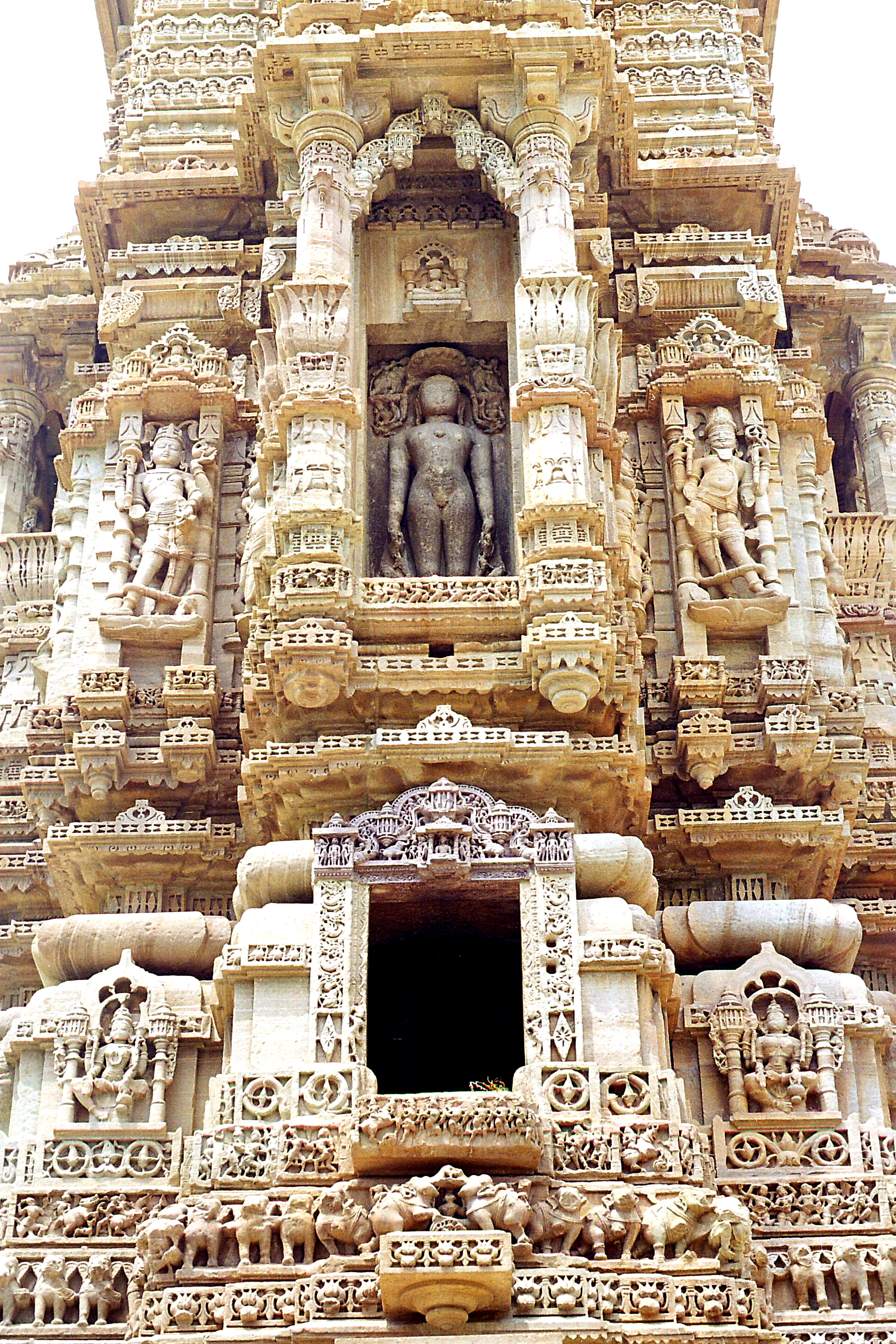 Detail of the Jain Kirti Stambha tower, Chittor Fort
3.jpg)

.jpg)

Medieval painting[edit | edit source]

Jain temples and monasteries had mural paintings from at least 2,000 years ago, though pre-medieval survivals are rare. In addition, many Jain manuscripts were illustrated with paintings, sometimes lavishly so. In both these cases, Jain art parallels Hindu art, but the Jain examples are more numerous among the earliest survivals. The manuscripts begin around the 11th century, but are mostly from the 13th onwards, and were made mainly in Gujarat, with some in Rajasthan. By the 15th century they were becoming increasingly lavish, with much use of gold.[3]
The manuscript text most frequently illustrated is the Kalpa Sūtra, containing the biographies of the Tirthankaras, notably Parshvanatha and Mahavira. The illustrations are square-ish panels set in the text, with "wiry drawing" and "brilliant, even jewel-like colour". The figures are always seen in three-quarters view, with distinctive "long pointed noses and protruding eyes". There is a convention whereby the more distant side of the face protrudes, so that both eyes are seen.[4]
Rajput painting[edit | edit source]
In the late 16th Century, the Rajput courts began to develop distinctive styles of miniature painting, combining indigenous as well as foreign influences such as Persian, Mughal, Chinese and European.[5] Rajasthani painting consists of four principal schools that have within them several artistic styles and substyles that can be traced to the various princely states that patronised these artists. The four principal schools are:
- The Mewar school that contains the Chavand, Nathdwara, Devgarh, Udaipur and Sawar styles of painting
- The Marwar school comprising the Kishangarh, Bikaner, Jodhpur, Nagaur, Pali and Ghanerao styles
- The Hadoti school with the Kota, Bundi and Jhalawar styles
- The Dhundar school of Amber, Jaipur, Shekhawati and Uniara styles of painting
Phad paintings[edit | edit source]
Phad paintings are colourful scroll paintings done on cloth, originally made to illustrate the performances of narratives by Bhopa singer/reciters. These have their own styles and patterns and are very popular due to their vibrant colors and historic themes. The Phad of God Devnarayan is largest among the popular Pars in Rajasthan. The painted area of God Devnarayan Ki Phad is 170 square feet (i.e. 34' x 5').[6] Some other Pars are also prevalent in Rajasthan, but being of recent origin they are not classical in composition.[6] Another famous Par painting is Pabuji Ki Phad. Pabuji Ki Phad is painted on a 15 x 5 ft. canvas.[6] Other famous heroes of Phad paintings are Gogaji, Prithviraj Chauhan, Amar Singh Rathore etc.[7]
Gallery[edit | edit source]
-
 Bani Thani painting
 -
 Purushkara Yantra, 18th century
 -

,_Kishangarh,_ca._1750,_National_Museum_New_Delhi.jpg)


Notes[edit | edit source]
- ↑ "Krishna and Radha". Philadelphia Museum of Art. Archived from the original on 27 October 2018. Retrieved 26 October 2018.
- ↑ Vaśishṭha, Rādhākr̥Shṇa; Vashistha, R. K. (1995). Art and artists of Rajasthan: a ... – Rādhākr̥shṇa Vaśishṭha. Abhinav Publications. p. 22. ISBN 9788170172840. Archived from the original on 2 July 2023. Retrieved 25 December 2021.
- ↑ Rowland, 341-343
- ↑ Rowland, Benjamin (1967). The Art and Architecture of India: Buddhist, Hindu, Jain (3 ed.). Pelican History of Art, Penguin. p. 343. ISBN 0140561021. Archived from the original on 25 December 2021. Retrieved 25 December 2021.
- ↑ Neeraj, Jai Singh (1991). Splendour Of Rajasthani Painting. New Delhi: Abhinav Publications. p. 13. ISBN 9788170172673. Archived from the original on 2 July 2023. Retrieved 15 October 2020.
- ↑ 6.0 6.1 6.2 Painted Folklore and Folklore Painters of India. Concept Publishing Company. 1976. Archived from the original on 2 July 2023. Retrieved 21 September 2016.
- ↑ Indian Murals and Paintings By Nayanthara S, p 15
Further reading[edit | edit source]
- Kossak, Steven (1997). Indian court painting, 16th-19th century. New York: The Metropolitan Museum of Art. ISBN 0870997831. (see index: p. 148-152)
- Daljeet (2018). Rajasthani Miniatures: The Magic of Strokes and Colours. Niyogi Books. ISBN 978-93-86906-26-7.