

>ShortDescBot ShortDescBot adding short description "Species of amphibian" |
m page fix |
||
| Line 3: | Line 3: | ||
| status = LC | | status = LC | ||
| status_system = IUCN3.1 | | status_system = IUCN3.1 | ||
| status_ref = <ref name=iucn>{{ | | status_ref = <ref name="iucn status 20 November 2021">{{cite iucn |author=Sushil Dutta, Mohammed Firoz Ahmed, Saibal Sengupta, Debjani Roy, Sabitry Bordoloi |date=2004 |title=''Amolops gerbillus'' |volume=2004 |article-number=e.T58207A11746896 |doi=10.2305/IUCN.UK.2004.RLTS.T58207A11746896.en |access-date=20 November 2021}}</ref> | ||
|image= | | image = Amolops_gerbillus.jpg | ||
| image_caption = ''Amolops gerbillus'' | |||
| taxon = Amolops gerbillus | | taxon = Amolops gerbillus | ||
| authority = ([[Nelson Annandale|Annandale]], 1912) | | authority = ([[Nelson Annandale|Annandale]], 1912) | ||
| Line 11: | Line 12: | ||
}} | }} | ||
'''''Amolops gerbillus''''' is a species of [[frog]] found in [[Asia]]. It is native to northern and northeastern [[India]], [[ | '''''Amolops gerbillus''''', also known as the '''Yembung sucker frog''' or the '''gerbil stream frog''',<ref name=Frost/> is a species of [[frog]] found in [[South Asia]]. It is native to [[Bhutan]],<ref>{{cite web|url=https://www.inaturalist.org/observations?place_id=7707&subview=map&taxon_id=25901|title=Observations - iNaturalist|website=iNaturalist.org}}</ref> northern and northeastern [[India]], [[Myanmar]], eastern [[Nepal]] and [[Tibet]], where it is typically found in the south-facing foothills of the [[Himalayas]], along high-elevation hillstreams, mountain creeks and ponds.<ref name="iucn status 20 November 2021" /> It is an amphibious species, spending equal time basking in the sun and swimming and hunting in the water. | ||
==References== | ==References== | ||
{{Reflist|30em|refs= | {{Reflist|30em|refs= | ||
<ref name=Frost>{{cite web |url=http://research.amnh.org/vz/herpetology/amphibia/Amphibia/Anura/Ranidae/Amolops/Amolops-gerbillus |title=''Amolops gerbillus'' (Annandale, 1912) |author=Frost, Darrel R. |year=2017 |work=Amphibian Species of the World: an Online Reference. Version 6.0 |publisher=American Museum of Natural History | | <ref name=Frost>{{cite web |url=http://research.amnh.org/vz/herpetology/amphibia/Amphibia/Anura/Ranidae/Amolops/Amolops-gerbillus |title=''Amolops gerbillus'' (Annandale, 1912) |author=Frost, Darrel R. |year=2017 |work=Amphibian Species of the World: an Online Reference. Version 6.0 |publisher=American Museum of Natural History |access-date=25 February 2017}}</ref> | ||
}} | }} | ||
Latest revision as of 23:41, 1 October 2025
| Amolops gerbillus | |
|---|---|

| |
| Amolops gerbillus | |
Scientific classification 
| |
| : | [[Template:Taxonomy/Amolops]] |
| Species: | Template:Taxonomy/AmolopsA. gerbillus
|
| Binomial name | |
| Template:Taxonomy/AmolopsAmolops gerbillus (Annandale, 1912)
| |

| |
| Synonyms | |
|
Rana gerbillus Annandale, 1912 | |
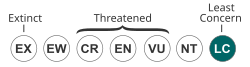
Amolops gerbillus, also known as the Yembung sucker frog or the gerbil stream frog,[2] is a species of frog found in South Asia. It is native to Bhutan,[3] northern and northeastern India, Myanmar, eastern Nepal and Tibet, where it is typically found in the south-facing foothills of the Himalayas, along high-elevation hillstreams, mountain creeks and ponds.[1] It is an amphibious species, spending equal time basking in the sun and swimming and hunting in the water.
References[edit | edit source]
- ↑ 1.0 1.1 Sushil Dutta, Mohammed Firoz Ahmed, Saibal Sengupta, Debjani Roy, Sabitry Bordoloi (2004). "Amolops gerbillus". IUCN Red List of Threatened Species. 2004 e.T58207A11746896. doi:10.2305/IUCN.UK.2004.RLTS.T58207A11746896.en. Retrieved 20 November 2021.
{{cite journal}}: CS1 maint: multiple names: authors list (link) - ↑ Frost, Darrel R. (2017). "Amolops gerbillus (Annandale, 1912)". Amphibian Species of the World: an Online Reference. Version 6.0. American Museum of Natural History. Retrieved 25 February 2017.
- ↑ "Observations - iNaturalist". iNaturalist.org.
 | This Ranidae article is a stub. You can help Bharatpedia by expanding it. |